
Article

New Insights into PLA/PVA Blends: Unraveling the Composition–Structure–Property Relationship of Biopolymer Films Prepared by Single-Solvent Casting

by
João Vitor Souto de Araújo Queiroz
1,
Clara Maria Marinho Serafim
1,
Emanuel Pereira do Nascimento
1,
Danilo Diniz Siqueira
2,
Renate Maria Ramos Wellen
3,
Edcleide Maria Araújo
1 and
Carlos Bruno Barreto Luna
1,*
1
Academic Unit of Materials Engineering, Federal University of Campina Grande, Av. Aprígio Veloso, 882-Bodocongó, Campina Grande 58429-900, PB, Brazil
2
MackGraphe, Mackenzie Institute for Research in Graphene and Nanotechnologies, São Paulo 01302-907, SP, Brazil
3
Department of Materials Engineering, Federal University of Paraíba, Cidade Universitária, João Pessoa 58051-900, PB, Brazil
*
Author to whom correspondence should be addressed.
Clean Technol. 2026, 8(4), 131; https://doi.org/10.3390/cleantechnol8040131
Submission received: 16 July 2026 / Revised: 8 August 2026 / Accepted: 12 August 2026 / Published: 14 August 2026

Abstract

Poly(lactic acid) (PLA) is a renewable and biodegradable polymer that has attracted considerable attention for sustainable packaging applications. However, its inherent brittleness limits its use in flexible films. In this study, PLA/poly(vinyl alcohol) (PVA) blend films were prepared by a single-solvent-casting rout at PLA/PVA weight ratios of 80/20, 70/30, 60/40, and 50/50 to investigate the influence of composition on their thermal, chemical, morphological, mechanical, optical, and water vapor barrier properties. Increasing the PVA content progressively modified the molecular organization of the system, the crystallization ability of the PLA phase and promoting a more homogeneous phase distribution. These structural changes resulted in a transition from a brittle behavior to increasingly ductile films, with the PLA/PVA 50/50 composition exhibiting the most favorable combination of tensile toughness, transparency, and morphological homogeneity, reaching an elongation at break of approximately 60%. In contrast, the increase in the hydrophilic phase led to higher water vapor permeability, highlighting the trade-off between mechanical performance and moisture barrier properties. Overall, the results demonstrate that controlling the PLA/PVA ratio provides an effective strategy for tailoring the morphology and functional properties of solvent-cast PLA/PVA films, contributing to a better understanding of the composition–structure–property relationships in biopolymer blends.

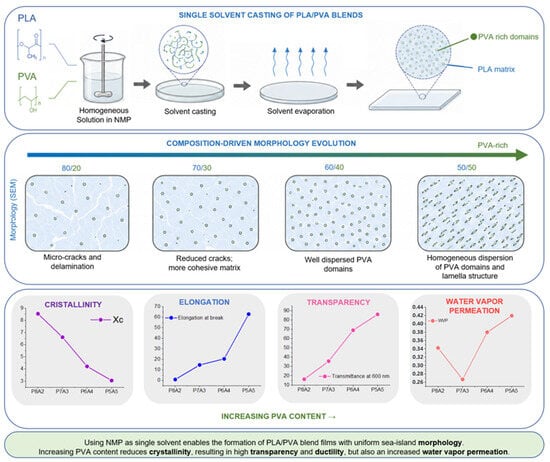
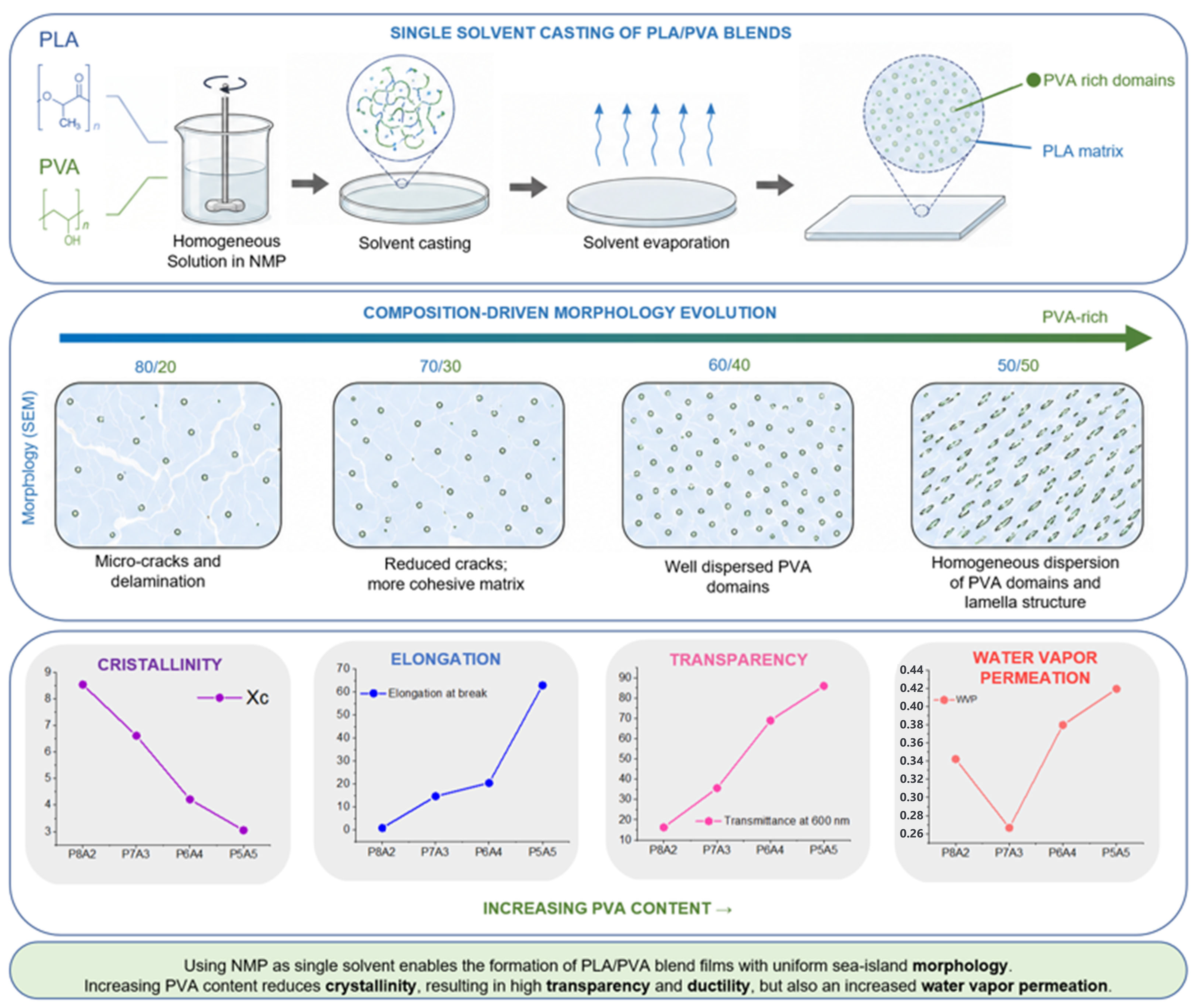
Graphical Abstract

1. Introduction

The growing demand for sustainable materials has stimulated the development of biodegradable polymers capable of replacing conventional petroleum-based plastics, particularly in short-service-life applications such as food packaging, disposable products and agricultural films [1,2,3]. Among the available biopolymers, poly(lactic acid) (PLA) has emerged as one of the most promising alternatives owing to its renewable origin, industrial processability, high mechanical strength, transparency and relatively low carbon footprint [4,5]. Nevertheless, despite these advantages, PLA exhibits intrinsic brittleness and limited elongation at break, considerably restricting its application in products requiring flexibility and toughness [6]. To overcome these limitations, polymer blending has become an attractive and cost-effective strategy, enabling the combination of complementary properties without altering the chemical structure of the constituent polymers [7,8].
Among the various polymers investigated as blending candidates for PLA, poly(vinyl alcohol) (PVA) has attracted considerable attention due to its biodegradability, excellent film-forming ability, flexibility, transparency and outstanding oxygen barrier properties [9,10]. Consequently, PLA/PVA blends have been extensively investigated as sustainable materials for various applications, aiming to combine the stiffness and processability of PLA with the ductility and hydrophilic character of PVA [11,12].
PLA/PVA blends can be prepared through conventional thermoplastic processing techniques, such as extrusion, injection molding and internal mixing, as well as by solution-based methods including electrospinning and solvent casting [13,14,15]. Among these approaches, solvent casting offers important advantages for producing thin films under mild processing conditions. However, this route remains challenging because PLA and PVA possess markedly different polarities, making it difficult to identify a common solvent capable of dissolving both polymers simultaneously. Consequently, most studies have relied on water/oil emulsions or multiple-solvent systems, such as ethyl acetate/water or chloroform/water, which consistently exhibit pronounced sea-island morphologies and brittle behavior when PLA constitutes the continuous phase and a great loss in transparency [16,17]. Even when a single solvent like hexafluoroisopropanol (HFIP) was successfully employed by Wang et al., Ref. [18] to produce PLA/PVA films, PVA remained the continuous phase, and PLA contents above 10 wt.% promoted severe particle agglomeration and embrittlement. Thus, although the feasibility of single-solvent processing has been demonstrated, the relationships between composition, phase morphology, crystallization behavior, and functional properties of PLA-rich solvent-cast PLA/PVA films remain insufficiently understood.
Regardless of the processing route, the properties of PLA/PVA blends are fundamentally governed by the interactions established between the two polymer phases. Hydrogen bonding between the hydroxyl groups of PVA and the ester groups of PLA generally promotes partial miscibility within the amorphous phase [19]. Although these interactions are insufficient to suppress phase separation in the crystalline regions, resulting in the formation of the characteristic phase-separated sea-island morphology with weak interface adhesion, in which PVA-rich domains are dispersed but not attached to the PLA matrix [20]. Such heterogeneous microstructures strongly influence stress transfer across the interface and, consequently, the mechanical performance of the material [21].
Another aspect that remains controversial concerns the role of PVA in the crystallization behavior of PLA. Some studies reported that PVA may act as a nucleating agent, accelerating PLA spherulite growth [22,23]. In contrast, other studies associate increasing PVA content with reduced crystallinity due to restricted chain mobility and phase confinement promoted by intermolecular interactions [20]. These apparently contradictory observations suggest that the influence of PVA on PLA crystallization cannot be explained by a single mechanism and is likely governed by the combined effects of blend composition, molecular characteristics of PVA and processing conditions. Consequently, the relationship between crystallization, phase morphology and functional properties remains insufficiently understood. Collectively, these studies demonstrate that both processing route and blend composition profoundly influence phase organization. Nevertheless, they also reveal that the mechanisms governing structural evolution during film formation are still far from being fully elucidated.
Despite the growing number of investigations on PLA/PVA blends, a unified understanding of how blend composition governs molecular interactions, crystallization, phase morphology and, ultimately, the functional properties of solvent-cast films are still lacking. Most available studies focus either on processing optimization, compatibilization strategies or specific end-use applications, whereas systematic correlations between structural evolution and mechanical, optical and barrier properties remain scarce. In particular, studies capable of isolating the effect of blend composition using a single-solvent-casting route are still limited.
Therefore, this work investigates how the PLA/PVA ratio governs the composition–structure–property relationship of PLA-rich solvent-cast blend films prepared using 1-Methyl-2-pyrrolidone (NMP) as a single solvent rout of processing. Particular emphasis is placed on correlating molecular interactions, crystallization behavior, phase morphology, mechanical performance, transparency and water vapor permeation to provide new insights into the structural evolution of PLA/PVA blends.

2. Methodology

2.1. Materials

Polylactic acid (PLA), Ingeo Biopolymer 3D850 grade, manufactured by NatureWorks, Blair, NE (USA), with a density of 1.24 g/cm3, relative viscosity of 4.0, melt flow index between 7 and 9 g/10 min, glass transition temperature between 55 and 60 °C, and molecular weight of 1115.00 kDa. Polyvinyl alcohol (PVA) presenting a molecular weight of 104.5 kDa and a degree of hydrolysis of 88%, purchased from Neon, Rio de Janeiro (Brazil). 1-Methyl-2-pyrrolidone (NMP) AR/ACS grade, purchased from Neon, Rio de Janeiro (Brazil).

2.2. Blends Processing

The formulations of the blends prepared in this work are summarized in Table 1. Initially, individual PLA and PVA solutions were prepared by dissolving each polymer in 25 mL of NMP under constant magnetic stirring (Model 752A Magnetic Stirrer, Fisatom, São Paulo, Brazil). The PLA solution was maintained at 100 °C and the PVA solution at 80 °C, both in sealed beakers to minimize solvent loss, at 300 rpm for 30 min, until the complete dissolution of the polymers. Subsequently, the solutions were mixed in a magnetic stirrer without heating for an additional 30 min; the final blend composition was controlled by the individual concentration of each polymer in its respective 25 mL solution, while maintaining a total polymer concentration of 5% (w/v) in the final solution.
The solvent evaporation step was carried out by pouring 45 mL of the final polymer solution onto a Teflon plate measuring 200 × 100 mm. The assembly was immediately transferred to a forced-air oven equipped with an exhaust system (Nova Ética, São Paulo, Brazil) and heated at 80 °C for 24 h. After this period, the films could be peeled off the plate.
A solvent-cast neat PLA film could not be obtained under the processing conditions employed in this study, as the PLA solution did not produce a continuous self-supporting film after solvent evaporation. Therefore, a compression-molded PLA film prepared from the same polymer grade was used as the reference material. Although this approach introduced a difference in the processing route, it provided a suitable reference for the base polymer, and this limitation should be considered when comparing the neat PLA with the solvent-cast blends. The neat PLA reference film was prepared by placing 3 g of PLA between two Teflon sheets and compression molding at 190 °C, using a heating time of 3 min, followed by 4 min under a 5-ton load and subsequent cooling outside the press under ambient conditions for 3 min with a 9 kg weight applied to maintain film flatness. For consistency, neat PVA films were also prepared as reference materials using the same solvent-casting procedure employed for the blends, except that the PLA dissolution and homogenization steps were omitted.

2.3. Characterizations

Fourier Transform Infrared Spectroscopy coupled with Attenuated Total Reflectance (FTIR-ATR) was employed to examine the chemical structure of the prepared films. The measurements were conducted using a Bruker Alpha II spectrometer, operating in the wavenumber range of 4000–400 cm−1, with a spectral resolution of 4 cm−1 and 32 accumulated scans for each sample. The spectra were normalized to the maximum absorbance prior to qualitative analysis.
The light transmittance of the films was evaluated by UV–Vis spectroscopy over the wavelength range of 200 to 800 nm using a UV-M51 spectrophotometer supplied by Bel Photonics. The opacity values were calculated according to Equation 1 using measurements obtained from three independent specimens of each film composition. The results were statistically analyzed by one-way ANOVA followed by Tukey’s post hoc test (α = 0.05), using Minitab 16 software.
Opacity = A 600 x  
where A600 is the absorbance at 600 nm obtained from the −log(T600) (log transformed transmittance at 600 nm) values and x is the thickness in mm for each specimen.
The glass transition (Tg), crystalline melting (Tm), cold crystallization (Tcc), and crystallization (Tc) temperatures, as well as the degree of crystallinity (Xc) of the samples, were determined using a Shimadzu DSC-60 (Kyoto, Japan). Approximately 3 mg of each sample was placed in a sealed aluminum crucible and subjected to a first heating, a cooling, and a second-heating scan at a rate of 10 °C/min over a temperature range of 30 to 220 °C, under an inert nitrogen atmosphere with a constant gas flow of 50 mL/min. Following the analyses, Xc was calculated using Equation (2) based on data from the second-heating scan:
x c = Δ H f Δ Hcc H μ × w × 100
where Xc is the degree of crystallinity of the polymer, ΔHf is the enthalpy change associated with crystal melting in the samples, ΔHcc is the enthalpy change associated with cold crystallization (occurring in PLA), w is the polymer fraction in the blend, and Hμ is the enthalpy of fusion for the 100% crystalline polymer, 93.7 J/g for PLA [24], and 138.6 J/g for PVA [25]. The Xc of the PLA phase in the blends was calculated using the PLA weight fraction in each composition and the Hμ of 100% crystalline PLA. The enthalpies were determined by numerical integration of the corresponding thermal events using the Shimadzu LabSolutions TA 1.02 software. For each event, a linear baseline was defined between the on-set and end-set temperatures before peak integration.
The cross-sectional morphology of the films was investigated using scanning electron microscopy (SEM), with the cross-section exposed via cryogenic fracture in liquid nitrogen. Analyses were conducted using a TESCAN VEGA 3 scanning electron microscope (Brno, Czech Republic) operating in high vacuum at an accelerating voltage of 10 kV, with magnifications of 1000×, 2000×, 5000×, and 10,000×. Samples were pre-coated with a thin layer of gold deposited for 2 min using a sputtering system. The images were analyzed using ImageJ 1.54d software; images at 1000× magnification were used to measure film thickness, while images at 10,000× magnification were used to determine average domain size.
Values for elastic modulus, tensile strength and elongation at break were obtained in accordance with ASTM D882-18 using an Oswaldo Filizola BME universal mechanical testing machine (São Paulo, Brazil) equipped with a 500 N load cell, metallic grips that closed manually, and serrated surfaces to prevent specimen slippage during testing. Tests were performed on 10 specimens per sample, obtained from two independent films each, measuring 100 × 10 mm, at a grip separation rate of 5 mm/min and an initial gauge length of 50 mm. The Young’s modulus was calculated from the initial linear region of the stress–strain curve (0.1–0.25% strain range), considering the eventual toe compensation. The failure criterion was defined as the complete rupture of the specimen. The test specimens were conditioned at room temperature (23 ± 2 °C) and a relative humidity of 50 ± 10% for at least 40 h prior to testing, and these same conditions were maintained during the tests. Minitab software was used for the statistical analysis of the results.
The water vapor permeation test was conducted in accordance with the ASTM E96-16 standard. Following the Water Method, the films were cut and sealed onto glass containers filled halfway with distilled water; the assembly was weighed and placed in a sealed chamber containing a desiccant (silica gel) at a room temperature of 25 °C. The test was performed in duplicate for each composition, with weight taken at 1 h intervals during the first 5 h and every 24 h over a period of 8 days. The water vapor transmission rate (WVTR) was determined from the slope of the linear regression fitted to the mass-loss versus time plot (Equation (3)), using the initial mass and the subsequent mass measurements recorded every 24 h. The water vapor permeability (WVP) was calculated according to Equation (4).
WVTR = G tA
WVP = WVTR × L P RH 1 RH 2
where G is the mass change in grams, t is the time over which the change occurred in hours (with G/t representing the slope of the line), and A is the exposed area in m2. For Equation (3), L is the film thickness in mm, measured for each specimen individually using a digital micrometer, P is the saturated water vapor pressure at 25 °C (3.17 kPa), RH1 is the relative humidity inside the container (assumed to be 100% or 1), and RH2 is the relative humidity outside (10% or 0.1), as indicated by a thermo-hygrometer placed inside the sealed chamber.

3. Results and Discussion

3.1. Fourier Transform Infrared Spectroscopy (FTIR)

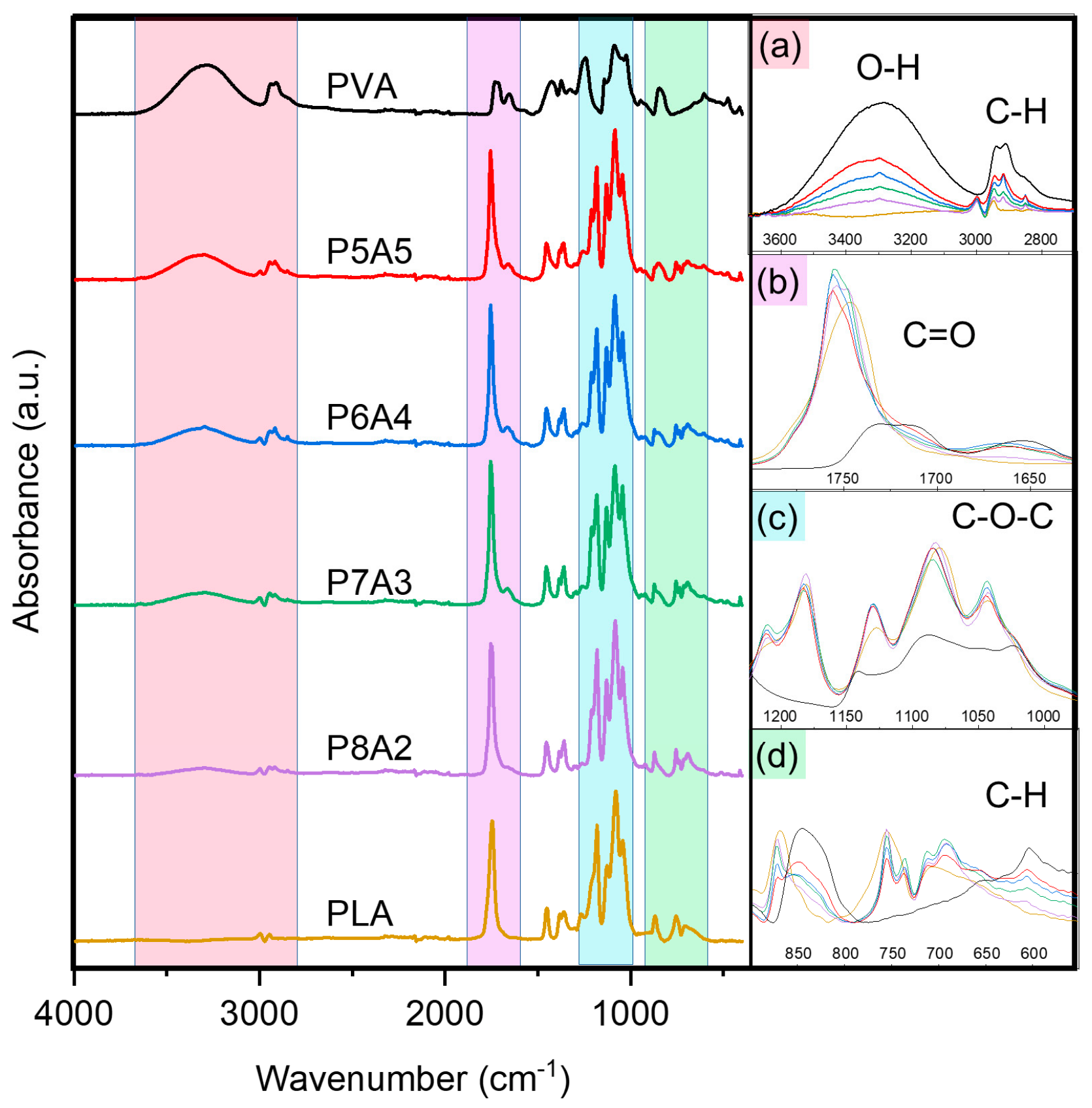
The FTIR spectra of PLA, PVA, and the blends P8A2 (80/20), P7A3 (70/30), P6A4 (60/40), and P5A5 (50/50) are illustrated in Figure 1. For PLA, characteristic bands appear at 2998 and 2946 cm−1, corresponding to C-H stretching vibrations of methyl and methylene groups, respectively; an intense band at 1747 cm−1 is attributed to the carbonyl (C=O) stretching mode; and CH3 and CH vibrations appear at 1452 and 1359 cm−1, respectively. Additionally, bands at 1127, 1080, and 1043 cm−1 are associated with C-O-C bonds [26,27]. The O-CH-CH3 group stretching vibration is present around 869 cm−1, and the α-CH3 methyl group bending vibration appears at 755 cm−1 [28].
For PVA, a broad band appears around 3280 cm−1, characteristic of the symmetric stretching of the hydroxyl (O-H) group, as well as a band at 1425 cm−1 related to asymmetric stretching. Bands at 2939 and 2911 cm−1 are associated with the asymmetric stretching vibration of the CH2 group, while bands at 1731 and 1655 cm−1 correspond to the C=O bond of the acetate group still present in the partially hydrolyzed PVA molecules. At 1326 and 1242 cm−1, it is possible to observe bands characteristic of CH2 in the out-of-plane and bending vibration modes, respectively, and at 947 and 844 cm−1 in the wagging mode [29,30].
For the blends, the main bands of the original polymers were retained, with intensities proportional to their concentrations. The band associated with the PVA hydroxyl (O-H) group shifted to a higher wavenumber (3298 cm−1), as did the carbonyl (C=O) band, which exhibited a double peak at 1756 and 1747 cm−1, as shown in insets (a) and (b) of Figure 1, possibly due to intermolecular hydrogen-bonding interactions [31,32].
The band that was previously partially overlapped in the PVA spectrum appears more defined in the blends at 2850 cm−1 and is associated with C-H stretching (inset (a), Figure 1) [33]. Similar behavior was observed for the peaks at 1210, 735, and 694 cm−1, which were previously partially overlapped in the PLA spectrum (insets (c) and (d), Figure 1). This spectral range is associated with C-H group vibration modes (rocking and wagging); the increased definition may result from changes in the molecular environment and structural reorganization driven by intermolecular interactions and band overlapping [34]. These findings, therefore, indicate that the polymers interact at the molecular level.

3.2. Differential Exploratory Calorimetry (DSC)

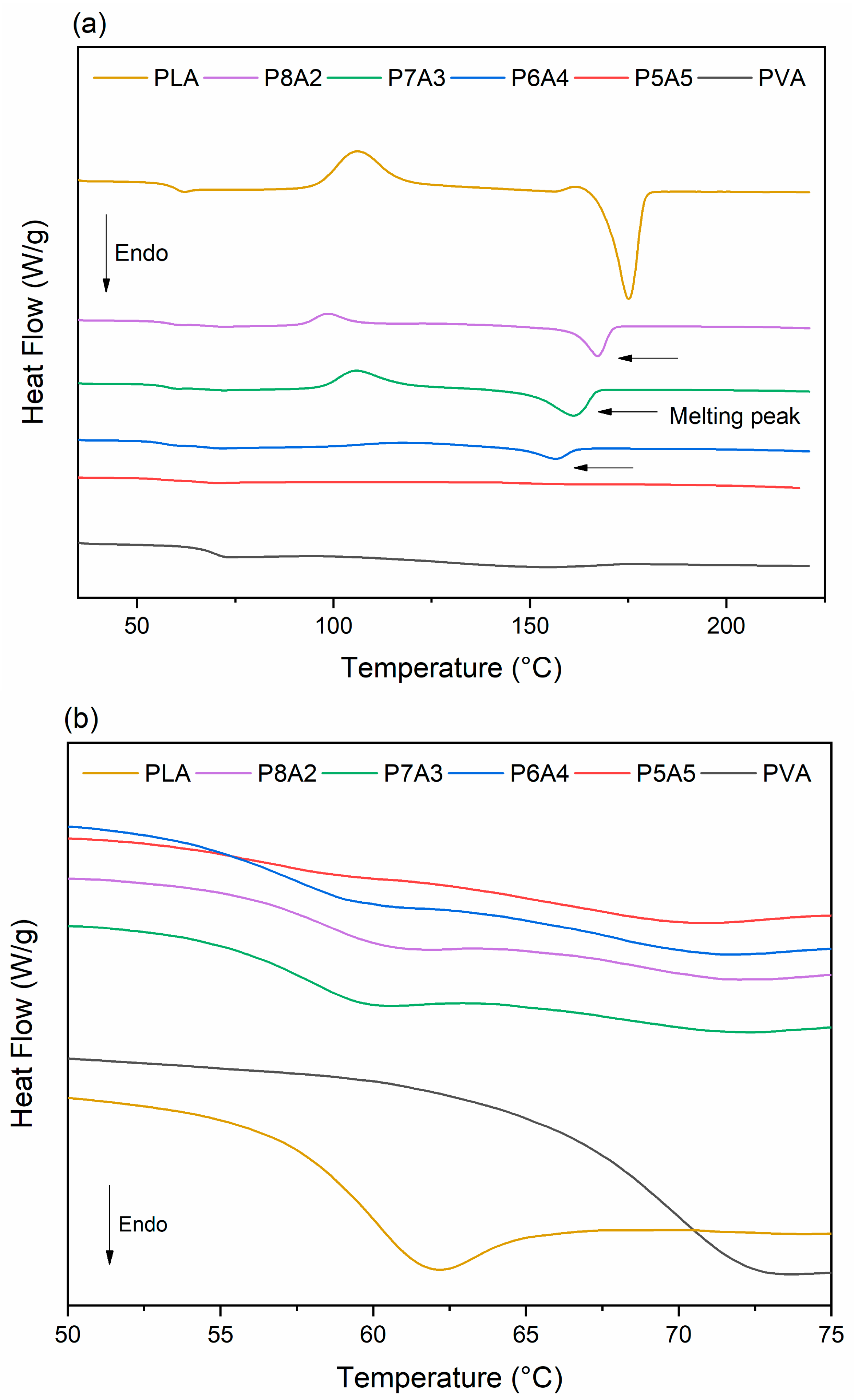
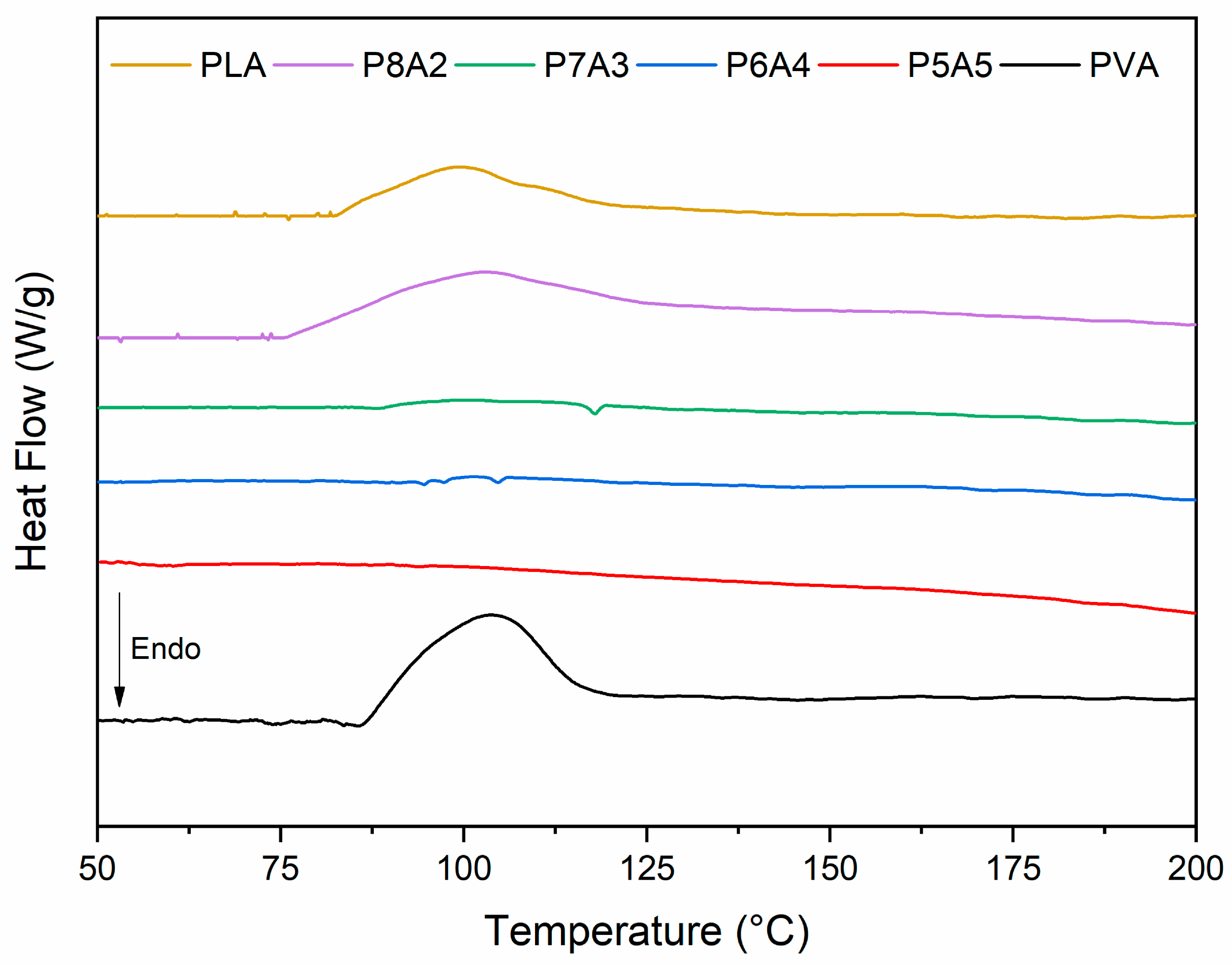
Figure 2a illustrates the DSC curves for the second-heating run of PLA, PVA, and their blends, as well as an inset (b) covering the 50–75 °C range, while Table 2 lists the transition temperatures and enthalpy changes. It can be observed that PLA exhibited a typical curve, with a glass transition (Tg) around 58 °C, an exothermic peak at 108 °C corresponding to cold crystallization (Tcc), which occurs when molecules gain sufficient mobility to crystallize during heating, and an endothermic peak at 175 °C, associated with the melting of the crystals (melting temperature (Tm)). Similar values have been reported in the literature [24,35]. In addition, its degree of crystallinity of 14.79% indicates a predominantly amorphous polymer [36].
PVA, in comparation with PLA, exhibits a higher Tg of 68.75 °C and a broad, low-intensity melting peak at 154.46 °C, with a degree of crystallinity of 6.52%. It is considered as a predominantly amorphous polymer containing heterogeneous crystals, a feature directly associated with its molecular weight and relatively low degree of hydrolysis. Despite the high Tg, PVA films are flexible at room temperature due to the presence of moisture, as water acts as a plasticizer for this polymer, which possesses a high density of hydroxyl groups in its structure [37]. Furthermore, partially hydrolyzed PVA contains acetate groups, remains from poly(vinyl acetate), that reduce polymer chain regularity, thereby resulting in less perfect crystals and a lower crystallinity degree [38].
All blends still exhibit the two Tg values of the original polymers, as seen in inset (b) of Figure 2, although shifted toward lower temperatures, characteristic of an immiscible blend, yet one has interactions that slightly shift the transition to lower temperatures. Regarding Tcc, exothermic peaks appear in blends P8A2, P7A3 and P6A4, with 20, 30 and 40 wt.%, respectively, but its peak is less pronounced than in PLA, and the peak for sample P6A4 is broad, has low-intensity, and is shifted to higher temperatures, indicating that PVA hinders PLA crystallization during heating. In addition, P5A5 (50 wt.%), the composition with the most PVA content, did not exhibit a cold crystallization peak.
The crystalline melting peak, on the other hand, is singular and shifted to temperatures intermediate between the PLA and PVA endothermic peaks, moving closer to the PVA Tm value as its proportion increases. This behavior may suggest the formation of increasingly imperfect crystals, where PVA likely acts as a defect that hinders crystal formation, a hypothesis supported by the literature [13]. The crystallinity degree also decreases as the PVA proportion increases, reaching a minimum of 3.05% for the P5A5 blend, a value lower than that of pure PVA, thereby supporting the thesis that crystallization is hindered in the blend. For completeness, the first-heating DSC thermograms are provided in the Supplementary Information (Figure S1). They show the same overall thermal trends as the second-heating scans; however, the latter were used for crystallinity calculations to minimize the influence of processing history.
The progressive reduction in the crystallization ability of the PLA phase, reflected by the lower crystallinity tendency, suggests an a more amorphous microstructure. Such structural changes are generally associated with properties that are advantageous for flexible polymer films. A larger amorphous fraction may facilitate additive incorporation and molecular diffusion within the matrix, while also promoting lower stiffness and greater ductility owing to increased chain mobility. Likewise, the increased free volume typically associated with less crystalline materials may reduce barrier performance while improving optical transparency by decreasing light scattering caused by crystalline domains [39,40,41,42]. These trends are consistent with the mechanical, water vapor permeability, and optical properties observed for the investigated PLA/PVA blends, indicating that crystallization behavior, together with phase morphology, plays an important role in determining their functional performance.
Although some studies report the nucleating effect of certain PVA grades on PLA [14,22], only PVA at concentration of 20% promoted reduction in Tcc value and crystallization peak during cooling, while at proportions of 30%, 40%, and 50% almost completely inhibited the crystallization of the blend, as shows the cooling DSC curves in Figure 3. Whether PVA acts as a nucleating agent or as an obstacle for PLA crystallization will depend on its content, degree of hydrolysis and molecular weight, as well as the partial miscibility between the two grades of polymers.

3.3. Scanning Electron Microscopy (SEM)

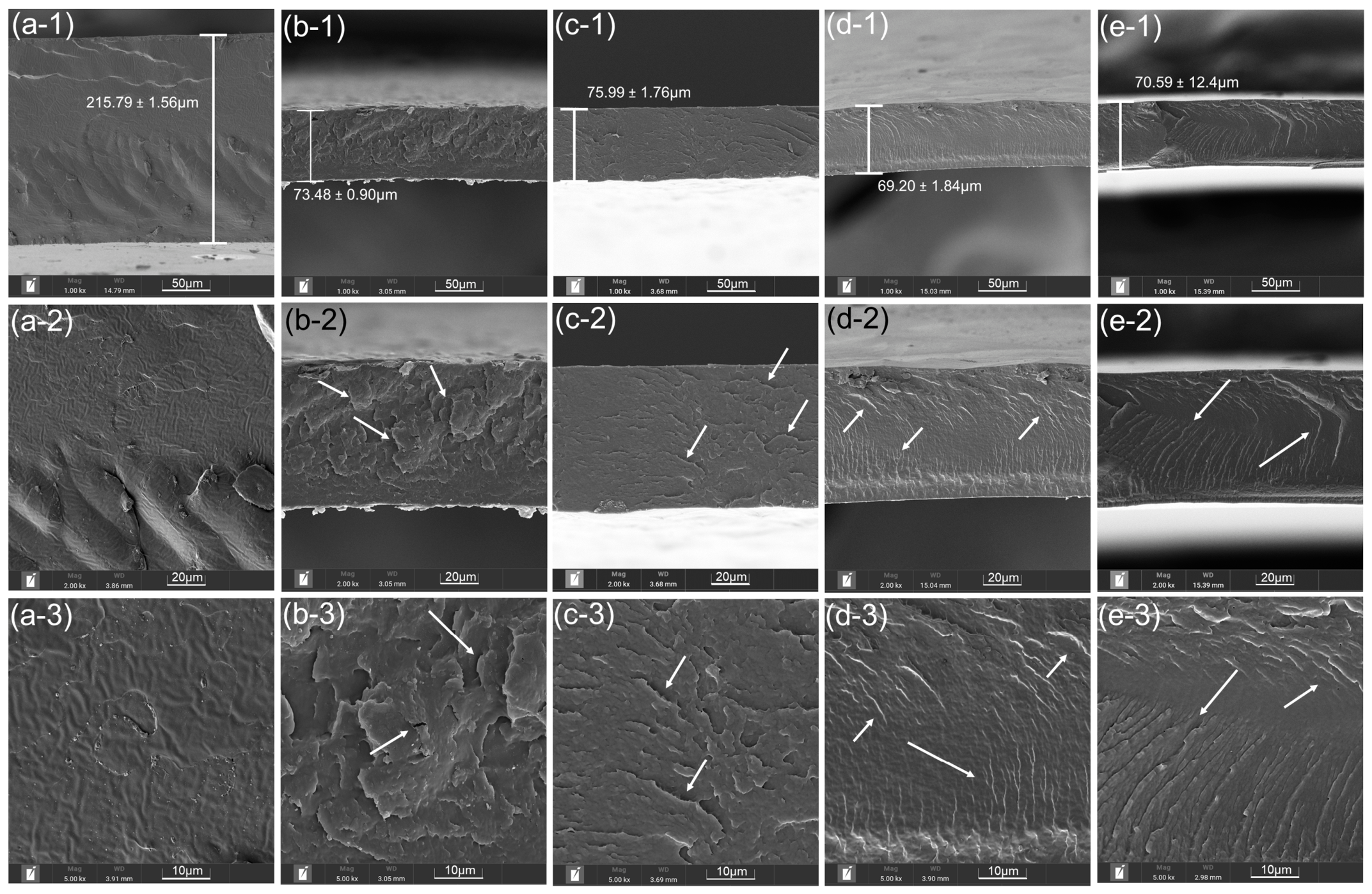
Measuring the cross-sectional images of films fractured in liquid nitrogen (Figure 4), the blend films obtained via solvent evaporation exhibited very similar thicknesses: 73.48 ± 0.90 μm for P8A2, 75.99 ± 1.76 μm for P7A3, 69.20 ± 1.84 μm for P6A4, and 70.59 ± 1.24 μm for P5A5. In contrast, the PLA film obtained via hot press measured 215.79 ± 1.56 μm in thickness. It should be noted that differences observed between neat PLA and the blends may arise not only from blend composition but also from the distinct processing routes. Therefore, comparisons with neat PLA are intended primarily to provide a reference for the base polymer, whereas the discussion of composition-dependent trends focuses on the solvent-cast PLA/PVA blends.
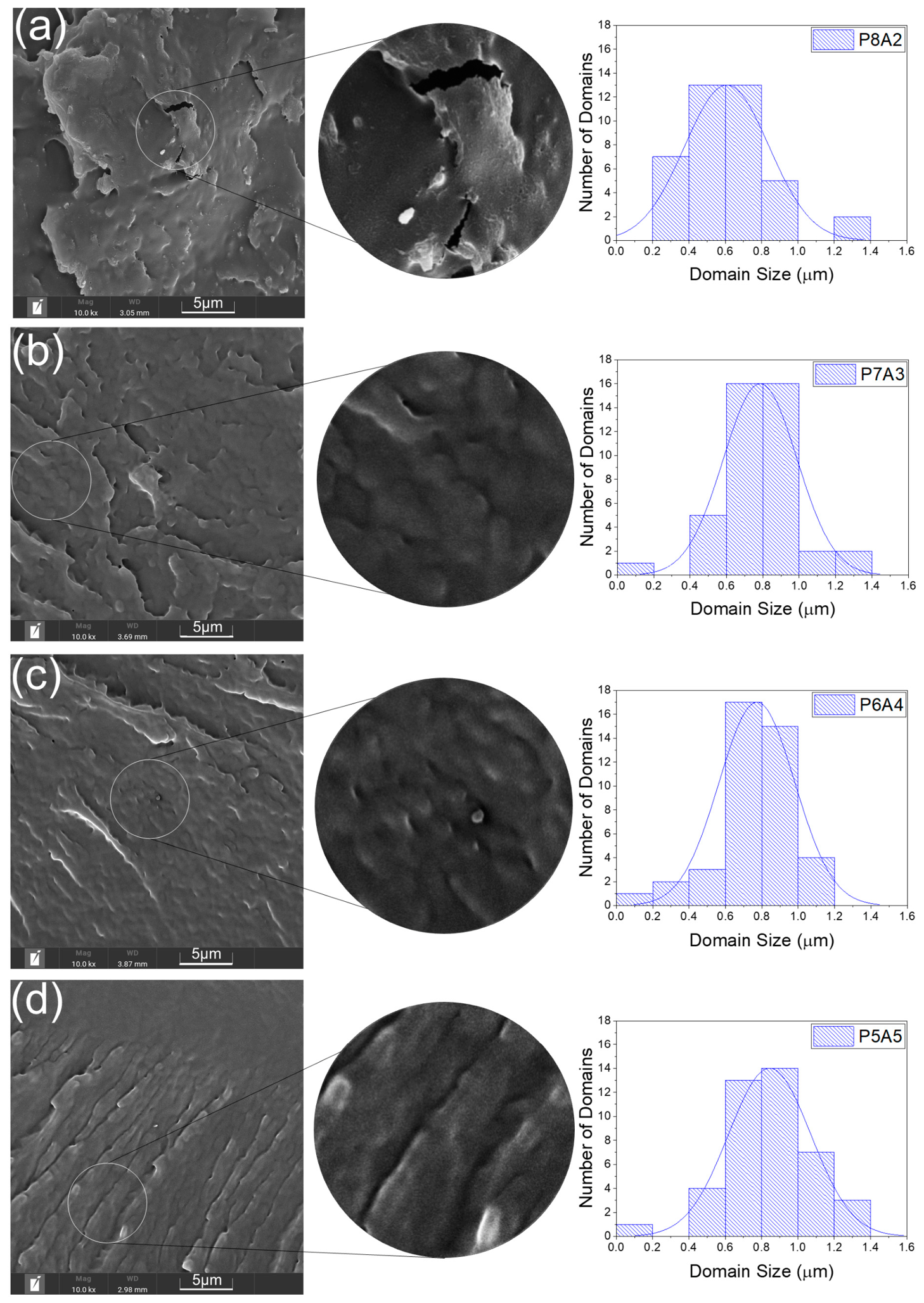
The fracture morphology of the PLA film displayed the polymer’s typical brittle character, showing virtually no roughness (Figure 4a). Conversely, images of P8A2 reveal irregularities, micro-cracks, and small white particles, which may be associated with localized crystallization, distributed across a fracture surface organized into smooth, delaminated layers (as indicated by the arrows in Figure 4(b-2,b-3)), which are indicative of a brittle material [43]. Small, irregular domains were also observed throughout the matrix, which is consistent with a PVA rich phase, as illustrated in Figure 5a, with an average size of 0.59 ± 0.23 μm. These characteristics suggest that, at this concentration and heterogenous distribution of PVA domains, the structure was further embrittled, a finding later confirmed by tensile tests.
In the images for the P7A3 (Figure 4c), the structure appears more homogeneous; while layered features are still discernible, they are visible only at magnifications of 2000× and 5000× (Figure 4(c-2,c-3)). The domains associated with PVA-rich phase appear roughly spherical and without detachment from the PLA matrix, and indicative of good adhesion. This morphology is known as “sea-island” and is commonly found in PLA/PVA blends [17,44]. The dispersed phase size is 0.80 ± 0.16 μm (Figure 5b); this is directly related to the partial compatibility between the two polymers, enabling good interfacial adhesion and homogeneous domains. The higher PVA concentration promotes cohesion among its molecules.
With 40% of PVA, P6A4, there is no longer a layered structure but a high density of sphere-like domains, with sizes very similar to those in P7A3, 0.79 ± 0.17 μm (Figure 5c). This morphology reflects the blend’s mechanical properties, which show significantly higher elongation compared to the composition with a lower proportion of the second polymer. The literature reports that the sea-island morphology in polymer films enables greater deformation and retards crack propagation [45]. Furthermore, regions with light-colored lamellae indicated by the arrows in Figure 4(d-2,d-3) are visible in P6A4, these may be associated with plastic deformation, indicating a greater capacity for energy dissipation via shear deformation, even during cryogenic fracture [46].
Finally, the P5A5 (50 wt.%) composition retained the refined morphology observed for P6A4, although with an even higher density of dispersed domains, exhibiting an average size of 0.86 ± 0.19 μm (Figure 5d). In addition, some domains displayed a slight elongation into ellipsoidal shapes. Under cryogenic fracture, P5A5 also exhibited more extensive lamellar-like regions than P6A4, as indicated by the arrows in Figure 4(e-2,e-3). These fractographic features are consistent with increased energy absorption during fracture.
Although the SEM micrographs of P5A5 still exhibit a morphology composed of fine spherical-like domains, the equal PLA/PVA ratio may also favor the development of an interconnected network or the on-set of phase inversion. Similar behavior has been reported for PLA/PVA blends at a 50/50 composition. For example, Chuaponpat et al. [44] observed a sea-island morphology in melt-processed PLA/PVA blends, but after selective extraction of the PVA phase, an interconnected porous structure was revealed, suggesting that co-continuous phase organization may exist but cannot always be directly identified by conventional SEM.
These morphological observations were consistent with the tensile test results, where P5A5 exhibited significantly higher elongation at break and tensile toughness than the other compositions. Collectively, these results suggest that increasing the PVA content, together with the refined phase morphology obtained by the single-solvent-casting route, favors a transition toward less brittle mechanical behavior.

3.4. Tensile Properties

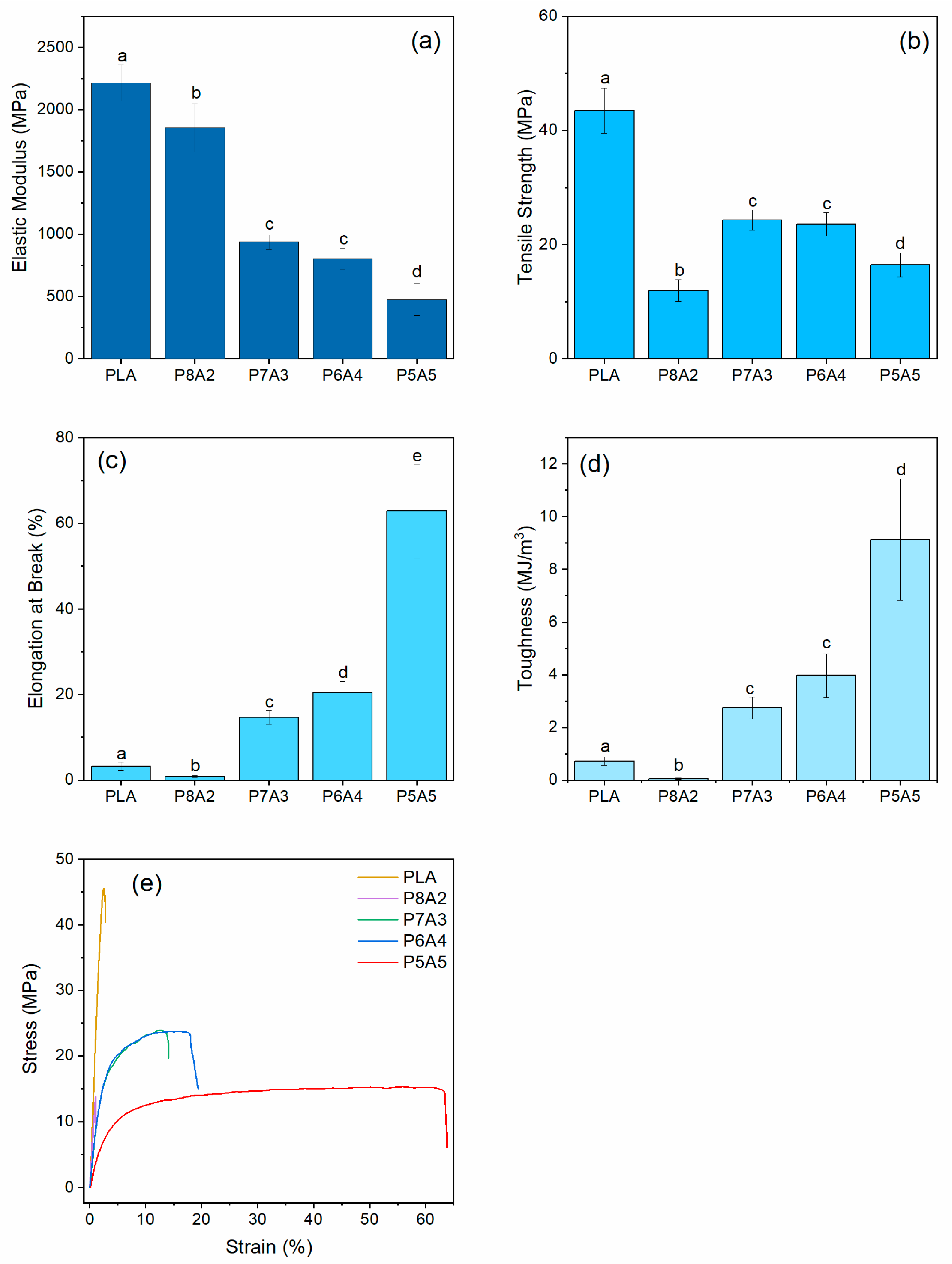
For statistics analyses, normality was assessed for each dataset using the Anderson–Darling method, and Levene’s test was used to verify the homogeneity of variances. Being p > 0.05 for both, a one-way ANOVA was performed, followed by Tukey’s post hoc test (α = 0.05). Statistical analyses regarding elongation and tensile toughness were conducted on log-transformed data to satisfy the criteria for homogeneity of variance. Figure 6 displays the graphs showing the tensile-strain properties of the evaluated samples; statistically different results are indicated by different letters in each column.
The graph in Figure 6a displays a progressive decrease in the Young’s modulus of the blends with increasing PVA concentration, particularly above 30 wt.%. No statistically significant difference was observed between the 30% and 40% PVA formulations (P7A3 and P6A4), followed by a further reduction at the maximum investigated content of 50 wt.% (P5A5). Regarding tensile strength, Figure 6b, the P8A2 composition (20 wt.% PVA) exhibited the lowest values among all evaluated samples, which directly correlates with its premature failure and low elongation at break, Figure 6c. This indicates that a low PVA content (20 wt.%) induces severe embrittlement, yielding a behavior even more brittle than that of neat thermoformed PLA. This phenomenon is consistent with the microcracks identified via SEM and the higher degree of crystallinity of this specific blend compared to the others. While the tensile strength remained statistically equivalent between P7A3 and P6A4, a further decrease was observed for P5A5.
Compared to neat thermoformed PLA and the P8A2 blend, the other formulations exhibited a remarkable increase in elongation at break, particularly P5A5, which achieved an average elongation exceeding 60% (yielding the trend: P8A2 < PLA < P7A3 < P6A4 << P5A5). Although the incorporation of PVA reduced the tensile strength of the blends, this reduction was offset by the substantial increase in elongation at break, resulting in progressively higher toughness. Accordingly, P5A5 exhibited the highest toughness, with values around 9.1 MJ/m3 (Figure 6d), indicating a balanced strength–ductility trade-off in the mechanical properties of the blends. Such a combination is particularly attractive for flexible packaging applications, where the ability to absorb mechanical energy and resist crack propagation is desirable [47].
This enhanced performance of P5A5 is consistent with the refined morphology and homogeneously dispersed PVA domains, which can promote efficient interfacial stress transfer. Above 30 wt.% PVA, the film ductility increases significantly, driven by the inherent high deformation capacity of PVA, supported by its extensive intermolecular hydrogen-bonded network [48]. This behavior was further favored by the partial compatibility between the polymer phases, supported by the intermolecular interactions suggested by FTIR and by the dislocated Tg values revealed by DSC [13,20]. Consequently, the combined effects of chemical interactions, refined phase morphology and a predominantly amorphous structure enabled the transition from brittle to ductile behavior without the need for additional plasticizers or compatibilizers.

3.5. UV-Vis Spectroscopy

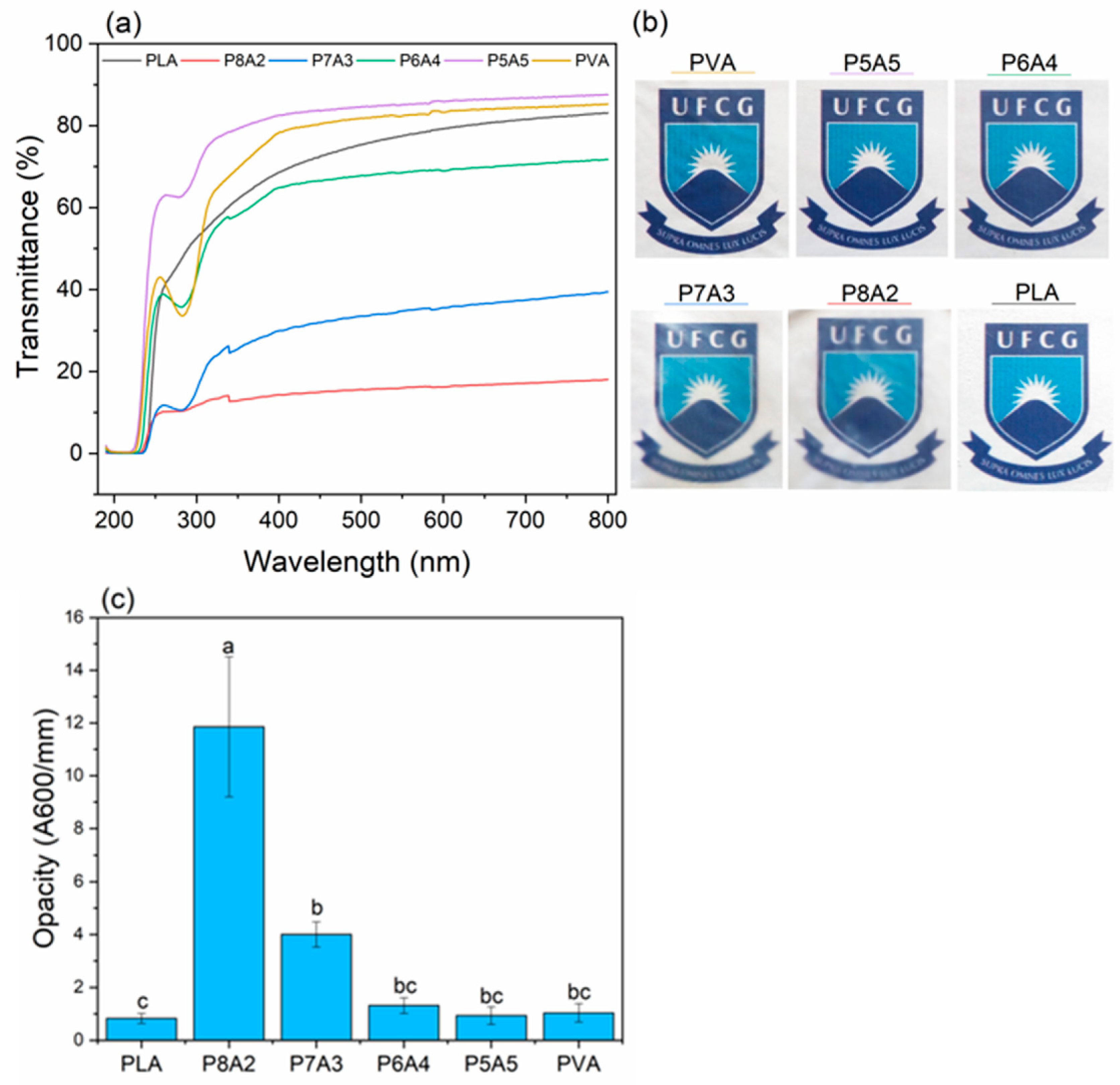
The UV-Vis transmittance spectra of the developed films, shown in Figure 7a, illustrate the optical behavior of the materials across the 200 to 800 nm spectral range. For the PLA film used as a reference, virtually complete radiation blockage was observed up to approximately 237 nm, followed by a gradual increase in transmittance as the wavelength increased; transmittance was around 45% at 280 nm and reached 80% at 600 nm. This behavior aligns with expectations for compression-molded PLA films, which exhibit partial ultraviolet radiation blockage and high transparency in the visible region. The high transmittance in this range is attributed to the predominantly amorphous nature of PLA, which reduces light scattering and facilitates the transmission of visible light, giving the film a transparent appearance [49].
PVA also exhibited high optical transparency, a characteristic widely reported for this polymer [50,51,52]. Its UV-Vis spectrum exhibited a cutoff wavelength around 225 nm and an inflection near 280 nm, where transmittance was 33.57%. This behavior is likely linked to the presence of residual acetate groups resulting from the incomplete hydrolysis of poly(vinyl acetate); these groups can undergo π–π* electronic transitions, particularly in partially hydrolyzed PVA grades [53]. In the visible region, the film maintained high transmittance, reaching around 83% at 600 nm, a result consistent with the material’s predominantly amorphous nature and the absence of chromophore groups capable of absorbing radiation in this spectral range [54]. Among the blends, P8A2 displayed the lowest transmittance over nearly the entire analyzed wavelength range, followed by P7A3. Increasing the PVA fraction progressively enhanced visible-light transmittance, with P5A5 exhibiting the highest values among all investigated materials.
The opacity values calculated from the absorbance at 600 nm normalized by film thickness are presented in Figure 7c. The composition P8A2 exhibited a significantly higher opacity than all other materials of 11.85 ± 2.65, whereas P6A4 and P5A5 were statistically comparable to neat PLA (0.83 ± 0.19) and PVA (1.04 ± 0.35) with 1.32 ± 0.29 and 0.94 ± 0.34, respectively. P7A3, despite the lower transmittance and less transparent aspect, analyzing the photographs in Figure 7b, did not present statically significant difference in comparation with PVA and the blends with higher PVA content. P8A2, on the other hand, presented optical behavior consistent with its heterogeneous microstructure revealed by SEM, characterized by micro-cracks and delaminated regions, which act as efficient light-scattering centers [55]. As the PVA content increased, the dispersed domains became progressively finer and more uniformly distributed throughout the PLA matrix. Simultaneously, DSC revealed a low crystallization tendency. This combination likely minimized discontinuities within the material, thereby reducing light scattering and restoring optical transparency.
These results demonstrate that the optical properties of solvent-cast PLA/PVA blends are very influenced by the evolution of phase morphology besides the intrinsic optical properties of the individual polymers. Although both PLA and PVA are highly transparent, inadequate phase organization dramatically increases opacity, as observed for P8A2. Conversely, refinement of the dispersed phase together with reduced crystallinity enables highly transparent films at higher PVA contents, as demonstrated by P6A4 and P5A5 film blends.
P5A5 exhibited the highest transmittance values among all the analyzed films, even surpassing those observed for the pure polymers across the entire spectral range investigated. Transmittance values were around 63% at 280 nm and 87% at 600 nm, and the opacity values were the lowest between the analyzed blends. This characteristic implies a greater transparency, as is noticeable in Figure 7b, and also a reduced capacity to block ultraviolet radiation, which may represent a disadvantage for some sensitive applications [56,57].

3.6. Water Vapor Barrier

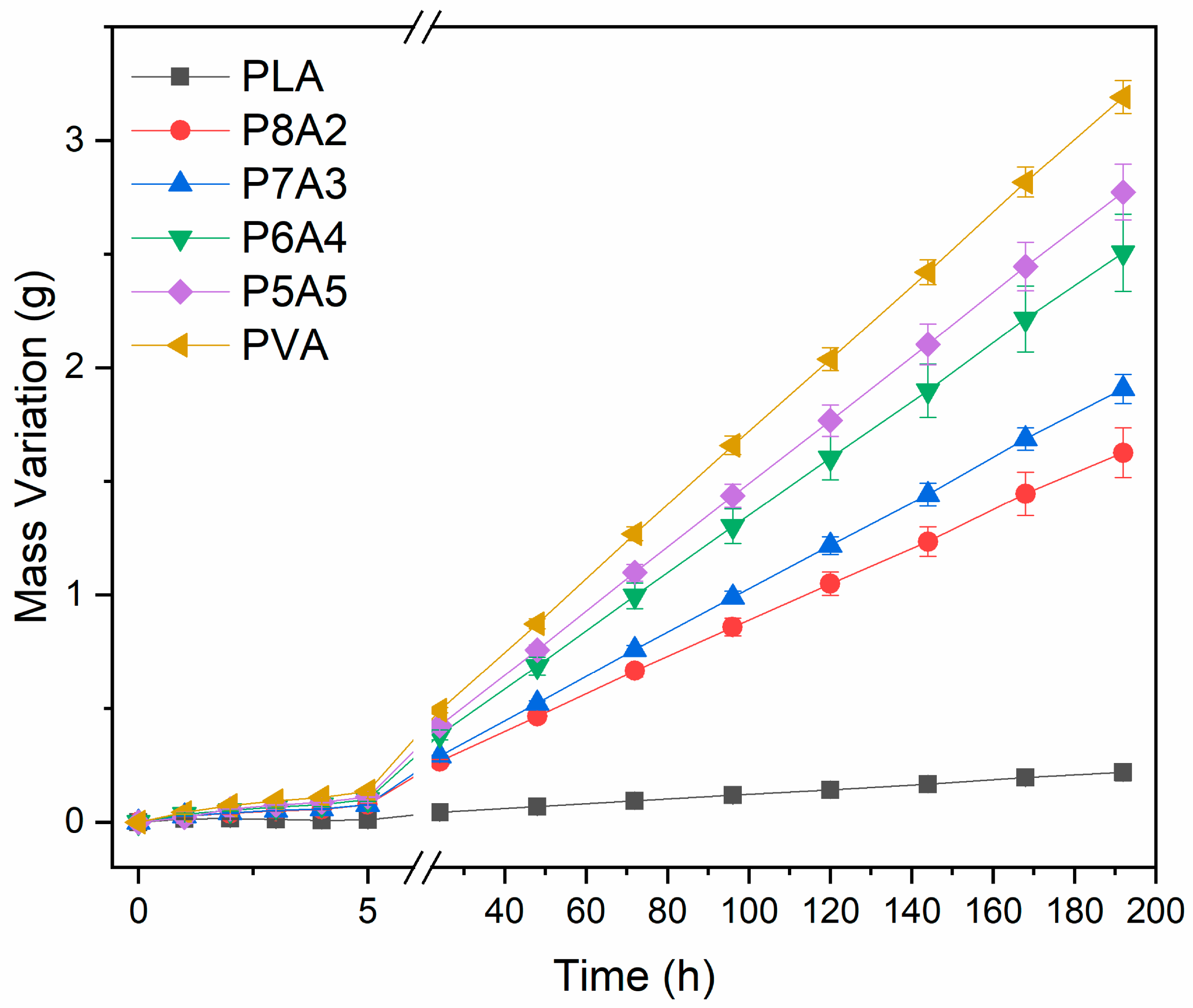
Water vapor transmission rate (WVTR) and water vapor permeability (WVP) are parameters of great importance for polymeric films, especially for food applications, since the ability to maintain an adequate moisture balance can prevent water accumulation and, consequently, the proliferation of bacteria and fungi [58]. Figure 8 illustrates the graphs of mass variation over time and Table 3 summarizes the WVTR and WVP values for neat PLA and PVA and the blends studied.
Analyzing the WVTR values, the increase, in absolute terms, paralleled the rise in PVA concentration within the blend. This behavior can be attributed to the hydrophilic nature of this polymer and the higher diffusivity of water vapor through the material’s amorphous and hydrophilic regions, which facilitates the transport of water molecules through the polymer structure [59]. This result is also consistent with the high density of PVA domains homogeneously dispersed within the matrix, as seen in the SEM images for samples P6A4 and P5A5, which exhibited the highest water vapor transmission values among the evaluated blends. In contrast, pure PLA exhibits superior water vapor barrier properties, when compared to PVA and the blends, as it is a hydrophobic polymer and has a significant difference in thickness.
However, when analyzing the WVP values, which account for film thickness and vapor pressure variation, sample P8A2 showed higher permeability than P7A3, despite having a lower PVA content. This behavior is consistent with the delaminated structure and micro-cracks present in P8A2, as indicated by the SEM images of its morphology, these features facilitate vapor permeation even through a relatively more hydrophobic structure [60]. The other samples followed a trend similar to that observed for WVTR, though with a more pronounced difference between pure PVA and the P5A5 composition, reflecting the structural and chemical differences between the materials.
Although the higher PVA content improved the ductility of the blends, its hydrophilic nature also increased water vapor permeability. Therefore, the balance between flexibility and moisture resistance should be carefully considered depending on the intended application. The moderate WVP values observed for the blends may be advantageous for specific applications, such as fresh-produce packaging, where controlled moisture exchange can help reduce condensation and preserve the visual quality of fruits and vegetables during storage and transport [61,62]. However, this potential application needs to be confirmed through additional studies involving oxygen permeability, sealing performance, food-contact safety, and shelf-life evaluation under practical storage conditions. Furthermore, it should be noted that the water vapor permeation measurements were performed in duplicate. Although the observed trends were consistent with the morphological and compositional changes in the blends, additional independent replicates would further strengthen the quantitative comparison between formulations.

3.7. Sustainability Considerations

The use of N-methyl-2-pyrrolidone (NMP) in the present study was motivated by its ability to dissolve both PLA and PVA in a single solvent, avoiding the additional variables commonly associated with emulsion-based or multi-solvent systems. Nevertheless, despite being classified as an acceptable residual solvent below a permitted daily exposure of 5.3 mg day−1 according to the International Council for Harmonization (ICH) and the U.S. Food and Drug Administration (FDA), NMP is a petroleum-derived solvent and prolonged occupational exposure has been associated with adverse health effects, including eye irritation, headaches, and developmental toxicity [63]. Therefore, although suitable for laboratory-scale investigations, the environmental and safety aspects of NMP should be carefully considered when evaluating the scalability of this processing route.
In recent years, considerable effort has been devoted to replacing conventional dipolar aprotic solvents with bio-based alternatives. Dong et al. [64], for example, discussed the replacement or partial substitution of NMP during the processing of PVDF and polycarbonate, reporting that materials prepared using triethyl phosphate or organic carbonates exhibited properties comparable to those obtained with NMP. Likewise, Ifadah et al. [13] successfully prepared PLA membranes using Cyrene™, Circa Group, Oslo NO, a biomass-derived solvent, although the process did require 10 h for PLA dissolution at 90 °C, followed by 3 h of homogenization with a PVA solution prepared separately in dimethyl sulfoxide (DMSO), before membrane formation by phase inversion. By comparison, the present work required 30 minutes for PLA dissolution at 100 °C, 30 minutes for PVA dissolution at 80 °C, and 24 h of solvent evaporation at 80 °C. Although the processing sequence is simpler because both polymers are combined in a single solvent, both approaches remain energy-intensive due to the prolonged heating and drying stages.
Cyrene™ is produced from levoglucosenone obtained through biomass pyrolysis followed by catalytic hydrogenation, and has been proposed as a sustainable replacement for solvents such as NMP and N,N-dimethylformamide (DMF) [65]. However, its industrial adoption is still limited by production scale and cost. A techno-economic assessment by Angellotti et al. [66], estimated a production cost of approximately US$59,000 per ton for Cyrene™, whereas conventional petroleum-derived solvents such as DMF typically range from US$575 to US$1570 per ton, depending on the market. This substantial cost difference currently represents a major barrier to the widespread implementation of greener solvent systems.
Future research should prospect on replacing petroleum-derived solvents with renewable alternatives, improving solvent recovery and recycling strategies, and reducing process energy consumption and environment impact. These developments will be essential for enhancing the sustainability and industrial applicability of biopolymer blend films such as PLA/PVA, and many others.

4. Conclusions

This study demonstrates that the composition of PLA/PVA blends plays a central role in governing the structure–property relationships of solvent-cast films. Rather than acting independently, molecular interactions, crystallization behavior, and phase morphology evolve simultaneously with blend composition, collectively determining the mechanical, optical, and barrier performance of the resulting materials. The results indicate that increasing the PVA content progressively refines the phase morphology and suppresses the crystallization ability of the PLA phase, promoting a transition from brittle to ductile behavior while enhancing optical transparency. At the same time, the increased hydrophilic character compromises moisture-barrier performance, highlighting the inherent trade-off between flexibility and water vapor resistance in PLA/PVA systems. These findings provide a broader understanding of how composition can be used as a design parameter to tailor the balance between competing functional properties in biopolymer blends. Among the investigated formulations, the PLA/PVA 50/50 blend exhibited the most balanced combination of toughness, morphological homogeneity, and optical performance, demonstrating that significant ductility can be achieved without the use of additional plasticizers or compatibilizers. Finally, although the present processing route proved effective for investigating these composition–structure–property relationships, the sustainability of solvent-cast manufacturing remains an important consideration. Future studies should therefore combine advanced characterization techniques, such as DMA and WAXD, with evaluations of residual solvent content, solvent recovery, oxygen barrier performance, sealing behavior, biodegradability, and food-contact safety. Addressing these aspects will be essential for translating the fundamental insights reported here into environmentally responsible and viable packaging technologies.

Supplementary Materials

The following supporting information can be downloaded at: https://www.mdpi.com/article/10.3390/cleantechnol8040131/s1: Figure S1. DSC curves for the first heating run of neat PLA, PVA, and the blends.

Author Contributions

Conceptualization, J.V.S.d.A.Q., C.M.M.S. and C.B.B.L.; methodology, J.V.S.d.A.Q., E.P.d.N. and D.D.S.; validation, J.V.S.d.A.Q., C.M.M.S., R.M.R.W. and E.M.A.; formal analysis, J.V.S.d.A.Q.; investigation, J.V.S.d.A.Q., C.M.M.S., E.P.d.N., D.D.S. and C.B.B.L.; resources, E.M.A.; data curation, C.B.B.L., R.M.R.W. and E.M.A.; writing—original draft, J.V.S.d.A.Q., C.M.M.S. and C.B.B.L.; writing—review and editing, J.V.S.d.A.Q., C.M.M.S., R.M.R.W. and C.B.B.L.; visualization, C.B.B.L., R.M.R.W. and E.M.A.; supervision, E.M.A. and C.B.B.L.; project administration, E.M.A.; funding acquisition, E.M.A. All authors have read and agreed to the published version of the manuscript.

Funding

This research was funded by Coordenação de Aperfeiçoamento de Pessoal de Nível Superior (CAPES) through the award of graduate scholarships (Finance Code 001), and Conselho Nacional de Desenvolvimento Científico e Tecnológico (CNPq) trhough the Research Productivity (PQ) fellowships, grant numbers 303426/2021-7, 312014/2020 and 152382/2025-9.

Data Availability Statement

The datasets generated and analyzed during the current study are available from the corresponding author on reasonable request.

Acknowledgments

The authors express their gratitude to the Universidade Federal de Campina Grande (UFCG) for providing the infrastructure necessary to carry out this research. And the Fundação de Apoio à Pesquisa do Estado da Paraíba (FAPESQ) is recognized for funding the acquisition of the FTIR equipment and the universal testing machine used in this study.

Conflicts of Interest

The authors declare no conflicts of interest.

References

  1. Guo, B.; Zhu, L.; He, X.; Zhou, X.; Dong, B.; Liu, J. Modified Composite Biodegradable Mulch for Crop Growth and Sustainable Agriculture. Polymers 2024, 16, 1295. [Google Scholar] [CrossRef] [Scilit] [PubMed]
  2. da Silva, L.R.C.; Rios, A.d.O.; Santana, R.M.C. Polymer blends of poly(lactic acid) and starch for the production of films applied in food packaging: A brief review. Polym. Renew. Resour. 2023, 14, 108–153. [Google Scholar] [CrossRef] [Scilit]
  3. Paudel, S.; Janaswamy, S. Alfalfa cellulose–starch binary complex films for sustainable biodegradable packaging applications. Food Biosci. 2026, 75, 108218. [Google Scholar] [CrossRef] [Scilit]
  4. Taib, N.A.A.B.; Rahman, M.R.; Huda, D.; Kuok, K.K.; Hamdan, S.; Bakri, M.K.B.; Bin Julaihi, M.R.M.; Khan, A. A review on poly lactic acid (PLA) as a biodegradable polymer. Polym. Bull. 2023, 80, 1179–1213. [Google Scholar] [CrossRef] [Scilit]
  5. Łopusiewicz, Ł.; Macieja, S. Polylactic acid: A chemically derived polymers for sustainable packaging. Sustain. Mater. Food Packag. Preserv. Food Secur. Sustain. 2025, 85–103. [Google Scholar] [CrossRef] [Scilit]
  6. Islam, M.S.; Elahee, G.M.F.; Fang, Y.; Yu, X.; Advincula, R.C.; Cao, C. Polylactic acid (PLA)-based multifunctional and biodegradable nanocomposites and their applications. Compos. B Eng. 2025, 306, 112842. [Google Scholar] [CrossRef] [Scilit]
  7. Raj, A.; Yousfi, M.; Prashantha, K.; Samuel, C. Morphologies, Compatibilization and Properties of Immiscible PLA-Based Blends with Engineering Polymers: An Overview of Recent Works. Polymers 2024, 16, 1776. [Google Scholar] [CrossRef] [Scilit] [PubMed]
  8. Castro, M.C.R.; Pereira, J.; André, M.P.; Pereira, P.; Cruz, V.; Rodrigues, P.V.; Machado, A.V. Tailoring PLA/Gelatin Film Properties for Food Packaging Using Deep Eutectic Solvents. Molecules 2026, 31, 39. [Google Scholar] [CrossRef] [Scilit] [PubMed]
  9. Zeng, S.; Wang, X.; Li, L.; Li, W. Green Preparation of High-Performance Poly(Vinyl Alcohol) Film by Combining Gel-Like Extrusion and Biaxial Stretching. Ind. Eng. Chem. Res. 2024, 63, 8622–8632. [Google Scholar] [CrossRef] [Scilit]
  10. Gautam, L.; Warkar, S.G.; Ahmad, S.I.; Kant, R.; Jain, M. A review on carboxylic acid cross-linked polyvinyl alcohol: Properties and applications. Polym. Eng. Sci. 2022, 62, 225–246. [Google Scholar] [CrossRef] [Scilit]
  11. Fan, S.; Mu, H.; Gao, H.; Chen, H.; Wu, W.; Fang, X.; Liu, R.; Niu, B. Preparation of PVA/PLA-based intelligent packaging to indicate the quality of shiitake mushrooms. J. Agric. Food Res. 2023, 12, 100589. [Google Scholar] [CrossRef] [Scilit]
  12. Liu, Z.; Lu, H.; Zhang, H.; Li, L. Poly(vinyl alcohol)/polylactic acid blend film with enhanced processability, compatibility, and mechanical property fabricated via melt processing. J. Appl. Polym. Sci. 2021, 138, 51204. [Google Scholar] [CrossRef] [Scilit]
  13. Ifadah, M.; Nikita, K.; Park, J.H.; Lee, T.K.; Nam, S.Y. A novel green solvent-assisted strategy using CyreneTM for PLA/PVA blend membrane fabrication in water treatment applications. J. Water Process Eng. 2026, 89, 110231. [Google Scholar] [CrossRef] [Scilit]
  14. Gross, I.P.; Saatkamp, R.H.; Sanches, M.P.; Parize, A.L.; Pires, A.T.N. Poly(lactic acid)/Poly(vinyl alcohol) Biodegradable Blends Using Monobutyl Maleate as a Plasticizer and Compatibilizer. ACS Appl. Polym. Mater. 2023, 5, 99–108. [Google Scholar] [CrossRef] [Scilit]
  15. Tran, N.H.A.; Brünig, H.; Auf der Landwehr, M.; Vogel, R.; Pionteck, J.; Heinrich, G. Controlling micro- and nanofibrillar morphology of polymer blends in low-speed melt spinning process. Part II: Influences of extrusion rate on morphological changes of a PLA/PVA blend through a capillary die. J. Appl. Polym. Sci. 2016, 133, 44257. [Google Scholar] [CrossRef] [Scilit]
  16. Grande, R.; Carvalho, A.J.F. Compatible ternary blends of chitosan/poly(vinyl alcohol)/poly(lactic acid) produced by oil-in-water emulsion processing. Biomacromolecules 2011, 12, 907–914. [Google Scholar] [CrossRef] [Scilit] [PubMed]
  17. Belletti, G.; Ronconi, G.; Mazzanti, V.; Buratti, E.; Marchi, L.; Sotgiu, G.; Calosi, M.; Mollica, F.; Bertoldo, M. Morphology and Mechanical Properties of Poly(vinyl alcohol)/Poly(lactic acid) Blend Films Prepared from Aqueous Dispersions. Macromol. Mater. Eng. 2024, 309, 202300237. [Google Scholar] [CrossRef] [Scilit]
  18. Wang, W.; Gong, Y.; Sun, Q.; Li, L.; Xu, A.; Liu, R. High performance polyvinyl alcohol/polylactic acid materials: Facile preparation and improved properties. J. Appl. Polym. Sci. 2022, 139, e52470. [Google Scholar] [CrossRef] [Scilit]
  19. Meng, X.; Qiu, J.; Zhang, B.; Sakai, E.; Feng, H. Effect of polyvinyl alcohol on the enzymatic degradation of bio-based polyester blends. Mater. Today Commun. 2025, 48, 113558. [Google Scholar] [CrossRef] [Scilit]
  20. Restrepo, I.; Medina, C.; Meruane, V.; Akbari-Fakhrabadi, A.; Flores, P.; Rodríguez-Llamazares, S. The effect of molecular weight and hydrolysis degree of poly(vinyl alcohol)(PVA) on the thermal and mechanical properties of poly(lactic acid)/PVA blends. Polimeros 2018, 28, 169–177. [Google Scholar] [CrossRef] [Scilit]
  21. Kittikorn, T.; Chaiwong, W.; Stromberg, E.; Torro, R.M.; Ek, M.; Karlsson, S. Enhancement of interfacial adhesion and engineering properties of polyvinyl alcohol/polylactic acid laminate films filled with modified microfibrillated cellulose. J. Plast. Film Sheeting 2020, 36, 368–390. [Google Scholar] [CrossRef] [Scilit]
  22. Yeh, J.T.; Yang, M.C.; Wu, C.J.; Wu, X.; Wu, C.S. Study on the Crystallization Kinetic and Characterization of Poly(lactic acid) and Poly(vinyl alcohol) Blends. Polym.-Plast. Technol. Eng. 2008, 47, 1289–1296. [Google Scholar] [CrossRef] [Scilit]
  23. Yamaguchi, M.; Shu, W.; Kimura, T.; Vo, H.G.D.; Kida, T.; Mori, T.; Kitani, M.; Aridome, N.; Miyamoto, A. Anomalous Postprocessing Dimensional Change of Injection-Molded Products Composed of Poly(lactic acid) and Poly(vinyl alcohol). ACS Appl. Polym. Mater. 2023, 5, 2136–2143. [Google Scholar] [CrossRef] [Scilit]
  24. dos Santos Filho, E.A.; Luna, C.B.B.; da Silva Barbosa Ferreira, E.; Pinto, G.M.; Andrade, R.J.E.; Fechine, G.J.M.; Araújo, E.M. Enhancing PLA/ABS Blends Compatibility: A Comparative Study With SAN-Epoxy and SAN-MA. Polym. Adv. Technol. 2025, 36, e70078. [Google Scholar] [CrossRef] [Scilit]
  25. Mandal, P.; Stokes, K.; Hernández, G.; Brandell, D.; Mindemark, J. Influence of Binder Crystallinity on the Performance of Si Electrodes with Poly(vinyl alcohol) Binders. ACS Appl. Energy Mater. 2021, 4, 3008–3016. [Google Scholar] [CrossRef] [Scilit]
  26. Fernández-Tena, A.; Olmedo-Martínez, J.L.; Sabino, G.M.A.; Collinson, E.; López, J.V.; Irusta, L.; González, A.; de Ilarduya, A.M.; Guerrica-Echevarria, G.; Aranburu, N.; et al. Mechanical, barrier, and photodegradation properties of biodegradable PLA-based blend films. RSC Sustain. 2025, 3, 4622–4631. [Google Scholar] [CrossRef] [Scilit]
  27. Letwaba, J.; Muniyasamy, S.; Rakku, N.; Mavhungu, L. Improved Performance and Compost Biodegradation of PLA/PBAT Blend and PLA/PBAT Compatibilized Blends with Algae as a Reinforcer. J. Renew. Mater. 2026, 14, 6. [Google Scholar] [CrossRef] [Scilit]
  28. Wu, C.; Wu, B.; Abdalkarim, S.Y.H.; Wang, M.; Zou, Z.; Jin, M.; Yu, H.-Y. Synergistic enhancement and spherulite growth mechanism of PLA composites by multi-dimensional mineralized cellulose nanocrystals. Carbohydr. Polym. 2025, 366, 123926. [Google Scholar] [CrossRef] [Scilit] [PubMed]
  29. Franca, T.; Goncalves, D.; Cena, C. ATR-FTIR spectroscopy combined with machine learning for classification of PVA/PVP blends in low concentration. Vib. Spectrosc. 2022, 120, 103378. [Google Scholar] [CrossRef] [Scilit]
  30. Rajan, S.; Marimuthu, K.; Ayyanar, C.B.; Hoque, M.E. Development and in-vitro characterization of HAP blended PVA/PEG bio-membrane. J. Mater. Res. Technol. 2022, 18, 4956–4964. [Google Scholar] [CrossRef] [Scilit]
  31. Riaz, U.; Ashraf, S.M. Characterization of Polymer Blends with FTIR Spectroscopy. In Characterization of Polymer Blends; John Wiley & Sons: Hoboken, NJ, USA, 2014; pp. 625–678. [Google Scholar] [CrossRef] [Scilit]
  32. Yan, Z.; Dou, Q. Preparation and characterization of poly(vinyl alcohol)/poly(lactic acid) blends containing bio-based plasticizers. J. Vinyl Addit. Technol. 2024, 30, 895–910. [Google Scholar] [CrossRef] [Scilit]
  33. Limpan, N.; Prodpran, T.; Benjakul, S.; Prasarpran, S. Influences of degree of hydrolysis and molecular weight of poly(vinyl alcohol) (PVA) on properties of fish myofibrillar protein/PVA blend films. Food Hydrocoll. 2012, 29, 226–233. [Google Scholar] [CrossRef] [Scilit]
  34. Guo, L.; Sato, H.; Hashimoto, T.; Ozaki, Y. FTIR study on hydrogen-bonding interactions in biodegradable polymer blends of poly(3-hydroxybutyrate) and poly(4-vinylphenol). Macromolecules 2010, 43, 3897–3902. [Google Scholar] [CrossRef] [Scilit]
  35. da Silva, F.U.; Luna, C.B.B.; da Silva, F.S.; Barreto, J.V.M.; Schmitz, D.P.; Soares, B.G.; Wellen, R.M.R.; Araújo, E.M. Exploring the Effect of Annealing on PLA/Carbon Nanotube Nanocomposites: In Search of Efficient PLA/MWCNT Nanocomposites for Electromagnetic Shielding. Polymers 2025, 17, 246. [Google Scholar] [CrossRef] [Scilit] [PubMed]
  36. Chu, H.; Chen, Z.; Chen, Y.; Wei, D.; Liu, Y.; Zhao, H. Mechanical Properties and Crystallinity of Specific PLA/Cellulose Composites by Surface Modification of Nanofibrillated Cellulose. Polymers 2024, 16, 2474. [Google Scholar] [CrossRef] [Scilit] [PubMed]
  37. Hdidar, M.; Chouikhi, S.; Fattoum, A.; Arous, M. Effect of hydrolysis degree and mass molecular weight on the structure and properties of PVA films. Ionics 2017, 23, 3125–3135. [Google Scholar] [CrossRef] [Scilit]
  38. Deng, H.; Su, J.; Zhang, W.; Khan, A.; Sani, M.A.; Goksen, G.; Kashyap, P.; Ezati, P.; Rhim, J.-W. A review of starch/polyvinyl alcohol (PVA) blend film: A potential replacement for traditional plastic-based food packaging film. Int. J. Biol. Macromol. 2024, 273, 132926. [Google Scholar] [CrossRef] [Scilit] [PubMed]
  39. Abdelmounaim, B.; Abdelhakim, K.; Aicha, M.; Rhim, J.W. Effect of nanoclay polarity on irganox 1081 diffusion in LLDPE: Dispersion and barrier relationships. Appl. Clay Sci. 2026, 290, 108283. [Google Scholar] [CrossRef] [Scilit]
  40. Jiang, X.; Guo, Z.; Yuan, Z.; Zhang, X.; Zhu, J.; Wang, J. High thermal resistance biobased copolyester from 2,5-Thiophenedicarboxylic acid with excellent gas barrier properties. Eur. Polym. J. 2024, 220, 113453. [Google Scholar] [CrossRef] [Scilit]
  41. Liu, X.; Desilles, N.; Jiang, B.; Chappey, C.; Lebrun, L. High barrier semi-crystalline polyesters involving nature occurring pyridine structure towards sustainable food packaging. Polymer 2022, 247, 124790. [Google Scholar] [CrossRef] [Scilit]
  42. Siracusa, V. Packaging Material in the Food Industry. In Antimicrobial Food Packaging, 2nd ed.; Academic Press: Cambridge, MA, USA, 2025; pp. 111–126. [Google Scholar] [CrossRef] [Scilit]
  43. Chen, X.; Zhang, R.; Mao, Y.; Zhong, L.; Lin, P.; Deng, Q.; Zheng, B.; Shen, H.; Feng, Z.; Zhang, H. Development of a toughened and antibacterial Poly(lactide acid) (PLA) with preserved strength by elemental sulfur-based bio-renewable dynamically crosslinked elastomers. Chem. Eng. J. 2023, 467, 143419. [Google Scholar] [CrossRef] [Scilit]
  44. Chuaponpat, N.; Ueda, T.; Ishigami, A.; Kurose, T.; Ito, H. Morphology, thermal and mechanical properties of co-continuous porous structure of PLA/PVA blends by phase separation. Polymers 2020, 12, 1083. [Google Scholar] [CrossRef] [Scilit] [PubMed]
  45. Gong, H.; Ji, Q.; Cheng, Y.; Zhao, X.; Zhang, M.; Zhang, X.; Wang, J.; Xie, Y.; Zhang, Z. Engineering High-Performance Polymer Dielectrics via Sea-Island Phase Separation: Synergizing Toughness, Energy Density, and Low Dielectric Loss. Small Methods 2025, 10, e01755. [Google Scholar] [CrossRef] [Scilit] [PubMed]
  46. Zheng, Q.; Wang, D.; Gong, X.; Liu, L.; Wu, H.; Li, Z.; Hong, H.; Yao, J. Lignin-derivable block copolymer micelle for effectively reinforcing and toughening polylactic acid. Int. J. Biol. Macromol. 2024, 277, 134159. [Google Scholar] [CrossRef] [Scilit] [PubMed]
  47. Pokhrel, G.; Jo, H.; Christ, N.M.; Son, H.; Howarter, J.A.; Davis, C.S. Mechanical Deformation Behavior of Polymer Blend Thin Films. Macromol. Rapid Commun. 2025, 46, 2400736. [Google Scholar] [CrossRef] [Scilit] [PubMed]
  48. Fu, Z.; Guo, S.; Li, C.; Wang, K.; Zhang, Q.; Fu, Q. Hydrogen-bond-dominated mechanical stretchability in PVA films: From phenomenological to numerical insights. Phys. Chem. Chem. Phys. 2022, 24, 1885–1895. [Google Scholar] [CrossRef] [Scilit] [PubMed]
  49. Marrucho, I.M. Optical and Spectroscopic Properties. In Poly(Lactic Acid); John Wiley & Sons: Hoboken, NJ, USA, 2022; pp. 115–133. [Google Scholar] [CrossRef] [Scilit]
  50. Soliman, T.S.; Zaki, M.F.; Hessien, M.M.; Elkalashy, S.I. The structure and optical properties of PVA-BaTiO3 nanocomposite films. Opt. Mater. 2021, 111, 110648. [Google Scholar] [CrossRef] [Scilit]
  51. El-Nagar, H.; El-Sadek, M.S.A.; Ibrahim, E.M.M.; Elnobi, S. Structural and optical properties of SnO nano-filler in eco-friendly PVA polymer for flexible optoelectronic applications. Sci. Rep. 2025, 15, 30614. [Google Scholar] [CrossRef] [Scilit] [PubMed]
  52. Alghamdi, A.M. Fabrication and comprehensive characterization of HPMC/PVA/CMC-MoO3 bio-nanocomposites: Enhanced mechanical, electrical, and antibacterial properties for food packaging applications. Int. J. Biol. Macromol. 2025, 287, 138612. [Google Scholar] [CrossRef] [Scilit] [PubMed]
  53. Fernandes, D.M.; Andrade, J.L.; Lima, M.K.; Silva, M.F.; Andrade, L.H.C.; Lima, S.M.; Hechenleitner, A.W.; Pineda, E.G. Thermal and photochemical effects on the structure, morphology, thermal and optical properties of PVA/Ni0.04Zn0.96O and PVA/Fe0.03Zn0.97O nanocomposite films. Polym. Degrad. Stab. 2013, 98, 1862–1868. [Google Scholar] [CrossRef] [Scilit]
  54. Shamekh, A.M.A.; Shaalan, N.M.; Hanafy, T.A.; Rashad, M. Linear/nonlinear optical properties of functional inorganic MgO nano-filler in PVA transparent polymer for flexible optoelectronic devices. Phys. B Condens. Matter 2023, 651, 414617. [Google Scholar] [CrossRef] [Scilit]
  55. González Trueba, L.H.; Grabski, V.; Alexandrova, L.; Aguilar Lugo, C. Thermal Aging of Asahi SB-1000 Polymer Optical Fibers: Study on the Light Transmission Loss. Adv. Polym. Technol. 2024, 2024, 8830983. [Google Scholar] [CrossRef] [Scilit]
  56. Roy, S.; Majumder, P.; Singha Mahapatra, T. UV-Shielding Efficiency of Polymer/ZnO Nanocomposites: Recent Developments and Prospects. J. Vinyl Addit. Technol. 2026, 32, 456–483. [Google Scholar] [CrossRef] [Scilit]
  57. Gennaro, M.; Büyüktaş, D.; Carullo, D.; Pinto, A.; Dallavalle, S.; Farris, S. UV-Shielding Biopolymer Coatings Loaded with Bioactive Compounds for Food Packaging Applications. Coatings 2025, 15, 741. [Google Scholar] [CrossRef] [Scilit]
  58. Geeta; Shivani; Devi, N.; Shayoraj; Bansal, N.; Sharma, S.; Dubey, S.K.; Kumar, S. Novel chitosan-based smart bio-nanocomposite films incorporating TiO2 nanoparticles for white bread preservation. Int. J. Biol. Macromol. 2024, 267, 131367. [Google Scholar] [CrossRef] [Scilit] [PubMed]
  59. Souza, B.W.S.; Cerqueira, M.A.; Casariego, A.; Lima, A.M.P.; Teixeira, J.A.; Vicente, A.A. Effect of moderate electric fields in the permeation properties of chitosan coatings. Food Hydrocoll. 2009, 23, 2110–2115. [Google Scholar] [CrossRef] [Scilit]
  60. Soleimanzadeh, A.; Mizani, S.; Mirzaei, G.; Bavarsad, E.T.; Farhoodi, M.; Esfandiari, Z.; Rostami, M. Recent advances in characterizing the physical and functional properties of active packaging films containing pomegranate peel. Food Chem. X 2024, 22, 101416. [Google Scholar] [CrossRef] [Scilit] [PubMed]
  61. Huang, X.; Lin, Z.; Yuan, W. High-molecular-weight fibroin as a preservation coating for perishable fruits. Food Chem. 2026, 513, 149014. [Google Scholar] [CrossRef] [Scilit] [PubMed]
  62. Mulla, M.F.Z.; Shonte, T.; Foley, L.; Gaffney, M.T.; Frias Celayeta, J.M.; Pathania, S. Modified atmospheric packaging an emerging non-invasive packaging technique for strawberry preservation—A review. Heliyon 2026, 12, e44539. [Google Scholar] [CrossRef] [Scilit]
  63. Tarrass, F.; Benjelloun, M. Health and environmental effects of the use of N-methyl-2-pyrrolidone as a solvent in the manufacture of hemodialysis membranes: A sustainable reflexion. Nefrología (Engl. Ed.) 2022, 42, 122–124. [Google Scholar] [CrossRef] [PubMed]
  64. Dong, X.; Lu, D.; Harris, T.A.L.; Escobar, I.C. Polymers and solvents used in membrane fabrication: A review focusing on sustainable membrane development. Membranes 2021, 11, 309. [Google Scholar] [CrossRef] [Scilit] [PubMed]
  65. Wang, Y.; Dai, M.; Luo, G.; Fan, J.; Clark, J.H.; Zhang, S. Preparation and Application of Green Sustainable Solvent Cyrene. Chemistry 2023, 5, 2322–2346. [Google Scholar] [CrossRef] [Scilit]
  66. Angellotti, G.; Li Petri, G.; Valenza, C.; Luque, R.; Ciriminna, R.; Pagliaro, M. A case study in the emerging bioeconomy: Biobased solvents dihydrolevoglucosenone and 2-methyltetrahydrofuran. RSC Sustain. 2025, 4, 735–741. [Google Scholar] [CrossRef] [Scilit]
Figure 1. FTIR spectra of PLA, PVA and blends. Insets of 3700–2800 (a), 1800–1600 (b), 1250–950 (c) and 900–550 cm−1 (d).
Cleantechnol 08 00131 g001
Figure 2. DSC curves for the second heating (a) and inset from 50 to 75 °C (b) of neat PLA and PVA and the blends.
Cleantechnol 08 00131 g002
Figure 3. Cooling DSC curves for PLA, PVA and blends.
Cleantechnol 08 00131 g003
Figure 4. SEM micrographs of the cryogenically fractured surfaces of (a) PLA, (b) P8A2, (c) P7A3, (d) P6A4, and (e) P5A5 acquired at magnifications of (1) 1000×, (2) 2000×, and (3) 5000×.
Cleantechnol 08 00131 g004
Figure 5. SEM micrographs (10,000×) of the cryogenic fracture surfaces, enlarged view of selected area, and domain size distributions for (a) P8A2; (b) P7A3; (c) P6A4; and (d) P5A5.
Cleantechnol 08 00131 g005
Figure 6. Mechanical properties of neat PLA and PLA/PVA blends. (a) Elastic modulus; (b) tensile strength; (c) elongation at break; (d) tensile toughness; (e) representative stress–strain curves. Statistically different results are indicated by different letters in each column.
Cleantechnol 08 00131 g006
Figure 7. (a) Representative transmittance spectrum in the UV-Vis range for PLA, PVA, and their blends; (b) photographs of the films; (c) opacity. Statistically different results are indicated by different letters in each column.
Cleantechnol 08 00131 g007
Figure 8. Mass variation over time due to water vapor transmission.
Cleantechnol 08 00131 g008
Table 1. Compositions and designation of the PLA/PVA blends.
Compositions
CodingPLA (% Weight)PVA (% Weight)
P8A28020
P7A37030
P6A46040
P5A55050
Table 2. Glass transition (Tg), cold crystallization (Tcc), crystallization (Tc), and crystalline melting (Tm) temperatures, and enthalpy changes for cold crystallization (ΔHcc) and crystalline melting (ΔHm).
CompositionTG1 (°C)TG2 (°C)TCC (°C)ΔHCC (J/g)TC (°C)TM (°C)ΔHM (J/g)XC (%)
PLA58.68-107.5526.8699.11175.2840.7214.79
P8A257.9668.17100.016.00102.67167.4312.408.54
P7A357.2367.63107.1715.90-161.5220.246.62
P6A456.4467.60118.404.66-157.197.034.22
P5A556.0565.73---158.741.433.05
PVA-68.75--103.72154.469.046.52
Table 3. Water vapor transmission rate (WVTR), water vapor permeability (WVP), and the respective standard variation for neat PLA and PVA and all blends studied.
CompositionWVTR (g/h.m2)Error (±)WVP (g.mm/h.m2.kPa)Error (±)
PLA0.7122.8 × 10−30.0542.1 × 10−4
P8A25.5742.3 × 10−20.3421.4 × 10−3
P7A36.6031.4 × 10−20.2665.6 × 10−4
P6A48.6621.9 × 10−20.3808.4 × 10−4
P5A59.5651.4 × 10−20.4196.2 × 10−4
PVA10.9942.2 × 10−20.5591.1 × 10−3
Disclaimer/Publisher’s Note: The statements, opinions and data contained in all publications are solely those of the individual author(s) and contributor(s) and not of MDPI and/or the editor(s). MDPI and/or the editor(s) disclaim responsibility for any injury to people or property resulting from any ideas, methods, instructions or products referred to in the content.