1. Introduction
Urban wastewater treatment in the European Union (EU) is governed by a comprehensive regulatory framework—the Urban Wastewater Treatment Directive 91/271/EEC (UWWTD)—that was adopted in 1991 and has evolved significantly over the past three decades [
1]. It establishes the foundational requirements for the collection, treatment, and discharge of urban wastewater across member states, with the primary objective of protecting the environment. The implementation of the UWWTD, in conjunction with the Water Framework Directive 2000/60/EC (WFD), has been instrumental in reducing pollutant releases across European water bodies, although practical implementation regarding chemical pollution has faced several challenges [
2].
In response to these challenges, the EU adopted a comprehensive revision of the UWWTD, published as Directive (EU) 2024/3019, which entered into force on 1 January 2025 [
3]. This represents a paradigm shift in European water policy, extending its scope to smaller agglomerations (≥1000 population equivalents (PE) compared to the previous 2000 PE threshold), requiring facility upgrade to target micropollutant removal, establishing stricter limits for nitrogen and phosphorus discharge, and setting ambitious energy neutrality targets for the wastewater sector by 2045. Member states are directed to transpose these requirements into national law by 31 July 2027, with phased implementation extending to 2045 for the most demanding provisions.
Another significant addition and central challenge for wastewater treatment plant (WWTP) operators is the mandatory monitoring of emerging contaminants, often requiring complex and time-consuming monitoring processes. Member states must monitor wastewater systems with regard to chemical pollutants including per- and polyfluoroalkyl substances (PFASs), microplastics (MPs), known viruses, emerging pathogens and antimicrobial resistance markers (Directive (EU) 2024/3019, Article 17) [
3].
MPs—synthetic polymer particles ≤ 5 mm—have been recognized as contaminants of emerging concern, and WWTPs have been identified as both significant pathways for MPs entering aquatic environments and potential control points for their removal [
4,
5]. Currently, no standardized MP monitoring method exists. However, total suspended solids (TSSs) is a well-established parameter already embedded in monitoring protocols and compliance permits. Recent research suggests a strong synergy between TSSs and MP abundance; a comprehensive study of inland and island WWTPs demonstrated Spearman correlation coefficients of ρ = 0.74 for influent and ρ = 0.80 for effluent samples, with multiple linear regression analyses confirming TSSs as the most reliable predictor of MP abundance (adjusted R
2 = 0.91;
p = 0.001) [
6] Given that MPs largely coexist with suspended particulates, investigating whether TSSs can serve as a reliable, “ready-to-use” proxy for MP removal efficiency is vital for cost-effective regulatory compliance. Furthermore, studies have shown that the trend of MP removal rates closely parallel BOD, COD, suspended solid, and total phosphorus removal in secondary treatment processes [
7].
Comprehensive reviews of MP occurrence and removal in WWTPs have established that conventional WWTP technologies achieve variable removal efficiencies depending on the treatment stages and technology employed. A critical review comparing MP removal rates across 21 studies found that secondary and tertiary WWTPs removed an average of 88% and 94% of MP, respectively, with the majority (72% on average) removed during primary treatment [
8]. The largest fraction of removed MPs becomes trapped in sewage sludge, raising concerns about terrestrial ecosystem contamination through land application. Despite the high MP removal rates of standard treatment practices, substantial amounts of MPs are still released from WWTPs due to the high volumes of water processed. A previous study comparing the amounts of MPs released by different WWTPs revealed that up to 367 billion MPs/year are released from a standard WWTP [
4].
Despite the new requirements for quaternary treatment and MP monitoring, a critical technological gap remains; most conventional quaternary treatment methods (such as advanced oxidation processes (AOPs) or granular activated carbon (GAC)) are designed to target dissolved chemical species such as micropollutants and do not sufficiently remove MPs. The oxidation process of AOPs acts at the particle surface and often results in fragmentation of the particles into nanoparticles or secondary pollutants, rather than complete degradation or removal [
9]. GAC has shown varying removal performances, from 30%–>90%, as it is impacted significantly by MP and water characteristics, operating conditions, and adsorbent properties, such as the GAC pore size, whereby the removal performance varies according to the particle size distribution [
10]. Consequently, there is an urgent need for novel, target-specific technologies that can be seamlessly integrated alongside quaternary stages to address MP removal.
Among MP treatment technologies, quantitative analysis revealed that filter-based treatment technologies and membrane bioreactors (MBRs) consistently achieve the highest MP removal efficiency; however, the MPs are only transferred to the sewage sludge [
5,
11]. Novel technologies like the agglomeration–fixation reaction developed by Sturm et al. show that effective circular economy technologies are also applicable, in which the removed agglomerates can be reused [
12,
13,
14].
The need for effective MP control is particularly acute in the Mediterranean region, a semi-enclosed basin with densely populated coastlines and limited water exchange. MPs constitute more than 80% of total plastic debris in the Mediterranean Sea, with rivers and WWTP discharges identified as major transport pathways to the Aegean Sea [
15,
16]. Reported MP mass concentrations in Greek WWTP effluents range from 4.5 to 69.2 μg/L, with strong seasonal variability and peak loads following heavy rainfall events and during touristic seasons where populations and associated wastewater volumes often increase substantially [
17]. Encouragingly, recent studies of advanced Mediterranean WWTPs indicate that well-designed conventional and advanced treatment technologies can achieve stable MP removal efficiencies across dry, rainy, and touristic seasons [
18].
Despite strengthening the regulatory framework and growing scientific evidence, significant knowledge gaps remain regarding the practical integration of MP monitoring and removal into existing WWTP systems. In particular, the potential to leverage conventional wastewater quality parameters—such as TSSs—as proxies for MP abundance and removal efficiency has not yet been sufficiently validated under real operational conditions, especially in two-stage treatment configurations typical of Mediterranean WWTPs. Thus, the relationship between conventional wastewater quality parameters and MP removal efficiency requires further investigation to develop cost-effective monitoring and removal strategies.
This study addresses these challenges by investigating the simultaneous removal of MPs and TSSs through a novel MP removal technology installed at a two-stage WWTP in Greece, with MP levels and removal efficiencies determined using a fluorescence-based MP detection method. The research aims to quantify the MP removal efficiency and TSS removal of the agglomeration–fixation (clump and skim) technology. Further, the statistical correlation between MP concentrations and TSS levels before and after the treatment process is assessed to further determine TSS monitoring as a practical proxy indicator for MP removal efficiency, aligning with current scientific research. The findings contribute to the development of simple and effective integrated MP monitoring and removal strategies that support full compliance with the revised UWWTD’s mandate for MP and micropollutant monitoring while taking proactive measures to remove MPs and protect the ecologically sensitive Mediterranean marine environment.
2. Materials and Methods
2.1. Demo Site Description
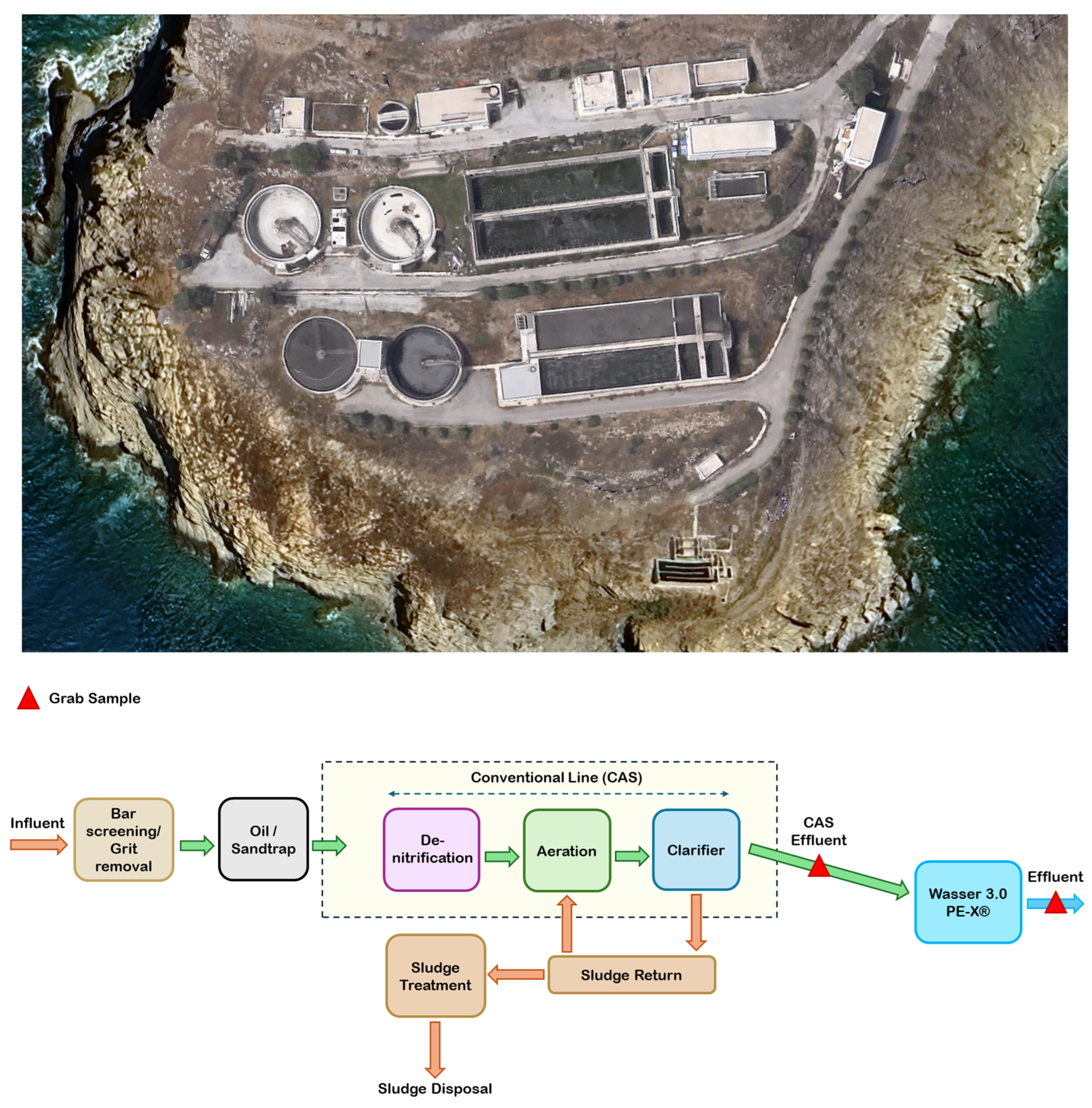
The removal trials took place in real-life conditions at the Mykonos WWTP (
Figure 1). Mykonos was selected as a representative island of wastewater pollution being influenced largely by tourist activity. The pretreatment units are located at the highest level, while the biological treatment units are located on the second and third levels. The chlorination unit is downstream and receives the treated wastewater by gravity. The treated water is emitted into the Mediterranean Sea. The plant consists of two main lines, a conventional activated sludge system with 8400 m
3/d maximum capacity and a membrane bioreactor with 10,800 m
3/d maximum capacity.
The two lines usually operate in parallel but can be deactivated individually depending on current wastewater load and volume. At the time of the experiments, the MBR was shut down due to maintenance and only the conventional line was operating. The MBR is operated from March to mid-November, which is the touristic season, when the population of the island increases significantly.
The wastewater treatment plant is designed to serve a population equivalent (PE) of 48,000. Incoming wastewater originates primarily from two sources: municipal sewage collected via Mykonos’ sewer system and effluent from septic tanks. Due to seasonal tourism, influent volumes fluctuate significantly, with off-season population dropping below 10,000 PE. The removal experiments were undertaken using the secondary effluent of the conventional activated sludge line, with no MBR treatment.
For the conventional treatment, the average sludge retention time (SRT) in winter is 23.3 days and 18.3 days in summer; the average hydraulic retention time (HRT) in winter is 60.6 h and 30.3 h in summer.
During the two days of the removal trials (15–16 November 2025), the conventional line discharge was 3197.93 m3, and 2532.09 m3. Loops 1–2 were performed on 15 November and loops 3–5 on 16 November.
2.2. Removal Trials
Wasser 3.0 PE-X
® is a filter-free process that utilizes abcr eco Wasser 3.0 PE-X
®, wastewater (AB930003 abcr GmbH, Karlsruhe, Germany) for organosilane-induced agglomeration to clump MP particles into larger aggregates. The agglomeration–fixation mechanism is based on the interaction between organic groups of organosilanes and MP surfaces, where the reactive groups form a stable hybrid silica gel through a water-induced sol–gel process [
19]. The formed agglomerates float to the surface and are subsequently separated using coarse-pored separation units [
12,
14].
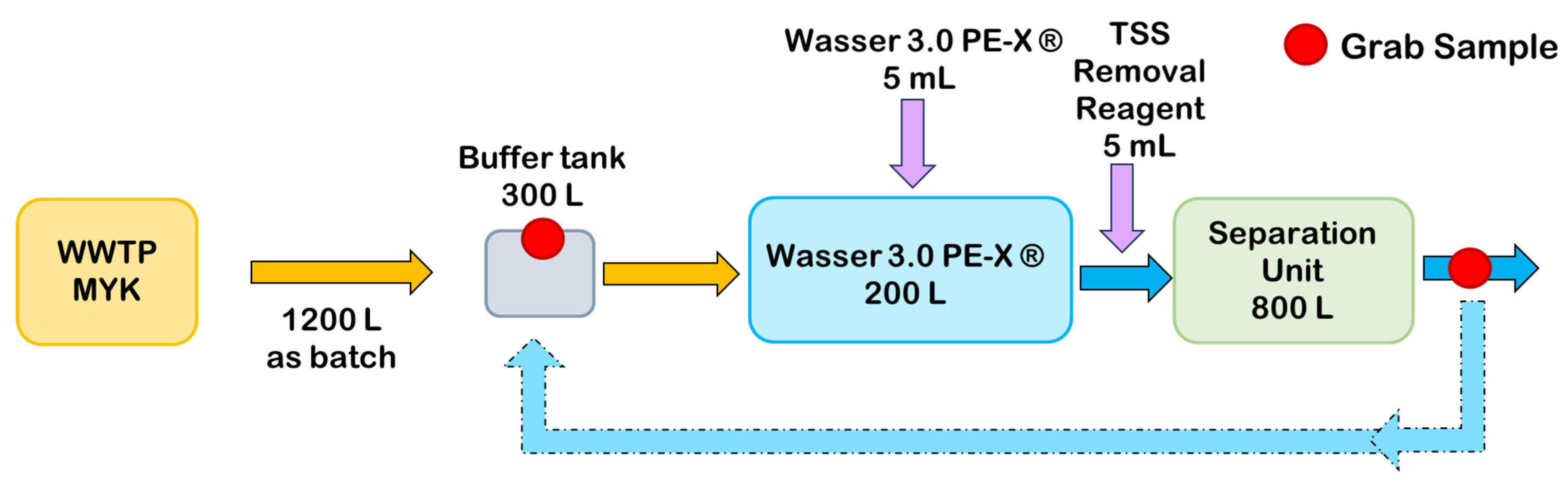
The pilot plant (
Figure 2) is made of stainless steel and has a capacity of 0–2 m
3. The separation unit has a capacity of 0.8 m
3. The pilot plant has been installed at the conventional line (CAS) effluent of the Mykonos WWTP and is operated via centrifugal puMP with a flow rate of 5 m
3/h. An additional valve is installed at the ground outlet of the separator along with a pump for the loop flow. The setup was conducted to combine TSS and MP removal, with the final setup of the TSS and MP removal trials shown in
Figure 1. Dosing of 5 mL abcr eco Wasser 3.0 PE-X
®, wastewater (AB930003, abcr GmbH, Karlsruhe, Germany) for MP removal was conducted manually and added directly in the reactor, whereby the MP agglomerates collected in the vortex in the reactor. For TSS removal, 5 mL of the TSS removal reagent (Zetag
TM 9218, Solenis Technologies Germany GmbH, Krefeld, Germany) was added via a dosing valve between the MP removal unit and separation unit and the remaining organic residues agglomerate. Dosage concentrations were evaluated in preliminary laboratory-scale experiments using 1 L of wastewater. The reaction time for the reagents was 15 min, after which outflow samples were taken. All agglomerates were removed via the separation unit.
The system was then stopped and flushed for the next trial round. The test setup was run five times. For each test run, 3 influent and 3 effluent 500 mL grab samples were taken consecutively, resulting in a total of 30 × 500 mL samples. The samples were analyzed for pH, TSSs, COD, conductivity, turbidity and MPs.
2.3. MP Process Monitoring
MP monitoring follows a standardized workflow consisting of sample collection by filtration, subsequent H
2O
2 digestion, and final detection through fluorescent staining and imaging [
4,
20]. The advantage of this method is its fast and cost-effective application, which makes it efficient for processing high numbers of samples, which is particularly useful for application at WWTPs. Its disadvantages are missing chemical characterization of polymer types and risks of false positives with natural particles [
20].
2.3.1. MP Sample Pretreatment
All grab samples were shipped to the Sanitary Engineering Laboratory of the National Technical University of Athens (NTUA) for pretreatment, according to the standardized protocol provided, outlined in Sturm et al. 2023 [
20]. The pretreated samples were then shipped to Wasser 3.0 gGmbH in Landau, Germany, for the final treatment steps outlined in
Section 2.3.2.
2.3.2. MP Sample Processing
MP sample processing was conducted according to the preparation and detection methods outlined in Sturm et al. 2023 [
20].
For each analysis, a 500 mL grab sample was processed by vacuum filtration using a 10 µm stainless-steel filter disc (Wolftechnik Filtersysteme GmbH & Co., KG, Weil, Germany) mounted on a DURAN® filtration apparatus (Cat. No. 257106304, DWK Life Sciences GmbH, Mainz, Germany). After filtration, the disc together with the collected particulate matter was transferred into a beaker containing 20 mL of 35% hydrogen peroxide (AB171423, abcr GmbH, Karlsruhe, Germany) and a small amount (3–5 grains) of iron(II) sulfate (AB203817, abcr GmbH, Karlsruhe, Germany) and covered with aluminum foil. The beaker was then placed on a heating plate and maintained at 100 °C for 1 h to promote oxidative digestion. Following a 10 min cooling period, the filter disc was removed and rinsed thoroughly with water so that all rinsate returned to the same beaker. The disc was subsequently reinstalled in the filtration setup, and the entire digested sample was refiltered. Afterwards, the disc was removed again and any remaining solids were washed into a clean beaker.
In the staining step, the fluorescent dye abcr eco Wasser 3.0 detect mix MP-1 (AB930015, abcr GmbH, Karlsruhe, Germany), which selectively labels microplastic particles, was added to the sample. A total of 25 µL dye (final concentration 0.25 mg/L) was introduced, and the mixture was incubated at 80 °C for 1 h. After the staining reaction, the sample was filtered onto a 25 mm black polyethersulfone membrane (Metricel® Black PES, 0.80 µm, Pall, Dreieich, Germany) and subsequently stored in a Petri dish.
2.3.3. MP Detection
Fluorescence microscopy was conducted using a Zeiss Axiozoom.V16 system (Carl Zeiss Microscopy Deutschland GmbH, Oberkochen, Germany). The instrument was fitted with a PlanNeoFluar Z 1.0× objective (Carl Zeiss Microscopy Deutschland GmbH, Oberkochen, Germany) and an Axiocam 712 mono camera (Carl Zeiss Microscopy Deutschland GmbH, Oberkochen, Germany). Green-channel excitation and emission were recorded using a customized filter set provided by AHF Analysentechnik AG (Tübingen, Germany). Imaging settings followed those reported in Sturm et al. 2025 [
4]. Each membrane filter was photographed completely and subsequently evaluated.
Image processing was performed in ZEN 3.8 (Carl Zeiss Microscopy Deutschland GmbH, Oberkochen, Germany) using the particle-counting functionality of the ZEN Toolkit 2D. This module identifies microplastic particles automatically by applying a predefined fluorescence intensity threshold. As sampling is done with the 10 µm mesh filter cartridge, the detection limit of the method is set to 10 µm.
2.3.4. MP Contamination Control
All sample handling was carried out in a dedicated laboratory reserved exclusively for microplastic analyses. Prior to each session, the workspace was wiped using lint-free cloths, and personnel wore particle-reduced protective clothing (4510 M, 3M Deutschland GmbH, Ness, Germany). Before entering the room, the suit was additionally treated with an adhesive lint roller. An air-filtration unit was operated continuously, glassware was used whenever feasible, and samples were kept covered with aluminum foil throughout processing. Procedural blanks were analyzed at regular intervals, and their values were subtracted from the measured microplastic counts.
2.4. Measurement of Additional Wastewater Parameters
The TSS, COD, and pH analyses were performed by NTUA.
pH and electrical conductivity were determined using a portable multiparameter device pH and electrical conductivity were determined using a portable multiparameter device equipped with SenTix® 940 and TetraCon® 925 electrodes (WTW MULTI 3630 IDS, Xylem Analytics Germany Sales GmbH & Co., KG, WTW, Weilheim, Germany). Turbidity measurements were carried out with a handheld turbidity instrument (HACH 2100Q, Hach Lange GmbH, Düsseldorf, Germany).
COD was determined using HACH reagent kits LCK314 (Hach Lange GmbH, Düsseldorf, Germany) (10–150 mg/L) and LCK 114 (Hach Lange GmbH, Düsseldorf, Germany) (150–1000 mg/L) based on the dichromate method, according to the DIN 38409-H41-H44 standard [
21]. Briefly, 2 mL of the sample was transferred in the test tubes, which were digested at 148 °C for 2 h in a thermoreactor (VELP ECO6, VELP Scientifica Srl, Usmate Velate (MB), Italy), cooled to room temperature and measured with a spectrophotometer (HACH DR2800, Hach Lange GmbH, Düsseldorf, Germany).
TSSs were quantified following the procedure described in DIN 38 409-H2-2 [
22]. For the filtration step, 125 mm cellulose filters (MN 640 w, retention 7–12 µm, Macherey-Nagel GmbH & Co., KG, Düren, Germany) were used in combination with a vacuum filtration setup. Prior to sample processing, each filter was rinsed with 100 mL of demineralized water, dried at 105 °C for 2 h, and weighed to obtain the initial mass. Subsequently, 1 L of the water sample was filtered. The filters were then dried again for 2 h at 105 °C and reweighed, and the difference in mass was used to calculate the TSS concentration.
3. Results
3.1. MP Removal
The Wasser 3.0 PE-X
® technology demonstrated substantial MP removal across all five experimental loops (
Table 1). The data revealed influent of the Wasser 3.0 PE-X reactor (representing the WWTP conventional line effluent) MP concentrations ranging from 633 to 5843 microplastics/L (MP/L) (mean: 2032 ± 2176 MP/L), reflecting the heterogeneous nature of the wastewater regarding MP contamination. Following treatment, effluent concentrations were reduced to 96–263 MP/L (mean: 178 ± 76 MP/L), corresponding to an average removal efficiency of 86% ± 8% (range: 77–96%). These results confirm the robustness of the organosilane-based agglomeration process under varying input conditions.
The observed concentration-dependent removal efficiency (Loop 4: 95.5% at 5842.5 MP/L versus Loop 5: 77.3% at 742 MP/L) is consistent with collision-based agglomeration mechanisms. Higher particle concentrations increase the collision frequency between microplastic particles and organosilane molecules, leading to more efficient agglomerate formation. This observation corresponds with industrial pilot studies documenting mass removal efficiencies of 97.4% at high particle loads (1725 mg/L) [
23].
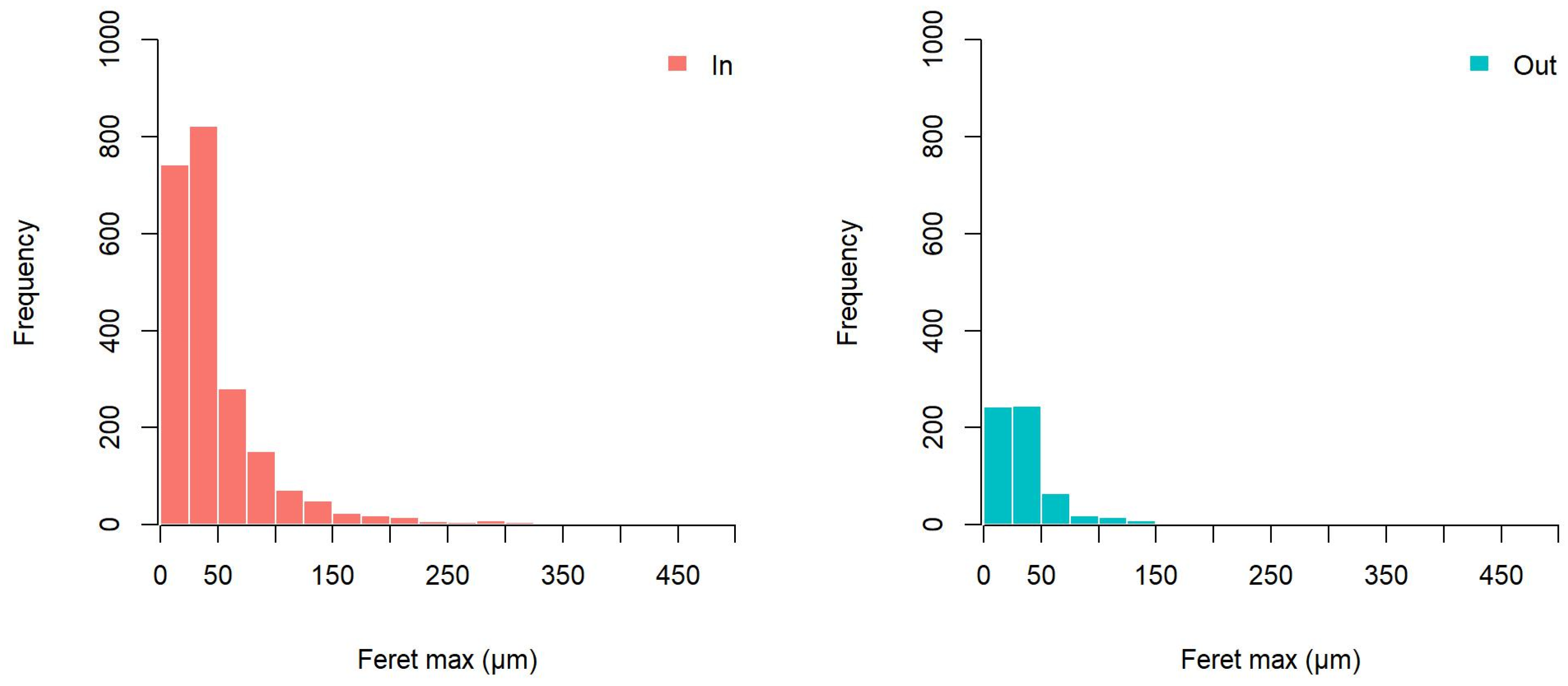
Based on the size distribution (
Figure 3), 70% of MPs in the influent are smaller than 50 µm and 33% are smaller than 25 µm. In the effluent, 81% of particles are smaller than 50 µm and 40% are smaller than 25 µm. These differences indicate that larger particles are removed marginally more efficiently than smaller ones.
3.2. Additional Water Quality Parameters
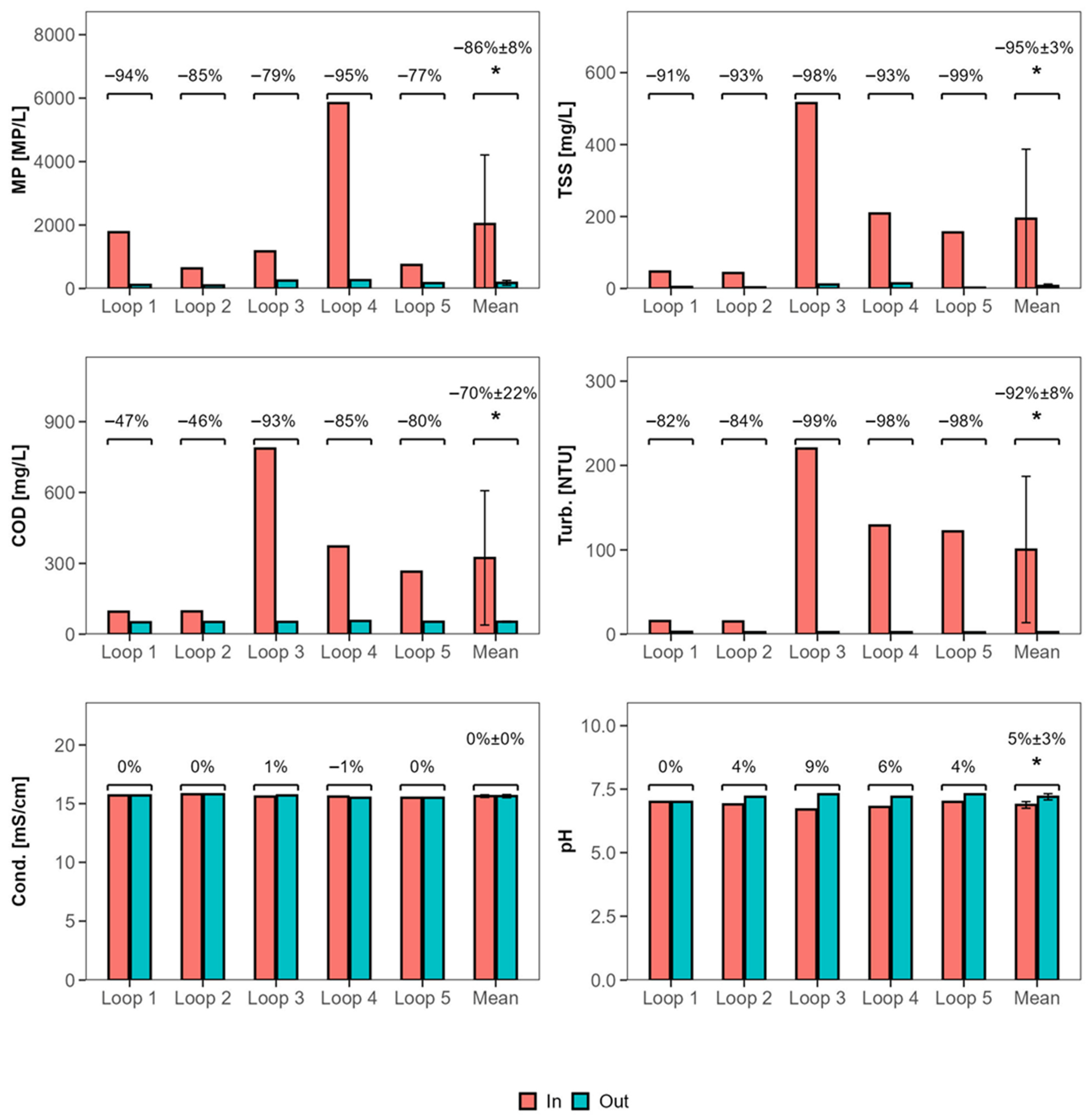
In addition to MP removal, further water quality parameters were recorded to evaluate the effect of the tested system on other monitored wastewater parameters in a two-stage WWTP with the application of the agglomeration–fixation process (
Figure 4).
Analysis of the influent data shows pronounced fluctuations in COD, TSSs, and turbidity, while conductivity and pH remain largely stable. Despite these variations in the incoming wastewater, the treatment system consistently removes COD, TSSs, and turbidity across all loops, resulting in stable effluent concentrations. The combined MP and TSS removal process substantially improves effluent quality and thereby reduces environmental pollution. As the treatment primarily targets MPs and TSSs, with COD and turbidity decreasing as a secondary effect, conductivity and pH remain essentially unchanged. The following subsections discuss each parameter in detail.
The pronounced differences observed between Loops 1–2 (15 November 2025) and Loops 3–4 (16 November 2025) in COD, TSSs, and turbidity are related to variations in the volume and frequency of wastewater deliveries. At the time of the removal trials, the wastewater was transported to the WWTP by truck. On 15 November, deliveries were more continuous and of a higher total volume, which supported stable operating conditions and the effectiveness of the secondary clarifier. In contrast, on 16 November the volume delivered was lower and arrived less regularly, resulting in less stable process conditions with sudden spikes in water and consequently higher TSS and COD values, affecting the effectiveness of the secondary clarifier negatively.
It is notable that the dosage of abcr eco Wasser 3.0 PE-X® and the TSS removal reagent were previously tested only at lab scale. Based on lab scale optimizations, they were selected for the pilot-scale experiments to provide a buffer for potential increases in sludge and MP loads during operation. The chosen dosages leave room for further optimization and improved resource efficiency.
3.2.1. Total Suspended Solids (TSSs)
TSSs were reduced from an inlet concentration of 194 ± 173 mg/L (min: 43 mg/L; max: 515 mg/L) to an outlet concentration of 7 ± 5 mg/L (min: 2 mg/L; max: 14 mg/L). The average reduction amounts to 95 ± 3% (min: 91%; max: 99%). Notable are the strong fluctuations in TSSs between the loops, with one order of magnitude of difference between the lowest and highest TSS values.
TSS reduction reflects the physical aggregation of particulate substances and subsequent removal in the removal unit.
3.2.2. Chemical Oxygen Demand (COD)
COD was reduced from an inlet concentration of 323 ± 254 mg/L (min: 95 mg/L; max: 786 mg/L) to an outlet concentration of 53 ± 2 mg/L (min: 51 mg/L; max: 56 mg/L). The average reduction amounts to 70 ± 20% (min: 46%; max: 93%).
COD consists of both dissolved oxidizable substances and dispersed solids. Consequently, loops 1–2, which receive lower TSS concentrations, also exhibit lower influent COD. Their COD removal efficiency (46–47%) is therefore lower than in Runs 3–5 (80–93%), where higher TSS loads are removed and, with them, a larger COD fraction. The remaining COD mainly represents dissolved organic compounds and the residual TSSs. The reduction in the outflowing COD shows a clear improvement in the quality of the effluent water.
For comparison, in industrial applications of MP removal in highly contaminated wastewater, COD reduction of 78.8% has been documented [
23]. This was also due to the reduction in TSSs, which consisted almost exclusively of suspended MPs.
3.2.3. Turbidity Removal
Turbidity was reduced from an inlet concentration of 100 ± 78 NTU (min: 15 NTU; max: 220 NTU) to an outlet concentration of 2 ± 0.2 NTU (min: 2 NTU; max: 3 NTU). The average reduction amounts to 93 ± 7% (Min: 82%; Max: 99%).
Turbidity is caused by suspended solids. Accordingly, loops 1–2, which received influent water with lower TSS concentrations, had a lower turbidity and a turbidity removal efficiency of 82–84%. In contrast, loops 3–5 receive an influent with much higher TSS concentrations and achieve particularly high removal efficiencies of 98–99%. These results further support the effective aggregation and retention of suspended particles through the agglomeration–fixation mechanism.
3.2.4. pH and Conductivity
Conductivity and pH remain unaffected. Conductivity showed an influent concentration of 15.6 ± 0.1 mS/cm (min: 15.5 mS/cm; max: 15.8 mS/cm) and an effluent concentration of 15.6 ± 0.1 mS/cm (min: 15.5 mS/cm; max: 15.8 mS/cm), whereby no significant changes occur.
The pH changed from an influent value of 6.9 ± 0.1 (min: 6.7; max: 7.0) to an effluent value of 7.2 ± 0.1 (min: 7.0; max: 7.3). The average change corresponds to a calculated reduction value of −5 ± 3% (min: −9; max: 0), reflecting a slight increase.
This result indicates that the agglomeration process does not induce strong ionic changes or precipitation of ions, as the conductivity remains unchanged and the pH only slightly increases.
3.3. Correlation Analysis
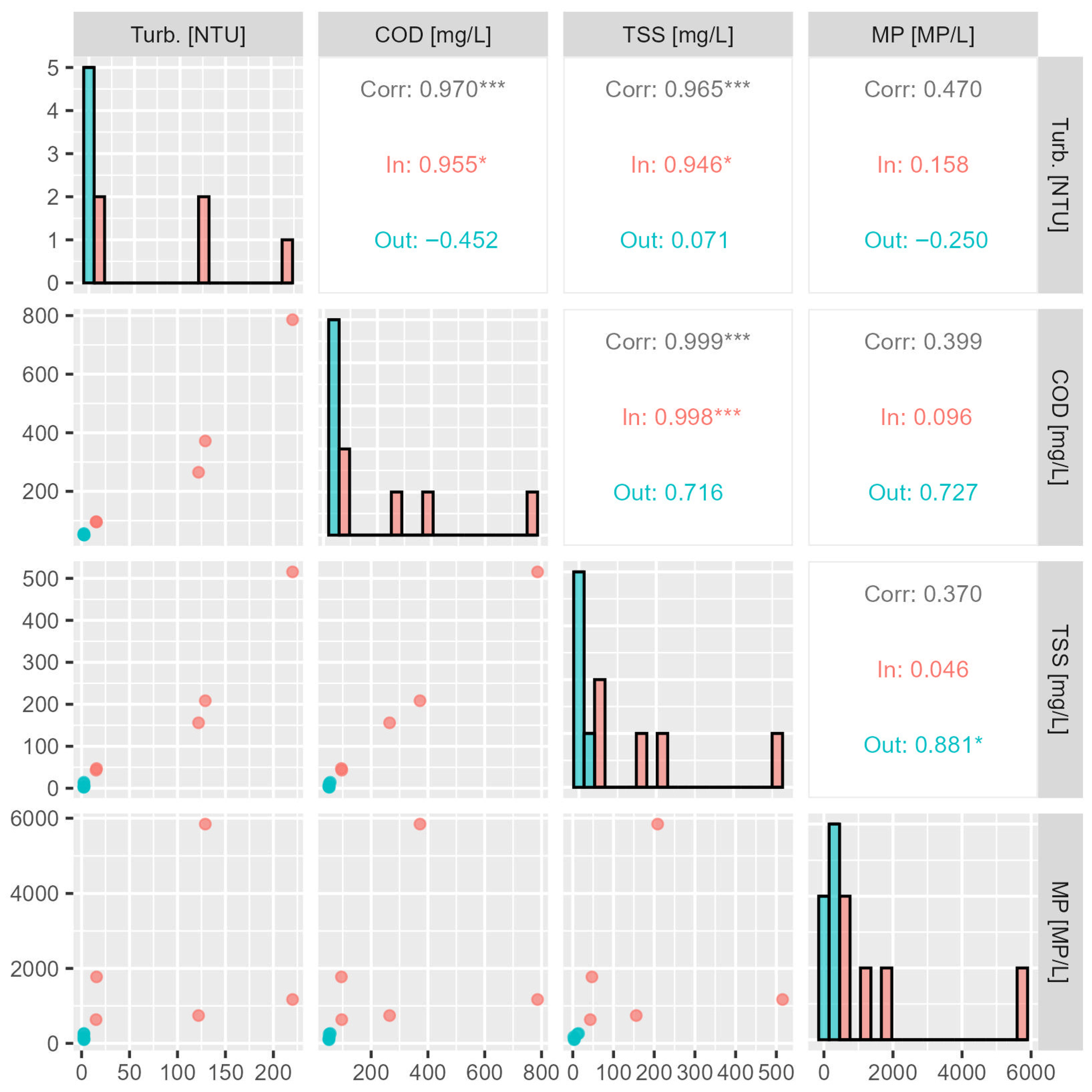
Correlation analysis was conducted for turbidity, COD, TSSs, and MPs (
Figure 5). Turbidity, COD, and TSSs exhibited very strong correlations, with coefficients (r) ranging from 0.970 to 0.999. When separating influent (in) and effluent (out) data, influent values remained strongly correlated (r = 0.946–0.955), whereas effluent data showed weaker or no correlations (r = −0.071 to −0.716). The reduced correlations in the effluent can be attributed to the low variation in these parameters in the treated waters, reflecting the steady removal performance.
Correlation analysis with MPs revealed weak to moderate correlations across the full dataset (r = 0.370–0.470). For the influent samples, correlations were very weak or absent, whereas effluent data showed strong correlations between MPs and TSSs (r = 0.881) as well as between MPs and COD (r = 0.727). A weak negative correlation was observed between turbidity and MPs (r = −0.250). Given the limited dataset (five influent and five effluent samples), statistical significance is restricted, and a larger sample size would be required to draw more robust conclusions.
As discussed in
Section 3.2.3, turbidity and TSSs are directly related, since suspended solids scatter light and thereby cause turbidity in water [
24]. COD and TSSs are also connected, as suspended solids in wastewater frequently contain organic matter that is oxidizable and thus contributes to COD [
25].
Turbidity is an easily measurable parameter that can be monitored continuously in flow, making it particularly suitable for cost-effective process control. An efficiency increase could be achieved by adapting the dosing of a TSS removal reagent according to the turbidity level.
5. Conclusions
The pilot trials at the municipal WWTP of Mykonos demonstrated the effectiveness of the agglomeration–fixation process under real operating conditions. Installed downstream of the conventional two-stage activated sludge line, the pilot plant was designed to dose organosilane reagents and a TSS removal reagent to induce the aggregation of MPs and suspended solids and remove them in a removal unit by sedimentation. Operating in semi-continuous mode, it consistently improved effluent quality despite strong fluctuations in influent caused by irregular wastewater deliveries.
Across five experimental loops, MP concentrations were reduced from highly variable influent levels (633–5843 MP/L) to stable effluent values (96–263 MP/L), corresponding to an average removal efficiency of 86 ± 8%. In parallel, TSSs decreased by 95 ± 3%, turbidity by 93 ± 7%, and COD by 70 ± 20%, while pH and conductivity remained unaffected. The influent water showed pronounced variability in COD, TSSs, and turbidity, reflecting the irregular timing and volume of truck-delivered wastewater to the WWTP, which directly influenced the stability of biological treatment and the load entering the pilot unit. These results confirm the robustness of the demonstrated treatment mechanism.
A correlation analysis revealed very strong relationships between turbidity, TSSs, and COD in the influent, reflecting their shared particulate origin. In the effluent, these correlations weakened due to consistently low residual concentrations, highlighting the stabilizing effect of the treatment. MPs showed weak to moderate correlations overall, but effluent data indicated strong associations with TSSs and COD. Turbidity, being easily measurable and strongly linked to TSSs, emerged as a promising proxy for process monitoring and reagent dosing optimization.
Taken together, the pilot trials validate the Wasser 3.0 PE-X® technology as a reliable and scalable solution for advanced wastewater treatment for MP and TSS removal. By consistently lowering particulate and organic loads, the system reduces pollutant emissions into sensitive coastal environments such as the Mediterranean Sea, where wastewater is a major pathway for MP contamination. The recyclability of formed agglomerates offers additional potential for circular economy applications. These findings demonstrate that the agglomeration–fixation process can serve as an effective post-treatment stage, enhancing effluent stability and mitigating environmental risks in WWTPs subject to seasonal and irregular loading.




 ,
,