Article

Signal Processing Techniques for Enhancing an Areal Density in Two-Reader/Three-Track Detection of Staggered Bit-Patterned Magnetic Recording Systems


by
Natthakan Rueangnetr
1,
Satra Tor. Wattanaphol
1,
Kittipon Kankhunthod
1,
Simon J. Greaves
2 and
Chanon Warisarn
1,*
1
School of Integrated Innovative Technology (SIITec), King Mongkut’s Institute of Technology Ladkrabang (KMITL), Bangkok 10520, Thailand
2
Research Institute of Electrical Communication (RIEC), Tohoku University, Sendai 980-8577, Japan
*
Author to whom correspondence should be addressed.
Appl. Syst. Innov. 2026, 9(3), 66; https://doi.org/10.3390/asi9030066
Submission received: 10 February 2026 / Revised: 12 March 2026 / Accepted: 18 March 2026 / Published: 23 March 2026

Abstract

As the demand for digital storage capacity continues to grow, bit-patterned magnetic recording (BPMR) has emerged as a promising technology to overcome the superparamagnetic limit of conventional recording methods. Nevertheless, the extremely close spacing of magnetic islands in BPMR can result in significant signal corruption, particularly due to inter-track interference. This paper presents robust signal-processing schemes for a two-reader, three-track detection system in a staggered BPMR configuration to address these challenges. The first proposed method employs a sum-soft-information technique, which combines log-likelihood ratios from two detectors to maximize mutual information. This approach significantly improves the reliability of middle-track detection. We also propose the inter-track interference subtraction technique, in which the highly reliable data recovered from the middle track are used to reconstruct the interference signal, which is then subtracted from the upper and lower tracks using an optimized weighting factor. Simulation results at an areal density of 3.0 Tb/in2 demonstrate that an optimized weighting factor of 1.78 effectively cancels interference. Moreover, the results indicate that our proposed scheme achieves a bit-error rate (BER) comparable to that of the three-reader, one-track detection BPMR systems. Furthermore, our method also demonstrates a lower BER for both adjacent tracks when compared to the conventional single-reader, two-track reading system, even in the presence of 10% media noise.

1. Introduction

As consumer-generated digital data continues to grow exponentially, the demand for increased storage capacity is more urgent than ever. Beyond DNA-based data storage [1,2,3,4], which is continually evolving to support the growing volume of data today, hard disk drives (HDDs) continue to receive significant attention. However, the traditional recording technology used in current HHDs, one of the main data storage devices, faces significant physical limitations [5,6,7,8]. The superparamagnetic limit now constrains the advancement of areal density (AD) in conventional granular media. This challenge has led researchers to investigate techniques that can push the boundaries of AD further, such as bit-patterned magnetic recording (BPMR) [9,10,11,12,13,14], which has the potential for ultra-high-density storage. BPMR is believed to provide an AD exceeding 4 terabits per square inch (Tb/in2). However, implementing BPMR introduces new challenges; the extremely close spacing between magnetic islands can cause severe signal corruption, primarily originating from inter-symbol interference (ISI) and inter-track interference (ITI) [12,13,14].
To effectively combat the effects of interference in BPMR systems, a variety of techniques have been proposed, including both describable and indescribable algorithms. Indescribable algorithms, particularly those based on deep learning, are now the standard for managing interference in BPMR systems. Research [15,16,17] clearly demonstrates that these algorithms outperform traditional detectors that rely on the partial-response maximum-likelihood (PRML) method. The multi-layer perceptron (MLP) is used as a soft-output detector [15], providing a well-estimated value by using the binary cross-entropy loss function and the identity activation function for the output layer. In Ref. [17], long short-term memory (LSTM) is also used to estimate two-dimensional interference, including ITI and ISI, in BPMR systems. This ISI/ITI estimator can efficiently produce the replica ITI/ISI signals before using them to remove ISI/ITI from the received signal.
Nevertheless, this work is committed to enhancing the assessment of describable algorithms by advancing signal-processing methods grounded in the PRML framework. For instance, multi-track maximum likelihood (ML) detection aims to process signals from multiple tracks simultaneously [18,19,20,21], thereby mitigating ITI. Moreover, this approach tends to have exponential computational complexity [19]. Another technique, an iterative soft-output detection [22], uses log-likelihood ratios (LLRs) to refine detection across multiple iterations. While this method enhances LLR reliability, it also introduces significant processing latency due to repeated decoding cycles.
Additionally, successive interference cancellation (SIC) has been widely studied [23]. This method involves subtracting the interference from a detected track before processing the neighboring tracks. It was found that the standard SIC is highly susceptible to error propagation: if the initial track is mis-detected, the error can propagate to subsequent tracks. Moreover, the ITI subtraction technique using turbo iteration in a coded BPMR system has been proposed to address the ITI issue [24]. In this approach, an imitated ITI sequence is generated by convolving the estimated recorded data sequence from the turbo iteration with the ITI coefficients. This sequence is then used to subtract the ITI from the equalized data sequence. The resulting refined sequence, which still contains some partial ITI, can be fed back into the turbo iteration process for as many rounds as necessary to improve its reliability. In Ref. [25], the combination of multi-head reading and iterative ITI cancellation has been shown to be effective in multi-track systems. In this approach, the readback signal from the target track is refined by subtracting the weighted signals of adjacent tracks before being sent to a turbo decoder. The resulting decoded data sequence, which has a higher reliability, is then used to reconstruct the ITI signal for the next turbo iteration. These two techniques have demonstrated better performance than conventional systems that do not use ITI subtraction. Furthermore, recent studies have introduced bit-summation detection, which employs a three-reader approach to enhance LLR reliability through mutual information [26] instead of using the turbo iteration process to increase the LLR reliability of the target track as employed in [24,25]. While this method demonstrates strong performance by summing three sequences of LLRs from three detectors in the three-reader system, our work investigates the feasibility of achieving similar reliability with a two-reader system.
To address these limitations, this paper proposes a robust signal-processing scheme for a two-reader, three-track detection, staggered-BPMR architecture. The proposed system uniquely combines two powerful algorithms to enhance detection performance, which include:
  • Sum-soft-information (SSI) technique: We use a two-reader configuration, positioned to maximize mutual information from the middle track. The LLRs from two detectors at the corresponding positions of both readers are combined using the SSI technique to significantly improve the reliability of middle-track detection.
  • ITI subtraction scheme: The highly reliable data recovered from the middle track, which is generated using the SSI technique, is then used to reconstruct the interference signal. This reconstructed signal is then subtracted from the upper and lower tracks using an optimized weighting factor. Our simulation results indicate that a weighting factor value of 1.78 yields optimal interference cancellation across all signal-to-noise ratios (SNRs).
The SSI technique and ITI subtraction scheme are combined because they address two distinct yet closely related parts of the track-detection problem. First, the SSI technique improves the reliability of middle-track detection by combining two mutually LLR sequences from the two readers. Since both sequences contain soft information about the middle track, their combination yields a more reliable estimate than either sequence alone. This more reliable middle-track information is then used to reconstruct the middle-track interference component for the next stage. After that, the ITI subtraction technique is adopted to remove the reconstructed interference from the readback signals before detecting the upper and/or lower tracks. Therefore, SSI first serves as a reliability-enhancement front-end, while ITI subtraction then serves as an interference-cancellation stage. This combination is motivated by the fact that interference subtraction is most effective when the interfering sequence has been estimated with high reliability. In this work, the proposed combination enables effective ITI suppression in a two-reader, three-track architecture without requiring turbo iterations or an additional third reader. The experimental results show that the two proposed techniques not only enhance recording performance on the middle track but also improve bit error rate (BER) on both the upper and lower tracks. As a result, these techniques outperform conventional PRML systems for one-dimensional (1D) signal processing schemes, even with 10% media noise.
This paper is organized as follows: Section 2 provides a description of the BPMR channel model. Proposed techniques are presented in Section 3. In Section 4, we discuss and demonstrate the simulation results. Finally, Section 5 offers our conclusions.

2. Channel Model

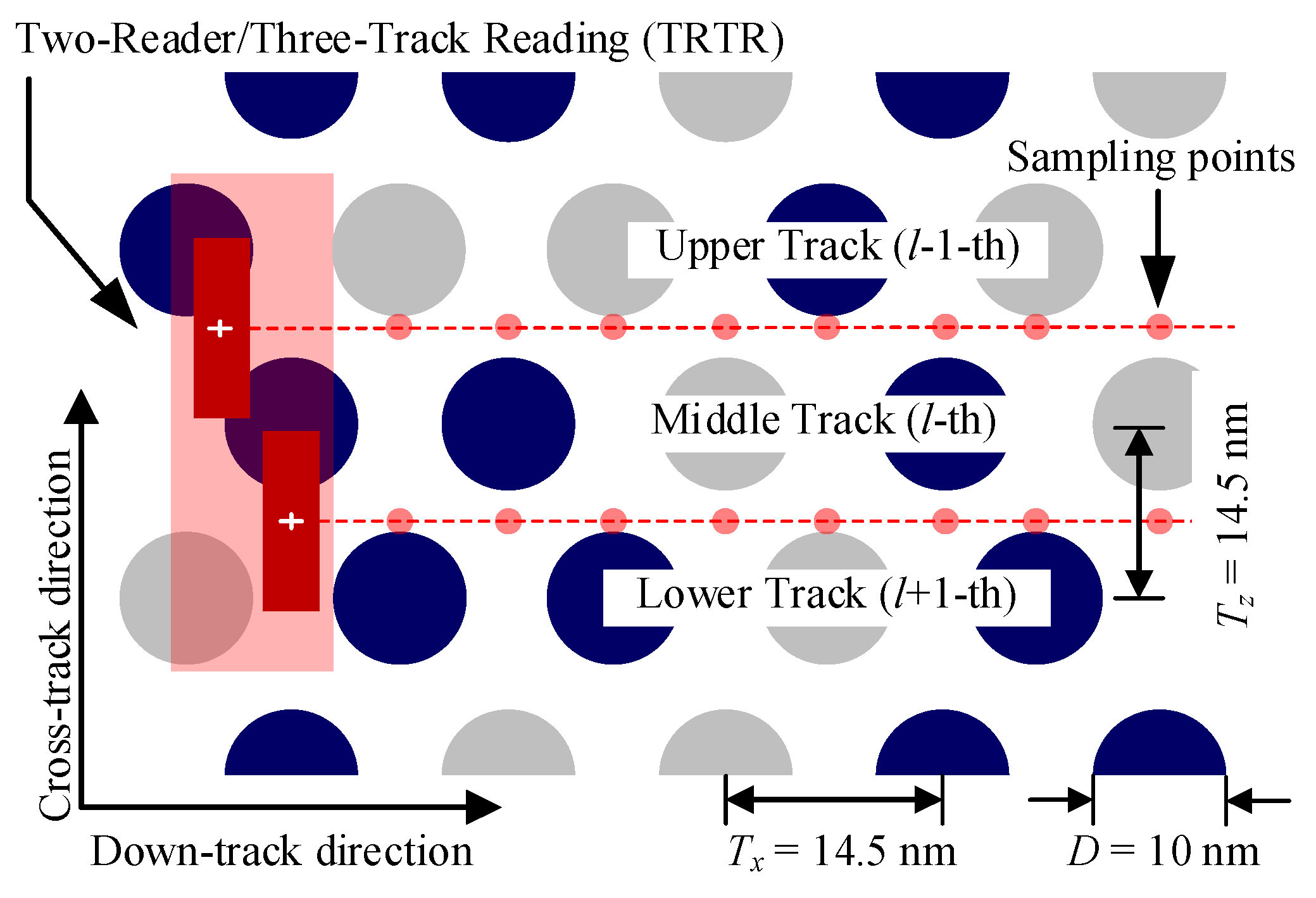
This study uses a staggered-BPMR system with a bit period (Tx) equal to the track pitch (Tz). These values were set to 14.5 nm, which equates to ADs of 3.0 Tb/in2, and the bit-island diameter was 10 nm, as illustrated in Figure 1. The bit-islands were composed of tiny pixels in the x- and y-planes [27,28], and non-magnetic material separated the bit-islands. We used two readers to read three tracks simultaneously, with the readers positioned between the tracks to enhance mutual information and facilitate efficient ITI subtraction, as illustrated in Figure 1. Size and position fluctuations of the islands were included and modeled as media noise [28].
The size fluctuation percentage can be defined as follows:
Size Fluctuation = σ D D × 100 ,
where σ D is the variance of the bit-island diameter, defined as a Gaussian distribution, and D is the diameter of the ideal bit-islands, which was set to 10 nm. The position fluctuation percentage can be defined as follows:
Position Fluctuation = σ P L × 100 ,
where σ P is the variance of the center-center distance between neighboring bit-islands and the center-center distance between ideal bit-islands according to a Gaussian distribution, and L is the length of the bit period.
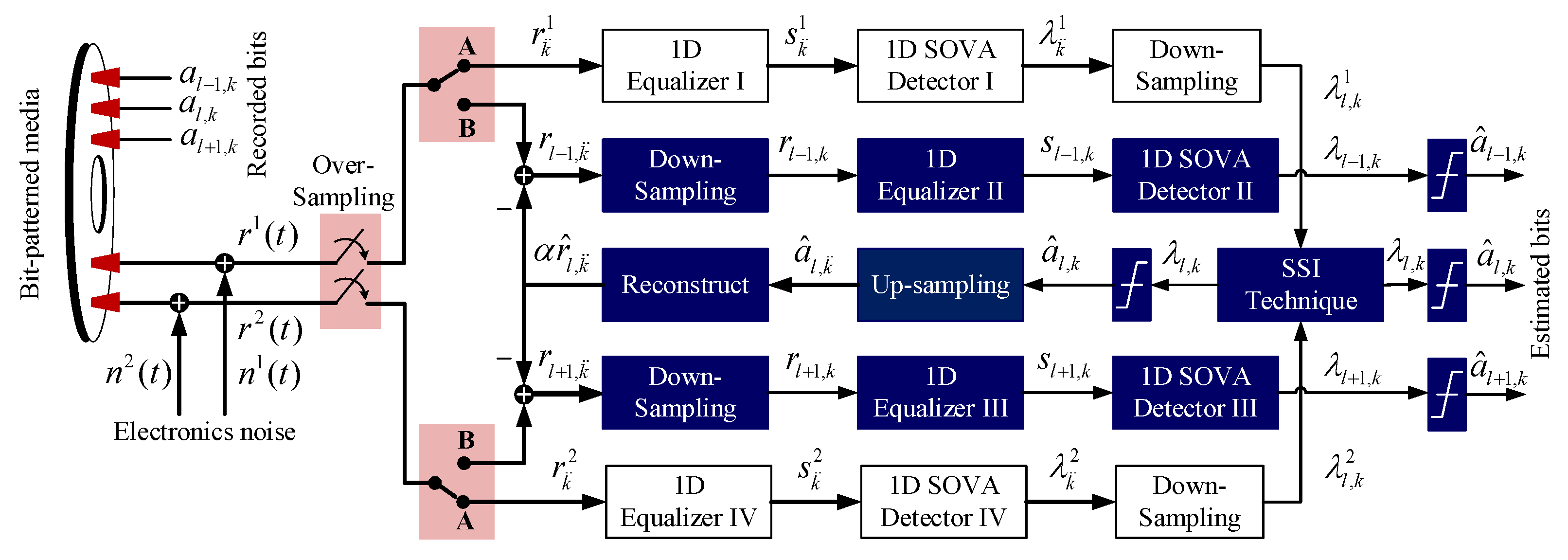
In the writing process, we assume that all bit-islands are perfectly written, which implies that the magnetization of all bit-islands is consistent with the recorded bit pattern. Here, the recorded bits of the upper, middle, and lower tracks are defined as a l 1 , k , a l , k , and a l + 1 , k , respectively, as shown in Figure 2. These subscripts represent the l-th track and the k-th bit. In the reading process, the readback signals can be generated by convolving the magnetization of the bit-island with the reader’s sensitivity function [29]. Mathematically, the readback signal of the j-th reader, r j ( x , y ) , can be written as:
r j x , y = m j ξ , η h j x ξ , y η d ξ d η + n j x , y ,
where j { 1 , 2 } is the j-th reader. The parameters x and y are the reader position in the down- and cross-track directions, respectively. The m j ( ξ , η ) 1 , + 1 is the magnetization as a function of down- and cross-track directions, ξ , and η , respectively. h j ( ξ , η ) is the reader sensitivity response [29], n j ( x , y ) is electronic noise that corrupts the readback signal produced from the j-th reader, defined as an additive white Gaussian noise (AWGN) with zero mean and variance σ 2 . The SNR is defined as:
SNR = 10 log 10 ( A / σ 2 ) ,
In decibels (dB), where A = 1 is the normalized peak amplitude of the readback signal.
In this work, we use two readers to simultaneously read three data tracks, with the first reader positioned between the upper and middle tracks. In contrast, the second reader is placed between the middle and lower tracks, as shown in Figure 1. We can fix the position on the y-axis, while the x-axis can be defined in terms of time using the parameter t rather than x. Therefore, the readback signal of the j-th reader, r j ( x , y ) , can be considered as a continuous-time readback signal r j ( t ) . To obtain the discrete-time readback signal r k ¨ j of the j-th reader at the k ¨ -th sample, r k ¨ j , the continuous-time readback signal is oversampled at a period of 0.5 × Tx, according to the following equation:
r k ¨ j ( t ) t = 0.5 × k ¨ T x ,
We observe that the number of data samples collected will be twice the required number for each track. This oversampling technique allows us to gather data samples from both adjacent tracks simultaneously. Specifically, data samples from the upper or lower track are collected at odd positions of each data sequence. In contrast, the data samples from the middle track are found at even positions, as shown in Figure 1. As a result, we generate two data sequences from the middle track: one from the first reader and another from the second reader. We refer to these as the mutual data in this work.
As shown in Figure 2, the switches move to the A position in the first step. The readback data sequences r k ¨ 1 and r k ¨ 2 produced by the first and the second readers, respectively, are sent to 1D equalizers to equalize the readback data sequences s k ¨ 1 and s k ¨ 2 according to their target data sequences. Here, we employ a 1D equalizer with 1 × 11 taps and a 1D target with 1 × 3 taps, both designed using the minimum mean-square error (MMSE) criterion [30]. After equalization, the equalized data sequences are detected using 1D soft-output Viterbi algorithm (SOVA) detectors [31] to produce the soft-information or LLR sequences of the first and second data sequences, represented as λ k ¨ 1 and λ k ¨ 2 , respectively. The LLR sequences are then downsampled to keep only the samples at the even positions, which correspond to the bit-islands of the middle track, as shown in Figure 1. The two LLR sequences, denoted as λ l , k 1 and λ l , k 2 , are fed to the SSI algorithm to produce the enhanced LLR for the middle track, λ l , k . This enhanced LLR of the middle track is then separated into two paths. The first path leads to a threshold detector to estimate the user bits of the middle track, a ^ l , k , while the second path is used to produce the remaining ITI in the ITI subtraction scheme. The estimated bits of the middle track are then upsampled by padding zeros at the odd positions before being sent to the reconstruction process. Here, the bits are represented as a ^ l , k ¨ , which will be convoluted with the channel coefficients to produce the estimated readback signal of the middle track, r ^ l , k ¨ , as described in detail in the next section.
In the second step, the switches move to the B position, and the readback signals from the first and second readers are then subtracted from the estimated readback signal of the middle track after weighting by the weight parameter, α . These two sequences are processed with 1D equalizers followed by 1D SOVA detectors after a down-sampling process, which means that only the data at odd positions are used to produce the LLRs, λ l 1 , k ¨ and λ l + 1 , k ¨ for the upper and lower tracks, respectively. In this step, the 1D equalizers and 1D SOVA detectors must be designed based on the responses of the upper and lower tracks using the MMSE method [30,31]. These two LLRs are then passed to the threshold detector, which decides on the estimated bits of the upper and lower tracks, which are represented as a ^ l 1 , k and a ^ l + 1 , k , respectively. These estimated bits for all three tracks will be used to evaluate the BER in the final performance assessment.

3. Proposed Methods

3.1. Sum-Soft-Information (SSI) Technique

Previously, we proposed a three-reader, one-track detection method to enhance data retrieval in a staggered BPMR system [26], in which the three readers were used to retrieve all three data tracks to determine the recorded bits on a single track. The three reader sequences are called mutual data sequences. The performance of the considered track can be improved by using the SSI technique, which leverages all three LLR sequences from three SOVA detectors to enhance the reliability of the LLR for the considered track. However, to reduce the number of readers, reduce complexity, and improve the overall performance of a staggered BPMR system, we first propose an SSI technique, which uses only two LLR sequences from both adjacent tracks, and then suggest the ITI subtraction technique, which can operate together efficiently. Here, the enhanced LLR of the middle track, λ l , k can be defined by the following equation:
λ l , k = λ l , k 1 + λ l , k 2 ,
where λ l , k 1 and λ l , k 2 are the LLRs of the upper and the lower tracks, respectively. We observe that these two sequences are mutual because they represent the possible bits of the middle track. This enhanced LLR sequence can be significantly better than an individual LLR sequence generated from its adjacent tracks. Finally, these LLRs are then passed to a threshold detector to produce the estimated user bits of the middle track, which will be used for the next ITI subtraction operation.
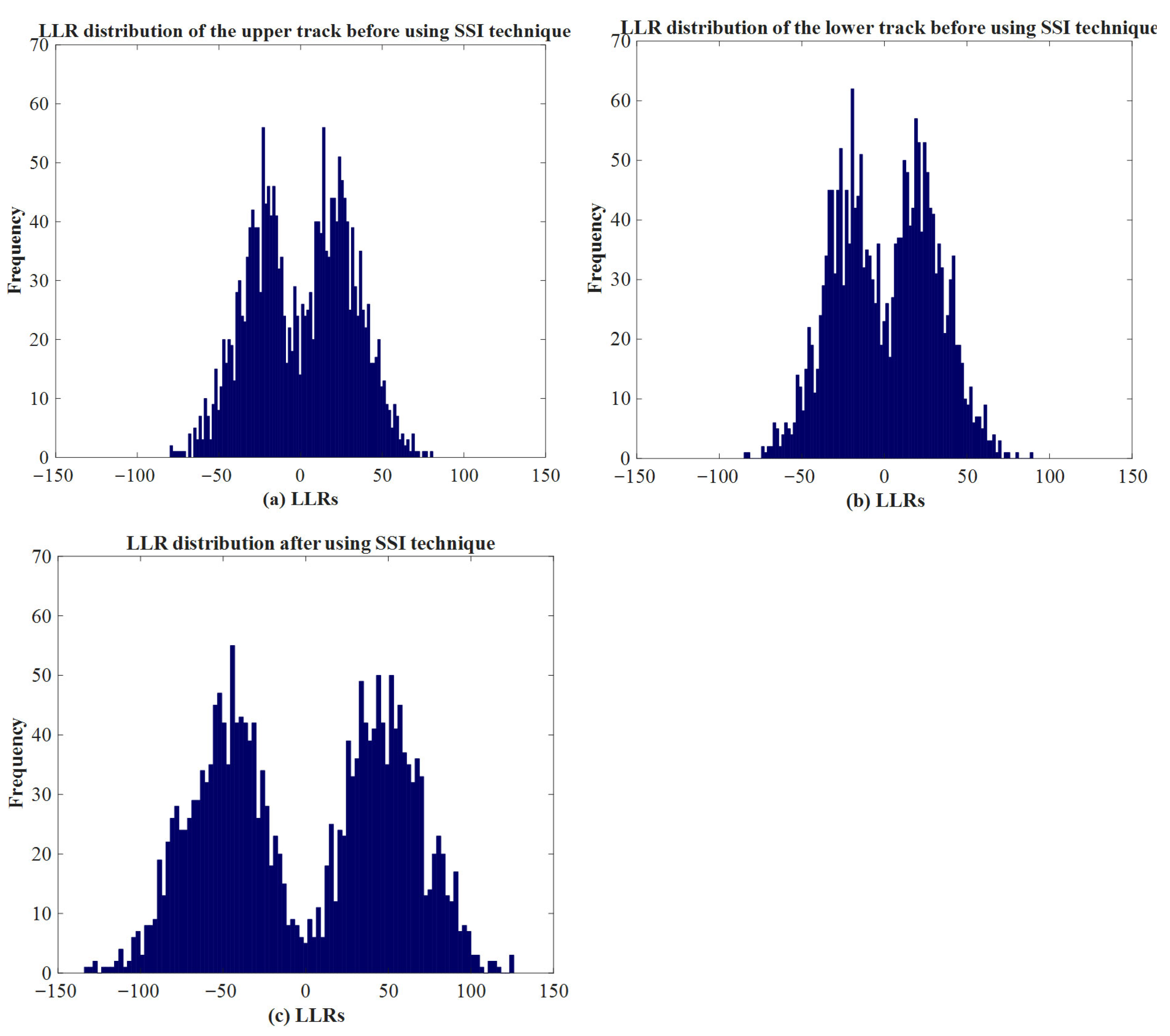
Figure 3 shows the LLR distributions of individual LLRs of the upper and lower tracks, compared with the enhanced LLR of the middle track after applying the SSI technique. We conducted a thorough comparison of the improved LLRs before and after applying the SSI technique, and the analysis of the LLR distribution in both cases is clearly illustrated in Figure 3. Here, we set the SNR to 12 dB, with no media noise. Figure 3a shows the distributions of the LLRs for the upper track, while Figure 3b presents the distributions of the LLRs for the lower track. The SOVA detector generates both sets of distributions. They appear to have the same distribution shape, suggesting that both tracks were affected by similar interference. In contrast, Figure 3c shows the distributions of the LLRs generated using the SSI technique. Here, the lengths of the upper and lower track data sequences were 2048 bits as shown in Figure 3a and Figure 3b, respectively, while the length of the middle track data sequence was 4096 bits, as shown in Figure 3c. The left and right sides of the distributions indicate the possibility of values of bit “−1” and bit “+1,” respectively. The overlapping area represents the area that cannot be decided between bit “−1” and bit “+1,” which implies that a larger overlapping area makes it harder to choose between bit “−1” or bit “+1”. Figure 3c clearly demonstrates that the SSI technique can enhance LLR reliability, thereby improving estimates of user bits for the middle track. Using this SSI technique enables suppression of the ITI effect in the ITI subtraction operation.

3.2. Inter-Track Interference (ITI) Subtraction

After obtaining the estimated user bits of the middle track, a ^ l , k , the estimated user sequence is padded with zeroes at the odd positions to obtain the up-sampled sequence, a ^ l , k ¨ . The reconstructed data sequence, r ^ l , k ¨ , can then be generated from the following equation:
r ^ l , k ¨ = h a ^ l , k ¨ ,
where * is the convolution operator. h is the channel response coefficients, which can be obtained by sampling the reader sensitivity function according to the bit period, Tx, of the middle track. Since we consider the 1D channel response coefficients, we can sample the reader sensitivity function in the down-track direction. In this work, the number of channel response coefficients is represented in matrix form as 1 × 5 taps, which can be defined by the following equation:
h = h l , 2   h l , 1   h l , 0   h l , 1   h l , 2 ,
where h l , 0 is the highest, corresponding to the height point of the sensitivity function that is positioned at the center of the desired bit. Other coefficients can be obtained using the same method, with their values decreasing in descending order according to the shape of the reader sensitivity function.
To generate the reproduced data sequences of the upper and lower tracks, the reconstructed data sequence of the middle track is then used to subtract the initial readback sequences denoted by r k ¨ 1 and r k ¨ 2 , which are retrieved from the first reader and the second reader, respectively. Moreover, to achieve optimal ITI subtraction, we use a weighting factor, α, for scaling the reconstructed data sequence of the middle track before performing the subtraction, as described by the following equations:
r l 1 , k ¨ = r k ¨ 1 α r ^ l , k ¨ ,
r l + 1 , k ¨ = r k ¨ 2 α r ^ l , k ¨ ,
Since the media structure has a staggered pattern, with the data sequences of the upper and lower tracks positioned at odd locations within each reproduced data sequence, the two reproduced data sequences must be down-sampled before being processed by the 1D equalizers and the 1D SOVA detectors in path-B, as illustrated in Figure 2. In this context, the reproduced data sequences that are considered only at the odd positions of the upper and lower tracks are represented by r l 1 , k and r l + 1 , k , respectively.
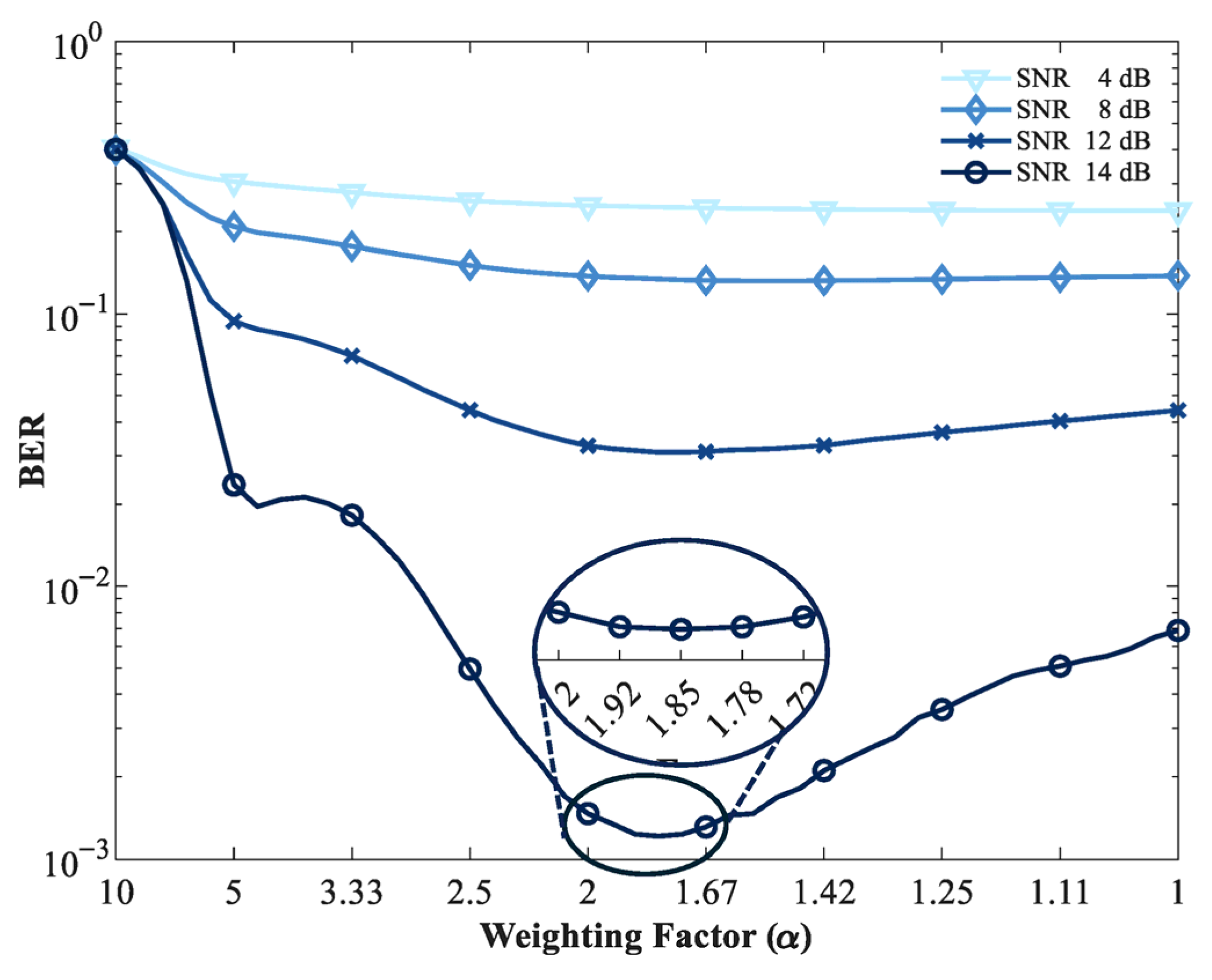
In this work, we determined the optimal weighting factor by conducting system simulations to identify the value that yielded the lowest BER, as illustrated in Figure 4. The simulations were conducted at SNR levels of 4, 8, 12, and 14 dB. The results consistently indicated an optimal α value of 1.78, demonstrating that the optimal weighting factor is independent of the SNR. Therefore, we will use this value of α for the remainder of the study. It is important to note that, across other system configurations and parameter settings, such as various areal densities, reader sensitivity functions, reader position arrangements, and media noise sources, even if some metrics, e.g., weighting factors and channel response coefficients, may differ. However, the proposed concept of using SSI and ITI subtraction techniques can still be applied to improve overall system performance.
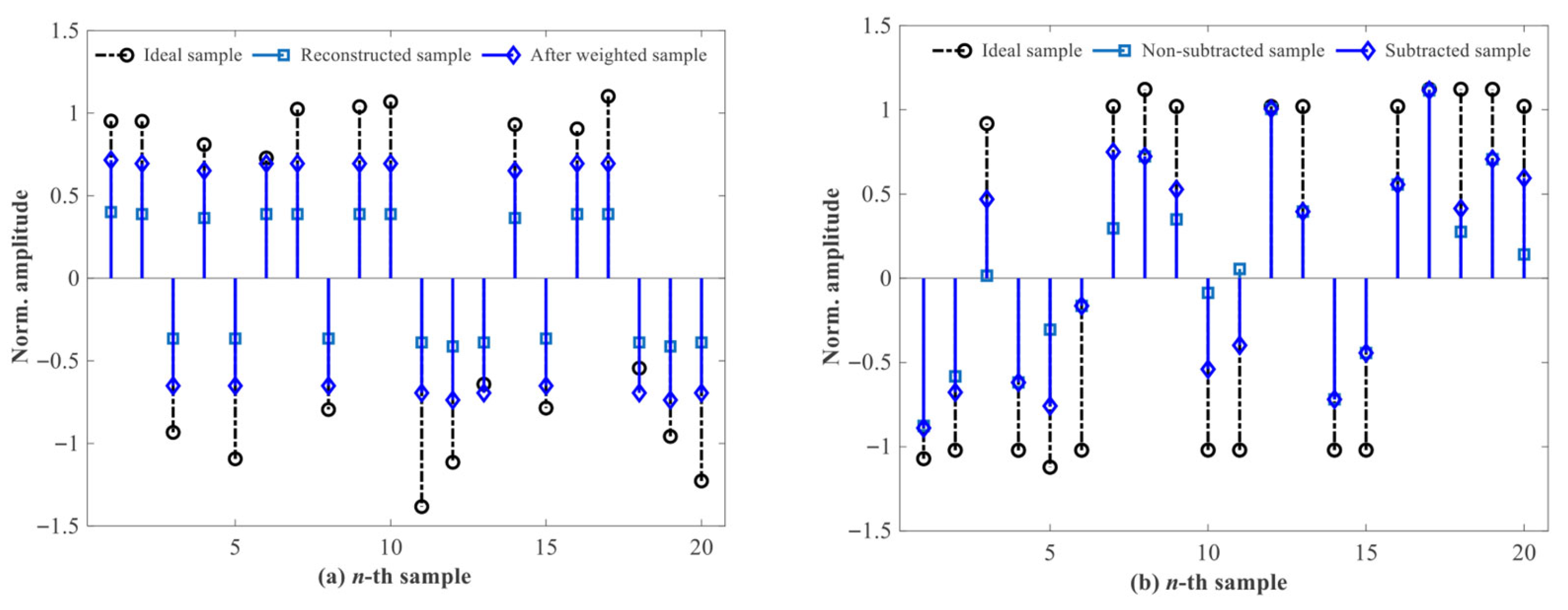
Figure 5a illustrates reconstructed data sequences for the middle track, highlighting results obtained with and without the weighting factor. These results are represented by blue diamond points and blue square points, respectively. Additionally, the reconstructed data sequences are compared with the ideal data sequence (indicated by the black circles), which was generated by convolving the sensitivity function with the magnetization of bit-islands for the middle track, excluding adjacent tracks and media noise, at an SNR of 12 dB. The reader was positioned between the middle track and either the upper or lower track, as depicted in Figure 1. The reconstructed data sequences with the weighting technique appear to be closer to the ideal data sequence than those without weighting. Consequently, the weighted reconstructed data sequences are used to eliminate the ITI effect for both the upper and lower tracks.
Additionally, we also present an example of all three data sequences associated with the ITI subtraction technique, as shown in Figure 5b. The black circle samples represent the ideal data sequences generated by convolving the sensitivity function with the magnetization of the upper track (or lower track), excluding adjacent tracks and media noise, at an SNR of 12 dB. The reader was positioned between the middle track and the upper (or lower) track, as depicted in Figure 1. The ideal samples represent the target for the reproduced data sequence after using the ITI subtraction technique. The blue square samples represent the readback data sequence obtained from either the first or second reader, including data from the middle track and its adjacent tracks. The blue diamond samples illustrate the reproduced data sequence acquired using the ITI subtraction technique. The reproduced data sequence closely resembles the ideal data sequence, more so than the initial readback data sequence. This suggests that the ITI subtraction technique effectively minimizes the impact of ITI.
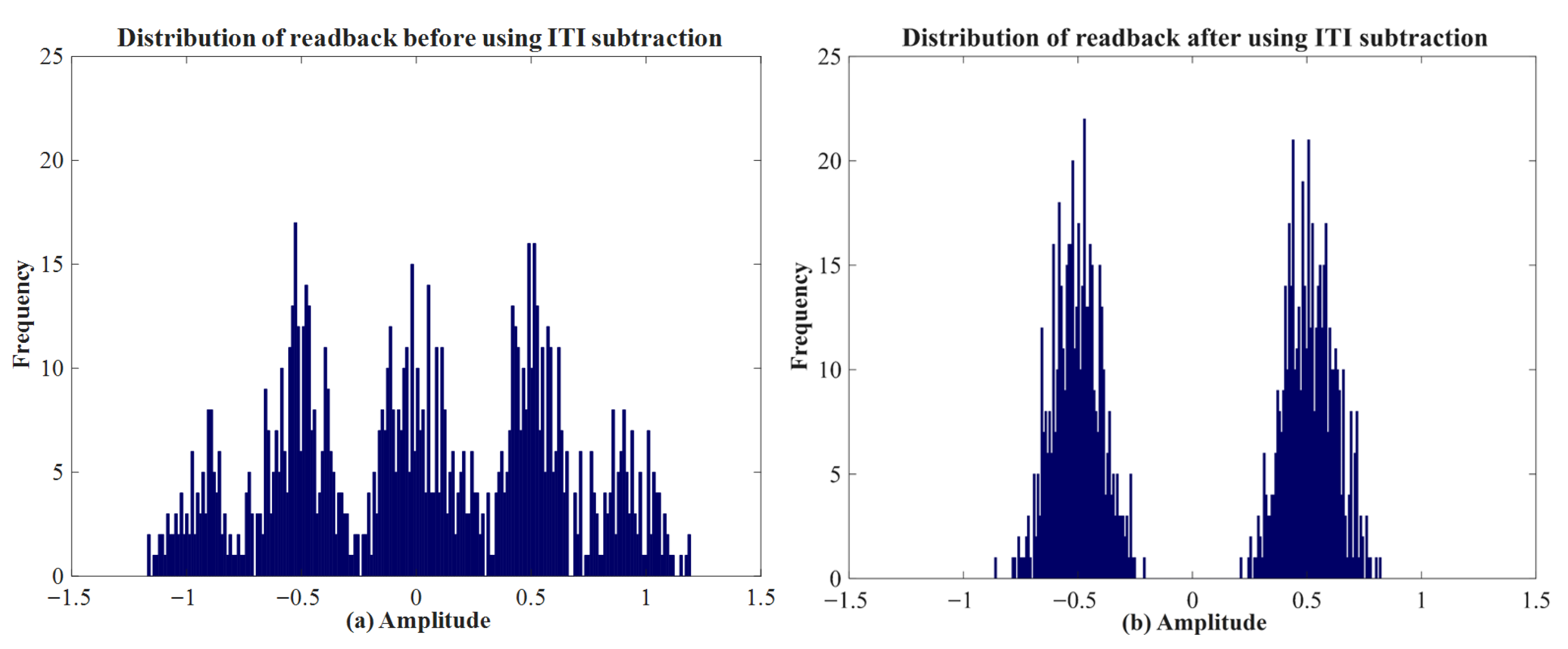
We have also investigated the distributions of the data sequences, generated from the first reader at an SNR of 20 dB before and after using the proposed ITI subtraction technique, as shown in Figure 6a and Figure 6b, respectively. The figure highlights the differences between the two data sequences. The initial readback signal contains five possible data groups, suggesting that the equalizer and detector must be more complex to handle these ambiguities, as shown in Figure 6a. In contrast, the data sequence obtained after ITI subtraction yields only two possible data groups, as shown in Figure 6b, which indicates that estimating the user bits is not only simpler but also that the signal processing operations are less complex. Additionally, using well-designed equalizers and detectors based on the generated data sequence can enhance BER performance on both the upper and lower tracks, as discussed in the next section.

3.3. 1D PRML Design

In this work, we employ the 1D MMSE method for designing the equalizer [30]. The design process is divided into two parts according to the detection stages, as shown in Figure 2. On path-A, for the first stage, the readback sequences, r k ¨ 1 and r k ¨ 2 from the first and second readers, respectively, are processed to obtain the LLRs for the middle track. Let us consider how to obtain the target coefficients, g A 1 = [ g 0 g 1 g 2 ] T and the equalizer coefficients, f A 1 = [ f N f 0 f N ] T for the upper track of path-A by applying a monic constraint to the 1D target and fixing the first coefficient, g 0 = 1 . Here, we set the target and equalizer coefficient sizes to 1 × 3 and 1 × 11, respectively. [-]T is the transpose operator. The equalizer coefficients, f A 1 and the target coefficients, g A 1 are found by minimizing the expected squared error from the following equation:
E w k ¨ 1 2 = E r k ¨ 1 f k ¨ 1 a k ¨ 1 g k ¨ 1 2 ,
where w k ¨ 1 is an error from the target and equalizer design process, r k ¨ 1 is the readback sequence obtained from oversampling the first readback signal, a k ¨ 1 is the recorded bit sequence that is formed as a k ¨ 1 = a l 1 , k a l , k a l 1 , k + 1 a l , k + 1 a l , k + K , and K is the length of the recorded bit sequence. We also design the target coefficients, g A 2 and equalizer coefficients, f A 2 for the lower track using the same process. We can minimize the expected squared error from the following equation:
E w k ¨ 2 2 = E r k ¨ 2 f k ¨ 2 a k ¨ 2 g k ¨ 2 2 ,
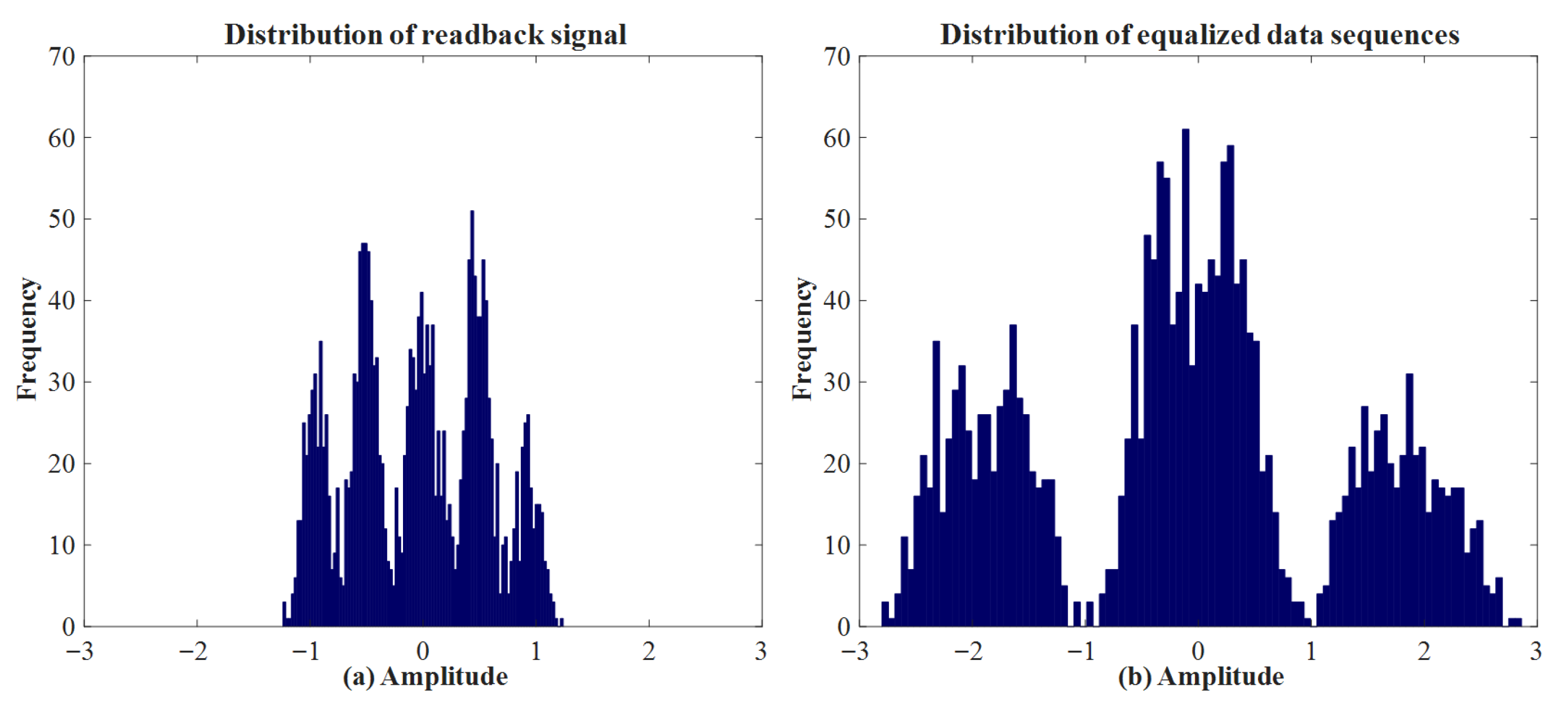
where w k ¨ 2 is an error from the target and equalizer design process, r k ¨ 2 is the readback sequence obtained from oversampling the second readback signal. There is a slight difference in the recorded bit format, which will become a k ¨ 2 = a l + 1 , k a l , k a l + 1 , k + 1 a l , k + 1 a l , k + K . Figure 7a illustrates the distribution of the first readback signal, while Figure 7b displays the distribution of the equalized data sequence. The data can be categorized into three distinct groups, suggesting that detection is more straightforward with the 1D SOVA detector.
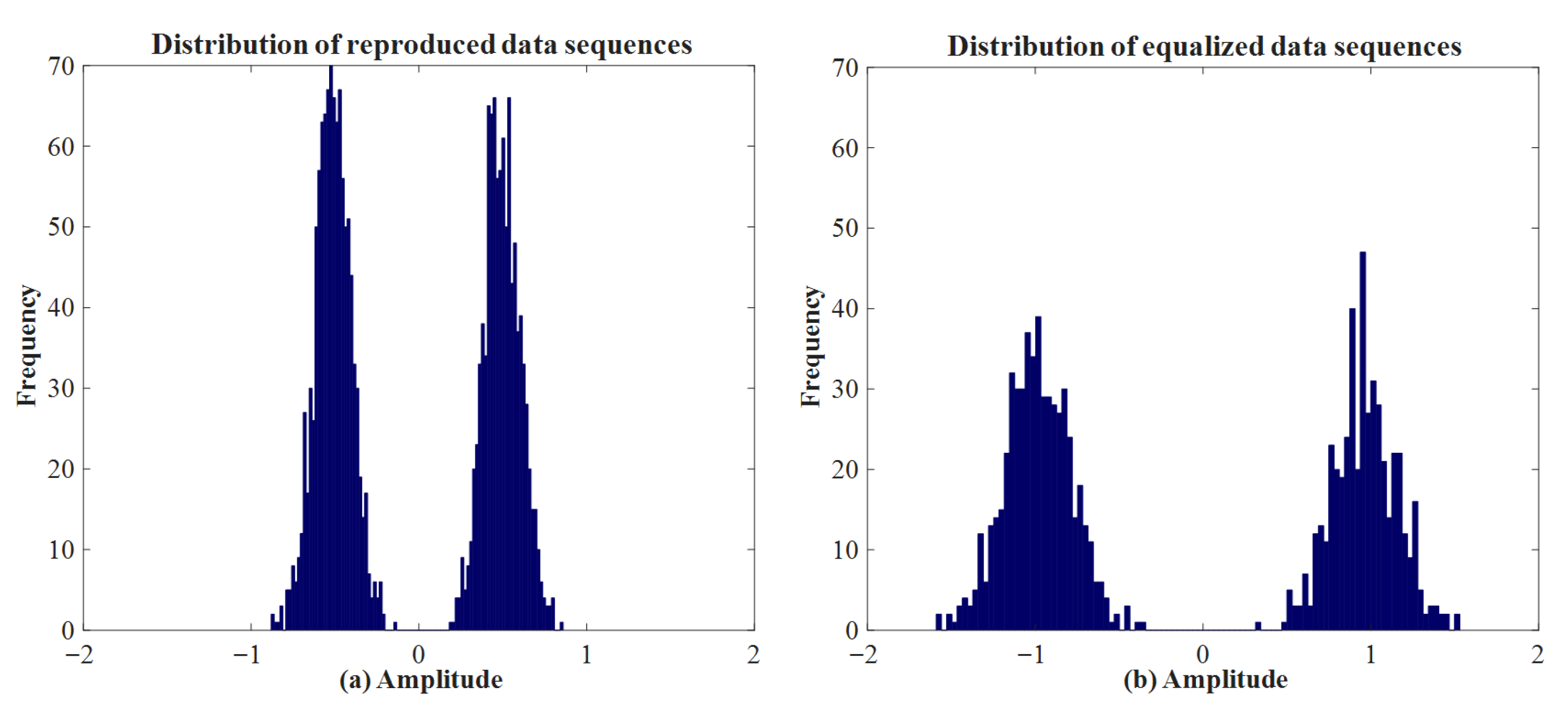
In the second stage of path-B, the equalizers are also designed using the 1D MMSE method to equalize the data sequences after ITI subtraction. Here, the reproduced data sequences, s l 1 , k and s l + 1 , k are the equalized data sequences of the upper and lower tracks, respectively. With the ITI from the middle track already suppressed, the signal distribution is simplified to two possible groups, as illustrated in Figure 8a. Therefore, we can utilize the fixed target, g B 1 = [ 1 0 0 ] for the upper track and g B 2 = [ 1 0 0 ] for the lower track to detect the upper and lower tracks, respectively. By using these fixed targets, the equalizers for both upper and lower tracks can be designed to eliminate only the ISI effect, simplifying the detection process for the 1D SOVA detectors. Therefore, we can obtain the equalizer coefficients of the upper track in path-B, f B 1 = [ f N f 0 f N ] T by minimizing the expected squared error from the following equation:
E w k 1 2 = E r l 1 , k 1 f k 1 a l 1 , k 1 g k 1 2 ,
where w k 1 is an error from the target and equalizer design process, r l 1 , k 1 is the readback sequence obtained from down-sampling the first reproduced data sequence, and a l 1 , k 1 is the recorded bit sequence of the upper track. We can also get the equalizer coefficients of the lower track in path-B, f B 2 = [ f N f 0 f N ] T by minimizing the expected squared error from the following equation:
E w k 2 2 = E r l + 1 , k 2 f k 2 a l + 1 , k 2 g k 2 2 ,
where w k 2 is an error from the target and equalizer design process, r l + 1 , k 2 is the readback sequence obtained from down-sampling the second reproduced data sequence, and a l + 1 , k 2 is the recorded bit sequence of the lower track. The equalized data sequence of the upper track is shown in Figure 8b, which clearly indicates that the data distribution is separated into two distinct groups. This implies that the 1D equalizer can effectively mitigate ISI.

4. Simulation Results

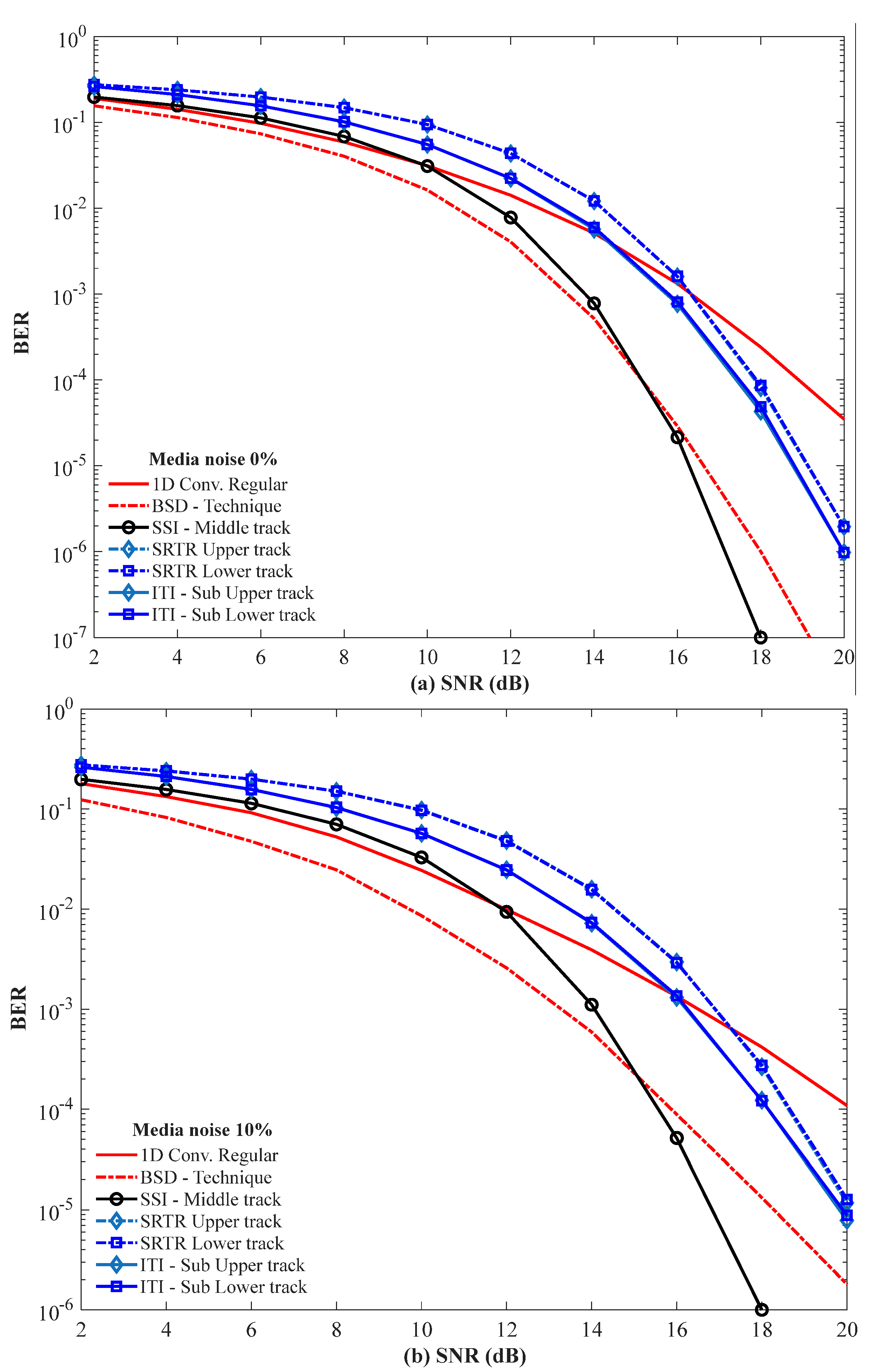
We assess the performance of our proposed system by measuring the BER in the absence and presence of media noise, accounting for fluctuations in both the position and size of the bit-islands. We assume that the effect of media noise follows a Gaussian distribution and define its size and position in terms of percentages of the original dimensions and spacing, respectively, as detailed in Section 2. Figure 9 show the BER versus SNR for various systems, including the proposed systems, a conventional system, and the three-reader one-track detection system [26]. Here, the proposed systems use the SSI technique to enhance the middle track’s performance, while the ITI subtraction technique is used to improve the upper and lower tracks’ performance. The two proposed techniques are referred to as “SSI-Middle Track” and “ITI-Sub Upper Track” along with “ITI-Sub Lower Track”. The conventional single-reader two-track reading technique [28] is denoted as “SRTR Upper Track” and “SRTR Lower Track.” The conventional three-reader one-track detection technique [26] is referred to as the “BSD-Technique”.
As shown in Figure 9a, at an AD of 3.0 Tb/in2 and in the absence of media noise, employing the SSI technique can effectively improve the performance of the middle track. Using the SSI technique can achieve an SNR that is 2.4 dB lower than that of the conventional SRTR system at BER = 10−3, and 2.5 dB lower at BER = 10−5. Moreover, it can achieve better performance than the traditional three-reader one-track detection technique, which uses three readers to produce three mutual information values to determine the recorded bits on a single middle track [26]. Especially at high SNR or low electronic noise, the readback signals were mainly affected by ITI and ISI, indicating that the proposed SSI technique can effectively mitigate both. In addition, the ITI subtraction technique can improve the BER of both upper and lower tracks, achieving around 1.0 dB and 0.8 dB gain over the conventional SRTR system at BER = 10−3 and 10−5, respectively.
When analyzing BER in the presence of 10% media noise, as illustrated in Figure 9b, we found that the proposed system continues to deliver superior performance. The results indicate that our proposed SSI technique still provides a lower BER on the middle track than the traditional three-reader one-track detection system. Furthermore, the ITI subtraction technique yields lower BERs on both the upper and lower tracks than the SRTR system. Additionally, when media noise is present, our proposed ITI subtraction technique achieves greater BER improvement than the conventional SRTR, indicating that our system is more robust to media noise. These results suggest that our proposed system is well-suited for high-density magnetic recording, even in the presence of significant media noise.
Nevertheless, we recognize that there are additional practical noise sources and other significant factors beyond our scope. These include correlated and non-Gaussian media noise, reader asymmetry and mismatch, various hardware-related distortions, track misregistration, and situations involving written errors. These limitations could further impact the overall BER performance and should be explored in more realistic settings.
Finally, to evaluate the complexity of our proposed systems relative to various recording systems, we have computationally investigated the number of operations by counting the total number of elementary arithmetic operations required to process one user bit, depending on the equalizer and detector used. These operations include subtraction (Sub.), division (Div.), multiplication (Mul.), and addition (Add.), summarized in Table 1. The additional complexity of our proposed system is slightly higher than that of the conventional 1D detection for both regular and staggered BPMR systems [28]. Still, we can achieve better BER performance than both systems. Moreover, our proposed system not only has lower complexity than the system using the BSD technique [26], but also provides better BER performance.

5. Conclusions

In this work, we present the sum-soft-information (SSI) technique to enhance the bit-error rate (BER) performance of the middle track in a two-reader, three-track bit-patterned magnetic recording (BPMR) system. In this setup, two readers are positioned between the middle track and its adjacent tracks. The readback signals from each reader are oversampled. The samples at odd positions correspond to data from the upper and lower tracks, while those at even positions relate to the middle track. We obtain two data sequences from the middle track, sampled from the two readback signals. These sequences represent soft-information that reflects the mutual information of the middle track, which we term mutual information. We utilize this information in the SSI technique to recreate the estimated readback signal for the middle track. Subsequently, we subtract the estimated readback signal of the middle track from the readback signals generated by the first and second readers. This process allows us to regenerate the individual readback signals for the upper and lower tracks before estimating the recorded bits, which we refer to as the proposed inter-track interference (ITI) subtraction technique. The proposed SSI technique demonstrates effective performance, achieving results comparable to those of a three-reader, one-track detection system, where all three readers are used to detect only one track. Furthermore, the proposed ITI subtraction technique outperforms the single-reader, two-track reading technique in both the presence and absence of media noise.

Author Contributions

Conceptualization, C.W., K.K. and N.R.; methodology, C.W. and K.K.; software, S.T.W.; validation, N.R., S.T.W. and C.W.; formal analysis, C.W.; investigation, S.J.G.; resources, N.R.; data curation, N.R.; writing—original draft preparation, S.T.W.; writing—review and editing, S.J.G.; visualization, C.W.; supervision, C.W.; project administration, C.W.; funding acquisition, C.W. All authors have read and agreed to the published version of the manuscript.

Funding

This work was financially supported by King Mongkut’s Institute of Technology Ladkrabang Research Fund: Grant number KREF146812.

Data Availability Statement

The original contributions presented in this study are included in the article. Further inquiries can be directed to the corresponding author.

Conflicts of Interest

The authors declare no conflict of interest.

References

  1. Sabary, O. Survey for a Decade of Coding for DNA Storage. IEEE Trans. Mol. Biol. Multiscale Commun. 2024, 10, 2. [Google Scholar] [CrossRef]
  2. Hou, Z.; Qiang, W.; Wang, X.; Chen, X.; Hu, X.; Han, X.; Shen, W.; Zhang, B.; Xing, P.; Shi, W.; et al. “Cell Disk” DNA Storage System Capable of Random Reading and Rewriting. Adv. Sci. 2024, 11, 2305921. [Google Scholar] [CrossRef] [PubMed]
  3. Gomes, C.P.; Martins, A.G.C.; Nunes, S.E.; Ramos, B.; Wisinewski, H.R.; Reis, J.L.M.S.; Lima, A.P.; Aoyagi, T.Y.; Goncales, I.; Maia, D.S.; et al. Coding, decoding and retrieving a message using DNA: An experience from a Brazilian center research on DNA data storage. Micromachines 2024, 15, 474. [Google Scholar] [CrossRef] [PubMed]
  4. Shen, P.; Zheng, Y.; Zhang, C.; Li, S.; Chen, Y.; Chen, Y.; Liu, Y.; Cai, Z. DNA Storage: The Future Direction for Medical Cold Data Storage. Synth. Syst. Biotechnol. 2025, 10, 677–695. [Google Scholar] [CrossRef]
  5. Lu, P.L.; Charap, S.H. Thermal instability at 10 Gbit/in2 magnetic recording. IEEE Trans. Magn. 1994, 30, 4230–4232. [Google Scholar]
  6. Weller, D.; Moser, A. Thermal effect limits in ultrahigh-density magnetic recording. IEEE Trans. Magn. 1999, 35, 4423–4439. [Google Scholar] [CrossRef]
  7. Wood, R. The feasibility of magnetic recording at 1 Terabit per square inch. IEEE Trans. Magn. 2000, 36, 36–42. [Google Scholar] [CrossRef]
  8. Wood, R. Future hard disk drive systems. J. Magn. Magn. Mater. 2008, 321, 555–561. [Google Scholar] [CrossRef]
  9. Weller, D.; Doerner, M.F. Extremely high-density longitudinal magnetic recording media. Annu. Rev. Mater. Res. 2000, 30, 611–644. [Google Scholar] [CrossRef]
  10. Richter, H.J.; Dobisz, E.A.; Landau, H.G.; Olmos, P.R.; Yang, H.; Westerholt, K.; Zabel, H. Recording on bit-patterned media at densities of 1 Tb/in2 and beyond. IEEE Trans. Magn. 2006, 42, 2255–2260. [Google Scholar] [CrossRef]
  11. Dobisz, E.A.; Bandic, Z.Z.; Wu, T.-W.; Albrecht, T. Patterned media: Nanofabrication challenges of future disk drives. Proc. IEEE 2008, 96, 1836–1846. [Google Scholar] [CrossRef]
  12. Nabavi, S.; Kumar, B.V.K.V.; Bain, J.A. Two-dimensional pulse response and media noise modeling for bit-patterned media. IEEE Trans. Magn. 2008, 44, 3789–3792. [Google Scholar] [CrossRef]
  13. Lin, M.Y.; Cheng, S.G.; Chen, J.S.; Lin, C.J. Channel characterization and performance evaluation of bit-patterned media. IEEE Trans. Magn. 2013, 49, 723–729. [Google Scholar] [CrossRef]
  14. Nguyen, T.A.; Lee, J. Effective generalized partial response target and serial detector for two-dimensional bit-patterned media recording channel including track mis-registration. Appl. Sci. 2020, 10, 5738. [Google Scholar] [CrossRef]
  15. Jeong, S.; Lee, J. Soft-output detector using multi-layer perceptron for bit-patterned media recording. Appl. Sci. 2022, 12, 620. [Google Scholar] [CrossRef]
  16. Rueangnetr, N.; Greaves, S.J.; Warisarn, C. Enhancing signal processing with multilayer perceptron utilization for bit-patterned magnetic recording. IEEE Access 2025, 13, 186843–186855. [Google Scholar] [CrossRef]
  17. Nguyen, T.A.; Lee, J. Using long short-term memory to estimate the two-dimensional interference of bit-patterned media recording systems. In Proceedings of the 2024 IEEE International Magnetic Conference (INTERMAG Short Papers), Rio de Janeiro, Brazil, 5–10 May 2024; pp. 1–2. [Google Scholar] [CrossRef]
  18. Saito, H. Signal-processing schemes for multi-track recording and simultaneous detection using high areal density bit-patterned media magnetic recording. IEEE Trans. Magn. 2015, 51, 3101404. [Google Scholar] [CrossRef]
  19. Chan, K.S.; James, A.; Rahardja, S. Evaluation of a joint detector demodulator decoder (JDDD) performance with modulation schemes specified in the DVB-S2 standard. IEEE Access 2019, 7, 86217–86225. [Google Scholar] [CrossRef]
  20. Nguyen, T.A.; Lee, J. Estimating interference with a two-dimensional Viterbi algorithm for bit-patterned media recording. Appl. Sci. 2022, 12, 2156. [Google Scholar] [CrossRef]
  21. Nguyen, T.A.; Lee, J. Improving serial detection using MAP algorithm for bit-patterned media recording. Appl. Sci. 2022, 12, 1979. [Google Scholar] [CrossRef]
  22. Nguyen, T.A.; Lee, J. Iterative parallel–serial detection structure using MAP algorithm for bit-patterned media recording systems. IEEE Trans. Magn. 2023, 59, 3000306. [Google Scholar] [CrossRef]
  23. Peng, S.; Liu, A.; Liu, X.; Wang, K.; Liang, X. MMSE turbo equalization and detection for multicarrier faster-than-Nyquist signaling. IEEE Trans. Veh. Technol. 2018, 67, 2267–2275. [Google Scholar] [CrossRef]
  24. Koonkarnkhai, S.; Warisarn, C.; Kovintavewat, P. A novel ITI suppression technique for coded dual-track dual-head bit-patterned magnetic recording systems. IEEE Access 2020, 8, 153077–153086. [Google Scholar] [CrossRef]
  25. Koonkarnkhai, S.; Kovintavewat, P. An iterative ITI cancellation method for multi-head multi-track bit-patterned magnetic recording systems. Dig. Commun. Netw. 2020, 7, 107–112. [Google Scholar] [CrossRef]
  26. Rueangnetr, N.; Koonkarnkhai, S.; Kovintavewat, P.; Greaves, S.J.; Warisarn, C. Enhancing log-likelihood ratios with mutual information on three-reader one-track detection in staggered BPMR systems. Appl. Sci. 2025, 15, 2329. [Google Scholar] [CrossRef]
  27. Buajong, C.; Warisarn, C. Multitrack reading scheme with single reader in BPMR systems. In Proceedings of the 2017 International Electrical Engineering Congress (iEECON), Pattaya, Thailand, 8–10 March 2017; pp. 1–4. [Google Scholar] [CrossRef]
  28. Warisarn, C. Mitigating the effects of track mis-registration in single-reader/two-track reading BPMR systems. IEEE Trans. Magn. 2019, 55, 3001106. [Google Scholar] [CrossRef]
  29. Yamashita, M.; Osawa, H.; Okamoto, Y.; Nakamura, Y.; Suzuki, Y.; Miura, K.; Muraoka, H. Read/write channel modeling and two-dimensional neural network equalization for two-dimensional magnetic recording. IEEE Trans. Magn. 2011, 47, 3558–3561. [Google Scholar] [CrossRef]
  30. Kovintavewat, P.; Ozgunes, I.; Kurtas, E.; Barry, J.R.; McLaughlin, S.W. Generalized partial-response targets for perpendicular recording with jitter noise. IEEE Trans. Magn. 2002, 38, 2340–2342. [Google Scholar] [CrossRef]
  31. Karakulak, S.; Siegel, P.H.; Wolf, J.K.; Bertram, H.N. Joint-track equalization and detection for bit patterned media recording. IEEE Trans. Magn. 2010, 46, 3639–3647. [Google Scholar] [CrossRef]
Figure 1. Illustration of the bit-island arrangement, sampling points, and readers’ placement over the three considered tracks, consisting of the upper, middle, and lower tracks.
Asi 09 00066 g001
Figure 2. The proposed BPMR channel model using the SSI technique and ITI subtraction, where the weighted reconstructed readback signals are used for ITI subtraction.
Asi 09 00066 g002
Figure 3. LLR distributions of individual LLRs for (a) upper and (b) lower tracks compared with the (c) enhanced LLR of the middle track after applying the SSI technique under an SNR of 12 dB without media noise.
Asi 09 00066 g003
Figure 4. BER versus weighting factor, α for SNR levels of 4, 8, 12, and 14 dB.
Asi 09 00066 g004
Figure 5. Example of reconstructed data sequences before and after weighting (a) and the readback sequences with and without subtraction (b), compared to the ideal case.
Asi 09 00066 g005
Figure 6. Amplitude distributions consisting of (a) the readback signal and (b) the reproduced data sequence obtained through ITI subtraction at an SNR of 20 dB.
Asi 09 00066 g006
Figure 7. Distributions of the first readback signal (a) and its equalized data sequence (b) under an SNR of 12 dB.
Asi 09 00066 g007
Figure 8. Distributions of reproduced data sequence of the upper track (a) and its equalized data sequence (b) under an SNR of 12 dB.
Asi 09 00066 g008
Figure 9. BER performance versus SNR at an AD of 3.0 Tb/in2 in (a) absence and (b) presence of media noise at 10%.
Asi 09 00066 g009
Table 1. Computational complexity comparison of the equalizers and detectors for different detection methods.
SystemsEqualizerDetector Total
Mul./Div.Add./Sub.Mul./Div.Add./Sub.
1D Conv. Regular11114040102
BSD—Technique [26]3333120122308
SSI—Middle track [28]22228081205
SRTR Upper track [28]11114040102
SRTR Lower track [28]11114040102
ITI—Sub Upper track 22228082206
ITI—Sub Lower track22228082206
Disclaimer/Publisher’s Note: The statements, opinions and data contained in all publications are solely those of the individual author(s) and contributor(s) and not of MDPI and/or the editor(s). MDPI and/or the editor(s) disclaim responsibility for any injury to people or property resulting from any ideas, methods, instructions or products referred to in the content.