Article

Autonomous Frequency–Voltage Regulation Strategy for Weak-Grid Renewable-Energy Stations Based on Hybrid Supercapacitors and Cascaded H-Bridge Converters

1
State Grid Shanghai Energy Interconnection Research Institute, Shanghai 201203, China
2
Hebei Provincial Key Laboratory of Distributed Energy Storage and Microgrid, North China Electric Power University, Baoding 071003, China
*
Author to whom correspondence should be addressed.
Appl. Syst. Innov. 2026, 9(1), 23; https://doi.org/10.3390/asi9010023
Submission received: 21 November 2025 / Revised: 10 January 2026 / Accepted: 11 January 2026 / Published: 21 January 2026
(This article belongs to the Topic Collection Series on Applied System Innovation)

Abstract

Hybrid supercapacitors possess high power and energy density, while the cascaded H-bridge converter features rapid response capability. Integrating these two components leads to an energy storage system capable of swiftly responding to power demands, effectively mitigating voltage and frequency instability in weak-grid renewable energy stations. Based on this system, in this paper, a novel automatic frequency–voltage regulation strategy is proposed. First, a fast fault severity detection method is proposed. It evaluates the system’s fault condition by monitoring the voltage response and generates auxiliary signals to enable subsequent rapid compensation of voltage and frequency. Subsequently, fast automatic voltage and frequency regulation strategies are developed. These strategies leverage real-time fault assessment to deliver immediate power support to weak-grid renewable stations following a disturbance, thereby effectively stabilizing the terminal voltage magnitude and system frequency. The effectiveness of the proposed method is validated through simulations. A grid-connected model of a weak-grid renewable energy station is established in MATLAB (2023b)/Simulink. Tests under various fault scenarios with different short-circuit ratios and voltage sag depths demonstrate that the proposed strategy can rapidly stabilize both voltage and frequency after large disturbances.

1. Introduction

Driven by global carbon neutrality goals, the power grid is undergoing an unprecedented transformation, with a significant increase in use of renewable energy sources such as wind and solar [1]. However, the intermittent and variable nature of these resources, coupled with their integration via voltage-sourced converters (VSCs), reduces system inertia [2]. This leads to a weakened grid, characterized by voltage fluctuations and frequency instability. To maintain stable operation, the power system urgently requires additional methods for voltage and frequency support [3].
To address the challenges posed by power systems with high penetration of renewable energy, grid-forming energy storage, which utilizes advanced power electronics to actively establish stable grid operating points, has become a key research direction for enhancing the voltage and frequency strength of new power systems. Existing research primarily focuses on grid-forming systems with batteries or supercapacitors as the core storage. For instance, Ref. [4] proposes an energy storage-based DSTATCOM with improved dq0 compensation and coordinated control to enhance power quality and voltage support; moreover, Ref. [5] coordinates a supercapacitor energy storage system and a solid-state fault current limiter to improve the fault ride-through capability of wind turbines. Refs. [6,7] optimize the dynamic response of energy storage systems through a hybrid MPPT algorithm and a coordinated control strategy, respectively. Meanwhile, at the system planning and coordinated dispatch level, research focuses on utilizing energy storage as a key flexibility resource for the optimal dispatch and economic operation of high-renewable integrated energy systems, providing a foundational framework for large-scale grid-forming storage deployment [8]. Complementing these system-level studies, recent case-based research demonstrates the application of advanced optimization algorithms to coordinate the active and reactive power dispatch of Battery Energy Storage Systems (BESS) in microgrids, directly quantifying operational cost savings while adhering to network constraints [9].
Currently, synchronous condensers are the primary engineering solution for providing voltage support and short-circuit capacity. However, as large rotating equipment, they suffer from economic drawbacks such as long construction cycles and high operational losses [10]. Static synchronous compensators (STATCOMs) employing advanced topologies such as the cascaded H-bridge can achieve millisecond-level precise reactive power control [11], but their functionality is typically confined to the reactive power domain, lacking the ability to provide active power support for system frequency. While virtual synchronous generator (VSG) control strategies can provide both inertia and voltage/frequency regulation [12,13], their dynamic response is constrained by both the power density of the backend energy storage unit and the power transfer bandwidth of the front-end converter. Therefore, overcoming the limitations of existing solutions in terms of response speed and functional comprehensiveness is a current research priority.
To further enhance energy storage performance, the recent development of hybrid supercapacitors (HSCs) offers a new path for power system frequency regulation [14]. Concurrently, the cascaded H-bridge (CHB), as a direct-grid-connected topology, exhibits superior rapid power response capability [15]. Combining these two components provides a hardware foundation for constructing a fast-responding energy storage system. Building upon this foundation, this paper proposes an automatic voltage and frequency regulation control strategy based on a hybrid supercapacitor and a cascaded H-bridge converter, designed to address the insufficient support in weak grid stations. The main contributions of this work are as follows:
(1) A fault-level detection method based on “offline characteristic calibration and online logic identification” to guide rapid power compensation;
(2) A fast-response, automatic voltage–reactive power regulation strategy;
(3) A rapid frequency–active power regulation strategy to enhance system transient stability.
This study is structured as follows: Section 2 introduces the operating characteristics of the hybrid supercapacitor and the topology and control of the cascaded H-bridge converter. Section 3 details the proposed fault detection and severity assessment method. Section 4 presents the automatic voltage–reactive power regulation strategy. Section 5 elaborates on the frequency–active power regulation strategy. Section 6 provides simulation results and an in-depth analysis to validate the proposed strategies. Finally, Section 7 concludes this study.

2. Analysis of Hybrid Supercapacitor Characteristics and the Direct-Grid-Connected Energy Storage Structure

Hybrid supercapacitors (HSCs) combine high power and energy characteristics, with performance metrics bridging the gap between traditional supercapacitors and secondary batteries. They have emerged as a key energy storage technology for providing flexible regulation in power systems with high penetration of renewable energy.
Benefiting from a charge storage mechanism that couples electric double-layer and pseudocapacitive effects, along with a design enabling rapid ion transport in nanostructured electrodes and electrolytes, HSCs achieve a dynamic response time of just 10–100 ms. This is 1–3 orders of magnitude faster than conventional secondary batteries (in the order of seconds) and fuel cells (in the order of tens of seconds to minutes) [16]. Consequently, HSC-based energy storage systems are ideal for applications such as primary frequency regulation, virtual inertia support, and transient power compensation in electrical grids, where they can provide a millisecond-level, high-rate power response to enhance system frequency stability.

2.1. Analysis of Hybrid Supercapacitor Operational Characteristics

In analyzing the operational characteristics of HSCs, the open-circuit voltage (OCV) and equivalent series resistance (ESR) are critical internal parameters that determine their energy–power output capability and cycle stability. The OCV directly reflects the balance between the state of charge (SOC) and the electrochemical potential at the electrode/electrolyte interface. Its nonlinear variation influences the steady-state setting and dynamic adjustment range of the DC bus voltage in grid-forming converters. The ESR represents the combined impedance from ion migration, charge transfer, and ohmic losses. It determines the voltage drop magnitude and thermal dissipation during millisecond-level power transients. Therefore, when utilizing HSCs as the DC-side energy source for grid-forming storage, it is essential to accurately characterize the OCV-SOC mapping and the variations in ESR with temperature and operating conditions.
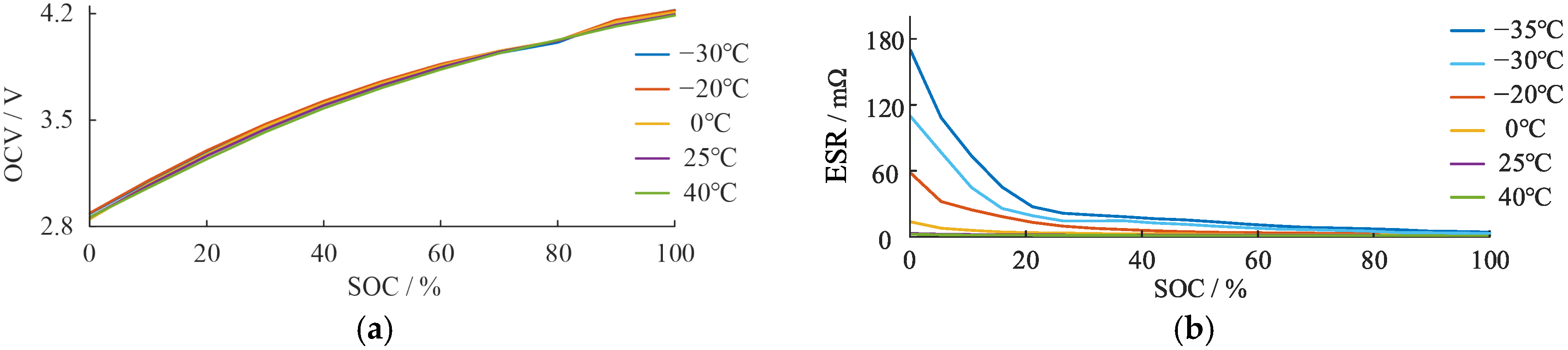
Standard discharge tests were performed on a hybrid supercapacitor with a rated voltage of 3.7 V and a rated capacity of 8 Ah. The resulting open-circuit voltage (OCV) and equivalent series resistance (ESR) characteristics are shown in Figure 1a and Figure 1b, respectively.
Figure 1a indicates that the OCV is primarily a function of SOC, with minimal dependence on temperature. The impedance data in Figure 1b shows that ESR is large and conversely correlated with SOC at sub-zero temperatures, yet it stabilizes in the 1~5 mΩ range at temperatures above 0 °C. Since HSCs typically operate above 0 °C, the ESR generally remains at a low level, thereby ensuring high operational efficiency.

2.2. Direct-Grid-Connected Grid-Forming Energy Storage Topology

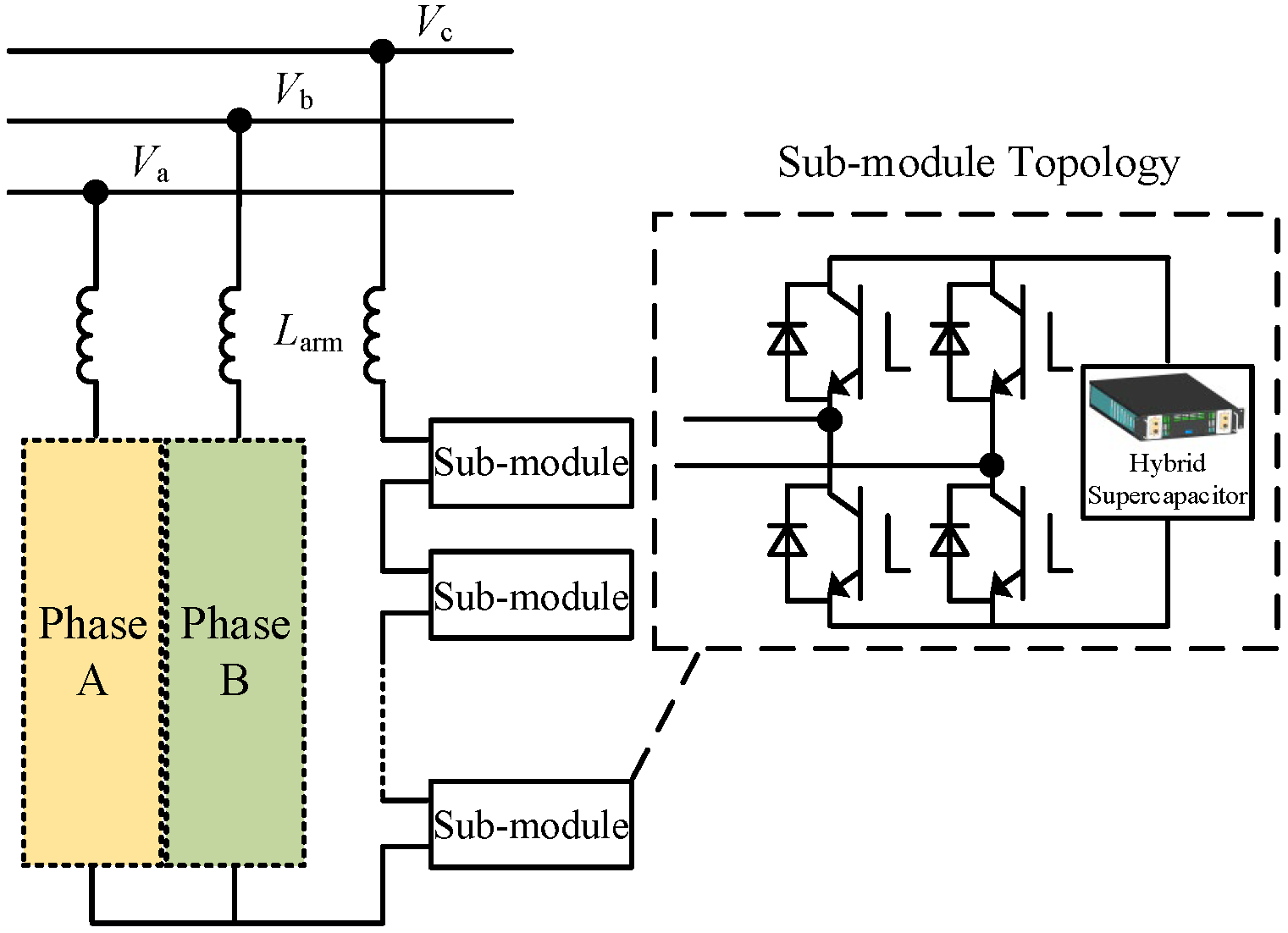
This study employs a cascaded chain topology to construct a grid-forming energy storage system based on HSCs and cascaded H-bridges (CHBs), capable of automatic voltage and current regulation. The system structure is shown in Figure 2.
In this configuration, phases A, B, and C are connected in a star configuration and linked to the grid via reactors. Each phase comprises multiple series-connected H-bridge submodules, granting the system high scalability and enabling high-capacity reactive power regulation.
Inter-phase voltage balancing among the CHB submodules is achieved by injecting a zero-sequence voltage to adjust the power of each phase, thus maintaining the total DC voltage balance across the three phases. Intra-phase voltage balancing within the submodules of each phase employs a modulation wave adjustment method, which independently fine-tunes the modulation wave of each H-bridge based on the error between its capacitor voltage and the reference value [17]. A sinusoidal pulse width modulation (SPWM) strategy is adopted. The power commands are processed through a dual-loop voltage and current decoupling control scheme, and the resulting signals are then used to generate the SPWM triggering signals for the CHB converter [18,19].

3. Fault Detection and Severity Assessment

3.1. Fault Detection

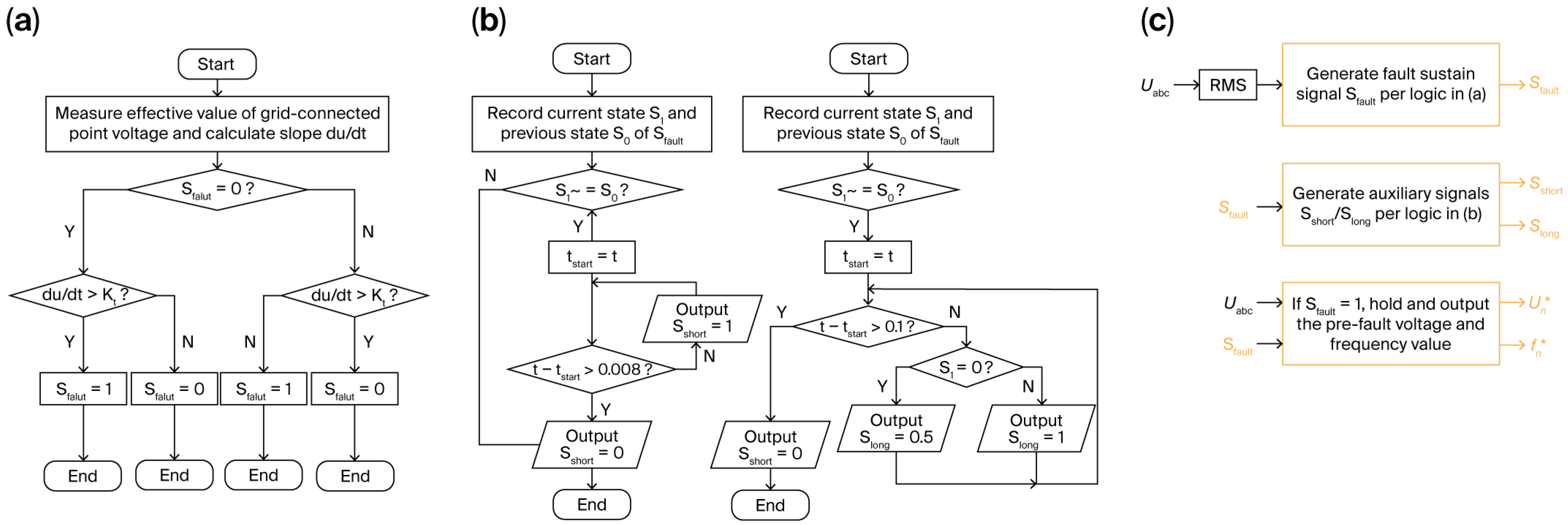
The primary function of the fault detection module is to determine the occurrence and clearance of a fault, thereby generating the corresponding fault status signal Sfault. The logic diagram for determining Sfault is shown in Figure 3a.
During normal system operation (Sfault = 0), if the slope of the voltage RMS value at the measurement point exceeds a threshold Kt, a fault is declared, and Sfault is set to 1. Conversely, when the system is in a fault state (Sfault = 1), Sfault is reset to 0 if the slope of the voltage RMS value remains below the threshold Kt. The threshold Kt is set lower than the voltage slope induced by the mildest fault within this study’s scope, such as a minor voltage sag under a high short-circuit ratio (SCR), to ensure detection sensitivity. Meanwhile, it is set higher than the maximum slope expected during severe normal disturbances, e.g., the maximum power swing induced by wind turbines, to prevent maloperation.
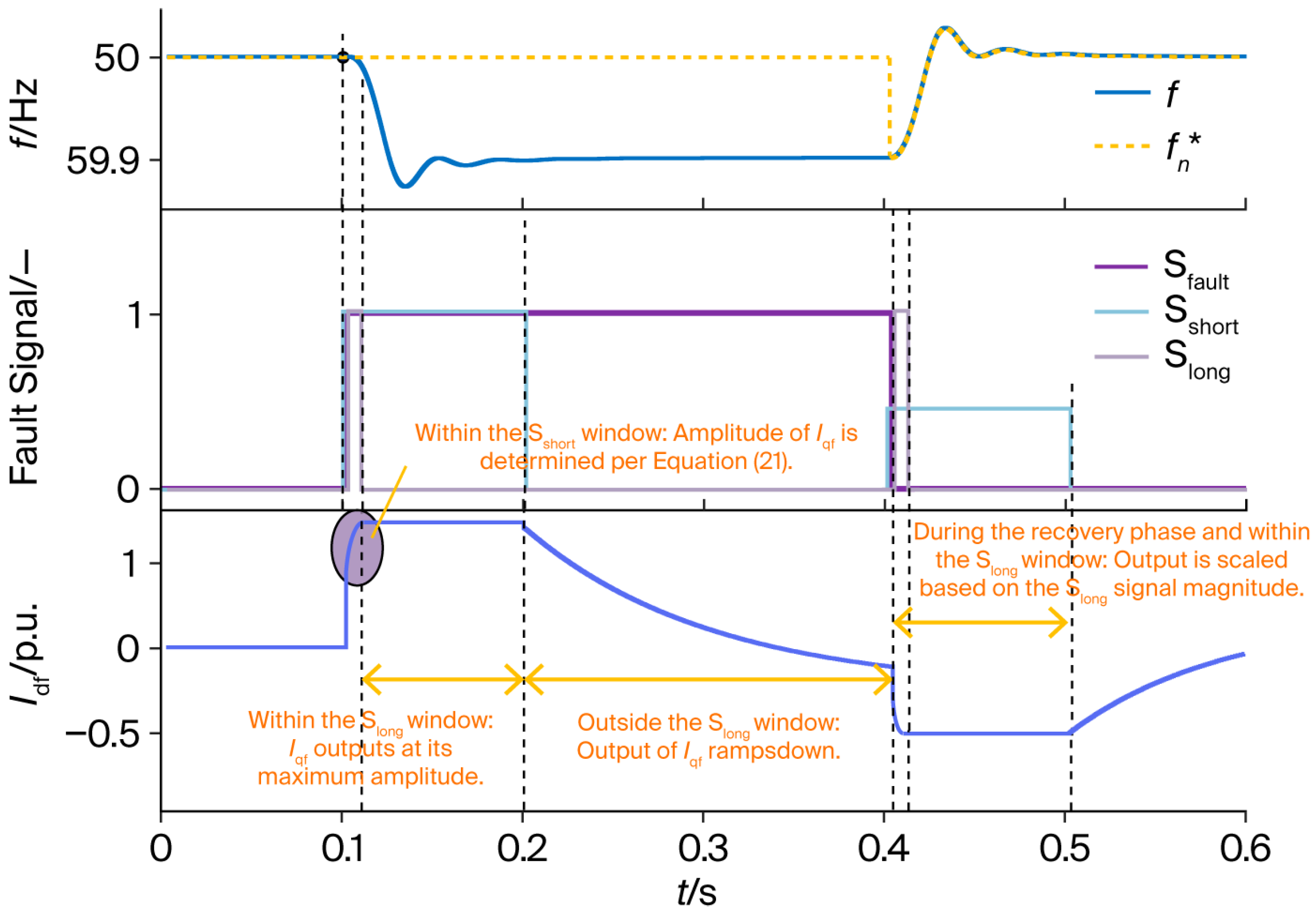
The Sfault signal accurately identifies the fault inception and recovery instances, defining the fault duration. When Sfault transitions from 0 to 1, the pre-fault RMS voltage Un* at the renewable station’s output terminal is captured and held as the reference for the subsequent voltage non-droop control. Simultaneously, the instantaneous system frequency fn* is captured and held to serve as the frequency reference. Two key auxiliary signals, Sshort and Slong, are also generated through the logic detailed in Figure 4b.
The Sshort signal is triggered immediately upon fault detection (coinciding with Sfault being set to 1) and remains active for a fixed short duration of 0.008 s. This brief window is designated for high-speed sampling and analyzing the voltage waveform to rapidly assess the fault severity. The 0.008 s duration is strategically chosen to ensure that the entire process of fault assessment and the calculation of the required compensation power can be completed within the first voltage cycle after fault inception, critical for enabling ultra-fast power support.
At the same moment that Sfault transitions to 1, the Slong signal is activated and sustains a 0.1 s high-level pulse. Functioning as a gating and scaling signal, Slong directly governs the enabling and amplitude scaling of the fast compensation current Iqf. When Slong is high (“1”), it enables Iqf to output at its full calculated magnitude. After the 0.1 s pulse, when Slong returns to low (‘0’), the output of Iqf does not cease abruptly but undergoes a ramp-down process. This mechanism defines the active period during which Iqf is maintained at its full supporting magnitude. The 0.1 s duration is designed to bridge the inherent response time gap, providing stable voltage and frequency support until other conventional, slower-acting regulation strategies (e.g., the voltage droop control and the reference-tracking control) become fully operational.
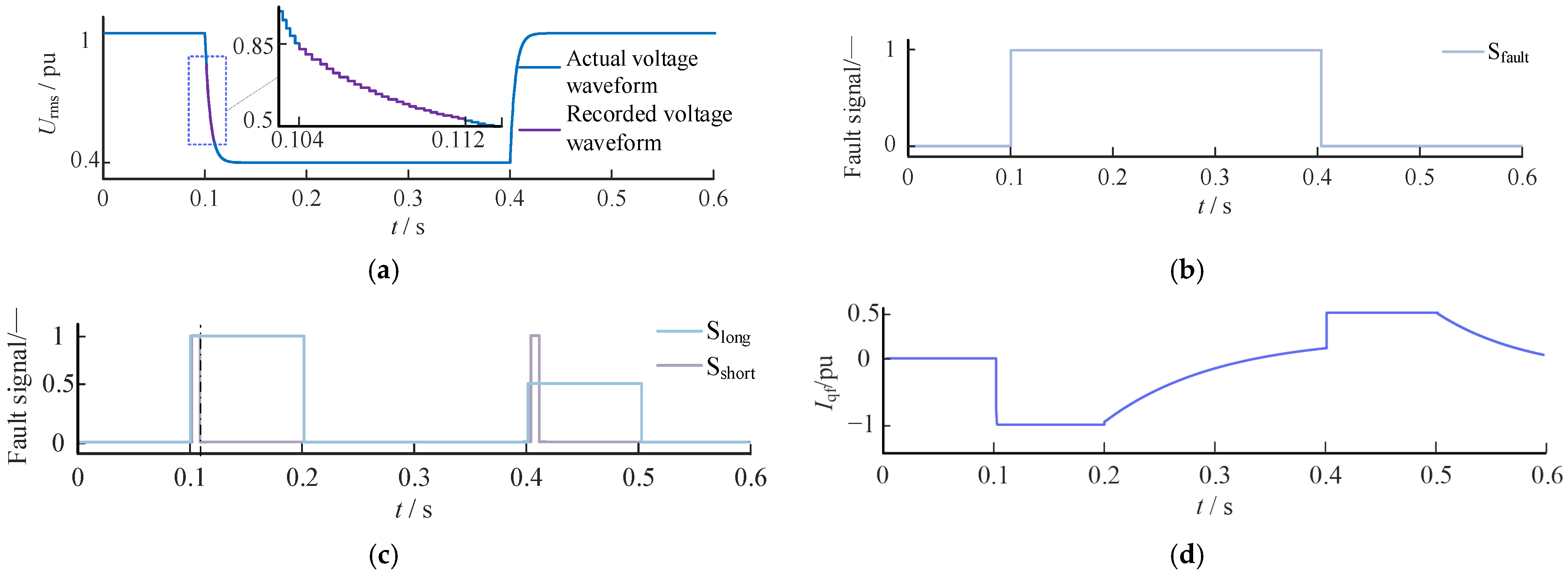
Figure 4 illustrates the relationship between the voltage RMS value at the renewable energy station, the fault signals, the auxiliary signals, and the corresponding generated compensation signal Iqf. When a fault occurs at t = 0.1 s, the slope of the station’s terminal voltage is detected as exceeding the preset threshold Kt after a 4 ms delay, causing Sfault to transition from 0 to 1. Simultaneously, the short pulse signal Sshort and the long pulse signal Slong are set to 1. During the active high state of Sshort, the voltage waveform is analyzed to determine fault severity, which yields the required amplitude for the fast compensation signal Iqf (denoted as 1 for this case). During the period when Slong is high (“1”), Iqf is output at this determined amplitude. When Slong returns to low (“0”), Iqf gradually ramps down to zero. It should also be noted that, since the required compensation during the recovery phase is significantly less than that during the fault itself [20], the amplitude of the long signal Slong is set smaller during recovery—specifically, it is set to half of its amplitude during fault inception.

3.2. Fault Voltage Characteristic

Consider a renewable energy station with a short-circuit ratio (SCR) of “a”. When a fault occurs at the point of common coupling (PCC) between the renewable station and the main grid, causing a voltage sag to a per-unit value “b” (pre-fault voltage is 1 p.u.), the post-fault per-unit voltage Uo at the station’s terminal is given by (1); see Appendix A for the detailed derivation.
U o ( t ) = b + ( 1 b ) e t ( 1.05   a ω 0 )
Differentiating the fault voltage curve yields the post-fault rate of voltage change:
d U o ( t ) d t = ( b 1 ) / τ e t / τ
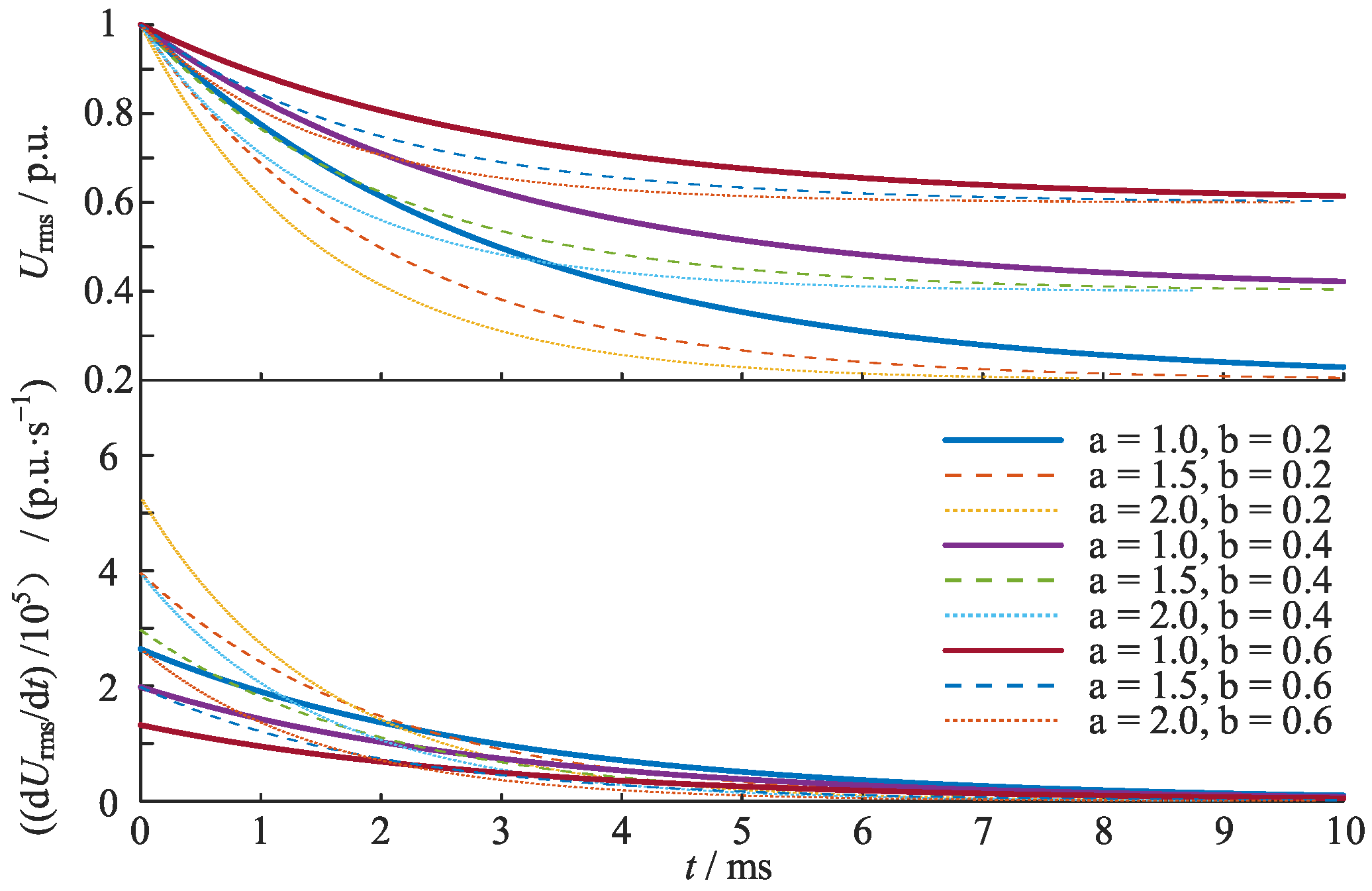
Equation (1) indicates that the voltage variation at the renewable station’s output terminal during a fault depends primarily on the station’s short-circuit ratio “a” and the voltage sag depth “b”.
Relevant to the weak-grid scenarios analyzed in this study, Figure 5 shows the post-fault voltage and its rate of change for SCRs of 1, 1.5, and 2 and for voltage sags of 0.6, 0.4, and 0.2 p.u., respectively.
Based on the fault voltage response obtained for different SCRs “a” and PCC voltage sags “b”, the scenario for a fault at any point along the transmission line can be inferred. If the fault location is a fraction “k” (k ∈ [0, 1]) of the line length from the station, the impedance between them is “k/a”. This scenario is equivalent to a fault causing a voltage sag of depth “b” at the PCC with an SCR of “a/k”.

3.3. Fault Severity Assessment

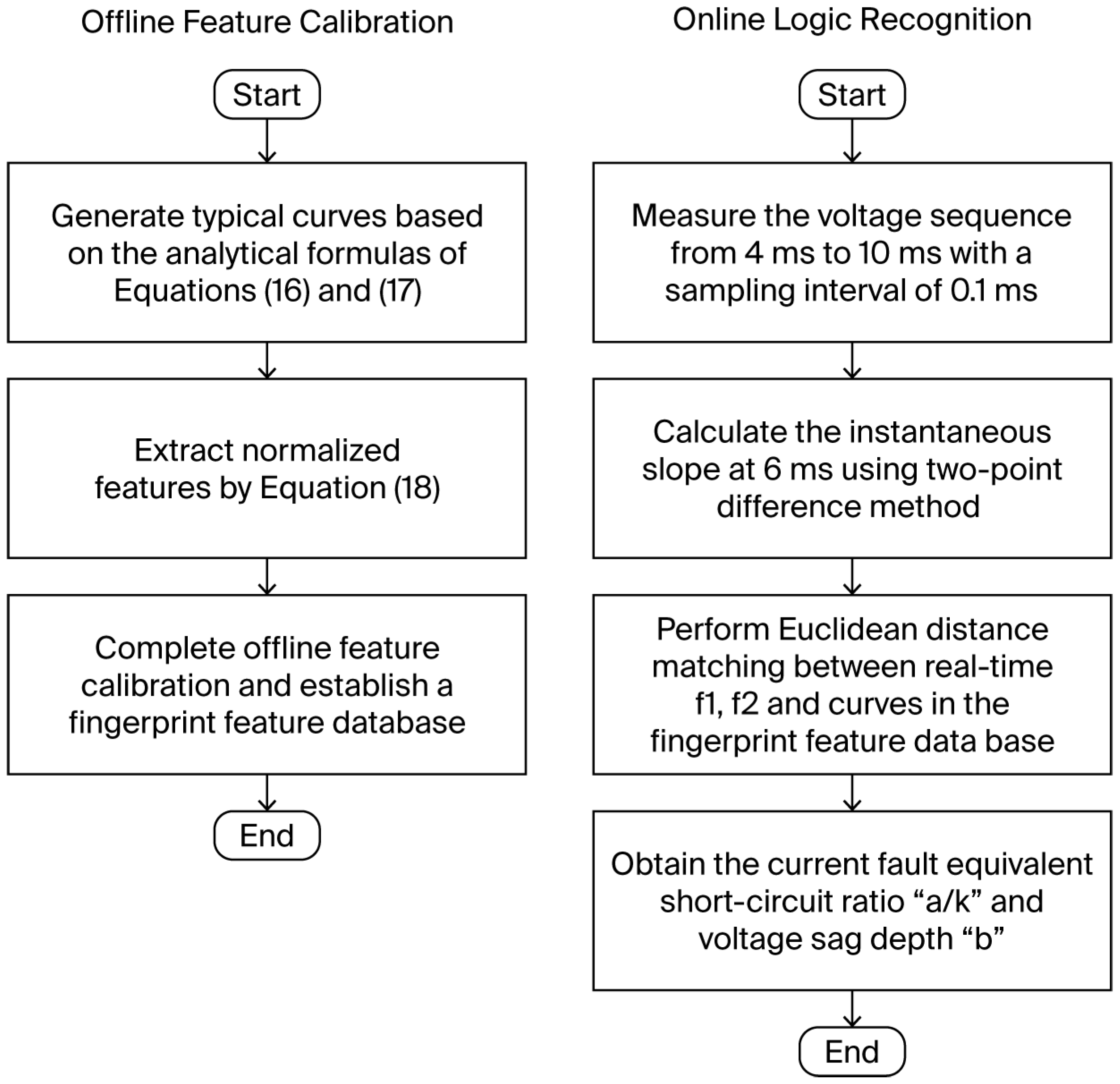
A two-dimensional feature window, constructed from the voltage waveform and its rate of change between 4 ms and 10 ms after a fault, is used for conducting the online assessment of fault severity in weak-grid renewable energy stations. This process identifies the short-circuit ratio and voltage sag depth; the corresponding logic is depicted in Figure 6.
The fault assessment process consists of two parts: offline characteristic calibration and online logic identification. The offline calibration first obtains the post-fault voltage and rate-of-change curves, as shown in Figure 6, based on Equations (1) and (2). Two normalized features are then extracted from these curves:
f 1   = ( U pcc 6 ms b ) / ( 1 b ) f 2 = ( d U pcc / d t ) ( 6 ms ) / ( ω 0 ( 1 b ) )
Equation (3) defines a set of feature values derived from the voltage deviation and its rate of change. Substituting the nine typical scenarios from Figure 6 into Equation (3) yields nine (fref1, fref2) pairs. These pairs form a “single-parameter curve” in the two-dimensional plane, serving as a “fingerprint database”, thereby completing the offline calibration.
Following a fault, the online identification logic is executed. During the active period of the Sshort signal, a voltage sequence is captured. The instantaneous slope at 6 ms is calculated using a two-point difference method, as shown in Equation (2). The real-time features (f1, f2) are then matched against the nine reference pairs (fref1, fref2) in the fingerprint database using a minimum Euclidean distance criterion. The closest match identifies the corresponding fault scenario with its specific short-circuit ratio and voltage sag depth.

4. Automatic Voltage–Reactive Power Regulation Strategy

To enhance voltage support capability in weak-grid renewable energy stations, this study proposes an automatic voltage–reactive power regulation strategy utilizing a grid-forming energy storage system based on hybrid supercapacitors (HSCs) and cascaded H-bridges. This strategy aims to improve voltage stability at these stations. Under steady-state conditions, the primary means of control is reactive power–voltage (Q-V) droop control. This maintains the voltage at the station’s point of connection within acceptable limits while ensuring proper reactive power sharing and system stability. During transient events, the strategy rapidly injects reactive power based on the severity of voltage deviation to support the connection point voltage.
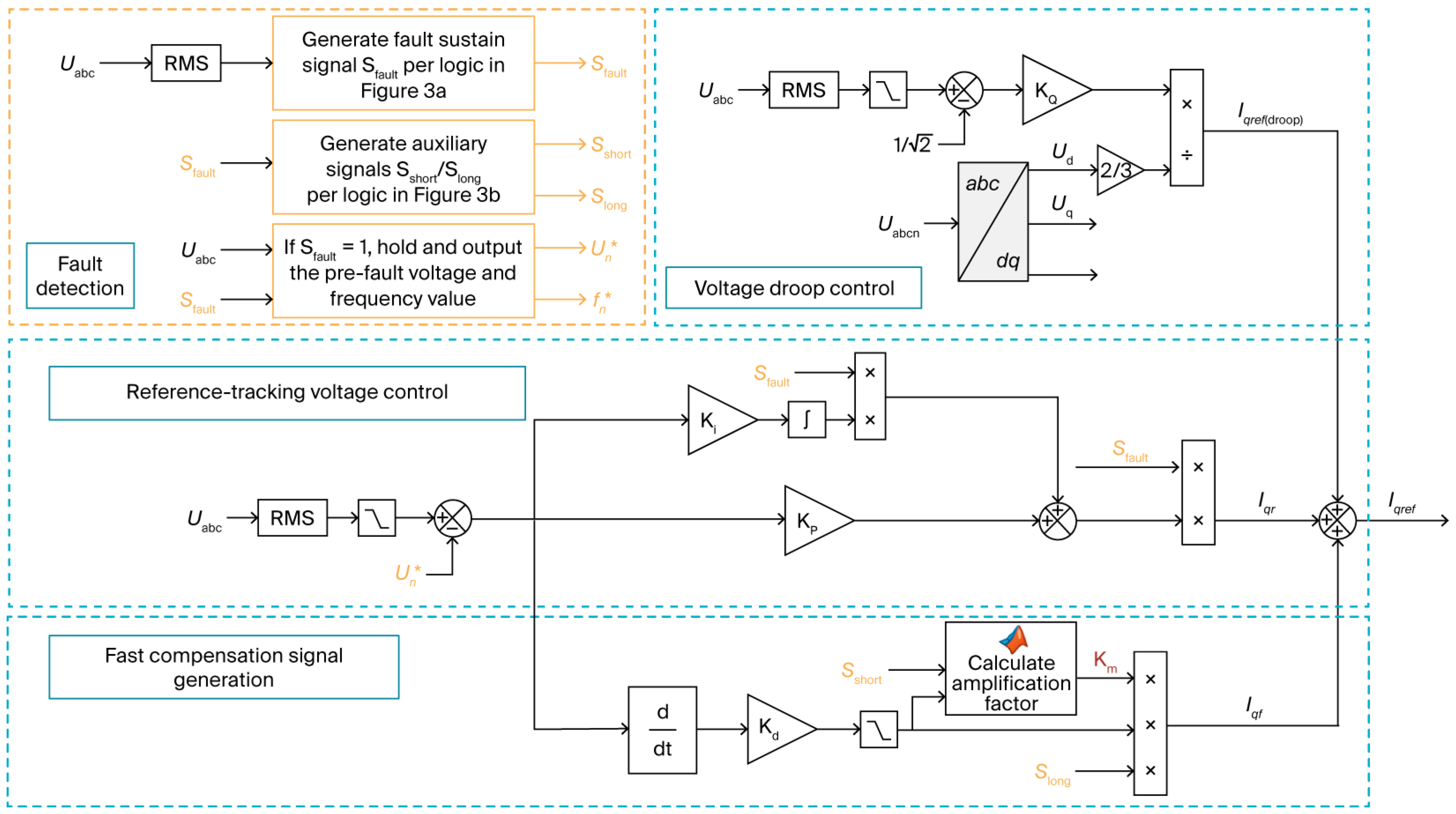
The overall automatic voltage regulation strategy for the HSC-CHB-based grid-forming system is depicted in Figure 7. Building upon the fault status and severity information provided by the detection strategy detailed in Section 3 and Figure 3c, this control scheme coordinates multiple modules to achieve voltage support. It comprises three core functional blocks used for regulation: voltage droop control, reference-tracking voltage control, and fast compensation signal generation. Voltage droop control remains active under all conditions to maintain baseline stability. In contrast, fast compensation signal generation and voltage non-droop control are specifically activated during the fault persistence and recovery phases, leveraging real-time fault assessment to deliver rapid and precise reactive power injection.

4.1. Voltage Droop Control

Voltage droop control is a regulation method centered on a Q-V droop characteristic. It ensures that the station’s terminal voltage remains within limits while considering reactive power sharing and overall system stability. Its control block diagram is part of Figure 7.
The reference reactive power from the Q-V droop is used to calculate the required q-axis reference current, as expressed in Equation (4):
I q r e f = ( Q r e f + Δ Q ) / ( 1.5 u d )
Here, Qref is set to 0, and ud is the d-axis component of the voltage at the station’s point of connection from the dq-transform. ΔQ is determined based on the voltage deviation, as given by Equation (5):
Δ Q = K Q ( U r m s U r e f )
where KQ is the reactive power droop coefficient, typically between 20 and 50; Urms is the per-unit RMS voltage at the renewable station’s output terminal; and Uref is the reference voltage, a predefined constant.
Substituting Equation (5) into Equation (4) yields Equation (6):
I q r e f = K Q ( U r m s U r e f ) / ( 1.5 u d )
Equation (6) shows that the q-axis reference current Iqref from the droop control is primarily determined based on the deviation between the measured RMS voltage and its reference. When Urms is below Uref, Iqref becomes negative, triggering the converter to inject reactive power to boost the voltage. Conversely, when Urms is above Uref, Iqref becomes positive, triggering the converter to absorb reactive power to reduce the voltage.

4.2. Reference-Tracking Voltage Control

To address insufficient voltage support during faults, this paper proposes reference-tracking voltage control. It latches the pre-fault per-unit voltage Un* at the renewable station’s output terminal. During the fault, this value is compared with the measured per-unit RMS voltage Urms, generating an error ΔU. A PI controller processes this error to regulate and maintain the voltage during the fault period. The control block diagram is shown in the corresponding part of Figure 7.
In this control, the Sfault signal from the fault detection block enables the tracking of the pre-fault voltage. The transition of Sfault from 0 to 1 triggers the latching of Un*. The voltage error ΔU is then calculated as the difference between this latched value and the current Urms.
The voltage error ΔU is processed via a PI controller to produce the q-axis reference current Iqr for the reference-tracking voltage control, as expressed in Equation (7):
I q r = K p Δ U + K i ( Δ U ) d t
The use of a PI controller may lead to integrator windup, which can cause a voltage surge after fault recovery. To prevent this, the Sfault signal is used to confine the integrator’s action strictly to the fault duration. The integrator is reset to zero immediately upon fault clearance. This leads to a modification of Equation (7), resulting in Equation (8):
I q r = K p Δ U + S f a u l t K i ( Δ U ) d t
Thus, when Sfault transitions from 1 to 0 (recovery), the integral term is reset to zero, effectively preventing integrator windup.

4.3. Fast Compensation Signal Generation

To simultaneously enhance the voltage and frequency support strength at the renewable station’s output [20], the voltage must be stabilized within an extremely short time after a fault occurs. However, relying solely on the reference-tracking voltage control cannot meet this requirement for a rapid response. Therefore, this study proposes using a fast compensation signal to achieve rapid voltage support at the station’s output immediately following a fault.
The core principle of this fast compensation is to estimate the reactive current deficit caused by voltage sag and inject it without waiting for the closed-loop controller to accumulate errors. This is achieved using a feedforward path that directly translates the measured fault severity into a current command.
When a renewable energy station with a short-circuit ratio (SCR) “a” experiences a voltage sag “b” (per-unit, pre-fault voltage is 1 p.u.) at its point of connection with the main grid, the online identification logic assesses fault severity. The compensation is derived from the power balance at the station’s output terminal.
Equation (9) describes this power balance before and after the fault:
U 0 = U 1 + Q c o m p X s y s
Here, U0 is the pre-fault per-unit voltage at the station’s point of connection, typically 1; U1 is the post-fault per-unit voltage; Qcomp is the per-unit reactive power required to maintain the voltage; and Xsys is the system impedance, which can be approximated as the reciprocal of the SCR “a”, i.e., “1/a”.
From Equation (9), the per-unit reactive power Qcomp required to theoretically maintain the pre-fault voltage is derived as Equation (10):
Q c o m p = ( 1 b ) a
The reactive power reference is then converted into a corresponding reactive current reference Iqcomp via Equation (11). The current reference Iqcomp is the q-axis current command that the grid-forming converter must instantly output. Through its current control loop, the converter adjusts its output voltage phase and magnitude to force this current into the grid, thereby actively pulling the PCC voltage back towards its pre-fault level. Equation (11) is defined as follows:
I q c o m p = ( 1 b ) a / b
Thus, the ideal instantaneous q-axis reference current would be Iqcomp. However, to dynamically adapt to the actual fault transient, a gain Km is applied to the measured initial rate of change in voltage (d(ΔUrms)/dt), as shown in the control block diagram and Equation (12). The gain Km acts as a scaling factor that maps the severity and dynamics of the voltage disturbance, quantified using d(ΔUrms)/dt, to the amplitude of the feedforward current injection Iqf. This design ensures that the compensation effort is proportionally adjusted according to the urgency and scale of the voltage deviation observed at the very beginning of the fault. Equation (12) is defined as follows:
I q f = K m ( ( d Δ U r m s / d t ) K d )
The stable value of Km is determined post-fault using Equation (13), where m is the average d(ΔUrms)/dt recorded during the Sshort = 1 window. This design deliberately strikes a balance between the need for rapid response and measurement reliability. The short duration of the Sshort window is essential for meeting the stringent requirement for ultra-fast fault assessment and compensation initiation. Although a brief time window limits the data available for averaging and remains susceptible to some measurement noise, using the average value “m” (as opposed to an instantaneous sample) provides a fundamental level of filtering against transient irregularities. Equation (13) is defined as follows:
K m = I q c o m p / ( m K d )
In summary, the generation of the fast compensation signal Iqf follows a well-defined sequence upon fault detection. First, the voltage transient during the Sshort pulse is measured to assess the fault severity and dynamics. This measurement directly informs the calculation of the adaptive gain Km via Equation (13). Second, combining this gain Km with the initial voltage change rate through Equation (12) yields the final magnitude of Iqf. Thus, the process translates the immediate electrical measurements of the fault (characterized by its depth and rate) into a precise feedforward current command for the converter. The resultant waveform of the controlled current injection Iqf is presented in Figure 4d.

5. Frequency–Active Power Automatic Regulation Strategy

In weak-grid renewable energy stations, the rate of change of frequency (RoCoF) changes dramatically in response to voltage and power disturbances due to low system inertia, with values significantly exceeding those in conventional synchronous grids. To enhance frequency stability under such conditions, this chapter proposes an automatic frequency–active power regulation strategy based on the hybrid supercapacitor (HSC) and cascaded H-bridge (CHB) system. This strategy operates based on the fault status and severity information provided by the detection scheme. By coordinating two distinct operational modes, it delivers rapid and adaptive frequency support.
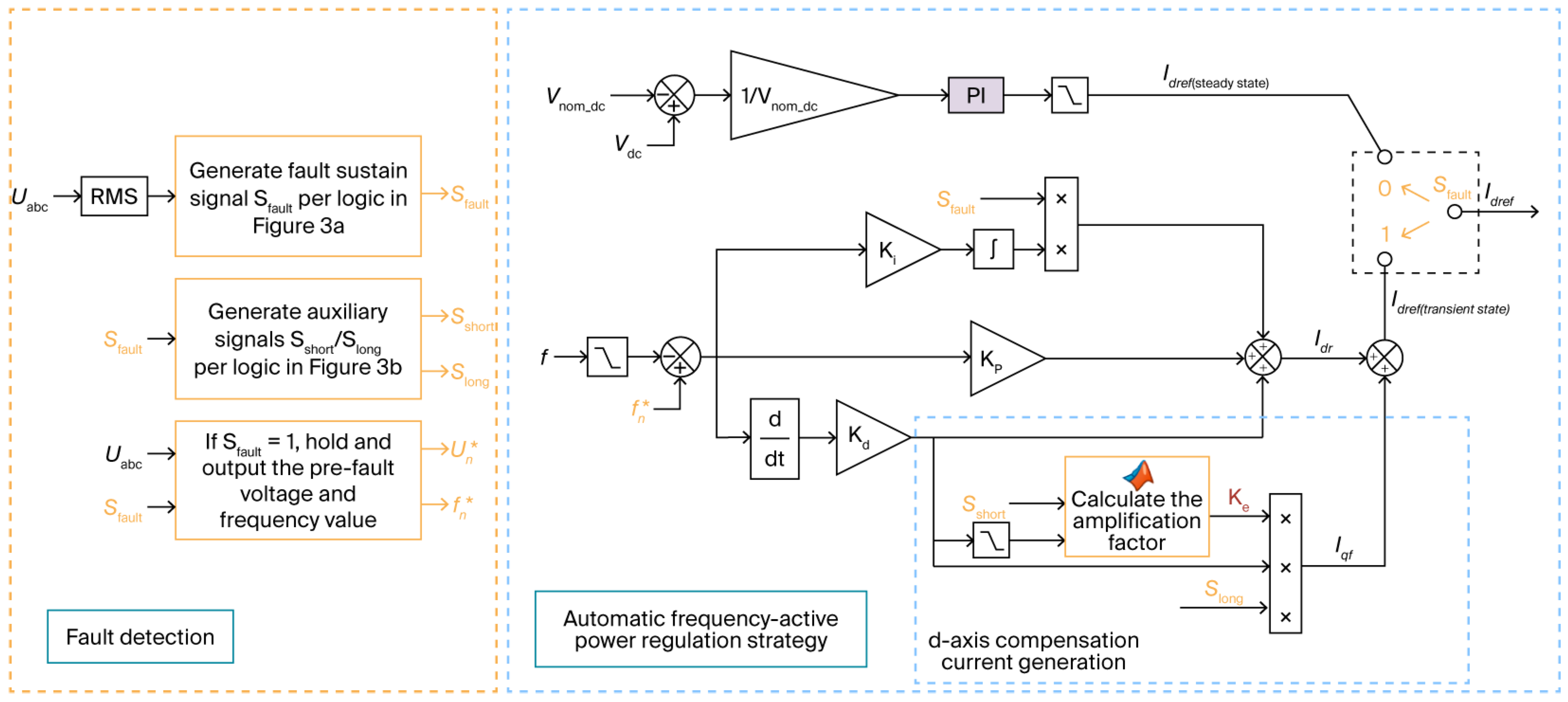
The mode of operation is directly governed by the fault status signal Sfault. When Sfault = 0, indicating the absence of a major disturbance, the control objective is to maintain the HSCs at a healthy state of charge (SOC) to preserve energy reserves. Conversely, when Sfault = 1, signifying a severe grid fault, the control priority shifts to frequency stabilization by injecting active power based on the real-time frequency deviation and assessed fault severity. The overall control strategy, illustrating this conditional operation, is presented in Figure 8.

5.1. HSC Module Voltage Control

During steady-state operation, the SOC of the HSCs must be maintained within a safe operating range to prevent lifespan degradation and power deficits caused by deep charging or discharging. As noted in [21], a hybrid supercapacitor/battery system should maintain its SOC between 30% and 70% via an Energy Management System (EMS) under normal conditions, reserving capacity for subsequent transient power demands.
The open-circuit voltage characteristics shown in Figure 1 indicate that the HSC’s OCV is minimally affected by temperature and operating mode, providing an almost unique mapping to the SOC. Therefore, this strategy maintains the HSC SOC within the safe range by regulating the HSC module voltage. Consequently, during steady-state operation, the d-axis reference current for the storage converter is determined by the voltage deviation of the CHB submodules on the DC side, as given by Equation (14):
I d r e f = K p ( V d c V d r e f ) + K i ( V d c V d c r e f ) d t
For a single HSC cell, the OCV ranges from 2.8 V to 4.2 V. A voltage between 3.45 V and 3.95 V corresponds to an SOC between 30% and 70%. Thus, the control strategy stabilizes the HSC voltage within this range during steady-state operation.

5.2. Frequency Stability Strategy During Faults

During faults in weak grids, the system experiences large frequency deviations, a high rate of change of frequency (RoCoF), and a delayed frequency response. To address this, the control strategy employs a dual-path approach comprising frequency deviation-based PID control and fast compensation signal generation. These two paths work in tandem: the former provides dynamic damping and correction, while the latter delivers instantaneous support to counteract the initial power deficit.
During faults in weak grids, the system experiences large frequency deviations, a high rate of change of frequency (RoCoF), and a delayed frequency response. To address this, the control strategy employs a dual-path approach comprising frequency deviation-based PID control and fast compensation signal generation.
The frequency deviation-based PID controller serves as the foundational regulatory loop. With the frequency deviation Δf as its input, it generates a baseline regulating current Idr, as expressed in Equation (15). This loop actively damps frequency oscillations and drives the system frequency back towards its nominal value throughout the fault and recovery process. Equation (15) is defined as follows:
I dr = K p Δ f + K i Δ f d t + K d d Δ f d t
However, relying solely on this feedback mechanism results in a response too slow to counteract the sudden active power deficit, leading to a deep frequency nadir. Therefore, a parallel fast compensation signal is indispensable for instant support. Generated through a feedforward mechanism, its core function is to estimate and inject the missing active power concurrently with the fault, bridging the inertial gap before the slower PID loop becomes effective.
The fast compensation signal is designed to estimate and counteract the active power deficit arising from a voltage sag. Consider a renewable energy station with a short-circuit ratio (SCR) “a” experiencing a voltage sag to a depth “b” (per-unit, pre-fault voltage is 1 p.u.). The fundamental physical cause of the power deficit is the reduced power transfer capacity (P ∝ V) due to the depressed terminal voltage. To simplify the analysis and ensure a conservative design, this study assumes that the pre-fault active current Ip remains momentarily constant. This assumption establishes a clear design benchmark for subsequent fast active power compensation. In reality, Ip may decrease due to system transient responses, leading to a larger actual power deficit. Therefore, the compensation derived from this assumption represents the minimum necessary support, ensuring reliable and guaranteed active power support during the initial fault period. The analysis starts from the fundamental power relationship:
P = V I p
The pre-fault per-unit active power P0 is given by Equation (17). At the fault instant, with voltage sag “b” and assuming constant Ip, the instantaneous power P1 becomes as defined in Equation (18):
P 0 = 1 I p = A
P 1 = b I p = b A
The difference ΔPfault (Equation (19)) quantifies the sudden active power loss that must be compensated for to prevent frequency collapse:
Δ P f a u l t = ( 1 b ) I p = ( 1 b ) A
To translate this power deficit into a current command for the converter, ΔPfault is converted into a per-unit active current reference Idcomp, as expressed in Equation (20). The Idcomp represents the exact amount of additional d-axis current that the grid-forming converter needs to inject instantaneously to offset the estimated power deficit and support the system frequency. Equation (20) is defined as follows:
I d c o m p = ( 1 b ) A / b
The actual fast compensation current Idf is not directly set to this theoretical value. Instead, to dynamically adapt the response to the real-time observed fault severity, Idf is generated by scaling the instantaneous rate of change of frequency (RoCoF) with an adaptive gain Kn, as defined in Equation (21):
I d f = ( K d ( d Δ f / d t ) ) K n
Here, Kn acts as a dynamic scaling factor that determines the proportionality between the observed disturbance intensity, quantified by the rate of change of frequency (RoCoF), and the final compensation current Idf. The value of Kn is adaptively calculated for each fault using the average RoCoF, denoted as n, which is recorded during the Sshort window, as defined in Equation (22):
K n = I d c o m p / ( n K d )
In summary, following fault detection and the activation of the Sshort signal, the fast compensation current Idf is generated through a sequence of steps. First, the average rate of change of frequency n is computed from the measurements captured during the short window. Next, the adaptive gain Kn is determined by substituting n into Equation (22). Finally, the real-time value of Idf is calculated via Equation (21) using the instantaneous RoCoF and the updated gain Kn. This calculated current Idf is then combined with other control outputs to form the final d-axis current reference for the converter. The corresponding control block is presented in the d-axis current compensation section of Figure 8, and the resulting waveform of Idf is illustrated in Figure 9.

6. Simulation Analysis

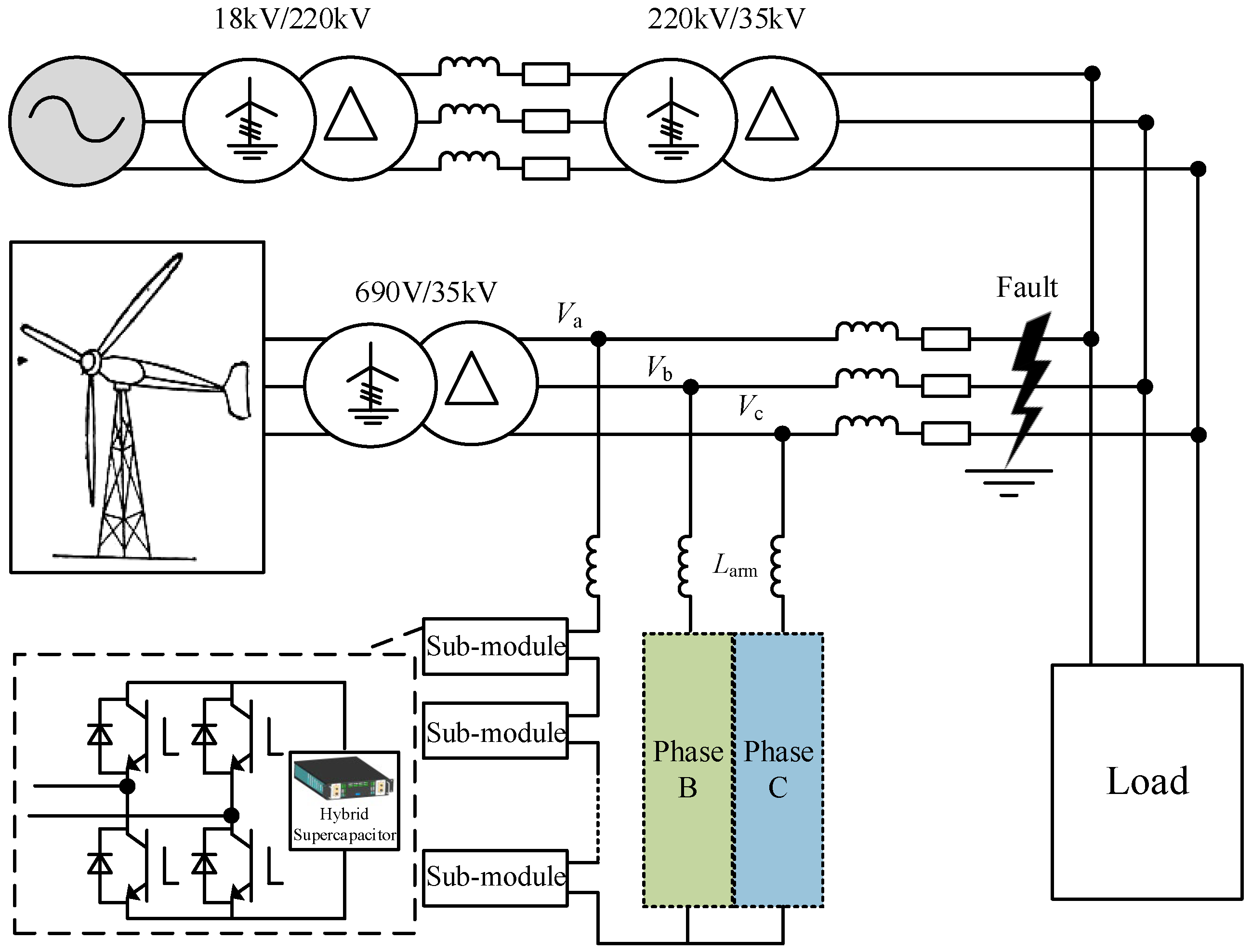
To validate the effectiveness of the proposed control strategy, a grid-following renewable energy station connected to a weak grid was modeled in MATLAB/Simulink, as shown in Figure 10. The key simulation parameters are listed in Table 1. A 1500 MW thermal power unit simulated the main grid, while a 15 MW wind farm was connected via a transformer in parallel with the direct-grid-connected HSC-based voltage and frequency compensator. The HSC model is simulated under standard ambient temperature conditions (25 °C). This operational temperature is selected based on the characteristic curves presented in Figure 1, which indicate that the dependence of the HSC’s key parameters (OCV and ESR) on temperature is negligible within and above this range, thereby justifying the simplification used for this control-focused study. A three-phase short-circuit fault with a duration of 625 ms was applied at the PCC to induce a severe voltage sag and active power fluctuations in the grid.

6.1. Comparative Analysis of Voltage and Frequency Support

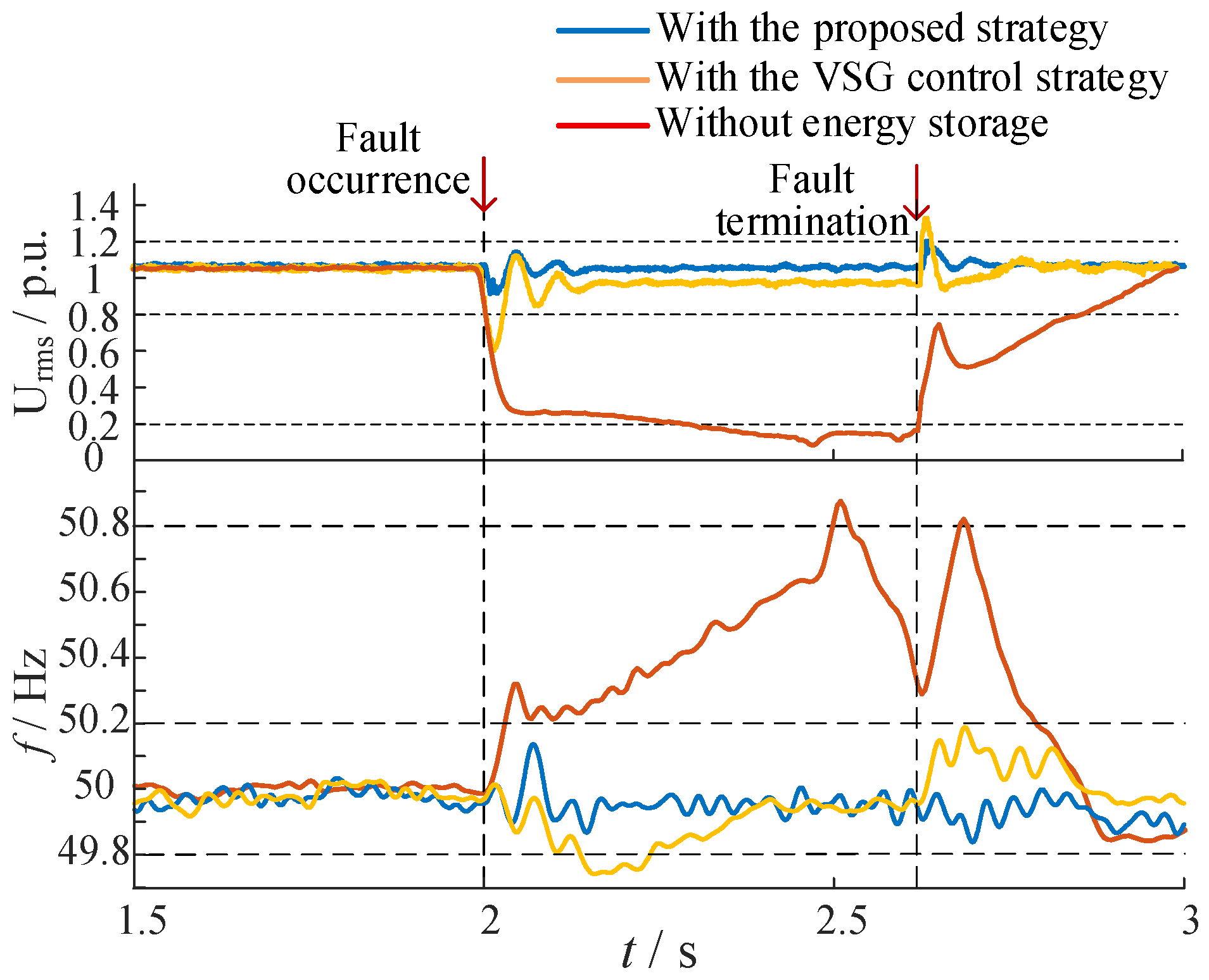
To provide a comprehensive and critical evaluation of the proposed control strategy’s performance, a comparative case study is conducted within the simulation testbed shown in Figure 10. The dynamic response of the system equipped with the energy storage system governed via the proposed strategy is benchmarked against two representative scenario when the wind farm with a short-circuit ratio (SCR) of 1 experiences a severe three-phase fault, causing an 80% voltage sag (to 0.2 p.u.) at the PCC. The scenarios are as follows: (1) the original weak-grid system without any compensatory energy storage, and (2) the same system with storage governed via a classical virtual synchronous generator (VSG) control strategy. This three-way comparison is designed to quantitatively dissect the contributions of the proposed strategy, distinguishing its performance from both the inherent instability of the uncompensated grid and the established capabilities of a conventional grid-forming approach.
The comparative dynamic responses under this severe fault condition are presented in Figure 11. An 80% voltage sag is applied at t = 2 s.
For the system without energy storage, the PCC RMS voltage collapses instantly to below 0.2 p.u. upon fault inception. Concurrently, the frequency experiences an abrupt change exceeding 0.2 Hz, with the maximum frequency deviation surpassing 0.8 Hz during the fault period.
When a BESS with classical VSG control is deployed, the voltage dip is mitigated, with the RMS voltage settling around 0.6 p.u. The frequency, supported by the VSG’s inertial response, declines at a slower rate, and the maximum deviation is reduced to approximately 0.25 Hz.
In the case employing the proposed strategy, both voltage and frequency are promptly supported. The maximum voltage dip is confined within 0.1 p.u., and frequency deviation is limited to within 0.2 Hz. Notably, both the voltage and frequency are stabilized at their pre-fault levels within one cycle of the source voltage after the fault.
This comparative analysis confirms the superiority of the proposed strategy in terms of both response speed and support effectiveness for voltage and frequency stability, demonstrating its rapid response and robust support capabilities.

6.2. Performance Under Various Voltage Sag Depths in Weak Grids

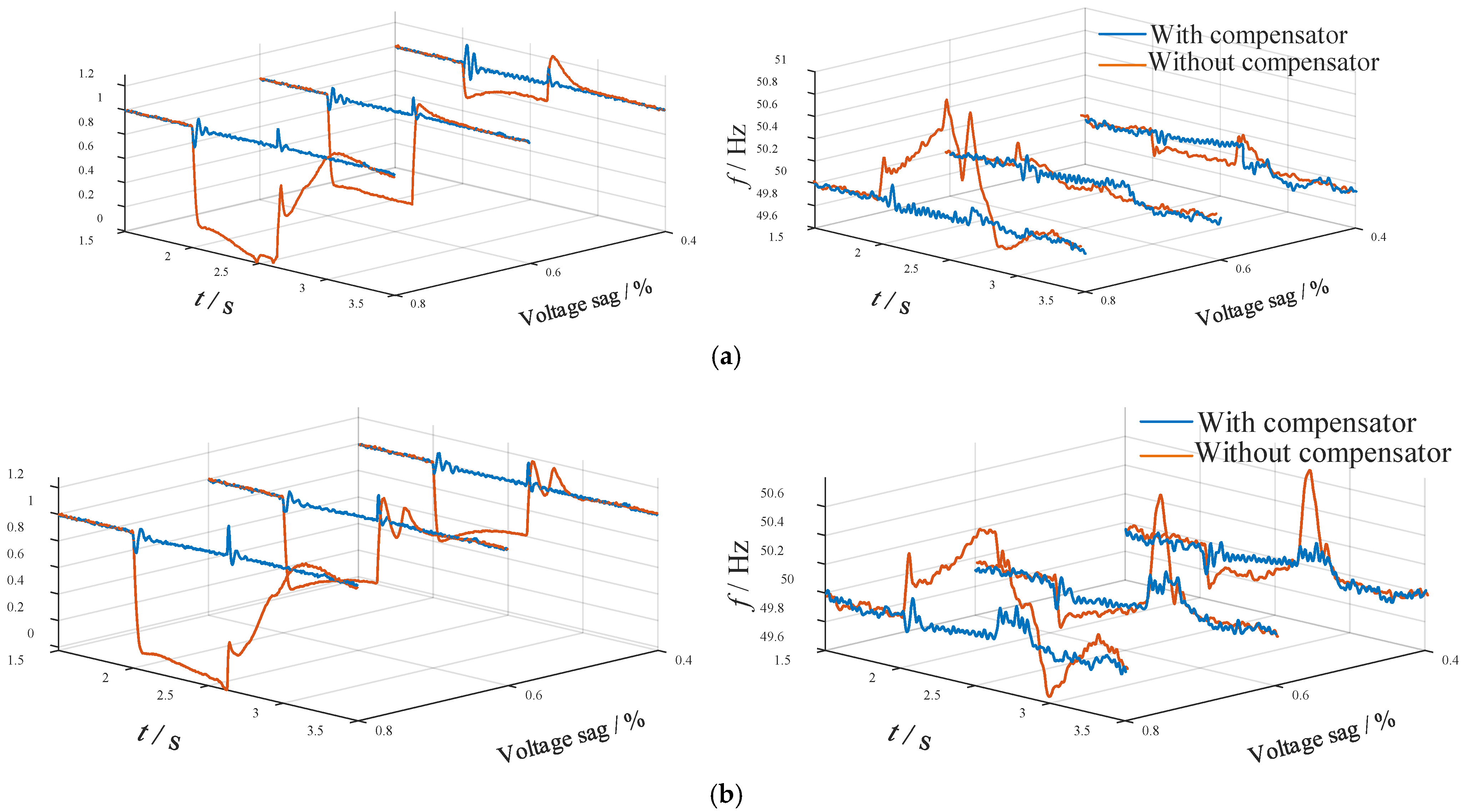
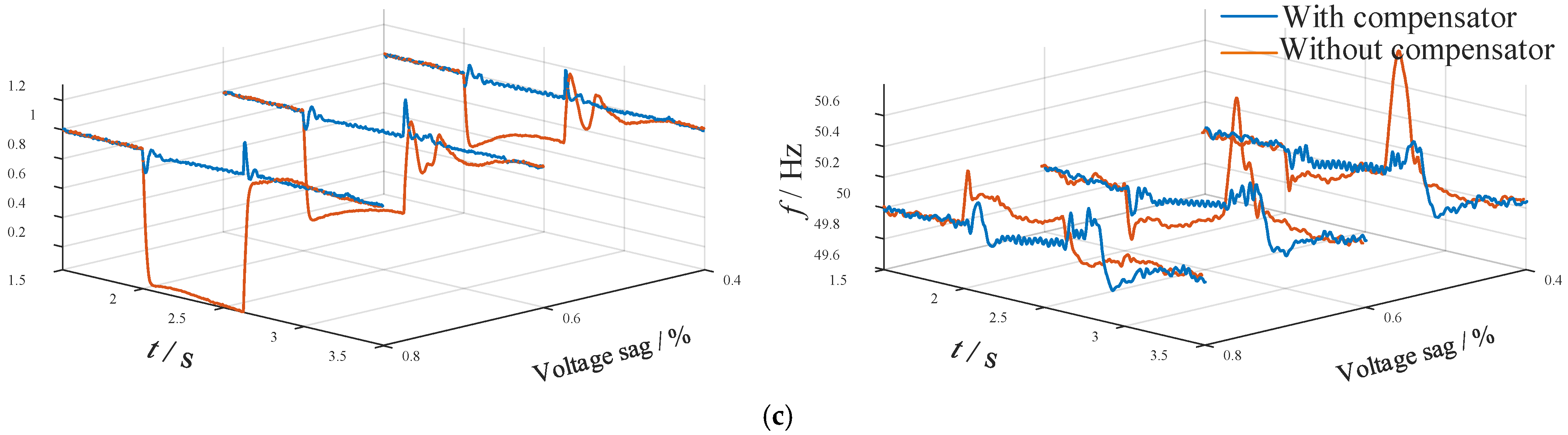
To evaluate the robustness of the proposed strategy against variations in grid strength and fault severity, a systematic parametric study was conducted. The tests covered critical parameters, including low short-circuit ratios (SCR = 1, 1.5, 2) and various voltage sag depths (20% to 80%). Figure 12 shows the dynamic responses of system voltage and frequency under several representative scenarios.
Under the proposed compensation strategy, the results in Figure 12 show that the station’s voltage rapidly recovered in all cases with dips under 0.2 p.u., while the frequency deviation was always maintained within ±0.2 Hz. This confirms the strategy’s capability to maintain transient stability and its significant robustness across different grid strengths and fault depths.
Compared to the uncompensated case, the proposed strategy demonstrated broad adaptability, maintaining system stability under all the tested fault conditions involving different SCRs (1, 1.5, 2) and voltage sag depths (20% to 80%).

7. Conclusions

In this study, an automatic voltage and frequency regulation control strategy based on a hybrid supercapacitor and a cascaded H-bridge converter is proposed to address insufficient voltage and frequency support in weak-grid renewable energy stations. This strategy features a fast fault severity assessment method integrated with coordinated voltage–reactive power and frequency–active power regulation loops, enabling the HSC-CHB system to rapidly inject targeted compensating power during grid disturbances. To validate the performance of the proposed strategy, comprehensive simulations were conducted. Under various weak-grid conditions and voltage sag depths, the strategy demonstrates significant effectiveness. Compared to uncompensated and VSG-controlled cases, it substantially limits voltage deviation, minimizes frequency excursions, and ensures system stability within one cycle post-fault. The proposed method represents a promising solution for enhancing transient stability in renewable-rich weak grids, with potential for future integration into broader grid-support frameworks.

Author Contributions

Conceptualization, G.N. and Y.J.; methodology, Y.L.; software, N.Z.; validation, G.N., Y.J. and M.W.; formal analysis, Y.L.; investigation, Y.G.; resources, G.N.; data curation, X.Y.; writing—original draft preparation, Y.G.; writing—review and editing, X.Y.; visualization, Y.G.; supervision, G.N.; project administration, G.N.; funding acquisition, G.N. All authors have read and agreed to the published version of the manuscript.

Funding

This research was funded by the Science and Technology Project of State Grid Corporation of China through the project titled “Research on Operation Control and Development Pattern of Hybrid Ultracapacitor Energy Storage System for Grid Frequency Regulation” (Grant No. 4000-202355726A-3-3-JC).

Data Availability Statement

The research results and data are confidential, according to contractual requirements, except for those that have been disclosed in this article.

Conflicts of Interest

The authors declare no conflicts of interest.

Abbreviations

The following abbreviations are used in this manuscript:
HSCHybrid supercapacitor
CHBCascaded H-Bridge
OCVOpen-circuit voltage
ESREquivalent series resistance
SCRShort-circuit ratio
PCCPoint of common coupling
RoCoFRate of change of frequency
SfaultFault status signal (0: normal, 1: fault)
Un*Latched pre-fault per-unit RMS voltage at the renewable station’s output terminal
fn*Latched pre-fault system frequency
SshortShort-duration pulse signal for fast fault severity assessment
SlongGating signal for enabling and scaling the fast compensation current
Iqfq-axis reference current for fast reactive power compensation
KmAdaptive gain for scaling the fast voltage compensation current
mAverage initial rate of change in voltage during the Sshort window
Iqrq-axis reference current from the reference-tracking voltage control (PI output)
IqcompTheoretical q-axis current reference to maintain pre-fault voltage
Idfd-axis reference current for fast active power compensation
KnAdaptive gain for scaling the fast frequency compensation current
nAverage rate of change of frequency (RoCoF) during the Sshort window
Idrd-axis reference current from the frequency-deviation-based PID control

Appendix A

Equation (1) in the main text describes the dynamic voltage response at the terminal of a renewable energy station following a fault at the point of common coupling (PCC). The derivation process is described below.
When a renewable energy station with a short-circuit ratio (SCR) “a” experiences a voltage sag to a per-unit value “b” (pre-fault voltage is 1 p.u.) at the PCC, the system-side impedance can be represented as
Z s y s = R s + j X s y s
Neglecting the small resistance Rs, the system reactance is inversely proportional to the SCR, as shown in Equation (A2):
X s y s = 1 / a
To analyze the transient, a first-order model is employed, and an equivalent inductance Leq and an equivalent damping resistor Req are defined. Leq characterizes the system’s inertia against voltage changes, while Req (typically set to 5% of Xsys) provides necessary damping. Equation (A3) is defined as follows:
L e q = X s y s / ω 0 R e q = 0.05 X s y s
where ω0 is the fundamental angular frequency.
The fault is modeled as an additional impedance Zfault inserted after the system impedance. Based on the voltage divider principle, Equation (A4) is defined as follows:
| U f a u l t | = | U 0 | · | Z f a u l t | | X s y s + Z f a u l t |
Given that the per-unit fault voltage Ufault = b and the pre-fault voltage U0 = 1 p.u., this leads to
Z f a u l t = b 1 b · X s y s
Applying Kirchhoff’s voltage law to the fault branch yields the following first-order differential equation:
L eq d i fault d t + R e q i fault = U pcc ( t ) b
The relationship between the fault current Ifault and the PCC voltage is
I f a u l t = U 0 ( j X s y s + Z f a u l t )
Combining Equations (A5)–(A7), the differential equation for the fault voltage transient is derived as
d Δ U d t + ( 1 + τ ) Δ U = 0
Here, τ is equal to (Xsys/ω0)/(a · Req + Xsys), which, when combined with Equation (A3), simplifies to
τ = 1 1.05 ω 0 a
Solving the first-order differential equation with the initial condition (ΔU(0) = 1 − b) gives the post-fault voltage at the station’s terminal as a function of time:
U o ( t ) = b + ( 1 b ) e t ( 1.05 a ω 0 )
This is denoted as Equation (1) in this manuscript. The derivation confirms that the post-fault voltage dynamic primarily depends on the grid strength (SCR, a) and the fault depth (b), forming the basis for the proposed fault severity assessment method.

References

  1. Cavus, M. Advancing Power Systems with Renewable Energy and Intelligent Technologies: A Comprehensive Review on Grid Transformation and Integration. Electronics 2025, 14, 1159. [Google Scholar] [CrossRef]
  2. Ratnam, K.S.; Palanisamy, K.; Yang, G. Future low-inertia power systems: Requirements, issues, and solutions—A review. Renew. Sustain. Energy Rev. 2020, 124, 109773. [Google Scholar] [CrossRef]
  3. Li, C.; Yang, Y.; Cao, Y.; Wang, L.; Dragicevic, T.; Blaabjerg, F. Frequency and Voltage Stability Analysis of Grid-forming Virtual Synchronous Generator Attached to Weak Grid. IEEE J. Emerg. Sel. Top. Power Electron. 2022, 10, 2662–2671. [Google Scholar] [CrossRef]
  4. Wang, P.; Bi, J.; Li, F.; Liu, C.; Sun, Y.; Cheng, W.; Wang, Y.; Kang, W. Research on Energy Storage-Based DSTATCOM for Integrated Power Quality Enhancement and Active Voltage Support. Electronics 2025, 14, 2840. [Google Scholar] [CrossRef]
  5. Ghosh, A.; Kumar, B.K. A coordinated control strategy with solid state fault current limiter and supercapacitor energy storage system for enhancing LVRT capability of DFIG-based wind energy conversion system. Electr. Eng. 2025, 107, 15231–15247. [Google Scholar] [CrossRef]
  6. Benfatma, H.; Khouidmi, H.; Bessedik, B. Neural network and ACO algorithm-tuned PI controller for MPPT in a hybrid battery-supercapacitor energy storage system within DC micro-grid photovoltaic installations. J. Energy Storage 2025, 120, 116499. [Google Scholar] [CrossRef]
  7. Li, Z.; Liu, F. Frequency and voltage regulation control strategy of wind turbine based on supercapacitors under power grid fault. Energy Rep. 2023, 10, 2612–2622. [Google Scholar] [CrossRef]
  8. Chen, T.-C.; Alvarez, J.R.N.; Dwijendra, N.K.A.; Kadhim, Z.J.; Alayi, R.; Kumar, R.; PraveenKumar, S.; Velkin, V.I. Modeling and Optimization of Combined Heating, Power, and Gas Production System Based on Renewable Energies. Sustainability 2023, 15, 7888. [Google Scholar] [CrossRef]
  9. Sanin-Villa, D.; Grisales-Noreña, L.F.; Montoya, O.D. Operational Cost Minimization in AC Microgrids via Active and Reactive Power Control of BESS: A Case Study from Colombia. Appl. Syst. Innov. 2025, 8, 180. [Google Scholar] [CrossRef]
  10. Hadavi, S.; Mansour, M.Z.; Bahrani, B. Optimal allocation and sizing of Synchronous Condensers in weak grids with increased penetration of wind and solar farms. IEEE J. Emerg. Sel. Top. Circuits Syst. 2021, 11, 199–209. [Google Scholar] [CrossRef]
  11. Sharma, S.; Gupta, S.; Zuhaib, M.; Bhuria, V.; Malik, H.; Almutairi, A.; Afthanorhan, A.; Hossaini, M.A. A Comprehensive Review on STATCOM: Paradigm of Modeling, Control, Stability, Optimal Location, Integration, Application, and Installation. IEEE Access 2024, 12, 2701–2729. [Google Scholar] [CrossRef]
  12. Chen, Y.; Xia, Y.; Li, H.; Yang, K.; Li, D.; Fan, Y. Adaptive VSG Grid-connected Control Strategy Based on Moment of Inertia and Damping Coefficient. In Proceedings of the 2024 IEEE 7th International Electrical and Energy Conference (CIEEC), Harbin, China, 10–12 May 2024; pp. 4583–4588. [Google Scholar] [CrossRef]
  13. Chen, S.; Sun, Y.; Han, H.; Luo, Z.; Shi, G.; Yuan, L.; Guerrero, J.M. Active power oscillation suppression and dynamic performance improvement for multi-VSG grids based on consensus control via COI frequency. Int. J. Electr. Power Energy Syst. 2023, 147, 108796. [Google Scholar] [CrossRef]
  14. Banerjee, S.; Mordina, B.; Sinha, P.; Kar, K.K. Recent advancement of supercapacitors: A current era of supercapacitor devices through the development of electrical double layer, pseudo and their hybrid supercapacitor electrodes. J. Energy Storage 2025, 108, 115075. [Google Scholar] [CrossRef]
  15. Eroğlu, F.; Kurtoğlu, M.; Eren, A.; Vural, A.M. A novel adaptive state-of-charge balancing control scheme for cascaded H-bridge multilevel converter based battery storage systems. ISA Trans. 2023, 135, 339–354. [Google Scholar] [CrossRef] [PubMed]
  16. Beguin, F.; Frąckowiak, E. Supercapacitors: Materials, Systems, and Applications; Mechanical Industry Press: Beijing, China, 2014. [Google Scholar]
  17. Ko, Y.; Tcai, A.; Liserre, M. DC-Link Voltage Balancing Modulation for Cascaded H-Bridge Converters. IEEE Access 2021, 9, 103524–103532. [Google Scholar] [CrossRef]
  18. Rodriguez-Rodrıguez, J.R.; Moreno-Goytia, E.L.; Venegas-Rebollar, V.; Campos-Gaona, D.; Felix, R.A.; Ugalde-Caballero, L.E. Current-sensorless control of an SPWM H-Bridge-based PFC rectifier designed considering voltage sag condition. Electr. Power Syst. Res. 2016, 130, 181–191. [Google Scholar] [CrossRef]
  19. Lin, S.; Zhao, T.; Qiu, F. Research on low-voltage ride-through control of cascaded H-bridge grid-connected invert-er. Power Electron. 2025, 59, 14–18. (In Chinese) [Google Scholar]
  20. Schiapparelli, G.P.; Massucco, S.; Namor, E.; Sossan, F.; Cherkaoui, R.; Paolone, M. Quantification of Primary Frequency Control Provision from Battery Energy Storage Systems Connected to Active Distribution Networks. In Proceedings of the 2018 Power Systems Computation Conference (PSCC), Dublin, Ireland, 11–15 June 2018; pp. 1–7. [Google Scholar]
  21. Li, S.; Wang, K. The Literature Review on Control Methods of SOH and SOC for Supercapacitors. In Proceedings of the 2019 4th International Conference on Control, Robotics and Cybernetics (CRC), Tokyo, Japan, 27–30 September 2019; pp. 17–21. [Google Scholar] [CrossRef]
Figure 1. The operational characteristics of hybrid supercapacitors: (a) the OCV characteristics; (b) the internal resistance characteristics.
Asi 09 00023 g001
Figure 2. The topology of the CHB converter.
Asi 09 00023 g002
Figure 3. Signal flow diagram during fault persistence: (a) flow chart of fault status signal generation; (b) flow chart of auxiliary signal generation; (c) fault detection control block diagram.
Asi 09 00023 g003
Figure 4. Voltage and associated signal waveforms during fault: (a) voltage waveform before and after fault; (b) waveform of Sfault; (c) waveform of Slong and Sshort; (d) waveform of q-axis reference current for fast compensation.
Asi 09 00023 g004
Figure 5. Post-fault voltage and voltage change rate curves.
Asi 09 00023 g005
Figure 6. Fault detection logic diagram.
Asi 09 00023 g006
Figure 7. Automatic voltage regulation strategy.
Asi 09 00023 g007
Figure 8. Frequency–active power control block diagram.
Asi 09 00023 g008
Figure 9. Relationship diagram of frequency, logic signals, and d-axis compensation reference current.
Asi 09 00023 g009
Figure 10. Wind turbine grid-connected simulation model under weak-grid conditions.
Asi 09 00023 g010
Figure 11. Simulation waveforms under SCR = 1 with a voltage sag up to 80%.
Asi 09 00023 g011
Figure 12. Simulation results of voltage and frequency under various SCR and voltage sag depths: (a) simulation results when the SCR is 1; (b) simulation results when the SCR is 1.5; (c) simulation results when the SCR is 2.
Asi 09 00023 g012aAsi 09 00023 g012b
Table 1. Simulation parameters.
ParameterValue
Rated capacity of wind farm/MW15
Rated capacity (apparent power) of cascaded H-bridge converter/MVA20
Voltage of cascaded H-bridge sub-module/V1600
Number of cascaded H-bridge sub-modules/unit(s)22
Output side of cascaded H-bridge filter inductance/H0.003
Reactive power droop coefficient30
Voltage non-droop PID parameters10/150/0.03
PI parameters of DC voltage stabilization strategy20/60
PID parameters based on frequency deviation control0.4/25/0.02
d-axis current inner-loop parameters2/20
q-axis current inner-loop parameters0.8/8
Disclaimer/Publisher’s Note: The statements, opinions and data contained in all publications are solely those of the individual author(s) and contributor(s) and not of MDPI and/or the editor(s). MDPI and/or the editor(s) disclaim responsibility for any injury to people or property resulting from any ideas, methods, instructions or products referred to in the content.