

Optimizing Energy Storage Systems with PSO: Improving Economics and Operations of PMGD—A Chilean Case Study


 , ,
, ,  and
and
Abstract
1. Introduction
1.1. Scope and Problem Description
1.2. State of the Art
1.3. Summary of the Solution Proposal
1.4. Main Contributions
- Coordinated BESS–PMGD operational framework under real distribution constraints. This work develops a practical and operationally oriented framework for the coordinated management of BESS integrated in parallel with photovoltaic PMGD within distribution networks. The proposed methodology explicitly targets the maximization of PMGD energy sales while rigorously enforcing technical constraints associated with the grid, generation units, and storage systems, including voltage limits, line thermal capacities, and battery operational boundaries. The framework is conceived for operational planning and dispatch analysis, ensuring direct applicability to real PMGD projects under realistic operating conditions.
- Regulation-consistent economic and mathematical formulation. A comprehensive economic optimization model is formulated in strict alignment with the Chilean PMGD regulatory framework. The model explicitly incorporates stabilized energy selling prices, short-term nodal purchasing prices, seasonal solar irradiance variability, and hourly demand profiles. The objective function maximizes the daily economic balance by jointly considering energy sales, energy purchases, and operation and maintenance costs, while all technical and operational constraints are embedded through a structured penalty-based fitness formulation that preserves physical feasibility.
- Master–slave energy management system with nonlinear AC power flow. An advanced energy management system is implemented using a master–slave architecture, where Particle Swarm Optimization (PSO) determines the optimal hourly charging and discharging schedule of the BESS, and an hourly nonlinear AC power flow solved via successive approximations verifies compliance with voltage, current, and operational limits. This tight coupling avoids linearized or overly simplified network representations and ensures that all candidate solutions are evaluated under realistic electrical operating conditions.
- Robust constraint handling through penalty-based fitness evaluation. The proposed framework integrates a structured penalty-based fitness function that explicitly enforces the full set of operational constraints associated with distributed energy resources and the distribution network. These constraints include active and reactive power balance equations, nodal voltage limits mandated by Chilean regulations, thermal current limits of distribution lines, PMGD interconnection power limits, and detailed BESS constraints related to charging and discharging power, state-of-charge bounds, and daily energy balance conditions. The formulation further incorporates the real variability of photovoltaic generation and user demand through seasonal and hourly profiles derived from utility measurements, while the effect of reactive power compensation is implicitly captured through the inclusion of capacitor banks installed along the feeder. This mechanism systematically discards economically attractive but technically infeasible solutions and guides the optimization process toward dispatch strategies that are both profitable and physically admissible. Moreover, the combined mathematical model and test system define a general validation scenario that demonstrates the robustness and replicability of the proposed methodology across other distribution networks and energy contexts.
- Comparative statistical validation of optimization performance. The proposed methodology is rigorously validated through a comparative statistical analysis against Monte Carlo and population-based Genetic Algorithm approaches. Performance is assessed in terms of best and average solutions, repeatability, and computational efficiency across multiple runs and seasonal operating conditions. The results consistently demonstrate that PSO achieves superior convergence behavior, robustness, and reduced computational effort for the considered operational planning problem.
- Operational mitigation of renewable energy curtailment in Chilean distribution systems. The results provide practical evidence that properly coordinated BESS operation enables the absorption of photovoltaic energy surpluses during low-demand periods and their injection during peak demand and high-price intervals. This operational strategy not only contributes to mitigating renewable energy curtailment, alleviating feeder congestion, and improving operational stability in saturated distribution networks, but also leads to a direct increase in PMGD revenues from energy sales. By shifting surplus photovoltaic generation toward economically favorable operating periods, the proposed approach enhances the economic balance of PMGD projects and supports the recovery of battery investment and operational costs. These findings confirm that current energy storage–oriented strategies for the Chilean power system constitute a technically sound and economically viable pathway to maximize renewable energy utilization.
1.5. Document Organization
2. Mathematical Formulation
2.1. Objective Function
2.2. Technical and Operative Constraints
2.3. Fitness Function Proposed
| Algorithm 1 Fitness Function Evaluation Process |
|
3. Solution Methodology
3.1. Master Stage: Energy Storage System Operation
3.1.1. Proposed Encoding for Battery Charging and Discharging Scheme
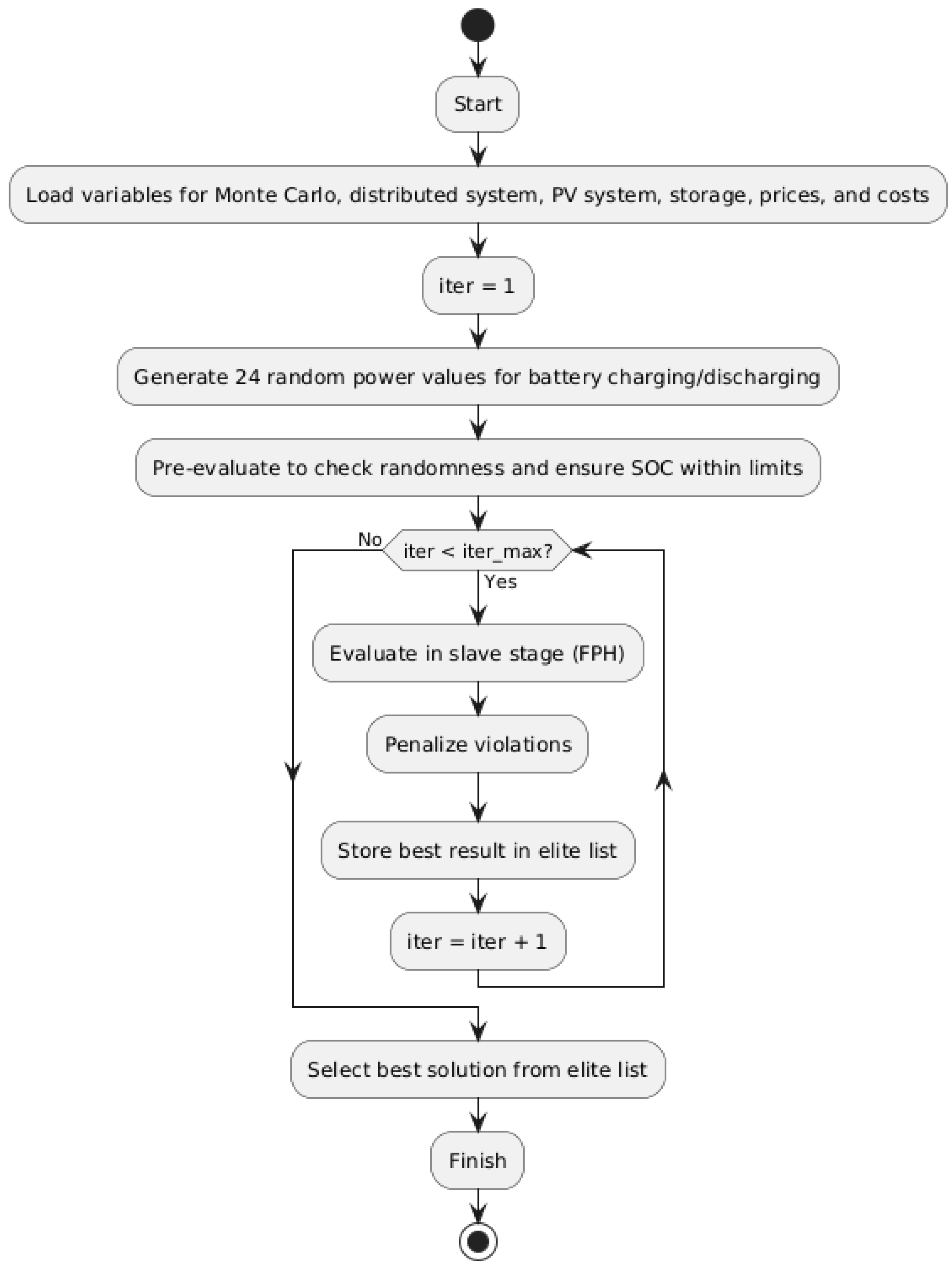
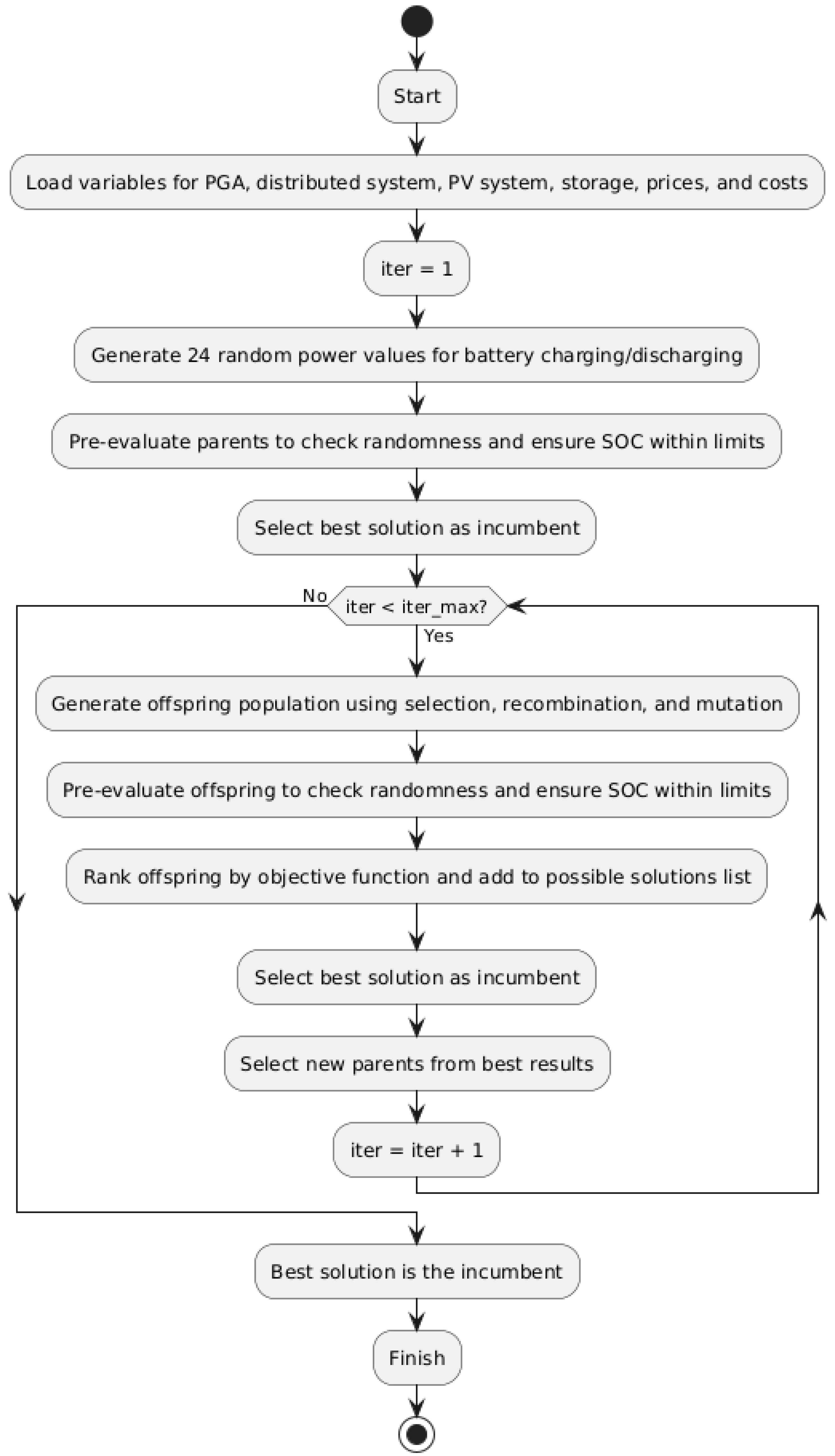
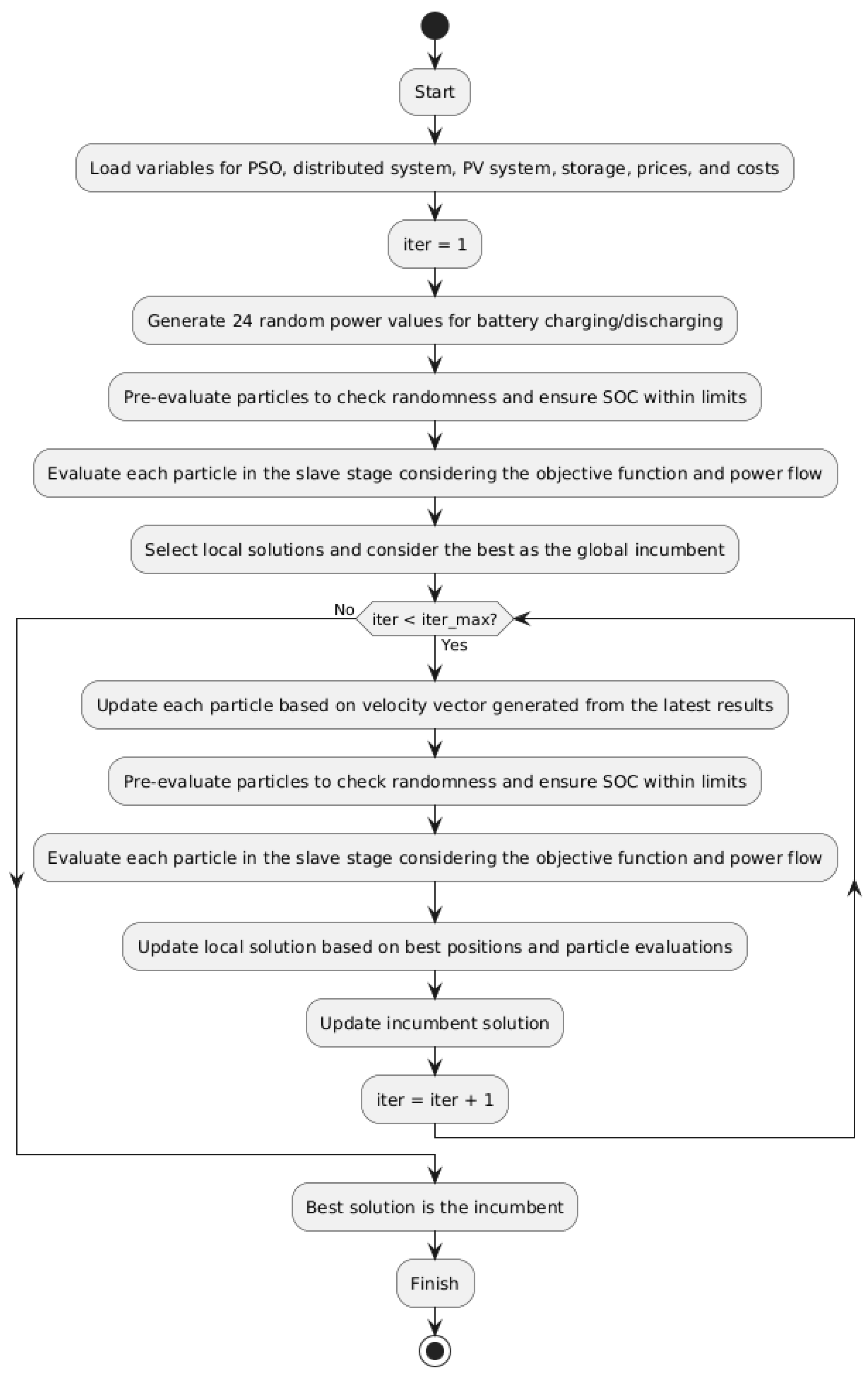
3.1.2. Optimization Methods for the Master Stage
Monte Carlo Method (MC)
Population-Based Genetic Algorithm (GAP)
Particle Swarm Optimization (PSO)
3.1.3. Parameter Tuning for Optimization Algorithms
3.2. Slave Stage: Hourly Power Flow Calculation
4. Test System and Considerations
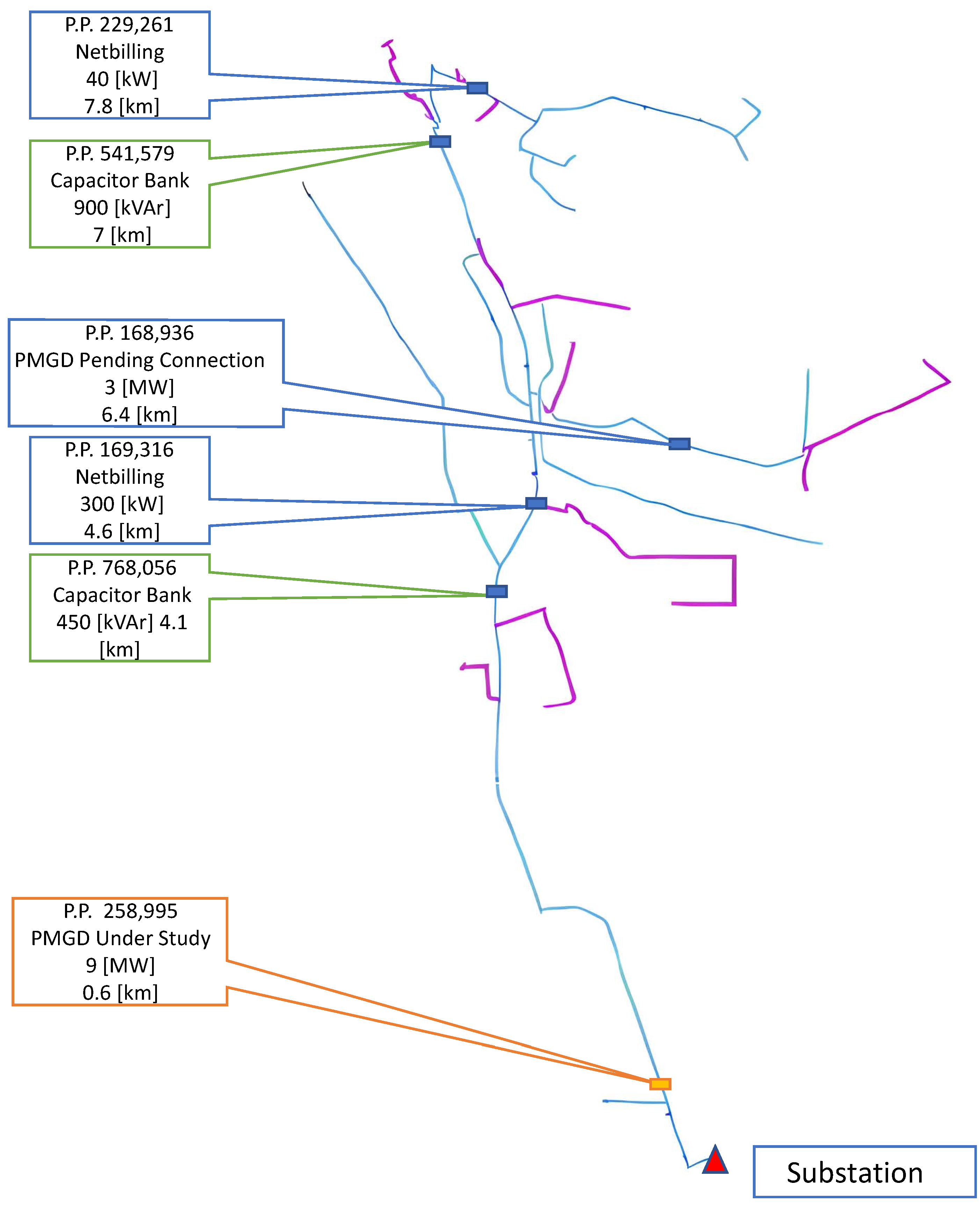
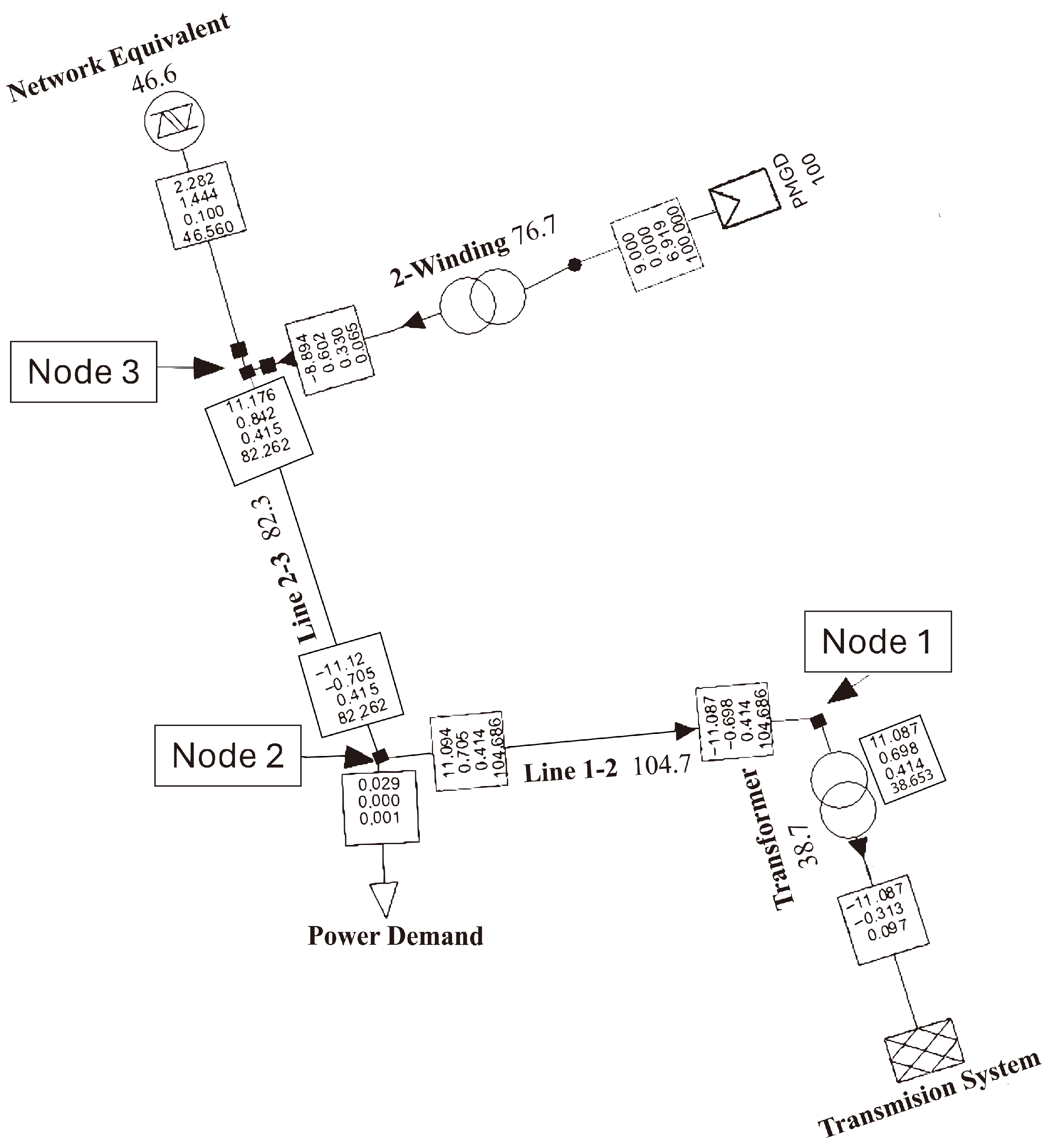
4.1. Simplification of the DES Studied for the Power Flow Analysis
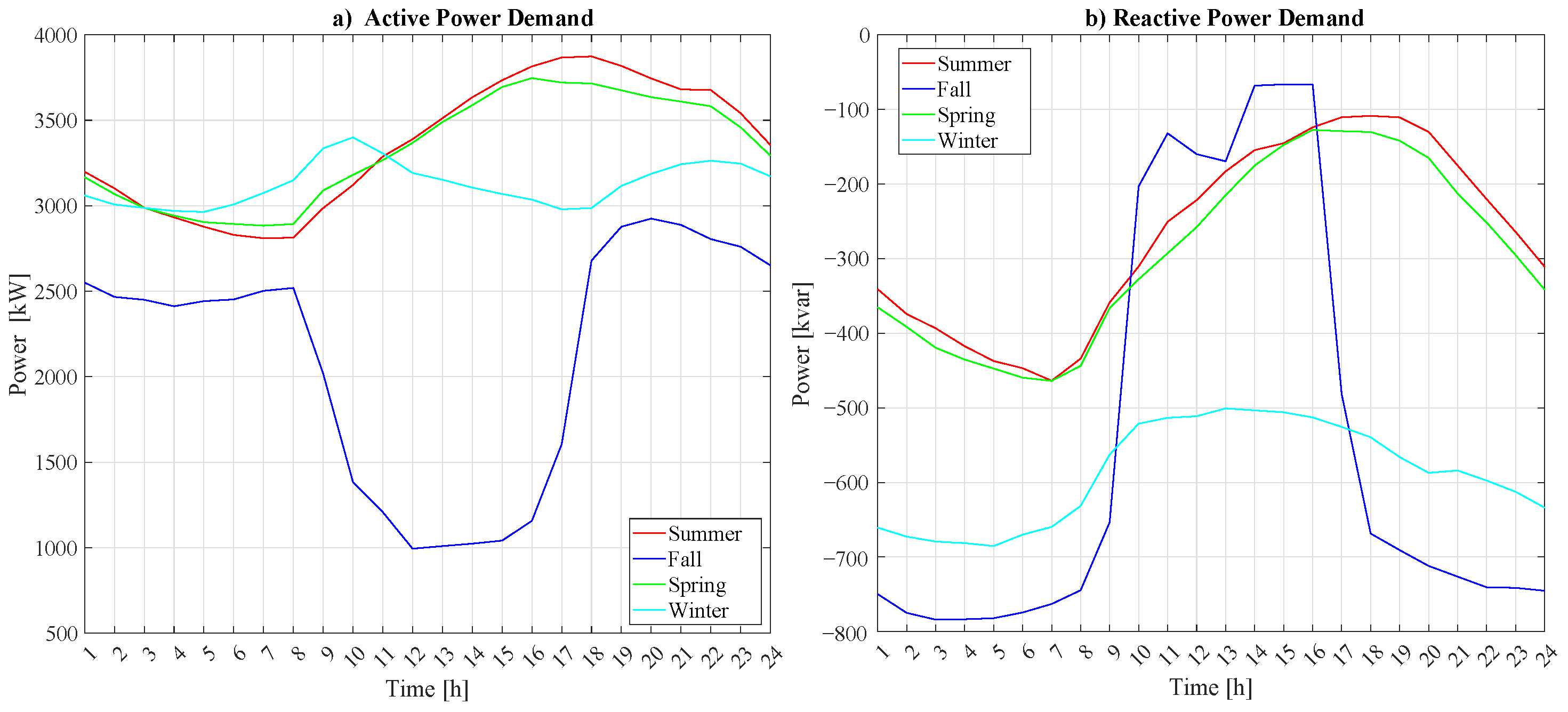
4.2. Power Demand Curves
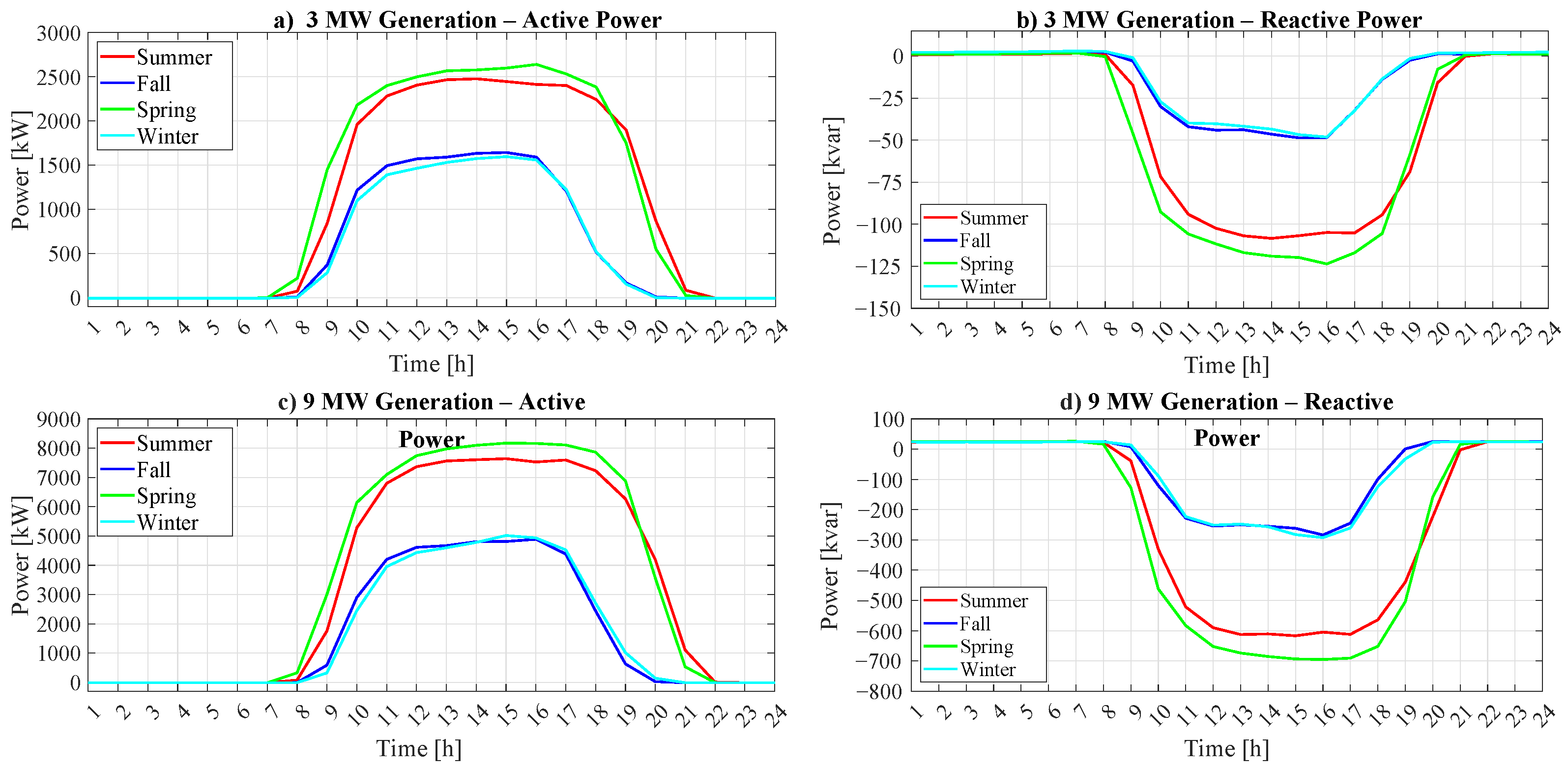
4.3. PV Generation Curves
4.4. Energy Selling Price
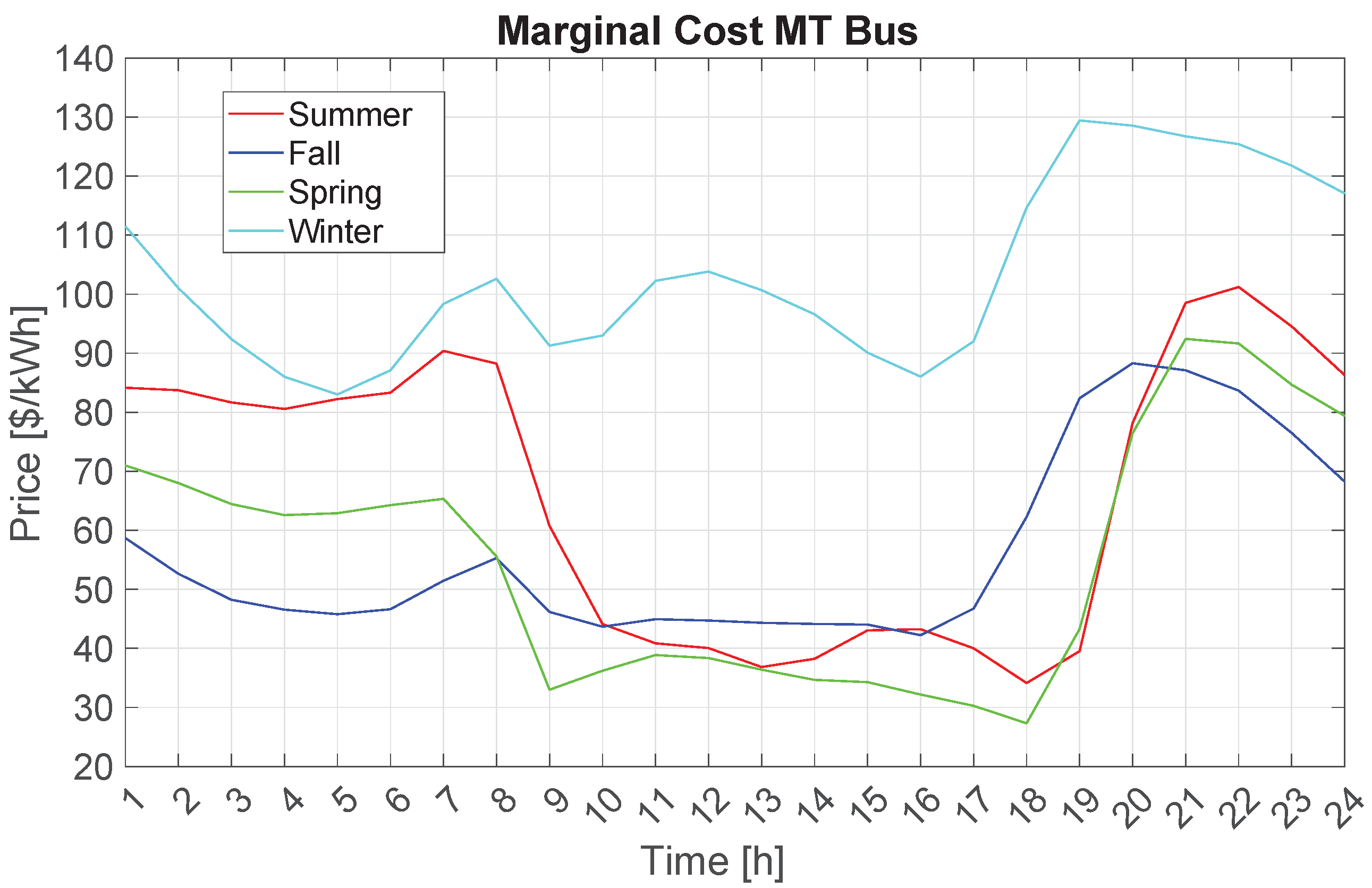
4.5. Energy Purchase Price
4.6. Battery Energy Storage System
4.7. Chilean Technical Regulation for PMGD and BESS Operation
5. Simulation Results
5.1. Analysis for an Average Day of Operation per Season
5.1.1. Average Daily Results Across Different Seasons
5.1.2. Annual Results Analysis
5.2. Technical Analysis
5.3. Analysis of the PSO Case in Summer
5.4. Execution Times
6. Conclusions and Future Work
Author Contributions
Funding
Institutional Review Board Statement
Data Availability Statement
Acknowledgments
Conflicts of Interest
References
- Revesz, R.L.; Unel, B. Managing the future of the electricity grid: Energy storage and greenhouse gas emissions. Harv. Environ. Law Rev. HELR 2018, 42, 139. [Google Scholar]
- UNFCCC. Portal de Estrategias a Largo Plazo. 2021. Available online: https://unfccc.int/process/the-paris-agreement/long-term-strategies (accessed on 20 July 2024).
- Coordinador. Informe Mensual del Coordinador Eléctrico Nacional. 2022 y 2021. Available online: https://www.coordinador.cl/reportes/documentos/informe-mensual-coordinador-electrico-nacional (accessed on 13 March 2023).
- Coordinador. Reducción de Energía Eólica y Solar Durante la Operación en Tiempo Real. 2022. Available online: https://www.coordinador.cl/operacion/documentos/resumen-de-reduccion-de-energia-eolica-y-solar-durante-la-operacion-en-tiempo-real/ (accessed on 22 March 2023).
- Errázuriz, C.P. Los mecanismos de estabilización de precios para la energía eléctrica en Chile. Desafíos y lecciones. Rev. Derecho Adm. 2024, 329–338. [Google Scholar] [CrossRef]
- Jung, D.; Schönberger, F.; Moraga, F.; Ilgen, K.; Wieland, S. Floating photovoltaic in Chile: Potential for clean energy generation and water protection. Sustain. Energy Technol. Assess. 2024, 63, 103647. [Google Scholar] [CrossRef]
- Stecca, M.; Elizondo, L.R.; Soeiro, T.B.; Bauer, P.; Palensky, P. A comprehensive review of the integration of battery energy storage systems into distribution networks. IEEE Open J. Ind. Electron. Soc. 2020, 1, 46–65. [Google Scholar] [CrossRef]
- Mallikarjun, P.; Thulasiraman, S.R.G.; Balachandran, P.K.; Zainuri, M.A.A.M. Economic energy optimization in microgrid with PV/wind/battery integrated wireless electric vehicle battery charging system using improved Harris Hawk optimization. Sci. Rep. 2025, 15, 10028. [Google Scholar] [CrossRef]
- Grisales-Noreña, L.; Cortés-Caicedo, B.; Montoya, O.D.; Hernandéz, J.; Alcalá, G. A battery energy management system to improve the financial, technical, and environmental indicators of Colombian urban and rural networks. J. Energy Storage 2023, 65, 107199. [Google Scholar] [CrossRef]
- Jani, V.; Abdi, H. Optimal allocation of energy storage systems considering wind power uncertainty. J. Energy Storage 2018, 20, 244–253. [Google Scholar] [CrossRef]
- Ray, S.; Kasturi, K.; Nayak, M.R. Optimal Operation of Grid-Tied PV & BESS Powered Smart Home with Electric Vehicle using AOA. In Proceedings of the 2022 International Conference on Intelligent Controller and Computing for Smart Power (ICICCSP), Hyderabad, India, 21–23 July 2022; IEEE: Piscataway, NJ, USA, 2022; pp. 1–6. [Google Scholar]
- Wahyuni, S.; Gunadin, I.; Muslimin, Z. Study of Optimal Alocation and Sizing of Battery Energy Storage Systems in Wind Turbine Integrated Power Generating Systems Using Metaheuristic AI. In Proceedings of the 2024 International Seminar on Intelligent Technology and Its Applications (ISITIA), Mataram, Indonesia, 10–12 July 2024; IEEE: Piscataway, NJ, USA, 2024; pp. 524–529. [Google Scholar]
- Saleem, M.; Saha, S.; Izhar, U.; Ang, L. Optimized energy management of a solar battery microgrid: An economic approach towards voltage stability. J. Energy Storage 2024, 90, 111876. [Google Scholar] [CrossRef]
- Zhang, R.; Lee, M.; Huang, L.; Ni, M. Optimization of battery energy storage system (BESS) sizing in different electricity market types considering BESS utilization mechanisms and ownerships. J. Clean. Prod. 2024, 470, 143317. [Google Scholar] [CrossRef]
- Wei, L.; Li, Y. Research on maximum power point tracking of photovoltaic power generation based on improved hybrid optimization algorithm. Sci. Rep. 2025, 15, 3991. [Google Scholar] [CrossRef]
- Diaz-Bello, D.; Vargas-Salgado, C.; Gomez-Navarro, T.; Aguila-Leon, J. Enhancing energy efficiency and profitability in microgrids through a genetic algorithm approach, analyzing the use of storage systems. Sustain. Energy Technol. Assessments 2025, 73, 104154. [Google Scholar] [CrossRef]
- Grisales-Noreña, L.; Cortés-Caicedo, B.; Montoya, O.D.; Sanin-Villa, D.; Gil-González, W. Integration of BESS in grid connected networks for reducing the power losses and CO2 emissions: A parallel master-stage methodology based on PDVSA and PSO. J. Energy Storage 2024, 87, 111355. [Google Scholar] [CrossRef]
- Alghamdi, A.S. Microgrid energy management and scheduling utilizing energy storage and exchange incorporating improved gradient-based optimizer. J. Energy Storage 2024, 97, 112775. [Google Scholar] [CrossRef]
- Nassef, A.M.; Abdelkareem, M.A.; Maghrabie, H.M.; Baroutaji, A. Review of metaheuristic optimization algorithms for power systems problems. Sustainability 2023, 15, 9434. [Google Scholar] [CrossRef]
- Falabretti, D.; Gulotta, F.; Spinelli, L. Participation of aggregated DERs to the ancillary services market: A Monte Carlo simulation-based heuristic greedy-indexing model. Energies 2022, 15, 1037. [Google Scholar] [CrossRef]
- Shang, Y.; Wu, W.; Liao, J.; Guo, J.; Su, J.; Liu, W.; Huang, Y. Stochastic maintenance schedules of active distribution networks based on Monte-Carlo tree search. IEEE Trans. Power Syst. 2020, 35, 3940–3952. [Google Scholar] [CrossRef]
- He, Y.; Liao, N.; Rao, J.; Fu, F.; Chen, Z. The optimization of investment strategy for resource utilization and energy conservation in iron mines based on Monte Carlo and intelligent computation. J. Clean. Prod. 2019, 232, 672–691. [Google Scholar] [CrossRef]
- Dashtdar, M.; Flah, A.; Hosseinimoghadam, S.M.S.; Kotb, H.; Jasińska, E.; Gono, R.; Leonowicz, Z.; Jasiński, M. Optimal operation of microgrids with demand-side management based on a combination of genetic algorithm and artificial bee colony. Sustainability 2022, 14, 6759. [Google Scholar] [CrossRef]
- Rodriguez-Cabal, M.A.; Botero-Gómez, V.; Sanin-Villa, D. Optimization of Weight Reduction in Power Transmission Systems Using Bio-Inspired Algorithms and Composite Materials. Coatings 2024, 14, 1586. [Google Scholar] [CrossRef]
- Zhou, Y.; Li, Z.; Zhou, H.; Li, R. The application of PSO in the power grid: A review. In Proceedings of the 2016 35th Chinese Control Conference (CCC), Chengdu, China, 27–29 July 2016; IEEE: Piscataway, NJ, USA, 2016; pp. 10061–10066. [Google Scholar]
- Grisales-Noreña, L.F.; Ocampo-Toro, J.A.; Montoya-Giraldo, O.D.; Montano, J.; Hernandéz, J. Optimal operation of battery storage systems in standalone and grid-connected DC microgrids using parallel metaheuristic optimization algorithms. J. Energy Storage 2023, 65, 107240. [Google Scholar] [CrossRef]
- Mokhtari, O.; Chevalier, S.; Almassalkhi, M. Structure-preserving Optimal Kron-based Reduction of Radial Distribution Networks. arXiv 2025, arXiv:2508.15006. [Google Scholar]
- Aprueba Reglamento Para Medios de Generación De Pequeña Escala. 2020. Available online: https://www.bcn.cl/leychile/navegar?idNorma=1150437 (accessed on 20 January 2025).
- Costo Marginal Online|Coordinador Eléctrico Nacional. 2024. Available online: https://www.coordinador.cl/mercados/graficos/costos-marginales/costo-marginal-online/ (accessed on 20 March 2024).
- Servicio de Evaluación Ambiental. 2024. Available online: https://www.sea.gob.cl/en/ (accessed on 20 March 2024).
- CNE. Norma Técnica de Conexión y Operación de PMGD en Instalaciones de Media Tensión. 2019. Available online: https://www.cne.cl/wp-content/uploads/2019/07/NTCO-PMGD-Julio-2019.pdf (accessed on 9 September 2023).



| Hour | h = 1 | h = 2 | h = 3 | ⋯ | h = 22 | h = 23 | h = 24 |
|---|---|---|---|---|---|---|---|
| Power | 2 | −4 | 3.5 | ⋯ | 1 | −4 | −2 |
| Method | Parameter | Value | Search Range |
|---|---|---|---|
| PSO | Population Size | 1100 | [4, 1200] |
| 0.4057 | [0, 0.5] | ||
| Acceleration Factor () | 1.6168 | [0, 3] | |
| Acceleration Factor () | 1.5715 | [0, 3] | |
| Max Inertia Weight | 0.8643 | [0, 1] | |
| Min Inertia Weight | 0.3521 | [0, 1] | |
| GAP | Generations | 2000 | [0, 2000] |
| Individuals | 195 | [0, 200] | |
| Mutations | 2 | [0, 10] | |
| MC | Iterations | 184 | [50, 200] |
| Population Size | 1410 | [100, 2000] |
| Node | Reactive Power (kVAr) | Distance (km) |
|---|---|---|
| No. 541579 | 900 | 7 |
| No. 768056 | 450 | 4.1 |
| Step-Up Transformer | |
|---|---|
| Rated Power (MVA) | 4.92 |
| Frequency (Hz) | 50 |
| Rated Voltage (kV) | 15/0.63 |
| Connection Group | YNd11 |
| Positive Seq. Reactance (X1) [%] | 8 |
| Zero Seq. Reactance (X0) [%] | 8 |
| Tap Range | 5 steps—2.5% |
| Number of Transformers | 2 |
| Inverters Specifications | |
|---|---|
| Max. AC Power (MW) | 1.5 kW |
| Max. DC Voltage (kV) | 0.63 DC |
| Brand and Model | INGECON SUN 1640TL B360 |
| Number of Inverters | 6 |
| Node | Power (kW) | Distance (km) |
|---|---|---|
| 229,261 | 40 | 7.8 |
| 169,316 | 300 | 4.64 |
| Line | ||||
|---|---|---|---|---|
| 1 | 0.01219 | 0.0137 | 29 | 0 |
| 2 | 0.1032 | 0.2666 | −11,176 | −842 |
| Line | DIgS. Full | DIgS. Simpl. | MATLAB |
|---|---|---|---|
| 1–2 | 104.69 | 104.69 | 104.69 |
| 2–3 | 82.26 | 82.26 | 82.27 |
| Node | DIgS Full | DIgS. Simpl. | MATLAB |
|---|---|---|---|
| 1 | 1.0341 | 1.0341 | 1.0340 |
| 2 | 1.0347 | 1.0347 | 1.0346 |
| 3 | 1.0405 | 1.0405 | 1.0404 |
| Semester | 00:00–03:59 | 04:00–07:59 | 08:00–11:59 | 12:00–15:59 | 16:00–19:59 | 20:00–23:59 |
|---|---|---|---|---|---|---|
| First semester 2021 | 47.549 | 47.131 | 37.965 | 34.124 | 39.720 | 53.958 |
| Second semester 2021 | 48.467 | 46.183 | 29.937 | 27.361 | 43.405 | 59.442 |
| First semester 2022 | 52.719 | 47.480 | 31.154 | 29.617 | 48.868 | 70.623 |
| Network Voltage | High and Medium Density | Low and Very Low Density |
|---|---|---|
| Low Voltage | ±7.5% | ±10% |
| Medium Voltage | ±6% | ±8% |
| Season | Model | Summer | Autumn | ||||
|---|---|---|---|---|---|---|---|
| CLP/day | MC | GAP | PSO | MC | GAP | PSO | |
| Best Result | CLP/day | 4,182,737.93 | 4,462,002.95 | 4,463,102.85 | 1,712,153.30 | 1,886,564.58 | 1,887,125.58 |
| Average Result | CLP/day | 4,055,959.59 | 4,461,385.04 | 4,462,858.85 | 1,617,181.28 | 1,886,161.86 | 1,887,125.58 |
| Standard Deviation | CLP/day | 80,581.45 | 795.26 | 514.41 | 47,618.03 | 339.34 | 0.00 |
| Season | Model | Winter | Spring | ||||
| CLP/day | MC | GAP | PSO | MC | GAP | PSO | |
| Best Result | CLP/day | 1,594,896.80 | 2,328,711.17 | 2,370,548.23 | 4,052,035.75 | 4,295,020.92 | 4,295,757.41 |
| Average Result | CLP/day | 1,540,597.49 | 2,316,361.83 | 2,368,277.72 | 3,962,681.75 | 4,294,571.61 | 4,292,203.86 |
| Standard Deviation | CLP/day | 51,240.35 | 7134.17 | 2392.79 | 66,563.99 | 375.28 | 4968.46 |
| Method | Best Solution (CLP) | Average Solution (CLP) | Std. Deviation (CLP) |
|---|---|---|---|
| Monte Carlo (MC) | $4,182,738 | $4,055,960 | 80,581.45 |
| GAP | $4,462,003 | $4,461,385 | 795.26 |
| PSO | $4,463,103 | $4,462,859 | 514.41 |
| Base Case | $3,132,256 | – | – |
| Method | Std. Deviation (%) | Difference (Best vs. Avg.) (%) | Avg. Processing Time (s) |
| Monte Carlo (MC) | 1.990% | 3.03% | 213.73 |
| GAP | 0.020% | 0.01% | 146.56 |
| PSO | 0.010% | 0.01% | 56.64 |
| Base Case | – | – | – |
| Method | Base Case | Monte Carlo (MC) | GAP | PSO |
|---|---|---|---|---|
| Best Annual Result | $805,700,960.84 | $1,039,588,274.98 | $1,171,758,170.01 | $1,175,947,567.15 |
| Average Annual Result | $805,700,960.84 | $1,006,451,018.07 | $1,170,452,995.89 | $1,175,397,439.21 |
| Method | Monte Carlo (s) | GAP (s) | PSO (s) |
|---|---|---|---|
| Max | 208 | 142 | 55 |
| Min | 221 | 145 | 62 |
| Average | 211 | 144 | 56 |
| Method | Monte Carlo (%) | GAP (%) |
|---|---|---|
| Max | 382% | 261% |
| Min | 357% | 234% |
| Average | 378% | 257% |
Disclaimer/Publisher’s Note: The statements, opinions and data contained in all publications are solely those of the individual author(s) and contributor(s) and not of MDPI and/or the editor(s). MDPI and/or the editor(s) disclaim responsibility for any injury to people or property resulting from any ideas, methods, instructions or products referred to in the content. |
© 2026 by the authors. Published by MDPI on behalf of the International Institute of Knowledge Innovation and Invention. Licensee MDPI, Basel, Switzerland. This article is an open access article distributed under the terms and conditions of the Creative Commons Attribution (CC BY) license.
Share and Cite
Tapia-Aguilera, J.; Grisales-Noreña, L.F.; Quintal-Palomo, R.E.; Montoya, O.D.; Sanin-Villa, D. Optimizing Energy Storage Systems with PSO: Improving Economics and Operations of PMGD—A Chilean Case Study. Appl. Syst. Innov. 2026, 9, 22. https://doi.org/10.3390/asi9010022
Tapia-Aguilera J, Grisales-Noreña LF, Quintal-Palomo RE, Montoya OD, Sanin-Villa D. Optimizing Energy Storage Systems with PSO: Improving Economics and Operations of PMGD—A Chilean Case Study. Applied System Innovation. 2026; 9(1):22. https://doi.org/10.3390/asi9010022
Chicago/Turabian StyleTapia-Aguilera, Juan, Luis Fernando Grisales-Noreña, Roberto Eduardo Quintal-Palomo, Oscar Danilo Montoya, and Daniel Sanin-Villa. 2026. "Optimizing Energy Storage Systems with PSO: Improving Economics and Operations of PMGD—A Chilean Case Study" Applied System Innovation 9, no. 1: 22. https://doi.org/10.3390/asi9010022
APA StyleTapia-Aguilera, J., Grisales-Noreña, L. F., Quintal-Palomo, R. E., Montoya, O. D., & Sanin-Villa, D. (2026). Optimizing Energy Storage Systems with PSO: Improving Economics and Operations of PMGD—A Chilean Case Study. Applied System Innovation, 9(1), 22. https://doi.org/10.3390/asi9010022