
Article

Proton Binding of Halloysite Nanotubes at Varied Ionic Strength: A Potentiometric Titration and Electrophoretic Mobility Study

1
MTA-SZTE Momentum Biocolloids Research Group, Department of Physical Chemistry and Materials Science, Interdisciplinary Centre of Excellence, University of Szeged, 6720 Szeged, Hungary
2
Centre for Micro- and Nanosciences, University of Rijeka, Radmile Matejčić 2, HR-51000 Rijeka, Croatia
3
Faculty of Biotechnology and Drug Development, University of Rijeka, Radmile Matejčić 2, HR-51000 Rijeka, Croatia
*
Author to whom correspondence should be addressed.
Current address: Institute of Condensed Matter and Nanosciences (IMCN), Bio- and Soft Matter (BSMA), Université Catholique de Louvain (UCLouvain), Croix du Sud 1/L7.04.02, 1348 Louvain-la-Neuve, Belgium.
Colloids Interfaces 2025, 9(6), 79; https://doi.org/10.3390/colloids9060079
Submission received: 16 October 2025 / Revised: 13 November 2025 / Accepted: 19 November 2025 / Published: 27 November 2025
(This article belongs to the Special Issue Ten Years Without Nikola Kallay)

Abstract

Proton binding (i.e., charging) isotherms of halloysite nanotubes (HNT) were determined from cycled acid-base potentiometric titrations in KCl solution at constant ionic strengths (0.01, 0.10, 1.00 mol dm−3). The isotherms measured in the pH cycle from 3 to 11 and back exhibit a pronounced hysteresis with respect to the direction of pH change, which is accurately reproducible when the cycle is repeated. The hysteresis is absent if the cycled titration is performed within a narrow pH range between 5 and 9. These results align with the dissolution rates of alumina and silica, which form the two surfaces of the rolled kaolinite sheet in HNT, and clearly point to reversible partial dissolution-deposition processes in the HNT interior during a titration cycle, outside the above pH range (alumina dissolution below pH ≈ 5 and silica dissolution above pH ≈ 8.5). In the studied titration experiments, these processes produce partially dissolved surface-bound, rather than completely dissolved species (reversible surface etching). Under the applied conditions, reversible surface etching is less pronounced in the acidic part of the titration cycle. Charging isotherms recorded in the decreasing pH titrations at varied ionic strength exhibit a common intersection point very close to zero charge (point of zero charge) around pH ≈ 8.1, characteristic for an amphoteric solid surface. These isotherms were reasonably well fitted by applying the surface protonation model in the HNT interior, which invokes the Stern model of the electric double layer (EDL), by summing the surface charges calculated for alumina and silica as separate components (surfaces). The model surface charge isotherms for alumina surface in the HNT interior exhibit a point of zero charge at pH = 9.0, while the silica surface has a negative charge above pH > 8.5, which is in very good agreement with the values reported in the literature: as for these two surfaces, thus for kaolinite nanoparticles. The best-fit protonation site density for both surfaces is equal to 8.0 nm−2, while the best-fit intrinsic pKa for alumina and silica surfaces of HNT are equal to 9.0 and 8.5, respectively. The pH-dependence of electrophoretic mobility, measured by means of electrophoretic light scattering, reveals a more acidic behavior of the outermost silica surface than within the inner HNT phase, which is consistent with the literature result reported for kaolinite. The results reported herein confirm that the inner and outer surfaces of the HNT are oppositely charged below pH < 8.0 and negatively charged above that value, and importantly, they reveal new details about the protonation affinities and EDL parameters at active surfaces of HNT, important for the colloidal stability of HNT suspensions and the functionalization of HNT through the electrostatic binding of active molecules.

Graphical Abstract

1. Introduction

Halloysite nanotubes (HNT) present a polymorph within the kaolin group of minerals, which all share the same general formula Al2Si2O5(OH)4 [1]. Unlike the naturally prevalent kaolinite, which is dehydrated and features a structure of stacked flat double-sided sheets of SiO4 tetrahedra and AlO6 octahedra, HNTs consist of rolled-up double-sided sheets. This configuration results in the characteristic “carpet roll” form of the HNT, wall with a hollow inner lumen [2,3] (cf. Figure 1). Although the structural attributes of HNTs are relatively well understood, the mechanism underlying the curling and rolling of the sheets remains a topic of ongoing research [2,4]. The interstitial space between the sheets in HNTs can be either dehydrated or contain stoichiometrically bound water molecules (Al2Si2O5(OH)4·2H2O), with experimentally determined inner-sheet distances of 7.5 Å and 10 Å, respectively [5].
The diverse applications of HNTs are attributed to their unique inner and outer surface compositions, inherent biocompatibility and large-scale availability [6]. These exceptional properties have been extensively documented, positioning HNTs as highly promising materials for a range of biomedical applications, including drug delivery systems, medical implants, and cosmetic formulations [7,8,9]. Furthermore, HNTs serve as versatile building blocks for the development of advanced nanocomposites [10]. The abundance of functional groups on both the inner lumen and the outer surface enables HNTs to function as efficient nanocontainers, capable of encapsulating a variety of bioactive compounds, such as antioxidants [11,12], anticancer drugs [9], and enzymes [13].
The functional behavior of HNTs is strongly influenced by the pH-dependent surface charge of their inner and outer surfaces. The outer surface of HNTs (Bout), composed of silica, carries a negative charge due to deprotonated silanol groups, yielding a zeta potential of approximately −30 mV in the pH range between 4 and 8 [14,15]. This value is also influenced by the charge in the lumen [16]. In contrast, the inner lumen, consisting of alumina, is positively charged under neutral and acidic conditions [17]. This dual charge distribution is akin to the one observed in kaolinite [18] and not only governs the adsorption and release of loaded molecules but also impacts colloidal stability, particle interactions [19,20], and the overall performance of HNT-based systems in various applications. Other typical physicochemical characteristics include a density of approximately 2.53 g·cm−3, a specific surface area ranging from 22 to 150 m2g−1, and a cation exchange capacity in the range from 2 to 60 × 10−2 mol·kg−1 [1,21]. When suspended in aqueous solutions, the HNT water content within the inner part becomes pH-dependent [4]. The inner surfaces A and B present the majority of the HNT specific surface area exposed to aqueous solutions, thus dominating the behavior related to the binding of small ions and pH-buffering by HNTs.
Despite the critical role of pH-dependent charging of HNT surfaces, this property remains insufficiently studied experimentally and is not well understood in terms of proton binding models. This is surprising, given that the non-ideality of proton binding at metal oxide surfaces such as alumina and silica is very well understood in terms of the electrostatic contribution to the chemical potential of surface-bound protons and the contributions of ions in the electric double layer [22,23], which has even been successfully applied to kaolinite [18]. To the best of our knowledge, the sole available report on the binding constants of alumina and silica sites in HNTs, which were fitted from the potentiometric titration data, is by Bretti et al. [24]. Regrettably, this study does not provide the measured data, and the model fits are reported as a single standard deviation for the entire dataset. The models applied by these authors are adopted from polyelectrolyte literature and address the non-ideality of proton binding (specifically, the dependence of binding constants on the degree of protonation) on a semi-empirical level.
This study aims to bridge the knowledge gap in the pH-dependent charging of HNT by providing rigorously measured experimental data from potentiometric titrations and electrophoretic light scattering. These results are interpreted using the Stern model of the electric double layer for both types of surfaces encountered in HNT. To correlate the modeling outcomes with the proposed structural model outlined in Figure 1, the pH-charging behavior of HNT surfaces will be compared with their individual constituents, namely alumina (for surface A) and silica (for surfaces B and Bout). Additionally, the impact of sheet curling on the ion-exchange properties of HNT will be examined by comparing the pH-dependent charging of HNT with kaolinite, a planar counterpart with identical composition and crystal structure. In our approach, we hope to uphold several essential principles that qualify scientific research as both rigorously credible and beautiful. These principles, initially conveyed to one of us by Professor Nikola Kallay through his physical chemistry laboratory course, as well as his mentorship and our collaboration on one of his bold scientific hypotheses, which was validated through experiments utilizing his ingenious experimental designs [25], include a sound postulation of a scientific hypothesis; an experimental design enabling measurement of variables pertinent to hypothesis validation; rigorous execution of experimental measurements and validation of data reproducibility; a comprehensive understanding of the scientific problem in terms of physical models and their limitations; justification of these models through data fitting; and, ultimately, the careful and critical formulation of conclusions.

Stern Model of pH-Dependent Surface Charging

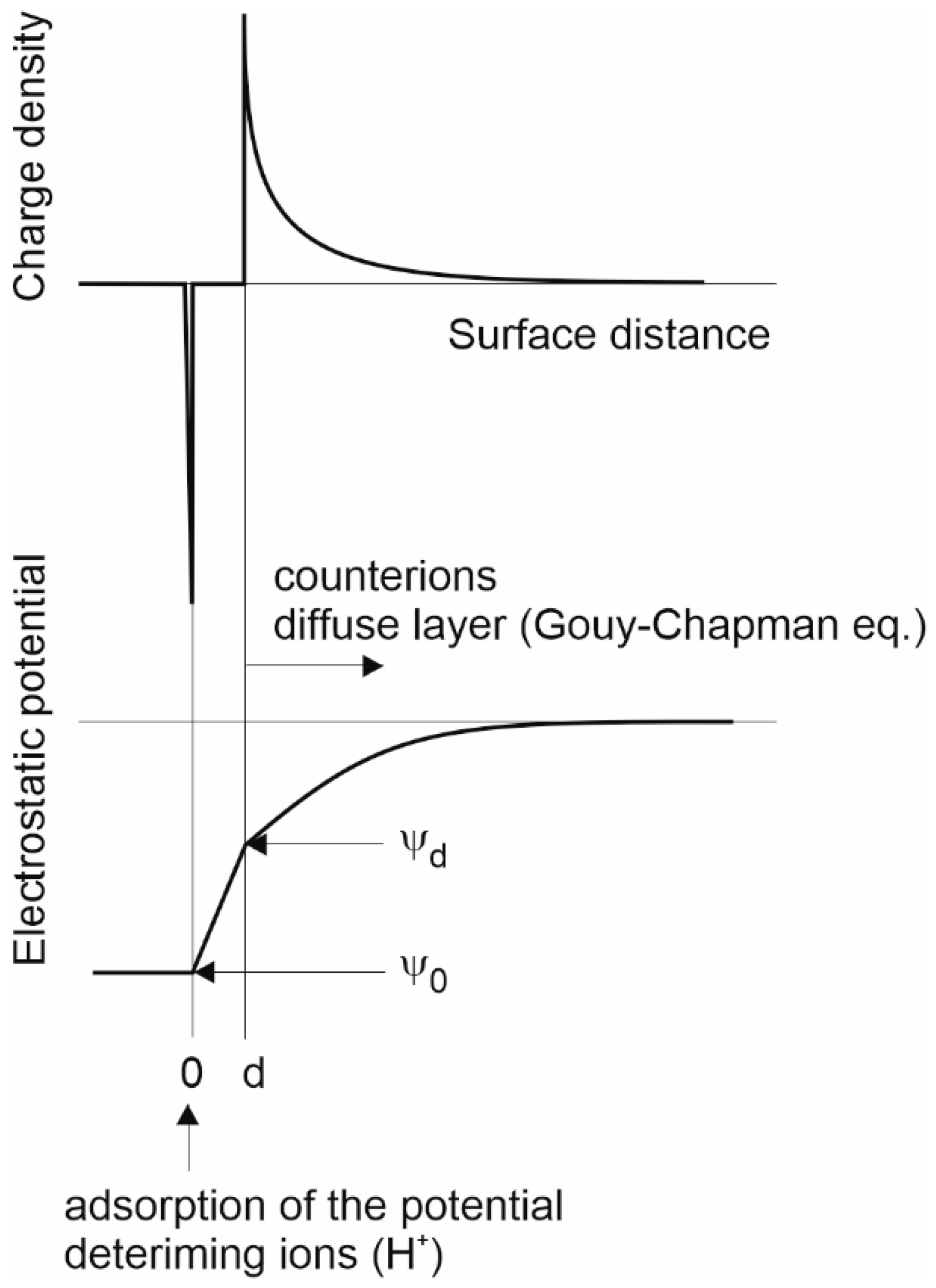
The Stern model, depicted in Figure 2, treats the planar charged surface in contact with an ionic solution, by dividing this system into two distinct regions: (a) the surface, where binding of the potential determining ions is influenced by the surface potential  ψ 0 , and (b) the diffuse layer, in which the diffusion of the charge-balancing counterions is governed by the potential described by the Poisson–Boltzmann equation [26,27]. We begin examining region (a) through formulation of site binding equations for the potential determining ions, specifically H+, at surfaces A and B:
a t   A : A l O H 1 / 2 + A l O 1 / 2 + H +
a t   B : S i O H 0 S i O + H +
where all oxide species are surface-bound and exposed to the ionic solution. In the reactions above, it should be noted that all oxide species are not represented with the precise number of covalently coordinated oxygen atoms to aluminum or silicon. Instead, they are formulated such as to establish the mass vs. charge stoichiometry of each binding site per one H+. This approach focuses on binding sites rather than specific chemical structural groups, thereby avoiding differentiation of such groups according to the number of bound protons. An abstract binding site for one H+ is introduced for this purpose. The surface concentration of sites is an average across various potential surface groups, weighted by their respective surface concentrations.
At thermodynamic equilibrium, the mass action law for the above two reactions is expressed as follows:
K a , A l O H = Γ A l O 1 / 2 a H + , A Γ A l O H 1 / 2 +
K a , S i O H = Γ S i O a H + , B Γ S i O H
where  K a , A l O H  and  K a , S i O H  represent the intrinsic thermodynamic equilibrium constants with  p K a = l o g 10 K a Γ  represents the surface concentration in nm−2. The proton activities in the 0-plane at surfaces A and B,  a H + , A  and  a H + , B , are influenced by the surface potential in the 0-plane of the electric double layer (cf. Figure 2):
a H + , i = a H + e z i q ψ 0 / k T
where  a H +  represents the experimentally measurable proton activity in the bulk solution, with  p H = l o g 10 a H + , i represents surface A or B,  z i  the charge number of the site in the deprotonated state (−1/2 for aluminol and −1 for silanol sites),  ψ 0  the surface potential in the 0-plane, q the elementary charge and kT the thermal energy. The surface concentrations for each type of site adhere to the mass balance equation:
Γ A l O 1 / 2 +   Γ A l O H 1 / 2 + = Γ 0 , A
Γ S i O + Γ S i O H = Γ 0 , B
where  Γ 0 , i  represents the total concentration of the respective sites at surface i.
The decision to adopt reaction 1 over a two-step reaction (2-pK model) involving  S O H 2 + S O H  and  S O  (where S denotes a “surface species”) with  p K a 1  and  p K a 2 , as proposed for metal oxide surfaces [28,29], is based on the observation that the pKa values for the two protonation steps involving oxygen atoms bound to aluminum in both alumina and kaolinite are very similar (cf. [17,18]). Furthermore, there is no structural evidence indicating that the surface A in HNT comprises two distinct types of proton binding sites, such as singly versus doubly coordinated oxygen atoms. Consequently, compared to the 2-pK model, reaction (1) represents the postulation of an average hypothetical reaction step rather than multiple steps. In this context, pKa in the one-pK model serves as an average of pKa1 and pKa2 from the two-pK model, while the total number of postulated protonation sites is effectively doubled. Importantly, the here-chosen site averaging does not influence the maximum concentration of surface-bound protons, but just sites. When pKa1 and pKa2 are similar, adopting reaction 1 is advantageous as it reduces the number of model parameters, thereby constraining the fit. For further details on this approach, please refer to the comprehensive chapter by Borkovec, Jönsson, and Koper [22].
In the diffuse layer adjacent to surface i, the distribution of counterions is derived from solving the Poisson–Boltzmann equation for a planar surface at an arbitrary potential, specifically the (inverse) Gouy–Chapman equation [22]:
ψ d , i = 2 k T q sinh 1 q σ d , i 2 k T ε 0 ε w κ
where d denotes any distance from the onset of the diffuse layer,  σ d , i  represents the surface charge density (in Cm−2),  ε 0  the permittivity of vacuum and  ε w  the relative permittivity of water, while  κ  represents the inverse Debye length,  κ = 2 q 2 I ε 0 ε r k T . The relationship between the surface potential  ψ 0  and the surface charge density at the onset of the diffuse layer,  σ d , i , is introduced through the definition of Stern capacitance, specifically for surface i:
C S , i = σ d , i ψ 0 , i ψ d , i
Electroneutrality is independently applicable to each electric double layer at surfaces A and B, even if the respective double layers overlap. Consequently,  σ d , i  can be equated to the negative surface charge density  σ 0 , i  attributed to the charged surface species j at each surface i:
σ d , i = σ 0 , i = q j z j Γ i , j
where  σ 0 , i  represents the surface charge density in the 0-plane of surface i, and  z j  the charge number of the surface species:  A l O 1 / 2  and  A l O H 1 / 2 +  at A and  S i O  at B. For one surface i, equations (3)–(10) form a closed set and can be solved for  σ 0 , i p H . Summed surface charge densities from surfaces A and B ( σ d , A + σ d , B ) may then be fitted to the experimental charging isotherms of HNT, in order to obtain the best-fit  p K a , A l O H  and  p K a , S i O H Γ 0 , A  and  Γ 0 , B C S , A  and  C S , B  for the aluminol and silanol surfaces, respectively.

2. Materials and Methods

Ultrapure water with a resistivity of 18.2 mΩ cm, supplied by a VWR Purity TU+ system, was utilized for all sample preparations. All measurements were performed at a temperature of 298.15 K. To minimize particulate contamination during light scattering experiments, all solutions—including water, salts, and ionic liquids—were filtered through 0.1 µm syringe filters (Millex Merck KGaA, Darmstadt, Germany) prior to use.
Pristine halloysite nanotubes (HNT, Sigma-Aldrich, St. Louis, USA) were subjected to alkaline modification according to a previously established procedure [30]. In brief, a 20 g/L suspension of commercial HNT powder was prepared in a 14.5 mM KOH solution and maintained under continuous magnetic stirring for 24 h. The resulting dispersion was centrifuged at 10,000 rpm for 10 min, after which the supernatant was discarded. The precipitate was repeatedly washed with ultrapure water and redispersed until the supernatant reached near-neutral pH. The resulting material was collected, transferred into glass vessels, and dried at 110 °C for 15 h to obtain hydroxylated HNT (h-HNT) powder. The dried powder was subsequently redispersed in water at a concentration of 10,000 mg/L for further sample preparation. All subsequent results and discussions pertain to experiments performed with the h-HNT samples. This choice reflects the interest of the application scientists for h-HNT due to its better stability and polydispersity properties [20,31]. However, as no differences were observed when experiments presented in this study were performed with unhydrolyzed HNT, both abbreviations h-HNT and HNT refer to h-HNT.
Electrophoretic light scattering (ELS) measurements were conducted using a Litesizer 500 instrument (Anton Paar GmbH, Graz, Austria), equipped with a 40 mW semiconductor laser operating at 658 nm in backscatter mode (scattering angle: 175°). Phase shift was determined using the continuously monitored phase analysis light scattering (cm-PALS) method. Sample preparation was identical for all systems examined. Prior to each measurement, h-HNT suspensions were prepared by mixing the particles, KCl solution, and either HCl or NaOH with MQ water, followed by injection into the measurement cuvette. Each sample comprised 1.8 mL of KCl solution at the appropriate concentration and 0.2 mL of a stable h-HNT dispersion (100 mg/L). Measurements were performed in omega-shaped plastic cuvettes (700 µL, Anton Paar). Before assessing electrophoretic mobility, samples were equilibrated at 25 °C for 2 h and subjected to pH measurement. Data acquisition began after 1 min of equilibration within the instrument, with reported values representing the averages of five independent measurements.
Potentiometric titrations (measurement of charging isotherms): Acid-base potentiometric titrations were undertaken by using a computer-controlled, high-precision potentiometric titrator equipped with four burettes [32] and a pH-measurement electrode pair (Metrohm Porotrode 6.0235.200, Metrohm, Herisau, Switzerland) Ag/AgCl (3 mol dm−3) reference electrode (Metrohm 6.0733.100). In the titration cell, a 100 cm3 solution at initial pH = 3 and ionic strength was prepared by adding appropriate volumes of HCl (c = 0.2500 mol dm−3, prepared from 1.0000 mol dm−3 solution, Titrisol, Merck) and KCl (c = 3.0 mol dm−3, prepared from analytical grade solid salt purchased from Merck) solutions, to which approximately 100 mg of the dry h-HNT powder was added. Titration runs were conducted in both increasing and decreasing pH directions within a pre-set range (3 < pH < 11) by using HCl and KOH titrant solutions (c = 0.2500 mol dm−3, prepared from 1.0000 mol dm−3 solution, Dilut-It, Avantor, Radnor, USA), without changing the sample. The ionic strength was maintained constant by the additions of a salt solution (KCl, c = 3.0 mol dm−3) or water. Each experiment comprised three cycles of increasing and decreasing pH. These experiments were repeated with different samples at ionic strengths 0.01, 0.10 and 1.00 mol dm−3. Deionized water (18.2 mΩ cm) was used for all solution preparations, with dissolved CO2 removed by heating to the boiling point and cooling under a nitrogen atmosphere.
The comprehensive description of the applied potentiometric titration technique along with the data treatment method, can be found in ref. [32]. Briefly, the molar quantity of elementary charge in the system,  q ( p H )  [mol], is calculated from the experimental titration data (volumes of added titrants vs. pH) by applying the electroneutrality equation:
q p H = H + H + b O H + O H b + K + K + b C l + C l b · V
where square brackets denote molar concentrations, and V is the total volume of the titrated system. Index b denotes the quantities measured in the blank experiment, thus in absence of the HNT (titration baseline). The H+ and OH ion concentrations are calculated from the measured pH value by applying the standard pH and activity coefficient definitions, while the K+ and Cl concentrations are calculated from the volumes of the added titrants. The mean activity coefficient of H+ and OH and ionic product of water fitted from the titration baseline. Experimental  q p H  is calculated into surface charge σ(pH) [C m−2] from:
σ p H = q p H · F m H N T ·   A s H N T
where  m ( H N T )  represents the total dry mass of the titrated HNT sample,  A s ( H N T )  the specific surface area determined from the BET isotherms (see next) and F is the Faraday constant.
N2 adsorption–desorption isotherms were acquired by utilizing a Micromeritics ASAP2020 system at 77 K. Prior to measurement, the sample was degassed in vacuum at a temperature of 623 K for 4 h. The specific surface area was calculated by applying the Brunauer–Emmett–Teller (BET) method in a p/p0 range of 0.05 to 0.30. In all other respects, the standard measurement and data treatment procedure was applied as many times described in the literature (for a concise description see, for example, ref. [33]).

3. Results and Discussion

The specific surface area, determined from the BET isotherm for the degassed and dehydrated HNT sample, is 44.7908 ± 0.1334 m2 g−1. Detailed isotherm data, which show excellent reversibility and absence of microporosity (from comparison with the isotherm shapes discussed in [33]), and BET model fit are available in the Supplementary Materials. Charge titration experiments indicate that the dissolution of HNT surfaces is reversible within the examined pH range, demonstrating reversible etching of alumina and silica surfaces, and is affected by ion screening. For clarity, this section is divided into two parts. The first subsection addresses the reversibility of charge titration. The second subsection examines the impact of ionic strength on the charging isotherms under quasi-reversible conditions, analyzed within the framework of the Stern model of the electric double layer, which forms at both surfaces A and B.

3.1. Charge Titration Reversibility: The Dissolution-Deposition of Surface Groups

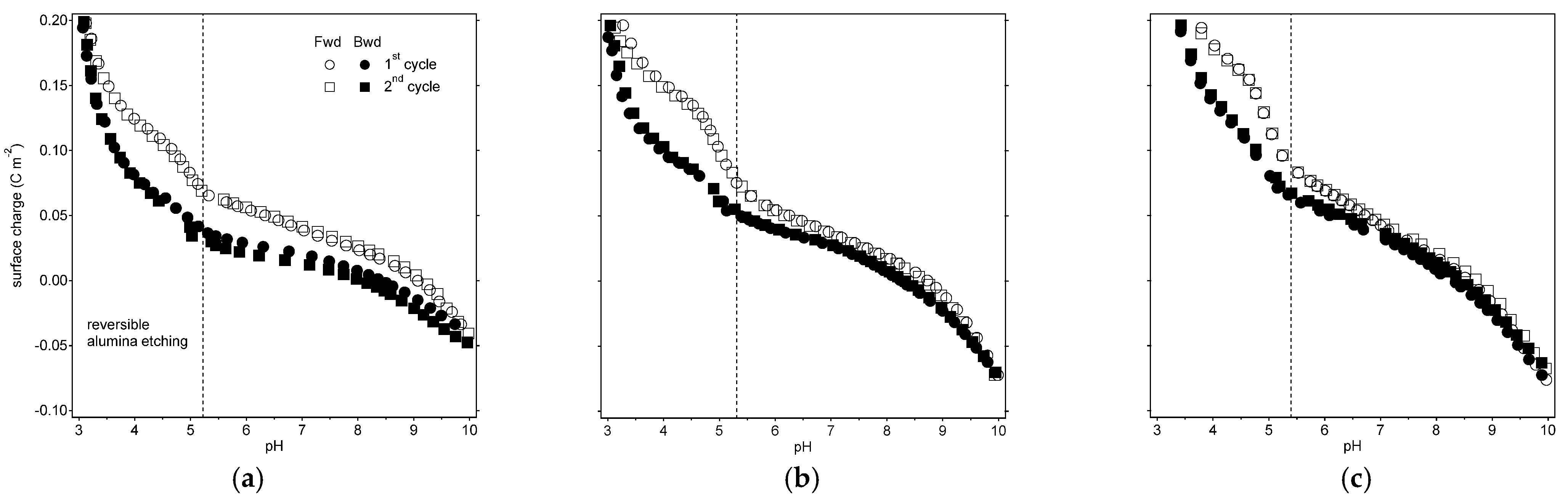
The reversibility of charge titration for HNT at ionic strengths 0.01, 0.10 and 1.00 mol dm−3 is demonstrated in the graphs presented in Figure 3, which displays the charging isotherms determined from the pH-cycled potentiometric titration experiments. In these experiments, pH was initially increased from 3 to 11 (forward direction) and subsequently decreased from 11 to 3 (backward direction). This cycle was repeated multiple times, although data only from the second and third cycles are shown. Data outside the pH range from 4 to 10 are excluded due to reduced accuracy of charge determination [32]. A noticeable hysteresis is evident between the forward vs. backward directions across all three ionic strengths, while data from the same direction across different titration cycles align closely.
The hysteretic shape of the cycled isotherms clearly points to pH-triggered process(es) which are not reversible unless the system is titrated to the same initial pH, thus providing an example of a “memory effect” in pH-dependent surface charging. Based on previous reports, the observed hysteresis may be explained by the dissolution of both surfaces (A and B) upon exposure to acid or base, producing dissolved charged species (i.e., surface etching) to an extent that depends on pH and time of exposure. Due to different periods of exposure to etching conditions for alumina vs. silica during the titration, as well as different rate constants of these processes, the extent of dissolution is more pronounced for alumina surface at low pH than for silica at high pH. These findings are supported by the available knowledge about the stability of aluminum and silicon oxides [17,34,35,36] as well as kaolinite [18,37] towards dissolution at different pH. Specifically, all forms of solid and amorphous aluminum oxides are most stable against dissolution at pH = 5.1 [36], and dissolution occurs both below and above this pH value, producing dissolved Al3+ and AlO2, respectively. Silicon oxide (silica) begins dissolving in mildly basic solutions just above pH ≈ 7, resulting in negatively charged silanol surface species [34,35]. In kaolinite, which is stoichiometrically identical to HNT, the dissolution of silicon and aluminum is reportedly coupled (though non-stoichiometrically) below  p H   6.5 , with a preferential release of silicon [37].
Etching of the alumina sheet in harsh acidic media (0.1–1 M H2SO4) is routinely used for HNT lumen etching, as a preparation step for adsorption of anionic molecules [14,38]. However, during titration in which HNT is exposed to relatively mild acidic and basic environments (see above for the applied pH range), new dissolved charged species are not produced in the bulk solution, as evidenced by the precise overlay of the cycled isotherms presented in Figure 3. If this were the case, isotherms recorded in the same pH-change direction would be progressively shifted by the dissolved charge produced during each cycle, which is not observed.
The cycled titration experiments conducted within narrower pH ranges at I = 0.10 mol dm−3, presented in Figure S1 (see Supplementary Materials), provide more detail about the surface dissolution processes. When pH is cycled within the range 3   pH   5 (cf. Figure S1), the hysteresis is pronounced and precisely repeats after the first cycle. This supports the observation that the alumina surface (A) dissolves below pH ≈ 5 [17]. However, in the present pH range and experimental time-frame, none of the Al3+(aq) dissolved species (which at higher pH would include the hydrolyzed species ( A l O H 2 + A l ( O H ) 2 + A l ( O H ) 3 A l ( O H ) 4 ) are observed in the bulk solution, but rather as surface-bound protonated (cationic) aluminol functional groups ( A l O H 2 + ). This was further confirmed by titrating the supernatant solution obtained by centrifuging the suspension of HNT that had previously been cyclically titrated in the range 3 < pH < 11, which showed an absence of any titrating species. The sudden increase in cationic charge below pH   5.1 has been previously documented for kaolinite, albeit without specific reference to the dissolution process [18]. Notably, hysteresis is completely absent if pH is cycled in the range 5   pH   9 (cf. Figure S2). This observation is explained by the fact that the equilibrium extent of aluminum oxide dissolution below pH = 5.1 is at least two orders of magnitude larger than above that pH [36]. In the pH range 6.5   pH   11 (cf. Figure S1c), an increase in the negative charge is observed during the first two forward-backward cycles. This indicates that exposure to a basic environment during these cycles primarily generates negatively charged silanol surface groups  S i O , and to a lesser extent,  A l O 2  at pH levels exceeding 9 (above the PZC of the alumina surface, as discussed in the following subsection). The third backward run nearly coincides with the second, suggesting that the dissolution process ceases and reversibility is achieved for the backward runs after the first cycle.
Upon examining the graphs in Figure 3, particularly the comparison of isotherms at I = 0.01 mol dm−3 and I = 0.10 mol dm−3, it is evident that the hysteresis above pH ≈ 5 becomes narrower with increasing ionic strength. This trend, which will be discussed in the next subsection, can be attributed to the electrostatic screening of the surface potential by counterions. This phenomenon is observable for both the alumina and silica surfaces and subsequently reduces the extent of dissolution. At low pH, the highly positive electrostatic field within the interior significantly enhances the dissolution of the alumina surface. Conversely, at high pH, the relatively weak negative electrostatic field is less effective in producing semi-dissolved, surface-bound silanol and aluminol groups.
In summary, the hystereses observed in the graphs presented in Figure 3 arise from dissolution and deposition of the surface-bound, partially dissolved species, specifically amphoteric aluminols and weakly acidic silanols. Within the studied pH range, these surface etching processes are reversible through deposition, thus qualifying as reversible surface etching. Aluminol groups, being amphoteric, titrate across the entire pH range studied, whereas silanols, which are acidic and negatively charged in the deprotonated form, titrate only above pH ≈ 7. The surface-bound, partially dissolved aluminol species within the HNT interior, are detectable below the threshold for dissolution of alumina (denoted with vertical dashed lines in Figure 3) and are particularly evident during forward (increasing pH) titration runs. The threshold is observed to shift from pH = 5.2 at I = 0.01 mol dm−3 to pH = 5.4 at I = 1.00 mol dm−3.

3.2. Stern Model for the HNT Interior and the Charging Mechanism of HNT Under the Quasi-Reversibility Conditions

The consistent repeatability of the charging isotherm hysteresis within the examined pH range (cf. Figure 3) indicates that data from both forward and backward titrations can be considered as measured under quasi-reversible conditions. This implies that the surface charging state is reversible, provided the experiment follows the same pH and time trajectory. The preceding discussion suggests the presence of a surface-bound phase of partially dissolved aluminol groups during forward titration (increasing pH), which deposit at surface A (within the HNT interior) at higher pH values. Conversely, in the backward titration, these groups behave as non-dissolved, albeit hydrated, amphoteric surface sites. It is therefore reasonable to assume that, under these conditions, all titrating sites are located in the same surface plane (aluminol in A, silanol in B) and experience the same potential  ψ 0 , which differs between surfaces A and B. These assumptions facilitate the fitting of backwards titrations by employing the protonation model for the HNT interior as outlined in Section 1. This approach separately addresses the protonation equilibria and the electric double layers at surfaces A and B, while using the combined surface charge densities from both surfaces as the fitted variable.
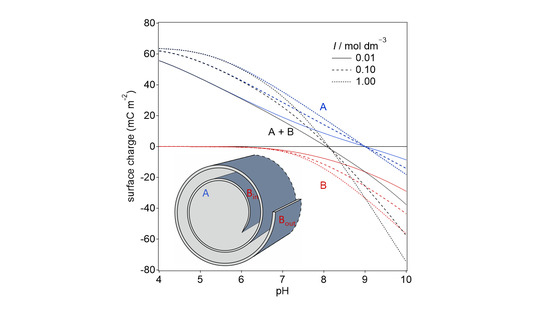
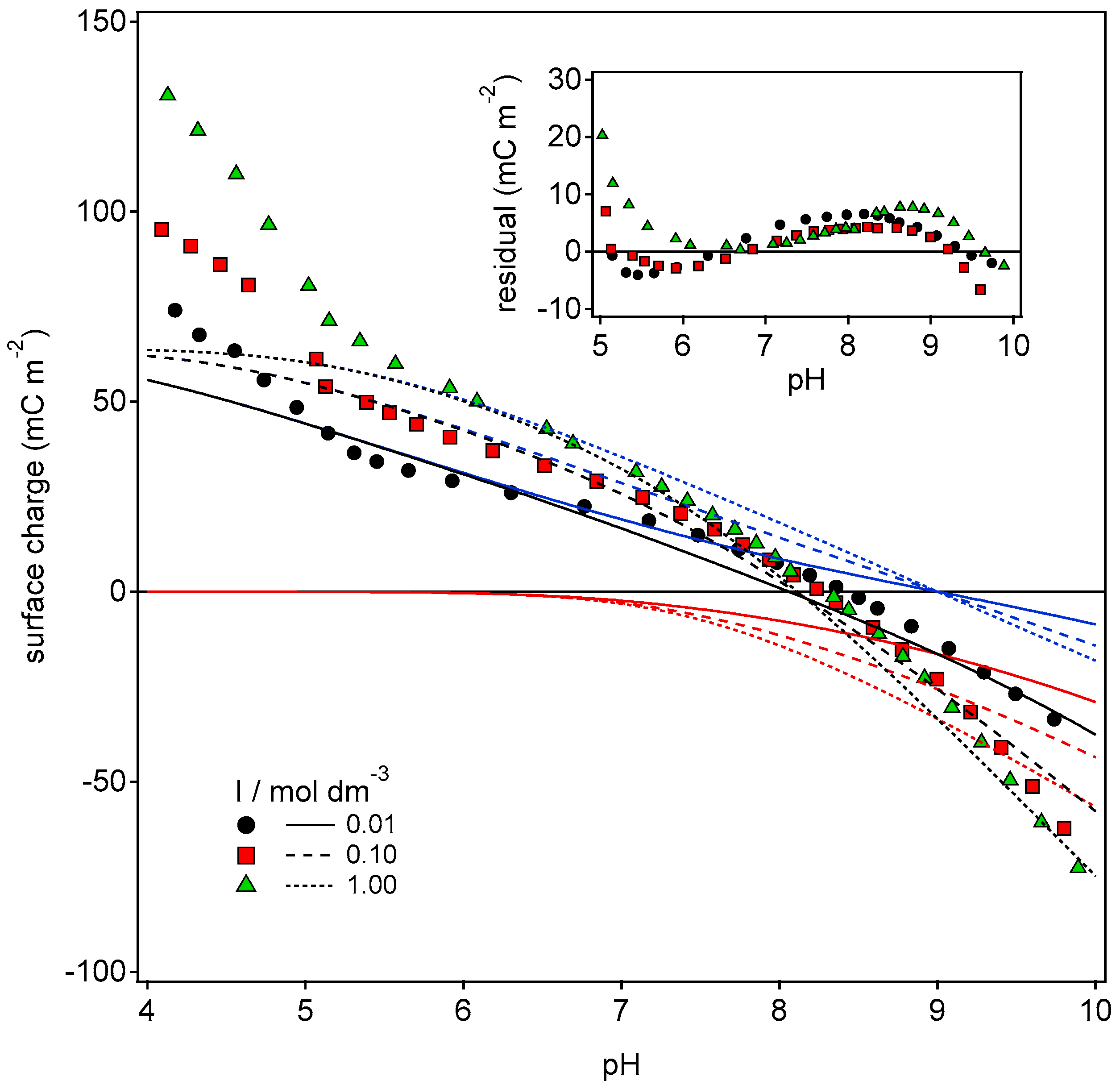
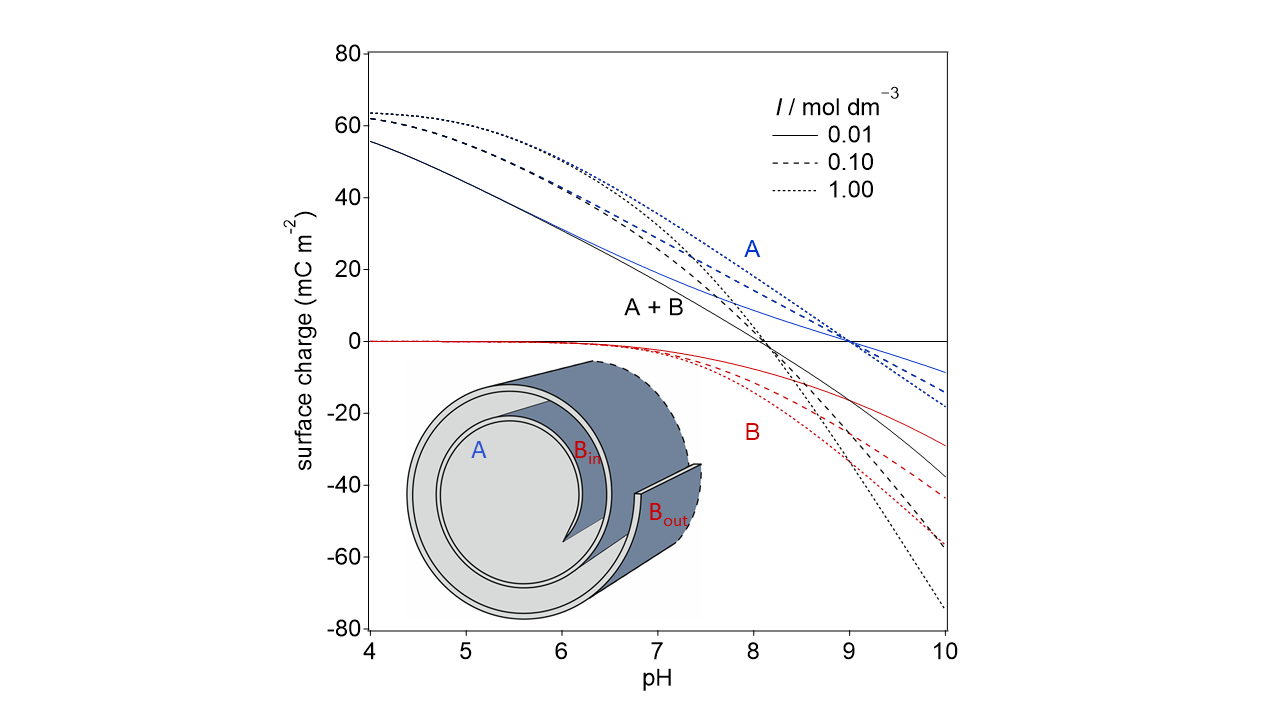
Figure 4 presents the charging isotherms from the decreasing pH runs of the second titration cycle, measured at three distinct ionic strengths. Notably, the common intersection point of these isotherms aligns almost perfectly with the zero charge, thereby identifying it as the point of zero charge (PZC). This observation indicates that the titrating groups experience well-defined surface potentials ( ψ 0 ) at both surfaces A and B, confirming the absence of surface-bound semi-dissolved species at pH levels above 5, applicable only to the backward titration runs. The lines in Figure 4 represent the best-fit surface charge densities, summed over surfaces A and B, where these separate contributions were calculated using the Stern model for each surface. The fit, achieved through visual estimation within the pH range of 5 to 10, is notably accurate, while data at lower pH values are included to demonstrate the onset of alumina dissolution. The optimal model parameters are tabulated in Table 1.
The isotherms presented in Figure 4 are in almost quantitative agreement with those established for kaolinite [18]. The best-fit model charging isotherms for separate surfaces A and B, represented by red and blue colored lines, respectively, highlight the distinct titration pH ranges for aluminol and silanol sites. While the former are amphoteric and titrate in the whole examined range, the weakly acidic silanols are negatively charged and titrate only above pH ≈ 6.5, consistent with the behavior of silica surfaces [34,35,39]. Surface A, representing aluminol sites, shows a point of zero charge at pHPZC = 9.0, which corresponds to the intrinsic pKa and aligns well with previously reported values [17]. Below pHPZC, alumina sheet is positively charged, transitioning to negatively charge above this value.
The effective pK (pKeff) of a surface may be calculated from the charging isotherms by invoking Katchalsky’s equation [22]:
p K e f f p H log θ 1 θ + p H = p K a w e l k T l n 10 ;  
θ p H = σ 0 p H σ 0 , m i n σ 0 ,   m a x σ 0 , m i n
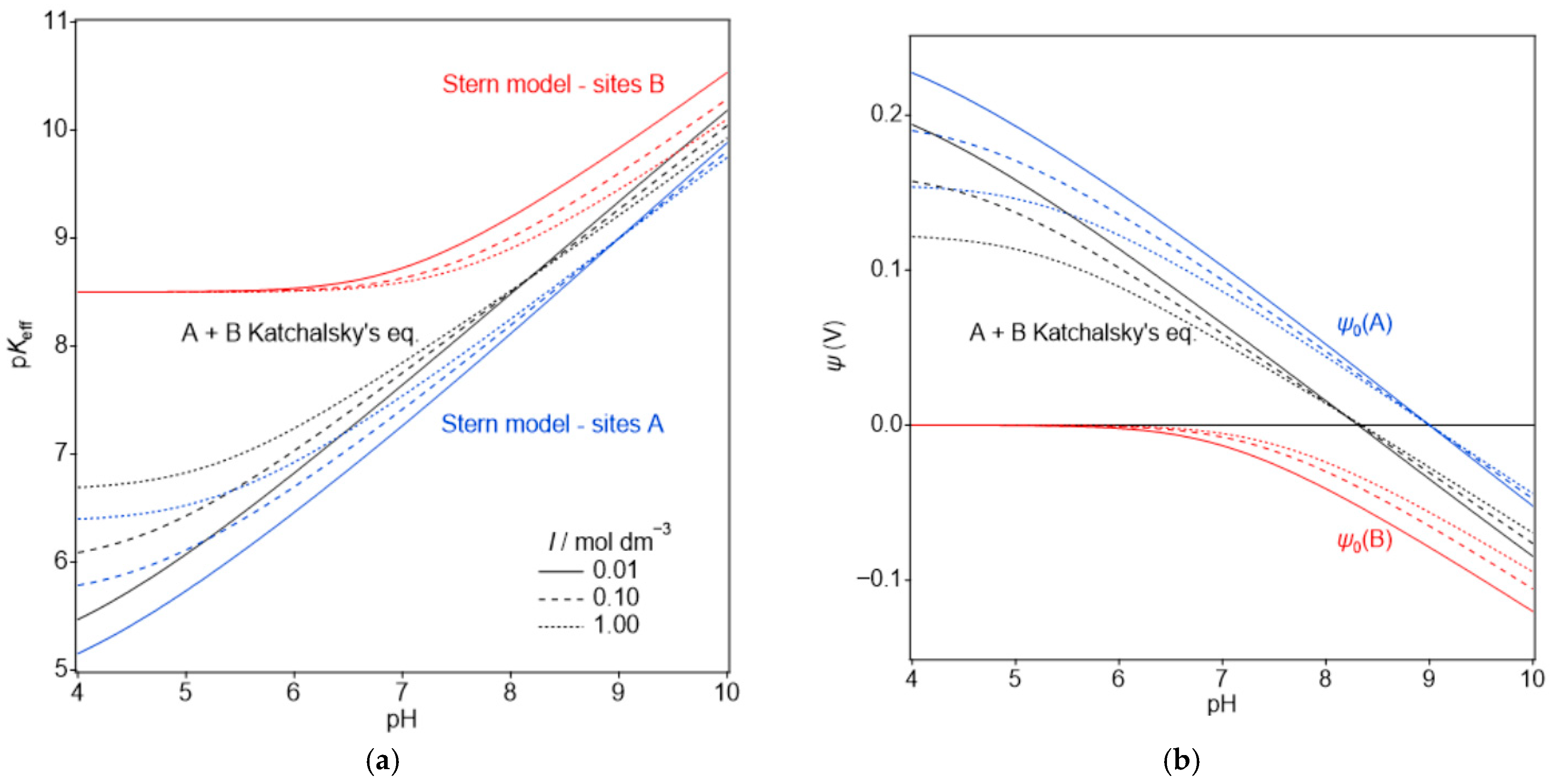
where pKa represents the intrinsic deprotonation constant and  θ  the degree of protonation, which can be calculated from the charging isotherms via Equation (14), into which the maximum and minimum surface charge obtained from the Stern model isotherms are introduced (cf. Figure 4, black lines). On the right-hand side of Equation (13),  p K e f f  is decomposed into the intrinsic pKa constant, which is independent of the ionic strength, and a non-ideality term, which depends on both pH- and the ionic strength-dependent. This term is identified with the unitless electrostatic contribution to the Gibbs energy of protonation, which is proportional to the potential ( ψ = w e l / e ) presented in Figure 5b. In this context, the potential calculated from Katchasky’s eq. should be interpreted as the effective potential of the HNT interior experienced by a proton in the bulk solution, regardless of the specific surface to which it binds, which is in Figure 5b compared to potential  ψ 0  of surfaces A and B.
As illustrated in Figure 5a, the  p K e f f  of the HNT interior closely resembles the  p K e f f  of the alumina surface across nearly the entire titratable pH range and is minimally influenced by the charging state of the silica surface. This observation is not surprising, as the silica surface is uncharged at lower pH and thus exerts no electrostatic influence on the overall charging within the HNT interior ( p K e f f , B = p K a , B ). At pH   8, the  p K e f f  of silica aligns with that of the alumina surface. This is further evidenced by the magnitude of  ψ 0  at surfaces A and B (cf. Figure 5b). Consequently, the silica surface exerts a relatively negligible electrostatic potential within the HNT interior at pH   8.

3.3. The Outer Silica Surface and Electrophoretic Mobility of the HNT

Potentiometric titration experiments provide valuable insights into the overall proton exchange of HNT with the solution, primarily influenced by the charging state of the HNT interior due to its larger surface area. In contrast, electrophoretic mobility serves as a quantitative measure of the charging state of the outermost surface exposed to the solution, denoted as Bout. As previously reported by Katana et al. [13], the electrophoretic mobility for both pristine and hydroxylated HNTs in water at pH = 7.00 and I = 0.10 mol dm−3 was identical, measured at −2 ± 0.07 × 10⁻⁸ m2 V−1 s−1. However, the hydrodynamic radius decreased from 225 ± 5 nm for the untreated nanotubes to 146 ± 9 nm following hydroxylation. Additionally, the polydispersity index was reduced to 20 ± 0.6% for hydroxylated HNTs compared to 25 ± 0.8% for the raw material, confirming that the alkaline treatment improved dispersion quality.
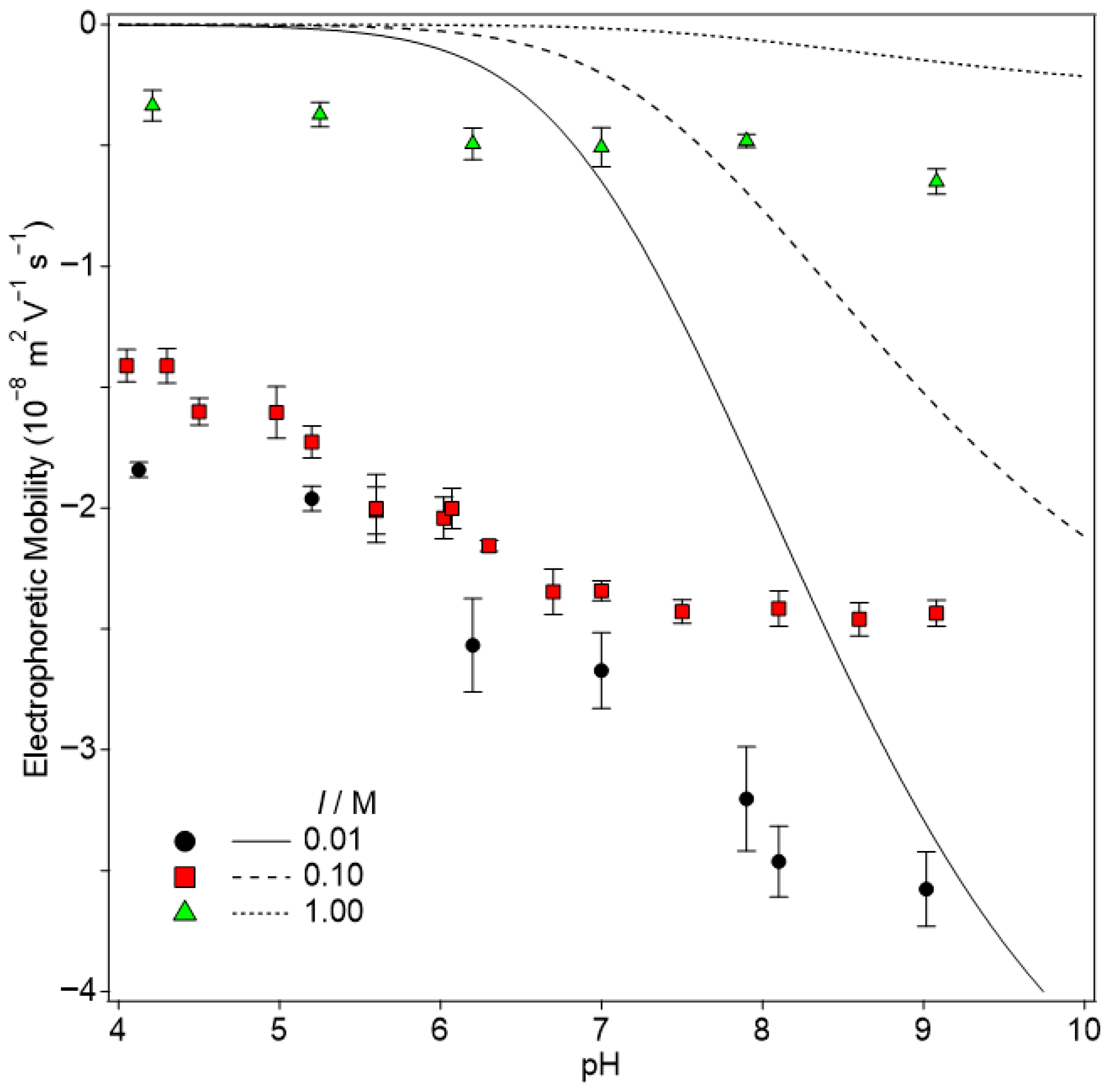
The experimental pH-dependence of the HNT electrophoretic mobility, determined at varied ionic strength, is presented in Figure 6. It is apparent that the outermost surface maintains a negative charge across the entire pH-range, consistent with the “carpet roll” image of the HNT structure (cf. Figure 1). However, the pH-dependence of the HNT electrophoretic mobility does not align with the charging isotherm established in this study for the silica surface (B) within the interior of the HNT, nor with existing literature information on the pH-dependence of silica surface charge in general. Although a direct comparison of the electrophoretic mobility (cf. Figure 6) vs. titrated surface charge (cf. Figure 4) is not possible, this may be attempted by invoking the electrical double layer model fitted from the charging isotherms combined with a relationship between the ζ-potential and el. mobility. From the Stern model (cf. Figure 2), ζ-potential may be calculated from the d-plane potential by invoking the  ψ r  function resulting as a solution of the Poisson–Boltzmann eq., and a postulated shear plane distance from the d-plane (specifically, Equation (3.27) in [22]). For solid nanoparticles with protonatable surface in monovalent electrolyte solution, this approach has often led to very good comparison of the modeled surface charge vs. electrophoretic mobility data [40,41,42,43]. In the present case, under the hypothesis that the surface charge of sheet B determines the el. mobility of HNT, mobilities modeled by applying O’Brien and White’s model for spherical nanoparticles [44] with a radius of 50 nm and a shear plane distance of 1 nm, are represented by red lines in Figure 6. It is evident that the measured data points significantly deviate from this model, demonstrating a much stronger degree of deprotonation across the entire examined pH range, i.e., higher surface acidity. Notably, a very similar pH-dependence of electrophoretic mobility has been previously reported for HNT [45] and kaolinite [18], supporting the validity of the presented experimental data. It is worth mentioning that the cited study does not report the structure of the studied kaolinite in aqueous medium, and since these samples are known to contain HNT, the reported results may pertain to the latter. Focusing on our findings, apart from noting that Bout apparently does not have a significant impact on the overall proton-exchange behavior, there is no clear explanation for the observed much stronger acidity of the outer HNT surface Bout compared to B. The presence of a certain percentage of other metal oxides, such as Fe2O3, may be speculated [1]; however, these materials are positively charged at low pH. Moreover, there is no apparent reason for the outer silica surface in HNT samples prepared by washing to exhibit a significantly different chemical composition from the inner surface. Therefore, a plausible explanation might involve the presence of partially dissolved SiO2 in the form of a poly(silicic acid) “hairy silica” layer at Bout. This has been observed to induce a higher negative surface charge and to a limited extent, increase the acidity of silica nanoparticle surfaces [34,35].

4. Conclusions

The present study reports novel experimental data on the pH-dependent charging of halloysite nanotubes (HNT), rigorously measured through potentiometric titrations at constant ionic strengths and electrophoretic light scattering. The charging isotherms, determined across various pH ranges and ionic strengths, exhibit a hysteretic shape indicative of the quasi-reversibility of proton binding within the HNT interior. This implies that the charging state of the inner proton binding surfaces is reproducible only when the same pH and time path of the experiment is replicated. The proton binding process approaches reversibility when titration is conducted in the decreasing pH direction, up to approximately pH 5.2, similar to observations in alumina nanoparticles. Conversely, when pH is increased from below 5.2, protonation of the alumina surface within the HNT interior is not reversible due to concurrent dissolution and deposition processes.
The site binding model for distinct silica and alumina surfaces, combined with the Stern model of the electric double layer, was effectively applied to elucidate the protonation and electrostatic conditions within the HNT interior. The model achieved excellent fits of the charging isotherms by employing the same proton binding site density (0.8 nm−2) for both alumina and silica surfaces, similar intrinsic pK values (9.0 and 8.5, respectively), and comparable Stern capacitances (0.5 F m−2 and 0.8 F m−2, respectively). However, the surface potential at the two surfaces differs significantly below pH ≲ 8, as alumina is amphoteric and can be both positively and negatively charged, whereas silica exhibits only negative charge at pH ≳ 6.5. In HNT, the alumina surface demonstrates a point of zero charge (PZC) of 9.0, but only when titration is performed in the decreasing pH direction.
Electrophoretic light scattering measurements indicate that the outer silica surface exhibits a pronounced negative charge across the entire examined pH range above approximately pH 4.0. This finding contrasts with the charging isotherm of the inner silica surface. While this discrepancy warrants further investigation, the current experimental and modeling results corroborate the established understanding of the opposite charge distribution in halloysite nanotubes (HNTs), with the interior and exterior exhibiting opposite charges across a broad pH range below pH 9.0. Above this pH level, both surfaces carry charges of the same sign.
Overall, the pH-dependent charging behavior of HNTs appears to align closely with that reported for kaolinite, both in terms of the interior and outer surface charging. This suggests that the curling of the double-sided alumina/silica sheets and their differing hydration states in HNTs do not significantly influence the material’s charging state. Nonetheless, this observation merits further investigation, including in situ structural measurements.

Supplementary Materials

The following supporting information can be downloaded at https://www.mdpi.com/article/10.3390/colloids9060079/s1, Figure S1: The surface charge isotherms from cycled titration experiments performed within pH range 3 ≲ pH ≲ 6 (a), 5 ≲ pH ≲ 9 (b) and 6.5 ≲ pH ≲ 11 (c) at I = 0.10 mol dm−3. Open symbols represent the direction of increasing pH (forward, see legend), while the closed symbols represent the direction of decreasing pH (backward). The data measured outside pH < 4 and pH > 10 are excluded from presentation due to a lower accuracy; Figure S2: (a) N2 adsorption (open circles) and desorption (closed circles) isotherm for the solid dehydrated HNT. (b) BET isotherm calculated and fitted to data presented in a) within the pressure range 8.32 < p/mmHg < 224.25 (linear regression parameters: slope = 966.85 × 10⁻⁴ g cm−3, offset = 50.51 × 10⁻⁵ g cm−3).

Author Contributions

Conceptualization, B.K., D.Č.; Data curation, B.K., D.Č.; Formal analysis, B.K., D.Č.; Investigation, B.K., D.Č.; Methodology, B.K., D.Č.; Resources, D.Č.; Supervision, D.Č.; Software, D.Č.; Validation, B.K., D.Č.; Visualization, B.K., D.Č.; Writing—original draft, B.K., D.Č.; Writing—review & editing, D.Č. All authors have read and agreed to the published version of the manuscript.

Funding

This research received no external funding.

Data Availability Statement

Dataset available on request from the authors.

Acknowledgments

Duško Čakara would like to acknowledge Michal Borkovec (University of Geneva) for enabling the calculations via the Stern and O’Brien and White’s models, by kindly sharing his Fortran code. The authors would also like to acknowledge István Szilágyi (University of Szeged) for inspiring discussions, Srećko Valić (University of Rijeka) for making available the nitrogen gas adsorption measurements and Andreas Puškarić (Ruđer Bošković Institute, Zagreb) for helping us run and interpret the latter experiments.

Conflicts of Interest

Authors declare no conflicts of interest.

References

  1. Joussein, E.; Petit, S.; Churchman, J.; Theng, B.; Righi, D.; Delvaux, B. Halloysite Clay Minerals—A Review. Clay Min. 2005, 40, 383–426. [Google Scholar] [CrossRef]
  2. Ferrante, F.; Armata, N.; Lazzara, G. Modeling of the Halloysite Spiral Nanotube. J. Phys. Chem. C 2015, 119, 16700–16707. [Google Scholar] [CrossRef]
  3. Gray-Wannell, N.; Cubillas, P.; Aslam, Z.; Holliman, P.J.; Greenwell, H.C.; Brydson, R.; Delbos, E.; Strachan, L.-J.; Fuller, M.; Hillier, S. Morphological Features of Halloysite Nanotubes as Revealed by Various Microsco-pies. Clay Min. 2023, 58, 395–407. [Google Scholar] [CrossRef]
  4. Rozza, R.; Ferrante, F. Computational study of water adsorption on halloysite nanotube in different pH environments. Appl. Clay Sci. 2020, 190, 105589. [Google Scholar] [CrossRef]
  5. Ferrante, F.; Armata, N.; Cavallaro, G.; Lazzara, G. Adsorption Studies of Molecules on the Halloysite Surfaces: A Computational and Experimental Investigation. J. Phys. Chem. C 2017, 121, 2951–2958. [Google Scholar] [CrossRef]
  6. Massaro, M.; Noto, R.; Riela, S. Past, Present and Future Perspectives on Halloysite Clay Minerals. Molecules 2020, 25, 4863. [Google Scholar] [CrossRef]
  7. Lvov, Y.; Abdullayev, E. Functional polymer–clay nanotube composites with sustained release of chemical agents. Prog. Polym. Sci. 2013, 38, 1690–1719. [Google Scholar] [CrossRef]
  8. Lvov, Y.M.; Shchukin, D.G.; Möhwald, H.; Price, R.R. Halloysite Clay Nanotubes for Controlled Release of Protective Agents. ACS Nano 2008, 2, 814–820. [Google Scholar] [CrossRef]
  9. Vergaro, V.; Lvov, Y.M.; Leporatti, S. Halloysite Clay Nanotubes for Resveratrol Delivery to Cancer Cells. Macromol. Biosci. 2012, 12, 1265–1271. [Google Scholar] [CrossRef]
  10. Lazzara, G.; Cavallaro, G.; Panchal, A.; Fakhrullin, R.; Stavitskaya, A.; Vinokurov, V.; Lvov, Y. An assembly of organic-inorganic composites using halloysite clay nanotubes. Curr. Opin. Colloid Interface Sci. 2018, 35, 42–50. [Google Scholar] [CrossRef]
  11. Massaro, M.; Amorati, R.; Cavallaro, G.; Guernelli, S.; Lazzara, G.; Milioto, S.; Noto, R.; Poma, P.; Riela, S. Direct chemical grafted curcumin on halloysite nanotubes as dual-responsive prodrug for pharmacological applications. Colloids Surf. B Biointerfaces 2016, 140, 505–513. [Google Scholar] [CrossRef]
  12. Hári, J.; Sárközi, M.; Földes, E.; Pukánszky, B. Long term stabilization of PE by the controlled release of a natural antioxidant from halloysite nanotubes. Polym. Degrad. Stab. 2018, 147, 229–236. [Google Scholar] [CrossRef]
  13. Katana, B.; Rouster, P.; Varga, G.; Muráth, S.; Glinel, K.; Jonas, A.M.; Szilagyi, I. Self-Assembly of Protamine Biomacromolecule on Halloysite Nanotubes for Immobilization of Superoxide Dismutase Enzyme. ACS Appl. Bio Mater. 2019, 3, 522–530. [Google Scholar] [CrossRef] [PubMed]
  14. Lvov, Y.; Wang, W.; Zhang, L.; Fakhrullin, R. Halloysite Clay Nanotubes for Loading and Sustained Release of Functional Compounds. Adv. Mater. 2016, 28, 1227–1250. [Google Scholar] [CrossRef]
  15. Santos, A.C.; Ferreira, C.; Veiga, F.; Ribeiro, A.J.; Panchal, A.; Lvov, Y.; Agarwal, A. Halloysite clay nanotubes for life sciences applications: From drug encapsulation to bioscaffold. Adv. Colloid Interface Sci. 2018, 257, 58–70. [Google Scholar] [CrossRef] [PubMed]
  16. Cavallaro, G.; Lazzara, G.; Milioto, S. Exploiting the Colloidal Stability and Solubilization Ability of Clay Nanotubes/Ionic Surfactant Hybrid Nanomaterials. J. Phys. Chem. C 2012, 116, 21932–21938. [Google Scholar] [CrossRef]
  17. Tombácz, E.; Szekeres, M. Interfacial Acid−Base Reactions of Aluminum Oxide Dispersed in Aqueous Electrolyte Solutions. 1. Potentiometric Study on the Effect of Impurity and Dissolution of Solid Phase. Langmuir 2001, 17, 1411–1419. [Google Scholar] [CrossRef]
  18. Carroll-Webb, S.A.; Walther, J.V. A surface complex reaction model for the pH-dependence of corundum and kaolinite dissolution rates. Geochim. Cosmochim. Acta 1988, 52, 2609–2623. [Google Scholar] [CrossRef]
  19. Katana, B.; Takács, D.; Szerlauth, A.; Sáringer, S.; Varga, G.; Jamnik, A.; Bobbink, F.D.; Dyson, P.J.; Szilagyi, I. Aggregation of Halloysite Nanotubes in the Presence of Multivalent Ions and Ionic Liquids. Langmuir 2021, 37, 11869–11879. [Google Scholar] [CrossRef]
  20. Katana, B.; Takács, D.; Csapó, E.; Szabó, T.; Jamnik, A.; Szilagyi, I. Ion Specific Effects on the Stability of Halloysite Nanotube Colloids—Inorganic Salts versus Ionic Liquids. J. Phys. Chem. B 2020, 124, 9757–9765. [Google Scholar] [CrossRef]
  21. Pasbakhsh, P.; Churchman, G.J.; Keeling, J.L. Characterisation of properties of various halloysites relevant to their use as nanotubes and microfibre fillers. Appl. Clay Sci. 2013, 74, 47–57. [Google Scholar] [CrossRef]
  22. Borkovec, M.; Jönsson, B.; Koper, G.J.M. Ionization Processes and Proton Binding in Polyprotic Systems: Small Molecules, Proteins, Interfaces, and Polyelectrolytes. In Surface and Colloid Science; Matijević, E., Ed.; Springer: Boston, MA, USA, 2001; Volume 16, pp. 99–339. [Google Scholar] [CrossRef]
  23. Hesleitner, P.; Babic, D.; Kallay, N.; Matijevic, E. Adsorption at solid/solution interfaces. 3. Surface charge and potential of colloidal hematite. Langmuir 1987, 3, 815–820. [Google Scholar] [CrossRef]
  24. Bretti, C.; Cataldo, S.; Gianguzza, A.; Lando, G.; Lazzara, G.; Pettignano, A.; Sammartano, S. Thermodynamics of Proton Binding of Halloysite Nanotubes. J. Phys. Chem. C 2016, 120, 7849–7859. [Google Scholar] [CrossRef]
  25. Kallay, N.; Čakara, D. Reversible Charging of the Ice–Water Interface. J. Colloid Interface Sci. 2000, 232, 81–85. [Google Scholar] [CrossRef]
  26. Evans, D.F.; Wennerström, H. Colloidal Domain; Wiley-Vch: Weinheim, Germany, 1999; ISBN 0471242470. [Google Scholar]
  27. Israelachvili, J.N. Intermolecular and Surface Forces; Academic Press: Oxford, UK, 2011; ISBN 0123919339. [Google Scholar]
  28. Kallay, N.; Dojnović, Z.; Čop, A. Surface potential at the hematite–water interface. J. Colloid Interface Sci. 2005, 286, 610–614. [Google Scholar] [CrossRef]
  29. Blesa, M.A.; Kallay, N. The metal oxide—Electrolyte solution interface revisited. Adv. Colloid Interface Sci. 1987, 28, 111–134. [Google Scholar] [CrossRef]
  30. Rouster, P.; Dondelinger, M.; Galleni, M.; Nysten, B.; Jonas, A.M.; Glinel, K. Layer-by-layer assembly of enzyme-loaded halloysite nanotubes for the fabrication of highly active coatings. Colloids Surf. B Biointerfaces 2019, 178, 508–514. [Google Scholar] [CrossRef]
  31. Zeng, S.; Reyes, C.; Liu, J.; Rodgers, P.A.; Wentworth, S.H.; Sun, L. Facile Hydroxylation of Halloysite Nano-tubes for Epoxy Nanocomposite Applications. Polymer 2014, 55, 6519–6528. [Google Scholar] [CrossRef]
  32. Čakara, D. Charging Behavior of Polyamines in Solution and on Surfaces: A Potentiometric Titration Study. Ph.D. Thesis, University of Geneva, Geneva, Switzerland, 2004. [Google Scholar]
  33. Thommes, M.; Kaneko, K.; Neimark, A.V.; Olivier, J.P.; Rodriguez-Reinoso, F.; Rouquerol, J.; Sing, K.S.W. Physisorption of gases, with special reference to the evaluation of surface area and pore size distribution (IUPAC Technical Report). Pure Appl. Chem. 2015, 87, 1051–1069. [Google Scholar] [CrossRef]
  34. Kobayashi, M.; Skarba, M.; Galletto, P.; Cakara, D.; Borkovec, M. Effects of Heat Treatment on the Aggrega-tion and Charging of Stöber-Type Silica. J. Colloid Interface Sci. 2005, 292, 139–147. [Google Scholar] [CrossRef] [PubMed]
  35. Yates, D.E.; Healy, T.W. The structure of the silica/electrolyte interface. J. Colloid Interface Sci. 1976, 55, 9–19. [Google Scholar] [CrossRef]
  36. Pourbaix, M. Atlas of Electrochemical Equilibria in Aqueous Solutions, 2nd ed.; National Association of Corrosion Engineers: Houston, TX, USA, 1974. [Google Scholar]
  37. Wieland, E.; Stumm, W. Dissolution kinetics of kaolinite in acidic aqueous solutions at 25 °C. Geochim. Cosmochim. Acta 1992, 56, 3339–3355. [Google Scholar] [CrossRef]
  38. Abdullayev, E.; Joshi, A.; Wei, W.; Zhao, Y.; Lvov, Y. Enlargement of Halloysite Clay Nanotube Lumen by Se-lective Etching of Aluminum Oxide. ACS Nano 2012, 6, 7216–7226. [Google Scholar] [CrossRef] [PubMed]
  39. Wells, J.D.; Koopal, L.K.; de Keizer, A. Monodisperse, Nonporous, Spherical Silica Particles. Colloids Surf. A Physicochem. Eng. Asp. 2000, 166, 171–176. [Google Scholar] [CrossRef]
  40. Behrens, S.H.; Borkovec, M.; Schurtenberger, P. Aggregation in Charge-Stabilized Colloidal Suspensions Re-visited. Langmuir 1998, 14, 1951–1954. [Google Scholar] [CrossRef]
  41. Trefalt, G.; Behrens, S.H.; Borkovec, M. Charge Regulation in the Electrical Double Layer: Ion Adsorption and Surface Interactions. Langmuir 2015, 32, 380–400. [Google Scholar] [CrossRef]
  42. Behrens, S.H.; Christl, D.I.; Emmerzael, R.; Schurtenberger, P.; Borkovec, M. Charging and Aggregation Properties of Carboxyl Latex Particles: Experiments versus DLVO Theory. Langmuir 2000, 16, 2566–2575. [Google Scholar] [CrossRef]
  43. Schudel, M.; Behrens, S.; Holthoff, H.; Kretzschmar, R.; Borkovec, M. Absolute Aggregation Rate Constants of Hematite Particles in Aqueous Suspensions: A Comparison of Two Different Surface Morphologies. J. Colloid Interface Sci. 1997, 196, 241–253. [Google Scholar] [CrossRef]
  44. O’BRien, R.W.; White, L.R. Electrophoretic mobility of a spherical colloidal particle. J. Chem. Soc. Faraday Trans. 2 1978, 74, 1607–1626. [Google Scholar] [CrossRef]
  45. Katana, B.; Takács, D.; Bobbink, F.D.; Dyson, P.J.; Alsharif, N.B.; Tomšič, M.; Szilagyi, I. Masking specific effects of ionic liquid constituents at the solid–liquid interface by surface functionalization. Phys. Chem. Chem. Phys. 2020, 22, 24764–24770. [Google Scholar] [CrossRef]
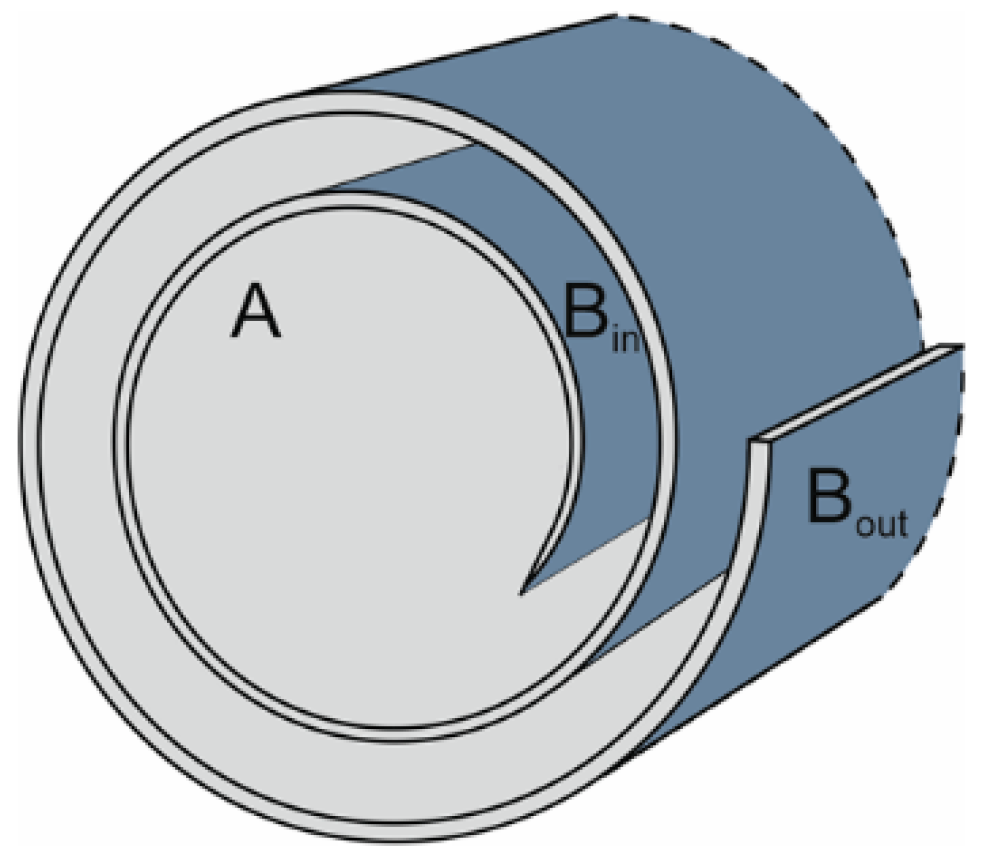
Figure 1. Schematic image of the “carpet roll” structure of HNT. The inner part of the nanotube consists of a hollow lumen and alternating double-faced sheets, with Al2O3 at the concave side (A) and SiO2 at the convex side (Bin). The outermost SiO2 face is denoted as Bout.
Colloids 09 00079 g001
Figure 2. Stern model of the electric double layer.
Colloids 09 00079 g002
Figure 3. Proton binding isotherms determined from forward (increasing pH, open symbols) and backward (decreasing pH, closed symbols) potentiometric titration experiments at (a) I = 0.01 mol dm−3; (b) I = 0.10 mol dm−3; (c) I = 1.00 mol dm−3.
Colloids 09 00079 g003
Figure 4. Experimental charging isotherms of HNT at varied ionic strength (symbols, see legend). Blue and red lines represent the model proton binding isotherms for sites A and sites B, respectively. Black lines represent the sum of proton binding isotherms for separate components (sites A + sites B). Residuals from fitting are presented in the inset graph. The sum of squared residuals calculated within 5 < pH < 10 equals 29 × 10−3 C2 m−4.
Colloids 09 00079 g004
Figure 5. (a) Effective pK (pKeff) at varied ionic strength for surfaces A (alumina, blue) and B (silica, red) in HNT interior calculated separately from the Stern model, vs. the overall pKeff of the interior (black) calculated from the summed charging isotherms presented in Figure 4. (b) Surface potential in the 0-plane for surfaces A (blue) and B (red), calculated from the Stern model, at varied ionic strength, and the overall potential in the HNT interior (black) experienced by a test charge in the exterior. The model parameters are tabulated in Table 1.
Colloids 09 00079 g005
Figure 6. Electrophoretic mobility of HNT (symbols) and model spherical silica surface (lines) at varied pH and ionic strength (see legend).
Colloids 09 00079 g006
Table 1. Best-fit parameters of the Stern model for the alumina (A) and silica (B) surfaces of the HNT interior. Tabulated are the total surface concentration of sites,  Γ 0 , the intrinsic pKa and Stern capacitance, CS.
Surface Sites Γ 0 / n m 2 p K a C S / F m 2
A (alumina)0.89.000.5
B (silica)8.500.8
Disclaimer/Publisher’s Note: The statements, opinions and data contained in all publications are solely those of the individual author(s) and contributor(s) and not of MDPI and/or the editor(s). MDPI and/or the editor(s) disclaim responsibility for any injury to people or property resulting from any ideas, methods, instructions or products referred to in the content.