
Article

One-Pot Reprotonation–Compounding Strategy Toward High-Performance Aramid Nanofiber-Reinforced Poly(vinyl alcohol) Films

State Key Laboratory of Advanced Polymer Materials, Polymer Research Institute, Sichuan University, Chengdu 610065, China
*
Author to whom correspondence should be addressed.
Colloids Interfaces 2026, 10(4), 57; https://doi.org/10.3390/colloids10040057
Submission received: 26 June 2026 / Revised: 24 July 2026 / Accepted: 27 July 2026 / Published: 29 July 2026
(This article belongs to the Topic New Research on Thin Films and Nanostructures)

Abstract

Aramid nanofibers (ANFs) inherit the exceptional properties of the bulk counterparts, while introducing a large specific surface area and excellent processability. However, the strong inter-fibrillar interactions and tendency to agglomerate hinder their high-content incorporation into polymer matrices. Here, we report a one-pot reprotonation–compounding strategy for fabricating aramid nanofiber-reinforced poly(vinyl alcohol) (ANF–PVA) composite films, where the ANF dispersion was mixed with polymers during the protonation process to form a continuous 3D network in the ANF-PVA film. The optimized film with a loading of 20 wt% ANFs exhibited a tensile strength of 122.2 MPa and a toughness of 28.36 J m−3. Furthermore, the high ANF loading enabled versatile applications. A robust ANF-PVA hydrogel, prepared via salt-induced gelation, delivered 132% enhancement in tear strength and 38.2% increase in cyclic compressive strength compared with the PVA hydrogel. Moreover, inspired by the “brick-and-mortar” architecture of natural nacre, the fully organic ANF-PVA film was incorporated into carbon fiber/epoxy laminates, with a configuration of one nacre-inspired film per five prepreg plies, achieving a 36.5% improvement in impact toughness and minimal loss in flexural strength. This scalable reprotonation–compounding approach provides a general route for producing high-loading ANF-based composites, paving the way for the broader utilization in advanced materials.

Graphical Abstract

1. Introduction

Aramids, a family of high-performance aromatic polyamides represented by poly(p-phenylene terephthalamide) (PPTA), have attracted significant attention owing to their strong intermolecular hydrogen bonding, which endows it with outstanding properties [1,2,3]. However, the insolubility and infusibility of PPTA greatly restrict its processing options, leading to limitations in the scope of its practical applications [4,5]. Nowadays, aramid nanofibers (ANFs) have emerged as a solution to the bottleneck. The superior properties of macroscopic aramids are retained while being endowed with nanoscale advantages, such as a high specific surface area, abundant surface functional groups, and tunable interfacial characteristics [6,7]. These merits have led to their widespread application [8,9,10]. Among them, significant attention has been paid to the high-value utilization of ANF–polymer composites [11,12,13,14]. However, existing methods can only incorporate a limited number of ANFs. Excessive addition not only fails to meet the desired requirements but also leads to a degradation of performance, which primarily arises from the fact that ANFs are flexible fibers with a large aspect ratio. And at high loading levels, ANFs are physically forced to come close together, where their strong fiber-fiber interactions (e.g., hydrogen bonding and π-π stacking) dominate over fiber-matrix interactions, leading to spontaneous and severe aggregation [15,16,17]. Therefore, when subjected to external stress, they cannot effectively bear and transfer it, ultimately transforming from a “reinforcing phase” into a “defect source”.
Currently, although numerous methods have been developed to achieve high-loading applications of ANFs, these are predominantly confined to the preparation of specialized materials, such as aerogels [18,19,20]. Furthermore, several approaches for achieving high-ANF-loading composites are plagued by significant complexity [21]. Therefore, it is imperative to develop simple and scalable fabrication processes of ANF composites to facilitate the high performance and broad application of ANFs.
ANFs can be prepared through mechanical stripping, electrospinning, polymerization-induced self-assembly, and deprotonation [22]. Among these, deprotonation enables the dissociation of macroscopic, highly crystalline PPTA into ANFs with diameters ranging from 3 to 30 nm and lengths of up to 10 μm [23]. Moreover, with its combination of rapid processing, high achievable concentrations, and superior nanofiber quality, this approach has become the predominant technique in contemporary research and practical applications [24,25]. The underlying chemical principle of deprotonation can be described in three steps: Firstly, the powerful hydrogen-bonding network within the PPTA fibers is significantly weakened by the combined action of a strong base (KOH) and a polar aprotic solvent (DMSO). The amide groups (-NH-) on the molecular chains undergo deprotonation, losing protons (H+) to form negatively charged polyanions (-N-). Consequently, the electrostatic repulsion from these charged chains becomes the dominant force driving the dissociation of fibers. Ultimately, the system transforms from an insoluble fibrous state into a homogeneous, transparent, dark red colloidal solution [26,27]. Additionally, the introduction of a small amount of water as a proton donor in the early deprotonation stage enhances the dissociation driving force and significantly reduces the required time [28]. Subsequently, the reprotonation process enables the reconstruction of macroscopic materials from these nanofibers and the restoration of their excellent mechanical properties through the addition of a proton donor to the ANF/DMSO dispersion, which supplies H+ ions that recombine with the polyanions (-N), leading to the regeneration of the neutral amide groups (-NH-) [25]. Proton donors can be inorganic substances, such as water, diluted acetone, and dilute hydrochloric acid [29]. Moreover, polymers like PVA and polyacrylamide (PAM) can also function as effective proton sources due to their co-protonation capability [30,31,32].
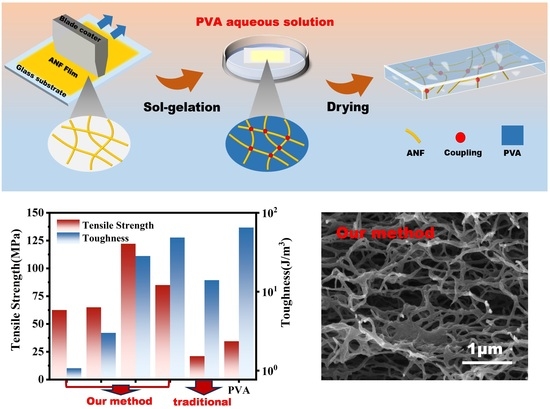
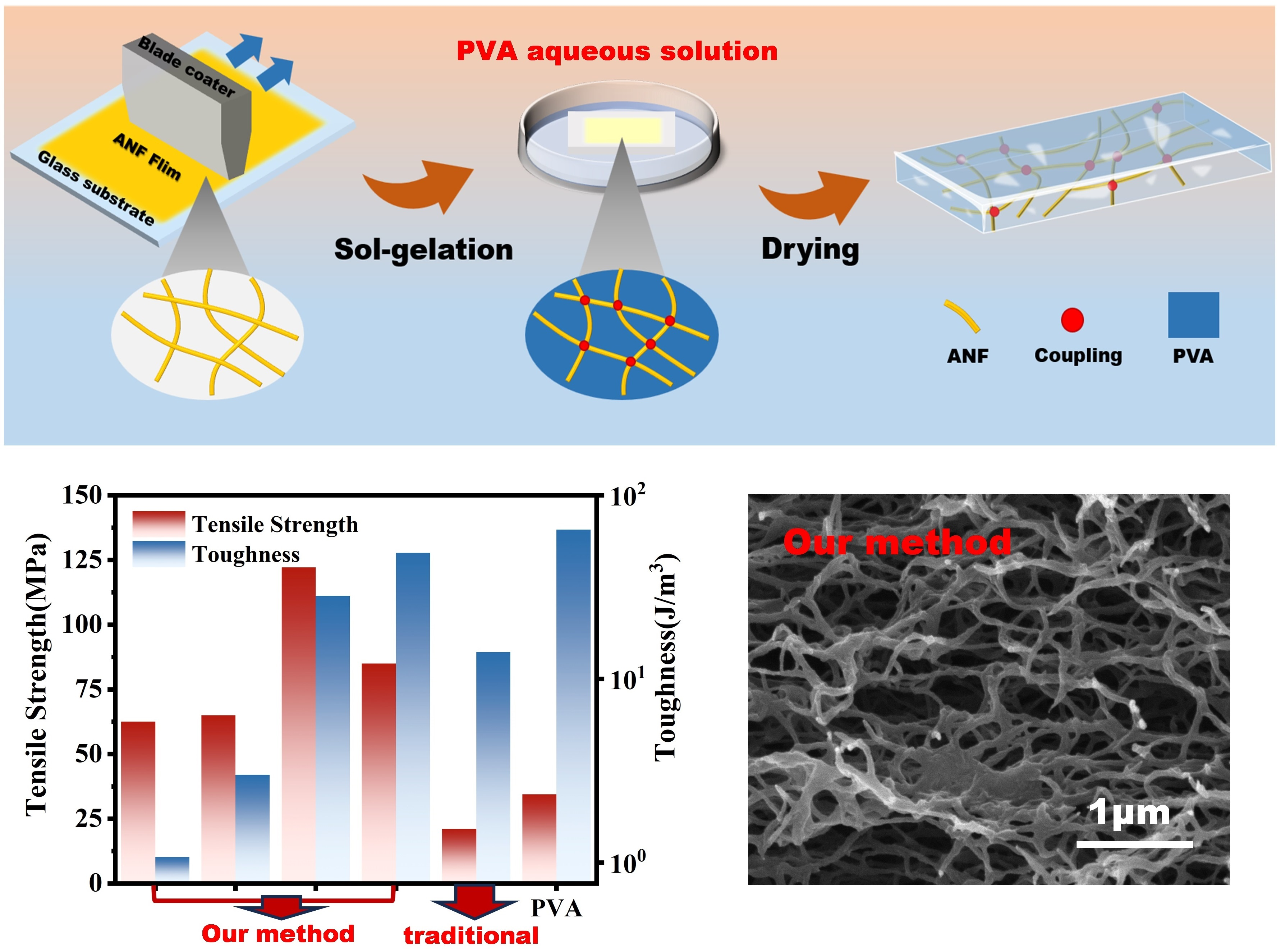
Here, a high-performance aramid nanofiber-reinforced polyvinyl alcohol (ANF-PVA) composite film was fabricated using a one-pot reprotonation–compounding strategy. The effects of different reinforcement methods and ANF loading ratios were investigated, indicating the superior tensile strength of our proposed strategy (122.15 MPa) over conventional compounding approaches (21.05 MPa) and the pure PVA film (34.44 MPa). Notably, this approach successfully achieves a high ANF loading of 20 wt%, overcoming the limitations of current studies, where high filler loadings are typically restricted to complex manufacturing processes or specialized aerogel systems. The optimized ANF-PVA film not only exhibited direct applicability in its pristine form but also served as a versatile platform for fabricating high-performance hydrogels and functioned as an interfacial reinforcing agent to enhance the mechanical properties of epoxy composites. Notably, the ANF-PVA hydrogel prepared by our method displayed a 132% improvement in tear strength and a 38.2% increase in cyclic compressive strength compared to pure PVA hydrogel, and possessed a wide-temperature-range dimensional stability and deformability. Furthermore, by leveraging the high strength and toughness of the film, an all-organic, nacre-mimetic brick-and-mortar architecture was engineered to toughen carbon fiber-reinforced epoxy (CF/EP) composites. This bio-inspired architecture, featuring one nacre-inspired film for five prepreg plies, enabled the sample to achieve a 36.4% enhancement in impact toughness, while compromising its flexural strength the least.

2. Experimental Section

2.1. Materials

PPTA fiber (Kevlar 49) was purchased from DuPont Company (Wilmington, DE, USA). Dimethyl sulfoxide (DMSO) and potassium hydroxide (KOH) were obtained from Chengdu Kelong Chemical Reagent Factory (Chengdu, China). Sodium citrate (SC) was obtained from Tianjin Bodi Chemical Co., Ltd. (Tianjin, China). Polyvinyl alcohol (PVA) with a molecular weight of 200,000 was brought from Chongqing Chuanying Chemical Co., Ltd. (Chongqing, China). The carbon fiber reinforced epoxy resin prepreg (CF/EP, AGMP3520/SYT45) was supplied by AVIC Composite Corporation (Beijing, China). All reagents were employed as received without further purification, unless otherwise stated.

2.2. Preparation of ANF/DMSO Dispersion

The ANF/DMSO dispersion was rapidly prepared according to the method introduced by Kim et al. [7] First, 0.75 g of KOH was dissolved in 6 mL of deionized water to prepare a concentrated alkaline solution. Then, 150 mL of DMSO was added at a deionized water-to-DMSO ratio of 1:25. Finally, 1.5 g of aramid fibers were introduced into the mixed solution, followed by high-speed stirring at room temperature. After approximately 4 h, a homogeneous, transparent dark red colloidal solution was obtained.

2.3. Preparation of ANF-PVA Films

First, aqueous polyvinyl alcohol (PVA) solutions with concentrations of 2.5 wt%, 5 wt%, 7.5 wt%, and 10 wt% were prepared separately. Subsequently, the ANF/DMSO dispersion was blade-coated onto a glass substrate and promptly transferred into PVA solutions of varying concentrations, which enabled the simultaneous reprotonation of ANFs and their integration with PVA, preparing the composite films with different ANF mass fractions. Finally, the films were dried in an oven at 80 °C for 24 h. The resulting composite films were designated as A-xP (x = 2.5, 5, 7.5, and 10), where the corresponding contents of ANFs were 27 wt%, 24 wt%, 20 wt%, and 15 wt%, respectively. The corresponding concentrations of each component in each sample are shown in Table S1.
As a control, deionized water was added to the ANF dispersion to precipitate the ANF gel, which was then repeatedly filtered and washed with deionized water, followed by drying to obtain ANF fillers. Next, these fillers were incorporated into a PVA/DMSO solution (PVA:ANF = 4:1) and stirred to achieve a mixture, which was subsequently blade-coated and dried to form composite films designated as “Filler”. The pure PVA film was also fabricated using the blade-coating method followed by drying.

2.4. Preparation of ANF-PVA Hydrogels

Here, two different methods were adopted to prepare the ANF-PVA hydrogel. First, the simultaneous reprotonation of ANFs and their integration with PVA was achieved by immersing the ANF sol into an aqueous PVA solution. The resulting gel was subsequently dried at room temperature for 24 h, followed by a 24 h salting-out in a 0.03 mol/L sodium citrate solution to obtain the ANF-PVA hydrogel, which was designated as “Immerse”. In the second method, 10 mL of a 10 mg/mL ANF/DMSO solution was mixed with 4 mL of a 100 mg/mL PVA/DMSO solution under high-speed stirring. The mixture was promptly cast into a film, followed by reprotonation in deionized water. Then, the resulting gel underwent drying and salting-out as described above to yield another ANF-PVA hydrogel, which was designated as “Intermix”. Finally, a pure PVA hydrogel was prepared following the same procedures.

2.5. Preparation of CF/AP/EP Composites

First, CF/EP prepreg was cut into 9 cm × 9 cm squares, while the thickness of the A-7.5P film sample was adjusted to approximately 9 μm by employing doctor blades of different specifications. Afterwards, eighteen plies of the prepreg were stacked, with ANF-PVA films interleaved between the layers. Finally, the layup was pre-cured in a hot press at 120 °C for 10 min, followed by a full hot-pressing cycle at 120 °C under 0.5 MPa for 2 h, yielding the film-toughened CF/EP composite (CF/AP/EP). Among these, the sample fabricated by interleaving one nacre-inspired robust film for each prepreg ply was designated as “N1P1”, and one nacre-inspired robust film for two prepreg plies was designated as “N1P2”. Following this nomenclature, samples labeled “N1P3” and “N1P5” were prepared accordingly, while the control sample without any film was designated as CF/EP.

3. Characterization

3.1. Raman Spectroscopy

Raman spectroscopy (inVia Reflex, Renishaw, Wotton-under-Edge, UK) with a laser wavelength of 633 nm was employed to analyze the changes in interactions of the characteristic groups in the ANF/DMSO dispersion and the ANF-PVA film.

3.2. Scanning Electron Microscope (SEM)

The fracture surfaces of the ANF-PVA films, ANF-PVA hydrogel, and the etched CF/AP/EP were examined after sputter-coating with gold under an SEM (FEI Inspect F, Waltham, Hillsboro, OR, USA, FEI Company) at an accelerating voltage of 5 kV.

3.3. Transmission Electron Microscope (TEM)

A drop of the diluted aqueous dispersion of 0.01 wt% (ANF/DMSO) was deposited onto a pure titanium film and dried at room temperature. The microstructure was observed using a Tecnai G2 F20 S-TWIN transmission electron microscope (TEM) (Tecnai G2 F20 S-TWIN, Hillsboro, OR, USA, FEI Company).

3.4. Thermogravimetric Analysis (TGA)

TGA was performed on the ANF-PVA films using a thermogravimetric analyzer (Q50, TA Instruments, Wilmington, DE, USA) under a constant heating rate of 10 °C/min over a temperature range of 20~700 °C.

3.5. Cyclic Compression Testing

The cyclic compressive properties of the hydrogels were investigated referring to ASTM D695 by using an electronic universal testing machine BOSS 3220 SERIES II, TA Instruments, Wilmington, DE, USA) for the samples with dimensions of 15 mm × 15 mm × 1.5 mm, which were tested for 20 cycles at a frequency of 1 Hz under a fixed strain of 5%.

3.6. Tensile Property Testing

The tensile properties of the films and the tear properties of the hydrogels were evaluated in accordance with ASTM D882 using a universal testing machine (BOYI 2025, Guangdong Kunpeng Instrument Co., Ltd., Dongguan, China). The films were cut into uniform specimens measuring 40 mm × 10 mm. The hydrogel samples were identically sized, and a 3 mm long notch was introduced along the width direction. The tests were conducted with a 500 N load cell at a crosshead speed of 5 mm/min and a gauge length of 15 mm, with five measurements per sample to ensure the reliability of statistics.

3.7. Fourier Transform Infrared Spectroscopy (FTIR)

FTIR in single-reflection ATR mode (BRUKER INVENIO R, Bruker, Germany) was used to explore the changes in interactions between characteristic groups of the ANF-PVA film, CF/EP, and CF/AP/EP samples.

3.8. Bending Property Testing

The flexural properties of the CF/EP and CF/AP/EP were evaluated in accordance with ASTM D7264 using a universal testing machine (BOYI 2025, Guangdong Kunpeng Instrument Co., Ltd., Guangdong, China). The samples were cut with dimensions of 80 mm × 10 mm × 3 mm by a cutting machine. The flexural properties were measured via a three-point bending mode with a span-to-thickness ratio of 16:1 and a loading rate of 5 mm/min. Five measurements were examined for each sample to minimize experimental errors.

3.9. Impact Property Testing

The impact resistance of the CF/EP and CF/AP/EP composites was investigated in accordance with ASTM D6110 using a pendulum impact tester (XJUD-22, Chengde Jinhe Instrument Manufacturing Co., Ltd., Chengde, China). The laminate was cut into uniform specimens with dimensions of 80 mm × 10 mm × 3 mm. A notch was then introduced along the thickness direction, with a depth equivalent to 0.2 times the thickness. The tests were conducted with an 11 J pendulum energy, with five replicates per sample for statistical reliability.

4. Results and Discussion

4.1. Reprotonation of ANFs and the Interaction Within ANF-PVA Films

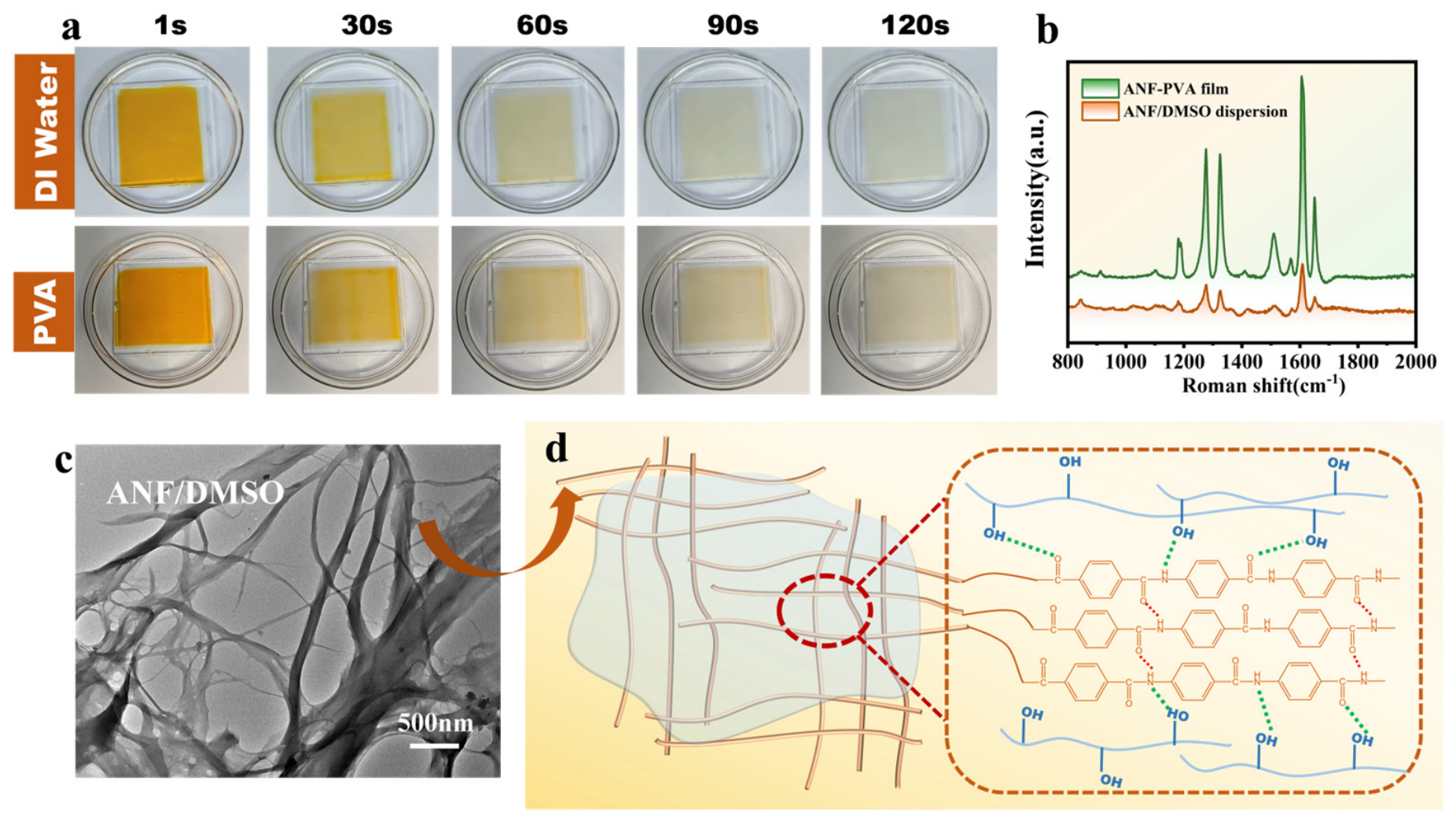
While many studies have universally adopted inorganic substances [29], such as deionized water, as proton donors for the ANF reprotonation, certain polymers like PVA also demonstrate a co-protonation capability due to the abundance of hydroxyl groups on their side chains. First, the reprotonation rates of ANFs in deionized water and aqueous PVA solution were compared, which were monitored and recorded with digital photography, as shown in Figure 1a. It can be observed that, similar to deionized water, the aqueous PVA solution undergoes a transition from an orange sol to a milky-white gel within 120 s, indicating the completion of the reprotonation process. In brief, the ANF reprotonation and its subsequent compounding through interaction with PVA can co-occur, resulting in a rapid integration process. The evidence for the successful reprotonation of ANFs and their compounding with PVA was provided by Raman spectroscopy, as presented in Figure 1b. The signals of ANF/DMSO dispersion in key regions such as ~1575 cm−1 (amide II band of ANFs, N–H), and ~1650 cm−1 (amide I band of ANFs, C=O) are extremely weak, indicating the dissociation of PPTA into isolated ANFs in DMSO. This also serves as indirect evidence of their successful reprotonation. However, the composite film exhibited a series of high-intensity, broadened multiple peaks, which is ascribed to the reconstruction of PPTA structure, as well as the rigid hydrogen-bonding network formed between the C=O and N–H groups of ANFs and the O–H groups of PVA. The reconfiguration of hydrogen bond interactions makes its bending vibration less restricted, exhibiting a decrease in its vibrational frequency from 1572 cm−1 to 1567 cm−1 and a red shift in the amide II band [33]. Simultaneously, the π-electron cloud of the C=O bond is attracted by the H from PVA, leading to a decrease in electron density and a consequent reduction in the Raman activity [34]. Ultimately, based on the foregoing analysis, a schematic depiction of the interactions within the ANF-PVA film is presented in Figure 1c,d. The reprotonated ANF backbones provide numerous amide groups for intra-chain hydrogen bonding (C=O⋯H–N), while the abundant hydroxyl groups on PVA side chains form extensive inter-molecular hydrogen bonds with the C=O and N–H groups on ANFs. This synergy of multiple hydrogen-bonding interactions yields a percolating three-dimensional (3D) rigid network within the composite.

4.2. Microstructure and Mechanical Properties of ANF-PVA Films

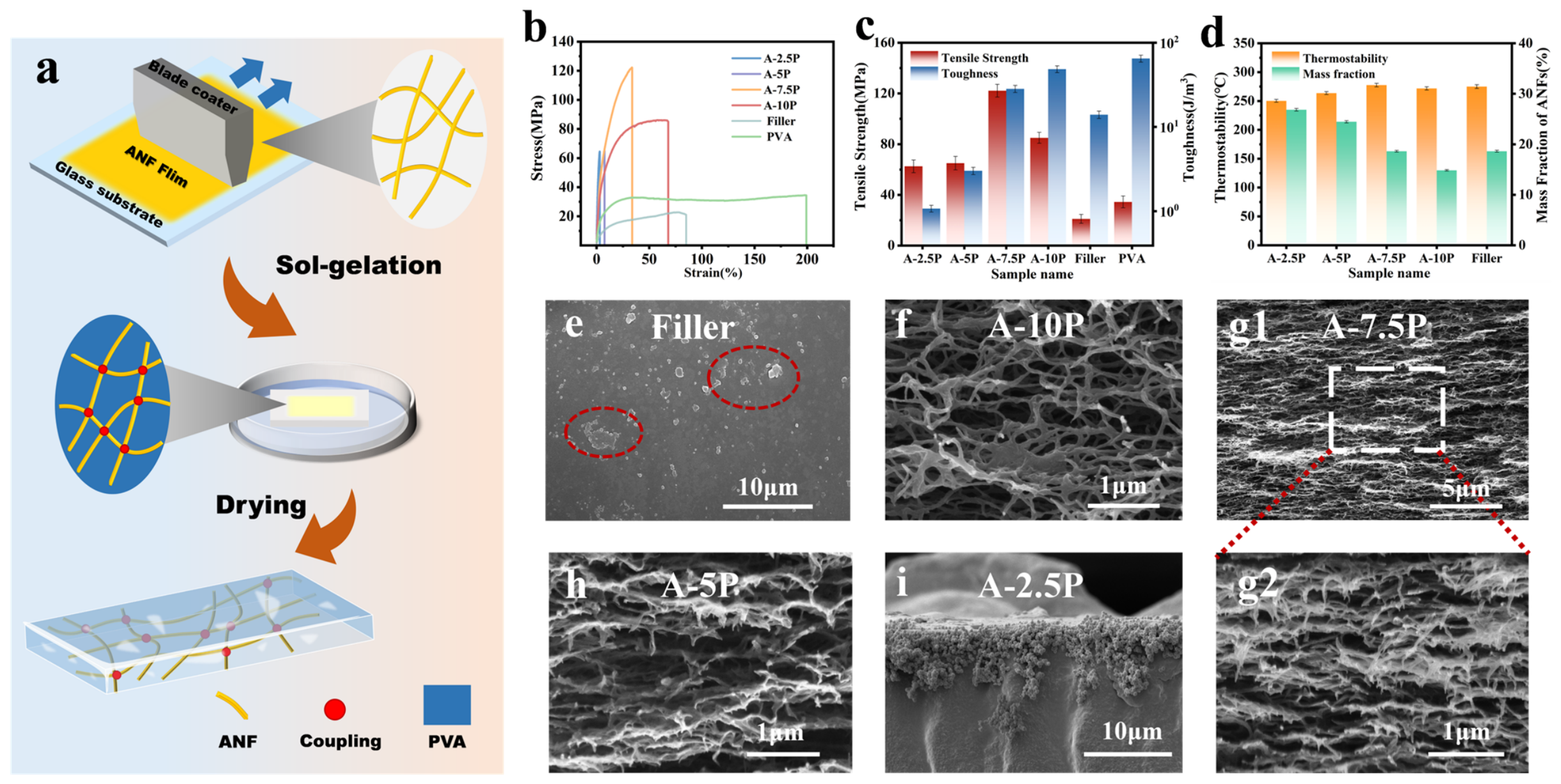
Through a straightforward three-step process involving blade coating, one-pot reprotonation–compounding, and drying, as illustrated in Figure 2a, ANF-PVA films were successfully fabricated. Furthermore, conventional filler-reinforced films and PVA films were fabricated for comparison. The tensile strength and toughness of the samples were investigated, with the results depicted in Figure 2b,c. It was found that all ANF-PVA films fabricated via our approach demonstrate superior tensile strength compared to the control samples. Among them, sample A-7.5P exhibited the best overall performance, with a tensile strength of 122.2 MPa, a toughness of 28.36 kJ/m3. In contrast, the traditionally filler-reinforced film showed a decrease in tensile strength compared to the pure PVA film, indicating a failure to achieve the intended reinforcing effect. Moreover, the thermal stability and the mass fraction of ANFs of the ANF-PVA films were explored via thermogravimetric analysis, highest thermal decomposition temperature of 277.5 °C (Figure 2d).
To gain deeper insights into the underlying causes of the aforementioned performance differences, the microstructural morphology of ANF-PVA films was examined by SEM, as illustrated in Figure 2e–i. For the conventional filler-reinforced films, significant filler aggregation was indicated by red cycles in Figure 2e, which was attributed to the strong intermolecular forces, high surface energy, and van der Waals forces brought by the high aspect ratio, flexibility, and abundant surface-active groups of the ANFs. This aggregation hinders the reinforcing effect and introduces defects, which ultimately degrade the composite’s performance. On the contrary, a continuous, interconnected 3D porous network existed in the ANF-PVA film, where the PVA was etched via a 24 h water bath treatment at 60 °C to facilitate clearer observation of the ANF framework.
The magnified view in Figure 2(g2) indicated that the porous network was composed of interlaced ANFs with fine diameters and high aspect ratios. The robust framework formed by the self-assembly of ANFs combines with the PVA matrix via intensive hydrogen bonding, enabling effective stress transfer and dispersion at the nanoscale. When subjected to tensile loading, the continuous ANF network dissipates a substantial amount of energy through multiple mechanisms, including fiber pull-out, fiber slippage, and the breakage of hydrogen bonds [35], which is fundamentally responsible for the optimal performance. With the continuous increase in ANF content, the porous structure underwent a sequential transition from loose to dense, then back to loose, and eventually to agglomeration. As the fiber content reached approximately 20 wt% (A-7.5P), ANFs formed a complete yet non-redundant 3D network, where the interactions with the PVA matrix achieved an optimal balance, yielding an ideal nanoporous structure with the smallest pore size and the narrowest size distribution (Figure 2(g1)). With the content further increasing to 24 wt% (A-5P), the densely packed ANF network generates stronger internal contraction stress, which compresses the PVA domains into large regions and subsequently leaves large holes after etching. Moreover, the rigidity brought by the excessive network contraction prevents stress dissipation through plastic deformation under load and consequently results in performance degradation (Figure 2h). At an ANF loading of 27 wt% (A-2.5P), the diminished inter-fiber distance promotes self-aggregation of the ANFs via strong van der Waals and hydrogen bonding forces, which completely disrupts the continuous network and causes a significant deterioration in properties (Figure 2i).

5. Potential Applications

5.1. Robust ANF-PVA Hydrogel

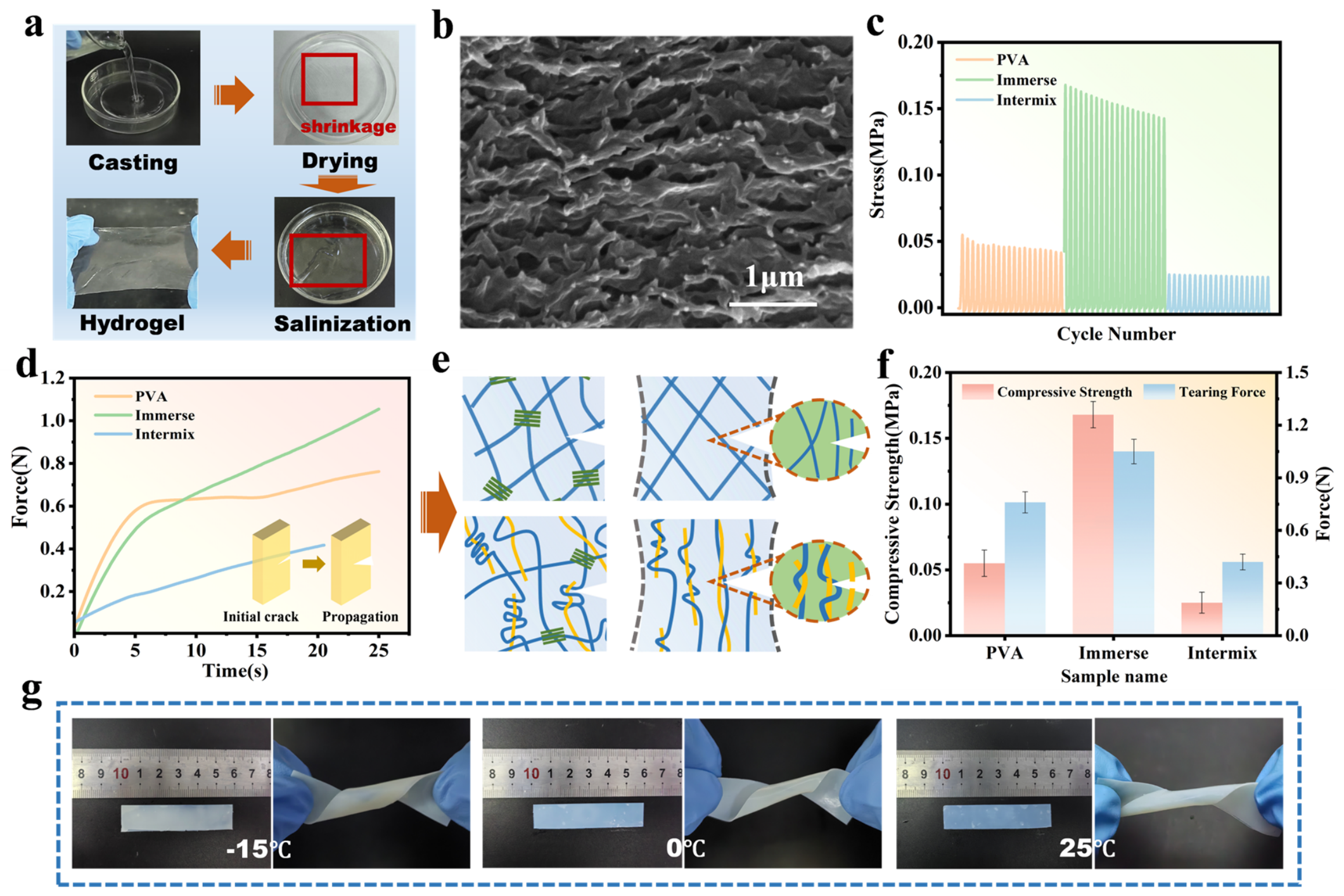
Based on the continuous 3D network of ANFs and their uniform, interpenetrating phase structure with the PVA matrix, which were obtained by the one-pot reprotonation–compounding strategy, a robust ANF-PVA hydrogel (Immerse) was fabricated by combining this process with a salting-out technique [36]. Additionally, the other ANF-PVA hydrogel (Intermix) was prepared through a conventional solution blending combined with the salting-out method, along with PVA hydrogel as a control, as shown in Figure 3a. The mechanical properties of the three hydrogels are summarized in Figure 3c–f. Firstly, the “Immerse” hydrogel was examined by SEM to observe the morphology of its cross-sections after a freeze-dried process, confirming the successful construction of the 3D network structure within the hydrogel (Figure 3b). The interaction between PVA and ANFs induces the formation of irregular ribbon-like structures, which are closely interconnected, creating pores of varying sizes. Meanwhile, the PVA fills these pores and permeates the entire network, resulting in the characteristic porous morphology. The cyclic compression test was performed on the hydrogels (Figure 3c). It turned out that the hydrogel prepared by our method exhibits the optimal compressive strength, significantly outperforming the control samples, which originates from a synergistic effect of efficient stress transfer between the load-bearing, continuous ANF skeleton and the strong interfacial bonding between ANFs and PVA.
In contrast, the “Intermix” displays lower compressive strength compared to the PVA hydrogel, which may result from localized agglomeration due to the rapid gelation between the two polymers during solution mixing, preventing the formation of a continuous network capable of resisting external forces. In the Section 2, both the films and hydrogels keep the first two steps the same, involving blade coating and a one-pot reprotonation–compounding process. The discrepancy between the two samples was only in the final step, where the films are obtained via drying, whereas the hydrogels are formed through salting-out. Therefore, the internal agglomeration morphology of the “Intermix” is consistent with that of films prepared via conventional blending. Subsequently, the tearing strength and corresponding mechanisms of the hydrogels were investigated [37]. The ranking of tearing strength for the three hydrogels is consistent with that of their compressive strength (Figure 3d). Furthermore, the mechanism responsible for the resistance to crack propagation in PVA hydrogel is illustrated in Figure 3e. For the PVA hydrogel, once the crack tip was subjected to stress, the fragile physical crosslinking network could not effectively transmit and dissipate stress. Instead, for the Immerse sample, the stress concentrated at the crack tip can be effectively transferred and dispersed into the surrounding larger volume of the PVA matrix through the ANF network, including multiple energy dissipation mechanisms such as weak hydrogen bond breakage, fiber slip and pull-out, and the deflection effect of fibers on the crack. In addition, the structural defects introduced by the agglomeration of ANFs in the “Intermix” sample hinder the construction of an ideal energy dissipation network with PVA, resulting in the lowest tear strength. In summary, compared to PVA hydrogel, the tear strength and cyclic compressive strength of the ANF-PVA hydrogel prepared by our method exhibit 132% and 38.2% enhancements, respectively. Benefiting from the ANF network structure, the “Immerse” sample also exhibited excellent dimensional stability and deformability across a broad temperature range from −15 °C to 20 °C, as shown in Figure 3g.

5.2. Fully Organic Nacre-Inspired Film Toughened CF/EP Composite

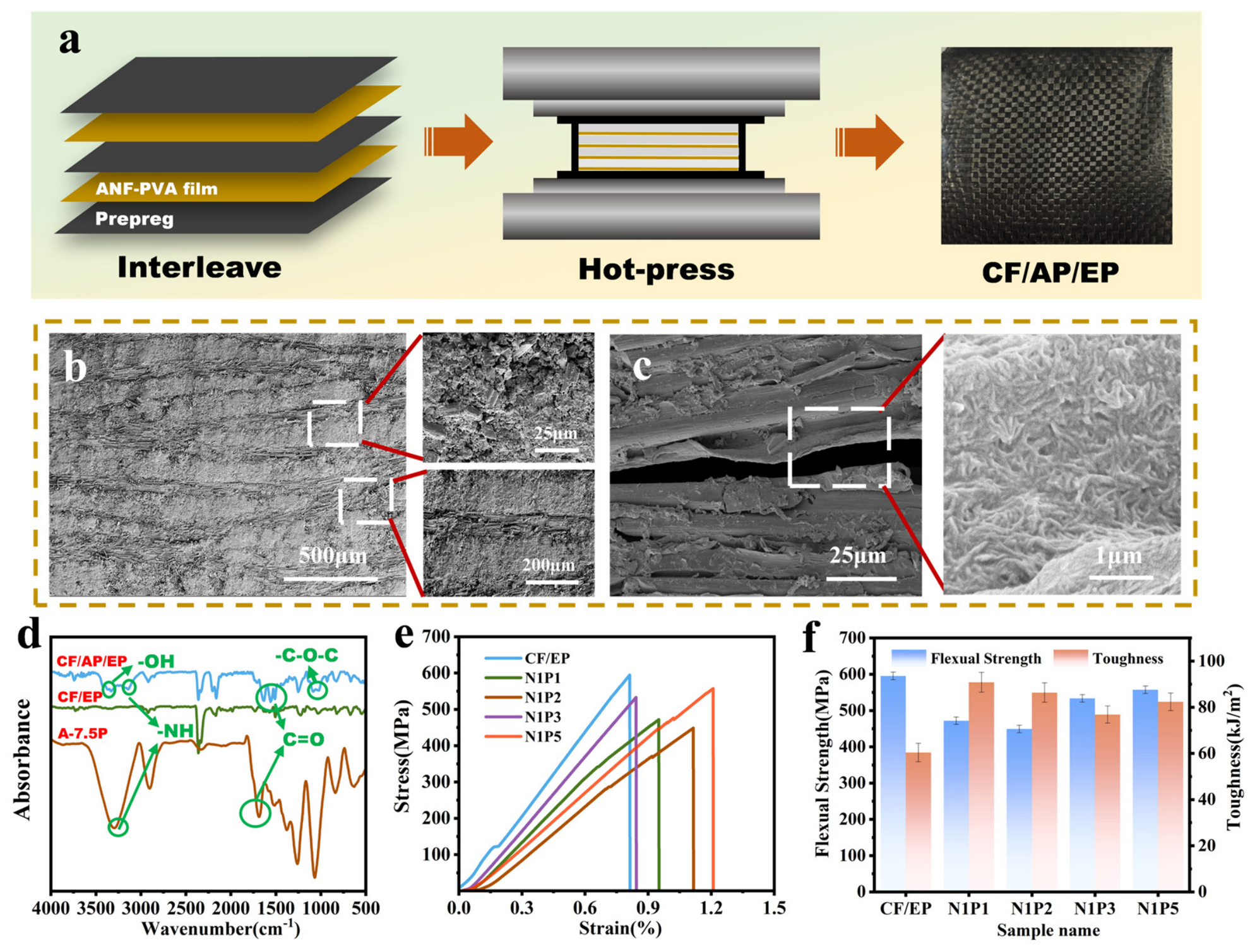
On account of the high strength and excellent toughness of the A-7.5P film, a film of approximately 9 μm thick was prepared by adjusting the thickness of the doctor-blade coating. Inserting this fully organic, nacre-inspired film into the CF/EP prepreg, followed by a lamination and subsequent hot-press, constructed a layer-by-layer structure, aiming to enhance the impact resistance of CF/EP, as illustrated in Figure 4a. To validate a successful construction of a multi-layer architecture, the SEM characterization was performed in Figure 4b, revealing the CF prepregs with two different directions. At a higher magnification, the distinct carbon fibers within adjacent layers can be clearly seen. The PVA within the sample was etched, allowing for the observation of the interfacial bonding between layers from the cross-section of the multilayer sample. Figure 4c shows that there are gaps and a lamellar structure directly adjacent to the carbon fibers between the upper and lower layers. Magnifying the lamellar structure enables an identification of the continuous 3D network structure formed by the ANF-PVA film, verifying a superior interface integration. Next, the FTIR characterization on the CF/EP, A-7.5P, and CF/AP/EP samples was conducted to further validate the favorable interaction between the film and CF/EP, as presented in Figure 4d. The double peaks around 1100 cm−1 in the CF/AP/EP spectrum correspond to vibrations of the C–O group from PVA and the C–O–C group from EP [38,39,40]. Notably, the CF/AP/EP sample exhibits a remarkably broadened absorption band centered around 3300 cm−1, indicative of a dense hydrogen-bonding network formed among EP, PVA, and ANFs. Such interactions likely involve the hydrogen bonds between the O–H groups of EP and the C=O groups of ANFs, as well as between the O–H groups of PVA and the N–H groups of ANFs. The slight red shift in this broad band further substantiates the presence of strong intermolecular hydrogen bonding. In addition, the characteristic C=O stretching band of ANFs, located at approximately 1660 cm−1, shifts toward lower wavenumbers upon composite formation, suggesting the participation of ANFs in the hydrogen-bonding network.
The three-point bending tests and drop-weight impact tests were employed to evaluate the mechanical properties of the four toughened samples along with the pure specimen, with the results presented in Figure 4e,f. It can be observed that all the toughened samples exhibit a varying degree of enhancement in toughness compared to the pure specimen, while their flexural strengths are compromised. Specifically, the toughness of the N1P1 sample was measured at 90.82 kJ/m2, with an enhancement of 50.3% compared to that of the pure sample (60.42 kJ/m2). However, its flexural strength decreased by 20.7% due to the introduction of a film with lower strength. When the content of the ANF composite film was reduced, the configuration employing a single-layer ANF–PVA film atop a five-layer prepreg (denoted as N1P5) exhibited the optimal overall performance in the CF/EP composite. This architecture delivered a remarkable impact toughness of 82.40 kJ m−2, accompanied by a decrease of 6% in flexural strength. This combination of strength and toughness can be attributed to the hierarchical “brick-and-mortar” similar to natural nacre, where CF/EP composites were embedded alternately into ductile films. Moreover, the corresponding flexural modulus of the CF/EP composites was shown in Figure S1.
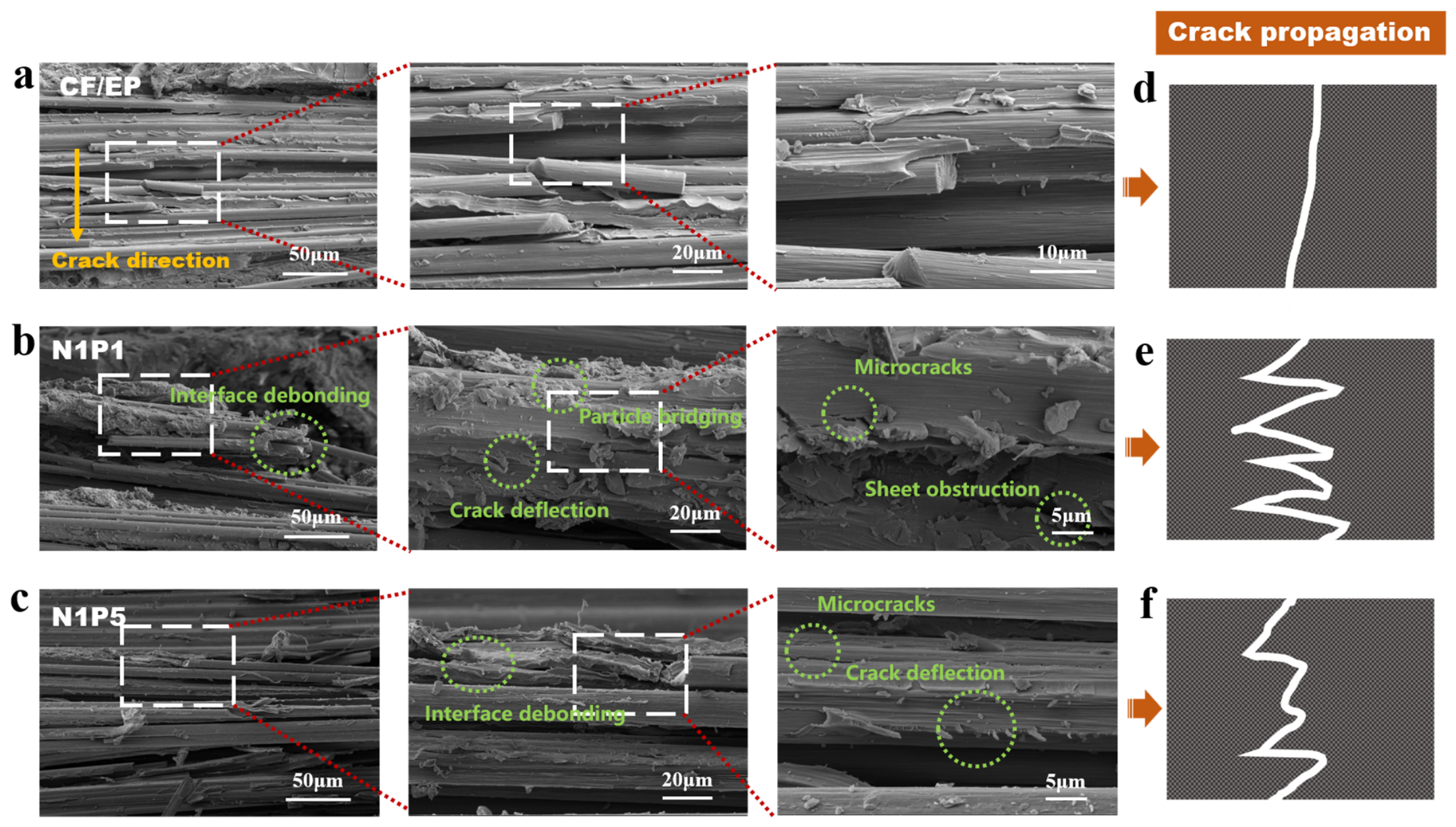
To gain further insight into the toughening mechanism of the ANF-PVA film in CF/EP composites, the fracture surface morphology of CF/EP, as well as N1P1 and N1P5, was characterized. A smooth epoxy matrix surface and carbon fibers with clean fracture ends of the CF/EP sample can be observed from Figure 5a, indicating its brittle nature and a single energy dissipation mechanism. In contrast, for sample N1P1, a rough epoxy matrix fracture surface and the carbon fibers with pronounced resin residue upon pull-out were exhibited in Figure 5b, demonstrating the multiple energy dissipation mechanisms, including interfacial debonding, crack deflection, and particle bridging, which are fundamental reasons for its outstanding toughness. Furthermore, it can be observed in Figure 5c that only localized areas are exhibiting the features of toughness fracture in sample N1P5. Magnification of these regions reveals traces of energy dissipation mechanisms, such as interfacial debonding, microcracking, and crack deflection. Finally, the contrast in brightness within the first SEM images of Figure 5a–c can be interpreted to determine whether the laminated structures lie on the same plane, serving as a basis to infer the crack propagation path during sample failure, as illustrated in Figure 5d–f.

6. Conclusions

This study demonstrates a straightforward and efficient approach of one-pot reprotonation–compounding for producing ANF-PVA films, enabling a high-loading and high-performance application of ANFs. In particular, the composite film with 20 wt% ANFs develops an ideal, continuous 3D percolating network, which facilitates the most effective stress transfer and dissipation, thereby endowing optimal overall properties. On the basis of the ideal structure derived from the ANFs and PVA, representative applications were showcased. First, combined with a salting-out strategy, a robust ANF-PVA hydrogel was fabricated, which demonstrated 132% and 38.2% improvements in tear strength and cyclic compressive strength, respectively, over the PVA counterpart. Secondly, drawing inspiration from the architecture of natural nacre, the film-toughened CF/EP laminates were produced by the stacking of prepregs and the intercalation of all-organic films, and subsequent hot-press. Among these laminates, the N1P5 configuration achieved a 36.4% enhancement in impact toughness with the least compromise of its flexural strength. This work offers a novel strategy for fabricating high-loading ANF-reinforced materials and paves the way for their broader applications.

Supplementary Materials

The following supporting information can be downloaded at: https://www.mdpi.com/article/10.3390/colloids10040057/s1, Figure S1: The Flexural Modulus of the CF/EP composites; Table S1: The concentrations of each component in each sample.

Author Contributions

Conceptualization, M.N. and C.Y.; methodology, Y.X.; validation, Y.X. and C.Y.; investigation, Y.X. and C.Y.; writing—original draft preparation, Y.X.; writing—review and editing, Y.X., C.Y. and M.N.; supervision, M.N.; funding acquisition, M.N. All authors have read and agreed to the published version of the manuscript.

Funding

This research was funded by the Advanced Materials-National Science and Technology Major Project (2024ZD0607400), Natural Science Foundation of Sichuan Province (2026NSFSC0374), Sichuan Science Technology Program (NO 2025ZDZX0121), and State Key Laboratory of Advanced Polymer Materials (sklpme2026-1-8).

Data Availability Statement

The raw data supporting the conclusions of this article will be made available by the authors on request.

Conflicts of Interest

The authors declare no conflicts of interest.

References

  1. Wang, Y.; Tuo, X.; Ye, G. Self-healing heterocyclic aramid nanofibers as dynamic interfacial cement for fabricating hybrid aramid paper. Chem. Eng. J. 2025, 511, 161662. [Google Scholar] [CrossRef] [Scilit]
  2. Xie, C.; Guo, Z.-X.; Qiu, T.; Tuo, X. Construction of Aramid Engineering Materials via Polymerization-Induced para-Aramid Nanofiber Hydrogel. Adv. Mater. 2021, 33, 2101280. [Google Scholar] [CrossRef] [Scilit] [PubMed]
  3. Kim, H.; Kim, H.J.; Eom, Y. Upcycling p-Aramid Waste into Universal Antidripping Aramid Nanofiber Coatings for Future Mobility Interior Plastics. ACS Nano 2025, 19, 26438–26450. [Google Scholar] [CrossRef] [Scilit] [PubMed]
  4. Han, Z.-M.; Hou, Y.; Liu, H.-C.; Guan, Q.-F.; Yang, H.-B.; Yang, K.-P.; Yin, C.-H.; Ling, Z.-C.; Zhao, Y.-X.; Xia, J.; et al. Fast and Massive Production of Aramid Nanofibers via Molecule Intercalation. J. Am. Chem. Soc. 2025, 147, 7939–7949. [Google Scholar] [CrossRef] [Scilit] [PubMed]
  5. Du, W.; Zhang, J.; Zhao, Z.; Zhang, X. Preparation of novel temperature-responsive double-network hydrogel reinforced with aramid nanofibers. Compos. Commun. 2020, 22, 100438. [Google Scholar] [CrossRef] [Scilit]
  6. Nasser, J.; Lin, J.; Steinke, K.; Sodano, H.A. Enhanced interfacial strength of aramid fiber reinforced composites through adsorbed aramid nanofiber coatings. Compos. Sci. Technol. 2019, 174, 125–133. [Google Scholar] [CrossRef] [Scilit]
  7. Kim, H.C.; Sodano, H.A. Ultra-High Toughness Fibers Using Controlled Disorder of Assembled Aramid Nanofibers. Adv. Funct. Mater. 2023, 33, 2208661. [Google Scholar] [CrossRef] [Scilit]
  8. Yang, Y.; Huang, C.; Gao, G.; Hu, C.; Luo, L.; Xu, J. Aramid nanofiber/bacterial cellulose composite separators for lithium-ion batteries. Carbohydr. Polym. 2020, 247, 116702. [Google Scholar] [CrossRef] [Scilit] [PubMed]
  9. Zhao, Y.; Deng, C.; Yan, B.; Yang, Q.; Gu, Y.; Guo, R.; Lan, J.; Chen, S. One-Step Method for Fabricating Janus Aramid Nanofiber/MXene Nanocomposite Films with Improved Joule Heating and Thermal Camouflage Properties. ACS Appl. Mater. Interfaces 2023, 15, 55150–55162. [Google Scholar] [CrossRef] [Scilit] [PubMed]
  10. Nie, Z.; Guo, X.; Chen, J.; Yang, X.; Chen, J.; Wang, R.; Qi, S. In-situ MoS2-reinforced aramid nanofiber aerogels with integrated photothermal–phase-change coupling for adaptive thermal management. Compos. Commun. 2026, 62, 102745. [Google Scholar] [CrossRef] [Scilit]
  11. Patterson, B.A.; Malakooti, M.H.; Lin, J.; Okorom, A.; Sodano, H.A. Aramid nanofibers for multiscale fiber reinforcement of polymer composites. Compos. Sci. Technol. 2018, 161, 92–99. [Google Scholar] [CrossRef] [Scilit]
  12. Yang, B.; Zhou, Q.; Zhang, M.; Wang, L.; Li, W.; Lu, P. Highly foldable, robust and water-resistant cellulose specialty paper reinforced by aramid nanofibers. Cellulose 2022, 29, 2033–2045. [Google Scholar] [CrossRef] [Scilit]
  13. He, P.; Pu, H.; Li, X.; Hao, X.; Ma, J. CNTs-coated TPU/ANF composite fiber with flexible conductive performance for joule heating, photothermal, and strain sensing. J. Appl. Polym. Sci. 2023, 140, e53668. [Google Scholar] [CrossRef] [Scilit]
  14. Li, M.; Fang, C.; Cheng, Y.; Zhang, X.; Liu, J.; Xiang, K.; Zhang, Y. Designed VO2/ANF/PVA aerogel composite material for adaptive infrared stealth and dynamic thermal regulation. Compos. Commun. 2025, 59, 102589. [Google Scholar] [CrossRef] [Scilit]
  15. Lee, G.-H.; Lingappan, N.; Kang, H.W.; Jeon, I.; Lee, W. Three-dimensional nanostructures of crosslinked aramid nanofibers with exceptional mechanical and thermal insulation characteristics. Appl. Surf. Sci. 2024, 660, 159993. [Google Scholar] [CrossRef] [Scilit]
  16. Xu, M.; Zhang, K.; Wang, L.; Wang, Q. Spider silk inspired bead-like aramid nanofibers via hydrogen-bond donor strategy for synergistic reinforcement of high-performance rubber composite. Compos. Part B-Eng. 2023, 255, 110616. [Google Scholar] [CrossRef] [Scilit]
  17. Yang, J.; Wang, B.; Zhao, Q.; Liu, K.; Mo, L.; Du, H.; Qin, Z.; Pan, X. Sustainable Conductive Organohydrogel Strengthened by Lignin@Polypyrrole Core–Shell Nanoparticles for Multifunctional Wearable Electronics. SusMat 2025, 5, e70027. [Google Scholar] [CrossRef] [Scilit]
  18. Zhang, X.; Ni, X.; He, M.; Gao, Y.; Li, C.; Mo, X.; Sun, G.; You, B. A synergistic strategy for fabricating an ultralight and thermal insulating aramid nanofiber/polyimide aerogel. Mater. Chem. Front. 2021, 5, 804–816. [Google Scholar] [CrossRef] [Scilit]
  19. Teng, F.; Li, N.; Yuan, Y.; Yu, J.; Wang, Y.; Hu, Z. Efficient preparation and multifunctional application of low shrinkage para aramid aerogels. Compos. Part A Appl. Sci. Manuf. 2025, 193, 108826. [Google Scholar] [CrossRef] [Scilit]
  20. Yan, R.; Qin, W.; Gong, G.; Chen, W.; Peng, H.; Zhou, B. Lightweight Composite Aramid Nanofiber Aerogel With Multistage Pores and Layered Structure for Acoustic and Thermal Insulation. J. Appl. Polym. Sci. 2025, 142, e56850. [Google Scholar] [CrossRef] [Scilit]
  21. Zhang, Z.; Cao, W.; Yuan, X.; Zhao, W.; Zhou, M.; Zhu, B. Development of a “Rigid-Flexible” Structure at the Interface Through Aramid Nanofibers@MXene to Enhance Mechanical Properties of Carbon Fiber/Polyamide Composites. ACS Appl. Mater. Interfaces 2024, 16, 15514–15524. [Google Scholar] [CrossRef] [Scilit] [PubMed]
  22. Yang, B.; Wang, L.; Zhang, M.; Luo, J.; Lu, Z.; Ding, X. Fabrication, Applications, and Prospects of Aramid Nanofiber. Adv. Funct. Mater. 2020, 30, 2000186. [Google Scholar] [CrossRef] [Scilit]
  23. Yang, M.; Cao, K.; Sui, L.; Qi, Y.; Zhu, J.; Waas, A.; Arruda, E.M.; Kieffer, J.; Thouless, M.D.; Kotov, N.A. Dispersions of Aramid Nanofibers: A New Nanoscale Building Block. ACS Nano 2011, 5, 6945–6954. [Google Scholar] [CrossRef] [Scilit] [PubMed]
  24. Han, G.; Zhou, B.; Li, Z.; Feng, Y.; Liu, C.; Shen, C. Ultrafine aramid nanofibers prepared by high-efficiency wet ball-milling-assisted deprotonation for high-performance nanopaper. Mater. Horiz. 2023, 10, 3051–3060. [Google Scholar] [CrossRef] [Scilit] [PubMed]
  25. Yang, B.; Wang, L.; Zhang, M.; Luo, J.; Ding, X. Timesaving, High-Efficiency Approaches to Fabricate Aramid Nanofibers. ACS Nano 2019, 13, 7886–7897. [Google Scholar] [CrossRef] [Scilit] [PubMed]
  26. Burch, R.R.; Sweeny, W.; Schmidt, H.W.; Kim, Y.H. Preparation of aromatic polyamide polyanions: A novel processing strategy for aromatic polyamides. Macromolecules 1990, 23, 1065–1072. [Google Scholar] [CrossRef] [Scilit]
  27. Cao, K.; Siepermann, C.P.; Yang, M.; Waas, A.M.; Kotov, N.A.; Thouless, M.D.; Arruda, E.M. Reactive Aramid Nanostructures as High-Performance Polymeric Building Blocks for Advanced Composites. Adv. Funct. Mater. 2013, 23, 2072–2080. [Google Scholar] [CrossRef] [Scilit]
  28. Chen, H.-J.; Bai, Q.-Y.; Liu, M.-C.; Wu, G.; Wang, Y.-Z. Ultrafast, cost-effective and scaled-up recycling of aramid products into aramid nanofibers: Mechanism, upcycling, closed-loop recycling. Green Chem. 2021, 23, 7646–7658. [Google Scholar] [CrossRef] [Scilit]
  29. Wei, Y.; Chen, X.; Dai, Z.; Cheng, M.; Fu, Q.; Deng, H. Two-step re-protonation strategy to fabricate aramid nanofiber sheet (ANFS) based high performance composite film. Compos. Sci. Technol. 2024, 248, 110480. [Google Scholar] [CrossRef] [Scilit]
  30. Guan, Y.; Li, W.; Zhang, Y.; Shi, Z.; Tan, J.; Wang, F.; Wang, Y. Aramid nanofibers and poly(vinyl alcohol) nanocomposites for ideal combination of strength and toughness via hydrogen bonding interactions. Compos. Sci. Technol. 2017, 144, 193–201. [Google Scholar] [CrossRef] [Scilit]
  31. Yu, T.; Pang, X.; Zhao, T.; Wang, K.; Tang, W.; Zhao, A.; Xu, C.; Chen, N.; Li, L.; Wu, F.; et al. Thermally Stable, Ion-Regulating Aramid Nanofiber-Polyacrylamide Modified Separator Enabling Safe and High-Performance Lithium Metal Batteries. Adv. Funct. Mater. 2025, 36, e23631. [Google Scholar] [CrossRef] [Scilit]
  32. Wu, H.; Wang, H.; Wang, C.; Yuan, Z.; Xu, H.; Zheng, J.; Jiang, M.; Wu, J. Machine-Learning-Assisted Design of Mechanically Robust Room-Temperature Self-Healing Epoxy Resins. Macromolecules 2025, 58, 5101–5109. [Google Scholar] [CrossRef] [Scilit]
  33. Li, W.; Wang, B.; Wang, S.; Wan, P.; Xie, P.; Chen, D. Efficient mechanochemically for the preparation of high performance aramid nanofibers and KOH/DMSO superbase. Appl. Mater. Today 2023, 35, 102011. [Google Scholar] [CrossRef] [Scilit]
  34. Huang, L.; Zhang, M.; Nie, J.; Yang, B.; Tan, J.; Song, S. Ultrafast formation of ANFs with kinetic advantage and new insight into the mechanism. Nanoscale Adv. 2022, 4, 1565–1576. [Google Scholar] [CrossRef] [Scilit] [PubMed]
  35. Zhao, Y.; Fu, R.; Hu, F.; Yan, B.; Yang, Q.; Gu, Y.; Lan, J.; Deng, C.; Chen, S. Aqueous Dispersion of Aramid Nanofibers Achieved by Using Tannic Acid for Ultrahigh Strength Films. ACS Appl. Mater. Interfaces 2024, 16, 20896–20907. [Google Scholar] [CrossRef] [Scilit] [PubMed]
  36. Liu, D.; Cao, Y.; Jiang, P.; Wang, Y.; Lu, Y.; Ji, Z.; Wang, X.; Liu, W. Tough, Transparent, and Slippery PVA Hydrogel Led by Syneresis. Small 2023, 19, 2206819. [Google Scholar] [CrossRef] [Scilit] [PubMed]
  37. Liu, Z.; Chu, Y.; Wu, Y.; Wu, H.; Wang, Y.; Li, X.; Wang, L.; Xue, H.; Shi, Y.; Tang, L.; et al. Spider silk inspired strong yet tough composite hydrogels. Compos. Sci. Technol. 2024, 252, 110613. [Google Scholar] [CrossRef] [Scilit]
  38. Nasser, J.; Zhang, L.; Sodano, H. Aramid nanofiber interlayer for improved interlaminar properties of carbon fiber/epoxy composites. Compos. Part B-Eng. 2020, 197, 108130. [Google Scholar] [CrossRef] [Scilit]
  39. Wang, C.; Xu, H.; Xie, Z.; Zheng, J.; Wu, J. Extrudable, robust and recyclable bio-based epoxy vitrimer via tailoring the topology of a dual dynamic-covalent-bond network. Polymer 2023, 289, 126487. [Google Scholar] [CrossRef] [Scilit]
  40. Xu, H.; Zhang, Y.; Wang, H.; Wu, J.-R. Unraveling the Heterogeneity of Epoxy-amine Networks by Introducing Dynamic Covalent Bonds. Chin. J. Polym. Sci. 2023, 41, 926–932. [Google Scholar] [CrossRef] [Scilit]
Figure 1. Digital photographs of the reprotonation process for ANF dispersion in deionized water and PVA solution, respectively (a); a comparison of the Raman spectra for the ANF/DMSO dispersion and the ANF-PVA composite film (b); TEM image of ANFs (c); schematic illustration of the interaction within ANF-PVA films (d).
Colloids 10 00057 g001
Figure 2. Schematic diagram of the fabrication for the ANF-PVA films (a); Stress-strain curves (b) and corresponding tensile strength and toughness bar charts (c) for neat PVA film, ANF-filled PVA film, and ANF-PVA films with different ANF mass ratios; Thermal decomposition temperatures and the corresponding ANF mass fractions in various ANF-PVA film samples (d); SEM images of the cross-sections of Filler (e), A-10P (f), A-7.5P (g1,g2), A-5P (h), and A-2.5P (i).
Colloids 10 00057 g002
Figure 3. Schematic illustration for the preparation process of the hydrogels (a); SEM image of the cross-section of the ANF-PVA hydrogel-“Immerse” (b); cyclic compression performance of the ANF-PVA hydrogels and pure PVA hydrogel (c); force–time curves and diagrams of the tearing process for hydrogels (d); schematic diagram of the tearing mechanisms for the hydrogels (e); Bar charts of the compressive strength and tear strength for the hydrogels (f); the deformability of the “Immerse” sample over a wide temperature range (g).
Colloids 10 00057 g003
Figure 4. Schematic illustration of the fabrication process for CF/AP/EP sample (a); SEM image of the multilayer structure in CF/AP/EP (b); SEM images of the collapsed cross-sectional morphology in CF/AP/EP following PVA etching and impact testing (c); the FTIR characterization on the CF/EP, A-7.5P, and CF/AP/EP samples (d); stress–strain curves of CF/EP, and toughened samples with different brick-mortar ratios (e) and corresponding bar charts of flexural strength and toughness (f).
Colloids 10 00057 g004
Figure 5. SEM images of the CF/EP, N1P1, and N1P5 of cross section are presented to investigate the toughening mechanisms, with the samples having undergone impact testing (ac); schematic illustrations of crack propaga-tion in CF/EP, N1P1, and N1P5 (df).
Colloids 10 00057 g005
Disclaimer/Publisher’s Note: The statements, opinions and data contained in all publications are solely those of the individual author(s) and contributor(s) and not of MDPI and/or the editor(s). MDPI and/or the editor(s) disclaim responsibility for any injury to people or property resulting from any ideas, methods, instructions or products referred to in the content.