Article

Formulations of Beta-Glucan and Arabinogalactan Edible Gels for Elderly

1
Certex, a.s., 812 37 Bratislava, Slovakia
2
Institute of Food Sciences, Faculty of Biotechnology and Food Sciences, Slovak University of Agriculture in Nitra, 949 76 Nitra, Slovakia
3
Institute of Electrical Engineering, Automation, Informatics and Physics, Faculty of Economics and Management, Slovak University of Agriculture in Nitra, 949 76 Nitra, Slovakia
4
Faculty of Chemical and Food Technology, Slovak University of Technology, 812 37 Bratislava, Slovakia
*
Author to whom correspondence should be addressed.
Colloids Interfaces 2026, 10(4), 56; https://doi.org/10.3390/colloids10040056
Submission received: 9 June 2026 / Revised: 17 July 2026 / Accepted: 23 July 2026 / Published: 28 July 2026

Abstract

Seniors represent a vulnerable demographic group at risk of inadequate nutrient and fiber intake due to various age-related changes. It is essential to address the issue of nutritional security for this growing population category. The objective of this work was to formulate polysaccharide arabinogalactan (AG) and beta-glucan (BG)-based edible gels in combination with MT (Methyl cellulose) and study the effect of the addition of different amounts of sweetener to obtain the desired sensorial characteristics for elderly subjects. The addition of sucrose (SU) and palatinose (PT) at different concentrations was investigated to develop stable, spoonable gel formulations with appropriate rheological, textural, sensory, and water-holding properties. The optimal formulations obtained by viscosity measurement were AG:MT 2:2 (w/w) and BG:MT 3:1.6 (w/w) respectively, retaining up to 10% (w/w) SU and 30% (w/w) PT respectively. From these matrices, prototypes of edible gels for the elderly were designed, representing a source of dietary fiber and a potentially easy-to-swallow food form for the elderly. Their organoleptic properties were characterized by sensory evaluation (N = 65 panelists). The addition of MT to maintain the viscosity in BG hydrogels was more pronounced than in AG hydrogels.

Graphical Abstract

1. Introduction

As the number of elderly people increases, meeting their specific nutritional needs is increasingly important to improve their quality of life. Scientists and food manufacturers are focusing on creating healthy foods tailored for this demographic category. One of the key nutritional components is fiber [1], which has been associated with health benefits such as reducing the risk of obesity, diabetes, and cardiovascular disease and promoting longevity due to its anti-inflammatory and metabolic properties [2]. Fiber supports the health of the microflora, plays a significant role in the prevention of colon cancer, aids in the treatment of intestinal diseases, enhances mineral absorption, facilitates digestion, promotes satiety, and prevents constipation. It is particularly important for the elderly, with national dietary guidelines emphasizing the need to increase fiber intake (especially by eating fruit and vegetables) [3,4]. However, older people often avoid high-fiber foods due to their texture, which is often described as hard, dry, or sticky. Designing high-fiber foods with acceptable texture can encourage consumption in older people [2].
Arabinogalactan (AG) is a water-soluble polymer widely used in pharmaceuticals, cosmetics, and the food industry due to its biodegradability, thickening properties, and stability. The positive effects of AG on the intestinal microflora have been confirmed in several studies [5,6]. Some studies suggest that AGs have anti-cancer activity [6,7,8], for example, A type II AG from rice exhibited anti-cancer activity through natural killer cell-mediated cytotoxicity [9]. This polysaccharide is considered safe and has Generally Recognized as Safe (GRAS) status [10]. The Food and Drug Administration (FDA) has approved AG as a source of dietary fiber.
With its notable functional attributes, beta-glucan (BG) has found growing applications in the food sector, with some BGs forming gels suitable for food use. Softer gels are formed using modified BG [11,12,13]. Authors Maheshwari et al. [14] indicated that BG is effective not only in the prevention but also in the management of diseases such as cardiovascular diseases, diabetes, cancer or obesity. Based on extensive research, the FDA has approved health claims related to the benefits of soluble fiber in foods containing oats. The recommended optimal fiber intake for adults is set at 25–35 g (25–32 g for women and 30–35 g for men) [15]; note that AG and BG are fermented in the colon by bacterial enzymes [16].
By utilizing these functional polysaccharides in the design and development of new products, food companies can develop foods with high dietary fiber content and appropriate textures that are easy for the elderly to consume and serve to meet their nutritional needs and promote better health outcomes. Ensuring both safety and palatability, foods intended for older adults must combine soft texture with appealing sensory and nutritional qualities. Texture-modified foods are often used, particularly for the elderly, as well as for people with chewing and swallowing difficulties [17]. Gels are consumed without chewing, by compression between the tongue and hard palate [18,19], and may provide solutions to ensure safe food intake as well as systems to deliver nutrients and health-promoting substances to vulnerable groups such as the elderly [20]. The use of hydrogels has been the subject of intensive research [16,21]. We assume that the AG and BG polysaccharide gels chosen for this study serve as effective model systems for exploring food texture alongside their nutritional effects.
The objective of this study was to examine the behavior of BG and AG in aqueous systems when combined with MT (Methyl cellulose) focusing on their physical and functional characteristics. To achieve this, a series of AG:MT and BG:MT hydrogels with different component ratios was prepared and characterized. The influence of palatinose (PT) and sucrose (SU) on gel stability and physicochemical properties were then evaluated in order to identify formulations suitable for the development of high-fiber products that are easy to swallow, intended for older adults. Pristine, as well as gel formulations containing 5, 10 or 30 wt.% palatinose (PT), and 10 wt.% sucrose (SU), were characterized by differential scanning calorimetry, texture analysis, syneresis, viscosity, conductivity, and pH measurement. Palatinose was selected as the sweetener due to its low glycemic index (GI), its tooth-friendly nature, since it does not ferment in the oral cavity, and its ease of digestion [22]. Finally, consumer acceptance was also explored through sensory evaluation (N = 65). Although previous studies have highlighted the influence of sugars on the rheological behavior of various hydrocolloid systems, the present study systematically compares the effects of different concentrations of palatinose and sucrose across a broad range of AG- and BG-based formulations. The obtained experimental data provide further insight into formulation-dependent changes in the physicochemical, thermal, textural, and sensory properties of these hydrogels and support the selection of suitable matrices for the development of edible gels with tailored properties for target population groups.

2. Materials and Methods

2.1. Materials

Beta-glucan (BG) with a molecular weight of 450 kDa and 93% purity, sourced from Pleorotus ostreatus, was supplied by Natures Ltd. (Trnava, Slovakia) in the form of micronized particles averaging 4.5 μm in diameter. Arabinogalactan (AG) derived from Larix sibirica, with a purity of 98.7%, was provided by the Favorskii Irkutsk Institute of Chemistry in Russia. Methocel K15MCR and MethocelTM 4AM (MT) were purchased from Sigma-Aldrich (St. Louis, MO, USA). Other chemicals (analytical or Ph. Eur. grade) required for conducting the presented experiments were purchased locally and used unchanged. Food-grade flavorings (apple crush and vanilla) were sourced from Aroco, s.r.o. (Prague, Czech Republic). Double distilled water was used in all phases of the experiment.

2.2. Gel Preparation

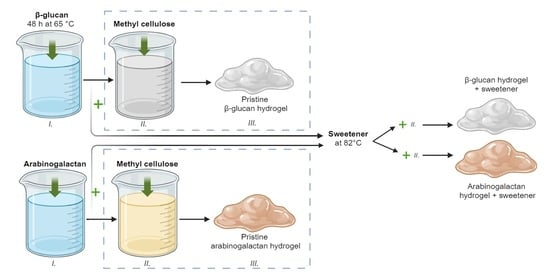
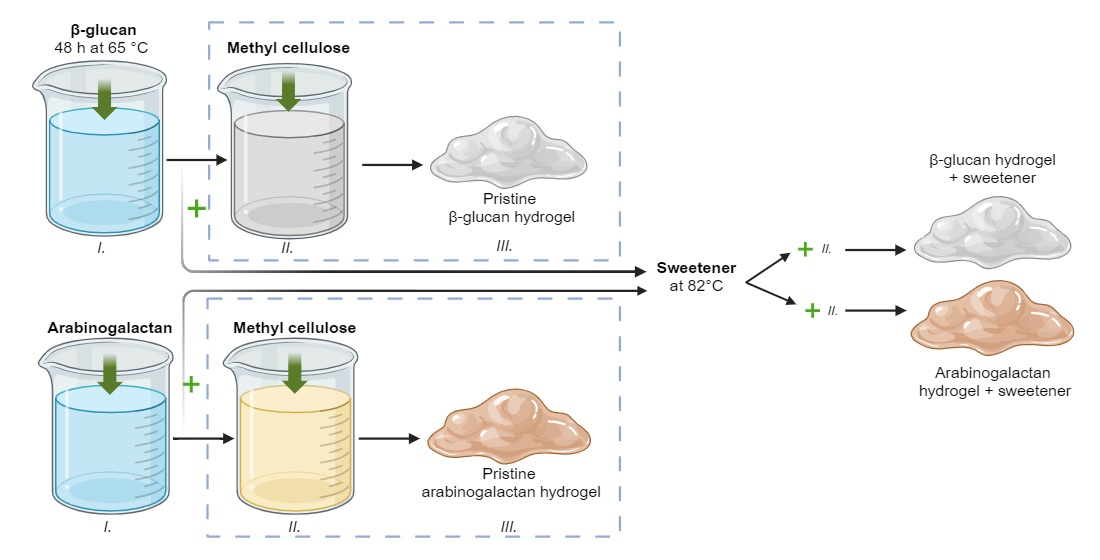
The gel preparation method was adapted in part from established protocols described by [23,24]. For the pristine gels, the appropriate amount of MethocelTM (MT) powder was gently added to the aqueous AG solution. The MT powder (40–60 mesh), was incorporated while maintaining the temperature at 82 °C under continuous stirring until fully dispersed. The mixture was subsequently stirred at room temperature for 30 min, without additional heating, to allow complete dissolution of MT and formation of a smooth, transparent gel.
For the BG variants, the gel was prepared by gelation of micronized BG in water (conditions included 48 h at 65 °C). The mixture was then stirred at 82 °C for 2 h, with intermittent homogenization using an IKA Ultra Turrax T18 homogenizer (Staufen, Germany) at 4000 rpm. After this step, MethocelTM (MT) was added to the mixture. For gel with sweetener, a calculated amount of PT and SU from 5 to 30 wt.% and 10 wt.% respectively was added at a temperature of 82 °C before MT addition.
The quantities of each component were determined according to the formulation ratios detailed in the Composition section of the Results. For example, a ratio of AG:MT 2:1 corresponds to 2 g of arabinogalactan (AG) and 1 g of MethocelTM (MT).
For sensory evaluation, the selected formulations were prepared according to the same procedure described above, with the exception that food-grade flavorings (apple crush or vanilla) were added in the final stage of preparation at the manufacturer’s recommended concentration (0.05 g) and mixed thoroughly to ensure their homogeneous distribution throughout the gel.
Multi-gram batches (~100 g) were prepared to evaluate gel formation and to characterize their physicochemical properties. For sensory evaluation and stability testing, the selected formulations were prepared as 10 kg batches.

2.3. Viscosity Measurements

Viscosity was measured in duplicate at 22.0 ± 0.5 °C using an Anton Paar DV-1P (Anton Paar GmbH, Fraz, Austria) rotational viscometer equipped with a tempering bath, following the conditions described by Veverka et al. [23]. The apparent viscosity was expressed in millipascal seconds (mPa·s) and automatically calculated and displayed on a screen for every spindle/speed combination.

2.4. Syneresis

Approximately 10 g of gel was placed in a graduated 15 mL centrifuge tube and sealed before refrigeration. The samples underwent five freeze–thaw cycles (FTCs), each consisting of freezing at −20 °C for 12 h, followed by thawing at 25 °C for 6 h. After each cycle, the samples were collected and evaluated for syneresis. Syneresis was quantified by centrifuging the gels at 7000 rpm for 20 min using a SW14 centrifuge rotor (O.K. Servis Bio Pro, Prague, Czech Republic), and the volume of released water was measured. This procedure was adapted from Veverka et al. [12].

2.5. pH and Conductivity Measurement

The pH of freshly prepared 20 g samples was measured at 20.0 ± 0.5 °C using a digital pH meter (Mettler Toledo, Columbus, OH, USA). Conductivity was measured under the same conditions with a Mettler Toledo S230 conductometer (Mettler Toledo, Greifensee, Switzerland) using a 731 ISM electrode.
Since it was assumed that, in the case of instability of the samples, this change would be reflected in the pH and conductivity values, these parameters are also monitored in ongoing long-term stability tests.

2.6. Differential Scanning Calorimetry

The thermal properties of hydrogels were analyzed using a PerkinElmer DSC8500 differential scanning calorimeter (PerkinElmer, Waltham, MA, USA) fitted with an IntraCooler II automatic cooling system [12]. Approximately 4–5 mg of sample (±0.01 mg) was sealed in aluminum pans for analysis. Nitrogen gas (20 mL/min) served as purge gas throughout the measurements. Calibration of the temperature scale was performed using the melting points of n-decane, diphenyl ether, and indium, while the heat flow was standardized based on the heat of fusion of indium. All measurements complied with standard DSC practices and adhered to the ISO 11357-1:2023 guidelines.

2.7. Texture Analysis

Texture characterization of gels was conducted using a TA.XT.plus texture analyzer (Stable Micro Systems, Surrey, UK) fitted with a cylindrical stainless-steel back-extrusion probe (35 mm diameter) and a 5 kg load cell. Gel samples (60 g), equilibrated to room temperature (~22 °C), were placed into a back-extrusion container of 40 mm diameter. Compression tests were performed at a constant speed of 1 mm/s, with the probe penetrating to a depth of 30 mm. The parameters assessed included firmness, consistency, cohesiveness, and work of cohesion [25].
Firmness was expressed as the maximum positive force during probe penetration, whereas consistency corresponded to the positive area under the force–distance curve during compression. Cohesiveness was determined as the maximum negative force recorded during probe withdrawal, while the work of cohesion represented the negative area under the withdrawal part of the force–distance curve [25].

2.8. Sensory Analysis

The sensory analysis involved sixty-five participants aged 60 to 75 years and above. A target viscosity of approximately 6000 mPa·s was selected as a practical formulation criterion to obtain gels with sufficient structural integrity for handling and spoon consumption. This value was used as a formulation target rather than as a clinical viscosity threshold, since the International Dysphagia Diet Standardization Initiative (IDDSI) framework classifies texture-modified foods based on functional performance rather than viscosity alone. Based on the assessment of the physical properties presented in Table 1 and Table 2, BG:MT 1:1.6 and AG:MT 2:2 containing 10% palatinose were selected for sensory evaluation [26,27].
The following flavors were added to the matrices: apple crush and vanilla. Samples of the evaluated gels are shown in Figure 1. A total of 10–15 mL of the sample was labeled with a three-digit code. The evaluation was carried out at room temperature using a 9-point hedonic scale [28], ranging from 1 = dislike extremely to 9 = like extremely, for the evaluation of attributes: appearance, aroma, taste, aftertaste, and overall preference. Subsequently, the evaluators were asked to rate the fluidity, color, intensity of bitter taste, and intensity of sweet taste using a 5-point Just-About-Right (JAR) scale (1 = too little, 3 = just about right, 5 = too much). The JAR scale is a bipolar scale characterized by opposite-end anchor points and a center point. The end anchor points represent attribute levels that are not JAR (they deviate from the respondent’s theoretical ideal score in opposite directions—“too little” and “too much”). The center point of this scale is labeled as JAR. The anchor points can be modified and phrased according to a particular attribute, for example, “not sweet enough” and “too sweet”. This scale is used to explore consumers’ perceptions and measure their response to a particular attribute. Based on the existing attribute level, the respondent can predict the direction of the attribute level that corresponds with their preferences [29].
Prior to the evaluation, the evaluators were asked to sign an informative consent, informing them of the potential risks as well as the possibility of terminating the evaluation at any stage. The evaluators’ responses were anonymous and did not allow the identification of the person concerned.

2.9. Data Analysis

Sensory data were analyzed by descriptive analysis function in the RedJade Sensory Software (RedJade Sensory Solutions, LLC, Martinez, CA, USA). For the determination of the statistical significance of sensory attributes (evaluated on a 9-point hedonic scale), one-way analysis of variance (ANOVA)–Duncan and REGWQ tests were used. Differences between values were considered significant when the p-value was greater than the significance level alpha = 0.05. Penalty analysis was performed on JAR data. The two analyses were performed using XLSTAT 2021.5 (New York, NY, USA, 2021).

3. Results and Discussion

Two series of hydrogels containing AG and BG were prepared, which differed in the content of the polysaccharides. The AG and BG contents varied from 1 to 4 wt.% and 1 to 3 wt.%, respectively, with sweetener concentrations of PT and SU in the blends from 5 to 30 wt.% and 10 wt.%, respectively. Water was used as a solvent. For their further characterization, viscosity measurements, DSC, and rheology study were applied.

3.1. Rheological and Physicochemical Properties

The rheological properties of the gels are summarized in Table 1. It has been previously reported that the physicochemical behavior of BG in aqueous solutions is significantly influenced by the type and concentration of second gum [30]. Although direct quantification of synergistic effects was not performed, the observed viscosities of mixed systems (AG or BG in combination with MT) were markedly higher compared to their individual components, suggesting possible synergism [31,32]. Viscosity measurements of BG dispersions with increasing MT content (1–3% w/w) revealed a notable viscosity enhancement. Notably, pure BG gel at 3.0 wt.% and the BG:MT 3:1 mixture with equivalent total gum content exhibited relatively low viscosities. Incorporation of 5 wt.% PT reduced viscosity from 1030 to 870 mPa·s, while the addition of Methocel K15MCR, a high-viscosity hydroxypropyl methylcellulose, did not further increase viscosity. A hydrogel containing 3.0 wt.% BG combined with 2 wt.% MT demonstrated a significant viscosity increase to 37,170 mPa·s. Even a 30% (w/w) PT addition to BG:MT 3:2 gel had no fatal effect, and final viscosity was observed at 12,000 mPa·s. However, the obtained viscosity exceeded the target formulation criterion, making the gel less suitable for the intended spoonable texture. In the case of SU addition, already 10% addition had a final effect, showing a decrease in viscosity among all systems studied to 370 mPa·s. Subsequently, a concentration of 1.6% (w/w) MT was chosen as a compromise value. The gel composed of 3% BG and 1.6% MT showed a viscosity of 17,440 mPa·s, while blends with 5 and 10% PT yielded viscosities of 8820 and 7700 mPa·s, respectively. The BG:MT:PT 3:1.6:10 blend was selected for the next study, as evidenced by the viscosity behavior values for the 3:2 blend. An increase in viscosity, as well as gel formation, can also be observed in the application of dispersed insoluble polysaccharides, depending on the interactions between the particles and volume fractions of these polysaccharides [16,33]. It is important to note that synergistic viscosity effects of BG combined with other gums appear limited to barley-derived BG [30]. For the AG series, the relationship between concentration and viscosity was more consistent, with all AG:MT mixtures forming stable, transparent gels, transitioning from viscoelastic fluids to gels. Viscosity increased progressively from AG:MT 3:2 through AG:MT 2:2; until the highest viscosity for 4:3 mixtures, indicating synergistic interactions. Pure AG gels formed weak structures above 2.0 wt.% (~95 mPa·s), but gelation was enhanced by MT addition. The addition of 10% PT to the pristine AG:MT 2:2 gel-forming mixture resulted in a viscosity of 4940 mPa·s, which was within the target range. In contrast, the addition of 10% SU led to antagonistic effects and the formulation was excluded from further study. As observed in the present study, higher concentrations of PT (30% w/w) and SU (10% w/w) inhibited gel network formation. This observation is consistent with previous studies [34,35], which reported that increasing sweetener concentrations in hydrocolloid systems may reduce gel viscosity. The ability of SU to compete with polysaccharide molecules for available water, and the interaction between sucrose and water, were hypothesized. In contrast, Fu and Rao (2001) [36] found that increasing the amount of added SU may stabilize the structure or junction zones. In our case, the intermediate gel strength and sensory characteristics were found when PT was applied at 10% concentration.
Conductivity values vary significantly across the formulations, suggesting differences in the ionic content or gel structure. Higher conductivity is observed in samples with AG, especially in the AG 4:1 (3100 µS/cm) and AG 3:2* (2910 µS/cm) mixtures, indicating the presence of more dissolved ions or higher ionic mobility. The enthalpy of fusion results indicates the enthalpy change during the phase transition. The values vary slightly across the gels, with some formulations showing slightly lower values when PT or SU is added (e.g., AG 2:2 (5% PT) drops to 284 J/g from 311 J/g). This suggests the additives may influence the thermal properties of the gels. The majority of gels have a high total water content, often above 90%, indicating their high hydration capacity. The water content decreases with increasing PT concentrations, which could be due to the interaction between the polysaccharides and water molecules, reducing free water availability (e.g., BG 3:2 (30% PT) has 73.5% total water). A similar trend was observed with the freezing water (% w/w), where the content decreased with higher concentrations of PT and SU. An increase in non-freezing water was observed with the PT addition, suggesting stronger water–polymer interactions. For example, BG 3:2 (30% PT) has 15.3% non-freezing water, compared to 5.4% in BG 3:2.

3.2. Syneresis and Textural Properties

The studies examine the stability of hydrogel complexes over multiple FTCs, modeling the frozen product’s journey from processing plant to warehouse, to thawing and refreezing by consumers at home [23,37]. Before freeze–thaw (FT) treatment, no syneresis was observed at 22 °C during the study period of two months, indicating a good ability of both hydrogels to retain water after formation. However, the behavior of AG and BG gels are different in FTCs; the results are listed in Table 2. AG pristine gels and PT-containing formulations exhibited only negligible syneresis (≪1%) even after the fourth and fifth FTCs, confirming excellent water-holding capacity and freeze–thaw stability. In contrast, BG:MT gels exhibited pronounced syneresis (approximately 35–43%), indicating poor water-holding capacity and reduced structural stability after repeated freezing and thawing. Also, the gels’ instability did not depend on the ratio of sweetener. It was observed that the frozen storage for one week did not influence the aggregation, but repeated FTCs changed the structure of aggregates in a way that suggests cryogelation. These findings indicate that AG-based formulations are suitable for products that may undergo frozen storage and repeated freeze–thaw cycles, whereas BG-based formulations are more appropriate for products intended for storage under stable, non-freezing conditions [38].
Different types of polysaccharide gelling agents have been used to consider better stability and gel-forming ability. Table 1 shows the relationship between the gel-forming ability of MT and Methocel K15MCR (a type of modified hydroxypropyl methylcellulose). As we can clearly see, AG or BG differ in their ability to form the desired gel with MT versus Methocel K15MCR. These results clearly showed that Methocel K15MCR does not form a final gel with favorable properties under our conditions. Only at a pronounced concentration of Methocel K15MCR was the target viscosity reached; unfortunately, the addition of PT sweetener had a detrimental effect and was subsequently excluded from further studies.
Texture plays a crucial role in shaping the sensory quality of gels [39]. The data obtained in this study are presented in Table 2 and several general patterns and trends can be observed. The firmness of the gels seems to vary with the composition and the presence of the sweetener palatinose. For example, in the AG compositions, AG:MT 2:3 exhibits a much higher firmness (29.18 ± 0.82 g) than the other AG compositions. The firmness is also impacted by the inclusion of palatinose, with AG:MT 2:2 (5% PT) showing a higher firmness than AG:MT 2:2. To explain why AG:MT 2:2 (10% PT) shows lower firmness compared to AG:MT 2:2, we need to consider the interaction between the hydrogel components and palatinose at different concentrations. The increase in firmness at a lower palatinose concentration (5%) might be due to the optimal interaction between the hydrogel matrix and the sweetener, leading to a more structured network. However, at higher concentrations (10%), this interaction might become less favorable, potentially due to the oversaturation of palatinose within the matrix, leading to a weaker gel structure and reduced firmness. The difference in firmness between AG:MT 2:2 (5% PT) and AG:MT 2:2 (10% PT) could be attributed to the different interactions of components at varying palatinose concentrations, the impact of FTC on the gel structure, and the extent of syneresis observed in these samples. To provide a more detailed explanation, further investigation into the specific molecular interactions and structural changes occurring in these samples at different palatinose concentrations would be beneficial. Similar observations can be made for BG compositions. BG gels prepared as mixtures of high molecular weight (HMW) and low molecular weight (LMW) oat BG in the ratios of 0:100, 25:75, 50:50, 75:25, and 100:0 were investigated in a study conducted by Brummer et al. [40]. The textural properties were measured and the results indicate that the firmness and hardness of the gels increased with the addition of up to 50% HMW BG; however, after 50% addition, this effect diminished.
Consistency shows a similar trend to firmness. In general, gels containing BG tend to show higher consistency than those containing AG, particularly in the BG:MT 3:2 (5% PT) composition. Generally, compositions containing BG show higher absolute values for cohesiveness, implying higher structural integrity. The work of cohesion generally follows the trend of cohesiveness. It can be noticed that AG:MT 2:3 and BG:MT 3:1.6 show significantly high values for the work of cohesion compared to other compositions. The addition of PT at different concentrations (5% and 10%) seems to alter the characteristics of the gels. In general, there is an increase in firmness, consistency, and work of cohesion with the addition of PT, though there are exceptions such as in the case of AG:MT 2:2 and BG:MT 3:1.6. Polysaccharide compositions marked with * (indicating the use of Methocel K15MCR) have lower values in all measured parameters compared to their corresponding pristine compositions.
The observed differences in firmness, consistency, and cohesiveness between AG and BG gels, and the impact of sweetener addition, can be attributed to the degree of cross-linking and the nature of the polysaccharide–sweetener interactions. The firmness and consistency are a direct manifestation of the gel’s structural integrity, which is influenced by the molecular weight of the polysaccharides, the presence of branching, and the interaction with sweeteners [41,42]. Cohesiveness, reflecting the gel’s ability to resist deformation, highlights the strength of the molecular interactions within the gel matrix. In the back-extrusion test, cohesiveness is represented by the maximum negative force recorded during probe withdrawal. Accordingly, the negative values observed for all samples are expected, with larger negative values corresponding to greater cohesiveness of the gel [25].
The addition of glucose in HMW and LMW oat BG gels (0:100, 50:50, and 75:25 ratios) resulted in higher firmness and hardness values compared to the control samples without glucose addition in a study conducted by Brummer et al. [40]. The results of this study suggest that, by the addition of sugar and the adjustment of molecular fraction ratios, the textural properties of gels can be modified for different purposes. An interesting observation was noted with the addition of citric acid and flavoring when a decrease in hardness and firmness was observed. The influence of sugar on the textural parameters of the BG gel was also confirmed in a study by the authors Irakli et al. [43], and it was found that the textural parameters of the barley BG gels (Young’s modulus and strength) were influenced by the addition of sugar as well as the type of added sugar. With the addition of glucose, fructose, and sucrose, the strength of the gels increased, but the opposite effect was observed with the addition of ribose. Similarly, a decrease in Young’s modulus was observed for ribose and xylose, as was an increase for glucose, fructose, and sucrose. The authors explain this occurrence by the inhibitory effect of pentoses on the aggregation of polymer chains. The differences observed in the research results regarding the textural properties of the BG gel can be attributed to the dependence of the gel properties on factors such as molecular structure, molecular weight, concentration, distribution, temperature, and other relevant properties [40]. Few studies have investigated the use of AG in gel form or in complex with MT [12,23] while textural properties have not been investigated.

3.3. Differential Scanning Calorimetry

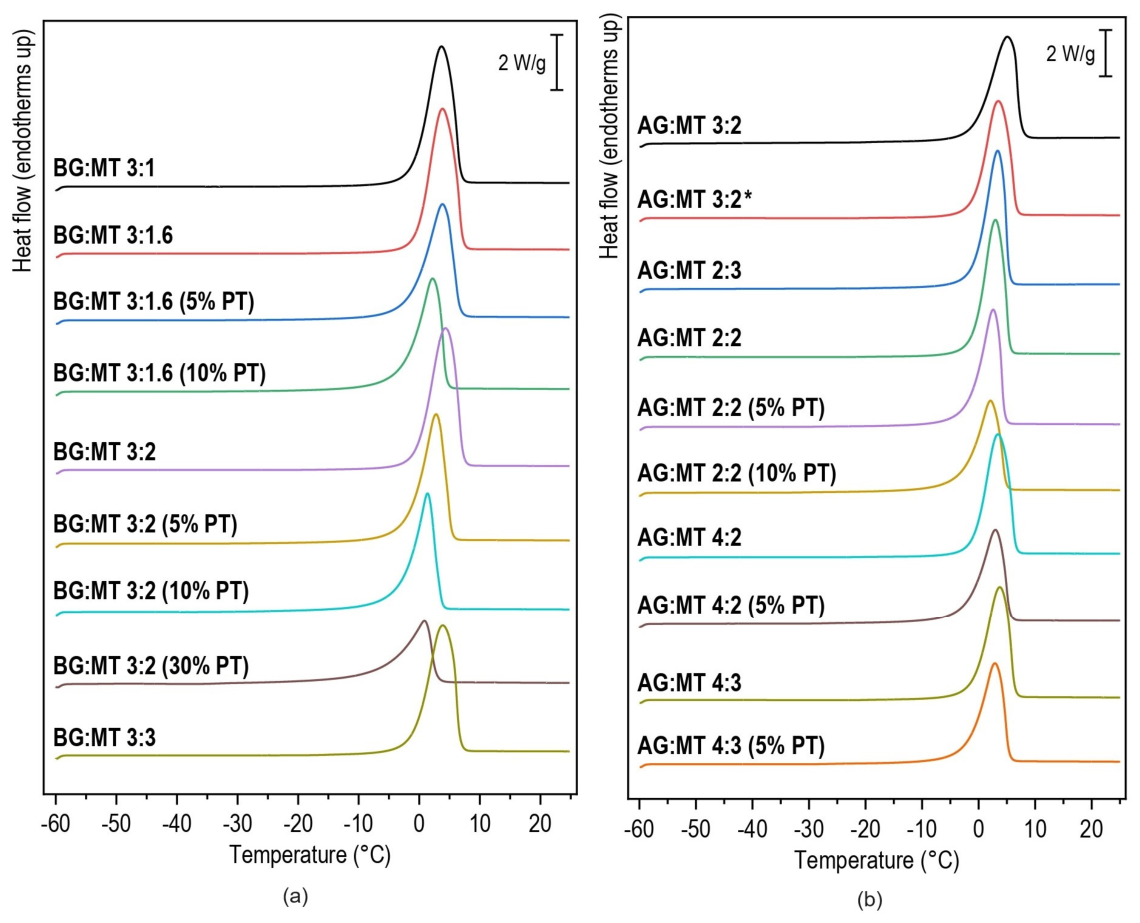
DSC measurements were carried out in order to study the thermal behavior of prepared gels and to assess the interaction of water with the gel matrix. After cooling at −5 °C min−1 from room temperature and subsequent reheating at 5 °C min−1, all formulations exhibit a single broad endotherm corresponding to the melting of water. Figure 2 displays the DSC records of the BG:MT and AG:MT series gels during heating at 5 °C min−1. For all studied materials, the measured enthalpy of melting was lower than the theoretical value corresponding to total water content. The effect was due to the presence of non-freezing water. This is, however, only an apparent decrease due to normalizing the enthalpy of melting to the overall sample mass. Three different states of water can be hypothesized as being present in pristine polysaccharide hydrogels: free (non-interacting) water; water bound within the secondary hydrating shell of polysaccharide chains; and strongly bound water forming the primary hydrating shell. While the two former types freeze upon cooling, the latter one interacts with the gel matrix strongly enough to completely resist freezing [44]. The amount of non-freezing water can be deduced as a difference between the total water content and freezing water content determined from the DSC area under the melting peak. The area under the melting peak (that is, specific enthalpy of fusion, Δfush) was determined by integrating the DSC peak of melting using Pyris 11 software (Perkin Elmer Instruments, Shelton, CT, USA) assuming a sigmoidal baseline within the temperature range of −25 °C and 15 °C. Dividing the Δfush values by that for pure water (334 J/g) makes it possible to determine the amount of freezing water; the results are listed in Table 1.
Taking into account the considerable uncertainty of this determination (small difference between two similar percentages), the content of non-freezing water can be regarded as identical in AG and BG series (2.8–5.0% and 2.0–5.1%, respectively) and also practically independent of the total amount of gel-forming polysaccharides (p >> 0.05). These results agree with those previously reported by Veverka et al. [12] for bacteriophage-loaded hydrogels of similar composition. In addition to a single cooling–heating cycle, representative pristine gels (AG:MT 4:3, BG:MT 3:2, and BG:MT 3:1) were also subjected to three FTCs between 30 °C and −60 °C without any discernible effect on the DSC trace, thus suggesting good low-temperature stability of gels with no syneresis [45]. Determination of (non-)freezing water in polymer hydrogels is a relatively common practice [46]. In general, the higher proportion of non-freezing water would suggest a higher affinity of a polymer (or mixture thereof) towards water and thus more stable hydrogel which should be less prone to phase separation or syneresis [47].
However, a major portion of the water in pristine gels is still present in unbound (i.e., freezing) form (Table 1), suggesting that factors other than non-freezing water content contribute to syneresis behavior. Here, increases in non-freezing water content did not consistently correspond to reductions in syneresis or changes in viscosity. Thus, the amount of non-freezing water does not appear to be a reliable indicator of phase stability for the hydrogels under study. Although PT increased the proportion of non-freezing water, this did not necessarily translate into improved freeze–thaw stability. This observation suggests that the amount of non-freezing water alone is insufficient to explain phase stability and that additional structural characteristics of the hydrogel network are likely to contribute to water retention during repeated freeze–thaw cycles, consistent with previous reports indicating that hydrogel properties are influenced not only by the state of water but also by the structural organization and chemical characteristics of the polymer network [48].
Matrices composed of a high concentration of PT exhibited a gradual increase in the content of non-freezing water, e.g., 5.4% to 11.4% in the BG:MT 3:2 series and 4.4% to 8.1% in the AG:MT 2:2 series. The opposite effect can be seen in Table 1, for Δfush values. The DSC records (Figure 2) also demonstrate the effect of PT on the melting/freezing point of gels. PT as a low-molecular solute lowers the melting point of hydrogels, thus offering the possibility of their storage at sub-zero temperatures, while the desired rheological properties are maintained.
Regarding the results obtained for finalized formulations (i.e., gel matrices loaded with low-molecular nutritional compounds), their DSC traces were very similar to those of pristine hydrogels. The main difference resides in the expected effect of solutes on the melting of freezable water: samples containing low-molecular compounds melt in wider temperature ranges and exhibit lower melting points and melting enthalpies compared to pristine hydrogels.

3.4. Sensory Analysis

In general, AG-based gels received higher scores compared to BG-based gels regardless of the flavor (Table 3), which corresponds to the previous research conducted by Vietoris et al. [48]. However, these differences were not statistically significant for all formulations. The preferred sample by the evaluators was the apple crush-flavored AG-based gel, which scored the highest on all attributes evaluated on a 9-point scale. We can observe differences in the evaluation of AG gels mainly in the assessment of smell, as AG gel with apple crush flavor received an average score of 6.9 points and AG gel with vanilla flavor received 5.75 points. Smaller differences are evident with aftertaste (AGAC–6.65; AGV–6.10) and overall preference (AGAC–6.70; AGV–6.20, abbreviations see Table 3). The results from the evaluation of BG gels indicate that the gels did not differ statistically regardless of the added flavor. A decrease in consumer acceptance of the BG-containing product was also found in a study by Szpicer et al. [49] when the concentration and amount of BG solution in low-fat beef burgers influenced the decrease in consumer acceptance of external appearance, juiciness, taste, aroma, texture, and overall acceptance.
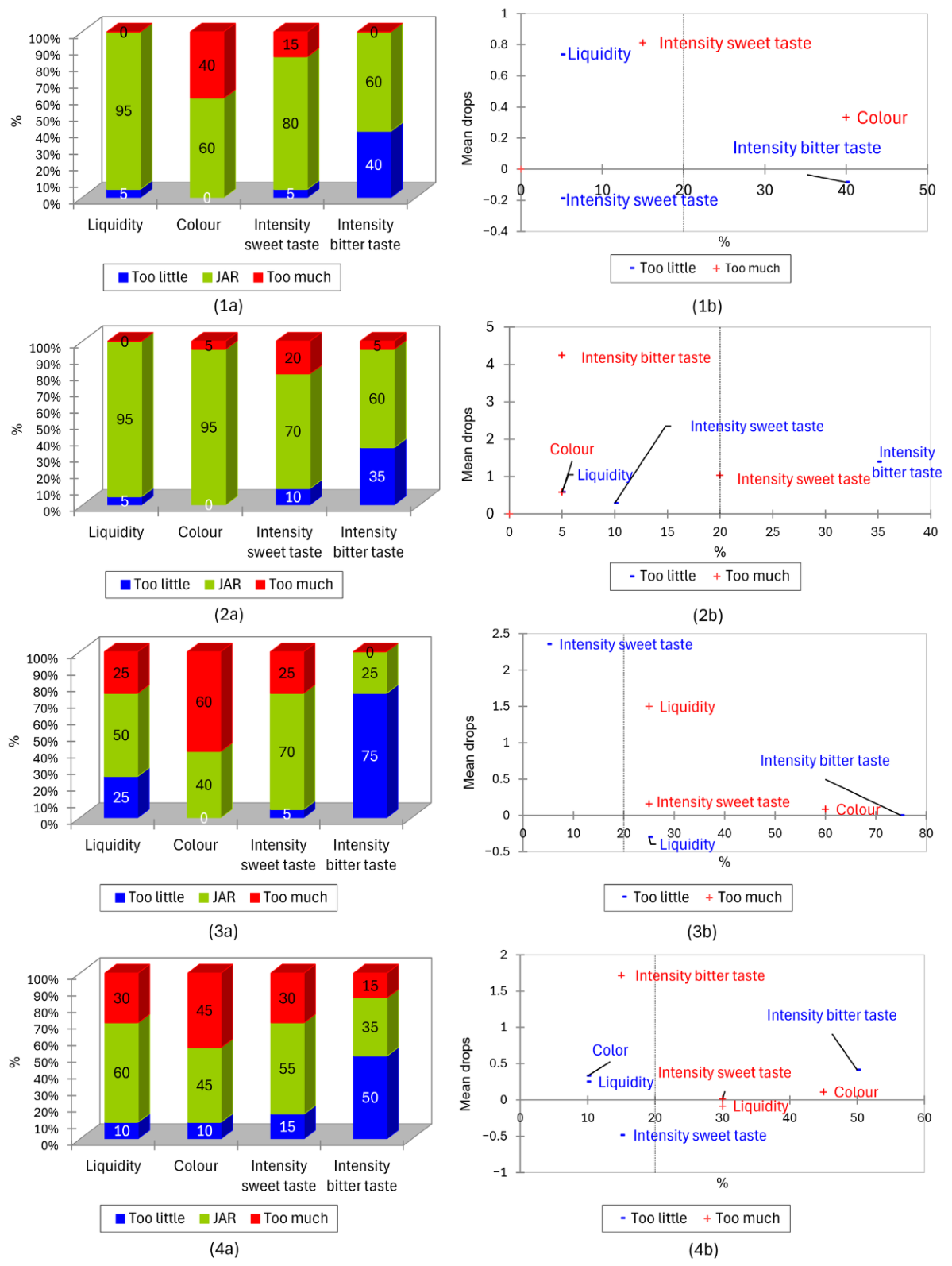
The data obtained by assessing the attributes using the JAR scale were evaluated using penalty analysis; the results are shown in Figure 3. The significance level was set at 20% [50]. The vertical line marks 20% of the consumers on the graph, thereby dividing it effectively into four sub-graphs. The attributes highlighted in the top-right quadrant represent areas requiring adjustment in the product development process to enhance consumer acceptance [50,51]. AG gels had higher JAR selections for all evaluated attributes when compared to BG gels. AG gels with apple crush flavor had a high selection of JAR for liquidity (95%) and intensity of sweet taste (80%). A total of 40% of evaluators considered this gel as too bright, as well as not bitter enough. This is also confirmed based on the explanation of the penalty plots, as more than a significant proportion of participants (20%) penalized the apple crush AG gel for being “too” bright and “not” bitter enough. Vanilla-flavored AG gels received the highest selection of JAR for all evaluated attributes, as only 20% of evaluators selected “too much” for the intensity of sweet taste and only 5% for the color and intensity of bitter taste. We can observe that this gel was penalized for bitter taste intensity, having “too little” bitter taste (see Figure 3(2b)). The penalty for “too much” intensity of sweet taste is on the significance level line. For the apple crush-flavored BG gels, 75% of participants rated the intensity of the bitter taste as “too little” as they stated that the gel was not bitter enough. Low JAR selection was also noted in the color evaluation, with 60% of the evaluators selecting the “too much” option, indicating that the color of the gel was too bright. Regarding the evaluation of liquidity, we can observe non-identical evaluations, as the same percentage of evaluators chose two antagonistic non-JAR options. In total, 25% of evaluators considered this gel too sweet. This gel was penalized for having “too much” liquidity, too much intensity of sweet taste, and too bright a color. The gray color of BG can significantly affect the properties of BG products, such as appearance [52]. In a study conducted by Volikakis et al. [53], products containing BG concentrate obtained significantly lower scores (on a 7-point scale) in evaluating the color of the product, and this result was attributed to the slightly grayish color of the concentrate. In the case of vanilla-flavored BG gel, the highest selection of JAR was noted for liquidity (60%) and intensity of sweet taste (55%). This gel was penalized for having “too much” sweet taste intensity, too bright a color, and “too little” intensity of bitter taste. Older evaluators in all samples perceived the intensity of bitter taste as “too little” to varying degrees (35–75%), indicating that the samples were not sufficiently bitter. The detection threshold of the elderly has been the subject of numerous studies, most of which found that the detection threshold for bitter taste increased compared to the younger individuals [54,55]. A systematic review by Methven et al. [55] revealed that the threshold for bitter taste increased from 1.2- to 4-fold in the case of older individuals, depending on the tastant used (caffeine and quinine). The physicochemical properties of polysaccharide matrices affect the retention, release, and perception of flavor components and it is therefore necessary to conduct further research focusing on the release of flavor components from AG and BG gels in combination with MT. Research by authors Fu et al. [36] has confirmed that the viscosity and swelling ability of polysaccharides influences the release of aromatic molecules from the matrix, which subsequently affects the way evaluators perceive flavor.

4. Conclusions

This study investigated the properties of BG- and AG-based gels in aqueous systems containing MT and evaluated the effect of palatinose addition on the development of edible gels as potential carriers of beneficial dietary fiber. The results demonstrated that formulation composition, including both the polysaccharide type and palatinose addition, significantly influenced the rheological, textural, and mechanical properties of the gels. AG and BG show distinct properties, with BG compositions generally exhibiting higher consistency and cohesiveness. The addition of sweetener (PT) also impacted the gel characteristics, with a general increase in firmness and consistency. However, the behavior with varying PT concentrations is complex and needs further investigation to understand the underlying interactions. The marked differences in freeze–thaw stability between AG- and BG-based formulations support formulation-specific storage recommendations. AG-based formulations are suitable for products intended for frozen storage, whereas BG-based formulations are more appropriate for products stored under stable, non-freezing conditions.
AG:MT 2:2 (w/w) and BG:MT 3:1.6 (w/w) with the addition of 10% palatinose represented the optimal formulations in regard to viscosity measurement and were chosen as matrix prototypes to which flavors were subsequently added. Sensory evaluation of these samples revealed that senior evaluators preferred AG-based edible gels regardless of added flavor compared to BG-based gels. By analyzing the JAR data using penalty analysis, sensory-related deficiencies of the evaluated samples were identified and penalized, while in the case of BG-based gels, a higher number of penalties was observed. These results can be used for the modification of edible gel formulations according to consumer preferences, whereby further research should include sensory evaluation involving a larger number of evaluators (consumer panel) as well as a trained panel.
Targeted selection of polysaccharides in hydrocolloid formulations can ensure the preparation of products for the delivery of beneficial dietary fiber, with the gel form presenting potential benefits for a segment of the population with specific texture requirements, such as the elderly.

5. Patents

Miroslav Veverka, Melina Korcok, and Vladimir Vietoris have a registered utility model #PUV 50044-2023 in the Industrial Property Office of the Slovak Republic.

Author Contributions

M.V.: Conceptualization, Methodology, Investigation, Writing—original draft preparation. V.V.: Methodology, Resources, Data curation, Supervision, Project administration, Funding acquisition. M.K.: Formal analysis, Investigation, Writing—original draft preparation. P.Z.: Data curation, Writing—review and editing. P.H.: Writing—review and editing. T.D.: Visualization, Writing—review and editing. All authors have read and agreed to the published version of the manuscript.

Funding

This research was supported by the Slovak Research and Development Agency, grant number APVV-20-0078 “Development of edible gel-based foods and applications in a target segment of the aging population”.

Data Availability Statement

Dataset available on request from the authors.

Conflicts of Interest

Author Miroslav Veverka is employed by the company Certex, a.s., Bratislava, Slovakia. The remaining authors declare that the research was conducted in the absence of any commercial or financial relationships that could be construed as a potential conflict of interest.

References

  1. Qin, Y.; Pillidge, C.; Harrison, B.; Adhikari, B. Pathways in formulating foods for the elderly. Food Res. Int. 2024, 186, 114324. [Google Scholar] [CrossRef] [Scilit] [PubMed]
  2. Calligaris, S.; Moretton, M.; Melchior, S.; Mosca, A.C.; Pellegrini, N.; Anese, M. Designing food for the elderly: The critical impact of food structure. Food Funct. 2022, 13, 6467–6483. [Google Scholar] [CrossRef] [Scilit] [PubMed]
  3. Donini, L.M.; Savina, C.; Cannella, C. Nutrition in the Elderly: Role of Fiber. Arch. Gerontol. Geriatr. 2009, 49, 61–69. [Google Scholar] [CrossRef] [Scilit] [PubMed]
  4. Barber, T.M.; Kabisch, S.; Pfeiffer, A.F.H.; Weickert, M.O. The health benefits of dietary fibre. Nutrients 2020, 12, 3209. [Google Scholar] [CrossRef] [Scilit] [PubMed]
  5. Chen, O.; Sudakaran, S.; Blonquist, T.; Mah, E.; Durkee, S.; Bellamine, A. Effect of arabinogalactan on the gut microbiome: A randomized, double-blind, placebo-controlled, crossover trial in healthy adults. Nutrition 2021, 90, 111273. [Google Scholar] [PubMed]
  6. Wang, Y.; Liu, Y.; Ivusic Polic, I.; Chandran Matheyambath, A.; LaPointe, G. Modulation of human gut microbiota composition and metabolites by arabinogalactan and Bifidobacterium longum subsp. longum BB536 in the simulator of the human intestinal microbial ecosystem (SHIME®). J. Funct. Foods 2021, 87, 104820. [Google Scholar] [CrossRef] [Scilit]
  7. Gong, G.; Liu, Q.; Deng, Y.; Dang, T.; Dai, W.; Liu, T.; Liu, Y.; Sun, J.; Wang, L.; Liu, Y.; et al. Arabinogalactan derived from Lycium barbarum fruit inhibits cancer cell growth via cell cycle arrest and apoptosis. Int. J. Biol. Macromol. 2020, 149, 639–650. [Google Scholar] [CrossRef] [Scilit] [PubMed]
  8. Zamay, T.N.; Starkov, A.K.; Kolovskaya, O.S.; Zamay, G.S.; Veprintsev, D.V.; Luzan, N.; Nikolaeva, E.D.; Lukyanenko, K.A.; Artyushenko, P.V.; Shchugoreva, I.A.; et al. Nucleic acid aptamers increase the anticancer efficiency and reduce the toxicity of cisplatin-arabinogalactan conjugates in vivo. Nucleic Acid Ther. 2022, 32, 497–506. [Google Scholar] [CrossRef] [Scilit] [PubMed]
  9. Yang, L.; Lai, C.; Hsieh, C.; Lin, W. Natural killer cell-mediated anticancer effects of an arabinogalactan derived from rice hull in CT26 colon cancer-bearing mice. Int. J. Biol. Macromol. 2019, 124, 368–376. [Google Scholar] [CrossRef] [Scilit] [PubMed]
  10. Pitkänen, L.; Heinonen, M.; Mikkonen, K.S. Safety considerations of plant polysaccharides for food use: A case study on phenolic-rich softwood galactoglucomannan extract. Food Funct. 2018, 4, 1931–1943. [Google Scholar] [CrossRef] [Scilit]
  11. Kaur, R.; Sharma, M.; Ji, D.; Xu, M.; Agyei, A. Structural features, modification, and functionalities of beta-glucan. Fibers 2019, 8, 1. [Google Scholar] [CrossRef] [Scilit]
  12. Veverka, M.; Dubaj, T.; Veverková, E.; Šimon, P.; Husár, Š.; Tomanová, K.; Jorík, V. Beta-glucan and arabinogalactan-based xerogels for abuse-deterrent opioid formulations. Eur. J. Pharm. Sci. 2019, 129, 132–139. [Google Scholar] [CrossRef] [Scilit] [PubMed]
  13. Vaikousi, H.; Biliaderis, C.G.; Izydorczyk, M.S. Solution flow behavior and gelling properties of water-soluble barley (1→3,1→4)-β-glucans varying in molecular size. J. Cereal Sci. 2004, 39, 119–137. [Google Scholar] [CrossRef] [Scilit]
  14. Maheshwari, G.; Sowrirajan, S.; Joseph, B. β-Glucan, a dietary fiber in effective prevention of lifestyle diseases—An insight. Bioact. Carbohydr. Diet. Fibre 2019, 19, 100187. [Google Scholar] [CrossRef] [Scilit]
  15. Stephen, A.M.; Champ, M.M.J.; Cloran, S.J.; Fleith, M.; van Lieshout, L.; Mejborn, H.; Burley, V.J. Dietary fibre in Europe: Current state of knowledge on definitions, sources, recommendations, intakes and relationships to health. Nutr. Res. Rev. 2017, 30, 149–190. [Google Scholar] [CrossRef] [Scilit] [PubMed]
  16. Lovegrove, A.; Edwards, C.H.; De Noni, I.; Patel, H.; El, S.N.; Grassby, T.; Zielke, C.; Ulmius, M.; Nilsson, L.; Butterworth, P.J.; et al. Role of polysaccharides in food, digestion, and health. Crit. Rev. Food Sci. Nutr. 2016, 57, 237–253. [Google Scholar]
  17. Gallego, M.; Barat, J.M.; Grau, R.; Talens, P. Compositional, structural design and nutritional aspects of texture-modified foods for the elderly. Trends Food Sci. Technol. 2022, 119, 152–163. [Google Scholar] [CrossRef] [Scilit]
  18. Kohyama, K.; Ishihara, S.; Nakauma, M.; Funami, T. Fracture phenomena of soft gellan gum gels during compression with artificial tongues. Food Hydrocoll. 2021, 112, 106283. [Google Scholar] [CrossRef] [Scilit]
  19. Nishinari, K.; Ishihara, S.; Hori, K.; Fang, Y. Tongue-palate squeezing of soft gels in food oral processing. Trends Food Sci. Technol. 2020, 99, 117–132. [Google Scholar] [CrossRef] [Scilit]
  20. Korčok, M.; Calle, J.; Veverka, M.; Vietoris, V. Understanding the health benefits and technological properties of β-glucan for the development of easy-to-swallow gels to guarantee food security among seniors. Crit. Rev. Food Sci. Nutr. 2022, 63, 11504–11521. [Google Scholar] [CrossRef] [Scilit] [PubMed]
  21. Santagiuliana, M.; Piqueras-Fiszman, B.; van der Linden, E.; Stieger, M.; Scholten, E. Mechanical properties affect detectability of perceived texture contrast in heterogeneous food gels. Food Hydrocoll. 2018, 80, 254–263. [Google Scholar] [CrossRef] [Scilit]
  22. Shyam, S.; Ramadas, A.; Chang, S.K. Isomaltulose: Recent evidence for health benefits. J. Funct. Foods 2018, 48, 173–178. [Google Scholar] [CrossRef] [Scilit]
  23. Veverka, M.; Dubaj, T.; Gallovič, J.; Veverková, E.; Šimon, P.; Lokaj, J.; Jorík, V. Formulations of Staphylococcus aureus bacteriophage in biodegradable beta-glucan and arabinogalactan-based matrices. J. Drug Deliv. Sci. Technol. 2020, 59, 101909. [Google Scholar] [CrossRef] [Scilit]
  24. Korčok, M.; Veverka, M.; Nakonechna, K.; Škrípová, S.; Vietoris, V. Factors influencing elderly consumers’ preferences for edible gels: Insights from Slovakia. Gels 2024, 10, 610. [Google Scholar] [CrossRef] [Scilit] [PubMed]
  25. Stable Micro Systems. Back Extrusion Rig. Available online: https://www.stablemicrosystems.com/products/attachments/back-extrusion-rig/ (accessed on 17 July 2026).
  26. Raheem, D.; Carrascosa, C.; Ramos, F.; Saraiva, A.; Raposo, A. Texture-Modified Food for Dysphagic Patients: A Comprehensive Review. Int. J. Environ. Res. Public Health 2021, 18, 5125. [Google Scholar] [CrossRef] [Scilit] [PubMed]
  27. Cichero, J.A.Y.; Lam, P.; Steele, C.M.; Hanson, B.; Chen, J.; Dantas, R.O.; Duivestein, J.; Kayashita, J.; Lecko, C.; Murray, J.; et al. Development of International Terminology and Definitions for Texture-Modified Foods and Thickened Fluids Used in Dysphagia Management: The IDDSI Framework. Dysphagia 2016, 32, 293–314. [Google Scholar] [CrossRef] [Scilit] [PubMed]
  28. Peryam, D.; Girardot, N. Advanced taste-test method. Food Eng. 1952, 24, 58–61. [Google Scholar]
  29. Lawless, H.T.; Heymann, H. Sensory Evaluation of Food: Principles and Practices, 2nd ed.; Springer: New York, NY, USA, 2010; p. 596. [Google Scholar]
  30. Ghotra, B.S.; Vasanthan, T.; Temelli, F. Rheological properties of aqueous blends of high purity barley β-glucan with high purity commercial food gums. Food Chem. 2009, 117, 417–425. [Google Scholar] [CrossRef] [Scilit]
  31. Pellicer, J.; Delegido, J.; Dolz, J.; Dolz, M.; Hernández, M.J.; Herráez, M. Influence of shear rate and concentration ratio on viscous synergism: Application to xanthan–locust bean gum–NaCMC mixtures. Food Sci. Technol. Int. 2000, 6, 415–423. [Google Scholar] [CrossRef] [Scilit]
  32. Hernández, M.J.; Dolz, J.; Dolz, M.; Delegido, J.; Pellicer, J. Viscous synergism in carrageenans (κ and λ) and locust bean gum mixtures: Influence of adding sodium carboxymethylcellulose. Food Sci. Technol. Int. 2001, 7, 383–391. [Google Scholar] [CrossRef] [Scilit]
  33. Nkenmogne Kamdem, I.E.; Saidou, C.; Ngassoum, M.B.; Ndjouenkeu, R. Synergistic interactions in dilute aqueous solutions between alginate and tropical vegetal hydrocolloids. Heliyon 2020, 6, e04348. [Google Scholar] [CrossRef] [Scilit] [PubMed]
  34. Richardson, P.H.; Willmer, J.; Foster, T.J. Dilute solution properties of guar and locust bean gum in sucrose solutions. Food Hydrocoll. 1998, 12, 339–348. [Google Scholar] [CrossRef] [Scilit]
  35. Bayarri, S.; Durán, L.; Costell, E. Influence of sweeteners on the viscoelasticity of hydrocolloids gelled systems. Food Hydrocoll. 2004, 18, 611–619. [Google Scholar] [CrossRef] [Scilit]
  36. Fu, J.T.; Rao, M.A. Rheology and structure development during gelation of low-methoxyl pectin gels: The effect of sucrose. Food Hydrocoll. 2001, 15, 93–100. [Google Scholar] [CrossRef] [Scilit]
  37. Mizrahi, S. Syneresis in food gels and its implications for food quality. In Chemical Deterioration and Physical Instability of Food and Beverages; Skibsted, L.H., Risbo, J., Andersen, M.L., Eds.; Woodhead Publishing: Cambridge, UK, 2010. [Google Scholar]
  38. Kilcast, D. Understanding, detecting and preventing taints in foods. In Chemical Deterioration and Physical Instability of Food and Beverages; Skibsted, L.H., Risbo, J., Andersen, M.L., Eds.; Woodhead Publishing: Cambridge, UK, 2010; pp. 349–377. [Google Scholar]
  39. Fan, R.; Ma, P.; Zhou, D.; Yuan, F.; Cao, X. The properties and formation mechanism of oat β-glucan mixed gels with different molecular weight composition induced by high-pressure processing. PLoS ONE 2019, 14, e0225208. [Google Scholar] [CrossRef] [Scilit] [PubMed]
  40. Brummer, Y.; Defelice, C.; Wu, Y.; Kwong, M.; Wood, P.J.; Tosh, S.M. Textural and rheological properties of oat beta-glucan gels with varying molecular weight composition. J. Agric. Food Chem. 2014, 62, 3160–3167. [Google Scholar] [CrossRef] [Scilit] [PubMed]
  41. Huang, M.; Kennedy, J.F.; Li, B.; Xu, X.; Xie, B.J. Characters of rice starch gel modified by gellan, carrageenan, and glucomannan: A texture profile analysis study. Carbohydr. Polym. 2007, 69, 441–448. [Google Scholar] [CrossRef] [Scilit]
  42. Yang, Z.; Yang, H.; Yang, H. Effects of sucrose addition on the rheology and microstructure of κ-carrageenan gel. Food Hydrocoll. 2018, 75, 164–173. [Google Scholar] [CrossRef] [Scilit]
  43. Irakli, M.; Biliaderis, C.G.; Izydorczyk, M.S.; Papadoyannis, I.N. Isolation, structural features and rheological properties of water-extractable β-glucans from different Greek barley cultivar. J. Sci. Food Agric. 2004, 84, 1170–1178. [Google Scholar] [CrossRef] [Scilit]
  44. Wolfe, J.; Bryant, G.; Koster, K.L. What is “unfreezable water”, how unfreezable is it, and how much is there? Cryo Lett. 2002, 23, 157–166. [Google Scholar]
  45. Li, L.; Kim, Y.; Huang, W.; Jia, C.; Xu, B. Effects of ice structuring proteins on freeze–thaw stability of corn and wheat starch gels. Cereal Chem. 2010, 87, 497–503. [Google Scholar] [CrossRef] [Scilit]
  46. Gun’ko, V.M.; Savina, I.N.; Mikhalovsky, S.V. Properties of water bound in hydrogels. Gels 2017, 3, 37. [Google Scholar] [CrossRef] [Scilit] [PubMed]
  47. Karim, A.; Zarifeh, R.; Habibi, Y.; Khalloufi, S. A review on the hydration properties of dietary fibers derived from food waste and their interactions with other ingredients: Opportunities and challenges for their application in the food industry. Crit. Rev. Food Sci. Nutr. 2024, 64, 11722–11756. [Google Scholar] [PubMed]
  48. Vietoris, V.; Berčík, J.; Veverka, M.; Chhetri, G.; Dvořák, M.; Korčok, M. Exploring the Influence of Health and Nutritional Benefits Information on Sensory Evaluation of Edible Gels in Seniors. Appl. Food Res. 2025, 5, 101217. [Google Scholar] [CrossRef] [Scilit]
  49. Szpicer, A.; Onopiuk, A.; Półtorak, A.; Wierzbicka, A. The influence of oat β-glucan content on the physicochemical and sensory properties of low-fat beef burgers. CyTA J. Food 2020, 18, 315–327. [Google Scholar] [CrossRef] [Scilit]
  50. Gere, A. Penalty analysis is an efficient tool for food product development: Case study with lemonades. J. Process Energy Agric. 2022, 26, 90–94. [Google Scholar] [CrossRef] [Scilit]
  51. Iserliyska, D.; Dzhivoderova, M.; Nikovska, K. Application of penalty analysis to interpret JAR data—A case study on orange juices. Curr. Trends Nat. Sci. 2017, 6, 6–12. [Google Scholar]
  52. Mykhalevych, A.; Polishchuk, G.; Nassar, K.; Osmak, T.; Buniowska-Olejnik, M. β-Glucan as a techno-functional ingredient in dairy and milk-based products—A review. Molecules 2022, 27, 6313. [Google Scholar] [CrossRef] [Scilit] [PubMed]
  53. Volikakis, P.; Biliaderis, C.G.; Vamvakas, C.; Zerfiridis, G.K. Effects of a commercial oat-β-glucan concentrate on the chemical, physico-chemical and sensory attributes of a low-fat white-brined cheese product. Food Res. Int. 2004, 37, 83–94. [Google Scholar] [CrossRef] [Scilit]
  54. Yoshinaka, M.; Ikebe, K.; Uota, M.; Ogawa, T.; Okada, T.; Inomata, C.; Takeshita, H.; Mihara, Y.; Gondo, Y.; Masui, Y.; et al. Age and sex differences in the taste sensitivity of young adult, young-old and old-old Japanese. Geriatr. Gerontol. Int. 2016, 16, 1281–1288. [Google Scholar] [PubMed]
  55. Methven, L.; Allen, V.J.; Withers, C.A.; Gosney, M.A. Conference on ‘Malnutrition matters’ Nutrition Society Symposium: Muscle wasting with age: A new challenge in nutritional care; Part 1—The underlying factor. Proc. Nutr. Soc. 2012, 71, 556–565. [Google Scholar] [CrossRef] [Scilit] [PubMed]
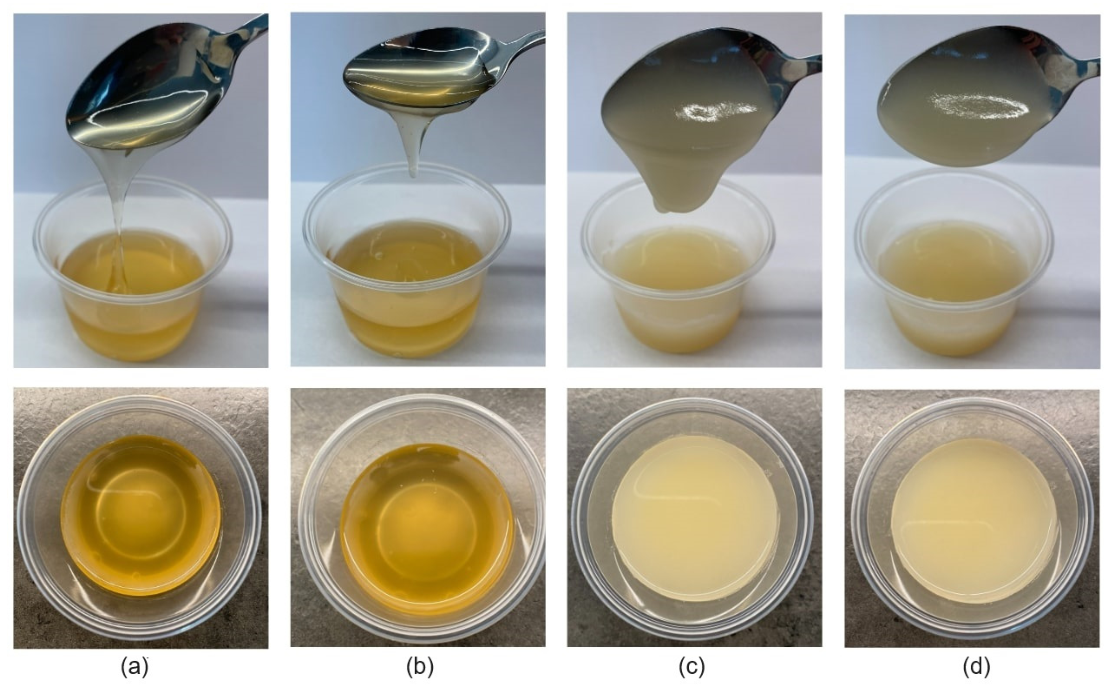
Figure 1. Visual representation of evaluated gel samples through sensory analysis. (a) AG-based gel, apple crush flavor; (b) AG-based gel, vanilla flavor; (c) BG-based gel, apple crush flavor; (d) BG-based gel, vanilla flavor.
Colloids 10 00056 g001
Figure 2. DSC records (heating at 5 °C min−1) of: (a) BG:MT series gels; (b) AG:MT series gels. * Methocel K15MCR.
Colloids 10 00056 g002
Figure 3. Percentages for the JAR levels and mean drop plots for sensory attributes. (1a,1b) AG-based gel, flavor: apple crush; (2a,2b) AG-based gel, flavor: vanilla; (3a,3b) BG-based gel, flavor: apple crush; (4a,4b) BG-based gel, flavor: vanilla.
Colloids 10 00056 g003
Table 1. Viscosity of pristine AG or BG gels and their sweetened counterparts.
Composition
(wt.%)
κ
(µS/cm)
Δfush
(J/g)
Total Water
(% w/w)
Freezing Water
(% w/w)
Non-Freezing Water
(% w/w) *
Viscosity **
(mPa·s)
BG:MT 3:131531296.092.0 ± 1.04.0 ± 0.91030
BG:MT 3:1 (5% PT)1643nc91.5nc870
BG:MT 3:1 *1978nc96.0nc880
BG:MT 3:1.616631795.593.5 ± 1.02.0 ± 0.917,440
BG:MT 3:1.6 (5% PT)153928890.985.0 ± 1.05.9 ± 0.88820
BG:MT 3:1.6 (10% PT)172526586.978.2 ± 1.08.7 ± 0.87700
BG:MT 3:1.6 (2% AG)2210ncncnc1540
BG:MT 3:2 160230495.189.7 ± 1.05.4 ± 0.937,170
BG:MT 3:2 (5% PT)nc28290.683.2 ± 1.07.4 ± 0.875,620
BG:MT 3:2 (10% PT)154025586.675.2 ± 1.011.4 ± 0.813,310
BG:MT 3:2 (10% SU)144nc86.6nc370
BG:MT 3:2 (30% PT)96419773.558.2 ± 1.015.3 ± 0.612,000
BG:MT 3:3195130294.289.1 ± 1.05.1 ± 0.9236,360
AG:MT 2:12210nc97.0nc-9190
AG:MT 3:2274030995.191.2 ± 1.03.9 ± 0.95360
AG:MT 3:2 *291031395.192.3 ± 1.02.8 ± 0.97740
AG:MT 2:3269030795.190.6 ± 1.04.5 ± 0.941,440
AG:MT 2:2249031196.191.7 ± 1.04.4 ± 0.915,130
AG:MT 2:2 (5% PT)205028491.683.8 ± 1.07.8 ± 0.815,140
AG:MT 2:2 (10% PT)197326987.579.4 ± 1.08.1 ± 1.04940
AG:MT 2:2 (10% SU)496nc87.5nc530
AG:MT 4:13100nc95.0nc360
AG:MT 4:2nc31894.193.8 ± 1.00.3 ± 0.96050
AG:MT 4:2 (5% PT)nc27289.780.2 ± 1.09.5 ± 0.82890
AG:MT 4:3245029993.288.2 ± 1.05.0 ± 0.9113,260
AG:MT 4:3 (5% PT)414027888.982.0 ± 1.06.8 ± 0.817,110
Note: SU = sucrose; PT = palatinose; nc = test not conducted; Δfush = specific enthalpy of melting, pH of pristine gels 6.75–7.48, pH of other compositions 4.35–5.25, * Methocel K15MCR; ** standard deviation (±) for all measurements was less than 0.03.
Table 2. Textural properties and syneresis of the samples studied.
Composition
(wt.%)
Syneresis
(%)
Firmness
(g), SD
Consistency
(g.s), SD
Cohesiveness
(g), SD
Work of Cohesion
(g.s), SD
AG:MT 2:10.189.53 ± 0.17129.52 ± 4.83−10.08 ± 0.92−24.67 ± 1.10
AG:MT 2:30.0729.18 ± 0.82232.35 ± 2.39−19.07 ± 0.48−95.61 ± 2.00
AG:MT 2:3 *0.2012.13 ± 0.04125.05 ± 1.94−9.78 ± 0.37−31.51 ± 0.57
AG:MT 3:2 *0.0913.12 ± 0.13123.77 ± 1.70−10.15 ± 0.03−35.68 ± 0.96
AG:MT 2:20.1213.24 ± 0.59128.48 ± 3.65−12.14 ± 0.56−39.94 ± 3.69
AG:MT 2:2 (5% PT)0.0916.17 ± 0.61145.83 ± 3.64−14.08 ± 0.50−53.69 ± 8.69
AG:MT 2:2 (10% PT)0.0912.1 ± 0.10275.82 ± 2.00−12.50 ± 0.30−12.50 ± 0.31
BG:MT 3:141.9210.2 ± 0.21122.24 ± 0.46−10.65 ± 0.63−34.63 ± 2.00
BG:MT 3:1.638.7522.51 ± 0.09193.86 ± 1.00−18.77 ± 0.22−78.13 ± 6.40
BG:MT 3:1.6 (5% PT)43.0411.50 ± 0.18125.88 ± 1.52−12.21 ± 0.17−35.99 ± 1.40
BG:MT 3:1.6 (10% PT)39.8816.62 ± 1.71295.32 ± 2.91−14.60 ± 0.41−58.10 ± 1.81
BG:MT 3:2 (5% PT)36.0537.07 ± 0.21479.25 ± 1.25−22.72 ± 0.89−238.48 ± 1.06
BG:MT 3:2 (10% PT)0.1723.47 ± 0.92201.56 ± 6.2517.77 ± 0.21−81.79 ± 2.42
BG:MT 3:2 (30% PT)nc37.47 ± 1.85308.85 ± 5.21−24.57 ± 3.14−176.25 ± 6.74
BG:MT 3:335.8320.38 ± 0.87169.63 ± 4.54−15.41 ± 0.83−63.09 ± 2.37
Note: bold = pristine composition, * Methocel K15MCR, PT = palatinose, nc = test not conducted, pH = pristine gels 6.75–7.48, other compositions 4.35–5.25.
Table 3. Duncan and REGWQ tests (ANOVA) for sensory attributes.
SampleAppearance, SDSmell,
SD
Taste,
SD
Aftertaste, SDOverall Preference, SD
AGAC6.45 ± 1.39 a6.90 ± 1.45 a7.05 ± 1.19 a6.65 ± 1.35 a6.70 ± 1.26 a
AGV6.75 ± 1.45 a5.75 ± 2.12 b6.90 ± 1.55 ab6.10 ± 1.74 ab6.20 ± 1.79 ab
BGAC5.30 ± 1.13 b5.25 ± 1.59 b5.45± 1.57 c5.35 ± 1.42 b5.55 ± 1.47 ab
BGV5.15 ± 1.18 b5.20 ± 1.54 b5.80 ± 1.85 bc5.05 ± 1.85 b5.25 ± 1.52 b
Note: a, b, c = groups within a column with different superscripts differ significantly at p ≤ 0.05; AGAC—AG-based gel, flavor: apple crush flavor; BGAG—based gel, flavor: apple crush; AGV—AG-based gel, flavor: vanilla; BGV—BG-based gel, flavor: vanilla; SD—standard deviation.
Disclaimer/Publisher’s Note: The statements, opinions and data contained in all publications are solely those of the individual author(s) and contributor(s) and not of MDPI and/or the editor(s). MDPI and/or the editor(s) disclaim responsibility for any injury to people or property resulting from any ideas, methods, instructions or products referred to in the content.