


Abstract
Non-dilute emulsions are emulsions where the concentration of the droplets is high enough for the neighbouring droplets to interact with each other hydrodynamically but is still smaller than the packed bed concentration where the droplets are packed and deformed against each other. Thus, they cover a broad range of droplet concentrations. Many emulsions encountered in industrial applications fall under this category. Non-dilute emulsions exhibit rich rheological behaviour, from a simple Newtonian fluid to a highly non-Newtonian fluid, reflecting shear-thinning, shear-thickening, yield stress, viscoelasticity, etc. In this article, the rheology of non-dilute emulsions is reviewed comprehensively. Emulsions of hard-sphere-type droplets and deformable droplets, with and without surfactants, are covered. The mathematical models describing the rheological behaviour of non-dilute emulsions are discussed. The influences of electric charge and interfacial rheology on the rheological behaviour of emulsions are covered in detail. The flocculation of droplets caused by different mechanisms, such as depletion and bridging induced by additives, and their effect on emulsion rheology are investigated thoroughly. Finally, the dynamic rheology of non-dilute emulsions is discussed, covering both pure oil–water interfaces and additive-laden interfaces. The mathematical models describing the dynamic rheological behaviour of non-dilute emulsions are described. Based on the existing theoretical and empirical models, it is possible to a priori predict the rheology of non-dilute emulsions. However, serious gaps in the existing knowledge on non-dilute emulsion rheology remain. This review identifies the gaps in existing knowledge and points out future directions in research related to non-dilute emulsion rheology.
Keywords:
emulsions; droplets; suspensions; rheology; non-Newtonian; dynamic rheology; viscoelasticity; viscosity; shear-thinning 1. Introduction
In dilute emulsions, the separation between the droplets is large enough that the droplets do not interact with each other. Provided that the deformation of droplets is small (capillary number ), dilute emulsions exhibit Newtonian rheology. The concentration of droplets in dilute emulsions is very small (volume fraction ). Every droplet could be considered as if it is suspended alone in an infinite body of matrix phase. Consequently, only single-droplet mechanics is needed to develop constitutive rheological laws for dilute emulsions.
Non-dilute emulsions are emulsions where the concentration of the droplets is large enough for the neighbouring droplets to experience hydrodynamic interactions with each other. Yet the concentration of droplets in non-dilute emulsions is not high enough to approach or even exceed the maximum packing concentration ( where the droplets just begin to touch each other. When , emulsions are called high-internal-phase-ratio emulsions (HIPREs) [1]. The rheological behaviour of HIPREs is controlled by a network of interfacial films rather than by individual droplets. Thus, the concentration of droplets in non-dilute emulsions covers the broad range of . At (typically less than ), the interaction between the neighbouring droplets just begins, and at , the droplets are jam-packed without significant deformation, that is, the undeformed droplets just touch each other (see Figure 1). In emulsions with , the droplets are no longer spherical (see Figure 1). They are deformed as they are pressed against each other, and the emulsion rheology is controlled by interfacial films. The of undeformed uniform spheres is 0.637 if the packing is a random close-packing type. For hexagonal close packing of uniform spheres, . Thus, depends on the microstructure of the emulsion.
Figure 1.
Variations in microstructure of emulsion with increase in .
2. Rheology of Non-Dilute Emulsions of Hard-Sphere-Type Droplets
In this section, we assume that the droplets in emulsions undergo only hydrodynamic interactions. Non-hydrodynamic interactions are absent. Also, the capillary number is small. Thus, the droplets are more like hard spheres. However, the fluid within the droplets is not stationary, as it undergoes internal circulation caused by the transfer of viscous stresses from the external phase to the droplet. Such emulsions are purely viscous in nature without any elastic effects. For dilute non-interacting emulsions, the relative viscosity is given by the celebrated Taylor’s equation [2]:
where is intrinsic viscosity, which depends on viscosity ratio . For rigid particles, , the intrinsic viscosity becomes the Einstein value of . Note that is defined as the ratio of emulsion viscosity to continuous-phase (matrix) viscosity . According to Equation (1), the relative viscosity increases linearly with concentration of droplets for dilute emulsions. However, the non-dilute emulsions exhibit an exponential rise in relative viscosity, and they also exhibit non-Newtonian pseudoplastic rheology due to interactions between the droplets.
2.1. Dimensional Considerations
Neglecting any Coulombic and van der Waals interactions, the viscosity of an emulsion is expected to be a function of the following variables: shear rate (), time (), continuous-phase or matrix viscosity (), dispersed-phase viscosity (), continuous-phase density (), dispersed-phase density (), droplet radius (R), concentration of particles, that is, number density (), thermal energy (), and interfacial tension (). Thus,
As there are three basic dimensions involved in expressing all these variables, that is, mass, length, and time, and there are 11 variables, the total number of independent dimensionless groups that can be formed is 11 − 3 = 8. The dimensionless groups are: relative viscosity (), reduced time (, reduced density (), viscosity ratio ), volume fraction , Peclet number , capillary number , and particle Reynolds number . Thus, the dimensionless form of Equation (2) is:
Assume that the droplets are large and non-Brownian 1 such that . The density ratio is close to 1. Assume negligible deformation of droplets, , and there is steady state . Thus, Equation (3) simplifies to:
2.2. Zero-Shear Viscosity of Emulsions
The zero-shear of emulsions is a function of just two variables, and , as .
Several authors have derived theoretical models for the viscosity function for non-dilute emulsions. Oldroyd [3] derived the following expression for using the effective medium approach:
In the Oldroyd approach [3], an emulsion is initially considered as a homogeneous effective medium. The unknown rheology of the effective medium is then determined by replacing a small portion of the effective homogeneous medium by the actual components of the emulsion and demanding that if a tiny portion of the effective medium is replaced by the real components of the emulsion, then there can be no difference observed in the rheology of the emulsion. The Oldroyd model can be expanded as follows:
The Oldroyd equation simplifies to the Taylor equation, Equation (1), in the limit . The Oldroyd model is clearly an improvement over the Taylor model. However, it still severely underestimates the of emulsions when is larger than 0.1.
Yaron and Gal-Or [4] and Choi and Schowalter [5] applied the cell model approach to develop the expressions for . In the cell model approach, it is envisioned that the droplets of an emulsion reside in unit cells of the same size subjected to the same flow field. The size of the unit cell is determined from the size (radius) of droplets and their concentration (volume fraction). The Stokes equations are solved under creeping flow conditions to determine the velocity, rate of strain, and stress fields within and external to droplets. Yaron and Gal-Or [4] and Choi and Schowalter [5] utilized different boundary conditions at the cell boundary, and hence their expressions for are different. Yaron and Gal-Or assumed the cell boundary to be frictionless, whereas Choi and Schowalter assumed the cell boundary to be a rigid surface. Their expressions are as follows.
Yaron and Gal-Or:
Choi and Schowalter:
The Choi and Schowalter equation simplifies to Equation (1) in the limit , whereas the Yaron and Gal-Or equation gives the following erroneous result in the limit :
Phan-Thien and Pham [6] also developed an equation for non-dilute emulsions by applying the effective medium technique. Their equation is given as:
Unlike the other equations for relative viscosity , Equation (11) is not explicit in .
2.2.1. Predictions of Zero-Shear Viscosity of Emulsions
Figure 2 compares the versus volume fraction () plots generated from different models at . The increases nonlinearly with the increase in . The Oldroyd model, Equation (6), predicts the lowest viscosity, whereas the Choi and Schowalter model, Equation (9), predicts the highest viscosity. The order of viscosity prediction from different models is Choi and Schowalter > Yaron and Gal-Or > Phan-Thien and Pham > Oldroyd. The Oldroyd model predicts a finite value even at , whereas other models diverge at . This is unusual, as divergence of viscosity is expected at where . For example, when so that the inclusions are rigid (solid) particles, the viscosity is well known to diverge at the packed bed concentration close to 0.64.
Figure 2.
Comparison of relative viscosity versus volume fraction () plots predicted by different models when the viscosity ratio is unity.
Figure 3 compares the model predictions of relative viscosity versus viscosity ratio () at a fixed volume fraction of droplets . Interestingly, we see three distinct regions in relative viscosity versus viscosity ratio plots, namely, low-viscosity regime for where the viscosity is constant; the transition regime for where increases with the increase in ; and the high-viscosity regime for where the becomes constant. Once again, the model predictions are in the following order: Choi and Schowalter > Yaron and Gal-Or > Phan-Thien and Pham > Oldroyd.
Figure 3.
Comparison of versus plots predicted by different models (.
2.2.2. Comparisons with Experimental Data
Figure 4 compares the flow curves for four different sets of O/W emulsions with different droplet diameters but the same [7]. The average droplet diameters of emulsions are as follows: Set 1 (21.4 µm), Set 2 (9.12 µm), Set 3 (8.1 µm), and Set 4 (4.6 µm). The viscosity ratio of all emulsions is also the same, that is, . Clearly, the droplet size has a large effect on the viscosity of non-dilute emulsions, especially at a high value of , where the crowding and jamming of droplets is important.
Figure 4.
Comparison of flow curves of emulsions of different sets with different droplet diameters at the same .
The zero-shear (low stress of 0.1137 Pa) viscosity data for emulsions is shown in Figure 5 [7]. The data are shown separately for emulsions covering the different ranges of , that is, and . Interestingly, the data for all emulsions with different average droplet sizes fall on the same curve, indicating that the viscosity is independent of droplet size in the volume fraction range of . However, the droplet size effect becomes important in the high range of , where the viscosity decreases substantially when the average droplet size is increased.
Figure 5.
Zero-shear (low-shear-stress) viscosity versus for different sets with different droplet diameters.
Figure 6 compares the experimental data with theoretical predictions [7]. Although the Oldroyd model (Equation (6)) predictions are not shown, it predicts relative viscosities only slightly larger than the Taylor model (Equation (1)). Clearly, the Taylor and Oldroyd (not shown) models severely underpredict the relative viscosities of emulsions. The model of Yaron and Gal-Or overpredicts the viscosities, but the predicted values are close to the experimental data. The Choi and Schowalter model overpredicts the substantially within the range of .
Figure 6.
Comparison of experimental data with the predictions of theoretical models.
Figure 7 compares experimental data with the predictions of Equation (11) [8]. The experimental viscosity data for nine sets of O/W and W/O emulsions covering viscosity ratio over a broad range of are compared with the model predictions. Clearly, Equation (11) severely underpredicts the emulsion viscosities.
Figure 7.
Comparison of experimental viscosity data on emulsions with the predictions of Equation (11).
One serious drawback of these theoretical models is that they do not consider the effects of size and size distribution of droplets on the zero-shear . Also, the models assume that of droplets can reach as high as 1 without any divergence in at . This disagrees with experimental observations, especially in the case of droplets with , where the droplets are rigid (solid) particles. In this case, the viscosity is well known to diverge at the packed bed concentration close to 0.64. Furthermore, the rate of increase of with is predicted to be much lower by the models in comparison with the experimental data. The data shows that the rate of increase in viscosity increases sharply at high due to crowding and jamming of droplets. The models of Oldroyd (Equation (6)) and Phan-Thien and Pham (Equation (11)) severely underpredict the viscosities. The Yaron and Gal-Or model (8) describes the experimental data reasonably well only as long as is well below , that is, . However, at values larger than 0.6, both the Yaron and Gal-Or model, Equation (8), and the Choi and Schowalter model, Equation (9), severely underpredict zero-shear viscosities of emulsions.
Pal [8] reasoned that to overcome the limitations of the literature models that severely underpredict the values, especially at high , we must incorporate into the models (see Figure 1) to consider the crowding and jamming of droplets at high . At , the emulsions develop a significant yield stress, and therefore, the zero-shear viscosity diverges at . As varies with the droplet size distribution, its incorporation into the models also takes care of the dependence of viscosity on droplet size distribution. Note that zero-shear viscosity provides important information about a material’s maximum resistance to flow, and therefore, its prediction is important for initial processing steps like pumping and mixing.
2.2.3. Improved Models for Zero-Shear Viscosity of Non-Dilute Emulsions
Pal [8] proposed several improved models for the of non-dilute emulsions. He utilized the effective medium technique to derive the following equation for non-dilute emulsions:
where . Integration, using the condition at , yields the equation for non-dilute emulsions as:
In the special case of and , Equation (13) reduces to the Roscoe–Brinkman [9,10] equation for suspensions of solid particles given as:
In another development, Pal [11] developed an equation for non-dilute emulsions beginning with Equation (1) and using the effective medium technique along with the crowding of droplets:
Integration of Equation (16), using the condition at , yields the viscosity equation of non-dilute emulsions as:
In the special case of , Equation (16) reduces to the well-known Mooney [12] equation for suspensions of solid particles given as:
Pal [11] also argued that the differential equation, Equation (15), tends to overcorrect the jamming effect of droplets and proposed the following modified equation:
Integration of Equation (18), using the condition at , yields the equation for of non-dilute emulsions:
In the special case of , Equation (19) gives the following celebrated Krieger–Dougherty [13] equation for suspensions of solid particles:
Pal [14] further contended that the equations originally developed and proposed for suspensions could also be converted into equations for emulsions if in the suspension equation is replaced with the term . For example, the equation for a suspension can be expressed as:
where is a known function for suspension. This suspension equation with known can be converted into an emulsion equation as:
Based on this reasoning, Pal [14] proposed several additional relative viscosity equations for non-dilute emulsions. Mendoza and Santamaria-Holek [15] also applied Pal’s approach to convert their suspension model for emulsions as follows:
2.2.4. Comparisons with Experimental Data
According to Equation (13), the plot of versus is expected to be linear with a slope of and intercept of 1. Figure 8 and Figure 9 show the typical plots of versus for a variety of emulsions covering in the range of [8]. As expected from Equation (13), a linear relationship is observed. The slope parameter ranges from 1.184 to 1.466. This corresponds to values of 0.68 to 0.84.
Figure 8.
Experimental verification of Equation (13).
Figure 9.
Experimental verification of Equation (13).
In Figure 10, all the experimental data are plotted as versus where . Clearly, Equation (13) describes all the data very well [8].
Figure 10.
Comparison between nine sets of data with the predictions of Equation (13).
Pal [16] recently collected a large amount of zero-shear (low-capillary-number) viscosity data of emulsions and evaluated the relative viscosity models. The viscosity ratio range covered was . The range of volume fraction of droplets covered was . Figure 11 shows the data of emulsions considered by Pal [16]. The relative viscosity is plotted as a function of . A large variation in the viscosity values is observed from one set to another. One reason for the spread of relative viscosity at the same is that the λ is not the same for all systems.
Figure 11.
Data of emulsions collected from different sources.
In all the improved zero-shear viscosity models, Equations (13), (16) and (19), is the unknown parameter. Pal [16] estimated the unknown from the experimental data by plotting versus . The plot is linear, that is, extended to to estimate the . This approach to estimate from the relative viscosity data has been used for suspensions of solid particles by several authors [17,18].
The plot of versus data is shown in Figure 12 for . As expected, a linear relationship is observed with an estimated value of 0.708. It is well known that for the random packing of uniform spheres and for the hexagonal packing of uniform spheres. Thus, the estimated value for the emulsions falls in between.
Figure 12.
estimation.
Figure 13 compares predictions of Equation (13) with experimental data using the value of 0.708 as estimated in Figure 12. Interestingly, all the experimental viscosity data overlap onto a single curve, confirming the validity of scaling the relative viscosity as versus a basis as suggested by the model Equation (13). Furthermore, the data shows satisfactory agreement with the predictions of the model. Note that the range of covered in Figure 13 is much wider (1 to 105) compared with the data shown in Figure 10 (1 to 600).
Figure 13.
Comparison between data and the model predictions given by Equation (13).
Figure 14, Figure 15 and Figure 16 compare predictions of Equations (16), (19) and (23) with experimental data of emulsions. The value used is 0.708 as determined in Figure 12. Equation (16) overestimates the viscosities severely, especially when , whereas Equation (19) underestimates the viscosities over the full range of . Equation (23) also generally underpredicts the viscosities.
Figure 14.
Comparison between data and the model predictions given by Equation (16).
Figure 15.
Comparison between data and model predictions given by Equation (19).
Figure 16.
Comparison between data and model predictions given by Equation (23).
The average percentage relative error (APRE) of model prediction is estimated for each model as:
where is the total number of data points and . The subscripts “exp” and “mod” of indicate experimental and model values, respectively. The estimated APRE values are as follows: −10.43%, Equation (13) overpredicts to a small degree; −3.9 × 1024%, Equation (16) severely overpredicts; 29.09%, Equation (19) underpredicts substantially; and 20.24%, Equation (23) underpredicts substantially [16].
2.2.5. Best Available Model for Zero-Shear Viscosity of Non-Dilute Emulsions
The models presented in the preceding section (Section 2.2.4) are an improvement over the models presented earlier in Section 2.2 (Oldroyd, Yaron and Gol-Or, Choi and Schowalter, and Phan-Thien and Pham). The improvement in the models is due to the introduction of in the models. However, the APRE (average percentage relative error) is still large.
Pal [16,19] developed another model, which is much more accurate compared with other models. The model was developed using the effective medium technique and considering the aggregation of droplets in a flow field caused by the collision of neighbouring droplets:
where
Figure 17a compares the predictions of Equation (25) with the data for emulsions. The used is 0.708, the same as that used in previous comparisons. The APRE of this model is just 3%, that is, it underpredicts the viscosities slightly.
Figure 17.
(a) Comparison between data and model predictions given by Equation (25). (b) Comparison of experimental viscosity and the prediction of Equation (25) at a fixed of 0.5 but varying .
Figure 17b compares the experimental data for emulsions at a fixed value of 0.5 with the estimations of Equation (25) [19]. For , the data follows the model (Equation (25)) closely when . For , the data follows the model closely when . This could mean that the microstructure of emulsions is affected by .
2.2.6. Effect of Droplet Size and Distribution on Zero-Shear Viscosity of Non-Dilute Emulsions
The droplet size and size distribution have a strong effect on the viscosity of non-dilute emulsions, especially at volume fraction of droplets approaching the . For example, the emulsions in Figure 5 showed a negligible effect of droplet size when . However, at higher concentrations corresponding to , the viscosity of the emulsion increased substantially with the decrease in average droplet size. Figure 18 shows several additional examples where the viscosity of an emulsion shows a large increase with the decrease in droplet size [20,21].
Figure 18.
Viscosity plots of bimodal emulsions. Fine and coarse monomodal emulsions are mixed in various proportions at the same . The values for various sets shown are as follows: Set 2 (), Set 3 (), Set 4 (), and Set 5 ().
The fine emulsions in Figure 18 are much more viscous than the coarse emulsions at the same . For the emulsion data shown in Figure 18, the droplet size information is given in Table 1.
Table 1.
Droplet size information of emulsions in Figure 18.
The increase in emulsion viscosity with the decrease in average droplet size can be explained in terms of an increase in hydrodynamic interaction between the droplets. The mean separation distance between the droplets , given by the following equation [22] based on a cubical arrangement of uniform spheres decreases with the decrease in droplet size:
A decrease in the mean separation distance between the droplets with the decrease in droplet size is expected to enhance the interaction between the droplets and hence result in an increase in viscosity.
Interestingly, the viscosity of an emulsion is also affected strongly by the droplet size distribution. Figure 18 shows that the viscosity of a bimodal emulsion (mixture of fine and coarse emulsions at the same ) can be much lower than that of either fine or coarse emulsion, especially at low values of shear stress (zero-shear rate). The effect of droplet size distribution is more clearly shown in Figure 19. For any given set, the fine emulsion exhibits a much higher viscosity than the coarse emulsion, as expected. However, the bimodal (mixed fine and coarse) emulsion exhibits viscosities even lower than that of the coarse emulsion at low values of fine-emulsion content, clearly demonstrating the effect of droplet size distribution on emulsion viscosity. Furthermore, the viscosity of the mixed emulsion goes through a minimum value at a certain content of the fine emulsion (around 0.20 to 0.30) [20].
The decrease in viscosity of a mixed emulsion upon the addition of a fine emulsion to a coarse emulsion can be justified in terms of , the packing volume fraction of droplets. According to the relative viscosity models described in the preceding sections, the higher the , the lower the emulsion viscosity. The is expected to increase with the addition of a fine emulsion to a coarse emulsion, as fine emulsion droplets can easily fit into the voids between large droplets, and as a result, one can incorporate a higher concentration of droplets into the emulsion to reach a packed bed structure.
Based on the size distribution data, the can be estimated from the analytical model of Ouchiyama and Tanaka [23]. The expression according to the Ouchiyama and Tanaka theory [23] is given as:
where
In Equations (28)–(30), is the of monodisperse emulsion, is the number fraction of droplets of diameter , is the number average diameter of the emulsion, and the abbreviation is defined as:
Figure 20 shows the plots of for bimodal emulsions as a function of the volume fraction of fine emulsions. In calculating the values of from the Ouchiyama and Tanaka theory, Equations (28)–(30), the value of is taken as 0.74. The plots of versus volume fraction of fine emulsion exhibit a maximum value at a certain content of the fine emulsion. Interestingly, the maximum in occurs almost at the volume fraction of the fine emulsion where a minimum in viscosity is observed (see Figure 19). Also, note that the value of increases with the decrease in , the ratio of fine emulsion to coarse emulsion diameters.
Figure 20.
Variation of with fine emulsion content of bimodal emulsions, as predicted by the Ouchiyama and Tanaka theory.
The improved emulsion viscosity models involving (for example, Equation (25)) and discussed in the preceding sections could be used to predict the viscosities of multimodal emulsions. For simplicity, we will consider emulsions with . We utilize the model expressed in Equation (25) to determine the influence of droplet size modality on . When , the model becomes:
Consider a bimodal emulsion composed of two fractions of droplets: coarse-droplet fraction and fine-droplet fraction (see Figure 21). Let be the concentration of fine droplets in the mixture of fine droplets and dispersion medium (excluding large droplets), be the concentration of large droplets in the overall emulsion, and be the total concentration of all droplets in the emulsion. Thus,
where , , and are the volumes of the dispersion medium (matrix liquid), fine droplets, and large droplets, respectively, in the whole emulsion.
Figure 21.
Bimodal emulsion.
If the fine droplets are assumed to be very small in comparison with the large droplets, the fine-droplet fraction can be treated as a homogeneous phase with respect to the large droplets. Thus,
where is the overall viscosity, is the viscosity of the fine emulsion fraction, is the continuous-phase viscosity, and is the function given by Equation (25). Using Equations (35) and (36), the of the whole emulsion can be expressed as [16]:
Combining Equations (33) and (37), we obtain:
The unknown volume fractions and can be calculated if we know the values of and fraction of coarse droplets as follows:
Note that:
Figure 22 shows the of bimodal emulsions as a function of at various values of . The value used is 0.7405, that is, hexagonal close packing concentration.
Figure 22.
of bimodal emulsions as function of for different values of .
According to Figure 22, a large drop in is observed upon the conversion of a monomodal emulsion to a bimodal emulsion, keeping constant. The effect of size modality is large when . Furthermore, the of a mixed emulsion shows a minimum at some content of fine droplets , as observed experimentally in Figure 19. In Figure 19, it is observed that the viscosity of the mixed emulsion experiences a minimum value of a fine emulsion proportion around 0.20 to 0.30. The model predictions (Figure 22) also exhibit a minimum around a fine emulsion proportion of 0.30.
2.3. Effect of Reynolds Number on Emulsion Viscosity
The discussion so far is restricted to zero-shear viscosity of non-dilute emulsions. Non-dilute emulsions generally exhibit pseudoplastic behaviour caused by clustering and breakup of clusters even when and there is negligible deformation of droplets. In shear flow, the droplets undergo frequent collisions and form aggregates (see Figure 23), which translate and rotate with the emulsion flow (see Figure 24) [7,24,25,26,27]. The size of the clusters is related to the Reynolds number, defined as:
where , , and are matrix density, droplet radius, and matrix viscosity, respectively. The average cluster size decreases with the increase in , resulting in a decrease in the emulsion viscosity.
Figure 23.
Flocculation of droplets in flow of emulsion.
Figure 24.
Formation and rotation of collision doublets.
The viscosity data of shear-thinning non-dilute emulsions can be scaled in terms of versus regardless of the droplet size (at a fixed ). Pal [7,24,28] published several articles on the rheology of non-dilute emulsions of noncolloidal droplets assuming the capillary number to be small (→ 0). As an example, Figure 25 shows the versus data of Pal [7] for non-dilute emulsions at various values of . At any given , versus data for emulsions of different average droplet sizes overlap. Thus, the data for the non-Newtonian shear-thinning emulsions having different droplet sizes can be scaled very well with .
Figure 25.
Scaling of relative viscosity with .
Figure 26 shows the effect of on the versus curves for monomodal emulsions [20]. The increases with the increase in as expected. The increase in with the increase in is quite large at low . As the increases, the gap between different versus curves becomes smaller because of the shear-thinning effect.
Figure 26.
Relative viscosity with curves for monomodal emulsions showing the effect of .
The versus curves follow the model given as [20]:
where is zero-shear , is high shear limiting , and and are constants. According to Equation (43), the plot of versus is expected to be a straight line on a log-log scale. Figure 27 shows such a plot for monomodal emulsions of a Sauter mean diameter of 4.6 at different volume fractions of droplets [20]. The plots of versus are indeed linear on a log-log scale. The slope of the plots, that is, in Equation (43), is nearly the same for all the plots corresponding to different values of . However, the constant in Equation (43) varies with . Figure 27 also shows that the experimental data at different for monomodal emulsions overlap when plotted as versus , where is where .
Figure 27.
versus and for monomodal emulsions.
Figure 28 shows the plots of versus and for bimodal emulsions at a fixed but varying fractions of fine and coarse droplets. Once again, linear plots are observed and all the data fall on the same line when plotted as versus . The slope of the line is the same as in Figure 27, that is, . Thus, all the data in Figure 27 and Figure 28 could be described by the following equation [20]:
Figure 28.
versus and for bimodal emulsions at .
This appears to be a universal correlation valid for all non-dilute shear-thinning emulsions where non-hydrodynamic effects are absent and → 0. However, , , and are expected to be dependent on , , and viscosity ratio .
Pal [28] proposed another approach to correlate the relative viscosity versus data of multimodal non-dilute emulsions. According to dimensional considerations [28],
where the intrinsic viscosity is a function of viscosity ratio , given as . For a given and , is a function of only and . For example, Figure 29a shows the data for fine, coarse, and mixed kerosene-in-water emulsions at . The is not a function of alone. It also depends on the droplet size distribution. Emulsions with different proportions of fine droplets give different especially at low values of . In Figure 29b, the same data are replotted as versus . The data for fine, coarse, and mixed emulsions overlap, represented by the following empirical fit [28]:
where and .
Figure 29.
Correlation of and as a function of for bimodal emulsions at (a) versus . (b) versus .
3. Rheology of Non-Dilute Emulsions of Deformable Droplets
Figure 30 illustrates that the emulsion droplet deforms and orients with the flow field. When the shear rate is increased, the droplets become more stretched and aligned with the flow field. Consequently, even very dilute emulsions (extremely low ) exhibit shear-thinning behaviour [29,30,31,32]. Two dimensionless groups are important: λ and . The droplets in emulsions undergo internal circulation that is governed by the viscosity ratio. Upon increasing the , the droplets become more stretched and streamlined with the flow. This explains shear-thinning behaviour of emulsions regardless of whether they are dilute or non-dilute in droplet concentration.
Figure 30.
Deformed droplet in shear flow.
Frankel and Acrivos [31] derived the rheological constitutive law for infinitely dilute emulsions considering the small deformation of droplets in the flow field. Their constitutive law is given as:
where is the Jaumann derivative, is the viscous stress tensor, is the rate-of-strain tensor, and is the characteristic time constant for the emulsion given as:
Note that is given as:
where superscript indicates the transpose of a tensor, refers to the trace of a tensor, and is the unit tensor. Equation (47) predicts pseudoplastic, that is, shear-thinning, behaviour of emulsions, and viscosity is given as:
Equation (50) gives:
where and is . Thus, of a dilute emulsion is dependent on λ and . For a dilute emulsion of bubbles with , and becomes:
Pal [33] also developed a viscosity equation for infinitely dilute emulsions. He utilized the analogy between shear modulus and shear viscosity to develop his equation, given as follows:
where
The predictions of Equation (53) agree with Equation (52).
Figure 31 shows the plots of of an emulsion, defined as , as a function of for differen4t values of λ. Equation (53) is used to generate the plots. When , that is, the droplets are rigid solid particles, the intrinsic viscosity is 2.5, independent of , indicating Newtonian behaviour. For a finite , the decreases as is increased, indicating pseudoplastic non-Newtonian behaviour. At a given , increases as λ is increased. Note that the can even become negative at high when λ < 1.
Figure 31.
The effect of on emulsion .
Starting from Equation (54) and using the differential effective medium approach, Pal [33] derived the following viscosity equations for non-dilute emulsions:
where
Figure 32 shows versus plots generated from Equations (55)–(57) for two different values of at a fixed value of 0.50. The value used is 0.637. The versus plot at a given exhibits three distinct regions: constant region at low values of , a pseudoplastic region at intermediate values of , and finally a constant region, again at high values of . The is always greater than unity for all values of when . However, for a low value of 0.1, is greater than unity only when is small. At a high , becomes less than unity.
Figure 32.
Relative viscosity versus capillary number predicted by Equations (55)–(57) at . The used is 0.637 in calculations.
Figure 33 shows a comparison between data and model predictions (Equations (55)–(57)) at a low capillary number, . The data covers a broad range of , 3.906 × 10⁻⁴ ≤ ≤ 3.25 × 10⁵. The data are plotted as versus , where is given as [33]:
Figure 33.
Comparison between model predictions and data at .
Note that is the left-hand side of Equations (55)–(57). The data can be described satisfactorily with Equation (57) using a single value of 0.637. Equation (55) underpredicts the viscosities, whereas Equation (56) overpredicts the viscosities over the full range of .
Figure 34 shows a comparison between data and model (Equations (55)–(57)) predictions at a high capillary number, . The experimental data at high were obtained for magmatic emulsions with . The data are plotted as versus , where is defined in Equation (61). Once again, Equation (57) shows good agreement with the data when a value of 0.637 is used. Equation (55) underestimates the viscosities, whereas Equation (56) overestimates the viscosities at a high .
Figure 34.
Comparison between model predictions and data at .
Figure 35 and Figure 36 show comparisons between experimental and predicted profiles of versus . A value of 0.637 is used in the calculations. At high values of (Figure 35), Equation (57) gives good predictions. Equation (55) overpredicts and Equation (56) underpredicts the relative viscosities. Note that the relative viscosities are all less than one as the capillary number is large. At low values of (Figure 36), Equations (55)–(57) predict similar values of and show good agreement with the experimental data [33].
Figure 35.
Comparison between model predictions and data of as a function of .
Figure 36.
Comparison between model predictions and data of as a function of .
Pal [16] recently proposed another improved model to describe the effect of numbers on the of non-dilute emulsions. It is as follows:
This model is based on the improved model of Equations (25) and (26). In the limit , Equation (62) reduces to the model expressed in Equations (25) and (26).
4. Influence of Interfacial Rheology on the Bulk Rheology of Non-Dilute Emulsions
The bulk rheology of emulsions is strongly influenced by interfacial rheology. A clean interface is characterized by only the interfacial tension . In the presence of additives at the interface, the bulk rheological behaviour is altered. Assuming that the interface is purely viscous in nature, the interface is now characterized by two interfacial viscosities, namely, the surface-shear viscosity () and the surface-dilational viscosity , in addition to the interfacial tension. The rheological constitutive equation of a purely viscous interface is given as [29]:
where is the surface-stress tensor, is the surface rate-of-strain tensor, and is the surface unit tensor.
The bulk rheology of an emulsion is linked to the interface constitutive equation through the boundary conditions at the droplet surface. For an additive-laden interface, the tangential viscous tractions are no longer continuous at the interface, as observed in the case of a clean interface. At the droplet surface, the tangential stress discontinuity is expressed as [29]:
The normal stress discontinuity across the interface is given as [29]:
where is the stress tensor at the interface from the matrix side, is the stress tensor at the interface from the droplet side, is the surface gradient operator defined as , is the unit tensor, is the del operator, and is the outward unit normal vector.
For dilute emulsions with purely viscous interfaces, the zero-shear relative viscosity () is given as [29,34]:
where is defined as follows:
Here is the shear Boussinesq number defined as , is the droplet radius, and is the dilational Boussinesq number defined as .
For an inviscid interface, and and the tangential viscous tractions are continuous at the interface. In this case, Equation (66) reduces to the Taylor viscosity equation (Equation (1)) for dilute emulsions of spherical droplets with clean interfaces. When the interface is highly viscous, that is, , the transmission of tangential stresses from the continuous phase to the droplet phase is severely inhibited and becomes 5/2. In this case, Equation (66) reduces to the Einstein expression for the viscosity of a dilute suspension of rigid particles [33]:
Equation (66) assumes that the interfacial properties are uniform over the entire interface. If the surfactant distribution over the droplet surface is not uniform, complications could arise due to the generation of Marangoni stresses. The Marangoni stresses cause the droplets to behave more like rigid particles. However, if the surface Peclet number is very small , the Marangoni stresses can be neglected. The Peclet number is defined as:
where is the surface diffusivity of the surfactant.
Danov [35] considered the Marangoni phenomenon in emulsions and derived the following expression for the zero-shear :
where is the interfacial mobility parameter, given as:
where is the effective diffusion coefficient of the surfactant and is the Gibbs elasticity of the interface defined as:
where is the surfactant concentration.
Equation (70) reduces to Equation (66) for interfaces with negligible Gibbs elasticity (). The varies from 0 to 1, that is, . For a completely mobile interface such as bubbles without any surface additives, is 0, and for a completely immobile interface such as rigid particles, is unity. When the Gibbs elasticity of an interface is high, that is, the Marangoni effect is strong, and the parameter is unity. In this case, the expression for emulsion viscosity, Equation (70), reduces to Equation (68). For a surfactant-free clean interface, , , , and is . Thus, the expression for emulsion viscosity, Equation (70), reduces to the Taylor formula (Equation (1)). Note that only when the interface is completely mobile, that is, the dispersed phase is bubbly without any additives.
The viscosity models, Equations (66) and (70), are restricted to very dilute emulsions in the limit . Pal [36] developed models for non-dilute emulsions considering the effect of interfacial rheology. Starting with the dilute emulsion equation, Equation (70), and using the differential effective medium approach (DEMA), he developed the following models for non-dilute emulsions:
Figure 37 compares predictions of Equations (73)–(75) at a fixed volume fraction of droplets, that is, = 0.5. As can be seen, the relative viscosity of the emulsion increases with the increase in the value of the interfacial mobility parameter () from 0 (bubbly suspension) to unity (rigid particle suspension). The Danov model (Equation (70)) predicts the lowest , as this model fails to consider hydrodynamic interactions between the droplets. The predictions of the models expressed in Equation (73)–(75) are in the following order: (Equation (74)) > (Equation (75)) > (Equation (73)).
Figure 37.
Predictions of as a function of from the models expressed in Equations (70) and (73)–(75). The emulsion is 0.5.
Figure 38 shows versus plots for different values of . A of 0.637 is used. The relative viscosity increases with the increase in for a given . Pal [36] estimated for emulsions using viscosity data from emulsions and fitting Equation (75) to the data. The value of 0.637 was used. Figure 39 shows the goodness of fit of Equation (75) to individual sets of data and the corresponding effective values. In Figure 40, effective versus is plotted, where is calculated for the clean interface as . Note that the emulsions consist of interfaces coated with surfactants. The effective is generally larger than due to the presence of additives at the interface. The effect of interfacial additives is particularly important for emulsions with a low viscosity ratio, where .
Figure 38.
Relative viscosity predicted from Equation (75) for different .
Figure 39.
Comparisons between data and predictions of Equation (75).
Figure 40.
Plot of effective versus , where is calculated from the viscosity ratio = . Note that corresponds to bubbles with clean interface and corresponds to high viscosity droplets with clean interface.
5. Influence of Surface Charge on the Rheology of Non-Dilute Emulsions
The rheological properties of an emulsion are strongly affected by the presence of an electric charge, and hence an electric double layer, on the surface of the droplets. As shown schematically in Figure 41, an electrically charged droplet attracts a cloud of counter-ions. Just next to the charged droplet surface, a monolayer of immobile ions of the opposite charge is formed. This immobile layer of ions is called the Stern layer. Outside the Stern layer, the ionic cloud consists of mobile co-ions and counter-ions. This diffuse outer layer of ions is referred to as the Gouy or Debye-Huckel layer. The concentration of counter-ions is higher than that of co-ions in the diffuse layer. As one moves away from the droplet’s surface, the concentration of counter-ions gradually decreases toward the bulk concentration. The charge cloud surrounding the droplet surface, that is, the Stern and diffuse layers combined, is referred to as an electrical double layer [37].
Figure 41.
An electrically charged droplet surrounded by an ionic cloud. Variations of ionic concentration and electric potential with distance from the droplet surface are also shown.
Figure 42 shows the plots of versus data for negatively charged droplets (electrostatically stabilized emulsions) [38]. The charge density of the droplets is the same. However, the average droplet diameter varies from one plot to another. The of an emulsion is much higher when the average droplet size is small. Referring to Figure 42, the relative viscosities are in the following order at a given concentration (volume fraction) of oil droplets: . The reason for the increase in with the decrease in droplet size is an increase in electrical-double-layer thickness with respect to the droplet size. Thus, the relative double layer thickness is an important factor in governing the rheological properties of emulsions of charged droplets. Note that is the Debye length, which is a measure of electrical-double-layer thickness, and is the droplet radius.
Figure 42.
Relative viscosity of electrically charged non-dilute emulsions.
The theory for the viscosity of electrostatically stabilized dispersions has been well established. However, studies are for the most part restricted to suspensions of solid particles. Nevertheless, they are equally relevant to emulsions. The viscosity of suspensions of electrically charged particles is governed by four dimensionless groups. They are the Hartmann number (), the ion Peclet number (), the relative thickness of the electrical double layer (), and the dimensionless surface potential (). These dimensionless groups are defined as follows [27,29,37]:
where is the surface potential, is the bulk ionic strength, is the ion diffusivity, is the permittivity of the fluid, is the Boltzmann constant, is the absolute temperature, is the particle radius, is the electronic charge, and is the Debye length given as:
The Hartmann number is the ratio of electrical force to viscous force acting on the fluid. It represents the rigidity of the charge cloud. The ion Peclet number is a measure of the extent to which the motion of the fluid relative to the particle disturbs the charge cloud. The dimensionless group is the inverse of the relative thickness of the electrical double layer () with respect to the particle size. The dimensionless surface potential () is the ratio of the electrical energy to thermal energy of ions.
The constitutive equation for a dilute suspension of electrically charged spherical particles under the condition that the distortion of a charge cloud by fluid motion is small, that is, , can be expressed as [29,37]:
where is the primary electroviscous coefficient, which depends on three dimensionless groups (assuming ), that is,
From Equation (81), it follows that
Several theoretical studies have been done to predict the primary electroviscous coefficient [37,39,40,41,42,43,44]. The predictive equations for are summarized in Table 2.
Table 2.
Primary electroviscous coefficient for dilute suspensions of solid particles.
For concentrated suspensions, the electroviscous coefficient also depends on . The for concentrated suspensions is defined according to the modified form of Equation (83) [42]:
where is given as:
Note that when (uncharged particles), Equation (84) becomes the Simha equation for non-dilute suspensions of uncharged particles.
For arbitrary surface potential and thin double layers, Ohshimo [44] has developed the expression for for non-dilute suspensions of solid particles using the cell model approach. His model is listed in Table 3. An important point to note is that for non-dilute suspensions considers the interaction of double layers of neighbouring particles assuming there is no overlap of double layers. Thus, considers both primary and secondary electroviscous effects.
Table 3.
Electroviscous coefficient for non-dilute suspensions of solid particles.
Figure 43 shows the electroviscous coefficient variation with for different values of dimensionless surface potential obtained from the Ohshimo model for concentrated suspensions described in Table 3. For a given , the electroviscous coefficient increases as increases. However, at a given value of , initially increases with , reaches a maximum value, and later falls off with a further increase in . This can be seen more clearly in Figure 44.
Figure 43.
Variation of with for concentrated suspensions. The value is 30. The electrolyte is KCl.
Figure 44.
Variation of with surface potential at different particle concentrations . The value is 30. The electrolyte is KCl.
There are no theoretical models available for the electroviscous coefficient for concentrated emulsions. However, the scaling of of concentrated emulsions could be readily achieved using the effective concentration of droplets defined as:
where is the thickness of the electrical double layer. The thickness of the double layer can be estimated using the intrinsic viscosity measurements of dilute emulsions [38]. For the van der Waarden emulsions of negatively charged oil droplets (see Figure 42), values estimated from intrinsic viscosity measurements are as follows: nm for emulsions with droplet diameter of 205 nm, nm for emulsions with droplet diameter of 102 nm, nm for emulsions with droplet diameter of 58.5 nm, and nm for emulsions with droplet diameter of 27.5 nm. In Figure 45, the data of Figure 42 is replotted as a function of effective volume fraction of droplets given by Equation (86).
Figure 45.
Scaling of of electrically charged non-dilute oil-in-water emulsions with respect to .
The data for all the emulsions of different droplet sizes overlap into a single curve, confirming the scaling of with respect to (instead of ). Furthermore, the data is in excellent agreement with the predictions of the Pal model, Equation (25).
The Ohshimo model for concentrated suspensions addresses the effect of the “secondary electroviscous effect” only partially. However, at a high concentration of particles, the electrical double layers of neighbouring particles tend to overlap, resulting in a much stronger “secondary electroviscous effect” than considered in the Ohshimo model. The suspension now becomes shear-thinning and even develops a yield stress [27].
When charged particles come close to each other, they form doublets, which rotate together and dissipate energy. Figure 46 shows the paths of two neighbouring particles in the flow [27,39,45]. The paths followed by electrically neutral particles are quite close as compared with the paths of the charged particles subjected to electrical repulsion. Note that the spatial distribution of particles at rest is determined by the balance of Brownian and electrostatic forces. When shear force is applied to the suspension, this microstructure is affected. The electrostatic repulsion force is larger than the viscous force at low shear rates, and therefore, the radii of rotating doublets are quite large, leading to high viscosities. The radii of doublets and hence the viscosity are reduced as the viscous force dominates the electrostatic repulsion force at high shear rates.
Figure 46.
Trajectories of particles in flow. …. denotes uncharged particles with hydrodynamic interactions; ___ denotes charged particles without hydrodynamic interactions; and ---- denotes paths of charged particles according to Chan et al. [45]. Adapted from [39].
As an example, Figure 47 shows the rheological behaviour of electrostatically stabilized O/W emulsions at [46]. The emulsions were stabilized by an anionic surfactant (sodium dodecyl benzene sulfonate, SDBS). The zeta potential of the droplets varied by varying the pH. With the increase in pH, the zeta potential and electrophoretic mobility of droplets increased, as shown in Figure 48 [46]. The emulsions are highly viscous and shear-thinning due to a strong “secondary electroviscous effect”. The electroviscous effect becomes stronger with the increase in pH due to an increase in zeta potential of the droplets.
Figure 47.
The evolution of flow curves of O/W emulsions with pH. (a) Shear stress versus shear rate. (b) Viscosity versus shear rate. Adapted from [46].
Figure 48.
The variations of zeta potential and electrophoretic mobility of O/W emulsions with pH. Adapted from [46].
Figure 49 shows another example of the viscous behaviour of a concentrated electrostatically stabilized suspension. The of the suspension is 0.425 [47]. The particles are strongly negatively charged, and the ionic strength of the suspension is controlled by the addition of an electrolyte. The secondary electroviscous effect makes the suspension pseudoplastic. Furthermore, at low electrolyte concentration, the suspension shows a yield stress as reflected in the upward bending of the viscosity versus shear stress plot. Viscosity decreases substantially when the electrolyte concentration increases due to a reduction in the thickness of the electrical double layer.
Figure 49.
Viscous behaviour of suspensions of charged particles at of 0.425. Adapted from [47].
Figure 50 shows versus dimensionless shear stress for latex suspensions of charged particles at a of 0.40 [48]. Once again, the electrostatically stabilized suspensions are pseudoplastic, and their viscosity decreases with the increase in electrolyte concentration due to the decrease in double layer thickness. The suspensions develop a yield stress when the electrolyte concentrations are low, as reflected in the upward bending of the viscosity versus shear stress plot.
Figure 50.
Viscous behaviour of electrically charged suspensions at 0.40. Adapted from [48].
The effect of on the versus dimensionless shear-stress data for latex suspensions of charged particles is shown in Figure 51 [48]. The suspensions exhibit pseudoplastic behaviour even at a low of 0.05. The suspensions also develop a yield stress as reflected in the upward bending of the viscosity versus dimensionless shear stress plot.
Figure 51.
Viscous behaviour of electrically charged suspensions at different values of . Adapted from [48].
Thus, the electrostatically stabilized suspensions are shear-thinning and they also develop yield stress at low electrolyte concentrations and high . The yield stress is due to the overlap of electrical double layers and the crowding effect of particles (see Figure 52) [27].
Figure 52.
Merging electrical double layers of neighbouring particles and crowding of particles at high .
Interestingly, the suspensions of electrically charged particles also exhibit strong shear-thickening at high values close to (but less than ), where overcrowding and jamming of particles occurs. As an example, Figure 53 and Figure 54 show the viscous behaviour of non-dilute suspensions of charged silica particles [27,49]. The suspensions exhibit shear-thickening behaviour, that is, the viscosity rises sharply when the shear rate is increased. At high , a discontinuity in viscosity versus shear rate plots is also observed (see Figure 54).
Figure 53.
Viscous behaviour of suspensions of electrically charged particles. Adapted from [49].
Figure 54.
Shear-thickening in suspensions of electrically charged particles at high . Adapted from [49].
It is not clear under what conditions electrostatically stabilized suspensions exhibit yield stress and under what conditions they exhibit shear-thickening. It appears that suspensions with moderate volume fractions but thick electrical double layers (large ) tend to exhibit yield-stress behaviour, whereas suspensions at high volume fractions (but still significantly less than ) with relatively thin double layers (small ) exhibit shear-thickening. However, as the packed bed volume fraction is approached, stable suspensions coated with thin stabilizing layers almost always possess yield stress with or without any shear-thickening behaviour. This point is illustrated in Figure 55, where cornstarch suspensions exhibit shear-thickening behaviour up until without any yield stress [50]. For the suspensions possess both yield stress and shear-thickening behaviour. Note that the starch particles are not spherical, and therefore, the of starch suspensions is expected to be lower in comparison with the spherical particles.
Figure 55.
Yield stress and shear-thickening in suspensions. (a) Viscosity curves for cornstarch in water at different . The cornstarch particles have an average diameter of 14 . (b) The microscope image of cornstarch particles, indicating the absence of clustering of particles. Adapted from [50].
6. Influence of Steric Effects on the Rheology of Non-Dilute Emulsions
The presence of an adsorbed layer of surfactant and/or polymer on the surface of the droplets (see Figure 56) can have a significant effect on the rheology of an emulsion [27]. Such emulsions, referred to as sterically stabilized systems, are generally shear-thinning in nature.
Figure 56.
Droplet covered by a steric layer.
Consider the close approach of two neighbouring droplets with adsorbed layers of surfactant/polymer of thickness (see Figure 57). When , there is no steric interaction between the droplets. However, a strong steric interaction occurs between the droplets when due to overlap and interpenetration of the adsorbed layers. The steric interaction is of two types: mixing (osmotic) interaction and entropic interaction. If the matrix fluid is a good solvent for the adsorbed surfactant/polymer chains, the mixing or interpenetration of adsorbed layers is thermodynamically unfavoured, resulting in repulsion between the droplets. If the matrix fluid is a poor solvent for the adsorbed layers, the mixing/interpenetration of adsorbed layers is thermodynamically favoured, resulting in the attraction of droplets. When , the adsorbed material (for example, polymer chains) is compressed and there is a loss in configuration entropy of the adsorbed molecules. This elastic or entropic interaction causes repulsion between the droplets. The total free energy of the interaction between two droplets covered with adsorbed layers is given as [51]:
where refers to the van der Waals interaction.
Figure 57.
Interaction between droplets covered by steric layers.
The presence of an adsorbed layer of thickness increases the effective of the droplets in accordance with Equation (86). An increase in the effective of the droplets in turn increases the viscosity of an emulsion. A sterically stabilized emulsion with small droplets and a thick adsorbed layer is expected to exhibit much higher viscosity as compared with the emulsion of large droplets and thin adsorbed layers.
Figure 58 shows the viscous behaviour of sterically stabilized suspensions at different values of [52]. The radius of the particles is 80 nm and they were coated with a thick layer (60 nm) of end-grafted PDMS (polydimethylsiloxane). The actual (without the steric layer) is quite low, approximately in the range of 0.02 to 0.15. However, the effective estimated from Equation (86) varies from 0.12 to 0.81. As expected, sterically stabilized suspensions at high effective are generally pseudoplastic with a Newtonian plateau at low shear rates. However, at , the Newtonian plateau at low shear rates disappears, indicating the appearance of yield stress. The cause of yield stress in sterically stabilized suspensions is the overlap of thick steric layers and the crowding effect of particles, as illustrated schematically in Figure 59.
Figure 58.
Viscous behaviour of sterically stabilized suspensions at different values of . Adapted from [52].
Figure 59.
Merging of steric layers of neighbouring particles and crowding of particles at high .
Sterically stabilized suspensions exhibit shear-thickening under certain conditions. Figure 60 shows an example of shear-thickening observed in sterically stabilized suspensions [53]. With the increase in shear stress, a region of nearly constant shear rate develops at high stresses. The discontinuity in shear rate is reflective of the shear-thickening behaviour of the suspension.
Figure 60.
Shear-thickening in suspensions of PMMA particles at different volume fractions. The particles are sterically stabilized. Adapted from [53].
Note that the thickness of the steric layers in sterically stabilized suspensions shown in Figure 60 is relatively small, that is, is approximately 0.026 ). For sterically stabilized suspensions with large , yield-stress behaviour is expected at relatively low . Thus, to observe shear-thickening in suspensions (electrostatically or sterically stabilized), the following conditions are favourable: repulsive particles (electrically charged or sterically stabilized), a thin double layer or steric layer compared with the particle radius, and a high volume fraction of particles.
Interestingly, emulsions of deformable liquid droplets do not exhibit any shear-thickening. The inclusions must be rigid particles for shear-thickening to appear. Particle roughness also plays a role. A suspension of rough particles is more prone to shear-thickening. Figure 61 shows the shear-thickening effect in concentrated emulsions when the droplets are covered by a steric layer of solid nanoparticles [54]. Droplets covered by a steric layer of solid nanoparticles (see Figure 62), referred to as Pickering droplets, behave more like rigid particles [55].
Figure 61.
Viscous behaviour of Pickering emulsions at . Adapted from [54].
Figure 62.
Pickering droplet.
7. Rheology of Flocculated Emulsions
The flocculation of droplets induces non-Newtonian pseudoplastic behaviour in emulsions. The flocculated emulsions also possess yield stress at high volume fractions of particles. The flocculation of droplets can be induced by different mechanisms: (1) removal or suppression of the stabilizing layer (steric or electrical double layer) present on droplet surfaces; (2) Brownian motion of droplets; (3) introduction of depletion forces; and (4) promotion of bridging of droplets.
Figure 63 shows the viscosity changes that occur when sterically stabilized particles of a suspension are made attractive by suppression of the steric layer [56]. The particles of the suspension were covered by octadecyl chains forming a steric layer. The temperature of the suspension was varied to suppress the steric layer by altering the solvency of the suspending medium. The suppression of the steric layer by decreasing the temperature increased attraction between the particles, resulting in the flocculation of the particles. Consequently, the suspension became pseudoplastic. The suspension could also develop yield stress.
Figure 63.
The effect of increasing interparticle attraction on the viscous behaviour of a suspension. Adapted from [56].
Figure 64 shows the relative viscosity plots of sterically stabilized suspensions of PVC particles at a of 0.20 [57,58]. In this case, the flocculation of particles is induced by changing the solvency of the adsorbed steric layer in the dispersion medium. The quality of the solvent for the steric polymer layer can be characterized in terms of the Flory–Huggins interaction parameter (). For good solvents, , whereas for poor solvents, . For a neutral theta solvent, . Figure 64 shows that the suspension becomes highly viscous and pseudoplastic when the solvent quality of the steric layer is changed from good to poor. The suspension is highly flocculated when the solvent for the steric layer is poor.
Figure 64.
The influence of solvent quality on the steric layer, and hence the relative viscosity, on a sterically stabilized suspension where is the Flory–Huggins interaction parameter. Adapted from [57,58].
The effect of Brownian motion on the rheology of dispersions (suspensions and emulsions) is strong when the size of the droplets/particles is in the submicron or nanometer range [57,58,59,60]. Assuming that the inclusions are “hard spheres” with thin stabilizing layers (steric or electrical double layer), the rheology of such dispersions is governed by hydrodynamic interactions and Brownian motion. The rheological equation of state of Brownian dispersions under a steady state can be expressed as:
where is the shear rate, is the continuous-phase viscosity, is the radius of the inclusion (particle or droplet), is the number density of inclusions, are the densities of the dispersed and continuous phases, is the Boltzmann constant, and is the absolute temperature. Equation (88) can be written in dimensionless form as:
where is the relative density and is the Peclet number, defined as:
where is the shear stress. Assuming neutrally buoyant particles () and creeping flow (), Equation (89) reduces to:
Thus, the relative viscosity of different hard-sphere-type dispersions (emulsions/suspensions) is a function of the volume fraction of particles and the Peclet number. Consequently, dispersions of inclusions of different sizes but the same and have the same relative viscosity.
Figure 65 and Figure 66 show the viscous behaviours for latex 141 suspensions in bromoform and latex 84 suspensions in bromoform, respectively. The hydrodynamic radii of the latex particles are 141 nm for latex 141 suspensions and 84 nm for latex 84 suspensions. As both dispersions are Brownian, they exhibit strong pseudoplastic behaviour. The flow curves of Brownian suspensions at any can be described as [60]:
where and are zero-shear and infinite-shear limiting viscosities, respectively, is the shear stress and is the critical shear stress at which .
Figure 65.
Viscous behaviour of non-dilute Brownian suspensions of latex 141. Adapted from [60].
Figure 66.
Viscous behaviour of Brownian suspensions of latex 84. Adapted from [60].
Figure 67 shows the superposition of the latex suspension data of different sized particles. Clearly, the versus Peclet number plots for latex suspensions with different sized particles overlap at the same volume fraction of particles.
Figure 67.
Plots of versus for Brownian suspensions at different values of . Adapted from [60].
Figure 68 shows another example of the superposition versus data for Brownian suspensions of different particle sizes and different dispersion mediums at a fixed . The data covers suspensions of particle sizes ranging from 77 nm to 314 nm. Clearly, the scaling of data on the basis of versus is excellent.
Figure 68.
versus for Brownian suspensions. Adapted from [59].
Note that at high (), close to , suspensions of Brownian hard spheres develop a yield stress due to the crowding of particles [27,61]. The presence of yield stress in the suspension at high is indicated by an upward bend in the viscosity versus shear stress plot.
Depletion flocculation of droplets/particles is induced by the addition of “free” polymer macromolecules or micelles to the dispersion medium [51,62,63,64,65,66,67,68] of an emulsion/suspension. When the particles of a dispersion approach each other at distances smaller than the size of a polymer molecule or surfactant micelle, the polymer molecules or surfactant micelles present in the dispersion medium are forced out of the interparticle space (see Figure 69). This creates a polymer- or micelle-free (depleted) zone between the particles. As the concentration of polymers or micelles outside the interparticle space is not zero, an inward osmotic force is generated on the particles (see Figure 69), resulting in clustering of particles. Figure 69 shows depletion flocculation caused by polymer molecules, while Figure 70 shows depletion flocculation caused by micelles.
Figure 69.
Flocculation of particles caused by polymer-induced depletion.
Figure 70.
Flocculation of droplets caused by micelle-induced depletion.
Flow curves ( versus plots) of depletion-flocculated emulsions are shown in Figure 71. The flocculation of the emulsion was caused by surfactant micelles [69]. The emulsions are highly shear-thinning and flocculated (see Figure 72).
Figure 71.
Viscous behaviour of micelle-induced depletion-flocculated emulsions. Adapted from [69].
Figure 72.
Aggregation of oil droplets caused by micelle-induced depletion.
Figure 73 shows another example of depletion-flocculated emulsions. The emulsions are of the water-in-oil (W/O) type, and the is fixed at 0.29 [65]. The emulsions become shear-thinning as the surfactant concentration is increased due to depletion flocculation of water droplets (see Figure 74) caused by micelles.
Figure 73.
Viscous behaviour of micelle-induced depletion-flocculated emulsions at different surfactant concentrations.
Figure 74.
Flocculation of water droplets caused by micelle-induced depletion emulsion.
Jansen et al. [66] presented a theoretical analysis of the correlation of relative viscosity for depletion-flocculated emulsions caused by surfactant micelles. According to them, the relative viscosity can be scaled adequately using the so-called “depletion flow number” (), defined as:
where is the micelle radius and is the volume fraction of micelles. is the ratio of viscous energy needed to separate the droplets to the depletion energy that opposes this separation.
Figure 75 demonstrates the scaling of an emulsion’s relative viscosity on the basis of the depletion flow number. In Figure 75a, versus plots are shown for depletion-flocculated W/O emulsions at different surfactant concentrations. At any given , the relative viscosity increases with the increase in surfactant concentration. The same data are scaled on the basis of the depletion flow number in Figure 75b. The relative viscosity curves generally superpose when plotted against the depletion flow number. The only exception occurs for the highest surfactant concentration, which falls slightly higher than the rest.
Figure 75.
Effect of surfactant concentration on the relative viscosity of a W/O emulsion. (a) versus shear rate. (b) versus depletion flow number . The numbers in the plots indicate volume fractions of surfactant (sorbitan monostearate). The value of is 0.15 and the Sauter mean diameter of the emulsions is 3 . Adapted from [66].
Depletion flocculation can also be caused by the addition of excess or free protein in the dispersion medium. Figure 76 and Figure 77 show the flow curves for emulsions flocculated by protein (sodium caseinate). The is 0.35 in Figure 76 [67] and 0.45 in Figure 77 [68], and the protein concentration is increased. As the protein concentration of the aqueous phase is increased, the emulsions become non-Newtonian pseudoplastic due to the depletion flocculation of droplets.
Figure 76.
Pseudoplastic behaviour of protein-flocculated emulsion at different protein concentrations (35 vol% n-tetradecane, pH 6.8, 30 °C). Adapted from [67].
Figure 77.
Effect of protein content on viscosity of depletion-flocculated O/W emulsions (45 vol% n-tetradecane, pH 6.8, 30 °C). Adapted from [68].
Flocculation of inclusions can also occur by a bridging mechanism. Bridging flocculation of inclusions occurs when the polymer present in the continuous-phase fluid of the dispersion is the adsorbing type [51,70]. Bridging of particles can occur in two ways, as shown schematically in Figure 78. In Figure 78a, bridging occurs when segments of the same polymer molecule adsorb onto different particles, whereas in Figure 78b, bridging of particles occurs by entanglement of different polymer molecules adsorbed onto different particles.
Figure 78.
(a) Bridging flocculation caused by the same polymer molecule adsorbed on two or more droplets/particles. (b) Bridging flocculation caused by entanglement of different adsorbed polymer molecules.
Figure 79 shows the viscous behaviour of concentrated suspensions with adsorbing-type polymer included in the suspending medium [70]. The polymer is polyacrylic acid (PAA), present at a concentration of 1 wt%. The diameter of the particles is 80 nm. The suspensions are nearly Newtonian or slightly pseudoplastic up to a critical shear rate. However, a rapid rise in viscosity occurs above the critical value, indicating shear-thickening behaviour. After a sharp rise in viscosity, the viscosity decreases with a further increase in shear rate.
Figure 79.
Viscosity versus shear rate curves for non-dilute suspensions in the presence of polymer in the suspending medium. Adapted from [70].
The shear-thickening behaviour observed in Figure 79 is caused by polymer-bridging flocculation of particles. In the low-shear-rate region, an equilibrium exists between the formation of polymer bridges between particles and their breakup, resulting in nearly Newtonian behaviour of the suspension. The breakup of polymer bridges is caused by thermal energy, especially when the polymer is not strongly adsorbed on the particle surface. Thus, polymer bridging between the particles is reversible when the polymer does not adsorb strongly on the particle surface. Shear-thickening in these suspensions is caused by rapid stretching of polymer chains. When polymer macromolecules are rapidly elongated, the restoring force of the bridges increases the resistance to flow, and hence, a rise in viscosity occurs. However, at high shear rates, the bridges undergo breakup, resulting in pseudoplastic behaviour.
Note that when the polymer is a strongly adsorbing type, the polymer bridges formed between the particles are irreversible in nature. In this case, the suspension shows a hysteresis effect. For example, Figure 80 shows the viscosity versus shear rate plots of suspensions containing a strongly adsorbing type of polymer. The suspension behaves like a pseudoplastic fluid until the critical shear rate is reached. The viscosity rises sharply at some critical shear rate. This abrupt increase in viscosity occurs due to the shear-induced bridging of particles. The suspensions also show a hysteresis effect, as the bridging of particles by polymer molecules is irreversible. In other words, the suspension viscosities do not return to the initial values when the shear rate is lowered to values below the critical shear rate. The viscosities remain high even when the shear rate is lowered below the critical value.
Figure 80.
Viscous behaviour of suspensions at different polymer concentrations, keeping the particle concentration fixed at 5 wt% silica. Adapted from [70].
When surfactant is added to a suspension flocculated by polymer bridges, preferential adsorption of the surfactant on the particle surface occurs, resulting in the breakup of polymer bridges. As an example, Figure 81 shows the influence of surfactant addition to a suspension flocculated by polymer bridges [70]. At a high surfactant concentration of 2 wt%, all polymer bridges are disrupted, and the suspension loses its shear-thickening behaviour.
Figure 81.
Influence of surfactant on the rheological behaviour of suspension flocculated by polymer bridges. The is 0.15 and the polymer is polyacrylic acid at a concentration of 2 wt%. Adapted from [70].
Figure 82 shows the viscous behaviour of emulsions flocculated by protein (sodium caseinate) bridging [68]. The adsorption and bridging of droplets by protein is a slow process. The flow curve shifts upward to higher viscosities as the emulsion ages. With aging, the number of protein bridges between the droplets increases, causing an increase in viscosity. However, no shear-thickening behaviour is observed. It seems that the bridges undergo breakup with the increase in shear rate, resulting in shear-thinning of the emulsion.
Figure 82.
Effect of emulsion aging on the viscosity of caseinate-stabilized emulsion (35 vol% n-tetradecane, pH 6.8, 30 °C, 1 wt% protein). Upon aging, the emulsion droplets undergo bridging flocculation by protein adsorption. Adapted from [68].
8. Dynamic Rheology of Non-Dilute Emulsions
The linear viscoelastic behaviour of emulsions has been studied theoretically by Oldroyd [3] and Palierne [71]. The complex shear modulus of a dilute emulsion of identical droplets is given by the following expression derived by Palierne [71]:
where is the complex shear modulus of the continuous phase (matrix) and is given by:
In Equation (95), is the complex shear modulus of droplets and is the interfacial tension. Note that , where is the storage modulus, is the loss modulus, and is .
The Palierne equation (Equation (94)) is applicable to infinitely dilute emulsions. It cannot be applied at finite concentrations of droplets, as the hydrodynamic interaction between the droplets is ignored in its derivation. To consider the hydrodynamic interaction between droplets, Palierne extended the dilute emulsion equation (Equation (94)) using a self-consistent treatment like the Lorentz sphere method in electricity. The complex shear modulus equation for non-dilute emulsions developed by Palierne is given as:
where is given by Equation (95).
The Palierne model, Equation (96), could be rewritten in terms of storage and loss moduli as:
where
For emulsions of two immiscible Newtonian liquids, the Palierne model, Equation (96), reduces to:
where is the zero-shear viscosity, is the relaxation time, is the retardation time, and is the frequency of oscillation. and are given as:
Figure 83 shows the storage and loss moduli and Cole–Cole plots of a non-dilute emulsion () generated from the Palierne model (Equation (107)) for different values of interfacial stress . The viscosity ratio is fixed at 1, and the continuous-phase viscosity is 1 Pa·s. The plateau storage modulus at high frequencies increases with the increase in interfacial stress . The interfacial stress has a negligible effect on the Cole–Cole diagram. The Cole–Cole diagram exhibits a single frequency domain, as indicated by a single arc, due to the relaxation of the shape of droplets.
Figure 83.
Moduli and Cole–Cole plots of a non-dilute emulsion () generated from the Palierne model (Equation (107)) for different values of interfacial stress .
Figure 84 shows the storage and loss moduli and Cole–Cole plots of a non-dilute emulsion () generated from the Palierne model (Equation (107)) for different values of The interfacial stress is fixed at 100 Pa, and the is 1 Pa·s. The plateau storage modulus at high frequencies decreases with the increase in . The Cole–Cole diagram shifts to higher dynamic viscosities with the increase in .
Figure 84.
Moduli and Cole–Cole plots of a non-dilute emulsion () generated from the Palierne model (Equation (107)) for different values of .
Figure 85 shows a comparison of theoretical predictions (Palierne model, Equation (96)) with experimental data of storage and loss moduli for non-dilute emulsions [72]. The continuous phase of the emulsions was 0.82 wt% polymer (Praestol 2540 TR, Ashland Inc., Wilmington, DE, USA) solutions containing 0.5 wt% Triton X-100 as a surfactant. The dispersed phase (droplets) was a Newtonian petroleum oil of viscosity 5.8 mPa·s at 25 °C. Emulsions were prepared at three oil fractions: 0.20, 0.35, and 0.51. While the predictions of the Palierne model are in good agreement with the experimental data at 0.20, the model severely underpredicts the moduli values at higher values of .
Figure 85.
Comparisons between theoretical predictions (Palierne model, Equation (96)) and data of storage and loss moduli of non-dilute O/W emulsions.
Figure 86 shows a comparison of theoretical predictions (Palierne model, Equation (96)) with experimental data of storage and loss moduli for non-dilute suspensions of solid particles [72]. The continuous phase of the emulsions was 1.02 wt% polymer (cellulose gum) solutions containing 2 wt% Triton X-100 as a surfactant. The dispersed phase (particles) was glass beads with a Sauter mean diameter of 46 . The suspensions were prepared at four volume fractions of glass beads: 0.176, 0.289, 0.377, and 0.449. Once again, the Palierne model gives good predictions at a low of 0.176. The model severely underpredicts the moduli values at higher values of .
Figure 86.
Comparisons between theoretical predictions (Palierne model, Equation (96)) and experimental data of storage and loss moduli of non-dilute suspensions.
The drawbacks of the Palierne model are as follows: (1) It generally underestimates the values of storage and loss moduli at high concentrations of the dispersed phase, as observed in Figure 85 and Figure 86. (2) It allows the of particles/droplets to reach a value of unity. This is physically unrealistic. It may be possible for the volume fraction of particles to reach a value of unity only under the special case where the particle size distribution of the dispersion is extremely wide. Generally, the is much less than unity. For example, for random close packing of uniform spheres. (3) It fails to exhibit the divergence of the storage modulus at , especially when the dispersed phase consists of solid particles. Thus, the Palierne model does not adequately consider the crowding effect of particles and droplets.
To overcome the limitations of the Palierne model, Pal [73] derived new complex shear modulus equations for emulsions using the differential scheme and taking into consideration the crowding effect of droplets. His models are as follows:
where
Equation (111) reduces to the following equation for the suspension of solid spherical particles without interfacial tension:
For rigid spheres, , and therefore, Equation (115) further simplifies to:
Another model developed by Pal [73] for the complex shear modulus of emulsions using the differential scheme and taking into consideration the crowding effect of droplets is as follows:
Equation (116) reduces to the following equation for the suspension of solid spherical particles without interfacial tension:
For rigid spheres, Equation (118) simplifies to:
Figure 87 compares the predictions of the Pal model, Equation (116), with the experimental data ( and phase lag angle ) for solids-in-liquid suspensions prepared with spherical glass beads [74]. The Sauter mean diameter of the particles was 92 . The dispersion medium was 1.02 wt% cellulose gum. The volume fraction of solids was varied from 0.176 to 0.449. The predictions of the Pal model are in good agreement with the experimental values of complex shear modulus and phase lag angle for suspensions. The value used in the model was 0.74.
Figure 87.
Comparisons between theoretical predictions (Pal model, Equation (116)) and experimental data of and of non-dilute suspensions.
Figure 88 shows comparisons between the predictions of the Pal model, Equation (119), with the experimental data ( and phase lag angle ) for solids-in-liquid suspensions prepared with spherical glass beads (Sauter mean diameter of 92 ), considered in Figure 87 [74]. The predictions of the Pal model are in good agreement with the experimental values of complex shear modulus and phase lag angle for suspensions. However, the value used in the model is now 0.50.
Figure 88.
Comparisons between theoretical predictions (Pal model, Equation (119)) and experimental data of and of non-dilute suspensions.
While Equation (116) gives a high value of 0.74, Equation (119) gives a significantly lower value of .
The Pal models, Equations (111) and (117), overcome the limitations of the Palierne model, Equation (96), in that the crowding effect of particles/droplets is accounted for adequately. However, the Pal models are not explicit in the complex modulus of the emulsion . Furthermore, they are not easy to solve to predict the moduli of emulsions. The equations are too complicated and highly nonlinear, with no analytical solutions possible.
A new modified form of the Palierne model, Equation (96), was also proposed by Pal [72] to accurately describe the linear viscoelastic behaviour of non-dilute emulsions and suspensions. The proposed model takes into consideration the crowding effect and packing limit of particles by replacing the actual in the Palierne model (Equation (96)) with the effective given as , where is required to obey the following boundary conditions: at , at , and at Thus, the modified Palierne model proposed by Pal [72] is as follows:
One simple expression for that obeys the just-stated boundary conditions is [72]:
The predictions of the modified Palierne model, Equation (120) in conjunction with Equation (121), are compared with data in Figure 89 and Figure 90. As can be seen, the modified Palierne model describes the data of emulsions and suspensions adequately. The value used in the model predictions is 0.57 [72].
Figure 89.
Comparisons between theoretical predictions (modified Palierne model, Equation (120)) and data of storage and loss moduli of non-dilute O/W emulsions.
Figure 90.
Comparisons between theoretical predictions (modified Palierne model, Equation (120)) and data of storage and loss moduli of non-dilute suspensions.
Thus far, we have considered the dynamic rheology of emulsions with pure oil–water interfaces characterized by a uniform interfacial tension. In the presence of additives (surfactants, polymers, etc.) on the oil–water interfaces, the interface itself becomes viscoelastic in nature. The viscoelastic interface is characterized by a complex surface-shear modulus and a complex surface-dilational modulus defined as [29]:
where , , and are the surface-shear modulus, surface-shear viscosity, surface-dilational modulus, and surface-dilational viscosity, respectively.
The linear viscoelastic behaviour of emulsions with viscoelastic interfaces can be described by the generalized Palierne model, Equation (96), with defined as [71]:
where and are given as:
Thus, the storage and loss moduli of emulsions with viscoelastic interfaces can be calculated from Equations (97)–(100) using the following expressions for and :
where
As an example, Figure 91 shows the dynamic rheological behaviour of a non-dilute emulsion () with viscoelastic oil–water interfaces. The unique feature of emulsions with viscoelastic interfaces is that they exhibit two frequency domains corresponding to two plateaus in the storage modulus and two arcs in the Cole–Cole diagram. The right-hand-side arc of the Cole–Cole plot corresponds to low-frequency behaviour, and the left-hand-side arc corresponds to high-frequency behaviour. The low-frequency domain reflects elastic behaviour due to interfacial relaxation, whereas the high-frequency domain reflects elastic behaviour due to the shape relaxation of droplets.
Figure 91.
Dynamic rheology of an emulsion with viscoelastic oil–water interfaces. The plots are generated from the generalized Palierne model. (a) Storage and loss moduli. (b) Cole-Cole diagram.
9. Research Gaps and Future Directions
Although our current understanding of non-dilute emulsion rheology is good, there are still some serious gaps in the existing knowledge:
- Rigorous theories to model the rheological behaviour of non-dilute emulsions are lacking. Approximate techniques such as cell models or self-consistent and effective medium approaches are often utilized to model the rheology of non-dilute emulsions.
- There are hardly any experimental studies available on the effect of deformation (that is, capillary number) on the rheology of non-dilute emulsions. Most studies available on the effect of capillary number are restricted to magmatic emulsions of bubbles.
- Non-hydrodynamic forces, such as electrostatic, steric, van der Waals, and Brownian forces, are often ignored in the modelling of the rheology of non-dilute emulsions. Non-hydrodynamic forces are particularly important in nano-emulsions.
- Experimental studies on non-dilute emulsions dominated by non-hydrodynamic forces are lacking. This is especially the case for nano-emulsions.
- Experimental and theoretical studies on the influence of interfacial rheology on the steady shear and viscoelastic behaviours of non-dilute emulsions are scarce. For example, there is little data available on the interfacial properties, or even on how to measure them experimentally, and their effect on bulk emulsion rheology. Experimental measurements of interfacial rheological properties and their link to bulk emulsion rheology are generally lacking.
- The adsorption kinetics of surfactants on a droplet’s surface and their impact on the interfacial properties and bulk rheology need to be investigated thoroughly.
- The influence of additives such as surfactant micelles and adsorbing and non-adsorbing polymers on the rheology of non-dilute emulsions has received little attention. In such emulsions, depletion and bridging flocculation of droplets can play an important role in governing the emulsion rheology.
- There is little experimental data available on the nonlinear viscoelastic behaviour of emulsions under the application of steady shear. For example, the generation of normal stresses in the steady shear flow of emulsions is often not considered. Emulsions can exhibit a rich nonlinear viscoelastic behaviour under steady shear, especially when the droplet–droplet interactions are strong, attractive or repulsive.
- The nonlinear viscoelastic behaviour of non-dilute emulsions using large-amplitude oscillatory shear (LAOS) has received little attention. The oscillatory shear studies available are restricted to linear small-amplitude oscillatory shear (SAOS). LAOS studies can provide useful insights into the microstructure and droplet–droplet interactions of emulsions.
- Advanced experimental techniques, such as interfacial rheometry, droplet-based microfluidics, and scattering techniques, should be utilized to understand and characterize the microstructure, dynamics, and stability of non-dilute emulsions and their link to bulk rheology.
10. Conclusions
- The zero-shear viscosity of non-dilute emulsions of hard-sphere droplets depends on the volume fraction of droplets, viscosity ratio, droplet size and droplet size distribution. The effects of droplet size and droplet size distribution are important only at high values of droplet volume fraction, where crowding and jamming of droplets is strong.
- The zero-shear viscosity of non-dilute emulsions of hard-sphere droplets can be estimated accurately using the Pal model expressed in the form of Equations (25) and (26).
- Non-dilute emulsions of hard-sphere droplets exhibit pseudoplastic shear-thinning behaviour due to the shear-induced clustering and breakup of clusters. The relative viscosity of monodisperse emulsions of hard-sphere droplets (at a fixed viscosity ratio) can be scaled very well with respect to the particle Reynolds number.
- Emulsions of deformable droplets exhibit pseudoplastic shear-thinning behaviour due to the elongation and orientation of droplets with the flow. The viscosity of monodisperse emulsions of deformable droplets depends on the volume fraction of droplets, viscosity ratio, and capillary number. With the increase in capillary number, the viscosity of emulsion decreases due to the elongation and orientation of droplets with the flow.
- The viscosity of non-dilute emulsions of deformable droplets can be estimated accurately as a function of the capillary number using the Pal models expressed in the form Equations (57) and (62).
- The zero-shear relative viscosity of emulsions of non-deformable droplets (small capillary number) is also affected by the interfacial properties characterized by an interfacial mobility parameter (). For a completely mobile interface corresponding to clean bubbles, , and for a completely immobile or rigid interface, . For droplets with non-zero viscosity, depends on the viscosity ratio as well as interfacial properties, such as the Gibbs elasticity, surface-shear and dilational viscosities, if the interface is laden with additives. For clean droplets (no additives), . In the presence of additives on the droplet surface,
- The electric charge on droplets can have a strong effect on the rheology of non-dilute emulsions. This is especially the case when the electrical-double-layer thickness is more than 10 percent of the droplet radius. For emulsions with thick double layers relative to droplet radius, the emulsion tends to develop a yield stress due to overlapping double layers, even at a moderate concentration of the dispersed phase.
- Emulsions with thin double layers compared to the droplet radius can exhibit shear-thickening at high volume fractions of the dispersed phase, where crowding of droplets dominates. However, shear-thickening disappears and the emulsion exhibits a yield stress when the packed bed concentration of droplets is approached.
- Non-dilute emulsions consisting of droplets coated with thick steric layers of additives (surfactants, polymers, etc.) develop a yield stress when overlapping of steric layers occurs. Emulsions with thin double layers compared to the droplet size can exhibit shear-thickening at high volume fractions of the dispersed phase, where crowding of droplets dominates. When the packed bed concentration of droplets covered with thin steric layers is approached, shear-thickening disappears but the emulsion develops a yield stress.
- The flocculation of droplets in non-dilute emulsions can be induced by the suppression of the stabilizing interfacial layer (double layer or steric layer) or by introducing a depletion force with the addition of free surfactant micelles or free polymer in the continuous phase. When the droplets are very small (nm range), flocculation can also occur due to Brownian force. The flocculated emulsions are pseudoplastic. The incorporation of adsorbing-type polymer into the continuous phase, which adsorbs on neighbouring droplets, can cause shear-thickening in emulsions due to the stretching and resultant resistance of polymer bridges.
- The dynamic rheology of non-dilute emulsions with pure oil–water interfaces (no additives) exhibits a single relaxation behaviour, reflected in a single plateau of the storage modulus and a single arc in the Cole–Cole diagram. The relaxation behaviour is due to the shape relaxation of droplets. In the case of additive-laden oil–water interfaces, emulsions exhibit two relaxation domains, reflected in two plateaus of the storage modulus and two arcs in the Cole–Cole diagram. The two relaxation behaviours are due to the relaxation of the interface and relaxation of the shape of droplets.
- The storage and loss moduli of non-dilute emulsions in the linear viscoelastic region can be predicted reasonably well with the modified Palierne model proposed by Pal [72].
Funding
This research was funded by an NSERC Discovery grant awarded to R.P.
Data Availability Statement
The raw data supporting the conclusions of this article will be made available by the author on request.
Conflicts of Interest
The author declares no conflicts of interest.
References
- Pal, R. Rheology of high internal phase ratio emulsions and foams. Adv. Colloid Interface Sci. 2025, 339, 103426. [Google Scholar] [CrossRef] [Scilit] [PubMed]
- Taylor, G.I. The viscosity of a fluid containing small drops of another fluid. Proc. R. Soc. A 1932, 138, 41–48. [Google Scholar] [CrossRef] [Scilit]
- Oldroyd, J.G. The Elastic and Viscous Properties of Emulsions and Suspensions. Proc. R. Soc. A 1953, 218, 122. [Google Scholar] [CrossRef] [Scilit]
- Yaron, I.; Gal-Or, B. On Viscous Flow and Effective Viscosity of Concentrated Suspensions and Emulsions. Rheol. Acta 1972, 11, 241. [Google Scholar] [CrossRef] [Scilit]
- Choi, S.J.; Schowalter, W.R. Rheological properties of nondilute suspensions of deformable particles. Phys. Fluids 1975, 18, 420–427. [Google Scholar] [CrossRef] [Scilit]
- Phan-Thien, N.; Pham, D.C. Differential Multiphase Models for Polydispersed Suspensions and Particulate Solids. J. Non-Newton. Fluid Mech. 1997, 72, 305. [Google Scholar] [CrossRef] [Scilit]
- Pal, R. Shear viscosity behavior of emulsions of two immiscible liquids. J. Colloid Interface Sci. 2000, 225, 359–366. [Google Scholar] [CrossRef] [Scilit]
- Pal, R. Viscosity-concentration equation for emulsions of nearly spherical droplets. J. Colloid Interface Sci. 2000, 231, 168–175. [Google Scholar] [CrossRef] [Scilit]
- Brinkman, H.C. The Viscosity of Concentrated Suspensions and Solutions. J. Chem. Phys. 1952, 20, 571. [Google Scholar] [CrossRef] [Scilit]
- Roscoe, R. The Viscosity of Suspensions of Rigid Spheres. Br. J. Appl. Phys. 1952, 3, 267. [Google Scholar] [CrossRef] [Scilit]
- Pal, R. Novel viscosity equations for emulsions of two immiscible liquids. J. Rheol. 2001, 45, 509–520. [Google Scholar] [CrossRef] [Scilit]
- Mooney, M. The viscosity of a concentrated suspension of spherical particles. J. Colloid Sci. 1951, 6, 162–170. [Google Scholar] [CrossRef] [Scilit]
- Krieger, I.M.; Dougherty, T.J. Mechanism for non-Newtonian flow in suspensions of rigid particles. Trans. Soc. Rheol. 1959, 3, 137–152. [Google Scholar] [CrossRef] [Scilit]
- Pal, R. Single-parameter and two-parameter rheological equations of state for non-dilute emulsions. Ind. Eng. Chem. Res. 2001, 40, 5666–5674. [Google Scholar] [CrossRef] [Scilit]
- Mendoza, C.I.; Santamaria-Holek, I. The rheology of hard sphere suspensions at arbitrary volume fractions: An improved differential viscosity model. J. Chem. Phys. 2009, 130, 044904. [Google Scholar] [CrossRef] [Scilit]
- Pal, R. Recent developments in the viscosity modeling of concentrated monodisperse emulsions. Foods 2023, 12, 3483. [Google Scholar] [CrossRef] [Scilit]
- Tanner, R.I. Review article: Aspects of non-colloidal suspension rheology. Phys. Fluids 2018, 30, 101301. [Google Scholar] [CrossRef] [Scilit]
- Pal, R. Recent progress in the viscosity modeling of concentrated suspensions of unimodal hard spheres. ChemEngineering 2023, 7, 70. [Google Scholar] [CrossRef] [Scilit]
- Pal, R. New generalized viscosity model for non-colloidal suspensions and emulsions. Fluids 2020, 5, 150. [Google Scholar] [CrossRef] [Scilit]
- Pal, R. Relative viscosity of non-Newtonian concentrated emulsions of noncolloidal droplets. Ind. Eng. Chem. Res. 2000, 39, 4933–4943. [Google Scholar] [CrossRef] [Scilit]
- Pal, R. Effect of droplet size on the rheology of emulsions. AIChE J. 1996, 42, 3181–3190. [Google Scholar] [CrossRef] [Scilit]
- Shivashankar, T.S.; Enneti, R.K.; Park, S.J.; German, R.M.; Atre, S.V. The effects of material attributes on powder-binder separation phenomena in powder injection molding. Powder Technol. 2013, 243, 79–84. [Google Scholar] [CrossRef] [Scilit]
- Ouchiyama, N.; Tanaka, T. Porosity estimation for random packings of spherical particles. Ind. Eng. Chem. Fundam. 1984, 23, 490. [Google Scholar] [CrossRef] [Scilit]
- Pal, R. Scaling of relative viscosity of emulsions. J. Rheol. 1997, 41, 141–150. [Google Scholar] [CrossRef] [Scilit]
- Graham, A.L.; Bird, R.B. Particle clusters in concentrated suspensions. 1. Experimental observations of particle clusters. Ind. Eng. Chem. Fundam. 1984, 23, 406–410. [Google Scholar] [CrossRef] [Scilit]
- Graham, A.L.; Steele, R.D.; Bird, R.B. Particle clusters in concentrated suspensions. 3. Prediction of suspension viscosity. Ind. Eng. Chem. Fundam. 1984, 23, 420–425. [Google Scholar] [CrossRef] [Scilit]
- Pal, R. Non-Newtonian behaviour of suspensions and emulsions: Review of different mechanisms. Adv. Colloid Interface Sci. 2024, 333, 103299. [Google Scholar] [CrossRef] [Scilit]
- Pal, R. A novel method to correlate emulsion viscosity data. Colloids Surf. A 1998, 137, 275–286. [Google Scholar] [CrossRef] [Scilit]
- Pal, R. Rheology of Particulate Dispersions and Composites; CRC Press: Boca Raton, FL, USA, 2007. [Google Scholar]
- Schowalter, W.R.; Chaffey, C.E.; Brenner, H. Rheological behavior of a dilute emulsion. J. Colloid Interface Sci. 1968, 26, 152–160. [Google Scholar] [CrossRef] [Scilit]
- Frankel, N.A.; Acrivos, A. The constitutive equation for a dilute emulsion. J. Fluid Mech. 1970, 44, 65–78. [Google Scholar] [CrossRef] [Scilit]
- Barthes-Biesel, D.; Acrivos, A. The rheology of suspensions and its relation to phenomenological theories for non-Newtonian fluids. Int. J. Multiph. Flow 1973, 1, 1–24. [Google Scholar] [CrossRef] [Scilit]
- Pal, R. Viscous behavior of concentrated emulsions of two immiscible Newtonian fluids with interfacial tension. J. Colloid Interface Sci. 2003, 263, 296–305. [Google Scholar] [CrossRef] [Scilit] [PubMed]
- Oldroyd, J.G. The effect of interfacial stabilizing films on the elastic and viscous properties of emulsions. Proc. R. Soc. A 1955, 232, 567–577. [Google Scholar] [CrossRef] [Scilit]
- Danov, K.D. On the viscosity of dilute emulsions. J. Colloid Interface Sci. 2001, 235, 144–149. [Google Scholar] [CrossRef] [Scilit]
- Pal, R. Influence of interfacial rheology on the viscosity of concentrated emulsions. J. Colloid Interface Sci. 2011, 356, 118–122. [Google Scholar] [CrossRef] [Scilit] [PubMed]
- Pal, R. Fundamental rheology of disperse systems based on single-particle dynamics. Fluids 2016, 1, 40. [Google Scholar] [CrossRef] [Scilit]
- Van der Waarden, M. Viscosity and electroviscous effect of emulsions. J. Colloid Sci. 1954, 9, 215–222. [Google Scholar] [CrossRef] [Scilit]
- Russel, W.B. The rheology of suspensions of charged rigid spheres. J. Fluid Mech. 1978, 85, 209–232. [Google Scholar] [CrossRef] [Scilit]
- Russel, W.B. Bulk stresses due to deformation of the electrical double layer around a charged sphere. J. Fluid Mech. 1978, 85, 673–683. [Google Scholar] [CrossRef] [Scilit]
- Watterson, I.G.; White, L.R. Primary electroviscous effect in suspensions of charged spherical particles. J. Chem. Soc. Faraday Trans. 1981, 77, 1115–1128. [Google Scholar] [CrossRef] [Scilit]
- Rubio-Hernandez, F.J.; Carrique, F.; Ruiz-Reina, E. The primary electroviscous effect in colloidal suspensions. Adv. Colloid Interface Sci. 2004, 107, 51–60. [Google Scholar] [CrossRef] [Scilit] [PubMed]
- Ohshima, H. Primary electroviscous effect in a dilute suspension of charged mercury drops. Langmuir 2006, 22, 2863–2869. [Google Scholar] [CrossRef] [Scilit] [PubMed]
- Ohshima, H. Primary electroviscous effect in a moderately concentrated suspension of charged spherical particles. Langmuir 2007, 23, 12061–12066. [Google Scholar] [CrossRef] [Scilit] [PubMed]
- Chan, F.S.; Blachford, J.; Goring, D.A.I. The secondary electroviscous effect in a charged spherical colloid. J. Colloid Interface Sci. 1966, 22, 378–385. [Google Scholar] [CrossRef] [Scilit]
- Kundu, P.; Kumar, V.; Mishra, I.M. Study the electro-viscous effect on stability and rheological behavior of surfactant-stabilized emulsions. J. Dispers. Sci. Technol. 2018, 39, 384–394. [Google Scholar] [CrossRef] [Scilit]
- Wu, B.; Iwashita, T.; Chen, W.R. Scaling of shear rheology of concentrated charged colloidal suspensions across glass transition. J. Phys. Chem. B 2022, 126, 922–927. [Google Scholar] [CrossRef] [Scilit]
- Krieger, I.M.; Eguiluz, M. The second electroviscous effect in polymer latices. Trans. Soc. Rheol. 1976, 20, 29–45. [Google Scholar] [CrossRef] [Scilit]
- Boersma, W.H.; Laven, J.; Stein, H.N. Viscoelastic Properties of Concentrated Shear-Thickening Dispersions. J. Colloid Interface Sci. 1992, 149, 10–22. [Google Scholar] [CrossRef] [Scilit]
- Brown, E.; Forman, N.A.; Orellana, C.S.; Zhang, H.; Maynor, B.W.; Betts, D.E.; DeSimone, J.M.; Jaeger, H.M. Generality of shear thickening in dense suspensions. Nat. Mater. 2010, 9, 220–224. [Google Scholar] [CrossRef] [Scilit]
- Pal, R. Rheology of emulsions containing polymeric liquids. In Encyclopedia of Emulsion Technology; Becher, P., Ed.; Marcel Dekker: New York, NY, USA, 1996; Volume 4. [Google Scholar]
- Nommensen, P.A.; Duits, M.H.G.; Van den Ende, D.; Mellema, J. Steady shear behavior of polymerically stabilized suspensions: Experiments and lubrication based modeling. Phys. Rev. E 1999, 59, 3147–3154. [Google Scholar] [CrossRef] [Scilit]
- Frith, W.J.; d’Haene, P.; Buscall, R.; Mewis, J. Shear thickening in model suspensions of sterically stabilized particles. J. Rheol. 1996, 40, 531–548. [Google Scholar] [CrossRef] [Scilit]
- Wolf, B.; Lam, S.; Kirkland, M.; Frith, W.J. Shear thickening of an emulsion stabilized with hydrophilic silica particles. J. Rheol. 2007, 51, 465–478. [Google Scholar] [CrossRef] [Scilit]
- Pal, R. A Simple Model for the Viscosity of Pickering Emulsions. Fluids 2018, 3, 2. [Google Scholar] [CrossRef] [Scilit]
- Woutersen, A.T.J.M.; de Kruif, C.G. The rheology of adhesive hard sphere dispersions. J. Chem. Phys. 1991, 94, 5739–5750. [Google Scholar] [CrossRef] [Scilit]
- Russel, W.B. Review of the role of colloidal forces in the rheology of suspension. J. Rheol. 1980, 24, 287–317. [Google Scholar] [CrossRef] [Scilit]
- Wiley, S.J.; Macosco, C.W. Steady shear rheological behavior of PVC Plastisols. J. Rheol. 1978, 22, 525–545. [Google Scholar] [CrossRef] [Scilit]
- Krieger, I.M. Rheology of monodisperse latices. Adv. Colloid Interface Sci. 1972, 3, 111–136. [Google Scholar] [CrossRef] [Scilit]
- Rodriguez, B.E.; Kaler, E.W.; Wolfe, M.S. Binary mixtures of monodisperse latex dispersions. 2. Viscosity. Langmuir 1992, 8, 2382–2389. [Google Scholar] [CrossRef] [Scilit]
- Jones, D.A.R.; Leary, B.; Boger, D.V. The rheology of a concentrated colloidal suspension of hard spheres. J. Colloid Interface Sci. 1991, 147, 479–495. [Google Scholar] [CrossRef] [Scilit]
- Aronson, M.P. Flocculation of emulsions by free surfactant in purified systems. Colloids Surf. 1991, 58, 195–202. [Google Scholar] [CrossRef] [Scilit]
- Pal, R. Rheological behavior of concentrated surfactant solutions and emulsions. Colloids Surf. 1992, 64, 207–215. [Google Scholar] [CrossRef] [Scilit]
- Pal, R. Rheological behavior of surfactant-flocculated water-in-oil emulsions. Colloids Surf. 1993, 71, 173–185. [Google Scholar] [CrossRef] [Scilit]
- Pal, R. Dynamics of flocculated emulsions. Chem. Eng. Sci. 1997, 52, 1177–1187. [Google Scholar] [CrossRef] [Scilit]
- Jansen, K.M.B.; Agterof, W.G.M.; Mellema, J. Viscosity of surfactant stabilized emulsions. J. Rheol. 2001, 45, 1359–1371. [Google Scholar] [CrossRef] [Scilit]
- Dickinson, E.; Golding, M. Depletion flocculation of emulsions containing unadsorbed sodium caseinate. Food Hydrocoll. 1997, 11, 13–18. [Google Scholar] [CrossRef] [Scilit]
- Dickinson, E.; Golding, M. Rheology of sodium caseinate stabilized oil-in-water emulsions. J. Colloid Interface Sci. 1997, 191, 166–176. [Google Scholar] [CrossRef] [Scilit] [PubMed]
- Pal, R. Rheology of Blends of Suspensions and Emulsions. Ind. Eng. Chem. Res. 1999, 38, 5005–5010. [Google Scholar] [CrossRef] [Scilit]
- Otsubo, Y. Dilatant flow of flocculated suspensions. Langmuir 1992, 8, 2336–2340. [Google Scholar] [CrossRef] [Scilit]
- Palierne, J.F. Linear rheology of viscoelastic emulsions with interfacial tension. Rheol. Acta 1990, 29, 204–214. [Google Scholar] [CrossRef] [Scilit]
- Pal, R. A new linear viscoelastic model for emulsions and suspensions. Polym. Eng. Sci. 2008, 48, 1250–1253. [Google Scholar] [CrossRef] [Scilit]
- Pal, R. Novel shear modulus equations for concentrated emulsions of two immiscible liquids with interfacial tension. J. Non-Newton. Fluid Mech. 2002, 105, 21–33. [Google Scholar] [CrossRef] [Scilit]
- Pal, R. Complex shear modulus of concentrated suspensions of solid spherical particles. J. Colloid Interface Sci. 2002, 245, 171–177. [Google Scholar] [CrossRef] [Scilit]
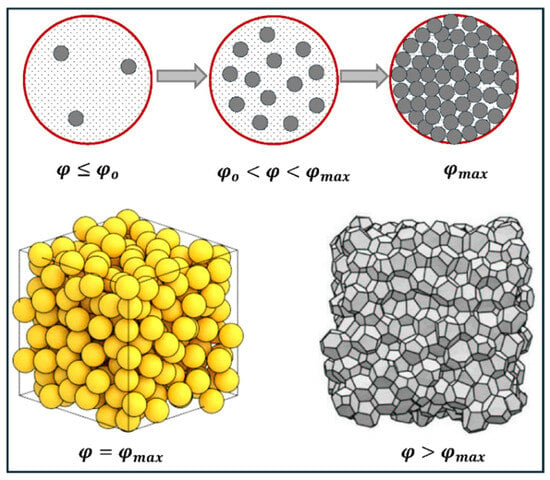
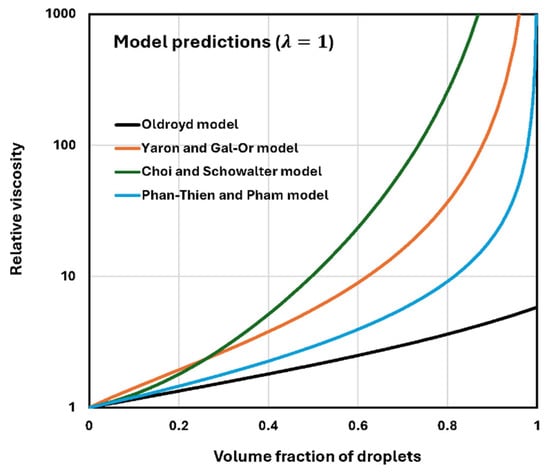
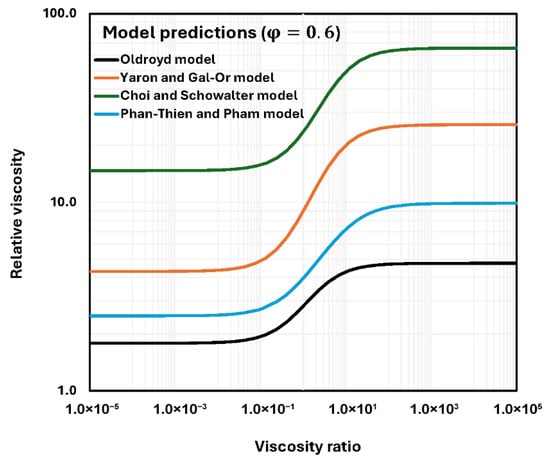
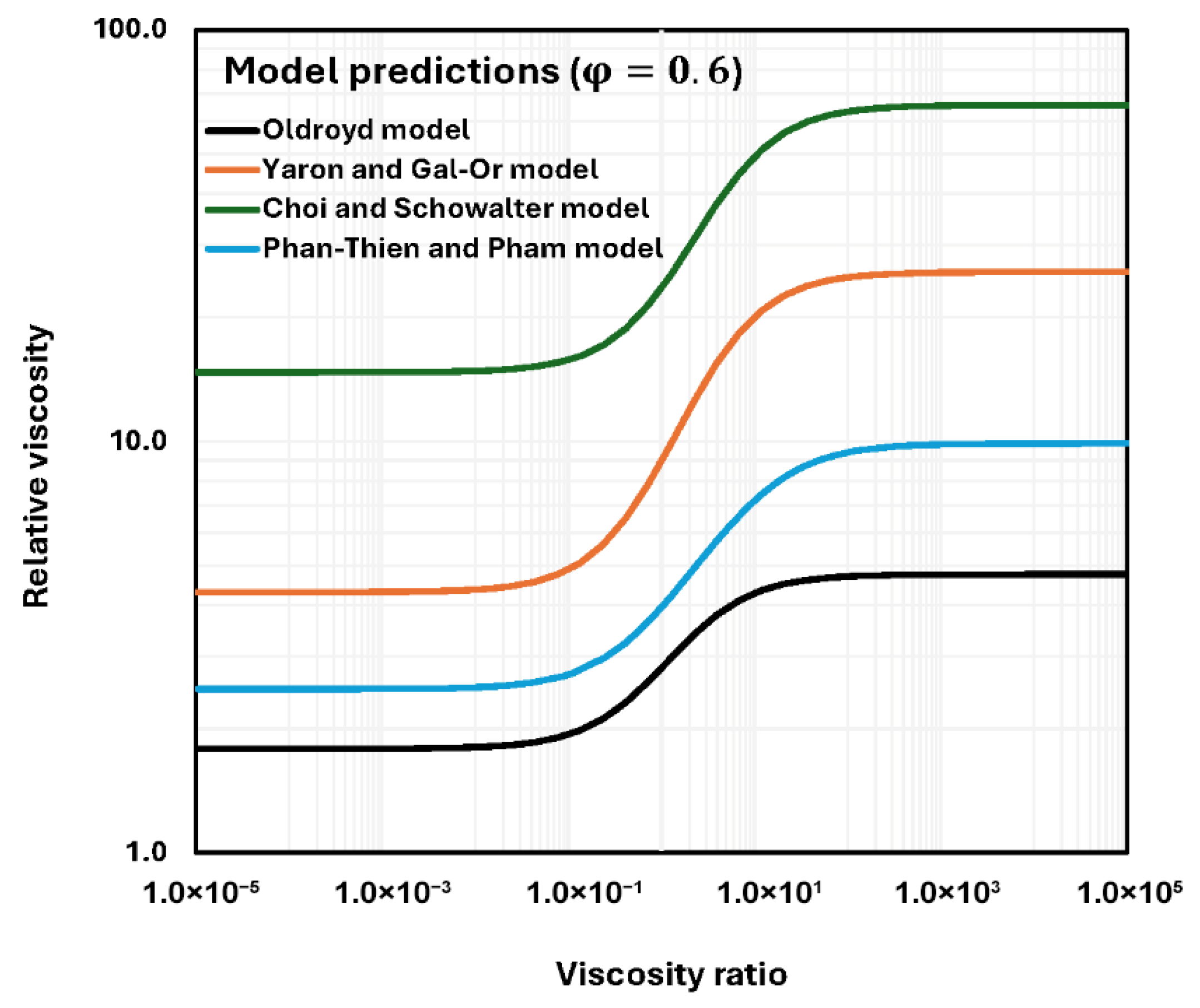
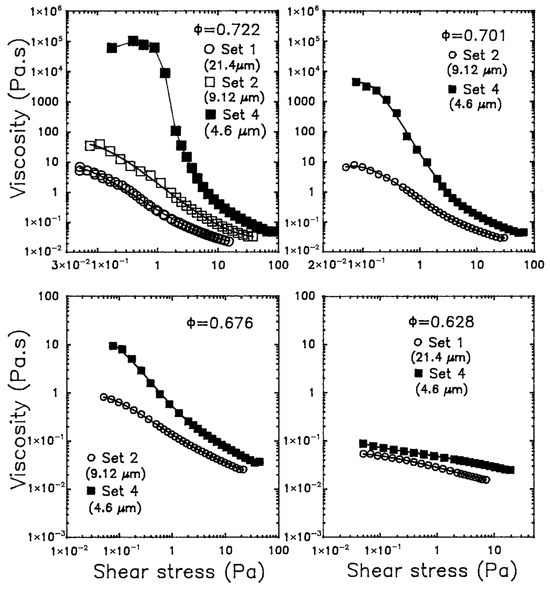
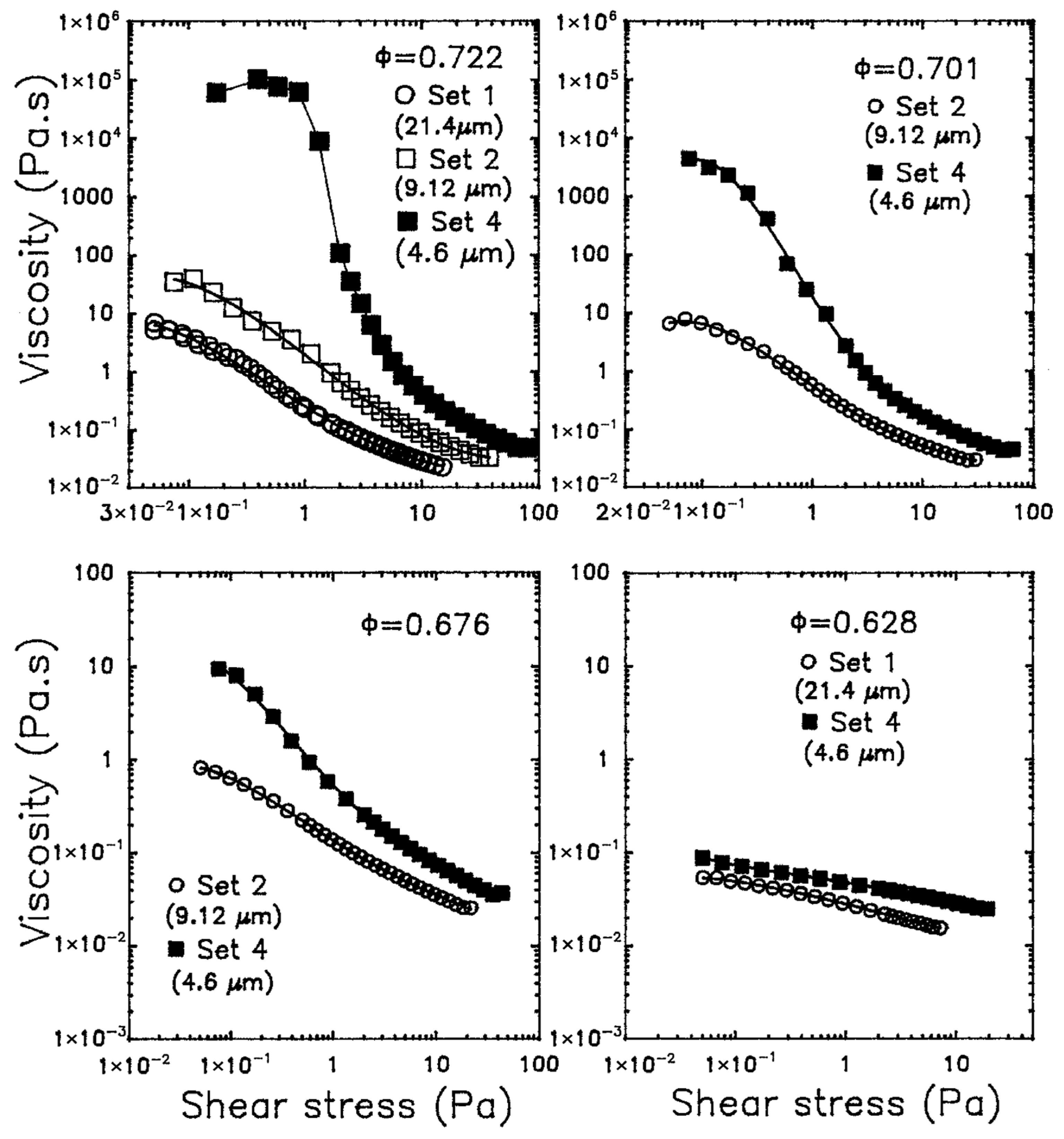
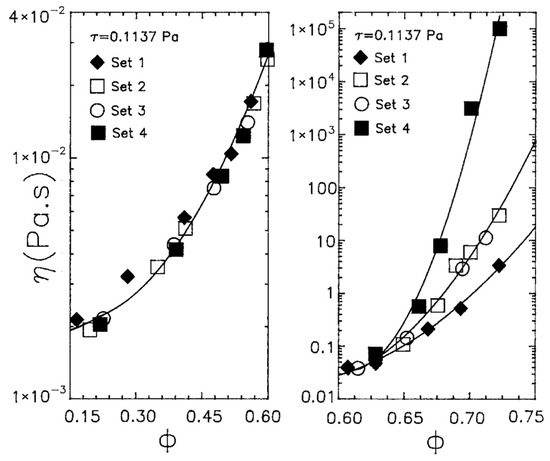
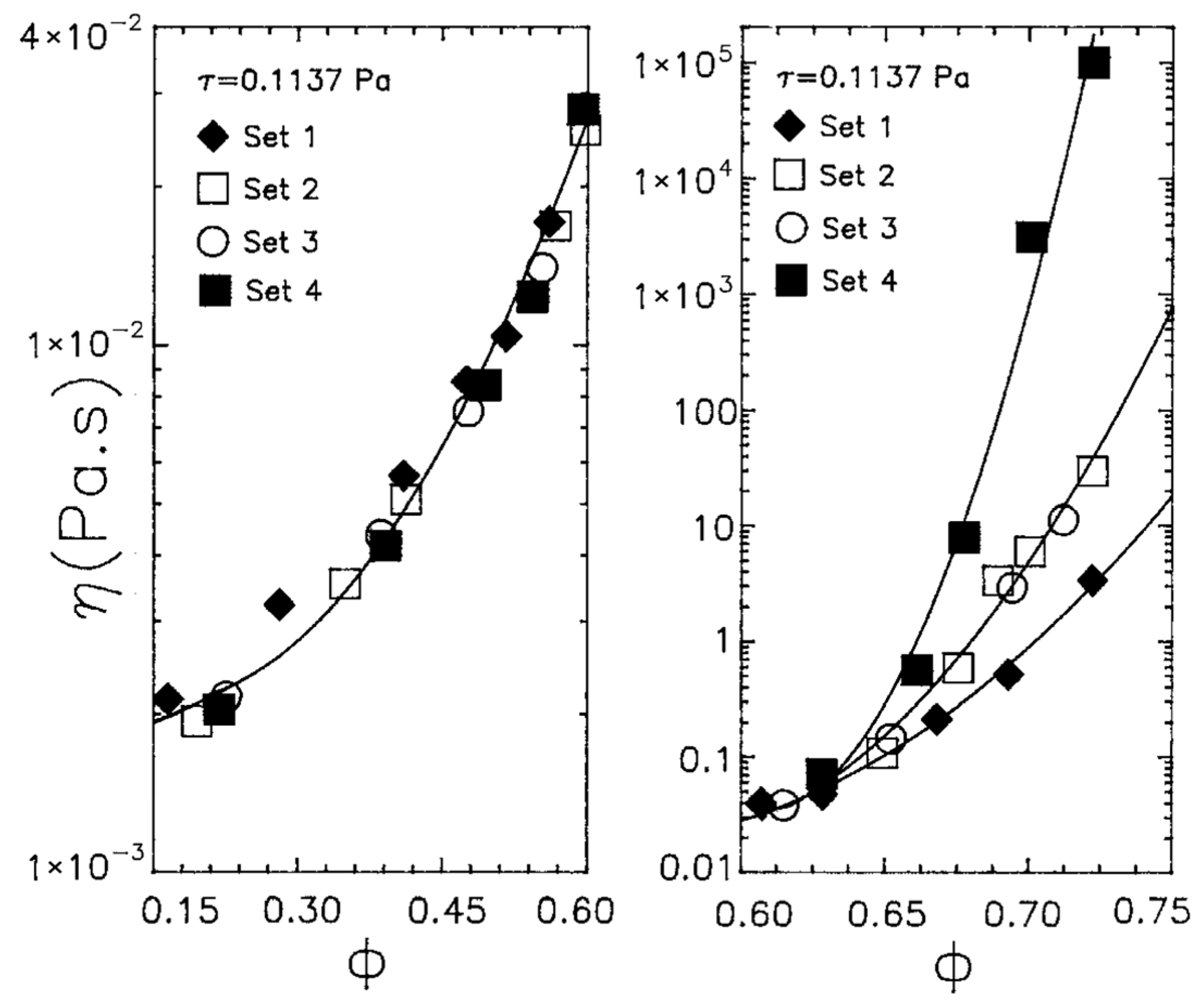
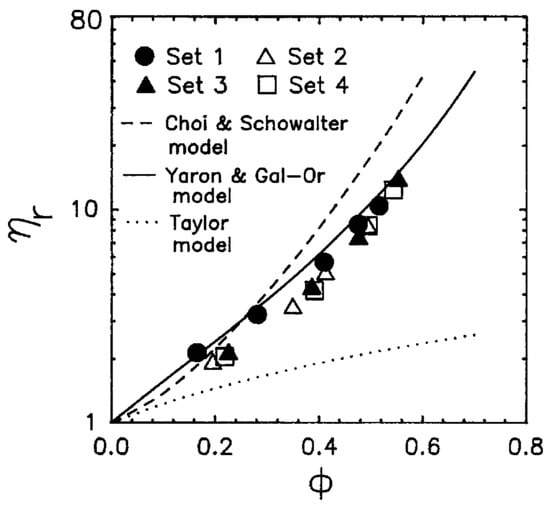
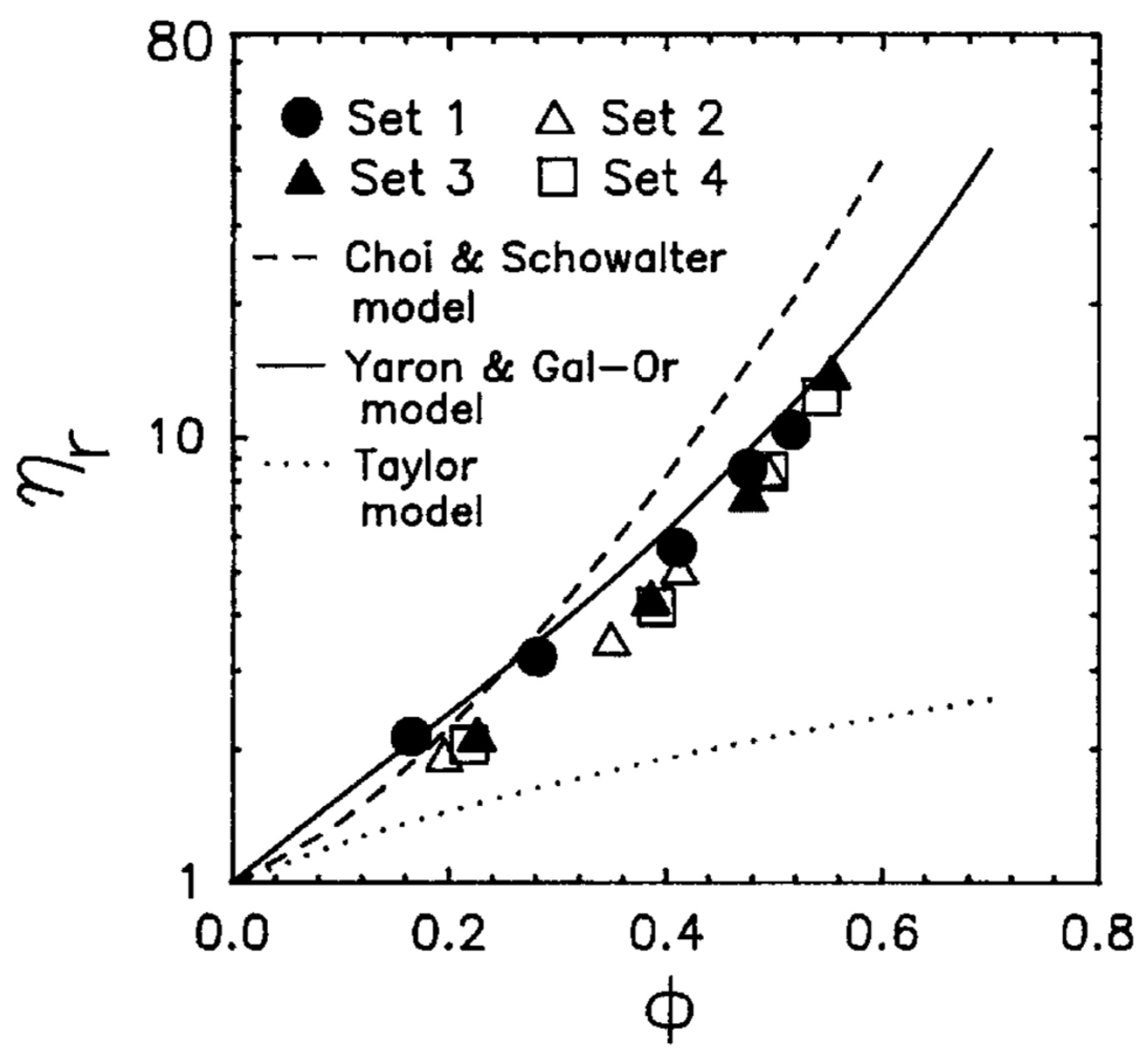
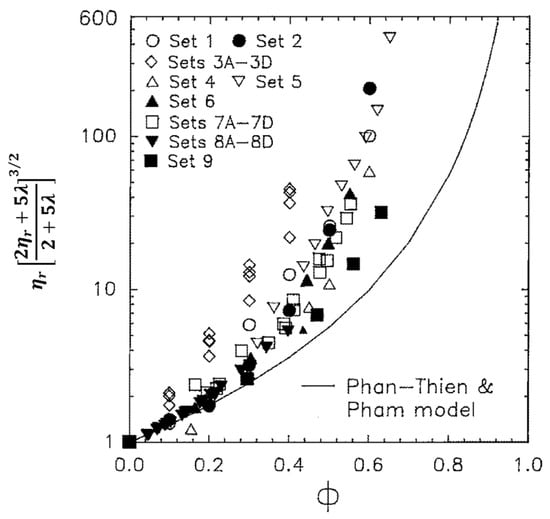
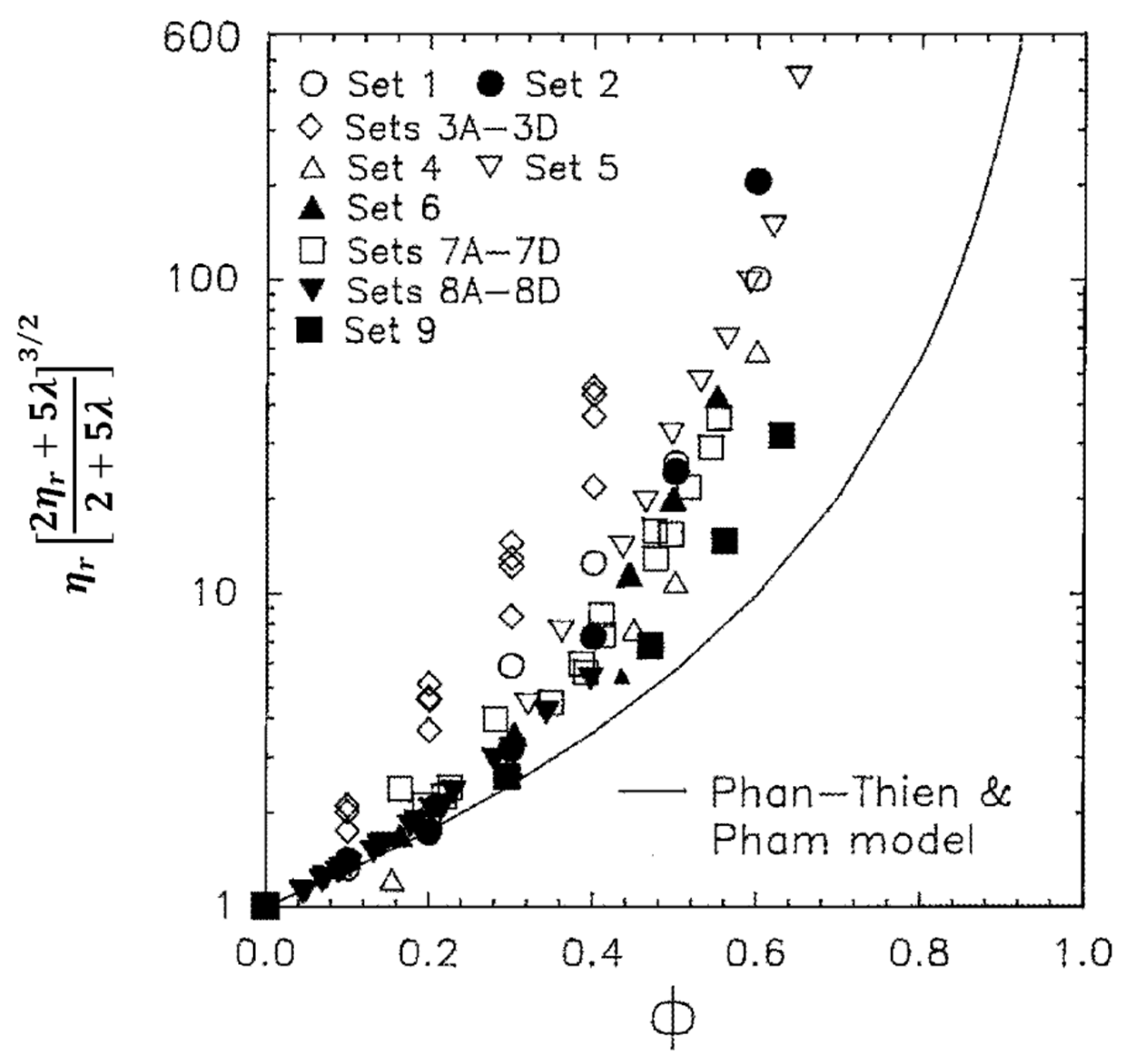
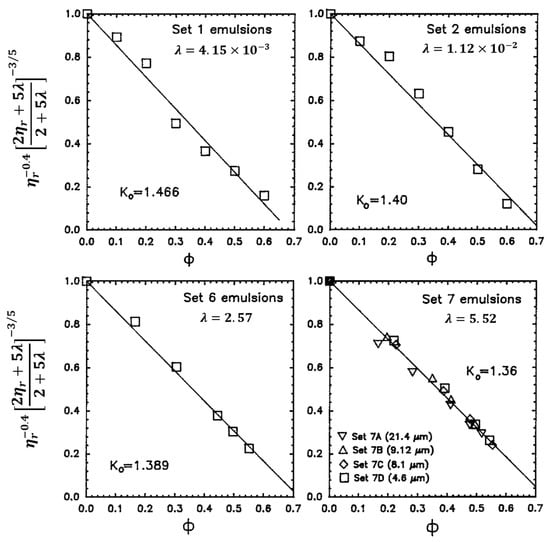
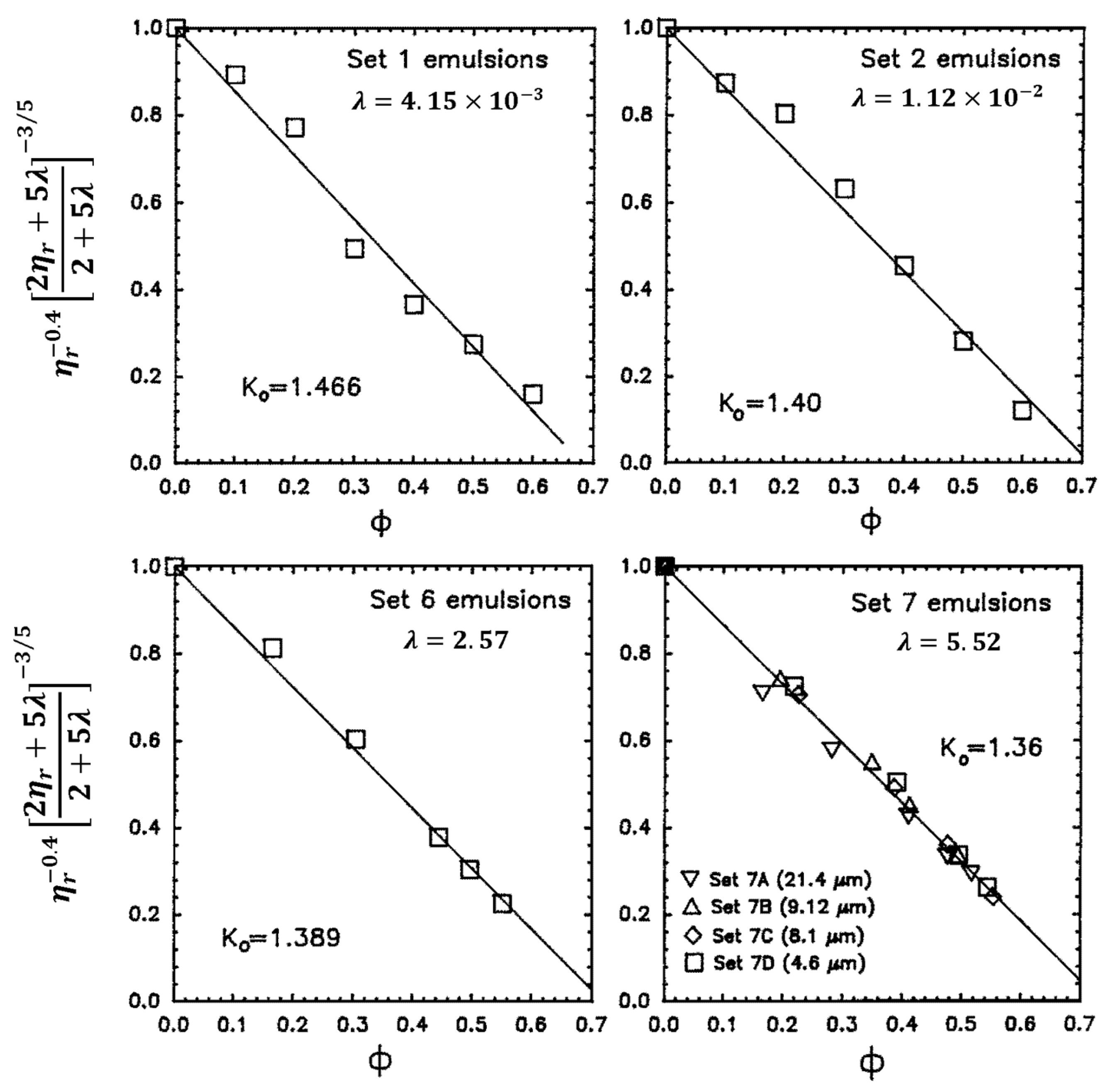
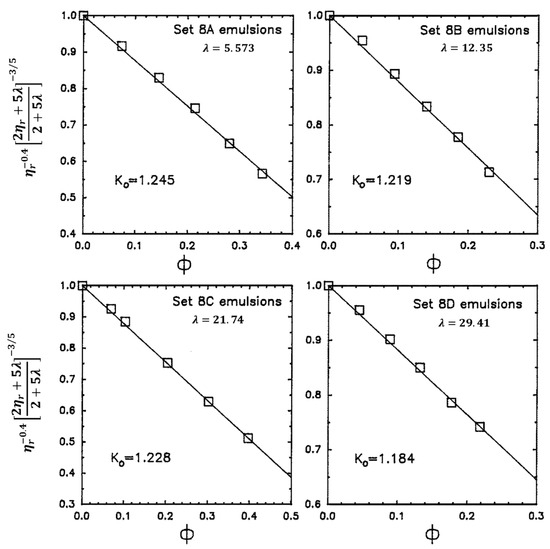
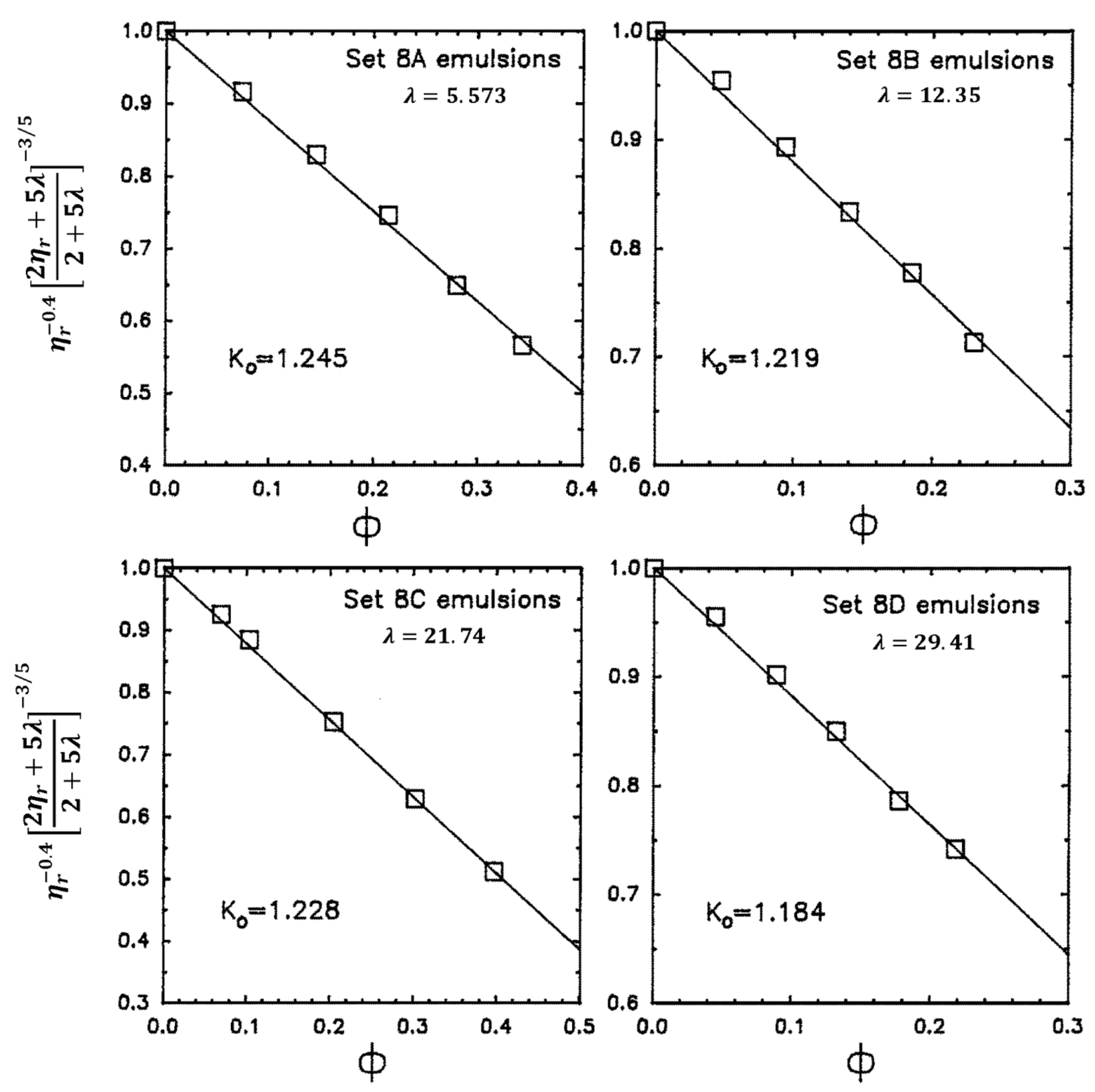
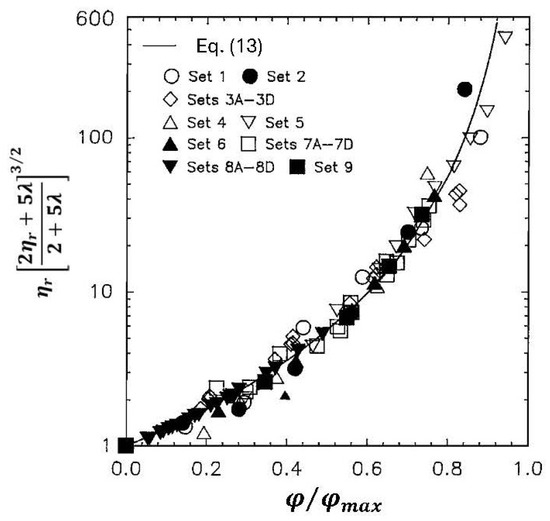
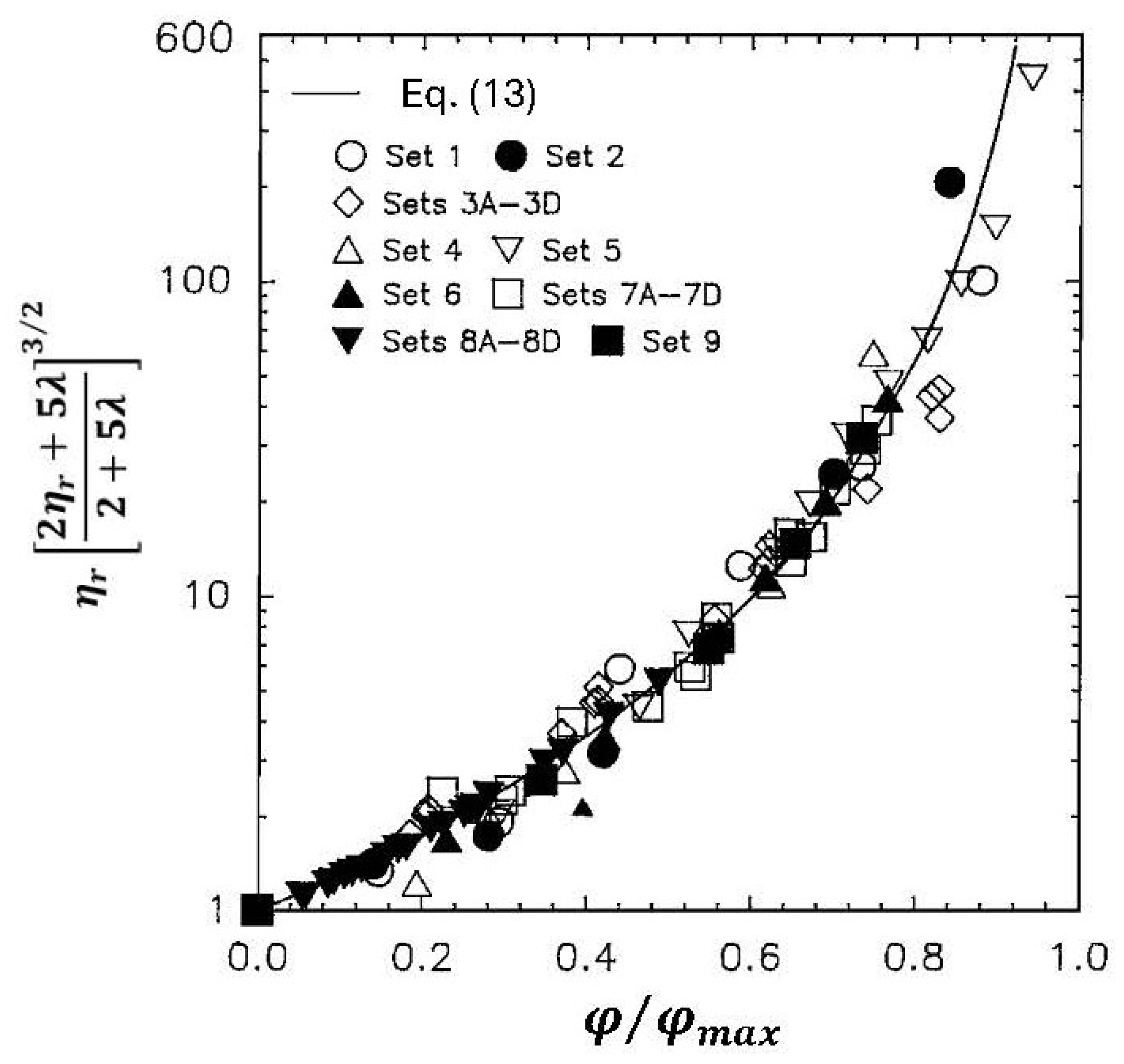
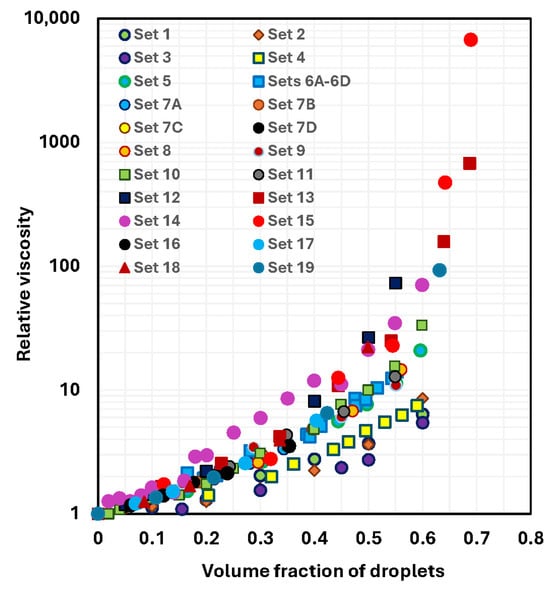
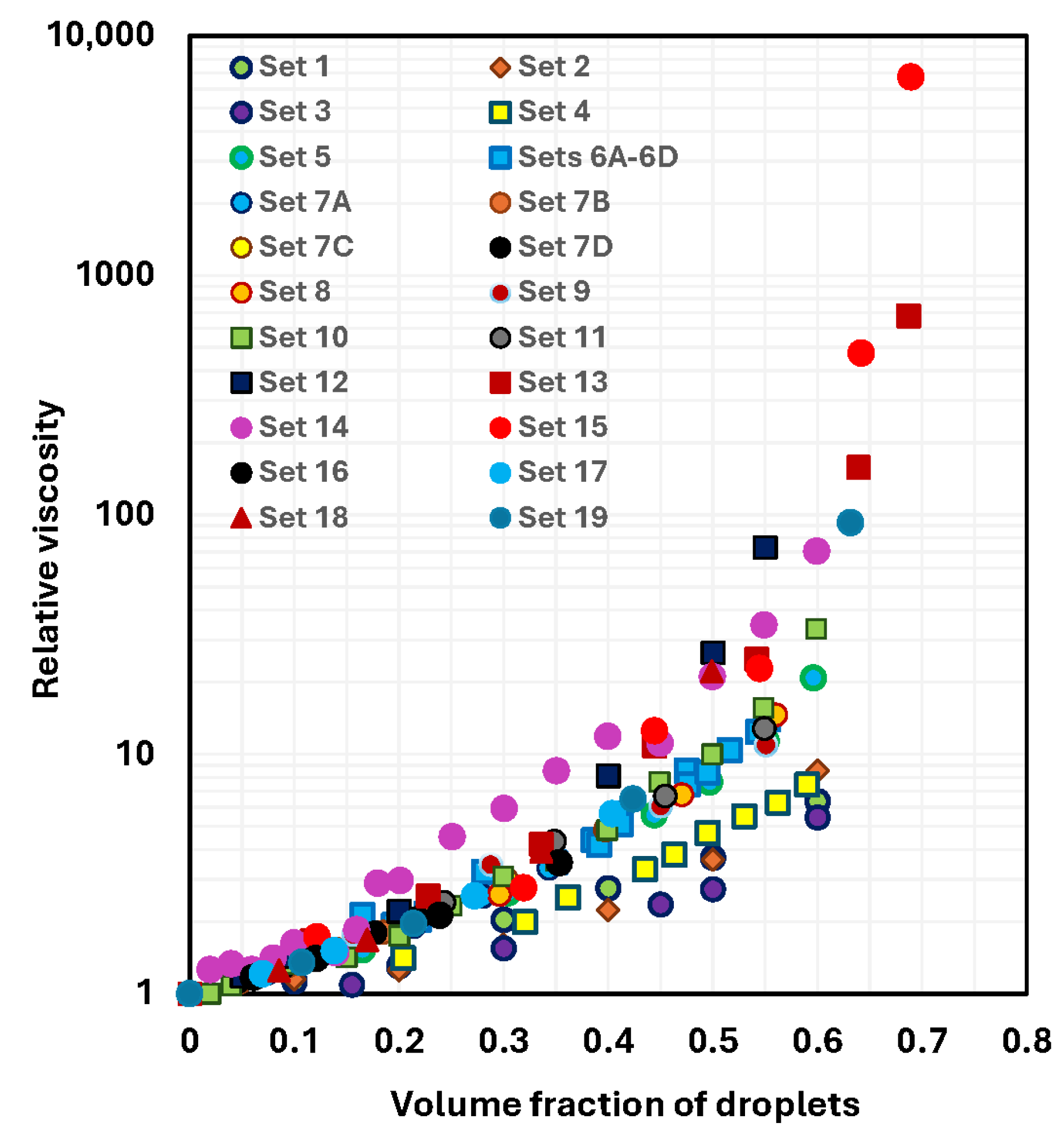
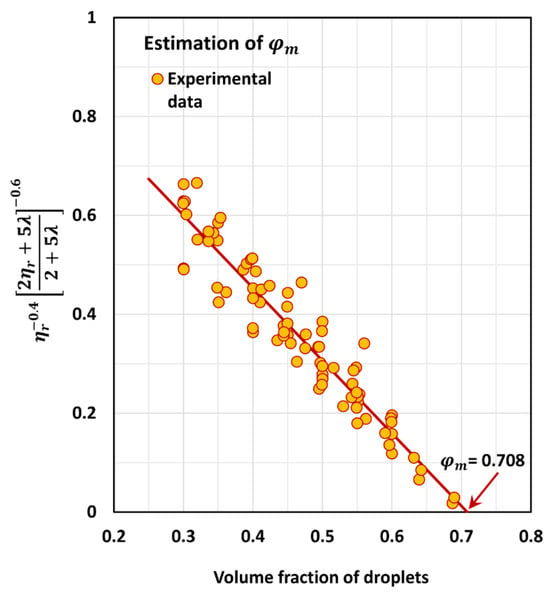
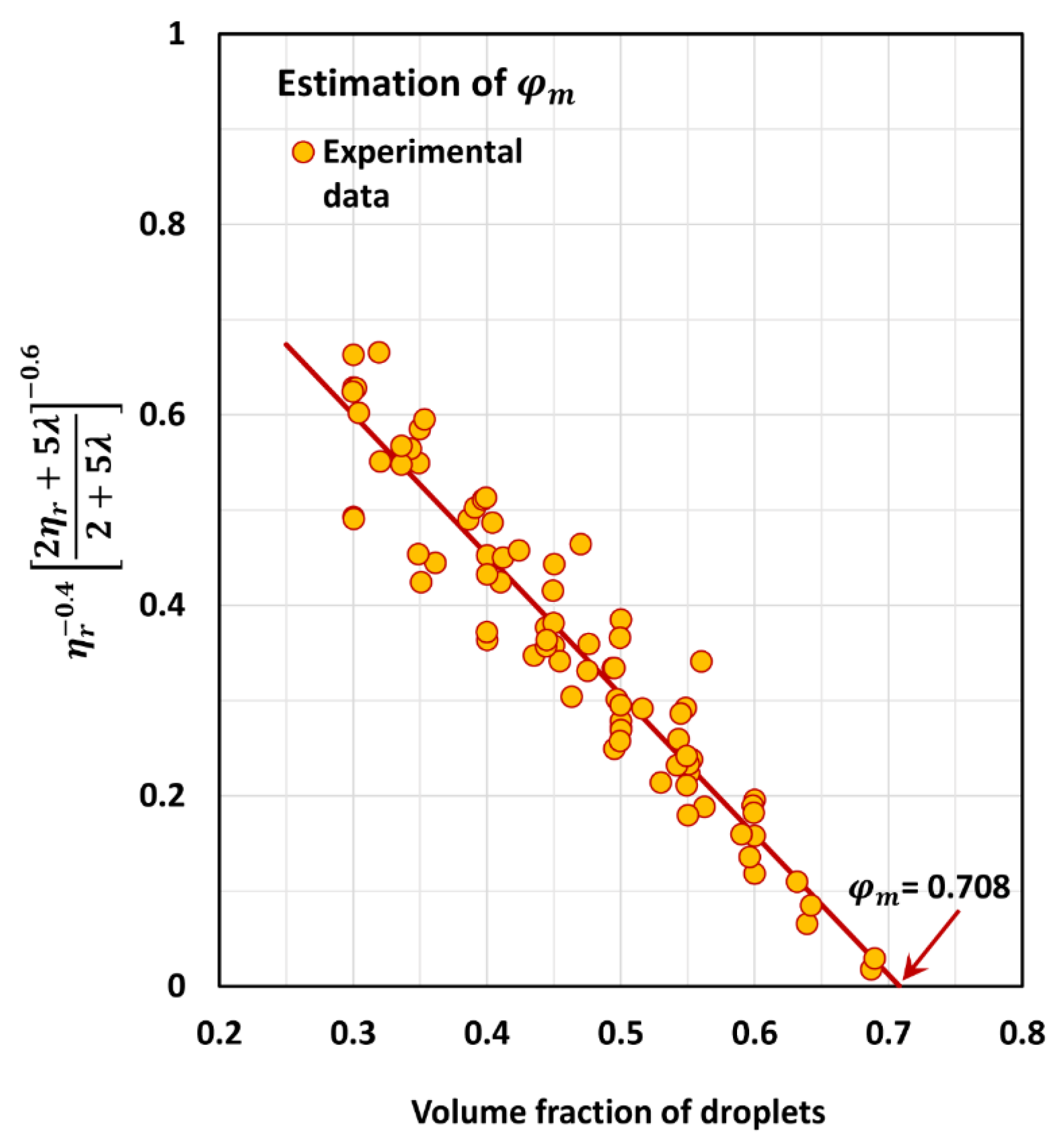
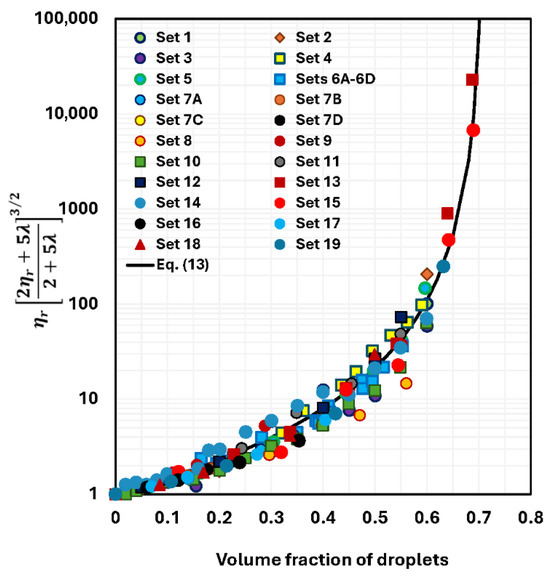
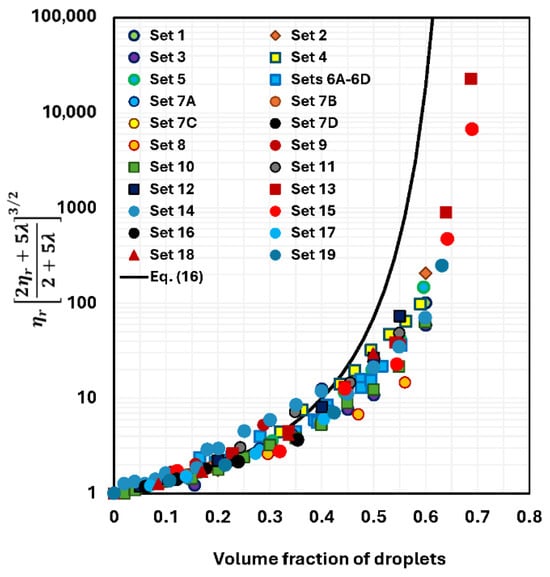
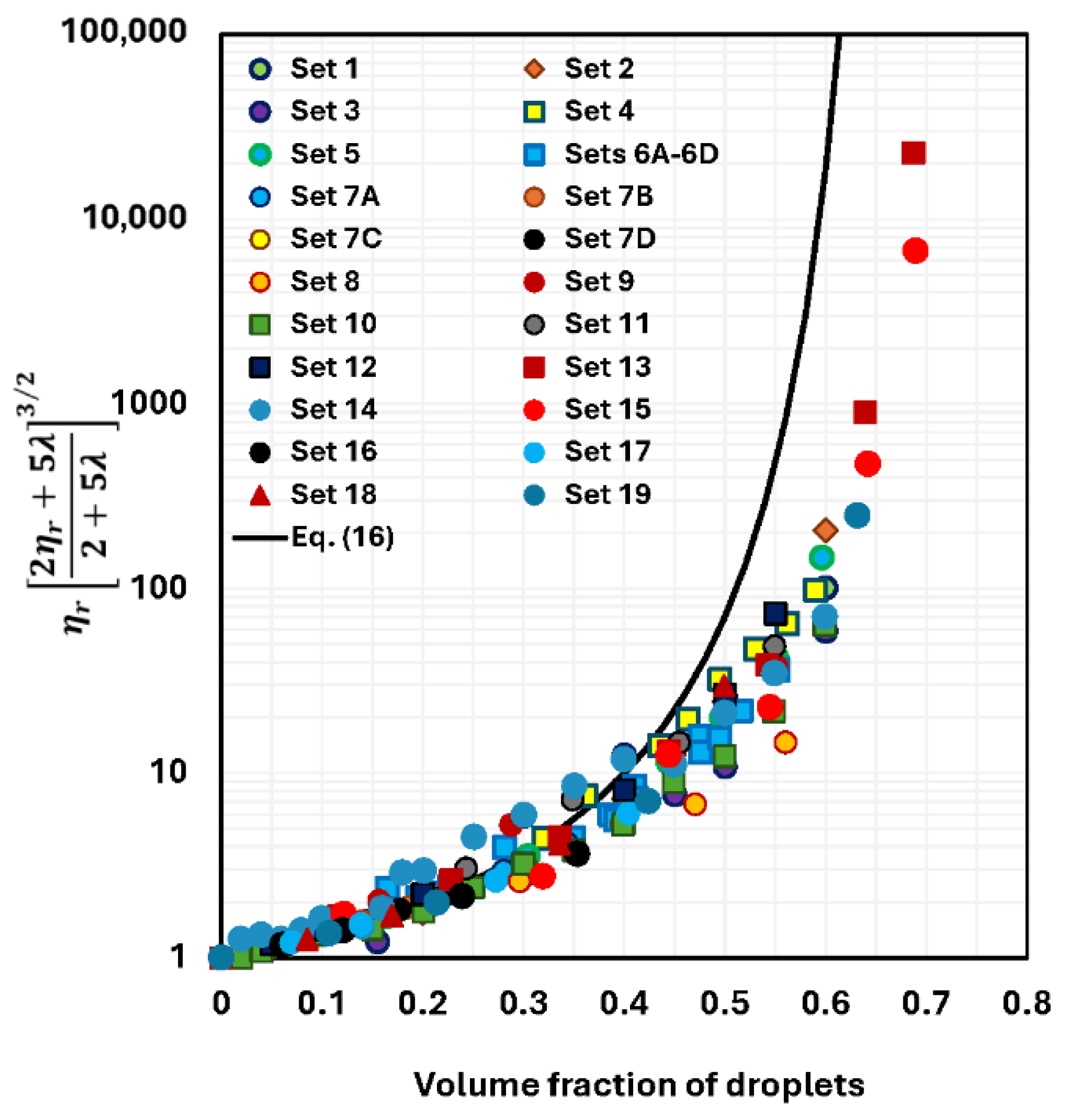
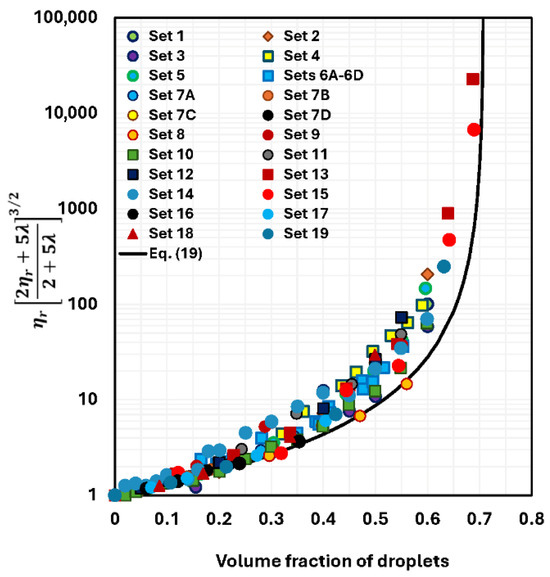
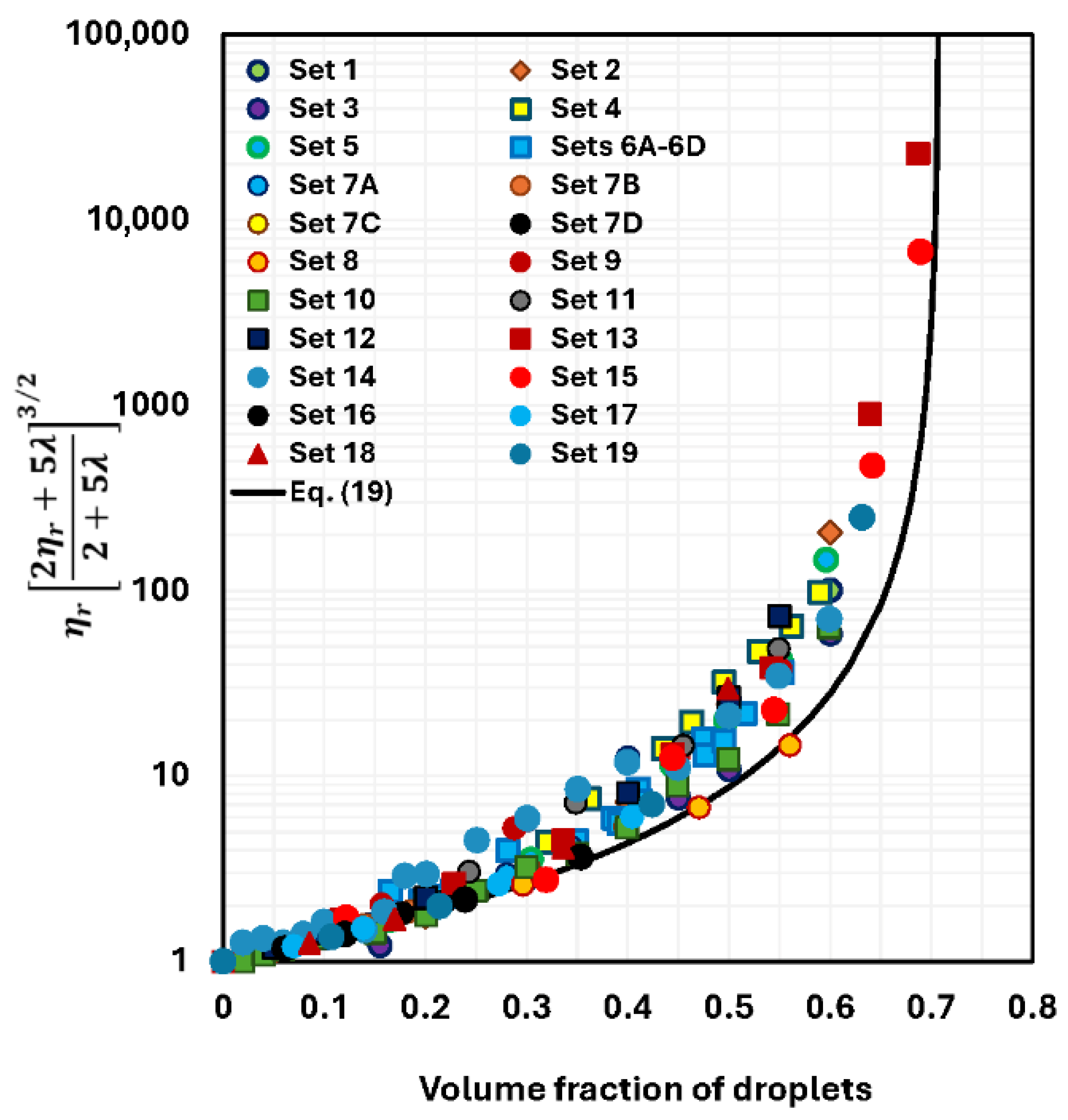
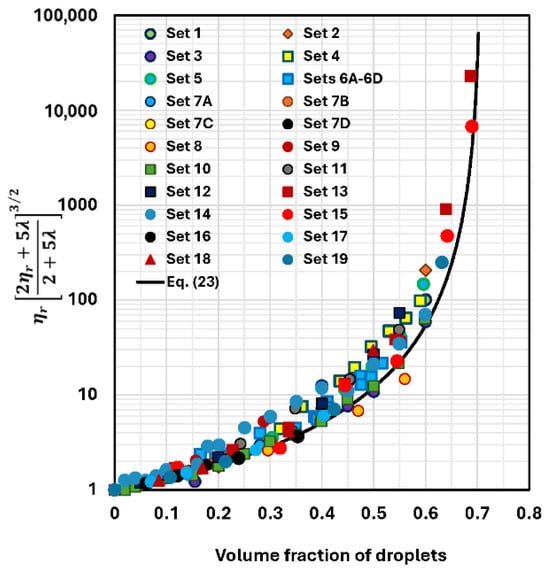
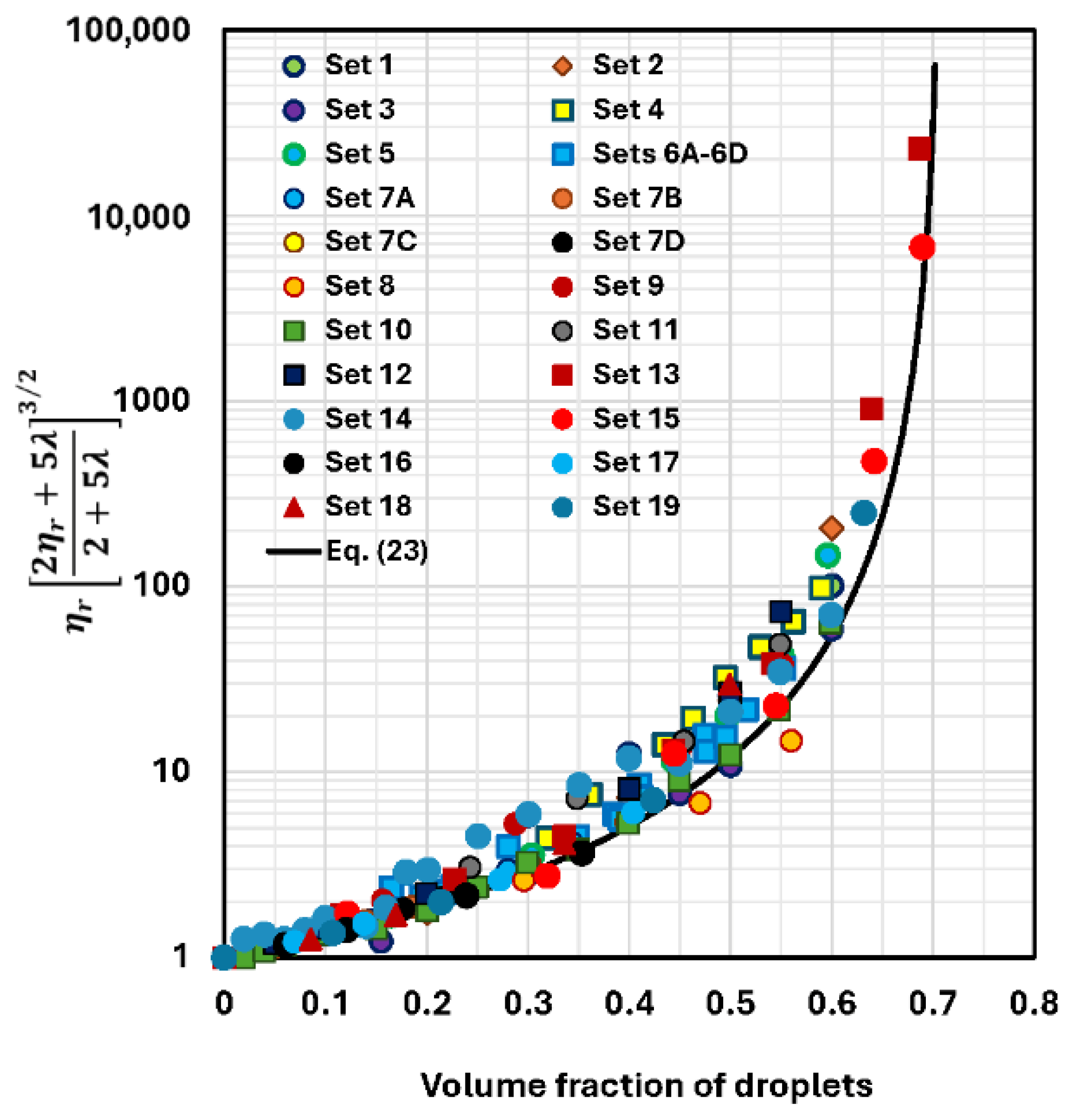
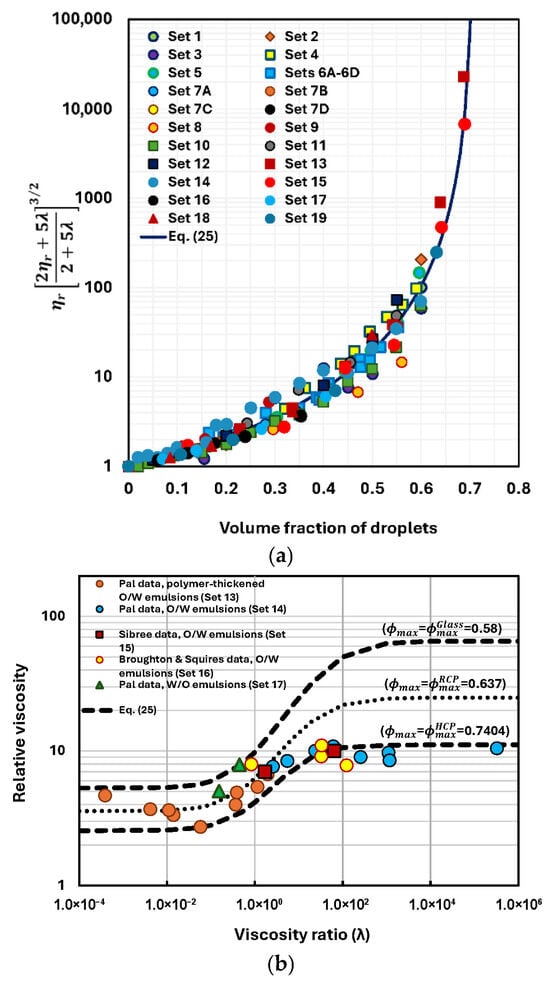
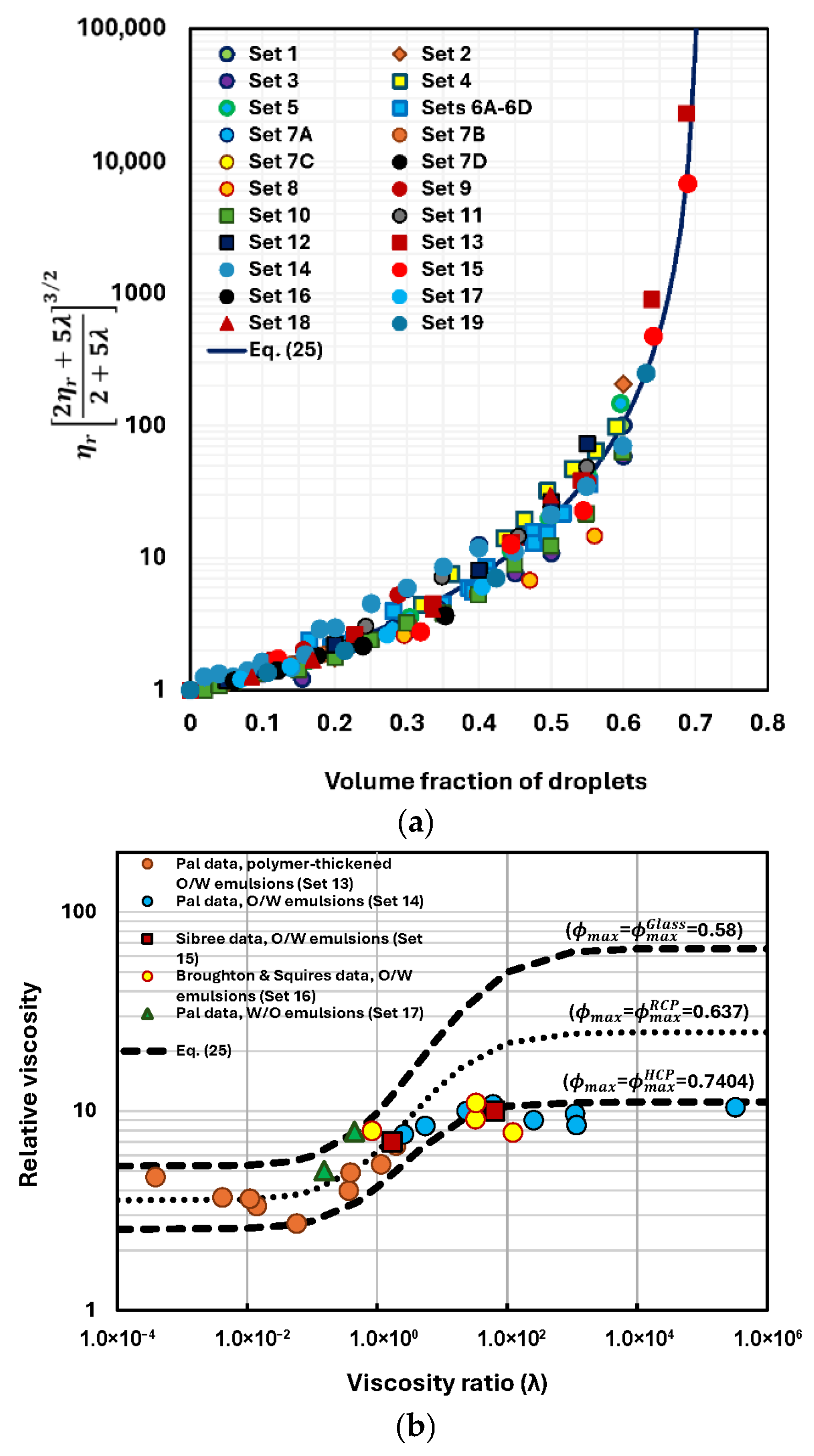
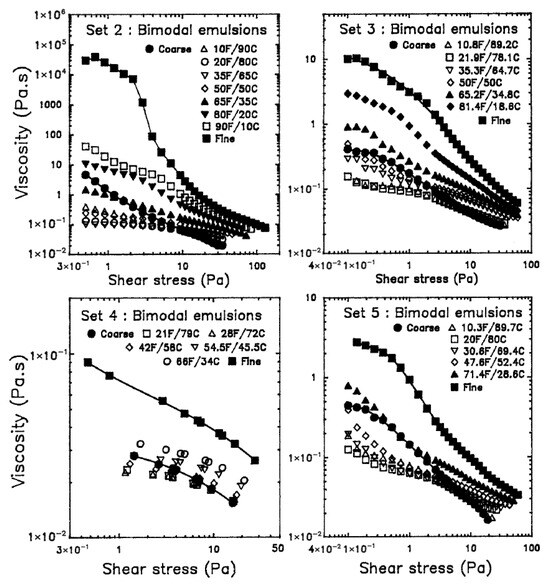
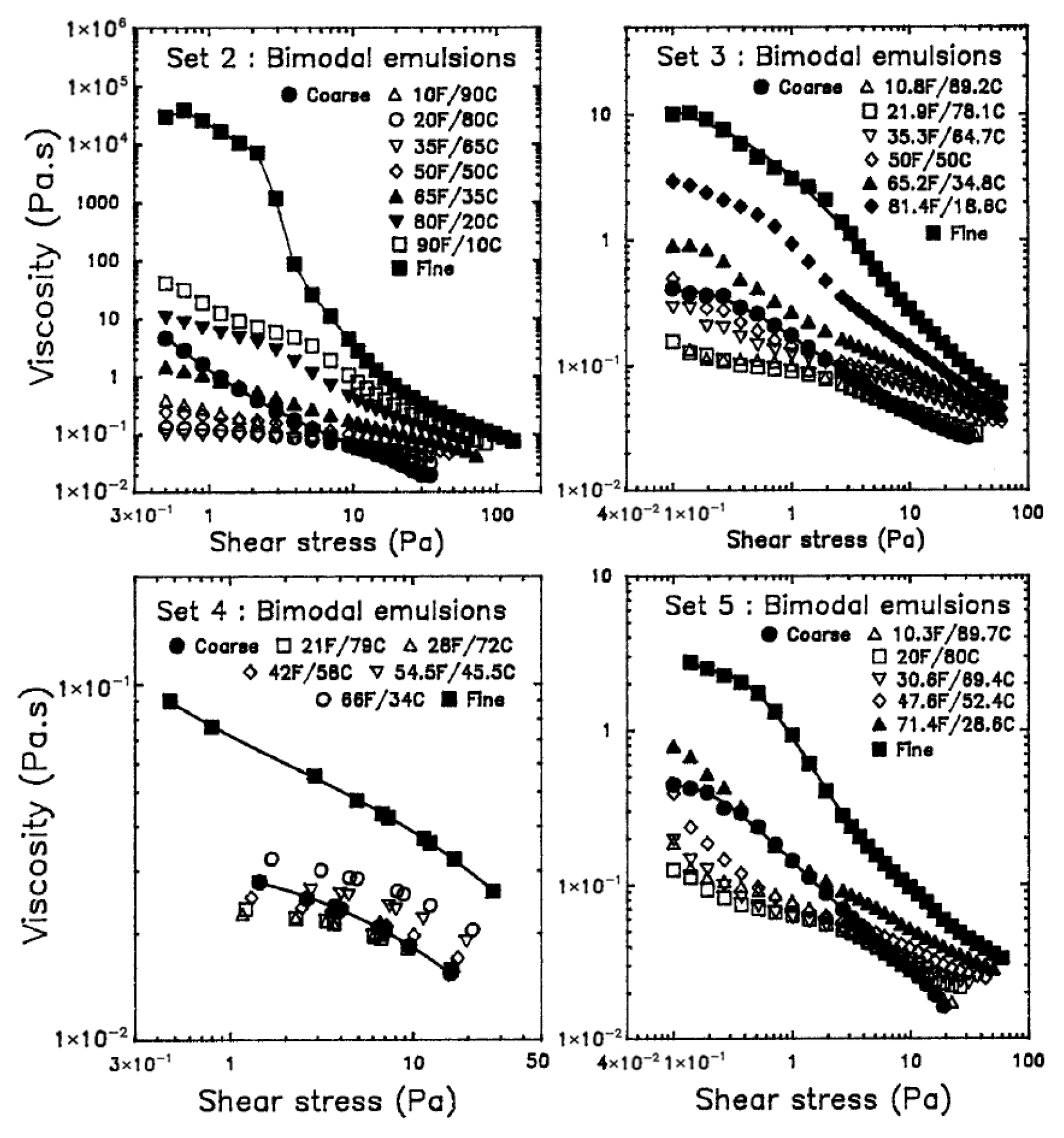
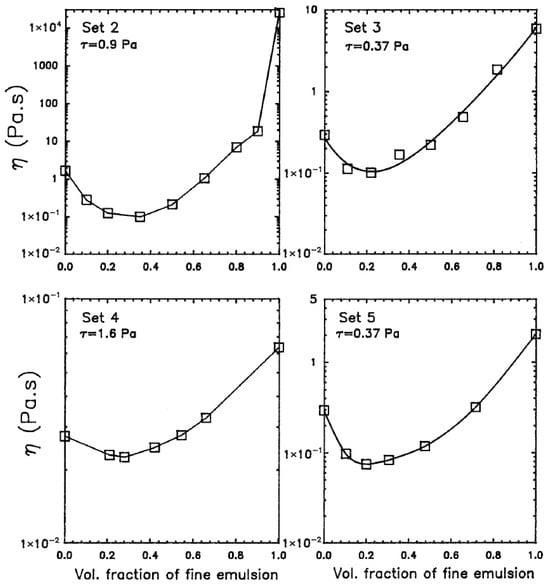
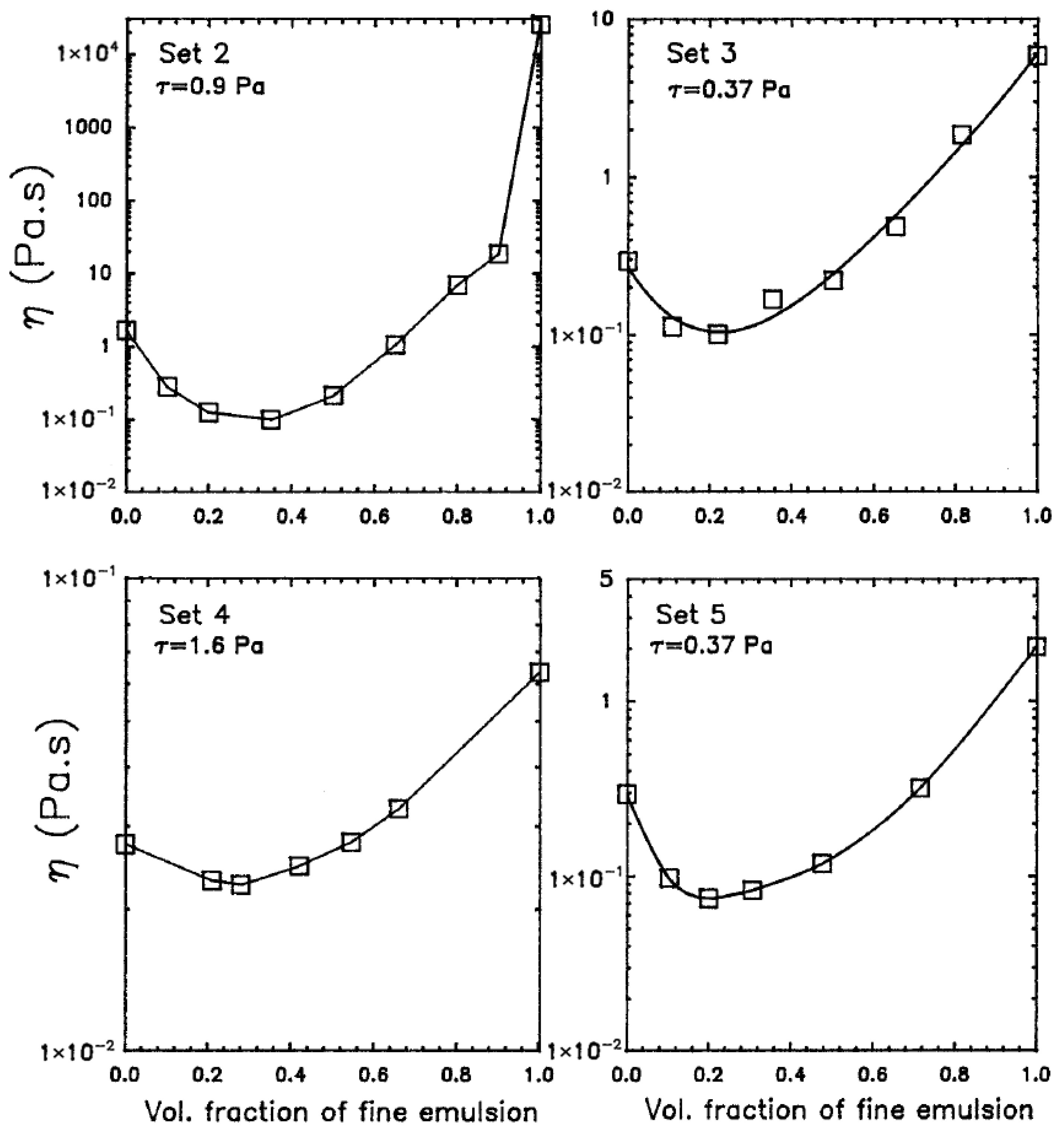
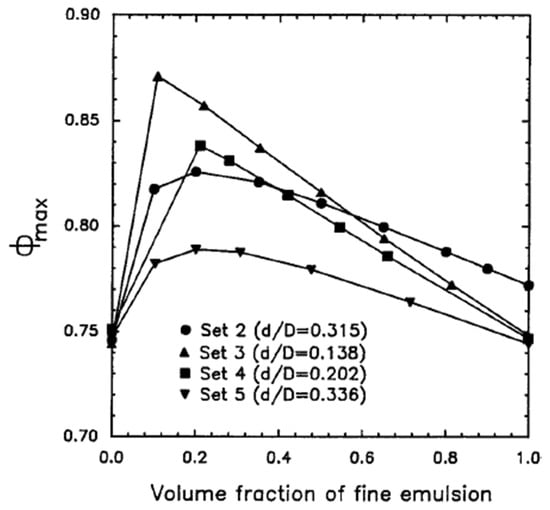
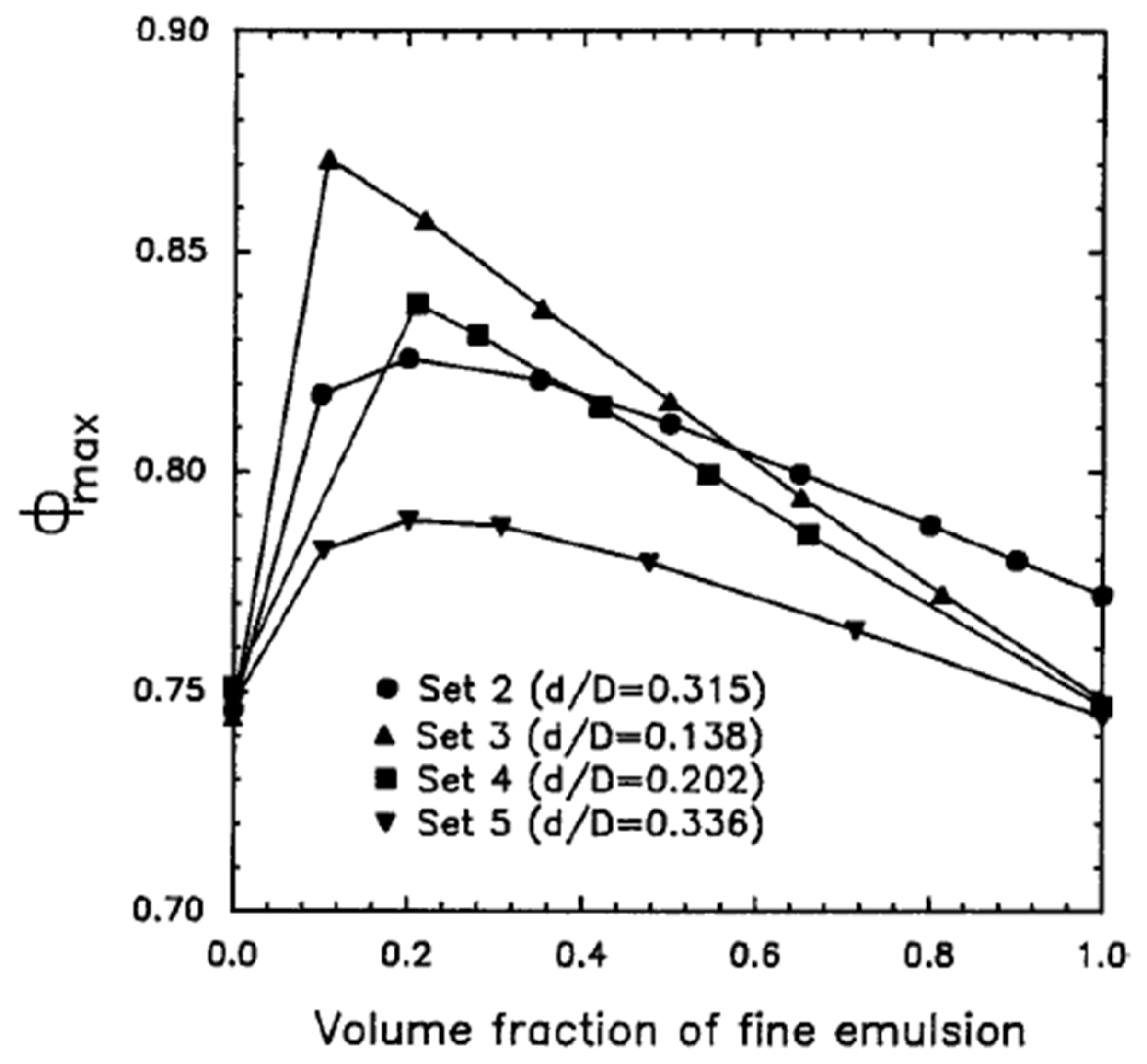
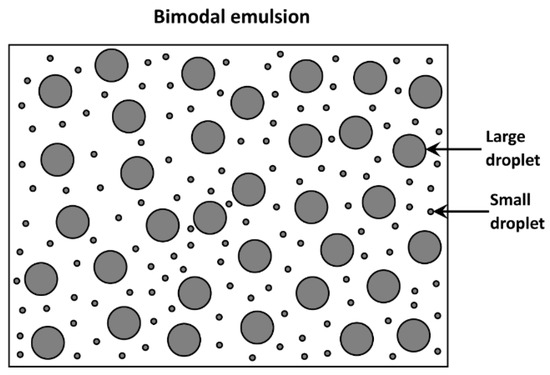
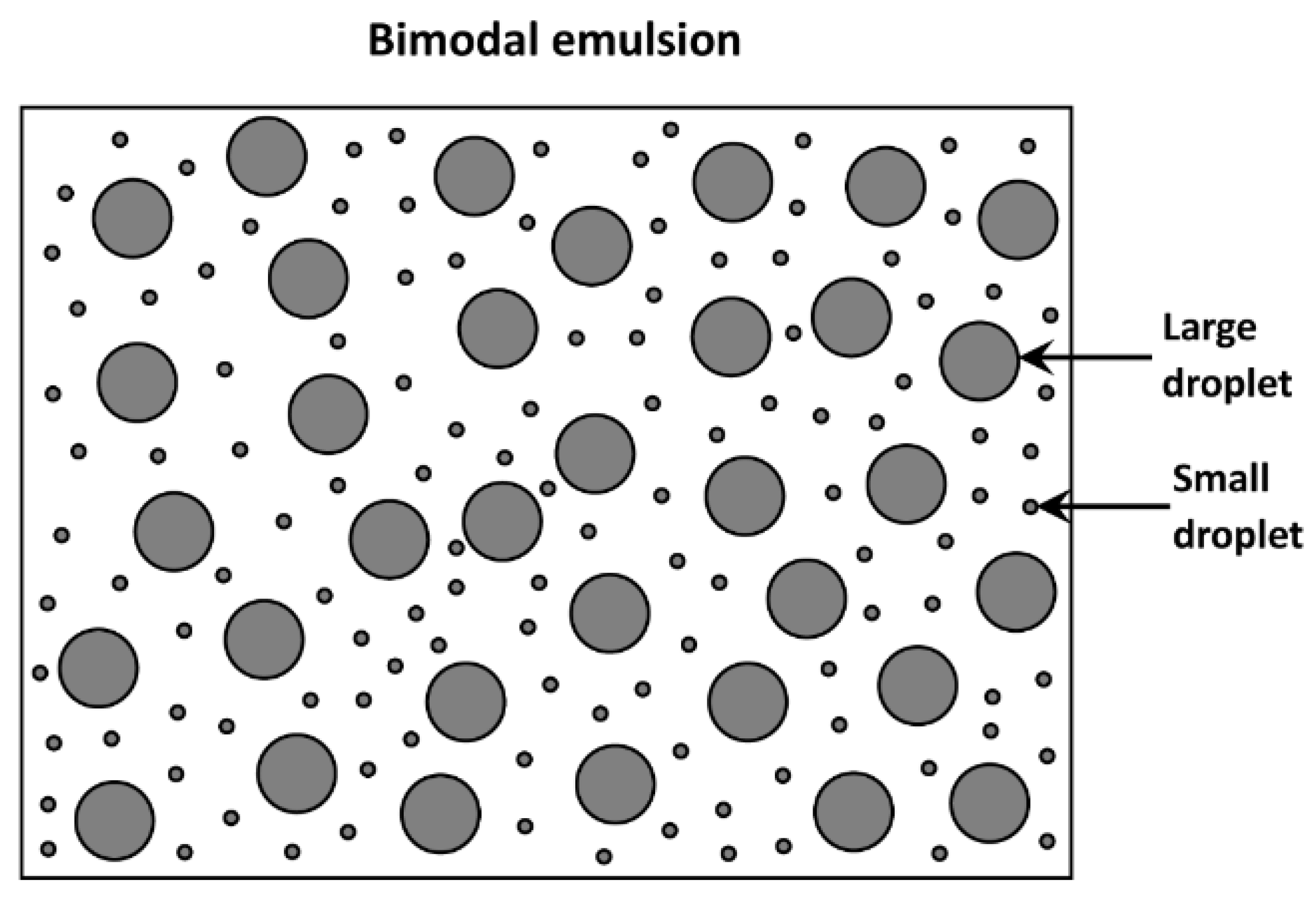
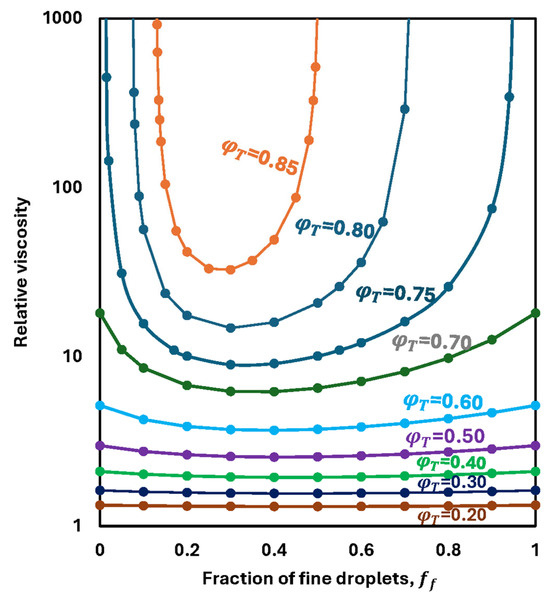
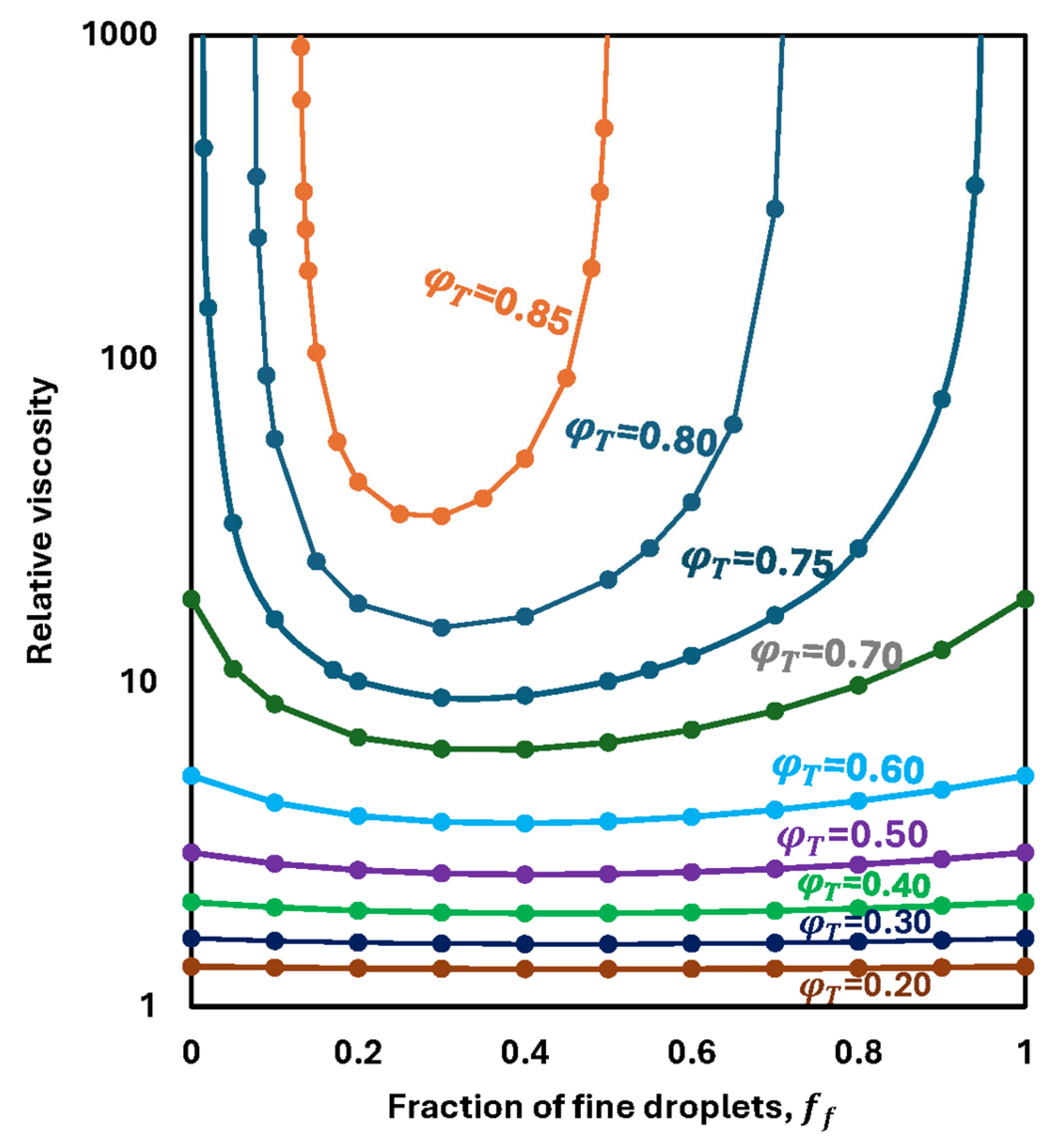
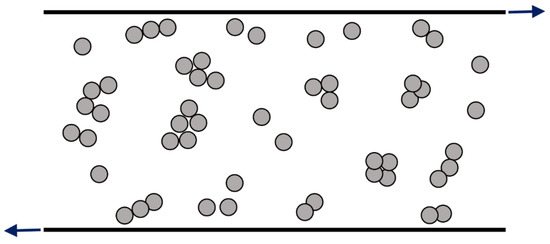
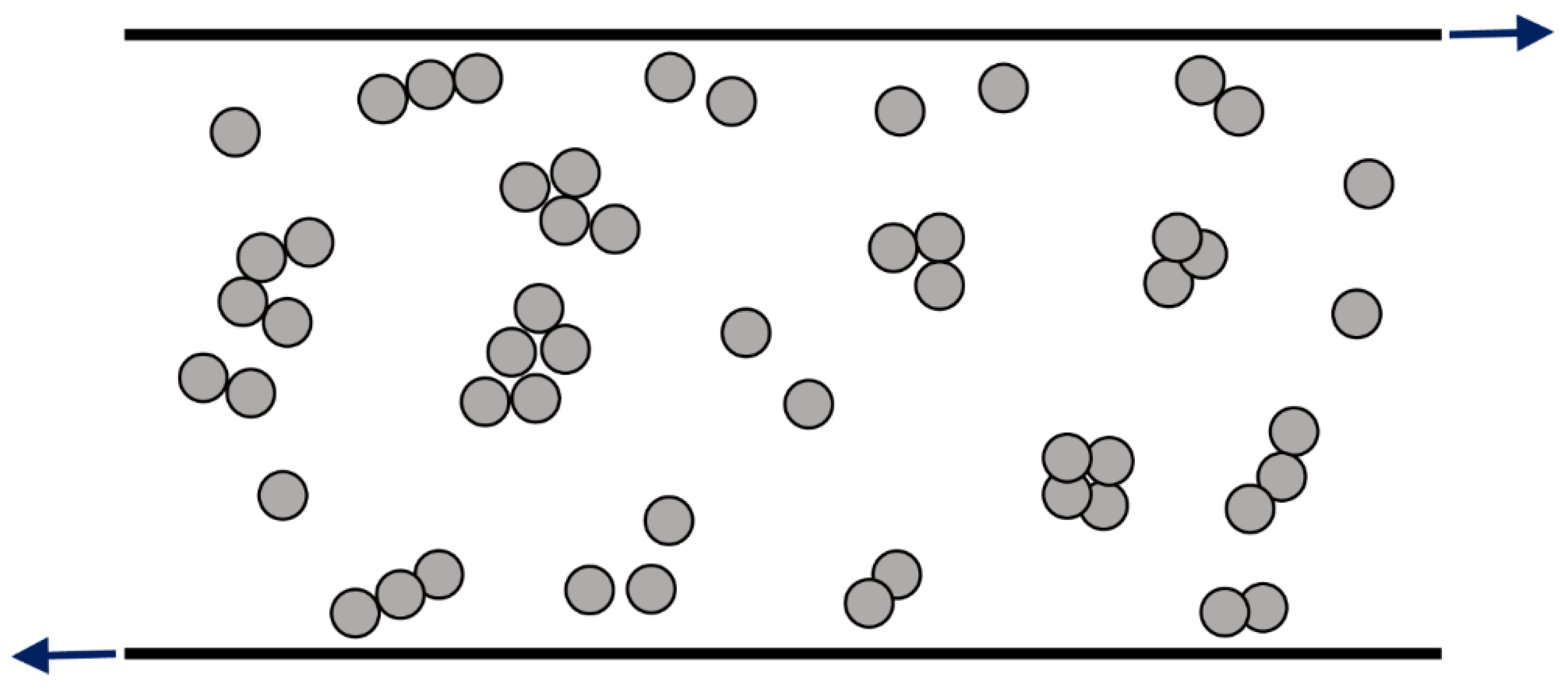
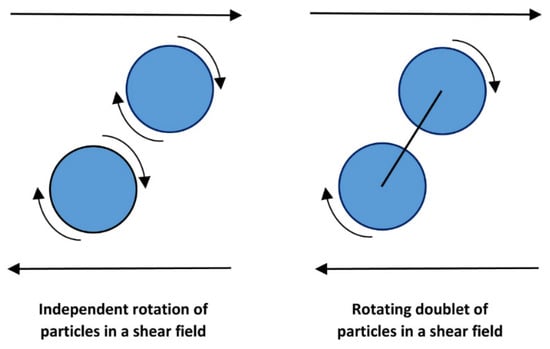
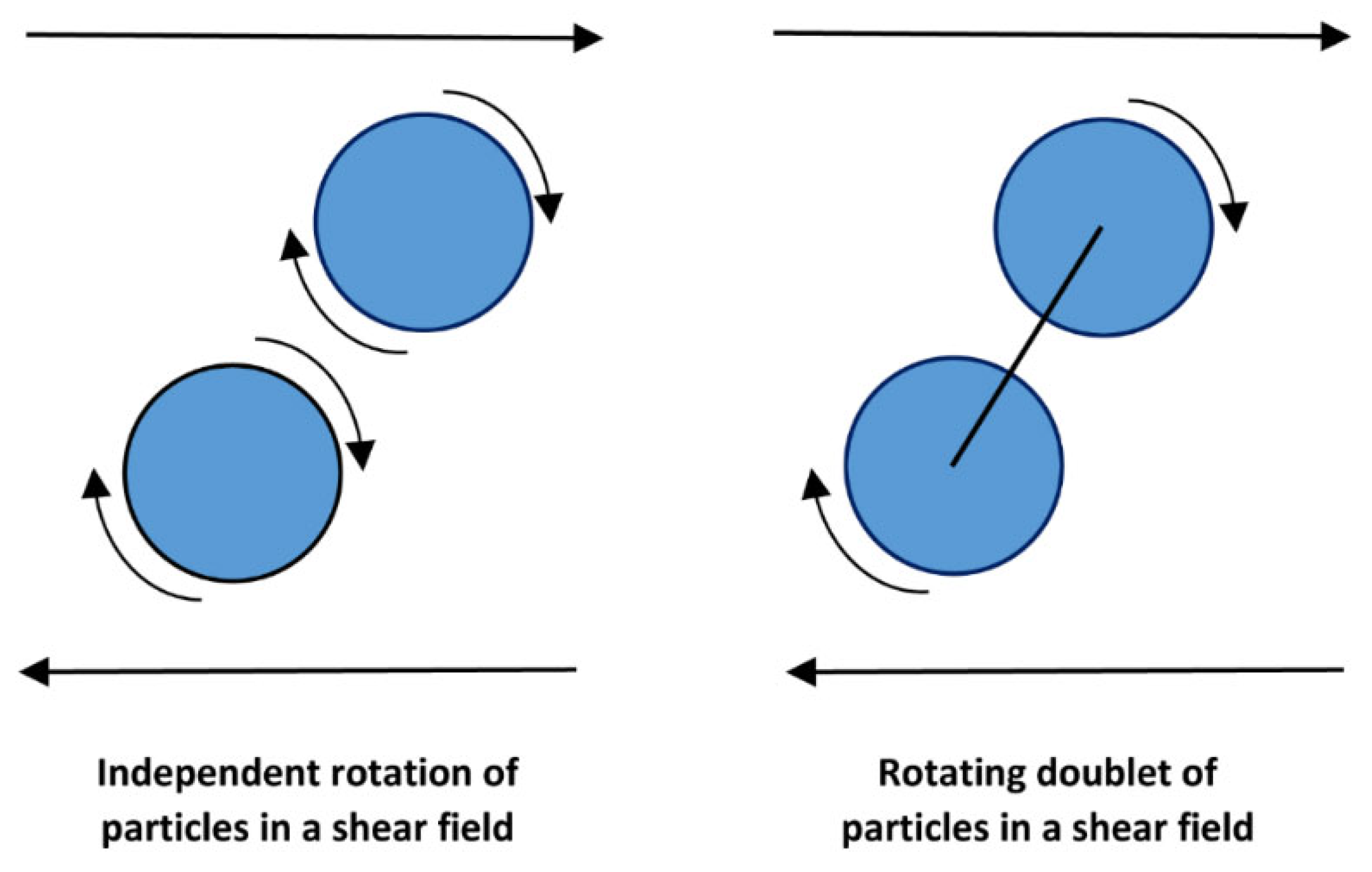
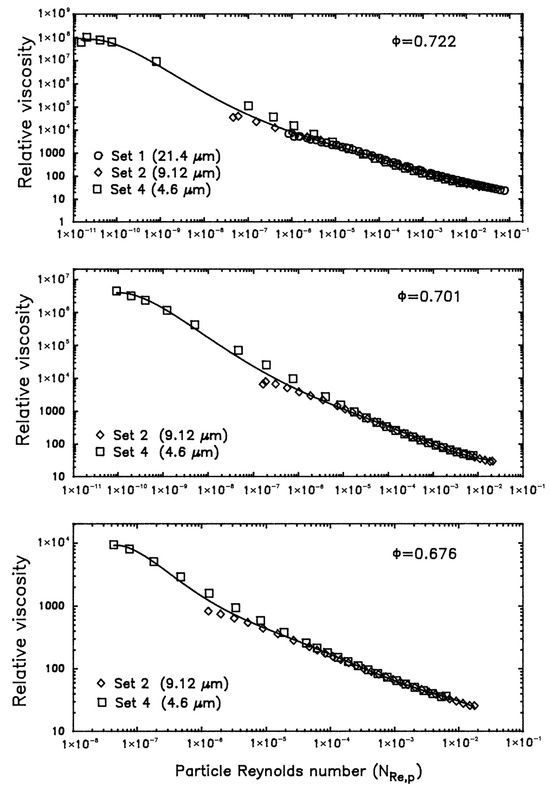
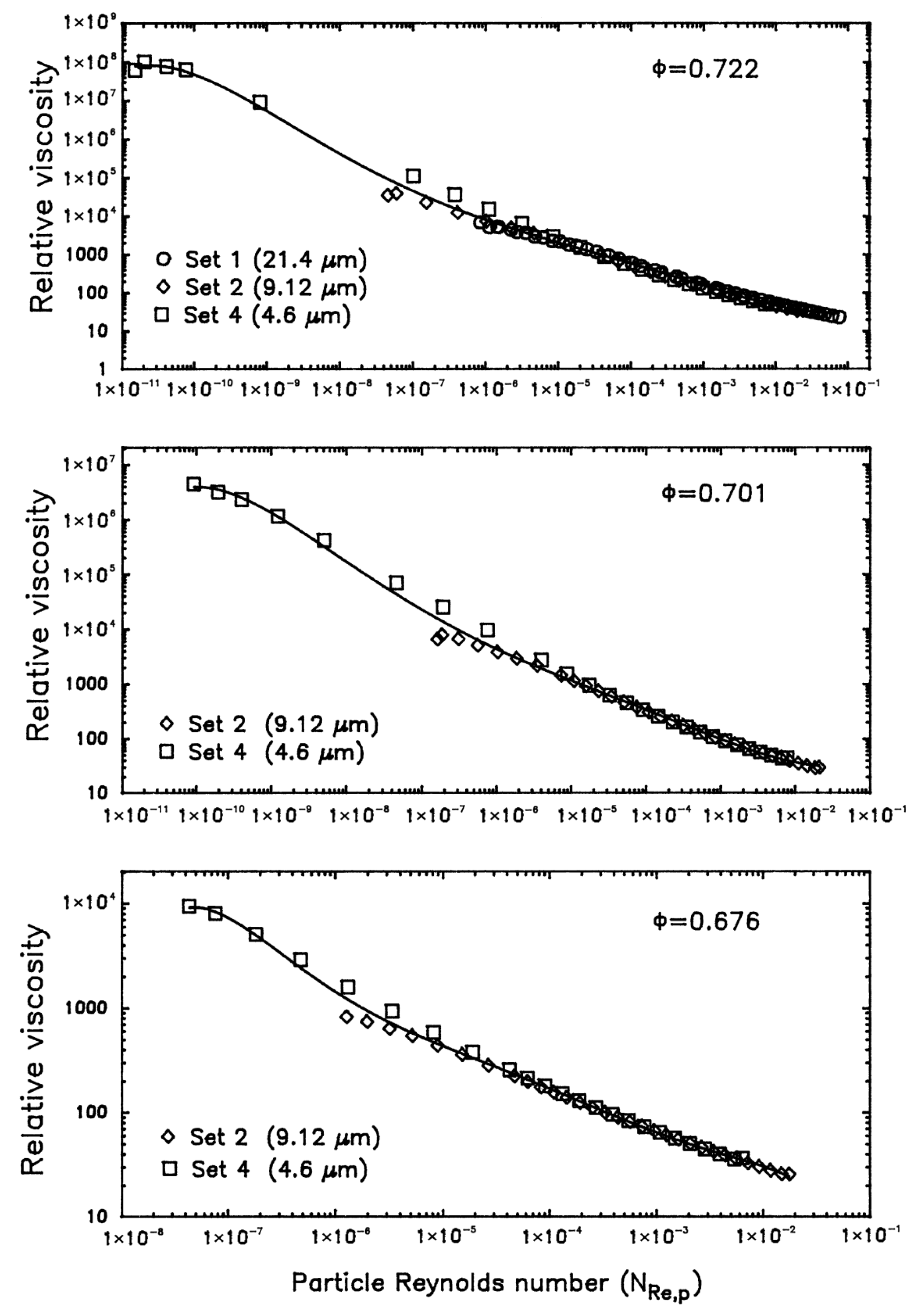
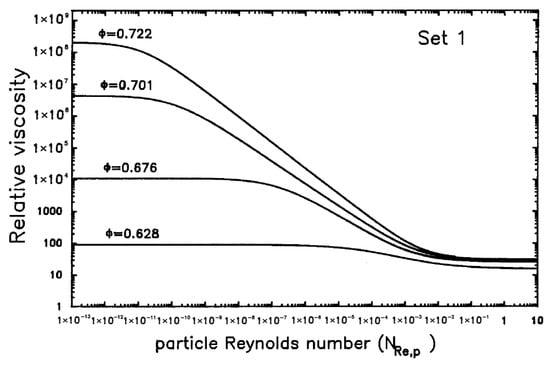
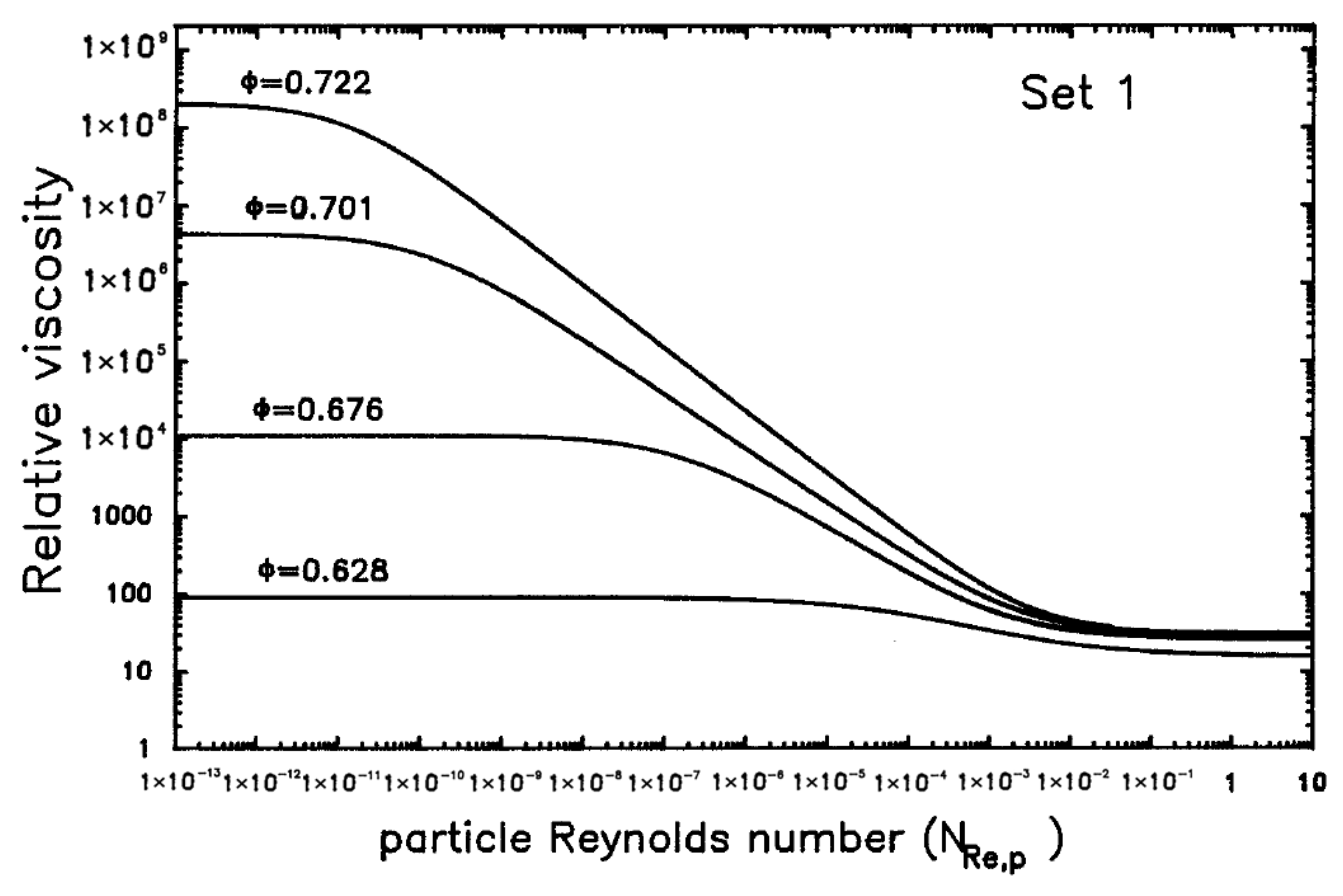
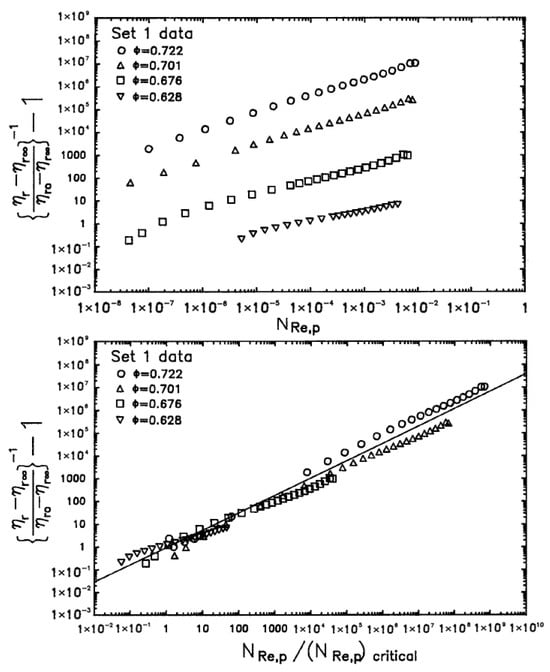
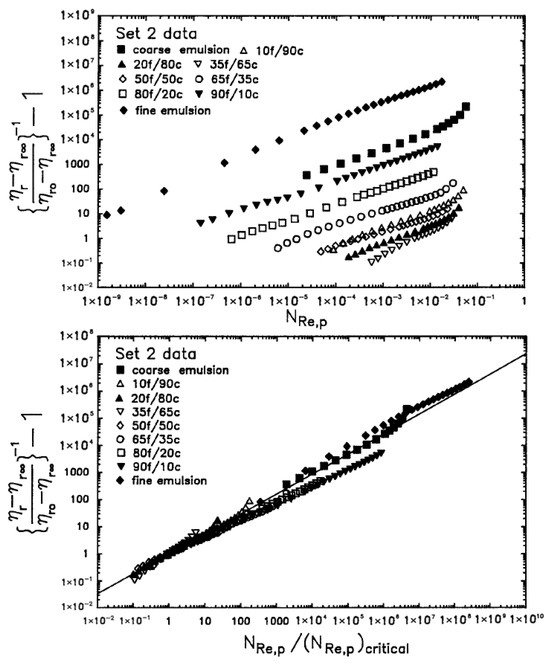
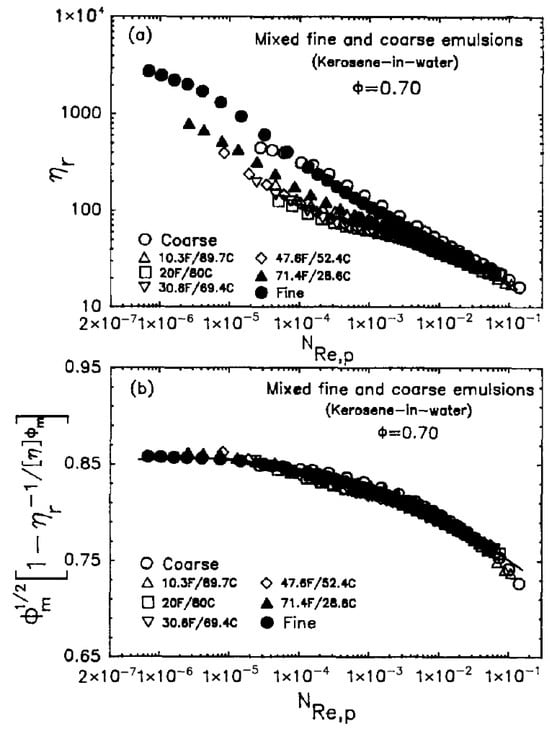
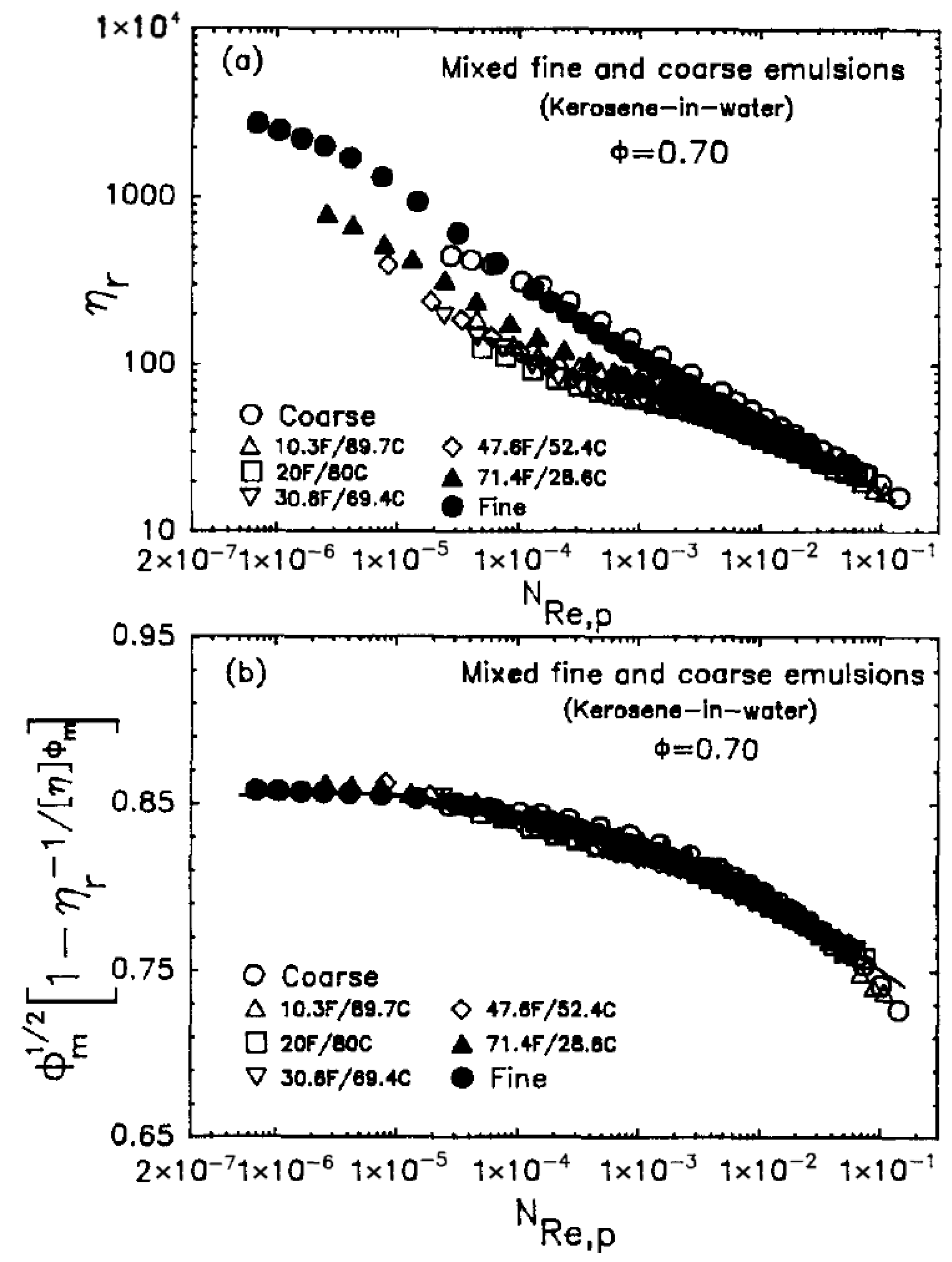
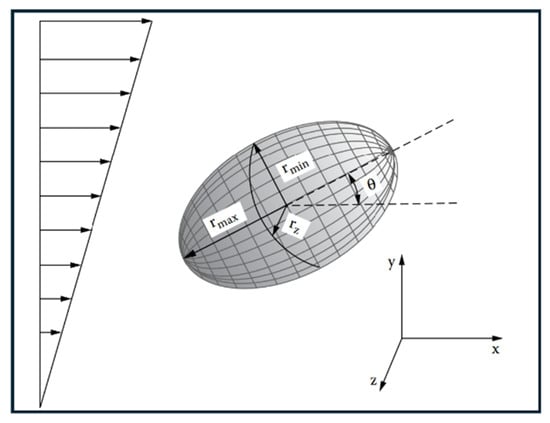
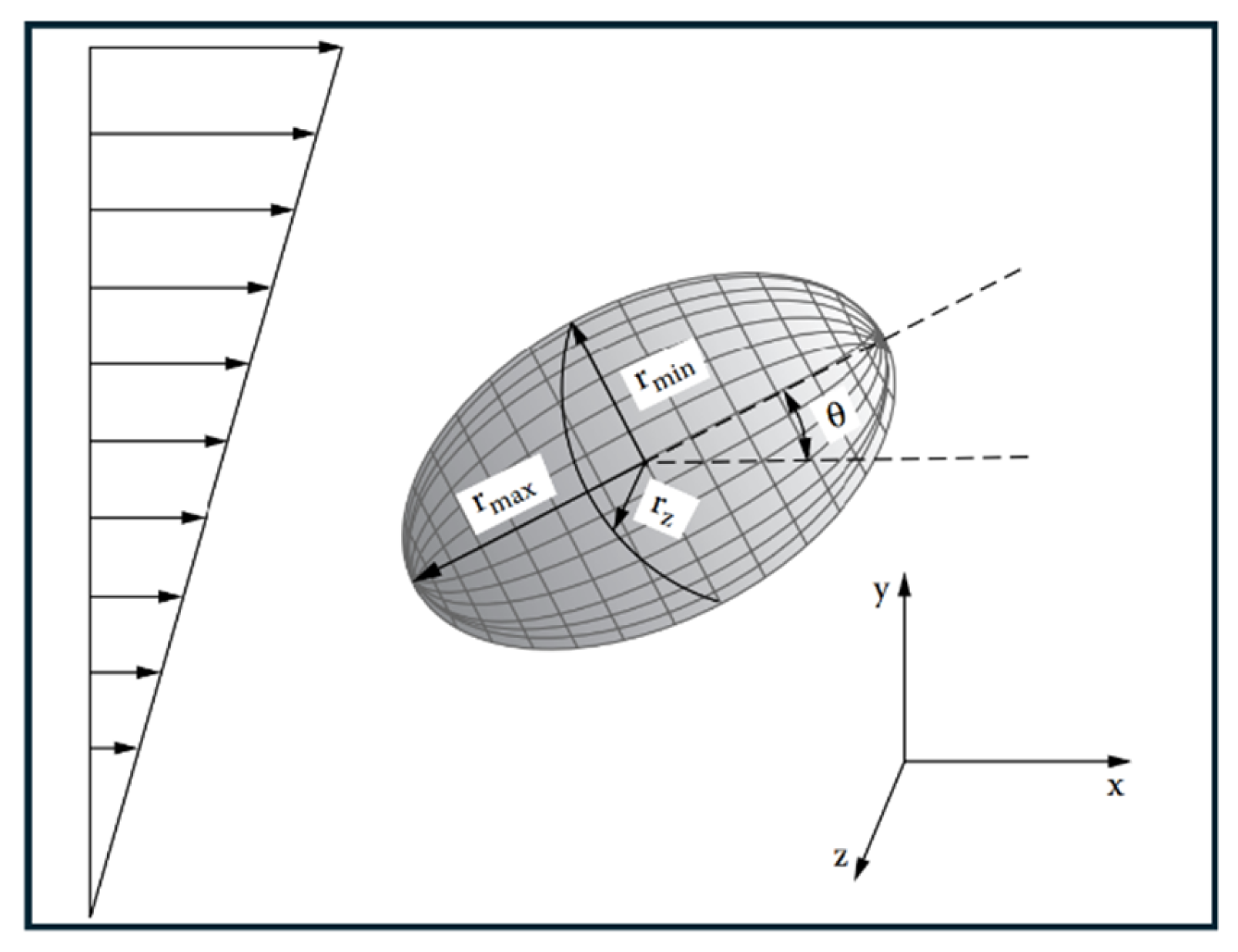
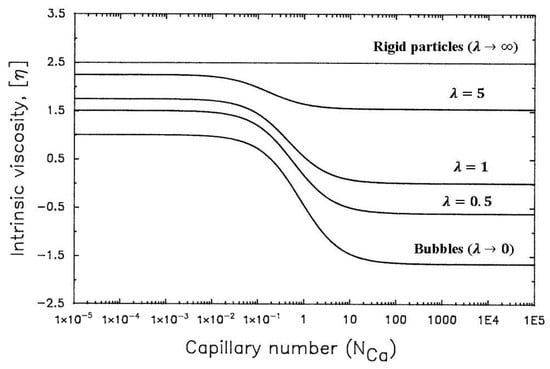
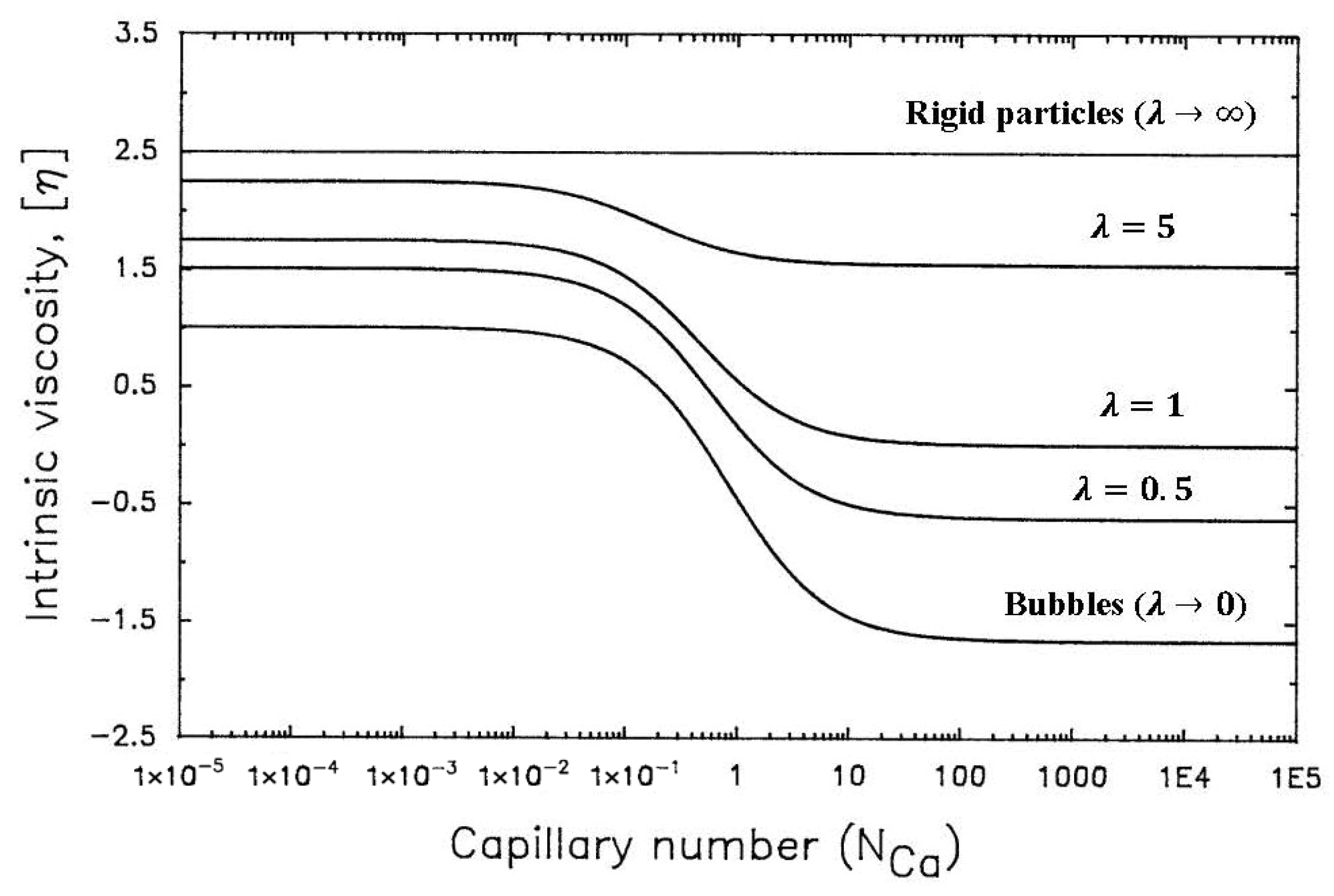
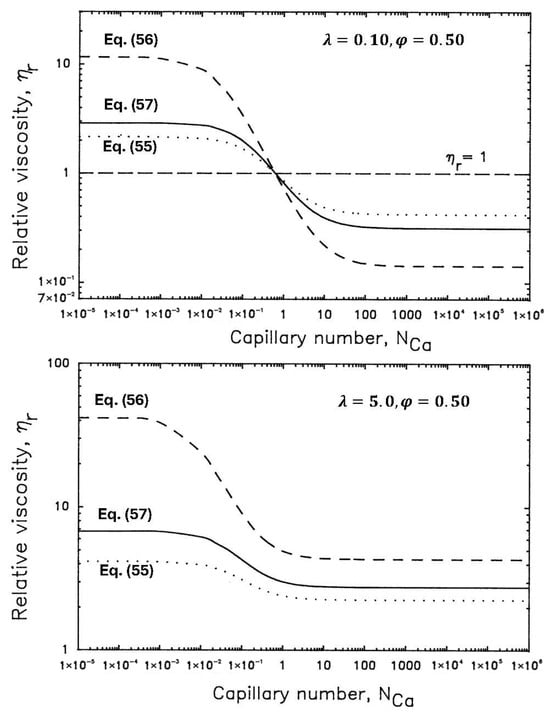
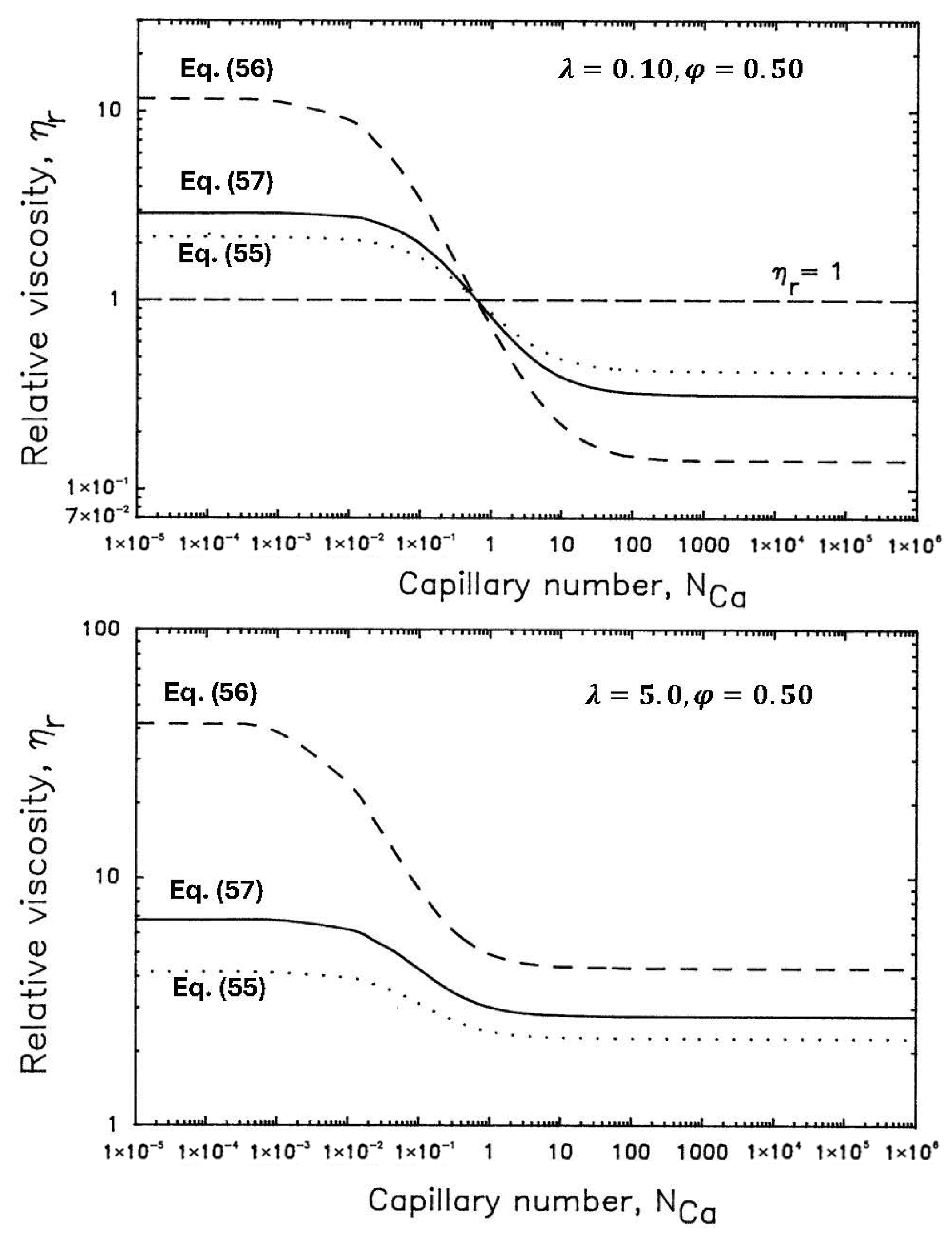
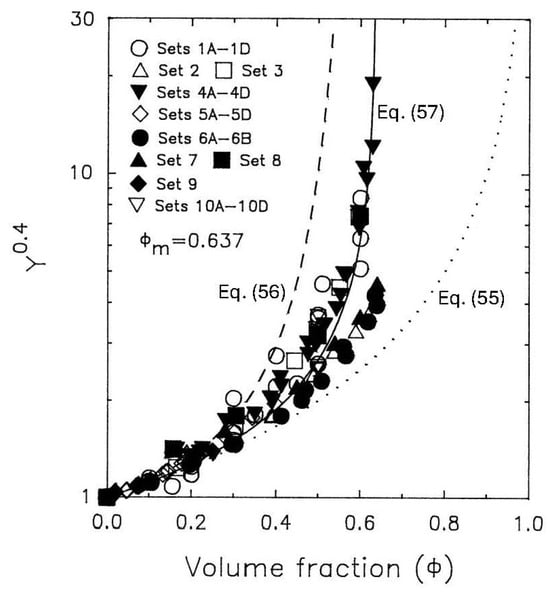
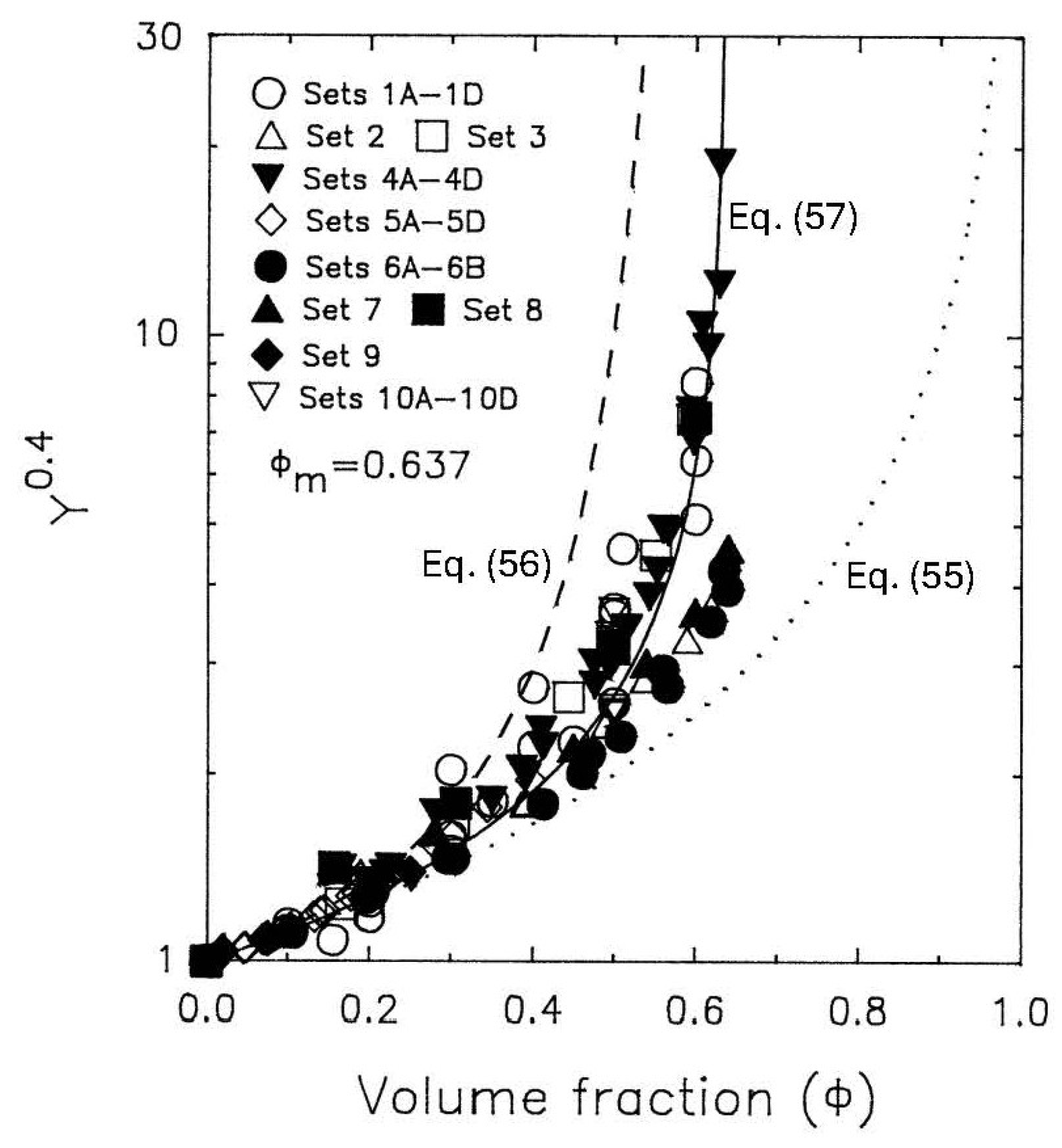
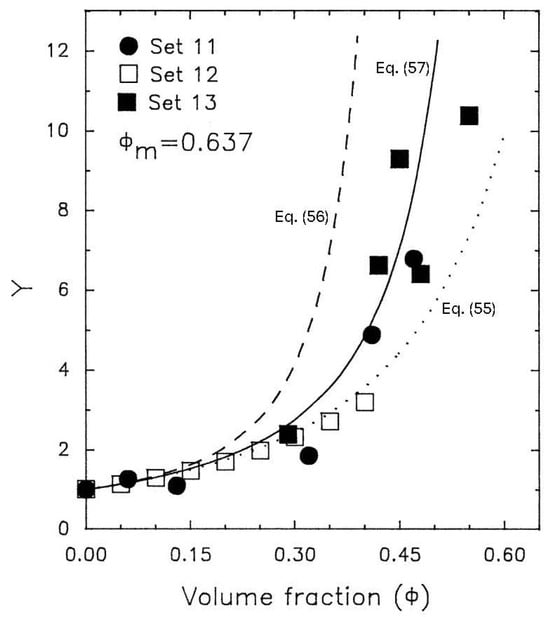
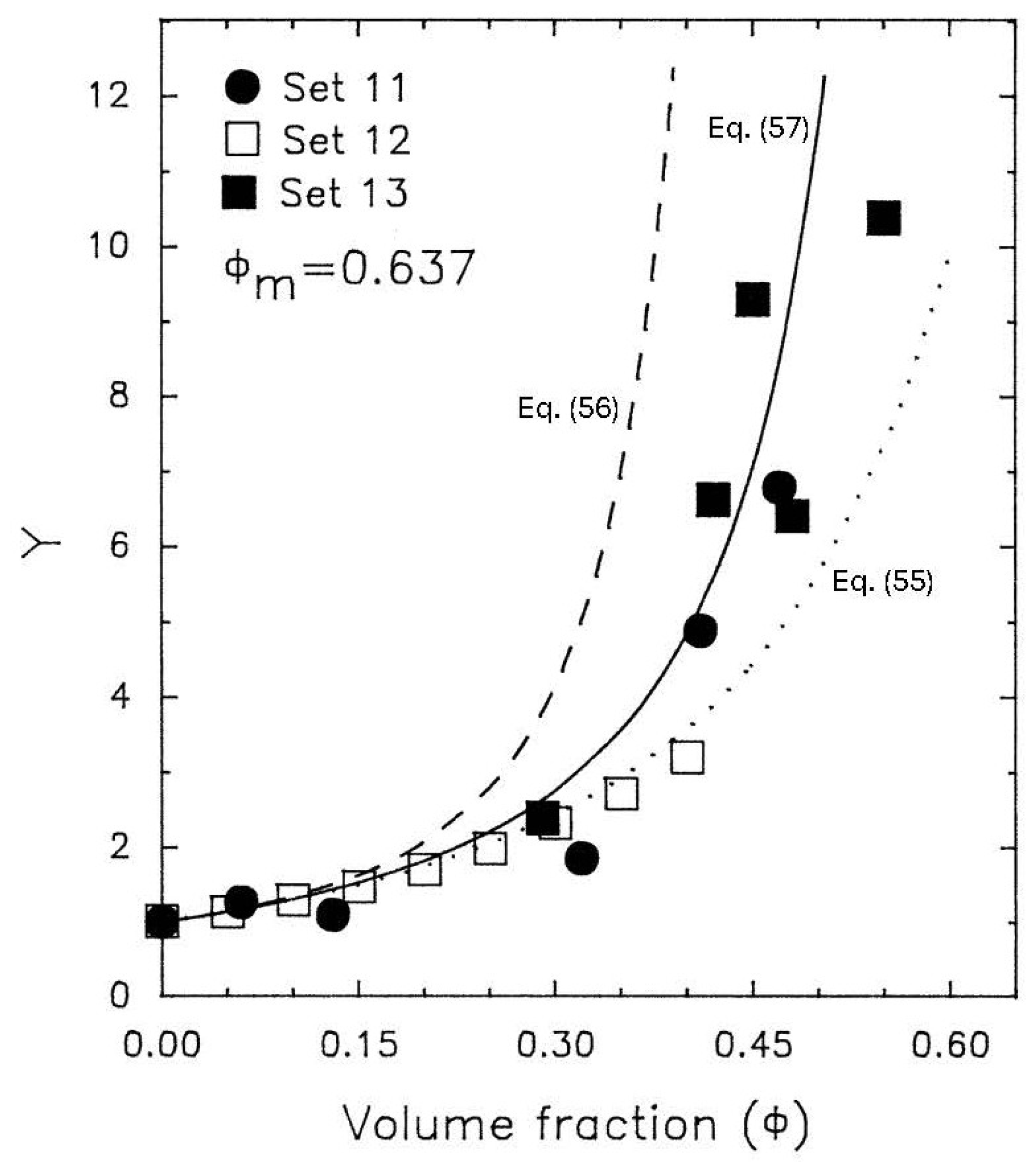
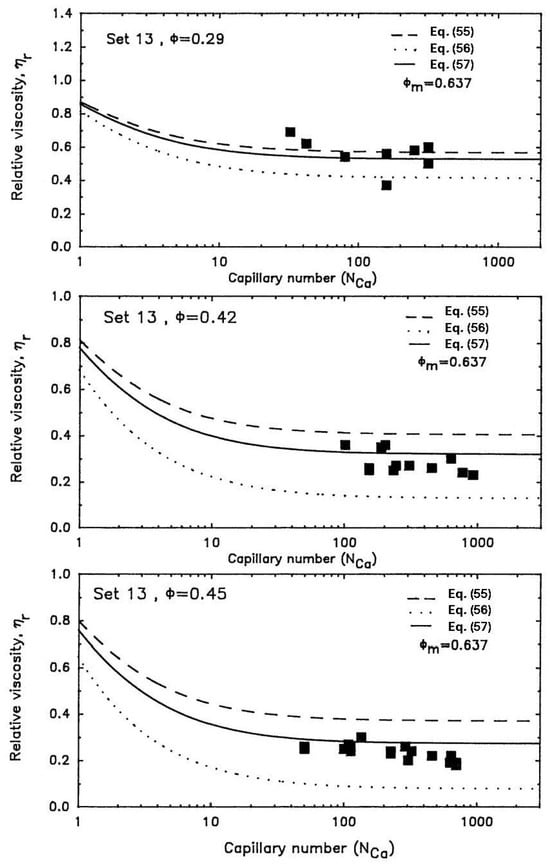
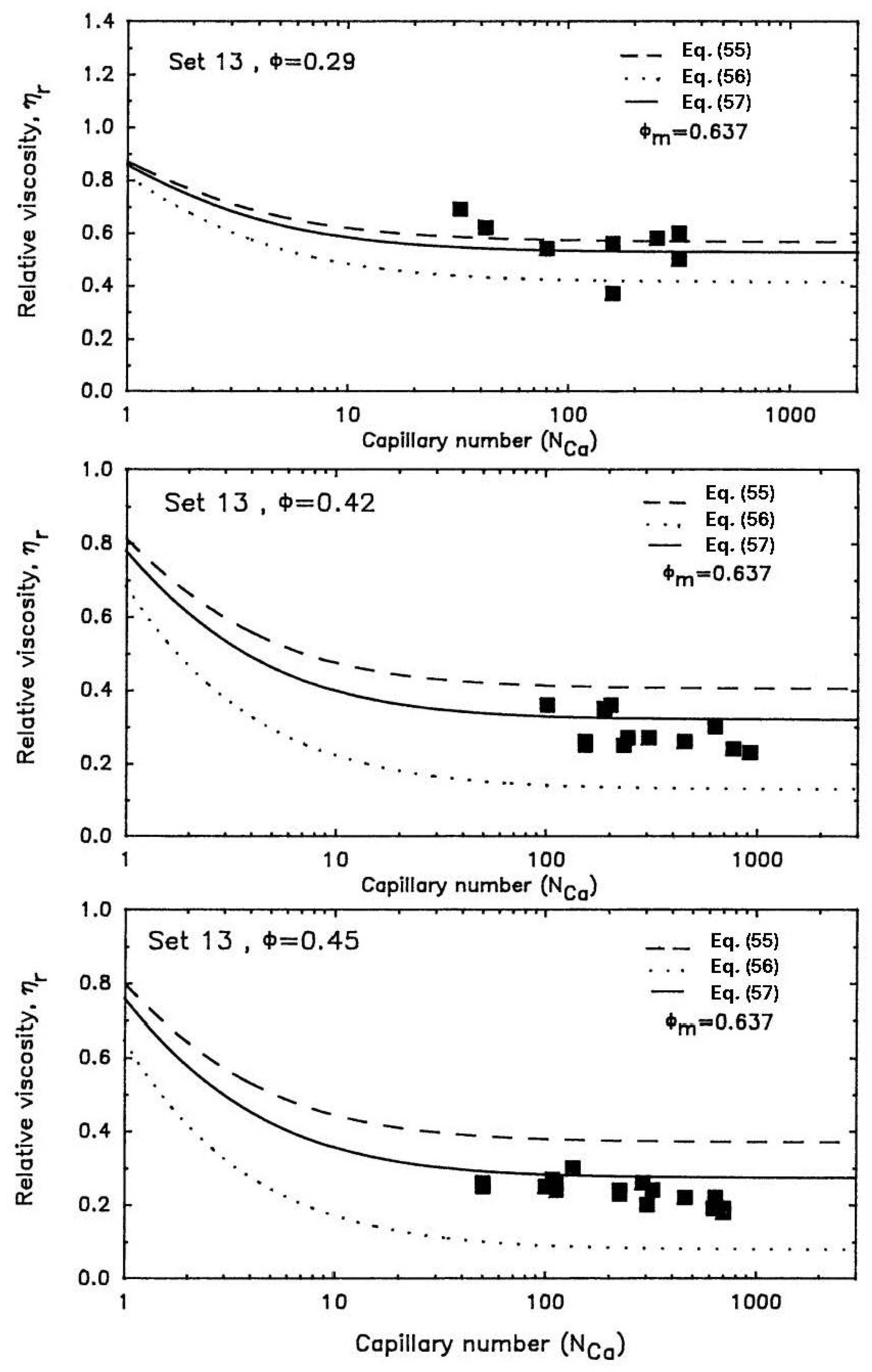
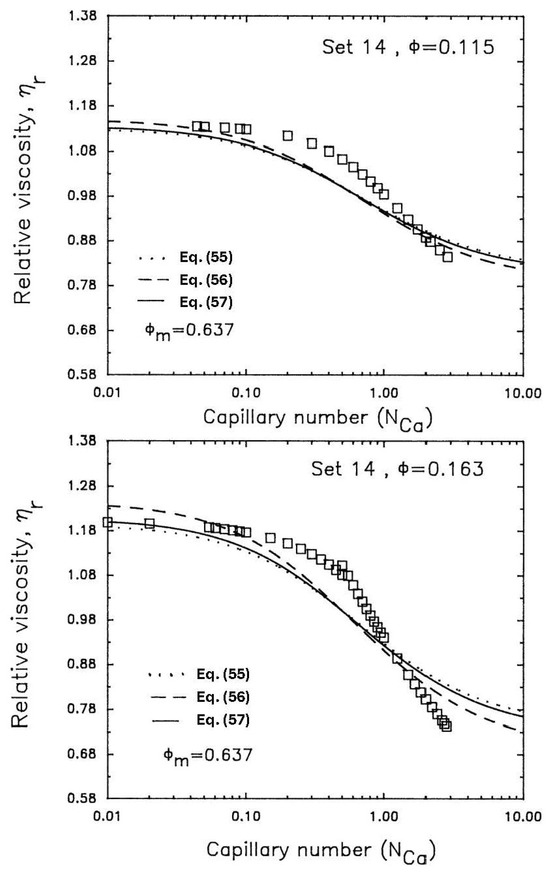
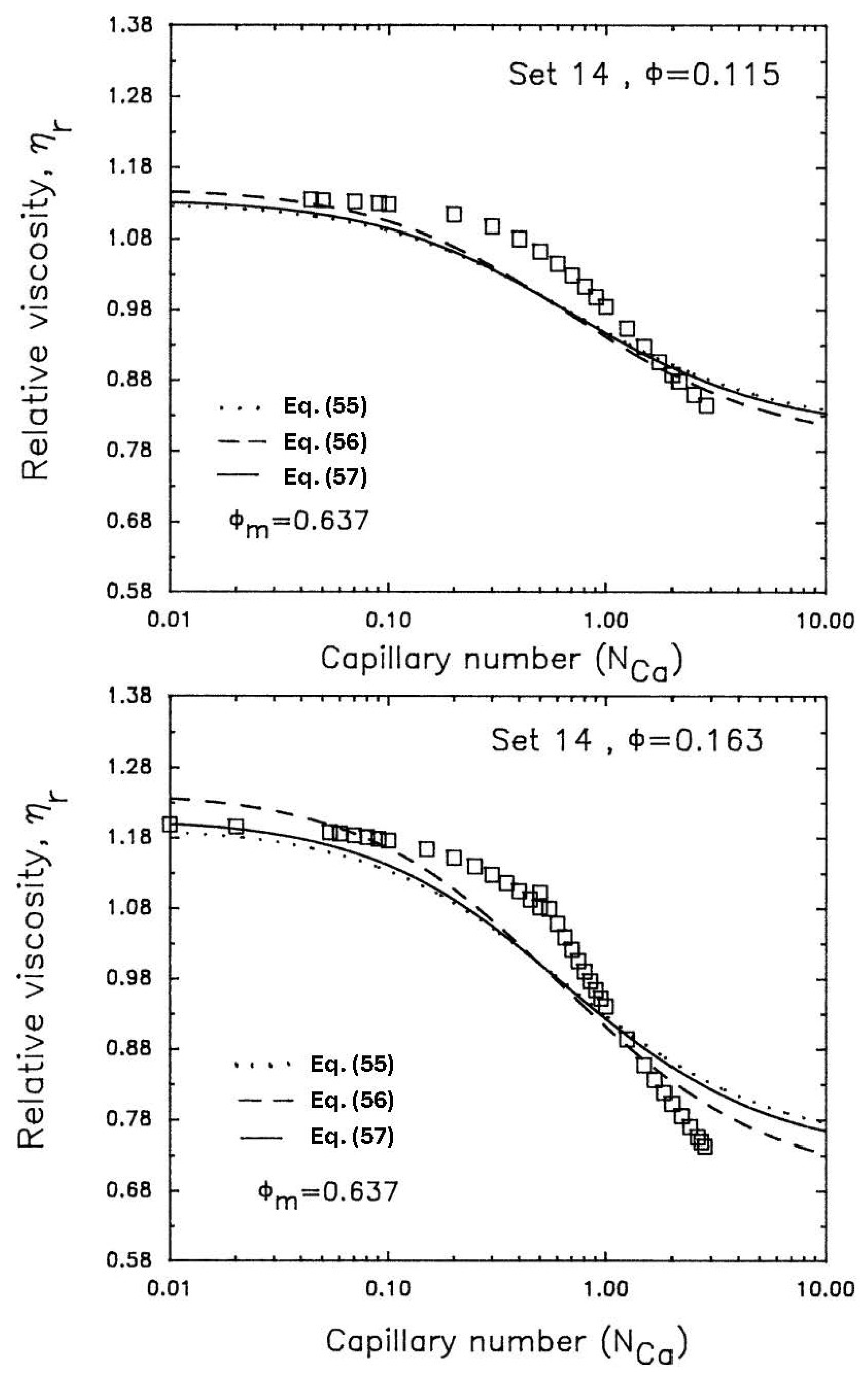
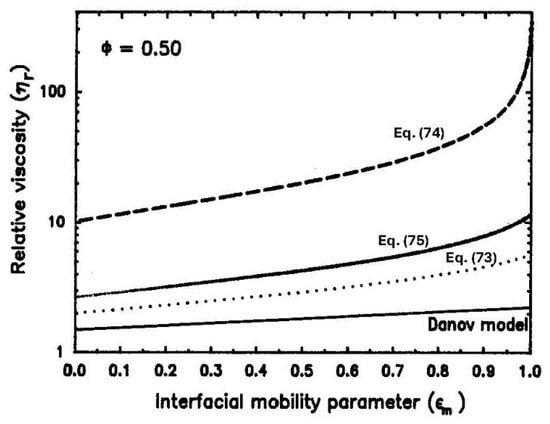
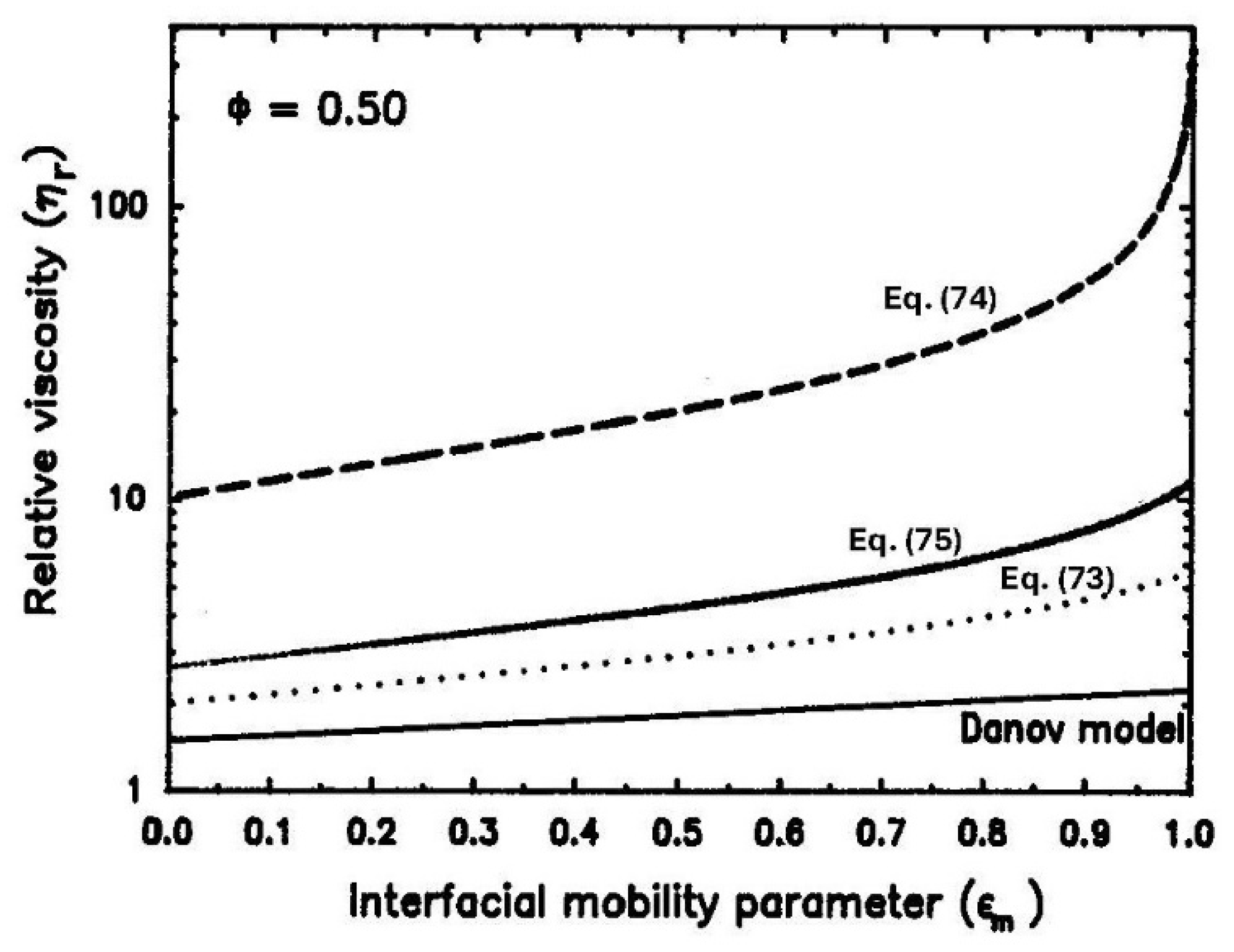
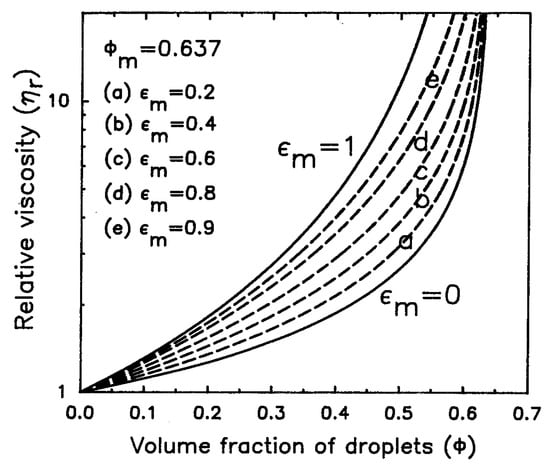
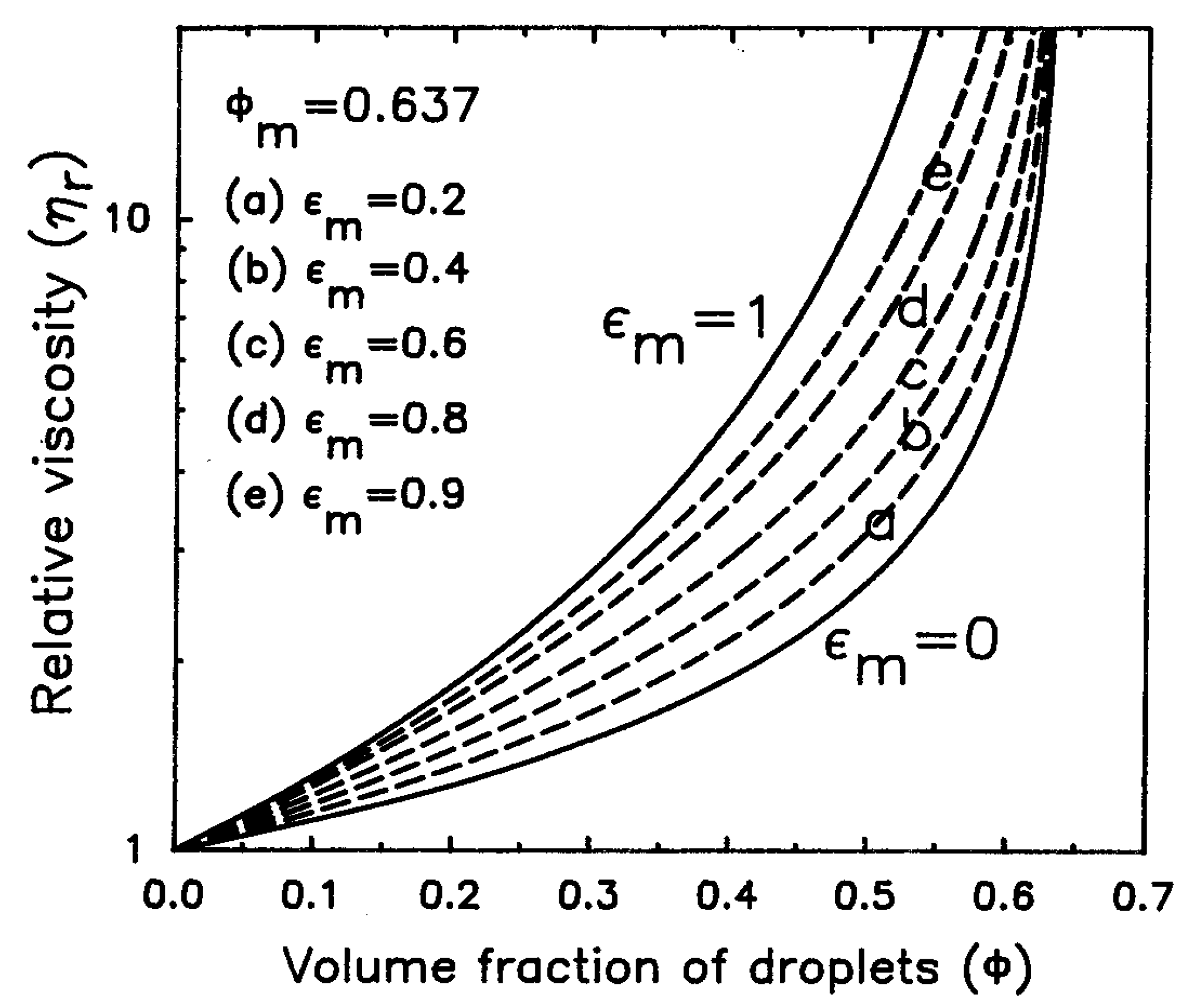
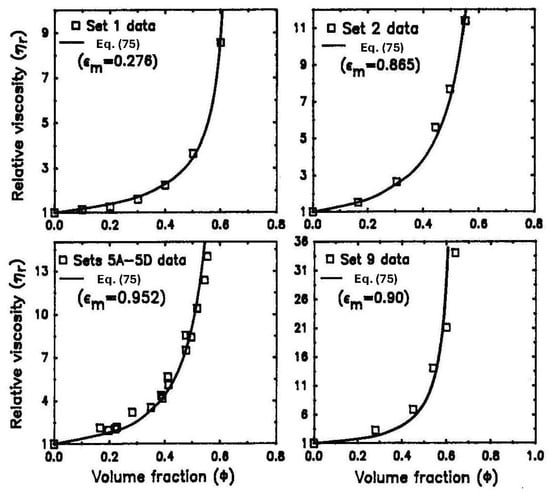
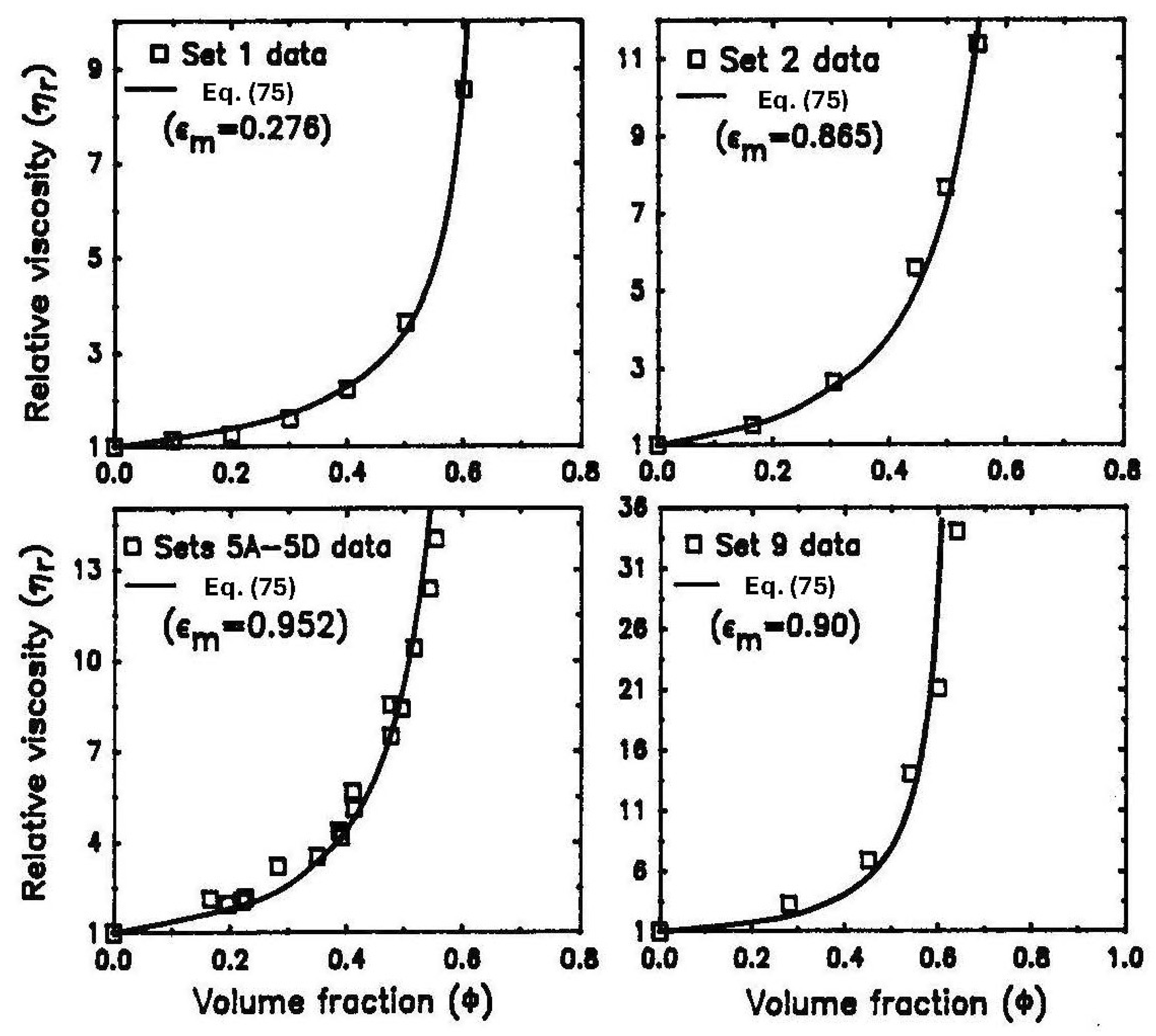
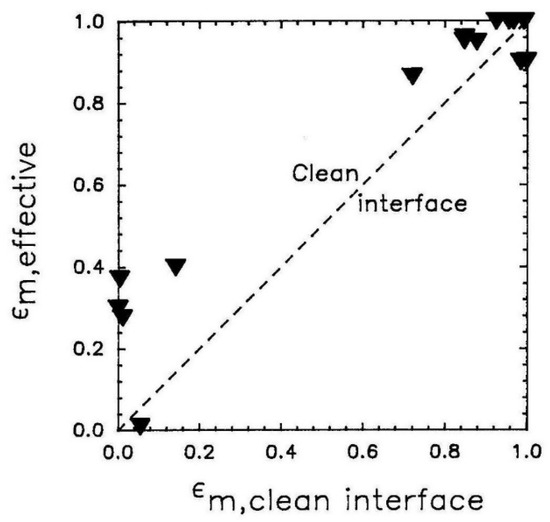
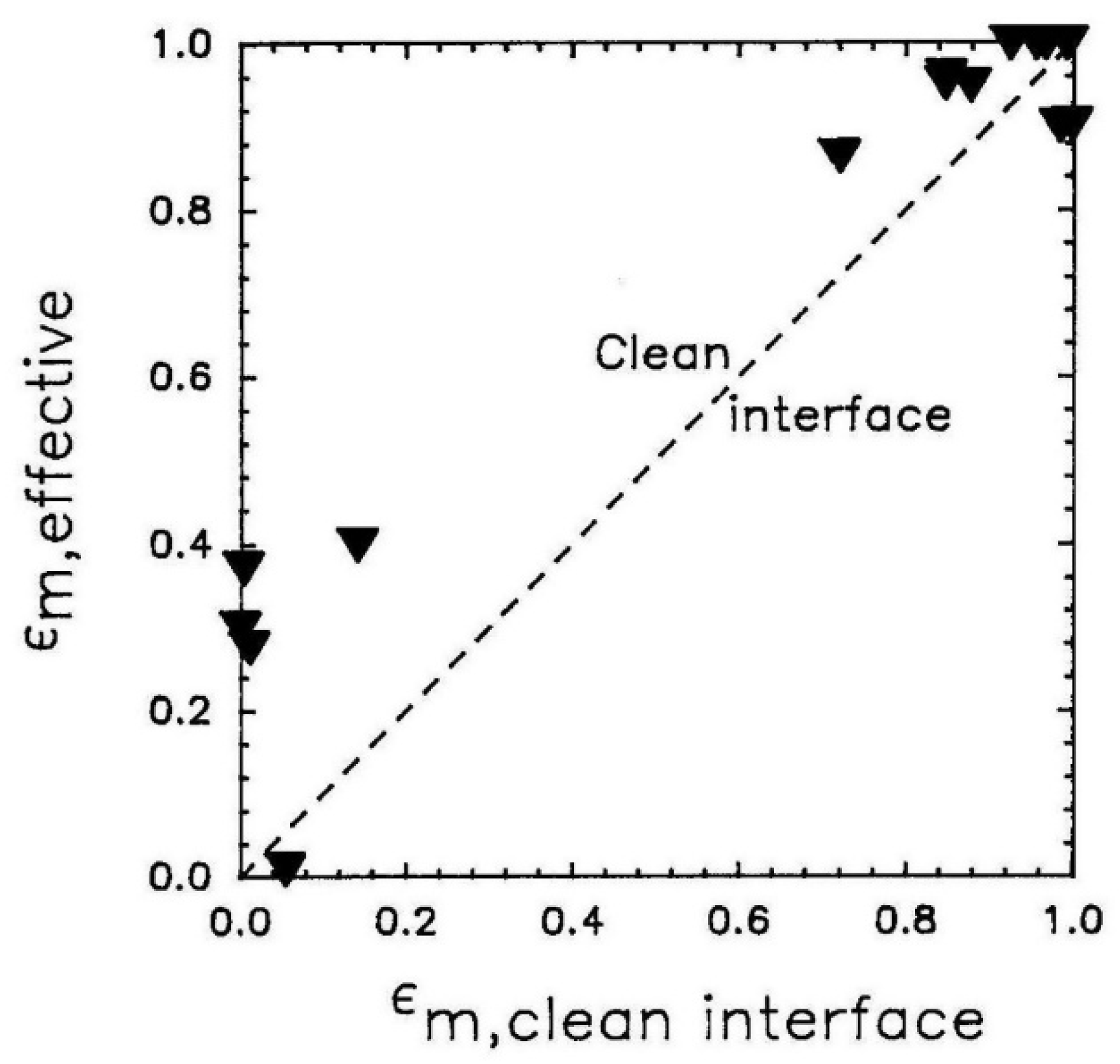
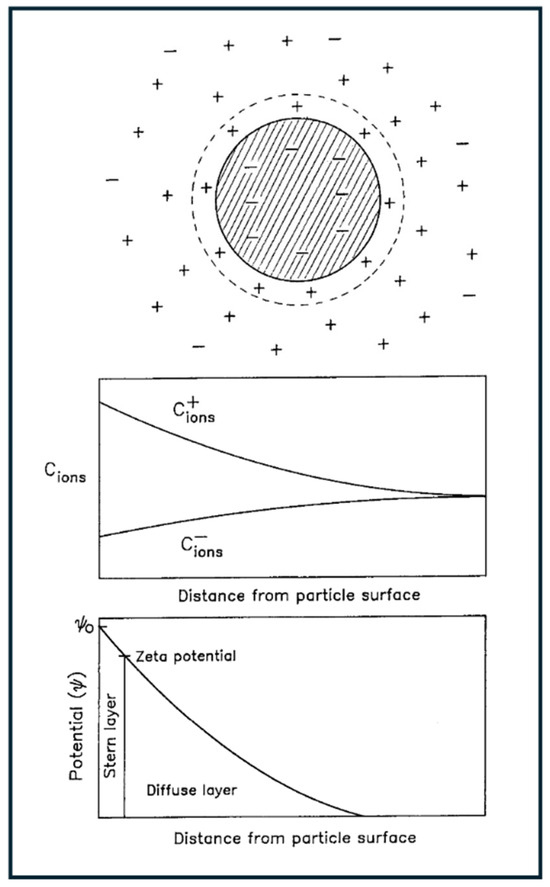
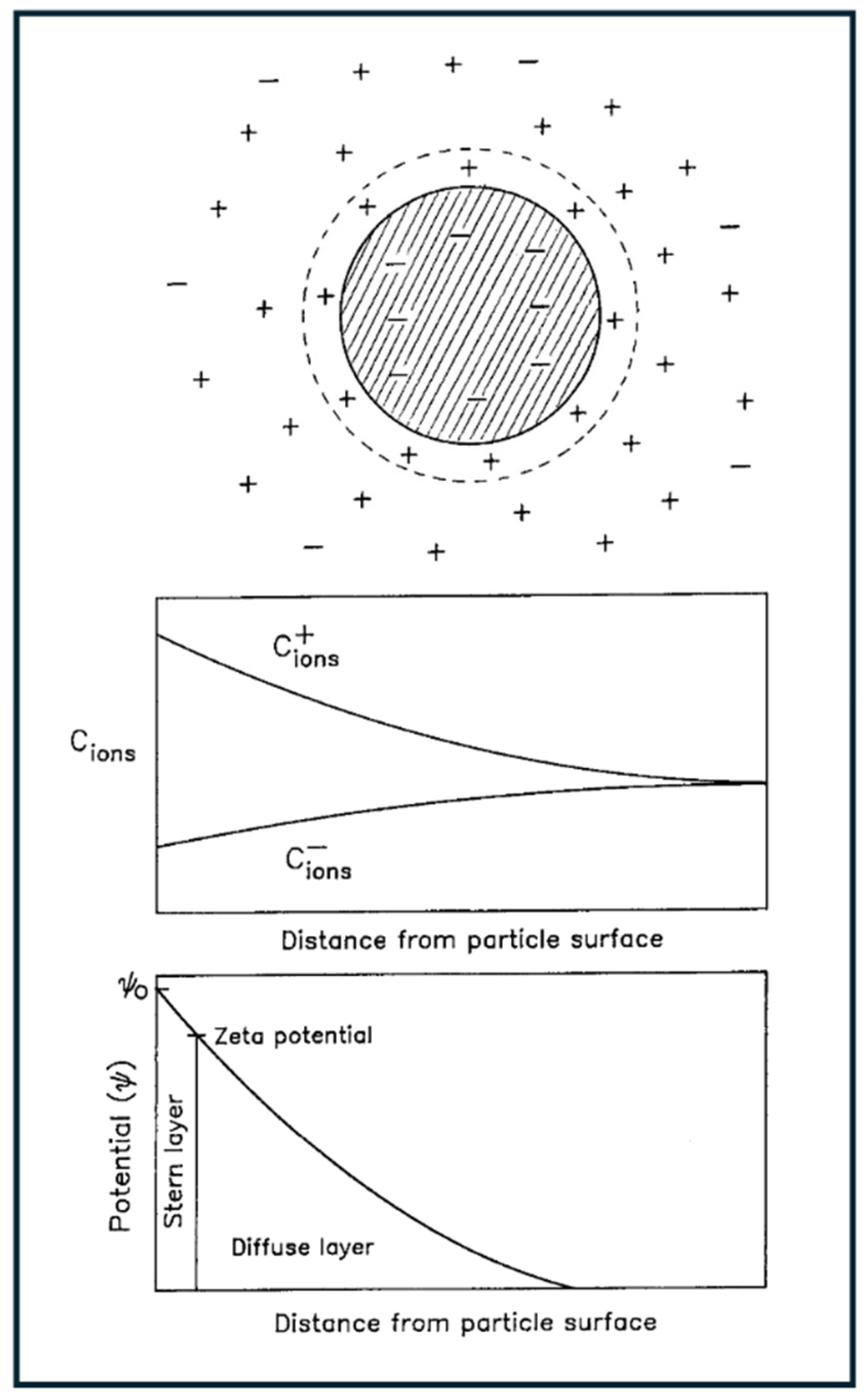
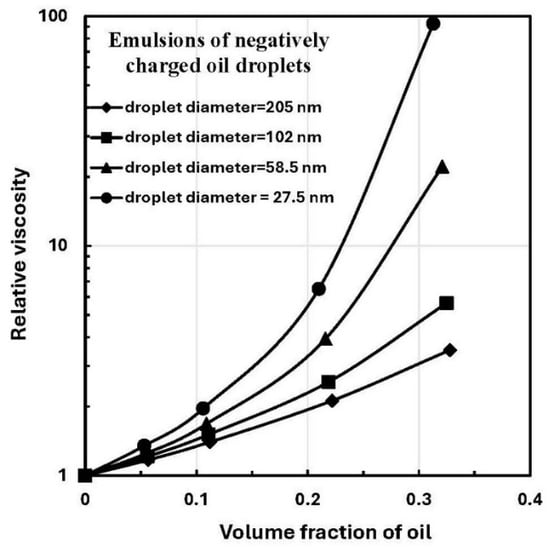
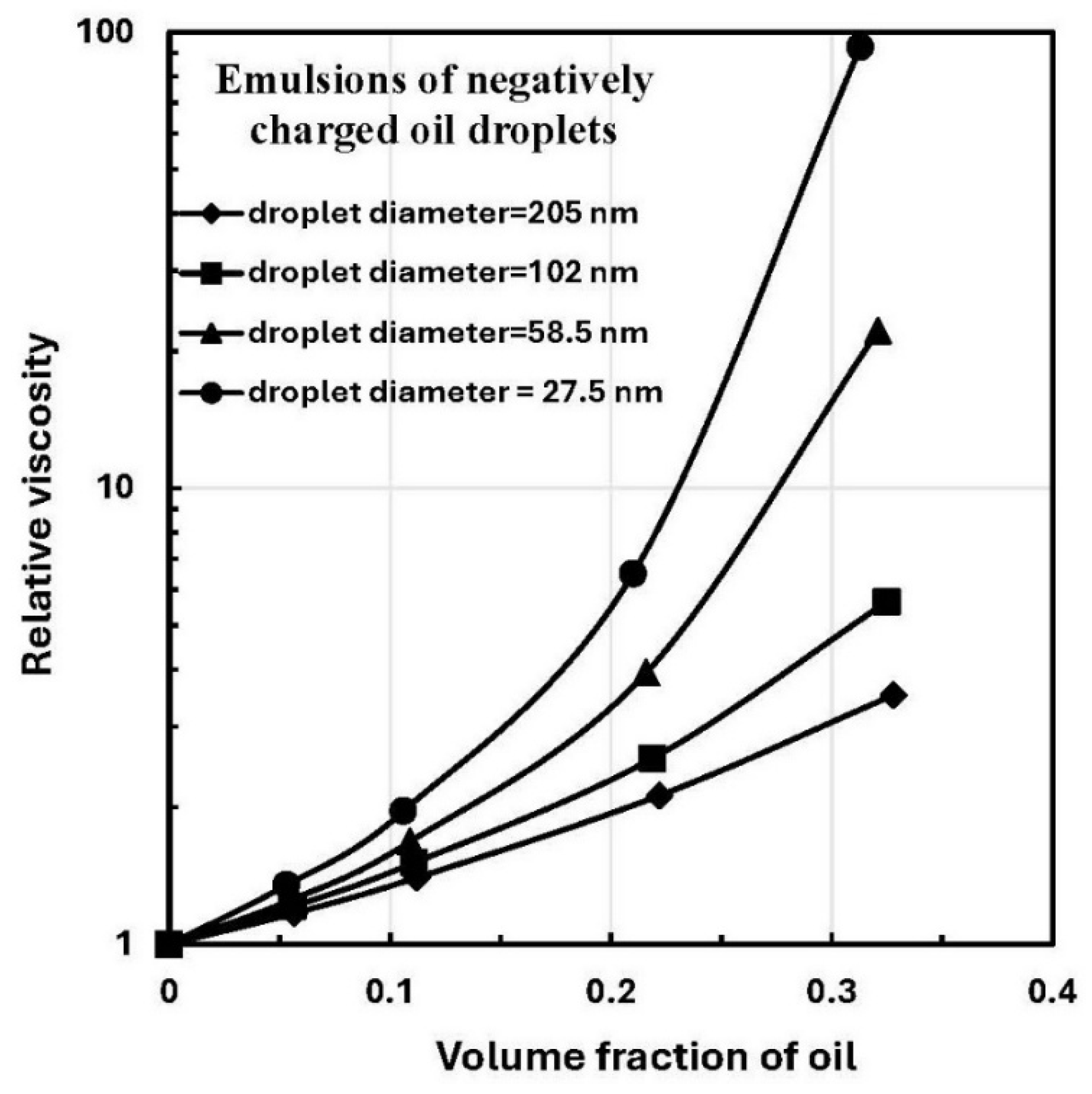
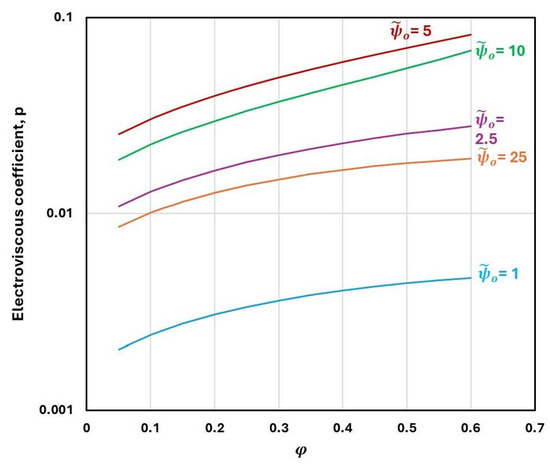
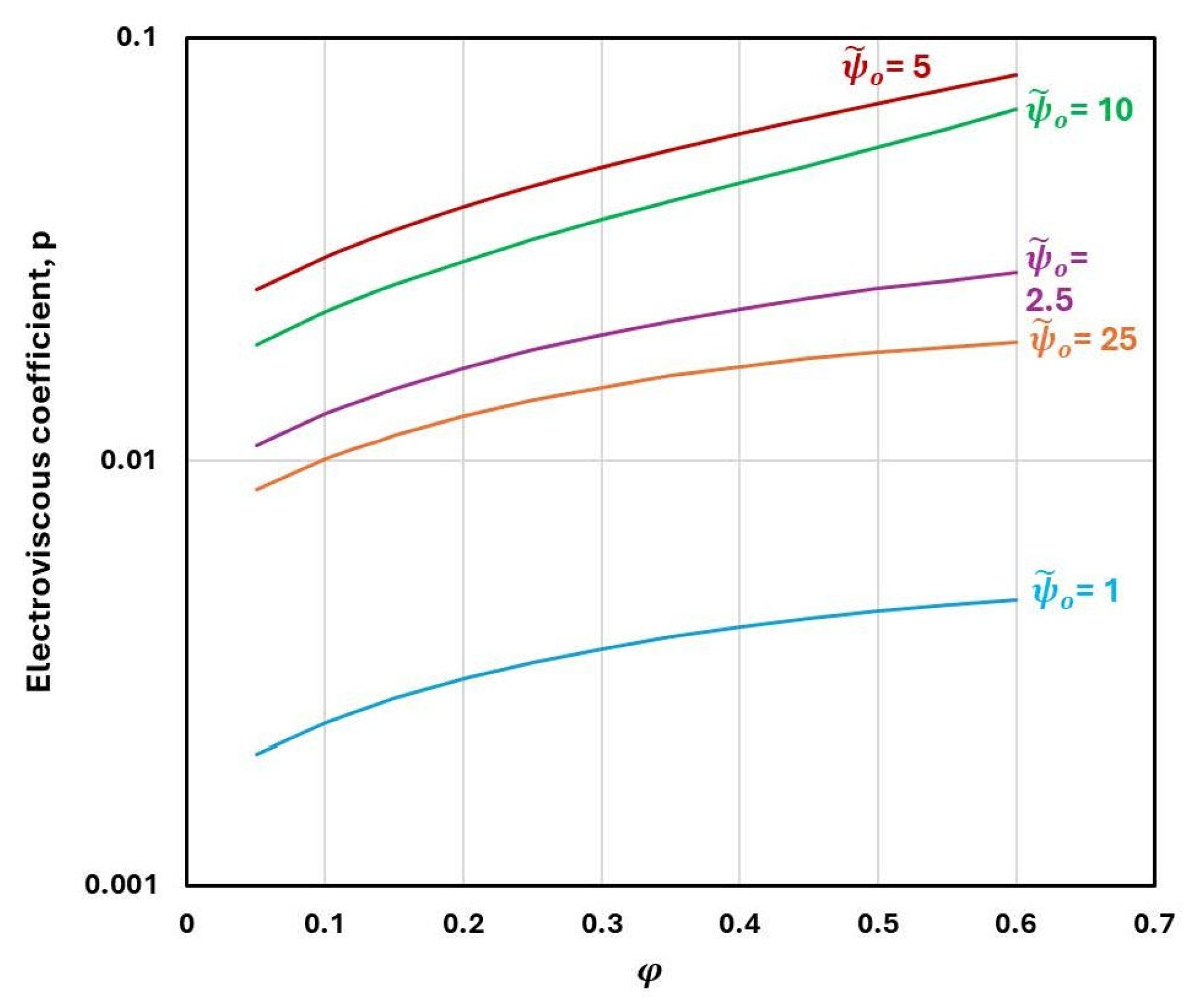
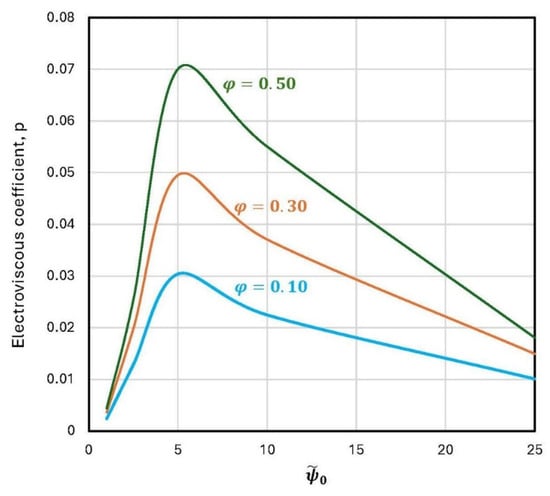
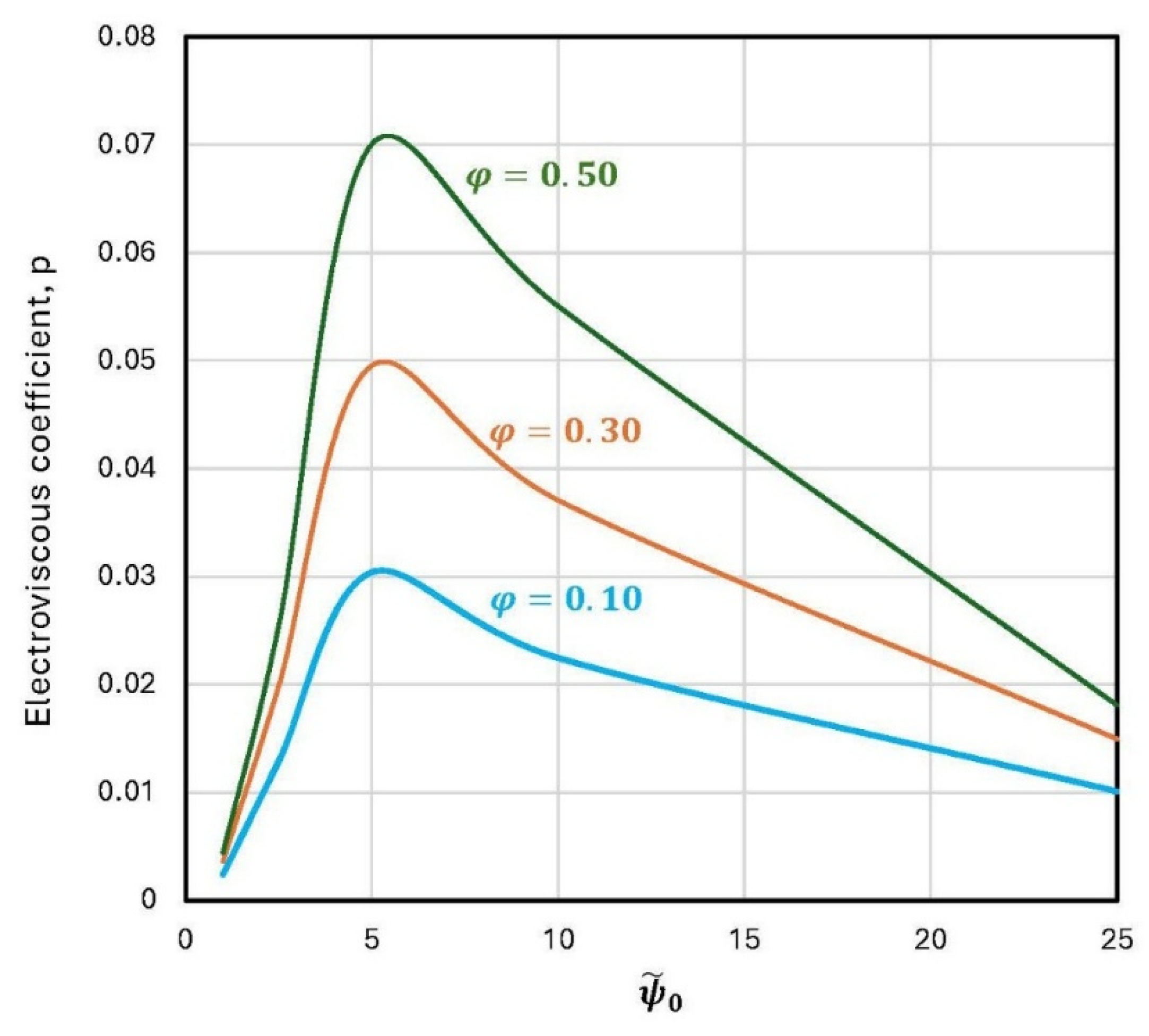
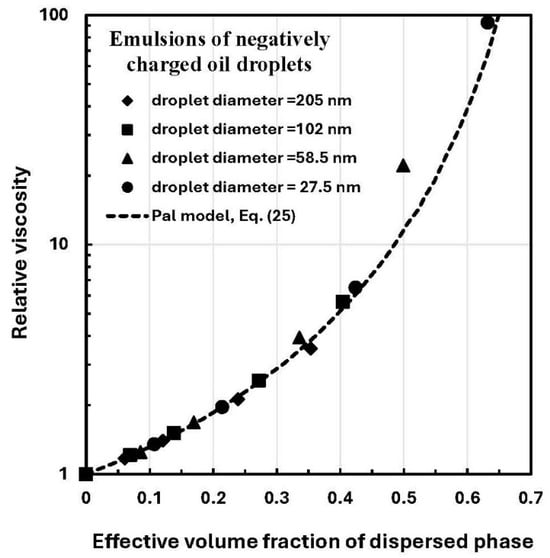
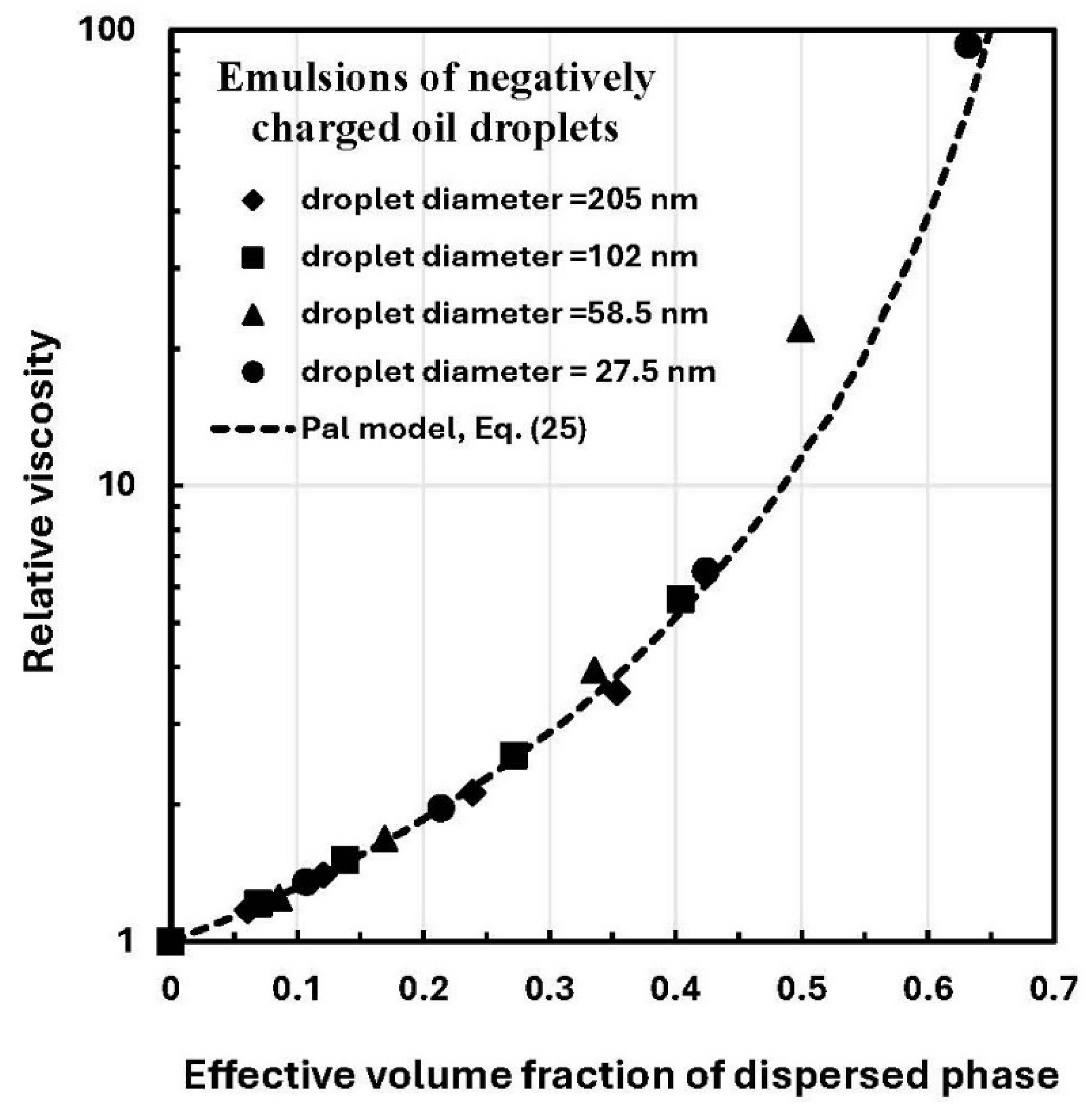
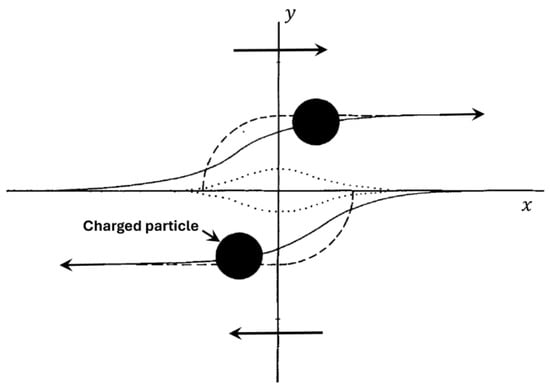
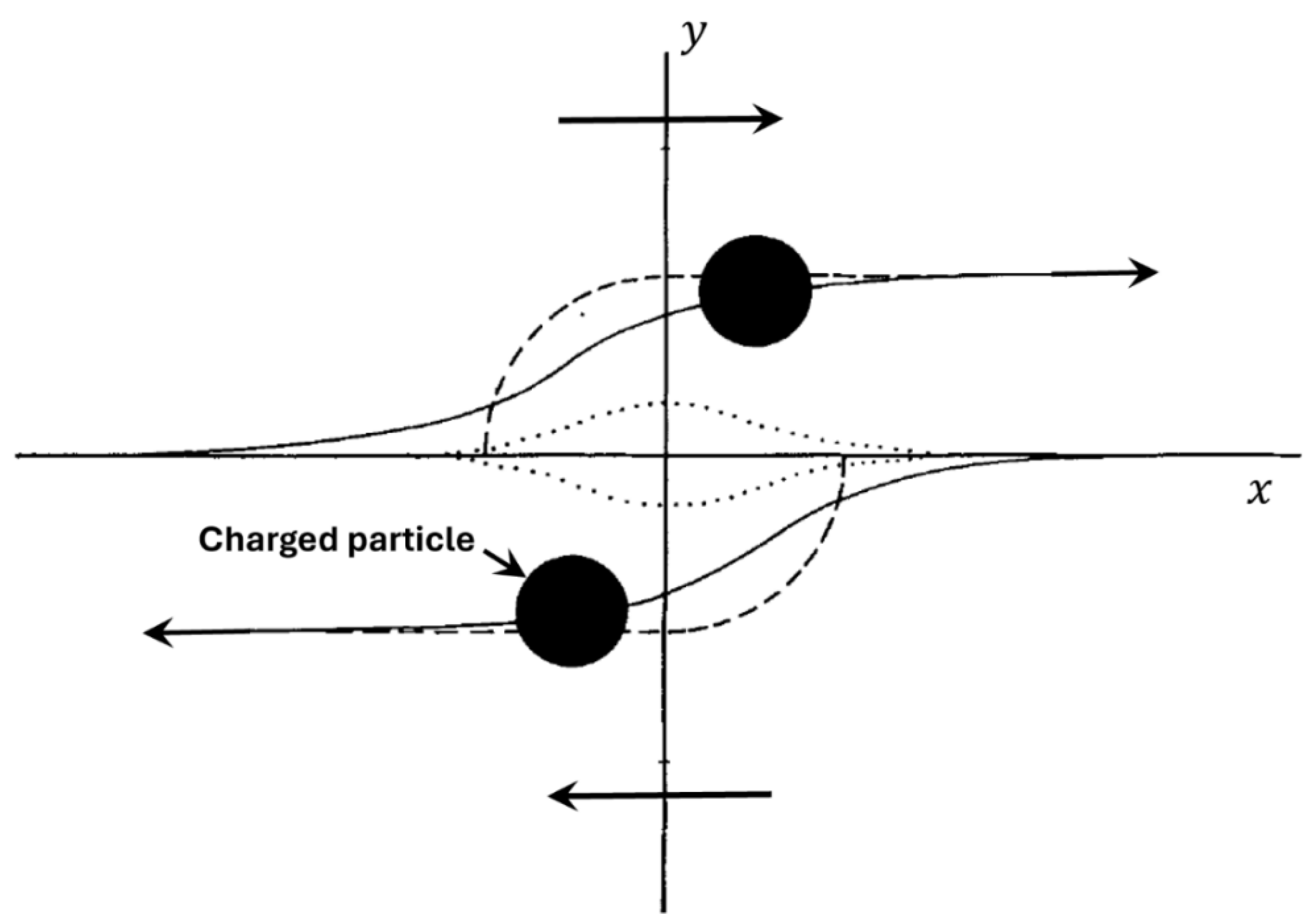
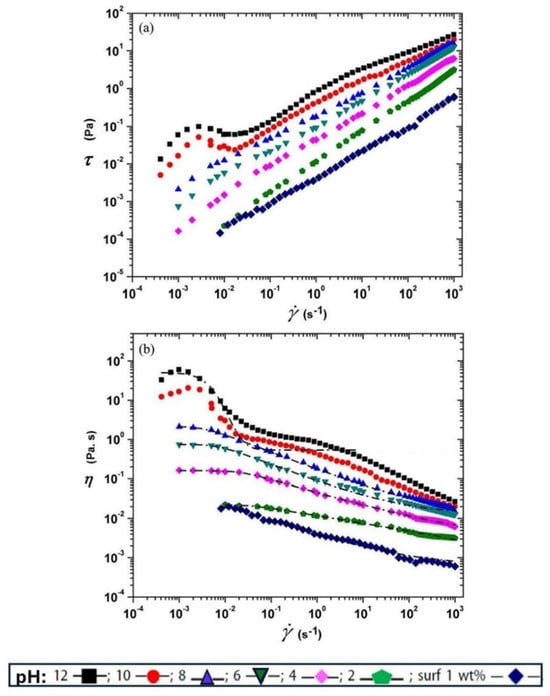
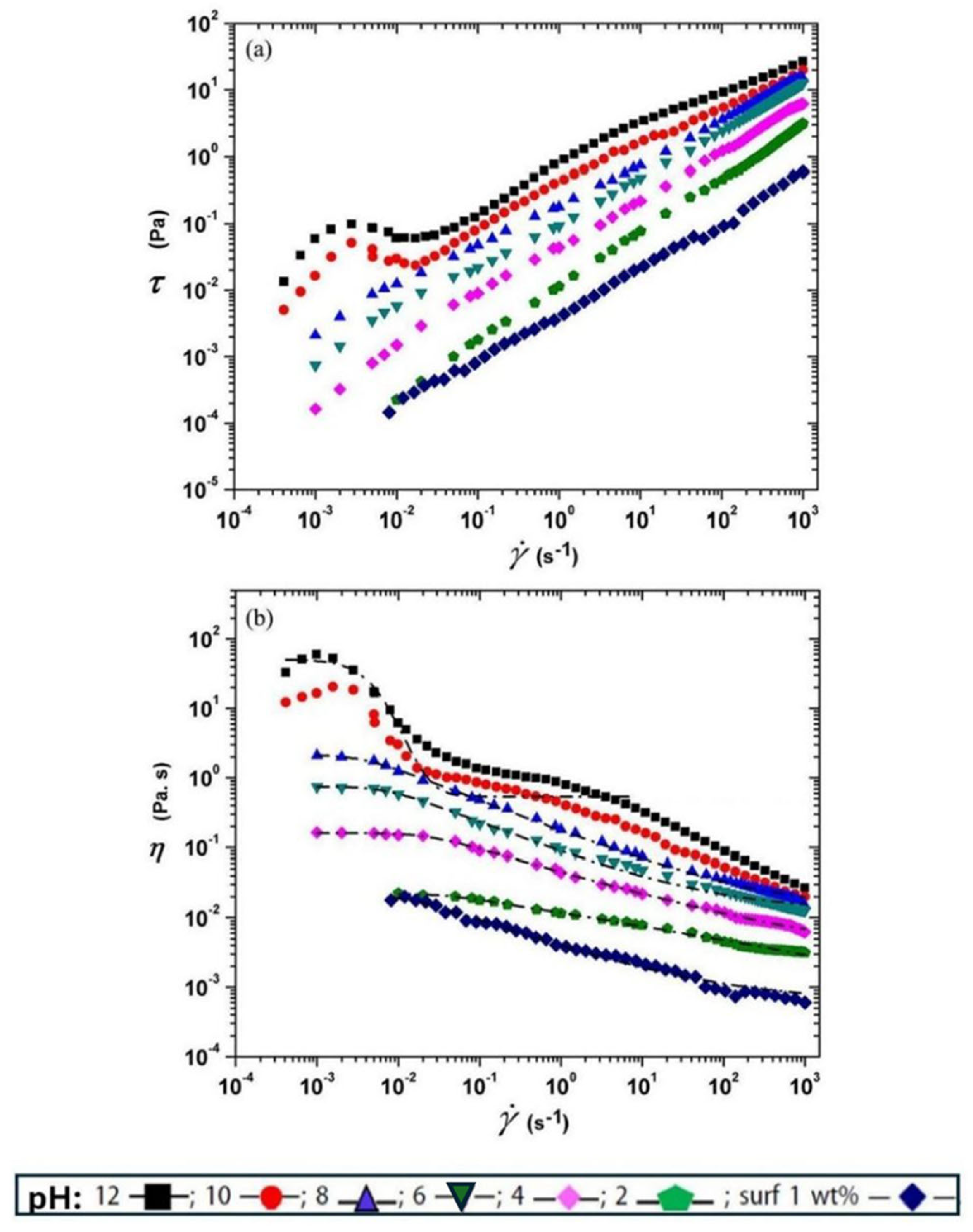
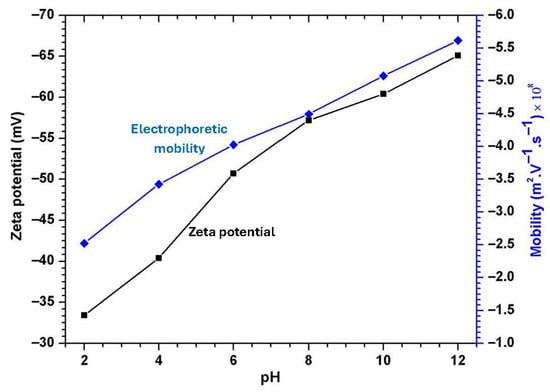
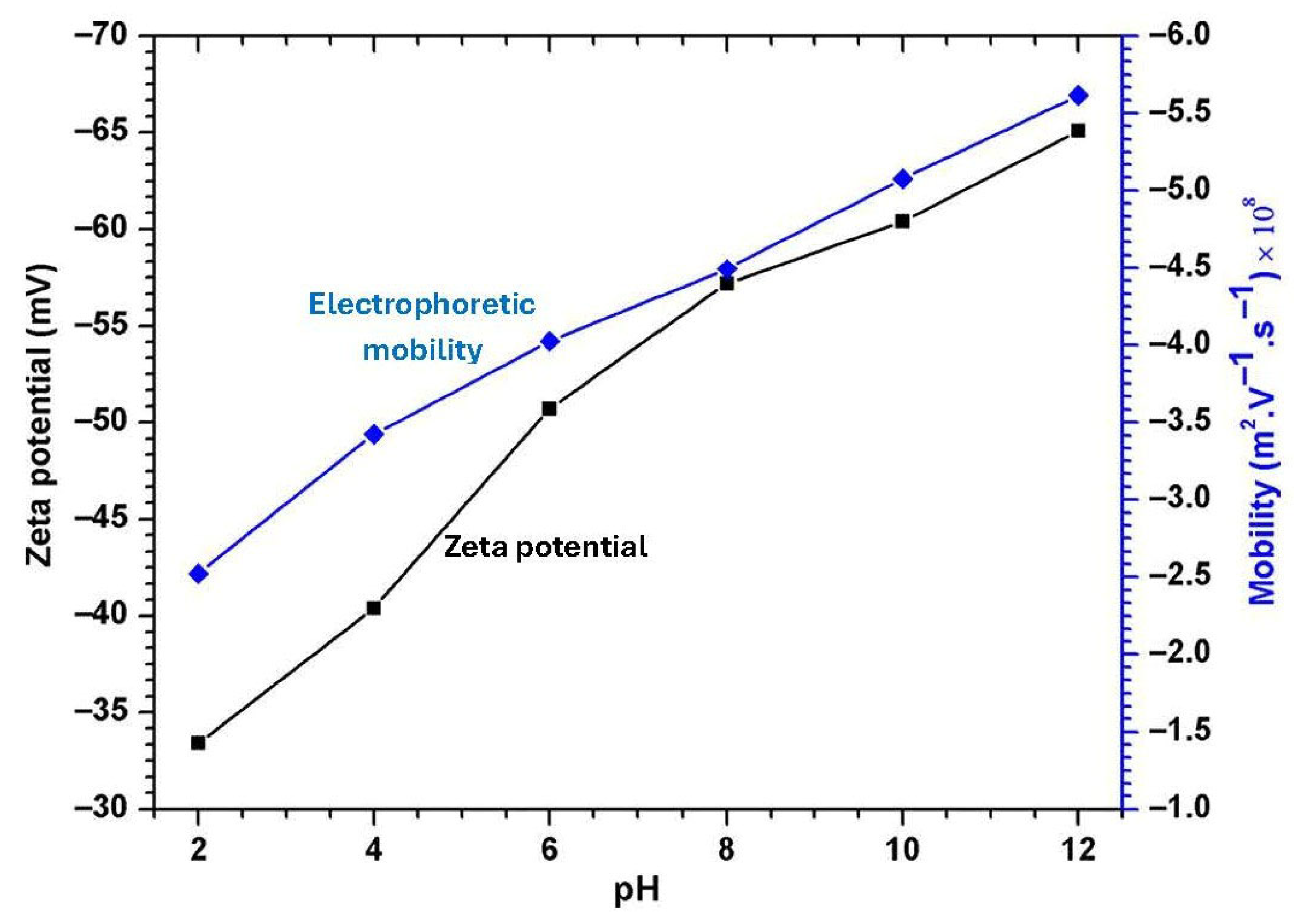
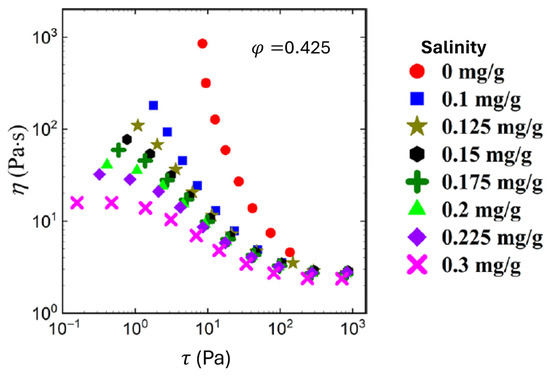
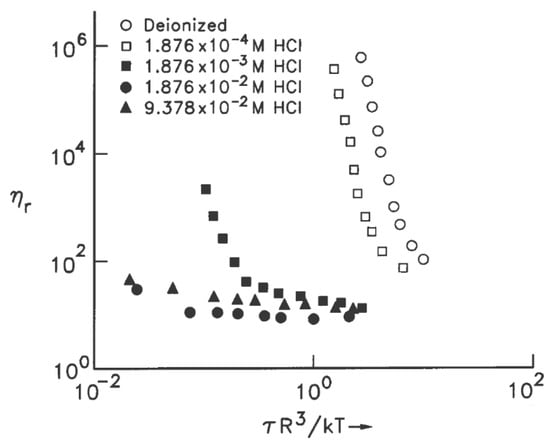
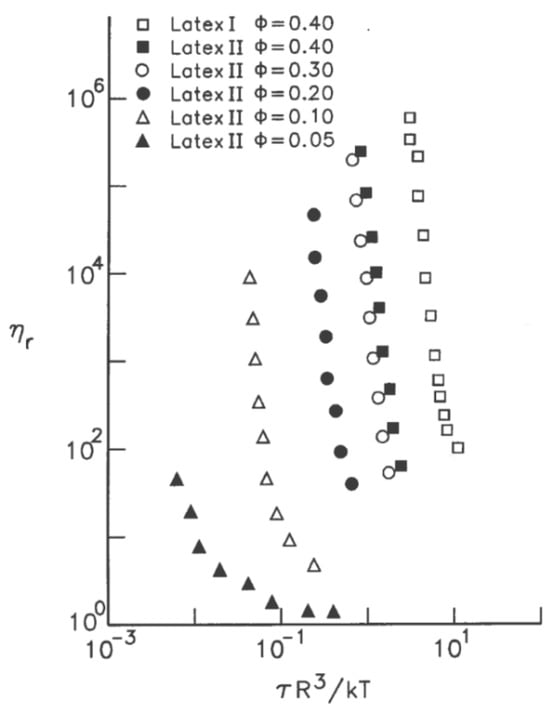
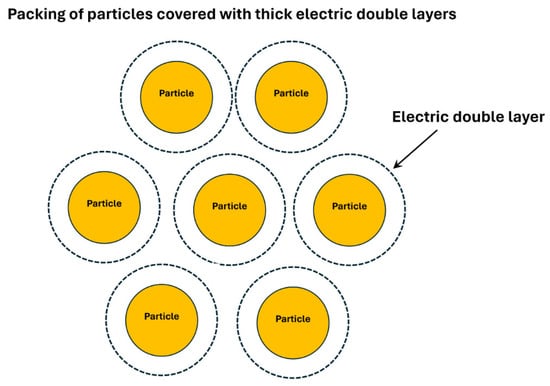
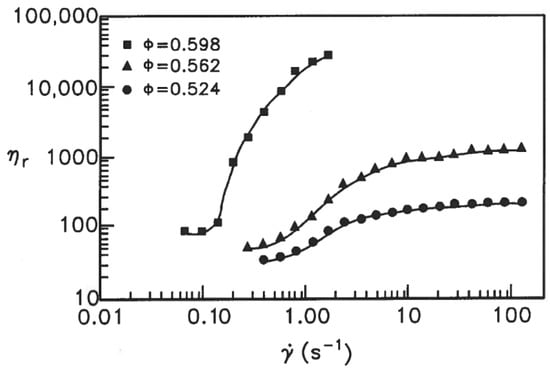
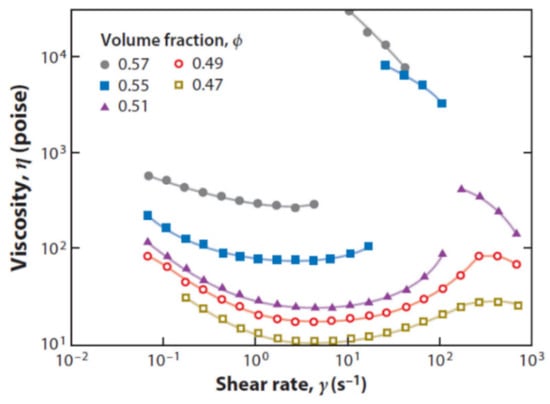
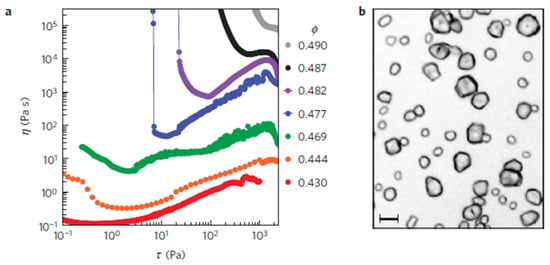
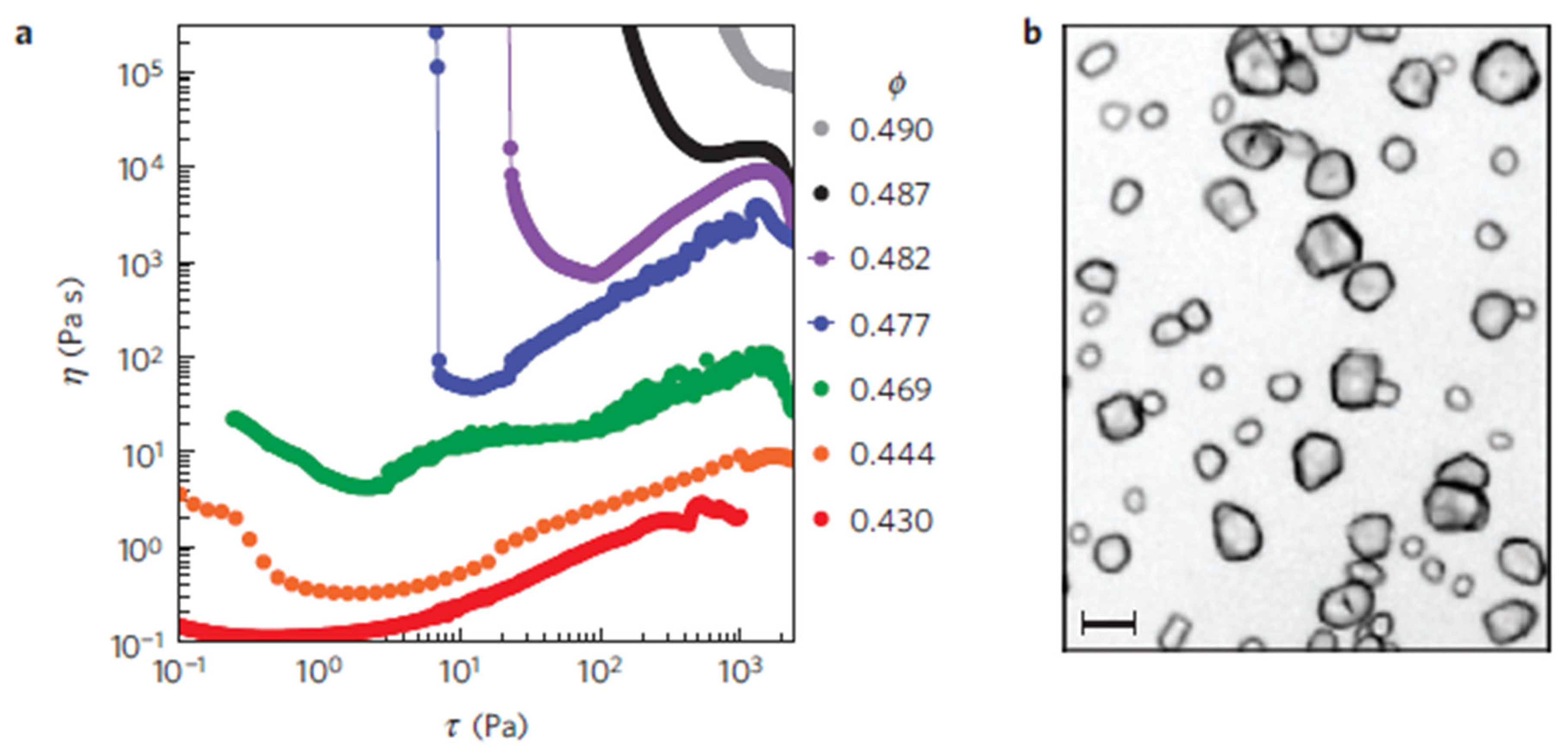
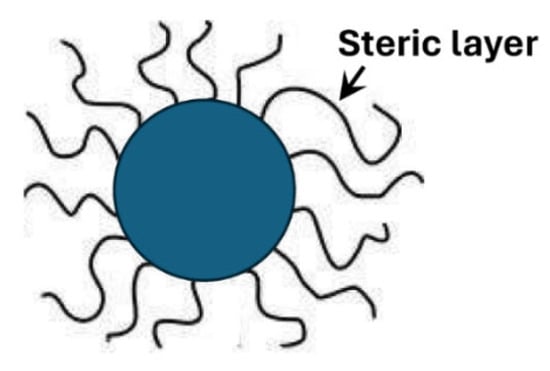
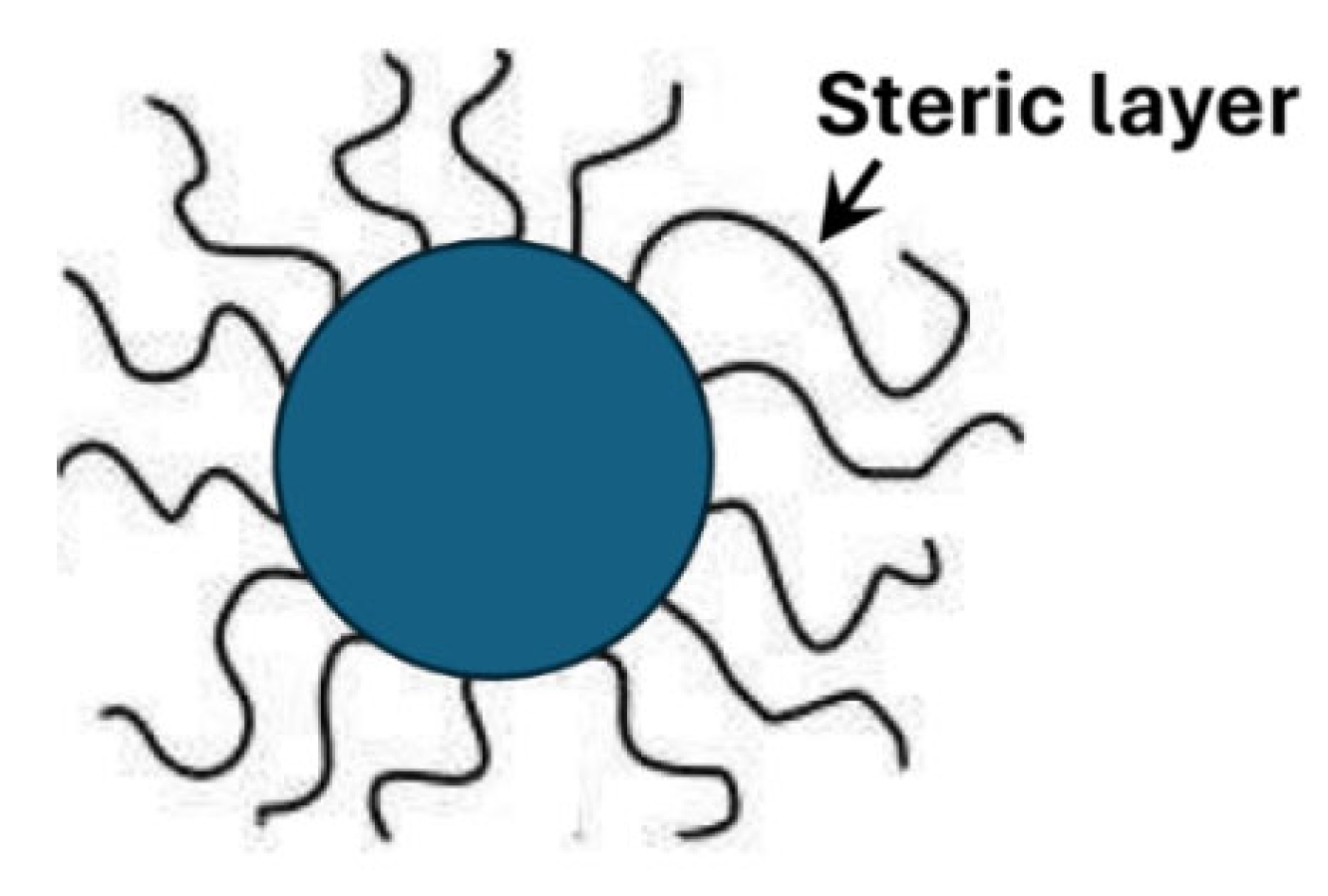
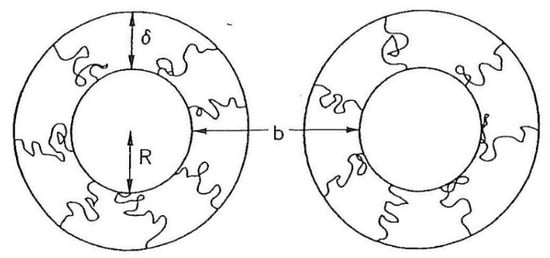
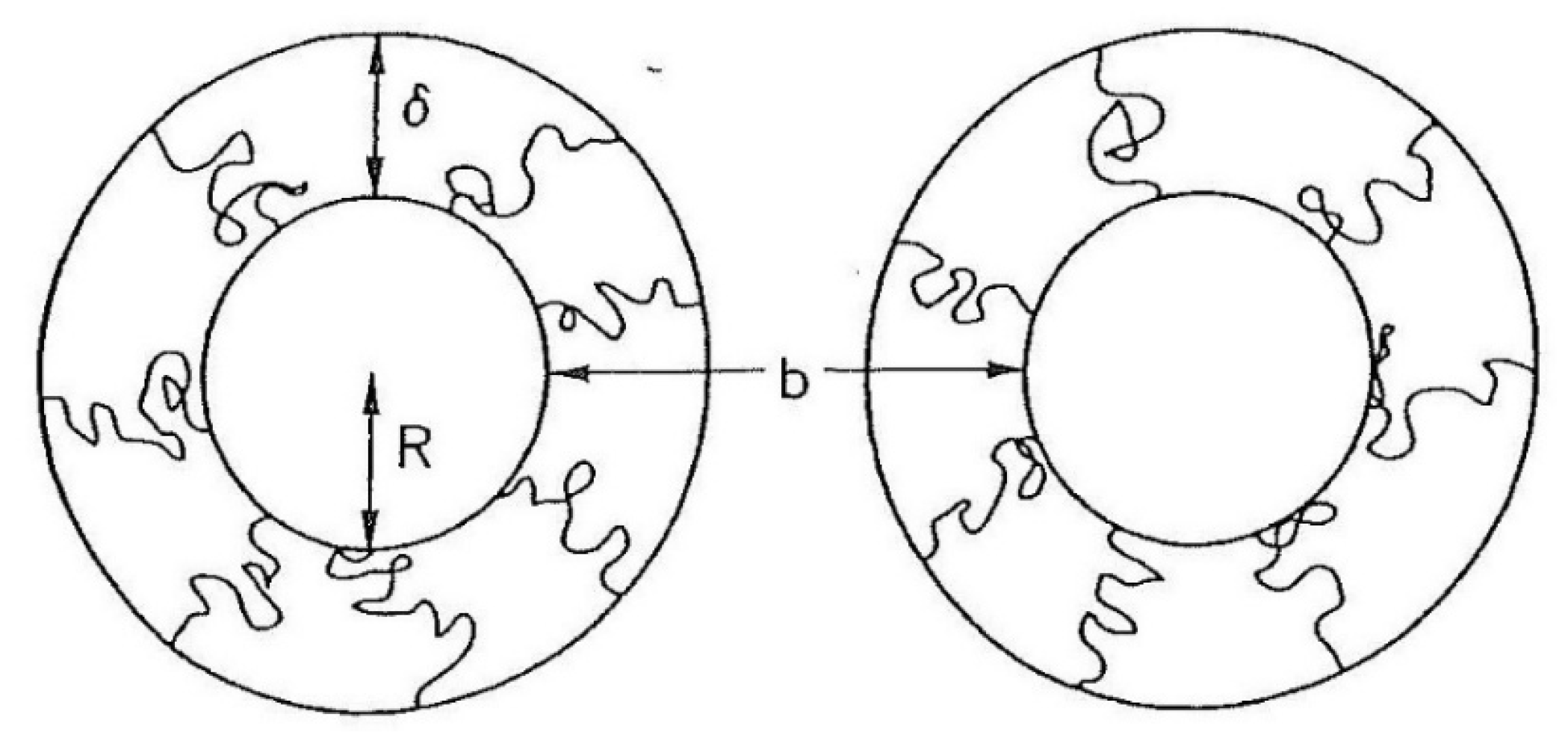
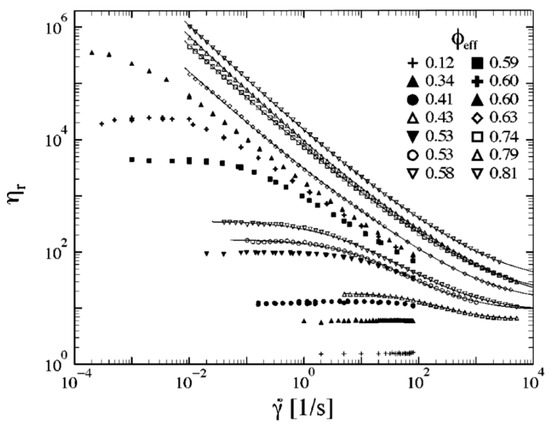
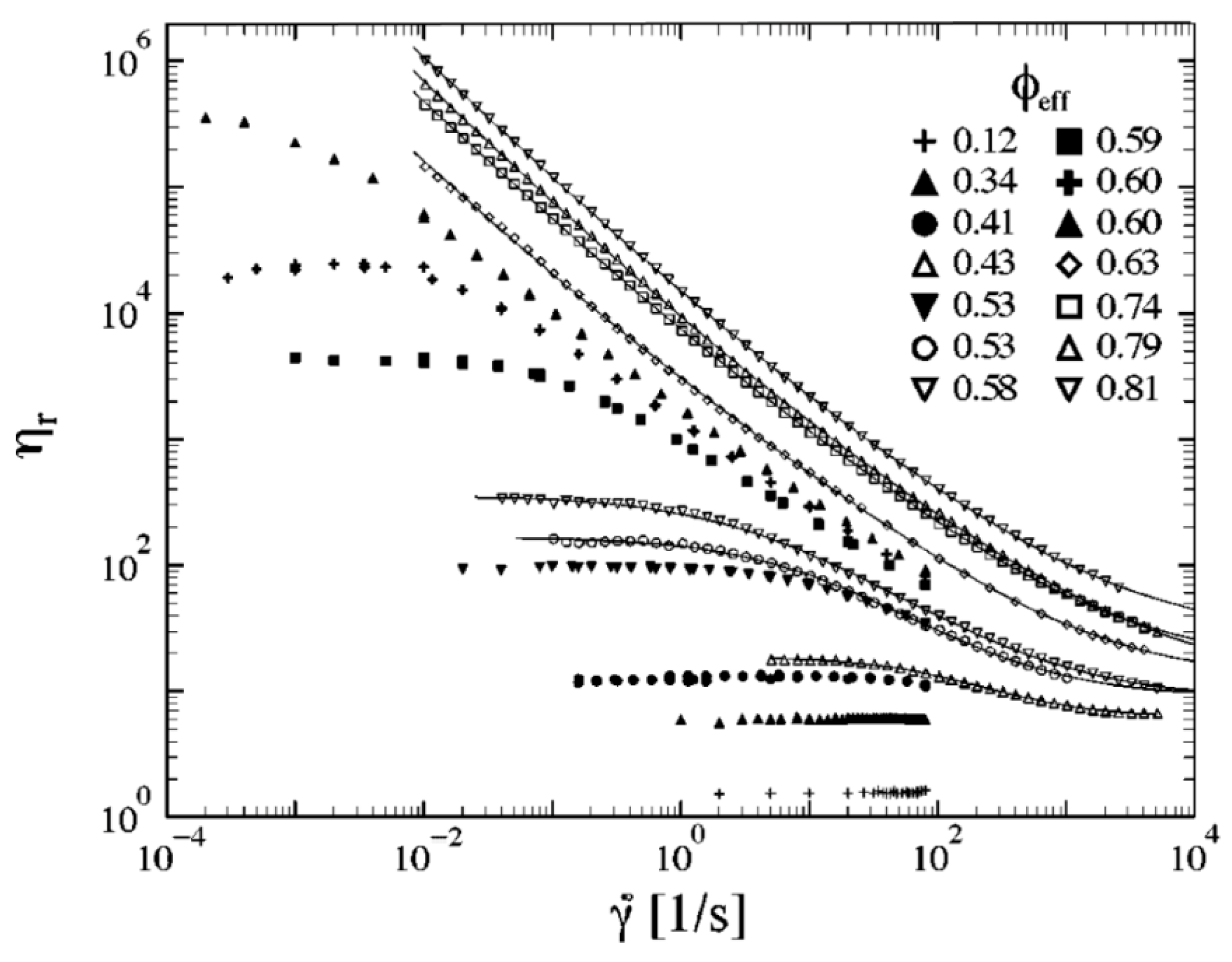
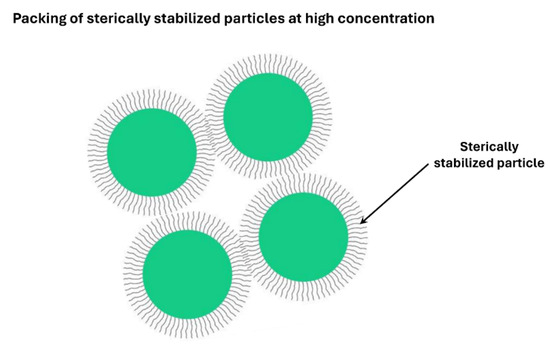
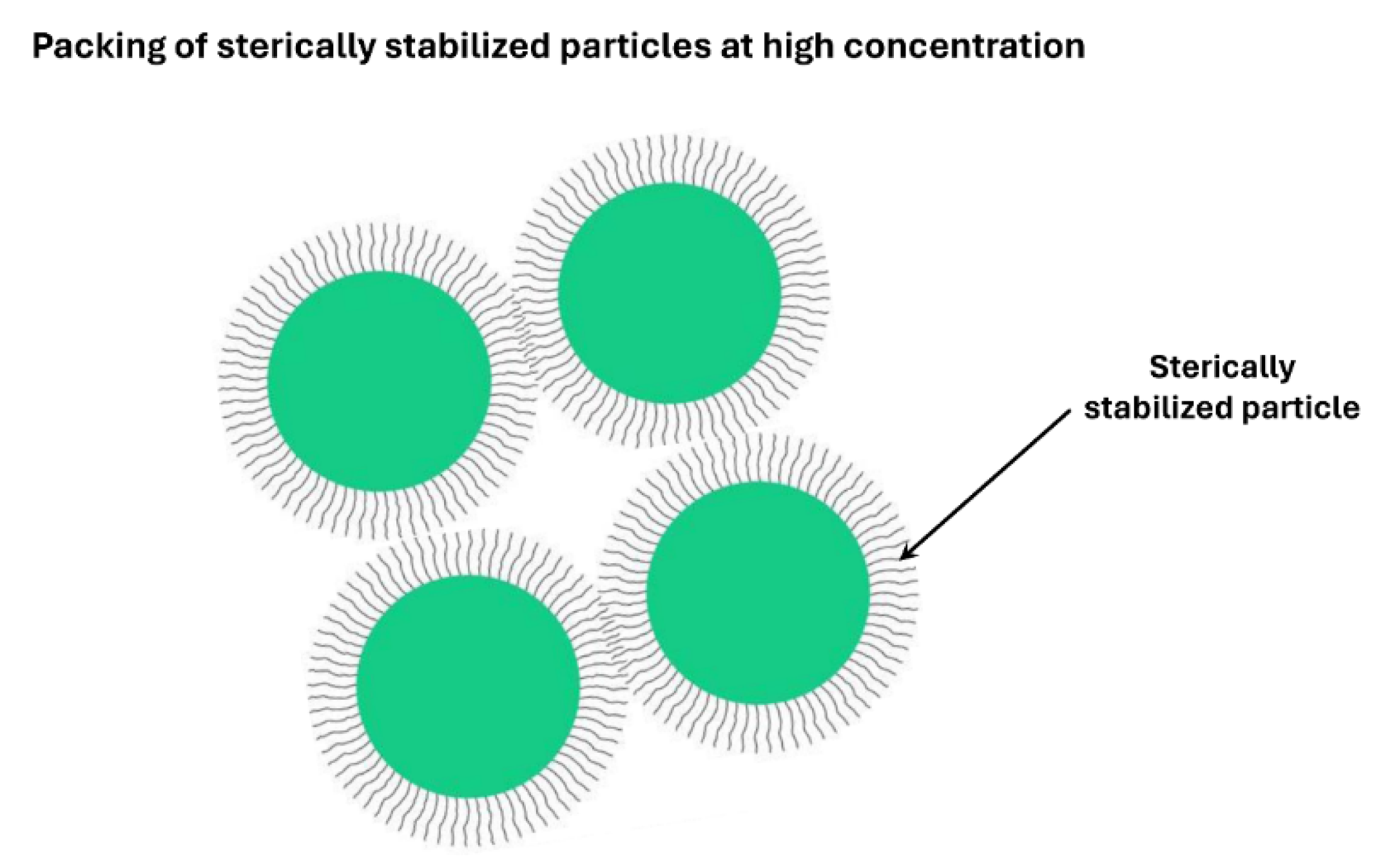
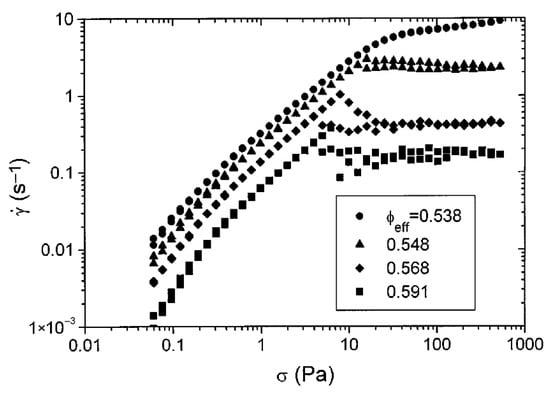
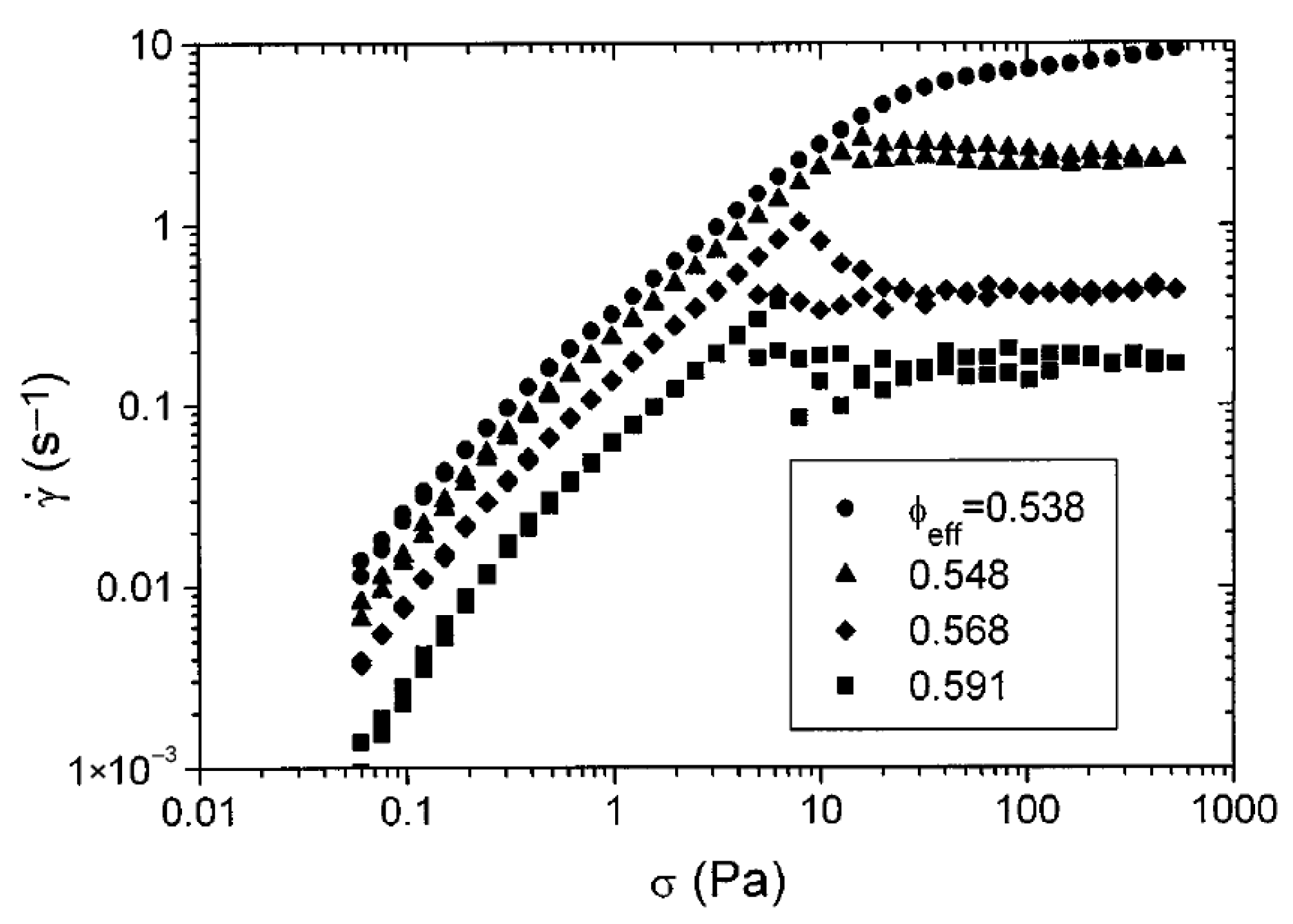
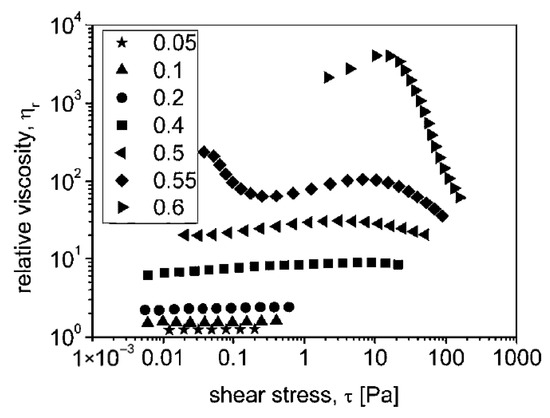
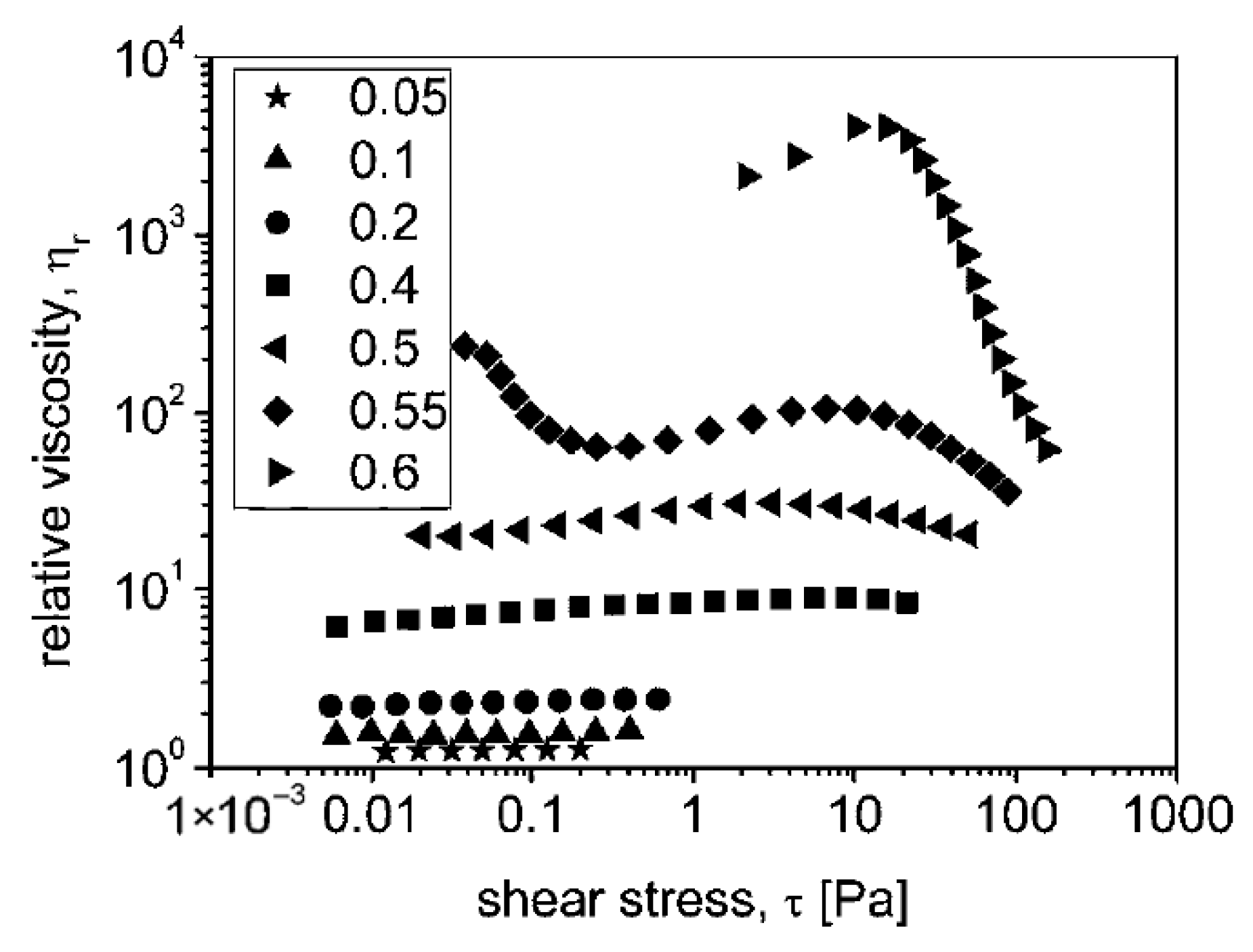
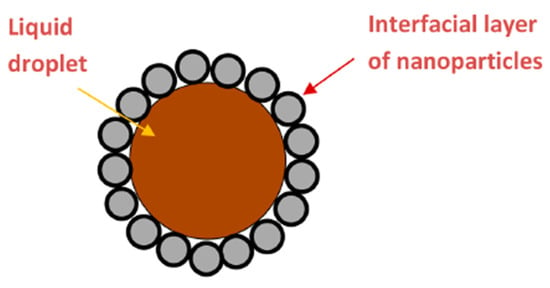
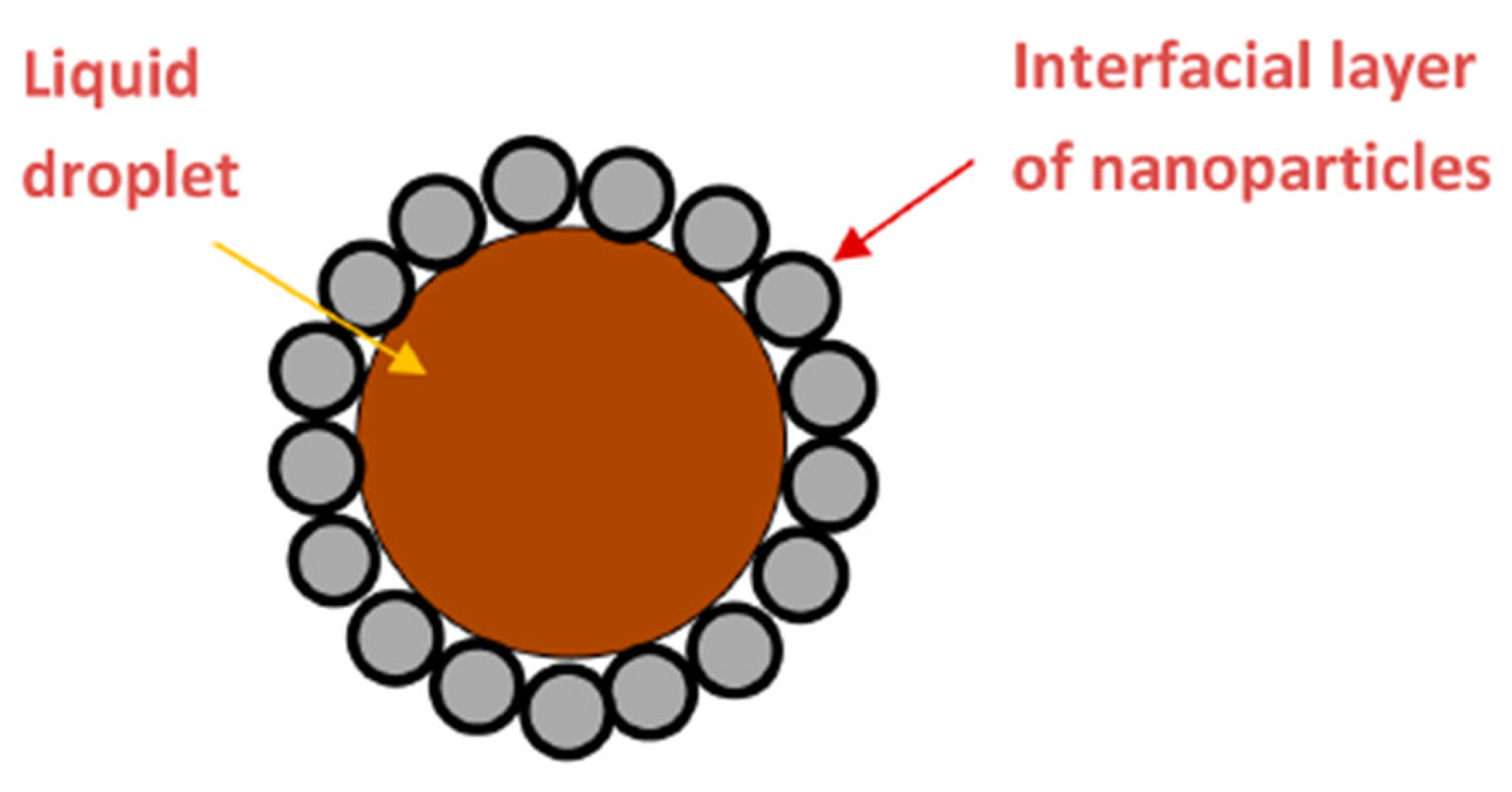
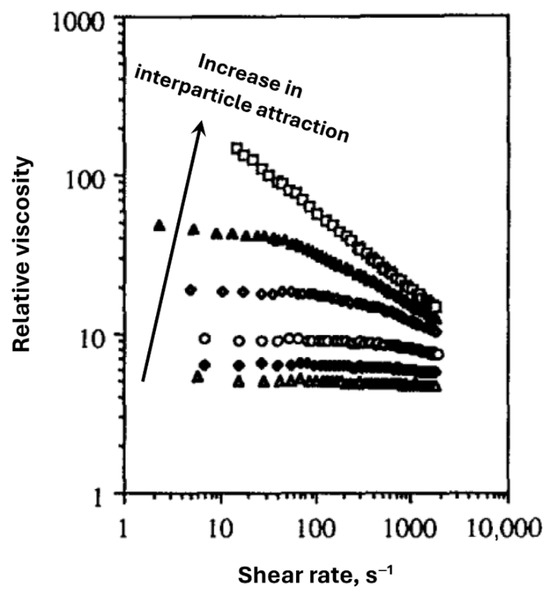
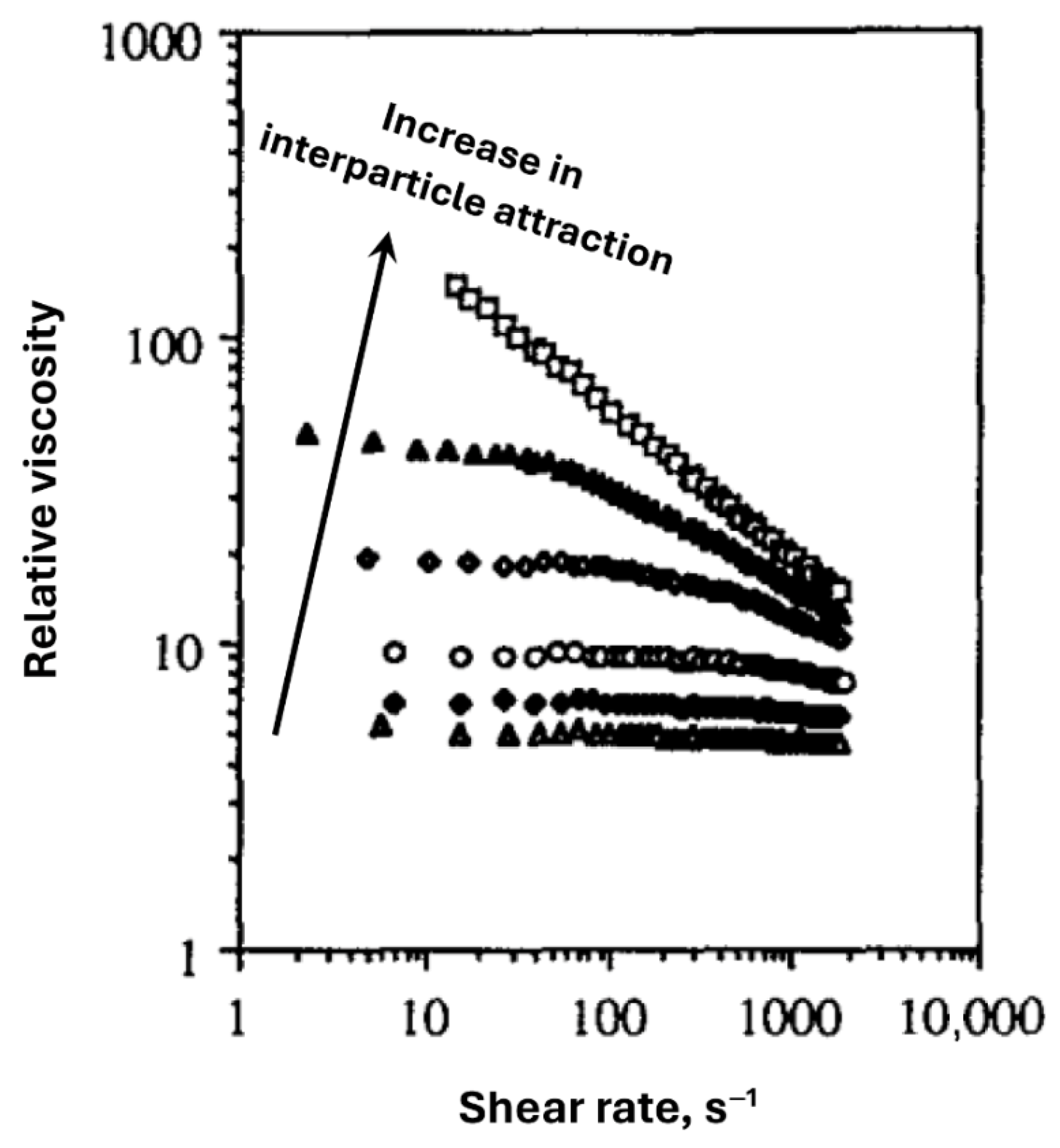
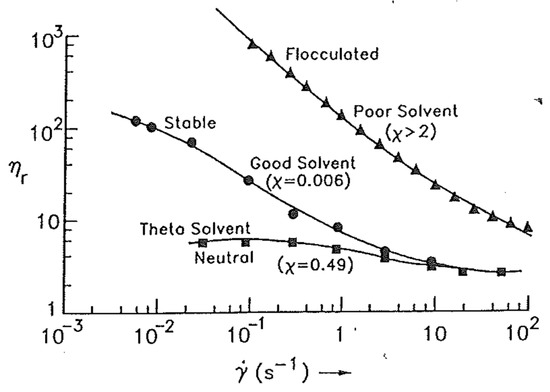
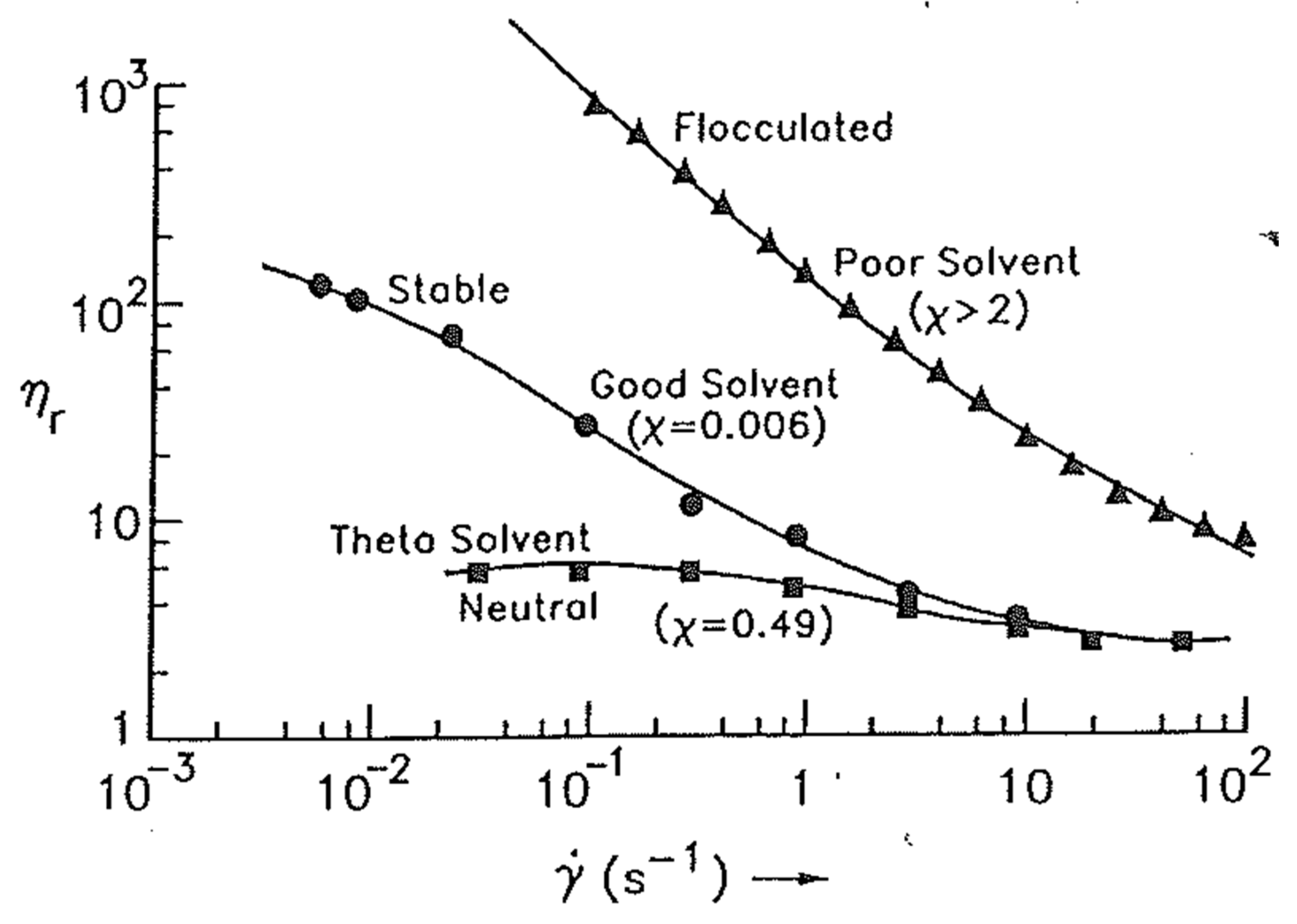
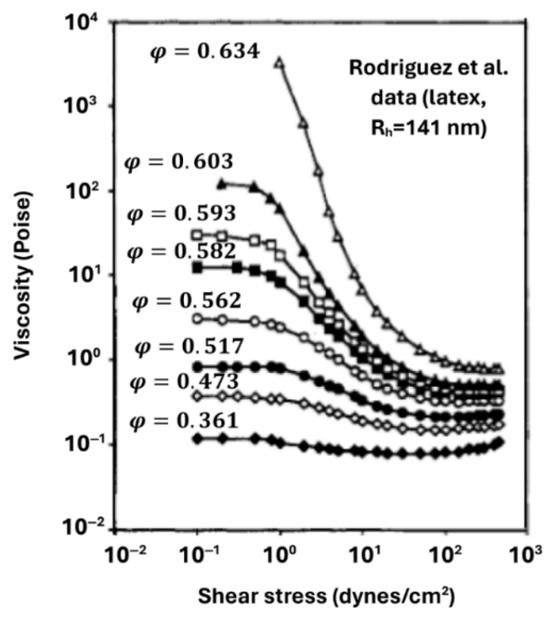
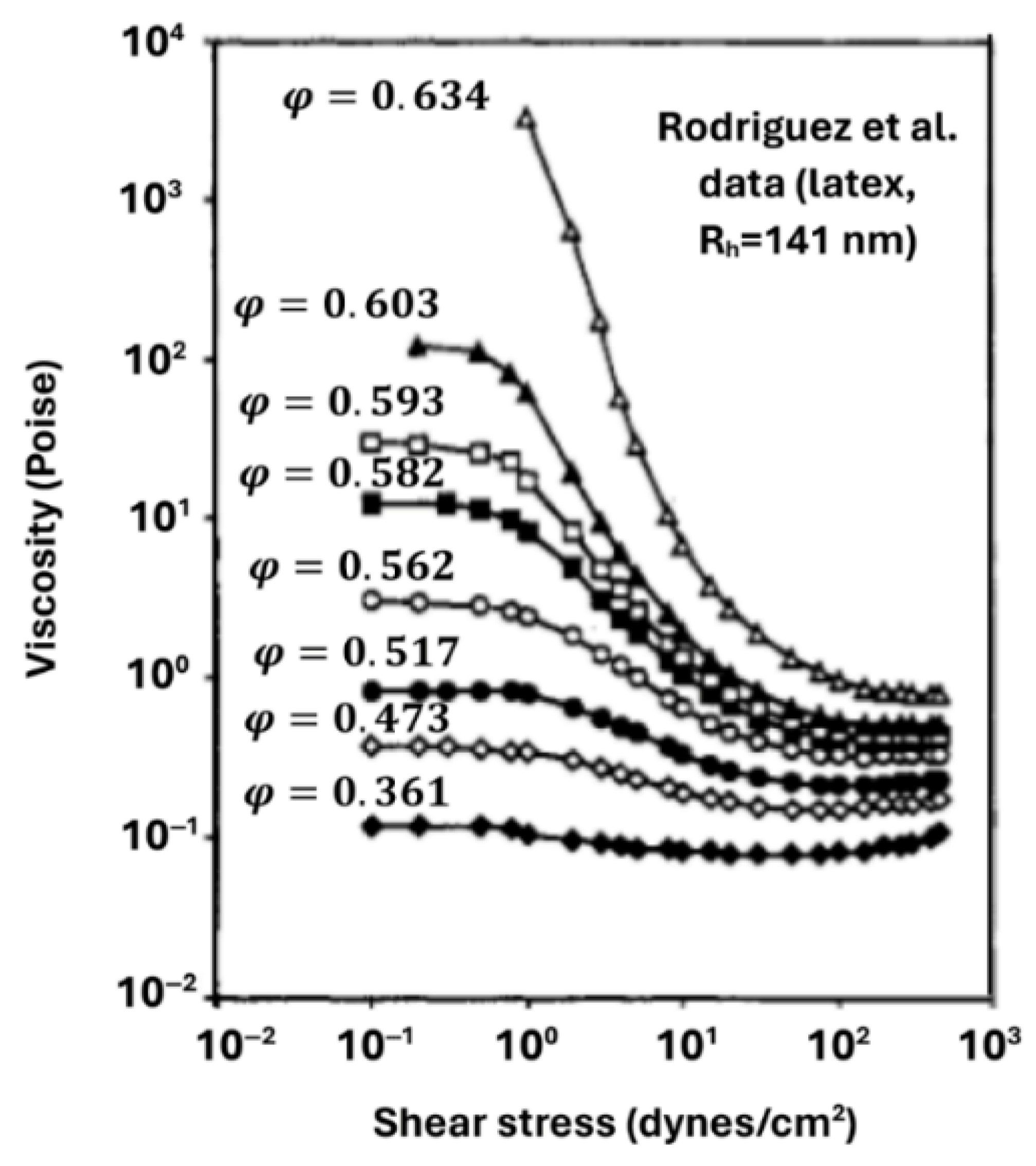
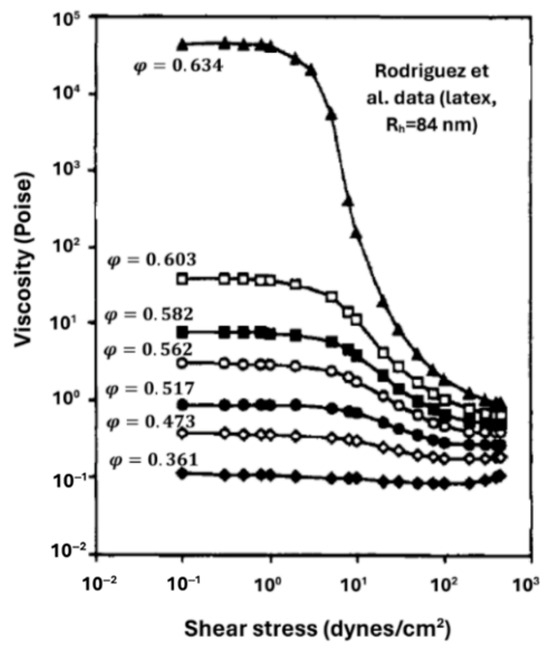
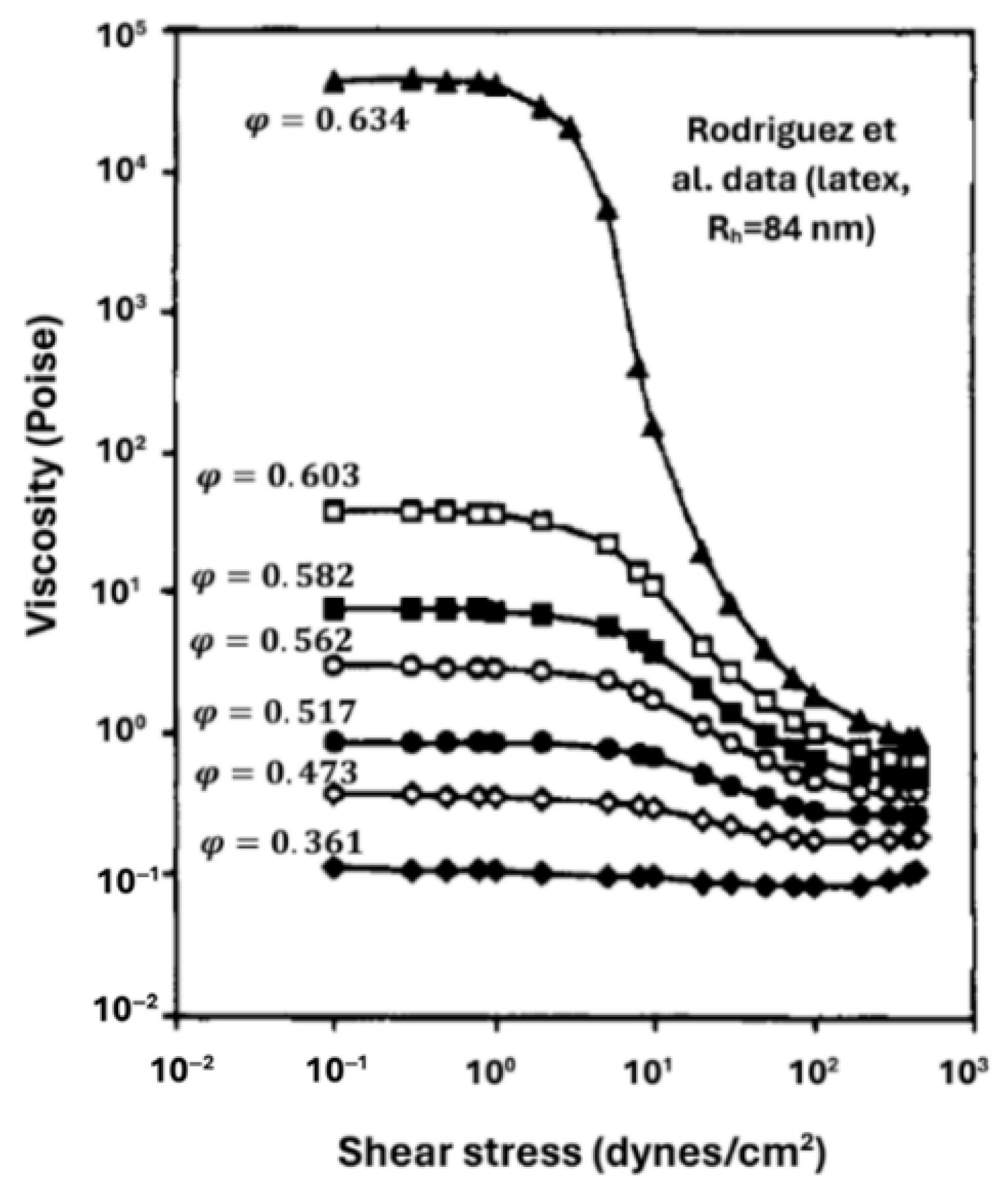
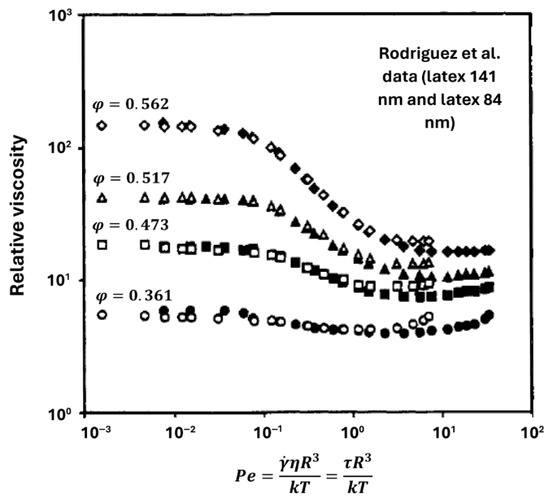
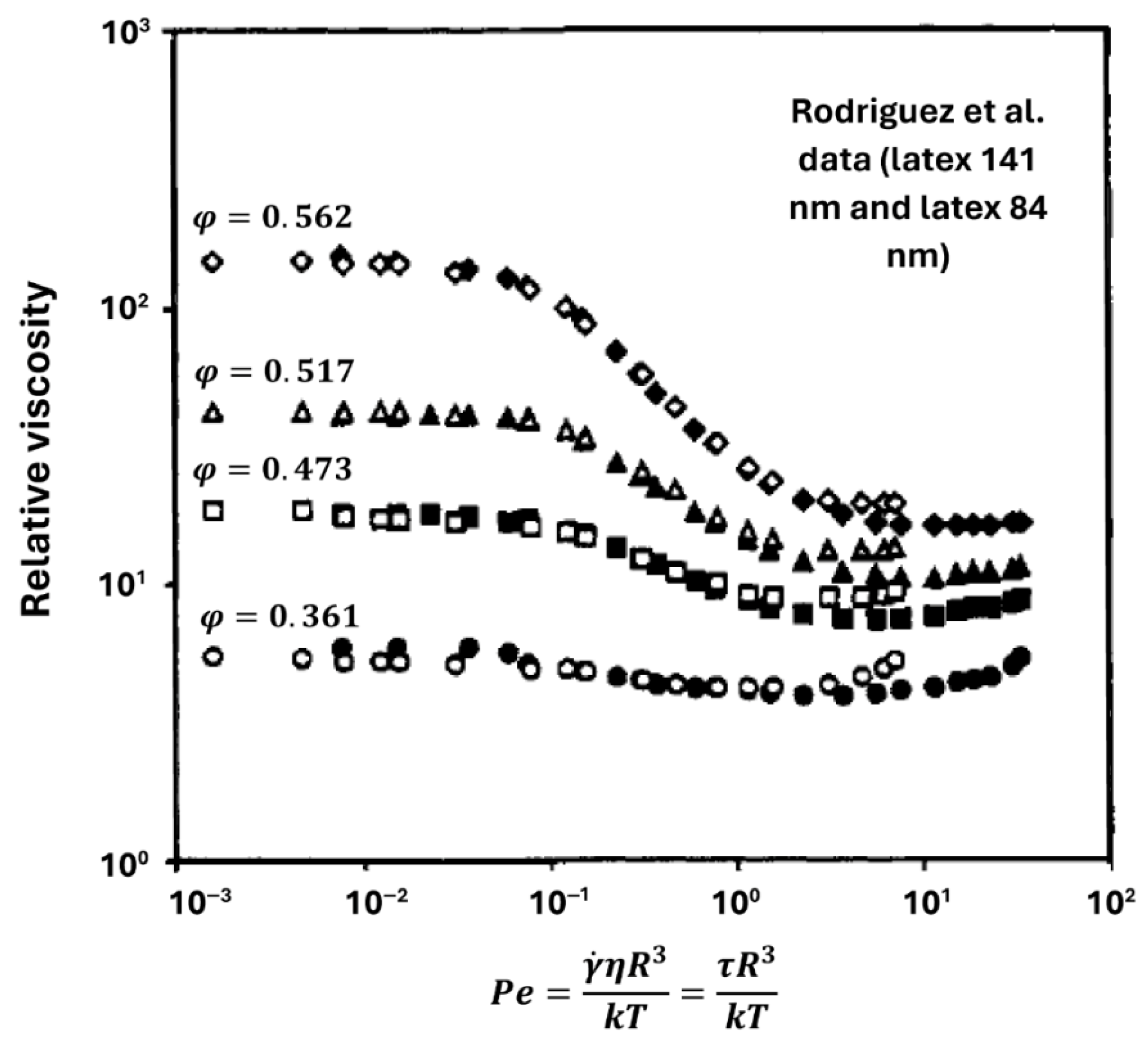
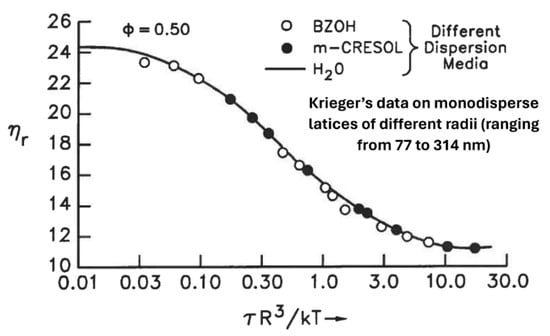
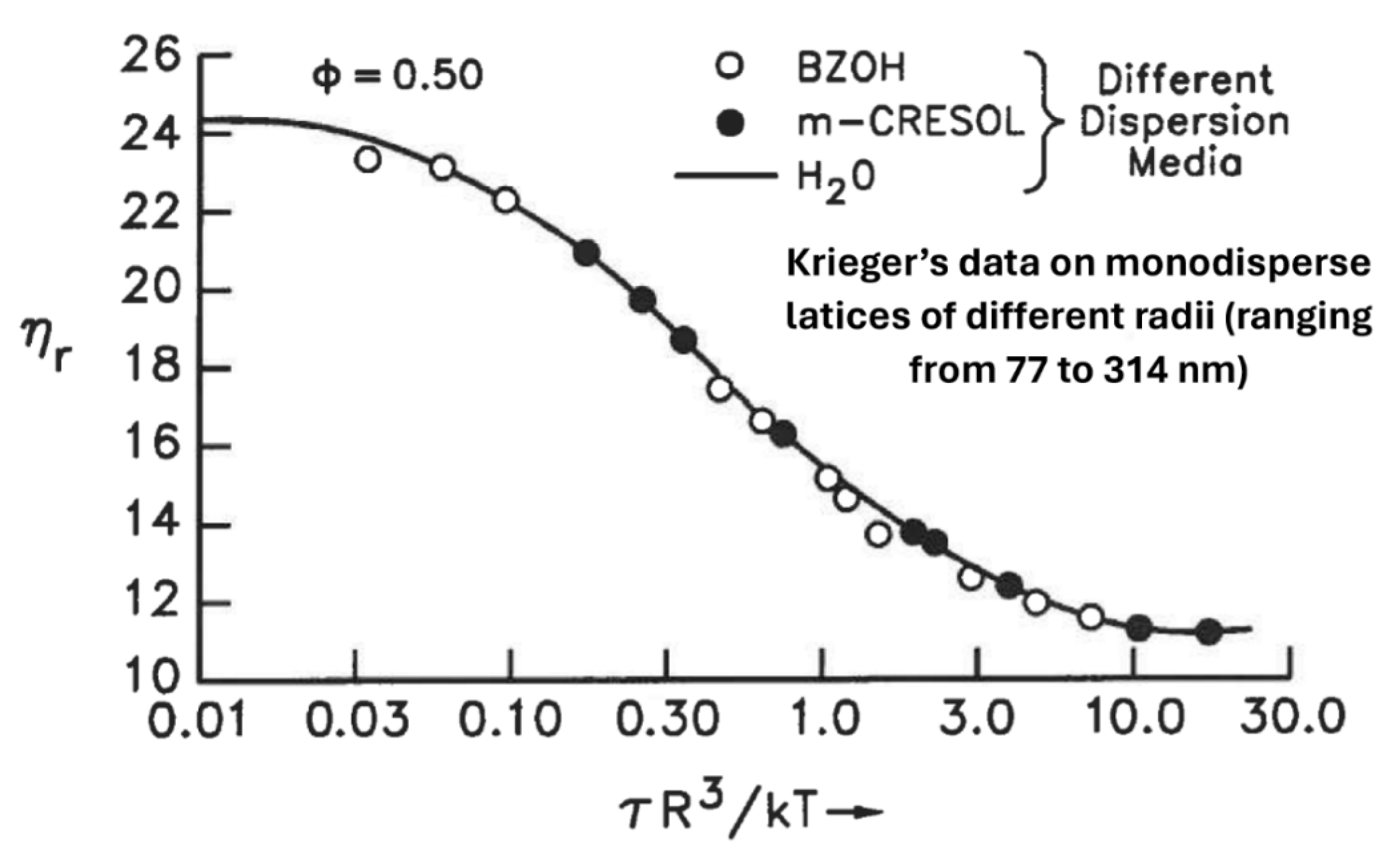
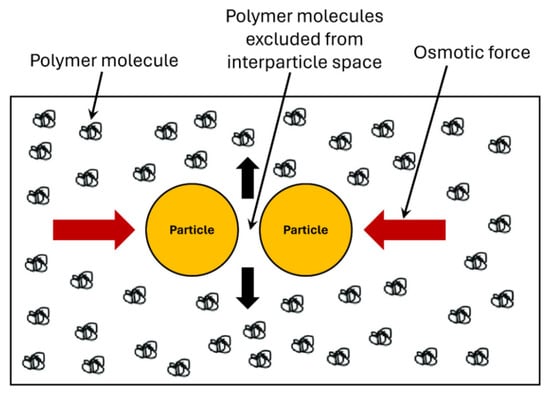
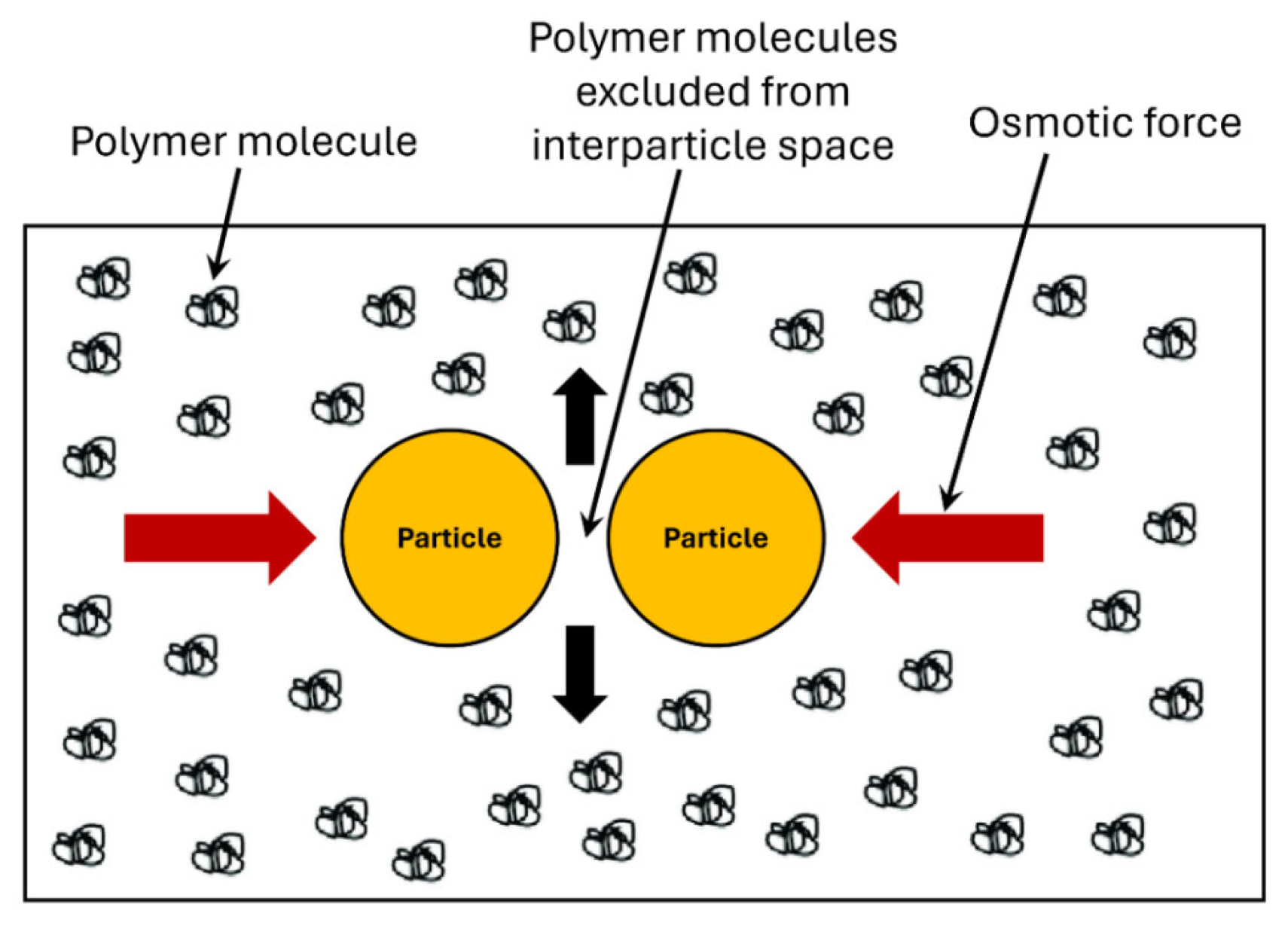
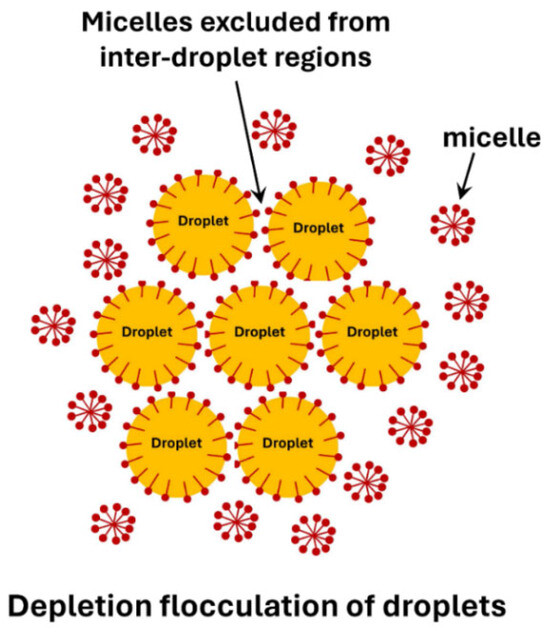
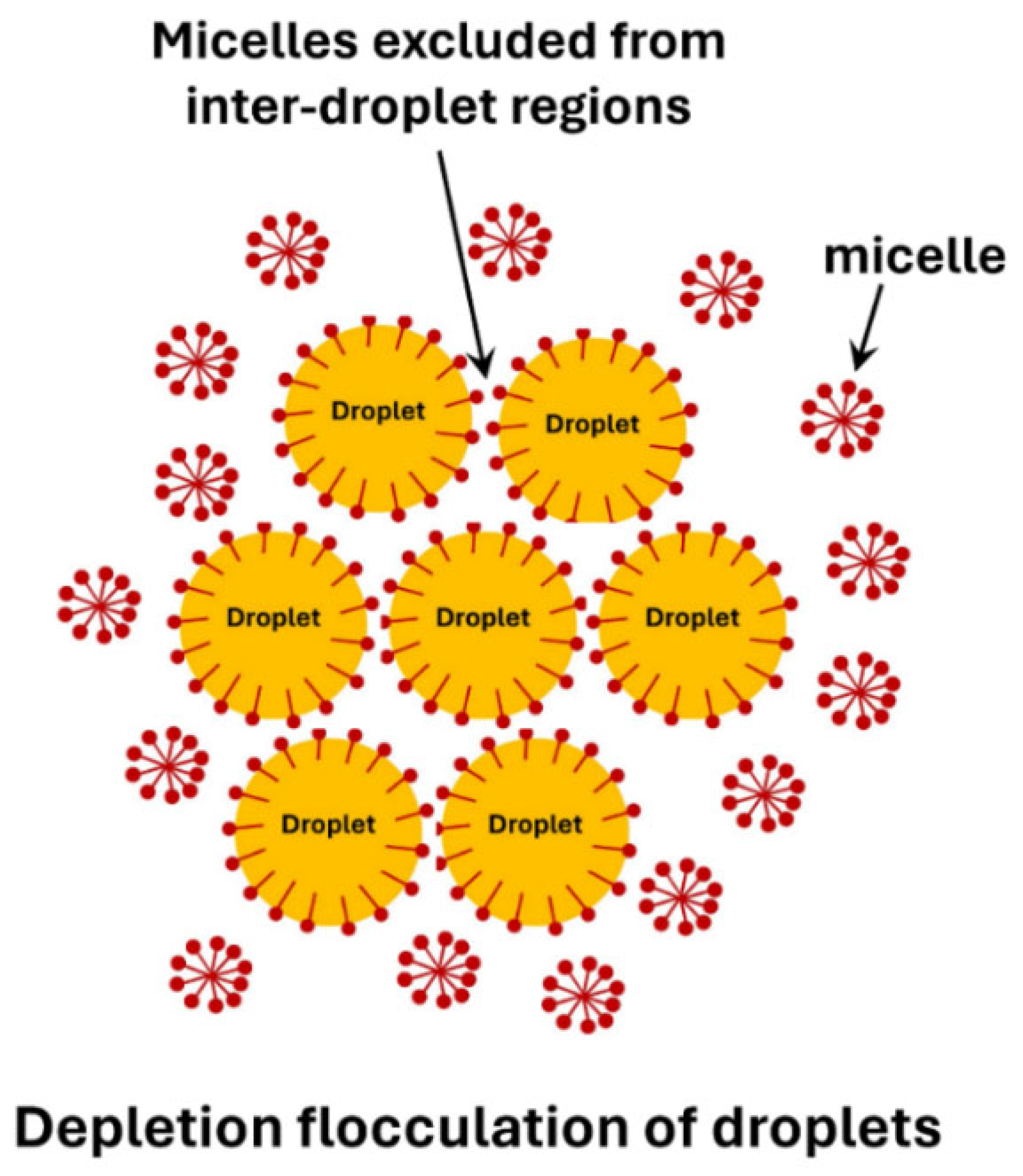
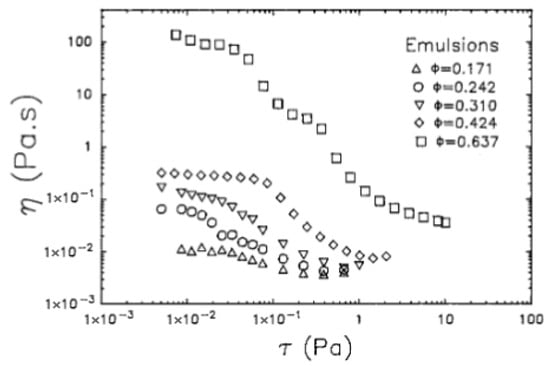
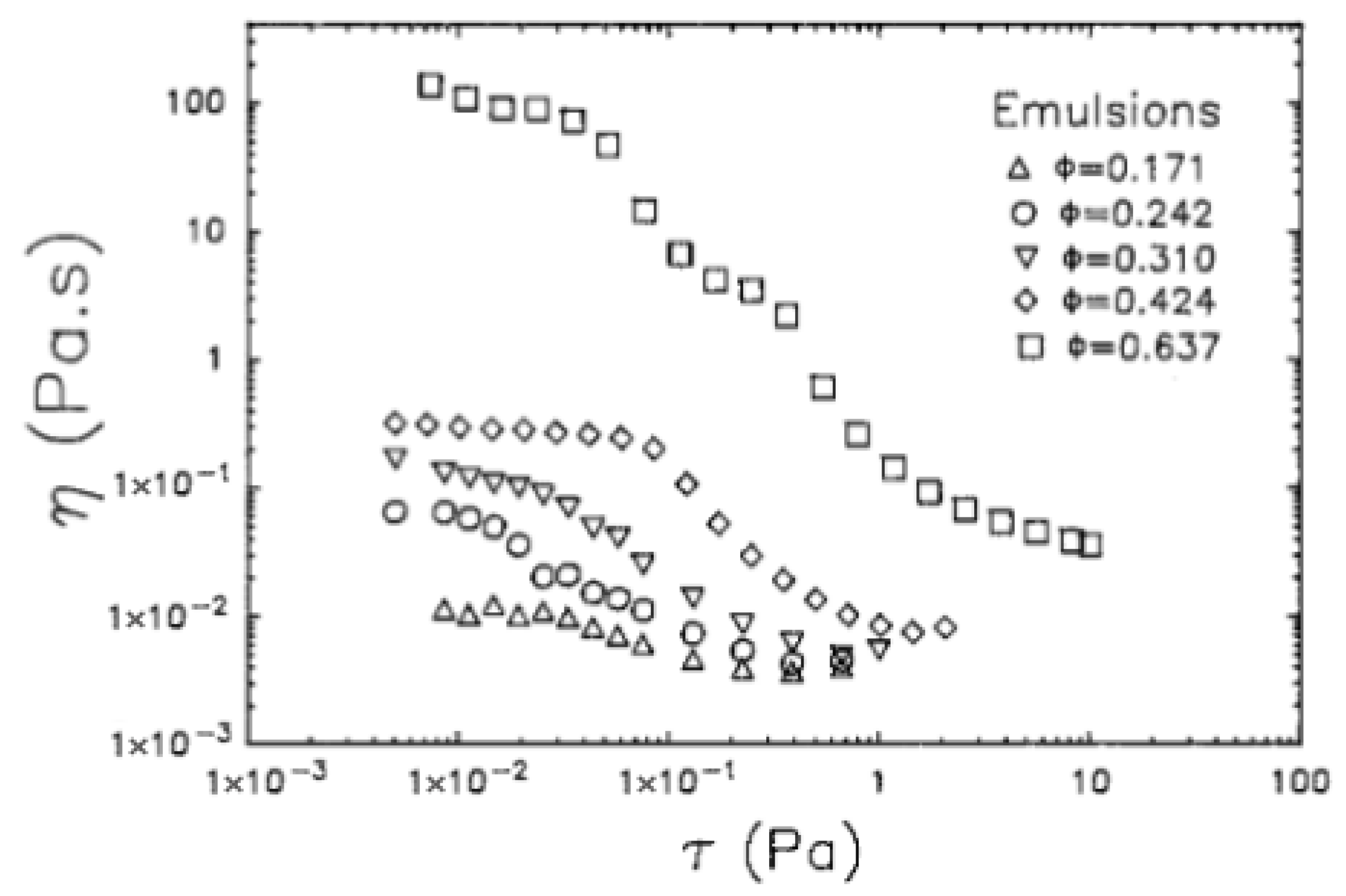
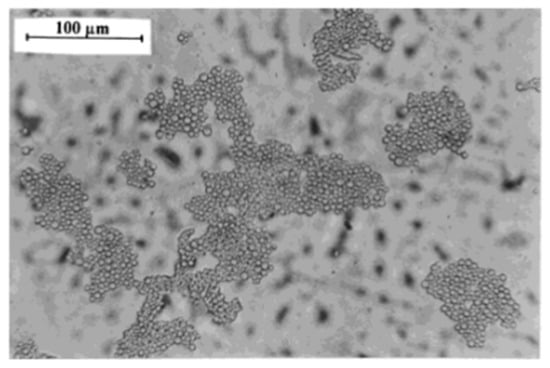
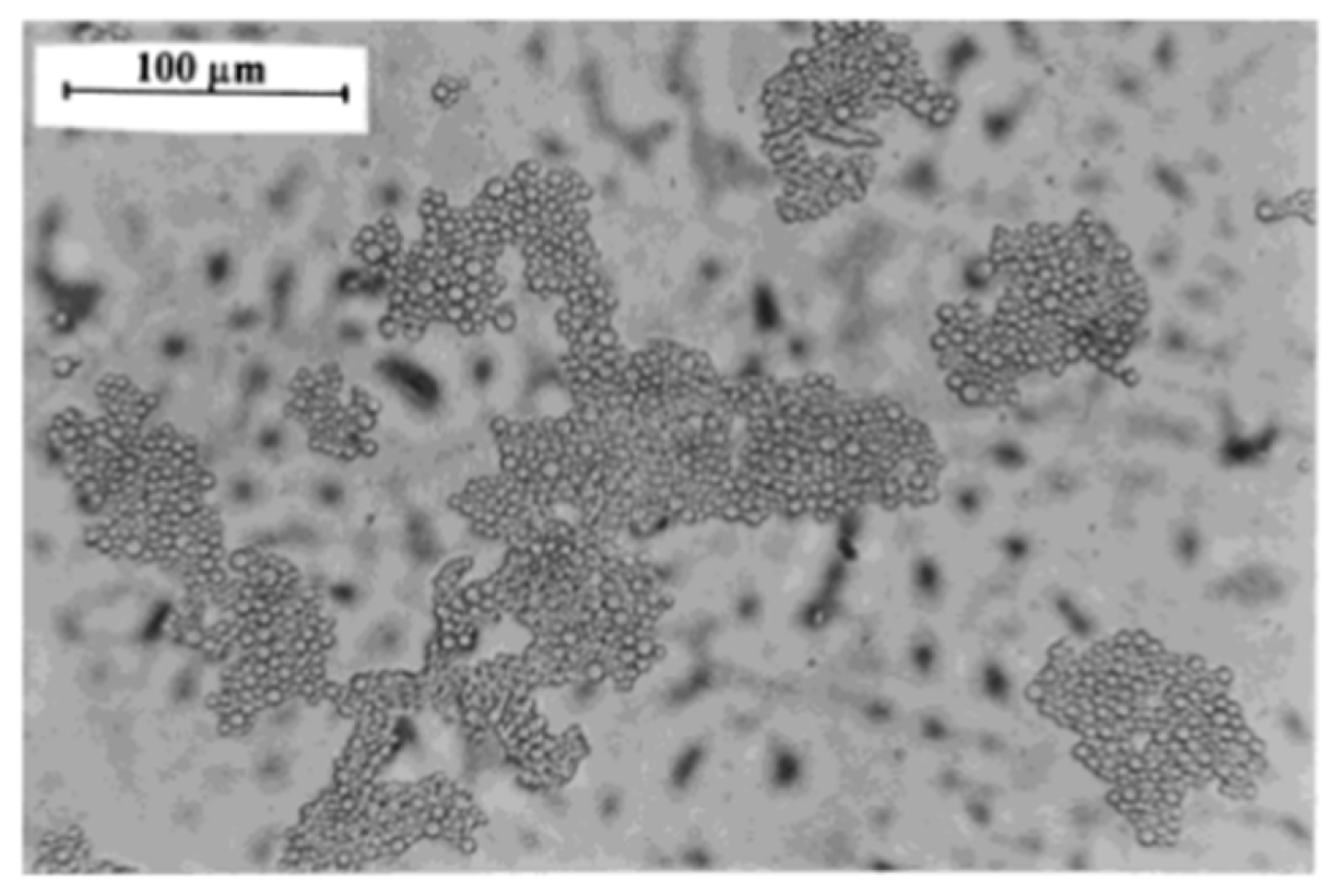
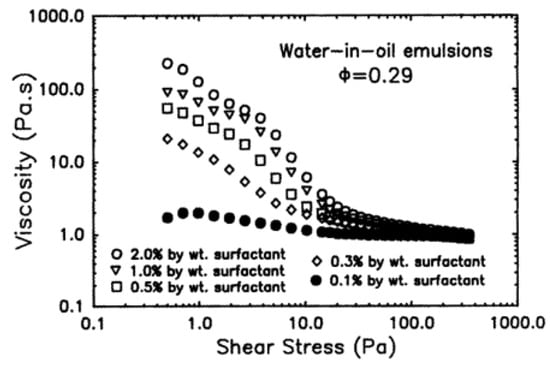
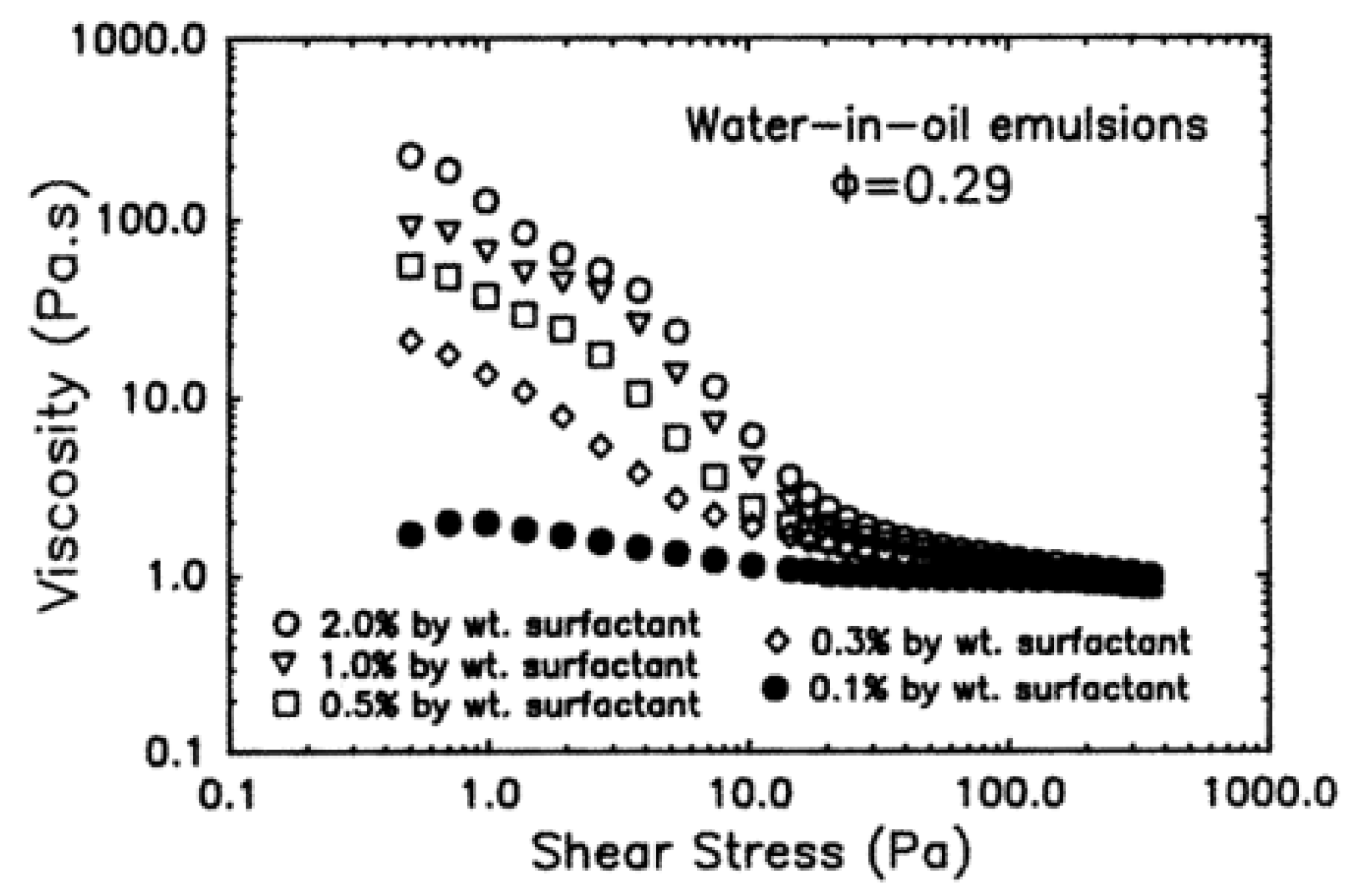
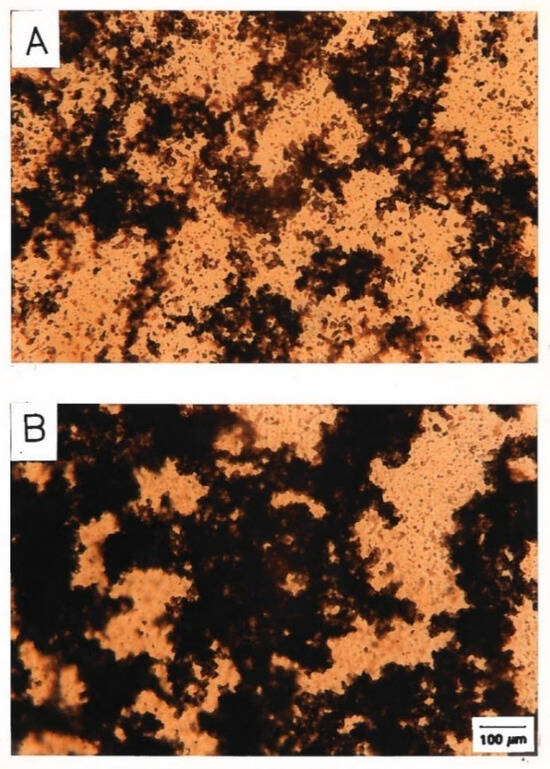
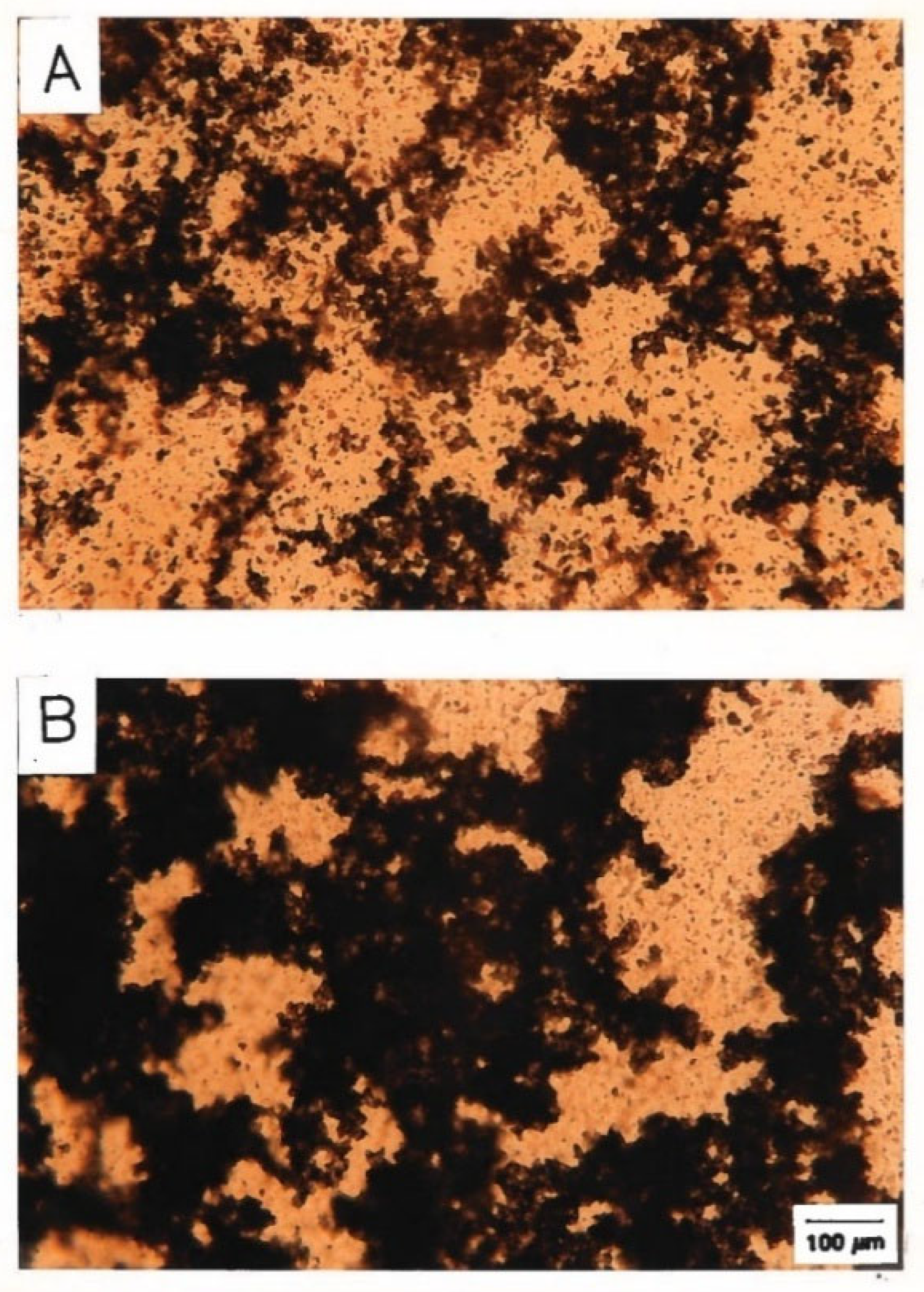
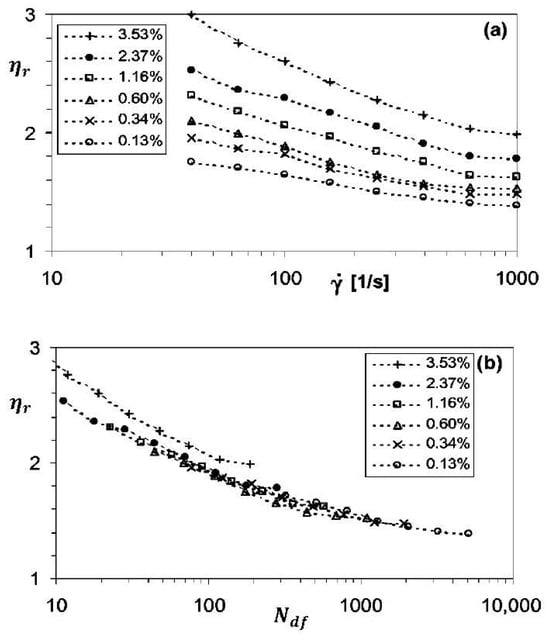
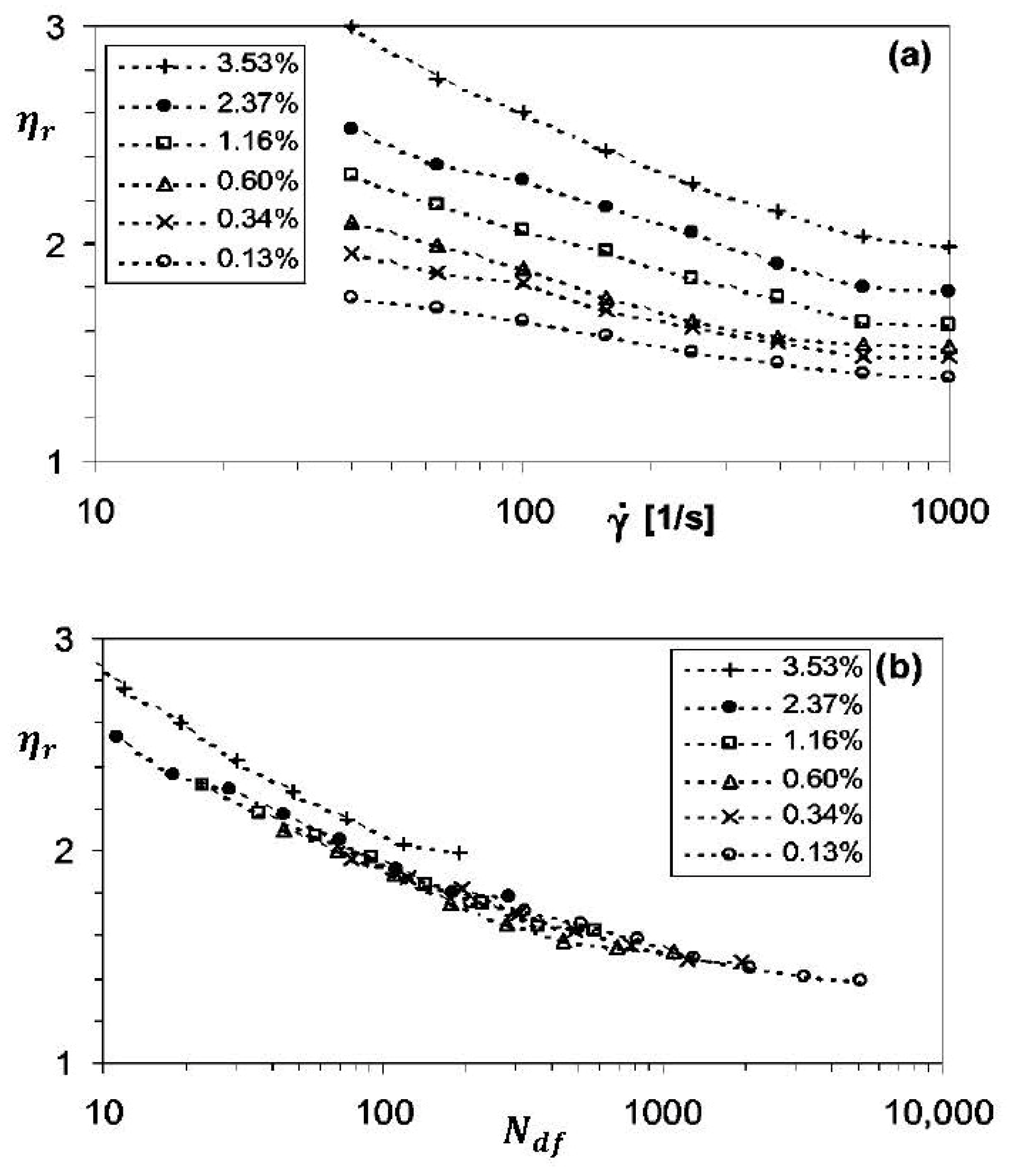
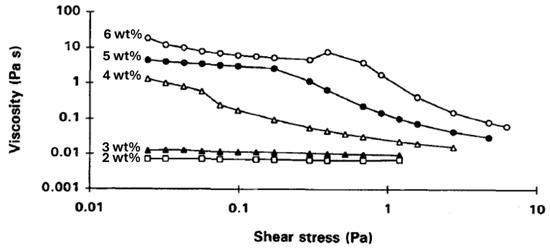
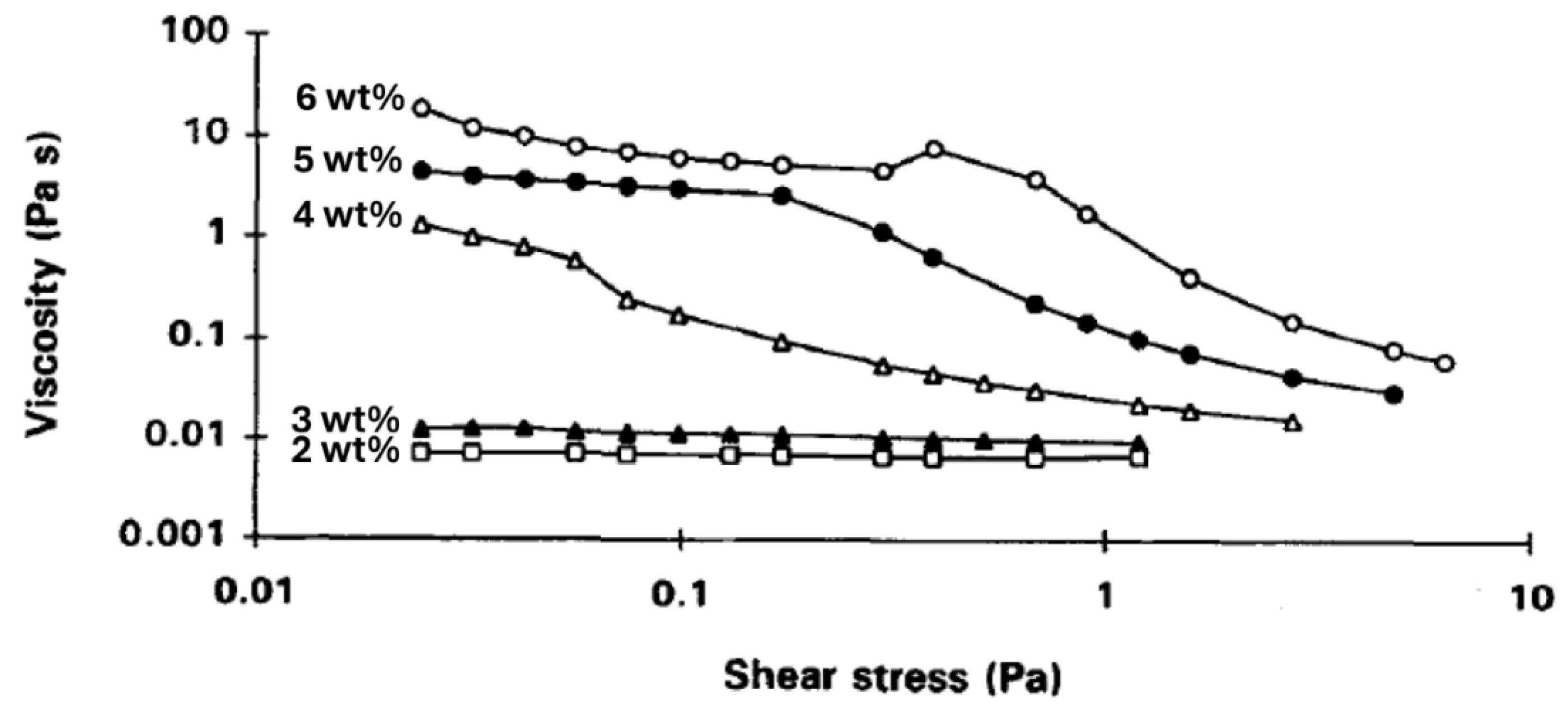
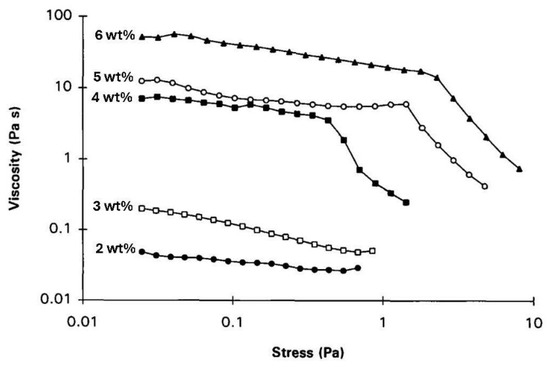
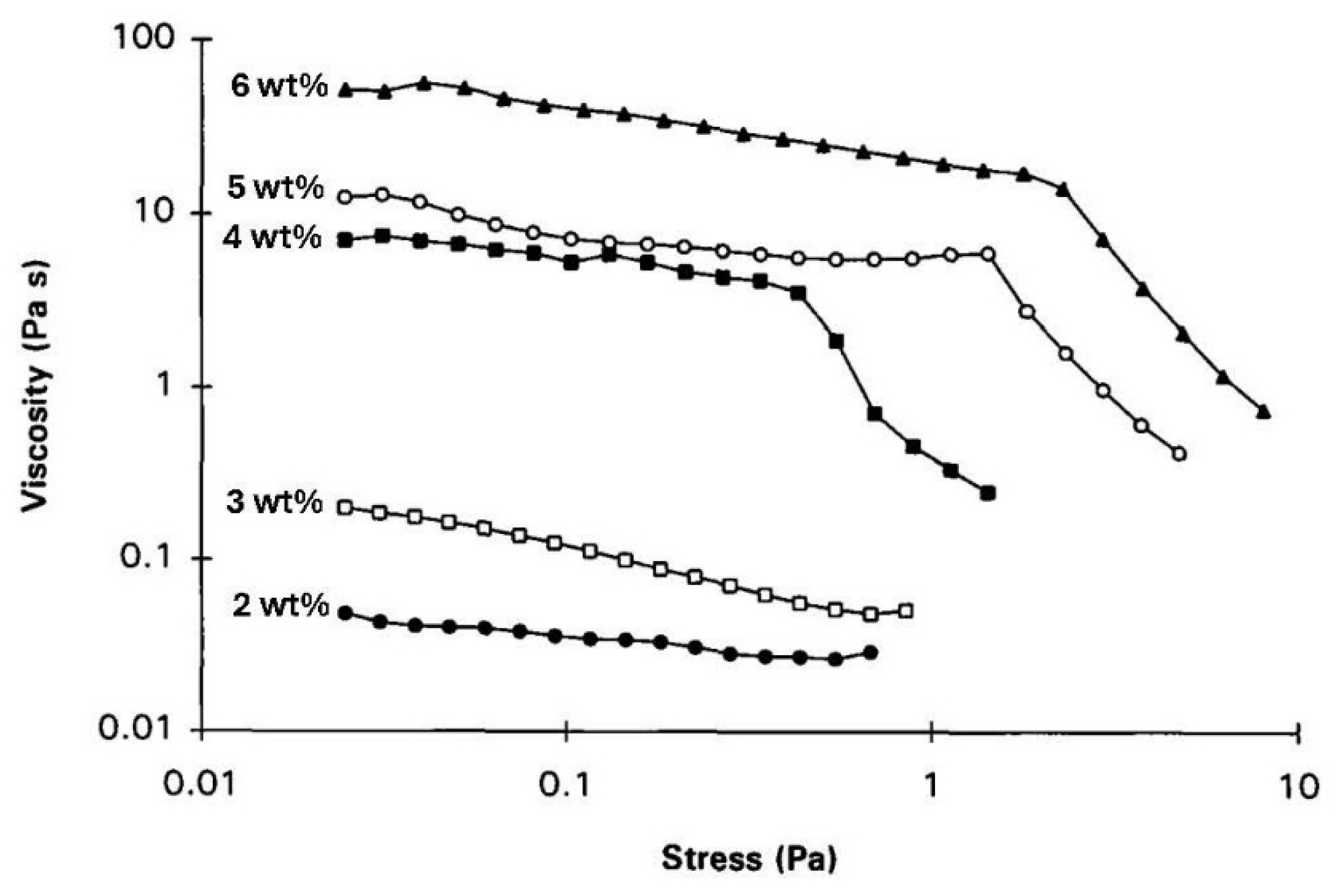
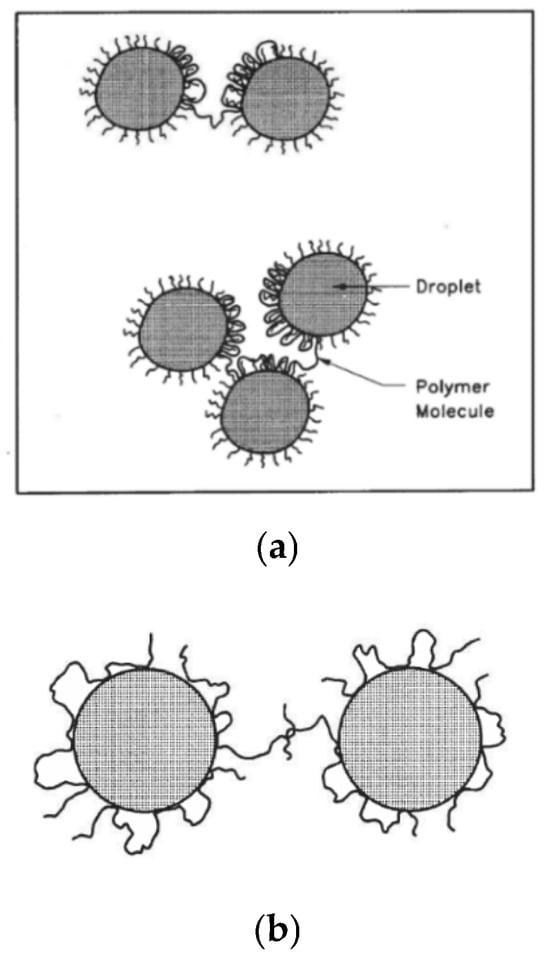
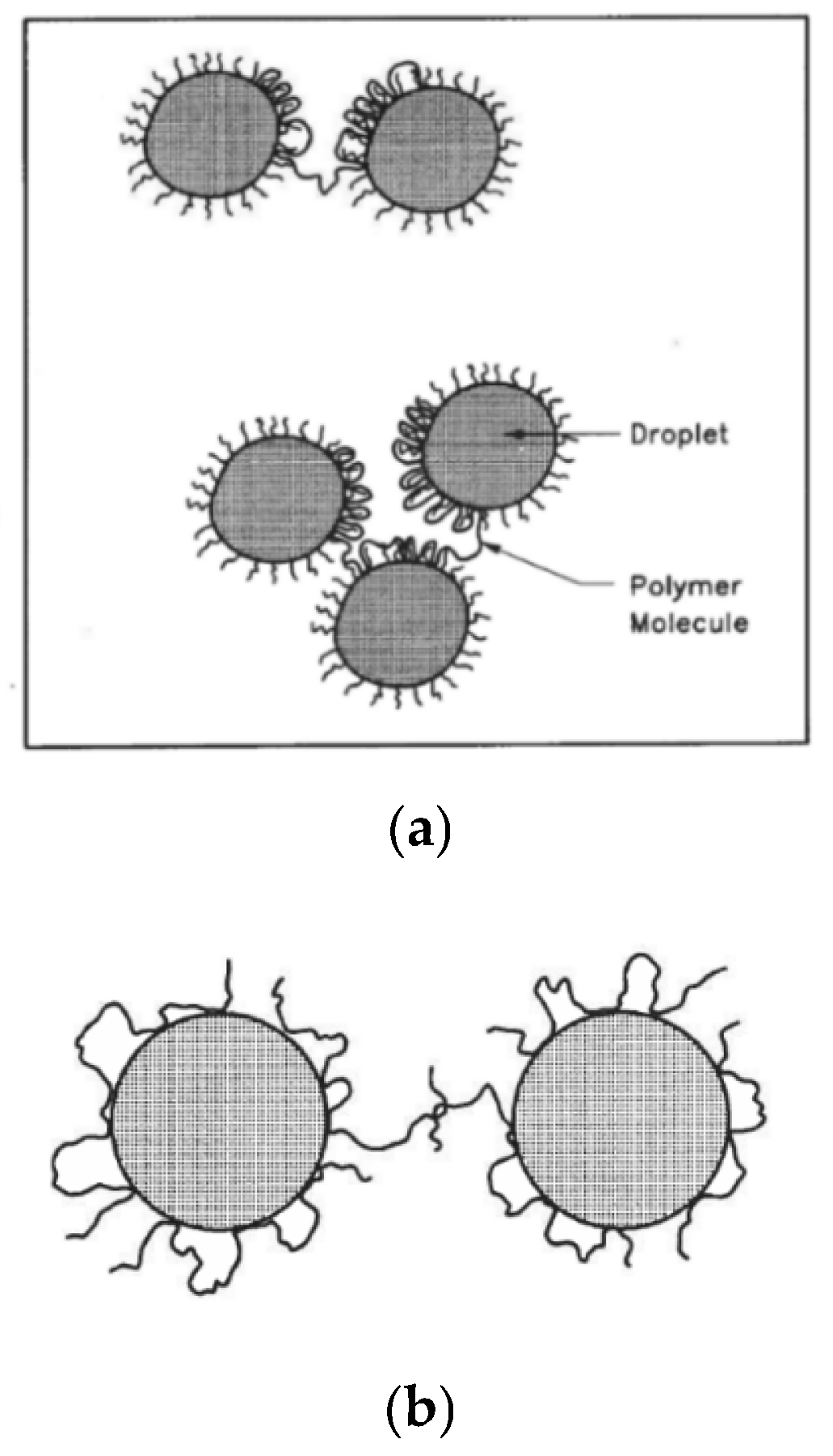
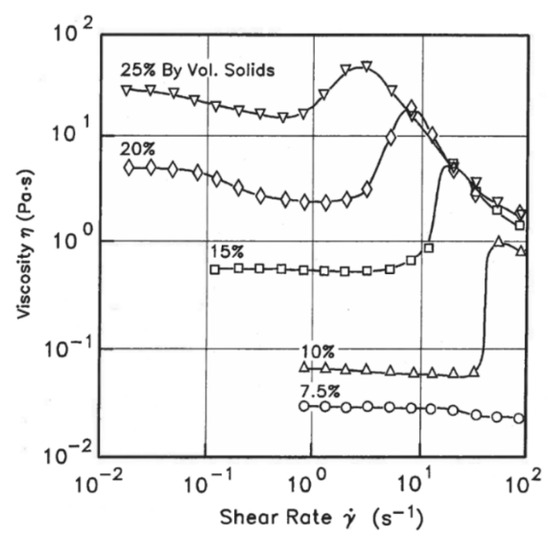
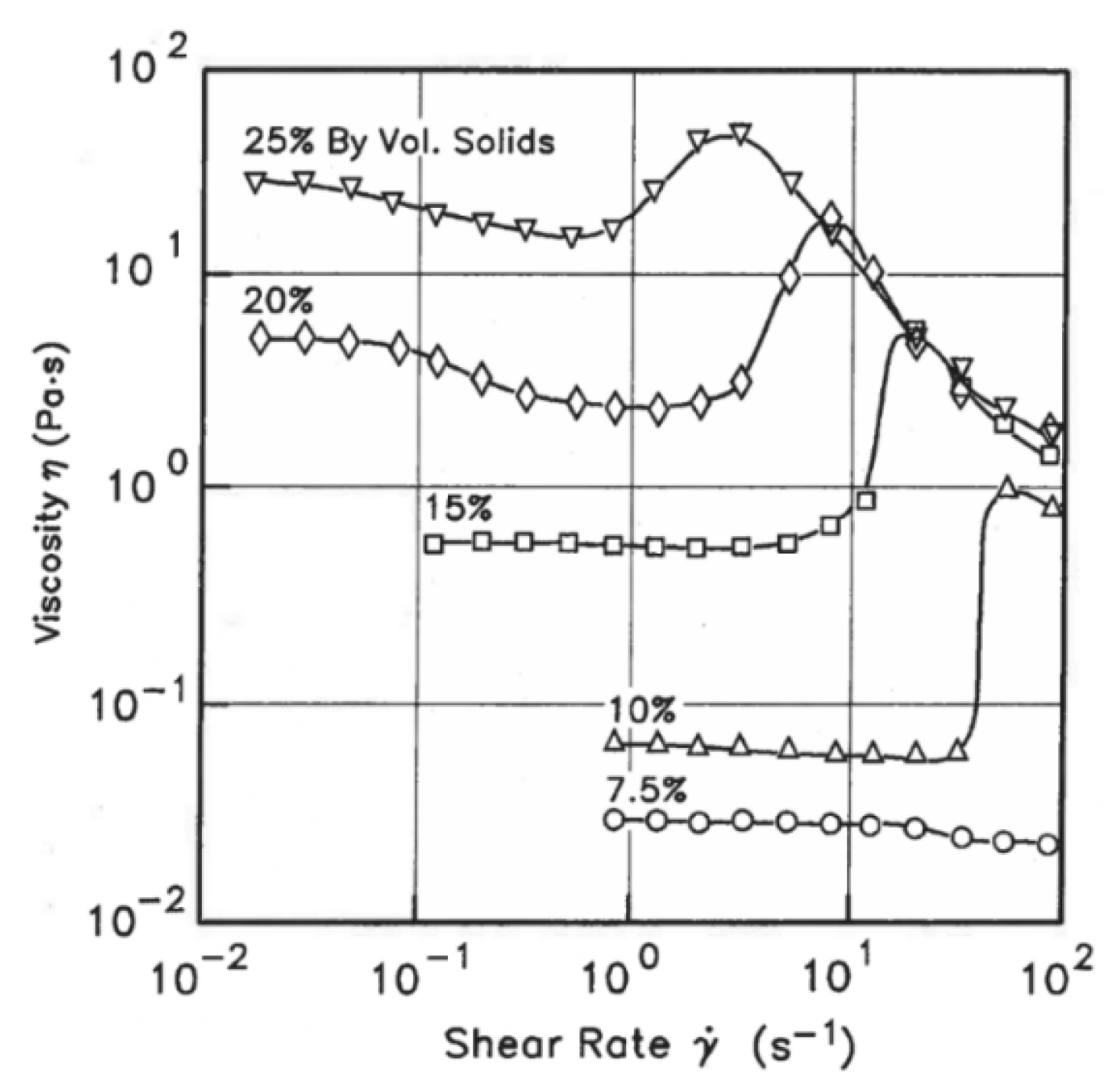
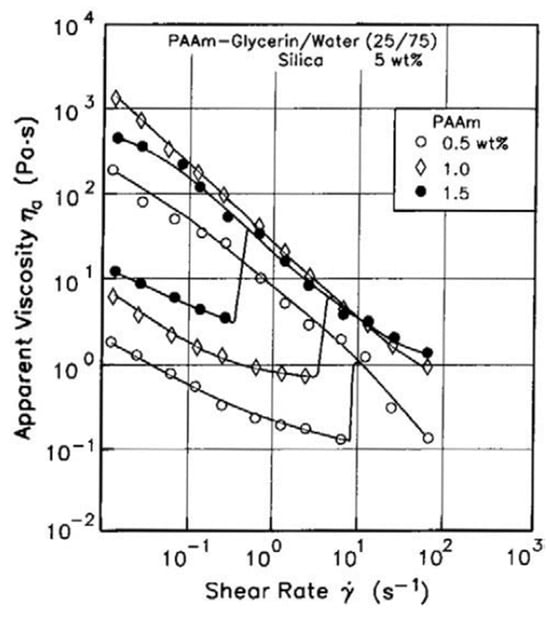
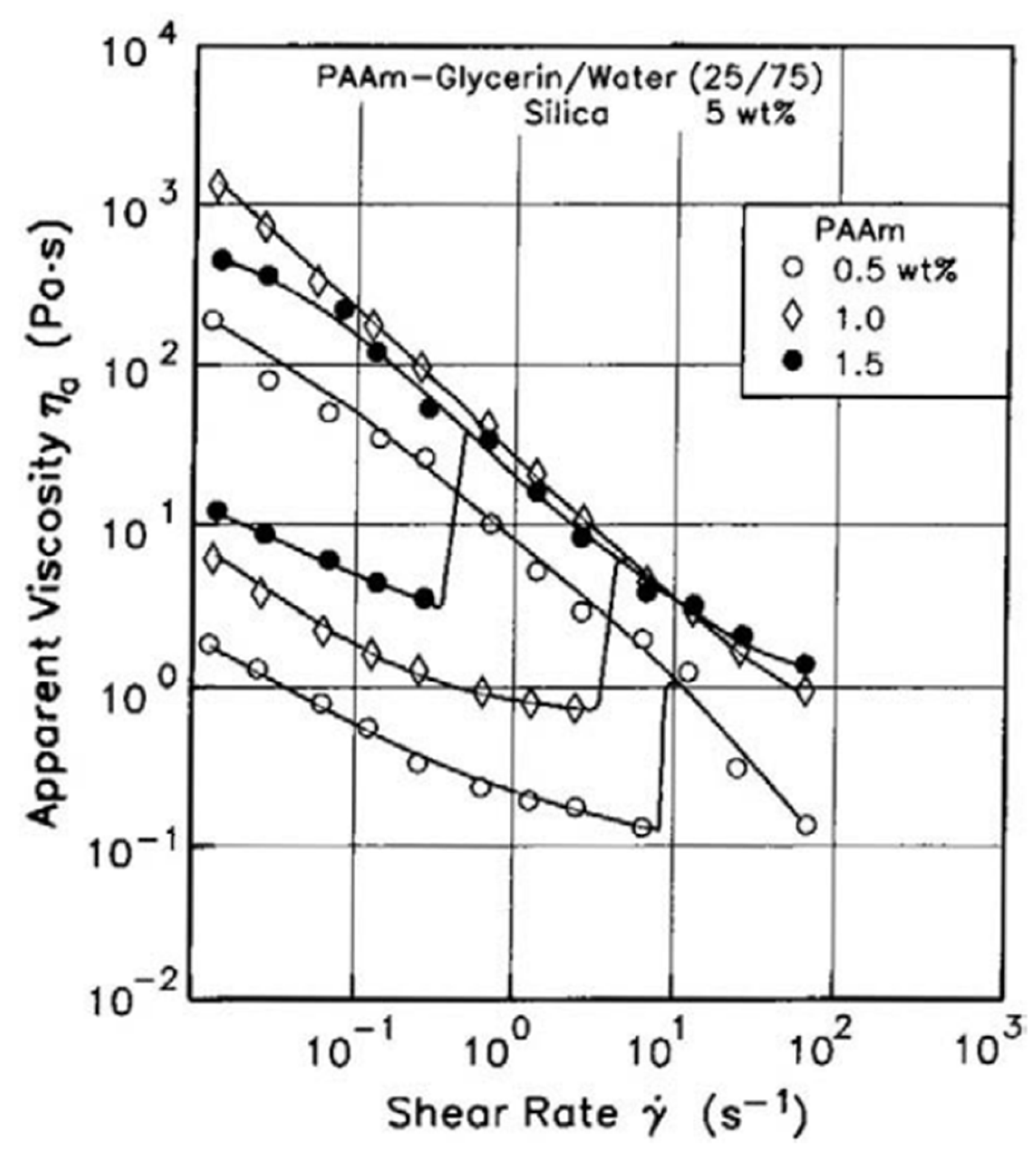
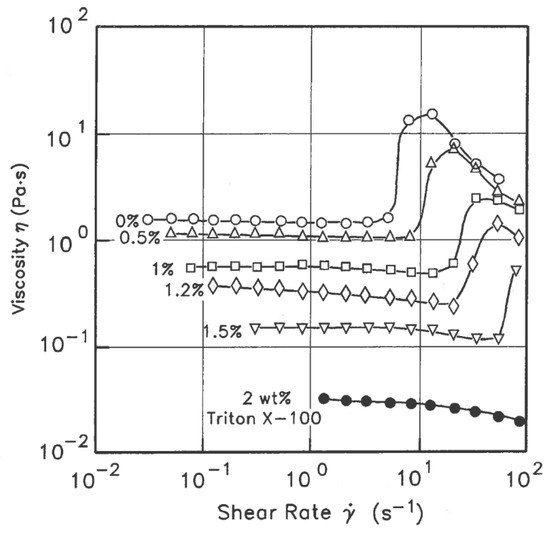
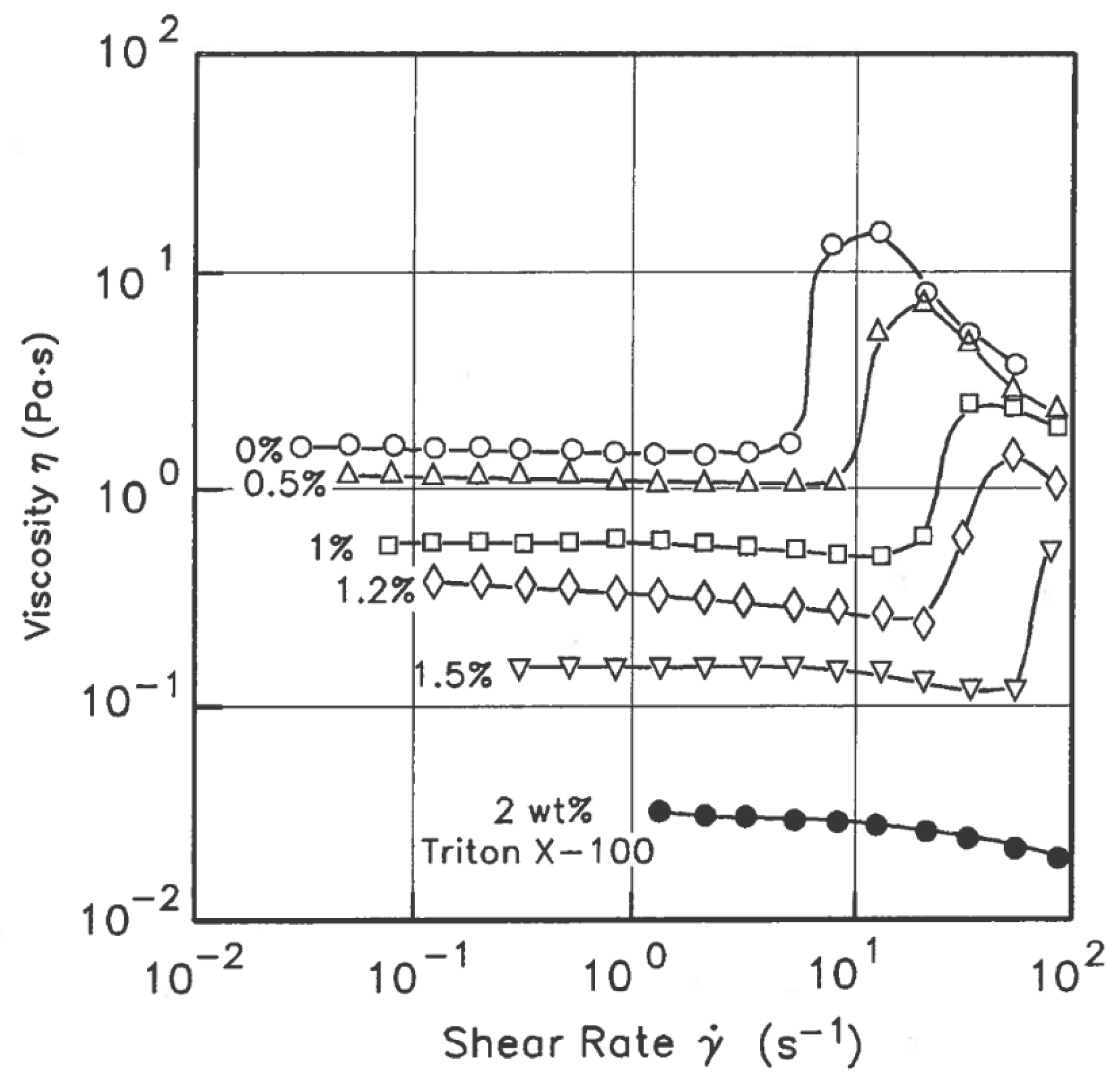
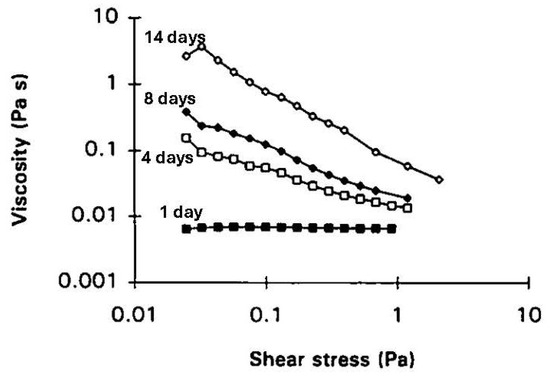
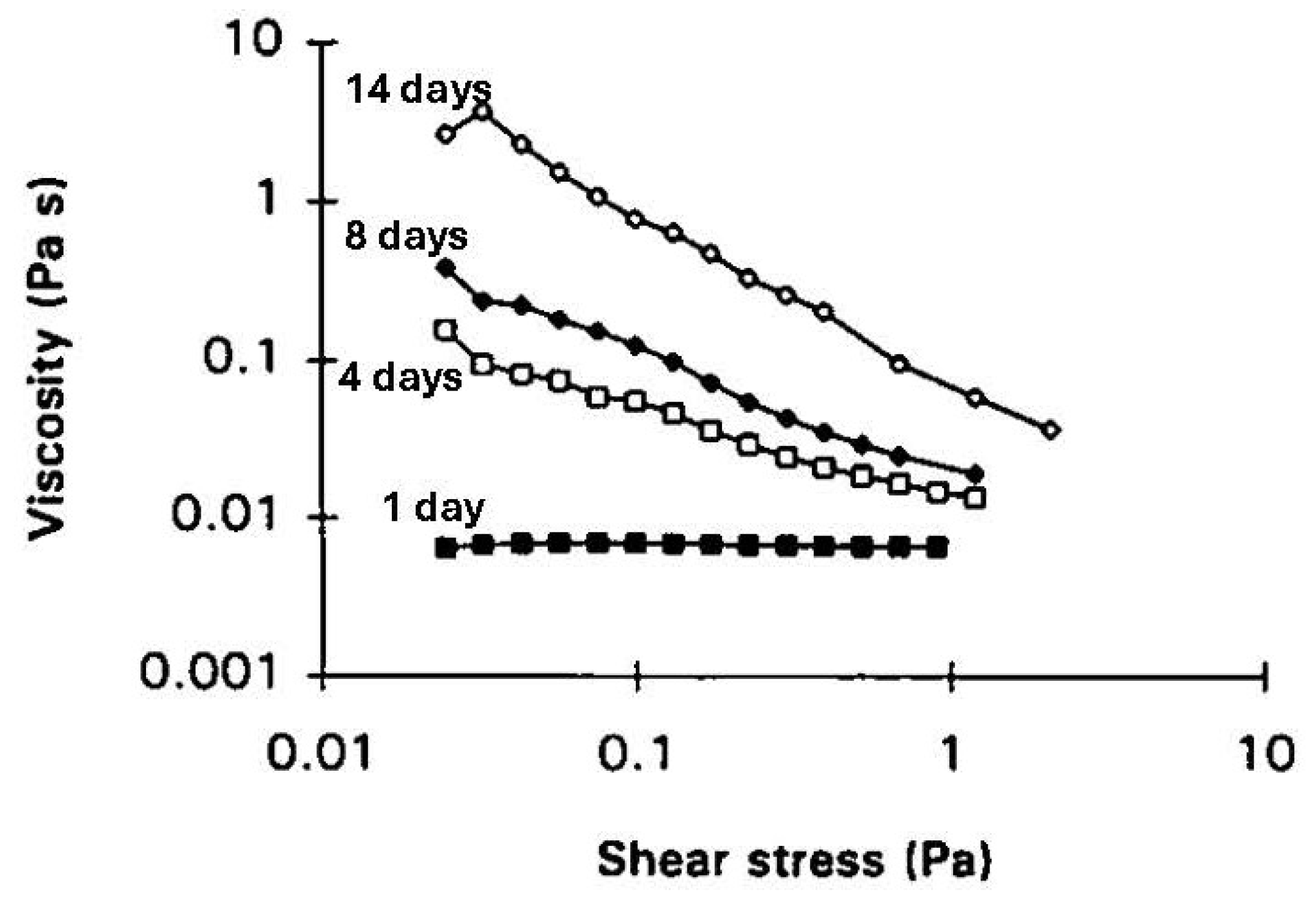
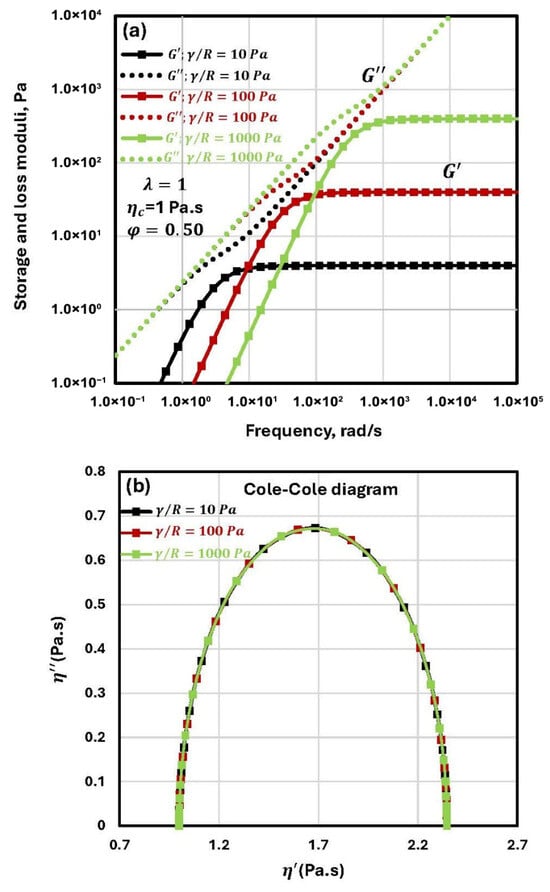
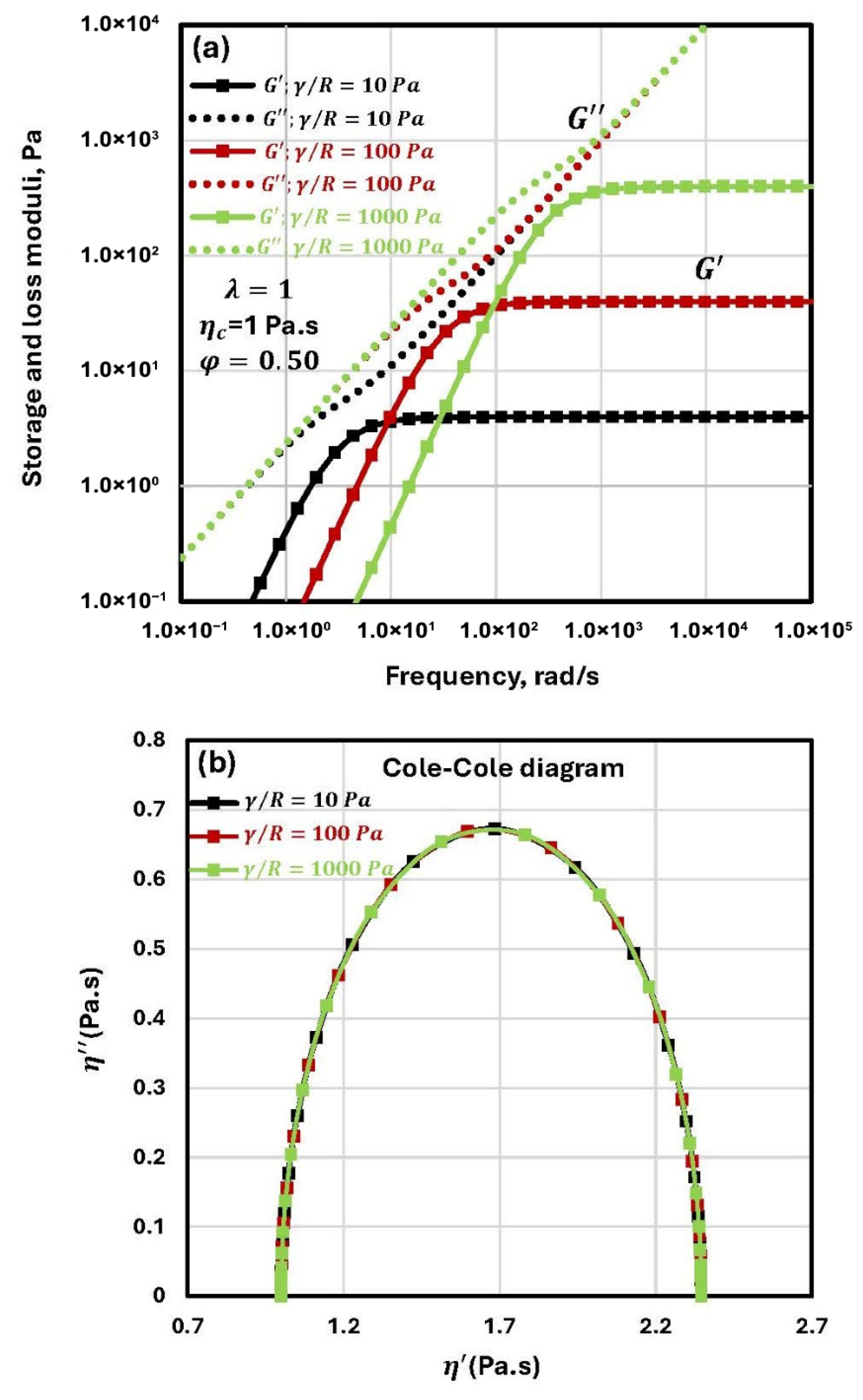
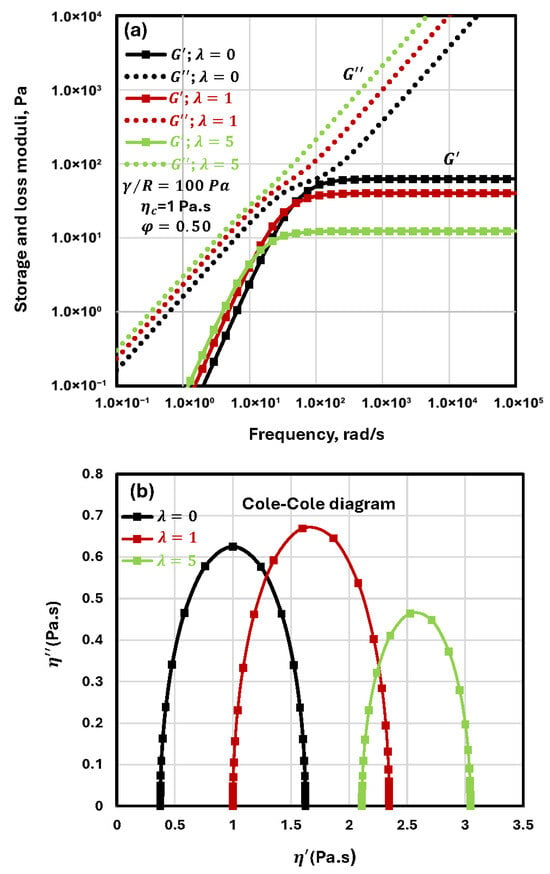
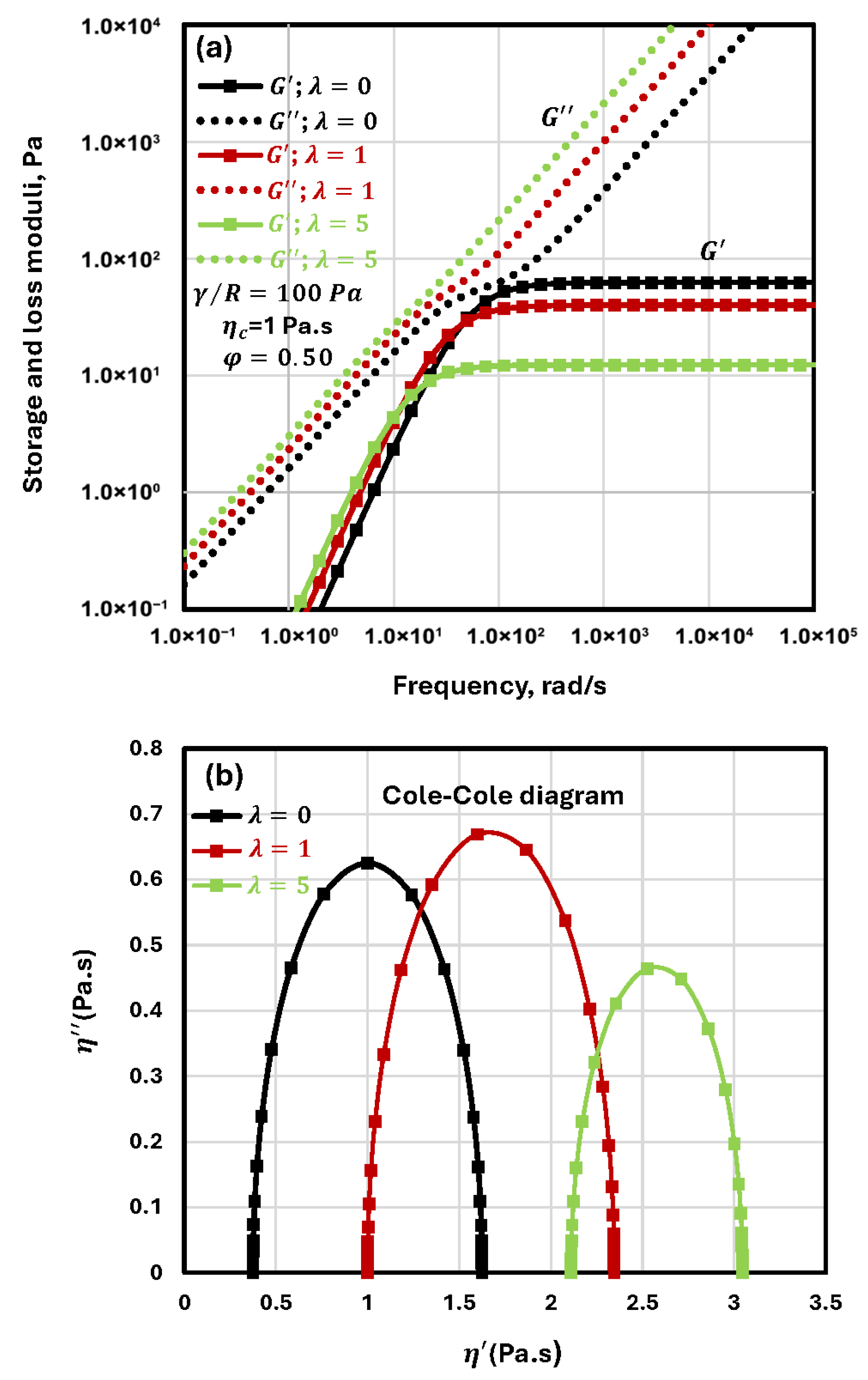
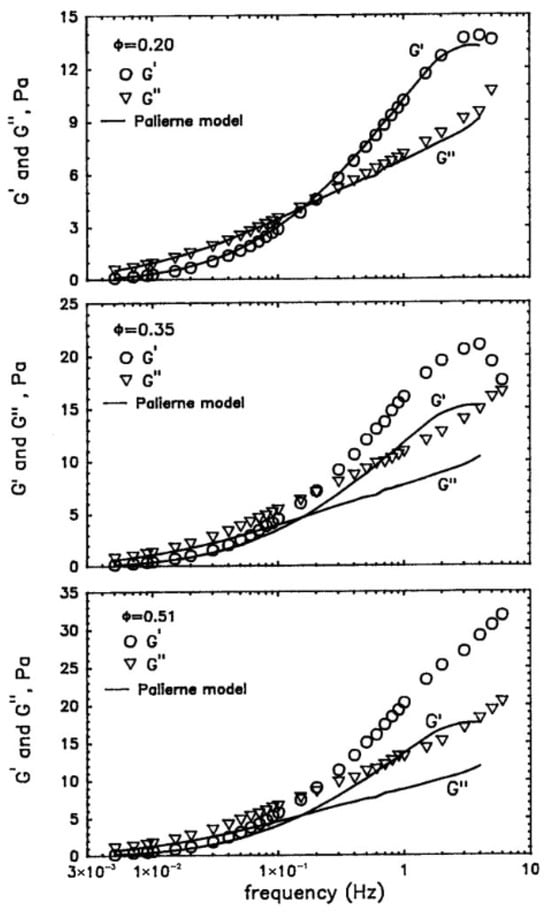
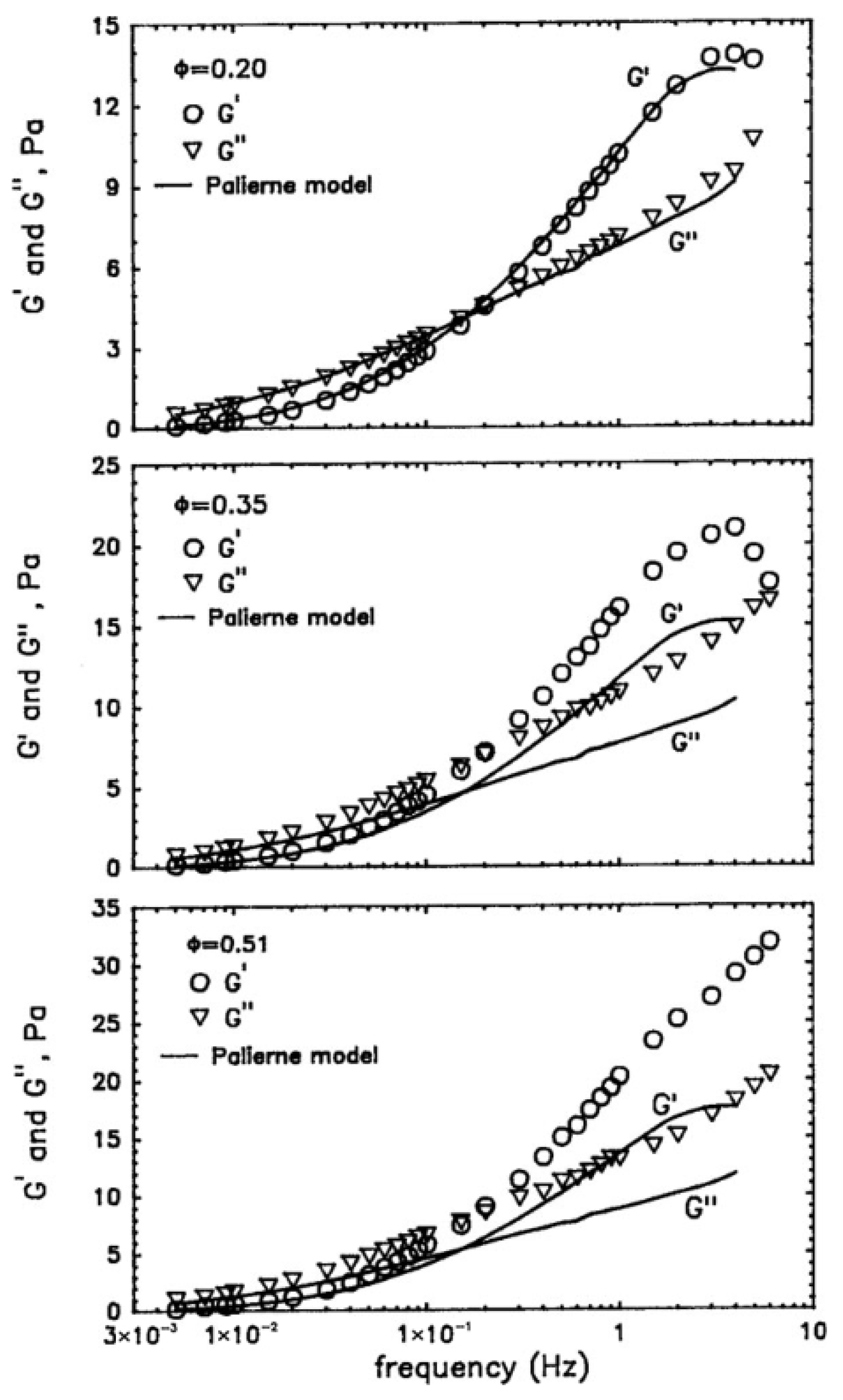
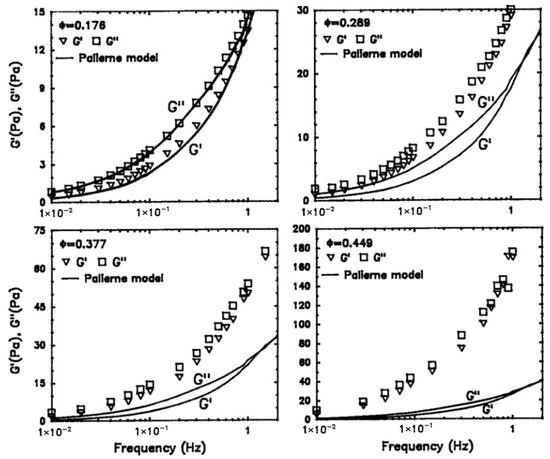
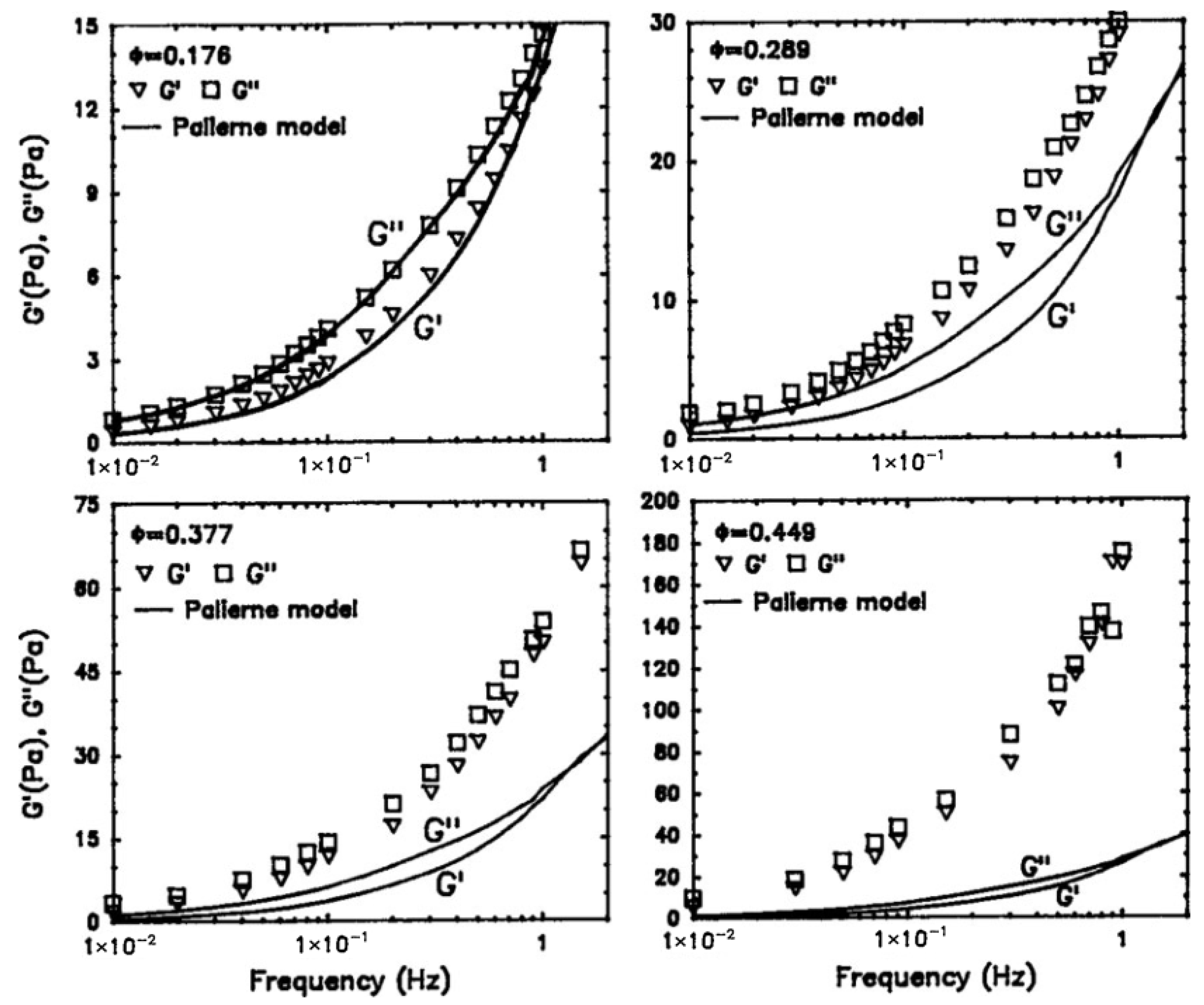
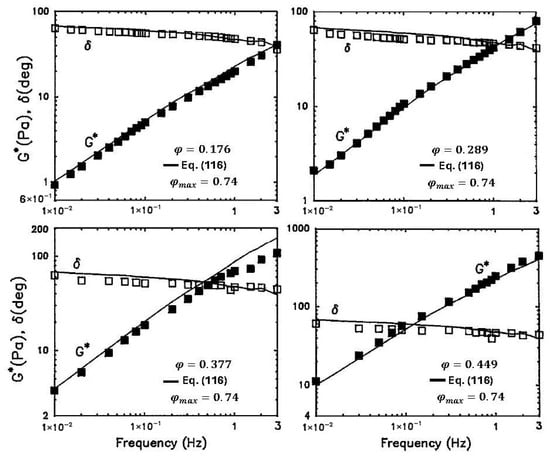
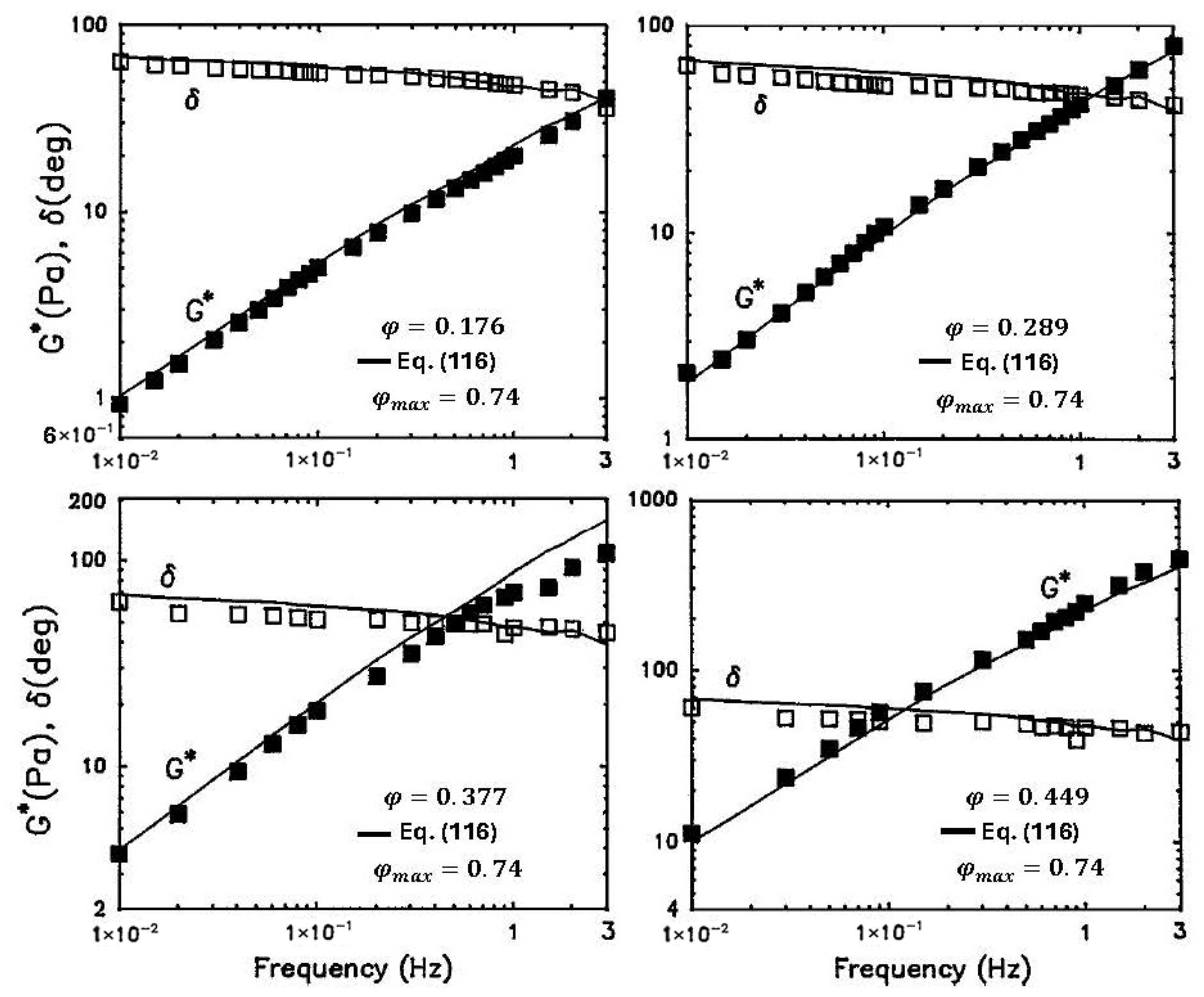
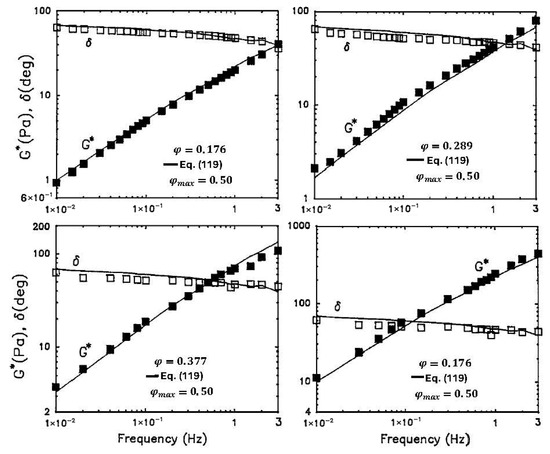
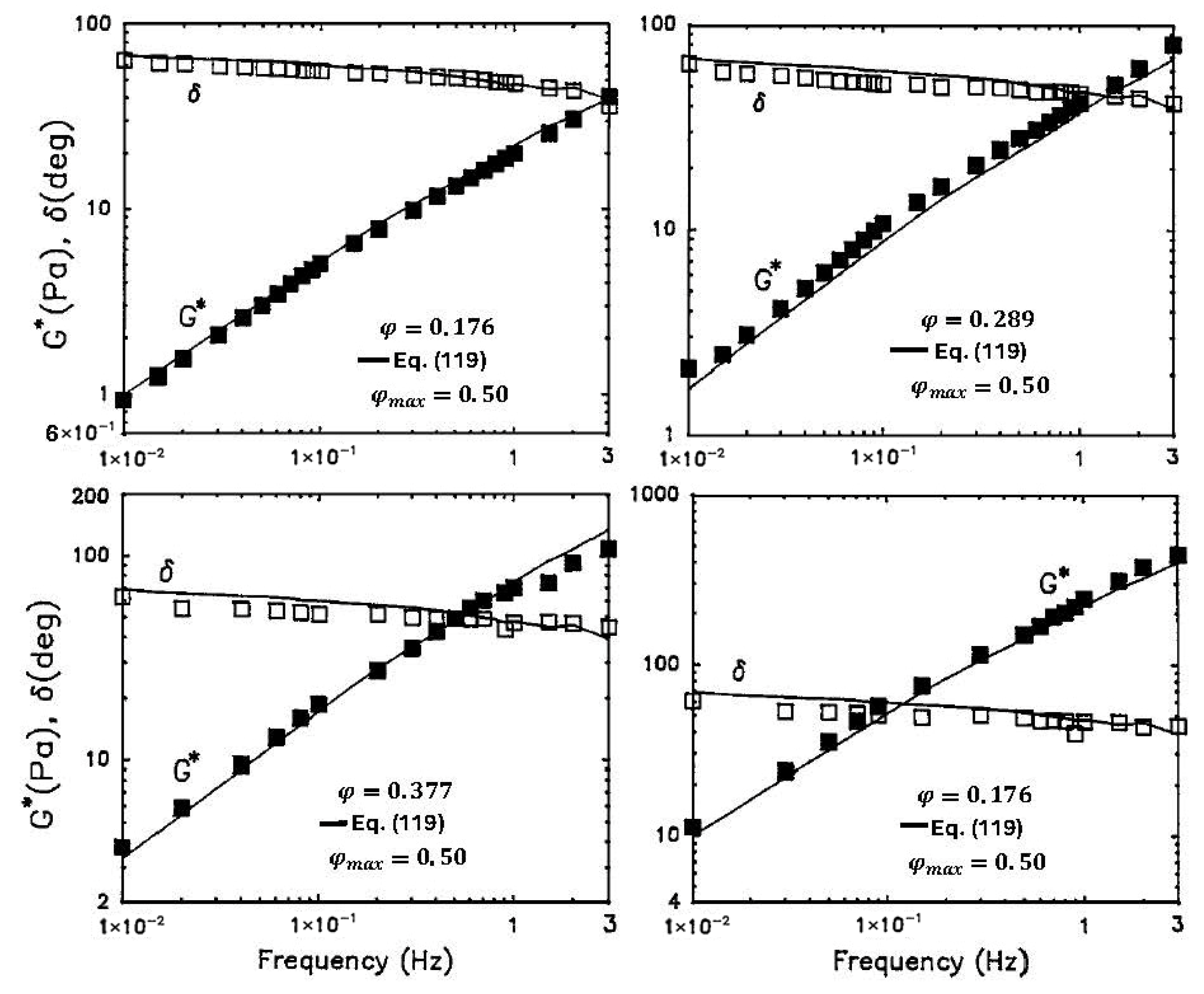
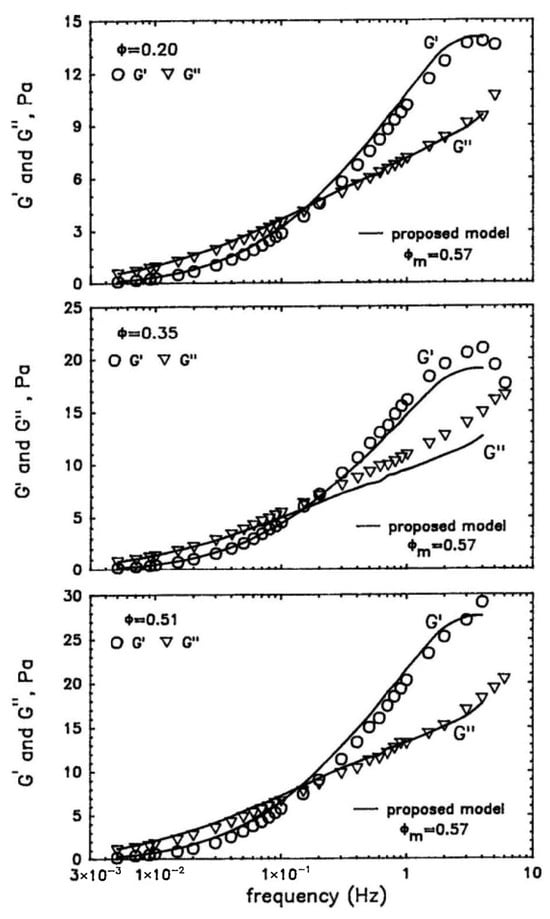
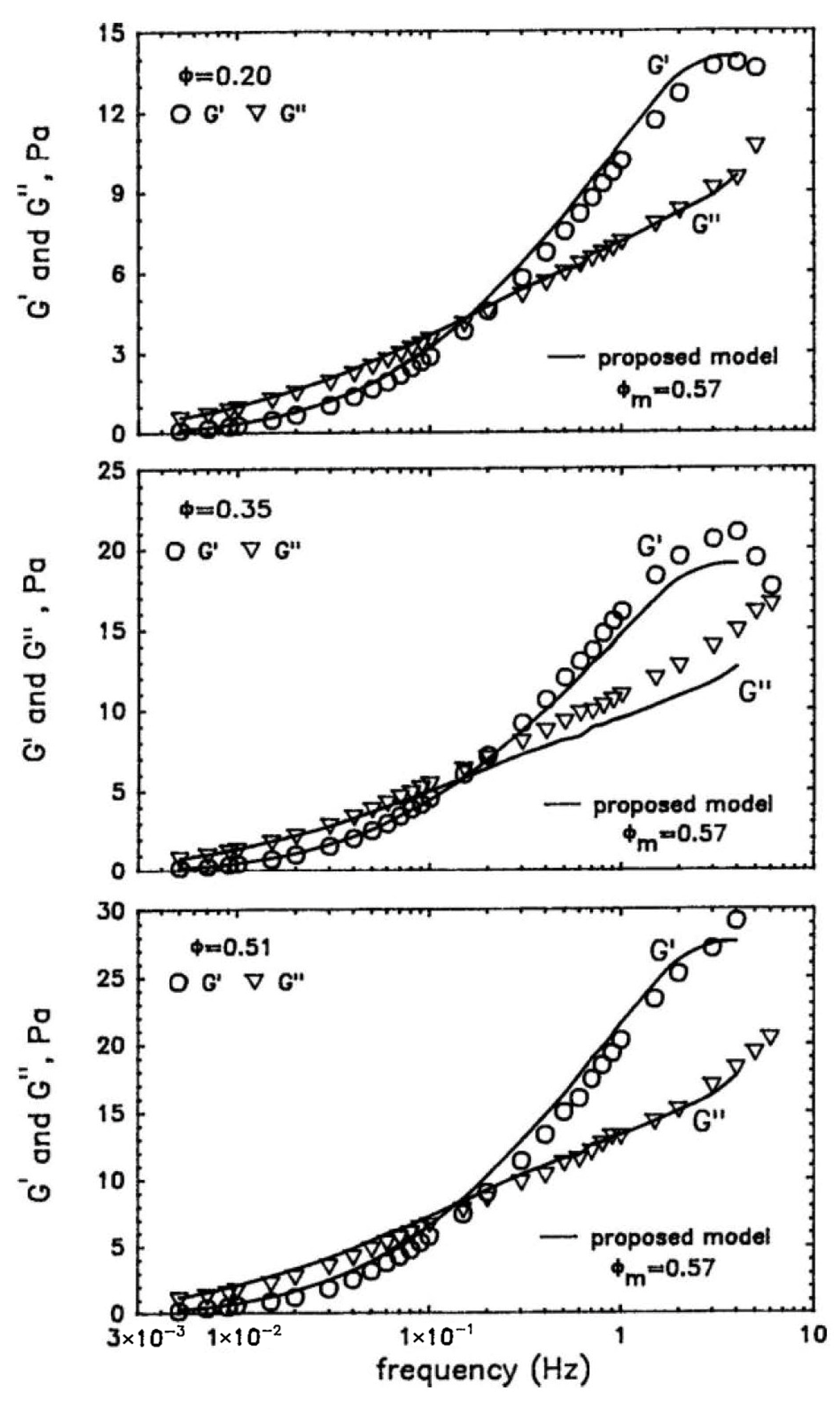
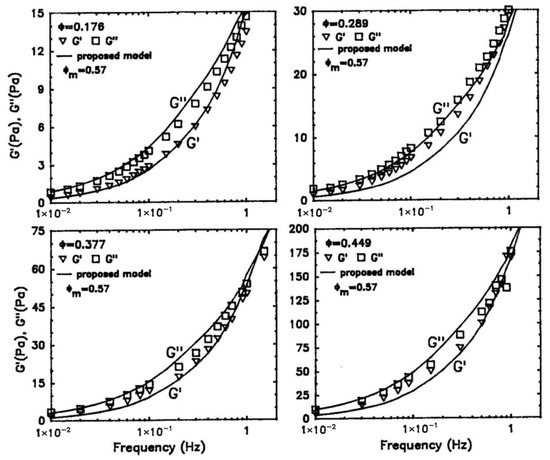
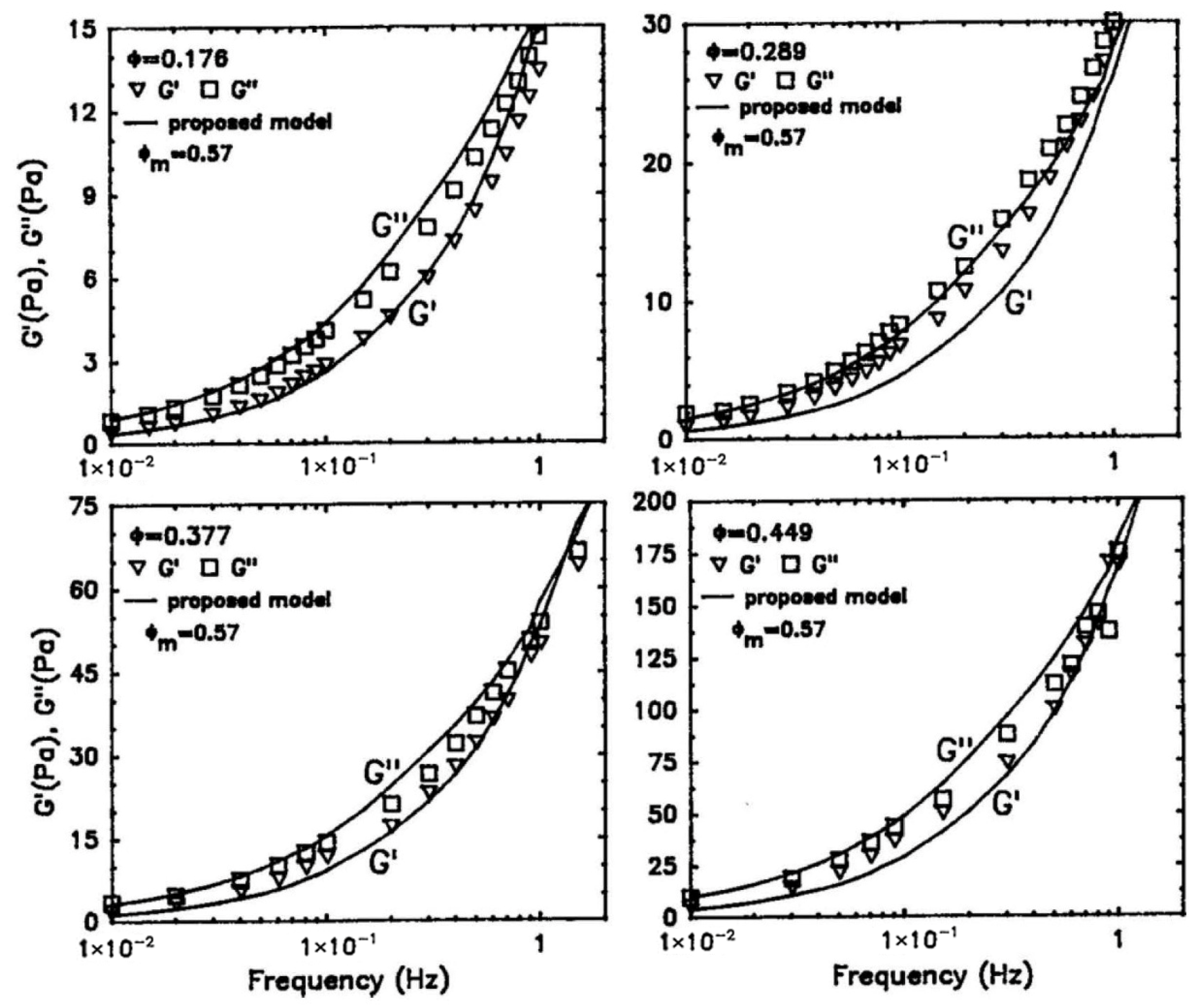
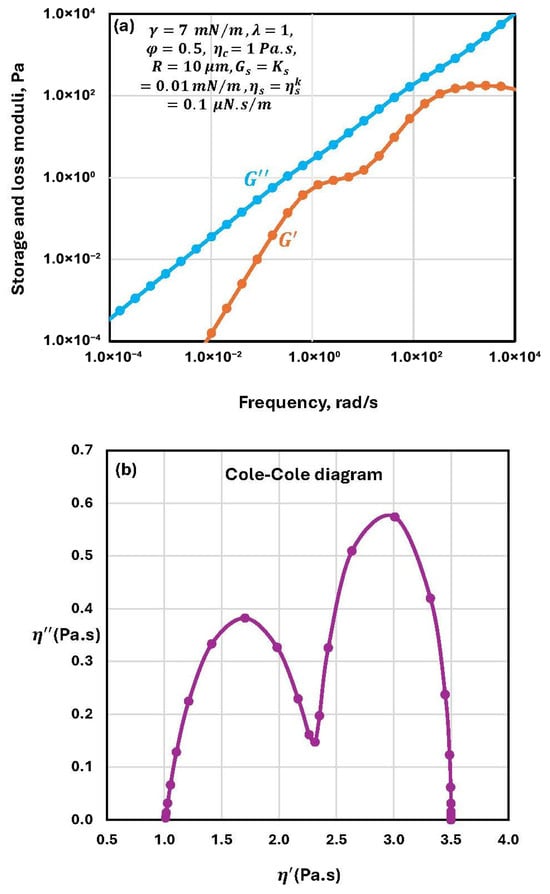

Disclaimer/Publisher’s Note: The statements, opinions and data contained in all publications are solely those of the individual author(s) and contributor(s) and not of MDPI and/or the editor(s). MDPI and/or the editor(s) disclaim responsibility for any injury to people or property resulting from any ideas, methods, instructions or products referred to in the content. |
© 2026 by the author. Licensee MDPI, Basel, Switzerland. This article is an open access article distributed under the terms and conditions of the Creative Commons Attribution (CC BY) license.