Article

Quasi-Static Axial Crushing Behaviour of Rectangular Foam-Filled CFRP-Aluminium Hybrid Composite Tubes


1
Department of Engineering Management, College of Engineering, Prince Sultan University, Riyadh 12435, Saudi Arabia
2
Department of Mechanical Design and Production Engineering, Faculty of Engineering, Zagazig University, Zagazig 44519, Egypt
*
Author to whom correspondence should be addressed.
J. Compos. Sci. 2025, 9(12), 676; https://doi.org/10.3390/jcs9120676
Submission received: 6 October 2025 / Revised: 10 November 2025 / Accepted: 25 November 2025 / Published: 5 December 2025
(This article belongs to the Section Carbon Composites)

Abstract

This study investigates the quasi-static axial crushing behaviour of carbon fibre-reinforced polymer (CFRP) tubes with variations incorporating polyurethane foam (PU) and aluminium tubes. Six different composite configurations were fabricated, including a baseline hollow CFRP tube and hybrid structures with foam and aluminium reinforcements. The mechanical response was evaluated through load–displacement behaviour and energy absorption. Visual inspection of the failure modes revealed distinct fracture mechanisms influenced by the type of reinforcement. The results indicate that incorporating aluminium significantly enhances load-bearing capacity, energy absorption, and crushing efficiency, with the sample containing four aluminium secondary tubes exhibiting the highest specific energy absorption. Meanwhile, foam-filled samples improved load-bearing capacity while mitigating brittle failure. These findings suggest that CFRP hybrid structures with aluminium and foam reinforcements offer promising solutions for lightweight Crashworthiness applications in the automotive and aerospace industries.

1. Introduction

The use of carbon composite materials in various engineering and non-engineering sectors, including marine, building, automotive, and aerospace, has rapidly evolved [1]. These composite materials, such as carbon fibre-reinforced polymers (CFRP), possess high specific strength and energy absorption capability compared to conventional metals, permitting significant mass reductions and improved mechanical performance in safety-critical applications [2]. The marine, automobile, and aerospace industries benefit mainly from carbon composite materials due to their superior structural performance, which contributes to reduced fuel consumption and emissions. With rising concerns over fuel costs and environmental sustainability, manufacturers increasingly use advanced carbon composites to replace heavier metallic components. The fundamental advantage of CFRP materials, particularly in crashworthiness performance, lies in their high specific energy absorption (SEA) [3].
Extensive research has shown that CFRP structures outperform conventional metals under axial and dynamic loading due to their superior strength-to-weight ratio [4]. Their energy-absorption capabilities have been studied under various loading and failure modes, in which CFRP failure typically involves fracture, interply delamination, and matrix cracking [5]. These damage mechanisms depend strongly on fibre orientation and layer configuration, making the design of CFRP composites more complex than conventional metals, Khan found that fibre orientations of 15°/75° significantly enhanced load-bearing capacity and energy absorption under axial crushing [6].
The crashworthiness of composite tubes is also influenced by geometry. Rectangular and circular tubes are most studied due to their structural relevance, with rectangular tubes generally providing up to 50% higher energy absorption than circular ones because of better load distribution and stable deformation. Similarly, increasing wall thickness in thin-walled tubes improves crash performance by enhancing load-bearing capability. Other geometrical shapes, such as sinewave, hexagonal, and conical cross-sections, have also been explored for energy absorption efficiency under quasi-static loading [6]. Mahdi and Sebaey observed that aramid/epoxy composites demonstrated superior energy absorption compared to carbon/epoxy due to their higher crushing stability [7].
PU foam fillers further enhance the energy absorption and crashworthiness of CFRP and aluminium tubes. Filling CFRP tubes with lightweight materials such as PU foam prevents inner wall buckling and stabilises crushing behaviour [8]. Studies report a potential improvement of up to 10% in peak load and total energy absorption in foam-filled composite tubes compared to hollow ones. Similarly, smaller honeycomb cell sizes improve crushing resistance by increasing filler density [9]. Sabeay et al. observed that PU foam-filled carbon composite tubes exhibited higher peaks and mean crushing loads and greater energy absorption. Foam fillers improve internal support and delay brittle failure, contributing to more controlled progressive crushing. Hybrid carbon/aluminium composite tubes with PU foam also demonstrate higher energy absorption and stability compared to hollow configurations [10].
Increasing foam thickness further improves the crushing performance of hybrid CFRP-aluminium tubes. However, CFRP-aluminium hybrids are often brittle under high axial strain rates [11]. The inclusion of aluminium enhances plastic deformation and provides lateral support to CFRP walls, reducing stress concentrations and brittle fracture [12]. This hybridization allows progressive load-bearing and better crashworthiness. The arrangement of CFRP layers around aluminium cores affects SEA and delamination behaviour, depending on cross-sectional shape, size, and configuration [13].
Rectangular and circular hybrid tubes are widely used due to their ease of manufacture and effective energy absorption. Rectangular configurations generally absorb more energy than circular ones due to stable buckling and uniform deformation [14]. Researchers have also explored combining CFRP with fibres such as Kevlar to improve ductility. Studies have shown that hybrid carbon/Kevlar/epoxy tubes achieve a balance between energy absorption and structural stability, where carbon-dominant layers exhibit higher SEA, while Kevlar layers delay catastrophic failure [15]. Kumar reported that pentagonal aluminium–Kevlar composites improved crash performance due to enhanced ductility and energy dissipation. Such configurations are suitable for automotive components requiring high impact resistance [16].
Although these studies mainly focus on quasi-static axial crushing, it is essential to note that the crashworthiness response may differ under dynamic conditions due to strain-rate effects in foam, CFRP, and aluminium components. Prior work on foam-filled aluminium tubes also shows that filler density significantly influences SEA, making PU foam ideal for lightweight applications. Multi-tubular hybrid assemblies using PU foam have demonstrated improved load distribution and higher crushing stability [17].
Despite extensive research on CFRP, aluminium, and foam-filled tubes, most prior studies have treated these materials separately or used simple circular geometries. Limited work exists on hybrid rectangular configurations that better reflect actual crashworthy structures, such as automotive crash boxes or aerospace frames. To address this research gap, the current experimental investigation leads to a novel rectangular multi-tubular combination of CFRP outer shells, internal aluminium reinforcements, and PU foam cores. This composite tube design permits the interface of three separate reinforcement mechanisms: (i) pure rectangular aluminium tubes act as internal stiffeners that delay axial local buckling and calm tube folding, (ii) PU foam prevents delamination and evenly distributes pressure. (iii) The rectangular composite and aluminium geometry improves corner restraint and supports developing crushing [18,19]. This study examines six different composite tube configurations to provide practical insights into the synergistic interaction between foam and aluminium reinforcements within CFRP rectangular tubes, contributing to the design of lightweight, high-performance energy-absorbing structures for transportation safety applications [20,21].

2. Materials and Methods

2.1. Materials and Composite Structures

In this study, numerous composite configurations are fabricated, including CFRP and aluminium rectangular multi-tube hybrid composites. The individual CFRP composite rectangular tubes were from DragonPlate®, manufactured by Allred & Associates Inc., Elbridge, NY, USA, and the aluminium rectangular tubes were purchased from Saudi Arabia. The details of the tubes are presented in Table 1.
The CFRP tubes’ stacking sequence comprises two types of carbon fibre cloth (Braided ±45 and Unidirectional 0). Carbon fibre has a modulus of 228 GPa and a tensile strength of 4.41 GPa. Epoxy resin served as the matrix, with approximately 50% fibre volume fraction. These properties pertain to the reinforcing fibre used in the composite, not the entire laminate system.
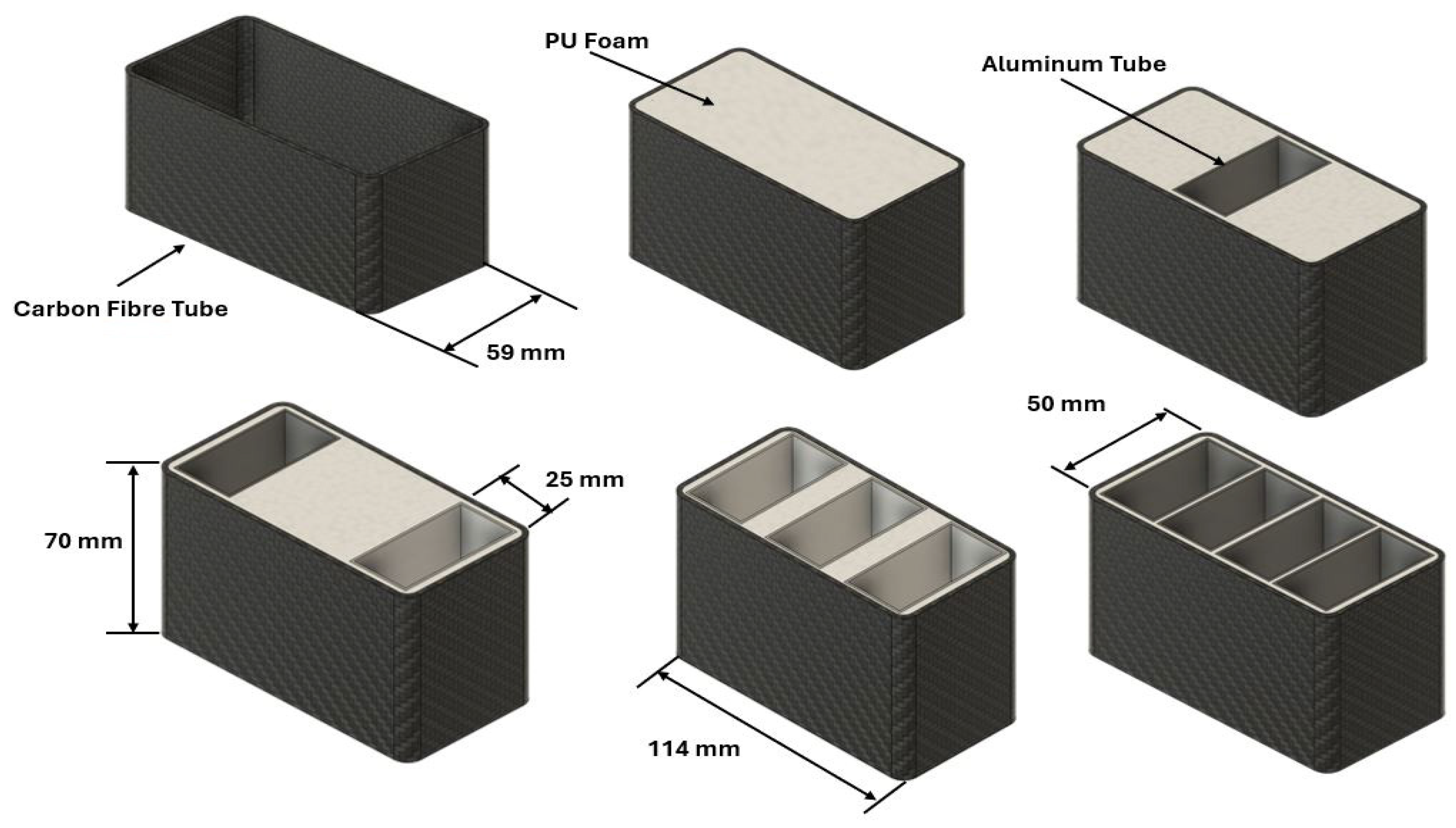
The CFRP and aluminium rectangular tubes were cut to the experimentally designed desired height (70 mm). The carbon composite tube wall thickness was 2.25 mm, the width was 25 mm, the length was 50 mm, the aluminium height was 70 mm, the width was 59 mm, and the wall thickness was 1.25 mm. The above composite and aluminium tubes formed six different configurations of the composite’s compositions. Detailed schematic images and an actual example of the tube configurations are shown in Figure 1. The composite aluminium rectangular tube for all experimental samples is defined to process the placement of primary and secondary tubes. In every arrangement, the outer tube, a hybrid composite tube, consists of the CT tube and the secondary internal aluminium tube, referred to as AL. The complete arrangement of the primary and secondary carbon and aluminium tubes used to arrange the test specimens is represented in Table 2.
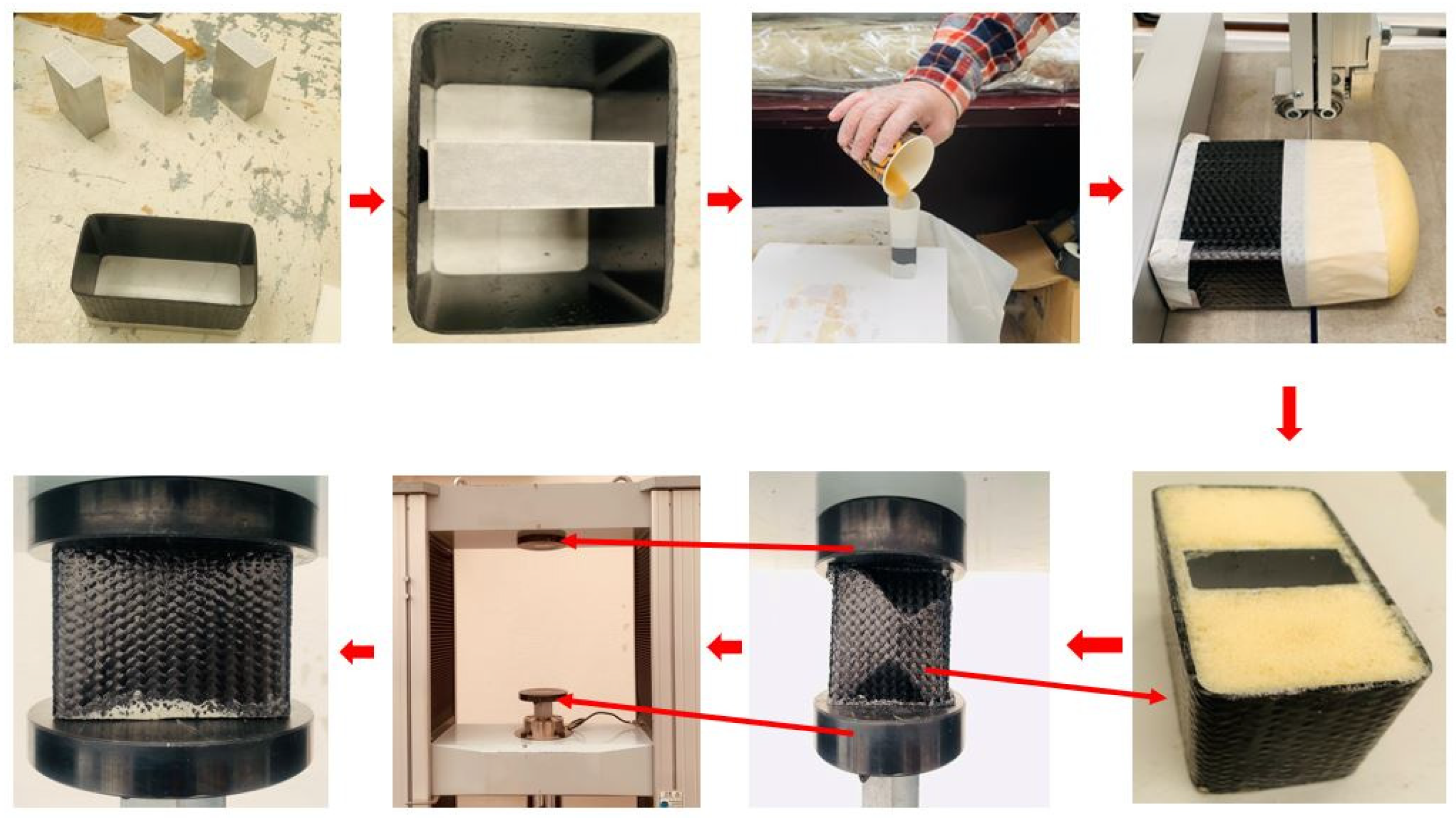
Polyurethane foam (PU), which is supplied by “TOTALBOAT” (Allred & Associates Inc., Elbridge, NY, USA), with a density of 32 kg/m3, was used in this experimental examination. We have designated “F” to indicate the subject. The PU-filled composite tubes contain two liquid components at room temperature. Equal volumes of both liquid parts should be mixed to produce foam. This mixing method uses manual stirring for approximately 30 s. Once the PU foaming proceedings begin, just before the foam develops, pour the liquid mixture into the tube and allow it to foam fully, expanding after 15–20 min. The Mechanical performance of composite tubes, characteristics of the PU foam (compressive strength and plateau efficiency), is presented in Section 3.5.
The manufacturer’s technical data sheet (TOTALBOAT) states that the foam exhibits a compressive strength of around 200 kPa and a closed-cell efficiency of around 94% under standard compression tests. This PU foam fills the spaces inside the CFRP tube or between the CFRP and aluminium rectangular tubes, binding them together into a hybrid composite tube, as shown in Figure 1.
The prepared composite hybrid tubes were subjected to a quasi-static axial crushing test to evaluate their crashworthiness properties. All experimental periods were conducted in a climate-controlled lab, where the temperature was maintained at 25 °C and the humidity at 50%.

2.2. Testing Protocol for Crashworthiness

Quasi-static crushing tests were conducted using a universal testing machine with a maximum load capacity of 300 kN to examine crushing mechanisms and behaviours and to assess the crashworthiness of carbon/aluminium PU-filled composite tubes in all arrangements, as shown in Figure 2. In the test process, a universal machine was attached to two flat circular steel plates set parallel to each other, with a measurement crosshead speed maintained at 5 mm/min Each sample was located between two circular, rigid, flat steel plates and subjected to axial compression until a maximum displacement of 45 mm was reached. For each configuration, three specimens were tested per standard ASTM practices for comparative mechanical testing of composite and hybrid structures. The repeatability of the results was evaluated by calculating the mean, standard deviation (SD), and coefficient of variation (CV). A digital camera captured the experimental behaviour of all composites at multiple phases during testing. Investigation of quasi-static crushing tests revealed 10 factors associated with crashworthiness that were applied to assess axial crushing performance, allowing for a direct assessment. In the study, the first parameter is Peak Load, which refers to the load at the initial peak on the load–displacement curve, typically observed at the end of the composite’s linear region. The Mean Crushing Load (Pₘ) was calculated as the average load during the stable crushing displacement, from the point after the initial peak load to the point of structural densification. Crushing Force Efficiency (CFE) is the ratio of the mean crushing load to the peak load, indicating the load-bearing strength through incremental tests. The test results for the samples show that Energy Absorption (EA) represents the total energy lost by the sample up to extreme displacement. However, Specific Energy Absorption (SEA) is the energy absorbed per unit mass, demonstrating efficiency compared to the composite specimen’s weight. The crashworthiness analysis provides a detailed explanation of these composite parameters and their calculation equations. It enables a comprehensive assessment of crashworthiness across different arrangements of the carbon composite samples illustrated in Figure 1.
In the experiment, three samples per arrangement fulfil the ASTM standards for composite assessment. Despite the inadequate number of repeats, the results indicated adequate repeatability, with generally CV values below 7% and all lower than 12%, confirming appropriate consistency for quasi-static compression tests [22].
In the investigation, the Energy Absorption (EA) equation is measured by integrating the force-displacement curve, as shown in Equation (1).
E A = P d δ
The tubes’ properties, including specific energy absorption (SEA) and crush force efficiency (CFE), were obtained by normalizing absorbed energy by tube mass. At the same time, CFE was the ratio of mean crushing force to peak force, as shown in Equations (2) and (3).
S E A = P d δ m
C F E = P m P i p
The mean crushing, load P m   is the average load during stable crushing. It is calculated by integrating the instantaneous load P ( δ ) from the initial displacement δ i to the final displacement δ d and dividing the displacement range ( δ d δ i ) , giving the average load absorbed over the crushing process, as presented in Equation (4)
P m = 1 δ d δ i δ i δ P   δ d δ
For each sample arrangement, three samples were tested. The mean, standard deviation (STD), and coefficient of variation (CV) were calculated for all measured parameters to evaluate repeatability, where
C V = S T D Mean × 100 %

3. Results and Discussion

3.1. Load vs. Displacement

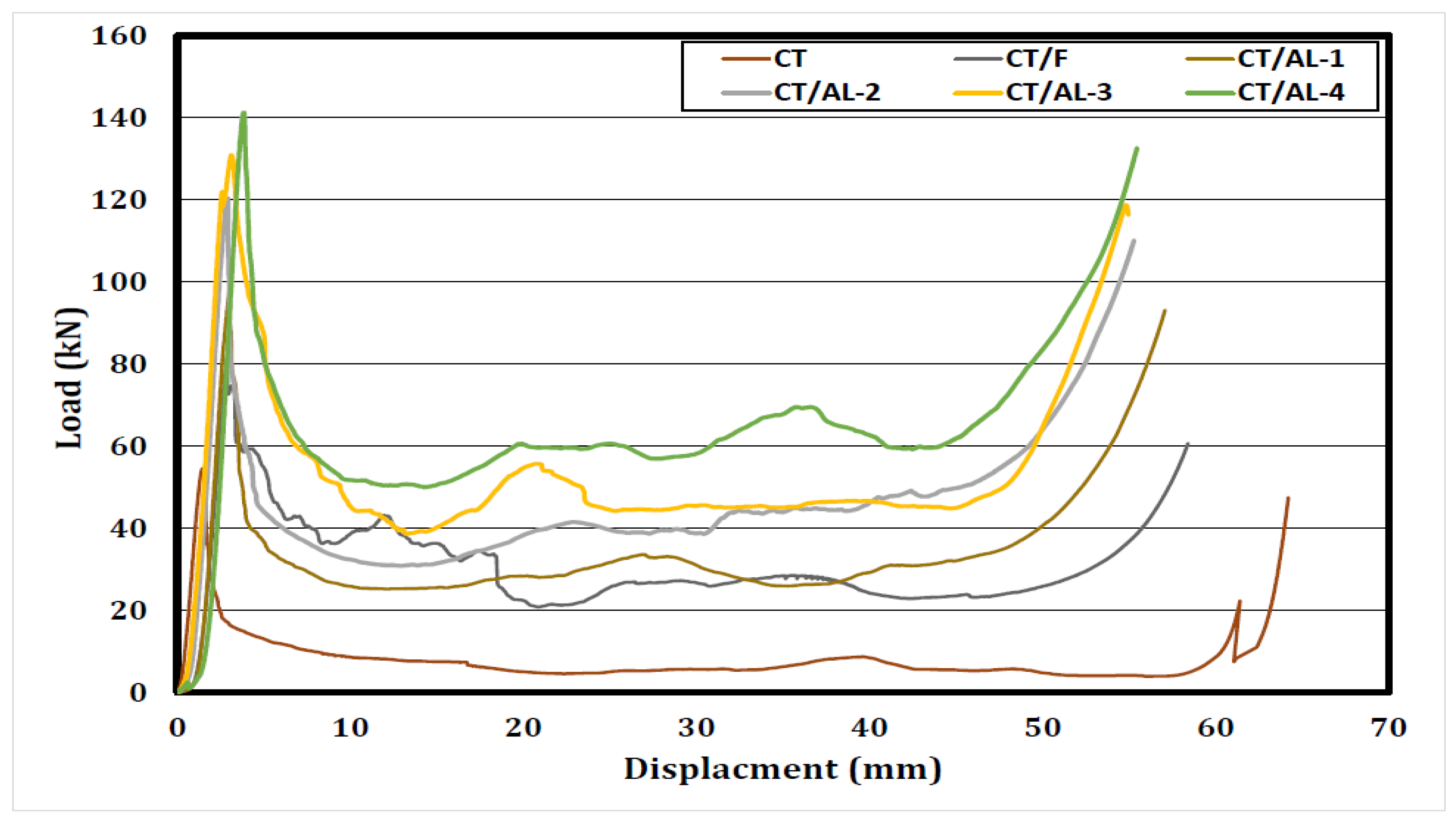
Figure 3 presents the load–displacement curves demonstrating the crushing behaviour of all the samples under axial loading. These curves offer insight into the crashworthiness properties of the CFRP composite and its hybrid configurations with foam and multiple aluminium tubes [23]. Different stages typically characterise the load–displacement response of polymer composites: The pre-crushing stage, where the material undergoes elastic deformation; the peak load, marking the initiation of structural failure; the post-crushing stage, involving progressive failure and energy absorption; and the densification stage, where the material compacts under increasing load [24].
The hollow CFRP tube (CT) shows the typical brittle failure behaviour [25]. The load–displacement curve shows a steep initial slope, indicating high stiffness in the pre-crushing stage. The material reaches its peak load of roughly 54.9 kN at a displacement of 1.5 mm. At this point, the curve drops abruptly, indicating a sudden failure [26]. This sharp drop is characteristic of brittle materials, where the structure cracks or shatters without significant deformation [27]. This behaviour indicated the limited load-bearing capacity of pure CFRP due to its brittle nature. This rapid load drop can be attributed to local wall buckling and fibre–matrix delamination initiating at the tube corners, which are critical stress concentrators in rectangular geometries. It also suggests that while CFRP is strong and stiff, it lacks the ductility required for effective energy dissipation in crash scenarios [28]. The CT/F composite reaches a peak load of approximately 80.4 kN at a displacement of 2.8 mm. The addition of foam increases the peak load and delays the start of failure compared to CT. The curve indicates a combination of brittle and ductile failure mechanisms, with more gradual post-peak behaviour than pure CFRP. This can be attributed to the foam’s crushing behaviour, where its cells collapse progressively, dissipating some of the crushing energy, stabilizing the crushing process and leading to enhanced crushing performance compared to pure CFRP [25]. The foam also redistributes local stress across the CFRP inner wall, thereby mitigating premature fibre breakage and reducing the propagation of shear-induced delamination. In the CT/AL-1 sample, which consists of a single aluminium tube, material failure initiates at a load of approximately 98 kN and a displacement of about 3 mm. The densification stage begins at around 46 mm displacement. The curve exhibits a more pronounced post-peak fluctuation, indicating progressive crushing and an enhanced load-bearing capacity [1]. The aluminium tube increases crushing resistance and provides a more stable crushing process. The aluminium inserts act as a constraint, delaying local buckling by introducing a secondary load path that stabilizes the CFRP wall and absorbs energy through plastic folding. Studying the load–displacement curve of the CT/AL-2 sample, a peak load of 121 kN at a displacement of approximately 2.9 mm was observed. The curve shows a more gradual decline in load after the peak, indicating improved energy absorption and a more controlled failure process [29]. The densification stage begins at around 44 mm displacement. The addition of a second aluminium tube significantly increases the peak load and stabilizes the structure, leading to higher crushing properties. Moreover, the sample with three aluminium tubes (CT/AL-3) exhibits a peak load of approximately 130 kN at a displacement of about 3.2 mm. The curve shows a post-peak region with significant crushing resistance [30,31]. This enhancement arises because multiple rectangular tubes distribute compressive stress more evenly, suppressing localized buckling and promoting symmetric folding throughout the structure. The final sample, CT/AL-4, comprising four aluminium tubes, reaches a maximum peak load of approximately 143 kN at a displacement of almost 3.8 mm. This sample maximizes load-bearing capacity and structural stability, indicating that four aluminium tubes provide optimal strength and reflect the most efficient crushing behaviour observed in the study. However, despite the highest peak load, overall efficiency must also account for added mass. Later sections include the sample masses to verify energy absorption per unit weight and compare actual lightweight efficiency.
The hybrid configurations, particularly CT/AL-4, show significant improvements in peak load, load-bearing capacity, and crushing stability compared to pure CFRP. These observations highlight the potential of hybrid composites for applications that require high crashworthiness and energy dissipation. The novel aspect of this work lies in combining rectangular multi-tube aluminium inserts with a foam-filled CFRP shell. Unlike prior circular or single-insert hybrids, the rectangular geometry modifies stress flow and local confinement, creating multi-directional load-sharing zones and altering the collapse mechanism.
Adding rectangular aluminium tubes enhances load–displacement performance by shifting the failure mode from brittle to yielding. Aluminium tubes used as fillers strengthen the composite structure, reducing local buckling and delamination of the tube structures. Simultaneously, the foam core facilitates gradual collapse and stress redistribution, resulting in a stable, multi-peak crushing load. The aluminium layers undergo sequential plastic folding, while foam compaction reduces interfacial stress concentration, yielding a smoother energy-dissipation response. This multi-stage response aligns with previous research on PU foam-filled and carbon-hybrid CFRP/Al tubes [1,2,3,4,5,6,7,8,9,10,11,12,13,14,15,16,17,18,19,20,21,22,23,24,25,26,27,28,29].

3.2. Peak Load of Hybrid Composite Tubes

The peak load is crucial in evaluating a material’s crashworthiness and structural integrity under axial crushing. To confirm the reliability of the experimental data, the peak load values from the three tested specimens of each configuration are summarised in Table 3, along with the calculated mean, standard deviation (SD), and coefficient of variation (CV). The results show that five of the six configurations exhibited CV values below 7%. In contrast, CT/AL-4 showed a higher CV of 11.6%, which remains within an acceptable range for hybrid composite crushing tests. These experimental investigation results verify that, although only three samples per composite tube configuration were tested, the low CV values (<12%) indicate acceptable repeatability and consistency of the measured data.
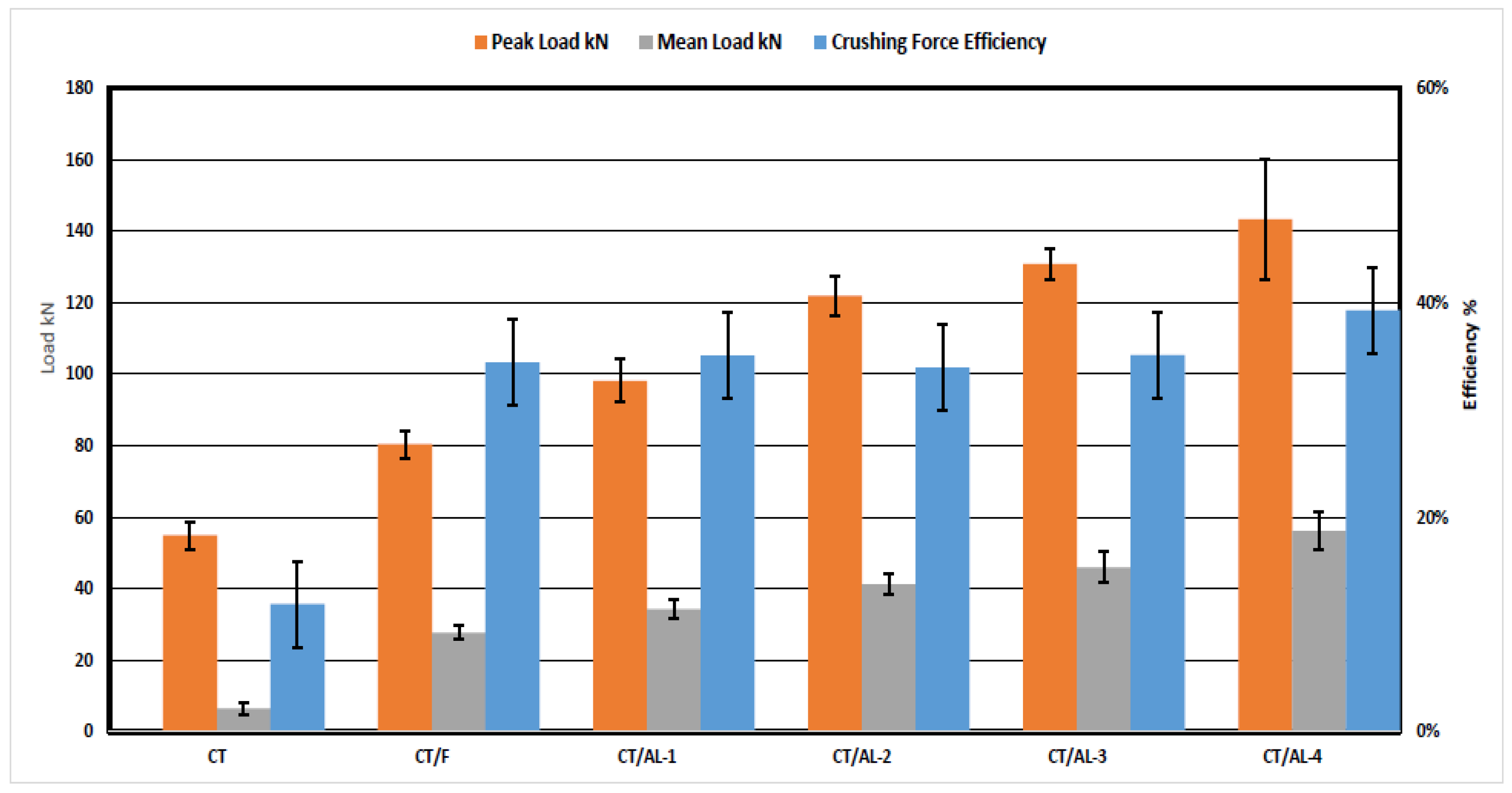
Figure 4 represents the peak loads of all the studied samples. The CT sample exhibits a peak load of approximately 54.9 kN, indicating high stiffness and a brittle failure mode. The result indicates that while CFRP is strong and stiff, it lacks the ductility required for performing effectively in crash scenarios [30,31]. The CT/F sample reaches a peak load of approximately 80.44 kN, a 46.5% increase over the CT sample. The increase in the peak load further delays the onset of failure, indicating improved load endurance and a more controlled failure process. This can be attributed to the addition of foam as a filler, which stabilizes the composite and enhances its crushing properties compared to pure CFRP [29].
The CT/AL-1 sample achieves a peak load of 98.09 kN. The addition of 2 aluminium tubes to the composite increases the peak load to 121.89 kN for the CT/AL-2. The second aluminium tube significantly increases the peak load and stabilizes the structure, allowing the material to withstand higher loads before failure [30]. The peak load increases to approximately 130.75 kN in the CT/AL-3 composite, which consists of three aluminium tubes. The aluminium tubes improve the ductility of the structure, while the CFRP provides the necessary stiffness, resulting in a hybrid composite that excels in both strength and load-bearing capacity [32]. The CT/AL-4 configuration, with four aluminium tubes, further increased the peak load to 143.30 kN. This composite variant achieves the highest peak load among all samples, demonstrating the most remarkable ability to withstand higher crushing loads. The fourth aluminium tube provides improved ductility and structural stability, allowing the material to withstand even higher loads before failure. Even though the CT/AL-4 variant offers the highest peak load, the performance gain may not justify the added weight and material cost in some applications [33]. This indicates that CT/AL-4 is the strongest configuration; CT/AL-3 may still be the more efficient choice for applications where weight and cost are essential factors.

3.3. Mean Load of Hybrid Composite Tubes

The mean load is a critical parameter in evaluating the crushing resistance of materials under axial loading. Figure 4 illustrates the mean load of all the CFRP and hybrid composite samples. Below is a detailed description of each sample’s trends and behaviour.
The pure CFRP sample has the lowest mean load (6.52 kN) among all the configurations. CFRP fails primarily due to mechanisms such as fibre breakage, matrix cracking, and delamination, which limit its load-bearing capacity and crushing resistance. The low mean load indicates that pure CFRP is less efficient for applications requiring effective energy dissipation, as it cannot sustain high loads over a wide range of displacements. This makes CFRP suitable only for applications where stiffness and strength are prioritized over crashworthiness [34]. Adding foam significantly improves the mean load compared to CT (about 27.65 kN). The reason is that foam acts as a stress buffer, resulting in a more gradual load drop after the peak. The higher mean load indicates better crushing behaviour of the material and a more controlled failure process. The foam enhances the material’s ability to sustain load over a longer duration, making it more suitable for crashworthiness applications.
Adding an aluminium tube to the CRFP with foam (CT/AL-1) further increases the mean load to 34.25 kN, highlighting the advantages of combining CFRP with a hollow aluminium tube. The aluminium tube introduces ductility, which complements the stiffness of CFRP, resulting in a more stable crushing process [35]. This configuration enables the material to sustain higher loads over time, as indicated by the increased mean load. The hybrid structure strikes a balance between strength and ductility, thereby enhancing energy absorption and improving structural integrity [36]. The CT/AL-2 and CT/AL-3 configurations, featuring multiple aluminium tubes, result in a further increase in mean load, indicating that the sample withstood higher loads for a longer duration. The aluminium tubes improve the material’s ductility, while the CFRP maintains stiffness, resulting in a hybrid composite that excels in load-bearing capacity [37].
The increase in mean load indicates a more stable, energy-efficient crushing response from the composites, and it correlates directly with improved post-peak stability, confirming that foam and aluminium inserts suppress unstable fracture propagation by promoting uniform stress distribution along the tube walls. Retungural aluminium tube insertions plastically collapse after initial composite fibre failure, while enduring force, with PU foam moderating axial local load buckling by evenly distributing stresses. This evolution from brittle carbon-hybrid composite failure to reduced friction and metal yielding enables advanced axial crushing, significantly improving crashworthiness while maintaining a protective, lightweight design.

3.4. Crushing Force Efficiency of Hybrid Composite Tubes

The crushing force efficiency of the samples. The hollow CT sample exhibited a CFE of 11.88%, indicating limited energy absorption and a tendency toward brittle failure. Introducing PU foam in CT/F increased the CFE to 34.43%, suggesting that the foam core effectively stabilized the structure. This observation aligns with findings by Reddy et al., who reported that foam-filled tubes exhibit higher CFE due to reduced force fluctuations during crushing [37]. The CFE increased with the number of aluminium tube reinforcements, with CT/AL-4 achieving the highest efficiency at 39.28%.
Observing the CFE characteristic alongside reduced load fluctuations suggests that the carbon composite no longer collapses immediately but gradually folds through continuous deformation. This is consistent with studies by [38] Those who reported greater CFE were associated with brittle failure in foam-filled or hybrid composite tubes. The aluminium provides lateral support to the carbon-composite wall. Simultaneously, the PU foam core is a strain-absorbing layer, inducing brittle fracture to a quasi-axial collapse and thus improving load-bearing efficacy.

3.5. Energy Absorption of Hybrid Composite Tubes

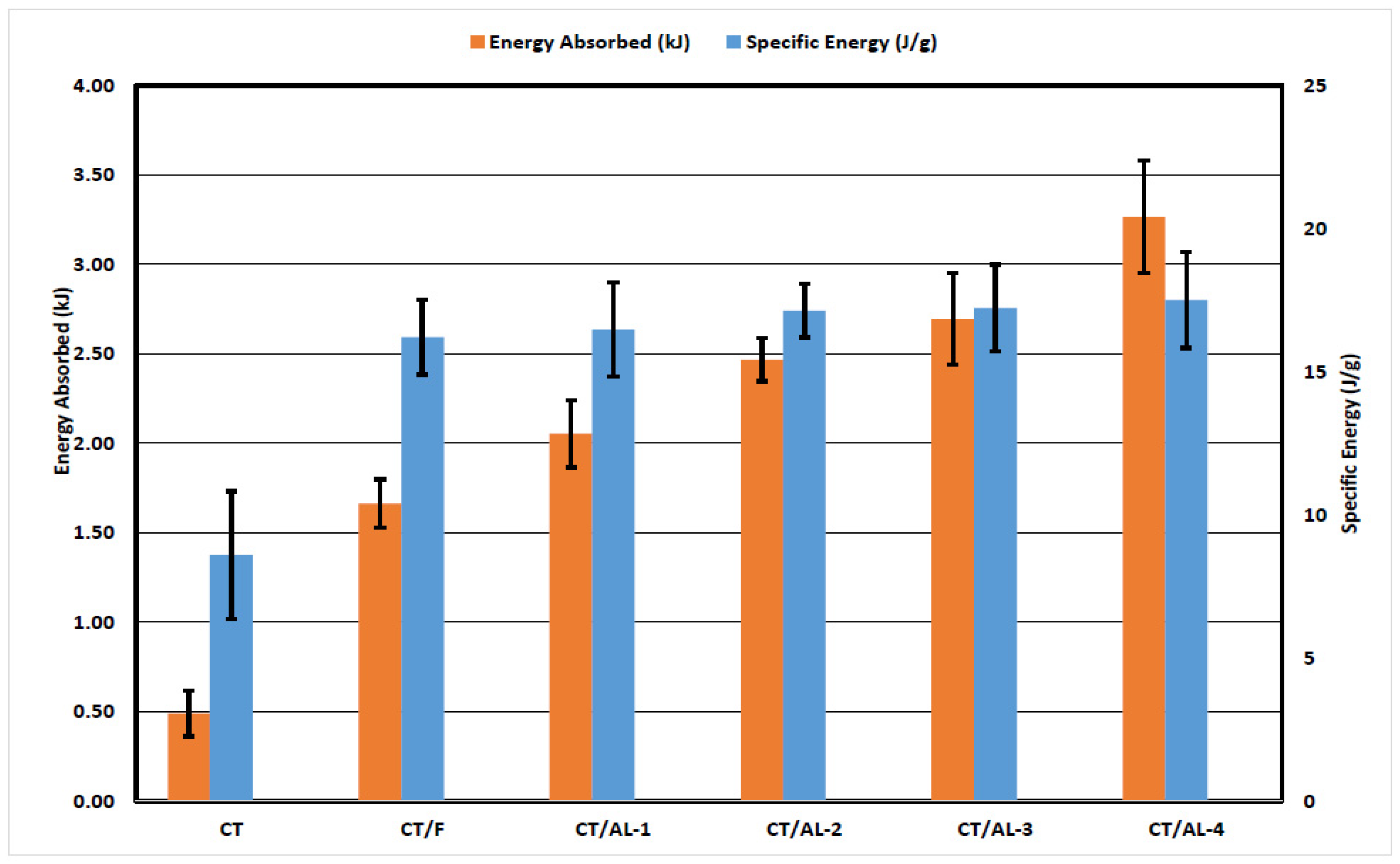
Figure 5 shows the energy absorption capability of the samples under axial compression. The Specific Energy Absorption (SEA) is also shown in the figure, highlighting energy absorption efficiency per unit mass (in J/g). Energy absorption is a crucial measure of a material’s ability to dissipate energy before failing, and it is directly linked to its capacity to protect against impacts or collisions, particularly in applications such as automotive crash safety, protective gear, and aerospace structures [37]. The difference in energy absorption, as seen in the figure, highlights the effects of adding reinforcements to the CFRP tube (CT) and shows the potential for a significant increase in its ability to withstand crushing forces [39].
The hollow CFRP tube (CT) serves as the baseline for this study. It absorbs the least energy among all the samples, averaging about 0.49 kJ. This is due to the lack of internal support in the hollow structure, which makes it more prone to sudden failure under crushing forces. CFRP composites are known for their high strength-to-weight ratio, but they tend to fail in a brittle manner, as observed in an earlier study [40]. This brittleness is also reflected in the high standard deviation of approximately 0.126 kJ, indicating notable variability in the crushing behaviour. This high standard deviation can also be attributed to minor factors, such as the quality of the material and testing conditions. The CT sample has the lowest specific energy absorption among all configurations, at approximately 8.59 J/g. The hollow structure lacks internal reinforcement, making it less effective at dissipating energy per unit mass.
When Polyurethane foam is added to the hollow CFRP tube (CT/F), the energy absorption increases dramatically from 0.49 kJ to 1.66 kJ, more than three times that of the hollow variant. Adding foam to the CT enhances its specific energy absorption, increasing it to 16.21 J/g. This value is nearly twice that of the hollow CRFP composite. The reason for this increase is that the foam acts as a filler, providing internal support that helps distribute the crushing forces more evenly across the structure. This reduces the chances of sudden failure and allows gradual material deformation. The foam enhances energy absorption and stabilizes the material’s response to crushing, which is indicated by a lower standard deviation of 0.13 kJ. The higher SEA value makes the foam-filled CFRP tube a more suitable material for applications requiring lightweight yet energy-absorbing materials, such as automotive or aerospace structures [41].
The addition of a single hollow aluminium tube into the foam-filled CFRP tube (CT/Al-1) further enhances energy absorption. Yang et al. Additionally, the aluminium tube provides more strength and stiffness to the structure, allowing it to resist crushing forces more effectively. The energy this configuration absorbs is approximately 2.05 kJ on average, which is about 23% more than that of CT/F. The sample achieved a specific energy absorption of approximately 16.47 J/g, a slight increase over the CT/F sample. This configuration demonstrates the benefits of combining lightweight foam with a reinforcing aluminium tube, resulting in a hybrid composite that balances weight and performance. The aluminium acts as a reinforcement in the composite, preventing the foam and CFRP from collapsing too quickly and enabling the material to absorb energy over a more extended period by delaying and stabilizing the failure mechanism [38,39,40,41,42,43,44,45,46].
In CT/AL-2, a second aluminium tube is added to the foam-filled CFRP tube, resulting in an even higher energy absorption of 2.47 kJ. Compared to the CT/F, this reflects an increase of approximately 50%. The sample also exhibited a further increase in the specific energy absorption to 17.14 J/g, indicating a significant enhancement over the CT/F and CT/AL-1 composites. The two aluminium tubes provide additional structural support, further delaying failure and allowing the material to absorb more energy. The increased absorption is likely due to the balanced reinforcement offered by the two bars, which helps distribute the crushing forces more evenly and reduces the likelihood of sudden failure [43,44]. Adding three hollow aluminium tubes to the composite (CT/AL-3) further increased the energy absorption by almost 62% compared to the CT/F sample. The additional aluminium bar enhances the composite’s structural integrity, making it even more resistant to crushing forces [45].
The final variant, CT/AL-4, with four aluminium tubes, exhibits the highest energy absorption, averaging 3.26 kJ, and achieves the highest SEA of 17.5 J/g. The four aluminium bars work together to provide maximum structural reinforcement, allowing the composite to withstand crushing forces for an extended period and absorb more energy. The improvement in mean load shows a more stable, energy-efficient buckle. Aluminium tubes undergo plastic deformation after the first composite fibre fracture, with nearly constant force, whereas PU foam delays local buckling. This change—from CFRP fracture to frictional decrease and metal yielding—accounts for progressive crushing, enhancing crashworthiness without adding extra weight, as reported by the studies [32,33,34,35,36,37,38]. The polyurethane foam serves as a foundation for improved energy dissipation, while the hollow aluminium tubes provide structural reinforcement. The results reveal a consistent and predictable trend: increasing the reinforcing material in the CFRP structure enhances energy absorption.

3.6. Visual Representation of Hybrid Tubes

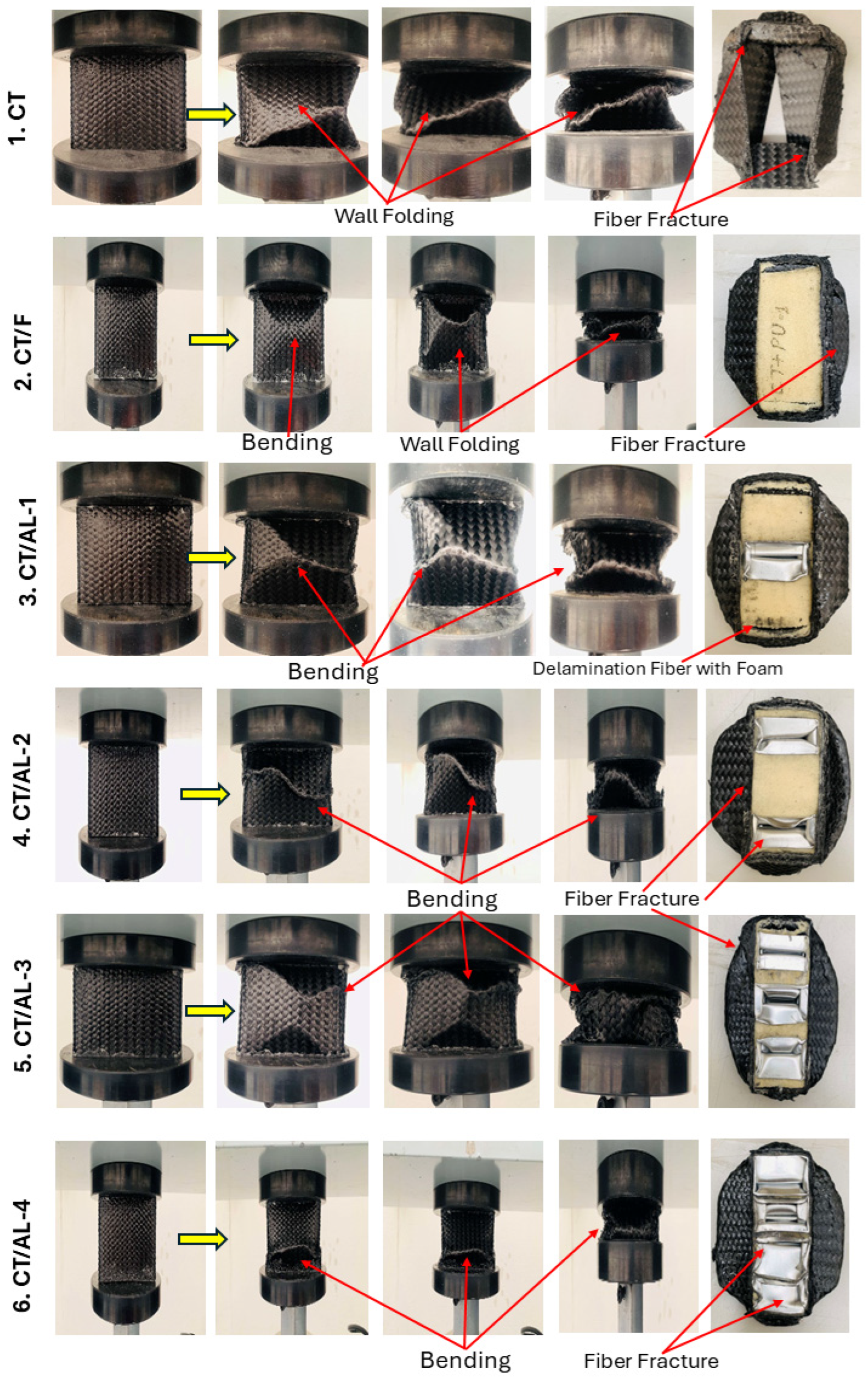
Figure 6 illustrates the crushing behaviour of six distinct carbon fibre-reinforced polymer hybrid composites subjected to axial loading. It was observed that failure modes varied across composite tube samples, with visual evidence indicating that internal fillers had an impact on structural performance [47]. The CT sample exhibited severe buckling and extensive delamination during crushing, resulting in brittle failure. In contrast, introducing PU foam in CT/F resulted in more controlled crushing and reduced delamination, indicating that the foam effectively distributed the applied load and enhanced energy absorption. This observation aligns with findings by Xiao et al., who reported that adding foam in CFRP tubes exhibited improved impact resistance and more stable deformation patterns compared to hollow counterparts [48].
Further enhancement was noted in samples incorporating both PU foam and aluminium tubes. Samples that included increasing numbers of aluminium tubes displayed progressively more uniform deformation. The sample CT/AL-4, comprising four aluminium tubes, exhibited excellent structural integrity with minimal delamination and controlled folding patterns, as shown in Figure 6. This suggests that combining PU foam and multiple aluminium inserts provides superior reinforcement, effectively mitigating catastrophic failure modes. Meriç and Gedikli have documented similar effects for combining metallic reinforcements with composite materials.
The retungural aluminium tubes act as local load paths, buckling, redistributing compression stresses, and delaying wall buckling in the outer layer of the composite hybrid tube. Meanwhile, the PU foam functions as an interfacial layer, absorbing strain energy and preventing immediate delamination of both tubes [42]. The interface among these elements alters the distribution of local buckling and the development of failure, supporting experimental advances in crashworthiness metrics such as CFE and SEA.
The visual observations in Figure 6 demonstrate the role of fillers in dictating the failure behaviour of composite tubes under axial compression. The progression from hollow structures to those filled with foam and Aluminium correlates with a transition from brittle, unstable failure modes to more ductile and controlled deformation patterns. This progression is consistent with previous studies, which have demonstrated that the inclusion of foam and metallic reinforcements in composite tubes enhances their crashworthiness by promoting stable energy dissipation and preventing abrupt structural failures. Although microscopy or fracture surface analysis was not conducted, the images capture the main features, such as wall folding, bending, fibre fracture, and delamination. These visual observations are consistent with failure mechanisms reported in earlier studies.
The composite samples, which showed similar progressive folding (CT/AL-3, Figure 6 CT/AL-4), aligned with the highest SEA and CFE values, indicating a direct link between deformation patterns and mechanical performance. The reduced delamination and measured folding features suggest that metal-assisted collapse is more influential than fibre brittleness. This performance reflects the evolution of failure in hybrid composites, as described by Zhu et al. [34] and Zhang et al. [40]. Where aluminium boundary conduct enhances ductility and stabilizes crushing, overall, the visual evidence supports the mechanical data, showing that the structural hybridization of composites effectively shifts failure from brittle CFRP to more ductile, energy-efficient behaviour.

3.7. Correlation Between Failure Mechanisms and Mechanical Performance

A comparison between mechanical metrics (Peak Load, SEA, CFE) and monitored buckle patterns (Figure 6) shows that hybridization consistently improved both strength and energy absorption. The transition from delamination-driven brittle fracture in the CT specimen to advanced folding in CT/AL-4 shifts the energy-dissipation mechanism from fibre-dominated to matrix/metal-dominated. This multi-mechanism response, which links CFRP strength, aluminium ductility, and foam inhibition, demonstrates a carbon-hybrid failure mode that enhances crush efficiency and reduces structural uncertainty. Supporting the findings of Yang et al. [30].

4. Conclusions

The investigational outcomes indicate that modifying CFRP tubes with aluminium rectangular tubes and PU foam can alter their crushing response, enhancing energy absorption and load-bearing properties. However, various critical observations occur. The carbon tube (CT) exhibited a brittle fracture with minimal energy absorption, achieving a peak load of only 55 kN, a mean load of 8 kN, an energy absorption of 0.5 kJ, and a crushing force efficiency (CFE) of 11.88%, highlighting its poor bending resistance. Although carbon hybrid tube specimens with rectangular aluminium tubes exhibited enhanced performance, CT/AL-4 reached a peak load of 160 kN, an energy absorption of 3.5 kJ, and a CFE of 39.28%. However, these improvements may be specific to the arrangement and may vary under dynamic loading or with different materials. PU foam-filled composite tube samples were tested to enhance structural integrity by reducing catastrophic failure. Still, their stabilizing effect was not quantitatively linked to PU foam density or tube structure geometry, raising questions about scalability and repeatability.
Key findings from this investigation include:
  • The current studies have proposed a hybrid design (CFRP + aluminium + PU foam) that showed potential in rectangular tube arrangements. Still, the research did not analytically explore parametric differences such as wall thickness, foam density, or aluminium placement.
  • CT/AL-4 produced superior samples under axial testing conditions, but its effectiveness in real-world dynamic impacts has not yet been demonstrated.
  • PU foam delayed the structural failure, but the degree of improvement compared to PU foam assets was not precisely measured.
  • Aluminium tubes strengthened and enhanced their strength and load capacity, but potential issues like galvanic corrosion and interface delamination were not addressed.
  • The combined PU foam-aluminium method provides an initial pathway for balancing energy absorption and weight, but the design optimization for real-world applications requires further study.
The investigation has substantial limitations: testing was restricted to quasi-static conditions, ignoring strain-rate sensitivity, fatigue effects, and long-term durability. Moreover, conservation issues such as composite moisture, temperature changes, and corrosion effects were not addressed. Future experimental studies should thoroughly evaluate these characteristics, alongside organized parametric studies, to establish the actual effectiveness and reliability of these carbon hybrid tube structures for automotive or aerospace applications.

Author Contributions

Conceptualization, T.K.; Methodology, T.K. and H.J.; Software, T.K. and H.J.; Validation, T.K. and H.J.; Formal analysis, T.K., H.J. and T.A.S.; Investigation, T.K.; Resources, T.K. and H.J.; Data curation, T.K. and H.J.; Writing—original draft, T.K.; Writing—review & editing, T.K. and H.J.; Visualization, T.K. and T.A.S.; Supervision, T.K. and T.A.S.; Project administration, T.K. and T.A.S.; Funding acquisition, T.A.S. All authors have read and agreed to the published version of the manuscript.

Funding

This research received no external funding.

Data Availability Statement

The original contributions presented in this study are included in the article material. Further inquiries can be directed to the corresponding author.

Acknowledgments

The authors would like to acknowledge the support of Prince Sultan University, Riyadh, for paying the Article Processing Charge (APC) of this publication.

Conflicts of Interest

The authors declare no conflicts of interest.

Abbreviations

CFRPCarbon fibre-reinforced polymer
PU Foam Polyurethane foam
SEASpecific energy absorption
CFECrushing Force Efficiency
F-dForce-Displacement
ALAluminium
CTComposite Tube
CT/PUComposite Tube with Foam
CT/AL-1 to CT/AL-4Composite Tube with different Aluminium configurations

References

  1. Khan, T.; Alshahrani, H.; Abd-Elaziem, W.; Umarfarooq, M.A.; Sebaey, T.A. Quasi-static axial crushing of multi-tubular foam-filled carbon fiber reinforced composite structures. Polym. Compos. 2023, 44, 7843–7854. [Google Scholar] [CrossRef]
  2. Khan, T.; Acar, V.; Aydin, M.R.; Hülagü, B.; Akbulut, H.; Seydibeyoğlu, M.Ö. A review on recent advances in sandwich structures based on polyurethane foam cores. Polym. Compos. 2020, 41, 2355–2400. [Google Scholar] [CrossRef]
  3. Abramovich, H. Introduction to composite materials. In Stability and Vibrations of Thin Walled Composite Structures; Elsevier: Amsterdam, The Netherlands, 2017; pp. 1–47. [Google Scholar] [CrossRef]
  4. Ataabadi, P.B.; Karagiozova, D.; Alves, M. Crushing and energy absorption mechanisms of carbon fiber-epoxy tubes under axial impact. Int. J. Impact Eng. 2019, 131, 174–189. [Google Scholar] [CrossRef]
  5. Khan, R.A.; Mahdi, E.; Cabibihan, J.-J. Effect of Fibre Orientation on the Quasi-Static Axial Crushing Behaviour of Glass Fibre Reinforced Polyvinyl Chloride Composite Tubes. Materials 2021, 14, 2235. [Google Scholar] [CrossRef]
  6. Mohamed, M.N. Influence of Linear and Stepped Variation in Wall Thickness on the Energy Absorption Efficiency of Square Tubes Under Axial Compression; Springer: Berlin/Heidelberg, Germany, 2023; pp. 291–302. [Google Scholar] [CrossRef]
  7. de Lemos Coutinho, L.; Abada, M.; Ibrahim, A.; Jung, S.J. Energy absorption of CFRP composite thin-walled tubes with PVC foam-filled cores. Innov. Infrastruct. Solut. 2022, 7, 168. [Google Scholar] [CrossRef]
  8. Hussein, R.D.; Ruan, D.; Lu, G.; Sbarski, I. Axial crushing behaviour of honeycomb-filled square carbon fibre reinforced plastic (CFRP) tubes. Compos. Struct. 2016, 140, 166–179. [Google Scholar] [CrossRef]
  9. Sebaey, T.A. Effect of Exposure Temperature on the Crashworthiness of Carbon/Epoxy Composite Rectangular Tubes Under Quasi-Static Compression. Polymers 2020, 12, 2028. [Google Scholar] [CrossRef]
  10. Yalçın, M.M.; Özsoy, M.İ. Lateral compression behavior of expanded polypropylene foam-filled carbon fiber reinforced polymer and aluminum/carbon fiber reinforced polymer composite tubes: An experimental study. J. Reinf. Plast. Compos. 2025, 44, 484–499. [Google Scholar] [CrossRef]
  11. Junaedi, H.; Khan, T.; Sebaey, T. Characteristics of Carbon-Fiber-Reinforced Polymer Face Sheet and Glass-Fiber-Reinforced Rigid Polyurethane Foam Sandwich Structures under Flexural and Compression Tests. Materials 2023, 16, 5101. [Google Scholar] [CrossRef]
  12. Sebaey, T.A.; Rajak, D.K.; Mehboob, H. Internally stiffened foam-filled carbon fiber reinforced composite tubes under impact loading for energy absorption applications. Compos. Struct. 2021, 255, 112910. [Google Scholar] [CrossRef]
  13. TSebaey, A.; Junaedi, H.; Alshahrani, H.; Alyamani, R.; Akkad, K. Effect of thermal aging on the crashworthiness of foam-filled CFRP composite tubes under lateral compression. J. Mater. Res. Technol. 2023, 23, 1–12. [Google Scholar] [CrossRef]
  14. Sebaey, T.; Costa, J.; Maimí, P.; Batista, Y.; Blanco, N.; Mayugo, J. Measurement of the in situ transverse tensile strength of composite plies by means of the real time monitoring of microcracking. Compos. B Eng. 2014, 65, 40–46. [Google Scholar] [CrossRef]
  15. Alshahrani, H.; Sebaey, T.A. Bearing Properties of CFRP Composite Laminates Containing Spread-Tow Thin-Plies. Polymers 2022, 14, 2076. [Google Scholar] [CrossRef]
  16. Najeeb, M.I.; Syamsir, A.; Amir, S.M.M.; Khan, T.; Sebaey, T.A. Failure Analysis of Plant Fibre-Reinforced Composite in Civil Building Materials Using Non-Destructive Testing Methods: Current and Future Trend. J. Nat. Fibers 2023, 20, 2. [Google Scholar] [CrossRef]
  17. Özbek, Ö. The Influence of Fiber Orientation on Crashworthiness Behavior of Carbon Fiber Reinforced Composite Pipes. Eur. J. Eng. Sci. Technol. 2019, 2, 53–63. [Google Scholar] [CrossRef]
  18. Ge, F.; Lin, Y.; Zhang, F.; Zhang, Z.; Wang, M. Crushing Characteristics Comparison between Aluminum/CFRP and Aluminum/CFRP/Aluminum Hybrid Tubes. Polymers 2022, 14, 4034. [Google Scholar] [CrossRef]
  19. Jiang, R.; Gu, Z.; Zhang, T.; Liu, D.; Sun, H.; Pan, Z.; Peng, D. Energy Absorption Characteristics of a CFRP-Al Hybrid Thin-Walled Circular Tube under Axial Crushing. Aerospace 2021, 8, 279. [Google Scholar] [CrossRef]
  20. Zha, Y.; Wang, S.; Ma, Q.; Zhang, H.; Hui, X.; Zhou, T. Study on the axial impact of Al-CFRP thin-walled tubes with induced design. Polym. Compos. 2022, 43, 4660–4686. [Google Scholar] [CrossRef]
  21. Gan, N.; Feng, Y.; Yin, H.; Wen, G.; Wang, D.; Huang, X. Quasi-static axial crushing experiment study of foam-filled CFRP and aluminum alloy thin-walled structures. Compos. Struct. 2016, 157, 303–319. [Google Scholar] [CrossRef]
  22. Alshahrani, H.; Sebaey, T.A.; Allah, M.M.A.; El-baky, M.A.A. Multi-response optimization of crashworthy performance of perforated thin walled tubes. J. Compos. Mater. 2023, 57, 1579–1597. [Google Scholar] [CrossRef]
  23. Goel, M.D. Deformation, energy absorption and crushing behavior of single-, double- and multi-wall foam filled square and circular tubes. Thin-Walled Struct. 2015, 90, 1–11. [Google Scholar] [CrossRef]
  24. Zou, L.; Wang, X.; Wang, R.; Huang, X.; Li, M.; Li, S.; Jiang, Z.; Yin, W. Crashworthiness Performance and Multi-Objective Optimization of Bi-Directional Corrugated Tubes under Quasi-Static Axial Crushing. Materials 2024, 17, 3958. [Google Scholar] [CrossRef] [PubMed]
  25. Yalçın, M.M.; Özsoy, M.İ. Enhanced Crashworthiness Parameters of Nested Thin-Walled Carbon Fiber-Reinforced Polymer and Al Structures: Effect of Using Expanded Polypropylene Foam. Appl. Sci. 2024, 14, 9635. [Google Scholar] [CrossRef]
  26. Ge, F.; Lin, Y.; Wang, M.; Zhang, Z.; Zhang, F.; Li, C. Numerical analysis on the energy absorbing characteristics of aluminum/<scp>CFRP</scp> hybrid tubes under quasi-static crushing loading. Polym. Compos. 2023, 44, 274–293. [Google Scholar] [CrossRef]
  27. Özsoy, M.İ.; Yalçın, M.M.; Yaren, M.F. Investigation on quasi-static compression of circular CFRP tubes: Effect of EPP foam filling. J. Braz. Soc. Mech. Sci. Eng. 2023, 45, 442. [Google Scholar] [CrossRef]
  28. Alshahrani, H.; Almeshari, B.; El-baky, M.A.A.; Sebaey, T.A. Crashworthiness assessment of foam-filled internally strengthened carbon fibre-reinforced composite tubes under axial compression. Int. J. Crashworthiness 2024, 29, 142–150. [Google Scholar] [CrossRef]
  29. Alshahrani, H.; Almeshari, B.; El-Baky, M.A.A.; Sebaey, T.A. Crashworthiness characteristic of aluminum/composite hybrid tubes under axial compression. Results Eng. 2025, 25, 103889. [Google Scholar] [CrossRef]
  30. Yang, H.; Lei, H.; Lu, G. Crashworthiness of circular fiber reinforced plastic tubes filled with composite skeletons/aluminum foam under drop-weight impact loading. Thin-Walled Struct. 2021, 160, 107380. [Google Scholar] [CrossRef]
  31. Zhou, G.; Tang, H.; Sun, Q.; Li, D.; Peng, Y.; Zeng, D.; Su, X. Analysis of the crushing behaviors of woven carbon fiber reinforced plastic hat section component under dynamic bending and axial crushing loading. Thin-Walled Struct. 2021, 161, 107426. [Google Scholar] [CrossRef]
  32. López, C.; Romera, L.; Díaz, J. Assessment of foam-filled carbon-fiber reinforced thermoplastic tubes under impact loading for energy absorption structures. Compos. Struct. 2025, 373, 119537. [Google Scholar] [CrossRef]
  33. Ren, J.; Liu, S.; Wang, J.; Zhao, C. Energy Absorption Characteristics of CFRP–Aluminum Foam Composite Structure Under High-Velocity Impact: Focusing on Varying Aspect Ratios and Relative Densities. Polymers 2025, 17, 2162. [Google Scholar] [CrossRef] [PubMed]
  34. Zhu, G.; Liao, J.; Sun, G.; Li, Q. Comparative study on metal/CFRP hybrid structures under static and dynamic loading. Int. J. Impact Eng. 2020, 141, 103509. [Google Scholar] [CrossRef]
  35. Sampath, V.; Rao, C.L.; Reddy, S. Energy Absorption of Foam Filled Aluminum Tubes under Dynamic Bending. Procedia Manuf. 2017, 7, 225–233. [Google Scholar] [CrossRef]
  36. Kong, H.; Huang, W.; Zhang, Y.; Lin, J.; Yang, J.; Zhang, Z. Energy absorption behavior of Al/CFRP hybrid tubes under tearing trigger mechanism. Compos. B Eng. 2025, 304, 112679. [Google Scholar] [CrossRef]
  37. Mamalis, A.G.; Manolakos, D.E.; Ioannidis, M.B.; Papapostolou, D.P. Crashworthy characteristics of axially statically compressed thin-walled square CFRP composite tubes: Experimental. Compos. Struct. 2004, 63, 347–360. [Google Scholar] [CrossRef]
  38. Demir, M.M.; Okutan, M.S.; Özsoy, M.İ. Energy absorption properties of filament wound aluminum/CFRP hybrid tubes: Axial, lateral and bending loadings. Polym. Compos. 2025, 46, 12047–12064. [Google Scholar] [CrossRef]
  39. Kim, H.C.; Shin, D.K.; Lee, J.J.; Kwon, J.B. Crashworthiness of aluminum/CFRP square hollow section beam under axial impact loading for crash box application. Compos. Struct. 2014, 112, 1–10. [Google Scholar] [CrossRef]
  40. Zhang, C.; Tan, K.T. Low-velocity impact response and compression after impact behavior of tubular composite sandwich structures. Compos. B Eng. 2020, 193, 108026. [Google Scholar] [CrossRef]
  41. Yao, S.; Chen, Z.; Xu, P.; Li, Z.; Zhao, Z. Experimental and Numerical Study on the Energy Absorption of Polyurethane Foam-Filled Metal/Composite Hybrid Structures. Metals 2021, 11, 118. [Google Scholar] [CrossRef]
  42. Yang, H.; Lee, L.J. Comparison of unsaturated polyester and vinylester resins in low temperature polymerization. J. Appl. Polym. Sci. 2001, 79, 1230–1242. [Google Scholar] [CrossRef]
  43. Mat, F.; Jamir, M.R.M.; Ahmad, M.; Majid, M.S.A.; Ismail, K.A. Energy absorption and failure behavior of Al/CFRP/GFRP hybrid tubes under quasi-static axial loading. J. Mech. Sci. Technol. 2023, 37, 3261–3271. [Google Scholar] [CrossRef]
  44. Zang, M.; Hu, Y.; Zhang, J.; Ye, W.; Zhao, M. Crashworthiness of CFRP/aluminum alloy hybrid tubes under quasi-static axial crushing. J. Mater. Res. Technol. 2020, 9, 7740–7753. [Google Scholar] [CrossRef]
  45. Mou, H.; Chen, Y.; Xie, J.; Liu, H. Crashworthiness analysis of single CFRP, hybrid CFRP/Al and fiber metal laminate C-channels: Quasi-static crushing tests and numerical simulations. Thin-Walled Struct. 2025, 213, 113226. [Google Scholar] [CrossRef]
  46. Cao, S.; Jiang, R.; Jin, Z.; Sun, H.; Liu, D. Experimental and numerical investigation of crashworthiness of multicell metal/CFRP tubes. Int. J. Crashworthiness 2025, 30, 239–261. [Google Scholar] [CrossRef]
  47. Hu, H.; Du, B.; Jiang, W.; Zheng, C.; Zhu, N.; Liu, J.; Chen, L. Integrated Design in Load Carrying and Energy Absorption of Composite Tube. Front. Mater. 2022, 8, 824016. [Google Scholar] [CrossRef]
  48. Kim, D.-H.; Kim, H.-G.; Kim, H.-S. Design optimization and manufacture of hybrid glass/carbon fiber reinforced composite bumper beam for automobile vehicle. Compos. Struct. 2015, 131, 742–752. [Google Scholar] [CrossRef]
Figure 1. Representation of the tested hybrid composite tube configurations, including all composite tube configurations in mm.
Jcs 09 00676 g001
Figure 2. Experimental setup for quasi-static axial crushing of foam-filled CFRP tubes.
Jcs 09 00676 g002
Figure 3. Load–displacement curves of CFRP and hybrid tubes under quasi-static axial loading, showing pre-crushing, post-crushing, and densification stages. Axes: Load (kN); Displacement (mm).
Jcs 09 00676 g003
Figure 4. Peak Load of the hybrid composite tubes of the samples.
Jcs 09 00676 g004
Figure 5. Energy absorption (EA, in kJ) and specific energy absorption (SEA, in J/g) for CFRP and hybrid composite tubes under quasi-static axial compression.
Jcs 09 00676 g005
Figure 6. Compression tests on samples at various stages of crushing load, reaching up to 80% strain.
Jcs 09 00676 g006
Table 1. Carbon and aluminium rectangular tubes were utilized in the present study.
S.N.NameRef As:CompositionPly DirectionWall Thickness
[mm]
L × B × H [mm]
1Aluminium Rectangular TubesALAluminiumN/A1.2550 × 25 × 70
2CFRP Rectangular TubesCTCarbon FibreWoven 0/902.25114 × 59 × 70
Table 2. Carbon and aluminium rectangular tube arrangements for preparing test samples.
S. N.Sample NamePrimary TubeSecondary TubeFoam Used?Mass of the Samples
(grams)
1234
1CTCT No57.05
2CT/FCT Yes102.7
3CT/AL-1CTAL Yes127.3
4CT/AL-2CTALAL Yes143.9
5CT/AL-3CTALALAL Yes163.9
6CT/AL-4CTALALALALYes186.7
Table 3. Peak load with mean, Standard Deviation (SD), and Coefficient of Variation (CV).
Peak Load (kN)123Mean (kN)Std Dev (kN)CV (%)
CT58.4350.8155.5354.923.857.00
CT/F81.5983.6176.1280.443.874.82
CT/AL-192.0198.28103.9798.085.986.10
CT/AL-2120.45128.02117.21121.895.544.55
CT/AL-3130.89135.22126.13130.744.543.48
CT/AL-4124.05152.31153.54143.3016.6811.64
Disclaimer/Publisher’s Note: The statements, opinions and data contained in all publications are solely those of the individual author(s) and contributor(s) and not of MDPI and/or the editor(s). MDPI and/or the editor(s) disclaim responsibility for any injury to people or property resulting from any ideas, methods, instructions or products referred to in the content.