1. Introduction
Structural cost optimization has gained increasing importance in civil engineering due to rising material prices and the demand for sustainable construction practices. Reinforced concrete (RC) frame systems are among the most widely used structural systems in building construction, and their economic design directly influences the overall project feasibility.
Optimization should provide the best practically applicable solution by utilizing design variables under a specified objective function. Numerous heuristic and metaheuristic algorithms have been developed for optimal structural design. Examples include teaching–learning-based optimization (TLBO) [
1] and the flower pollination algorithm (FPA) [
2].
One of the most important objectives of optimization is to minimize costs while ensuring structural safety, as human demands and needs generally favor designs that achieve the most advantageous and cost-effective solutions. Another key objective is to achieve the minimum weight and maximum strength while maintaining structural safety.
The cost optimization of reinforced concrete (RC) frame elements is also a widely studied topic. Akın and Saka [
3] used the harmony search algorithm to determine the total cost of a frame, including concrete, formwork, and reinforcement steel costs for individual members, in accordance with the provisions of ACI 318-05.
Wang et al. [
4] used a large-scale optimization algorithm called the reinforcement learning level-based particle swarm optimization algorithm (RLLPSO) in their study. They compared experimental results obtained from two large-scale benchmark test suites with five state-of-the-art large-scale optimization algorithms and showed that RLLPSO was superior in most cases. Regupathi [
5] developed a genetic algorithm program in MATLAB for the cost optimization of RC beams and columns and applied it to multi-story RC frame structures. Bekdaş, Nigdeli, and Yang [
6] conducted a study on the optimal design of RC members using the harmony search algorithm. Chutani and Singh [
7] presented examples of RC frame optimization by hybridizing improved versions of particle swarm optimization (PSO) and the standard gravitational search algorithm (GSA). Ulusoy et al. [
8] used various metaheuristic algorithms, such as compatibility search, bat algorithm, and teaching-learning-based optimization, in the design of various RC beams for cost minimization. Maaroof et al. [
9] presented a hybrid framework integrating response surface methodology (RSM) with genetic algorithm (GA) to improve predictive modeling and optimize cement mixes. Their findings highlighted the robustness of the hybrid GA + RSM approach in capturing nonlinearities, improving accuracy, and achieving superior optimization results. Yang et al. [
10] used three metaheuristic optimization algorithms, namely the antlion optimization algorithm (ALO), the moth flame optimization algorithm (MFO), and the salp swarm algorithm (SSA), to select the optimal hyperparameters of the random forest (RF) model to estimate the punching shear strength (PSS) of fiber-reinforced polymer-reinforced concrete (FRP-RC) beams. Hong et al. [
11] proposed using artificial neural networks to approximate well-defined objective functions and other output parameters by a universal function, which can provide a generalized solution and enable the effective utilization of Jacobian and Hessian matrices in solving the Lagrangian function. Lin et al. [
12] investigated recycled rubber aggregate concrete (RRAC) and applied a comprehensive framework integrating mechanical property prediction, sustainability assessment, and mix-design optimization. They trained models for compressive strength and elastic modulus using machine learning algorithms, identified the best-performing model, and employed particle swarm optimization to generate mixture designs that balance strength, stiffness, and carbon footprint, achieving significant emission reductions without compromising performance. Lin et al. [
13] investigated the post-fire behavior of recycled aggregate concrete (RAC) containing coarse and fine aggregates. They tested 225 specimens at temperatures up to 800 °C, analyzed key mechanical properties, and proposed constitutive models and conversion relationships for residual strength and elastic modulus, providing insights into RAC performance after high-temperature exposure. Yu et al. [
14] investigated size effects on uniaxial tensile and compressive behaviors of recycled aggregate concrete (RAC) produced using conventional and equivalent mortar volume (EMV) methods. They conducted experimental and numerical analyses, developing 2D random polygonal aggregate and discrete element mesomodels to evaluate the influence of the water-to-cement ratio, recycled aggregate content, and fabrication methods on compressive and tensile strengths, elastic modulus, and peak strains. The study proposed size reduction coefficients for practical application, showing that the EMV method improved compressive strength and elastic modulus, delayed compressive damage, and provided guidance for adjusting design parameters in RAC. Thomas et al. [
15] investigated the strength and durability of concrete containing recycled concrete aggregates (RCA), showing that up to 25% of natural aggregates can be replaced without significantly affecting concrete performance. They also developed predictive mathematical models and a mixed design methodology for RCA concrete. Çakıroğlu et al. [
16] investigated the use of the Jaya metaheuristic algorithm to optimize reinforced concrete structures for both carbon emissions and cost while maintaining satisfactory structural performance. They applied the algorithm to determine optimal reinforcement ratios, concrete compressive strength, and cross-sectional dimensions at different levels of ultimate shear strength. The study demonstrated that optimization could significantly reduce both cost and carbon emissions without compromising structural safety. Gheyratmand et al. [
17] presented an artificial bee colony algorithm (ABCA) for the optimum design of RC frames under combined gravity and lateral static loads. Bekdaş and Nigdeli [
18] modified the harmony search algorithm for RC frames subjected to both static and dynamic loads.
Among the parameter-free optimization techniques, the Jaya algorithm and Rao algorithms have attracted considerable attention. These methods eliminate the need for algorithm-specific control parameters, simplifying implementation and improving robustness. The Jaya algorithm operates by iteratively moving candidate solutions toward the best solution while avoiding the worst solution. Similarly, the Rao-1, Rao-2, and Rao-3 algorithms utilize mathematical relationships between the best and worst individuals in the population to update design variables without requiring additional tuning parameters.
Although numerous studies have addressed the cost optimization of reinforced concrete structures using metaheuristic algorithms, most of them rely on parameter-dependent techniques that require the careful tuning of algorithm-specific parameters. This increases the implementation complexity and may affect the reliability of the results. In contrast, studies focusing specifically on parameter-free algorithms for reinforced concrete frame cost optimization are relatively limited and lack a comprehensive statistical evaluation of robustness. Therefore, this study aims to fill this gap by systematically evaluating parameter-free algorithms (Jaya and Rao variants) in terms of cost efficiency, convergence behavior, and robustness. Therefore, this study aims to evaluate and compare the performance of the Jaya and Rao algorithms for the cost optimization of a single-story two-span and three-story, three-span RC frame designed in accordance with ACI 318-25 [
19] provisions.
The structural analysis was performed using the matrix displacement method coded in MATLAB 2018, and the results were verified using SAP2000. Statistical evaluation based on 20 independent runs was conducted to assess the robustness, convergence stability, and reliability of the algorithms.
3. Optimum Cost Design of Reinforced Concrete Frame System
In this section, the minimum-cost design of a single-story, two-span reinforced concrete frame is performed using both the Jaya and Rao optimization algorithms. To further validate the performance of the optimization algorithms, a three-story, three-span reinforced concrete frame system was analyzed. The design procedure was conducted in accordance with the provisions of ACI 318-25 (Building Code Requirements for Structural Concrete and Commentary) [
19] published by the American Concrete Institute. A computational code was developed in the MATLAB environment to evaluate internal forces and perform the structural design. With appropriate modifications, the code can be extended to analyze systems with varying numbers of spans and stories, as well as to incorporate different optimization algorithms.
At the initial stage of the design process, key structural parameters such as the number of spans, number of stories, number of nodes, boundary conditions, element coordinates, and nodal connectivity are defined. The cross-sectional dimensions, namely the width (b) and height (h), are considered as design variables. These variables are randomly generated in the initial solution matrix within predefined lower and upper bounds to ensure compliance with design constraints.
Distributed live (L) and dead (D) loads are applied to the beams. The self-weight of the structure is excluded from the dead load and is instead calculated based on the randomly generated cross-sectional dimensions. This self-weight is then combined with the applied distributed loads.
The design constants considered in the analysis include the modulus of elasticity of steel (E
s), unit weight of steel (γ
s), unit weight of concrete (γ
c), clear concrete cover thickness (cc), compressive strength of concrete (f′
c), yield strength of steel (f
y), cost of concrete per cubic meter (C
c), and cost of steel per ton (C
s). The numerical values of these parameters are presented in
Table 1.
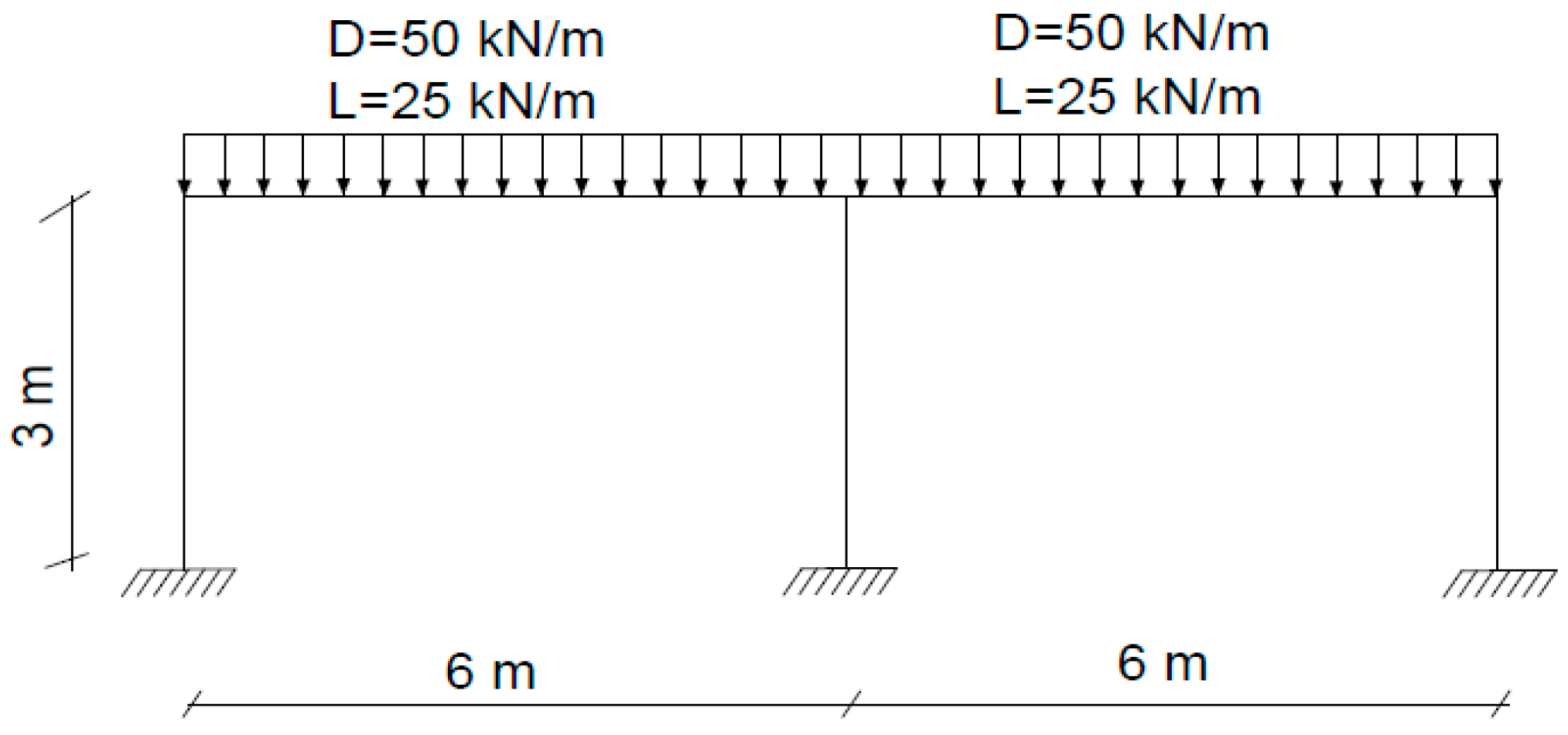
The single-story, two-span frame system is shown in
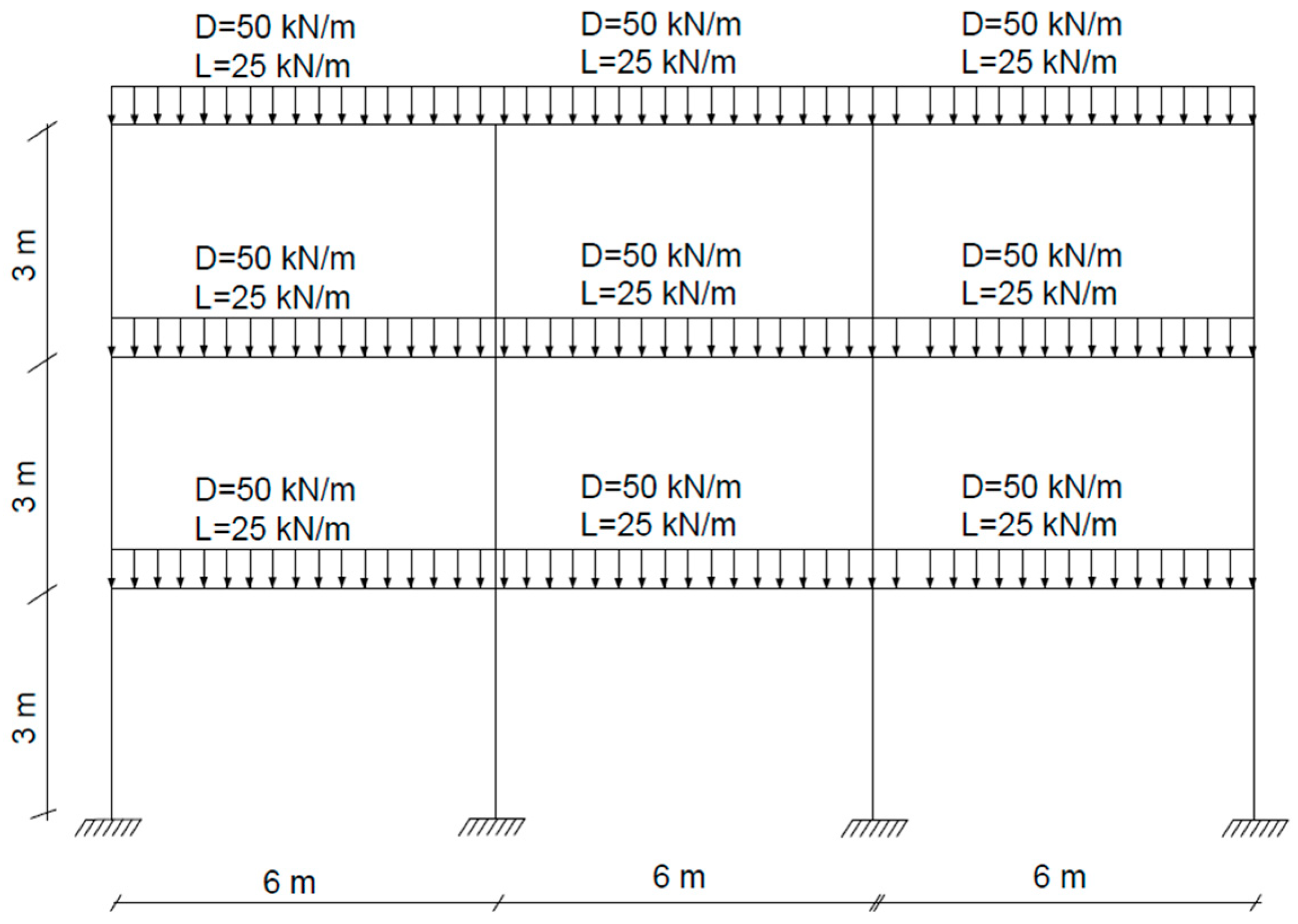
Figure 1, while the three-story, three-span frame system is presented in
Figure 2. The span lengths were taken as 6 m, and the story height as 3 m. The stopping criterion for the optimization (maximum number of iterations) was set to 100. The population size was taken as 20.
The equations corresponding to the ACI-318 provisions are given below. In the design procedure, the reinforced concrete beams were designed first. The cross-sectional width (b) and height (h) were treated as design variables, constrained between 300 mm and 600 mm. It was assumed that under applied loads, compression and tension zones develop in the cross-section, separated by the neutral axis. In the compression zone, the actual stress distribution in the concrete is replaced with an equivalent rectangular stress block that produces the same resultant force and location of action. The resultant compressive force in the concrete (F
c) and the resultant tensile force in the reinforcement (F
s) are given as:
where c is the neutral axis depth, A
s is the reinforcement area, and the factor related to the depth of the equivalent rectangular stress block (β
1) is defined as β
1 in ACI 318 and shall not exceed 0.65. Beams were designed with under-reinforced conditions. The balanced reinforcement ratio (
) and the maximum reinforcement ratio (
) were calculated to ensure ductile behavior:
The modulus of elasticity of concrete (E
c) was calculated as:
The analysis was performed using the load combination:
Minimum longitudinal reinforcement areas were ensured:
Shear design of beams was conducted according to:
In Equations (21)–(25), d is the effective depth of the beam obtained by subtracting the clear concrete cover from the overall beam height. Vc represents the nominal shear strength of the concrete, Vs denotes the nominal shear strength of the reinforcement, and s is the spacing between transverse reinforcement. After all conditions are satisfied, the final values of Av/s are calculated.
The material cost of each beam element was calculated as:
In Equation (26), le is the length of the element, Ts is the amount of reinforcement in tons, and Ac is the minimum gross cross-sectional area. After calculating the material cost for each beam element, the calculation proceeds to the material cost of the other structural element, namely the columns.
For columns, cross-sectional dimensions (b and h) were randomly generated as in beams and verified for minimum requirements. Column design used the moment amplification procedure from ACI 318. Top and bottom end factors, Ψ
A and Ψ
B, and the effective length factor for buckling, k, were computed as:
Correction factor C
m and critical buckling load P
c were calculated as:
In Equation (31), M
1 and M
2 are the column end moments obtained from structural analysis, with M
2 taken as the larger value. The coefficient C
m must be greater than 0.4, and if any lateral load acts between the column ends, it should be taken as 1.0. In Equation (33), δs is the moment amplification factor, and P
u is the factored axial load. Minimum bending moment M
min was calculated as:
In Equation (34), both 15 and h are taken in mm. Thus, the design sectional forces are obtained.
For columns, the minimum reinforcement ratio ρmin = 0.01 and the maximum reinforcement ratio ρmaks = 0.06 are used, and the generated cross-sectional dimensions are multiplied to check the reinforcement area requirements. If the calculated sectional forces fall outside the usable region of the interaction diagram, the reinforcement area is penalized.
After calculating the longitudinal reinforcement area, the shear reinforcement design of the columns is performed. The shear reinforcement design is carried out in the same manner as for the beams.
The objective function representing the total material cost of the structure, OF, is defined as:
In Equation (35), n denotes the total number of elements.
For simplicity and consistency with the developed computational framework, the cost function includes only concrete and reinforcement costs. Although formwork cost is known to contribute significantly to total construction cost, it is excluded from this study. This simplification is not expected to significantly affect the comparative evaluation of the optimization algorithms, which is the primary objective of this research. Future studies may incorporate additional cost components for more comprehensive economic evaluation.
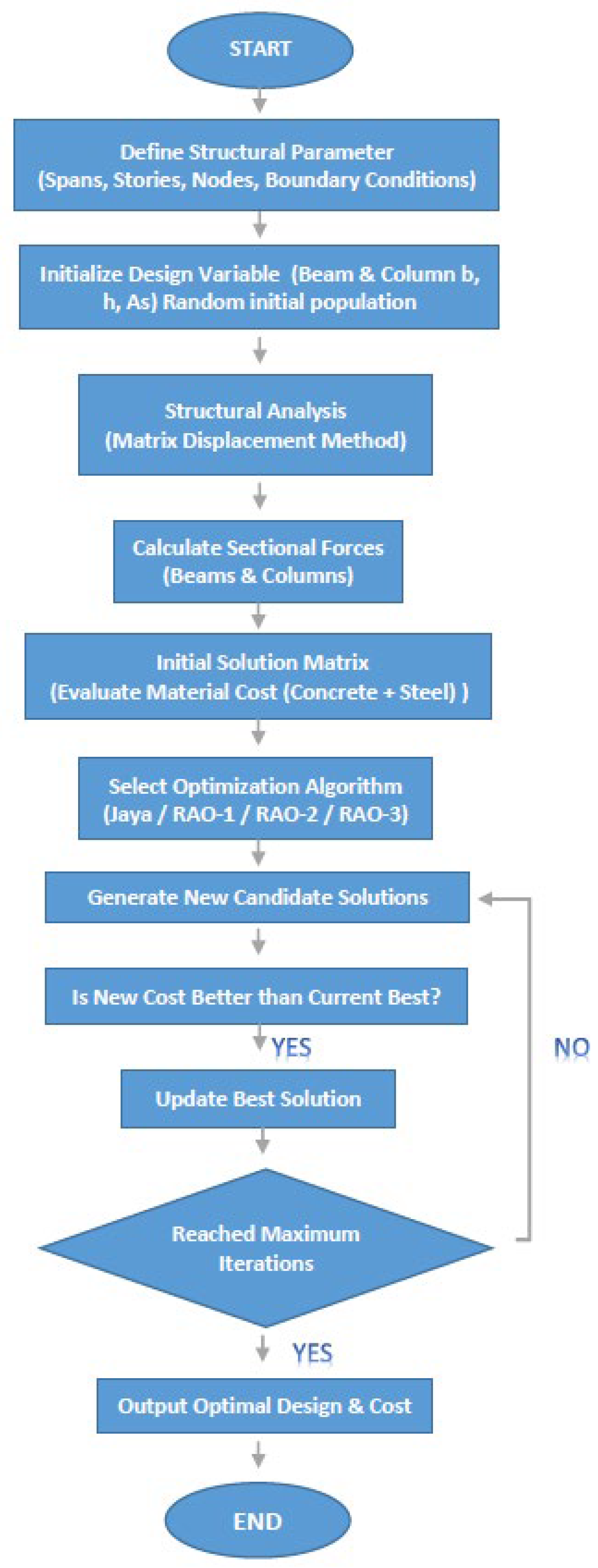
A flowchart, as shown in
Figure 3, was developed to illustrate the optimization procedure used in this study. The diagram outlines the sequential steps, including calculating sectional forces for beams and columns, evaluating material costs, selecting the optimization algorithm (Jaya or Rao variants), and generating new candidate solutions. Decision points, such as checking whether a new solution improves the current best cost, are clearly indicated with Yes/No branches. This visual representation enhances clarity by providing a concise summary of the iterative process used for structural cost optimization.
4. Results and Discussion
The present study compared the performance of four parameter-free metaheuristic algorithms (Jaya, Rao-1, Rao-2, and Rao-3) in the cost optimization of a reinforced concrete frame designed as per ACI 318-25. The analysis was conducted through 20 independent runs for each algorithm to assess convergence stability and robustness. The cost results of 20 independent studies for a single-story, two-span reinforced concrete frame system are presented in
Table 2.
Based on these results, the minimum, maximum, mean values, and standard deviations were calculated and are shown in
Table 3.
All algorithms successfully achieved the minimum cost value of 1170.3 in at least one run, indicating their effectiveness in locating the global optimum within the design space. However, the variability in the results differed among the algorithms.
The Jaya algorithm demonstrated a mean cost of 1182.3 with a relatively high standard deviation of 37.2, indicating a wider spread of solutions and occasional convergence to suboptimal points, as evidenced by a maximum cost of 1635. Notably, this high outlier increased the average cost and variability.
Rao-1 showed the highest average cost (1202.1) and standard deviation (49.0), along with a maximum cost of 1386.3, reflecting less consistent performance and a tendency to converge more slowly or to local minima compared to the others.
Rao-3 achieved a mean cost of 1215.1 and a moderate standard deviation of 21.8, displaying better stability than Jaya and Rao-1 but was still less consistent than Rao-2.
Among all, Rao-2 exhibited the lowest mean cost (1181.0) and the smallest standard deviation (15.7), alongside the narrowest cost range (1170.3 to 1217.8). This indicates that Rao-2 provides relatively better robustness and convergence consistency for the single-story, two-span frame case.
In addition to the single-story, two-span reinforced concrete frame system, twenty independent analyses were performed for the three-story, three-span reinforced concrete frame system. The results are presented in
Table 4.
Based on these results the best, worst, mean solutions, and standard deviation values are summarized in
Table 5.
The statistical results are summarized as follows: JAYA achieved a best cost of 2841.17 and a worst cost of 3055.84, with a mean value of approximately 2922.5 and a standard deviation of 78.6. Rao-1 produced a best solution of 2827.88 and a worst solution of 3005.08, yielding an average cost of about 2875.6 with a relatively low standard deviation of 55.4, indicating stable performance.
Rao-2 demonstrated the best overall minimum cost (2727.87) among all algorithms, although it exhibited higher variability with a standard deviation of 87.1 and a maximum cost of 2964.80. Rao-3 resulted in a minimum cost of 2824.99 and a maximum of 3053.89, with an average cost of 2872.9 and a standard deviation of 79.8.
Overall, Rao-2 appeared to be the most effective algorithm in terms of achieving the lowest cost, while Rao-1 provided more consistent results with lower variability. Jaya, although competitive, showed comparatively higher average cost values. Although Rao-2 achieved the lowest minimum cost among all algorithms, it exhibited the highest standard deviation, indicating significant variability in its performance for more complex structural systems. This suggests that while Rao-2 is effective in exploring the solution space, its consistency decreases as the problem complexity increases. In contrast, Rao-1 demonstrated more stable behavior with lower variability. Therefore, the robustness of the algorithms appears to depend on the complexity of the structural system.
5. Conclusions
The results indicate that the performance of parameter-free algorithms varies depending on the complexity of the structural system. While Rao-2 demonstrates strong performance and robustness for simpler problems, its variability increases for more complex frames. In such cases, Rao-1 provides more stable and consistent results. Therefore, no single algorithm can be considered universally superior, and the selection should depend on the characteristics of the structural optimization problem. These findings affirm the potential of parameter-free metaheuristics for reinforced concrete structural optimization, providing practitioners with efficient alternatives that do not require algorithm-specific parameter tuning.
The convergence behavior of the JAYA, Rao-1, Rao-2, and Rao-3 algorithms was analyzed for both the single-story, two-span and the three-story, three-span reinforced concrete frame systems.
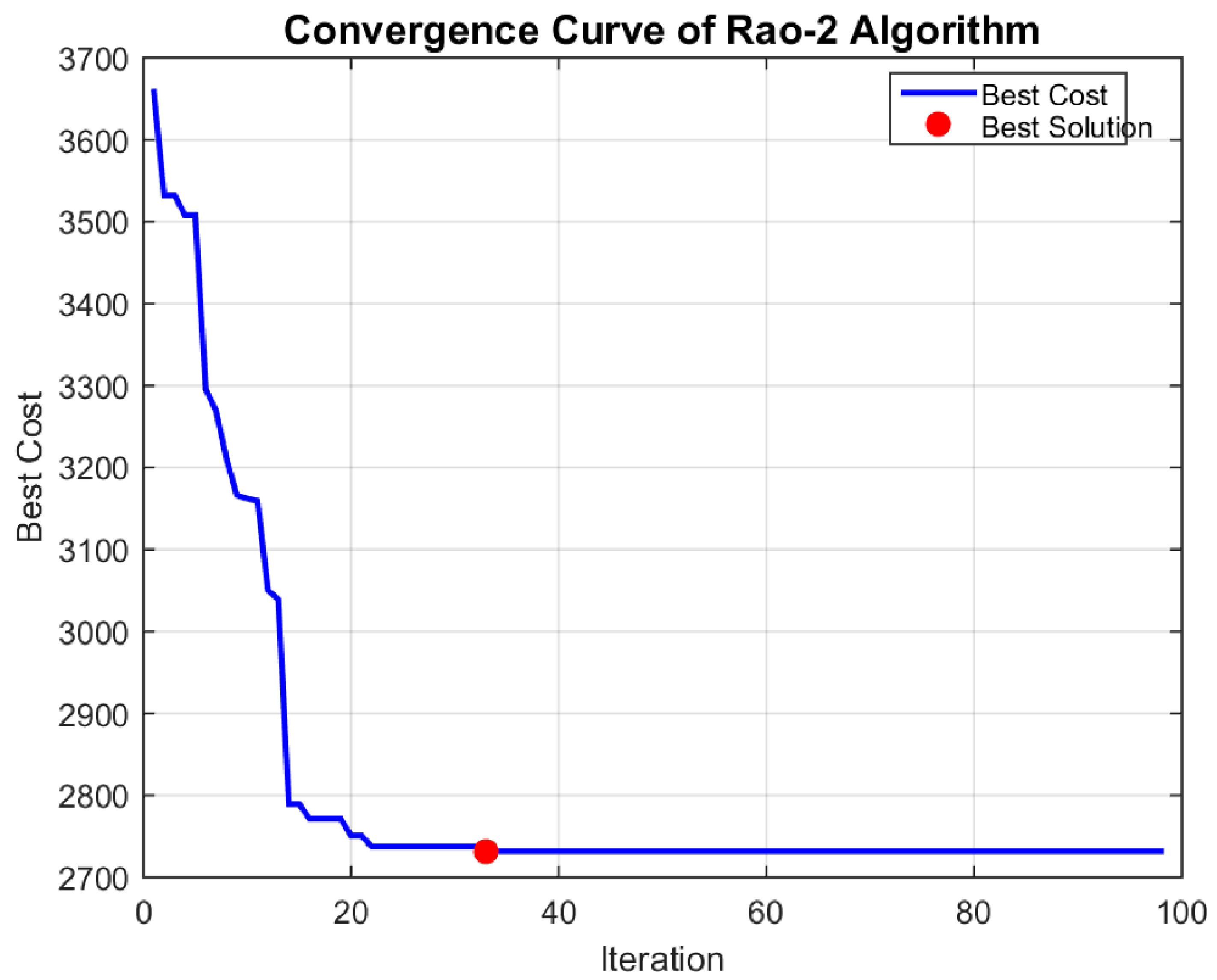
Figure 4 presents the convergence curves obtained from twenty independent runs for the best algorithm, illustrating the progression of the best cost value over successive iterations.
The convergence behavior of the Rao-2 algorithm was analyzed over 100 iterations with a population size of 20. The evolution of the best cost value across iterations is illustrated in the convergence curve.
As observed, the algorithm demonstrated a rapid decrease in the objective function value during the early stages of the search process. The initial cost started at approximately 3658 and dropped significantly within the first 15 iterations, reaching around 2789. This indicates an effective exploration capability of the algorithm in the initial phase.
Between iterations 15 and 30, the algorithm continued to improve the solution, albeit at a slower rate, eventually reaching a cost value of approximately 2737. After iteration 30, the convergence curve became relatively stable, with only minor improvements observed. The algorithm reached its best cost value of approximately 2727.87 around iteration 33.
From this point onward, the cost value remained constant until the final iteration, indicating that the algorithm had converged to a near-optimal solution. This stable behavior demonstrates the strong exploitation capability of the Rao-2 algorithm in the later stages of the optimization process.
Overall, the convergence curve reveals that the Rao-2 algorithm achieves a good balance between exploration and exploitation, with fast initial convergence followed by stable refinement of the solution.