1. Introduction
The need for efficient rehabilitation of aging and deficient concrete structures has led to extensive research on advanced strengthening techniques. Externally bonded fiber-reinforced polymer (FRP) composites, particularly carbon FRP (CFRP) sheets or plates, have emerged as a popular solution for enhancing the flexural performance of reinforced concrete (RC) beams and other structural members. CFRP strengthening offers a high tensile strength-to-weight ratio, corrosion resistance, and ease of installation without significantly altering member size, making it an attractive retrofit method for bridges and buildings [
1,
2,
3].
Numerous studies have demonstrated substantial increases in load-carrying capacity when CFRP is bonded to the tension face of RC beams; for example, Chajes et al. (1994) reported flexural strength gains on the order of 40–50% with CFRP strengthening, while later research showed even greater improvements (up to 230% in some cases) depending on the strengthening scheme and material properties [
2]. In addition to upgrading undamaged beams, CFRP laminates have proven effective in restoring or enhancing the capacity of damaged or substandard structures. Sheikh (2002) highlighted that externally bonded CFRP can retrofit and improve the performance of flexure-critical members, delaying failure and providing additional load margin in deficient beams [
4]. Similarly, recent work by Jafarzadeh and Nematzadeh (2022) showed that CFRP sheets successfully restored the flexural capacity of fire-damaged concrete beams, underlining the material’s versatility in rehabilitation scenarios [
5]. These prior studies establish externally bonded CFRP as a reliable technique for increasing the strength and stiffness of concrete elements in both repair and strengthening applications.
Despite the well-documented benefits of CFRP retrofitting, a critical challenge limiting its effectiveness is the premature debonding of the FRP from the concrete substrate. It is widely observed that many CFRP-strengthened beams do not reach the theoretical fiber rupture strain; instead, failure often occurs by separation of the CFRP sheet or plate from the concrete surface at loads below the member’s upgraded flexural capacity [
6,
7]. This debonding phenomenon can initiate in regions of high interfacial stress either at the ends of the CFRP (plate end debonding) or near intermediate flexural cracks (intermediate crack-induced debonding).
Both mode-II (shear) stress and mode-I (opening or peeling) stress contribute to these failures, with a concentration of peeling stresses at the plate ends playing a dominant role in so-called “peel-off” or delamination failures [
6]. As a result, the strengthened beam may exhibit a brittle failure mode, as the FRP suddenly delaminates from the concrete, leading to a rapid loss of capacity with little warning. Researchers have noted that debonding of externally bonded FRP is often the governing limit state, preventing the RC member from realizing the full strength and ductility theoretically possible with FRP reinforcement. For instance, Smith and Teng (2002) and others reported that the effective strain in an externally bonded CFRP laminate at failure is only a fraction of the material’s ultimate strain due to bond-induced premature peeling, especially when insufficient anchorage or bond length is provided [
2,
6]. This limitation has motivated substantial research into improving the FRP–concrete bond and reducing interfacial stress concentrations in order to mitigate premature debonding and achieve more ductile, reliable performance in CFRP-strengthened beams.
Over the past two decades, various techniques have been proposed and investigated to enhance the bond performance and interfacial stress resistance of externally bonded FRP systems. One well-studied approach is the use of mechanical anchorages or supplemental U-wraps at the ends of CFRP laminates to prevent the FRP from peeling off. Anchorage systems such as CFRP U-jackets, fiber “spike” anchors, and other mechanical fasteners have been shown to effectively delay or prevent debonding by transferring forces past the plate end and confining the FRP to the concrete [
8,
9]. They also demonstrated that adding U-wrap CFRP straps at the plate ends shifted the failure mode from plate-end debonding to FRP rupture or concrete crushing, thereby allowing for a significantly higher load capacity and FRP strain utilization in strengthened beams. A comprehensive review by Kalfat et al. (2013) concluded that properly designed anchorages (ranging from FRP spike anchors bonded into pre-drilled holes to mechanically fastened steel plates) can increase the effective usable FRP strain and prevent premature laminate separation, leading to notable improvements in strength and ductility [
8].
Other studies have proposed hybrid strengthening schemes to relieve interfacial stresses; for instance, Li and Xian (2018) developed a wedge-shaped bond anchorage with a locally flexible adhesive layer in grooved concrete, which improved stress distribution at the plate end and suppressed debonding under high loads [
10]. Eslami et al. (2019) introduced a novel end-anchorage combining surface grooves and FRP stitching through the concrete substrate, successfully forcing the failure to occur by FRP rupture instead of debonding [
11]. Likewise, recent research by Ayyobi et al. (2024) and by Amaireh et al. (2020) explored combined techniques (such as near-surface-mounted FRP bars used alongside externally bonded sheets and anchorage devices), reporting significant enhancements in flexural capacity and energy absorption while effectively postponing debonding under both static and cyclic loading [
12,
13]. In parallel, researchers have examined the influence of the bonding adhesive and interface properties on debonding behavior. It has been observed that using more compliant or ductile adhesives can reduce peak shear and peeling stresses at the FRP–concrete interface, thereby increasing the deformation capacity at debonding [
14]. Chajes’s early work showed that while ductile adhesives might slightly lower the ultimate bond strength, they allow for a larger FRP strain at failure, indicating a trade-off between bond rigidity and fracture toughness. Overall, these strategies, whether mechanical anchorage, optimized bond layouts, or modified bonding materials, share the same goal of enhancing the interface bond so that the strengthened beam can sustain higher loads and deflections without premature FRP peeling.
In recent years, an emerging line of research has focused on the use of polymer coatings or interlayers as a means to improve the performance of FRP-strengthened concrete members. In particular, elastomeric polymer coatings such as polyurea have attracted interest for their unique combination of high tensile strength, extreme elongation capacity, and energy absorption characteristics. Polyurea is a two-component spray-applied polymer known for its durability and crack-bridging ability; it can adhere to concrete surfaces and cures to form a tough, continuous membrane. Initially developed for industrial waterproofing and protective linings, polyurea coatings have been successfully used to harden structures against blasts, impacts, and other dynamic loads. For example, studies by Davidson et al. (2004, 2005) demonstrated that spray-applied polyurea layers significantly improved the blast resistance of unreinforced masonry and concrete elements, containing fragmentation and enhancing the structural integrity under explosive loads [
15,
16]. Tekalur et al. (2008) and Iqbal et al. (2018) reported similar findings for concrete and steel components: the addition of a polyurea coating dissipated impact on energy and delayed failure, resulting in greater survivability under blast/shock loading [
17,
18].
Beyond extreme loading scenarios, researchers have started to investigate polyurea’s potential in strengthening conventional structural members. Recent experimental work indicates that polyurea coatings can enhance the serviceability and ductility of RC flexural members. Szafran et al. (2022) tested RC beam specimens coated with a polyurea layer and observed improved cracking behavior, reduced deflections at service loads, and the ability to sustain cyclic loading without significant stiffness loss, even though the ultimate bending capacity did not increase dramatically [
19]. These results suggest that a polyurea coating provides beneficial confinement and crack control, effectively increasing the beam’s toughness and fatigue performance. In the context of FRP-strengthened members, a particularly promising concept is using a thin polymer layer as an intermediate or outer coating to relieve interfacial stresses and prevent the brittle debonding of the FRP. A study by Akin et al. (2020) on concrete columns confined with FRP wraps found that inserting a polyurea layer between the concrete surface and the FRP significantly increased the uniformity of stress in the jacket and allowed the FRP to achieve higher strain before failure [
20]. The polyurea acted as a soft but strong interface that delayed localization of stresses, thereby enhancing the effectiveness of FRP confinement in terms of ultimate strain and energy dissipation. This evidence points to the potential of polymer coatings to serve as a bond-enhancing layer in FRP strengthening systems.
Polymer coatings have also been applied as standalone strengthening solutions or in combination with fibers for various structural components. Alldredge et al. (2012) showed that a spray-applied polyurea coating on timber connections (rafter-to-wall joints) greatly improved their uplift capacity and ductility, essentially by providing a reinforcing wrap around the connection [
21]. Ha et al. (2016) investigated a fast-setting polyurea–urethane lining for deteriorated concrete water pipes and found marked improvements in the structural performance and leak resistance of the pipes after coating, demonstrating polyurea’s efficacy in rehabilitating concrete infrastructure [
22]. Furthermore, Szafran and Matusiak (2020) reported that polyurea reinforcement on concrete rings significantly increased their crushing strength, highlighting the material’s ability to improve concrete’s load-bearing capacity under compressive loads [
23]. These studies, though on diverse applications, consistently show that polymer coatings contribute to increased strength, ductility, and durability of structural elements by virtue of their high deformability and adhesive bond to the substrate. However, despite these encouraging findings, the use of polymer coatings specifically to address the peeling failure in CFRP-strengthened beams has not been widely explored in the literature to date, and there is a clear need for focused research in this area.
The present study aims to fill this knowledge gap by investigating an innovative hybrid strengthening technique for RC beams that combines externally bonded CFRP sheets with a spray-applied polyurea overcoat (Linex XS-350) applied directly over the bonded CFRP laminate on the beam soffit. This configuration, in which the polyurea encapsulates the CFRP rather than serving as an interlayer between the concrete and the CFRP, is distinct from previously reported approaches and has not been investigated in the context of flexural debonding mitigation. By encapsulating the bonded CFRP, the polyurea provides a continuous, distributed external anchorage that suppresses the peeling stresses responsible for premature debonding while simultaneously acting as an elastic confinement layer that allows the CFRP to sustain higher strains before rupture. This is the specific and primary novelty of the present work. The flexible coating is expected to act as a cushioning layer that enhances the bond strength between the CFRP and concrete while also providing external confinement to delay crack propagation and peel-off. Preliminary results from our experiments have been very promising: the polyurea-coated CFRP strengthening system demonstrated significantly higher bond integrity and ductility compared to beams strengthened with CFRP alone. In coated specimens, the ultimate load capacity was improved and, importantly, the failure mode shifted away from premature CFRP debonding. No early peeling of the CFRP was observed; instead, the beams were able to sustain larger deformations, indicating a more ductile flexural response. These findings strongly motivate the use of a polymer coating as a protective anti-peeling layer in FRP strengthening.
Based on this background, the objectives of the study are clearly defined. First, the study seeks to quantitatively assess the influence of the Linex XS-350 polyurea coating on the bond performance between CFRP sheets and concrete, with emphasis on how the coating modifies interfacial stress transfer and delays or prevents premature debonding. Second, the work aims to evaluate the improvement in flexural behavior, including load capacity, deflection response, ductility, and energy absorption of beams strengthened with CFRP in combination with polyurea coatings, relative to conventional CFRP-only strengthening. Third, the research investigates the failure mechanisms and cracking patterns to determine whether the application of a polymer overlay can suppress peeling-induced failures and promote more ductile rupture-controlled modes. By addressing these objectives, the study demonstrates a novel strengthening approach that exploits the synergistic action of CFRP reinforcement and an elastic, high-toughness coating. The ultimate goal is to enhance the reliability and effectiveness of CFRP retrofitting by improving bond resilience and ensuring more gradual, predictable failure.
2. Experimental Program
Specimen Details and Strengthening
Each beam configuration was tested once, with one specimen per configuration, and no replicate specimens were fabricated in this exploratory study. Seven reinforced concrete beam specimens were fabricated for this study, each with a rectangular cross-section of 100 mm × 200 mm and a total length of 2000 mm. These beams were tested under four-point loading bending test over a simple span. The internal reinforcement consisted of two ϕ12 mm tensile bars at the bottom, two ϕ10 mm compression bars at the top, and ϕ8 mm closed stirrups spaced at 150 mm along the span. This reinforcement detailing corresponds to standard laboratory-scale beams designed for flexural testing. All beams were cast using normal-strength concrete and cured under controlled laboratory conditions until testing.
The concrete mix used for casting the beams achieved an average 28-day compressive strength of 37 N/mm2. The reinforcing steel bars employed in the specimens had a yield strength of 370 N/mm2 and an ultimate tensile strength of 520 N/mm2.
The externally bonded strengthening system consisted of unidirectional carbon fiber sheets (SikaWrap) applied with an epoxy-based impregnating resin (Sikadur-330, Sika EG, Cairo, Egypt). According to the manufacturer’s specifications, the design thickness of a single CFRP laminate was 0.13 mm, corresponding to the total fiber area per sheet. The CFRP sheets had an ultimate tensile strength of 3500 N/mm2 and an elastic modulus of 230,000 N/mm2, resulting in an ultimate strain capacity of approximately 1.5%. The epoxy resin exhibited an ultimate tensile strength of 30 N/mm2 and an elastic modulus of 3800 N/mm2, ensuring reliable adhesion and stress transfer between the CFRP and concrete substrate.
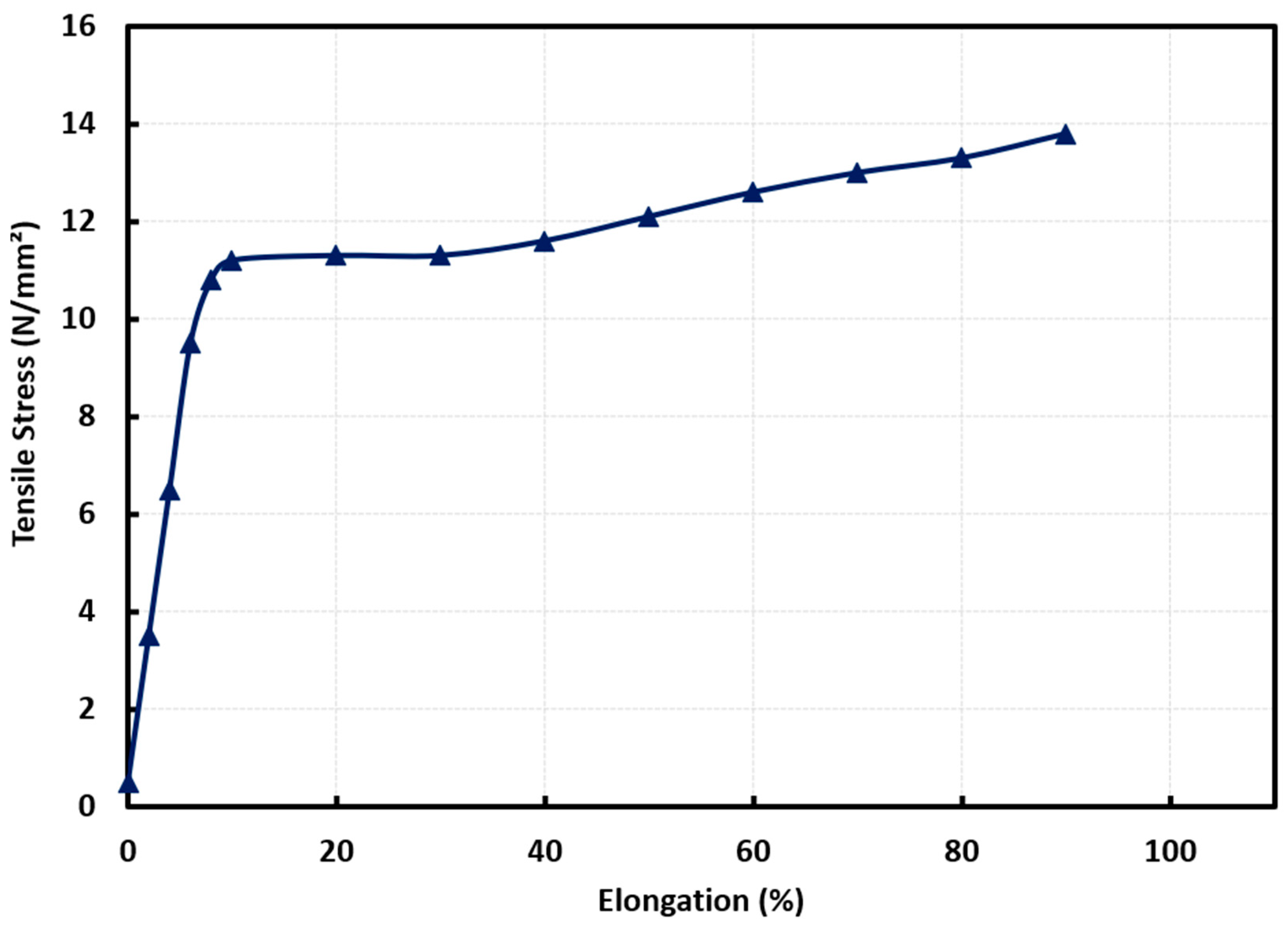
In addition, selected beams were coated with Linex XS-350(LINE-X, Huntsville, AL, USA), a thermoplastic polyurea overlay applied by a high-pressure spray. The material cures immediately, adheres strongly to both CFRP and concrete substrates, and exhibits thermal resistance up to 350 °F. Experimental characterization of the Linex coating indicated a highly ductile tensile response, with an ultimate tensile strength of approximately 14–15 N/mm
2 and an elongation capacity exceeding 90–100%. The material exhibited an initial elastic modulus of approximately 234 N/mm
2, followed by a reduced secant modulus of approximately 177 N/mm
2, reflecting the nonlinear strain-hardening behavior observed at higher elongation levels. The tensile stress–elongation response of Linex XS-350 is presented in
Figure 1.
Coating thickness was controlled using wet-film thickness gauges during application and verified after curing using a calibrated digital dry-film thickness gauge at five locations per beam, i.e., at the midspan, under each load point, and at the quarter-span points. Measured dry-film thicknesses were within ±0.2 mm of the target values for all specimens. For the embedded (2 + 2 mm) configuration, the first 2 mm layer was applied, cured, and verified before the CFRP sheet was placed; the second 2 mm layer was then applied over the CFRP and verified after curing.
The experimental program comprised one specimen per configuration, which is consistent with the exploratory nature of the investigation. To minimize inter-specimen variability and support the reproducibility of the results, all beams were cast from the same concrete batch with an average f′c = 37 N/mm2, all steel reinforcement was from the same production lot, and all CFRP and Linex materials were from the same product batches. The Linex coating was applied by the same operator in a single session using consistent equipment settings. These measures ensured that the observed differences in performance between specimens reflected the effect of the strengthening configuration rather than material or casting variability. However, replicate testing would strengthen the statistical confidence of the results, with future studies recommended to include at least two specimens per configuration.
It should be noted that direct bond-slip measurements at the CFRP–concrete interface were not performed in this study. Bond behavior was assessed indirectly through the longitudinal strain distribution recorded by the strain gauges mounted on the CFRP soffit at the midspan and under the load points and through the visual observation of failure modes. The strain gradient between the midspan and load-point gauges provides a qualitative indication of the extent of shear stress transfer along the bonded length. Future work should incorporate digital image correlation or relative displacement transducers at the plate end and at intermediate crack locations to directly quantify the bond–slip response and validate analytical bond models.
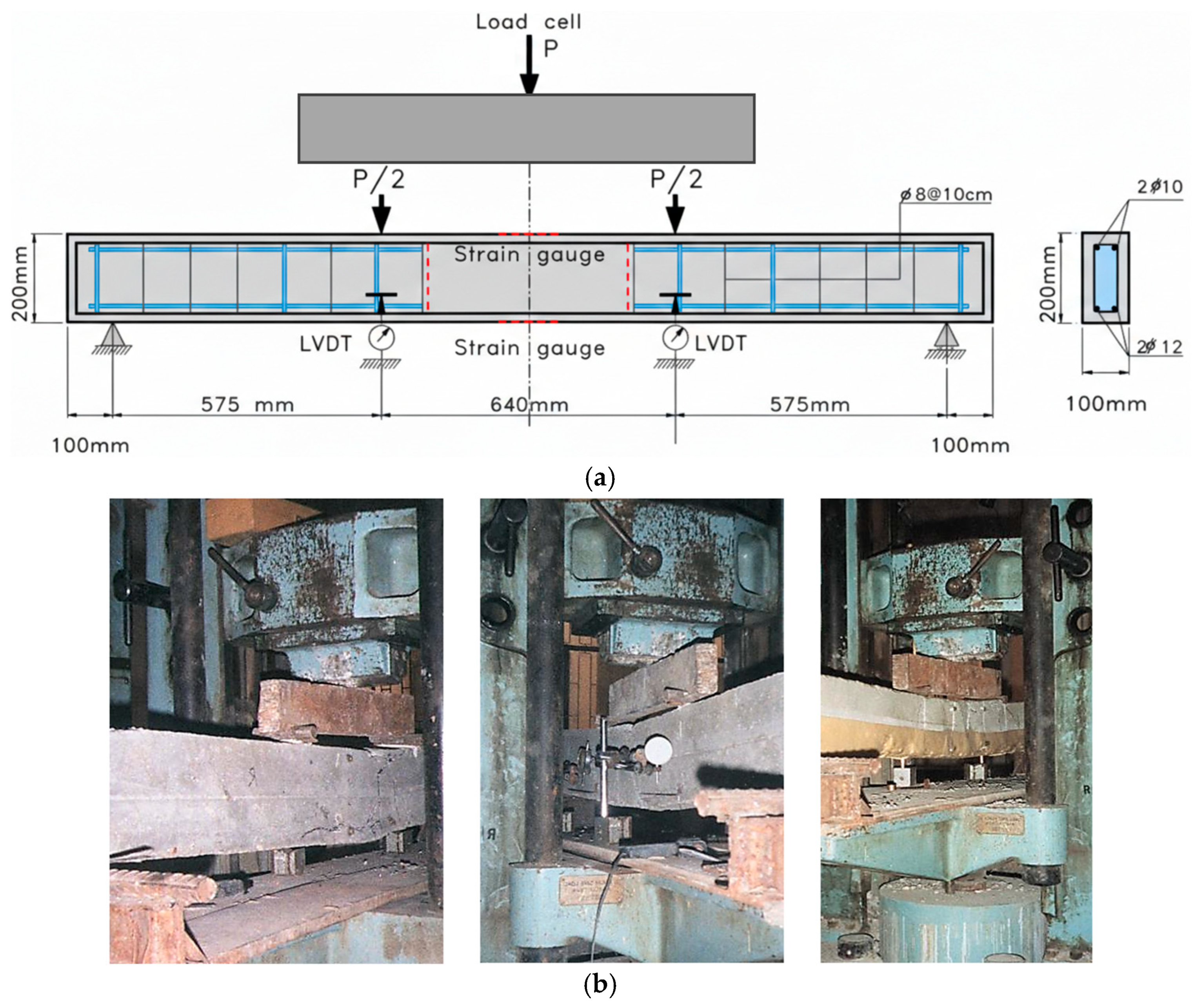
Electrical resistance strain gauges were bonded to the outer surface of the outermost CFRP laminate at the midspan and under the load points after the CFRP wet lay-up had fully cured. For double-layer specimens (B5, B6, B7), the gauges were attached to the surface of the second (outer) CFRP layer. For embedded configurations B4 and B7, the gauges were bonded to the outer CFRP surface prior to the polyurea overcoat application; the gauge lead wires were routed along the beam surface and protected with a thin epoxy sealant layer before the Linex spray was applied, ensuring that the high-pressure spray did not dislodge the connections. The Linex coating was then applied over the entire soffit, encapsulating both the CFRP laminate and the strain gauges. This installation procedure ensured that all gauges measured the tensile strain at the outermost fiber of the CFRP reinforcement, which is the critical location for debonding initiation. Strain gauges were also mounted at the top of the concrete surface at the midspan to monitor compression–face strains. Deflections were measured by LVDT transducers placed under load points. The load was applied by a hydraulic machine at a constant rate, under load control, up to failure and was recorded by a load cell. In
Figure 2, (a) shows a schematic of the four-point bending test setup, showing reinforcement details and instrumentation, and (b) provides photographic views of representative test specimens during loading, illustrating the coating configuration on the beam soffit.
The experimental program was designed to investigate two primary parameters, the CFRP thickness, varied between single-layer and double-layer sheets, and the Linex coating thickness, applied as none, thin (2 mm), or thick (4 mm). This arrangement created a two-factor classification matrix, as summarized in
Table 1, enabling a systematic evaluation of the strengthening system. Specifically, it allowed the study to assess the effect of CFRP thickness on beam behavior, the role of polymer coating thickness in enhancing performance, and the interaction between externally bonded CFRP sheets and the applied Linex overlay when used in combination.
It should be noted that the double-layer series does not include a 4 mm standalone coating configuration, equivalent to B2 in the single-layer series. This was a deliberate choice: since the single-layer results demonstrated that the embedded (2 + 2 mm) configuration consistently outperformed the 4 mm standalone coating in both strength and ductility, the embedded configuration was prioritized for the double-layer series as the most practically relevant variant. The three double-layer configurations, uncoated, thin-coated, and embedded, were selected to provide a direct parallel comparison with the single-layer series across the full range of confinement levels.
3. Results and Discussion
3.1. Load–Deflection Behavior
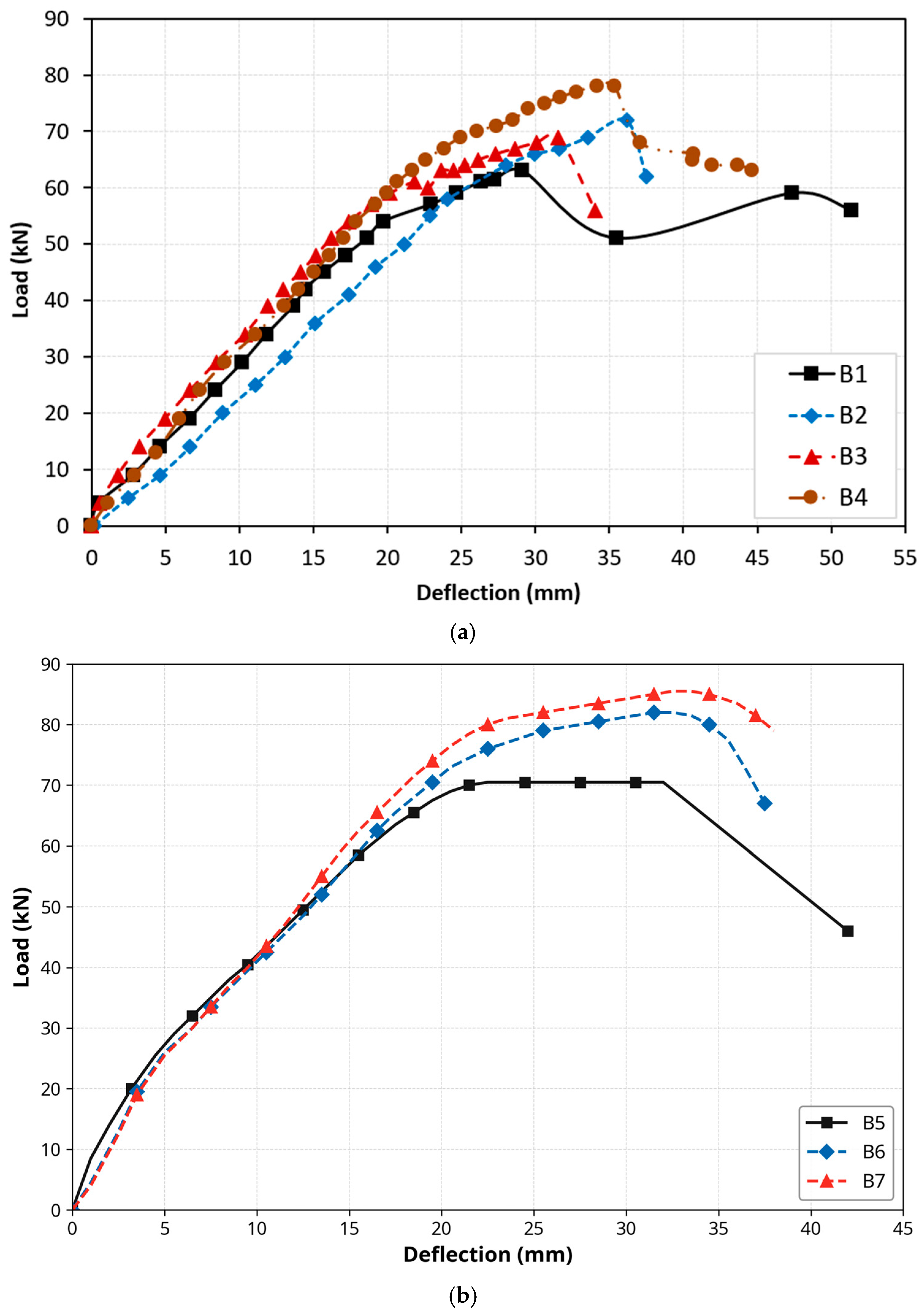
Across all tested beams, the load–deflection response exhibited a clear two-stage trend. The initial portion of the curves was almost linear, reflecting elastic behavior and good strain compatibility between the concrete, steel reinforcement, and CFRP sheets. As loading progressed, cracks developed in the tension zone, and the response transitioned into a nonlinear phase, eventually reaching peak load followed by softening or sudden failure depending on the strengthening configuration.
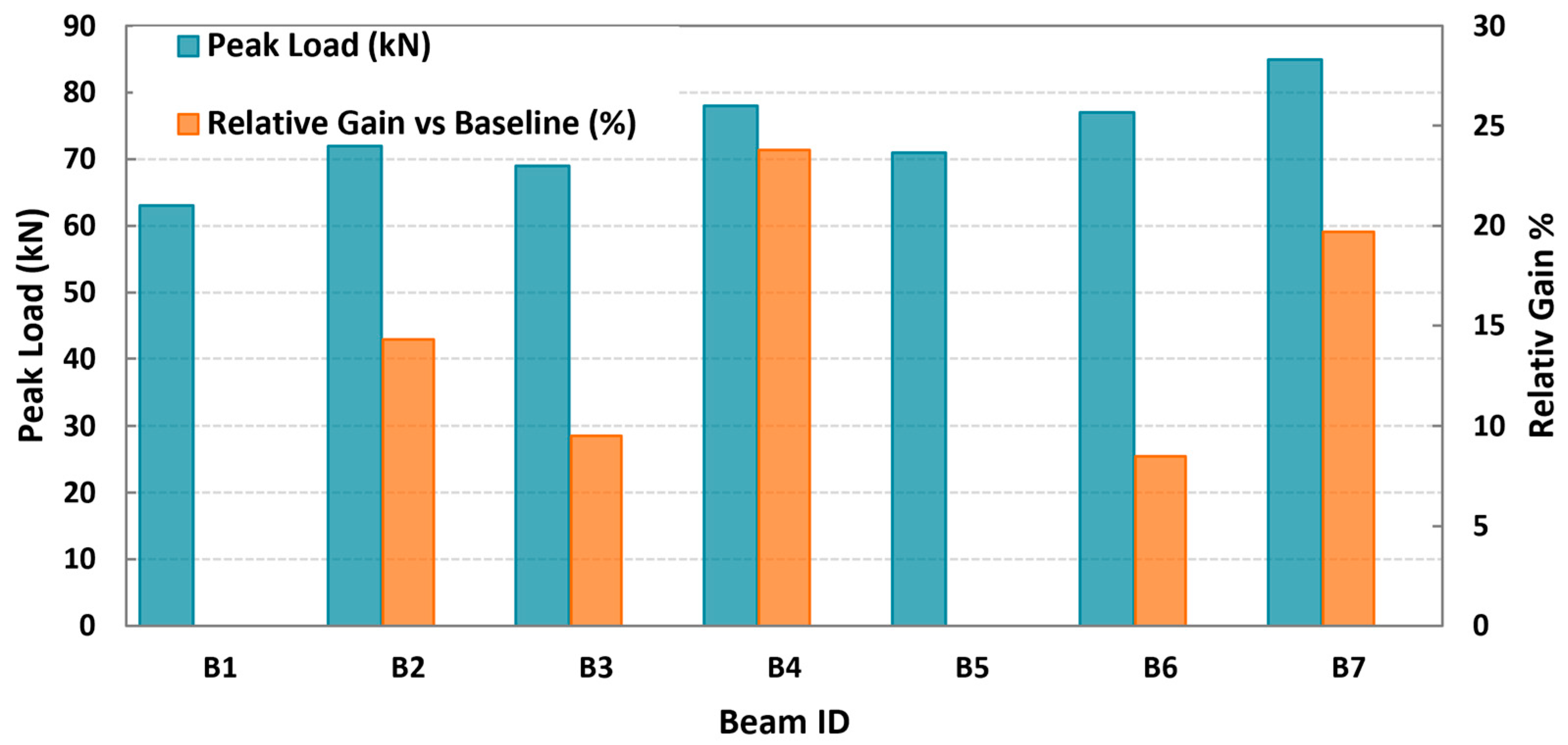
The recorded peak loads ranged from 63 kN for the uncoated single-layer specimen B1 to 85 kN for the double-layer-coated specimen B7, representing the overall strength range of the experimental program. Within the single-layer series, and taking B1 as the baseline, all beams coated with Linex showed clear gains in strength. B3, with a 2 mm coating, achieved a 9.5% increase, B2, with 4 mm coating, reached a 14.3% higher capacity, and the embedded configuration B4, with 2 + 2 mm, achieved the largest enhancement, with an increase of 23.8% over the uncoated specimen. A similar trend was observed in the double-layer series, where relative to B5, the addition of a thin 2 mm coating in B6 increased capacity by 8.5%, while the embedded 2 + 2 mm configuration in B7 produced the maximum strength gain of 19.7%.
Figure 3a,b show the load deflection curves for the single- and double-layer series respectively.
Regarding stiffness, the initial stiffness, which was calculated up to 30% of the peak load, was highest for the uncoated double-layer beam B5, confirming the expected stiffening contribution of using two CFRP laminates. In contrast, the application of Linex generally resulted in a slightly lower initial stiffness, likely due to the compliant nature of the polymer layer.
The slight reduction in initial stiffness observed in the coated specimens is physically consistent with the mechanics of compliant bondline systems. The polyurea layer with, an initial modulus equal to 234 N/mm2, is significantly more compliant than the epoxy adhesive, with E = 3800 N/mm2, used to bond the CFRP to the concrete. At low load levels, this compliant element introduces a marginally greater relative deformation between the CFRP and the concrete, reducing the initial composite stiffness of the system. This effect is analogous to the behavior of compliant adhesive layers in bonded joint mechanics, where a more flexible bondline reduces the initial shear stiffness while simultaneously lowering peak interfacial stress concentrations and increasing fracture toughness, the very mechanism responsible for the debonding suppression observed at higher load levels. The stiffness reduction is small (less than 5%) and disappears at intermediate load levels, as confirmed by the convergence of secant stiffness values at 50–75% of peak load.
However, when comparing secant stiffness values at intermediate load levels, typically between 50 to 75% of the peak, the coated and uncoated specimens showed very similar behavior, particularly within the double-layer set. This indicates that while the polymer overlay may reduce early stiffness slightly, it does not compromise the overall load-carrying efficiency of the CFRP strengthening system as failure is approached.
3.2. Midspan Strain Response
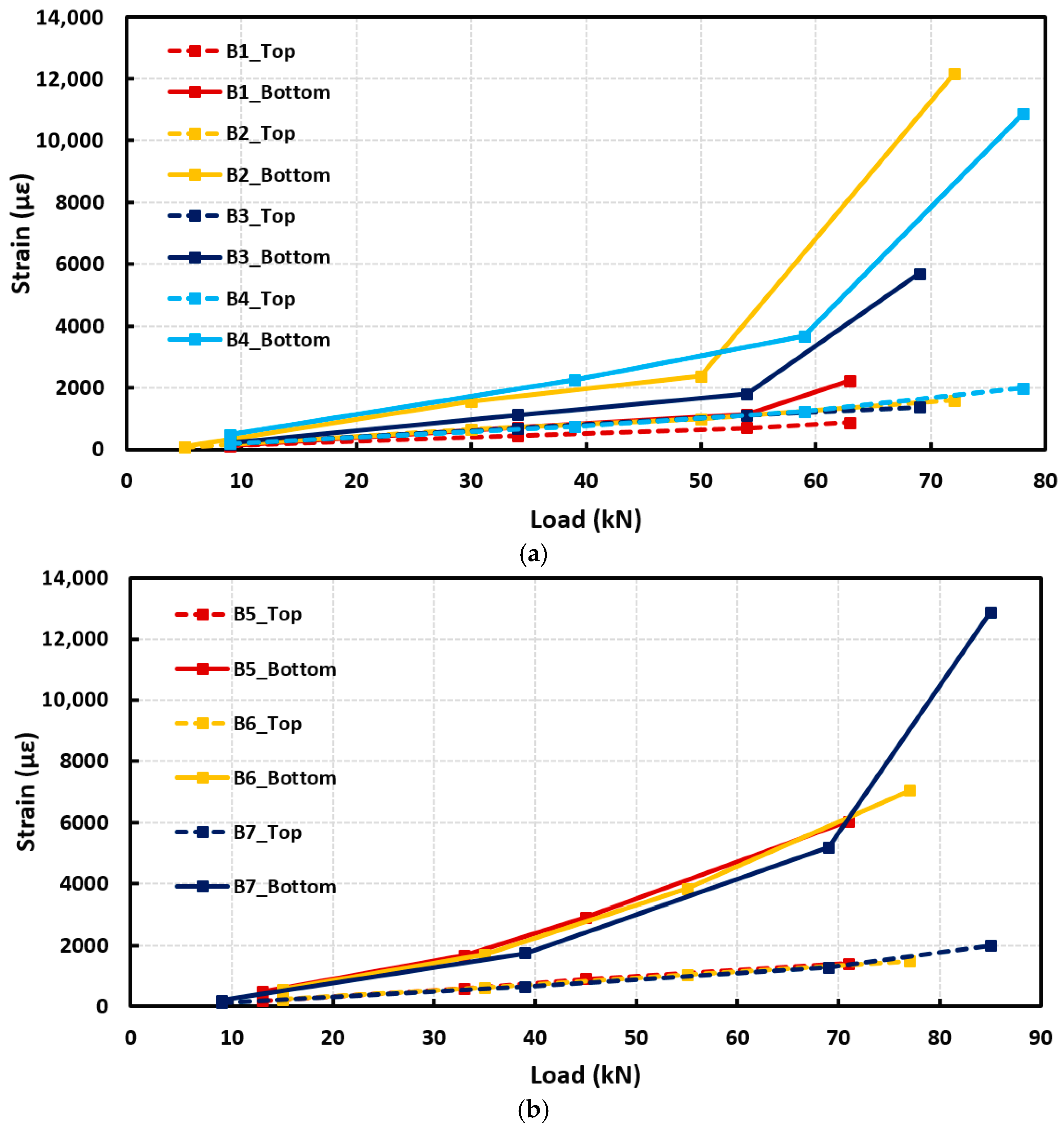
This section examines the midspan strain response of all specimens with the objective of characterizing the load transfer mechanism between the concrete, steel reinforcement, CFRP laminate, and the applied Linex coating and of assessing the extent to which the polyurea overlay enhances the effective strain utilization of the CFRP. In all beams, the strain response at both the top (compression face) and bottom (tension face) increased proportionally with load during the elastic stage, confirming strain compatibility and effective composite action. As cracking developed in the tensile zone, bottom-fiber strains began to rise more rapidly than the top, marking the onset of nonlinear behavior. The data presented in the following paragraphs provides clear evidence that the Linex coating substantially improved the load transfer efficiency of the CFRP, enabling significantly higher tensile strains before failure.
In the single-layer group, B1 to B4, and as shown in
Figure 4a, bottom strains increased consistently with applied load. The uncoated specimen (B1) showed the lowest strain capacity, with bottom strains reaching only around 2200 με at peak load before peeling failure. In contrast, the coated specimens exhibited significantly higher strain capacities. Beam B2, with a 4 mm coating, reached more than five times the bottom strain of B1 at failure, while B3 (thin coating) and B4 (embedded 2 + 2 mm coating) also recorded substantial increases, with B4 showing the most gradual and extended strain development. These results demonstrate the effectiveness of the Linex overlay in delaying debonding and enabling greater utilization of the CFRP.
In the double-layer group, B5 to B7, and as shown in
Figure 4b, the influence of the coating was again evident. The uncoated double-layer specimen (B5) developed bottom strains of about 6000 με at failure, while the coated beams achieved much higher values. Beam B6 (thin coating) reached bottom strains over 7000 με, while the embedded configuration (B7) exhibited the largest tensile strain capacity of the entire program, exceeding 12,800 με before rupture. The enhanced performance of B7 confirms the beneficial role of embedded coatings in anchoring CFRP and sustaining higher load levels.
On the compression side, top-fiber strains remained moderate for all specimens, with values generally between 1000–2000 με at failure. These levels correspond to less than 65% of the typical crushing strain of concrete, confirming that all specimens failed under tension-controlled modes rather than compression crushing.
Overall, the strain data reinforces the observed failure modes: uncoated specimens failed prematurely by peeling, reflected in their lower bottom strain capacities, while coated specimens reached significantly higher strain levels, indicating rupture-dominated failures and improved stress redistribution.
3.3. Failure Modes
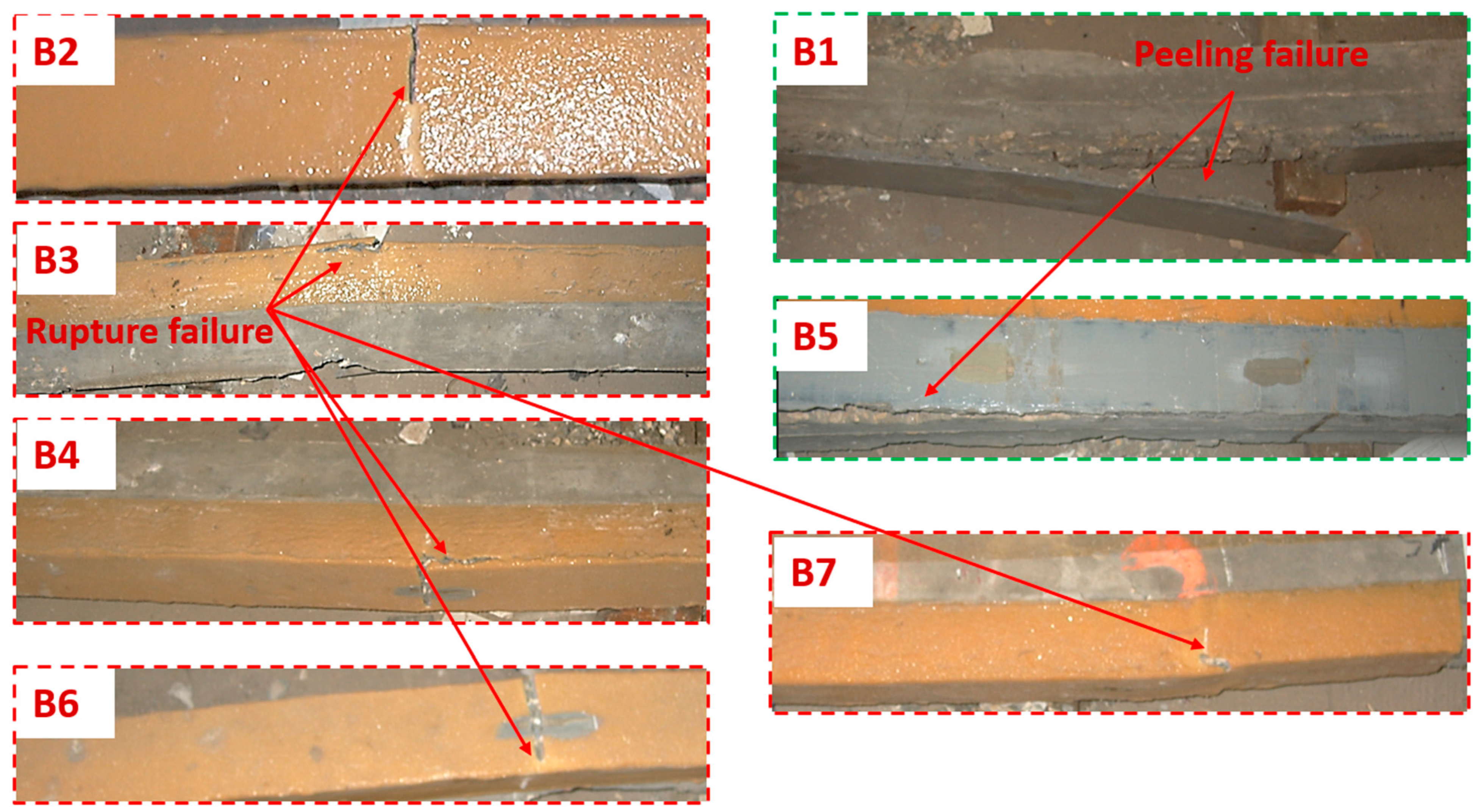
The observed failure modes were strongly influenced by both the number of CFRP layers and the presence of Linex coatings. The uncoated specimens (B1 and B5) consistently failed by premature peeling of the CFRP sheet from the soffit. In these cases, debonding initiated near flexural cracks close to the midspan and propagated rapidly towards the supports, causing a sudden reduction in load-carrying capacity despite significant residual deformation. This premature detachment limited the full utilization of the CFRP, as confirmed by the lower bottom-strain readings.
In contrast, all coated specimens (B2 to B4, B6, and B7) failed by tensile rupture of the CFRP laminates at or near the midspan. The application of Linex improved the bond and provided confinement, effectively suppressing peeling and allowing the CFRP sheets to carry stresses closer to their rupture capacity. Within this group, the embedded coating configurations in B4 and B7 displayed the most gradual approach to failure, with extended load–strain responses and higher energy absorption. The presence of the polymer coating also contributed to a more ductile failure progression, as evidenced by the smoother post-peak response compared with the abrupt peeling of uncoated beams.
These observations confirm that while the CFRP primarily enhances stiffness and strength, the Linex coating governs the failure mechanism by improving anchorage, delaying debonding, and promoting rupture-controlled failures that exploit the full capacity of the composite reinforcement.
Figure 5 presents representative post-failure photographs of the tested beams, illustrating typical surface conditions associated with uncoated CFRP strengthening, thin and thick Linex-coated systems, and embedded coating configurations. Based on failure characteristics and coating morphology, the observed behavior of the tested beams is presented.
Although all the coated specimens ultimately failed by CFRP rupture, the corresponding failure loads varied noticeably among them. This difference arose because, even under the same nominal failure mode, the effective strain distribution in the CFRP was not identical. Different coating configurations, thin, thick, or embedded, altered the way shear and peel stresses were transferred across the interface, influencing how much of the CFRP length became effectively engaged before rupture. Thicker and embedded coatings improved stress uniformity and reduced local debonding, allowing the CFRP to reach higher effective strain levels and thus sustain greater loads. The photographs confirm that B5 (uncoated double-layer) failed by premature CFRP peeling, similar to B1, while B6 and B7 both failed by CFRP rupture at or near the midspan, consistent with the single-layer-coated specimens. The visual comparison clearly illustrates the transition from debonding-controlled to rupture-controlled failure as the coating confinement increased, regardless of the number of CFRP layers.
In contrast, thinner coatings provided less confinement, causing localized stress concentrations that triggered rupture earlier, even though the overall mode of failure remained the same. Consequently, variations in interface behavior, rather than the material limit of the CFRP, explain the observed differences in peak load among the coated beams.
3.4. Comparative Analysis and Discussion of Hybrid System Effectiveness
The results can be interpreted systematically by examining the influence of the two main parameters: CFRP thickness (single versus double layer) and Linex coating thickness (none, thin, or thick).
Regarding the effect of CFRP thickness (no coating), comparing the uncoated beams, B5 (double layer) carried about a 13% higher peak load than B1 (single layer), with a correspondingly higher initial stiffness. This highlights the contribution of additional CFRP reinforcement in increasing load capacity. However, both beams failed by peeling, indicating that increasing the CFRP thickness alone does not prevent premature debonding.
For the effect of Linex coating thickness in single-layer beams, relative to the uncoated baseline B1, the application of Linex consistently improved performance. B3 (thin coating) achieved a 9.5% strength gain, B2 (thick coating) increased capacity by 14.3%, and B4 (embedded 2 + 2 mm coating) recorded the highest improvement, with a 23.8% strength increase. Similar trends were observed in strain response, where coated beams reached 2 to 5 times higher bottom strains before failure compared with B1. These results confirm that even for a single CFRP layer, the coating plays a dominant role in ensuring effective utilization.
If we look at the effect of Linex coating thickness in double-layer beams, a comparable trend was observed for the double-layer series. Relative to B5, the thin-coated specimen B6 reached an 8.5% higher capacity, while the embedded coated specimen B7 showed the best overall performance of the entire program, with a 19.7% capacity gain and bottom strains exceeding 12,800 με. This demonstrates that the benefits of coating are cumulative when combined with multiple CFRP layers.
For the interaction between CFRP and Linex, the combined effect of thicker CFRP reinforcement and polymer coating was most evident in B7, which exhibited the highest strength, strain capacity, and energy absorption among all the beams. This confirms that while CFRP provides stiffness and load capacity, the coating ensures anchorage and ductility, resulting in a synergistic effect when both parameters are optimized together.
Figure 6 shows the comparative analysis of peak load and relative gain for each beam.
3.5. Influence of Coating Configuration
The configuration of the Linex coating proved to be a key factor in optimizing performance. For the single-layer series, the strength gain over the uncoated baseline (B1) increased progressively with the level of confinement, ultimately resulting in a 23.8% strength increase for the embedded configuration (B4). A similar trend was observed in the double-layer series, where B7 showed the best overall performance, with a 19.7% capacity gain over B5 and bottom strains exceeding 12,800 με. The superior performance of the embedded configurations (B4 and B7) can be attributed to the complete encapsulation of the CFRP sheet within the polyurea matrix, which maximizes the contact area and utilizes the high adhesion and tensile strength of the polyurea to provide a continuous, distributed anchorage.
3.6. Comparison with Standalone Polyurea Strengthening
The findings of this study gain further significance when compared with recent work on standalone polyurea strengthening, such as the investigation by Elbelbisi et al. [
24], which utilized the same Linex XS-350 material on RC beams. That study established that polyurea coatings alone can enhance the load capacity and ductility of RC beams by providing confinement and crack control.
However, the present work demonstrates the superiority of the hybrid CFRP–polyurea system. While standalone polyurea strengthening provides a moderate increase in strength, it cannot match the high tensile strength contribution of the CFRP. By integrating the two materials, the system capitalizes on CFRP’s high strength while using polyurea’s ductility and bonding to ensure that the CFRP’s strength is fully mobilized. The polyurea coating functions as an elastic confinement layer that transforms the failure mode, allowing the high-strength CFRP to dictate the ultimate capacity.
The shift in failure mode from brittle peeling to ductile rupture is directly reflected in the enhanced energy absorption capacity of the coated beams. The gradual, extended load–deflection response, particularly in the embedded configurations, indicates a much higher level of ductility. This is a critical factor in structural engineering, as it provides greater warning before collapse and allows the structure to dissipate more energy under seismic or extreme loading events.
The shift in failure mode from brittle peeling to ductile rupture is directly reflected in the enhanced energy absorption capacity of the coated beams, as quantified in
Table 2. The gradual, extended load–deflection response, particularly in the embedded configurations, indicates a much higher level of ductility. This is a critical factor in structural engineering, as it provides greater warning before collapse and allows the structure to dissipate more energy under seismic or extreme loading events. For instance, the embedded single-layer beam (B4) achieved a 254.5% increase in energy absorption compared to its uncoated baseline (B1), while the optimal B7 configuration showed a 250.0% increase over its baseline (B5). These dramatic increases in energy absorption and ductility index confirm the superior toughness and resilience imparted by the hybrid system.
Based on the experimental observations, the following construction guidelines are recommended for the practical implementation of the hybrid CFRP–polyurea strengthening system. First, the concrete substrate must be thoroughly prepared by mechanical abrasion to remove laitance and achieve a clean, rough surface with a minimum surface tensile strength of 1.5 N/mm2, as required for externally bonded FRP systems. Second, the CFRP sheets should be applied using the wet lay-up process with the epoxy impregnating resin following the manufacturer’s specifications, ensuring full saturation of the fibers and elimination of air voids. Third, the polyurea coating (Linex XS-350) should be applied by high-pressure plural-component spray equipment after the epoxy has reached an initial set but before full curing, typically within 12–24 h, to promote mechanical interlocking between the epoxy surface and the polyurea layer. For the embedded configuration, a first polyurea layer of 2 mm should be applied directly to the prepared concrete surface, the CFRP sheet should be placed while the polyurea is still tacky, and a second 2 mm polyurea layer should be applied over the CFRP to fully encapsulate it. The coating thickness should be verified using a wet-film thickness gauge during application and a dry-film thickness gauge after curing. Quality control should include adhesion pull-off tests on representative areas to confirm bond integrity before the structure is returned to service.
3.7. Energy Absorption and Ductility Analysis
To provide a more comprehensive characterization of the structural performance of the hybrid strengthening system, an energy-based analysis was conducted for all specimens. Energy absorption was calculated as the area under the load–deflection curve up to the ultimate deflection, in kJ, using numerical integration of the recorded load–deflection data. The ductility index was defined as the ratio of the ultimate deflection δ
u to the yield deflection δ
y, where δ
y was determined using the equivalent elastoplastic energy absorption method, in which the yield deflection is defined as the deflection at which a bilinear idealization of the load–deflection curve, with equal areas under the actual and idealized curves, transitions from the elastic to the plastic branch. The results are summarized in
Table 2.
The energy absorption values confirm and quantify the ductility enhancement observed qualitatively in the load–deflection curves and failure mode photographs. The uncoated baselines (B1 and B5) absorbed the least energy, 0.55 kJ and 0.80 kJ, respectively, consistent with their brittle, sudden peeling failures. In contrast, all the coated specimens showed substantially higher energy absorption, with the embedded configurations (B4 and B7) achieving the largest values of 1.95 kJ and 2.80 kJ, corresponding to increases of 254.5% and 250.0% over their respective baselines. Even the thin-coated specimens (B3 and B6) showed substantial improvements of 72.7% and 56.3%, respectively, confirming that even a minimal polyurea coating provides significant toughness enhancement.
These dramatic improvements are a direct consequence of the transition from debonding-controlled to rupture-controlled failure: the polyurea coating suppresses the brittle interfacial fracture mechanism and forces the beam to dissipate energy through the progressive tensile fracture of the CFRP fibers, a process that requires significantly more energy and produces a more gradual, ductile post-peak response. The ductility index values follow the same trend, increasing from 1.00, the normalized baseline, to 2.24 for B4 and 2.33 for B7. From a structural engineering perspective, this enhanced energy absorption capacity is particularly significant for structures subjected to seismic, wind, or impact loading, where the ability to dissipate energy without sudden loss of capacity is a critical performance requirement.