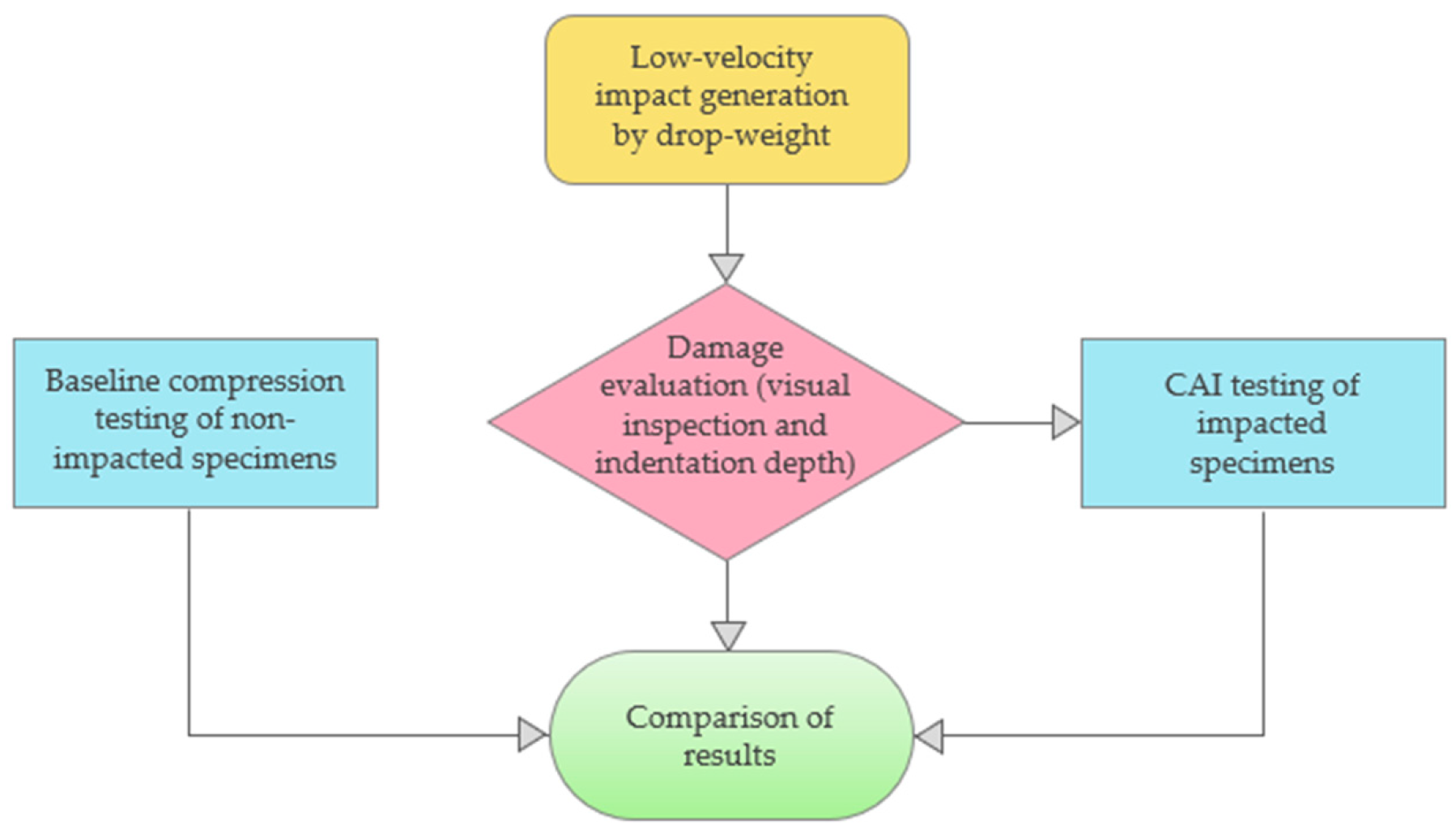
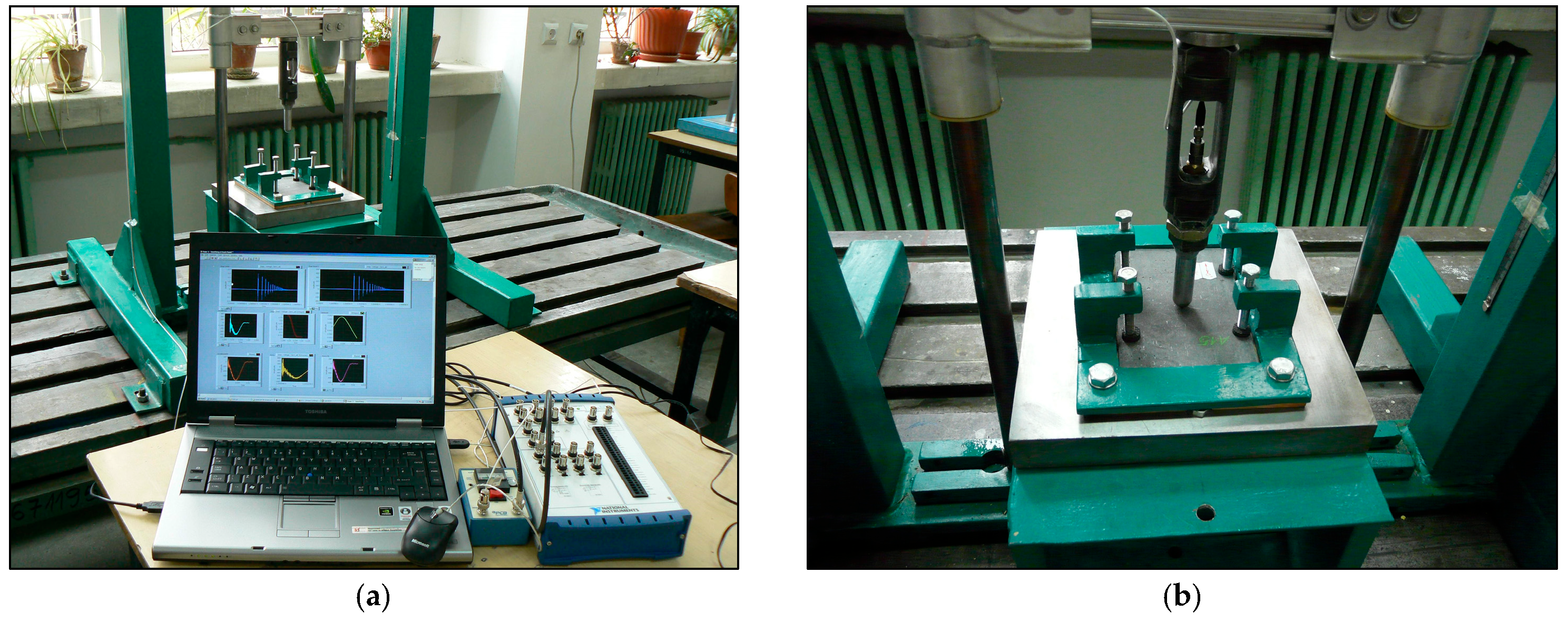
1. Introduction
Carbon-fiber-reinforced polymer (CFRP) composites are increasingly utilized in aerospace, automotive, and other weight-sensitive structures due to their high strength-to-weight ratio and design flexibility [
1,
2,
3]. However, these materials are highly vulnerable to low-velocity impact (LVI), which can cause barely visible impact damage (BVID)—including internal delamination, fiber breakage, and matrix cracking that may not be observable on the external surface [
4,
5,
6]. Unlike ductile metals, which absorb impact energy through plastic deformation, CFRP laminates dissipate impact energy via complex intra- and inter-ply damage mechanisms, resulting in a significant loss of residual compressive strength after impact [
7,
8]. Furthermore, because such damages are mainly internal and difficult to detect visually, they raise serious challenges for maintenance and damage-tolerant design [
9]. That is, the need for reliable post-impact assessment methods is underscored, as the residual strength can be substantially diminished even when the external damage appears negligible. Hence, an accurate evaluation of post-impact performance is imperative in safety-critical load-bearing applications, as even a minor BVID could compromise the integrity of the composite structure if left undetected.
Compression-after-impact (CAI) testing is commonly used to evaluate the residual strength of laminate composites after impact and confirm they meet damage-tolerance standards [
10,
11]. Over time, many studies have aimed to predict and measure the post-impact compressive strength of CFRP laminates [
12,
13,
14,
15,
16,
17,
18]. However, relatively few studies have explored how variations in the CAI test setup and fixtures can influence results [
19,
20]. As CAI procedures differ across standards and manufacturers, the fixture’s boundary conditions vary, which might alter the observed failure mode along with the measured residual strength. For instance, the Boeing CAI fixture (BSS 7260) guides all four edges of the specimen without clamping [
21]. In contrast, the Airbus CAI standard (AITM 1-0010) clamps the specimen at both the top and bottom edges, providing only lateral support along the sides [
22]. A couple of other CAI fixtures and specifications have been developed so far for larger and/or thicker specimens [
23,
24,
25,
26,
27,
28,
29], which make them less suitable for thin laminates, as detailed below.
For laminates with thicknesses ranging from 2 to 5 mm, large-specimen CAI protocols are not only material-intensive but may also alter damage and failure modes, as the impact and post-impact responses are significantly influenced by specimen thickness [
30]. In this regard, it is worth noting that under CAI loading, an impacted composite plate is prone to fail via complex mechanisms, including local delamination buckling, fiber fracture, and the propagation of impact-induced matrix cracks [
31,
32,
33]. Nevertheless, CAI results are valid only when failure is governed by in-plane compression of the damaged region, not by edge crushing or global buckling. Consequently, quantifying the CAI strength of thin CFRP laminates poses significant challenges [
34,
35]. As highlighted by Ghelli & Minak [
36], in thin laminates, global buckling under compression dominates the failure modes. Moreover, Linke et al. [
37] noted that thinner panels typically fail near one of the loaded edges (especially the free-sliding edge), rendering the test invalid for assessing residual compression strength.
To address these issues, several researchers have proposed modified CAI fixtures. Sánchez-Sáez et al. [
38] designed a new CAI device with two U-shaped support plates (with open centers) that clamp against the specimen surfaces while leaving the central impact area free. This setup proved effective for testing very thin laminates, as it restrained out-of-plane motion without causing additional damage to the impact site. A limitation is that it is a custom fixture for small coupons and requires controlled clamping pressure for repeatability. Remacha et al. [
39] added vertical ribs to a dedicated CAI support structure to stiffen thin panels; they demonstrated that this delays global buckling and can increase CAI strengths for approximately 2–3 mm laminates compared with a standard ASTM-type fixture. One constraint is that this method depends on a custom ribbed fixture with multiple contact lines between ribs and the specimen, so achieving reliable, comparable results requires precise alignment and tight tolerances, as well as controlled contact and friction conditions during testing. Linke & García-Manrique [
40] proposed a modified CAI fixture that changes the boundary conditions at the specimen corners or the loaded edge (increasing clamping or stiffening of the free-edge region) so that failure occurs mainly within the interior free span. However, this modification reduces the free measuring area (thus increasing specimen stiffness), which should be considered when comparing absolute CAI strengths with results from standard fixtures. Shabani et al. [
41] showed that adding large front and back anti-buckling support plates significantly reduces the unsupported area of the laminate, thereby suppressing global buckling and enabling CAI testing of larger coupons or panels without premature buckling failure. The additional support plates intentionally change the boundary conditions and reduce the free (unsupported) measurement span, so the resulting CAI strength and failure modes are not directly comparable to those obtained using a standard ASTM-type CAI setup and require a custom fixture. Mouzakis et al. [
42] performed CAI tests according to DIN 65561 [
27], with the aid of a dedicated high-strength steel anti-buckling fixture that restrains the specimen during quasi-axial in-plane compression. While this setup suppresses peripheral buckling, it cannot ensure complete rigidity over the entire free test area; as a result, out-of-plane deflections and localized buckling may still occur and interact with impact-induced damage during compression loading.
Although the above-mentioned solutions improve CAI testing of thin laminate composites, limitations remain; thus, a reliable and broadly applicable CAI fixture that consistently prevents edge-dominated failure and global buckling in thin CFRP laminates has not yet been fully established. In addition, to our knowledge, no prior study has specifically examined whether simply reversing a symmetric ply sequence—i.e., [0/−45/45/90]s vs. [90/45/−45/0]s—changes the CAI response. This is, in fact, the identified research gap that the present study aims to address in what follows.
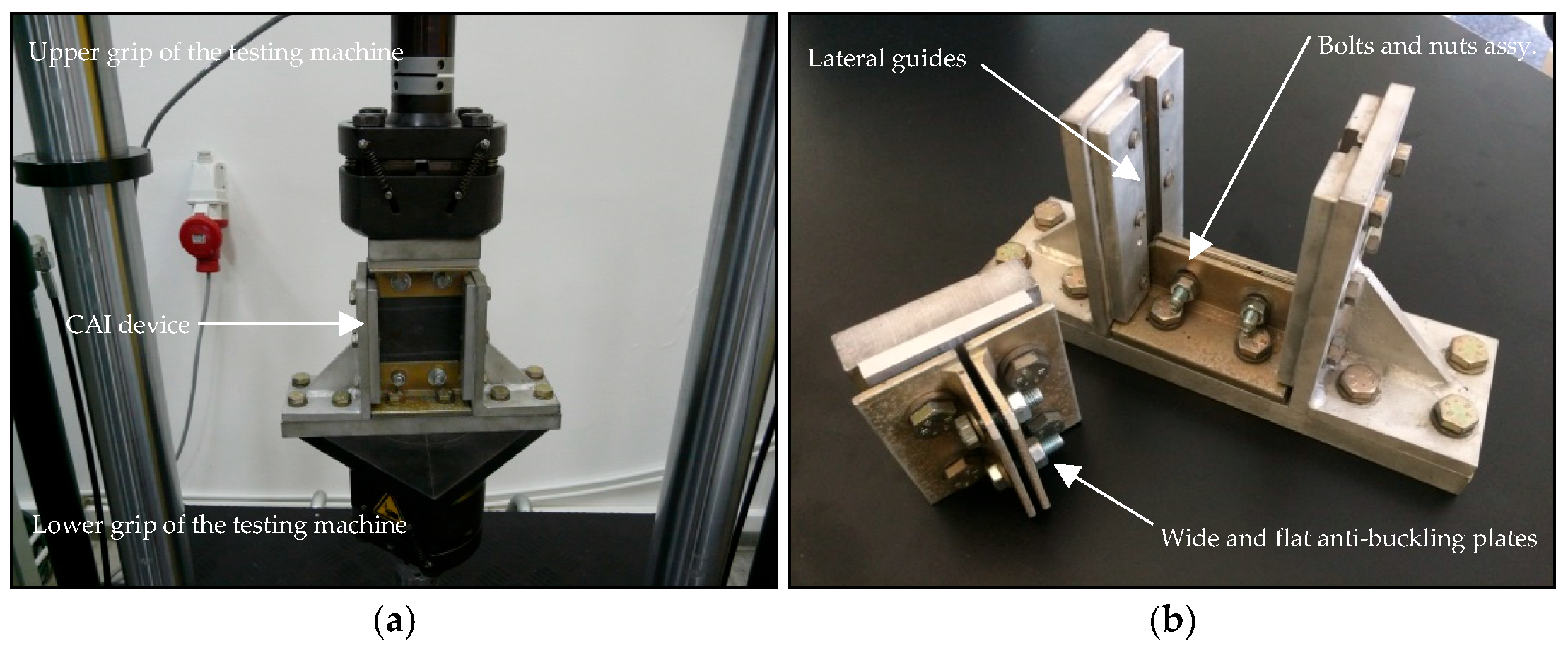
Therefore, an improved CAI test fixture tailored for thin CFRP laminates is proposed. Its design uses the standard coupon size and maintains the side-guiding approach of the BSS 7260 fixture but adds two pairs of anti-buckling steel plates that clamp the specimen’s top and bottom edges using bolt–nut assemblies, unlike the U-notch plates involved in Sánchez-Sáez’s device. After the impact test, four holes are drilled through each specimen to allow the clamping bolts to be mounted. By reducing the specimen’s unsupported length, this clamped setup significantly decreases the risk of global buckling under compressive load.
The proposed CAI fixture is validated through LVI and CAI tests on two reversed-symmetric angle-ply layups and maintains a full free measurement zone compatible with standard CAI coupon dimensions, enabling a reliable measurement of residual-strength data without buckling or edge artifacts. Compared to prior fixtures proposed in the literature, the new device retains the full free measurement zone and uses the same free-area dimensions as a standard CAI fixture. By addressing the buckling issue and edge-support effects without altering specimen geometry, the improved setup yields more reliable residual-strength data for thin CFRP laminates.
Furthermore, the influence of stacking sequence on impact damage and residual strength is examined by comparing two symmetric angle-ply configurations with reversed ply orders: [0/−45/45/90]s and [90/45/−45/0]s. These laminates contain identical plies, mirrored through the thickness, so that the outermost plies of one layup correspond to the innermost plies of the other. By subjecting both configurations to identical LVI and CAI conditions, the effect of ply orientation order on damage development and post-impact compressive performance is isolated, as already mentioned above. Thus, the main question is whether simply reversing a symmetric layup significantly affects the laminate’s damage tolerance and residual strength. The following sections describe the experimental method and present the results, highlighting how the modified CAI fixture and stacking sequence together influence the CAI behavior of thin CFRP composites.
3. Results and Discussion
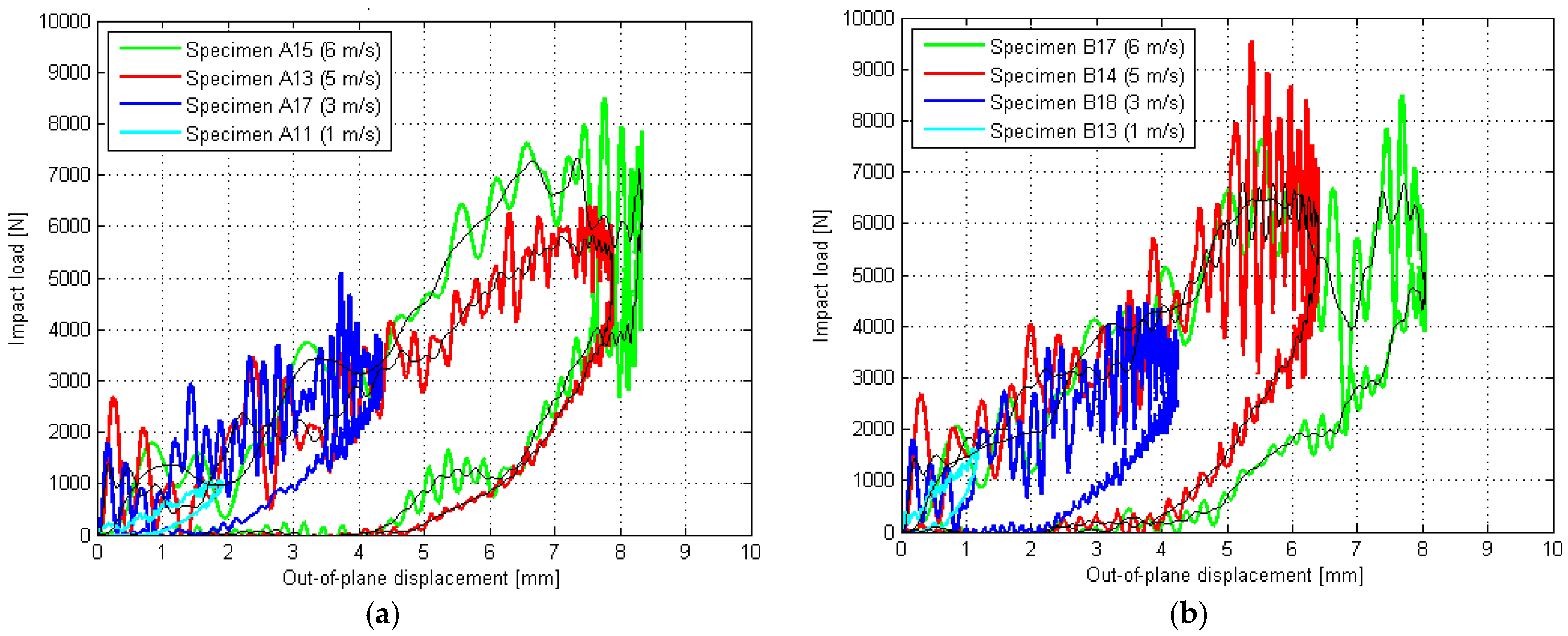
The low-velocity impact (LVI) load–displacement curves up to the barely visible impact damage (BVID) level are shown in
Figure 6 for both laminate configurations. Due to overlapping data, only one representative curve is displayed for each impact velocity. Consistent with previous studies, noticeable harmonic oscillations occur at the start of the impact due to dynamic interactions between the striker and the specimen [
43,
44]. These high-frequency oscillations make it difficult to see differences in the raw curves, so a smoothing technique was used to improve clarity. In the figure below, the thin black lines on the 5 m/s and 6 m/s curves show the filtered data. Specifically, a moving-average filter (window size approximately 20 points) was applied in MATLAB 2023b (MathWorks, Natick, MA, USA) to remove high-frequency oscillations without changing the overall trend. This smoothing process is fully reproducible and was applied equally to all curves.
After smoothing, each curve exhibits an initial linear section that gradually transitions to a gentler slope, followed by a second nearly linear segment. In this second segment, the oscillation amplitude becomes more noticeable as the projectile velocity approaches the BVID threshold (6 m/s). The change in slope around an impact force of approximately 6 kN is likely due to the onset of delamination damage, after which the specimen’s stiffness decreases. The increasing oscillation amplitude beyond this point indicates that sudden delamination growth is affecting the dynamic response, consistent with Schoeppner and Abrate’s observations of impact-induced delamination effects [
48].
Overall, the two reversed layups show very similar impact responses, including peak impact force and absorbed energy. The peak loads at a given impact velocity were nearly identical for A-type and B-type laminates. However, B-type specimens exhibited a slightly higher effective stiffness during impact (i.e., steeper initial slope in the load–displacement curve) compared to A-type specimens. This difference can be traced to the outer ply orientation: in B-type ([90/45/−45/0]
s), the 0° fibers are aligned along the specimen’s shorter dimension (width), likely increasing resistance to bending during impact, whereas in A-type ([0/−45/45/90]
s), the 0° fibers run along the length. A consistent finding is that B-type laminates sustain a smaller permanent indentation depth than A-type laminates at the same impact energy. The average dent depth measured 24 h after impact (allowing time for matrix relaxation and dimensional stabilization) was approximately 0.7 mm for B-type, versus 0.8 mm for A-type. This 24 h delay in measuring BVID ensures the indentation is fully stabilized—the polymer matrix relaxes and elastic recovery ceases—so the recorded depth reflects the permanent deformation [
45]. In fact, some impact protocols define the BVID threshold based on a permanent dent of ~0.6 mm after 24 h at ambient conditions [
46]. The slightly shallower dent in B-type specimens (despite equal impact energy) supports the idea that B-type layups have a marginally higher impact damage resistance (i.e., higher out-of-plane stiffness), consistent with their higher impact-phase stiffness. Conversely, B-type layups showed somewhat larger oscillation amplitudes in the post-contact part of the impact event, which could indicate more extensive internal damage (e.g., delamination growth) than A-type under the BVID-level impact. Regarding impact energy, both configurations absorbed nearly the same energies at sub-BVID velocities (e.g., ~0.94 J at 1 m/s, 8.5 J at 3 m/s, and 23.6 J at 5 m/s, on average). At the BVID threshold (6 m/s impact speed), B-type specimens absorbed slightly more energy (32.5 J) compared to A-type (31.7 J). This trend aligns with Kravchenko et al. [
14], who noted that higher impact energy can correlate with a larger damaged area in the laminate—here, B-type’s marginally higher absorbed energy likely indicates a slightly larger delaminated area formed during impact.
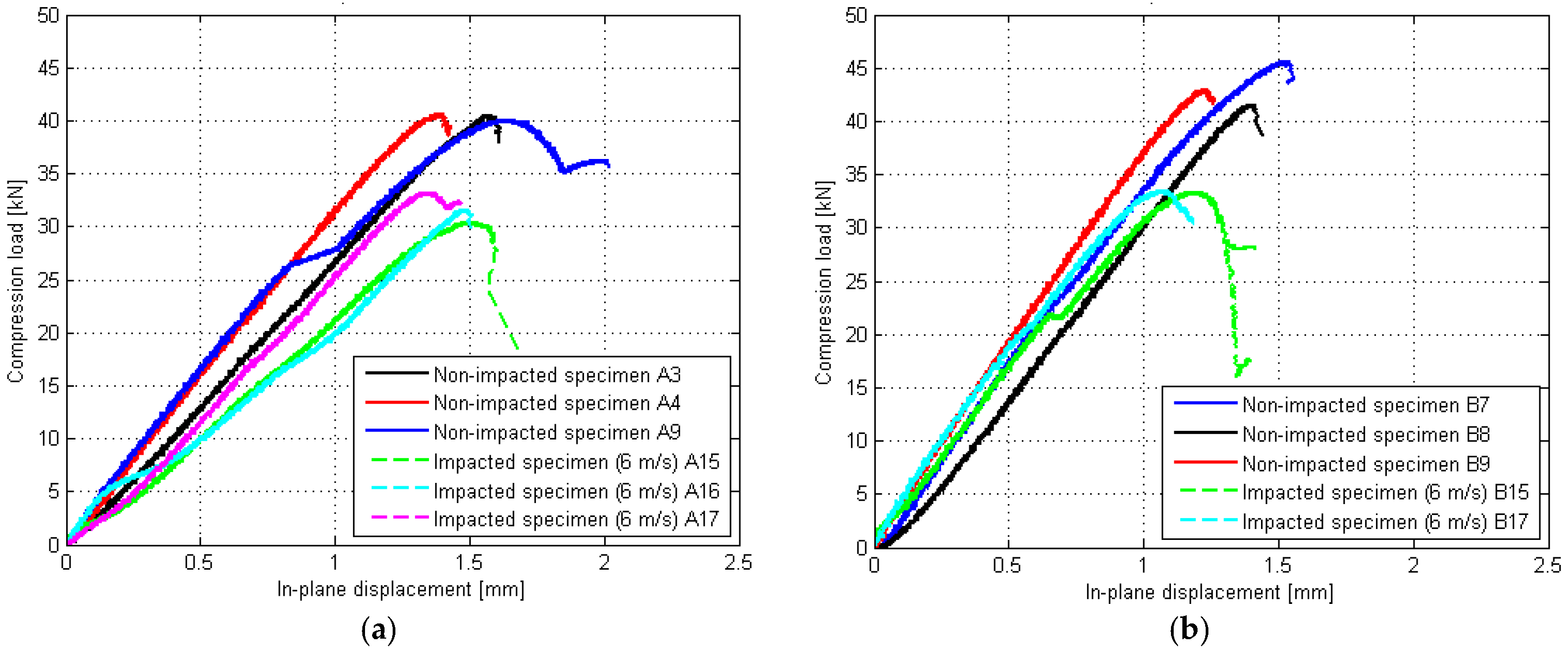
Figure 7 shows typical compression-after-impact (CAI) load–displacement curves for both layups, including non-impacted (baseline) and impacted specimens. Despite some scatter in the failure loads (common in CAI tests [
19]), all specimens followed a similar overall pattern: an initial linear elastic response, then gradual stiffness loss, and finally abrupt failure as the load increased. What is important to note is that none of the specimens exhibited global buckling during the CAI tests—this was true for both intact and impact-damaged cases. The lack of global buckling can be attributed to the effectiveness of the modified anti-buckling fixture, which restrained the specimen and prevented large out-of-plane deflections. Instead of global instability, some curves showed minor load drops or inflection points, typically at lower loads, linked to the onset of localized bending and delamination. In other words, as the compression load grew, small initial imperfections—caused by machining or slight fixture misalignments—could induce a slow out-of-plane deflection in the plate’s center [
49]. This localized buckling or delamination initiation is a known precursor to failure in composites and has been reported by other researchers as well. Tafreshi and Oswald [
50] and Amaro et al. [
51], for example, noted that the specific stacking sequence influences the development of local buckling modes and delamination patterns under compression. Our results support this: the two layups, A-type and B-type, showed slight differences in how out-of-plane deflection and internal damage evolved (discussed further below), even though their overall behavior was similar. Overall, the anti-buckling fixture ensured that in all cases, ultimate failure was driven by material damage—such as fiber kinking and delamination growth—rather than by unstable buckling collapse. This is important because Sun and Hallett [
19] have pointed out that standard CAI tests on undamaged composite plates often overestimate the actual compressive strength. In such cases, the specimen might buckle prematurely, failing at a load lower than the material’s true strength. In our tests, however, the specimens were laterally supported and did not undergo global buckling, so the measured strengths more accurately reflect the material’s compression capacity after impact.
The most important robustness check for thin-laminate CAI is that failure is not governed by fixture-induced instability. In the present campaign, no specimen exhibited global buckling, indicating that the modified boundary conditions successfully stabilized the panels and that the measured response reflects damage-controlled compression (delamination growth/fiber kinking) rather than buckling artifacts. Consequently, the remaining scatter in peak load is attributed to the inherent variability typical of CAI and impact-damage evolution, while the mean trends reported in
Figure 7 can be interpreted as laminate-dependent behavior rather than test-setup sensitivity.
Finally, the fixture’s effectiveness was evaluated using objective indicators directly linked to CAI validity for thin panels. First, no global buckling occurred in any test (undamaged or impacted), indicating that the measured peak loads were not limited by global instability. Second, the CAI response was repeatable: for each layup and condition, at least 3 specimens were tested, and peak load and initial stiffness were reported as mean values with standard deviation, allowing quantitative assessment of scatter (see
Figure 8). Third, the failure initiation location was verified by post-test inspection (see
Figure 9): impacted specimens failed from the impact zone, and no fractures initiated from bolt holes or edges, supporting the conclusion that the failure process is governed by impact damage rather than boundary effects.
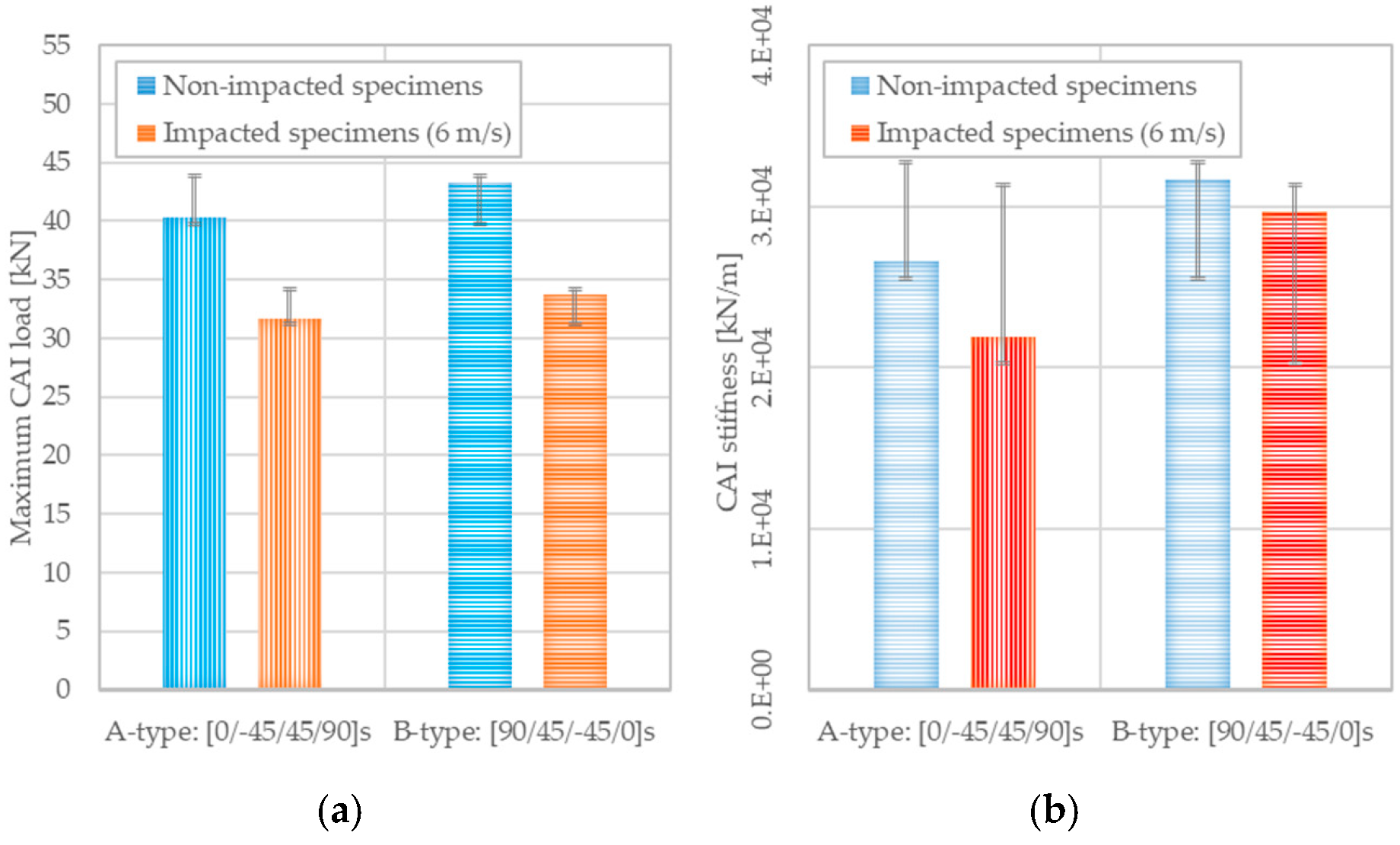
The quantitative results of the CAI tests are summarized in
Figure 8. The error bars represent ±1 standard deviation from repeated tests of at least three specimens per case, quantifying specimen-to-specimen scatter. Because the modified CAI fixture prevented global buckling and edge-dominated crushing in all tests, this variability is attributed primarily to natural laminate/fixture alignment tolerances and—most importantly for the impacted coupons—to differences in the realized BVID state (indentation depth and the associated delamination/crack development), rather than to instability artifacts of the test setup.
Figure 8a compares the maximum compressive loads supported by A-type versus B-type specimens, both in non-impacted (reference) and impacted states. Under baseline (non-impacted) conditions, B-type samples carried about 7% higher maximum load on average than A-type samples (for example, the average failure load for B-type was 7% above that of A-type). This suggests a slight benefit for the [90/45/−45/0]s stacking under compression, even without impact damage. After impact at the BVID level, however, the residual compressive strength of both configurations decreased significantly. Impacted A-type and B-type specimens both exhibited approximately a 22% reduction in peak load compared to their respective non-impacted references (
Figure 8a). In other words, the decrease in compressive strength due to BVID was roughly equal (~22%) for both layup configurations. This is an interesting observation—despite the layup difference, the effect of BVID on strength loss was similar. It should be noted that a ~20% reduction aligns with literature reports for CFRP laminates at the BVID threshold [
52]. By maintaining strict anti-buckling support during testing, we ensured that the observed strength decline was due solely to impact damage and not to buckling.
Figure 8b shows the compressive stiffness (the slope of the load–displacement curve in the elastic region) for each case, highlighting a key difference between the layups. The A-type laminates experienced a much greater stiffness degradation after impact: the average compressive stiffness of impacted A-type specimens dropped by approximately 17% compared to the undamaged A-type, while impacted B-type specimens lost only about 6% of their compressive stiffness relative to their references. In absolute terms, the undamaged A-type had a slightly lower initial stiffness than the undamaged B-type (consistent with previous impact results), and after impact, the stiffness of A-type fell well below that of B-type. This significant stiffness reduction in A-type can be explained by its laminate design: the middle plies in A-type are oriented at 90° (transverse to the loading direction), making the central sub-laminate less stiff and more prone to instability upon damage. When these transverse mid-plies were compromised by impact (delamination, matrix cracks, etc.), the A-type specimens showed earlier onset of local buckling and softening under compression, leading to a larger drop in effective stiffness. B-type, with 0° plies located in the mid-plane and ±45° plies on the outside, maintained a more stable, load-distributed architecture after impact, losing comparatively little stiffness. These findings reinforce the idea that layup orientation can significantly influence post-impact stiffness, not just strength.
The relative magnitude of the SD bars also provides insight into how sensitive each configuration is to small variations in damage and local failure development. In particular, the impacted groups show greater scatter than the non-impacted baselines, consistent with CAI behavior being governed by impact-induced delamination and by their growth under compression. The more pronounced SD in post-impact stiffness for A-type indicates that this layup is more susceptible to specimen-to-specimen differences in the onset and evolution of local sublaminate buckling/softening after BVID, whereas the smaller stiffness scatter for B-type suggests a more stable load-carrying architecture after impact—consistent with the observed layup-dependent damage patterns discussed in the next figures.
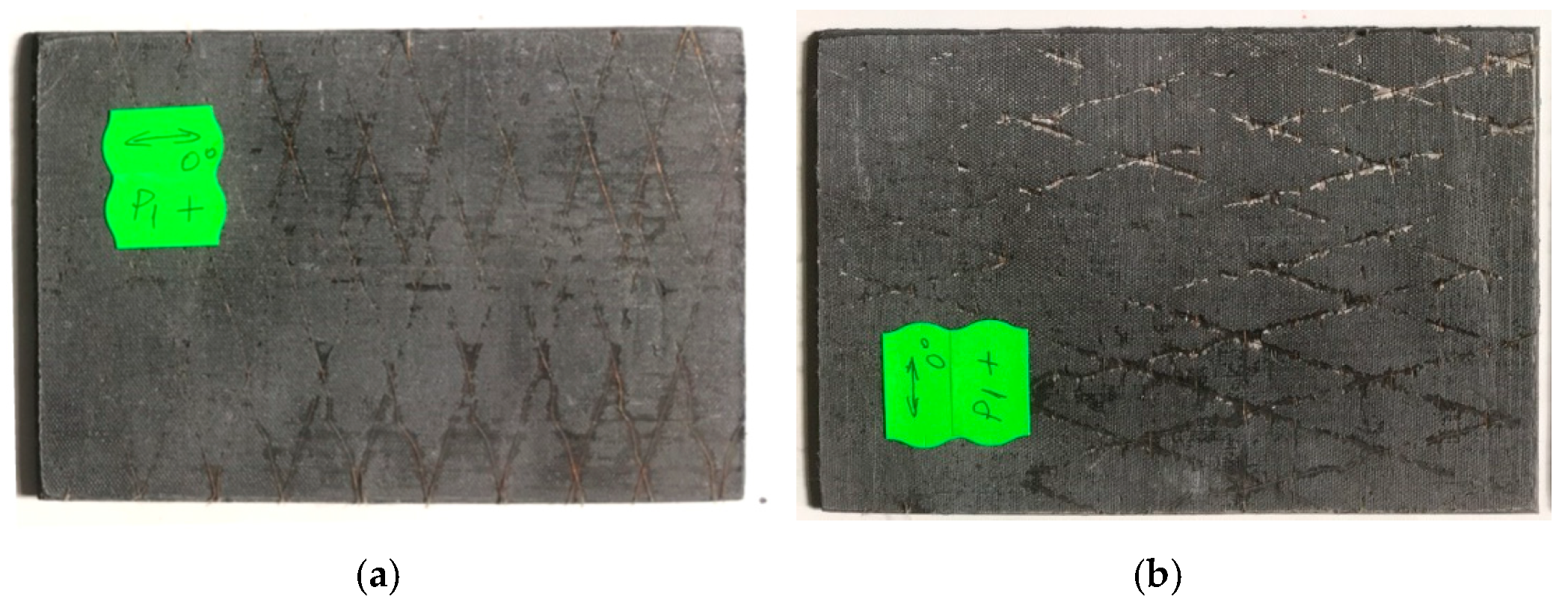
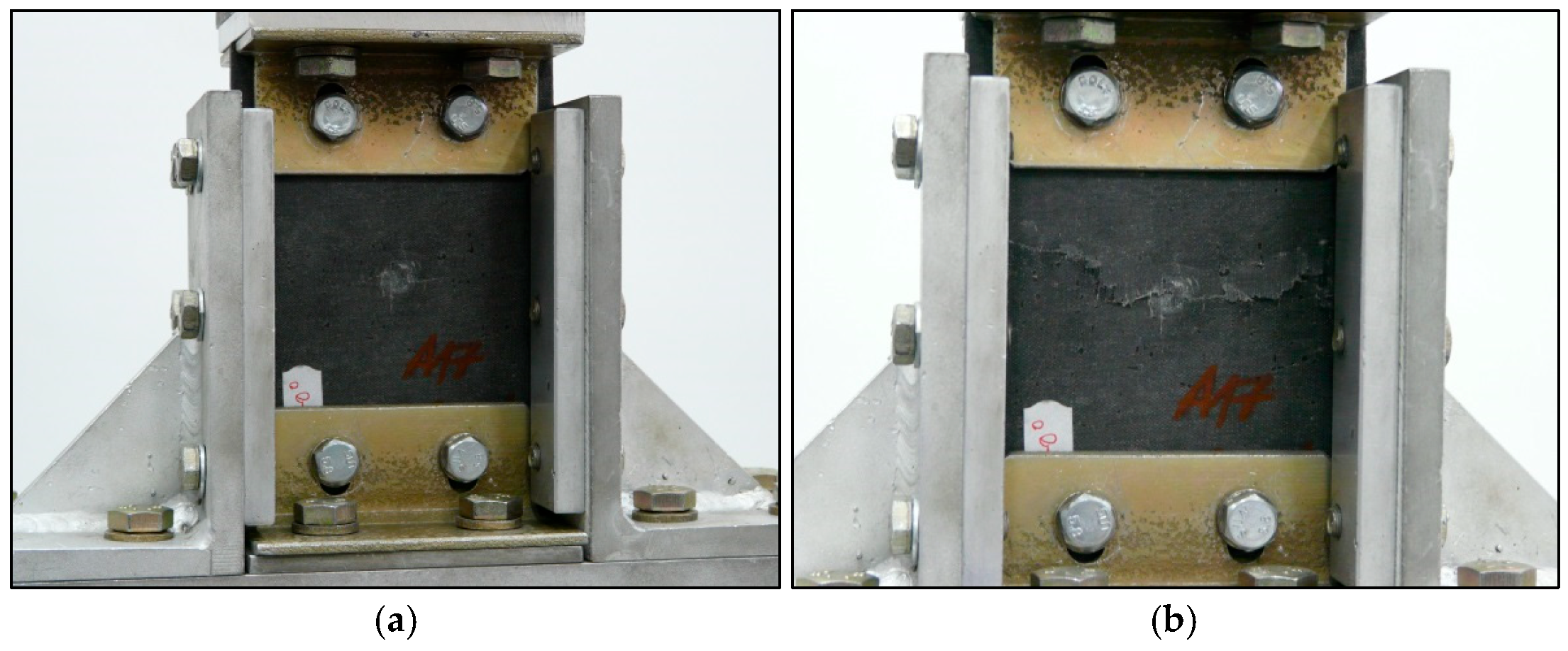
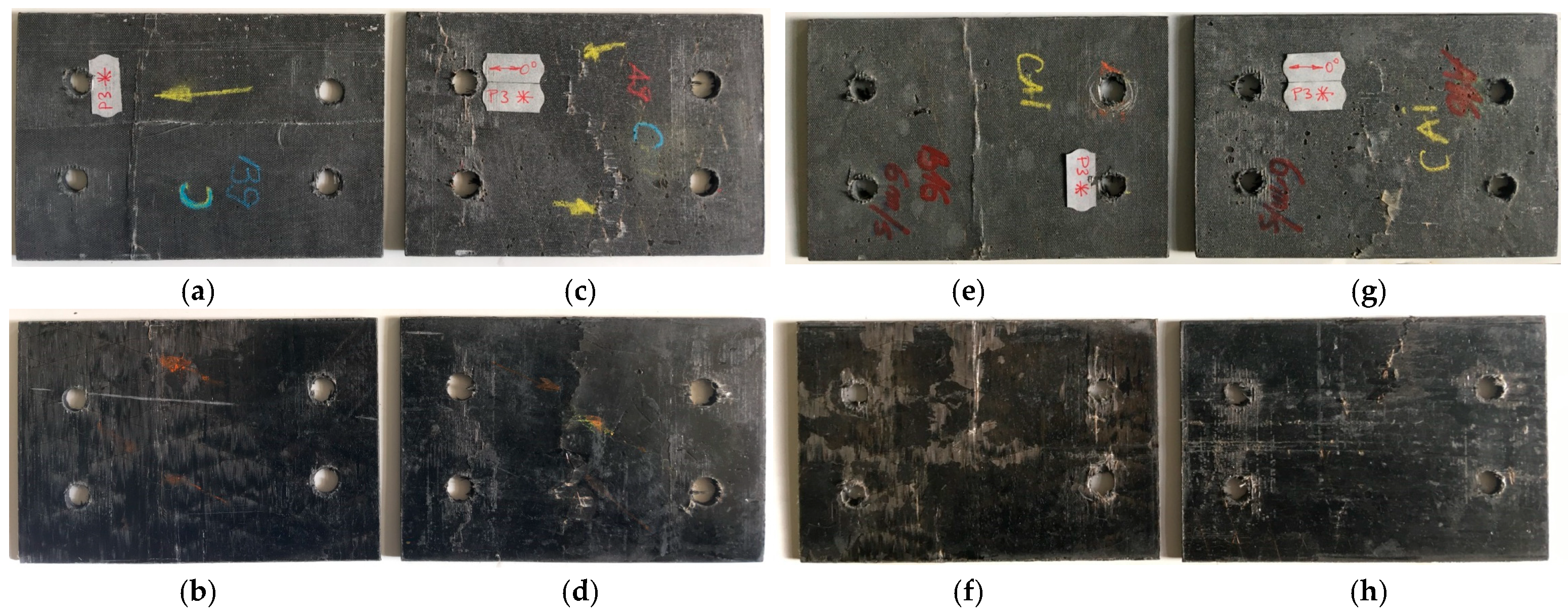
Figure 9 displays photographs of the failure modes for representative specimens: images
Figure 9a–d show a non-impacted (undamaged) A-type and B-type after compression failure, while
Figure 9e–h depict an A-type and B-type that were first impacted at 6 m/s (BVID) and then tested in compression. All specimens are shown from both the front and back faces. For the undamaged laminates (
Figure 9a–d), both layups exhibit similar damage modes under compressive failure: primarily delamination cracks running roughly perpendicular to the loading direction (i.e., delamination oriented longitudinally along the specimen length) and through-thickness compression shear cracks. In the A-type [0/−45/45/90]s specimen (
Figure 9c,d), a significant longitudinal delamination is visible, along with longitudinal splitting/fracture in the 0° ply that forms the outer layer on the front face. Interestingly, the front face of the A-type (which has the 0° ply on the outside and experiences concave bending during testing) shows relatively little fiber breakage in that outer 0° layer—the fiber bundles largely remain intact, even though delamination occurs beneath them. Conversely, on the back face of the same A-type sample (
Figure 9d), which has a 90° ply at the surface and experiences convex curvature, a prominent kink band formed with severe fiber fracture in the outer 90° layer. This indicates that the 0° face of A-type primarily failed by delamination along the fiber direction and splitting between plies, while the 90° face failed through fiber microbuckling and rupture. The B-type [90/45/−45/0]s specimen (
Figure 9a,b) showed a different damage distribution: here, the local buckling of the outer layers (90° fibers) is apparent, especially on the front face (
Figure 9a). The B-type still exhibits some delamination, but noticeably less on the convex (back) face (
Figure 9b) compared to the A-type. Instead, the failure of B-type seems to involve the outer 90° layers bulging outward and splitting, rather than extensive delamination between plies.
For the impact-damaged specimens (
Figure 9e–h), the compression failures started at the impact sites, as expected. In contrast, the non-impacted specimens could fracture anywhere along the gauge section because there were no pre-existing weak spots. The impact damage affected each layup’s failure pattern. In the B-type specimen impacted at 6 m/s (
Figure 9e,f), the pre-existing delamination from the impact expanded under compression, mainly in the transverse direction (parallel to the 90° fibers). When the final compressive fracture occurred, it originated from the impact zone. On the front (impacted, concave) face of the B-type, kink bands are visible in the 90° plies near the impact dent. These kink bands split and pushed outward, displacing the 90° layers and ultimately causing the underlying 0° fibers to fracture as the laminate collapsed. On the back (convex) face of the B-type (
Figure 9f), fiber breakage was less severe, with damage mainly limited to delamination and splitting along the 90° ply direction. The A-type impacted specimen (
Figure 9g,h) showed a somewhat different pattern. On its front face (
Figure 9g), the outer 0° layer mostly remained intact, similar to the undamaged case, but extensive delamination and matrix cracking occurred around the impact dent and spread along the length of the plate. On the back face of the impacted A-type (
Figure 9h), the 90° outer layer failed through severe fiber breakage and large kink-band formation, indicating that fiber buckling primarily caused the compressive failure. In summary, A-type laminates tend to undergo significant delamination along the loading direction and fiber fracture in the 90° back-face plies, while B-type laminates show more outward bulging (local buckling) of the 90° layers with less delamination on the back face. Despite these differences, all impacted specimens (A and B) ultimately failed via a through-thickness fracture that propagated across the width, involving combined modes of fiber kinking, delamination, and matrix cracking.
It is also important to note that no failure path originated from the bolt holes or plate-contact areas; for impacted specimens, failure always started in the impact-damaged zone, confirming that the fixture does not create an alternative hole-triggered failure mechanism. This indicates that the presence of holes and bolts did not significantly weaken the laminate or change the overall failure mode, confirming the efficacy of the fixture design.
The failure morphologies in
Figure 9 should be interpreted as material-driven CAI responses rather than fixture artifacts, because the modified setup effectively suppressed global buckling and edge-dominated crushing throughout testing. This is consistent with the load–displacement responses, in which none of the specimens exhibited global instability, and the fixture promoted failure governed by delamination growth and fiber kinking/microbuckling rather than by buckling collapse. In the undamaged condition, both layups show a compression-dominated response characterized by longitudinal delamination and compression-shear cracking in the gauge region, but with layup-dependent surface expressions: A-type tends to develop splitting/delamination aligned with the outer 0° ply, while B-type exhibits more pronounced outward bulging/local instability of the outer 90° layers. In the BVID-impacted condition, the fracture consistently initiates and propagates from the impact zone (as intended in CAI), reflecting impact-induced delamination acting as a trigger for local sublaminate buckling and subsequent kink-band formation; A-type shows more extensive delamination spreading along the plate length, whereas B-type failure is dominated by kink bands and splitting in the 90° surface plies near the dent. Importantly, the observed fracture paths did not originate from the bolt holes, indicating that the clamped-plate/bolt concept stabilizes thin specimens without introducing a competing premature failure mechanism. Based on these observations, the following experimental guidelines can be used when applying the proposed setup: (i) a valid test should show no global buckling and no crushing at the loaded edges; (ii) impacted specimens should fail from the impact region (not from fixture edges or holes); and (iii) differences in failure morphology between reversed symmetric layups should be interpreted via the competition between delamination growth and ply-level microbuckling/kink-band formation, which is influenced by whether 0° or 90° plies are placed on the outer surfaces.
To further support this interpretation and to clarify how the observed failure modes relate to the boundary conditions imposed by the proposed setup, the key implementation aspects and their engineering implications are summarized below.
Building on the standard CAI concepts of BSS 7260 [
21] and AITM 1-0010 [
22], the proposed fixture combines lateral guidance with end-face clamping using stiff anti-buckling plates and through-bolts. Beyond stabilizing the specimen, the bolted plates act as load-sharing elements at the ends, helping reduce edge-bearing damage and improving repeatability when testing thin panels. This behavior is consistent with established observations that bolted supports and controlled bolt-hole conditions (e.g., low clearance and sufficiently stiff support plates) enhance compressive/bearing stability in composite coupons [
53,
54,
55]. In the present tests, only minor localized bearing marks were observed around the holes, no crushing occurred at the loaded edges, and the fracture path did not initiate from the fastener holes—confirming that the fixture does not introduce a competing premature failure mechanism. From a practical standpoint, the method requires drilling four holes and reassembling the bolts between tests, but it provides a straightforward and reliable option for small-to-medium experimental campaigns on thin laminates where standard CAI boundary conditions may otherwise produce edge-dominated failures.
4. Conclusions
This study investigated two symmetric CFRP laminate layups with reversed ply orientations—A-type [0/−45/45/90]s versus B-type [90/45/−45/0]s—under compression after low-velocity impact. Both laminates had an average thickness of 4.2 mm and were impacted at velocities approaching the barely visible impact damage (BVID) threshold. Based on the experimental results, the following verified findings are summarized:
Innovative features and engineering applicability: Beyond the layup-specific findings, the main methodological contribution of this work is the proposed CAI test setup for thin laminates. The concept is a practical addition to a BSS 7260-type guiding fixture: it maintains lateral edge support while providing end-face clamping via anti-buckling plates and through-bolt assemblies. This hybrid boundary condition shortens the unsupported gauge length, stabilizes thin panels, and reduces edge crushing by load-sharing between the bolts/plates and the laminate. Importantly, the approach remains compatible with common CAI specimen geometries and loading methods, allowing its extension to other thin FRP laminates, layups, and impact severities where standard CAI fixtures might otherwise cause buckling- or edge-dominated failures.
Layup orientation effect: Reversing the stacking sequence had a noticeable but moderate impact on compression behavior. In undamaged conditions, B-type specimens (with 90° surface plies) achieved about 7% higher maximum compressive load than A-type specimens (with 0° surface plies). This indicates a slight advantage of having off-axis outer layers for load-bearing capacity. When impacted at approximately 6 m/s (causing BVID), both layup configurations experienced about a 22% reduction in their compressive strength compared to non-impacted specimens. Notably, this percentage decrease was nearly identical for both A-type and B-type, suggesting that both layups are equally vulnerable to impact-related strength reduction at the BVID level. However, the impact affected compressive stiffness differently: A-type laminates lost about 17% of their stiffness, while B-type laminates lost only about 6%. Therefore, the B-type stacking sequence proved more effective at maintaining stiffness after impact damage. We attribute the greater stiffness loss in A-type to its transverse middle plies (90°) being less supportive under compression after damage, making the A-type more prone to local buckling and softening. Conversely, B-type layup (with 0° plies in the mid-plane and ±45° plies at the surfaces) provided a more stable load path after impact, resulting in better stiffness retention.
Failure mode characteristics: The two layups showed different failure patterns under compression, both with and without prior impact. A-type specimens tended to develop significant longitudinal delamination and splits along the 0° fiber direction, with fiber kinking and breaking mainly occurring in the 90° layers on the compressive (back) side. B-type specimens, in contrast, exhibited a tendency toward local buckling of the outer 90° layers and experienced delamination damage that spread more transversely (widthwise) along the 90° fibers. The B-type’s 0° plies (beneath the surface) fractured only after the 90° plies buckled and split. Despite these differences, both layups ultimately failed primarily in a compression-dominated mode: failures involved fiber micro-buckling (kinking), delamination growth, and matrix cracking through the thickness, rather than global buckling. The presence of barely visible impact damage (a dent approximately 0.8 mm or 0.7 mm) served as the initiation point for failure in impacted specimens, while undamaged specimens had no pre-existing weak points and failed more uniformly. Importantly, the bolt holes made for the fixture did not weaken the structure—any bearing damage around the holes was minor and did not trigger crack initiation or growth in the gauge section.
Performance of the modified CAI fixture and overall validity: The proposed anti-buckling fixture demonstrated high effectiveness for CAI testing of thin laminates, ensuring that the measured response is dictated by laminate damage rather than test artifacts. By securely clamping the specimen’s ends between broad plates and providing lateral guidance, the device prevented global buckling and edge crushing in all tests, allowing the true material failure loads to be achieved even for thin (~4 mm) specimens. Additionally, the required bolt holes did not cause premature failure: although minor local bearing marks appeared, the fracture path did not originate from the holes, confirming that the fixture does not introduce a competing failure mechanism. These results support the general validity of the setup as an engineering test method: since the design principles (reduced unsupported length along with the stabilized boundary conditions) are not specific to the layup, the same fixture can be used to produce reliable CAI residual-strength and stiffness data for a wider range of thin composite panels (e.g., different stacking sequences and damage levels), thus extending beyond the present case study toward broader applications.
Overall, the fixture provides a simple method to obtain consistent, repeatable CAI data for thin composite panels in engineering practice, and it can be used in future studies for larger parametric campaigns (thickness, layup families, and impact energy) aimed at establishing design-allowable values and supporting potential standardization.