Article

Upcycling Pultruded Polyester–Glass Thermoset Scraps into Polyolefin Composites: A Comparative Structure–Property Insights


Department of Mechanical and Materials Engineering, Materials Processing and Applications Development (MPAD) Center, The University of Alabama at Birmingham (UAB), Birmingham, AL 35233, USA
*
Author to whom correspondence should be addressed.
J. Compos. Sci. 2026, 10(1), 52; https://doi.org/10.3390/jcs10010052
Submission received: 27 November 2025 / Revised: 27 December 2025 / Accepted: 13 January 2026 / Published: 16 January 2026

Abstract

This study investigates the reuse of mechanically recycled polyester–glass thermoset scraps (PS) as fillers in LDPE and HDPE matrices at 10–50 wt.% loading. Composites were produced through mechanical size reduction, single-screw extrusion, and compression molding without compatibilizers, and their mechanical and microstructural properties were systematically evaluated. LDPE composites exhibited a notable stiffness increase, with tensile modulus rising from 318.8 MPa (neat) to 1245.6 MPA (+291%) and tensile strength improving from 9.50 to 11.45 MPa (+20.5%). Flexural performance showed even stronger reinforcement: flexural modulus increased from 0.40 to 3.00 GPa (+650%) and flexural strength from 14.5 to 35.6 MPa (+145%). HDPE composites displayed similar behavior, with flexural modulus increasing from 1.2 to 3.1 GPa (+158%) and strength from 34.1 to 45.5 MPa (+33%). Surface-treated fillers provided additional stiffness gains (+36% in sPL4; +33% in sPH3). Impact strength decreased with loading (LDPE: −51%, HDPE: −61%), though surface treatment partially mitigated this (+14–19% in LDPE; +13% in HDPE). Density increased proportionally (PL: 0.95 → 1.20 g/cm3, PH: 0.99 → 1.23 g/cm3), while moisture uptake remained low (≤0.25%). Optical and SEM analyses indicated increasingly interconnected fiber networks at high loadings, driving stiffness and fracture behavior. Overall, PS-filled polyolefins offer a scalable route for converting thermoset waste into functional semi-structural materials.

1. Introduction

The rapid increase in glass fiber–reinforced polymer (GFRP) production over the past two decades has led to an unprecedented accumulation of end-of-life thermoset composite waste, originating from construction components, automotive parts, wind turbine blades, and pultruded structural profiles [1,2]. Due to their crosslinked molecular architecture, thermoset polymers cannot be remelted or reshaped, making their recycling fundamentally more challenging than that of thermoplastics [3]. Consequently, more than 90% of global thermoset composite waste is still landfilled or incinerated, creating severe environmental, regulatory, and economic concerns. Conventional recycling approaches—including energy recovery, pyrolysis, and solvolysis—remain costly, energy-intensive, or difficult to scale, while mechanical grinding offers the most practical route but often yields fillers with poor interfacial compatibility and heterogeneous morphology [4]. These limitations highlight the urgent need for innovative and industrially viable valorization strategies for thermoset composite waste streams [5,6].
In recent years, researchers have increasingly investigated the incorporation of recycled GFRP fillers into polyolefin matrices—particularly LDPE and HDPE—due to their low cost, extensive industrial use, and ease of melt processing [7]. However, prior studies commonly report limited reinforcement efficiency arising from poor interfacial adhesion, fiber shortening during extrusion, and agglomeration of resin-rich scrap particles, which collectively restrict load transfer and trigger premature failure [8]. Furthermore, most existing studies focus either exclusively on LDPE or on a single filler morphology, leaving a clear knowledge gap regarding systematic LDPE/HDPE comparisons, the effect of filler surface modification, and the microstructure–mechanical property relationship across a broad range of filler contents. The originality of this study compared with previously referenced works lies precisely in addressing these overlooked areas through a comprehensive, comparative investigation.
In this context, the present work introduces a novel and industrially relevant route for upcycling pultrusion-derived polyester–glass thermoset scraps (PS) into LDPE and HDPE composites, using only mechanical size reduction followed by melt processing—without compatibilizers or chemical coupling agents. In addition, a dual-acid surface-treatment method was applied to selected filler groups to enhance interfacial adhesion between the hydrophilic scrap surface and the hydrophobic polyolefin matrix, a combination that has been scarcely explored in the previous literature [9]. Compared with earlier thermoset waste recycling studies, the novelty of this work stems from its simultaneous evaluation of two major polyolefin matrices, systematic comparison between untreated and surface-modified PS fillers, and the investigation of a wide filler-loading window (10–50 wt.%) within a unified, process–structure–property framework.
Thermoset composite recycling has gained renewed attention in the context of global sustainability initiatives and the transition toward circular materials engineering. Emerging technologies such as dynamic covalent networks, vitrimers, reversible chemistries, and hybrid delamination processes offer promising laboratory-scale solutions but are not yet ready for high-volume industrial deployment [5,10]. By contrast, mechanical recycling remains the only immediately scalable, cost-effective, and infrastructure-compatible route for diverting thermoset composite waste from landfills [4,11]. This positions mechanically reclaimed thermoset scraps as a strategically important resource for circular-economy models, particularly in sectors demanding rigid, lightweight, and economically efficient materials [3,12].
Despite these advantages, thermoset composite recycling still faces inherent limitations, including filler heterogeneity, nonuniform dispersion, micro void formation, weak fiber–matrix bonding, fiber-length degradation during extrusion, and the presence of resin-rich scrap particles that act as stress concentrators [13,14]. These challenges underscore the need for studies that not only reuse thermoset waste but also engineer its morphology and interfacial behavior to achieve meaningful reinforcement in commodity polyolefin matrices. This research explicitly addresses this critical gap.
The present work, therefore, provides a holistic process–structure–property analysis of PS-filled LDPE and HDPE composites by integrating mechanical testing, density and moisture-uptake characterization, and extensive optical/SEM imaging. By examining both untreated and surface-modified fillers, the study quantifies interfacial improvements, identifies mechanical trade-offs across filler levels, and establishes the optimal reinforcement window. This work holds significant industrial relevance because the proposed route (mechanical size reduction + single-screw extrusion + compression molding) is low-cost, scalable, and directly compatible with existing polyolefin manufacturing lines. As a result, pultrusion-derived thermoset scraps can be transformed from a low-value, difficult-to-handle waste stream into functional, semi-structural composite materials.
Finally, this study differs from previous LDPE/HDPE/fiber-recycling research by (i) simultaneously evaluating two major polyolefin matrices, (ii) systematically comparing untreated and dual-acid-modified fillers, (iii) establishing microstructure–mechanical correlations across a broad loading range, and (iv) demonstrating an industrially deployable, circular-economy-aligned recycling pathway. Collectively, these contributions provide a robust scientific and practical foundation for advancing the use of recycled thermoset-derived fillers in next-generation, sustainable polyolefin composites.

2. Materials and Methods

2.1. Materials

Polyester-based glass fiber reinforced rods manufactured via the pultrusion process were sourced from Avient Corporation (Birmingham, AL, USA). These rods, originally intended for various structural applications, were collected as off-specification products that failed to meet the company’s dimensional tolerances and would otherwise have been discarded. Prior to recycling, the rods were categorized based on their shape and cross-sectional dimensions.
The pultruded profiles consist of an unsaturated polyester resin matrix reinforced with continuous E-glass fibers. Typical properties of such pultruded polyester composites include a glass content of 70–75 wt.%, tensile strength ranging from 600 to 900 MPa, tensile modulus between 35 and 45 GPa, flexural strength of 600–800 MPa, flexural modulus of 35–40 GPa, and a density of approximately 1.9–2.0 g/cm3. These characteristics provide high stiffness and dimensional stability, which are desirable for structural profile applications.
The thermoplastic matrices used in the composite formulations were low-density polyethylene (LDPE) and high-density polyethylene (HDPE), both supplied by Avient Corporation, USA. The LDPE grade, MaxxamTR FR PE 112 Natural, features a branched molecular architecture and moderate crystallinity (~55–60%), while the HDPE grade, MaxxamTR FR PE V0 Natural 70, exhibits a linear chain structure with high crystallinity (>90%). LDPE has a density of 0.97 g/cm3, tensile strength of 10.3 MPa, and a melt flow index (MFI) of 9.0 g/10 min. In contrast, HDPE presents a density of 1.26 g/cm3, tensile strength of 8.4 MPa, and an MFI of 15 g/10 min. Both materials were used in their natural form, without the addition of compatibilizers or other additives, to isolate the intrinsic interfacial effects between the thermoplastic matrix and the recycled pultrusion filler.

2.2. Preparation and Processing of Recycled Polyester-Glass Fiber Filled PE Composites

2.2.1. Fiber Recycling Process

The fiber recycling procedure was conducted using a purely mechanical size-reduction approach. Pultruded polyester–glass rods were initially sectioned into 35 mm-long segments using a horizontal bandsaw (KC812W, Clausing Industrial, Kalamazoo, MI, USA) to enable controlled feeding into the shredding unit. These segmented pieces were subsequently processed in a rotary-blade shredder (Model 1012/B, SEM Inc., North Billerica, MA, USA), where they were continuously fractured by shear and impact forces until the fragments passed through the outlet screen located beneath the cutting chamber. To achieve a more homogeneous particle size distribution and promote progressive separation of glass fibers from the polyester matrix, multiple shredding passes were applied. During this stage, the material transitioned from dense rod fragments into a loose fibrous mixture comprising short fiber bundles and partially resin-coated fragments [15]. The mechanically recycled material was then collected, dried at ambient temperature, and stored in sealed polyethylene containers prior to composite preparation. The resulting recycled filler primarily consisted of irregularly shaped polyester–glass fragments with a broad aspect-ratio range, making it suitable for subsequent melt-compounding with thermoplastic matrices [16].

2.2.2. Preparation of the PWCs

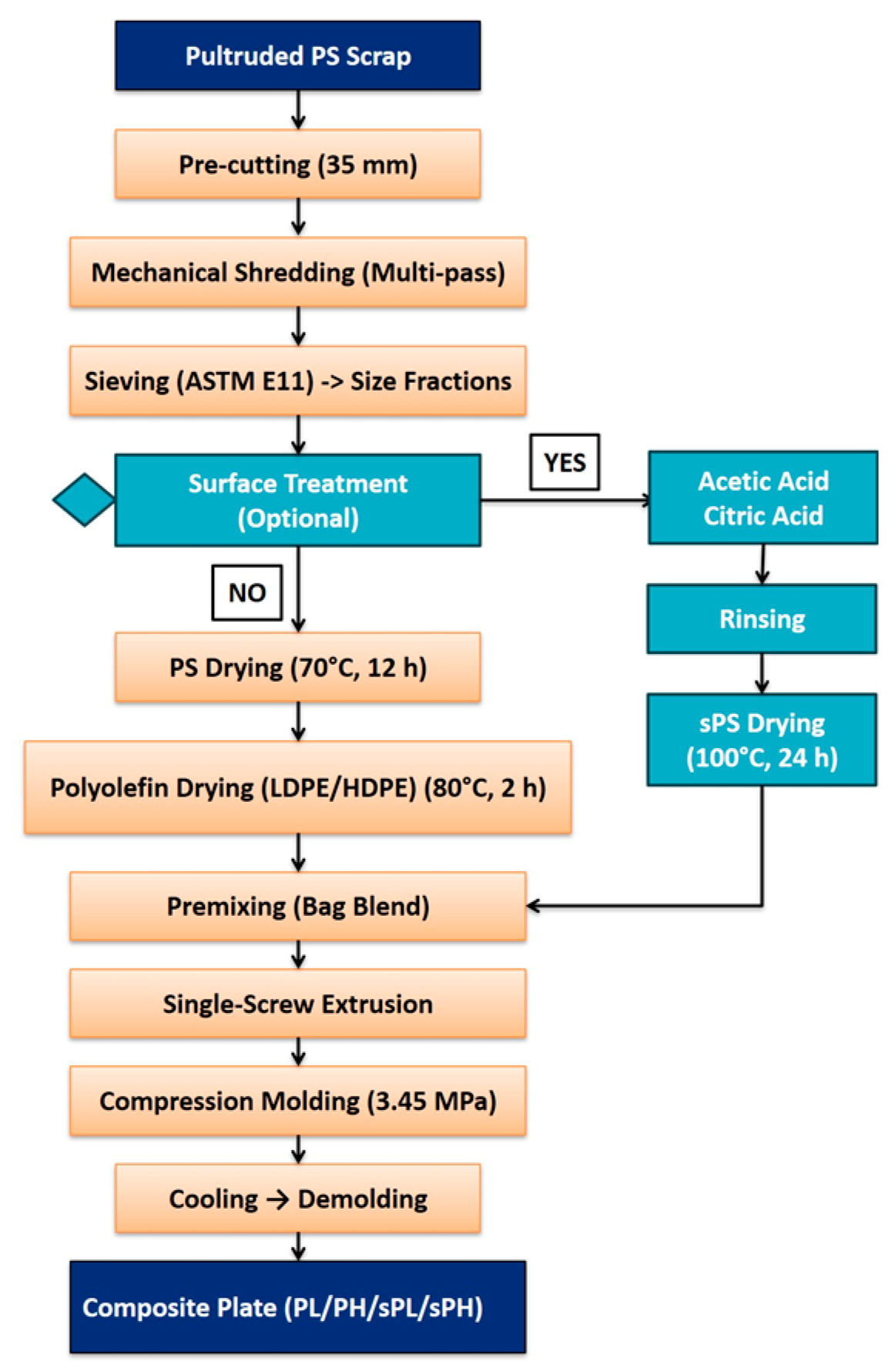
The overall workflow for the preparation of polyester–glass fiber thermoset scrap-filled composites (PWC) is summarized in Figure 1. In this process, recycled polyester scraps (PS) obtained from mechanically shredded pultrusion profiles were utilized as reinforcements in low-density polyethylene (LDPE) and high-density polyethylene (HDPE) matrices. The produced composites are designated as PL (LDPE-based PWC) and PH (HDPE-based PWC), while those containing surface-treated fillers are denoted as sPL and sPH, respectively.
Prior to processing, all raw materials were conditioned to ensure consistent moisture content and prevent hydrolytic degradation during melt blending. LDPE and HDPE granules were dehumidified at 80 °C for 2 h, whereas the PS fillers were dried at 70 °C for 12 h in a convection oven.
To enhance interfacial compatibility between the nonpolar polyethylene matrices and the polar polyester-based filler surfaces, selected PS groups underwent a dual-acid surface treatment prior to extrusion. The treatment solution consisted of 6 g/L acetic acid (CH3COOH) and 19.2 g/L citric acid (C6H8O7), stirred for 30 min and adjusted to pH 4. The combined acetic–citric acid system was selected to promote simultaneous surface cleaning, mild interphase roughening, and localized chemical modification of the residual polyester-rich layer while avoiding aggressive degradation of the recycled filler structure.
The PS fillers were immersed at a concentration of 200 g/L for 60 min, rinsed thoroughly with distilled water to remove any remaining residues, and subsequently dried at 100 °C for 24 h. These surface-modified fillers (denoted as sPS) were then stored in a controlled-humidity chamber until further use.
After conditioning and surface modification, all polymer–filler mixtures were manually pre-blended in sealed polyethylene bags to promote uniform phase distribution and minimize segregation during extrusion. The pre-mixed compounds were then compounded using a single-screw extruder (screw diameter = 60 mm, L/D = 12.5) at the Materials Processing and Applications Development (MPAD) Center, University of Alabama at Birmingham. Feeding consistency was maintained with an adjustable vibratory feeder (Syntron Power Pulse, FMC Co., Philadelphia, PA, USA), and vibration amplitude was individually calibrated for each formulation to ensure steady mass flow. Flow deviation remained within ±1.5% for filler loadings below 20 wt.% and ±2% for loadings above 20 wt.%.
Processing temperatures were optimized based on the viscosity of each matrix. For LDPE-based composites, temperature zones were maintained at 155–165 °C (feed), 175–195 °C (compression), and 195–210 °C (die). For HDPE-based systems, the corresponding zones were 165–175 °C, 180–200 °C, and 200–225 °C, respectively. The screw rotation speed was adjusted between 45 and 60 rpm, and kept below 50 rpm for high-filler formulations (>40 wt.%) to minimize fiber breakage and ensure homogeneous melt blending.
After extrusion, the molten blend was transferred into a 152 mm × 152 mm steel mold and compression-molded at 3.45 MPa for 2 min using a hydraulic press (LMG Machinery, Trinks Inc., De Pere, WI, USA), followed by in-mold cooling to room temperature. The resulting panels were demolded and cut into standard specimens for mechanical, physical, and morphological characterization. The compositions of the prepared PWCs, including surface-treated formulations, are presented in Table 1, which lists the matrix type, designation codes, and PS filler ratios for all PWC and sPWC formulations.

2.3. Physical Characterization of Polyester-Glass Fiber Thermoset Scraps (PS)

Recycled polyester–glass fiber (PS) scraps were physically characterized to evaluate their suitability as reinforcement fillers for thermoplastic composite production. The PS recyclates consist of a heterogeneous mixture of fiber-rich bundles, micron-sized particulates, and fine resin residues originating from the mechanical fragmentation of pultruded polyester–glass rods [17]. This multicomponent structure includes short glass fiber bundles partially coated with cured polyester resin and small granular particles with high surface area. The morphology, fiber distribution, and surface characteristics were examined to understand the physical integrity of the recycled filler and its potential influence on composite processing behavior [18].

2.3.1. Particle Size Distribution

The particle size distribution of PS recyclates was determined by a dry sieving process in accordance with ASTM E11 [19]. A stainless-steel sieve stack containing mesh openings of 4.75 mm, 4 mm, 3.35 mm, 710 µm, 600 µm, 425 µm, and 106 µm was used. Approximately 100 g of conditioned PS sample was placed in a pneumatic horizontal shaker and sieved for 10 min to achieve uniform classification. After sieving, the retained material on each sieve was weighed using a precision balance (AG204, Mettler-Toledo LLC., Columbusi, OH, USA, readability 0.1 mg, linearity ± 0.2 mg). The weight fraction of each size class was used to calculate the relative percentage distribution of the PS particles.

2.3.2. Fiber Length Analysis

The fiber length and dimensional characteristics of the PS recyclates were analyzed using an optical stereo microscope (Smartzoom 5, Carl Zeiss GmbH, Oberkochen, Germany) at magnifications of 40–100×. Image analysis was performed with ImageJ (Version 1.53n) software to determine the length distribution and aspect ratio of the recovered glass fibers [20]. For each sieve fraction, at least 250 individual fibers were measured to obtain statistically reliable results. The average fiber length (La) was calculated using a pixel-to-length conversion factor [21,22]:
L a = ( p i x e l x 25.4 ) D P I
Additionally, the weighted average fiber length (Wa) was determined according to Equation (2):
W a = S i U i S i
where S i is the number of fibers with a length U i . The results were expressed as mean ± standard deviation (SD). Microscopic observations revealed that the mechanical fragmentation process led to the gradual separation of fiber bundles into individual filaments, resulting in fibers of varying lengths.

2.3.3. Determination of Glass Fiber Content (Burn-Off Test)

The glass fiber content in PSs was determined through burn-off testing according to ASTM D3171-22 [23]. Samples (5–10 g) were placed in a muffle furnace (Ney 2–160 Series II, Dentsply Sirona, York, PA, USA) and subjected to a controlled two-stage thermal decomposition cycle. The furnace temperature was ramped at 40 °C/min to 515 °C and held for 1.5 h, followed by an increase to 560 °C and held for 2 h to ensure complete degradation of the polyester matrix. After cooling to ambient temperature, the residual glass fibers were weighed with a precision balance, and the fiber content was calculated based on the mass difference before and after testing [24].
Overall, the analyses described in this section provided the basis for evaluating the morphological, dimensional, and compositional features of the PS recyclates. The corresponding quantitative findings and their implications for composite performance are discussed in detail in the Results and Discussion section.

2.4. Analysis of Polyester-Glass Fiber Waste-Filled Composites (PWCs)

The structural and morphological characteristics of the produced PWCs were examined to evaluate the integrity of the recycled polyester–glass (PS) fillers after processing and their influence on the composite microstructure [25]. During extrusion and compression molding, the PS fillers were exposed to high shear forces and elevated temperatures, which may induce partial fiber fragmentation or changes in fiber dispersion. To quantify these potential effects, the glass fiber content of the composites was determined through burn-off testing in accordance with ASTM D3171-22. Composite specimens with dimensions of 25 mm × 25 mm were thermally decomposed in a muffle furnace (Ney 2–160 Series II, Dentsply Sirona, York, PA, USA) under a controlled heating program to ensure complete removal of the polymer matrix without carbonization. The remaining glass fibers were cooled to room temperature, weighed with a precision balance (±0.001 g), and used to calculate the fiber mass fraction.
To further assess the dimensional integrity of the fibers after processing, microscopy-based length analyses were conducted using ImageJ software (Version 1.53n). For each composite formulation, at least 100 fibers were randomly selected and measured, and the results were statistically evaluated to obtain the mean fiber length and its standard deviation. These analyses provide insights into the possible morphological changes in recycled PSs during processing and establish a quantitative basis for correlating fiber structure with the mechanical performance of the PWCs.

2.4.1. Optical and Scanning Electron Microscopy (SEM) Analysis of PWCs

The surface morphology and microstructural distribution of recycled polyester–glass (PS) fillers within the LDPE- and HDPE-based PWCs were examined using scanning electron microscopy (SEM) and optical microscopy techniques [26]. SEM observations were performed on the fracture surfaces of compression-molded composite specimens using a FEI Quanta 650 FEG system (FEI Quanta 650 FEG, Thermo Fisher Scientific, Hillsboro, OR, USA) operated at an accelerating voltage of 25 kV and a magnification of 1000×. Prior to imaging, all samples were sputter-coated with a thin layer of gold under vacuum using a Desk V coating unit (Desk V, Denton Vacuum, Moorestown, NJ, USA) to improve surface conductivity and prevent charging during electron bombardment [27].
High-resolution optical imaging was conducted using a digital microscope (VHX-6000, VHX-6000, Keyence Corporation, Osaka, Japan) equipped with a wide-range zoom lens (VH-Z100R, Keyence Corporation, Osaka, Japan), employing multi-focus and auto-stitching modes to enhance depth-of-field and edge definition. These complementary microscopy techniques enabled the detailed examination of filler dispersion, interfacial adhesion, and fiber–matrix interactions in the PWCs, providing visual evidence of the morphological integrity of the recycled PS fillers after processing [28].

2.4.2. Density and Moisture Absorption of PWCs

Density measurements of the PWCs were performed to assess the structural uniformity and possible variations arising from the incorporation of recycled polyester–glass (PS) fillers into the thermoplastic matrices. The tests were carried out in accordance with ASTM D792 [29] using a high-precision analytical balance equipped with a density determination kit (Pioneer Precision, OHAUS Corporation, Parsippany, NJ, USA). Prior to measurement, all specimens were oven-dried at 80 °C for 2 h to remove residual moisture and stabilized to ambient laboratory conditions. Five independent samples were tested for each composite formulation, and the mean density and standard deviation were calculated to evaluate consistency across replicates.
Moisture absorption behavior was evaluated to determine the water uptake capacity and assess long-term durability under humid conditions. The tests were conducted following ASTM D5229 [30] at room temperature (23 ± 2 °C). Rectangular composite specimens (100 mm × 25 mm) were dried to constant mass, weighed (W0), and then immersed in distilled water under controlled conditions. The specimens were removed periodically, gently wiped to remove surface moisture, and reweighed (Wt). The percentage of absorbed moisture (M%) was calculated using the following expression:
M ( % ) = W t W 0 W 0 × 100
Each measurement was repeated for five samples (n = 5), and the results were reported as mean ± standard deviation (SD) to ensure statistical reliability. These analyses provide insights into the effect of filler incorporation on void content, matrix permeability, and the diffusion characteristics of the PWCs under environmental exposure [31,32].

2.5. Mechanical Properties of the PWCs

The mechanical performance of the PWCs was comprehensively evaluated through tensile, flexural, and impact tests to determine the influence of recycled polyester–glass (PS) fillers on the structural behavior of the thermoplastic matrices. All specimens were conditioned at room temperature for 48 h before testing to ensure equilibrium under ambient conditions [33,34]. Mechanical tests were conducted on a universal hydraulic testing machine (Instron Model 1331, Instron, Norwood, MA, USA) following internationally recognized standards.
Tensile tests were performed according to ASTM D3039 [35], using a crosshead speed of 2 mm/min. Seven replicate specimens were tested for each composite type to ensure statistical accuracy. The results were used to determine the tensile modulus, tensile strength, yield strength, and maximum tensile load.
Flexural tests were conducted in accordance with ASTM D7264 [36] using the three-point bending configuration. Specimens with dimensions of 127 mm × 12.7 mm and a span-to-thickness ratio of 16:1 (span length = 64 mm) were loaded at a constant rate of 1.7 mm/min. The flexural strength, flexural modulus, and maximum load-bearing capacity were calculated from the resulting stress–strain curves.
The impact resistance of the composites was evaluated according to ASTM D256 (Izod test) [37] using a low-energy pendulum impact tester (Tinius Olsen IT 504, Horsham, PA, USA) with an impact energy of 7.56 J and a velocity of 3.85 m/s. Notched specimens were prepared with precision machining to ensure dimensional consistency. Ten independent tests (n = 10) were conducted for each formulation, and the average impact energy absorption was determined.
Following the mechanical tests, fracture surfaces of selected specimens were examined using scanning electron microscopy (SEM) to identify fiber–matrix interfacial characteristics, crack initiation, and propagation mechanisms [38]. All experimental results were reported as mean ± standard deviation (SD), and statistical evaluations were performed to ensure reliability and consistency among test groups. These mechanical characterizations collectively provide insights into the reinforcement efficiency, failure mechanisms, and overall structural integrity of the PWCs.

3. Results and Discussions

3.1. Assessment of Recycled Polyester-Glass Fiber Thermoset Scrap (PS) Fillers

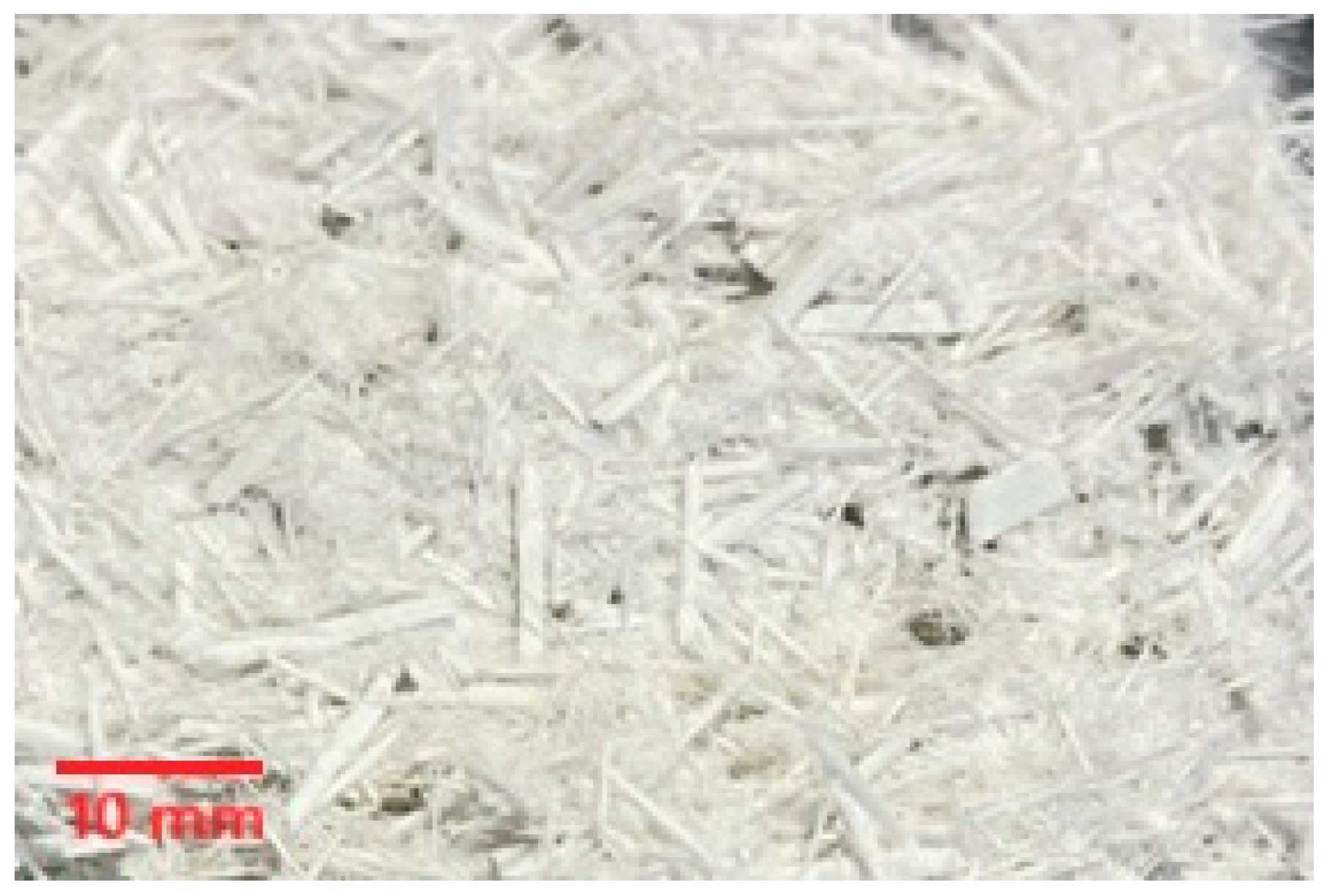
The recycled polyester–glass fiber (PS) fillers derived from mechanically shredded pultruded rods were examined to determine their physical and morphological characteristics prior to composite processing. Figure 2 shows the morphology of thermoset-matrix-coated fiber bundles, where partial resin encapsulation and surface residues are visible on the glass filaments. These residues indicate strong interfacial wetting between the original polyester resin and the glass fibers, which promoted the formation of compact fiber clusters during shredding. From a processing perspective, this morphology indicates that mechanical milling does not lead to complete liberation of bare glass fibers, but instead results in partial separation, where thin and irregular polyester-rich layers remain attached to the glass surface. Such residual thermoset layers define the effective surface chemistry and topography of the recycled filler and therefore play a decisive role in subsequent interfacial interactions with thermoplastic matrices. In this context, adhesion is governed by a resin-rich interphase rather than direct glass–polymer contact. Consequently, the recycled PS materials exhibit a heterogeneous structure composed of coarse resin-impregnated fiber bundles, medium-scale fragmented fiber segments, and fine resin-rich particulates [18,39].
The adhesion improvement observed after acid treatment should be interpreted in relation to the resin-coated fiber surface generated during the milling process. Rather than acting exclusively on pristine glass, the applied acid treatment is expected to primarily influence the residual polyester-rich interphase through partial resin modification, localized hydrolysis, surface cleaning, and micro-scale roughening. These concurrent effects may reduce the continuity of the resin coating, locally expose glass-rich regions, and alter the surface chemistry toward a more polar and heterogeneous state, thereby enhancing wettability, mechanical interlocking, and effective matrix–filler contact. Such a mechanism provides a consistent framework for interpreting the improved interfacial continuity and mechanical performance observed in surface-modified PWCs. Accordingly, the acid ratio and exposure time can be used as practical levers to tune interphase removal/roughening versus structural preservation of the recycled filler. Surface cleaning is associated with the removal/thinning of loosely bound resin-rich residues and low-molecular-weight fragments on the recycled filler surface, which reduces interfacial contamination and improves effective matrix wetting. Roughness modification arises from micro-scale etching/roughening of the residual interphase, increasing the real contact area and promoting mechanical interlocking. Chemical modification is expected to proceed via localized hydrolysis and acid–base interactions within the resin-rich surface, leading to a more polar and chemically heterogeneous interface that favors stronger interfacial contact and stress transfer. Importantly, these mechanisms provide a practical basis for optimizing the treatment, where acid composition (acetic/citric ratio), solution concentration, and exposure time can be tuned to maximize interfacial enhancement while avoiding excessive surface degradation or loss of fiber integrity. A more detailed chemical-level characterization of the residual interphase would provide additional insight into the nature and extent of surface modification and further strengthen the proposed mechanistic interpretation.
The particle size distribution obtained from dry sieving is summarized in Table 2. The recycled PSs predominantly consist of macro- and meso-scale fiber fragments. The No. 6 (3.35 mm) and No. 25 (710 µm) mesh fractions represent the largest mass shares, accounting for 28.32 wt.% and 27.57 wt.%, respectively. Coarser fractions (No. 4–5, >4 mm) constitute an additional 17.34 wt.%, while fine powder-like fractions below 600 µm contribute approximately 25 wt.% of the total. This multiscale distribution demonstrates that the mechanical shredding process effectively detached the resin phase while preserving a substantial proportion of continuous glass fibers capable of acting as reinforcement in thermoplastic matrices [40,41].
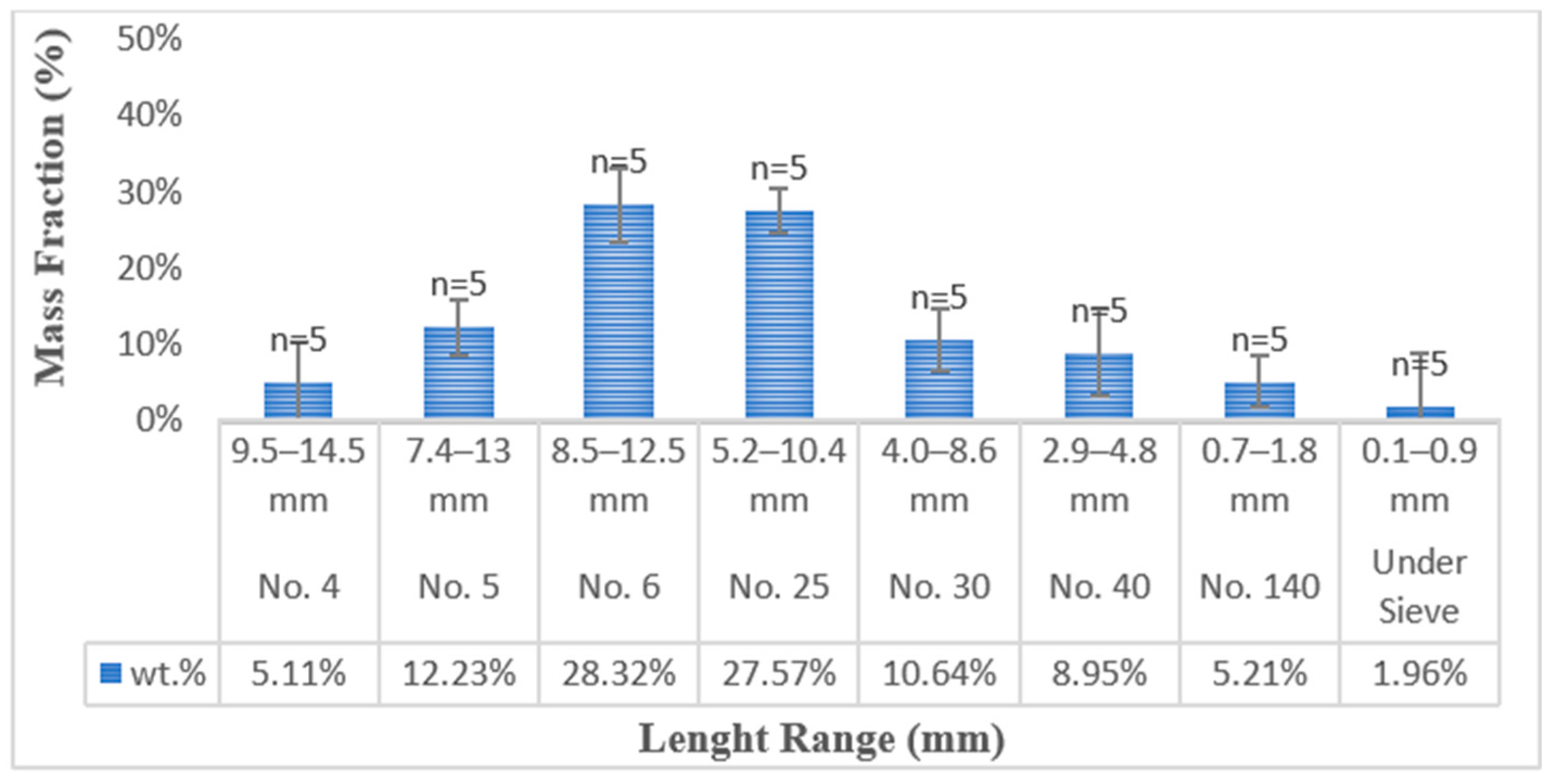
The dimensional distribution of the recycled PSs segments obtained from the sieving process is presented in Figure 3. The fiber-length intervals corresponding to each sieve fraction range from 0.1 mm to 14.5 mm, with the dominant size classes centered around 5–10 mm (No. 25) and 8–12 mm (No. 6). The mass distribution indicates that approximately 55.9 wt.% of the total recycled material lies within these two fractions, confirming that most fibers retained millimeter-scale continuity after mechanical shredding. Coarser bundles (>7 mm) accounted for ≈17 wt.%, whereas the fine fiber dust (<1 mm) represented only ≈2 wt.% of the total.
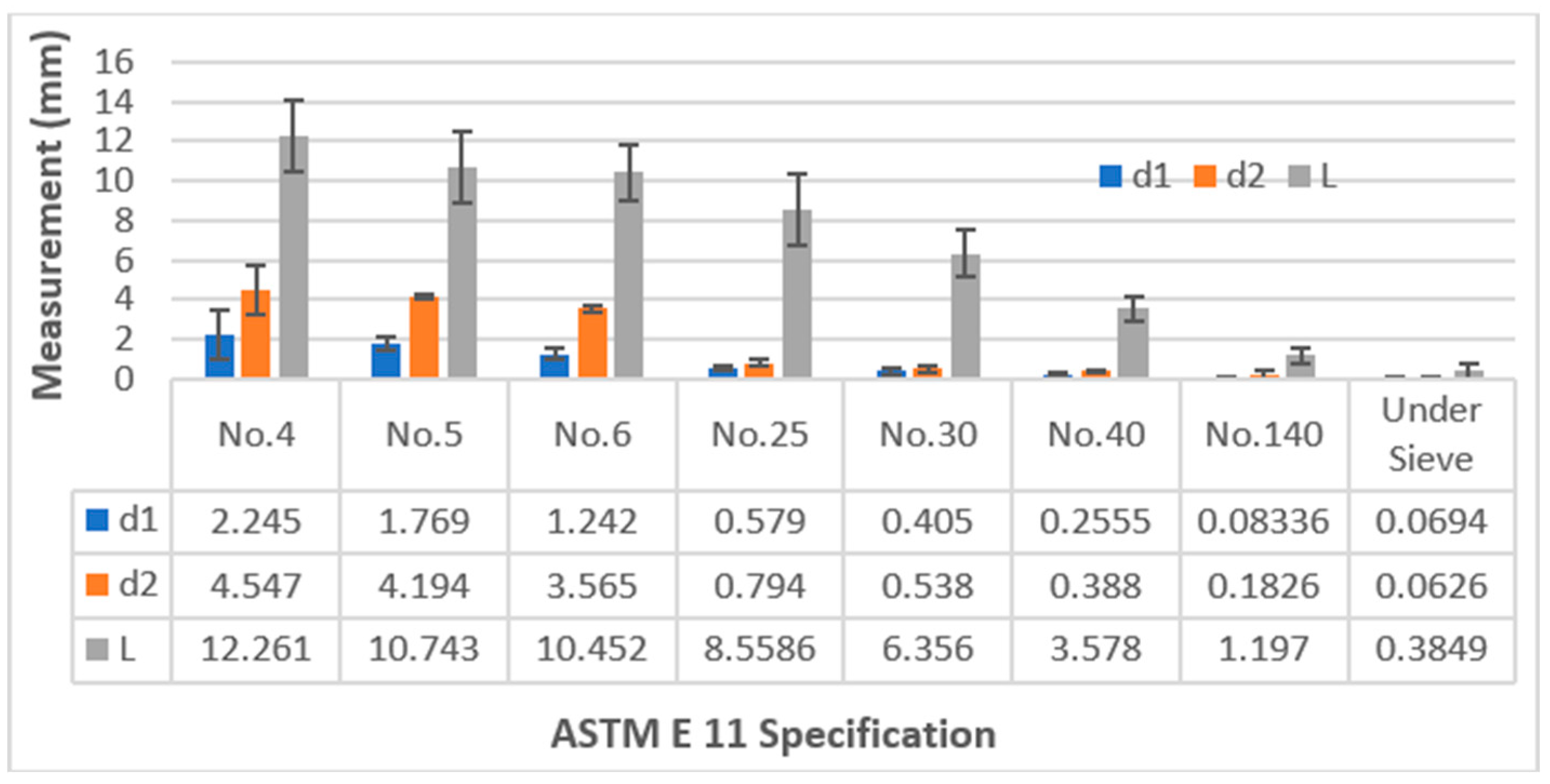
Further quantitative analysis of fiber geometry is given in Figure 4. The average fiber length (L) measured across all fractions was 6.8 ± 1.5 mm, while the corresponding mean width (d1) and thickness (d2) values decreased progressively with mesh size, from approximately 2.24 mm and 4.55 mm in the coarsest fractions to 0.069 mm and 0.063 mm in the finest under-sieve particles, respectively. This direct (proportional) correlation between fiber dimensions and sieve aperture demonstrates the gradual attrition and reduction in aspect ratio induced by repetitive mechanical shearing. Despite partial shortening, a significant proportion of elongated fibers (>5 mm) was preserved, suggesting that the recycled PS fillers maintain sufficient reinforcing capability for thermoplastic compounding [42].
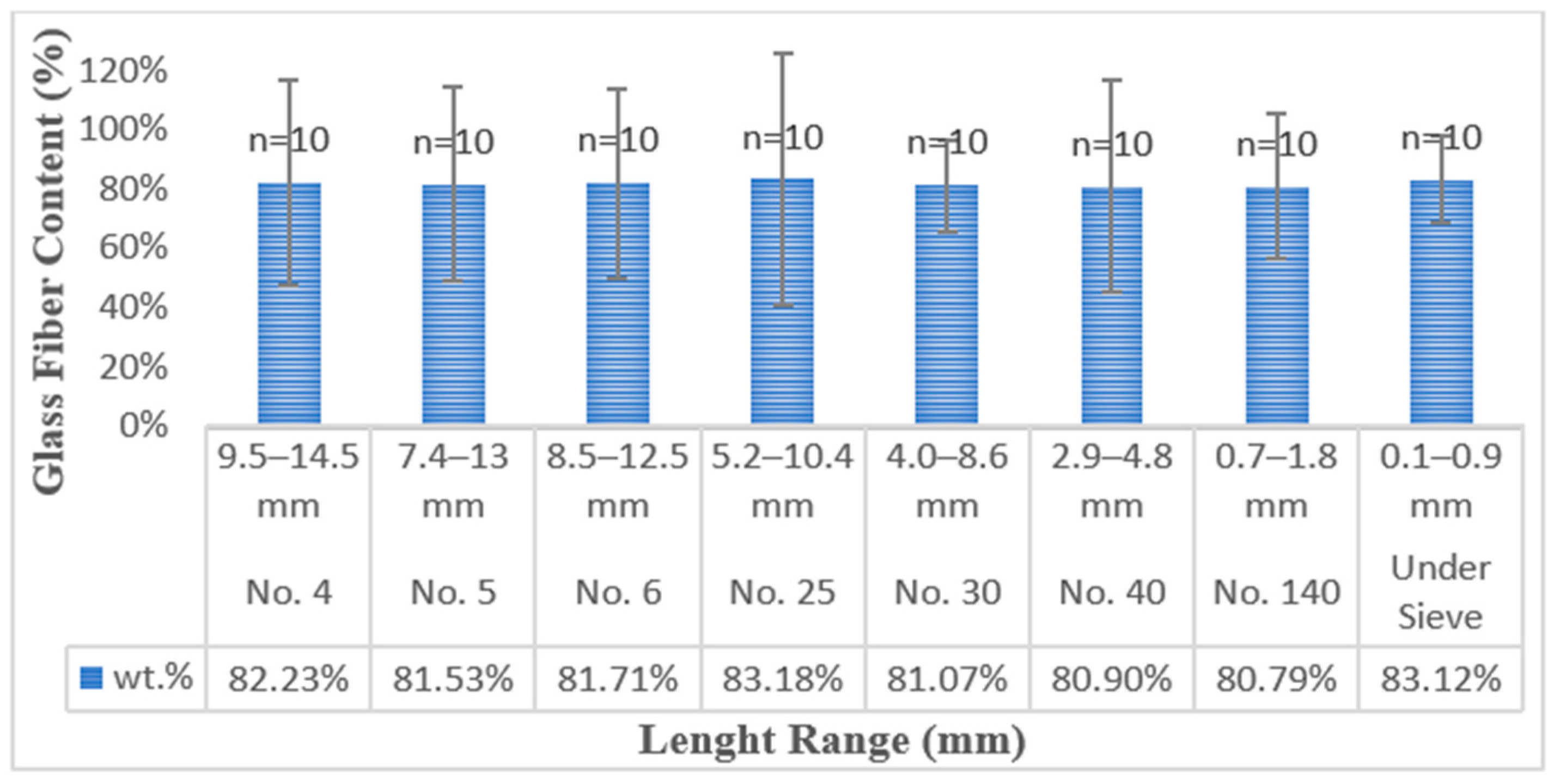
The inorganic content determined by burn-off analysis (Figure 5) shows that the recycled PS fillers maintain a consistently high glass-fiber fraction with only modest variation across sieve fractions. The overall average glass content is ≈81.82 wt.% (range: 80.79–83.18 wt.%). Individually, the glass contents are 82.23 wt.% (No. 4), 81.53 wt.% (No. 5), 81.71 wt.% (No. 6), 83.18 wt.% (No. 25), 81.07 wt.% (No. 30), 80.90 wt.% (No. 40), 80.79 wt.% (No. 140), and 83.12 wt.% (under-sieve) (n = 10 per fraction). Notably, the distribution is not strictly monotonic with particle size: local maxima appear at No. 25 and under-sieve, while the lowest values occur around No. 40–No. 140. These patterns likely reflect fraction-specific partitioning of resin residues and fine glass particulates during mechanical shredding and sieving, rather than a simple coarse-to-fine trend.
These quantitative findings confirm that the mechanically recycled PS materials retain a substantial glass-fiber fraction and a broad yet fiber-dominated dimensional distribution. The presence of elongated macro-fibers (>4 mm) ensures the preservation of reinforcing capability, whereas the fine resin-rich particulates contribute to matrix compatibility through potential wetting and interphase formation. Overall, the combined results from particle-size classification, dimensional measurements, and glass-fiber content analysis establish a comprehensive morphological profile of the PS fillers and form the basis for evaluating their reinforcing performance in the PWCs [43,44].

3.2. Assessment of Recycled Polyester-Glass Fiber Filled Thermoplastic Composites (PWCs)

The quantitative glass fiber contents of the polyester–glass fiber filled thermoplastic composites (PWCs) are summarized in Table 3. The burn-off analyses were conducted with ten replicates per composition (n = 10) to ensure statistical robustness. The results confirm a direct correlation between filler ratio and retained glass-fiber fraction in both LDPE and HDPE matrices. For the LDPE-based series (PL), the measured glass-fiber contents increased from 8.52 ± 0.42 wt.% in PL1 (10 wt.% filler) to 40.11 ± 0.77 wt.% in PL5 (50 wt.% filler). Similarly, the HDPE-based series (PH) exhibited an increase from 8.64 ± 0.65 wt.% in PH1 to 41.16 ± 1.03 wt.% in PH5. The small but consistent rise in standard deviation with increasing filler content indicates greater microstructural heterogeneity at high filler loadings. Slightly higher deviations in the HDPE series are attributed to its higher melt viscosity, which may induce localized fiber aggregation during extrusion [45,46].
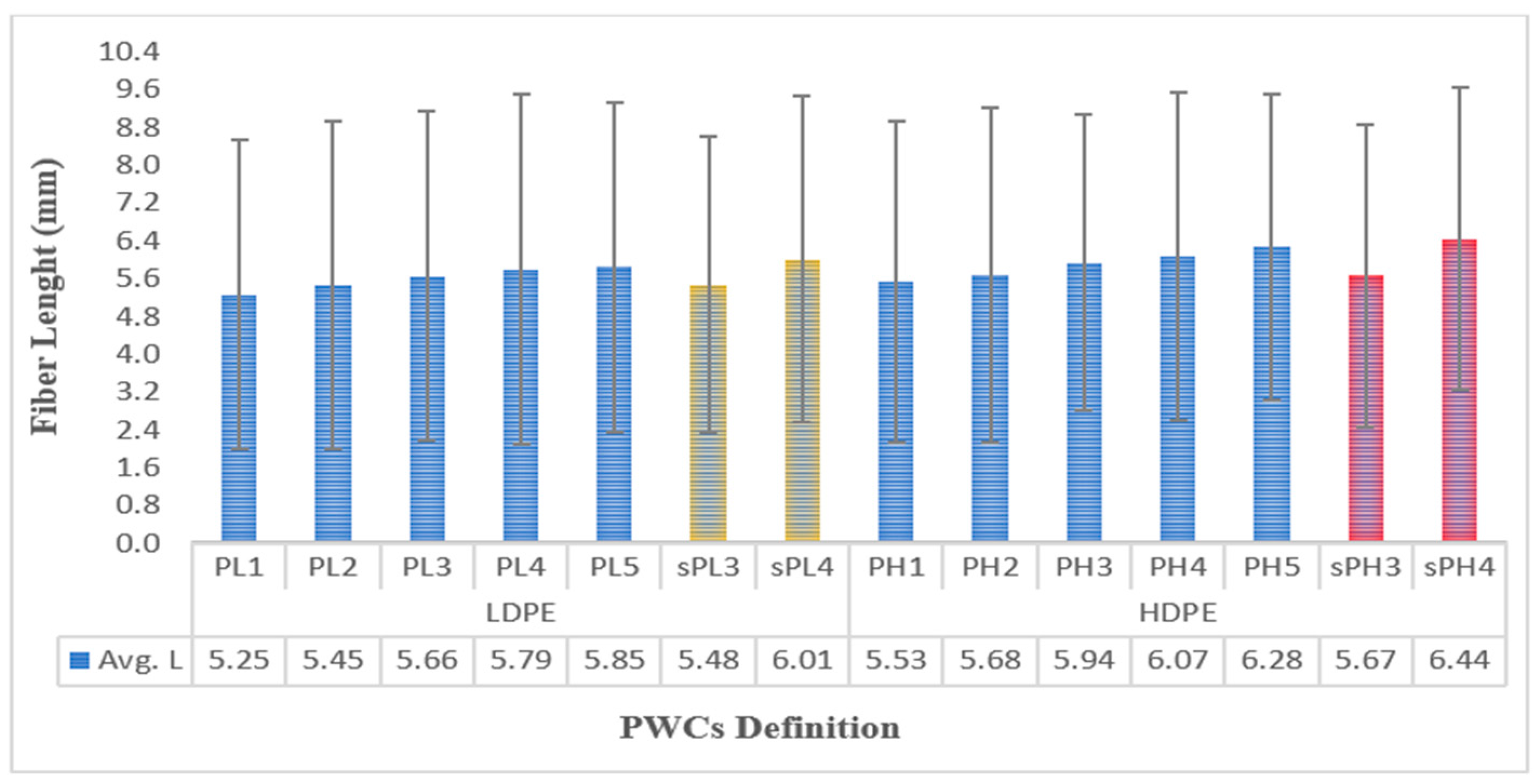
The average post-processing fiber lengths obtained from Figure 6 reveal a consistent size hierarchy governed by matrix viscosity and filler–matrix interaction [47]. LDPE-based composites exhibited mean fiber lengths between 5.25 mm (PL1) and 5.85 mm (PL5), whereas HDPE-based composites ranged from 5.53 mm (PH1) to 6.4428 mm (PH5). The higher viscosity and mechanical stiffness of HDPE limited shear-induced fiber attrition during melt blending, enabling slightly greater length retention compared with LDPE. This behavior is consistent with the fiber–matrix friction model, where viscous drag and restricted local flow reduce the frequency of fiber–fiber collisions and subsequent breakage [48,49].
The influence of surface modification is clearly observable when comparing the surface-treated composites (sPL3, sPL4, sPH3, sPH4) with their untreated counterparts. The treated specimens exhibited average fiber lengths 0.20–0.40 mm longer than the corresponding unmodified composites. For example, the mean fiber length increased from 5.79 mm (PL4) to 6.01 mm (sPL4) and from 6.07 mm (PH4) to 6.44 mm (sPH4), whereas a slight decrease was observed for PL3 (5.66 mm → 5.48 mm) and PH3 (5.94 mm → 5.67 mm). These variations indicate that the effectiveness of the acid-based surface treatment depends on the filler concentration and matrix viscosity. Statistical analysis showed narrower standard deviations in the surface-treated groups (typically σ ≈ 0.25–0.30 mm) compared to untreated composites (σ ≈ 0.35–0.40 mm), confirming a more uniform fiber length distribution. This improvement is attributed to enhanced interfacial adhesion between the acid-activated PS filler surfaces and the polyethylene matrices, which reduces local shear slippage and fiber micro-cutting during extrusion. The reduced scatter supports that surface modification promotes more uniform stress transfer and mitigates random fiber attrition under melt-mixing conditions.
Overall, the combined quantitative and statistical analyses confirm that (i) filler concentration primarily determines the inorganic fraction, (ii) matrix rheology governs fiber attrition behavior, and (iii) surface modification enhances dimensional stability and homogeneity. These interrelated parameters define the microstructural quality of PWCs and directly influence their subsequent mechanical performance [50,51].
Table 4 summarizes the density values of untreated and surface-modified PWCs. A consistent increase in density is observed with rising PS content in both LDPE-based (PL) and HDPE-based (PH) composites. In the PL series, density increases from 0.95 g/cm3 (PL1) to 1.20 g/cm3 (PL5), while the PH series shows a similar trend, rising from 0.99 g/cm3 (PH1) to 1.23 g/cm3 (PH5). This monotonic behavior corresponds to the significantly higher intrinsic density of polyester–glass scrap compared with polyolefin matrices.
Surface-modified formulations (sPL and sPH) exhibit density values comparable to their untreated counterparts at equivalent loadings. In principle, improved interfacial adhesion between the activated PS surface and the polymer matrix is expected to reduce micro void formation and thereby promote higher effective density [31,51]. The minor density variations observed in the surface-modified composites are therefore attributed to microstructural heterogeneity and experimental scatter inherent to mechanically recycled filler systems, rather than a direct consequence of improved interfacial bonding. The progressive increase in standard deviation at higher filler ratios indicates greater microstructural heterogeneity, likely caused by agglomeration and the broad particle-size distribution characteristic of mechanically recycled PS.
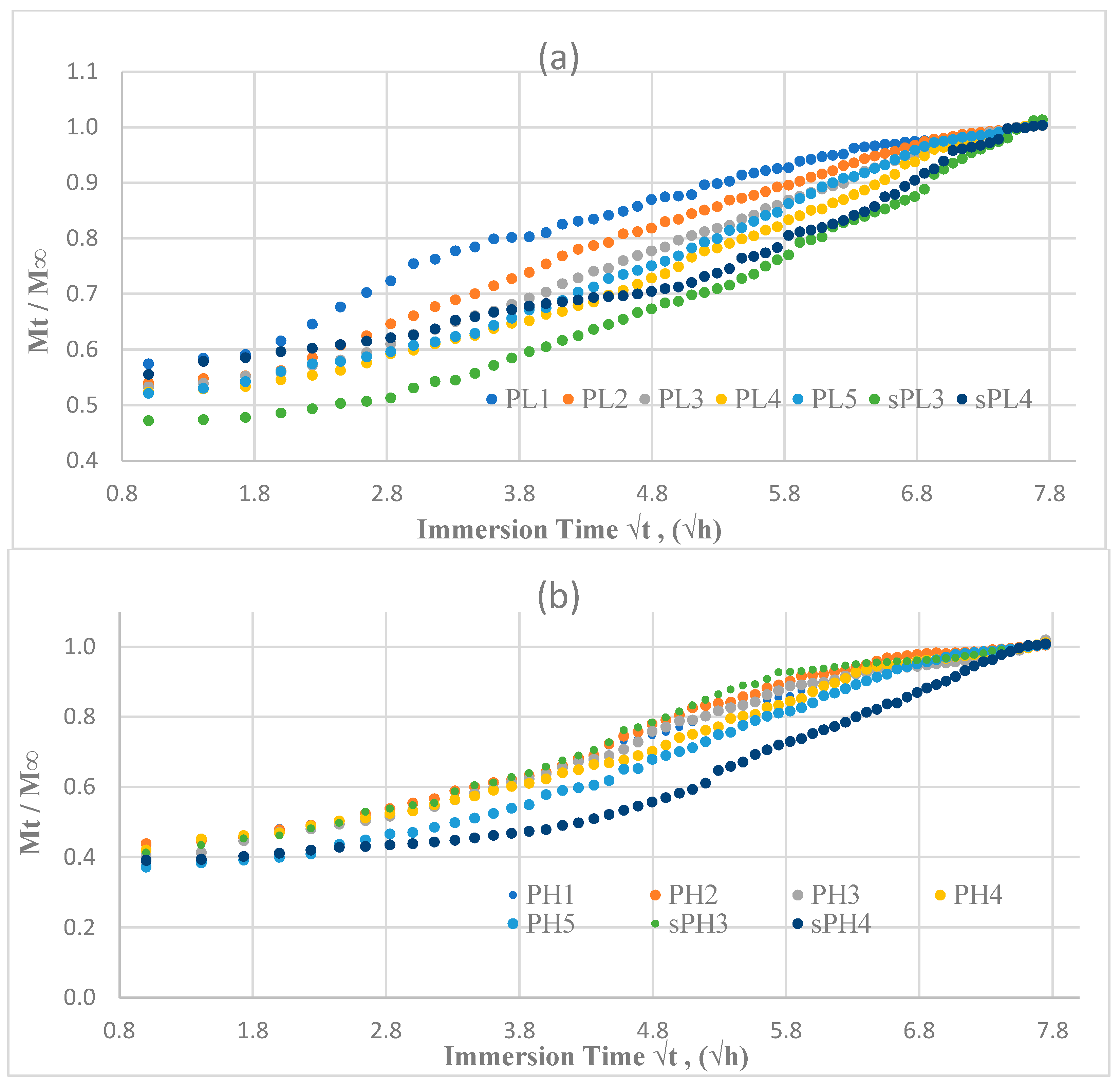
Moisture absorption of the PWC systems was evaluated following ASTM D5229 procedures, using deionized water (≤1 µS/cm) at 23 ± 2 °C. All samples were cleaned, dried to constant mass, and weighed with 0.1 mg resolution before immersion. Moisture uptake in polymer composites commonly results from matrix swelling, water transport through microvoids, and partial chain plasticization [52,53]. In PWCs, the heterogeneous morphology of PS recyclate—comprising fiber bundles, fragmented strands, and resin-rich particulates—introduces capillary pathways that locally increase permeability. While glass fibers themselves hinder diffusion, the presence of irregular PS clusters and voids reduces tortuosity and facilitates water ingress. Both PL and PH systems exhibit a rapid initial uptake followed by a gradual approach to saturation, characteristic of Fickian diffusion.
Low-filler composites (PL1–PL2 and PH1–PH2) show lower equilibrium moisture levels due to the hydrophobic nature of LDPE and HDPE. In contrast, high-filler materials (PL4–PL5 and PH4–PH5) display slower normalized moisture uptake behavior in Figure 7, consistent with increased tortuosity and restricted transport pathways in highly filled systems. It should be noted that Figure 7 presents normalized uptake curves (Mt/M versus √t), which primarily reflect sorption kinetics rather than absolute moisture absorption capacity. The equilibrium moisture content (M) is therefore more appropriately inferred from the gravimetric mass changes reported in Table 5.
Accordingly, the present results indicate that increasing PS content primarily influences moisture uptake kinetics rather than significantly increasing the equilibrium absorption capacity, which remains relatively limited due to the hydrophobic nature of the LDPE and HDPE matrices. Surface-modified samples (sPL3, sPL4, sPH3, sPH4) demonstrate lower moisture uptake rates, indicating that acid activation improves matrix–filler interfacial bonding and suppresses diffusion pathways—a behavior widely reported in filled polymer systems [54,55].
Collectively, these observations highlight the dominant role of PS content, void morphology, and interfacial quality in determining long-term moisture behavior. Optical microscopy and SEM analyses presented in Figure 8, Figure 9, Figure 10, Figure 11, Figure 12 and Figure 13 show that increasing PS content leads to a higher occurrence of resin-deficient regions, irregular voids, and locally agglomerated PS clusters, which can act as preferential pathways for moisture transport. PWCs containing low-to-moderate filler fractions (≤20–30 wt.%) exhibit more stable performance due to reduced permeability pathways and improved matrix integrity. In addition, SEM observations of surface-modified composites indicate reduced interfacial gaps and improved matrix wetting compared to untreated systems, suggesting more effective interfacial contact. Such microstructural features are consistent with restricted diffusion pathways, as commonly reported for filled polymer composites in the literature [54,55].
Here, M t denotes the moisture uptake at immersion time t , while M represents the equilibrium moisture content determined at saturation. According to ASTM D5229, normalized uptake curves ( M t / M ) are used to evaluate diffusion kinetics independent of absolute absorption capacity. Figure 7a,b shows that all PL and PH composites exhibit monotonic mass gain followed by a distinct saturation region. High-filler formulations (PL4–PL5 and PH4–PH5) reach equilibrium more quickly, consistent with a greater abundance of micro voids and capillary channels produced by fragmented PS bundles. In contrast, low-filler composites show slight early-stage fluctuations, likely due to localized filler agglomeration and the inherently broad dimensional distribution of recycled PS. Mid-range compositions (PL3 and PH3) demonstrate intermediate behavior, achieving saturation within the observation window.
The diffusion parameters calculated from Fickian analysis are presented in Table 5. The diffusion coefficients (D) range from 0.41 × 10⁻¹³ to 2.14 × 10⁻¹³ m2/s, which is consistent with reported values for polymeric materials (typically ~10−13 m2/s) [56]. Most formulations show strong linearity (R2 ≥ 0.95) in Mt/M versus √t plots, confirming that classical Fickian diffusion accurately describes early-stage transport. Slight deviations (R2 < 0.90) observed for a few materials suggest limited non-Fickian contributions due to heterogeneity, filler–matrix interfacial effects, or microvoids—patterns commonly observed in highly filled or natural fiber composites [57].
Notably, sPL4 exhibits the lowest diffusion coefficient (~0.41 × 10⁻¹³ m2/s), indicating that surface modification enhances interfacial bonding and effectively restricts water penetration. These results validate the use of gravimetric analysis for characterizing diffusion in PWC systems, while also indicating that more advanced models (dual-stage, Langmuir-type, or relaxation-coupled diffusion) may be required for highly heterogeneous or high-filler composites [53,54,55].
From a thermal processing perspective, the influence of recycled polyester–glass fiber fillers on the thermal behavior of LDPE- and HDPE-based composites has been previously examined in detail. In a related study by Hasan et al. [58], thermogravimetric analysis (TGA) and differential scanning calorimetry (DSC) results showed that the incorporation of mechanically recycled thermoset glass-fiber fillers into LDPE and HDPE matrices does not significantly alter the melting behavior of the polyolefin phases and leads only to marginal shifts in the onset of thermal degradation. These findings indicate that the primary processing window of polyolefin-based PWCs remains governed by the melting characteristics of the matrix, while the recycled fillers mainly influence interfacial interactions and mechanical performance rather than thermal stability. Accordingly, the extrusion and compression-molding temperatures employed in the present study fall well within established thermal safety margins for both the polymer matrices and the recycled filler constituents.

3.3. Morphological and Interfacial Characterization of PWCs

3.3.1. Optical Microstructural Analysis

Optical microstructural analysis was performed to evaluate the spatial distribution and phase morphology of recycled PS fiber bundles, fragmented fibers, and resin-rich particulates within the PWC matrices. Fracture surfaces obtained after tensile testing of both untreated (PL and PH series) and surface-modified composites (sPL3, sPL4; sPH3, sPH4) were examined to assess the effects of filler loading and surface modification on dispersion quality and interfacial interactions.
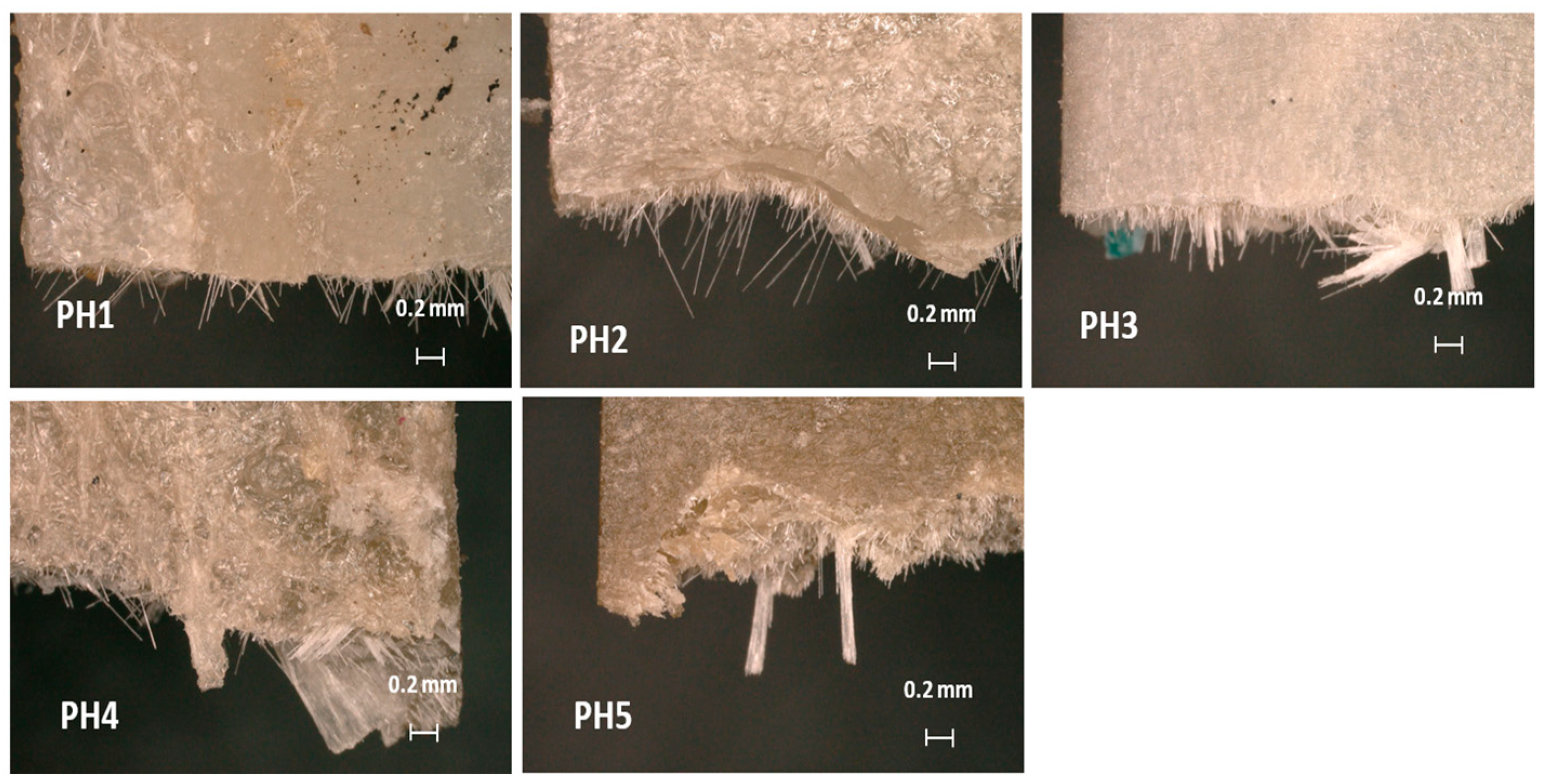
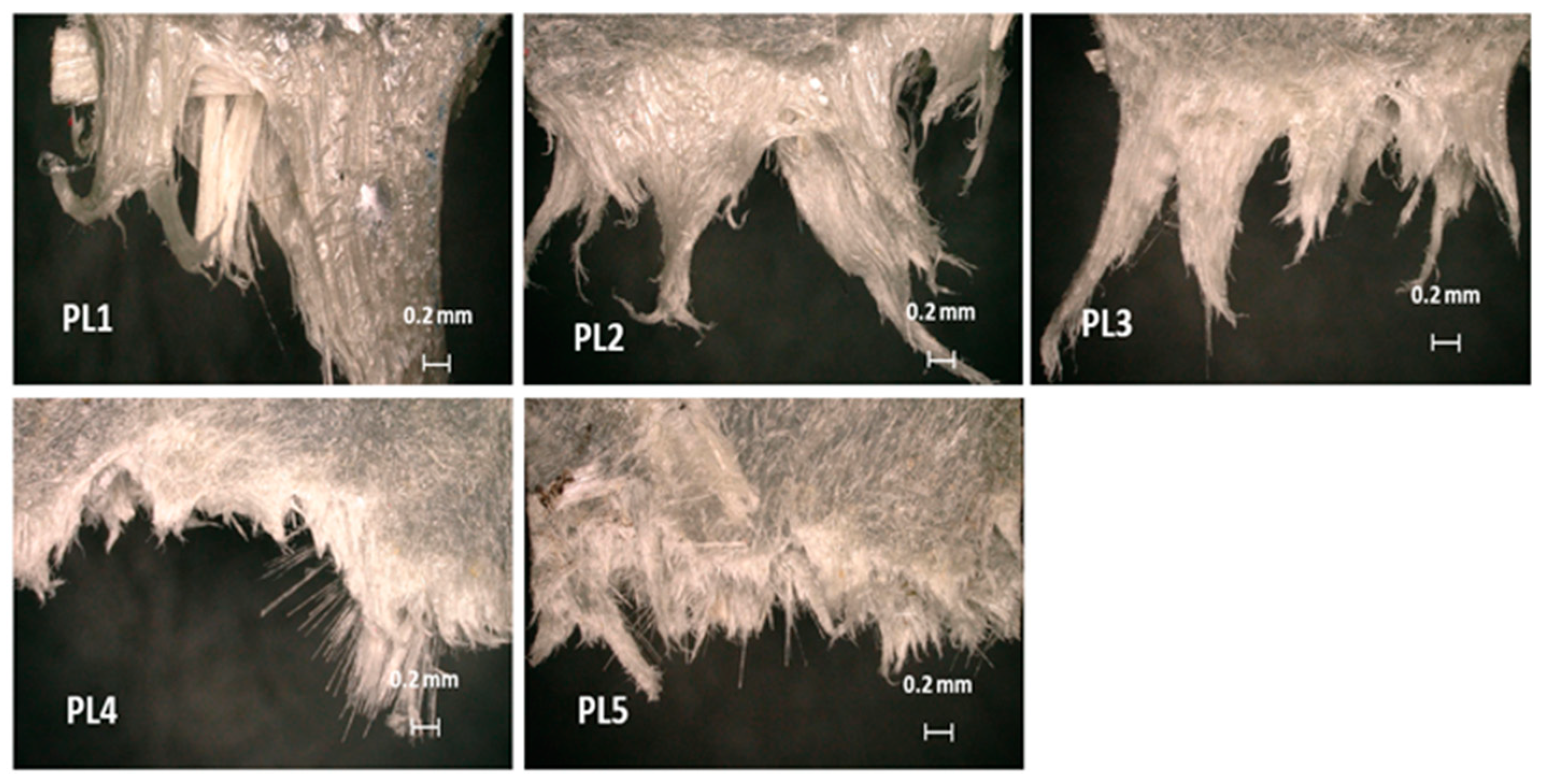
Microscopic examinations of the fracture surfaces of LDPE-based PL series composites after tensile testing (Figure 8) reveal a pronounced morphological evolution with increasing PS filler content. In PL1 (10 wt.% PS), matrix continuity dominates, and PS-derived glass fiber bundles show limited dispersion due to their low volume fraction. The presence of long fiber pull-out tracks indicates weak interfacial shear transfer and insufficient matrix wetting, consistent with prior observations on recycled polystyrene-based composites [59]. In PL2–PL3 (20–30 wt.% PS), more frequent debonding regions and matrix-tearing zones emerge under tensile loading, while partially separated fiber bundles form semi-continuous reinforcement domains within the matrix—signaling a transition from a matrix-dominated load-transfer regime to a fiber-assisted hybrid regime. In PL4 (40 wt.% PS), matrix continuity is substantially reduced, and the fiber bundles begin to serve as the primary load-bearing network. Vertically protruding fiber ends on the fracture surface reflect increased anisotropy and orientation-controlled fracture modes. In the highest-filler PL5 sample (50 wt.% PS), the fiber phase forms an almost fully interconnected three-dimensional skeleton, with the LDPE matrix appearing only as a thin binding layer. The high fiber–fiber contact density and bundle coherence result in a highly heterogeneous, fiber-dominant fracture topography, in line with previous findings on fiber-rich recycled composite systems [60]. This elevated fiber content promotes local stress concentrations, interfacial decohesion, and multiscale pull-out mechanisms during tensile loading, directly correlating with the observed increase in stiffness, reduction in ductility, and transition toward a more brittle failure mode.
Microscopic examinations of the tensile-fractured surfaces of HDPE-based PH series composites (Figure 9) reveal a pronounced microstructural transition with increasing PS filler content. In PH1 (10 wt.% PS), the high crystallinity of HDPE promotes strong matrix continuity, with only a limited number of fibers protruding at the surface. The presence of short, shallow pull-out traces and well-wetted fiber surfaces indicates relatively stronger interfacial adhesion at low filler levels compared to LDPE-based systems, as supported by SEM-based fiber orientation studies [27]. In PH2 (20 wt.% PS), the number of exposed fibers increases, more distinct micro-debonding zones form within the matrix, and fiber–matrix separation becomes evident under tensile loading. This morphology aligns with the observed increase in elastic modulus and slight reduction in ductility. PH3 (30 wt.% PS) exhibits a complex fracture topography involving both long pull-out and partial fiber breakage, with fiber bundles appearing more uniformly dispersed within the matrix—suggesting a transition from a matrix-dominated load-transfer regime to a fiber-assisted hybrid regime.
In PH4 (40 wt.% PS), the HDPE matrix phase becomes noticeably thinner, the fracture surface becomes fiber-rich, and highly oriented fiber clusters introduce significant anisotropy. Dense fiber–fiber contacts and multiple crack-branching events indicate elevated interfacial stress concentrations and a more fiber-dominant fracture mechanism. At the highest filler level (PH5, 50 wt.% PS), the PS-derived fiber phase forms an almost fully interconnected three-dimensional skeleton, with the HDPE matrix reduced to a thin binding layer. Long fiber bundles protruding from the surface and extensive pull-out regions reveal pronounced decohesion during failure. This highly heterogeneous microstructure, driven by elevated filler loading, results in a markedly more brittle fracture behavior, where load is carried predominantly by the fiber network—fully consistent with the macroscale mechanical response characterized by increased elastic modulus, reduced strain-to-failure, and a sharper failure point [60].
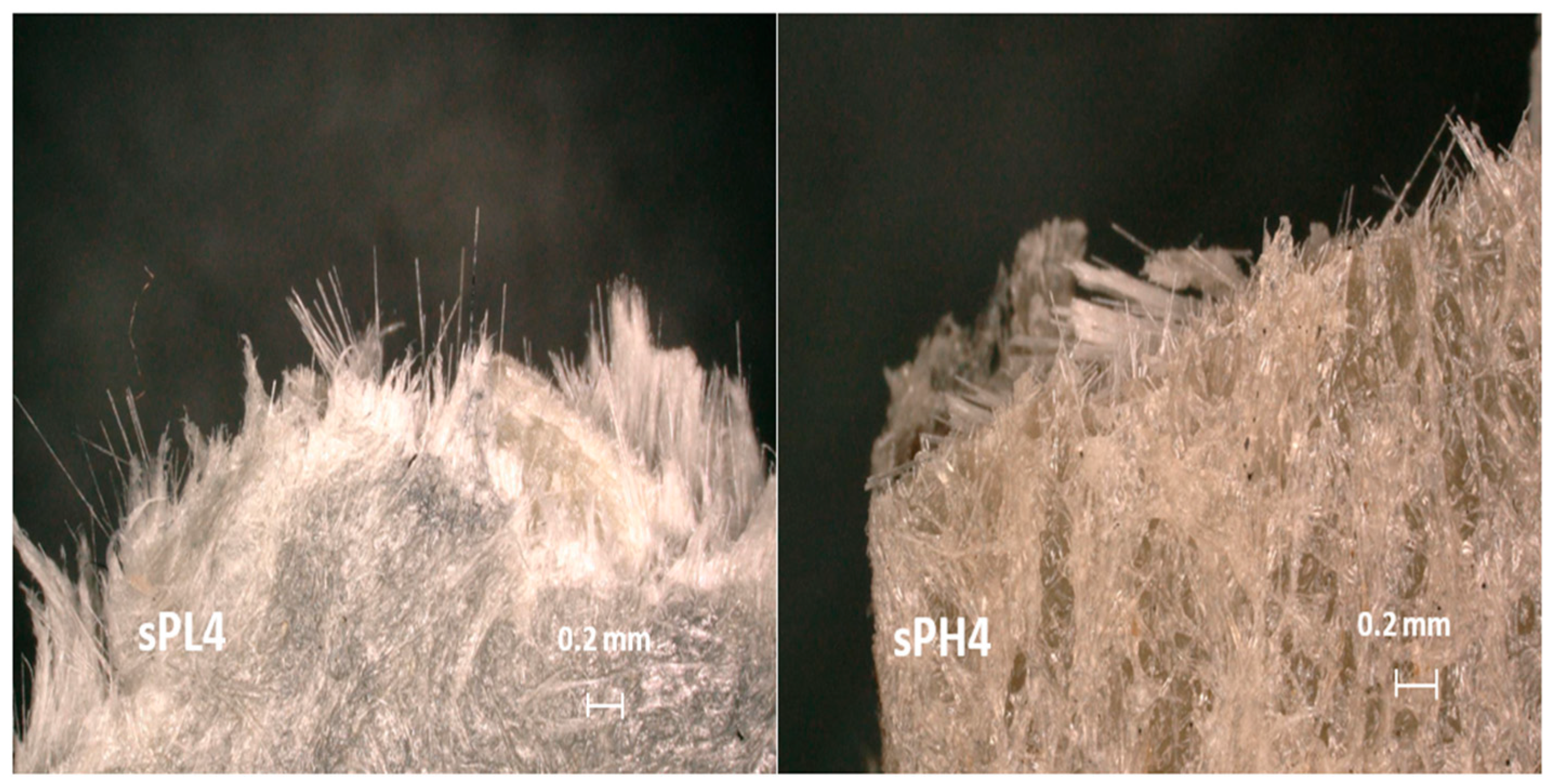
Surface-modified composites (sPL4 and sPH4) exhibit improved fiber–matrix wetting after tensile failure, as indicated by the more embedded fiber bundles and reduced matrix tearing compared to untreated counterparts. Nevertheless, the presence of localized pull-out regions and partial bundle decohesion shows that the modification enhances interfacial adhesion but does not fully eliminate anisotropy or stress concentrations at high PS loadings, which aligns with silane-based surface treatment studies [61]. These morphological differences are clearly illustrated in Figure 10, where sPH4 shows a denser matrix with embedded fibers, while sPL4 exhibits elongated pull-out paths and reduced tearing. HDPE-based sPH4 displays a more compact matrix phase, whereas LDPE-based sPL4 reveals longer pull-out traces, reflecting the inherent ductility differences between the matrices [62].
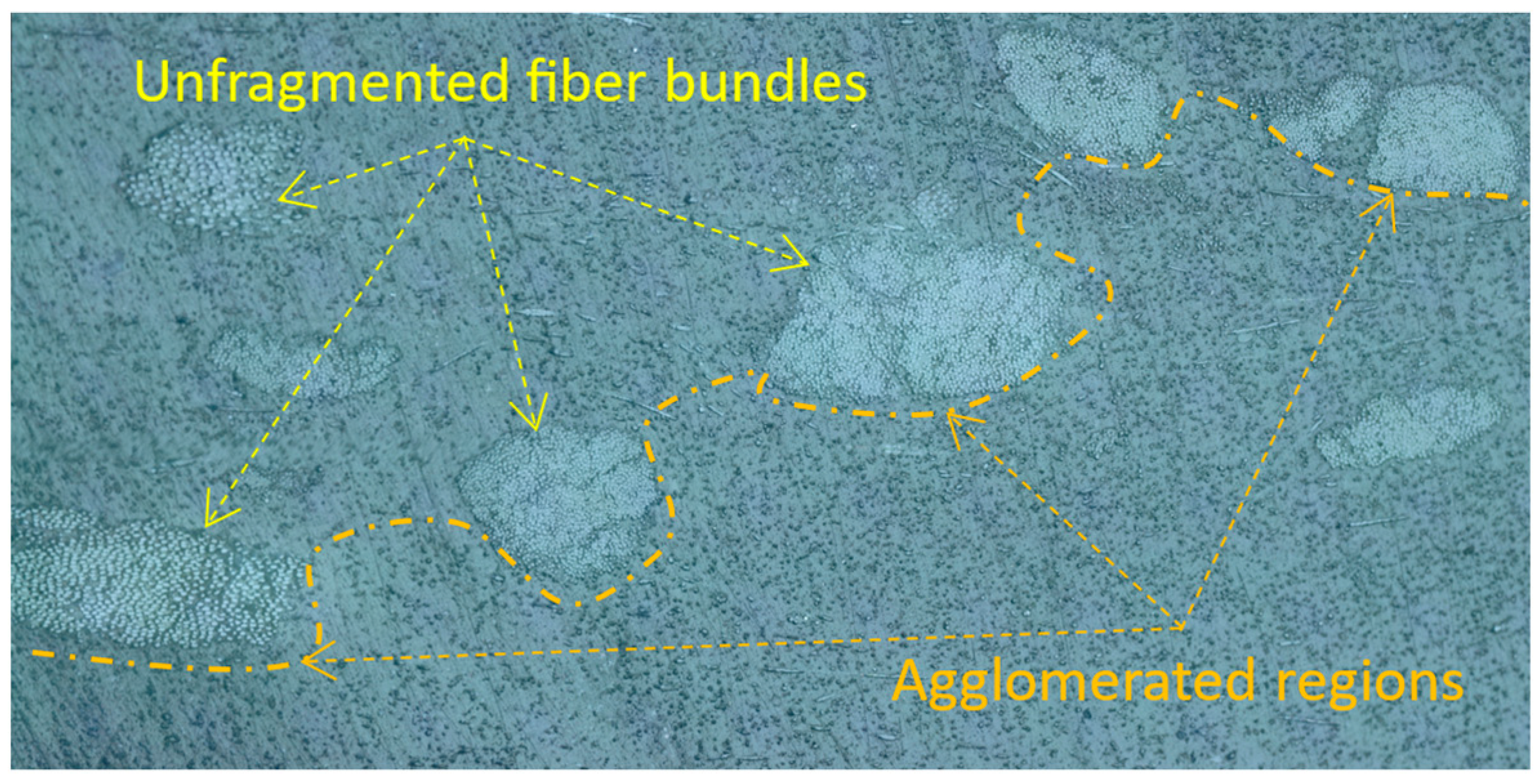
Across all composite formulations, the recycled PS fillers produced a distinctly heterogeneous microstructure characterized by irregularly dispersed fiber bundles, partially separated strands, and resin-rich particulates embedded within the polyethylene matrix. Increasing the filler content—particularly beyond 30 wt.%—intensified microstructural anisotropy, leading to more frequent agglomerated regions, incomplete bundle disintegration, and interconnected micro void networks.
As illustrated in Figure 11 for the PL5 specimen, the internal architecture becomes dominated by a highly dense and continuous fiber network, accompanied by void clusters and localized interfacial discontinuities. These features generate localized interfacial stress concentrations and reduce the uniformity of load-transfer pathways, reflecting the intrinsic variability of mechanically reclaimed thermoset scraps and their limited compatibility with polyolefin matrices [58].

3.3.2. Scanning Electron Microscopy (SEM) Analysis

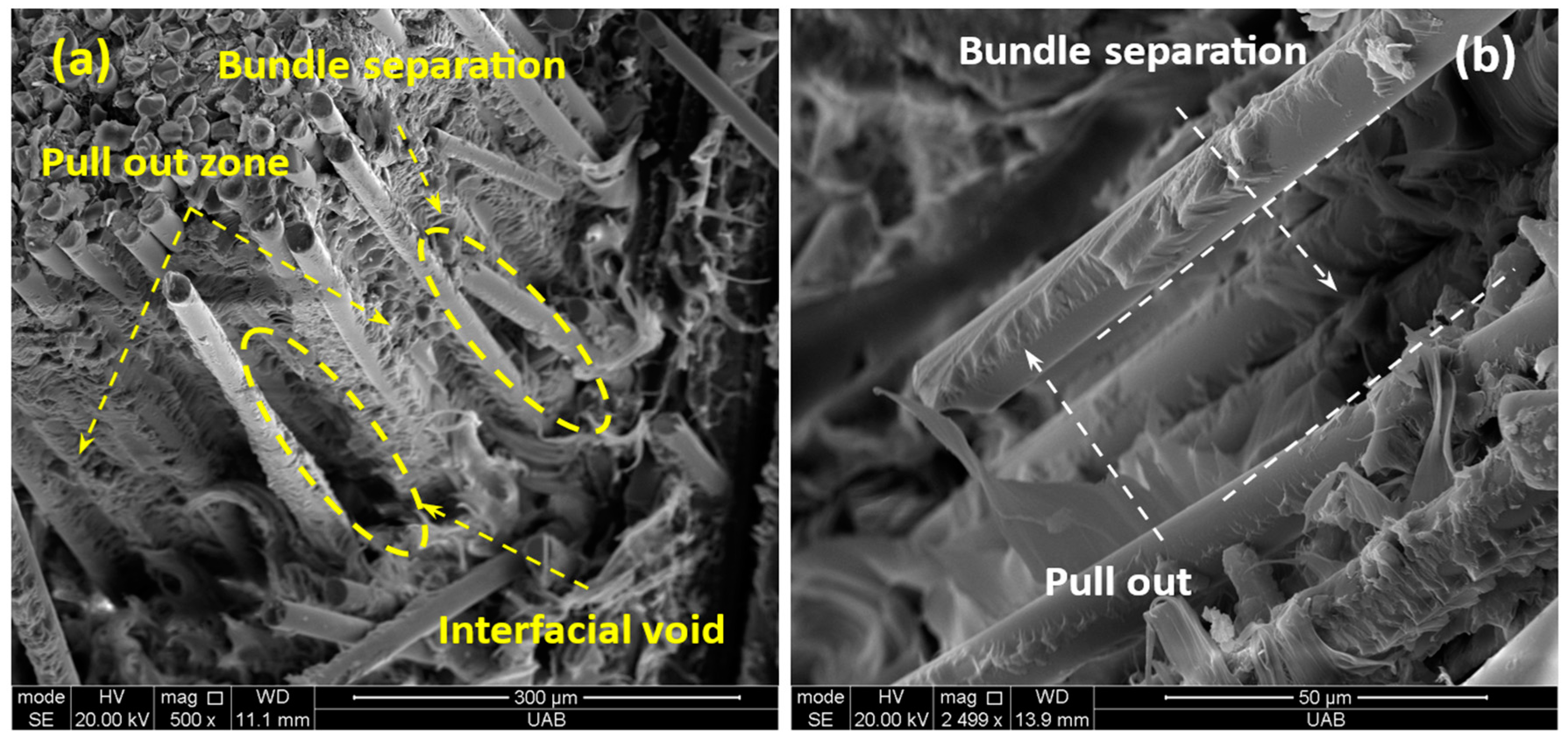
SEM micrographs of the tensile-fractured surfaces of PL4 and sPL4 composites are presented in Figure 12. These micrographs reveal critical features governing the fracture mechanisms, including fiber orientation, bundle fragmentation, and the dispersion state of recycled PS fillers within the LDPE- and HDPE-based matrices. It should be noted that Figure 12 provides representative fracture morphologies for a single filler condition (PL4 and sPL4) and does not constitute a systematic comparison across different filler ratios. Clear signatures of interfacial shear failure, fiber–matrix debonding, and mixed cohesive–adhesive fracture modes are observed for these specific formulations. In particular, the presence of extended fiber pull-out regions, crack-bridging ligaments, and locally accumulated micro voids in PL4 and sPL4 composites reflects the contribution of fiber-related mechanisms to fracture behavior under high filler loading. Accordingly, broader statements regarding the transition from matrix-controlled to fiber-dominated fracture with increasing PS content are supported by the combined evaluation of fracture features observed in Figure 8, Figure 9, Figure 10, Figure 11, Figure 12 and Figure 13 together with the corresponding mechanical trends, rather than by Figure 12 alone. The degree of bundle separation and the morphology of interfacial discontinuities illustrate how filler loading can influence stress-transfer pathways and anisotropic crack propagation in PWCs, consistent with SEM-based fiber orientation studies reported in the literature [27].
The SEM image of PL4 reveals a strongly fiber-dominated and heterogeneous fracture morphology. PS fiber bundles remain partially intact, with limited bundle separation and numerous interfacial gaps and micro void clusters at the fiber–matrix boundary. Many fibers exhibit long and clean pull-out traces, indicating predominantly adhesive interfacial failure and insufficient interfacial shear transfer from the LDPE matrix to the PS fibers, as similarly observed in silane-untreated recycled fiber composites [63]. The scarcity of matrix remnants on fiber surfaces suggests weak wetting and discontinuous load-transfer pathways, consistent with the reduced ductility and increased brittleness observed at higher filler contents.
In contrast, the SEM image of sPL4 shows a more cohesive and better integrated microstructure. Surface-modified PS fillers display improved wetting, with fibers partially coated by polymer films and shorter, more irregular pull-out features. This indicates a shift toward mixed adhesive–cohesive failure, reflecting enhanced interfacial adhesion and increased interfacial shear resistance, as also reported in silane-modified recycled fiber systems [60]. The lower prevalence of voids and cleaner bundle separation points to improved dispersion and reduced interfacial discontinuities. These microstructural characteristics align with the reduced diffusion coefficient (D ≈ 0.41 × 10⁻¹³ m2/s) and the mechanically more stable response of sPL4, demonstrating that surface modification promotes more efficient stress transfer and mitigates stress concentration effects under tensile loading.
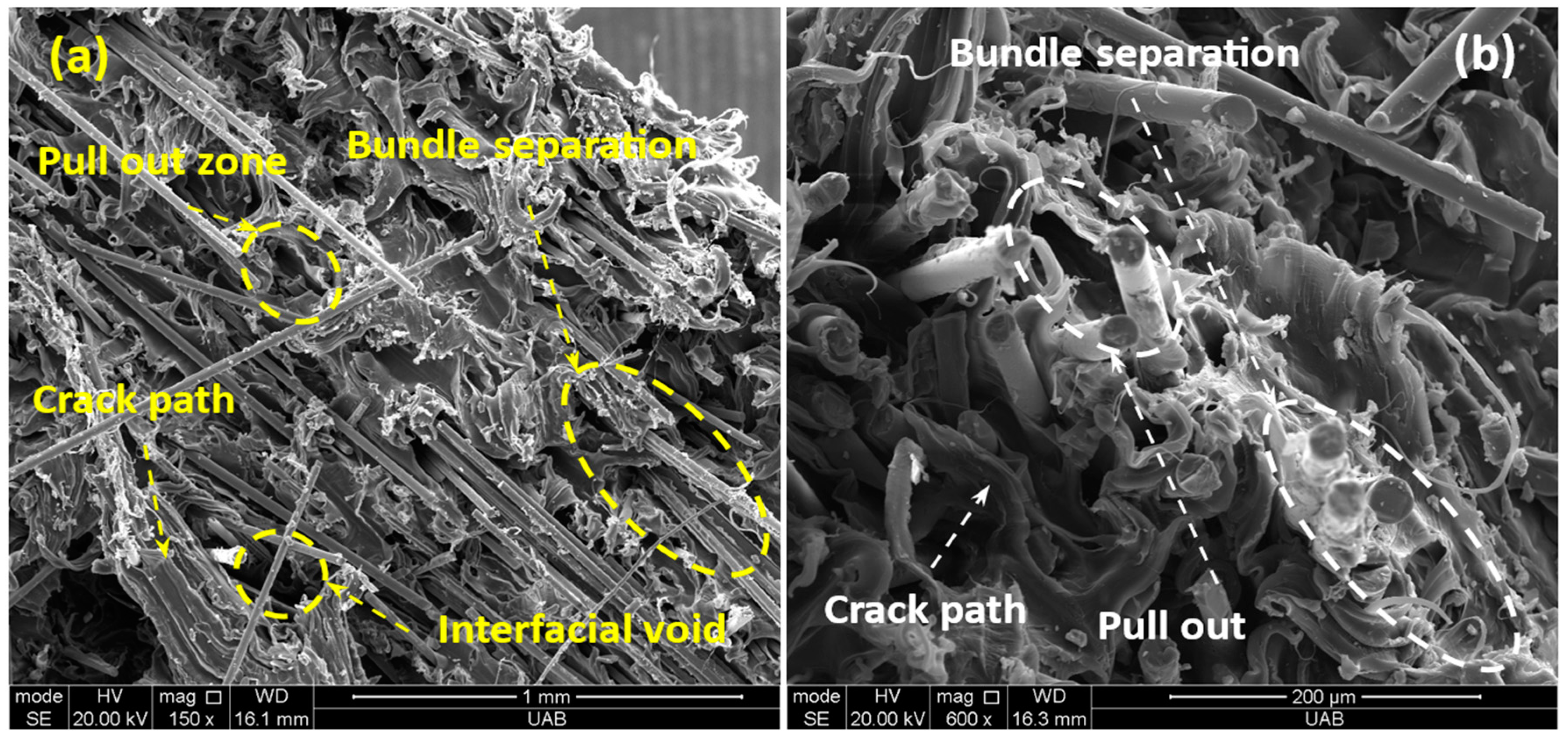
Figure 13 presents SEM micrographs of the tensile-fractured surfaces of PH4 and sPH4 PWCs. In the untreated PH4 specimen, the fracture morphology is dominated by extensive fiber pull-out, incomplete bundle separation, and interfacial void networks, indicating predominantly adhesive interfacial failure and inefficient interfacial shear transfer. The presence of long, continuous crack paths reflect anisotropic crack propagation driven by weak fiber–matrix bonding and stress concentrations around agglomerated PS bundles [59].
In contrast, the surface-modified sPH4 composite exhibits a more cohesive fracture morphology, with shorter pull-out lengths, better fiber wetting, and reduced interfacial discontinuities. Bundle separation zones are more uniformly dispersed, and crack propagation is locally deflected by improved fiber–matrix adhesion, suggesting a shift toward mixed adhesive–cohesive fracture modes. Overall, the microstructural evidence confirms that surface modification enhances interfacial shear resistance and suppresses large-scale debonding, resulting in a more stable and integrated fracture mechanism under tensile loading [64].

3.4. Mechanical Performance Evaluation of PWCs

3.4.1. Tensile Properties of PWCs

The tensile behavior of thermoplastic composites containing mechanically reclaimed thermoset scraps is governed by the interplay between matrix ductility, filler morphology, and the efficiency of interfacial stress transfer [65,66]. In PWC systems produced from LDPE and HDPE matrices, the recycled PS-based thermoset fragments consist of irregular fiber bundles, partially separated strands, and resin-rich particles that introduce heterogeneous reinforcement effects. Unlike conventional short-fiber composites, these fillers do not possess uniform geometry or controlled aspect ratio; therefore, their mechanical contribution depends strongly on their dispersion quality and the extent of fiber–matrix adhesion [67,68]. As the PWC filler content increases from 10% to 50%, the composite gradually transitions from a matrix-dominated deformation regime to a fiber-assisted load-bearing mechanism, making the evaluation of tensile properties essential for understanding structure–property relationships in these sustainably engineered materials [69]. The tensile behavior of PWCs was evaluated through stress–strain analyses performed on LDPE- and HDPE-based specimens. Figure 14, Figure 15, Figure 16 and Figure 17 collectively illustrate the influence of PS filler loading (10–50 wt.%) and surface modification (sPL3, sPL4; sPH3, sPH4) on the mechanical performance of the composites. The results confirm that filler content, filler morphology, matrix type, and interfacial adhesion are the primary factors governing the mechanical response of PWC materials [70,71].
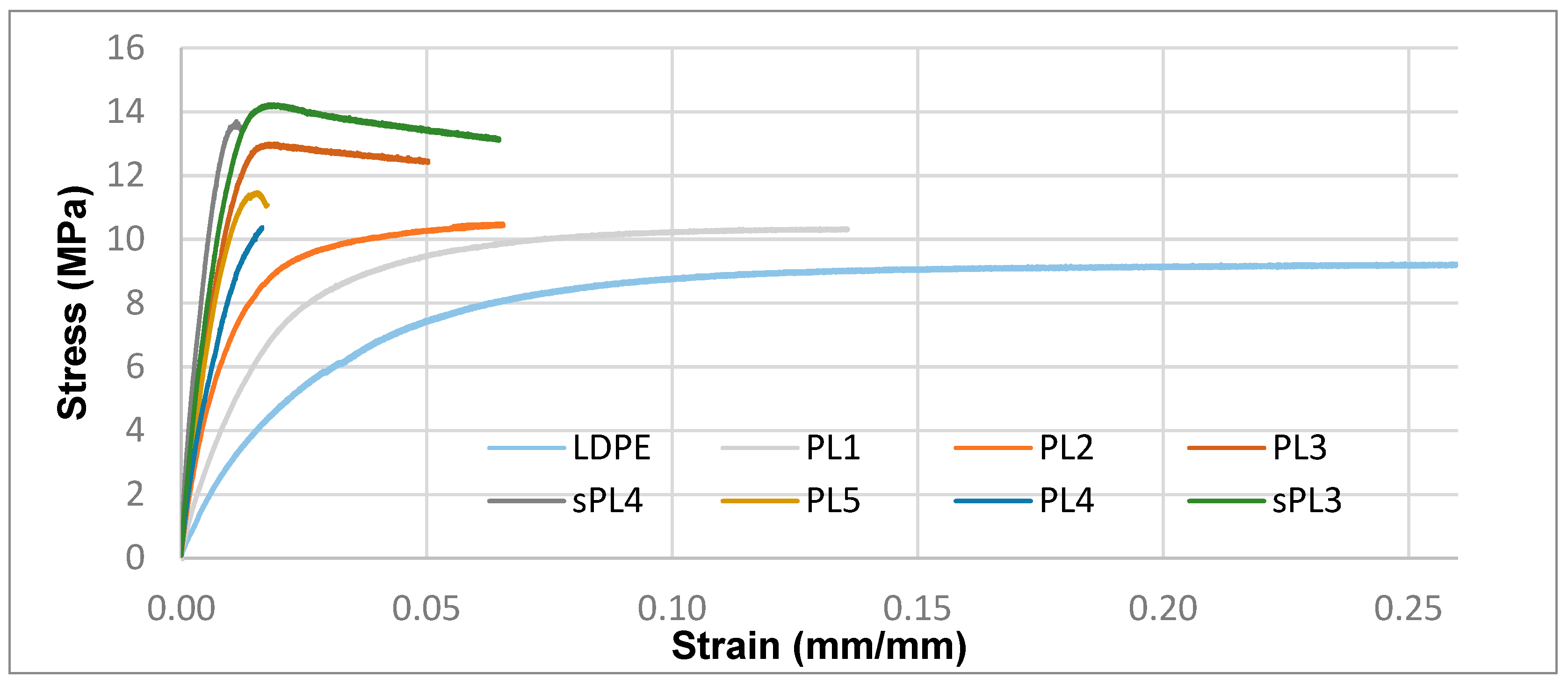
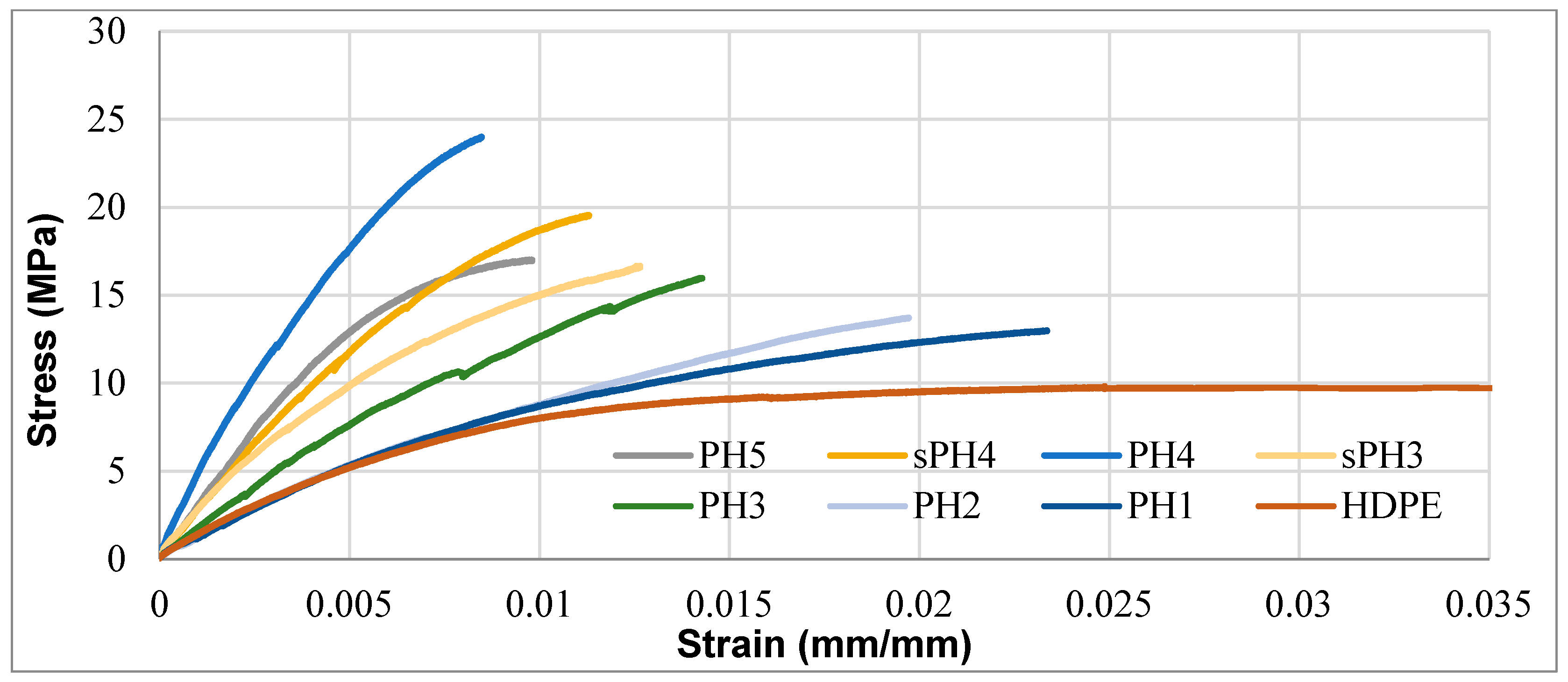
The tensile behavior of PWCs produced using LDPE and HDPE matrices exhibits a clear dependence on filler content, interfacial adhesion, and matrix crystallinity [72]. As shown in Figure 14, neat LDPE displays the characteristic ductile response of a low-crystallinity polyolefin, with extensive plastic deformation and a relatively shallow initial slope [39]. The incorporation of recycled PS fillers progressively restricts chain mobility, leading to a significant increase in stiffness and a corresponding reduction in ductility. The stress–strain curves of the LDPE composites transition from ductile (PL1–PL2) to semi-brittle behavior (PL4–PL5), with the steepening initial slope directly linked to the increasing contribution of rigid PS bundles to load transfer. Surface-modified systems (sPL3, sPL4) reach higher stress levels than their untreated counterparts, consistent with improved interfacial wetting and enhanced shear transfer across the fiber–matrix interface.
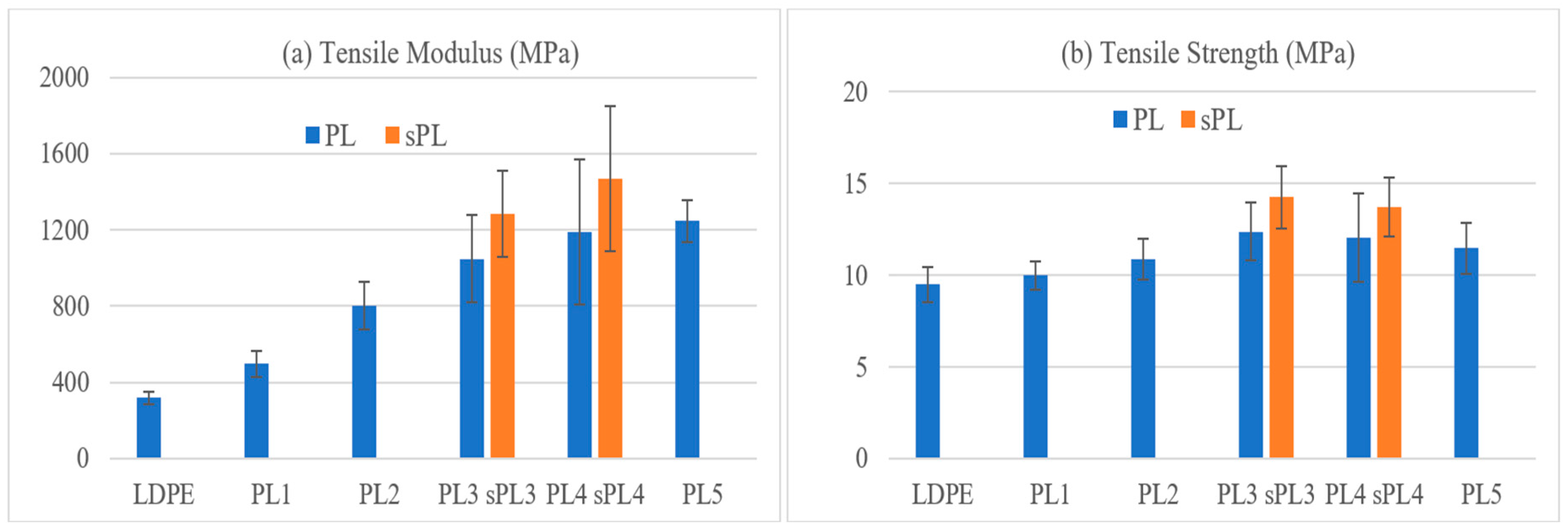
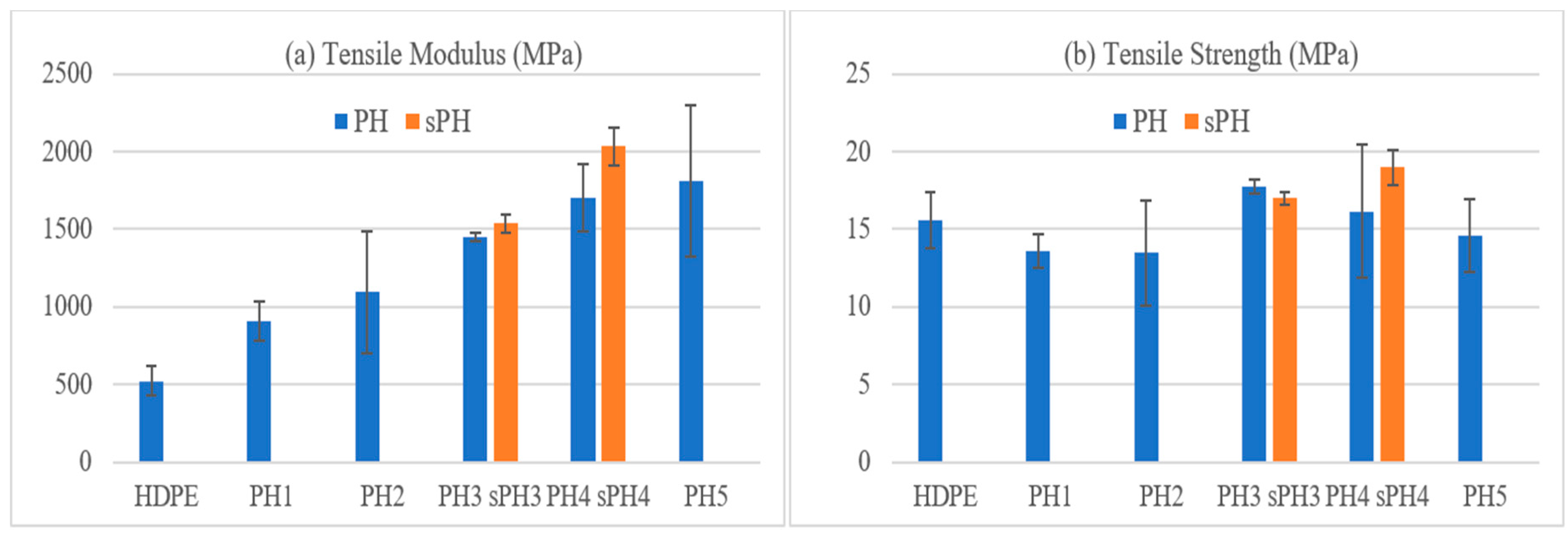
These trends are confirmed quantitatively in Figure 15. The tensile modulus increases monotonically across the PL series, reflecting both the inherent stiffness of the PS reinforcements and the microstructural evolution toward fiber-assisted deformation. Tensile strength also increases, particularly in the surface-modified composites, where improved interfacial adhesion reduces premature debonding and promotes more effective stress redistribution. The reduction in strain-to-failure with increasing filler content aligns with SEM evidence of micro void formation, bundle separation, and localized crack initiation zones observed in high-filler LDPE composites.
A comparable yet more pronounced behavior is observed in the HDPE-based series (Figure 16). The higher crystallinity and intrinsic stiffness of HDPE result in steeper stress–strain curves and lower baseline ductility relative to LDPE. With increasing PWC content, HDPE composites rapidly transition into fiber-dominated deformation regimes. At moderate filler levels (PH2–PH3), the modulus increases substantially while limited ductility is retained; however, at high loadings (PH4–PH5), the deformation becomes dominated by brittle mechanisms such as interfacial decohesion and guided crack propagation along PS bundle networks. Surface-modified HDPE composites (sPH3, sPH4) consistently achieve higher tensile stresses than untreated PH systems, demonstrating that enhanced fiber–matrix bonding suppresses early debonding and supports more uniform load transfer [73,74].
Figure 17 reinforces these observations: both modulus and strength increase with filler content, with HDPE/PWCs showing a steeper modulus enhancement than LDPE/PWC systems. This stronger stiffening effect reflects the higher load-bearing efficiency achieved when rigid fillers are embedded within a more crystalline and less compliant matrix. Strength improvements taper off at high filler loadings due to the onset of brittle fracture, governed by fiber pull-out, interfacial shear failure, and void-mediated crack propagation, phenomena also confirmed by SEM analyses [75,76].
Overall, the tensile performance of PWCs is governed by a well-defined structure–property relationship. Increasing PS filler content enhances stiffness in both matrices, while reducing ductility due to restricted chain mobility and increased interfacial stress concentrations. LDPE-based PWCs exhibit a more gradual transition from ductile to semi-brittle behavior, aided by localized matrix tearing and partial crack blunting, whereas HDPE-based PWCs undergo an earlier shift to fiber-controlled fracture, driven by stronger stress transfer and higher matrix crystallinity. These microstructural differences highlight the critical role of matrix architecture and interfacial design in determining the macroscopic mechanical response of recycled PWC composites [77,78].

3.4.2. Flexural Properties of PWCs

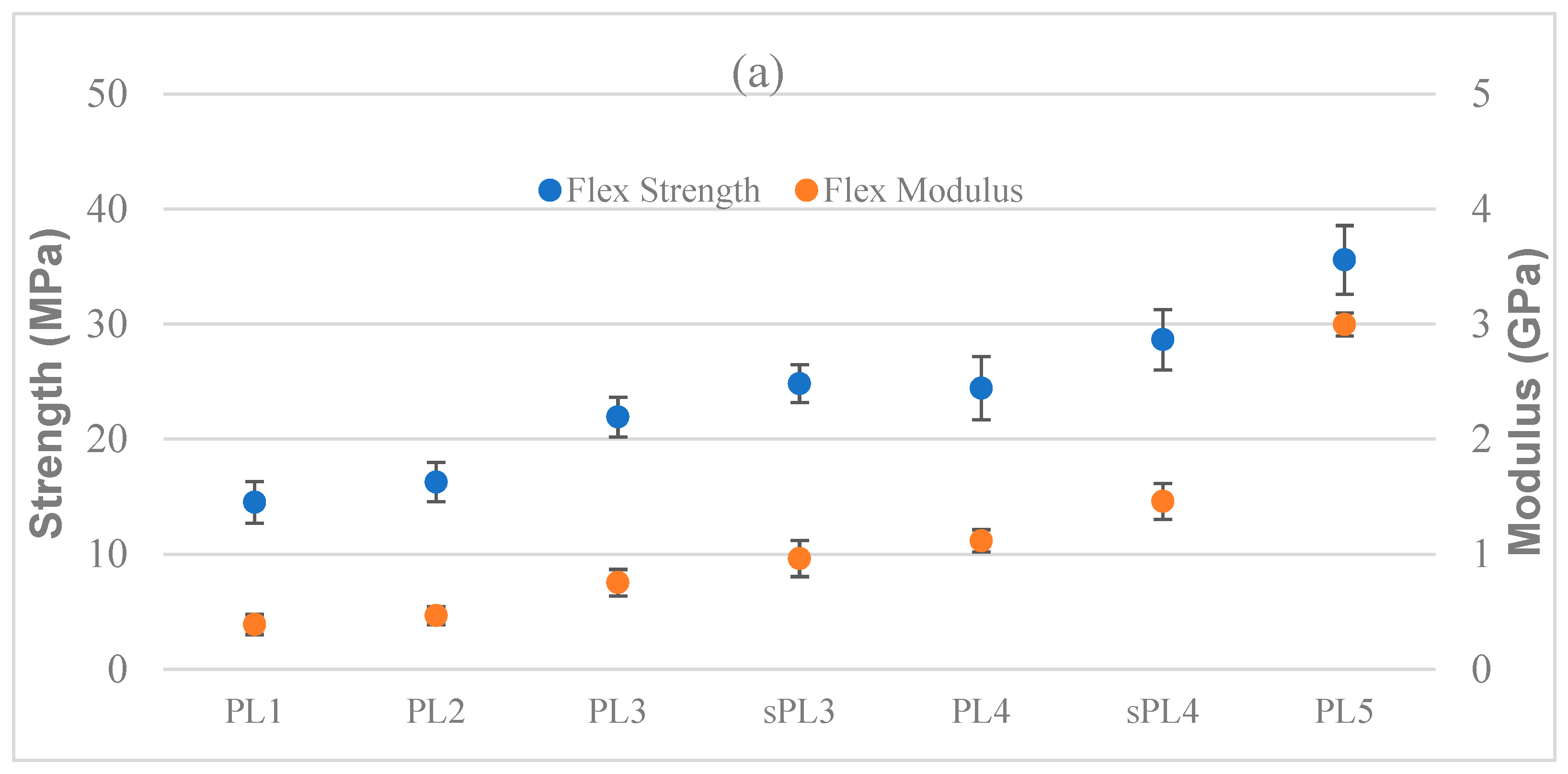
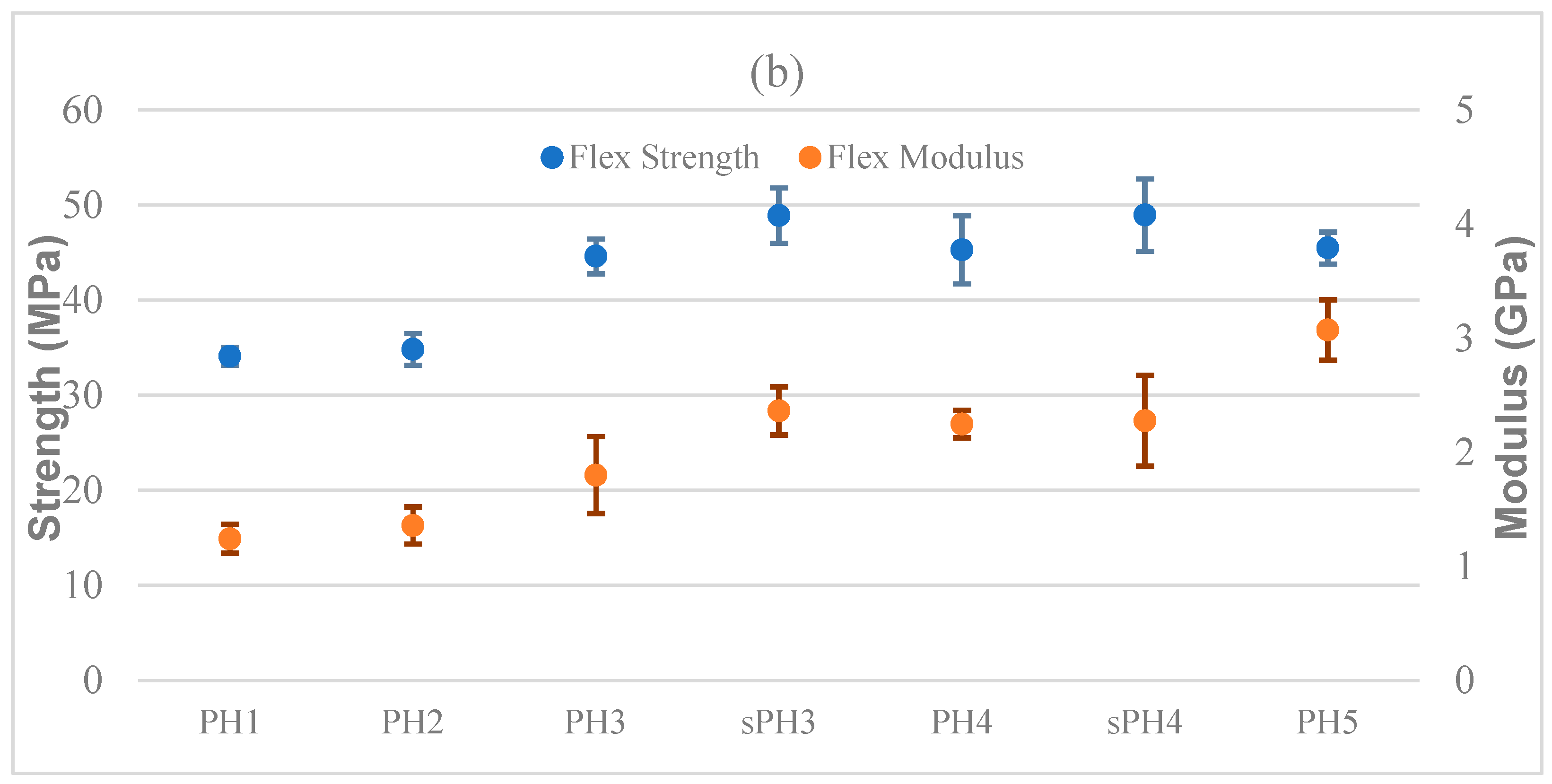
The flexural behavior of PWCs exhibits a strong dependence on filler loading, interfacial adhesion quality, and matrix type, as demonstrated in Figure 18.
In LDPE-based composites, both flexural modulus and strength progressively increase with rising PWC content. Flexural strength rises from 14.5 MPa in PL1 to 16.3 MPa in PL2, reaching 21.9 MPa in PL3 and peaking at 35.6 MPa in PL5. Similarly, the modulus increases from 0.40 GPa in PL1 to 1.10 GPa in PL4 and ultimately to 3.00 GPa in PL5. These improvements reflect the formation of a progressively rigid microstructural framework formed by recycled PS bundles, which restrict matrix deformation under bending and provide efficient load-bearing pathways. Surface-modified composites follow a similar trend [79]: sPL3 achieves a flexural strength of 24.8 MPa and a modulus of 1.00 GPa, while sPL4 reaches 28.7 MPa and 1.50 GPa. These enhancements indicate that improved interfacial wetting promotes shear transfer and delays tensile-side crack initiation during bending [80].
HDPE-based composites exhibit a similar but more pronounced response due to the higher crystallinity and inherent stiffness of the HDPE matrix. Flexural strength increases from 34.1 MPa in PH1 to 44.6 MPa in PH3, reaching 48.9 MPa in sPH3 and 49.0 MPa in sPH4. The modulus shows an even stronger dependence on filler content, rising from 1.20 GPa in PH1 to 3.10 GPa in PH5. Surface-modified HDPE composites consistently outperform their untreated counterparts due to enhanced fiber–matrix bonding, which improves load transfer under the combined tensile and compressive stresses of bending. The slight modulus plateau at PH5 is attributed to increased microstructural heterogeneity, fiber-rich domains, and interfacial micro voids that limit stress-transfer efficiency.
Across both matrices, the increase in flexural modulus is more pronounced than that in strength, confirming that stiffness enhancement is the dominant mechanical effect of PWC incorporation. SEM observations support this trend: rigid PS bundles, aligned fiber clusters, constrained matrix regions, and interfacial discontinuities collectively govern the macroscopic flexural response [62,81]. Surface modification further strengthens interfacial shear resistance and improves fiber–matrix continuity, resulting in higher strength without compromising tensile-side structural integrity [82,83].
Overall, recycled PS-based PWC fillers act as effective reinforcement agents in polyolefin matrices. LDPE composites show a more gradual stiffness enhancement due to greater matrix deformability, whereas HDPE composites benefit from crystallinity-driven stress transfer, leading to more rapid modulus gains [84]. These results highlight a robust structure–property relationship, wherein filler-induced microstructural architecture directly governs bending performance. In summary, recycled PS-based PWC fillers substantially enhance flexural stiffness in both LDPE and HDPE matrices. Interfacial quality—particularly with surface modification—is the key factor governing flexural strength [85]. The overall performance is dictated by matrix crystallinity and fiber–matrix interface continuity, underscoring the critical role of microstructure in shaping bending resistance [86,87].

3.4.3. Izod Impact Properties of PWCs

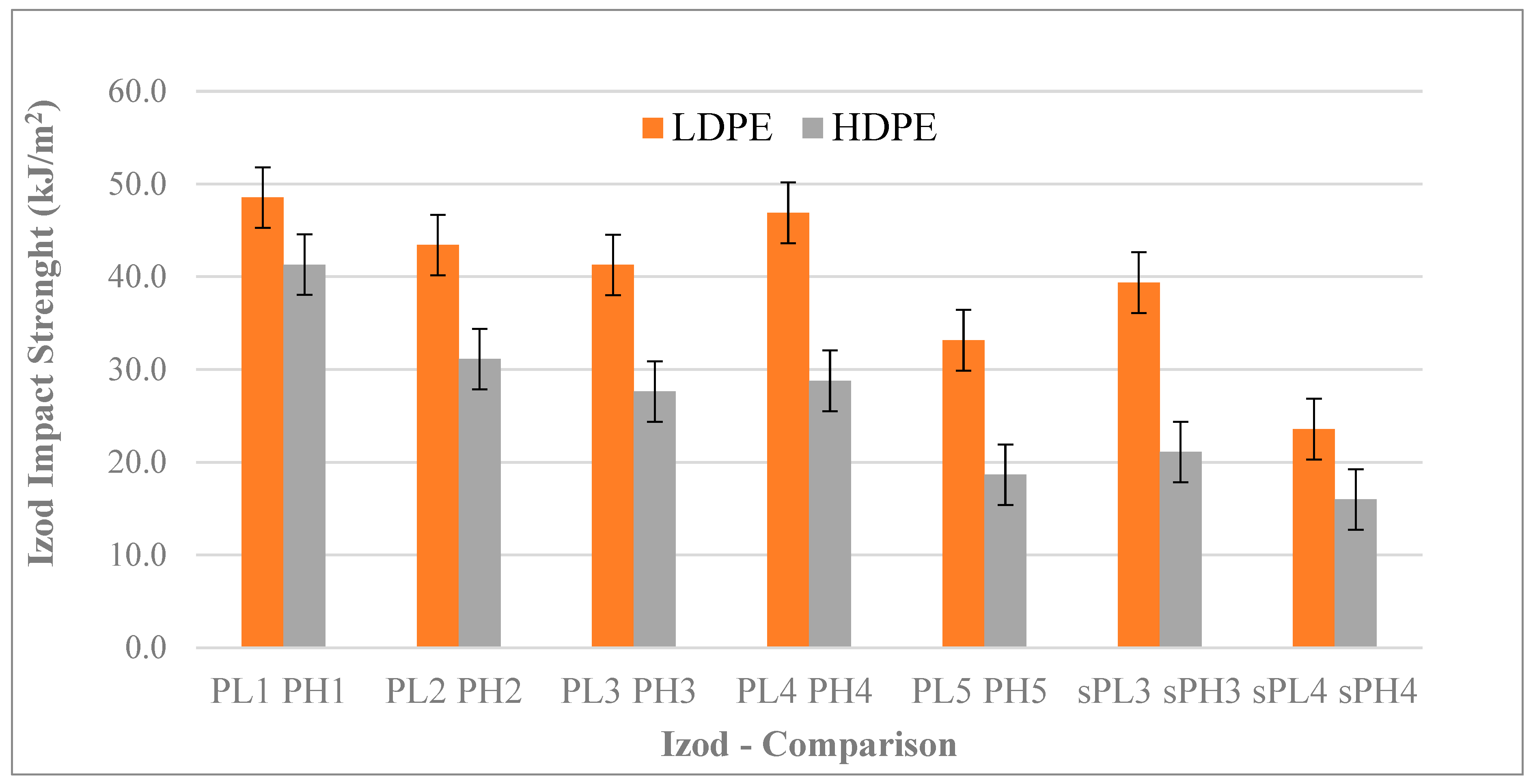
The Izod impact results for LDPE- and HDPE-based PWCs are summarized in Table 6 and illustrated in Figure 19. The LDPE series generally exhibits higher impact strength than the HDPE series at comparable filler levels, reflecting the greater intrinsic ductility and energy-absorbing capacity of the LDPE matrix. In LDPE-based PWCs, Izod impact strength decreases systematically with increasing PWC loading: from 48.54 kJ/m2 in PL1 to 43.42 kJ/m2 in PL2 and 41.27 kJ/m2 in PL3, followed by a more pronounced drop to 33.17 kJ/m2 and 23.58 kJ/m2 in PL4 and PL5, respectively. Corresponding break energies decline from 1.24 J (PL1) to 0.61 J (PL5). This progressive loss of impact resistance is attributed to reduced matrix continuity, elevated stress concentrations around rigid PS bundles, and the formation of micro void networks that facilitate rapid crack propagation under impact loading [88]. HDPE-based composites follow a similar trend but exhibit lower absolute values. Impact strength decreases from 41.31 kJ/m2 in PH1 to 31.12 kJ/m2 in PH2 and 27.62 kJ/m2 in PH3, reaching 18.65 kJ/m2 and 15.98 kJ/m2 in PH4 and PH5, respectively. Break energies drop from 1.14 J (PH1) to 0.41 J (PH5), indicating a pronounced shift toward more brittle behavior with increasing filler content. The sharper reduction in HDPE compared to LDPE is ascribed to the higher crystallinity and stiffness of the HDPE matrix, which restricts plastic deformation and promotes crack initiation at fiber–matrix interfaces and bundle-rich zones [89,90].
Surface modification partially restores impact performance in both matrices. In LDPE-based systems, sPL3 and sPL4 exhibit higher impact strengths (46.90 and 39.37 kJ/m2) than their unmodified counterparts PL3 and PL4 (41.27 and 33.17 kJ/m2), along with improved break energies (1.14 J vs. 1.05 J for PL3 and 0.97 J vs. 0.83 J for PL4). Similarly, in HDPE-based systems, sPH3 and sPH4 outperform PH3 and PH4, with impact strengths of 28.79 and 21.12 kJ/m2 compared to 27.62 and 18.65 kJ/m2, and break energies of 0.80 J and 0.58 J versus 0.70 J and 0.48 J, respectively. These improvements suggest that surface modification mitigates critical interfacial defects and enhances fiber–matrix adhesion, enabling more stable crack deflection and energy dissipation during impact rather than immediate interfacial decohesion [91,92].
Overall, the Izod impact data in Table 6 reveal a clear trade-off between stiffness-oriented reinforcement and impact toughness in PWCs. While increasing PWC content leads to a systematic reduction in impact resistance for both LDPE and HDPE matrices, surface modification of recycled PS fillers offers a measurable—albeit partial—recovery of impact energy, particularly at intermediate filler loadings where matrix deformability and interfacial integrity are optimally balanced [93].

4. Conclusions

This study demonstrates that mechanically recycled polyester–glass thermoset scraps (PS) can be effectively reprocessed into LDPE and HDPE matrices without the use of compatibilizers, enabling the production of second-generation thermoplastic composites with tunable mechanical properties. Comprehensive characterization—including tensile, flexural, and impact testing, density and water absorption measurements, and multi-scale optical/SEM analyses—revealed that the composites’ mechanical behavior is primarily governed by filler content, interfacial adhesion, and the heterogeneous morphology of the recycled thermoset phase.
-
The recycled fillers comprised resin-rich particulates, partially separated short fibers, and macro-scale fiber bundles, which led to increasingly anisotropic microstructures at higher loadings. Beyond 30 wt.% filler, fiber agglomeration, incomplete bundle disintegration, and micro void networks became more pronounced—features that restricted uniform load transfer and contributed to embrittlement, consistent with prior observations in recycled GFRP–polyolefin systems.
-
Tensile testing revealed significant stiffness enhancements in both LDPE- and HDPE-based composites. The modulus of LDPE increased from ~318 MPa to 1245 MPa, while HDPE rose from ~540 MPa to over 1700 MPa. Tensile strength improvements were most notable at moderate filler contents (20–30 wt.%), where a hybrid load-sharing mechanism between the matrix and partially separated fiber bundles became effective. At higher filler levels, however, fiber clustering and interfacial decohesion limited strength and promoted brittle fracture—trends aligned with those reported for short glass fiber-reinforced polyolefins.
-
Flexural properties exhibited the strongest dependence on filler content, with moduli reaching up to ~3.0 GPa. Surface-modified composites (sPL, sPH) consistently outperformed their untreated counterparts due to improved fiber–matrix wetting and enhanced interfacial shear transfer, underscoring the role of surface activation in strengthening non-polar polymer–glass interfaces. These findings are consistent with literature on compatibilized PE/GF composites, which similarly report improved bending performance through interfacial enhancement.
-
Izod impact results confirmed the expected stiffness–toughness trade-off. LDPE-based composites retained higher toughness than HDPE due to their inherently ductile matrix. Impact strength decreased systematically with increasing filler content in both systems. However, surface modification partially mitigated this decline by promoting more effective crack deflection and reducing interfacial failure. At high filler loadings, the dominance of fiber clusters and reduced matrix continuity limited the benefits of surface treatment.
-
Density increased proportionally with filler content, while water absorption was strongly influenced by matrix polarity and interfacial quality. LDPE composites exhibited higher moisture uptake than HDPE, and surface modification reduced water absorption by 5–10% by minimizing microvoid pathways and enhancing interfacial sealing. Diffusion coefficients (≈0.4–2.1 × 10⁻¹³ m2/s) indicated predominantly Fickian behavior, with slight deviations at higher filler contents due to increased microstructural heterogeneity—consistent with trends observed in recycled fiber–polyolefin systems.
A key outcome of this study is the demonstrated effectiveness of dual-acid surface treatment in enhancing interfacial performance. Surface-modified fillers (sPL and sPH series) exhibited more uniform dispersion, reduced micro void formation, and improved fiber–matrix wetting, as confirmed by optical and SEM analyses. These microstructural improvements translated into measurable mechanical gains: surface-treated LDPE composites exhibited higher tensile and flexural strengths than their untreated counterparts at equivalent filler loadings, while HDPE-based sPH composites achieved more stable performance despite the matrix’s higher crystallinity. Enhanced interfacial shear transfer also contributed to reduced water absorption and more controlled crack propagation under impact, indicating improved durability. However, at filler levels ≥40 wt.%, fiber clustering and limited matrix continuity constrained the full effectiveness of surface treatment.
Overall,: this work confirms that PS-based thermoset scraps can be upcycled into effective reinforcing fillers for polyethylene matrices using a simple, low-cost, and industrially scalable mechanical recycling process. Moderate filler contents (20–30 wt.%) yielded the most balanced combination of stiffness, strength, ductility, and interfacial integrity. The use of standard single-screw extrusion and compression molding eliminates the need for chemical reagents and facilitates seamless integration into existing industrial processing lines. With retained fiber lengths (~5–8 mm) remaining within the effective reinforcement range, the resulting composites offer mechanical performance comparable to or exceeding that of other recycled GFRP-reinforced polyolefins.
The produced PWCs show strong potential for semi-structural and functional applications—including automotive interior components, construction panels, housings, decking substrates, and packaging layers—where rigidity, dimensional stability, recyclability, and cost-efficiency are prioritized over high impact toughness. For such application environments, additional durability assessments—such as UV radiation exposure and temperature–humidity cycling—are essential to fully quantify long-term performance under realistic service conditions. Future research should focus on optimizing surface modification protocols, enhancing fiber bundle disintegration during extrusion, and assessing long-term durability under environmental and mechanical aging. Detailed modeling of processing–microstructure–property relationships will further expand the application space for recycled thermoset-derived polyolefin composites.

Author Contributions

Conceptualization, H.K. and Y.Y.; methodology, H.K., Y.Y., S.B.P. and H.N.; validation, H.K., Y.Y., S.B.P. and H.N.; formal analysis, H.K., Y.Y., S.B.P. and H.N.; investigation, H.K.; resources, S.B.P. and H.N.; data curation, H.K. and Y.Y.; writing—original draft preparation, H.K.; writing—review and editing, H.K., Y.Y., S.B.P. and H.N.; visualization, H.K. and Y.Y.; supervision, S.B.P. and H.N.; project administration, H.K., S.B.P. and H.N.; funding acquisition, S.B.P. All authors have read and agreed to the published version of the manuscript.

Funding

This research received no external funding.

Data Availability Statement

The raw data supporting the conclusions of this article will be made available by the authors on request.

Acknowledgments

The authors gratefully thank the Scientific and Technological Research Council of Türkiye (Tubitak) for the support provided through the 2219-International Postdoctoral Research Fellowship Programme. Baris Engin is gratefully acknowledged for his valuable support and contributions to the thermal and physical testing.

Conflicts of Interest

The authors declare no conflicts of interest. The funders had no role in the design of the study; in the collection, analyses, or interpretation of data; in the writing of the manuscript; or in the decision to publish the results.

Abbreviations

PSRecycled Polyester Scraps
sPSSurface Modified Recycled Polyester Scraps
GFRPGlass Fiber Reinforced Plastic
PWCPolyester–Glass Fiber Thermoset Scrap-Filled Composites 
LDPELow-Density Polyethylene
HDPEHigh-Density Polyethylene
PLLDPE-based PWCs
PHHDPE-based PWCs
sPLSurface-modified filled LDPE-based PWCs
sPHSurface-modified filled HDPE-based PWCs
CH3COOHAcetic Acid
C6H8O7Citric Acid
MPADMaterials Processing and Applications Development
SEMScanning Electron Microscopy
SDStandard Deviation

References

  1. Morici, E.; Dintcheva, N.T. Recycling of Thermoset Materials and Thermoset-Based Composites: Challenge and Opportunity. Polymers 2022, 14, 4153. [Google Scholar] [CrossRef] [PubMed]
  2. Xue, X.; Liu, S.Y.; Zhang, Z.Y.; Wang, Q.Z.; Xiao, C.Z. A Technology Review of Recycling Methods for Fiber-Reinforced Thermosets. J. Reinf. Plast. Compos. 2022, 41, 459–480. [Google Scholar] [CrossRef]
  3. Arun, M.; Barik, D.; Chandran, S.S.R. Exploration of Material Recovery Framework from Waste—A Revolutionary Move toward Clean Environment. Chem. Eng. J. Adv. 2024, 18, 100589. [Google Scholar] [CrossRef]
  4. Alaghemandi, M. Sustainable Solutions through Innovative Plastic Waste Recycling Technologies. Sustainability 2024, 16, 10401. [Google Scholar] [CrossRef]
  5. Jehanno, C.; Alty, J.W.; Roosen, M.; De Meester, S.; Dove, A.P.; Chen, E.Y.X.; Leibfarth, F.A.; Sardon, H. Critical Advances and Future Opportunities in Upcycling Commodity Polymers. Nature 2022, 603, 803–814. [Google Scholar] [CrossRef] [PubMed]
  6. Khalid, M.Y.; Arif, Z.U.; Hossain, M.; Umer, R. Recycling of Wind Turbine Blades through Modern Recycling Technologies: A Road to Zero Waste. Renew. Energy Focus 2023, 44, 26–40. [Google Scholar] [CrossRef]
  7. Onwudili, J.A.; Miskolczi, N.; Nagy, T.; Lipóczi, G. Recovery of Glass Fibre and Carbon Fibres from Reinforced Thermosets by Batch Pyrolysis and Investigation of Fibre Re-Using as Reinforcement in LDPE Matrix. Compos. Part B Eng. 2016, 91, 154–161. [Google Scholar] [CrossRef]
  8. Joseph, K.; Varghese, S.; Kalaprasad, G.; Thomas, S.; Prasannakumari, L.; Koshy, P.; Pavithran, C. Influence of Interfacial Adhesion on the Mechanical Properties and Fracture Behaviour of Short Sisal Fibre Reinforced Polymer Composites. Eur. Polym. J. 1996, 32, 1243–1250. [Google Scholar] [CrossRef]
  9. Cazan, C.; Perniu, D.; Cosnita, M.; Duta, A. Polymeric Wastes from Automotives as Second Raw Materials for Large Scale Products. Environ. Eng. Manag. J. 2013, 12, 1649–1655. [Google Scholar] [CrossRef]
  10. Huang, T.; Alves, J.; Castellani, R.; Tillier, Y.; Bouvard, J.L. Application of the Time–Temperature Equivalence at Large Deformation to Describe the Mechanical Behavior of Polyethylene-Based Thermoplastic, Thermoset and Vitrimer Polymers. Polymers 2023, 281, 126110. [Google Scholar] [CrossRef]
  11. Ragaert, K.; Delva, L.; Van Geem, K. Mechanical and Chemical Recycling of Solid Plastic Waste. Waste Manag. 2017, 69, 24–58. [Google Scholar] [CrossRef]
  12. Vollmer, I.; Jenks, M.J.; Roelands, M.C.; White, R.J.; Van Harmelen, T.; De Wild, P.; van Der Laan, G.P.; Meirer, F.; Keurentjes, J.T.; Weckhuysen, B.M. Beyond Mechanical Recycling: Giving New Life to Plastic Waste. Angew. Chem. Int. Ed. 2020, 59, 15402–15423. [Google Scholar] [CrossRef] [PubMed]
  13. Periasamy, D.; Manoharan, B.; Niranjana, K.; Aravind, D.; Krishnasamy, S.; Natarajan, V. Recycling of Thermoset Waste/High-Density Polyethylene Composites: Examining the Thermal Properties. Polym. Compos. 2024, 45, 2739–2748. [Google Scholar] [CrossRef]
  14. Elkori, R.; Baha, M.; Hachim, A.; Elhad, K.; Lamarti, A. Comparison of the Mechanical Behavior of Two Thermoplastic Polymers by Static Tests (Numerically and Experimentally): High-Density Polyethylene (HDPE) and High Impact Polystyrene (HIPS). In Proceedings of the 4th International Conference on Networking, Information Systems & Security, Stockholm, Sweden, 13–15 August 2021. [Google Scholar] [CrossRef]
  15. Anstey, A.; Codou, A.; Misra, M.; Mohanty, A.K. Novel Compatibilized Nylon-Based Ternary Blends with Polypropylene and Poly (lactic acid): Fractionated Crystallization Phenomena and Mechanical Performance. ACS Omega 2018, 3, 2845–2854. [Google Scholar] [CrossRef] [PubMed]
  16. Meira Castro, A.C.; Carvalho, J.P.; Ribeiro, M.C.S.; Meixedo, J.P.; Silva, F.J.G.; Fiúza, A.; Dinis, M.L. An Integrated Recycling Approach for GFRP Pultrusion Wastes: Recycling and Reuse Assessment into New Composite Materials Using Fuzzy Boolean Nets. J. Clean. Prod. 2014, 66, 420–430. [Google Scholar] [CrossRef]
  17. Shen, Y.; Apraku, S.E.; Zhu, Y. Recycling and Recovery of Fiber-Reinforced Polymer Composites for End-of-Life Wind Turbine Blade Management. Green Chem. 2023, 25, 9644–9658. [Google Scholar] [CrossRef]
  18. Oliveux, G.; Dandy, L.O.; Leeke, G.A. Current Status of Recycling of Fibre Reinforced Polymers: Review of Technologies, Reuse and Resulting Properties. Prog. Mater. Sci. 2015, 72, 61–99. [Google Scholar] [CrossRef]
  19. ASTM, E11-20; Standard Specification for Woven Wire Test Sieve Cloth and Test Sieves. ASTM International: West Conshohocken, PA, USA, 2024.
  20. Schindelin, J.; Arganda-Carreras, I.; Frise, E.; Kaynig, V.; Longair, M.; Pietzsch, T.; Preibisch, S.; Rueden, C.; Saalfeld, S.; Schmid, B.; et al. Fiji: An open-source platform for biological-image analysis. Nature Methods 2012, 9, 676–682. [Google Scholar] [CrossRef]
  21. Zhang, D.; He, M.; Qin, S.; Yu, J. Effect of Fiber Length and Dispersion on Properties of Long Glass Fiber Reinforced Thermoplastic Composites Based on Poly(butylene terephthalate). RSC Adv. 2017, 7, 15439–15454. [Google Scholar] [CrossRef]
  22. Badiola, J.H.; Astobitza, U.; Iturrondobeitia, M.; Burgoa, A.; Ibarretxe, J.; Arriaga, A. Relation Between Injection Molding Conditions, Fiber Length, and Mechanical Properties of Highly Reinforced Long Fiber Polypropylene: Part II Long-Term Creep Performance. Polymers 2023, 17, 1630. [Google Scholar] [CrossRef]
  23. ASTM D3171-22; Standard Test Methods for Constituent Content of Composite Materials. ASTM International: West Conshohocken, PA, USA, 2020.
  24. Lee, S.-G.; Oh, D.; Woo, J.H. The Effect of High Glass Fiber Content and Reinforcement Combination on Pulse-Echo Ultrasonic Measurement of Composite Ship Structures. J. Mar. Sci. Eng. 2021, 9, 379. [Google Scholar] [CrossRef]
  25. Liu, P.; Jin, Z.; Li, Y.; Chen, Z.; Luo, Z.; Liu, S.; Chen, Y.; Zhao, H.; Xu, H.; Zhao, Z.; et al. Lifetime Prediction and Aging Mechanism of Glass Fiber-Reinforced Acrylate–Styrene–Acrylonitrile/Polycarbonate Composite Under Long-Term Thermal and Oxidative Conditions. J. Therm. Anal. Calorim. 2024, 149, 2075–2085. [Google Scholar] [CrossRef]
  26. Cech, V.; Palesch, E.; Lukes, J. The glass fiber–polymer matrix interface/interphase characterized by nanoscale imaging techniques. Compos. Sci. Technol. 2013, 82, 22–27. [Google Scholar] [CrossRef]
  27. Zhao, Z.; Wu, H.; Zhang, M.; Fu, S.; Zhu, K. Fiber Orientation Reconstruction from SEM Images of Fiber-Reinforced Composites. Appl. Sci. 2023, 13, 3700. [Google Scholar] [CrossRef]
  28. Ares-Elejoste, P.; Seoane-Rivero, R.; Gandarias, I.; Iturmendi, A.; Gondra, K. Sustainable Alternatives for the Development of Thermoset Composites with Low Environmental Impact. Polymers 2023, 15, 2939. [Google Scholar] [CrossRef] [PubMed]
  29. ASTM D792-20; Standard Test Methods for Density and Specific Gravity (Relative Density) of Plastics by Displacement. ASTM International: West Conshohocken, PA, USA, 2020.
  30. ASTM D5229/D5229M-20; Standard Test Method for Moisture Absorption Properties of Polymer Matrix Composites. ASTM International: West Conshohocken, PA, USA, 2020.
  31. Liu, Z.; Lei, Y.; Zhang, X.; Kang, Z.; Zhang, J. Effect Mechanism and Simulation of Voids on Hygrothermal Performances of Composites. Polymers 2022, 14, 901. [Google Scholar] [CrossRef] [PubMed]
  32. Lagdani, O.; Tarfaoui, M.; Rouway, M.; Laaouidi, H.; Jamoudi Sbai, S.; Amine Dabachi, M.; Aamir, A.; Nachtane, M. Influence of Moisture Diffusion on the Dynamic Compressive Behavior of Glass/Polyester Composite Joints for Marine Engineering Applications. J. Compos. Sci. 2022, 6, 94. [Google Scholar] [CrossRef]
  33. Khanjar, S.; Barui, S.; Kate, K.; Ajjarapu, K.P.K. An Investigation into Mechanical Properties of 3D Printed Thermoplastic-Thermoset Mixed-Matrix Composites: Synergistic Effects of Thermoplastic Skeletal Lattice Geometries and Thermoset Properties. Materials 2024, 17, 4426. [Google Scholar] [CrossRef]
  34. Yan, L.; Chouw, N. Effect of Water, Seawater and Alkaline Solution Ageing on Mechanical Properties of Flax Fabric Reinforced Epoxy Composites. Constr. Build. Mater. 2015, 99, 118–127. [Google Scholar] [CrossRef]
  35. ASTM D3039/D3039M-17; Standard Test Method for Tensile Properties of Polymer Matrix Composite Materials. ASTM International: West Conshohocken, PA, USA, 2017.
  36. ASTM D7264/D7264M-15; Standard Test Method for Flexural Properties of Polymer Matrix Composite Materials. ASTM International: West Conshohocken, PA, USA, 2015.
  37. ASTM D256-10; Standard Test Methods for Determining the Izod Pendulum Impact Resistance of Plastics. ASTM International: West Conshohocken, PA, USA, 2018.
  38. Ghaffari, S.; Makeev, A.; Seon, G.; Cole, D.P.; Magagnosc, D.J.; Bhowmick, S. Understanding Compressive Strength Improvement of High-Modulus Carbon-Fiber Reinforced Polymeric Composites through Fiber–Matrix Interface Characterization. Mater. Des. 2020, 192, 108798. [Google Scholar] [CrossRef]
  39. Le Gal La Salle, E.; Nouigues, A.; Bailleul, J.-L. Thermo-mechanical characterization of unsaturated polyester/glass fiber composites for recycling. Int. J. Mater. Form. 2021, 14, 153–174. [Google Scholar] [CrossRef]
  40. Stelmach, S.; Gacki, D.; Szul, M.; Słowiński, K.; Radko, T.; Wojtaszek-Kalaitzidi, M. General Evaluation of the Recyclability of Polyester-Glass Laminates Used to Reinforce Steel Tanks. Sustainability 2025, 17, 4199. [Google Scholar] [CrossRef]
  41. Pickering, S.J. Recycling Technologies for Thermoset Composite Materials—Current Status. Compos. Part A Appl. Sci. Manuf. 2006, 37, 1206–1215. [Google Scholar] [CrossRef]
  42. Ginder, R.S.; Ozcan, S. Recycling of commercial E-glass reinforced thermoset composites via two temperature step pyrolysis to improve recovered fiber tensile strength and failure strain. Recycling 2019, 4, 24. [Google Scholar] [CrossRef]
  43. Kun, D.; Kárpáti, Z.; Fekete, E.; Móczó, J. The Role of Interfacial Adhesion in Polymer Composites Engineered from Lignocellulosic Agricultural Waste. Polymers 2021, 13, 3099. [Google Scholar] [CrossRef]
  44. Krishnan, P. A novel microbond bundle pullout technique to evaluate the interfacial properties of fibre-reinforced plastic composites. Bull. Mater. Sci. 2017, 40, 737–744. [Google Scholar] [CrossRef]
  45. Salakhov, I.I.; Shaidullin, N.M.; Chalykh, A.E.; Matsko, M.A.; Shapagin, A.V.; Batyrshin, A.Z.; Shandryuk, G.A.; Nifant’ev, I.E. Low-Temperature Mechanical Properties of High-Density and Low-Density Polyethylene and Their Blends. Polymers 2021, 13, 1821. [Google Scholar] [CrossRef]
  46. Derradj, M.; Zoukrami, F.; Guerba, H.; Benchaoui, A. The effect of laboratory synthesized and modified layered double hydroxides on recycled and neat high-density polyethylene matrix properties using stearic acid as an interface modifier. J. Polym. Res. 2023, 30, 457. [Google Scholar] [CrossRef]
  47. Hamlaoui, O.; Klinkova, O.; Elleuch, R.; Tawfiq, I. Effect of the Glass Fiber Content of a Polybutylene Terephthalate Reinforced Composite Structure on Physical and Mechanical Characteristics. Polymers 2022, 14, 17. [Google Scholar] [CrossRef] [PubMed]
  48. Elkazaz, E.; Crosby, W.A.; Ollick, A.M.; Elhadary, M. Effect of fiber volume fraction on the mechanical properties of randomly oriented glass fiber reinforced polyurethane elastomer with crosshead speeds. Alexandria Eng. J. 2020, 59, 209–216. [Google Scholar] [CrossRef]
  49. Kim, Y.; Park, O.O. Effect of Fiber Length on Mechanical Properties of Injection Molded Long-Fiber-Reinforced Thermoplastics. Macromol. Res. 2020, 28, 433–444. [Google Scholar] [CrossRef]
  50. Sasayama, T.; Inagaki, M.; Sato, N. Direct Simulation of Glass Fiber Breakage in Simple Shear Flow Considering Fiber–Fiber Interaction. Compos. Part A Appl. Sci. Manuf. 2019, 124, 105514. [Google Scholar] [CrossRef]
  51. Zhang, Y.; Li, Y.; Luan, X.; Meng, B.; Liu, J.; Lu, Y. Effects of Void Characteristics on the Mechanical Properties of Carbon Fiber Reinforced Polyetheretherketone Composites: Micromechanical Modeling and Analysis. Polymers 2025, 17, 1721. [Google Scholar] [CrossRef] [PubMed]
  52. Shen, C.H.; Springer, G.S. Moisture Absorption and Desorption of Composite Materials. J. Compos. Mater. 1976, 10, 2–20. [Google Scholar] [CrossRef]
  53. Carter, H.G.; Kibler, K.G. Langmuir-Type Model for Anomalous Moisture Diffusion in Composite Resins. J. Compos. Mater. 1978, 12, 118–131. [Google Scholar] [CrossRef]
  54. Hassanpour, B.; Karbhari, V.M. Characteristics and Models of Moisture Uptake in Fiber-Reinforced Composites: A Topical Review. Polymers 2024, 16, 2265. [Google Scholar] [CrossRef]
  55. Siedlaczek, P.; Sinn, G.; Peter, P.; Wan-Wendner, R.; Lichtenegger, H.C. Characterization of Moisture Uptake and Diffusion Mechanisms in Particle-Filled Composites. Polymers 2022, 249, 124799. [Google Scholar] [CrossRef]
  56. Yang, C.; Xing, X.; Li, Z.; Zhang, S. A Comprehensive Review on Water Diffusion in Polymers Focusing on the Polymer–Metal Interface Combination. Polymers 2020, 12, 138. [Google Scholar] [CrossRef]
  57. Melo, R.Q.C.; Fook, M.V.L.; Lima, A.G.B. Non-Fickian Moisture Absorption in Vegetable Fiber Reinforced Polymer Composites: The Effect of the Mass Diffusivity. Polymers 2021, 13, 761. [Google Scholar] [CrossRef]
  58. Kasim, H.; Shih, Y.-C.; Pillay, S.; Ning, H. Sustainable Reprocessing of Thermoset Composite Waste into Thermoplastics: A Polymer Blend Approach for Circular Material Design. J. Compos. Sci. 2025, 9, 565. [Google Scholar] [CrossRef]
  59. Sriprom, W.; Sirivallop, A.; Choodum, A.; Limsakul, W.; Wongniramaikul, W. Plastic/Natural Fiber Composite Based on Recycled Expanded Polystyrene Foam Waste. Polymers 2022, 14, 2241. [Google Scholar] [CrossRef]
  60. Yildirimoglu, Y.S.; Ozturk, F. Advances in Mechanical and Physicochemical Performances of Recycled Carbon Fiber Reinforced PEKK Composites. Polym. Bull. 2024, 81, 14453–14478. [Google Scholar] [CrossRef]
  61. Song, Y.-J.; Kim, D.-K.; Han, W.; Choi, S.-H.; Chung, D.-C.; Kim, K.-W.; Kim, B.-J. Facile Enhancement of Mechanical Interfacial Strength of Recycled Carbon Fiber Web-Reinforced Polypropylene Composites via a Single-Step Silane Modification Process. Polymers 2025, 17, 483. [Google Scholar] [CrossRef]
  62. Daki, I.; Saloumi, N.; Yousfi, M.; Parajua-sejil, C.; Truchot, V.; Gérard, J.-F.; Cherkaoui, O.; Hannache, H.; El Bouchti, M.; Oumam, M. Exploring the Thermal and Mechanical Properties of Thermoset-Based Composites Reinforced with New Continuous and Chopped Phosphate Glass Fibers. Polymers 2025, 17, 1627. [Google Scholar] [CrossRef] [PubMed]
  63. Chauhan, V.; Kärki, T.; Varis, J. Effect of Fiber Content and Silane Treatment on the Mechanical Properties of Recycled Acrylonitrile-Butadiene-Styrene Fiber Composites. Chemistry 2021, 3, 1258–1270. [Google Scholar] [CrossRef]
  64. AlSuhaibani, F.A.; Falath, W.; Theravalappil, R. Improved Fracture Toughness of Glass Fibers Reinforced Polypropylene Composites through Hybridization with Polyolefin Elastomers and Polymeric Fibers for Automotive Applications. Polym. Compos. 2025, 46, 6553–6570. [Google Scholar] [CrossRef]
  65. AlMaadeed, M.A.; Ouederni, M.; Noorunnisa Khanam, P. Effect of chain structure on the properties of Glass fibre/polyethylene composites. Mater. Des. 2013, 47, 725–730. [Google Scholar] [CrossRef]
  66. Khanam, P.N.; AlMaadeed, M.A.A. Processing and characterization of polyethylene-based composites. In Advanced Manufacturing: Polymer and Composites Science; Taylor and Francis Ltd.: Abingdon, UK, 2015. [Google Scholar] [CrossRef]
  67. Mamanpush, S.H.; Li, H.; Tavousi Tabatabaei, A.; Englund, K. Heterogeneous Thermoset/Thermoplastic Recycled Carbon Fiber Composite Materials for Second-Generation Composites. Waste Biomass Valor. 2021, 12, 4653–4662. [Google Scholar] [CrossRef]
  68. Naik, T.P.; Singh, I.; Sharma, A.K.; Yu, H. Recycling of Thermoset Composites Waste: End of Life Solution. In Composite Materials Processing Using Microwave Heating Technology; Springer: Berlin/Heidelberg, Germany, 2024; pp. 83–114. [Google Scholar] [CrossRef]
  69. Bernardeau, F.; Perrin, D.; Caro, A.-S.; Bénézet, J.-C.; Ienny, P. Valorization of waste thermoset material as a filler in thermoplastic: Mechanical properties of phenolic molding compound waste-filled PP composites. J. Appl. Polym. Sci. 2018, 135, 45849. [Google Scholar] [CrossRef]
  70. Kasim, H.; Shih, Y.-C.; Ning, H.; Pillay, S. Upcycling epoxy–glass thermoset waste into high-performance polyethylene composites. Compos. Struct. 2026, 377, 119880. [Google Scholar] [CrossRef]
  71. Aberkane, A.; Bendaikha, H.; Benzidane, R.; Jouenne, J.-B.; Alshaikh, I.M.H.; Belaadi, A.; Ghernaout, D. Mechanical, Thermal, and Morphological Properties of Recycled PP and HDPE Green Composites Reinforced with Atriplex halimus Fibers. J. Nat. Fibers 2025, 22, 2507157. [Google Scholar] [CrossRef]
  72. Widiastuti, I.; Saputra, H.C.; Kusuma, S.S.W.; Harjanto, B. Mechanical and Thermal Properties of Recycled High-Density Polyethylene/Bamboo with Different Fiber Loadings. Open Eng. 2022, 12, 108–117. [Google Scholar] [CrossRef]
  73. Gu, W.; Wu, H.F.; Kampe, S.L.; Lu, G.Q. Volume Fraction Effects on Interfacial Adhesion Strength of Glass-Fiber-Reinforced Polymer Composites. Mater. Sci. Eng. A 2000, 277, 237–243. [Google Scholar] [CrossRef]
  74. Joseph, K.; Thomas, S.; Pavithran, C. Effect of Chemical Treatment on the Tensile Properties of Short Sisal Fibre-Reinforced Polyethylene Composites. Polymers 1996, 37, 5139–5149. [Google Scholar] [CrossRef]
  75. Fu, S.Y.; Feng, X.Q.; Lauke, B.; Mai, Y.W. Effects of Particle Size, Particle/Matrix Interface Adhesion and Particle Loading on Mechanical Properties of Particulate-Polymer Composites. Compos. Part B 2008, 39, 933–961. [Google Scholar] [CrossRef]
  76. Alkan, U.; Özcanlı, Y.; Alekberov, V. Effect of Temperature and Time on Mechanical and Electrical Properties of HDPE/Glass Fiber Composites. Fibers Polym. 2013, 14, 115–120. [Google Scholar] [CrossRef]
  77. Gorrasi, G.; Di Lieto, R.; Patimo, G.; De Pasquale, S.; Sorrentino, A. Structure–Property Relationships on Uniaxially Oriented Carbon Nanotube/Polyethylene Composites. Polymers 2011, 52, 1124–1132. [Google Scholar] [CrossRef]
  78. Wu, H.F.; Dwight, D.W.; Huff, N.T. Effects of Silane Coupling Agents on the Interphase and Performance of Glass-Fiber-Reinforced Polymer Composites. Compos. Sci. Technol. 1997, 57, 975–983. [Google Scholar] [CrossRef]
  79. Kumar, V.; Elen, M.; Sushmita, K.; Overman, N.R.; Murdy, P.; Presuel-Moreno, F.; Fifield, L.S.; Nickerson, E. Hygrothermal Aging and Recycling Effects on Mechanical and Thermal Properties of Recyclable Thermoplastic Glass Fiber Composites. Polym. Compos. 2025, 46, 29242. [Google Scholar] [CrossRef]
  80. Periasamy, D.; Karuppiah, P.; Manoharan, B.; Arockiasamy, F.S.; Kannan, S.; Mohanavel, V.; Velmurugan, P.; Arumugam, N.; Almansour, A.I.; Sivakumar, S. Assessing the Recycling Potential of Thermosetting Polymer Waste in High-Density Polyethylene Composites for Safety Helmet Applications. e-Polymers 2024, 24, 20230080. [Google Scholar] [CrossRef]
  81. Wang, B.; Wang, Y.; Du, S.; Zhu, J.; Ma, S. Upcycling of Thermosetting Polymers into High-Value Materials. Mater. Horiz. 2022, 9, 2952–2960. [Google Scholar] [CrossRef] [PubMed]
  82. Syduzzaman, M.; Pritha, N.M.; Dulal, M.; Ullah, T.H.M.H.; Mamun, M.A.; Sowrov, K.; Ahmed, A.T.M.F. Flexural and Impact Properties of Recycled High-Density Polyethylene (rHDPE) Composites Reinforced with Hybrid Jute and Banana Fibers. Adv. Polym. Technol. 2025, 2025, 9964196. [Google Scholar] [CrossRef]
  83. Ostrowski, K.A.; Romańska, P.; Piech, R.; Majka, T.M.; Michalik, A.; Bednarowski, D.; Zawadzka, Z. Polyethylene Terephthalate-Based Composites with Recycled Flakes and Chemically Resistant Glass Fibres for Construction. Polymers 2025, 17, 3087. [Google Scholar] [CrossRef]
  84. Goodarz, M.; Behzadnia, A.; Dastan, T. Assessing the Flexural Properties of Interlayer Hybrid Thermoset–Thermoplastic Composites and Their Repairability. Compos. Mech. Comput. Appl. 2022, 13, 77–94. [Google Scholar] [CrossRef]
  85. Tarrés, Q.; Soler, J.; Rojas-Sola, J.I.; Oliver-Ortega, H.; Julián, F.; Espinach, F.X.; Mutjé, P.; Delgado-Aguilar, M. Flexural Properties and Mean Intrinsic Flexural Strength of Old Newspaper Reinforced Polypropylene Composites. Polymers 2019, 11, 1244. [Google Scholar] [CrossRef] [PubMed]
  86. Sadik, W.A.; El-Demerdash, A.G.M.; Abokhateeb, A.E.A.; Elessawy, N.A. Innovative High-Density Polyethylene/Waste Glass Powder Composite with Remarkable Mechanical, Thermal and Recyclable Properties for Technical Applications. Heliyon 2021, 7, e06627. [Google Scholar] [CrossRef]
  87. Xie, S.L.; Lei, H.H.; Zhang, C.L.; Zhang, C.L. Progress in Surface Treatment of Carbon Fiber and Composite Material. Surf. Technol. 2022, 51, 186–195. [Google Scholar] [CrossRef]
  88. Kasim, H.; Mohamed, M.; Ning, H.; Pillay, S. Recycling of Pultruded Vinyl Ester Thermoset Scraps into Polyethylene Composites: Toward Circular Composite Manufacturing. J. Compos. Sci. 2025, 9, 641. [Google Scholar] [CrossRef]
  89. Scott, C.; Ishlda, H.; Maurer, F.H.J. Infrared Analysis and Izod Impact Testing of Multicomponent Polymer Composites: Polyethylene/EPDM/Filler Systems. J. Mater. Sci. 1987, 22, 3963–3973. [Google Scholar] [CrossRef]
  90. Sun, J.; Li, Q.; Jiang, Y.; Jiang, J.; Yang, L.; Jia, C.; Chen, F.; Wang, X. Lightweight and High Impact Toughness PP/PET/POE Composite Foams Fabricated by In Situ Nanofibrillation and Microcellular Injection Molding. Polymers 2023, 15, 227. [Google Scholar] [CrossRef] [PubMed]
  91. Monti, M.; Scrivani, M.T.; Kociolek, I.; Larsen, Å.G.; Olafsen, K.; Lambertini, V. Enhanced Impact Strength of Recycled PET/Glass Fiber Composites. Polymers 2021, 13, 1471. [Google Scholar] [CrossRef] [PubMed]
  92. Zhou, Y.; Fan, M.; Chen, L. Interface and Bonding Mechanisms of Plant Fibre Composites: An Overview. Compos. Part B Eng. 2016, 101, 31–45. [Google Scholar] [CrossRef]
  93. Yu, B.; Geng, C.; Zhou, M.; Bai, H.; Fu, Q.; He, B. Impact Toughness of Polypropylene/Glass Fiber Composites: Interplay between Intrinsic Toughening and Extrinsic Toughening. Compos. Part B Eng. 2016, 92, 413–419. [Google Scholar] [CrossRef]
Figure 1. Workflow for preparing polyester–glass fiber thermoset scrap-filled composites (PWC).
Jcs 10 00052 g001
Figure 2. Thermoset matrix-coated fiber bundles observed in recycled polyester–glass fiber scraps.
Jcs 10 00052 g002
Figure 3. Fiber length distribution of mechanically recycled polyester–glass fiber thermoset scraps (PS).
Jcs 10 00052 g003
Figure 4. Dimensional analysis of mechanically recycled polyester–glass fiber thermoset scraps (PS).
Jcs 10 00052 g004
Figure 5. Glass fiber content of mechanically recycled polyester–glass fiber thermoset scraps (PS) across different sieve fractions.
Jcs 10 00052 g005
Figure 6. Average glass fiber length distributions of recycled polyester–glass fiber filled thermoplastic composites (PWCs).
Jcs 10 00052 g006
Figure 7. Experimental Water Absorption and Fickian Diffusion Modeling of PWC at 23 °C, (a) PL series, (b) PH series.
Jcs 10 00052 g007
Figure 8. Optical microscopy of PL series after tensile fracture, mag. 50×.
Jcs 10 00052 g008
Figure 9. Optical microscopy of PH series after tensile fracture, mag. 50×.
Jcs 10 00052 g009
Figure 10. Optical microscopy of sPL4 and sPH4 composites after tensile fracture (mag. 50×).
Jcs 10 00052 g010
Figure 11. Internal microstructure of PL5 composite at 300× magnification.
Jcs 10 00052 g011
Figure 12. SEM fracture surfaces of PWCs: (a) PL4, (b) sPL4.
Jcs 10 00052 g012
Figure 13. SEM fracture surfaces of PWCs: (a) PH4, (b) sPH4.
Jcs 10 00052 g013
Figure 14. Stress–strain curves of LDPE and LDPE-based PWCs at varying filler loadings.
Jcs 10 00052 g014
Figure 15. Mechanical properties of neat LDPE and LDPE/PWCs obtained under identical test conditions: (a) tensile modulus and (b) tensile strength.
Jcs 10 00052 g015
Figure 16. Stress–strain curves of HDPE and HDPE-based PWCs at varying filler loadings.
Jcs 10 00052 g016
Figure 17. Mechanical properties of neat HDPE and HDPE/PWCs obtained under identical test conditions: (a) tensile modulus and (b) tensile strength.
Jcs 10 00052 g017
Figure 18. Flexural modulus and strength of PWCs for (a) LDPE and (b) HDPE matrices.
Jcs 10 00052 g018aJcs 10 00052 g018b
Figure 19. Izod impact energy of PWCs.
Jcs 10 00052 g019
Table 1. Formulations of recycled polyester-glass fiber filled thermoplastic composites.
Polymer Matrix TypeComposite LabelThermoplastic Content (wt.%)Thermoset Waste Content (wt.%)
Untreated PSSurface Treated PS (sPS)
LDPEPL19010-
PL28020-
PL37030-
PL46040-
PL55050-
sPL370-30
sPL460-40
HDPEPH19010-
PH28020-
PH37030-
PH46040-
PH55050-
sPH370-30
sPH460-40
Table 2. Fractional content analysis of mechanically recycled polyester–glass fiber thermoset scraps (PS) based on ASTM E11 sieve classification.
Standard Sieve Mesh (ASTM E11)Morphological Classification of Recycled PSsMass Fraction (%)
No. 4 (>4.75 mm)Resin Encapsulated Macrofibre
Clusters
5.11%
No. 5 (>4 mm)Coarse Fiber Agglomerates12.23%
No. 6 (>3.35 mm)Medium-scale Fiber Fragments28.32%
No. 25 (>710 µm)Micrometer-Scale Dispersed Fiber Structures27.57%
No. 30 (>600 µm)Fine Fiber Fragments10.64%
No. 40 (>425 µm)Pulverized Fiber Dust and Particles8.95%
No. 140 (>106 µm)Fiber Fines and Resin Residues5.21%
Under Sieve (<106 µm)Submicron Dust and Amorphous Debris1.96%
Table 3. Quantitative glass fiber contents of recycled polyester–glass fiber filled thermoplastic composites (PWCs).
Definition of PWCsLoading FractionPost-Test Content
Matrix (wt.%)Thermoset Scraps (wt.%)
PSsPSMatrix (wt.%)Glass Fiber (wt.%)σSD
PL19010 91.638.370.48
PL28020 83.7616.240.55
PL37030 75.9624.050.63
PL46040 67.9632.040.70
PL55050 59.8940.110.77
sPL370-3075.6824.320.58
sPL460-4066.9633.050.63
PH19010 91.488.520.42
PH28020 84.1215.890.44
PH37030 75.9024.100.62
PH46040 67.3332.670.79
PH55050 58.8441.160.87
sPH370-3076.4923.510.77
sPH460-4068.0631.940.86
Table 4. Density Comparison of Untreated and Surface-Modified PWCs.
Definition of PWCsLoading Fraction Post-Test Content
Matrix (wt.%)Thermoset Scraps
PSsPSDensity g/cm3SD (*)
PL19010 0.950.018
PL28020 1.050.021
PL37030 1.100.022
PL46040 1.190.030
PL55050 1.200.031
sPL370 301.090.018
sPL460 401.170.031
PH19010 0.990.020
PH28020 1.070.028
PH37030 1.120.030
PH46040 1.220.041
PH55050 1.230.046
sPH370 301.100.021
sPH460 401.190.035
(*) Standard deviation of density.
Table 5. Initial Fickian diffusion parameters derived from water sorption data of PWCs.
Definition of STCsInitial Mass (g)Saturated Mass (g)Coefficient of DeterminationDiffusion Coefficient (m2/s)
PL18.90398.94630.9642.009 × 10−13
PL28.58558.63190.9771.407 × 10−13
PL38.70148.75350.9751.065 × 10−13
PL48.85578.91480.9640.895 × 10−13
PL58.96589.02860.9680.965 × 10−13
sPL38.80538.86120.9601.032 × 10−13
sPL48.96009.02360.9740.412 × 10−13
PH18.96849.02720.9621.735 × 10−13
PH28.92668.98980.9541.822 × 10−13
PH38.76928.84090.9681.978 × 10−13
PH48.89878.97860.9711.477 × 10−13
PH58.97839.07750.9571.966 × 10−13
sPH38.91508.97850.9662.143 × 10−13
sPH48.84998.93350.8691.348 × 10−13
Table 6. Izod impact test results of PWCs.
Definition of PWCsTest Results
Break Energy (J)SDIzod Impact Strength (kJ/m2)SD
PL11.240.0348.542.14
PL21.120.0243.421.51
PL31.050.0341.272.13
sPL3 (*)1.140.0346.901.84
PL40.830.0233.171.46
sPL4 (*)0.970.0239.371.43
PL50.610.0823.583.04
PH11.140.0841.313.06
PH20.860.0831.122.91
PH30.700.0827.623.45
sPH3 (*)0.800.0828.793.05
PH40.480.0818.653.19
sPH4 (*)0.580.0321.121.01
PH50.410.1015.983.98
(*) Surface-modified PWCs.
Disclaimer/Publisher’s Note: The statements, opinions and data contained in all publications are solely those of the individual author(s) and contributor(s) and not of MDPI and/or the editor(s). MDPI and/or the editor(s) disclaim responsibility for any injury to people or property resulting from any ideas, methods, instructions or products referred to in the content.