
Controlling the Thermodynamic Stability of Melt-Compounded PLA as Opportunity to Achieve 3D Printing Automotive Items with Medium Lifetime

 , , and
Abstract
1. Introduction
2. Materials and Methods
2.1. Materials
2.2. Procedure
2.3. Compounding
2.4. Characterization
2.4.1. Chemical Structure
2.4.2. Thermal Properties
2.4.3. Functional Properties
2.4.4. Thermodynamic Stability
3. Results
3.1. Heterogeneous Nucleated PLA
3.1.1. Structural Changes
3.1.2. Thermal Behavior
3.1.3. Functional Properties
3.2. Racemic Nucleated PLA
3.2.1. Chemical Structure
3.2.2. Thermal Behavior
3.2.3. Functional Properties
4. Discussion
5. Conclusions
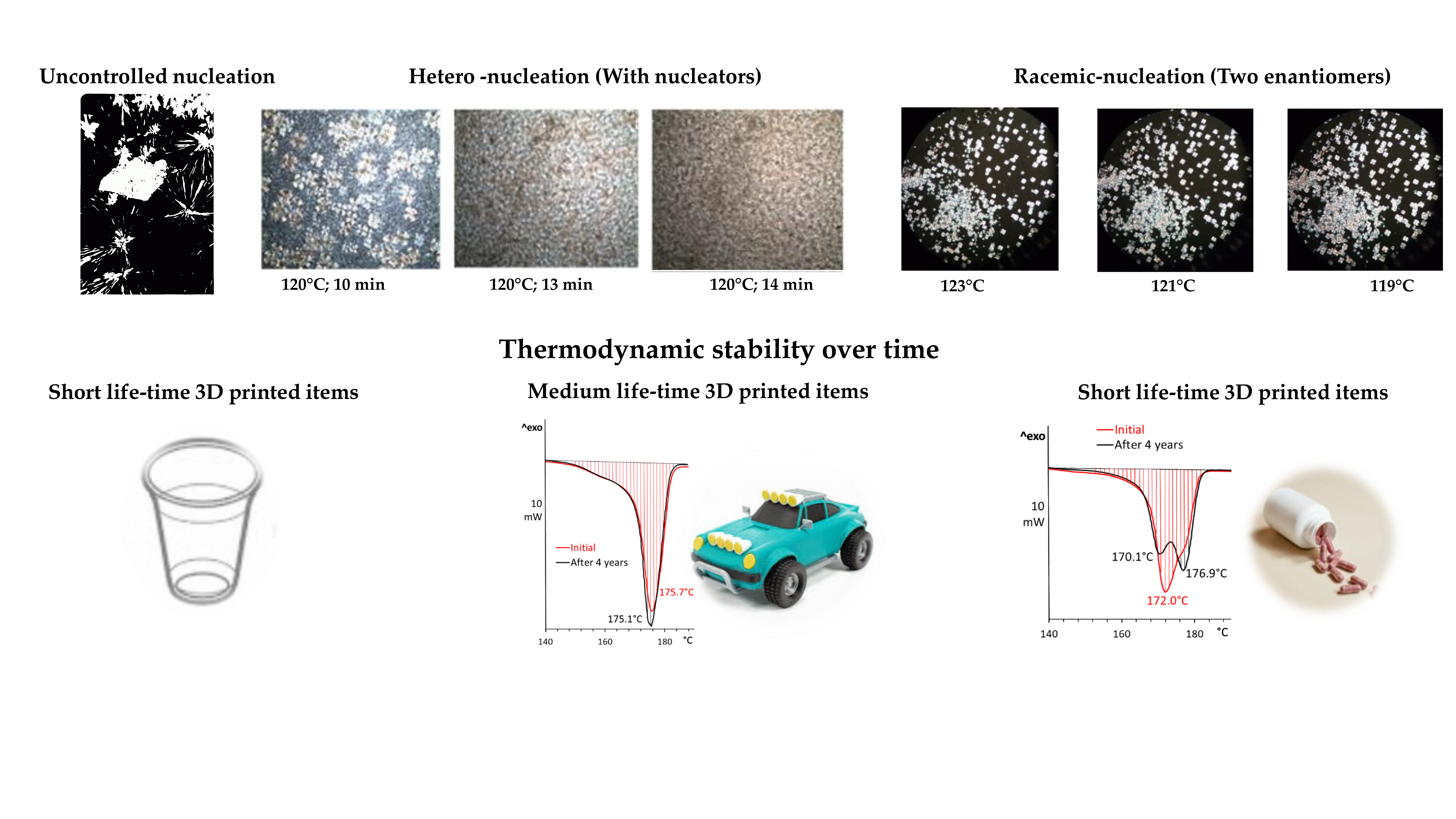
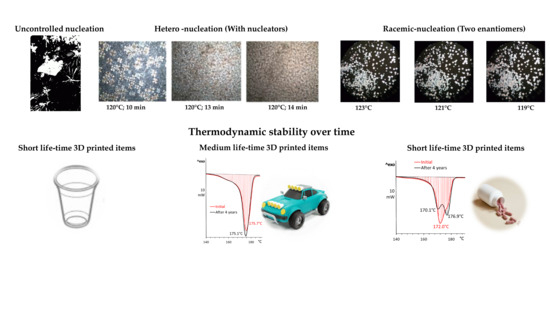
- This paper examines the thermodynamic stability of controlled nucleated PLA, focusing exclusively on formulations with good mechanical behavior, after storage for 4 years in controlled conditions. The PLA with 0.5% D lactide and low molecular weight, which has optimal melt flow at 3D printing, was nucleated with a sulfonic acid derivative (heterogeneous nucleation), in a variant, and with PLA with 4% D lactide (racemic nucleation) in another. Because the earliest signs of thermodynamic instability are to do with changes in chemical structure, which alter thermal behavior with no impact on mechanical properties, the study focuses on FTIR and DSC analysis. The obtained results were compared with the initial data.
- The type of PLA obtained by heterogeneous nucleation is suitable for 3D printing for durable applications firstly due to its mono-modal melting and crystallization in a narrow and high range and, secondly, due to its thermodynamic stability over time. The slightly widened melting range of heterogeneous nucleated PLA can be adjusted by strict control of the formulation and crystallization conditions.
- The type of PLA obtained by racemic crystallization is not suitable for the 3D printing of parts for medium-life auto applications because, after 4 years, its initial mono-modal melting converts into bi-modal melting, proving long-term thermodynamic instability, as proven by the FTIR and DSC analysis.
- Increased crystallinity enhances mechanical and thermal performance, chemical and barrier resistance, sorption and migration properties. However, it also leads to higher opacity, reduced flexibility, and increased brittleness, limiting the material’s ability to deform without fracturing. Under these circumstances, the crystallization must be carefully controlled to achieve the desired outcomes, particularly in the context of long-term sustainability.
- The observed difference in long-term thermodynamic stability between PLA produced via hetero-nucleation versus racemic nucleation is directly linked to the used PLA grade. This specific grade was selected to meet the requirements for 3D printing medium-life automotive components. Consequently, for a low-molecular-weight PLA, hetero-nucleation remains of interest.
- In polylactic acid (PLA), amorphous content generally has a much larger impact on long-term thermodynamic instability than crystal defects. In both variants of the nucleation, the same grade of low-molecular-weight PLA was used. This difference in thermodynamical stability over time between the hetero-nucleated PLA and stereo-complexed PLA was driven mainly by the specific conditions of the two nucleation processes.
- The utility of thermodynamic stability data is intrinsically linked to life-time prediction, leveraging advanced statistical molecular simulations driven by Artificial Intelligence (AI). Furthermore, AI facilitates a deeper understanding of the complex mechanisms underlying physical aging.
Supplementary Materials
Author Contributions
Funding
Data Availability Statement
Acknowledgments
Conflicts of Interest
References
- Dimonie, D.; Radu, S.; Doncea, S.; Pop, F.S.; Petre, C.; Dumitriu, I.; Fierascu, R. The miscibility estimation of some nanocomposites based on starch. e-Polymers 2011, 11, 957–970. [Google Scholar] [CrossRef]
- Dimonie, D.; Kelnar, I.; Socoteanu, R.; Darie, R.N.; Pop, F.S.; Zaharia, C.; Petrea, C. The influence of miscibility and micro-structure on the surface defects of some starch bio-hybrides. Mater. Plast. 2010, 47, 486–491. [Google Scholar]
- Dimonie, D.; Radovici, C.; Zaharia, C.; Vasilievici, G.; Stoleriu, A. Thermal behavior of biodegradable nanocomposites on the basis of polyvinyl alcohol and starch. Mater. Plast. 2006, 43, 132–137. [Google Scholar]
- Dimonie, D.; Mathe, S.; Truscă, S.D.; Damian, C.M.; Râpă, M.; Dima, S.-O.; Dumitru, S.; Oancea, F. The Influence of Miscibility of Some PLA-Based Bio-Hybrids Designed for 3D Printing and Medium-Life Applications on Their Physical Aging and Thermodynamic Stability. Polymers 2026, 18, 61. [Google Scholar] [CrossRef]
- Galeski, A. PP Structure, Blends and Composites; Karger-Kocsis, J., Ed.; Chapman & Hall: London, UK, 1995; pp. 351, 205, 377. [Google Scholar]
- Wong, A.C. Nucleating Agent Effect on Selected Optical and Mechanical Properties of Polypropylene. In ANTEC 1996, Conference Proceedings–Society of Plastics Engineers; Society of Plastics Engineers, Inc. (SPE): Danbury, CT, USA, 1996; Volume 42, pp. 2283–2288. [Google Scholar]
- Jabarin, S.A. Orientation and properties of polypropylene. J. Reinf. Plast. Compos. 1993, 12, 480–488. [Google Scholar] [CrossRef]
- Varga, J.; Karger-Kocsis, J. Rules of supermolecular structure formation in sheared isotactic polypropylene melts. J. Polym. Sci. Part B Polym. Phys. 1996, 34, 657–670. [Google Scholar] [CrossRef]
- Dimonie, D.; Dragomir, N.; Stoica, S. Attempts to diminish the drawbacks of polylactic acid designed for 3D/4D printing technology-fused deposition modeling. Mater. Plast. 2021, 58, 142–153. [Google Scholar] [CrossRef]
- Mathe, S.; Dimonie, D.; Cristea, M. Thermal analysis and polarized light microscopy as methods to study the increasing of the durability of PLA designed for 3D printing. Int. J. Polym. Anal. Charact. 2021, 26, 253–264. [Google Scholar] [CrossRef]
- Dimonie, D.; Vasile, C.; Coserea, R.M.; Garea, S.; Andrei, F. Characterization of the Nucleation Efficiency Based on Crystallization Behaviour and other PP Properties. Mater. Plast. 2009, 46, 180–184. [Google Scholar]
- Slager, J.; Domb, A.J. Biopolymer stereocomplexes. Adv. Drug Deliv. Rev. 2003, 55, 549–583. [Google Scholar] [CrossRef] [PubMed]
- Qing, X.; Chengtao, Y.; Pengju, P. Chapter 17-Stereocomplex Crystallization of Polymers With Complementary Configurations. In Crystallization in Multiphase Polymer Systems; Sabu, T., Mohammed, A.P., Gowd, E.B., Nandakumar, K., Eds.; Elsevier: Amsterdam, The Netherlands, 2018; pp. 535–573. [Google Scholar]
- Dimonie, D.; Mathe, S.; Iftime, M.; Ionita, D.; Trusca, R.; Iftimie, S. Modulation of the PLLA Morphology through Racemic Nucleation to Reach Functional Properties Required by 3D Printed Durable Applications. Materials 2021, 14, 6650. [Google Scholar] [CrossRef] [PubMed]
- Mathe, S.; Dimonie, D. The Dependence of the Racemic Crystallization of PLLA on the Molecular Weight of the Stereo-Complexer Macromolecules. UPB Sci. Bull. Ser. B 2023, 85, 139–152. [Google Scholar]
- Ehrenstein, G.; Pongratz, S. Resistance and Stability of Polymers; Hanser: Munich, Germany, 2013; pp. 29–35. [Google Scholar]
- Florjančič, U.; Imri, I. Tailoring functionality and durability of polymeric products by modifying processing conditions. J. Eng. 2008, 54, 507–520. [Google Scholar]
- Glaskova-Kuzmina, T.; Starkova, O.; Gaidukovs, S.; Platnieks, O.; Gaidukova, G. Durability of Biodegradable Polymer Nanocomposites. Polymers 2021, 13, 3375. [Google Scholar] [CrossRef]
- Muguda, S.; Lucas, G.; Hughes, P.; Augarde, C.; Perlot, C.; Bruno, A.; Gallipoli, D. Durability and hygroscopic behaviour of biopolymer stabilised earthen construction materials. Constr. Build. Mater. 2020, 259, 119725. [Google Scholar] [CrossRef]
- Homam, S.M.; Sheikh, S.A.; Collins, P.; Pernica, G.; Daoud, J. Durability of fibre reinforced polymers (FRP) used in concrete structures. In Proceedings of the 3rd International Conference on Advanced Composite Materials in Bridges and Structures, Ottawa, ON, Canada, 15 August 2000. [Google Scholar]
- White, J.R. Polymer ageing: Physics, chemistry or engineering? Time to reflect. CR Chim. 2006, 9, 1396–1408. [Google Scholar] [CrossRef]
- Hutchinson, J.M. Physical Ageing of polymers. Prog. Polym. Sci. 1995, 20, 703–760. [Google Scholar] [CrossRef]
- Godard, M.E.; Saiter, J.M. Physical Aging in Polymers: Comparison of Two Ways of Determining Narayanaswamy’s Parameter. Polym. Eng. Sci. 1996, 36, 2978–2985. [Google Scholar] [CrossRef]
- Skotnicki, M.; Drogoń, A.; Lulek, J.; Pyda, M. Physical Ageing of Amorphous Poly(lactic acid)-Indapamide System Studied by Differential Scanning Calorimetry. Pharmaceutics 2023, 15, 2341. [Google Scholar] [CrossRef]
- Muller, P.; Imre, B.; Bere, J.; Moczo, J.; Pukanszky, B. Physical ageing and molecular mobility in PLA blends and composites. J. Therm. Anal. Calorim. 2015, 122, 1423–1433. [Google Scholar] [CrossRef]
- Cui, L.; Imre, B.; Tátraaljai, D.; Pukánszky, B. Physical ageing of Poly(Lactic acid): Factors and consequences for practice. Polymer 2020, 186, 122014. [Google Scholar] [CrossRef]
- Orellana-Barrasa, J.; Ferrández-Montero, A.; Ferrari, B.; Pastor, J.Y. Natural Ageing of PLA Filaments, Can It Be Frozen? Polymers 2022, 14, 3361. [Google Scholar] [CrossRef] [PubMed]
- Burgos, N.; Martino, V.P.; Jiménez, A. Characterization and ageing study of poly(lactic acid) films plasticized with oligomeric lactic acid. Polym. Degrad. Stabil. 2013, 98, 651–658. [Google Scholar] [CrossRef]
- Martino, V.P.; Ruseckaite, R.A.; Jiménez, A. Ageing of poly(lactic acid) films plasticized with commercial polyadipates. Polym. Int. 2009, 58, 437–444. [Google Scholar] [CrossRef]
- Cheng, X.; Wang, S.; Zhang, X.; Iqbal, M.S.; Yang, Z.; Xi, Y.; Xiang, X. Accelerated aging behavior of degradable and non-degradable microplastics via advanced oxidation and their adsorption characteristics towards tetracycline. Ecotoxicol. Environ. Saf. 2024, 284, 116864. [Google Scholar] [CrossRef]
- Jianming, Z.; Harumi, S.; Hideto, T. Infrared Spectroscopic Study of CH3···OC Interaction during Poly(l-lactide)/Poly(d-lactide) Stereocomplex Formation. Macromolecules 2005, 38, 1822–1828. [Google Scholar]
- Mou, L.; Li, J.; Lu, Y.; Li, G.; Li, J. Olylactic acid: A future universal biobased polymer with multifunctional performance—From monomer synthesis, and processing to applications: A review. J. Hazard. Mater. Adv. 2025, 18, 100757. [Google Scholar]
- Wang, Y.; He, D.; Wang, X.; Cao, W.; Li, Q.; Shen, C. Crystallization of poly(lactic acid) enhanced by phthalhydrazide as nucleation agent. Polym. Bull. 2013, 70, 2911–2922. [Google Scholar] [CrossRef]
- Spinelli, G.; Kotsilkova, R.; Ivanov, E.; Petrova-Doycheva, I.; Menseidov, D.; Georgiev, V.; Di Maio, R.; Silvestre, C. Effects of filament extrusion, 3D printing and hot-pressing on electrical and tensile properties of Poly(Lactic) acid composites filled with carbon nanotubes and graphene. Nanomaterials 2020, 10, 35. [Google Scholar] [CrossRef]
- ISO 180; Plastics—Determination of Izod Impact Strength. International Organization for Standardization: Geneva, Switzerland, 2019.
- ISO 75; Plastics—Determination of Temperature of Deflection Under Load. International Organization for Standardization: Geneva, Switzerland, 2020.
- Feng, Y.; Ma, P.; Xu, P.; Wang, R.; Dong, W.; Chen, M.; Joziasse, C. The crystallization behavior of poly(lactic acid) with different types of nucleating agents. Int. J. Biol. Macromol. 2018, 106, 955–962. [Google Scholar] [CrossRef]
- Gregor, A.; Filova, E.; Novak, M.; Hosek, J. Designing of PLA scaffolds for bone tissue replacement fabricated by ordinarycommercial 3D printer. J. Biol. Eng. 2017, 11, 31. [Google Scholar] [CrossRef]
- Ma, P.; Jiang, L.; Xu, P.; Dong, W.; Chen, M.; Lemstra, P.J. Stereocomplexation between enantiomeric comb-shaped cellulose-g-poly(l-lactide) nanohybrids and poly(d-lactide) from the melt. Biomacromolecules 2015, 16, 3723–3729. [Google Scholar] [CrossRef]
- Karamanlioglu, Ü.A. Influence of time and room temperature on mechanical and thermal degradation of PLA. Therm. Sci. 2019, 23, 383–390. [Google Scholar] [CrossRef]
- Smith, B.C. The infrared spectra of polymers, VI: Polymers with C-O bonds. Spectroscopy 2022, 37, 15–19, 27. [Google Scholar] [CrossRef]
- Turki, A.; Oudiani, A.; Msahli, S.; Faouzi, S. Infrared spectra for alfa fibers treated with thymol. J. Glycobiol. 2018, 7, 1000130. [Google Scholar] [CrossRef]
- Yang, J.-Y.; Han, W.; Park, J.Y.; Kim, K.-W.; Kim, B.-J. Effect of nucleating agents addition on thermal and mechanical properties of natural fiber-reinforced polylactic acid composites. Polymers 2022, 14, 4263. [Google Scholar] [CrossRef] [PubMed]
- Meaurio, E.; López-Rodríguez, N.; Sarasua, J.-R. Infrared spectrum of poly(L-lactide): Application to crystallinity studies. Macromolecules 2006, 39, 9291–9301. [Google Scholar] [CrossRef]
- Suárez Franco, J.L.; Vázquez-Vázquez, F.C.; Pozos-Guillen, A.J.; Alvarez-Perez, M.A. Influence of diameter of fiber membrane scaffolds on the biocompatibility of hPDL mesenchymal stromal cells. Dent. Mater. J. 2018, 37, 465–473. [Google Scholar] [CrossRef]
- Moeini, A.; Cimmino, A.; Masi, M.; Van Reenen, A.J. The incorporation and release of ungeremine, an antifungal amaryllidaceae alkaloid, in poly(lactic acid)/poly(ethylene glycol) nanofibers. J. Appl. Polym. Sci. 2020, 137, 49098. [Google Scholar] [CrossRef]
- Vargas, H.; Romo-Uribe, A.; Teran-Salgado, E.; Flores, A. Electrospun polylactic acid non-woven mats incorporating silver nanoparticles. Polym. Bull. 2014, 71, 2437–2452. [Google Scholar] [CrossRef]
- Chen, X.; Han, L.; Zhang, T.; Zhang, J. Influence of crystal polymorphism on crystallinity calculation of poly(L-lactic acid) by infrared spectroscopy. Vib. Spectrosc. 2014, 70, 1–5. [Google Scholar] [CrossRef]
- Praveena, N.M.; Shaiju, P.; Amal Raj, R.B.; Bhoje Gowd, E. Infrared bands to distinguish amorphous, meso and crystalline phases of poly(lactide)s: Crystallization and phase transition pathways of amorphous, meso and co-crystal phases of poly(ʟ-lactide) in the heating process. Polymer 2021, 240, 124495. [Google Scholar] [CrossRef]
- Jongpanya-Ngam, P.; Khankrua, R.; Seadan, M.; Suttiruengwong, S. Effect of synthesized sulfonate derivatives as nucleating agents on crystallization behavior of poly(lactic acid). Des. Monomers Polym. 2022, 25, 115–127. [Google Scholar] [CrossRef] [PubMed]
- Lee, H.W.; Insyani, R.; Prasetyo, D.; Sitompul, J.P. Molecular weight and structural properties of biodegradable PLA synthesized with different catalysts by direct melt polycondensation. J. Eng. Technol. Sci. 2015, 47, 364–373. [Google Scholar] [CrossRef]
- Partini, M.; Pantani, R. Determination of crystallinity of an aliphatic polyester by FTIR spectroscopy. Polym. Bull. 2007, 59, 403–412. [Google Scholar] [CrossRef]
- Knez, K.; Gohs, U.; Buchholtz, S.A. Low-energy electron beam induced surface modification of polylactic acid (PLA). J. Radioanal. Nucl. Chem. 2025. [Google Scholar] [CrossRef]
- Kausar, A. Fabrication and characteristics of poly(benzimidazole/fluoro/ether/siloxane/amide)/sulfonated polystyrene/silica nanoparticle-based proton exchange membranes doped with phosphoric acid. Int. J. Polym. Mater. 2015, 64, 184–191. [Google Scholar] [CrossRef]
- Suzuki, T.; Ei, A.; Takada, Y.; Takahashi, K. Modification of physical properties of poly(L-lactic acid) by addition of methyl-β-cyclodextrin. J. Org. Chem. 2014, 10, 2997–3006. [Google Scholar] [CrossRef]
- Opaprakasit, P.; Opaprakasit, M.; Tangboriboonrat, P. Crystallization of polylactide and its stereocomplex investigated by two-dimensional fourier transform infrared correlation spectroscopy employing carbonyl overtones. Appl. Spectrosc. 2008, 61, 1352–1358. [Google Scholar] [CrossRef]
- Tretinnikov, O.N.; Kato, K.; Iwata, H. Adsorption of enantiomeric poly(lactide)s on surface-grafted poly(l-lactide). Langmuir 2004, 20, 6748–6753. [Google Scholar] [CrossRef] [PubMed]
- Braun, B.; Dorgan, J.R.; Dec, S.F. Infrared spectroscopic determination of lactide concentration in polylactide: An improved methodology. Macromolecules 2006, 39, 9302–9310. [Google Scholar] [CrossRef]
- Gupta, A.; Pal, A.K.; Woo, E.M.; Katiyar, V. Effects of amphiphilic chitosan on stereocomplexation and properties of poly(lactic acid) nano-biocomposite. Sci. Rep. 2018, 8, 4351. [Google Scholar] [CrossRef]
- Singh, S.K.; Anthony, P.; Chowdhury, A. High molecular weight poly(lactic acid) synthesized with apposite catalytic combination and longer time. Orient. J. Chem. 2018, 34, 1984–1990. [Google Scholar] [CrossRef]
- Kang, S.; Hsu, S.; Stidham, H.D.; Yang, X. A spectroscopic analysis of poly(lactic acid) structure. Macromolecules 2021, 34, 4542–4548. [Google Scholar] [CrossRef]
- Yuniarto, K.; Purwanto, Y.A.; Purwanto, S.; Welt, B.A.; Purwadaria, H.K.; Sunarti, T.C. Infrared and Raman studies on polylactide acid and polyethylene glycol-400 blend. AIP Conf. Proc. 2016, 1725, 020101. [Google Scholar] [CrossRef]
- Más, B.A.; Mello Cattani, S.M.; Cássia Cipriano Rangel, R.; Duek, E.A.R. Surface characterization and osteoblast-like cells culture on collagen modified PLDLA scaffolds. Mater. Res. 2014, 17, 1523–1534. [Google Scholar] [CrossRef]
- Moliner, C.; Finocchio, E.; Arato, E.; Lagazzo, A. Influence of the degradation medium on water uptake, morphology, and chemical structure of poly(lactic acid)-sisal bio-composites. Materials 2020, 13, 3974. [Google Scholar] [CrossRef]
- Singla, P.; Mehta, R.; Berek, D.; Upadhyay, S.N. Microwave assisted synthesis of poly(lactic acid) and its characterization using size exclusion chromatography. J. Macromol. Sci. Part Pure Appl. Chem. 2012, 49, 963–970. [Google Scholar] [CrossRef]
- Tsuji, H. Poly (Lactic Acid), Bio-Based Plasticsmaterials and Applications, 1st ed.; Kabasci, S., Ed.; John Wiley & Sons: Ltd.: Hoboken, NJ, USA, 2013. [Google Scholar]
- Zhang, J.; Duan, Y.; Sato, H.; Ozaki, Y. Crystal modifications and thermal behavior of poly(l-lactic acid) revealed by infrared spectroscopy. Macromolecules 2005, 38, 8012–8021. [Google Scholar] [CrossRef]
- Xue, B.; Xie, L.; Zhang, J. Detailed molecular movements during poly(L-lactic acid) cold-crystallization investigated by FTIR spectroscopy combined with two-dimensional correlation analysis. RSC Adv. 2017, 7, 47017–47028. [Google Scholar] [CrossRef]
- Tarani, E.; Pušnik, K.; Zemljic, L.F.; Chrissafis, K.; Papageorgiou, G.Z.; Lambropoulou, D.; Zamboulis, A.; Bikiaris, D.N.; Terzopoulou, Z. Cold Crystallization Kinetics and Thermal Degradation of PLA Composites with Metal Oxide Nanofillers. Appl. Sci. 2021, 11, 3004. [Google Scholar] [CrossRef]
- Petrucci, R.H.; Herring, F.G.; Madura, J.D.; Bissonnette, C. General Chemistry: Principles and Modern Applications; Pearson Education (Prentice Hall): Upper Saddle River, NJ, USA, 2002. [Google Scholar]
- Karimi, S.; Ghasemi, I.; Abbassi-Sourki, F. A study on the crystallization kinetics of PLLA in the presence of Graphene Oxide and PEG-grafted-Graphene Oxide: Effects on the nucleation and chain mobility. Compos. Part B Eng. 2019, 158, 302–310. [Google Scholar] [CrossRef]
- Sun, J.; Yu, H.; Zhuang, X.; Chen, X.; Jing, X. Crystallization Behavior of Asymmetric PLLA/PDLA Blends. J. Phys. Chem. B. 2011, 115, 2864–2869. [Google Scholar] [CrossRef] [PubMed]
- Xie, Q.; Han, L.; Shan, G.; Bao, Y.; Pan, P. Polymorphic Crystalline Structure and Crystal Morphology of Enantiomeric Poly(lactic acid) Blends Tailored by a Self-Assemblable Aryl Amide Nucleator. ACS Sustain. Chem. Eng. Am. Chem. Soc. 2016, 4, 2680–2688. [Google Scholar] [CrossRef]
- Brochu, S.; Prud’Homme, R.E.; Barakat, I.; Jerome, R. Stereocomplexation and Morphology of Polylactides. Macromolecules 1995, 28, 5230–5239. [Google Scholar] [CrossRef]
- Kawai, T.; Rahman, N.; Nakajima, K.; Matsuda, M.; Matsuba, G.; Nishida, K.; Kanaya, T.; Nakano, M.; Okamoto, H.; Kawada, J.; et al. Crystallization and Melting Behavior of Poly (l-lactic Acid). Macromolecules 2007, 40, 9463–9469. [Google Scholar] [CrossRef]
- Tsuji, H.; Ikada, Y. Stereocomplex formation between enantiomeric poly (lactic acids). 9. Stereocomplexation from the melt. Macromolecules 1993, 26, 6918–6926. [Google Scholar] [CrossRef]
- Tsuji, H.; Ikada, Y. Stereocomplex formation between enantiomeric poly (lactic acid). XI. Mechanical properties and morphology of solution-cast films. Polymer 1999, 40, 6699–6708. [Google Scholar] [CrossRef]
- Tsuji, H.; Tezuka, Y. Stereocomplex Formation between Enantiomeric Poly (lactic acid) s. 12. Spherulite Growth of Low-Molecular-Weight Poly (lactic acid) s from the Melt. Biomacromolecules 2004, 5, 1181–1186. [Google Scholar] [CrossRef]
- Park, H.-S.; Hong, C.-K. Relationship between the Stereocomplex Crystallization Behavior and Mechanical Properties of PLLA/PDLA Blends. Polymers 2021, 13, 1851. [Google Scholar] [CrossRef]
- Furuhashi, Y.; Yoshie, N. Stereocomplexation of solvent-cast poly(lactic acid) by addition of non-solvents. Polym. Int. 2012, 61, 301–306. [Google Scholar] [CrossRef]
- Raef, M.; Sarasua, J.-R.; Etxeberria, A.; Ugartemendia, J.M. Stereocomplexation: From molecular structure to functionality of advanced polylactide systems. Polymer 2023, 280, 126066. [Google Scholar] [CrossRef]
- de França, J.O.C.; da Silva Valadares, D.; Paiva, M.F.; Dias, S.C.L.; Dias, J.A. Polymers Based on PLA from Synthesis Using D,L-Lactic Acid (or Racemic Lactide) and Some Biomedical Applications: A Short Review. Polymers 2022, 14, 2317. [Google Scholar] [CrossRef] [PubMed]
- Gao, P.; Alanazi, S.; Masato, D. Crystallization of Polylactic Acid with Organic Nucleating Agents under Quiescent Conditions. Polymers 2024, 16, 320. [Google Scholar] [CrossRef]
- Gao, P.; Masato, D. The Effects of Nucleating Agents and Processing on the Crystallization and Mechanical Properties of Polylactic Acid: A Review. Micromachines 2024, 15, 776. [Google Scholar] [CrossRef]
- Saeidlou, S.; Huneault, M.A.; Li, H.; Park, C.B. Poly(lactic acid) crystallization. Prog. Polym. Sci. 2012, 37, 1657–1677. [Google Scholar] [CrossRef]
- Tábi, T.; Ageyeva, T.; Kovacs, J.G. The influence of nucleating agents, plasticizers, and molding conditions on the properties of injection molded PLA products. Mater. Today Commun. 2022, 32, 103936. [Google Scholar] [CrossRef]
- Foglia, F.; De Meo, A.; Iozzino, V.; Volpe, V.; Pantani, R. Isothermal crystallization of PLA: Nucleation density and growth rates of α and α ′ phases. Can. J. Chem. Eng. 2020, 98, 1998–2007. [Google Scholar] [CrossRef]
- Zhang, X.; Yang, B.; Fan, B.; Sun, H.; Zhang, H. Enhanced Nonisothermal Crystallization and Heat Resistance of Poly(L-lactic acid) by d-Sorbitol as a Homogeneous Nucleating Agent. ACS Macro Lett. 2021, 10, 154–160. [Google Scholar] [CrossRef]
- Nagarajan, V.; Zhang, K.; Misra, M.; Mohanty, A.K. Overcoming the Fundamental Challenges in Improving the Impact Strength and Crystallinity of PLA Biocomposites: Influence of Nucleating Agent and Mold Temperature. ACS Appl. Mater. Interfaces 2015, 7, 11203–11214. [Google Scholar] [CrossRef]
- Tábi, T.; Sajó, I.E.; Szabó, F.; Luyt, A.S.; Kovacs, J.G. Crystalline structure of annealed polylactic acid and its relation to processing. Express Polym. Lett. 2010, 4, 659–668. [Google Scholar] [CrossRef]
- Guo, S.; Zhou, Z.; Yu, S.; Chen, Z.; Xiang, H.; Zhu, M. The synergistic effect of heterogeneous nucleation and stress-induced crystallization on supramolecular structure and performances of poly(lactic acid) melt-spun fibers. Int. J. Biol. Macromol. 2023, 226, 1579–1587. [Google Scholar] [CrossRef] [PubMed]
- Pei, A.; Zhou, Q.; Berglund, L.A. Functionalized cellulose nanocrystals as biobased nucleation agents in poly(l-lactide) (PLLA)–Crystallization and mechanical property effects. Compos. Sci. Technol. 2010, 70, 815–821. [Google Scholar] [CrossRef]
- Song, F.; Wang, Q.; Wang, T. The effects of crystallinity on the mechanical properties and the limiting PV (pressure×velocity) value of PTFE. Tribol. Int. 2015, 93, 1–10. [Google Scholar] [CrossRef]
- Tsuji, H.; Ikada, Y. Properties and morphologies of poly(L-lactide):1. Annealing condition effects on properties and morphologies of poly(L-lactide). Polymer 1995, 36, 2709–2716. [Google Scholar] [CrossRef]
- McKeen, L. Introduction to the Physical, Mechanical, and Thermal Properties of Plastics and Elastomers. In The Effect of Sterilization on Plastics and Elastomers, 3rd ed.; William Andrew Publishing: Norwich, NY, USA, 2012; pp. 57–84. [Google Scholar]
- Alexopoulos, P.S.; O’Sullivan, T.C. Mechanical properties of thin films. Annu. Rev. Mater. Sci. 1990, 20, 391–420. [Google Scholar] [CrossRef]
- Odrobina, M.; Deák, T.; Székely, L.; Mankovits, T.; Keresztes, R.Z.; Kalácska, G. The Effect of Crystallinity on the Toughness of Cast Polyamide 6 Rods with Different Diameters. Polymers 2020, 12, 293. [Google Scholar] [CrossRef]
- Raghavan, J.; Meshii, M. Creep of polymer composites. Compos. Sci. Technol. 1998, 57, 1673–1688. [Google Scholar] [CrossRef]
- Wang, Z.; Li, Q.; Chen, X.; Zhang, Q.; Wang, K. High crystallinity makes excellent wear resistance in crosslinked UHMWPE. Polymer 2023, 280, 126059. [Google Scholar] [CrossRef]
- Lee, W.M. Selection of barrier materials from molecular structure. Polym. Eng. Sci. 1980, 20, 65–69. [Google Scholar] [CrossRef]
- Plota, A.; Masek, A. Lifetime Prediction Methods for Degradable Polymeric Materials—A Short Review. Materials 2020, 13, 4507. [Google Scholar] [CrossRef] [PubMed]
- Chinh, N.T.; Hoang, T. Life-Time Prediction for Polymer Materials. Vietnam J. Sci. Technol. 2021, 59, 527–551. [Google Scholar]



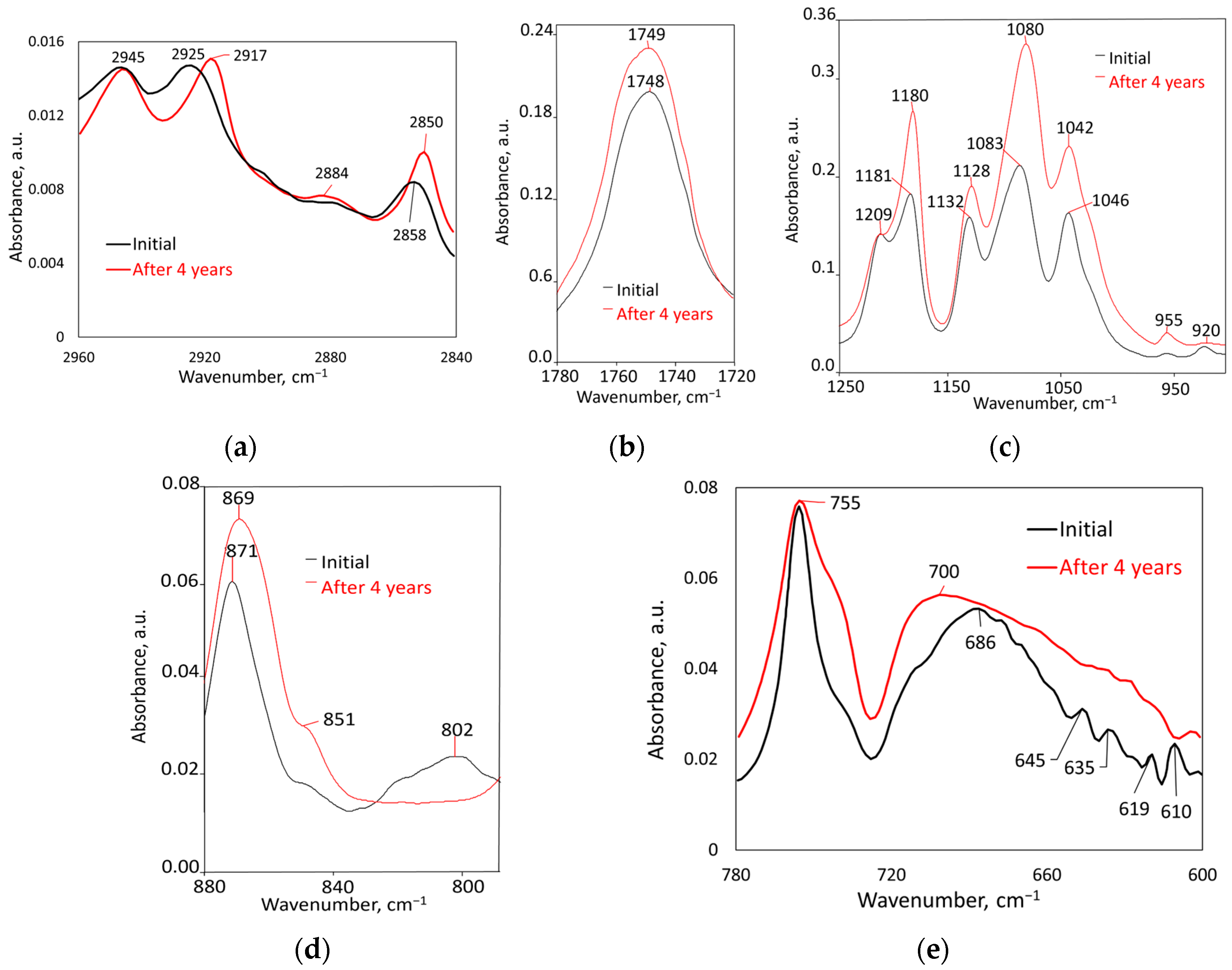
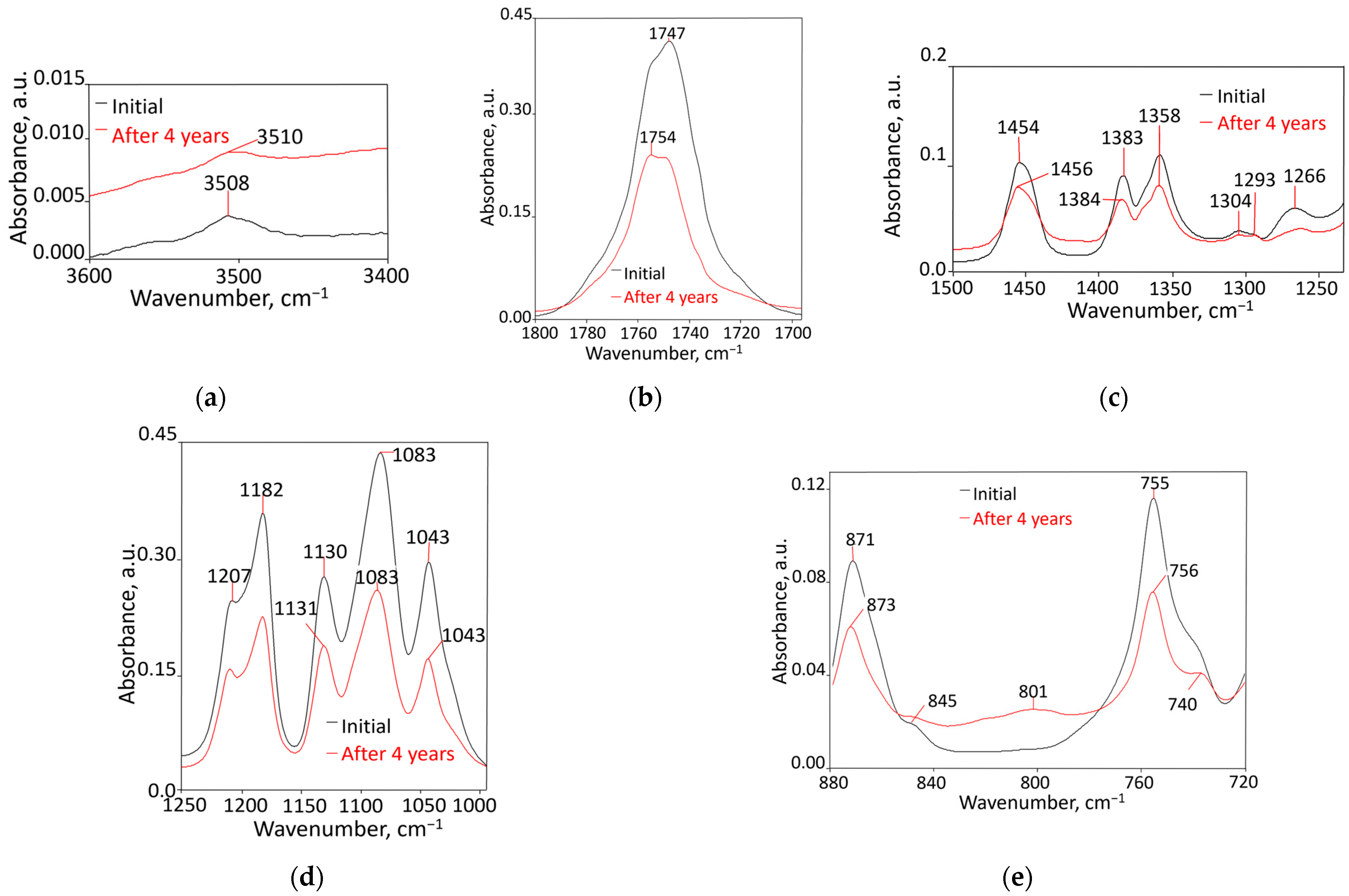
| Peak Changes Type | Comp. | Wavelength, cm−1; Peak Height (H), a.u. | Peaks No. |
|---|---|---|---|
| Disappeared | PLA 850 | 2997 cm−1; 1453 cm−1; 1383 cm−1; 1358 cm−1; 1303 cm−1; 1265 cm−1. | 6 |
| LAK 301 | 3071 cm−1; 2958 cm−1; 2905 cm−1; 2852 cm−1; 1722 cm−1; 1602 cm−1; 1442 cm−1; 1428 cm−1; 1323 cm−1; 1220 cm−1; 1117 cm−1; 1098 cm−1; 989 cm−1; 963 cm−1; 917 cm−1; 888 cm−1; 852 cm−1; 782 cm−1; 764 cm−1; 720 cm−1. | 20 | |
| Appeared | 2884 cm−1; 802 cm−1; 645 cm−1. | 3 | |
| Shifted by more than 10 cm−1 | PLA 850 | - | 0 |
| LAK 301 | 1734 cm−1 14 cm−1, H < 26%; 1197 cm−1 16 cm−1, H < 59%; 933 cm−1 22 cm−1, H < 93%; | 3 | |
| Identical or shifted with less than 10 cm−1 and their H variation compared to | PLA 850 | 2947 cm−1 2 cm−1, H < 48%; 2919 cm−1 6 cm−1, H < 48%; 2851 cm−1 7 cm−1, H < 64%; 1749 cm−1 1 cm−1, H < 58%; 1207 cm−1 2 cm−1, H < 48%; 1180 cm−1 1 cm−1, H < 52%; 1128 cm−1 4 cm−1, H < 55%; 1083 cm−1, H < 62%; 1042 cm−1 4 cm−1, H < 62%; 956 cm−1 1 cm−1, H < 75%; 920 cm−1, H < 50%; 870 cm−1 1 cm−1, H < 40%; 756 cm−1 1 cm−1, H < 33%; 694 cm−1 8 cm−1, H < 31%. | 14 |
| LAK 301 | 1210 cm−1 1 cm−1, H < 71%; 1139 cm−1 7 cm−1, H < 55%; 1048 cm−1 2 cm−1, H < 58%; 875 cm−1 4 cm−1, H < 40%; 751 cm−1 4 cm−1, H < 75%; 676 cm−1 10 cm−1, H < 68%; 623 cm−1 4 cm−1, H < 95%. | 7 |
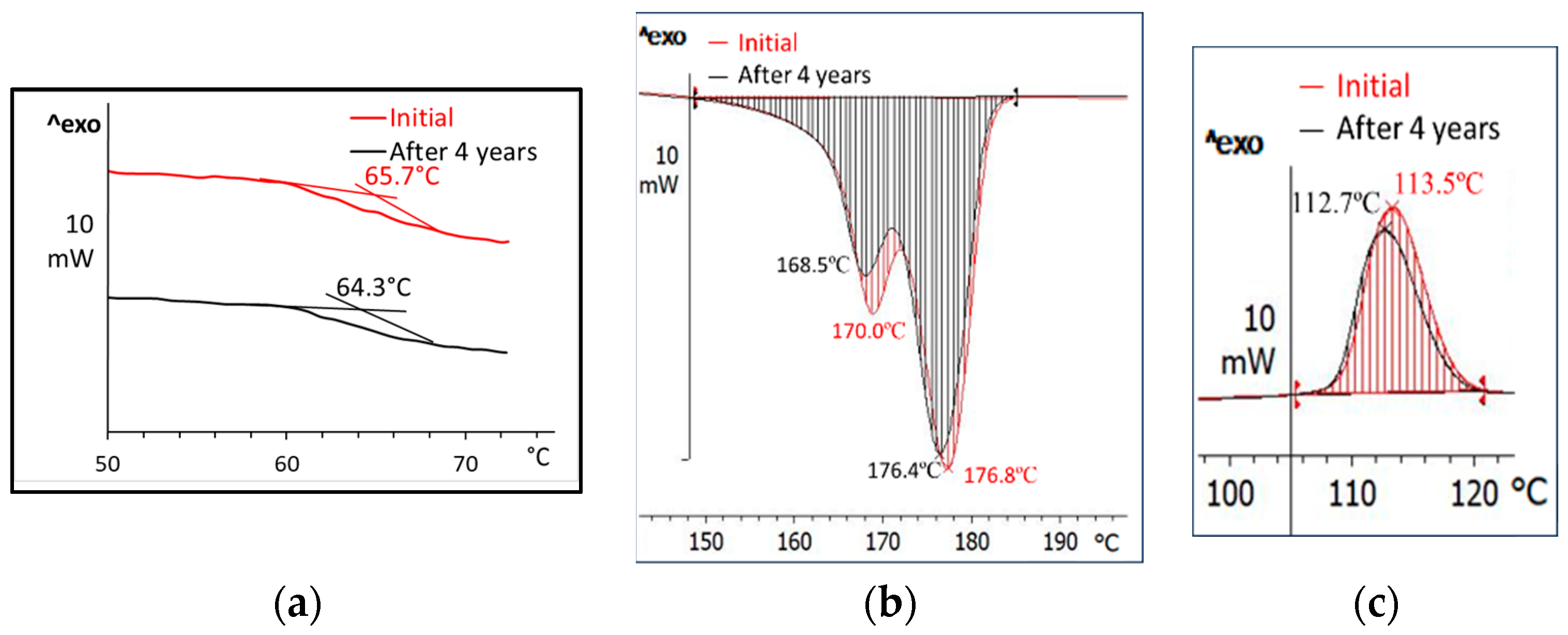
| Analysis Time, Years | Glass Transition | Melting (Endo) | ||||||
|---|---|---|---|---|---|---|---|---|
| Tg, °C | ΔTg4-i, °C | TMax.1/Max.2, °C | ΔTm4-i, °C | ΔHm, J·g−1 | ΔHm4-i, J·g−1 | Range, °C | Range4-i, °C | |
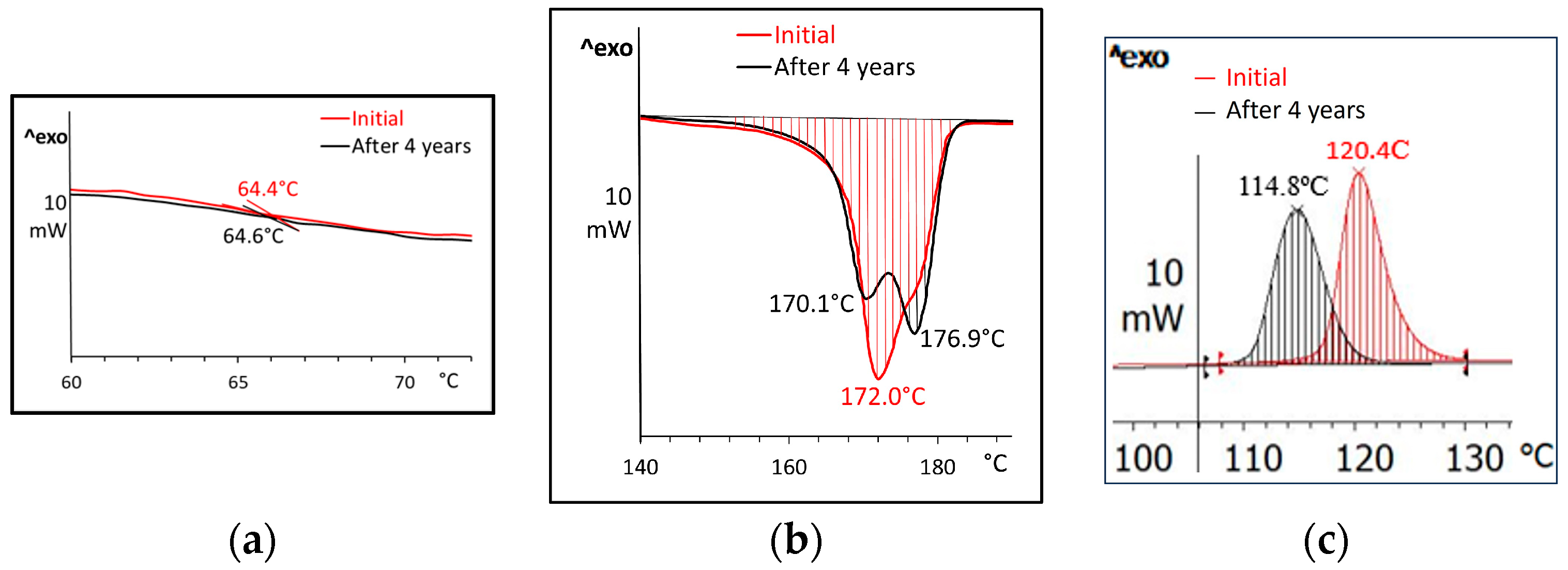
| Initial | 65.7 | - | 170/176.8 | - | 39.9 | - | 149–185 | 36 |
| After 4 years | 64.3 | 1.4↓ | 168.5/176.4 | 1.5↓/0.4~ | 40.7 | 0.8~ | 149–185 | 36~ |
| Analysis Time, Years | Crystallization (exo) | |||||||
|---|---|---|---|---|---|---|---|---|
| Tc, °C | ΔTc4-i, °C | ΔHc, J·g−1 | ΔHc4-i, J·g−1 | Range, °C | Range4-i, °C | C, % | ΔC4-i, % | |
| Initial | 113.5 | - | 36.2 | - | 121–105 | 16 | 42.9 | - |
| After 4 years | 112.7 | 0.8~ | 35.8 | 0.4~ | 121–105 | 16~ | 43.7 | 0.8~ |
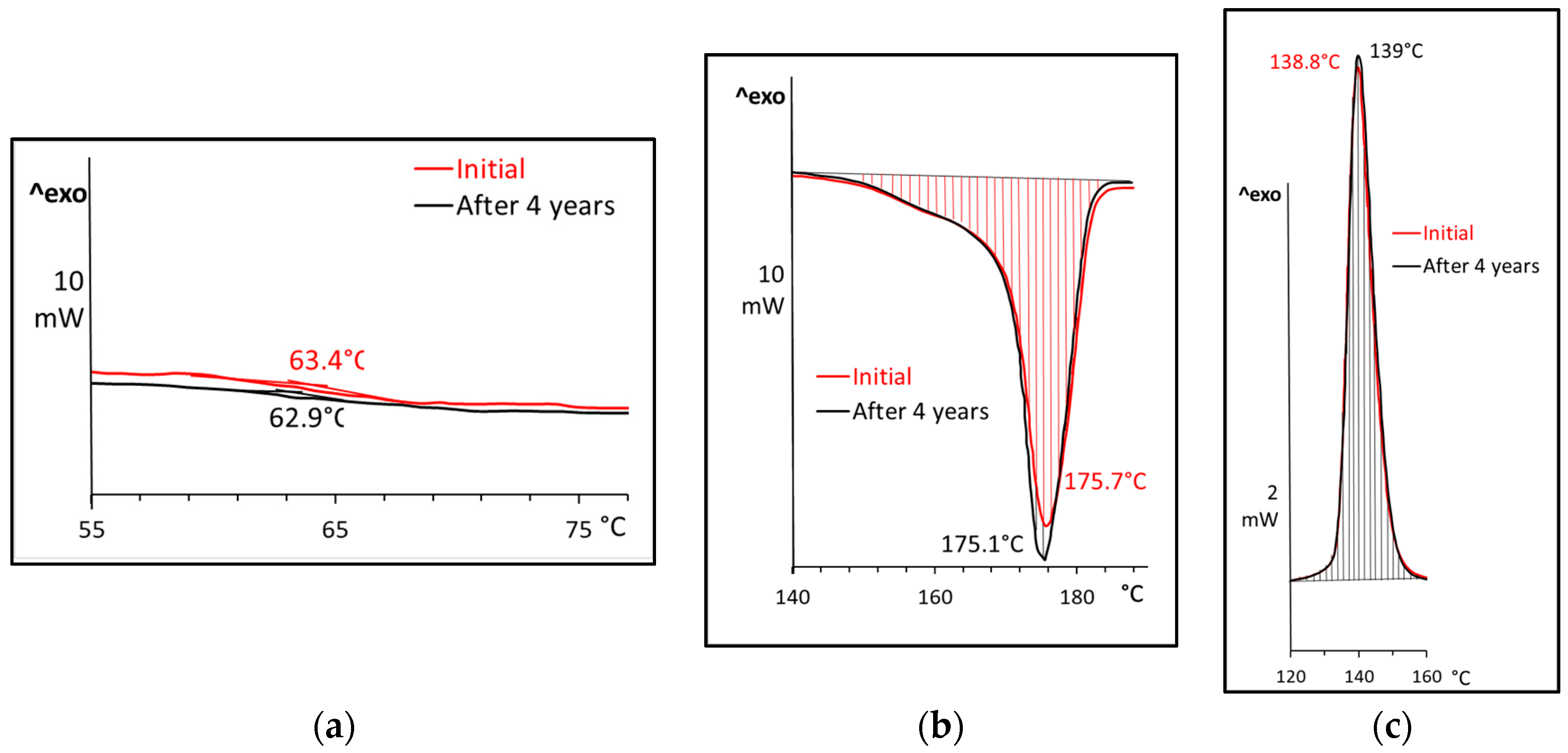
| Analysis Time, Years | Glass Transition | Melting (endo) | ||||||
|---|---|---|---|---|---|---|---|---|
| Tg, °C | ΔTg4-i, °C | Tm, °C | ΔTm4-i, °C | ΔHm, J·g−1 | ΔHm4-i, J·g−1 | Range, °C | Range4-i., °C | |
| Initial | 63.4 | - | 175.7 | - | 60.5 | - | 137–186 | 49 |
| After 4 years | 62.9 | 0.5~ | 175.1 | 0.6~ | 62.3 | 1.8↑ | 137–186 | 49~ |
| Analysis Time, Years | Crystallization (exo) | |||||||
|---|---|---|---|---|---|---|---|---|
| Tc, °C | ΔTc4-i, °C | ΔHc, J·g−1 | ΔHc4-i, J·g−1 | Range, °C | Range4-i., °C | C, % | ΔC4-i., % | |
| Initial | 138.8 | - | 55 | - | 157–115 | 42 | 65 | - |
| After 4 years | 139 | 0.2~ | 56.1 | 1.1↑ | 157–115 | 42~ | 67 | 2↑ |
| Sample\Properties | Functional Property | |
|---|---|---|
| Izod Impact Resistance, kJ/m2 | HDT, °C | |
| Neat PLA | 0.34 ± 0.2 | 66 |
| Heterogeneously nucleated PLA | 1.73 ± 0.1 | 97 |
| Peak Changes Type | PLA | Wavelength, cm−1; Peak Bio-Hybrids Height (H), a.u. | Peaks No. |
|---|---|---|---|
| Disappeared | SCXD | 2997 cm−1; 2947 cm−1, 2919 cm−1; 2851 cm−1; 956 cm−1; 920 cm−1; 694 cm−1 | 7 |
| SCXT | 2995 cm−1; 2945 cm−1; 2928 cm−1; 2900 cm−1; 2880 cm−1; 2851 cm−1; 955 cm−1; 700 cm−1 | 8 | |
| Appeared | 3508 cm−1; 1293 cm−1; 845 cm−1; 801 cm−1; 740 cm−1 | 5 | |
| Shifted by more than 10 cm−1 | SCXD | - | 0 |
| SCXT | - | 0 | |
| Identical or shifted with less than 10 cm−1 and their H variation compared to | SCXD | 1749 cm−1 2 cm−1, H < 7%; 1453 cm−1 1 cm−1, H < 23%; 1383 cm−1, H < 27%; 1358 cm−1, H < 8%; 1303 cm−11 cm−1, H < 56%; 1265 cm−1, 1 cm−1, H < 33%; 1207 cm−1 H < 4%; 1180 cm−1 2 cm−1, H < 57%; 1128 cm−1 2 cm−1, H < 13%; 1083 cm−1, H < 15%; 1042 cm−1 1 cm−1, H < 22%; 870 cm−1 1 cm−1, H < 10%; 756 cm−1 1 cm−1, H < 8%. | 13 |
| SCXT | 1747 cm−1, H < 28%; 1452 cm−1 2 cm−1, H < 29%; 1381 cm−1 2 cm−1, H < 38%; 1359 cm−1 1 cm−1, H < 8%; 1310 cm−1 6 cm−1, H < 50%; 1266 cm−1; H < 67%; 1210 cm−1 3 cm−1, H < 11%; 1182 cm−1, H < 65%; 1127 cm−1 3 cm−1, H < 18%; 1083 cm−1, H < 35%; 1042 cm−1 1 cm−1, H < 28%; 867 cm−1 4 cm−1, H < 10%; 755 cm−1, H ≈ 0. | 13 |
| Analysis Time, Years | Glass Transition | Melting (Endo) | ||||||
|---|---|---|---|---|---|---|---|---|
| Tg, °C | ΔTg4-i, °C | Tm, °C | ΔTm4-i, °C | ΔHm, J·g−1 | ΔHm4-i, J·g−1 | Range, °C | Range4-i, °C | |
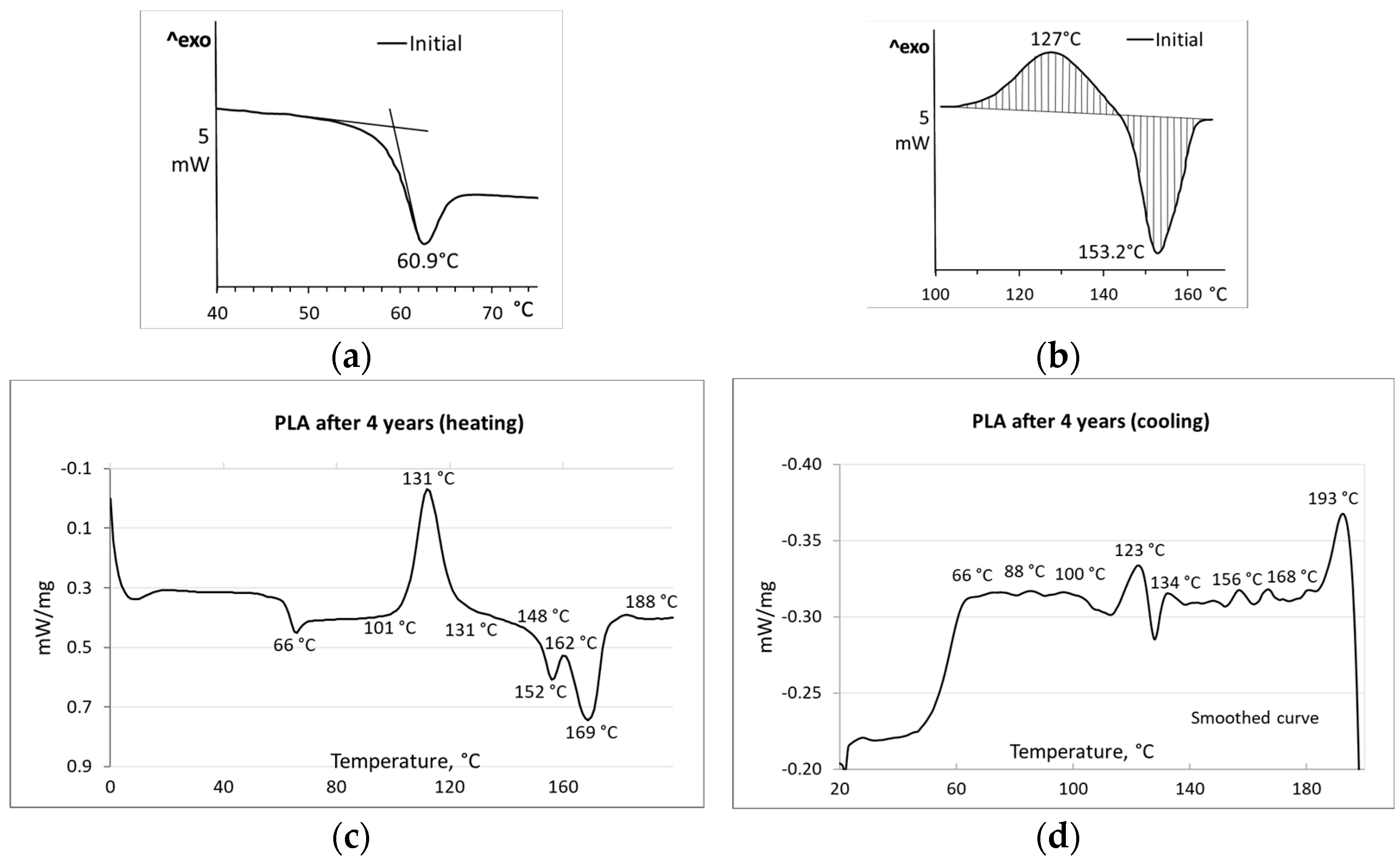
| Initial | 60.9 | - | 153.2 | - | 0.77 | - | 145–165 | 20 |
| After 4 years | 66↑ | 5.1 | 156/169 | 2.8↑ | 33.1 | 32.33↑ | 148–188 | 40→ |
| Analysis Time, Years | DSC Runs | Cold Crystallization (exo) | Crystallization (exo) | ||||||||||||
|---|---|---|---|---|---|---|---|---|---|---|---|---|---|---|---|
| Tcc, °C | ΔTcc4-i, °C | ΔHcc, J·g−1 | ΔHcc4-i, J·g−1 | Range, °C | Range4-i, °C | Tc, °C | ΔTc4-i, °C | ΔHc, J·g−1 | ΔHc4-i, J·g−1 | Range, °C | Range4-i, °C | C, % | ΔC4-i, % | ||
| Initial | Heating 2 | 127 | - | 0.7 | - | 101–145 | 44 | - | - | - | - | - | - | - | - |
| Cooling 1 | - | - | - | - | - | - | - | - | - | - | - | - | 0.08 | - | |
| After 4 years | Heating 2 | 113 | 14↓ | 30.6 | 29.9↑ | 101–131 | 30← | - | - | - | - | - | - | - | - |
| Cooling 1 | - | - | - | - | - | - | 123 | 123 | 1.98 | 1.98 | 113–128 | 15 | 2.7 | 2.62↑ | |
| Analysis Time, Years | Glass Transition | Melting (Endo) | ||||||
|---|---|---|---|---|---|---|---|---|
| Tg, °C | ΔTg4-i, °C | TMax.1/Max.2, °C | ΔTm4-i, °C | ΔHm, J·g−1 | ΔHm4-i, J·g−1 | Range, °C | Range4-i, °C | |
| Initial | 64.4 | - | 172/- | - | 48.8 | - | 136–190 | 54 |
| After 4 years | 64.6 | 0.2~ | 170.1/176.9 | 1.9↓/- | 46.3 | 2.5↓ | 136–190 | 54~ |
| Analysis Time, Years | Crystallization (exo) | |||||||
|---|---|---|---|---|---|---|---|---|
| Tc, °C | ΔTc4-i, °C | ΔHc, J·g−1 | ΔHc4-i, J·g−1 | Range, °C | Range4-i, °C | C, % | ΔC4-i, % | |
| Initial | 120.4 | - | 43 | - | 130–113 | 17 | 52.5 | - |
| After 4 years | 114.8 | 5.6↓ | 40 | 4↓ | 124–106 | 18← | 49.8 | 2.7↓ |
| Sample\Properties | Functional Property | |
|---|---|---|
| Izod Impact Resistance | HDT | |
| Racemic nucleated PLA | 2.36 ± 0.3 kJ/m2 | 95 °C |
| PLA 850 SCXD | 0.56 ± 0.1 kJ/m2 | 78 °C |
| PLA 3052 SCXT | 16 ± 0.15 J/m | 55 °C |
Disclaimer/Publisher’s Note: The statements, opinions and data contained in all publications are solely those of the individual author(s) and contributor(s) and not of MDPI and/or the editor(s). MDPI and/or the editor(s) disclaim responsibility for any injury to people or property resulting from any ideas, methods, instructions or products referred to in the content. |
© 2026 by the authors. Licensee MDPI, Basel, Switzerland. This article is an open access article distributed under the terms and conditions of the Creative Commons Attribution (CC BY) license.
Share and Cite
Dimonie, D.; Mathe, S.; Trușcă, R.D.; Damian, C.M.; Dumitru, Ș.; Oancea, F. Controlling the Thermodynamic Stability of Melt-Compounded PLA as Opportunity to Achieve 3D Printing Automotive Items with Medium Lifetime. J. Compos. Sci. 2026, 10, 92. https://doi.org/10.3390/jcs10020092
Dimonie D, Mathe S, Trușcă RD, Damian CM, Dumitru Ș, Oancea F. Controlling the Thermodynamic Stability of Melt-Compounded PLA as Opportunity to Achieve 3D Printing Automotive Items with Medium Lifetime. Journal of Composites Science. 2026; 10(2):92. https://doi.org/10.3390/jcs10020092
Chicago/Turabian StyleDimonie, Doina, Silvia Mathe, Roxana Doina Trușcă, Celina Maria Damian, Ștefan Dumitru, and Florin Oancea. 2026. "Controlling the Thermodynamic Stability of Melt-Compounded PLA as Opportunity to Achieve 3D Printing Automotive Items with Medium Lifetime" Journal of Composites Science 10, no. 2: 92. https://doi.org/10.3390/jcs10020092
APA StyleDimonie, D., Mathe, S., Trușcă, R. D., Damian, C. M., Dumitru, Ș., & Oancea, F. (2026). Controlling the Thermodynamic Stability of Melt-Compounded PLA as Opportunity to Achieve 3D Printing Automotive Items with Medium Lifetime. Journal of Composites Science, 10(2), 92. https://doi.org/10.3390/jcs10020092