Article

Valorization of Agri-Food Waste in Green Composites: Influence of Orange Peel Particulates on Mechanical, Thermal, and Antioxidant PLA Properties


by
Stefano Trimarchi
1,
Federica Curcio
1,
Roberta Cassano
2 and
Francesco Gagliardi
1,*
1
Department of Mechanical, Energy and Management Engineering, University of Calabria, 87036 Rende, CS, Italy
2
Department of Pharmacy, Health and Nutritional Sciences, University of Calabria, 87036 Rende, CS, Italy
*
Author to whom correspondence should be addressed.
J. Compos. Sci. 2026, 10(2), 91; https://doi.org/10.3390/jcs10020091
Submission received: 31 December 2025 / Revised: 22 January 2026 / Accepted: 6 February 2026 / Published: 9 February 2026
(This article belongs to the Special Issue Sustainable Polymer Composites: Waste Reutilization and Valorization)

Abstract

Polymer matrix composites derived from organic waste represent a viable solution for enhancing environmental sustainability. This study investigates the development and characterization of eco-friendly composite filaments using polylactic acid (PLA) reinforced with orange peel particulates (OPPs), evaluating their potential for fused filament fabrication (FFF). PLA/OPP composites were fabricated with varying reinforcement concentrations (2.5–20 wt%) and different particle sizes. The materials were characterized through mechanical testing, thermal analysis (DSC), and FTIR spectroscopy, while functional performance was evaluated via DPPH and ABTS antioxidant assays. The experimental results indicated that a specific low OPP concentration (2.5 wt%) maintained the tensile strength of the neat matrix while significantly improving ductility by 16.67%, thereby enhancing the processability for fused deposition modeling (FDM). Conversely, reinforcement levels exceeding 10 wt% led to a decline in mechanical properties due to fiber agglomeration and matrix saturation. Thermal analysis revealed that higher OPP content influences the crystallization kinetics, while FTIR spectra confirmed good interfacial compatibility through hydrogen bonding. Notably, the incorporation of OPP imparted significant antioxidant activity to the composites, which increased proportionally with filler content. In conclusion, this study demonstrates that low-content PLA/OPP composites successfully balance mechanical performance with functional bioactivity, providing a sustainable material suitable for active packaging and 3D printing applications.

1. Introduction

The excessive production and improper disposal of plastics pose significant threats to global ecosystems. Consequently, there is an urgent need to research innovative technologies aimed at mitigating the environmental impact of polymer degradation. Environmental sustainability can be enhanced through the development of polymers derived from organic waste precursors, such as coconut shells, potato peels, and various fruit residues. However, the application of these materials must be carefully evaluated based on their starch and cellulose content, local supply chain availability, and resulting mechanical properties. Notably, these bio-based materials exhibit mechanical performance comparable to conventional synthetic polymers, offering a promising strategy to reduce global plastic production, which is currently estimated at 400 million tons per year [1].
Currently, various recycling methods enable the reuse of plastics and their reintegration into the production cycle. However, the repeatability of these processes is often constrained by the thermal degradation of the polymer chains. Despite these limitations, recycling remains a valid alternative to conventional virgin polymer production [2]. To further reduce the consumption of virgin resin and the cost of the final product, a valuable strategy involves incorporating reinforcements derived from food and agricultural waste, such as egg and walnut shells [3], pecan shells [4], crab shells [5,6], and banana fibers [7], as well as wood-based residues like olive, orange, and fir tree [8,9,10], bamboo [11], and cork [12]. Although these organic fillers may limit traditional mechanical recycling streams, their inclusion significantly reduces the overall volume of synthetic polymer required per component and promotes end-of-life options such as industrial composting for biodegradable matrices.
In the literature, numerous case studies have aimed to verify these material characteristics or enhance them through the incorporation of fibers specifically for use in FDM techniques [13,14,15]. In modern 3D printing, PLA is widely utilized due to its favorable mechanical and thermal properties, as well as its inherent biodegradability and excellent processability [16,17]. Several studies have analyzed the recycling of natural and synthetic polymers to develop composites reinforced with recycled or waste fibers. A prominent example is spent coffee grounds (SCGs), which have an annual global consumption of approximately 6 million tons; notably, the production of 1 kg of soluble coffee generates about 2 kg of SCGs. The disposal of these grounds poses significant environmental challenges. Although organic in nature, the improper disposal of huge quantities of SCGs poses serious environmental challenges. Their anaerobic decomposition in landfills generates methane, a potent greenhouse gas, while the presence of bioactive compounds such as caffeine and tannins can exhibit phytotoxic effects and contaminate soil and groundwater if not properly valorized [18,19]. While some research has focused on utilizing SCGs for the extraction of activated carbon, ethanol, and biodiesel, or for applications in organic compost and animal feed [20], incorporating SCGs into polymer matrices offers a sustainable valorization pathway. This strategy stabilizes the biomass, preventing uncontrolled degradation, and simultaneously reduces the reliance on virgin fossil-based resins, transforming a waste liability into a functional filler.
In tests conducted by Wang et al. [21], increasing the percentage of SCGs in HDPE led to an improvement in mechanical properties, with the exception of tensile strength. Furthermore, Marques et al. [22] demonstrated that the type of polymer chain significantly influences the final mechanical features. Specifically, for the same polymer, a homopolymer chain is more rigid and exhibits higher tensile strength than a copolymeric chain. In both cases, a significant decline in performance was observed as the concentration of reinforcement increased.
Nevertheless, tests conducted with high concentrations of SCGs often show significant performance gaps between different loading levels. To more accurately verify how the material responds to applied stress, it is preferable to use a limited amount of reinforcement (<10–12 wt%) [23]. In this case, it is possible to observe how a certain level of saturation is reached within the matrix, leading to the formation of fiber agglomerates. These clusters reduce the effective interfacial interaction and, consequently, impair the load transfer between the fibers and the matrix. In studies conducted by Gupta et al. [24], which utilized mixtures of recycled PET and LLDPE reinforced with biocarbon derived from the pyrolysis of SCGs, it was observed that increasing the temperature led to an increase in tensile and flexural strength, while the storage modulus and elongation at break decreased. Furthermore, the fabrication of these composites significantly affects the thermal properties of the matrix, influencing the glass transition temperature (Tg), cold crystallization temperature (Tcc), crystallization temperature (Tc), and melting temperature (Tm), as well as altering the crystalline fraction [2,25].
Another widespread form of food waste is generated by the orange industry; after juice extraction, the peel accounts for approximately 50% of the fruit’s total weight. Despite being traditionally disposed of as waste, orange peels are rich in pectin, cellulose, essential oils, and soluble sugars, components that can be effectively utilized to produce biopolymers or reinforcing fibers [26]. For instance, Naik et al. [27] employed pyrolysis to carbonize orange peel particulates (OPPs) to enhance their carbon content. Their study revealed that as the carbonization temperature increased, the resulting PP/OPP composites exhibited improvements in hardness, tensile and flexural strength, and impact resistance. However, consistent with other studies, the use of higher OPP content eventually led to a phenomenon we refer to as ‘matrix saturation’. This occurs when the filler content exceeds the matrix’s capacity to fully wet and encapsulate the particles, resulting in the formation of aggregates and voids that act as stress concentrators. Usama Abass [28] utilized waste orange peel (OP) fibers to reinforce polyester resin via the hand lay-up spray technique, varying the reinforcement content from 2 wt% to 10 wt%. The results demonstrated that the maximum values for tensile strength, impact resistance, and hardness were achieved in the polymer–matrix composite (PMC) containing 10 wt% of OP. However, viscosity remains a critical parameter in such manufacturing processes; excessive reinforcement can negatively impact both the quality and the manufacturability of the final product. Consequently, to optimize surface quality and maintain appropriate viscosity before reaching matrix saturation, Rai et al. [29] identified 2 wt% of OPP as the ideal concentration for filament extrusion. Thus, the literature presents contrasting perspectives regarding the optimal fiber content required to reduce polymer consumption while maintaining or enhancing mechanical performance. In a case study by Sambudi et al. [16], the incorporation of these fibers into PLA introduced hydroxyl groups that modified the polymer surface; additionally, the presence of OPP was found to enhance the biodegradability of the matrix.
Natural reinforcements are highly hydrophilic, which may limit the interfacial interaction between the fibers and the hydrophobic polymer matrix. Consequently, it is often necessary to perform surface treatments on the fibers or include additives to mitigate moisture absorption [30]. In the experimental study conducted by Majrashi et al. [23], treatment with NaOH was found to increase the thermal stability of the composite, reduce weight loss compared to untreated fibers, and improve mechanical properties. Such treatments enhance the microstructure while also reducing bacterial proliferation and composite degradation. Similar findings were reported by Sun et al. [31], who developed a PMC based on PLA and rice husk fibers combined with ammonium polyphosphate (APP). Furthermore, the presence of phenolic compounds in orange peels imparts significant antioxidant properties [32]. For instance, Bassani et al. [33] successfully developed a packaging material by integrating antioxidant extracts from orange peels into a PLA matrix.
The objective of this study is to investigate the influence of OPP as a natural reinforcement within a PLA matrix. Specifically, the research evaluates how varying both the reinforcement concentration (from 2.5 to 20 wt.%) and the particle size range affects the mechanical, thermal, and chemical properties of the resulting PMCs. Furthermore, this work explores the functional potential of these biocomposites by assessing their antioxidant activity through DPPH and ABTS assays, aiming to develop a sustainable, bio-based material suitable for functional 3D printing and eco-friendly packaging applications.

2. Materials and Experimental Analyses

2.1. Materials

The PLA pellets (Ingeo 4043D, NatureWorks, Plymouth, MN, USA) were supplied by ReprapWorld (NL). The orange peels were obtained from locally harvested oranges; after collection, the peels underwent a specific treatment process to produce particulates suitable for use as reinforcement in the polymer matrix.

2.2. Sample Preparation

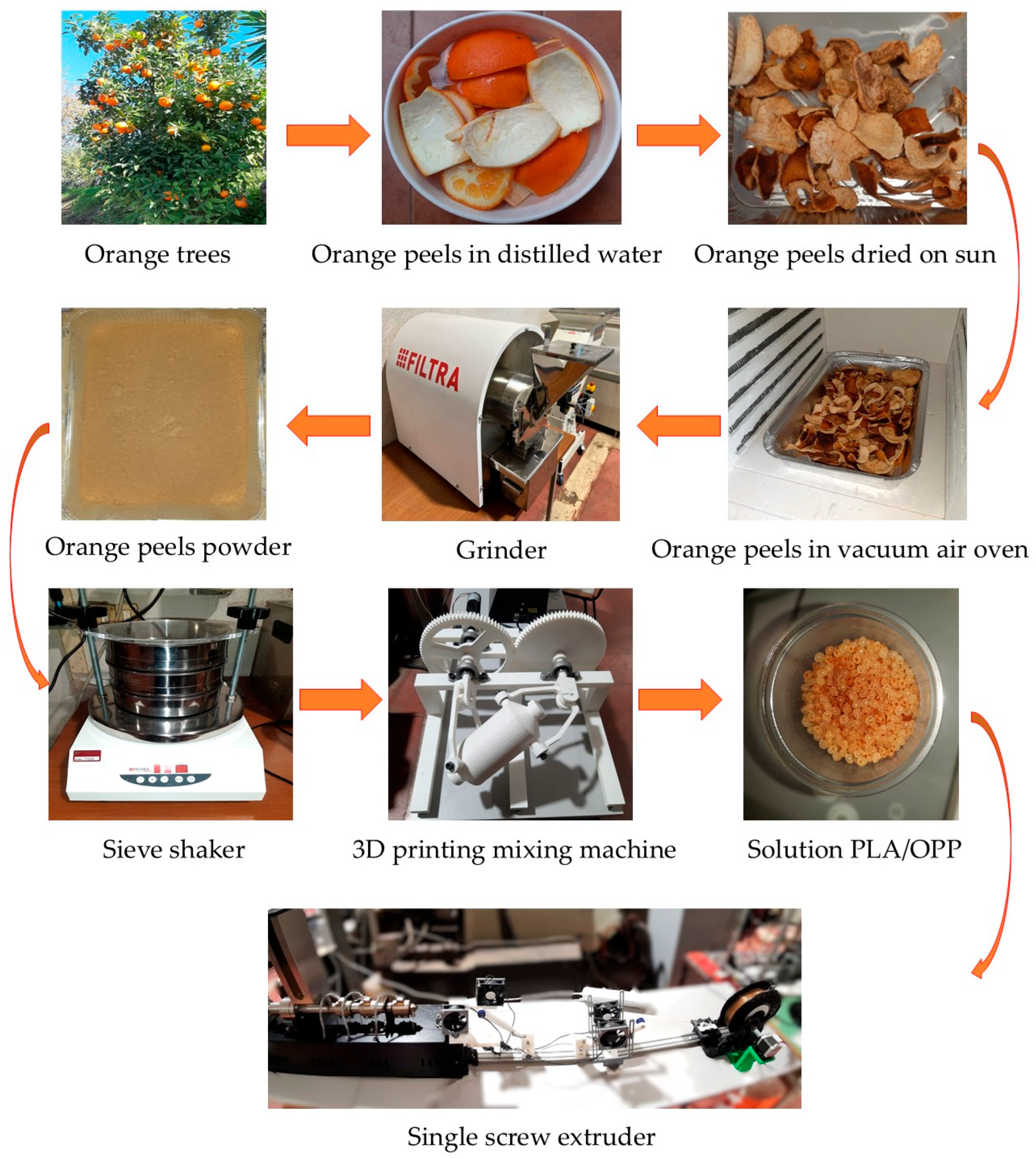
The sample preparation procedure was designed to promote food waste valorization. The complete preparation sequence is illustrated in Figure 1.
Specifically, according to the literature [34], the orange peels were rinsed and then soaked in distilled water for 24 h to remove impurities. To reduce the initial moisture content, the peels were sun-dried for four days, followed by a final drying step in a vacuum oven (TA2-9-12TP, Tefic Biotec, Xi’an, China) at 80 °C for 5 h. To achieve the desired particle size, the dried peels were processed in a grinder (FML-2000, Filtra Vibraciόn, Barcelona, Spain) for 5 min, followed by a 10 min cooling phase at 4 °C to prevent thermal degradation. This grinding cycle was repeated seven times. Finally, to obtain specific particle size fractions, the resulting powder was classified using a sieve shaker (FTS-0200, Filtra Vibraciόn, Barcelona, Spain) with two sieves: 90 µm and 75 µm. This classification ensures that the maximum particle size is well-defined, which is the critical parameter for avoiding nozzle clogging during the FFF process and ensuring consistent flow. Various weight percentages of orange peel particles were added to the PLA pellets, according to the experimental design schematized in Table 1. The components were dry-mixed for 50 min to ensure a homogeneous distribution before extrusion. The filament, with a nominal diameter of 1.75 mm, was produced using a single-screw extruder (Xcalibur, Noztek, Shoreham, UK) equipped with a nozzle diameter of 2.5 mm and three controlled heating zones, namely a feeding zone at 105 °C, a compression zone at 165 °C, and a die zone at 175 °C, with a screw speed maintained at 5 rpm. Upon exiting the die, the filaments were cooled by forced air (fans) and collected using an automatic winding machine.

2.3. Performed Experimental Analyses

The extruded filaments were systematically characterized to evaluate the influence of both OPP size and loading percentage on the resulting thermomechanical and oxidative properties. To this end, a comprehensive experimental campaign was conducted, including the specific testing procedures described in the following sub-sections.

2.3.1. Tensile Test of PLA/OPP Filaments

The mechanical properties of the PLA/OPP composite filaments were evaluated according to the ISO 11566 standard [35]. Tensile tests were performed using an universal testing machine (Model E42, MTS Systems Corporation, Eden Prairie, MN, USA), equipped with a 100 N load cell. For each formulation, five specimens were tested using a crosshead speed of 1 mm/min and an initial gauge length of 100 mm.

2.3.2. Thermal Analysis of PLA/OPP Composites

The thermal stability and characteristic transition temperatures of the PLA/OPP composites were determined by differential scanning calorimetry (DSC) (DSC 25, TA Instruments, New Castle, DE, USA). The analysis was conducted according to the ISO 11357 standard [36]. Three samples for each configuration were tested; samples weighing between 2 and 6 mg were placed in aluminum crucibles and subjected to one cycle of a heating ramp from 40 °C to 250 °C at a constant heating rate of 10 °C/min. The recorded DSC heating curves allowed for the evaluation of the initial degree of crystallinity (ꭓc) of the different composites. Specifically, ꭓc was calculated using the method described by Sarasua et al. [37], which accounts for the cold crystallization phenomenon observed during the heating scan.

2.3.3. FTIR Analysis

To identify the functional groups and evaluate the chemical interactions between the PLA matrix and the orange peel particulates, FTIR spectra were acquired using a Fourier transform infrared spectrometer (Spectrum Two, Perkin Elmer, Milan, Italy). The instrument was equipped with an attenuated total reflection (ATR) accessory, utilizing a ZnSe crystal. Three tests for each sample were performed. Specifically, the samples were placed directly onto the ATR surface, and infrared spectra were recorded in the range of 4000 to 450 cm−1.

2.3.4. DPPH Radical Scavenging Activity Assay

The antioxidant activity of pure and modified PLA was evaluated using a modified DPPH (2,2-diphenyl-1-picrylhydrazyl) radical scavenging assay. Three tests were conducted on each sample, and for each specimen, 100 mg of material was fully dissolved in 10 mL of a dichloromethane/dimethylformamide (DCM/DMF, 7:3 v/v) solvent mixture. The resulting solution was then diluted with 10 mL of methanol. Subsequently, 1 mL of this solution was incubated with 3 mL of a 0.25 mM DPPH ethanolic solution in the dark at room temperature. After 30 min of incubation, the absorbance was measured at 517 nm using a UV-Vis spectrophotometer, with pure ethanol serving as the blank. The DPPH radical scavenging activity was calculated using the following equation (Equation (1)):
Scavenging activity: (A° − A1)/(A°) × 100
where A° is the absorbance of the control (blank), and A1 is the absorbance in the presence of fibers. All tests were realized in triplicate, and the results are expressed as mean values ± standard deviation (SD).

2.3.5. ABTS Radical Scavenging Assay

7 mM of ABTS (2,2′-azino-bis(3-ethylbenzothiazoline-6-sulfonic acid)) stock solution was reacted with 2.45 mM of potassium persulfate and stirred in the dark for 12 h to generate the ABTS free radical. Prior to use, the solution was diluted with ethanol to reach a target absorbance of 0.70 at 734 nm. Three tests were carried out on each material. Subsequently, 1 mL of each sample (previously dissolved at a concentration of 10 mg/mL in a 7:3 v/v DCM/DMF mixture) was added to 3 mL of the ABTS solution. After 6 min of incubation, the absorbance was measured at 734 nm using a UV-Vis spectrophotometer. Finally, the ABTS scavenging activity was calculated using the following equation (Equation (2)):
Scavenging activity: (A° − As)/(A°) × 100
where As is the absorbance of the sample at 734 nm, and A° is the control. All tests were realized in triplicate, and the results are expressed as mean values ± SD.

3. Results and Discussion

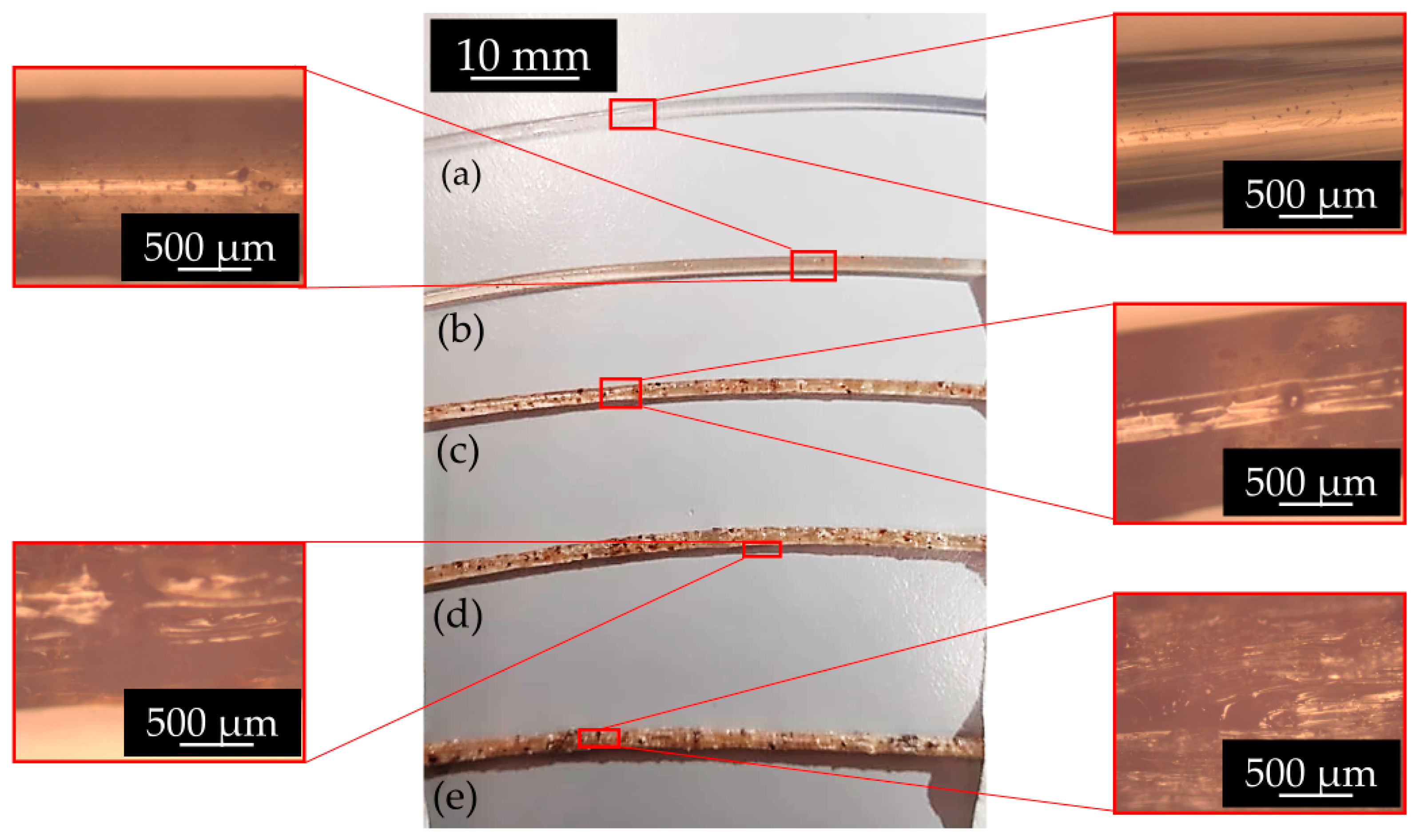
The extruded filaments showed a smooth surface and a consistent diameter, which is critical for the FDM process, without phenomena of die swelling or melt fracture during extrusion for OPP loadings up to 5 wt% (Figure 2). Furthermore, the filaments, up to 2.5 wt%, exhibited sufficient flexibility to be spooled onto reels without brittle fracture, confirming their suitability for feeding into standard 3D printers.
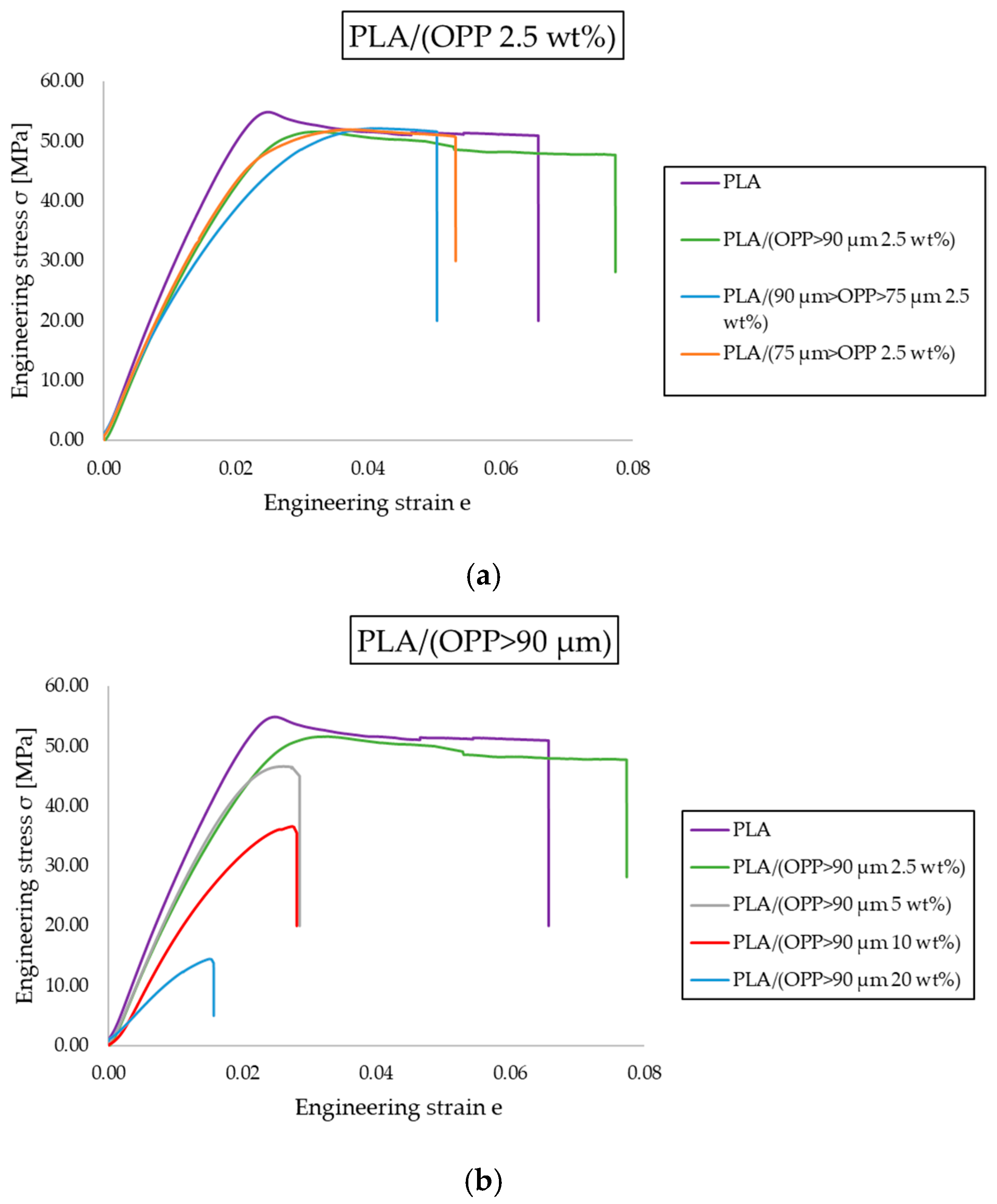
The plastic flow curves obtained from the tensile tests for each of the samples specified in Table 1 are shown in Figure 3. From these tensile flow curves, the following mechanical parameters were extracted for comparative analysis: Young’s modulus (E), ultimate tensile strength (σUTS), and engineering strain at break (e).
The neat PLA specimens exhibited the highest values for both σUTS and E. Interestingly, the addition of 2.5 wt% OPP yielded a tensile strength comparable to the pure matrix; specifically, σUTS decreased only slightly from 51.25 MPa to 47.75 MPa (−6.83%) for the PLA/(OPP > 90 μm 2.5 wt%) formulation. Notably, this specific sample showed a significant increase in engineering strain (e) from 0.07 to 0.077 (+10%). This enhancement in ductility and processability is a promising result for PLA-based 3D printing filaments, as it effectively mitigates the inherent brittleness of the polymer. This plasticizing effect could be attributed to the presence of residual traces of essential oils (such as limonene) entrapped within the orange peel particles, or potentially to other low-molecular-weight components like sugars and pectins, which may increase chain mobility within the PLA matrix. However, for all formulations containing 2.5 wt% OPP, the flow curves followed a similar trend. The observed variations in engineering strain (e) and Young’s modulus (E) at this concentration appear to be independent of the particle size, suggesting that the reinforcement loading, rather than the particle dimensions, governs the mechanical response at such low weight percentages.
For the PLA/(OPP > 90 μm 5 wt%) sample, the tensile strength (σUTS) decreased from 51.25 MPa to 45.02 MPa (−12.15%), while the engineering strain (e) dropped significantly from 0.07 to 0.028 (−60%). Conversely, the Young’s modulus (E) did not show significant variations, decreased from 2.6 to 2.27 GPa (-12.69%). In general, σUTS, e, and E followed a downward trend at higher OPP concentrations. This decline is likely due to the reduction in intermolecular forces at the filler–matrix interface; the particles may act as stress concentration points, which weakens the polymer structure and reduces its overall load-bearing capacity, despite a slight increase in flexibility in specific formulations. This trend is further confirmed by the tensile test results for the PLA/(OPP > 90 µm 20 wt%) composite, where the material exhibits a marked brittle behavior. This condition is primarily attributed to poor interfacial adhesion between the particles and the matrix, which creates structural defects that limit the overall tensile strength. Furthermore, even at a 10 wt% OPP loading, a significant reduction in stiffness, tensile strength, and elongation was observed. This suggests that the threshold for effective filler incorporation within the polymer matrix has been reached, beyond which further reinforcement becomes detrimental to the mechanical integrity of the composite. All characteristic mechanical values are summarized in Table 2.
The observed reduction in tensile strength with increasing filler content aligns with findings reported in the literature for similar PLA-based green composites. This behavior is consistent with the work of Bassani et al. [33], who observed that the incorporation of orange peel derivatives, while successfully imparting antioxidant properties to the PLA matrix, can lead to discontinuities in the material structure if not perfectly dispersed. Similarly, studies on PLA reinforced with lignocellulosic fibers often report a decrease in mechanical resistance due to the poor interfacial adhesion between the hydrophilic filler and the hydrophobic polymer matrix, which promotes the formation of aggregates at higher loadings [31]. However, unlike inert fillers, the OPPs used in this study provided a significant functional advantage by imparting antioxidant properties and enhancing ductility at low concentrations (2.5 wt%), suggesting a plasticizing effect likely due to residual low-molecular-weight compounds (e.g., sugars, oils), a phenomenon also observed in other agri-waste composites.
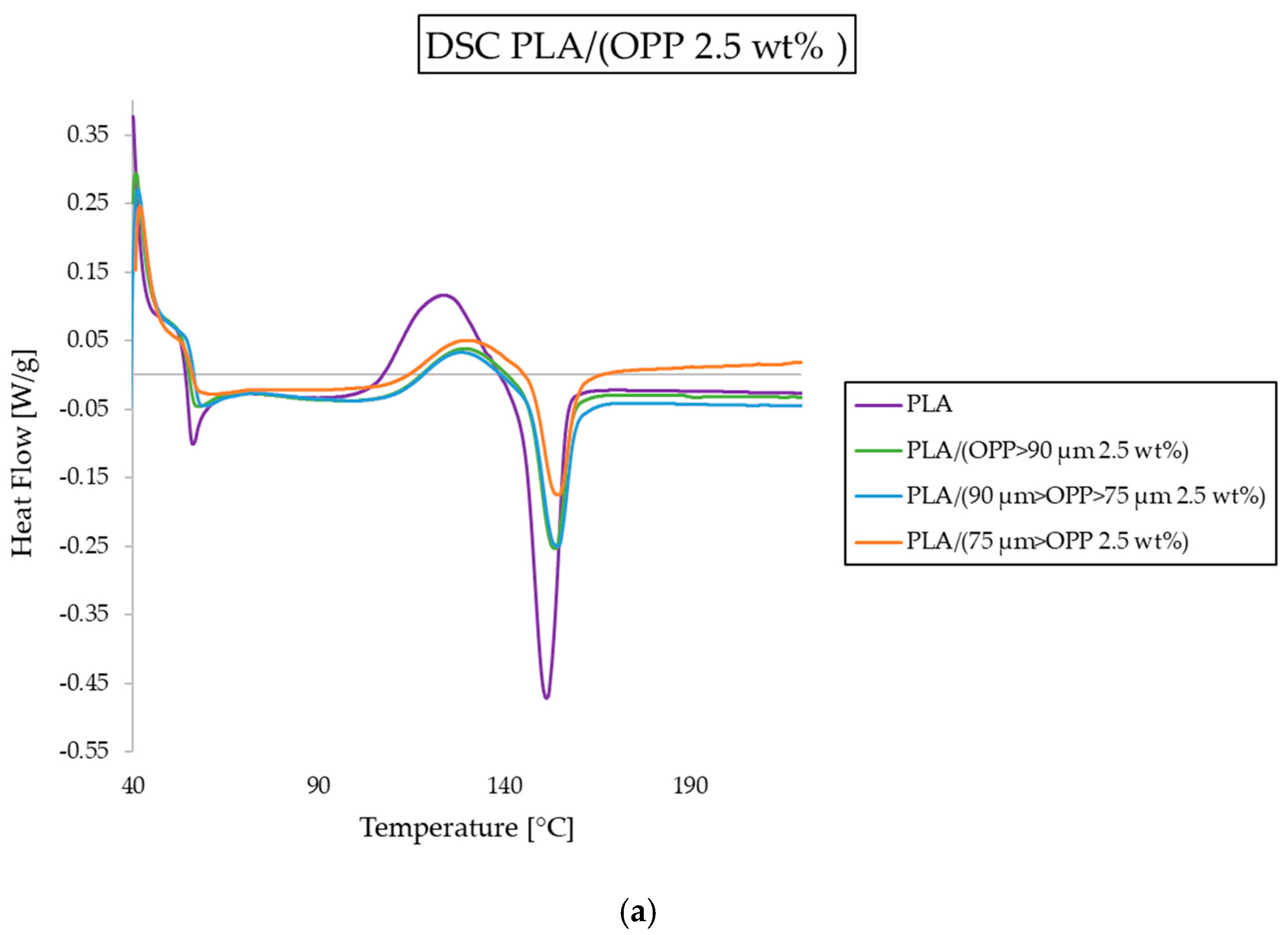
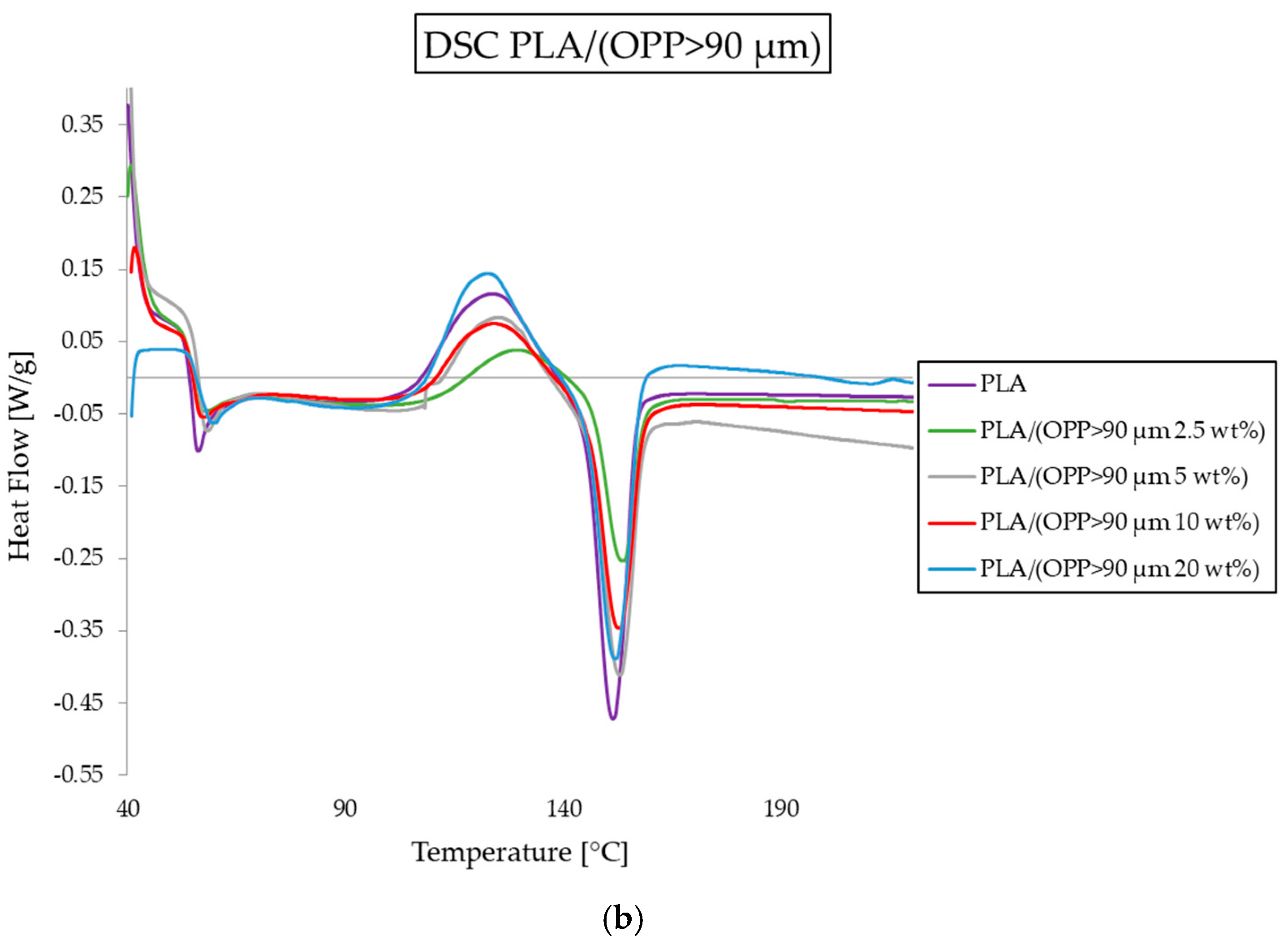
The DSC thermograms obtained to investigate the thermal properties and characteristic transitions of the various samples are presented in Figure 4a,b.
In all PLA/(OPP 2.5 wt%) formulations, the presence of the particles and their interaction with the polymer matrix appear to hinder the realignment of the polymeric chains, thereby restricting the formation of an ordered crystalline structure. Consequently, this hindrance requires higher thermal energy for the chains to rearrange, leading to an increase in the Tcc of the reinforced PLA compared to neat PLA.
Conversely, at higher OPP concentrations, the particle agglomerates influence the crystallization kinetics, promoting the reorganization of the polymer chains, as evidenced by the cold crystallization behavior. In the case of the 20 wt% reinforced composite, both the Tm and the Tcc remained similar to those of neat PLA. However, as the fiber content decreased, Tcc increased from 123 °C to 128 °C (+4.07%) for the PLA/(75 μm > OPP 2.5 wt%) sample. Similarly, Tm rose from 151 °C to 154 °C (+1.99%) for the PLA/(90 μm > OPP > 75 μm 2.5 wt%) formulation. In contrast, the glass transition temperature (Tg) did not exhibit a linear variation with respect to the filler content. The comprehensive thermal data are summarized in Table 3.
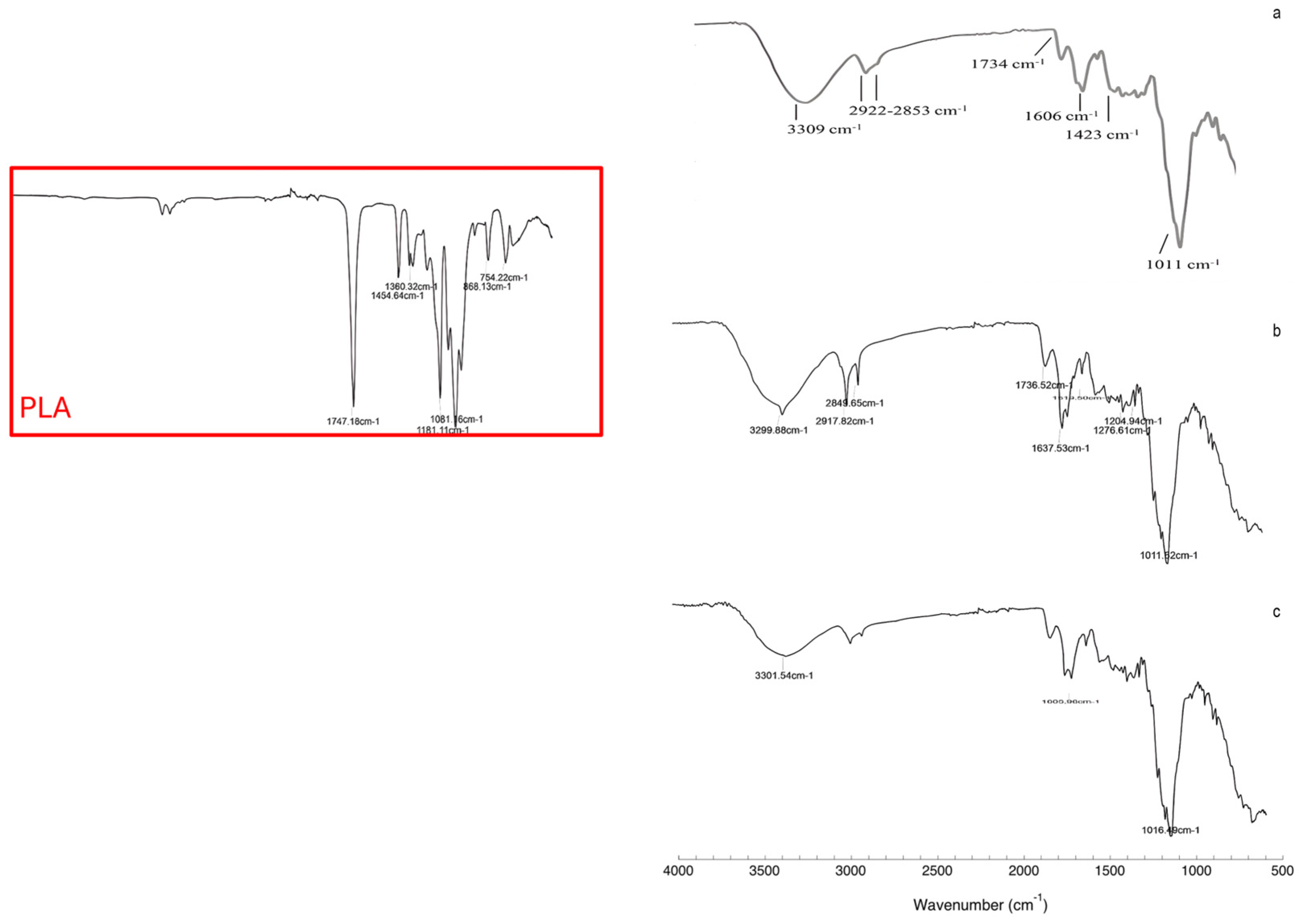
FTIR spectroscopy (Figure 5) was employed to identify the functional groups in each sample and to investigate the chemical changes or potential interactions induced by the incorporation of OPP into the extruded PLA matrix.
The characteristic absorption bands resulting from the stretching vibrations of C=O and C-O groups were identified as common features in the FTIR spectra of both OPP and PLA. Specifically, the C=O stretching peaks were observed at approximately 1747 cm−1 for PLA and approximately 1742 cm−1 for OPP. Furthermore, the C-O stretching vibrations were located at 1181 cm−1 and 1100 cm−1 for PLA and OPP, respectively. The minor peaks detected in the 2900–2860 cm−1 range can likely be attributed to the symmetric and asymmetric stretching vibrations of the methyl (-CH3) groups present in the PLA backbone. The broad absorption band at 3429 cm−1 in the OPP spectrum is characteristic of the -OH and -NH stretching vibrations from the cellulose and hemicellulose components of the lignocellulosic filler. Notably, the peak associated with the carbonyl group (C=O) exhibited distinct broadening within the 1760–1740 cm−1 range in the composites. This suggests the occurrence of intermolecular interactions, potentially due to hydrogen bonding between the PLA matrix and the cellulose or pectin fractions of the OPP. Furthermore, clear peaks emerged at 3299 cm−1 and 3301 cm−1 in spectra (b) and (c), corresponding to the hydroxyl groups detectable in the extruded PLA/(OPP > 90 µm 2.5 wt%) and PLA/(OPP > 90 µm 20 wt%) samples, respectively. As the OPP content increases, this peak becomes more pronounced, reflecting the high concentration of hydroxyl (-OH) groups inherent in the lignin and carbohydrates of the orange peel. Similarly, the presence of unsaturated aromatic compounds within the filler structure is confirmed by the C=C stretching vibrations in the 1600–1638 cm−1 range, which exhibit a consistent trend across the composite formulations. These results confirm the interfacial compatibility between PLA and OPP, which allows the composite to retain the fundamental structural integrity of the PLA matrix. These interactions were not sufficient to provide a reinforcing effect in terms of tensile strength. Instead of synergistic mechanical reinforcement, the interaction appears to facilitate interfacial slippage and chain mobility, contributing to the observed plasticizing effect at lower concentrations. Therefore, the reduction in tensile strength is attributed to the inherent softness of the organic filler and the disruption of the continuous PLA matrix, which overrides the chemical compatibility effects.
Orange peel is a byproduct rich in bioactive compounds and is recognized as a renewable, high-value source of natural antioxidants [32]. Given this composition, it was hypothesized that the functional bioactivity of PLA could be significantly enhanced through the incorporation of OPP. To verify this, the antioxidant capacity of the PLA/OPP samples was evaluated using ABTS and DPPH radical scavenging assays. The observed color change in the reaction solution qualitatively confirmed that the PLA/OPP composites possess radical scavenging capabilities, a property entirely absent in neat PLA. As summarized in Table 4, pure PLA lacks the ability to neutralize free radicals; however, the addition of just 2.5 wt% OPP initiated measurable antioxidant activity, which increased proportionally with the filler content. This demonstrated antioxidant performance highlights the potential of PLA/OPP composites for the preservation of food products that are highly susceptible to lipid oxidation.
A limitation of this study lies in the absence of chemical coupling agents or compatibilizers (e.g., silanes or maleated PLA). While the exclusion of synthetic additives preserves the fully green and compostable nature of the composite, it results in suboptimal interfacial adhesion. Additionally, although morphological analysis (e.g., SEM) was not performed in this study, the observed decline in mechanical properties at higher loadings provides strong indirect evidence of poor interfacial interaction and particle agglomeration. This lack of strong interfacial bonding is the primary factor responsible for the reduction in tensile strength at higher filling rates, limiting the material’s application to non-structural packaging solutions.

4. Conclusions and Future Works

This study investigated the influence of orange peel particulates (OPPs) as a functional reinforcement in PLA-based composites. The results demonstrate that the incorporation of this food industry byproduct significantly modulates the mechanical, thermal, and functional profile of the matrix:
As regards mechanical properties, at low OPP concentrations (2.5 wt%), the composite maintained its tensile strength while exhibiting an increase in ductility. In contrast, higher loadings (10–20 wt%) led to a decline in mechanical performance due to particle agglomeration and poor interfacial adhesion, identifying a clear saturation threshold for effective reinforcement.
The incorporation of OPPs significantly influenced the thermal behavior of the PLA matrix, revealing a competition between hindering and promoting effects. At low filler concentrations, the particles primarily acted as physical barriers that hindered segmental mobility, thereby restricting chain realignment and shifting the cold crystallization to higher temperatures. Conversely, at higher loadings, the heterogeneous nucleation effect became dominant. The increased surface area provided by the OPPs offered more sites for crystal growth, which, combined with a potential plasticizing effect from residual organic compounds, facilitated the structural reorganization of the polymer matrix. It was observed that both the melting temperature (Tm) and the cold crystallization temperature (Tcc) increased as the OPP content decreased, whereas the glass transition temperature (Tg) exhibited no discernible linear trend.
FTIR spectroscopy confirmed the successful incorporation of OPPs into the PLA matrix, revealing the formation of hydrogen bonds between the carbonyl groups of the PLA and the hydroxyl-rich lignocellulosic components of the orange peel. These intermolecular interactions are indicative of favorable interfacial compatibility, which facilitates the effective transfer of properties between the filler and the matrix. Ultimately, this chemical synergy supports the enhancement of both the functional and bioactive performance of the resulting polymer matrix composites (PMCs). While neat PLA exhibited negligible antiradical activity, the incorporation of OPPs imparted significant antioxidant properties to the resulting composites. This bioactivity was found to increase proportionally with the filler content, confirming the effective release or accessibility of the bioactive compounds within the polymer matrix. These findings demonstrate that PLA/OPP-based materials represent a viable and sustainable solution for the food industry, particularly for active packaging applications aimed at preventing lipid oxidation and extending the shelf life of sensitive products.
Based on the experimental results, a low OPP reinforcement content (2.5 wt%) achieves an optimal balance between mechanical performance, processability, and the functional requirements for active packaging, whereas higher loadings are limited by the processing constraints of filament extrusion. Indeed, these PLA/OPP composites show promising potential for applications in the active food packaging sector, where extending the shelf-life of products is crucial. Furthermore, the successful filament extrusion suggests that these materials could be effectively used in additive manufacturing (3D printing) for creating sustainable, functional objects.
Future research will focus on two main directions to overcome these challenges. Firstly, the investigation of eco-friendly surface treatment of OPP or the integration of coupling agents to improve filler–matrix compatibility without compromising biodegradability. According to that, the biodegradation rate of these composites under composting conditions will also be assessed. Secondly, given the promising antioxidant activity demonstrated, in vivo shelf-life testing on perishable food products will be conducted to validate the practical efficacy of these filaments in active food packaging applications.

Author Contributions

Conceptualization, S.T. and F.G.; methodology, F.C.; software, S.T.; validation, F.G. and F.C.; formal analysis, S.T. and F.G.; investigation, F.C. and S.T.; resources, F.G.; data curation, S.T.; writing—original draft preparation; writing—review and editing, R.C.; visualization; supervision, R.C.; project administration, R.C.; funding acquisition, F.G. All authors have read and agreed to the published version of the manuscript.

Funding

This research was funded by Tech4You—Technologies for climate change adaptation and quality of life improvement (ECS 00000009, CUP H23C22000370006), “Piano Nazionale di Ripresa e Resilienza”, Missione 4, Componente 2, Investimento 1.5.

Data Availability Statement

No additional data are available.

Acknowledgments

During the preparation of this manuscript/study, the author(s) used [Google Gemini 3 Pro] for the purposes of English grammar correction of some sentences. The authors have reviewed and edited the output and take full responsibility for the content of this publication.

Conflicts of Interest

The authors declare no conflicts of interest. The funders had no role in the design of the study; in the collection, analyses, or interpretation of data; in the writing of the manuscript; or in the decision to publish the results.

References

  1. Maraveas, C. Production of Sustainable and Biodegradable Polymers from Agricultural Waste. Polymers 2020, 12, 1127. [Google Scholar] [CrossRef]
  2. Boughanmi, O.; Allegue, L.; Marouani, H.; Koubaa, A.; Fouad, Y. Repetitive Recycling Effects on Mechanical Characteristics of Poly-Lactic Acid and PLA/Spent Coffee Grounds Composite Used for 3D Printing Filament. Polym. Eng. Sci. 2024, 64, 5613–5626. [Google Scholar] [CrossRef]
  3. Lohar, D.V.; Nikalje, A.M.; Damle, P.G. Development and Testing of Hybrid Green Polymer Composite (HGPC) Filaments of PLA Reinforced with Waste Bio Fillers. Mater. Today Proc. 2022, 62, 818–824. [Google Scholar] [CrossRef]
  4. Pierozan Bernardes, G.; de Prá Andrade, M.; Poletto, M. Influence of Carboxylic Acids (CAs) on the Structure–Properties Relationship in PLA/Pecan Nutshell (PN) Composites. J. Compos. Sci. 2025, 9, 422. [Google Scholar] [CrossRef]
  5. Palaniyappan, S.; Sivakumar, N.K.; Sekar, V. Sustainable Approach to the Revalorization of Crab Shell Waste in Polymeric Filament Extrusion for 3D Printing Applications. Biomass Convers. Biorefinery 2024, 14, 15721–15738. [Google Scholar] [CrossRef]
  6. Yang, F.; Ye, X.; Zhong, J.; Lin, Z.; Wu, S.; Hu, Y.; Zheng, W.; Zhou, W.; Wei, Y.; Dong, X. Recycling of Waste Crab Shells into Reinforced Poly (Lactic Acid) Biocomposites for 3D Printing. Int. J. Biol. Macromol. 2023, 234, 122974. [Google Scholar] [CrossRef] [PubMed]
  7. Patel, R.; Dhimmar, V.; Kagzi, S.; Patel, M. Investigation of Fused Deposition Modelling Process Parameters in 3D Printing for Composite Material (Poly Lactic Acid and Banana Fibre). Int. J. Automot. Mech. Eng. 2022, 19, 10028–10038. [Google Scholar] [CrossRef]
  8. Petousis, M.; Maravelakis, E.; Kalderis, D.; Saltas, V.; Mountakis, N.; Spiridaki, M.; Bolanakis, N.; Argyros, A.; Papadakis, V.; Michailidis, N.; et al. Biochar for Sustainable Additive Manufacturing: Thermal, Mechanical, Electrical, and Rheological Responses of Polypropylene-Biochar Composites. Biomass Bioenergy 2024, 186, 107272. [Google Scholar] [CrossRef]
  9. Reixach, R.; Espinach, F.X.; Arbat, G.; Julián, F.; Delgado-Aguilar, M.; Puig, J.; Mutjé, P. Tensile Properties of Polypropylene Composites Reinforced with Mechanical, Thermomechanical, and Chemi-Thermomechanical Pulps from Orange Pruning. Bioresources 2015, 10, 4544–4556. [Google Scholar] [CrossRef]
  10. Patti, A.; Acierno, S.; Cicala, G.; Acierno, D. Aging Effects on the Viscoelastic Behaviour of Products by Fused Deposition Modelling (FDM) Made from Recycled and Wood-Filled Polymer Resins. Eur. J. Wood Wood Prod. 2024, 82, 69–79. [Google Scholar] [CrossRef]
  11. Wang, Y.; Sultana, J.; Rahman, M.M.; Ahmed, A.; Azam, A.; Mushtaq, R.T.; Rehman, M. A Sustainable and Biodegradable Building Block: Review on Mechanical Properties of Bamboo Fibre Reinforced PLA Polymer Composites and Their Emerging Applications. Fibers Polym. 2022, 23, 3317–3342. [Google Scholar] [CrossRef]
  12. Fabijański, M. Properties of Composites Based on Polylactide Filled with Cork Filler. J. Compos. Sci. 2024, 8, 185. [Google Scholar] [CrossRef]
  13. Mishra, V.; Negi, S.; Kar, S. FDM-Based Additive Manufacturing of Recycled Thermoplastics and Associated Composites. J. Mater. Cycles Waste Manag. 2023, 25, 758–784. [Google Scholar] [CrossRef]
  14. Lei, M.; Liu, P.; Niu, C.; Xu, Y.; Li, Q.; Liang, X.; Chen, H. Characteristics of the Mesostructure of 3D-Printed PLA/GNP Composites. J. Compos. Sci. 2025, 9, 585. [Google Scholar] [CrossRef]
  15. Baechle-Clayton, M.; Loos, E.; Taheri, M.; Taheri, H. Failures and Flaws in Fused Deposition Modeling (FDM) Additively Manufactured Polymers and Composites. J. Compos. Sci. 2022, 6, 202. [Google Scholar] [CrossRef]
  16. Sambudi, N.S.; Lin, W.Y.; Harun, N.Y.; Mutiari, D. Modification of Poly(Lactic Acid) with Orange Peel Powder as Biodegradable Composite. Polymers 2022, 14, 4126. [Google Scholar] [CrossRef] [PubMed]
  17. Somsuk, N.; Pramoonmak, S.; Chongkolnee, B.; Tipboonsri, P.; Memon, A. Enhancing Mechanical Properties of 3D-Printed PLA Composites Reinforced with Natural Fibers: A Comparative Study. J. Compos. Sci. 2025, 9, 180. [Google Scholar] [CrossRef]
  18. Mussatto, S.I.; Machado, E.M.S.; Martins, S.; Teixeira, J.A. Production, Composition, and Application of Coffee and Its Industrial Residues. Food Bioprocess Technol. 2011, 4, 661–672. [Google Scholar] [CrossRef]
  19. Fernandes, A.S.; Mello, T.E.; Pollo, B.J.; Duarte, C.T.; Santos, E.A.; Horn, R.C. Impacts of Discarded Coffee Waste on Human and Environmental Health. Ecotoxicol. Environ. Saf. 2017, 141, 30–36. [Google Scholar] [CrossRef]
  20. Kovalcik, A.; Obruca, S.; Marova, I. Valorization of Spent Coffee Grounds: A Review. Foods 2018, 7, 90. [Google Scholar] [CrossRef]
  21. Wang, Z.; Dadi Bekele, L.; Qiu, Y.; Dai, Y.; Zhu, S.; Sarsaiya, S.; Chen, J. Preparation and Characterization of Coffee Hull Fiber for Reinforcing Application in Thermoplastic Composites. Bioengineered 2019, 10, 397–408. [Google Scholar] [CrossRef]
  22. Marques, M.; Gonçalves, L.F.F.F.; Martins, C.I.; Vale, M.; Duarte, F.M. Effect of Polymer Type on the Properties of Polypropylene Composites with High Loads of Spent Coffee Grounds. Waste Manag. 2022, 154, 232–244. [Google Scholar] [CrossRef]
  23. Majrashi, M.A.A.; Bairwan, R.D.; Mushtaq, R.Y.; Khalil, H.P.S.A.; Badr, M.Y.; Alissa, M.; Abdullah, C.K.; Ali, B.A.; Rizg, W.Y.; Hosny, K.M. Novel Enhancement of Interfacial Interaction and Properties in Biodegradable Polymer Composites Using Green Chemically Treated Spent Coffee Ground Microfiller. Int. J. Biol. Macromol. 2024, 266, 131333. [Google Scholar] [CrossRef] [PubMed]
  24. Gupta, A.; Mohanty, A.K.; Misra, M. Biocarbon from Spent Coffee Ground and Their Sustainable Biocomposites with Recycled Water Bottle and Bale Wrap: A New Life for Waste Plastics and Waste Food Residues for Industrial Uses. Compos. Part A Appl. Sci. Manuf. 2022, 154, 106759. [Google Scholar] [CrossRef]
  25. De Brito, E.B.; Tienne, L.G.P.; Cordeiro, S.B.; De Fátima Vieira Marques, M.; Monteiro, S.N. The Influence of Steam Explosion Treatment of Green Coffee Cake on the Thermal and Mechanical Properties of Reinforced Polypropylene Matrix Composites. J. Mater. Res. Technol. 2020, 9, 4051–4060. [Google Scholar] [CrossRef]
  26. Revathi, V.; Bora, S.; Afzia, N.; Ghosh, T. Orange Peel Composition, Biopolymer Extraction, and Applications in Paper and Packaging Sector: A Review. Sustain. Chem. Pharm. 2025, 43, 101908. [Google Scholar] [CrossRef]
  27. Naik, P.; Pradhan, S.; Sahoo, P.; Acharya, S.K. Effect of Filler Loading on Mechanical Properties of Natural Carbon Black Reinforced Polymer Composites. Mater. Today Proc. 2019, 26, 1892–1896. [Google Scholar] [CrossRef]
  28. Abass, R.U. Experimental Investigation on the Properties of Concrete with Sawdust as Partial Replacement for Fine Aggregate. Int. J. Eng. Sci. 2015, 4, 51–57. [Google Scholar]
  29. Rai, S.; Singh, B.; Chohan, J.S.; Alhadrawi, D.A.H.; Thakur, S. Investigations on Melt Flow Index of Nano Bio Fillers Reinforced Thermoplastic Composites for FDM Filament Fabrication. E3S Web Conf. 2024, 588, 03027. [Google Scholar] [CrossRef]
  30. García-García, D.; Carbonell, A.; Samper, M.D.; García-Sanoguera, D.; Balart, R. Green Composites Based on Polypropylene Matrix and Hydrophobized Spend Coffee Ground (SCG) Powder. Compos. Part B Eng. 2015, 78, 256–265. [Google Scholar] [CrossRef]
  31. Sun, Y.; Liu, M.; Zhang, Z.; Liu, H.; Shi, D.; Ying, J.; Mu, W.; Li, D.; Kong, I. Effect of Silane-Modified Ammonium Polyphosphate on the Mechanical, Thermal, and Flame-Retardant Properties of Rice Husk/Polylactic Acid Composites. J. Compos. Sci. 2025, 9, 251. [Google Scholar] [CrossRef]
  32. Rafiq, S.; Kaul, R.; Sofi, S.A.; Bashir, N.; Nazir, F.; Ahmad Nayik, G. Citrus Peel as a Source of Functional Ingredient: A Review. J. Saudi Soc. Agric. Sci. 2018, 17, 351–358. [Google Scholar] [CrossRef]
  33. Bassani, A.; Montes, S.; Jubete, E.; Palenzuela, J.; Sanjuán, A.P.; Spigno, G. Incorporation of Waste Orange Peels Extracts into PLA Films. Chem. Eng. Trans. 2019, 74, 1063–1068. [Google Scholar] [CrossRef]
  34. Shunmugam, M.N.; Sankaranarayanan, S.; Pandiarajan, N.; Parrthipan, B.K. Enhancing Mechanical Properties of PLA Filaments through Orange Peel Powder Reinforcement: Optimization of 3D Printing Parameters. Appl. Sci. Eng. Prog. 2024, 17, 7536. [Google Scholar] [CrossRef]
  35. ISO 11566:1996; Carbon Fibre—Determination of the Tensile Properties of Single-Filament Specimens. International Organization for Standardization: Geneva, Switzerland, 1996.
  36. ISO 11357-1:2023; Plastics—Differential Scanning Calorimetry (DSC)—Part 1: General Principles. International Organization for Standardization: Geneva, Switzerland, 2023.
  37. Sarasua, J.R.; Prud’homme, R.E.; Wisniewski, M.; Le Borgne, A.; Spassky, N. Crystallization Behavior and Mechanical Properties of Polylactide Copolymers. Macromolecules 1998, 31, 5355–5361. [Google Scholar] [CrossRef]
Figure 1. Schematic representation of the manufacturing process for PLA/OPP composites, including orange peel pretreatment, solution preparation, and melt extrusion.
Jcs 10 00091 g001
Figure 2. Comparison between different PLA/OPP composites filaments: (a) PLA; (b) PLA/(OPP > 90 μm 2.5 wt%); (c) PLA/(OPP > 90 μm 5 wt%); (d) PLA/(OPP > 90 μm 10 wt%); (e) PLA/(OPP > 90 μm 20 wt%).
Jcs 10 00091 g002
Figure 3. Representative tensile stress-strain curves: (a) comparison between pure PLA and composites containing particles of different sizes; (b) comparison between pure PLA and composites containing different percentages of reinforcement.
Jcs 10 00091 g003
Figure 4. DSC thermograms of the investigated materials: (a) comparison between neat PLA and composites with different particle sizes.; (b) comparison between neat PLA and composites with the same particle size at different loadings.
Jcs 10 00091 g004aJcs 10 00091 g004b
Figure 5. Comparison of FTIR curves: (a) FTIR of OPP; (b) FTIR of PLA/(OPP > 90 µm 2.5 wt%); (c) FTIR of PLA/(OPP > 90 µm 20 wt%).
Jcs 10 00091 g005
Table 1. Experimental setup.
Sample N°PolymerPowder
SizePercentage
1PLA--
2PLAOPP > 90 µm2.5 wt%
3PLA90 µm > OPP > 75 µm2.5 wt%
4PLA75 µm > OPP2.5 wt%
5PLAOPP > 90 µm5 wt%
6PLAOPP > 90 µm10 wt%
7PLAOPP > 90 µm20 wt%
Table 2. Mechanical properties of neat PLA and PLA/OPP composites obtained from tensile test.
SampleYoung’s ModulusUltimate Tensile StrengthEngineering Strain
E [GPa]±SDσUTS [MPa]±SDe±SD
PLA2.600.1351.251.880.070.001
PLA/(OPP > 90 µm 2.5 wt%)2.150.1047.751.330.0770.003
PLA/(90 µm > OPP > 75 µm 2.5 wt%)1.800.1051.531.830.050.002
PLA/(75 µm > OPP 2.5 wt%)2.170.1050.711.470.0530.003
PLA/(OPP > 90 µm 5 wt%)2.270.2045.021.890.0280.001
PLA/(OPP > 90 µm 10 wt%)1.560.0835.530.330.0280.001
PLA/(OPP > 90 µm 20 wt%)1.050.0513.790.820.0150.001
Table 3. Thermal properties of neat PLA and PLA/OPP composites obtained from DSC analysis.
SampleTg [°C]Tcc [°C]Tm [°C]
PLA55123151
PLA/(OPP > 90 µm 2.5 wt%)55128153
PLA/(90 µm > OPP > 75 µm 2.5 wt%)56128154
PLA/(75 µm > OPP 2.5 wt%)55128154
PLA/(OPP > 90 µm 5 wt%)56124153
PLA/(OPP > 90 µm 10 wt%)55123152
PLA/(OPP > 90 µm 20 wt%)55122152
Table 4. DPPH and ABTS radical scavenging activity of neat PLA and PLA/OPP composites.
SampleDPPH (Mean ± SD) ABTS (Mean ± SD)
PLA0.199 ± 0.0010.496 ± 0.016
PLA/(OPP > 90 µm 2.5 wt%)25.20 ± 0.2617.03 ± 0.06
PLA/(90 µm > OPP > 75 µm 2.5 wt%)24.95 ± 0.0717.14 ± 0.12
PLA/(75 µm > OPP 2.5 wt%)25.08 ± 0.0717.14 ± 0.16
PLA/(OPP > 90 µm 5 wt%)21.22 ± 0.0216.21 ± 0.20
PLA/(OPP > 90 µm 10 wt%)36.13 ± 0.0329.20 ± 0.10
PLA/(OPP > 90 µm 20 wt%)67.04 ± 0.0564.76 ± 0.13
Disclaimer/Publisher’s Note: The statements, opinions and data contained in all publications are solely those of the individual author(s) and contributor(s) and not of MDPI and/or the editor(s). MDPI and/or the editor(s) disclaim responsibility for any injury to people or property resulting from any ideas, methods, instructions or products referred to in the content.