1. Introduction
Engineers employ composites in rotating applications, such as turboprops, turbine blades, shafts, and flywheels. Carbon fiber-reinforced plastics (CFRP) are widely used in high-performance applications due to their high strength-to-weight ratio. Designers broadly classify turbo machinery into subcritical and supercritical classes. Subcritical turbines rotate below their first flexural mode. Supercritical turbines, on the other hand, operate at frequencies past their first flexural mode. Moreover, ultra-supercritical turbines operate at frequencies above the 3rd or 4th flexural modes of vibration. Material selection for such a machine becomes a major design choice. Although CFRPs have advantages over their metal counterparts, the anisotropic behavior of CFRPs introduces nonlinearity in system behavior.
The performance of a turbine depends on its structural and vibrational behavior. An interesting phenomenon observed in supercritical machines, especially in ultra-supercritical machines, is their nonlinear response. This behavior can be attributed to nonlinearity in the material or geometry. Such nonlinearity also exists in subcritical machines, but its effects on the system’s behavior are less significant. In ultra-supercritical machines, the flexural modes of vibration are below their operational frequency; the forcing from machine operation can cause nonresonant modal interactions.
Zeng et al. [
1] investigated complex modal interactions in a rotating composite shaft, focusing on internal resonance and energy transfer between modes with 2:1 and 3:1 relationships. Didier et al. [
2] integrated nonlinear rotor dynamics with uncertainty quantification, employing polynomial chaos expansion to model the anisotropic rotor response with parametric uncertainties. Khadem et al. [
3] used analytical methods to study the dynamics of a composite rotating shaft, focusing on primary parametric resonances induced by anisotropic stiffness. Zhao et al. [
4] used neural networks to predict the fatigue life of a supercritical turbine caused by high flexural loading. Alcorta et al. [
5] discussed a nonlinear model of a supercritical Jeffcott rotor, which includes geometric nonlinearity from large deformations and the nonlinear behavior of dampers at supercritical ranges. Bonello et al. [
6] employed the mechanical impedance method and studied how a flexible foundation affects the dynamic behavior of a supercritical rotor.
In engineering applications, high-frequency vibrations can occur in rotating machine components. High-frequency excitation and nonlinearities are key factors in nonresonant interactions. When a system exhibits geometric or inertia nonlinearities, applying an external high-frequency excitation can lead to nonresonant modal interactions. Nayfeh and Mook [
7] examined the mechanisms behind energy transfer from high-frequency to low-frequency modes. Hsu [
8] showed that linear approximation and analysis often fail to accurately describe the behavior of nonlinear systems under parametric excitation. Haddow and Hasan [
9] observed a very low subharmonic response in a cantilever beam when parametrically excited at twice its fourth natural frequency. Malatkar and Nayfeh [
10] experimentally demonstrated energy transfer between widely separated modes and aimed to develop an analytical solution to explain how the beam’s response changes with different input amplitudes. Cusumano and Moon [
11] reported nonplanar motion of a cantilever beam in response to parametric excitation. Feng [
12] modeled a Hamiltonian system with linear damping to analyze energy transfer from a high-frequency to a low-frequency mode. Anderson et al. [
13] created a model based on averaging to validate their experimental findings on modal coupling in a cantilever beam.
In this study, we examine a flexible turbo-machinery shaft rotating at ultra-supercritical speeds, which exhibits inherent inertia nonlinearity. The shaft has a first bending-mode vibration at 1.8 Hz. As the shaft exceeds the first vibration mode, the system operates normally. Similarly, it passes the second and third flexural modes without issue. At a rotational frequency of 34 Hz, the shaft begins to resemble the first bending mode. The oscillation amplitude of this mode increases exponentially, leading to catastrophic failure. Childs [
14] discussed similar rotor behavior influenced by end conditions. Ganesan and Padmanabhan [
15] studied the effect of misalignment on nonresonant modal coupling in a supercritical rotor system. Based on its description, this phenomenon appears chaotic. The first question is whether the operating frequency is an integer multiple of the first vibration mode. If not, why is the first bending mode excited? This question cannot be answered through a linear physical understanding of mechanical systems.
Chaos is common in mechanical, aeronautical, electrical, and biological systems. Nonlinearity in the system couples modes that are linearly uncoupled. Due to modal coupling, phenomena such as internal resonance and energy exchange between modes become apparent. To study these phenomena, it is essential to model the system’s nonlinearity. A linear mathematical model cannot capture the behavior of a chaotic physical system. Tools such as dimension calculations, Lyapunov exponents, spectral analysis, bifurcation diagrams, and time-series analysis are used to analyze chaos. Internal resonance occurs if linear modes are commensurate or nearly so, meaning nonzero integers ki exist such that k1ω1 + … + knωn ≈ 0. Combination resonance may occur if the excitation frequency matches two or more linear natural frequencies.
Notably, some systems exhibit a non-resonant response that transfers energy from a higher mode to a lower one. More importantly, a nonresonant modal interaction does not rely on any relationship between the frequencies of the interacting modes. The only clear sign of such an interaction, aside from the large gap between the modes, is the presence of asymmetric sidebands in the response power spectrum. The power spectrum illustrates how power is spread across different frequency components in a signal. The distance between the excitation frequency and the lower mode of our turbo shaft being excited is also substantial, with the lower mode occurring at 1:18 of the excitation frequency.
The existing literature clearly demonstrates the absence of a unified and robust framework employing a joint experimental, analytical, and numerical approach for analyzing rotor dynamics under nonresonant modal interactions, particularly one capable of unequivocally identifying the underlying physical mechanisms driving this behavior.
2. Problem Formulation
Examining the boundary conditions of the turbo shaft, we find that it has only a rotational degree of freedom at the driving end. Meanwhile, the shaft exhibits limited play at the non-driving end. In our experiment, we replaced this boundary condition with a cantilever beam that has minimal deflection. To study the phenomenon in a laboratory setting, we simplify the problem by removing beam rotation. The main goal is to clarify the mechanism of power transfer from the third mode to the first mode. If we can understand why this phenomenon occurs, we will be better equipped to either prevent the issue or modify the structure to address it.
To simplify the problem further, the circular shaft is replaced with a rectangular cross-section beam. This change in cross-section prevents modal interaction between in-plane and out-of-plane modes, which are close to each other in a beam with a circular cross-section. Since interaction between these modes is not the focus of this analysis, we eliminate it by changing the beam’s cross-section. Compared to the actual situation, where machine rotation causes excitation, the experimental beam is externally excited at its base in a direction perpendicular to the beam’s axis. In practice, the magnitude of residual inertial imbalance determines the excitation amplitude, while in the laboratory experiment, the shaker fulfills this role.
3. Experimental Setup
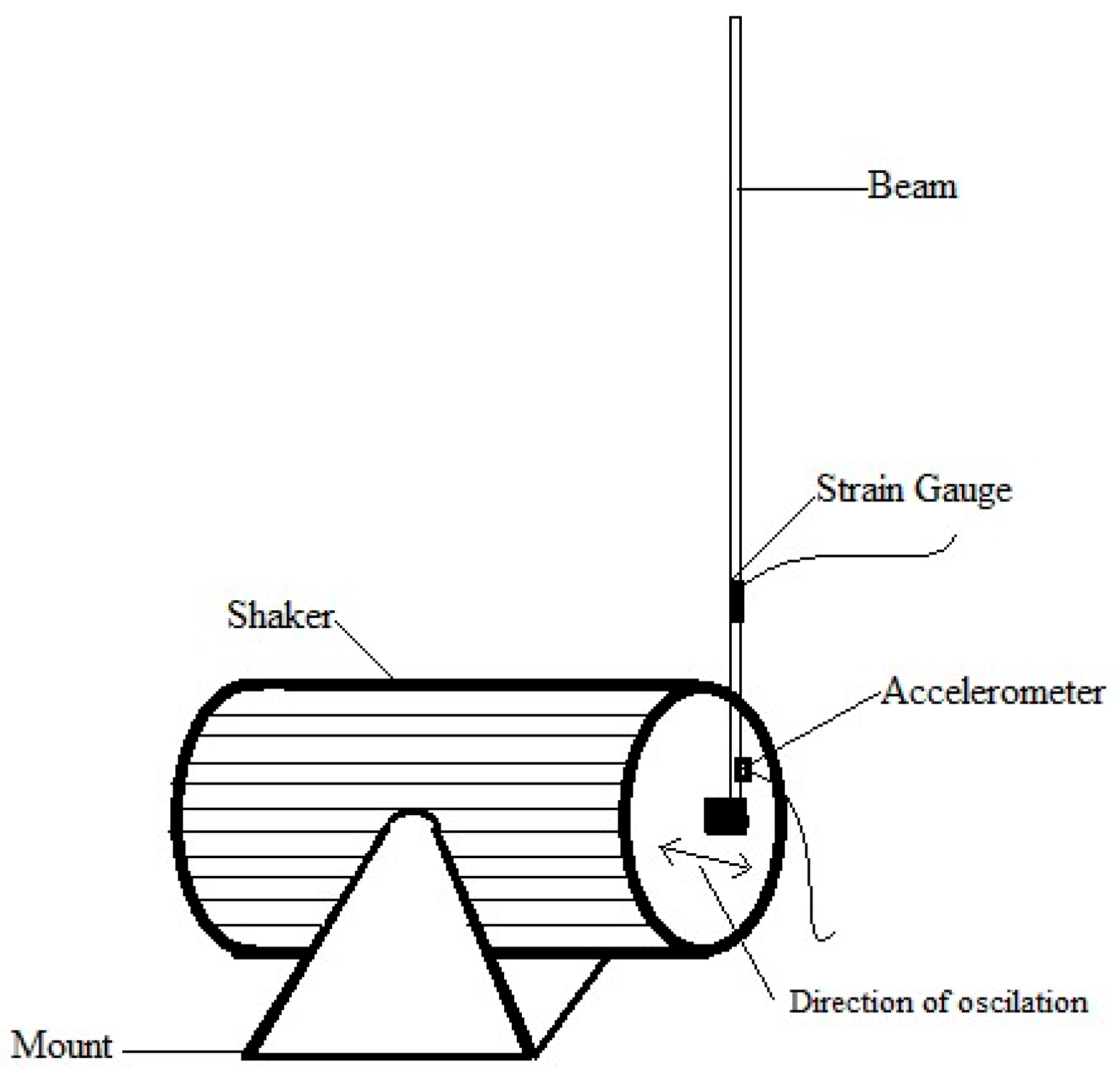
Figure 1 shows the schematic diagram of the experimental setup. A slender CFRP beam is vertically mounted and driven harmonically by a 350 N shaker. One end of the beam is attached to the shaker so that the excitation direction is perpendicular to the beam’s width. The beam’s dimensions are as follows: length 950 mm, width 20 mm, and thickness 2.5 mm. It consists of 8 plies, each 0.312 mm thick, with a layup of [+45/−45/+45/−45] s using Toray T-300 carbon fiber. LY564 epoxy resin, used as the lamina, has a 60:40 mass ratio, an effective Young’s modulus of 26 GPa, a shear modulus of 4 GPa, and a density of 1570 kg/m
3. The dimensions of the beam were designed to keep the first three vibration modes below 50 Hz, similar to those of the turbine shaft.
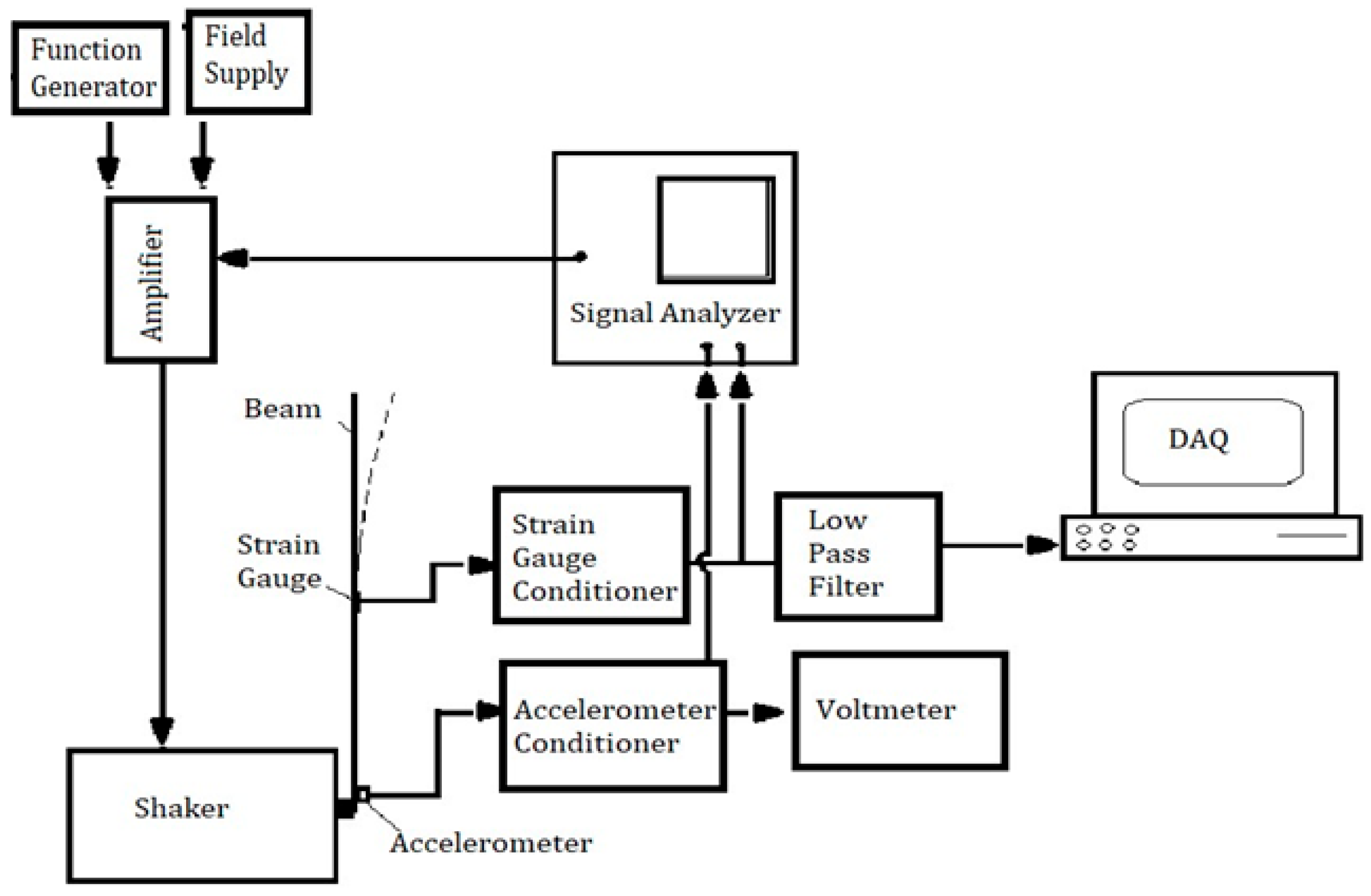
Figure 2 shows a schematic block diagram of a feedback control loop. An accelerometer is mounted at the end of the beam, attached to the shaker, to ensure consistent measurement of input excitation. A strain gauge measures the beam’s response. The strain gauge is attached just above the accelerometer on the beam’s surface. Careful selection of the strain gauge’s location is important because the reading will be negligible if the attachment point is at a node within the 50 Hz band.
A condition amplifier filters signals from the strain gauge and accelerometer before they are recorded. Measurements taken with a strain gauge indicate the strain in the beam at the gauge’s mounting point. When measuring vibrations with a strain gauge, it is important to understand that similar strain values do not always correspond to the same tip deflection of the beam in different vibration modes [
7].
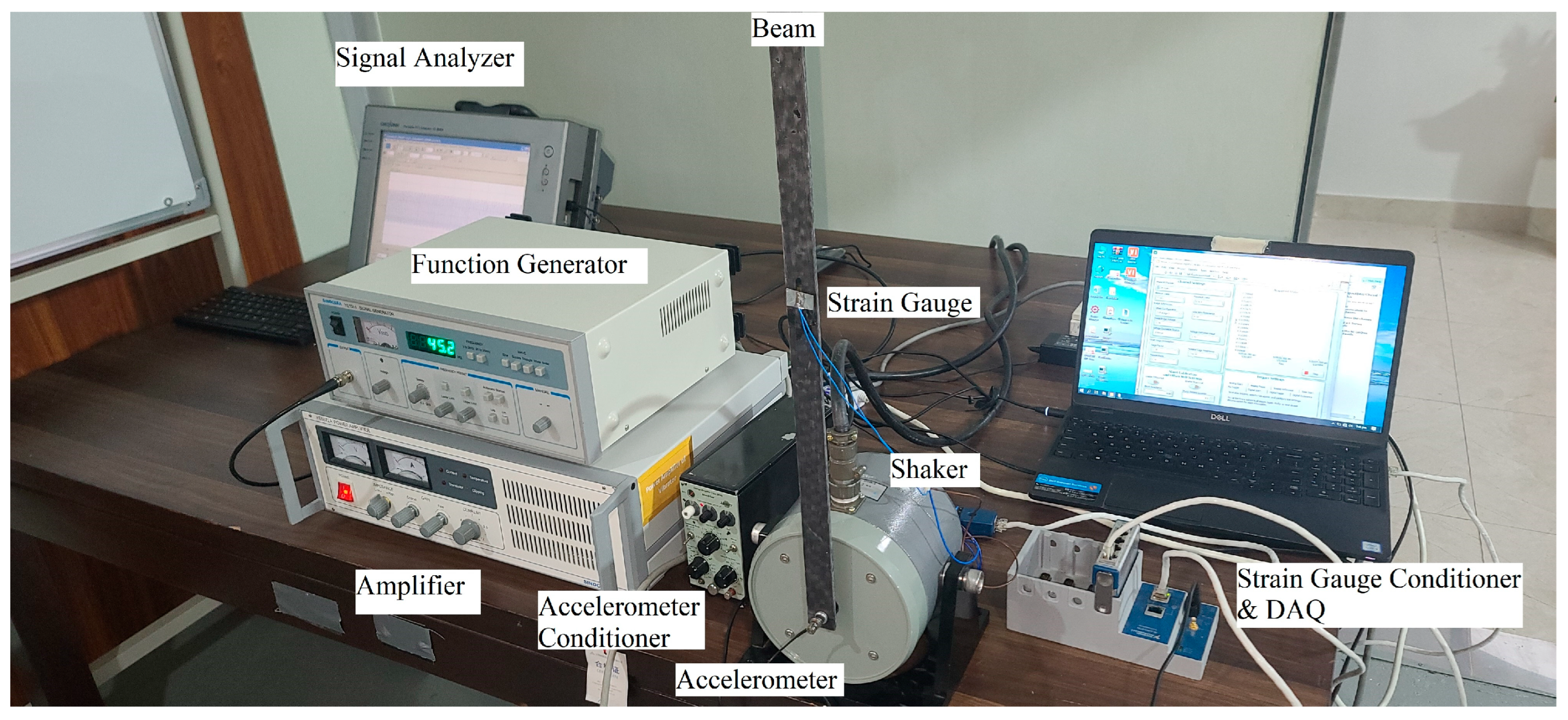
Equipment for data acquisition and conditioning includes the Ono-sokki DS 3600 4-Channel Signal Analyzer (Ono Sokki, Yokohama, Japan), the Bruel & Kjaer 4375 Piezoelectric Charge Accelerometer, and the Bruel & Kjaer 2635 Charge Amplifier and Conditioner with a Low-Pass Filter (Brüel & Kjær, Nærum, Denmark). The strain gauge used is a 15EH Micro Measurements strain gauge (Micro Measurements, Malvern, PA, USA). Strain data was acquired using the NI-9237 strain bridge module (National Instruments, Austin, TX, USA) as shown in
Figure 3.
4. Test Specimen
Preparing the test specimen is essential because it represents the actual turbine shaft. This section provides a detailed description of the laminate layup chosen to simulate the dynamic behavior of the turbine shaft.
Table 1 shows the mechanical properties of the laminate.
Figure 4 shows the CFRP test specimen used for experimental vibration analysis.
From reciprocity, we have
Reduced stiffness matrix
for θ =
45. The stiffness matrix takes the following form:
ABD matrices of the laminate are as follows:
Bending about the weak axis is as follows:
which gives theoretical flexural modes as stated in
Table 2.
5. Experimental Results
The frequency response function (FRF) of a dynamical system provides crucial insights into its nonlinear features, including bifurcations, the coexistence of multiple stable solutions, jump discontinuities, and amplitude-dependent stiffness effects. As a first step in diagnostics, both frequency-response and force-response measurements were taken to establish the system’s baseline dynamic behavior. The FRF obtained from the signal analyzer was used to identify the structure’s linear modal properties. At the same time, the natural frequencies of the beam were calculated numerically using Euler–Bernoulli beam theory, explicitly including gravitational loading in the model. A strong agreement between the experimentally measured and theoretically predicted modal frequencies was observed, as shown in
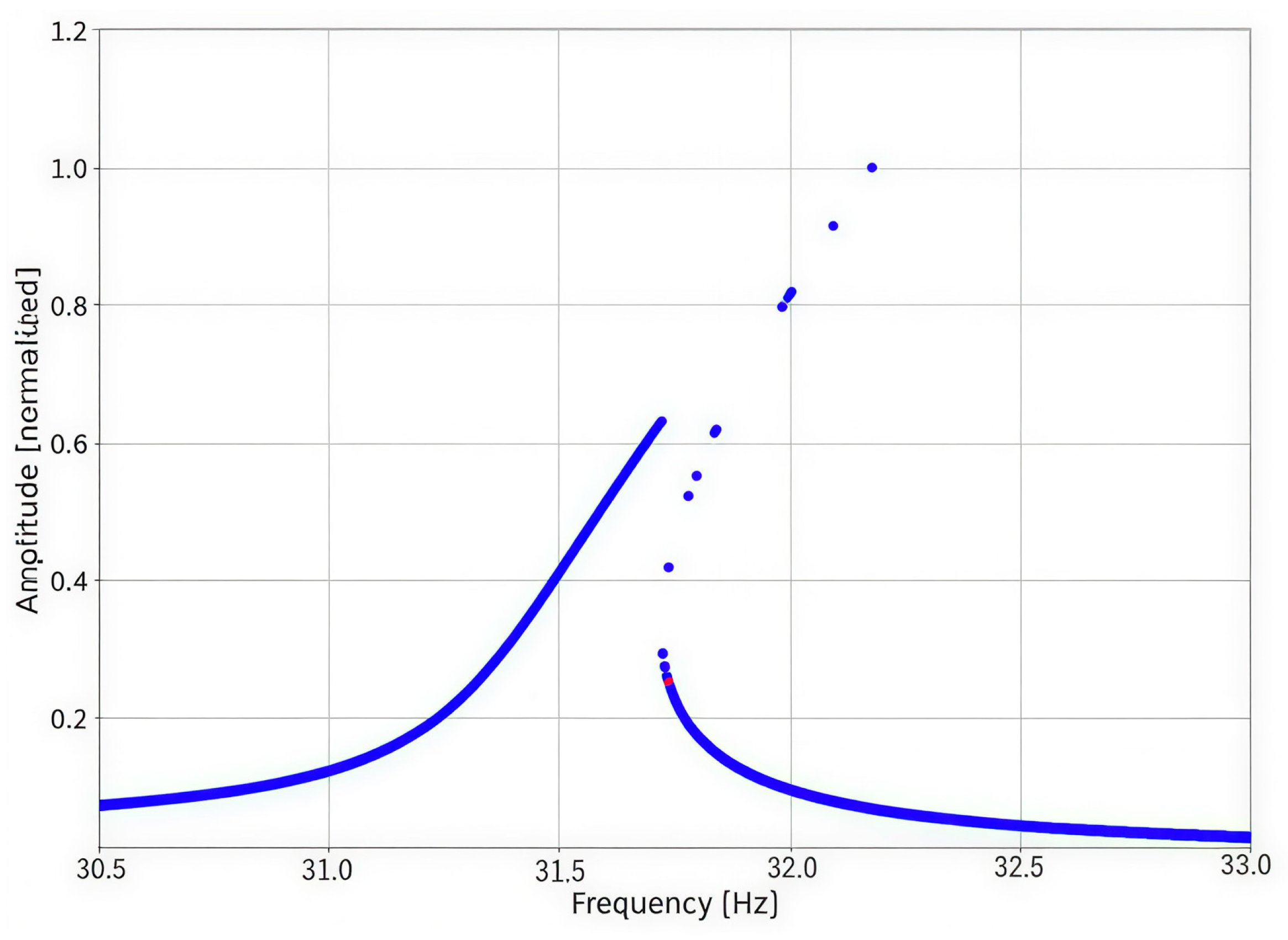
Table 2. To further study the dynamic response related to the third in-plane flexural mode, a frequency-sweep test was performed by maintaining a constant base excitation amplitude of 0.75 g while varying the excitation frequency around the third natural frequency (31.815 Hz), covering a range from 30 Hz to 33 Hz.
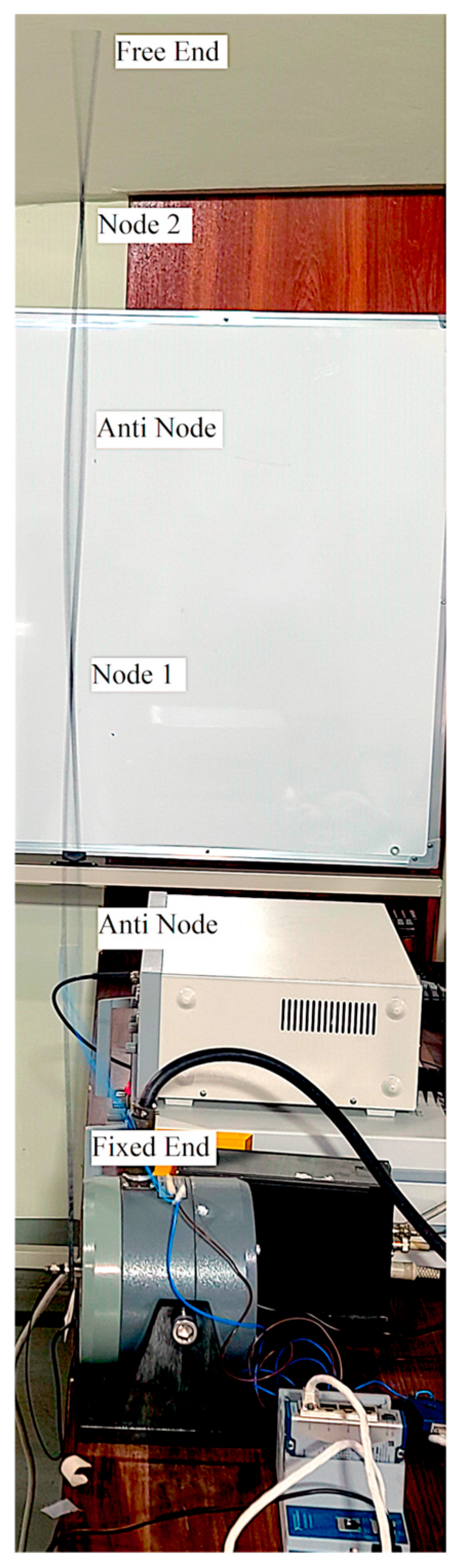
Figure 5 represents the CFRP beam oscillating at 31.8 Hz, assuming a mode shape of third mode of vibration superimposed with the first mode oscillation.
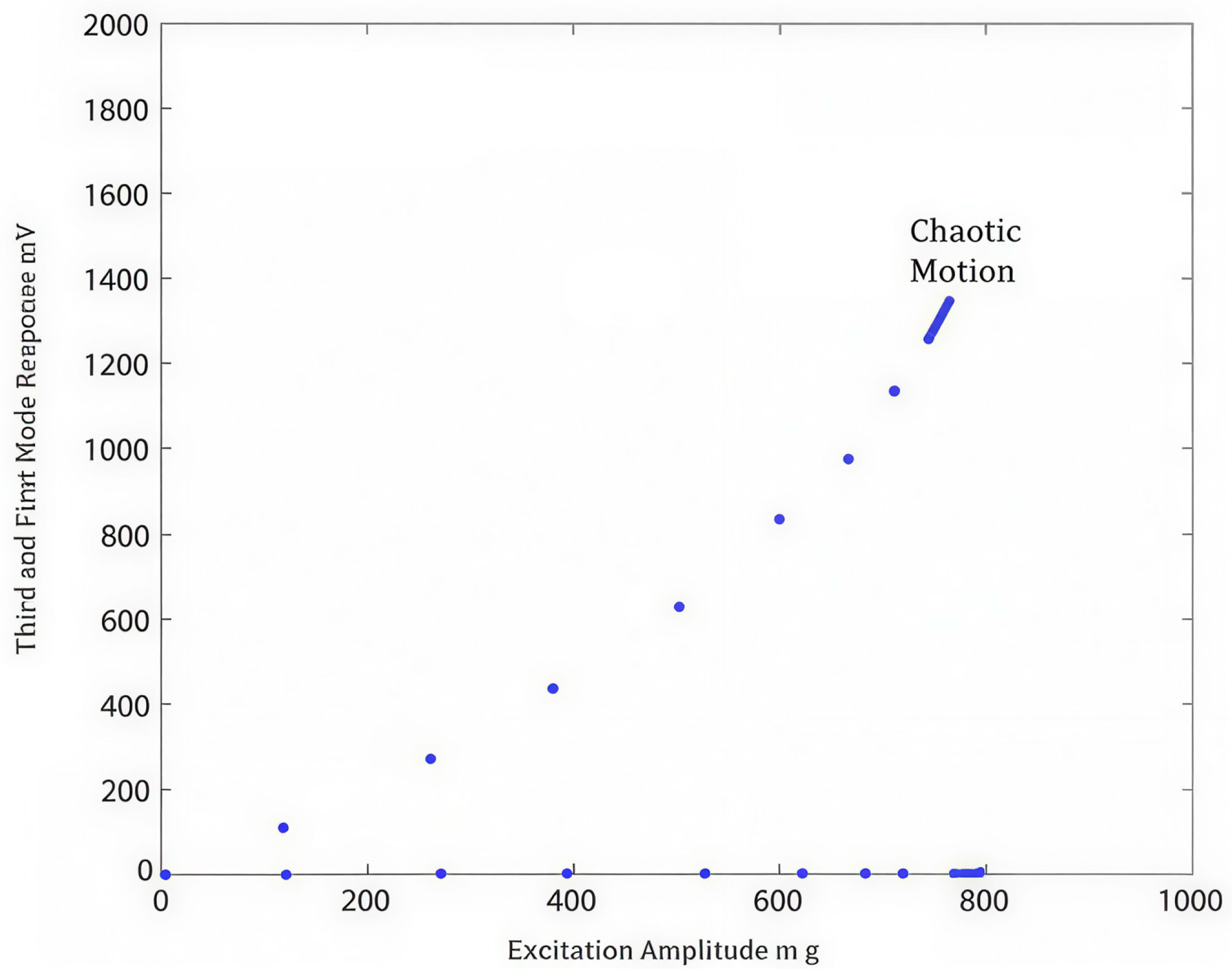
For the force response curve, the excitation frequency was consistently kept at 30 Hz, while the excitation amplitude was varied from 0 g to 1 g.
Figure 6 and
Figure 7 show the frequency and force response curves, respectively, based on data collected from both forward and reverse sweeps.
From
Figure 6, it is clear that there is no structural vibration mode near the third mode. However, when we sweep the excitation frequency beyond the third mode, the beam’s response is affected by its first mode. This indicates that nonresonant energy transfer occurs in the beam.
Figure 8 shows multiple frequency oscillations in the beam’s response and confirms that the selected beam cross-section, layup, and material are suitable for examining energy transfer between widely spaced modes.
It was observed during both forward and reverse sweeps that the spectral components associated with the first mode carry significant energy when the third mode is modulated either periodically or chaotically. Furthermore, when the third mode’s behavior shifts to a periodic state, the first mode either disappears or shows negligible energy.
The slow dynamics of the third-mode modulation generate a new frequency. This frequency arises from the modulation of high- and low-frequency components (sidebands) of the Hopf bifurcation about the third mode, which will be referred to as the Hopf frequency.
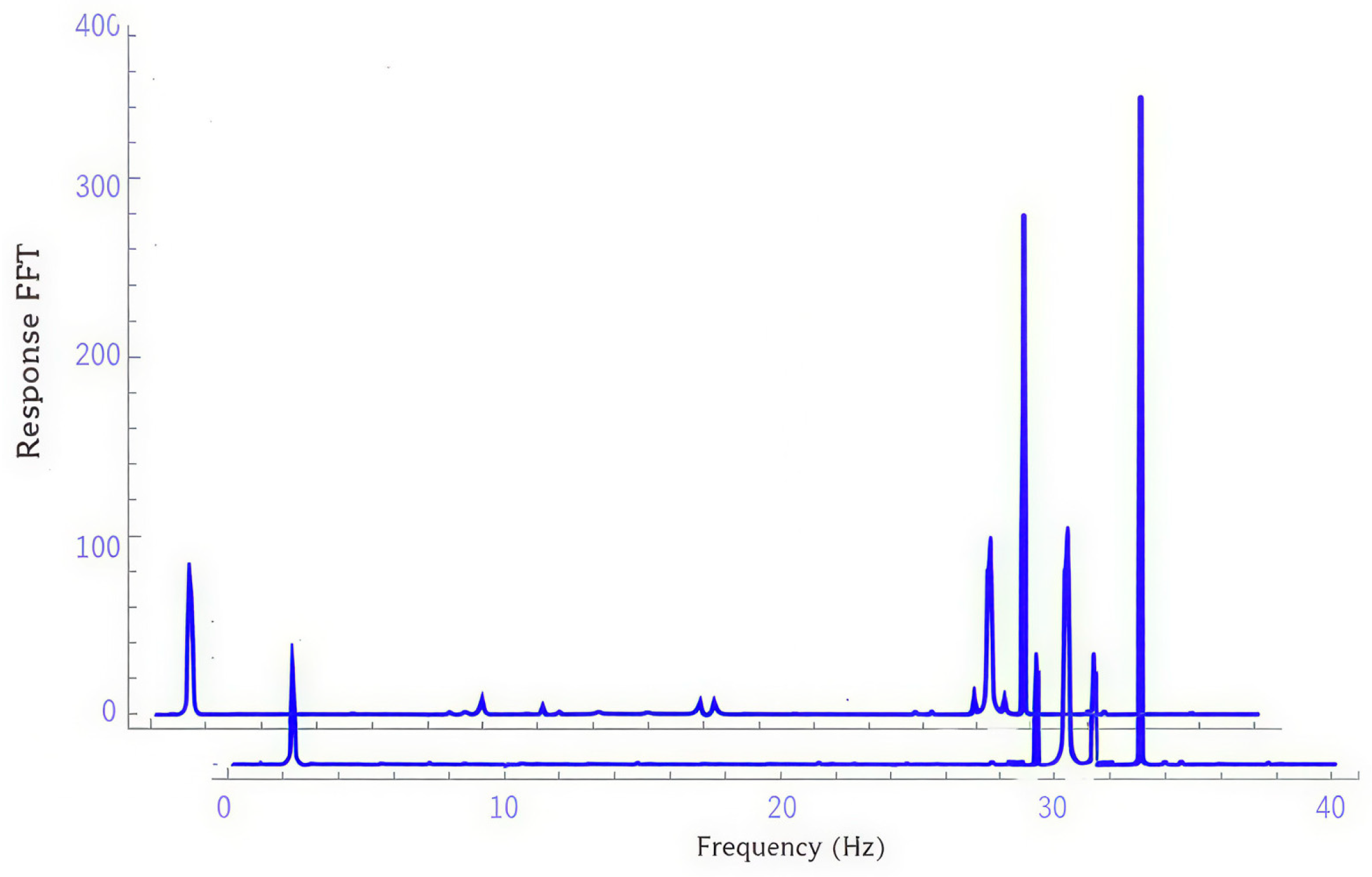
Figure 9 displays two main peaks besides the excitation frequency: one is the third mode with sidebands, and the other is the Hopf frequency, close to the first mode. The asymmetry of the sidebands around the third mode indicates phase modulation. It was observed that lowering the excitation frequency causes the beam motion to jump to a single-mode response.
Similarly, during the forward sweep, the beam’s motion transitions from a single-mode response to a phase-modulated multimodal interaction between the first and third modes. The impact of external excitation amplitude was also examined by increasing it from 0.8 g to 2.8 g while keeping the excitation frequency constant at 33 Hz. It was observed that the sideband spacing expanded from 1.8 Hz to 4.1 Hz. As the Hopf frequency moved away from the first mode frequency, the contribution of the first mode vibration decreased in the response spectrum.
6. Reduced-Order Model
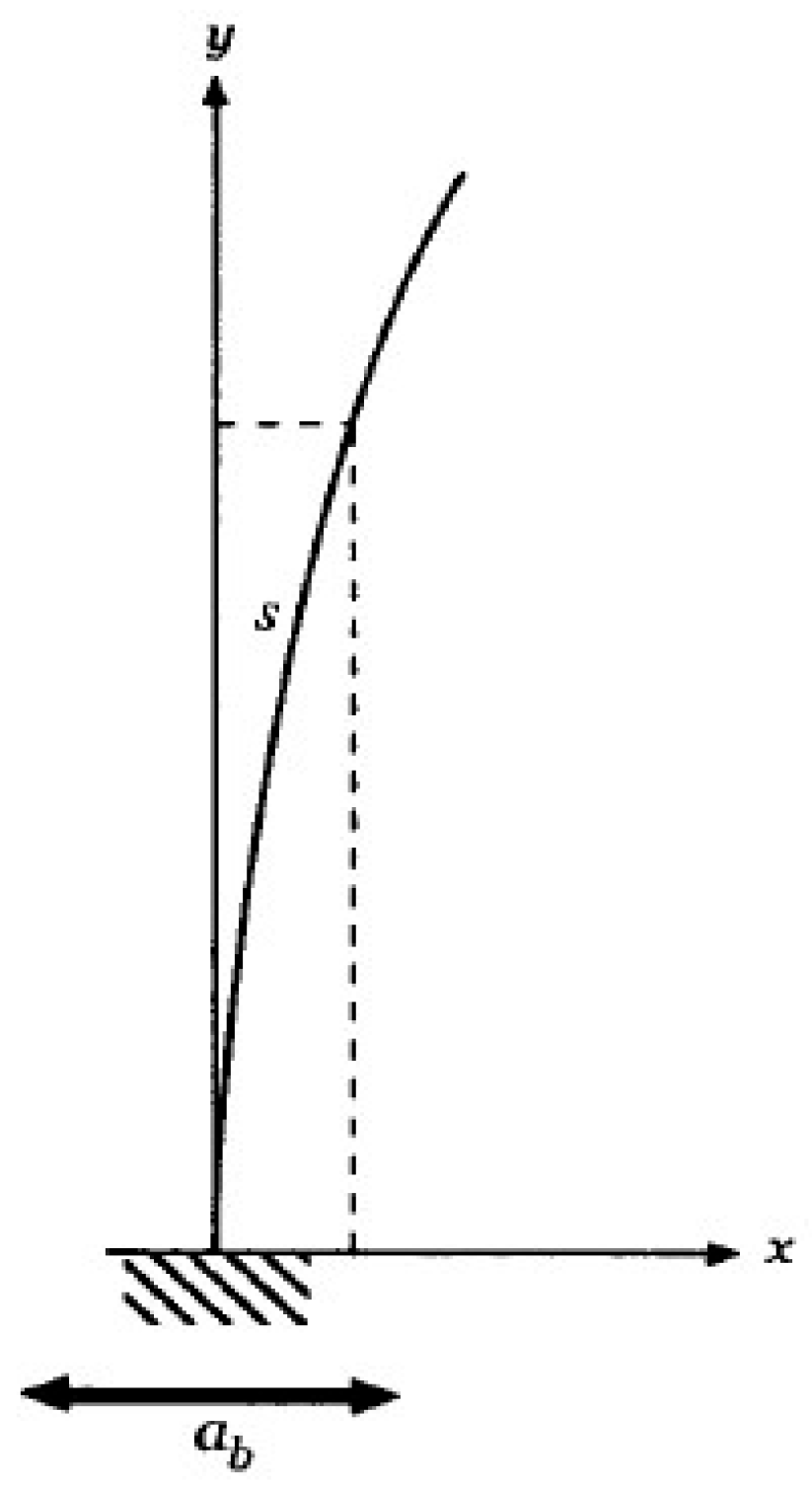
To analyze the nonlinear phenomenon observed during experimentation, using a higher-order nonlinear model is not ideal because it increases computational complexity with limited benefits. To address this, model-reduction techniques are employed to enhance computational efficiency while maintaining essential nonlinear features. To analyze energy transfer between modes through nonresonant interaction, this section introduces a simplified mathematical model. For clarity, the beam is modeled as an inextensible, uniform cantilever. As shown in
Figure 10, the beam has displacement components along the x- and y-axes, labeled as u and v, respectively.
Assuming an inextensible cantilever beam reduces the problem’s degrees of freedom because the axial displacement component can be expressed in terms of the lateral displacement component. Using a beam with a rectangular cross-section also helps keep the in-plane and out-of-plane modes well separated. Crespo da Silva and Glenn [
16] derived the equations of motion for non-planar, nonlinear vibrations of an isotropic, inextensible, Euler–Bernoulli beam. Here, those integral partial-differential equations are simplified to the case of a uniform cantilever beam under transverse excitation undergoing planar motion. The equation used in this study is as follows:
To capture nonlinear modal interactions and bifurcation responses, the reduced-order model includes not only the externally excited mode (mode-3) but also the internally resonant, nonlinearly activated mode (mode-1). In this case, two modes are retained to enable bifurcation dynamics. To generate a robust, qualitatively converged chaotic attractor, the current ROM can be expanded to incorporate four modes. The reduced-order model is validated by comparing it with experimental data on Hopf-bifurcation onset, post-bifurcation response amplitudes, spectral content, and time–frequency characteristics.
Splitting spatial and temporal components of motion in the following way:
Equation (1) becomes
The third term on the right-hand side
is a cubic nonlinear term. It represents geometric/hardening nonlinearity (potential/strain energy related). The fourth term
is the inertia/softening nonlinearity (kinetic-energy/momentum-related). To change the limit of the spatial variable in Equation (3) from (0 −
l) to (−1, 1), we introduce
ξ,
Consequently,
Writing Equation (2) in the above-defined spatial variable
The spatial component of motion is approximated using Chebyshev polynomials. The advantage of using Chebyshev polynomials for approximation is their low computational resource requirement to achieve the necessary accuracy of spatial derivatives. Mathematically,
where
Ai is the sum of even and odd terms such that
where
n = 1, 2, …. Here, the
Ti are Chebyshev polynomials of the first kind. The constants
α1,
α2, …,
α8 can be determined using the following boundary conditions of the cantilever beam,
The entire length of the beam is divided into K Gauss–Lobatto segments using the following expression:
Discretizing the beam span simplifies the complex partial differential equation into a set of K nonlinear second-order ordinary differential equations in space coordinates.
To simplify the above expression, we utilize the nondimensional frequency parameter of the Euler–Bernoulli beam as
Using the expression, we reduce Equation (11) to the following form.
where
Although the coefficients
B,
C,
D, and
E are obtained from spatial discretization using Chebyshev polynomials and Gauss–Lobatto quadrature, they stay constant over time. These constants represent the linear (
B and
C) and nonlinear (
D and
E) spatial distributions of inertia and stiffness.
Constants B, C, D, and E depend on the slope, moment, and shear along the beam’s length. They are not fixed values; instead, they represent the beam’s behavior at each node. Throughout the entire length of the beam, these constants appear as arrays. These parameters depend on physical properties such as E1, E2, G12, and ν12, and their local variations at each node. While these variables can be assigned values assuming linear material behavior, doing so undermines the purpose of the study. Therefore, we keep them as variables to better match experimental data and understand the mechanisms behind nonlinear behavior.
To depict the interaction between the first and third modes, we now represent
ϕ(
t) as a sum of two orthogonal temporal modes:
Mode-1 and mode-3 are orthogonal to each other and follow the principle
in the modal subspace. Equations of motion of both modes are as follows
The set of strongly coupled nonlinear ordinary differential equations is integrated over time using an explicit adaptive Runge–Kutta method of order 4–5 (Dormand–Prince). For smooth nonlinear dynamics arising from spectral discretization, RK45 is well established and widely used for this purpose. The adaptive time step is limited by the highest natural frequency of the discretized system, such that
ensuring both numerical stability and compliance with the Nyquist sampling criterion. Time-step convergence was verified by progressively refining the time step until changes in response amplitude and dominant frequency content became negligible.
To obtain the spectral response, the steady and non-stationary responses were analyzed using the Short-Time Fourier Transform (STFT) after discarding initial transients. A Hanning window was used to reduce spectral leakage and to accurately capture the time-varying frequency content related to nonlinear modal interactions and energy transfer.
7. Analytical Investigation
Analyzing Equation (13) analytically, we identify the mathematical expressions that specify the conditions required for the bifurcation behavior observed during the experimental investigation.
here,
To determine the conditions under which our ROM undergoes bifurcation, we analyze it using the Method of Multiple Scales around a fixed point [
7]. Introducing a small parameter ε to track weak effects.
near-resonant forcing
Slow and fast timescales are defined as
Derivatives are defined as
The series expansion of the temporal response is written as
The asymptotic expansion is organized in powers of a small parameter ε, where subscripts indicate perturbation order rather than the modal index. Due to the reflection symmetry of the cantilever beam about its undeformed state, quadratic nonlinearities disappear, and the primary nonlinear effect occurs at cubic order.
Order (ε) term has the solution
By substituting
into Equation (17), enforcing the coefficients of
and separating the real and imaginary parts, we derive the reduced dynamics, amplitude modulation, and phase modulation as shown in Equations (16)–(18).
Perturbation about a fixed point
yields the Hopf bifurcation threshold
beyond this limit, the fixed point becomes unstable and
Substituting into physical motion, we get an expression for the sideband existence
Although asymptotic analysis does not provide a quantitative measure of the Hopf frequency, it clarifies the underlying mechanism responsible for bifurcation, the influence of external forcing amplitude and nonlinearities, and identifies the threshold at which bifurcation occurs. From Equation (23), we find that corresponds to the sideband spacing. Tracing back to the origin of bifurcation, we see how depends on the external forcing amplitude F. A gradual increase in F raises its value until it becomes comparable to the first mode, initiating energy transfer. becomes aligned with the first mode and triggers energy transfer.
8. Discussion
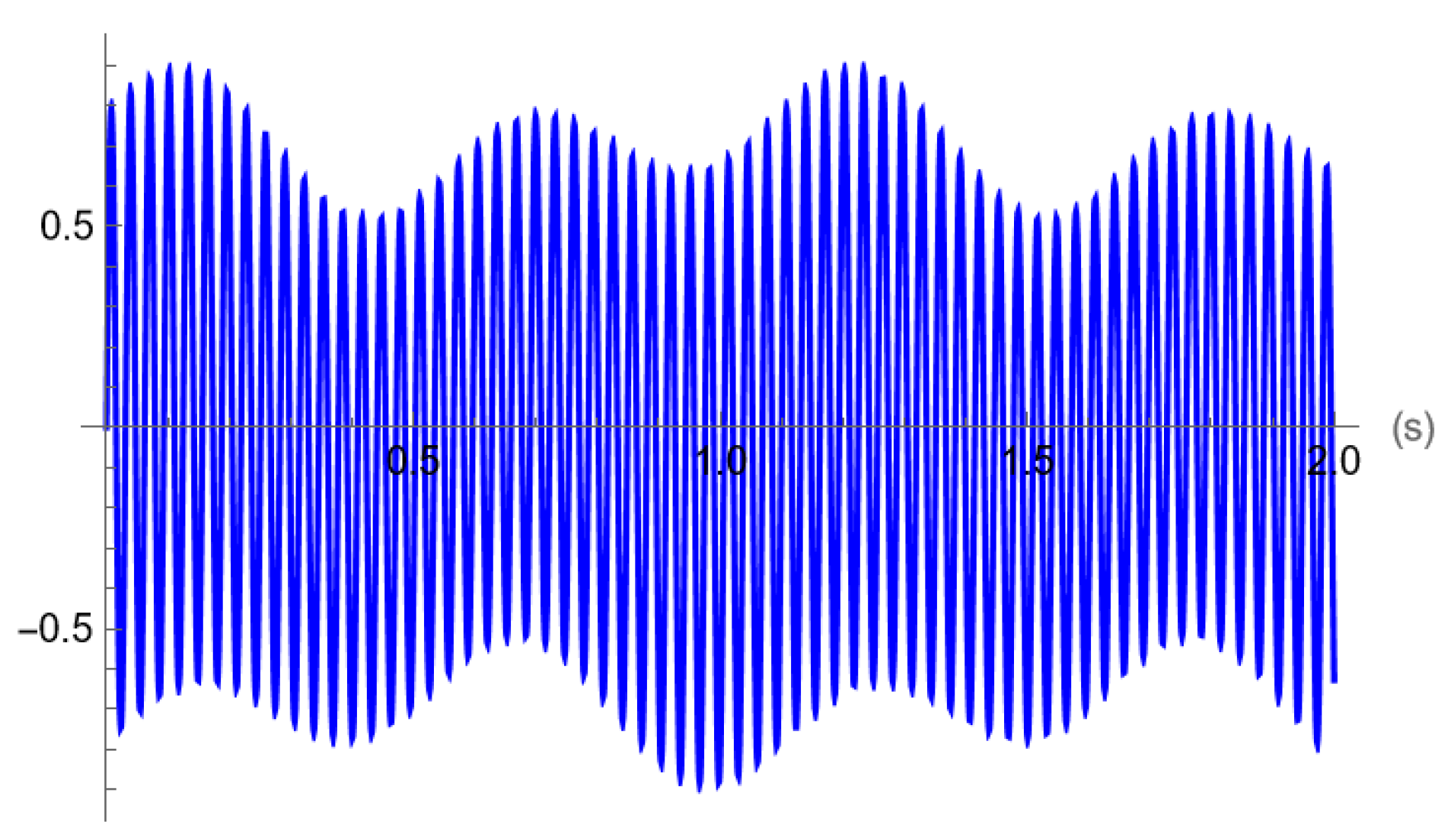
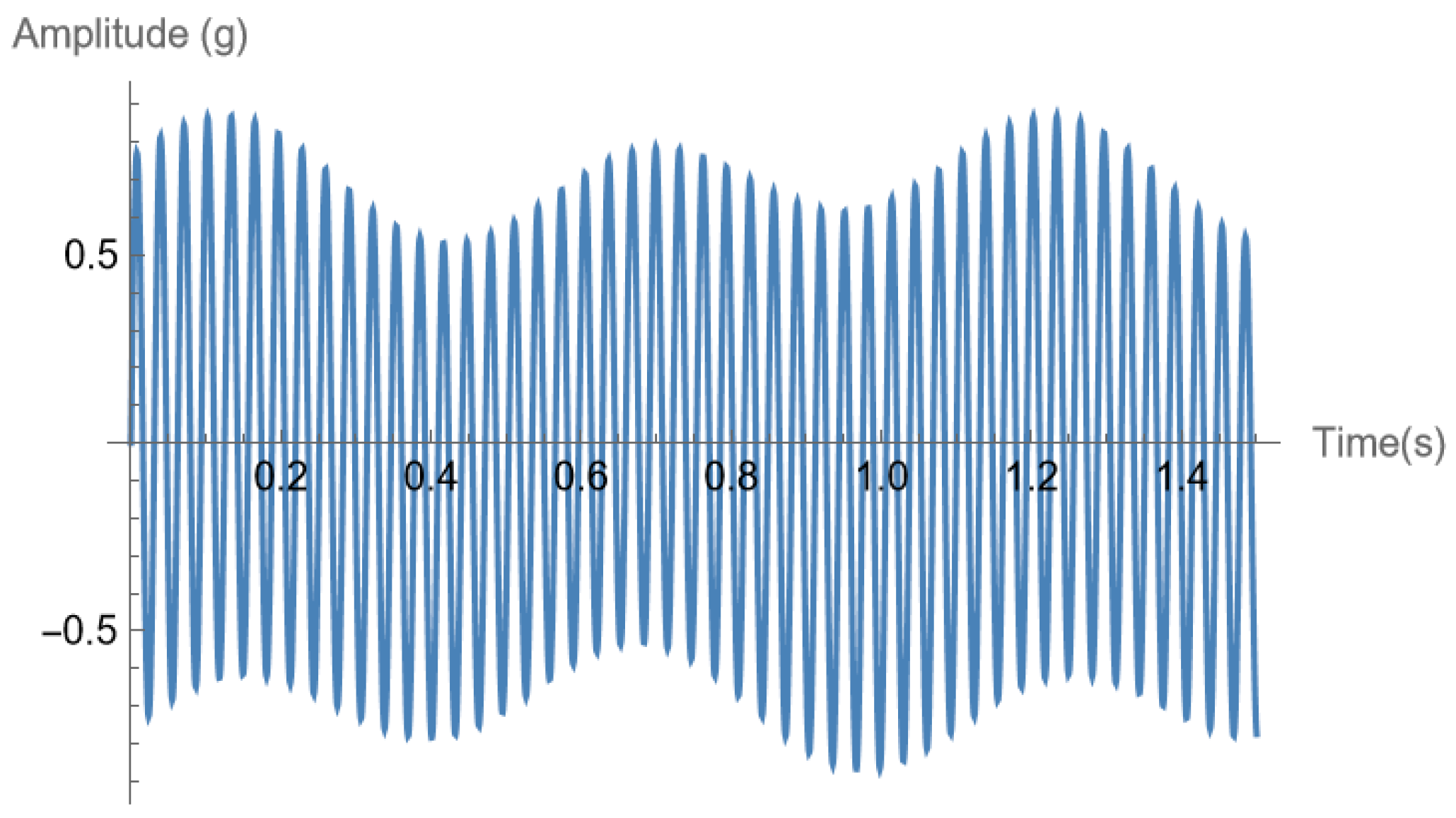
The model was analyzed both analytically and numerically to understand modal interactions. The time trace plot in
Figure 11 shows that the beam’s response includes low-frequency components overlaid on the input high-frequency excitation.
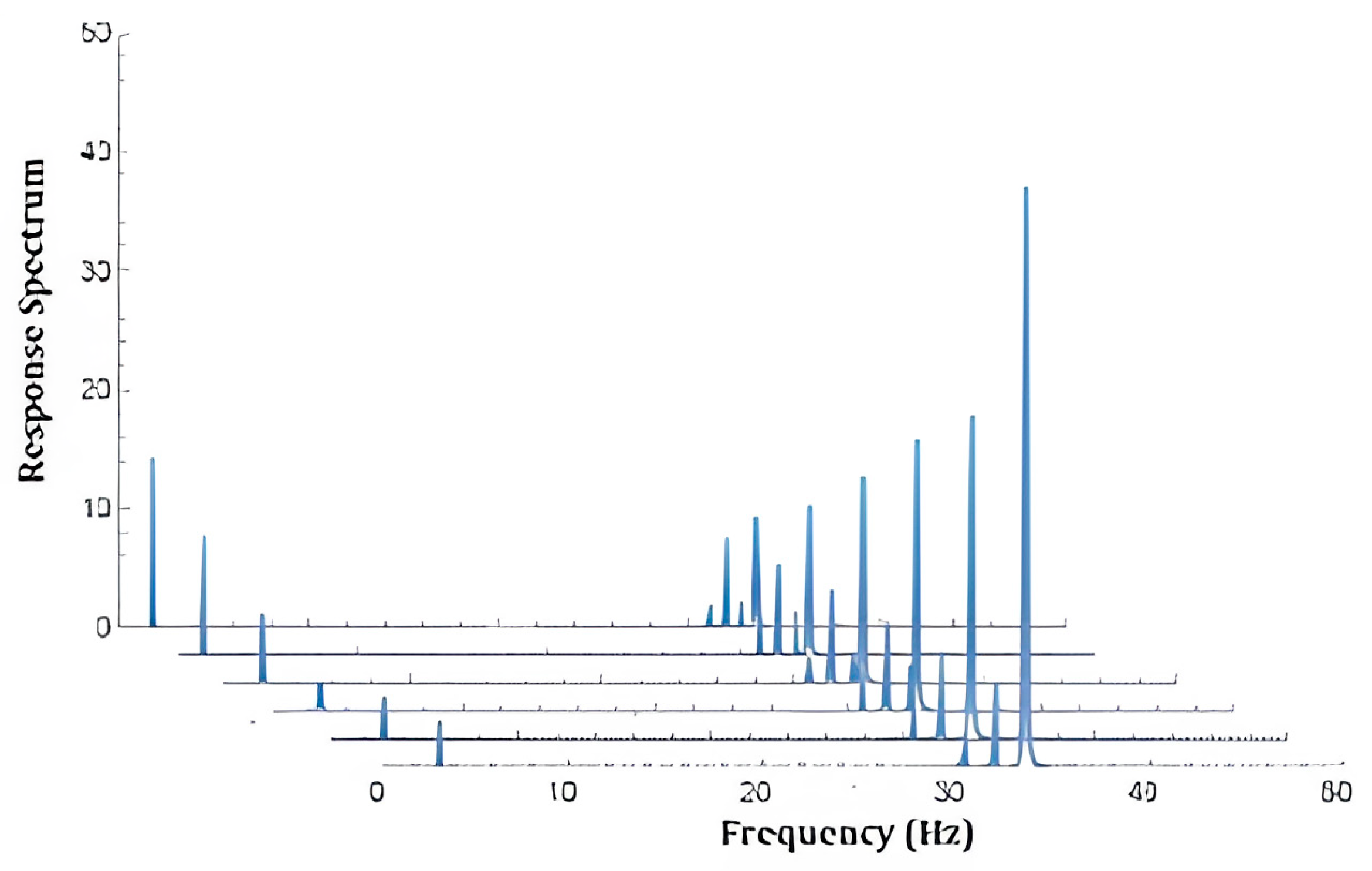
Figure 12 displays the third mode and its sidebands, along with the low-frequency first-mode vibration. When the difference between the sidebands around the third mode approaches 1.8 Hz, the first-mode response is triggered by the matching Hopf frequency (sideband spacing).
Figure 11 and
Figure 12 demonstrate that the mathematical model accurately predicts the beam’s response.
The amplitude of external excitation was increased from 0.8 g to 2.8 g.
Figure 12 shows an increase in the Hopf frequency from 1.9 Hz to 3.5 Hz, which causes the amplitude of the first mode (1.817 Hz) to decrease from 2.2 g to 0.02 g. This demonstrates that the mathematical model accurately reflects the physical phenomenon.
Based on the current experiments and numerical results, it can be concluded that the nonresonant modal coupling of the cantilever beam depends on its inherent nonlinear properties (represented by constants
D and
E) and the external excitation amplitude (
F). The results show that the numerical and experimental data generally align. Differences in values are due to variations in the nonlinear coefficients of both the physical beam and the mathematical model. A comparison between Hopf frequency variation and the first-mode response amplitude with respect to changes in excitation amplitude is presented in
Table 3.
The amplitude of external excitation influences the Hopf frequency, which in turn controls the non-resonant modal interaction of the beam. The rotor shaft of an ultra-supercritical turbine experiencing non-resonant modal interaction can also be improved by intentionally adding residual imbalance to the blades. The reasons for increasing this residual imbalance become clear through careful analysis of the root cause. This additional imbalance will slightly affect the shaft’s vibrational behavior at the operating frequency, but more importantly, it will help prevent chaotic behavior by adjusting the external excitation’s amplitude and, consequently, changing the Hopf frequency.
9. Conclusions
The nonresonant modal response of a supercritical rotating shaft was examined by modeling it as a non-rotating cantilever beam with a rectangular cross-section. Experimental, numerical, and analytical methods were employed to analyze the problem and its key mechanisms. It was observed experimentally that increasing the external excitation amplitude, F, results in the formation of sidebands around the third mode. Furthermore, higher excitation amplitudes increase the spacing between these sidebands. Phase modulation of the third mode generates a low-frequency component (Hopf frequency) equal to the sideband spacing. As the sidebands move further apart, this low-frequency component also shifts. When the sideband spacing matches the first mode, the low-frequency component resonates with the first mode, causing the beam’s response to combine the third and first modes.
Numerical simulations were conducted to quantify the effects of nonlinear constants D and E by matching data with experimental results. This study highlights the strong dependence of non-resonant behavior on the self-cubic nonlinear term D, while the mixed-cubic nonlinear term E has a notably weaker influence on the beam’s response. In a CFRP cantilever beam, the nonlinear terms in the equations of motion represent geometric and kinematic effects caused by large deflections and rotations within an anisotropic laminated structure. Quadratic nonlinearities describe symmetry-breaking mechanisms such as bending–stretching coupling and biased equilibrium states. Conversely, cubic nonlinearities mainly arise from mid-plane stretching and the amplitude-dependent effective stiffness caused by fiber reorientation and shear deformation. These nonlinear terms influence amplitude-dependent frequency shifts, modal coupling, and energy redistribution observed during vibration tests.
Analytical results using the Method of Multiple Scales reveal the relationship between system behavior and the self and mixed cubic nonlinear constants
D and
E in the reduced dynamics system (α). Phase modulation (θ) of the system is directly connected to (α) and the external forcing amplitude
F. Amplitude modulation (a) is directly influenced by phase modulation (θ) and external forcing
F. The bifurcation threshold is directly affected by the nonlinear constants
D and
E through α. The current results show that energy transfer from mode-3 to mode-1 occurs via modulation of mode-3. The amplitude and phase modulation of the third mode are clearly visible in the response spectrum in
Figure 12 as sidebands around the third-mode frequency.
This study develops a framework to analyze the nonlinear behavior of an ultra-supercritical CFRP shaft by integrating geometric simplification for testing, modal reduction for computational analysis, and analytical techniques for bifurcation classification. This approach can also be extended to include physical parameters such as interlaminar slippage, fiber-matrix delamination, microcracks, and other factors affecting this nonlinear behavior.