Article

Combined Computational-Experimental Investigation of Crack Kinking Under Mode I Loading in Thick Adhesively Bonded GFRP Composite Joints


by
Akash Sharma
1,*,
Ali Shivaie Kojouri
2,
Jialiang Fan
3,
Anastasios P. Vassilopoulos
4,
Veronique Michaud
3,
Kalliopi-Artemi Kalteremidou
2,
Danny Van Hemelrijck
2 and
Wim Van Paepegem
1,5
1
Department of Materials, Textiles and Chemical Engineering, Ghent University, Technologiepark–Zwijnaarde 46, B-9052 Zwijnaarde, Belgium
2
Department of Mechanics of Materials and Constructions (MeMC), Vrije Universiteit Brussel, 1050 Brussels, Belgium
3
Laboratory for Processing of Advanced Composites (LPAC), Institute of Materials (IMX), Ecole Polytechnique Fédérale de Lausanne (EPFL), 1015 Lausanne, Switzerland
4
Composite Mechanics Group (GR-MeC), Ecole Polytechnique Fédérale de Lausanne (EPFL), 1015 Lausanne, Switzerland
5
FlandersMake@UGent-MIRO, 9052 Ghent, Belgium
*
Author to whom correspondence should be addressed.
J. Compos. Sci. 2026, 10(2), 107; https://doi.org/10.3390/jcs10020107
Submission received: 6 January 2026 / Revised: 10 February 2026 / Accepted: 14 February 2026 / Published: 19 February 2026
(This article belongs to the Section Composites Applications)

Abstract

This study developed a combined computational-experimental approach to investigate crack kinking in thick adhesively bonded Glass Fibre Reinforced Polymer (GFRP) composite joints, focusing on the adhesive joints found at wind turbine blade trailing edges. Double Cantilever Beam (DCB) tests were performed on composite joints with a 10-mm thick epoxy adhesive, representative of trailing-edge joints. Finite Element (FE) models included cross-ply GFRP composites and an adhesive layer. Subsequently, both the composite/adhesive interfaces and voids were explicitly modelled, allowing separate and combined evaluations of their effects on crack kinking. A cohesive zone model was used to capture the fracture along the composite/adhesive interfaces, while a Drucker-Prager plasticity model combined with a ductile damage model was used for the adhesive. The numerical findings indicated that crack kinking in FE simulations with explicit interfaces was primarily governed by the lower fracture resistance of the composite/adhesive interface relative to that of the bulk adhesive. Voids with a total volume fraction of approximately 1% were modelled by randomly deleting cubic 1 mm C3D8R elements in the adhesive layer to reproduce the voids typically observed in thick adhesive joints. The predicted crack paths closely matched experimental results. Simulations with voids revealed that voids above or below the adhesive midplane caused crack deflection toward the nearest interface. In models combining both features, cracks were consistently redirected toward the composite/adhesive boundary near voids, reproducing experimental observations. These results provide new insights into trailing-edge adhesive joint failure and establish a foundation for better modelling and design.

1. Introduction

Adhesive joints are crucial for connecting wind turbine blades and providing lightweight solutions, durability, fatigue resistance, and uniform stress distribution [1]. However, their failure often shortens the blade lifespan. Trailing-edge failure is one of the most common damage modes observed in 1.5 MW wind turbine blades, as reported by Eder et al. [2,3,4]. Similarly, Ataya et al. [5] found that visual inspection of several blades with 17–22 years of service revealed severe trailing-edge cracking. Recent investigations of the DTU 10 MW reference turbine (86m long blade) have confirmed that trailing-edge failure remains a critical mode for contemporary wind turbines [6,7].
Detailed studies of trailing-edge-inspired thick joints have further shown that complex multi-site crack initiation, interactions among adhesives, interfaces, laminate cracking, and manufacturing-induced defects can strongly affect local strength and failure mechanisms of these joints [8,9,10,11,12]. These findings underscore the need for a dedicated investigation of trailing-edge adhesive failure [1,2,10,13,14,15,16]. Moreover, mode I opening (peel) is a fundamental failure mode that is directly relevant to how trailing-edge joints initiate and grow cracks [10,17,18,19]. To study the mode I failure behaviour of trailing-edge adhesive joints, coupon-level Double Cantilever Beam (DCB) tests of adhesively bonded composite joints were conducted in previous works by the authors [10,17]. It is highlighted that the adhesive bond lines in the trailing-edge of the wind turbine blades are at least 10 mm thick [10,12,15,17,18] and therefore all the presented specimens, as well as the FE models, will have a bond line thickness of ~10 mm.
To represent trailing-edge adhesive joints, the DCB specimens consisted of two cross-ply Glass Fibre Reinforced Polymer (GFRP) laminates adhered using an approximately 10 mm-thick adhesive layer. Moreover, a pre-crack was created in the DCB specimens in the middle of the adhesive layer. These tests replicated mode I loading conditions in a simplified and controlled environment and offered valuable insights into the mode I behaviour of thick adhesive joints utilised in the trailing edges of wind turbine blades [17,20].
Despite the pre-crack in the midplane of the adhesive, the crack path always deviated from the midplane towards the composite/adhesive boundary in thick adhesively bonded composite joints [21,22,23,24]. This phenomenon is known as crack kinking [17]. Research examining crack kinking under mode I loading of thick adhesive joints is limited, with a few exceptions [14,17]. One of the reason for crack kinking in thick adhesive joints under mode I loading is the presence of voids, which are inevitable due to the high viscosity of these adhesives [9,10,25,26]. Barzegar et al. [27] utilised an ultrasonic guided-wave–based methodology to detect and quantify porosity in adhesively bonded CFRP joints. The aforementioned study concluded that voids serve as crack initiation sites in the adhesive layer.
In addition to the voids, a weak composite/adhesive interface may be a major contributor to crack kinking. A crack naturally follows the path of least resistance. It avoids the higher energy required to propagate through the tougher adhesive and deviates toward the interface, consistent with the principle that the weakest link in the system fails first [12,28,29,30]. Hence, assessing the influence of the weak composite/adhesive interface on the crack kinking is essential. Moreover, material discontinuities in the adherend/adhesive interfaces lead to local stress concentrations, creating crack initiation sites in a 10 mm-thick adhesive layer joint under mode I loading [24].
In this regard, Villamil et al. [21] reported mode I crack propagation rates in adhesively bonded GFRP joints under impact and constant-amplitude fatigue loading. However, the mechanisms and conditions that led to crack kinking toward composite/adhesive boundaries were not analysed. Similarly, Fernandes et al. [24] investigated multi-material DCB joints with 10 mm thick adhesive layers and analysed how modulus mismatch, pre-crack length, and T-stress influenced crack-path stability. However, voids and composite/adhesive interfaces were not explicitly modelled. Moreover, Sengab et al. [25] numerically studied a single-lap adhesive joint with an interfacial crack and a void in the adhesive and analysed how the void size, shape, and location influence the energy release rates and kinking of the interface crack into the adhesive. However, the behaviour of the joint under global mode I opening was not studied, nor were composite/adhesive interfaces and voids modelled together in that context.
Similarly, Miao et al. [8] investigated crack initiation in composite/adhesive joints using DCB tests. The study revealed that voids in a thick (~7 mm) adhesive layer altered the crack propagation path. In addition, if pre-cracks were present at the interface, the cracks often propagated into the composite layers. However, the aforementioned study did not account for the influence of voids and composite/adhesive interfaces. In their studies of thick, adhesively bonded GFRP composite joints, Fan et al. [3,9] found that the inevitable voids resulting from the adhesive paste’s high viscosity led to unstable propagation and promoted crack kinking. However, the studies by Fan et al. did not address the individual and/or combined influence of voids or composite/adhesive interfaces on crack kinking under mode I loading. Sam-Daliri et al. [31,32] estimated the shear strength of unidirectional GFRP joints manufactured by co-curing with varying adhesive thickness. However, the mode I behaviour of the joints has not been studied.
Additionally, the elastoplastic behaviour of adhesives and the presence of residual stresses influence the mode I behaviour of thick adhesive joints [10,33,34,35,36,37,38]. Shao et al. [39] developed a physics-informed, data-driven framework to predict the fatigue life of CFRP adhesively bonded joints in offshore wind turbine blades. However, the aforementioned research work did not incorporate an elastoplastic material model for the adhesive, relying instead on cohesive traction–separation degradation. Moreover, the aforementioned study focused on thin adhesive layers (0.3–1.1 mm) and did not explore the influence of adhesive plasticity. Similarly, Akpinar et al. [40] conducted a 3D nonlinear finite element analysis of single-lap composite joints under four-point bending using an elastoplastic model of the adhesive layer. However, the aforementioned study used a very thin (~0.12 mm) adhesive layer and did not address curing-induced or thermal residual stresses.
Residual stresses arise from mismatches in the thermal expansion coefficients (CTEs) between the composite and adhesive when the adhesive joint undergoes a significant temperature change during curing [37,41,42]. In this regard, Agha et al. [37,38] implemented a cure-, temperature-, and rate-dependent viscoelastic–plastic adhesive model to predict curing-induced residual stresses in a multi-material automotive roof joint. However, it remained limited to a thin (~0.20 mm) adhesive layer and an aluminium–steel roof configuration, thereby restricting its applicability to thick composite joints under mode I loading.
In addition, the pre-cracking process during DCB specimen preparation influences the residual stress and crack propagation in thick adhesive joints [17]. In this context, finite element (FE) simulations are advantageous because they enable the seamless integration of the aforementioned multiple factors concurrently [15,40].
Thus, computational studies must first include the influence of thermal loads, subsequent pre-cracking, and mechanical mode I loading. Then, the reason for the crack kinking can be addressed. The aforementioned aspects were thoroughly investigated in the authors’ previous study on the mode I failure behaviour of joints between two cross-ply GFRP laminates with a ~10 mm-thick epoxy-based adhesive layer [15].
In the abovementioned research work, although experimental and computational strain fields and load-displacement responses matched, discrepancies in crack paths were observed after crack initiation. The experimental cracks deviated toward the composite/adhesive boundary, whereas the computational cracks remained centred. Since the FE model in ref. [15] had a perfectly bonded composite/adhesive interface and a void-free adhesive, the influence of a weak composite/adhesive interface and the effect of voids could not be studied.
Building on the research mentioned above, the current study explicitly incorporated the effects of the composite/adhesive interface and voids. Moreover, the interaction between the interface and voids was incorporated into the computational approach to improve the prediction of crack paths in thick adhesive joints under mode I loading. In addition to the above, since crack propagation is a highly nonlinear phenomenon, it was ensured that numerical artefacts did not trigger crack kinking in FE simulations.
To the best of the authors’ knowledge, none of the computational studies on thick adhesive joints have examined the combined and individual effects of (i) the composite/adhesive interface and (ii) voids on the crack kinking phenomenon observed in such joints. Based on these considerations, the following objectives were established:
  • Identifying the potential causes of crack kinking in mode I failure of ~10 mm thick adhesive joints using FE simulations.
  • Investigating the impact of voids and the composite/adhesive interface within the adhesive layers on the mode I behaviour of thick adhesively bonded GFRP composite joints through FE simulations.
To achieve the objectives discussed above, the composite/adhesive interface and voids were first incorporated into the model individually and then in combination. The composite/adhesive interface properties were assessed using DCB tests, with the pre-crack located at the composite/adhesive boundary. The experimental results were then compared with corresponding FE simulations incorporating an explicitly modelled composite/adhesive interface. Finally, the overall influence of the void and composite/adhesive interface on crack kinking was assessed through FE simulations. A thickness of 10 mm was chosen for all numerical models to ensure consistency and relevance to the targeted application: the trailing-edge joint of wind turbine blades. In addition, the identified numerical artefacts are discussed in Appendix A.

2. Experiments

2.1. Material Characterisation

2.1.1. Bulk Adhesive

The study utilises Sika power®-830 adhesive from Sika Technology AG, Baar, Switzerland. This epoxy-based adhesive is specifically designed to join the two halves of the wind turbine blades. The mechanical properties of the adhesive were experimentally determined by performing tensile tests (according to ASTM D638-22 [43]) and compressive tests (according to ASTM D695) on a bulk adhesive specimen [17,44]. The bulk adhesive specimens were cured by heating them to 70 °C for four hours, as recommended by the manufacturer. A horizontal optical dilatometer (Misura® ODLT, manufactured by Expert System Solutions S.r.l., Modena, Italy) was used to measure the material’s CTE [7]. The material properties are listed in Table 1.

2.1.2. Composite

The adherends were cross-ply[90/0]7s GFRP composite laminates produced by Vacuum-Assisted Resin Transfer Moulding (VARTM). UD glass fabric (supplied by Suter Kunststoffe AG, Fraubrunnen, Switzerland; aerial weight: 425 g/m2) and EPIKOTE epoxy resin MGS RIMR 135 were used as the reinforcement and matrix, respectively. EPIKURE MGS RIMH 137 was used as the curing agent. The composite was first cured at room temperature for 24 h. During post-curing, the temperature was gradually increased from 20 °C to 60 °C over 2 h, maintained at 60 °C for 9.5 h, and then maintained at 80 °C for 6 h [10]. The fibre volume fraction was 50.8%. The fibre volume fraction was determined using a burn-off test in accordance with ASTM D3171 [45] and the procedure reported in [46], in which the composite specimens were heated at 550 °C for 6 h to burn off the matrix and thus allow the fibre mass (and corresponding volume fraction) to be calculated from the residual reinforcement. The mechanical properties and thermal expansion coefficients of the composite laminate were obtained from the previous research work of the authors [15,17] and are shown in Table 2.

2.2. DCB Tests

2.2.1. Thick Adhesive Joints with Pre-Crack in the Middle

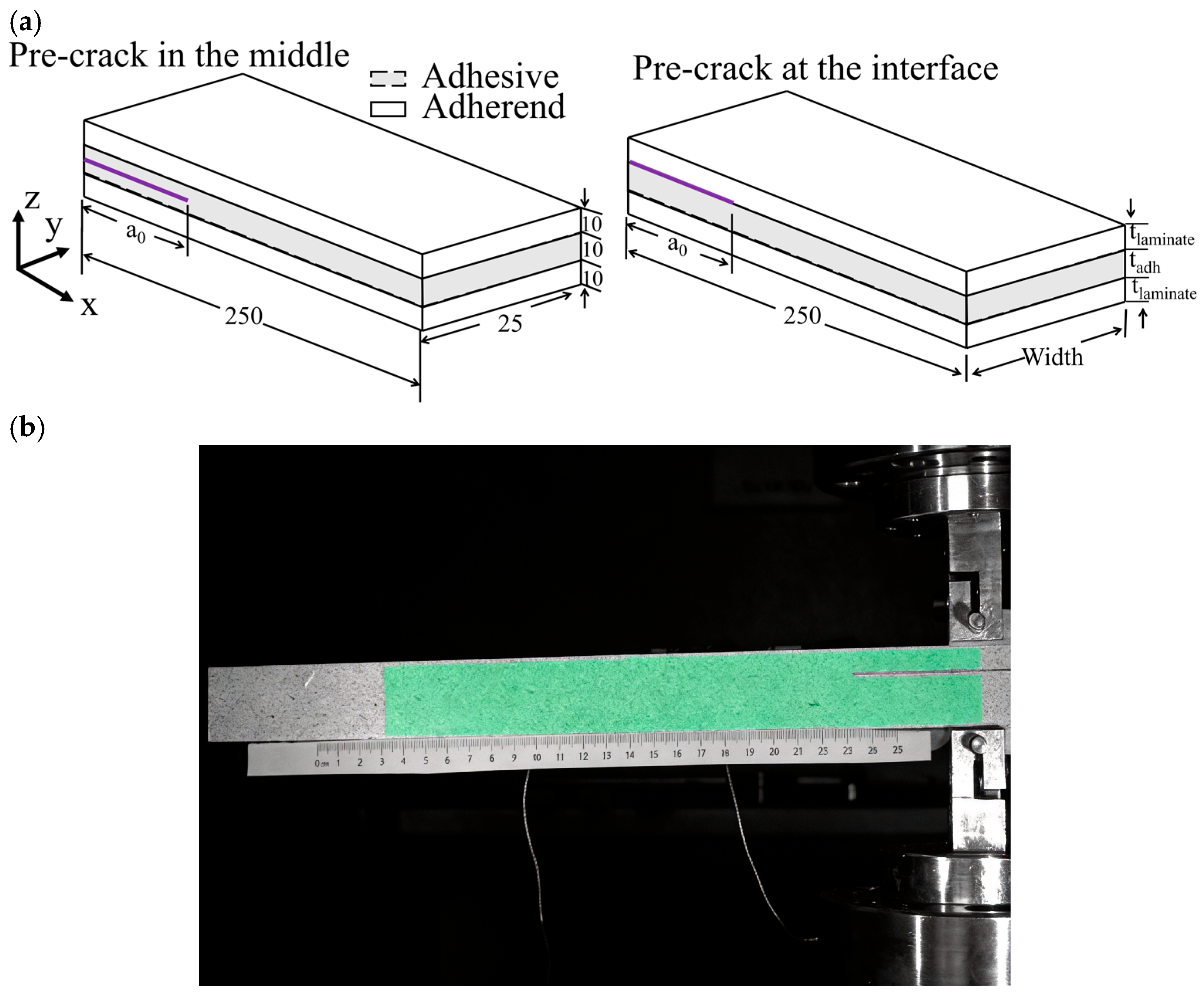
DCB specimens with varying pre-crack lengths (a0) (24 mm to 52 mm) were tested in the authors’ previous research [15,17]. An adhesive layer approximately 10 mm thick was applied between the two cross-ply laminates. Spacers were inserted between the laminates to maintain a 10 mm adhesive layer thickness during curing. The joint was placed in a metallic mould, and a 70 kg load was applied to the mould. Afterwards, the obtained adhesive joint was post-cured at 70 °C for six hours. Subsequently, the joint was left to air-cool to room temperature (20 °C). A pre-crack was created in the middle of the adhesive layer using a diamond saw. The thickness of the pre-crack was 1 mm (left image in Figure 1a). The specimen dimensions followed the ASTM D3433 standard [17,47]. For details of the test setup with a midplane pre-crack, the reader is referred to the authors’ previous study [17].
In addition, the diamond saw pre-cracking method was adopted because, as reported in [14], it provides precise, controllable, and reproducible starter cracks in thick adhesive DCB joints. Moreover, its influence on the results has been experimentally and analytically verified in previous studies using the same specimen geometry and identical materials [14,17,18,22].

2.2.2. Thick Adhesive Joints with Pre-Cracks in the Composite/Adhesive Boundary

The second series of tests was conducted on DCB specimens with a pre-crack at the composite/adhesive boundary to determine the properties of the composite/adhesive interface. The specimens were GFRP composites bonded by an adhesive (right image in Figure 1a). The manufacturing technique was the same as that for the specimens discussed above, except that a 50 mm-long and 0.01 mm-thick Teflon sheet was inserted at the composite/adhesive boundary. Subsequently, the Teflon inserted at the composite/adhesive boundary was removed, creating a 50 mm-long pre-crack (denoted as a0 in Figure 1a). DCB tests were performed, and load-displacement curves were generated. The dimensions of the specimens are listed in Table 3.

3. Modelling

3.1. Modelling of the DCB Specimens

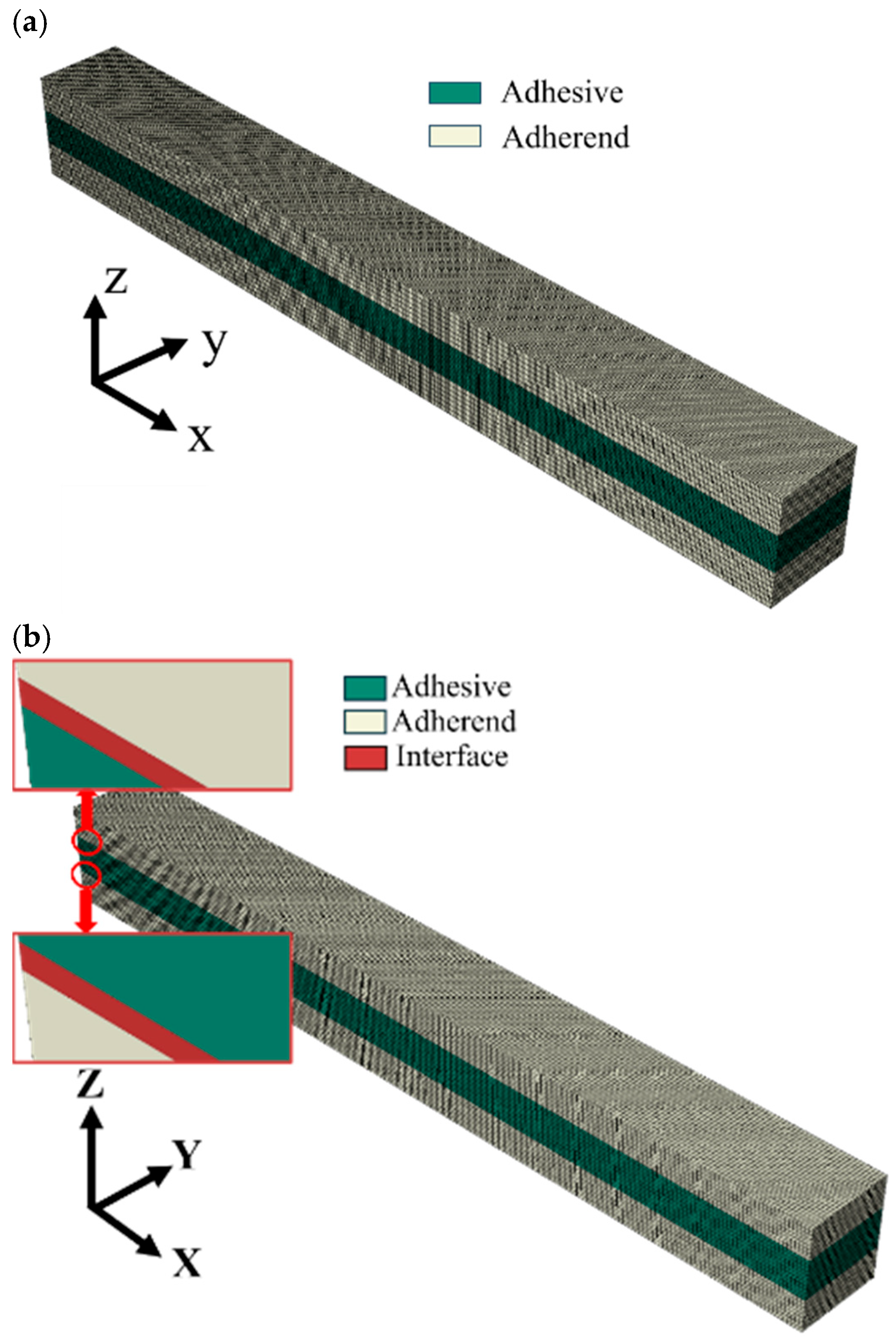
The finite element (FE) models of the DCB specimens consisted of 8-noded hexahedral elements with reduced integration (C3D8R). These DCB FE models had dimensions identical to those of the physical specimens used in the experimental investigations. Two distinct models were developed. In the first model, without a cohesive interface, the composite and adhesive regions were assumed to be perfectly bonded (Figure 2a). The adhesive properties were assigned to the central section, while the top and bottom sections were assigned the properties of the cross-ply GFRP composite laminate.
For the DCB FE simulations involving the effect of the composite/adhesive interface, an interface (0.01 mm thick) was inserted between the composite and adhesive through partitioning. Cohesive elements (COH3D8) were assigned to the interface. The Cohesive Zone model (CZM) available in Abaqus was assigned to the interface section. The FE model is shown in Figure 2b.

3.2. Material Models

3.2.1. Adhesive

The Drucker-Prager plasticity model was used to describe the elastoplastic behaviour of the adhesive. The Drucker-Prager model was then combined with the ductile damage model to facilitate damage. These are built-in material models in Abaqus [48,49]. The yield criterion for the Drucker-Prager model is as follows:
F   =   t p   tan β d   =   0 ;   Where ,   t   =   q 2 1   +   1 K r q 3 1 1 K
where p is the hydrostatic stress (MPa). Moreover, t is the flow stress (MPa), and q is the Von Mises stress (MPa). In addition, r is the third invariant of the deviatoric stress tensor (MPa). Further, β is the slope of the yield surface in the p-t stress plane (°), and K is the ratio of the yield stress in triaxial tension to that in triaxial compression. The values of β and K for the Sika power®-830 epoxy adhesive are listed in Table 1. The following flow potential describes plastic flow:
G   =   t p   tan ψ
Given that epoxy resin does not undergo a change in volume while yielding, a non-dilatant flow (i.e., dilation angle ψ = 0) was used [15,50]. The adhesive properties are listed in Table 1. The hardening curves extracted from the experimental tensile stress-strain data simulated the hardening [15].
The failure plastic strain of the adhesive (0.0118 mm/mm) was used as the equivalent plastic strain (PEEQ) at the initiation of failure [17]. Once the damage is initiated, the scalar damage variable ‘Dm’ governing the damage evolution evolves from ‘0’ (no damage) to ‘1’ (complete damage). Hence, a small fracture energy ‘Ga’ of 0.001 N/mm was used to ensure the immediate removal of the element once the equivalent plastic strain surpassed the failure strain [15,47,48].
The built-in thermal expansion model in Abaqus was coupled with the above model to compute thermal stresses in the adhesive. The CTE of the adhesive is presented in Table 1. The chemical volume shrinkage of ~3–7% caused by curing was not modelled to prevent complexity [37,42,51]. In addition, to assess the influence of the voids, voids were added to the DCB FE models as deleted elements within the adhesive layer.

3.2.2. Composite

A linear-elastic, transversely isotropic material model in Abaqus represented the composite’s behaviour. Additionally, a built-in orthotropic thermal expansion model in Abaqus was used to assess the thermal stresses. The CTEs of the composite are listed in Table 2. No damage model was assigned to the composite, as it remained intact during DCB testing.

3.2.3. Composite/Adhesive Interface

A bilinear traction−separation law, available in Abaqus, was used to capture the mechanical behaviour of the interface between the GFRP composite and adhesive [50,52]. The following equation defines the linear-elastic component of the traction−separation law:
t s t t t n = K 0 0 0 K 0 0 0 K δ s δ t δ n
The onset of interface damage is assumed to occur as soon as the following maximum-stress criterion is satisfied.
m a x t n t n 0 , t s t s 0 . t t t t 0 = 1
Here, 〈 〉 represents the Macaulay brackets, which imply that only tensile normal deformations are considered in the criterion [46]. Moreover, the damage evolution is governed by the following power-law criterion:
G n G I c α + G s G I I c α + G t G I I I c α = 1
In the above equation, GIc is the critical normal fracture energy while GIIc and GIIIc are the critical shear and tangential fracture energies. Gn, Gs, and Gt are the fracture energies in normal, tangential and shear modes. α represents the power-law coefficient and is set to 2 [53].

3.3. Approach for Simulations

The finite element simulation approach followed a unique computational methodology comprising three steps. The first step was thermal post-curing of the thick adhesive joint. The second step was virtual pre-cracking, and the third was mechanical loading [15]. These steps aimed to mirror the lifecycle of the DCB specimens—from adhesive curing to final mode I DCB testing—as accurately as possible.

3.3.1. Thermal Loading

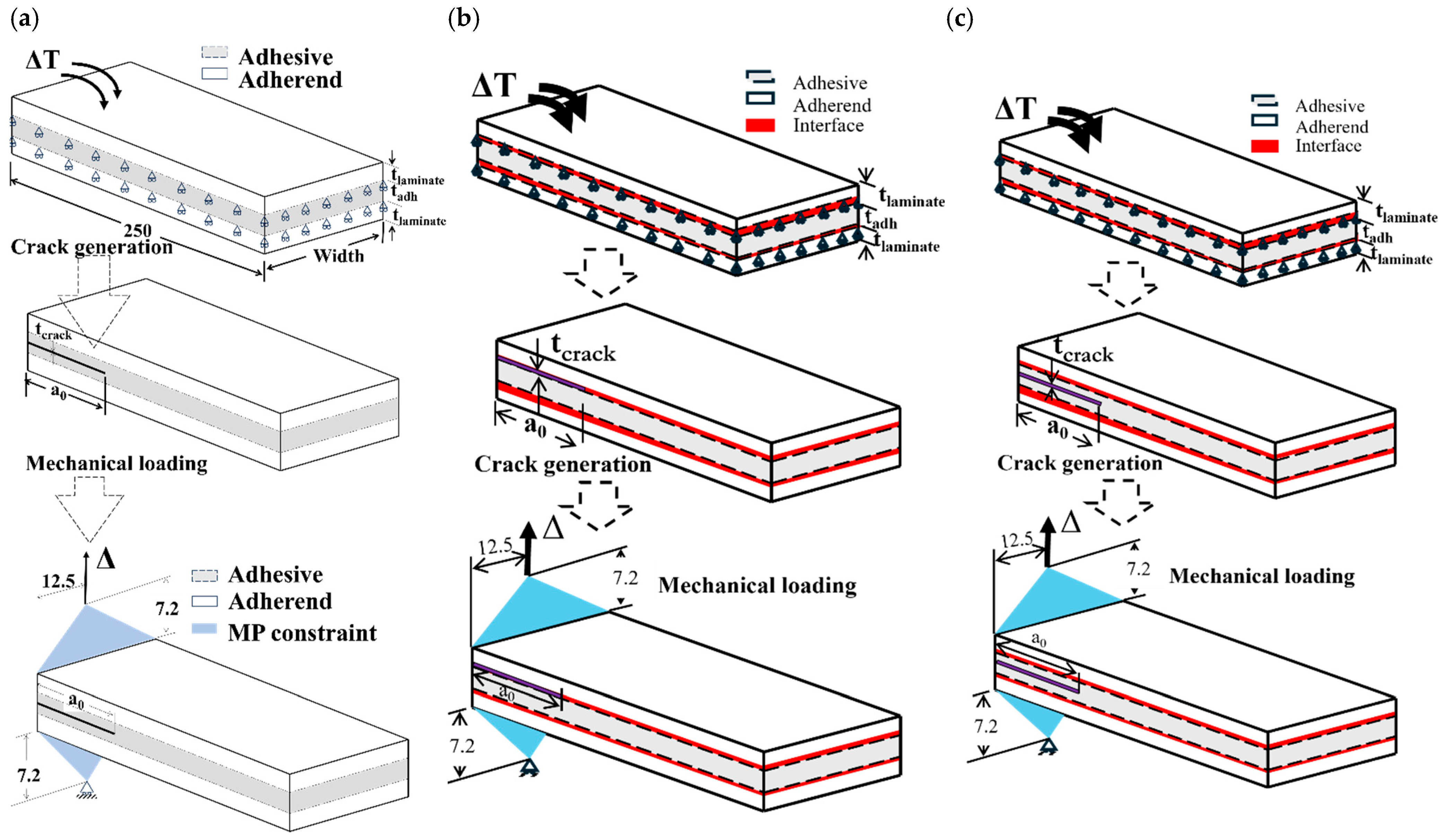
A temperature reduction from 70 °C to 20 °C (ΔT = −50 °C) was implemented to replicate the cooling of the DCB specimen during the post-curing step. At the same time, a single middle node was fixed to avoid free-body motion. Spacers were inserted between the laminates to maintain a ~10 mm-thick adhesive layer during curing. This meant that the composite laminates could not move in the through-thickness direction during curing because of these spacers. Hence, the thickness-direction movement of the nodes on the surfaces at the composite/adhesive boundary was constrained (as shown in Figure 3).

3.3.2. Virtual Pre-Crack Generation

Virtual pre-cracking was achieved by removing elements from the FE model using the command line ‘*model, change’ in Abaqus, thereby replicating the physical pre-crack in the experiment. Initially, the DCB FE model without a cohesive interface, as shown in Figure 2a, was pre-cracked in the middle (Figure 3a). The midplane pre-crack was 1 mm thick. The composite and adhesive in the model were perfectly bonded. This simulation is referred to hereon as MPC-PB, i.e., DCB FE simulations with a Midplane Pre-crack and Perfect Bond between the composite and adhesive. In subsequent simulations, the DCB FE model with a cohesive interface was pre-cracked using the following two approaches: (i) a pre-crack at the composite/adhesive interface (Figure 3b) and (ii) a pre-crack in the middle of the adhesive layers (Figure 3c).
The approach shown in Figure 3b was employed to compare with the DCB tests on thick adhesive joints with pre-cracks in the composite/adhesive boundary to estimate the properties of the composite/adhesive interface. For clarity, this approach will be referred to as IPC-WCI (DCB FE simulations with Interface Pre-crack and Cohesive Interface) from here on. The approach shown in Figure 3c was used to investigate the effects of the composite/adhesive interface on mode I behaviour when the pre-crack was in the middle of the DCB specimens. From here on, the approach in Figure 3c will be referred to as MPC-WCI (DCB FE simulations with Midplane Pre-crack With Cohesive Interface). The thickness of the midplane pre-crack in the MPC-WCI model was 1 mm, while that of the interface pre-crack in the IPC-WCI model was 0.01 mm.
It is again emphasised that midplane and interface pre-cracks were created during the ongoing simulation. Hence, the equilibrium of the residual stresses was disturbed by the removal of elements in the pre-crack. This allowed the influence of the crack generated during specimen preparation to be incorporated into the mode I behaviour of the adhesive joints. Note that during the pre-cracking, the spacers were removed while preparing the DCB specimens. Hence, the restriction on the translational movement of nodes along the through-thickness direction at the composite/adhesive boundary was no longer effective in this step.

3.3.3. Mechanical Loading

The steps mentioned above were executed using the Abaqus/Standard module. During mechanical loading, it is highly likely that the nonlinear adhesive material behaviour, combined with damage and element deletion, would cause convergence difficulties in Abaqus/Standard. Hence, the mechanical loading step was executed using the Abaqus/Explicit module. The results of the pre-cracking step were transferred to Abaqus/Explicit. Subsequently, two reference points were established, and a rigid beam multi-point (MP) constraint connection was created between these points and the edges of the upper and lower adherends. The top reference point (TRP) was subjected to displacement, while the bottom reference point (BRP) remained fixed in the translational degree of freedom. The boundary conditions of the model during the steps mentioned above are shown in Figure 3.
An applied mass-scaling factor of 1000 was used to speed up simulations during mechanical loading. To maintain quasi-static behaviour, the kinetic-to-internal energy (KE/IE) ratio for the simulations must be less than 5% [54,55]. The aforementioned ratio was examined post-simulation and was well below 5% in all simulations.

3.3.4. Numerical Artefacts

In this paper, the authors wanted to investigate the physical sources of crack kinking in thick adhesive joints. However, many numerical artefacts can cause (i) incorrect crack tip stresses before mode I loading and (ii) parasitic crack kinking solely caused by numerical sources. These numerical artefacts are often overlooked in the literature on mode I simulations of adhesive joints and can lead to misinterpretations of crack kinking. The authors carefully eliminated these artefacts, ensuring that the FE results described in this paper were free of them. The artefacts and their remedies are described in the Appendix A.

4. Results and Discussion

4.1. Results of the FE Simulations

The numerical results discussed in this section correspond to the MPC-PB model (Figure 3a). The length of the middle pre-crack was 25 mm. Based on the results of a mesh sensitivity analysis, cubic elements with a side of 1 mm were used for the adhesive section. The composite sections had a larger element size (1.3 mm × 1 mm × 1 mm) to mitigate computational costs (Figure 2b).

4.1.1. Effect of Thermal Loads

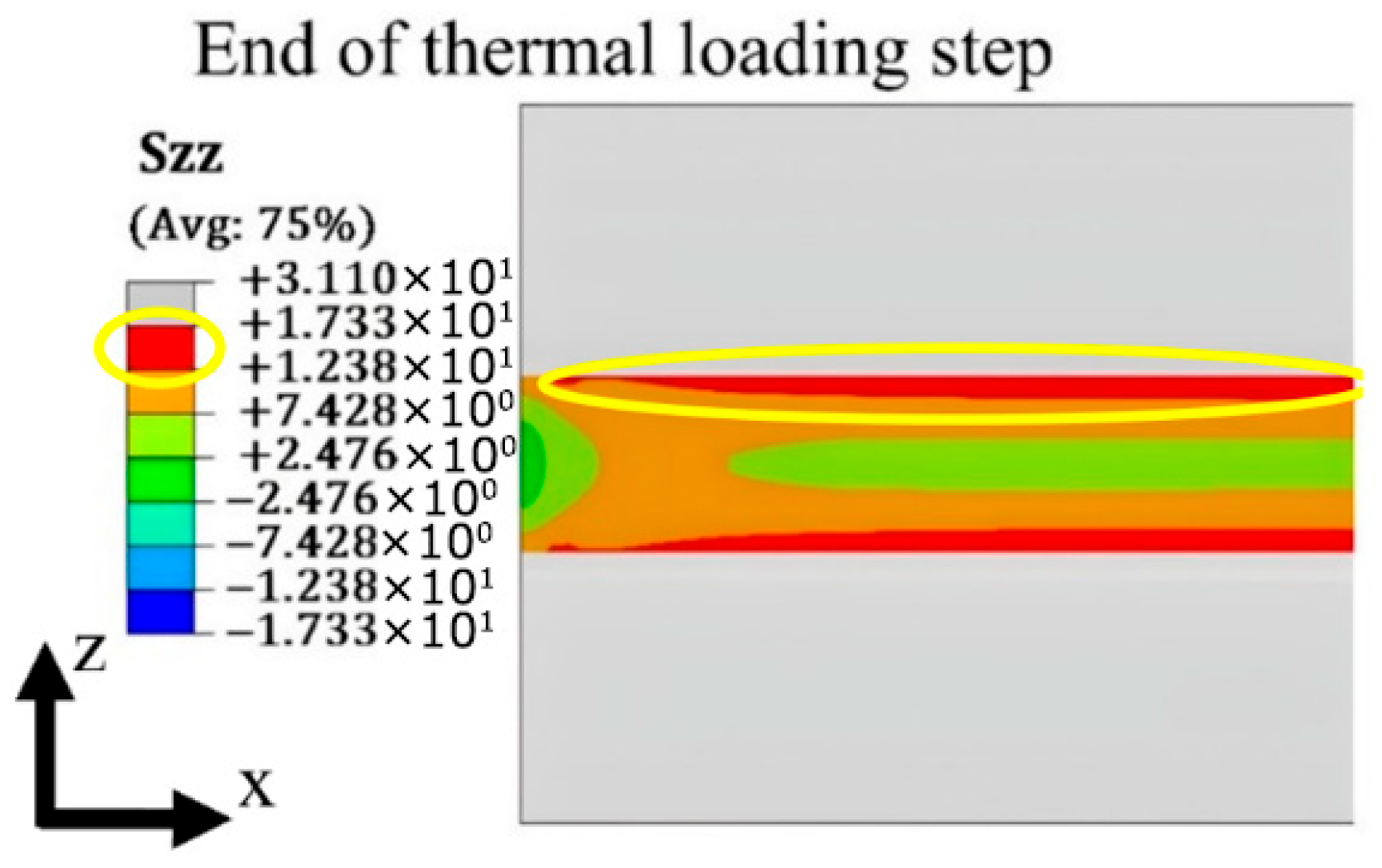
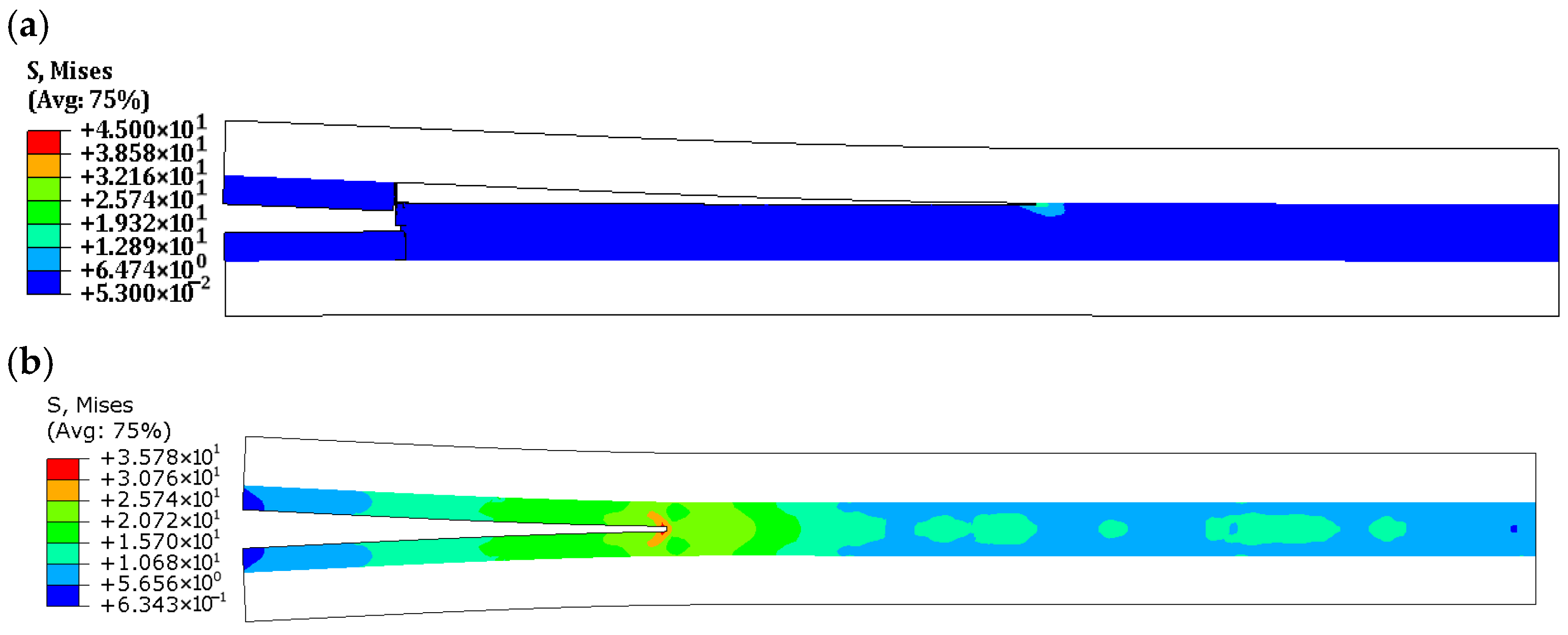
Due to the temperature difference of −50 °C, the mismatch in the thermal expansion coefficient caused stress in the adhesive layer of the FE model, as shown in Figure 4. The stresses along the thickness were maximum at the boundary of the adhesive and composite. Furthermore, the stress concentration was ~12 MPa, as highlighted by the yellow ring in Figure 4. This stress equates to roughly 30% of the adhesive tensile strength of 40 MPa. Note that the stress in the middle of the adhesive layer was ~5 MPa.

4.1.2. Effect of Virtual Pre-Cracking

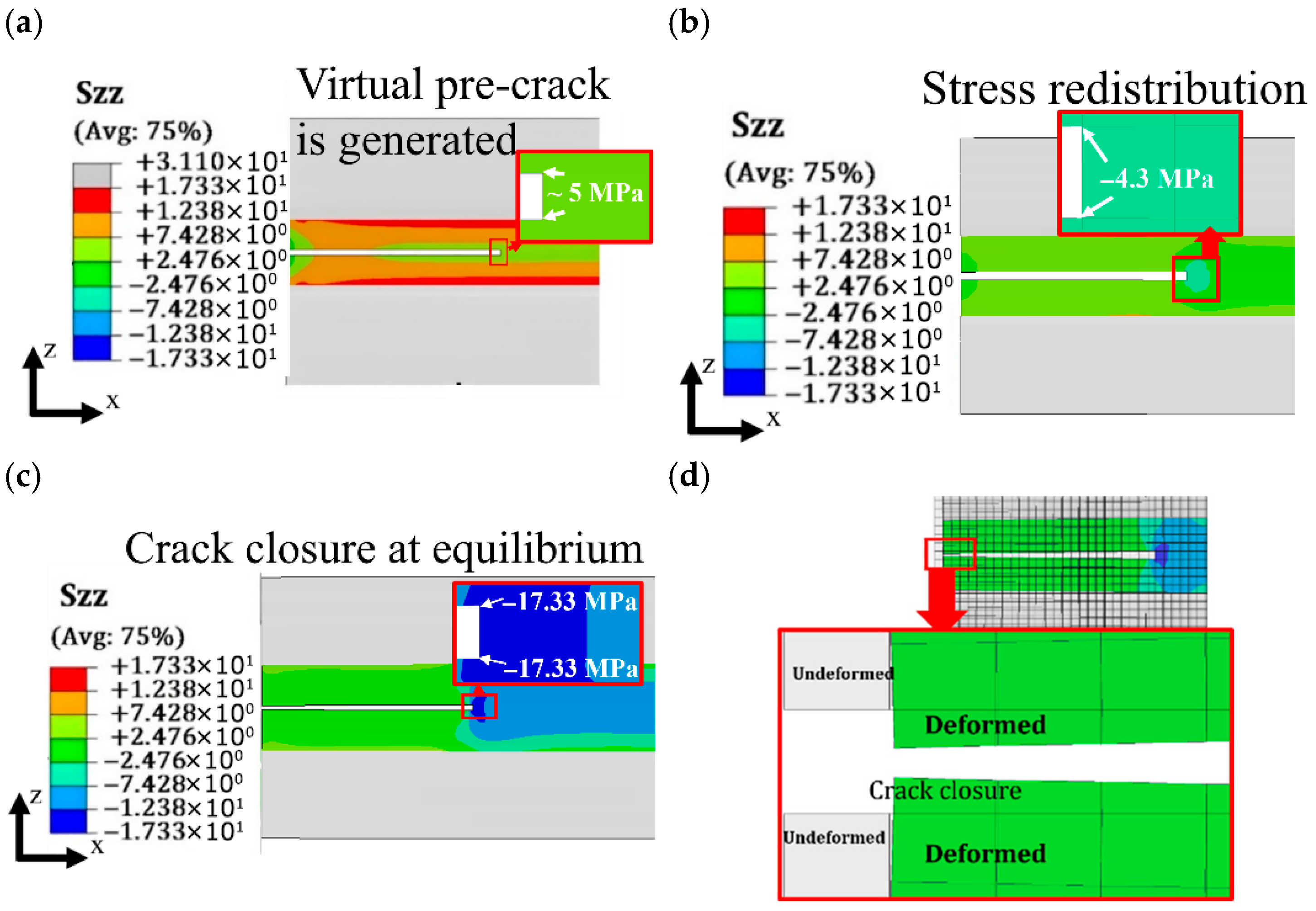
When the virtual pre-crack was generated, the crack tip stresses were ~5 MPa (Figure 5a). However, the creation of a virtual pre-crack resulted in unbalanced forces. These unbalanced forces bent the adhesive surfaces on either side of the crack towards each other. This led to the through-thickness stress at the crack tip becoming negative, approximately −4.3 MPa (Figure 5b). The crack continued to close until mechanical equilibrium was attained. Finally, the stress decreased to −17 MPa (Figure 5c), compared with the previous value of −4.3 MPa.
Note that Abaqus/Standard checks the mechanical equilibrium throughout the simulation [44]. This means that at each simulation increment, the forces were balanced. Thus, the virtual crack was closed statically with no dynamic changes. The crack closure is shown in Figure 5d. Interestingly, this simulated crack closure behaviour was consistent with the experimental observations. The joints were closed during the pre-cracking of the DCB specimens. This was also documented by Fan et al., who used the same adhesive joint [10].
It is important to emphasise that almost all DCB simulations in the literature insert the pre-crack as a pre-existing geometrical feature in the FE model and then apply the thermal loading. This is not correct, since they start with a stress-free crack tip before the thermal loading.

4.1.3. Effect of Mechanical Loading

The results of the virtual pre-cracking were exported to Abaqus/explicit. The displacement was subsequently applied to the top reference point (TRP), and the bottom reference point (BRP) was fixed. The vertical reaction force of the TRP was plotted against the relative displacement between the TRP and BRP to generate a numerical load-displacement curve. The obtained curve was compared with the experimental load-displacement curve derived in previous experimental studies conducted by the authors’ research group [10,15,17].
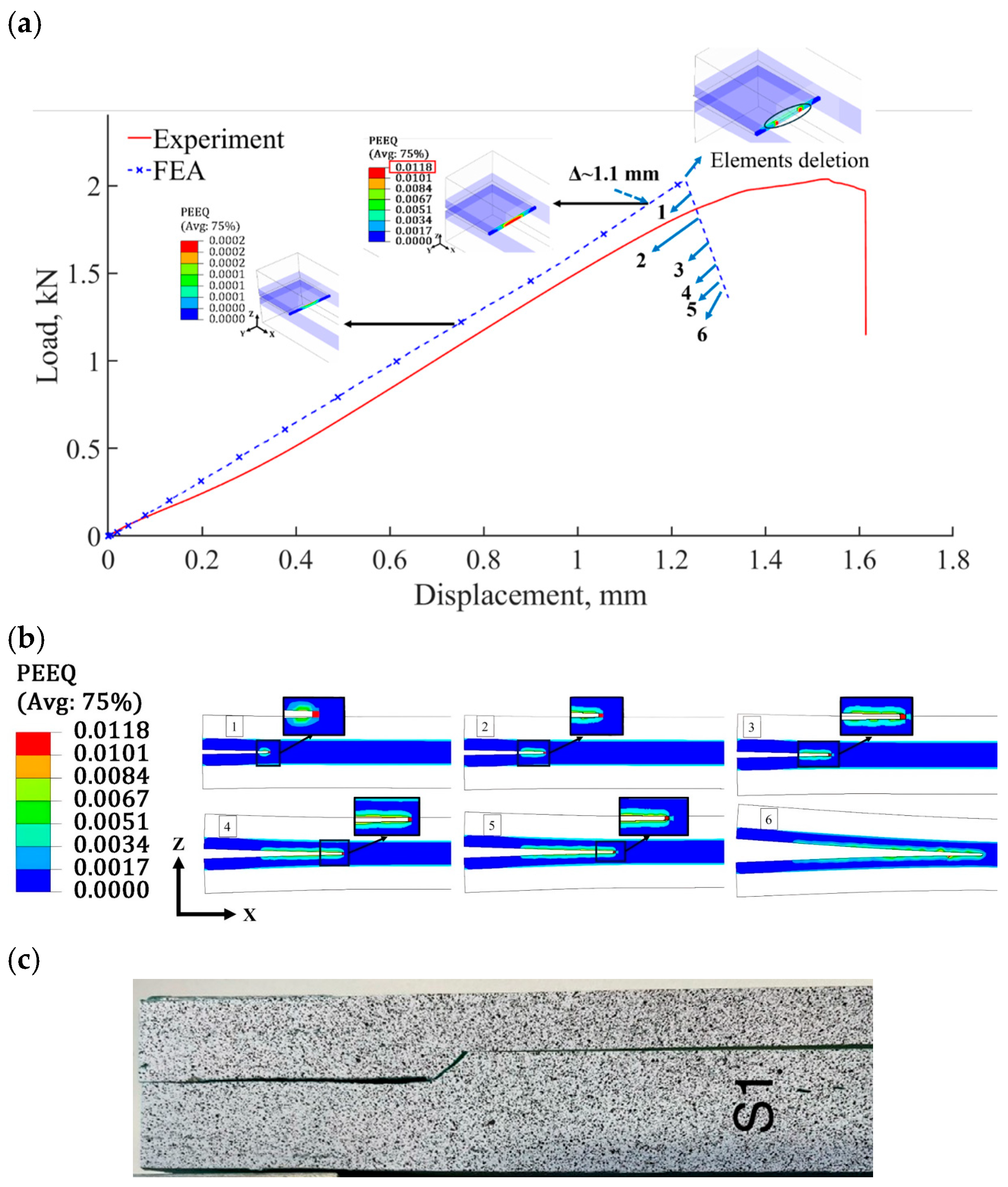
As shown in Figure 6a,b, the PEEQ, i.e., equivalent plastic strain, was maximum at the crack tip. When the crack tip PEEQ became 0.0118 mm/mm, damage was initiated at the crack tip elements. Due to a minuscule fracture energy (0.001 N/mm), the damage (Dm) quickly increased from 0 (no degradation) to 1 (total degradation). Hence, the crack tip elements underwent deletion (‘Element deletion’ in Figure 6a) when the PEEQ in an element reached the adhesive’s failure plastic strain. As loading progressed, neighbouring elements along the crack tip line also reached the failure strain. This led to their sequential removal, resembling crack propagation (Figure 6b). Thus, crack propagation was governed by the adhesive’s actual plastic failure strain (Figure 6b).
The numerical load-displacement response matched the experimental results (Figure 6a) [15,17]. However, the crack propagation path in the thick adhesive layer did not match the experimental crack propagation path in the DCB specimens. The experiments exhibited crack kinking towards the interface between the composite and adhesive (Figure 6c). The failed specimen (S1) shown in Figure 6c is part of an experimental study conducted by the authors [15,17]. It was ensured that the results discussed abovewere not influenced by numerical artefacts.

4.2. DCB Tests: Pre-Crack at the Composite/Adhesive Interface

Figure 6a shows that the experimental behaviour was accurately predicted up to the onset of crack propagation. However, the simulated crack remained straight throughout the rest of the simulation (Figure 6b), while the experimental crack kinked to the composite/adhesive boundary (Figure 6c). As mentioned in Section 3.3.4, the numerical artefacts were already eliminated and can be found in the Appendix A of this paper. Hence, this discrepancy was attributed to the lack of a discretely modelled composite/adhesive interface and the presence of voids within the adhesive layer in the FE model. Hence, these aspects were incorporated into the DCB FE model. For this purpose, the composite/adhesive interface properties were required. To extract the aforementioned properties, DCB tests were conducted in which the pre-crack was at the composite/adhesive boundary.
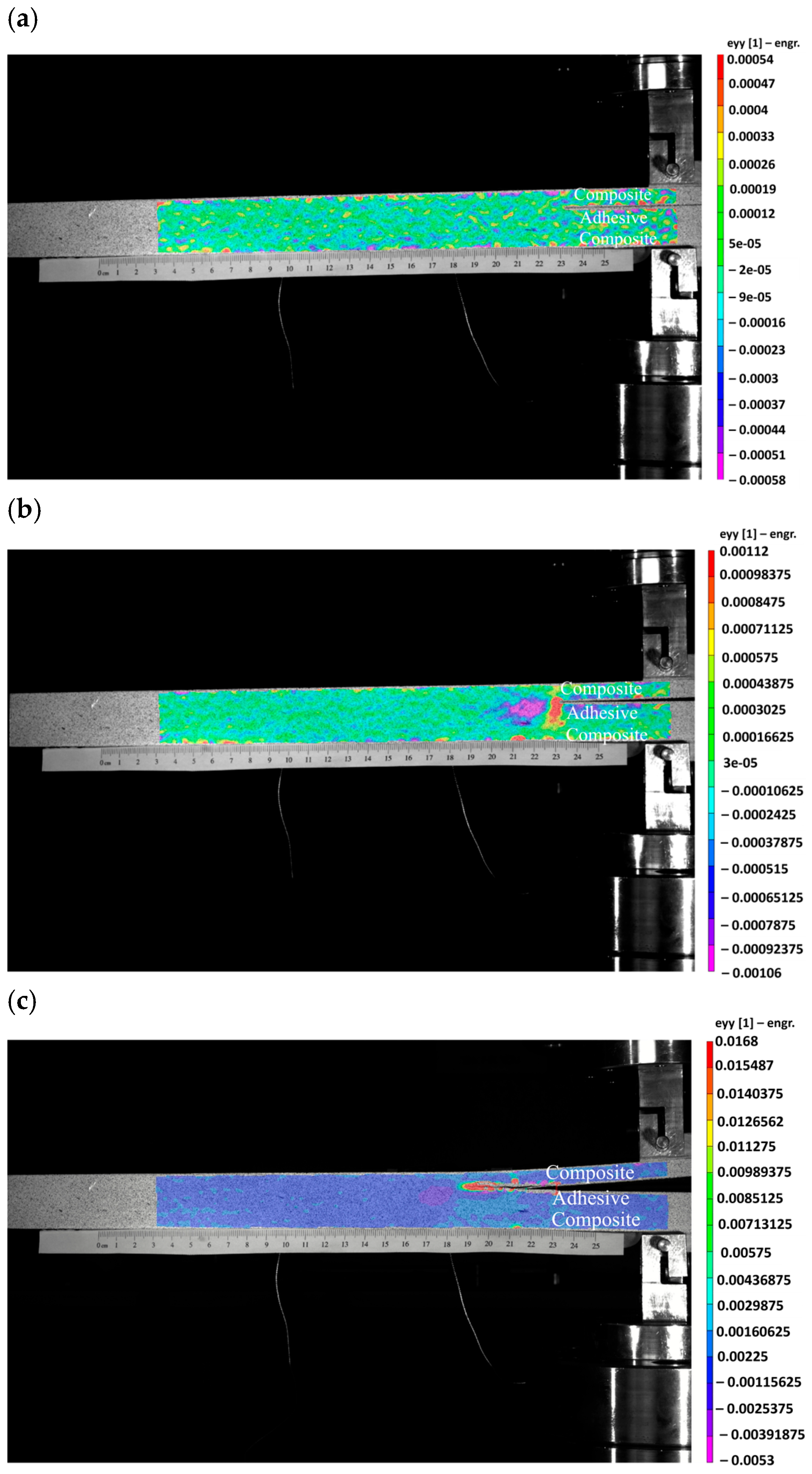
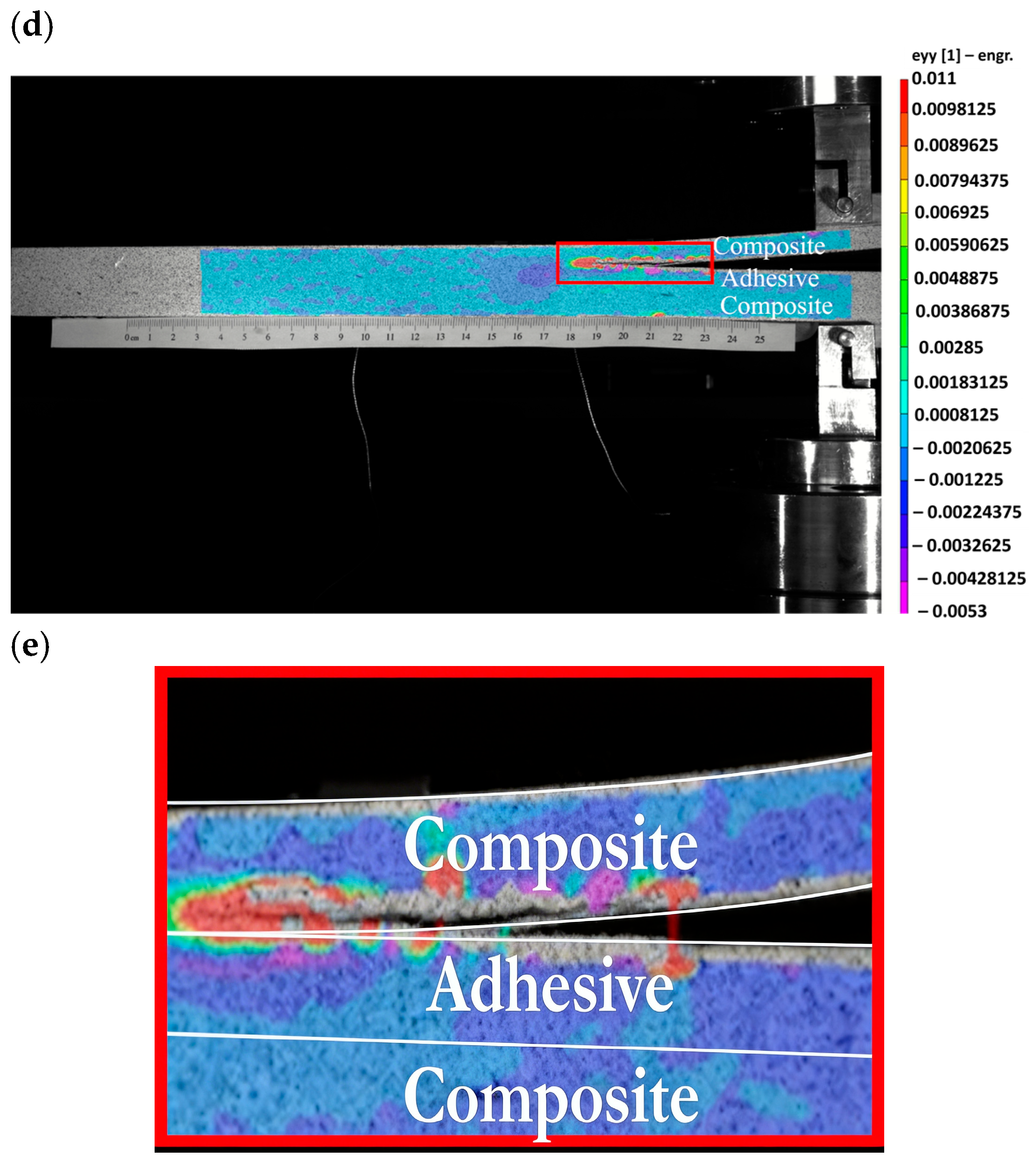
During the DCB tests with a pre-crack at the composite/adhesive boundary, crack propagation was observed at two different locations in all specimens. Figure 7 shows the crack propagation observed at different stages under applied loading for specimen S2. Initially, failure occurred at the composite/adhesive boundary. Subsequently, the crack began to propagate along the composite/adhesive boundary as the loading increased [Figure 7a,b]. Upon further loading, the crack propagated along the interface, while the 90° layer of the composite, adjacent to the adhesive, delaminated from its upper plies. (Figure 7c). Eventually, the crack propagated entirely within the composite [Figure 7d,e].
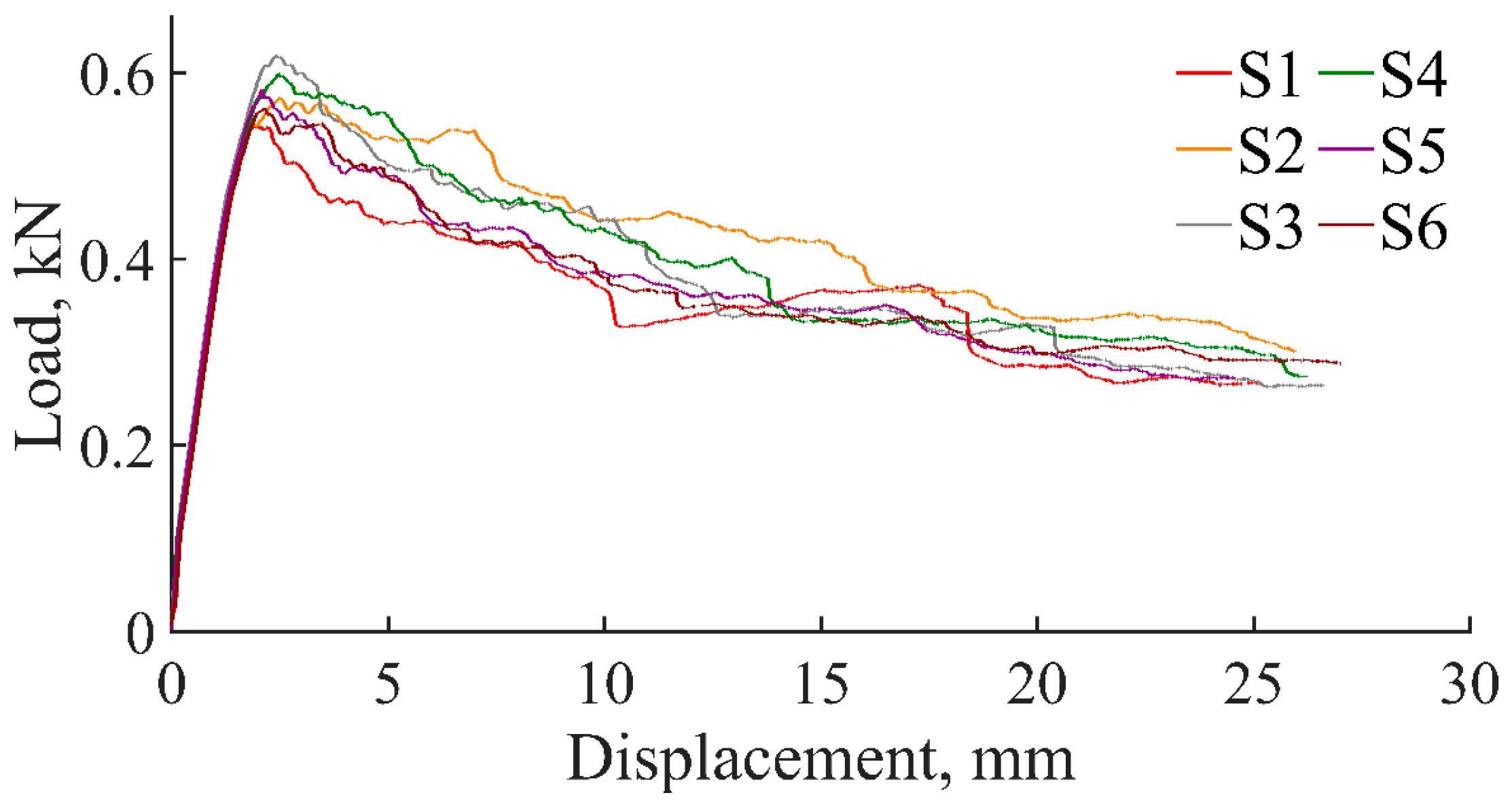
The load-displacement curves of the specimens are shown in Figure 8.

4.3. Composite/Adhesive Interface Properties

The crack traversing the composite rendered the conventional formulae for evaluating the interface’s fracture properties inapplicable. Hence, DCB-FE-IPC simulations, as shown in Figure 3b, were conducted to assess them by comparing them with the experimental response. The interface properties were adopted from values reported in the literature [53] and used directly to simulate the load-displacement responses. The agreement cannot be expected to be perfect because the experimental crack also migrates from the composite/adhesive interface to the internal composite ply/ply interfaces.

4.3.1. Determination of Interface Properties

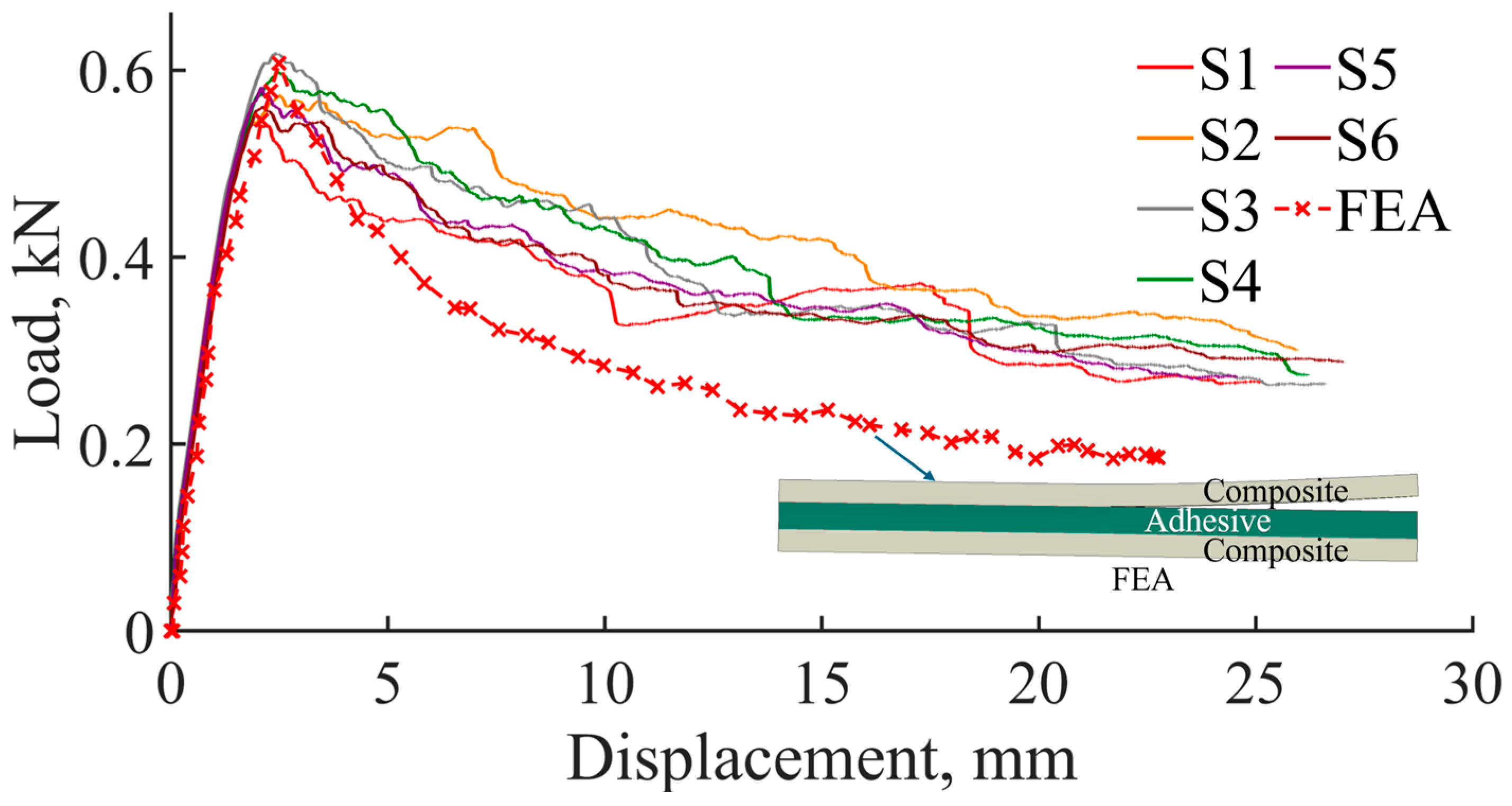
The computational load-displacement response was predicted through the IPC-WCI simulation approach shown in Figure 3b and compared with the experimental results. The interface stiffness ‘K’ was assumed to be 3 × 10⁴ N/mm3 [54]. The normal interface strength (Tn) was assumed to be 30 MPa, as in [54]. The shear (Ts) and tangential (Tt) strength values were assumed to be equal to 17.3 MPa [54]. In addition, the value of the critical fracture energy ‘GIc’ was fixed at 600 J/m2 [54]. The mode II/III interface fracture energies (GIIc/IIIc) were set to 1200 J/m2. It was assumed that GIIc = GIIIc [54]. To govern the evolution of damage at the interface, the power-law criterion highlighted in Equation (5) was utilised. The predicted load-displacement curve was plotted against the experimental curve (Figure 9). The computational load-displacement curve accurately matched the experimental curves up to the peak load.

4.3.2. Validation of Interface Properties

It should be noted that the experimental load-displacement curve results from a scenario with two distinct cracks formed during the DCB tests. The first crack propagated along the composite/adhesive interface, and the second crack propagated through the composite laminate. It is not possible to replicate the second crack in the FE simulations since no damage behaviour was assigned to the composite in the model. The additional energy dissipation from the additional crack results in experimental load-displacement curves that show higher loads than the computational curves in the post-peak portion. Nevertheless, it is worth noting that the experimental peak load was accurately predicted (Figure 9).

4.4. Effect of Composite/Adhesive Interface

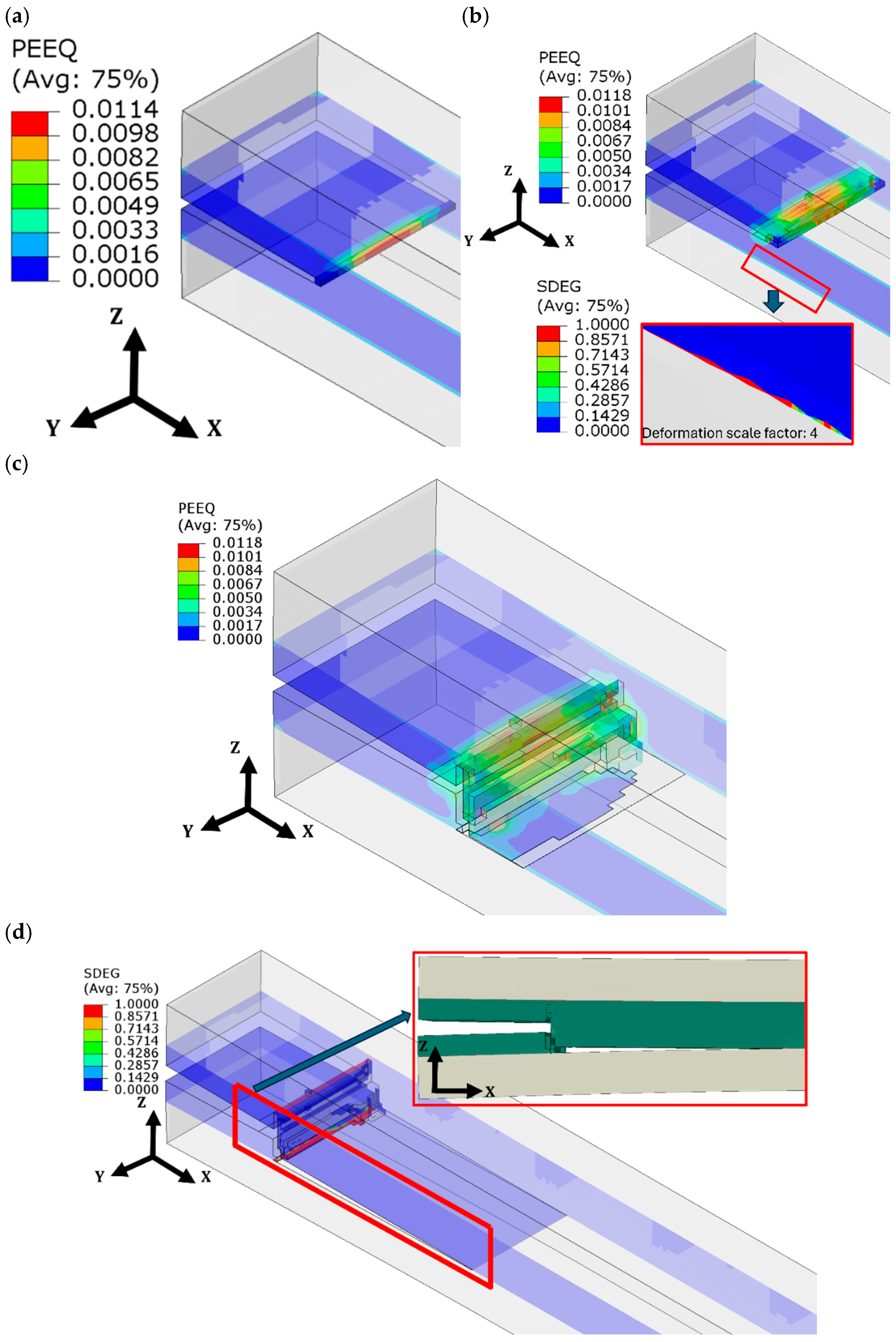
The MPC-WCI simulation (Figure 3c) was conducted with a midplane pre-crack length of 25 mm. Note that the results of the thermal loading, pre-crack generation, and load-displacement curves were the same as those reported in Section 4.1. Henceforth, these results are omitted. As shown in Figure 10a, the PEEQ was maximum at the crack tip. Damage to the tip elements commenced when the crack-tip PEEQ reached 0.0118 mm/mm (adhesive’s plastic strain at failure). Again, owing to the small fracture energy (0.001 N/mm), the elements were immediately removed. This caused the crack to initially propagate in a straight path (Figure 10b).
Simultaneously, when the stress at the composite/adhesive interface exceeded 30 MPa, damage was initiated in the cohesive elements. When the critical fracture energy of the interface elements was entirely dissipated, the ‘scalar stiffness degradation’ (SDEG) variable reached ‘1’, indicating complete degradation (Figure 10b). The PEEQ of adhesive elements adjacent to the interface increased due to stress redistribution. As a result, the crack path deviated sharply from the adhesive midplane to the composite/adhesive interface region (Figure 10c). Subsequent crack propagation along the composite/adhesive interface was driven by the continuous removal of the interface elements (Figure 10d). Thus, the crack deviation is attributed to the lower fracture resistance of the composite/adhesive interface compared to that of the bulk adhesive.
The crack propagation in the deformed FE model (Figure 10d) resembles the experimental crack path (Figure 6c). The only difference here is that the computational crack jumped towards the interface below the crack tip, whereas in the experiment, it jumped towards the upper composite/adhesive boundary.
If the cohesive interface properties were assigned sufficiently large values, the crack propagated in a nearly straight path, resembling the response obtained for the MPC-PB (Midplane Pre-crack with Perfectly Bonded composite and adhesive) configuration. To demonstrate this, another simulation was conducted on the MPC-WCI model. The MPC-WCI model was assigned interface strengths (tn = ts = tt) of 45 MPa, and the mode I fracture energy, GIC, was doubled to 1200 J/m2. Note that the assigned interface strength exceeds the strength of the adhesive (Table 1). The mode II and III fracture energies, GIIC and GIIIC, were maintained at 1200 J/m2. Figure 11 shows the simulations demonstrating straight crack propagation. Assigning these fracture energies indicated that the interface was very tough or nearly perfectly bonded. Therefore, the crack remained in the middle with such high fracture energies. This result is evidence that the presence of a cohesive composite/adhesive interface in the model influences crack kinking.

4.5. Effect of the Presence of Voids

4.5.1. Effect of Multiple Voids

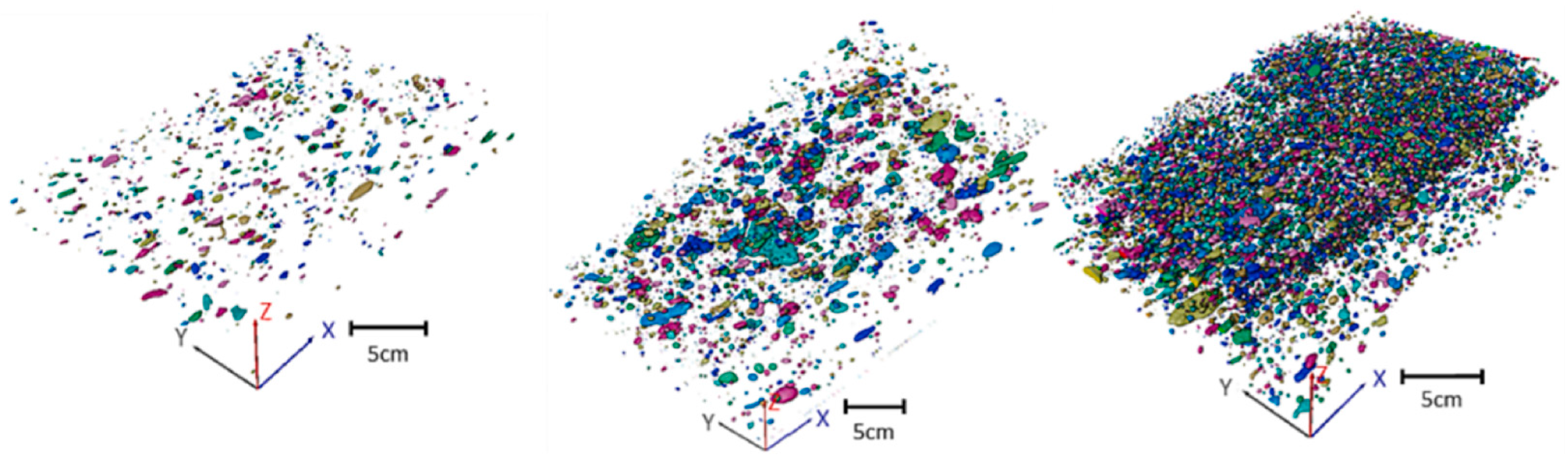
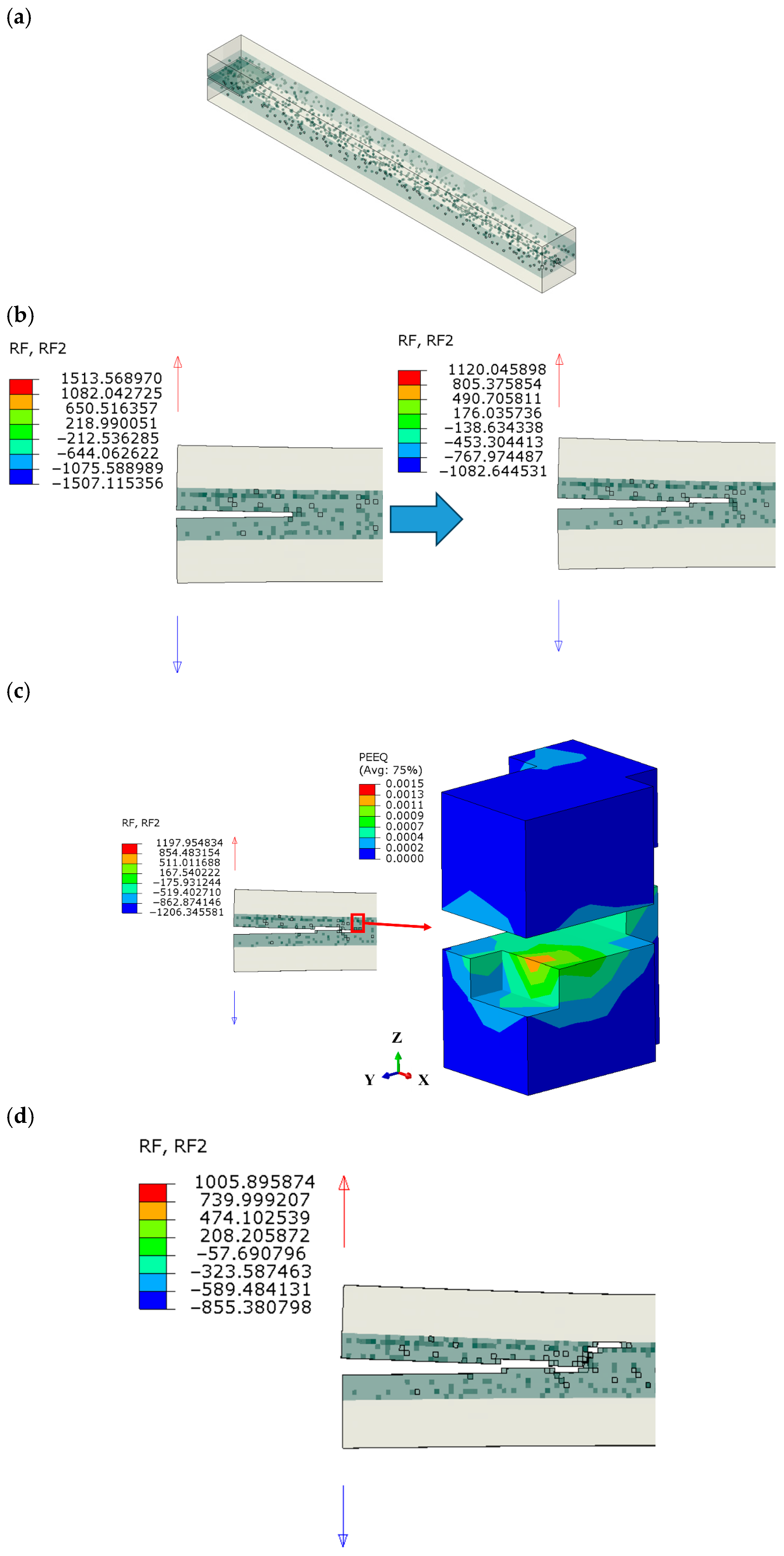
Computed Tomography (CT) images of the adhesive joints revealed a void content ranging from 0.36% to 4.19% in the experimental specimens, as shown in Figure 12 [10]. Due to meshing constraints, it was not feasible to replicate the actual geometry of voids observed in experimental specimens. Instead, voids were represented by randomly deleting cubic C3D8R elements from the adhesive layer in the MPC-PB model; each deleted element had an edge length of 1 mm. Elements were deleted iteratively until a total void content of ~1% was reached. This approach reduced modelling complexity and preprocessing effort (Figure 13a). To study the effect of the voids separately, the simulations presented in this section did not explicitly model cohesive interfaces, and the composite and adhesive were perfectly bonded, similar to the MPC-PB model shown in Figure 3a.
Thermal loading and pre-cracking effects were the same as those obtained from the void-free MPC-PB model shown in Section 4.1; hence, they are omitted here to maintain brevity. The vertical reaction forces (RF2) at the top and bottom loading points of the model must be in equilibrium (see Appendix A). However, the voids attracted crack propagation toward their location. The crack initially propagated straight because the voids were in the middle (Figure 13b).
However, as soon as the crack reached a region of the adhesive where the voids were not in the middle but near the composite/adhesive interface, it kinked towards the void. It is evident from Figure 13c that the value of PEEQ at the void was very high, which, in turn, attracted the crack. When crack kinking occurred, the altered propagation path led to a force imbalance (Figure 13d). In addition, the KE/IE was less than 3% for the simulation, indicating quasi-static simulations. Subsequently, the effect of void location on crack propagation was investigated.

4.5.2. Effect of Void’s Location

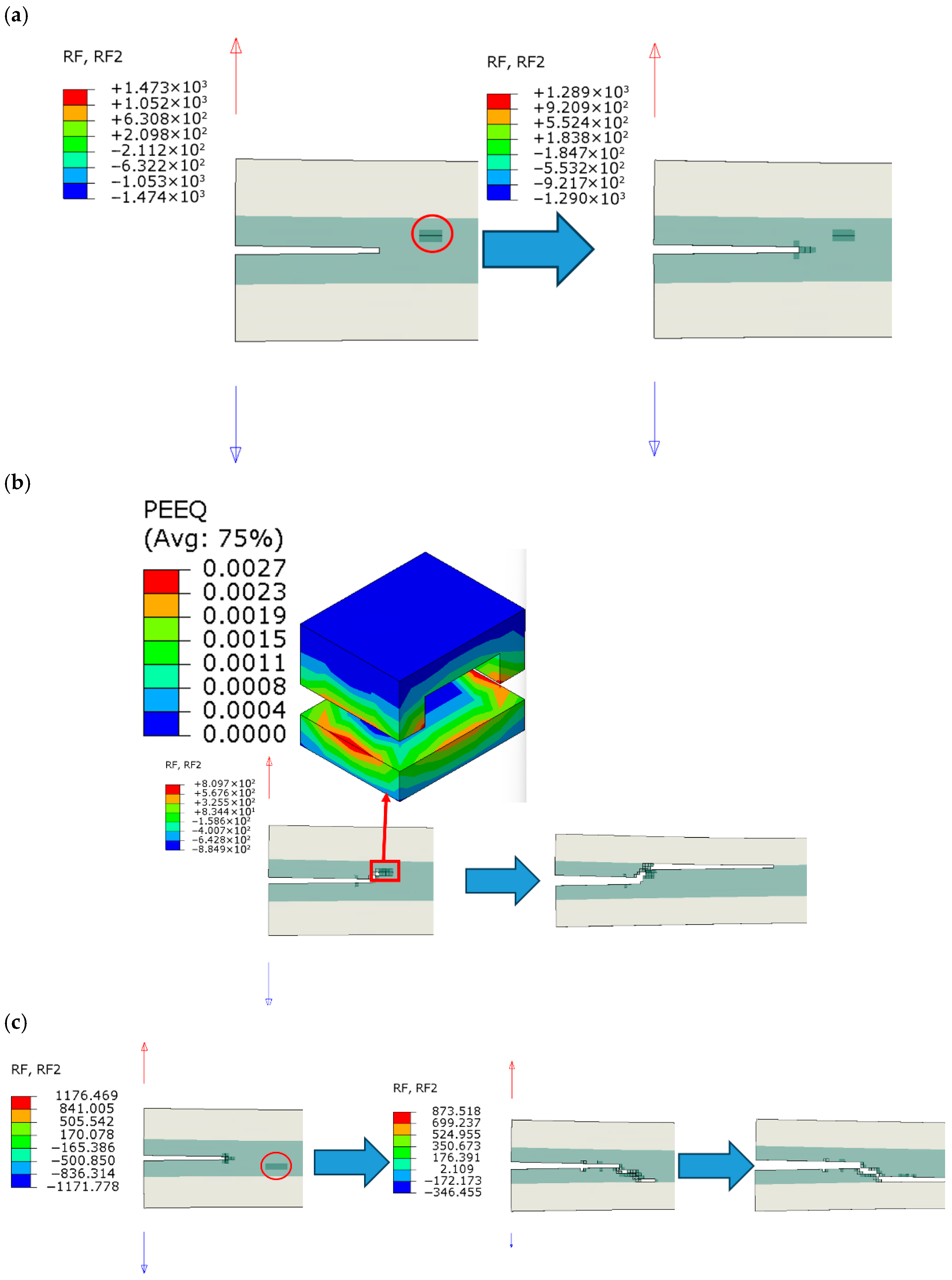
Two FE simulations, each featuring a single void, were conducted. In the first simulation, the void was located above the pre-crack within the adhesive layer. Whereas in the second, it was positioned below the pre-crack.
When the void was above the crack tip line (Figure 14a), the crack initially propagated in a straight path before traversing towards the void. Subsequently, the crack coalesced with the void due to the high PEEQ around the void, as shown in Figure 14b. The crack jumped towards and propagated along the boundary between the composite and adhesive above the crack tip (Figure 14b). Similarly, when the void was located below the crack tip line (Figure 14c), the crack coalesced with the void and subsequently jumped to the composite/adhesive boundary below the crack tip.

4.6. Combined Effect of Voids and Composite/Adhesive Interface

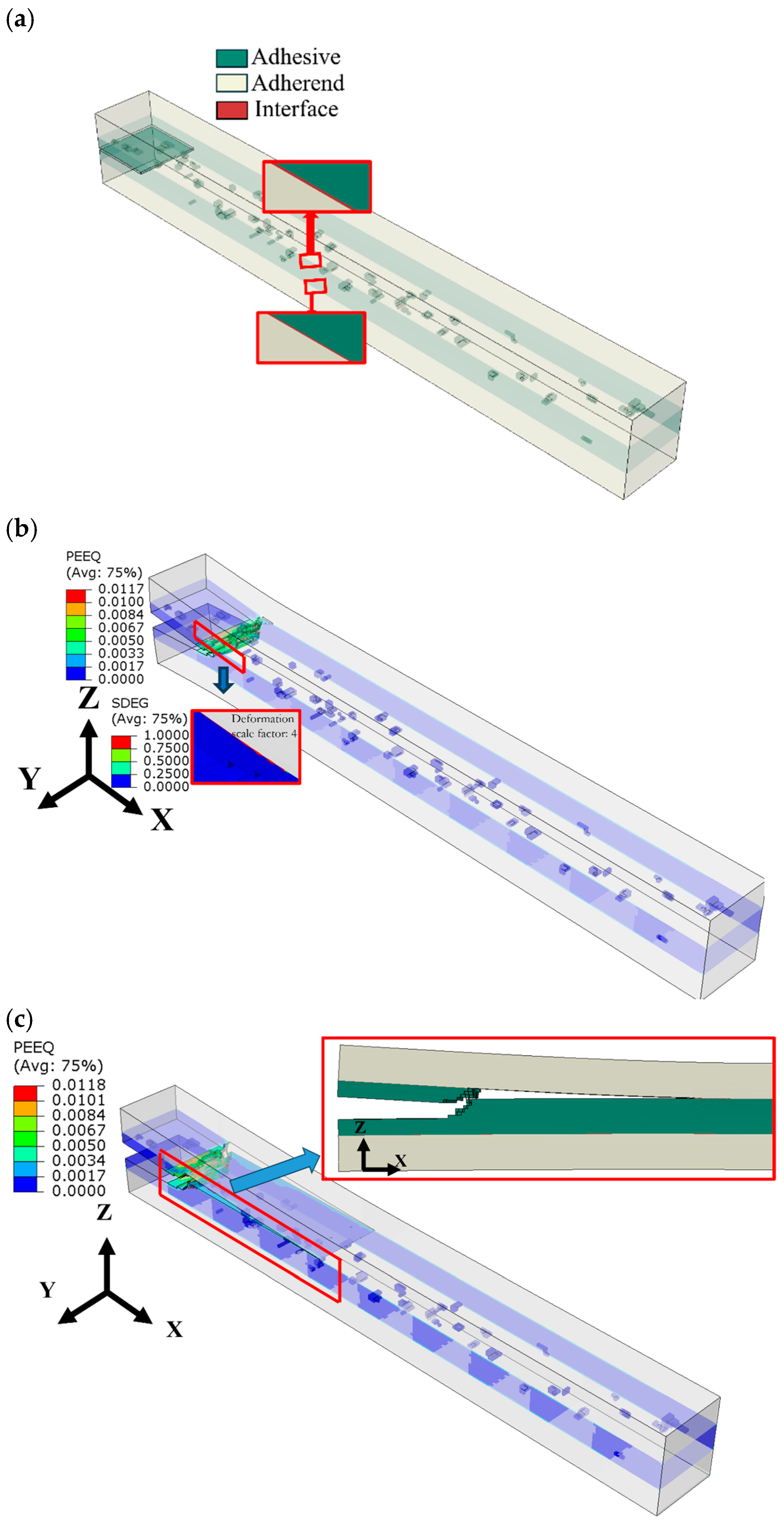
Finally, simulations with voids and explicitly modelled composite/adhesive interfaces, where the estimated composite/adhesive interface properties were assigned, were conducted. Note that these models were obtained by generating voids in the MPC-WCI (Figure 3c). Voids were modelled as deleted cubic elements, with each element having a side of 1 mm. The pre-crack length was 25 mm.
Figure 15 illustrates the combined influence of voids and the composite/adhesive interface. The abovementioned model is shown in Figure 15a. Crack propagation initiated at the crack tip and advanced straight, driven by the PEEQ within the adhesive (Figure 15b). When the normal stress at the interface elements reached 30 MPa, stiffness degradation in the cohesive interface elements led to progressive debonding at the composite/adhesive interface.
As the crack advanced in a straight line, it reached a region where a void was above its path. As shown in Figure 15c, upon reaching the aforementioned location, the crack coalesced with the voids due to the very high PEEQ around the void. This triggered the crack to jump towards the composite/adhesive interface. Notably, the interface in this region had already experienced significant degradation. Consequently, the crack propagated from the void to the degraded composite/adhesive interface, ultimately traversing the composite/adhesive boundary. Finally, the deformed FE model (Figure 15c) exhibited a computational crack propagation that resembles the experimental crack path (Figure 6c).

5. Conclusions

The crack kinking behaviour of thick adhesively bonded GFRP composite joints subjected to mode I loading was investigated using a combined computational and experimental approach. As a key contribution, the effects of the composite/adhesive interface and the presence of voids within the adhesive layers were incorporated concurrently.
The MPC-WCI simulations, i.e., simulations with composite/adhesive interfaces, revealed that crack kinking in thick adhesive joints was primarily attributed to the lower fracture resistance of the composite/adhesive interface compared to that of the adhesive. The computational crack path closely matched experimental crack paths. The MPC-PB simulations with voids in the adhesive layer revealed that voids above or below the adhesive midplane promoted upward or downward crack deflection toward the nearest interface.
The voids were then introduced into the adhesive layer in the MPC-WCI model (model with a Midplane Pre-crack and an explicitly modelled composite/adhesive interface). The aforementioned simulations revealed that the crack was redirected toward the composite/adhesive interface when voids were encountered near the crack propagation path. Finally, the observed computational crack path exhibited crack kinking that closely matched the experimental crack path [15,17].
Unlike previous studies that mainly attributed crack kinking in thick adhesive joints to geometry-induced T-stress under idealised, perfectly bonded conditions, the present work demonstrates that both composite/adhesive debonding and void-induced path deviations jointly contribute to crack kinking in thick adhesive joints. The results also underscore the importance of minimising void formation and improving bonding procedures during manufacturing. Implementing improved adhesive handling, surface preparation, and process control can therefore enhance structural performance and reduce interfacial debonding in adhesively bonded composite joints.
Regarding future work, subsequent studies should extend this approach to thick adhesive joints subjected to mode II, mixed-mode, and fatigue loading conditions, while retaining the crucial aspects identified in this study: the influence of residual stresses, pre-cracking conditions, composite/adhesive interface defects, and void defects. Such investigations, combined with more detailed micro-scale fracture surface characterisation, will further generalise the present findings and support the development of physically sound design criteria for thick adhesive joints.
Furthermore, to enable a quantitative separation between interface-driven and void-induced crack kinking, future work should include systematic sensitivity analyses in which interface properties and void content are varied independently.

Author Contributions

A.S.: Writing—original draft, Visualisation, Validation, Software, Methodology, Investigation, Data curation, Conceptualisation. A.S.K.: Visualisation, Validation, Investigation, Data curation. J.F.: Validation, Investigation, Formal analysis, Data curation. A.P.V.: Writing—review and editing, Visualisation, Project administration, Funding acquisition. V.M.: Writing—review and editing, Project administration, Funding acquisition. K.-A.K.: Writing—review and editing, Validation, Data curation. D.V.H.: Writing—review and editing, Project administration, Investigation, Data curation. W.V.P.: Writing—review and editing, Validation, Supervision, Project administration, Methodology, Investigation, Funding acquisition, Conceptualisation. All authors have read and agreed to the published version of the manuscript.

Funding

The authors acknowledge funding under the Lead Agency scheme from the Research Foundation—Flanders (FWO Vlaanderen) through project grant G031020N and the Swiss National Science Foundation (SNF) through project grant 200021E_18944/1 titled “Combined numerical and experimental approach for the development, testing, and analysis of thick adhesive joints in large wind turbine blades”.

Data Availability Statement

Data will be made available upon request.

Conflicts of Interest

The authors declare no conflicts of interest.

Appendix A

As highlighted in Section 3.3.4, many numerical artefacts that are often overlooked can lead to misinterpretations of the crack kinking. The authors carefully eliminated these artefacts, ensuring that the FE results described in this paper were free of them. The artefacts and their remedies are described herein.

Appendix A.1. Effect of Pre-Crack Generation

The post-curing of the thick adhesive joints generates stresses within the adhesive layer, due to the mismatch in thermal expansion coefficient between the adhesive and the composite [15]. Creating a pre-crack will alter the stress state within the adhesive layer. Therefore, pre-cracking must be achieved during the ongoing simulation. This aspect is often overlooked in simulations, as pre-cracks are often inserted as pre-existing geometrical features in the finite element (FE) models typically used by researchers [56,57]. While not a computational artefact, it remains a relevant conceptual inconsistency.
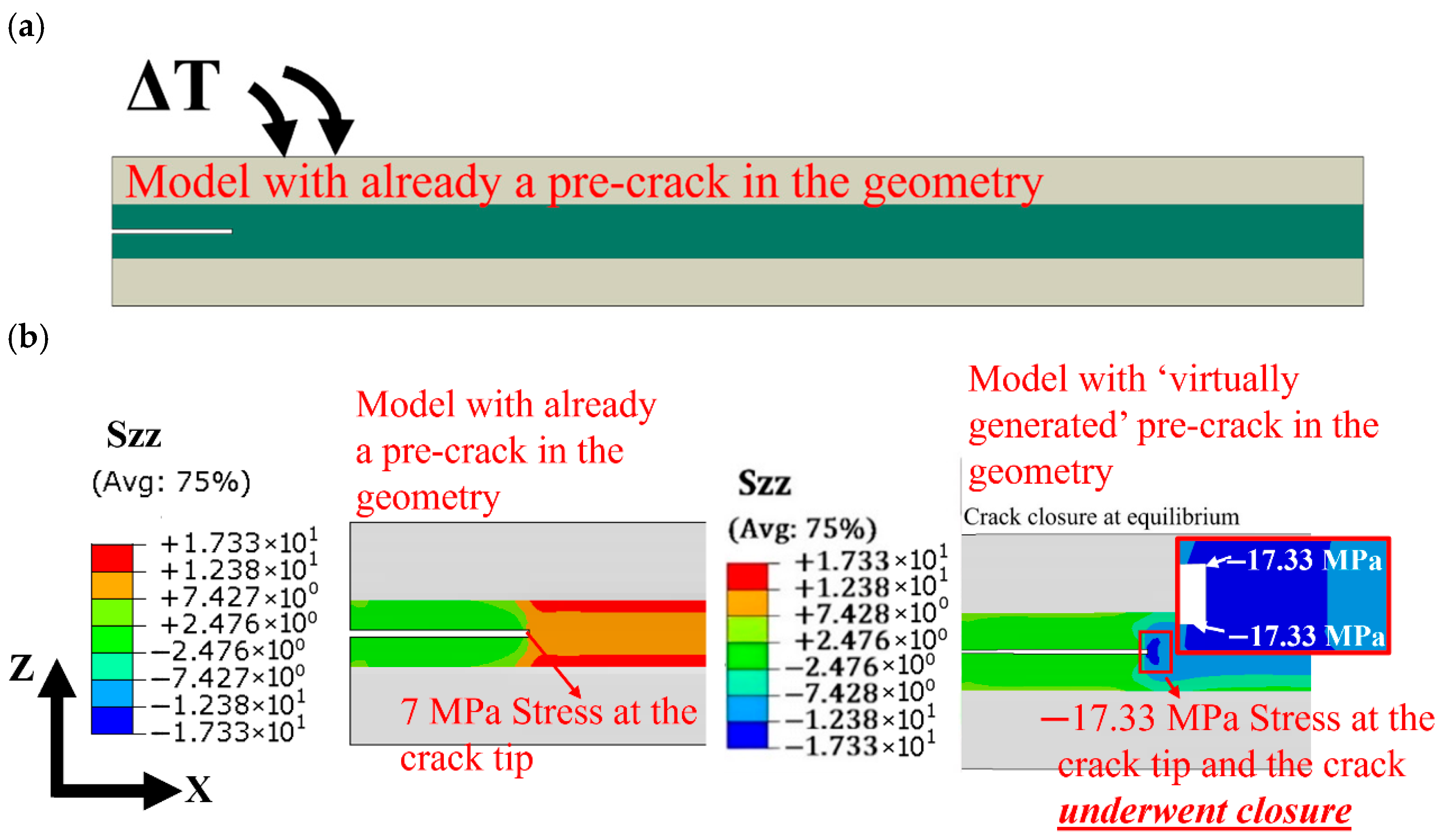
To highlight the influence of virtual pre-cracking, a model with a pre-existing crack was subjected to a thermal load of −50 °C (Figure A1a). Subsequently, the stresses in the adhesive of the aforementioned model were compared with those in the virtually pre-cracked model.
Figure A1. Effect of virtual pre-crack generation: (a) FE model with an already present pre-crack in the geometry; (b) stresses at the crack-tip for the FE model with an already present pre-crack in the geometry versus the one with a ‘virtually generated’ pre-crack.
Jcs 10 00107 g0a1
Figure A1b demonstrates a substantial discrepancy in the crack-tip stresses, with values of 7 MPa and −17.33 MPa. Moreover, crack closure has been observed during the preparation of DCB specimens [10,15,17]. A similar crack closure was observed only in the FE simulation when pre-cracking was achieved during an ongoing simulation.

Appendix A.2. Effect of Mesh Refinement at the Crack Tip

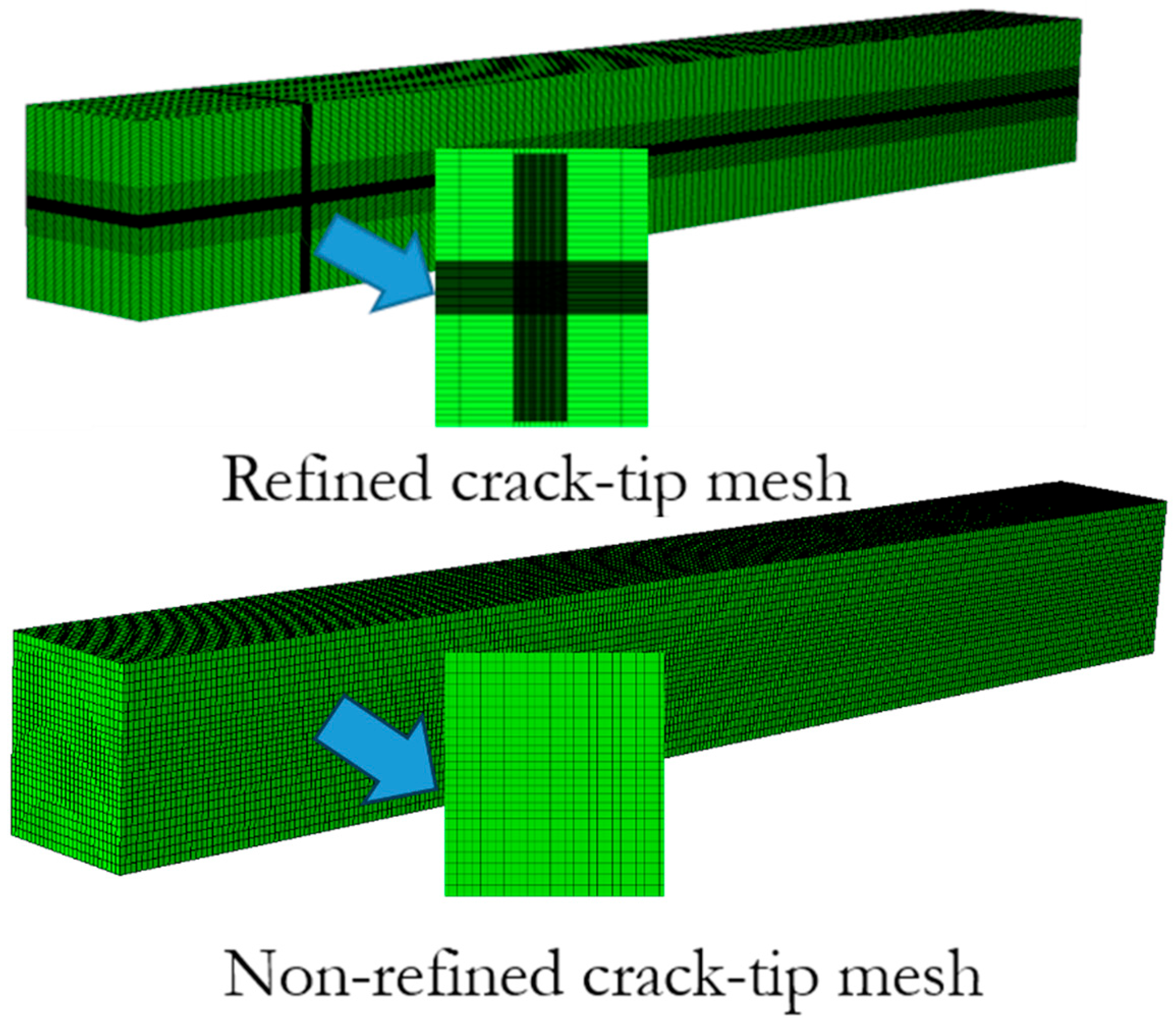
The most common suggestion in computational studies is to use a highly refined mesh for the region near the crack tip [58,59,60,61]. However, serious issues related to mesh refinement at the crack tip were encountered.
Figure A2 compares the refined and unrefined meshes in the crack-tip region. To minimise the dependence on mesh size, the aspect ratio of the elements must be as close to unity as possible when using the ductile damage model [46]. Hence, during FE simulations with the refined crack-tip mesh, the ductile damage formulation tended to delete elements with an aspect ratio greater than 1 first, even when neighbouring elements along the straight crack path had higher equivalent plastic strains.
Figure A2. Highly refined vs. non-refined mesh at the crack tip region.
Jcs 10 00107 g0a2
Reducing the ratio to unity while maintaining a significantly refined crack-tip mesh was impractical because the large number of elements would make the computations too expensive to perform. Hence, the crack-tip refinement was disregarded. Thus, to maintain an aspect ratio of unity in the adhesive region and ensure that the virtual pre-crack matched the 1 mm crack thickness, the mesh described in Section 4.1 was employed. As a result, the elements were deleted based on their damaged state, causing the crack to traverse the middle of the adhesive region in a straight path (Figure A3b). Hence, the aspect ratio of the elements must be carefully examined when using the ductile damage model.
Figure A3. Effect of crack-tip refinement on crack propagation in the DCB FE model: (a) refined and (b) non-refined crack-tip mesh.
Jcs 10 00107 g0a3

Appendix A.3. Effect of Inertial Forces

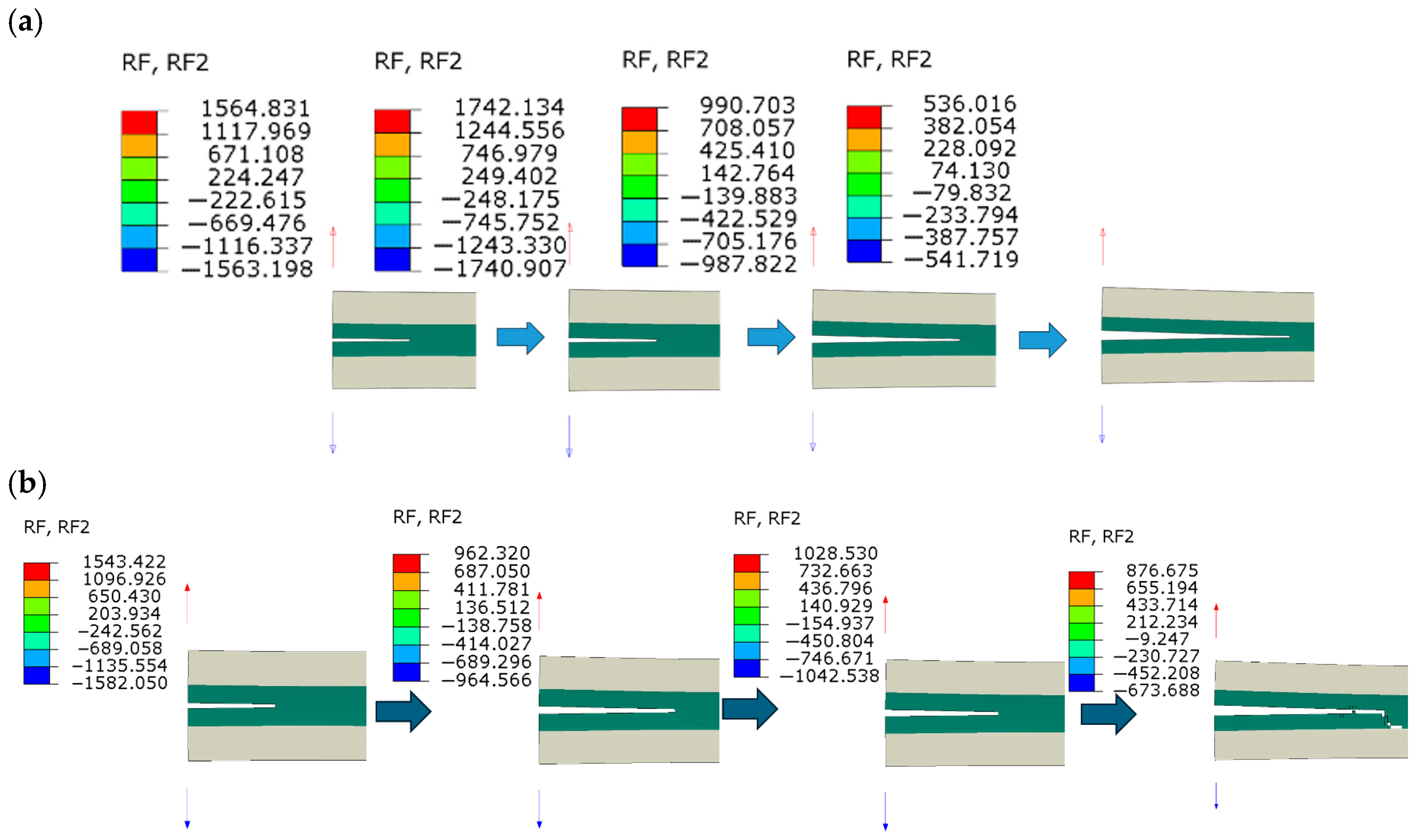
The thickness-direction reaction forces (RF2 in Figure A4) at the top and bottom loading points must remain balanced (RF2top ≈ RF2bottom) to ensure quasi-static crack growth (Figure A4a). This equilibrium is achievable only when the kinetic-to-internal energy (KE/IE) ratio remains low throughout the simulation (<2%). As mentioned earlier, the mass-scaling factor in the simulations was set to 1000.
When a higher mass-scaling factor of 10,000 was used to further speed up the simulation, the KE/IE ratio exceeded 8%. A KE/IE ratio higher than 5% undermined the quasi-static assumptions [54,55]. Thus, RF2bottom became significantly larger than RF2top, resulting in crack propagation toward the bottom composite laminate (Figure A4b). If RF2top became considerably larger than RF2bottom, the crack propagated toward the top composite laminate. Thus, monitoring the force balance at the loading points is critical, and mass scaling must be applied cautiously.
Figure A4. Effect of reaction forces in the DCB FE model: (a) balanced vs. (b) imbalanced reaction forces.
Jcs 10 00107 g0a4

References

  1. Zuo, P.; Vassilopoulos, A.P. Review of fatigue of bulk structural adhesives and thick adhesive joints. Int. Mater. Rev. 2021, 66, 313–338. [Google Scholar] [CrossRef]
  2. Eder, M.A.; Bitsche, R.D. Fracture analysis of adhesive joints in wind turbine blades. Wind Energy 2015, 18, 1007–1022. [Google Scholar] [CrossRef]
  3. Haselbach, P.U.; Eder, M.A.; Belloni, F. A comprehensive investigation of trailing edge damage in a wind turbine rotor blade. Wind Energy 2016, 19, 1871–1888. [Google Scholar] [CrossRef]
  4. Haselbach, P.U.; Branner, K. Initiation of trailing edge failure in full-scale wind turbine blade test. Eng. Fract. Mech. 2016, 162, 136–154. [Google Scholar] [CrossRef]
  5. Ataya, S.; Ahmed, M.M. Damages of wind turbine blade trailing edge: Forms, location, and root causes. Eng. Fail. Anal. 2013, 35, 480–488. [Google Scholar] [CrossRef]
  6. Bangaru, A.K.; Miao, X.-Y.; Sørensen, B.F.; Chen, X. Prediction of crack growth at trailing edge bondlines of a wind turbine rotor blade for the assessment of remaining service life. IOP Conf. Ser. Mater. Sci. Eng. 2023, 1293, 012037. [Google Scholar] [CrossRef]
  7. Balzani, C.; Castelos, P.N. Non-proportionality analysis of multi-axial fatigue stress histories in trailing edge adhesive joints of wind turbine rotor blades. Wind Energy Sci. 2025, 10, 1249–1267. [Google Scholar] [CrossRef]
  8. Miao, X.-Y.; Chen, X.; Lu, R.; Eder, M.A. Multi-site crack initiation in local details of composite adhesive joints. Compos. Part B Eng. 2022, 242, 110055. [Google Scholar] [CrossRef]
  9. Fan, J.; Ikeda, K.; Vassilopoulos, A.P.; Michaud, V. Void content and displacement ratio effects on fatigue crack growth in thick adhesively bonded composite joints under constant amplitude loading. Int. J. Fatigue 2024, 188, 108508. [Google Scholar] [CrossRef]
  10. Fan, J.; Vassilopoulos, A.P.; Michaud, V. Mode I fracture of thick adhesively bonded GFRP composite joints for wind turbine rotor blades. Compos. Struct. 2024, 327, 117705. [Google Scholar] [CrossRef]
  11. Srinivasan, D.V.; Vassilopoulos, A.P. Manufacturing and toughening effects on the material properties of wind turbine blade adhesives. Polym. Test. 2022, 116, 107770. [Google Scholar] [CrossRef]
  12. Srinivasan, D.V.; Vassilopoulos, A.P. Toughening of thick bonded interfaces through architected crack-arresting features. Compos. Part A Appl. Sci. Manuf. 2024, 188, 108575. [Google Scholar] [CrossRef]
  13. Sharma, A.; Kojouri, A.S.; Fan, J.; Vassilopoulos, A.P.; Michaud, V.; Kalteremidou, K.-A.; Van Hemelrijck, D.; Van Paepegem, W. Investigating the mode-I failure behaviour of thick adhesive joints using a coupled computational/experimental approach. In Proceedings of the ECCM21: 21st European Conference on Composite Materials (ECCM21), Proceedings. European Conference on Composite Materials, Nantes, France, 2–5 July 2024; pp. 928–935. [Google Scholar]
  14. Karami, J.; Kojouri, A.S.; Fan, J.; Kalteremidou, K.-A.; Van Paepegem, W.; Vassilopoulos, A.; Michaud, V.; Van Hemelrijck, D. Investigating the effects of different crack sharpening methods on the mode I and mode II fracture tests of an epoxy resin. In Proceedings of the 20th European Conference on Composite Materials, Lausanne, Switzerland, 26–30 June 2022; pp. 1–8. [Google Scholar]
  15. Sharma, A.; Kojouri, A.S.; Fan, J.; Vassilopoulos, A.P.; Michaud, V.; Kalteremidou, K.-A.; Van Hemelrijck, D.; Van Paepegem, W. Combined computational-experimental investigation of residual stresses and pre-cracking in mode I behaviour of thick adhesively bonded GFRP composite joints. Compos. Struct. 2025, 351, 118549. [Google Scholar] [CrossRef]
  16. Methfessel, T.; Becker, W. A generalized model for predicting stress distributions in thick adhesive joints using a higher-order displacement approach. Compos. Struct. 2022, 291, 115556. [Google Scholar] [CrossRef]
  17. Kojouri, A.S.; Karami, J.; Kalteremidou, K.-A.; Fan, J.; Sharma, A.; Vassilopoulos, A.P.; Michaud, V.; Van Paepegem, W.; Van Hemelrijck, D. An experimental and analytical study of mode I fracture and crack kinking in thick adhesive joints. Compos. Part B Eng. 2024, 284, 111695. [Google Scholar] [CrossRef]
  18. Kojouri, A.S.; Karami, J.; Fan, J.; Sharma, A.; Vassilopoulos, A.P.; Michaud, V.; Van Paepegem, W.; Van Hemelrijck, D.; Kalteremidou, K.-A. A new equivalent crack length technique for mode I fracture of adhesively bonded joints. Compos. Part B Eng. 2025, 305, 112733. [Google Scholar] [CrossRef]
  19. Holmes, J.W.; Sørensen, F.; Brøndsted, P. Reliability of Wind Turbine Blades: An Overview of Materials Testing. Proc. Wind Power Shanghai 2007, 35, 36. [Google Scholar]
  20. Budzik, M.K.; Wolfahrt, M.; Reis, P.; Kozłowski, M.; Sena-Cruz, J.; Papadakis, L.; Nasr Saleh, M.; Machalicka, K.V.; de Teixeira de Freitas, S.; Vassilopoulos, A.P. Testing mechanical performance of adhesively bonded composite joints in engineering applications: An overview. J. Adhes. 2022, 98, 2133–2209. [Google Scholar] [CrossRef]
  21. Villamil, A.A.B.; Casas-Rodriguez, J.P.; Holguin, A.P.; Barrera, M.S. Mode I crack propagation experimental analysis of adhesive bonded joints comprising glass fibre composite material under impact and constant amplitude fatigue loading. Materials 2021, 14, 4380. [Google Scholar] [CrossRef]
  22. Fan, J.; Karami, J.; Kojouri, A.; Van Hemelrijck, D.; Vassilopoulos, A.; Michaud, V. Investigation of bulk adhesive material and thick adhesive joints for wind turbine applications. In Proceedings of the ECCM 2022—Proceedings of the 20th European Conference on Composite Materials: Composites Meet Sustainability, Lausanne, Switzerland, 26–30 June 2022; pp. 129–136. [Google Scholar]
  23. Fan, J.; Vassilopoulos, A.P.; Michaud, V. Influence of voids on thick DCB joint behavior. In Proceedings of the 23rd International Conference on Composites Materials (ICCM 23), Belfast, Northern Ireland, 30 July–4 August 2023; Available online: https://infoscience.epfl.ch/handle/20.500.14299/205922 (accessed on 13 February 2026).
  24. Fernandes, R.L.; Budzik, M.K.; Benedictus, R.; de Freitas, S.T. Multi-material adhesive joints with thick bond-lines: Crack onset and crack deflection. Compos. Struct. 2021, 266, 113687. [Google Scholar] [CrossRef]
  25. Sengab, A.; Talreja, R. A numerical study of failure of an adhesive joint influenced by a void in the adhesive. Compos. Struct. 2016, 156, 165–170. [Google Scholar] [CrossRef]
  26. da Silva, L.F.; Adams, R.; Gibbs, M. Manufacture of adhesive joints and bulk specimens with high-temperature adhesives. Int. J. Adhes. Adhes. 2004, 24, 69–83. [Google Scholar] [CrossRef]
  27. Barzegar, M.; Lugovtsova, Y.; Bulling, J.; Mishurova, T.; Pasadas, D.J.; Ribeiro, A.L.; Ramos, H.G. Adhesive Porosity Analysis of Composite Adhesive Joints Using Ultrasonic Guided Waves. IEEE Trans. Ultrason. Ferroelectr. Freq. Control 2024, 71, 485–495. [Google Scholar] [CrossRef]
  28. de Moura, M.; Daniaud, R.; Magalhães, A. Simulation of mechanical behaviour of composite bonded joints containing strip defects. Int. J. Adhes. Adhes. 2006, 26, 464–473. [Google Scholar] [CrossRef]
  29. Cognard, J.; Davies, P.; Sohier, L.; Créac’hCadec, R. A study of the non-linear behaviour of adhesively-bonded composite assemblies. Compos. Struct. 2006, 76, 34–46. [Google Scholar] [CrossRef]
  30. Oshima, S.; Koyanagi, J. Review on Damage and Failure in Adhesively Bonded Composite Joints: A Microscopic Aspect. Polymers 2025, 17, 377. [Google Scholar] [CrossRef]
  31. Jiang, Y.; Kelly, C.; Flatharta, D.; Sam-Daliri, O.; Flanagan, T.; Goggins, J.; Finnegan, W. Numerical Simulation of Adhesive-Free Glass Fibre Hydrofoil Structural Demonstrators under Flexural Bending. In Proceedings of the 16th European Wave and Tidal Energy Conference, Funchal, Portugal, 7–11 September 2025; Volume 16. [Google Scholar] [CrossRef]
  32. Sam-Daliri, O.; Jiang, Y.; Flaherty, D.; Walls, M.; Kennedy, C.; Flanagan, M.; Ghabezi, P.; Finnegan, W. Mechanical analysis of unidirectional glass fibre reinforced epoxy composite joints manufactured by adhesive bonding and co-curing techniques. Mater. Des. 2025, 258, 114739. [Google Scholar] [CrossRef]
  33. Jensen, F.; Falzon, B.; Ankersen, J.; Stang, H. Structural testing and numerical simulation of a 34m composite wind turbine blade. Compos. Struct. 2006, 76, 52–61. [Google Scholar] [CrossRef]
  34. Ma, C.; Tian, Y.; Gong, Y.; Zhang, J.; Qi, H.; Wang, C. Study of the effect of curing residual stress on the bonding strength of the single lap joint using a high-temperature phosphate adhesive. Materials 2018, 11, 1198. [Google Scholar] [CrossRef]
  35. da Silva, L.F.M.; Adams, R.D. Joint strength predictions for adhesive joints to be used over a wide temperature range. Int. J. Adhes. Adhes. 2007, 27, 362–379. [Google Scholar] [CrossRef]
  36. Sim, K.-B.; Lee, T.-H.; Han, G.-Y.; Kim, H.-J. Thermal expansion and mechanical properties of urethane-modified epoxy bonded CFRP/steel joints at low and high temperatures for automotive. Compos. Struct. 2023, 322, 117426. [Google Scholar] [CrossRef]
  37. Agha, A.; Abu-Farha, F. Numerical implementation and validation of a viscoelastic-plastic material model for predicting curing induced residual stresses in adhesive bonded joints. Int. J. Adhes. Adhes. 2022, 118, 103195. [Google Scholar] [CrossRef]
  38. Agha, A.; Abu-Farha, F. Experimental methods to capture curing induced effects in adhesive bonded joints. Int. J. Adhes. Adhes. 2021, 104, 102735. [Google Scholar] [CrossRef]
  39. Shao, Z.; Liu, Z.; Zhang, Y.; Zhu, X. Fatigue Life Prediction and Reliability Assessment of CFRP Adhesively Bonded Joints in Offshore Wind Turbine Blade Applications: A Physics-Informed Data-Driven Approach. Qual. Reliab. Eng. Int. 2025, 41, 943–956. [Google Scholar] [CrossRef]
  40. Akpinar, S.; Aydin, M.D. 3-D non-linear stress analysis on the adhesively bonded composite joint under bending moment. Int. J. Mech. Sci. 2014, 81, 149–157. [Google Scholar] [CrossRef]
  41. Jumbo, F.; Ashcroft, I.; Crocombe, A.; Wahab, M.A. Thermal residual stress analysis of epoxy bi-material laminates and bonded joints. Int. J. Adhes. Adhes. 2010, 30, 523–538. [Google Scholar] [CrossRef]
  42. Holst, T.; Sayer, F.; Antoniou, A. Modelling of chemical shrinkage evolution with curing degree of a filled epoxy adhesive. In IOP Conference Series: Materials Science and Engineering; IOP Publishing Ltd.: Bristol, UK, 2020; p. 012020. [Google Scholar]
  43. ASTM D638-22; Standard Test Method for Tensile Properties of Plastics. ASTM International: West Conshohocken, PA, USA, 2022.
  44. ASTM D695; Standard Test Method for Compressive Properties of Rigid Plastics. ASTM International: West Conshohocken, PA, USA, 2015.
  45. ASTM D3171; Standard Test Methods for Constituent Content of Composite Materials. ASTM International: West Conshohocken, PA, USA, 2022.
  46. Mallick, P.K. Fibre Reinforced Composites: Materials, Manufacturing, and Design, 2nd ed.; Marcel Dekker Inc.: New York, NY, USA, 1993. [Google Scholar]
  47. ASTM D3433-99; Standard test method for fracture strength in cleavage of adhesives in bonded metal joints. ASTM International: West Conshohocken, PA, USA, 2020.
  48. Sharma, A.; Daggumati, S. Computational micromechanical modeling of transverse tensile damage behavior in unidirectional glass fiber-reinforced plastic composite plies: Ductile versus brittle fracture mechanics approach. Int. J. Damage Mech. 2020, 29, 943–964. [Google Scholar] [CrossRef]
  49. Abaqus 6.23 Documentation; Dassault Systemes Simulia Corporation (2023). Available online: https://help.3ds.com (accessed on 15 February 2025).
  50. Sharma, A.; Daggumati, S.; Gupta, A.; Van Paepegem, W. On the prediction of the bi-axial failure envelope of a UD CFRP composite lamina using computational micromechanics: Effect of microscale parameters on macroscale stress–strain behavior. Compos. Struct. 2020, 251, 112605. [Google Scholar] [CrossRef]
  51. Shah, D.U.; Schubel, P.J. Evaluation of cure shrinkage measurement techniques for thermosetting resins. Polym. Test. 2010, 29, 629–639. [Google Scholar] [CrossRef]
  52. Daggumati, S.; Sharma, A.; Van Paepegem, W. Synergistic effects of microscale variabilities on the thermo-mechanical behavior of a UD CFRP ply. Int. J. Mech. Sci. 2023, 242, 108004. [Google Scholar] [CrossRef]
  53. Camanho, P.P.; Davila, C.G.; de Moura, M.F. Numerical Simulation of Mixed-Mode Progressive Delamination in Composite Materials. J. Compos. Mater. 2002, 37, 1415–1438. [Google Scholar] [CrossRef]
  54. Fame, C.M.; Wu, C.; Feng, P.; Tam, L.-H. Numerical investigations on the damage tolerance of adhesively bonded pultruded GFRP joints with adhesion defects. Compos. Struct. 2022, 301, 116223. [Google Scholar] [CrossRef]
  55. Sun, L.; Li, C.; Tie, Y.; Hou, Y.; Duan, Y. Experimental and numerical investigations of adhesively bonded CFRP single-lap joints subjected to tensile loads. Int. J. Adhes. Adhes. 2019, 95, 102402. [Google Scholar] [CrossRef]
  56. Hou, X.; Kanani, A.Y.; Ye, J. Double lap adhesive joint with reduced stress concentration: Effect of slot. Compos. Struct. 2018, 202, 635–642. [Google Scholar] [CrossRef]
  57. Kanani, A.Y.; Hou, X.; Ye, J. The influence of notching and mixed-adhesives at the bonding area on the strength and stress distribution of dissimilar single-lap joints. Compos. Struct. 2020, 241, 112136. [Google Scholar] [CrossRef]
  58. Albuquerque, C.; de Castro, P.; Calçada, R. Efficient crack analysis of dynamically loaded structures using a modal superposition of stress intensity factors. Eng. Fract. Mech. 2012, 93, 75–91. [Google Scholar] [CrossRef]
  59. Hou, Y.; Wang, W.; Meng, L.; Sapanathan, T.; Li, J.; Xu, Y. An insight into the mechanical behavior of adhesively bonded plain-woven-composite joints using multiscale modeling. Int. J. Mech. Sci. 2022, 219, 107063. [Google Scholar] [CrossRef]
  60. He, Z.; Zheng, G.; Luo, Q.; Li, Q.; Sun, G. Fatigue damage tolerance of CFRP/Al adhesive joints with thermal effects. Int. J. Mech. Sci. 2024, 281, 109543. [Google Scholar] [CrossRef]
  61. Campilho, R.; Banea, M.D.; Chaves, F.; da Silva, L. eXtended Finite Element Method for fracture characterization of adhesive joints in pure mode I. Comput. Mater. Sci. 2011, 50, 1543–1549. [Google Scholar] [CrossRef]
Figure 1. The Double Cantilever Beam (DCB) test: (a) Schematic description of the specimens (all dimensions are in mm); (b) Experimental set-up for pre-crack at the composite/adhesive boundary (for the setup of the test, with middle pre-crack, the readers are referred to [17]).
Jcs 10 00107 g001
Figure 2. Finite element models for the DCB specimen: (a) without cohesive interface and (b) with cohesive interface.
Jcs 10 00107 g002
Figure 3. Description of the finite element simulation approaches: (a) MPC-PB (DCB FE simulations with Midplane Pre-crack and Perfect Bond between composite and adhesive), (b) IPC-WCI (DCB FE simulations having Interface Pre-crack With Cohesive Interface); and (c) MPC-WCI (DCB FE simulations with Midplane Pre-crack With Cohesive Interface).
Jcs 10 00107 g003
Figure 4. The influence of thermal loading on the thick adhesive joint: through-the-thickness stresses in the adhesive joint after thermal loads.
Jcs 10 00107 g004
Figure 5. The influence of virtual pre-crack generation: (a) virtual pre-crack generation; (b) stress redistribution; (c) closure of the pre-crack, (d) deformed FE model superimposed on the undeformed FE model (deformation scale factor 3) after virtual pre-cracking.
Jcs 10 00107 g005
Figure 6. Computational and experimental results: (a) Computational load-displacement response for specimen-S1 illustrating the progression of PEEQ at the crack-tip; (b) Crack propagation dictated by PEEQ at points 1 to 6 of the computational curve; (c) Failure of the experimental DCB specimen reported in [17].
Jcs 10 00107 g006
Figure 7. Progression of the crack for the experimental specimen: (a) initial load application, (b) onset of crack propagation along the composite/adhesive interface, (c) crack initiation into the composite layer, (d) crack propagation within the composite laminate, and (e) zoomed-in image to highlight crack propagating into the composite.
Jcs 10 00107 g007aJcs 10 00107 g007b
Figure 8. Load versus displacement curves for the specimens with pre-cracks at the composite/adhesive interface.
Jcs 10 00107 g008
Figure 9. Experimental versus computational load-displacement response of a thick adhesive joint with a pre-crack at the interface.
Jcs 10 00107 g009
Figure 10. Results from the MPC-WCI, i.e., Midplane Pre-crack model With Cohesive Interface: (a) the evolution of PEEQ at the crack-tip; (b) straight crack propagation in the adhesive governed by PEEQ and simultaneous reduction in the stiffness of the cohesive interface elements; (c) crack deflection towards the composite/adhesive interface; and (d) crack propagation along the composite/adhesive interface.
Jcs 10 00107 g010
Figure 11. Computational response of the MPC-WCI model with very high interface strengths and fracture energies.
Jcs 10 00107 g011
Figure 12. Computed Tomography (CT) images of voids in the adhesive layers of various thick adhesive joints [10].
Jcs 10 00107 g012
Figure 13. Influence of voids in the adhesive layer: (a) DCB FE model with voids; (b) evolution of an almost straight crack; (c) crack deflection towards the composite/adhesive boundary; (d) crack propagation along the composite/adhesive boundary.
Jcs 10 00107 g013
Figure 14. Influence of void location in the adhesive layer: (a) straight crack propagation when the void is above the crack tip line; (b) coalescence of the crack and void due to the high PEEQ around the void and subsequent crack jump to the boundary; (c) coalescence of the crack and void and subsequent crack jump to the boundary when the void is below the crack tip line.
Jcs 10 00107 g014
Figure 15. Combined influence of voids and composite/adhesive interface: (a) MPC-WCI model with the inclusion of voids; (b) crack propagation towards void in the adhesive governed by PEEQ and simultaneous stiffness degradation of the cohesive interface elements; (c) coalescence of crack and void and subsequently crack jumps to the interface.
Jcs 10 00107 g015
Table 1. The properties of the adhesive [15,17,43].
PropertiesSika Power®-830 Epoxy Adhesive
Ea, [GPa]2.6
νa, [-]0.4
Ga, [N/mm]0.001
αa, [10−6/°C]78.2
β, [°] #23.2
K, [-] *0.875
Plastic strain at failure, [mm/mm]0.0118
σt, [MPa]40
σc, [MPa]60
# slope of the yield surface in the p-t stress plane (°); * ratio of yield stress in triaxial tension to that in triaxial compression.
Table 2. Elastic properties and thermal expansion coefficients of cross-ply [90/0]7s GFRP laminate [15,17].
PropertiesCross-Ply [90/0]7s GFRP Laminate
EXX, [GPa]24.7
EYY, [GPa]24.3
EZZ, [GPa]12.7
νXY, νXZ, [-]0.13
GXY, [GPa]3.2
GXZ, [GPa]3.2
GYZ, [GPa]3.5
αXX, [10−6/°C]14.9
αYY, [10−6/°C]15.3
αZZ, [10−6/°C]38.1
Table 3. Dimensions of the specimens with pre-cracks at the composite/adhesive boundary.
Composite ThicknessAdhesive Thickness
SpecimenW [mm]t_Laminate [mm]t_Adh [mm]a0 [mm]
S125.318.710.850
S225.068.710.850
S325.088.71150
S425.18.710.650
S525.618.710.750
S624.868.710.650
Disclaimer/Publisher’s Note: The statements, opinions and data contained in all publications are solely those of the individual author(s) and contributor(s) and not of MDPI and/or the editor(s). MDPI and/or the editor(s) disclaim responsibility for any injury to people or property resulting from any ideas, methods, instructions or products referred to in the content.