
Article

Modulating Reactivity and Stability of Graphene Quantum Dots with Boron Dopants for Mercury Ion Interaction: A DFT Perspective


by
Joaquín Alejandro Hernández Fernández
1,2,3,*,
Juan Jose Carrascal
3 and
Juan Sebastian Gómez Pérez
1,*
1
Chemistry Program, Department of Natural and Exact Sciences, San Pablo Campus, Universidad de Cartagena, Cartagena de Indias D.T. y C., Cartagena 130015, Colombia
2
Department of Natural and Exact Science, Universidad de la Costa, Barranquilla 080002, Colombia
3
Grupo de Investigación GIA, Fundacion Universitaria Tecnologico Comfenalco, Cr 44 D N 30A, 91, Cartagena 130015, Colombia
*
Authors to whom correspondence should be addressed.
J. Compos. Sci. 2026, 10(1), 40; https://doi.org/10.3390/jcs10010040
Submission received: 2 December 2025 / Revised: 4 January 2026 / Accepted: 6 January 2026 / Published: 12 January 2026
(This article belongs to the Section Composites Modelling and Characterization)

Abstract

The objective of this study was to use Density Functional Theory (DFT) calculations to examine how boron doping modulates the electronic properties of graphene quantum dots (GQDs) and their interaction with the Hg2+ ion. Boron doping decreases the HOMO-LUMO gap and increases the GQD’s electrophilic character, facilitating charge transfer to the metal ion. The adsorption energy results were negative, indicating electronic stabilization of the combined systems, without implying thermodynamic favorability, with the GQD@3B_Hg2+ system being the strongest at −349.52 kcal/mol. The analysis of global parameters (chemical descriptors) and the study of non-covalent interactions (NCIs) supported the affinity of Hg2+ for doped surfaces, showing that the presence of a single boron atom contributes to clear attractive interactions. In general, configurations doped with 1 or 2 boron atoms exhibit satisfactory performance, demonstrating that boron doping effectively modulates the reactivity and adsorption properties of GQD for efficient Hg2+ capture.

1. Introduction

Heavy metal (HM) contamination is a critical global problem, primarily caused by human activities that harm ecosystems and public health [1,2,3,4,5]. Mercury ions (Hg2+) are among the most concerning pollutants due to their high toxicity and persistence. They disrupt enzymes, damage DNA, and cause serious neurotoxic effects even at trace levels [6,7,8]. Rising Hg2+ discharge into environments from industry and mining demands advanced remediation and detection technologies [3,6]. Conventional techniques for the detection of HMs, such as atomic absorption spectroscopy (AAS) and inductively coupled plasma mass spectrometry (ICP-MS), offer high sensitivity, but are often limited by cost, operational complexity, and lack of portability for real-time monitoring [9,10,11,12]. This has accelerated the search for nanomaterial-based sensors, among which graphene quantum dots (GQDs) have emerged as pioneers due to their exceptional properties, including tunable photoluminescence, a high surface-to-volume ratio, and excellent aqueous dispersibility [13,14,15]. The quantum confinement and edge effects intrinsic to GQDs provide a versatile platform for chemical functionalization, enabling enhanced interactions with target analytes, such as Hg2+ [16,17,18]. Research into nanomaterial-based sensors now focuses on the unique capabilities of quantum dots (QDs). Scientists have studied many types of QDs, such as carbon (CQDs), silicon (SiQDs), graphene (GQDs), carbon nitride (CNQDs), and sulfurized quantum dots (SQDs) [13,19,20,21,22]. They have also examined various doped and functionalized derivatives for advanced electrochemiluminescent (ECL) detection platforms [23,24,25,26]. In this context, GQDs have emerged as leaders due to their properties as zero-dimensional graphene derivatives. These materials offer pronounced edge effects and quantum confinement, along with broad surface functionalization, low toxicity, and high biocompatibility [27,28,29].
Chemical doping is an effective strategy for tailoring the electronic and chemical properties of GQDs. While nitrogen and sulfur doping have been extensively explored, the role of boron (B), an electron-deficient element, offers unique opportunities to modulate surface reactivity [30,31]. Substituting carbon atoms with boron creates p-type carriers and electron-deficient sites, significantly altering charge distribution, reducing the Fermi level, and influencing the binding affinity for cationic species such as Hg2+ [30]. Additionally, boron doping enhances electrical conductivity and introduces structural defects that serve as preferential adsorption centers. Computational approaches, in particular Density Functional Theory (DFT), have become indispensable for unraveling the atomistic mechanisms underlying dopant-mediated adsorption processes [30,32]. Previous DFT studies have extensively examined nitrogen- and sulfur-doped carbon nanostructures for Hg2+ capture; however, systematic research focused on boron-doped GQDs remains less prevalent [33,34,35,36]. Understanding how boron incorporation affects the electronic structure, adsorption energy, and the nature of the interaction with Hg2+ is essential to rationally design more efficient and selective adsorbents. A computational study reveals that surface modification of GQDs with boronic acid groups (-BCO2) produces a unique effect, resulting in a blue shift in absorption and generating fluorescence emission in the near-infrared (1026 nm) with a high quantum yield of 29% [30]. A comparative summary of representative DFT studies on GQDs and related nanostructures for heavy metal adsorption is provided in Table A1 (Appendix A).
Boron makes a distinct electronic contribution compared to other heteroatoms commonly used for graphene surface modification. By introducing lone-pair basic centers, nitrogen doping typically increases the ability to donate electrons and frequently favors interactions with soft Lewis acids through n→σ* charge transfer [37,38]. While phosphorus boosts conductivity and red-shifts the electronic structure through bigger atomic radii and hyperconjugative effects, sulfur doping increases π-polarizability and soft donor capacity, promoting dispersive interactions [37,39]. Boron, on the other hand, is an electron-deficient element that lowers the Fermi level and encourages interaction with cationic contaminants by producing p-type acceptor sites and localized holes within the π network. It is anticipated that adsorption processes involving highly charged heavy metals will be significantly impacted by this acceptor-type behavior [38,40]. Hg2+ is the most dangerous, persistent oxidation form of mercury, so mercury was chosen as a target contaminant. It is a worldwide priority pollutant and shows bioaccumulation, neurotoxicity, and endocrine disruption even at detectable levels. The preferential presence of Hg2+ in aquatic environments as aquo complexes, such as [Hg(H2O)6]2+, [41,42], enables coordination to electronegative surface sites. Therefore, understanding how boron substitution controls electrical affinity toward Hg2+ is key to designing capture and sensing platforms.
In this work, we present a comprehensive DFT study with the specific objectives to: (1) elucidate how boron doping affects the adsorption behavior of GQDs towards Hg2+ ions; (2) evaluate key geometrical, electronic, and energetic parameters such as HOMO-LUMO gaps, density of states, adsorption energies, and non-covalent interactions; and (3) establish a structure–property relationship highlighting boron’s contribution. These objectives aim to generate fundamental insights to guide the experimental synthesis of boron-enriched GQDs for environmental sensing and heavy metal removal.

2. Materials and Methods

2.1. Computational Details

This work employs Density Functional Theory (DFT) [43,44] as a computational foundation to investigate the adsorption mechanism of Hg2+ ion on graphene quantum dots (GQDs) specifically doped with boron. Using the C36H15 system as a molecular model, where doping is introduced by atomic substitution, it was analyzed how the incorporation of boron modifies the electronic properties and the metal/surface affinity. The methodology consisted of geometrically optimizing all the structures using the ORCA 6.1.0 computational package [45,46], applying the B3LYP functional [47,48] with D3BJ dispersion correction [49] and the def2-TZVP basis set [50] for all the atoms, complemented with the RIJCOSX approximation using the auxiliary def2/J basis for the efficient calculation of Coulomb and exchange integrals, which allowed quantitatively characterizing the interaction energies and charge transfer associated with the adsorption process.

2.2. Analysis of Electronic Features and Reactive Centers

The HOMO-LUMO boundary orbitals were analyzed to evaluate the electronic stability and chemical reactivity of the systems studied. The energy gap (Egap) between these orbitals constitutes a fundamental parameter to predict the electronic behavior, since reduced Egap values facilitate electronic excitation and provide greater chemical reactivity to the system, while wider gaps are associated with greater electronic stability and less predisposition to interact with external species [51,52,53].
Δ E E g a p = E L U M O E H O M O
The study of electronic properties was complemented with the Multiwfn 4.8 program [54], processing the output files of the quantum calculations. With this tool, the total densities of stations (TDOS) were calculated and the analysis of non-covalent interactions (NCIs) was performed, allowing us to characterize the distribution of electron levels and to visualize the weak interactions present in the adsorbent systems.

2.3. Adsorption Energy Analysis

To analyze the affinity between the doped GQDs and the mercury ion, the adsorption energy was calculated using the following expression:
E a d s = E C o m p l e x ( E G Q D @ B + E H g 2 + )
where Ecomplex corresponds to the total electronic energy of the optimized complex, EGQD@B is the energy of the isolated doped graphene quantum dot, and EHg2+ represents the energy of isolated Hg2+. Negative Eads values denote that the electronic energy of the combined system is lower than the separated fragments, indicating electronic stabilization of the complex.
Importantly, this definition is restricted to electronic energies and does not constitute a thermodynamic observable. Therefore, Eads cannot be interpreted as enthalpy, heat release, exothermicity, or thermodynamic favorability. Conclusions regarding spontaneity or exothermic behavior require explicit evaluation of enthalpy or Gibbs free energy differences, which were not used as the criterion for adsorption interpretation in this work.

2.4. Computation of Global Reactivity Descriptors

To characterize the reactivity and electronic stability of the systems studied, DFT-based global descriptors were determined from the boundary orbital energies (HOMO-LUMO), obtained from calculations performed with ORCA 6.1.0 computational package [45,46] after geometrical optimization. The calculated parameters include: chemical hardness (η), chemical potential (μ), electronegativity (χ), global electrophilicity (ω) and chemical softness (S).
η = E L U M O E H O M O 2
μ = E L U M O + E H O M O 2
χ = μ
ω = μ 2 2 η
S = 1 η
These descriptors make it possible to quantify the electronic reactivity in the systems. A higher capacity to accept electrons is signaled by higher levels of ω and χ. A decrease in η, which implies an increase in S, is related to a higher capacity of the system to change its electronic distribution in the face of external disturbances [55,56,57].

3. Results and Discussion

3.1. Evaluation of Structural Changes Triggered by Doping and Adsorption

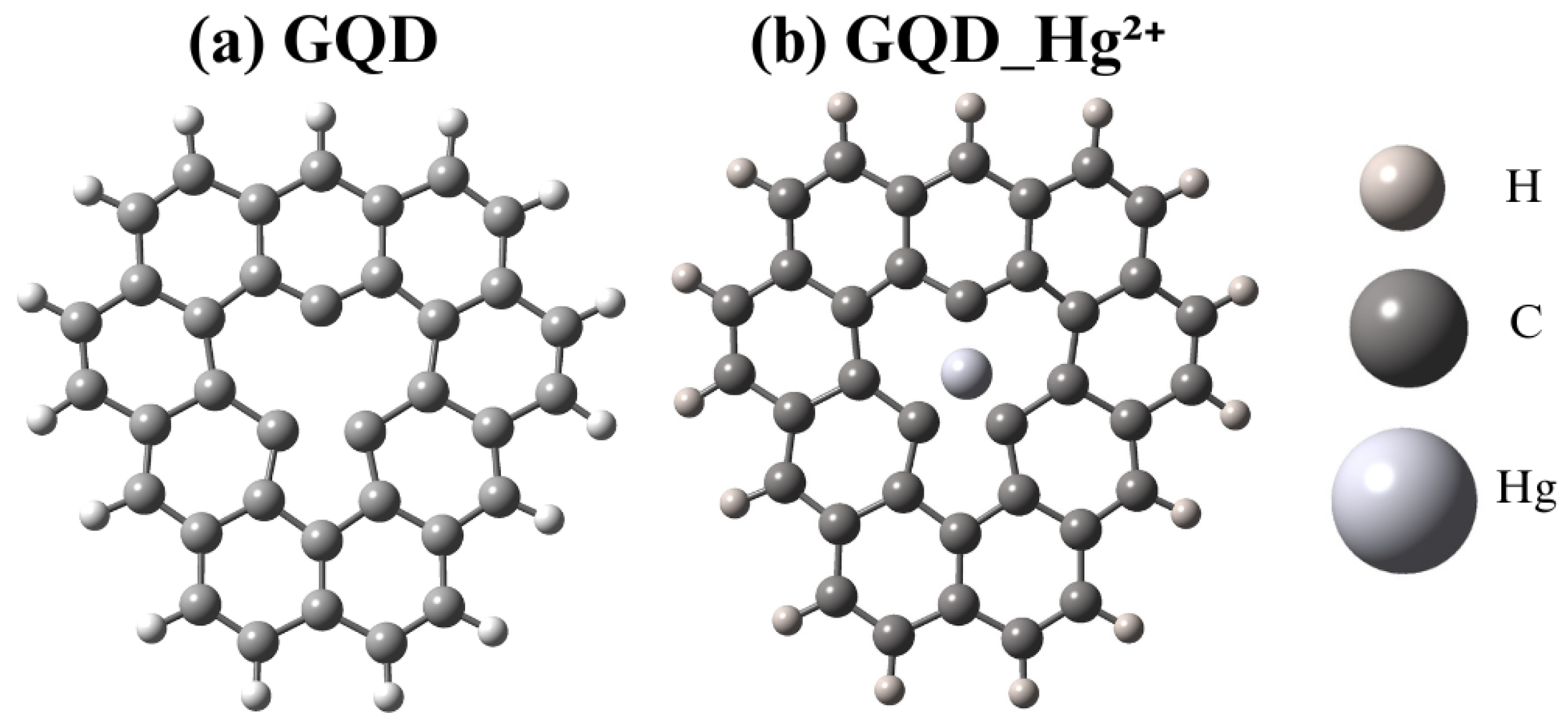
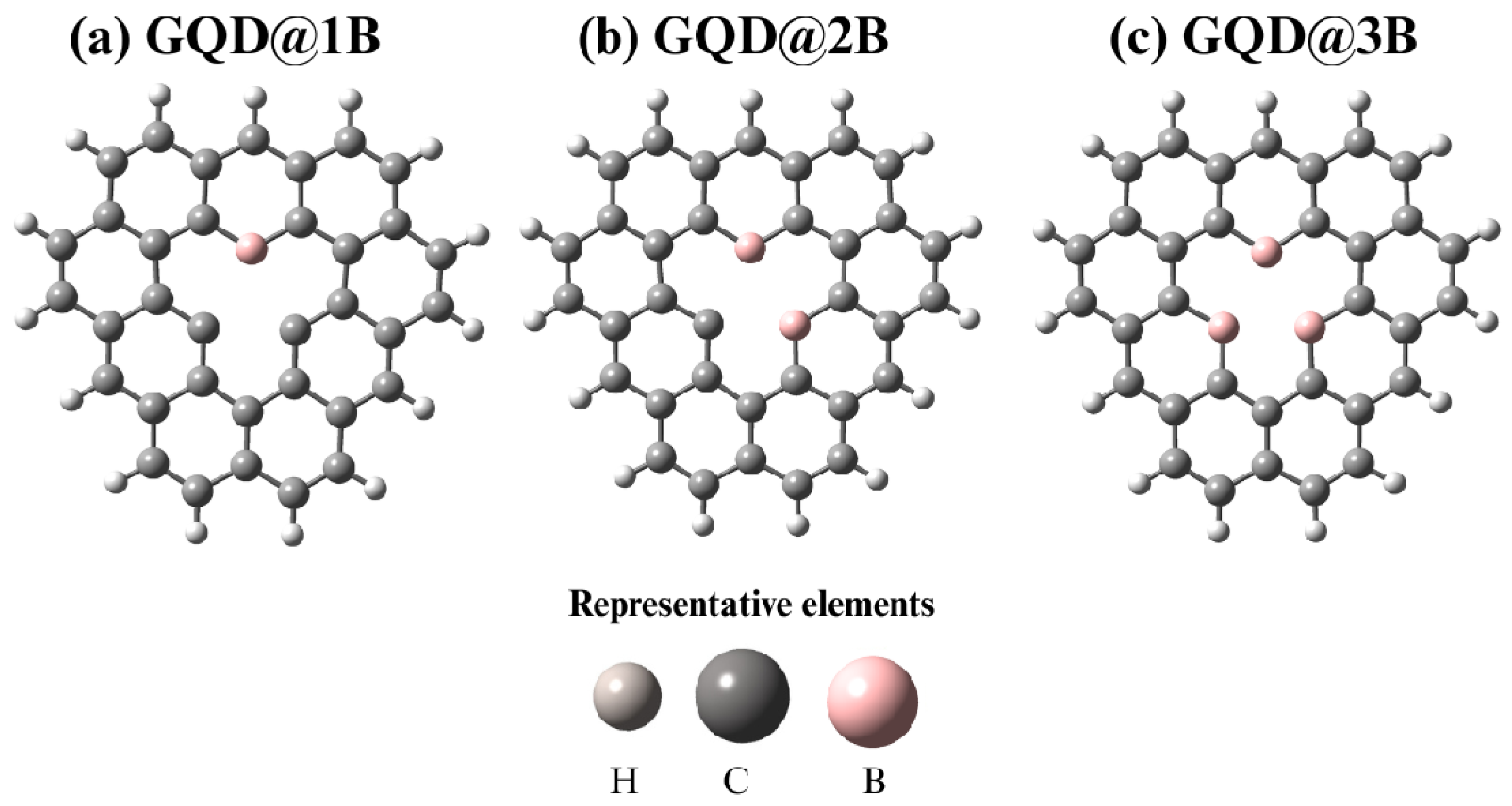
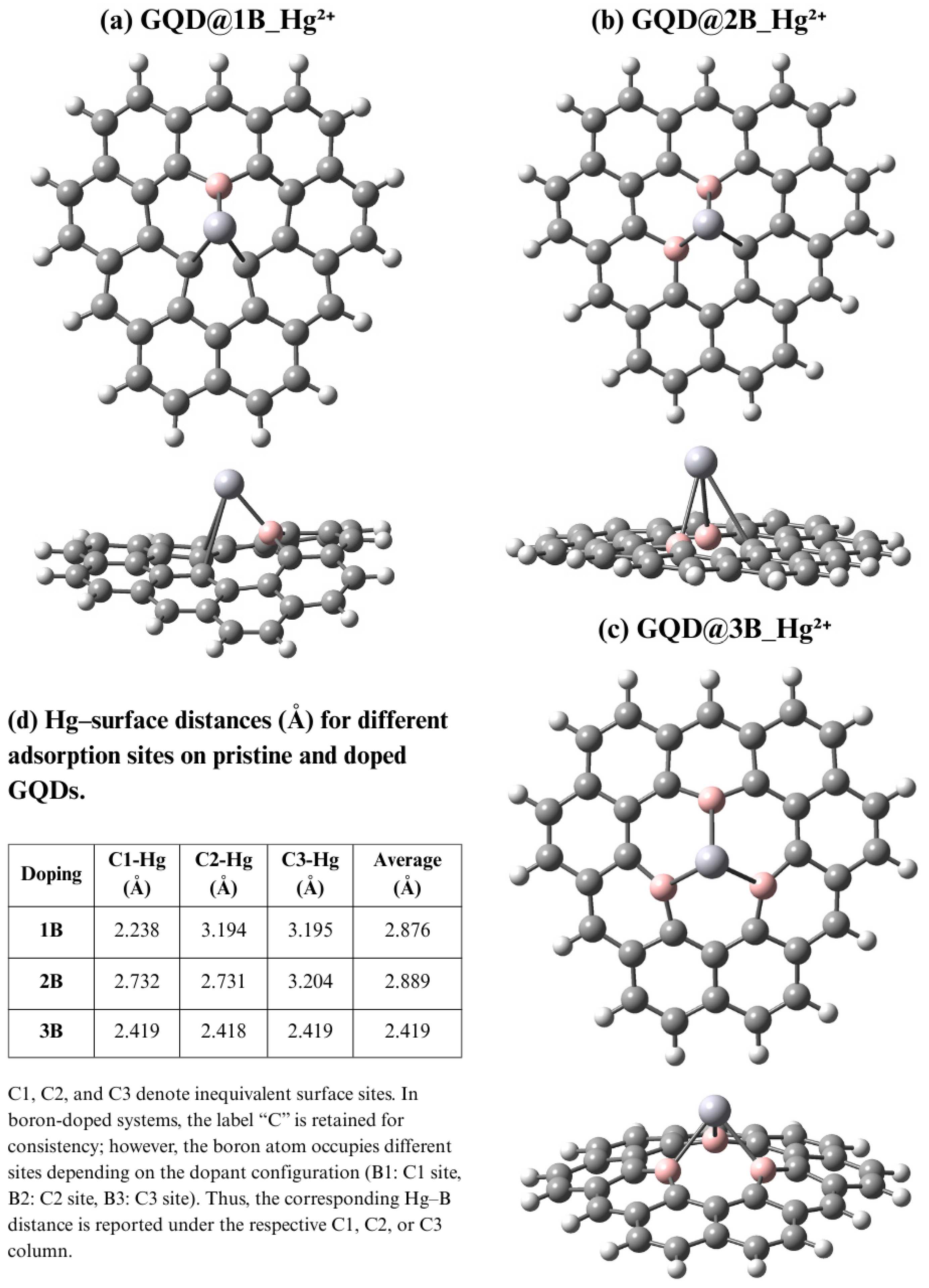
Figure 1, Figure 2 and Figure 3 display the optimal geometries of pure, boron-doped, and GQDs_Hg2+. The virgin GQD exhibits a symmetric, planar graphene-like framework, characteristic of an sp2-hybridized (one s and two p orbitals forming planar structures) carbon lattice (Figure 1a). This planarity is retained when Hg2+ is adsorbed (Figure 1b), as the Hg2+ ion sits above the GQD surface, allowing adsorption without large-scale lattice distortion. The optimized geometries of boron-doped GQDs with one (GQD@1B), two (GQD@2B), and three (GQD@3B) substitutional boron atoms at different lattice positions are shown in Figure 2. Boron substitution does not significantly alter the overall planar geometry in any doped arrangement. Differences in atomic size and electronic character (atomic radius and valence electron count) between boron and carbon cause only minor local rearrangements near the dopant sites, while the graphene backbone remains intact.
When Hg2+ is adsorbed onto boron-doped GQDs, a more noticeable geometric reaction occurs (Figure 3), causing a localized distortion. Evidenced by the cation’s displacement from the GQD plane and changes in its immediate coordination environment, the overall planarity of the GQD framework remains intact. Figure 3 side views confirm the distortion is limited to the adsorption region and does not spread across the graphene lattice. Investigation of Hg-surface coordination distances in Figure 3d offers quantitative insight into these structural effects. Virgin GQDs display relatively long C-Hg distances, indicating weak cation contact, while boron doping yields shorter Hg–surface distances, especially when Hg2+ is near boron sites. As boron concentration rises from 1B to 3B, Hg2+ shows increasingly symmetric coordination with multiple nearby atoms, further reducing and homogenizing Hg–surface separations.

3.2. Analysis of Physicochemical Parameters Influencing Hg2+ Uptake by GQDs

According to Table 1, boron doping in GQDs significantly alters their physicochemical properties compared to the pure GQD structure. The undoped GQD has a Gibbs free energy value of −1380.241 Hartree and a low dipole moment, 0.441 D. In contrast, systems that are doped with boron show a significant rise in Gibbs free energy; the GQD@3B system is the most distinct, with a figure of −1340.466 Hartree. The addition of a heteroatom reduces thermodynamic stability, as reflected in this increase. At the same time, boron doping leads to a significant increase in the dipole moment. The GQD@1B system shows the highest dipole moment in this series, at 3.269 D, despite the fact that pure GQD is nearly apolar. This increase indicates a significant redistribution of electrons and a substantial increase in the molecule’s polarity, which could improve its surface reactivity.

3.3. Evaluation of Electronic Distributions and Reactivity Centers Via

3.3.1. HOMO-LUMO Analysis

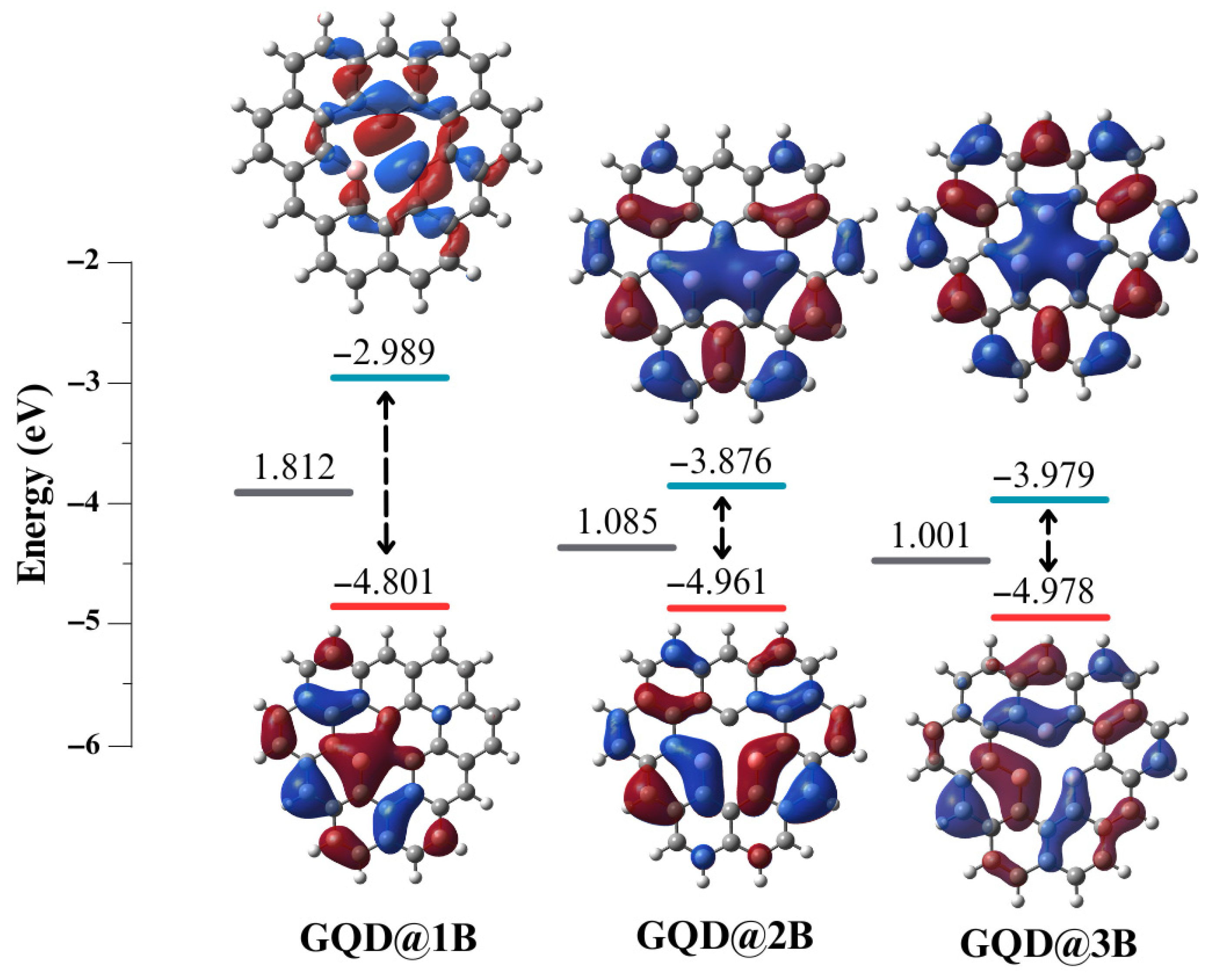
To analyze the electronic stability and chemical reactivity of GQDs, measure the energies of the boundary orbitals (HOMO-LUMO) and the energy gap. The energy gap (Egap), a key predictor of electronic behavior, reflects stability and reactivity. Lower Eg values indicate less energy is required for electronic excitation, leading to greater interaction with other chemical species and higher reactivity. The undoped GQD has a higher electronic bandgap (Egap = 2.551 eV) than the boron-doped GQD. Boron doping gradually reduces Egap, with GQD@3B (0.898 eV) as the lowest among the boron-doped samples (Figure 4). This decrease shows that doping increases the material’s potential reactivity.
On the other hand, Table 2 lists the HOMO-LUMO values for complexes formed with the Hg2+ ion. For comparison, the Egap is 1.088 eV for the GQD without the dopant, whereas boron doping steadily increases this gap in the complexes. Specifically, the GQD@3B_Hg2+ system, containing three boron atoms, reaches the highest gap in the series at 1.484 eV. This progression demonstrates that boron, relative to the undoped GQD, enhances the system’s electronic stability after metal adsorption. Literature findings support this trend: for example, an electrochemical study notes that boron doping expands the HOMO-LUMO gap in GQDs, making them more electronically robust and less reactive [58,59]. Moreover, experimental results confirm that B-doped systems are more stable than undoped GQD complexes with Hg2+.

3.3.2. Comparison of the Gap Before and After Adsorption

The changes in the energy gap (eV) of the systems, both before and after adsorption of the Hg2+ ion, were compared to analyze their electronic reactivity and their ability to interact with the pollutant. After adsorption, the pure system (GQD) shows a considerable decrease in its energy gap, which drops from 2.551 to 1.088 eV. This decrease is evidence of a provocative electronic activation by the adsorbate, in which charge transfer is favored due to a higher densification of states near the Fermi level.
On the other hand, systems with doped boron tend to increase the energy difference after adsorption. For GQD@1B, a decrease is noted (from 1.812 to 1.288 eV), but for GQD@2B and GQD@3B, there is a significant increase; the last of these presents the largest difference in the series, which is 1.484 eV. This behavior indicates that, unlike the pure system, boron induces an electronic reorganization after adsorption, increasing the distance between the boundary levels. Therefore, the electronic reactivity is reduced, and the system becomes more stable when the metal is present. The results obtained for boron-doped complexes are consistent with previously reported literature. After adsorption, the GQD@B_Hg2+ systems have wider energy differences (in the range 1197–1484 eV) than the pure system. According to previous research, boron modifies the electronic properties; however, the resulting systems are less reactive. This is consistent with the electronic stability trends observed in this study for boron complexes with Hg2+.

3.3.3. Evaluation of Electronic States Distribution

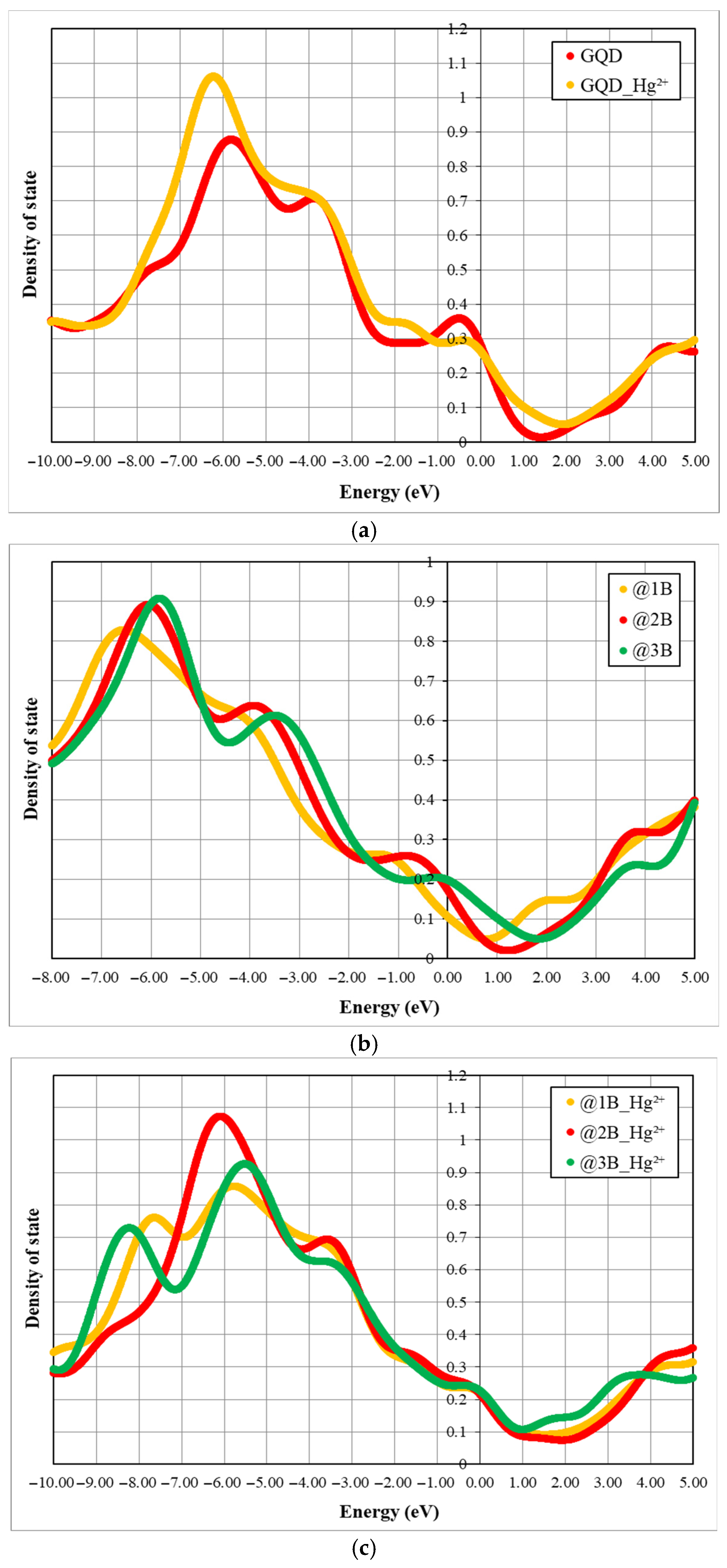
The study of the density of states (DOS) enables the determination of a direct connection between doping and the ability of GQDs to interact with the Hg2+ ion, as well as between the structural modification induced by such doping. The maximum density of states (Dmax) and the corresponding energy position (Emax) for all systems are summarized in Table 3. When dealing with pure GQD, the adsorption of Hg2+ leads to a moderate increase in its Dmax of +0.183 and a reduction in its Emax of −0.415 eV. This behavior suggests a hybrid interaction: on the one hand, the increase in the density of states signals an alteration in the electronic configuration; on the other hand, the negative energy shift indicates that the most relevant electrons move away from the Fermi level. On the other hand, boron-containing species (GQD@B) have a different response pattern. The GQD@2B system shows a significant increase in Dmax (+0.181 eV) and an almost nonexistent Emax shift (−0.039 eV) (Figure 5). This combination of results verifies that the Hg2+ ion has a very stable and efficient electronic coupling with it.

3.4. Analysis of Reduced Density Gradient (NCI) Features in Hg2+ GQDs Systems

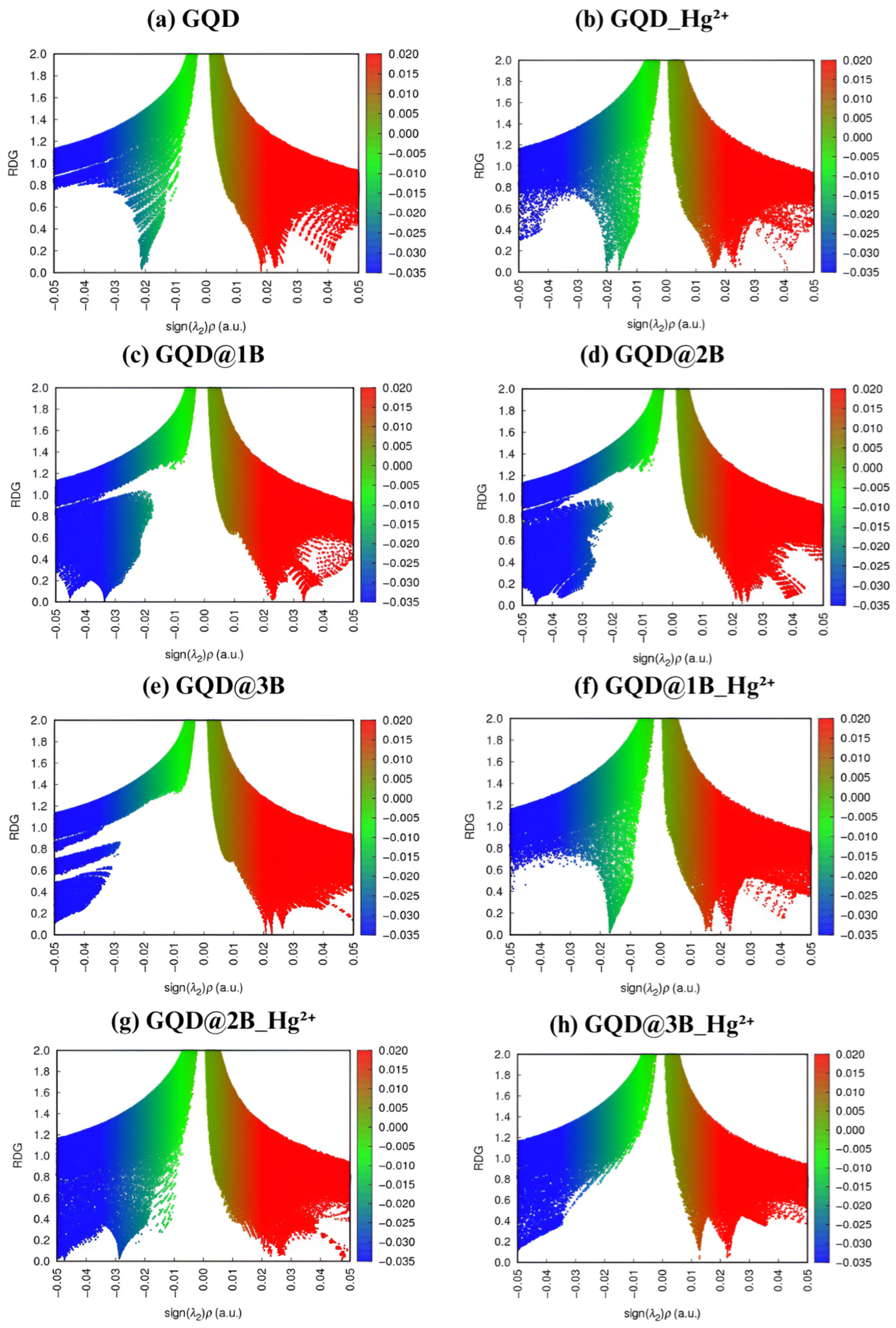
Analysis of the non-covalent interactions (NCIs) between Hg2+ and GQD surfaces shows that boron doping significantly strengthens the metal cation bond (see Figure 6). In RDG (Reduced Density Gradient) plots, blue areas represent electrostatic or coordinative attraction, green areas depict dispersive Van der Waals-type interactions, and red areas indicate steric repulsion. For pure GQD, Hg2+ adsorption is mainly marked by green regions, indicating weak dispersive interactions. Only faint blue traces appear after adsorption, signifying a reversible physisorption process without strong coupling. In contrast, boron doping alters this behavior: in the GQD@1B system, pronounced blue regions (≈ −0.015 to −0.020 a.u.) appear, highlighting stronger interactions between doped centers and Hg2+. This is consistent with partially coordinative binding, characteristic of more stable adsorption and chemosorption.
However, as the number of dopants increases, as in GQD@2B and GQD@3B, the attractive signals are scattered and weakened, indicating electronic competition between doped sites. This scattering reduces the clarity of the blue peaks and creates a setting in which dispersive, weaker interactions dominate. Notably, GQD@2B exhibits a balance between weak and moderate signals, indicating ongoing but less intense interactions compared to monobromated doping. In summary, greater doping reduces signal intensity and clarity, with GQD@2B maintaining some interaction strength but still weaker than the monobromated case.

3.5. Analysis of Global Chemical Descriptors as Predictors of Hg2+ Interaction Strength

The inclusion of boron alters the electronic reactivity of GQD and may enhance its affinity for charged species such as Hg2+. This can be observed through the analysis of the global reactivity descriptors, whose values are summarized in Table 4. In the undoped GQD, the overall hardness, which is quite high (η = 1.275 eV), and the most negative chemical potential (µ = −4.051 eV) indicate a stable system with moderate reactivity. These values indicate that the GQD, in its pure state, has a restricted ability to restructure its electron density against an external agent. The condition is modified when the lattice is subjected to the introduction of boron atoms. The hardness is reduced (η = 0.906 eV), and the overall softness is increased at GQD@1B, indicating that the system is more flexible at the electronic level. Doping with a single boron atom enhances the ability of the material to accept electron density, which is reflected in a higher electrophilicity (ω = 8.372) and a greater facility to redistribute charge. A shown in Table 4, this behavior denotes a more reactive system compared to pristine GQD, which may facilitate the initial interaction with metal cations.
The trend becomes more pronounced in GQD@2B and GQD@3B when the number of dopants increases. The two configurations have even lower hardness values (η = 0.543–0.500 eV), but with significant increases in electrophilicity (ω between 17.994 and 20.062). This suggests that the presence of multiple boron atoms leads to significant electronic activation, making systems more flexible and sensitive to incoming charge, thereby increasing their propensity to interact with highly charged species such as Hg2+.

3.6. Evaluation of Energetic Stability in the Adsorption Process

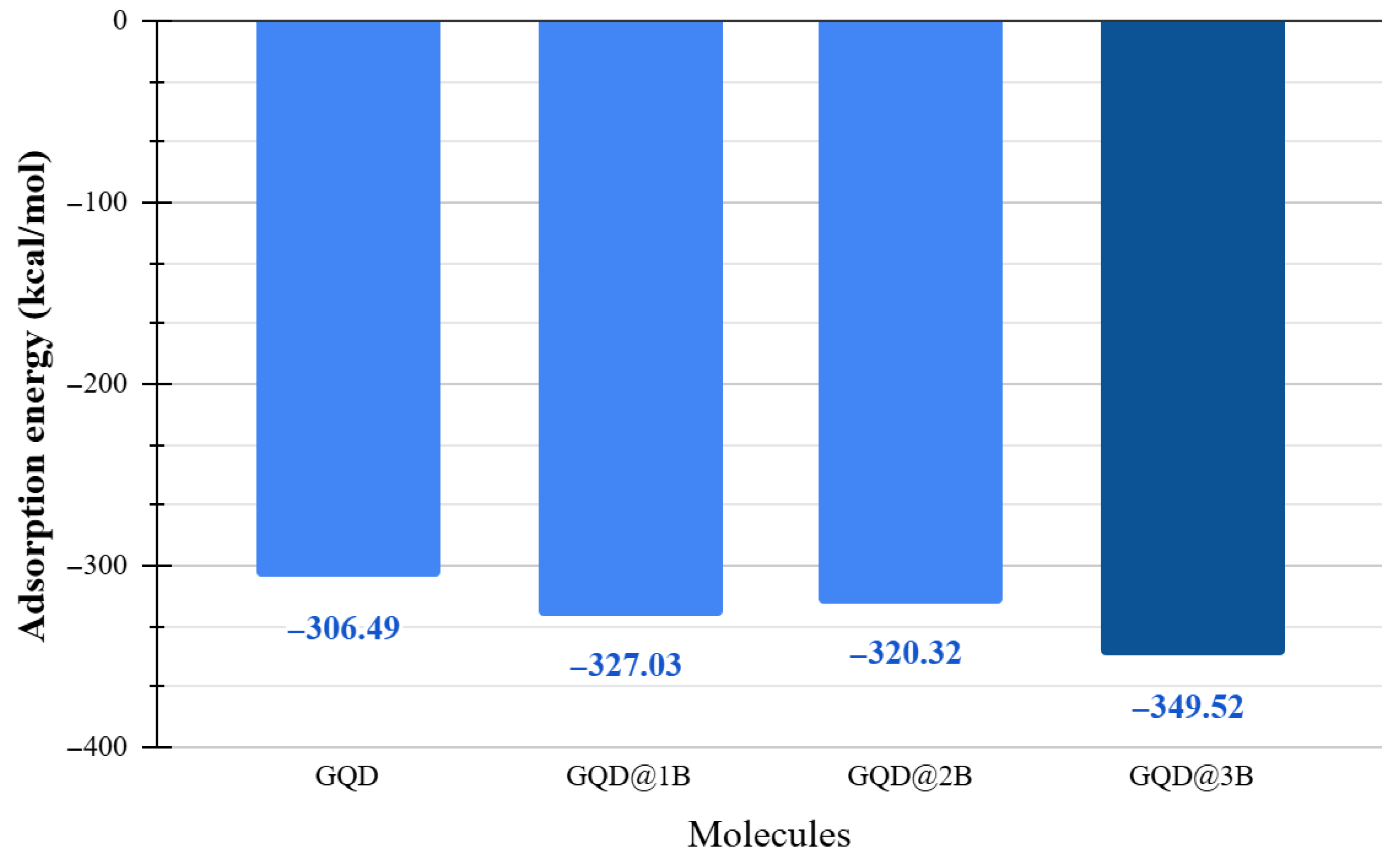
The electronic adsorption energy (Ea) was used to assess the metal-GQD surface interaction. In all configurations, the Ea values for Hg2+ complexes with GQDs are negative (see Figure 7), indicating electronic stability of the coupled systems in comparison to the isolated fragments. GQD@3B_Hg2+ exhibits the greatest negative adsorption energy (−349.52 kcal/mol) among the systems examined. This quantity suggests that the interaction with the mercury ion may involve coordinative contributions from the cationic center to the boron sites rather than simple electrostatic contact. The extremely negative Ea values found in this study (up to −349.52 kcal mol−1 for GQD@3B_Hg2+) [60,61] show strong electronic stability in the presence of boron dopants. This stabilization is compatible with boron’s electron-deficient nature. It might favor partial covalent character through orbital reconfiguration, encouraging donor–acceptor interactions with the strongly charged Hg2+ ion [60,61,62,63,64,65,66,67,68]. The reduction in the HOMO–LUMO gap, the increase in global electrophilicity, and the attractive regions seen in the reduced-density gradient (RDG) plots all support a coordination-type adsorption mechanism. These results are mediated by dopant-induced changes in electronic structure, as does the magnitude of the adsorption energies. The values surpass those typical of purely electrostatic or van der Waals interactions.
It should be highlighted, nonetheless, that Ea is an electrical energy criterion and does not constitute thermodynamic proof. As a result, claims about heat release or spontaneous behavior require explicit enthalpic or free-energy analysis and cannot be inferred from Ea alone. Furthermore, using bare Hg2+ in the gas phase may yield upper-limit estimates of interaction strength; future research should account for hydrated mercury species to determine environmental relevance.

4. Conclusions

DFT calculations show that the interaction capacity of GQD with the Hg2+ ion and its electronic properties are significantly altered by boron doping. Pure GQD exhibits a relatively large HOMO-LUMO gap (2.55 eV), which is considerably reduced upon adsorption (1.08 eV), indicating electronic activation by the metal. In contrast, boron-doped systems show smaller initial gaps (0.90–1.81 eV), pointing to a higher tendency toward electronic reorganization even before interaction occurs. The DOS research demonstrates that boron doping produces specific electronic rearrangements that depend on the amount of added heteroatoms. Specifically, GQD@2B exhibits the most balanced increase in density of states after adsorption, indicating efficient binding of Hg2+ without causing significant electronic destabilization. The remarkable energy fluctuation detected in GQD@3B, on the other hand, corroborates the notion that orbital rearrangement is enhanced by numerous doped sites, thereby increasing the system’s sensitivity to the presence of the cation. Without suggesting thermodynamic favorability, the adsorption energies show electronic stability in all configurations. With a total of –349.52 kcal/mol, GQD@3B_Hg2+ has the strongest electronic stabilization in this family. This behavior is complemented by NCI analysis: although pure GQD exhibits mostly weak, dispersive interactions, the addition of a boron atom strengthens the interactions, as evidenced by more defined attractive signals. However, when more doping is present (2B and 3B), these signals tend to disperse, indicating electronic competition between the active centers and a relative reduction in coordination.
Finally, the overall reactivity descriptors corroborate that boron doping decreases the hardness of the GQD and increases its electrophilicity, thereby enhancing its interaction with strongly positive species such as Hg2+ and its charge-accepting properties. Overall, these findings indicate that doping with a moderate dose of boron (in particular 1B and 2B) enhances the affinity and reactivity towards Hg2+, whereas high amounts of doping (3B) result in greater post-adsorption electronic stabilization, albeit with less selective interactions. Thus, boron becomes an effective modulator of GQD activity, enabling its sensitivity and stability to be tailored for applications aimed at heavy metal capture.

Author Contributions

Conceptualization, J.A.H.F. and J.S.G.P.; Methodology, J.A.H.F., J.J.C. and J.S.G.P.; Software, J.A.H.F., J.J.C. and J.S.G.P.; Validation, J.A.H.F. and J.S.G.P.; Formal analysis, J.A.H.F. and J.S.G.P.; Investigation, J.A.H.F. and J.S.G.P.; Resources, J.A.H.F. and J.J.C.; Data curation, J.A.H.F., J.J.C. and J.S.G.P.; Writing—original draft, J.A.H.F. and J.S.G.P.; Writing—review & editing, J.A.H.F. and J.S.G.P.; Visualization, J.A.H.F. and J.J.C.; Supervision, J.A.H.F.; Project administration, J.A.H.F.; Funding acquisition, J.J.C. All authors have read and agreed to the published version of the manuscript.

Funding

This research received no external funding.

Data Availability Statement

The original contributions presented in this study are included in the article. Further inquiries can be directed to the corresponding authors.

Conflicts of Interest

The authors declare no conflict of interest.

Appendix A

This appendix provides a comparative overview of representative DFT studies on GQDs and related nanostructures for heavy metal adsorption.
Table A1. Comparative summary of DFT methodologies, modeled systems, and key findings reported for heavy metal adsorption on GQDs.
ReferencesStudied
System
DopantDFT MethodSpeciesKey Findings
[50]Finite GQDs (hexagonal and triangular, H edges and NH groups)NH groups at edgesDFT (functional GGA-PBE, molecule-like bases; study of hydrated states and different sites: surface and border)Cd2+, Pb2+ (as hexa-, penta- and tetra-hydrate complexes)All schemes (surface, edge, functional groups) allow adsorption of hydrated Cd2+ and Pb2+; both physisorption is observed.
[60]Finite GQDs of different sizes and shapes (pristine, with C substitution by HM and with HM on the surface)Primarily pristine GQDs; study of C substitution by heavy metals (local metal doping)B3LYP/6-31G + SDDCd, Hg, Pb (neutral atoms and charged species, including Cd2+, Hg2+, Pb2+)Neutral Pb atoms show higher adsorption energy (stronger binding) than Cd or Hg in physisorption; charged (ionized) species chemisorb and act as acceptors (withdrawing charge from GQDs); diffusion barriers of adatoms are obtained on GQDs (relevant for sensors); the substitution of C by heavy ions strongly alters geometry and optical spectra, proposing GQDs as a sensitive platform for optical detection of Cd, Hg and Pb.
[33]GQDs functionalized with O and B-O groupsO-GQD, BC2O-GQD, BCO2-GQDB3LYP/6-31G(d,p) HydrogenB/O functionalization reduces gap and modulates adsorption; it illustrates how B-O groups fine-tune active sites in GQDs.
[62]Pristine GNDs, with vacancies or metal-doped + phosphateModified graphene nanodots (B/W/S/P) + PO43−CAM-B3LYP/6-31G(d); aqueous solvent (PCM, SCRF); ADCH analysisPhosphate-GND complexesIonic adsorption strongly alters gap and absorption; it suggests an optical sensing mechanism based on gap change.
[63]Chitosan hydrogel with “Carbon quantum dots” + Hg2+QDsB3LYP/GenECP; LanL2DZ for metal ions, 6-31G(d) for non-metal atomsHg2+, Cd2+, Pb2+Interaction order Hg2+ > Cd2+ > Pb2+; strong electronic stabilization explains high luminescent selectivity.

References

  1. El-Sharkawy, M.; Alotaibi, M.O.; Li, J.; Du, D.; Mahmoud, E. Heavy Metal Pollution in Coastal Environments: Ecological Implications and Management Strategies: A Review. Sustainability 2025, 17, 701. [Google Scholar] [CrossRef]
  2. Briffa, J.; Sinagra, E.; Blundell, R. Heavy Metal Pollution in the Environment and Their Toxicological Effects on Humans. Heliyon 2020, 6, e04691. [Google Scholar] [CrossRef]
  3. Hama Aziz, K.H.; Mustafa, F.S.; Omer, K.M.; Hama, S.; Hamarawf, R.F.; Rahman, K.O. Heavy Metal Pollution in the Aquatic Environment: Efficient and Low-Cost Removal Approaches to Eliminate Their Toxicity: A Review. RSC Adv. 2023, 13, 17595–17610. [Google Scholar] [CrossRef] [PubMed]
  4. Masindi, V.; Muedi, K.L. Environmental Contamination by Heavy Metals. In Heavy Metals; Saleh, H.E.-D.M., Aglan, R.F., Eds.; InTech: London, UK, 2018; ISBN 9781789233605. [Google Scholar]
  5. Laoye, B.; Olagbemide, P.; Ogunnusi, T.; Akpor, O. Heavy Metal Contamination: Sources, Health Impacts, and Sustainable Mitigation Strategies with Insights from Nigerian Case Studies. F1000Research 2025, 14, 134. [Google Scholar] [CrossRef]
  6. Wu, Y.-S.; Osman, A.I.; Hosny, M.; Elgarahy, A.M.; Eltaweil, A.S.; Rooney, D.W.; Chen, Z.; Rahim, N.S.; Sekar, M.; Gopinath, S.C.B.; et al. The Toxicity of Mercury and Its Chemical Compounds: Molecular Mechanisms and Environmental and Human Health Implications: A Comprehensive Review. ACS Omega 2024, 9, 5100–5126. [Google Scholar] [CrossRef] [PubMed]
  7. Song, S.; Li, Y.; Liu, Q.S.; Wang, H.; Li, P.; Shi, J.; Hu, L.; Zhang, H.; Liu, Y.; Li, K.; et al. Interaction of Mercury Ion (Hg2+) with Blood and Cytotoxicity Attenuation by Serum Albumin Binding. J. Hazard. Mater. 2021, 412, 125158. [Google Scholar] [CrossRef] [PubMed]
  8. Bhardwaj, V.; Nurchi, V.M.; Sahoo, S.K. Mercury Toxicity and Detection Using Chromo-Fluorogenic Chemosensors. Pharmaceuticals 2021, 14, 123. [Google Scholar] [CrossRef]
  9. Abdelmonem, B.H.; Kamal, L.T.; Elbaz, R.M.; Khalifa, M.R.; Abdelnaser, A. From Contamination to Detection: The Growing Threat of Heavy Metals. Heliyon 2025, 11, e41713. [Google Scholar] [CrossRef]
  10. Li, K.; Yang, H.; Yuan, X.; Zhang, M. Recent Developments of Heavy Metals Detection in Traditional Chinese Medicine by Atomic Spectrometry. Microchem. J. 2021, 160, 105726. [Google Scholar] [CrossRef]
  11. Shi, Y.; Zhang, S.; Zhou, H.; Dong, Y.; Liu, G.; Ye, W.; He, R.; Zhao, G. Recent Developments in Heavy Metals Detection: Modified Electrodes, Pretreatment Methods, Prediction Models and Algorithms. Metals 2025, 15, 80. [Google Scholar] [CrossRef]
  12. Tawfik, W.; El-Saeed, M.; Khalil, A.; Fikry, M. Detection of Heavy Metal Elements by Using Advanced Optical Techniques. J. Egypt. Soc. Basic Sci.-Phys. 2024, 1, 99–127. [Google Scholar] [CrossRef]
  13. Li, M.; Chen, T.; Gooding, J.J.; Liu, J. Review of Carbon and Graphene Quantum Dots for Sensing. ACS Sens. 2019, 4, 1732–1748. [Google Scholar] [CrossRef]
  14. Mansuriya, B.; Altintas, Z. Applications of Graphene Quantum Dots in Biomedical Sensors. Sensors 2020, 20, 1072. [Google Scholar] [CrossRef] [PubMed]
  15. Kumar, Y.R.; Deshmukh, K.; Sadasivuni, K.K.; Pasha, S.K.K. Graphene Quantum Dot Based Materials for Sensing, Bio-Imaging and Energy Storage Applications: A Review. RSC Adv. 2020, 10, 23861–23898. [Google Scholar] [CrossRef] [PubMed]
  16. Zacharias, M.; Kelires, P.C. Quantum Confinement of Electron–Phonon Coupling in Graphene Quantum Dots. J. Phys. Chem. Lett. 2021, 12, 9940–9946. [Google Scholar] [CrossRef]
  17. Gu, S.; Hsieh, C.-T.; Tsai, Y.-Y.; Ashraf Gandomi, Y.; Yeom, S.; Kihm, K.D.; Fu, C.-C.; Juang, R.-S. Sulfur and Nitrogen Co-Doped Graphene Quantum Dots as a Fluorescent Quenching Probe for Highly Sensitive Detection toward Mercury Ions. ACS Appl. Nano Mater. 2019, 2, 790–798. [Google Scholar] [CrossRef]
  18. Li, S.-Y.; He, L. Recent Progresses of Quantum Confinement in Graphene Quantum Dots. Front. Phys. 2022, 17, 33201. [Google Scholar] [CrossRef]
  19. Walther, B.K.; Dinu, C.Z.; Guldi, D.M.; Sergeyev, V.G.; Creager, S.E.; Cooke, J.P.; Guiseppi-Elie, A. Nanobiosensing with Graphene and Carbon Quantum Dots: Recent Advances. Mater. Today 2020, 39, 23–46. [Google Scholar] [CrossRef]
  20. Kamal, A.; Hong, S.; Ju, H. Carbon Quantum Dots: Synthesis, Characteristics, and Quenching as Biocompatible Fluorescent Probes. Biosensors 2025, 15, 99. [Google Scholar] [CrossRef]
  21. Facure, M.H.M.; Schneider, R.; Lima, J.B.S.; Mercante, L.A.; Correa, D.S. Graphene Quantum Dots-Based Nanocomposites Applied in Electrochemical Sensors: A Recent Survey. Electrochem 2021, 2, 490–519. [Google Scholar] [CrossRef]
  22. Wang, Z.; Hu, T.; Liang, R.; Wei, M. Application of zero-dimensional nanomaterials in biosensing. Front. Chem. 2020, 8, 320. [Google Scholar] [CrossRef]
  23. Li, L.; Liu, D.; Mao, H.; You, T. Multifunctional Solid-State Electrochemiluminescence Sensing Platform Based on Poly(Ethylenimine) Capped N-Doped Carbon Dots as Novel Co-Reactant. Biosens. Bioelectron. 2017, 89, 489–495. [Google Scholar] [CrossRef]
  24. Sohal, N.; Maity, B.; Basu, S. Recent Advances in Heteroatom-Doped Graphene Quantum Dots for Sensing Applications. RSC Adv. 2021, 11, 25586–25615. [Google Scholar] [CrossRef]
  25. Murugesan, A.; Li, H.; Shoaib, M. Recent Advances in Functionalized Carbon Quantum Dots Integrated with Metal–Organic Frameworks: Emerging Platforms for Sensing and Food Safety Applications. Foods 2025, 14, 2060. [Google Scholar] [CrossRef]
  26. Zheng, Y.; Lin, J.; Xie, L.; Tang, H.; Wang, K.; Liu, J. One-step preparation of nitrogen-doped graphene quantum dots with anodic electrochemiluminescence for sensitive detection of hydrogen peroxide and glucose. Front. Chem. 2021, 9, 688358. [Google Scholar] [CrossRef]
  27. Tian, P.; Tang, L.; Teng, K.-S.; Lau, S.-P. Graphene quantum dots: Preparations, properties, functionalizations and applications. Mater. Futures 2024, 3, 022301. [Google Scholar] [CrossRef]
  28. Gidwani, B.; Sahu, V.; Shukla, S.S.; Pandey, R.; Joshi, V.; Jain, V.K.; Vyas, A. Quantum Dots: Prospectives, Toxicity, Advances and Applications. J. Drug Deliv. Sci. Technol. 2021, 61, 102308. [Google Scholar] [CrossRef]
  29. Mansuriya, B.D.; Altintas, Z. Carbon Dots: Classification, Properties, Synthesis, Characterization, and Applications in Health Care—An Updated Review (2018–2021). Nanomaterials 2021, 11, 2525. [Google Scholar] [CrossRef]
  30. Rani, P.; Dalal, R.; Srivastava, S. Effect of Surface Modification on Optical and Electronic Properties of Graphene Quantum Dots. Appl. Surf. Sci. 2023, 609, 155379. [Google Scholar] [CrossRef]
  31. Dejpasand, M.T.; Sharifi, S.; Saievar-Iranizad, E.; Yazdani, A.; Rahimi, K. Boron- and Nitrogen-Doped Graphene Quantum Dots with Enhanced Supercapacitance. J. Energy Storage 2021, 42, 103103. [Google Scholar] [CrossRef]
  32. Juang, R.-S.; Hsieh, C.-T.; Kao, C.-P.; Gandomi, Y.A.; Fu, C.-C.; Liu, S.-H.; Gu, S. Highly Fluorescent Green and Red Emissions from Boron-Doped Graphene Quantum Dots under Blue Light Illumination. Carbon 2021, 176, 61–70. [Google Scholar] [CrossRef]
  33. Sharma, V.; Roondhe, B.; Saxena, S.; Shukla, A. Role of Functionalized Graphene Quantum Dots in Hydrogen Evolution Reaction: A Density Functional Theory Study. Int. J. Hydrogen Energy 2022, 47, 41748–41758. [Google Scholar] [CrossRef]
  34. Hellal, A.; Abdelsalam, H.; Tawfik, W.; Ibrahim, M.A. Assessment of Doped Graphene in the Removal of Atrazine from Water. Sci. Rep. 2024, 14, 21994. [Google Scholar] [CrossRef] [PubMed]
  35. Abdelsalam, H.; Sakr, M.A.S.; Teleb, N.H.; Abd-Elkader, O.H.; Zhang, Q. Quantum-Dot-Based Carbon Nanotubes: Design, Doping, and Lithium Storage for High-Capacity Energy Applications. Langmuir 2025, 41, 17803–17814. [Google Scholar] [CrossRef]
  36. Alsmani, N.; Al-Qurashi, O.S.; Wazzan, N. Performance Enhancement of Catechin-Graphene Quantum Dot Nanocomposites Functionalized with Carboxyl and Doped/Decorated with Boron towards Dye-Sensitized Solar Cell Applications: DFT and TD-DFT Calculations. J. Mol. Graph. Model. 2023, 121, 108427. [Google Scholar] [CrossRef]
  37. Mukherjee, S.; Kaloni, T.P. Electronic Properties of Boron- and Nitrogen-Doped Graphene: A First Principles Study. J. Nanopart. Res. 2012, 14, 1059. [Google Scholar] [CrossRef]
  38. Joucken, F.; Tison, Y.; Le Fèvre, P.; Tejeda, A.; Taleb-Ibrahimi, A.; Conrad, E.; Repain, V.; Chacon, C.; Bellec, A.; Girard, Y.; et al. Charge Transfer and Electronic Doping in Nitrogen-Doped Graphene. Sci. Rep. 2015, 5, 14564. [Google Scholar] [CrossRef]
  39. Gao, Y.; Xie, Y.; Wang, S.; Li, S.; Chen, L.; Zhang, J. Electronic and Optical Properties of Twin T-Graphene Co-Doped with Boron and Phosphorus. Materials 2022, 15, 2876. [Google Scholar] [CrossRef]
  40. Han, F.; Zong, Y.; Jassby, D.; Wang, J.; Tian, J. The Interactions and Adsorption Mechanisms of Ternary Heavy Metals on Boron Nitride. Environ. Res. 2020, 183, 109240. [Google Scholar] [CrossRef]
  41. Florez, E.; Zapata-Escobar, A.D.; Ferraro, F.; Ibargüen Becerra, C.; Chamorro, Y.; Maldonado, A.F. Coordination of Mercury(II) in Water Promoted over Hydrolysis in Solvated Clusters [Hg(H2O)1-6](Aq)2+: Insights from Relativistic Effects and Free Energy Analysis. J. Phys. Chem. A 2023, 127, 8032–8049. [Google Scholar] [CrossRef] [PubMed]
  42. Liu, M.; Kakade, A.; Liu, P.; Wang, P.; Tang, Y.; Li, X. Hg2+-Binding Peptide Decreases Mercury Ion Accumulation in Fish through a Cell Surface Display System. Sci. Total Environ. 2019, 659, 540–547. [Google Scholar] [CrossRef]
  43. Hohenberg, P.; Kohn, W. Inhomogeneous Electron Gas. Phys. Rev. 1964, 136, B864–B871. [Google Scholar] [CrossRef]
  44. Kohn, W.; Sham, L.J. Self-consistent equations including exchange and correlation effects. Phys. Rev. 1965, 140, A1133–A1138. [Google Scholar] [CrossRef]
  45. Neese, F. The ORCA Program System: The ORCA Program System. Wiley Interdiscip. Rev. Comput. Mol. Sci. 2012, 2, 73–78. [Google Scholar] [CrossRef]
  46. Neese, F. Software Update: The ORCA Program System—Version 6.0. Wiley Interdiscip. Rev. Comput. Mol. Sci. 2025, 15, e70019. [Google Scholar] [CrossRef]
  47. Becke, A.D. Density-Functional Thermochemistry. III. The Role of Exact Exchange. J. Chem. Phys. 1993, 98, 5648–5652. [Google Scholar] [CrossRef]
  48. Lee, C.; Yang, W.; Parr, R.G. Development of the Colle-Salvetti Correlation-Energy Formula into a Functional of the Electron Density. Phys. Rev. B Condens. Matter 1988, 37, 785–789. [Google Scholar] [CrossRef] [PubMed]
  49. Grimme, S.; Antony, J.; Ehrlich, S.; Krieg, H. A Consistent and Accurate Ab Initio Parametrization of Density Functional Dispersion Correction (DFT-D) for the 94 Elements H-Pu. J. Chem. Phys. 2010, 132, 154104. [Google Scholar] [CrossRef] [PubMed]
  50. Weigend, F.; Ahlrichs, R. Balanced Basis Sets of Split Valence, Triple Zeta Valence and Quadruple Zeta Valence Quality for H to Rn: Design and Assessment of Accuracy. Phys. Chem. Chem. Phys. 2005, 7, 3297–3305. [Google Scholar] [CrossRef]
  51. Abdelsalam, H.; Teleb, N.H.; Yahia, I.S.; Zahran, H.Y.; Elhaes, H.; Ibrahim, M.A. First Principles Study of the Adsorption of Hydrated Heavy Metals on Graphene Quantum Dots. J. Phys. Chem. Solids 2019, 130, 32–40. [Google Scholar] [CrossRef]
  52. Mulya, F.; Kuamit, T.; Apilardmongkol, P.; Parasuk, V. DFT Study of Lithium Adsorption on Silicon Quantum Dots for Battery Applications. Phys. E Low Dimens. Syst. Nanostruct. 2024, 164, 116060. [Google Scholar] [CrossRef]
  53. Jindal, R.; Yogi, R.; Shukla, A. First-Principles Study of Penta-CN2 Quantum Dots for Efficient Hydrogen Evolution Reaction. Int. J. Hydrogen Energy 2024, 63, 517–527. [Google Scholar] [CrossRef]
  54. Lu, T.; Chen, F. Multiwfn: A Multifunctional Wavefunction Analyzer. J. Comput. Chem. 2012, 33, 580–592. [Google Scholar] [CrossRef] [PubMed]
  55. Kaya, S.; Putz, M.V. Atoms-in-Molecules’ Faces of Chemical Hardness by Conceptual Density Functional Theory. Molecules 2022, 27, 8825. [Google Scholar] [CrossRef] [PubMed]
  56. Badry, R.; Elhaes, H.; Ibrahim, A.; Refaat, A.; Ibrahim, M.A. Investigating the Electronic Properties and Reactivity of Polyaniline Emeraldine Base Functionalized with Metal Oxides. Sci. Rep. 2024, 14, 27024. [Google Scholar] [CrossRef]
  57. Molski, M. Theoretical Modeling of Structure-Toxicity Relationship of Cyanides. Toxicol. Lett. 2021, 349, 30–39. [Google Scholar] [CrossRef]
  58. Kaur, M.; Ubhi, M.K.; Grewal, J.K.; Sharma, V.K. Boron- and Phosphorous-Doped Graphene Nanosheets and Quantum Dots as Sensors and Catalysts in Environmental Applications: A Review. Environ. Chem. Lett. 2021, 19, 4375–4392. [Google Scholar] [CrossRef]
  59. Hai, X.; Mao, Q.-X.; Wang, W.-J.; Wang, X.-F.; Chen, X.-W.; Wang, J.-H. An Acid-Free Microwave Approach to Prepare Highly Luminescent Boron-Doped Graphene Quantum Dots for Cell Imaging. J. Mater. Chem. B Mater. Biol. Med. 2015, 3, 9109–9114. [Google Scholar] [CrossRef]
  60. Shtepliuk, I.; Caffrey, N.M.; Iakimov, T.; Khranovskyy, V.; Abrikosov, I.A.; Yakimova, R. On the Interaction of Toxic Heavy Metals (Cd, Hg, Pb) with Graphene Quantum Dots and Infinite Graphene. Sci. Rep. 2017, 7, 3934. [Google Scholar] [CrossRef]
  61. Liu, Z.; Mo, Z.; Liu, N.; Guo, R.; Niu, X.; Zhao, P.; Yang, X. One-Pot Synthesis of Highly Fluorescent Boron and Nitrogen Co-Doped Graphene Quantum Dots for the Highly Sensitive and Selective Detection of Mercury Ions in Aqueous Media. J. Photochem. Photobiol. A Chem. 2020, 389, 112255. [Google Scholar] [CrossRef]
  62. Shtepliuk, I. A DFT Study of Phosphate Ion Adsorption on Graphene Nanodots: Implications for Sensing. Sensors 2023, 23, 5631. [Google Scholar] [CrossRef]
  63. Yan, X.; Rahman, S.; Rostami, M.; Tabasi, Z.A.; Khan, F.; Alodhayb, A.; Zhang, Y. Carbon Quantum Dot-Incorporated Chitosan Hydrogel for Selective Sensing of Hg2+ Ions: Synthesis, Characterization, and Density Functional Theory Calculation. ACS Omega 2021, 6, 23504–23514. [Google Scholar] [CrossRef] [PubMed]
  64. Fernández, J.H.; Guerra, Y.; Cano, H. Detection of Bisphenol A and Four Analogues in Atmospheric Emissions in Petrochemical Complexes Producing Polypropylene in South America. Molecules 2022, 27, 4832. [Google Scholar] [CrossRef] [PubMed]
  65. Hernández-Fernández, J.; Puello-Polo, E.; Castro-Suarez, J.R. Characterization of the Morphological and Chemical Profile of Different Families of Microplastics in Samples of Breathable Air. Molecules 2023, 28, 1042. [Google Scholar] [CrossRef] [PubMed]
  66. Hernández-Fernández, J.; Ortega-Toro, R.; Castro-Suarez, J.R. Theoretical–Experimental Study of the Action of Trace Amounts of Formaldehyde, Propionaldehyde, and Butyraldehyde as Inhibitors of the Ziegler–Natta Catalyst and the Synthesis of an Ethylene–Propylene Copolymer. Polymers 2023, 15, 1098. [Google Scholar] [CrossRef]
  67. Hernández-Fernández, J.; Cano-Cuadro, H.; Puello-Polo, E. Emission of Bisphenol A and Four New Analogs from Industrial Wastewater Treatment Plants in the Production Processes of Polypropylene and Polyethylene Terephthalate in South America. Sustainability 2022, 14, 10919. [Google Scholar] [CrossRef]
  68. Hernández-Fernández, J.; González-Cuello, R.; Ortega-Toro, R. Parts per Million of Propanol and Arsine as Responsible for the Poisoning of the Propylene Polymerization Reaction. Polymers 2023, 15, 3619. [Google Scholar] [CrossRef]
Figure 1. The GQD and complex structures that correspond to the optimized geometries at the DFT level B3LYP/def2-TZVP.
Jcs 10 00040 g001
Figure 2. Optimized structures of B-doped GQDs in different positions. The geometries were obtained by DFT calculations with a B3LYP/def2-TVPZ level of theory.
Jcs 10 00040 g002
Figure 3. Optimized geometries and Hg-surface coordination distances in boron-doped GQDs.
Jcs 10 00040 g003
Figure 4. Representations of the boundary molecular orbitals (HOMO-LUMO) and corresponding energy values (eV) for boron-doped GQD (@1B, @2B and @3B).
Jcs 10 00040 g004
Figure 5. Total density of states (TDOS) calculated for B-doped GQDs and their Hg2+ adsorption complexes: (a) GQD and GQD_Hg2+ system; (b) B-doped GQDs with different B-doping sites (1B, 2B, and 3B); and (c) B-doped GQD_Hg2+ adsorption complexes.
Jcs 10 00040 g005
Figure 6. RDG vs. sign(λ2)ρ plots for pure GQD, GQD_Hg2+ and boron-doped GQD systems in different configurations (1B, 2B and 3B).
Jcs 10 00040 g006
Figure 7. Adsorption energies (kcal mol−1) of Hg2+ on B-doped GQDs calculated at the B3LYP/def2-VPZ level of theory.
Jcs 10 00040 g007
Table 1. Thermodynamic parameters and dipole moments of pristine and doped GQDs before and after Hg2+ adsorption.
MoleculeElectronic Energy (Hartree)Enthalpy
(Hartree)
Gibbs Free Energy (Hartree)Entropy (kcal/mol×K)Dipolar Moment (Debye)
GQD−1380.578−1380.173−1380.24142.3800.441
GQD@1B−1367.340−1366.936−1367.00744.2403.269
GQD@2B−1354.126−1353.724−1353.79444.0300.419
GQD@3B−1340.890−1340.490−1340.55943.3800.001
GQD_Hg2+−1533.510−1533.510−1533.17747.3705.905
GQD@1B_Hg2+−1520.309−1519.901−1519.97546.7104.194
GQD@2B_Hg2+−1507.083−1506.677−1506.75247.0104.797
GQD@3B_Hg2+−1493.798−1493.394−1493.47047.5604.510
Table 2. Boundary orbital energies (HOMO-LUMO) and energy gap (eV) for GQD, its doped derivatives and Hg2+ ion.
MoleculeHOMO (eV)LUMO (eV)Energy Gap (eV)
GQD−5.326−2.7762.550
GQD_Hg2+−11.712−10.6241.088
GQD@1B_Hg2+−11.578−10.2901.288
GQD@2B_Hg2+−11.595−10.3981.197
GQD@3B_Hg2+−11.594−10.1101.484
Table 3. Maximum density of states (Dmax) and associated energy (Emax) values for pure GQD, doped GQD and complexes formed with Hg2+, obtained by DFT calculations.
MoleculeDmax (au)Emax (eV)
GQD0.877−5.809
GQD@1B0.827−6.544
GQD@2B0.891−6.045
GQD@3B0.907−5.824
GQD_Hg2+1.060−6.224
GQD@1B_Hg2+0.857−5.779
GQD@2B_Hg2+1.072−6.084
GQD@3B_Hg2+0.925−5.514
Table 4. Global chemical reactivity descriptors calculated for pristine and B-doped GQDs before and after Hg2+ adsorption.
MoleculeChemical Potential
μ
Global Hardness
η
Electronegativity
χ
Global Softness
S
Electrophilicity Index
ω
GQD−4.0511.2754.0510.3926.434
GQD@1B−3.8950.9063.8950.5528.372
GQD@2B−4.4190.5434.4190.92217.994
GQD@3B−4.4780.5004.4781.00020.062
GQD_Hg2+−11.1680.54411.1680.919114.636
GQD@1B_Hg2+−10.9340.64410.9340.77692.804
GQD@2B_Hg2+−10.9970.59910.9970.835101.007
GQD@3B_Hg2+−10.8520.74210.8520.67479.345
Disclaimer/Publisher’s Note: The statements, opinions and data contained in all publications are solely those of the individual author(s) and contributor(s) and not of MDPI and/or the editor(s). MDPI and/or the editor(s) disclaim responsibility for any injury to people or property resulting from any ideas, methods, instructions or products referred to in the content.