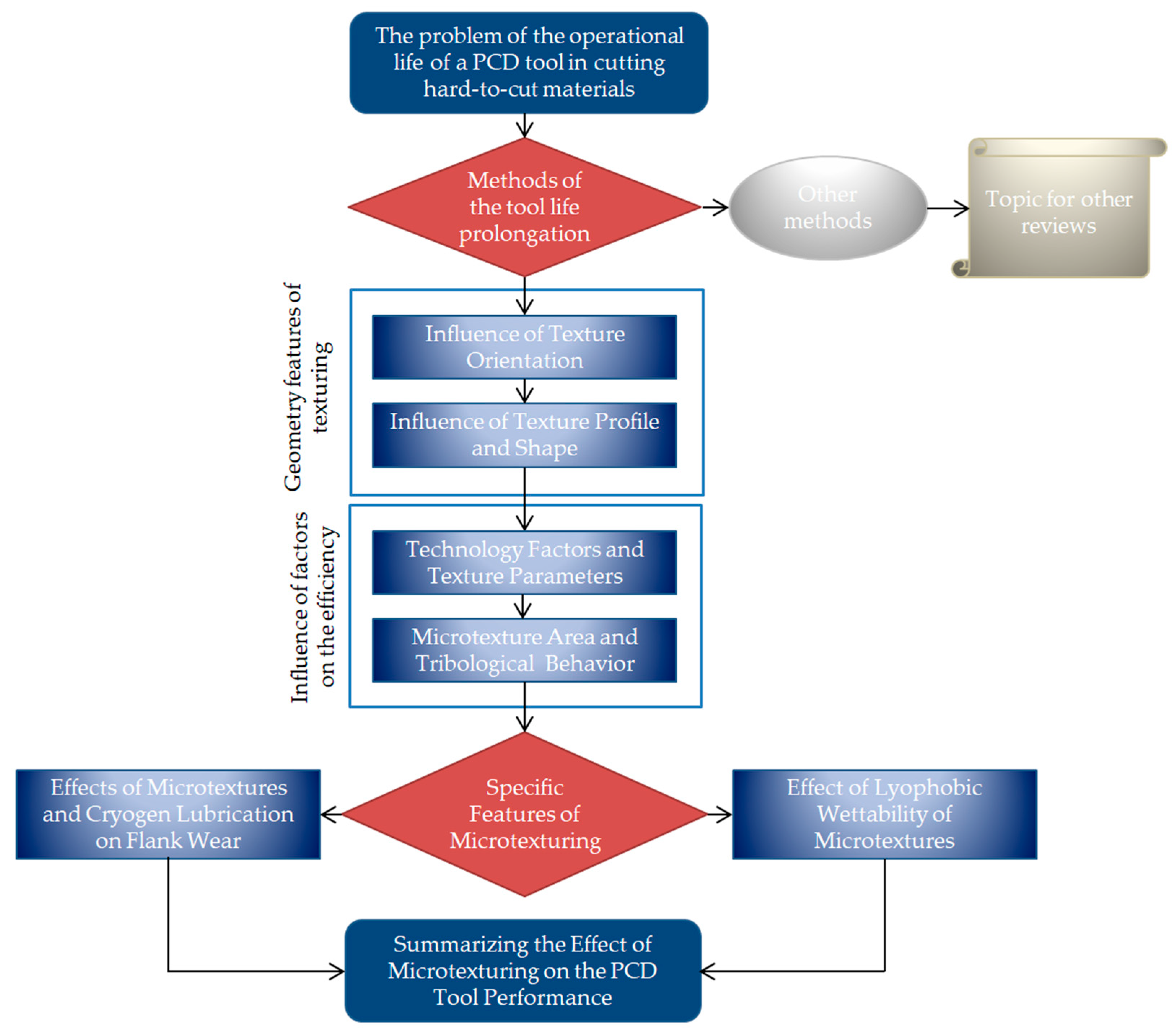
Figure 1.
The schematic of the review structure.
Figure 1.
The schematic of the review structure.
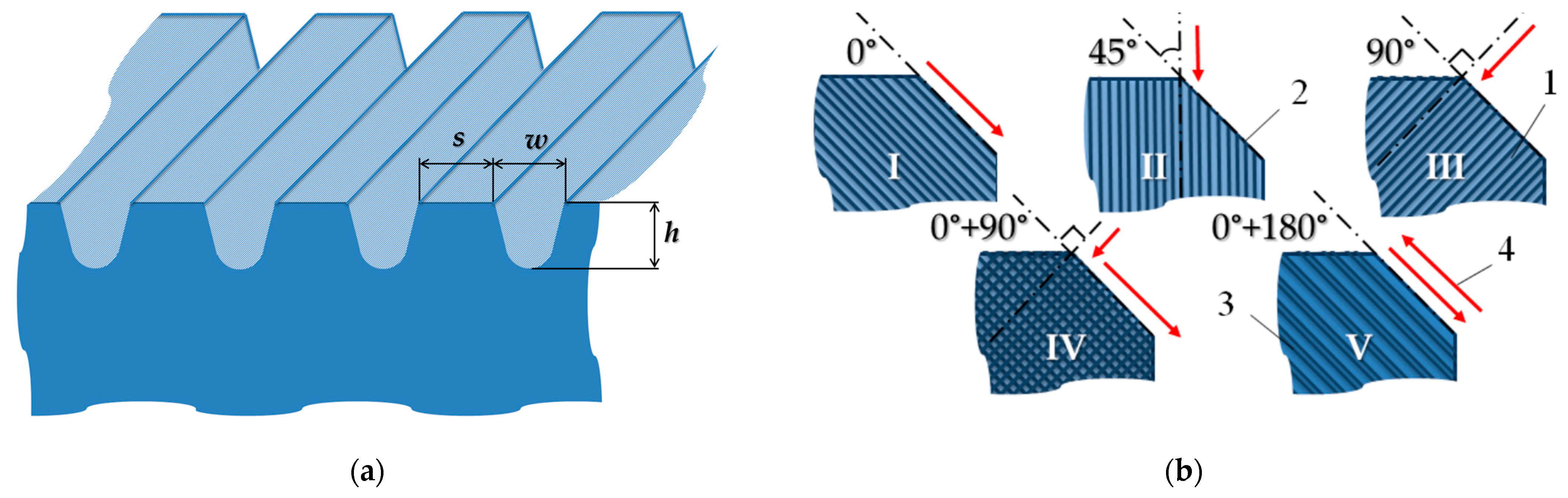
Figure 2.
Microtextures formed on the rake face of the PCD tool: (a) a profile of the microtextures, where w is the groove width, s is the step between grooves, and h is the depth of a groove; (b) directions of microgrooves, where (1) is a rake face of the PCD insert, (2) is a chamfer, (3) is a single groove, (4) is a direction of the formed groove (red arrows), I is microtextures at 0° to the chamfer edge, II is microtextures at 45° to the chamfer edge, III is microtextures at 90° to the chamfer edge, IV is crosshatching microtextures at 0° and 90° to the chamfer edge, and V is microtextures with a double groove at 0° to the chamfer edge.
Figure 2.
Microtextures formed on the rake face of the PCD tool: (a) a profile of the microtextures, where w is the groove width, s is the step between grooves, and h is the depth of a groove; (b) directions of microgrooves, where (1) is a rake face of the PCD insert, (2) is a chamfer, (3) is a single groove, (4) is a direction of the formed groove (red arrows), I is microtextures at 0° to the chamfer edge, II is microtextures at 45° to the chamfer edge, III is microtextures at 90° to the chamfer edge, IV is crosshatching microtextures at 0° and 90° to the chamfer edge, and V is microtextures with a double groove at 0° to the chamfer edge.
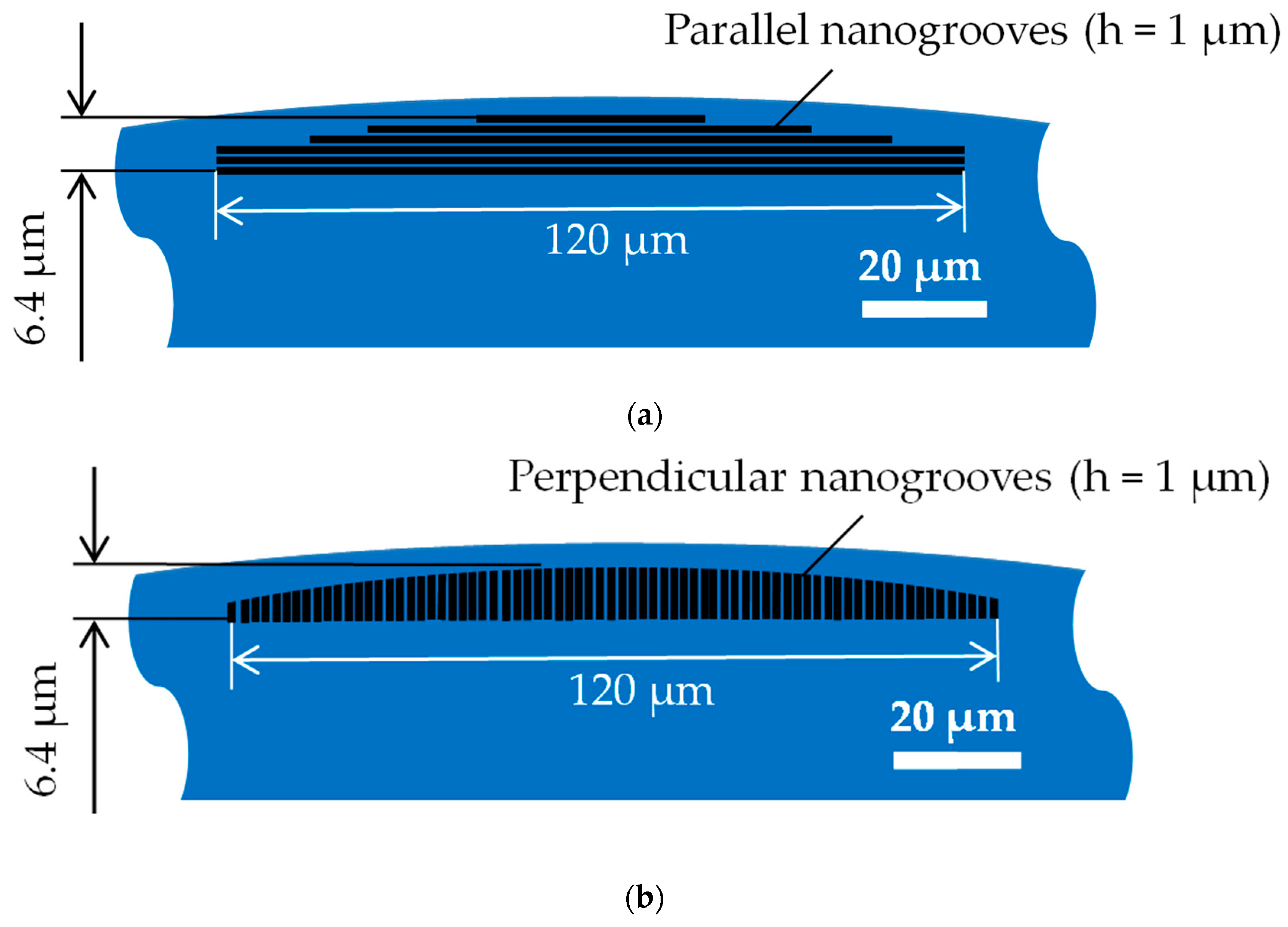
Figure 3.
Nanogrooves on the rake face of the PCD tool produced by focused ion beam (nanogrooves are shown schematically, not to scale): (a) parallel; (b) perpendicular.
Figure 3.
Nanogrooves on the rake face of the PCD tool produced by focused ion beam (nanogrooves are shown schematically, not to scale): (a) parallel; (b) perpendicular.
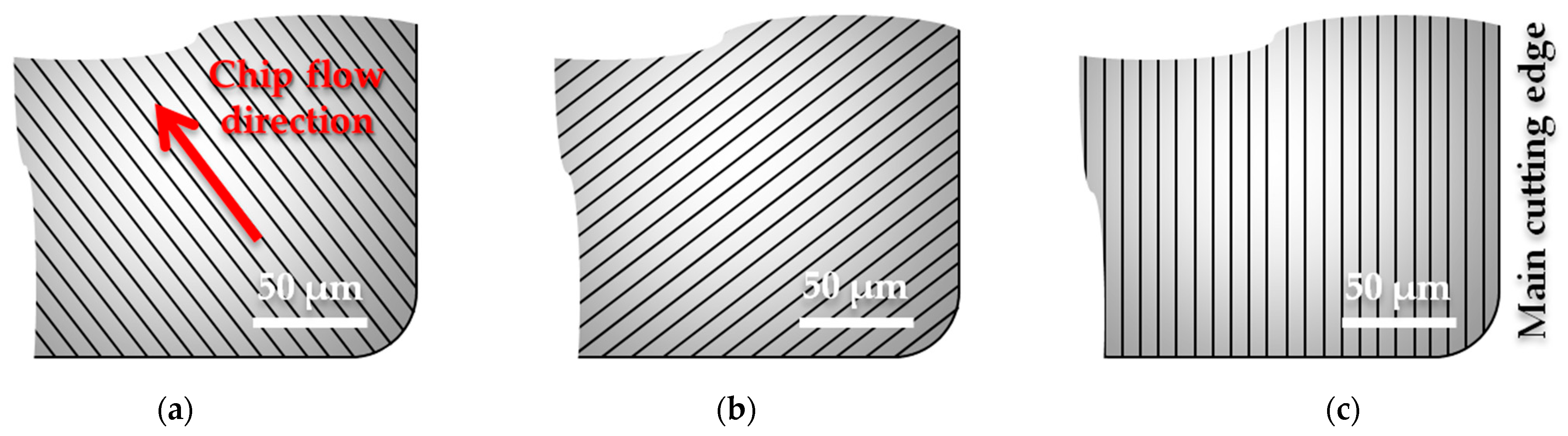
Figure 4.
Graphical presentation of the micro/nanotextures on the rake face of the PCD cutting insert produced by fiber laser: (a) parallel to the chip flow direction (at 135° to the main cutting edge); (b) perpendicular to the chip flow direction (at 45° to the main cutting edge); (c) parallel to the main cutting edge (0°).
Figure 4.
Graphical presentation of the micro/nanotextures on the rake face of the PCD cutting insert produced by fiber laser: (a) parallel to the chip flow direction (at 135° to the main cutting edge); (b) perpendicular to the chip flow direction (at 45° to the main cutting edge); (c) parallel to the main cutting edge (0°).
Figure 5.
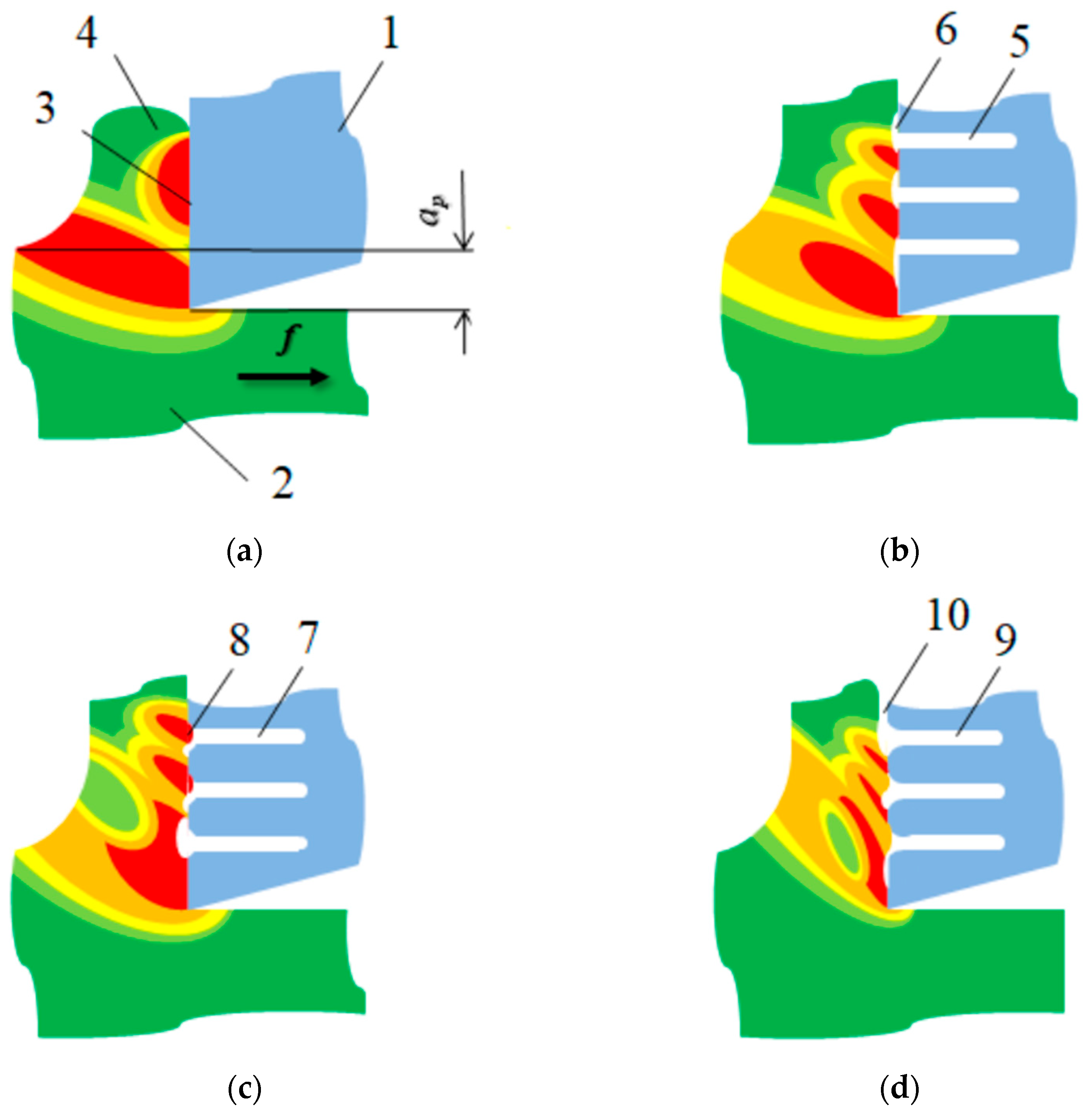
Illustration of the simulation results of the temperature fields and features of chip flow in cutting homogenous material with a cutting tool, where the gradation of colors indicates the temperature fields from 20 °C to 550–580 °C: (a) without microtextures; (b) with rectangle profile in plan microtextures; (c) with microtextures with a chamfer; (d) with microtextures with rounded edges, where f is a feed direction (indicated by an arrow), ap is a cutting depth (indicated by dimension lines), (1) is a cutting tool, (2) is the homogenous material of the workpiece, (3) is an area of the contact between the cutting tool and workpiece (contact pad), (4) is the formation of the chip, (5) is a rectangle in plan microtexture, (6) is the formation of the gap between the cutting tool and workpiece, (7) is the microtexture with a chamfer, (8) is extrusion of the material into the kerf, (9) is a microtexture with round edges, (10) is the absence of contact between the cutting tool and workpiece (stable gap).
Figure 5.
Illustration of the simulation results of the temperature fields and features of chip flow in cutting homogenous material with a cutting tool, where the gradation of colors indicates the temperature fields from 20 °C to 550–580 °C: (a) without microtextures; (b) with rectangle profile in plan microtextures; (c) with microtextures with a chamfer; (d) with microtextures with rounded edges, where f is a feed direction (indicated by an arrow), ap is a cutting depth (indicated by dimension lines), (1) is a cutting tool, (2) is the homogenous material of the workpiece, (3) is an area of the contact between the cutting tool and workpiece (contact pad), (4) is the formation of the chip, (5) is a rectangle in plan microtexture, (6) is the formation of the gap between the cutting tool and workpiece, (7) is the microtexture with a chamfer, (8) is extrusion of the material into the kerf, (9) is a microtexture with round edges, (10) is the absence of contact between the cutting tool and workpiece (stable gap).

Figure 6.
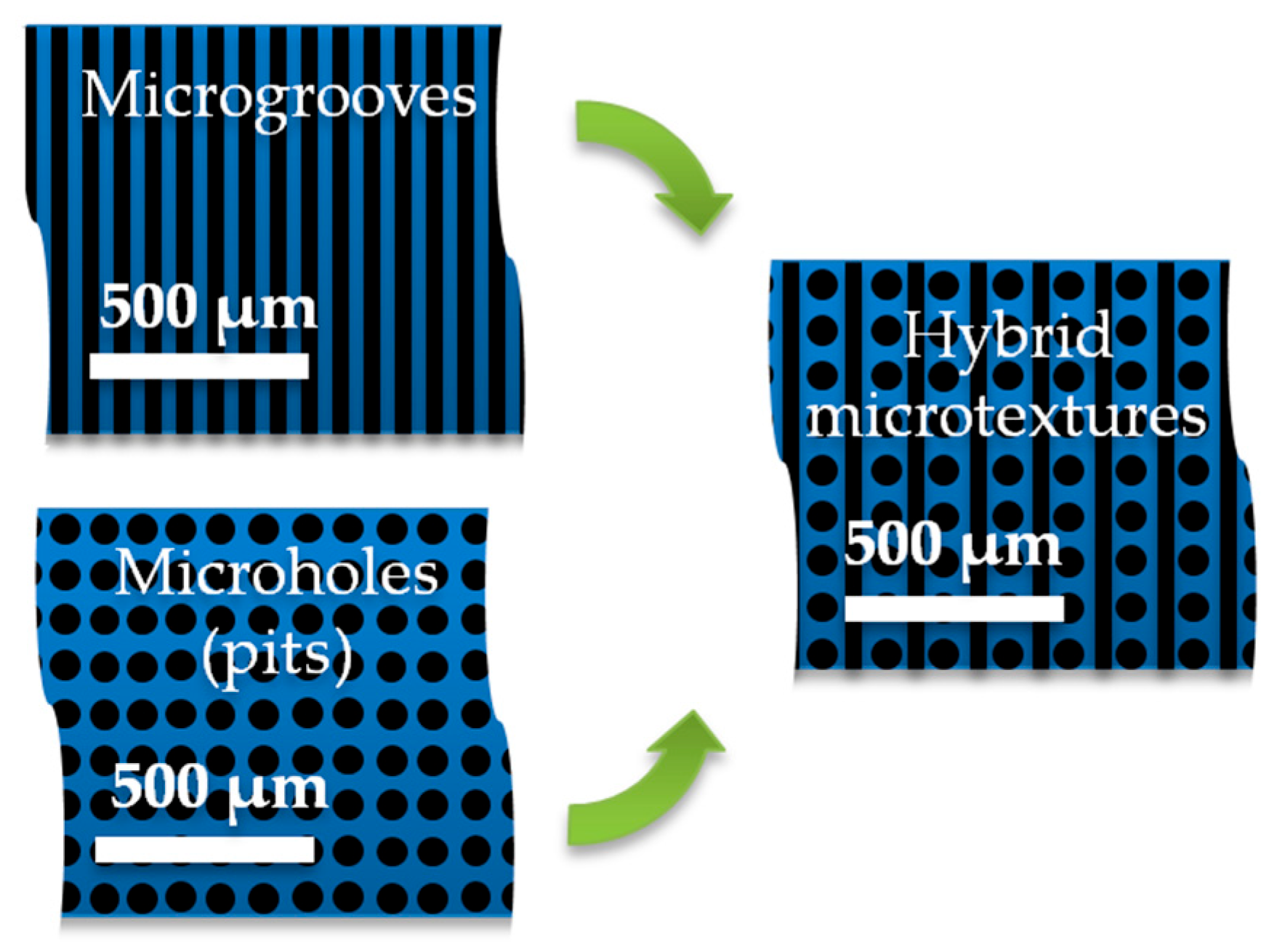
Three types of developed and produced microtextures on the rake face of the cutting tool made of hard alloy and inlaid with PCD for testing in milling SiCp/Al composite, where the green arrows show that the hybrid texture consisted of a combination of the developed microgrooves and microholes.
Figure 6.
Three types of developed and produced microtextures on the rake face of the cutting tool made of hard alloy and inlaid with PCD for testing in milling SiCp/Al composite, where the green arrows show that the hybrid texture consisted of a combination of the developed microgrooves and microholes.
Figure 7.
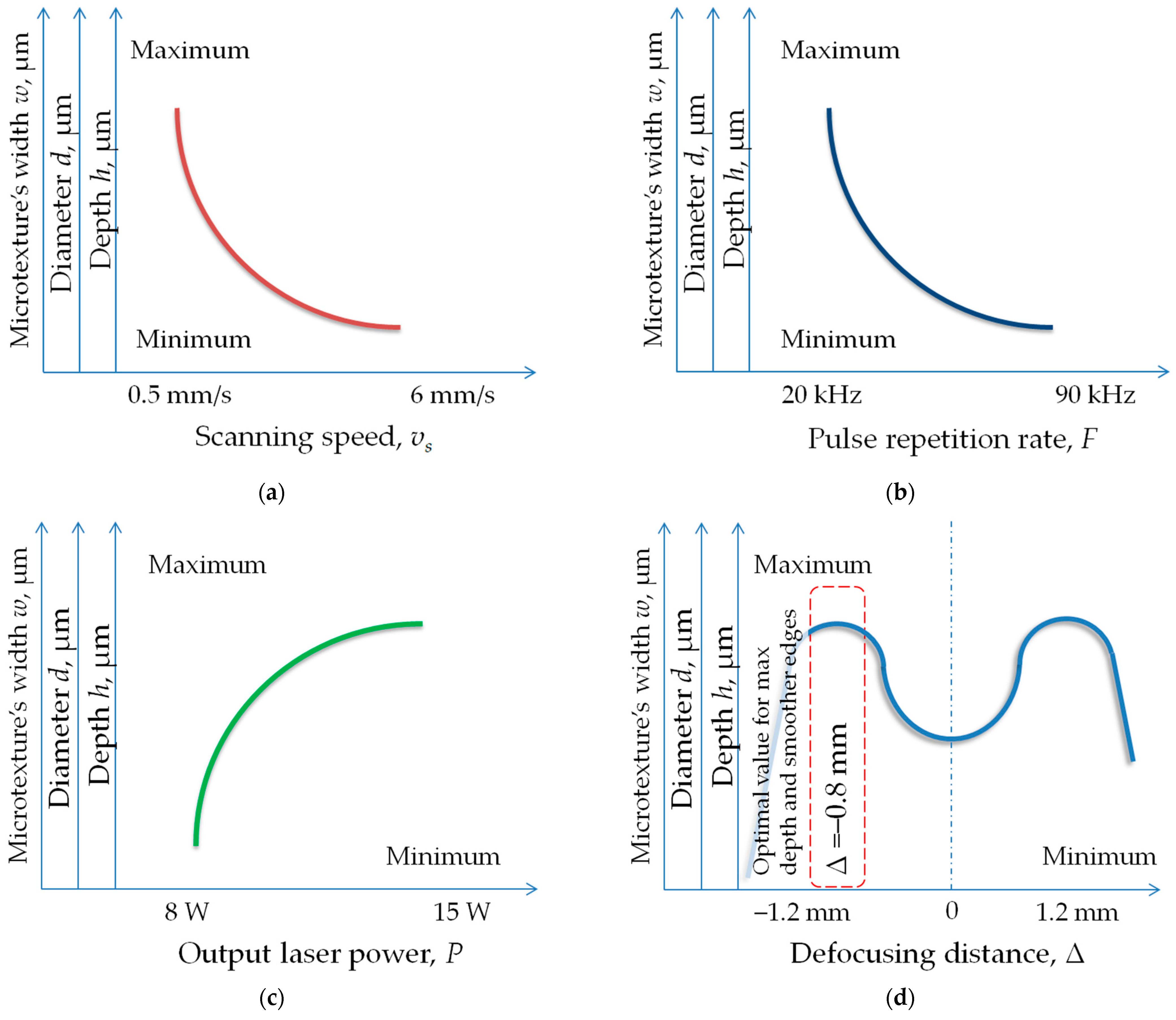
The influence of the infrared nanosecond-pulsed ytterbium fiber laser factors on the parameters of the microtextures produced on the rake face of the PCD tool, depending on (a) scanning speed; (b) pulse frequency; (c) laser power; (d) defocusing distance, where the section of the graph with the best result (the largest diameter, depth, and width of microtextures) is marked by a red dotted line box, where Δ = −0.8 mm.
Figure 7.
The influence of the infrared nanosecond-pulsed ytterbium fiber laser factors on the parameters of the microtextures produced on the rake face of the PCD tool, depending on (a) scanning speed; (b) pulse frequency; (c) laser power; (d) defocusing distance, where the section of the graph with the best result (the largest diameter, depth, and width of microtextures) is marked by a red dotted line box, where Δ = −0.8 mm.
Figure 8.
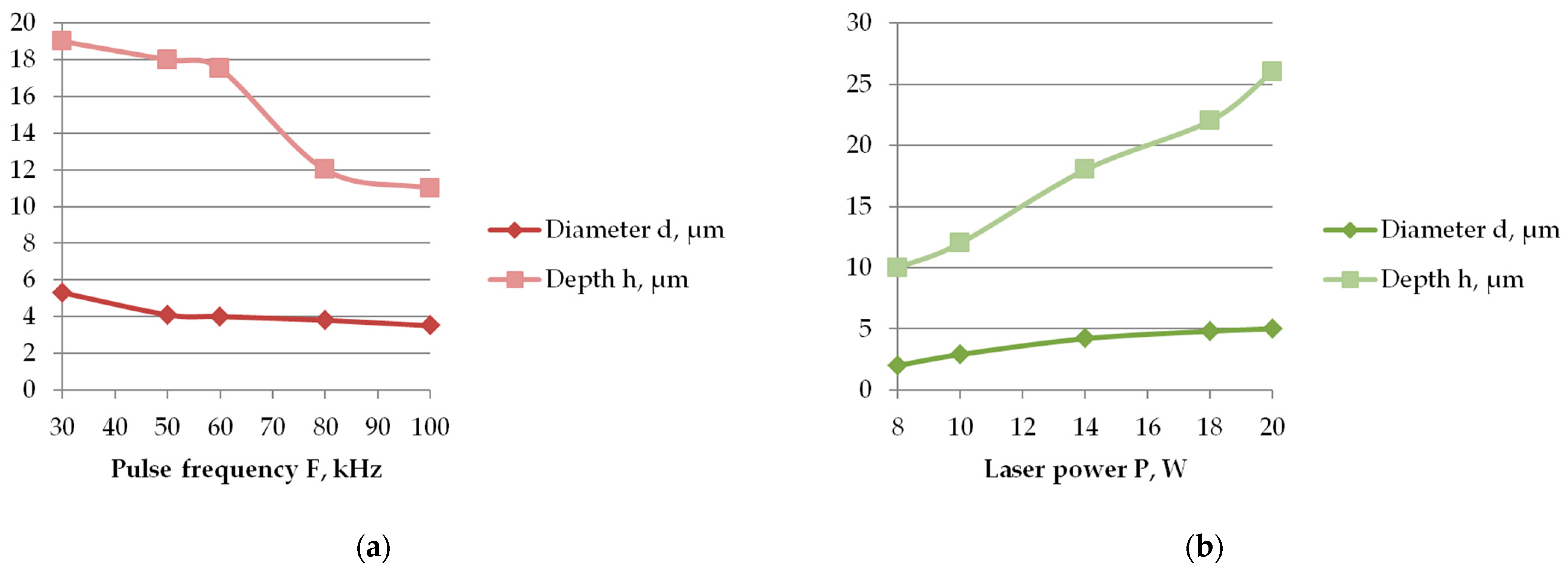
The dependence of the microhole parameters (diameter and depth) on the infrared nanosecond laser factors in microtexturing of the PCD cutting insert rake face: (a) pulse frequency; (b) power.
Figure 8.
The dependence of the microhole parameters (diameter and depth) on the infrared nanosecond laser factors in microtexturing of the PCD cutting insert rake face: (a) pulse frequency; (b) power.
Figure 9.
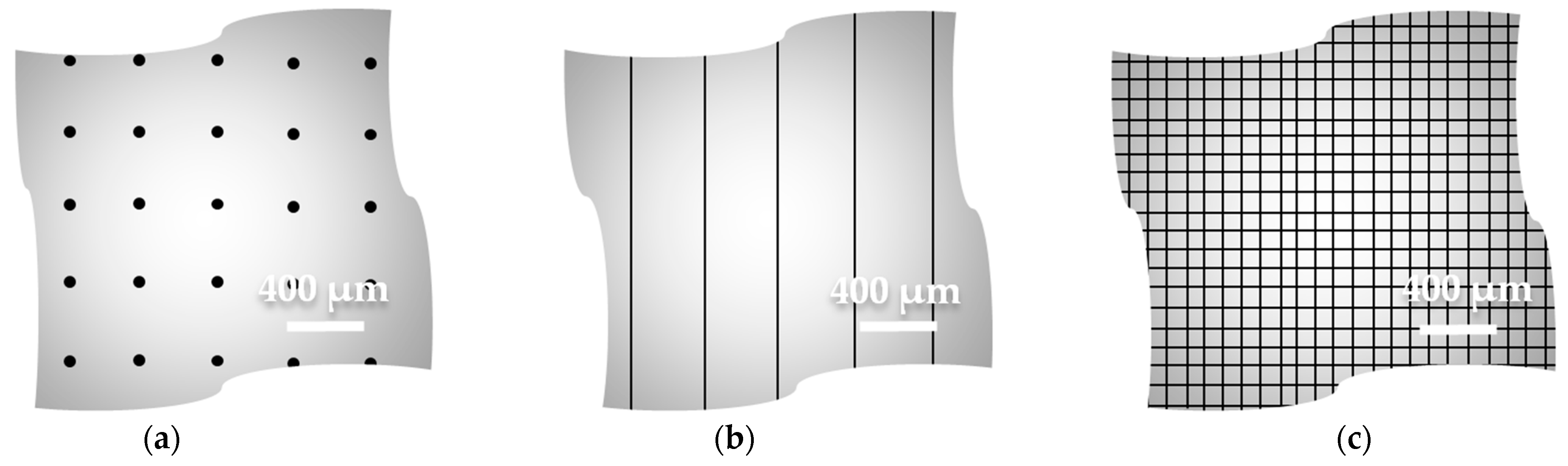
Graphical presentation of the microtextures on the PCD sample produced by femtosecond laser: (a) microholes; (b) microgrooves; (c) micronodes (cross-hatching).
Figure 9.
Graphical presentation of the microtextures on the PCD sample produced by femtosecond laser: (a) microholes; (b) microgrooves; (c) micronodes (cross-hatching).
Figure 10.
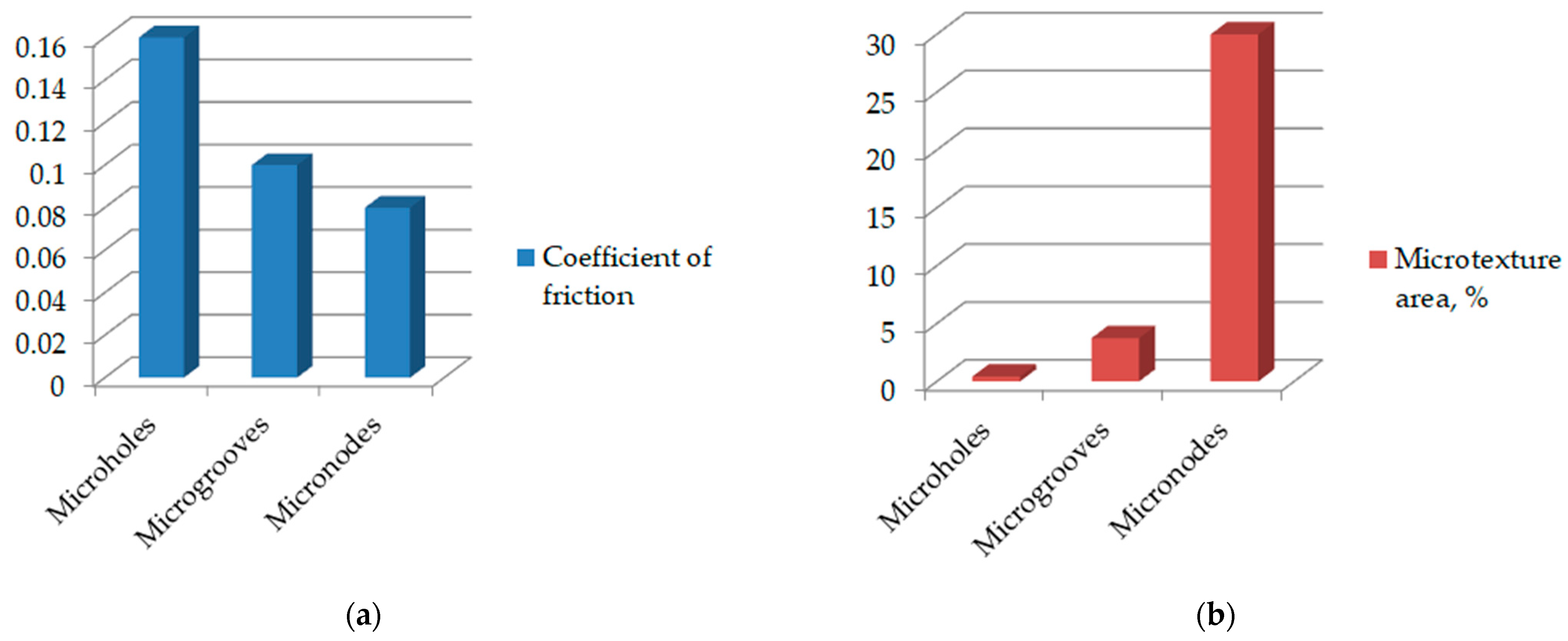
The correlation between the coefficient of friction of the PCD samples with various types of microtextures and the microtexture area (%): (a) coefficient of friction; (b) microtexture area (%), which was calculated as follows: .
Figure 10.
The correlation between the coefficient of friction of the PCD samples with various types of microtextures and the microtexture area (%): (a) coefficient of friction; (b) microtexture area (%), which was calculated as follows: .
Figure 11.
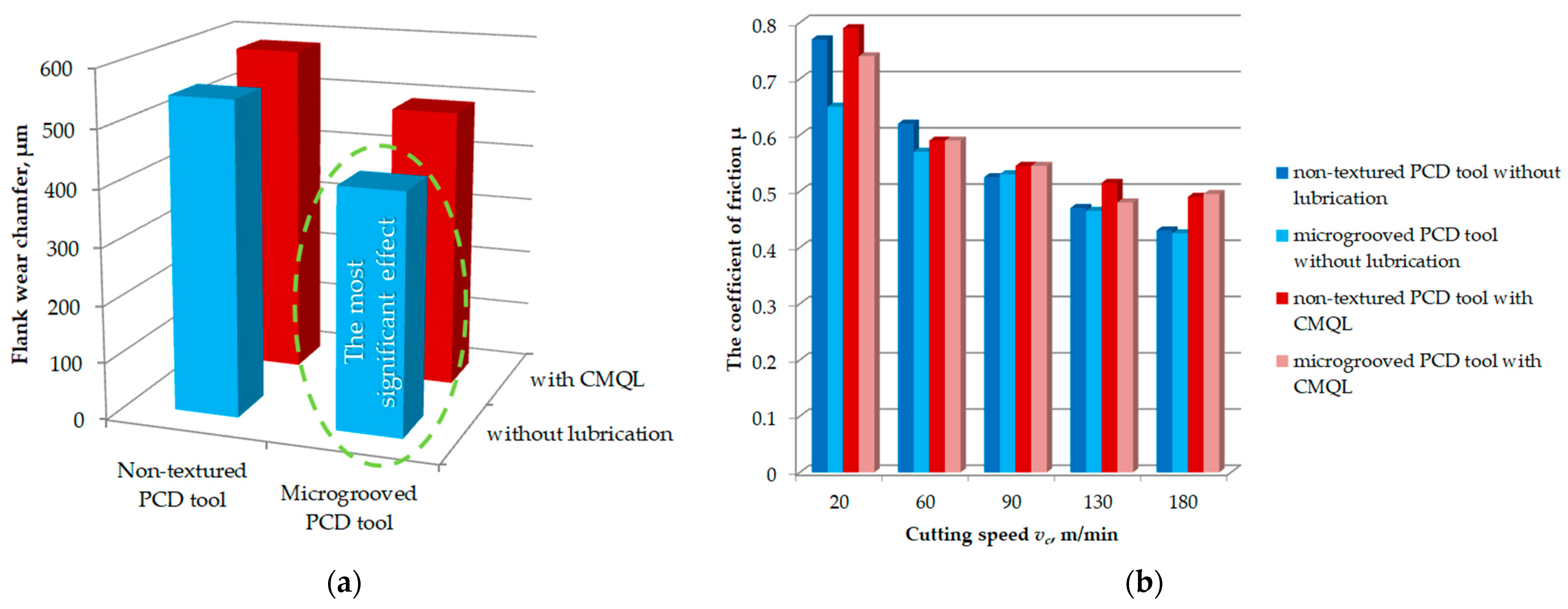
The flank wear chamfer of non-textured and microgrooved PCD tool options without lubrication and with CMQL at a feed rate (f) of 0.19 mm/r, a width of cut (ae) of 2 mm, and a cutting speed (vc) of ~176 m/min, where the most significant effect is marked by a green dotted line (a); the coefficient of friction μ for different experimental options at the cutting speed (vc) from 20 to 180 m/min (b).
Figure 11.
The flank wear chamfer of non-textured and microgrooved PCD tool options without lubrication and with CMQL at a feed rate (f) of 0.19 mm/r, a width of cut (ae) of 2 mm, and a cutting speed (vc) of ~176 m/min, where the most significant effect is marked by a green dotted line (a); the coefficient of friction μ for different experimental options at the cutting speed (vc) from 20 to 180 m/min (b).
Figure 12.
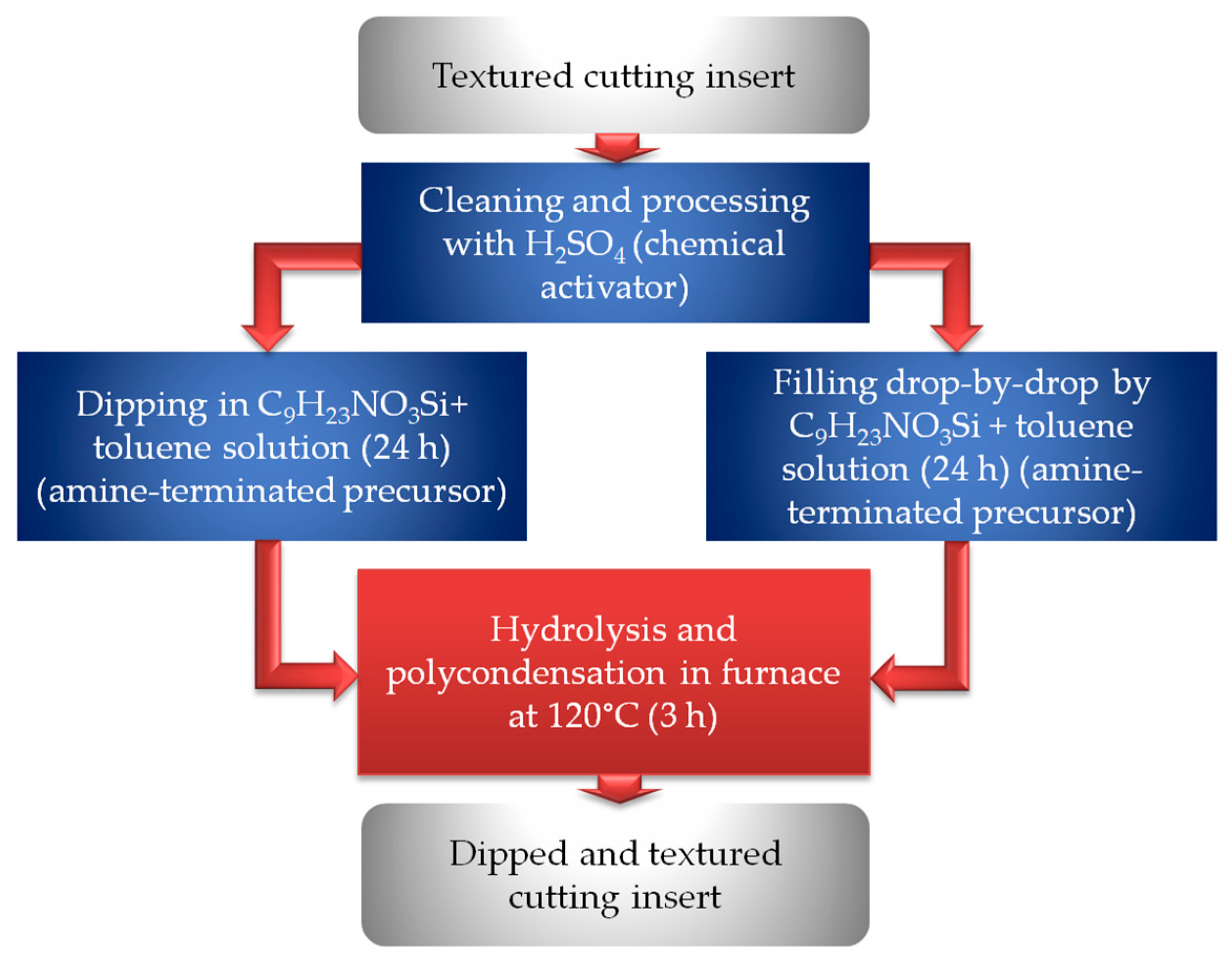
Schematic of the dip- and drop-coating methods for providing lyophobic wettability to the PCD cutting insert.
Figure 12.
Schematic of the dip- and drop-coating methods for providing lyophobic wettability to the PCD cutting insert.
Figure 13.
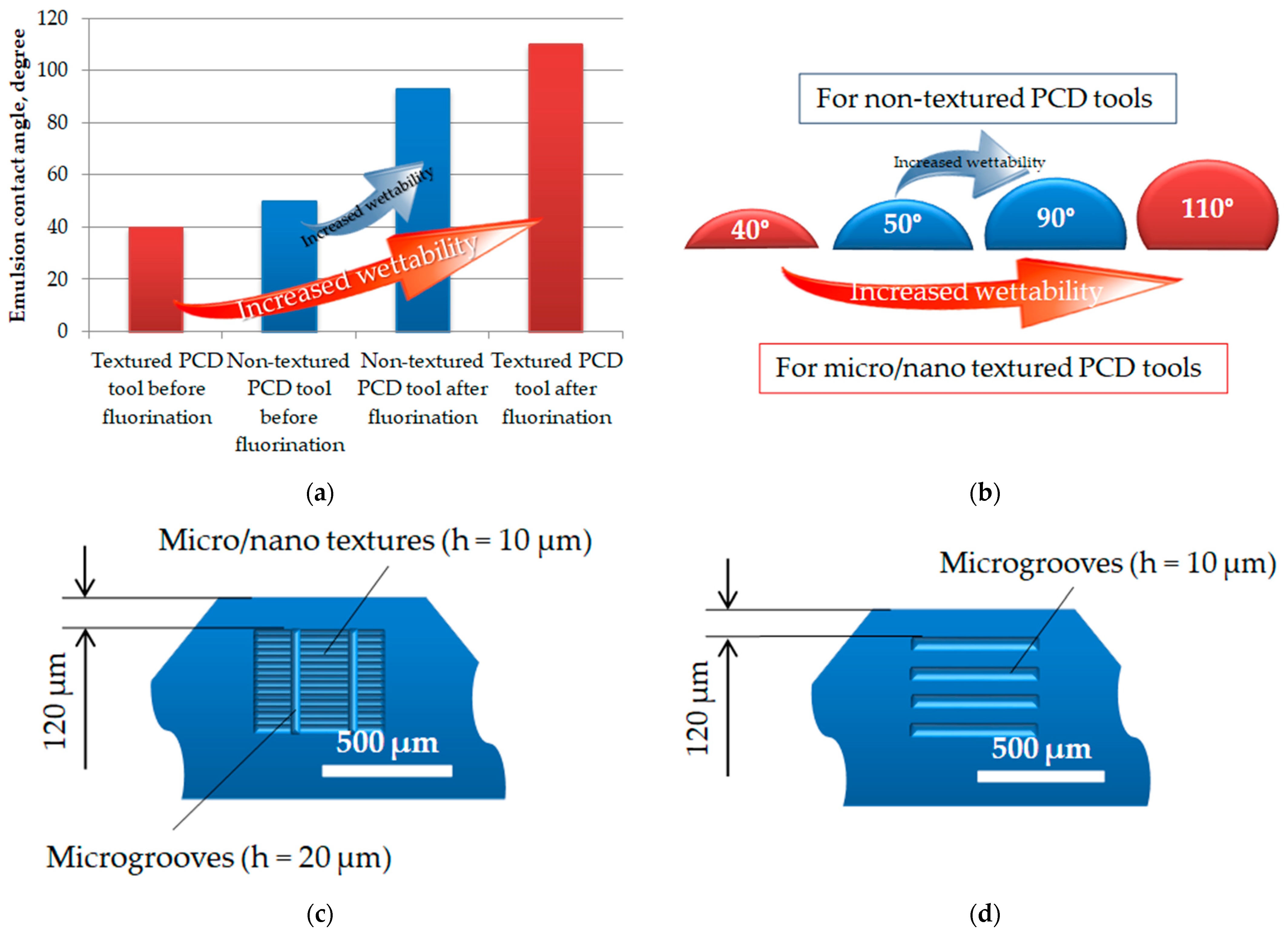
The influence of the fluorination on the wettability of the micro/nanotextured and non-textured PCD tools: (a) emulsion contact angle histogram for different PCD tool options; (b) the approximate shape of the cutting liquid depending on emulsion contact angle for different PCD tool options; (c) micro/nanotextures on the rake face of the PCD tool; (d) microgrooves on the rake face of the PCD tool.
Figure 13.
The influence of the fluorination on the wettability of the micro/nanotextured and non-textured PCD tools: (a) emulsion contact angle histogram for different PCD tool options; (b) the approximate shape of the cutting liquid depending on emulsion contact angle for different PCD tool options; (c) micro/nanotextures on the rake face of the PCD tool; (d) microgrooves on the rake face of the PCD tool.
Table 1.
The factors of laser engraving of microtextures in the shape of microgrooves and micronodes by a nanosecond-pulsed Nd:YAG fiber laser (ablation).
Table 1.
The factors of laser engraving of microtextures in the shape of microgrooves and micronodes by a nanosecond-pulsed Nd:YAG fiber laser (ablation).
| Factor | Measurement Unit | Value |
|---|
| Laser power (P) | W | 50 |
| Scanning speed (vs) | mm/s | 300–500 |
| Pulse frequency (F) | Hz | 30–50 |
| Pulse duration (τ) | ns | 250 |
| Laser spot diameter (d0) | µm | ø50 |
| Energy distribution | – | Gaussian |
Table 2.
The factors of etching of nanogrooves by a focused ion beam (ablation).
Table 2.
The factors of etching of nanogrooves by a focused ion beam (ablation).
| Factor | Measurement Unit | Value |
|---|
| Accelerating voltage (V) | KeV | 30 |
| Beam size 1 | pA | 600 |
| Liquid metal ion source | – | Gallium |
| Assisting gas | – | Not provided |
| Incident angle | degree | 0° |
| Ion dose | nC/μm2 | 20 |
Table 3.
The factors of laser engraving of micro/nanotextures by an infrared nanosecond-pulsed ytterbium fiber laser (ablation).
Table 3.
The factors of laser engraving of micro/nanotextures by an infrared nanosecond-pulsed ytterbium fiber laser (ablation).
| Factor | Measurement Unit | Value |
|---|
| Wavelength (λ) | nm | 1064 |
| Laser power (P) | W | 70 |
| Scanning speed (vs) | mm/s | 900 |
| Pulse frequency (F) | kHz | 70 |
| Pulse duration (τ) | ns | 260 |
| Laser beam diameter in the focal plane (d0) | µm | ~ø30 |
| Intensity of radiation (Ir) | % | 20 |
| Energy fluence (Φ) | J/cm2 | 3.38 |
Table 4.
The factors of laser engraving of microtextures by an infrared nanosecond-pulsed ytterbium fiber laser (ablation).
Table 4.
The factors of laser engraving of microtextures by an infrared nanosecond-pulsed ytterbium fiber laser (ablation).
| Factor | Measurement Unit | Value |
|---|
| Wavelength (λ) | nm | 1064 |
| Pulse frequency (F) | kHz | 20 |
| Pause duration (p) | ns | 100 |
| Outgoing laser beam diameter (D0) | mm | ø6.5 |
| Energy distribution | – | Gaussian |
| Laser spot shape | – | Elliptical |
Table 5.
The factors of laser engraving of microtextures by a femtosecond laser (ablation).
Table 5.
The factors of laser engraving of microtextures by a femtosecond laser (ablation).
| Factor | Measurement Unit | Value |
|---|
| Scanning speed (vs) | mm/s | 0.5 |
| Energy density (U) 1 | mW | 100 |
Table 6.
The factors of laser engraving of microholes on the rake face of a PCD tool for turning a SiCp/Al composite by an infrared nanosecond-pulsed ytterbium fiber laser (ablation).
Table 6.
The factors of laser engraving of microholes on the rake face of a PCD tool for turning a SiCp/Al composite by an infrared nanosecond-pulsed ytterbium fiber laser (ablation).
| Factor | Measurement Unit | Value |
|---|
| Wavelength (λ) | nm | 1064 |
| Laser power (P) | W | 20 |
| Pulse frequency (F) | kHz | 20 |
| Pulse duration (τ) | ns | 100 |
| Outgoing laser beam diameter (D0) | mm | ø6.5 |
Table 7.
The factors of laser engraving of microgrooves and microholes on the rake face of a PCD tool by an infrared nanosecond-pulsed ytterbium fiber laser (ablation) to investigate the influence of laser factors on the size of microgrooves and microholes.
Table 7.
The factors of laser engraving of microgrooves and microholes on the rake face of a PCD tool by an infrared nanosecond-pulsed ytterbium fiber laser (ablation) to investigate the influence of laser factors on the size of microgrooves and microholes.
| Factor | Measurement Unit | Value |
|---|
| Wavelength (λ) | nm | 1064 |
| Laser output power (P) | W | 8–15 |
| Scanning speed (vs) | mm/s | 0.5–6 |
| Pulse frequency (F) | kHz | 20–90 |
| Defocusing distance (Δ) | mm | from 1.2 to −1.2 mm |
Table 8.
The factors of laser engraving of microholes on the rake face of a PCD tool by an infrared nanosecond-pulsed ytterbium fiber laser (ablation) to investigate the influence of pulse frequency and power on the size of microholes.
Table 8.
The factors of laser engraving of microholes on the rake face of a PCD tool by an infrared nanosecond-pulsed ytterbium fiber laser (ablation) to investigate the influence of pulse frequency and power on the size of microholes.
| Factor | Measurement Unit | Value |
|---|
| Wavelength (λ) | nm | 1064 |
| Laser output power (P) | W | 8–20 |
| Pulse frequency (F) | kHz | 30–100 |
| Pulse duration (τ) | ns | 100 |
| Defocusing distance (Δ) | μm | from 2 to −2 |
| Energy per pulse (E) (for P = 20 W and F = 20 kHz) | mJ | 1 |
Table 9.
The factors of laser engraving of microtextures by an infrared femtosecond-pulsed titanium–sapphire fiber laser (ablation).
Table 9.
The factors of laser engraving of microtextures by an infrared femtosecond-pulsed titanium–sapphire fiber laser (ablation).
| Factor | Measurement Unit | Value |
|---|
| Wavelength (λ) | nm | 800 |
| Pulse frequency (F) | Hz | 1000 |
| Pulse duration (τ) | fs | 150 |
| Beam width (w0) | mm | 8 |
| Focal length (δ), distance from the optical center of the lens (the point of greatest sharpness) to the matrix | mm | 100 |
| Pulse energy (E) | μJ | 600 |
Table 10.
The correlation between the laser processing factors and microtextural parameters.
Table 10.
The correlation between the laser processing factors and microtextural parameters.
| Ref. | Microtexturing | Parameters of Microtextures, µm | Effect |
|---|
| Technology | Factors |
|---|
| [41] | Nanosecond fiber laser (Ytterbium) | P = 8–15 W, vs = 0.5–6 mm/s, F = 20–90 kHz, Δ = 0.5–1.2 mm | Microgrooves and microholes: w = 30 µm, h = 55 µm for the microgrooves and d = 60 µm, h = 73 µm for the microholes | The width, diameter, and depth of the microtextures are reduced with a higher scanning speed and pulse repetition rate and a lower average output power; the maximum depth (h) and smoother edges were achieved when Δ = −0.8 mm |
| [68] | Nanosecond fiber laser (Ytterbium) | P = 8–20 W, F = 20–100 kHz, Δ = 4 μm, λ = 1064 nm, τ = 100 ns,
E = 1 mJ (for 20 W and 20 kHz), d0 = 1.265 µm (emission diameter = 6.5 mm), M2 < 1.4 | Microholes d = 2–10 µm | High laser power, low pulse frequency, and large positive defocus are used to process the PCD surface to obtain a large diameter.
The vase-shaped microholes occur under circumstances of positive defocusing amount, low pulse frequency, and high power |
| [69] | Femtosecond laser (Ti-Sapphire) | τ = 150 fs, λ = 800 nm, F = 1000 Hz,
w0 = 8 mm, Δ = 100 mm, E = 600 μJ | Microgrooves, microholes, micronodes (cross-hatching) | The coefficient of friction for micronodes was 0.08, CoF 1 was 0.10 for microgrooves, and CoF was 0.16 for microholes |
Table 11.
The factors of laser engraving of microgrooves by an infrared nanosecond-pulsed ytterbium fiber laser (ablation).
Table 11.
The factors of laser engraving of microgrooves by an infrared nanosecond-pulsed ytterbium fiber laser (ablation).
| Factor | Measurement Unit | Value |
|---|
| Wavelength (λ) | nm | 1055–1070 |
| Laser power (P) | W | 12 |
| Scanning speed (vs) | mm/s | 2 |
| Pulse frequency (F) | Hz | 20 |
| Pulse duration (τ) (characteristics of the laser source) | ns | 100 |
| Defocusing distance (Δ) | mm | –0.6 |
| Repeat number (β) | times | 50 |
Table 12.
The factors of laser engraving of lyophobic micro/nanostructures and lyophilic grooves (Step 1) by an infrared nanosecond-pulsed ytterbium fiber laser (ablation).
Table 12.
The factors of laser engraving of lyophobic micro/nanostructures and lyophilic grooves (Step 1) by an infrared nanosecond-pulsed ytterbium fiber laser (ablation).
| Factor | Measurement Unit | Value |
|---|
| Wavelength (λ) | nm | 1064 |
| Scanning speed (vs) | mm/s | 80 |
| Pulse duration (τ) | ns | 100 |
| Focal length (δ) | mm | 210 |
| Pulse energy (E) | mJ | 0.25 |
| Repeat number of laser scanning (β) | times | 2 |
Table 13.
The factors of laser engraving of lyophobic microgrooves perpendicular to the direction of micro/nanotextures (Step 3) by an infrared nanosecond-pulsed ytterbium fiber laser (ablation).
Table 13.
The factors of laser engraving of lyophobic microgrooves perpendicular to the direction of micro/nanotextures (Step 3) by an infrared nanosecond-pulsed ytterbium fiber laser (ablation).
| Factor 1 | Measurement Unit | Value |
|---|
| Scanning speed (vs) | mm/s | 200 |
| Pulse energy (E) | mJ | 0.7 |
| Repeat number of laser scanning (β) | times | 1 |
Table 14.
Effect of lyophobic wettability of microtextures, including fluorination as a step in PCD tool rake face treatment and dip- and drop-based coating techniques, on PCD tool performance in cutting hard-to-cut materials.
Table 14.
Effect of lyophobic wettability of microtextures, including fluorination as a step in PCD tool rake face treatment and dip- and drop-based coating techniques, on PCD tool performance in cutting hard-to-cut materials.
| Ref. | Workpiece Material | Microtexturing | Parameters of Microtextures, µm | Effect |
|---|
| Technology | Factors |
|---|
| [37] | Al 6061-T6 alloy | ND: YAG fiber laser graving | | Cross-chevron textures + dip- and drop-based lyophobic wettability coatings: l = 1.5 mm, wt = 1.5 mm, w = 80 µm, angle = 40°, h = 200 µm | Reduction was by 60–65% for cutting force and 60–62% for thrust force comparing the dip-based lyophobic wettability inserts with cross-chevron textures and non-textured cutting inserts |
| [39] | Ti6Al4V alloy | Fiber laser graving (1) + fluorination (2) + fiber laser graving (3) | Steps 1 and 3: τ = 100 ns, λ = 1064 nm, Δ = 210 mm, E = 0.25 mJ and 0.27 mJ, vs = 80 mm/s and 200 mm/s, laser scanning times β = 2 and 1 Step 2: 0.8% fluoroalkyl silane solution for 24 h + oven at 140 °C for 120 min
| Micro/nanotextures: m = 120 µm, w = 30 µm, (1) s = 30 μm, h = 20 µm for textures with the peaks of 10 µm;
(3) h = 20 µm for microgrooves | The coefficient of friction for fluorinated textured tools decreased by 11–12%, the flank wear was reduced by 22.3%, and reduction in cutting forces was by 4–6% |
Table 15.
Effect of microtextures on PCD tool performance in cutting hard-to-cut materials.
Table 15.
Effect of microtextures on PCD tool performance in cutting hard-to-cut materials.
| Ref. | Cutting Technology | Cutting Tool | Workpiece Material | Microtexturing | Parameters of Microtextures, µm | Effect |
|---|
| Technology | Factors |
|---|
| [33] | Turning | PCD cutting insert | Ti6Al4V alloy | Electrical discharge machining (sublimation) | Copper wires with diameters of 0.4 mm and 0.6 mm + deionized water | Microholes with tunnels | Tool flank wear reductions by 40–62% |
| [34] | Turning | PCD cutting insert | Ti6Al4V alloy | Nanosecond laser micrograving (ablation, usually infrared ytterbium fiber) | τ = 250 ns, F = 30–50 Hz, vs = 300–500 mm/s | Microgrooves: m = 100 µm, w = 50 µm, s = 50 µm, d = 10 µm, r = 0.02–0.05 mm; h = 10 µm | Helical chip shape at 0° and 45°, no reduction in cutting forces, insignificant reduction in roughness |
| [35] | Turning | PCD tool | Ti6Al4V alloy | Infrared nanosecond ytterbium fiber laser micrograving (ablation) | λ = 1055–1070 nm, τ = 100 ns, vs= 2 mm/s F = 20 kHz, P = 12 W; Δ = −0.6 mm, β = 50 times, production time = 1500 s | Microgrooves: m = 300 µm; l = 1500 µm, w = 60 µm, h = ~60–63 µm, s = 85 µm | The microgrooved tool reduced the flank wear by 23.6%; the coefficient of friction μ for the microgrooved tool without lubrication was 3–18% less than that for the non-textured PCD tool with cryogenic lubrication |
| [36] | Microcutting | PCD tool | SiCp/Al composite | Infrared nanosecond ytterbium fiber laser micrograving (ablation) | p = 100 ns, F = 20 kHz, λ = 1064 nm, D0 = 6.5 mm | Microgrooves: m = 25–45 µm, w = 16 µm, s = 40–80 µm, l = 1000 µm, d = 70 µm, h = 70 µm | Microgrooves with m = 35 µm and s = 40 µm—reduction in cutting forces by 4–20% and Ra by 22% |
| [38] | Milling | Hard alloy tool inlaid with PCD | SiCp/Al composite | Femtosecond laser micrograving (ablation) | U = 100 mW 1, vs = 0.5 mm/s | Hybrid (microgrooves + microholes): d = 50 µm, w = 15 µm, s1 = s2 =70 µm | The operational life was improved by 2.13 times, the flank wear was reduced by 54%; Ra was 1.4 µm |
| [40] | Turning | PCD cutting insert | Al 6082 alloy | Infrared nanosecond ytterbium fiber laser micrograving (ablation) | P = 70 W, λ = 1064 nm, τ = 260 ns, F = 70 kHz | Microgrooves: h = 260 nm, w = 7 μm, s = 20 μm | Parallel-to-chip-flow-direction grooves reduced the cutting forces by 12%, adhesion by 59%, and the coefficient of friction by 14% |
| [42] | Ultra-precision machining | PCD tool | Tungsten carbide (hard alloy) | Fused ion beam etching | Accelerating voltage of 30 KeV, beam size of 600 pA, ions of gallium, incident angle of 0°, ion dose of 20 nC/μm2 | Nanogrooves:
m = 2 µm; l = 35–120 µm, w = 0.8 µm, h = 1 µm, s = 1 µm | The coefficient of friction of parallelly and perpendicularly nanotextured tools to the cutting direction of nanotextured tools was improved by 7% and 10%, respectively, Ra parameter was improved by 3–5% for parallelly textured tools. Perpendicularly textured tools have shown no effect |
| [67] | Turning | PCD tool | SiCp/Al composite | Infrared nanosecond ytterbium fiber laser ablation | P = 20 W, λ = 1064 nm, τ = 100 ns, F = 20 kHz, D0 = 6.5 mm | Microholes: m = 35 μm, s = 60 μm | The cutting forces were reduced by 22%; the black wear scratching, tool wear, and adhesion were reduced |





 ,
,