1. Introduction
Natural and human-made disasters pose escalating threats to communities, infrastructures, and communication systems worldwide. Conventional infrastructures such as cellular towers and radio repeaters are often rendered inoperable during crises, leaving first responders without dependable channels for information exchange. This vulnerability emphasizes the urgent need for adaptive, robust, and decentralized communication mechanisms that can withstand disruptive environments [
1,
2].
Reliable communication is essential for situational awareness, effective coordination of rescue operations, and timely dissemination of critical alerts [
3,
4]. To this end, Unmanned Aerial Vehicles (UAVs), or drones that can access hazardous or hard-to-reach areas, are highly beneficial for applications ranging from aerial surveillance and victim detection to real-time mapping and emergency communication restoration, because of their high mobility, rapid deployability, and cost-effectiveness [
5,
6]. UAVs have also proven effective across all three phases of disaster management (before, during, and after), using diverse airframe types such as fixed-wing platforms for large-area patrol and rotary-wing platforms for tactical deployments [
7,
8]. Equipped with thermal sensors, millimeter-wave radar, and GPS modules, UAVs can autonomously detect survivors, navigate complex environments, and transmit situational data in real time [
9].
Recently, Flying Ad Hoc Networks (FANETs), self-organizing networks of UAVs, have emerged as a transformative technology to overcome the limitations of ground-based communication systems, offering rapid situational awareness, flexible deployment, and resilient connectivity in disaster environments. However, the design of FANETs presents several challenges, particularly in developing clustering and routing strategies that ensure both network survivability and secure data exchange under constrained resources. Prior studies have highlighted UAVs’ potential to restore communication in emergencies. Erdelj and Natalizio [
10] demonstrated UAVs’ ability to form temporary ad hoc networks for victims and first responders, while Liu and Ansari [
11] examined UAV-mounted base stations for machine-to-machine (M2M) communications in areas with damaged cellular infrastructure. Building on these foundational efforts, subsequent works have explored clustering and routing for improved survivability. For example, Nguyen et al. [
12] proposed a low-complexity, distributed user-clustering model for real-time cellular recovery, while distributed clustering of ground devices under UAV coverage was shown to enhance energy efficiency and link stability [
13]. Although these schemes improve network lifetime, they do not directly integrate trust or security into the clustering process. In terms of routing, Rahman et al. [
14] introduced a centralized software-defined networking (SDN) algorithm to maximize throughput in disaster-stricken areas, while Zhou et al. [
15] proposed a hierarchical SDN-based multi-UAV architecture that improved lifetime and responsiveness compared to legacy protocols such as AODV and OLSR. Similarly, UbiQNet [
16] demonstrated adaptive neighbor discovery for drone-based mesh networks, enabling rapid deployment in disaster zones. While these frameworks effectively enhance connectivity, they often lack explicit mechanisms for secure data exchange and adaptive reconfiguration under adversarial conditions. Recent research has begun to incorporate resilience and security into clustering and routing. Hafeez et al. [
17] employed blockchain-enhanced UAV networks to mitigate spoofing and denial-of-service attacks, while Wu et al. [
18] utilized free-space optical (FSO) links to achieve both high data rates and strong physical-layer security. In parallel, Li et al. [
19] optimized UAV deployment and spectrum allocation in Non-orthogonal multiple access (NOMA)-enabled relaying drones using learning-based algorithms, demonstrating how routing can be made both scalable and resource-efficient. Despite these advances, most approaches address either survivability, or efficiency, or security in isolation. Very few frameworks holistically combine clustering, routing, and trust management into a single architecture tailored for highly dynamic FANET environments.
Motivated by these limitations, this paper introduces WAA-CR, a Weighted Average Algorithm-based Clustering and Routing framework for secure and efficient UAV communication in disaster response networks. WAA-CR integrates multiple lightweight modules to enhance communication resilience. It features a WAA-based metaheuristic optimizer for cluster head (CH) selection and shelter location planning [
20], a trust-authentication model to filter out unverified UAVs [
21], a multi-objective fitness function for clustering and routing, and an adaptive maintenance mechanism to dynamically reconfigure clusters and routes. The research objectives guiding the design of WAA-CR are fivefold:
Conduct a comprehensive review of disaster communication techniques, with emphasis on disaster detection, network survivability, and secure data exchange.
Develop a resilient FANET architecture capable of maintaining robust communication even under failures and high-mobility conditions.
Integrate shelters or Ground Control Stations (GCSs) as communication anchors to minimize latency, reduce routing overhead, and improve efficiency during disaster response.
Minimize the number of active UAVs required for data collection, communication, and coverage, while preserving connectivity and functionality.
Ensure secure inter-UAV communication through a lightweight, trust-based authentication framework that protects against malicious activity while maintaining confidentiality and integrity of transmitted data.
Through these objectives, WAA-CR advances the design of a resilient, scalable, and secure FANET architecture that can operate effectively in post-disaster environments. By jointly considering optimization, trust, authentication, and dynamic network conditions, the framework contributes to next-generation emergency communication systems capable of saving lives and supporting critical infrastructure recovery.
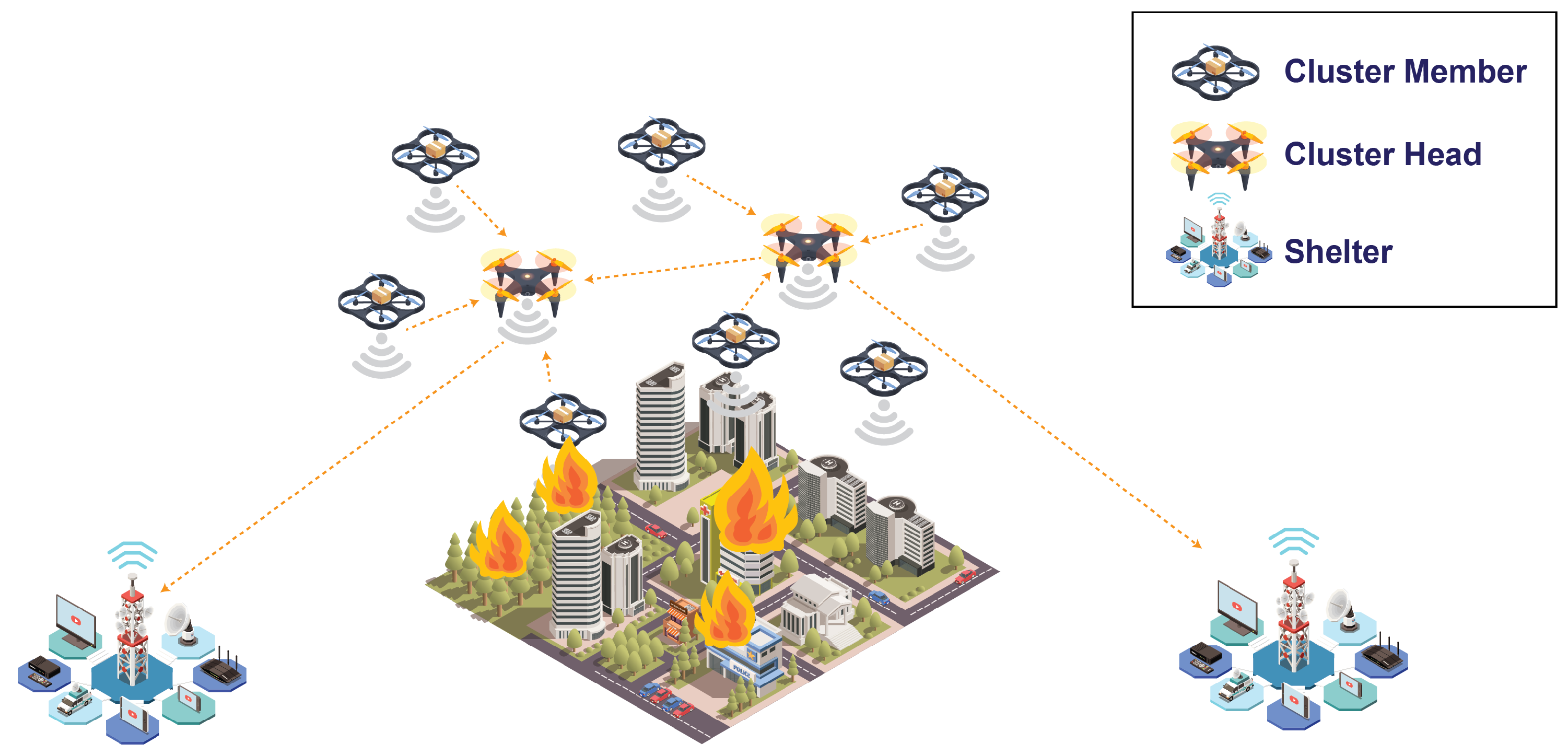
Figure 1 shows an example illustration of the proposed WAA-CR framework in a fire disaster scenario. UAVs are organized into clusters, where Cluster Members (CMs) communicate with a designated CH. The CH coordinates intra-cluster communication and forwards data to shelters or GCSs, which act as communication anchors. By combining shelter-based infrastructure with trust and energy-aware clustering and routing, WAA-CR ensures resilient, secure, and adaptive communication even when traditional infrastructure is disrupted by disasters.
The key contributions of this paper are as follows:
A novel WAA-CR (Weighted Average Algorithm-based Clustering and Routing) framework is proposed for secure, efficient, and adaptive communication in FANETs. It leverages a WAA metaheuristic optimizer for CH selection.
A shelter-aware cluster formation process is introduced, beginning with shelter location optimization and followed by cluster count estimation and WAA-based CH selection that jointly consider trust, energy, mobility, and communication metrics.
A lightweight trust and authentication model is integrated into the clustering and routing processes to ensure that only verified, reputable UAVs participate in communication, thereby enhancing network resilience and security. This model incorporates an Exponentially Weighted Moving Average (EWMA) model-based trust formulation, which dynamically updates each UAV’s trust level by combining recent behavioral evidence with historical trust values. This adaptive strategy enhances the network’s resilience against misbehavior and supports secure, real-time UAV collaboration.
A multi-objective, trust-based routing phase is developed using composite quality metrics (e.g., residual energy, trust, hop count, speed variation, link stability) for robust and delay-aware path formation toward shelters (GCS nodes).
An adaptive maintenance mechanism is implemented to handle CH mobility, trust decay, node failures, and dynamic CM reassignment, maintaining consistent connectivity and reducing reconfiguration overhead in dynamic environments.
Extensive simulations are conducted to evaluate the WAA-CR framework against existing state-of-the-art methods, including clustering and routing protocols. The results demonstrate improvements in energy efficiency, cluster lifetime, trust accuracy, and end-to-end delivery performance.
The remainder of this paper is organized as follows.
Section 2 reviews related work on drone-assisted emergency communication networks, as well as secure clustering and routing approaches in FANETs.
Section 3 describes the system model, including UAV mobility, energy, communication, and trust computation.
Section 4 introduces the overall WAA-CR architecture and outlines its core building blocks.
Section 5 presents the preprocessing modules, where
Section 5.1 discusses shelter (GCSs) and explains its role in guiding clustering and routing, and
Section 5.2 details the cluster count estimation procedure.
Section 6 describes the lightweight authentication submodule and its integration with trust evaluation.
Section 7 discusses the core modules;
Section 7.1 elaborates the WAA-based CH selection and clustering methodology, including the CM Assignment process (
Section 7.2), while
Section 7.3 and
Section 7.4 address the trust-aware routing phase and adaptive maintenance mechanisms. The operational role of WAA-CR in post-disaster communication restoration is presented in
Section 8.
Section 9 provides the simulation results and performance analysis. Finally,
Section 10 concludes the paper and outlines future research directions.
2. Related Work
The goals of drone-assisted emergency communications, including rapid restoration, wide-area coverage with minimal assets, resilience to failures, and secure data exchange, map directly onto the design of clustering and routing in FANETs.
The literature on UAV-enabled disaster response spans two interdependent layers: (i) system-level emergency communications, which target rapid restoration of connectivity, wide-area coverage with limited assets, secure backhaul, and operational endurance; and (ii) network-layer clustering and routing in FANETs, which provide the self-organization and data-plane mechanisms that realize those service goals under mobility, resource, and adversarial constraints. To make these threads explicit and comparable, we structure our review into two subsections that mirror this separation of concerns. The first subsection, Drone-Assisted Emergency Communications, surveys frameworks and building blocks that directly affect time-to-first-connectivity, resilient backhaul (e.g., UAV relays, SDN control, and FSO links), security primitives (e.g., blockchain-based trust), and endurance (e.g., tethering and energy-aware deployment), and includes field validations. The second subsection, Clustering and Routing in UAV-Based FANETs, examines the mechanisms by which UAV swarms self-organize and forward data, CH election, cluster sizing and maintenance, trust-aware metrics, mobility prediction, learning- and metaheuristic-based optimization, and multipath and load-aware routing—thereby operationalizing the emergency communication requirements. This two-part structure clarifies what capabilities post-disaster systems must provide and how FANET protocols deliver them in highly dynamic environments. It also reveals a persistent gap: many works optimize survivability, security, or efficiency in isolation, whereas practical deployments demand their simultaneous satisfaction.
Table 1 and
Table 2 synthesize representative studies across these layers and motivate our integrated design, WAA-CR, which couples shelter-aware clustering, trust-based authentication, multi-objective routing, and adaptive maintenance into a unified framework.
2.1. Drone-Assisted Emergency Communications
Disaster communication and detection systems have become increasingly vital due to the rising frequency and severity of modern disasters. FANETs have emerged as a transformative technology to overcome the limitations of traditional ground-based systems, offering rapid situational awareness, flexible deployment, and network resilience in disaster environments [
3,
4]. This section provides a comprehensive review of existing UAV-based methods for disaster detection and network survivability, with particular focus on their effectiveness in maintaining secure and reliable data exchange, as follows.
A foundational application of UAVs in disaster management lies in their ability to serve as rapidly deployable communication relays. Erdelj and Natalizio [
10] highlighted UAVs’ capacity to establish temporary ad hoc networks that restore connectivity for victims and emergency responders, while addressing challenges such as limited flight time and bandwidth allocation. Similarly, Liu and Ansari [
11] investigated resource allocation for UAV-mounted Bss to support M2M communications among human-carried devices in areas where cellular infrastructure has been destroyed. These efforts demonstrate that UAV systems can extend network coverage to affected zones while efficiently managing communication resources. To further enhance network survivability, researchers have proposed optimized UAV positioning and trajectory planning. Rahman et al. [
14] introduced a centralized control algorithm within an SDN framework to maximize throughput in disaster-stricken areas. Nguyen et al. [
12] developed a low-complexity, distributed user-clustering model for real-time recovery of disaster-affected cellular networks, enabling rapid convergence and adaptability to emergency scenarios. These approaches are essential for conserving energy while ensuring robust communication links. Chowdhury and Rahnemoonfar [
22] developed a self-attention-based semantic segmentation model for UAV imagery to assess infrastructure damage with high accuracy.
In the context of secure and resilient data exchange, blockchain technology has emerged as a promising solution. Hafeez et al. [
17] presented a blockchain-enhanced UAV network architecture for post-disaster communication, utilizing a hybrid consensus protocol to ensure privacy, decentralized control, and resilience to cyberattacks such as denial-of-service and spoofing. Their system demonstrated scalability to hundreds of UAVs with minimal latency, underscoring the importance of secure data exchange in multi-UAV networks. Qiu et al. [
23] propose a multi-agent proximal policy optimization framework for UAV trajectory control during disasters. By optimizing energy consumption and communication coverage, their approach ensures reliable UAV-based emergency communication, directly addressing challenges in network disruption and disaster recovery. This illustrates the potential of reinforcement learning to enable dynamic and context-aware UAV deployments, forming a critical layer for integrating secure communication protocols under constrained conditions. Wu et al. [
18] introduced an FSO-based drone-assisted mobile access network designed for emergency scenarios, where terrestrial infrastructure is unavailable. By leveraging high-speed, interference-resistant FSO links between UAVs, their architecture enables rapid restoration of backhaul communication with strong directionality and low interception risk. This contributes to network survivability and supports secure data transmission in post-disaster environments, making it a promising physical-layer solution for UAV-based emergency networks.
To address energy constraints and maintain persistent coverage, Saif et al. [
24] utilized tethered UAVs powered by ground stations, facilitating continuous operation in disaster monitoring. Complementing this, the study in [
13] explored distributed clustering of ground user devices to enhance energy efficiency and connectivity under UAV coverage in post-disaster scenarios. These cooperative strategies effectively extend mission durations while maintaining reliable communications. Zhou et al. [
15] proposed an SDN-based architecture for multi-UAV emergency communication, enabling rapid deployment and flexible reconfiguration in disaster zones. Their hierarchical approach improves network lifetime and responsiveness compared to traditional routing protocols like AODV and OLSR. Although not focused on cryptographic techniques, the architecture offers a flexible control structure well-suited for integrating secure data exchange mechanisms, thereby providing a strong basis for resilient post-disaster UAV communication systems.
To validate UAV-based solutions for restoring communication in field conditions, McRae et al. [
25] conducted real-world tests of a drone-mounted radio repeater system across 10 rugged search and rescue (SAR) sites. Their results demonstrated that aerial repeaters could reliably restore communication within minutes in all cases, even in complex terrain like canyons or mountains. While not explicitly focused on encryption, their work establishes a robust physical communication layer essential for secure and resilient post-disaster data exchange in UAV networks. For disaster scenarios involving obstructed environments and limited infrastructure, RESTORE [
26] proposes a drone-assisted Non-Line-of-Sight Free-Space Optical (FSO) communication system to maintain backhaul connectivity. RESTORE leverages the intrinsic security and high bandwidth of FSO links while integrating low-energy relay selection and distributed scheduling to extend UAV mission life. Its focus on physical-layer resilience and minimal coordination overhead offers a secure and energy-efficient foundation for post-disaster communication, complementing higher-layer secure data exchange mechanisms.
To address the critical communication gap in the first hours following a disaster, UbiQNet was proposed as a drone-based mesh network architecture [
16]. It repurposes commercially available drones, equipped with ESP-based communication chips, to create a mesh network through which victims can communicate their status and location to responders. The architecture includes an adaptive neighbor-discovery algorithm and a mobile app interface for usability in real-world disaster zones. Unlike traditional systems that require hours to establish connectivity, UbiQNet enables rapid, resilient, and scalable communication, thereby significantly reducing response delays. Beyond communication, UAV-based sensing has proven valuable for early warning and situational awareness. For instance, Wan et al. [
27] developed a hyperspectral UAV–ground joint observation system for environmental disaster monitoring at tailing reservoirs, illustrating the effectiveness of aerial–ground sensor integration. Zacharie et al. [
28] applied UAV-based human detection through image processing to support search and rescue operations, expanding the UAV’s role into active field surveillance. To enhance network recovery in post-disaster scenarios, recent work has integrated relaying drones with non-orthogonal multiple access (NOMA) schemes. By jointly optimizing three-dimensional UAV deployment and spectrum allocation, a QoS-driven sum rate maximization problem was formulated to serve cell edge users (CEUs) [
19]. The problem was decomposed using an LSTM-based recurrent neural network for drone placement and the Hungarian algorithm for spectrum matching. Simulation results demonstrated that NOMA-enabled relaying drones offer a scalable and efficient strategy for post-disaster communications.
Optimized path planning and trajectory modeling are crucial for mission success in uncertain environments. In light of this, Lin et al. [
29] modeled UAV operations as a vehicle routing problem, introducing heuristics for energy-efficient coverage. Duong et al. [
30] proposed practical, low-complexity algorithms for real-time data collection in disaster-impacted wireless sensor networks. These strategies support effective navigation and data acquisition amid unpredictable conditions. To ensure continuous monitoring, Noguchi and Komiya [
31] proposed a cooperative monitoring framework with in-flight UAV replacements, enabling real-time observation without interruption despite flight time limitations. This adaptable system contributes to persistent situational awareness. Additionally, several studies have proposed general frameworks to enhance post-disaster network survivability. Matracia et al. [
32] surveyed enabling technologies and architectures, emphasizing the convergence of terrestrial, aerial, and spaceborne systems in future 6G environments. Their analysis highlighted the importance of resource allocation, channel modeling, and edge computing. Sung et al. [
33] introduced an AIoT-based early warning system for flash floods, integrating real-time monitoring with secure communication to enable early warning and rapid responses. A comparison of existing UAV-based post-disaster frameworks and the proposed WAA-CR framework is presented in
Table 1.
Table 1.
Comparison of existing UAV-based post-disaster frameworks with WAA-CR.
Table 1.
Comparison of existing UAV-based post-disaster frameworks with WAA-CR.
| Objective | Representative Works | Focus/Strength | Gap Compared to WAA-CR |
|---|
| Survivable Communication | Rahman et al. [14], Nguyen et al. [12], Zhou et al. [15], UbiQNet [16] | Optimized UAV placement, clustering, SDN-based recovery, mesh networking for disaster zones | Security not central, limited integration with trust or adaptive routing |
| Secure Data Exchange (CIA) | Hafeez et al. [17], Wu et al. [18], Sung et al. [33] | Blockchain privacy, FSO physical-layer security, AIoT-based secure warning systems | Solutions are isolated; lack integration with clustering and survivability |
| Efficient Deployment (Resource Management) | Liu & Ansari [11], Saif et al. [24], Lin et al. [29], Li et al. [19] | Energy efficiency, tethered UAVs, routing for minimum energy, NOMA-based drone relays | Efficiency addressed without simultaneous trust, CIA security, or adaptive survivability |
| Integrated Frameworks | Matracia et al. [32], McRae et al. [25], Qiu et al. [23] | General surveys, field trials, reinforcement learning for trajectory optimization | No single holistic design combining shelter optimization, secure clustering, trust, and adaptive routing |
| Proposed WAA-CR Framework | Provides an integrated solution ensuring secure, reliable, and efficient UAV-based post-disaster communication via shelter location optimization, weighted clustering and routing, trust-based authentication, and adaptive reconfiguration. |
2.2. Clustering and Routing in UAV-Based FANETs
A wide range of the literature has explored FANET clustering and routing strategies tailored for FANETs to improve resilience, scalability, and survivability. For instance, in [
34], the authors addressed FANET clustering challenges using the
k-means algorithm. However, the fixed selection of the
k value limits its effectiveness, leading to a significantly shorter cluster lifetime. This section categorizes and critically examines key advances in clustering and routing mechanisms relevant to our WAA-CR framework.
Trust management plays a central role in FANET security. With the increasing demand for more adaptive and resilient clustering strategies, numerous studies emphasized the importance of trust computation for detecting malicious nodes and ensuring safe communication [
35,
36]. Kundu et al. [
37] proposed the Trusted Dynamic Leader Selection for FANETs (TDLS-FANET), a trust-based leader selection mechanism incorporating QoS metrics, social trust, and fitness functions to dynamically elect reliable CHs. Alam et al. [
38] introduced a fuzzy-logic-based model that blends geocasting with trust-aware node behavior analysis.Gupta and Sharma [
39] proposed a methodology called SCSF, which employs fuzzy logic-based trust evaluation at both the cluster and individual node levels. The approach enhances security by allowing each node multiple opportunities to prove its trustworthiness before final classification. Additionally, the study introduces a Cluster Confidence (C) metric to strengthen routing security and overall network trustworthiness. Kundu et al. [
40] proposed a Fuzzy-Based Trusted Malicious UAV Detection Scheme to enhance the security and reliability of FANETs. The model employs a fuzzy logic-driven trust evaluation mechanism. Trust computation integrates multiple parameters, enabling a more accurate distinction between intentional and accidental misbehavior. By incorporating a dynamic trust decay function, the system continuously adapts to network changes and UAV behavior over time. The scheme further supports trust-based clustering. To enhance trust propagation and authentication, blockchain technology has been integrated into FANET communication protocols. Qureshi et al. [
41] presented the Trust Establishment Mechanism for FANET (TEM-FANET), a lightweight blockchain-based trust and authentication system designed to identify malicious UAVs in real time. Francis and Parmeswaran [
42] extended this concept by developing a hybrid FANET trust model that combines flying and stationary nodes, using a blockchain-based record system to securely share and manage trust information among network nodes.
Several works employ artificial intelligence and metaheuristics for cluster formation and routing. Danesh et al. [
43] proposed CLARA, a five-phase routing algorithm using learning automata to adapt CH selection and route formation based on energy and link quality. Khedr et al. [
44] introduced MWCRSF, a mobility-aware clustering scheme based on the Sparrow Search Algorithm (SSA). CHs are selected using a weighted function over mobility, connectivity, energy, and distance. Abd Mohammed et al. [
45] combined game theory and decision trees with path similarity to form stable clusters. Yang et al. [
46] proposed ICRP, a hybrid ant colony routing protocol enhanced by Physarum-inspired behavior, which dynamically adjusts routes using predictive maintenance and pheromone feedback. In [
47], a bio-inspired Grey Wolf Optimization (GWO) method was proposed to design an energy-efficient clustering algorithm for UAV networks deployed in wildfire monitoring. This approach constructs a hierarchical tree topology with an optimal number of clusters, reducing energy consumption and minimizing routing delays and communication overhead from CHs to BS. However, it introduces considerable clustering overhead and lacks a cluster maintenance mechanism, which is essential for sustaining cluster stability over time. Similarly, [
48] presents a Moth Flame Optimization (MFO)-based CH election scheme considering the UAV location and residual energy. The primary limitation of this method is its failure to account for UAV mobility during clustering, a critical factor in highly dynamic FANET scenarios. In addition, the trustworthiness of nodes is also not evaluated, which may compromise the reliability of the network.
Latency and energy efficiency are critical for UAV swarms. Khayat et al. [
49] introduced a latency-oriented clustering scheme using a reward index, distance, and speed for CH selection. The ICBM-UAV protocol [
50] aims to improve battery conservation and SAR efficiency by forming intelligent clusters for victim detection. UAVs perform data collection and user localization while minimizing energy usage and delay. HMGOC [
51], a hybrid model combining Mountain Gazelle Optimization with the Jaya algorithm, adapts clustering and routing using Bayes’ theorem to enhance stability and reduce latency. Scalability in FANETs has driven the adoption of biologically inspired models. Yang et al. [
52] proposed PICA, a Physarum-inspired clustering algorithm that improves CH stability, cluster merging, and backup CH selection using distributed multi-hop logic.
Overall, recent works show a growing trend toward integrating trust-aware, adaptive, and bio-inspired techniques in FANET routing. Our WAA-CR framework builds on these foundations by combining multi-objective optimization, trust verification, and adaptive routing maintenance to meet the demands of dynamic post-disaster response environments.
Table 2 gives a comparison of trust-aware and optimization-based clustering and routing methods in FANETs.
Table 2.
Comparison: trust-aware and optimization-based clustering and routing methods in FANETs.
Table 2.
Comparison: trust-aware and optimization-based clustering and routing methods in FANETs.
| Protocol (Model) | Trust Mechanism | Clustering Strategy | Routing Focus |
|---|
| TDLS-FANET [37] | Hybrid trust mechanism (QoS + Social trust + Fitness score) | Dynamic Leader Selection | Reduce delay and energy, improve PDR via dynamic leader routing |
| TEM-FANET [41] | Blockchain + Direct/Indirect Trust | A flat, trust-based network organization | Trust-based secure routing that selects high-trust paths. |
| CLARA [43] | – (no explicit trust) | Multi-phase adaptive clustering with learning automata | Energy-aware, resilient route formation |
| FBTMD [40] | Fuzzy + Direct/Indirect Trust | CH Trust Validation | Authentication & Isolation |
| Fuzzy Trust Routing [40] | Hybrid trust computation with fuzzy logic classification | Dynamic cluster head selection | Malicious avoidance, adaptive trust routing |
| MWCRSF [44] | – (no explicit trust) (mobility/connectivity metrics only) | Mobility-based SSA Clustering | Skyline Filtered Routing |
| ICRP [46] | – (no explicit trust) | Hybrid Routing w/Relay Nodes | Load-aware + Predictive |
| PICA [52] | – (no explicit trust) | Physarum-Inspired Clustering | Maintaining stable cluster structures and minimizing re-clustering events. |
| ICBM-UAV [50] | – (no explicit trust) | Smart CH Assignment for SAR | Victim-Oriented Communication |
| HMGOC [51] | – (no explicit trust) | Mountain Gazelle + Jaya hybrid clustering | Latency-aware Load Routing |
| SCFS [39] | Dynamic fuzzy trust | Adaptive re-clustering | Trust Recovery + Isolation |
| WAA-CR (Proposed) | Trust-Authentication + Direct Validation | WAA Metaheuristic + Shelter-Aware CH Selection | Trust-Aware Multi-Hop Routing |
2.3. Research Gaps
Despite significant progress in UAV-assisted disaster communication and FANET management, several key gaps remain in existing studies. Prior works have advanced individual aspects such as optimized UAV placement and trajectory planning for survivability [
12,
14,
15], blockchain-enabled secure data exchange [
17], and energy/resource-efficient deployment [
11,
24,
29]. However, these contributions primarily address isolated challenges. Existing frameworks often emphasize either resilience (e.g., SDN-based reconfiguration, UAV relays), security (e.g., blockchain, FSO links), or efficiency (e.g., NOMA-enabled UAVs, tethered platforms), but rarely integrate these dimensions into a unified architecture. To date, no comprehensive framework simultaneously ensures secure, reliable, and efficient post-disaster UAV communication.
At a more technical level, clustering and routing strategies in FANETs also reveal substantial limitations. Most approaches are single-objective, focusing on coverage, energy efficiency, or throughput, without considering the multi-objective interplay between trust, reliability, energy, and network stability in highly dynamic FANET environments. While some methods incorporate trust evaluation or cryptographic techniques, they are often limited in scope, facing challenges of adaptability and computational complexity under UAV constraints. Furthermore, many clustering and routing schemes neglect adaptive cluster maintenance, resulting in premature energy depletion, reduced cluster lifetime, and increased network overhead. Static deployment assumptions also fail to capture the inherent mobility and topological dynamics of UAV networks, thereby reducing system resilience.
These gaps highlight the pressing need for a holistic solution that addresses both system-level integration and technical-level clustering and routing challenges. Motivated by this, we propose the WAA-CR framework, which integrates shelter location optimization, multi-objective clustering and routing, trust-aware authentication, and adaptive maintenance to ensure secure, energy-efficient, and resilient UAV-based disaster management networks.
4. Core Components of the WAA-CR Framework
In this section, we first provide background on the WAA metaheuristic optimizer, followed by a description of the architectural design and core components of the WAA-CR framework.
4.1. Background: WAA Metaheuristic Optimizer
The WAA, introduced by Jun Cheng and Wim De Waele [
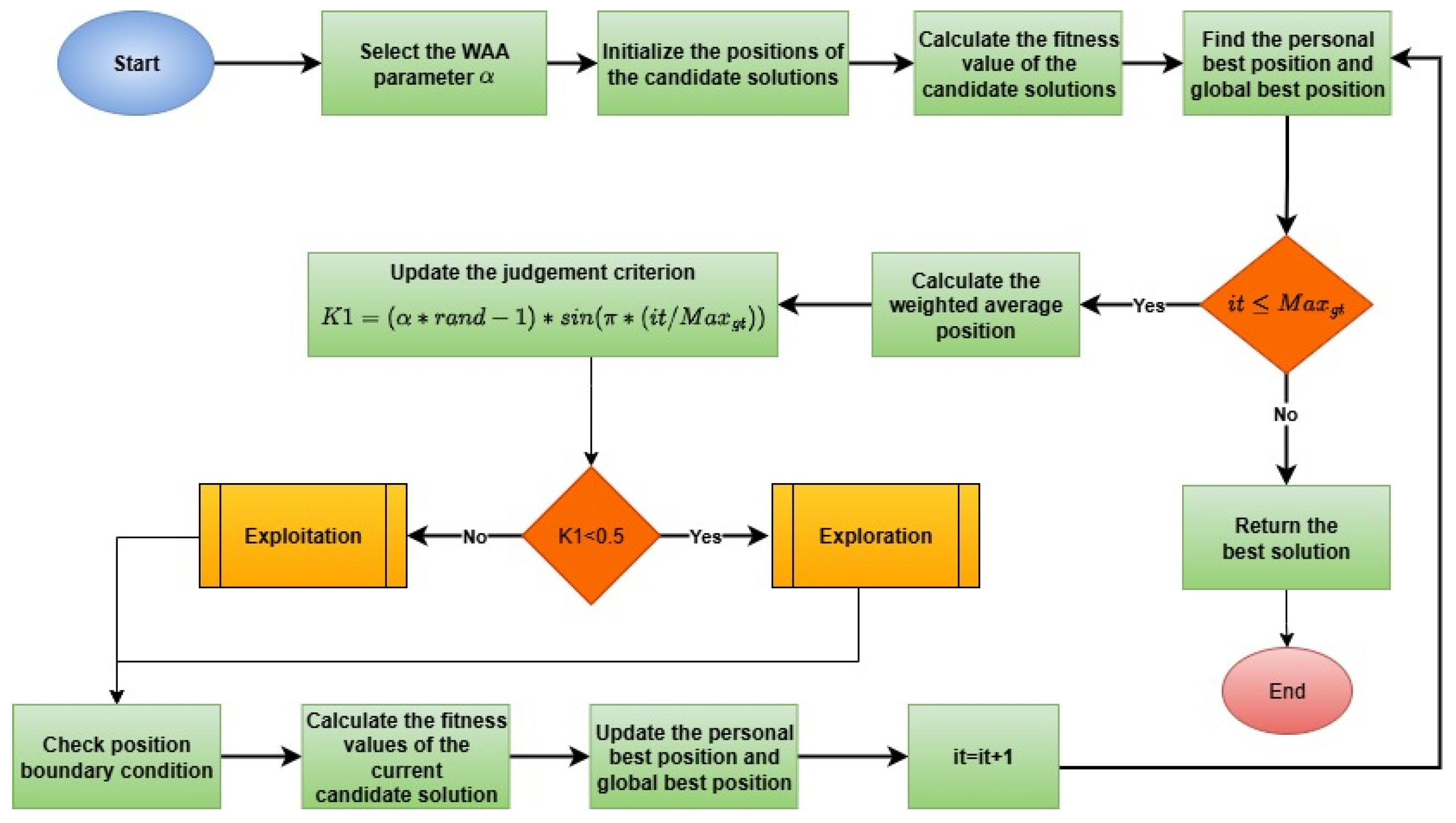
20], is a novel metaheuristic optimization method developed to effectively address complex, nonlinear, and high-dimensional optimization problems. Traditional mathematical optimization techniques often struggle with such problems, especially when dealing with non-differentiable objective functions or when prone to getting stuck in local optima. Metaheuristic algorithms, on the other hand, offer robust, gradient-free approaches capable of exploring large and complex solution spaces efficiently. The overall processes of WAA are shown in
Figure 2.
The key idea behind WAA is the use of a dynamically calculated weighted average position derived from the top-performing individuals in the population. This position is used in conjunction with the personal best and global best positions to guide each candidate solution. The result is a balanced and adaptive movement across the search space.
Algorithm Workflow: The WAA operates through the following key steps:
Initialization: A population of candidate solutions is randomly initialized within the given search bounds. Each individual’s fitness is evaluated using the objective function.
Weighted Average Calculation: A subset of high-quality solutions is selected, and their fitness values are used to compute a weighted average position. For minimization problems, individuals with lower fitness contribute more heavily.
Exploration vs. Exploitation Decision: At each iteration, a probabilistic function determines whether a candidate engages in exploration (global search) or exploitation (local refinement). This decision is influenced by a sinusoidal function and random factors to ensure dynamic balance.
Exploitation Strategies: Three strategies are defined, in terms of the weighted average position (), the personal best position (), and the global best position (). These strategies enhance convergence by focusing the search in high-potential regions.
Exploration Strategies: Two techniques are used: (i) Lévy flight: Random long or short jumps around the global best to discover new regions. (ii) Random reinitialization: Resetting a candidate to a new random position to diversify the search.
Update Loop: Candidates are updated according to the selected strategy, fitness is recalculated, and best positions are updated. This process repeats until a termination condition is met (e.g., maximum number of iterations).
4.2. WAA-CR Core Building Blocks
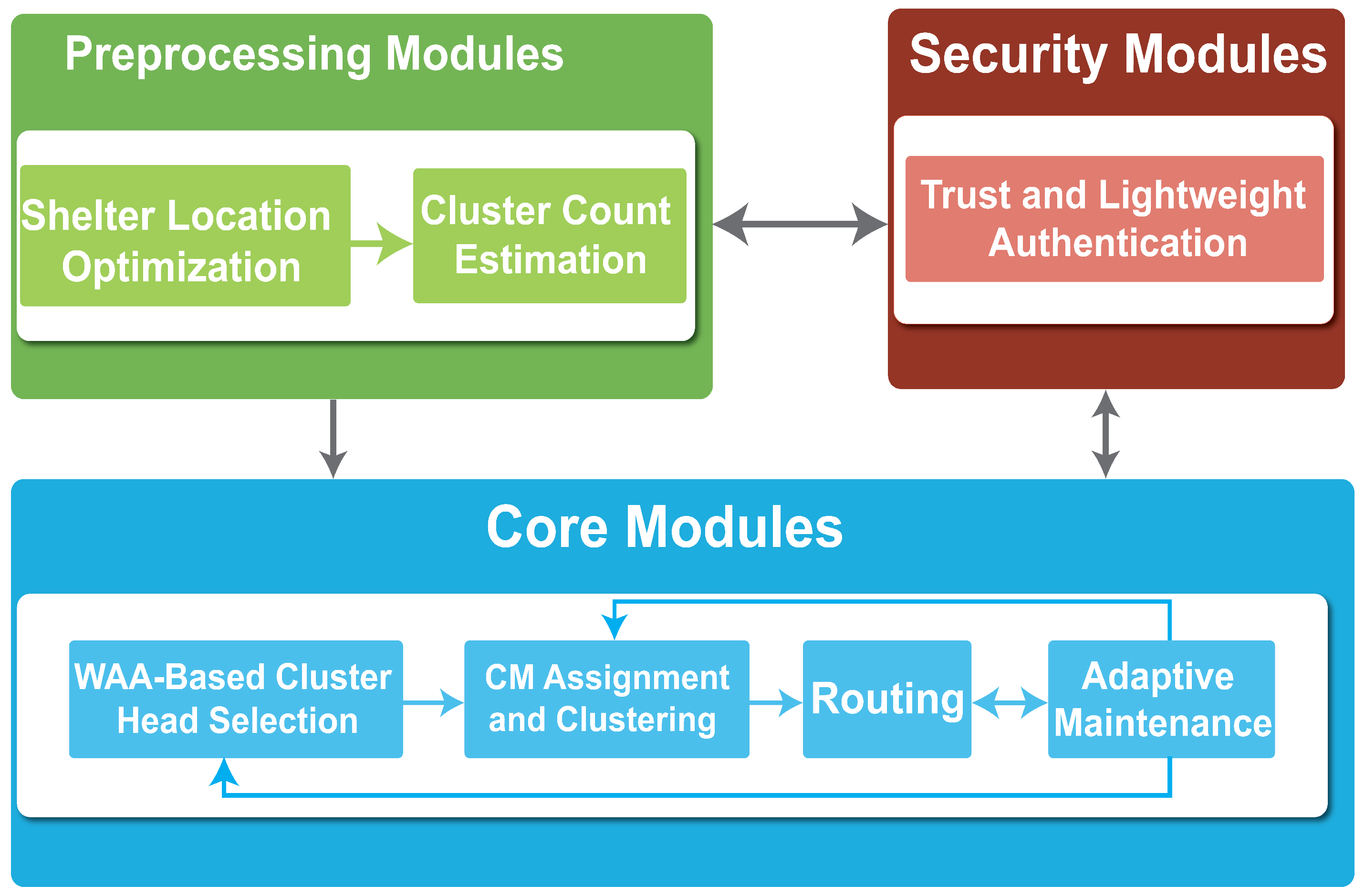
To address our objectives, the WAA-CR framework (
Figure 3) is structured into modular components, each targeting specific functionality and resilience criteria.
The process begins with Shelter Location Details (Step 1), which discuss the communication shelters (GCSs). Their placement directly inform Step 2 (Cluster Count Estimation), as the number and distribution of shelters influence how many CHs are needed. Both Steps 1 and 2 serve as prerequisites for Step 3 (CH Selection using WAA), which uses proximity to shelters and global constraints to identify suitable CHs via a multi-objective fitness function. Once CHs are selected, Step 4 (CM Assignment) assigns remaining UAVs to the chosen heads, laying the groundwork for the next stage. Step 5 (Authentication and Trust Evaluation) plays a dual role by filtering unreliable CHs and enabling secure routing, while being dynamically updated by subsequent steps. Based on this trusted topology, Step 6 (Routing Phase) establishes robust communication paths from CMs to shelters, taking into account CH roles and trust ratings. Finally, Step 7 (Adaptive Maintenance) monitors mobility, energy levels, and link stability, triggering updates to Steps 2–6 to help adapt to evolving network conditions. This tightly coupled flow ensures resilience, security, and efficiency throughout the network lifecycle.
The following sections provide a detailed description of each WAA-CR module, which is organized into three main categories: preprocessing modules, security modules, and core modules.
5. Preprocessing Modules
The preprocessing modules include two main components. Shelter location optimization anchors the overall network by using predetermined GCS/shelter positions. This supports Objective 3 by minimizing delay and improving geographic accessibility. Cluster count estimation predicts the optimal number of clusters based on UAV distribution and shelter zones, thereby minimizing clustering overhead and improving load balance. It directly contributes to Objectives 3 and 4.
5.1. Shelter Location Optimization
To enhance communication efficiency and resilience in disaster scenarios, shelter locations are incorporated as a preprocessing module within the WAA-CR framework. These shelters (GCSs) act as communication anchors and influence subsequent clustering and routing phases by shaping the spatial distribution of UAVs. Thus, shelter placement serves as a foundational infrastructure component for the overall framework.
In real-world disaster scenarios, determining optimal shelter locations is a highly complex problem due to the dynamic and uncertain nature of disasters. Factors such as disaster type, scale, severity, and geographic impact vary significantly and require real-time data integration and adaptive optimization strategies. Addressing such challenges falls beyond the scope of this work. Therefore, in the WAA-CR framework, shelter locations are assumed to be predetermined based on the prevailing disaster situation. This assumption enables the study to focus on UAV clustering, routing, and trust-aware communication, while treating shelter placement as an external input rather than an optimization objective.
Several studies in the literature have extensively addressed the shelter location problem. From a criteria evaluation perspective, ref. [
57] applies the best-worst method under interval type-2 fuzzy sets to identify key criteria for shelter site selection, highlighting proximity and transport–distribution capacity as dominant factors. Similarly, ref. [
58] proposes a multi-criteria decision-making model incorporating hazard, exposure, vulnerability, and relief capacity using AHP, entropy weighting, and TOPSIS for improved reliability. From an urban resilience planning perspective, ref. [
59] introduces disaster prevention life circles using GIS-based accessibility analysis and Voronoi diagrams to balance supply and demand. Ref. [
60] integrates flood risk modeling and multi-objective optimization with agent-based evacuation simulations to evaluate shelter effectiveness. Other works emphasize population distribution and risk factors. Ref. [
61] examines population density to improve safety-oriented shelter placement, while ref. [
62] develops a risk-based decision support system using LGDM and OWA to evaluate post-earthquake shelter locations based on multiple criteria.
Overall, these studies demonstrate that shelter location planning is a well-established and complex optimization problem involving hazard assessment, infrastructure, risk preferences, and population dynamics. In contrast, this work assumes predefined shelter locations and focuses on the dynamic UAV-GCS association under changing network conditions. This decoupling allows the WAA-CR framework to maintain modularity, where infrastructure planning can be performed offline, while UAV operations adapt in real time during disaster response operations.
5.2. Cluster Count Estimation
To ensure energy-efficient and delay-aware clustering in FANETs, the number of clusters (or, equivalently, the number of CHs) must be carefully selected before the CH selection process. This step is critical in the WAA-CR framework because the initial cluster count directly affects the system’s communication overhead, CH load balancing, and the feasibility of bandwidth allocation in both intra- and inter-cluster communication.
Our proposed framework adopts a cluster count estimation strategy inspired by [
51], which leverages node connectivity, UAV coverage conditions, and bandwidth balance to derive the optimal number of clusters
m. For a UAV
and CH candidate
, the connectivity between them is established if the Euclidean distance
satisfies:
That means, the nearest CH, say
for a UAV
, is selected from the set of candidates
C by minimizing the Euclidean distance. A binary connectivity indicator
is defined as:
This ensures that each UAV can associate with its nearest CH within communication range
R. To guarantee total network coverage, the following constraints must be satisfied:
Together, these constraints guarantee the assignment of all nodes to the cluster allocations such that each node is covered by at least one CH. In contrast, each UAV is only allowed to associate with one cluster or CH.
In FANET environments with limited bandwidth, it is important to balance intra- and inter-cluster communication. Let
be the available bandwidth within a cluster (intra-cluster),
be the available bandwidth for CH-to-CH or CH-to-GCS communication (inter-cluster), and
be the number of CMs in cluster
k. To prevent overloading CHs (small
m) or wasting bandwidth (large
m), the following inequality must hold:
The cluster count estimation problem is thus modeled as a constrained optimization task:
subject to the following constraints:
The output of this cluster count estimator is the optimal number of clusters
. This value is then supplied to the WAA-based CH selection module as a cluster count constraint, guiding the algorithm to generate exactly
CHs. This approach reduces clustering overhead and energy consumption, ensures adequate CH coverage without overloading nodes, balances intra- and inter-cluster bandwidth usage, and enables seamless interaction with shelter-aware and trust-based routing. As such, cluster count estimation forms a critical preprocessing layer in the overall architecture of WAA-CR, bridging shelter planning with efficient CH deployment.
7. Core Modules
The core modules form the foundation of the WAA-CR architecture and include several interconnected processes. The WAA-Based CH Selection and Clustering Module utilizes a multi-objective fitness function to select optimal CHs by balancing factors such as residual energy, trust, mobility (speed variation), link stability, and proximity to shelters. This module is central to Objectives 2 and 4. The CH selection process leverages proximity to shelters and global constraints to identify suitable CHs through the WAA. Following CH selection, the Cluster Member (CM) Assignment phase assigns the remaining UAVs to the selected CHs, forming the foundation for the subsequent routing stage.
The routing process establishes optimal paths from CHs to shelters using a Quality Parameter (QP) that integrates trust, hop count, residual energy, speed variation, and link stability. This routing mechanism supports Objectives 2, 4, and 5. Finally, the Adaptive Route and Cluster Maintenance Process continuously monitors network conditions (e.g., trust, energy) and triggers localized updates or re-clustering when necessary, thereby enhancing network survivability and contributing to Objective 2.
7.1. WAA-Based CH Selection
The CH selection process serves a dual purpose: ensuring efficient network operation and reducing the number of UAVs required to maintain effective communication and secure data exchange. This process is formulated as a multi-objective optimization problem. By evaluating several performance criteria, such as energy balance, intra- and inter-cluster communication costs, mobility stability, trustworthiness, and load distribution, our model selects a minimal and optimal subset of CHs from the available UAVs. These CHs are responsible for data aggregation, cluster coordination, and communication with the shelter or GCS, thereby reducing the computational and communication burden on regular UAVs.
This optimization contributes to reducing the number of drones needed for full network functionality in several ways. First, efficient coverage is achieved by positioning the CHs to cover nearby UAVs with minimal communication range overlap, thereby reducing redundancy. Second, data aggregation is improved by delegating processing and forwarding tasks to CHs, allowing non-CH UAVs to conserve energy and operate in simpler roles, which minimizes the total number of UAVs required. Finally, secure communication is ensured by integrating trust metrics into the CH selection process so that only reliable UAVs are chosen to manage sensitive data exchange, reducing the need for additional nodes dedicated solely to secure relaying.
The WAA-based CH selection procedure is outlined in Algorithm 1. Overall, the proposed CH selection framework acts as a multi-criteria decision-making mechanism that not only maximizes communication efficiency and security, but also implicitly minimizes the number of UAVs required for resilient FANET operations. To solve this optimization problem, we first present the formal problem formulation, followed by the design of our fitness function. Finally, we describe how the solution is obtained using a recent metaheuristic optimization technique called the WAA.
| Algorithm 1: WAA-based CH selection. |
 |
7.1.1. Problem Formulation
The goal of this section is to optimize the selection of CHs in a Flying Ad Hoc Network (FANET) in a way that ensures energy efficiency, communication reliability, mobility stability, trustworthiness, and minimal resource usage. The network is composed of N UAVs deployed in a 3D space, dynamically forming clusters based on local and global metrics. The primary objective is to select an optimal and minimal subset of CHs that guarantees full coverage and secure, efficient operation of the network. Let be a binary variable that indicates whether UAV is selected as a CH. Additionally, denotes the association variable specifying that UAV is assigned to CH . The optimization problem is subject to several constraints.
First, the coverage constraint requires that each UAV be associated with at least one CH within the communication range R:
Second, the unique assignment constraint ensures that each UAV is associated with exactly one CH:
Third, the trust threshold requires that every selected CH satisfy a minimum trust level:
Finally, the energy constraint ensures that CHs maintain sufficient residual energy above a specified threshold:
This formulation ensures that the selected CHs maintain full functional coverage of the UAV network, while minimizing the number of CHs, reducing energy consumption, and enhancing communication and security performance. To address the formulated optimization problem, we design a multi-objective fitness function that evaluates the suitability of candidate CH sets based on key network performance metrics. This fitness function serves as the core evaluation mechanism in our CH selection algorithm. It integrates both system-level goals (e.g., energy efficiency, communication stability) and security requirements (e.g., trustworthiness), while also enforcing minimal CH selection through penalty-based control, satisfying the constraints on coverage, trust, energy, and unique assignment.
7.1.2. Fitness Function Design
The longevity and stability of a FANET significantly depend on the strategic selection of CHs, which are inherently more energy-intensive due to their responsibilities in both intra- and inter-cluster communication. Additionally, factors such as UAV mobility, communication distances, and trustworthiness significantly affect overall network performance. To address these challenges, we propose a multi-objective fitness function that integrates essential network characteristics to guide optimal CH selection. The following factors are incorporated into the fitness function:
Residual Energy : Ensures energy-aware clustering by evaluating the ratio of the total residual energy of all UAVs to the cumulative energy of selected CHs. A lower value of
implies a better energy distribution among CHs:
Intra-cluster Communication Distance : Measures the average distance between CHs and their members to minimize communication energy consumption:
Distance to GCS : Evaluates how close CHs are to the GCS, where shorter distances reduce transmission delay and improve reliability:
The distance-to-GCS metric
plays a critical role in aligning the WAA-CR framework with the objective, which focuses on optimizing shelter or base station (GCS) placement for effective disaster response. This metric evaluates how close the selected CHs are to the GCS relative to the entire UAV population. By minimizing
, the framework encourages the selection of CHs that are geographically closer to the GCS or designated shelters. This leads to lower transmission delays, reduced energy consumption, and more reliable data delivery paths in high-mobility or disrupted environments. Through normalization and inclusion in the multi-objective fitness function, the term
positively contributes to the overall score, effectively rewarding CH configurations that align with shelter proximity. As a result, this factor operationalizes Objective 3 by ensuring that optimized cluster structures directly support strategic shelter positioning and disaster response efficiency.
Load Balancing : Measures the uniformity of cluster sizes to avoid overburdening CHs and to balance energy usage:
Speed Variation : Captures the relative mobility of UAVs in 3D space. High variation may cause unstable clustering, so low-speed deviation is preferred:
Overall Trust : Ensures that UAVs with a higher reputation and reliable behavior are more likely to become CHs. The trust is computed using Equation (
11).
To unify these metrics into a single fitness score, each normalized objective function
is weighted by a tunable parameter
such that
. The overall CH fitness value is then computed using a Boltzmann-distribution-based estimator[
68]:
To ensure fair contribution of each objective in the fitness calculation, all fitness components are normalized to a common scale before applying the weights. This prevents any single metric from dominating the final score due to its numerical range. The normalization is performed using min-max scaling as shown:
where
is the raw value of the objective function.
and
are the minimum and maximum values of that function observed in the population during evaluation.
is the normalized value used for weighted computation.
While the core fitness function
captures the quality of a candidate CH set based on performance metrics, the full objective function introduces an additional penalty to discourage excessive CH selection. This is modeled using the exponential term
, where
m is the number of selected CHs,
N is the total number of UAVs, and
is a tunable penalty coefficient. The complete objective function is thus defined as:
This structure enables the optimization process to balance between maximizing performance and minimizing the number of selected CHs.
7.1.3. WAA-Based CH Selection Operations
The WAA performs an iterative population-based search that balances exploration and exploitation through a weighted averaging mechanism. In this work, the standard continuous WAA is modified into a binary adaptation suitable for cluster head (CH) selection decisions, where a sigmoid transfer function maps continuous updates into binary states. To enhance robustness in dynamic FANET conditions, two auxiliary processes are incorporated: a repair mechanism that restores infeasible solutions caused by constraint violations, and an Exploration Strategy in Binary Space that introduces stochastic diversity through Lévy-inspired bit flips and partial reinitialization. The core workflow for CH selection is summarized as follows:
Initialization: Each candidate solution in WAA is represented as a binary vector of length N, where N denotes the total number of UAVs in the FANET: Here, indicates that UAV is selected as a CH, and otherwise. Based on this encoding, the corresponding CM associations are determined by assigning each non-CH UAV to the nearest CH within communication range R, if one exists.
Fitness Evaluation: Each candidate solution undergoes a multi-step evaluation to compute its fitness:
- (a)
Decode CH Set: Identify all UAVs selected as CHs:
- (b)
Identity Verification: Each CH must pass an authentication check:
If any CH fails verification, the solution is deemed invalid and assigned a minimal fitness value given by:
- (c)
Cluster Assignment: Each non-CH UAV is assigned to its closest verified CH within range R. If no CH is available, the solution is marked infeasible and penalized.
- (d)
Constraint Checks:
Coverage: Each UAV must be connected to a CH:
Energy: Each CH must maintain sufficient residual energy, given by:
Trust: Each CH must satisfy the minimum trust threshold condition:
Any violation of these constraints results in a penalized fitness value .
- (e)
Fitness Computation: Valid solutions are scored using the multi-objective fitness function: , as defined in Equation (28).
Repair Mechanism: A repair mechanism is applied to recover infeasible solutions:
This mechanism enhances feasibility while maintaining population diversity.
Weighted Mean Calculation: The weighted mean position
of top-performing individuals is calculated as:
Individuals with lower cost values (higher fitness) receive greater weights, thus exerting stronger influence on
. Here,
denotes the objective (fitness) cost associated with the
i-th candidate solution
, computed from the multi-objective function in Equation (
28). Lower cost values correspond to higher-quality CH configurations that satisfy energy, trust, and coverage criteria.
Position Update: Each individual updates its position using , the global best , and its personal best . The update mode is determined as:
Exploration: Random or Lévy flight perturbations expand the search space.
Exploitation: Individuals move toward , , and to refine solutions.
A sinusoidal probability function controls the balance between exploration and exploitation. Since standard WAA operates in continuous space, binary adaptation uses a sigmoid-based update:
where
is the sigmoid function, and the update term
is:
Weights
are randomly generated and normalized, mapping continuous updates into binary decisions.
Exploration in Binary Space: To prevent premature convergence, the algorithm introduces stochastic diversity:
Lévy-inspired Bit Flips: Randomly flip bits using a heavy-tailed probability distribution.
Partial Reinitialization: Randomly reset parts of the binary vector while ensuring that at least one CH remains active.
Constraint Enforcement and Evaluation: Each updated position is checked against boundary limits and re-evaluated using . Personal and global bests are updated when improvements are observed.
Termination and Output: The process repeats until the maximum iteration count is reached or convergence is achieved. The algorithm then outputs the best solution , corresponding best cost , and convergence statistics.
7.2. CM Assignment and Clustering
After the CHs are selected through the WAA-based procedure, the remaining UAVs (Cluster Members, CMs) must associate themselves with appropriate CHs to form fully functional clusters. This stage enables the transformation of the optimized CH set into a structured and connected cluster topology. The process is fully decentralized, allowing each UAV to make its own decision based on locally observable information and periodic broadcasts from nearby CHs or shelters.
Each UAV independently selects a CH based on local observations, following a fully decentralized process:
Beaconing: Each shelter periodically broadcasts metadata such as ID, signal strength, trust level, and geolocation.
Local Table Construction: UAVs compile a local table of the CH based on received beacon data.
Scoring and Selection: Each UAV evaluates each CH (
s) using a multi-criteria score:
where the terms account for distance, link stability, shelter trustworthiness, and energy efficiency. The UAV selects:
Selective Registration: The UAV registers only with the selected CH to minimize signaling overhead.
After all UAVs have completed the selection process, the network naturally forms a set of clusters, where each CH acts as a local coordinator responsible for intra-cluster communication, data aggregation, and forwarding toward shelters. This adaptive clustering mechanism ensures that clusters are energy-balanced, trust-aware, and dynamically maintained as UAVs move or environmental conditions change, providing a stable foundation for subsequent routing and data delivery phases.
7.3. Routing Process
In the WAA-CR framework, the routing phase plays a critical role in establishing secure, energy-efficient, and mobility-aware communication between UAVs and the GCS. Following the clustering and CH selection process, this phase ensures that data generated by CMs is reliably forwarded through selected CHs to the GCS. The routing phase is outlined in Algorithm 2.
Inspired by the trust-aware routing principles in [
69,
70] and adapted for the dynamics of FANETs, the routing phase is structured into two main components: route formation and route upkeep. These components leverage the same multi-objective optimization strategy employed during CH selection, ensuring consistent and robust performance across the network.
| Algorithm 2: WAA-CR routing phase with lightweight authentication. |
| 1: Input: Source UAV , GCS, List of candidate CHs, Trust table, Residual energy, Speed variation, Link stability |
| 2: Output: Optimal secure route from to GCS |
| 3: — Route Formation — |
| 4: sends Route Request (RREQ) via its CH |
| 5: GCS receives candidate paths |
| 6: for each path do |
| 7: for each CHj in do |
| 8: Authenticate CHj using Lightweight Authentication. |
| 9: if Authentication fails then |
| 10: Discard path and continue to next |
| 11: end if |
| 12: end for |
| 13: Compute: average trust along (), normalized hop count (), average residual energy , average speed variation , and average link stability (). |
| 14: Compute Quality Parameter: |
| 15: end for |
| 16: Rank all paths by in descending order |
| 17: Select as optimal secure route |
| 18: — Route Upkeep — |
| 19: Monitor trust and energy of each CH in current route |
| 20: if any CH fails trust or energy threshold then |
| 21: Trigger Route Error (RERR) to source |
| 22: Source re-initiates route formation (go to Line 4) |
| 23: end if |
| 24: Return: Optimal authenticated and mobility-aware route |
7.3.1. Route Formation Step
The route formation process begins when a UAV initiates data transmission by sending a Route Request (RREQ) through its CH. Prior to inclusion in any candidate route, each CH along the path is authenticated using the Lightweight Drone Authentication Layer. This ensures that only identity-verified UAVs are evaluated in the routing process and protects against spoofed or unauthorized nodes.
The GCS collects multiple candidate routes in the form:
where each route
represents a potential multi-hop path from the source to the GCS. Each route is evaluated using a composite Quality Parameter (QP), which aggregates multiple performance metrics using normalized scores and tunable weights:
Here,
denotes the normalized average trust along the path,
represents the normalized hop count (where lower values are preferred),
is the normalized average residual energy of the path,
captures the normalized speed variation of nodes along the path, and
corresponds to the normalized link stability metric as defined below. The coefficients
are the weight factors assigned to each metric, subject to the condition
. In addition, an authentication requirement is imposed such that only UAVs successfully passing through the lightweight authentication mechanism are considered in the path selection process. To account for mobility-induced link disruption in FANETs, we define the link stability between any two UAVs
i and
j as the ratio of their sustained connection time to a reference observation window [
71,
72]:
where
is the time duration for which UAVs
i and
j remain within communication range, and
is the duration of the monitoring window. Paths with higher average
values across their hops are favored, as they are less prone to mobility-related disconnections. Based on the computed
values, the BS generates a ranked list:
where
represents the highest scoring (i.e., optimal) path that balances trust, efficiency, energy, and stability.
7.3.2. Route Upkeep Step
To maintain secure and reliable communication, a route maintenance mechanism is activated whenever a node’s trust level or residual energy falls below a defined threshold. In such cases, a Route Error (RERR) message is triggered and propagated backward to the source node. Upon receiving the RERR, the source re-initiates the route formation step, allowing the system to dynamically adapt to changes in network conditions.
During re-routing, each candidate next-hop CH is re-authenticated using the Lightweight Drone Authentication process before being considered in the QP evaluation. This ensures that compromised or spoofed nodes cannot re-enter the network via re-routing loopholes. By incorporating mobility-aware metrics such as speed variation and link stability into its multi-objective path evaluation, the WAA-CR routing phase achieves secure path selection through trust-aware evaluation and authentication, energy-efficient routing by considering residual energy metrics, adaptive resilience to UAV mobility and link disruptions, and methodological consistency with the clustering phase.
While trust metrics mitigate insider threats, they rely on the assumption that all participating UAVs are legitimate. To enforce this, WAA-CR integrates a Lightweight Drone Authentication Layer that ensures identity validation before trust evaluation. Authentication is applied during route formation, next-hop selection, and route repair, thereby preventing spoofed nodes from joining the network and protecting the integrity of routing decisions.
7.4. Adaptive Route and Cluster Maintenance Process
To ensure robustness and secure adaptation in highly dynamic FANET environments, the WAA-CR framework incorporates a comprehensive adaptive maintenance process. This mechanism addresses various topological changes over time, including the departure or relocation of a CH, the disconnection of a CM, or the integration of a new UAV into the network. The maintenance process operates through periodic control messages. Each CH broadcasts a MSG_Hello message at a regular interval to verify connectivity with its CMs. Upon receiving the message, each CM must respond with a MSG_Ack. If the CH does not receive a response from a CMj,k within a time window after attempts, the CM is marked as disconnected and removed from the CM list. To protect against spoofing and unauthorized participation, all control messages, MSG_Hello, MSG_Ack, and role transition requests, are authenticated. This ensures message integrity and identity validation for all communication events.
If a CH fails to broadcast
MSG_Hello or if its fitness score
drops below the threshold
, the maintenance logic evaluates the best-fit CM for promotion. The selected CM
i,k is promoted to CH only if it meets the following conditions:
If no suitable candidate exists, the CH selection process is re-executed via Algorithm 1.
When a new or previously disconnected UAV seeks to join a cluster, it initiates a
R_Join request to the nearest
. Upon receiving this request,
authenticates the UAV using the Lightweight Drone Authentication Layer. If authentication succeeds and the following conditions are satisfied
where
denotes the current number of Cluster Members in cluster
k, and
is the maximum permissible cluster size, then the UAV is admitted. Otherwise, the request is denied to preserve security and load balance.
Any change in CH roles, CM connectivity, or node additions triggers a local re-evaluation of routing paths through the next-hop CH selection process (Algorithm 3). This ensures continuous route validity and optimization in response to UAV mobility and trust fluctuations. Fitness scores for CHs and CMs are periodically recalculated using updated metrics—energy, mobility, and trust—within the WAA-based multi-objective evaluation framework. These proactive updates enable the system to adapt to degradation in node behavior or link quality. Algorithm 3 is executed adaptively whenever the routing topology changes, such as during cluster head failure or replacement, UAV joining or rejoining, or significant variations in trust or link stability. It may also run periodically as part of routine route maintenance to ensure that each CH consistently forwards data through the most trusted, energy-efficient, and stable neighboring CH.
The next-hop CH selection algorithm allows each cluster head to forward data through its most suitable neighboring CH. Each candidate neighbor first undergoes lightweight authentication to exclude untrusted nodes. For every authenticated CH, the algorithm evaluates multiple factors, including trustworthiness, hop count, residual energy, speed variation, and link stability. These metrics are combined into a weighted fitness score representing the overall forwarding quality of the candidate. The CH with the highest score is then selected as the next-hop. This process ensures routing decisions remain secure, energy-aware, and resilient to mobility, thereby maintaining stable communication paths across the FANET.
| Algorithm 3: WAA-CR: next-hop CH selection during routing. |
| 1: Input: Set of neighboring CHs for current CH : |
| 2: Output: Selected next-hop CH: |
| 3: Initialization: Set , |
| 4: for each do |
| 5: Step 1: Authentication |
| 6: if fails Lightweight Authentication then |
| 7: Skip |
| 8: end if |
9: Step 2 Compute Trust Score (), Compute Hop Count Score (), Compute Residual
Energy Score((), Compute Speed Variation Score (), and Compute Link Stability
Score(). |
| 10: Step 3: Aggregate Fitness Score |
| 11: if then |
| 12: |
| 13: |
| 14: end if |
| 15: end for |
| 16: return |
Algorithms 2 and 3 operate in complementary phases of the WAA-CR framework. While Algorithm 2 establishes a secure end-to-end route between the source UAV and the GCS by evaluating multiple candidate paths, Algorithm 3 functions at the local level, enabling each CH to dynamically select its most reliable next-hop neighbor during data forwarding. Together, these algorithms ensure both global route optimality and local adaptability, maintaining secure and energy-efficient communication under high mobility conditions.
8. Operational Role of WAA-CR in Post-Disaster Communication Restoration
When terrestrial communication infrastructure is damaged or unavailable, the proposed WAA-CR framework enables an autonomous aerial communication backbone using clustered UAVs (Algorithm 1). In this setting, UAVs self-organize into clusters, each managed by a CH, while multi-hop communication routes are established between CHs and GCSs. The combined operation of the WAA-CR routing algorithm (Algorithm 2) and the next-hop CH selection algorithm (Algorithm 3) ensures that connectivity between shelters is rapidly restored and maintained under dynamic conditions.
8.1. WAA-CR Routing for End-to-End Path Formation
Algorithm 2 governs the end-to-end route construction from a source UAV to its destination shelter. Once UAVs are clustered, this routing phase identifies all possible multi-hop paths between CHs. Each candidate path undergoes lightweight authentication to exclude untrusted or compromised CHs, ensuring the integrity of the routing process in potentially adversarial disaster environments. For each authenticated path, the algorithm evaluates a composite Quality Parameter (QP) that integrates trust, residual energy, hop count, speed variation, and link stability. The route with the maximum QP value is chosen as the optimal path for data forwarding.
During operation, the algorithm continuously monitors the trustworthiness and energy levels of all CHs participating in the established route. If any CH falls below the defined thresholds—due to mobility, energy depletion, or misbehavior—a Route Error (RERR) message is triggered. The source UAV then initiates route rediscovery, allowing the network to self-heal and sustain end-to-end connectivity. This adaptive process ensures that even under UAV mobility and partial network degradation, a secure and energy-efficient multi-hop route remains available between shelters.
8.2. Next-Hop CH Selection for Local Adaptation and Resilience
While the routing algorithm manages the global route, Algorithm 3 handles local decision-making at the CH level. Each CH independently selects its next-hop neighbor based on a weighted evaluation of trust, residual energy, hop distance, speed variation, and link stability. This decision is refreshed periodically or upon detecting significant topology variations such as CH failure, UAV rejoining, or link degradation. By enabling each CH to locally adapt its forwarding choice, the algorithm enhances the resilience of the overall routing topology. When a CH or link becomes unreliable, neighboring CHs autonomously reconfigure their next-hop decisions without requiring a full route rediscovery. This distributed adaptation minimizes communication delay, maintains high packet delivery ratios, and preserves network stability in highly dynamic post-disaster environments.
8.3. Integrated Operation in the Post-Disaster Scenario
Together, the WAA-CR modules and the integrated algorithms form a hierarchical control structure that maintains secure and reliable aerial communication when ground infrastructure is damaged. At the top level, Algorithm 2 ensures global routing stability by establishing and maintaining authenticated, energy-efficient multi-hop paths between UAV clusters and shelters. Complementarily, Algorithm 3 enables local link optimization by allowing each CH to dynamically select the most suitable neighboring CH based on trust, residual energy, and link stability. When a CH fails or its trust level drops, self-healing connectivity is achieved as Algorithm 3 performs localized rerouting, while Algorithm 2 triggers global route repair to restore end-to-end communication.
The WAA-based CH selection procedure (Algorithm 1) plays a central role in initializing this hierarchy. It employs a multi-objective WAA to elect stable, energy-efficient, and trusted CHs by considering metrics such as residual energy, mobility, link stability, and proximity to shelters. This ensures that the communication backbone is formed over the most reliable UAV nodes before routing begins.
The integrated operation is reinforced by the coordinated functioning of the WAA-CR modules. The preprocessing modules—including shelter location optimization and Cluster Count Estimator—anchor the network by using predetermined GCS/shelter positions and predicting suitable cluster numbers for balanced coverage. The security modules, consisting of the Lightweight Authentication and Trust Evaluation processes, safeguard the network by verifying UAV identities and continuously filtering untrusted nodes. Finally, the core modules—comprising WAA-based CH Selection, Cluster Member Assignment, Routing, and Adaptive Maintenance—enable efficient clustering, optimal route discovery using Quality Parameter (QP) evaluation, and continuous topology updates under UAV mobility and energy variations. Through this multi-layered cooperation, the WAA-CR framework achieves a fully autonomous, secure, and self-healing UAV communication network. The preprocessing modules provide structural stability, the security modules enforce trust and authenticity, and the core modules—guided by Algorithms 1–3—enable adaptive clustering and resilient multi-hop communication to effectively restore connectivity between shelters in post-disaster environments.
9. Results and Discussion
This section discusses and compares the results of the proposed WAA-CR framework against well-established methods in recent FANET research. The following state-of-the-art trust-based and metaheuristic methods are used for comparative analysis: TDLSF [
37], FBTMD [
40], KMEANS [
34], HMGOC [
51], BICHGWO [
47], and EECPMFO [
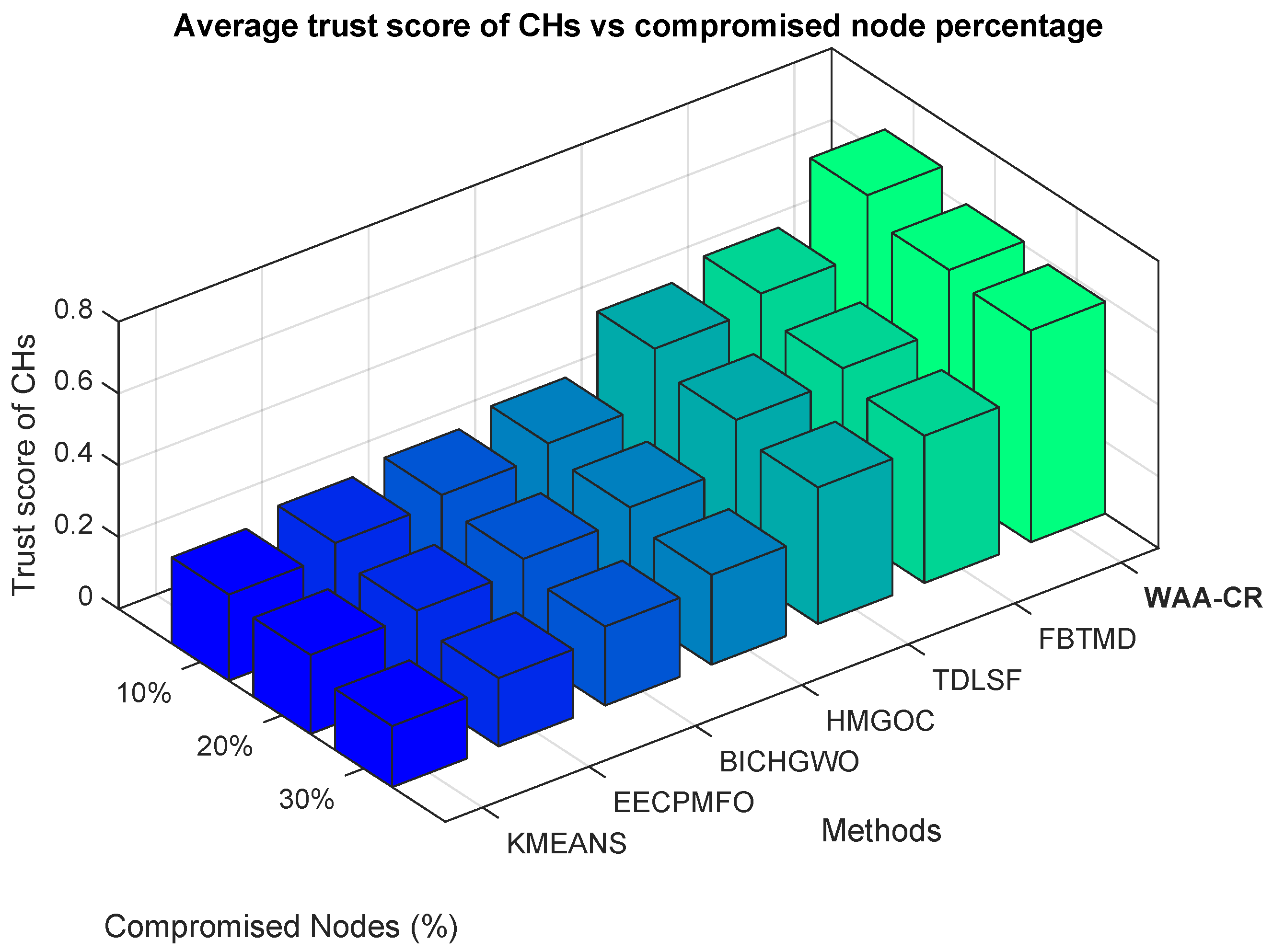
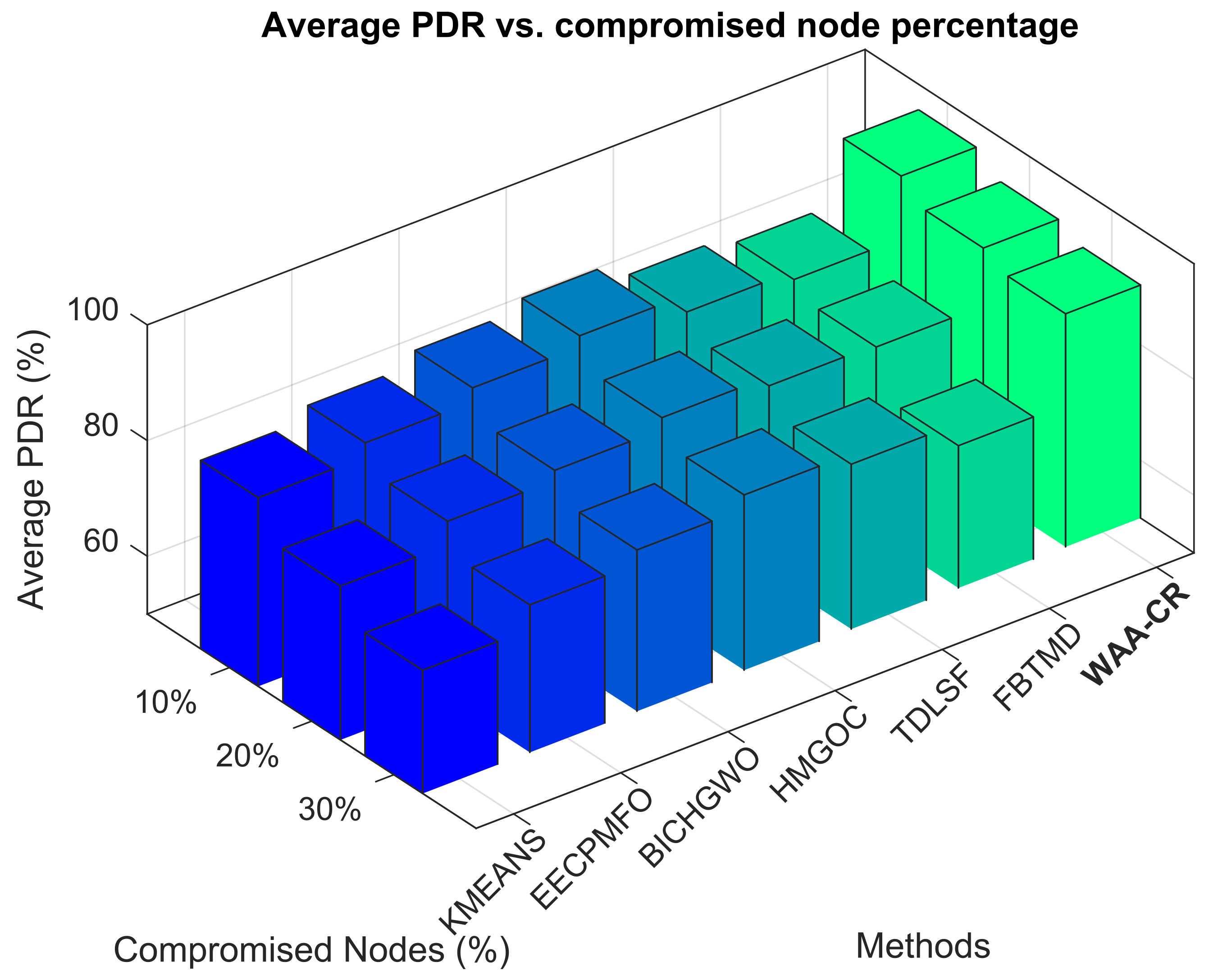
48]. Simulations are carried out using MATLAB R2020a. Different sets of experiments are designed to evaluate the framework, focusing on: the clustering and routing performance, the level of trustworthiness, and the impact of compromised nodes. The simulation settings are discussed as follows:
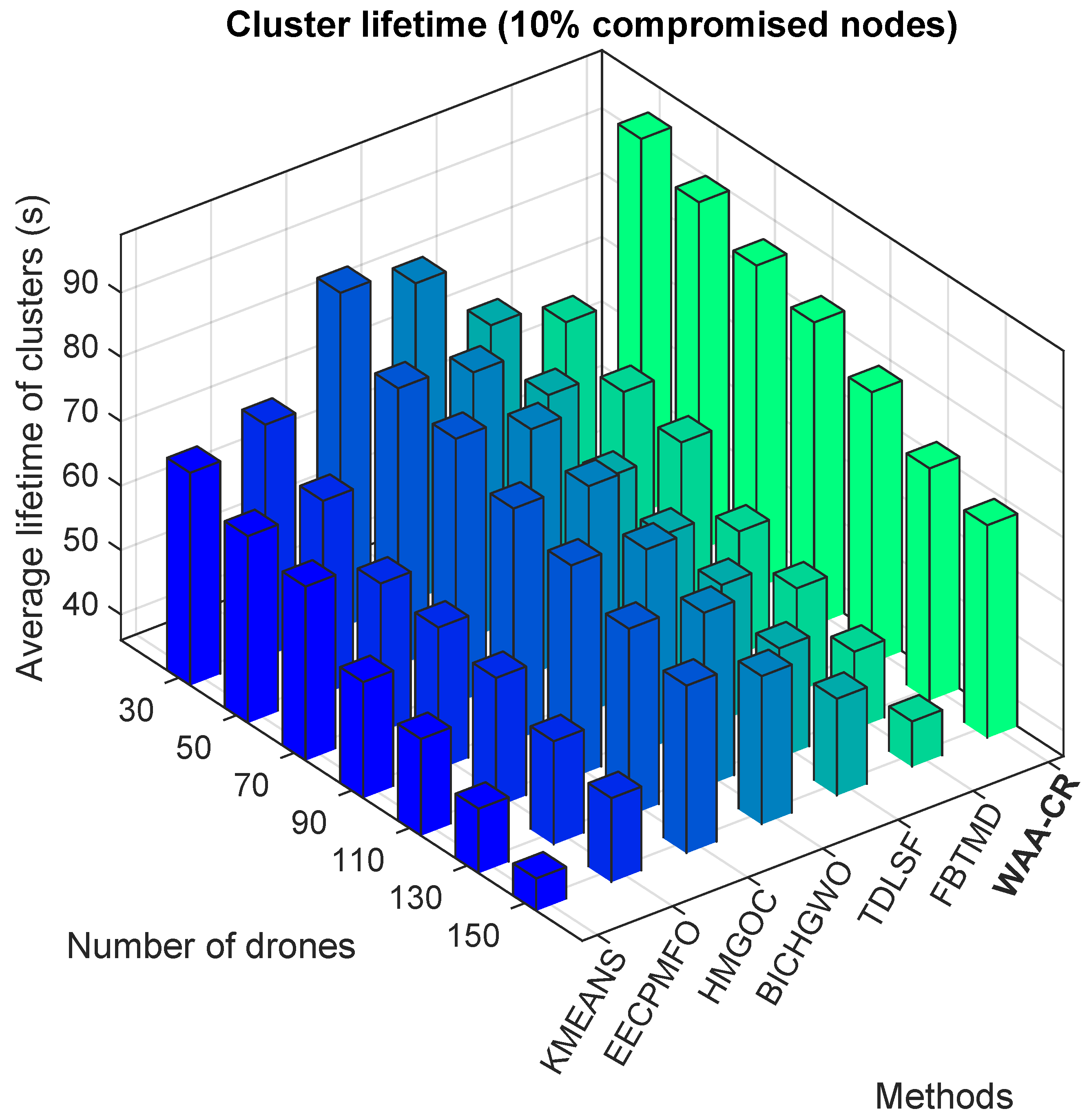
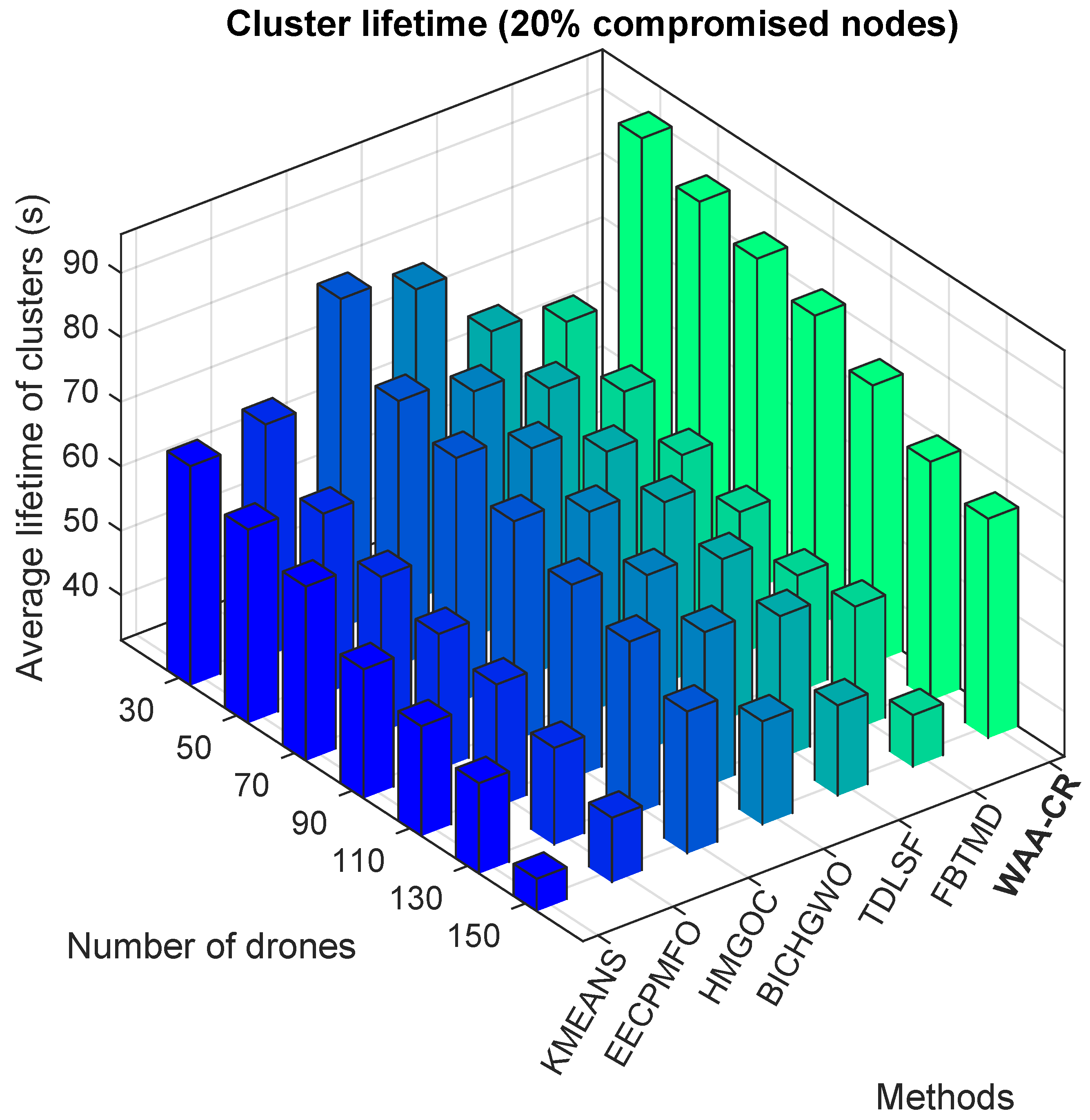
Simulation Scenario: For the experimental analysis, UAV nodes ranging from 30 to 150 are deployed within a 3D environment of size 2000 m × 2000 m × 500 m, with the GCS placed outside the deployment area. Each UAV is initialized with identical energy levels and computational resources, whereas the GCS is assumed to have unlimited energy and processing capability. The trust levels of drones range from 0.1 to 1. To ensure statistical reliability, 20 independent runs are performed using different random seeds, and the best results are reported. Among the deployed nodes, 10–30% are designated as compromised to evaluate the framework under different intensities of adversarial conditions. Communication within and across clusters is based on the IEEE 802.11n protocol, modeled under Rayleigh fading conditions, operating at carrier frequencies of 2.4 GHz (intra-cluster) and 5 GHz (inter-cluster). The adopted radio energy parameters are:
nJ/bit,
pJ/bit/m
4, and
pJ/bit/m
2. UAV mobility and flight-related energy consumption are characterized using
kg,
wings, and a wing radius
of
m. To ensure fair comparison, all the compared algorithms are executed and assessed under identical experimental settings, employing 30 search agents and a fixed maximum iteration count of 100. The simulation parameters used are presented in
Table 3.
9.1. Analysis: Clustering and Routing Performance
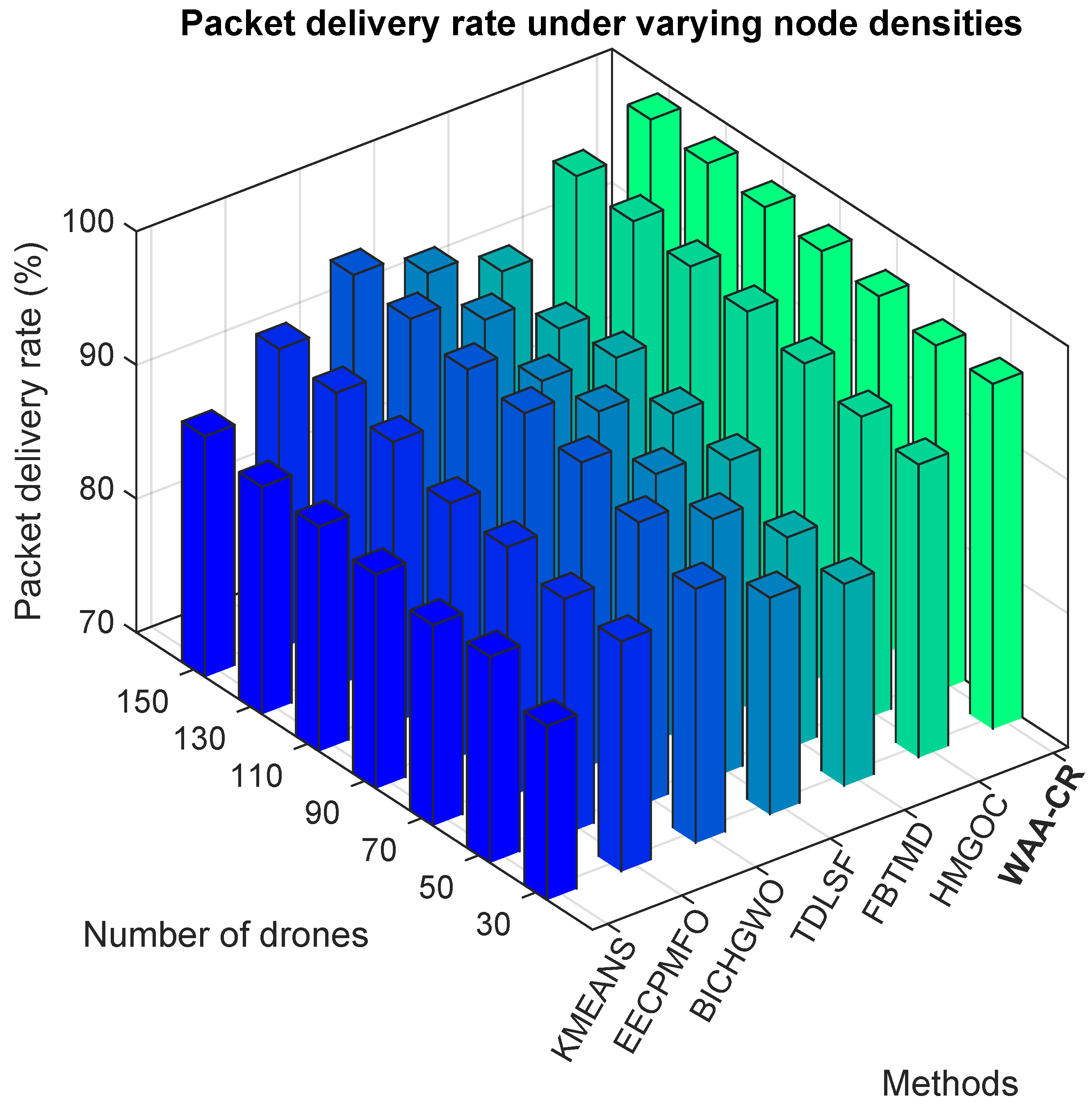
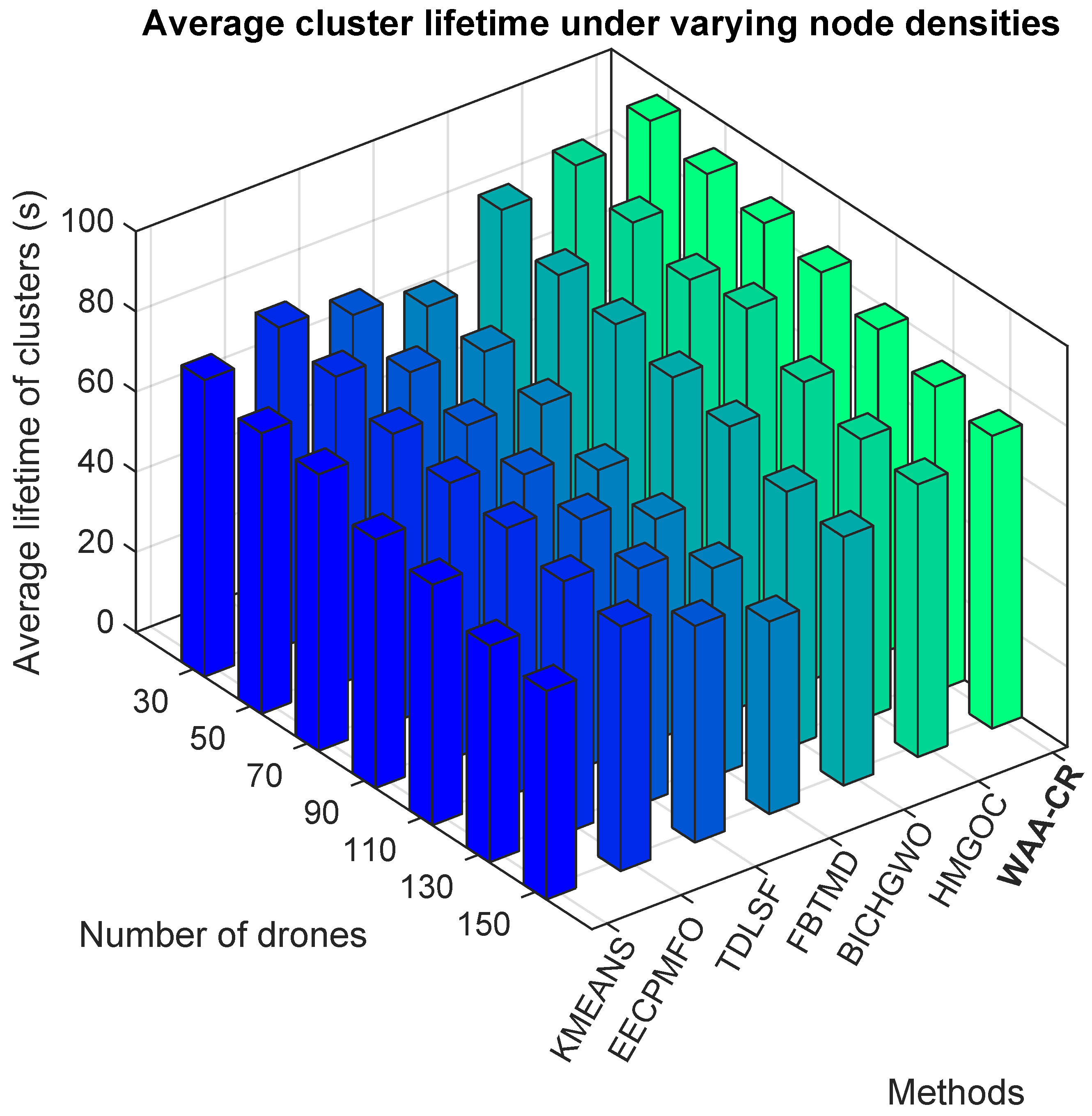
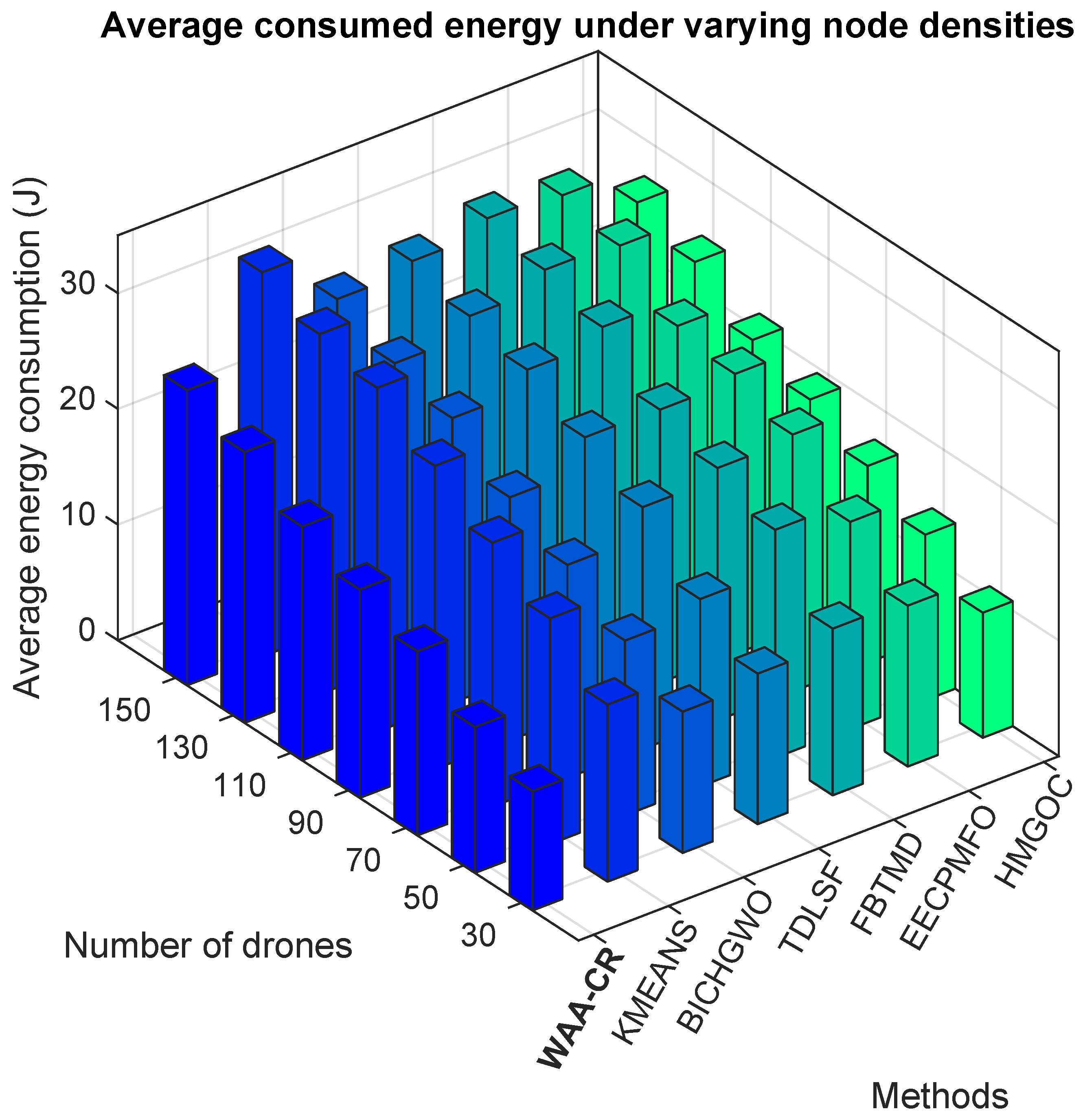
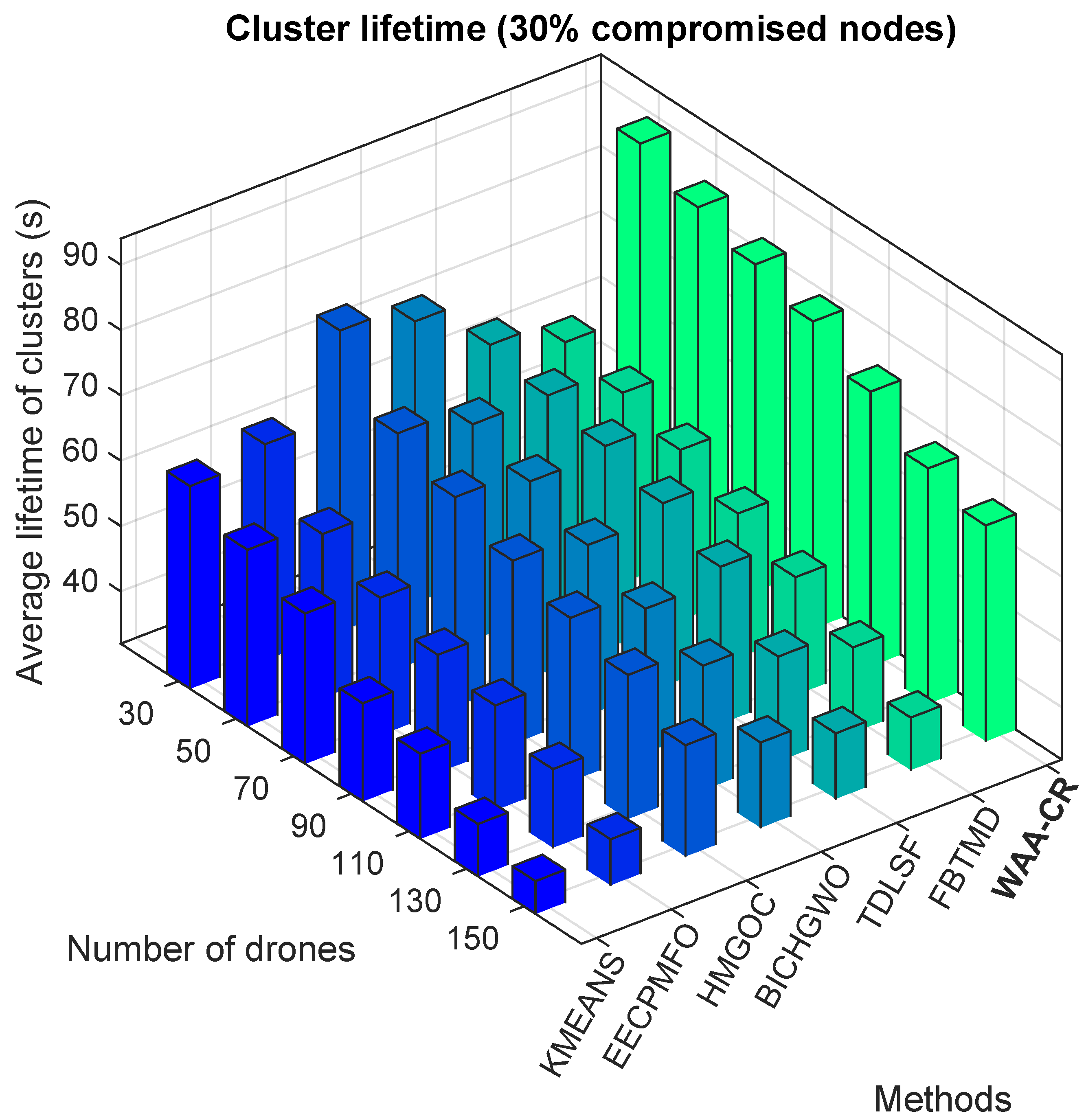
This section presents a comparative analysis of the clustering and routing performance of the evaluated methods with respect to five key metrics: (i) number of CHs, (ii) cluster creation time, (iii) cluster lifetime, (iv) energy consumption, and (v) packet delivery rate (PDR). The number of CHs reflects how efficiently the network organizes itself, with fewer but well-distributed CHs generally leading to stable clusters. Cluster creation time indicates the responsiveness of the algorithm in forming clusters under dynamic UAV mobility. Cluster lifetime measures the stability and sustainability of the formed clusters, which is critical in dynamic FANET scenarios. Energy consumption highlights the efficiency of each method in conserving the limited power resources of UAVs, whereas PDR provides insight into the reliability and effectiveness of data transmission across the network.
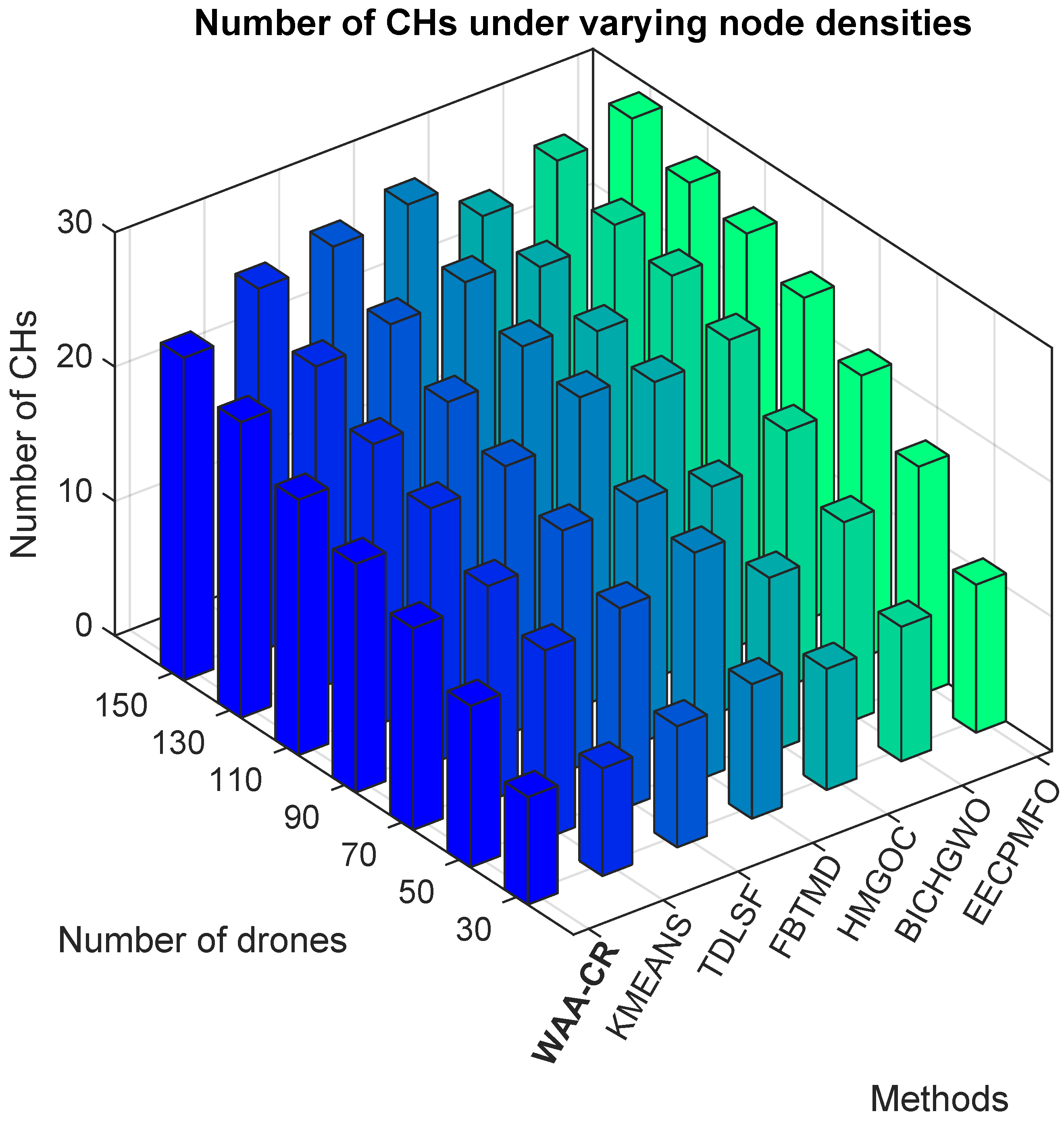
Number of CHs: First, an experimental comparison of the number of CHs was carried out across all examined algorithms under varying drone densities in FANET. As shown in
Figure 4, the number of CHs generally increases with higher UAV counts, reflecting the requirements for handling larger networks. However, the rate of increase and count of CHs differ notably among the methods, highlighting their distinct design method and trade-offs. The proposed WAA-CR achieves a balanced CH distribution across all drone densities. By integrating secure and survivable clustering that considers trust, energy, mobility, and communication metrics, it maintains moderate CH counts, thereby avoiding excessive clustering overhead while ensuring coverage and stability. In comparison, K-means clustering produces a relatively higher CH count at large network sizes due to its distance-based partitioning, which does not account for dynamic FANET requirements. TDLSF and FBTMD, which employ trust and honesty-based mechanisms, also show higher CH numbers as UAVs increase. On the other hand, bio-inspired and metaheuristic approaches such as BICHGWO, EECPMFO, and HMGOC generate even more CHs under dense deployments. Among the compared methods, WAA-CR achieves the most effective trade-off, sustaining fewer but well-distributed CHs, which is expected to improve cluster stability, improve packet delivery, and extend the lifetime, as evident in the subsequent results.
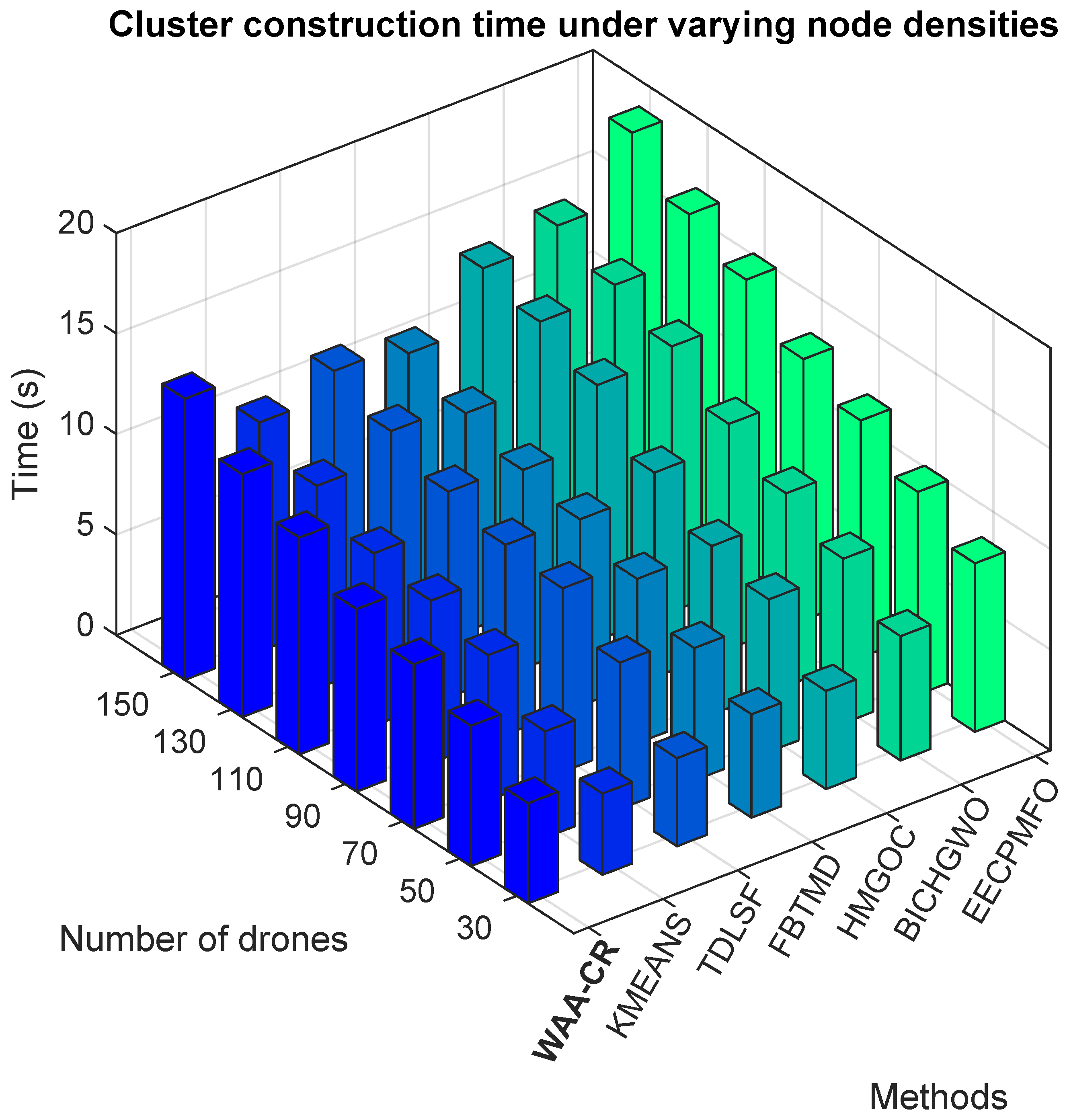
Cluster Creation Time: This metric represents the duration required for cluster formation.
Figure 5 depicts the time taken by the different examined methods for creating the clusters. Among the compared methods, K-means exhibits the shortest time, owing to its fast convergence without extensive iterations. On the other hand, the proposed WAA-CR demonstrates consistently better cluster formation times, balancing efficiency with reliability, and outperforms other trust-based and bio-inspired methods even at higher drone densities. Its clustering strategy ensures reliable and stable CH selection, optimizes node utilization, and accommodates UAV mobility. Through the selection of reliable and trustworthy CHs and accommodating the dynamic movement of nodes, WAA-CR ensures better stability and lifespan of the formed clusters.
Cluster Lifetime: It measures the duration from cluster creation to cluster breakdown, during which the CH manages both intra-cluster and inter-cluster communications. As the CH’s fitness diminishes over time or falls below a predefined threshold, it transitions to a CM, making this metric sensitive to UAV count, mobility, energy consumption, and cluster maintenance frequency.
Figure 6 illustrates the average cluster lifetime results across different methods for varying drone densities. Overall, the result decreases with increasing densities of UAVs due to the dynamic topology of FANETs and frequent cluster reconfigurations.
Among the evaluated techniques, WAA-CR consistently achieves the longest lifetime and maintains superior performance even across higher densities. It exhibits an improvement of 12 to 18% over other metaheuristic approaches, and around 26% compared to K-means, which exhibits the shortest cluster lifetime. The superiority of the WAA-CR can be attributed to its efficient CH selection, stable and trustworthy clustering strategy, and adaptive cluster maintenance, which collectively accommodate UAV mobility while minimizing frequent CH changes. Extending the lifetime of clusters is crucial for reliable communication and sustained network performance in highly dynamic context of FANETs.
Energy Consumption: One of the key factors influencing FANET lifetime is energy consumption, as UAVs operate with constrained resources.
Figure 7 reflects the average energy consumption of the examined methods under varying drone densities. The proposed WAA-CR consistently demonstrates the lowest energy consumption across all UAV counts, owing to its multi-criteria aware and adaptive CH selection, efficient cluster formation, and optimized routing strategy. By efficiently selecting CHs and performing prompt cluster maintenance, WAA-CR reduces abrupt energy depletion in individual UAVs, improves load balancing, and minimizes unnecessary node re-transmissions, thereby conserving both energy and bandwidth. K-means, despite being computationally simple, consumes higher energy. While HMGOC also demonstrates relatively better energy efficiency, other bio-inspired methods, such as BICHGWO and EECPMFO, and other methods, including TDLSF and FBTMD, exhibit higher energy consumption, particularly at larger drone densities, since they do not account for timely maintenance of clusters to prevent a rapid decline in a node’s remaining energy, and the lack of such maintenance can also lead to increased re-transmissions, further raising energy consumption.
Packet Delivery Rate: Figure 8 illustrates the packet delivery rate (PDR) performance of the algorithms across varying drone densities. This metric reflects the successful delivery of data packets within the network. Overall, the PDR for all methods improves as the number of UAVs increases, since denser deployments enhance connectivity and reduce link breakages. Among the compared methods, WAA-CR consistently achieves the highest PDR, exceeding 95% even under sparse deployments, outperforming the other compared schemes in the delivery success rates. In contrast, the k-means clustering approach exhibits the lowest PDR values due to its limited adaptability to mobility and lack of robustness in CH selection. Bio-inspired approaches such as EECPMFO and BICHGWO show moderate improvements, while trust-based methods like TDLSF and FBTMD provide slightly better reliability but still fall behind the proposed scheme. The superior performance of WAA-CR is attributed to its integration of trust evaluation into the clustering and routing process, ensuring that packet forwarding is carried out by reliable UAVs, thereby reducing transmission failures. Additionally, the scheme’s stability-aware clustering and delay-conscious routing mechanisms maintain robust connectivity and minimize retransmissions. These integrated features result in highly reliable communication and significantly improved delivery success rates compared to existing methods.
9.2. Analysis: Level of Trustworthiness
The trust score, which reflects the reliability of the selected CHs, is a key indicator of secure and dependable data collection in UAV networks.
Figure 9 presents the average trust score of CHs under varying percentages of compromised nodes. A higher trust score signifies that the chosen CHs are more capable of managing and relaying data while resisting malicious interference. The results clearly demonstrate that WAA-CR consistently achieves the highest trust scores across all compromise levels, highlighting its effectiveness in integrating trust into both clustering and routing. This trust-driven design ensures reliable CH selection, leading to enhanced data integrity and sustained network performance. In contrast, existing approaches such as TDLSF and FBTMD partially address malicious node elimination but still fall behind WAA-CR in securing CHs. Other metaheuristic methods, including HMGOC, BICHGWO, EECPMFO, and KMEANS, do not explicitly incorporate trust evaluation, which limits their ability to ensure reliable CH selection under the presence of compromised nodes.
9.3. Analysis: Impact of Compromised Nodes
This section examines the performance of the proposed WAA-CR and the compared algorithms under varying percentages of compromised nodes in the FANET, ranging from 10% to 30%. It is crucial to study such adversarial conditions because the compromised nodes can mislead the clustering process, degrade routing reliability, and ultimately reduce the overall network performance. The results are presented as follows:
First, to analyze the impact on the clustering process, we have examined the clustering performance of the methods by measuring the cluster lifetime results under a varying number of compromised nodes.
Figure 10,
Figure 11 and
Figure 12 show the cluster lifetime performance of the different methods under a varying number of compromised nodes. With more compromised nodes, most existing algorithms show a noticeable reduction in cluster lifetime, since unreliable or compromised CHs cause frequent re-clustering and instability. In contrast, WAA-CR maintains significantly longer cluster lifetimes across all levels of compromise. This robustness comes from its trust-aware CH selection, which ensures that even under adversarial influence, reliable nodes are chosen as CHs. As a result, cluster stability is preserved, and unnecessary re-clustering procedures are avoided.
The next metric considered is the average packet delivery rate, which evaluates the success rate of data packet transmissions within the network under a varying number of compromised nodes. The results are presented in
Figure 13. A higher percentage of compromised nodes typically reduces the PDR, as malicious or unstable nodes increase packet losses and retransmissions. However, WAA-CR consistently achieves the highest PDR values, maintaining reliable data delivery even when a larger number of nodes is compromised. This improvement is a result of the proposed effective trust-aware and secure cluster-based routing mechanism, which eliminates the interference of unreliable or compromised nodes, ensuring secure and reliable communication links.
The results demonstrate that WAA-CR outperforms other methods across the evaluated metrics, maintaining cluster stability and high communication reliability even with increasing percentages of compromised nodes. These findings highlight the resilience of the proposed WAA-CR framework for FANET under adversarial conditions.
9.4. Considerations for Integration in Disaster Response Systems
The WAA-CR framework enables trust-aware FANET clustering and routing for disaster-prone environments. To enhance network resilience during infrastructure disruptions, it can be integrated with UAV-based recovery models such as mesh relay drones, tethered UAVs, and Aerial Base Stations (ABSs), by enabling dynamic, redundant communication paths between shelters or GCSs. Mesh relay drones provide a flexible, multi-hop communication layer for rapid deployment and self-healing routing when direct links fail. Tethered UAVs act as stable, semi-permanent aerial hubs with continuous power, supporting reliable communication and trust management. Meanwhile, ABS platforms operate at higher altitudes to offer wide-area connectivity and serve as a fallback link for long-range communication. These models enable the creation of hierarchical and adaptive recovery mechanism that ensures robust and continuous connectivity in dynamic post-disaster environments.
10. Conclusions
This work presented the WAA-CR framework, a trust-aware and mobility-adaptive architecture for UAV-based communication recovery in disaster scenarios. The framework integrates three core components: (i) a preprocessing module for communication shelter placement, treated as a predetermined input due to disaster variability; (ii) a clustering mechanism that optimizes CH selection based on multi-objective metrics including trust, energy, and connectivity; and (iii) a routing phase that extends these principles by incorporating mobility-aware metrics such as speed variation and link stability. Together, these components enable secure, energy-efficient, and resilient communication among UAVs and between UAVs and shelters. The proposed approach contributes to disaster communication research by combining trust management, energy optimization, and mobility resilience into a unified framework. By decoupling shelter placement from UAV association, WAA-CR achieves modularity, allowing infrastructure planning to be performed offline while enabling UAVs to adapt dynamically to real-time operational conditions. Furthermore, the use of lightweight authentication ensures that security requirements are addressed without compromising system efficiency.
By combining trust management, energy optimization, and mobility resilience, WAA-CR provides a unified and modular solution for post-disaster communication. The preprocessing modules anchor the network, the security modules ensure authentication and trust integrity, and the core modules enable adaptive clustering and self-healing routing. Collectively, these functions allow the system to maintain continuous and reliable connectivity when ground infrastructure is damaged.
The variability in disaster types makes determining suitable shelter sites a highly complex task, as the type, scale, severity, and location of disasters are dynamic and unpredictable in practice. Addressing this challenge will be the focus of our future work. In addition, we plan to extend the WAA-CR framework by incorporating broader IoT integrations to enhance situational awareness and network adaptability in diverse disaster scenarios.




 ,
,