Article

Real-Life ISO 15189 Qualification of Long-Range Drone Transportation of Medical Biological Samples: Results from a Clinical Trial


1
Human Biology Center, Amiens-Picardie University Hospital Center, F-80000 Amiens, France
2
AGIR Laboratory UR 4294, Picardie-Jules Verne University, F-80000 Amiens, France
3
Laboratory of the Montreuil District Hospital Center, F-62180 Rang-du-Fliers, France
4
Delivrone, F-76100 Rouen, France
*
Authors to whom correspondence should be addressed.
Drones 2026, 10(1), 71; https://doi.org/10.3390/drones10010071
Submission received: 5 December 2025 / Revised: 14 January 2026 / Accepted: 19 January 2026 / Published: 21 January 2026
(This article belongs to the Special Issue Recent Advances in Healthcare Applications of Drones)

Highlights

What are the main findings?
  • The drone system enabled the 80 km transportation of clinical samples without damage.
  • Freezing, refrigerated, and room temperatures were maintained during flights.
What are the implications of the main findings?
  • The quality of pre-analytical conditions prevented clinical impact on the interpretation of the biological results.
  • Long-range transportation by drone is in accordance with the ISO 15189 standard.

Abstract

Controlling pre-analytical conditions for medical biology tests, particularly during transport, is crucial for complying with the ISO 15189 standard and ensuring high-quality medical services. The use of drones, also known as unmanned aerial vehicles, to transport clinical samples is growing in scale, but requires prior validation to verify that there is no negative impact on the test results provided to doctors. This study aimed to establish a secure, high-quality solution for transporting biological samples by drone in a coastal region of France. The 80 km routes passed over several densely populated urban areas, with take-off and landing points within hospital grounds. The analytical and clinical impact of this mode of transport was compared according to two protocols: an interventional clinical trial on 30 volunteers compared to the reference transport by car, and an observational study on samples from 126 hospitalized patients compared to no transport. The system enabled samples to be transported without damage by maintaining freezing, refrigerated, and room temperatures throughout the flight, without any significant gain in travel time. Analytical variations were observed for sodium, folate, GGT, and platelet levels, with no clinical impact on the interpretation of the results. There is a risk of time-dependent alterations of blood glucose measurements in heparin tubes, which can be corrected by using fluoride tubes. This demonstrated the feasibility and security of transporting biological samples over long distances in line with the ISO 15189 standard. Controlling transport times remains crucial to assessing the quality of analyses. It is imperative to devise contingency plans for backup solutions to ensure the continuity of transportation in the event of inclement weather.

1. Introduction

The International Organization for Standardization (ISO) 15189 standard [1] not only regulates the stages of laboratory analysis but also requires rigor in the process preceding analysis. The pre-analytical phase of a laboratory examination is pivotal, since 60–70% of errors are committed during this phase [2]. While the laboratory is responsible for controlling each phase of the analysis, pre-analytical errors generally occur outside the laboratory and could affect patient safety. Biased and/or delayed laboratory results are very detrimental for patients, since more than 70% of medical decisions are based on a laboratory result in France [3]. Staff training and the use of standardized materials for blood collection can reduce these risks. The transportation of samples is more difficult to standardize, since this is impacted by various environmental factors such as ambient temperature, the maintenance of sample temperature, vibrations, the transport time, and road traffic. The effects of extreme temperatures and physical forces during sample transportation are responsible for alterations to specimen analyses, sometimes directly linked to induced hemolysis [4]. The qualification of transportation methods according to ISO 15189 standard is thus essential to guarantee a low risk of incorrect laboratory results and patient safety.
The transport of biological samples for clinical analysis has traditionally been carried out by land, particularly by car, especially in rural areas. However, recent technological advances in the field of drones, also called unmanned aerial vehicles (UAV), have opened up the possibility of using them in healthcare for the transport of biological material [5,6]. This mode of transport is considered promising and offers several significant theoretical advantages. First, it could improve territorial coverage and healthcare access by offering better connectivity. In addition, it offers greater flexibility and maneuverability as it can be deployed on demand. Unlike road transport, which depends on the availability of human personnel and remains subject to traffic conditions, drones do not have these constraints. In an increasingly challenging ecological context, drone transport also represents a potentially more environmentally friendly solution, with a theoretical reduction in carbon footprint of up to 95% compared to conventional solutions [7]. However, the main issue with this approach is its innovative nature. Its adoption still requires numerous in-depth evaluations before it can replace or supplement existing transport services. Studies must confirm the system’s operational availability, practicality, and safety, as well as its real economic advantage for biological samples transport. Ultimately, drones could serve as an effective complement to conventional transportation, offering a faster, more flexible, and more environmentally friendly option for healthcare logistics.
For several years now, drone transport solutions have been implemented for the purpose of medical applications. Since 2016, Zipline has been working with the Rwandan government to organize the distribution of healthcare supplies (medicines, blood products) using a drone and parachute delivery system. The implementation of this system has resulted in a reduction in both distribution times and the wastage of blood products [8]. In Ghana, the implementation of Zipline’s aerial logistics solution has been demonstrated to enhance access to vaccines and essential medications for maternal health, as well as for emergency situations [9,10]. Since then, numerous projects have been initiated with the objective of delivering medicines, vaccines, blood samples and transfusion units, as summarized by Oakey et al. [11]. However, there is a scarcity of peer-reviewed publications, particularly those addressing the analytical impact on blood testing.
Some studies have shown that drone transport has little effect on the impact that the environment has on samples during transport, whether in terms of humidity, altitude, or vibration, potentially compromising the physical integrity of the samples and the results of biological analysis [6]. However, flight configurations varied in terms of duration, distance, and cargo. Amukele et al. were the first to report that the transportation of laboratory specimens by small drones did not impact the accuracy of routine biological test results following brief flights [12,13]. Long-distance flights appear to be at greater risk of leading to erroneous results due to a breakdown in the maintenance of transport temperatures over longer flight times [14]. Research indicates that drone transportation is a viable mode in terms of the preservation of results (hemolytic–icteric–lipemic (HIL) index [15], immunohematology [16], chemistry [12,17], and microbiology [13]), as demonstrated by published data. However, it should be noted that some studies have highlighted potential discrepancies in a few parameters depending on transport protocols [14,17]. Therefore, it is advisable for laboratories to carefully assess the impact of drone transportation on laboratory results before implementing it on a regular basis. In addition, according to the ISO 15189 standard, each laboratory must validate its transport methods internally, based on the literature, the recommendations of learned societies, and its usual quality indicators for sample transport [18]. This therefore concerns conventional road transport when a healthcare facility needs to transfer biological samples to an analysis laboratory. In the event of a technical breakdown in a laboratory, it may be necessary to request analysis from a referral laboratory, which lengthens the turnaround time and is doubly impacted by the transport by drone deployed on an emergency basis.
With a view to safely and effectively deploying drone transport in European hospitals, this study aimed to prove that this method has no analytical impact on sensitive biological results, while ensuring that the correct transport temperatures are maintained. To achieve this, an interventional clinical trial in healthy volunteers was conducted involving long-distance flights of 80 km between French hospital laboratories. The regulatory challenge of this study was to demonstrate the safety of drone takeoffs/landings from vertiports installed within sensitive sites such as hospitals and conducting flights over several large urban areas. In addition, a simulation of a back-up procedure requiring additional transport by drone and an extension to the turnaround time was carried out. The aim was to assess the impact of the drone transport solution on analytical parameters under real-life conditions for in-patient samples. The results that follow are the first to be shared from a registered clinical trial study.

2. Materials and Methods

2.1. Study Population and Biological Clinical Samples

To guarantee the requisite statistical power, the study protocol necessitated the inclusion of 30 patients, with a maximum exclusion rate of 10%. Thirty healthy volunteers were recruited as part of the TRANS-AIRGHT clinical trial (NCT05885568) for the first phase of the study (Figure 1A). The inclusion criteria for this interventional study were as follows: age > 18 years old, no contraindication to blood collection, and informed and consenting voluntarism. The exclusion criteria were an impossibility to collect sufficient blood volume and retractation of consent to take part in the study. Seventeen women and thirteen men were thus included (median age of 40 years, ranging from 23 to 60 years). All thirty included patients were sampled for blood at the Laboratory of the Montreuil District Hospital Center (MDHC), providing twice as many tubes as is usually required. Thus, each subject provided double blood samples in BD Vacutainer® PST™ Plasma Separation Tubes, BD Vacutainer® SST™ Serum Separation Tubes, 2 BD Vacutainer® EDTA Tubes, BD Vacutainer® Fluoride Tubes, and BD Vacutainer® Citrate Tubes (Becton Dickinson, Rungis, France). Samples were anonymized. All thirty included patients were analyzed in accordance with the protocol. Unfortunately, one patient was excluded from the folate level analysis due to one of the paired samples being hemolyzed.
For the second phase of the study (PATH-AIRGHT), an observational matched analysis was carried out between the test results for 126 hospitalized patients routinely sampled at the Amiens-Picardie University Hospital Center (APUHC), for whom additional tubes not required for the recommended treatment were sent to the laboratory (Figure 1B). The necessary samples were processed normally for routine clinical care. Surplus tubes were anonymized and kept at room temperature without pre-treatment before being flown under real conditions back to the originating laboratory for delayed analysis. Only proscribed biological parameters were examined in the flown samples. Thus, the size of groups and the panel of studied biomarkers varied. Validation of the transport of samples at low temperatures (−25 +/− 5 °C) was carried out again using surplus samples frozen after analysis. A batch of biological samples were flown at 2–8 °C to assess the reliability of the metrological method, but no analyses were performed on these tubes, due to the inappropriate size of the population for interpreting matched comparisons.

2.2. Pre-Analytical Phase and Flight Data

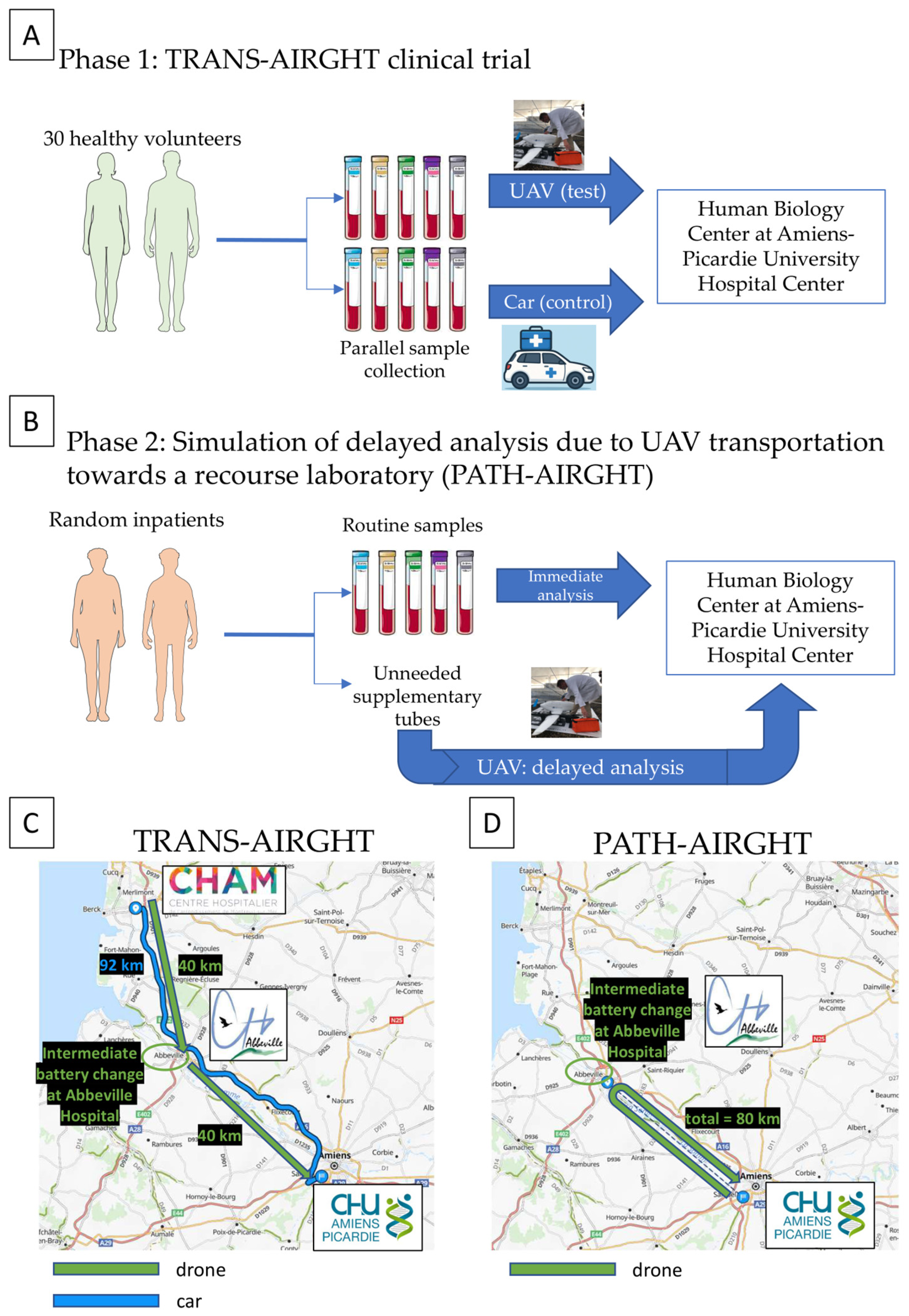
For the ISO 15189 qualification of transportation methods, several parameters must be controlled and compared to a reference method. The Human Biology Center (HBC) at APUHC usually transports biological samples by car between laboratory sites. Car transportation was thus used as the reference method to assess the non-inferiority of drone transportation according to pre-analytical (time and maintenance of temperature on board) and analytical (biological and clinical impact on analyte results) criteria. Drone transportation was operated by Delivrone (Rouen, France) with an Eiger II UAV (Rigitech, Prilly, Switzerland). This UAV weighs 22 kg in operational conditions and has a wingspan of 2.70 m, a load volume of 15 L for a maximum payload of 3 kg, and a runtime of 40 min thanks to its electric batteries. An illustrative video taken independently of the current study can be found at https://shorturl.at/2US2a (accessed on 18 January 2026). This fixed-wing VTOL (Vertical Take-Off and Landing) drone combines the advantages of the vertical take-off of conventional drones with the cruising efficiency of an airplane over long distances. The drone has an average speed of 110 km/h and a top speed of 150 km/h. At maximum load and with its current energy range, the drone can travel 100 km in less than 40 min. Currently, the maximum operational limits of the aircraft are wind speeds above 45 km/h (12 m/s), gusts of 55 km/h (15 m/s) or more, heavy rain, temperatures below −7 °C and above 40 °C, snow/ice, and thunderstorms within a 20 km radius of the flight corridor. An operating license issued by the Civil Aviation Safety Directorate (DSAC, Paris, France) was required for these flights, which were operated in the “specific” category under SORA. To obtain this license, the operator Delivrone had to submit a license application file demonstrating that the flights, the drone, and the equipment complied with European regulations (EASA). This file includes, in particular, a risk analysis covering both the “air” domain (ensuring separation from other airspace users) and the “ground” domain (ensuring the safety of people and property on the ground), thus demonstrating control of the level of risk associated with the operation. Ground risk is reduced through the implementation of several measures, which may be strategic (proven reliability of the drone, selection of a flight path that passes over as few populated areas as possible, emergency procedures, etc.) or tactical (use of a rescue parachute in the event of drone failure, for example). As part of the TRANS-AIRGHT clinical trial, for each type of tube, one tube was transported by courier as the reference transportation mode, while one tube was transported by UAV as the test transportation mode. The UN3373-certified carrying cases were specifically designed by Sofrigam (Rueil-Malmaison, France) to fit inside the drone, and the same cases were used for car transport. These cases were filled with eutectic plates in accordance with the manufacturer’s recommendations, taking into account the target internal temperature for transportation. (Supplementary Figure S1). The DSAC has certified that this packaging is safe and will not spread biological materials in the event of a crash, based on experimental crash tests (authorization number: FRA-OAT-2025DLIV008-000). Samples were sent from MDHC, and the destination for laboratory procedures was the HBC at APUHC (Figure 1C). A panel of critical parameters were analyzed according to the ISO 15189 requirements for the qualification of transportation modes, maintaining room temperature (between 15 and 25 °C) in the transport case. For the PATH-AIRGHT study, routine tubes were immediately analyzed at HBC, while unprocessed or frozen surplus tubes were submitted to a semi-circular 80 km UAV transportation before analysis and matched comparison (Figure 1D).
The transportation time and the temperature inside the carrying case were measured by a BD Widerlab™ TII—Time & Temperature tracker (Becton Dickinson, Rungis, France). Another tracker was inserted in the drone’s trunk to measure environmental temperature during the flight.
Because drones are unmanned aerial vehicles, maintaining sample security and preventing unauthorized access during flights is a critical concern. Consequently, our study addressed this by using locked packages and equipping the drone with advanced navigation and real-time tracking capabilities. What is more, even when the UAV had the theoretical battery capacity to cover a distance of 80 km, an intermediate battery change was systematically carried out for safety reasons. This was carried out at the Abbeville Hospital (Figure 1C,D).

2.3. Analytical Phase—Clinical Laboratory Methods

All anonymized samples were analyzed in a blind manner with regard to the mode of transport and pair-matching by automated analyzers. Upon arrival at the HBC, a complete blood count was immediately performed on EDTA tubes with Sysmex XN1000 device (Sysmex, Kobe, Japan). Other samples were centrifugated for 15 min at 3247 rotations per minute to separate plasma or sera for analysis. Atellica CH930 or IM1300 analyzers (Siemens Healthineers, Tarrytown, NY, USA) were used to quantify levels of sodium, potassium, glucose heparinate, creatinine, calcium, phosphorus, total CO2, lactate dehydrogenase (LDH), urea, total bilirubin, alkaline phosphatase (ALP), alanine transaminase (ALT), aspartate transaminase (AST), gamma-glutamyl transferase (GGT), proteins, albumin, C-reactive protein (CRP), iron, transferrin (in PST tubes), glucose fluoride (in Fluoride tubes), folates, thyroid-stimulating hormone (TSH), triiodothyronin, thyroxine, vitamin B12, 25OH vitamin D, and the lipid–cholesterol panel (in SST tubes). Hemolysis, icterus, and lipemia (HIL) were evaluated in plasma and serum before analyte dosing with the automatic method of the Atellica Solution System. Prothrombin time, partial thromboplastin time, fibrinogen, factor V, D-Dimers, and antithrombin were analyzed in citrate tubes with a Sysmex CA-1500 instrument (Sysmex, Kobe, Japan).
Urinalysis was conducted using a UF-4000 (Sysmex, Kobe, Japan) for cellular quantification and an Atellica CH930 for biochemical parameters. Hepatitis B serology was performed with an Alinity I system (Abbott, Chicago, IL, USA). Blood culture bottles containing 1 mL of Staphylococcus aureus, Escherichia coli, or Campylobacter jejuni (diluted to 105 UFC/mL in saline medium) were placed into the BD Bactec FX instrument (Becton Dickinson, Rungis, France). Organisms in positive blood cultures and sputum samples were identified using standard microbiological methods and matrix-assisted laser desorption ionization–time of flight mass spectrometry (MALDI-TOF MS; Bruker Corp., Billerica, MA, USA).
Plasma cytomegalovirus, cervical human papillomavirus, nasopharyngeal influenza virus, and SARS-CoV-2 genomes were searched for with a Cobas 6800 (Roche, Bale, Switzerland). In order to check the critical stability of nucleic acids during drone transportation at freezing temperatures, low-positivity samples containing these DNA or RNA viruses were selected for this study.

2.4. Statistical Analysis and Clinical Interpretation

The Kolmogorov–Smirnov test was performed to examine normal distribution. Continuous variables in this study are presented as the mean and standard deviation (SD), while continuous variables with skewed distributions are presented as the median and interquartile range (IQR). The paired t-test was used for normally distributed continuous variables, whereas the Wilcoxon signed-rank test was used for variables with skewed distributions. Bland–Altman plots were used to illustrate the agreement between the two different transportation modes. The chi-square test was used to examine contingencies. In line with the ISO 15189 standard, discrepancies were compared to the difference of 2.8 standard deviations in reproducibility for each analyte. For the PATH-AIRGHT study, only analyzed parameters with size groups ≥5 were considered for statistical analysis, which analyses were performed using GraphPad Prism version 10.0 for Windows (GraphPad Software, San Diego, CA, USA). The threshold for statistical significance was set to p < 0.05.
As outlined in the ISO 15189 standard, a mathematical apparent difference does not necessarily imply a clinically significant difference. Therefore, when the initial statistical analysis revealed a discrepancy, the total change limit (TCL) method was implemented as a secondary analysis [19]. TCL was calculated as TCL= √((2.77 CVa)2 + (0.5 CVb)2), where CVa is the in-lab analytical dispersion and CVb is the average within-subject variation as reported by European Federation of Clinical Chemistry and Laboratory Medicine (EFLM) [20]. When a deviation exceeding the TCL interval was observed between paired results, we concluded that there was a significant deviation according to ISO 15189.
As a third line of analysis, the clinical impact of the error was assessed according to two criteria: firstly, the result should be interpreted in isolation, in comparison to standard reference values, and secondly, the impact of any errors on clinical care should be considered.

2.5. Institutional Review Board Statement

This study was conducted following the Declaration of Helsinki, and all procedures were performed following local guidelines and regulations. TRANS-AIRGHT clinical trial (NCT05885568) was approved by Nord-Ouest III Ethic Committee (France). In line with the French legislation on non-interventional studies of routine clinical practice, the PATH-AIRGHT protocol was approved by a hospital committee with competency for research not requiring authorization by an institutional review board (Amiens University Medical Center, reference: PI2023_843_0027).
All participants provided informed consent to participate in the study and agreed to the publication of the manuscript.

3. Results

3.1. Conduction of Trial UAV Flights

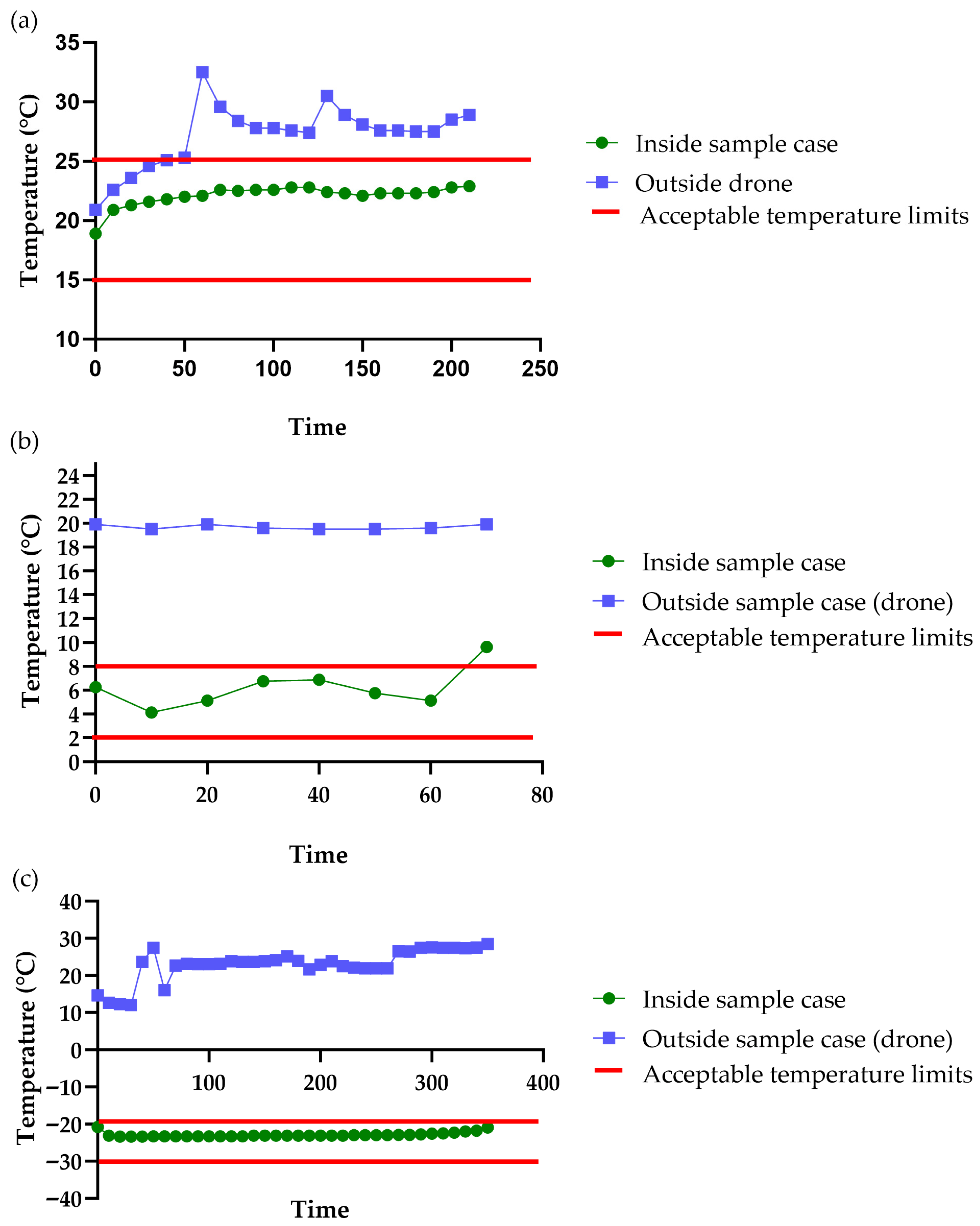
The six TRANS-AIRGHT flights were operated on three separate days between May and June 2025. Depending on the day and period (morning or afternoon), outside temperatures varied between 14.5 °C and 23 °C. Wind and gust speeds varied, reaching 7 m/s and 10 m/s, respectively. On all flights, the packaging system ensured that samples were always maintained at the target temperatures. With a target temperature of between 15 and 25 °C (room temperature conditions), the average temperature was 22 °C inside the sample case. A technical incident caused a delay in the arrival of a series of seven samples from the MDHC at the HBC. On its initial arrival at the HBC, the remote-controlled drone took off again before the samples could be unloaded by a member of staff on site. The samples were therefore transported for an extra 131 min. However, it is interesting to note that the target temperatures were still effectively maintained during the total 3 h and 25 min of transport by drone (Figure 2a). No other incidents occurred during this test phase. It has therefore been established that the metrology and air safety arrangements were sufficient to validate the technical feasibility of drone flights between hospital sites over long distances and over densely populated areas.
The PATH-AIRGHT evaluation phase aimed at assessing the impact of drone transport on samples from hospitalized patients. Twenty-five flights spread over six days were operated between June 2025 and September 2025. Wind and gust speeds varied, reaching 8 m/s and 10 m/s, respectively. Outside temperatures varied between 11.3 and 34.6 °C, with an average temperature of 25.4 +/− 5.5 °C (mean +/− SD). Under transport conditions at room (15–25 °C), refrigerated (2–8 °C), and freezing (−30–−20 °C) temperatures, the temperatures maintained in the drone’s sample case were 22.5 +/− 1.1 °C, 5.7 +/− 1.0 °C, and −22.6 +/− 0.9 °C, respectively. The temperature range limits were never exceeded, except after one hour of refrigerated transport (Figure 2b). There was only one flight to evaluate the refrigerated transport of biological samples which was not used for laboratory analysis. A weather incident (strong winds) forced the drone to remain stationary for several hours at the intermediate battery change point during one of the flight operations. At that time, the aircraft was carrying frozen samples that could only be returned to the HBC after a total transport time of 5 h and 50 min. Temperature monitoring showed no deviation from the target temperatures. This demonstrates that the measures put in place enable a temperature of between −30 and −20 °C to be maintained in the drone, despite high outside temperatures (up to 28.4 °C, Figure 2c).

3.2. TRANS-AIRGHT: Clinical Trial on Healthy Volunteers

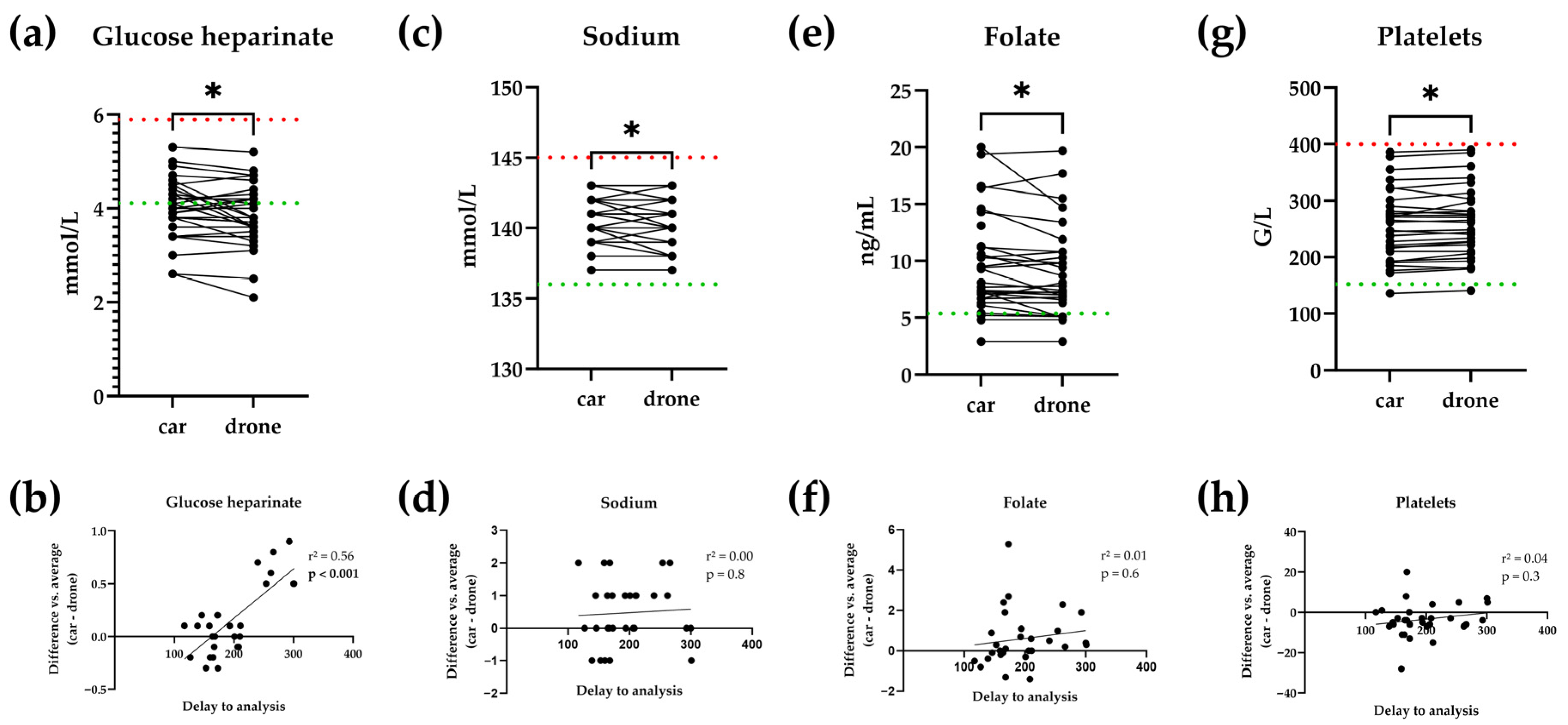
All of the samples from the thirty participants were transported to their defined destination, regardless of the mode of transport (car or drone). All tubes were intact, with no visible damage on receipt. Pre-analytical time, including sample preparation, transport and receipt at the laboratory performing the analysis, did not differ between modes of transport. The incident mentioned above, which delayed the arrival at the HBC of a series of seven samples transported by drone, explains the slightly higher median transport time for drone transport compared with road transport (173.0 vs. 166.5, p = 0.1; Table 1). The results of biological analyses generally did not differ significantly between tubes transported by drone and by courier. While blood glucose levels in fluoride tubes were equivalent under both conditions, blood glucose levels in heparin tubes were significantly lower when transported by drone (p = 0.04, Figure 3a).
This was explained by a correlation between pre-analytical delay and measurement differences (r2 = 0.56, p < 0.001, Figure 3b). If we exclude the samples corresponding to unacceptable transport times by drone, linked to the unloading incident at the HBC, we no longer find any difference in this parameter depending on the mode of transport. The other parameters statistically affected by mode of transport were sodium, folate, and platelet count (Figure 3c,e,g). It is not possible to explain these differences as a function of pre-analytical delay (Figure 3d,f,h). However, these statistically significant variations did not lead to any changes in the clinical interpretation of the result based on the expected normal values (Supplementary Table S1). Despite the occasional measurement discrepancies observed for each parameter (Supplementary Figure S2), these remained below the threshold of TCL recommended by the ISO 15189 standard. In terms of TCL and clinical interpretation relative to the pathological threshold, only one clinically affected variation occurred between the two modes of transport. This concerned an elevation of D-Dimers above the normal value that was observed for a flown sample of a volunteer (0.72 µg/mL in drone sample vs. 0.19 µg/mL in car sample, clinical threshold < 0.5 µg/mL). The impact of this error on clinical care would have been minimal, as the patient was not in an emergency thrombosis situation. Also, this abnormal sample belongs to the batch that experienced a technical incident and an extended pre-analytical delay (254 min in the drone versus 124 min in the car). In accordance with the laboratory procedures, as the pre-analytical delay exceeded four hours, the clinical report would have indicated the need to control the result of another blood sample. It should be noted that the mean LDH levels and mean platelet volume of healthy volunteers were slightly above the maximal expected normal value. However, there was no significant difference between the car and drone groups.
The TRANS-AIRGHT clinical trial therefore demonstrated the clinical and biological validity of the drone transport method developed in France, as long as the time of transport is controlled.

3.3. PATH-AIRGHT: Observational Study on Pathological Samples

As variables were slightly affected by drone transportation in healthy volunteers, pathological samples from random inpatients at the APUHC were submitted to an extended pre-analytical phase, including an 80 km transportation by drone. In a comparison of pair-matched samples that were directly analyzed, we found concordant results for drone samples for most biochemical biomarkers, blood counts, urinalyses, and hepatitis B serologies (Table 2).
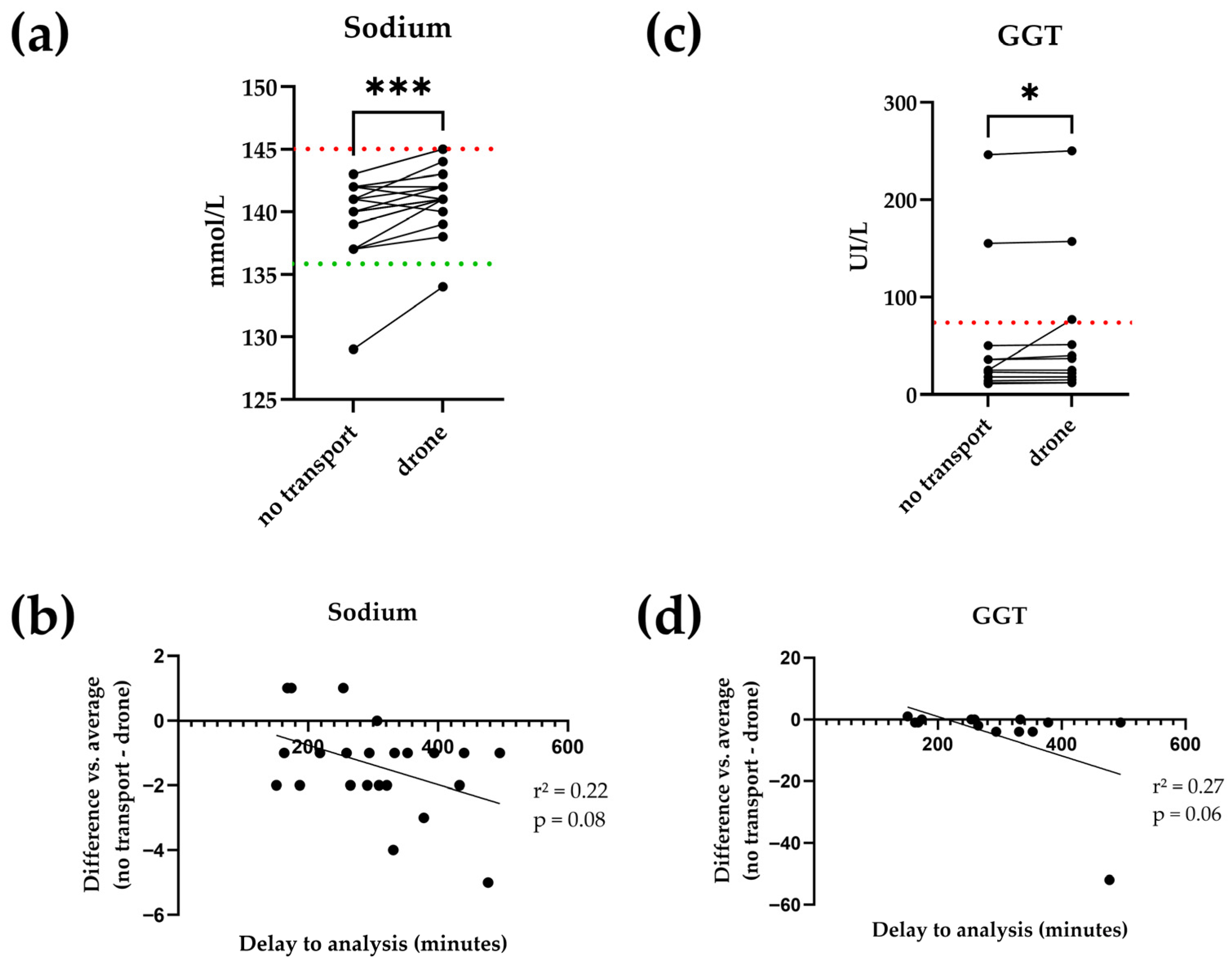
As previously, drone transportation altered sodium results without a significant correlation with delay in analysis (Figure 4a,b). The same phenomenon was observed for the GGT results. A bias in quantitative results was not associated with biased clinical interpretations, since the results were still in the same range as normal or pathological values. In fact, deviations were kept within the TCL range that is tolerated by the criteria of ISO 15189. Interestingly, glucose heparinate, folates, and platelets were not impacted by delays and drone transportation in samples from hospitalized patients, in contrast to those from healthy volunteers.
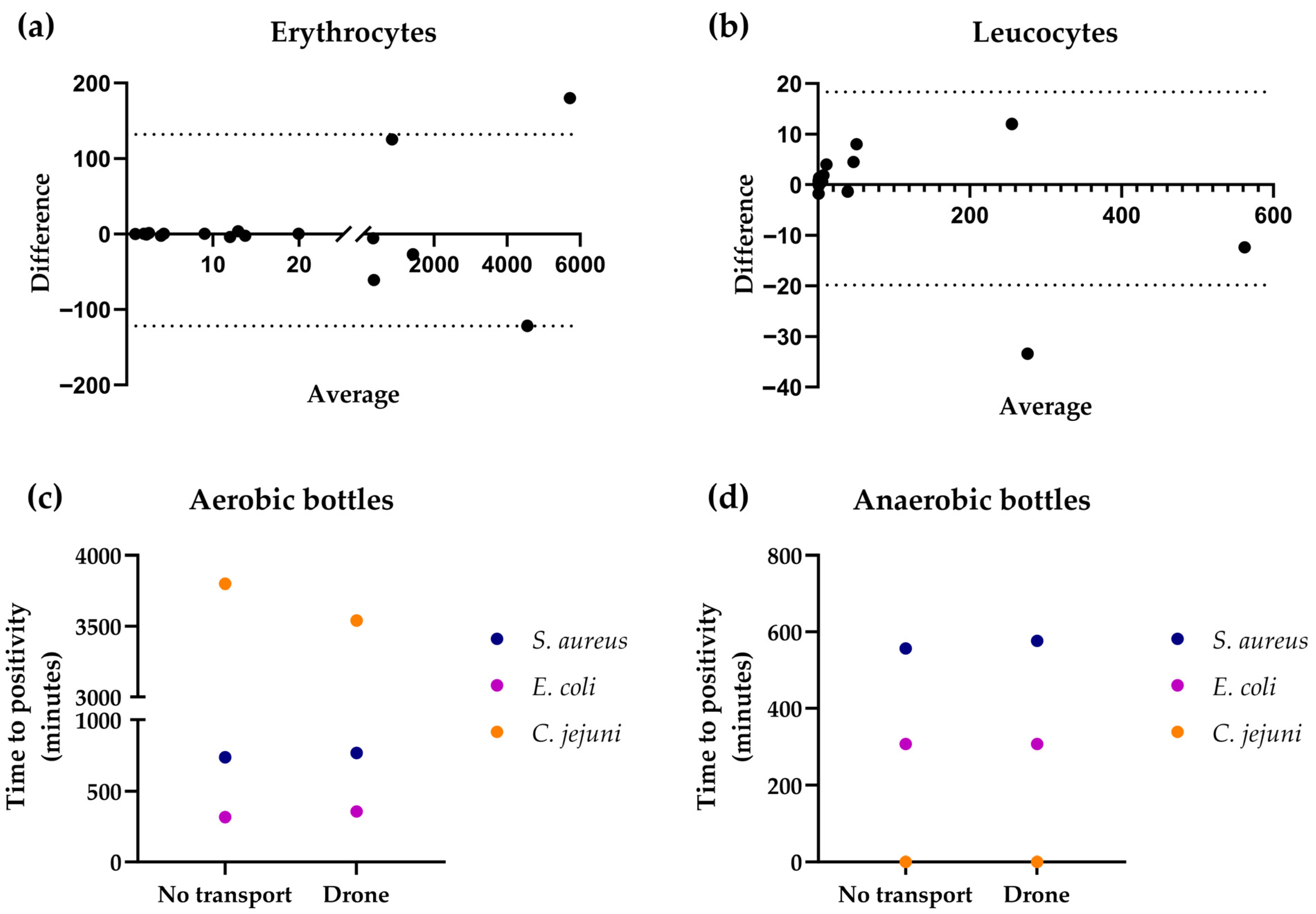
Cytobacterial analyses did not differ significantly in terms of erythrocyte and leucocyte counts between flown samples and the controls (p = 0.7 and p = 0.2, respectively; Figure 5a,b; Table 2). Differences were observed, but they were not related to altered clinical interpretation. Blood cultures’ times to positivity were similar between the two methods for all of the studied bacteria (S. aureus, E. coli, and C. jejuni) in aerobic (Figure 5c) and anaerobic (Figure 5d) bottles.
Drone transportation was also evaluated for virological assays in the event of use in an epidemic context. Because room temperature seemed easy to preserve in the drone system, and because freeze–thaw cycles might degrade viral genomes, we chose to compare results between non-transported samples and frozen-flown samples containing small amounts of DNA or RNA viruses. Since the temperatures were successfully maintained within acceptable limits, qualitative and quantitative results of viral PCR assays in blood and swabs obtained from infected inpatients were not impaired by drone transportation (Table 3).

4. Discussion

The aim of this study was to demonstrate the feasibility of drone transport (1) in relation to the climatic and urban conditions in our region, (2) without physical degradation of samples, (3) while ensuring optimal temperature maintenance, and (4) without a clinical impact on medical biology results for both healthy patients and hospitalized individuals. The clinical trials were robustly designed, with a comparison to the reference transport mode that met the ISO 15189 standard. Therefore, the final comparison of laboratory results encompassed all of the environmental factors that could impact clinical reports, including delays, vibration, temperatures, and so on. The successful completion of the clinical trials is indicative of the effective transportation of all included patients’ samples, which were able to undergo laboratory procedures safely and without any damage. This demonstrates the drone transportation system’s feasibility within the defined study conditions, which simulate real-life use.
Between May and September, the period covered by our study, the average outdoor temperature usually ranges between 8 °C and 22 °C. These temperatures are not generally problematic for maintaining temperatures between 15 °C and 25 °C (room temperature), but they do allow us to test transport conditions below 8 °C (refrigerated and frozen). In these situations, the tests, although limited in their number of iterations (particularly the refrigerated condition, which was only tested on one flight), were conclusive, with temperatures maintained as expected for transport duration. During the tests, outside temperatures exceeded 34 °C, but this did not prevent the various target temperatures from being maintained over a prolonged period. Thus, drone transport is compatible with different thermostatic transport conditions, regardless of outside temperatures.
On the other hand, weather conditions have a significant impact on drone flight operations. Although the average maximum wind speed over a month is around 26 km/h, thunderstorms with gusts or strong winds (>40 km/h) are frequent. In the context of setting up experimental flight routes for transporting biological samples by drone, flight plans often had to be delayed or postponed for safety reasons. The Directorate General for Civil Aviation, the organization responsible for granting flight authorizations, established a safety risk equal to zero for this particular flight. This is in addition to the requirement to ensure that the aircraft had a minimum of 30% battery charge upon landing. In this configuration, the cancelation of flights was due to adverse weather conditions, which reduced the drone’s theoretical energy autonomy. These cancelations were decided a minimum of 16 h prior to the flights. In real-life conditions, the laboratory is able to activate the backup solution. In order to complete the 9 days of testing, a total of 17 days of testing were scheduled, and some of the 9 days of testing included only a limited number of flights. These precautions were taken in view of the likelihood of incidents occurring during such long-distance flights in adverse conditions. In addition, this would lead to increased drone battery consumption, which could result in a mid-flight failure. It was therefore also decided to systematically schedule an intermediate battery change at a relay hospital for safety reasons. In real conditions, flight delays should be exceptional and intermediate battery changes should not be systematic, especially if battery technology improves. As demonstrated in this study, the system has been shown to be reliable when it comes to wind and gust speeds of up to 8 m/s and 10 m/s, respectively. For the time being, intermediate battery changes to mitigate mid-flight failures are likely to be necessary for certain real-world use cases. It is reasonable to assume that this limitation will persist until drones become more resilient to adverse weather conditions and until more sustainable or robust energy solutions are available. It is important to note that the value of drone solutions may be significantly reduced until there is a substantial improvement in drone capabilities. In the end, this will improve transport times compared to those using couriers, which were similar in our study. The main projects described in the literature show a possible time saving [21], but the times are often comparable [17,22]. All of this data tends to indicate that, for the moment, drone transport does not reduce transit time between sites compared to road transport. This theoretical argument, often accepted ad hoc, has not yet been scientifically validated. It must be evaluated independently, taking into account the constraints specific to each transport route (distance, traffic, etc.). However, a major advance brought about by this project is the establishment of air corridors and the creation of drone routes (carrying biological samples) flying over three populated urban areas with take-off/landing points located at hospital sites, where air safety is highly regulated in France and must not disrupt medical helicopter traffic [23].
When flights were conducted, no damage was observed to the transported samples. These results were expected given the flight operator’s experience with shorter distances, but also in light of data from the literature on comparable UAV systems [6]. In addition, similar flights not included in the clinical trials presented here validated the damage-free transport of laboratory reagents, bottled medicines, and baby bottles containing donated breast milk from the Amiens-Picardie University Hospital milk bank.
In-drone vibrations were not monitored during the trials for several reasons. Firstly, the weight and volume of payloads were limited. Johannessen et al. subsequently demonstrated that turbulence up to 30 G, corresponding to a speed change from 100 km/h to zero in 0.1 s, does not affect uncentrifuged blood samples [24]. As demonstrated by Wiltshire et al., vibrations during drone transportation are typically well below this value (below 0.5 G), being similar to those experienced during road transportation [25]. Prior to the initiation of the trials, an independent vibrational study was conducted by an external specialized institute, the CEVAA (Rouen, France) (data on patent). Moreover, it is standard practice in our laboratory and in others to use pneumatic systems for the transportation of blood samples. This mode of transportation imposes greater constraints on samples than do pedestrian or road transport due to the occurrence of accelerations of more than 2 G without significant clinical consequences [26,27]. Furthermore, the forces induced by drone transportation remain low, and are largely absent below 20 Hz [11], suggesting that these would have less impact than the routine centrifugation of samples (more than 2000 G for 15 min). In the course of our research, we compared the analytical and clinical results regarding blood and urine parameters between samples transported by drone and control samples (with or without transport), while taking into account the potential impact of vibrations and other environmental perturbators.
On the other hand, temperature maintenance constituted an important concern when considering drone transportation. This was proven to be the case in the designed system, with variations in terms of duration of efficiency. The results obtained were consistent with, or even better than, the theoretical assessments carried out beforehand in our lab. In fact, we demonstrated that temperatures could be maintained below −20 °C in the drone sample case for more than five hours, despite outside temperatures exceeding 25 °C. For target temperatures between 2°C and 8 °C, temperature maintenance was only effective for approximately one hour, in line with our indoor tests, and the drone test was not repeated more than once due to the weather and flight schedule constraints mentioned above. To our knowledge, this is the first description of the transport of biological material by drone under these specific temperature conditions. We have also confirmed that a so-called “room temperature” can be actively maintained for more than three hours of transport by drone [14]. This a priori validation is therefore sufficient to allow the mode of transport to be qualified according to the ISO 15189 and the French Accreditation Committee standard [28]. According to the latest recommendations, real-time monitoring is not necessary and periodic temperature checks may suffice. We opted for the Widerlab monitoring device (Beckton-Dickinson, Rungis, France), which tracks temperature measurements and alerts the laboratory in the event of problems upon receipt of samples using RFID detection and associated software.
Regarding the impact of drone transport on biological results, we can conclude that there is no direct clinical impact of this mode of transport. This conclusion applies to samples from healthy individuals and hospitalized patients in comparison to road transport or no transport. However, statistical differences were found in our study, with no impact on the clinical interpretation of the results and no deviation from the tolerance limit according to ISO 15189. Over the hundreds of performed analyses, only one discordant parameter could have led to an erroneous clinical interpretation. It concerned an elevated D-Dimer level in a healthy volunteer. However, the long pre-analytical time and the absence of clinical relevance of such a lab result without the context of pulmonary embolism should have triggered extended reflection by the biologist or the physician in real life [29]. The parameters frequently associated with inadequate transport leading to hemolysis did not differ between the drone and car groups, which highlights the safety of drone transport [30] (for hemolysis index, potassium, hemoglobin, AST, LDH, platelet activation, etc.). Nevertheless, we observed slightly subnormal mean values for LDH and mean platelet volume in both groups of healthy volunteers. As the outcome of this study was the difference between groups, this did not impact the conclusion regarding the quality of drone transportation in comparison to the reference method (car). However, it should be noted that false-positive elevations can be detected in cases of hemolysis (for LDH) and platelet activation (for mean platelet volume). These appear earlier than other biomarkers. [17,31]. This could thus reflect a common effect of transportation or inappropriate blood sampling during the study protocol. The main parameters that were altered between samples transported by drone and car were sodium, folate, GGT, platelets, and blood glucose in heparinized tubes. Statistical differences in sodium levels according to the mode of transport have not been described previously, but they did not lead to any erroneous clinical interpretations in our study. Folate levels can be influenced by hemolysis [32], which is time- and temperature-dependent. These factors cannot explain the irrelevant analytical discrepancy, without clinical impact, observed in healthy volunteers. Furthermore, this discrepancy was not found in pathological samples. As also noted by Shapira et al. and Weekx et al. [16,17], we observed a discrepancy in GGT levels in pathological samples transported by drone, with no clinical impact. In line with the study by Callewaert et al., transporting tubes by drone had a limited effect on the clinical significance of platelet counts in comparison to transporting tubes by car [22]. Finally, heparinized blood glucose is a sensitive biological parameter that is frequently altered in the event of prolonged pre-analytical delays, particularly when transported by drone [12,14,17,33]. The consumption of glucose inside the tube by red blood cells is time-dependent and manifests itself as false hypoglycemia. We observed this result for TRANS-AIRGHT samples for which the pre-analytical delay was more than three hours. On the other hand, blood glucose measured in fluoride tubes, which prevent this phenomenon [34], showed no difference depending on the mode of transport. Surprisingly, blood glucose levels, as well as most other parameters that varied depending on the mode of transport during TRANS-AIRGHT, showed no discrepancy during PATH-AIRGHT. This may be explained by the limited number of samples analyzed, in line with the study design. A new clinical trial, PATH-AIRCHU (NCT05887089), is expected to be conducted to measure more accurately and comprehensively the impact of drone transport on numerous altered biological parameters in hospitalized patients. It will be particularly important to verify the impact of drone transport on samples from patients with coagulation disorders (constitutional or iatrogenic), since we were unable to collect sufficient samples during the PATH-AIRGHT study. In addition, it will be essential to ensure the inclusion criteria are of the highest quality if we are to observe more pathological results. In fact, by randomly including inpatients in the PATH-AIRGHT study, not all observed results were pathological, which limited the conclusions that could be drawn. For instance, a patient hospitalized with a blood disorder did not systematically exhibit abnormalities on the ionogram. Conversely, a patient suffering from renal failure did not always show abnormalities in the ionogram without cytopenia. By including a random sample of hospitalized patients, we were able to include the maximum number possible within the period of study, even if this number was revealed to often be low. This ensured that our sample remained representative of a hospital population, despite median normal values and a low number of participants.
During our study, we also verified the absence of any impact on virological and cytobacteriological analyses. Until now, there had been no data on the stability of DNA or RNA viruses transported by drone. Given the effectiveness of compliance with metrological conditions, it was not surprising that no difference was observed and that this transport solution could be considered, particularly in the context of an epidemic or pandemic. With regard to bacteriology, Amukele et al. clearly demonstrated the non-inferiority of drone transport for bacterial culture and identification [13]. We only carried out a logistical validation to ensure that the drone deployed was capable of containing blood cultures, which are urgent samples. We also wanted to check that bottles spiked with microaerophilic bacterium such as C. jejuni were not affected by this mode of transport, as this data was not included in the study by Amukele et al [13]. Finally, it was important to ensure that the erythrocyte and leucocyte counts in biological fluids were not altered. These parameters are theoretically sensitive to variations in the pre-analytical process [35] (vibrations, time, and temperature), and yet are major criteria for diagnosis and the initiation of treatment in various organ infections (pyelonephritis, septic arthritis, meningitis, etc.) [36].
The results of this study are therefore consistent with existing data in the literature, while providing new arguments for developing the transport of biological samples by drone over long distances. We hope that this study will serve as an example and help to minimize the need for each laboratory to qualify drone transport in accordance with ISO 15189. This transport system also seems suitable for combining other deliverables such as medicines [37], bottles of breast milk, and potentially blood products [21] or organs [38]. Further research is required on these specific topics, since the effects of temperature and vibration on these products differ from those on blood samples.

5. Conclusions

Through these real-life clinical trials, we have demonstrated the feasibility and security of transporting biological samples by drone over distances of 80 km in a coastal region of France, in line with the ISO 15189 standard. Controlling transport times and sample storage temperatures remains critical, although this was not particularly limiting in the configurations used in our trials. Current drone standards and operational constraints mean that the long-range drone transport of biological samples cannot be considered reliable without substantial backup solutions.

Supplementary Materials

The following supporting information can be downloaded at: https://www.mdpi.com/article/10.3390/drones10010071/s1. Figure S1: Loading of samples in carrying cases and drone. (A) Protocol for temperature conditioning of samples in carrying cases. (B) Illustration of a UN3373-certified carrying case containing a PER0821 eutectic plate for “room temperature” protocol, situated adjacent to the 95 kPa bag prepared for loading and containing blood samples, along with the BD Widerlab TII time and temperature tracker. (C) Illustration of the Eiger 2 drone with three loaded bags and a battery installed and connected. Figure S2: Bland–Altman representation of agreement between car and drone transportation for biological medical parameters. Table S1: In-lab reference intervals for adults for the biological variables evaluated in the TRANS-AIRGHT study.

Author Contributions

Conceptualization. S.C., A.V., O.L. and G.D.; methodology. G.D., B.D., M.C., C.D.-M. and O.B.; software. O.B. and B.D.; validation. S.C., A.V. and C.D.-M.; formal analysis. B.D.; investigation. B.D., M.C. and M.P.; resources. S.C., M.P., O.L. and G.D.; data curation. M.D., J.F. and H.T.; writing—original draft preparation. B.D.; writing—review and editing. B.D., M.C., C.D.-M., A.V. and S.C.; visualization. B.D.; supervision. A.V.; project administration. O.L., S.C. and G.D.; funding acquisition. O.L. and S.C. All authors have read and agreed to the published version of the manuscript.

Funding

This research received no external funding.

Data Availability Statement

The data that support the findings of this study are fully provided in the results. Other data are not publicly available due to privacy or ethical restrictions.

Acknowledgments

This research was supported by CHU Amiens-Picardie (Danielle Portal, Didier Renaut, Martial Roucout), Conseil Départemental de la Somme, CH Abbeville (Hélène Deruddre), and CH de l’Arrondissement de Montreuil (Jeanne-Marie Marion-Drumez and Cédric Ponton).

Conflicts of Interest

Author Gautier Dhaussy was employed by the company Delivrone. The remaining authors declare that the research was conducted in the absence of any commercial or financial relationships that could be construed as a potential conflict of interest.

Abbreviations

The following abbreviations are used in this manuscript:
ALPAlkaline Phosphatase
ALTAlanine Transaminase
APUHCAmiens-Picardie University Hospital Center
ASTAspartate Transferase
CRPC-Reactive Protein
GGTGamma-Glutamyl Transferase
HBCHuman Biology Center
IQRInter-Quartile Range
ISOInternational Organization for Standardization
LDHLactate Dehydrogenase
MDHCMontreuil District Hospital Center
TSHThyroid-Stimulating Hormone
UAVUnmanned Aerial Vehicles

References

  1. ISO 15189:2022; Medical Laboratories—Requirements for Quality and Competence. International Organization for Standardization: Vernier, Switzerland, 2022.
  2. Vermeersch, P.; Frans, G.; von Meyer, A.; Costelloe, S.; Lippi, G.; Simundic, A.-M. How to Meet ISO15189:2012 Pre-Analytical Requirements in Clinical Laboratories? A Consensus Document by the EFLM WG-PRE. Clin. Chem. Lab. Med. 2021, 59, 1047–1061. [Google Scholar] [CrossRef] [PubMed]
  3. Bonnefont-Rousselot, D.; Delpech, M.; Chatron, P.; Gueant, J.-L.; Le Bouc, Y.; Maquart, F.-X.; Massoubre, B.; Rives, N.; Vigneron, C. Rapport 22-12. La Biologie Médicale En France: Évolutions et Enjeux. Bull. L’Acad. Natl. Méd. 2023, 207, 3–15. [Google Scholar] [CrossRef]
  4. Zaninotto, M.; Tasinato, A.; Vecchiato, G.; Legnaro, A.; Pinato, A.; Plebani, M. Performance Specifications in Extra-Analytical Phase of Laboratory Testing: Sample Handling and Transportation. Clin. Biochem. 2017, 50, 574–578. [Google Scholar] [CrossRef] [PubMed]
  5. Lippi, G.; Mattiuzzi, C. Biological Samples Transportation by Drones: Ready for Prime Time? Ann. Transl. Med. 2016, 4, 92. [Google Scholar] [CrossRef]
  6. De Silvestri, S.; Capasso, P.J.; Gargiulo, A.; Molinari, S.; Sanna, A. Challenges for the Routine Application of Drones in Healthcare: A Scoping Review. Drones 2023, 7, 685. [Google Scholar] [CrossRef]
  7. Kreier, F. Drones Bearing Parcels Deliver Big Carbon Savings. Nature 2022. [Google Scholar] [CrossRef]
  8. Nisingizwe, M.P.; Ndishimye, P.; Swaibu, K.; Nshimiyimana, L.; Karame, P.; Dushimiyimana, V.; Musabyimana, J.P.; Musanabaganwa, C.; Nsanzimana, S.; Law, M.R. Effect of Unmanned Aerial Vehicle (Drone) Delivery on Blood Product Delivery Time and Wastage in Rwanda: A Retrospective, Cross-Sectional Study and Time Series Analysis. Lancet Glob. Health 2022, 10, e564–e569. [Google Scholar] [CrossRef]
  9. Kremer, P.; Haruna, F.; Tuffour Sarpong, R.; Agamah, D.; Billy, J.; Osei-Kwakye, K.; Aidoo, P.; Dodoo, D.; Okoh-Owusu, M. An Impact Assessment of the Use of Aerial Logistics to Improve Access to Vaccines in the Western-North Region of Ghana. Vaccine 2023, 41, 5245–5252. [Google Scholar] [CrossRef]
  10. Kremer, P.; Haruna, F.; Briegleb, C.; Amoah, M.E.; Oteng, K.F.; Boadi, S.; Dwomoh, S.; Bentil, A.; Tinkorang, E. A Mixed Method Impact Assessment of the Use of Aerial Logistics to Improve Maternal Health and Emergencies Outcomes in the Ashanti Region of Ghana. BMC Health Serv. Res. 2025, 25, 390. [Google Scholar] [CrossRef]
  11. Oakey, A.; Waters, T.; Zhu, W.; Royall, P.G.; Cherrett, T.; Courtney, P.; Majoe, D.; Jelev, N.; Oakey, A.; Waters, T.; et al. Quantifying the Effects of Vibration on Medicines in Transit Caused by Fixed-Wing and Multi-Copter Drones. Drones 2021, 5, 22. [Google Scholar] [CrossRef]
  12. Amukele, T.K.; Sokoll, L.J.; Pepper, D.; Howard, D.P.; Street, J. Can Unmanned Aerial Systems (Drones) Be Used for the Routine Transport of Chemistry, Hematology, and Coagulation Laboratory Specimens? PLoS ONE 2015, 10, e0134020. [Google Scholar] [CrossRef] [PubMed]
  13. Amukele, T.K.; Street, J.; Carroll, K.; Miller, H.; Zhang, S.X. Drone Transport of Microbes in Blood and Sputum Laboratory Specimens. J. Clin. Microbiol. 2016, 54, 2622–2625. [Google Scholar] [CrossRef] [PubMed]
  14. Amukele, T.K.; Hernandez, J.; Snozek, C.L.; Wyatt, R.G.; Douglas, M.; Amini, R.; Street, J. Drone Transport of Chemistry and Hematology Samples Over Long Distances. Am. J. Clin. Pathol. 2017, 148, 427–435. [Google Scholar] [CrossRef] [PubMed]
  15. Stierlin, N.; Hemmerle, A.; Renz, H.; Risch, L.; Risch, M. Stability of Hemolytic, Lipemic, and Icteric Indices in Blood Samples Transported by Drone: A Focused Report. J. Appl. Lab. Med. 2025, 10, 704–709. [Google Scholar] [CrossRef]
  16. Weekx, S.; Lint, P.V.; Jacobs, S. The Effects of Drone Transportation on Routine Laboratory, Immunohematology, Flow Cytometry and Molecular Analyses. Clin. Chem. Lab. Med. 2025, 63, 311–319. [Google Scholar] [CrossRef]
  17. Shapira, M.; Cohen, B.; Friemann, S.; Tal, Y.; Teper, Z.; Dudkiewicz, M.; Portuguese, S.; Na’amnih, W.; Shriki, D.D. The Impact of Clinical Sample Transportation by Unmanned Aerial Systems on the Results of Laboratory Tests. Drones 2025, 9, 179. [Google Scholar] [CrossRef]
  18. Testa, S.; Meijer, P.; Lasne, D.; Mullier, F. Implementation of the New EUR IVD Regulation and Relation with ISO15189 Accreditation: Guidance Is Urgently Required for Haemostasis Testing. Int. J. Lab. Hematol. 2022, 44, 71–78. [Google Scholar] [CrossRef]
  19. Fraser, C.G.; Petersen, P.H.; Ricos, C.; Haeckel, R. Proposed Quality Specifications for the Imprecision and Inaccuracy of Analytical Systems for Clinical Chemistry. Eur. J. Clin. Chem. Clin. Biochem. 1992, 30, 311–317. [Google Scholar]
  20. EFLM Biological Variation. Available online: https://biologicalvariation.eu/ (accessed on 12 January 2026).
  21. Homier, V.; Brouard, D.; Nolan, M.; Roy, M.-A.; Pelletier, P.; McDonald, M.; de Champlain, F.; Khalil, E.; Grou-Boileau, F.; Fleet, R. Drone versus Ground Delivery of Simulated Blood Products to an Urban Trauma Center: The Montreal Medi-Drone Pilot Study. J. Trauma. Acute Care Surg. 2021, 90, 515–521. [Google Scholar] [CrossRef]
  22. Callewaert, N.; Pareyn, I.; Acke, T.; Desplinter, B.; Van de Pitte, K.; Van Vooren, J.; De Meyer, M.; Seeldraeyers, E.; Peeters, F.; De Meyer, S.F.; et al. Limited Impact of Drone Transport of Blood on Platelet Activation. Drones 2024, 8, 752. [Google Scholar] [CrossRef]
  23. Kooli, C. Ethical and Safety Implications of Medical Emergency Landing Exploitations: A Call for Policy Action. Glob. J. Qual. Saf. Healthc. 2025, 8, 89–92. [Google Scholar] [CrossRef] [PubMed]
  24. Johannessen, K.A.; Wear, N.K.S.; Toska, K.; Hansbo, M.; Berg, J.P.; Fosse, E. Pathologic Blood Samples Tolerate Exposure to Vibration and High Turbulence in Simulated Drone Flights, but Plasma Samples Should Be Centrifuged After Flight. IEEE J. Transl. Eng. Health Med. 2021, 9, 4000110. [Google Scholar] [CrossRef] [PubMed]
  25. Wiltshire, M.; Boxshall, J.; Milne, J.; Oleniacz, K.; Theobald, K.; Phillips, B. The Effects of Drone Transportation on Blood Component Quality: A Prospective Randomised Controlled Laboratory Study. Br. J. Haematol. 2024, 205, 2022–2030. [Google Scholar] [CrossRef] [PubMed]
  26. Kapoula, G.V.; Kontou, P.I.; Bagos, P.G. The Impact of Pneumatic Tube System on Routine Laboratory Parameters: A Systematic Review and Meta-Analysis. Clin. Chem. Lab. Med. 2017, 55, 1834–1844. [Google Scholar] [CrossRef]
  27. Le Quellec, S.; Paris, M.; Nougier, C.; Sobas, F.; Rugeri, L.; Girard, S.; Bordet, J.-C.; Négrier, C.; Dargaud, Y. Pre-Analytical Effects of Pneumatic Tube System Transport on Routine Haematology and Coagulation Tests, Global Coagulation Assays and Platelet Function Assays. Thromb. Res. 2017, 153, 7–13. [Google Scholar] [CrossRef]
  28. Cofrac. Comité Français d’Accréditation. Available online: https://tools.cofrac.fr/fr/documentation/index.php?fol_id=63 (accessed on 12 November 2025).
  29. Ongaro, G.; Marti, C.; Perrier, A.; Righini, M. D-dimères et suspicion d’embolie pulmonaire: Seuil adapté à l’âge. Rev. Med. Suisse 2014, 446, 1908–1912. [Google Scholar] [CrossRef]
  30. Heireman, L.; Van Geel, P.; Musger, L.; Heylen, E.; Uyttenbroeck, W.; Mahieu, B. Causes, Consequences and Management of Sample Hemolysis in the Clinical Laboratory. Clin. Biochem. 2017, 50, 1317–1322. [Google Scholar] [CrossRef]
  31. Farhana, A.; Lappin, S.L. Biochemistry, Lactate Dehydrogenase. In StatPearls; StatPearls Publishing: Treasure Island, FL, USA, 2025. [Google Scholar]
  32. Minović, I.; Dikkeschei, L.D.; Vos, M.J.; Kootstra-Ros, K.-R. Interpretation of Folate Results in Hemolytic Plasma Samples: A Practical Approach. Ann. Lab. Med. 2021, 41, 485–488. [Google Scholar] [CrossRef]
  33. Perlee, D.; van der Steege, K.H.; den Besten, G. The Effect of Drone Transport on the Stability of Biochemical, Coagulation and Hematological Parameters in Healthy Individuals. Clin. Chem. Lab. Med. 2021, 59, 1772–1776. [Google Scholar] [CrossRef]
  34. Mikesh, L.M.; Bruns, D.E. Stabilization of Glucose in Blood Specimens: Mechanism of Delay in Fluoride Inhibition of Glycolysis. Clin. Chem. 2008, 54, 930–932. [Google Scholar] [CrossRef]
  35. Lahmer, M.; Saddari, A.; Benaissa, E.; Ben Lahlou, Y.; Elouennass, M.; Maleb, A.; Beyyoudh, S. Non-Conformités de La Phase Préanalytique de l’examen Cytobactériologique Des Urines (ECBU) Au Laboratoire de Microbiologie Du CHU Mohammed VI d’Oujda. Tunis. Med. 2023, 101, 612–616. [Google Scholar] [PubMed]
  36. Fleming, C.; Russcher, H.; Lindemans, J.; de Jonge, R. Clinical Relevance and Contemporary Methods for Counting Blood Cells in Body Fluids Suspected of Inflammatory Disease. Clin. Chem. Lab. Med. 2015, 53, 1689–1706. [Google Scholar] [CrossRef] [PubMed]
  37. Zhu, W.; Oakey, A.; Royall, P.G.; Waters, T.P.; Cherrett, T.; Theobald, K.; Bester, A.-M.; Lucas, R. Investigating the Influence of Drone Flight on the Stability of Cancer Medicines. PLoS ONE 2023, 18, e0278873. [Google Scholar] [CrossRef] [PubMed]
  38. Enjoji, T.; Soyama, A.; Fukumoto, M.; Peilin, L.; Matsuguma, K.; Imamura, H.; Maruya, Y.; Hara, T.; Matsushima, H.; Kugiyama, T.; et al. Feasibility of Organ Transportation by a Drone: An Experimental Study Using a Rat Model. Transplant. Proc. 2023, 55, 2227–2231. [Google Scholar] [CrossRef]
Figure 1. Design of the study. Population, sample collection, and mode of transport of TRANS-AIRGHT (A) and PATH-AIRGHT (B) studies. Schematic representation of routes between hospitals where TRANS-AIRGHT (C) and PATH-AIRGHT (D) were conducted. UAV: unmanned aerial vehicle.
Drones 10 00071 g001
Figure 2. Maintenance of room (15 to 25 °C, (a)), refrigerated (2 to 8 °C, (b)), and freezing (−30 to −20 °C, (c)) temperatures under the worst conditions of drone transportation.
Drones 10 00071 g002
Figure 3. Paired comparison of results (a) and correlation between difference from average (car vs. drone) and delay in analysis (b) for the glucose heparinate variable. Analyses for sodium (c,d), folate (e,f), and platelets (g,h) are represented in the same format. Green dotted lines represent the lower normal clinical value. Red dotted lines represent the upper normal clinical value. *: p < 0.05. R2: Pearson coefficient of determination.
Drones 10 00071 g003
Figure 4. Paired comparison of results (a) and correlation between difference from average (no transport vs. drone) and delay in analysis (b) for the glucose sodium variable. Analyses for GGT (c,d) are represented in the same format. Green dotted lines represent the lower normal clinical value. Red dotted lines represent the upper normal clinical value. *: p < 0.05. ***: p < 0.001. R2: Pearson coefficient of determination.
Drones 10 00071 g004
Figure 5. Impact of drone transportation on cytobacteriological analyses. Bland–Altman representation of erythrocyte (a) and leucocyte (b) counts in urine. Dotted lines represent the 95% limits of agreement. Time to positivity of bacteria strains in aerobic (c) and anaerobic (d) inoculated blood culture bottles.
Drones 10 00071 g005
Table 1. Differences in the levels of biological variables by transportation type (car vs. drone).
CarDronep a CarDronep a CarDronep a
n = 30n = 30 n = 30n = 30 n = 30n = 30
Pre-analytical delay (minutes), median [IQR]166.5 [135.5–183.2]173.0 [159.7–218.2]0.1 b
Biochemistry markersBlood count variablesCoagulation variables
Positive plasma hemolysis index, n (%)0 (0%)0 (0%)1 cWhite blood cells (G/L), mean (SD)6.7 (1.8)6.7 (1.8)0.6Prothrombine Time (%), mean (SD)97.5 (4.9)97.7 (4.7)0.5
Positive serum hemolysis index, n (%)0 (0%)1 (3.33%)0.31 cNeutrophils (G/L), mean (SD)4.0 (1.3)4.0 (1.3)0.09Partial Thromboplastin Time (ratio), mean (SD)1.03 (0.09)1.03 (0.07)0.3
Glucose heparinate (mmol/L), median [IQR]4.00 [3.75–4.42]3.8 [3.57–4.42]0.04Lymphocytes (G/L), mean (SD)2.0 (0.6)1.9 (0.6)0.4Fibrinogen (g/L), mean (SD)3.0 (0.6)3.06 (0.7)0.2
Glucose fluoride (mmol/L), mean (SD)4.85 (0.54)4.81 (0.56)0.09Monocytes (G/L), mean (SD)0.5 (0.1)0.5 (0.6)0.2Factor V (%), mean (SD)114.0 (17.0)114.6 (17.9)0.4
Creatinine (µmol/L), mean (SD)72.13 (11.49)72.27 (11.83)0.7Eosinophils, (G/L), mean (SD)0.2 (0.1)0.2 (0.1)0.7 bD-Dimers (µg/mL), mean (SD)0.14 (0.17)0.17 (0.20)0.1
Potassium (mmol/L), mean (SD)3.75 (0.35)3.73 (0.35)0.3Red blood cells (G/L), mean (SD)4.7 (0.3)4.7 (0.3)0.3Antithrombin (%), mean (SD)110.7 (10.3)110.9 (9.5)0.8
Sodium (mmol/L), mean (SD)140.8 (1.45)140.3 (1.54)0.01Hemoglobin (g/dL), mean (SD)14.2 (1.2)14.2 (1.2)0.7
Calcium (mmol/L), mean (SD)2.45 (0.06)2.45 (0.07)0.9Hematocrit (%), mean (SD)42.2 (3.1)42.4 (3.1)7
Phosphor (mmol/L), mean (SD)0.96 (0.13)0.95 (0.14)0.2Mean corpuscular volume (fL), mean (SD)90.8 (4.5)90.8 (4.4)0.8
Total CO2 (mmol/L), mean (SD)27.8 (2.0)28.0 (2.1)0.3Mean corpuscular hemoglobin (pg), mean (SD)30.5 (2.0)30.4 (1.9)0.6
LDH (U/L), mean (SD)249.9 † (49.7)250.3 † (34.6)1Mean corpuscular hemoglobin concentration (g/dL), mean (SD)33.6 (1.2)33.5 (1.2)0.4
Urea (mmol/L), mean (SD)4.77 (1.28)4.81 (1.35)0.4Red cell Distribution Width (%), mean (SD)13.2 (1.3)13.2 (1.3)0.3
Total bilirubin (mmol/L), mean (SD)10.5 (4.0)10.5 (4.1)0.7Platelets (G/L), mean (SD)255.3 (63.0)258.8 (62.7)0.03
ALP (U/L), mean (SD)74.6 (15.8)74.5 (15.8)0.9Mean Platelet Volume (fL), mean (SD)11.1 † (0.8)11.1 † (0.8)0.3
ALT (U/L), mean (SD)23.7 (10.8)23.4 (11.2)0.4
AST (U/L), mean (SD)22.0 (8.5)22.0 (8.9)0.9
GGT (U/L), mean (SD)23.9 (10.3)24.0 (10.5)0.6
Folate * (ng/mL), mean (SD)9.75 (4.33)9.03 (4.04)0.02
Protein (g/L), mean (SD)76.7 (3.54)76.7 (3.40)0.8
a p value was obtained by a paired t-test. b p value was obtained by a Wilcoxon matched-pair signed rank test. c p value was obtained by a chi-square test. * n = 29. †: mean values outside normal range. ALP: alkaline phosphatase; ALT: alanine transaminase; AST: aspartate transferase; GGT: gamma-glutamyl transferase; IQR: interquartile range; LDH: Lactic dehydrogenase; SD: standard deviation.
Table 2. Differences in the levels of biological variables by transportation type (no transport vs. drone).
n =No TransportDronep a
Pre-analytical delay (minutes), median [IQR]126NA287.0 [219.3–372.5]
Biochemistry blood markers
Positive plasma hemolysis index, n (%)222 (9%)3 (14%)0.6 b
Positive serum hemolysis index, n (%)241 (4%)0 (0%)0.3 b
Glucose heparinate (mmol/L), median [IQR]85.3 [3.9–5.6]5.0 [3.9–6.75]0.1
Creatinine (µmol/L), median [IQR]2086.5 [55.5–145.0]86 [55.5–147.0]0.4
Potassium (mmol/L), median [IQR]183.77 [3.39–4.16]3.71 [3.32–4.14]0.4
Sodium (mmol/L), median [IQR]23140.0 [139.0–142.0]141.0 [141.0–142.0]<0.001
Calcium (mmol/L), median [IQR]172.36 [2.24–2.50]2.36 [2.26–2.50]0.5
Phosphor (mmol/L), median [IQR]221.06 [0.86–1.26]1.03 [0.85–1.29]0.7
Total CO2 mmol/L, median [IQR]2327.0 [25.0–28.0]26.0 [25.0–28.0]0.2
Urea (mmol/L), median [IQR]239.9 [4.3–11.1]9.7 [4.6–10.6]0.06
Total bilirubin (mmol/L), median [IQR]158.0 [8.0–11.0]8.0 [8.0–11.0]1
ALP (U/L), median [IQR]15105.0 [63.0–189.0]103.0 [65.0–190.0]0.5
ALT (U/L), median [IQR]1421.0 [17.0–26.0]21.5 [17.0–33.2]0.01
AST (U/L), median [IQR]1422.0 [18.0–40.0]25.0 [15.5–39.0]0.9
GGT (U/L), median [IQR]1425.0 [18.0–76.2]37.0 [18.0–77.0]0.01
Folate (ng/mL), median [IQR]116.2 [3.0–8.0]5.8 [2.2–10.3]0.1
Protein (g/L), median [IQR]2368.0 [61.0–71.0]67.0 [60.0–70.0]0.2
Total cholesterol (mmol/L), median [IQR]85.53 [3.93–6.85]5.55 [3.97–6.92]0.5
HDL cholesterol (mmol/L), median [IQR]81.17 [0.72–1.30]1.17 [0.72–1.29]0.9
LDL cholesterol (mmol/L), median [IQR]83.69 [2.38–4.88]3.66 [2.45–4.87]0.9
Triglycerides (mmol/L), median [IQR]81.67 [1.41–2.34]1.68 [1.38–2.33]0.2
TSH (mUI/L), median [IQR]81.83 [1.07–3.37]1.83 [1.05–3.51]0.4
Triiodothyronin (pmol/L), median [IQR]55.79 [4.73–7.39]5.60 [4.78–7.55]0.6
Thyroxine (ng/dL), median [IQR]61.11 [0.98–1.27]1.08 [1.0.3–1.21]0.6
Vitamin B12 (pg/mL), median [IQR]9520.0 [383.5–579.0]421.0 [354.0–522.0]0.07
25OH Vitamin D (ngl/mL), median [IQR]543.4 [20.6–57.2]46.5 [25.1–58.9]0.06
Iron (µmol/L), median [IQR]616.8 [12.7–24.3]18.0 [13.5–24.8]0.06
Transferrin (µmol/L), median [IQR]52.30 [1.76–2.64]2.36 [1.79–2.68]0.25
CRP (mg/mL), median [IQR]90.24 [0.00–23.0]1.3 [0.25–22.4]0.9
Albumin (g/L), median [IQR]733.0 [26.0–41.0]33.0 [27.0–41.0]0.5
Blood count variables
White blood cells (G/L), median [IQR]266.9 [4.8–9.0]6.4 [4.9–8.6]0.6
Neutrophils (G/L), median [IQR]213.8 [3.2–5.8]3.7 [2.8–5.0]0.2
Lymphocytes (G/L), median [IQR]211.3 [0.8–2.0]1.4 [0.8–2.0]0.5
Red blood cells (G/L), median [IQR]263.9 [3.4–4.6]3.9 [3.3–4.6]0.8
Hemoglobin (g/dL), median [IQR]2612.0 [10.2–13.2]12.0 [10.1–13.3]0.4
Hematocrit (%), median [IQR]2637.3 [31.3–40.0]37.3 [31.2–41.0]7
Platelets (G/L), median [IQR]26217.0 [181.0–303.5]220.5 [163.0–310.0]0.1
Urinalysis variables
Potassium (mmol/L), median [IQR]1722.7 [18.8–39.1]23.2 [19.0–36.4]0.4
Sodium (mmol/L), median [IQR]1765.3 [40.0–60.6]65.6 [38.9–93.3]0.7
Creatinine (µmol/L), median [IQR]134.3 [2.7–8.8]4.4 [2.7–14.5]0.7
Urea (mmol/L), median [IQR]15164.4 [96.9–283.8]174.3 [116.4–278.4]0.8
Protein (mg/L), median [IQR]12141.0 [109.0–310.0]86.0 [60.5–325.5]0.3
Erythrocytes (103/mL), median [IQR]17112.6 [3.15–621.8]13.9 [3.3–586.5] 0.8
Leucocytes (103/mL), median [IQR]175.8 [1.65–51.85]5.2 [1.3–45.6]0.8
Hepatitis B serology variables
Hbs antigen (index), median [IQR]
(positivity threshold = 1)
60.49 [0.46–0.50]0.50 [0.45–0.54]0.9
Anti-Hbs antibodies (mUI/mL), median [IQR]6198.3 [0.00–541.2]190.1 [0.00–534.4]0.4
Anti-Hbc antibodies (index), median [IQR]
(positivity threshold = 1)
60.31 [0.15–0.43]0.19 [0.15–0.22]0.2
a p value was obtained by a Wilcoxon matched-pair signed rank test. b p value was obtained by a chi-square test. ALP: alkaline phosphatase; ALT: alanine transaminase; AST: aspartate transferase; CRP: C-reactive protein; GGT: gamma-glutamyl transferase; HDL: High-Density Lipoprotein; IQR: interquartile range; LDL: Low-Density Lipoprotein; TSH: thyroid-stimulating hormone.
Table 3. Differences in the levels of biological variables by transportation type (no transport vs. drone with frozen temperatures).
n =No TransportDrone
Plasma cytomegalovirus DNA4DNQ (20.6–34.5 UI/mL)DNQ (20.6–34.5 UI/mL)
DNQ (20.6–34.5 UI/mL)DNQ (20.6–34.5 UI/mL)
630 UI/mL631 UI/mL
DNQ (20.6–34.5 UI/mL)DNQ (20.6–34.5 UI/mL)
Cervical human papillomavirus DNA533.25 Ct33.4 Ct
27.53 Ct29.3 Ct
18.89 Ct19.65 Ct
27.00 Ct27.51 Ct
29.35 Ct27.53 Ct
Influenza A virus RNA (swab)127.89 Ct30.46 Ct
SARS-CoV-2 RNA (swab)318.3 Ct18.27 Ct
33.99 Ct33.66 Ct
14.65 Ct15.77 Ct
Ct: cycle threshold. DNQ: detected not quantified.
Disclaimer/Publisher’s Note: The statements, opinions and data contained in all publications are solely those of the individual author(s) and contributor(s) and not of MDPI and/or the editor(s). MDPI and/or the editor(s) disclaim responsibility for any injury to people or property resulting from any ideas, methods, instructions or products referred to in the content.