
Article

Human Machine Autonomy in Medical and Humanitarian Logistics in Remote and Infrastructure-Poor Settings


1
Industrial & Systems Engineering Department, Rensselaer Polytechnic Institute, 110 8th Street, Troy, NY 12180, USA
2
Cognitive Science Department, Rensselaer Polytechnic Institute, 110 8th Street, Troy, NY 12180, USA
3
Whitman School of Management, Syracuse University, 721 University Avenue, Syracuse, NY 13244, USA
4
Autonomous Machines Department, State University of New York (SUNY) Upstate Medical University, 750 East Adams Street, Syracuse, NY 13210, USA
5
Independent Researcher, 1025 Gillespie Street, Schenectady, NY 12308, USA
*
Author to whom correspondence should be addressed.
Drones 2025, 9(12), 841; https://doi.org/10.3390/drones9120841
Submission received: 30 September 2025 / Revised: 3 December 2025 / Accepted: 3 December 2025 / Published: 5 December 2025
(This article belongs to the Special Issue Recent Advances in Healthcare Applications of Drones)

Highlights

What are the main findings?
  • Using initial empirical data from an on-going study in a resource-constrained environment, the limited data analysis suggested links between increased levels of uncrewed aerial systems’ autonomy and system performance, with higher endurance, lower speeds, and lower consumption per flight time and less waypoint deviation observed, although system efficiency was decreased with greater autonomy.
  • Few operator performance differences in following system tracks or track-keeping, and in perceiving and comprehending unfolding situations, or situation awareness, were observed with increasing autonomy, perhaps due to the small subject pool and the homogeneity of the operator’s subject pool.
What are the implications of the main findings?
  • This work proposes a framework for examining the impact of various levels of autonomy in human–autonomy teams operating in remote humanitarian logistics delivery systems.
  • It highlights the importance of considering human and technological performance and perceptions together in human–autonomy teams, particularly in infrastructure-poor settings.

Abstract

Human–autonomy teams (HATs) incorporating uncrewed aerial systems (UASs) play critical roles in a variety of safety-critical systems. Increased autonomy in HATs in beyond visual line of sight (BVLOS) UAS operations introduces new mission, safety, and logistics system performance challenges, and highlights the scarcity of in situ empirical research examining UAS and operator performance and operator situation awareness in HATs with embedded autonomy, particularly in remote and infrastructure-poor settings. This work addresses this research gap and examines the challenges and contributions of HATs employing various levels of autonomy in remote humanitarian logistics delivery systems, using initial empirical data from an on-going study in a resource-constrained environment. The preliminary results suggest the importance of considering human and technology performance and perceptions in HATs together, particularly in infrastructure-poor settings such as the Arctic, where leveraging limited resources is critical and the force multiplication effects of HATs may have significant impact.

1. Introduction

Human–autonomy teams (HATs) linking humans and intelligent automation are proliferating, with applications in automotive [1], aviation [2], military [3], and healthcare [4] systems. HATs range in capabilities, from teams of one human working cooperatively with one autonomous agent [5], to multiple teams of humans and intelligent, autonomous agents working interdependently toward a common goal [6], and have been fueled by advances in artificial intelligence, affordable high-performance computing, micro- and nano-sensor development, and the philosophical interest in ethical, privacy, and security issues [7]. These teams are at the core of Joint Cognitive Systems [8] and provide important context for human factors and cognitive systems engineering research in autonomous systems [5,9], trust repair [10], and AI explainability [11], and in frameworks for adjustable autonomy and resilience [12].
HATs incorporating uncrewed aerial systems (UASs) provide essential support in safety-critical settings, including military systems [13,14], search and rescue [15], and humanitarian and medical logistics [16]. These HATs have various levels of autonomy, from single-pilot drone applications with limited UAS autonomy to teams of multiple pilots with autonomous UASs in beyond visual line of sight (BVLOS) operations [17]. Although HAT capabilities within UASs have expanded, the systems still face challenges in communications [18], telemetry [19], and airspace integration [20], particularly in remote and infrastructure-poor settings, where connectivity is limited, airspace conflicts may be difficult to detect and manage, and safety is of great concern [21].
Expanding use of HATs with UASs has sparked both technological as well as human factors interest [22], although little empirical work has been undertaken assessing and integrating findings in these areas. This research addresses that gap and suggests a research model to explore how humans and autonomous UAS teammates perform in safety-critical settings, under varying degrees of UAS autonomy. These questions are especially important in remote, safety-critical settings, where humans and autonomous UAS must collaborate in real-time to successfully accomplish their missions with little infrastructure support. This preliminary study with a limited number of high-autonomy flights is set in the context of humanitarian and medical logistics and contributes to preliminary understandings of human and autonomy performance in safety- and mission-critical systems. However, the small sample of high-autonomy BVLOS flights and the homogeneous operator subject pool suggests that additional data collection is required for more conclusive findings.

1.1. Background

Human–machine teams (HMTs) with UASs that are controlled by human operators in visual line of sight (VLOS) operations have been studied for many years. These studies examined system controllability and obstacle avoidance [23,24]; reinforcement learning algorithms for shared UAS autonomy [25]; and pilot assistance for UAS landing tasks [26]. Research has also focused on the safety aspects of autonomous UASs, including run-time verification of unsafe autonomous UAS behavior [27], as well as UAS integration with intelligent reasoning models [28]. Many of these studies have been undertaken in virtual environments [24,26], simulators [23], and some in operational as well as simulated environments [25].
In humanitarian and medical logistics, human-controlled drones operating under VLOS have cooperatively effected AED [29,30], pharmaceutical [31], and medical supplies deliveries [32,33], hastening the delivery of tissue, blood, and other samples where surgery centers and labs are not co-located, reducing the time a patient needs to wait for results before surgeons can proceed in remote settings [34]. HMTs using UASs in simulated settings showed improved response times and reduced traffic congestion [35] and, in the field, enhanced access for underserved populations [36], and have used reinforcement learning to detect and identify disaster victims by utilizing UAS audio and voice recognition capabilities [37]. Goals for these systems include improving individual health benefits, such as cardiac arrest response times [38], as well as broader objectives, such as developing scalable solutions that enhance medical and first responder capabilities [39]. Incorporating increasing degrees of autonomy in UAS operations offers the promise of surmounting long-standing challenges in humanitarian and medical logistics, including personnel and resource shortages; geographic challenges; limits to technological accessibility, connectivity, and resource availability; and often, environmental constraints [40,41].

1.2. UAS Autonomy

UAS human–machine autonomy has been described along a continuum of UAS and operator roles and responsibilities, with increasing degrees of UAS task transparency, task allocation, visibility, decision-making, and situational awareness [25]. Following similar frameworks in the automotive industry, five levels of UAS autonomy have been proposed, in the Autonomy levels for UAS (ALFUS) framework [42]. These levels are operationalized for VLOS and BVLOS flights in Table 1.
Table 1’s ALFUS framework describes varying levels of UAS autonomy which are based on mission and environmental complexity, with higher levels of autonomy associated with (1) fewer requirements for human involvement for all phases of UAS flight operations; (2) better UAS software v1.19 capabilities to independently perform planning, scheduling, and decision-making, and (3) advanced UAS hardware to enable better sensing, perception, communication, navigation, and surveillance [43]. In this framework, higher levels of UAS autonomy include the UAS performing complex operations in challenging environments without operator intervention, such as performing self-deconfliction and enacting contingency plans, with the UAS flight management system (FMS) software version 6.1 controlling flight operations. Lower levels of autonomy provide more human operator operational control [42]. These degrees of autonomy are distinguished from next-generation agentic UASs, which incorporate UAS cognitive capabilities, contextual adaptability, and goal-directed learning behavior, linking autonomy with intentionality, self-regulation, and adaptability traits by virtue of embedded AI [44].

1.3. Impacts of Autonomy Levels

1.3.1. System Performance

To date, most UAS autonomy studies have focused on lower levels of autonomy in VLOS operations [15], although some research has addressed technological and design issues for BVLOS operations [45]. Earlier research investigated the impact of levels of autonomy on key elements of UAS performance, including UAS accuracy, efficiency, navigational, and logistical performance, as well as endurance and power consumption, echoing similar work that has been undertaken for autonomous uncrewed ground vehicles [46].
Many studies have posited operational benefits from increased levels of autonomy, suggesting that UASs operating with higher levels of autonomy could be more reliable than UASs operating at lower autonomy levels, as long as the needs of fault-tolerant systems, integrated vehicle health management, and simulation testing were addressed [47]. Others have suggested that increasing levels of UAS autonomy might reduce operator and pilot risk, as well as risks to other third parties, as UASs with higher levels of autonomy might be able to utilize risk-based planning to avoid high-risk areas [48,49], and may be able to perform conflict resolution between manned and unmanned aircraft with advanced detect-and-avoid capabilities [50]. UASs with higher autonomy may also be capable of better resource allocation and improved path planning [51], forming optimized air routes with smoother traffic flow [52]. These improvements could shorten travel distances, reducing flight time and energy consumption [53]. For large-scale or swarm operations, higher levels of autonomy could also help to improve fleet-wide scheduling and energy and airspace resource allocation [54]. These benefits and risks have been posited in a myriad of studies but have not been explored in many empirical studies.

1.3.2. Operator Performance

The advent of highly autonomous UASs raises questions about human operators as well as UAS performance in HATs [55], as operators perform real-time cooperative UAS track-keeping [56], situation monitoring [57], and flight execution tasks. Team cognition research frameworks provide insights into dynamic HAT member interactions, particularly during error experiences [58] and human-systems performance models in safety- and mission-critical settings [59] and provide the backdrop for expectations regarding operator performance in HATs.
Previous work has largely focused on VLOS operations. However, UAS operator performance may differ with BVLOS operations since more than one operator can be involved, and flight sequences often involve hand-offs between crew members [60], perhaps with varying levels of automation [61]. Some studies of UAS BVLOS missions with higher autonomy levels showed higher operator performance [62] but also increased mental workload with higher operational risks [63]. Workload impacts could be linked to operator separation from the UAS, termed out-of-the-loop (OTL) unfamiliarity, where operators lack adequate levels of situation awareness to operate a UAS efficiently [64], resulting in degraded operator performance and high levels of boredom [65].
In medical and humanitarian logistics, BVLOS operator performance has been measured by quantitative measures of operator task performance, such as waypoint tracking [66], as well as by measures of attentional resources, automation dependence, and vigilance [55,67]. These VLOS and BVLOS studies have been undertaken in simulators [55,67], and sometimes, in case studies in the field [66].

1.3.3. Situation Awareness

Theoretical frameworks for situation awareness—the perception, comprehension, and projection of the future states of elements in an environment [68]—are fundamental for much HAT research and for this work. High degrees of autonomous UAS SA, as when UAS sensors accurately identify the environment in which the UAS operates, have been found to support safe mission task completion [69,70], and AI capabilities in UASs are sparking interest in AI-enabled UAS SA [71]. Human operator SA with autonomous UASs has also been studied [72] and has been found to decline when UAS operators are mentally fatigued during long UAS missions with few breaks [73], or when operators become autonomous operations monitors [74]. Some research suggests that high levels of autonomy could reduce situation awareness [75], but other research has shown that interactive features with AI such as cooperative team tasks and confirmation of decisions, feedback, and measurement of performance can improve SA [76]. With growing attention to UAS integration into commercial airspace and the introduction of Unified Traffic Management, SA among human operators, autonomous UAS, and air traffic control is of increasing interest [77].
Methods have been proposed to measure UAS SA for HATs in BVLOS flights [78]; surveys and reviews of techniques to measure SA for autonomous UASs have been undertaken [79]; and architectures and workflows have been developed [80]. However, few empirical studies of human UAS operators engaged in BVLOS flights have been conducted, and even fewer have been reported for humanitarian and medical logistics missions [81].

1.3.4. Moderating Variables

UAS and UAS operator performance are influenced by a variety of environmental factors, including ambient temperature [82], visibility [83], wind [84], and weather [85]. In general, adverse environmental conditions tend to dampen UAS performance [86], as well as UAS operator performance and perceptions [87]. These studies have been undertaken in simulated environments [86] and have utilized operator surveys [87], but few studies have utilized in situ observations using operational best practices and standards, and fewer still have been undertaken in humanitarian and logistics settings.
Operator demographics, characteristics, and perceptions can also play a role in operator performance and situation awareness. Operator performance in HATs has been shown to be influenced by UAS operator age [88], demographics [59], gaming experience [89], and technology use and familiarity [90]. Some studies have been undertaken in simulated environments [67,89], while others combined survey data with physiological attribute measurements [91]. Studies have also considered the impact of operator workload on operator performance, using gaze-based machine learning models [92]; some have studied operator confidence and satisfaction with the technology [93], as well as trust in the UAS [90,94]. Surprisingly little research has explored the impact of UAS operator demographics and characteristics on UAS performance, perhaps because research to date has not considered human impacts on technology performance in HATs.
Some BVLOS studies have explored UAS crew performance, with suggestions that crew members with prior military UAS and video gaming experience are able to perform complex BVLOS operations more successfully than crew members without that experience [63]. Recent research examining UAS operator team performance in command and control (C2) tasks has combined workload measures with other metrics, such as eye tracking, the NASA Task Load Index (NASATLX) [95,96] and the Situation Awareness Global Assessment Technique (SAGAT) instrument [97].

1.4. Research Model

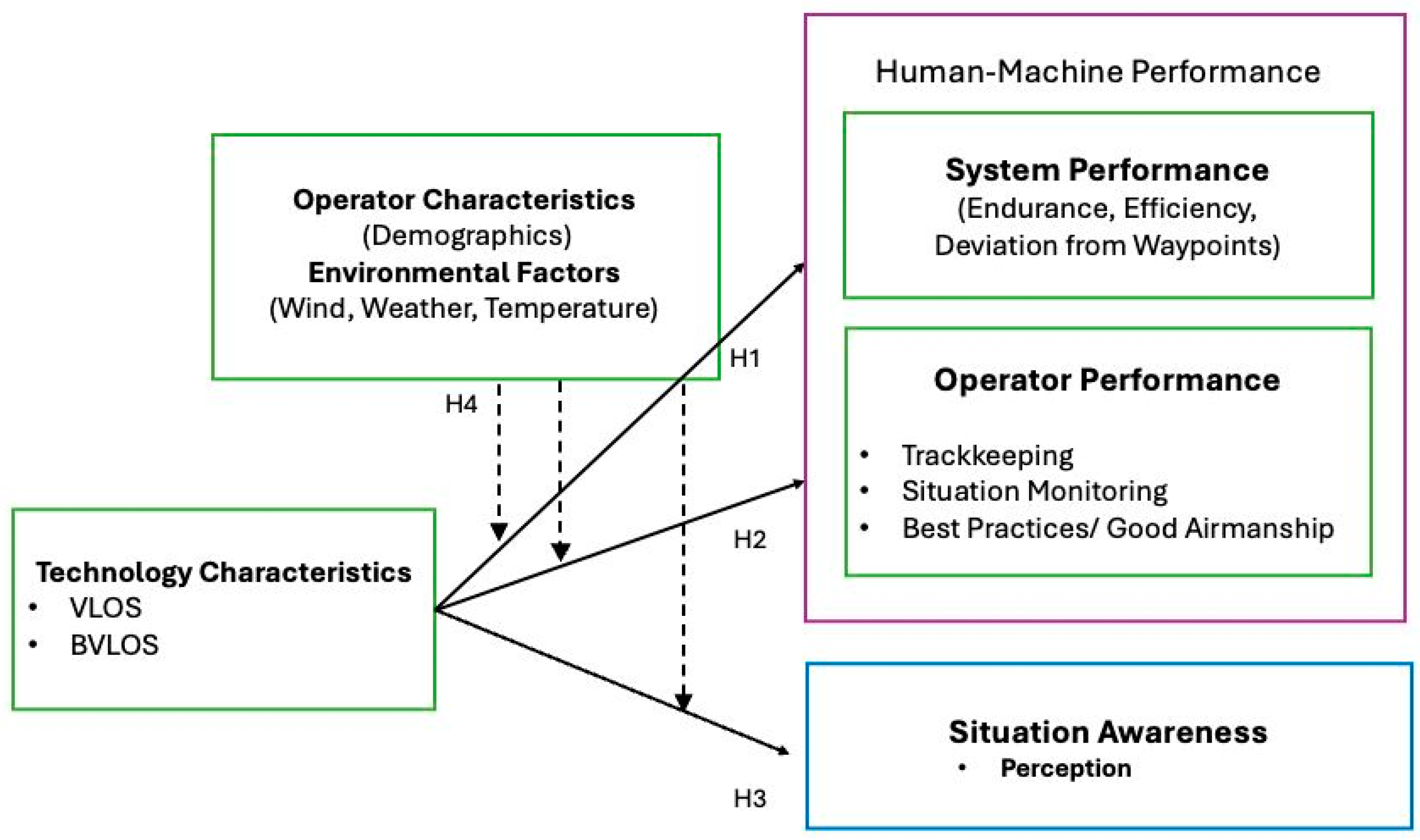
This study extends previous research and explores the impact of varying levels of UAS autonomy on UAS and operator performance and situation awareness as HATs engage in humanitarian and medical logistics tasks in remote and infrastructure-challenged settings. Our research model is shown in Figure 1. Our work is motivated by the lack of theoretical models and empirical studies that directly address the impacts of different levels of UAS autonomy on system and operator performance and operator situation awareness in HATs. Although some research has assessed operator and system performance with VLOS [98], fewer studies have conducted empirical research with BVLOS [29].

1.5. Hypotheses

Previous studies of autonomy [75,99], UAS performance [100], human–autonomy teams [101], and UAS operator situation awareness [58] inform this research that explores the impact of varying levels of autonomy on HAT performance and perceptions in a safety-critical, infrastructure-challenged setting.
Hypothesis 1 (H1).
Increasing levels of autonomy will be associated with improved UAS performance.
Earlier studies have shown that increasing UAS autonomy has been associated with longer UAS distance traveled [102], improved UAS efficiency [82], and battery-level management [103]. At the same time, UAS performance decrements with autonomy have been observed with GNSS degradation [104], level of automation mismatches [105], and because of environmental factors [82]. H1 therefore explores the impact of varying levels of UAS autonomy on UAS endurance, efficiency, and waypoint deviations.
Hypothesis 2 (H2).
Increasing levels of autonomy will be associated with improved operator performance.
Previous UAS studies show that higher levels of autonomy have been associated with improved operator performance, including navigational task performance and track-keeping, as well as reduced workloads [62,101]. At the same time, operator performance decrements with increasing autonomy have been observed in long-duration surveillance operations, where operator fatigue and loss of engagement impacted performance [67]. H2 thus explores these UAS autonomy impacts on operator performance in a resource- and infrastructure-challenged setting.
Hypothesis 3 (H3).
Increasing levels of autonomy will be associated with improved operator situation awareness.
Increasing autonomy has been shown to be linked to improved operator situation awareness, with autonomy studied through advanced UAS supervisory control interfaces [62], as well as through autonomy transparency [106]. In this study, H3 explores the link between varying levels of autonomy and operator situation awareness in a setting with limited infrastructure support.
Hypothesis 4 (H4).
Environmental factors and operator demographics will influence UAS and operator performance, as well as operator situation awareness, in varying conditions of autonomy.
Environmental challenges have long plagued UAS operations, and unfavorable wind and weather have impacted UAS and operator performance. Operator demographics have also been shown to influence UAS [107] and operator [108] performance. Thus, H4 considers the impact of environmental and demographic factors on UAS and operator performance in a medical and humanitarian logistics setting.

2. Materials and Methods

2.1. Operational Setting: Medical and Humanitarian Logistics

This quasi-experimental research study is set in a medical and humanitarian logistics system utilizing uncrewed aerial systems transportation, where UAS operators are responsible for safe navigation through the U.S. Federal Aviation Administration (FAA)-approved and -shielded operational airspaces for UAS VLOS and BVLOS flights. The regularly scheduled UAS flights were undertaken in a mixed rural–urban–semi-rural setting in upstate New York, where operators flew between SUNY Upstate-approved UAS humanitarian and logistics test sites (hospitals, cancer centers, and test ranges). The rural settings were distant from connectivity hubs and faced frequent connectivity issues; the rural settings also had sparse populations, making maintenance and/or logistics support difficult. The semi-rural and urban flights took place between new cancer and hospital centers in settings with limited physical, electronic, and airspace infrastructure, complicating UAS operations and making airspace conflicts difficult to detect. Operations in this setting require cognitive resources for observation and tracking of the UAS, situational awareness, and monitoring system performance for both types of flights; this includes conforming to the best practices of good airmanship, track-keeping, and situation monitoring.

2.2. Evaluation

This section presents the methods, data, procedures, and materials used to evaluate the hypotheses, including the variables and operationalizations for this study (Table 2). Analysis was performed on the data collected, and the results are shown in Table 3, Table 4, Table 5 and Table 6.

2.2.1. Methods

Participants were FAA-certified UAS pilots qualified to fly BVLOS flights under the BVLOS waiver granted to our research partner, SUNY Upstate Medical University’s Autonomous Machines Department, who recruited participants for the study. Participants were observed during regularly scheduled UAS VLOS and BVLOS test flights between SUNY Upstate-approved UAS humanitarian and logistics test sites (hospitals, cancer centers, and test ranges), over rural and commercial areas in upstate New York.
UAS performance data for H1 were obtained from sensors on the UAS and from the UAS’s flight management system (FMS). Operator performance data for H2 and H3 were gathered by surveys and observation using the FAA General Operations Manual (GOM) assessment criteria for good airmanship and best practices, which consider operator judgment, decision-making, hazard identification, and risk analysis for flight operations [109] (Table 2). Environmental data for H4 were obtained from sensor data on the UAS.
The data violated normality and independent t-test assumptions. The small sample suggested non-parametric approaches, and the repeated measures meant that the data must be treated as dependent. The Wilcoxon signed-rank test, a non-parametric repeated-measures paired data test (repeated measures from the same subject), requires balanced samples, a requirement that the data violated. The Skillings–Mack test (a generalized form of the Friedman test that is robust to unbalanced samples) was considered to compare non-parametric repeated measures of means, but power was limited by the small sample size. As a result, percentage differences and descriptive statistics of this preliminary and relatively rare dataset were chosen as initial analysis approaches.
System performance data to support Hypothesis 1 were analyzed by calculating percentage differences in the UAS’s performance flight data for distances flown, speed, energy consumption, efficiency, and waypoint deviation for low- and high-autonomy flights, normalized by flight time. Qualitative survey, observation, and field note data in support of Hypotheses 2 and 3 were analyzed and coded using the FAA General Operation Manual (GOM) assessment criteria [109]. Given the small and unbalanced samples, post hoc power analyses were undertaken using G*Power version 3.1.9.7. The results from the low- and high-autonomy flights were compared and the limitations of the small sample size and the operator pool was assessed. The H4 environmental data were categorized by compass reference points and analyzed by inspection to determine trends and potential impacts of the environmental data.

2.2.2. Data

Data for 16 visual line of sight (VLOS) and 3 beyond visual line of sight (BVLOS) flights were collected in Spring and Summer 2025 at several remote locations across Upstate New York. A total of 84% of the flights were rural flights, with the remaining semi-rural flights, in a mix of urban and rural settings. Data for this quasi-experiment were captured by observation, by flight and UAS automation, and through the UAS flight controller and monitoring software system. The flight management software system collected general information, operation data, positional statistics, speed statistics, battery statistics, and throttle and actuator performance metrics. Other sensor-based metrics were collected each flight.
The dataset comprised 36.64 GB of mixed media data, with 109 KB numerical data, 173.3 MB image data, 235.9 MB text data, and 36.23 GB video and audio. No video and audio data were analyzed in this study due to sponsor data restrictions. Data were stored, retained, and backed up on an external drive in a secure and locked location, in accordance with the data confidentiality, integrity, and availability procedures and protocols in Rensselaer Polytechnic Institute (RPI)’s and SUNY Upstate’s human subjects research guidelines and requirements.
The flight dataset was limited, given the short Summer and Spring flight schedule before the UAS was taken out of year-end service in mid-August 2025 for maintenance in Switzerland. The small subject pool was also limited by the availability of UAS pilots who were certified to fly under the FAA BVLOS waiver granted to SUNY Upstate Medical University for BVLOS humanitarian and logistics missions, and the unbalanced sample cells between the VLOS and BVLOS flights reflected the limits of our quasi experimental design where BVLOS flights were only available sporadically.

2.2.3. Procedure

Subjects were briefed before the VLOS and BVLOS flights with a 10 min pre-flight briefing and introduction. A 15 min pre-flight survey, a 20–25 min flight observation, and a 10 min post-flight survey of the GOM H2 track-keeping and H3 situation awareness elements shown in Table 6 then followed, for a total data-collection period of 1 h. Participants were observed as they performed routine UAS VLOS and BVLOS flights following FAA and International Civil Aviation Organization (ICAO) standard operating procedures [109,110]. Data from flight operation observations were collected at the test sites. Participant consent was obtained prior to UAS flight operations.
In the experiment, VLOS and BVLOS flights ranging in distance from 3.38 km to 41.06 km and lasting between 2 min and 23 min, were undertaken over a 3-month summer period (June–August 2025). Flights were part of daily regularly scheduled hourly UAS medical logistics delivery flights during daylight hours. Two FAA Part 107-certified male pilots, who were 41 and 43 years old, flew all VLOS and BVLOS flights. Environmental conditions were similar for all flights, with the average temperature ranging from 72° F to 91.9 °F degrees, winds varying from 0 to 9.2 mph, and wind direction consistently from the north to the northwest (NNW) and west–southwest (WSW). In this initial experiment, no flights were undertaken in adverse conditions (rain, high winds, or reduced visibility), consistent with FAA regulations. Data were gathered automatically from the UAS and its flight management software, and from observation of the UAS pilots using assessments from the FAA’s General Operations Manual (GOM) [109].

2.2.4. Materials

The UAS used in this research is a long-range vertical takeoff and landing (VTOL) UAS capable of VLOS and BVLOS flights that conducts daily healthcare and humanitarian logistics deliveries. UAS flight and data management were provided by the UAS flight control software and monitoring software system and additional software, visual, and audio recording devices. The UAS’s infrastructure and flight monitoring software includes drone delivery systems, with portable laptops, screens, and power systems that provide UAS communications, flight tracking, fleet management, and flight operations.

2.3. Analysis

The analysis undertaken in this initial study was limited, given the small sample sizes for the VLOS and BVLOS flights and the unbalanced samples. Table 3 shows the H1 UAS endurance, efficiency, and waypoint deviation results for VLOS and BVLOS flights. UAS endurance was measured in terms of distance flown, speed, and UAS battery consumption, normalized for flight time. UAS efficiency was measured in terms of UAS battery levels and UAS waypoint deviation was measured as the standard deviation of UAS direction, reflecting wind conditions at the time. All H1 data were provided directly from the UAS.
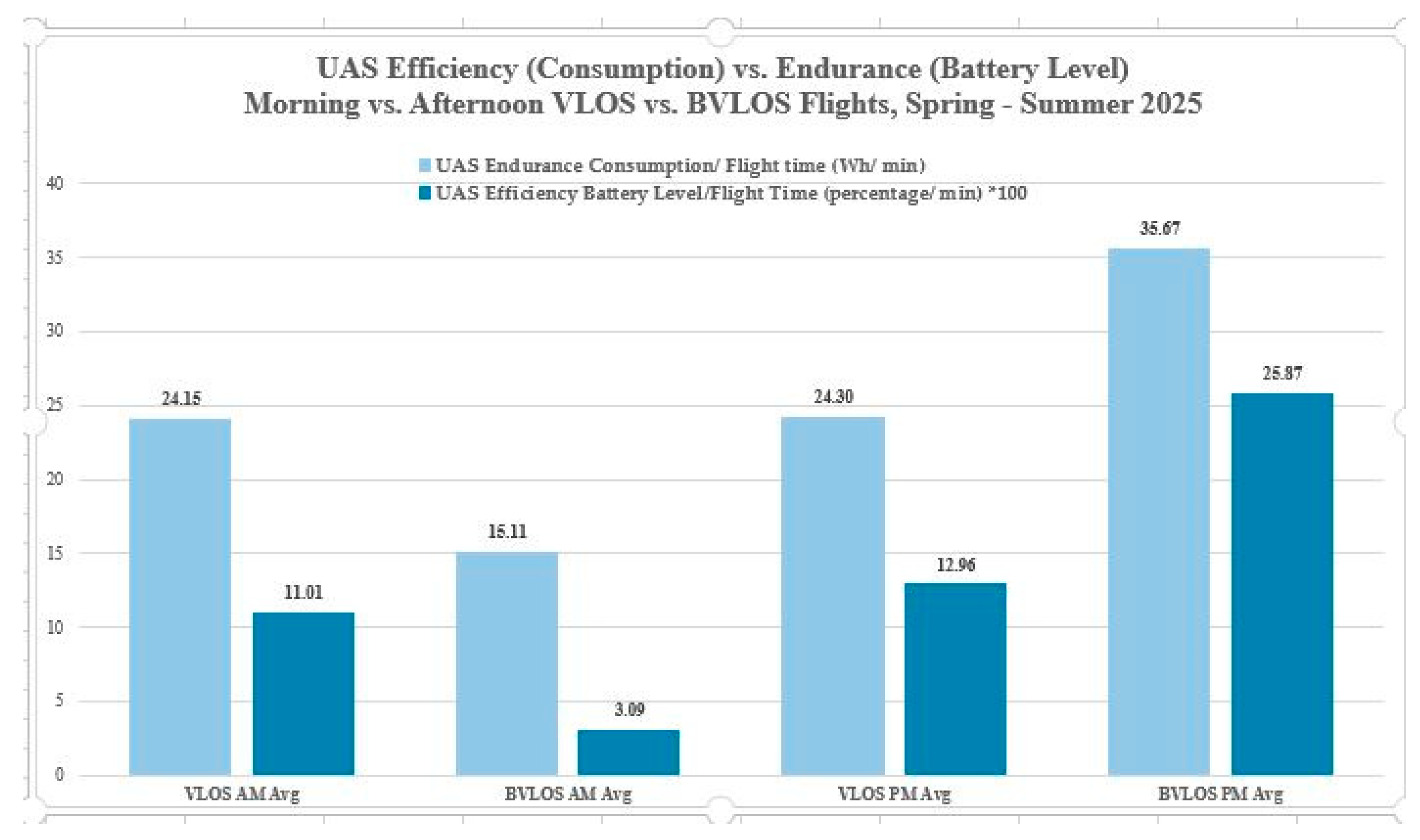
Inspection of Table 3 shows differences in H1 variables between the two sets of flights. BVLOS flights showed more endurance, with longer distances flown (20.6%) per flight time than VLOS flights, at lower (22%) speeds and lower UAS power consumption per flight time (9%). This suggests that the small number of high-autonomy flights showed greater flight endurance, and simultaneously showed lower efficiency, with lower remaining battery percentages per flight time (12.65%), but better UAS track-keeping, with less waypoint deviation (71.34%) than the VLOS flights. High endurance and improved track-keeping results, even when coupled with lower efficiency, suggest high-autonomy findings worthy of further exploration. In contrast, UAS VLOS efficiency (consumption) was consistent across morning and afternoon flights, but BVLOS efficiency varied widely across morning and afternoon flights. These findings are most likely due to the small number of BVLOS flights, and the one outlier afternoon BLOVS flight (Figure 2). These results may also have been due to the straight-line BVLOS flights, with lower westerly headwind speeds (17.6%) (Table 4), which could have improved BVLOS distances flown per flight time and dampened flight path deviation and power consumption, compared to the VLOS large-loop flights in more wind. The small sample sizes may also have influenced these results. Taken together, the VLOS and BVLOS efficiency, endurance, and track-keeping results within this small and limited dataset suggest that further exploration is required for more conclusive results.
The magnitude and direction of these trends were magnified when morning VLOS and BVLOS flights were compared, with differences in distance flown, speed, consumption, battery percentage remaining, and waypoint deviation between the flights more pronounced in the BVLOS flights (Table 3). Afternoon BVLOS flights did not exhibit the same amplification or trends, primarily because of the small sample size (n = 3 BVLOS flights), and the outlier results from the last BVLOS flight, which influenced all BVLOS afternoon flight results. Given the small and unbalanced samples, post-hoc power analyses indicated that the statistical power was low, ranging from 1 − β = 0.08 to 1 − β = 0.24 for system performance data and 1 − β = 0.19 to 1 − β = 0.61 for operator performance data (Table 5). In all cases, the small sample sizes can be assumed to have had an impact on the generalizability of the study results, suggesting that additional data collection would improve the strength of these findings.
Operator track-keeping performance was assessed using scores from the FAA General Operations Manual (GOM) Assessment for Monitoring UAS Flight Path (GOM Assessment 6), while operator situation awareness was assessed using scores for Monitoring UAS Altitude (GOM Assessment 7) (Table 6). Scores were assigned by a consistent set of two FAA-qualified Part 107 UAS pilots as observers for all flights, with scores assigned from Highly Effective (HE = 4 points), Effective (E = 3 points), Not Effective (N = 2 points), to Unsatisfactory (U = 1 point). The elements of the observations are shown in Table 6.
Small differences were observed with higher levels of autonomy, with average operator BVLOS track-keeping slightly less effective (5.38%) than VLOS flights operated by human pilots, although there was a 6.67% higher percentage of highly effective track-keeping ratings in the BVLOS flights. This may be due to the higher risks and greater vigilance needed with BVLOS flights that depend on onboard video and flight controller information during the flight.
Operator situation awareness scores for BVLOS flights, however, were uniformly highly effective, and slightly better than those for VLOS flights, even with a small number of BVLOS flights (n = 3). Operators during BVLOS flights showed slightly higher performance with respect to following the mission structure—monitoring waypoints, UAS altitude, altitude consistency, and altitude relative to obstacles—and avoiding opportunities for collisions, compared to operators during VLOS flights. The homogeneity of the UAS operator subjects, with similar ages, experience levels, technological familiarity, and credentials, and the small number of BVLOS flights, may have contributed to the uniform assessments of highly effective situation awareness in both VLOS and BVLOS flights, with only slightly higher situation awareness scores in BVLOS flights.
UAS environmental data showed that the wind was consistently from the west for all flights, varying from the WSW and WNW to the NNW (Table 7). Notably, the wind was from the WNW for 66.67% of BVLOS flights, while it was from the NNW for 50% of VLOS flights (Table 4). This could explain differences in the VLOS endurance and efficiency numbers, as wind blowing against the direction of the UAS flight creates resistance, thus reducing endurance and efficiency. Both UAS and operator performance are affected by high winds, conditions under which UAS flights are prohibited, and which were not encountered in this study.

2.4. Informed Consent

This research study involved human participants and was reviewed and approved by the Rensselaer Polytechnic Institute and SUNY Upstate Medical University Institutional Review Boards, which review and approve all human subject research in accordance with applicable state law and federal law governing Human Subject Research (45 CFR § 46 Protection of Human Subjects).

3. Results

Overall, increased levels of autonomy were generally associated with improved UAS performance, with higher endurance, lower speeds, lower consumption per flight time, and less waypoint deviation, although UAS efficiency was decreased with greater autonomy. The results, therefore, generally support H1.
However, few operator track-keeping performance differences were observed with higher levels of autonomy, perhaps in keeping with the ‘hands-off’ nature of BVLOS flights in which the UAS’s autonomy performs track-keeping. Differences noted between VLOS and BVLOS morning flights, between BVLOS morning and afternoon flights, and between BVLOS morning and afternoon flights, bear further investigation and additional data collection, given the small number of morning BLVOS (n = 2) and afternoon BVLOS flights (n = 1).
Despite this, there were differences with higher levels of autonomy over the course of the day in VLOS and BVLOS flights, as operators in morning VLOS flights showed more effective track-keeping (20%) than the operators in the morning BVLOS flights. The small number of BVLOS flights makes these results inconclusive, and H2 is therefore not supported. Operators’ situation awareness results in H3 were uniformly highly effective in BVLOS flights, but no differences were observed between operators flying VLOS and BVLOS flights, perhaps due to the homogeneity of the UAS operator subject pool. H3, as a result, was not supported. The choice of an SA instrument is worth considering in this analysis, as different studies used different techniques to measure the constructions of SA. For example, Roth et al. [111], measured SA using the SAGAT and the SART methods. The SAGAT found a positive effect of automation transparency and the SART did not, perhaps because the SART is more of an indicator of confidence in one’s own SA than of SA itself [112]. Nevertheless, comparing results that were based on different measurement methods can be challenging because of differences in the sensitivity and reliability of these methods.
The small number of high-autonomy flights, the limited qualified operator pool, and the unbalanced samples limit the power and generalizability of this work, but also suggest directions for future research in this area, namely whether additional data collection and analysis would show that BVLOS flights were associated with improved UAS endurance and waypoint deviation, but with few differences in operator track-keeping performance and situation awareness, as found in this work. Although limited by the initial small sample size and UAS operator subject pool, these results provide a baseline and a template for future research considering technology and human performance together in human–autonomy teams operating under various levels of autonomy.

4. Discussion

This study presents the first set of initial data from an on-going study of the impacts of varying levels of UAS autonomy on UAS and operator performance and situation awareness for medical and humanitarian logistics flights in VLOS and BVLOS conditions. Several of the variables studied have not been considered before, and most have not been studied in tandem with other variables. Thus, one contribution of this work is the development of a framework considering both technology and human performance in HATs, and an empirical examination of the impacts of varying levels of autonomy on all components of HATs, both human and technology, in resource-constrained settings. Previous theoretical and empirical studies have not considered human operator performance and technology performance together, although some models and studies have considered human operator performance and situation awareness together. This study addresses this research gap and suggests a framework for considering the impacts of increasing autonomy on the performance, perceptions, and characteristics of all members of HATs.
In this study, improved endurance and waypoint deviation performance were observed with greater autonomy, while UAS operator performance was not greatly impacted. In spite of the small sample size of the study, this non-intuitive result, that UAS performance would improve over longer, ‘hands-off’ flights with greater UAS autonomy, while UAS operator track-keeping and situation awareness were not impacted, is an unexpected result that bears future examination with a larger sample size, particularly as efforts to integrate UASs into the commercial airspace proceed.
This work also highlights the importance of empirical studies that utilize operational data in real-time settings. Earlier work found that adverse environmental conditions tend to dampen UAS performance [86] and UAS operator performance and perceptions of their performance [87]. These studies have been undertaken in simulated environments [86] and have utilized operator surveys [87], but few studies have utilized in situ observations using operational best practices and standards, and fewer still have been explored in humanitarian and logistics settings, as in this research. Although this study involved a limited number of high-autonomy flights, UAS data revealed differences between the BVLOS and VLOS flights that suggested greater efficiency with higher levels of autonomy. Further empirical work or additional data are therefore required to explore the impacts of higher levels of autonomy on human and operator performance and situation awareness. In addition, since H4 considered only mild environmental fluctuations and not the extreme weather conditions expected in infrastructure-constrained environments, further work is also required to explore the impact of adverse environmental factors, as well as of operator stress, workload, fatigue, and confidence in and satisfaction with the technology. Some of these characteristics have been studied in other logistic systems but few studies have addressed all these variables together in a single framework [101,113]. Similarly, few have addressed HATs using UASs in adverse and harsh weather conditions, the next steps for this research.
The results from this initial study offer some support for assessments of human operator and UAS performance, along with situation awareness, in studies of HATs with varying levels of autonomy. However, while interesting, the conclusions drawn from these results are tentative due to the study’s small sample size of UAS flights, and the small number of FAA-qualified UAS pilots who were able to fly under the BVLOS waiver. The statistical analysis undertaken was therefore rudimentary, given the quality and limits of the data available.

5. Conclusions

The preliminary results presented in this quasi-experiment are important as human–autonomy teaming increases in humanitarian and medical logistics settings, where little empirical work has addressed both human and UAS performance in HATs, especially in remote settings. The limited dataset and homogeneous subject pool reported in this work reflect the early nature of this research, which was completed under a BVLOS waiver from the U.S. Federal Aviation Administration for humanitarian and logistics flights in a remote setting. The data collection took place in a small waiver window with acceptable environmental conditions, which again limited the resulting dataset.
Medical and humanitarian logistics work often occurs at the margins of geography, resources, and visibility, where human and technological performance are essential to achieve safety, reliability, and sustainability, and where attention to communication, organizational design, AI-enhanced decision-making, and the development of human–technology trust are critical constructs [114], and important research directions for future HATs. Understanding these constructs with human and technology teammates in HATs in medical and humanitarian logistics settings, thus, has important future research, managerial, and practical implications.
Practically, logistics managers in medical and humanitarian response settings can benefit from improved understanding of how best to employ and deploy autonomy in remote and infrastructure-poor settings, which demand optimized human and technology performance and the management of scarce resources. Policy makers in regulatory and humanitarian nonprofit organizations can benefit from insights from this human factors, logistics, technology impact, engineering, and organizational structure research that is expanding our understanding of the impact of varying levels of autonomy on HATs, and can develop informed policies and regulations regarding HATs in safety-critical and remote settings. Decision makers tasked with the oversight and management of human and technology teammates under varying degrees of autonomy can benefit from considerations of the limits of UASs and human performance, particularly as autonomy and responsibilities vary between team members. Operators and practitioners on the front lines of UAS practice have long contributed to better understanding of the interactions, influences, and relationships between the roles of humans and technology in UAS operations. These understandings are particularly critical, given the proliferation of UAS in recreational and commercial use; the rapid advances in UAS technology, autonomy, and BVLOS flights; and the new challenges associated with the integration of UAS into the commercial airspace.
This research was limited by the small sample size and the small number of high-autonomy flights, which were restricted by a limited data-collection window (Spring and Summer flights before the UAS’s scheduled maintenance period) and federally mandated requirements for BVLOS flights and operators. Although the operator performance and situation awareness hypotheses were not supported, the results suggest that further research is needed to explore the impact of high-autonomy flights on operator and UAS performance, particularly in resource-limited safety-critical settings. The small sample of high-autonomy BVLOS flights and the homogeneous operator subject pool suggests that additional data collection is required for more conclusive findings.
This research represents one step in an emerging research stream directed at understanding the impacts of levels of UAS autonomy in safety-critical systems, advances that are increasingly important as UAS capabilities embrace agentic AI capabilities that include intentionality, learning, adaptive reasoning, and explainability, in addition to autonomy. Next steps in this research include the study of HATs using UASs for medical and humanitarian logistics in adverse weather and environmental conditions in the Arctic and with a larger dataset, leveraging advances in advanced analytics, micro-weather technology, and embedded intelligence. Future work should explore questions raised in this preliminary study, namely, the roles of humans and technology in HATs, the need for improved precision in tools assessing human performance, and challenges in integrating multidisciplinary results across safety-critical settings. As a preliminary step, this research contributes to our understanding of the limits and capabilities of human–autonomy teams in safety- and mission-critical systems and provides input to emerging human–technology–automation decision frameworks, including the use of evolving AI capabilities.

Author Contributions

Conceptualization, M.R.G., G.M., J.M., S.R., R.S. and S.I.; methodology, M.R.G. and G.M.; validation, M.R.G., G.M., and J.M.; formal analysis, M.R.G., G.M., J.M. and A.R.; investigation, G.M. and J.M.; resources, M.R.G. and S.R.; data curation, J.M., G.M. and M.R.G.; writing—original draft preparation, G.M., J.M. and M.R.G.; writing—review and editing, M.R.G., G.M., J.M. and A.R.; visualization, G.M. and M.R.G.; supervision, M.R.G. and S.B.; project administration, M.R.G. and S.R.; funding acquisition, M.R.G. and S.R. All authors have read and agreed to the published version of the manuscript.

Funding

This material is based upon funding supported by the University of Alaska Anchorage and work supported by the U.S. Department of Homeland Security (DHS) under grand award number 24STADA00002-02-00, from the DHS Arctic Domain Awareness Center of Excellence at the University of Alaska Anchorage. The work was also supported by the McDevitt Foundation at Le Moyne College and by the State University of New York (SUNY) Upstate Medical University’s Autonomous Machine Department, which provided the UAS, access to test sites, and participants for this research.

Data Availability Statement

The original contributions presented in this study are included in the article. Further inquiries can be directed to the corresponding author.

Acknowledgments

The authors are grateful for support from the U.S. Coast Guard, Western Alaska, and US Arctic Sector, particularly CAPT Christopher Culpepper, USCG; CDR Scott Farr, USCG; CDR Joellen Arons, USCG; LCDR Abbie Lyons, USCG; Shawn Hay; and from NuAir LLC, especially Ken Stewart and COL Tony Basile, USAF (retired). The views and conclusions contained in this document are those of the authors and should not be interpreted as necessarily representing the official policies, either expressed or implied, of the U.S. Department of Homeland Security or the University of Alaska Anchorage. No generative AI tools were used in the preparation of this research. The authors are also grateful for the feedback from the five reviewers and the editor, whose suggestions greatly improved our manuscript No generative AI tools were used in this paper (e.g., to generate text, data, or graphics, or to assist in study design, data collection, analysis, or interpretation).

Conflicts of Interest

The authors declare the following financial interests/personal relationships which may be considered as potential competing interests: Gwendolyn Morgan and James McGarvey report that financial support was provided by the U.S. Department of Homeland Security, as an Arctic Domain Awareness Center (ADAC) ARCTIC Research Fellow, as well as from the State University of New York (SUNY) Upstate Medical University, Autonomous Machines Department. Martha Grabowski reports that administrative support was provided by the U.S Department of Homeland Security, Arctic Domain Awareness Center (ADAC) ARCTIC, as well as from the U.S. Coast Guard, Sector Western Alaska and U.S. Arctic, and from the State University of New York (SUNY) Upstate Medical University, Autonomous Machines Department. Martha Grabowski has patent application 18/515,909, 21 November 2023—AI-Based Search and Rescue Technology Platform pending with Gwendolyn Morgan, Jean Philippe Rancy, and James McGarvey. There are no known other competing financial interests or personal relationships that could have appeared to influence the work reported in this paper.

Abbreviations

The following abbreviations are used in this manuscript:
ADAC ARCTICArctic Domain Awareness Center—Addressing Rapid Changes Through Technology Innovation and Collaboration
AIArtificial Intelligence
AMMorning
BVLOSBeyond Visual Line of Sight
DHSU.S. Department of Homeland Security
FAAU.S. Federal Aviation Administration
FMSFlight Management System
GNSSGlobal Navigation Satellite System
GOMU.S. Federal Aviation Administration’s General Operations Manual
HATHuman–Autonomy Teams
HMTHuman Machine Teaming
ICAOInternational Civil Aviation Organization
NASAU.S. National Aviation and Space Administration
NNWNorth–Northwest
NWNorthwest
PMAfternoon
RPIRensselaer Polytechnic Institute
SASituation Awareness
SAGATSituation Awareness Global Assessment Technique
SARTSituation Awareness Rating Technique
SUNYState University of New York
TLXTask Load Index
UAAUniversity of Alaska Anchorage
UASUncrewed Aerial System
USCGU.S. Coast Guard
VLOSVisual Line of Sight
VTOLVertical Take Off and Landing
WWest
WNWWest–Northwest
WSWWest–Southwest

References

  1. Kannally, C.T.; Smith, J.R.; IJtsma, M. Human-AI teaming in the automotive and mobility industry: Guiding design to support joint activity. In Proceedings of the Human Factors and Ergonomics Society Annual Meeting, Washington, DC, USA, 23–27 October 2023; Sage Publications: Los Angeles, CA, USA, 2023; Volume 67, pp. 111–116. [Google Scholar] [CrossRef]
  2. Tokadli, G.; Dorneich, M.C.; Matessa, M. Evaluation of playbook delegation approach in human-autonomy teaming for single pilot operations. Int. J. Hum. Comput. Interact. 2021, 37, 703–716. [Google Scholar] [CrossRef]
  3. Bayrak, A.E.; Gorsich, D.; Epureanu, B.I. Future of Autonomous High-Mobility Military Systems. SAE Int. J. Connect. Autom. Veh. 2020, 3, 205–215. [Google Scholar] [CrossRef]
  4. Jia, Y.; Evans, H.; Porter, Z.; Graham, S.; McDermid, J.; Lawton, T.; Snead, D.; Habli, I. The Case for delegated AI Autonomy for Human AI teaming in Healthcare. arXiv 2025, arXiv:2503.18778. [Google Scholar] [CrossRef]
  5. McNeese, N.; Demir, M.; Chiou, E.; Cooke, N.; Yanikian, G. Understanding the role of trust in human-autonomy teaming. In Proceedings of the 52nd Hawaii International Conference on System Sciences (HICCS), Maui, HI, USA, 8–11 January 2019; Available online: https://hdl.handle.net/10125/59466 (accessed on 25 July 2025).
  6. O’Neill, T.; McNeese, N.; Barron, A.; Schelble, B. Human–autonomy teaming: A review and analysis of the empirical literature. Hum. Factors 2022, 64, 904–938. [Google Scholar] [CrossRef]
  7. Norlander, A. Autonomy in Conflict: Technology, Complexity, Ethics, and Policy Implications. IEEE Access 2025, 13, 90489–90498. [Google Scholar] [CrossRef]
  8. Xu, W.; Gao, Z. Applying HCAI in developing effective human-AI teaming: A perspective from human-AI joint cognitive systems. Interactions 2024, 31, 32–37. [Google Scholar] [CrossRef]
  9. Gebru, B.; Zeleke, L.; Blankson, D.; Nabil, M.; Nateghi, S.; Homaifar, A.; Tunstel, E. A review on human–machine trust evaluation: Human-centric and machine-centric perspectives. IEEE Trans. Hum. Mach. Syst. 2022, 52, 952–962. [Google Scholar] [CrossRef]
  10. De Visser, E.J.; Pak, R.; Shaw, T.H. From ‘automation’ to ‘autonomy’: The importance of trust repair in human–machine interaction. Ergonomics 2018, 61, 1409–1427. [Google Scholar] [CrossRef] [PubMed]
  11. Lawless, W.F.; Mittu, R.; Sofge, D.; Hiatt, L. Artificial intelligence, autonomy, and human-machine teams—Interdependence, context, and explainable AI. AI Mag. 2019, 40, 5–13. [Google Scholar] [CrossRef]
  12. Zieba, S.; Polet, P.; Vanderhaegen, F.; Debernard, S. Principles of adjustable autonomy: A framework for resilient human–machine cooperation. Cogn. Technol. Work 2010, 12, 193–203. [Google Scholar] [CrossRef]
  13. Phillips, D.; Duplessis, B.T.; Stoll, H.; Kelly, T.K.; Parker, T. Small Uncrewed Aircraft Systems (SUAS) in Divisional Brigades; RAND Corporation: Santa Monica, CA, USA, 2025; Available online: https://www.rand.org/content/dam/rand/pubs/research_reports/RRA2600/RRA2642-5/RAND_RRA2642-5.pdf (accessed on 27 July 2025).
  14. Sauser, M.K. Unmanned Aircraft and the Revolution in Operational Warfare. Military Review. July–August 2025; pp. 54–64. Available online: https://www.armyupress.army.mil/Portals/7/military-review/Archives/English/JA-25/Unmanned-Aircraft-Revolution/Unmanned-Aircraft-Revolution-ua.pdf (accessed on 27 July 2025).
  15. Ray, H.M.; Laouar, Z.; Sunberg, Z.; Ahmed, N. Human-centered autonomy for UAS target search. In Proceedings of the 2024 IEEE International Conference on Robotics and Automation (ICRA), Yokohama, Japan, 13–17 May 2024; IEEE: New York, NY, USA, 2024; pp. 9563–9570. [Google Scholar] [CrossRef]
  16. Aggarwal, S.; Gupta, P.; Balaji, S.; Sharma, S.; Ghosh, A.K.; Simmy; Panda, S. Assessing the feasibility of drone-mediated vaccine delivery: An exploratory study. Health Sci. Rep. 2025, 8, e70208. [Google Scholar] [CrossRef]
  17. Kirwan, B. Human Factors Requirements for Human-AI teaming in Aviation. Future Transp. 2025, 5, 42. [Google Scholar] [CrossRef]
  18. Wolter, C.A.; Ruszkowski, L.K.M.; Borade, A.R.; Goodyear, M.T. BVLOS UAS Cargo Delivery Simulation–A DoD-Sponsored Operational Evaluation with NASA and Project ULTRA; NASA Technical Reports Server (NTRS): Washington, DC, USA, 2025. Available online: https://ntrs.nasa.gov/citations/20250002630 (accessed on 13 July 2025).
  19. Sajjadi, S.; Mehta, V.; Janabi-Sharif, F.; Mantegh, I. Cellular Connectivity Risk-Aware Flight Path Planning for BVLOS UAV Operations. In Proceedings of the 2025 International Conference on Unmanned Aircraft Systems (ICUAS), Charlotte, NC, USA, 14–17 May 2025; IEEE: New York, NY, USA, 2025; pp. 609–616. [Google Scholar] [CrossRef]
  20. Shao, P.C. Risk assessment for UAS logistic delivery under UAS traffic management environment. Aerospace 2020, 7, 140. [Google Scholar] [CrossRef]
  21. Van Manen, B.R.; Ter Maat, G.; Boe, M.; Mersha, A.Y. The BEAST: Modular Open-Source Framework for BVLOS Drone Flights with Long-Term Autonomy. In Proceedings of the 2025 International Conference on Unmanned Aircraft Systems (ICUAS), Charlotte, NC, USA, 14–17 May 2025; IEEE: New York, NY, USA, 2025; pp. 457–464. [Google Scholar] [CrossRef]
  22. van Wynsberghe, A.; Comes, T. Drones in humanitarian contexts, robot ethics, and the human–robot interaction. Ethics Inf. Technol. 2020, 22, 43–53. [Google Scholar] [CrossRef]
  23. Wu, H.; Duan, H. Hierarchical pigeon inspired optimization based Multi-UAV obstacle avoidance control. Aerosp. Sci. Technol. 2025, 159, 109963. [Google Scholar] [CrossRef]
  24. Sun, T.; Gu, J.; Mou, J. UAV autonomous obstacle avoidance via causal reinforcement learning. Displays 2025, 87, 102966. [Google Scholar] [CrossRef]
  25. Cleland-Huang, J.; Chambers, T.; Zudaire, S.; Chowdhury, M.T.; Agrawal, A.; Vierhauser, M. Human–machine teaming with small unmanned aerial systems in a mape-k environment. ACM Trans. Auton. Adapt. Syst. 2024, 19, 3. [Google Scholar] [CrossRef]
  26. Backman, K.; Kulić, D.; Chung, H. From Novice to Skilled: RL-Based Shared Autonomy Communicating with Pilots in UAV Multi-Task Missions. ACM Trans. Hum. Robot Interact. 2025, 14, 37. [Google Scholar] [CrossRef]
  27. Sieber, C.; Vieira da Silva, L.M.; Grünhagen, K.; Fay, A. Rule-based verification of autonomous unmanned aerial vehicles. Drones 2024, 8, 26. [Google Scholar] [CrossRef]
  28. Tian, Y.; Lin, F.; Li, Y.; Zhang, T.; Zhang, Q.; Fu, X.; Huang, J.; Dai, X.; Wang, Y.; Tian, C.; et al. UAVs meet LLMs: Overviews and perspectives towards agentic low-altitude mobility. Inf. Fusion 2025, 122, 103158. [Google Scholar] [CrossRef]
  29. Jakobsen, L.K.; Gram, J.K.B.; Grabmayr, A.J.; Højen, A.; Hansen, C.M.; Rostgaard-Knudsen, M.; Claesson, A.; Folke, F. Semi-autonomous drone delivering automated external defibrillators for real out-of-hospital cardiac arrest: A Danish feasibility study. Resuscitation 2025, 208, 110544. [Google Scholar] [CrossRef]
  30. Al-Faridi, S.G.; Alghamdi, A.S.; Alosiml, F.K.; Alshammari, Z.K.T.; Alshammari, H.M.H.; Alsahmah, S.M.F.; Alotaibli, F.; Al-Faridi, S.G.; Aloufi, O.; Saqer, T.S.M.; et al. Drone-Assisted AED Delivery in Out-of-Hospital Cardiac Arrest: A Systematic Review of Response Time, Feasibility, and Cost-Effectiveness. Integr. Biomed. Res. 2024, 8, 1–7. [Google Scholar] [CrossRef]
  31. Jairoun, A.A.; Al-Hemyari, S.S.; Shahwan, M.; Al-Ghananeem, A.M.; El-Dahiyat, F.; Al-Salmi, S.; Babar, Z.U.D. The evolution of medication delivery via drones: Revolutionizing healthcare logistics. J. Pharm. Policy Pract. 2025, 18, 2519137. [Google Scholar] [CrossRef]
  32. Aljohani, M.; Mukkamala, R.; Olariu, S. Delivery of Medical Supplies to Remote Locations via Unmanned Aerial Vehicles: Approaches, Challenges, and Solutions. Transp. Res. Procedia 2025, 84, 73–80. [Google Scholar] [CrossRef]
  33. Kumar, S.; Khan, A. Emergency Medical Supply Automatic Drone Evaluation: A Complete Review. Int. J. Mech. Eng. Res. Technol. 2025, 17, 14–30. [Google Scholar]
  34. Pandey, G.; Manimaran, P.; Mishra, A.; Sapra, A. Unmanned aerial vehicles: An inevitable armamentarium in Armed Forces Medical Services. Med. J. Armed Forces India 2025, in press. [Google Scholar] [CrossRef]
  35. Finney, O.; Snowdon, K.; Lomzynska, S.; Ferraresi, D.; Norton, M.; Austin, D.; Gale C Wilkinson, C.; McClelland, G. The impact of drone delivery of an automated external defibrillator: A simulation feasibility study. Br. Paramed. J. 2025, 10, 56–61. [Google Scholar] [CrossRef]
  36. Enayati, S.; Bahmani, P. Collaborative Last-Mile Delivery with Drones in Rural America; No. 25-1121-3002-104; University of Nebraska-Lincoln, Mid-America Transportation Center: Lincoln, NE, USA, 2025. Available online: https://rosap.ntl.bts.gov (accessed on 27 July 2025).
  37. Patel, R.R.; Parmar, P.J.; Sutariya, M.J. MedDrone Rescue: A Survey on Drones for Medical Supplies in Rural, Terrained Areas and Search & Rescue Operations. In Proceedings of the 2025 International Conference on Machine Learning and Autonomous Systems (ICMLAS), Prawet, Thailand, 10–12 March 2025; IEEE: New York, NY, USA, 2025; pp. 1682–1689. [Google Scholar] [CrossRef]
  38. Lejeune, M.A.; Margot, F. Response Time Minimization for Cardiac Arrests. Prod. Oper. Manag. 2025, 34, 2618–2640. [Google Scholar] [CrossRef]
  39. Aretoulaki, E.; Ponis, S.T.; Plakas, G. Requirements Engineering for a Drone-Enabled Integrated Humanitarian Logistics Platform. Appl. Sci. 2024, 14, 6464. [Google Scholar] [CrossRef]
  40. Quintanilla García, I.; Vera Velez, N.; Alcaraz Martínez, P.; Vidal Ull, J.; Fernandez Gallo, B. A quickly deployed and UAS-based logistics network for delivery of critical medical goods during healthcare system stress periods: A real use case in Valencia (Spain). Drones 2021, 5, 13. [Google Scholar] [CrossRef]
  41. Habibi, S.; Ivaki, N.; Barata, J. A Systematic Literature Review of Unmanned Aerial Vehicles for Healthcare and Emergency Services. arXiv 2025, arXiv:2504.08834. [Google Scholar] [CrossRef]
  42. Pang, B.; Wang, C.J.; Low, K.H. Framework of level-of-autonomy-based concept of operations: UAS capabilities. In Proceedings of the 2021 IEEE/AIAA 40th Digital Avionics Systems Conference (DASC), San Antonio, TX, USA, 3–7 October 2021; IEEE: New York, NY, USA, 2021; pp. 1–10. Available online: https://ieeexplore.ieee.org/abstract/document/9594469/ (accessed on 3 August 2025).
  43. Huang, H.M.; Pavek, K.; Ragon, M.; Jones, J.; Messina, E.; Albus, J. Characterizing Unmanned System Autonomy: Contextual Autonomous Capability and Level of Autonomy Analyses. In Unmanned Systems Technology IX; SPIE: Bellingham, WA, USA, 2007; Volume 6561, pp. 509–517. [Google Scholar] [CrossRef]
  44. Sapkota, R.; Roumeliotis, K.I.; Karkee, M. AI agents vs. Agentic AI: A conceptual taxonomy, applications and challenges. arXiv 2025, arXiv:2505.10468. [Google Scholar] [CrossRef]
  45. McCrink, M.H.; Gregory, J.W. Design and development of a high-speed UAS for beyond visual line-of-sight operations. J. Intell. Robot. Syst. 2021, 101, 31. [Google Scholar] [CrossRef]
  46. Durst, P.J.; Gray, M.W. Levels of Autonomy and Autonomous System Performance Assessment for Intelligent Unmanned Systems; ERDC/GSLSR-14-1; U.S. Army Corps of Engineers, Engineer Research & Development Center (ERDC): Vicksburg, MI, USA, 2014; Available online: https://erdc-library.erdc.dren.mil/server/api/core/bitstreams/81b728f8-7609-4ef8-e053-411ac80adeb3/content (accessed on 16 August 2025).
  47. Osborne, M.; Lantair, J.; Shafiq, Z.; Zhao, X.; Robu, V.; Flynn, D.; Perry, J. UAS operators’ safety and reliability survey: Emerging technologies towards the certification of autonomous UAS. In Proceedings of the 2019 4th International IEEE Conference on System Reliability and Safety (ICSRS), Rome, Italy, 20–22 November 2019; pp. 203–212. [Google Scholar] [CrossRef]
  48. Hu, X.; Pang, B.; Dai, F.; Low, K.H. Risk Assessment Model for UAV Cost-Effective Path Planning in Urban Environments. IEEE Access 2020, 8, 150162–150173. [Google Scholar] [CrossRef]
  49. Pang, B.; Tan, Q.; Ra, T.; Low, K.H. A Risk-based UAS Traffic Network Model for Adaptive Urban Airspace Management. In Proceedings of the AIAA Aviation 2020 Forum, Virtual, 15–19 June 2020; pp. 1–9. [Google Scholar] [CrossRef]
  50. Wang, C.H.J.; Tan, S.K.; Low, K.H. Three-dimensional (3D) Monte-Carlo modeling for UAS collision risk management in restricted airport airspace. Aerosp. Sci. Technol. 2020, 105, 105964. [Google Scholar] [CrossRef]
  51. Wu, Y.; Li, L.; Su, X.; Gao, B. Dynamics modeling and Trajectory Optimization for unmanned aerial-aquatic vehicle diving into the water. Aerosp. Sci. Technol. 2019, 89, 220–229. [Google Scholar] [CrossRef]
  52. Tao, F.; Chen, Z.; Wang, Z.; Zhu, L.; Wang, J. Multi-Strategy Improved Particle Swarm Optimization Algorithm for Path Planning of UAV in 3-D Low Altitude Urban Environment. IEEE Internet Things J. 2025, 12, 40470–40483. [Google Scholar] [CrossRef]
  53. Mejias, L.; Diguet, J.P.; Dezan, C.; Campbell, D.; Kok, J.; Coppin, G. Embedded computation architectures for autonomy in unmanned aircraft systems (UAS). Sensors 2021, 21, 1115. [Google Scholar] [CrossRef] [PubMed]
  54. Dhuheir, M.; Erbad, A.; Al-Fuqaha, A.; Hamdaoui, B.; Guizani, M. AoI-Aware Intelligent Platform for Energy and Rate Management in Multi-UAV Multi-RIS System. IEEE Trans. Netw. Serv. Manag. 2025, 22, 4376–4393. [Google Scholar] [CrossRef]
  55. Liu, D.; Peterson, T.; Vincenzi, D.; Doherty, S. Effect of time pressure and target uncertainty on human operator performance and workload for autonomous unmanned aerial system. Int. J. Ind. Ergon. 2016, 51, 52–58. [Google Scholar] [CrossRef]
  56. Wang, C.J.; Ng, E.M.; Low, K.H. Investigation and modeling of flight technical error (FTE) associated with UAS operating with and without pilot guidance. IEEE Trans. Veh. Technol. 2021, 70, 12389–12401. [Google Scholar] [CrossRef]
  57. Simpson, T. Real-time drone surveillance system for violent crowd behavior unmanned aircraft system (uas)–human autonomy teaming (hat). In Proceedings of the 2021 IEEE/AIAA 40th Digital Avionics Systems Conference (DASC) Conference, San Antonio, TX, USA, 3–7 October 2021; pp. 1–9. [Google Scholar] [CrossRef]
  58. Demir, M.; McNeese, N.J.; Cooke, N.J. The evolution of human-autonomy teams in remotely piloted aircraft systems operations. Front. Commun. 2019, 4, 50. [Google Scholar] [CrossRef]
  59. Stutts, I.R.; Schall, M.C.; Matthews, J.; Gallagher, S.; Phillips, G.H.; Umphress, D. Human Performance in Highly Automated, Cyber Vulnerable Unmanned Aerial Systems: Effects of Operators’ Background and Task Load. IEEE Trans. Hum. Mach. Syst. 2023, 53, 743–750. [Google Scholar] [CrossRef]
  60. Lacher, A. Considerations for Airspace Integration Enabling Early Multi-Aircraft (m:N) Operations; No. NASA/TM-20250002264; National Aeronautics and Space Administration: Washington, DC, USA, 2025. Available online: https://ntrs.nasa.gov/citations/20250002264 (accessed on 13 July 2025).
  61. Grindley, B.; Parnell, K.J.; Cherett, T.; Scanlan, J.; Plant, K.L. Understanding the human factors challenge of handover between levels of automation for uncrewed air systems: A systematic literature review. Transp. Plan. Technol. 2024, 48, 1383–1408. [Google Scholar] [CrossRef]
  62. Zhou, J.; Zhu, H.; Kim, M.; Cummings, M.L. The impact of different levels of autonomy and training on operators’ drone control strategies. ACM Trans. Hum. Robot Interact. (THRI) 2019, 8, 22. [Google Scholar] [CrossRef]
  63. Bhopatkar, R.A.; Howarter, J.A.; Ljungren, W. A Human Factors Assessment of Crew Mental Workload in m: N sUAS BVLOS Surveillance Operations. In Proceedings of the AIAA Aviation Forum and Ascend 2024, Las Vegas, NV, USA, 29 July–2 August 2024; p. 4317. [Google Scholar] [CrossRef]
  64. Wickens, C.D. Situation awareness: Impact of automation and display technology. Situation awareness: Limitations and enhancement in the aviation environment, Report of the Advisory Group for Aerospace Research & Development, AGARD-CP-575, k2. In Proceedings of the Aerospace Medical Panel Symposium, Brussels, Belgium, 24–27 April 1995. [Google Scholar]
  65. Tvaryanas, A.P. Human Systems Integration in Remotely Piloted Aircraft Operations. Aviat. Space Environ. Med. 2006, 77, 1278–1282. [Google Scholar] [CrossRef]
  66. Maalouf, G.; Meier, K.; Richardson, T.; Guerin, D.; Watson, M.; Lundquist, U.P.S.; Afridi, S.; Rolland, E.G.; Jepsen, J.H.; Njoroge, W.; et al. Insights into Safe and Scalable BVLOS UAS Operations from Kenya’s OI Pejeta Conservancy. In Proceedings of the 2025 International Conference on Unmanned Aircraft Systems (ICUAS), Charlotte, NC, USA, 14–17 May 2025; IEEE: New York, NY, USA, 2025; pp. 905–912. [Google Scholar] [CrossRef]
  67. Wohleber, R.W.; Matthews, G.; Lin, J.; Szalma, J.L.; Calhoun, G.L.; Funke, G.J.; Chiu, C.Y.P.; Ruff, H.A. Vigilance and automation dependence in operation of multiple unmanned aerial systems (UAS): A simulation study. Hum. Factors 2019, 61, 488–505. [Google Scholar] [CrossRef]
  68. Endsley, M.R. Toward a theory of situation awareness in dynamic systems. Hum. Factors 1995, 37, 32–64. [Google Scholar] [CrossRef]
  69. Costello, D.H.; Jewell, J.; Xu, H.H. Autonomous flight-test data in support of safety of flight certification. J. Air Transp. 2021, 29, 93–106. [Google Scholar] [CrossRef]
  70. Costello, D.; Cienfuegos, P.J.; Xu, H. Using Sensor Errors to Define Autonomous System Situational Awareness. IEEE Access 2024, 12, 193763–193781. [Google Scholar] [CrossRef]
  71. Dehghan, M.; Khosravian, E. A review of cognitive UAVs: AI-driven situation awareness for enhanced operations. AI Tech Behav. Soc. Sci. 2024, 2, 54–65. [Google Scholar] [CrossRef]
  72. Politowicz, M.S.; Chancey, E.T.; Glaab, L.J. Effects of autonomous sUAS separation methods on subjective workload, situation awareness, and trust. In Proceedings of the AIAA SciTech 2021 Forum, Virtual, 19–21 January 2021; p. 1176. [Google Scholar] [CrossRef]
  73. Hinss, M.F.; Brock, A.M.; Roy, R.N. Cognitive effects of prolonged continuous human-machine interaction: The case for mental state-based adaptive interfaces. Front. Neuroergonomics 2022, 3, 935092. [Google Scholar] [CrossRef]
  74. Lee, J.D.; Seppelt, B.D. Human Factors and Ergonomics in Automation Design. In Handbook of Human Factors and Ergonomics, 4th ed.; Salvendy, G., Ed.; John Wiley & Sons: Hoboken, NJ, USA, 2012; pp. 1615–1642. [Google Scholar] [CrossRef]
  75. Li, S.; Cummings, M.L.; Welton, B. Assessing the impact of autonomy and overconfidence in UAV first-person view training. Appl. Ergon. 2022, 98, 103580. [Google Scholar] [CrossRef]
  76. Endsley, M.R. Supporting Human-AI Teams: Transparency, explainability, and situation awareness. Comput. Hum. Behav. 2023, 140, 107574. [Google Scholar] [CrossRef]
  77. Insaurralde, C.C.; Blasch, E. Ontological Airspace-Situation Awareness for Decision System Support. Aerospace 2024, 11, 942. [Google Scholar] [CrossRef]
  78. McAree, O.; Aitken, J.M.; Veres, S.M. Quantifying situation awareness for small, unmanned aircraft: Towards routine beyond visual line of sight operations. Aeronaut. J. 2018, 122, 733–746. [Google Scholar] [CrossRef]
  79. Hartley, R.J.A.L.; Henderson, I.L.; Jackson, C.L. BVLOS unmanned aircraft operations in forest environments. Drones 2022, 6, 167. [Google Scholar] [CrossRef]
  80. De Luca, V.; Pascarelli, C.; Colucci, M.; Afrune, P.; Corallo, A.; Avanzini, G. A Platform for Safe Operations of Unmanned Aircraft Systems in Critical Areas. Engineering 2025, 49, 314–331. [Google Scholar] [CrossRef]
  81. Emad Alfaris, R.; Vafakhah, Z.; Jalayer, M. Application of drones in humanitarian relief: A review of state of art and recent advances and recommendations. Transp. Res. Rec. 2024, 2678, 689–705. [Google Scholar] [CrossRef]
  82. Scanavino, M.; Avi, A.; Vilardi, A.; Guglieri, G. UAS testing in low pressure and temperature conditions. In Proceedings of the 2020 International Conference on Unmanned Aircraft Systems (ICUAS), Athens, Greece, 1–4 September 2020; IEEE: New York, NY, USA, 2020; pp. 1757–1765. [Google Scholar] [CrossRef]
  83. Highland, P.; Williams, J.; Yazvec, M.; Dideriksen, A.; Corcoran, N.; Woodruff, K.; Kirby, L.; Chun, E.; Kousheh HStoltz, J.; Schnell, T. Modelling of unmanned aircraft visibility for see-and-avoid operations. J. Unmanned Veh. Syst. 2020, 8, 265–284. [Google Scholar] [CrossRef]
  84. Wang, B.H.; Wang, D.B.; Ali, Z.A.; Ting Ting, B.; Wang, H. An overview of various kinds of wind effects on unmanned aerial vehicle. Meas. Control 2019, 52, 731–739. [Google Scholar] [CrossRef]
  85. Mishra, L.; Kaabouch, N. Impact of weather factors on unmanned aerial vehicles’ wireless communications. Future Internet 2025, 17, 27. [Google Scholar] [CrossRef]
  86. Chu, T.; Starek, M.J.; Berryhill, J.; Quiroga, C.; Pashaei, M. Simulation and characterization of wind impacts on sUAS flight performance for crash scene reconstruction. Drones 2021, 5, 67. [Google Scholar] [CrossRef]
  87. Kalnysh, V.V.; Shvets, A.V.; Maltsev, O.V. Features of the influence of working conditions on psychophysiological functions of unmanned aircraft systems operators. Physiol. J. 2024, 70, 12–25. [Google Scholar] [CrossRef]
  88. Kim, S.; Irizarry, J. Human performance in UAS operations in construction and infrastructure environments. J. Manag. Eng. 2019, 35, 04019026. [Google Scholar] [CrossRef]
  89. Ferraro, J.C.; Mouloua, M.; Mangos, P.M.; Matthews, G. Gaming experience predicts UAS operator performance and workload in simulated search and rescue missions. Ergonomics 2022, 65, 1659–1671. [Google Scholar] [CrossRef]
  90. Chancey, E.T.; Politowicz, M.S.; Ballard, K.M.; Unverricht, J.; Buck, B.K.; Geuther, S. Human-Automation Trust Development as a Function of Automation Exposure, Familiarity, and Perceived Risk: A High-Fidelity Remotely Operated Aircraft Simulation. J. Cogn. Eng. Decis. Mak. 2025, 19, 200–222. [Google Scholar] [CrossRef]
  91. Alharasees, O.; Kale, U. Human factors and AI in UAV systems: Enhancing operational efficiency through AHP and real-time physiological monitoring. J. Intell. Robot. Syst. 2024, 111, 5. [Google Scholar] [CrossRef]
  92. Atweh, J.; Riggs, S. Predicting Mental Demand of Teammates Using Eye Tracking Metrics: A Machine Learning Approach. In Proceedings of the 2025 HFES Symposium on Eye Tracking Research and Applications, Tokyo, Japan, 26–29 May 2025; pp. 1–3. [Google Scholar]
  93. Wheatcroft, J.M.; Jump, M.; Breckell, A.L.; Adams-White, J. Unmanned aerial systems (UAS) operators’ accuracy and confidence of decisions: Professional pilots or video game players? Cogent Psychol. 2017, 4, 1327628. [Google Scholar] [CrossRef]
  94. Mouloua, M.; Ferraro, J.C.; Kaplan, A.D.; Mangos, P.; Hancock, P.A. Human factors issues regarding automation trust in UAS operation, selection, and training. In Human Performance in Automated and Autonomous Systems; CRC Press: Boca Raton, FL, USA, 2019; pp. 169–190. [Google Scholar] [CrossRef]
  95. Hart, S.G.; Staveland, L.E. Development of NASA-TLX (Task Load Index): Results of empirical and theoretical research. Adv. Psychol. 1988, 52, 139–183. [Google Scholar] [CrossRef]
  96. NASA (National Aeronautics and Space Administration). NASA Task Load Index (TLX) Paper and Pencil Package v. 1.0; Human Performance Research Group, NASA Ames Research Center: California, CA, USA, 2021. Available online: https://ntrs.nasa.gov/api/citations/20000021488/downloads/20000021488.pdf (accessed on 2 September 2025).
  97. Atweh, J.A.; Riggs, S.L. Display Design Shapes How Eye Tracking, Workload, and Situation Awareness Predict Team Performance. In Proceedings of the 2025 Systems and Information Engineering Design Symposium (SIEDS), Charlottesville, VA, USA, 2 May 2025; IEEE: New York, NY, USA, 2025; pp. 404–409. [Google Scholar] [CrossRef]
  98. Bostock, N.; Wickramasuriya, M.; Webster-Giddings, A.; Costello, D. Drone Operator Workload Analysis for Integration onto a Naval Vessel. J. Intell. Robot. Syst. 2025, 111, 45. [Google Scholar] [CrossRef]
  99. Rudnick, G.; Schulte, A. Scalable autonomy concept for reconnaissance UAVs on the basis of an HTN agent architecture. In Proceedings of the 2016 International Conference on Unmanned Aircraft Systems (ICUAS), Arlington, VA, USA, 7–10 June 2016; IEEE: New York, NY, USA, 2025; pp. 40–46. [Google Scholar] [CrossRef]
  100. Hertel, B.; Donald, R.; Dumas, C.; Ahmadzadeh, S.R. Methods for combining and representing non-contextual autonomy scores for unmanned aerial systems. In Proceedings of the 2022 8th International Conference on Automation, Robotics and Applications (ICARA), Prague, Czech Republic, 18–20 February 2022; IEEE: New York, NY, USA, 2022; pp. 135–139. [Google Scholar] [CrossRef]
  101. Rebensky, S.; Carroll, M.; Bennett, W.; Hu, X. Impact of heads-up displays on small, unmanned aircraft system operator situation awareness and performance: A simulated study. Int. J. Hum. Comput. Interact. 2022, 38, 419–431. [Google Scholar] [CrossRef]
  102. Malyuta, D.; Brommer, C.; Hentzen, D.; Stastny, T.; Siegwart, R.; Brockers, R. Long-duration fully autonomous operation of rotorcraft unmanned aerial systems for remote-sensing data acquisition. J. Field Robot. 2020, 37, 137–157. [Google Scholar] [CrossRef]
  103. Wan, Z.; Chandramoorthy, N.; Swaminathan, K.; Chen, P.Y.; Reddi, V.J.; Raychowdhury, A. Berry: Bit error robustness for energy-efficient reinforcement learning-based autonomous systems. In Proceedings of the 2023 60th ACM/IEEE Design Automation Conference (DAC), San Francisco, CA, USA, 9–13 July 2023; IEEE: New York, NY, USA, 2023; pp. 1–6. [Google Scholar] [CrossRef]
  104. Kalaitzakis, M.; Vitzilaios, N. UAS Control under GNSS Degraded and Windy Conditions. Robotics 2023, 12, 123. [Google Scholar] [CrossRef]
  105. Porat, T.; Oron-Gilad, T.; Rottem-Hovev, M.; Silbiger, J. Supervising and controlling unmanned systems: A multi-phase study with subject matter experts. Front. Psychol. 2016, 7, 568. [Google Scholar] [CrossRef] [PubMed]
  106. Van de Merwe, K.; Mallam, S.; Nazir, S. Agent transparency, situation awareness, mental workload, and operator performance: A systematic literature review. Hum. Factors 2024, 66, 180–208. [Google Scholar] [CrossRef]
  107. El Safany, R.; Bromfield, M.A. A human factors accident analysis framework for UAV loss of control in flight. Aeronaut. J. 2025, 129, 1723–1749. [Google Scholar] [CrossRef]
  108. Peng, L.; Li, K.W. Perceived difficulty, flight information access, and performance of male and female novice drone operators. Work 2022, 72, 1259–1268. [Google Scholar] [CrossRef]
  109. Federal Aviation Administration. Pilot’s Handbook of Aeronautical Knowledge; FAA-H-8083-25C; Simon and Schuster: New York, NY, USA, 2023. Available online: https://www.faa.gov/regulations_policies/handbooks_manuals/aviation/phak (accessed on 10 August 2025).
  110. ICAO. Annex 19, to the Convention on International Civil Aviation. Safety Management, 2nd ed.; EASA: Nairobi, Kenya, 2016; Available online: https://elibrary.icao.int/reader/250466/&returnUrl%3DaHR0cHM6Ly9lbGlicmFyeS5pY2FvLmludC9wcm9kdWN0LzI1MDQ2NiUzRl9nbCUzRDEqMTc5ZmhtZypfZ2EqTWpFeU1ERXhPRFEyTnk0eE56SXdORFU0TmprMipfZ2FfOTkyTjNZRExCUSpNVGN5TXpZNU1UVTRNaTQzTGpBdU1UY3lNelk1TVRVNE1pNHdMakF1TUEuLg%3D%3D?productType=ebook (accessed on 14 August 2025).
  111. Roth, G.; Schulte, A.; Schmitt, F.; Brand, Y. Transparency for a workload-adaptive cognitive agent in a manned–unmanned teaming application. IEEE Trans. Hum. Mach. Syst. 2019, 50, 225–233. [Google Scholar] [CrossRef]
  112. Endsley, M.R. Design and evaluation for situation awareness enhancement. Proc. Hum. Factors Soc. Annu. Meet. 1988, 32, 97–101. [Google Scholar] [CrossRef]
  113. Wang, J.; Fang, W.; Qiu, H.; Wang, Y. The Impact of Automation Failure on Unmanned Aircraft System Operators’ Performance, Workload, and Trust in Automation. Drones 2025, 9, 165. [Google Scholar] [CrossRef]
  114. Grabowski, M.; Martelli, P.F.; Roberts, K.H. Reliability-Seeking virtual organizations at the margins of systems, resources and capacity. Saf. Sci. 2023, 168, 106327. [Google Scholar] [CrossRef]
Figure 1. Research model.
Drones 09 00841 g001
Figure 2. UAS VLOS and BVLOS efficiency (consumption) vs. endurance (battery level).
Drones 09 00841 g002
Table 1. Autonomy Levels for UAS (ALFUS) [42,43].
Autonomy LevelDescriptionDefinitionOperationalization
0No AutonomyOperator is eyes on and hands on. Operator controls all aspects of flight in VLOS operations.VLOS: Primary operational control is with the operator. No autonomous operations.
1Assistive AutonomyOperator is assisted with limited autonomous capabilities to perform actions such as altitude control or obstacle warning detection. VLOS: Primary operational control is with the operator, with some autonomy.
2Partial AutonomyOperator is allowed temporary hands-off operations, but is eyes on to monitor operations. UAS has more operational capabilities, such as taking flight action, autonomous takeoff and landing, and medium-range detect and avoid operations. VLOS: Operator has temporary hands-off operations but still has eyes on to monitor operations.
3Conditional Autonomy Operator temporarily takes eyes and hands off operations. The UAS’s flight management system (FMS) will start to take control of the operation.BVLOS: Operator is temporarily eyes and hands off; UAS FMS starts to control UAS operations.
4High AutonomyAutonomy is the primary control method. The operator intervenes by exception or only in specific situations (e.g., emergencies). Most operational actions are controlled by the UAS FMS. BVLOS: UAS FMS autonomy is the primary operational control, except in emergencies or specific situations.
5Full AutonomyFully autonomous UAS operations. The human operator is by default eyes off and hands off. The UAS FMS conducts all actions to ensure the safety and efficiency of operations. BVLOS: UAS operations are completely autonomous, driven by the UAS FMS.
Table 2. Variables and operationalizations.
ConstructVariableDefinitionOperationalizationSource
Hypothesis 1
System PerformanceEndurance:
Distance FlownUAS distance traveled from launch to landing [102] UAS Distance Flown/Flight Time (km/min)UAS
SpeedSpeed at which the UAS was flown [45]UAS Speed/Flight Time
(Km/hr)/min))
UAS
ConsumptionPercentage of energy used by the UAS during the flight [51]UAS Consumption Watt-hours
(energy used)/Flight Time (Wh/min)
UAS
Efficiency:Percentage of battery power remaining [103]Battery Level %/Flight Time
(percentage/min)
UAS
Waypoint Deviation:Standard Deviation of UAS direction from predicted direction, driven by wind [56]Standard Deviation of UAS direction from predicted
direction (wind direction)/flight time (Deg/min)
UAS
Hypothesis 2
Operator PerformanceTrack keeping:Flight path Trackkeeping [67,101]FAA General Operation Manual GOM/Observation
Assessment 6: Monitoring Flight Path
-Monitoring difference between defined
route & UAS flight
-Recognizing difference between defined
route & UAS flight
-Documenting difference between defined
route & UAS flight
HE (Highly Effective), E (Effective), NE (Not Effective),
U (Unsatisfactory)
GOM Assessment, Observation
Hypothesis 3
Situation AwarenessSituation Monitoring:Flight, system and environmental monitoring,
Monitoring altitude of mission [25,55]
FAA General Operation Manual GOM/Observation
Assessment 7: Situation Awareness
–Mission structure followed
–Monitoring waypoints
–Monitoring altitude
–Monitoring altitude consistency
–Monitoring altitude relative to obstacles
–Collisions avoided
HE (Highly Effective), E (Effective), NE (Not Effective),
U (Unsatisfactory)
GOM Assessment, Observation
Table 3. H1: UAS performance: VLOS vs. BVLOS UAS flights; morning vs. afternoon.
Flight TypeUAS EnduranceUAS EnduranceUAS EnduranceUAS EfficiencyUAS Waypoint Deviation
Distance Flown/Flight Time (km/min)Speed/
Flight time
(km/hr./min)
Consumption/
Flight time
(Wh/min)
Battery Level/Flight Time
(percentage/min)
Waypoint Standard Dev
/Flight Time
(Standard Dev in degrees/min)
VLOS (n = 16)1.3778261.27948224.14668112.23%1.827505
BVLOS (n = 3)1.6620270.99685521.96098210.68%0.523837
% Difference20.63%−22.09%−9.05%−12.65%−71.34%
VLOS AM Avg1.4383001.18841124.14668111.01%1.696643
BVLOS AM Avg1.9809190.37407015.1081403.09%0.52387
% Difference37.73%−68.52%−31.35%−71.96%−69.13%
VLOS PM Avg1.3415421.33412524.30278712.96%1.906022
BVLOS PM Avg1.0242422.24242435.66666725.87%4.818182
% Difference−23.65%68.08%46.76%99.65%152.79%
VLOS AM Avg1.4383001.18841123.88650311.01%1.696643
VLOS PM Avg1.3415421.33412524.30278712.96%1.906022
% Difference6.73%−12.26%−1.74%17.62%−12.34%
BVLOS AM Avg1.9809190.37407015.1081403.09%0.52387
BVLOS PM Avg1.0242422.24242435.66666725.87%4.818182
% Difference−48.29%499.47%136.08%737.58%819.79%
Table 4. H4 environmental impact data: wind.
Flight TypeWind Speed
(m/sec)
Wind Direction
(Direction, Degrees)
% Wind Direction
VLOS (n = 16)
WNW25.00%
WSW25.00%
NNW50.00%
Average VLOS 1.58302.99WNW
BVLOS (n = 3)
WNW66.67%
WSW33.33%
Average BVLOS 1.3277.87W
% Difference Average VLOS vs. Average BVLOS−17.62%−8.29%
Table 5. Power test.
Statistical PowerStatistical Power
System Performance 1 β = 0.08 1 β = 0.24
Operator Performance 1 β = 0.19 1 β = 0.61
PowerLow
(Type II errors)
Low
(Type II errors)
Table 6. H2, H3: Operator performance: track-keeping and situation awareness.
Flight TypeH2: Track-Keeping
GOM Assessment 6
H3: Situation Awareness
GOM Assessment 7
Number of Flights
Scale for Averages:
Highly Effective (HE) = 4,
Effective I = 3,
Not Effective (NE) = 2, Unsatisfactory (US) = 1
Monitoring Flight Path
—Monitoring difference between defined route and UAS flight
—Recognition of difference between defined route and UAS flight
—Documentation of differences between define route and UAS flight
Monitor Altitude
—Mission structure followed
—Monitoring waypoints
—Monitoring altitude
—Monitoring altitude consistency
—Monitoring altitude relative to obstacles
—Collisions avoided
Morning,
Afternoon Flights
VLOS Average (n = 16)3.883.94
BVLOS Average (n = 3)3.674.000
% Difference−5.38%1.59%
VLOS HE %62.50%93.75%
BVLOS HE%66.67%100%
% Difference6.67%6.67%
VLOS HE% AM 83.3%83.33%6 Morning Flights
VLOS HE % PM 90.00%100%10 Afternoon
Flights
% Difference8%20%
VLOS HE% AM 83.3%83.3%6 Morning Flights
BVLOS HE % AM 50.00%100%2 Morning Flights
% Difference−20%20.0%
VLOS HE % PM 90.00%100%10 Afternoon Flights
BVLOS HE % PM 100%100%1 Afternoon Flight
% Difference11.11%0.0
BVLOS HE % AM50.00%100%2 Morning Flights
BVLOS HE % PM 100%100%1 Afternoon Flight
% Difference50%0.0%
Table 7. H4: Environmental impact data: wind direction by flights.
Flight TypeWind DirectionAverage
Wind Direction
(Degrees)
Number of Flights
Morning, Afternoon
VLOS AMNW315.36 Morning Flights
BVLOS AMW265.752 Morning Flights
% Difference −15.72%
VLOS PMWNW295.610 Afternoon Flights
BVLOS PMWNW302.11 Afternoon Flight
% Difference 2.2%
VLOS AMNW315.36 Morning Flights
VLOS PMWNW295.610 Afternoon Flights
% Difference 6.25%
BVLOS AMW265.752 Morning Flights
BVLOS PMWNW302.11 Afternoon Flight
% Difference 13.68%
Disclaimer/Publisher’s Note: The statements, opinions and data contained in all publications are solely those of the individual author(s) and contributor(s) and not of MDPI and/or the editor(s). MDPI and/or the editor(s) disclaim responsibility for any injury to people or property resulting from any ideas, methods, instructions or products referred to in the content.