Boundary Control for Consensus in Fractional-Order Multi-Agent Systems Under DoS Attacks and Actuator Failures


Abstract
1. Introduction
- 1.
- The boundary control-based strategy proposed in this paper significantly reduces the reliance on internal state information compared to traditional distributed control methods [31,32,33,34]. By controlling the system using only boundary information, it avoids the high demands on sensors and actuators, thus greatly reducing control costs. This approach has a clear advantage in large-scale systems, especially in situations where communication is interrupted or sensors are unavailable.
- 2.
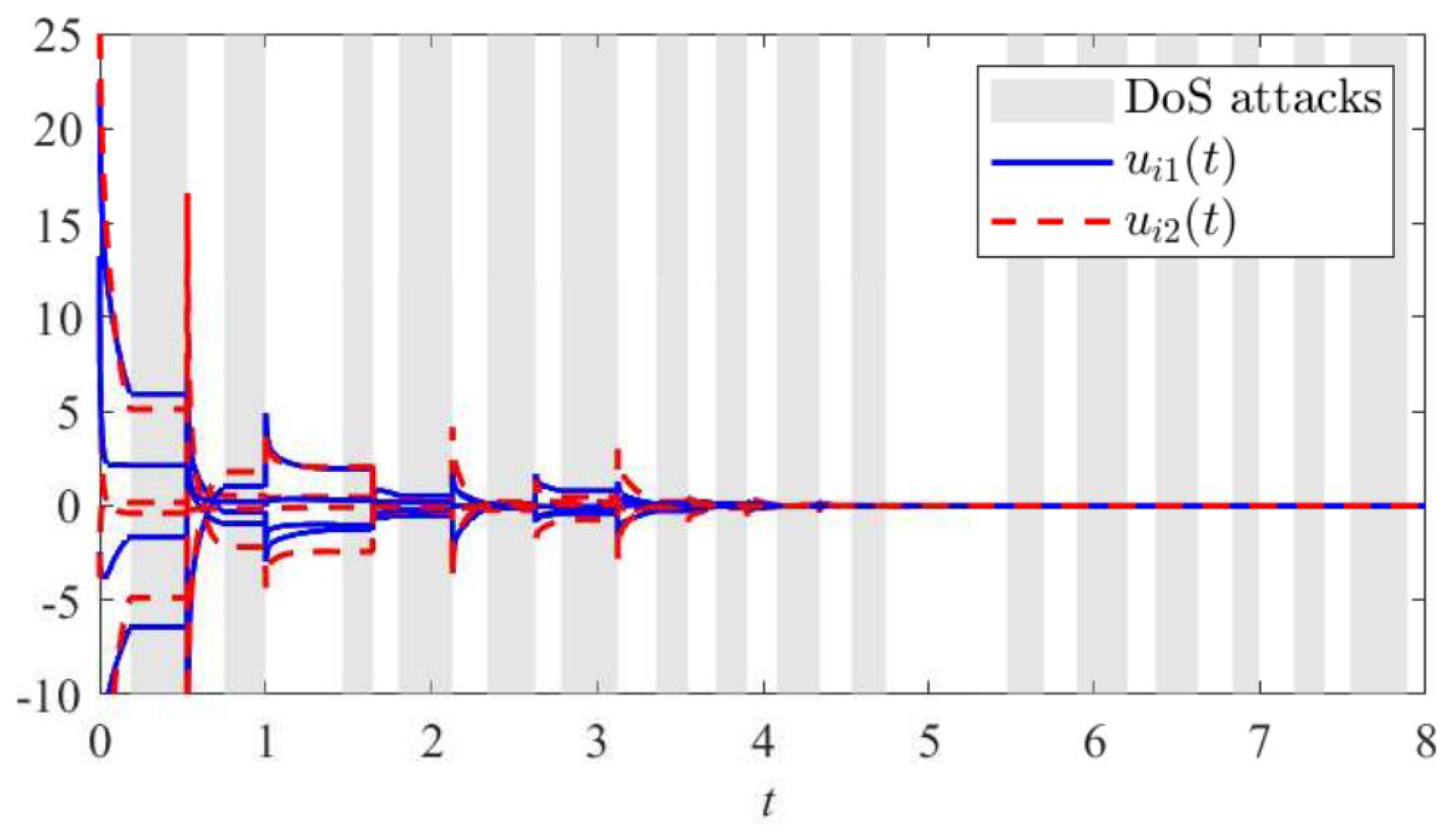
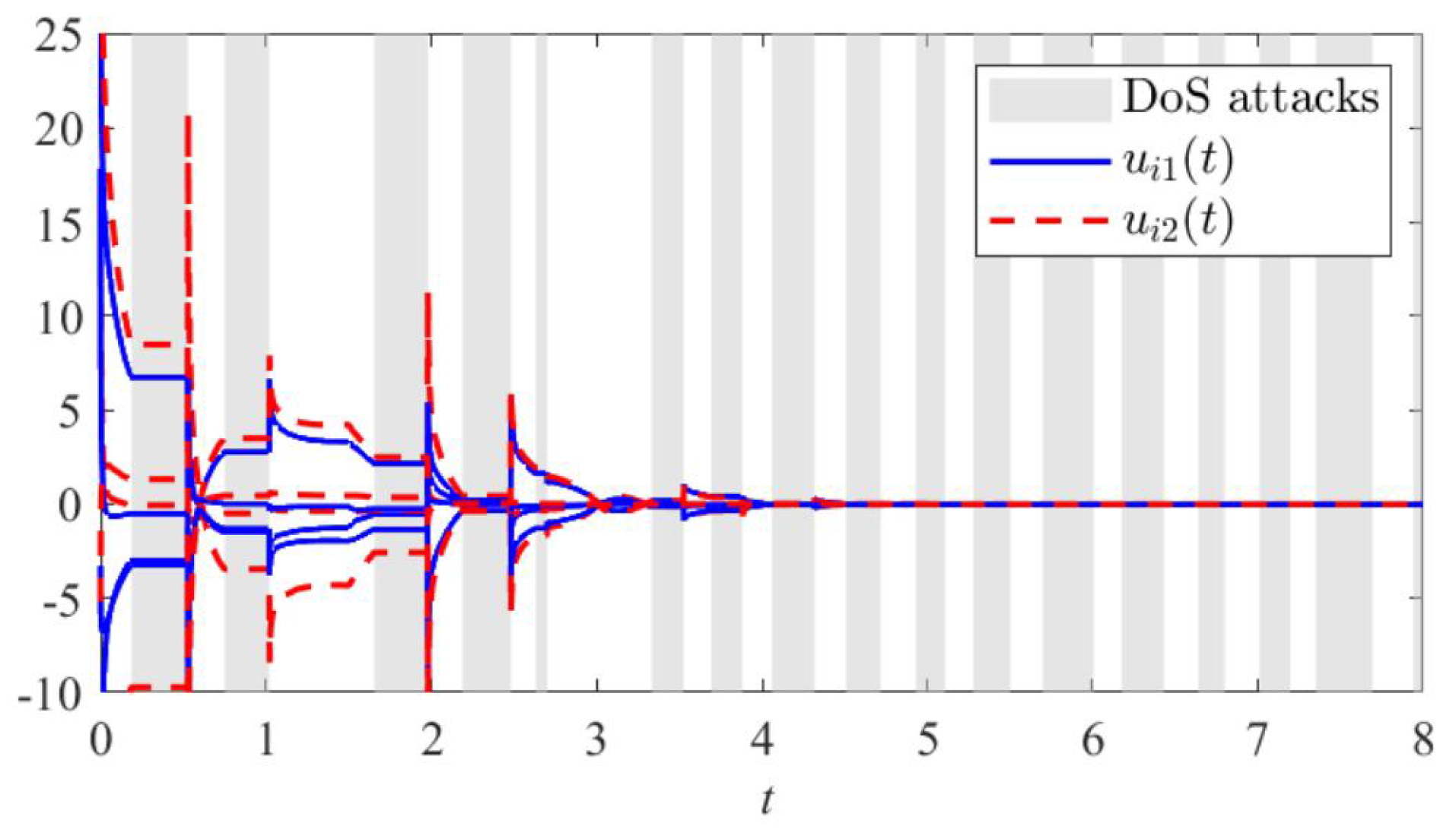
- Unlike existing event-triggered control schemes [35], this paper introduces a buffer mechanism to address communication interruptions caused by DoS attacks. When communication is interrupted, the control signal is not set to zero but instead uses the most recent valid control input stored in the buffer, thereby reducing the risk of performance degradation and system instability.
- 3.
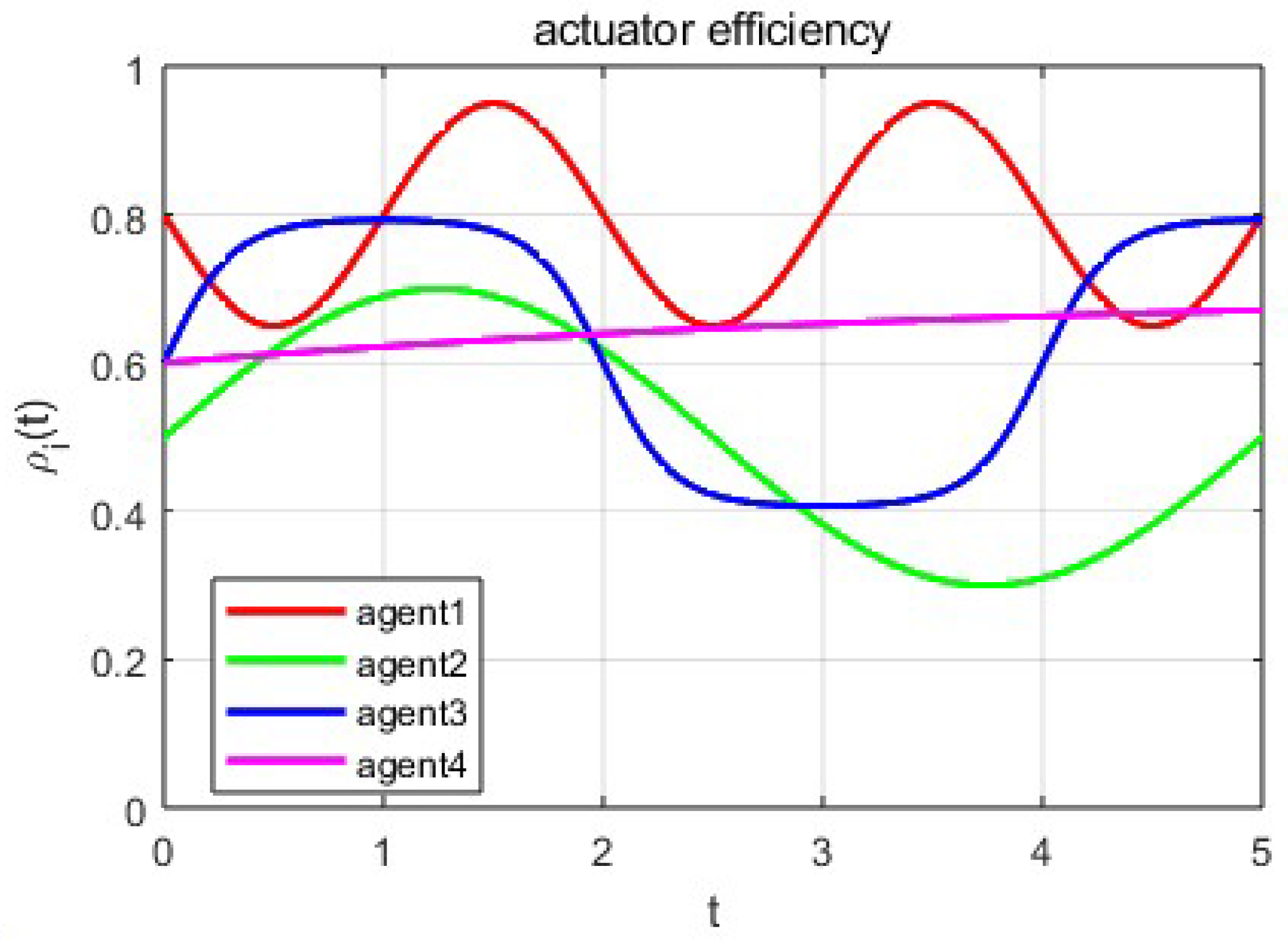
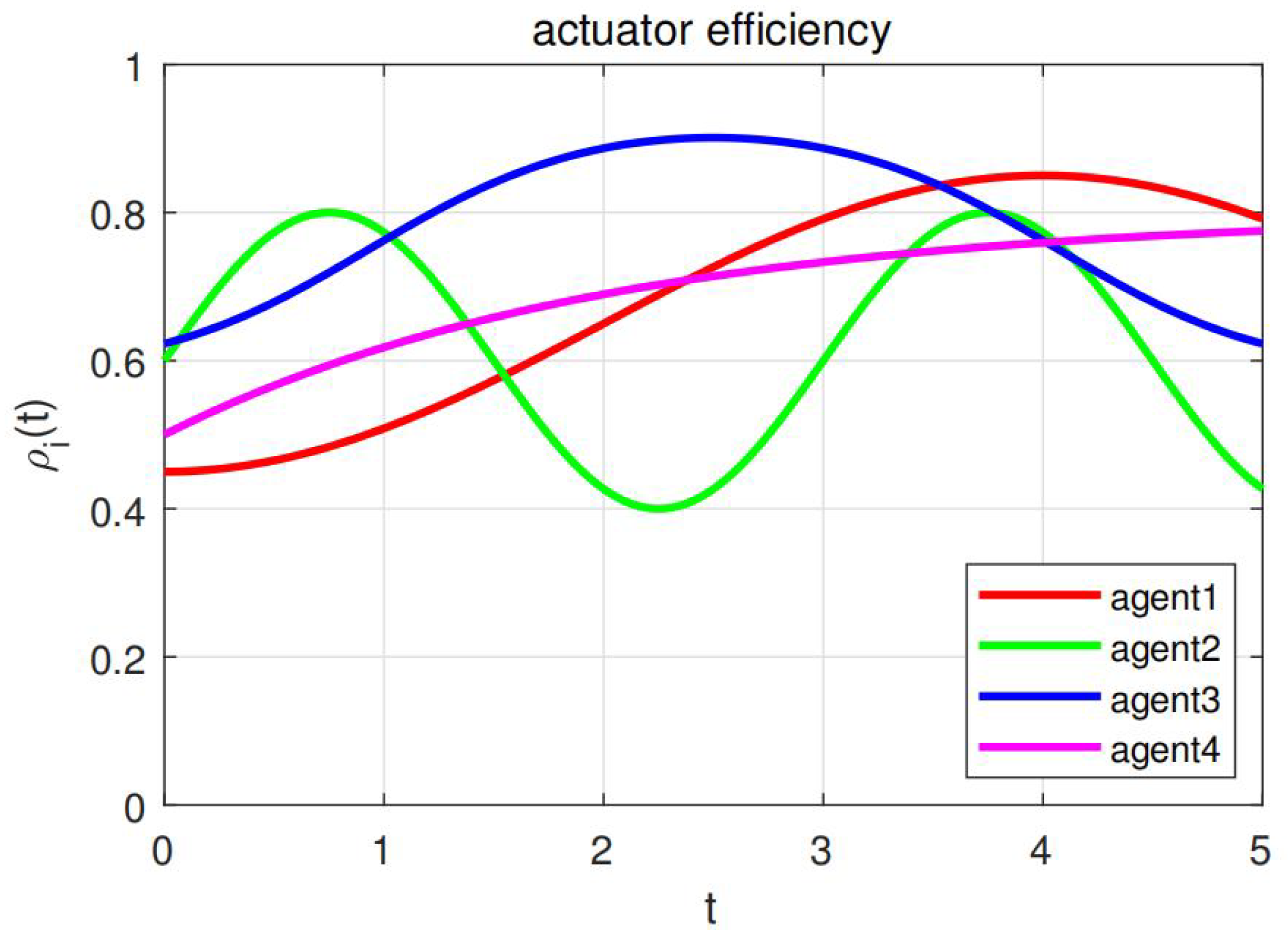
- This paper incorporates variations in actuator efficiency into the controller design, allowing for automatic adjustments when actuator failures or performance fluctuations occur. This innovation enables the control system to adapt in real-time to changing operating conditions, ensuring the stability and consistency of the system in practical operations.
2. Problem Description and Preliminaries
3. Leaderless FOMASs Consensus Under Boundary Control
4. Leader-Following FOMASs Consensus Under Boundary Control
5. Numerical Simulation
6. Conclusions
Author Contributions
Funding
Data Availability Statement
Conflicts of Interest
References
- Zeng, Q.; Nait-Abdesselam, F. Multi-Agent Reinforcement Learning-Based Extended Boid Modeling for Drone Swarms. In Proceedings of the ICC 2024—IEEE International Conference on Communications, Denver, CO, USA, 9–13 June 2024; pp. 1551–1556. [Google Scholar] [CrossRef]
- Yang, Y.; Xiao, Y.; Li, T. Attacks on Formation Control for Multiagent Systems. IEEE Trans. Cybern. 2022, 52, 12805–12817. [Google Scholar] [CrossRef]
- Antonio, G.P.; Maria-Dolores, C. Multi-Agent Deep Reinforcement Learning to Manage Connected Autonomous Vehicles at Tomorrow’s Intersections. IEEE Trans. Veh. Technol. 2022, 71, 7033–7043. [Google Scholar] [CrossRef]
- Xu, R.; Chen, C.J.; Tu, Z.; Yang, M.H. V2X-ViTv2: Improved Vision Transformers for Vehicle-to-Everything Cooperative Perception. IEEE Trans. Pattern Anal. Mach. Intell. 2025, 47, 650–662. [Google Scholar] [CrossRef] [PubMed]
- Wang, T.; Cao, J.; Hussain, A. Adaptive Traffic Signal Control for large-scale scenario with Cooperative Group-based Multi-agent reinforcement learning. Transp. Res. Part C Emerg. Technol. 2021, 125, 103046. [Google Scholar] [CrossRef]
- Zeynivand, A.; Javadpour, A.; Bolouki, S.; Sangaiah, A.; Ja’fari, F.; Pinto, P.; Zhang, W. Traffic flow control using multi-agent reinforcement learning. J. Netw. Comput. Appl. 2022, 207, 103497. [Google Scholar] [CrossRef]
- Liu, G.P. Coordination of Networked Nonlinear Multi-Agents Using a High-Order Fully Actuated Predictive Control Strategy. IEEE/CAA J. Autom. Sin. 2022, 9, 615–623. [Google Scholar] [CrossRef]
- Li, X.; Jiang, H.; Yu, Z.; Ren, Y.; Shi, T.; Chen, S. Leader-following scaled consensus of multi-agent systems based on nonlinear parabolic PDEs via dynamic event-triggered boundary control. Inf. Sci. 2025, 719, 122449. [Google Scholar] [CrossRef]
- Qiu, H.; Korovin, I.; Liu, H.; Gorbachev, S.; Gorbacheva, N.; Cao, J. Distributed adaptive neural network consensus control of fractional-order multi-agent systems with unknown control directions. Inf. Sci. 2024, 655, 119871. [Google Scholar] [CrossRef]
- Li, H.; Liu, S.; Meng, G.; Fan, Q. Dynamic Observer-Based H-Infinity Consensus Control of Fractional-Order Multi-Agent Systems. IEEE Trans. Autom. Sci. Eng. 2025, 22, 12720–12729. [Google Scholar] [CrossRef]
- Zamani, H.; Khandani, K.; Majd, V.J. Fixed-time sliding-mode distributed consensus and formation control of disturbed fractional-order multi-agent systems. ISA Trans. 2023, 138, 37–48. [Google Scholar] [CrossRef]
- Chen, Y.; Shao, S. Discrete-Time Fractional-Order Sliding Mode Attitude Control of Multi-Spacecraft Systems Based on the Fully Actuated System Approach. Fractal Fract. 2025, 9, 435. [Google Scholar] [CrossRef]
- Liu, Y.; Zhang, H.; Shi, Z.; Gao, Z. Neural-Network-Based Finite-Time Bipartite Containment Control for Fractional-Order Multi-Agent Systems. IEEE Trans. Neural Netw. Learn. Syst. 2023, 34, 7418–7429. [Google Scholar] [CrossRef]
- Zhang, X.; Zheng, S.; Ahn, C.K.; Xie, Y. Adaptive Neural Consensus for Fractional-Order Multi-Agent Systems With Faults and Delays. IEEE Trans. Neural Netw. Learn. Syst. 2023, 34, 7873–7886. [Google Scholar] [CrossRef] [PubMed]
- Liu, Y.; Zhang, H.; Wang, Y.; Liang, H. Adaptive Containment Control for Fractional-Order Nonlinear Multi-Agent Systems With Time-Varying Parameters. IEEE CAA J. Autom. Sin. 2022, 9, 1627–1638. [Google Scholar] [CrossRef]
- Zhong, Y.; Yuan, Y.; Yuan, H. Nash Equilibrium Seeking for Multi-Agent Systems Under DoS Attacks and Disturbances. IEEE Trans. Ind. Inform. 2024, 20, 5395–5405. [Google Scholar] [CrossRef]
- Xu, H.; Zhu, F.; Ling, X. Secure bipartite consensus of leader–follower multi-agent systems under denial-of-service attacks via observer-based dynamic event-triggered control. Neurocomputing 2025, 614, 128817. [Google Scholar] [CrossRef]
- Wen, H.; Li, Y.; Tong, S. Distributed adaptive resilient formation control for nonlinear multi-agent systems under DoS attacks. Sci. China Inf. Sci. 2024, 67, 209201. [Google Scholar] [CrossRef]
- Liu, J.; Dong, Y.; Gu, Z.; Xie, X.; Tian, E. Security consensus control for multi-agent systems under DoS attacks via reinforcement learning method. J. Frankl. Inst. 2024, 361, 164–176. [Google Scholar] [CrossRef]
- Chen, P.; Liu, S.; Chen, B.; Yu, L. Multi-Agent Reinforcement Learning for Decentralized Resilient Secondary Control of Energy Storage Systems Against DoS Attacks. IEEE Trans. Smart Grid 2022, 13, 1739–1750. [Google Scholar] [CrossRef]
- Zhao, N.; Zhang, H.; Shi, P. Observer-Based Sampled-Data Adaptive Tracking Control for Heterogeneous Nonlinear Multi-Agent Systems Under Denial-of-Service Attacks. IEEE Trans. Autom. Sci. Eng. 2025, 22, 4771–4779. [Google Scholar] [CrossRef]
- Zhao, Y.; Sun, H.; Yang, J.; Hou, L.; Yang, D. Event-Triggered Fully Distributed Bipartite Containment Control for Multi-Agent Systems Under DoS Attacks and External Disturbances. IEEE Trans. Circuits Syst. I Regul. Pap. 2025, 72, 6011–6024. [Google Scholar] [CrossRef]
- Wang, J.; Yan, Y.; Liu, Z.; Chen, C.P.; Zhang, C.; Chen, K. Finite-time consensus control for multi-agent systems with full-state constraints and actuator failures. Neural Netw. 2023, 157, 350–363. [Google Scholar] [CrossRef] [PubMed]
- Zhang, Y.; Li, H.; Sun, J.; He, W. Cooperative Adaptive Event-Triggered Control for Multiagent Systems With Actuator Failures. IEEE Trans. Syst. Man Cybern. Syst. 2019, 49, 1759–1768. [Google Scholar] [CrossRef]
- Deng, C.; Gao, W.; Che, W. Distributed adaptive fault-tolerant output regulation of heterogeneous multi-agent systems with coupling uncertainties and actuator faults. IEEE CAA J. Autom. Sin. 2020, 7, 1098–1106. [Google Scholar] [CrossRef]
- Li, J.; Yan, Z.; Shi, X.; Luo, X. Distributed Adaptive Formation Control for Fractional-Order Multi-Agent Systems with Actuator Failures and Switching Topologies. Fractal Fract. 2024, 8, 563. [Google Scholar] [CrossRef]
- Zhang, T.; Lin, M.; Xia, X.; Yi, Y. Adaptive cooperative dynamic surface control of non-strict feedback multi-agent systems with input dead-zones and actuator failures. Neurocomputing 2021, 442, 48–63. [Google Scholar] [CrossRef]
- Zhang, Z.; Dong, J. Containment control of interval type-2 fuzzy multi-agent systems with multiple intermittent packet dropouts and actuator failure. J. Frankl. Inst. 2020, 357, 6096–6120. [Google Scholar] [CrossRef]
- Lui, D.G.; Petrillo, A.; Santini, S. Adaptive fault-tolerant containment control for heterogeneous uncertain nonlinear multi-agent systems under actuator faults. J. Frankl. Inst. 2024, 361, 107317. [Google Scholar] [CrossRef]
- Su, Y.; Shan, Q.; Liang, H.; Li, T.; Zhang, H. Event-Based Adaptive Optimal Fault-Tolerant Consensus Control for Uncertain Nonlinear Multiagent Systems With Actuator Failures. IEEE Trans. Syst. Man Cybern. Syst. 2025, 55, 7273–7287. [Google Scholar] [CrossRef]
- Long, S.; Huang, W.; Wang, J.; Liu, J.; Gu, Y.; Wang, Z. A Fixed-Time Consensus Control With Prescribed Performance for Multi-Agent Systems Under Full-State Constraints. IEEE Trans. Autom. Sci. Eng. 2025, 22, 6398–6407. [Google Scholar] [CrossRef]
- Jiang, Y.; Liu, L.; Feng, G. Fully distributed adaptive control for output consensus of uncertain discrete-time linear multi-agent systems. Automatica 2024, 162, 111531. [Google Scholar] [CrossRef]
- Xu, N.; Chen, Z.; Niu, B.; Zhao, X. Event-Triggered Distributed Consensus Tracking for Nonlinear Multi-Agent Systems: A Minimal Approximation Approach. IEEE J. Emerg. Sel. Top. Circuits Syst. 2023, 13, 767–779. [Google Scholar] [CrossRef]
- Hu, W.; Cheng, Y.; Yang, C. Leader-following consensus of linear multi-agent systems via reset control: A time-varying systems approach. Automatica 2023, 149, 110824. [Google Scholar] [CrossRef]
- Song, X.; Sun, X.; Song, S.; Zhang, Y. Secure Consensus Control for PDE-Based Multiagent Systems Resist Hybrid Attacks. IEEE Syst. J. 2023, 17, 3047–3058. [Google Scholar] [CrossRef]
- Liu, Y.; Zuo, Z.; Song, J.; Li, W. Fixed-time consensus control of general linear multiagent systems. IEEE Trans. Autom. Control 2024, 69, 5516–5523. [Google Scholar] [CrossRef]
- Peng, X.J.; He, Y.; Li, H.; Tian, S. Consensus Control and Optimization of Time-Delayed Multiagent Systems: Analysis on Different Order-Reduction Methods. IEEE Trans. Syst. Man Cybern. Syst. 2025, 55, 780–791. [Google Scholar] [CrossRef]
- Hao, Y.; Fang, Z.; Cao, J.; Liu, H. Consensus Control of Nonlinear Fractional-Order Multiagent Systems With Input Saturation: A T–S Fuzzy Method. IEEE Trans. Fuzzy Syst. 2024, 32, 6754–6766. [Google Scholar] [CrossRef]
- Seuret, A.; Gouaisbaut, F. Wirtinger-based integral inequality: Application to time-delay systems. Automatica 2013, 49, 2860–2866. [Google Scholar] [CrossRef]
- Qin, J.; Gao, H.; Zheng, W.X. Exponential Synchronization of Complex Networks of Linear Systems and Nonlinear Oscillators: A Unified Analysis. IEEE Trans. Neural Netw. Learn. Syst. 2015, 26, 510–521. [Google Scholar] [CrossRef]
- Lv, Y.; Hu, C.; Yu, J.; Jiang, H.; Huang, T. Edge-Based Fractional-Order Adaptive Strategies for Synchronization of Fractional-Order Coupled Networks With Reaction–Diffusion Terms. IEEE Trans. Cybern. 2020, 50, 1582–1594. [Google Scholar] [CrossRef]
- Li, Y.; Chen, Y.; Podlubny, I. Mittag–Leffler stability of fractional order nonlinear dynamic systems. Automatica 2009, 45, 1965–1969. [Google Scholar] [CrossRef]
- Yang, C.; Huang, T.; Yi, K.; Zhang, A.; Chen, X.; Li, Z.; Qiu, J.; Alsaadi, F.E. Synchronization for nonlinear complex spatio-temporal networks with multiple time-invariant delays and multiple time-varying delays. Neural Process. Lett. 2019, 50, 1051–1064. [Google Scholar] [CrossRef]
- Liu, C.; Wang, W.; Jiang, B.; Patton, R.J. Fault-Tolerant Consensus of Multi-Agent Systems Subject to Multiple Faults and Random Attacks. IEEE Trans. Circuits Syst. I Regul. Pap. 2025, 72, 4935–4945. [Google Scholar] [CrossRef]
- Chen, J.; Shen, J.; Chen, W.; Li, J.; Zhang, S. Application of Robust Fuzzy Cooperative Strategy in Global Consensus of Stochastic Multi-Agent Systems. IEEE Trans. Autom. Sci. Eng. 2025, 22, 12058–12070. [Google Scholar] [CrossRef]
- De Persis, C.; Tesi, P. Input-to-State Stabilizing Control Under Denial-of-Service. IEEE Trans. Autom. Control 2015, 60, 2930–2944. [Google Scholar] [CrossRef]
- Yan, L.; Liu, Z.; Philip Chen, C.; Zhang, Y.; Wu, Z. Optimized adaptive consensus control for multi-agent systems with prescribed performance. Inf. Sci. 2022, 613, 649–666. [Google Scholar] [CrossRef]
- Sun, Y.; Shi, P.; Lim, C.C. Event-triggered sliding mode scaled consensus control for multi-agent systems. J. Frankl. Inst. 2022, 359, 981–998. [Google Scholar] [CrossRef]


Disclaimer/Publisher’s Note: The statements, opinions and data contained in all publications are solely those of the individual author(s) and contributor(s) and not of MDPI and/or the editor(s). MDPI and/or the editor(s) disclaim responsibility for any injury to people or property resulting from any ideas, methods, instructions or products referred to in the content. |
© 2025 by the authors. Licensee MDPI, Basel, Switzerland. This article is an open access article distributed under the terms and conditions of the Creative Commons Attribution (CC BY) license (https://creativecommons.org/licenses/by/4.0/).
Share and Cite
Qi, Q.; Chen, X.; Wang, D.; Dai, J.; Yang, Y.; Yang, C. Boundary Control for Consensus in Fractional-Order Multi-Agent Systems Under DoS Attacks and Actuator Failures. Fractal Fract. 2025, 9, 745. https://doi.org/10.3390/fractalfract9110745
Qi Q, Chen X, Wang D, Dai J, Yang Y, Yang C. Boundary Control for Consensus in Fractional-Order Multi-Agent Systems Under DoS Attacks and Actuator Failures. Fractal and Fractional. 2025; 9(11):745. https://doi.org/10.3390/fractalfract9110745
Chicago/Turabian StyleQi, Qiang, Xiao Chen, Dejian Wang, Jiashu Dai, Yuqian Yang, and Chengdong Yang. 2025. "Boundary Control for Consensus in Fractional-Order Multi-Agent Systems Under DoS Attacks and Actuator Failures" Fractal and Fractional 9, no. 11: 745. https://doi.org/10.3390/fractalfract9110745
APA StyleQi, Q., Chen, X., Wang, D., Dai, J., Yang, Y., & Yang, C. (2025). Boundary Control for Consensus in Fractional-Order Multi-Agent Systems Under DoS Attacks and Actuator Failures. Fractal and Fractional, 9(11), 745. https://doi.org/10.3390/fractalfract9110745