
Article

Evolution of Mechanical Properties and Fractal Characteristics of Acoustic Emission of Sandstone–Concrete Composites Under Acidic Sulfate Attack
1
School of Resource & Environment and Safety Engineering, University of South China, Hengyang 421001, China
2
Hunan Province & Hengyang City Engineering Technology Research Center for Disaster Prediction and Control on Mining Geotechnical Engineering, Hengyang 421001, China
*
Author to whom correspondence should be addressed.
Fractal Fract. 2026, 10(5), 308; https://doi.org/10.3390/fractalfract10050308
Submission received: 27 March 2026 / Revised: 22 April 2026 / Accepted: 28 April 2026 / Published: 1 May 2026

Abstract

The long-term stability of rock–concrete composites largely depends on the mechanical properties and durability of the rock–concrete interface. This study investigated the coupling effect of interfacial roughness and acid sulfate corrosion on sandstone–concrete composites by using uniaxial compression tests combined with acoustic emission (AE) monitoring. The results showed that corrosion continuously reduces the mechanical properties of the specimens with peak strength and elastic modulus, exhibiting a two-stage evolution: rapid degradation in the early stage followed by a slow decline in the later stage. After 60 days of corrosion, the peak strength for composites with JRC = 5, JRC = 10, and JRC = 15 interfaces decreased by 46.59%, 44.34%, and 50.43%, respectively. The elastic modulus exhibited the same pattern of variation, and the decreasing rate was 68.90%, 66.96%, and 76.46% for the JRC = 5, JRC = 10, and JRC = 15 groups. Acoustic emission activities appeared earlier and were more significant after corrosion. With the effect of corrosion, the fracture mode evolved from tensile-dominated cracks to mixed tensile–shear cracks with a stronger shear component. Fractal analysis of AE energy revealed that the Hurst exponent decreased from 0.842–0.864 in the natural state to 0.503–0.567 after 60 days of immersion, whereas the fractal dimension increased from 1.136–1.182 to 1.433–1.497, indicating a decrease in the persistence and increase in complexity of the acoustic emission energy release process. Overall, the moderately rough interface (JRC = 10) achieved a better balance between initial strengthening and long-term corrosion resistance. These findings provide experimental support for evaluating the durability of sandstone–concrete composites in acidic sulfate environments.

1. Introduction

Rock–concrete composites are widely used in hydraulic engineering works, underground caverns, tunnel support systems, and transportation infrastructure. Their long-term in-service performance is governed to a large extent by the mechanical behavior of the contact interface between the rock and concrete materials, which is commonly referred to as the rock–concrete interface [1]. Extensive studies have shown that, since this interface often constitutes the mechanically weak plane in composite systems, its failure mode and load-bearing capacity are strongly affected by factors such as interfacial morphology, mismatch in material stiffness, and loading conditions [1,2]. Therefore, an in-depth understanding of interfacial mechanical characteristics is of great significance for the safety assessment and life-cycle design of rock–concrete structures.
Among the various influencing factors, interfacial roughness is widely recognized as a key parameter governing the mechanical behavior of both natural rock joints and artificial interfaces. In their seminal studies, Patton (1966) [3] and Barton (1977) [4] demonstrated that surface asperities enhance interfacial shear and tensile resistance through mechanical interlocking, and they introduced the widely adopted Joint Roughness Coefficient (JRC). Subsequently, roughness theory was further introduced into the study of artificial interface systems. Relevant studies have demonstrated that, in both concrete–rock interfaces and concrete–concrete interfaces, interface roughness and its geometric characteristics play a significant role in controlling shear strength, deformation behavior, and failure mechanisms, highlighting roughness as a key parameter for characterizing the mechanical response of artificial interfaces [5,6]. Experimental evidence indicates that roughness magnitude and geometric morphology directly control crack initiation, the transition between tensile- and shear-dominated failure modes, and ultimate fracture patterns [7,8,9]. Shen et al. (2019) [10] found that the bonding strength of the concrete–rock interface is jointly governed by surface roughness and interfacial wettability, with a clear coupling effect between these two factors; moreover, as the interface roughness increases, the influence of wettability on bonding strength gradually decreases. Chen et al. (2023) [7] further demonstrated that interface roughness significantly affects the shear strength, dilatancy behavior, and failure mode of bonded rock–concrete interfaces.
In practical underground engineering, interfaces are subjected not only to complex mechanical loading but also to long-term chemical attack from groundwater, industrial effluents, and acid rain. Ions in groundwater can react with carbonates in concrete and silicate minerals in sandstone, which induces pore-structure alteration, as well as interfacial softening and debonding, and ultimately changes the mechanical behavior of both sandstone and concrete. Previous studies have reported corrosion-induced degradation in the strength and stiffness of concrete, sandstone, and rock–concrete composites [11,12,13,14]. Macro- and micro-scale experimental results further indicate that the long-term deterioration of rock–concrete interfaces is primarily governed by acid-induced dissolution, material softening, and interfacial debonding, which are accompanied by pore development, microstructural degradation, and the progressive loss of strength and stiffness [15,16,17].
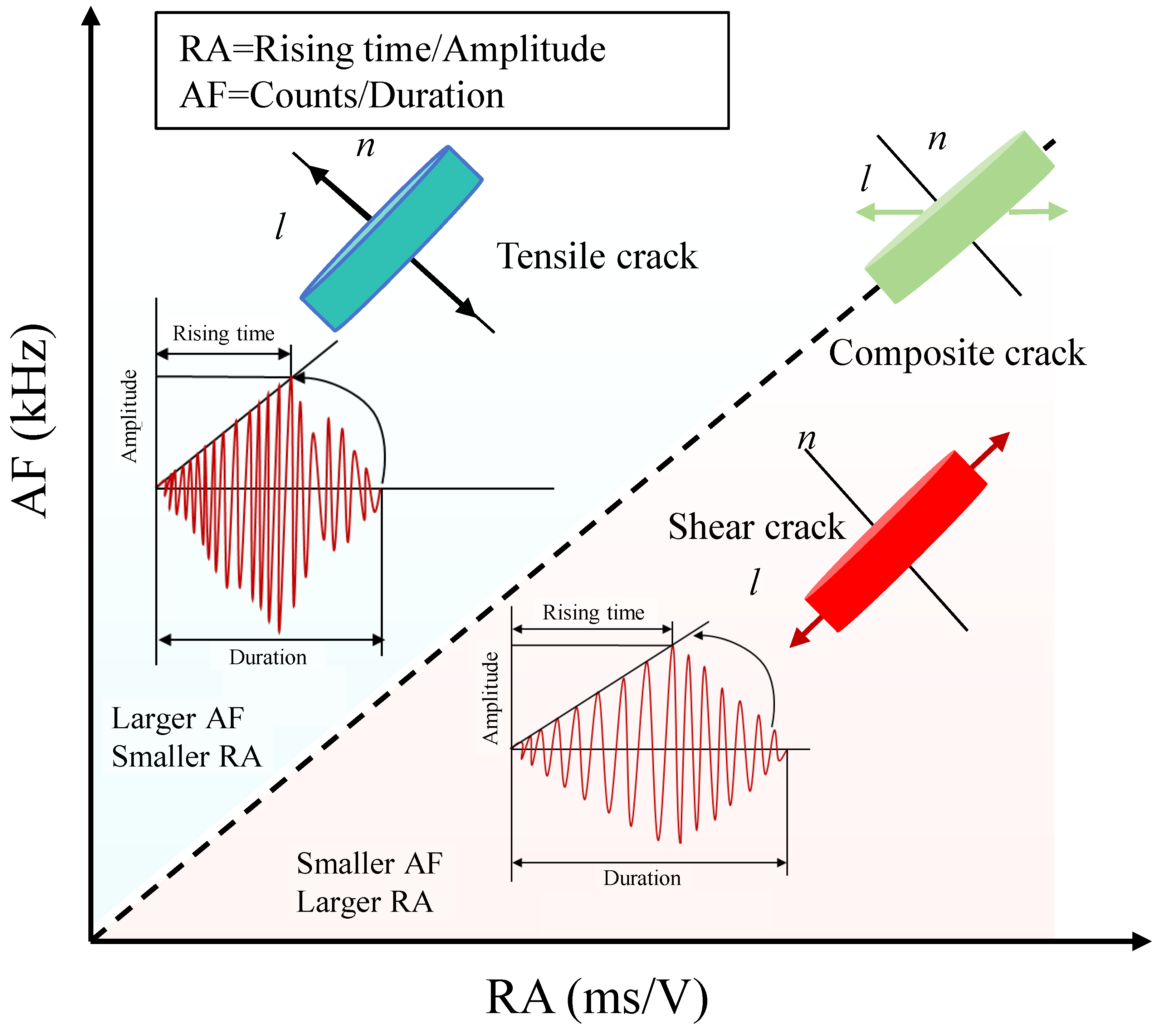
Acoustic emission has become an important non-destructive technique for investigating the damage evolution of rock materials, owing to its unique capacity to monitor the entire process of microcrack initiation, propagation, and coalescence in real time. Characteristic AE parameters such as ring count, energy, and b-value have been widely used to identify different damage stages and the RA/AF ratio (in which the RA is the ratio of rising time to AE amplitude and the AF is the ratio of AE count to duration) is used for distinguishing between the tensile and shear failure of rock samples [18,19,20,21]. In addition, AE source localization techniques can be used to reconstruct the spatial evolution of damage by capturing the spatiotemporal migration of AE events and have been successfully employed in the investigation of fracture and damage processes in brittle materials, including rocks, concrete, and cemented backfills [22,23,24]. Research by Hong et al. (2004) [25] and Qiu et al. (2024) [26] confirms that acoustic emission signals are highly sensitive to interfacial shear-damage evolution, crack growth, and instability processes. In summary, in the fields of mining engineering and geotechnical engineering, acoustic emission has become a reliable technique for monitoring the failure process of brittle materials.
However, previous studies have mostly focused on the influence of a single factor on the mechanical property evolution of sandstone–concrete composites, while neglecting the overall effect under the synergistic action of interface morphology and corrosive environment. In this study, acidic sulfate erosion tests were first conducted on the sandstone–concrete composites, followed by uniaxial compression tests supplemented synchronously with acoustic emission monitoring technology. Firstly, the evolution law of mechanical properties of sandstone–concrete composites under the combined influence of sulfate erosion and interface morphology was analyzed. Subsequently, based on AE multi-parameter analysis, the acoustic emission signal characteristics and fracture modes of the composites during the failure process were revealed. Finally, the fractal characteristics of acoustic emission energy were analyzed by using the fractal analysis method. The findings are expected to provide a scientific basis for the durability assessment and safety-oriented design of sandstone–concrete structures in geochemical environments.

2. Materials and Methods

2.1. Preparation of Rock Interfaces Based on Fractal Theory

The rock–concrete composite prepared in this study consisted of two components, namely sandstone and concrete. The sandstone material was a representative bluish sandstone collected from Fengxian County, Xuzhou City, Jiangsu Province, China. In underground engineering, discontinuities formed in surrounding rock after excavation generally exhibit a certain degree of roughness, and the interfacial morphology plays a critical role in the mechanical performance of a rock–concrete composite. Therefore, a rational laboratory simulation of rock discontinuity surfaces is necessary. Natural rough rock surfaces usually exhibit self-affine fractal characteristics, and the surface morphology of fractures can be described by fractional Brownian motion (fBm) [27]. In fBm, the height of surface roughness is defined as a random function of two independent spatial variables, x and y, denoted as z(x, y). The function increment over an interval of length h, z(x + hx, y + hγ) − z(x, y), follows a Gaussian distribution with a mean of 0 and a variance of σ2. The statistical self-affine properties of fractional Brownian motion are as follows.
z x + h x , y + h y z x , y = 0
σ h 2 = h 2 H σ 1 2
where H is the Hurst exponent, whose value ranges from 0 to 1. Its relationship with the fractal dimension Df is expressed as Df = 3 − H.
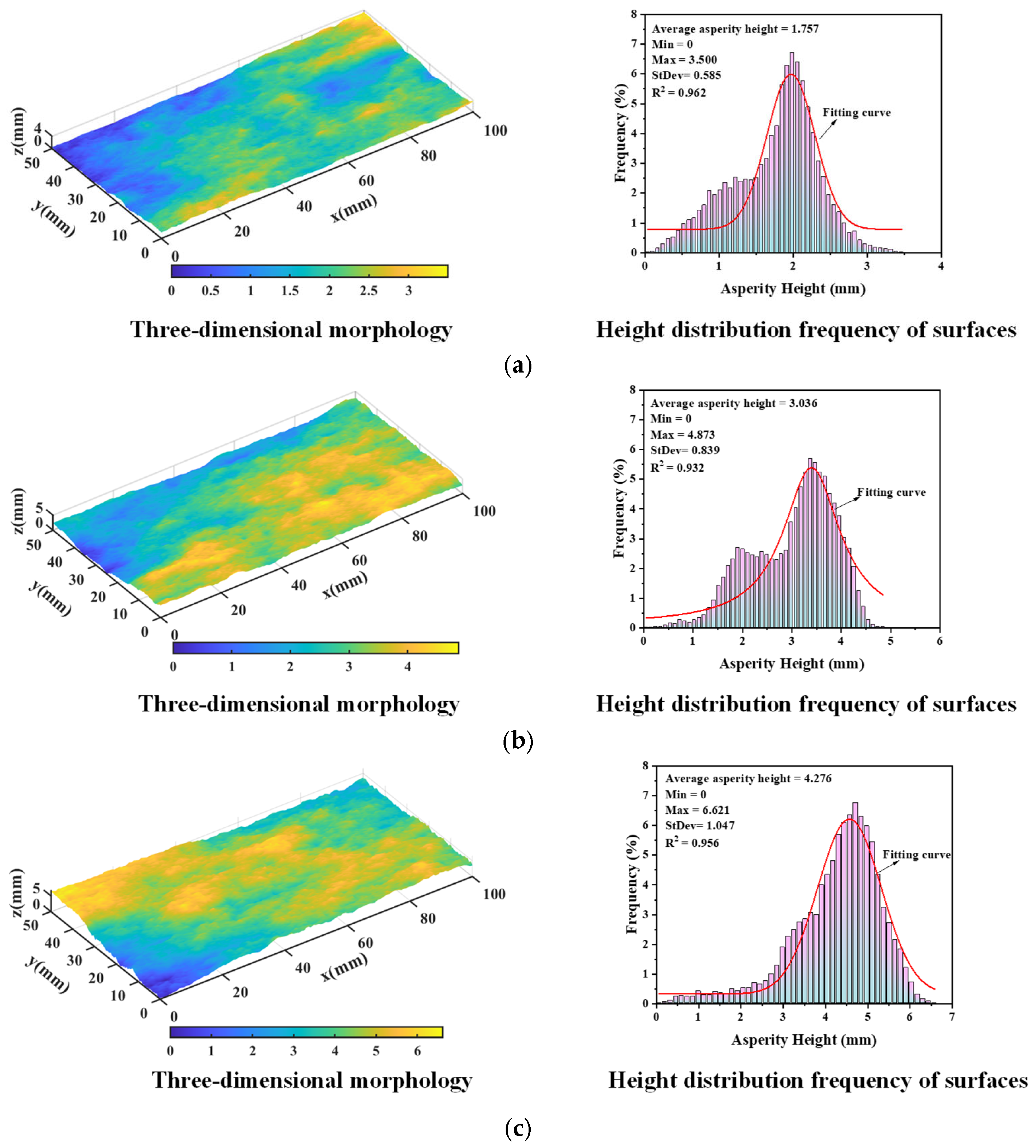
Fourier transform, the random Weierstrass–Mandelbrot function, and the successive random addition (SRA) method are widely used to construct fractional Brownian motion models. Among them, the SRA algorithm has been extensively applied to the generation of rough rock surfaces due to its ease of understanding and high efficiency. Liu developed a modified SRA algorithm to generate rock surfaces with self-affine characteristics [27]. This method overcomes the scaling and correlation issues associated with self-affine distributions in the traditional SRA algorithm. In this study, the modified SRA algorithm proposed by Liu was implemented through self-programming in Matlab R2019a to generate three representative surfaces with different roughness levels, each measuring 100 mm in length and 50 mm in width. Figure 1 presents the three-dimensional morphology and height distribution frequency of the sandstone surfaces with three different levels of roughness. The spatial point data of this rough interface were used for the subsequent CNC engraving of the sandstone interfaces.
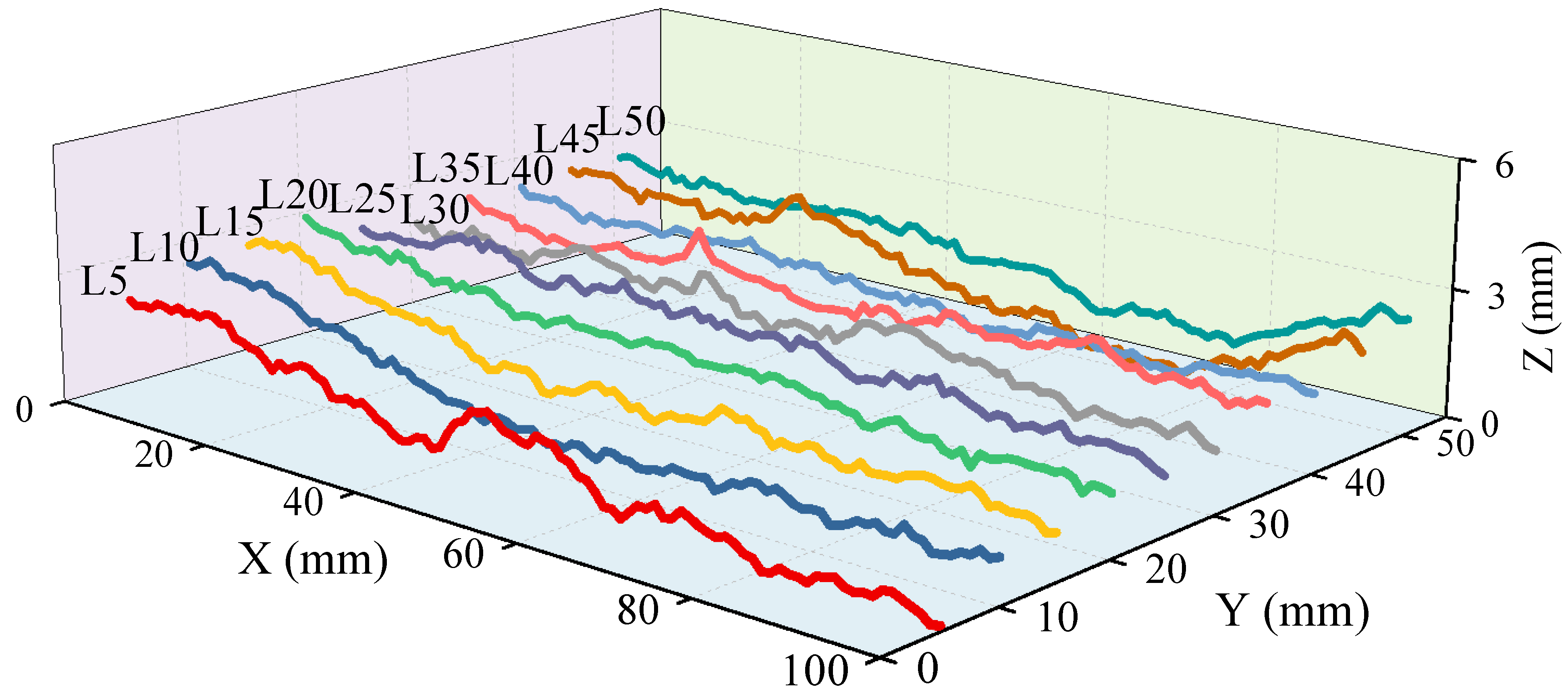
The roughness of the rock surface was quantified using the Joint Roughness Coefficient (JRC) proposed by Barton and Choubey [4]. As suggested by ISRM (1981), the JRC can be modelled in sectional profiles taken parallel to the direction of shear. When a sandstone–concrete composite specimen is subjected to a uniaxial compressive load along the x direction, shear failure occurs at the interface along the axial direction of the specimen (the x direction). Thus, fifty-one profiles that were parallel to the x direction were selected and placed 1 mm apart along the y direction from each generated surface. Figure 2 shows the rough line profile used to calculate the JRC, and due to the limited image space, only a portion of these profiles is shown. For each 2D profile, the JRC can be calculated by using Equations (3) and (4), proposed by Tse and Cruden [28]. The roughness of the rock surface was then defined as the mean value of all selected 2D profiles. Based on these calculations, the three prepared sandstone surfaces had JRC values of 5, 10, and 15, respectively.
Z 2 = 1 M z i z i 1 x i x i 1 2 1 / 2
J R C = 32.2 + 32.47 log 10 Z 2
where the values (xi, zi) and (xi−1, zi−1) represent the adjacent coordinates of the 2D profiles separated by the sampling interval Δx, M is the number of sampling intervals, and Z2 is the root mean square of the first derivative of the profile.
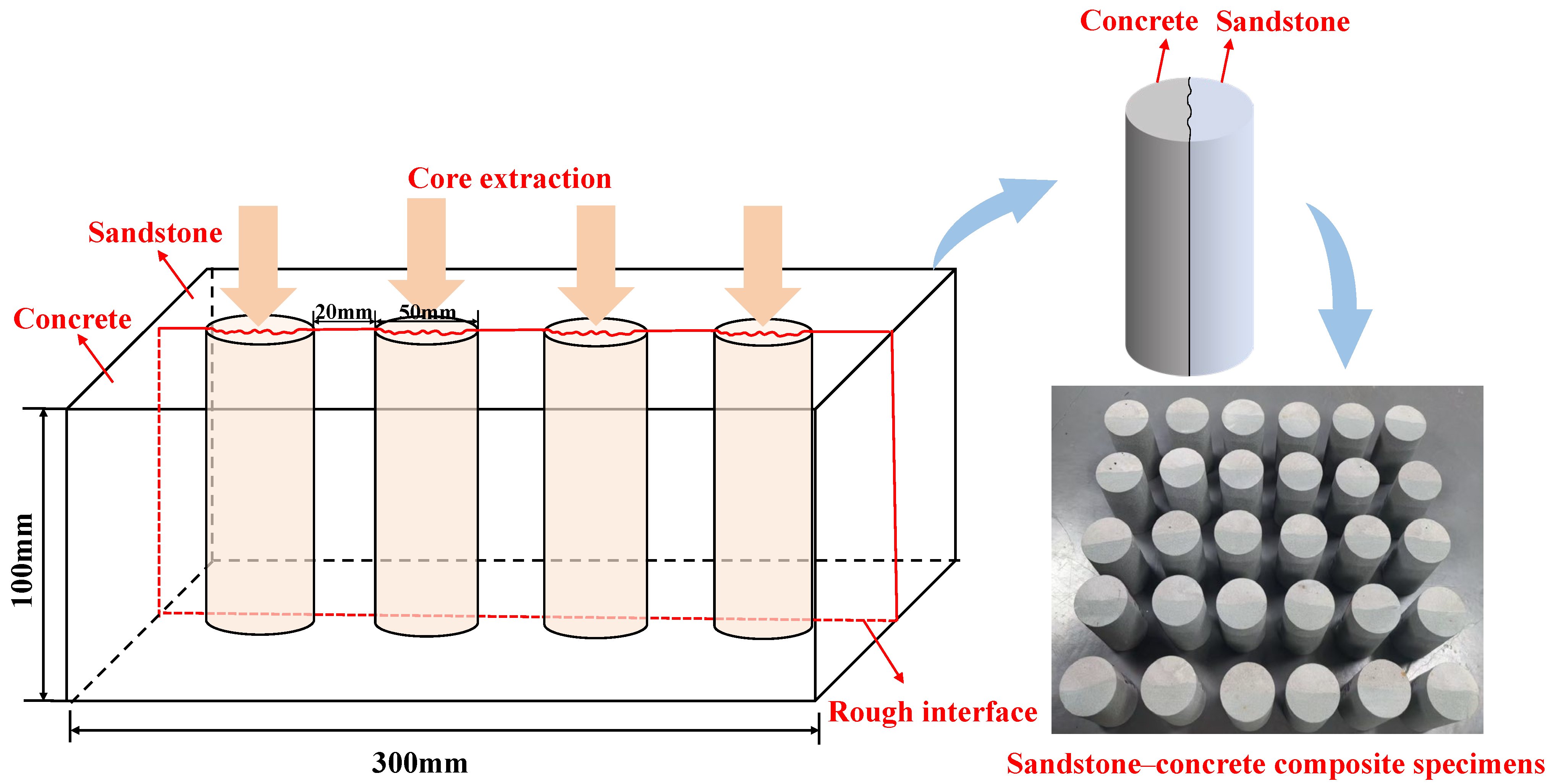
In this study, the LD 6060 CNC heavy-duty stone mold engraving machine manufactured by Jinan Lingdiao CNC Equipment Co., Ltd., Jinan City, China was used to engrave the sandstone surfaces with different levels of roughness. The machine is equipped with an integral cast-iron bed, which provides high structural stability during machining. With a spindle power of 5.5 kW and high transmission precision along the X, Y, and Z axes, it can meet the requirements for engraving rock surfaces. Its positioning accuracy reaches as high as 0.02 mm. The process of engraving a rough rock surface is divided into the following steps: (i) import the surface data from Figure 1 into the CNC engraving machine control system and set up a carving path; (ii) fix the pre-prepared original rock sample on the working platform; (iii) carry out the engraving operation. On this basis, the original rock surface morphology was replicated onto sandstone blocks of 300 mm × 100 mm × 60 mm. Four surfaces (with a length of 100 mm and a width of 50 mm) of identical roughness were fabricated on each rectangular rock specimen, with a spacing of 20 mm between adjacent rough surfaces. A batch of sandstone samples containing the same interface morphological characteristics were produced by the three-dimensional engraving technology. The morphology of the engraved sandstone sample surface is extremely similar to that of the numerically generated roughness surface. Previous studies [1,29] have shown that the CNC engraving machine has extremely high precision, with the error between the engraved rough surface and the original rock surface being only about 1–2%. Therefore, the JRCs of the engraved sandstone surfaces in this study were not calculated again and were equal to that of the numerically generated roughness surface shown in Figure 1.

2.2. Preparation of Sandstone–Concrete Composite Specimens

The concrete used in this study was C30 fine aggregate concrete, which consists of cementitious materials, aggregates, water, and a water-reducing admixture. The mix proportions of all constituents are listed in Table 1. The cementitious material consisted of cement and fly ash. The cement was Conch brand PO42.5 ordinary Portland cement. The fly ash was Grade I fly ash from Henan Longteng New Materials Power Plant, Zhengzhou City, China. The coarse aggregate was calcareous gravel with continuous grading in the particle size range of 5–15 mm and an apparent density of 2880 kg/m3. The fine aggregate was medium-coarse sand with a fineness modulus of 2.60 and an apparent density of 2600 kg/m3. A polycarboxylate-based high-performance water reducer (Dingzun Building Materials Co., Ltd., Guangzhou City, China) was used as the chemical admixture.
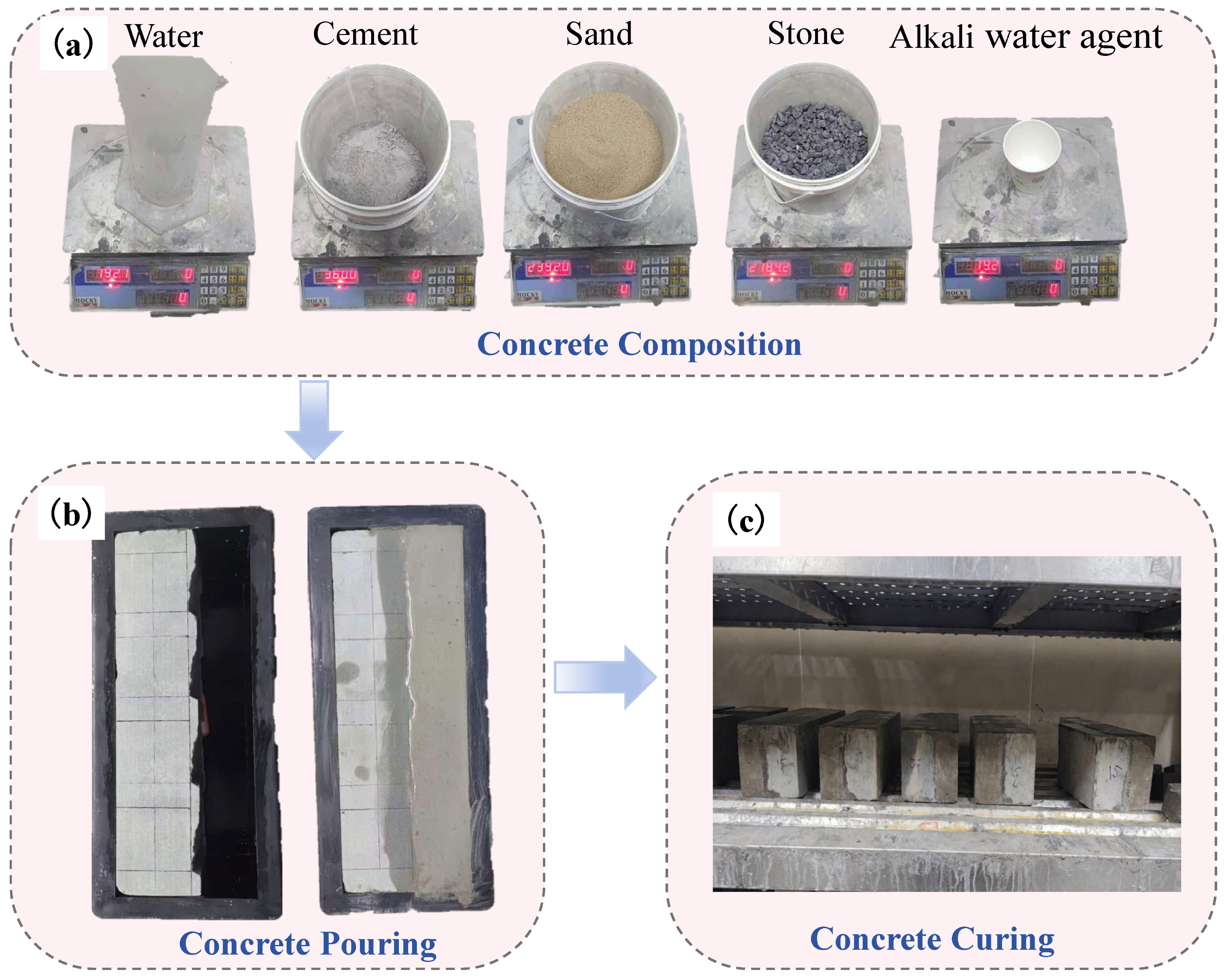
Sandstone blocks with different roughness levels were first placed into a standard mold (300 mm × 100 mm × 100 mm). Subsequently, freshly mixed C30 concrete was poured into the other side of the mold and compacted by vibration. After air-drying under ambient conditions for 24 h, the sandstone–concrete composite blocks were demolded and then cured for 28 days in a chamber with constant temperature and humidity. The curing temperature was 20 °C and the relative humidity was 95%. Figure 3 shows the preparation of sandstone–concrete composites. After curing, the cubic blocks were removed and cored using a drilling machine. The final prepared standard cylindrical specimens measured 50 mm in diameter and 100 mm in height (50 mm × 100 mm). The machining accuracy satisfied ISRM recommendations, with the non-parallelism of the two end faces controlled within 0.05 mm and the perpendicularity deviation between the end face and the axis at less than 0.3°. A schematic diagram of the sampling process is shown in the Figure 4. To ensure the reliability of the experimental data, three parallel samples were prepared for each test group.

2.3. Experimental Program

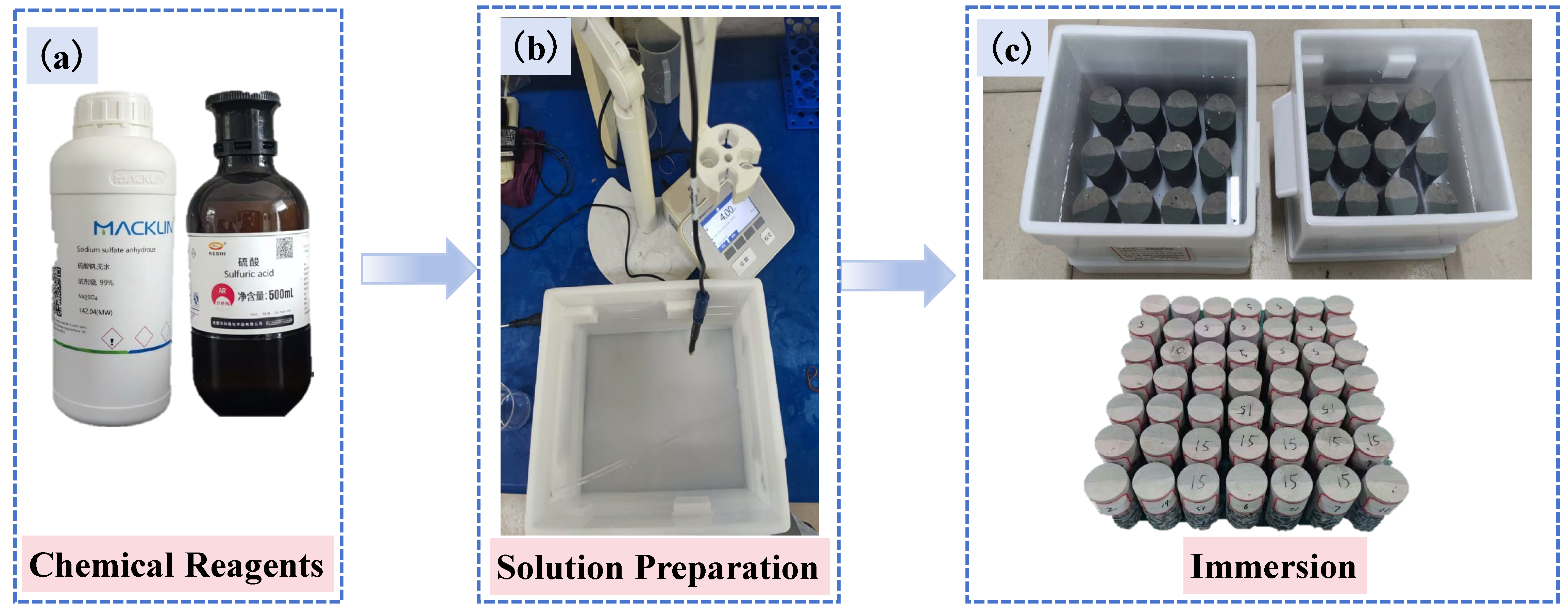
In deep rock engineering, the presence of groundwater can significantly affect the mechanical properties and stability of surrounding rock masses. Groundwater is essentially a complex chemical solution containing major ions such as Na+, Ca2+, Mg2+, K+, SO42−, Cl, and HCO3. To simplify experimental variables, this study focused primarily on the effects of Na+ and SO42− on sandstone–concrete composite. In reality, the pH of groundwater typically ranges from approximately 5.5 to 7, and the sulfate concentrations (mol/L) are typically in the order of 10−2. In order to observe corrosion-induced deterioration within a short period of time, the method of increasing the sulfate concentration and lowering the pH value of the solution was adopted. Therefore, a sodium sulfate solution with a pH of 4 and a concentration of 0.1 mol/L was used as the immersion solution. The immersion durations were 0, 3, 7, 14, 30, and 60 days. During immersion, the pH value of the solution was measured daily using a pH meter. When the measured pH deviated from the target value, dilute H2SO4 was added dropwise until the pH returned to 4. The procedure for the acidic sulfate immersion test is illustrated in Figure 5.
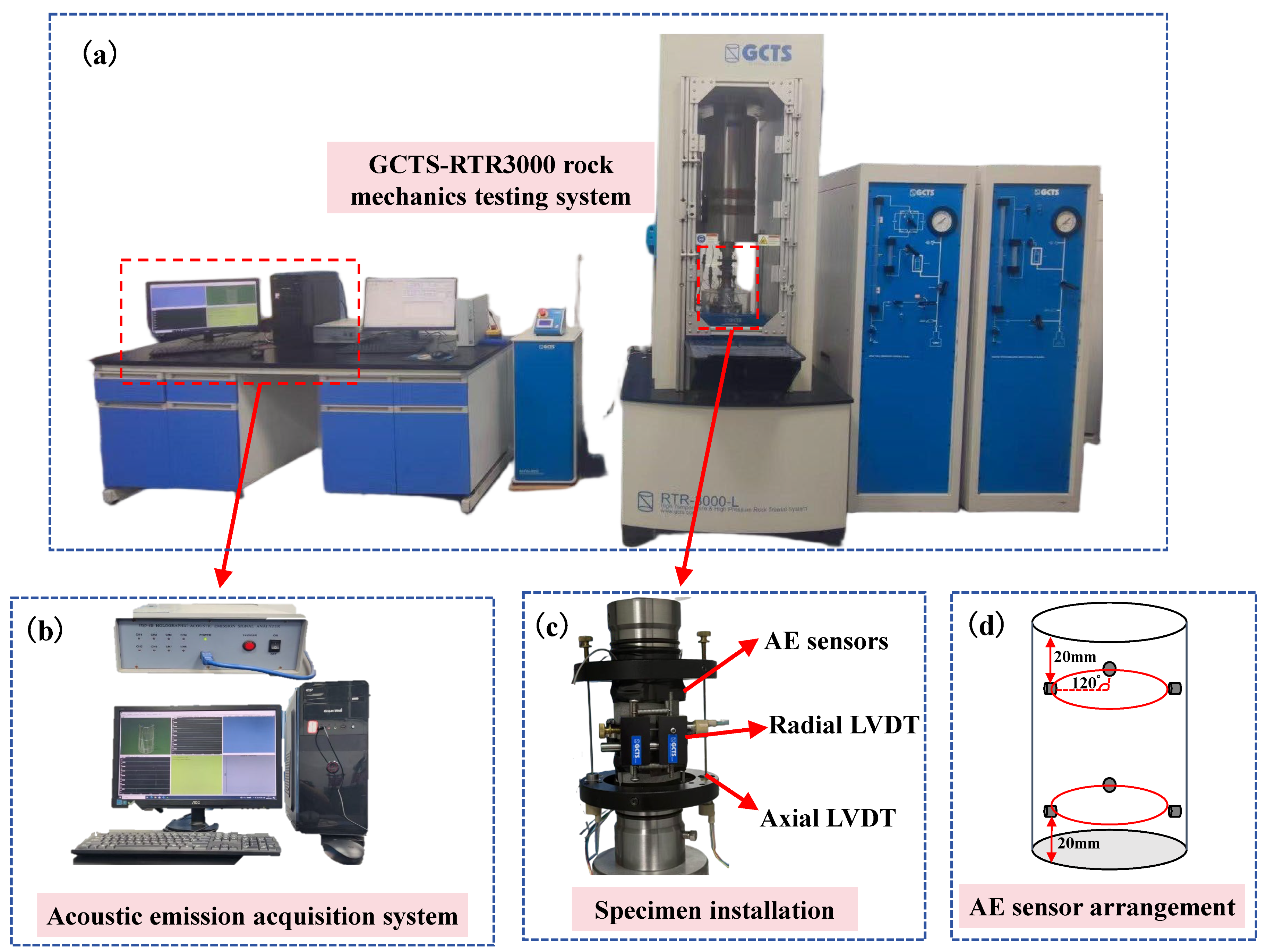
At the end of each immersion stage, one group of specimens was taken out for uniaxial compression testing. The mechanical tests were conducted on the GCTS-RTR-3000 rock mechanics testing system. Axial load was applied in a stress-control mode at a loading rate of 0.8 MPa/min. The axial and radial deformations of the samples were monitored using LVDT displacement sensors with an accuracy of ±0.25%. The mechanical response parameters, including axial stress, axial strain, and radial strain, were acquired and synchronously stored in real time by the computer control system. The mechanical testing system is shown in Figure 6.
To monitor damage evolution throughout the entire loading process, a DS5 acoustic emission (AE) system (manufactured by Beijing Soft Island Times Technology Co., Ltd., Beijing, China) was utilized to acquire AE signals from the specimen in real time. A total of six RS-55A sensors were employed, three of which were placed on the upper part of the sample and the rest on the lower part. The sensors were arranged at an angle of 120 degrees to each other (Figure 6d). Vaseline was used as a coupling agent between the sensors and the specimen surface to ensure stable signal transmission. The acoustic emission signal was processed by a 40 dB preamplifier. The acquisition threshold was set to 40 dB, and the sampling frequency was 3 MHz to ensure effective detection of AE events associated with microcrack initiation and propagation. The main AE acquisition parameters used in this study are summarized in Table 2.

3. Mechanical Properties

3.1. Evolution Characteristics of Stress–Strain Curves

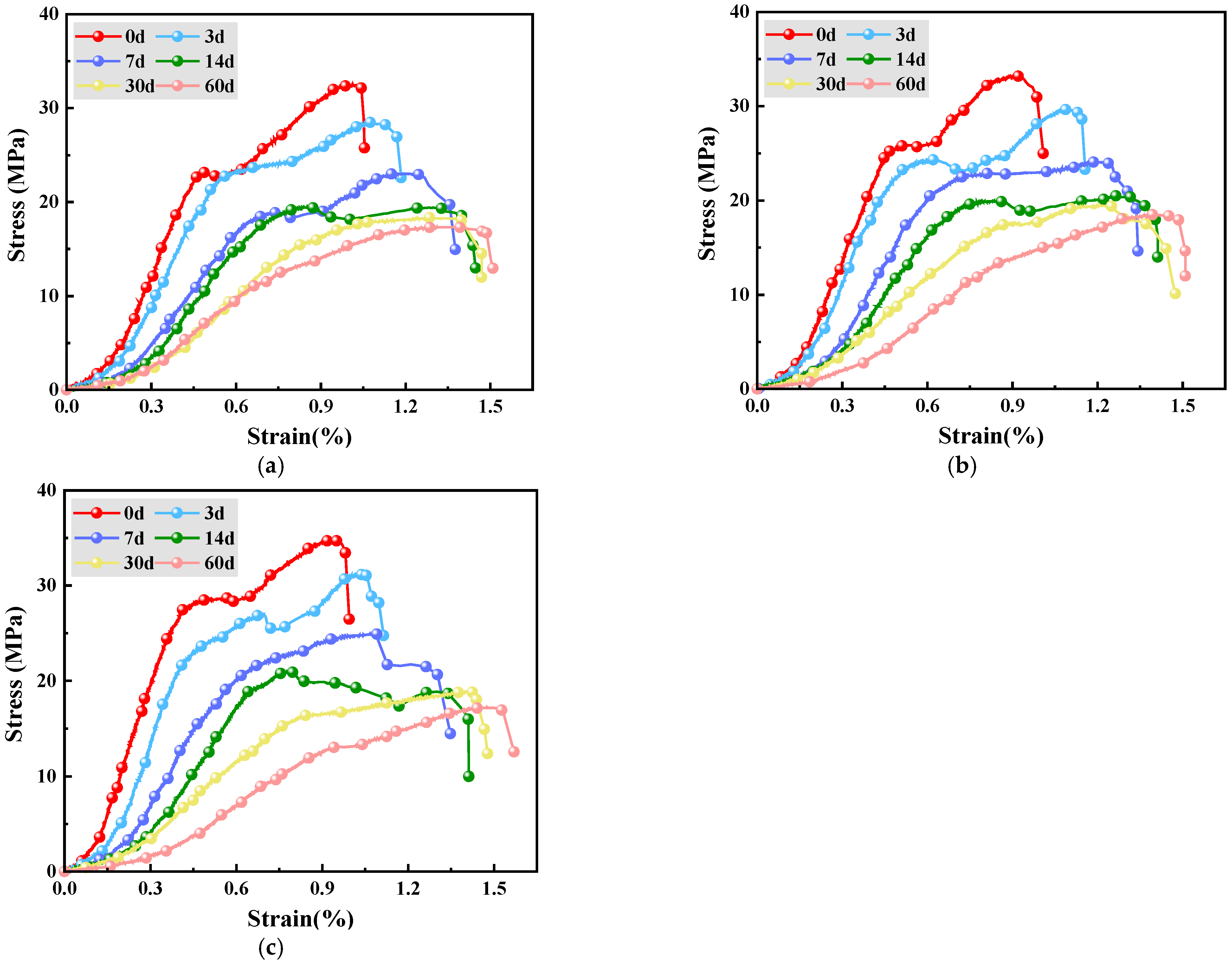
The stress–strain curves obtained from uniaxial compression are presented in Figure 7. As shown, the pre-peak response of the sandstone–concrete composite specimens can be divided into three typical stages: the initial compaction stage, the linear elastic stage, and the plastic deformation stage. Under the same interfacial roughness coefficient, the effect of chemical corrosion on the uniaxial stress–strain curve is mainly manifested as follows: with an increase in corrosion time, the pore compaction stage gradually prolongs, and under the same stress level, the corresponding strain increases markedly with increasing corrosion time. In this stage, the stress–strain curve of the uncorroded specimens is relatively steep. After 3 days of corrosion, the compaction stage is slightly prolonged, indicating that microcracks have formed within the specimen, while the overall structural integrity remains relatively good. When the corrosion duration increases to 14 and 60 days, the compaction stage becomes significantly longer and the initial slope decreases noticeably, suggesting pronounced internal structural alteration under sustained acidic sulfate attack. This corrosion process simultaneously increases the number and scale of pores and cracks, with deterioration being particularly evident in the interfacial region.
The slope of the elastic segment also changes significantly with corrosion duration. For a given interface roughness, uncorroded specimens exhibit a steeper elastic segment. As corrosion time increases, the slope of the elastic stage continuously decreases and the linear region gradually shortens, indicating the degradation of the overall stiffness of the composite. Over 60 days of corrosion, the elastic stage is substantially compressed, implying that corrosion-induced interfacial debonding and microcrack propagation are activated at relatively low stress levels, causing an earlier transition into nonlinear deformation. The nonlinear stage, corresponding to crack initiation, propagation, and coalescence, is highly sensitive to corrosion duration. At the same interface roughness, specimens without corrosion exhibit higher peak stress, indicating stronger load-bearing capacity during loading. As corrosion time increases from 3 days to 60 days, the peak stress continuously decreases, and the pre-peak nonlinear deformation stage is notably prolonged. In some specimens, rapid stress collapse occurs after the peak, indicating that corrosion weakens both inter-particle bonding in the sandstone and concrete phases and the mechanical interlocking effect at the interface.
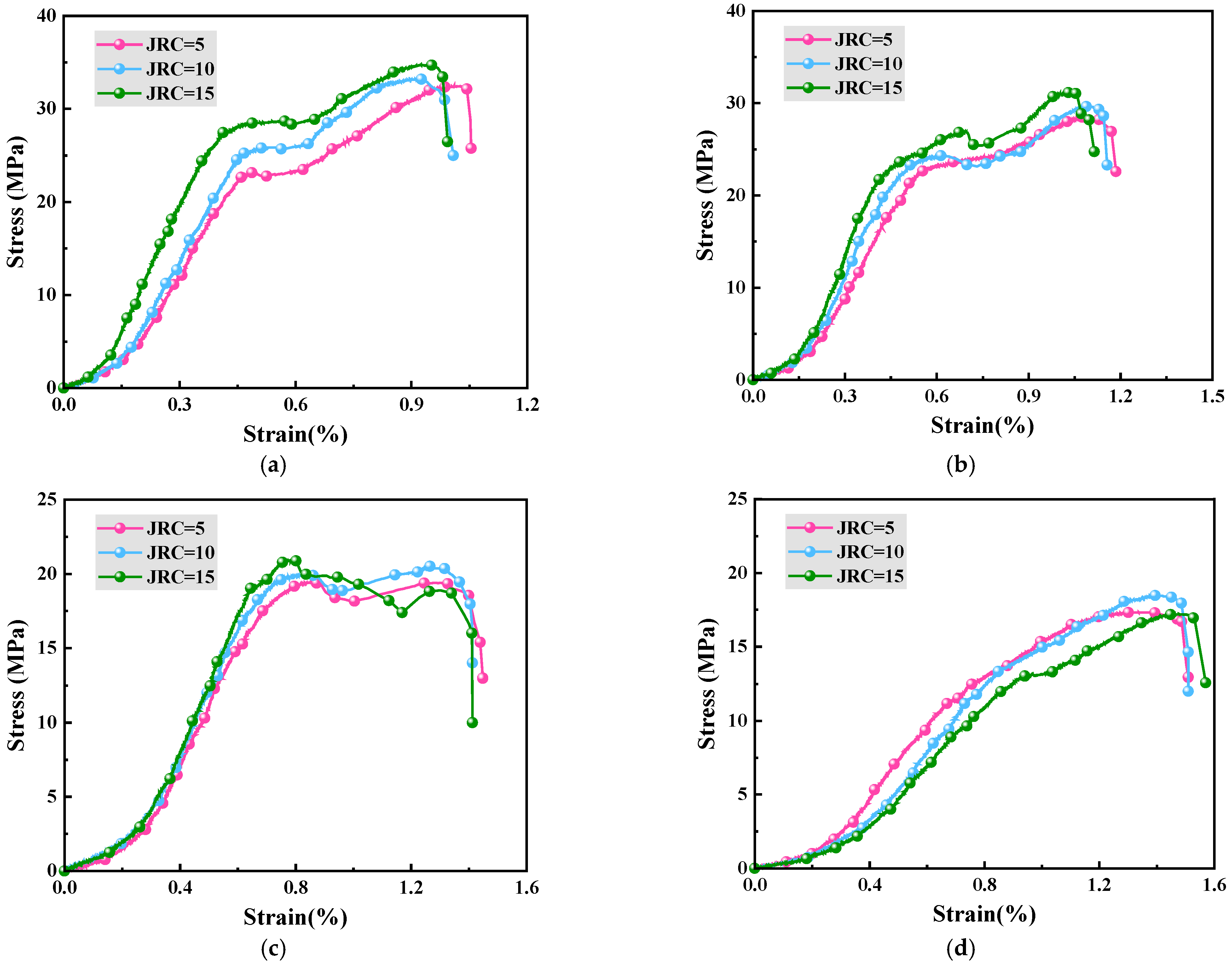
Figure 8 presents the variation in compressive stress–strain behavior with interfacial roughness at identical corrosion durations. At a given corrosion time, the interfacial roughness exerts a pronounced control on the pore-compaction stage. Specimens with low roughness (JRC = 5) consistently show a longer compaction stage during early corrosion, indicating fewer initial contact points and a smaller effective load-transfer area at the interface, and therefore higher sensitivity to corrosion-induced damage. In contrast, specimens with high roughness interfaces (JRC = 15) still exhibit a comparatively shorter compaction stage at early corrosion ages, suggesting that multiple asperity interlocking points can rapidly establish load-transfer paths at the onset of loading.
During the elastic stage, higher interfacial roughness corresponds to a steeper stress–strain slope and a more clearly defined linear segment. Under the same corrosion duration, specimens with JRC = 15 generally exhibit a higher elastic modulus and a more stable linear response, indicating that mechanical interlocking at rougher interfaces can partially compensate for corrosion-induced degradation of interfacial bonding. However, the beneficial effect of interface roughness progressively diminishes with prolonged corrosion.
Interfacial roughness also has a significant influence on peak stress. Under uncorroded and short-term corrosion conditions, greater roughness leads to higher peak stress and a longer pre-peak nonlinear extension stage, reflecting stronger interfacial resistance and more effective crack-growth retardation. After 60 days of corrosion, however, the reduction in peak stress becomes more pronounced for high-roughness interfaces. This indicates that although highly rough interfaces possess superior initial load-bearing capacity, their larger specific surface area and stronger stress-concentration effects make them more susceptible to accelerated degradation under long-term corrosion.

3.2. Peak Strength

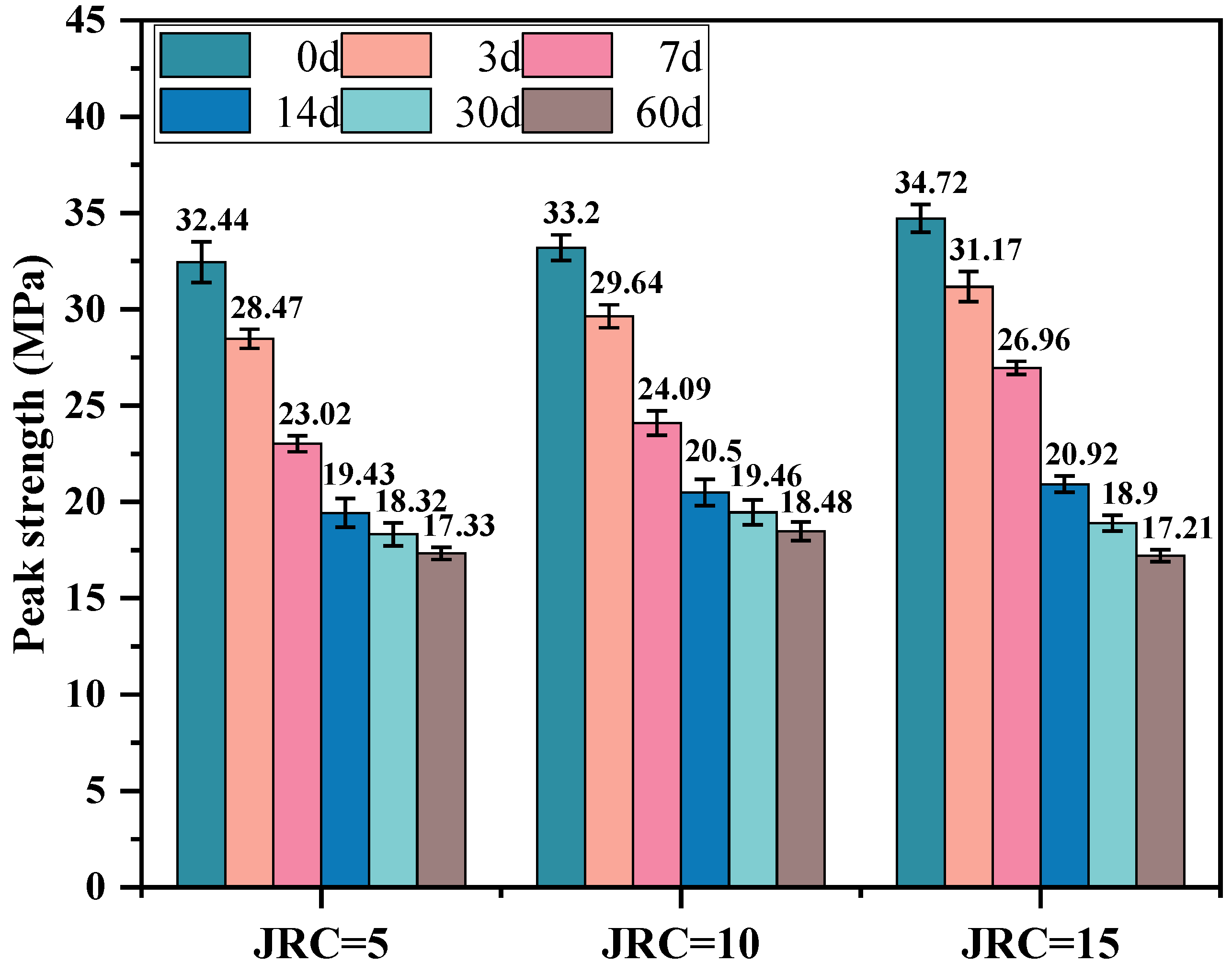
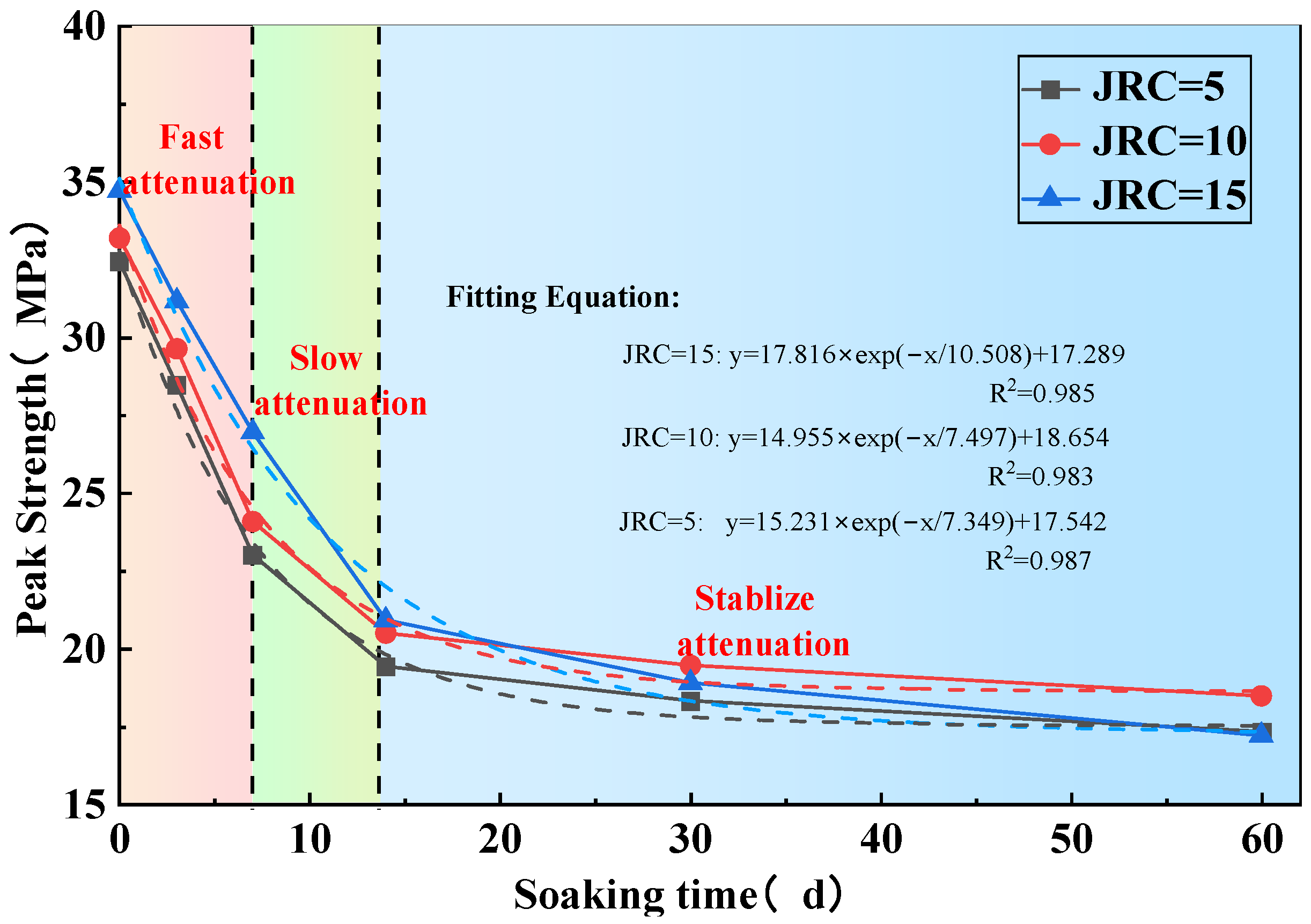
As shown in Figure 9, under the same roughness condition, the peak strength of all specimens continuously decreases with the corrosion time, indicating a pronounced cumulative deterioration effect of corrosion on the interface and the near-interface zone. Peak strength exhibits an exponential decay trend with increasing exposure duration, and the degradation process shows clear stage-dependent characteristics (Figure 10). The 0–7 d period is the most sensitive stage in terms of load-bearing capacity loss. Specifically, the first attenuation stage occurs from 0 days to 3 days, with a reduction of approximately 10–12%. The 3–7 d interval then becomes the dominant window of rapid strength loss, with an additional decrease of about 18–20% relative to 3 days, suggesting that effective interfacial load-transfer structures can deteriorate rapidly at the early corrosion stage. From 7 days to 14 days, the peak strength continues to decline but at a lower rate; during the 14–60 d period, the decay slows further, indicating that late-stage deterioration is mainly governed by microcrack propagation and progressive interfacial degradation. In terms of long-term corrosion performance, the peak-strength retention at 60 days is approximately 55.6% for specimens with JRC = 10, compared with about 52–52.5% for specimens with JRC = 5 and JRC = 15. This result indicates that, under the present corrosive environment, the specimens with a medium-roughness interface exhibit relatively superior peak-strength retention.
Under corrosive conditions, the influence of interfacial roughness on peak strength is strongly time-dependent. In the uncorroded state (0 d) and under short-term corrosion (3 d), the peak strength increases with JRC, indicating that rougher interfaces can effectively enhance ultimate load-bearing capacity through stronger mechanical interlocking and frictional resistance. As corrosion progresses (7–14 d), the peak-strength differences among different JRC levels gradually diminish, suggesting that sustained chemical attack progressively weakens the strength gain originally provided by roughness-induced interlocking. In the middle-to-late stage (30–60 d), the strength ranking shifts to JRC = 10 > 15 > 5, i.e., high-roughness interfaces no longer maintain the highest peak strength. This indicates that, in chemical corrosion environments, the roughness-induced strengthening effect has an upper limit and may become blunted under medium- to long-term attack, with even localized reversal in performance.
These observations indicate a progressive shift in the governing mechanism of peak load-bearing capacity with corrosion evolution: control transitions from early-stage morphology-induced strengthening to mid-to-late-stage corrosion-induced damage. In the uncorroded and short-term corrosion stages, higher JRC enhances peak strength by increasing the effective contact area, interfacial interlocking intensity, and frictional resistance. As corrosion advances, however, asperity-contact zones on rough interfaces are more likely to become preferential sites for chemical attack and localized damage, causing the mechanically induced strength gain from roughness to be consumed more rapidly. Consequently, the strength gap among different roughness levels continues to contract, and in the 30–60 d stage, the ranking changes such that the peak strength of specimens with JRC = 10 becomes slightly higher than that of specimens with JRC = 15. Overall, increasing roughness can markedly improve initial peak load-bearing capacity, whereas medium- to long-term performance depends on the competitive balance between roughness-derived initial strengthening and corrosion-induced acceleration of damage. Under the present test conditions and material system, the medium roughness level (JRC = 10) exhibits more stable peak-strength retention and superior long-term residual load-bearing performance.

3.3. Elastic Modulus

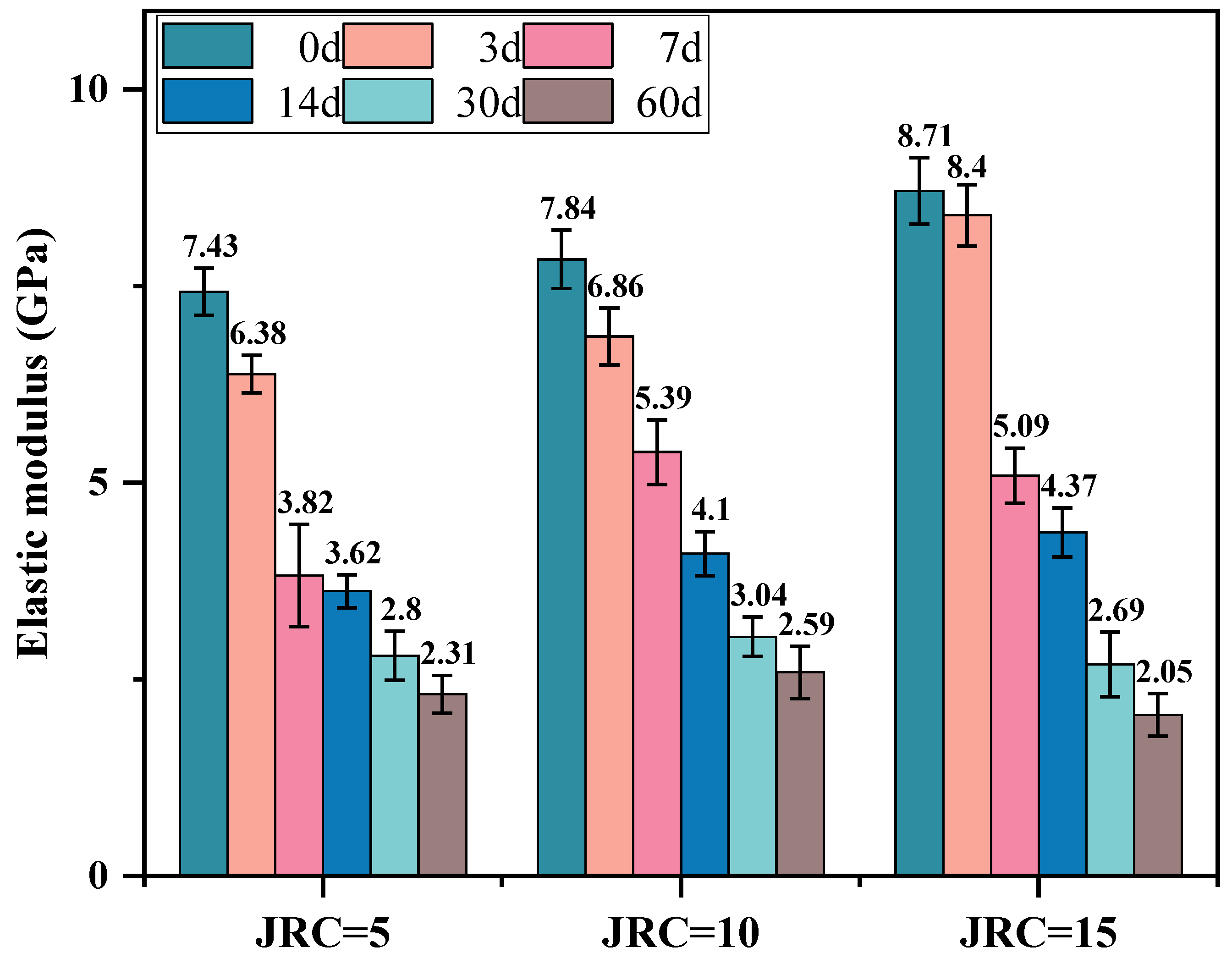
As shown in Figure 11, the elastic modulus (E) of sandstone–concrete composites decrease systematically with increasing corrosion duration across all interface roughness levels (JRC = 5–15), indicating that corrosion-induced microcracking and interfacial debonding progressively degrade specimen stiffness. Relative to the uncorroded condition, E decreases by 61.2–69.1% at 30 days corrosion and by 67.0–76.5% at 60 days corrosion. The degradation rate is strongly roughness-dependent. For JRC = 5, a pronounced early-stage loss was observed at 7 days (decreased by 48.6% relative to 0 day), suggesting that low interfacial interlocking makes stiffness highly sensitive to bonding damage. For JRC = 15, the elastic modulus remains nearly unchanged at 3 days (decreased by 3.6%), reflecting a strong initial constraining effect of roughness on deformation. Under prolonged corrosion, however, this group shows the largest modulus reduction (decreased by 76.5% at 60 days), indicating that high roughness increases the reactive contact area and accelerates damage accumulation once corrosion penetrates the interface. By comparison, specimens with JRC = 10 exhibit the best overall modulus retention, maintaining the highest E under both medium- and long-term exposure (5.39 GPa at 7 days; 2.59 GPa at 60 days). This suggests the existence of an “optimal roughness” that balances mechanical enhancement from interfacial interlocking against corrosion-induced deterioration, thereby offering improved long-term safety and reliability.
When comparing the effect of roughness at a given corrosion duration, in the early corrosion stages (0 d and 3 d), the elastic modulus E shows a monotonic increase with increasing interfacial roughness (JRC), indicating that geometric interlocking markedly enhances the initial stiffness of sandstone–concrete composites. Interfaces with higher JRC provide stronger deformation restraint, thereby suppressing early interfacial slip and debonding and exhibiting a pronounced interlocking effect. With continued corrosion, however, the roughness-dependent ranking becomes non-monotonic, and medium roughness gradually becomes dominant (7 d: JRC10 > JRC15 > JRC5; 30–60 d: JRC10 > JRC5 > JRC15). This pattern indicates a competitive interplay between roughness-enhanced load transfer and roughness-facilitated corrosion damage. Overall, the data reveal a clear time-dependent roughness effect: higher JRC is beneficial to initial stiffness but may lead to greater long-term modulus loss, whereas JRC = 10 provides the most stable stiffness retention under sustained chemical-corrosion conditions.

4. Acoustic Emission Characteristics

4.1. Acoustic Emission Fundamentals and RA-AF Crack Classification

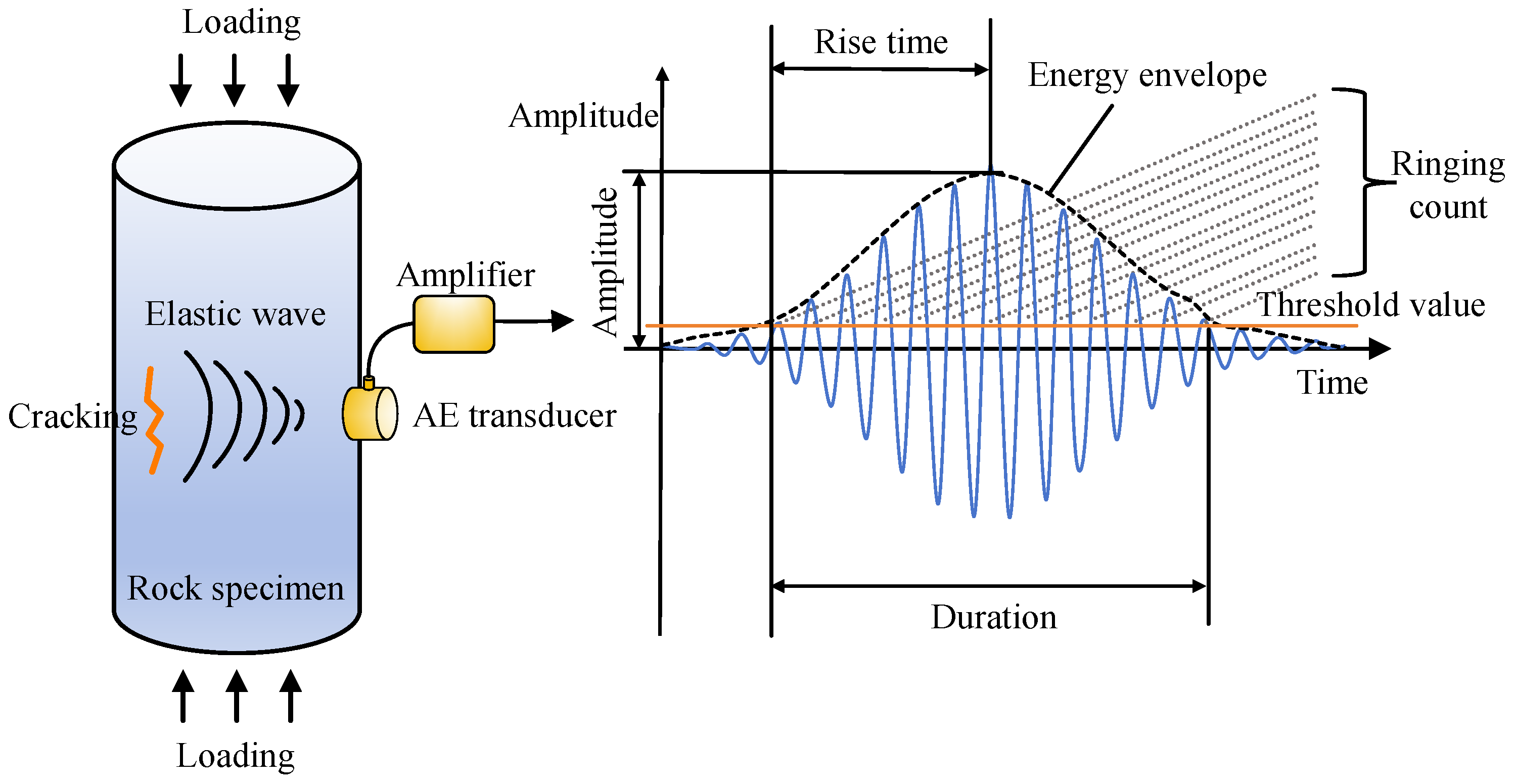
Acoustic emission is a passive, real-time, and non-destructive monitoring technique that records transient elastic waves released during microcrack initiation, crack propagation, and frictional sliding in deforming materials [20]. As shown in Figure 12, AE signals generated within loaded rock specimens are captured by piezoelectric sensors and characterized by waveform parameters such as amplitude, rise time, duration, ring count, and signal energy. These parameters are defined relative to a preset threshold to suppress background noise [30,31]. They provide quantitative measures of damage activity and released fracture energy and have been widely used to track damage evolution in rock- and cement-based materials [32].
A widely adopted and increasingly reinforced approach for crack-mode discrimination is the RA-AF analysis. As illustrated in Figure 13, tensile cracks are typically associated with low RA and high AF, whereas shear-dominated cracks exhibit high RA and low AF due to prolonged frictional sliding along crack surfaces [33]. Mixed-mode cracks generally occupy the intermediate region in RA-AF space. Existing studies indicate that RA-AF analysis can effectively link AE activity to fracture mechanisms and damage stages in both rock and concrete [32,33,34].

4.2. AE Ring Count and Energy

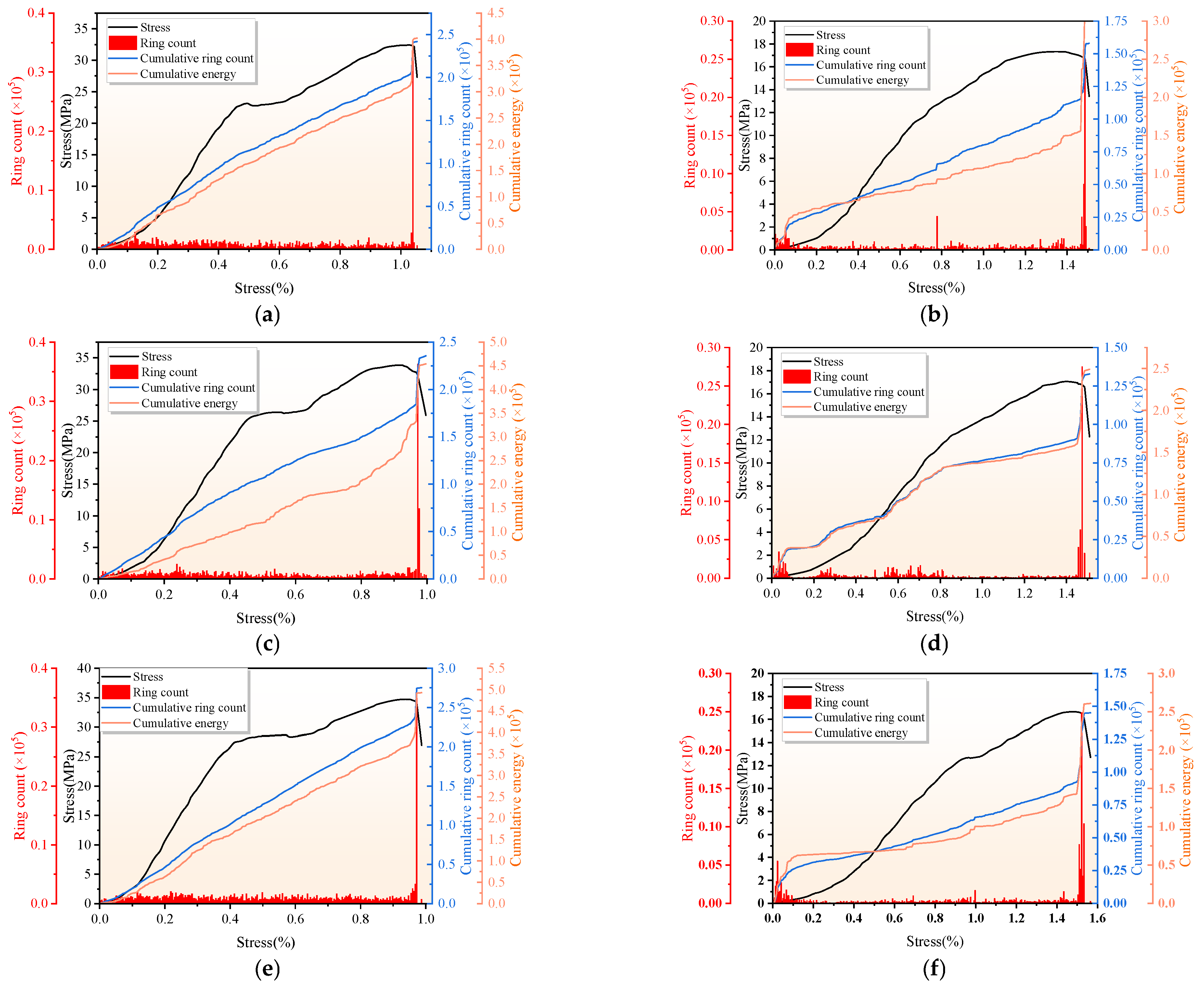
Figure 14 presents the AE data at the sandstone–concrete interface in the uncorroded state and after 60 days of sulfate immersion. Without corrosion, increasing interfacial roughness does not markedly shift AE onset, but it promotes pronounced late-stage concentration of AE activity, particularly in the interfacial region (Figure 14a,c,e). This trend is consistent with the load-transfer mechanism that higher roughness strengthens mechanical interlocking and frictional resistance at the interface, enabling external load to be transmitted more effectively across the sandstone–concrete contact rather than being dissipated by early interfacial slip [7,35]. Consequently, microdamage development is restrained during the early and middle loading stages, while stress progressively accumulates at asperity-contact zones. As stress approaches the peak level, local stress concentration triggers rapid release of stored strain energy, manifested as a sharp late-stage increase in cumulative ring count and cumulative AE energy.
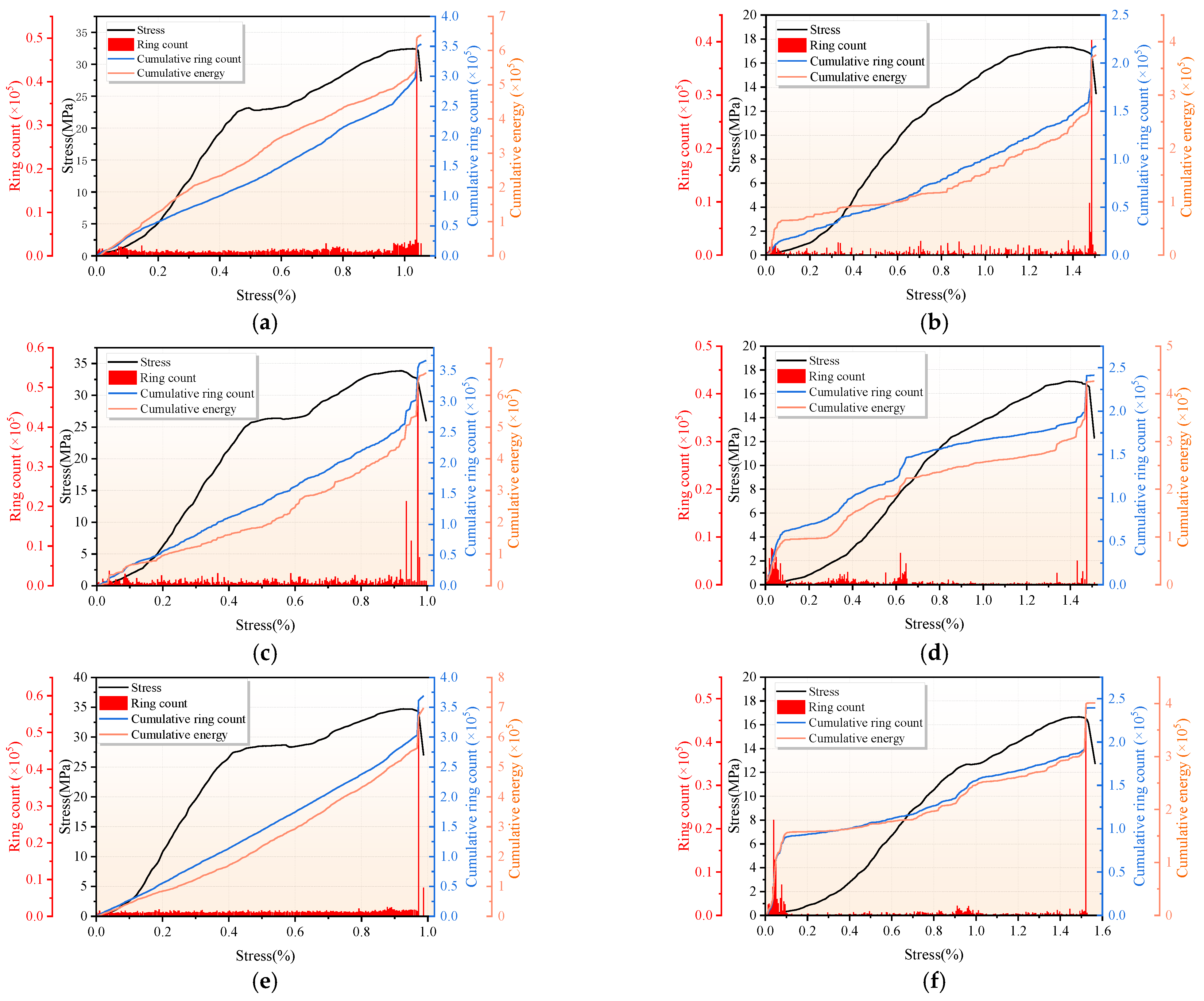
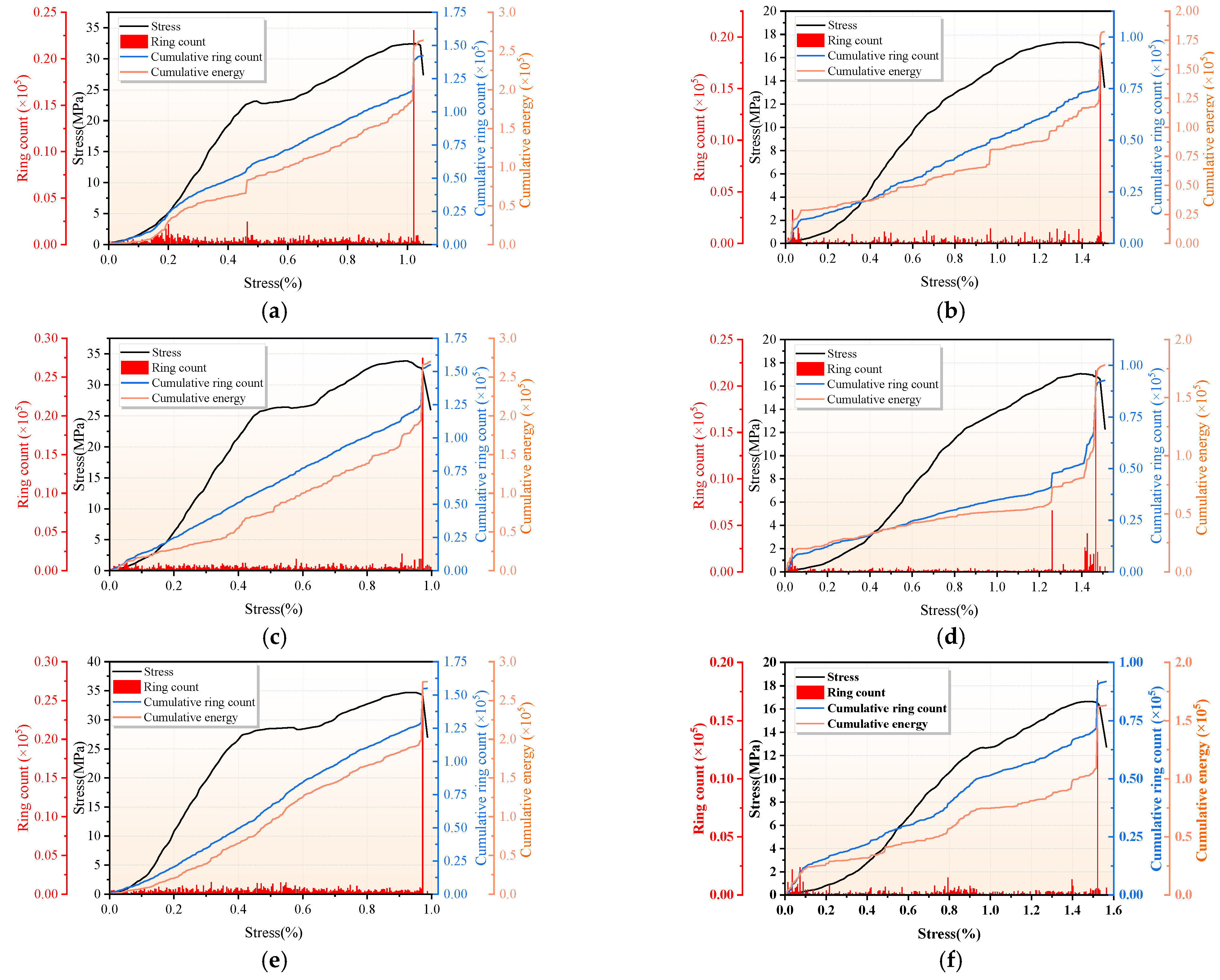
In the concrete region (Figure 15), increasing roughness likewise delays the growth of cumulative AE parameters, although the overall evolution is smoother than that observed at the interface. This behavior suggests that, under stronger interfacial constraint, stress transfer into the concrete becomes more uniform, and damage develops predominantly through progressive tensile microcrack propagation rather than abrupt unstable fracture. The attenuation of early-stage AE activity further indicates that effective interfacial confinement suppresses premature crack initiation in concrete. By contrast, the AE response in the sandstone region (Figure 16) is relatively insensitive to interfacial roughness, with cumulative AE curves showing similar shapes across roughness levels. This implies that damage evolution in sandstone is governed mainly by the intrinsic mechanical properties of the sandstone material, with crack initiation occurring primarily near the peak-stress state.
After 60 days of corrosion, AE activity in all regions appears earlier. This shift is consistent with corrosion-induced degradation of interfacial roughness and reduction in effective contact area, both of which diminish stress-transfer efficiency and weaken interfacial confinement. In the interfacial region (Figure 14b,d,f), cumulative AE curves initiate earlier and evolve more gradually, indicating that interfacial damage transitions from strongly constrained, roughness-controlled localized failure to a more distributed process characterized by microslip and the coordinated propagation of multiple cracks. In the concrete region (Figure 15b,d,f), the earlier onset of AE activity suggests that reduced interfacial constraint allows tensile cracks to initiate at lower stress levels. Figure 16b,d,f shows that AE signals in the sandstone region remain concentrated mainly in the late loading stage. This is not because the sandstone matrix is the first domain to undergo pronounced corrosion, but rather that the acidic sulfate exposure preferentially deteriorates the interface and the concrete side. The cementitious matrix is more susceptible to dissolution and microcrack growth, leading to premature loss of interfacial bonding and load-transfer capacity. Because the sandstone matrix has higher strength and greater compactness than concrete, early-stage damage is primarily confined to the weaker interface-concrete zone. Distinct AE release in the sandstone region emerges mainly from pre-peak to post-peak loading, when stress redistribution becomes significant. Overall, corrosion-controlled damage is concentrated in the interfacial vicinity, whereas the sandstone region is comparatively less affected.
AE data from different regions indicate that the interface is the key control zone governing the long-term durability of the sandstone–concrete composite. Although higher interfacial roughness can enhance mechanical interlocking and improve load transfer under short-term loading, in a corrosive environment, it accelerates microcrack activity and frictional instability within the specimen, thereby significantly increasing the extent of chemical damage. These findings suggest that, under similar laboratory and engineering conditions, optimal interface design should balance the short-term mechanical benefits of roughness enhancement against its potential adverse effects on long-term environmental durability, particularly in acidic sulfate-rich groundwater environments.

4.3. Failure Mode Analysis Based on RA-AF

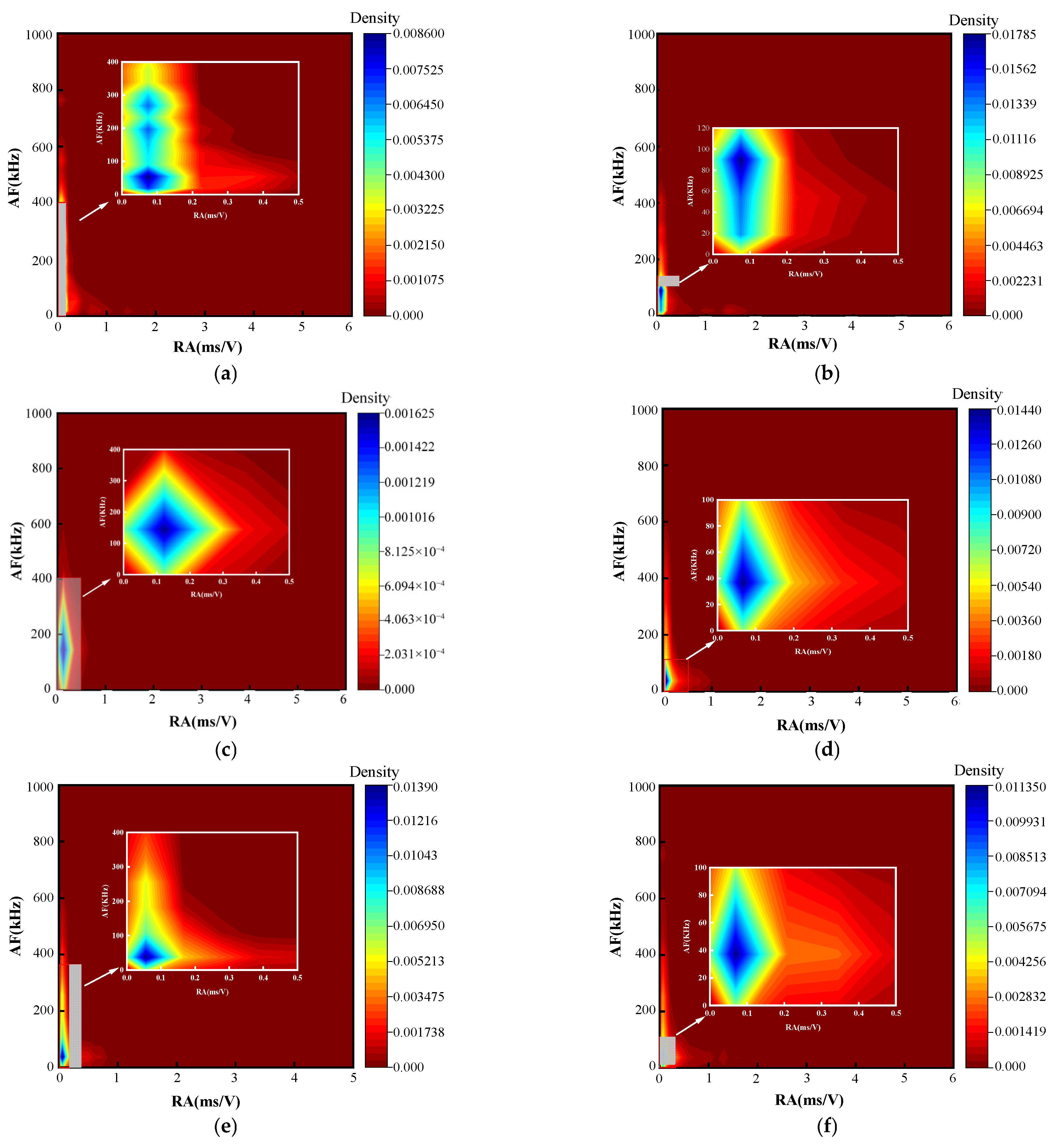
Figure 17a shows the RA-AF kernel density distribution for specimens with JRC = 5 at 0 d. The high-density region is concentrated mainly in the low RA domain and exhibits substantial extension along the AF axis. Overall, the distribution is characterized by low RA and medium-to-high AF values, indicating that AE events are predominantly associated with tensile failure, while the proportion of shear-type events is relatively low.
Figure 17c presents the RA-AF kernel density map for specimens with JRC = 10 at 0 d. The high-density zone shifts toward intermediate RA and intermediate AF. Compared with Figure 17a, RA values are generally higher, and the AF distribution becomes more concentrated, suggesting that shear or mixed tension–shear mechanisms increase markedly on top of a still-important tensile component. Figure 17e shows the RA-AF distribution for specimens with JRC = 15 at 0 d. The dominant density peak shifts toward low RA and low AF, while the distribution also extends into the high-RA domain. This coexistence of low-AF tensile-type events and relatively high-RA shear-type events indicates a more pronounced mixed tensile–shear failure characteristic at higher interface roughness.
Figure 17b presents the RA-AF kernel density distribution for JRC = 5 after 60 days of corrosion. The high-density region remains concentrated in the low-RA domain and shows a continuous spread along the AF axis. The overall low-RA/high-AF pattern is still dominant, indicating that tensile failure remains the primary mechanism, with no pronounced increase in shear-dominated activity. Figure 17d shows the RA-AF kernel density distribution for JRC = 10 after 60 days of corrosion. Compared with the uncorroded state, the RA range expands markedly, and kernel density contours extend toward higher RA values. This indicates a significant enhancement of shear and mixed tension–shear failure characteristics, accompanied by a relative reduction in the proportion of tensile-dominated events. Figure 17f shows the RA-AF distribution for JRC = 15 after 60 days of corrosion. Although the main density peak is still located in the low-RA region, the kernel density in the high-RA domain increases clearly, revealing substantial participation of shear-type AE events. This suggests that, for highly rough interfaces, corrosion strongly promotes shear-dominated failure behavior.
As shown in Figure 17, the increase in interfacial roughness promotes a transition in the AE-detected failure mode from tension-dominated cracking to mixed tension–shear cracking or even shear-dominated cracking. Under the same roughness condition, corrosion further increases the proportion of high-RA AE events, making shear-related failure characteristics more pronounced. This effect is most significant at highly rough interfaces.

5. Discussion

5.1. R/S Fractal Analysis Method

To further reveal the temporal correlation and complexity of damage evolution, this section introduces fractal analysis of the AE energy time series. In this study, the fractal characteristics of AE energy were used to quantify the persistence, long-range correlation, and complexity of damage evolution under different interface roughness and corrosion conditions. During the loading and failure process of rock–concrete composites, the interface region is usually the key site where damage first initiates and continues to evolve. The initiation, propagation, and penetration of microcracks within the interface are accompanied by a large number of AE events, and the energy release process can directly reflect the evolution and degradation characteristics of the interface bearing structure. Since the interface region simultaneously contains the irregular surface of the rock mass, the cementing phase of concrete, and the initial pores and microcracks, its structural and mechanical behavior has significant heterogeneity and multi-scale characteristics [36]. Therefore, AE energy time series usually exhibit obvious fractal characteristics. Existing studies have shown that the Hurst exponent can effectively characterize the long-range correlation and memory of AE sequences, while the fractal dimension can further describe the complexity and disorder level of the damage evolution process [37,38,39,40].
Let the AE energy time series be denoted by {xt } t = 1 N . For a given scale k, the original sequence is partitioned into m = (N/k) non-overlapping subsequences. The j-th subsequence is written as {xj,t } t = 1 k (j = 1,2, …, m). The mean of each subsequence is first computed as follows:
x ¯ j = 1 k t = 1 k x j , t
The cumulative deviation sequence is then defined as follows:
Y j n = t = 1 n x j , t x ¯ j ,   n = 1 , 2 , , k
Accordingly, the range and standard deviation are defined as follows, respectively:
R j k = max 1 n k Y j n min 1 n k Y j n
S j k = 1 k t = 1 k x j , t x ¯ j 2
The rescaled range of the j-th subsequence is given by (R/S)j(k) = Rj(k)/Sj(k). Averaging over all subsequences at the same scale k yields the following:
E R S k = 1 m j = 1 m R S j k
Assume that the sequence satisfies the following scaling relation:
E R S k = C k H
Taking logarithms on both sides thus yields the following linear form:
ln E R S k = ln C + H ln k
Therefore, H can be obtained as the slope of the linear fit between lnE[R/S](k) and lnk:
H = d ln E R / S k d ln k
where H is the Hurst exponent. A higher H value indicates that AE energy release tends to continue along an existing evolutionary path, reflecting stronger persistence and a more stable cumulative-damage pattern.
The fractal dimension DH is used to characterize the complexity and irregularity of the AE energy-release process. An increase in DH indicates that crack propagation and energy dissipation become more tortuous, scattered, and complex. The fractal dimension DH is defined as follows:
D H = 2 H

5.2. Fractal Characteristics of AE Energy Time Series

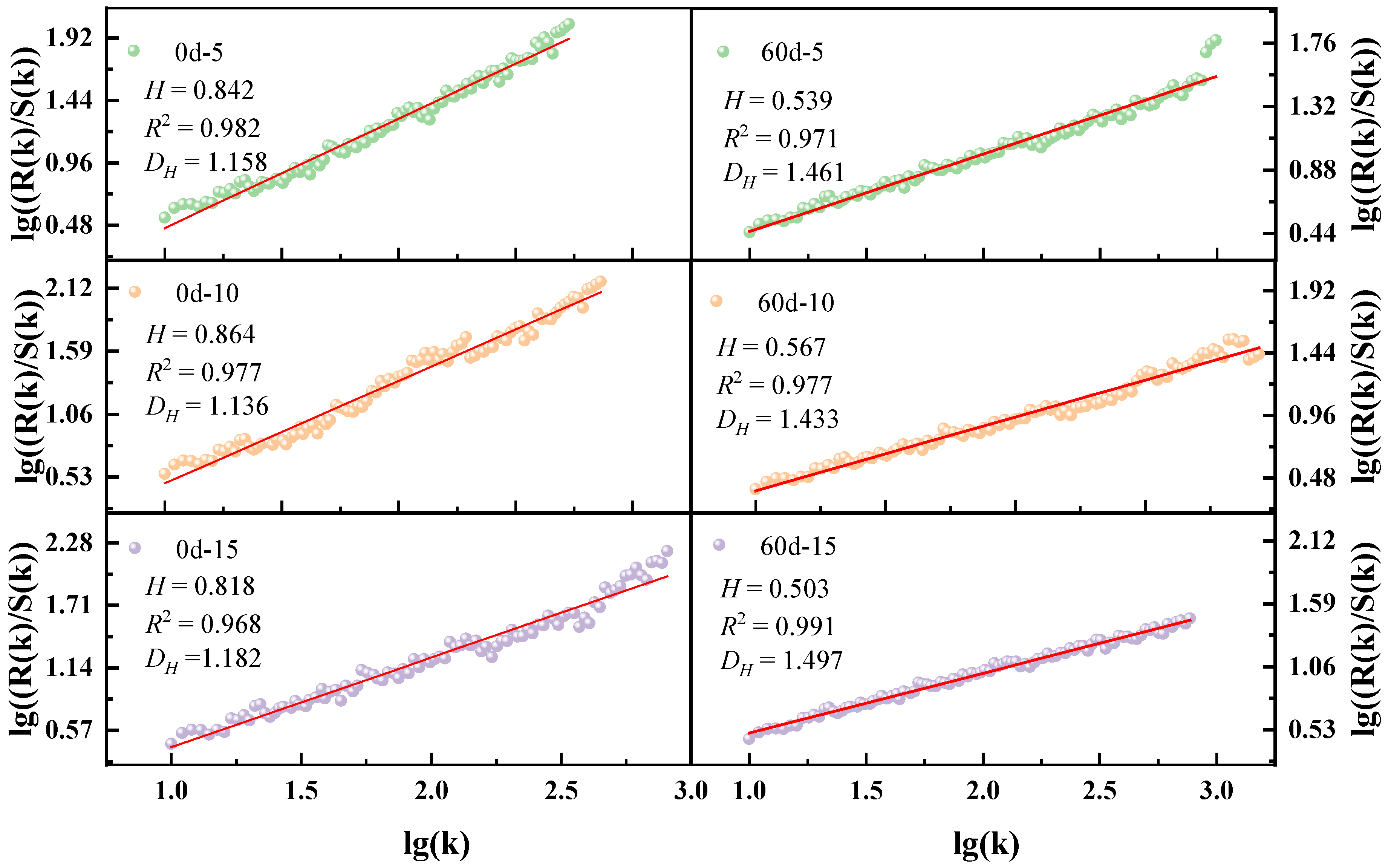
As shown in Figure 18, the R/S analysis of AE energy time series indicates pronounced fractal characteristics for specimens with all interface roughness levels. In an uncorroded state, the fractal dimensions for JRC = 5, 10, and 15 are 1.158, 1.136, and 1.182, respectively. These relatively low values suggest that the energy-release process remains comparatively ordered at this stage, with crack growth dominated by progressive evolution. The Hurst exponents for all roughness levels are significantly greater than 0.5, indicating clear long-range correlation in interfacial energy release. As interfacial roughness increases, geometric interlocking becomes stronger, making crack propagation more likely to continue along pre-existing damage paths; consequently, damage evolution exhibits stronger path dependence and a more stable cumulative pattern.
Figure 18 shows the fractal characteristics of the AE energy time series of samples with different interface roughness levels under corrosion conditions of 0 days and 60 days. As shown in Figure 18, in the uncorroded state, the fractal dimensions of the samples with JRC = 5, 10, and 15 are 1.158, 1.136, and 1.182, respectively, and the corresponding Hurst exponents are 0.842, 0.864, and 0.818, respectively, which are all significantly greater than 0.5. This indicates that the AE energy time series of each group of samples have a strong long-range correlation, and the overall damage evolution in the interface region shows a relatively stable gradual accumulation process. After 60 days of corrosion, the fractal dimensions of the three groups of samples increased to 1.461, 1.433 and 1.497, respectively, while the corresponding Hurst exponents decreased to 0.539, 0.567 and 0.503, respectively. This indicates that corrosion significantly weakened the persistence of the AE energy release process and enhanced the complexity of crack propagation and damage evolution.
To more comprehensively reflect the changing characteristics of fractal parameters throughout the corrosion process, the Hurst exponent and fractal dimension of the AE energy time series of samples with different roughness levels at different corrosion times are shown in Table 3.
As shown in Table 3, under all three roughness conditions, the Hurst exponent continuously decreased with increasing corrosion time, while the fractal dimension DH continuously increased. This indicates that corrosion continuously weakens the time dependent nature of the AE energy release process and enhances the complexity of interfacial damage evolution. In the early stage of corrosion (0–3 days), although the H value decreased somewhat, it remained at a relatively high level overall, indicating that the interfacial support framework was not yet significantly damaged at this stage, and corrosion was mainly manifested as pore expansion, localized weakening of cementation, and microcrack initiation. Entering the middle stage (3–15 days), the H value of each group of samples decreased more significantly, while DH increased simultaneously, indicating that the interfacial damage had transitioned from localized disturbance to a significant reorganization stage. During the 30–60 days period, the H value continued to approach 0.5, while the DH value continued to increase, indicating that the system gradually evolved from stable, cumulative damage to more complex and localized instability.

5.3. Analysis of the Influence and Damage Mechanism of Roughness

The fractal evolution paths of interfaces with different roughness levels differ significantly. For the JRC = 5 specimen, its Hurst exponent decreases rapidly in the early stages of corrosion, indicating that low-roughness interfaces, due to fewer initial contact points and weaker mechanical interlocking, are more sensitive to corrosion-induced interfacial debonding and breakage of the load-bearing chain, exhibiting more pronounced early damage characteristics.
The JRC = 15 specimen shows a different pattern. Under uncorroded and short-term corrosion conditions, high-roughness interfaces can still maintain high load-bearing capacity due to strong geometric interlocking. However, as corrosion continues, its Hurst exponent decreases the most, and its fractal dimension increases the most. This indicates that high-roughness interfaces are more prone to stress concentration due to local protrusions and failure of key interlocking units after long-term corrosion, leading to multi-crack synergistic propagation and complex instability.
In contrast, JRC = 10 consistently maintains a relatively high H value and a low DH value throughout all corrosion stages, indicating that the moderately rough interface exhibits stronger damage persistence and lower evolutionary disorder throughout the corrosion-loading process. This aligns with the previous mechanical results showing that JRC = 10 possesses superior strength and deformation retention capabilities, demonstrating that moderate roughness can achieve a good balance between mechanical interlocking enhancement and long-term corrosion stability.
Further combining the previous mechanical and AE results reveals that the changes in fractal parameters are not isolated statistical phenomena, but rather a comprehensive reflection of macroscopic mechanical degradation and microscopic crack evolution. As corrosion deepens, the AE activity in the interface region shifts forward overall, and cracks initiate earlier and gradually shift from dispersed propagation to localized, concentrated penetration. During this process, the Hurst exponent continuously decreases, indicating that energy release becomes increasingly difficult to sustain along existing paths; the continuously increasing fractal dimension indicates that the crack propagation path becomes more tortuous and complex. In other words, corrosion causes the interfacial force transmission network to gradually shift from a relatively stable cooperative bearing to local residual contact control, thus exhibiting the obvious fractal evolution characteristics of “low H, high DH”.
In summary, the AE energy time series exhibited significant fractal characteristics both before and after corrosion. With prolonged corrosion time, the Hurst exponent continuously decreased and gradually approached 0.5, while the fractal dimension continuously increased, indicating that the long-range correlation of energy release in the interface region weakened, and the crack propagation and damage evolution processes became increasingly complex. Under the influence of corrosion, specimens with an interface roughness of JRC = 10 exhibit the lowest fractal dimension of acoustic emission energy during the failure process, suggesting that moderately rough interfaces possess a certain advantage in inhibiting damage under the present test conditions. Although JRC = 15 showed strong initial interlocking, it was more prone to highly complex instability evolution after long-term corrosion. Overall, the medium-roughness interface demonstrated a better balance between initial mechanical strengthening and long-term durability stability.

6. Conclusions

This study combines mechanical testing with multi-parameter acoustic emission (AE) analysis to systematically investigate the mechanical properties and acoustic emission evolution characteristics of sandstone–concrete composite specimens with different interface roughness levels under acidic sulfate erosion. The results indicate that the interfacial zone remains the critical region governing overall instability. Although increased roughness enhances early-stage load-bearing capacity, this advantage progressively diminishes as corrosion deepens, and the damage process shifts from delayed accumulation to earlier activation with a higher tendency toward abrupt instability. These findings suggest that interface optimization should balance initial mechanical enhancement with long-term durability and stability. Based on the above observations, the main conclusions are as follows:
(1)
Acidic sulfate corrosion causes continuous reductions in both the peak strength and elastic modulus of sandstone–concrete composites, and both parameters exhibit a two-stage evolution characterized by rapid early degradation followed by a slower late-stage decline. The strengthening effect of interfacial roughness is primarily manifested at the early stage. Higher JRC improves load-bearing and deformation resistance through enhanced interfacial interlocking. However, this advantage progressively weakens as corrosion advances. Overall, under the present experimental conditions, the JRC = 10 group showed a relatively better balance between strengthening efficiency and corrosion sensitivity.
(2)
The interface is the primary weak zone controlling the durability of sandstone–concrete composites. In the uncorroded state, higher roughness enhances load transfer through interlocking and friction, delays early- and mid-stage damage, and causes AE activity to concentrate mainly near the pre-peak stage. After 60 days of corrosion, AE activity shifts earlier and intensifies continuously, indicating that interfacial contact degradation reduces load-transfer efficiency and activates damage at lower loading levels. RA-AF analysis further shows that the failure mechanism evolves with increasing JRC from tension-dominated cracking to mixed tension–shear cracking with an enhanced shear component. Corrosion further amplifies this trend, especially at highly rough interfaces. Overall, interface design should explicitly balance short-term mechanical gains against long-term environmental durability.
(3)
The time series of AE energy of rock–concrete composite exhibited obvious fractal characteristics before and after corrosion. In the uncorroded state, the Hurst index of each group of samples was significantly greater than 0.5, indicating that the damage evolution in the interface region had strong long-range correlation and persistence. As the corrosion time increased, the Hurst index continued to decrease and gradually approached 0.5, while the fractal dimension increased synchronously, indicating that the correlation of the AE energy release process in the interface region continued to weaken, and the crack propagation path and damage evolution process became increasingly complex. Under different roughness conditions, JRC = 10 maintained a relatively high Hurst index and a low fractal dimension in each stage, indicating that its medium roughness interface had more advantages in terms of damage persistence and evolution stability. Although JRC = 15 had a strong geometric interlocking effect in the uncorroded and early stages, it had the lowest Hurst index and the highest fractal dimension after long-term corrosion, indicating that the high roughness interface was more likely to generate local stress concentration and complex crack synergistic propagation under corrosion. Overall, corrosion drives the evolution of interfacial damage from relatively stable, gradual accumulation to more complex and localized instability, whereas medium-roughness interfaces tended to exhibit a more stable balance between initial mechanical strengthening and long-term durability.
(4)
The above conclusions are only applicable to the study of uniaxial compressive failure behavior of sandstone–concrete composite materials under acidic sulfate erosion. The mechanical properties of other rock–concrete composites under different chemical environments and mechanical loading paths require further investigation.

Author Contributions

Methodology, Z.Z.; writing—original draft, Z.Y.; writing—review and editing, M.W. and Z.Z.; conceptualization, M.W.; data curation, M.W.; project administration: L.W.; validation, Y.T.; funding acquisition, Z.Z., M.W., L.W. and Y.T. All authors have read and agreed to the published version of the manuscript.

Funding

This research was funded by the National Natural Science Foundation of China (grant number: 52274167), the Science and Technology Innovation Program of Hunan Province (grant number: 2023RC3171), the Deep Earth Probe and Mineral Resources Exploration, National Science and Technology Major Project (grant numbers: 2025ZD1010700, 2025ZD1010708), the Natural Science Foundation of Hunan Province (grant numbers: 2023JJ30516, 2024JJ9074), and the Research Foundation of Education Bureau of Hunan Province (grant numbers: 23A0329, 24A0306, 25B0382).

Data Availability Statement

Data will be made available on request.

Conflicts of Interest

The authors declare no conflicts of interest.

References

  1. Jiang, Q.; Yang, Y.; Yan, F.; Zhou, J.; Li, S.; Yang, B.; Zheng, H. Deformation and failure behaviours of rock-concrete interfaces with natural morphology under shear testing. Constr. Build. Mater. 2021, 293, 123468. [Google Scholar] [CrossRef]
  2. Guo, Z.; Gao, J.; You, J. Research on compression failure criteria and characteristics of rock-concrete assemblies with rough interfaces. Constr. Build. Mater. 2024, 311, 110544. [Google Scholar] [CrossRef]
  3. Patton, F. Multiple modes of shear failure in rock. In ISRM Congress; ISRM-1CONGRESS-1966-087; ISRM: Salzburg, Austria, 1966. [Google Scholar]
  4. Barton, N.; Choubey, V. The shear strength of rock joints in theory and practice. Rock Mech. 1977, 10, 1–54. [Google Scholar] [CrossRef]
  5. Badika, M.; Merabi, B.; Capdevielle, S.; Dufour, F.; Saletti, D.; Briffaut, M. Influence of concrete-rock bonds and roughness on the shear behavior of concrete-rock interfaces under low normal loading: Experimental and numerical analysis. Appl. Sci. 2022, 12, 5643. [Google Scholar] [CrossRef]
  6. Ayinde, O.O.; Wu, E.; Zhou, G.; Malidadi, T. Influence of interface roughness geometrical parameters on the shear behaviour of old and new concrete interface. Asian J. Civ. Eng. 2022, 23, 229–247. [Google Scholar] [CrossRef]
  7. Chen, Y.; Yang, J.; Li, M.; Zhou, L.; Guo, B.; Zuo, J. Effects of roughness on shear properties and acoustic emission characteristics of bonded Rock-Concrete interfaces. Constr. Build. Mater. 2023, 398, 132405. [Google Scholar] [CrossRef]
  8. Yuan, S.; Du, B.; Shen, M. Experimental and numerical investigation of the mechanical properties and energy evolution of sandstone-concrete combined body. Sci. Rep. 2024, 14, 5214. [Google Scholar] [CrossRef] [PubMed]
  9. Bao, W.; Zhu, J.; Han, D.; Bi, S.; Hu, Q.; Liu, L. Experimental study of shear behavior of rock-shotcrete interface under dynamic shearing: Insights from interface roughness and strain rate. Geomech. Geophys. Geo-Energ. Geo-Resour. 2023, 9, 72. [Google Scholar] [CrossRef]
  10. Shen, Y.; Wang, Y.; Yang, Y.; Sun, Q.; Luo, T.; Zhang, H. Influence of surface roughness and hydrophilicity on bonding strength of concrete-rock interface. Constr. Build. Mater. 2019, 213, 156–166. [Google Scholar] [CrossRef]
  11. Wang, J.; Du, B.; Shen, M.; Li, Y.; Yuan, S. Damage constitutive model and mechanical properties of a concrete limestone composite after acid corrosion. Sci. Rep. 2025, 15, 1868. [Google Scholar] [CrossRef] [PubMed]
  12. Liang, Y.; Huo, R.; Song, Z.; Mu, Y.; Li, G. Macro-meso deterioration characteristics and statistical damage constitutive model for acid-corroded sandstone. J. Build. Eng. 2023, 71, 106499. [Google Scholar] [CrossRef]
  13. Huo, R.; Liang, Y.; Li, S.; Miao, Z.; Qiu, T. The damage mechanism and deterioration characteristics of acid-corroded sandstone: An experimental study. Arab. J. Geosci. 2022, 15, 537. [Google Scholar] [CrossRef]
  14. Whittaker, M.; Black, L. Current knowledge of external sulfate attack. Adv. Cem. Res. 2015, 27, 532–545. [Google Scholar] [CrossRef]
  15. Wang, Q.; Kunther, W.; Li, Y.; Visalakshi, T.; Gomasa, R.; Amroun, S.; Souza, D.; Kasaniya, M.; Tole, I.; Li, X.; et al. Sulfate attack testing approaches from concrete to cement paste: A review by RILEM TC 298-EBD. Mater. Struct. 2025, 58, 232. [Google Scholar] [CrossRef]
  16. Shen, M.; Zhao, Y.; Bi, J.; Wang, C.L.; Du, B. Microstructure evolution and damage mechanisms of concrete-rock-composite corrosion in acid environment. J. Build. Eng. 2024, 82, 108336. [Google Scholar] [CrossRef]
  17. Li, S.; Song, S.; Miao, Z.; Yin, X. Deterioration characteristics and damage constitutive model of granite-shotcrete under acid corrosion cycle conditions. J. Build. Eng. 2024, 85, 108729. [Google Scholar] [CrossRef]
  18. Grosse, C.; Ohtsu, M.; Aggelis, D.; Shiotani, T. Acoustic Emission Testing: Basics for Research-Applications in Engineering; Springer Nature: Berlin/Heidelberg, Germany, 2021. [Google Scholar]
  19. Prem, P.; Murthy, A. Acoustic emission monitoring of reinforced concrete beams subjected to four-point-bending. Appl. Acoust. 2017, 117, 28–38. [Google Scholar] [CrossRef]
  20. Aggelis, D. Classification of cracking mode in concrete by acoustic emission parameters. Mech. Res. Commun. 2011, 38, 153–157. [Google Scholar] [CrossRef]
  21. Shahidan, S.; Pulin, R.; Bunnori, N.; Holford, K. Damage classification in reinforced concrete beam by acoustic emission signal analysis. Constr. Build. Mater. 2013, 45, 78–86. [Google Scholar] [CrossRef]
  22. Lei, G.; Wu, D.; Zhu, S.; Xi, X. Spatio-temporal evolution of acoustic emission events and initiation of stress fields in the fracturing of rock mass around a roadway under cyclic high-stress loading. PLoS ONE 2023, 18, e0286005. [Google Scholar] [CrossRef] [PubMed]
  23. Farhidzadeh, A.; Dehghan-Niri, E.; Salamone, S.; Luna, B.; Whittaker, A. Monitoring crack propagation in reinforced concrete shear walls by acoustic emission. J. Struct. Eng. 2013, 139, 04013010. [Google Scholar] [CrossRef]
  24. Zhao, K.; Yang, J.; Yu, X.; Yan, Y.; Zhao, K.; Lai, Y.; Wu, J. Damage evolution process of fiber-reinforced backfill based on acoustic emission three-dimensional localization. Compos. Struct. 2023, 309, 116723. [Google Scholar] [CrossRef]
  25. Hong, C.; Jeon, S. Influence of shear load on the characteristics of acoustic emission of rock-concrete interface. Key Eng. Mater. 2004, 270, 1598–1603. [Google Scholar] [CrossRef]
  26. Qiu, K.; Li, S.; Qian, Z.; Liu, R.; Liu, Z.; Yuan, M. Direct shear mechanism of steel fiber reinforced shotcrete-rock interface in lined hydrogen storage caverns: Insights from acoustic emission and DIC. Constr. Build. Mater. 2024, 456, 139294. [Google Scholar] [CrossRef]
  27. Liu, H.; Bodvarsson, G.; Lu, S.; Molz, F. A corrected and generalized successive random additions algorithm for simulating fractional Levy motions. Math. Geosci. 2004, 36, 361–378. [Google Scholar] [CrossRef]
  28. Tse, R.; Cruden, D.M. Estimating joint roughness coefficients. Int. J. Rock Mech. Min. Sci. Geomech. Abstr. 1979, 16, 303–307. [Google Scholar] [CrossRef]
  29. Zhang, Y.; Song, J.; Hu, D.; Liu, Y.; Zhou, F. Shearing performance of natural joints with different roughnesses under direct shearing tests. Geofluids 2022, 2022, 9745733. [Google Scholar] [CrossRef]
  30. Yang, J.; Mu, Z.; Yang, S. Experimental study of acoustic emission multi-parameter information characterizing rock crack development. Eng. Fract. Mech. 2020, 232, 107045. [Google Scholar] [CrossRef]
  31. Tra, V.; Kim, J.; Jeong, I.; Kim, J. An acoustic emission technique for crack modes classification in concrete structures. Sustainability 2020, 12, 6724. [Google Scholar] [CrossRef]
  32. Mandal, D.; Bentahar, M.; El Mahi, A.; Brouste, A.; El Guerjouma, R.; Montresor, S.; Cartiaux, F.B. Acoustic emission monitoring of progressive damage of reinforced concrete T-beams under four-point bending. Materials 2022, 15, 3486. [Google Scholar] [CrossRef]
  33. Zhao, T.; Zhang, P.; Xiao, Y.; Guo, W.; Zhang, Y.; Zhang, X. Master crack types and typical acoustic emission characteristics during rock failure. Int. J. Coal Sci. Technol. 2023, 10, 2. [Google Scholar] [CrossRef]
  34. Li, S.; Yang, D.; Huang, Z.; Gu, Q.; Zhao, K. Acoustic emission characteristics and failure mode analysis of rock failure under complex stress state. Theor. Appl. Fract. Mech. 2022, 122, 103666. [Google Scholar] [CrossRef]
  35. Gao, H.; Zhai, Y.; Wang, T.; Li, Y.; Meng, F.; Zhang, H.; Li, Y. Compression failure conditions of concrete-granite combined body with different roughness interface. Int. J. Min. Sci. Technol. 2023, 33, 297–307. [Google Scholar] [CrossRef]
  36. Zhang, W.; Liu, D.; Tang, Y.; Jian, Y. Compression damage precursors of silane-protected concrete under sulfate erosion based on acoustic emission characterization. Fractal Fract. 2025, 9, 254. [Google Scholar] [CrossRef]
  37. Li, Z.; Xu, R. An early-warning method for rock failure based on Hurst exponent in acoustic emission/microseismic activity monitoring. Bull. Eng. Geol. Environ. 2021, 80, 7791–7805. [Google Scholar] [CrossRef]
  38. Friedrich, L.F.; Cezar, É.S.; Colpo, A.B.; Tanzi, B.N.R.; Sobczyk, M.; Lacidogna, G.; Niccolini, G.; Kosteski, L.E.; Iturrioz, I. Long-range correlations and natural time series analyses from acoustic emission signals. Appl. Sci. 2022, 12, 1980. [Google Scholar] [CrossRef]
  39. Xie, X.; Li, S.; Guo, J. Study on multiple fractal analysis and response characteristics of acoustic emission signals from goaf rock bodies. Sensors 2022, 22, 2746. [Google Scholar] [CrossRef]
  40. Liu, C.; Zhao, G.; Pan, C.; Meng, X.; Xu, W. Experimental study of rock failure and fractal characteristics under true triaxial unloading. Fractal Fract. 2025, 9, 182. [Google Scholar] [CrossRef]
Figure 1. Numerically generated three-dimensional morphology and height frequency distributions of surfaces: (a) JRC = 5; (b) JRC = 10; (c) JRC = 15.
Fractalfract 10 00308 g001
Figure 2. The rough line profiles for JRC calculation.
Fractalfract 10 00308 g002
Figure 3. Preparation of sandstone–concrete composites: (a) concrete composition; (b) concrete pouring; (c) concrete curing.
Fractalfract 10 00308 g003
Figure 4. Schematic diagram of sandstone–concrete composite sampling.
Fractalfract 10 00308 g004
Figure 5. Procedure for the acidic sulfate immersion test: (a) chemical reagents; (b) solution preparation; (c) immersion test.
Fractalfract 10 00308 g005
Figure 6. The mechanical testing system: (a) GCTS-RTR-3000 rock mechanics testing system; (b) acoustic emission acquisition system; (c) specimen installation; (d) AE sensor arrangement.
Fractalfract 10 00308 g006
Figure 7. Compressive stress–strain curves of composite specimens at different corrosion durations: (a) JRC = 5; (b) JRC = 10; (c) JRC = 15.
Fractalfract 10 00308 g007
Figure 8. Compressive stress–strain curves of sandstone–concrete composite specimens with different interfacial roughness levels at the same corrosion duration: (a) 0 d; (b) 3 d; (c) 14 d; (d) 60 d.
Fractalfract 10 00308 g008
Figure 9. Variation in peak strength with corrosion time for specimens with different interfacial roughness.
Fractalfract 10 00308 g009
Figure 10. Stage-wise temporal characteristics of peak-strength degradation (the dash lines are the fitted curve of peak strength).
Fractalfract 10 00308 g010
Figure 11. Variation in elastic modulus with corrosion time for specimens with different interfacial roughness.
Fractalfract 10 00308 g011
Figure 12. Graphical illustration of characteristic parameters of acoustic emission signals.
Fractalfract 10 00308 g012
Figure 13. Schematic diagram for crack type identification based on RA-AF values.
Fractalfract 10 00308 g013
Figure 14. Cumulative AE ring count and cumulative AE energy at the sandstone–concrete interface: (a) 0 d-5; (b) 60 d-5; (c) 0 d-10; (d) 60 d-10; (e) 0 d-15; (f) 60 d-15.
Fractalfract 10 00308 g014
Figure 15. Cumulative AE ring count and cumulative AE energy in the concrete region: (a) 0 d-5; (b) 60 d-5; (c) 0 d-10; (d) 60 d-10; (e) 0 d-15; (f) 60 d-15.
Fractalfract 10 00308 g015
Figure 16. Cumulative AE ring count and cumulative AE energy in the sandstone region: (a) 0 d-5; (b) 60 d-5; (c) 0 d-10; (d) 60 d-10; (e) 0 d-15; (f) 60 d-15.
Fractalfract 10 00308 g016
Figure 17. Kernel density maps in the RA-AF domain for different interfacial roughness levels at 0 d and 60 d of corrosion: (a) 0 d-5; (b) 60 d-5; (c) 0 d-10; (d) 60 d-10; (e) 0 d-15; (f) 60 d-15.
Fractalfract 10 00308 g017
Figure 18. Fractal characteristics of AE energy for different interfacial roughness levels under 0 d and 60 d corrosion conditions.
Fractalfract 10 00308 g018
Table 1. Mix proportions of concrete (kg/m3).
MaterialCementFly AshGravelSandAdmixturesWater
Content325759559154165
Table 2. Acquisition parameters of the AE system.
ParameterThreshold
(dB)
HLT
(μs)
HDT
(μs)
PDT
(μs)
Sampling
Frequency
(MHz)
Pre-Amplified
(dB)
Value4030015050340
Note: HLT, HDT, and PDT denote the hit lockout time, hit definition time, and peak definition time, respectively.
Table 3. Hurst exponent and fractal dimension of AE energy time series of samples with different interfacial roughness levels at different corrosion times.
Corrosion TimeH (JRC = 5)DH
(JRC = 5)
H
(JRC = 10)
DH
(JRC = 10)
H
(JRC = 15)
DH
(JRC = 15)
0 d0.8421.1580.8641.1360.8181.182
3 d0.7961.2040.8281.1720.8051.195
7 d0.7321.2680.7761.2240.7551.245
14 d0.7141.2860.7591.2410.7081.292
30 d0.6221.3780.6761.3240.5961.404
60 d0.5391.4610.5671.4330.5031.497
Disclaimer/Publisher’s Note: The statements, opinions and data contained in all publications are solely those of the individual author(s) and contributor(s) and not of MDPI and/or the editor(s). MDPI and/or the editor(s) disclaim responsibility for any injury to people or property resulting from any ideas, methods, instructions or products referred to in the content.