
A Stress-Adaptive Variable-Order Fractional Model for Motivational Dynamics with Memory Effects


Abstract
1. Introduction
1.1. Motivation as a Memory-Driven Process
1.2. Fractional Calculus and Long-Range Memory
1.3. Existing Computational Models of Motivation and Cognitive Load
1.4. Variable-Order Fractional Operators
1.5. The Research Gap
1.6. Contributions
- Causal Volterra formulation: the model is defined directly as a type-III variable-order Volterra integral equation [21] with kernel evaluated at history time s, not derived by algebraic substitution. The difference from the non-causal form is quantified analytically in Remark 3.
- Rigorous analysis: well-posedness via Banach contraction with explicit constants; boundedness via the fractional Gronwall inequality.
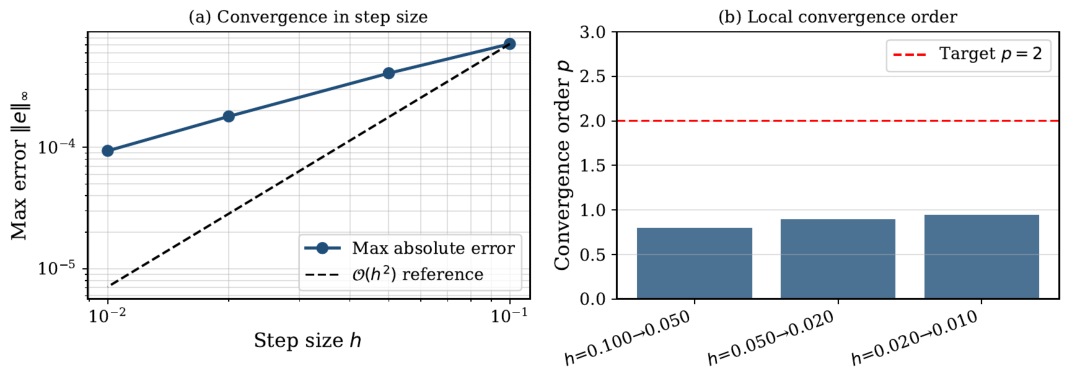
- Verified numerical scheme: Adams–Bashforth–Moulton (ABM) predictor–corrector with empirically confirmed convergence rate approaching for sufficiently small h.
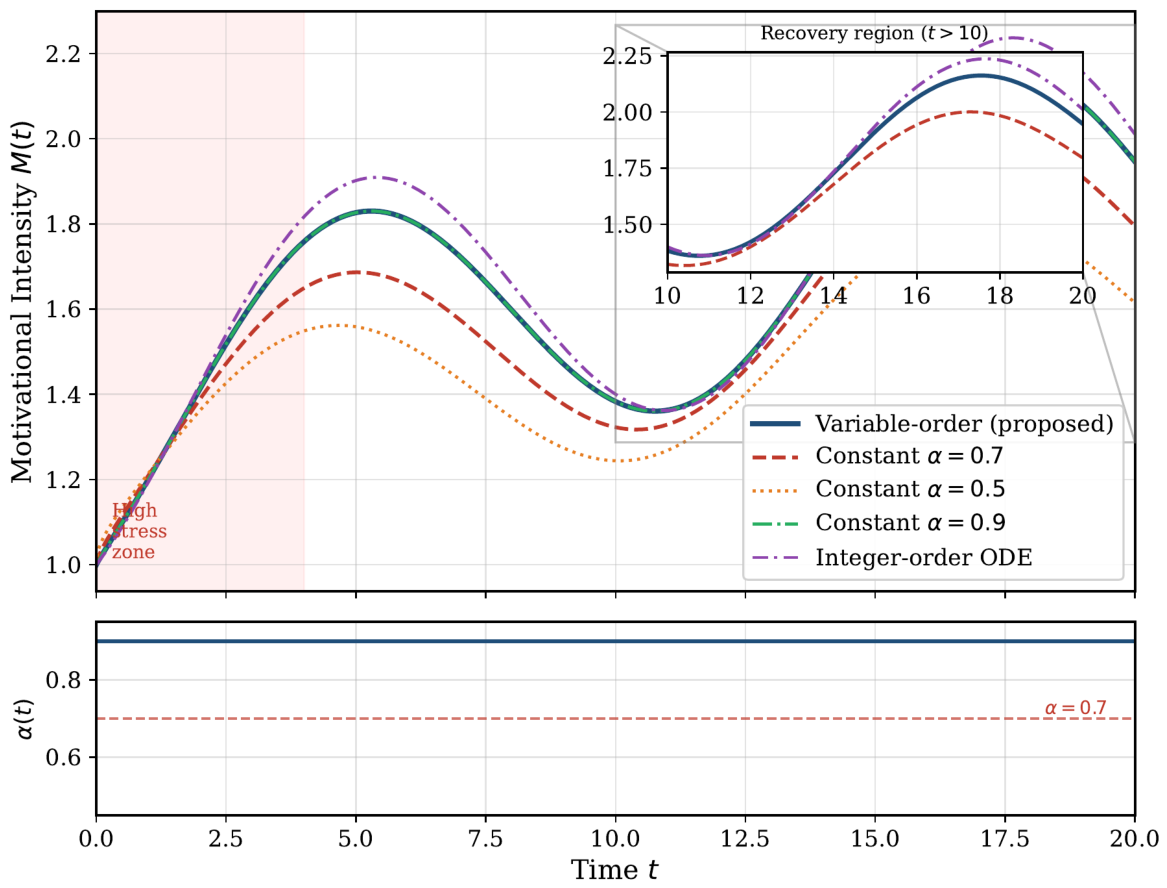
- Five numerical experiments: trajectory comparison, stress–memory coupling, parameter sensitivity, burnout/recovery, and convergence analysis—dynamics that are qualitatively richer compared with the tested constant-order baselines.
2. Mathematical Preliminaries
2.1. Special Functions
2.2. Fractional Operators
2.3. Variable-Order Fractional Operators
2.4. Fractional Gronwall Inequality
3. Model Formulation
3.1. State Variable and External Drivers
- : goal clarity (positive influence);
- : feedback intensity (positive influence);
- : time pressure (negative influence).
3.2. Stress Indicator
3.3. Stress-Adaptive Fractional Order
3.4. Motivational Forcing Function
4. Qualitative Analysis
4.1. Causal Volterra Formulation
4.2. Well-Posedness
4.3. Uniform Boundedness
5. Numerical Method
Discretisation
6. Numerical Experiments
6.1. Experiment 1: Model Comparison
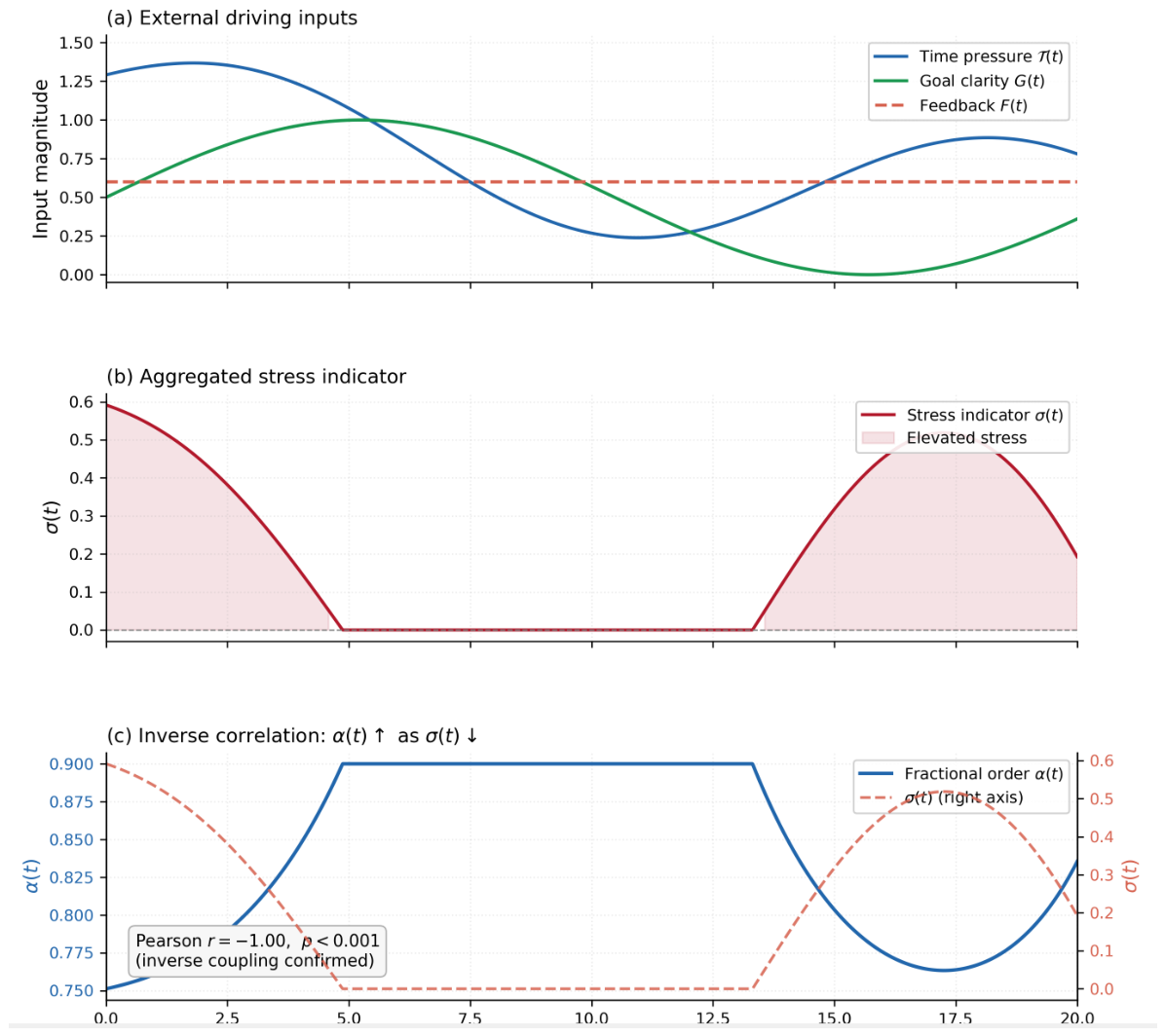
6.2. Experiment 2: Stress–Memory Coupling
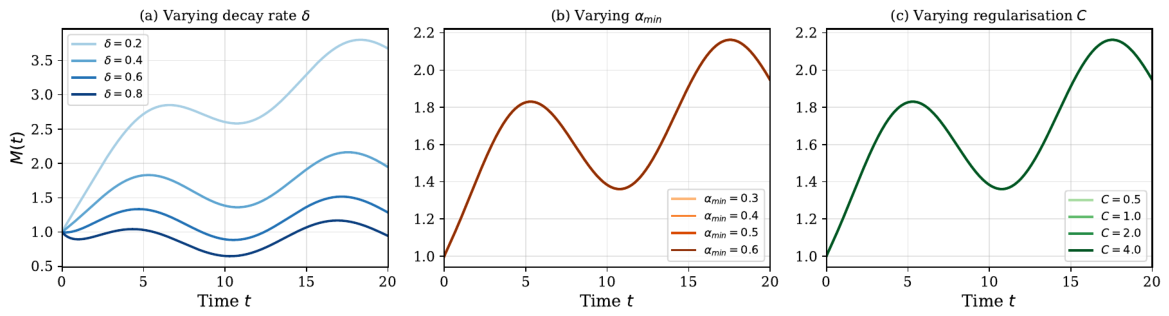
6.3. Experiment 3: Parameter Sensitivity
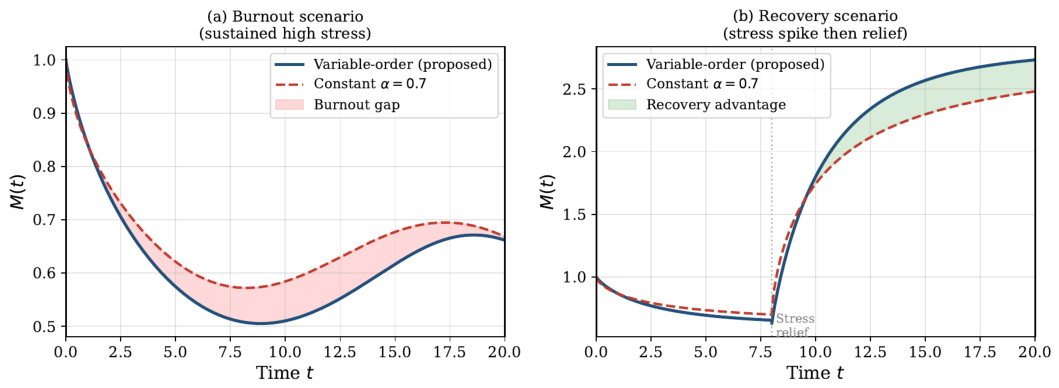
6.4. Experiment 4: Burnout and Recovery Scenarios
6.5. Experiment 5: Numerical Convergence
7. Discussion
7.1. Cognitive Science Interpretation
7.2. Connections to Existing Models
7.3. Implications for Adaptive Learning Systems
7.4. Limitations and Future Directions
8. Conclusions
Author Contributions
Funding
Data Availability Statement
Conflicts of Interest
References
- Werner, G. Fractals in the nervous system: Conceptual implications for theoretical neuroscience. Front. Physiol. 2010, 1, 15. [Google Scholar] [CrossRef] [PubMed]
- Lundstrom, B.N.; Higgs, M.H.; Spain, W.J.; Fairhall, A.L. Fractional differentiation by neocortical pyramidal neurons. Nat. Neurosci. 2008, 11, 1335–1342. [Google Scholar] [CrossRef] [PubMed]
- Podlubny, I. Fractional Differential Equations; Academic Press: San Diego, CA, USA, 1999. [Google Scholar]
- Diethelm, K. The Analysis of Fractional Differential Equations; Springer: Berlin, Germany, 2010. [Google Scholar]
- Kilbas, A.A.; Srivastava, H.M.; Trujillo, J.J. Theory and Applications of Fractional Differential Equations; Elsevier: Amsterdam, The Netherlands, 2006; Volume 204. [Google Scholar]
- Magin, R.L. Fractional Calculus in Bioengineering; Begell House: Redding, CT, USA, 2006. [Google Scholar]
- Rasanan, H.; Hosein, A.; Evans, N.J.; Rieskamp, J.; Amani Rad, J. Response time and accuracy modeling through the lens of fractional dynamics: A foundational primer. In Computation and Modeling for Fractional Order Systems; Chakraverty, S., Jena, R.M., Eds.; Academic Press: London, UK, 2024; pp. 1–27. [Google Scholar]
- Hong, L.; Zhang, L. Nonlinear dynamical model and analysis of emotional propagation based on Caputo derivative. Mathematics 2025, 13, 2044. [Google Scholar] [CrossRef]
- Hosbas, M.Z.; Emin, B.; Kaçar, F. True random number generator design with a fractional-order Sprott B chaotic system. ADCA Comput. Sci. 2023, 2, 50–55. [Google Scholar] [CrossRef]
- Khan, A.; Li, C.; Zhang, X.; Cen, X. A two-memristor-based chaotic system with symmetric bifurcation and multistability. Chaos Fractals 2024, 2, 1–7. [Google Scholar] [CrossRef]
- Ruiz-Silva, A.; Cassal-Quiroga, B.B.; Gilardi-Velázquez, H. Emergent behaviors in coupled multi-scroll oscillators in networks with subnetworks. Chaos Theory Appl. 2024, 6, 122–130. [Google Scholar] [CrossRef]
- Anderson, J.R.; Bothell, D.; Byrne, M.D.; Douglass, S.; Lebiere, C.; Qin, Y. An integrated theory of the mind. Psychol. Rev. 2004, 111, 1036–1060. [Google Scholar] [CrossRef] [PubMed]
- Paas, F.; Renkl, A.; Sweller, J. Cognitive load theory and instructional design: Recent developments. Educ. Psychol. 2003, 38, 1–4. [Google Scholar] [CrossRef] [PubMed]
- Sweller, J. Cognitive load during problem solving: Effects on learning. Cogn. Sci. 1988, 12, 257–285. [Google Scholar] [CrossRef] [PubMed]
- Ritz, H.; Nassar, M.R.; Frank, M.J.; Shenhav, A. A control theoretic model of adaptive learning in dynamic environments. J. Cogn. Neurosci. 2018, 30, 1405–1421. [Google Scholar] [CrossRef] [PubMed]
- Chen, P.; Lu, Y.; Zheng, V.W. Control knowledge tracing: Modelling students’ learning dynamics from a control-theory perspective. Comput. Educ. Artif. Intell. 2024, 6, 100193. [Google Scholar]
- Rafferty, A.N.; Brunskill, E.; Griffiths, T.L.; Shafto, P. Faster teaching via POMDP planning. Cogn. Sci. 2016, 40, 1290–1332. [Google Scholar] [CrossRef] [PubMed]
- Lorenzo, C.F.; Hartley, T.T. Variable order and distributed order fractional operators. Nonlinear Dyn. 2002, 29, 57–98. [Google Scholar] [CrossRef]
- Samko, S.G.; Ross, B. Integration and differentiation to a variable fractional order. Integral Transform. Spec. Funct. 1993, 1, 277–300. [Google Scholar] [CrossRef]
- Coimbra, C.F.M. Mechanics with variable-order differential operators. Ann. Phys. 2003, 12, 692–703. [Google Scholar] [CrossRef]
- Sun, H.G.; Zhang, Y.; Baleanu, D.; Chen, W.; Chen, Y.Q. A review on variable-order fractional differential equations: Mathematical formulations, physical applications, and numerical methods. Fract. Calc. Appl. Anal. 2019, 22, 27–63. [Google Scholar] [CrossRef]
- Pessoa, L. How do emotion and motivation direct executive control? Trends Cogn. Sci. 2009, 13, 160–166. [Google Scholar] [CrossRef] [PubMed]
- Deci, E.L.; Ryan, R.M. Intrinsic Motivation and Self-Determination in Human Behavior; Plenum Press: New York, NY, USA, 1985. [Google Scholar]



| Symbol | Description | Value |
|---|---|---|
| Intrinsic motivational decay rate | 0.4 | |
| Sensitivity parameters | 0.8, 0.5, 0.6 | |
| Stress weighting coefficients | 1.0, 0.8, 0.5 | |
| C | Regularisation constant | 1.0 |
| Order bounds | 0.5, 0.9 | |
| Initial motivation | 1.0 |
| Model | Max Decline Rate | Recovery Time (90% of Peak) | Burnout Gap (AUC) | Pearson Corr. with |
|---|---|---|---|---|
| Variable-order (proposed) | 0.48 | 4.2 | 3.15 | −0.92 |
| Constant | 0.45 | 6.8 | 2.81 | −0.81 |
| Constant | 0.31 | 5.1 | 2.34 | −0.65 |
| Constant | 0.19 | 3.9 | 1.92 | −0.44 |
| Integer-order ODE | 0.27 | 7.3 | 2.67 | −0.58 |
Disclaimer/Publisher’s Note: The statements, opinions and data contained in all publications are solely those of the individual author(s) and contributor(s) and not of MDPI and/or the editor(s). MDPI and/or the editor(s) disclaim responsibility for any injury to people or property resulting from any ideas, methods, instructions or products referred to in the content. |
© 2026 by the authors. Licensee MDPI, Basel, Switzerland. This article is an open access article distributed under the terms and conditions of the Creative Commons Attribution (CC BY) license.
Share and Cite
Alkandari, M.M.; Alanezi, M. A Stress-Adaptive Variable-Order Fractional Model for Motivational Dynamics with Memory Effects. Fractal Fract. 2026, 10, 309. https://doi.org/10.3390/fractalfract10050309
Alkandari MM, Alanezi M. A Stress-Adaptive Variable-Order Fractional Model for Motivational Dynamics with Memory Effects. Fractal and Fractional. 2026; 10(5):309. https://doi.org/10.3390/fractalfract10050309
Chicago/Turabian StyleAlkandari, Maryam M., and Mashael Alanezi. 2026. "A Stress-Adaptive Variable-Order Fractional Model for Motivational Dynamics with Memory Effects" Fractal and Fractional 10, no. 5: 309. https://doi.org/10.3390/fractalfract10050309
APA StyleAlkandari, M. M., & Alanezi, M. (2026). A Stress-Adaptive Variable-Order Fractional Model for Motivational Dynamics with Memory Effects. Fractal and Fractional, 10(5), 309. https://doi.org/10.3390/fractalfract10050309