


Abstract
Disaster warning is crucial for coal mine safety. However, capturing the precursor information of disaster occurrence remains a challenging task, especially the spatiotemporal fractal characteristics of microseismic events before large-scale fractures in rock masses and their indicative significance for disasters. In this study, we proposed a method for precursor identification and early warning indication of high-energy microseismic events by a combination of temporal and spatial fractal of low-energy events based on a set of 78 days of on-site microseismic monitoring data. The rationality of this method was validated by numerical simulation, which focuses on the fractal characteristics of rock fracture morphology under compression loading. The results show: (1) Before the occurrence of high-energy microseismic events, the fractal dimension of the microseismic events in the time series was relatively low, and the variance and autocorrelation coefficient of the time fractal dimension showed an increasing trend, exhibiting a typical slowing down phenomenon. (2) The spatial fractal dimension of the microseismic events rapidly decreased to 1.3–1.5 before the occurrence of high-energy events, with an average decrease of over 0.48. (3) Microseismic events are associated products of coal rock mass fracture processes, and their uniqueness in time series and spatiotemporal evolution characteristics have important indicative significance for the incubation and early warning of coal rock mass disasters.
1. Introduction
Coal plays a foundational role in China’s energy structure, a status that is unlikely to change in the foreseeable future. Deep mining of coal seams has become an inevitable trend and is gradually becoming the norm [1,2]. The deep mining environment in coal mines exhibits various typical characteristics, such as high in situ stresses, high gas pressures, high seepage pressures, high ground temperatures, and strong mining-induced disturbances. These conditions pose serious threats from compound dynamic disasters, including coal and gas outbursts, rock bursts, and large deformation of roadways. In the context of multi-hazard coupling and chain effects, advanced early warning and coordinated prevention and control of dynamic disasters have become strategic necessities for ensuring production safety [3,4].
The cause of dynamic disasters in coal mines is the unstable propagation and interconnection of fracture networks within the coal–rock mass under critical stress conditions. This process leads to the sudden release of stored elastic energy and results in violent failure of the surrounding rock—a highly dynamic mechanism [5]. Microseismic monitoring can effectively capture the processes and characteristics of rock fracturing, thereby enabling the inference of stress redistribution within the rock mass [6,7]. Characterizing the spatiotemporal evolution of microseismic activity in detail is therefore essential for gaining deeper insights into the mechanisms of disaster initiation and identifying potential precursory signals.
The occurrence of dynamic disasters is influenced by the properties of coal and rock, mining techniques, and geological structures. The complex evolution of these factors represents a nonlinear scientific problem, conceptually analogous to critical transitions in complex systems where progressive internal damage precipitates abrupt macroscopic failure [8]. An effective strategy to address such nonlinear issues is real-time microseismic monitoring, which has been established as a cornerstone for tracking nonlinear fracture evolution and gathering critical information for disaster early warning in mining environments worldwide [9,10,11]. Before reaching its strength limit, a loaded coal–rock mass undergoes micro-crack nucleation and propagation around macroscopic fracture surfaces, a process universally documented in fundamental theories of rock deformation and brittle failure [12,13,14,15]. The formation of these macroscopic fractures results from multi-scale crack development, with the number of rock fractures exhibiting scale invariance in both the directional grouping and random distribution, consistent with fractal statistics observed across geological system [16,17]. Furthermore, the fracture roughness and spatial geometry of fracture networks adhere to well-established fractal laws [18,19,20]. Consequently, the spatiotemporal distributions of microseismic events—signals that accompany rock mass failure—can also be described using fractal theory, a paradigm extensively validated in international seismological and rock mechanics research [21,22]. This phenomenon serves as a precursory indicator for the instability and failure of coal–rock masses, providing valuable insights for disaster early warning [23,24,25,26].
Although previous studies have advanced our understanding of disaster mechanisms and microseismic response characteristics, the spatiotemporal fractal features of microseismic events in mines and their implications for hazard precursor identification remain largely unexplored. To address this gap, an integrated analytical method for the spatiotemporal analysis of microseismic data was proposed in this study that incorporates fractal dimension metrics. This approach enables fine-grained discrimination of the spatiotemporal fractal characteristics of microseismic events and reveals how clusters exhibiting distinct fractal signatures can serve as potential indicators of impending hazards. In the proposed method, kernel density estimation (KDE) is first employed to characterize the spatial distributions of microseismic events and identify zones of stress concentration. A sliding window technique is then applied to dynamically track the evolution of key parameters over time. Using the correlation integral method, both the spatial fractal dimension (Dc) and the temporal fractal dimension (Dt) are calculated to quantify the structural complexity of event distributions and the temporal clustering behavior of the seismic sequence, respectively. Within this framework, the fractal dynamics of microseismic activity under deep-mining-induced stress perturbations were systematically investigated, and their intrinsic relationship with the coal–rock mass instability was explored. The findings provide theoretical support for the early warning of compound dynamic hazards in underground mining environments.
2. Methods
2.1. Temporal Fractal Analysis
Microseismic events serve as direct indicators of rock fracturing under stress, and they exhibit significant non-randomness in their temporal occurrence. As damage accumulates within a rock mass and approaches a critical state of macroscopic failure, the temporal distribution of these events typically transitions from a relatively uniform pattern to one characterized by pronounced clustering. Therefore, accurately characterizing the temporal distribution structures of microseismic events is crucial for elucidating the dynamic processes associated with rock fracture and facilitating advanced warning systems for dynamic hazards in mining operations. In comparison to other measures of the fractal dimension, such as the Hausdorff dimension and box counting dimension, the correlation dimension provides a metric that is specifically derived from the distribution of the event occurrence times [27]. Based on the temporal correlation integral, the correlation dimension can be used to effectively capture the clustering behavior and the intrinsic correlations present within time series data. This approach exhibits reduced sensitivity to the data volume while yielding results that are consistent with those obtained through alternative dimensionality estimates.
The calculation of the correlation dimension is fundamentally based on the correlation integral. This integral quantifies the probability that the time interval between any two events in a time series is less than a specified scale, τ. For a specific set of microseismic events, the correlation integral function C(τ) is defined as follows:
where N represents the total number of recorded microseismic events, and and denote the timestamps of these events. The expression is the time interval between two distinct events, while is the Heaviside step function, defined as follows:
In an intermediate range of τ, the function C(τ) exhibits growth that follows a power-law relationship, i.e.,
Thus, the spatial correlation dimension is defined as
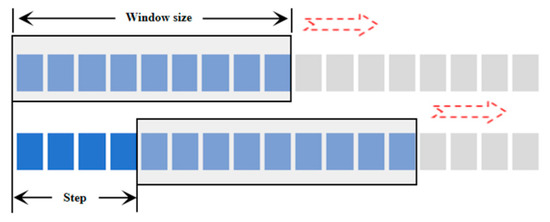
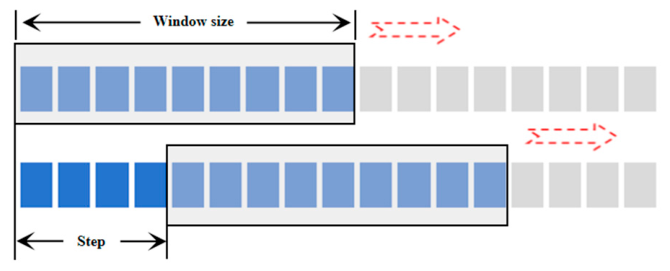
By using the sliding window algorithm (Figure 1), a sequence of microseismic events within a specified temporal range is obtained across the working face area. The spatial correlation dimension is then calculated sequentially for each window. Variations in the temporal correlation dimension between different sliding windows reflect the degree of temporal clustering within a given set of microseismic events. A gradual decrease in as the window advances can indicate a transition from a random distribution to a dense clustering in the time series of microseismic events, suggesting an accelerated expansion of dispersed microcracks within the rock mass.
Figure 1.
Sliding window method.
2.2. Spatial Fractal Dimension
By utilizing the sliding window algorithm to compute the time fractal dimension, the time correlation dimension at a specified spatial scale r can be similarly obtained [27]:
The variability of the spatial correlation dimension between different sliding windows reflects the degree of spatial clustering within the microseismic event set. A gradual decrease in as the window shifts may suggest that microseismic events are clustering around common rock fracture surfaces in space.
3. Experiment and Results
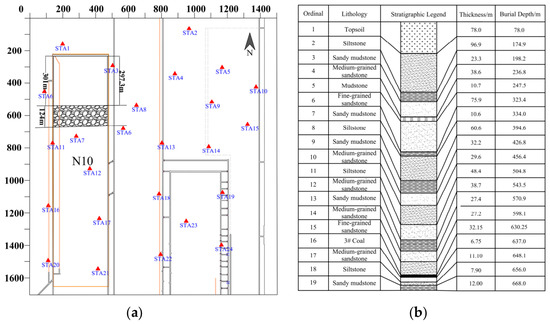
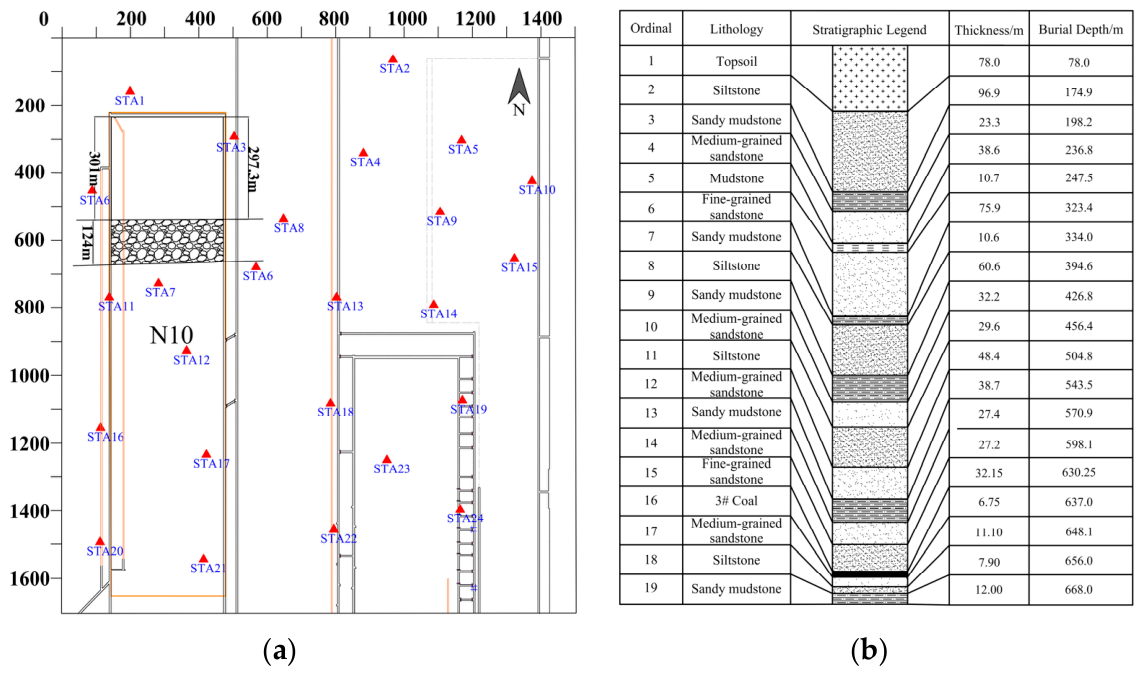
The data presented in this paper were obtained from a microseismic monitoring system installed at the surface of a mining site. This system consisted of 24 triaxial seismometers, each equipped with high-sensitivity accelerometers that possessed a sensitivity of 80 V/g, a response frequency range of 5–200 Hz, and a sampling frequency of 1 kHz. The primary purpose of the monitoring network was to capture microseismic events and issue hazard warnings during operations at the N10 working face. This particular face had an extensive strike length of 1820 m, a dip width of 330 m, and coal seam depths reaching approximately 637 m. The overlying strata were predominantly composed of sandstone and mudstone, with bedrock exposed directly at the surface (Figure 2).
Figure 2.
(a) Monitoring network layout and (b) geological overview of the study area.
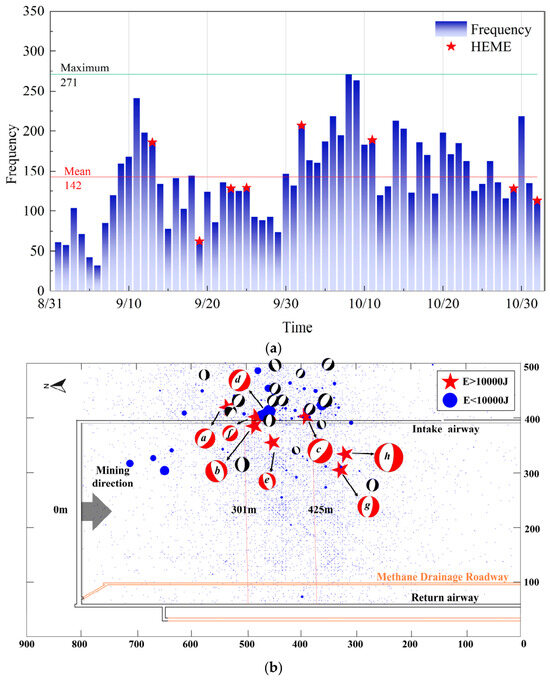
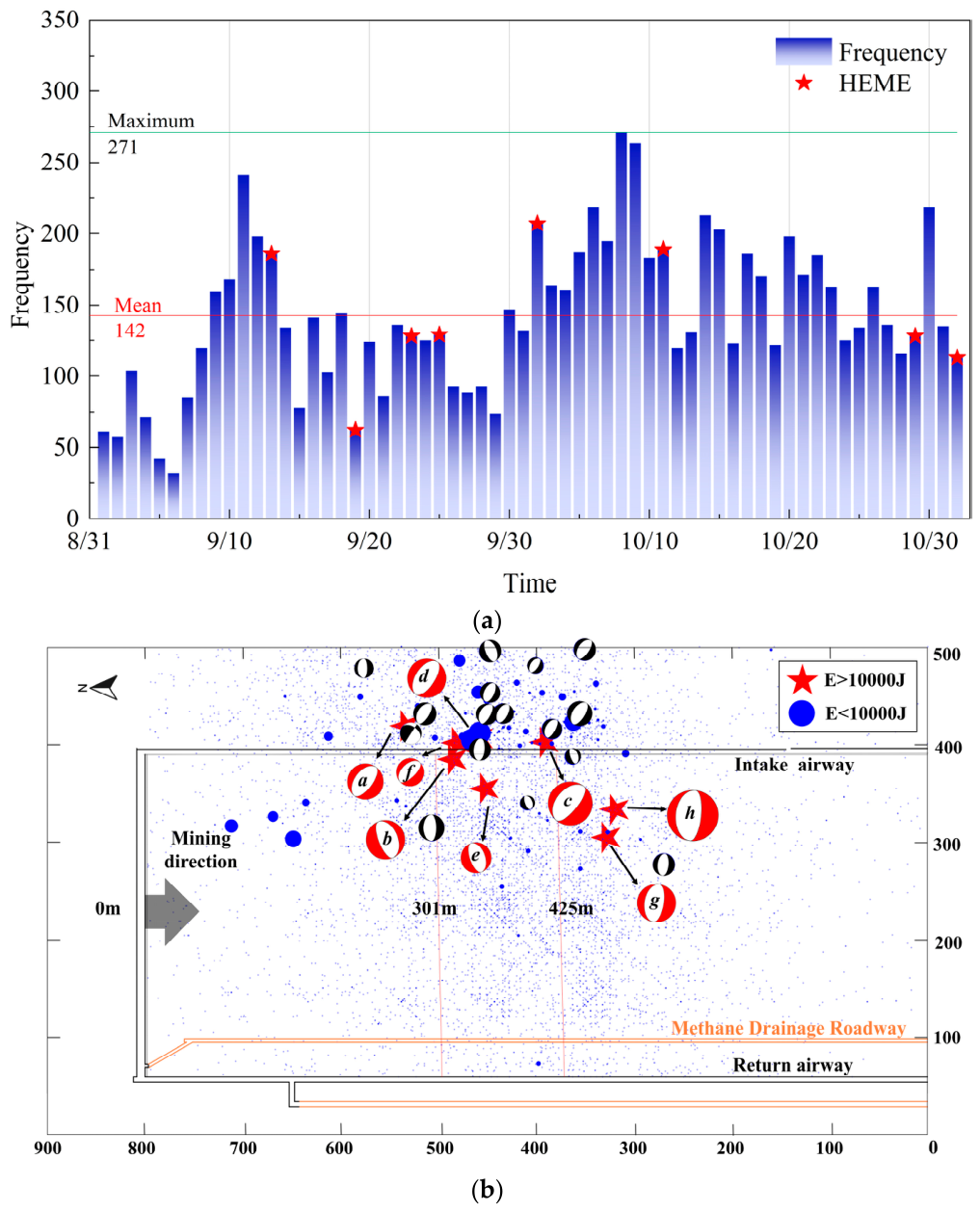
From September to November 2022, within the mining section range of 301–425 m and at depths of 300–700 m below ground level, the system recorded over 9000 valid microseismic events with moment magnitudes exceeding −3.0, including eight high-energy events (Table 1); the average daily frequency of events reached 145, with a maximum of 271 (Figure 3a). Their planar distribution is shown in Figure 3b. The substantial sample size provided a solid data foundation for investigating the spatiotemporal distribution characteristics of microseismic events under operating conditions and for research on disaster early warning systems.
Table 1.
Statistical parameters of high-energy microseismic events.
Figure 3.
(a) Daily microseismic event frequency. (b) Distribution of microseismic events (a–h represents high-energy event sequences).
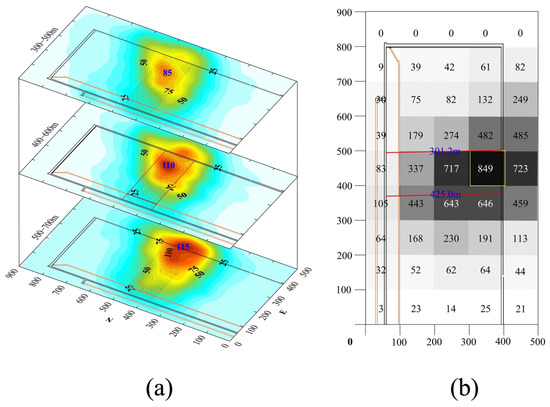
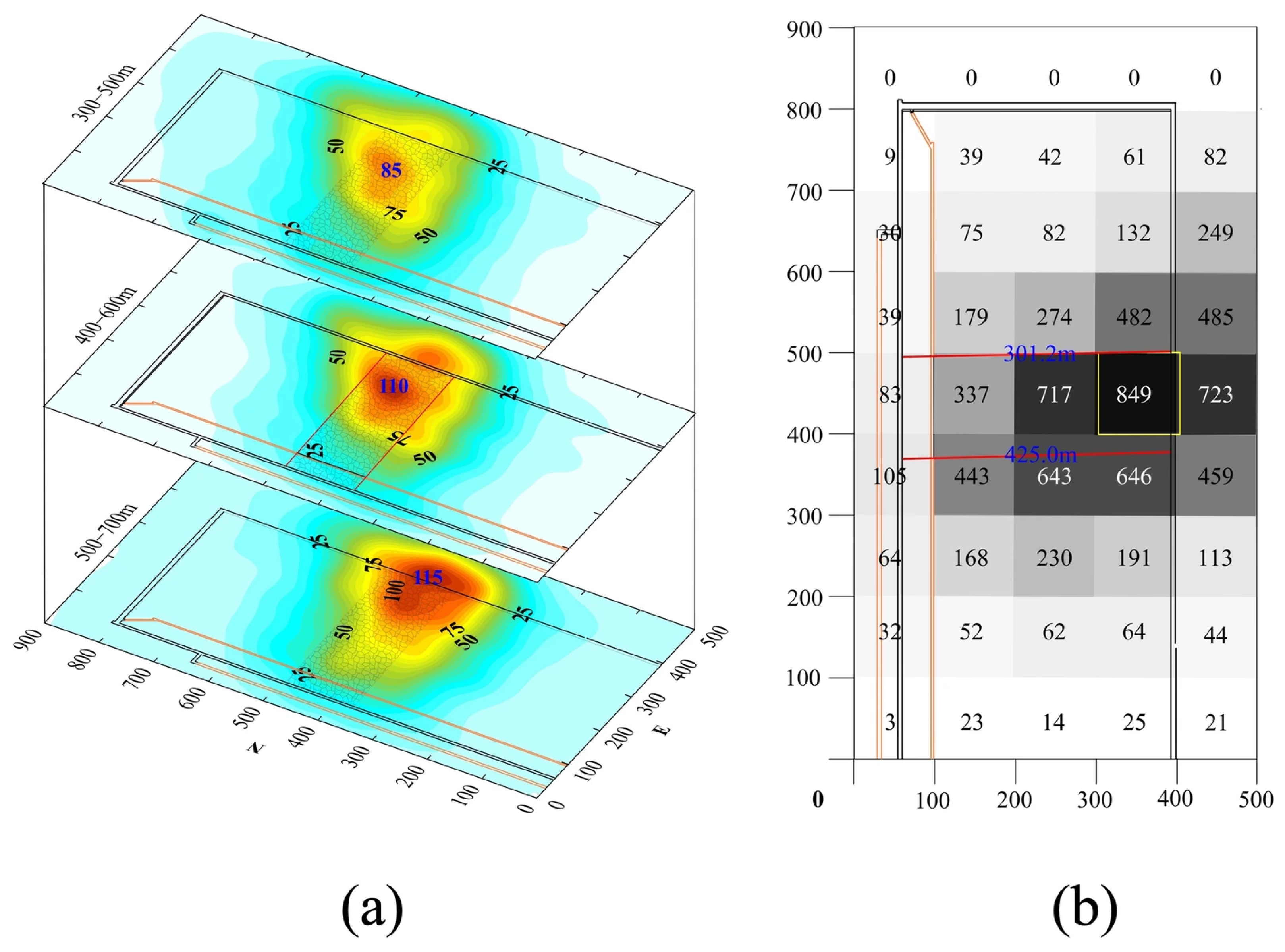
Key strata are commonly recognized as the “source layer” or “dominant stratum” for microseismic activity within the overburden of mining regions [28]. In response to mining disturbances, microseismic events occurring in the key strata and their adjacent areas, particularly near lower boundaries and fault lines, tend to exhibit a denser distribution and higher energy levels compared to those in other strata. By employing KDE [29], we obtained the vertical probability density distributions of microseismic events across depth intervals of 500–700, 400–600, and 300–500 m (Table 2). The distribution functions had the following form:
where represents the total number of samples, K(⋅) denotes the kernel function, is the bandwidth parameter, and is the distance between the estimation point and the sample point .
Table 2.
Probability density distribution characteristics.
As shown in Figure 4a, within the depth range of 500–700 m, the density of microseismic events was markedly higher than that observed in other layers. This suggested that there was a potential key layer location within the study area. Furthermore, as depicted in Figure 4b, the frequency of microseismic events peaked at 8.5 per m2 within the mining distance range of 301.2–425.0m.
Figure 4.
(a) Microseismic event density and (b) event grid distribution (numbers in grid cells represent microseismic event counts for that block).
4. Discussion
4.1. Temporal Fractal Characteristics
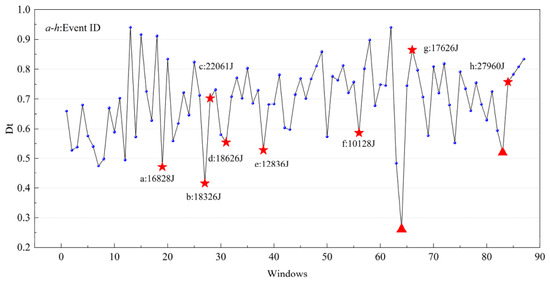
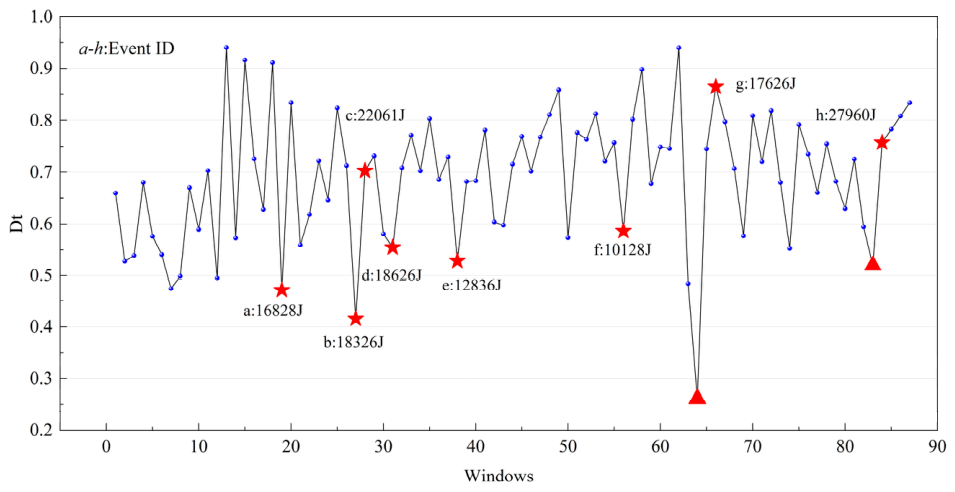
The occurrence times of microseismic events exhibited uniqueness within the time series. With an average daily microseismic frequency of approximately 145 events, the temporal fractal dimension (Dt) is calculated via a sliding-window approach, employing a window length of 100 events and a step size of 95 events that corresponds to a time span of roughly 16.5 h. Such a window configuration effectively captures the diurnal temporal characteristics of the critical slowing down phenomenon during the rock-mass instability process. The Dt values displayed significant dynamic fluctuations during the earthquake preparation process, reflecting both the dispersion and clustering characteristics of microseismic activities in terms of their temporal distribution. In the later stages of earthquake preparation or during the pre-earthquake period, there was an increase in the oscillation amplitude of the Dt values. Notably, within windows where high-energy events occurred or in one to two windows preceding such occurrences, the Dt values generally remained low (Figure 5).
Figure 5.
Dt variation trend in high-density regions (the red five-pointed star represents the window where high-energy microseismic events occur, and the triangle indicates the low-value window preceding the occurrence of high-energy microseismic events).
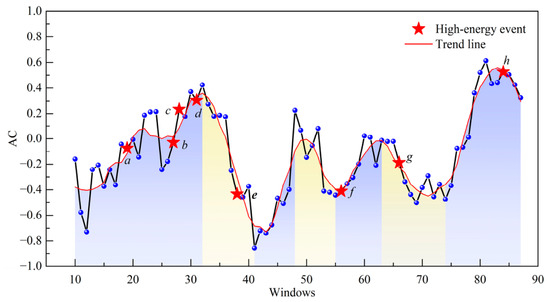
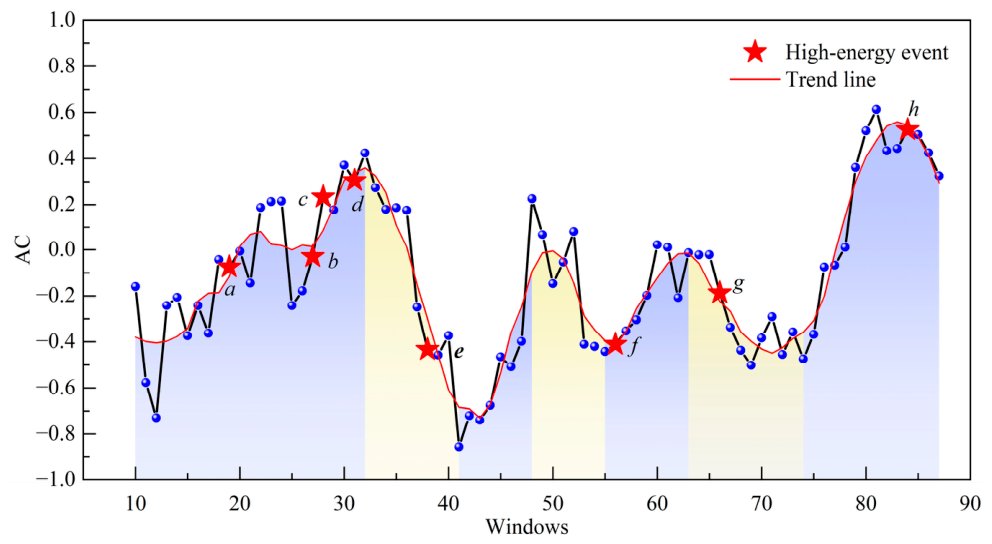
When a dynamical system approaches a critical point (or bifurcation point), the rate at which it regains equilibrium following minor disturbances significantly decreases. The acoustic emission (AE) energy during the rock loading process demonstrates a critical slowing down phenomenon [30]. The variance and autocorrelation coefficients are statistical parameters that can be employed to quantitatively characterize this critical slowing-down behavior [31,32]. To more effectively capture the sensitive changes in the temporal structure during the critical occurrence stage of significant energy events, the variance and autocorrelation coefficients were further integrated to conduct an in-depth analysis of the statistical characteristics of Dt across various the pre-earthquake stages.
The variance S2 was used to gauge the degree of dispersion of the Dt values, where S represents the standard deviation. The formulas are as follows:
where xi represents the i-th data point, and n denotes the sequence length. The autocorrelation coefficient measures the strength of the relationship between the current and past values in a time series. When the lag length of variable x is j, the autocorrelation coefficient a(j) can be expressed as follows:
The analysis of over 9000 sample events revealed that during the critical phase of eight high-energy events, the autocorrelation coefficients for the windows in which six of these events occurred exhibited a consistent increasing trend (Figure 6). This phenomenon aligns well with the findings from indoor acoustic emission experiments [33].
Figure 6.
Dt autocorrelation coefficient and variance.
The observed deceleration of high-energy microseismic event’s temporal characteristics signified systematic alterations in the intrinsic correlations and volatility of the microseismic time series prior to rock mass instability. This approach effectively addresses the limitations associated with the use of a single fractal dimension, demonstrating that the occurrence of microseismic events over time is not entirely random but rather governed by dynamic processes involved in the internal damage evolution within the rock mass. Consequently, it offers a more sensitive composite criterion for identifying the critical state of system instability.
4.2. Spatial Fractal Characteristics
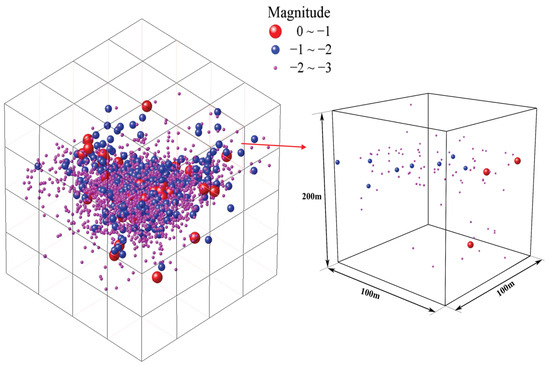
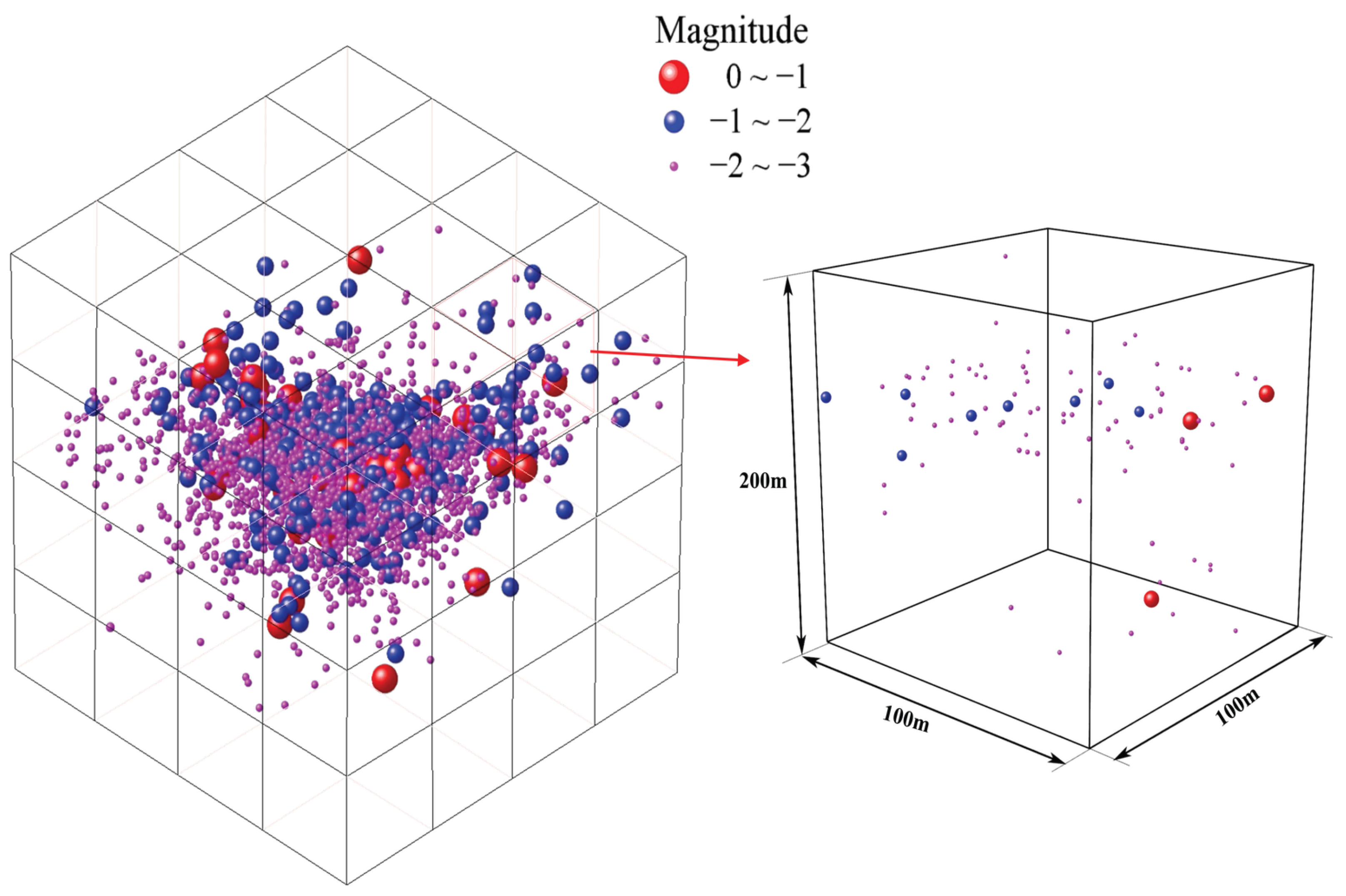
To accurately examine the aggregation and evolution processes of microseismic events in three-dimensional space, a cubic coverage method was employed for local spatial fractal analysis. The high-density area was partitioned into cubic volumes measuring 100 × 100 × 200 m (Figure 7), allowing for the evaluation of the spatial fractal characteristics of the microseismic event distribution across various regions.
Figure 7.
Cubic coverage method.
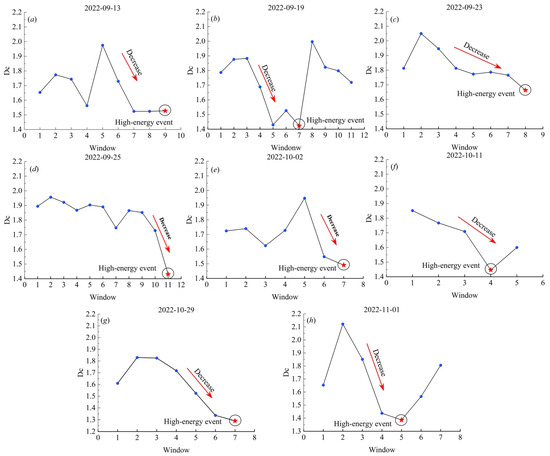
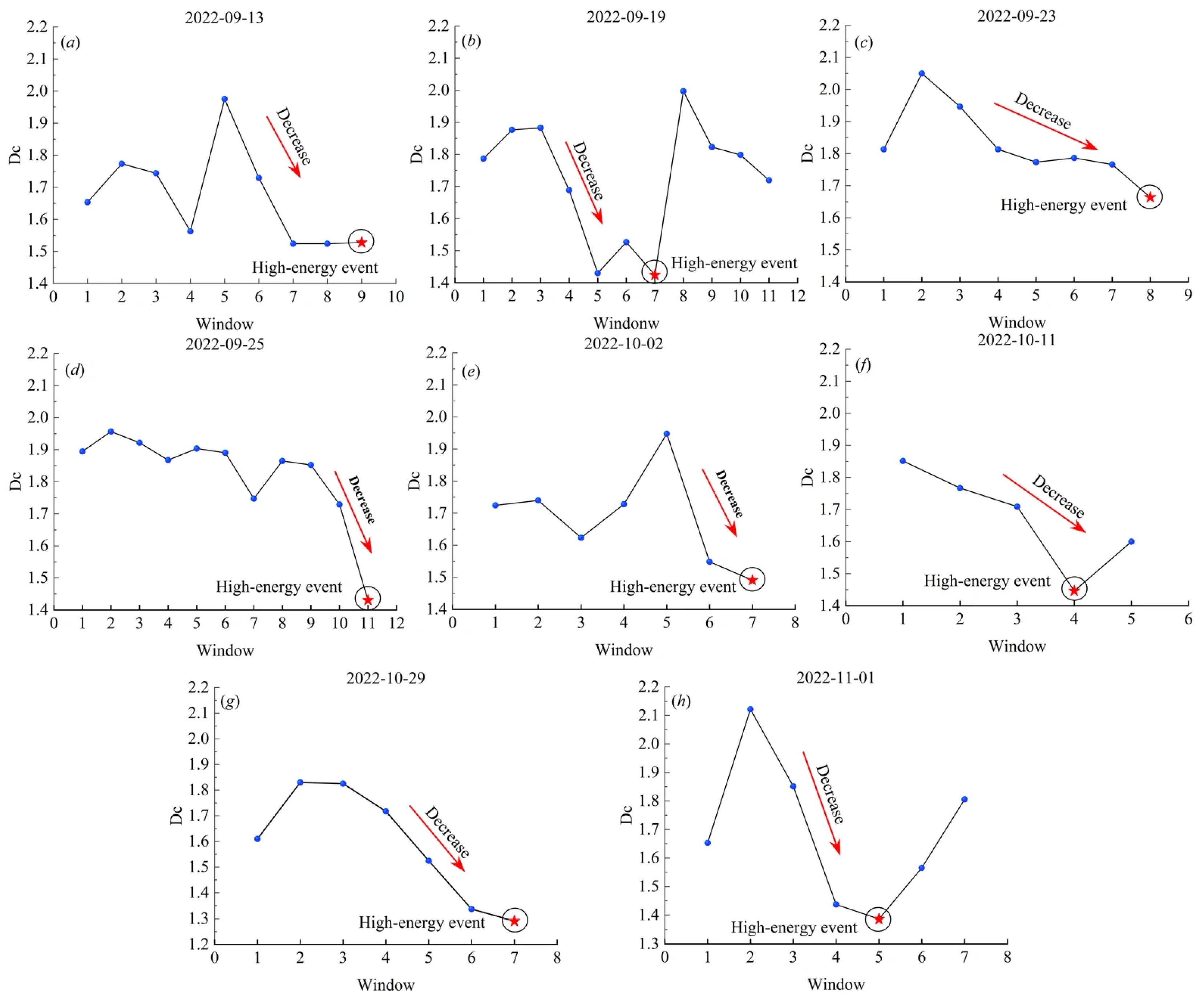
The data was segmented using a sliding window approach, where the windows were selected based on the number of events (each window encompassed 30 consecutive events with a step size of 10 events). The Dc of the microseismic events within each window was subsequently calculated. During the seismogenic stage, the Dc values of these microseismic events exhibited fluctuations between 1.7 and 2.2, indicating that the fractures formed a complex and interconnected network system, devoid of distinct linear or planar structures. This observation may suggest that the fracture behavior of the coal and rock mass was primarily influenced by discontinuous primary fractures (Figure 8).
Figure 8.
(a–h) Spatial fractal evolution curves before the occurrence of 8 high-energy events.
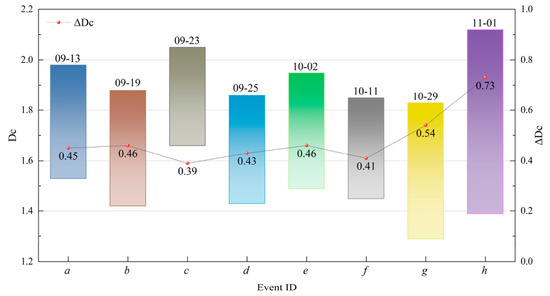
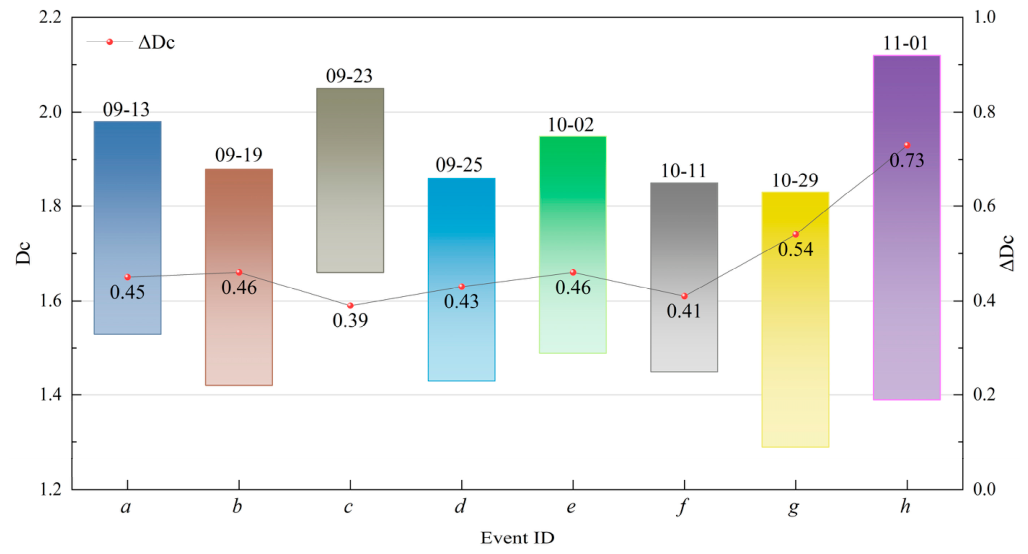
Before the occurrence of high-energy events, the Dc of the microseismic activities exhibited a systematic reduction trend. During the pre-earthquake phase, as the stress continued to accumulate, fractures began to favor specific dominant pathways, leading to a gradual concentration of microseismic activities in proximity to the anticipated main rupture surface. This shift in the spatial distribution transitioned from a “plane” configuration to a “band” or “line,” resulting in a rapid decrease in the fractal dimension to values between 1.3 and 1.5. This process facilitated the formation of large-scale fractures that were associated with high-energy microseismic events, with an average decline in Dc exceeding 0.48 during this period (Figure 9). Laboratory triaxial compression experiments on rocks have demonstrated that such a reduction in spatial fractal dimension is physically linked to the progressive localization of fracture networks toward a dominant failure plane prior to catastrophic failure [34].
Figure 9.
Amplitude reduction of spatial fractal dimension.
To verify the dependence of the precursory feature of the decline in Dc prior to high-energy events on the calculation parameters, the effects of different window sizes and step sizes were tested (Table 3).
Table 3.
Decrease in spatial fractal dimension under varying window sizes and step lengths.
From the perspective of step-size effects, under the condition of a fixed window length of 30, reducing the step size from 10 to 5 does not significantly alter the distribution characteristics of ΔDc. The means and confidence intervals of the two are highly overlapping, indicating that the precursory characteristics are insensitive to small-to-medium step sizes. However, when the step size increases to 20, with an overlap rate of approximately 33%, the confidence interval of ΔDc shifts downward as a whole, and the mean approaches the critical threshold of 0.40. This demonstrates that an excessively large step size causes the window to advance too quickly, skipping the steep drop phase of Dc and resulting in the loss of critical transition information immediately before the event.
From the perspective of window size effects, with a fixed step size of 10, when the window length varies in the range of 20–50, both the mean and dispersion of ΔDc remain stable, and the confidence intervals overlap with each other, confirming the statistical robustness of the precursory characteristics within this range. However, when the window size is expanded to 80, the magnitude of the decrease is significantly diluted, and the mean drops to near the critical level. This indicates that an excessively large window may smooth out localized damage signals by covering multiple fracture events. Through comprehensive comparison, the configuration with a window length of 30 and a step size of 10 achieves the optimal balance between maintaining precursory identification sensitivity and computational stability. The reported rapid decline in Dc is therefore not an artifact of parameter selection.
4.3. Numerical Simulation of Rock Damage Process Under Compression Conditions
The damage evolution of rocks under compression conditions can effectively reproduce the occurrence process of dynamic disasters in coal mines. Through numerical simulation, damage elements in the process of rock fracture can be extracted one by one, accurately depicting the morphology of rock fractures and cracks. This approach effectively avoids spatiotemporal fractal errors caused by the microseismic location accuracy. In situ X-ray microtomography studies of rock failure under triaxial conditions have revealed that catastrophic failure is preceded by distinct stages of microcrack nucleation and coalescence [35], corroborating the damage evolution process captured by our numerical mode.
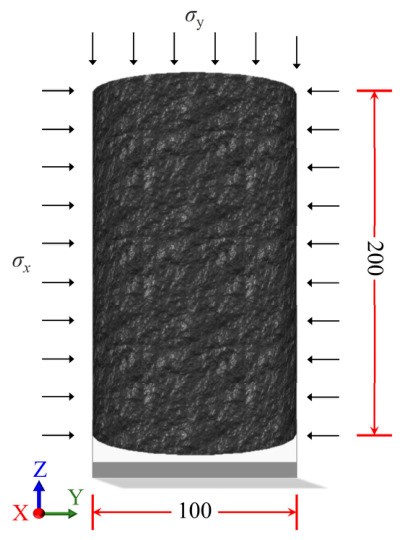
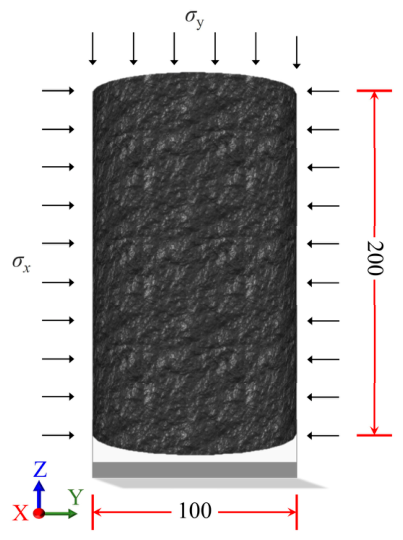
In this research, a three-dimensional cylindrical simulated specimen is established, the material constitutive model adopts the Mohr–Coulomb elastic-plastic model, and the field variable program is used to assign initial mechanical parameters to each mesoscopic element. The model dimensions are 100 × 100 mm × 200 mm (Figure 10), which was discretized into 50 × 50 × 100 = 250,000 mesoscopic elements. The damage evolution is achieved through a field variable-dependent progressive stiffness degradation mechanism [36]. The specific material parameters are shown in Table 4.
Figure 10.
Numerical model for biaxial compression of coal.
Table 4.
Basic material parameters used in numerical calculation.
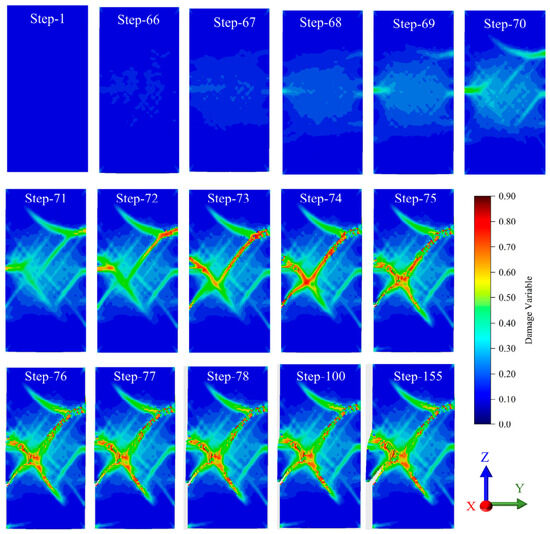
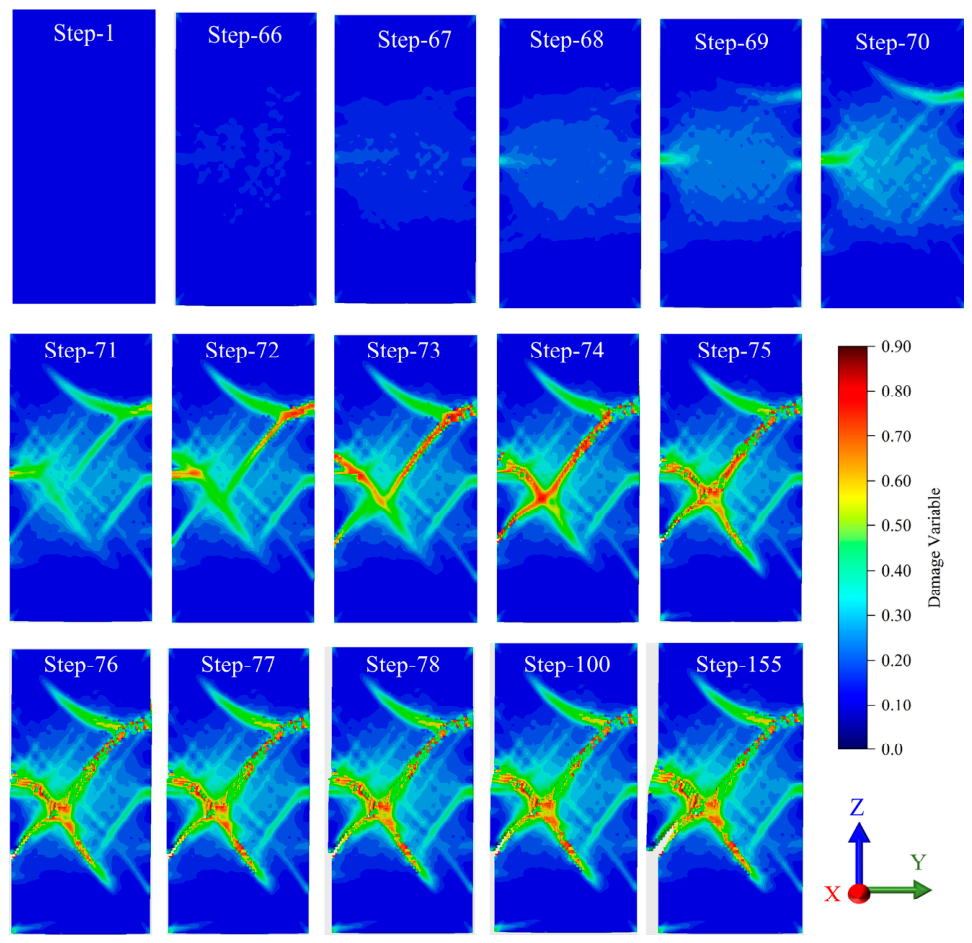
In the compression simulation, the model’s bottom is fully constrained in terms of stress and strain, while the top is subjected to stress through a smooth step amplitude curve by the displacement loading within 0~2 mm, and a constant confining pressure is applied to the sides of the model. During the loading process, the explicit dynamic method was employed for the damage calculation of the test specimen, combined with the fixed mass scaling technique to enhance computational efficiency, until the specimen was completely destroyed. Figure 11 illustrates the entire process of the specimen being damaged, including the generation of micro-defects to microcrack nucleation, and finally to the occurrence of macroscopic fracture over 155 computational steps.
Figure 11.
The entire process of the specimen being damaged.
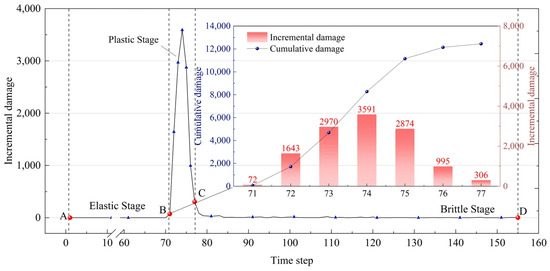
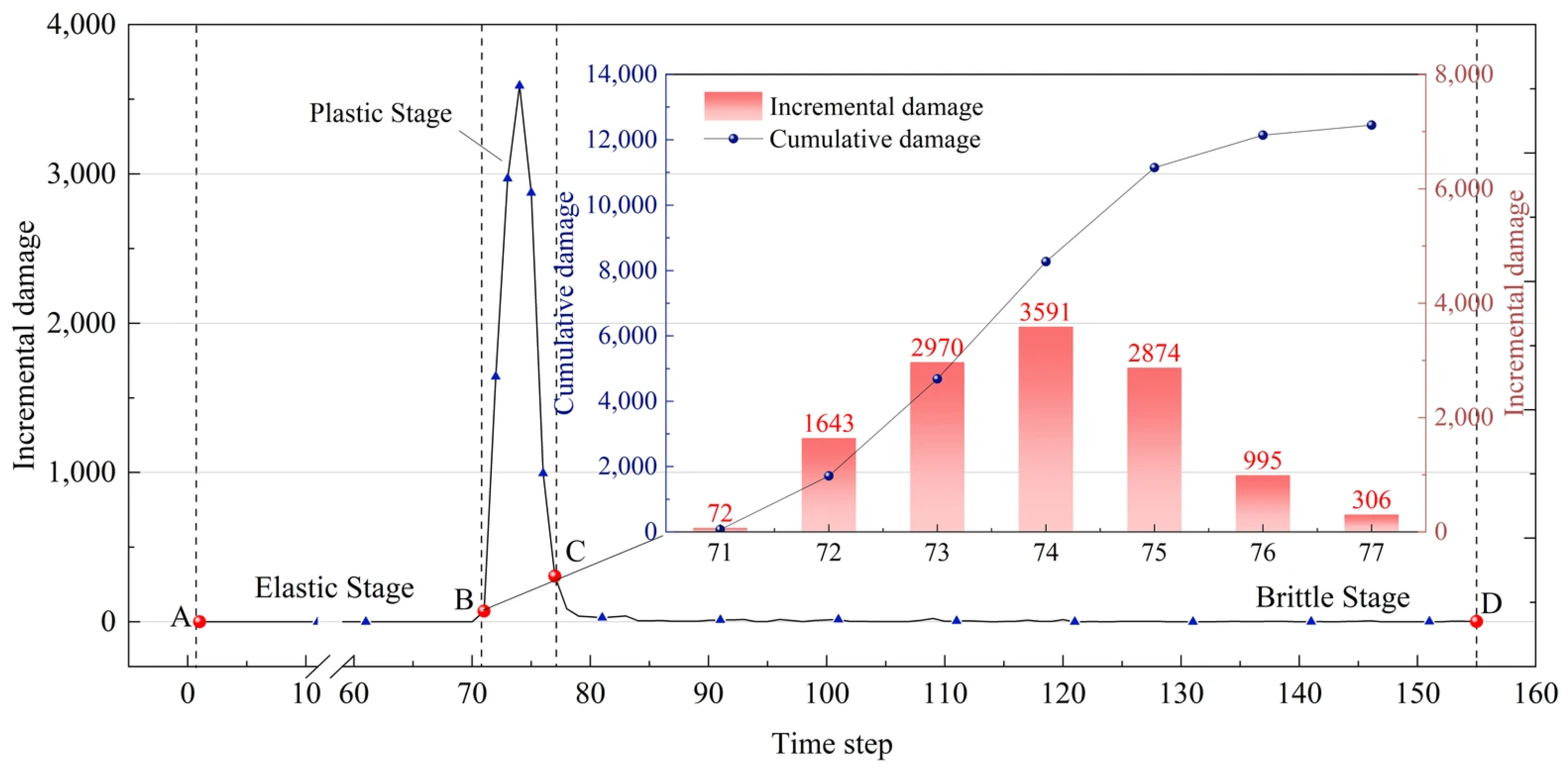
Figure 12 illustrates the variation in incremental damage over time, and the process of rock damage can be divided into three typical stages.
Figure 12.
Temporal evolution pattern of incremental damage.
In steps 0–70, the sample is in the elastic phase (section AB), with zero newly added damage units and stable microcracks that have not propagated, indicating that the system is in a relatively equilibrium state. In steps 71–77, the sample transitions to the plastic phase (section BC), where the number of damage units rapidly increases in a very short period of time, reaching a peak of 3591 damage units before quickly declining. Cracks rapidly aggregate and nucleate, causing the system to abruptly transition from a stable state to a critical instability state. This transition is characterized by a high clustering of damage events in the time series. In steps 78–155, the sample enters the brittle phase (section CD), where the number of damage units’ plummets to a lower level and tends to stabilize.
During the specimen’s failure process, the evolution of cracks exhibits typical fractal characteristics. In terms of time, the number of newly added damage elements during the plastic failure stage of the sample follows a pattern of increasing first and then decreasing. To be specific, only 72 elements were damaged in the 71st step, then it rapidly climbed to a peak of 3591 in the 74th step, and subsequently fell back rapidly to 306 in the 77th step. The cumulative damage curve continued to rise but the rate of increase slowed down significantly, indicating that the energy release of the system was nearing completion. In terms of space, microcracks developed dispersedly from the 71st to the 72nd step, and dominant cracks penetrated to form a typical conjugate shear pattern from the 73rd to the 74th step. When the main fracture surface was fully penetrated in the 75th step, the degree of damage localization was the highest and the spatial fractal dimension reached its lowest. In the 76th to 77th steps, the crack morphology stabilized and the fracture structure tended to be stable. The damage cloud maps corresponding to each time step visually revealed the process of damage localization.
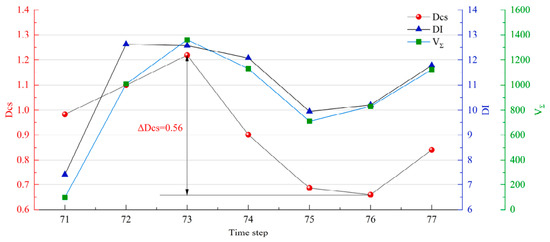
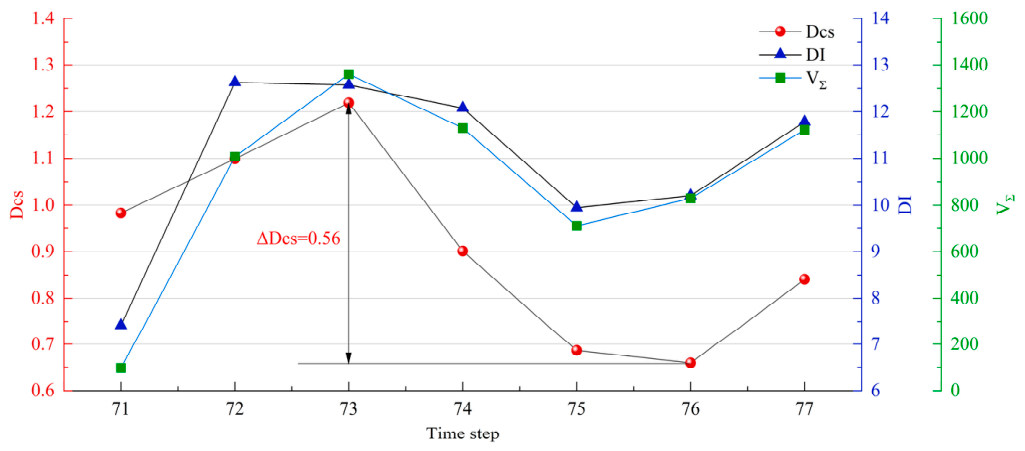
To quantitatively characterize the spatial features of the newly added damage distribution, based on the locations of the damaged elements extracted from Figure 12, the spatial fractal dimension Dc of crack evolution at each time step was calculated, and supplemented the dispersion index () and the spatial volume range () for comprehensive identification (Figure 13).
Figure 13.
Variation in spatial dispersion and distribution range during damage evolution.
and was calculated by
where represents the average standard deviation in each direction, and denotes the covariance matrix.
The quantitative calculation results show that the spatial fractal dimension Dcs of the crack morphology in the specimen remains at a high level of 1.26 from step 72 to step 73, indicating a relatively dispersed damage distribution. From step 74 onwards, Dcs decreases rapidly, reaching its lowest value of 0.66 between steps 75 and 76, indicating that the damage is highly concentrated on the dominant fracture surface. At step 77, Dcs slightly increases, reflecting a trend towards structural stability. The dispersion index and spatial volume range index exhibit the same trend as Dcs, with an initial increase, subsequent decrease, and eventual increase. After reaching the peak at step 73, they synchronously decline, reaching a trough between steps 75 and 76, which corroborates the lowest value of the fractal dimension and jointly reveals the critical process of damage transitioning from a dispersed and disordered state to a localized and ordered structure.
In the numerical simulation, the fractal dimension Dcs decreased by 0.56 from the stage of local damage to the formation of macroscopic fractures in the specimen (Figure 13). In the aforementioned microseismic field monitoring, the average decrease in Dc before the occurrence of high-energy microseismic events was 0.48 (Figure 9).
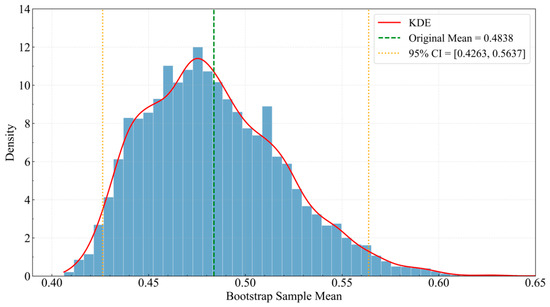
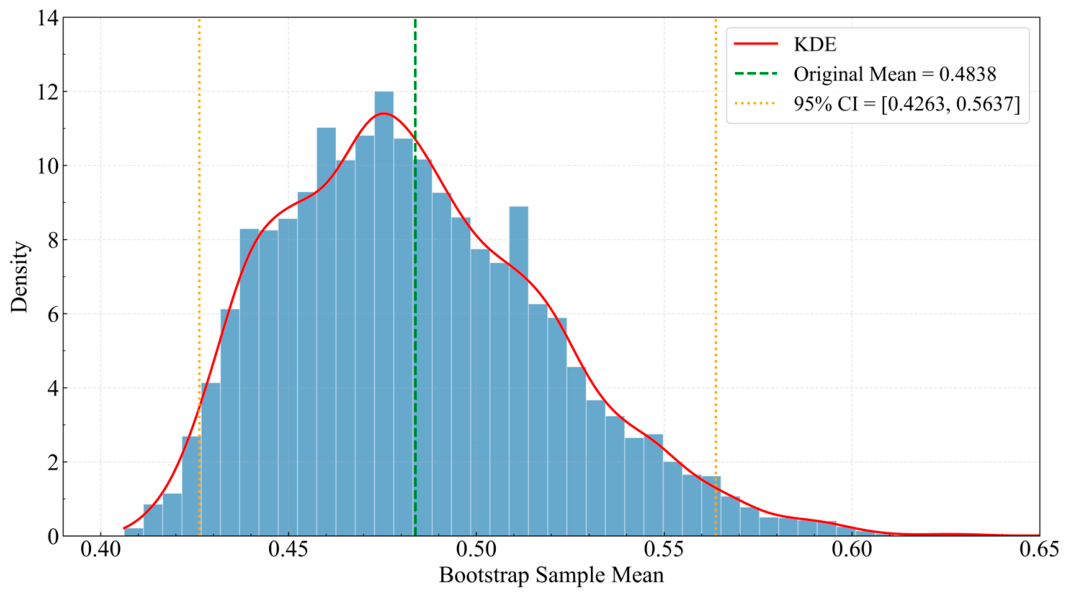
To evaluate the statistical consistency between simulated and field observed values, this study adopts the one-sample Bootstrap resampling method for nonparametric inference [37]. Specifically, taking the observed ΔDc values acquired before eight high-energy events in the field as the empirical population, we perform 10,000 times of random sampling with replacement. Each subsample has a size of 8, and the mean value is calculated for each subsample. On this basis, the empirical distribution of sample means is established (Figure 14).
Figure 14.
Empirical distribution of bootstrap sample means for ΔDc values.
The results show that the Bootstrap mean is 0.484 with a standard deviation of 0.036, and its 95% percentile confidence interval is [0.426, 0.564]. The reference value ΔDcs = 0.56 obtained from numerical simulation lies near the upper bound of this confidence interval, indicating that the simulation results have no systematic deviation within the empirical distribution of available field data. A two-tailed p-value calculated based on the Bootstrap distribution is 0.031, which is less than 0.05. This demonstrates that there is no significant difference between the overall mean of field monitoring data and the simulated value. It is worthwhile to point out that the spatial fractal dimension Dcs of the damage element in the numerical simulation method is slightly lower than the spatial fractal dimension Dc of microseismic events in field engineering practice. This may be due to the fact that in the idealized model, the heterogeneity of the medium and the absence of primary fractures make the damage evolution path more concentrated, and the sudden characteristics of the localized breakthrough stage are more pronounced. At the same time, it is not ruled out that the fractal dimension may be slightly higher due to the location error of microseismic events.
4.4. Significance of the Dt and Dc for Disaster Early Warning
The development of dynamic disasters in coal and rock masses presents a complex, nonlinear scientific challenge. The key to early warning of such disasters lies in the proactive identification of potential failure surfaces and the delineation of the evolving macroscopic fracture network. The locations, timings, and intensities of microseismic events serve as direct indicators of “hotspot” zones where stresses accumulate, concentrate, and are released within the rock mass. By analyzing the migration rates and directions of these microseismic events, it becomes feasible to infer nucleation points and propagation paths for major fractures, thereby uncovering precursory evolutionary sequences that lead to macroscopic failure. This methodology is an effective approach for disaster early warning.
The significance of the Dt lies in its capacity to encapsulate the intrinsic complexity of a time series into a single, quantifiable metric. Variations in the value of this metric can signify alterations in the underlying order of a nonlinear dynamical system. Prior to high-energy microseismic events, a rapid decline in the Dt visually indicates a sharp increase in the frequency of microseismic occurrences per unit time. This phenomenon suggests an accelerated clustering of microseismic activity and the expedited nucleation of micro-cracks within the coal–rock mass. During the process of crack coalescence and macroscopic fracture formation, microseismic events exhibit a deceleration phenomenon within the time series, characterized by an upward trend in the autocorrelation coefficient values of the Dt. The simultaneous occurrence of a rapid reduction in the fractal dimension followed by this deceleration effect provides a composite criterion for early warning of high-energy microseismic events or dynamic disasters. Many scholars have confirmed that, the phenomenon of critical slowing down leads to three possible early-warning signals in the dynamics of a system approaching a bifurcation: slower recovery from perturbations, increased autocorrelation and increased variance [8,38].
The significant reduction in Dc (correlation fractal dimension) during microseismic events over a brief period serves as a robust indicator of the internal rock fracture evolution, transitioning from a disordered statistical distribution to an ordered dominant structure. This interpretation aligns with the theoretical framework that links a decreasing fractal dimension to enhanced predictability of large-scale failure events [39]. From the perspective of multiscale energy dissipation, the systematic decrease in the spatial fractal dimension can be regarded as a signature of energy transfer toward macroscopic scales [40], which is fully consistent with the localization process observed in our microseismic data. When the decrease in Dc exceeds 0.48—a threshold derived from our statistical analysis—the coal–rock mass rapidly transitions from a relatively stable state to an unstable critical state. Understanding this process is fundamental for elucidating the underlying mechanisms of dynamic disasters in major engineering projects and for developing mitigation strategies. Thus, this finding provides an additional essential criterion for hazard early warning.
5. Conclusions
Based on a 78-day field dataset of microseismic monitoring data, the spatiotemporal evolution characteristics of the events preceding high-energy microseismic events were investigated in this study by integrating the temporal and spatial fractal dimensions. Meanwhile, a numerical simulation theoretically verified the validity of the microseismic spatiotemporal fractal analysis. Furthermore, the significance of the microseismic spatiotemporal evolution in relation to disaster preparedness and early warning systems was examined, particularly considering the instability mechanisms associated with coal–rock masses.
(1) Microseismic events are direct manifestations of fracturing processes occurring within coal–rock masses. Their distinctiveness within time series data provides an effective framework for examining the evolution and nucleation of micro-cracks, as well as precursory developments.
(2) In response to mining-induced disturbances, prior to the occurrence of a high-energy microseismic event, the Dt remains relatively low. However, there is an observable increasing trend in the autocorrelation coefficient associated with this dimension. This phenomenon reflects a typical critical slowing-down behavior within the time series, thereby offering a sensitive composite criterion for identifying the critical states indicative of system instability.
(3) Leading up to a high-energy event, there is a rapid decline in the Dc values during microseismic events to a range between 1.3 and 1.5, with an average decrease exceeding 0.48. This pronounced reduction serves as a direct indicator signifying the transition of coal–rock masses from a relatively stable state to an unstable critical state.
Author Contributions
Methodology, L.T. and Y.C.; Investigation, L.T.; Writing—original draft, L.T.; Conceptualization, Y.C.; Writing—review and editing, S.L. (Shijia Liu) and M.W.; Data curation, S.L. (Shengliang Lu). All authors have read and agreed to the published version of the manuscript.
Funding
This research was funded by the National Natural Science Foundation of China (grant no. 42230814, grant no. 12272126) and the Natural Science Foundation of Henan Province of China (grant no. 252300420283).
Data Availability Statement
The datasets presented in this article are not readily available because they are subject to ongoing analysis and further validation. Requests to access the datasets should be directed to the corresponding author.
Acknowledgments
We especially thank the various operators for supplying microseismic data and for enabling this work.
Conflicts of Interest
Author Shengliang Lu was employed by the company Lu’an Chemical Group Co., Ltd. The remaining authors declare that the research was conducted in the absence of any commercial or financial relationships that could be construed as a potential conflict of interest.
References
- Yuan, L.; Zhang, T.; Wang, Y.-H.; Wang, X.; Wang, Y.; Hao, X. Scientific issues and key technologies for safe and efficient deep coal resource mining. J. Coal Sci. Eng. 2025, 50, 1–12. [Google Scholar] [CrossRef]
- Ma, Y.-K.; Nie, B.-S.; He, X.-Q.; Li, X.-C.; Meng, J.-Q.; Song, D.-Z. Mechanism investigation on coal and gas outburst: An overview. Int. J. Miner. Metall. Mater. 2021, 27, 872–887. [Google Scholar] [CrossRef] [Scilit]
- Zhang, Z.-Q.; Zhang, Q.-H.; Liu, J. Research progress and outlook on early warning systems for coal and gas outbursts and composite dynamic hazards in China. China J. Coal Sci. Eng. 2024, 49, 911–923. [Google Scholar] [CrossRef]
- Zhou, X.-P.; Zhang, J.-Z. Damage progression and acoustic emission in brittle failure of granite and sandstone. Int. J. Rock Mech. Min. Sci. 2021, 143, 104789. [Google Scholar] [CrossRef] [Scilit]
- Kaiser, P.K.; Cai, M. Design of rock support systems under rockburst conditions. J. Rock Mech. Geotech. Eng. 2012, 4, 215–227. [Google Scholar] [CrossRef] [Scilit]
- Cai, M.; Kaiser, P.K.; Morioka, H. FLAC/PFC coupled numerical simulation of AE in large-scale underground excavations. Int. J. Rock Mech. Min. Sci. 2007, 44, 550–564. [Google Scholar] [CrossRef] [Scilit]
- Wang, Z.-L.; Wang, H.-W.; Qu, Q.; Jiang, Y.; Jiang, P.; Pan, Y. Determination of mining-induced stress based on mining face hydraulic support stress and micro-seismicity. J. Rock Mech. Geotech. Eng. 2025, 17, 5493–5508. [Google Scholar] [CrossRef] [Scilit]
- Scheffer, M.; Bascompte, J.; Brock, W.; Brovkin, V.; Carpenter, S.R.; Dakos, V.; Held, H.; van Nes, E.H.; Rietkerk, M.; Sugihara, G. Early-warning signals for critical transitions. Nature 2009, 461, 53–59. [Google Scholar] [CrossRef] [Scilit]
- Pan, Y.-S.; Song, Y.-M.; Liu, J. Patterns, transformations and new developments in rockburst prevention and control in Chinese coal mines. China J. Rock Mech. Eng. 2023, 42, 2081–2095. [Google Scholar] [CrossRef]
- Zhao, R.-S. A review of rock mechanics development and several unresolved centennial problems. China. J. Rock Mech. Eng. 2021, 40, 1297–1336. [Google Scholar] [CrossRef]
- AskariPour, M.; Saeidi, A.; Rouleau, A.; Mercier-Langevin, P. Rockburst in underground excavations: A review of mechanism, classification, and prediction methods. Undergr. Space. 2022, 7, 577–607. [Google Scholar] [CrossRef] [Scilit]
- Dong, L.-J.; Zhang, Y.-H.; Sun, D.-Y.; Chen, Y.-C.; Tang, Z. Acoustic emission characteristics of granite fracturing and identification of crack unstable propagation states. China J. Rock Mech. Eng. 2022, 41, 120–131. [Google Scholar] [CrossRef]
- Li, X.-B.; Gong, F.-Q. Advances and prospects in rock mechanics research for deep mining based on combined dynamic-static loading tests. J. Coal Sci. Eng. 2021, 46, 846–866. [Google Scholar] [CrossRef]
- Zhao, Y.; Yang, T.-H.; Wang, S.-H.; Jia, P. Damage analysis method for mining rock mass based on microseismic-derived fractures and its engineering application. China J. Geotech. Eng. 2022, 44, 305–314. [Google Scholar] [CrossRef]
- Jia, Z.-Q.; Xie, H.-P.; Zhang, R.; Li, C.; Wang, M.; Gao, M.; Zhang, Z.; Zhang, Z. Acoustic emission characteristics and damage evolution of coal at different depths under triaxial compression. Rock Mech. Rock Eng. 2020, 53, 2063–2076. [Google Scholar] [CrossRef] [Scilit]
- Zhao, Y.-S.; Feng, Z.-C.; Liang, W.-G.; Yang, D.; Hu, Y.-Q.; Kang, T.-H. Investigation of fractal distribution law for the trace number of random and grouped fractures in a geological mass. Eng. Geol. 2009, 109, 224–229. [Google Scholar] [CrossRef] [Scilit]
- Khan, M.; He, X.-Q.; Song, D.-Z.; Tian, X.; Li, Z.; Xue, Y.; Aslam, K.S. Extracting and predicting rock mechanical behavior based on microseismic spatio-temporal response in an ultra-thick coal seam mine. Rock Mech. Rock Eng. 2023, 56, 3725–3754. [Google Scholar] [CrossRef] [Scilit]
- Xie, H.-P.; Pariseau, W.G. Fractal Estimation of Joint Roughness Coefficients. Sci. China Ser. B. 1994, 37, 1516–1524. [Google Scholar]
- Xiao, Y.; Hou, B.; Liu, X.; Cao, B.; Muhadasi, Y.; Ling, C.; Xie, L. Fine calculation method for fracture morphology based on microseismic events and its application. Energy Sci. Eng. 2020, 8, 370–381. [Google Scholar] [CrossRef] [Scilit]
- Wang, C.-B.; Si, G.-Y.; Zhang, C.-G.; Cao, A.; Canbulat, I. Location error based seismic cluster analysis and its application to burst damage assessment in underground coal mines. Int. J. Rock Mech. Min. Sci. 2021, 143, 104784. [Google Scholar] [CrossRef] [Scilit]
- Cheng, G.-W.; Li, L.-C.; Zhu, W.-C.; Yang, T.; Tang, C.; Zheng, Y.; Wang, Y. Microseismic investigation of mining-induced brittle fault activation in a Chinese coal mine. Int. J. Rock Mech. Min. Sci. 2019, 123, 104096. [Google Scholar] [CrossRef] [Scilit]
- Zhang, Q.-Z.; Zhang, X.-P.; Liu, Q.-S.; Pan, Y.; Chi, J.; Qiu, J.; Yin, X. Microseismic monitoring and rockburst characteristics in a deep-buried tunnel excavated by TBM. Rock Mech. Rock Eng. 2024, 57, 1565–1578. [Google Scholar] [CrossRef] [Scilit]
- Dou, L.-M.; Cao, A.-Y.; Yang, Y.; He, H.; Yang, G.; Bai, X.; Gu, Q.; Li, S.; Fu, X.; Gu, S.; et al. Fracturing characteristics of significantly thick overburden inducing mine earthquakes and the stress-triggering mechanisms of the mine earthquakes. Coal Geol. Explor. 2024, 52, 1–13. [Google Scholar] [CrossRef]
- Zhu, X.-J.; Pan, Y.-S.; Qi, Q.-X.; Xiao, Y.-H.; Li, H.-T. Study on the mechanism and identification criteria of mine-induced tunnel rockburst pressure. J. Min. Saf. Eng. 2024, 41, 493–503. [Google Scholar] [CrossRef]
- Cao, A.-Y.; Wang, C.-B.; Yang, X.; Wang, B.; Zhang, N.; Zhao, W.W. Characterization of mine fractures and rockburst early warning under microseismic location accuracy constraints. Coal Sci. Technol. 2024, 52, 1–9. [Google Scholar] [CrossRef]
- Wu, Y.-L.; Zhu, Z.-J.; Chen, K.; Lv, F. Early-warning method for rock bursts based on the fractal characteristics of microseismic source. Sci. Rep. 2025, 15, 38871. [Google Scholar] [CrossRef] [Scilit] [PubMed]
- Mondal, S.K.; Roy, P.N.S. Temporal multifractal pattern of seismicity in northwest Himalayan region. J. Geol. Soc. India 2016, 88, 569–575. [Google Scholar] [CrossRef] [Scilit]
- Wu, Q.-S.; Jiang, J.-Q.; Wu, Q.-L.; Xue, Y.; Kong, P.; Gong, B. Study on the fracture of hard and thick sandstone and the distribution characteristics of microseismic activity. Geotech. Geol. Eng. 2018, 36, 3357–3373. [Google Scholar] [CrossRef] [Scilit]
- Mi, X.-Z.; Yu, L.-Y.; Zhang, J.; Liu, R.; Hu, B.; Qiu, S. Analysis of fracture spatial distributions and fast reconstruction of discrete fracture networks model based on non-parametric kernel density estimation method. Eng. Geol. 2025, 351, 108034. [Google Scholar] [CrossRef] [Scilit]
- Zhang, X.-X.; Liu, J.-J.; Shi, J.-H. Critical slowing down characteristics of acoustic emission in different rock failures under uniaxial compression. Sci. Technol. Work Saf. China. 2025, 21, 197–203. [Google Scholar] [CrossRef]
- Zhang, Z.-H.; Li, Y.-C.; Hu, L.-H.; Tang, C.; Zheng, H. Predicting rock failure with the critical slowing down theory. Eng. Geol. 2021, 280, 105960. [Google Scholar] [CrossRef] [Scilit]
- Li, H.-R.; Shen, R.-X.; Qiao, Y.-F.; He, M. Acoustic emission signal characteristics and its critical slowing down phenomenon during the loading process of water-bearing sandstone. J. Appl. Geophys. 2021, 194, 104458. [Google Scholar] [CrossRef] [Scilit]
- Lu, J.; Jiang, W.; Xie, H.-P.; Gao, H.; Zhang, D. Dynamic disaster mechanism and acoustic emission evolution of deep coal-rock under true triaxial disturbance stress. J. Rock Mech. Geotech. Eng. 2025, 17, 5829–5844. [Google Scholar] [CrossRef] [Scilit]
- McBeck, J.; Ben-Zion, Y.; Renard, F. Fracture network localization preceding catastrophic failure in triaxial compression experiments on rocks. Front. Earth Sci. 2021, 9, 778811. [Google Scholar] [CrossRef] [Scilit]
- Cartwright-Taylor, A.; Main, I.G.; Butler, I.B.; Fusseis, F.; Flynn, M.; King, A. Catastrophic failure: How and when? Insights from 4-D in situ X-ray microtomography. J. Geophys. Res. Solid Earth. 2020, 125, e2020JB019642. [Google Scholar] [CrossRef] [Scilit]
- Xu, M.-F.; Jiang, A.-N.; Yang, X.-R.; Jiang, T.-F. Elastoplastic-damage-seepage coupling model and numerical algorithm for rock slope stability evaluation. Int. J. Damage Mech. 2021, 30, 1450–1472. [Google Scholar] [CrossRef] [Scilit]
- Kawa, J.; Wieczorek, M. Jackknife based generalized resampling reliability approach for rock slopes and tunnels stability analyses with limited data: Theory and applications. J. Rock Mech. Geotech. Eng. 2022, 14, 714–730. [Google Scholar] [CrossRef] [Scilit]
- Wei, Y.; Li, Z.-H.; Kong, X.-G.; Zhang, Z.; Cheng, F.; Zheng, X.; Wang, C. The precursory information of acoustic emission during sandstone loading based on critical slowing down theory. J. Geophys. Eng. 2018, 15, 2150–2158. [Google Scholar] [CrossRef] [Scilit]
- Venegas-Aravena, P.; Cordaro, E.G. Subduction as a smoothing machine: How multiscale dissipation relates precursor signals to fault geometry. Geosciences 2023, 13, 243. [Google Scholar] [CrossRef] [Scilit]
- Venegas-Aravena, P.; Zaccagnino, D. Large earthquakes are more predictable than smaller ones. Seismica 2025, 4, 1568. [Google Scholar] [CrossRef] [Scilit]

Disclaimer/Publisher’s Note: The statements, opinions and data contained in all publications are solely those of the individual author(s) and contributor(s) and not of MDPI and/or the editor(s). MDPI and/or the editor(s) disclaim responsibility for any injury to people or property resulting from any ideas, methods, instructions or products referred to in the content. |
© 2026 by the authors. Licensee MDPI, Basel, Switzerland. This article is an open access article distributed under the terms and conditions of the Creative Commons Attribution (CC BY) license.