
Article

Pore Structure and Multifractal Characteristics of Tight Sandstone: A Case Study of the Jurassic Sangonghe Formation in Northern Turpan-Hami Basin, NW China
1
School of Earth Sciences, Northeast Petroleum University, Daqing 163318, China
2
National Key Laboratory for Multi-Resource Collaborated Green Development of Continental Shale Oil, Northeast Petroleum University, Daqing 163318, China
3
Northwest Branch, PetroChina Research Institute of Petroleum Exploration and Development, Lanzhou 730020, China
4
Offshore Oil Production Plant Sinopec Shengli Oilfield Branch, Dongying 257000, China
*
Author to whom correspondence should be addressed.
Fractal Fract. 2026, 10(4), 259; https://doi.org/10.3390/fractalfract10040259
Submission received: 30 March 2026 / Revised: 12 April 2026 / Accepted: 13 April 2026 / Published: 15 April 2026

Abstract

Pore structure and multifractal characteristics are two critical indicators for evaluating the heterogeneity of tight sandstone reservoirs. An integrated analysis comprising physical property tests, X-ray diffraction, casting thin sections, scanning electron microscopy, high-pressure mercury intrusion (HPMI), and constant-rate mercury intrusion (CRMI) is conducted on five samples from the Jurassic Sangonghe Formation in the northern Turpan-Hami Basin to investigate the full-scale pore size distribution (FPSD) and its multifractal characteristics. The results indicate that the pores in tight sandstone are mainly residual intergranular pores, dissolution pores, intercrystalline pores, and microfractures. The FPSD exhibits a bimodal or trimodal pattern, with dominant pore sizes ranging from 0.00516 μm to 1.15 μ m . Two key multifractal parameters, the multifractal dimension range ( D m i n D m a x ) and the relative dispersion ( R d ), were utilized to effectively characterize pore structure heterogeneity and asymmetry. Higher D m i n D m a x values correspond to stronger heterogeneity, whereas lower R d values indicate a dominance of nanoscale pores. Furthermore, D m i n D m a x and R d exhibit negative correlations with permeability and clay mineral content, and positive correlations with feldspar content. This study demonstrates the utility of FPSD in characterizing pore structure and highlights the applicability of multifractal theory in assessing the heterogeneity of tight sandstone reservoirs.

1. Introduction

With the growing global demand for energy and the increasing exhaustion of conventional oil and gas resources, considerable attention has been given to the development and utilization of unconventional hydrocarbon reservoirs [1,2,3]. Among them, tight sandstone reservoirs are regarded as future source of energy worldwide, and have been successfully developed in several major petroliferous basins in China [4,5]. In contrast to conventional reservoirs, tight sandstone reservoirs commonly exhibit poor physical properties, complex pore structure, and strong heterogeneity [6]. The pore structure is significant to the storage and percolation capacities of tight sandstone reservoirs and directly determines the efficiency of oil and gas recovery [7]. Consequently, a comprehensive understanding of the pore structure is essential for efficient exploitation and economic production of tight sandstone reservoirs.
Currently, numerous methods and technologies, including casting thin sections (CTS) [8], scanning electron microscopy (SEM) [9], high-pressure mercury intrusion (HPMI) [10,11], constant-rate mercury intrusion (CRMI) [12], and nuclear magnetic resonance (NMR) [13], have been widely adopted to analyze the pore structure of tight sandstone. However, each of these methods has its advantages and limitations in studying the pore structure of tight sandstone. For instance, CTS and SEM are utilized to clearly and intuitively observe the pore types and morphology but fail to provide quantitative data on the pore structure. HPMI can be used to determine the pore size distribution; however, it may lose some pore structure information owing to the shielding effects of small pores, and it can easily destroy pore structure under high mercury intrusion pressure. CRMI has a low and constant mercury intrusion rate and can effectively distinguish pore and throat according to the fluctuations of mercury intrusion pressure, but it has limitations in detecting the pore with radius less than 0.12 μ m due to its lower maximum test pressure of approximately 6.2 MPa [14]. NMR enables non-destructive analysis of the pore structure; however, its results are based on T2 relaxation time and must be combined with other techniques to determine pore size distribution. Therefore, it is valuable to integrate various methods to analyze the pore structure of tight sandstone.
Fractal geometry was initially proposed by Mandelbrot in the 1980s to describe and explore the self-similarity of complex media [7,15,16]. Since then, it has been widely utilized to quantitatively characterize the complexity of pore structure in tight sandstone [17,18]. Many studies have proved that fractal dimension (D) is an effective indicator for evaluating the heterogeneity of pore structure [2,17,19]. However, due to the discontinuous pore distribution resulting from complex depositional and diagenetic processes in tight sandstone, characterization based solely on a single fractal dimension may overlook many important pore structure details [20,21]. Multifractal theory, which emerged as an extension and superposition of single fractal dimension analysis, decomposes self-similar measures into intertwined fractal sets and partitions complex fractal structures into multiple regions characterized by singularity strength and generalized fractal dimensions [4,7]. In recent years, although this methodology has been widely applied to examine nanoscale pore structure in tight sandstone, few studies have focused on the multifractal characteristics of tight sandstone based on integrated experimental analyses.
In this paper, an integrated analysis including physical property tests, X-ray diffraction (XRD), CTS, SEM, HPMI, and CRMI was conducted to comprehensively investigate the pore structure and pore size distribution (PSD) of tight sandstone. Subsequently, multifractal characteristics were elucidated by applying multifractal theory, and their relationships with pore structure, percolation capacity, and mineral compositions were discussed. The findings presented in this paper provide valuable insights for the exploration and development of tight sandstone reservoirs.

2. Samples and Methods

2.1. Samples and Geological Setting

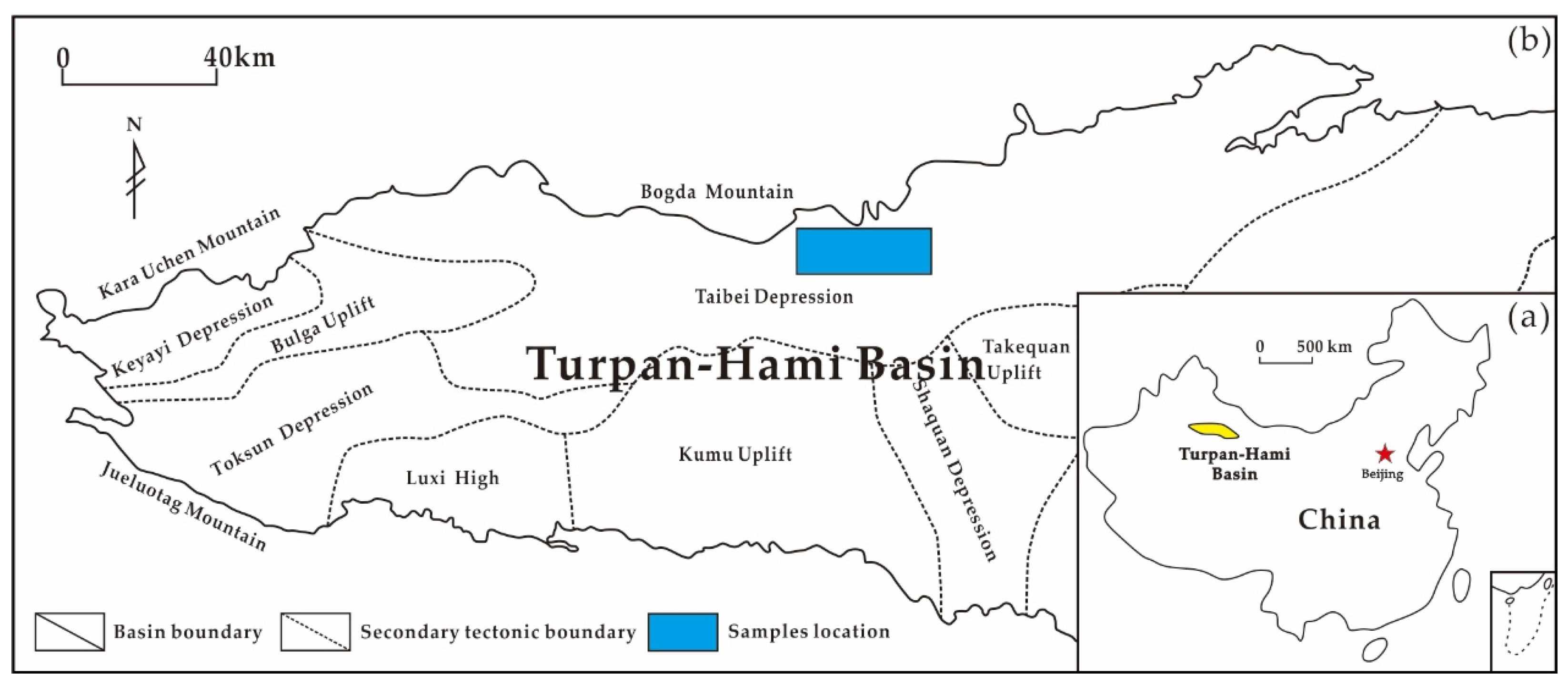
The Turpan-Hami Basin, a major petroliferous basin in Northwest China (Figure 1a), is characterized by the superposition of Meso-Cenozoic continental sequences upon Paleozoic fold basements [22]. The basin is an east–west oriented narrow intermontane basin, covering an area of approximately 5.35 ×   10 4   k m 2 (Figure 1b) [23]. For a detailed geological setting and stratigraphic framework of the study area, the reader is referred to Wang et al. (2024) [24].
Five cylindrical core plug samples (2.5 cm in diameter and 5.0 cm in length) for this study were collected from Wells B5, A27, A33, A35, and A207 in northern Turpan-Hami Basin. All samples are from the Jurassic Sangonghe Formation, with burial depths ranging from 2792 to 4395 m. Before testing, all core plugs were washed with dichloromethane and distilled water to remove residual oil and subsequently dried under vacuum at a temperature of 110 °C for 48 h. Each core plug was further cut into four parts with approximate lengths of 0.5, 0.5, 1.0, and 3.0 cm. Two parts with lengths of 0.5 cm were used for CTS and SEM observations. The remaining parts with lengths of 1.0 and 3.0 cm were analyzed for physical properties and then used for CRMI and HPMI experiments, respectively. In addition, powder samples (3–5 g) from each core plug were prepared for X-ray diffraction (XRD) analysis. All experiments were conducted at the National Key Laboratory of Continental Shale Oil, Northeast Petroleum University.

2.2. Experimental Methodology

2.2.1. CTS and SEM

The samples were grinded down to thin sections with a thickness of 0.03 mm and then impregnated with red epoxy resin. The CTSs were then observed using a Zeiss Axio Imager Z1 polarizing microscope (Göttingen, Germany) to determine mineral compositions, pore types, and pore space, following the Chinese Oil and Gas Industry Standard (SY/T 5368-2016 [25]). Before SEM observation, cubic samples with side lengths of 0.1 cm were coated with gold to enhance conductivity [12]. After that, a Zeiss EVO MA 15 scanning electron microscope (Göttingen, Germany) was used to observe pore morphology and cement characteristics that cannot be clearly detected by CTS owing to resolution limitation, following the Chinese Oil and Gas Industry Standard (SY/T 5162-2021 [26]).

2.2.2. Physical Properties

The measurement of porosity and permeability was conducted by a Core Lab PorePDP-200 instrument (automated porosimeter–permeameter, Houston, TX, USA) in accordance with the Chinese National Standard (GB/T 29172-2012 [27]). The porosity was tested by the gas expansion method using helium as a carrier gas. The permeability was measured by the pressure decay method under a confining stress of 1.5 MPa, with Klinkenberg correction applied [1].

2.2.3. XRD

Powder samples were taken, ground into 300 mesh, and smeared on glass slides for XRD analysis. Measurements were carried out using a Bruker D8 Advance A25 X-ray diffractometer (Karlsruhe, Germany) equipped with Cu-K α radiation, following the Chinese Oil and Gas Industry Standard (SY/T 5163-2018 [28]). The X-ray tube was operated at 40 kV and 40 mA, with a scanning range of 3–35° and a scan step of 0.02°. The relative contents of minerals were semi-quantitatively determined by comparing the diffraction spectra of different samples with standard minerals.

2.2.4. HPMI

A Micromeritics AutoPore IV 9500 mercury porosimeter (Norcross, GA, USA) was utilized to conduct the HPMI experiment. The maximum mercury intrusion pressure of the instrument was set at 200 MPa, and the corresponding minimum detectable pore radius was approximately 0.0036 μm. This experiment was performed in accordance with the Chinese National Standard (GB/T 29171-2012 [29]). During the test, mercury intruded into pore space by overcoming capillary pressure until mercury intrusion pressure stabilized, and was subsequently extruded as mercury pressure gradually decreased. Both mercury intrusion and extrusion curves were obtained to characterize pore structure, and pore size distribution was calculated using the following equation proposed by Washburn (1921) [30]:
r = 2 σ cos θ P c
where r is pore radius, μm; σ is interfacial tension, N/m; θ is wetting angle, °; P c is capillary pressure, MPa. Usually, σ was taken as 0.48 N/m and θ as 140° [31].

2.2.5. CRMI

CRMI experiment was carried out using a Core Test ASPE-730 mercury porosimeter (Morgan Hill, CA, USA) following the Daqing Oilfield (PetroChina) Standard (Q/SY DQ1526-2020 [32]). In this method, the mercury injection rate was controlled at 5 × 10⁻⁵ mL/min. Pores and throats were distinguished based on pressure fluctuations during mercury intrusion, with pores identified by sudden decreases and throats by consistent increases in the pressure curve. Pore–throat radius was then calculated using the aforementioned Washburn equation.

2.3. Multifractal Analysis

Multifractal theory has been thoroughly described in previous research works [33]. In this study, the commonly used box-counting method was employed to perform multifractal analysis of pore size distribution obtained from HPMI and CRMI experiments. The data were divided into N ε equal-sized boxes with a scale of ε . For the i -th box, the cumulative porosity or pore volume is denoted as N i ε . Then, the corresponding probability mass function for the i -th box can be expressed as follows:
P i ε = N i ε i = 1 N ε N i ε
For pores with multifractal characteristics, P i ε and ε satisfy the following power law relationship:
P i ε ε a i
where the value of a i depends on the actual position of the i -th box and is referred to as the Lipschitz–Hölde singularity exponent, which reflects the local singularity strength of P i ε .
The number of boxes with the same or similar value of α is denoted as N α ε , and the relationship between N α ε and ε can be expressed as follows:
N α ε ε f α
where f α represents the fractal dimension of subsets with the same or similar value of α , and the plot of f α versus α is referred to as the multifractal spectrum or singularity spectrum.
To determine the multifractal distribution properties, the partition function X q , ε for a given moment order q and box size ε is defined as follows:
X q , ε = i = 1 N ε P i q ε ε r q
where q ranges from to + and, in this study, is taken as an integer within the interval [−10, 10] to reflect the contributions of P i ε . The mass scaling function τ ( q ) can be expressed as follows:
τ q = lim ε 0 log X q , ε log ε = lim ε 0 i = 1 N ε P i q ε log ε
The generalized fractal dimension D q associated with the moment order q can be expressed as follows:
D q = τ q 1 q = 1 q 1 lim ε 0 i = 1 N ε P i q ε log ε , q 1
and
D q = lim ε 0 i = 1 N ε P i ε × log P i ε log ε , q = 1
Following the Legendre transformation, the singularity strength α q and the multifractal spectrum f α associated with parameter q can be expressed as follows:
α q = d τ q d q
and
f α = q α q τ q
Generally, the q ~ D q and α ~ f α functions are used to describe the multifractal characteristics of pore size distribution.

3. Results

3.1. Physical Properties, Mineral Compositions, and Pore Types

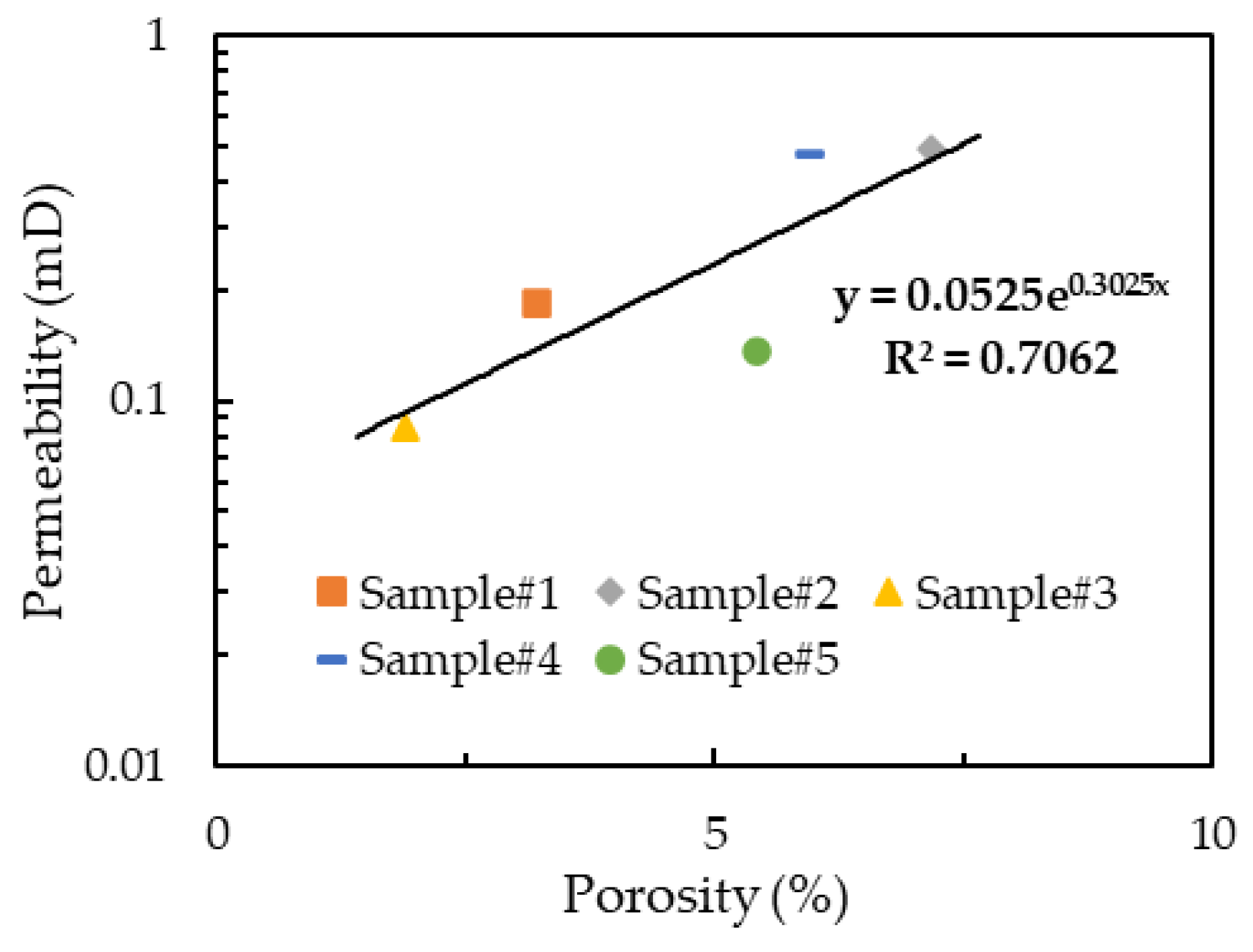
The physical properties and XRD analysis results of the five samples are presented in Table 1. Porosity and permeability measurements indicate that the Sangonghe Formation in the study area is a typical tight sandstone reservoir characterized by very low porosity and ultra-low permeability. The porosity ranges from 1.90% to 7.17%, with an average of 4.73%, and the permeability ranges from 0.085 mD to 0.491 mD, with an average of 0.276 mD. Nevertheless, a moderate correlation ( R 2 = 0.7062) is observed between porosity and permeability (Figure 2), suggesting that porosity has a certain influence on permeability. The mineral compositions of the five samples are dominated by quartz and clay minerals, followed by feldspar and calcite. The quartz content ranges from 42.0% to 57.1%, with an average of 50.7%. The clay mineral content ranges from 18.9% to 39.0%, with an average of 28.5%. The feldspar content ranges from 10.8% to 16.4%, averaging 13.28%, with plagioclase as the main type, accounting for 70–90% of the total. The calcite content varies significantly among the samples, with the highest value (18.9%) observed in Sample #2, compared to 4.0–5.5% (averaging 4.7%) in the other four samples.
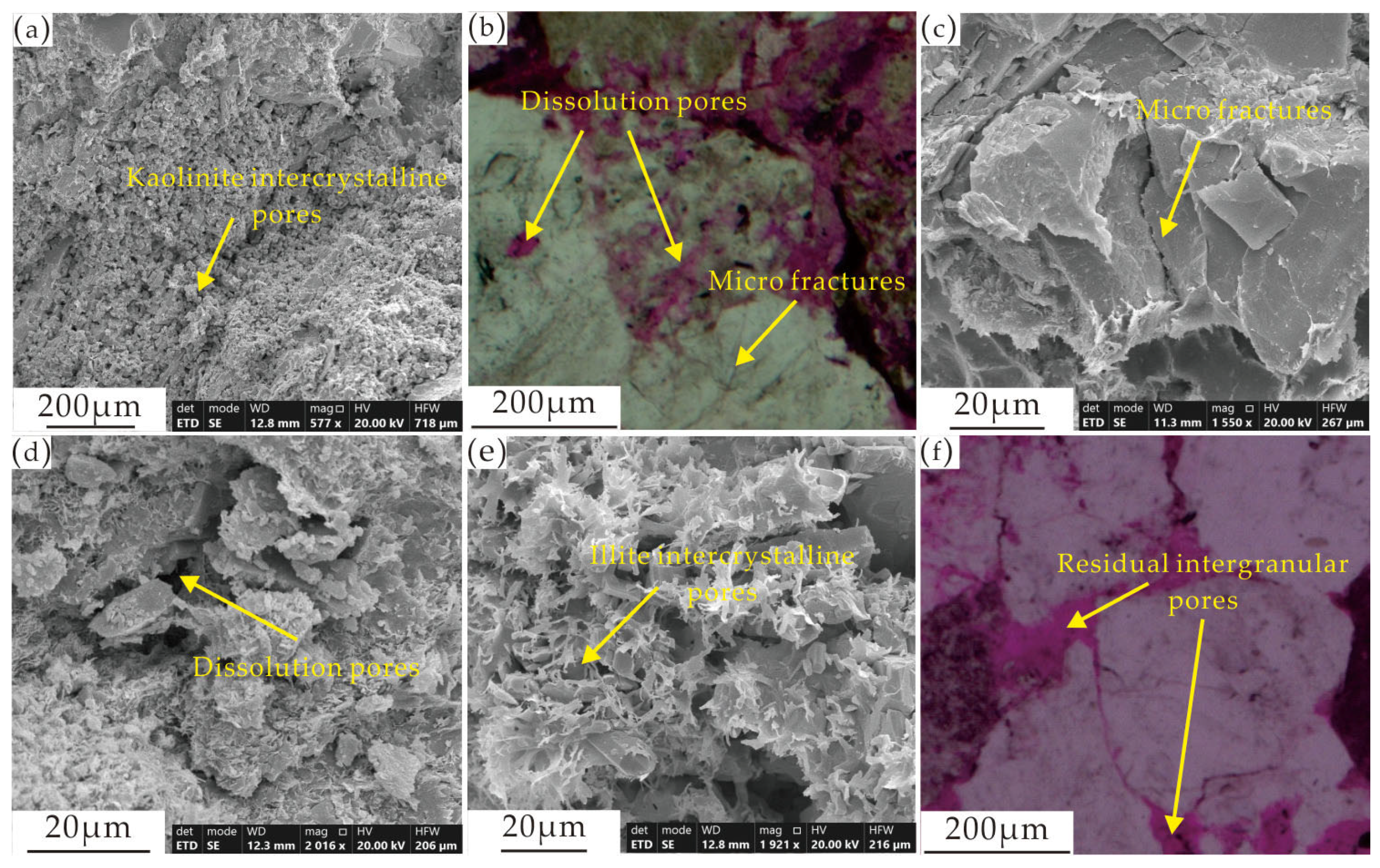
Based on CTS and SEM observation, pore types of the Sangonghe Formation in the study area can be classified into four types: residual intergranular pores, dissolution pores, intercrystalline pores, and microfractures. Residual intergranular pores are primary pores remaining after compaction and cementation, with irregular geometry (Figure 3f). Due to strong compaction during deep burial, the pores are rarely observed, and concave–convex contacts are the dominant particle contact relationship. Dissolution pores are produced by partial to complete dissolution of unstable components, such as feldspars and rock fragments (Figure 3b,d). Intercrystalline pores are mainly micropores developed within clay minerals (e.g., illite and kaolinite), with pore size of generally less than 1 μ m (Figure 3a,e). Microfractures are formed by brittle grain cracking under overlying formation pressure during diagenesis (Figure 3b,c).

3.2. Pore Size Distribution Characteristics

3.2.1. HPMI Results

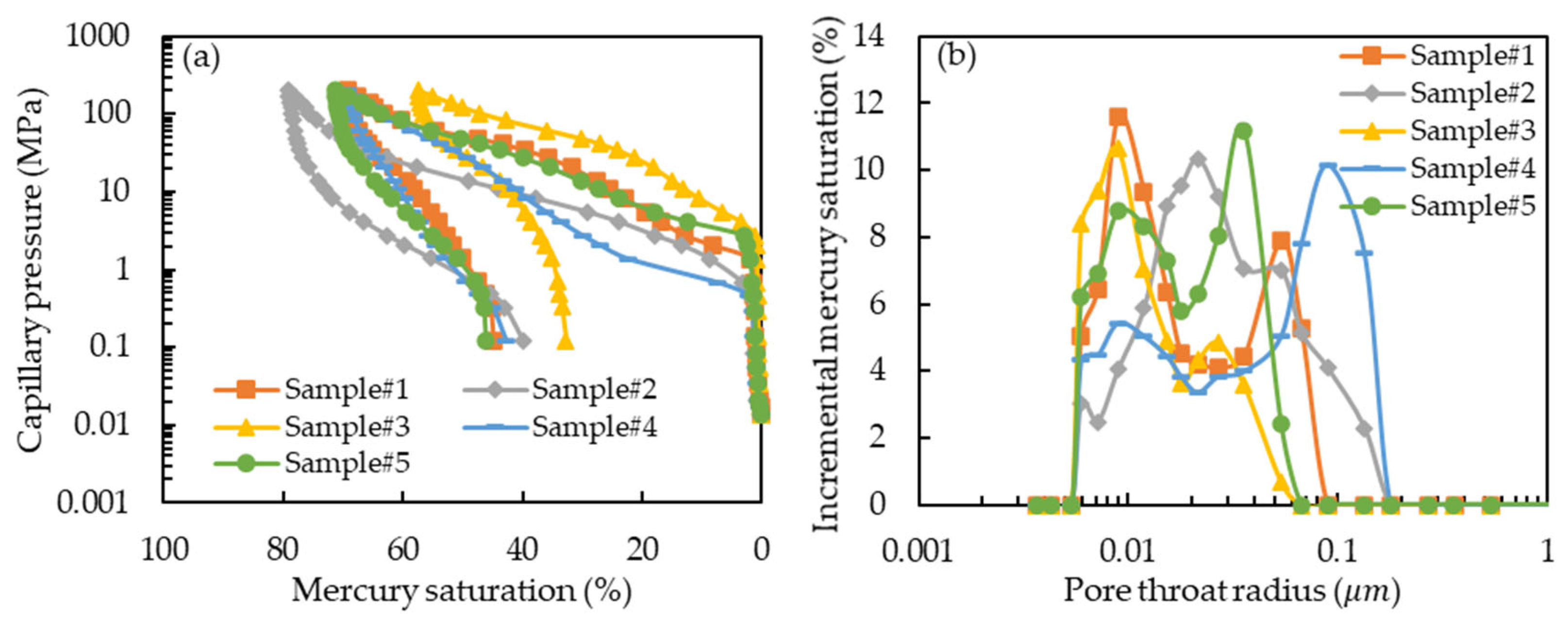
Table 2 and Figure 4a present the capillary pressure curves and pore structure parameters of the five samples measured by HPMI. The threshold pressure ranges from 0.676 MPa to 2.749 MPa, with an average of 1.600 MPa. The maximum mercury saturation ranges from 57.48% to 79.13%, with an average of 69.25%. The sorting coefficient, which quantifies the concentration of pore–throat distribution [34], ranges from 1.791 to 3.392, with an average of 2.373. For Samples #2 and #4 with higher porosity and permeability, the capillary curves show lower threshold pressure but steeper curve slope. In addition, pore size distribution obtained by HPMI indicates that Sample #2 shows unimodal characteristics with a peak distribution of 0.02–0.40 μ m , whereas the other samples show bimodal morphological characteristics, reflecting a more complex pore structure (Figure 4b). Therefore, the heterogeneity of pore structure cannot be evaluated simply based on the HPMI experimental results.

3.2.2. CRMI Results

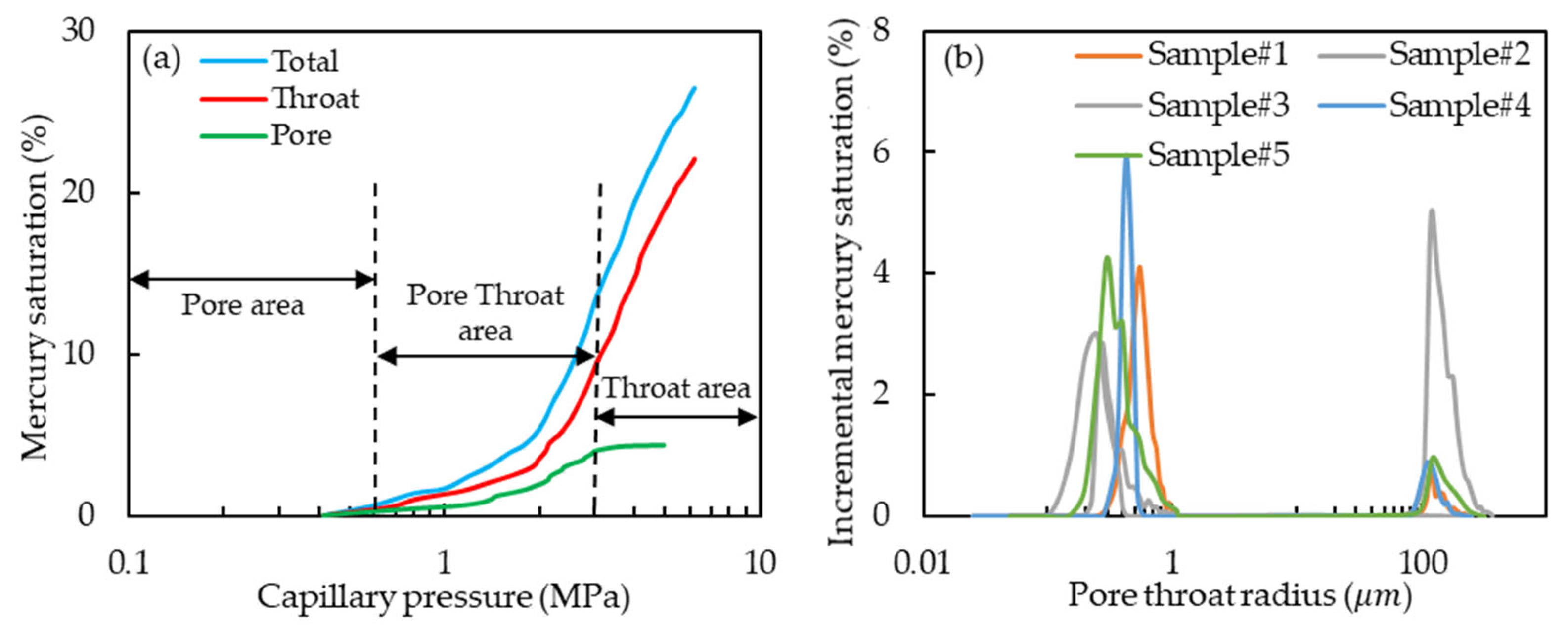
Figure 5a presents the typical capillary pressure curves of Sample #4, including pore, throat, and total capillary pressure curves. During the initial stage of mercury injection, the trend of the total capillary pressure curve follows the pore capillary pressure curve. With increasing pressure, the total capillary pressure curve is gradually controlled by the throat. The pore size distribution of the five samples obtained by CRMI shows bimodal morphological characteristics, with left peaks (throat radius) of 0.16–0.75 μ m and right peaks (pore radius) of 90–240 μ m (Figure 5b). Table 3 displays the pore structure parameters obtained by CRMI. The threshold pressure ranges from 0.489 MPa to 2.516 MPa, with an average of 1.346 MPa. The average pore radius and throat radius are mainly concentrated in the ranges of 116.875–160.163 μ m and 0.295–0.581 μ m , respectively. The maximum mercury saturation varies from 10.659% to 37.044%, which is much lower than that of HPMI due to the limitation of maximum injection pressure. Therefore, the characteristics of nanoscale pore (radius < 0.12 μ m ) are mainly determined by HPMI, while the experimental results of CRMI are more suitable for characterizing larger pores and throats that may be shielded under high mercury injection pressure.

3.2.3. Full-Scale PSD Characteristics

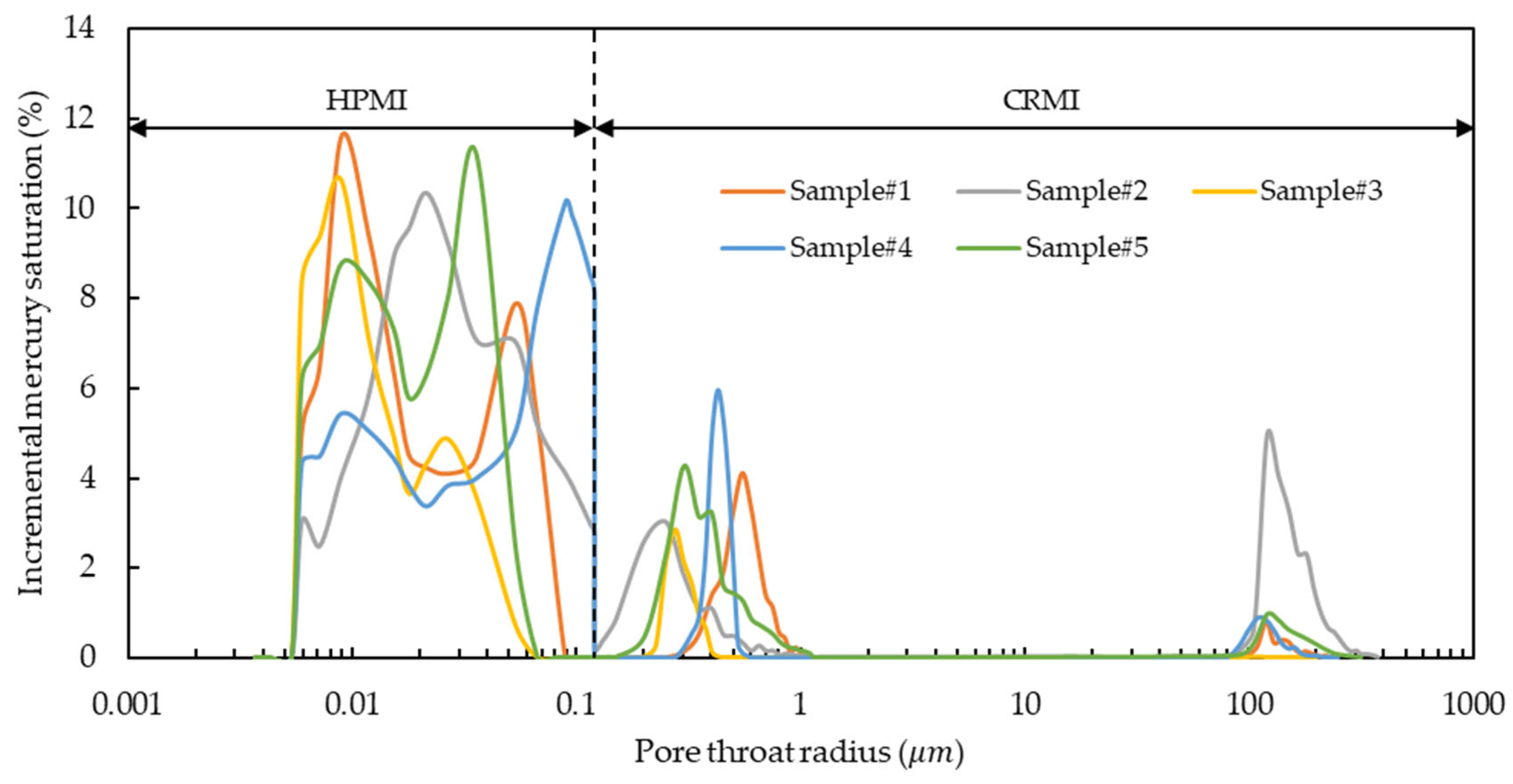
Considering the respective technical features of HPMI and CRMI, an integrated method was proposed to comprehensively determine the full-scale PSD (FPSD) of the tight sandstone samples. By combining the HPMI-derived PSD curve with a radius less than 0.12 μ m and the CRMI-derived PSD curve with a radius larger than 0.12 μ m , the full-scale PSD curves of the five samples were obtained (Figure 6). The distribution of pores is mainly concentrated in the range of 0.00516 μ m –1.15 μ m . The main region of the full-scale PSD curves shows bimodal or trimodal characteristics. Samples #1 and #3 show higher amplitude and narrower pore distribution at the left peak (radius < 0.02 μ m ), suggesting small pore–throat structure with strong heterogeneity and low permeability (0.1862 mD and 0.0852 mD, respectively). Sample #5 shows wider pore distribution but higher amplitude at the right (0.4 μ m   < radius < 0.9 μ m ) and middle peak (0.03 μ m   < radius < 0.08 μ m ), indicating a large pore–throat structure with strong heterogeneity, relatively high porosity (5.433%), but low permeability (0.1369 mD). Sample #4 displays a lower amplitude and broader left (radius < 0.02 μ m ) and middle peak (0.05 μ m   < radius < 0.1 μ m ), indicating a small pore–throat structure with relatively homogeneous and high permeability (0.4791 mD). Sample #2 presents a bimodal pattern dominated by a broad left peak (radius < 0.08 μ m ), reflecting the highest permeability (0.4913 mD).

3.3. Multifractal Characteristics

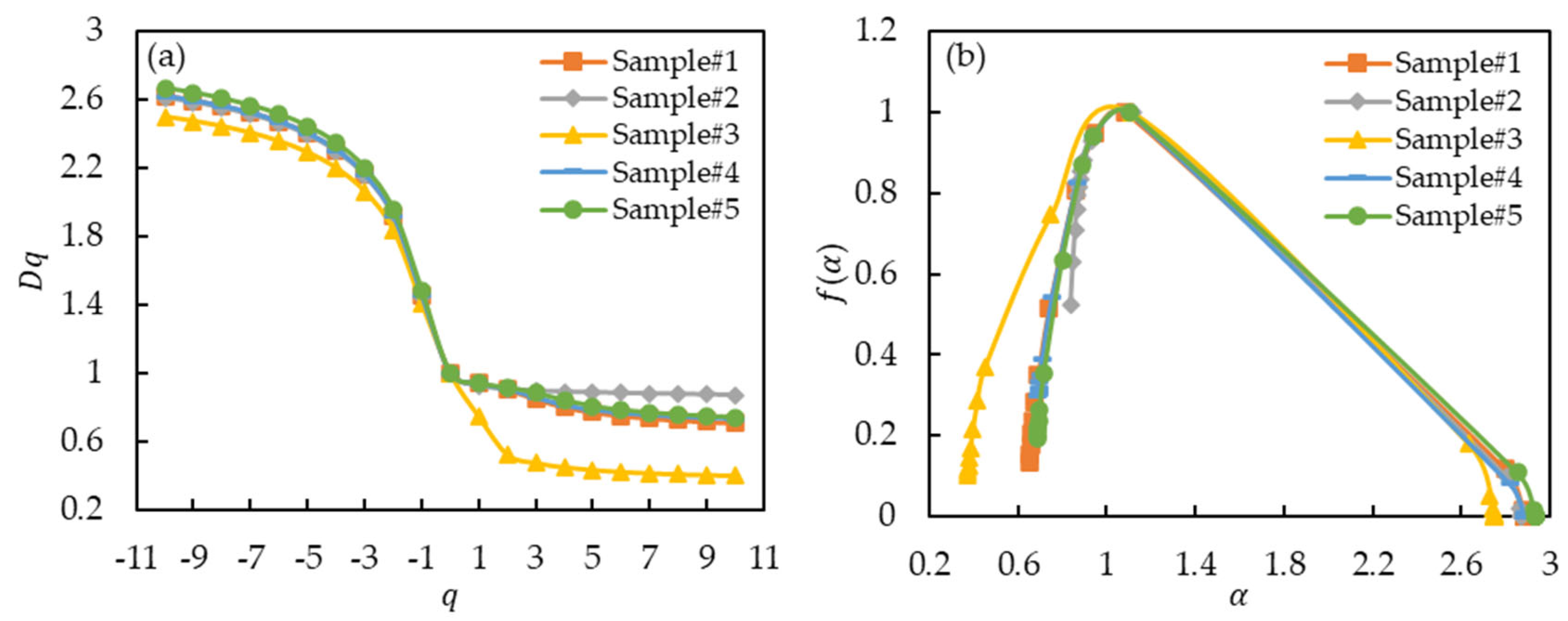
Figure 7a presents the generalized dimension spectrum calculated from the full-scale PSD. For all samples, the curves exhibit an inverted “S” shape, showing a consistent decreasing trend in D q with increasing q . The D q values at q = 0, 1, and 2, that is D 0 , D 1 , and D 2 , are denoted as the capacity dimension, the information dimension, and the correlation dimension, respectively [35]. The data summarized in Table 4 show a hierarchical ordering pattern among all samples, with D 0 > D 1 > D 2 , revealing the multifractal nature of the full-scale PSD [36]. In addition, all samples exhibit the same D 0 value of 1, which reflects the continuous distribution of pore sizes along a one-dimensional domain. D m i n represents the generalized dimension value at the minimum q value ( q = 10 ), and D m a x represents the generalized dimension value at the maximum q value ( q = 10 ). D m i n D m a x represents the width of the generalized dimension spectrum and can be used to quantify the heterogeneity of the full-scale PSD, with a larger width indicating stronger heterogeneity. Among the five samples, the D m i n D m a x values range from 1.74 to 2.18, with an average of 1.97. Compared with the other samples, Samples #1 and #3 exhibit relatively large D m i n D m a x values greater than 2, which also indicates that the pore structure of Samples #1 and #3 is heterogeneous. The multifractal spectrum presented in Figure 7b exhibits an asymmetric concave parabolic shape bounded by a peak at α 0 , f α 0 , further confirming the multifractal nature of the full-scale PSD. To the left of the peak, corresponding to q < 0 , the f α increases with increasing α , whereas to the right of the peak, corresponding to q > 0 , the f α decreases with increasing α . α m a x represents the maximum singularity strength at q = 10 , and α m i n represents the minimum singularity strength at q = 10 . Similar to the generalized dimension spectrum, α = α m a x α m i n represents the width of the multifractal spectrum and can be employed to determine the complexity of pore structure, with larger α indicating more heterogeneous full-scale PSD. In addition, α 0 α m i n represents the width of the left branch, corresponding to the heterogeneity of high-probability regions and mainly associated with nanoscale pores, while α m a x α 0 represents the width of the right branch, corresponding to the heterogeneity of low-probability regions and mainly associated with larger pores [37]. Generally, R d = α 0 α m i n α m a x α 0 represents the difference between the left and right spectral width, which can be used to quantify the deviation degree of the f α spectrum from the central symmetry line. Furthermore, a lower R d value corresponds to a more pronounced left-skewed spectrum, indicating that the multifractal characterization is dominated by high-probability regions. The calculated characteristic parameters of multifractal spectrum are presented in Table 4. The R d values of all samples are less than 0, indicating that the f α spectra are left-skewed. This further confirms that nanoscale pores have a more important influence on the heterogeneity of the full-scale PSD.
Overall, several multifractal parameters can be employed to quantitatively characterize the heterogeneity of the full-scale PSD. Among them, D m i n D m a x and R d exhibit sensitive inter-sample responses and are therefore selected as key multifractal parameters for further discussion in the following sections.

4. Discussion

It should be noted that the limited number of samples may introduce uncertainty in statistical robustness; nevertheless, the observed trends are internally consistent with pore-scale observations and previous studies.

4.1. Relationship Between Multifractal Parameters and Percolation Capacity

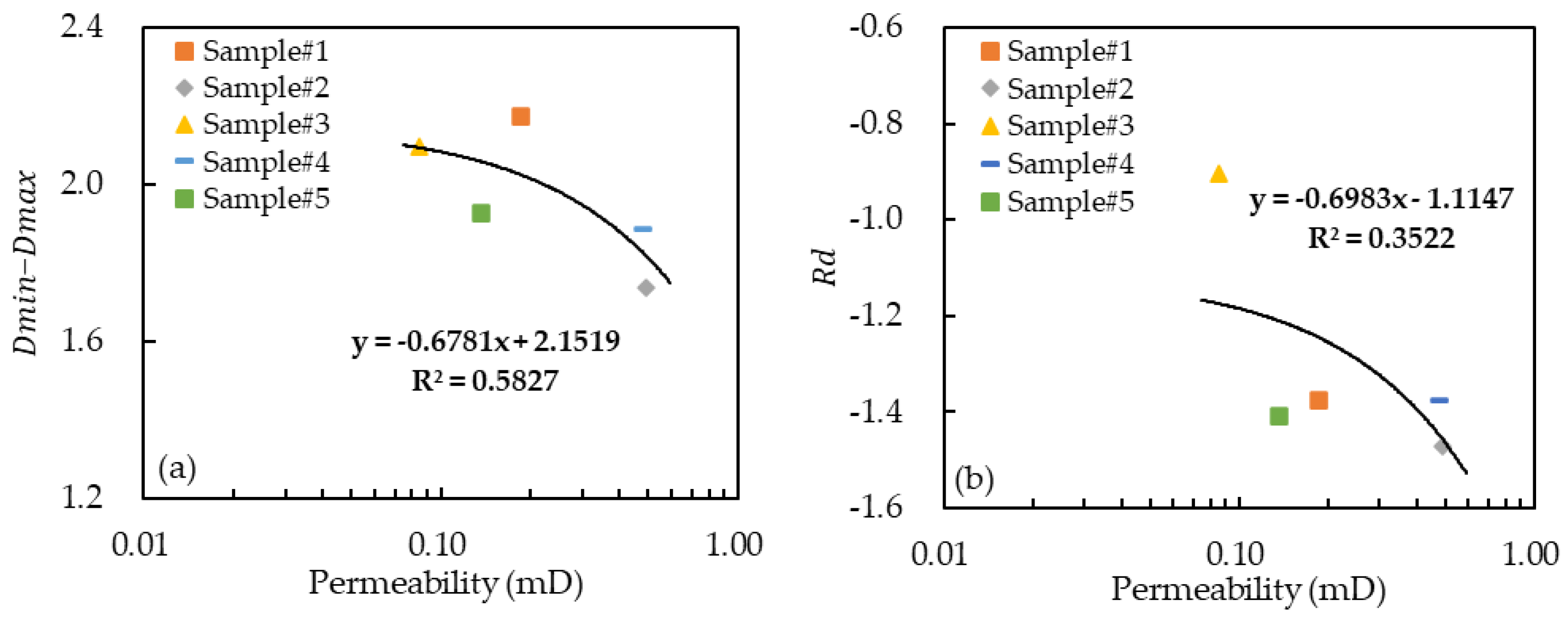
Percolation capacity has always been a primary focus in the study of tight sandstone reservoirs, and permeability is regarded as a crucial criterion for this capacity [1,3]. The data presented in Figure 8a clearly demonstrate a negative correlation between D m i n D m a x and permeability, indicating that the heterogeneity of percolation capacity can be effectively described by the generalized dimension spectrum. Similarly, R d exhibits a negative correlation with permeability (Figure 8b), implying that the heterogeneity of percolation capacity is predominantly controlled by relatively smaller pores corresponding to high-probability parameters. This behavior can be mainly ascribed to the pore–throat configuration relationship. Fluid flow in tight sandstone reservoirs is mainly governed by a limited number of relatively homogenous and well-connected pore–throat systems. As the heterogeneity of pore–throat configuration relationship increases, the contribution of these effective flow pathways is progressively reduced, leading to poorer percolation capacity, which is reflected by lower R d values.

4.2. Relationship Between Multifractal Parameters and Mineral Compositions

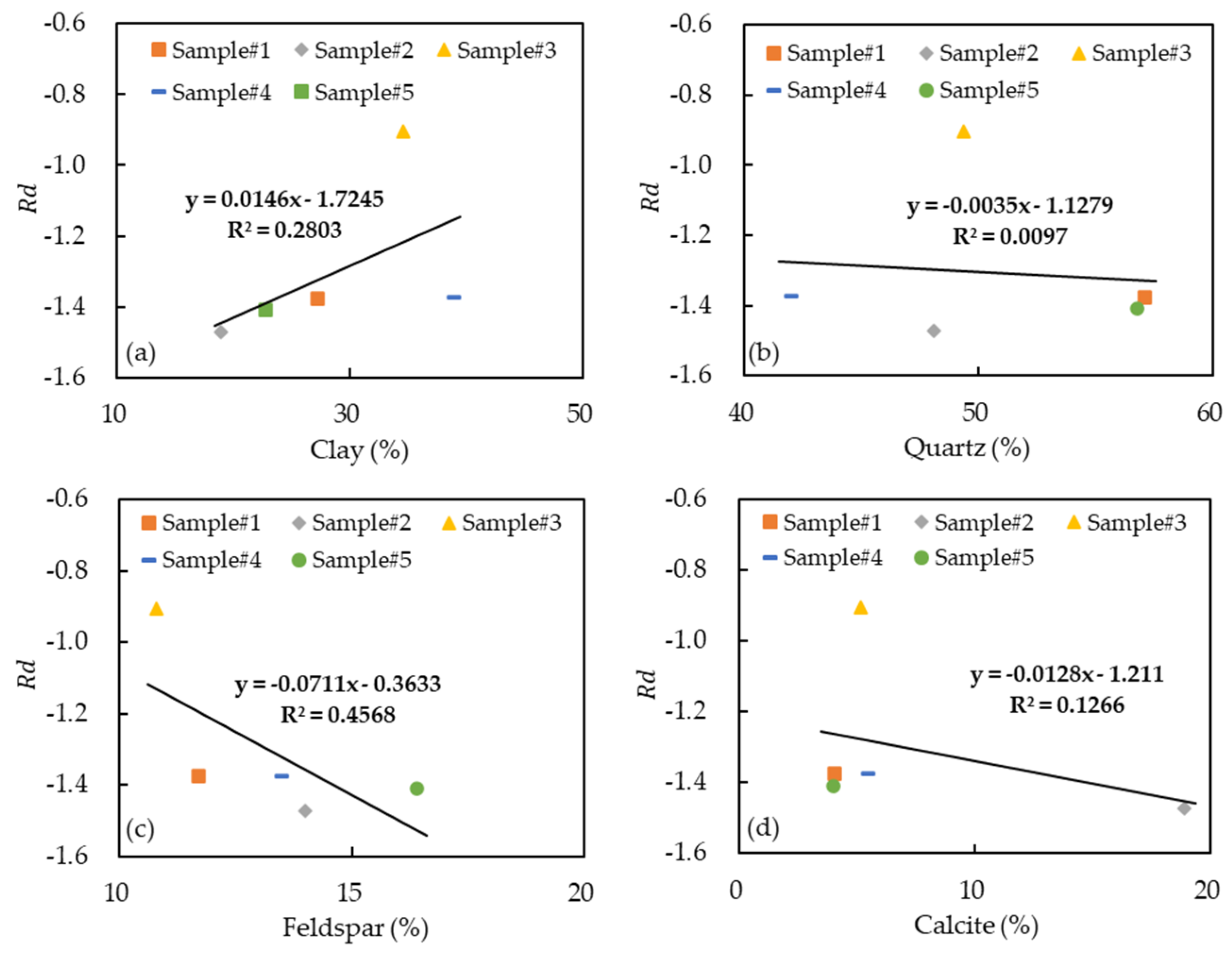
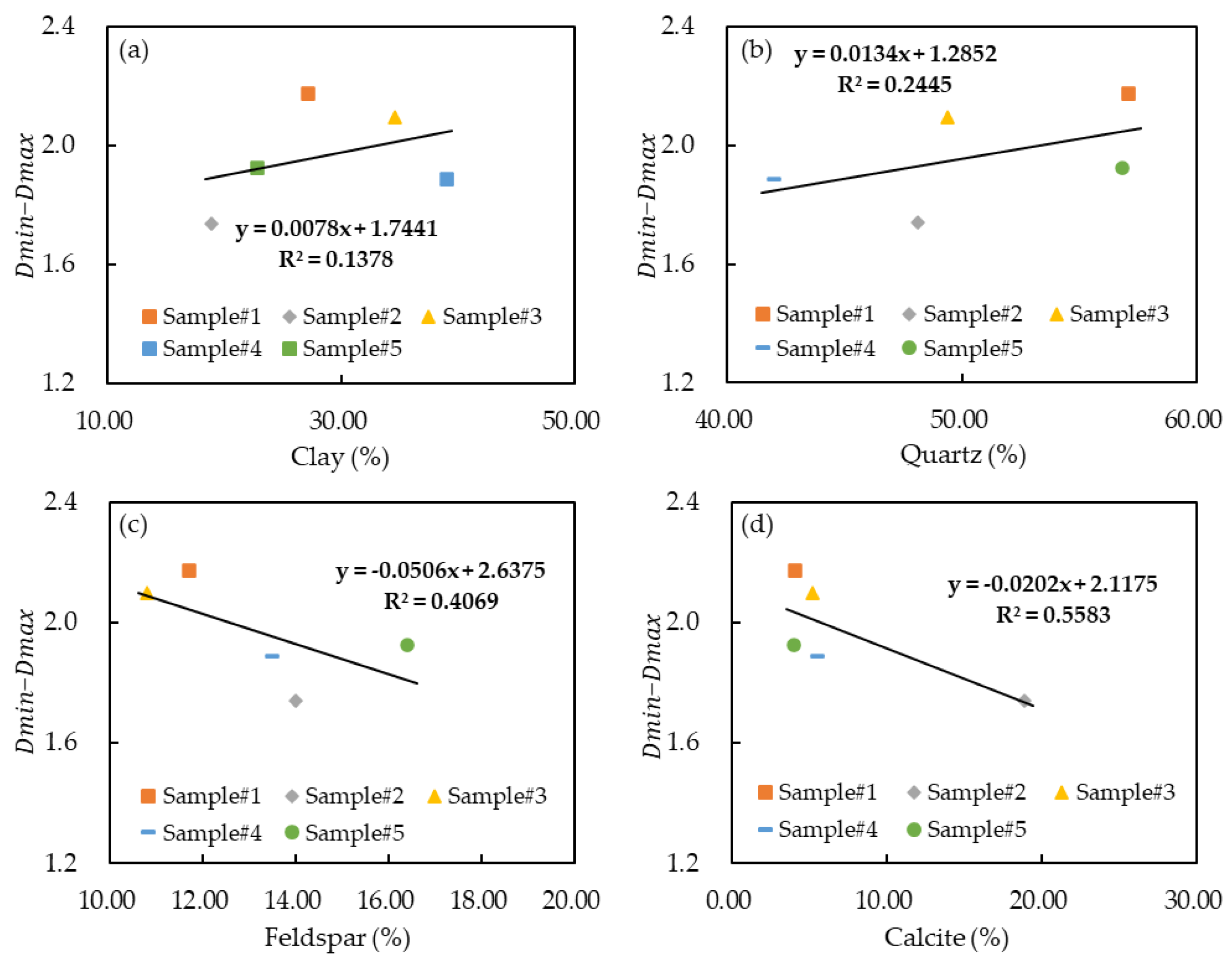
To comprehensively evaluate the effect of mineral compositions on the heterogeneity of tight sandstone in the study area, the relationship between D m i n D m a x and R d versus clay, quartz, feldspar, and calcite contents are plotted in Figure 9 and Figure 10. D m i n D m a x shows a positive correlation with clay mineral content (Figure 9a), which can be ascribed to the development of intercrystalline pores within clay minerals. In addition, clay minerals can fill dissolution pores and residual intergranular pores, further enhance heterogeneity, and worsen pore space. Accordingly, these effects also explain the positive correlation between R d and clay mineral content (Figure 10a). Both D m i n D m a x and R d exhibit weak correlations with quartz content (Figure 9b and Figure 10b), which is mainly due to the fact that while quartz has a strong ability to resist compaction and stabilize rock framework, its influence on the heterogeneity of pore structure may remain limited under the complex diagenetic processes during deep burial in the study area. Nevertheless, negative correlations are observed between D m i n D m a x and feldspar content, as well as between R d and quartz content. This trend can be attributed to feldspar dissolution; this process not only generates dissolution pores and enhances heterogeneity but also results in a clear decline in overall feldspar content. Excluding Sample #2 with abnormally high calcite content, no clear correlation is observed between the multifractal parameters and calcite content (Figure 9d and Figure 10d). Calcite tends to occupy pore space and reduce pore connectivity; however, it may be partially dissolved during later burial stages. Thereby, its content has no meaningful influence on heterogeneity or homogeneity.

4.3. Relationship Between Multifractal Parameters and Pore Structure

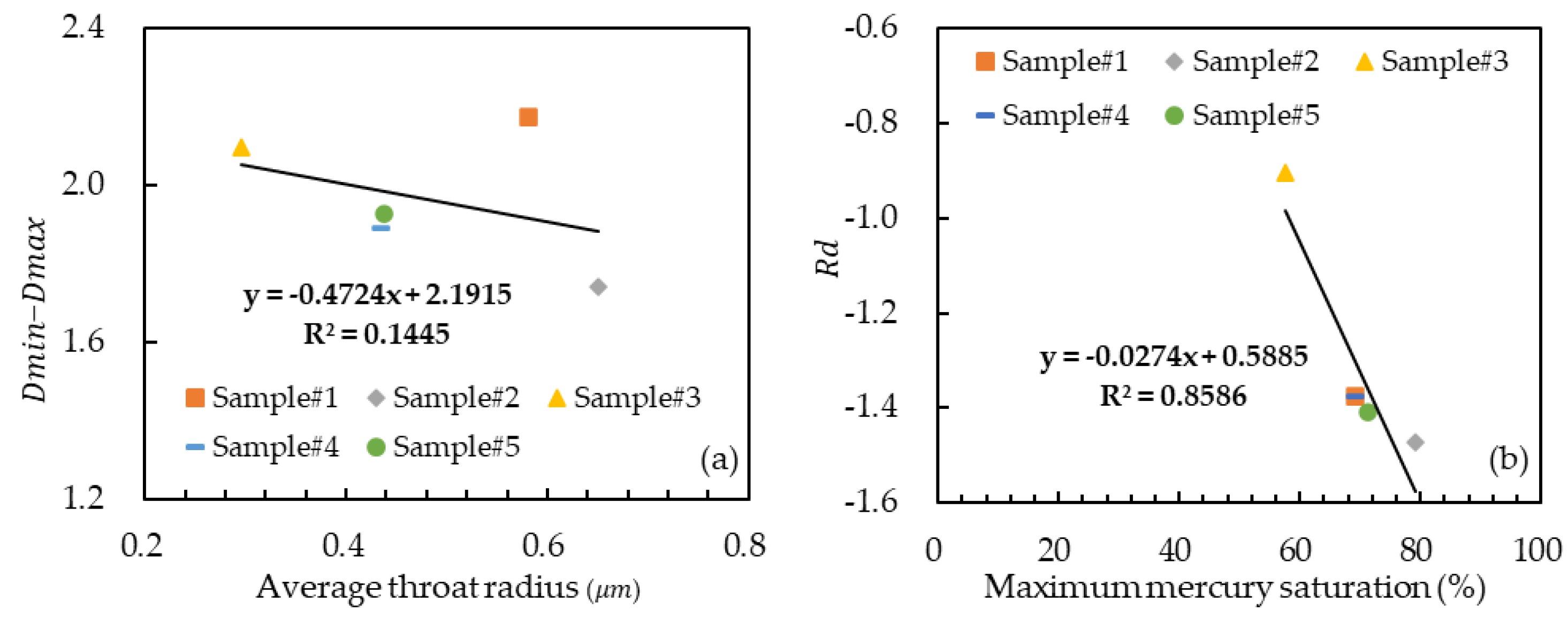
Given the pronounced heterogeneity of pore structure in tight sandstone samples and the shielding effect of throat on pore, the average throat radius can better determine the overall characteristics of pore structure. As shown in Figure 11a, the correlation between D m i n D m a x and average throat radius indicates that the heterogeneity of pore structure decreases with increasing average throat radius. This finding is in agreement with previous studies on pore structure using a single fractal dimension [2,12].
The negative correlation between R d and maximum mercury saturation is illustrated in Figure 11b. R d decreases with increasing maximum mercury saturation, suggesting increasing dominance of nanoscale pores within pore structure. Although the favorable pore–throat configuration relationship enhances the storage capacity of tight sandstone reservoirs, the heterogeneity of pore structure may remain strong due to the presence of small throats, as discussed above.

5. Conclusions

Tight sandstone samples from the Jurassic Sangonghe Formation in the northern Turpan-Hami Basin were examined by conducting physical property tests, XRD, CTS, SEM, HPMI, and CRMI. The following conclusions were obtained:
(1) The porosity of these samples ranged from 1.90% to 7.17% with an average of 4.73%, whereas the permeability ranged from 0.085 mD to 0.491 mD with an average of 0.276 mD. Pore types include residual intergranular pores, dissolution pores, intercrystalline pores, and microfractures, reflecting complex diagenetic modification during deep burial.
(2) Full-scale pore size distribution (FPSD) obtained by integrating HPMI and CRMI was widely distributed between 0.00516 μ m and 1.15 μ m with a bimodal or trimodal pattern, which was in good agreement with the physical properties.
(3) Multifractal characteristics of the FPSD were analyzed, and the hierarchical ordering pattern of the generalized dimensions ( D 0 > D 1 > D 2 ) indicated the multifractal nature of pore structure among tight sandstone samples. The left–right difference in the multifractal spectra width R d values of all samples were negative, revealing that the heterogeneity of the FPSD was dominated by nanoscale pores.
(4) D m i n D m a x and R d showed negative correlations with permeability, average throat radius, and maximum mercury saturation. Clay mineral and feldspar content had an obvious influence on the multifractal parameters, whereas quartz and calcite exhibited weak correlations.

Author Contributions

Writing—original draft, methodology, investigation, visualization, J.H.; writing—review & editing, supervision, Z.L.; data curation, B.H.; formal analysis, Z.D. All authors have read and agreed to the published version of the manuscript.

Funding

This research was funded by Heilongjiang Provincial Department of Education basic research expenses, grant number 2024YSKYFX-01.

Data Availability Statement

All data generated or analyzed during this study are included in this published article.

Acknowledgments

Special thanks go to Leng Huang for her dedicated support in manuscript preparation and typesetting.

Conflicts of Interest

Author Bin Hao was employed by the company Northwest Branch, PetroChina Research Institute of Petroleum Exploration and Development. Author Zhiwen Dong was employed by the company Offshore Oil Production Plant Sinopec Shengli Oilfield Branch. The remaining authors declare that the research was conducted in the absence of any commercial or financial relationships that could be construed as a potential conflict of interest.

References

  1. Qiao, J.; Zeng, J.; Jiang, S.; Ma, Y.; Feng, S.; Xie, H.; Wang, Y.; Hu, H. Role of pore structure in the percolation and storage capacities of deeply buried sandstone reservoirs: A case study of the Junggar Basin, China. Mar. Pet. Geol. 2020, 113, 104129. [Google Scholar] [CrossRef]
  2. Qu, Y.; Sun, W.; Tao, R.; Luo, B.; Chen, L.; Ren, D. Pore–throat structure and fractal characteristics of tight sandstones in Yanchang Formation, Ordos Basin. Mar. Pet. Geol. 2020, 120, 104573. [Google Scholar] [CrossRef]
  3. Han, Y.; Jiang, Z.; Liang, Z.; Lai, Z.; Wu, Y.; Shi, X.; Duan, X.; Zhang, Y.; Li, Y. Study on the multifractal characterization and seepage of the shale matrix: A case study of the Longmaxi Formation in southwestern Sichuan Basin, China. Geoenergy Sci. Eng. 2024, 238, 212924. [Google Scholar] [CrossRef]
  4. Zhao, P.; Wang, Z.; Sun, Z.; Cai, J.; Wang, L. Investigation on the pore structure and multifractal characteristics of tight oil reservoirs using NMR measurements: Permian Lucaogou Formation in Jimusaer Sag, Junggar Basin. Mar. Pet. Geol. 2017, 86, 1067–1081. [Google Scholar] [CrossRef]
  5. Li, P.; Shen, B.J.; Liu, Y.L.; Bi, H.; Liu, Z.B.; Bian, R.K.; Wang, P.-W.; Li, P. The fractal characteristics of the pore throat structure of tight sandstone and its influence on oil content: A case study of the Chang 7 Member of the Ordos Basin, China. Pet. Sci. 2025, 22, 2262–2273. [Google Scholar] [CrossRef]
  6. Mao, G.; Lai, F.; Li, Z.; Wei, H.; Zhou, A. Characteristics of pore structure of tight gas reservoir and its influence on fluid distribution during fracturing. J. Pet. Sci. Eng. 2020, 193, 107360. [Google Scholar] [CrossRef]
  7. Yang, Y.B.; Xiao, W.L.; Zheng, L.L.; Lei, Q.H.; Qin, C.Z.; He, Y.A.; Liu, S.-S.; Li, M.; Li, Y.-M.; Zhao, J.-Z.; et al. Pore throat structure heterogeneity and its effect on gas-phase seepage capacity in tight sandstone reservoirs: A case study from the Triassic Yanchang Formation, Ordos Basin. Pet. Sci. 2023, 20, 2892–2907. [Google Scholar] [CrossRef]
  8. Qiao, J.; Zeng, J.; Chen, D.; Cai, J.; Jiang, S.; Xiao, E.; Zhang, Y.; Feng, X.; Feng, S. Permeability estimation of tight sandstone from pore structure characterization. Mar. Pet. Geol. 2022, 135, 105382. [Google Scholar] [CrossRef]
  9. Cui, Z.C.; Xi, K.L.; Cao, Y.C.; Shan, X.; Huang, W.K.; Guo, H.J.; Peng, B.; Zan, N.M. Feldspar dissolution controlled by coal-measure fluids and the impacts on pore structure of tight sandstone reservoirs: The case of the Jurassic Badaowan Formation in the Junggar Basin, Northwestern China. Mar. Pet. Geol. 2025, 178, 107419. [Google Scholar] [CrossRef]
  10. Zhang, Q.; Liu, Y.; Wang, B.; Ruan, J.; Yan, N.; Chen, H.; Wang, Q.; Jia, G.; Wang, R.; Liu, H.; et al. Effects of pore-throat structures on the fluid mobility in chang 7 tight sandstone reservoirs of longdong area, Ordos Basin. Mar. Pet. Geol. 2020, 135, 105407. [Google Scholar] [CrossRef]
  11. Liu, J.; Zhang, C.; Jiang, Y.; Hou, S. Investigation on pore structure characteristics of ultra-tight sandstone reservoirs in the upper Triassic Xujiahe Formation of the northern Sichuan Basin, China. Mar. Pet. Geol. 2022, 138, 105552. [Google Scholar] [CrossRef]
  12. Wu, Y.; Liu, C.; Ouyang, S.; Luo, B.; Zhao, D.; Sun, W.; Awan, R.S.; Lu, Z.; Li, G.; Zang, Q. Investigation of pore-throat structure and fractal characteristics of tight sandstones using HPMI, CRMI, and NMR methods: A case study of the lower Shihezi Formation in the Sulige area, Ordos Basin. J. Pet. Sci. Eng. 2022, 210, 110053. [Google Scholar] [CrossRef]
  13. Wang, Z.; Liu, Y.; Lu, S.; Lin, L.; Zhou, N.; Liu, Y. Differential development characteristics of secondary pores and effects on pore structure and movable fluid distribution in tight gas sandstones in the lower Permian, northeastern Ordos Basin, China. Geoenergy Sci. Eng. 2023, 224, 211580. [Google Scholar] [CrossRef]
  14. Zhou, Y.; Han, G.; Liu, Y.; Mou, L.; Wang, K.; Yang, P.; Yan, K. Fractal Characteristics and Controlling Factors of Pore-Throat Structure in Tight Sandstone Reservoirs: A Case Study of the 2nd Member of the Kongdian Formation in the Nanpi Slope, Cangdong Sag, Bohai Bay Basin. Fractal Fract. 2025, 9, 608. [Google Scholar] [CrossRef]
  15. Mandelbrot, B.B. Multifractal measures, especially for the geophysicist. Pure Appl. Geophys. 1989, 131, 5–42. [Google Scholar] [CrossRef]
  16. Sun, J.; Xiao, X.; Cheng, P. Influence of water on shale pore heterogeneity and the implications for shale gas-bearing property—A case study of marine Longmaxi Formation shale in northern Guizhou. Mar. Pet. Geol. 2021, 134, 105379. [Google Scholar] [CrossRef]
  17. Wu, F.; Li, Y.; Burnham, B.; Zhang, Z.; Yao, C.; Yuan, L.; Zhang, F.; Deng, H.; Xi, Y.; He, J. Fractal-based NMR permeability estimation in tight sandstone: A case study of the Jurassic rocks in the Sichuan Basin, China. J. Pet. Sci. Eng. 2022, 218, 110940. [Google Scholar] [CrossRef]
  18. Zhao, H.; Chang, X.; Ge, T.; Zeng, Z.; Zhang, J.; Ming, D.; Han, R. Application of fractal model in the jurassic tight sandstone reservoirs of central Junggar basin as constrained by mercury ejection curves. Energy Geosci. 2025, 6, 100360. [Google Scholar] [CrossRef]
  19. Zhou, Y.; Xu, J.; Lan, Y.; Zi, H.; Cui, Y.; Chen, Q.; You, L.; Fan, X.; Wang, G. New insights into pore fractal dimension from mercury injection capillary pressure in tight sandstone. Geoenergy Sci. Eng. 2023, 228, 212059. [Google Scholar] [CrossRef]
  20. Zhong, X.; Liu, L.; Wang, H.; Xu, Z.; Chen, H.; Wang, X.; Zhu, Y. Characteristics and origins of the modal pore throat structure in weakly cemented sandy conglomerate reservoirs. J. Pet. Sci. Eng. 2022, 208, 109470. [Google Scholar] [CrossRef]
  21. Zhou, Y.; Wu, S.T.; Zhu, R.K.; Jiang, X.H.; Hua, G.L. A novel intermingled fractal model for predicting relative permeability in tight oil reservoirs considering microscopic pore geometry. Pet. Sci. 2025, 22, 3880–3899. [Google Scholar] [CrossRef]
  22. Lin, T.; Chen, X.; Yang, F.; Gou, H.; Liu, M.; Yang, R. Reservoir characteristics and controlling factor of tight sandstone in Shuixigou Group in Taibei depression, Turpan-Hami basin. Energy Geosci. 2024, 5, 100258. [Google Scholar] [CrossRef]
  23. Zhang, Y.; Qu, X.; Chen, X.; Zhang, H.; Wang, W.; Miao, C. Influence of coal rock on tight sandstone reservoirs in coal seam roofs: A case study of the lower jurassic in the Taibei sag, Turpan-Hami Basin, China. Mar. Pet. Geol. 2024, 165, 106887. [Google Scholar] [CrossRef]
  24. Wang, B.; Huang, Z.; Xiao, D.; Yu, H.; Zeng, W.; Wang, X.; Qu, T.; Li, Z.; Yang, Y. Generation and expulsion of Lower Jurassic hydrocarbon in different source rocks in the Taibei Sag, Turpan-Hami Basin, northwest China. J. Asian Earth Sci. 2024, 259, 105911. [Google Scholar] [CrossRef]
  25. SY/T 5368-2016; Identification for Thin Section of Rocks. National Energy Administration: Beijing, China, 2016.
  26. SY/T 5162-2021; Scanning Electron Microscope Analysis Method of Rock Samples. Petroleum Industry Standard: Beijing, China, 2021.
  27. GB/T 29172-2012; Practices for Core Analysis. Chinese Standard: Beijing, China, 2012.
  28. SY/T 5163-2018; Analysis Method for Clay Minerals and Ordinary Non-Clay Minerals in Sedimentary Rocks by the X-Ray Diffraction. National Energy Administration: Beijing, China, 2018.
  29. GB/T 29171-2012; Rock Capillary Pressure Measurement. Standardization Administration of China: Beijing, China, 2013.
  30. Washburn, E.W. The dynamics of capillary flow. Phys. Rev. 1921, 17, 273. [Google Scholar] [CrossRef]
  31. Sun, X.; Guo, Q.; Wang, Y.; Xu, C.; Zhang, Z. Insights into Pore–Throat Fractal Characteristics and Shale-Oil Mobilization by HTHP Imbibition in Lacustrine Calcareous Shale. Fractal Fract. 2026, 10, 156. [Google Scholar] [CrossRef]
  32. Q/SY DQ1526-2020; Technical Specifications for Geologic Design of Oil and Gas Field Development Drilling. Daqing Oilfield Company Limited: Daqing, China, 2020.
  33. Ferreiro, J.P.; Miranda, J.; Vázquez, E.V. Multifractal analysis of soil porosity based on mercury injection and nitrogen adsorption. Vadose Zone J. 2010, 9, 325–335. [Google Scholar] [CrossRef]
  34. Zhang, H.; Wang, C.; Sui, J.; Lv, Y.; Guo, L.; Wu, Z. Pore-Throat Structure, Fractal Characteristics, and Main Controlling Factors in Extremely Low-Permeability Sandstone Reservoirs: The Case of Chang 3 Section in Huachi Area, Ordos Basin. Fractal Fract. 2025, 9, 439. [Google Scholar] [CrossRef]
  35. Tong, Z.; Zhang, J.; Li, Z.; Wu, Y.; Wang, D.; Gong, D. Investigation of organic-shale nanopores in the Lower Cambrian Niutitang Formation using low temperature N2 and CO2 adsorption: Multifractality and classification. Microporous Mesoporous Mater. 2022, 337, 111935. [Google Scholar] [CrossRef]
  36. Zheng, S.; Yao, Y.; Liu, D.; Cai, Y.; Liu, Y.; Li, X. Nuclear magnetic resonance T2 cutoffs of coals: A novel method by multifractal analysis theory. Fuel 2019, 241, 715–724. [Google Scholar] [CrossRef]
  37. Yang, Z.; Chen, D.; Tang, X.; Wang, Y.; Jiang, Z.; Huang, L.; Yang, L.; Gao, Z. Oil-bearing evaluation of different shale lithofacies utilizing integrated optimization regression model and multifractal dimension: The Fengcheng Formation in Mahu Sag, China. Fuel 2026, 404, 136353. [Google Scholar] [CrossRef]
Figure 1. (a) Geographical location of the Turpan-Hami Basin in China (modified after Wu et al., 2022) [12]. (b) Geographical location of the study area in the Turpan-Hami Basin (blue rectangle).
Fractalfract 10 00259 g001
Figure 2. Relationship between porosity and permeability.
Fractalfract 10 00259 g002
Figure 3. CTS and SEM images showing the pore types: (a) kaolinite intercrystalline pores, Sample #1, SEM; (b) dissolution pores and microfractures, Sample #1, CTS; (c) microfractures, Sample #3, SEM; (d) dissolution pores, Sample #4, SEM; (e) illite intercrystalline pores, Sample #5, SEM; (f) residual intergranular pores, Sample #2, CTS.
Fractalfract 10 00259 g003
Figure 4. Experimental results of HPMI measurement. (a) Capillary pressure curves of 5 samples. (b) Pore size distribution of 5 samples.
Fractalfract 10 00259 g004
Figure 5. Experimental results of CRMI measurement. (a) Typical capillary pressure curves of Sample #5. (b) Pore size distribution of 5 samples.
Fractalfract 10 00259 g005
Figure 6. Full-scale PSD based on the integration of HPMI and CRMI.
Fractalfract 10 00259 g006
Figure 7. Multifractal characteristics of full-scale PSD of five samples. (a) Generalized dimension spectrum; (b) multifractal spectrum.
Fractalfract 10 00259 g007
Figure 8. Relationship between multifractal parameters and permeability. (a) D m i n D m a x versus permeability; (b) R d versus permeability.
Fractalfract 10 00259 g008
Figure 9. Relationship between D m i n D m a x and mineral content: quartz (a), feldspar (b), clay (c), and calcite (d).
Fractalfract 10 00259 g009
Figure 10. Relationship between R d and mineral content: quartz (a), feldspar (b), clay (c), and calcite (d).
Fractalfract 10 00259 g010
Figure 11. Relationship between multifractal parameters and pore structure derived from CRMI and HPMI. (a) D m i n D m a x versus average throat radius obtained from CRMI; (b) R d versus maximum mercury saturation obtained from HPMI.
Fractalfract 10 00259 g011
Table 1. Physical properties and mineral compositions of 5 samples.
Sample IDWell NameDepth (m)Porosity (%)Permeability (mD)Mineral Compositions from XRD (wt.%)
ClayQuartzK-FeldsparPlagioclaseCalcite
#1A 272792.763.210.18627.257.11.710.04.1
#2B 52300.547.170.49118.948.14.29.818.9
#3A 354395.391.900.08534.649.41.49.45.2
#4A 333802.265.950.47939.042.01.412.15.5
#5A 2073563.175.430.13722.856.83.113.34.0
Table 2. Pore structure parameters obtained by HPMI.
Sample IDPorosity
(%)
Permeability
(mD)
Threshold Pressure (MPa)Median Radius (μm)Sorting Coefficient of Pore ThroatMaximum Mercury Saturation (%)Efficiency of Mercury Withdrawal (%)
#13.210.1861.3630.0962.69569.2035.32
#27.170.4910.6760.1382.07979.1349.54
#31.900.0852.7490.0461.79157.4843.08
#45.950.4790.4670.2953.39269.2138.19
#55.430.1372.7440.0561.91071.2435.35
Table 3. Pore structure parameters obtained by CRMI.
Sample IDPorosity
(%)
Permeability
(mD)
Threshold Pressure (MPa)Average Pore Radius (μm)Average Throat Radius (μm)Mercury Saturation of Pores (%)Mercury Saturation of Throats (%)Maximum Mercury Saturation (%)
#13.210.1861.363139.6760.5812.84620.89223.738
#27.170.4910.676160.1630.64722.63012.97535.605
#31.900.0852.749116.8750.2950.04110.61810.659
#45.950.4790.467123.7710.4344.11232.93337.045
#55.430.1372.744155.9470.4374.37422.11826.492
Table 4. Multifractal parameters based on full-scale PSD.
Sample ID D m i n D 0 D 1 D 2 D m a x D m i n D m a x α m a x α 0 α m i n Δ α R d
#12.89 1.00 0.95 0.91 0.71 2.182.89 1.08 0.65 2.23 −1.38 
#22.61 1.00 0.93 0.91 0.87 1.742.87 1.12 0.84 2.04 −1.47 
#32.50 1.00 0.75 0.52 0.40 2.102.75 1.11 0.37 2.38 −0.90 
#42.62 1.00 0.94 0.91 0.73 1.892.89 1.10 0.69 2.19 −1.37 
#52.67 1.00 0.94 0.92 0.74 1.932.93 1.11 0.69 2.25 −1.41 
Disclaimer/Publisher’s Note: The statements, opinions and data contained in all publications are solely those of the individual author(s) and contributor(s) and not of MDPI and/or the editor(s). MDPI and/or the editor(s) disclaim responsibility for any injury to people or property resulting from any ideas, methods, instructions or products referred to in the content.