
Article

Convergence of a Structure-Preserving Scheme for the Space-Fractional Ginzburg–Landau–Schrödinger Equation

1
School of Mathematics and Physics, Wuhan Institute of Technology, Wuhan 430205, China
2
School of Mathematics and Statistics, Huazhong University of Science and Technology, Wuhan 430074, China
3
School of Mathematics and Physics, China University of Geosciences(Wuhan), Wuhan 430074, China
4
Shenzhen Research Institute, China University of Geosciences, Shenzhen 518063, China
5
Chongqing CUG Industrial Technology Research Institute Co., Ltd., Chongqing 400015, China
*
Author to whom correspondence should be addressed.
Fractal Fract. 2026, 10(1), 56; https://doi.org/10.3390/fractalfract10010056
Submission received: 13 November 2025 / Revised: 24 December 2025 / Accepted: 6 January 2026 / Published: 14 January 2026

Abstract

We present a linearly implicit and structure-preserving scheme to solve the space-fractional Ginzburg–Landau–Schrödinger equation. The fully discrete scheme is obtained by combining the modified leap-frog method in the temporal direction and the finite difference methods in the spatial direction. It is shown that the scheme can be unconditionally energy-stable. In particular, the equation becomes the space-fractional Schrödinger equation. Then, the scheme can keep both the discrete mass and energy conserved. Moreover, convergence of the scheme is obtained. Numerical experiments are performed to confirm the theoretical results.

1. Introduction

We aim to propose structure-preserving and fully discrete numerical methods for solving the following space-fractional Ginzburg–Landau–Schrödinger equation:
( α i β ) φ t + ( Δ ) γ 2 φ ( 1 | φ | 2 ) φ = 0 , x Ω , t > 0 ,
with the initial condition
φ ( x , 0 ) = φ 0 ( x )
where i = 1 denotes the imaginary unit and α 0 , β 0 , and 1 < γ < 2 are constants. The space-fractional operator is the Riesz fractional derivative, defined as
( Δ ) γ / 2 φ ( x , t ) = 1 2 cos ( π γ 2 ) D x γ φ ( x , t ) + D + γ x φ ( x , t ) ,
where D x γ φ ( x , t ) and D + γ x φ ( x , t ) are the left and right Riemann–Liouville derivatives, respectively. In particular, when α = 0 and β 0 , Equation (1) becomes the usual space-fractional Schrödinger equation, which is widely used to describe non-Markovian evolution in quantum mechanics and physics [1,2]. When α 0 and β = 0 , Equation (1) reduces to the usual semilinear space-fractional diffusion equations. When γ tends to 2, the models become the classical Ginzburg–Landau–Schrödinger equation [3,4,5], which has a wide application in the study of chaos, oscillations, and superconductors.
The space-fractional Ginzburg–Landau–Schrödinger Equation (1) is energy-stable. This is because
d d t E ( φ ) = 4 α Ω | φ t | 2 d x 0 ,
where E ( φ ) = 2 Ω | ( Δ ) γ 4 φ | 2 + ( | φ | 2 1 ) 2 d x . The results can be obtained by taking the inner product with respect to φ t on both sides of (1) and taking the real parts. When α = 0 , Equation (1) reduces to the space Schrödinger equation. Then, it is mass- and energy-conserving,
Ω | φ ( · , t ) | 2 d x = Ω | φ 0 ( x ) | 2 d x , and E ( φ ( · , t ) ) = E ( φ 0 ( x ) ) .
In recent years, it has been one of the hot spots in developing structure-preserving schemes for space-fractional equations. For the fractional Schrödinger-type equation, several mass- and energy-conserving schemes have been developed. For example, Wang [6] presented a linearly implicit conservative difference scheme for the space-fractional coupled nonlinear Schrödinger equations. Wang and Huang [7] applied the Fourier pseudo-spectral method to approximate the spatial fractional operator in the fractional Schrödinger equation and showed that the discrete equation satisfies the corresponding symplectic properties. Hu et al. [8] presented an implicit structure-preserving difference scheme for the space-fractional nonlinear Schrödinger equation, which preserves mass and energy conservation. Castillo and Gomez [9] considered the conservation of the local discontinuous Galerkin method for the fractional nonlinear Schrödinger equation. Liu and Ran [10] proposed a high-order scheme that preserves modified energy conservation for generalized nonlinear fractional Schrödinger wave equations. Moreover, a variety of energy-stable or energy-conserving approaches have been proposed, often based on the invariant energy quadratization approach [11,12], the scalar auxiliary variable approach [13,14,15,16], the relaxation approach [17,18,19,20], and so on [21,22,23,24]. As mentioned before, the energy evolution of the Ginzburg–Landau–Schrödinger equation depends on the value of α . When α = 0 , it is energy-conserving; when α 0 , it is energy-stable. However, there have been few studies on the structure-preserving schemes for the space-fractional Ginzburg–Landau–Schrödinger equation up to now.
In the present study, we present a structure-preserving scheme for solving the space-fractional Ginzburg–Landau–Schrödinger equation. The fully discrete scheme is obtained by combining the modified leap-frog method in the temporal direction and the finite difference methods in the spatial direction. By carefully choosing the approximation of the intermediate variables, the scheme is linearly implicit. This means that at each time step, we only need to solve one set of algebraic equations without requiring iteration, thereby saving computational cost. It is shown that the scheme can be unconditionally energy-stable. In particular, when α = 0 , the equation becomes the space-fractional Schrödinger equation. In such cases, the scheme can keep both the discrete mass and energy conserved. Moreover, convergence of the scheme is obtained. It is shown that the numerical schemes can be of order 2 in both temporal and spatial directions. Numerical experiments are given to confirm the theoretical results.
The rest of this paper is organized as follows. In Section 2, we present the fully discrete scheme and the main results for this paper, including the unconditional energy stability and convergence results. In Section 3, we give the proof of the main convergence results. In Section 4, we provide some numerical examples to validate the effectiveness of the scheme. In Section 5, we present the principal results and provide final conclusion of this paper.

2. Fully Discrete Scheme and Main Results

In this section, we will present the fully-discrete scheme for the space-fractional Ginzburg–Landau–Schrödinger equation.
Let h = b a M and τ = T N be the spatial size and temporal step, where M , N are two positive integers. Define x k = a + k h ( k = 0 , 1 , , M ) and t n = n τ ( n = 0 , 1 , , N ) as the spatial and temporal partitions, respectively. And let Φ k n be numerical approximations to φ ( x k , t n ) . Let Ω h = { x k 0 k M } , and the grid function space V h = { ψ ψ = ( ψ k ) is a grid function defined on Ω h and ψ 0 = ψ M = 0 } . For any grid function ψ = { ψ j n 1 j M 1 , 0 n N } ,
D τ ψ k 0 = 1 τ ( ψ k 1 ψ k 0 ) , ψ ¯ k 0 = 1 2 ( ψ k 1 + ψ k 0 ) , D τ ψ k n = 1 2 τ ( ψ k n + 1 ψ k n 1 ) , ψ ¯ k n = 1 2 ( ψ k n + 1 + ψ k n 1 ) , 1 n N , ψ n , φ n = h k = 1 M 1 ψ k n ( φ k n ) * , | | ψ n 2 = ψ n , ψ n ,
where ( ψ k n ) * is the conjugate of ψ k n .
For a better understanding of spatial discretization, we introduce the following lemma.
Lemma 1 
([25]). Let φ C 5 ( R ) ; all derivatives up to order five belong to L 1 ( R ) . Then for 1 < γ 2 , we have c 0 γ 0 , c k γ = c k γ 0 for all k 1 , and
( Δ ) γ / 2 φ ( x ) = k = + c k γ h γ φ ( x k h ) + O ( h 2 ) ,
where the coefficients are c k γ = ( 1 ) k Γ ( γ + 1 ) Γ ( γ / 2 k + 1 ) Γ ( γ / 2 + k + 1 ) .
For space-fractional problems, the solutions will decay to zero as | x | tends to infinity. As a result, as in [26,27], the homogenous Dirichlet boundary conditions will be used, i.e., φ ( a , t ) = φ ( b , t ) = 0 . And the space-fractional Laplacian ( Δ ) γ / 2 φ ( x ) in the truncated bounded domain is approximated by
( Δ ) γ / 2 φ ( x j ) = k = 1 M 1 c j k γ h γ φ ( x k ) + O ( h 2 ) .
To simplify the notation, define
δ x γ φ j n = k = 1 M 1 c j k γ h γ Φ k n .
With these notations, a modified leap-frog difference scheme for GLSE (1) is
( α i β ) D τ φ k n + δ x γ φ ¯ k n + ( | φ j n | 2 1 ) φ ¯ k n = 0 , n = 1 , 2 , , N , k = 1 , 2 , , M 1 .
The boundary and initial conditions are as follows:
φ n 0 = φ M n = 0 , Φ k 0 = φ 0 ( x k ) .

3. Structure-Preserving Properties and Convergence

In this section, we focus on the structure-preserving properties and convergence of the fully discrete scheme.
The energy stability of scheme (2) requires a discrete operator, which is defined in the following lemma.
Lemma 2 
([28]). For any grid functions u V h , there exists a discrete operator Λ x γ such that
( δ x γ u , u ) = Λ x γ u 2 .
Now, we present the energy-stability results as follows.
Theorem 1. 
The fully discrete scheme (2) is energy-stable; i.e.,
E ( φ n ) E ( φ n 1 ) , 0 n N 1 ,
where
E ( φ 0 ) = 2 Λ x γ φ 0 2 + | φ 0 | 2 1 2 , E ( φ n ) = Λ x γ φ n 2 + Λ x γ φ n 1 2 + | φ n | 2 1 , | φ n 1 | 2 1 , n 1 .
In particular, when α = 0 , the fully discrete scheme is energy- and mass-conserving; i.e.,
E ( φ n ) = E ( φ 0 ) , φ n 2 = φ 0 2 0 n N .
Proof. 
Firstly, we let n = 0 in Equation (2). Multiplying both sides of the equation by h D τ ( φ k n ) * and summing over for k from 1 to M 1 , we have
α D τ φ 0 2 = Re Λ x γ φ 1 + φ 0 2 , Λ x γ φ 1 φ 0 τ + Re ( k = 1 M 1 ( | Φ k 0 | 2 1 ) Φ k 1 + Φ k 0 2 , Φ k 1 Φ k 0 τ ) = 1 2 τ ( Λ x γ φ 1 2 Λ x γ φ 0 2 ) + 1 2 τ Re | φ 0 | 2 1 , | φ 1 | 2 | φ 0 | 2 = 1 2 τ ( E ( φ 1 ) E ( φ 0 ) ) .
For n 1 , multiplying both sides of the equation by h D τ ( φ k n ) * and summing over for k from 1 to M 1 , we have
α D τ φ n 2 = Re ( Λ x γ φ n + 1 + φ n 1 2 , Λ x γ φ n + 1 φ n 1 2 τ ) + Re ( k = 0 M 1 ( | φ K n | 2 1 ) Φ k n + 1 + Φ k n 1 2 , Φ k n + 1 Φ k n 1 2 τ ) = 1 4 τ ( Λ x γ φ n + 1 2 Λ x γ φ n 1 2 ) + 1 4 τ Re ( | φ n | 2 1 ) , | φ n + 1 | 2 | φ n 1 | 2 = 1 4 τ ( E ( φ n + 1 ) E ( φ n ) ) , 1 n N 1 .
These imply that
E ( φ n + 1 ) E ( φ n ) = 4 τ α D τ φ n 2 0 , 0 n N 1 .
In particular, when α = 0 , it holds that
E ( φ n + 1 ) E ( φ n ) = 0 , 0 n N 1 .
Next, we show that the scheme is mass-conserving when α = 0 . In such case, multiplying both sides of Equation (2) by ( φ ¯ k n ) * and summing over for k from 1 to M 1 , we have
i β D τ φ n , φ ¯ n = Λ x γ φ ¯ n 2 + | φ n | 2 1 , | φ ¯ n | 2 = 0 .
Taking the imaginary part of both sides of the equation, we arrive at
φ n 2 = φ h n 1 2 , n = 1 , 2 , , N .
This implies that the fully discrete scheme is mass-conserving when α = 0 . This completes the proof.    □
Theorem 2. 
Suppose that τ < α 2 . There exists a constant C 1 such that the numerical solutions satisfy
φ n C 1 φ 0 , 1 n N .
Proof. 
It is clear that the result holds when α = 0 by Theorem 1. In what follows, we focus on the case α > 0 . In such a case, we first consider the case n = 0 . Multiplying both sides of Equation (2) by h ( φ ¯ k n ) * and summing over for k from 1 to M 1 and taking the real part, we get
α Re φ 1 φ 0 τ , φ 1 + φ 0 2 + Λ x γ φ ¯ 1 2 + | φ 0 | 2 , | φ ¯ 1 | 2 φ ¯ 1 2 = 0 ,
which further implies that
α 2 τ ( φ 1 2 φ 0 2 ) φ ¯ 1 2 1 2 ( φ 1 2 + φ 0 2 ) .
For n 1 , multiplying both sides of Equation (2) by h ( φ ¯ k n ) * and summing over for k from 1 to M 1 and taking the real part, we get
α Re φ n + 1 φ n 1 2 τ , φ n + 1 + φ n 1 2 + Λ x γ φ ¯ n 2 + | φ n | 2 , | φ ¯ n | 2 φ ¯ n 2 = 0 , n = 1 , 2 , , N 1 .
Therefore, it holds that
α 4 τ ( φ n + 1 2 φ n 1 2 ) φ ¯ n 2 1 2 ( φ n + 1 2 + φ n 1 2 ) , 1 n N 1 .
Together with (4) and (5), we have
φ 1 2 α + τ α τ φ 0 2 , φ n + 1 2 α + 2 τ α 2 τ φ n 1 2 , 1 n N 1 .
Therefore, we have
φ h n + 1 2 ( α + 2 τ α 2 τ ) N φ h 0 2 = ( α + 2 τ α 2 τ ) 2 T 2 τ φ h 0 2 .
For any 0 < τ < α 2 , there exists a constant C T such that ( α + 2 τ α 2 τ ) 2 T 2 τ C 1 2 . Therefore, the final results hold.    □
Theorem 3. 
Suppose that the solution φ ( t , x ) C 2 , 5 . If the time step τ is sufficiently small, then the numerical solution φ k n of the fully discrete scheme (2) converges to the exact solution φ ( x k , t n ) with the error O ( τ 2 + h 2 ) in the L 2 norm.
Proof. 
Let Φ k n = φ ( x k , t n ) . Then, it holds that
( α i β ) D τ Φ k n + δ x γ Φ ¯ k n + ( | Φ j n | 2 1 ) Φ ¯ k n = η k n , n = 1 , 2 , , N , k = 1 , 2 , , M 1 .
where η k n is the truncation error. By Lemma 1 and Taylor expansion, there exists a constant C * such that
| η k n | < C * ( τ 2 + h 2 ) .
Let e k n = φ k n Φ k n . Subtracting Equation (7) from Equation (2), we have
( α i β ) D τ e k n + δ x γ e ¯ k n + F k n = η k n , n = 1 , 2 , , N , k = 1 , 2 , , M 1 ,
where F k n = ( | φ j n | 2 1 ) φ ¯ k n ( | Φ j n | 2 1 ) Φ ¯ k n .
Now, multiplying both sides of Equation (2) by h ( e ¯ k n ) * and summing over for k from 1 to M 1 and taking the imaginary part, we have
β ( e 1 2 e 0 2 ) 2 τ h k = 1 M 1 | ( F k 0 η k 0 ) e ¯ k 0 | ,
and
β ( e n + 1 2 e n 1 2 ) = 2 τ h k = 1 M 1 | ( F k n η k n ) e ¯ k | .
Summing over the above equations for n from 0 to n, it holds that
β e n + 1 2 + β e n 2 β e 0 2 + 2 τ h n = 0 N k = 1 M 1 | ( F k n η k n ) e ¯ k n | .
Note that
| F k n | = | ( φ k n | 2 1 ) φ ¯ k n ( | Φ k n | 2 1 ) Φ ¯ k n | = | ( φ k n | 2 1 ) φ ¯ k n ( | φ k n | 2 1 ) Φ ¯ k n + ( | φ k n | 2 1 ) Φ ¯ k n ( | Φ k n | 2 1 ) Φ ¯ k n | | ( φ k n | 2 1 ) φ ¯ k n ( | φ k n | 2 1 ) Φ ¯ k n | + | ( | φ k n | 2 1 ) Φ ¯ k n ( | Φ k n | 2 1 ) Φ ¯ k n | ( | φ k n | 2 1 | ) | e ¯ k n | + ( | φ k n | 2 | Φ k n | 2 ) | Φ ¯ k n | L ( | e k n 1 | + | e k n | + | e k n + 1 | ) ,
where L is constant. Then, it holds that
2 τ h k = 1 M 1 | ( F k n η k n ) e ¯ k n | τ h k = 1 M 1 ( | F k n | 2 + | η k n | 2 + | e k n + 1 + e k n 1 | 2 2 ) τ h k = 1 M 1 ( 3 ( L 2 + 1 ) ( | e k n 1 | 2 + | e k n | 2 + | e k n + 1 | 2 ) + | η k n | 2 ) .
Together with (8), (12), and (13), we have
β e n + 1 2 + β e n 2 β e 0 2 + 9 τ ( L 2 + 1 ) j = 0 n e j 2 + C τ ( τ 2 + h 2 ) 2 .
Now, by the discrete Grönwall inequality, we conclude that there exists τ * ; when τ < τ * , it holds that
e n C ( τ 2 + h 2 ) .
This completes the proof.    □

4. Numerical Examples

In this section, we will verify the convergence of the proposed scheme, its energy-dissipative law (when α 0 ), and its mass- and energy-conservative laws (when α = 0 ). The temporal convergence order is computed by the following formula:
O r d e r = log ( E r r o r ( τ 1 ) / E r r o r ( τ 2 ) ) log ( τ 1 / τ 2 ) ,
where E r r o r ( τ 1 ) represents the discrete L 2 error when the time step is set to τ 1 and the spatial step h is fixed. The spatial convergence order can similarly be obtained. All simulations are performed on a laptop (Lenovo Legion Y7000p) equipped with an Intel Core i7 processor and 16 GB of RAM. The algorithms are implemented and executed in MATLAB R2024b.
Example 1. 
Consider the following equation:
( α β ß ) φ t + ( Δ ) γ 2 φ ( 1 | φ | 2 ) φ = 0 , x Ω , t > 0 ,
where  Ω = [ 10 , 10 ]  and the initial function
φ 0 ( x ) = sech ( x ) exp ( 3 ß x ) .
We test the convergence of the proposed scheme by setting α = 1 and β = 1 . We calculate the temporal convergence orders with spatial partitions N = 64 and time steps τ = 1 / 10 , 1 / 20 , 1 / 40 , 1 / 80 . Since the analytical solution is unknown, we employ the four-stage and eight-order Gauss method with τ =   1 × 10 4 to provide reference solutions. The L 2 errors and convergence orders for γ = 1.2 , 1.5 , 1.8 are presented in Table 1. The proposed scheme exhibits second-order temporal convergence. Similarly, we calculate the spatial convergence orders with spatial partitions N = 32 , 64, 128 and time step τ =   1 × 10 5 . The corresponding L 2 errors and convergence orders for γ = 1.2 , 1.5 , 1.8 are shown in Table 2. These results imply that the scheme has a second-order convergence rate in the spatial direction.
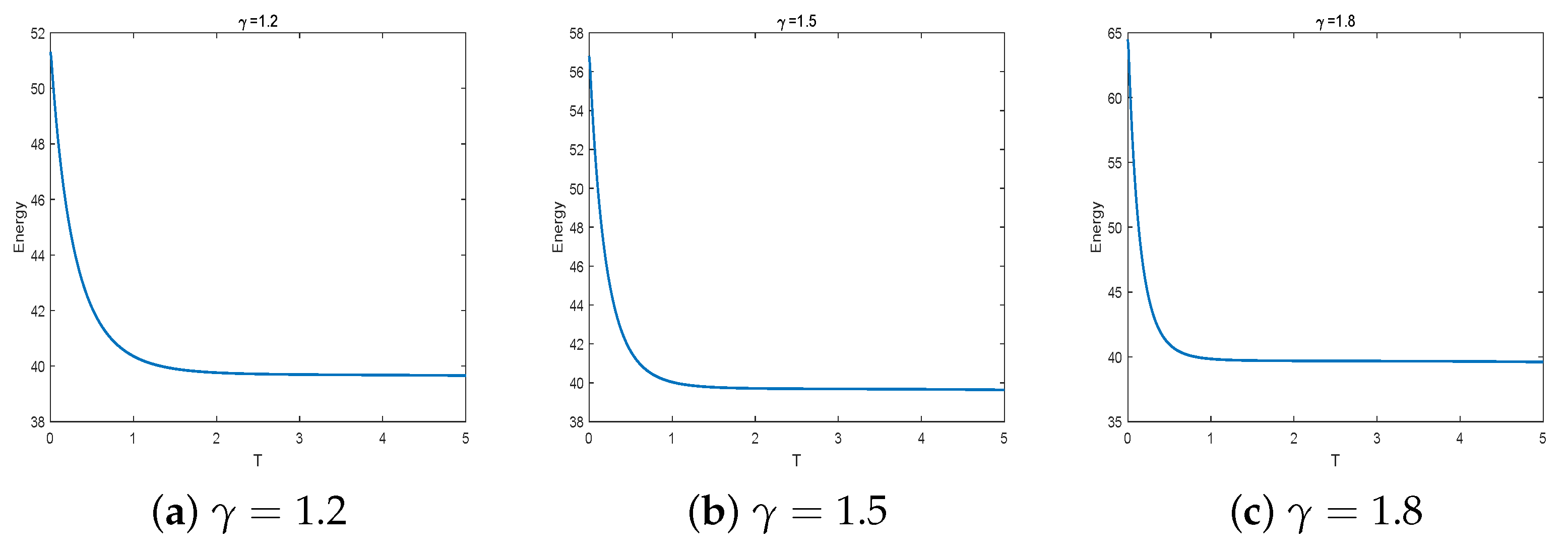
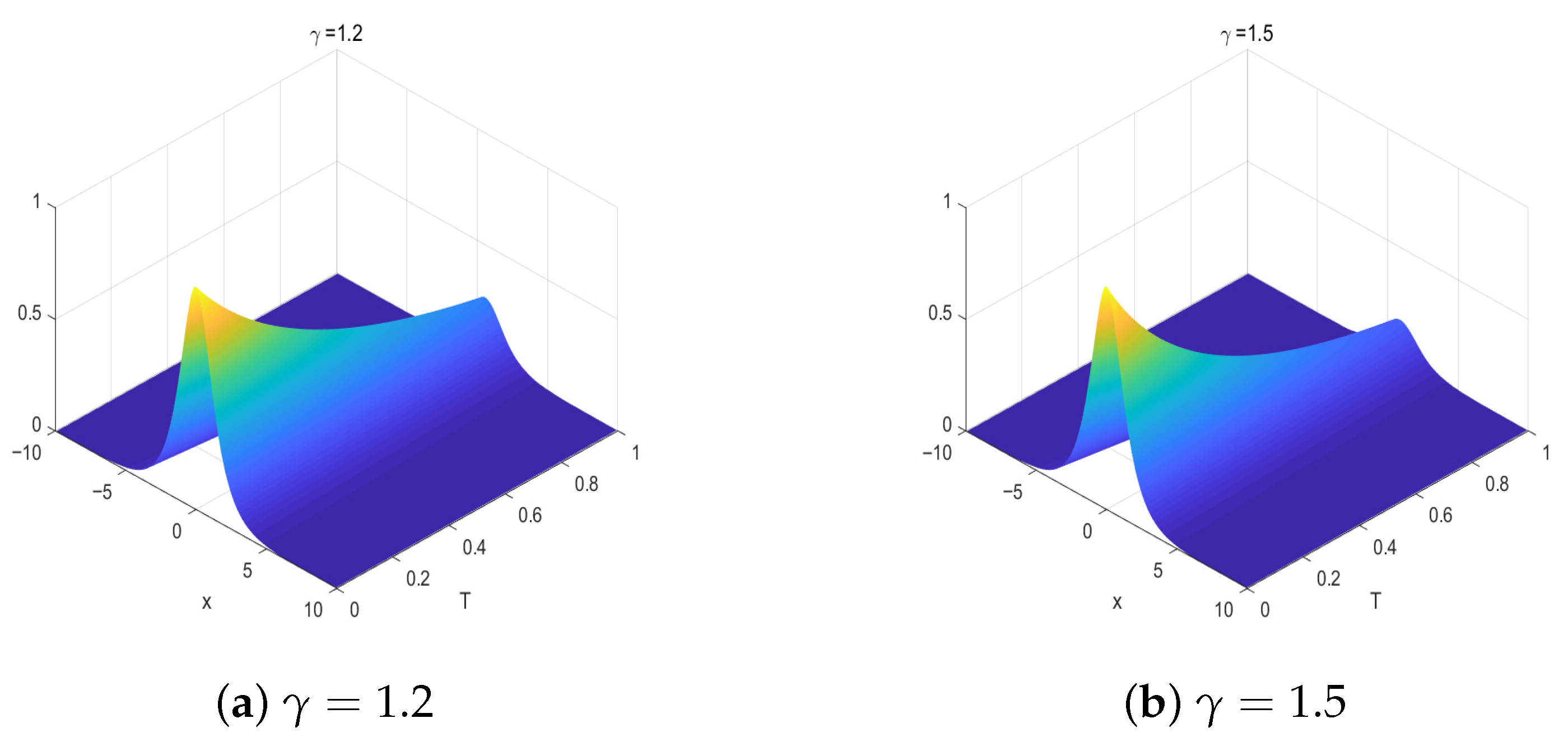
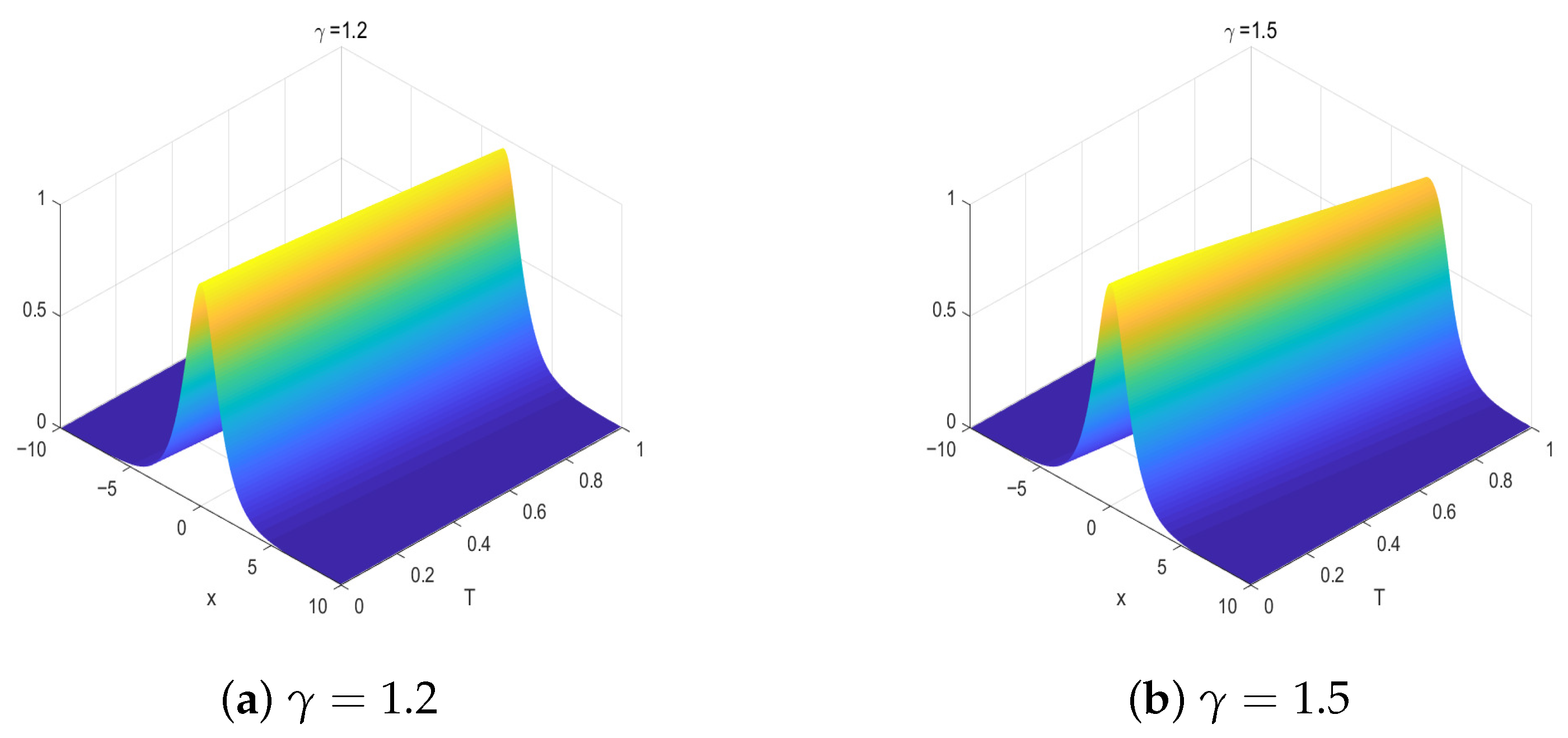
To verify the energy stability of the proposed scheme when α = 1 and β = 1 , we set N = 128 , τ = 1 / 100 to solve this equation. The evolution of energy for different values of γ is presented in Figure 1. The evolution of numerical solutions obtained at N = 256 , τ = 1 / 100 is shown in Figure 2. Clearly, our scheme can dissipate energy unconditionally when α 0 , consistent with our theoretical results.
To test the mass- and energy-conserving property of the scheme, at each time step, we calculate the discrepancies of the discrete mass and energy
MassError = | M ( φ n ) M ( φ 0 ) | M ( φ 0 ) , EnergyError = | E ( φ n ) E ( φ 0 ) | E ( φ 0 ) , 1 n T τ
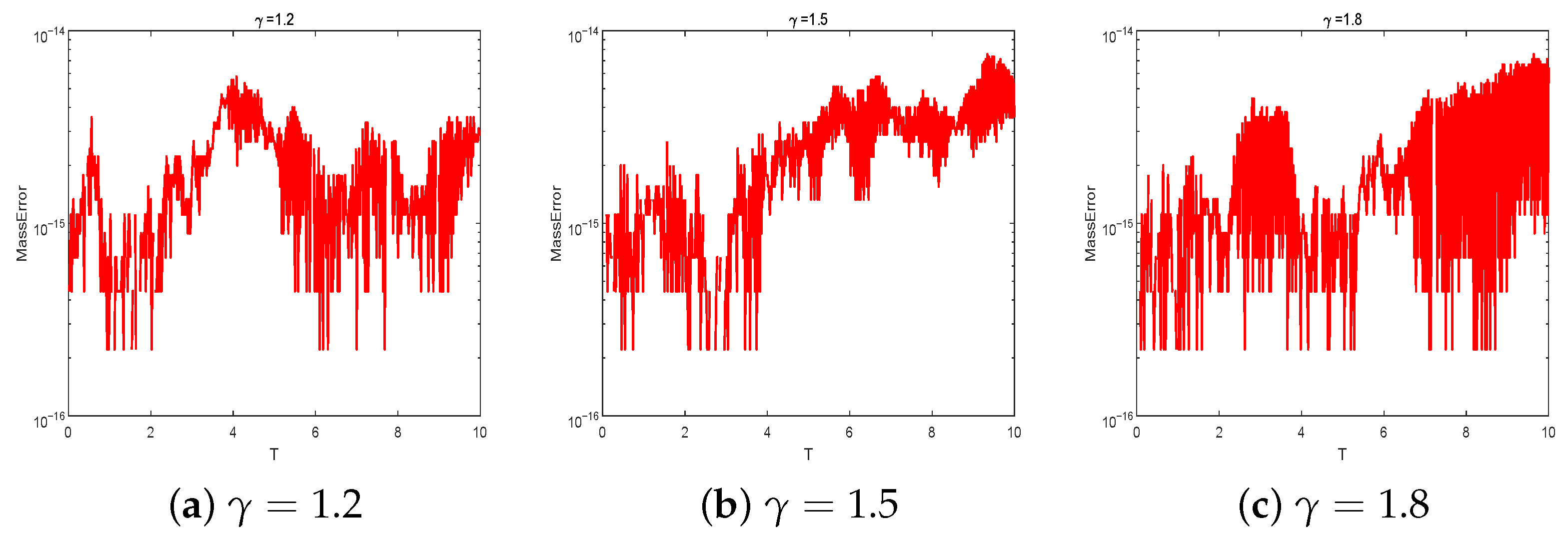
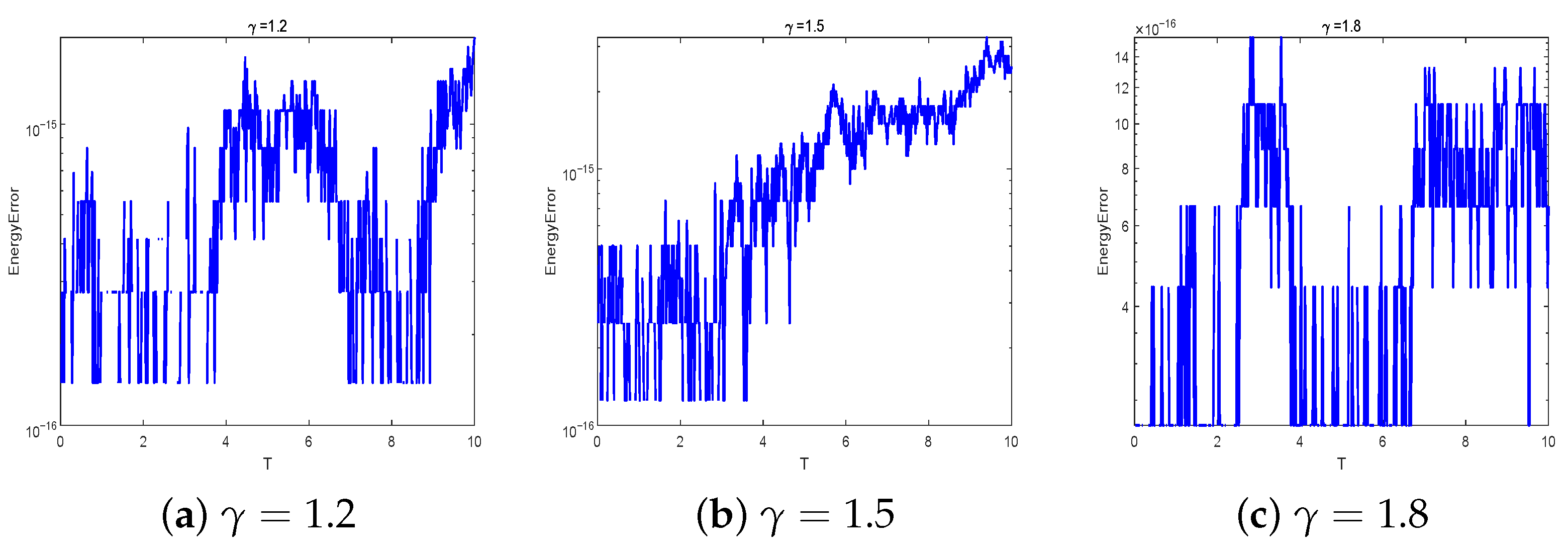
To verify the mass and energy conservation of the proposed scheme when α = 0 and β = 1 , we set N = 128 , τ = 1 / 50 to solve this equation. The evolution of energy for different values of γ is presented in Figure 3 and Figure 4. The evolution of numerical solutions obtained at N = 256 , τ = 1 / 100 is shown in Figure 5. From Figure 3 and Figure 4, the discrepancies of discrete mass and energy have both reached machine precision. This implies that the fully discrete scheme is unconditionally mass- and energy-conserving at α = 0 , which is consistent with the theoretical analysis.

5. Conclusions

In this paper, an effective numerical scheme is proposed to solve the space-fractional Ginzburg–Landau–Schrödinger equation. The fully discrete scheme is obtained by combining the modified leap-frog method and the finite difference methods. The fully discrete scheme is linearly implicit. This implies that at each time step, we always solve a system of linear algebraic equations. Therefore, the computational cost is less than that for the previous fully implicit methods. This numerical scheme also maintains energy stability when the coefficient α 0 . When α = 0 , the equation degenerates into the space-fractional Schrödinger equation, and the numerical scheme we constructed preserves both mass and energy conservation. Moreover, error estimates of the scheme are obtained. Numerical experiments are given to confirm the theoretical results. In future research, we aim to develop high-order, efficient numerical algorithms that preserve multiple physical quantities for high-dimensional problems.

Author Contributions

Conceptualization, H.Q. and X.C.; methodology, H.Q. and H.J.; software, H.Q. and H.J.; validation, X.C.; formal analysis, H.Q. and X.C.; investigation, X.C.; writing—original draft preparation, H.Q.; writing—review and editing, H.J. and X.C.; funding acquisition, H.Q. and X.C. All authors have read and agreed to the published version of the manuscript.

Funding

This work is supported in part by the National Natural Science Foundation of China (NSFC) (Nos. 12301524, 12501716)”, “Natural Science Foundation of Hubei Province (No. 2025AFB172)”, “the Natural Science Foundation of Wuhan (No. 2025040601020136)”, “Shenzhen Science and Technology Program (No. JCYJ20250604183428039)”, “the Natural Science Foundation of Chongqing (No. CSTB2025NSCQ-GPX0706)”, “Scientific Research Fund of Wuhan Institute of Technology (No. K2023054)”, and “CUG Scholar Scientific Research Funds at China University of Geosciences (Wuhan) (Nos. 2024015 and 2024059)”.

Institutional Review Board Statement

Not applicable.

Data Availability Statement

Dataset available on request from the authors.

Conflicts of Interest

Author Xiaoli Chen was employed by the company “Chongqing CUG Industrial Technology Research Institute”. The remaining authors declare that the research was conducted in the absence of any commercial or financial relationships that could be construed as a potential conflict of interest declare that there are no conflicts of interest.

References

  1. Laskin, N. Fractional quantum mechanics. Phys. Rev. E 2000, 62, 3135–3145. [Google Scholar] [CrossRef]
  2. Laskin, N. Fractional Schrödinger equation. Phys. Rev. E 2002, 66, 056108. [Google Scholar] [CrossRef]
  3. Adler, S.; Piran, T. Relaxation methods for gauge field equilibrium equations. Rev. Mod. Phys. 1984, 56, 1–40. [Google Scholar] [CrossRef]
  4. Du, Q.; Gunzburger, M.; Peterson, J. Analysis and approximation of the Ginzburg-Landau model of superconductivity. SIAM Rev. 1992, 34, 54–81. [Google Scholar] [CrossRef]
  5. Zhao, D.; Tang, Y.; Li, D. A Linearly Implicit and Structure-Preserving Scheme for the Ginzburg–Landau–Schrödinger Equation. Numer. Methods Partial. Differ. Equ. 2026, 41, e70043. [Google Scholar] [CrossRef]
  6. Wang, D.; Xiao, A.; Yang, W. A linearly implicit conservative difference scheme for the space fractional coupled nonlinear Schrödinger equations. J. Comput. Phys. 2014, 272, 644–655. [Google Scholar] [CrossRef]
  7. Wang, P.; Huang, C. Structure-preserving numerical methods for the fractional Schrödinger equation. Appl. Numer. Math. 2018, 129, 137–158. [Google Scholar] [CrossRef]
  8. Hu, D.; Gong, Y.; Wang, Y. On convergence of a structure preserving difference scheme for two-dimensional space-fractional nonlinear Schrödinger equation and its fast implementation. Comput. Math. Appl. 2021, 98, 10–23. [Google Scholar] [CrossRef]
  9. Castillo, P.; Gomez, S. On the conservation of fractional nonlinear Schrödinger equation’s invariants by the local discontinuous Galerkin method. J. Sci. Comput. 2018, 77, 1444–1467. [Google Scholar] [CrossRef]
  10. Liu, Y.; Ran, M. Arbitrarily high-order explicit energy-conserving methods for the generalized nonlinear fractional Schrödinger wave equations. Math. Comput. Simul. 2024, 216, 126–144. [Google Scholar] [CrossRef]
  11. Yang, X.; Ju, L. Efficient linear schemes with unconditional energy stability for the phase field elastic bending energy model. Comput. Methods Appl. Mech. Eng. 2017, 315, 691–712. [Google Scholar] [CrossRef]
  12. Yang, X.; Zhao, J.; Wang, Q.; Shen, J. Numerical approximations for a three-component Cahn-Hilliard phase-field model based on the invariant energy quadratization method. Math. Model. Methods Appl. Sci. 2017, 27, 1993–2030. [Google Scholar] [CrossRef]
  13. Li, X.; Wen, J.; Li, D. Mass- and energy-conserving difference schemes for nonlinear fractional Schrödinger equations. Appl. Math. Lett. 2021, 111, 106686. [Google Scholar] [CrossRef]
  14. Shen, J.; Xu, J.; Yang, J. The scalar auxiliary variable (SAV) approach for gradient flows. J. Comput. Phys. 2018, 353, 407–416. [Google Scholar] [CrossRef]
  15. Zhao, D.; Li, D.; Tang, Y.; Wen, J. A decoupled, linearly implicit and unconditionally energy stable scheme for the coupled Cahn-Hilliard systems. J. Comput. Math. 2025, 43, 708–730. [Google Scholar] [CrossRef]
  16. Li, D.; Li, X.; Sun, H. Optimal error estimates of SAV Crank-Nicolson finite element method for the coupled nonlinear Schrödinger equation. J. Sci. Comput. 2023, 97, 71. [Google Scholar] [CrossRef]
  17. Ketcheson, D. Relaxation Runge-Kutta methods: Conservation and stability for inner-product norms. SIAM J. Numer. Anal. 2019, 57, 2850–2870. [Google Scholar] [CrossRef]
  18. Li, D.; Li, X. Multiple relaxation exponential Runge-Kutta methods for the nonlinear Schrödinger equation. SIAM J. Numer. Anal. 2024, 62, 2719–2744. [Google Scholar] [CrossRef]
  19. Li, D.; Li, X.; Zhang, Z. Implicit-explicit relaxation Runge-Kutta methods: Construction, analysis, and applications to PDES. Math. Comput. 2023, 92, 117–146. [Google Scholar] [CrossRef]
  20. Li, D.; Li, X. Relaxation exponential Rosenbrock–type methods for oscillatory Hamiltonian systems. SIAM J. Sci. Comput. 2023, 45, A2886–A2911. [Google Scholar] [CrossRef]
  21. Eyre, D. Unconditionally gradient stable time marching the Cahn-Hilliard equation. Mater. Res. Soc. Symp. Proc. 1998, 529, 39–46. [Google Scholar] [CrossRef]
  22. Elliott, C.; Stuart, A. The global dynamics of discrete semilinear parabolic equations. SIAM J. Numer. Anal. 1993, 30, 1622–1663. [Google Scholar] [CrossRef]
  23. Bhrawy, A.H.; Zaky, M. An improved collocation method for multi-dimensional space-time variable-order fractional Schrödinger equations. Appl. Numer. Math. 2017, 111, 197–218. [Google Scholar] [CrossRef]
  24. Zhai, S.; Wang, D.; Weng, Z.; Zhao, X. Error analysis and numerical simulations of Strang splitting method for space fractional nonlinear Schrödinger equation. J. Sci. Comput. 2019, 81, 965–989. [Google Scholar] [CrossRef]
  25. Çelik, C.; Duman, M. Crank-Nicolson method for the fractional diffusion equation with the Riesz fractional derivative. J. Comput. Phys. 2012, 231, 1743–1750. [Google Scholar] [CrossRef]
  26. Wang, D.; Xiao, A.; Yang, W. Crank–Nicolson difference scheme for the coupled nonlinear Schrödinger equations with the Riesz space fractional derivative. J. Comput. Phys. 2013, 242, 670–681. [Google Scholar] [CrossRef]
  27. Secchi, S. Ground state solutions for nonlinear fractional Schrödinger equations in RN. J. Math. Phys. 2013, 54, 031501. [Google Scholar] [CrossRef]
  28. Wang, P.; Huang, C. An implicit midpoint difference scheme for the fractional Ginzburg-Landau equation. J. Comput. Phys. 2016, 312, 31–49. [Google Scholar] [CrossRef]
Figure 1. The evolution of energy obtained by the proposed scheme under different γ .
Fractalfract 10 00056 g001
Figure 2. The evolution of numerical solutions obtained by the proposed scheme under different γ .
Fractalfract 10 00056 g002
Figure 3. The discrepancy in mass obtained by the proposed scheme under different γ .
Fractalfract 10 00056 g003
Figure 4. The discrepancy in energy obtained by the proposed scheme under different γ .
Fractalfract 10 00056 g004
Figure 5. The evolution of numerical solutions obtained by the proposed scheme under different γ .
Fractalfract 10 00056 g005
Table 1. L 2 errors at T = 1 and convergence orders in the temporal direction.
τ γ = 1.2 γ = 1.5 γ = 1.8
ErrorsOrdersErrorsOrdersErrorsOrders
1 / 10 5.68 × 10 3 - 8.33 × 10 3 - 1.12 × 10 2 -
1 / 20 1.42 × 10 3 2.00 2.06 × 10 3 2.01 2.70 × 10 3 2.05
1 / 40 3.53 × 10 4 2.00 5.15 × 10 4 2.00 6.68 × 10 4 2.01
1 / 80 8.82 × 10 5 2.00 1.29 × 10 4 2.00 1.67 × 10 4 2.00
Table 2. L 2 errors at T = 1 and convergence orders in the spatial direction.
N γ = 1.2 γ = 1.5 γ = 1.8
ErrorsOrdersErrorsOrdersErrorsOrders
32 1.57 × 10 1 - 1.41 × 10 1 - 1.02 × 10 1 -
64 3.60 × 10 2 2.12 3.03 × 10 2 2.22 2.10 × 10 2 2.29
128 9.44 × 10 3 1.93 7.21 × 10 3 2.07 4.90 × 10 3 2.10
Disclaimer/Publisher’s Note: The statements, opinions and data contained in all publications are solely those of the individual author(s) and contributor(s) and not of MDPI and/or the editor(s). MDPI and/or the editor(s) disclaim responsibility for any injury to people or property resulting from any ideas, methods, instructions or products referred to in the content.