Article

Cascaded Optimized Fractional Controller for Green Hydrogen-Based Microgrids with Mitigating False Data Injection Attacks


1
Electrical Engineering Department, Faculty of Engineering, Menoufia University, Shebin El-Kom 32511, Egypt
2
Centro de Transición Energética (CTE), Facultad de Ingeniería, Universidad San Sebastián, Bellavista 7, Santiago 8420524, Chile
3
Department of Electrical Engineering, College of Engineering, Prince Sattam bin Abdulaziz University, Al Kharj 16278, Saudi Arabia
4
Electrical Department, Faculty of Technology and Education, Sohag University, Sohag 82524, Egypt
*
Author to whom correspondence should be addressed.
Fractal Fract. 2026, 10(1), 55; https://doi.org/10.3390/fractalfract10010055
Submission received: 15 October 2025 / Revised: 2 January 2026 / Accepted: 6 January 2026 / Published: 13 January 2026

Abstract

Green hydrogen production and the use of fuel cells (FCs) in microgrid (MG) systems have become viable and feasible solutions due to their continuous cost reduction and advancements in technology. Furthermore, green hydrogen electrolyzers and FC can mitigate fluctuations in renewable energy generation and various demand-related disturbances. Proper incorporation of electrolyzers and FCs can enhance load frequency control (LFC) in MG systems. However, they are subjected to multiple false data injection attacks (FDIAs), which can deteriorate MG stability and availability. Moreover, most existing LFC control schemes—such as conventional PID-based methods, single-degree-of-freedom fractional-order controllers, and various optimization-based structures—lack robustness against coordinated and multi-point FDIAs, leading to significant degradation in frequency regulation performance. This paper presents a new, modified, multi-degree-of-freedom, cascaded fractional-order controller for green hydrogen-based MG systems with high fluctuating renewable and demand sources. The proposed LFC is a cascaded control structure that combines a 1+TID controller with a filtered fractional-order PID controller (FOPIDF), namely the cascaded 1+TID/FOPIDF LFC control. Furthermore, another tilt-integrator derivative electric vehicle (EV) battery frequency regulation controller is proposed to benefit from EVs installed in MG systems. The proposed cascaded 1+TID/FOPIDF LFC control and EV TID LFC methods are designed using the powerful capability of the exponential distribution optimizer (EDO), which determines the optimal set of design parameters, leading to guaranteed optimal performance. The effectiveness of the newly proposed cascaded 1+TID/FOPIDF LFC control and design approach employing multi-generational-based two-area MG systems is studied by taking into account a variety of projected scenarios of FDIAs and renewable/load fluctuation scenarios. In addition, performance comparisons with some featured controllers are provided in the paper. For example, in the case of fluctuation in RESs, the measured indices are as follows: ISE (1.079, 0.5306, 0.3515, 0.0104); IAE (15.011, 10.691, 9.527, 1.363); ITSE (100.613, 64.412, 53.649, 1.323); and ITAE (2120, 1765, 1683, 241.32) for TID, FOPID, FOTID, and proposed, respectively, which confirm superior frequency deviation mitigation using the proposed optimized cascaded 1+TID/FOPIDF and EV TID LFC control method.

1. Introduction

Conventional power grids typically include fossil fuel generation systems based on synchronous generators, such as those powered by natural gas, coal, and oil [1]. However, these energy resources are expensive, limited, unsustainable, and emit greenhouse gases. Therefore, promoting the transition to newer, cleaner, more sustainable, and environmentally friendly energy sources has been a dominant focus of global government and research interests. The planning, operation, and structure of power grid systems have all been affected by the shift to clean energy sources [2]. In this case, the sectionization of larger power systems into smaller, grid-connected or isolated microgrids (MGs) has been proposed for more reliable and sustainable grid operations. The use of regional energy resources, such as wind, solar, and biomass, has become feasible in MG systems by reducing reliance on traditional centralized fossil fuel generation [3].
Taking into account all these factors, renewable energy-based MGs represent an emerging step towards the decentralized future of sustainable community-powered electrical systems. However, the nature of electrical energy generated from commonly used MG sources, particularly solar photovoltaic (PV) and wind, continuously varies, namely the intermittent nature of these sources [4]. Another fluctuating power comes from the demand side, which is subject to different scenarios and variations. Joint intermittency in renewable and demand power systems presents several challenges to power management and control. Furthermore, these sources lack intrinsic inertia, a feature of conventional systems based on synchronous generators. A power mismatch between the power generated and the power requested results in severe frequency variations [5]. This can then result in issues with the MG system’s protection and frequency control relays.
Incorporating a load frequency controller (LFC) has proven to be an efficient way to maintain the MG frequency within predefined limits in such dynamic environments [6]. The literature has presented numerous studies and assessments of the effects of demand loads and renewables [7]. To simulate the inertia of conventional generation based on synchronous generation and enhance the frequency dynamic response, the integration of energy storage devices and systems (ESSs) into electrical MGs has been studied. Proper control structure and design methodology are essential for inertia provision and emulation. ESS systems, particularly battery ESSs, capacitive ESSs, and superconducting ESSs, have been widely introduced and studied for these objectives. However, installing large-capacity ESSs in MGs requires high costs, which increases the total supply cost. An intelligent approach is the use of inherent batteries in electric vehicles (EVs), which can significantly replace fossil fuel transportation systems [8]. The control of EV batteries can improve frequency regulation and can serve as a reserve for MG systems.
Recently, production of hydrogen with reduced emissions has been considered as the principal energy vector towards a more sustainable and environmentally friendly energy transition [9,10]. Green hydrogen refers to water electrolysis powered by renewables. Numerous different-scale production plants are planned to produce green hydrogen, which are added to operating or under-construction plants. With the incorporation of green hydrogen into energy systems, there have been advances in electrolyzer and fuel cell technologies [11,12], control methods [13], maximum power point extraction [14], power electronics integration topologies [9], integration with other energy sources [15], and MG operation [16,17], among others. In addition, green hydrogen electrolyzers and fuel cell (FC) systems are an economic solution to managing energy in modern power grids [9]. Integration with intermittent renewables and demand can flatten their curves, reducing power imbalances. In addition, they can be controlled according to the frequency response of the MG systems [18].
Various control schemes have been applied for LFC in MG systems. Furthermore, selecting a design methodology is crucial for optimizing the performance of developed LFC methods. Recent developments in sliding mode control (SMC) have made it feasible for a wide range of applications. The SMC has presented an alternative method for LFC in MG systems [19]. However, the chattering effects and design issues require performance compromise and challenges. This, in turn, has made the SMC not recommended, especially in MG operation with its requirements and stochastic performance.
On the another hand, the fuzzy logic control (FLC) has been presented in the literature as an intelligent solution for LFC in MGs [20]. A hybrid type-II FLC with PID optimized with the Harmony Searching Algorithm (HSA) has been presented in [21]. However, the need for expert knowledge in the design process of FLC-based control systems hinders their applicability. Also, the MG characteristics and requirements need further efforts and experience in LFC for FLC design.
Some other attempts based on the linear quadratic regulator (LQR) with I control have been presented in [22]. However, LQR-based control methods assume linear models of MG systems, which are impractical, and ignore several important characteristics of MG components. Another method based on model predictive control (MPC) has also been provided in [23] for LFC. However, MPC-based algorithms require a precise model and determined parameters of the MG for efficient control performance. MGs are characterized by several uncertainties in the parameters and models.
Traditional integer-order (IO)-related controllers have been used in LFCs for decades due to their widespread industrial use. The integrator (I), proportional-I (PI), and PI-derivative (PID) control systems are among the frequently used controllers [24]. They proved to be straightforward, implementable structures with wide industrial applications. However, their performance deteriorates with uncertain plant parameters and models. Some advanced IO structures have been provided in the literature to mitigate the problems of traditional ones. PID double-derivative controllers (PID-DD), I-DD, PIDN, and PIDDN have been proposed [25,26,27,28]. However, the development of many inspired PID variants, such as BELBIC-PID sigmoid-PID and neuroendocrine-PID, have been applied with the goal of enhancing robustness and adaptability over traditional PID controllers [29]. These techniques deal with uncertainties and nonlinearities rely on heuristic neuro-biological mappings learning mechanisms or nonlinear gain modulation. However, their nonlinear structures act as gain schedulers but do not allow explicit phase margin, iso-damping, or noise sensitivity shaping.
The use of metaheuristic algorithms in the design of LFC methods has shown optimized performance and guarantees optimal control parameter sets [30,31]. The bacterial foraging algorithm (BFOA) has been presented in [30,31] and has been proven to improve LFC performance indices. The dandelion optimizer (DO) has been utilized with nonlinear PI in a single area-based MG system [32]. Furthermore, artificial rabbit optimization (ARO) with PI LFC and PID controllers has been applied to multi-source MG systems [33]. Furthermore, combined I LFC and PI inertia provision controllers have been introduced in [34] and optimized with particle swarm optimization (PSO) in interconnected MGS. Simple, cost-effective, and easily implementable IO controller features have been proven in these papers. However, this type of controller has limitations, including its performance in the presence of uncertainties, its adaptability across various operating points, and its ability to mitigate frequency deviations, among others.
Adding fractional-order (FO) operators to IO controllers yields new structures of FO controllers. They offer more flexible designs and the potential to optimize system performance. There are three different terms in FO control, including FOI, FOD, and tilt terms. Several structures have been presented in the literature of FO and/or hybridized with IO and FLC systems. For instance, the FOPID provides five tunable parameters compared to the three tunable parameters of the IO PID controller. The FOPID has been presented in [35] with optimized performance with the imperialist competitive algorithm (ICA). Another TID controller, combining the teaching–learning algorithm and pattern search (hTLBO-PS) algorithm, has been proposed in [36].
The cascaded TID LFC method with the Salp Swarm Algorithm (SSA) has been presented in [37]. A hybrid TID-TIDF with PSO-optimized design has been provided in [38] for LFC and virtual inertia provision using SMES ESSs. The hybrid TID-FOPID, namely FOTID LFC, has been presented in [39] with optimized parameters using manta ray foraging optimizers (MRFOs). Another design for a combined controller utilizing artificial ecosystem optimization (AEO) is presented in [40]. The modified Gray wolf with Cuckoo searching (MGWO-CS) optimization has been given for designing the TID controller in [41]. The global neighborhood algorithm (GNA) with a new 1+FOPTID LFC method has been proposed in [24]. Another FOPIDA LFC with GWO has been presented for maritime MGs [42]. The intelligent FOI (iFOI) LFC method has been provided and designed using the GWO in [43]. On another hand, a single-agent stochastic optimization algorithm such as Memorizable Smoothed Functional (MSF), Normalized SPSA, Norm-limited SPSA, and Simulated Annealing (SA) are computationally efficient and frequently used for controller tuning, but they are primarily intended for local trajectory-based search [44]. These algorithms use noisy gradient or perturbation information to iteratively update a single candidate solution. As a result, when the cost function is non-convex multi-modal or highly nonlinear, as is common in nonlinear control systems, they are vulnerable to premature convergence because their performance is heavily dependent on initialization noise level and local landscape smoothness [45]. However, this work applied the exponential distribution optimizer (EDO), which makes use of a multi-agent ecosystem mechanism that allows for the simultaneous exploration of several search space regions and maintains population diversity through agent competition and interaction. In the face of significant nonlinearities and uncertainties, this enables EDO to avoid premature convergence and achieve more dependable global optimization of controller parameters. For robust tuning of sophisticated PID/TID/FOPID controllers, where global optimality and stability margins are crucial, EDO is therefore a better option than single-agent techniques.
The cascaded FOPI(1+PDN) optimized with the spider wasp optimization (SWO) algorithm has been proposed in [46]. A cascaded FOPDN with FPTID has been presented in [47], whereas the dandelion optimization (DO) algorithm has been proposed for optimizing the controller. However, the presented controllers do not consider the various expected attacks on the system. The cheetah optimization (CO) algorithm has been presented for the optimal design of PID control for MGs under FDI Cyberattacks [48]. However, the performance is limited by the PID control performance. Another modified CO (mCO) algorithm has been introduced for optimizing FOPID controllers in [49]. The CO and mCO have not been tested for cascaded control methods with different ESSs and green hydrogen systems. In [50], a 4DoF-based fractional-order cascade controller for wind farm applications was optimized using deep reinforcement learning (DDPG). While these approaches improved dynamic stability for wind energy conversion, they are limited to wind-only systems.
Another issue is that MGs with green hydrogen electrolyzers and FCs are subjected to several cyberattacks [51]. In particular, false data injection attacks (FDIAs) are most common in these systems [52]. The false signal is injected into the frequency measurement communication system or sent to the different controlled components in the MG. Mitigating the impacts of FDIAs on the MG system and its components has gained broad interest [53]. In order to guarantee that the frequency of the MG system remains within the operator’s allowed limits, the designed control must be robust. The developed control must be resilient and ensure that the frequency of the MG system remains within the operator’s acceptable limits. Furthermore, the integration and control of various renewable and green hydrogen components are necessary to work efficiently while simultaneously managing and compensating for FDIAs. The employment of unknown input observers (UIOs) has been proposed in [54] for detecting FDIAs in MG systems. A prescribed-time controller has been presented to mitigate the effects of FDIAS in MGs. Another threshold-based assessment method has been provided in [55] for protecting MGs against FDIAs. However, defining the proposer threshold is a challenging task for this type of controller. An SMC method has been introduced in [56] for the simultaneous detection of attacks, utilizing the interface between the controller and sensors. Recent studies have explored fractional-order cascade controllers for renewable energy systems.
However, designing optimal control methods using FO theory remains challenging in the case of FDIAs in MG systems.
From the aforementioned discussion, it appears that to mitigate the frequency disturbances from loading and renewable sources, it is essential to develop an optimized control method.
Based on the literature reviewed, the main contributions of this article are listed below.
  • An optimized control method is proposed for enhancing the participation of green hydrogen, as a preferred energy vector, in regulating the frequency in interconnected MG systems. A modified two-degree-of-freedom cascaded fractional-order controller for green hydrogen-based MG systems is proposed in the paper.
  • The proposed LFC is a cascaded tilt FO integrator with a filtered FO derivative and a filtered FO derivative controller, namely, a cascaded 1+TID/FOPIDF LFC. The incorporated control terms in the proposed combination can effectively improve the system’s response with properly designed parameters.
  • A mitigation scheme is proposed for false data injection attacks (FDIAs) using the optimized design of the proposed cascaded 1+TID+FOPIDF LFC control with TID EV participation in LFC in multi-source interconnected MGs.
  • The set of optimal parameters of the design parameters of the newly proposed cascaded 1+TID/FOPIDF LFC control and EV TID LFC methods are determined with the powerful capability of the exponential distribution optimizer (EDO). Coordinated design of tunable parameters in the system, with simultaneous determination of the optimal set, can guarantee the desired performance of the set as a whole rather than determining each parameter individually.
  • Various expected FDIAs, denial-of-service (DoS) attacks, and disturbance-related scenarios are studied and compared with the conventional LFC methods performed in the paper.
Unlike previous LFC schemes relying on standalone TID, FOPID, or hybrid FO/IO controllers, the proposed cascaded 1+TID/FOPIDF structure introduces a unique two-degree-of-freedom arrangement that integrates a tilt–fractional integrator with a filtered fractional-order derivative stage—a configuration not previously explored in LFC research. Moreover, while previous studies have considered ESSs or independent FO controllers, the integration of an electric vehicle battery-based TID controller provides an additional layer of coordinated frequency support that is absent from the existing literature. The paragraph also clarifies that, unlike prior work evaluating FO controllers under conventional disturbances only, the proposed framework explicitly accounts for multiple cyber–physical threats, including multi-scenario FDIAs, DoS attacks, and renewable/load fluctuations within a unified MG model. In addition, the proposed controller parameters are optimally tuned using the exponential distribution optimizer (EDO), marking the first application of this algorithm to cascaded FO control in MG LFC studies and offering superior convergence characteristics for both MG areas. Finally, the developed multi-source MG model integrates green hydrogen electrolyzers, fuel cells, wind, PV, EV storage, and key nonlinearities within a comprehensive dynamic framework that extends beyond the modeling capabilities of most existing research, ensuring clear differentiation and avoiding any impression of overlap with related work.
The rest of the article is organized as follows. Section 2 presents the considered case study and its mathematical formulations. The FDIAs modeling in MGs are presented in Section 3. The proposed 1+TID/FOPIDF LFC control and EV TID LFC methods are detailed in Section 4. The design steps and the optimization algorithm are given in Section 5. The results obtained and performance verifications are presented in Section 6. Finally, conclusions of the current work are given in Section 7.

2. Power System Configuration

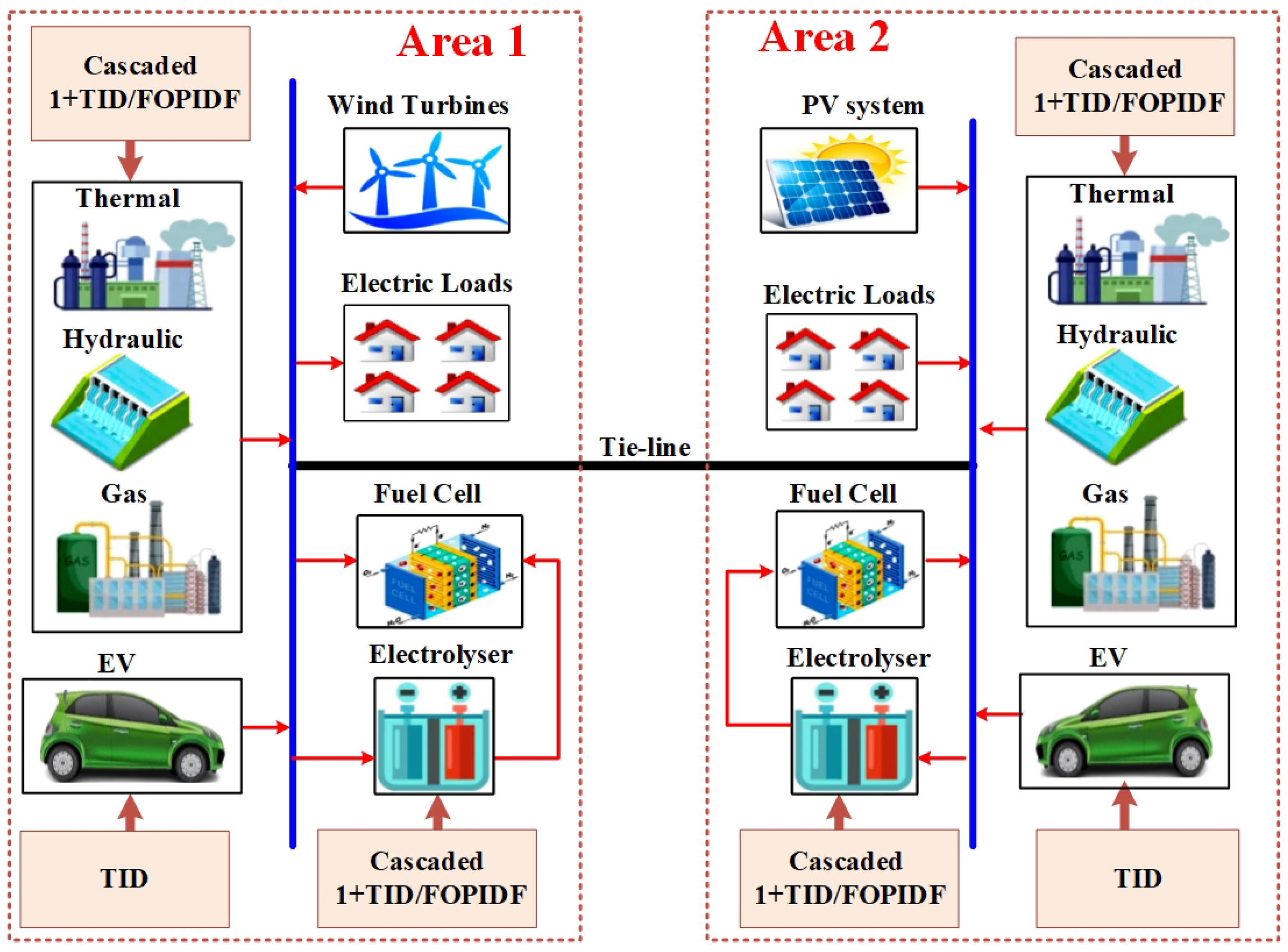
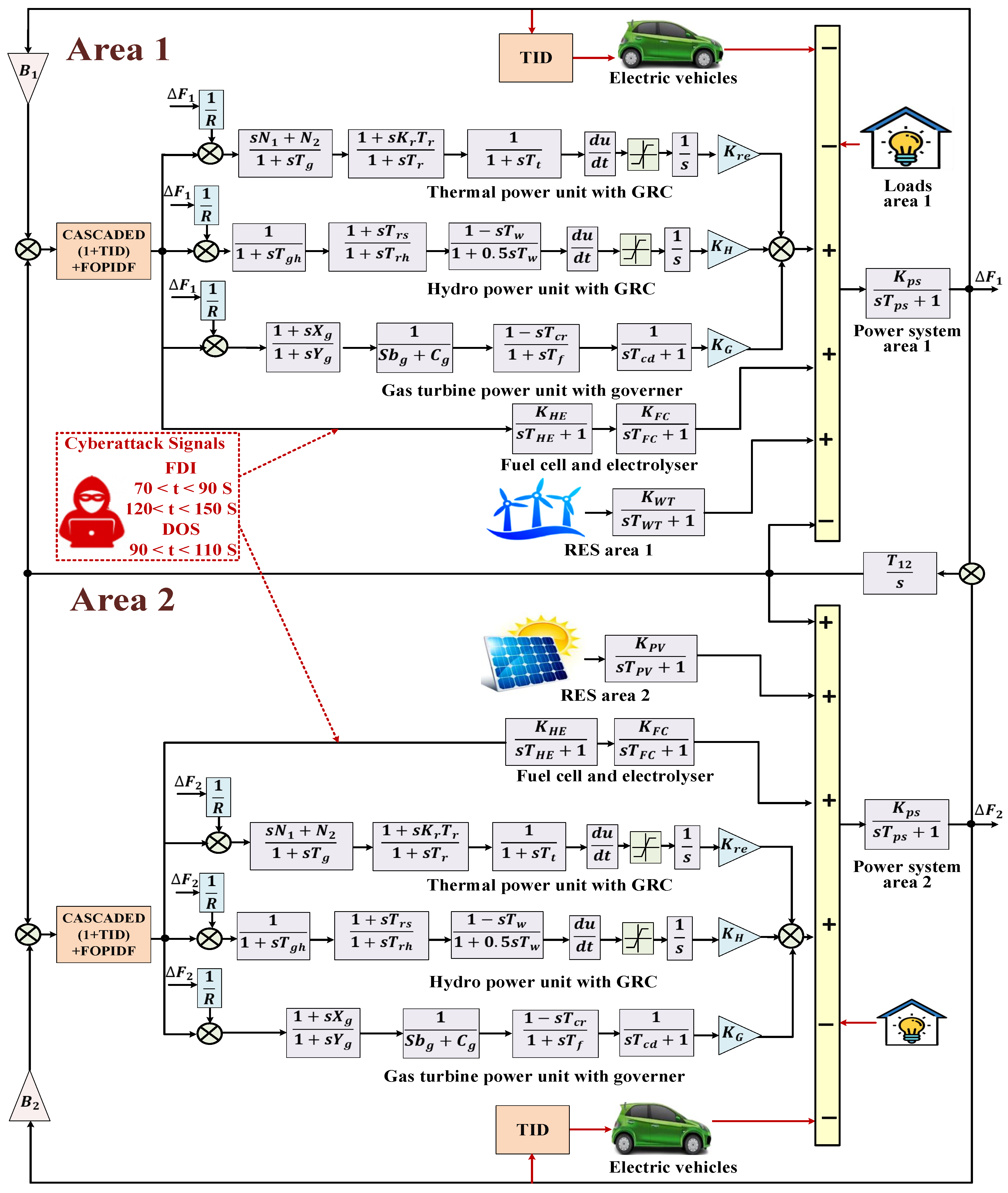
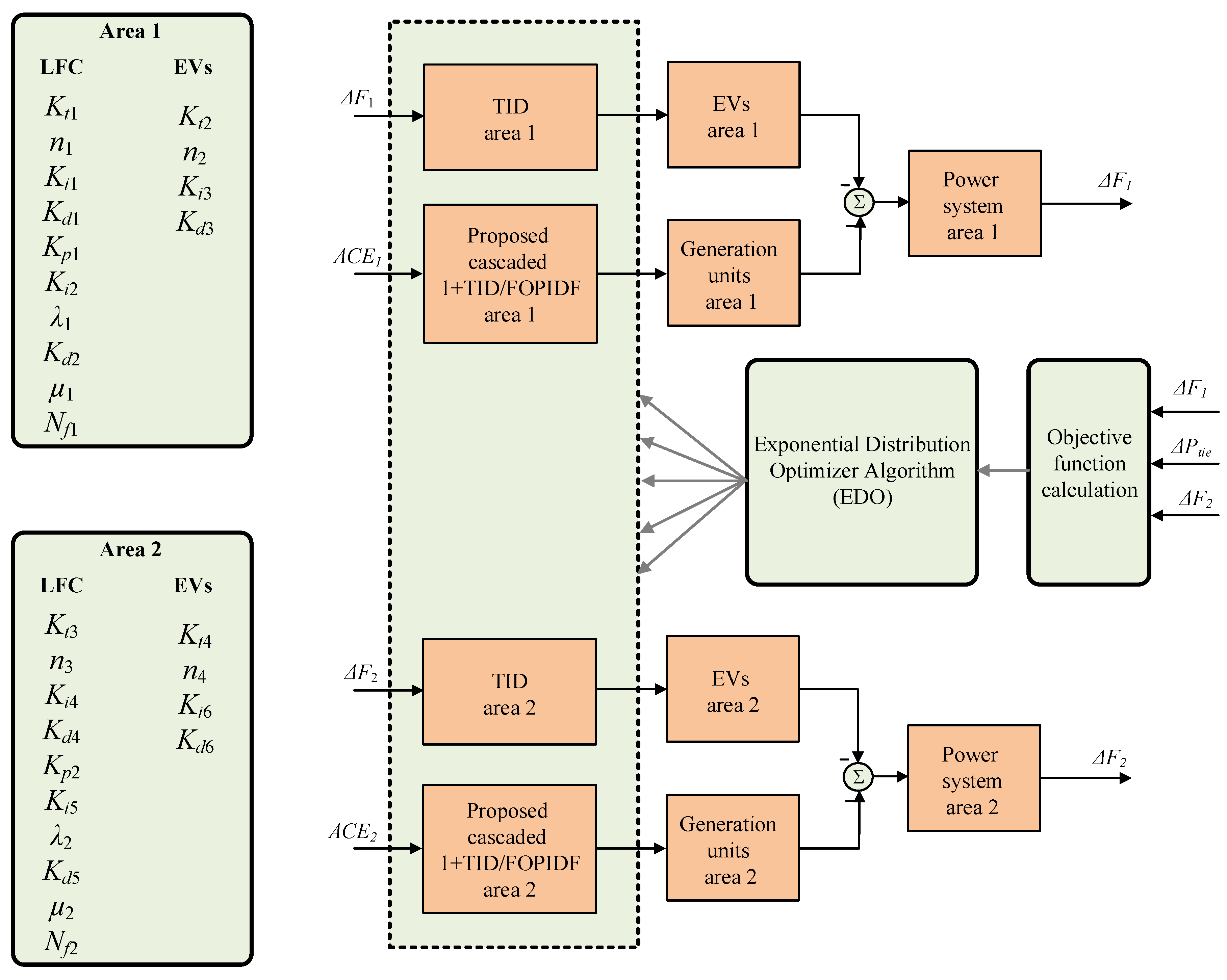
This study introduces a modern power system model with integrated conventional and emerging technologies, as shown in Figure 1. The system incorporates two control regions; each area consists of conventional power plants, RESs, FC systems, EVs, and electric loads. The tie-line connects the two areas and controls the flow of power between them. Figure 2 presents the overall structure of the interconnected MG system. Each component is modeled using its corresponding linear transfer function, as detailed in this section. The figure also includes the proposed control system, which integrates the cascaded 1+TID/FOPIDF controller and the EV-based TID controller, along with the injection points of cyberattack signals (FDIA and DoS). A detailed explanation of the control strategy and its subcomponents is provided in Section 4. A MATLAB/Simulink environment is used to implement the LFC model of the system under study, which was built using transfer functions and the parameters given in Table 1.
The effectiveness of the proposed controllers is considerably affected by the nonlinear behavior exhibited by the system components. Consequently, it is important to consider these factors when designing and testing. This approach takes into account the physical limitations of the power plants, such as the governor dead band (GDB) of thermal units and the generation rate constraint (GRC). The GRC is set to increase and decrease rates at 10 % pu/min (0.0017 pu.MW/s) [57]. Additionally, GRC constraints limit the hydroelectric power plant, stating that the increase and decrease rates are 270 % pu/min ( 0.045 pu.MW/s) and 360 % pu/min ( 0.06 pu.MW/s), respectively. The GDB can be expressed in terms of the speed change and its rate of change after linearization, producing a Fourier series transfer function with a 0.5% backlash [58]. The GDB transfer function has the following mathematical representation:
G G D B ( s ) = s N 1 + N 2 1 + s T g r
where N 1 and N 2 represent the Fourier coefficients of GDB, with values N 1 = 0.2 π , N 2 = 0.8 .
The modeling of each subcomponent in the interconnected MG system is based on linearized transfer functions derived from the referenced studies. The following assumptions are considered:
  • All system components are assumed to operate in their linear regions, and nonlinear effects (e.g., GDB, GRC) are represented using linearized models.
  • Temperature effects on PV and EV models are considered to be constant.
  • SOC changes dynamically during simulation in the safe operating range (20–95%).
  • Communication links are assumed to be ideal except during cyberattack scenarios.
  • Measurement noise and delays are neglected in normal operation.

2.1. Conventional Power System Model

Within each area, the conventional power systems under study include gas, hydro, and thermal power units. These systems are essential to maintain stability by regulating frequency and responding to changes in load through LFC. Each power unit follows a set of transfer functions to model its dynamic behavior.

2.1.1. Thermal Power Unit

The dynamic behavior of the reheated thermal structure, including the governor, reheater, and turbine, is expressed by the general transfer function G R T ( s ) , as given in the equation below [59].
G R T ( s ) = ( s N 1 + N 2 ) ( 1 + s K r T r ) ( 1 + s T g ) ( 1 + s T r ) ( 1 + s T t )

2.1.2. Hydro Power Unit

The mathematical model of hydroelectric power, along with its corresponding sub-models, including the governor, hydraulic turbine, and the storage and storage system, is represented by the general transfer function G H ( s ) , as given in the following equation [60]:
G H ( s ) = ( 1 s T w ) ( 1 + s T r s ) ( 1 + s T g h ) ( 1 + 0.5 s T w ) ( 1 + s T r h )

2.1.3. Gas Turbine Power Unit

The transfer function G G ( s ) , which describes the gas generation system, including the gas governor, valve positioner, fuel control, and compressor discharge system, is presented as follows [61]:
G G ( s ) = ( 1 + s X g ) ( 1 s T c r ) ( 1 + s Y g ) ( s b g + C g ) ( 1 + s T f ) ( 1 + s T c d )

2.2. RESs Model

The system’s RESs include PV power in Area 2 and wind power in Area 1. Each of these sources is modeled based on its respective dynamic equations. In this research, accurate wind and PV power outputs are generated using the models in [62].

2.2.1. Wind Power Model

Wind turbines transform the incoming wind flow into real power P W i n d according to the following equation [62]:
P W i n d = 1 2 ρ A T V 3 C P ( λ T , β )
where P W i n d refers to the power generated by the wind turbine, ρ is the mass density of air kg/m3, A T is the turbine’s rotor swept area, V is the wind velocity, expressed in ( m / s ) , and C P is the percentage of the total wind power that is transformed into mechanical power that is useful. According to the Betz limit, the value of C P is theoretically limited to 59.3%. A first-order delay mechanism is used to simulate the dynamic model of the integrated induction-based wind turbine [62].
G W T ( s ) = K T 1 + T W T s

2.2.2. PV Power Model

Photovoltaic energy is a key renewable source that converts photons into electricity using PV systems. The power generated from a solar power plant can be expressed follows [62]:
P p v = η φ s o l a r S 1 0.005 ( T a + 25 )
where η is the efficiency factor, the solar irradiation is φ s o l a r , the solar panel’s surface area is S, and the ambient temperature is T a . Assuming a first-order delay, the transfer function of the PV–grid interface is presented below [62]:
G P V ( s ) = K P V 1 + T P V s

2.3. Hydrogen System Model

The electrolyzer, FC, and hydrogen storage tank are essential to maintain energy sustainability and improve power generation. The electrolyzer separates water into H 2 and O 2 using the DC electrical energy provided by the AC/DC converter. The hydrogen storage tank stores H 2 through compression. The FC produces electrical energy for the grid by electrochemically converting stored hydrogen and oxygen. A DC/AC converter transfers the generated power to the grid. The HE and FC transfer functions are provided in the following equations [59]:
G H E ( s ) = K H E 1 + s T H E
G F C ( s ) = K F C 1 + s T F C

2.4. EVs Model

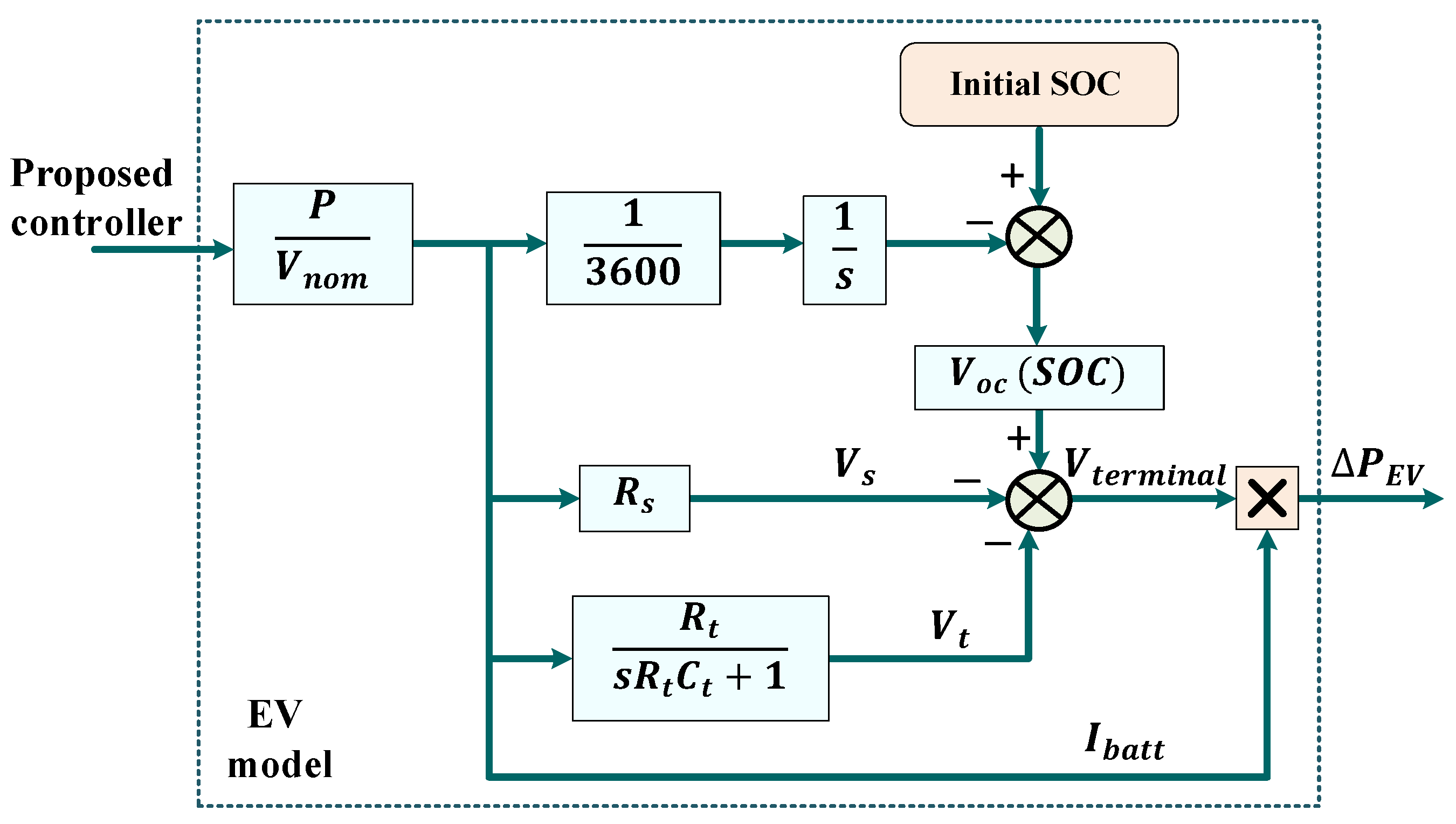
EVs play an important role in MGs because of their potential to provide energy storage and grid support. The recent integration of EVs into power grids allows for more efficient use of their built-in batteries. Thus, stable EV batteries may be regulated to improve frequency flexibility in remote microgrids. EVs reduce the need for extra ESS units in these systems. As a result, EVs have the potential to lower system costs while also improving remote MG operations. Simulating the dynamics of EV energy storage is critical for a variety of tasks, including optimizing power system configuration, control, and monitoring. To simulate EV functionality in LFC, an equivalent Thevenin-based EV model is used and incorporated into the two-region power system [40], as shown in Figure 3. In this model, V o c represents the battery’s open-circuit voltage. According to [63], the EV’s voltage is determined by its state of charge (SOC) and battery voltage.
V o c ( SOC ) = V n o m + S R T F ln SOC C n o m SOC
where V n o m and C n o m represent the nominal capacity and nominal voltage of the batteries that supply power to the EV, S represents the sensitivity parameter, R is the gas constant, F denotes the Faraday constant, and T denotes the temperature constant.

3. Cyberattacks on LFC in MG Systems

This section aims to study the effects of cyberattacks on the hydrogen ESS (comprising FCs and electrolyzers) and, more broadly, on the LFC. The main objective is to ensure efficient LFC in MGs, even in the presence of potential cybersecurity breaches. Conducting cyberattacks involves gaining unauthorized access to the targeted systems. Attackers utilize multiple techniques to gather system data, which is later used to target different areas within the MG [64]. Cyberattacks mainly include denial-of-service (DoS) and false data injection (FDI) attacks [65].

3.1. FDI Attacks in the MG

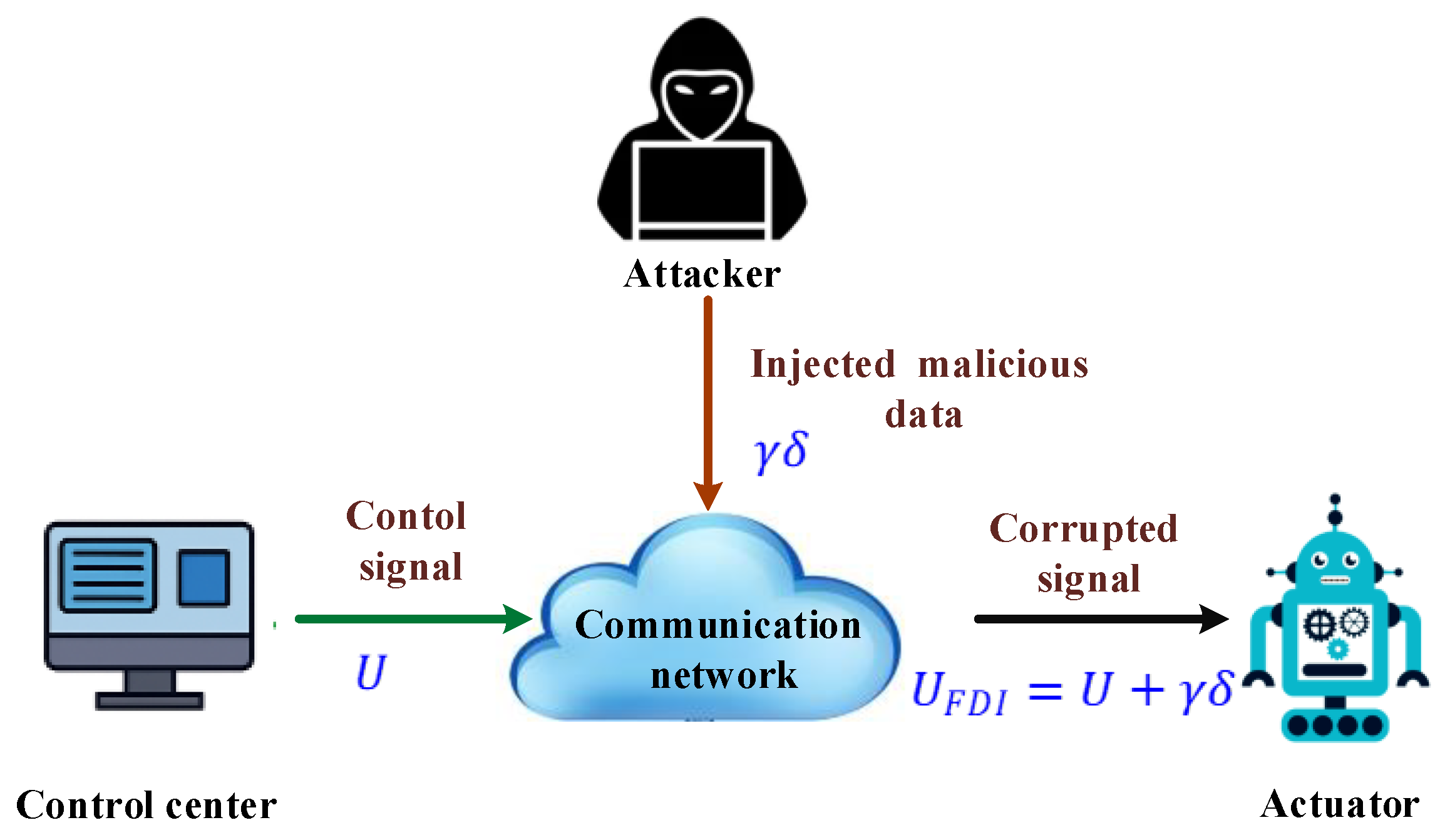
FDI attacks pose a significant cyber threat to power systems by injecting malicious data into control signals during transmission [66]. In this way, interference can cause disruptions to frequency regulation, reducing system performance and increasing instability. Figure 4 illustrates how FDI undermines control precision through signal manipulation. Therefore, FDI attacks are taken into account when developing secure control strategies for power systems. Hence, the FDI attack can be represented mathematically as follows [67]:
U FDI = U + γ δ
where U FDI is the corrupted control signal, U denotes the original control signal, γ is a binary variable indicating the presence of an attack ( γ = 1 if an attack occurs; otherwise γ = 0 ), and δ represents malicious data injected by the attacker.
In this study, the attacker injects a malicious frequency-related signal into the control loop of the electrolyzer and FC. These units respond inaccurately based on incorrect input, resulting in undesired power behavior. In the MG, a mismatch between power generation and demand occurs, producing frequency deviations that can lead to system instability. The two most critical time-varying attack signals considered to assess the robustness of the proposed control approach are detailed below [68]:
V 1 ( t ) = 0.2
V 2 ( t ) = 0.3 c o s ( t )
Amplitude and timing of the injected attack signals (e.g., 0.2, 0.3) were selected for realistic cyberattacks described in recent publications [64] or standards such as NESCOR. The intensity values correspond to how strongly the system is attacked without driving it into an immediate collapse phase (or a safe state) and therefore provide a way to quantify real controller resilience. The duration of the disruption (e.g., 20–30 s) aligns with regular time intervals in simulated smart grid hacks, allowing us to test the proposed control strategy under plausible, stressful conditions.
The FDIA attack modifies the control input signal as represented in Equation (12). This corrupted signal is injected into the communication path between the controller and the electrolyzer/fuel cell units. The attack signals defined in Equations (13) and (14) are applied to evaluate the resilience of the proposed control strategy, as shown in Figure 2.

3.2. DoS Attack in the MG

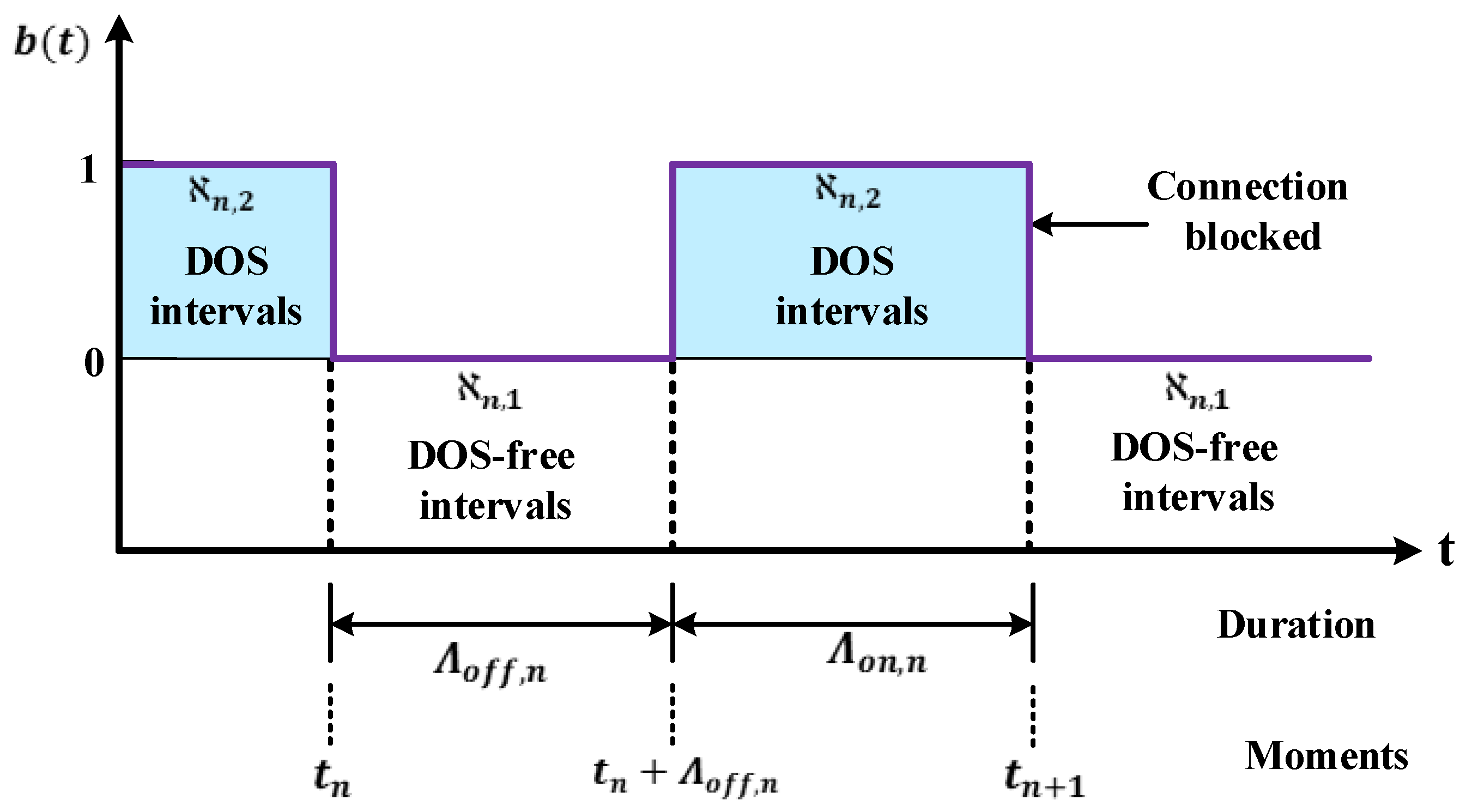
A Denial-of-Service (DoS) attack is a common cyber threat that disrupts communication channels by temporarily obstructing signal transmission. During DoS attacks, the flow of permitted data packets is disrupted owing to network congestion. During DoS attacks, the flow of valid data packets is interrupted as the communication channel is overwhelmed by signal obstruction [69]. DoS attacks result in a loss of data packets. In frequency regulation systems, DoS attacks can disrupt signal transmission channels, causing failure of the actuator response. Therefore, substantial deviations in the system’s frequency may occur, posing a risk to power system security. Thus, DoS attacks must be considered when evaluating the cybersecurity of frequency control systems. The following expression provides a model for the blocking signal generated during a DoS attack:
b ( t ) = 0 , t n , 1 = [ t n , t n + Λ off , n ) , 1 , t n , 2 = [ t n + Λ off , n , t n + 1 ) ,
where b ( t ) is a binary function representing the blocking signal due to a DoS attack at time t, 0 indicates the signal is blocked, and 1 indicates the signal is allowed. n N represents the DoS attack-blocking period index. n , 1 represents the time interval when the DoS attack is inactive (communication is allowed). n , 2 refers to the time interval when the DoS attack is active (blocking occurs), t n denotes the start time of the n t h DoS cycle, Λ off , n is the duration of the free DoS attack during the n t h cycle, and t n + 1 is the start time of the next DoS cycle. Additionally, the timing of OFF/ON transitions in DoS attacks is expressed as follows:
t n , i = t n , i = OFF , t n + Λ off , n , i = ON .
where t n , i represents time points based on the state i of the DoS attack. The DoS attack blocks the communication channel according to the binary function described in Equation (15) and the timing transitions in Equation (16). This blocking signal prevents the controller from sending commands to the electrolyzer and fuel cell units, as illustrated in Figure 5.

4. The Proposed LFC Controller

4.1. FO ORA Method

Although FO methods can improve system flexibility and optimality, they present several issues regarding their implementation and digital realization. In its general form, FO operators define the type of control term as illustrated below [70]:
D α | a t = α > 0 d α d t α FO derivatives term α < 0 t 0 t f d t α FO integral term α = 0 1
The Grunewald–Letnikov models α t h for f within limits a to t as [71]:
D α | a t = lim h 0 1 h α r = 0 t a h ( 1 ) r n r f ( t r h )
where h is the implementation sampling time, [ · ] as integer operator, and n must satisfy ( n 1 < α < n ). Whereas binomial coefficients are determined as [71]:
n r = Γ ( n + 1 ) Γ ( r + 1 ) Γ ( n r + 1 )
where Γ in (19) is [70]:
Γ ( n + 1 ) = 0 t x 1 e t d t
In Riemann–Liouville, the model eliminates summation operators using [72]:
D α | a t = 1 Γ ( n α ) ( d d t ) n a t f ( τ ) ( t τ ) α n + 1 d τ
In Caputo, the model is defined as [71]:
D α | a t = 1 Γ ( n α ) a t f ( n ) ( τ ) ( t τ ) α n + 1 d τ
Besides these generalized forms, Oustaloup’s recursive approximation (ORA) demonstrated a simpeasily implementableable digital form of FO operators [70]. Accordingly, this work utilizes the ORA form to implement the proposed control and optimum design process. In ORA form, α th as derivative FO operator ( s α ) is mathematically formulated as follows [70]:
s α ω h α k = N N s + ω k z s + ω k p
where ω k p and ω k z determine locations for poles/zeros in (23), respectively within sequence of ω h and located as
ω k z = ω b ( ω h ω b ) k + N + 1 α 2 2 N + 1
ω k p = ω b ( ω h ω b ) k + N + 1 + α 2 2 N + 1
ω h α = ( ω h ω b ) α 2 k = N N ω k p ω k z
The order N defines the precision and complexity of the ORA form, with a generating number ( 2 N + 1 ) order of poles/zeros. A proper selection of N is a value of five as a compromise between accuracy and implementation complexity, as employed in this work. The selected frequency range is ( ω [ ω b , ω h ] ) as [ 10 3 , 10 3 ] rad/s.

4.2. Proposed Cascaded 1+TID/FOPIDF LFC Controller

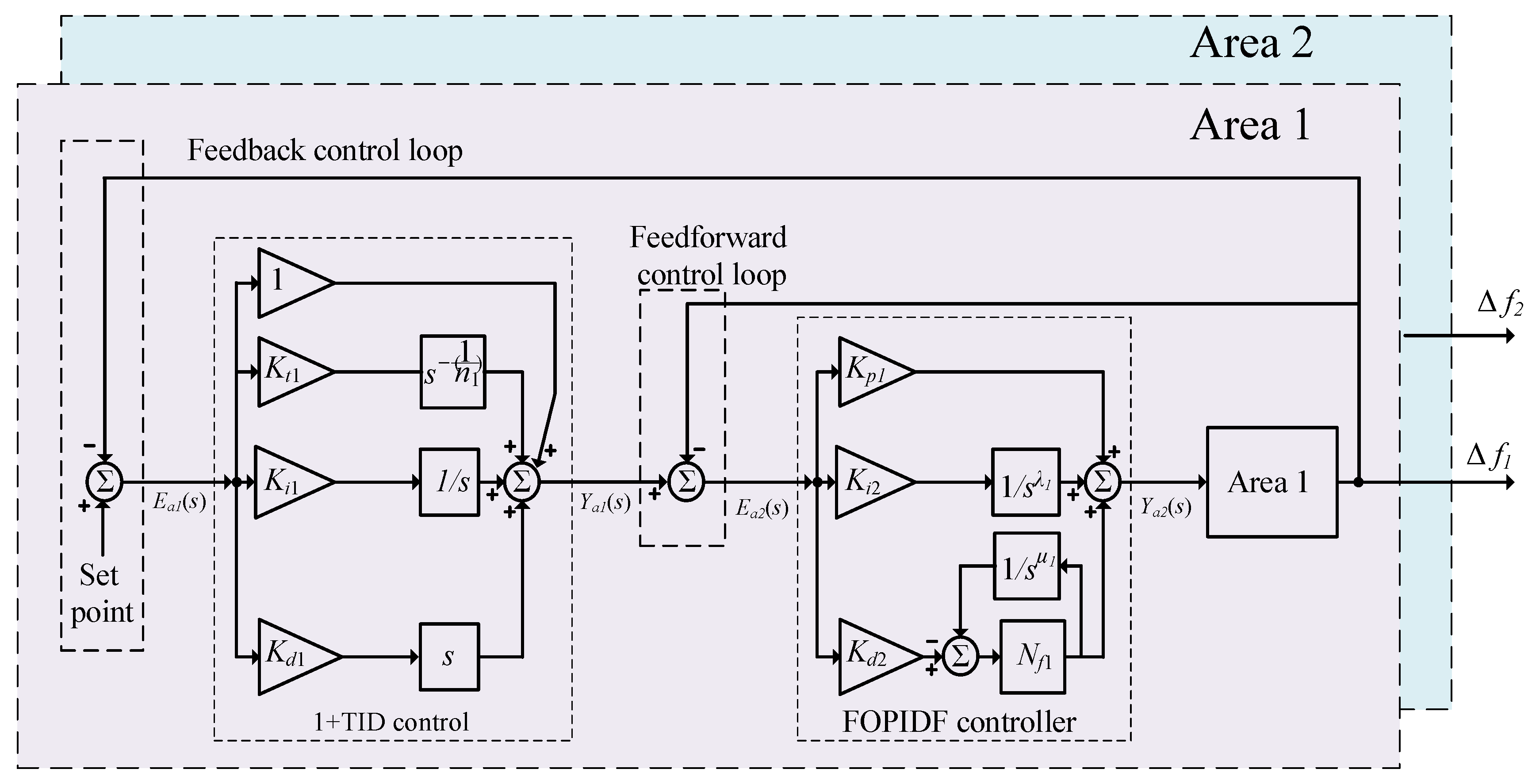
This section presents the proposed control strategies in detail, as represented in the overall control system block diagram shown in Figure 2. This figure illustrates how the system components interact through their transfer functions and how the control structure integrates the cascaded 1+TID/FOPIDF controller and the EV-based TID controller, further detailed in Figure 6 and Figure 7, respectively. The proposed 1+TID/FOPIDF controller, shown in Figure 6, combines the benefits of a modified tilt 1+TID section cascaded by the PFO-ID and the filter with the derivative branch, known as the cascaded 1+TID/FOPIDF controller. The 1+TID component is the controller’s inner loop, and it uses the frequency deviation in each area as its feedback signal. This tilt-based control loop improves disturbance rejection and robustness against parameter variations. The outer loop of the proposed control scheme is represented by the FOPIDF section, which uses the ACE signal as its feedback input. This part of the cascaded controller uses the FO branch instead of the IO proportional term, which in turn combines the benefits of the FOPID control with the tilt term from the inner loop. Furthermore, the FOID terms provide more opportunities for flexible design compared with the IO-based PID controller. Merging of the two controllers results in a more adaptable and tunable structure for the proposed cascaded 1+TID/FOPIDF controller. Additionally, a fractional filter introduces filtering properties alongside the FO operator, addressing the reliability issue of the derivative term. Although the derivative action enhances stability and reduces overshoot, it also amplifies high-frequency noise. Thus, incorporating a filtering stage with the derivative term is essential.
The transfer functions and the output signals of the proposed control scheme can be written as follows (the same is applied to area 2):
1 + T I D = 1 + K t 1 s ( 1 n 1 ) + K i 1 s + K d 1 s
F O P I D F = K p 1 + K i 2 s λ 1 + K d 2 s μ 1 N f 1 s μ 1 + N f 1
The motivating features of each included control term in the proposed controllers are based on their added benefits to the overall control structure. The incorporation of the FOC tilt part increases design and tunable parameter flexibility by adding a tilt operator parameter. The tilt part increases the disturbance rejection capability and improves control robustness against the existing parameter uncertainty of the MG system. Replacing IO terms with FO-based integration actions leads to better steady-state performance with minimized steady-state errors. Furthermore, it adds the FO operator parameter to provide flexibility in the behavior of the proposed controller. Similarly, the FO-based derivative actions add an extra tunable parameter, resulting in reduced overshoot and undershoot. Thus, it leads to better transients and lower transient times. Using the FO filtering helps in the total elimination of existing high-frequency disturbance in the derivative part, which is a well-known problem in derivative actions. The FO filter introduces a realizable derivative term without high-frequency noise.
From Figure 6, the mathematical model of the proposed controller can be formed as follows:
Y 1 ( s ) = ( 1 + T I D ) ( A C E 1 β 1 Δ F 1 )
Y 2 ( s ) = ( Y 1 ( s ) Δ F 1 ) ( F O P I D F )

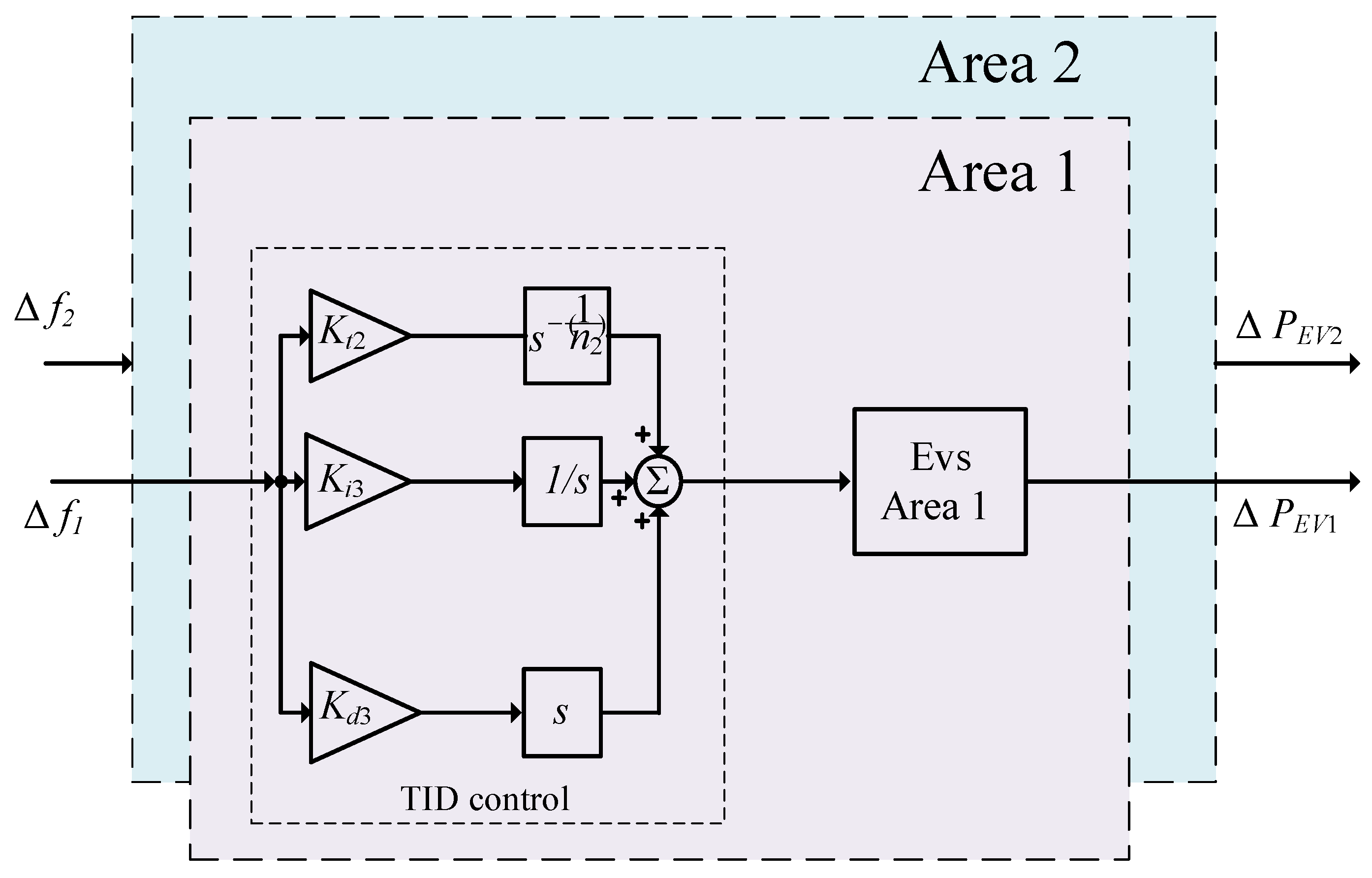
4.3. Proposed TID EV Participation

Each area’s EVs are controlled by the TID controller. It can be described for area 1 as (the same is applied to area 2):
Δ P E V a = ( K t 2 s ( 1 n 2 ) + K i 3 s + K d 3 s ) Δ F 1
Figure 7 describes the structure of the TID controller, which was utilized during this work to enhance the operation of electric vehicles by optimizing stability, efficiency, and performance. Unlike traditional PID controllers, the TID incorporates a fractional-order tilt component, which improves its response to dynamic driving conditions, such as acceleration, regenerative braking, and load variations. By fine-tuning the torque distribution and energy recovery, the TID controller ensures smoother acceleration, reduced EV strain, and better handling. Its adaptive tuning capability makes it ideal for electric vehicles, balancing ride comfort and energy efficiency while maintaining robust control under varying generation and load conditions. This results in a longer battery life.

5. Proposed Optimum Design

5.1. EDO Optimizer Algorithm

The EDO has recently been presented in [73] and has shown improved performance in several optimal determination processes [74]. The proper method for representing natural coefficients using randomly expressed exponential coefficients is a primary characteristic of EDO, which is utilized for earlier event occurrences. The coefficients are held in reserve for specific events that may occur during waiting periods. Another property of the EDO method is that the probability distribution functions (PDFs) of various statistically based events are independent of the search process’s history, resulting in a memoryless distribution.
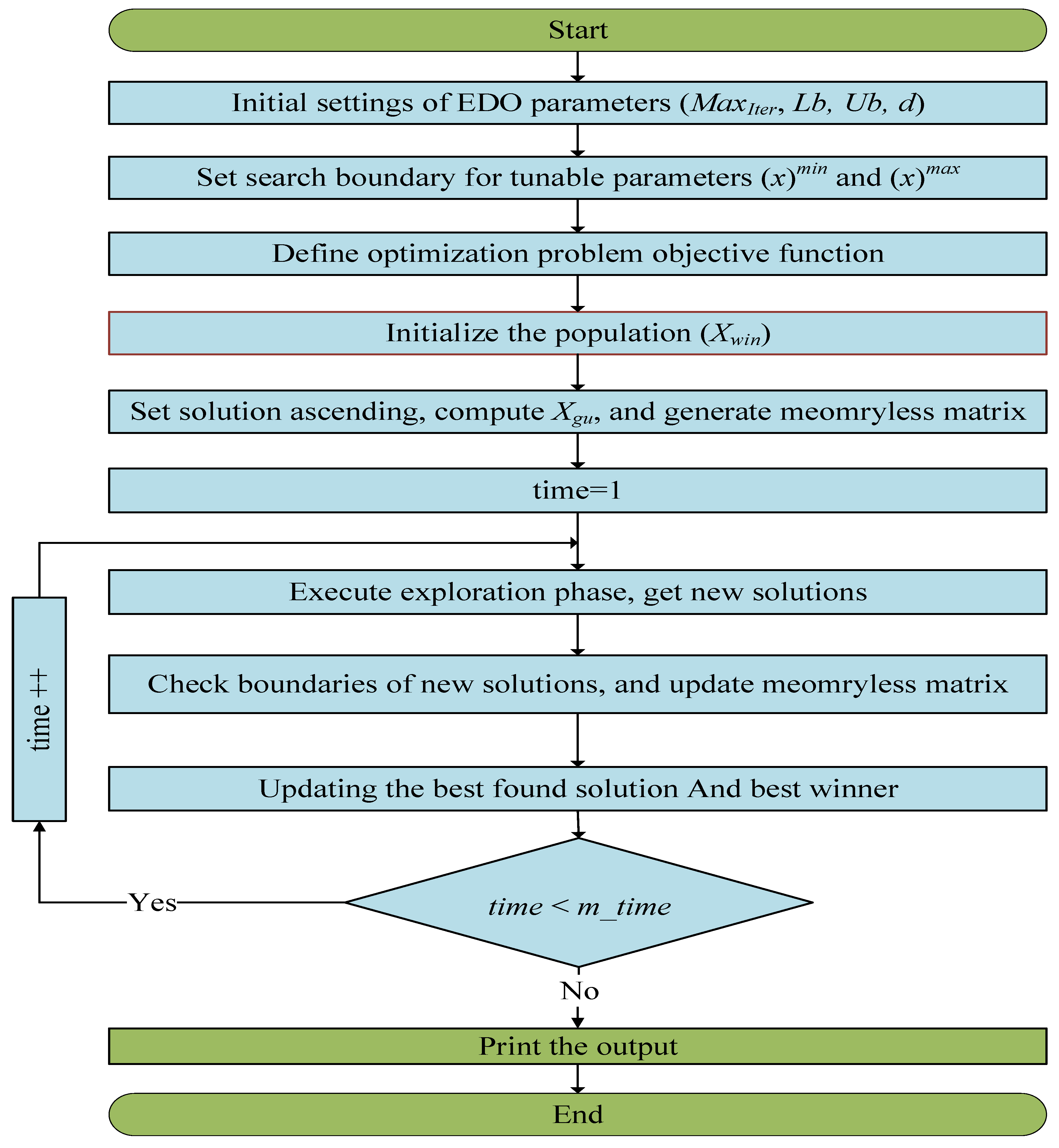
The motivation for using the EDO is as follows: it is based on a mathematical model of the exponential PDF to represent each individual’s updating mechanism during exploitation and exploration, wherein the positions of each solution are represented by exponentially varying random variables. This, in turn, improves convergence behavior, especially for the nonlinear control methods proposed in this paper. Furthermore, the memoryless exploitation phase is used in the EDO algorithm in Figure 8, leading to independent solutions and hence avoiding the common local minima problem in other algorithms. The memoryless model is used for the solution, along with exponential variance.
The PDF representing random coefficients is expressed as follows [75]:
f ( t p ) = γ e γ t p if t p > 0 0 O t h e r w i s e
where t p represents a positive number of the waiting period until the event occurrence, and γ > 0 is an exponential distribution. Meanwhile, the accumulated exponential PDF is determined using the following [76]:
f ( t p ) = 1 e γ t p if t p > 0 0 O t h e r w i s e
where
ν = 1 γ , σ 2 = 1 γ 2 , ν = σ
where ν and σ 2 refer to average and standard deviation (STD) for the exponential PDF, respectively.
In the initialization phase, the initial populations ( X i n ) with M solutions are randomly generated at extremely diverse values, whereas potential solutions are represented using an ED model with random exponential associated positions. X i n populations are expressed as follows [74]:
X i n ( i , j ) = [ X i n ( i , 1 ) X i n ( i , 2 ) X i n ( i , 3 ) , , X i n ( i , d ) ] w i t h i = 1 , 2 , , M a n d j = 1 , 2 , 3 , , d
X i n ( i , j ) = L b + r a n d ( U b + L b )
X i n ( i , j ) = X i n ( 1 , 1 ) X i n ( 1 , 2 ) X i n ( 1 , d ) X i n ( 2 , 1 ) X i n ( 2 , 2 ) X i n ( 2 , d ) X i n ( N , 1 ) X i n ( N , 2 ) X i n ( N , d )
where d refers to the optimization process dimension. X i n ( i , j ) refers to element with j random coefficient for vector i t h of nominee ED’s. U b and L b refer to upper/lower solution boundaries, respectively, and rand in range [0, 1] is a random number.
In the exploitation phase, the guiding solver for the EDO algorithm is determined using the average value of the best three primary solutions, and it is expressed as follows [77,78]:
X g u i t e r = X i n , b e s t 1 i t e r + X i n , b e s t 2 i t e r + X i n , b e s t 3 i t e r 3
where i t e r and X g u , i t e r refer to the EDO current iteration and guiding solver associated with the current iteration, respectively. A memoryless matrix is constructed to store newly determined solutions, regardless of their current objective functions. The obtained simulated memoryless updated solutions are as follows [75]:
V i i t e r = k . ( m e m o r y l e s s i i t e r σ 2 + h . X g u i t e r ) if X i n ( i ) i t e r = m e m o r y l e s s i i t e r h . ( m e m o r y l e s s i i t e r σ 2 + l o g ( ϕ ) . X i n ( i ) i t e r ) O t h e r w i s e
k = ( f ) 10 , h = ( f ) 5 , f = 2 . r a n d 1
where k and h refer to adaptive EDO parameters, m e m o r y l e s s i i t e r refers to a memoryless simulated matrix for ith solution. ϕ and f refer to random numbers in [0, 1] and [−1, 1] ranges, respectively. Whereas the estimated exponential rate is obtained using [77]:
ν = ( m e m o r y l e s s i i t e r + X g u i t e r ) / 2
In the exploration phase, searching spaces are determined by the EDO algorithm for the prospective locations of optimum global solutions. The solution is updated as follows [73,74]:
V i i t e r + 1 = X i n ( i ) i t e r M i t e r + ( c . Z 1 + ( 1 c ) . Z 2 )
M i t e r = i = 1 M X i n ( j , i ) i t e r
c = h × f a n d h = 1 i t e r M i t e r
Z 1 = M D 1 + D 2 a n d Z 2 = M D 2 + D 1
D 1 = M X i n ( r 1 ) a n d D 2 = M X i n ( r 2 )
where M i t e r represents the average value of X i n , and c refers to the adjusted information ratio factor between the Z 1 and Z 2 vectors to the new solution. Whereas g and M i t e r refer to adaptive factor and maximum iteration number, respectively. X i n , r 1 and X i n , r 2 refer to candidate-winner solutions. D 1 refers to the average solution difference with X i n , r 1 , and D 2 refers to the average solution difference with X i n , r 2 . ζ (with ζ < 0.5) refers to a probability coefficient, which determines the applied exploitation/exploration phase. It is determined by a switching factor as follows [75]:
V i i t e r = k . ( m e m o r y l e s s i i t e r σ 2 + h . X g u i t e r ) if X i n ( i ) i t e r = m e m o r y l e s s i i t e r h . ( m e m o r y l e s s i i t e r σ 2 + l o g ( ϕ ) . X i n ( i ) i t e r ) O t h e r w i s e if ζ < 0 X i n ( i ) i t e r M i t e r + ( c . Z 1 + ( 1 c ) . Z 2 ) O t h e r w i s e
A summarized diagram of the EDO phases is shown in Figure 8.

5.2. Optimized Design and Performance Using EDO Algorithm

Classical schemes for determining fractional-order controllers are very complex and require an expert and a considerable amount of time for tuning. The reason lies in the characteristics of the controller, which interconnects power grids with their inherent nonlinearities in higher-order equivalent representations. Another issue is the non-integer characteristics of FO control schemes. An alternative solution can be achieved by applying intelligent metaheuristic optimization algorithms to determine the parameters through iterative solution refinement guided by an objective function. A significant benefit of these methods is the ability to output a set of suggested optimal parameters for the tunable elements during the optimization process. This, in turn, ensures optimality compared to the traditional parameter-by-parameter design process.
In the proposed system, four FO controllers are tuned through the EDO algorithm. The LFC parameters in the two areas using the cascaded 1+TID/FOPIDF controllers and the TID controllers are the required design variables of the algorithm. An overview of the design process representation utilizing the EDO algorithm is shown in Figure 9.

Procedure: Applying EDO to Tune the Proposed Controllers

Step 1: Model the Studied Plant
  • Model the two-area MG system in MATLAB/Simulink, including nonlinearities and generation unit limitations.
  • Implement the system structure shown in Figure 1, Figure 2 and Figure 3 in Section 2.
  • Apply representative operating scenarios, including step load disturbances in both areas.
Step 2: Acquire Measured Variables
  • Measure the following quantities during each simulation run:
    Δ F 1 , Δ F 2 , Δ P t i e
  • Form the measurement vector:
    x = [ Δ F 1 , Δ F 2 , Δ P t i e ]
Step 3: Formulate the Objective Function
Use traditional error-based performance indices:
I S E = 0 t s ( ( Δ F 1 ) 2 + ( Δ F 2 ) 2 + ( Δ P t i e ) 2 ) d t I T S E = 0 t s ( ( Δ F 1 ) 2 + ( Δ F 2 ) 2 + ( Δ P t i e ) 2 ) t . d t I A E = 0 t s ( a b s ( Δ F 1 ) + a b s ( Δ F 2 ) + a b s ( Δ P t i e ) ) d t I T A E = 0 t s ( a b s ( Δ F 1 ) + a b s ( Δ F 2 ) + a b s ( Δ P t i e ) ) t . d t
These serve as performance measures for the EDO algorithm.
Step 4: Define Parameter Search Boundaries
Search limits for all gains and fractional orders:
K t m i n K t 1 , K t 2 , K t 3 , K t 4 K t m a x n m i n n 1 , n 2 , n 3 , n 4 n m a x K i m i n K i 1 , K i 2 , K i 3 , K i 4 , K i 5 , K i 6 K i m a x λ m i n λ 1 , λ 2 λ m a x K d m i n K d 1 , K d 2 , K d 3 , K d 4 , K d 5 , K d 6 K d m a x μ m i n μ 1 , μ 2 μ m a x N f m i n N f 1 , N f 2 N f m a x
wherein ( ) m i n and ( ) m a x are set as
0 K t 1 , K t 2 , K t 3 , K t 4 5 2 n 1 , n 2 , n 3 , n 4 10 0 K i 1 , K i 2 , K i 3 , K i 4 , K i 5 , K i 6 5 0 λ 1 , λ 2 1 0 K d 1 , K d 2 , K d 3 , K d 4 , K d 5 , K d 6 5 0 μ 1 , μ 2 1 50 N f 1 , N f 2 500
Step 5: Initialize the EDO Algorithm
  • Set the maximum number of iterations and population size.
  • Generate the initial population of parameter vectors.
  • Compute the objective function for each individual.
Step 6: Perform Iterative Optimization
  • For each iteration:
    Evaluate the objective function for all population members.
    Identify the best (minimum) objective value.
  • If a population member achieves a better objective value than the stored global optimum, update the following:
    The global optimum objective value.
    The corresponding parameter vector.
Step 7: Finalize Optimal Parameters
  • After the maximum iteration count is reached, record the following:
    The final optimal objective value.
    The corresponding parameter vector.
    The iteration history.
Step 8: Validate the Optimized Controllers
  • Implement the optimized controller parameters in real-time simulation.
  • Apply various test scenarios involving renewable/load fluctuations and FDIA cases.
  • Evaluate system performance to verify robustness and improved LFC capability.

6. Simulation Results and Performance Verification

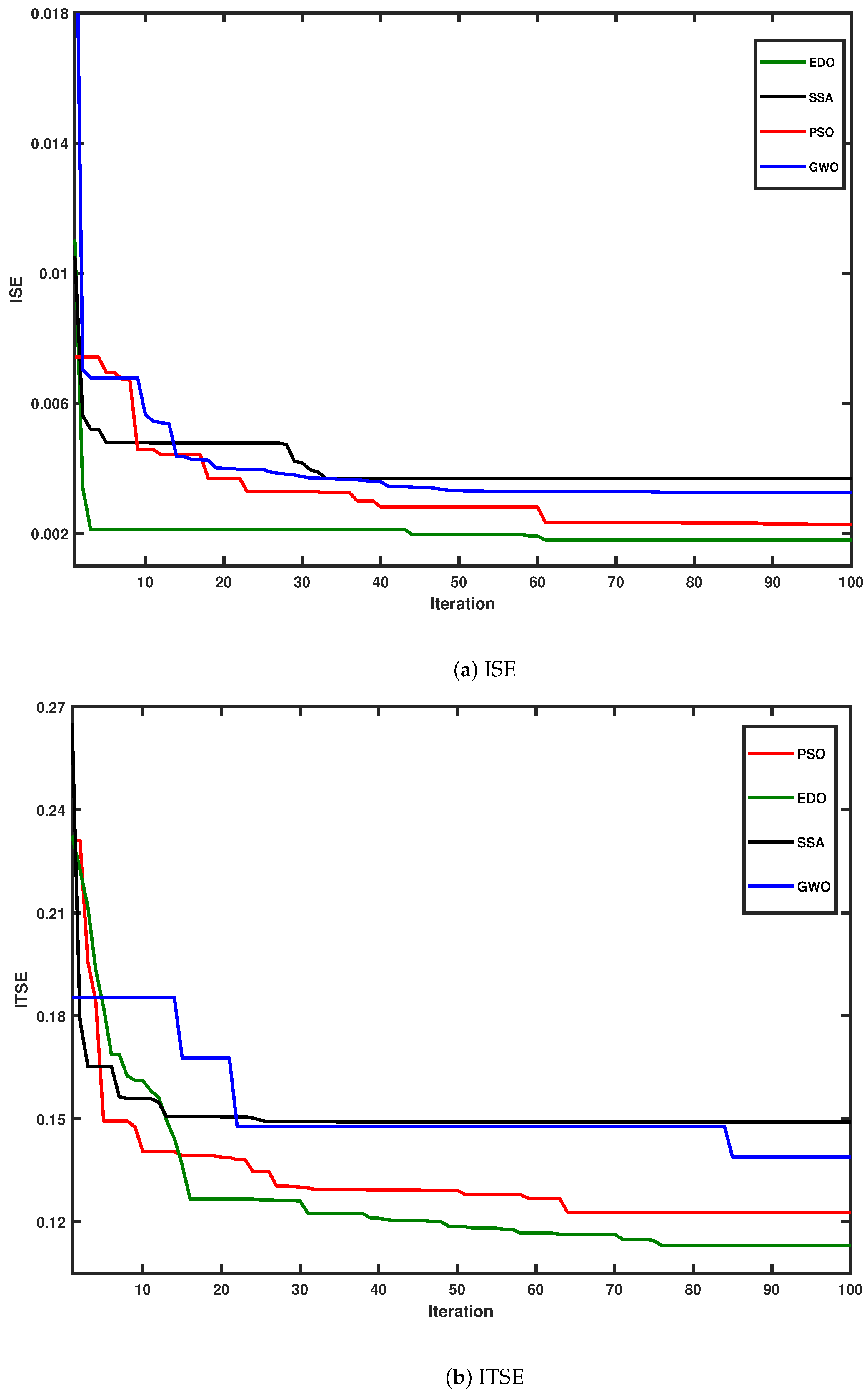
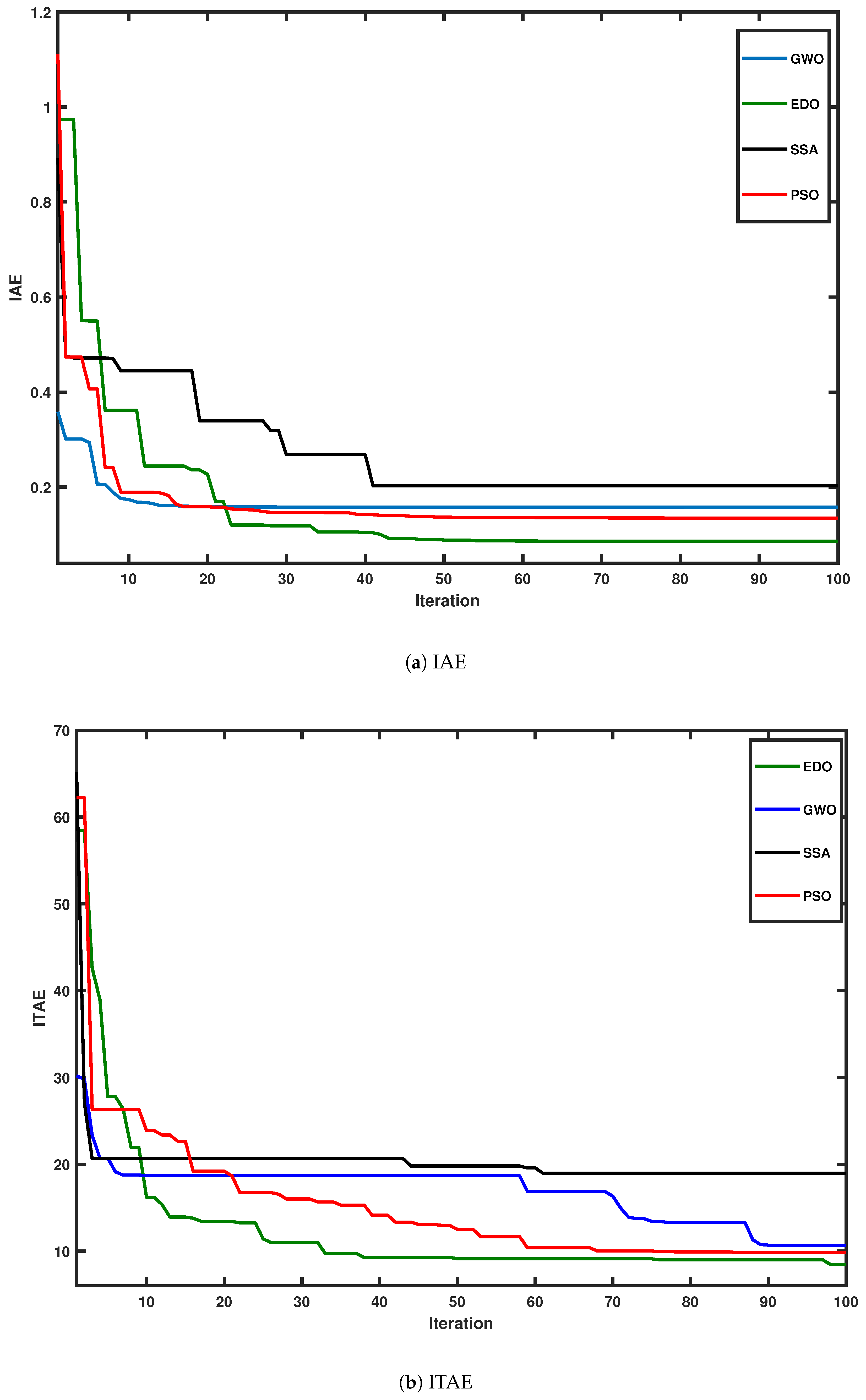
The proposed controller 1+TID/FOPIDF, along with the other controllers used, TID, FOPID, and FOTID, have been implemented using MATLAB/Simulink 2022b. To find the optimal parameters for the proposed controller, the EDO algorithm was programmed using a MATLAB m-file. The optimization process is made 30 times using the same iteration numbers, population size, and parameter boundaries. The obtained statistical results over the 30 runs are summarized in Table 2, which also provides statistical analysis of the best value, worst value, mean value, median value, and standard deviation for each optimizer during the 30 runs. It has been run with 100 iterations and 20 population sizes. The proposed EDO gives the lowest value of the objective function compared to the other studied optimizers. Moreover, EDO has been validated using a step load disturbance, compared with other algorithms such as PSO, GWO, and SSA, as mentioned in the literature review. Figure 10 and Figure 11 demonstrate the consistent, rapid decline in the EDO, indicating a significant improvement in convergence compared to other optimization techniques. Table 3 summarizes all the optimized values of the controller parameters.
The following scenarios have been used to analyze how the proposed controller will affect the system being studied:
  • Scenario 1: Step load disturbance (SLD).
  • Scenario 2: Multi-step load.
  • Scenario 3: Fluctuations in RESs
  • Scenario 4: Penetration at load 0.05 pu.
  • Scenario 5: Penetration at load 0.1 pu.
  • Scenario 6: Cyberattacks FDIA.
  • Scenario 7: DoS attack.
The performance index values of all scenarios, the peak overshoot, undershoot, and settling times are displayed in Table 4, Table 5 and Table 6. In addition, Table 7 compares the ITSE, ITAE, ISE, and IAE integral performance indices for various controllers in Scenarios 1 through 7.

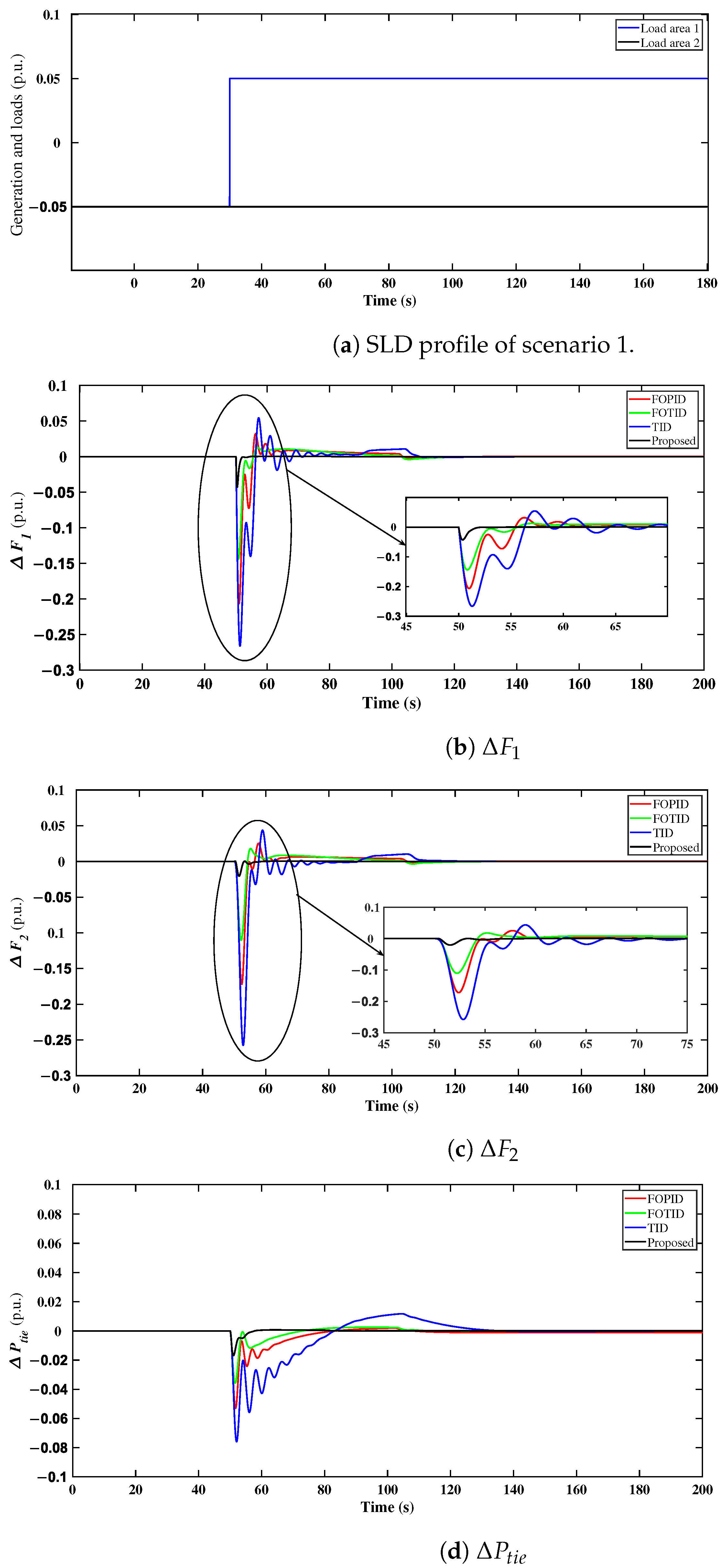
6.1. Scenario 1: Step Load Disturbance (SLD)

The performance of the investigated dual-area multi-machine power system is assessed under a 10% SLD, which is applied at the simulation start time, as shown in Figure 12a. It can be observed from Figure 12b,c that the TID controller exhibits sustained frequency oscillations exceeding 0.266 Hz, which failed to stabilize within the nominal range. In contrast, the FOPID controller reduces deviations to an acceptable limit of approximately 0.172 Hz, albeit with a slow convergence rate. However, the FOTID controller kept the frequency at a low level of 0.11 Hz. However, the proposed hybrid approach of 1+TID/FOPIDF demonstrates superior damping by curtailing frequency deviations more rapidly, achieving stabilization to 0.02 Hz in just 5 s. Figure 12d compares the system tie-line power response using the four suggested control schemes, which highlight the critical role of the proposed approach 1+TID/FOPIDF. Furthermore, the efficacy of the hybrid controller 1+TID/FOPIDF in coordinating the participation of the EV and the FC to minimize oscillatory behavior relative to other strategies is quantified in Table 4. These findings underscore the robustness of the hybrid 1+TID/FOPIDF controller in managing continuous and abrupt load variations, as it outperforms the TID, FOPID, and FOTID controllers in terms of transient frequency deviations, settling time, and resilience under SLD conditions.

6.2. Scenario 2: Multi-Step Load

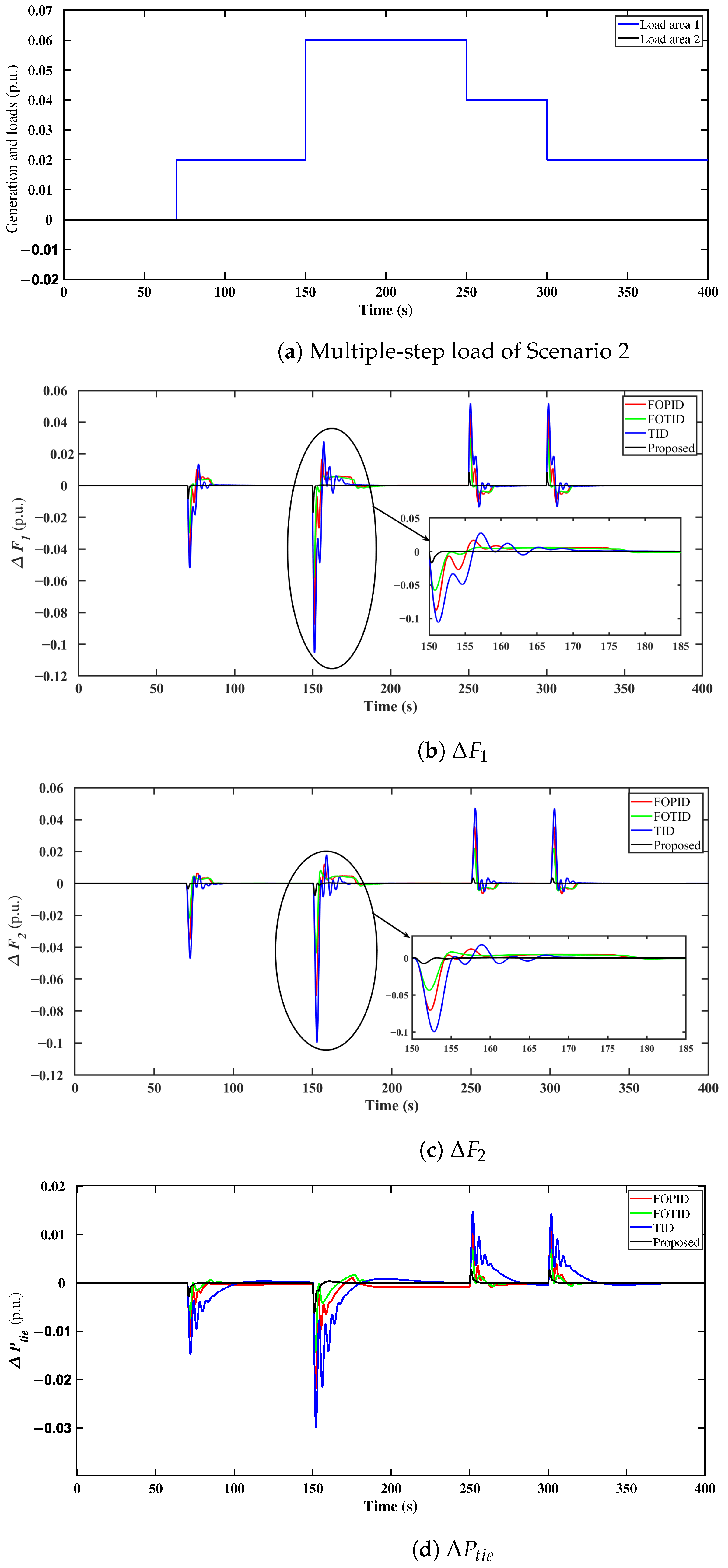
Figure 13a illustrates the load profile for Scenario 2, characterized by step-like fluctuations in load demand over a 400 s interval within a 0 to 0.06 pu range. These abrupt variations are designed to assess the system’s dynamic response under changing load conditions in LFC, as well as to evaluate the effectiveness and robustness of the proposed hybrid 1+TID/FOPIDF controller. The integration of EVs and FC generation into the LFC framework is also examined. Hence, it can be concluded that the 1+TID/FOPIDF controller outperforms TID, FOPID, and FOTID controllers in managing both inserting and shedding loads, achieving faster convergence and minimal frequency deviations as depicted in Figure 13b,c. The controller’s robustness is further validated under continuous and abrupt load variations, confirming its adaptability to diverse operating conditions. Additionally, Figure 13d depicts the coordinated operation of EV and FC storage systems in stabilizing the Autonomous MG tie-line power through rapid charge/discharge cycles, facilitated by the EDO-optimized 1+TID/FOPIDF framework. This dynamic interaction underscores the resilience of the combined LFC strategy in maintaining system stability. Key performance metrics for this scenario are summarized in Table 4, which reinforces the superiority of the proposed approach in minimizing settling times and frequency overshoots, thereby validating its potential for real-world interconnected MG applications.

6.3. Scenario 3: Fluctuations in RESs

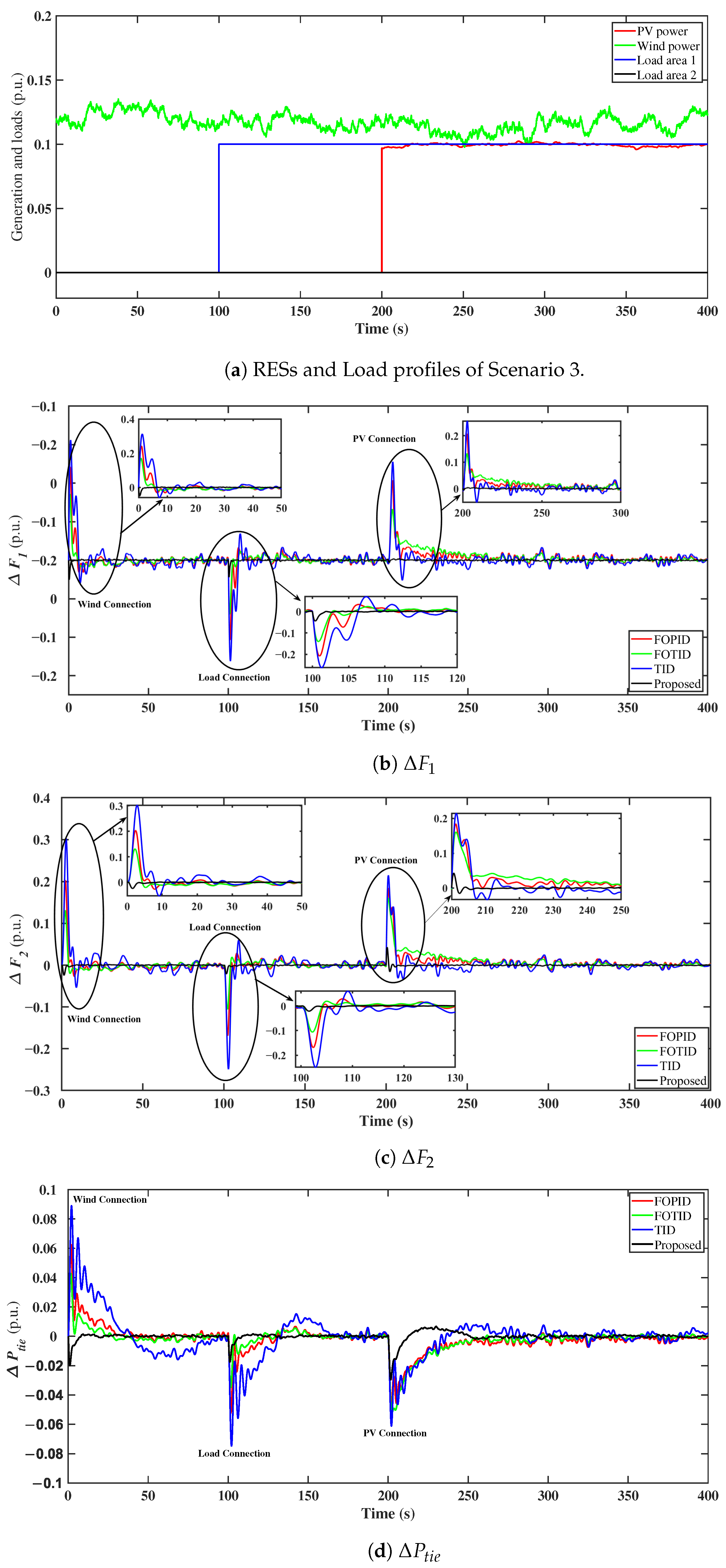
Integrating RESs introduces challenges for interconnected MG power systems, as their inherent variability can adversely affect the frequency response. This is attributed to the system’s reliance on inverter-based technologies and insufficient rotational inertia. To evaluate the effectiveness of the proposed hybrid 1+TID/FOPIDF structure for LFC strategy and EV performance in coordination with FC systems under extreme load and PV/wind fluctuations, a highly variable wind generation unit was introduced at t = 0 s, followed by an SLD at t = 100 s and installation of PV generation at t = 200 s as described in Figure 14a.
Figure 14b compares the performance of the control strategies. Under low-inertia conditions, the TID controller exhibits significant transient oscillations, with frequency deviations in area one peaking at 0.32 Hz (t = 0 s), 0.07 Hz (t = 100 s), and 0.25 Hz (t = 200 s). FOPID reduces these deviations to 0.22 Hz, 0.02 Hz, and 0.2 Hz during the same three events. The FOTID controller can damp the frequency deviation to 0.17 Hz, 0.018 Hz, and 0.13 Hz at 0, 100, and 200 s of transient time. On the other hand, the proposed hybrid 1+TID/FOPIDF scheme outperforms both, limiting oscillations to 0.0008 Hz while requiring lower control signal output, thereby reducing control costs. Furthermore, Figure 14c,d prove the efficacy of the proposed 1+TID/FOPIDF controller in addition to the critical role of EVs and FC power sharing, which decreases during integration of RES but increases with load changes. Table 4 summarized the overshoot, undershoot, and settle time values of all control strategies at a whole time interval of this scenario, which demonstrates the superior performance of the proposed control approach in coordinating LFC, EVs, and FC, ensuring stability during RES and load fluctuations.

6.4. Scenario 4: Penetration at Load 0.05 pu

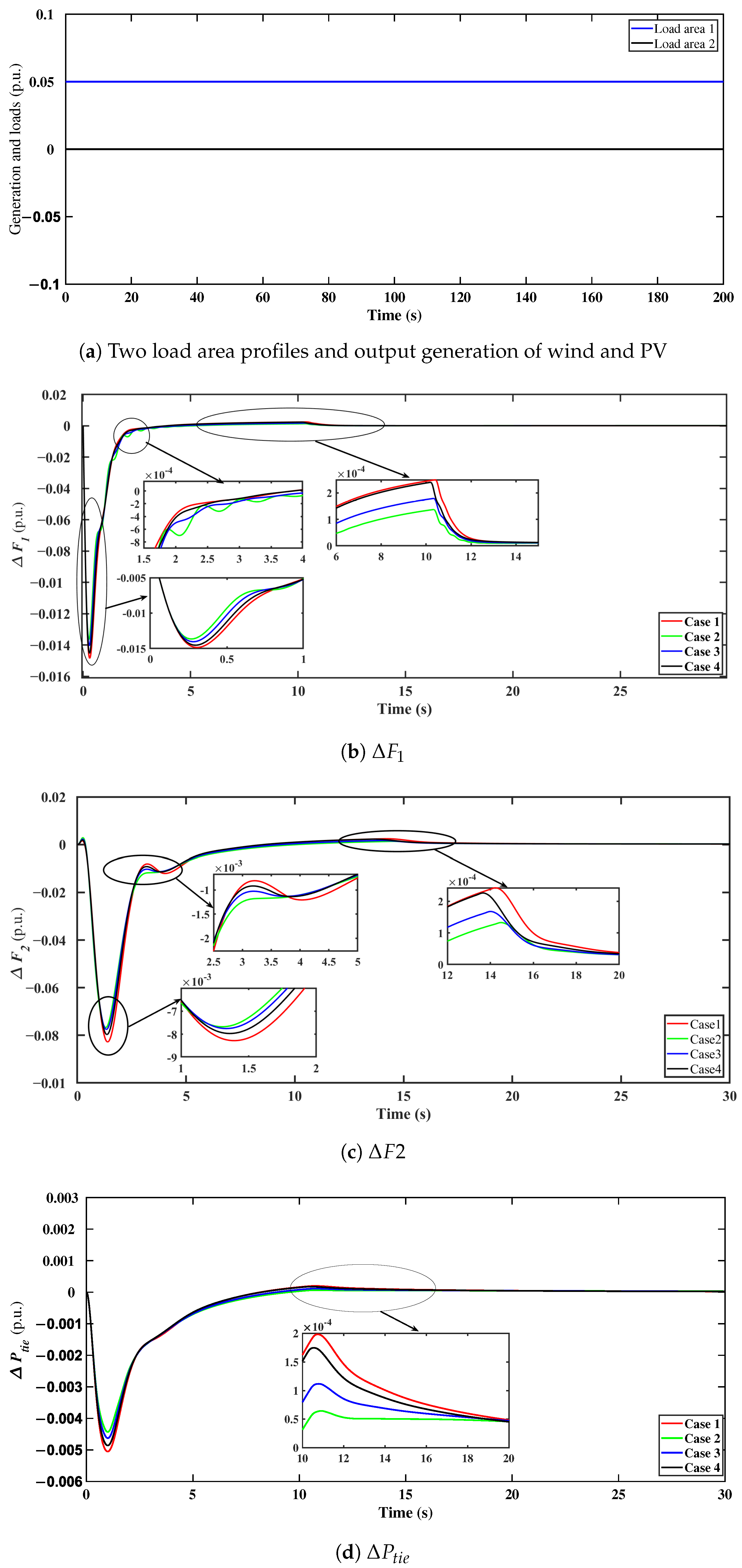
The system’s response in a two-area MG for Scenario 4 with a load of 0.05 pu is shown in Figure 15, demonstrating the efficacy of different control techniques. The load profiles and consistent PV and wind generation output are shown in Figure 15a, creating a stable operational baseline. The dynamic responses of the tie-line power deviation ( Δ P t i e ), frequency in Area 1 ( Δ F 1 ), and frequency in Area 2 ( Δ F 2 ) are displayed in Figure 15b, Figure 15c and Figure 15d, respectively. The suggested 1+TID/FOPIDF controller exhibits better dynamic behavior when the responses of four control cases are compared. In particular, the suggested controller results in quicker settling times for frequency and tie-line power variations, less overshoot, and faster damping. The comprehensive insets in Figure 15 highlight significant transient phases, offering a better understanding of the improved stability of the suggested approach.

6.5. Scenario 5: Penetration at Load 0.1 pu

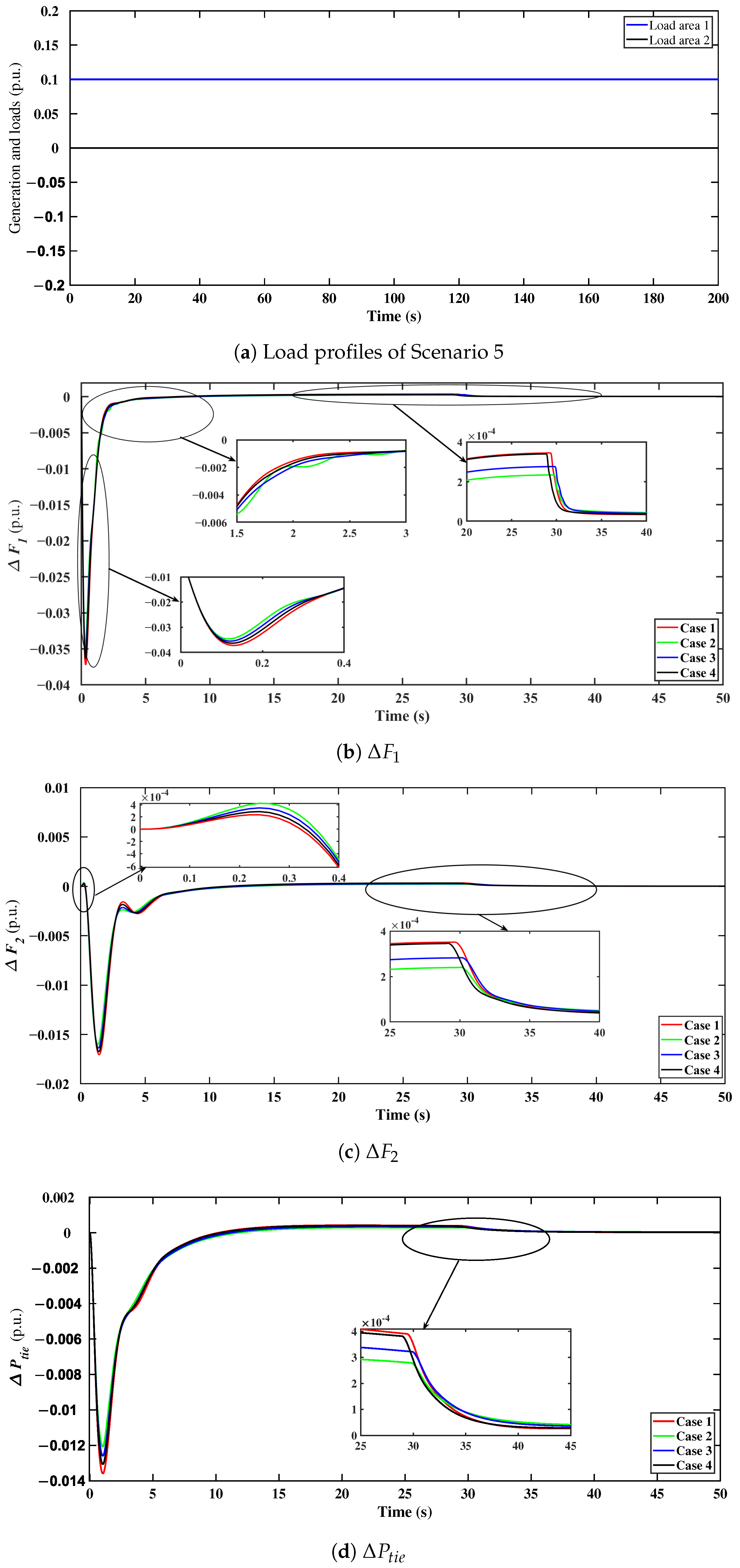
Figure 16 illustrates the dynamic response of the LFC system that incorporates FCs in Scenario 4 with a disturbance magnitude of 0.1 pu. In Figure 16a, the power generation from PV and wind sources is presented alongside the load demand in two distinct areas, demonstrating a steady-state generation-load equilibrium for the given scenario. Figure 16b–d show the frequency deviations in Area 1 ( Δ F 1 ), Area 2 ( Δ F 2 ), and the deviation of the tie-line power ( Δ P t i e ), respectively, for four control strategies. These responses highlight the effectiveness of each controller in mitigating the disturbance. The zoomed-in insets within each plot enable a detailed analysis of transient behaviors, including overshoot, undershoot, and the time required to reach a steady state. The comparative results reveal that while all controllers ultimately restore stability, they differ in their dynamic performance, underscoring the importance of selecting the appropriate controller to enhance system resilience and frequency regulation.

6.6. Scenario 6: Cyberattacks FDIA

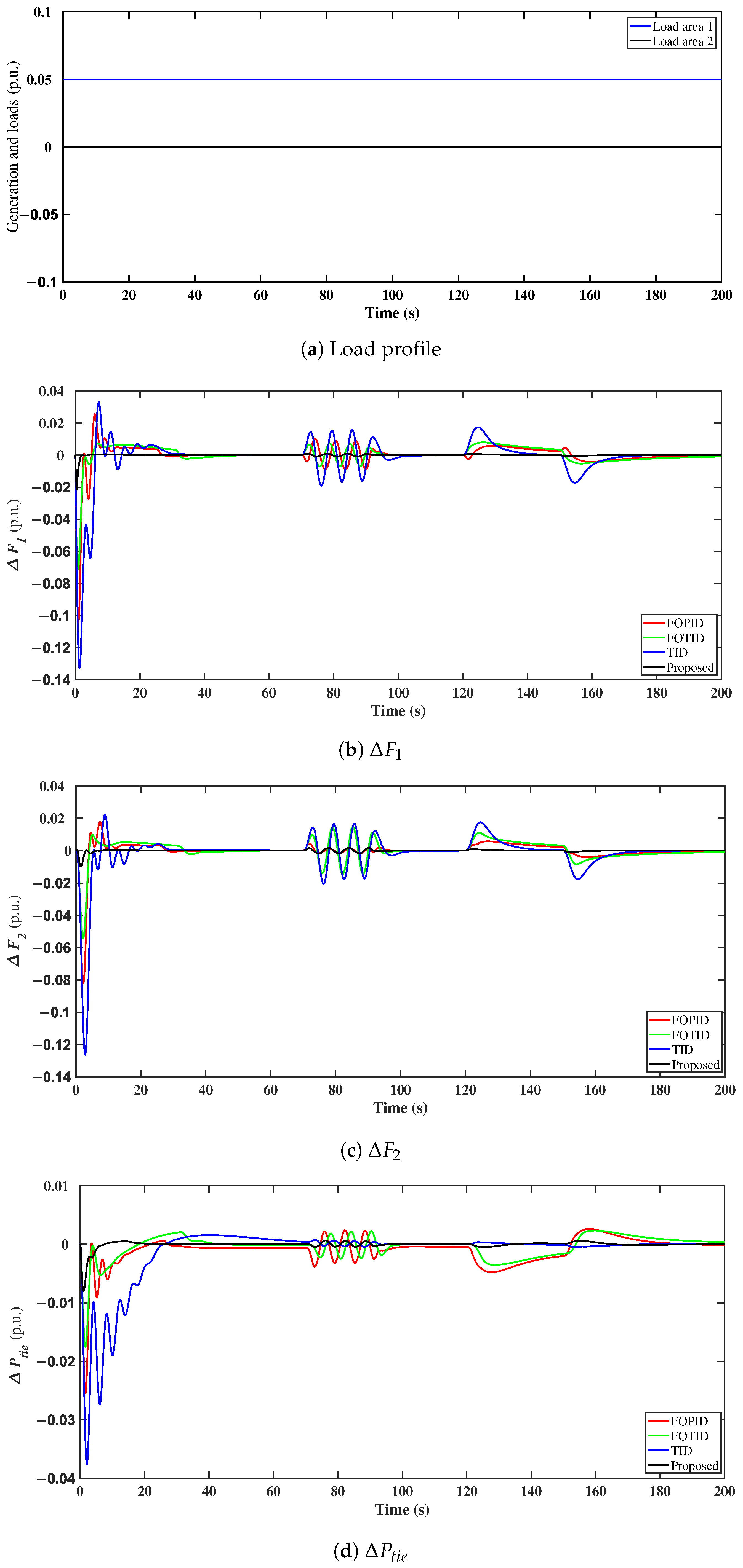
In this scenario, the system frequency response was examined in the event of cyberattacks applied to the input signal of the controller responsible for energy storage and the transfer of stored energy to the MG, as illustrated above. The following FDI attack signals were applied:
  • At 70 s < t < 90 s , the malicious signal v 2 ( t ) was applied.
  • At 120 s < t < 150 s , the malicious signal v 1 ( t ) was applied.
Figure 17a presents the load profile for Scenario 6, featuring step changes in load demand over 200 s, ranging from 0 to 0.05 pu. These sudden fluctuations are intended to test the dynamic performance of the system under varying load conditions in LFC and to evaluate the effectiveness and robustness of the proposed hybrid 1+TID/FOPIDF controller. The impact of FDI cyberattacks on controller performance is shown in Figure 17b–d. The TID controller exhibits the largest oscillations and the slowest settling time, particularly during the early disturbance period, indicating the worst damping capability. While the FOTID and FOPID controllers perform better, with reduced oscillations and faster settling, this reflects the advantage of using fractional-order terms to enhance robustness. In contrast, the proposed 1+TID/FOPIDF controller consistently outperforms all other control schemes across the three measures of ( Δ F 1 ), ( Δ F 2 ), and ( Δ P t i e ), demonstrating the smallest overshoot, strong suppression of oscillatory ripples, and the quickest return to steady state. Therefore, it has been noted that the superiority of the proposed controller lies in its remaining smoother and closer to the zero-deviation point, especially during disturbances around 60–120 s. That performance indicates superior disturbance-rejection capability of the proposed 1+TID/FOPIDF controller in the studied MG system.
Table 7 presents the frequency response results, evaluated via numerical analysis using performance indices including IAE, ISE, ITAE, and ITSE. A review of the table highlights the effectiveness of the proposed control strategy. Based on performance metrics, the proposed controller reduces frequency oscillations by more than 70% compared to the FOPID, FOTID, and TID controllers, respectively.

6.7. Scenario 7: Dos Attack

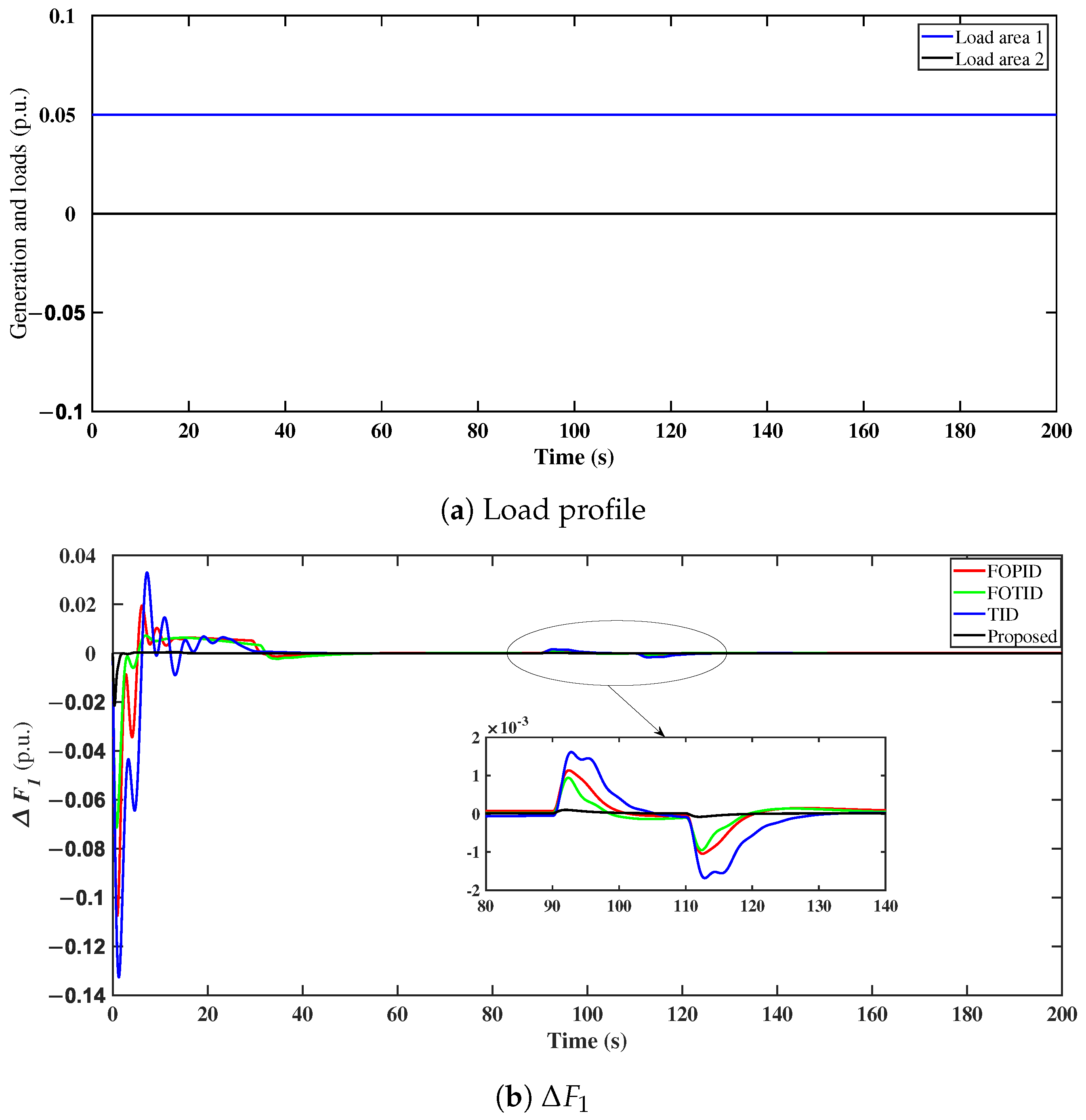
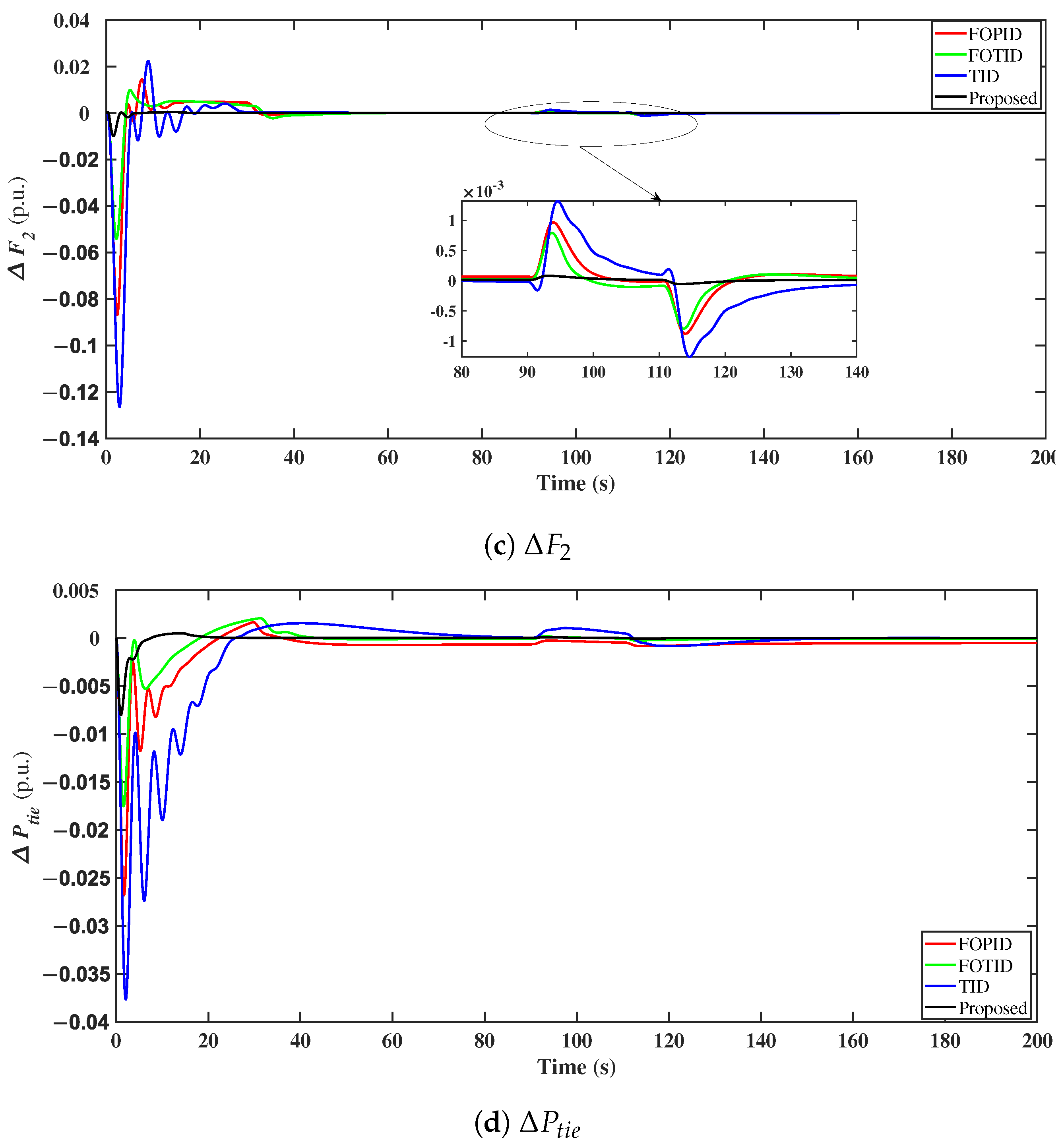
This section presents clearer distinctions among the four controllers to evaluate the effectiveness of the proposed control strategy in mitigating DoS attacks within a hydrogen-based ESS. At 90 s < t < 110 s , it is assumed that the DoS attack simultaneously affects the control signals of the electrolyzer and the FC.
Figure 18 illustrates the impact of DoS attacks on the frequency response of the isolated MG. Figure 18b–d compares the performance of the proposed control strategy with that of the FOPID, TID, and FOTID controllers under DoS attacks. Consistent with previous scenarios, the TID scheme still exhibits the weakest performance, with pronounced oscillations, slower damping, and deeper fluctuations in both frequency and tie-line power waveforms, indicating limited robustness to sudden load variations. The FOPID and FOTID respond more effectively, with noticeably smaller overshoot and improved damping compared to the TID controller. However, they still display moderate oscillatory ripples during the magnified disturbance event. In contrast, the proposed strategy effectively suppresses frequency oscillations during DoS attacks, with the smallest deviation amplitude and the fastest return to nominal conditions within acceptable limits. Hence, the proposed controller is the most effective in the studied MG, followed by FOPID and FOTID, which exhibit comparable but slightly inferior performance, and TID is the least robust controller. Performance was quantitatively evaluated using frequency response metrics and various performance indices, with the results summarized in Table 7. Analysis of Table 7 reveals that the proposed 1+TID/FOPIDF controller enhances the dynamic frequency response of the MG by more than 80% compared to the FOPID, FOTID, and TID controllers, respectively.

7. Conclusions

This paper presented the effectiveness of integrating green hydrogen technologies and EV batteries into MG systems for enhanced LFC. By proposing a novel cascaded 1+TID/FOPIDF controller, together with an EV-based TID controller, this paper addressed the challenges posed by RES fluctuations and false data injection attacks (FDIAs). The proposed controller was implemented in MATLAB/Simulink 2022b, and its parameters were optimized using the exponential distribution optimizer (EDO), ensuring optimal tuning. Simulation results under various scenarios confirmed that the proposed control strategies significantly improved system frequency stability and robustness, outperforming existing methods in mitigating frequency deviations in multi-area MG systems. For example, in Scenario 3, in the case of fluctuation in RESs, the measured indices are as follows: ISE (1.079, 0.5306, 0.3515, 0.0104), IAE (15.011, 10.691, 9.527, 1.363), ITSE (100.613, 64.412, 53.649, 1.323), and ITAE (2120, 1765, 1683, 241.32) for TID, FOPID, FOTID, and proposed, respectively. These results showed that the LFC using the proposed controller significantly outperforms the other conventional controllers used. In addition to these performance indices, detailed transient response comparisons further demonstrate the superiority of the proposed approach. The proposed controller consistently achieved the lowest overshoot (OS), undershoot (US), and settling time (Ts) across all tested scenarios. In Scenario 1, the overshoot for the proposed controller was reduced by more than 50% compared with TID, FOPID, and FOTID controllers, while achieving the fastest settling time (5.29 s versus 8.35–21.67 s). In Scenario 2, the proposed method again exhibited the smallest undershoot values and maintained settling times of approximately 4–5 s, outperforming competing controllers that required 7–18 s. Under the more demanding conditions of Scenario 3 (wind, load, and PV disturbances), the proposed controller maintained robust performance, yielding settling times of 29–56 s, whereas the other controllers demonstrated significantly slower dynamics, with settling times reaching up to 140 s. These findings demonstrate that the EDO-optimized cascaded 1+TID/FOPIDF controller delivers superior damping, stronger dynamic stability, and greater resilience to RES fluctuations and cyberattacks, confirming its effectiveness and suitability for modern multi-area microgrid applications.

Author Contributions

Conceptualization, N.A.N., W.A.H., M.A., E.A.M., D.M.A., and A.F.F.; Methodology, N.A.N., W.A.H., M.A., E.A.M., D.M.A., and A.F.F.; Software, N.A.N., W.A.H., M.A., E.A.M., D.M.A., and A.F.F.; Validation, N.A.N., W.A.H., M.A., E.A.M., D.M.A., and A.F.F.; Formal analysis, N.A.N., W.A.H., M.A., E.A.M., D.M.A., and A.F.F.; Investigation, N.A.N., W.A.H., M.A., E.A.M., D.M.A., and A.F.F.; Resources, N.A.N., W.A.H., M.A., E.A.M., D.M.A., and A.F.F.; Data curation, N.A.N., W.A.H., M.A., E.A.M., D.M.A., and A.F.F.; Writing—original draft, N.A.N., W.A.H., M.A., E.A.M., D.M.A., and A.F.F.; Writing—review and editing, N.A.N., W.A.H., M.A., E.A.M., D.M.A., and A.F.F.; Visualization, N.A.N., W.A.H., M.A., E.A.M., D.M.A., and A.F.F.; Supervision, M.A. and E.A.M. All authors have read and agreed to the published version of the manuscript.

Funding

The authors extend their appreciation to Prince Sattam bin Abdulaziz University for funding this research work through the project number (PSAU/2025/01/33673).

Data Availability Statement

No new data were created or analyzed in this study. Data sharing is not applicable to this article.

Conflicts of Interest

The authors declare no conflicts of interest.

Nomenclature

SymbolDescriptionSymbolDescription
K r Gain of reheater steam turbine T r Time constant of reheater steam turbine
T i Turbine time constant N 1 , N 2 Fourier coefficients
T s g Governor time constant T g h Hydro turbine governor time constant
T r s Governor reset time (hydro) T r h Transient droop time constant (hydro)
T w Water string time in penstock B g Gas turbine valve positioner constant
C g Valve positioner (gas turbine) X g Lead time constant (gas governor)
T g Lag time constant (gas governor) T c r Combustion reaction time delay
T f Gas turbine fuel time constant T c d Compressor discharge time constant
T 2 Speed governor time constant T T 1 HP turbine time constant
T R H 1 First LP turbine time constant T R H 2 Second LP turbine time constant
K H HP turbine gain K R 1 First LP turbine gain
K P V PV gain T P V PV time constant
K W T Wind gain T W T Wind time constant
S O C State of charge V o c Open-circuit voltage (SOC dependent)
V n o m Nominal voltage C n o m Nominal EV battery capacity
RGaseous constantFFaraday’s constant
TTemperature Δ F i Area frequency deviation
Δ P t i e Tie-line power flow A C E i Area control error
C 1 Outer controller C 2 Inner controller
K p , K i , K d PID controller gainsnTilt parameter
μ FO differentiation operator λ FO integration operator
λ m i n Min FO integration operator λ m a x Max FO integration operator
μ m i n Min FO differentiation operator μ m a x Max FO differentiation operator
K p m i n Min proportional gain K p m a x Max proportional gain
K i m i n Min integral gain K i m a x Max integral gain
K d m i n Min derivative gain K d m a x Max derivative gain
K t m i n Min tilt gain K t m a x Max tilt gain
n m i n Min tilt fractional component n m a x Max tilt fractional component
N c m i n Min derivative filter coefficient N c m a x Max derivative filter coefficient
a m i n , c m i n Min tilt set-point weight a m a x , c m a x Max tilt set-point weight
b m i n , d m i n Min derivative set-point weight b m a x , d m a x Max derivative set-point weight
R B Brownian’s motion vectortCurrent value
t m a x Max iteration value ω k p Poles’ locations
ω k z Zeros’ locationsWBinary number
rRandom number r 1 , r 2 Random indices of preys
Z max Lower bounding vectors Z min Upper bounding vectors
R x Droop constant B x Frequency bias
K p s Power system gain T p s Power system time constant

Abbreviations

Abbreviations
HPHigh pressureLPLow pressure
LFCLoad frequency controlMGMicrogrid
RESRenewable energy systemEVsElectrical Vehicles
FOFractional orderSLDStep load disturbance
GRCGeneration rate constraintGDBGovernor dead band
DoSDenial-of-serviceFDIAFalse data injection attack
ISEIntegral-squared errorITSEIntegral time-squared error
IAEIntegral-absolute errorITAEIntegral time-absolute error
ORAOustaloup recursive approximationsEDOExponential distribution optimizer
CDMCoefficient diagram methodLQRLinear quadratic regulator
ANNArtificial neural networkIMCInternal model control
CCCascadedSMESSuperconducting magnetic energy storage
UIOsUnknown input observers

References

  1. Fresia, M.; Minetti, M.; Rosini, A.; Procopio, R.; Bonfiglio, A.; Invernizzi, M.; Denegri, G.B.; Lisciandrello, G.; Orrù, L. A Techno-Economic Assessment to Define Inertia Needs of the Italian Transmission Network in the 2030 Energy Scenario. IEEE Trans. Power Syst. 2024, 39, 5050–5061. [Google Scholar] [CrossRef]
  2. Curto, D.; Favuzza, S.; Franzitta, V.; Guercio, A.; Amparo Navarro Navia, M.; Telaretti, E.; Zizzo, G. Grid Stability Improvement Using Synthetic Inertia by Battery Energy Storage Systems in Small Islands. Energy 2022, 254, 124456. [Google Scholar] [CrossRef]
  3. Zhang, Y.; Hao, Z.; Yang, S.; Zhang, B. A System-View Optimal Additional Active Power Control of Wind Turbines for Grid Frequency Support. IEEE Trans. Power Syst. 2024, 39, 4323–4335. [Google Scholar] [CrossRef]
  4. Li, L.; Zhou, K.; Tian, P. A Decentralized Control with Adaptive Virtual Inertia and Damping Combination for Islanded Cascaded-Type VSG Systems. IEEE Access 2023, 11, 139272–139283. [Google Scholar] [CrossRef]
  5. Chakraborty, S.; Modi, G.; Singh, B.; Panigrahi, B.K.; Singh, V.; Chandra, A.; Al-Haddad, K. A Control for Preventing False Tripping of Grid-Tied Renewable Systems with Increased Solar Penetration and Fluctuating Load Demand. IEEE Trans. Ind. Electron. 2025, 72, 3722–3734. [Google Scholar] [CrossRef]
  6. AboRas, K.M.; Alshehri, M.H.; Megahed, A.I. Eel and Grouper Optimization-Based Fuzzy FOPI-TIDμ-PIDA Controller for Frequency Management of Smart Microgrids Under the Impact of Communication Delays and Cyberattacks. Mathematics 2025, 13, 2040. [Google Scholar] [CrossRef]
  7. Padhy, S.; Sahu, P.R.; Khadanga, R.K.; Arya, Y.; Panda, S. MSOA-optimized FOFPID controller for frequency stability of distributed power system under the influence of cyber-attacks. Electr. Power Syst. Res. 2025, 247, 111736. [Google Scholar] [CrossRef]
  8. AboRas, K.M.; Fouad, A.; Kotb, H.; ElRefaie, H.B.; Yakout, A.H. Enhancing frequency stability in power systems through DO-optimized FOPI-PIDA-controlled STATCOM for wind energy integration. Alex. Eng. J. 2025, 129, 192–204. [Google Scholar] [CrossRef]
  9. Renaudineau, H.; Vergara-Rosales, N.; Llor, A.M.; Kouro, S. Green hydrogen production from off-grid photovoltaic: An assessment on optimal sizing. J. Energy Storage 2025, 246, 122794. [Google Scholar] [CrossRef]
  10. Zhu, J.; Feng, L.; Yu, C.; Wu, L. Renewable methanol production from biomass gasification coupled with green hydrogen: Process design and economic assessment. Int. J. Hydrogen Energy 2025, 191, 151693. [Google Scholar] [CrossRef]
  11. Mohsen, F.M.; Mjbel, H.M.; Challoob, A.F.; Alkhazaleh, R.; Alahmer, A. Advancements in green hydrogen production: A comprehensive review of prospects, challenges, and innovations in electrolyzer technologies. Fuel 2026, 404, 136251. [Google Scholar] [CrossRef]
  12. Devrim, Y.; Öztürk, R.A. The design and techno-economic evaluation of wind energy integrated on-site hydrogen fueling stations for different electrolyzer technologies. Int. J. Hydrogen Energy 2025, 159, 150597. [Google Scholar] [CrossRef]
  13. Mohamed, M.; Boulkaibet, I.; Ebeed, M.; El-Rifaie, A.M. An Enhanced Control of Grid-Connected Solid-Oxide Fuel Cell System Using Beluga Whale-Optimized Fractional-Order PID Control. Processes 2025, 13, 2044. [Google Scholar] [CrossRef]
  14. Aly, M.; Rezk, H. A Differential Evolution-Based Optimized Fuzzy Logic MPPT Method for Enhancing the Maximum Power Extraction of Proton Exchange Membrane Fuel Cells. IEEE Access 2020, 8, 172219–172232. [Google Scholar] [CrossRef]
  15. Boujmiraz, S.; El Ghazi, A.; Bouziane, K.; Sanjari, M.J.; Jellouli, O.; Berrada, A. High-resolution AI-based forecasting and techno-economic assessment of green hydrogen production from a hybrid PV/wind system at the regional scale. Int. J. Hydrogen Energy 2025, 190, 152098. [Google Scholar] [CrossRef]
  16. Wahidi, R.; Ahmad, A.U.; Shrivastava, N.A.; Nizami, T.K.; Irfan, M.M. Dynamic control strategies for islanded DC microgrids integrating renewable energy, fuel cells, and battery-EV storage. Frankl. Open 2025, 13, 100378. [Google Scholar] [CrossRef]
  17. Federici, L.; Tribioli, L.; Cozzolino, R.; Mendecka, B.; De Santis, M. Investigation on battery and fuel cell electric vehicle-to-grid potential for microgrid frequency regulation. Int. J. Hydrogen Energy 2025, 144, 726–737. [Google Scholar] [CrossRef]
  18. Razzhivin, I.; Andreev, M.; Kievec, A. Increasing the stability of hydrogen production in the wind energy-hydrogen system through the use of synthetic inertia of the wind turbine. Int. J. Hydrogen Energy 2022, 47, 38495–38505. [Google Scholar] [CrossRef]
  19. Bagheri, A.; Jabbari, A.; Mobayen, S. An intelligent ABC-based terminal sliding mode controller for load-frequency control of islanded micro-grids. Sustain. Cities Soc. 2021, 64, 102544. [Google Scholar] [CrossRef]
  20. Lee, Y.S.; Jang, D.W. Optimization of Neural Network-Based Self-Tuning PID Controllers for Second Order Mechanical Systems. Appl. Sci. 2021, 11, 8002. [Google Scholar] [CrossRef]
  21. Khooban, M.H.; Niknam, T.; Blaabjerg, F.; Dragičević, T. A new load frequency control strategy for micro-grids with considering electrical vehicles. Electr. Power Syst. Res. 2017, 143, 585–598. [Google Scholar] [CrossRef]
  22. Mandal, R.; Chatterjee, K. Frequency control and sensitivity analysis of an isolated microgrid incorporating fuel cell and diverse distributed energy sources. Int. J. Hydrogen Energy 2020, 45, 13009–13024. [Google Scholar] [CrossRef]
  23. Hu, J.; Shan, Y.; Guerrero, J.M.; Ioinovici, A.; Chan, K.W.; Rodriguez, J. Model predictive control of microgrids—An overview. Renew. Sustain. Energy Rev. 2021, 136, 110422. [Google Scholar] [CrossRef]
  24. Choudhary, R.; Rai, J.; Arya, Y. FOPTID1 controller with capacitive energy storage for AGC performance enrichment of multi-source electric power systems. Electr. Power Syst. Res. 2023, 221, 109450. [Google Scholar] [CrossRef]
  25. Saikia, L.; Nanda, J.; Mishra, S. Performance comparison of several classical controllers in AGC for multi-area interconnected thermal system. Int. J. Electr. Power Energy Syst. 2011, 33, 394–401. [Google Scholar] [CrossRef]
  26. Abdelkader, M.; Ahmed, E.M.; Mohamed, E.A.; Aly, M.; Alshahir, A.; Alrahili, Y.S.; Kamel, S.; Jurado, F.; Nasrat, L. Frequency Stabilization Based on a TFOID-Accelerated Fractional Controller for Intelligent Electrical Vehicles Integration in Low-Inertia Microgrid Systems. World Electr. Veh. J. 2024, 15, 346. [Google Scholar] [CrossRef]
  27. Raju, M.; Saikia, L.; Sinha, N. Automatic generation control of a multi-area system using ant lion optimizer algorithm based PID plus second order derivative controller. Int. J. Electr. Power Energy Syst. 2016, 80, 52–63. [Google Scholar] [CrossRef]
  28. Ahmed, E.; Mohamed, E.; Selim, A.; Aly, M.; Alsadi, A.; Alhosaini, W.; Alnuman, H.; Ramadan, H. Improving load frequency control performance in interconnected power systems with a new optimal high degree of freedom cascaded FOTPID-TIDF controller. Ain Shams Eng. J. 2023, 14, 102207. [Google Scholar] [CrossRef]
  29. Shiryayeva, O.; Suleimenov, B.; Kulakova, Y. Optimal Design of I-PD and PI-D Industrial Controllers Based on Artificial Intelligence Algorithm. Algorithms 2024, 17, 288. [Google Scholar] [CrossRef]
  30. Ali, E.; Abd-Elazim, S. Bacteria foraging optimization algorithm based load frequency controller for interconnected power system. Int. J. Electr. Power Energy Syst. 2011, 33, 633–638. [Google Scholar] [CrossRef]
  31. Hasan, N.; Alsaidan, I.; Sajid, M.; Khatoon, S.; Farooq, S. Robust self tuned AGC controller for wind energy penetrated power system. Ain Shams Eng. J. 2022, 13, 101663. [Google Scholar] [CrossRef]
  32. Almasoudi, F.; Bakeer, A.; Magdy, G.; Alatawi, K.; Shabib, G.; Lakhouit, A.; Alomrani, S. Nonlinear coordination strategy between renewable energy sources and fuel cells for frequency regulation of hybrid power systems. Ain Shams Eng. J. 2023, 15, 102399. [Google Scholar] [CrossRef]
  33. Khalil, A.; Boghdady, T.; Alham, M.; Ibrahim, D. Enhancing the conventional controllers for load frequency control of isolated microgrids using proposed multi-objective formulation via artificial rabbits optimization algorithm. IEEE Access 2023, 11, 3472–3493. [Google Scholar] [CrossRef]
  34. Bakeer, M.; Magdy, G.; Bakeer, A.; Aly, M. Resilient virtual synchronous generator approach using DC-link capacitor energy for frequency support of interconnected renewable power systems. J. Energy Storage 2023, 65, 107230. [Google Scholar] [CrossRef]
  35. Taher, S.; Fini, M.; Aliabadi, S. Fractional order PID controller design for LFC in electric power systems using imperialist competitive algorithm. Ain Shams Eng. J. 2014, 5, 121–135. [Google Scholar] [CrossRef]
  36. Khamari, D.; Sahu, R.; Gorripotu, T.; Panda, S. Automatic generation control of power system in deregulated environment using hybrid TLBO and pattern search technique. Ain Shams Eng. J. 2020, 11, 553–573. [Google Scholar] [CrossRef]
  37. Guha, D.; Roy, P.; Banerjee, S. Maiden application of SSA-optimised CC-TID controller for load frequency control of power systems. IET Gener. Transm. Distrib. 2019, 13, 1110–1120. [Google Scholar] [CrossRef]
  38. Elmelegi, A.; Mohamed, E.; Aly, M.; Ahmed, E.; Mohamed, A.A.; Elbaksawi, O. Optimized tilt fractional order cooperative controllers for preserving frequency stability in Renew. Energy-based power systems. IEEE Access 2021, 9, 8261–8277. [Google Scholar] [CrossRef]
  39. Mohamed, E.; Ahmed, E.; Elmelegi, A.; Aly, M.; Elbaksawi, O.; Mohamed, A.A. An optimized hybrid fractional order controller for frequency regulation in multi-area power systems. IEEE Access 2020, 8, 213899–213915. [Google Scholar] [CrossRef]
  40. Ahmed, E.; Mohamed, E.; Elmelegi, A.; Aly, M.; Elbaksawi, O. Optimum modified fractional order controller for future electric vehicles and renewable energy-based interconnected power systems. IEEE Access 2021, 9, 29993–30010. [Google Scholar] [CrossRef]
  41. Khadanga, R.; Kumar, A.; Panda, S. A modified grey wolf optimization with cuckoo search algorithm for load frequency controller design of hybrid power system. Appl. Soft Comput. 2022, 124, 109011. [Google Scholar] [CrossRef]
  42. Almasoudi, F.; Magdy, G.; Bakeer, A.; Alatawi, K.; Rihan, M. A new load frequency control technique for hybrid maritime microgrids: Sophisticated structure of fractional-order PIDA controller. Fractal Fract. 2023, 7, 435. [Google Scholar] [CrossRef]
  43. Zaid, S.; Bakeer, A.; Magdy, G.; Albalawi, H.; Kassem, A.; El-Shimy, M.; AbdelMeguid, H.; Manqarah, B. A new intelligent fractional-order load frequency control for interconnected modern power systems with virtual inertia control. Fractal Fract. 2023, 7, 62. [Google Scholar] [CrossRef]
  44. Mok, R.; Ahmad, M.A. Fast and optimal tuning of fractional order PID controller for AVR system based on memorizable-smoothed functional algorithm. Eng. Sci. Technol. Int. J. 2022, 35, 101264. [Google Scholar] [CrossRef]
  45. Doostmohammadian, M.; Gabidullina, Z.R.; Rabiee, H.R. Nonlinear Perturbation-Based Non-Convex Optimization Over Time-Varying Networks. IEEE Trans. Netw. Sci. Eng. 2024, 11, 6461–6469. [Google Scholar] [CrossRef]
  46. Ekinci, S.; Izci, D.; Turkeri, C.; Ahmad, M.A. Spider Wasp Optimizer-Optimized Cascaded Fractional-Order Controller for Load Frequency Control in a Photovoltaic-Integrated Two-Area System. Mathematics 2024, 12, 3076. [Google Scholar] [CrossRef]
  47. Elsawy Khalil, A.; Boghdady, T.A.; Alham, M.; Ibrahim, D.K. A novel cascade-loop controller for load frequency control of isolated microgrid via dandelion optimizer. Ain Shams Eng. J. 2024, 15, 102526. [Google Scholar] [CrossRef]
  48. Kumar, M.; Altaf, A.; Kumar, A. Cheetah Optimizer based PID Controller Design for Islanded AC Microgrid under FDI Cyber-attack. In Proceedings of the 2023 IEEE 3rd International Conference on Smart Technologies for Power, Energy and Control (STPEC), Bhubaneswar, India, 10–13 December 2023; IEEE: Piscataway, NJ, USA, 2023; pp. 1–6. [Google Scholar] [CrossRef]
  49. Fathy, A.; Bouaouda, A.; Hashim, F.A. A novel modified Cheetah Optimizer for designing fractional-order PID-LFC placed in multi-interconnected system with renewable generation units. Sustain. Comput. Inform. Syst. 2024, 43, 101011. [Google Scholar] [CrossRef]
  50. Peykarporsan, R.; Oshnoei, S.; Fathollahi, A.; Lie, T.T. A Novel Intelligent Fractional Order Cascade Control to Enhance Wind Energy Conversion in Wind Farms: A Practical Case Study. IEEE Trans. Energy Convers. 2025, 40, 1736–1749. [Google Scholar] [CrossRef]
  51. Syrmakesis, A.D.; Alhelou, H.H.; Hatziargyriou, N.D. A Novel Cyber Resilience Method for Frequency Control in Power Systems Considering Nonlinearities and Practical Challenges. IEEE Trans. Ind. Appl. 2024, 60, 2176–2190. [Google Scholar] [CrossRef]
  52. Lv, X.; Sun, Y.; Dinavahi, V.; Zhao, X.; Qiao, F. Robust networked power system load frequency control against hybrid cyber attack. IET Smart Grid 2023, 6, 391–402. [Google Scholar] [CrossRef]
  53. Hu, S.; Ge, X.; Chen, X.; Yue, D. Resilient Load Frequency Control of Islanded AC Microgrids Under Concurrent False Data Injection and Denial-of-Service Attacks. IEEE Trans. Smart Grid 2023, 14, 690–700. [Google Scholar] [CrossRef]
  54. Abouzeid, S.I.; Chen, Y.; Zaery, M.; Amrr, S.M.; Abdelhameed, E.H. Prescribed-Time Mitigation of False Data Attacks in Microgrid Load Frequency Control. IEEE Trans. Smart Grid 2025, 16, 3256–3268. [Google Scholar] [CrossRef]
  55. Mishra, D.K.; Ray, P.K.; Li, L.; Zhang, J.; Hossain, M.; Mohanty, A. Resilient control based frequency regulation scheme of isolated microgrids considering cyber attack and parameter uncertainties. Appl. Energy 2022, 306, 118054. [Google Scholar] [CrossRef]
  56. Ibraheem, M.I.; Edrisi, M.; Alhelou, H.H.; Gholipour, M.; Al-Hinai, A. A Sophisticated Slide Mode Controller of Microgrid System Load Frequency Control Under False Data Injection Attack and Actuator Time Delay. IEEE Trans. Ind. Appl. 2024, 60, 2117–2126. [Google Scholar] [CrossRef]
  57. Hassan, A.; Aly, M.M.; Selim, A.; Elmelegi, A.; Aldhaibani, A.; Mohamed, E.A. Optimal cascade 2DOF fractional order master-slave controller design for LFC of hybrid microgrid systems with EV charging technology. Results Eng. 2025, 25, 103647. [Google Scholar] [CrossRef]
  58. Arya, Y. AGC of PV-thermal and hydro-thermal power systems using CES and a new multi-stage FPIDF-(1+PI) controller. J. Energy Storage 2019, 134, 796–806. [Google Scholar] [CrossRef]
  59. Tabak, A.; Duman, S. Maiden application of TIDμ1NDμ2 controller for effective load frequency control of non-linear two-area power system. IET Renew. Power Gener. 2023, 18, 1269–1291. [Google Scholar] [CrossRef]
  60. Daraz, A.; Malik, S.A.; Azar, A.T.; Aslam, S.; Alkhalifah, T.; Alturise, F. Optimized Fractional Order Integral-Tilt Derivative Controller for Frequency Regulation of Interconnected Diverse Renewable Energy Resources. IEEE Access 2022, 10, 43514–43527. [Google Scholar] [CrossRef]
  61. Sharma, A.; Singh, N. Load frequency control of connected multi-area multi-source power systems using energy storage and lyrebird optimization algorithm tuned PID controller. J. Energy Storage 2024, 100, 113609. [Google Scholar] [CrossRef]
  62. Hafez, W.A.; Aly, M.; Mohamed, E.A.; Nagem, N.A. Improved fractional order control with virtual inertia provision methodology for electric vehicle batteries in modern multi-microgrid energy systems. J. Energy Storage 2025, 106, 114582. [Google Scholar] [CrossRef]
  63. Ahmed, E.M.; Elmelegi, A.; Shawky, A.; Aly, M.; Alhosaini, W.; Mohamed, E.A. Frequency Regulation of Electric Vehicle-Penetrated Power System Using MPA-Tuned New Combined Fractional Order Controllers. IEEE Access 2021, 9, 107548–107565. [Google Scholar] [CrossRef]
  64. Yıldız, S.; Yildirim, B.; Özdemir, M.T. Enhancing load frequency control and cybersecurity in renewable energy microgrids: A fuel cell-based solution with non-integer control under cyber-attack. Int. J. Hydrogen Energy 2024, 75, 438–449. [Google Scholar] [CrossRef]
  65. Alankrita; Pati, A.; Adhikary, N. Detection and mitigation against false data injection attacks using SHT and ANN in distributed control of DC microgrid. Electr. Power Syst. Res. 2025, 241, 111356. [Google Scholar] [CrossRef]
  66. Mahvash, H.; Taher, S.A.; Guerrero, J.M. Mitigation of severe false data injection attacks (FDIAs) in marine current turbine (MCT) type 4 synchronous generator renewable energy using promoted backstepping method. J. Energy Storage 2024, 222, 120008. [Google Scholar] [CrossRef]
  67. Yang, S.; Lao, K.W.; Hui, H.; Su, J.; Wang, S. Secure frequency regulation in power system: A comprehensive defense strategy against FDI, DoS, and latency cyber-attacks. Appl. Energy 2025, 379, 124772. [Google Scholar] [CrossRef]
  68. Haes Alhelou, H.; Golshan, M.E.H.; Hatziargyriou, N.D. A Decentralized Functional Observer Based Optimal LFC Considering Unknown Inputs, Uncertainties, and Cyber-Attacks. IEEE Trans. Power Syst. 2019, 34, 4408–4417. [Google Scholar] [CrossRef]
  69. Huseinovic, A.; Mrdovic, S.; Bicakci, K.; Uludag, S. A Survey of Denial-of-Service Attacks and Solutions in the Smart Grid. IEEE Access 2020, 8, 177447–177470. [Google Scholar] [CrossRef]
  70. Micev, M.; Ćalasan, M.; Oliva, D. Fractional Order PID Controller Design for an AVR System Using Chaotic Yellow Saddle Goatfish Algorithm. Mathematics 2020, 8, 1182. [Google Scholar] [CrossRef]
  71. Dulf, E.H. Simplified Fractional Order Controller Design Algorithm. Mathematics 2019, 7, 1166. [Google Scholar] [CrossRef]
  72. Motorga, R.; Mureșan, V.; Ungureșan, M.L.; Abrudean, M.; Vălean, H.; Clitan, I. Artificial Intelligence in Fractional-Order Systems Approximation with High Performances: Application in Modelling of an Isotopic Separation Process. Mathematics 2022, 10, 1459. [Google Scholar] [CrossRef]
  73. Abdel-Basset, M.; El-Shahat, D.; Jameel, M.; Abouhawwash, M. Exponential distribution optimizer (EDO): A novel math-inspired algorithm for global optimization and engineering problems. Artif. Intell. Rev. 2023, 56, 9329–9400. [Google Scholar] [CrossRef]
  74. Aly, M.; Mohamed, E.A.; Ahmed, E.M. Boosting Frequency Stability in Multi-Microgrid Systems with an Innovative Dual-Hybrid Fractional Control Scheme Integrating Demand Response. IEEE Access 2024, 12, 175304–175327. [Google Scholar] [CrossRef]
  75. Hassan Ali, H.; Fathy, A. Reliable exponential distribution optimizer-based methodology for modeling proton exchange membrane fuel cells at different conditions. Energy 2024, 292, 130600. [Google Scholar] [CrossRef]
  76. Kalita, K.; Ramesh, J.V.N.; Cepova, L.; Pandya, S.B.; Jangir, P.; Abualigah, L. Multi-objective exponential distribution optimizer (MOEDO): A novel math-inspired multi-objective algorithm for global optimization and real-world engineering design problems. Sci. Rep. 2024, 14, 1816. [Google Scholar] [CrossRef]
  77. Shang, P.; Liu, S.; Ying, H.; Wang, C. Integrating a dimensional perturbation module into exponential distribution optimizer for solving optimization problems. Expert Syst. Appl. 2024, 255, 124865. [Google Scholar] [CrossRef]
  78. Houssein, E.H.; Saeed, M.K.; Hu, G.; Al-Sayed, M.M. An efficient improved exponential distribution optimizer: Application to the global, engineering and combinatorial optimization problems. Clust. Comput. 2024, 27, 9345–9380. [Google Scholar] [CrossRef]
Figure 1. Main components of the considered MG with RES penetration and EVs under the proposed LFC.
Fractalfract 10 00055 g001
Figure 2. Interconnected MG System with proposed control and cyberattack integration.
Fractalfract 10 00055 g002
Figure 3. EV model.
Figure 3. EV model.
Fractalfract 10 00055 g003
Figure 4. FDI attack model.
Fractalfract 10 00055 g004
Figure 5. DoS attack-blocking signals.
Fractalfract 10 00055 g005
Figure 6. Structure of proposed cascaded 1+TID/FOPIDF LFC.
Fractalfract 10 00055 g006
Figure 7. Structure of EV’s controller.
Fractalfract 10 00055 g007
Figure 8. Operating phases for EDO algorithm.
Fractalfract 10 00055 g008
Figure 9. Overall design process of optimized parameter finding using the EDO method and objective function.
Fractalfract 10 00055 g009
Figure 10. ISE and ITSE performance indices for EDO convergence curve.
Fractalfract 10 00055 g010
Figure 11. IAE and ITAE performance indices for EDO convergence curve.
Fractalfract 10 00055 g011
Figure 12. Dynamic response of the MG system under Scenario 1.
Fractalfract 10 00055 g012
Figure 13. Dynamic response of the MG system under Scenario 2.
Fractalfract 10 00055 g013
Figure 14. Dynamic response of the MG system under Scenario 3.
Fractalfract 10 00055 g014
Figure 15. Dynamic response of the MG system under Scenario 4.
Fractalfract 10 00055 g015
Figure 16. Dynamic response of the MG system under Scenario 5.
Fractalfract 10 00055 g016
Figure 17. Dynamic response of the MG system under Scenario 6.
Fractalfract 10 00055 g017
Figure 18. Dynamic response of the MG system under Scenario 7.
Fractalfract 10 00055 g018aFractalfract 10 00055 g018b
Table 1. Parameters of the interconnected MGs with RES, EVs, and control elements.
ParametersSymbolValues
Area1 Area2
ThermalThermal governor time constant T g (s)0.060.06
Turbine time constant T t (s)0.30.3
Reheater time constant T r (s)10.210.2
Reheater gain K r 3.063.06
HydraulicHydraulic governor time constant T g h (s)0.20.2
Reservoir system time constant T r s (s)4.94.9
Water starting time constant T w (s)1.11.1
Penstock time constant T r h (s)28.7528.75
GasGovernor response parameters X g , Y g (s)0.6, 1.10.6, 1.1
Governor dynamics parameters b g ( s ) , c g 0.049, 10.049, 1
Corrective time constant for fuel flow T c r (s)0.010.01
Fuel system delay time constant T f (s)0.2390.239
Compressor discharge delay time constant T c d (s)0.20.2
WindWind time constant T W T (s)1.5-
Wind gain K W T 1-
PVPV time constant T P V (s)-1.3
PV gain K P V -1
ElectrolyzerElectrolyzer time constant T H E (s)0.50.5
Electrolyzer gain K H E 0.30.3
Fuel cellFuel cell time constant T F C (s)44
Fuel cell gain K F C 0.20.2
Power systemPower system time constant T P S (s)11.4911.49
Power system gain K P S 68.965568.9655
Area capacity P r x (MW)17401740
Frequency biasing value B x (MW/Hz)0.43120.4312
Drooping constant R x (Hz/MW)2.42.4
MG constant of inertia H x (pu.s)0.08330.0833
MG damping coefficients D x (pu./Hz)0.01450.0145
Li-ion EV battery model
Integration ratio with grid-5–10%5–10%
Rated voltage V r a t e d (V)364.8364.8
Rated capacity C r a t e d (Ah)66.266.2
Series resistance R s e r (ohms)0.0740.074
Transients resistance R t r a n s (ohms)0.0740.074
Transients capacitance C t r a n s (farad)703.6703.6
Thermal constant R T / F 0.026120.02612
Maximum allowable SOC%9595
Total Energy Storage E b a t t (kWh)24.1524.15
Table 2. Obtained ISE over 30 runs of the studied optimizers.
Run No.SSAGWOPSOEDO
10.004960.003980.002520.00197
20.004750.003120.002640.00171
30.003920.003380.0023930.00202
40.003590.003710.002050.00162
50.004650.003880.002800.00202
60.003960.003280.002520.00199
70.004910.003530.002920.00178
80.004660.003270.002140.00245
90.004570.003370.002710.00188
100.004070.003500.002730.00184
110.004200.003830.002460.00200
120.004640.003210.002050.00185
130.004090.003630.002350.00199
140.004870.003560.002320.00192
150.005010.003340.002650.00220
160.004310.003220.002720.00186
170.004190.003410.002780.00207
180.004960.003940.002770.00179
190.004730.003540.002850.00211
200.004230.003870.002840.00196
210.004570.003560.002630.00205
220.004780.003680.002700.00187
230.004800.003380.002570.00201
240.004700.003540.002380.00176
250.004220.003160.002700.00184
260.004200.003600.002340.00200
270.004870.003660.003010.00193
280.004050.003600.002990.00185
290.004450.003170.002950.00202
300.004980.003670.002670.00189
Statistical Parameters
Best0.003590.003120.002050.00162
Worst0.005010.003980.003010.00245
Mean0.004550.003520.002590.00196
Median0.004600.003540.002650.00196
Std. Deviation0.000320.000240.000280.00017
Table 3. Optimal values of the controller parameters for each area.
ControllerArea K t 1 K p 1 K i 1 K i 2 K d 1 K d 2 n 1 λ 1 μ 1 N f 1 K t 2 K i 3 K d 3 n 2
Cascaded 1+TID/FOPIDF(1)1.96740.332890.10.922421.570.809823.86770.457570.5531245.0444----
(2)1.93581.37440.384420.717970.788871.39314.60140.465160.55918300----
TID(1)----------2.58842.67420.10.33333
(2)----------1.22390.11310.49900.33333
Table 4. Transient performance indices for different control strategies under Scenarios 1, 2, and 3.
ScenariosControl StrategyTransient Parameters
Overshoot (OS) (ve) Undershoot (US) (−ve) Time Settling (Ts)
Δ F 1 Δ F 2 Δ P tie Δ F 1 Δ F 2 Δ P tie Δ F 1 Δ F 2 Δ P tie
Scenario 1
at t = 50 s
TID0.05310.04270.01170.26610.25660.075962.3563.1482.2
FOPID0.03170.02330.00230.20780.17160.052358.3290.2162.64
FOTID0.01230.01120.00220.14360.11020.035290.2491.2191.26
Proposed0.00070.00050.00040.04210.02100.01682.583.3245.94
Scenario 2
at t = 150 s
TID0.02670.01750.00080.10550.09950.029825.428.8671.9
FOPID0.02750.01210.00090.08750.07150.021527.9232.244.31
FOTID0.00620.01230.00160.05690.04370.014428.3232.546.22
Proposed0.00010.00010.00030.01550.00760.00592.313.65.146.18
Scenario 3
Wind connection
at t = 0 s
TID0.31150.30240.0880.05810.0519-25.1527.6885.3
FOPID0.02440.20180.06290.02470.0225-10.410.2841.66
FOTID0.17040.12980.04180.01840.01970.002710.7810.4537.68
Proposed---0.04920.02430.01973.124.1410.98
Scenario 3
Load connection
at t = 100 s
TID0.06890.05750.01440.26010.24910.072928.3229.4462.64
FOPID0.02930.02560.00610.20310.20310.053126.4230.2350.9
FOTID0.01800.01930.00520.13970.13970.033624.7628.2149.2
Proposed0.00090.00080.00120.04420.01910.01564.185.8411.14
Scenario 3
PV connection
at t = 200 s
TID0.25300.21080.00870.05040.03240.062450.7451.9675.21
FOPID0.20450.1851---0.051449.5450.2171.23
FOTID0.13020.1589---0.044549.4750.1571.21
Proposed0.0010.04120.00560.00080.01540.02930.522.950.56
Table 5. Transient performance indices for different control strategies under Scenarios 4 and 5.
ScenariosTransient Parameters
Share of Power
Generation
Overshoot (OS) (ve) Undershoot (US) (−ve) Time Settling (Ts)
Cases K Ti K Hi K Gi Δ F 1 Δ F 2 Δ p tie Δ F 1 Δ F 2 Δ P tie Δ F 1 Δ F 2 Δ P tie
Scenario 4
Load = 0.05 pu
at t = 0 s
Case 11/21/41/42.4939 × 10 4 2.427 × 10 4 1.9828 × 10 4 0.01450.00820.005112.819.8619.82
Case 21/31/31/31.3719 × 10 4 1.3282 × 10 4 0.6442 × 10 4 0.01360.00760.004412.1618.7818.21
Case 32/53/103/101.8324 × 10 4 1.6793 × 10 4 1.1176 × 10 4 0.01400.00770.004612.1818.8618.41
Case 45/103/113/112.3512 × 10 4 2.2363 × 10 4 1.7464 × 10 4 0.01450.00790.004812.2819.2118.41
Scenario 5
at Load = 0.1 pu
at t = 0 s
Case 11/21/41/43.4465 × 10 4 3.5161 × 10 4 3.9028 × 10 4 0.03720.01720.013537.1646.6245.46
Case 21/31/31/32.3439 × 10 4 2.3684 × 10 4 2.8277 × 10 4 0.03460.01590.011534.9645.0244.76
Case 32/53/103/102.7633 × 10 4 2.8092 × 10 4 3.2017 × 10 4 0.03540.01620.012535.0245.8144.92
Case 45/103/113/113.3229 × 10 4 3.4437 × 10 4 3.8203 × 10 4 0.03630.01670.013136.1646.0145.21
Table 6. Transient performance indices for different control strategies under Scenarios 6 and 7.
ScenariosControl StrategyTransient Parameters
Overshoot (OS) (ve) Undershoot (US) (−ve) Time Settling (Ts)
Δ F 1 Δ F 2 Δ P tie Δ F 1 Δ F 2 Δ P tie Δ F 1 Δ F 2 Δ P tie
Scenario 6
at t = 90 s
TID0.01570.01650.00050.01590.01760.053119.84.6320.185.04
FOPID0.03520.02900.00180.22060.18260.022316.8418.81<10.92
FOTID0.00840.01290.00250.00810.01370.000415.5817.5212.02
Proposed0.00090.00170.00040.00080.00160.00034.865.185.12
Scenario 6
at t = 150 s
TID0.00990.01750.00040.01720.01740.000421.0623.2527.36
FOPID0.01000.01190.00050.00840.00840.003432.4333.7540
FOTID0.00740.01090.00230.00530.00510.003234.2436.3543.44
Proposed0.00060.00070.00040.00050.00060.00032.583.2510.35
Scenario 7
at t = 0 s
TID0.03280.02190.00150.13210.12630.037363.9245.4485.32
FOPID0.01830.01430.00200.10780.08650.027140.4845.2672.36
FOTID0.00720.00940.00160.07030.05310.017144.6238.6445.36
Proposed0.00030.00010.00040.01940.00980.00794.125.6220.73
Scenario 7
at t = 110 s
TID0.00160.00130.00080.00160.00120.000820.4824.3837.3
FOPID0.00110.00090.00020.00110.00080.000727.0632.2334.32
FOTID0.00090.0007-0.00090.0007-26.2432.3131.21
Proposed0.00010.0001----2.723.122.92
Table 7. Comparison of integral performance indices (ISE, IAE, ITSE, ITAE) for different controllers under Scenarios 1 to 7.
ScenariosController ApproachISEIAEITSEITAE
Scenario 1TID0.31513.425117.012226.545
FOPID0.11611.9246.151131.356
FOTID0.05121.3722.73492.193
Proposed0.00190.1570.09919.514
Scenario 2TID0.07372.31112.876462.121
FOPID0.03391.5936.006299.832
FOTID0.01441.0892.569205.986
Proposed0.00040.10180.071317.954
Scenario 3TID1.07915.011100.6132120
FOPID0.530610.69164.4121765
FOTID0.35159.52753.6491683
Proposed0.01041.3631.323241.32
Scenario 4Case 10.00030.05880.00030.8267
Case 20.00020.05560.00020.8003
Case 30.00020.05510.00020.7918
Case 40.00020.05610.00020.7822
Scenario 5Case 10.00070.060.00041.8267
Case 20.00040.06560.00031.8003
Case 30.00040.06510.00031.7918
Case 40.00040.07610.00041.7822
Scenario 6TID0.08092.29401.2576107.511
FOPID0.08832.23164.8402181.595
FOTID0.00581.0770.5872125.054
Proposed0.00040.13030.00376.605
Scenario 7TID0.08532.4411.5881136
FOPID0.02771.4670.4054105.4
FOTID0.01841.6930.7294144.6
Proposed0.00040.14540.00619.273
Disclaimer/Publisher’s Note: The statements, opinions and data contained in all publications are solely those of the individual author(s) and contributor(s) and not of MDPI and/or the editor(s). MDPI and/or the editor(s) disclaim responsibility for any injury to people or property resulting from any ideas, methods, instructions or products referred to in the content.