
Article

From Mathematics to Art: A Petri Net Representation of the Fibonacci Sequence and Its Fractal Geometry


1
Independent Researcher, 1607 Palézieux, Switzerland
2
Institute of Automatic Control, Electronics and Electrical Engineering, University of Zielona Góra, 65-516 Zielona Góra, Poland
*
Author to whom correspondence should be addressed.
Fractal Fract. 2026, 10(1), 53; https://doi.org/10.3390/fractalfract10010053
Submission received: 22 November 2025 / Revised: 4 January 2026 / Accepted: 8 January 2026 / Published: 13 January 2026

Abstract

Mathematics, as Bertrand Russell noted, possesses both truth and beauty. In this work, we revisit the classical Fibonacci recurrence thanks to a minimal Petri net. Starting from a minimal layered construction that mirrors the second-order additive rule F n = F n 1 + F n 2 , we show that the marking dynamics of the associated net generate a combinatorial triangle whose parity structure reveals a self-similar, Sierpiński-like pattern. To the best of our knowledge, this oblique fractal geometry has never been formally documented. We provide a formal definition of the underlying Petri net, analyse its computational properties, and explore the emergence of higher-order harmonics when token markings are considered modulo primes. The study highlights how a classical recurrence gives rise to previously unnoticed geometric regularities at the intersection of mathematics and art. Beyond its mathematical interest, the construction illustrates how minimal Petri net dynamics can be used as formal specification patterns for distributed, event-driven systems.

1. Introduction

The Fibonacci sequence has a central place in discrete mathematics and has been examined from both structural and applied perspectives [1]. From the spirals observed in shells and sunflowers [2] to architectural proportions of the Renaissance [3], it has been associated with natural and geometric harmony. Beneath its aesthetic appeal lies a simple recursion that can be expressed and studied through computational models. Approaches based on cellular automata or Lindenmayer systems [4] have been used to model Fibonacci-like recursions and to analyse their self-similar behaviour. These models show how simple local rules can give rise to the structure of Fibonacci-type sequences, clarifying the mechanisms that drive their recursive growth.
The Fibonacci sequence also appears in a range of applied contexts, from biological growth models to algorithmic and computational processes [5,6,7]. These applications continue to motivate interest in understanding not only the numerical properties of the sequence, but also the mechanisms underlying its propagation in discrete systems.
Petri nets as a formal specification technique [8] are successfully applied for modelling of automation and control systems [9], with a rich support of analysis and verification methods. Their flexibility and power make it possible to use them also in some other related domains, for example to model power systems [10], manufacturing systems [11], ecosystems [12] or chemical reaction networks [13]. They have also turned out to be well-suited for visualization and analysis of mathematical problems and structures, such as the Collatz Conjecture [14], Pascal’s triangle and Sierpiński triangle [15].
Beyond theory, the Fibonacci sequence appears in diverse applications, ranging from biological modelling [5] and random number generation [6] to chaos enhancement in one-dimensional maps [16], stock-price forecasting [7], and data-driven trading analysis [17]. Such breadth highlights the continued motivation to better understand not only the numerical properties of the sequence, but also the mechanisms governing its propagation when encoded in computational frameworks.
More broadly, related questions on scale-dependent patterns arising in discrete dynamics have recently been investigated by Li and Selmi [18,19]. While these contributions develop multifractal and entropy-based formalisms, the present work emphasises a Petri net modelling perspective and, accordingly, does not attempt a multifractal characterisation here. Nevertheless, such frameworks provide natural analytical directions for a future quantitative study of Petri-net-generated modular patterns. Fractal lattices such as the Sierpiński gasket have also been considered in various theoretical settings, including topological models (see Moustaj et al. [20]).
The main contributions of this paper are as follows:
  • We introduce a Petri net representation of the Fibonacci recurrence that mirrors the second-order additive structure of the sequence.
  • We show that the associated marking dynamics naturally generate a combinatorial triangle whose parity pattern exhibits a self-similar structure reminiscent of Sierpiński-type fractals.
  • We provide a visual and computational study of this pattern, including its behaviour modulo higher primes, and discuss its aesthetic and structural properties.
The rest of the paper is structured as follows. Section 2 provides some theoretical background, focusing on used notations, related work and Petri nets formalism. Section 3 introduces a Petri net model for the Fibonacci sequence. Section 4 presents the emergence of the Sierpiński Triangle. Section 5 provides a deeper discussion about the observed pattern. Finally, Section 6 summarizes and concludes the article.

2. Theoretical Background

2.1. Notation

In this paper, the following standard mathematical notations are used.
  • The Fibonacci sequence ( F n ) n 0 is defined by:
    F 0 = 0 , F 1 = 1 , F n = F n 1 + F n 2 ( n 2 ) .
    Its first terms are 0 , 1 , 1 , 2 , 3 , 5 , 8 , 13 , 21 ,
  • Parentheses are used to denote binomial coefficients, defined in the usual way as:
    n k = n ! k ! ( n k ) ! .
    This expression corresponds to the number of possible combinations of k elements chosen from n, without regard to order.
  • The notations introduced above will be used consistently throughout the paper. In particular, the Fibonacci sequence ( F n ) provides the numerical reference for the analysis, while the triangular array
    T ( n , k ) = n k k
    serves as a discrete representation of the recurrence. The sum of all terms in each horizontal layer of this array is a Fibonacci number,
    k = 0 n / 2 n k k = F n + 1 .
    The first rows of the triangular array T ( n , k ) = n k k are shown below:Fractalfract 10 00053 i001
    The sums 1 , 1 , 2 , 3 , 5 , 8 , 13 , correspond to the Fibonacci sequence ( F n ) . Thus, each horizontal layer represents one iteration of the recurrence F n + 2 = F n + 1 + F n , which will be later structurally reproduced by the Petri net model.

2.2. Modelling Frameworks

Complementing traditional numerical or analytical treatments, the Fibonacci sequence has been modelled using a variety of formal and computational approaches. Cellular automata [21] have been shown to reproduce Fibonacci-like recursions through local interaction rules, demonstrating how complex numerical patterns can emerge from simple distributed dynamics. The elementary Rule 150 CA produces a global activity pattern that coincides with a two-step Fibonacci–type iteration [22]. Other constructions use small, finite-state one-dimensional automata to generate Fibonacci numbers in real time [23], while more general frameworks have been developed to produce a wide class of linear recursive sequences. Furthermore, cellular automata-based pseudorandom number generators sometimes embed Fibonacci-type recurrences, linking the sequence to statistical and computational applications [24]. Another interesting approach is to use Lindenmayer systems (L-systems) [4] that generate Fibonacci growth patterns and related fractal geometries through recursive string-rewriting rules.
Only a few works, however, have explored Petri nets as a modelling tool for Fibonacci-type recurrences. Existing examples typically rely on small illustrative nets used for teaching purposes. For instance, Davidrajuh [25] shows a simple Coloured Petri net example that generates the Fibonacci series in the teaching context. Van der Aalst [26] presents a three-place Coloured Petri net capable of generating Fibonacci numbers up to 10,000, however the model is not intended to capture structural properties of the sequence. These prior contributions—primarily illustrative and pedagogical—demonstrate that Petri nets can operationally encode the recurrence, but they do not analyse the emergent combinatorial or fractal structures produced by net dynamics—a gap addressed by the present study. We propose a Petri net formalism that not only generates Fibonacci numbers but also exposes their recursive structure and emergent fractal geometry, providing a framework for both computational and visual analysis.

2.3. Petri Nets

To clarify the modelling approach adopted in this work, some fundamental principles of Petri nets are briefly recalled. The following description relies on the classical formalism established in Refs. [8,27].
A Petri net is formally defined as a quadruple:
P N = ( P , T , F , M 0 ) ,
where P is a finite set of places (represented as circles), T is a finite set of transitions (depicted as bars or rectangles), and F ( P × T ) ( T × P ) is the set of directed arcs connecting them. M 0 denotes the initial marking, i.e., the distribution of tokens in the net at time zero.
In a Petri net, transitions can occur only through these directed arcs, which allows one to represent causality and concurrency explicitly. A transition is said to be enabled when each of its input places contains at least one token. When the transition fires, a token is removed from every input place and one is added to each output place, thus defining the discrete evolution of the system.
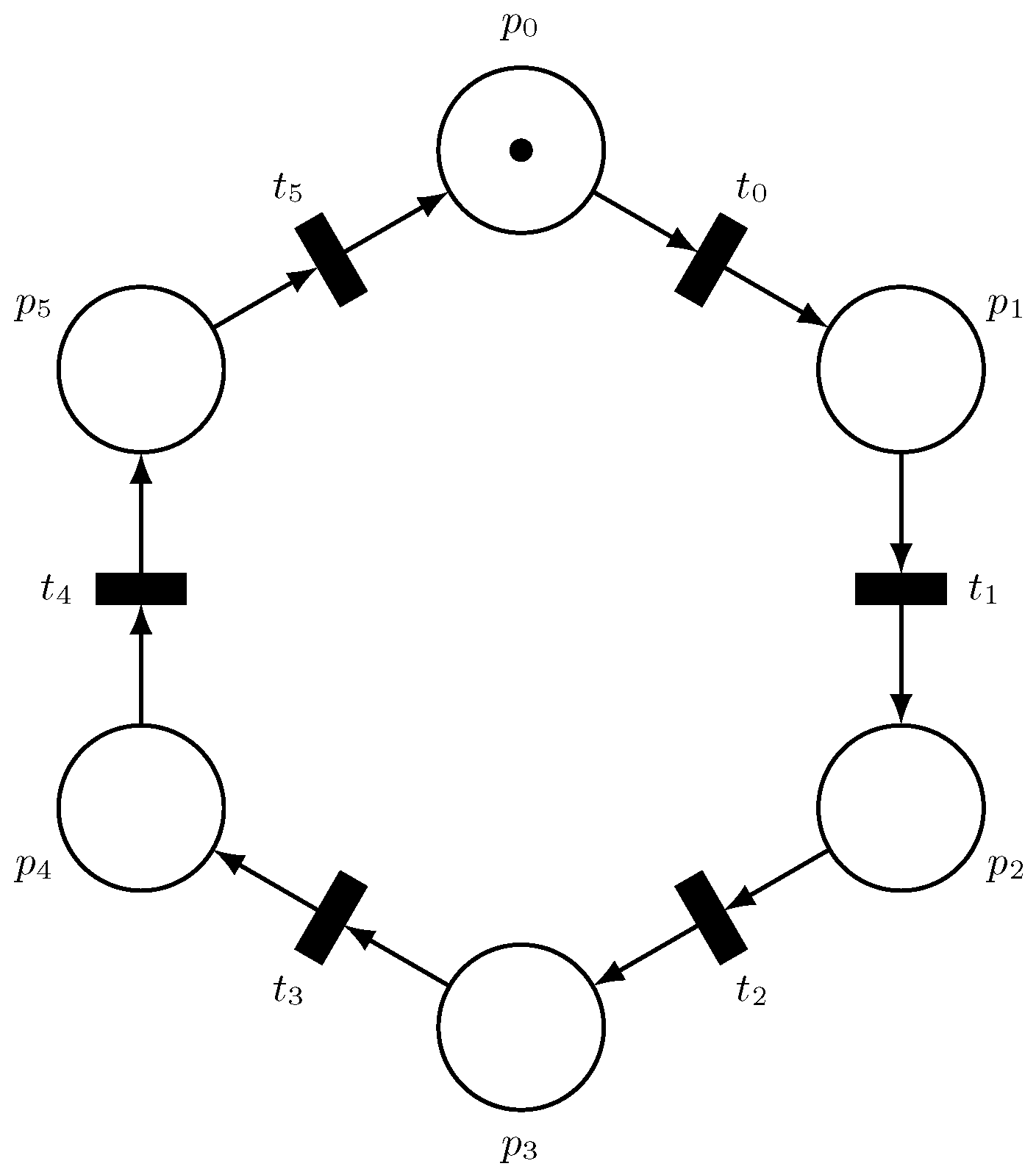
A marking M is said to be reachable from M 0 if there exists a finite sequence of transition firings leading from M 0 to M. The net is live if, from any reachable marking, every transition can eventually fire, and it is safe if, in all reachable markings, no place ever contains more than one token. A simple, cyclic Petri net is shown in Figure 1.

3. When Order Becomes Pattern: A Petri Net for the Fibonacci Sequence

Similarly to Pascal’s Triangle (described in detail in our previous work [15] and also in the other literature [28]), a layered Petri net can be defined to reproduce the Fibonacci sequence. Each layer corresponds to one iteration of the recurrence relation, and the construction proceeds vertically.
Let p n denote a place at level n 0 . For each level n 2 , one transition T n is introduced that consumes one token from both p n 1 and p n 2 , and produces a single token in p n . The initial marking contains one token in p 0 and one token in p 1 , representing the base values of the sequence.
The resulting Petri net reproduces the Fibonacci recurrence structurally, since each firing of transition T n depends on the presence of tokens in the two preceding places. Therefore, after n steps, place p n contains the number of tokens corresponding to the Fibonacci number F n .
The construction is depicted below in Figure 2. For the purpose of visualisation, we adopt a simplified interpretation in which tokens are not consumed when a transition fires. Thanks to this interpretation, the coloured places on the left-hand side of the figure retain the tokens produced during the construction. As a result, the total number of tokens in these places matches exactly the values of the Fibonacci sequence. While simulating the Petri net in the standard way, the corresponding Fibonacci numbers would appear step by step as tokens are generated and propagate through the net.

4. Emergence of the Sierpiński Triangle

There is a well-established relationship between Pascal’s triangle, the Fibonacci sequence, and the Sierpiński pattern, as discussed by Kimberling [29]. Hosoya [30] also investigated a related triangular structure, whose row sums likewise yield Fibonacci number. In our previous work on Pascal’s triangle [15], we showed that Petri net constructions are adapted to reproduce binomial structures. In the present study, we extend this connection by developing a Petri net-based representation of the Fibonacci triangle that generates comparable, yet intriguing self-similar patterns.

4.1. Petri Net Model of the Fibonacci Triangle

The Petri net is denoted by P N = ( P , T , F , M 0 ) , following the definition introduced in Section 2.3.
Formally,
P = { p , k 0 k / 2 , 0 N } , T = { t , k 0 k / 2 } .
The flow relation connects each transition to two places from the previous layers:
F = { ( p 1 , k , t , k ) , ( p 2 , k 1 , t , k ) , ( t , k , p , k ) } .
The initial marking is defined as:
M 0 ( p 0 , 0 ) = 1 , M 0 ( p 1 , 0 ) = 1 , M 0 ( p , k ) = 0 for > 1 .
Each transition t , k thus consumes one token from p 1 , k and one token from p 2 , k 1 , producing a single token in p , k . This mirrors the combinatorial identity:
T ( , k ) = T ( 1 , k ) + T ( 2 , k 1 ) ,
which corresponds to the Fibonacci law:
F n + 2 = F n + 1 + F n .
The resulting Petri net is:
  • bounded—each place contains a finite number of tokens equal to the corresponding coefficient T ( , k ) ;
  • acyclic—transitions connect only consecutive layers, ensuring no backward arcs;
  • not live—transitions become disabled once their input places are empty;
  • not reversible—it is impossible to return to the initial marking.
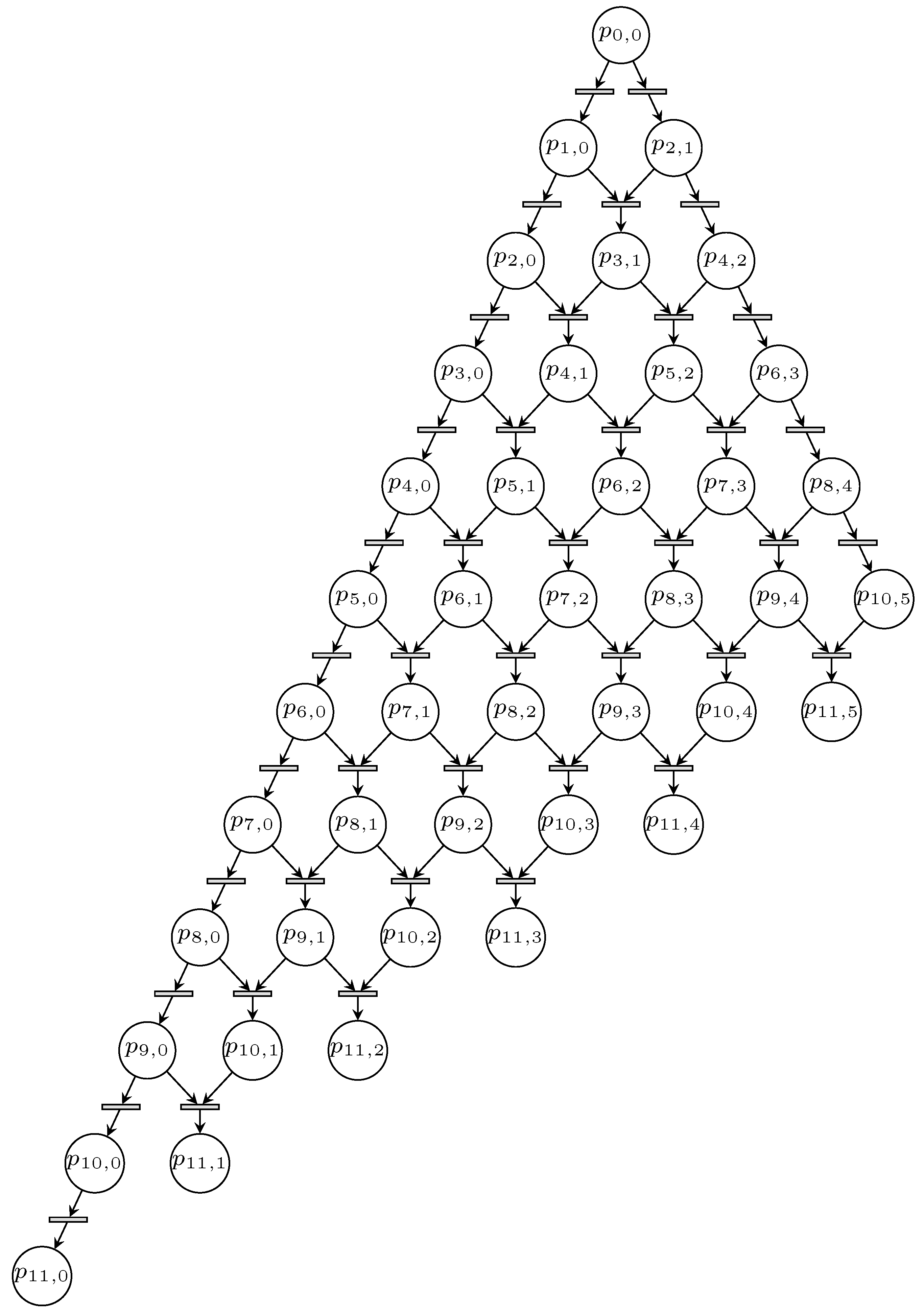
The formal definition given previously is illustrated in the Petri net of Figure 3, whose structure directly encodes the Fibonacci recurrence. Each layer corresponds to one iteration of the process, and the marking of place p , k equals the binomial coefficient T ( , k ) , so that summing the markings across a given layer reproduces the corresponding Fibonacci number.

4.2. Token Counts

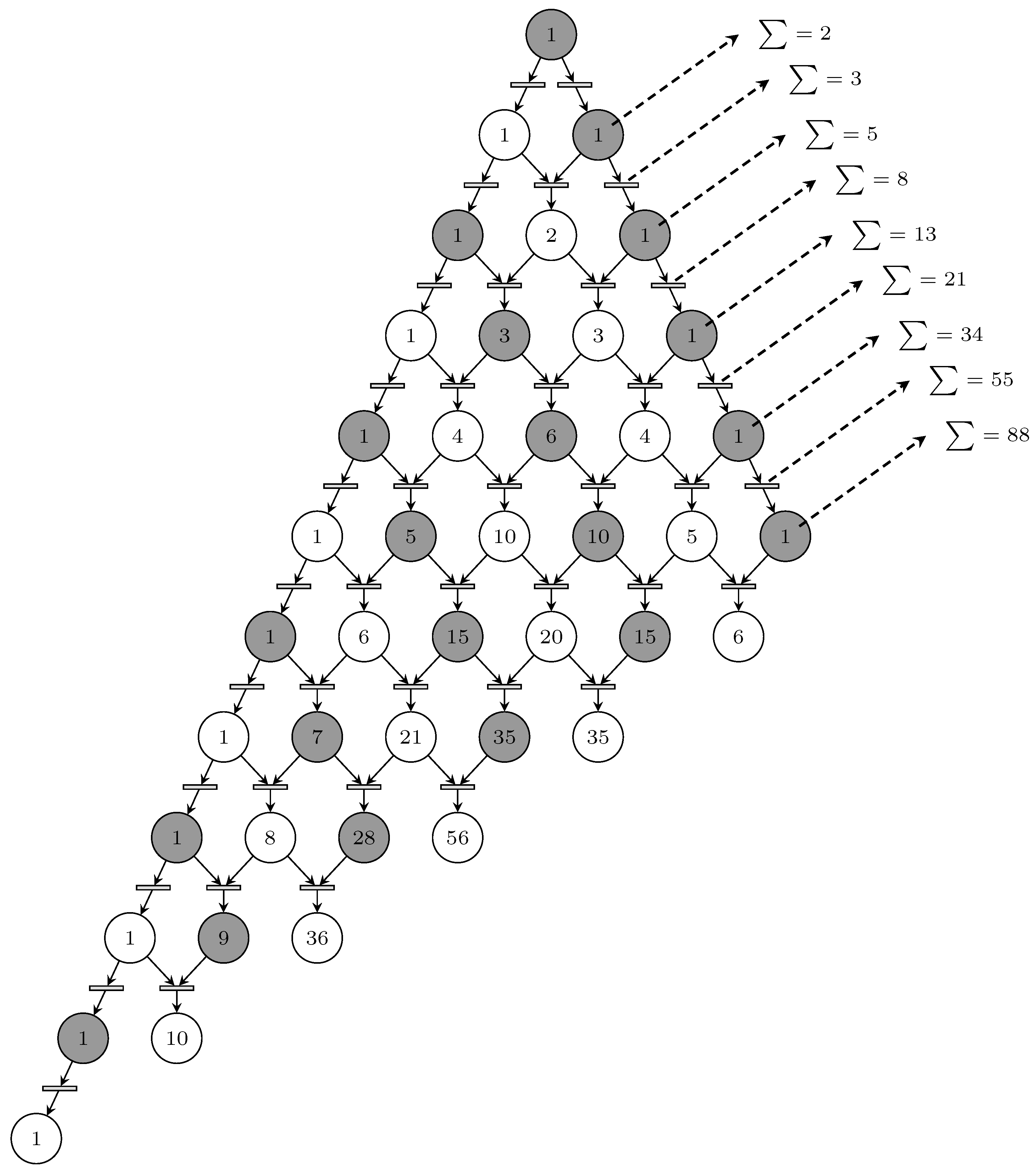
Starting from a single initial token in place p 0 , 0 the propagation of tokens reproduces accurately the additive structure of the Fibonacci triangle, as shown in Figure 4.
Remark: Although the values T ( , k ) could be computed horizontally, line by line, the Petri net is simulated diagonally: layer is computed from layers 1 and 2 , since this ordering reflects the causal structure of the model. All transitions producing layer depend exclusively on these two preceding layers.
Computational complexity of the Fibonacci Petri net. Similarly to Pascal’s Petri net, the number of individual places, transitions and token values increases rapidly with the depth of the construction.
  • Places. In each diagonal layer , the Fibonacci triangle contains / 2 + 1 places. Hence, the total number of places up to depth n satisfies
    P ( n ) = = 0 n / 2 + 1 = ( n + 2 ) 2 4 .
  • Transitions. For 2 , each place p , k is produced by exactly one transition t , k . Thus, the total number of transitions up to depth n is
    T r ( n ) = P ( n ) 2 = ( n + 2 ) 2 4 2 .
  • Number of tokens. The number of tokens in layer n is F n + 1 . Consequently, the cumulative number of tokens up to depth n is
    N total ( n ) = j = 0 n F j + 1 = F n + 3 1 .
To overcome the rapidly increasing values of tokens, places and transitions, we use a marking–based propagation in which all tokens are transferred in a single effective firing. Although the structure of the net remains unchanged, the number of required firings becomes equal to the number of places, reducing the computational cost from exponential to quadratic.
The Golden Ratio. Since each layer contains T n = F n + 1 tokens, the ratio of successive layers tends to
T n + 1 T n = F n + 2 F n + 1 φ , φ = 1 + 5 2 .
Using Binet’s formula, we obtain the asymptotic growth
T n = F n + 1 φ n + 1 5 , N total ( n ) = F n + 3 1 φ n + 3 5 .

4.3. Parity and Token Colouring

In our Petri net representation, each place p , k contains a number of tokens equal to the coefficient T ( , k ) of the Fibonacci triangle. If the marking of each place is considered modulo two, the parity of the token count can be visualised by assigning a black colour to odd values (one token modulo two) and a white colour to even values (zero tokens modulo two).
This binary colouring directly reflects the parity structure of the underlying coefficients. According to a classical result by Édouard Lucas [31], the binomial coefficient n k is odd if and only if
k & ( n k ) = 0 ,
where & denotes the bitwise and operator in base 2. This criterion determines the exact positions of the black cells in Pascal’s triangle, and, by extension, in the Fibonacci triangle through the relation
T ( n , k ) = n k k .
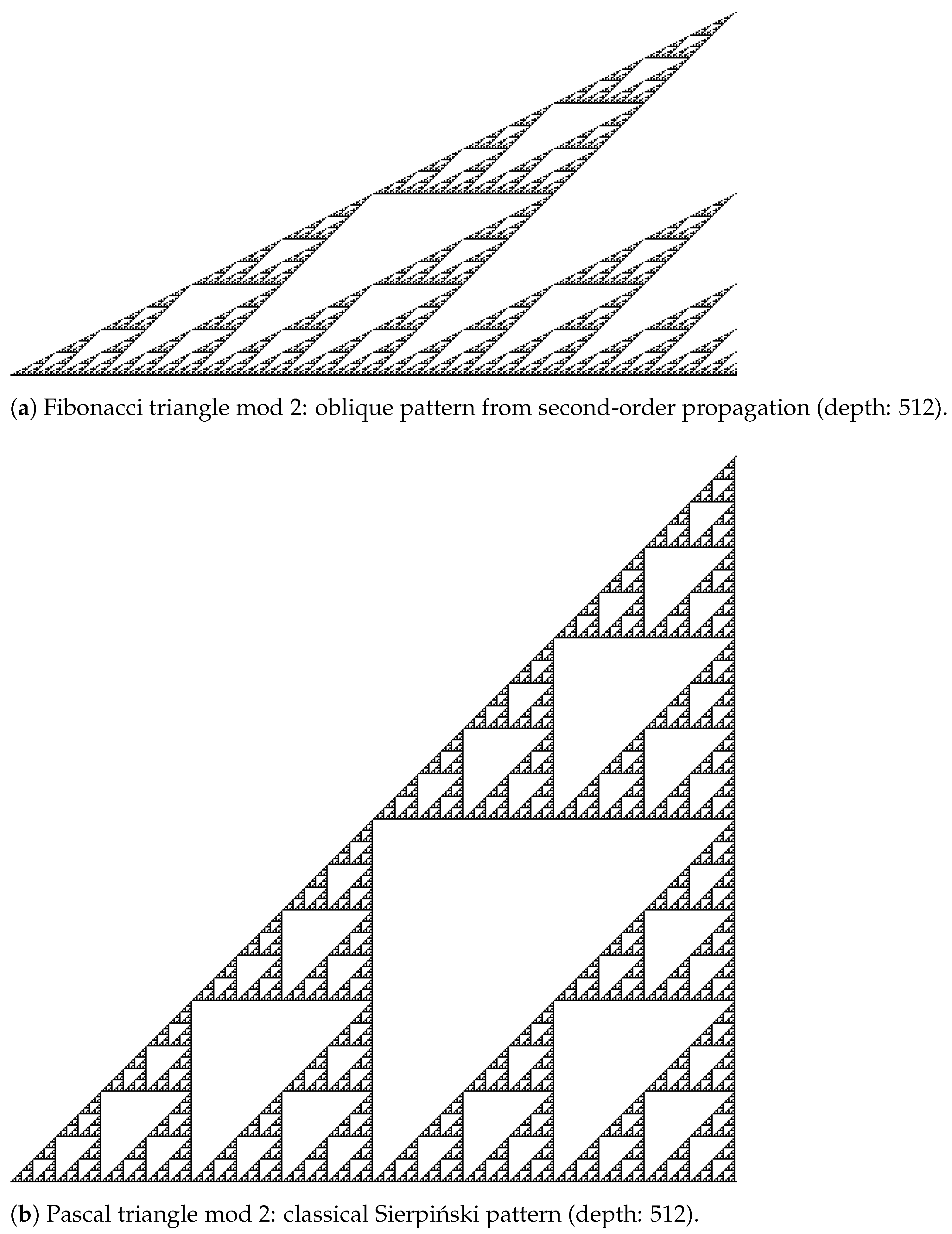
The resulting pattern, obtained by plotting the parity of token counts, reveals a self-similar structure similar to the Sierpiński triangle, as shown in Figure 5.

5. Study of the Observed Pattern

5.1. Specificity of the Proposed Construction

The specificity of this model is best understood by comparing it with two classical structures already present in the literature. Kimberling [29] established the relationship between Pascal’s triangle, the Fibonacci sequence, and the Sierpiński pattern obtained under modulo 2 colouring. Hosoya’s triangle [30], whose row sums also yield Fibonacci numbers, provides another well-known construction. In both cases, the array is generated by local update rules on a triangular lattice and retains a central symmetry reminiscent of Pascal’s triangle. By contrast, our construction is induced by the delayed dependency of the second-order Fibonacci recurrence, encoded as token propagation in a Petri net. When represented in the natural ( , k ) coordinates of the construction (rather than the classical ( n , k ) binomial indexing), the lattice becomes obliquely organised and the central symmetry is broken.
Several authors have pointed out that Fibonacci-related triangular arrays display striking self-similar patterns under modular colouring. Wilson [32] analyses the Fibonacci triangle modulo p, and DeBellevue and Kryuchkova [33] and Southwick [34] report fractal behaviour in the fibonomial triangle modulo primes. Related explorations of deformed or shifted Sierpiński-type structures appear in the work of Taylor [35], who studies ‘Sierpiński relatives’ obtained through symmetry transformations.
In contrast, our Petri net model introduces a second-orderpropagation rule, in which each layer depends on the two preceding ones. This seemingly modest shift in recurrence order has several consequences:
1.
Structural specificity. Unlike Pascal’s triangle or Hosoya’s triangle, which are symmetric with respect to a vertical axis, the lattice generated by our model is obliquely organised in the natural ( , k ) coordinates induced by the layered construction. The two-step dependency introduces a phase delay in the propagation of information, which breaks the central symmetry observed in the classical triangular arrays.
2.
Dynamic specificity.When interpreted as a Petri net, the model reveals a two-layer dependency structure: tokens propagate through both immediate and delayed transitions. This provides a dynamic viewpoint that is not emphasised in the classical presentations of Pascal’s or Hosoya’s arrays, which are typically described by local single-step update rules.
3.
Geometric specificity under modular colouring. Under modular visualisation, especially modulo 2 or modulo a prime p, the second-order propagation produces an oblique, self-similar geometry in the ( , k ) representation, with systematic diagonal displacement bands across layers. We use the term “delayed fractality” as a descriptive label for this visually consistent displacement effect, which reflects the temporal lag of the second-order dependency when represented spatially in the layered array.
Additionally, the emergence of discrete harmonics in the modular representations constitutes an additional distinguishing aspect of the proposed model. These oscillatory structures arise from the temporal lag induced by the second-order propagation rule encoded in the Petri net dynamics. Note that “harmonics” refers here to the recurring oblique bands in modular visualisations.

5.2. Brief Discussion on the Fractal Dimension

The Hausdorff dimension provides the fundamental mathematical notion of fractal dimension. It is designed to describe sets that may exhibit self-similarity and can possess a non-integer dimension. A classical example is the Sierpiński triangle, whose Hausdorff dimension is given by
dim H ( Sierpi ń ski ) = log 3 log 2 1.585 .
Unlike classical geometric objects, which have an integer dimension (a curve has dimension 1 and a surface has dimension 2), fractal structures often exhibit a non-integer effective dimension. In the present work, the displayed parity patterns are finite, discretised renderings of an underlying dyadic construction. Therefore, rather than claiming an exact fractal dimension, we use a box-counting estimate as a practical indicator of visual scaling complexity. We therefore estimate the geometric complexity of the structure introduced in this paper using the box-counting dimension. The estimation was performed with the Fractal Box Counter tool in ImageJ (Fiji v1.54p), applied to the binary parity plot shown in Figure 5. Using box sizes r = 2 , 8 , 16 , 32 , 64 , we obtain an effective box-counting dimension
D box 1.41 .
Restricting the analysis to box sizes r = 4 , 8 , 16 , 32 , in order to reduce boundary effects, yields a higher estimate
D box 1.48 .
These values should be interpreted cautiously: they depend on the finite observation window, image resolution, and the selected range of box sizes.They do not constitute a proof of (non-)equivalence with any classical limit set. Rather, they provide an empirical, reproducible summary of the scaling behaviour observed in the finite plots generated by our Petri net construction.

5.3. Study of Higher Moduli

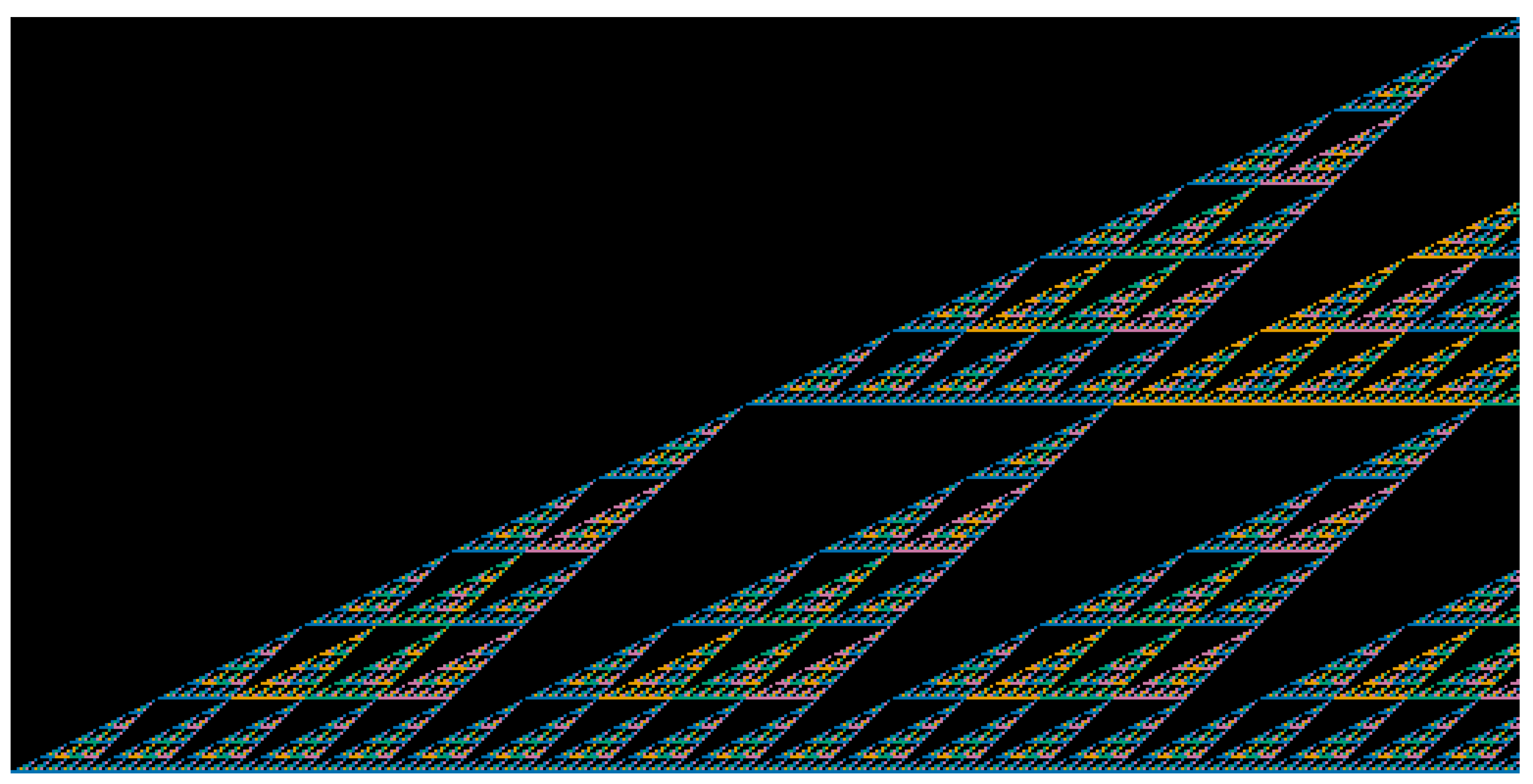
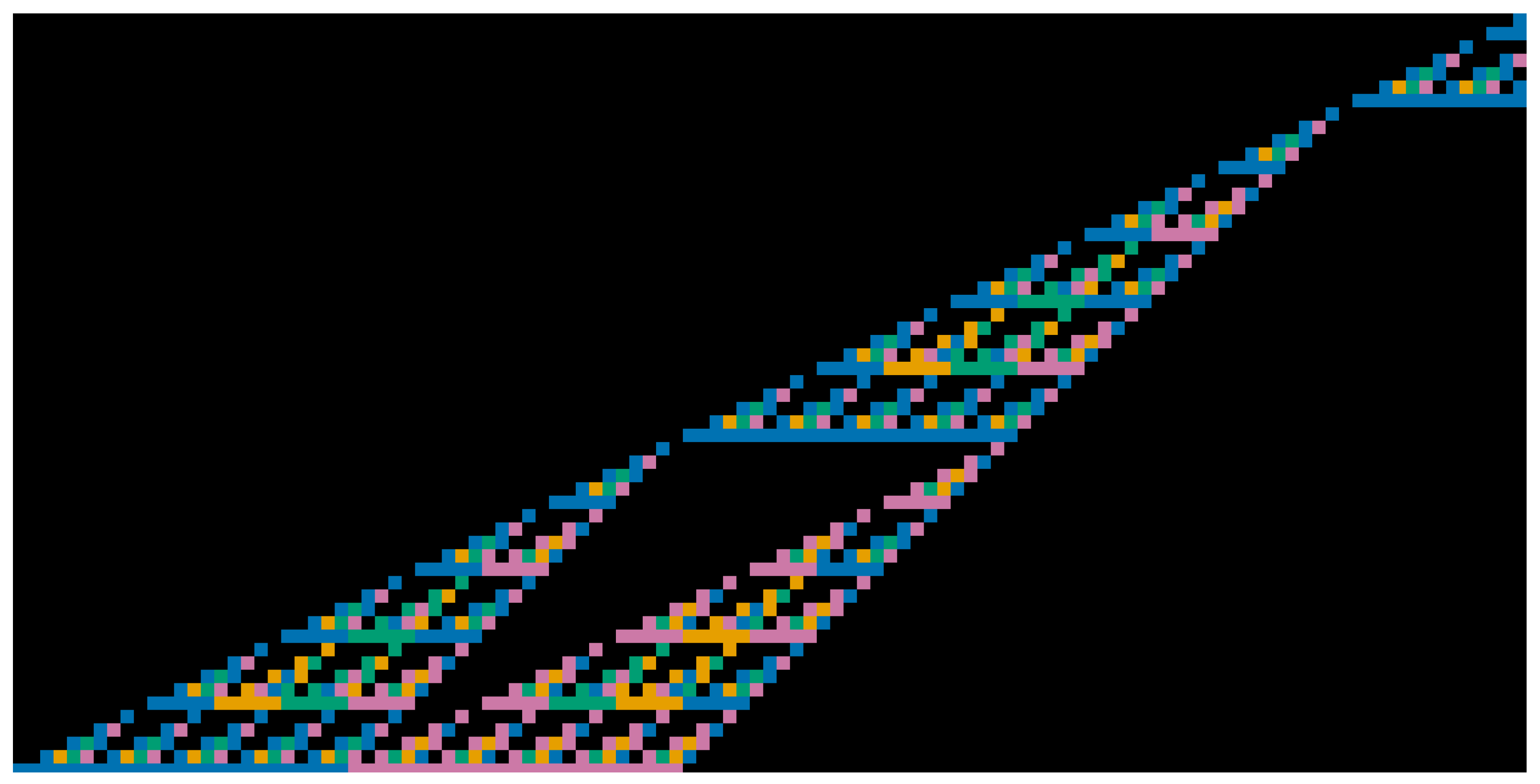
For higher moduli (e.g., p = 5 ), the Fibonacci recurrence produces nested diagonal bands reflecting higher-order harmonics, as shown below in Figure 6 and Figure 7. These bands are noticeably thicker and more structured than in the case p = 2 , because a larger modulus amplifies the periodic blocks within Fib ( n ) mod p . As p increases, the diagonal patterns broaden and become more hierarchically organised.
Remark: In modulo 2, the shift at the top right corner remains hidden due to binary symmetry; in modulo p > 2 , however, the delay becomes geometrically visible, revealing the “latency” of the second-order recurrence. In the proposed Petri net model, “latency” refers to the temporal lag induced by the second-order propagation rule, since the state of a given layer depends on the two preceding layers.

5.4. Added Value of the Petri Net Representation

The use of a Petri net formalism in the present work goes beyond a purely illustrative role. Its primary contribution lies in the explicit modelling of the propagation structure induced by the second-order recurrence. In classical combinatorial or dynamical approaches, the evolution of the system is typically described through recurrence relations, in which temporal dependencies remain implicit. By contrast, the Petri net representation makes these dependencies explicit at the structural level, which allowed us to identify and interpret the resulting mathematical object presented in this article that had remained implicit in classical recurrence-based descriptions.

6. Conclusions

In this work, Petri nets have been used to analyse the Fibonacci recurrence through a layered construction. What begins as the elementary relation F n = F n 1 + F n 2 gradually reveals a richer behaviour when expressed as token propagation: a discrete geometry shaped by delayed dependencies, the emergence of self-similar structures, and a fractal organisation that had not been documented in this form.
Beyond its combinatorial interest, the model highlights how formal computational frameworks can expose hidden symmetries within classical sequences. Here, the interplay between structure and propagation gives rise to patterns that bridge mathematics and visual intuition, an echo of Baudelaire’s assertion that “all is order and beauty.”
Future work could extend the model in several directions, including a more detailed mathematical analysis of the modular patterns produced by the construction, and extensions to higher-order recurrences within the same Petri net framework.

Author Contributions

Conceptualization, D.M. and I.G.; methodology, D.M.; software, D.M.; investigation, D.M. and I.G.; writing—original draft preparation, D.M. and I.G.; writing—review and editing, D.M. and I.G.; visualization, D.M.; supervision, I.G.; project administration, I.G.; funding acquisition, I.G. All authors have read and agreed to the published version of the manuscript.

Funding

This work was partially supported by a program of the Polish Ministry of Science under the title ‘Regional Excellence Initiative’, project no. RID/SP/0050/2024/1.

Institutional Review Board Statement

Not applicable.

Informed Consent Statement

Not applicable.

Data Availability Statement

The original contributions presented in this study are included in the article. Further inquiries can be directed to the corresponding author.

Conflicts of Interest

The authors declare no conflicts of interest.

References

  1. Horadam, A. A generalized Fibonacci sequence. Am. Math. Mon. 1961, 68, 455–459. [Google Scholar] [CrossRef]
  2. Sinha, S. The Fibonacci numbers and its amazing applications. Int. J. Eng. Sci. Invent. 2017, 6, 7–14. [Google Scholar]
  3. Zeina, M.A.; Ahmed, A. The Golden ratio and its impact on Architectural design. Int. Des. J. 2022, 12, 77–90. [Google Scholar] [CrossRef]
  4. Prusinkiewicz, P.; Lindenmayer, A. The Algorithmic Beauty of Plants; Springer: Berlin/Heidelberg, Germany, 1990. [Google Scholar]
  5. Mougkogiannis, P.; Adamatzky, A. On the response of proteinoid ensembles to fibonacci sequences. ACS Omega 2025, 10, 10401–10424. [Google Scholar] [CrossRef]
  6. Sawicki, P.; Maksymovych, V.; Harasymchuk, O.; Lupenko, S.; Shabatura, M.; Marczak, K.; Shevchuk, R.; Karpinski, M. Optimization of Additive Fibonacci Generators Based on Primitive Polynomials Over GF (p). IEEE Access 2025, 13, 149901–149910. [Google Scholar] [CrossRef]
  7. Chen, T.L.; Cheng, C.H.; Teoh, H.J. Fuzzy time-series based on Fibonacci sequence for stock price forecasting. Phys. A Stat. Mech. Its Appl. 2007, 380, 377–390. [Google Scholar] [CrossRef]
  8. Reisig, W. Petri Nets: An Introduction; EATCS Monographs on Theoretical Computer Science; Springer: Berlin/Heidelberg, Germany, 1985. [Google Scholar]
  9. Grobelna, I.; Wiśniewski, R.; Grobelny, M.; Wiśniewska, M. Design and Verification of Real-Life Processes With Application of Petri Nets. IEEE Trans. Syst. Man, Cybern. Syst. 2017, 47, 2856–2869. [Google Scholar] [CrossRef]
  10. Grobelna, I.; Szcześniak, P. Interpreted Petri Nets Applied to Autonomous Components within Electric Power Systems. Appl. Sci. 2022, 12, 4772. [Google Scholar] [CrossRef]
  11. Grobelna, I.; Karatkevich, A. Challenges in Application of Petri Nets in Manufacturing Systems. Electronics 2021, 10, 2305. [Google Scholar] [CrossRef]
  12. Gaucherel, C.; Pommereau, F. Using discrete systems to exhaustively characterize the dynamics of an integrated ecosystem. Methods Ecol. Evol. 2019, 10, 1615–1627. [Google Scholar] [CrossRef]
  13. Koch, I. Petri nets—A mathematical formalism to analyze chemical reaction networks. Mol. Inform. 2010, 29, 838–843. [Google Scholar] [CrossRef]
  14. Mailland, D.; Grobelna, I. A Novel Approach to the Collatz Conjecture with Petri Nets. Information 2025, 16, 745. [Google Scholar] [CrossRef]
  15. Mailland, D.; Grobelna, I. From Mathematics to Art: Modelling the Pascal’s Triangle with Petri Nets. Symmetry 2025, 17, 2181. [Google Scholar] [CrossRef]
  16. Nazish, M.; Banday, M.T. A novel fibonacci-sequence-based chaotification model for enhancing chaos in one-dimensional maps. IEEE Internet Things J. 2024, 24, 40268–40277. [Google Scholar] [CrossRef]
  17. Sun, J.; Du, S.; Alexandris, C.; Du, J. Towards the Data Analysis of Fibonacci Sequence During SSE 50ETF Options Trading in China. In Proceedings of the International Conference on Human-Computer Interaction, Gothenburg, Sweden, 22–27 June 2025; Springer: Berlin/Heidelberg, Germany, 2025; pp. 298–313. [Google Scholar] [CrossRef]
  18. Wang, T.; Selmi, B.; Li, Z. The descriptive set theoretic properties of multifractal topological entropy and its applications. Chaos Solitons Fractals 2025, 200, 117058. [Google Scholar] [CrossRef]
  19. Li, Z.; Selmi, B.; Zyoudi, H. A comprehensive approach to multifractal analysis. Expo. Math. 2025, 43, 125690. [Google Scholar] [CrossRef]
  20. Osseweijer, Z.F.; Eek, L.; Moustaj, A.; Fremling, M.; Morais Smith, C. Haldane model on the Sierpiński gasket. Phys. Rev. B 2024, 110, 245405. [Google Scholar] [CrossRef]
  21. iCasas, F.; Pau, M.C.; Casanovas, J. Representing Fibonacci function through cellular automata using Specification and Description Language. In Proceedings of the 2010 Summer Simulation Multiconference, Ottawa, ON, Canada, 11–14 July 2010. [Google Scholar]
  22. Claussen, J.C. Time evolution of the rule 150 cellular automaton activity from a Fibonacci iteration. J. Math. Phys. 2008, 49, 062701. [Google Scholar] [CrossRef]
  23. Kamikawa, N.; Umeo, H. A design of algorithms for real-time generation of linear-recursive sequences on cellular automata. In Proceedings of the 14th International Symposium on Artificial Life and Robotics, Beppu, Japan, 5–7 February 2009; pp. 281–286. [Google Scholar]
  24. Zarezadeh, Z. Cellular automaton-based pseudorandom number generator. Complex Syst. 2017, 26, 373–389. [Google Scholar] [CrossRef]
  25. Davidrajuh, R. Colored Petri Nets for Modeling of Discrete Systems; Springer: Singapore, 2023. [Google Scholar] [CrossRef]
  26. Van Der Aalst, W.M. Learning Colored Petri Nets Using Object-Centric Event Data (OCED2CPN). In Proceedings of the 2023 7th IEEE Congress on Information Science and Technology (CiSt), Agadir-Essaouira, Morocco, 16–22 December 2023; IEEE: New York, NY, USA, 2023; pp. 1–6. [Google Scholar] [CrossRef]
  27. Petri, C.A. Kommunikation mit Automaten; Institut für Instrumentelle Mathematik, Universität Bonn: Bonn, Germany, 1962. [Google Scholar]
  28. Moser, B.A. A novel Fibonacci pattern in Pascal’s triangle. arXiv 2018, arXiv:1811.02085. [Google Scholar] [CrossRef]
  29. Kimberling, C. Pascal, Fibonacci, and Sierpiński. Fibonacci Q. 1997, 35, 314–319. [Google Scholar]
  30. Hosoya, H. Fibonacci Triangle. Fibonacci Q. 1972, 10, 173–183. [Google Scholar] [CrossRef]
  31. Lucas, É. Théorie des Fonctions Numériques Simplement Périodiques. Am. J. Math. 1878, 1, 184–240. [Google Scholar] [CrossRef]
  32. Wilson, B. The Fibonacci Triangle Modulo p. Fibonacci Q. 1998, 36, 194–203. [Google Scholar] [CrossRef]
  33. Debellevue, M.; Kryuchkova, E. Fractal Behavior of the Fibonomial Triangle Modulo Prime p, Where the Rank of Apparition of p Is p+1. Fibonacci Q. 2018, 56, 113–120. [Google Scholar] [CrossRef]
  34. Southwick, J. A Conjecture concerning the Fibonomial Triangle. arXiv 2016, arXiv:1604.04775. [Google Scholar] [CrossRef]
  35. Taylor, T. Using Triangle Sierpinski Relatives to Visualize Subgroups of the Symmetries of the Square. In Proceedings of the Bridges 2023: Mathematics, Art, Music, Architecture, Education, Culture, Halifax, NS, Canada, 27–31 July 2023; Bridges Organization: Kansas, MO, USA, 2023; pp. 141–148. [Google Scholar]
Figure 1. Example of a simple cyclic Petri net. The net comprises six places ( p 0 p 5 ) arranged in a regular pentagon, six transitions ( t 0 t 5 ) connect the places sequentially, and a single token initially resides in p 0 . Note for reviewers: Revised rendering—black-and-white, compact layout.
Fractalfract 10 00053 g001
Figure 2. Generative Petri net representing the Fibonacci recurrence. Note for reviewers: Revised rendering—rotation 90°, black-and-white, compact layout.
Fractalfract 10 00053 g002
Figure 3. Petri net representation of the Fibonacci recurrence. Note for reviewers: Revised rendering—black-and-white.
Fractalfract 10 00053 g003
Figure 4. Token propagation in the Petri net encoding the Fibonacci recurrence. Each diagonal layer accumulates a total number of tokens equal to the Fibonacci value F n + 1 . For example, for = 5 , the corresponding layer contains the values T ( 5 , 0 ) = 1 , T ( 5 , 1 ) = 4 , and T ( 5 , 2 ) = 3 , whose sum 1 + 4 + 3 = 8 yields the Fibonacci number F 6 . Note for reviewers: Revised rendering—black-and-white.
Fractalfract 10 00053 g004
Figure 5. Comparison of parity patterns generated by Petri net propagation rules. The Fibonacci triangle (a) follows a second-order rule, T ( , k ) = T ( 1 , k ) + T ( 2 , k 1 ) , generating an oblique, self-similar structure characteristic of delayed propagation. The Pascal triangle (b) results from a first-order rule, P ( n , k ) = P ( n 1 , k 1 ) + P ( n 1 , k ) , producing the well-known symmetric Sierpiński gasket.
Fractalfract 10 00053 g005
Figure 6. Fibonacci Triangle mod 5, each colour represents one residue class in { 0 , 1 , 2 , 3 , 4 } .
Fractalfract 10 00053 g006
Figure 7. Zoom on the Fibonacci mod 5 pattern, highlighting self-similar structures.
Fractalfract 10 00053 g007
Disclaimer/Publisher’s Note: The statements, opinions and data contained in all publications are solely those of the individual author(s) and contributor(s) and not of MDPI and/or the editor(s). MDPI and/or the editor(s) disclaim responsibility for any injury to people or property resulting from any ideas, methods, instructions or products referred to in the content.