Article

Tree Structure, Diversity, and Carbon Storage in Urban and Peri-Urban Parks of Western Mexico

by
Efrén Hernández-Alvarez
1,
Bayron Alexander Ruiz-Blandon
2,*,
Mario Alberto Hernández-Tovar
3,
Rosario Marilu Bernaola-Paucar
4,*,
Gary Francis Rojas-Hurtado
5,
Veronica Zevallos-Guadalupe
5,
Alex Marcos Zevallos-Guadalupe
6,
Luis Armando Nieto Ramos
7 and
Carlos Emérico Nieto Ramos
8
1
Centro Universitario de Ciencias Biológicas y Agropecuarias (CUCBA), Universidad de Guadalajara (UDG), Cam Ramón Padilla Sánchez 2100, Zapopan 44600, Mexico
2
Instituto Nacional de Investigaciones Forestales, Agrícolas y Pecuarias, Ciudad de México 04010, Mexico
3
Departamento de Madera, Celulosa y Papel, Centro Universitario, de Ciencias Exactas e Ingenierías (CUCEI), Camino Ramón Padilla Sánchez 440, Las Agujas 45221, Mexico
4
Escuela Profesional de Ingeniería Agroindustrial, Facultad de Ingeniería, Universidad Nacional Autónoma Altoandina de Tarma, Junín 12731, Peru
5
Escuela Profesional de Administración, Facultad de Ciencias Administrativas, Universidad Nacional Autónoma Altoandina de Tarma, Junín 12731, Peru
6
Facultad de Ingeniería de Sistemas, Universidad Nacional del Centro del Perú, Junín 12006, Peru
7
Departamento de Psicología, Universidad Andina del Cusco, Puerto Maldonado 17001, Peru
8
Escuela Profesional de Ingeniería Forestal y Medio Ambiente, Facultad de Ingeniería, Universidad Nacional Amazónica de Madre de Dios, Puerto Maldonado 17000, Peru
*
Authors to whom correspondence should be addressed.
Urban Sci. 2026, 10(5), 273; https://doi.org/10.3390/urbansci10050273
Submission received: 4 April 2026 / Revised: 4 May 2026 / Accepted: 12 May 2026 / Published: 14 May 2026
(This article belongs to the Section Urban Environment and Sustainability)

Abstract

Urban green spaces play a key role in supporting biodiversity, climate regulation, and carbon storage in rapidly expanding cities. Urban and peri-urban parks can differ markedly in tree-community structure, floristic diversity, and carbon-storage capacity. The aim of the study was to compare these attributes between an urban and a peri-urban park. The study compared these attributes between an urban park and a peri-urban park in western Mexico using data collected in 500 m2 circular plots. Tree structure was assessed through diameter at breast height, height, crown diameter, basal area, and crown projection area, while floristic composition and diversity were evaluated using richness, Shannon, Simpson, Pielou, and Menhinick indices. Aboveground biomass, belowground biomass, and carbon stocks were estimated using generalized allometric equations. A total of 1675 trees belonging to 19 families, 33 genera, and 49 species were recorded. The peri-urban park showed greater structural development, with significantly higher DBH, height, crown diameter, basal area, biomass, and carbon stocks, whereas the urban park supported greater species richness and higher Shannon diversity. Species composition also differed strongly between parks, and carbon storage was concentrated in a reduced number of dominant taxa in each site. DBH was the structural variable most strongly associated with total carbon per tree. These findings show that floristic diversity and carbon-storage capacity do not necessarily increase in parallel and that urban and peri-urban parks can provide contrasting but complementary ecological functions.

1. Introduction

Urban parks (UP) and other tree-covered public spaces are a key component of contemporary landscapes because they concentrate ecological, social, and climatic functions within areas subject to intense human pressure. In addition to their recreational and cultural value, these spaces contribute to environmental regulation through shade provision, moderation of local temperatures, habitat availability, and carbon storage. For that reason, the study of urban tree communities has moved beyond simple species inventories and now places greater emphasis on structural attributes, species composition, and ecological function, particularly under current urban expansion and climate-change scenarios. In this context, quantifying tree diversity and carbon-related functions has become increasingly relevant for planning and management in cities and their surrounding landscapes [1,2,3]. Species composition often varies according to management history, planting design, and site conditions.
Recent research has shown that the ecological performance of UP is closely linked to variation in tree structure and composition. Key structural attributes such as DBH, height, basal area, and crown dimensions are widely used to characterize plant communities and their functional performance. Comparative studies have documented that differences in diameter at breast height (DBH), total height, crown width, basal area, and species diversity are reflected in contrasting levels of carbon storage among parks. In Kumasi, Ghana, significant differences in DBH, tree height, basal area, and carbon stocks were reported among public parks, while research in Beijing showed that park function, vegetation arrangement, and management can influence carbon density and biodiversity patterns. Studies in Kumasi and Beijing [4,5] indicate that UP should not be treated as homogeneous green spaces, but as distinct ecological units whose structure and functioning depend on site history, management, and spatial context. These patterns suggest that higher species richness does not always translate into greater carbon storage, highlighting potential trade-offs between biodiversity and ecosystem function.
In Mexico, work on urban tree communities has advanced considerably, but the available evidence is still uneven in its geographic coverage and analytical depth. Studies in Linares, Nuevo León, have shown the value of combining dendrometric variables such as DBH, total height, and crown diameter with diversity indices to describe urban tree structure. At a broader scale, recent research in Mexico City demonstrated that tree diversity, basal area, and canopy cover vary across land uses and boroughs, confirming that urban forest structure is strongly conditioned by spatial heterogeneity. Earlier work along a neotropical urbanization gradient in Mexico City also showed that tree richness, density, and composition change across urban contexts, highlighting the influence of urban development on woody vegetation patterns. Studies conducted in Mexico [6,7,8] confirm that comparative approaches are necessary to understand how different urban conditions shape tree communities.
Despite this progress, direct comparisons between urban and peri-urban parks (PUP) remain relatively scarce in Mexico, especially when they are based on plot-level inventories that allow a consistent evaluation of stand structure, species composition, and carbon storage. This gap is important because PUP often occupy transition zones where urban influence, management intensity, and vegetation configuration differ from those of parks embedded within the urban matrix. In addition, the relationship between tree diversity and carbon storage remains context-dependent and not fully understood, particularly in urban versus peri-urban comparisons. Therefore, comparative analyses at the local scale are needed to better understand how structural and compositional differences influence carbon storage in urban systems. Based on previous urban-forest studies [4,5,8], a plot-based assessment can provide a more reliable basis for estimating aboveground biomass (AGB), carbon stocks, and the relative contribution of dominant taxa, while also allowing clearer ecological interpretation of differences between sites.
The present study addresses this need by comparing the tree communities of one UP and one PUP in western Mexico using field data collected in fixed-area plots. It was hypothesized that the PUP would exhibit a distinct tree structure and composition relative to the UP, and that these differences would be reflected in greater structural heterogeneity and carbon storage. Accordingly, the objectives of this study were: (1) to characterize and compare tree structure, composition, and diversity between the two parks; (2) to estimate AGB and carbon storage from dendrometric measurements; and (3) to identify the structural attributes and taxa that contribute most strongly to carbon storage in each park. Conceptually, the study contributes by showing that urban–peri-urban park comparisons can reveal functional trade-offs between diversity-oriented and carbon-oriented ecosystem services, even within the same metropolitan region.

2. Materials and Methods

2.1. Study Area

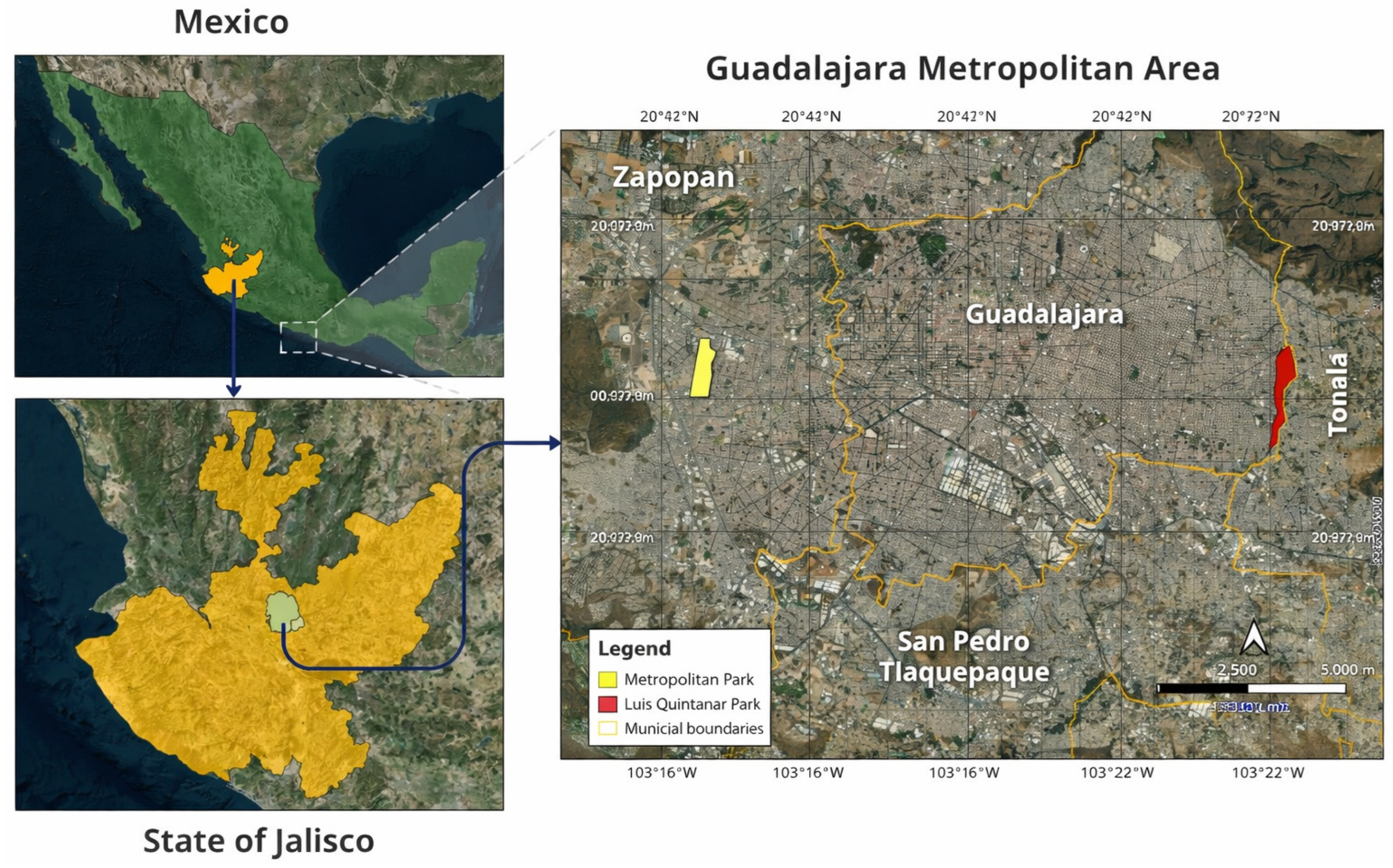
This study was conducted in two public parks located in the Guadalajara Metropolitan Area, western Mexico. UP corresponded to Parque Metropolitano de Zapopan, Jalisco, Mexico, with an area of 100 ha. The PUP corresponded to Parque Luis Quintanar, Guadalajara, Jalisco, Mexico, with an area of 92 ha (Figure 1). Both sites were selected because they represent contrasting landscape contexts within the same metropolitan region, which provides an adequate basis for comparing tree-community structure, diversity, and carbon storage between urban and peri-urban settings [4,9].
The approximate central coordinates of the UP were 20.67° N, 103.44° W, whereas those of the PUP were 20.67° N, 103.27° W, based on the georeferenced records available in the inventory. The use of georeferenced tree records strengthened the spatial consistency of the dataset and improved the interpretation of structural and compositional variation between parks.

2.2. Sampling Design and Tree Inventory

Tree data were obtained from circular plots of 500 m2, equivalent to 0.05 ha per sampling unit. The radius of each plot was calculated from the area of a circle as follows (1):
r = A / π
where r is plotting radius (m) and A is plot area in m2. Based on this expression, the radius of each plot was 12.62 m. Fixed-area circular plots are commonly used in forest and urban tree inventories because they allow consistent estimation of density, composition, and structural attributes while reducing corner effects associated with rectangular plots [9].
According to the observed diameter range in the database, all standing trees with diameter at breast height (DBH) ≥ 5 cm were included in the analysis. This threshold is suitable for characterizing established juvenile and adult trees and is consistent with previous urban tree studies focused on structure, diversity, and ecological function [9,10].
For each individual tree, the inventory included family, genus, species, origin, DBH, total height, crown diameter, basal area (BA), and geographic position. Before analysis, taxonomic names were standardized to correct orthographic inconsistencies, unify incomplete taxonomic entries, and avoid artificial inflation of species richness caused by duplicated records. Taxonomic cleaning is essential in comparative studies because errors at this stage can affect estimates of richness, diversity, dominance, and biomass allocation by species [10].

2.3. Field Measurements

DBH was measured at 1.30 m above ground level using a diameter tape manufactured by Forestry Suppliers, Inc. (Jackson, MI, USA). Total height was measured with a Haga hypsometer manufactured by Haga GmbH & Co. KG (Nuremberg, Germany) from a fixed horizontal distance of 20 m from each tree. Crown diameter was recorded in meters during fieldwork. These dendrometric variables are widely recognized as the minimum set required to characterize stand structure and estimate aboveground biomass and carbon storage in tree inventories [11].

2.4. Structural Attributes

Tree-community structure was characterized using density, DBH, total height, crown diameter, basal area, and crown projection area (CAP). Basal area for each tree was calculated using Equation (2):
BAi = π × DBHi2/40,000,
where BAi is basal area in m2 and DBHi is diameter at breast height in cm. Basal area is one of the most informative descriptors of stand structure because it combines tree size and stocking into a single measure [9,10].
Crown projection area was estimated using Equation (3):
CPAi = π × CDi2/4
where CPAi is crown projection area in m2 and CDi is crown diameter in m. This variable was included because canopy occupation is directly related to shading potential, space use, and the structural role of species within parks [9].
All plot-level structural variables were converted to a hectare basis using the following expansion factor (4):
Vha = Vplot × 20
where Vha is the value expressed per hectare and Vplot is the observed value in a 0.05 ha plot. Each plot represented 0.05 ha; therefore, 20 plots correspond to one hectare for data scaling purposes. This conversion allowed direct comparison of density, basal area, crown projection area, biomass, and carbon storage between parks.
To examine stand organization in greater detail, DBH-class and height-class distributions were constructed for each park. These distributions were used to evaluate size inequality, representation of smaller trees, dominance of large individuals, and the vertical arrangement of the tree community, which are all relevant attributes in urban and peri-urban forest structure assessments [4,10].

2.5. Floristic Composition and Alpha Diversity

Floristic composition was described using species richness, absolute abundance, relative abundance, frequency, and dominance. Alpha diversity was quantified through species richness (S), Shannon diversity (H′), Simpson diversity (1 − D), Pielou’s evenness (J′), and Menhinick’s richness index (DMn) ((5)–(8)). These indices were selected because together they describe richness, heterogeneity, dominance, and equitability, which are complementary dimensions of diversity in urban tree communities [10,12].
Shannon diversity was calculated using Equation (5):
H′ = −∑ pi ln(pi),
where pi is the proportion of individuals belonging to species i.
Simpson diversity was calculated using Equation (6):
1 D = i = 1 S   p i 2 ,
where pi is the relative abundance of species i. Pielou’s evenness was estimated using Equation (7):
J′ = H′/ln(S),
where S is the total number of species.
Menhinick’s richness index was calculated using Equation (8):
D mn   = S N ,
where N is the total number of recorded individuals. These indices are commonly used in comparative vegetation studies because they allow the interpretation of diversity from complementary perspectives rather than relying only on observed richness [12].
The ecological importance of each species was summarized through the importance value index (IVI), calculated using Equation (9):
IVIi = RDi + RFi + RDoi,
where RDi is relative density, RFi is relative frequency, and RDoi is relative dominance of species i. Relative density was calculated as the percentage contribution of each species to the total number of individuals, relative frequency as the percentage contribution of the occurrence of each species across plots, and relative dominance as the percentage contribution of each species to total basal area. IVI was included because it integrates numerical representation, spatial occurrence, and structural prominence in a single metric, which is especially useful in urban tree studies [10].
Rank-abundance curves were also generated for each park to visualize dominance structure and the degree to which abundance was concentrated in a few species or distributed more evenly among taxa. This analysis is useful because simplified urban tree communities may be structurally functional but less resilient to disturbance, pests, or disease outbreaks [9].

2.6. Sampling Completeness and Compositional Dissimilarity

Sampling completeness was evaluated using sample-size-based rarefaction and extrapolation under the Hill numbers framework (q = 0, 1, 2), where q = 0 corresponds to species richness, q = 1 to the exponential of Shannon diversity, and q = 2 to the inverse Simpson concentration. This approach reduces the risk of overinterpreting diversity differences driven only by unequal sample sizes and is widely recommended for ecological comparisons [12].
Between-park compositional dissimilarity was quantified using the Bray–Curtis index calculated from species abundance data. In addition, species composition between parks was evaluated using a chi-square test of independence based on the species-by-park contingency matrix. These analyses allowed evaluation of whether the UP and the PUP supported differentiated tree assemblages beyond what could be inferred from univariate diversity indices alone [13].

2.7. Aboveground and Belowground Biomass and Carbon Storage

Aboveground biomass (AGB) was estimated using a generalized allometric model for tropical trees based on diameter at breast height (DBH). This approach was selected because the inventory included a large number of taxa and species-specific wood density values were not available for the full dataset. Under these conditions, the use of a generalized tropical allometric equation provides a consistent and operational framework for stand-level comparisons, especially when the main objective is to contrast parks under the same analytical procedure rather than to obtain species-specific destructive calibration. Tree height was retained as a structural variable for comparative and correlative analyses, but it was not incorporated into the biomass model in order to avoid combining heterogeneous tree architecture with missing wood-density information in a single predictive step [11,14].
AGB for each tree was calculated using Equation (10):
AGB = exp(−2.134 + 2.530 × ln(DBH)),
where AGB is the aboveground biomass in kg tree and DBH is the diameter at breast height in cm. This generalized model has been widely used in tropical biomass assessments when species-specific equations are unavailable, and it offers a practical basis for consistent estimation across multispecies inventories [14].
Belowground biomass (BGB) was estimated indirectly from AGB using a root-to-shoot ratio approach, which is broadly accepted when destructive root sampling is not feasible. In accordance with generalized tropical biomass estimation frameworks, BGB was calculated as a fixed proportion of AGB using Equation (11) [15,16]:
BGB = 0.24 × AGB,
where BGB is the belowground biomass in kg tree−1, and 0.24 represents the root-to-shoot ratio adopted for generalized estimation. This procedure is suitable for comparative studies because it allows root biomass to be incorporated into total biomass estimates without introducing additional uncertainty associated with unmeasured root systems [15,16]:
Total biomass (TB) was then obtained as the sum of aboveground and belowground biomass using Equation (12):
TB = AGB + BGB,
where TB is the total biomass in kg tree−1. This integration is relevant because the omission of belowground biomass may underestimate total tree biomass and, consequently, total carbon storage at the stand level [16].
Carbon stocks were estimated by applying a carbon fraction of 0.47 to dry biomass, following IPCC guidelines for woody vegetation. Aboveground carbon (AGC), belowground carbon (BGC), and total carbon stock (TC) were calculated using Equations (13)–(15) [16]:
AGC = AGB × 0.47,
BGC = BGB × 0.47,
TC = TB × 0.47,
where AGC, BGC, and TC are expressed in kg C tree−1.
Individual-tree values were aggregated by plot, species, family, and park, and then converted to a hectare basis to enable direct comparison between the UP and the PUP. This procedure allowed identification of the principal taxonomic contributors to biomass and carbon storage and facilitated interpretation of how floristic and structural organization influenced carbon accumulation in each park [4,14]. Estimation framework was selected because it is coherent with the information available in the inventory and avoids overstating model precision where key functional traits are missing. Although generalized allometric equations are less specific than models parameterized with wood density or species-level calibration, they remain useful for ecological comparison and are widely accepted in broad-scale tropical biomass assessments when applied consistently across all sampled units [11,14].

2.8. Statistical Analyses

Comparisons between parks were performed using the most appropriate analytical unit for each variable set. Structural variables, biomass, carbon stock, and structure–carbon relationships were evaluated at the individual-tree level, whereas diversity and composition were assessed at the park level using the complete inventory. This approach provided an adequate basis for comparing structural heterogeneity, floristic diversity, and functional capacity between the UP and the PUP [4].
Before inferential testing, normality and homogeneity of variances were evaluated. When assumptions were met, differences between parks were tested using Student’s t-test; when assumptions were not met, the Mann–Whitney U test was applied. This procedure is appropriate because structural variables in urban tree inventories commonly show skewed distributions and unequal variances. Differences in the distribution of individuals among DBH classes and height classes were evaluated using chi-square tests of independence in order to determine whether size-class structure differed significantly between the UP and the PUP. Effect sizes were also calculated for the main structural and carbon-related variables to distinguish statistically significant differences from ecologically meaningful ones [9].
Differences in Shannon diversity between parks were evaluated using Hutcheson’s t-test, whereas species richness was assessed through individual-based rarefaction at a common sample size. Species composition between parks was compared using a chi-square test of independence based on the species-by-park contingency matrix, and compositional dissimilarity was quantified using the Bray–Curtis index calculated from species abundance data [13].
Relationships between structural variables and carbon stock were explored through correlation analyses and simple linear regression models using DBH, total height, crown diameter, and basal area as predictor variables and carbon per tree as the response variable [4,11]. All statistical analyses were conducted using SAS software, version 9.4 [17].

2.9. Data Curation and Analytical Scope

Before analysis, the database was revised to detect duplicate records, implausible values, missing data, and inconsistencies in taxonomic nomenclature or variable coding. Records with incomplete information that prevented structural or biomass calculations were reviewed individually before inclusion in each analytical step. Because the original database contained empty fields for carbon and volume, carbon was estimated analytically from the available dendrometric variables, whereas volume was not retained as a response variable because it was not directly measured and was not essential to the main objectives of the study. This decision maintained analytical coherence and focused the manuscript on the dimensions best supported by the available data: structure, diversity, composition, and carbon storage [4,10].

3. Results

3.1. General Characterization of the Tree Community

A total of 1675 trees were recorded across the two parks. These individuals belonged to 19 families, 33 genera, and 49 species. The PUP contained the largest number of individuals (1018), whereas the UP showed greater taxonomic richness, with 15 families, 24 genera, and 38 species. In contrast, the PUP comprised 14 families, 20 genera, and 21 species. Overall, these values indicate that the PUP concentrated on a greater number of trees, while the UP supported a broader taxonomic composition (Table 1).

3.2. Structural Variation Between Parks

Tree structure differed markedly between the two parks (Table 2). Mean DBH was higher in the PUP than in the UP, with values of 22.98 and 17.84 cm, respectively. Mean height followed the same pattern, reaching 10.70 m in the PUP and 7.43 m in the UP. Crown diameter was also greater in the PUP (5.97 m) than in the UP (5.36 m).
Basal area and crown projection area showed the same tendency. Mean basal area per tree was 0.0530 m2 in the PUP and 0.0319 m2 in the UP, whereas mean crown projection area reached 33.28 m2 in the PUP and 27.45 m2 in the UP (Table 2). At the park scale, density was higher in the PUP (11.07 trees ha−1) than in the UP (6.57 trees ha−1), and basal area per hectare was also greater in the PUP (0.59 m2 ha−1) than in the UP (0.21 m2 ha−1).
All evaluated structural variables differed significantly between parks. DBH, height, crown diameter, basal area, and crown projection area were all significantly higher in the PUP than in the UP (p < 0.001 in all cases). Overall, these results indicate that the PUP supported a denser and structurally more developed tree community than the UP.

3.3. Size-Class Distribution and Vertical Structure

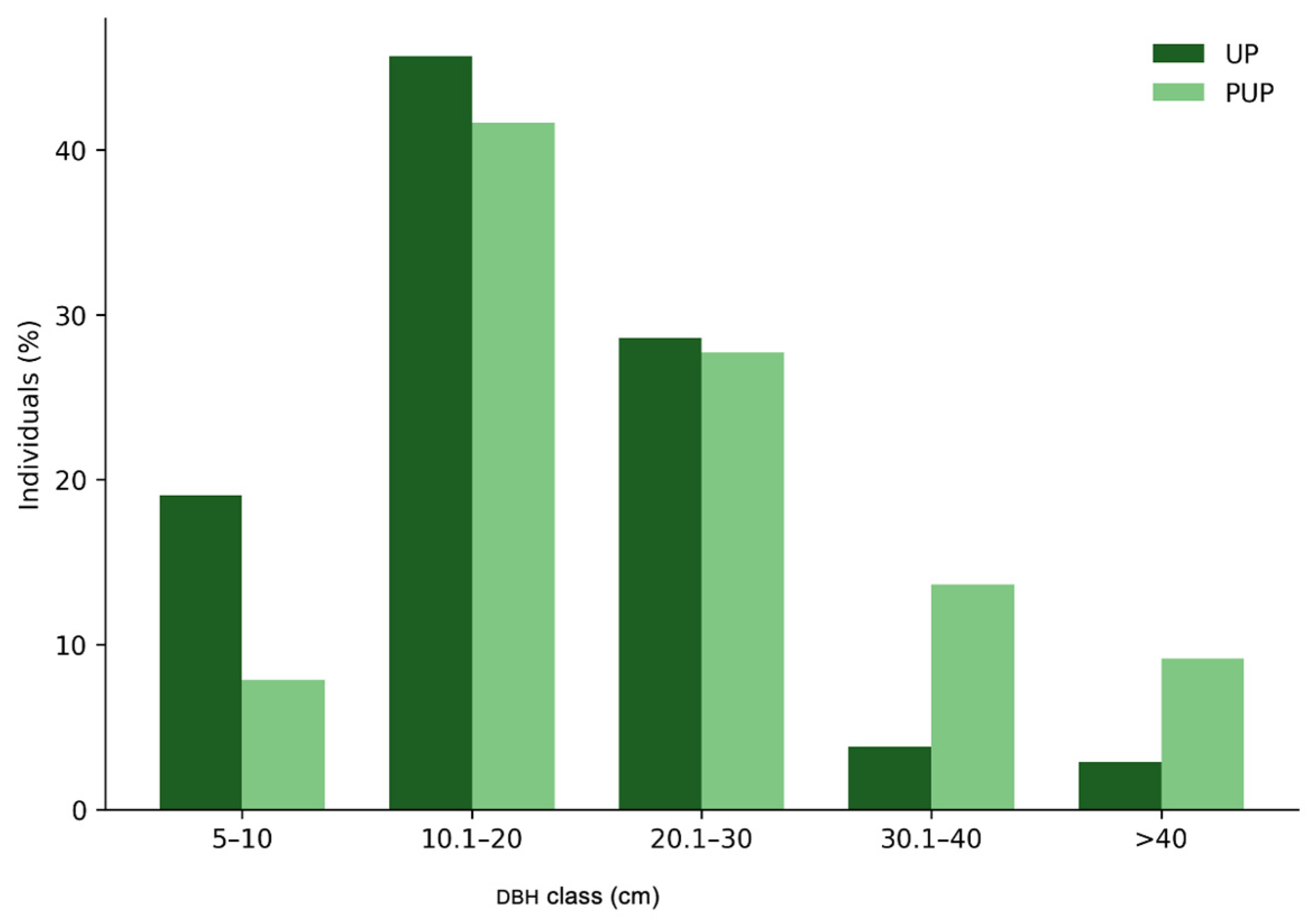
The distribution of individuals among diameter classes differed significantly between parks (χ2 = 105.13, df = 4, p < 0.001; Figure 2). In both parks, most trees were concentrated in the intermediate diameter classes, particularly between 10.1 and 20 cm and between 20.1 and 30 cm. However, the PUP showed a greater representation of large trees than the UP. In the PUP, 13.7% of individuals were recorded in the 30.1–40 cm class and 9.1% exceeded 40 cm, whereas in the UP these classes represented only 3.8% and 2.9% of the inventory, respectively.
By contrast, the UP contained a higher proportion of small trees, with 19.0% of individuals in the 5–10 cm class, compared with 7.9% in the PUP. These results indicate that the PUP had a broader diameter distribution and a stronger representation of medium- and large-sized trees than the UP.
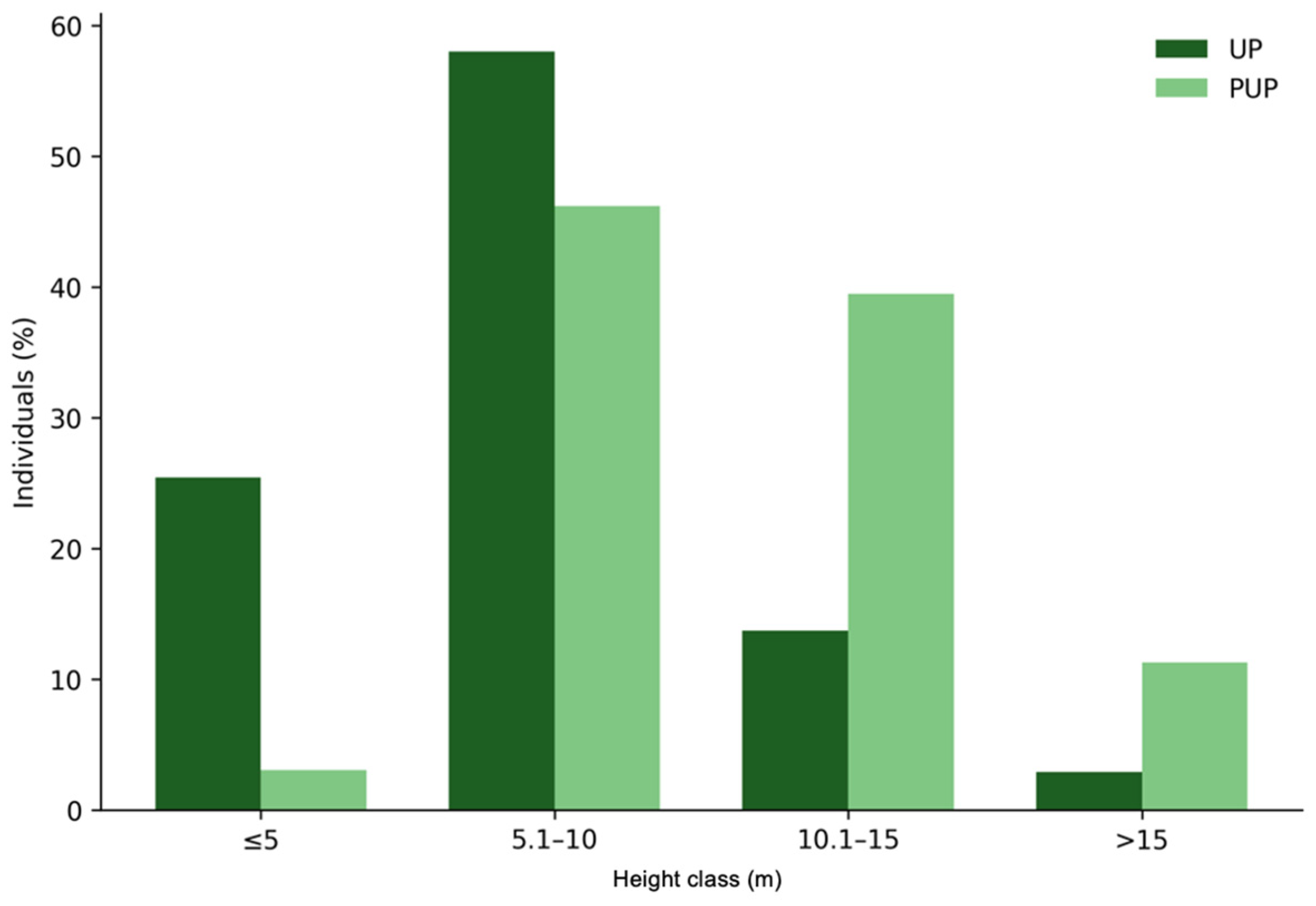
Height-class distribution also differed significantly between parks (χ2 = 305.75, df = 3, p < 0.001; Figure 3). In the UP, most individuals were concentrated in the 5.1–10 m class (58.0%), followed by trees ≤ 5 m tall (25.4%), whereas only 13.7% of individuals occurred in the 10.1–15 m class and 2.9% exceeded 15 m in height.
The PUP showed a more vertically developed structure, with 46.2% of trees in the 5.1–10 m class, 39.5% in the 10.1–15 m class, and 11.3% above 15 m. This pattern confirms that the PUP supported a taller and more vertically heterogeneous tree community, whereas the UP was dominated by shorter individuals concentrated in the lower height strata.

3.4. Floristic Composition and Species Dominance

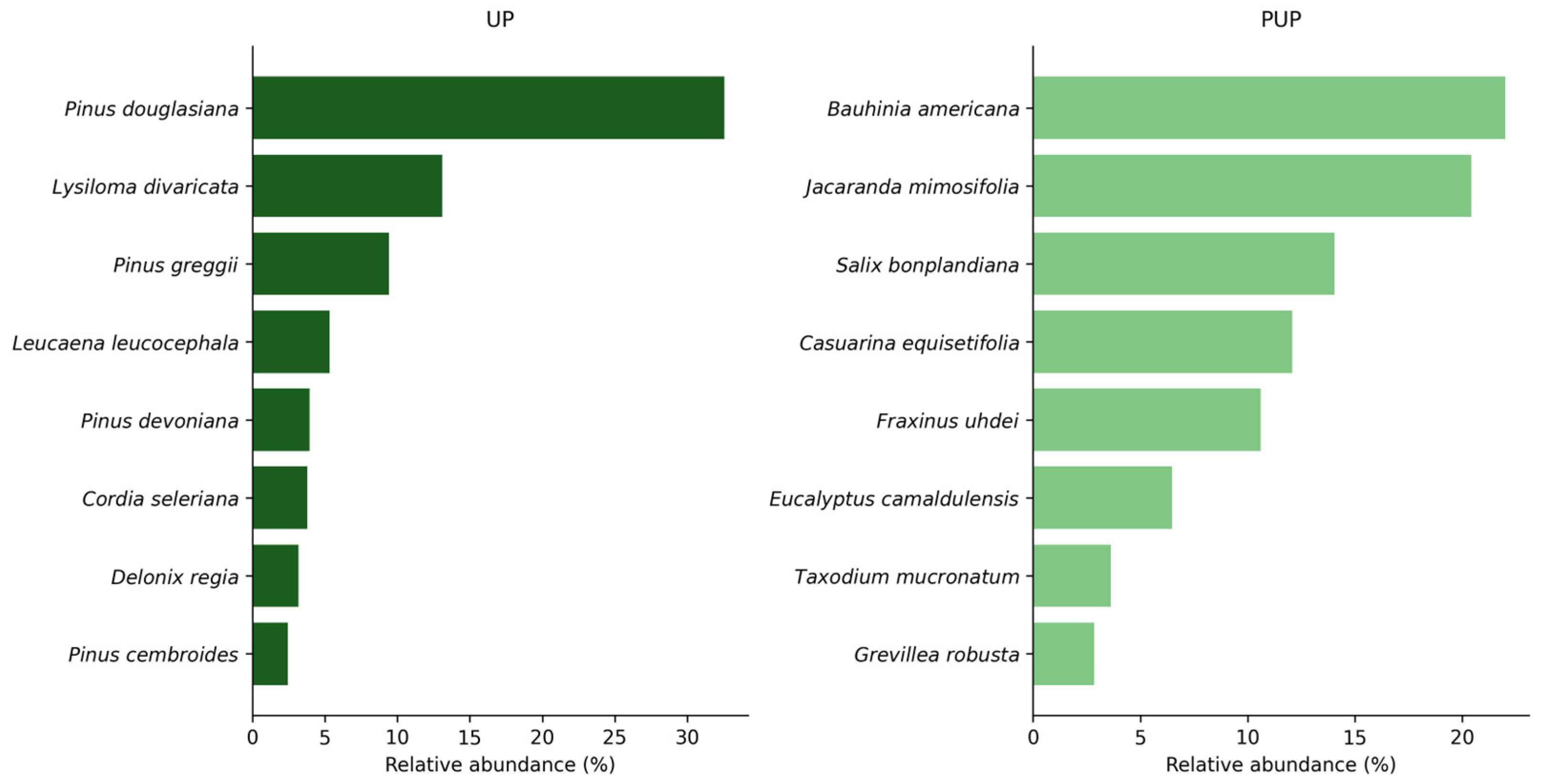
Floristic composition differed noticeably between parks, both in species identity and in the taxa that concentrated most of the abundance and structural dominance (Table 3; Figure 4). In the UP, the tree community was strongly dominated by Pinus douglasiana, which accounted for 32.6% of all individuals and 37.4% of the total basal area. Other important species in this park were Lysiloma divaricata, with 13.1% of the individuals, and Pinus greggii, which represented 9.4% of the inventory and 11.3% of total basal area. These results show that the UP was characterized by the marked prominence of a few taxa, particularly conifers, which concentrated a large share of the structural development of the stand.
In the PUP, dominance was distributed among a broader group of species. Bauhinia americana was the most abundant taxon, contributing 22.0% of all individuals, followed by Jacaranda mimosifolia with 20.4% and Salix bonplandiana with 14.0%. However, structural dominance was led by Casuarina equisetifolia, which accounted for 21.2% of the total basal area, followed by Jacaranda mimosifolia with 18.6% and Salix bonplandiana with 16.4%. This pattern indicates that the most abundant species in the PUP were not always the same taxa that contributed most strongly to stand dominance, reflecting a more distributed floristic structure than that observed in the UP.
At the family level (Table 4), the UP was overwhelmingly dominated by Pinaceae, which represented 49.5% of all individuals and 54.3% of the total basal area. Fabaceae was the second most abundant family, with 24.7% of the individuals, whereas Myrtaceae contributed disproportionately to basal area relative to its abundance, accounting for 17.4% of the total stand basal area. In the PUP, family-level dominance was more evenly partitioned. Fabaceae was the most abundant family, with 23.7% of the individuals, followed by Bignoniaceae with 20.4% and Salicaceae with 14.0%. In contrast, Casuarinaceae showed the highest structural dominance, contributing 21.2% of total basal area, followed by Bignoniaceae with 18.6% and Salicaceae with 16.4%. These results confirm that the UP was dominated by fewer and more structurally concentrated taxonomic groups, whereas the PUP showed a more heterogeneous composition and a broader distribution of dominance among taxa.

3.5. Diversity Patterns and Sampling Completeness

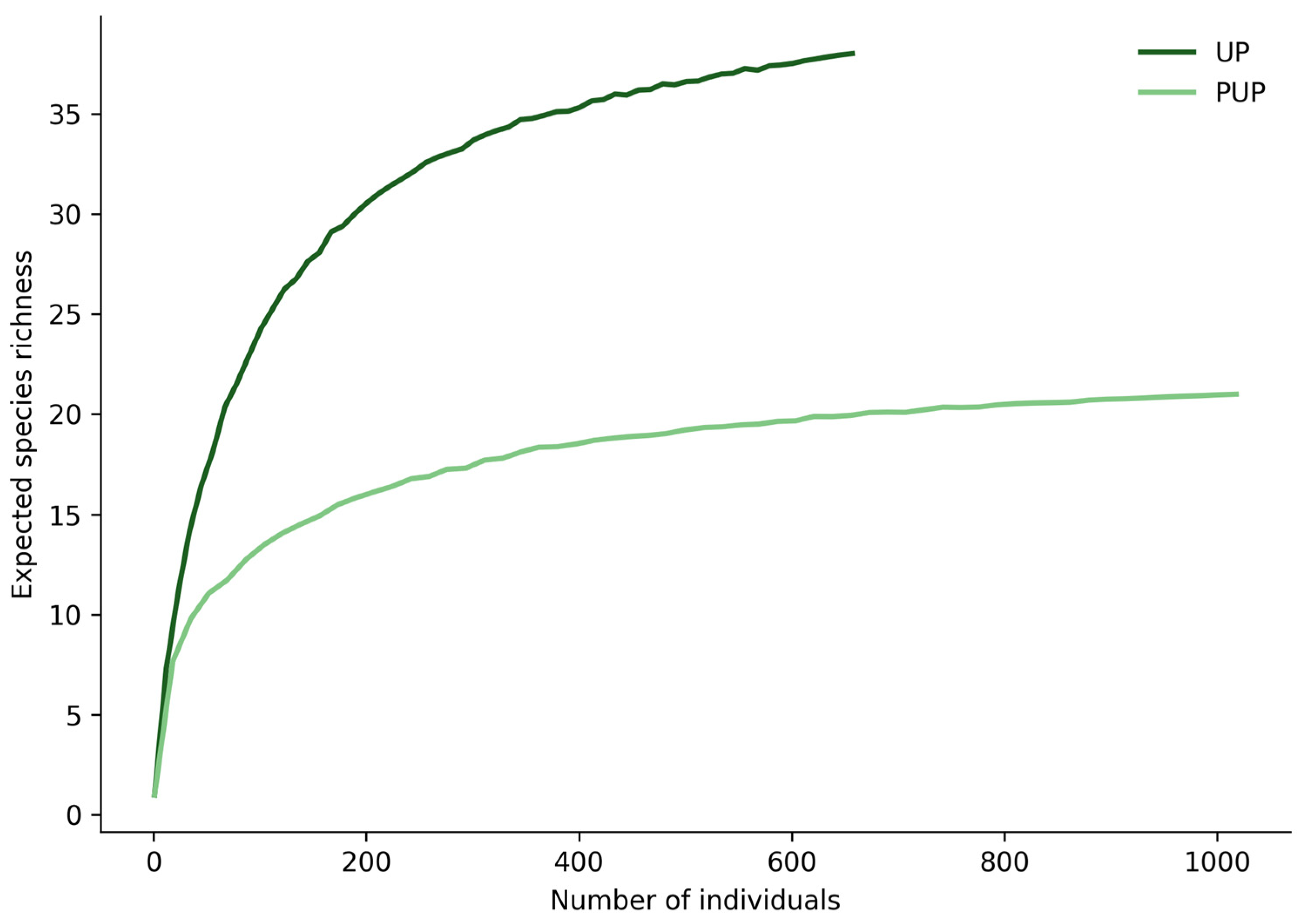
Diversity differed between parks, mainly because the UP supported a richer tree community than the PUP (Table 5; Figure 5). The UP contained 38 species, whereas the PUP comprised 21 species. This contrast remained evident after standardizing sampling effort through individual-based rarefaction. At a common sample size of 657 individuals, the expected richness in the PUP was 19.98 species (95% CI: 18–21), which remained well below the 38 species recorded in the UP. These results indicate that the higher richness observed in the UP was not an artifact of sample size, but reflected a real difference in floristic diversity between parks.
The same pattern was observed for Shannon diversity, which was significantly higher in the UP (H′ = 2.64) than in the PUP (H′ = 2.20) (Hutcheson’s t = 192.07, df = 912.25, p < 0.001). By contrast, Simpson diversity showed nearly identical values in both parks (0.857 in the UP and 0.857 in the PUP), indicating a similar degree of dominance concentration despite the marked difference in richness. Pielou’s evenness also was very similar between parks, with values of 0.727 in the UP and 0.724 in the PUP, which suggests that the distribution of individuals among species was comparable even once richness differences were taken into account.
Menhinick’s richness index reinforced this contrast, reaching 1.48 in the UP and only 0.66 in the PUP. Overall, these findings show that the UP was floristically richer and more diverse than the PUP, whereas both parks displayed a similar pattern of dominance and evenness.

3.6. Compositional Dissimilarity Between Parks

Tree species composition differed significantly between parks (Table 6). The contingency analysis based on species abundances showed a highly significant association between species identity and park type (χ2 = 1521.30, df = 48, p < 0.001). This result indicates that the floristic composition of the UP and the PUP was not randomly distributed, but instead reflected a clear compositional differentiation between both parks.
This pattern was reinforced by the Bray–Curtis dissimilarity index, which reached 0.949 between parks (Table 6). Such a high value indicates a strong difference in species composition and relative abundance, confirming that the tree communities of the UP and the PUP were markedly dissimilar. Taken together, these results show that the two parks not only differed in structure and diversity, but also in their overall floristic composition.

3.7. Biomass and Carbon Allocation

Biomass and carbon stocks were consistently higher in the PUP than in the UP (Table 7). Mean aboveground biomass, belowground biomass, and total biomass per tree were all 87.5% higher in the PUP than in the UP (AGB: p = 3.93 × 10⁻¹⁹; BGB: p = 3.93 × 10⁻¹⁹; TB: p = 3.93 × 10⁻¹⁹). The same proportional difference was observed for aboveground carbon, belowground carbon, and total carbon per tree (AGC: p = 3.93 × 10⁻¹⁹; BGC: p = 3.93 × 10⁻¹⁹; TC: p = 3.93 × 10⁻¹⁹). At the hectare scale, the PUP stored 215.4% more total biomass and 215.9% more total carbon than the UP, confirming that the structural differences between parks translated into a substantially greater carbon storage capacity in the peri-urban site.
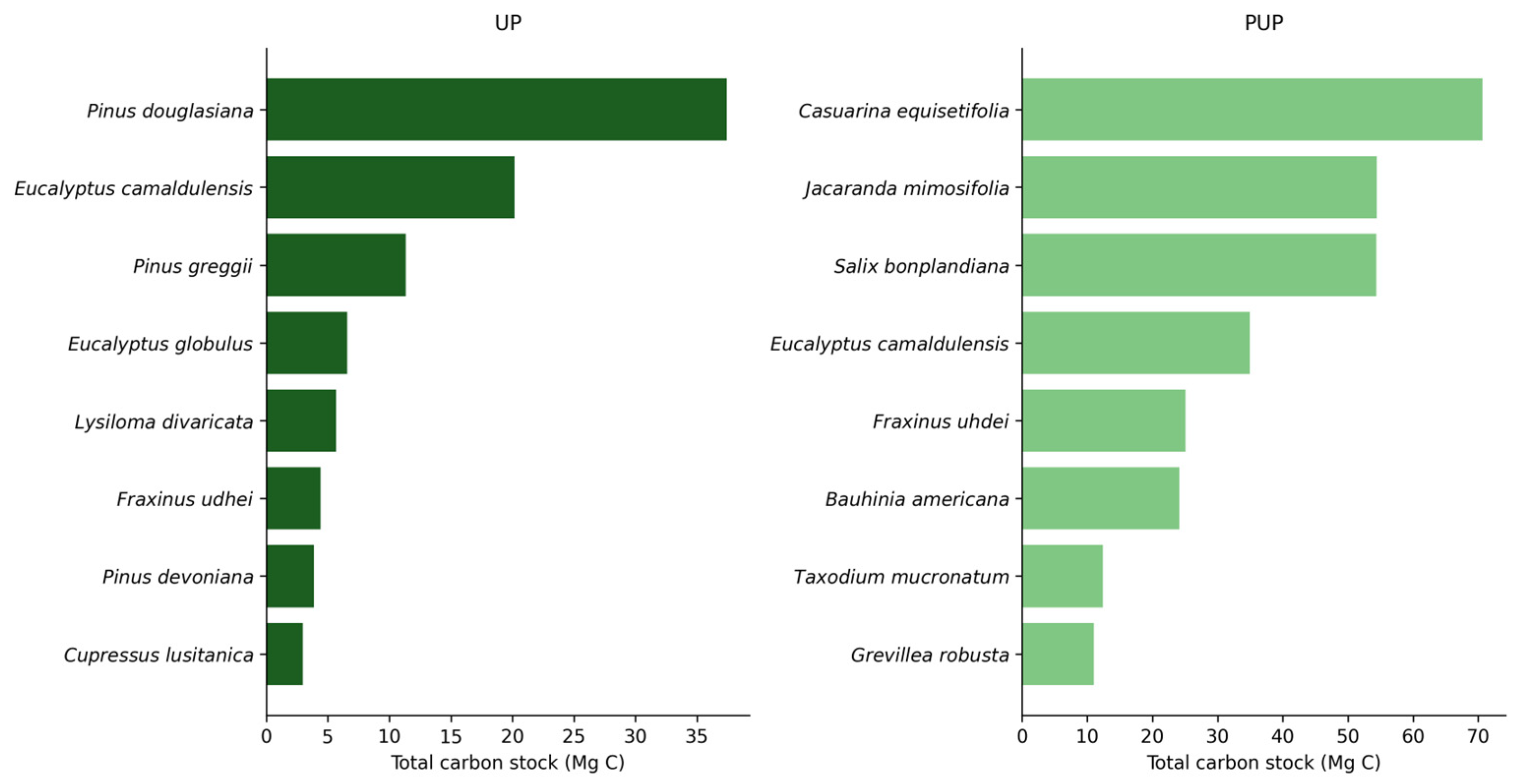
Carbon accumulation was concentrated in a limited number of taxa in both parks, although the dominant contributors differed between sites (Figure 6). In the UP, Pinus douglasiana was the main species contributing to carbon storage, with 37.42 Mg C, followed by Eucalyptus camaldulensis with 20.19 Mg C and Pinus greggii with 11.33 Mg C.
In the PUP, the highest carbon contribution corresponded to Casuarina equisetifolia with 70.66 Mg C, followed by Jacaranda mimosifolia with 54.40 Mg C and Salix bonplandiana with 54.39 Mg C. These results indicate that the taxa driving carbon storage were not necessarily the most abundant species, but rather those combining relatively high abundance with larger tree size and greater structural development.
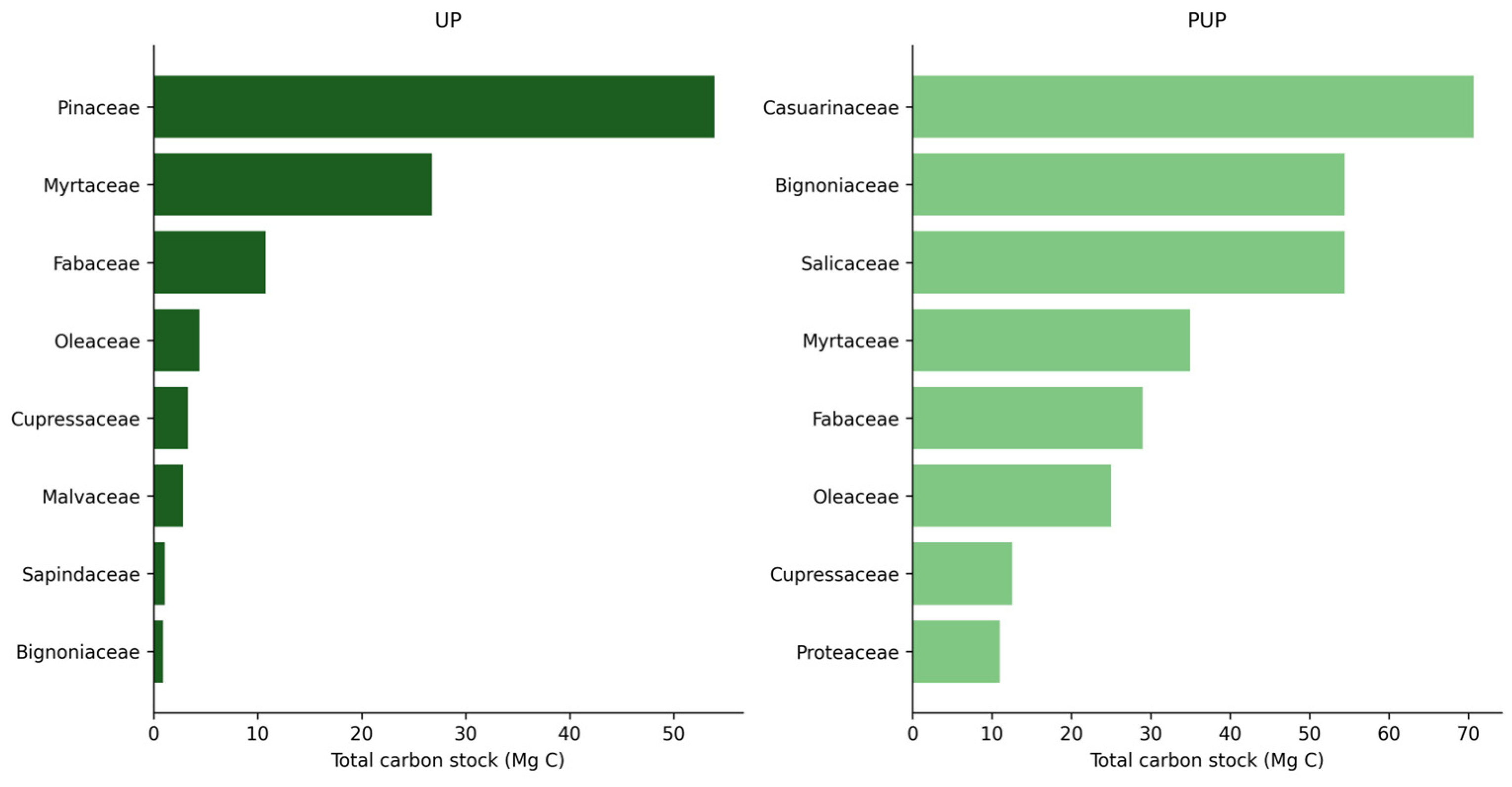
A similar pattern emerged at the family level (Figure 7). In the UP, Pinaceae was the family with the highest contribution to total carbon storage, reaching 53.92 Mg C, followed by Myrtaceae with 26.76 Mg C and Fabaceae with 10.75 Mg C. In the PUP, carbon allocation was led by Casuarinaceae with 70.66 Mg C, followed by Bignoniaceae with 54.40 Mg C and Salicaceae with 54.39 Mg C. Taken together, these results show that carbon storage in both parks was concentrated in a reduced set of dominant species and families, but the taxonomic groups responsible for that function differed substantially between the urban and peri-urban contexts.

3.8. Structural Predictors of Carbon Storage

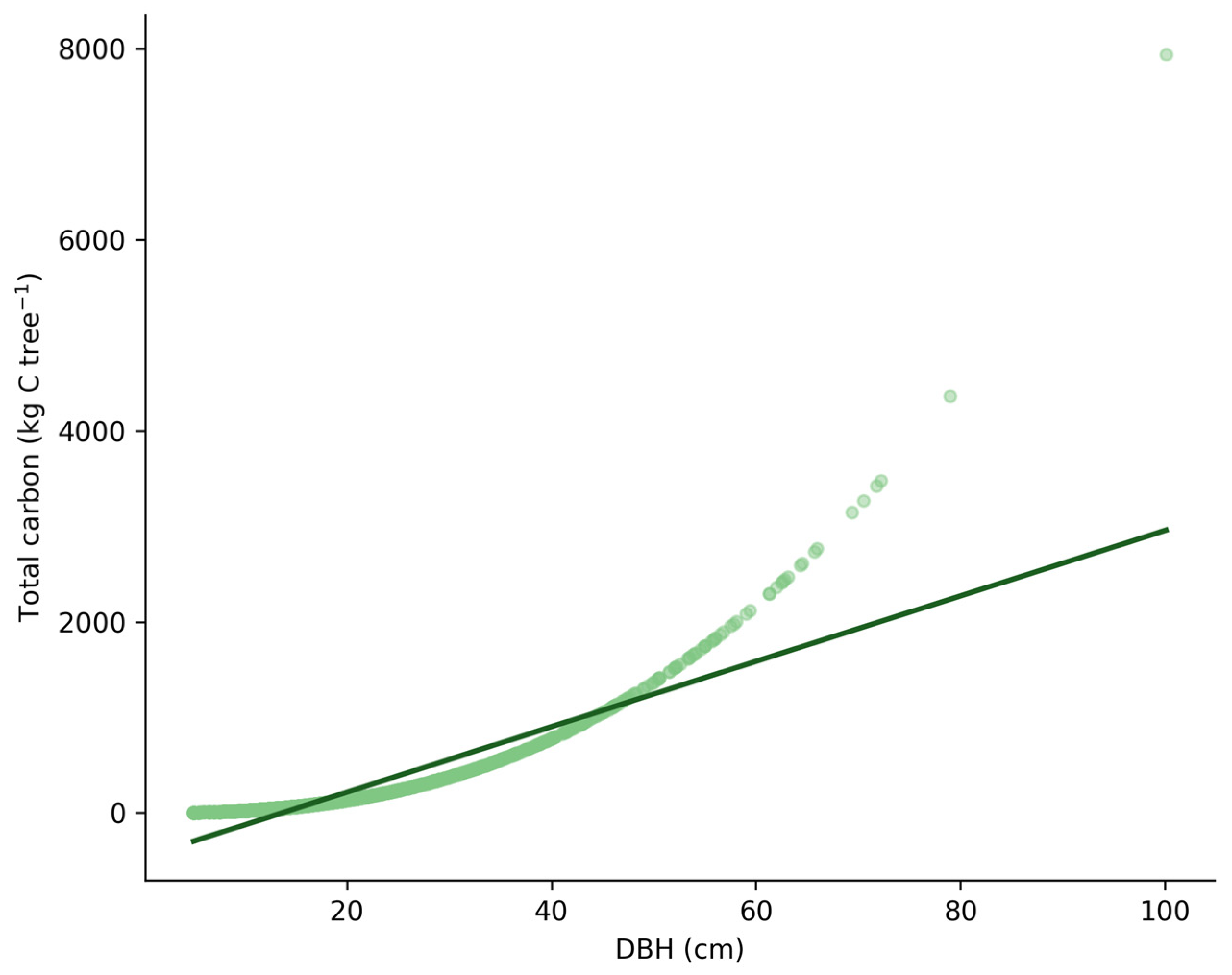
Total carbon per tree was strongly associated with tree size, although the strength of that relationship varied among structural attributes (Table 8; Figure 8). Diameter at breast height (DBH) showed the clearest relationship with carbon stock, with a positive and highly significant association (r = 0.879, p < 0.001). The linear model indicated that DBH alone explained 77.2% of the observed variation in total carbon per tree (R2 = 0.772, p < 0.001). This result confirms that stem diameter was the main structural determinant of carbon storage in the studied parks.
Tree height and crown diameter were also positively related to carbon stock, but their explanatory power was substantially lower (Table 8). Height showed a moderate positive association with carbon (r = 0.509, p = 6.76 × 10−111) and explained 25.9% of the variation in total carbon (R2 = 0.259, p = 6.76 × 10−111). Similarly, crown diameter was positively associated with carbon stock (r = 0.494, p = 9.30 × 10−104), accounting for 24.4% of the observed variation (R2 = 0.244, p = 9.30 × 10−104). These results indicate that although taller trees and wider crowns tended to store more carbon, their predictive value was clearly lower than that of DBH.
Basal area showed the highest statistical association with carbon stock (r = 0.986, p < 0.001; R2 = 0.971, p < 0.001). However, because basal area is directly derived from DBH and the biomass model used in this study also depends on DBH, this relationship should be interpreted cautiously and not as an independent ecological driver. For this reason, DBH provides the most meaningful structural predictor of carbon storage in practical terms, combining strong explanatory power with direct field applicability.

4. Discussion

4.1. Contrasting Structural and Floristic Patterns Between the Urban and Peri-Urban Parks

The main outcome of this study was the clear functional contrast between parks: the PUP was characterized by larger trees, higher structural dominance, and greater biomass and carbon stocks, whereas the UP maintained greater taxonomic richness and diversity but lower structural development. This pattern only partially supports the working hypothesis, because structural superiority and floristic richness did not converge in the same site [4,8].
This pattern agrees with recent studies showing that carbon storage in urban green spaces depends more strongly on stand structure, tree size, and the presence of dominant large individuals than on species richness alone, while diversity tends to be shaped more directly by planting history, site design, and species mixing under urban management [4,5,9]. Similar patterns have been reported across urbanization gradients in different cities, where structural attributes tend to explain carbon storage more strongly than species diversity. In this sense, the urban–peri-urban contrast observed here can be interpreted as a local expression of broader urbanization gradients, where management intensity, planting history, and stand development shape ecosystem-service outcomes.
The greater carbon storage observed in the PUP is ecologically consistent with its broader diameter distribution, taller vertical profile, and stronger representation of medium- and large-sized trees, because these attributes increase biomass accumulation at both the individual and stand levels, as has also been documented in urban parks in Kumasi and in structurally differentiated green spaces in Beijing [4,5].
By contrast, the higher richness and Shannon diversity recorded in the UP suggest that urban settings may concentrate a wider mixture of planted species even when their structural development is comparatively lower, a pattern also reported in Mexican urban parks and in broader assessments of urban forests where species variety reflects management history and heterogeneous planting rather than the dominance of a few large trees [8,18].
The results therefore reinforce an important point for urban forestry: a park can be floristically richer without being the strongest carbon sink, and a park can store more carbon without necessarily supporting the highest local diversity, which means that biodiversity value and climate-regulation capacity should not be assumed to vary in parallel across urban green spaces [9].
From a management perspective, this contrast suggests that urban and peri-urban parks should not be evaluated with a single performance criterion, because sites optimized for taxonomic variety may differ from those that maximize structural development and carbon retention, and both functions are relevant for resilient metropolitan green infrastructure under rapid urban change [8].

4.2. Taxonomic Composition and the Concentration of Structural Dominance and Carbon Storage

A second important result of this study was that biomass and carbon storage were concentrated in a relatively small number of species and families in both parks, although the dominant taxa differed sharply between the UP and the PUP [19].
This pattern is consistent with recent evidence showing that carbon storage in urban forests is often driven by a reduced set of dominant taxa whose structural development outweighs their numerical representation, which means that the functional role of a species cannot be inferred from abundance alone [20,21].
In the UP, carbon accumulation was dominated mainly by Pinus douglasiana, followed by Eucalyptus camaldulensis and Pinus greggii, while at the family level Pinaceae contributed most of the stored carbon. This indicates that carbon storage in the urban park depended strongly on a reduced set of structurally dominant taxa, particularly conifers and large-bodied introduced trees, rather than on the full floristic spectrum recorded in the inventory [20,22].
In the PUP, the same functional concentration was evident, but the taxonomic profile was different. Carbon storage was led by Casuarina equisetifolia, Jacaranda mimosifolia, and Salix bonplandiana, while Casuarinaceae, Bignoniaceae, and Salicaceae accounted for the greatest family-level contributions. This suggests that the greater carbon stock recorded in the peri-urban park was not simply a consequence of having more individuals, but of supporting taxa that combined relatively high abundance with larger dimensions and stronger structural dominance [19].
These results align with broader forest evidence showing that dominance can have a stronger effect on carbon accumulation than richness alone, especially when dominant taxa occupy a large share of stand basal area and contain more large individuals, which is precisely the pattern observed here for both parks, although with different taxonomic identities [22].
From an ecological perspective, this means that composition matters not only because it determines how many species occur in a park, but because it determines which species become structurally dominant and, therefore, which taxa control the largest share of biomass and carbon storage [21].
This distinction is especially relevant for urban forestry because species selection and retention decisions can modify carbon-storage potential substantially over time, and recent studies have shown that strategic changes in urban tree composition can lead to major gains in sequestration performance when structurally suitable taxa are favored [21].
Accordingly, the results suggest that management should move beyond species counts and pay greater attention to the identity, structural performance, and long-term persistence of dominant taxa, since these attributes ultimately define how much carbon a park can retain and how stable that function may be through time [19,20].

4.3. Diversity Does Not Necessarily Translate into Greater Carbon Storage

One of the most relevant outcomes of this study was that the UP, despite having greater species richness and higher Shannon diversity, did not store more biomass or carbon than the PUP, which indicates that floristic diversity and carbon-storage capacity did not increase in parallel across the two parks [4,19].
This result agrees with recent work showing that carbon storage in urban green spaces is driven more strongly by tree size, stand structure, and dominance patterns than by richness alone, especially where a limited number of large individuals account for a disproportionate share of aboveground biomass [23].
In this case, the higher richness of the UP reflected a broader mixture of taxa, but this did not translate into greater carbon accumulation because the PUP contained larger trees, higher basal area, and a stronger representation of medium- and large-sized individuals, which are precisely the attributes most closely linked to biomass accumulation and carbon storage [23].
A similar contrast has been reported in other urban and peri-urban settings where diversity and carbon-related functions do not necessarily peak in the same places. In urban parks in Kumasi, for example, structural differences among parks were closely reflected in carbon stocks, while diversity varied independently across sites, suggesting that structurally developed stands can store more carbon without being the richest in species [4].
More broadly, recent analyses have shown that the relationship between biodiversity and carbon storage is context dependent rather than universally positive. Structural diversity often has a stronger and more direct effect on carbon storage than species diversity, and the contribution of diversity can shift depending on stand conditions, vegetation type, and environmental context [24,25].
This helps explain why the higher richness recorded in the UP should not be interpreted as a weaker ecological condition. Instead, it suggests that the two parks expressed different functional profiles: the UP contributed more strongly to local taxonomic diversity, whereas the PUP contributed more strongly to carbon storage through its larger and more structurally developed trees [26,27].
From a management perspective, this distinction is important because it shows that increasing species numbers alone will not necessarily maximize climate-regulation services. If the goal is to strengthen carbon storage, management must also consider the long-term establishment of structurally robust taxa and the retention of large trees, whereas if the goal is to enhance biodiversity, a broader mixture of species may be prioritized even when carbon gains are more modest [26].
Taken together, the results support the view that biodiversity value and carbon-storage potential should be treated as complementary, but not interchangeable, dimensions of urban green infrastructure, and that the most effective urban-forest strategies are likely to be those that explicitly balance both objectives rather than assuming that one will automatically deliver the other [23].

4.4. Diameter as the Main Structural Correlate of Carbon Storage

A central result of this study was that DBH was the structural variable most closely associated with total carbon per tree, which is ecologically consistent because stem diameter integrates cumulative growth and, in practice, captures much of the size-related variation in woody biomass across mixed tree communities [28].
This pattern agrees with previous work showing that diameter remains one of the most robust predictors of biomass and carbon in urban trees, even when other structural variables are available, because it is directly linked to stem volume expansion and tends to retain strong explanatory power across contrasting species and management settings [29,30].
In this case, height and crown diameter were also positively associated with carbon storage, but their explanatory capacity was clearly lower than that of DBH. That result is consistent with recent urban-forest studies showing that height and crown structure improve interpretation of tree performance, but often do not surpass diameter as single predictors of biomass or carbon when inventories are based on multispecies populations with heterogeneous architecture [31].
This does not mean that height and crown attributes are unimportant. Rather, it suggests that their contribution is more complementary than primary in broad comparative inventories such as the present one. Recent modeling work has shown that canopy height and crown-related metrics can improve estimation accuracy, especially in remote-sensing frameworks or species-specific models, but diameter still provides the most practical and transferable field predictor when the goal is to compare sites under a common analytical framework [32].
The very strong association observed here between basal areas and carbon storage should be interpreted more cautiously. Although statistically expected, that relationship is not fully independent because the basal area is mathematically derived from DBH and therefore reflects the same dimensional axis that underlies the biomass estimates used in this study. For that reason, DBH remains the most meaningful variable for ecological interpretation and management use, since it combines predictive strength with direct applicability in routine inventories [29,30].
From a practical standpoint, this result has clear implications for urban-forest assessment. If carbon storage is strongly concentrated in trees with greater stem diameter, then monitoring DBH distribution and retaining large individuals should be considered a central management priority, particularly in parks where climate-regulation functions are part of the desired ecosystem-service portfolio [26,33].
At the same time, the literature also shows that urban-tree carbon estimates can vary depending on the allometric model applied, which means that DBH should be viewed as a robust predictor, but not as a substitute for methodological transparency. This is especially important in multispecies urban inventories, where structural diversity, pruning history, and open-grown architecture may introduce departures from models developed in conventional forest conditions [28,30].
The findings support the idea that DBH is the most informative single structural variable for explaining carbon storage in mixed urban and peri-urban tree communities, while height and crown traits provide useful additional context rather than replacing the predictive value of diameter [30,32].

4.5. Implications for Urban Forest Management and Future Research

The contrast observed between parks suggests that urban-forest management should not rely on a single indicator of performance, because a park that maximizes taxonomic richness may differ from one that maximizes biomass and carbon storage, and both functions are valuable within metropolitan green infrastructure [34,35].
From a practical standpoint, the results indicate that management strategies for urban and peri-urban parks should combine two complementary priorities: maintaining or increasing taxonomic diversity where floristic heterogeneity is a relevant goal, and retaining structurally important trees where climate-regulation functions such as carbon storage are prioritized [34,36]. For example, management actions may include prioritizing the conservation of large trees, selecting species with high growth potential, and adjusting planting density according to the desired balance between diversity and carbon storage.
This is especially important because recent evidence shows that urban-forest management interventions can influence biodiversity and carbon outcomes simultaneously, but the direction and magnitude of those effects depend strongly on how interventions are designed and on which ecological objective is given priority [34].
In that sense, the present findings support a management perspective in which large trees and structurally dominant taxa are treated as strategic ecological assets rather than as incidental elements of park vegetation, because they make a disproportionate contribution to long-term carbon retention and to the regulation services expected from urban green spaces [35,37].
At the same time, the higher diversity recorded in the urban park indicates that species mixing remains relevant for resilience and for the broader ecological value of public green spaces, particularly under conditions of disturbance, pests, and climate variability, where greater compositional heterogeneity may reduce functional vulnerability over time [36,38].
For that reason, the most effective management pathway is unlikely to be one that promotes carbon-oriented species selection alone. Instead, recent work suggests that urban planning benefits more from trait-based and function-based strategies that balance carbon storage with biodiversity support and other ecosystem services, rather than maximizing one service at the expense of the rest [38].
This study also points to several directions for future research. First, future inventories would benefit from retaining plot-level identifiers throughout the analytical workflow, because that would allow for stronger multivariate analyses of compositional change and spatial heterogeneity. Second, integrating variables such as canopy condition, maintenance intensity, soil properties, and disturbance history would help explain why structurally similar trees may perform differently across park types. Third, the use of species-specific allometric equations and wood-density data, where available, would improve precision in biomass estimates, particularly in multispecies urban communities [19].
A further priority is to examine how park design, social use, and management regimes influence the balance between biodiversity conservation and carbon storage, because resilient urban green infrastructure depends not only on tree attributes, but also on governance, maintenance, and long-term planning [34,36].
Although the results are site-specific, the approach can be applied in other cities to identify whether parks are functioning mainly as biodiversity reservoirs, carbon-storage areas, or multifunctional green spaces. These considerations suggest that urban and peri-urban parks should be managed as multifunctional ecological infrastructure, where richness, structural development, carbon storage, and resilience are treated as interconnected but not interchangeable objectives [35,37]. This study is based on two parks within the same metropolitan area; therefore, the results should be interpreted as site-specific rather than broadly generalizable patterns. Differences between parks may also reflect management history and local environmental conditions.

5. Conclusions

This study showed that the urban park and the peri-urban park differed not only in floristic composition, but also in the ecological functions associated with stand structure and carbon storage. The peri-urban park supported a more developed tree structure, with larger trees, greater basal area, and higher biomass and carbon stocks, whereas the urban park maintained greater species richness and higher Shannon diversity. These findings indicate that floristic diversity and carbon-storage capacity did not increase in parallel across the two parks, but instead reflected different ecological profiles.
Carbon storage in both parks was concentrated in a reduced number of dominant species and families, although the taxa responsible for that function differed sharply between sites. This result highlights the importance of species identity and structural dominance in determining the functional performance of urban green spaces. In addition, DBH was the structural attribute most strongly associated with carbon storage, confirming its value as a practical and informative predictor in comparative urban tree inventories.
These results suggest that urban and peri-urban parks should be managed as multifunctional ecological infrastructure. Strategies aimed at increasing biodiversity should not be assumed to maximize carbon storage automatically, and management focused on carbon retention should not overlook the ecological value of floristic diversity. A more balanced approach, combining species diversity with the conservation and establishment of structurally important trees, may provide a stronger basis for resilient urban green infrastructure in metropolitan landscapes. However, these findings should be interpreted within the scope of a site-based comparison, as the study was conducted in two parks within the same metropolitan area.

Author Contributions

Conceptualization, E.H.-A., B.A.R.-B. and M.A.H.-T.; methodology, E.H.-A., B.A.R.-B. and M.A.H.-T.; software, B.A.R.-B. and M.A.H.-T.; validation, R.M.B.-P., G.F.R.-H. and A.M.Z.-G.; formal analysis, B.A.R.-B. and E.H.-A.; investigation, E.H.-A., B.A.R.-B. and M.A.H.-T.; resources, B.A.R.-B.; data curation, M.A.H.-T., V.Z.-G. and L.A.N.R.; writing—original draft preparation, E.H.-A., B.A.R.-B., M.A.H.-T., R.M.B.-P., V.Z.-G., A.M.Z.-G. and C.E.N.R.; writing—review and editing, E.H.-A., B.A.R.-B., M.A.H.-T., R.M.B.-P., G.F.R.-H., V.Z.-G., A.M.Z.-G., L.A.N.R. and C.E.N.R.; visualization, B.A.R.-B.; supervision, B.A.R.-B. and R.M.B.-P.; project administration, B.A.R.-B. and R.M.B.-P.; funding acquisition, E.H.-A., B.A.R.-B. and R.M.B.-P. All authors have read and agreed to the published version of the manuscript.

Funding

This research received no external funding. Fieldwork, publication costs, and other expenses associated with this study were covered by the authors’ own resources.

Data Availability Statement

All data supporting the results presented in this research are included in the manuscript.

Acknowledgments

The corresponding author dedicates this work to the memory of Lovren Aleksander Ruiz Guzmán and Dellanira Blandon Renteria. He is also deeply grateful to Marilyn Zuleth Ruiz Guzmán, Magnolia Ruiz Echeverry, and MaCeMaR for their meaningful support during the development of this study. The lead author also sincerely thanks Margarita Camacho Gonzalez, Andy, Nicolas, Citlalli, Maria Asis, and Dany for their support and motivation throughout the development of his academic activities.

Conflicts of Interest

The authors declare no conflicts of interest.

Abbreviations

The following abbreviations are used in this manuscript:
UPUrban park
PUPPeri-urban park
DBHDiameter at breast height
BABasal area
CPACrown projection area
IVIImportance value index
AGBAboveground biomass
BGBBelowground biomass
TBTotal biomass
AGCAboveground carbon
BGCBelowground carbon
TCTotal carbon

References

  1. Mazon, J. Integrating Urban Tree Carbon Sequestration into Metropolitan Ecosystem Services for Climate-Neutral Cities: A Citizen Science-Based Methodology. Urban Sci. 2025, 9, 463. [Google Scholar] [CrossRef]
  2. Moreno, R.; Nery, A.; Zamora, R.; Lora, Á.; Galán, C. Contribution of Urban Trees to Carbon Sequestration and Reduction of Air Pollutants in Lima, Peru. Ecosyst. Serv. 2024, 67, 101618. [Google Scholar] [CrossRef]
  3. Nowak, D.J.; Crane, D.E. Carbon Storage and Sequestration by Urban Trees in the USA. Environ. Pollut. 2002, 116, 381–389. [Google Scholar] [CrossRef]
  4. Nero, B.F.; Kuusaana, E.D.; Ahmed, A.; Campion, B.B. Carbon Storage and Tree Species Diversity of Urban Parks in Kumasi, Ghana. City Environ. Interact. 2024, 24, 100156. [Google Scholar] [CrossRef]
  5. Zhang, M.; Chen, K.; Liu, H.; Yi, Y. Analysing Carbon Density in Urban Parks by Considering the Management of Different Functional Parks: A Case Study in Beijing. Ecol. Indic. 2024, 166, 112411. [Google Scholar] [CrossRef]
  6. Leal Elizondo, C.E.; Leal Elizondo, N.; Alanís Rodríguez, E.; Pequeño Ledezma, M.A.; Mora Olivo, A.; Buendia Rodríguez, E. Estructura, Composición y Diversidad Del Arbolado Urbano de Linares, Nuevo León. Rev. Mex. Cienc. For. 2018, 9, 252–270. [Google Scholar] [CrossRef]
  7. Ortega-Álvarez, R.; Rodríguez-Correa, H.A.; MacGregor-Fors, I. Trees and the City: Diversity and Composition along a Neotropical Gradient of Urbanization. Int. J. Ecol. 2011, 2011, 704084. [Google Scholar] [CrossRef]
  8. Toledo-Aceves, T.; Toledo-Garibaldi, M. Tree Species Diversity Increases Carbon Stocks in Tropical Montane Cloud Forests across Successional Stages. For. Ecol. Manag. 2025, 578, 122480. [Google Scholar] [CrossRef]
  9. Lahoti, S.; Lahoti, A.; Joshi, R.K.; Saito, O. Vegetation Structure, Species Composition, and Carbon Sink Potential of Urban Green Spaces in Nagpur City, India. Land 2020, 9, 107. [Google Scholar] [CrossRef]
  10. de Lourdes Saavedra-Romero, L.; la Rosa, P.H.; Alvarado-Rosales, D.; Martínez-Trinidad, T.; Villa-Castillo, J. Diversidad y estructura arbórea, indicadores de salud aplicados a un Bosque Urbano de la Ciudad de México. Polibotánica 2019, 47, 25–37. [Google Scholar] [CrossRef]
  11. Chave, J.; Réjou-Méchain, M.; Búrquez, A.; Chidumayo, E.; Colgan, M.S.; Delitti, W.B.C.; Duque, A.; Eid, T.; Fearnside, P.M.; Goodman, R.C.; et al. Improved Allometric Models to Estimate the Aboveground Biomass of Tropical Trees. Glob. Change Biol. 2014, 20, 3177–3190. [Google Scholar] [CrossRef]
  12. Chao, A.; Gotelli, N.J.; Hsieh, T.C.; Sander, E.L.; Ma, K.H.; Colwell, R.K.; Ellison, A.M. Rarefaction and Extrapolation with Hill Numbers: A Framework for Sampling and Estimation in Species Diversity Studies. Ecol. Monogr. 2014, 84, 45–67. [Google Scholar] [CrossRef]
  13. Anderson, M.J. A New Method for Non-Parametric Multivariate Analysis of Variance. Austral Ecol. 2001, 26, 32–46. [Google Scholar] [CrossRef]
  14. Brown, S. Estimating Biomass and Biomass Change of Tropical Forests: A Primer; FAO Forestry Paper; Food and Agriculture Organization of the United Nations (FAO): Rome, Italy, 1997; Volume 134. [Google Scholar]
  15. Mokany, K.; Raison, R.J.; Prokushkin, A.S. Critical Analysis of Root: Shoot Ratios in Terrestrial Biomes. Glob. Change Biol. 2006, 12, 84–96. [Google Scholar] [CrossRef]
  16. IPCC. 2019 Refinement to the 2006 IPCC Guidelines for National Greenhouse Gas Inventories; IPCC: Geneva, Switzerland, 2019. [Google Scholar]
  17. SAS Institute Inc. SAS/STAT User’s Guide, Version 9.4; SAS Institute Inc.: Cary, NC, USA, 2016. [Google Scholar]
  18. Martinez-Trinidad, T.; López, P.H.; López-López, S.F.; Caballero, L.M. Diversidad, estructura y servicios ecosistémicos del arbolado en cuatro parques de Texcoco mediante i-Tree Eco. Rev. Mex. Cienc. For. 2021, 12, 202–223. [Google Scholar] [CrossRef]
  19. Kim, J.; Kang, Y.; Kim, D.; Son, S.; Kim, E.J. Carbon Storage and Sequestration Analysis by Urban Park Grid Using I-Tree Eco and Drone-Based Modeling. Forests 2024, 15, 683. [Google Scholar] [CrossRef]
  20. Jevon, F.; Crown, C.A.; Clark, J.A.G.; Doroski, D.A.; Darling, L.; Sonti, N.F.; Yesilonis, I.D.; Dietsch, G.; Bradford, M.; Pregitzer, C.C. Native Trees Are Responsible for the High Carbon Density in Urban Natural Area Forests across Eight United States Cities. J. Appl. Ecol. 2025, 62, 132–143. [Google Scholar] [CrossRef]
  21. Kacprzak, M.J.; Ellis, A.; Fijałkowski, K.; Kupich, I.; Gryszpanowicz, P.; Greenfield, E.; Nowak, D. Urban Forest Species Selection for Improvement of Ecological Benefits in Polish Cities—The Actual and Forecast Potential. J. Environ. Manag. 2024, 366, 121732. [Google Scholar] [CrossRef] [PubMed]
  22. Yan, G.; Fan, C.; Zheng, J.; Liu, G.; Yu, J.; Guo, Z.; Cao, W.; Wang, L.; Wang, W.; Meng, Q.; et al. Forest Carbon Stocks Increase with Higher Dominance of Ectomycorrhizal Trees in High Latitude Forests. Nat. Commun. 2024, 15, 5959. [Google Scholar] [CrossRef]
  23. Crockett, E.T.H.; Atkins, J.W.; Guo, Q.; Sun, G.; Potter, K.M.; Ollinger, S.; Silva, C.A.; Tang, H.; Woodall, C.W.; Holgerson, J.; et al. Structural and Species Diversity Explain Aboveground Carbon Storage in Forests across the United States: Evidence from GEDI and Forest Inventory Data. Remote Sens. Environ. 2023, 295, 113703. [Google Scholar] [CrossRef]
  24. Lu, S.; Zhang, D.; Wang, L.; Dong, L.; Liu, C.; Hou, D.; Chen, G.; Qiao, X.; Wang, Y.; Guo, K. Comparison of Plant Diversity-Carbon Storage Relationships along Altitudinal Gradients in Temperate Forests and Shrublands. Front. Plant Sci. 2023, 14, 1120050. [Google Scholar] [CrossRef]
  25. Tong, L.; Wang, Y.; Zhu, Z.; Chen, Z.; Tang, S.; Zhao, X.; Chen, K.; Wang, L. Effects of Species and Structural Diversity on Carbon Storage in Subtropical Forests. Biology 2025, 15, 79. [Google Scholar] [CrossRef]
  26. Ramke, L.; Knapp, S.; Straka, T.M. How Does the Choice of Trees in Favour of High Carbon Storage Benefit Faunistic Biodiversity in Urban Areas? A Systematic Review. Landsc. Urban Plan. 2025, 261, 105404. [Google Scholar] [CrossRef]
  27. Rehman, Z.; Zubair, M.; Dar, B.A.; Habib, M.M.; Abd-ElGawad, A.M.; Yasin, G.; Gilani, M.M.; Malik, J.A.; Rafique, M.T.; Jahanzaib, J. Urban Parks and Native Trees: A Profitable Strategy for Carbon Sequestration and Climate Resilience. Land 2025, 14, 903. [Google Scholar] [CrossRef]
  28. Velasco, E.; Chen, K.W. Carbon Storage Estimation of Tropical Urban Trees by an Improved Allometric Model for Aboveground Biomass Based on Terrestrial Laser Scanning. Urban For. Urban Green. 2019, 44, 126387. [Google Scholar] [CrossRef]
  29. McPherson, E.G.; Xiao, Q.; Aguaron, E. A New Approach to Quantify and Map Carbon Stored, Sequestered and Emissions Avoided by Urban Forests. Landsc. Urban Plan. 2013, 120, 70–84. [Google Scholar] [CrossRef]
  30. Boukili, V.K.S.; Bebber, D.P.; Mortimer, T.; Venicx, G.; Lefcourt, D.; Chandler, M.; Eisenberg, C. Assessing the Performance of Urban Forest Carbon Sequestration Models Using Direct Measurements of Tree Growth. Urban For. Urban Green. 2017, 24, 212–221. [Google Scholar] [CrossRef]
  31. Lee, S.; Lee, S.; Lee, J.; Son, Y.; Yoon, T.K. Estimating Aboveground Volume of Diverse Urban Tree Species: Developing Allometric Equations for Higher Taxonomic Levels. Urban For. Urban Green. 2024, 94, 128256. [Google Scholar] [CrossRef]
  32. Dong, H.; Tang, L.; Liu, J.; Hu, X.; Shao, G. Remote Sensing of Urban Tree Carbon Stocks: A Methodological Review. ISPRS J. Photogramm. Remote Sens. 2025, 227, 570–593. [Google Scholar] [CrossRef]
  33. Lin, J.; Ma, Q.; Ju, Y.; Zhang, H.; Wang, Q.; Huang, B. Relationships between Urbanization, Tree Morphology, and Carbon Density: An Integration of Remote Sensing, Allometric Models, and Field Survey. Urban For. Urban Green. 2022, 76, 127725. [Google Scholar] [CrossRef]
  34. Hutt-Taylor, K.; Bassett, C.G.; Kinnunen, R.P.; Frei, B.; Ziter, C.D. Existing Evidence on the Effect of Urban Forest Management in Carbon Solutions and Avian Conservation: A Systematic Literature Map. Environ. Evid. 2024, 13, 23. [Google Scholar] [CrossRef]
  35. Yao, Y.; Zheng, H.; Ouyang, Z.; Gong, C.; Zhang, J.; Ying, L.; Wen, Z. Impact of Urban Green Infrastructure on Ecosystem Services: A Systematic Review. Ecol. Indic. 2025, 178, 113885. [Google Scholar] [CrossRef]
  36. Huff, E.S.; Johnson, M.; Roman, L.; Sonti, N.F.; Pregitzer, C.C.; Campbell, L.; McMillen, H. A Literature Review of Resilience in Urban Forestry. Arboric. Urban For. 2020, 46, 185–196. [Google Scholar] [CrossRef]
  37. Wang, X.; Hu, Q.; Zhang, R.; Sun, C.; Wang, M. Ecosystem Services in Urban Blue-Green Infrastructure: A Bibliometric Review. Water 2025, 17, 2273. [Google Scholar] [CrossRef]
  38. Russo, A.; Cirella, G.T. Urban Ecosystem Services in a Rapidly Urbanizing World: Scaling up Nature’s Benefits from Single Trees to Thriving Urban Forests. Land 2024, 13, 786. [Google Scholar] [CrossRef]
Figure 1. Location of the study area in the Guadalajara Metropolitan Area, Jalisco, Mexico.
Urbansci 10 00273 g001
Figure 2. Diameter-class distribution of trees in the urban park (UP) and peri-urban park (PUP).
Urbansci 10 00273 g002
Figure 3. Height-class distribution of trees in the urban park (UP) and peri-urban park (PUP).
Urbansci 10 00273 g003
Figure 4. Relative abundance of the eight most abundant tree species in the urban park (UP) and peri-urban park (PUP).
Urbansci 10 00273 g004
Figure 5. Individual-based rarefaction curves of tree species richness in the urban park (UP) and peri-urban park (PUP).
Urbansci 10 00273 g005
Figure 6. Main tree species contributing to total carbon storage in the urban park (UP) and peri-urban park (PUP).
Urbansci 10 00273 g006
Figure 7. Main families contributing to total carbon storage in the urban park (UP) and peri-urban park (PUP).
Urbansci 10 00273 g007
Figure 8. Relationship between diameter at breast height (DBH) and total carbon stock per tree.
Urbansci 10 00273 g008
Table 1. General characterization of the tree community in the urban park (UP) and peri-urban park (PUP).
ParkIndividualsFamiliesGeneraSpecies
UP657152438
PUP1018142021
Total1675193349
Table 2. Structural attributes of the tree community in the urban park (UP) and peri-urban park (PUP).
VariableUPPUPp-Value
Density (trees ha−1)6.5711.07
DBH (cm)17.84 ± 9.41 b22.98 ± 2.11 a<0.001
Height (m)7.43 ± 0.20 b10.70 ± 1.42 a<0.001
Crown diameter (m)5.36 ± 0.36 b5.97 ± 0.96 a<0.001
Basal area (m2 tree−1)0.0319 ± 0.0024 b0.0530 ± 0.0080 a<0.001
Crown projection area (m2 tree−1)27.45 ± 4.94 b33.28 ± 4.14 a<0.001
Basal area (m2 ha−1)0.21 ± 0.03 b0.59 ± 0.01 b<0.001
Crown projection area (m2 ha−1)180.35 ± 35.41 b368.20 ± 64.90 a<0.001
Different letters within rows indicate significant differences between parks.
Table 3. Most abundant and structurally dominant tree species in the urban park (UP) and peri-urban park (PUP).
ParkSpeciesIndividualsRelative Abundance (%)Basal Area (m2)Relative Dominance (%)
UPPinus douglasiana21432.577.8537.40
Lysiloma divaricata8613.091.436.83
Pinus greggii629.442.3711.32
Leucaena leucocephala355.330.482.29
Pinus devoniana263.960.833.98
Cordia seleriana253.810.211.00
Delonix regia213.200.261.23
Pinus cembroides162.440.170.81
PUPBauhinia americana22422.005.4410.09
Jacaranda mimosifolia20820.4310.0318.60
Salix bonplandiana14314.058.8716.44
Casuarina equisetifolia12312.0811.4221.19
Fraxinus uhdei10810.614.608.53
Eucalyptus camaldulensis666.485.6210.42
Taxodium mucronatum373.632.123.93
Grevillea robusta292.851.873.47
Only the most abundant and structurally dominant species are shown for each park. Relative dominance was calculated from total basal area.
Table 4. Main families contributing to tree abundance and structural dominance in the urban park (UP) and peri-urban park (PUP).
ParkFamilyIndividualsRelative Abundance (%)Basal Area (m2)Relative Dominance (%)
UPPinaceae32549.4711.4054.32
Fabaceae16224.662.6812.80
Boraginaceae253.810.211.00
Malvaceae233.500.602.85
Myrtaceae213.203.6517.40
Bignoniaceae203.040.241.12
PUPFabaceae24123.676.3011.68
Bignoniaceae20820.4310.0318.60
Salicaceae14314.058.8716.44
Casuarinaceae12312.0811.4221.19
Oleaceae10810.614.608.53
Myrtaceae676.585.6310.44
Only the main families contributing to abundance and basal area are presented for each park. Relative dominance was calculated from total basal area.
Table 5. Diversity indices of the tree community in the urban park (UP) and peri-urban park (PUP).
ParkIndividualsSpecies Richness (S)Shannon (H′)Simpson (1 − D)Pielou (J′)Menhinick
UP657382.640.8570.7271.48
PUP1018212.200.8570.7240.66
Values were calculated from the complete tree inventory of each park.
Table 6. Compositional dissimilarity between the urban park (UP) and peri-urban park (PUP).
MetricValue
Chi-square (χ2)1521.30
Degrees of freedom48
p-value<0.001
Bray–Curtis dissimilarity0.949
Chi-square values were calculated from the species-by-park contingency matrix. Bray–Curtis dissimilarity was calculated from species abundance data.
Table 7. Biomass and carbon allocation in the urban park (UP) and peri-urban park (PUP).
VariableUPPUPp-Value
AGB (kg tree−1)279.44 ± 55.73 b524.05 ± 85.07 a<0.001
BGB (kg tree−1)67.07 ± 13.34 b125.77 ± 20.22 a<0.001
TB (kg tree−1)346.51 ± 69.07 b649.82 ± 106.29 a<0.001
AGC (kg C tree−1)131.34 ± 26.07 b246.30 ± 40.88 a<0.001
BGC (kg C tree−1)31.52 ± 6.14 b59.11 ± 9.45 a<0.001
TC (kg C tree−1)162.86 ± 32.21 b305.42 ± 49.34 a<0.001
AGB (Mg ha−1)1.84 ± 0.04 b5.80 ± 0.01 a<0.001
BGB (Mg ha−1)0.44 ± 0.01 b1.39 ± 0.05 a<0.001
TB (Mg ha−1)2.28 ± 0.03 b7.19 ± 0.21 a<0.001
AGC (Mg C ha−1)0.86 ± 0.02 b2.73 ± 0.01 a<0.001
BGC (Mg C ha−1)0.21 ± 0.01 b0.65 ± 0.03 a<0.001
TC (Mg C ha−1)1.07 ± 0.04 b3.38 ± 0.02 a<0.001
Different letters within rows indicate significant differences between parks.
Table 8. Relationships between structural attributes and total carbon stock per tree.
Predictor Variablerp-ValueR2Model p-Value
DBH0.879<0.0010.772<0.001
Height0.5096.76 × 10−1110.2596.76 × 10−111
Crown diameter0.4949.30 × 10−1040.2449.30 × 10−104
Basal area0.986<0.0010.971<0.001
Pearson correlation coefficients and coefficients of determination were calculated using total carbon per tree as the response variable.
Disclaimer/Publisher’s Note: The statements, opinions and data contained in all publications are solely those of the individual author(s) and contributor(s) and not of MDPI and/or the editor(s). MDPI and/or the editor(s) disclaim responsibility for any injury to people or property resulting from any ideas, methods, instructions or products referred to in the content.