
Evaluating Social Resilience in Super-Aged Urbanism: A Cultural Dimension-Based Framework for Cluster Living Service Models

Abstract
1. Introduction
1.1. The Global Emergence of Super-Aging Urbanism
1.2. Social Resilience and Resilient Aging-in-Place
- Intrinsic (Normative) Aging: Addressing natural biological progression through supportive spatial design.
- Extrinsic Aging: Mitigating health decline caused by unhealthy lifestyles or physical inactivity by optimizing service systems.
- Bonding Social Capital: Strong ties within families and peer residents (e.g., neighborhood mutual aid). In modern SCRCs, this manifests as horizontal support networks that provide immediate emotional and functional assistance [8].
- Bridging Social Capital: “Weak ties” that cross geographical or organizational boundaries, such as links to NPOs or external community hubs. These networks facilitate information flow and prevent social isolation [9].
- Linking Social Capital: Vertical connections between residents and institutional power, such as government agencies or healthcare systems. In the context of Taiwan’s “Smart Rainforest” initiative, this determines the efficiency of resource delivery, including AI-driven subsidies and digital health records [10,11].
1.3. Bridging the Cultural Gap in SCRC Models
- Collectivism vs. Individualism: Unlike Western models that prioritize absolute autonomy, East Asian SCRCs often rely on “Filial Piety” and intergenerational connectivity for success.
- Uncertainty Avoidance: In societies like Taiwan, “Institutional Transparency” and “Medical Continuity” are identified as high-priority factors for resident security.
- RQ1:
- What key factor indicators constitute a social resilience-oriented cluster living service model for the elderly within the context of Taiwan’s “Long-term Care 3.0” policy?
- RQ2:
- To what extent does national culture—specifically Hofstede’s dimensions—influence the prioritization of SCRC community attributes among diverse stakeholders in non-Western contexts?
- RQ3:
- Which service indicators achieve professional consensus through the Fuzzy Delphi Method (FDM), and what are the strategic implications for resilient urban aging policy?
2. Cluster Living Patterns of the Elderly
2.1. Elderly Care Needs and Residential Matching
2.2. Global Service Models: Comparative Synthesis and Cultural Foundations
3. Materials and Methods
3.1. Study Design and Data Sources
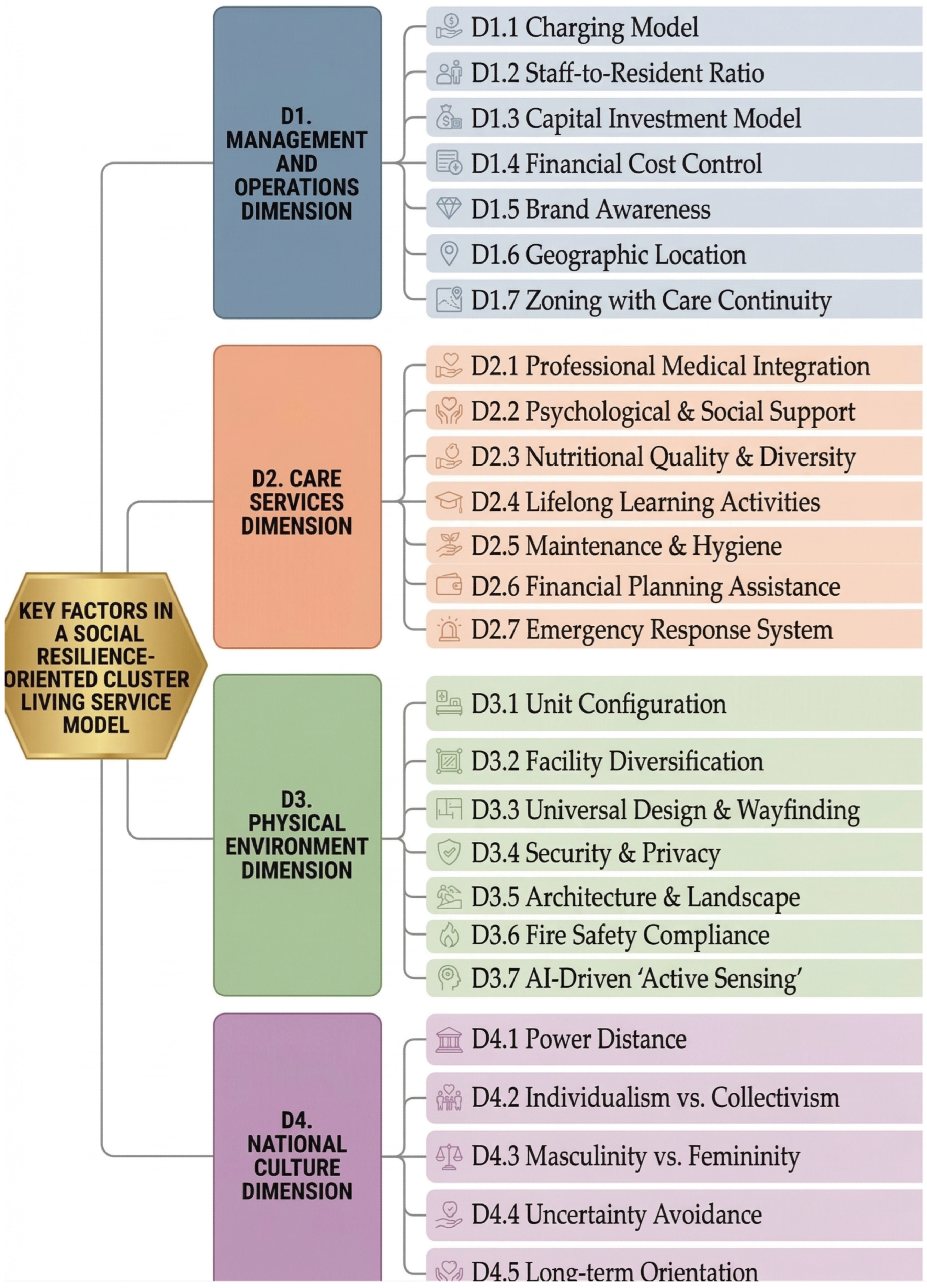
- Management Dimension: Evaluates the operational sustainability and efficiency of the service model. Key factors include organizational structure, financial feasibility, human resource allocation, quality management systems, and strategic marketing.
- Physical Environment Dimension: Emphasizes the spatial design of the living environment. This includes barrier-free infrastructure, the application of Smart Living Technologies (SLT), public space configuration, and safety management, aimed at supporting independent living and social participation.
- National Culture Dimension: Examines the socio-technical acceptance of residential models. This dimension analyzes how cultural values, social customs, family structures, and regulatory systems dictate elderly residential choices, ensuring that proposed strategies are aligned with the local sociocultural context.
3.2. Research Variables and Indicators
3.3. Fuzzy Delphi Method (FDM)
3.3.1. Expert Scoring Scale
3.3.2. Step 1: Establishing Cognitive Intervals
3.3.3. Step 2: Statistical Analysis and Outlier Exclusion
- Conservative Values: Minimum (), Geometric Mean (), and Maximum ().
- Optimistic Values: Minimum (), Geometric Mean (), and Maximum ().
3.3.4. Step 3: Constructing Triangular Fuzzy Numbers
- Conservative Triangular Fuzzy Number: = (, , ).
- Optimistic Triangular Fuzzy Number: = (, , ).
3.3.5. Step 4: Testing for Expert Consensus (Gray Zone Test)
3.3.6. Justification for the Single-Round Protocol
3.3.7. Threshold Setting
3.3.8. Sensitivity Analysis of the Consensus Threshold
Stringent Scenario (Threshold ≥ 8.0)
- Results Change: Under this scenario, indicators such as “Lifelong Learning Activities (7.86)” and “Uncertainty Avoidance (7.98)” would be excluded.
- Impact: While the model would become more streamlined, it might overlook the “Psychosocial Support” dimension, which experts identified as a significant trend in modern SCRC services. However, core safety and operational indicators (e.g., Fire Safety, Charging Model) remain unaffected, confirming their absolute necessity.
Relaxed Scenario (Threshold ≥ 7.6)
- Results Change: Indicators such as “Emergency Notification System (7.69)” and “Geographic Location (7.20)” would be closer to or included in the selection.
- Impact: A lower threshold would introduce more environmental and logistical factors. However, this might dilute the focus of the SCRC model on “active sensing” and “resilience,” potentially introducing noise into the subsequent weight calculations in the ANP phase (Table 5).
4. Results
4.1. Analysis of Expert Consensus Using the Fuzzy Delphi Method (FDM)
4.1.1. Expert Selection and Composition
- Industry Practitioners (n = 3): Senior executives and chief operators of prominent Continuing Care Retirement Communities (CCRCs) and wellness housing in Taiwan. They provide critical insights into market demand, operational management, and the practical implementation of elderly service models.
- Academic Scholars (n = 2): Professors specializing in elderly housing architecture, spatial planning, and co-housing communities. Their participation ensures theoretical robustness and alignment with global “aging-in-place” and “super-aged urbanism” trends.
- Government Professionals (n = 2): High-ranking officials from the Ministry of the Interior and local governments responsible for urban development. They provide essential perspectives on regulatory compliance, land-use strategies, and alignment with Taiwan’s Long-Term Care (LTC) 3.0 policy.
4.1.2. Data Collection Process
4.2. Stability and Convergence Analysis
- No Gray Zone (Interval = −1): Indicates a clear consensus range among experts, where opinions exhibit high uniformity.
- Convergent Gray Zone (Interval = 0): Signifies a minor fuzzy overlap in judgments; however, the overlap does not lead to statistical divergence (Zi ≤ Mi), confirming that a stable consensus has been reached.
4.2.1. Analysis of Retained Core Indicators ( ≥ 7.80)
4.2.2. Indicators Below the Threshold ( < 7.80)
- Note 1: The symbol “○” denotes that , indicating that the interval judgments of the experts have reached a consensus range without a gray zone. In such cases, the consensus importance value is calculated as = .
- Note 2: Gray-shaded rows represent evaluation criteria.

| Dimension | Evaluation Criterion | ) | ) | Interval | |||||||
|---|---|---|---|---|---|---|---|---|---|---|---|
| Management | Charging Model | 9 | 9.79 | 10 | 7 | 7.19 | 8 | 2.6 | −1 | ○ | 8.49 |
| Staff-to-Resident Ratio | 9 | 9.39 | 10 | 6 | 6.97 | 8 | 2.4 | −1 | ○ | 8.18 | |
| Capital Investment Model | 7 | 8.91 | 10 | 5 | 5.93 | 7 | 3.0 | 0 | ○ | 7.42 | |
| Financial Cost Control and Management (Transparency) | 7 | 8.54 | 10 | 4 | 5.67 | 7 | 2.9 | 0 | ○ | 7.11 | |
| Brand Awareness | 8 | 9.36 | 10 | 6 | 6.79 | 7 | 2.6 | −1 | ○ | 8.08 | |
| Geographic Location | 7 | 8.72 | 10 | 4 | 5.67 | 7 | 3.0 | 0 | ○ | 7.20 | |
| Zoning with Care Continuity | 8 | 9.56 | 10 | 5 | 6.90 | 8 | 2.7 | 0 | ○ | 8.23 | |
| Care Services | Professional Medical Integration | 8 | 9.36 | 10 | 6 | 6.97 | 8 | 2.4 | 0 | ○ | 8.17 |
| Psychological & Social Support | 8 | 9.36 | 10 | 6 | 6.79 | 7 | 2.6 | −1 | ○ | 8.08 | |
| Nutritional Quality & Diversity | 8 | 9.17 | 10 | 6 | 6.79 | 7 | 2.4 | −1 | ○ | 7.98 | |
| Lifelong Learning Activities | 8 | 8.96 | 10 | 6 | 6.76 | 8 | 2.2 | 0 | ○ | 7.86 | |
| Maintenance & Hygiene | 8 | 9.36 | 10 | 6 | 6.79 | 7 | 2.6 | −1 | ○ | 8.08 | |
| Personal Financial Planning Assistance | 7 | 8.52 | 10 | 3 | 5.36 | 7 | 3.2 | 0 | ○ | 6.94 | |
| Emergency Notification System | 7 | 9.31 | 10 | 4 | 6.07 | 7 | 3.2 | 0 | ○ | 7.69 | |
| Physical Environment | Unit Configuration | 8 | 9.36 | 10 | 5 | 6.52 | 8 | 2.8 | 0 | ○ | 7.94 |
| Facility Diversification | 8 | 9.36 | 10 | 6 | 6.76 | 8 | 2.6 | 0 | ○ | 8.06 | |
| Universal Design & Wayfinding | 9 | 9.39 | 10 | 6 | 6.97 | 8 | 2.4 | −1 | ○ | 8.18 | |
| Security & Privacy | 8 | 9.56 | 10 | 5 | 6.90 | 8 | 2.7 | 0 | ○ | 8.23 | |
| Architecture & Landscape | 9 | 9.19 | 10 | 5 | 6.52 | 8 | 2.7 | −1 | ○ | 7.85 | |
| Fire Safety Compliance | 9 | 9.79 | 10 | 6 | 7.33 | 9 | 2.5 | 0 | ○ | 8.56 | |
| AI-Driven “Active Sensing” | 8 | 9.36 | 10 | 6 | 6.79 | 7 | 2.6 | −1 | ○ | 8.08 | |
| National Culture | Power Distance | 6 | 7.92 | 9 | 3 | 4.86 | 6 | 3.1 | 0 | ○ | 6.39 |
| Individualism vs. Collectivism | 8 | 9.36 | 10 | 6 | 6.76 | 8 | 2.6 | 0 | ○ | 8.06 | |
| Masculinity vs. Femininity | 6 | 7.71 | 9 | 3 | 4.64 | 6 | 3.1 | 0 | ○ | 6.18 | |
| Uncertainty Avoidance | 8 | 9.17 | 10 | 6 | 6.79 | 7 | 2.4 | −1 | ○ | 7.98 | |
| Long-term Orientation | 9 | 9.19 | 10 | 5 | 6.52 | 8 | 2.7 | −1 | ○ | 7.85 | |
| Threshold Value | 7.80 | ||||||||||
- Core retained indicators (≧7.80):
- Fire safety Compliance ( = 8.56): This received the highest expert consensus value, indicating that experts regard safety as the foundation of long-term care facilities.
- Charging model ( = 8.49): Financial stability and transparency of the charging model are crucial to operation.
- Zoning with care continuity ( = 8.23) and Security & Privacy ( = 8.23): These echo the emphasis on continuity of care in Long-Term Care 3.0 policy, highlighting the need for spatial layouts that respect elderly dignity.
- Universal Design & Wayfinding ( = 8.18) and Staff-to-resident ratio ( = 8.18): These metrics are identified as the primary drivers of service quality and operational efficiency within the cluster living model.
- AI-Driven “Active Sensing” ( = 8.08): This aligns with the current project focus, and experts also recognize the necessity of AI in spatial design.
- Indicators below the threshold (to be considered for deletion or revision): Although these indicators are important, their relative priority was lower in the experts’ consensus:
- Personal financial planning Assistance ( = 6.94): Considered peripheral to the immediate residential service delivery.
- Capital Investment Model ( = 7.42) and Financial Cost Control and Management (Transparency) ( = 7.11): Viewed as internal management logistics rather than direct determinants of resident well-being. The exclusion of ‘Financial Cost Control’ by experts does not imply a disregard for financial logic, but rather a prioritization of service quality and safety over internal administrative logistics.
- Power distance and masculinity/femininity cultural indicators: The exclusion of these factors reveals a significant paradigm shift. This shows that, within the National Culture dimension, experts considered substantive intergenerational inclusion and uncertainty avoidance to be more important than pure institutional power or symbolic status. This suggests that social resilience in Taiwan’s aging context is increasingly rooted in horizontal social capital rather than vertical hierarchical authority.
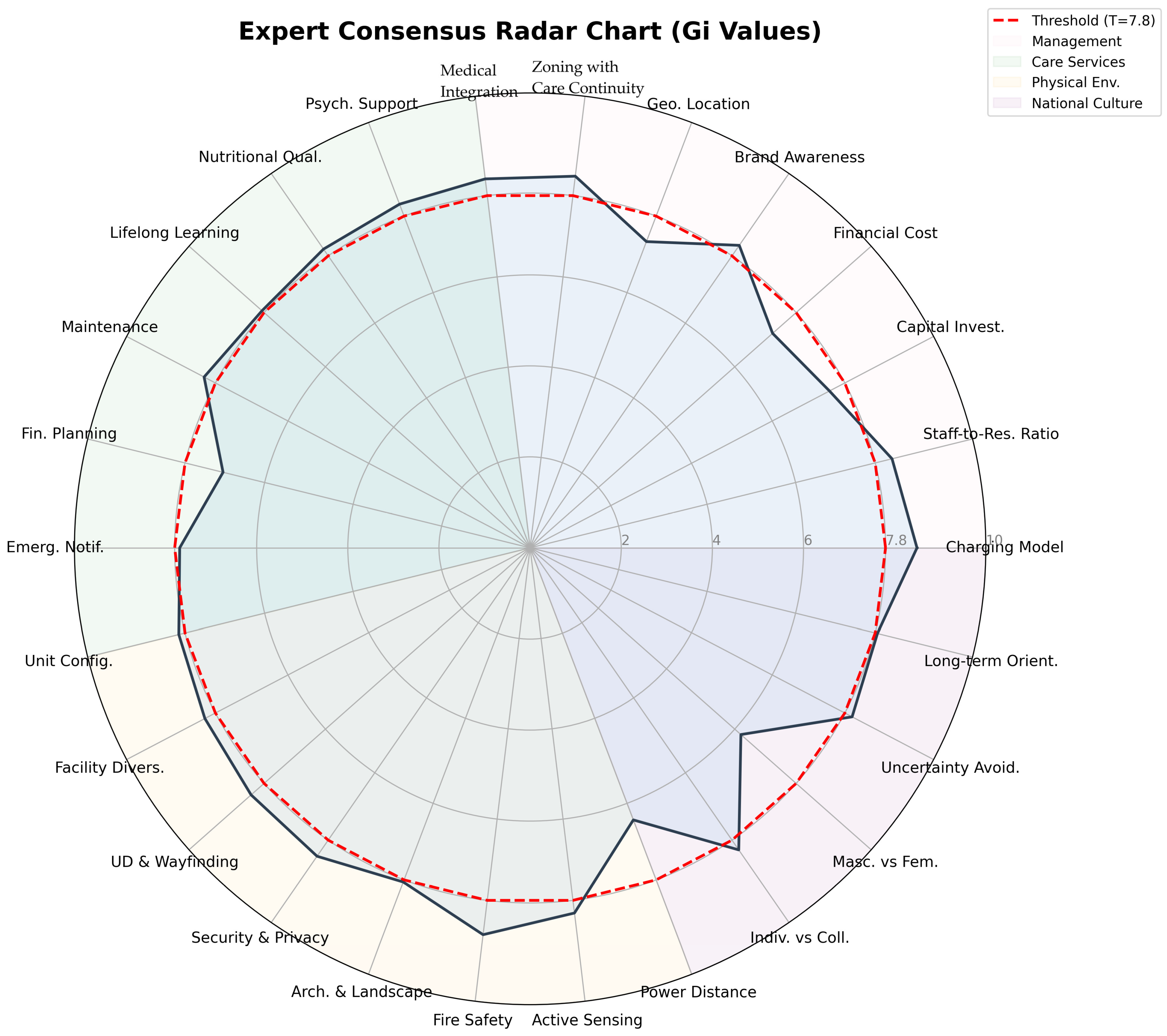
4.3. Radar Chart of Expert Consensus
- Axes: Each axis radiating outward from the center represents an evaluation criterion (e.g., charging model, fire safety, intergenerational inclusion, etc.).
- Consensus value (): The farther the solid line point is from the center, the higher the expert consensus value for that criterion, and thus the higher its importance.
- Threshold dashed line (Red Dashed Line, T = 7.80): This is the screening benchmark established in this study. Outside the dashed line indicates that the criterion passed the screening and is a key success factor; inside the dashed line indicates that the criterion did not reach consensus in importance and may be removed from the model or regarded as secondary.
- Color blocks: Different colors represent the four major dimensions (Management, Care Services, Physical Environment, and National Culture), making it easier to observe overall performance across dimensions.
4.3.1. Graphic Distribution and Data Interpretation
- Enabling Cornerstones: These peaks indicate that experts identify physical safety and economic viability as the foundational infrastructure required to sustain social resilience.
- Strategic Implication: Without a stable financial threshold, the delivery of psychosocial and cultural services becomes systemically fragile. A resilient community must guarantee fundamental security before layering more complex services.
- Paradigm Shift: This contraction confirms a shift in contemporary Taiwanese elder care, where traditional hierarchical authority and status-driven consumption have been de-emphasized.
- Value Transition: Resilience is no longer defined by “prestige” (Economic Display), but by “stability” (Economic Security). Older adults no longer prioritize “deference to authority” as primary drivers when selecting a residential community.
- “Body and Spirit” Metaphor: These graphical highlights represent the functional purpose of SCRC resilience. While economic factors provide the “body” (structure), these indicators provide the “spirit” (purpose).
- Refined Need: This reflects a cultural transition toward “connected autonomy” rather than traditional “dependence.”
4.3.2. Consistency of Expert Opinion
5. Discussion and Conclusions
5.1. Discussion
5.1.1. Management Dimension: From a “Real Estate Mindset” to a “Trust-Service Mindset”
- Key Indicators: Charging Model (8.49), and Zoning with Care Continuity (8.23).
- In-depth Analysis: The data reveal that expert concern for the charging model is second only to fire safety. This reflects a fundamental anxiety among Taiwanese older adults regarding long-term financial sustainability. While traditional retirement villages rely on high-entry deposits, a super-aged society demands asset liquidity and flexible allocation. This prioritization underscores that economic sustainability acts as the ‘enabling infrastructure’ for social resilience; without a viable financial vehicle, the community’s capacity to absorb social shocks—the core of social resilience—would be compromised.
- Policy Implications: An SCRC must evolve beyond a housing project into a financial vehicle. Integrating elder-care trust mechanisms can mitigate concerns regarding financial mismanagement or insolvency [25]. Furthermore, the high score for “Zoning with Continuity” underscores that “aging in place” is not just about the home, but about remaining within a familiar community even as care needs intensify.
5.1.2. Care Services Dimension: From “Physical Nursing” to “Whole-Person Support”
- Key Indicators: Professional Medical Integration (8.17); Psychological & Social Support (8.08).
- In-depth Analysis: In contrast to Western models that emphasize individualistic independence, our findings align with Eastern gerontology, where resilience is a collective property rooted in psychological companionship (8.08) and social capital.
- Academic Linkage: These findings suggest that non-medical support is a core determinant of well-being, echoing the “loneliness epidemic” cited in global gerontology. It should be clarified that the perceived synergy between social resilience and social capital identified here is a theoretical inference based on the high Gi values from expert consensus, rather than a directly measured empirical outcome. A resilient community must prioritize emotional support as highly as hygiene, requiring a multidisciplinary workforce that includes psychosocial experts alongside clinical staff.
5.1.3. Physical Environment Dimension: From “Barrier-Free” to “Ambient Sensing”
- Key Indicators: Fire Safety Compliance (8.56); Security & Privacy (8.23); AI-Driven “Active Sensing” (8.08).
- In-depth Analysis: AI-driven ‘Active Sensing’ (8.08) represents a transition from reactive to preventive resilience, where technology reduces the operational risk (Management) while simultaneously upholding the resident’s dignity (Social). AI investment is proposed as a risk-mitigation vehicle rather than a luxury amenity. In the context of Taiwan’s LTC 3.0, expensive sensor technologies serve to prevent catastrophic events (e.g., falls or fire fatalities), thereby ensuring the long-term economic and social viability of the SCRC model.
- Spatial Logic: Environmental design must now balance Active Sensing with privacy. By utilizing non-contact sensors (e.g., Wave radar), SCRCs can achieve real-time risk detection without the intrusive nature of cameras, thereby preserving the “Security & Privacy” (8.23) while maximizing life safety.
5.1.4. National Culture Dimension: From “Westernized Models” to “Cultural Translation”
- Key Indicators: Facility Diversification (8.06); Nutritional Quality & Diversity (7.98); Lifelong Learning Activities (7.86); Long-term Orientation (7.85).
- In-depth Analysis: This dimension represents the study’s most original finding. The high score for Intergenerational Inclusion challenges the Western CCRC tendency to create “elderly islands” (exclusive age-segregated enclaves). While previous research in the CCRC domain often prioritized ‘exclusive leisure’ as a mark of success, this study reveals a paradigm shift toward ‘connected autonomy.’ This divergence suggests that in East Asian contexts, social resilience is derived from multi-generational integration rather than age-segregated seclusion.
- The “Voices of Children” Factor: Taiwanese older adults increasingly desire “connected autonomy”—the ability to live independently yet remain part of a vibrant, multi-generational social fabric where they can “see young people and hear children.” This reflects an Eastern preference for community connectedness over total seclusion [26].
- Risk-Averse Pragmatism: The preference for robust financial/nursing guarantees over “facility luxury” aligns with high Uncertainty Avoidance. East Asian seniors prioritize long-term safety nets over hedonistic enjoyment.
- Core Finding: The rejection of “Power Distance” and “Masculinity” suggests that contemporary seniors seek egalitarianism and inclusion rather than traditional Confucian hierarchical authority. This “Cultural Translation” is essential for localized policy design in Taiwan’s Long-term Care 3.0 era.
5.2. Conclusion and Policy Implications
5.2.1. Policy Recommendations and Practical Implications
- Standardizing “Smart Safety” with Privacy Integration: Since Fire Safety Compliance and Security & Privacy reached the highest consensus, the government should update building codes to mandate non-contact sensing technologies (e.g., Wave radar) as safety standards. This reduces the burden of manual inspections while addressing the profound need for “Dignified Monitoring” [27]. In this context, the retention of AI-driven ‘Active Sensing’ (Gi = 8.08) represents a strategic shift from labor-intensive monitoring to technical efficiency, which directly addresses the high-priority ‘Staff-to-Resident Ratio’ (Gi = 8.18) identified by the experts. By reframing these costs as ‘preventive resilience,’ policymakers can justify the initial expenditure as a means to avoid the extreme social and legal costs associated with elderly accidents. Furthermore, domestic manufacturers should be incentivized to develop AI-integrated interactive designs that foster intergenerational inclusion and personalized preventive care [28].
- Establishing Financial Trusts for Care Continuity: To mitigate high Uncertainty Avoidance, policy should foster a “Trust-Service” ecosystem. By integrating elder-care trusts with long-term care insurance and clear refund mechanisms, the psychological and economic barriers to entry can be lowered. This ensures that “Zoning Management” (moving from independent to assisted living) is supported by a stable financial lifecycle, reducing future pressures on public welfare expenditure [29].
- Embedding SCRCs within the 15-Minute City Framework: Urban planning must move beyond “Elderly Islands” by utilizing floor-area incentives to encourage mixed-use development. Embedding SCRCs within the existing social fabric—utilizing transport networks and green spaces—promotes intergenerational mutual support. Drawing from Japan’s experience, localized, small-scale, community-embedded care networks can transform senior housing into a driver of regional development and social vitality [30].
5.2.2. Future Research Directions
- Ethical and Functional Frontiers of Ambient Intelligence: Future research should investigate the long-term socio-psychological impact of transitioning from camera-based surveillance to ambient intelligence (e.g., sensors embedded in architectural surfaces), specifically exploring how Generative AI and Large Language Models (LLMs) can synthesize behavioral data into proactive emotional support [31]. Specifically, empirical studies are needed to determine the threshold where “unobtrusive monitoring” balances resident safety with the right to privacy.
- Socio-Behavioral Dynamics of Intergenerational Co-living: While this study highlights a cultural preference for intergenerational inclusion, more rigorous investigation is required to evaluate the success factors of de-institutionalized co-living models, such as senior–student rent-exchange programs. Research should focus on how shared communal values can be measured and maintained across diverse age cohorts to combat the “loneliness epidemic”.
- Service Innovations for ‘Solo Agers’: With the rise in single-person elderly households, future studies should analyze the effectiveness of “Surrogate Family Services”. This includes examining the integration of digital care coordinators with legal and financial safeguards, such as reverse mortgages, to provide a holistic safety net for those without traditional familial support.
- Psychological Impact of Wellness-Centered Environment Design: There is a significant research gap regarding the quantitative assessment of how “wellness-centered software”—such as sensory-friendly environmental design—affects the cognitive health of residents compared to traditional physical hardware (e.g., ramps and handrails).
- Resilience under Environmental Stress: As climate change intensifies, future research must address the adaptability of modular SCRC housing against extreme weather, incorporating climate-adaptive thermal control and decentralized power strategies to safeguard disabled populations [32]. Investigations should prioritize the development of backup thermal-control systems and medical equipment power strategies for disabled populations within high-density urban settings.
6. Limitations and Future Research
- Methodological Subjectivity: Although the FDM is highly effective for aggregating expert consensus and mitigating ambiguity, the inherent subjectivity of expert judgment may influence the final interpretation. Future research should incorporate quantitative frameworks, such as Multi-Criteria Decision Analysis (MCDA) or the Analytic Hierarchy Process (AHP), to further validate indicator weightings and enhance the robustness of the model.
- Geographic and Cultural Scope: This analysis focused primarily on the socioeconomic and regulatory landscape of Taiwan. Given the significant impact of cultural dimensions identified in this study, cross-cultural comparative research is necessary to examine how different global sociocultural contexts—such as those in Europe or North America—shape elderly residential preferences and the “translation” of the CCRC model.
- Absence of User-Centric Data: The current framework relies on the “Top-Down” perspectives of experts (practitioners, academics, and officials). Future studies should incorporate the “Bottom-Up” lived experiences and satisfaction levels of actual residents through longitudinal surveys or in-depth interviews. This would provide a more holistic evaluation of how “Social Resilience” is perceived by the end-users.
- Urban–Rural Disparity: Taiwan exhibits substantial disparities in healthcare infrastructure and social capital between metropolitan and rural areas. Further research is required to investigate how residential choices and service demands vary across these settings to ensure spatial equity in elderly care distribution.
- Technological Ethics and Evolution: As digital health and Ambient Assisted Living (AAL) technologies evolve rapidly, future studies must assess not only their functional effectiveness but also their ethical implications, particularly regarding data privacy and the potential for “technological isolation.”
- Optimization of the Care Continuum: Finally, as the SCRC model matures, further investigation is needed on how to optimize the physical and operational transitions between Independent Living (IL) and Assisted Living (AL). Research should focus on minimizing the “relocation trauma” often associated with declining health status within integrated residential models.
Author Contributions
Funding
Institutional Review Board Statement
Informed Consent Statement
Data Availability Statement
Conflicts of Interest
References
- Ministry of Health and Welfare (MOHW). 2024 Taiwan Health and Welfare Report; MOHW: Taipei, Taiwan, 2024.
- World Health Organization. Global Age-Friendly Cities: A Guide; World Health Organization: Geneva, Switzerland, 2007. [Google Scholar]
- Buffel, T.; Handler, S.; Phillipson, C. (Eds.) Age-Friendly Cities and Communities: A Global Perspective; Policy Press: Bristol, UK, 2018. [Google Scholar]
- Norris, F.H.; Stevens, S.P.; Pfefferbaum, B.; Wyche, K.F.; Pfefferbaum, R.L. Community Resilience as a Metaphor, Theory, Set of Capacities, and Strategy for Disaster Readiness. Am. J. Community Psychol. 2008, 41, 127–150. [Google Scholar] [CrossRef] [Scilit] [PubMed]
- OECD. OECD Affordable Housing Database; OECD Publishing: Paris, France, 2025. [Google Scholar]
- Hofstede, G. Dimensionalizing cultures: The Hofstede model in context. Online Read. Psychol. Cult. 2011, 2, 8. [Google Scholar]
- Han, J.; Chan, E.H.W.; Qian, Q.K.; Yung, E.H.K. Achieving Sustainable Urban Development with an Ageing Population: An “Age-Friendly City and Community” Approach. Sustainability 2021, 13, 8614. [Google Scholar] [CrossRef] [Scilit]
- Rowe, J.W.; Kahn, R.L. Successful aging. Gerontologist 1997, 37, 433–440. [Google Scholar] [CrossRef] [Scilit]
- Hung, J.-Y. Assessment of home- and community-based long-term care centers in Taiwan. Soc. Sci. 2026, 15, 125. [Google Scholar]
- Ulrich, R.S. View through a window may influence recovery from surgery. Science 1984, 224, 420–421. [Google Scholar] [CrossRef] [Scilit]
- Ministry of Health and Welfare (Taiwan). Long-Term Care Services Act Regulations. 2023. Available online: https://law.moj.gov.tw/ENG/LawClass/LawAll.aspx?pcode=L0070040 (accessed on 3 May 2026).
- Chen, Y.; Chen, K.; Chang, C.-C.; Chen, M.; Yang, L. The individualized supervision strategy and effectiveness under the strength perspective: A pilot study for the case management model of the high-care elderly in communities. BMC Health Serv. Res. 2021, 21, 546. [Google Scholar]
- Sano, J.; Hirazawa, Y.; Komamura, K.; Okamoto, S. An overview of systems for providing integrated and comprehensive care for older people in Japan. Arch. Public Health 2023, 81, 81. [Google Scholar]
- Lawton, M.P.; Nahemow, L. Ecology and the aging process. In Psychology of Adult Development and Aging; Eisdorfer, C., Lawton, M.P., Eds.; American Psychological Association: Washington, DC, USA, 1973; pp. 613–660. [Google Scholar]
- World Bank. Choosing World Development Indicators: A Guide to Indicator Selection; World Bank: Washington, DC, USA, 2024. [Google Scholar]
- Ito, M. Avoiding the development bottleneck of China’s healthy old-age towns based on the practical experience of the Japanese version of CCRC. Zhuqu 2018, 2, 6–13. (In Chinese) [Google Scholar]
- Hsu, H.-M.; Chen, C.-T. Aggregation of fuzzy opinions under group decision making. Fuzzy Sets Syst. 1996, 79, 279–285. [Google Scholar] [CrossRef] [Scilit]
- Chiu, J.-Z.; Hsieh, C.-C. Fuzzy Delphi evaluation on long-term care nurse aide platform: Socio-technical approach for job satisfaction and work effectiveness. Appl. Syst. Innov. 2025, 8, 30. [Google Scholar] [CrossRef] [Scilit]
- Zheng, W.-Q.; Cheung, S.-M.; Wang, X. Developing age-friendly spaces through a gerontechnological lens: A systemic framework based on FDM-DANP analysis. Front. Med. 2025, 12, 1681486. [Google Scholar] [CrossRef] [Scilit]
- Ishikawa, A.; Amagasa, M.; Shiga, T.; Tomizawa, G.; Tatsuta, R.; Mieno, H. The max-min Delphi method and fuzzy Delphi method via fuzzy integration. Fuzzy Sets Syst. 1993, 55, 241–253. [Google Scholar] [CrossRef] [Scilit]
- Hsu, C.; Sandford, B.A. The Delphi technique: Making sense of consensus. Pract. Assess. Res. Eval. 2007, 12, 10. [Google Scholar]
- Cheng, C.H.; Lin, Y. Evaluating the best main battle tank using fuzzy decision theory with linguistic criteria evaluation. Eur. J. Oper. Res. 2002, 142, 174–186. [Google Scholar] [CrossRef] [Scilit]
- Darko, A.; Chan, A.P.C. Review of barriers to green building adoption. Sustain. Dev. 2016, 25, 167–179. [Google Scholar] [CrossRef] [Scilit]
- Wang, Y.; Ren, J.; Zhang, L.; Liu, D. Research on resilience evaluation of green building supply chain based on ANP-fuzzy model. Sustainability 2023, 15, 285. [Google Scholar] [CrossRef] [Scilit]
- Hu, X.; Xia, B.; Hu, Y.; Skitmore, M.; Buys, L. What hinders the development of Chinese continuing care retirement community sector? A news coverage analysis. Int. J. Strateg. Prop. Manag. 2019, 23, 108. [Google Scholar] [CrossRef] [Scilit]
- Xiang, L.; Tan, Y.; Jin, X.; Shen, Q. Understanding stakeholders’ concerns of age-friendly communities at the briefing stage: A preliminary study in urban China. Eng. Constr. Archit. Manag. 2020, 28, 31. [Google Scholar] [CrossRef] [Scilit]
- Tsai, S.-Y.; Hong, S.-Y. Influence of multisensory stimulation environmental designs for day services and healing environment of elderly people with dementia. Sens. Mater. 2019, 31, 1739. [Google Scholar] [CrossRef] [Scilit]
- Dong, W.; Sun, S.; Fu, Y. Assessing urban community parks from an age-friendly perspective: A multi-criteria decision-making approach. Front. Public Health 2025, 13, 1663359. [Google Scholar] [CrossRef] [Scilit]
- Li, R.Y.M.; Miao, S.; Abankwa, D.A.; Xu, Y.; Richter, A.; Ng, K.T.W.; Song, L. Exploring the market requirements for smart and traditional ageing housing units: A mixed methods approach. Smart Cities 2022, 5, 1752. [Google Scholar] [CrossRef] [Scilit]
- Juan, Y.-K.; Hsu, Y.-C.; Chang, Y.-P. Site selection assessment of vacant campus space transforming into daily care centers for the aged. Int. J. Strateg. Prop. Manag. 2021, 25, 34–39. [Google Scholar]
- Raza, M.M.; Venkatesh, K.P.; Kvedar, J.C. Generative AI and large language models in health care: Pathways to implementation. npj Digit. Med. 2024, 7, 62. [Google Scholar] [CrossRef] [Scilit]
- Huang, X.; Yao, R.; Halios, C.H.; Kumar, P.; Li, B. Integrating green infrastructure, design scenarios, and social-ecological-technological systems for thermal resilience and adaptation: Mechanisms and approaches. Renew. Sustain. Energy Rev. 2025, 212, 115422. [Google Scholar] [CrossRef] [Scilit]


| Country | Model | Policy Orientation | Core Service Philosophy | Strategic Approach |
|---|---|---|---|---|
| UK | Age UK | Privatization & PbR (Payment by Results) | Preventive well-being; shrinking resource optimization. | Community-centered; data-driven identification of sub-healthy elders. |
| USA | On Lok (PACE) | Integrated Long-term Care & Medical Services | All-inclusive capitation; cultural & linguistic sensitivity. | “Aging in place” via multidisciplinary assessment and home-based support. |
| Netherlands | Buurtzorg | Universal coverage; focus on mental & physical disability. | Bureaucracy-free; nurse-led professional autonomy. | “Onion Model” centered on client self-management and informal networks. |
| Japan | CCRC | Public LTC Insurance (Ages 40+) | Regional revitalization; active “second life” promotion. | Multi-generational co-living; revitalizing vacant housing and community stores. |
| Country & Model | Dominant Cultural Dimension | Critical Selection Factors (Prioritization) |
|---|---|---|
| UK: Age UK | Low Power Distance | Emphasis on information transparency, autonomy, and individual choice in service navigation. |
| USA: On Lok | Individualism | High valuation of service flexibility and the preservation of home-based autonomy. |
| Netherlands: Buurtzorg | Femininity/Low Power Distance | Focus on the quality of nurse–patient relationships and the strength of community mutual-aid networks. |
| Japan: CCRC | High Uncertainty Avoidance | Prioritization of medical continuity stability, institutional trust, and a sense of social belonging. |
| Dimension | Factor Indicator | Operational Definition | Citations for the Indicators |
|---|---|---|---|
| Management | 1. Charging Model | Analysis of fee structures: bundled care vs. fee-for-service; security deposits vs. monthly rental models. | [8,9,11,15] |
| 2. Staff-to-Resident Ratio | Compliance with Taiwan’s LTC standards (e.g., 1:8 for care attendants; 1:20 for nurses; 1:80 for social workers). | ||
| 3. Capital Investment Model | Comparison between heavy-asset (new construction) and light-asset (renovating idle government spaces) approaches. | ||
| 4. Financial Cost Control and Management (Transparency) | Management of high-capital expenditures, including staffing, facility maintenance, and service planning to ensure ROI. | ||
| 5. Brand Awareness | The perceived reputation and trust in the operator (public vs. private) and their track record in elderly care. | ||
| 6. Geographic Location | Accessibility analysis: urban proximity, transportation connectivity, and environmental/scenic quality. | ||
| 7. Zoning with Care Continuity | Spatial division into Independent Living (IL), Assisted Living (AL), Skilled Nursing (SN), and Memory Support (MS). | ||
| Care Services | 1. Professional Medical Integration | Provision of on-site medical personnel and equipment to ensure a seamless healthcare-to-housing link. | [8,12,13] |
| 2. Psychological & Social Support | Systems for counseling and “life companionship” to mitigate the emotional impact of physical decline. | ||
| 3. Nutritional Quality & Diversity | Diversity, hygiene, and nutritional balance of meal options tailored to geriatric dietary needs. | ||
| 4. Lifelong Learning Activities | Social engagement programs designed to enhance cognitive function and prevent social isolation. | ||
| 5. Maintenance & Hygiene | Protocols for regular disinfection, cleanliness of private/public spaces, and facility inspection. | ||
| 6. Personal Financial Planning Assistance | Services helping residents manage long-term living expenses, medical trusts, and end-of-life financial allocation. | ||
| 7. Emergency Notification System | Comprehensive notification infrastructure (e.g., pull-cords, wearable sensors) across all residential zones. | ||
| Physical Environment | 1. Unit Configuration | Variety of residential options (single/double occupancy) with emphasis on private bathroom accessibility. | [10,11,15] |
| 2. Facility Diversification | Integration of multi-use spaces: dining, fitness, retail, beauty services, and medical clinics within the cluster. | ||
| 3. Universal Design & Wayfinding | Circulation planning utilizing barrier-free standards and intuitive directional signage for cognitive support. | ||
| 4. Security & Privacy | Balance between 24/7 security patrols/access control and the resident’s right to personal privacy. | ||
| 5. Architecture & Landscape | Aesthetic integration of the built environment with local topography and biophilic design elements. | ||
| 6. Fire Safety Compliance | Installation of fire suppression and evacuation systems exceeding statutory safety requirements. | ||
| 7. AI-Driven “Active Sensing” | Integration of IoT, Wave radar, and AI for unobtrusive fall detection and behavioral risk recognition. | ||
| National Culture | 1. Power Distance | Preference for service models endorsed by medical authorities or formal government policy hierarchies. | [6,16] |
| 2. Individualism vs. Collectivism | Focus on intergenerational inclusion to mitigate the “stigma of abandonment” associated with institutional care. | ||
| 3. Masculinity vs. Femininity | Attraction to high-end facility status symbols and achievement-oriented marketing vs. nurturing care models. | ||
| 4. Uncertainty Avoidance | Demand for clear financial contracts, refund mechanisms, and guaranteed continuity of care. | ||
| 5. Long-term Orientation | Perception of SCRC entry as a strategic “long-term health asset” and preventive life planning. |
| Linguistic Variable | Numerical Range | Description |
|---|---|---|
| Very Unimportant | 0.0–2.0 | The indicator has a negligible impact on SCRC resilience. |
| Unimportant | 2.1–4.0 | The indicator has a minor or indirect influence. |
| Moderate | 4.1–6.0 | The indicator has a balanced or average impact. |
| Important | 6.1–8.0 | The indicator is a key driver for supply chain resilience. |
| Very Important | 8.1–10.0 | The indicator is essential and indispensable for SCRC. |
| Scenario | Threshold | No. of Selection Factors | Factors Changes |
|---|---|---|---|
| S1 (Relaxed) | ≥ 7.6 | 20 | Adds “Emergency Notification System (7.69),” increasing model complexity but lowering the overall average consensus. |
| S2 (Baseline) | ≥ 7.8 | 19 | The current study’s choice. Maintains a balance between comprehensive coverage and expert consensus. |
| S3 (Stringent) | ≥ 8.0 | 13 | Excludes 6 marginal indicators, such as “Nutritional Quality (7.98)” and “Lifelong Learning (7.86),” potentially narrowing the service scope. |
| No. | Category (N of Experts) | Expertise and Professional Background | Gender | Age | Year of Working Experience | Position | Organization Size |
|---|---|---|---|---|---|---|---|
| 1 | Industry (3) | Management and operation of a well-known CCRC and elderly wellness housing. | Male | 60+ | 21–30 | Head of Unit | 101–500 |
| 2 | Male | 40–49 | 11–20 | Professionals | 101–500 | ||
| 3 | Female | 40–49 | 11–20 | Professionals | 101–500 | ||
| 4 | Academia (2) | Research in elderly housing architecture, spatial planning, and co-living communities. | Male | 60+ | 21–30 | Head of Unit | 101–500 |
| 5 | Female | 60+ | 21–30 | Professionals | N/A | ||
| 6 | Government (2) | Central and local government officials in charge of urban development and housing policy. | Male | 50–59 | 21–30 | Head of Unit | 501–100 |
| 7 | Female | 50–59 | 21–30 | Head of Unit | 101–500 |
Disclaimer/Publisher’s Note: The statements, opinions and data contained in all publications are solely those of the individual author(s) and contributor(s) and not of MDPI and/or the editor(s). MDPI and/or the editor(s) disclaim responsibility for any injury to people or property resulting from any ideas, methods, instructions or products referred to in the content. |
© 2026 by the authors. Licensee MDPI, Basel, Switzerland. This article is an open access article distributed under the terms and conditions of the Creative Commons Attribution (CC BY) license.
Share and Cite
Kuo, H.-I.; Hung, J.-Y. Evaluating Social Resilience in Super-Aged Urbanism: A Cultural Dimension-Based Framework for Cluster Living Service Models. Urban Sci. 2026, 10, 274. https://doi.org/10.3390/urbansci10050274
Kuo H-I, Hung J-Y. Evaluating Social Resilience in Super-Aged Urbanism: A Cultural Dimension-Based Framework for Cluster Living Service Models. Urban Science. 2026; 10(5):274. https://doi.org/10.3390/urbansci10050274
Chicago/Turabian StyleKuo, Hsiao-I, and Jui-Ying Hung. 2026. "Evaluating Social Resilience in Super-Aged Urbanism: A Cultural Dimension-Based Framework for Cluster Living Service Models" Urban Science 10, no. 5: 274. https://doi.org/10.3390/urbansci10050274
APA StyleKuo, H.-I., & Hung, J.-Y. (2026). Evaluating Social Resilience in Super-Aged Urbanism: A Cultural Dimension-Based Framework for Cluster Living Service Models. Urban Science, 10(5), 274. https://doi.org/10.3390/urbansci10050274