1. Introduction
Various official organizations, such as the World Travel & Tourism Council (WTTC) and the World Tourism Organization (UN Tourism), confirm the economic importance of tourism activity [
1,
2], estimating its impact at 10% of global GDP and one in ten jobs, respectively. These economic effects occur because tourists spend part of the income generated in their place of origin at the destination [
3], making the analysis of tourist expenditure a fundamental pillar of the scientific literature dedicated to analyzing tourism from an economic perspective [
4,
5,
6,
7,
8].
However, analyzing tourist expenditure in an aggregate manner can obscure differences in the behavior of various types of tourists, leading to biased conclusions when extrapolating the economic impacts generated by a specific segment to the entire tourism demand [
6,
9,
10]. For this reason, recognizing tourist heterogeneity, as well as understanding their distinct consumption patterns, is essential for guiding destination management and planning strategies [
11].
In this context, a diversified tourism supply can be differentiated [
7,
12], insofar as there is a market tourism supply, which primarily encompasses hotel establishments, and a non-market supply, where there is no financial transaction for the accommodation used [
13]. This should not be confused with second home tourism, which could be understood as a specific subset within the broader category of non-market tourism. This typology has acquired growing relevance in many territories, becoming a significant part of both the accommodation supply and tourist flows [
14,
15,
16], favored by changes in lifestyles, population aging, and, more recently, the COVID-19 pandemic [
17,
18]. Non-market tourism presents differentiated behavioral and consumption patterns compared to tourism accommodated in market establishments [
7,
19,
20], as a consequence of longer stays [
14,
18,
21,
22], lower seasonal concentration [
15,
17,
18], and the absence of a direct cost for the use of accommodation in each stay undertaken. This makes it highly likely that this non-market tourist presents different expenditure levels than conventional tourists staying in hotel establishments [
20].
Nevertheless, despite the relevance of analyzing the expenditure patterns associated with non-market tourism in a differentiated manner, the existing empirical evidence remains relatively limited. Specifically, studies analyzing tourist expenditure patterns, although attempting to determine the effect of the length of stay and the seasonal component on actual spending, present significant gaps, as they have been applied to very specific geographical contexts [
23,
24]; analyzed a single type of tourist, whether domestic or international [
20,
23]; or their empirical evidence has been based on limited samples or specific surveys [
18,
23,
24].
Therefore, in order to overcome the existing gaps in the scientific literature, the main objective of this article is to evaluate the expenditure dynamics of non-market tourism at a national scale, using Spain as a case study. Specifically, the research outlines a twofold objective: first, to analyze the differences in tourist expenditure between market and non-market tourists driven by the length of stay and seasonality; and second, to overcome the use of aggregate means by identifying homogeneous groups with differentiated spending patterns within second home tourism.
To address this objective, the present study examines the tourist expenditure of both domestic and international visitors to Spain, drawing on a database from a cross-sectional survey that includes 1,253,115 observations, collected over a ten-year period, specifically, between 2015 and 2024.
The remainder of the article is structured as follows:
Section 2 provides a literature review on the importance of tourist expenditure, the conceptual boundaries of second home tourism, previous studies on non-market tourist expenditure, and the formulated hypotheses.
Section 3 outlines the methodological approach, describing the applied methodology and detailing the data used.
Section 4 presents the analysis and results.
Section 5 offers a discussion of the results obtained in this study relative to similar prior research. Finally,
Section 6 addresses the main conclusions of the work, including specific tourism policy recommendations for destinations specialized in non-market tourism.
2. Tourist Expenditure in Non-Market Tourism
2.1. Literature Review
The study of the level of tourist expenditure in the non-market segment and its differentiation from tourism accommodated in market establishments [
25] has generated an academic debate characterized by divergent approaches. In this regard, empirical research has addressed key aspects such as the existence of an expenditure reallocation by these tourists [
19], the identification of different consumption patterns [
21], or the analysis of significant differences in the total disbursement made compared to traditional visitors [
26,
27]. Given the territorial magnitude of this phenomenon, understanding its true economic footprint requires transcending mere empirical observation to examine the underlying theoretical dynamics.
A critical review of this literature reveals the consolidation of two main streams of analysis. On the one hand, the results of various studies focused on quantifying tourist expenditure maintain a more restrictive approach, pointing out that, by not assuming the direct cost of accommodation, second home tourists invariably record a lower total expenditure than traditional tourists [
27]. From this perspective, which can be considered transactional, authors conclude that the absence of payment for accommodation in the case of non-market tourism greatly limits the direct and immediate economic injection into the destination, positioning this segment as a less profitable profile in the short term compared to classic hotel tourism [
4,
6,
7,
10].
However, there is another stream of study diverging from the previous approach, which adds an additional step and focuses its analysis on the possibility of a “reallocation effect,” according to which the savings obtained in accommodation modify the structure of tourist expenditure. This unconsumed amount would be allocated to other local consumption items, which can partially compensate for the lack of accommodation expenditure and even reverse it in certain contexts [
19,
22,
26,
28]. By not incurring direct costs for the use of accommodation, the expenditure level of these visitors tends to concentrate steadily on complementary activities, such as retail trade, restaurants, self-provisioning, or local leisure, which are carried out continuously throughout the trip [
19,
28]. Furthermore, this second perspective highlights that the typically longer stays and lower seasonal dependence of this group act as compensatory mechanisms against their lower daily expenditure [
14,
15,
17], generating a structural base for the local tourism fabric.
Nevertheless, despite these important conceptual advances, empirical studies on non-market tourism have been marked by several methodological biases that hinder a structured understanding of its spending behavior. Traditionally, the literature has treated this segment homogeneously, drawing general conclusions from aggregate mean values that obscure the internal differences existing among tourists staying in non-market establishments [
25,
29,
30]. In general, certain scale limitations can be observed in the existing literature. Studies take very specific geographical contexts as references, usually of a local nature [
21,
22], analyze a single tourist profile by artificially separating domestic from international demand [
19,
21], or rely methodologically on limited samples resulting from ad hoc surveys [
17,
21,
22]. This heavy reliance on aggregate data and fragmented case studies has prevented an in-depth macroeconomic analysis of the internal heterogeneity of this segment at the national level.
2.2. Conceptual Definition of Second Home Tourism
Second home tourism constitutes a complex and heterogeneous tourism modality, given that beyond its traditional expression (use of housing during vacation periods) it incorporates other additional motivations and practices, such as the search for a better quality of life [
31], prolonged stays by retired people [
32], a more integrated experience in the life of the destination [
33], or, more recently, the combination of leisure and teleworking from a second home [
34,
35].
These particularities have contributed to blurring its conceptual boundaries, placing it in an intermediate space between traditional tourism, temporary migration, and part-time residence in destinations [
25,
36], which implies a lack of consensus in the scientific literature regarding the definition of second home tourism. In this regard, the absence of standardized criteria to define second home tourism has led to the use of different terms in the scientific literature to refer to this type of tourism [
37].
This lack of uniformity regarding its conceptualization leads to a lack of definition as to which accommodation typologies should be included in this category. In general, the literature agrees on considering owned housing as its core [
22,
24,
28,
38], although some authors broaden this concept and also incorporate dwellings provided free of charge by relatives and friends, as well as home exchanges [
20,
39,
40]. However, greater controversy has been generated by the possible inclusion of vacation rental homes within this category [
14,
23,
26,
27,
41,
42].
Nevertheless, this lack of specificity in the scientific literature contrasts with the criteria adopted by various international organizations [
13,
43], which use the concept of “non-market tourism” as an operational reference. In this context, the element that distinguishes non-market tourism from traditional tourism (or market tourism) is the absence of a direct economic transaction for accommodation.
Therefore, according to this criterion, there is a market supply, which encompasses hotel accommodations, campsites, tourist apartments, or, more recently with the expansion of digital platforms, short-term rental homes; and, on the other hand, a non-market supply, which includes stays in second homes, homes of relatives, or home exchanges without monetary compensation [
13].
2.3. Formulation of Hypotheses
2.3.1. Length of Stay and Seasonality as Determinants of Spending
The literature has identified the length of stay as an important determinant of tourist expenditure, usually observing a non-linear relationship characterized by diminishing marginal returns [
4,
29]. In the specific case of non-market tourism, various studies indicate that its notably longer stays [
14,
17,
19] cause a progressive assimilation toward the consumption patterns of the resident population [
31,
34,
35], which are characterized by a greater reliance on self-provisioning rather than the use of predominantly tourist services as the stay is prolonged [
21]. Thus, given the lack of macro-level empirical evidence that directly contrasts the intensity of this effect against the traditional tourist, the first hypothesis is formulated:
H1. There are differences between the expenditure made by market tourists and the expenditure of non-market tourists driven by the length of stay.
On the other hand, the temporal dimension of travel constitutes another major determinant of tourist expenditure levels. Unlike market tourism, users of non-market accommodation tend to visit destinations outside of peak periods as well [
14,
17,
19]. Although the literature warns about the pressure this type of tourism can exert on public resources during peak periods [
36], it also highlights its contribution to the economic stability of the destination by generating tourist flows with a more stable distribution throughout the year [
37,
44]. This lower seasonal concentration helps sustain local commercial activity during seasons traditionally considered to have a lower tourist influx [
17,
28], although the level of consumption during these periods may be conditioned by a generalized drop in season-linked prices [
19]. To empirically test these seasonal differences, the second hypothesis is formulated:
H2. There are differences between the expenditure made by market tourists and the expenditure of non-market tourists driven by the seasonality of the trip.
2.3.2. Heterogeneity in Non-Market Demand
As previously noted, analyzing non-market demand in an aggregate manner obscures the specific contribution of those subgroups or segments that present different characteristics and higher expenditure levels [
17,
28]. Research on consumer behavior cautions that radically distinct profiles coexist within this segment, ranging from short domestic trips linked to visiting relatives or returning to the place of origin, to long stays by international residential migrants [
23,
41], or hybrid profiles combining leisure and teleworking [
34,
35]. However, the existing differences between each of the aforementioned profiles become blurred when the analysis focuses solely on mean values [
40,
45] or in the absence of the application of clustering techniques to deconstruct demand and understand which profiles exhibit differentiated spending behaviors in accordance with methodological recommendations [
4,
6], with empirical evidence identifying such profiles for non-market tourists remaining scarce. Thus, in response to this theoretical limitation, the third hypothesis is formulated:
H3. Within second home tourism, tourist segments with differentiated spending patterns can be identified.
3. Research Methods
3.1. Data Collection
Academic literature on second home tourism frequently points out the existing difficulty in obtaining homogeneous, structured, and reliable data that allow not only for solid analyses but also robust comparisons with conventional tourism [
15,
46,
47]. In this sense, facing the limitations derived from the use of ad hoc surveys or those with a limited scope, this study uses different official surveys as data sources that provide country-level data, which guarantees high statistical representativeness and allows for the replicability of the results in other similar contexts [
48].
Specifically, for the present study, which uses Spain as a case study, there are official statistics that provide relevant information for the analysis of this variable. In particular, the Spanish National Statistics Institute (INE) continuously conducts two surveys that provide complementary information for the study of tourist expenditure: the “Resident Tourism Survey (ETR),” which is elaborated from the perspective of Spanish residents traveling within the country, and the “Tourist Expenditure Survey (EGATUR),” which is elaborated from the perspective of foreign or international tourists traveling to Spain. These two surveys are based on a structured questionnaire and are collected through direct interviews, where data is obtained by asking travelers about their expenditure. Thus, according to the methodology applied by ETR and EGATUR, since the data on expenditure and travel originate from the tourists themselves and given the large sample size used, this eliminates the possibility of the analyzed information being biased by the potential existence of a shadow economy, which could arise from the responses provided by tourism service providers.
The surveys are conducted continuously throughout the year to capture the seasonality of tourist behavior.
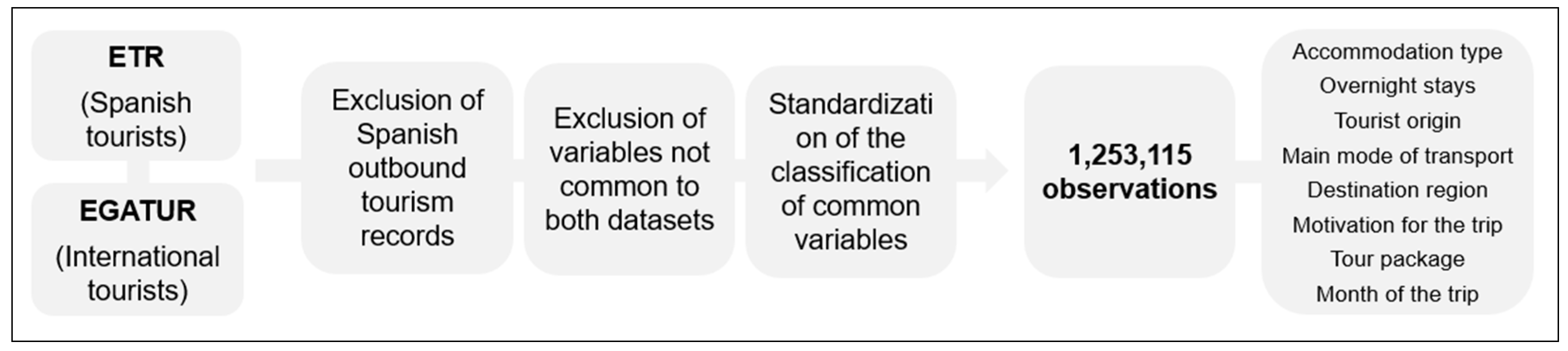
The integration of microdata from both information sources allows one to analyze the 10-year period between 2015 and 2024, with an availability of 1,253,115 observations. Nevertheless, for the construction of the database analyzed in this study, a harmonization process was necessary. This process was not merely descriptive, but sought to guarantee structural comparability between domestic and international visitors. To this end, a Common Expenditure Taxonomy was defined, grouping the original categories into equivalent headings (Transport, Food and Beverage, Activities, and Others/Shopping), thereby reducing the existing disparity in the level of breakdown between both surveys (
Figure 1). However, this integration process presents methodological limitations that must be acknowledged. First, there is an asymmetry in the data collection method: while EGATUR captures expenditure through interviews at the border upon departure from the destination, ETR collects information at the resident’s home after the trip has been completed. This methodological difference implies that the expenditure reported in the ETR may be subject to a greater underestimation of minor and routine expenses. Second, by relying exclusively on self-reported expenditure, the data may present underreporting biases. However, the use of a massive sample (N > 1.25 million) and the fact that both surveys follow the International Recommendations for Tourism Statistics [
43] allow individual measurement errors to be statistically diluted, ensuring the robustness of the aggregate trends.
First, microdata from ETR referring to domestic tourists traveling outside of Spain were eliminated, since the objective of our study focuses on tourism carried out within Spain.
Second, the variables analyzed by each of the surveys that are not common to both were eliminated, in order to avoid distortions and partial analyses. This resulted in the following independent variables: year, month, tourist origin, main mode of transport, destination region, length of stay, main accommodation type, purpose of the trip, and tourist package.
Third, based on the methodology of ETR and EGATUR, the categories existing within each of the independent variables were unified to match the breakdown provided by EGATUR, which offers a simpler and more concrete detail in its results than ETR.
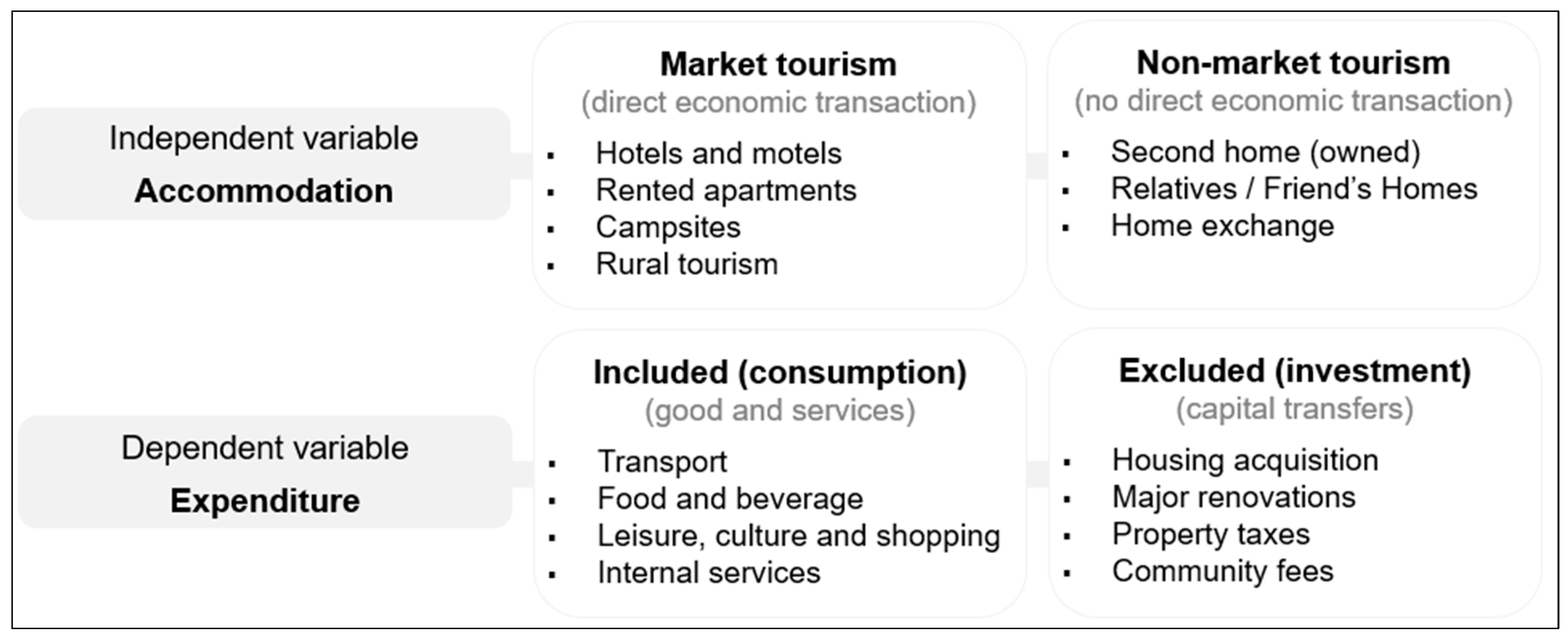
In accordance with the two objectives of this study, to differentiate the expenditure of market tourists from that of non-market tourists and to identify clusters with differentiated spending patterns for second home tourists, it is necessary to disaggregate the microdata according to the type of accommodation used. Following the criteria adopted by ETR and EGATUR, this is based on the existence, or lack thereof, of a direct economic transaction related to the accommodation service, resulting in two mutually exclusive and differentiated categories: market accommodation and non-market accommodation [
49,
50]. Market accommodation includes tourists staying in hotel establishments, tourist apartments, campsites, rural houses, hostels, or other paid accommodations, whereas non-market accommodation includes tourists staying in their own second homes, homes provided free of charge by relatives and friends, home exchanges, or other analogous forms of accommodation.
On the other hand, regarding the dependent variable, that is, tourist expenditure, it is strictly restricted to the direct disbursement on individual goods and services made during the trip or in advance, such as expenditure on accommodation, transport, food and beverage, leisure, or shopping [
43]. This concept is adopted in the methodology developed by the INE for the two databases utilized, ETR and EGATUR. Therefore, investment or capital expenses, such as the purchase of housing, structural renovations, property taxes, or community fees, are deliberately excluded [
13,
43]. This allows for a homogeneous comparison between the tourist who pays to stay in a hotel and the tourist who uses their second home as a form of accommodation, avoiding the distortion that maintenance costs or real estate investment would introduce.
In this regard,
Figure 2 details the forms of accommodation included in each of the categories, as well as the different items included in the concept of expenditure provided by the INE.
3.2. Applied Methodology
3.2.1. Expenditure by Market vs. Non-Market Tourists
To test the first two hypotheses established in this paper (H1 and H2), specifically, whether there are differences between the expenditure made by market tourists and the expenditure of non-market tourists driven by the length of stay and seasonality, a linear regression model with interaction and the non-parametric Kruskal–Wallis test were used.
This model allows for evaluating whether the relationship between a predictor variable (length of stay and seasonality) and a response variable (total expenditure) depends on the level of another categorical variable (market tourist vs. non-market tourist). The mathematical formulation of the model used is as follows:
where:
Expenditurei: total expenditure of tourist i;
Type of touristi: dummy variable (1 = non-market, 0 = market);
Xi: temporal predictor variable (overnight stays for H1 or seasonality for H2);
Type of touristi × Xi: interaction term;
β0: intercept (baseline expenditure of market tourists with 0 overnight stays);
β1: direct differential effect of the type of tourist (non-market);
β2: direct effect of the temporal variable (slope of the expenditure or change in the period of stay);
β3: interaction term (difference in the expenditure slope according to the accommodation type);
εi: random error term.
The choice of the Ordinary Least Squares (OLS) estimation method for this model is based on its suitability for directly quantifying the marginal effects and interactions proposed in the hypotheses. Although tourist expenditure data typically exhibit strong positive skewness and violate the assumption of normality, the exceptional sample size (N > 1.25 million) guarantees the asymptotic convergence of the estimators by virtue of the Central Limit Theorem, ensuring the validity of statistical inferences. As a methodological reinforcement against the non-normality of the data, the Kruskal–Wallis test is additionally applied, which allows for comparison of the mean expenditure ranks without the restrictive assumptions of traditional parametric models.
This test allows comparing the expenditure distribution among multiple independent groups (in this case, tourism seasonality), making it suitable for comparing more than two independent groups regarding the distribution of an ordinal or continuous variable without needing to assume normality.
The Kruskal–Wallis test is a generalization of the Mann–Whitney U test for more than two groups, based on the use of ranks. The Kruskal–Wallis statistic (
H) is calculated as:
where:
N is the total sample size;
k is the number of groups;
nj is the size of group j;
j is the mean rank of group j;
is the overall mean rank.
In the event of detecting statistically significant differences (
p < 0.001), a post hoc analysis of multiple comparisons is executed using the Bonferroni correction to control the inflation of Type I error (false positives). The adjusted significance level was calculated as:
where:
α is the original significance level (e.g., 0.05);
m is the number of independent comparisons;
If padjusted < α, the difference is considered significant.
3.2.2. Segmentation of Non-Market Tourists: A Cluster Analysis
To test the third hypothesis established in this paper (H3), specifically, to determine if there are differentiated spending patterns within second home tourists, a segmentation analysis based on unsupervised clustering techniques was applied. Considering the high available sample volume and the quantitative and coded categorical nature of the analyzed variables, the k-means clustering algorithm was used.
This scalable clustering technique allows grouping similar observations while minimizing the internal variability within each group. Specifically, the k-means algorithm seeks to divide a set of n observations into k clusters, such that the sum of squared distances within each group relative to the cluster centroid is minimized. The objective function minimized by the algorithm is:
where:
xi is observation i in the feature space;
μj is the centroid of cluster j;
Cj is the set of observations assigned to cluster j;
‖·‖2 represents the squared Euclidean distance.
Furthermore, the algorithm is executed iteratively through the following steps:
Random initialization of k centroids.
Assignment of each observation to the closest cluster (minimum Euclidean distance).
Recalculation of the centroids as the mean of the assigned observations.
Repetition of steps 2 and 3 until convergence (no changes in assignments or improvement of the criterion j).
To guarantee the validity of the k-means segmentation, the technical limitations inherent to the algorithm were taken into consideration. Given the sensitivity of this method to the scale of the variables and data types, the segmentation was executed by addressing the quantitative and coded categorical nature of the variables, thereby minimizing the risk of those with greater variance artificially dominating the cluster formation. Furthermore, the algorithm was applied iteratively with the objective of minimizing intra-cluster variance and avoiding convergence at suboptimal local minima.
On the other hand, to determine the optimal value of k, the Elbow Method was used, which consists of plotting the total within-cluster sum of squares (WCSS) as a function of the number of clusters. The point where the decrease in WCSS begins to be less pronounced (the “elbow” of the curve) suggests the optimal number of clusters.
Finally, the quality of the obtained partition was evaluated using the silhouette coefficient, a measure that quantifies the degree of internal cohesion and external separation of the clusters. For each observation
i, the silhouette coefficient
s(
i) is defined as:
where:
a(i) is the mean distance between observation (i) and the rest of the observations in the same cluster (internal cohesion);
b(i) is the lowest mean distance between observation (i) and the observations of the nearest cluster (external separation).
The value of s(i) ranges between −1 and 1. Values close to 1 indicate good classification; values close to 0 indicate overlapping; and negative values suggest misclassification. The global average silhouette coefficient is obtained as the mean of all s(i).
4. Results
4.1. Descriptive Analysis
First, a bivariate descriptive analysis between the variable under study (market tourists vs. non-market tourists) and the remaining available quantitative variables is presented, aiming to explore possible relevant associations and differentiated behavioral patterns for both types of tourists (
Table 1). Spearman’s rank correlation coefficient (
p < 0.001) is included to evaluate the strength of the association between each variable and the type of tourist.
In the table above, it can be observed that tourists using market accommodations present an average expenditure (€1094.76) more than double that recorded by non-market tourists (€515.06), confirming the existence of a negative and statistically significant association between the use of this type of accommodation and the volume of expenditure made (ρ = −0.4947; p < 0.001), and a weaker association with the number of overnight stays (ρ = –0.0916; p < 0.001). This reflects, therefore, significant differences in the stay and expenditure patterns between both types of tourists.
Second, a descriptive statistical analysis of the qualitative variables analyzed in this study is presented, with the aim of providing an overview of the differences between market and non-market tourists (
Table 2). The contingency coefficient (
p < 0.001) is included to assess whether the distribution of these variables differs between both types of tourists.
As can be seen in the table above, all the categorical variables analyzed show a statistically significant association (p < 0.001) with the type of tourist, although the degree of intensity varies among the variables. The highest contingency coefficients are observed for the purpose of the trip (C = 0.436), the use of a tourist package (C = 0.387), the main mode of transport (C = 0.355), the destination region (C = 0.351), and the origin of the tourist (C = 0.335), indicating that these variables discriminate to a greater extent between market and non-market tourists.
4.2. Expenditure by Market vs. Non-Market Tourists
4.2.1. Differences Related to the Length of Stay
To test the first hypothesis established in this paper (H1), specifically, whether there are differences between the expenditure made by market tourists and the expenditure of non-market tourists driven by the length of stay, a linear regression model with interaction between the type of tourist (market vs. non-market) and the length of stay (number of nights) was applied. The results are shown in
Table 3. This approach allows evaluation of whether expenditure increases as the stay is extended, while simultaneously verifying whether the spending pattern differs between market and non-market tourists.
The adjusted coefficient of determination (adjusted R2 = 0.5185) of the model indicates that it explains approximately 52% of the variability observed in total expenditure, which is a reasonably high value for this type of data. The results show that both the type of tourist (market vs. non-market) and the number of overnight stays have a significant effect and that, furthermore, there is a significant interaction between both variables. Therefore, there are differences in the expenditure made between both tourist typologies, which is explained by the duration of the stay.
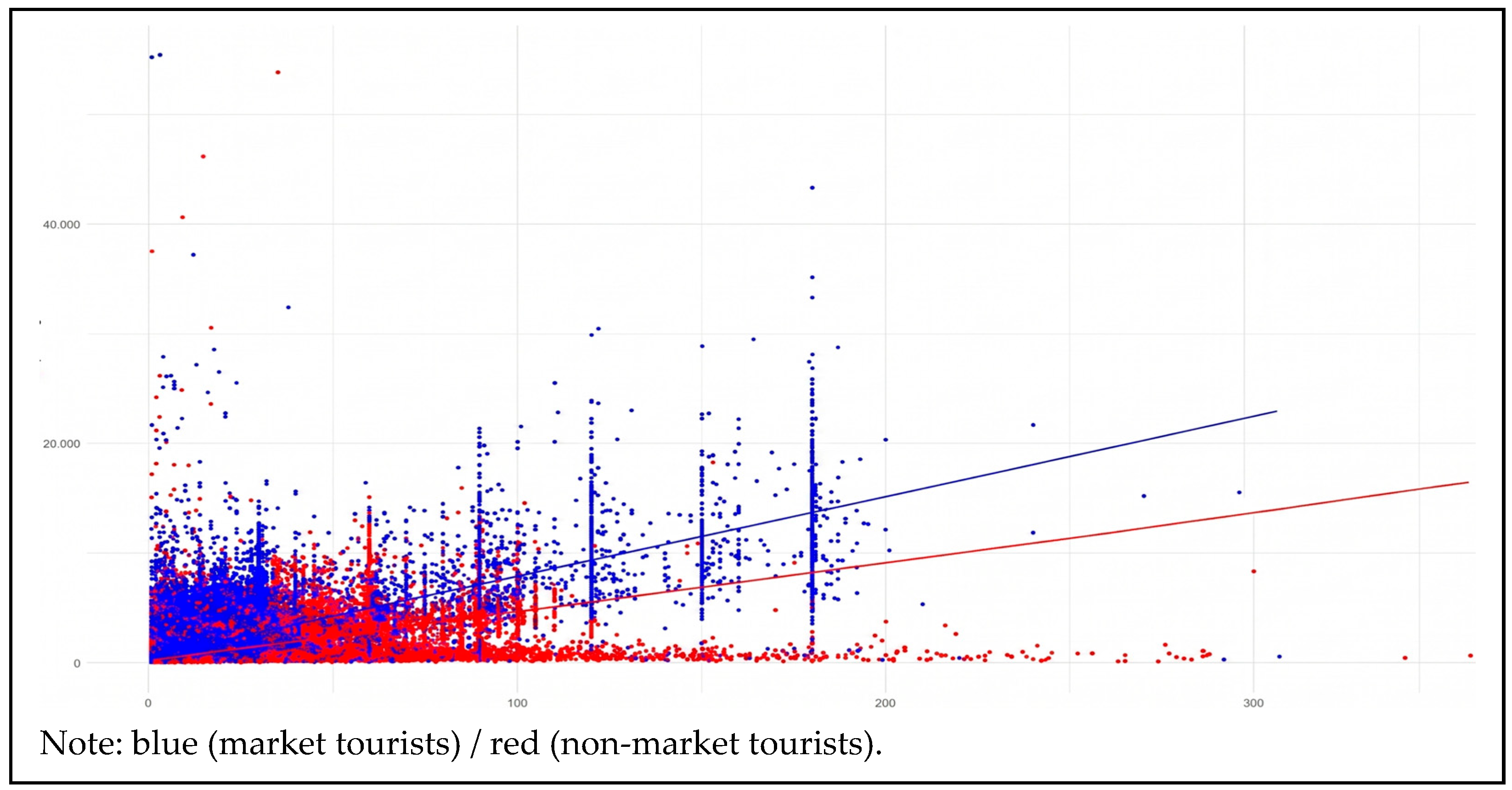
Specifically, the coefficient for overnight stays indicates that, for market tourists, each additional night is associated with an average increase of €72.91 in total expenditure. Furthermore, the negative interaction coefficient (−28.15) indicates that the effect of the number of overnight stays on expenditure is significantly smaller for non-market tourists. Thus, although expenditure increases in both groups as the length of stay increases, it does so to a lesser extent for tourists using non-regulated accommodation.
In other words, although expenditure increases with the nights of stay in both groups, it does so more slowly for tourists using a non-market establishment as their form of accommodation, as can be observed in
Figure 3.
4.2.2. Seasonality-Related Differences
To test the second hypothesis established in this study (H2), specifically, whether there are differences between the expenditure made by market tourists and the expenditure of non-market tourists driven by seasonality, a linear regression model with interaction between the type of tourist (market vs. non-market) and the month in which the trip was made (seasonality) was applied. The results are shown in
Table 4. It should be noted that, based on the frequency analysis shown in the descriptive analysis, two main periods were defined: high season (June, July, August, September, and October), in which the microdata exceed 100,000 monthly tourists, and low season (January, February, March, April, May, November, and December), in which the microdata are below 100,000 monthly tourists. This approach allows evaluating whether expenditure differs depending on the season in which the stay takes place, while also verifying whether the spending pattern differs between market and non-market tourists.
The adjusted coefficient of determination (adjusted R2 = 0.2855) of the model indicates that it explains approximately 28% of the variability observed in total expenditure, which is a reasonably high value for this type of data. The results of the model show that there are statistically significant differences in total expenditure depending on both the type of tourist and tourism seasonality.
Specifically, non-market tourists present a significantly lower average expenditure than market tourists (coefficient = −585.27; p < 0.001); furthermore, during the low tourism season, a significant reduction in total expenditure is observed compared to the high season (coefficient = −36.12; p < 0.001). On the other hand, the interaction between both variables is also significant (p < 0.001), indicating that the effect of seasonality on expenditure also varies depending on the type of tourist (market vs. non-market).
The Kruskal–Wallis test (
Table 5) applied to total expenditure according to seasonality (high season vs. low season) and the type of accommodation used (market vs. non-market) confirms the existence of significant differences (
p < 0.001). The post hoc analysis shows that expenditure is higher for market tourists and that, within each type of accommodation, the average expenditure is higher in the high season. In the case of non-market tourists, the average expenditure in the high season is €527.41, while the average expenditure in the low season is €502.53.
4.3. Segmentation of Non-Market Tourists: A Cluster Analysis
To test the third hypothesis established in this study (H3), specifically, to determine whether there are differentiated spending patterns within second home tourists, a segmentation analysis was applied based on unsupervised clustering techniques. Given the large available sample volume and the quantitative and coded categorical nature of the analyzed variables, the k-means clustering algorithm was used. For this analysis, variables with the capacity to discriminate between tourist profiles were used, namely: total expenditure, tourist origin, number of overnight stays, main mode of transport, seasonality, and main purpose of the trip. By applying the Elbow Method, it was determined that the optimal division of the sample is set at three clusters (k = 3), a point at which a reasonable balance between simplicity and captured information is achieved.
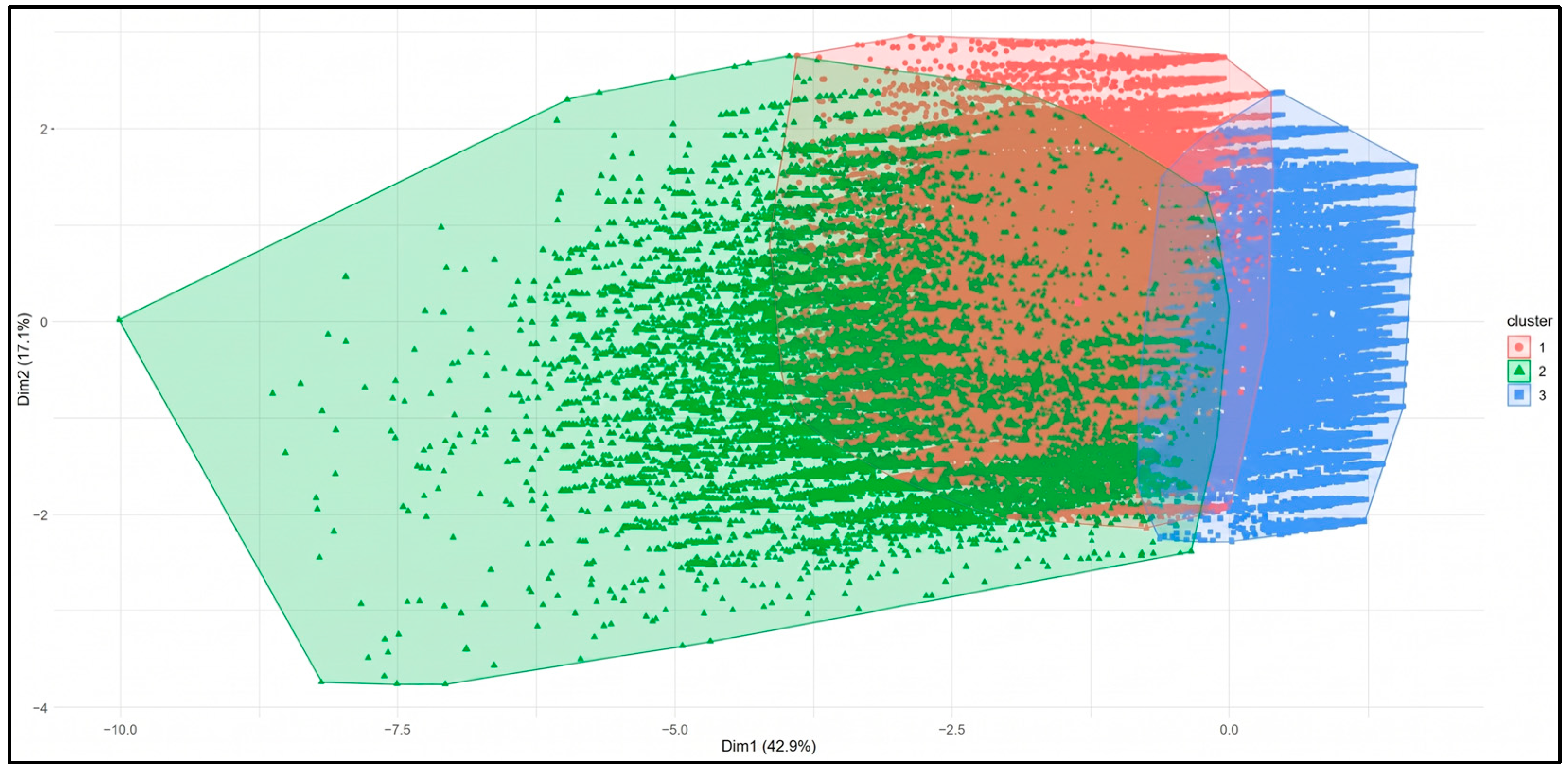
In this regard,
Figure 4 shows that the three identified clusters capture relevant structural differences projected onto the two main dimensions. These two dimensions correspond to the first two principal components obtained from the variables used in the clustering procedure (tourist expenditure, month of the visit, tourist origin, number of overnight stays, mode of transport, and main purpose of the trip). These dimensions summarize the main sources of variability in the dataset and allow visualizing the three clusters in a two-dimensional space, jointly explaining around 60% of the total variance.
On the other hand, the quality of the segmentation generated by the k-means cluster analysis was evaluated using the silhouette coefficient, with the results shown in
Table 6. Observing the disaggregated data, a very robust internal cohesion is confirmed for Cluster 3 (0.492), compared to a more moderate separation in Clusters 1 and 2 (around 0.24).
As a summary,
Table 7 presents an overview with the main characteristics identified in each of the 3 clusters.
Therefore, the segmentation performed among second home tourists allows identifying three profiles with differentiated spending patterns. On the one hand, Cluster 2, although a minority, stands out as the group with the highest strategic value due to its high expenditure and long stays, representing a key segment for attracting highly profitable international tourism. At the opposite extreme, Cluster 3 groups the majority of domestic tourists, with short stays and low expenditure, being relevant from a territorial point of view despite its low individual tourist expenditure. Finally, Cluster 1 represents an intermediate profile of foreign tourists and moderate expenditure, with weekly stays and stable behavior.
5. Discussion
The results obtained in this study allow discussion of two fundamental issues in the literature on non-market tourism: the differences compared to traditional market tourism (driven by the length of stay and the seasonality of the trip) and the need to identify groups of non-market tourists with differentiated spending patterns.
First, the empirical evidence obtained in this paper confirms that non-market tourists present, on average, lower expenditure levels than traditional market tourists [
4,
20,
44]. However, the main contribution of this work lies in showing that this difference in expenditure is driven by trip characteristics, specifically, the length of stay and the seasonality of demand.
Regarding the length of stay, the results obtained show that tourist expenditure increases as the number of overnight stays increases for both types of tourists, although this relationship is considerably weaker in the case of non-market tourists. This is in line with previous studies that have determined that the relationship between length of stay and expenditure exhibits diminishing marginal returns [
29,
51]. Indeed, in the case of second home tourism, although the stay is usually longer, this extended stay translates into expenditure that more closely resembles the consumption patterns of the resident population rather than typical tourist behaviors [
18,
20].
Regarding the seasonal dimension of tourism demand, the results obtained in this study determine that tourist expenditure is higher in the high season for both types of tourists, although non-market tourism presents a more balanced temporal distribution throughout the year. These results coincide with previous literature that has highlighted the role of second home tourism in reducing tourism seasonality, given that these tourists tend to make more repeated visits throughout the year [
14,
15,
18]. That is, although non-market tourism generates a lower average expenditure per trip, its temporal distribution can contribute to sustaining the economic activity of destinations during periods of lower tourism demand.
Therefore, these results reveal that non-market tourism stays have different characteristics from traditional tourism, but not necessarily a lower overall economic contribution. Although it presents a lower direct expenditure per stay, it involves longer and more repetitive stays, with a more stable distribution of visits throughout the year. Consequently, the results obtained allow reconciling the two previous arguments present in the scientific literature: the current that emphasizes the lower immediate economic contribution of residential tourism compared to hotel tourism [
4,
20], and the current that highlights its contribution to the temporal stability of demand and the maintenance of local economic activity [
15,
18].
Second, the results of this study represent another relevant contribution regarding the internal heterogeneity of non-market tourism. In this regard, although the majority of the scientific literature has treated this segment as a relatively homogeneous group, the cluster analysis performed in this study reveals the existence of clearly differentiated profiles within this demand. Therefore, the tourist expenditure of non-market tourism cannot be adequately evaluated using aggregate indicators, as previously noted for the case of aggregate tourism demand [
6].
Along these lines, the identification of Cluster 3 (domestic tourists with short stays and low expenditure) allows for questioning the traditional approach that evaluates the utility of tourism exclusively through direct economic injection metrics. Although previous studies focused on economic impact often penalize this type of visitor for their low individual expenditure, our results support and expand upon those theoretical perspectives that conceptualize the second-home tourist as a “floating population” or temporary resident [
25,
33,
36]. Accounting for the vast majority of non-market demand (56%), their behavioral patterns, which are assimilated to those of the local population, demonstrate that while they may not offer the best financial returns per trip, they do provide a massive and constant base demand structure. Thus, this finding enriches the current academic debate by showing that the value of this segment does not lie in the magnitude of its pure tourist expenditure, but rather in its volume capacity to act as a structural support that provides resilience and stability to destinations.
In this context of non-market tourism, few studies can serve as a reference to discuss the segmentation results of this paper. Thus, this study expands the existing evidence, which has been exclusively concentrated on local contexts, analyzing only international tourists and utilizing relatively limited samples [
23]. The results obtained in this study show that heterogeneity, in addition to international tourism, can also be observed in a national-scale analysis using a large database.
6. Conclusions
This paper has set out to investigate the expenditure of non-market tourism, providing a new approach that goes beyond the traditional focus based exclusively on average expenditure.
First, the results obtained confirm that non-market tourists present lower direct expenditure levels than traditional tourists staying in establishments that involve an economic disbursement. However, as a novelty compared to previous studies, it is highlighted that this difference is driven, on the one hand, by the length of stay, given that the longer stays of non-market tourism are associated with consumption patterns closer to those of a resident than to those of a traditional visitor; and, on the other hand, because this type of tourism presents a more balanced temporal distribution throughout the year, playing a relevant role in the generation of economic impacts during periods of lower activity.
Second, the study determines that non-market tourism constitutes a segment with heterogeneous spending patterns, highlighting the need to overcome the limitation of previous studies regarding its consideration as a homogeneous group. Indeed, the cluster analysis performed allows identification of distinct spending patterns with different characteristics regarding tourist origin, travel motivation, length of stay, or the main mode of transport used. This highlights the coexistence of a majority profile of domestic tourists with short stays and low expenditure, albeit with higher repeat visits, alongside a smaller segment of international tourists characterized by longer stays and significantly higher expenditure levels.
These results have relevant implications for the formulation of destination management policies. On the one hand, non-market tourism can contribute to reducing tourism seasonality by maintaining a relatively more stable presence outside the high season; therefore, the promotion of this type of tourism is relevant for destinations aiming to sustain local economic activity during periods of lower demand. On the other hand, the existence of distinct profiles within non-market tourism suggests the suitability of adopting more segmented management strategies. For the minority but highly profitable profiles identified, policies should not focus on attracting volume but rather on capturing value, especially in regions identified as having high demand (Catalonia, Andalusia, and the Valencian Community) that are focused on attracting international tourists. Leveraging their prolonged presence in the destination, tourism managers can design specific products aimed at retirement-age tourists or foster teleworking ecosystems for digital nomads, thereby incentivizing an increase in their average expenditure. The major domestic segment, focused on short weekend stays with lower expenditure per trip but high recurrence, requires a radically different approach, although it must occupy a central element in destination planning. Given that their consumption behavior is assimilated to that of the resident population, policies should not seek to maximize traditional tourism revenue but rather to foster their linkage with local supply chains, incentivizing the consumption of locally sourced products and small retail. In this way, it is guaranteed that this stable “floating population” consolidates its role as a permanent economic stabilizer for the destination.
It should also be noted that this study presents some limitations. Despite the magnitude of the sample analyzed, certain methodological limitations must be considered. The need to structurally harmonize the ETR and EGATUR involves combining databases with intrinsic differences in recall bias concerning the tourist expenditure incurred, due to the time at which the data is collected. Furthermore, the heavy reliance on microdata based on self-reported expenditure may lead to an underestimation of spending, particularly regarding routine micro-transactions carried out by second home users. Additionally, the loss of some relevant variables available exclusively for domestic tourism has fundamentally necessitated the use of aggregate total expenditure as the dependent variable, which has prevented analyzing an individualized breakdown of the expenditure made by each tourist.
Likewise, it should be pointed out that this study focuses exclusively on direct tourist expenditure as an analytical metric; therefore, the results should not be equated with the total economic impact generated by these tourists, which would require the evaluation of indirect and induced effects, as well as other capital expenses associated with their stay.
Finally, this work opens up new lines of research to expand the scope of the study and overcome existing limitations. It would be highly useful to incorporate new sources of information, such as anonymized records of bank card payments at destinations or other sources that provide additional data for domestic tourists. This would allow for a deeper analysis of tourist expenditure to more precisely identify the factors influencing the spending associated with non-market tourism. From an economic perspective, future studies could utilize macroeconomic models to measure not only the direct expenditure presented here, but also how that money impacts the rest of the local productive fabric (indirect and induced effects). Furthermore, the longitudinal nature of the surveys used offers the possibility of analyzing the temporal evolution of these spending patterns, evaluating potential changes over time, especially following the COVID-19 pandemic or as a result of new regulations linked to the short-term rental housing market.