1. Introduction
In an increasingly urbanised and human-dominated world, cities have become characterised by dense built form, impervious surfaces, and infrastructure-led development, raising concern over the environmental, health, and social consequences of predominantly “grey” urban environments [
1,
2].
In response, urban greening—particularly through urban forestry strategies—has emerged as a central planning approach and is increasingly recognised as essential urban infrastructure in the context of the biodiversity and climate emergency [
3]. Urban forests are widely framed as critical components of green infrastructure and nature-based solutions that support climate resilience, biodiversity, ecosystem services and human wellbeing in cities [
3].
Under banners such as green infrastructure, nature-based solutions, and climate-resilient cities, greening urban areas as an active intervention seeks to expand and maintain urban greenery [
4]. Increased tree canopy and proximity to green spaces are framed as public goods that provide environmental regulation, public health benefits, and enhanced urban liveability [
4,
5,
6]. In recent years, this strategic shift from grey to green has been further operationalised through proximity-based planning benchmarks, exemplified by the 3–30–300 rule, and related spatial frameworks that translate access to urban nature into measurable and policy-relevant thresholds [
7,
8].
In particular, the 3–30–300 rule has gained increasing attention as a practical framework for greening cities, establishing minimum standards for tree canopy cover and access to urban nature to support human wellbeing [
9]. Originally proposed by Konijnendijk [
7], the rule specifies that every resident should be able to see at least three trees from their home, live in neighbourhoods with at least 30% tree canopy cover, and have access to a high-quality public green space within 300 metres. By translating broad sustainability ambitions into measurable spatial indicators, it provides urban planners and landscape architects with a simple yet evidence-based tool for guiding canopy expansion and improving access to everyday urban nature. Recent empirical research has also examined methods for measuring and implementing the framework across different urban contexts.
For example, Browning et al. [
8] demonstrate how the framework can be operationalised using spatial indicators to assess whether cities meet minimum thresholds for nature access. Case studies from European cities further illustrate how the rule can support urban greening strategies by identifying neighbourhoods with insufficient canopy cover and limited access to green space, thereby informing targeted planning interventions [
10,
11]. At the same time, emerging research highlights both the opportunities and structural constraints associated with implementing the rule in dense urban environments, where land availability, urban form, and planning capacity may limit cities’ ability to meet its thresholds [
12]. In addition to its planning relevance, research suggests that increased tree visibility, higher canopy coverage, and improved access to nearby green space contribute to multiple environmental and health benefits, including improved mental well-being and urban resilience [
7,
13].
Despite these recognised benefits, greening initiatives are increasingly embedded within municipal urban forestry strategies, evaluation frameworks, and funding mechanisms. However, they are often implemented with minimal political debate concerning how benefits are distributed across communities. Evidence indicates that environmental enhancements can produce unintended socio-spatial consequences, particularly through green gentrification, where new or upgraded green spaces elevate property values and create displacement pressures in adjacent neighbourhoods [
14,
15]. As Hazbei et al. [
16] highlight, both the “luxury effect” and green gentrification function as socio-ecological processes shaping urban liveability, demonstrating that greening initiatives can inadvertently reinforce existing inequities. In urban regeneration contexts, these interventions frequently benefit middle- and higher-income residents, highlighting that social equity is not guaranteed, as ecological objectives interact with housing markets, governance frameworks, and planning decisions to determine access and exclusion [
4].
From an urban ecology perspective, the luxury effect describes the systematic tendency for more affluent neighbourhoods to support higher vegetation cover, tree canopy, and biodiversity than less advantaged areas [
17]. Documented across cities and multiple taxa, this pattern emphasises that socio-economic factors are key drivers of urban biodiversity [
17,
18,
19].
The luxury effect links wealth to biodiversity, reflecting the uneven distribution of environmental amenities for non-humans, and is conceptually distinct from green gentrification, which pairs environmental improvements with human displacement or exclusion [
17,
18].
For urban planners, this body of research demonstrates how socio-economic capacity, historical land-use legacies, and planning interventions influence the spatial distribution of urban nature and access to ecosystem services, including urban cooling, habitat provision, and environmental amenity [
4,
16,
18,
19].
Building on this literature, our governance-conditional perspective situates displacement risk upstream, arguing that proximity-based urban forestry interventions can either stabilise environmental benefits in place or translate them into housing price escalation and tenure insecurity, depending on the governance context [
4,
20]. We therefore distinguish inequality in environmental benefits associated with the luxury effect from green-gentrification outcomes, and specify the institutional conditions—particularly tenure security, affordability protections, and regulatory capacity—under which the latter becomes more likely [
4].
This approach highlights why treating urban forests as critical urban infrastructure requires coupling canopy and access targets with housing regulation and long-term stewardship mechanisms to ensure socially inclusive outcomes [
3]. It challenges the assumption that proximity-based urban forestry frameworks function as socially neutral planning tools and argues that greening standards, such as the 3–30–300 rule, operate as housing-mediated planning interventions. In market-oriented urban systems, improvements in tree canopy, park accessibility, and neighbourhood liveability are often capitalised into land and property values, generating rent escalation, displacement pressures, and tenure insecurity [
21,
22,
23]. These dynamics are not incidental side-effects of greening but reflect the institutional conditions through which environmental improvements interact with urban land markets.
Although environmental justice and green gentrification scholarship has documented the association between urban greening and rising housing costs [
24,
25,
26], proximity-based planning models rarely integrate affordability, retention, or displacement risk into their design logic. Accessibility is measured; affordability is not. As a result, neighbourhoods may satisfy sustainability and canopy coverage metrics while simultaneously reinforcing exclusionary housing outcomes.
The 3–30–300 rule illustrates this governance blind spot. While it provides a clear and communicable benchmark for urban forestry practice, it remains largely silent on tenure security, affordability, and residential retention. When mobilised as a performance indicator, it rewards spatial compliance without accounting for housing stress. Emerging empirical evidence suggests that compliance frequently clusters in already advantaged neighbourhoods, while greening interventions in lower-income areas can generate housing pressure before environmental benefits are socially stabilised [
27,
28].
This paper therefore makes a conceptual shift from outcome-based critiques of green gentrification to a governance-centred interrogation of urban forestry design itself. It asks: how do proximity-based urban forestry frameworks—particularly the 3–30–300 rule—translate through market-mediated processes into housing pressure and spatial inequality when implemented without explicit affordable housing protections? By foregrounding housing governance as the central analytical variable, this communication reframes proximity-based urban forestry as a politically consequential planning choice that requires parallel affordability and anti-displacement safeguards.
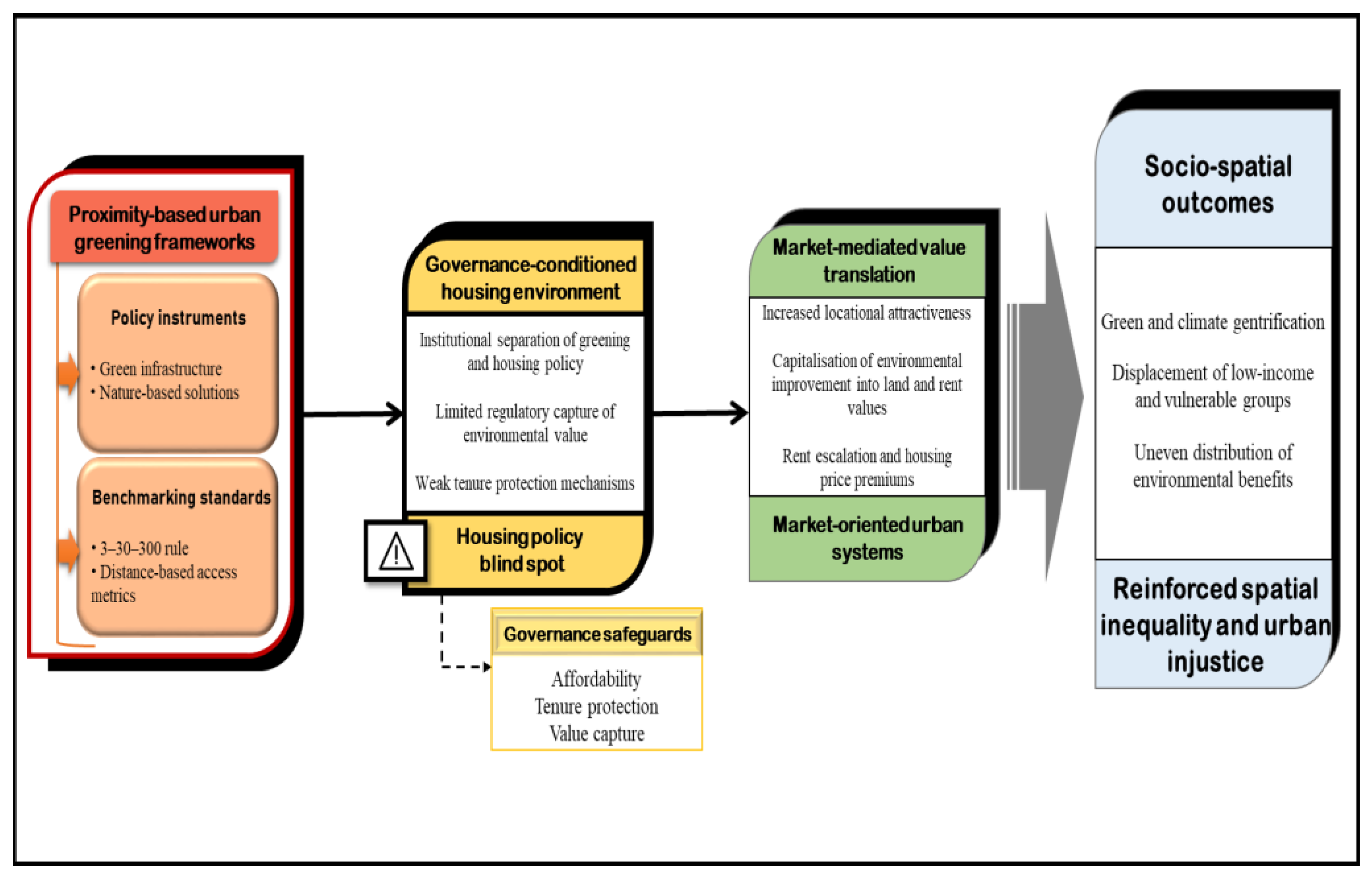
Figure 1 synthesises this governance pathway by illustrating the interaction between urban greening policy instruments, governance capacity, housing market dynamics, and potential socio-spatial outcomes, thereby clarifying the conditions under which proximity-based greening may contribute to displacement pressures.
2. Urban Greening and Proximity-Based Planning as Governance-Mediated Drivers of Housing Inequality
Urban greening and proximity-based planning are now firmly embedded within contemporary sustainability and liveability agendas. They are promoted through proximity-oriented concepts such as green infrastructure, walkability, and the 15 min city [
29,
30,
31] and are widely framed as socially progressive interventions intended to enhance environmental quality, public health, and everyday accessibility. However, a growing body of empirical and critical scholarship demonstrates that their socio-spatial effects are structurally uneven. Rather than operating as universally accessible public goods, greening and proximity-based interventions frequently function as mechanisms through which housing market advantages are produced and spatial inequalities are reinforced.
Evidence from hedonic pricing studies and meta-analyses consistently shows that proximity to green amenities, higher vegetation density, and improved environmental quality are capitalised into land values, housing prices, and rents [
32,
33]. These price effects are systematically uneven across space. They are typically strongest in neighbourhoods already characterised by high connectivity, service provision, and socio-economic advantage. Lower-income areas often experience delayed, partial, or conditional access to environmental improvements [
34]. As a result, urban greening frequently reproduces existing spatial inequalities rather than redistributing environmental benefits, despite its progressive policy framing.
A similar dynamic is evident in proximity-based and walkability-oriented planning. Frameworks that prioritise short travel distances, mixed land uses, and local access to daily needs are commonly justified on environmental and public health grounds, yet they rarely engage directly with housing affordability or tenure security [
29,
35]. Empirical research shows that increased walkability and destination accessibility are associated with higher housing prices and rents, particularly in already advantaged neighbourhoods [
35]. In lower-income areas, accessibility improvements are often accompanied by rising housing costs that erode affordability gains. Exclusion most often occurs gradually, through rent escalation, tenure precarity, and constrained access to upgraded housing markets, rather than through immediate displacement [
6].
These outcomes should not be interpreted as isolated implementation failures. They reflect a structurally embedded planning logic in which environmental and accessibility gains pass through weakly regulated or fragmented housing systems. Comparative analyses of planning regimes show that land-use and environmental interventions not explicitly coupled with affordable housing mechanisms tend to intensify market pressures rather than redistribute benefits [
36]. In this sense, greening and proximity-based planning operate as value-generating interventions that enhance place attractiveness while leaving affordability and anti-displacement safeguards marginal.
Recent governance-focused research further highlights the institutional conditions under which these inequities emerge. Although equitable urban greening frameworks increasingly emphasise distributional, procedural, and recognitional justice, implementation is often constrained by fragmented governance arrangements, limited regulatory capacity, and weak integration with housing policy [
37,
38,
39]. Without explicit mechanisms to secure long-term affordability and tenure stability, greening initiatives risk reinforcing socio-spatial stratification even when designed with equity intentions.
Therefore, this literature supports the central analytical claim advanced in this paper: housing inequalities associated with urban greening and proximity-based planning are structurally produced through governance-mediated interactions between environmental interventions and housing systems. Proximity-based greening reshapes housing affordability not through environmental change alone, but through the institutional mediation and regulatory filtering. Where housing policy remains fragmented or housing-neutral, environmental and accessibility gains are systematically translated into rising land values, rent escalation, and exclusionary pressures rather than inclusive outcomes.
Importantly, this argument does not suggest that greening itself causes housing inequality. Instead, it foregrounds housing governance as the mediating mechanism structuring how environmental gains are converted into socio-spatial outcomes. This reframing aligns with the governance-conditional framework introduced in the Introduction and shifts the analytical focus from whether greening improves access to whose access improves, who is able to remain in place, and how planning frameworks shape the uneven distribution of environmental benefits and housing risks.
3. Reframing the 3–30–300 Rule Through a Spatial Justice Lens
The 3–30–300 rule has gained prominence as a policy-oriented framework for advancing urban health, climate resilience, and everyday access to nature, and has been increasingly mobilised within urban forestry and greening-city agendas [
27,
40]. Its growing uptake is supported by a substantial body of research linking urban greenery to mental well-being, thermal comfort, air quality, and broader public health outcomes [
41].
Yet the apparent neutrality of the 3–30–300 rule obscures the socio-spatial conditions under which these thresholds are realised. As established in the previous section, proximity-based greening frameworks do not operate in institutional vacuums. Like other proximity-based accessibility models, the rule implicitly assumes that environmental targets can be pursued independently of housing systems and market dynamics [
42]. Empirical evidence challenges this assumption. Compliance with canopy cover and proximity benchmarks is highly uneven across urban space, with lower-income and marginalised neighbourhoods systematically less likely to meet these standards than affluent areas [
27,
43]. Rather than functioning as a universal environmental baseline, the rule often mirrors and consolidates existing patterns of spatial inequality.
These dynamics become especially visible in contexts characterised by fragile housing systems, weak rent regulation, or insecure tenure arrangements—conditions common across much of the Global South and increasingly present in deregulated cities of the Global North. Research on climate and green gentrification demonstrates that resilience-oriented greening initiatives frequently coincide with rent escalation, tenure insecurity, and gradual displacement pressures when implemented without robust housing protections [
24,
26]. Onyemenam [
44] further shows how flood-mitigation greening strategies intensified housing vulnerability among tenant populations, producing what has been described as a “green space paradox,” in which environmental value is generated yet captured through largely unregulated housing markets.
Importantly, the ways in which these dynamics unfold differ across Global North and Global South contexts, reflecting variations in housing governance structures, regulatory capacity, and urban development conditions. In many cities of the Global North, green gentrification tends to emerge within relatively formalised housing markets where environmental improvements increase property values and rents, potentially displacing lower-income tenants when tenant protections or affordability mechanisms are insufficient [
15,
45]. In contrast, cities in the Global South frequently operate under conditions characterised by informal housing systems, limited regulatory oversight, and widespread infrastructure deficits. In these settings, environmental upgrading and greening interventions interact with pre-existing vulnerabilities such as precarious tenure, poor housing quality, and limited access to basic services. Evidence from climate risk research on informal settlements demonstrates that environmental hazards and adaptation initiatives are closely intertwined with housing precarity and infrastructural inequality, often amplifying vulnerability where governance capacity is weak [
46]. Similarly, research on urban greening in the Global South highlights how environmental initiatives introduced without addressing structural inequalities can unintentionally reproduce environmental injustice by concentrating benefits in already advantaged areas while marginalised populations remain exposed to climate risks and infrastructural deficits [
47]. These differences indicate that the distributive outcomes of greening policies such as the 3–30–300 rule cannot be assumed to be universally transferable but instead depend on the specific institutional and housing governance conditions within which they are implemented.
Crucially, the 3–30–300 rule is not treated here as a direct driver of displacement. Consistent with the governance-conditional framework advanced in the Introduction, it is understood as a policy instrument whose distributive effects are structured by housing governance regimes, regulatory capacity, and tenure security. As Russo [
48] argues, the growing reliance on simplified and quantifiable greening frameworks can facilitate policy uptake, yet risks overlooking the social and institutional contexts through which access to urban nature, green space quality, and inclusivity are produced. When implemented within housing-neutral policy environments, such simplification can obscure how environmental improvements are mediated through housing systems, allowing greening benchmarks to legitimise selective access to urban nature while leaving affordability and tenure inequalities unaddressed.
Reframing the 3–30–300 rule through a spatial justice lens therefore shifts the analytical focus from whether greening targets are met to where they are met, for whom, and under what regulatory conditions. The distributive consequences of proximity-based greening are not determined by environmental thresholds alone, but by the regulatory mediation of greening intensity within housing systems [
49].
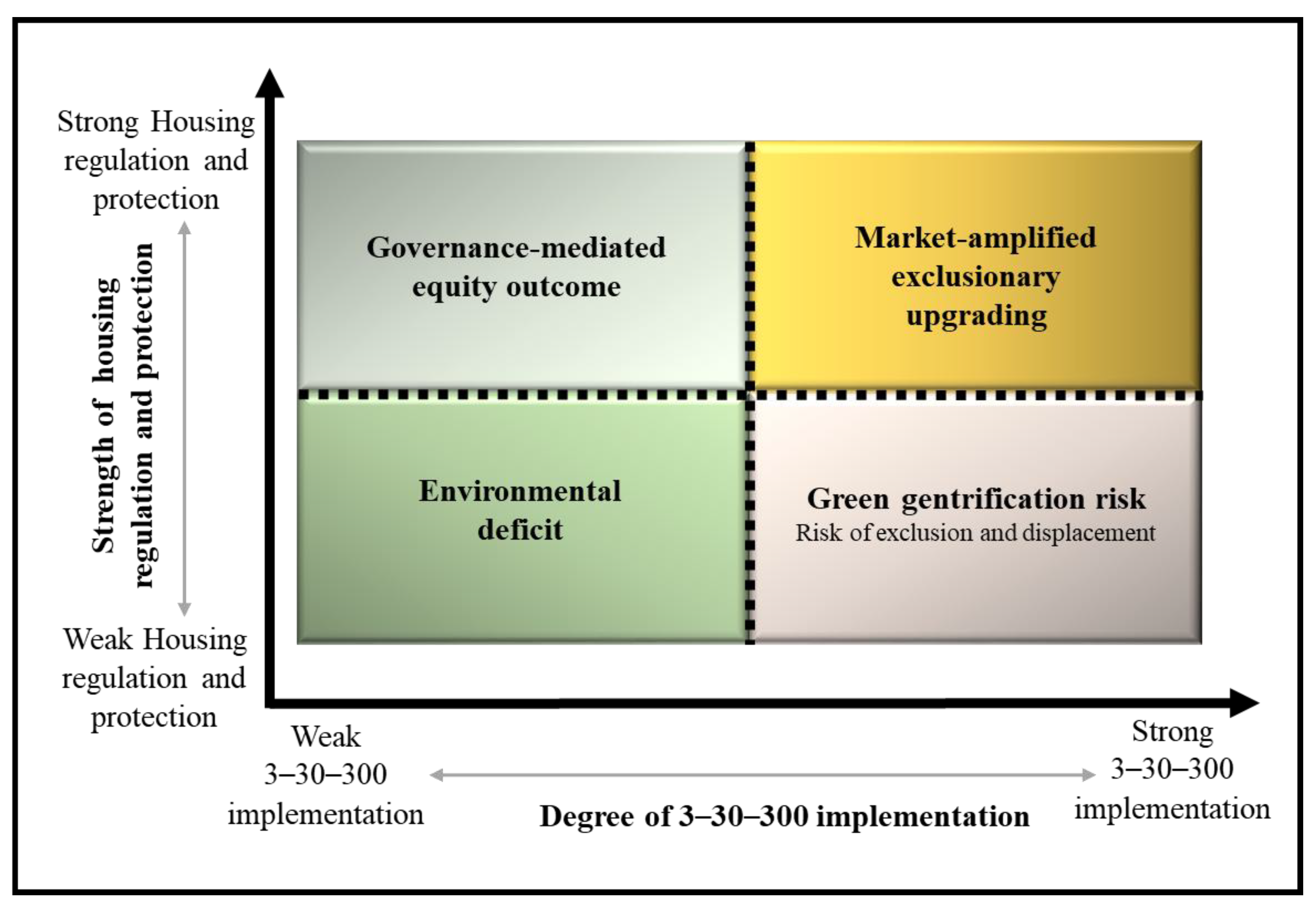
Figure 2 differentiates four governance-conditioned configurations. In this matrix, strong housing governance refers to contexts where regulatory capacity, tenant protection mechanisms, and affordability policies enable public authorities to moderate market pressures and capture environmental value for social benefit. Weak governance, by contrast, characterises contexts with limited rent regulation, insecure tenure arrangements, and fragmented housing policy, where environmental improvements are more readily translated into rising land values and displacement pressures.
Where both greening intensity and housing regulation are weak, cities remain characterised by environmental deficit. Where greening intensity increases under weak housing regulation, green gentrification risk and market-amplified exclusion become more likely. Conversely, when strong housing protections accompany greening implementation, governance-mediated equity outcomes are possible. This typology clarifies that distributive justice depends not on environmental thresholds alone, but on the regulatory mediation of greening intensity [
50,
51].
Seen in this light, the 3–30–300 rule functions not as a neutral technical guideline, but as a governance-sensitive policy lever. Its practical effects depend on how greening targets are embedded within housing regulation, tenure protections, and institutional capacity. This reframing clarifies the paper’s central contribution: the critical question is not simply whether cities meet 3–30–300 benchmarks, but whether the governance contexts in which they are pursued enable environmental gains to be shared and retained by lower-income residents rather than translated into rent escalation and socio-spatial exclusion.
4. Greening at the Neighbourhood Scale, Displacement at the City Scale: When Proximity Becomes an Uneven Housing Risk
Urban greening is increasingly operationalised through quantified, proximity-based benchmarks aligned with compact city and public health agendas [
52]. Frameworks such as the 3–30–300 rule exemplify this shift by translating complex environmental objectives into measurable neighbourhood-scale thresholds that are politically attractive and administratively manageable. In this section, the rule is not treated as an isolated policy device, but as a representative expression of a broader proximity-based planning logic whose distributive consequences are structured through housing governance regimes and extend beyond the scale at which it is formally implemented [
7].
Much early research on green infrastructure conceptualised scale primarily as a technical or spatial concern, focusing on neighbourhood-level exposure, accessibility, and health outcomes [
53,
54]. While this literature successfully demonstrated the environmental and public health value of proximity, it paid limited attention to how locally produced environmental improvements are mediated, captured, and redistributed through city-wide housing and land market institutions. Greening has therefore often been planned, evaluated, and justified at the neighbourhood scale, while its economic and social consequences unfold across broader urban governance systems. Here, scale is understood not merely as a spatial unit, but as an institutional interface through which environmental value is translated into housing outcomes [
55].
This scale mismatch is not socially neutral. Empirical evidence shows that neighbourhood-level greening and accessibility improvements are routinely capitalised through broader real estate dynamics, contributing to rising land values, housing prices, and displacement pressures across the city [
34,
56,
57]. These outcomes do not arise automatically from greening itself. Rather, they are mediated through market processes operating within specific housing governance contexts. Where housing regulation, affordability policy, and tenure protections are weak, fragmented, or poorly enforced, environmental value is more likely to be converted into price escalation than into stable social benefit.
Proximity-based planning can intensify these dynamics by coupling improvements in walkability, access to green space, and neighbourhood liveability with market-responsive development logics [
58]. While such interventions enhance everyday environmental quality at the local scale, they may simultaneously activate speculative investment and land valorisation processes that operate beyond the immediate intervention area. In cities characterised by fragile housing systems or limited affordability safeguards, environmental and accessibility gains are rapidly translated into higher rents and housing costs [
59]. Under these conditions, lower-income households may experience improved environments without secure rights to remain. Proximity thus operates not simply as a redistributive accessibility metric, but as a governance-mediated sorting mechanism that shapes who benefits from greening and who absorbs its housing risks.
Displacement associated with urban greening is therefore best understood not as a localised side effect, but as a scalar governance problem produced by the misalignment between neighbourhood-scale environmental planning and city-wide housing regulation. Displacement outcomes emerge through the regulatory mediation of greening intensity across tenure regimes and institutional capacities operating at multiple scales [
14,
60]. Where social housing provision, rent regulation, or tenant protections are absent, reactive, or weakly enforced, neighbourhood greening is more likely to translate into city-scale affordability pressures. Conversely, similar greening interventions may produce markedly different socio-spatial outcomes where housing governance is robust and proactively integrated [
61].
Viewed across scales, affordable housing becomes structurally vulnerable within proximity-based greening strategies when regulatory safeguards are not embedded alongside environmental targets. Environmental benefits are delivered locally, yet the risks associated with rising housing costs and displacement are unevenly distributed at the city scale.
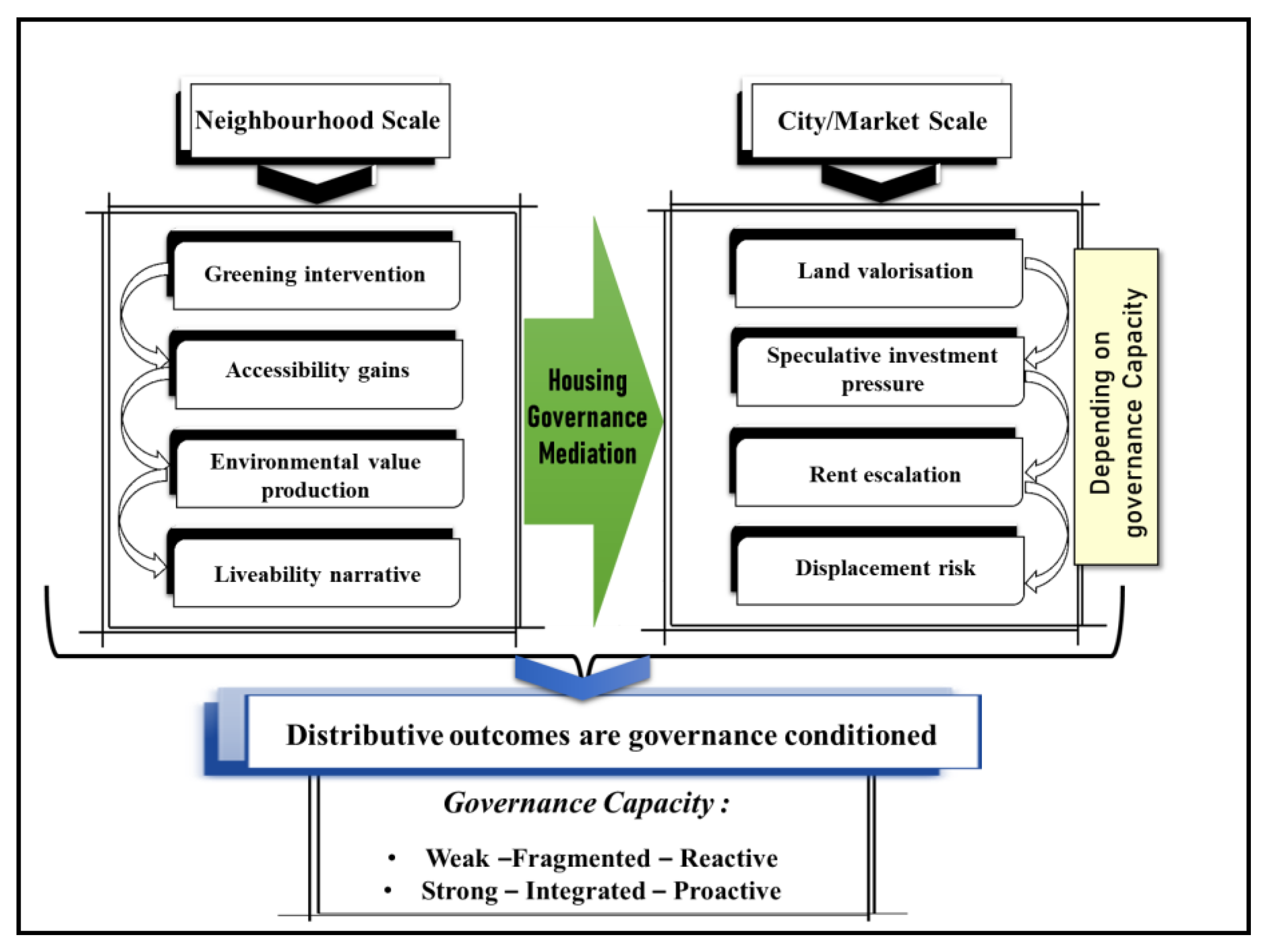
Figure 3 demonstrates how neighbourhood-scale greening processes interact with city-wide housing markets through governance mediation. The arrows linking the two columns represent the translation of local environmental improvements into broader urban land and housing dynamics. Curved arrows within each column indicate reinforcing feedback processes operating at each scale. The central arrow highlights the mediating role of housing governance in shaping whether environmental value is redistributed as social benefit or captured through speculative investment and rent escalation. In this way, the figure emphasises that displacement risk does not arise directly from greening itself but from the institutional conditions under which environmental value is incorporated into housing markets.
5. From Proximity to Governance: Why Greening Without Housing Regulation Produces Displacement
Urban greening is often promoted as a remedy for environmental injustice, urban vulnerability, and declining liveability. However, critical scholarship increasingly shows that in market-driven urban systems, greening initiatives can reproduce, rather than alleviate, socio-spatial inequalities. Following the governance-conditional framework outlined in this paper, these outcomes cannot be understood solely through spatial proximity [
62]. Instead, they emerge from institutional arrangements that determine how environmental improvements translate into housing outcomes. Studies on green gentrification and green grabbing indicate that environmental enhancements create surplus value captured by real estate markets, fuelling rent increases, speculative investments, and displacement pressures [
61,
63]. In governance contexts that do not intervene in housing, displacement is thus not merely an unintended consequence, but a structural result of greening-led urban transformations [
64,
65].
Planning responses to such dynamics remain largely reactive and fragmented. Policies are frequently introduced only after affordability losses and social exclusion have occurred, framing displacement as an external market failure rather than as an outcome embedded in planning frameworks. Evidence from proximity-based planning and the 15 min city concept highlights this limitation: although improved accessibility, walkability, and green amenities increase neighbourhood desirability, the lack of housing regulation and tenure protections enables these benefits to be captured through land and housing markets, resulting in rising property values and rents [
66,
67]. In these cases, proximity reshapes opportunities rather than redistributing them, determining who can remain in place and who is priced out.
The experience of mixed-tenure and New Urbanist developments further demonstrates the limits of greening in the absence of coordinated housing governance [
68,
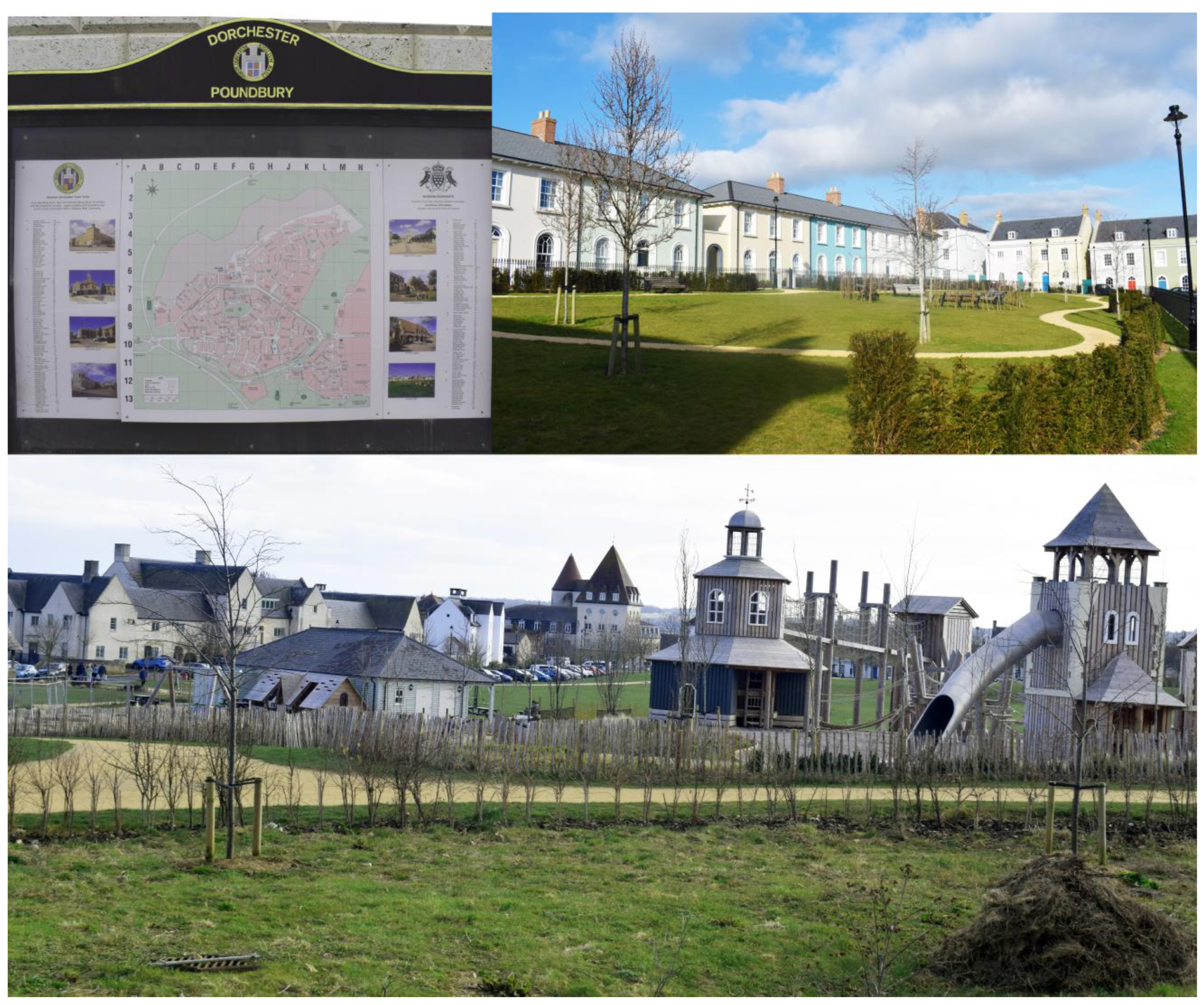
69]. For instance, the Poundbury master plan in Dorchester, UK (
Figure 4), integrates walkability, green spaces, and a 35% affordable housing quota, yet has faced criticism for social segregation, limited affordable housing, and weak integration between environmental design and social inclusion objectives [
68,
69,
70].
Within the governance-conditional matrix presented in
Figure 2, developments such as Poundbury can be interpreted as approximating the quadrant associated with market-amplified exclusionary upgrading, where high environmental quality and design-led greening coexist with strong market valorisation and relatively limited affordability safeguards. In this configuration, environmental improvements and neighbourhood liveability enhance land and property values, while housing governance mechanisms remain insufficient to prevent the selective capture of environmental benefits through market processes. This case illustrates that greening itself does not automatically produce inclusive outcomes; environmental design quality alone cannot secure equity without robust, long-term housing regulation. Post hoc measures, such as community orchards, allotments, and playgrounds, often function as supplemental enhancements rather than structurally guaranteed social provisions (
Figure 4).
From a political ecology perspective, this pattern exemplifies how environmental improvements are appropriated into market dynamics when planning prioritizes environmental performance but neglects tenure security and affordability [
64,
71]. Developers and investors can leverage green narratives to justify land valorisation, converting public environmental investments into private financial benefits. Political ecology is used here not as a separate theoretical approach, but to clarify how governance arrangements shape the allocation and retention of environmental value [
72,
73]. The resulting governance gap reflects not only regulatory absence but also weak coordination across planning, housing, and land market institutions.
Addressing this disconnect requires moving beyond project-based greening and recognizing urban greening as inherently connected to housing outcomes. Even well-intentioned greening initiatives are unlikely to prevent displacement when implemented under housing-neutral planning frameworks. Without long-term housing strategies, tenure protections, and coordinated regulations, environmental improvements are systematically translated into housing pressures through market mechanisms. Under such conditions, greening can exacerbate affordability loss and increase displacement risks for lower-income residents rather than promoting inclusive resilience [
74].
6. Policy Pathways for Housing-Aware Urban Greening
From a planning perspective, the core argument of this paper is clear: the distributive effects of proximity-based greening depend less on the ambition of environmental targets and more on the governance frameworks through which they are implemented. Benchmarks such as the 3–30–300 rule may provide operational clarity, but they do not determine social outcomes on their own. These outcomes are shaped by housing institutions, land market dynamics, and regulatory capacity. The key policy question is therefore not whether greening targets are desirable, but whether they are embedded within governance arrangements that protect affordability and enable residents to remain in place.
Rather than proposing a universal policy model, this section outlines governance pathways that directly address the scalar and institutional gaps identified throughout the paper. These pathways recognise that neighbourhood-scale greening becomes socially consequential only when translated through city-wide housing and land market systems.
The first route to achieve this is by making a clear connection between greening initiatives and the provision of affordable housing. If the public investment in green infrastructure enhances the desirability of the neighbourhood, then the use of inclusionary zoning, the provision of a quota of affordable housing, or the allocation of land for social housing could mitigate the full capitalization of the value added by greening into prices. By making a connection between greening and housing, some of the value added by environmental improvement could remain for social use, rather than being fully capitalised [
75].
A second pathway focuses on tenant protection and rent stabilisation in areas undergoing greening-led transformation. Research on green gentrification shows that exclusion often unfolds gradually through rent escalation and tenure insecurity rather than through sudden eviction [
45,
50]. Measures such as targeted rent stabilisation, stronger lease protections, and rights-to-return can therefore help stabilise communities while environmental quality improves.
A third route relates to mechanisms for value capture, which involve redirecting the benefits of greening on land values to long-term housing affordability. Development contributions, land value capture tools, or earmarked levies involve redirecting a share of environmental uplift to the provision or protection of housing. These mechanisms acknowledge greening not just as an environmental intervention, but as a process with value-creation potential and distributive consequences [
76,
77].
A fourth pathway involves integrating displacement-risk assessments into greening and climate adaptation programmes. Requiring planners to assess affordability and tenure impacts before implementation shifts housing risk from a reactive concern to a structural planning consideration. This approach aligns environmental objectives with the right to remain, rather than responding to exclusion only after it occurs.
Taken together, these pathways operationalise the governance-conditional framework advanced in this paper. Urban greening is neither inherently just nor inherently exclusionary. Its distributive outcomes depend on governance choices that regulate how environmental value circulates through housing systems. When affordability protections, tenure security, and coordinated regulation are embedded within greening strategies, proximity can shift from a mechanism of spatial sorting to a lever for more equitable and inclusive urban transformation.
7. Conclusions
This perspective argues that proximity-based urban greening frameworks cannot be treated as socially neutral planning tools when implemented within market-oriented housing systems. By examining how benchmarks such as the 3–30–300 rule operate in practice, the paper suggests that distributive outcomes depend less on environmental ambition than on the governance arrangements through which greening is embedded in housing systems. The central concern is therefore not whether proximity-based greening improves urban environments, but how such improvements are translated through housing markets into either inclusive or exclusionary outcomes. From a spatial justice perspective, access to urban nature is understood to be mediated by housing governance and market mechanisms. Across the analysis, the evidence indicates that when greening is pursued within housing-neutral policy environments, environmental gains may be capitalised into land and property markets, contributing to affordability pressures and displacement risks rather than equitable access. These dynamics point to the limitations of approaching greening as a purely environmental or technical objective.
The core contribution of this paper lies in repositioning proximity-based greening benchmarks as governance-conditioned planning instruments within wider greening-city agendas. Rather than solely documenting the effects of green gentrification, the analysis reconceptualises the level at which distributive urban inequality might be examined: not only at the level of outcomes, but also at the level of planning design and regulatory integration. By foregrounding governance as a mediating mechanism through which environmental value may be captured, redistributed, or displaced, the paper shifts attention toward the institutional conditions that shape who is able to remain in place as neighbourhoods become greener and more desirable. A spatial justice perspective helps to explain why similar proximity-based interventions can produce differing social outcomes across cities and neighbourhoods.
At the same time, proximity-based frameworks such as the 3–30–300 model may hold potential to support more equitable access to green space and to enable broader distribution of associated ecosystem services. From this perspective, access to proximate urban nature can be understood not merely as an amenity, but as an important component of neighbourhood liveability. However, the extent to which this potential is realised is likely to depend on how such frameworks are integrated within housing-sensitive governance arrangements capable of addressing market-driven exclusion.
Overall, this reframing positions proximity-based greening not simply as a neutral technical guideline, but as a planning instrument with important distributive implications. As a perspective, this paper does not seek to offer a universal policy template or empirical generalisation. Instead, it contributes to contemporary planning debates by highlighting the housing implications that urban greening agendas often leave implicit. Further empirical and comparative research would be valuable in assessing how these dynamics unfold across different institutional, national, and housing contexts. Recognising the governance-mediated relationship between greening and housing may be an important step toward ensuring that efforts to expand urban nature contribute to more equitable and inclusive urban futures.