Article

Mapping Heat Stress and Evaporative Cooling Potentials in South European Cities: Humidity Constraints and Water-Based Cooling Opportunities


1
Faculty of Mechanical Engineering, University of Niš, 18000 Niš, Serbia
2
Faculty of Civil Engineering and Architecture, University of Niš, 18000 Niš, Serbia
3
Faculty of Technical Sciences, University of Priština, 38220 Kosovska Mitrovica, Serbia
4
School of Civil Engineering, Aristotle University of Thessaloniki, 54124 Thessaloniki, Greece
5
Faculty of Occupational Safety, University of Niš, 18000 Niš, Serbia
*
Author to whom correspondence should be addressed.
Urban Sci. 2026, 10(3), 136; https://doi.org/10.3390/urbansci10030136
Submission received: 19 November 2025 / Revised: 4 February 2026 / Accepted: 11 February 2026 / Published: 3 March 2026
(This article belongs to the Section Urban Environment and Sustainability)

Abstract

Climate change is driven by global-scale warming, while cities additionally experience local amplification due to the urban heat island (UHI) effect (urban–rural temperature differences caused by urban form, materials, and reduced evapotranspiration). In this study, we address both dimensions by analyzing long-term near-surface climate variables and derived heat-exposure indicators for multiple South European cities and by translating climate signals into climate-suitability indicators for passive/evaporative cooling. In this study, heat-stress-relevant indicators and evaporative/adiabatic cooling opportunity across paired coastal and inland South European cities are quantified using long-term hourly reanalysis and scenario-based future projections. This paper compares coastal and inland city pairs from three regions: Nicosia and Limassol from Cyprus, Seville and Lisbon on the Iberian Peninsula, and Niš and Thessaloniki on the Balkans, to characterize recent heat stress and the prospective applications and limits of adiabatic cooling. ERA5/ERA5-Land variables from the Copernicus Climate Data Base, focusing on 2 m air temperature, 2 m dew point/relative humidity, and derived indicators: days above heat thresholds and “tropical nights”, were used to determine the differences between the local climate and compare severity of effects of global warming with respect to the specific climatic conditions of the chosen cities. Application of evaporative cooling was then tested with projections up to 2050 using Climate Consultant software, using regional temperature and humidity differences to explore comfort shifts and passive cooling applicability envelopes. Cross-city comparison of climate-suitability hours and cooling needs is included in the analysis. The novelty is a paired coastal–inland, multi-region South European design (Cyprus, Iberia, and Balkans) that combines long-term hourly reanalysis (1950–2025), scenario-based mid-century morphing, and a standardized psychrometric/adaptive-comfort framework to translate climate signals into comparable climate-suitability indicators for evaporative/adiabatic cooling across contrasting humidity regimes. The results provide planning direction by indicating that humid coastal cities should prioritize shading, reduced radiant load, ventilation/urban porosity and humidity-aware cooling, while hotter and drier inland cities retain a wider climatic window for evaporative cooling, subject to water-availability constraints.

1. Introduction

1.1. Warming, UHI and Cooling Demand

Over recent decades, global climate change has led to a systematic rise in mean air temperatures and an increase in the frequency, duration, and intensity of heatwaves worldwide. While warming is a global phenomenon, Europe has warmed faster than the global average, with mean temperatures now about 2.2 °C above pre-industrial levels, nearly twice the global average warming signal [1,2], and the Mediterranean basin is widely identified as a regional hotspot with pronounced summer warming and compound heat–drought risk [3,4]. Southern European countries, particularly Greece, Italy, Malta, Cyprus, Spain and Portugal, have been among the most severely affected regions. Long-term climate analyses indicate that average summer temperatures in large parts of Southern Europe have risen on the order of 1.5–2.5 °C compared to the reference period 1961–1990, with regional assessments for the Mediterranean reporting even higher anomalies when recent decades are considered [3,4,5]. In parallel, the frequency of extreme heat events has increased markedly: summers such as 2003, 2010, 2018 and 2022 have produced record-breaking heat anomalies and substantial excess mortality. For example, a recent multi-country epidemiological analysis estimated more than 60,000 heat-related deaths across Europe during the summer of 2022 alone, with the highest per capita impacts in Mediterranean countries [6]. These trends are particularly critical for urban areas, where approximately three-quarters of Europe’s population resides [7].
The superposition of large-scale climate warming and local urban heat island (UHI) effects often leads to higher night-time minimum temperatures and multi-day heat episodes that are more intense and longer-lasting in cities than in surrounding rural areas. Established UHI studies show that urban form, material properties (e.g., high thermal inertia and low albedo surfaces), limited evapotranspiration, and anthropogenic heat emissions jointly contribute to elevated urban air temperatures, especially during calm, clear summer conditions [8,9,10]. As a result, urban warming has a cascading impact: it increases cooling energy consumption, reduces outdoor and indoor thermal comfort, aggravates air pollution episodes, and elevates risks to human health and labor productivity [8,11,12].
Urban heat stress is a function of both atmospheric warming and the microclimatic modifications caused by urbanization. The term heat stress is used in an urban climate exposure sense to indicate meteorological conditions that increase the likelihood of thermal discomfort and adverse health impacts that intensify cooling demand at the city scale. In this manuscript, heat stress is treated as a structured analytical construct that links outdoor heat exposure with humidity-modified thermal discomfort and the climatic feasibility of passive cooling responses at the city scale. Based on heat stress, the following parameters are important: (1) heat hazard indicators based on air temperature extremes and persistence (hot days and tropical nights), and (2) humidity-modified thermal discomfort, represented here by Humidex as a pragmatic apparent temperature indicator for inter-city comparison. Individual physiological heat strain or activity-dependent heat load is neglected in this analysis; instead, standardized exposure metrics suitable for long-term multi-city analyses are applied. Since evaporative and adiabatic cooling effectiveness is constrained by wet-bulb depression, humidity (dew point temperature/relative humidity) is treated as a key limiting variable when interpreting passive cooling feasibility.
To characterize these conditions comparably across European regions, this study applies to a set of widely recognized thermal indicators: 2 m air temperature, near-surface humidity expressed through dew point or relative humidity, threshold-based heat indices, and the frequency of tropical nights. These indicators are consistent with the methodologies used by Copernicus, the World Meteorological Organization (WMO), the Intergovernmental Panel on Climate Change (IPCC), and the European Environment Agency (EEA) in climate assessment and adaptation monitoring frameworks [1,2,3,4,5]. The 2 m air temperature (T2m) remains the standard reference for assessing near-surface thermal conditions, representing the layer of air most relevant for human exposure, building performance, and public health [1,2]. This metric underpins heatwave reporting, mortality analysis, and building cooling simulations across Europe. Recent assessments show that Southern European regions have experienced above-average warming, with summer temperatures rising 1.5–2.5 °C above the 1960–1990 baseline and a sharp increase in high-temperature extremes [1,3,5]. These changes have intensified urban heat island effects while simultaneously increasing heat-related mortality, particularly during extreme events such as the 2022 European summer, in which more than 60,000 heat-related deaths were recorded, with the majority in Italy, Spain, Greece and Portugal [6]. Because temperature alone does not capture physiological or cooling-system stress, the role of air humidity is particularly important. Dew point temperature and relative humidity (RH) determine wet-bulb temperature, which constrains not only the capacity of the human body to dissipate heat through evaporation but also the operational efficiency of passive or evaporative cooling strategies [7,8]. As dew point temperatures rise, both physiological thresholds and technological performance limits are approached, resulting in an increased risk of heat stress even at temperatures previously considered tolerable. Psychrometric constraints become especially relevant in Mediterranean climates, where elevated moisture levels combine with extreme heat to reduce adaptive capacity and diminish nocturnal heat relief. To evaluate heat extremes more directly, threshold-based indicators are widely applied. Days exceeding maximum temperatures of 30 °C and 35 °C are commonly used in European climate science and in EEA adaptation reports to reflect strong and severe heat stress conditions, respectively [5,9]. Exceeding these thresholds is strongly correlated with nonlinear increases in heat-related mortality, hospital admissions, labor productivity loss, and peak electricity demand due to cooling [10,11]. In Mediterranean and Balkan urban areas, such as Seville, Nicosia, Thessaloniki and Niš, threshold exceedance trends have been rising sharply over the past three decades, driven by both global climate change and regional urbanization dynamics [12,13].
Methodologically, prior studies have assessed urban thermal stress using composite indices (e.g., UTCI, WBGT, and apparent temperature families) and have evaluated cooling feasibility using psychrometric constraints and climate-suitability concepts for passive strategies. However, many contributions are either single-city or single-climate-context studies, or they do not translate long-term climate signals into comparable “strategy-hour” metrics that can inform planning decisions across multiple cities. In this paper, the “comfort/strategy hours”, as climate-suitability hours derived from standardized psychrometric/adaptive-comfort logic (i.e., an indicator of when the outdoor climate allows specific passive strategies), are analyzed.
Heat stress cannot be fully understood by daytime temperatures alone. Tropical nights, defined as minimum temperatures ≥ 20 °C, are increasingly recognized as a critical climate metric because they prevent night-time thermal recovery, both physiologically and within buildings [5,14]. The inability of indoor temperatures to reset overnight leads to cumulative indoor heat storage, worsening health outcomes, imposing continuous cooling loads, and disproportionately affecting vulnerable groups without access to mechanical cooling. The IPCC highlights the increasing frequency of tropical nights as a major driver of excess mortality and reduced adaptive capacity in Southern European cities [2,3]. While some authors argue for the exclusive use of complex heat stress indices, such as the Universal Thermal Climate Index (UTCI) or wet-bulb globe temperature (WBGT), others note that simple metrics (Tmax, Tmin, dew point, and tropical nights) remain essential for long-term climate trend analysis, infrastructure planning, and building energy simulations due to their accessibility in reanalysis datasets and consistency across time horizons [15,16,17]. The combination of these indicators, therefore, provides a balanced foundation for the assessment of urban heat stress and the evaluation of evaporative cooling potential under current and future climatic conditions.
As urban temperatures rise, the cooling demand in Southern European cities is rapidly increasing, placing unprecedented stress on energy systems and exposing populations to intensified heat risk. One of the primary aggravating factors is anthropogenic heat emitted from conventional AC systems, which can amplify local temperatures and worsen UHI conditions through feedback mechanisms. Multiple studies have demonstrated that every additional degree of mechanical cooling demand can significantly elevate near-surface air temperature, increase ambient heat exposure, and worsen outdoor thermal comfort, thereby reinforcing both indoor and outdoor overheating trends [10,11,18,19,20]. This creates a paradoxical cycle in which cooling systems intended to alleviate thermal stress simultaneously contribute to greater long-term vulnerability, a pattern confirmed in cities such as Berlin, Singapore, and Mediterranean capitals, where cooling loads now constitute a major share of urban energy use [10,18,19]. Given this dynamic, evaporative cooling, also referred to as adiabatic cooling, has re-emerged as a key passive or hybrid strategy for moderating urban heat. The principle relies on exploiting the latent heat of vaporization: as water evaporates into the air, it absorbs heat, thus reducing air temperature without relying on compression-based refrigeration. The cooling intensity is determined by the difference between the dry-bulb and wet-bulb temperatures: the lower the humidity, the greater the cooling potential [15,21,22]. In contrast to vapor-compression systems, evaporative cooling consumes significantly less electricity, making it an energetically efficient and climate-adaptive approach, particularly relevant for regions with high cooling needs and strained electrical systems, such as Southern Europe. Evaporative cooling can be applied at multiple spatial scales. At the urban scale, misting systems, fountains, water films, and shaded evaporative surfaces can lower ambient temperatures in outdoor spaces, increasing pedestrian comfort and strengthening climate resilience in public areas [8,21,23]. At the building scale, evaporative cooling is commonly integrated into hybrid Heating, Ventilation, and Air Conditioning (HVAC) systems or implemented as direct or indirect evaporative units, promoting lower cooling energy consumption and reducing peak electricity demand, important in regions facing cooling-driven grid stress [15,24]. At the urban scale, water bodies (sea/lakes/rivers), vegetated areas and water features can moderate microclimates through evapotranspiration and evaporative heat exchange; however, their effectiveness depends on humidity regime, wind conditions and water availability, which motivates the comparative coastal–inland analysis. Recent assessments of Mediterranean climates confirm that direct evaporative cooling can reduce indoor temperatures by up to 7–10 °C under dry conditions, while regenerative or indirect systems expand applicability to moderate-humidity climates through staged or desiccant-assisted processes [21,22,25]. However, evaporative cooling faces climatic and technical limitations. Its performance depends strongly on-air humidity, making it less effective when dew point temperatures are high, a growing concern in certain Mediterranean coastal cities. Elevated moisture levels can reduce the thermodynamic gradient required for evaporation, decreasing efficiency compared to inland or arid regions [18,25,26]. Water availability is another emerging constraint, particularly in drought-prone areas such as Cyprus, Spain, and Southern Greece, where resource stress is projected to increase under climate change scenarios [4,13]. Operational challenges, including microbial control, mineral deposition, and required maintenance, also shape implementation boundaries [15,26]. Nevertheless, the integration of adiabatic systems into climate-resilient design is increasingly recognized as a key strategy to reduce energy consumption and enhance adaptive capacity within urban environments. As passive cooling becomes more critical under European climate trajectories, evaporative technologies offer a pathway to simultaneously reduce building cooling loads, mitigate urban overheating, and relieve pressure on energy infrastructure, provided that climatic context, water resources, and urban morphology are properly considered.

1.2. Heat Exposure, Discomfort and Strategy-Hour Approaches

Several approaches were used in the literature to quantify heat-related risk and comfort conditions [27,28,29,30]. At the outdoor scale, studies commonly report exposure/hazard indicators hot-day and tropical-night thresholds and combined temperature–humidity indices to capture humidity amplification. For building-related interpretation, a separate class of methods quantifies comfort, overheating, or discomfort hours using hourly weather files derived from observations, reanalysis, or future weather projections, often via “morphing” techniques that apply climate-model deltas to baseline EPW files. These hour-based metrics are typically framed as thermal comfort feasibility or overheating exceedance rather than physiological heat stress.
In parallel, several studies use psychrometric tools (including Climate Consultant and related bioclimatic/psychrometric chart approaches) to translate hourly climate data into strategy applicability envelopes and the share of hours where passive measures are climatically feasible [27,28,29]. Climate Consultant has been used under climate change scenarios to quantify changes in annual comfort hours and shifts in bioclimatic strategy relevance across multiple locations, supporting scientific sensitivity analyses rather than only early-stage design screening [27]. This methodological stream provides a useful bridge between city-scale climate signals and actionable passive cooling guidance while remaining conceptually distinct from health/physiological heat-stress modeling.

1.3. Research Gaps and Opportunities

Despite progress in urban climate research, significant knowledge gaps remain regarding heat stress dynamics and cooling adaptation in Southern Europe. Most existing studies are limited to single cities [31], individual countries, or broad climatic classifications, without systematically comparing coastal–inland pairs that represent distinctly different humidity, temperature, and evaporative cooling regimes. Furthermore, there is limited cross-city analysis of how future climatic conditions, projected to mid-century, will influence the technical feasibility and performance boundaries of evaporative (adiabatic) cooling, particularly when assessed using climate-morphing tools that simulate temperature and humidity shifts relevant for passive design. Existing studies also rarely benchmark heat-stress indicators, such as the frequency of temperature thresholds and tropical nights, explicitly against evaporative cooling applicability envelopes. Addressing these gaps, the present study aims to map and compare both recent and projected heat stress and evaporative cooling potential across representative Southern European urban pairs, Nicosia vs. Limassol, Seville vs. Lisbon, and Niš vs. Thessaloniki, capturing inland–coastal contrasts in Cyprus, the Iberian Peninsula, and the Balkans. The objectives are to quantify reference-period heat-stress indicators using ERA5 and ERA5-Land reanalysis data, benchmark the intensity and temporal evolution of heat extremes and tropical nights across the six cities, and apply Climate Consultant with climate-morphing functions to project comfort shifts and cooling requirements through 2050. In doing so, the study delineates future evaporative cooling applicability envelopes, identifies water–humidity constraints, and assesses the potential role of adiabatic cooling in strengthening urban heat resilience and informing climate-adaptation strategies in Southern Europe.

1.4. Study Objectives and Contribution

In this paper, a multi-layer assessment is presented that links distinct, but complementary, dimensions: (1) outdoor climatic exposure (temperature extremes and persistence: hot days, tropical nights), (2) humidity-modified thermal discomfort (Humidex as an apparent-temperature proxy), and (3) climate suitability for passive cooling (ASHRAE 55 adaptive comfort and psychrometric strategy zones from Climate Consultant). These are not interchangeable measures of “physiological heat stress.” Rather, they jointly support a coherent interpretation: exposure metrics describe how often hazardous conditions occur, Humidex describes when humidity amplifies perceived heat, and climate-suitability hours indicate when passive cooling strategies are climatically feasible. Together, they connect climate hazard to adaptation opportunity, enabling differentiated planning guidance across coastal and inland contexts. The coastal–inland classification is used here as a practical paired comparison of contrasting humidity regimes; however, latitude, city size, land cover, vegetation and urban form also influence urban climate and are discussed as limitations.
The goal of this study is to evaluate how local climate characteristics affect: (1) heat hazard/exposure, (2) humidity-modified thermal discomfort, and (3) the climatic feasibility of passive cooling strategies under both present and future conditions. Hence the following analysis was performed: (1) quantified heat exposure and persistence using temperature-based indicators (annual counts of hot days and tropical nights, Tmin ≥ 20 °C) derived from hourly ERA5/ERA5-Land data (1950–2025); (2) assessed humidity-modified thermal discomfort using Humidex (apparent temperature approximation based on air temperature and humidity); and (3) evaluated climate-suitability hours for passive strategies including evaporative/adiabatic options using psychrometric/adaptive-comfort classifications from Climate Consultant for baseline and CMIP6-SSP future scenarios. The results are interpreted comparatively across paired coastal and inland cities rather than combined into a single heat stress metric.
The study does not introduce a new thermal index or comfort model; instead, it proposes a structured, reproducible analytical framework that integrates the established methods (ERA5-based exposure indicators, Humidex as a humidity-modified discomfort, and Climate Consultant/ASHRAE 55 adaptive comfort outputs) into a single comparative analysis across different South European regions combined with CMIP6-SSP morphing future scenario analysis, and translating climatic differences into climate-suitability metrics that link hazard conditions to passive cooling feasibility for planning-oriented interpretation.
By analyzing paired coastal–inland cities in the Eastern Mediterranean (Limassol vs. Nicosia), Iberian Peninsula (Lisbon vs. Seville), and Balkan region (Thessaloniki vs. Niš), the study highlights how maritime vs. continental climates differ in heat stress exposure and in the effectiveness of cooling strategies now and in the future. This cross-comparative approach—combining state-of-the-art climate data analysis with building design tools—is intended to identify location-specific adaptation needs and inform sustainable urban cooling solutions for the coming decades.

2. Materials and Methods

For the purpose of the analysis, 6 cities were chosen as representatives. The analysis proceeded in four steps: (1) extraction of long-term hourly near-surface climate variables from ERA5 reanalysis for each city (1950–2025); (2) computation of heat-exposure and humidity-modified discomfort indicators (hot days, tropical nights, and Humidex); (3) generation of climate files for future periods using the adopted SSP scenarios (morphing/delta-change approach as described below); and (4) estimation of climate-suitability (“strategy-hour”) indicators using Climate Consultant 6.0 (ASHRAE 55 adaptive comfort proxy and psychrometric strategy envelopes) to interpret passive and evaporative/adiabatic cooling feasibility under present and future climates. This study does not include field monitoring and does not rely on Landsat-derived metrics in the core workflow; the comparative indicators are derived from reanalysis and standardized psychrometric classification.

2.1. Study Cities

Six representative cities (forming three coastal–inland pairs as noted above) were selected for analysis. The six cities were selected to represent contrasting South European summer humidity–temperature regimes using three paired coastal–inland contexts: Cyprus (Nicosia and Limassol) representing very hot Eastern Mediterranean summers with strong coastal humidity influence; Iberian Peninsula (Seville and Lisbon) representing hot interior conditions versus Atlantic coastal moderation; and Balkans (Niš and Thessaloniki) representing continental and maritime contrasts relevant for emerging cooling-demand growth. The paired structure supports a consistent comparison of heat exposure, humidity-modified discomfort, and climate suitability for evaporative/adiabatic cooling while recognizing that additional drivers (altitude, urban form, and land cover) contribute to city differences.
While the six cities are organized as three coastal–inland pairs, it should be noted that this pairing is not intended as a single-factor attribution to the distance from the sea. Urban and regional climates are jointly shaped by multiple drivers, including latitude, altitude, city size and urban form, land cover/vegetation, and air quality, in addition to coastal influence. The coastal–inland structure is used here as a practical comparative design to contrast typical humidity regimes that strongly condition evaporative/adiabatic cooling feasibility and humidity-modified discomfort while keeping the analysis interpretable across three South European regions. A full multivariate attribution of driver importance would require a larger city sample and additional datasets (e.g., land-cover metrics and morphology indicators), and is therefore identified as a priority for future work.

2.2. Data Resources and Pre-Processing

Hourly meteorological data for each city were obtained from the Copernicus ERA5/ERA5-Land data (at ~0.1° resolution), which provides consistent long-term records of atmospheric variables. ERA5 is a reanalysis product (model–observation synthesis) rather than a direct satellite remote-sensing retrieval; it provides temporally consistent hourly fields suitable for long-term inter-city comparisons. Key variables near the surface were extracted: 2 m air temperature, dew point temperature, radiant temperature, and 10 m wind speed, for a multi-decade baseline period (1950–2025) to enable detailed climate analysis. Using these data, annual climate indicators were computed for heat exposure: the number of hours per year with daily maximum temperature above a high threshold (hot days, Tmax ≥ 30 °C), and the number of tropical nights (days with minimum temperature ≥ 20 °C) [27,28]. Daily minimum and maximum values were derived from hourly ERA5 data to ensure consistency across all locations. In this study, hourly ERA5 variables were aggregated to daily maxima/minima, and then summarized annually as the annual maximum of daily maximum temperature (an upper-threshold extreme), and annual counts of hours where temperature exceeds the threshold (hot days defined by daily Tmax ≥ 30 °C and tropical nights defined by daily Tmin ≥ 20 °C). Humidex was computed at the hourly or daily maximum level and summarized annually as described in Section 2.3. These definitions ensure that the reported indicators reflect heat exposure and persistence, not only average conditions.
For each city, the ERA database can be used to extract UTCI time series as an advanced measure of outdoor thermal stress. The UTCI calculation combines air temperature, humidity, wind speed, and mean radiant temperature inputs; it is widely regarded as a robust composite index of human thermal comfort applicable across all climates [32]. However, due to significant volumes of data for the analyzed period, using ERA UTCI is not practical. In this paper, the Humidex thermal discomfort index was used.
Humidex is computed from temperature–humidity variables using the standard formulation described below. For scenario analysis, future hourly weather files are generated using a delta-change/morphing approach applied to the baseline EPW data for each SSP pathway. Comparative statistics are reported as absolute differences and percentage changes between baseline and future periods (and across scenarios), and the results are interpreted by contrasting coastal vs. inland pairs and regional groupings rather than attributing causality to a single driver.

2.3. Derived Indicators and Comparative Analysis

To evaluate heat exposure, the frequency of hot days (defined here as days with daily maximum temperature ≥ 30 °C) and tropical nights (defined as days with minimum temperature ≥ 20 °C) was used in addition to daily maximum temperatures. These parameters have emerged as a critical metric of heat exposure given their impact on human recovery and building cooling load. The ERA5 analysis showed a pronounced increase in tropical night frequency, especially in coastal cities. Historically (mid-20th century), inland cities had relatively few tropical nights.
To represent humidity-modified thermal discomfort in a way that is comparable across cities, the Humidex index was used. It expresses an “apparent temperature” response to the combined effect of air temperature and atmospheric humidity. Humidex is used here as a screening-level discomfort indicator (not a physiological heat-strain model), and its interpretation is therefore complementary to temperature threshold indicators (hot days, tropical nights) and to climate-suitability outputs from Climate Consultant. The standard Humidex formulation [33] was applied:
H = T + 0.5555 ( e 10 )
where T is the air temperature (°C) (ERA5 data), and e is the water vapor pressure in hPa. Here, e was derived from the dew point temperature ERA5 data using the Clausius–Clapeyron relation:
e = 6.11 × 10 ( 7.5 T d 237.7 + T d ) .
This empirical index [34], developed by Masterton and Richardson, yields an “apparent temperature” that combines air temperature and humidity effects on perceived discomfort. A higher Humidex indicates greater thermal discomfort, commonly used interpretive bands; H ≈ 30, indicating some discomfort, and higher values indicating increasing discomfort, are provided only for contextualization and screening, not to quantify health risk or physiological heat strain in this study [34,35].
To translate climate signals into design-relevant indicators, Climate Consultant 6.0 was used to compute climate-suitability hours (comfort/strategy hours) from hourly weather files. The software does not perform a full dynamic building simulation; instead, it classifies each outdoor hour on a psychrometric chart and reports the number of hours for which specific passive strategies are climatically feasible. This is a psychrometric hour-count (strategy-hour) analysis based on outdoor weather data, not a dynamic building energy simulation, and it does not constitute a health-risk or physiological heat-strain assessment. In this sense, the output represents outdoor-climate suitability for passive cooling strategies rather than guaranteed indoor comfort. To ensure comparability across cities and scenarios, the model was applied in a standardized, tool-consistent way, using identical settings for all the cities. The resulting hours were interpreted as outdoor climatic permissiveness for free-running operation (i.e., potential for adaptive comfort), not as a measure of thermal safety, physiological heat stress, or health risk. Since adaptive comfort is designed for indoor comfort in naturally ventilated buildings, it was used here strictly to indicate shifts in climatic feasibility of passive operation under present and future climates. Climate Consultant is primarily intended for design support, and its outputs were used only in their appropriate meaning: hour counts within standardized psychrometric and adaptive-comfort envelopes, which provide a transparent way to compare climatic feasibility of passive strategies across cities and scenarios.
The “Comfort Hours” reported by Climate Consultant were based on the ASHRAE 55 adaptive comfort logic for naturally ventilated operation, i.e., hours during which outdoor conditions fall within an adaptive comfort acceptability band (without mechanical cooling), under standard assumptions embedded in the tool, and were used to evaluate the climate-suitability hours in this paper. These hours are reported as an indicator of potential for passive operation and interpret changes across scenarios as shifts in climatic feasibility rather than as precise indoor comfort predictions. Projected mid-century temperature and humidity deltas from regional climate models were applied to the baseline data—a method akin to that of Belcher et al. (2005) [31], which adjusts hourly values to reflect future mean changes while preserving diurnal and seasonal variability.
In addition to “Comfort Hours”, Climate Consultant provides strategy hours for passive measures (e.g., sun shading, natural ventilation, and night flushing) and for cooling strategies, including evaporative/adiabatic cooling (direct/indirect where applicable) under psychrometric constraints. We focus on the relative share and evolution of these strategy hours across inland and coastal city pairs, emphasizing that humidity regimes (and thus, wet-bulb depression) can strongly limit evaporative cooling feasibility even when air temperatures are high.
Using the Climate Consultant software, thermal comfort was analyzed for building envelopes and evaporative cooling strategy zones. The ASHRAE Standard 55 adaptive comfort model for summertime was chosen, corresponding to lightly clothed occupants, as this model defines a comfort zone on the psychrometric chart appropriate for free-running buildings in warm climates. The software identifies various passive/hybrid cooling strategies by overlaying zones on the psychrometric chart (zones where direct evaporative cooling is effective, where two-stage evaporative cooling can achieve comfort, where only dehumidification plus cooling will work, etc.). For purposes of this analysis, six key strategy zones were analyzed: comfort (indoor conditions met without active cooling), sun shading of windows, direct evaporative cooling, two-stage evaporative cooling, cooling with dehumidification, and enhanced cooling (mechanical cooling required). Each hourly data point for a city falls into one of these zones based on its dry-bulb temperature and humidity. By tallying the percentage of hours falling into each zone, the potential effectiveness of evaporative cooling for that climate is determined. In analyzing the psychrometric charts, special attention was given to the warm-season months (April–October) when cooling may be needed; during cooler months, most hours fall in the comfort or heating-required zones, and evaporative cooling is not relevant.

2.4. Scenario Analysis

For each city pair (coastal vs. inland), the distribution of hours among these strategy zones to evaluate how maritime humidity versus continental aridity affects the viability of adiabatic cooling was compared. All the Climate Consultant settings (comfort model selection, acceptability band, and psychrometric strategy definitions) were kept identical across cities. Additionally, critical climatic thresholds visible on the charts were identified. This is essentially the difference between the dry-bulb temperature and the dew point (or wet-bulb) temperature; it represents the theoretical cooling limit of a direct evaporative cooler. When this difference is small (as in very humid air), even an ideal evaporative cooler can only lower air temperature marginally. Typical summer afternoon dew point levels in each city were noted, since a dew point above roughly 18–20 °C sharply reduces evaporative performance. These thresholds and patterns from Climate Consultant outputs are discussed in the Section 3. All the psychrometric analyses for the six cities were conducted using the 2023 baseline EPW data and a scenario 2050 EPW (for future outlook), and the resulting strategy breakdowns (hours in each zone) were compiled. The Climate Consultant software itself is referenced for methodological completeness [30]. To account for future climate conditions, the baseline EPW files were morphed using monthly temperature and humidity deltas derived from CMIP6 regional climate projections for a 2050 scenario, and the resulting future weather files were then analyzed in Climate Consultant to reassess thermal comfort and evaporative cooling potentials. Here, the following scenarios (Shared Socioeconomic Pathway—SSP) were analyzed:
  • SSP1-2.6 (Sustainability—Taking the Green Road): This scenario describes a world shifting toward sustainability, with low challenges to mitigation and adaptation. Global cooperation promotes green technologies, equity, and environmental awareness. Carbon emissions decline rapidly, resulting in a low radiative forcing level of 2.6 W/m2 by 2100, consistent with limiting global warming to well below 2 °C. This scenario reflects strong climate policy, reduced inequality, and investments in renewable energy.
  • SSP2-4.5 (Middle of the Road): This scenario assumes moderate socioeconomic trends and fragmented climate action. Neither particularly optimistic nor pessimistic, it represents a continuation of current development patterns with uneven mitigation efforts. Greenhouse gas emissions stabilize mid-century, leading to a radiative forcing of 4.5 W/m2 by 2100. Global warming in this scenario is likely to exceed 2 °C but remains under 3 °C.
  • SSP3-7.0 (Regional Rivalry—A Rocky Road): This high-emission pathway depicts a fragmented world marked by nationalism, regional conflicts, and low international cooperation. Investment in education, technology, and climate policy is limited, and energy use relies heavily on fossil fuels. Emissions rise steadily, resulting in 7.0 W/m2 of radiative forcing by 2100. Global average temperatures may increase by 3.5–4.0 °C or more in this scenario.
  • SSP5-8.5 (Fossil-Fueled Development—Taking the Highway): The most extreme scenario, SSP5-8.5, assumes rapid economic growth driven by fossil fuel exploitation, with minimal attention to climate policy. Societies prioritize energy-intensive lifestyles and technological advancement at the expense of sustainability. Emissions surge, leading to a radiative forcing of 8.5 W/m2 by 2100 and global warming possibly exceeding 4 °C. This pathway is often used as a worst-case benchmark for climate impact studies.
For interpretation, we retained the full set of SSP pathways to represent a plausible range of future conditions; however, SSP2-4.5 (Middle of the Road) was treated as the reference scenario for the most detailed narrative discussion, while the lower and higher pathways were used primarily to illustrate sensitivity bounds.
This study does not compute a direct physiological heat-strain metric (e.g., core temperature response); instead, indicators are used for comparative exposure and feasibility assessment at the city scale.

3. Results and Discussion

The results are presented in three blocks reflecting distinct constructs: (1) outdoor exposure (temperature-based extremes and persistence), (2) humidity-modified thermal discomfort (Humidex), and (3) climate suitability for passive cooling strategies (adaptive comfort and psychrometric strategy hours). This structure was chosen to avoid conflating physiological heat stress with indoor comfort and instead support a comparative assessment that connects heat hazard conditions with adaptation feasibility. Since the ASHRAE 55 adaptive comfort model is intended for indoor comfort in free-running buildings, the reported “Comfort Hours” are presented as climate-suitability indicators and should not be interpreted as indicators of health-related heat stress or thermal safety.

3.1. Daily Temperature Trends and Data Overview

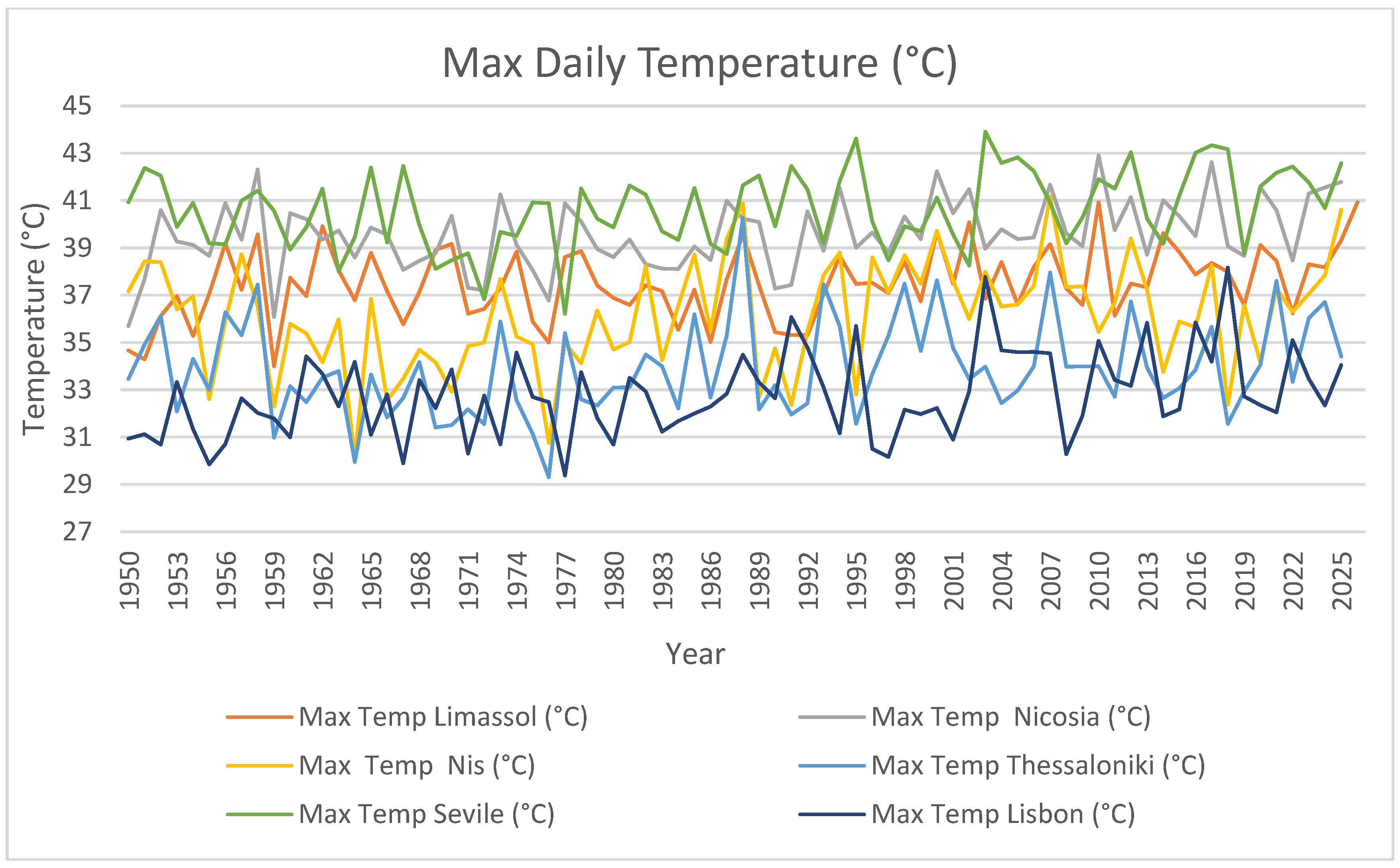
ERA5 reanalysis data (1950–2025) indicate increasing heat exposure across all six cities. Figure 1 reports the annual maximum of daily maximum air temperature as an upper-bound indicator of the most extreme heat reached in each year. We acknowledge that this metric represents a single extreme day/hour and is, therefore, not intended to describe heat persistence or the frequency of hot conditions. Consequently, interannual changes in Figure 1 may appear modest even when heat impacts increase substantially. For this reason, Figure 1 is interpreted together with persistence-oriented indicators—hot days (Figure 2) and tropical nights (Figure 3)—which capture how often extreme heat occurs and how frequently night-time recovery is limited. The annual maximum daily temperature has risen substantially, with recent decades seeing markedly higher peaks than mid-20th-century records. For example, Seville, the hottest site, reached yearly highs of 44 °C in the 2000s (maxima up to 43.9 °C in 2003) compared to 41 °C in the 1950s. Inland Nicosia exhibits a similar trend, with its record ERA5 temperature of 42.2 °C occurring in the late 1990s, exceeding earlier decades’ peaks of 16 °C or more. The coastal cities show slightly lower absolute extremes: Limassol and Thessaloniki typically peaked around 38–40 °C historically, while Lisbon rarely exceeded 35 °C except during exceptional events (e.g., 37.8 °C in 2003). These differences reflect the moderating maritime influence in coastal climates. Nevertheless, even the milder coastal sites have warmed. Figure 1 illustrates upward trends in annual maximum temperatures. All the cities saw their hottest years occur after 2000, consistent with Europe’s general warming and the Mediterranean hotspot effect. This intensification of extreme heat is also evidenced by the sharp increase in the frequency of very hot days (>35 °C) in recent decades. Such trends align with broader observations that Southern Europe’s summer extremes have become more intense post-1990.
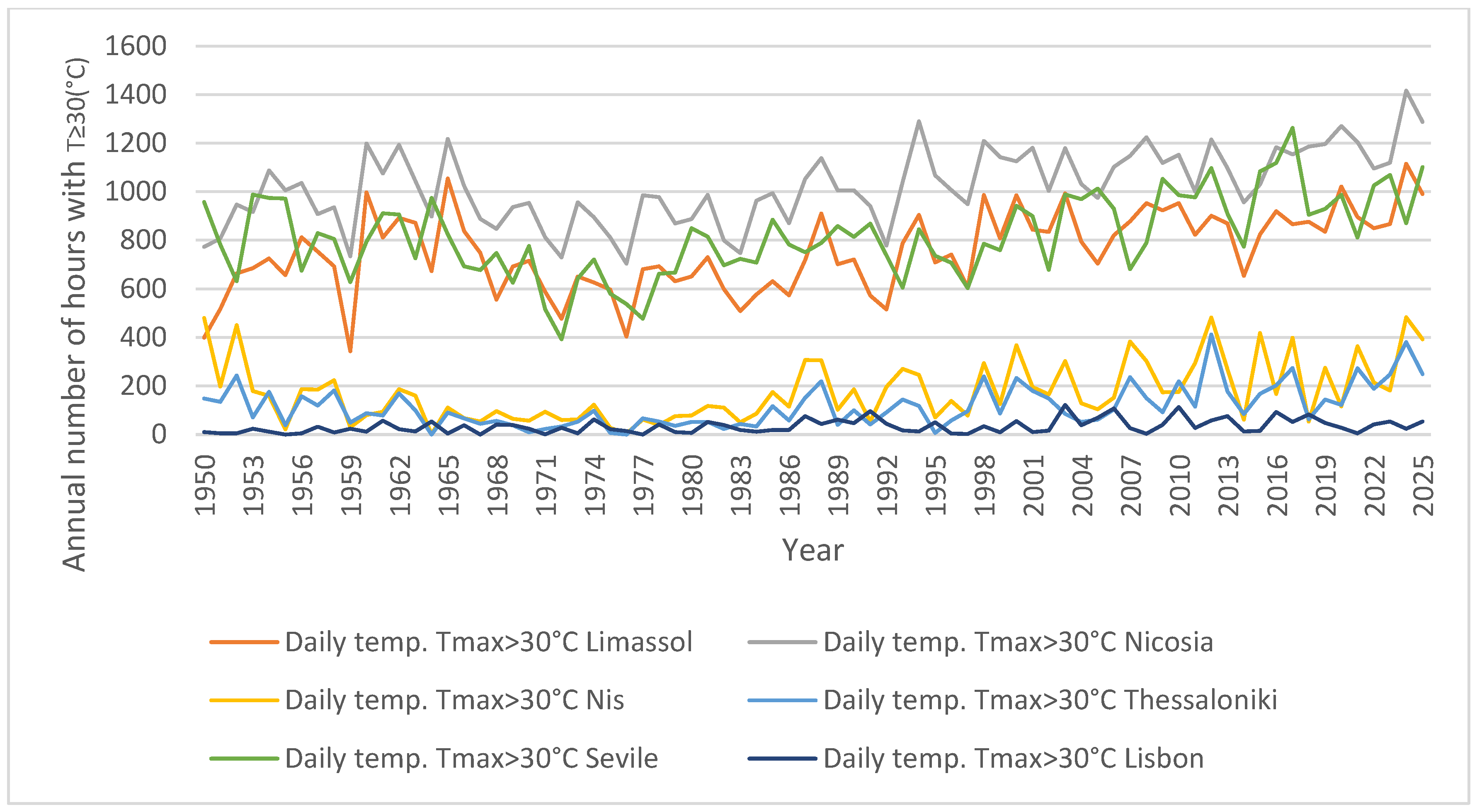
The frequency of hot days (defined here as days with daily maximum temperature ≥ 30 °C) has increased significantly over the 1950–2025 period in all six cities. In the 1950s, the inland cities of Nicosia and Seville already experienced many hot days (on the order of 80–100 days per year, based on ERA5), whereas coastal Lisbon saw only a handful (often <10 per year) due to its Atlantic-modulated climate. By the 2010s, these numbers had risen across the board. Seville now endures virtually the entire summer with Tmax ≥ 30 °C—roughly 100–120 hot days annually (a cca 20% increase from mid-century)—while Nicosia is close behind with ~90–100 hot days. Limassol’s hot-day count grew from 60 days in the 1950s to more than 80 days recently (reflecting its longer dry season). Even the cooler cities show notable increases: Thessaloniki’s hot days roughly doubled from 20 per year in the 1950s to 40 in the 2010s, and Niš rose from 30 to 45 days. Lisbon, which historically averaged only 2–5 hot days per year, now sees 8–15 such days annually. These shifts are illustrated in Figure 2, and they mirror the general warming patterns reported for Southern Europe. The rising occurrence of >30 °C days is especially concerning because this threshold is widely associated with heightened heat exposure and increased mortality risk. All six cities show an inflection toward more frequent hot days since the 1980s, consistent with regional climate change signals. Notably, the inland sites (Nicosia, Seville, and Niš) still record more hot days than their coastal counterparts due to larger summertime heating, but the gap has narrowed. For instance, Thessaloniki (coastal) now reaches a similar order of 40 hot days as Niš (inland) in some years. This convergence suggests that maritime climates are losing some of their historical heat advantage as baseline temperatures climb. Overall, the increase in hot-day frequency across these diverse cities underscores the intensification of summer heat extremes in South Europe. Since climate change often manifests more strongly through increasing frequency and persistence than through year-to-year changes in a single annual maximum, the analysis below prioritizes hot-day and tropical-night counts as the primary exposure metrics.
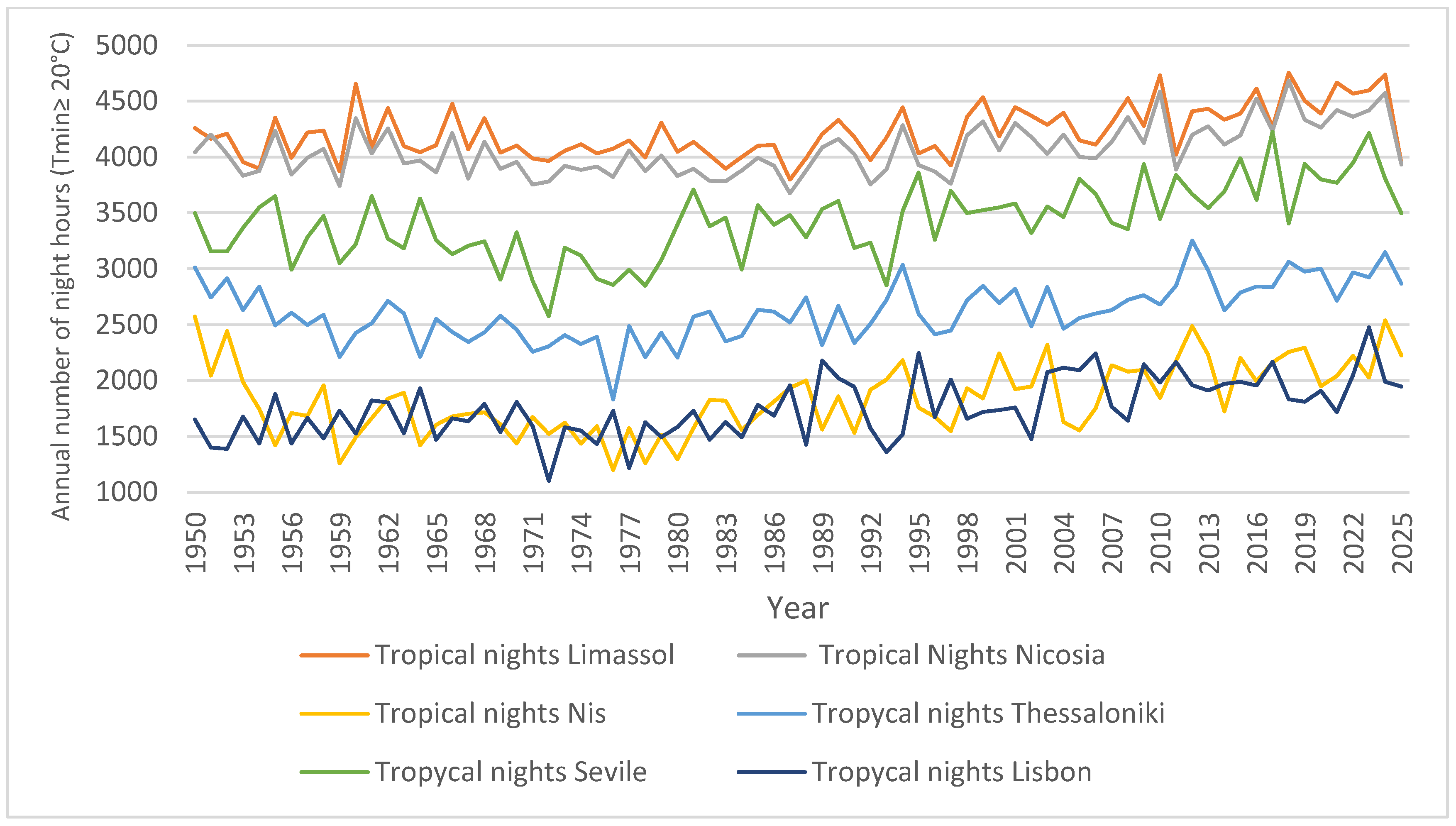
Niš often had zero nights per year staying above 20 °C (clear, dry air allowed nightly cooling to 15 °C or lower), and even in warm years of the 20th century, Niš rarely exceeded 5–10 tropical nights. By contrast, maritime climates naturally maintained warmer nights: Thessaloniki and Limassol each saw dozens of tropical nights even in the 1950s. Limassol’s climate is so moderated by the warm sea that in the baseline period it experienced virtually every summer night above 20 °C, on the order of 150–180 tropical nights per year (essentially May through October) in recent decades. Thessaloniki, with its humidity and urbanization, similarly averages on the order of 70–80 tropical nights per year now (compared to 30–40 per year in the 1950s). Seville and Nicosia, despite very hot days, benefit from stronger radiative cooling at night; their tropical night counts are intermediate. Nicosia presently observes on the order of 60 nights/year ≥ 20 °C, up from perhaps 20–30 nights in the mid-century. Seville’s count has climbed to 50–60 tropical nights (versus cca 20 or fewer historically). Even temperate Lisbon, where cool Atlantic breezes once kept nights mostly below 20 °C, now sees occasional tropical nights during heatwaves. Lisbon’s frequency increased from essentially 0–5 nights/year (1970s) to on the order of ~20 nights in the 2010s. This rising trend of night-time heat is a widespread phenomenon in Southern Europe, linked to both regional climate warming and amplified urban heat island effects that keep night minima elevated. Figure 3 shows the time evolution of annual tropical night counts, highlighting especially sharp increases since 1990. The coastal cities exhibit the highest frequencies and fastest growth, which aligns with IPCC reports identifying increasing tropical nights as a major climate risk for Southern European cities. Prolonged runs of tropical nights inhibit nocturnal cooling of buildings and human bodies, compounding heat exposure over successive days. Our results reinforce this concern: for instance, during recent extreme summers (e.g., 2021–2022), Thessaloniki and Limassol had stretches where every night for 1–2 months remained ≥25 °C (not just 20 °C), offering little relief. Such conditions dramatically increase health risks and energy demand for cooling. The data underscore that night-time overheating is no longer confined to the deep tropics—it is now a pressing issue in Mediterranean Europe as well. Urban adaptation strategies must therefore prioritize measures to cool down night temperatures (e.g., enhanced night ventilation, cool roofs, and UHI mitigation), particularly in coastal and dense urban areas where tropical nights are becoming the norm.

3.2. Primary Exposure Analysis

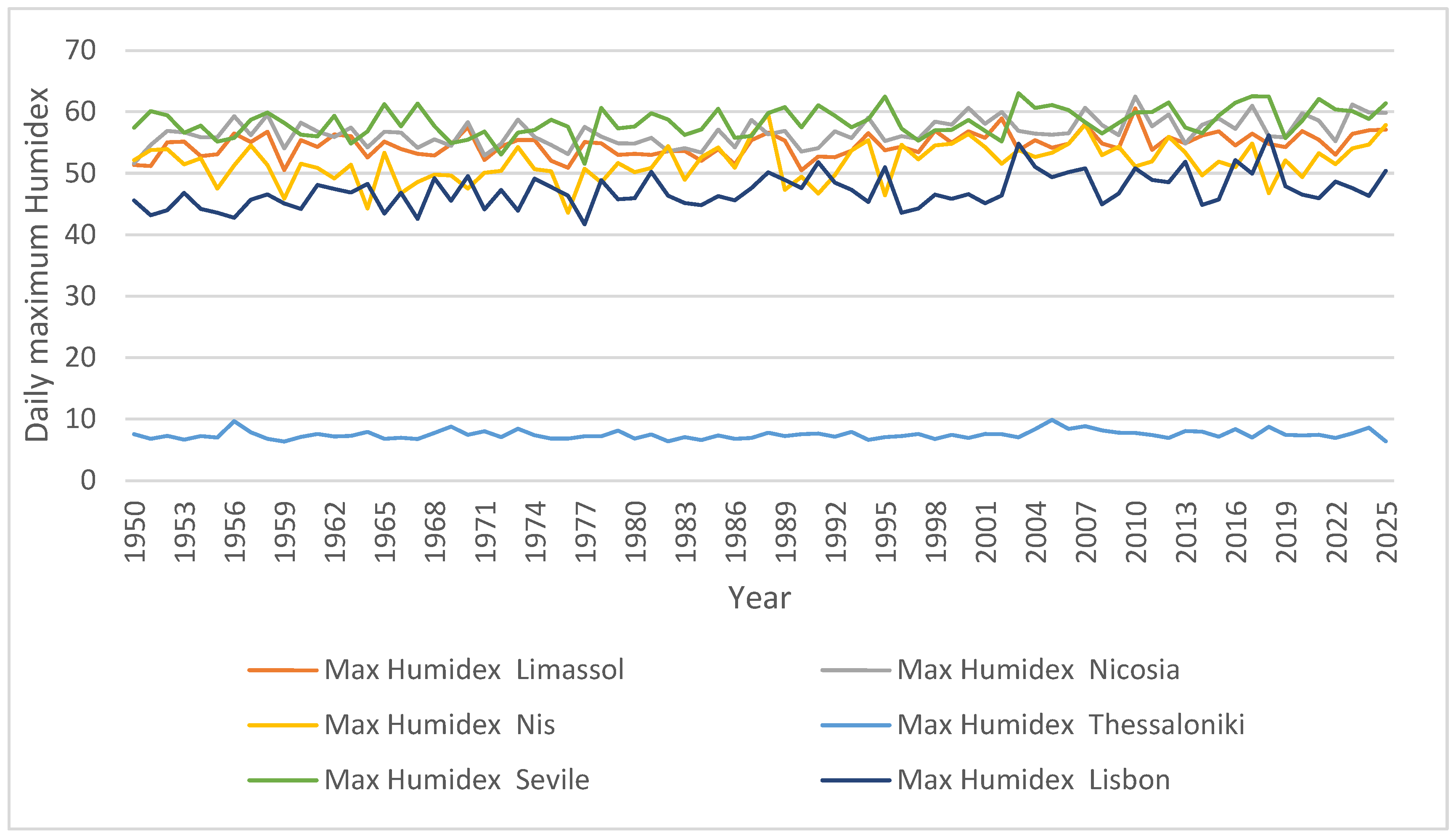
The Humidex analysis (Figure 4) reveals important differences between the hot–dry inland climates and the more humid coastal climates. As expected, drier cities reach higher air temperatures but slightly lower peak Humidex than humid cities. For example, Niš and Nicosia have each recorded air temperatures near 40–42 °C, yet their highest Humidex values are on the order of 53–57 °C because low dew points (often 5–15 °C) keep the vapor pressure modest. In contrast, Limassol and Thessaloniki, with slightly lower peak temperatures (~39–40 °C), have experienced similar or higher Humidex extremes of 55–58 due to oppressive humidity during heatwaves. Coastal Limassol’s worst-case Humidex in our period exceeds 57, occurring when T = 37 °C coupled with unusually high dew points of 26 °C. Such conditions push the wet-bulb temperature toward critical human tolerance limits of 30 °C, severely limiting the body’s cooling ability. Even Lisbon, the coolest city by temperature, can feel extremely hot under humid conditions. In August 2003, Lisbon’s air temperature of 37.8 °C and humidity produced a peak Humidex of 54.8, rivaling values in hotter Seville that year. This demonstrates that humidity can amplify heat discomfort to levels normally seen in much hotter climates.
On a routine basis, the maritime cities see far more hours of high Humidex than the interior cities. For instance, Limassol registers roughly 2500–3000 h per year with Humidex > 30 (comfort threshold) in recent decades, essentially every afternoon from June through September feels uncomfortably hot when humidity is considered. Thessaloniki and Lisbon each see a few hundred hours annually with Humidex > 30, mostly during summer afternoons and warm nights. By contrast, Niš historically had nearly zero hours with Humidex > 30 in some years, despite hot afternoons, because humidity drops so low that even 35–37 °C air felt slightly less stifling (H = 29 to 30). However, as climate warming brings higher absolute humidity, Niš is now starting to experience more humid heat as well (as a rise in hours with Humidex > 30 observed in the 2010s). In Seville’s dry heat, midday Humidex values often remain in the mid-30s despite 40 °C air, but occasional humid spells (when easterly winds bring Gulf of Cádiz moisture) can spike Humidex to 60, creating dangerous conditions. Such episodes, though infrequent, highlight that even in “dry” climates, the worst-case combination of heat and humidity can be life-threatening. Overall, the Humidex metric reinforces the need to consider humidity in heat discomfort assessments. Simple temperature thresholds may understate stress in coastal cities and overstate it in arid ones. Our findings support using composite indices (UTCI, Humidex, etc.) for urban heat risk studies while also confirming that low-tech evaporative cooling is most effective in climates with large wet-bulb depressions (hot–dry conditions). In humid coastal climates, the margin between dry-bulb and wet-bulb temperature is small, meaning passive cooling has limited capacity—a point explored further below.
Table 1 compares the baseline (1991–2020) heat-stress indicators for each city. Seville and Nicosia have the highest number of hot days (~100/year) and highest mean summer Tmax, while Lisbon has the fewest hot days (<10/year) and lowest extremes. Coastal Limassol and Thessaloniki show intermediate hot-day counts (~60–80 and ~30–40/year, respectively), but notably higher tropical night frequencies (see next section). Niš, with its continental climate, has moderate hot days (~45/year) and the lowest tropical night count. These baseline differences set the context for evaluating future changes under climate scenarios.

3.3. Annual Climate-Suitability Hours for Passive Cooling

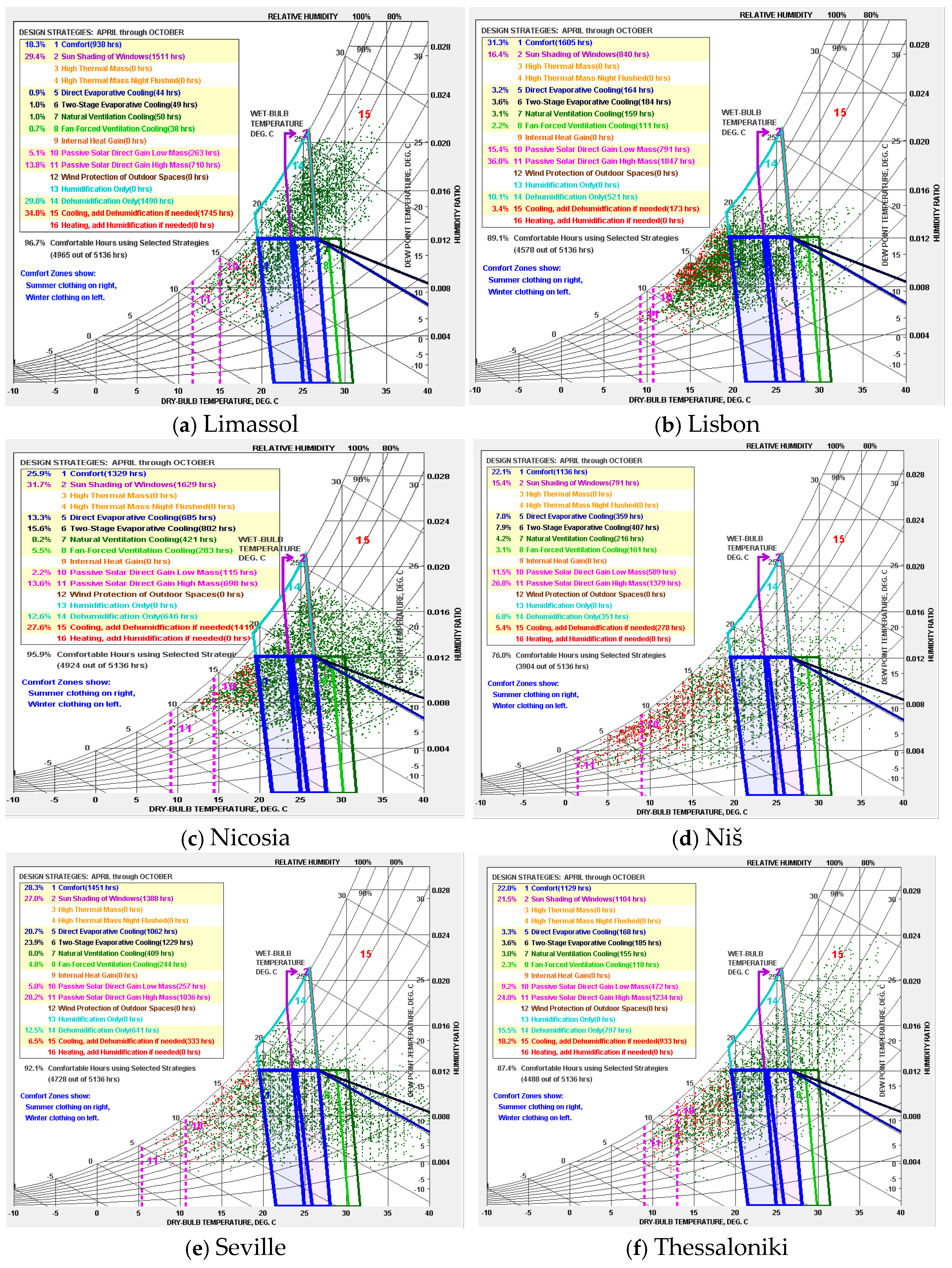
To translate these climatic findings into practical comfort and cooling implications, a Climate Consultant analysis was performed for each city. The reported Climate Consultant “comfort/strategy hours” are not presented as validated estimates of heat-stress health risk or cooling performance; they are comparative climate-suitability indicators derived from psychrometric and adaptive-comfort envelopes. Using the software’s psychrometric chart approach and morphed future weather files (year 2050) for four emission scenarios (SSP1-2.6, SSP2-4.5, SSP3-7.0, and SSP5-8.5), the annual distribution of comfort and the potential efficiency of various passive cooling strategies were computed (Figure 5). The comfort criteria were based on the ASHRAE Standard 55 adaptive model (separate comfort zones for summer vs. winter clothing). Table 2 summarizes the total annual hours within the comfort zone (i.e., not requiring any active heating or cooling) for the base year (2023) and the mentioned scenarios until 2050. Several clear patterns emerge. First, in the present climate, there is a stark contrast between cities: Lisbon enjoys the most hours of natural comfort (estimated 3500 h/year, 40% of the time), thanks to its mild temperatures year-round. Niš also has a significant number of climate-suitability hours (3000 h/yr), mainly in spring and autumn—winters are cold and summers hot, but shoulder seasons are pleasant. In Limassol and Seville, by contrast, the prolonged hot season severely reduces climate-suitability hours; currently, only on the order of 1500–2000 h/yr (20% of the time) are within the comfort zone without cooling. Nicosia and Thessaloniki are intermediate (2500 h and 2200 h respectively), reflecting hot summers (especially Nicosia), and, for Thessaloniki, some winter cold that requires heating. These baseline differences underscore how maritime climates yield longer comfort periods (especially in winter), whereas interior climates suffer both winter cold and summer heat, shrinking the naturally comfortable window.
Under future climate scenarios, climate-suitability hours decrease in all the cities (Table 2). The magnitude of decline closely follows the emission scenario severity. Under the low-end SSP1-2.6 (which corresponds to 1.8 °C global warming by 2050), the annual climate-suitability hours drop by about 5–15% in most cities. For example, Lisbon’s comfort time reduces to 3000 h (down 15%), and Niš to 2600 h (down 13%). For planning-relevant interpretation, SSP2-4.5 is treated as the reference scenario. Under SSP2-4.5 (Table 2 and Table 3), the pattern reinforces the coastal–inland contrast: humid coastal settings (e.g., Limassol/Lisbon/Thessaloniki) exhibit reduced climate-suitability (i.e., “comfort”) hours and a constrained psychrometric space for evaporative strategies, indicating that adaptation should prioritize solar/radiant load reduction (shading and reflective materials) and ventilation/urban porosity. In hotter inland contexts (e.g., Niš/Seville/Nicosia), the projected evolution under SSP2-4.5 indicates increasing heat exposure (hot days/tropical nights) while the feasibility of passive strategies becomes more conditional; evaporative/adiabatic options remain more frequently feasible than in humid coastal climates, but should be framed as climate-suitability indicators and interpreted together with exposure metrics to inform differentiated planning priorities.
The largest absolute losses occur in the already heat-challenged cities: Limassol loses 300 h of comfort (mostly in summer months that become too hot), and Seville loses 200–250 h. Higher emission scenarios show progressively larger impacts. Under SSP5-8.5 (a high-warming trajectory), nearly all summer hours become uncomfortable in the warmest cities. Limassol and Seville are projected to see virtually zero hours in June–August that meet comfort criteria (assuming only passive adaptation); even night temperatures under SSP5-8.5 seldom drop low enough for comfort without cooling. In Limassol, for instance, the Climate Consultant output indicates 0 h in July and August within the comfort zone by 2050 in the high scenario, whereas at present there are a few dozen such hours (typically in early morning) each month. Nicosia shows a similar elimination of summer comfort under SSP5-8.5. The monthly distribution of climate-suitability hours for Limassol in the current climate vs. SSP5-8.5 highlights the collapse of the comfort period in summer and the shift in marginal months like May and October towards needing cooling. Even in more temperate Lisbon, SSP5-8.5 causes a sharp reduction in comfort in climate-suitability hours in August, dropping by 50%. Winters, meanwhile, become milder; in cold-prone cities like Niš, this actually increases winter comfort slightly (fewer heating hours needed). However, this winter gain is far outweighed by the summer comfort loss in all scenarios. The net result is a substantial increase in hours requiring active cooling. By 2050, under mid-range to high scenarios (SSP2-4.5 and above), all six cities will require some form of cooling for most hours of the summer season. This projection is in line with other studies forecasting surging cooling demands in Southern Europe. It also reinforces concerns about future energy burdens and the need for resilient cooling strategies.
In Table 3, Climate Consultant comfort and strategy-hour data for June–August (JJA) for the six analyzed cities are presented, including hours of direct evaporative cooling, two-stage evaporative cooling, natural ventilation cooling, fan-forced ventilation cooling, dehumidification only, cooling and dehumidification, and climate suitability (“Comfort Hours”).
Table 3 presents a city-by-city breakdown of climate-suitability hours and cooling requirements in the current vs. future climates. In addition to climate-suitability hours (“Comfort Hours” with no HVAC needed), it lists the portion of time falling into key passive cooling strategy zones (from the psychrometric analysis): direct evaporative cooling (DEC), two-stage evaporative cooling (indirect + direct), and cooling with dehumidification (active cooling needed due to high humidity).
The distribution of hours among these zones indicates the evaporative cooling potential for each city and scenario. Presently, inland dry climates show a larger fraction of hot hours in the DEC or two-stage evaporative zone, whereas humid coastal climates see more hours that already require dehumidification. For example, in Nicosia’s 2023 climate, approximately 10% of the annual hours (mostly hot afternoons) lie in the range where direct evaporative cooling could maintain comfort (dry bulb > 27 °C but low humidity), and an additional 5% could be handled by two-stage evaporative cooling. In contrast, Limassol’s 2023 climate has only ~2–3% of the hours suitable for DEC, and nearly all hot hours in July–August exceed the humidity limits—instead, about 25% of the annual hours (chiefly summer evenings/nights with high RH) fall into the “cooling + dehumidification” category (meaning only a refrigerated AC or desiccant system can achieve comfort). These findings quantitatively confirm the earlier qualitative expectation: hot, dry climates retain a meaningful niche for adiabatic cooling, while hot, humid climates do not.
Future scenarios (Figure 5) further accentuate this contrast. Under SSP5-8.5, the share of hours amenable to direct evaporative cooling virtually vanishes in Limassol and Thessaloniki—nearly all hot-period hours in 2050 are simply too humid or too hot (or both) for evaporative methods. In Limassol’s SSP3-7.0/8.5 scenario, even two-stage evaporative cooling would only partially cover a few percent of hours in the cooler fringe seasons; over 90% of the summer hours require active dehumidification. By contrast, Nicosia and Niš in a low scenario (SSP1-2.6) could still manage a significant portion of hot hours with evaporative cooling—our projections suggest on the order of 10–15% of the annual hours remain in the DEC zone in 2050 for these drier cities (only slightly less than today) if global warming is limited, though under SSP5-8.5 this drops to <5%. Thessaloniki represents a borderline case: its climate is moderately humid, so currently it has limited DEC potential (~5% of the hours); by 2050, under high-emission conditions, virtually all the evaporative potential is lost as higher sea-surface temperatures push up ambient humidity (many hours shift into the red “dehumidification needed” zone on the psychrometric chart). In Thessaloniki, under SSP5-8.5, the comfortable/evaporative zones shrink dramatically compared to the 2023 chart, and most points lie outside passive zones.
The implications for urban adaptation are significant. In climates like Seville, Niš, or Nicosia (hot, dry summers), evaporative cooling remains a viable and appealing strategy in the near term, capable of providing relief with much lower energy use than compression AC. Our results suggest that if designed appropriately (e.g., using two-stage systems to extend effectiveness), evaporative cooling could meet a substantial share of cooling needs in these cities even as temperatures rise—albeit with some performance drop-off by 2050, especially in worst-case scenarios. However, in maritime and humid urban climates (Limassol, Thessaloniki, Lisbon), the window for adiabatic cooling is narrow. High night-time humidity and frequent heatwaves push conditions beyond what passive systems can handle, particularly under future warming. These cities will likely need to rely more on hybrid or mechanical cooling solutions and focus on urban heat island mitigation (since reducing background urban temperatures at night may be one of the only ways to secure relief). Water-centric strategies (e.g., misting, spray parks, and fountains) can still provide localized cooling outdoors, but their efficiency will be limited during humid spells, and they carry significant water demand. In water-scarce regions like Cyprus and Spain, large-scale evaporative cooling deployment must consider water resource constraints—an important trade-off as climate change is also projected to increase drought frequency in these areas.
The cross-city analysis shows that climate suitability is intensifying across South European cities, though the characteristics of that stress (daytime extremes vs. night-time warmth; dry vs. humid heat) vary in ways that are crucial for adaptation planning. Coastal cities are increasingly prone to compound heat-humidity stress at night, which undermines human recovery and limits passive cooling options. Inland cities face extraordinarily high daytime temperatures, but their drier air offers opportunities for low-energy cooling innovations (at least in the near term). All scenarios point to a substantial increase in cooling requirements by 2050, even under optimistic climate outcomes. This will likely strain energy infrastructure and peak electricity loads while also creating feedback loops if met solely by conventional air-conditioning (waste heat from AC can exacerbate urban night temperatures). Therefore, these findings underscore an urgent need for integrated adaptation strategies: combining enhanced passive cooling (shading, ventilation, evaporative techniques where suitable) with sustainable energy solutions and urban design that reduces heat load. Each city’s specific climate profile will dictate the best mix of measures—for instance, Niš and Nicosia might prioritize cool roofs and evaporative night cooling, while Lisbon and Thessaloniki might invest more in reflective materials, green infrastructure, and night-time ventilation to expel moist heat. Crucially, limiting global warming (e.g., following an SSP1-2.6 pathway) greatly improves the outlook: our analysis shows far more remaining climate-suitability hours and passive cooling feasibility under a low-emissions future as compared to high-emissions. This highlights that climate mitigation efforts directly translate into reduced urban climate suitability, buying time for cities to implement resilience measures. In a high-emission scenario, by mid-century, the climates of South European cities could approach unprecedented levels of thermal discomfort, against which adaptation options will be increasingly limited [32]. The mapping of heat stress and cooling potential presented here can inform local adaptation plans, helping identify where evaporative/adaptive cooling can be harnessed effectively and where alternative approaches will be needed to safeguard urban populations in the coming decades.

3.4. Discussion

This study focuses on jointly interpreting three complementary dimensions: heat exposure frequency (hot days and tropical nights), humidity-modified discomfort (Humidex), and climate suitability for passive/evaporative strategies (strategy/comfort hours). These dimensions should not be conflated into a single physiological heat-stress metric; instead, they provide a structured basis for cross-city comparison and planning interpretation.
A key insight is that coastal–inland differences are strongly mediated by humidity constraints: humid coastal climates may show strong heat exposure while simultaneously exhibiting a reduced psychrometric window for evaporative/adiabatic strategies. Conversely, hotter/drier inland climates can retain a wider evaporative feasibility window, but adaptation must consider water availability, radiant load control, and urban ventilation. These findings support differentiated planning priorities for coastal versus inland contexts. The exposure indicators used in this study—hot days and tropical nights—capture the frequency and persistence of heat conditions rather than average climate alone. This distinction is important for understanding why annual extremes may show limited change in some locations while the number of hot days increases substantially, which directly affects population exposure and cooling demand. Recent European assessments highlight that heat extremes are increasing and that the Mediterranean and Southern Europe are among the most affected regions, with growing risks for health, infrastructure, and energy systems under continued warming [1,2,3,4,5,13,14]. From an urban climate perspective, the UHI effect can further amplify nocturnal heat retention, making tropical nights particularly relevant because reduced night-time recovery increases cumulative heat burden and can elevate health risk during heat events [8,9,10,11,14]. These results align with broader evidence that urban warming and anthropogenic heat contributions can worsen heat exposure, especially during heatwaves [11,18,19,20].
The feasibility of evaporative and adiabatic cooling is not determined by temperature alone but by the joint thermodynamic and microclimatic context. In particular, ambient humidity and the associated wet-bulb temperature directly constrain the potential for evaporative cooling, explaining why some coastal locations can experience high heat exposure while showing reduced evaporative strategy hours. In addition, wind/ventilation conditions, radiant load and shading, urban morphology, and the availability of water and vegetated surfaces influence realized cooling effectiveness at the urban scale. Therefore, the strategy-hour results in this study should be interpreted as climate-suitability indicators under standardized psychrometric envelopes, and translated into planning priorities together with exposure metrics (hot days/tropical nights) and humidity-modified discomfort (Humidex).
This study indicates how coastal–inland differences are mediated not only by temperature exposure but also by humidity constraints, which directly limit evaporative and adiabatic cooling potential. Evaporative cooling effectiveness depends on the thermodynamic ability of air to accept moisture; as humidity rises, the evaporative cooling “headroom” decreases. This is consistent with the building-physics understanding of evaporative/adiabatic processes and with evidence that the geo-climatic feasibility of direct evaporative cooling varies substantially across Mediterranean sub-regions and humidity regimes [21,25,26]. In coastal climates, sea-breeze circulation can moderate temperature but simultaneously increase humidity, which can reduce the applicability window of evaporative strategies despite persistent heat exposure [21]. This study’s combined use of humidity-modified discomfort (Humidex) and strategy-hour feasibility, therefore, provides a planning-relevant way to interpret why some coastal cities may require stronger prioritization of radiant load reduction and ventilation-supporting urban form, even when maximum temperature trends are less pronounced.
Importantly, Humidex is treated here as a discomfort index (not a physiological heat-strain model), consistent with its formulation and common use as a screening indicator linking temperature and humidity [32,33]. Where physiological heat stress metrics are required (e.g., occupational/health risk applications), more advanced thermo-physiological indices such as UTCI and related human heat-balance models are more appropriate [36], but these are beyond the current scope focused on comparative feasibility screening.
In practice, this means that humid coastal cities should prioritize measures that reduce radiant load (shade, cool materials) and enhance ventilation/porosity while treating evaporative options as more constrained, whereas hotter/drier inland cities retain a wider climatic window for evaporative/adiabatic approaches, subject to water-availability and drought resilience considerations. The results support differentiated planning priorities across South European city types. In humid coastal cities, the combined evidence from humidity-modified discomfort and constrained strategy-hour feasibility suggests that planning should prioritize: (i) reducing radiant heat load through shading and cool/reflective materials, (ii) improving ventilation/urban porosity and corridor design, and (iii) applying evaporative options selectively and with humidity-aware operation, given the reduced psychrometric opportunity window [7,8,12,21,23]. In hotter/drier inland cities, evaporative/adiabatic approaches remain climatically feasible more often [21,25,26], but their deployment should be evaluated together with water availability, drought resilience, and local land-cover strategies.
These findings also connect directly with the broader policy and technology context: the expansion of cooling demand is a recognized risk for Mediterranean energy systems and urban resilience [12,15,16,17,34,35]. Passive and resilient cooling strategies are increasingly discussed as a key adaptation lever for South European buildings and cities [15,17,22,23,24], and scenario-based studies show that future climate pathways influence both bioclimatic strategy suitability and building performance [24,27,28,29,30]. Treating SSP2-4.5 as a planning-relevant reference scenario (while retaining the full scenario range) strengthens the practical interpretation because it aligns with mid-century decision horizons commonly used in building and urban adaptation planning [2,3,31].
The analysis presented in this study is the integrated interpretation of three complementary dimensions: outdoor heat exposure (hot days and tropical nights), humidity-modified thermal discomfort (Humidex), and climate suitability for passive cooling strategies (psychrometric/adaptive “strategy hours”). Considering these together helps avoid misleading conclusions that can arise from any single metric alone. For example, high temperature extremes do not automatically imply high evaporative cooling feasibility; feasibility depends strongly on humidity constraints (wet-bulb temperature), which also modulate perceived heat. The coastal–inland comparison highlights that humidity regimes can be a dominant constraint on evaporative cooling feasibility even when air temperatures are high. In more humid coastal settings, the psychrometric space available for evaporative strategies can narrow, shifting the relative importance toward shading, reduced solar/radiant load, and ventilation measures. In hotter/drier inland contexts, evaporative cooling options can remain more frequently feasible, but their practicality depends on water availability, design integration, and local microclimatic conditions.
Under future climate scenarios, the observed shifts in exposure metrics and in strategy-hour distributions should be interpreted as changes in climatic feasibility, not as direct predictions of indoor operative temperatures or cooling-system performance. The strength of the approach is in consistent inter-city comparison and in identifying when and where passive measures become more or less climatically relevant as warming progresses. The findings support differentiated adaptation emphasis: in humid coastal cities, priority strategies should include solar shading, high-albedo and low-radiant-load materials, ventilation corridors and urban porosity, and reducing anthropogenic heat. In hotter/drier inland cities, evaporative strategies can be considered more often climatically feasible, especially when combined with shade and ventilation; however, implementation should be assessed against water-sensitive urban design constraints and drought risk. This offers a planning-oriented translation of climate data into actionable priorities. However, this study uses a limited city sample (six cities), which restricts strong attribution of differences to any single driver beyond the coastal–inland framing (altitude, urban form, vegetation cover, and air quality). Therefore, the coastal–inland comparison is interpreted as a humidity-regime contrast for planning-oriented feasibility assessment, not as evidence that coastline distance dominates over other climatic and urban drivers. Coastal–inland contrasts are discussed as humidity-regime comparisons, not as evidence that coastline distance alone governs urban heat conditions. A quantitative multivariate attribution (e.g., testing the relative influence of altitude, vegetation fraction, latitude, urban form, and air quality) would require a larger city sample and additional spatial descriptors, and is therefore identified as a priority for future work. The Climate Consultant outputs are used as screening-level climate-suitability indicators, not validated heat-exposure and health-risk metrics or system performance simulations.
This study is designed as a paired coastal–inland comparative framework across three South European regions. While this supports consistent benchmarking, it does not provide full multivariate attribution of the relative importance of drivers such as altitude, vegetation fraction, urban density/morphology, or air quality. Future work should expand the city sample and integrate quantitative descriptors of land cover, morphology and anthropogenic heat, and, where feasible, evaluate sensitivity using coupled urban climate/building approaches [10,11,18,19,20].
In addition, Climate Consultant outputs are interpreted as standardized screening indicators of climate suitability based on psychrometric and adaptive envelopes; they are not validated predictors of physiological heat stress, thermal safety, or cooling-system performance. Follow-on work could integrate physiological indices (e.g., UTCI) [36] and/or building simulation to connect climate-suitability hours to indoor risk and energy outcomes under realistic operating assumptions [10,24,28]. Despite these limitations, the approach provides a transparent comparative basis to distinguish how warming and humidity regimes jointly shape heat exposure and the feasible adaptation space for evaporative cooling in South European urban contexts [1,2,3,4,5,12,21,27,28,29,30,31,34,35].
Future work should operationalize these contextual drivers by adding city descriptors (e.g., land-cover/vegetation fraction, urban density/morphology proxies, altitude/latitude, and, where available, air quality indicators) and applying multivariate attribution to quantify their relative influence on strategy-hour feasibility, and could expand the city set, incorporate explicit land-cover/urban-form variables, and validate strategy-hour interpretations with microclimate or building simulation studies in selected test cases.

4. Conclusions

The present study has systematically assessed the evolution of urban heat stress and the applicability of evaporative cooling strategies across six representative South European cities using long-term ERA5 climate data (1950–2025) and future scenario projections (2050) based on CMIP6 pathways.

4.1. Key Findings

The results demonstrate a marked intensification of thermal extremes in all the cities, particularly in the inland locations of Nicosia, Seville, and Niš, which already record over 100 hot days annually and exhibit the highest apparent temperatures by Humidex. Coastal cities such as Limassol and Thessaloniki experience fewer daytime peaks but face a growing prevalence of tropical nights and elevated humidity, which reduce night-time relief and constrain evaporative cooling potential. Scenario analysis using morphed EPW files and psychrometric modeling shows that, under high-emission futures (SSP5-8.5), climate-suitability hours decline by up to 30%, and passive cooling zones shrink dramatically—most notably in humid regions where the difference between dry- and wet-bulb temperatures narrows. A limitation is that Climate Consultant outputs are screening-level design indicators; therefore, we interpret them as climatic feasibility rather than validated predictions of indoor comfort, physiological heat stress, or system performance.

4.2. Practical Implications and Future Work

These findings indicate the need to tailor climate-resilient cooling strategies to local microclimates. In hot–dry cities, direct or two-stage evaporative cooling retains viability as a low-energy alternative, provided water availability is addressed. In contrast, in humid coastal environments, the dominance of latent heat stress necessitates hybrid solutions, enhanced ventilation, and urban design that promotes nocturnal heat release. Limiting global warming through mitigation pathways such as SSP1-2.6 significantly preserves passive comfort windows and delays critical adaptation thresholds. Thus, integrating high-resolution climate diagnostics with design-based cooling models offers a scalable methodology to inform city-specific resilience planning across Europe’s diverse climatic regimes.

Author Contributions

Conceptualization, M.M., M.R., and M.Đ.; methodology, M.M.; software, M.M. and V.J.; validation, M.M., H.K., and N.P.; formal analysis, G.A.; investigation, T.R.; resources, G.A.; data curation, T.R.; writing—original draft preparation, H.K., M.M., N.P., and M.R.; writing—review and editing, M.M., V.J. and T.R.; visualization, M.M.; supervision, M.M.; project administration, M.R. and T.R.; funding acquisition, M.M. and G.A. All authors have read and agreed to the published version of the manuscript.

Funding

This research was financially supported by the Ministry of Science, Technological development and Innovation of the Republic of Serbia (Contract No. 451-03-136/2025-03/200109).

Institutional Review Board Statement

Not applicable.

Informed Consent Statement

Not applicable.

Data Availability Statement

Data are available from the corresponding author upon reasonable request.

Acknowledgments

During the preparation of this manuscript/study, the authors used ChatGPT (GPT-5.1 Thinking model) for the purposes of improving the English language. The authors have reviewed and edited the output and take full responsibility for the content of this publication.

Conflicts of Interest

The authors declare no conflicts of interest.

Abbreviations

The following abbreviations are used in this manuscript:
UHIUrban Heat Island
ACAir conditioning
AHAnthropogenic Heat
CDDCooling Degree Days
WMOWorld Meteorological Organization
IPPCIntergovernmental Panel on Climate Change
EEAEuropean Environment Agency
RHRelative Humidity
UTCIUniversal Thermal Climate Index
WBGTWet-Bulb Globe Temperature
HVACHeating, Ventilation, and Air Conditioning
EPWEnergyPlus Weather
TMYTypical Meteorological Year
CMIP6Coupled Model Intercomparison Project Phase 6
SSPShared Socioeconomic Pathway
DECDirect Evaporative Cooling

References

  1. World Meteorological Organization (WMO); Copernicus Climate Change Service (C3S). State of the Climate in Europe 2023; WMO: Geneva, Switzerland; C3S: Reading, UK, 2024. [Google Scholar]
  2. Intergovernmental Panel on Climate Change (IPCC). Regional Fact Sheet: Europe and the Mediterranean. In Climate Change 2021: The Physical Science Basis; Contribution of Working Group I to the Sixth Assessment Report of the IPCC; IPCC: Geneva, Switzerland, 2021. [Google Scholar]
  3. Intergovernmental Panel on Climate Change (IPCC). Climate Change 2022: Impacts, Adaptation and Vulnerability; Contribution of Working Group II to the Sixth Assessment Report of the IPCC; Cambridge University Press: Cambridge, UK, 2022. [Google Scholar]
  4. FAO; Copernicus Climate Change Service (C3S). Mediterranean Climate Change Factsheets; FAO: Rome, Italy, 2023. [Google Scholar]
  5. European Environment Agency (EEA). Heat and Climate Change in Europe; EEA: Copenhagen, Denmark, 2022. [Google Scholar]
  6. Ballester, J.; Quijal-Zamorano, M.; Turrubiates, R.F.M.; Pegenaute, F.; Herrmann, F.R.; Robine, J.M.; Basagaña, X.; Tonne, C.; Antó, J.M.; Achebak, H. Heat-related mortality in Europe during the summer of 2022. Nat. Med. 2023, 29, 1857–1866. [Google Scholar] [CrossRef] [PubMed]
  7. European Environment Agency (EEA). Urban Adaptation to Climate Change in Europe; EEA: Copenhagen, Denmark, 2016. [Google Scholar]
  8. Santamouris, M. Heat Island Research in Europe: The State of the Art. Adv. Build. Energy Res. 2007, 1, 123–150. [Google Scholar] [CrossRef]
  9. Sobstyl, J.M.; Emig, T.; Qomi, M.J.A.; Pellenq, R.J.-M.; Ulm, F.-J. Role of Structural Morphology in Urban Heat Islands at Nighttime. Phys. Rev. Lett. 2018, 120, 108701. [Google Scholar] [CrossRef]
  10. Jin, L.; Schubert, S.; Fenner, D.; Meier, F.; Schneider, C. Integration of a Building Energy Model in an Urban Climate Model: Berlin Case Study. Bound.-Layer Meteorol. 2021, 178, 249–281. [Google Scholar] [CrossRef]
  11. Krpo, A.; Salamanca, F.; Martilli, A.; Clappier, A. On the Impact of Anthropogenic Heat Fluxes on the Urban Boundary Layer. Bound.-Layer Meteorol. 2010, 136, 105–127. [Google Scholar] [CrossRef]
  12. European Environment Agency (EEA). Cooling Buildings and Cities-Overheating Risks and Responses; EEA: Copenhagen, Denmark, 2020. [Google Scholar]
  13. European Environment Agency (EEA). Climate Change Impacts and Vulnerability in Europe-Mediterranean Region; EEA: Copenhagen, Denmark, 2022. [Google Scholar]
  14. European Environment Agency (EEA); World Health Organization (WHO Europe). Heat and Health in Europe: Evidence and Policy Responses; WHO Regional Office for Europe: Copenhagen, Denmark, 2021. [Google Scholar]
  15. Santamouris, M. Cooling the Buildings-Past, Present and Future. Energy Build. 2016, 128, 617–638. [Google Scholar] [CrossRef]
  16. Jakubcionis, M.; Carlsson, J. Estimating the EU Residential Space-Cooling Potential. Energy Policy 2017, 101, 225–235. [Google Scholar] [CrossRef]
  17. International Energy Agency (IEA). The Future of Cooling: Opportunities for Energy-Efficient Air Conditioning; IEA/OECD: Paris, France, 2018. [Google Scholar]
  18. Wang, A.; Li, X.-X.; Xin, R.; Chew, L.W. Impact of Anthropogenic Heat on Urban Environment: A Case Study of Singapore with High-Resolution Gridded Data. Atmosphere 2023, 14, 1499. [Google Scholar] [CrossRef]
  19. Khan, A.; Vasilakopoulou, K.; Santamouris, M. Exploring the Potential Impacts of Anthropogenic Heating on Urban Climate During Heatwaves. Sci. Rep. 2025, 15, 3908. [Google Scholar] [CrossRef] [PubMed]
  20. Yuan, C.; Zhu, R.; Tong, S.; Mei, S.J. Impact of Anthropogenic Heat from Air-Conditioning on Urban Climate. Energy Build. 2022, 269, 112171. [Google Scholar] [CrossRef]
  21. Chiesa, G.; Huberman, N.; Pearlmutter, D. Geo-Climatic Potential of Direct Evaporative Cooling in the Mediterranean Region: A comparison of key performance indicators. Build. Environ. 2019, 151, 318–337. [Google Scholar] [CrossRef]
  22. Capdevila, R.; Garrido, N.; Tontodonati, E. Energy Analysis of Resilient Cooling Technologies in Mediterranean Buildings. In Proceedings of BS2023: 18th Conference of IBPSA; IBPSA: Shanghai, China, 2024. [Google Scholar]
  23. Díaz-López, C.; López-Jiménez, P.A.; Pulido-Arcas, J.A. Passive Cooling Strategies to Optimise Sustainability and Thermal Comfort in Buildings: A Review. Energy Build. 2022, 262, 111996. [Google Scholar]
  24. Abbas, G.M.; Akgül, M.; Dino, I.G. Resilient Cooling of Mediterranean Office Spaces under Future Climate Scenarios. Archit. Eng. Des. Manag. 2024, 1–22. [Google Scholar] [CrossRef]
  25. Romero-Lara, M.J.; Comino, F.; de Adana, M.R. Seasonal Energy Efficiency Ratio of Regenerative Indirect Evaporative Coolers—Simplified calculation method. Appl. Therm. Eng. 2023, 220, 119710. [Google Scholar] [CrossRef]
  26. Tejero-González, A.; Franco-Salas, A. Direct Evaporative Cooling from Wetted Surfaces. WIREs Energy Environ. 2022, 11, e423. [Google Scholar] [CrossRef]
  27. Bienvenido-Huertas, D.; Rubio-Bellido, C.; Marín-García, D.; Canivell, J. Influence of the Representative Concentration Pathways (RCP) scenarios on the bioclimatic design strategies of the built environment. Sustain. Cities Soc. 2021, 72, 103042. [Google Scholar] [CrossRef]
  28. Roetzel, A.; Tsangrassoulis, A. Climate change sensitivity of comfort and energy performance criteria in offices. In Proceedings of the 45th Annual Conference of the Architectural Science Association (ANZAScA 2011), Sydney, Australia, 17–19 November 2011. [Google Scholar]
  29. Castro, A.; Sorte, S.; Rodrigues, V.; Martins, N. Residential Buildings at Climate Crossroads: Insights from Portugal for South European Energy Performance. Energies 2025, 18, 2336. [Google Scholar] [CrossRef]
  30. Keppas, S.C.; Papadogiannaki, S.; Parliari, D.; Kontos, S.; Poupkou, A.; Tzoumaka, P.; Kelessis, A.; Zanis, P.; Casasanta, G.; de’Donato, F.; et al. Future Climate Change Impact on Urban Heat Island in Two Mediterranean Cities Based on High-Resolution Regional Climate Simulations. Atmosphere 2021, 12, 884. [Google Scholar] [CrossRef]
  31. Belcher, S.E.; Hacker, J.N.; Powell, D.S. Constructing design weather data for future climates. Build. Serv. Eng. Res. Technol. 2005, 26, 49–61. [Google Scholar] [CrossRef]
  32. Masterton, J.M.; Richardson, F.A. A Method of Quantifying Human Discomfort Due to Heat and Humidity; Environment Canada Publications No. 79-1; Atmospheric Environment Service: Downsview, ON, Canada, 1979.
  33. Government of Canada. Humidex Calculator. Available online: https://weather.gc.ca/airquality/pages/provincial_summary/on_e.html (accessed on 15 November 2025).
  34. European Commission; Joint Research Centre (JRC). Cooling Demand and Climate Scenarios in Europe; JRC: Ispra, Italy, 2023. [Google Scholar]
  35. European Environment Agency (EEA). Cooling Degree Days in Europe; EEA: Copenhagen, Denmark, 2022. [Google Scholar]
  36. Fiala, D.; Havenith, G.; Bröde, P.; Kampmann, B.; Jendritzky, G. UTCI-Fiala Multi-Node Model of Human Heat Transfer and Temperature Regulation. Int. J. Biometeorol. 2012, 56, 429–441. [Google Scholar] [CrossRef] [PubMed]
Figure 1. Annual maximum of daily maximum air temperature (°C) for the six analyzed cities based on ERA5 data (1950–2025) (upper-bound annual extreme and is interpreted together with frequency/persistence indicators: hot days and tropical nights).
Urbansci 10 00136 g001
Figure 2. Number of hot days with temperatures above 30 °C per year based on ERA5 data (1950–2025).
Urbansci 10 00136 g002
Figure 3. Number of tropical nights with temperatures constantly above 20 °C per year based on ERA5 data (1950–2025).
Urbansci 10 00136 g003
Figure 4. Maximum daily Humidex values for the analyzed cities based on ERA5 data (1950–2025).
Urbansci 10 00136 g004
Figure 5. Climate Consultant results for the six cities: (a) Limassol, (b) Lisbon, (c) Nicosia, (d) Niš, (e) Seville, (f) Thessaloniki.
Urbansci 10 00136 g005
Table 1. Baseline (1991–2020) climate heat indicators for the six cities: Hot days—days per year with Tmax ≥ 30 °C; Tropical nights—nights per year with Tmin ≥ 20 °C; Max Tmax—highest recorded daily maximum (°C) in 1991–2020; Max Humidex—highest Humidex value in 1991–2020. Each value is derived from ERA5/ERA5-Land data.
CityHot Days (Days/yr)Tropical Nights (Days/yr)Max Tmax (°C)Max Humidex
Nicosia9560–7041–4259–61
Limassol75150+39–4055–58
Seville10550–6043–4460
Lisbon1020–3036–3847–50
Niš4510–2039–4053–55
Thessaloniki3570–8039–4050–54
Table 2. Annual climate-suitability hours (“Comfort Hours” from Climate Consultant using ASHRAE 55 adaptive comfort) and passive cooling strategy hours by city for present and future climates. “Comfort Hours” indicate climatic permissiveness for free-running operation, not thermal safety or heat-stress risk.
CityClimate-Suitability Hours (2023)Climate-Suitability Hours (SSP1-2.6)Climate-Suitability Hours (SSP5-8.5)DEC + Two-Stage EC (2023)DEC + Two-Stage EC
(SSP5-8.5)
Active Cooling Hours
(2050 SSP5-8.5)
Limassol2500 (~28%)2300 (−8%)1800 (−28%)200 h (few spring hours)50 h (almost nil in summer)4000 h (virtually all April–October)
Nicosia2200 (~25%)2000 (−10%)1500 (−32%)500 h (dry hot hours)150 h (early summer only)4200 h (most of June–September)
Seville1800 (~20%)1700 (−6%)1300 (−28%)400 h (dry hot hours)100 h (few in Jun)4500 h (all May–September)
Lisbon3500 (~40%)3000 (−15%)2500 (−30%)100 h (rare, dry heat)0 h (none—too humid)3000 h (July–September mostly)
Niš3000 (~34%)2700 (−10%)2300 (−23%)600 h (hot afternoons)200 h (some evenings)3500 h (June–August)
Thessaloniki2200 (~25%)2000 (−9%)1600 (−27%)180 h (limited)0 h (none in summer)4400 h (April–October)
Table 3. June–August Climate Consultant scenario data: climate suitability (“Comfort Hours” and psychrometric strategy hours).
CityScenarioComfort (Hours) JJADirect Evaporative
Cooling (h) JJA
Two-Stage Evaporative Cooling (h) JJANatural Ventilation Cooling (h) JJAFan-Forced Ventilation
Cooling (h) JJA
Dehumidification Only (h) JJACooling + Dehumidification If Needed (h) JJAComfortable (%) Avg JJANot Comfortable (%)
Avg JJA
Limassol202392111180413021000
SSP1-2.626111145217291000
SSP2-4.531111145517211000
SSP3-7.019011136418241000
SSP5-8.519011133011141000
Lisbon202385385948058317126982
SSP1-2.681610213312482546276991
SSP2-4.57898711312284600295991
SSP3-7.07559711713794612308991
SSP5-8.551166738462408232992
Nicosia202328934544620612636010841000
SSP1-2.649921491095928017001000
SSP2-4.562102150894026017151003
SSP3-7.062102150894026017151000
SSP5-8.5203161482221311541000
Niš2023609245290152101338273928
SSP1-2.6630322400167113322496958
SSP2-4.5646338425166112305522946
SSP3-7.0647338428160117254635964
SSP5-8.547622129211874131386965
Seville2023671631772208111273289991
SSP1-2.6542588759167122215634991
SSP2-4.5550606787179122226590991
SSP3-7.04675938001821211967161000
SSP5-8.5347394512120741034731001
Thessaloniki2023487961068161572833991
SSP1-2.6417689786493701216991
SSP2-4.541983110101573551235991
SSP3-7.0374100123111662801363991
SSP5-8.52728711093591848491001
Note: JJA denotes June–August; “(h) JJA” values are summed across all hours in June–August for the given year/scenario (denominator = total JJA hours in that year). “Comfortable (%) avg JJA” is calculated as 100 × [Comfort (hours) JJA/total JJA hours], and “Not comfortable (%) avg JJA” = 100 − Comfortable (%).
Disclaimer/Publisher’s Note: The statements, opinions and data contained in all publications are solely those of the individual author(s) and contributor(s) and not of MDPI and/or the editor(s). MDPI and/or the editor(s) disclaim responsibility for any injury to people or property resulting from any ideas, methods, instructions or products referred to in the content.