Article

The Organizational Transformation of Artificial Intelligence in Smart Cities: An Urban Artificial Intelligence Governance Maturity Model


School of Sustainable Engineering and the Built Environment, Ira A. Fulton Schools of Engineering, Arizona State University, Tempe, AZ 85287, USA
*
Author to whom correspondence should be addressed.
Urban Sci. 2026, 10(1), 63; https://doi.org/10.3390/urbansci10010063
Submission received: 8 December 2025 / Revised: 8 January 2026 / Accepted: 9 January 2026 / Published: 20 January 2026

Abstract

The transformative potential of Artificial Intelligence (AI) in urban management is severely constrained by pervasive systemic fragmentation. While AI applications demonstrate high efficacy within isolated domains, they rarely achieve the cross-domain integration necessary for realizing systemic benefits. Our prior research identified this fragmentation paradox, revealing that 91.5% of urban AI implementations operate at the lowest levels of integration. While the Urban Systems Artificial Intelligence Framework (UAIF) offers a technical blueprint for integration, realizing this vision is contingent upon organizational readiness. This paper addresses this critical gap by introducing the Urban AI Governance Maturity Model (UAIG), developed using a Design Science Research methodology. Distinguished from generic maturity models, the UAIG operationalizes Socio-Technical Systems theory by establishing a direct Governance-Technology Interlock that specifically links organizational maturity levels to the engineering requirements of cross-domain AI. The model defines five maturity levels across five critical dimensions: Strategy and Investment; Organizational Structure and Culture; Data Governance and Policy; Technical Capacity and Interoperability; and Trust, Ethics, and Security. Through illustrative applications, we demonstrate how the UAIG serves as a diagnostic tool and a strategic roadmap, enabling policymakers to bridge the gap between technical possibility and organizational reality.

1. Introduction: The Governance Bottleneck

The evolution of smart cities has reached a critical inflection point [1]. The initial wave of urbanization, coupled with advancements in Information and Communication Technologies (ICT), led to the deployment of numerous digital solutions aimed at enhancing urban efficiency and sustainability [2,3]. However, despite significant investment and technological progress, the holistic vision of a truly connected, intelligent city remains largely unrealized [4]. The central challenge has shifted from the capabilities of individual technologies to the capacity of urban organizations to integrate them systemically.

1.1. The Fragmentation Paradox Revisited

Our recent meta-analysis of AI, Machine Learning (ML), and Internet of Things (IoT) applications in the built environment revealed a stark duality [1]. While these interventions demonstrated substantial performance improvements within specific domains (pooled effect size Hedges’ g = 0.92), an overwhelming 91.5% of implementations operated at the lowest levels of integration (Levels 0–1), functioning as isolated “silos.” This “fragmentation paradox”—high efficacy in silos coupled with pervasive systemic fragmentation—prevents the realization of cross-domain synergies, such as the co-optimization of energy grids and transportation networks [1,5]. The persistence of this fragmentation, despite rapid advances in algorithmic sophistication, strongly suggests that the primary bottlenecks are not technological but organizational and governmental [6].

1.2. The Technical Framework and the Organizational Gap

In response to this technical fragmentation, we proposed the Urban Systems Artificial Intelligence Framework (UAIF) [2]. The UAIF is a multi-layered engineering blueprint designed to overlay intelligence on existing infrastructure, structured around three layers: (1) Data Federation and Semantic Digital Twin, (2) Cross-Domain Predictive Analytics, and (3) AI-Driven Multi-Objective Co-Optimization. The UAIF provides the technical architecture for how to integrate urban systems using open standards and advanced AI [2].
However, the existence of a technical blueprint does not guarantee its adoption. Urban infrastructure is managed by complex organizational structures—municipal departments, private utilities, and service providers—each with distinct mandates, budgets, and data governance practices [7]. The technical capacity defined by UAIF has outpaced the organizational capacity to implement it. Realizing the UAIF vision requires a corresponding evolution in how cities govern data, structure decision-making processes, and fund cross-departmental initiatives.

1.3. The Central Challenge

The central challenge facing urban policymakers and Chief Information Officers (CIOs) is the lack of a structured methodology for the organizational transformation required to support cross-domain AI integration. While existing IT maturity models provide generalized frameworks for improving digital capabilities [8], they often fail to address the unique socio-technical complexities of the urban environment. Integrating AI across heterogeneous urban systems involves navigating conflicting stakeholder interests, managing physical infrastructure interdependencies, and ensuring public trust in automated decision-making—challenges not adequately covered by generic IT frameworks [9]. Cities need a way to diagnose their current organizational readiness, identify critical barriers, and sequence the necessary strategic actions to move from siloed operations to integrated intelligence.

1.4. Research Contribution

This paper addresses this challenge by introducing the Urban AI Governance Maturity Model (UAIG). Developed using a rigorous Design Science Research (DSR) methodology [10], the UAIG serves as the necessary strategic companion to the technical UAIF architecture. Its primary contribution lies not in proposing another generic maturity model, but in explicitly defining the Governance-Technology Interlock. This concept articulates the specific organizational capabilities required to unlock corresponding technical layers of the UAIF. By operationalizing Socio-Technical Systems (STS) theory [11], the UAIG provides a diagnostic tool and a strategic roadmap to resolve the fragmentation paradox, moving cities from siloed pilots to integrated, AI-driven ecosystems.

2. Theoretical Foundations and Literature Review

The UAIG is grounded in the understanding that smart cities are not purely technological constructs but complex socio-technical systems. This section reviews the theoretical basis for this perspective, analyzes the root causes of fragmentation, and critiques existing maturity models to identify the research gap.

2.1. Socio-Technical Systems (STS) Theory in Urban Contexts

Socio-Technical Systems (STS) theory posits that organizational performance depends on the interaction between the social and technical subsystems of an organization [11]. In the context of a smart city, the technical subsystem includes the infrastructure, data platforms, and AI algorithms (e.g., the UAIF), while the social subsystem encompasses the municipal organizations, governance structures, workflows, and the skills of the personnel [12].
STS theory reveals why purely technocratic approaches to smart city development often fail. Implementing an integrated AI framework like UAIF without corresponding changes in the social system (e.g., establishing cross-departmental data sharing protocols or redefining Key Performance Indicators (KPIs)) leads to misalignment and resistance [13]. Effective urban transformation requires the “joint optimization” of both systems [11]. Governance, therefore, is not merely a support function but a critical design parameter for integrated urban AI.

2.2. The Anatomy of Urban Fragmentation

The fragmentation observed empirically in [1] is a manifestation of deeply entrenched organizational and economic barriers. A deeper analysis reveals several root causes:
Departmental Silos and Conflicting KPIs: Municipal governance are traditionally structured in vertical silos (e.g., Transportation, Energy, Water) [7]. Each department optimizes for its own KPIs, often leading to system-wide sub-optimization.
Data Ownership Disputes and Lack of Trust: Data is often viewed as an asset of the department that collected it, leading to reluctance to share it across organizational boundaries [14]. Concerns about data quality, privacy, and security further inhibit collaboration.
Risk-Averse Funding Models: Funding tends to favor discrete, short-term pilot projects with easily measurable, domain-specific outcomes. Securing investment for complex, long-term integration initiatives is challenging, as the Return on Investment (ROI) is harder to quantify and attribute to a single entity [6].
Vendor Lock-in and Technical Debt: The reliance on proprietary systems and the lack of mandated interoperability standards create technical barriers that mirror and reinforce organizational silos [15].

2.3. Critique of Existing Maturity Models

Maturity models are conceptual frameworks that describe the development of a specific capability over time, typically across several levels [16]. Numerous models exist for IT governance [8] and general smart city development [17,18].
However, existing models exhibit significant limitations when applied to integrated urban AI:
Generic Nature: General IT maturity models lack the domain specificity required for the urban built environment [18].
Technocratic Bias: Many smart city models focus predominantly on technological deployment while undervaluing the critical organizational and governance dimensions [17].
Lack of Focus on AI Co-optimization: Crucially, existing models do not adequately address the specific governance challenges posed by advanced, cross-domain AI. They lack the necessary focus on the organizational structures required to support multi-objective optimization (such as UAIF Layer 3), algorithmic transparency, and the ethical oversight of complex, interconnected control systems as seen in Table 1.

2.4. The Research Gap

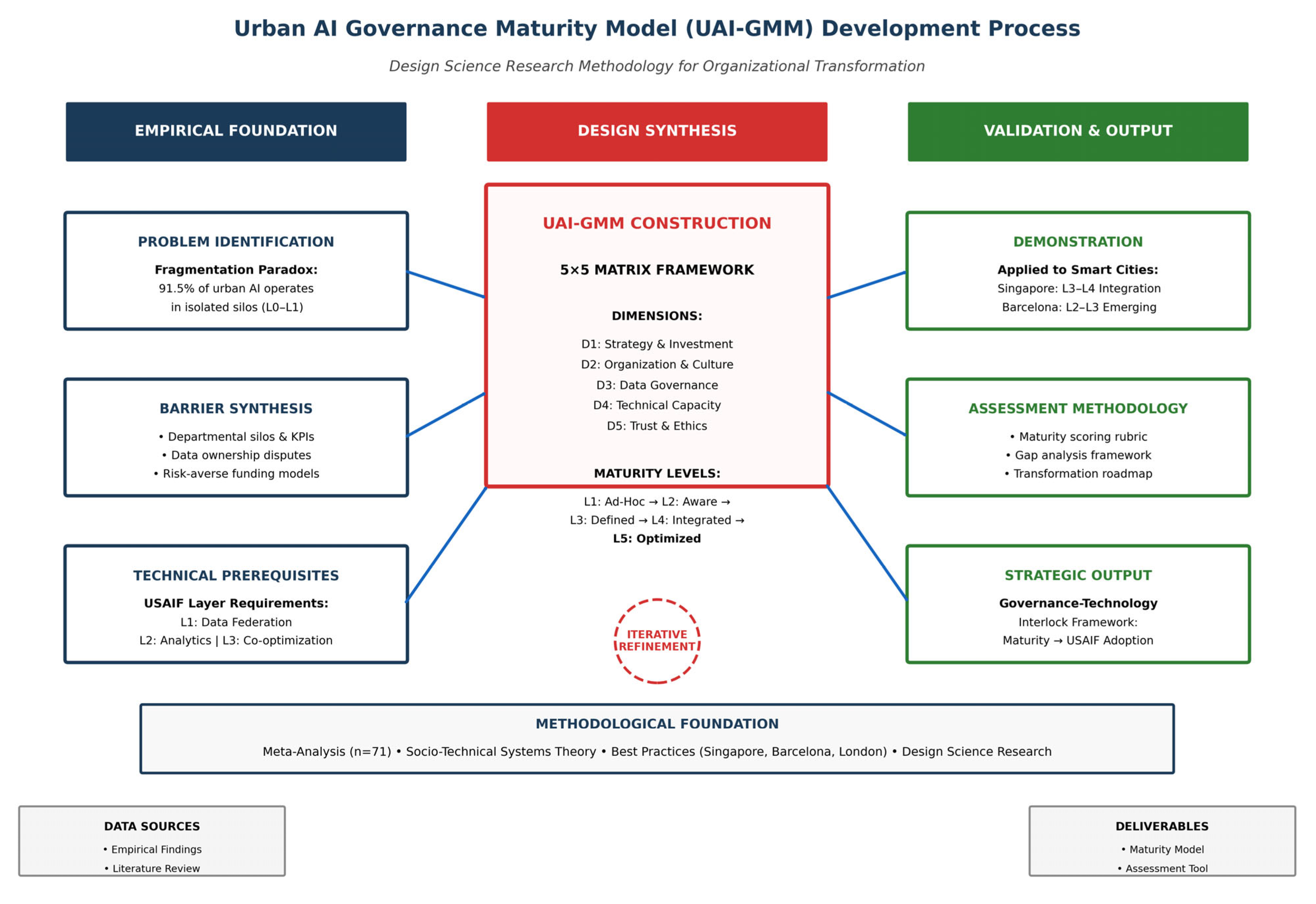
The literature review confirms a critical gap as illustrated in Table 1: the absence of a maturity model that specifically links organizational governance capabilities to the technical requirements of integrated, AI-driven urban systems. A new model is needed that incorporates the principles of STS theory, addresses the root causes of urban fragmentation, and provides a structured pathway for adopting complex AI frameworks like the UAIF as shown in Figure 1.

3. Methodology: Developing the UAIG

To develop a robust and relevant maturity model, we adopted the Design Science Research (DSR) methodology as shown in Figure 1. DSR is a rigorous approach for creating and evaluating novel artifacts that solve real-world organizational problems [10,20].

3.1. Design Science Research Approach

The development of the UAIG followed the five phases of the DSR process as articulated by Hevner et al. [20]:
  • Problem Identification and Motivation (Awareness): Defined by the empirical findings of our meta-analysis [1] and the literature review (Section 2).
  • Definition of Objectives for a Solution (Suggestion): To develop a maturity model that enables cities to assess their organizational readiness and define a strategic roadmap for adopting integrated AI frameworks.
  • Design and Development (Development): Defining the scope, dimensions, and levels of the UAIG based on multiple data inputs and iterative refinement.
  • Demonstration (Evaluation): The utility of the model was demonstrated through illustrative application to established smart city cases (Section 5). This phase confirms the artifact’s feasibility and utility in a preliminary manner.
  • Communication (Conclusion): This paper serves as the communication of the developed artifact.

3.2. Data Collection and Analysis (Design Inputs)

The design of the UAIG was informed by three primary sources of evidence to ensure rigor and relevance:
Barrier Synthesis: A systematic synthesis of the organizational and governance barriers identified in our prior empirical work [1] and the broader literature (Section 2.2).
UAIF Requirement Analysis: A detailed analysis of the UAIF architecture [2]. We reverse-engineered each layer of the UAIF to identify the implicit organizational and governance prerequisites for its successful implementation.
Best Practice Synthesis: An analysis of publicly available strategies, policy documents, and case studies of leading smart cities known for their advanced integration efforts (e.g., Singapore, Barcelona, London) [21,22].

3.3. Model Construction

The UAIG was constructed through an iterative process, aligning with the DSR approach:
Defining Dimensions: The synthesized inputs were categorized using thematic analysis [23]. This iterative coding process identified recurring themes related to organizational barriers and technical prerequisites. Through refinement based on the STS theoretical framework, these themes converged into five critical dimensions (Section 4.3).
Defining Levels: We adopted a five-level structure, consistent with established maturity model conventions (e.g., CMMI) [16], ranging from initial ad-hoc processes to optimized systemic integration (Section 4.2).
Developing Descriptors: For each intersection of dimension and level, specific, observable characteristics and practices were defined. This process involved iterative refinement based on applying the descriptors to the best practice cases, ensuring their mutual exclusivity and collective exhaustivity.

4. The Urban AI Governance Maturity Model (UAIG)

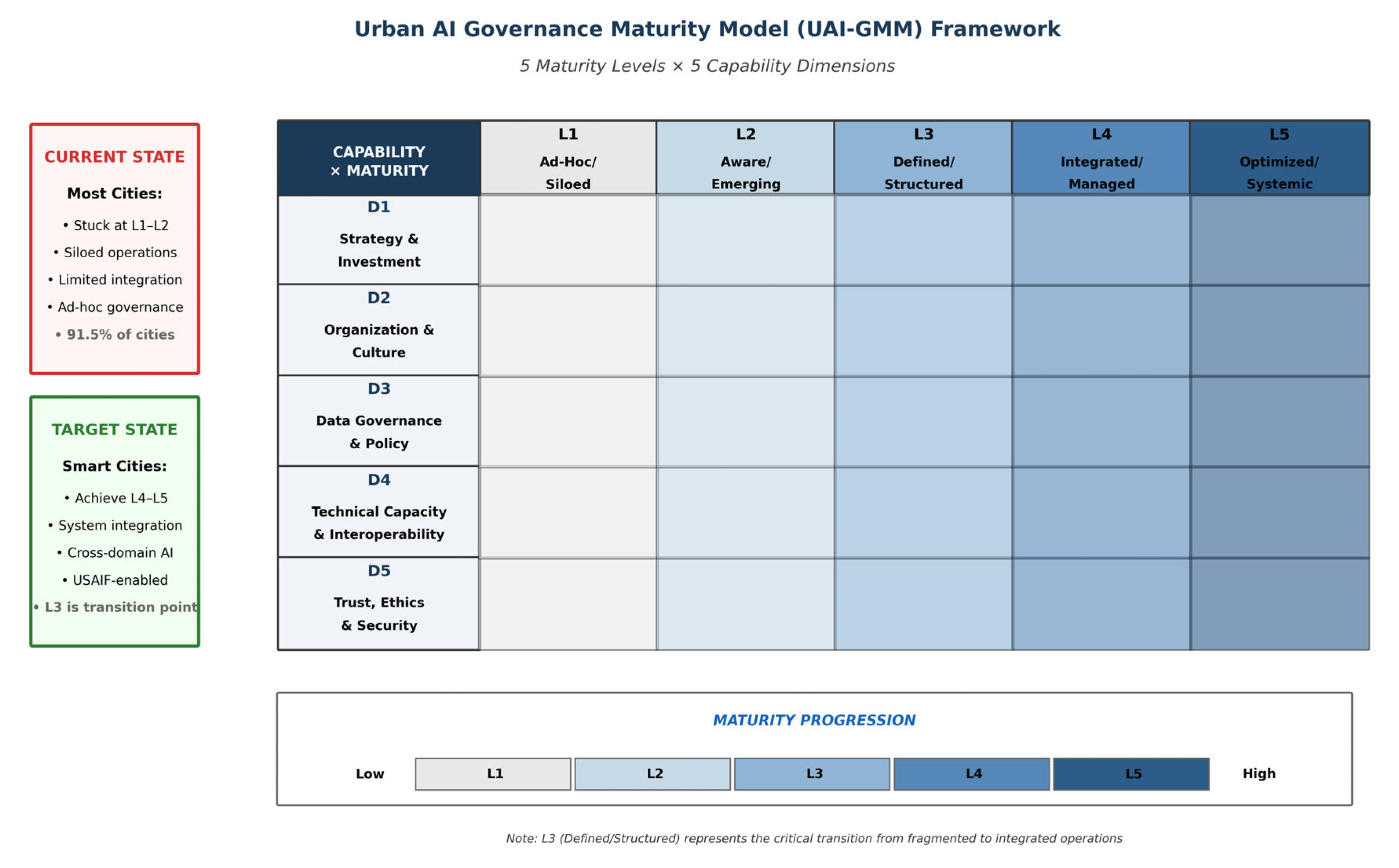
We examine the Urban AI Governance Maturity Model (UAIG), which is the core contribution of this research as illustrated in Figure 2.

4.1. Model Overview

The UAIG is structured as a 5 × 5 matrix, comprising five levels of maturity across five critical dimensions of capability.

4.2. The 5 Levels of Maturity (The Journey)

The five levels represent the evolutionary path a city undertakes in its journey towards integrated urban intelligence.
L1: Ad-Hoc/Siloed: The baseline observed in [1]. Activities are characterized by fragmented pilots and departmental autonomy.
L2: Aware/Emerging: Recognition of the limitations of silos. Initial efforts to inventory data assets and establish foundational governance structures are underway, but practices remain inconsistent.
L3: Defined/Structured: Formal governance policies, standards, and organizational structures for integration are established and mandated. Adherence to interoperability standards (e.g., the UAIF CIP [2]) is required for new projects.
L4: Integrated/Managed: City-wide data federation and cross-domain analytics are operational (UAIF Layers 1 & 2). Integration efforts are quantitatively managed and measured.
L5: Optimized/Systemic: Holistic AI-driven co-optimization and control are operational (UAIF Layer 3). Governance is focused on continuous improvement, ethics, and equity.

4.3. The 5 Dimensions of Capability (The Pillars)

The five dimensions represent the essential organizational capabilities required to support integrated urban AI.
D1: Strategy, Leadership, and Investment: Assesses the clarity of the vision, the strength of the political mandate, and the sustainability of funding models, emphasizing the shift from funding isolated pilots to investing in shared infrastructure.
D2: Organizational Structure and Culture: Evaluates the evolution of roles and structures to support horizontal integration, including the role of a Chief Data Officer (CDO) and a culture that incentivizes collaboration and shared KPIs.
D3: Data Governance and Policy: Focuses on frameworks for managing data as a strategic asset, including data ownership definition, sharing agreements, and standardization of data catalogs (e.g., W3C DCAT v3 [24]).
D4: Technical Capacity and Interoperability: Assesses the underlying technical infrastructure and skills, evaluating the adoption of open standards mandated by UAIF, such as NGSI-LD [25] and OGC standards [26], or equivalent open interoperability frameworks. This dimension further evaluates the ability to manage a federated digital twin architecture, emphasizing the avoidance of vendor lock-in through standardized data exchange mechanisms.
D5: Trust, Ethics, and Security: Addresses the critical elements of responsible AI adoption, including the implementation of robust AI ethics governance frameworks (e.g., ISO/IEC 42001 [27], NIST AI RMF [20]) and the robustness of the cybersecurity posture (e.g., NIST CSF 2.0 [28]).

4.4. The UAIG Matrix Visualization

The UAIG matrix in Table 2, details the specific, observable characteristics and practices at the intersection of each maturity level and dimension.

5. Operationalization and Illustrative Application

The value of the UAIG lies in its utility as both a diagnostic tool and a strategic roadmap. This section describes how the model can be operationalized and presents an illustrative application, fulfilling the Demonstration phase of the DSR methodology.

5.1. The Assessment Methodology (Operationalization)

The UAIG provides a structured methodology for cities to assess their current state and plan their transformation journey. To ensure replicability and reduce the subjectivity inherent in qualitative assessments, the assessment process follows a four-stage cycle derived from maturity model best practices [16]. First, the scoping and evidence collection phase defines boundaries, such as city-wide versus domain-specific scope, and gathers artifacts including strategic plans, API documentation, and budget allocations. Second, a rubric-based scoring evaluates evidence against specific descriptor questions. While the model treats all dimensions as equally critical for holistic integration, cities may prioritize specific dimensions based on immediate strategic goals. Third, a gap analysis identifies the delta between the current maturity profile and the target state, which is typically Level 4 for effective smart city operation. Fourth, roadmap development prioritizes actions to bridge identified gaps.
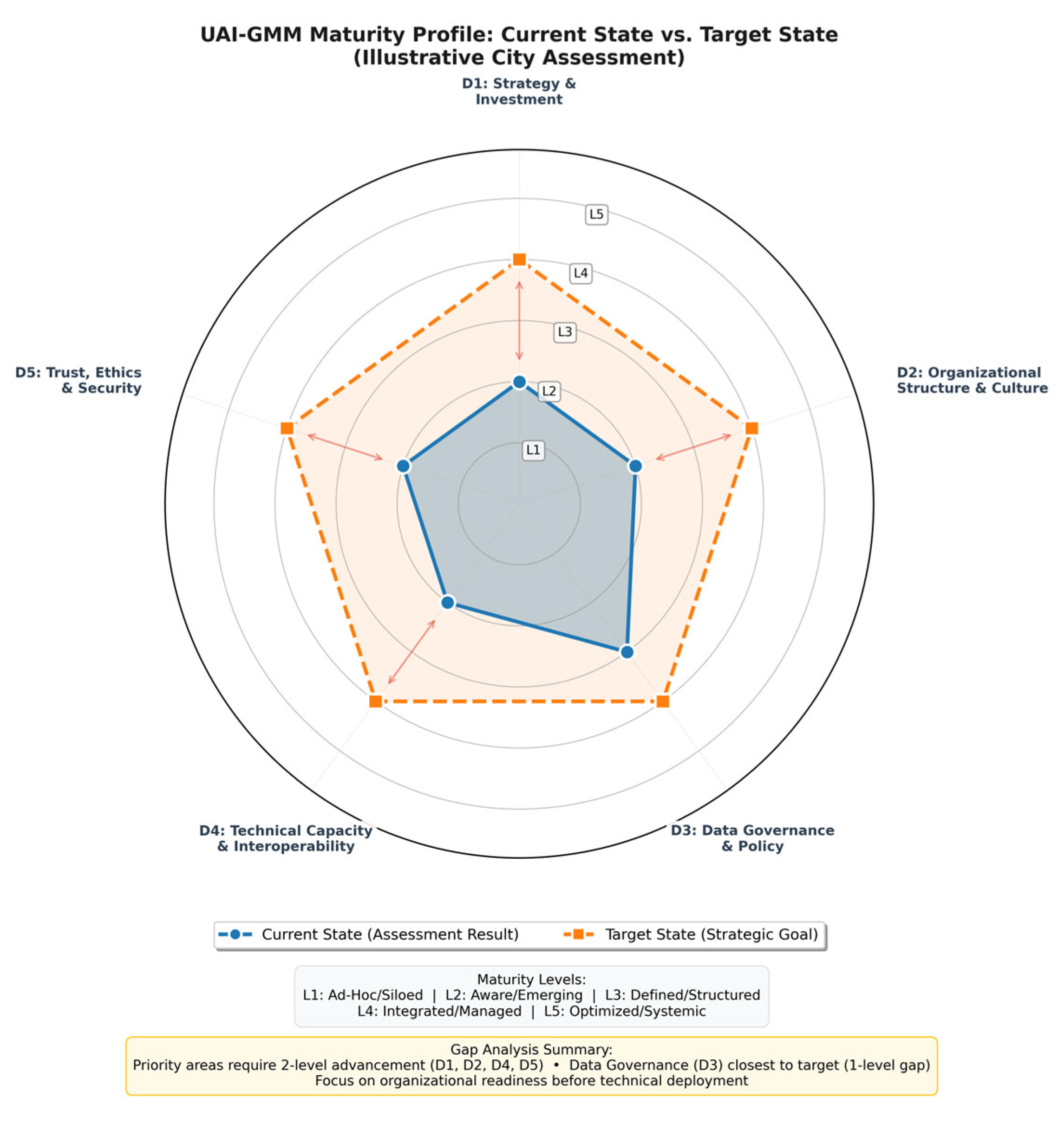
To facilitate the scoring process and mitigate assessment bias, Table 3 provides a sample assessment rubric with guiding questions and evidentiary requirements and Figure 3 provides an illustrative Radar Map of the assessment.
The process involves:
  • Scoping the Assessment: Defining the boundaries of the assessment (e.g., city-wide or specific domains).
  • Data Collection: Gathering evidence through stakeholder interviews, review of policy documents, and analysis of technical architectures.
  • Maturity Scoring: Evaluating the collected evidence against the descriptors in the UAIG matrix in Table 2.
  • Gap Analysis and Roadmap Development: Identifying gaps between the current maturity profile and the target state, facilitating the prioritization of actions.

5.2. The Governance-Technology Interlock: Synchronizing Maturity and Implementation

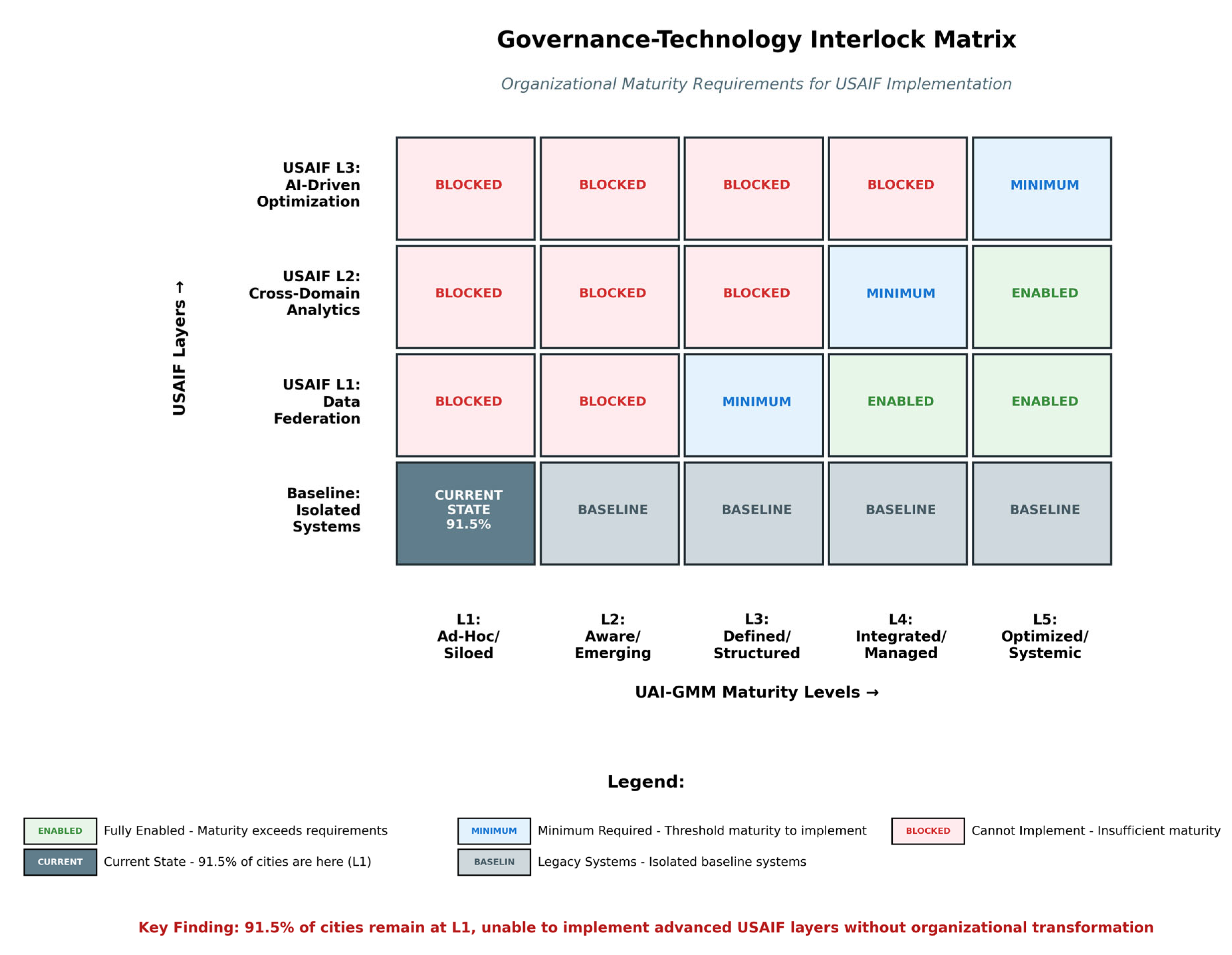
A key feature of the UAIG is its explicit linkage to the technical implementation phases of the UAIF framework (as detailed in [2]). Successful implementation of integrated AI requires a synchronization of organizational maturity and technological deployment—the “Governance-Technology Interlock” demonstrated in Figure 4.
The UAIG helps identify critical dependencies. For example, achieving UAIF Phase 1 (Data Federation) is contingent upon reaching at least L2 maturity in D3 (Data Governance) and D4 (Technical Capacity). Attempting to deploy advanced UAIF phases without the prerequisite organizational maturity is a primary driver of the failures and fragmentation observed in current smart city initiatives.

5.3. Illustrative Application (Demonstration of Utility)

To demonstrate the utility of the UAIG as an analytical artifact within the DSR cycle [10], we apply the model to analyze the governance strategies of three illustrative cities as per Table 4. This application serves as a demonstration of the logic and explanatory power of the model rather than a formal empirical validation. The analysis leverages publicly available information from established smart city case studies to illustrate how the model differentiates between varying levels of urban AI readiness [21,22].
High Maturity (e.g., Singapore): Singapore’s “Smart Nation” initiative is characterized by strong central leadership (D1), a dedicated governance body (GovTech) (D2), and mandated interoperability standards (D4) [21]. This high organizational maturity enabled Singapore to achieve the only Level 3 integration (real-time multi-domain integration) identified in our meta-analysis [1].
Medium Maturity (e.g., Barcelona): Barcelona demonstrates strong commitment to open data (D3) and has a clear digital strategy (D1) [22]. However, challenges remain in achieving full cross-departmental coordination and scaling integration (D2).
Low Maturity (Representative City): Many cities remain focused on isolated pilot projects, characterized by departmental silos and lack of centralized strategy, corresponding to the L1 maturity level.

5.4. Insights from the Demonstration

The illustrative application of the UAIG demonstrates its utility as an explanatory framework. The model helps to systematically analyze why certain cities succeed in integrating urban systems while others fail. The case studies illustrate that high maturity in technical capacity (D4) alone is insufficient; it must be matched by corresponding maturity in strategy (D1), organizational structure (D2), and data governance (D3).

6. Discussion: Implications for Policy and Practice

The UAIG offers significant implications for both the theory and practice of smart city development.

6.1. The Interdependence of Governance and Technology

A central implication of this research is the critical role of governance in the evolution of smart cities. The persistent fragmentation identified in [1] suggests that technological deployment often outpaces organizational capacity. However, we acknowledge that this relationship is bidirectional as governance and technical capacity are mutually constraining [13]. The UAIG posits that successful transformation requires a synchronized evolution, termed the Governance-Technology Interlock, rather than a purely top-down governance mandate.

6.2. Actionable Recommendations for Policymakers

The UAIG provides a basis for actionable recommendations for urban policymakers and CIOs:
  • Establish Centralized Leadership and Vision (D1): Create a clear, city-wide vision for integrated AI, backed by a strong political mandate. Secure sustainable funding for shared integration infrastructure.
  • Empower a Chief Data Officer (CDO) and Cross-Functional Teams (D2): Establish a CDO with the authority to drive data governance across departments. Reform organizational structures to support cross-functional integration teams with shared KPIs.
  • Mandate Open Standards and Interoperability (D4): Reform procurement policies to mandate adherence to open standards (e.g., NGSI-LD, OGC) and require interoperability testing (e.g., using the UAIF CIP [2]).
  • Invest in Trust and Responsible AI (D5): Proactively address ethical considerations and build public trust by implementing robust AI governance frameworks (e.g., ISO/IEC 42001).

6.3. Theoretical Contributions

This research makes several theoretical contributions. First, it advances the application of Socio-Technical Systems theory to the domain of smart cities by developing a concrete artifact (the UAIG) that operationalizes the concept of “joint optimization” for urban AI. Second, it addresses the limitations of existing maturity models by introducing a framework specifically tailored to the challenges of cross-domain integration and AI co-optimization. Third, it provides the strategic counterpart to the technical UAIF framework, completing the holistic perspective on achieving integrated urban intelligence. This alignment supports recent findings in IoT dependability which argue for a clear separation and synchronization between the management plane (governance) and the operation plane (technical execution) to ensure system reliability and integration [29].

6.4. Limitations and Future Research

We acknowledge several limitations. The UAIG, while developed rigorously using DSR, requires further empirical validation. The demonstration provided in Section 5 is preliminary; rigorous evaluation through in-depth case studies and surveys is needed to refine the model’s descriptors and confirm its generalizability across different urban contexts (e.g., Global South). Furthermore, the assessment process retains a degree of subjectivity; future work must focus on developing robust scoring rubrics to enhance reliability.
The UAIG, while developed rigorously using DSR [19], requires further empirical validation. Future research will focus on engaging a panel of global smart city experts and CIOs in Delphi studies to refine the descriptors and validate the content validity of the dimensions. Additionally, we plan to partner with pilot cities to conduct longitudinal case studies that track organizational transformation over 12 to 24 months, providing data on the efficacy of the model as a change management tool. Finally, we aim to develop a standardized survey instrument to test discriminant validity across a large sample size of municipalities, eventually establishing a global maturity benchmark.

7. Conclusions

The evolution of smart cities is at a crossroads. While the technical capabilities of AI offer immense potential for urban transformation, the pervasive fragmentation of urban systems prevents the realization of systemic benefits. Our research arc has systematically addressed this challenge: diagnosing the empirical reality of fragmentation [1], proposing a technical blueprint for integration (the UAIF) [2], and, in this paper, introducing the strategic roadmap for organizational transformation (the UAIG).
The UAIG provides a structured framework for cities to assess their organizational readiness and mature their governance capabilities across five critical dimensions. By explicitly linking organizational maturity to the technical prerequisites of integration, the model addresses the socio-technical bottlenecks that have long hindered smart city development.
Ultimately, the success of the smart city vision depends less on the sophistication of the technology and more on the capacity of urban organizations to adapt and evolve. The UAIG provides the strategic lens required to finally bridge the fragmentation gap and realize the vision of truly intelligent, sustainable, and human-centric cities.

Author Contributions

Conceptualization, O.A.; Methodology, O.A.; Software, O.A.; Validation, O.A. and S.T.A.; Formal Analysis, O.A.; Writing Original Draft Preparation, O.A.; Writing Review and Editing, O.A. and S.T.A.; Visualization, O.A.; Supervision, S.T.A. All authors have read and agreed to the published version of the manuscript.

Funding

This research received no external funding.

Institutional Review Board Statement

Not applicable.

Informed Consent Statement

Not applicable.

Data Availability Statement

No new data were created or analyzed in this study.

Acknowledgments

During the preparation of this manuscript, the authors used Grammarly (Desktop for Windows v1.2.194, released 10 September 2025) and Microsoft Copilot in Word (Microsoft 365 Build 19127.20192, released 3 September 2025) for language enhancement in the manuscript (grammar, structure, spelling, vocabulary, punctuation, and formatting). The authors have reviewed and edited the output and take full responsibility for the content of this publication.

Conflicts of Interest

The authors declare no conflicts of interest.

References

  1. Alrasbi, O.; Ariaratnam, S.T. A Meta-Analysis of Artificial Intelligence in the built environment: High-Efficacy Silos and Fragmented Ecosystems. Smart Cities 2025, 8, 174. [Google Scholar] [CrossRef]
  2. Alrasbi, O.; Ariaratnam, S. The Urban Systems Artificial Intelligence Framework (UAIF): An AI-Driven Engineering Blueprint for Overlaying Intelligence on Existing Urban Infrastructure. Doctoral Dissertation, Arizona State University, Tempe, Arizona, 2026. [Google Scholar]
  3. Albino, V.; Berardi, U.; Dangelico, R.M. Smart Cities: Definitions, Dimensions, Performance, and Initiatives. J. Urban Technol. 2015, 22, 3–21. [Google Scholar] [CrossRef]
  4. Mora, L.; Deakin, M.; Reid, A. Strategic Principles for Smart City Development: A Multiple Case Study Analysis of European Best Practices. Technol. Forecast. Soc. Chang. 2019, 142, 70–97. [Google Scholar] [CrossRef]
  5. Bibri, S.E.; Krogstie, J. Smart sustainable cities of the future: An extensive interdisciplinary literature review. Sustain. Cities Soc. 2017, 31, 183–212. [Google Scholar] [CrossRef]
  6. Janssen, M.; Matheus, R.; Zuiderwijk, A. Big and Open Linked Data (BOLD) for smart cities: Analyzing the barriers and developing a framework for data integration and analytics. Gov. Inf. Q. 2020, 37, 101483. [Google Scholar] [CrossRef]
  7. Chourabi, H.; Nam, T.; Walker, S.; Gil-Garcia, J.R.; Mellouli, S.; Nahon, K.; Pardo, T.A.; Scholl, H.J. Understanding Smart Cities: An integrative framework. In Proceedings of the 45th Hawaii International Conference on System Sciences, Maui, HI, USA, 4–7 January 2012; pp. 2289–2297. [Google Scholar] [CrossRef]
  8. ISACA. COBIT 2019 Framework: Introduction and Methodology; ISACA: Schaumburg, IL, USA, 2018. [Google Scholar]
  9. Kitchin, R. The real-time city? Big data and smart urbanism. GeoJournal 2014, 79, 1–14. [Google Scholar] [CrossRef]
  10. Peffers, K.; Tuunanen, T.; Rothenberger, M.A.; Chatterjee, S. A design science research methodology for information systems research. J. Manag. Inf. Syst. 2007, 24, 45–77. [Google Scholar] [CrossRef]
  11. Baxter, G.; Sommerville, I. Socio-Technical Systems: From Design Methods to Systems Engineering. Interact. Comput. 2011, 23, 4–17. [Google Scholar] [CrossRef]
  12. Kitchin, R. The ethics of smart cities and urban science. Philos. Trans. R. Soc. 2016, 374, 20160115. [Google Scholar] [CrossRef] [PubMed]
  13. Hughes, T.P. The evolution of large technological systems. In The Social Construction of Technological Systems: New Directions in the Sociology and History of Technology; Bijker, W.E., Hughes, T.P., Pinch, T.J., Eds.; MIT Press: Cambridge, MA, USA, 1987; pp. 51–82. [Google Scholar]
  14. Zuiderwijk, A.; Chen, Y.-C.; Salem, F. Implications of the use of artificial intelligence in public governance: A systematic literature review and a research agenda. Gov. Inf. Q. 2021, 38, 101577. [Google Scholar] [CrossRef]
  15. OASC. Minimal Interoperability Mechanisms (MIMs) Plus Technical Specifications, V4.0; Open & Agile Smart Cities (OASC): Brussels, Belgium, 2021. [Google Scholar]
  16. Becker, J.; Knackstedt, R.; Pöppelbuß, J. Developing maturity models for IT management—A procedure model and its application. Bus. Inf. Syst. Eng. 2009, 1, 213–222. [Google Scholar] [CrossRef]
  17. Caird, S.P.; Hallett, S.H. Towards a framework for evaluating the maturity of smart city strategies. Cities 2019, 89, 160–170. [Google Scholar] [CrossRef]
  18. Anthopoulos, L.; Reddick, C.G. Smart city maturity models: A systematic literature review. Inf. Polity 2016, 21, 169–183. [Google Scholar] [CrossRef]
  19. NIST. Artificial Intelligence Risk Management Framework, AI RMF 1.0; National Institute of Standards and Technology: Gaithersburg, MD, USA, 2023. [Google Scholar] [CrossRef]
  20. Hevner, A.R.; March, S.T.; Park, J.; Ram, S. Design science in information systems research. MIS Q. 2004, 28, 75–105. [Google Scholar] [CrossRef]
  21. Sipahi, E.B.; Saayi, Z. The world’s first “Smart Nation” vision: The case of Singapore. Smart Cities Reg. Dev. (SCRD) J. 2024, 8, 41–58. [Google Scholar] [CrossRef]
  22. Bakıcı, T.; Almirall, E.; Wareham, J. A smart city initiative: The case of Barcelona. J. Knowl. Econ. 2013, 4, 135–148. [Google Scholar] [CrossRef]
  23. Braun, V.; Clarke, V. Using thematic analysis in psychology. Qual. Res. Psychol. 2006, 3, 77–101. [Google Scholar] [CrossRef]
  24. W3C. Data Catalog Vocabulary (DCAT)—Version 3. W3C Recommendation. 22 August 2024. Available online: https://www.w3.org/TR/vocab-dcat-3/ (accessed on 14 October 2025).
  25. ETSI. Context Information Management (CIM); NGSI-LD API (ETSI GS CIM 009 V1.7.1); European Telecommunications Standards Institute: Sophia Antipolis, France, 2023. [Google Scholar]
  26. OGC. OGC API—Features—Part 1: Core. Open Geospatial Consortium. 2019. Available online: http://docs.opengeospatial.org/is/17-069r3/17-069r3.html (accessed on 14 October 2025).
  27. ISO/IEC 42001:2023; Information Technology—Artificial Intelligence—Management System. International Organization for Standardization: Geneva, Switzerland, 2023.
  28. NIST. Framework for Improving Critical Infrastructure Cybersecurity, Version 2.0 (NIST Cybersecurity Framework 2.0); National Institute of Standards and Technology: Gaithersburg, MD, USA, 2024. [Google Scholar] [CrossRef]
  29. Hao, L.; Zhang, S.; Schulzrinne, H. Advancing IoT System Dependability: A Deep Dive into Management and Operation Plane Separation. In Proceedings of the 2025 IEEE 11th World Forum on Internet of Things (WF-IoT), Chengdu, China, 27–30 October 2025. [Google Scholar] [CrossRef]
Figure 1. The Design Science Research (DSR) Process Adapted for UAIG Development.
Urbansci 10 00063 g001
Figure 2. Overview of the UAIG Framework (5 Levels and 5 Dimensions).
Urbansci 10 00063 g002
Figure 3. Sample Assessment Radar Chart UAIG Scoring (Illustrative).
Urbansci 10 00063 g003
Figure 4. The Governance-Technology Interlock: Mapping UAIG Maturity Levels to UAIF Implementation Prerequisites.
Urbansci 10 00063 g004
Table 1. Comparison of Existing Smart City Maturity Models and Gaps Addressed by UAIG.
Model/FrameworkFocus AreaKey Limitations in the Context of Integrated Urban AIUAIG Contribution
COBIT [8]IT Governance and ManagementGeneric IT focus; lacks specificity for the socio-technical complexities of urban systems; weak on cross-departmental integration.Provides urban-specific governance dimensions and addresses socio-technical alignment (STS theory).
Smart City Maturity Model (SCMM) [17]General Smart City DevelopmentTechnocratic bias; focuses on technology deployment rather than organizational capacity and governance evolution.Balances technical capacity (D4) with organizational structure (D2) and strategy (D1).
Anthopoulos & Reddick Review [18]Literature Synthesis of ModelsConfirms the fragmentation of models; notes that models often lack empirical validation or focus on specific technical architectures.Provides a synthesis based on empirical barriers and specific technical requirements (UAIF).
AI-Specific Frameworks (e.g., NIST AI RMF [19])AI Risk ManagementFocuses narrowly on risk and ethics (D5) but does not address the organizational transformation needed to implement AI systemically.Integrates ethics and trust (D5) within a broader organizational transformation framework.
Table 2. The UAIG Matrix: Detailed Descriptors.
DimensionL1: Ad-Hoc/SiloedL2: Aware/EmergingL3: Defined/StructuredL4: Integrated/ManagedL5: Optimized/Systemic
D1: Strategy & InvestmentVision is fragmented; Funding is project-based/short-term; Departmental leadership.Emerging recognition of integration need; Initial funding for pilot studies; CIO recognizes gap.Formal city-wide AI strategy defined; Mandated integration roadmap; Funding allocated for shared infrastructure.Strategy actively managed and measured; Sustainable funding models operational; Centralized, empowered leadership.Integrated vision embedded in city DNA; Continuous investment in innovation; Leadership champions systemic optimization.
D2: Org. Structure & CultureRigid departmental silos; KPIs conflict; Resistance to data sharing; No CDO.Initial cross-departmental working groups; Data sharing is ad-hoc but encouraged; CDO role proposed.Formal integration structures (e.g., Task Forces); Shared KPIs defined; CDO established with clear mandate.Cross-functional teams operational; KPIs actively tracked and incentivize collaboration; Data-driven culture emerging.Flexible, adaptive organizational structure; Shared KPIs drive system-wide outcomes; Deeply embedded data-driven culture.
D3: Data Governance & PolicyData ownership is departmental; No sharing agreements; Ad-hoc data quality.Data inventory initiated; Basic sharing principles discussed; Awareness of data quality issues.Formal data governance framework established (e.g., DCAT); Standardized sharing agreements mandated; Data quality standards defined.Governance framework operational and audited; Data managed as a strategic asset; Automated data quality monitoring.Continuous improvement of governance; Policy adapts rapidly to new data sources; Automated, predictive data quality management.
D4: Technical Capacity & InteroperabilityProprietary systems; No interoperability standards; Limited AI skills.Inventory of systems; Recognition of interoperability gap; Basic AI training initiated.Open standards mandated (e.g., NGSI-LD [24], OGC [25], or equivalent); Interoperability testing required (UAIF CIP); Core AI team established.Federated architecture operational (UAIF L1/L2); Full interoperability achieved; Advanced AI/MLOps capabilities deployed.System-of-systems architecture (UAIF L3); Dynamic, adaptive interoperability; Leading-edge AI research and deployment.
D5: Trust, Ethics & SecuritySecurity is reactive/localized; Ethical considerations absent or ad-hoc.Awareness of AI ethics and security risks; Basic security policies in place.Formal AI ethics framework adopted (e.g., NIST AI RMF); Security standards mandated (e.g., NIST CSF); Algorithmic transparency required.Ethics and security actively managed and audited; Privacy-by-design implemented; Proactive cybersecurity posture.Robust, adaptive AI ethics governance (ISO 42001); Full algorithmic accountability; System-wide, predictive security.
Table 3. Sample Assessment Rubric for UAIG Scoring (Illustrative).
DimensionGuiding Assessment Question (Sample)Evidence Required for L3 (Defined/Structured)
D1: Strategy & InvestmentIs there a documented AI strategy with a dedicated budget?Published City AI Strategy; Line item for shared infrastructure in annual budget.
D2: Org. Structure & CultureIs there a central authority for data integration?Appointment of CDO/CIO with cross-departmental authority; Inter-agency task force minutes.
D3: Data Governance & PolicyAre data sharing agreements standardized?Existence of a data marketplace or standard MOU templates used by multiple departments [23].
D4: Technical Capacity & InteroperabilityAre systems interoperable via open standards?Architecture diagrams showing NGSI-LD/OGC compliance [25,26]; Successful test of API data exchange.
D5: Trust, Ethics & SecurityIs there an AI ethics review board?Charter of Ethics Committee; Records of algorithmic impact assessments [28].
Table 4. Comparative Analysis of Illustrative Case Study Cities using the UAIG.
DimensionLow Maturity (Representative City)Medium Maturity (e.g., Barcelona)High Maturity (e.g., Singapore)
D1: Strategy & InvestmentL1: Fragmented vision, project-based funding.L3: Clear digital strategy defined, but integration funding remains challenging.L5: “Smart Nation” vision embedded; sustainable funding for shared infrastructure.
D2: Org. Structure & CultureL1: Rigid departmental silos; conflicting KPIs.L2: Emerging cross-departmental groups, but coordination remains inconsistent.L4: Dedicated governance body (GovTech); shared KPIs incentivize collaboration.
D3: Data Governance & PolicyL1: Departmental data ownership; no sharing agreements.L3: Strong open data mandates and standardized catalogs; governance framework established.L4: Data governed as a city-wide asset; standardized sharing protocols operational.
D4: Technical Capacity & InteroperabilityL1: Proprietary systems; no interoperability standards.L3: Adoption of open standards in progress; challenges in scaling interoperability.L4: Mandated interoperability standards; operational federated architecture.
D5: Trust, Ethics & SecurityL1: Reactive security; ad-hoc ethical considerations.L3: Formal security policies; emerging focus on digital rights and ethics.L4: Proactive security posture; robust governance frameworks for responsible technology use.
Observed Integration (Empirical)Level 0–1 (Siloed)Level 1–2 (Emerging data sharing)Level 3 (Multi-domain integration) [1,21]
Disclaimer/Publisher’s Note: The statements, opinions and data contained in all publications are solely those of the individual author(s) and contributor(s) and not of MDPI and/or the editor(s). MDPI and/or the editor(s) disclaim responsibility for any injury to people or property resulting from any ideas, methods, instructions or products referred to in the content.