1. Introduction
While cities occupy a mere 3% of the global land area, they concentrate the vast majority of economic activity and population [
1,
2], a figure projected to reach 80% by 2050 [
3]. This demographic density, coupled with the fact that urban centres account for over 70% of global CO
2 emissions [
4], positions them as critical focal points for climate mitigation and the transition toward sustainable development paradigms [
5,
6]. Central to this challenge is urban transport, a primary contributor to both environmental degradation and the decline in public health [
7,
8,
9]. Consequently, transforming this sector has become a prerequisite for achieving international climate objectives [
10,
11,
12]. This transformation requires a holistic view, as urban mobility entails a complex interplay between passenger movement and last-mile freight distribution. Since both processes share critical infrastructure—such as streets and intermodal nodes—they generate transversal effects on congestion and efficiency [
13,
14]. Accordingly, current literature increasingly advocates for moving beyond traditional transport silos, promoting integrated models that leverage synergies to enhance logistical efficiency and mitigate environmental impacts [
15,
16,
17].
Cities are beginning to explore synergies between urban passenger mobility and freight distribution. Specifically, integrating freight and passengers within the same system, particularly through the shared utilisation of buses, trams, and metros, has emerged in recent years as a potential solution to urban logistics challenges, thereby fostering reduced emissions and a more efficient use of existing infrastructure [
15,
18,
19,
20].
In this context, beyond environmental and logistical efficiency, the sustainability of urban transport systems must be multidimensional. It must not only optimise the utilisation of existing infrastructure via the integration of passengers and freight, but it must also ensure universal accessibility. The incorporation of universal design ensures that this same infrastructure meets the needs of all citizens, particularly those with reduced mobility.
Public transport plays a fundamental role in many aspects of daily life, facilitating access to employment [
21], education [
22], healthcare [
23], leisure [
24], and participation in social life [
25]. The inability to access public transport is one of the primary situations that prevents individuals from engaging in daily activities despite their desire to do so, disproportionately impacting people with disabilities or reduced mobility [
26,
27,
28,
29,
30].
Accessibility in urban public transport has been extensively analysed in the academic literature. The lack of accessibility at stops, stations, or within vehicles constitutes one of the primary barriers to mobility for people with disabilities and reduced mobility, thereby limiting their participation in the social, economic, and cultural life of cities [
31,
32,
33,
34,
35,
36]. Therefore, it is necessary to incorporate universal design as a guiding principle in the planning of transport infrastructure, with the aim of ensuring equitable access for all users [
26,
37,
38].
The existing literature has primarily relied upon qualitative studies, conducted through interviews or focus groups with small sample sizes, whereas research employing direct observation to assess the actual status of accessibility remains scarce [
39]. Furthermore, most of the work has focused on describing the barriers experienced by people with disabilities rather than on proposing solutions for their elimination [
35,
36,
38,
39].
Nevertheless, public administrations and transport operators require support instruments that facilitate the efficient allocation of resources and maximise the social impact of accessibility interventions. Although the integration of accessibility into urban transport planning is a widely recognised need in the literature [
32,
40,
41,
42], the lack of tools that enable the prioritisation of these improvements constitutes a critical gap in the research. This gap becomes even more relevant within the context of the increasing convergence between passenger mobility and urban logistics, where the prioritisation of interventions could be applied to dual-function mobility nodes, which simultaneously act as connection points for users and as logistical hubs.
Some studies have developed and validated a tool to assess the accessibility of public transport for people with physical disabilities and/or reduced mobility across various Spanish cities [
32,
43]. This methodology established critical and non-critical requirements from the perspective of user autonomy and safety in the use of public transport. Crucially, one of its main contributions was the integration of accessibility experts and people with physical disabilities in the definition, verification, and validation processes.
The literature has demonstrated that the participation of people with disabilities in the design of transport systems is essential to ensure that their mobility needs are met, to improve service quality, and to detect barriers that are invisible to traditional planners [
32,
38,
41,
42]. Consequently, the methodology integrated both compliance with the parameters established in the current regulations and legislation and the perspective provided by the users with physical disabilities themselves.
To complement traditional approaches, analytical tools that allow for the integration of multiple dimensions of analysis are required. In this regard, MCDM methodologies, such as the Analytic Hierarchy Process (AHP) or the Technique for Order Preference by Similarity to Ideal Solution (TOPSIS) constitute valuable resources for supporting complex decisions in urban planning. Various studies have demonstrated their utility in infrastructure projects [
44], in the planning and resource allocation for public services [
45,
46,
47], and in the analysis and design of transport systems [
48,
49], by allowing the integration of social, environmental, technical, and economic criteria into more robust and transparent planning processes.
Similarly, methods such as VlseKriterijumska Optimizacija I Kompromisno Resenje (VIKOR), the Complex Proportional Assessment (COPRAS), or the Additive Ratio Assessment (ARAS) have become established as effective approaches for solving problems with multiple conflicting objectives, such as the prioritisation of sustainable mobility measures in European cities [
50], the evaluation of transport options in contexts of urban congestion to determine the most sustainable alternatives [
51], the identification of key indicators in public transport systems [
52], and the optimisation of mobility infrastructure, such as the development of a park-and-ride system [
53].
The literature also highlights the utility of the AHP [
54,
55] and its fuzzy variants for prioritising criteria linked to accessibility in urban environments [
56,
57]. This is complemented by the value of hybrid approaches, which allow for a comprehensive evaluation of accessibility across spatial, economic, and social dimensions. These approaches have been applied in urban planning with multiple sustainability criteria [
56,
58], in the evaluation of accessibility to urban services, in the assessment of the impact of design on mobility [
54,
55,
57,
58], and in the identification of urban vulnerabilities linked to safety and social cohesion [
59].
The objective of this work is to design and validate a methodology for the prioritisation of interventions at bus stops. The purpose is to develop a practical tool that assists administrations and transport operators in optimising resource allocation and maximising the social impact of accessibility improvements.
The proposed methodology is based on a multi-criteria approach that integrates objective data with the active participation of a working group comprising researchers, architects, people with physical disabilities, and accessibility experts. This collaborative approach, applied from the design phase, ensures that the evaluation criteria respond comprehensively to the real needs of the users.
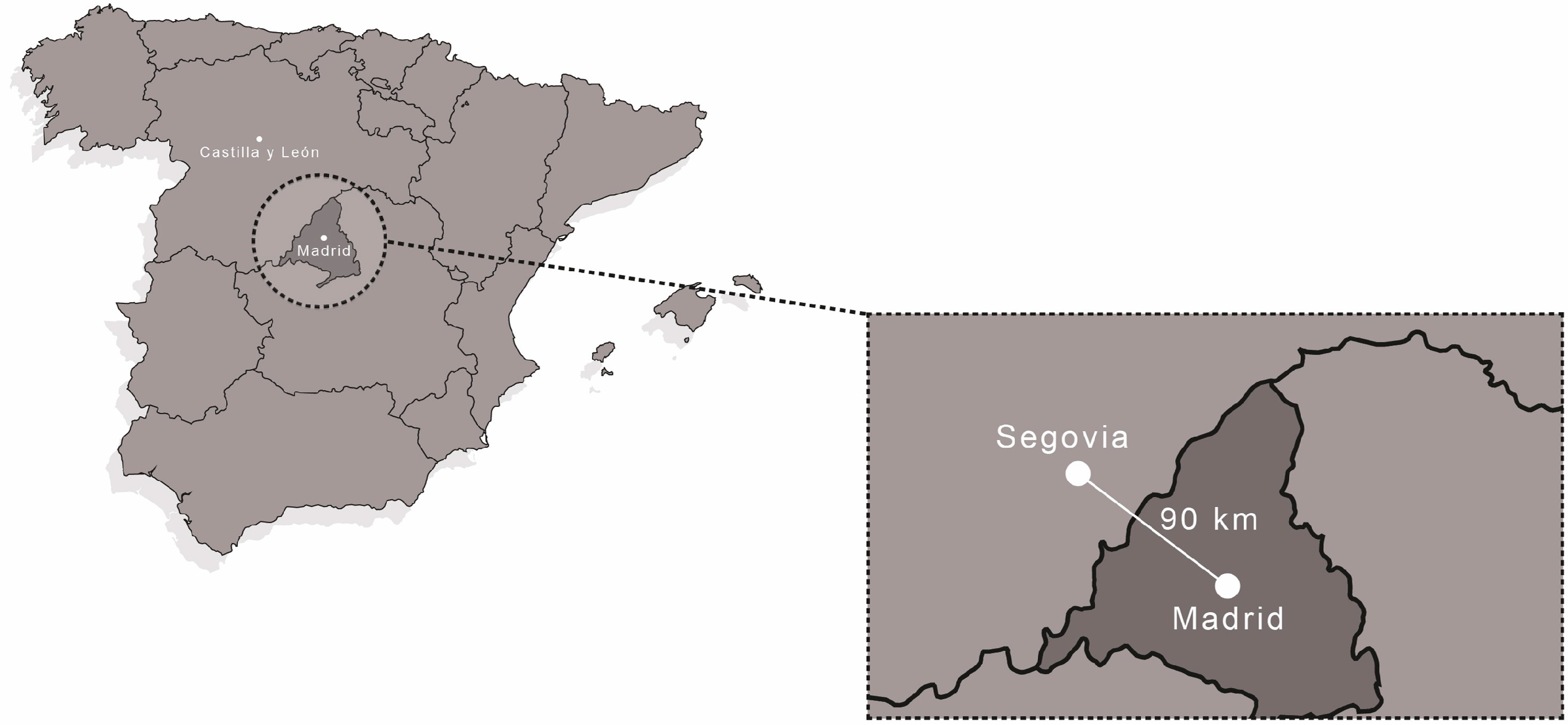
For empirical validation, the methodology was implemented in the city of Segovia (Spain). Building upon a preliminary study which evaluated 149 bus stops [
43], a sample of 30 stops was selected by an expert panel to facilitate the application and comparative analysis of prioritization results, utilising a combination of four MCDM methodologies: AHP-TOPSIS, AHP-VIKOR, AHP-COPRAS, and AHP–ARAS. This comparison enabled the authors not only to test the effectiveness of the methodology in a real urban context but also to analyse the differences between the approaches in order to assess their utility as a decision-support instrument.
Finally, the paper explores the possibility of extrapolating the methodology to other urban mobility nodes, such as intermodal stations or logistical micro-hubs. In this way, it contributes to the development of more inclusive, safe, and sustainable cities, fostering the implementation of accessible transport systems and the integration of accessibility into urban mobility policies. The proposal aligns directly with Sustainable Development Goal (SDG) 11, particularly Target 11.2 (Affordable and sustainable transport systems), by ensuring that interventions address the accessibility needs of vulnerable groups. This includes persons with disabilities, the elderly, expectant mothers, and individuals with temporary mobility impairments (e.g., those with injuries or recovering from medical procedures), as well as families with young children. By adopting this inclusive scope, the study ensures that the prioritisation model responds to the diverse functional requirements of the entire population throughout different life stages, while simultaneously addressing the environmental dimension of sustainability by fostering a modal shift away from private vehicle reliance toward more efficient public transport networks.
3. Multi-Criteria Decision-Making Methods
Following the definition of the four evaluation criteria and their associated data, their relative importance was determined using the Analytic Hierarchy Process (AHP), developed by Saaty [
61]. This method structures complex decision problems into hierarchical levels and assigns weights to the criteria based on pairwise comparisons conducted by the expert panel.
During the third session, each expert compared the relative importance of the criteria using Saaty’s fundamental scale (1–9), where a value of 1 indicates equal importance and 9 expresses an extreme preference of one criterion over another. The individual comparison matrices were aggregated by means of the geometric mean, obtaining a group consensus matrix. Based on this matrix, the normalised weights of each criterion were calculated, and the Consistency Ratio (CR) was verified to ensure the coherence of the judgements issued. Only matrices with CR < 0.10 were accepted, in accordance with the recommendations of Saaty [
61].
In complex decision processes, Multi-Criteria Decision-Making (MCDM) methods constitute essential tools for evaluating alternatives under multiple criteria—both qualitative and quantitative—and allow for the integration of technical and social information within a common analytical framework [
62]. In the present study, four representative methods of this approach were applied with the purpose of analysing the robustness and consistency of the results obtained in the prioritisation of interventions aimed at improving accessibility at bus stops.
The following outlines the mathematical formulation employed to derive the weights of the different criteria.
The consistency analysis shows that the matrix is acceptable, as the calculated Consistency Index (CI = 0.063933) combined with the Random Index for n = 4 (RI = 0.90) results in a Consistency Ratio of CR = 0.071037, which is below the recommended threshold of 0.10.
The final weights derived from AHP were employed in the application of four AHP–MCDM methodologies, selected for representing distinct approaches to decision making:
AHP–TOPSIS (Technique for Order Preference by Similarity to Ideal Solution): A method that identifies the best option by assessing the distance of each alternative from an ideal and an anti-ideal solution. Therefore, ensuring the best balance between positive and negative criteria [
63].
AHP–VIKOR (VlseKriterijumska Optimizacija I Kompromisno Resenje): A method focused on finding compromise solutions by simultaneously considering the maximum collective utility and the minimum individual dissatisfaction [
64].
AHP–COPRAS (Complex Proportional Assessment): This method evaluates alternatives based on their proportional contribution to the overall set, explicitly weighting both benefits and costs [
65].
AHP–ARAS (Additive Ratio Assessment): Calculates an additive ratio between each alternative and the best possible option, taking into account both the magnitude and the required direction of improvement [
66].
For each method, a decision matrix was constructed with 30 alternatives (stops) and the four weighted criteria. Quantitative criteria values underwent linear min-max normalization, unless the specific method for instance, vector normalization was strictly applied within the TOPSIS framework to maintain consistency with its mathematical formulation. For qualitative criteria, ordinal scales ranging from 1 to 9 were employed, following the consensus of the expert panel.
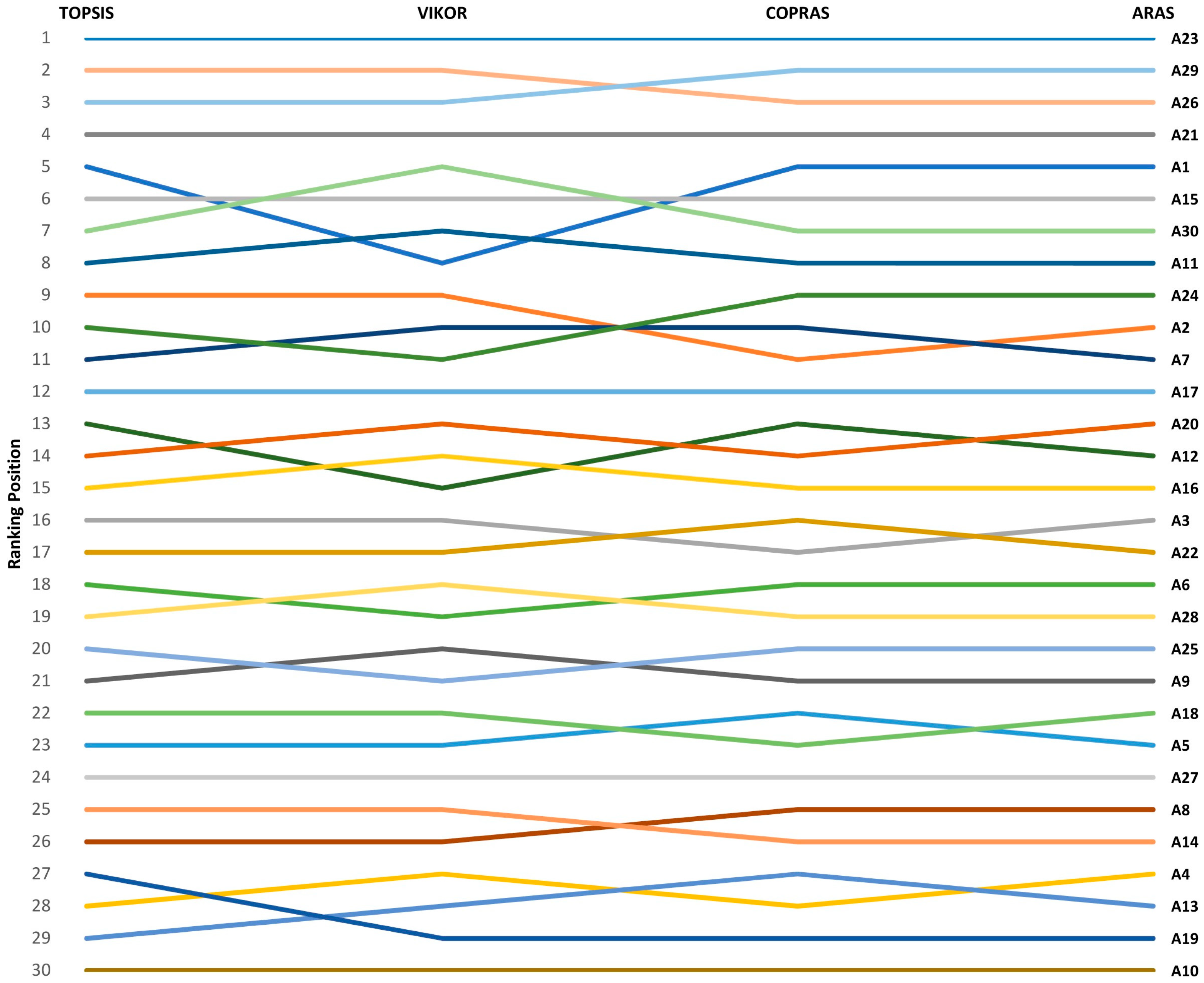
Subsequently, an independent ranking of the 30 stops was obtained for each MCDM method. The results were compared to analyse the robustness and stability of the priority order by calculating the Spearman correlation coefficient between the different rankings. This analysis enabled the authors not only to assess the consistency among the methods but also the reliability of the proposed model as a decision-support tool in complex urban settings.
The foundations of each of the applied methods are described in detail in the following sections.
3.1. AHP-TOPSIS
The Analytic Hierarchy Process (AHP) coupled with the Technique for Order Preference by Similarity to Ideal Solution (TOPSIS) was employed to evaluate and prioritise alternatives. The integration of AHP weights into TOPSIS facilitates the simultaneous assessment of each alternative’s proximity to the positive ideal solution (A+) and its distance from the negative ideal solution (A−), thereby accommodating both increasing and decreasing criteria.
This combined approach provides an objective and quantitatively precise evaluation, capitalising on the hierarchical rigour of AHP and the strong discriminatory capacity of TOPSIS. This integrated approach proves particularly suitable for problems requiring the comparison of technical solutions under multiple criteria related to performance, efficiency, and sustainability [
67,
68].
Starting from the performance matrix, .
Step 1. Normalisation (Vector Normalisation—Euclidean): Starting from the original evaluation matrix, a normalised decision matrix is constructed. This step is essential to convert all alternative values, with respect to the individual assessment criteria, to a common dimensionless base, thus enabling the necessary comparisons between them. The normalised rating
rij is calculated as follows:
Step 2. Weighted Matrix: The normalised decision matrix is multiplied by the relative weight of the corresponding criterion (column), which is calculated using a separate criterion weighting calculation method (for example, AHP).
Step 3. Ideal Solutions: Two hypothetical variables, A+ and A−, are defined, which, respectively, capture the maximum and minimum possible weighted performance values for each assessment criterion. The distinction between benefit criteria and cost criteria determines the values assigned to the positive ideal solution A+ and the negative ideal solution A−. The components of these ideal solutions are formally defined for each criterion as:
Step 4. Euclidean Distances to the Ideal Solutions: The Euclidean distance of each alternative from the Positive Ideal Solution and the Negative Ideal Solution is calculated using the Euclidean metric, establishing the proximity of each option to these respective reference points. The corresponding distances are determined as follows:
Step 5. Closeness Coefficient: The Closeness Coefficient for each alternative, which determines its proximity relative to the Positive Ideal Solution and the Negative Ideal Solution, is calculated as follows:
Step 6. Final Ranking: The calculated Closeness Coefficient yields the final ranking of alternatives: a higher value indicates the preferred alternative. Consequently, the alternatives are classified in descending order of their values, with those receiving the highest proximity measure ranked in the top positions.
3.2. AHP-VIKOR
The combined Analytic Hierarchy Process (AHP) and VIKOR (VIšeKriterijumska Optimizacija I Kompromisno Rešenje) approach integrates two complementary multi-criteria methods. The VIKOR method [
69] is designed to identify a compromise solution that represents the closest balance to the ideal, based on the weighted criteria derived from AHP [
70].
The methodology commences with a set of m alternatives, Ai (i = 1, 2, …, m), and n criteria, Cj (j = 1, 2, …, n). The performance values are organised in a decision matrix .
Step 1. Determination of the ideal and anti-ideal solutions: For each criterion
, the best (ideal) and worst (anti-ideal) performance values are defined as follows:
Step 2. Calculation of utility and regret measures: The utility index (
Si) and the regret index (
Ri) for each alternative are calculated as:
where
wj are the criterion weights obtained through AHP.
Step 3. Calculation of the compromise index (
Qi): The compromise index (
Qi) for each alternative is subsequently defined as:
where
,
,
ν ∈ [0, 1] is the strategy weight parameter, which reflects the importance of the majority group. In this study, following standard practice for an equitable compromise, the parameter value was set to ν = 0.5, granting equal weight to the group utility and the individual regret.
Step 4. Ranking and Compromise Conditions: Alternatives are ranked according to their Qi values in ascending order. The alternative with the lowest Qi value is considered the compromise solution, provided that the following two conditions are met:
where
A1 is the best-ranked alternative and
A2 is the second-best.
If either condition is not satisfied, the compromise set comprises the alternatives with proximate Qi values.
3.3. AHP-COPRAS
The COmplex PRoportional ASsessment (COPRAS) method, introduced by Zavadskas in 1994 [
71,
72], provides a robust methodology for MCDM problems, effectively accommodating both increasing (benefit) and decreasing (cost) criteria. The integration of AHP weights ensures coherent criterion weights for the ranking of alternatives.
The COPRAS methodology employs the following stages, commencing with the definition of the decision matrix:
This matrix comprises m alternatives, Ai (i = 1, … m), and n criteria, Cj (j = 1, … n). Crucially, each criterion is classified as either a benefit (to be maximised) or a cost (to be minimised) criterion.
Step 1. Normalisation of the Decision Matrix: Each element
xij of the decision matrix is normalised by the sum of all elements within the respective criterion
j:
Step 2. Weighting of the Normalised Entries: The normalised matrix entries are weighted using the criterion weights (
wj) obtained, for instance, via AHP:
Step 3. Calculation of Weighted Sums for Benefit and Cost Criteria: The weighted normalised values are summed separately for the two criterion types:
where
J+ and
J− denote the sets of indices for benefit and cost criteria, respectively.
Step 4. Calculation of the Relative Utility Index (
Qi): The Relative Utility Index is calculated using the following formula:
Step 5. Final Ranking: Alternatives are ranked in descending order based on their Qi values; the alternative with the highest Qi score is designated as the most desirable.
3.4. AHP–ARAS
The AHP–ARAS approach combines the hierarchical weighting capability of AHP with the Additive Ratio Assessment (ARAS) methodology, proposed by Zavadskas and Turskis [
66,
73]. The ARAS method is distinguished by its incorporation of an ideal (optimal) alternative (
A0) and its calculation of relative utility indices. This feature makes the method particularly suitable for decision problems where the performance of each option must be expressed in proportion to the best possible alternative.
The methodology begins by defining the decision matrix:
where
A0 represents the optimal (ideal) alternative, and the remaining
Ai are the actual alternatives.
Step 1. Normalisation of the Decision Matrix: The decision matrix is normalised using different formulas based on the nature of the criterion:
Step 2. Weighting of the Normalised Entries: The normalised values are subsequently weighted using the criterion weights (
wj) obtained from the AHP:
Step 3. Calculation of the Aggregate Score: For each alternative
Ai, the additive weighted aggregate score (
Si) is calculated as the sum of its weighted normalised values:
The value
S0 corresponds to the optimal or ideal alternative.
Step 4. Determination of the Relative Utility Degree: The relative utility degree (
Ki) for each alternative is determined as a function of the ideal alternative score (
S0):
Step 5. Final Ranking: Alternatives are ranked in descending order based on their Ki values. The alternative with Ki = 1 represents the ideal solution, and all other values are interpreted as a percentage of utility relative to the best possible option.
5. Discussion
The high consistency of the generated rankings (
Section 4.3), evidenced by the near-perfect correlations between COPRAS and ARAS (
ρ = 0.9978) and between TOPSIS and ARAS (
ρ = 0.9969) and TOPSIS and COPRAS (
ρ = 0.9951), confirms the methodological robustness of the results. This strong convergence is primarily attributable to the methods’ distinct mathematical underpinnings: TOPSIS and VIKOR are compromise-based approaches that prioritise distance from the ideal solution, whereas COPRAS and ARAS rely on additive ratio models. Furthermore, the robust stability of the core ranking across over 85% of the sensitivity simulations (
Section 4.4) effectively mitigates the inherent subjectivity often associated with AHP weighting.
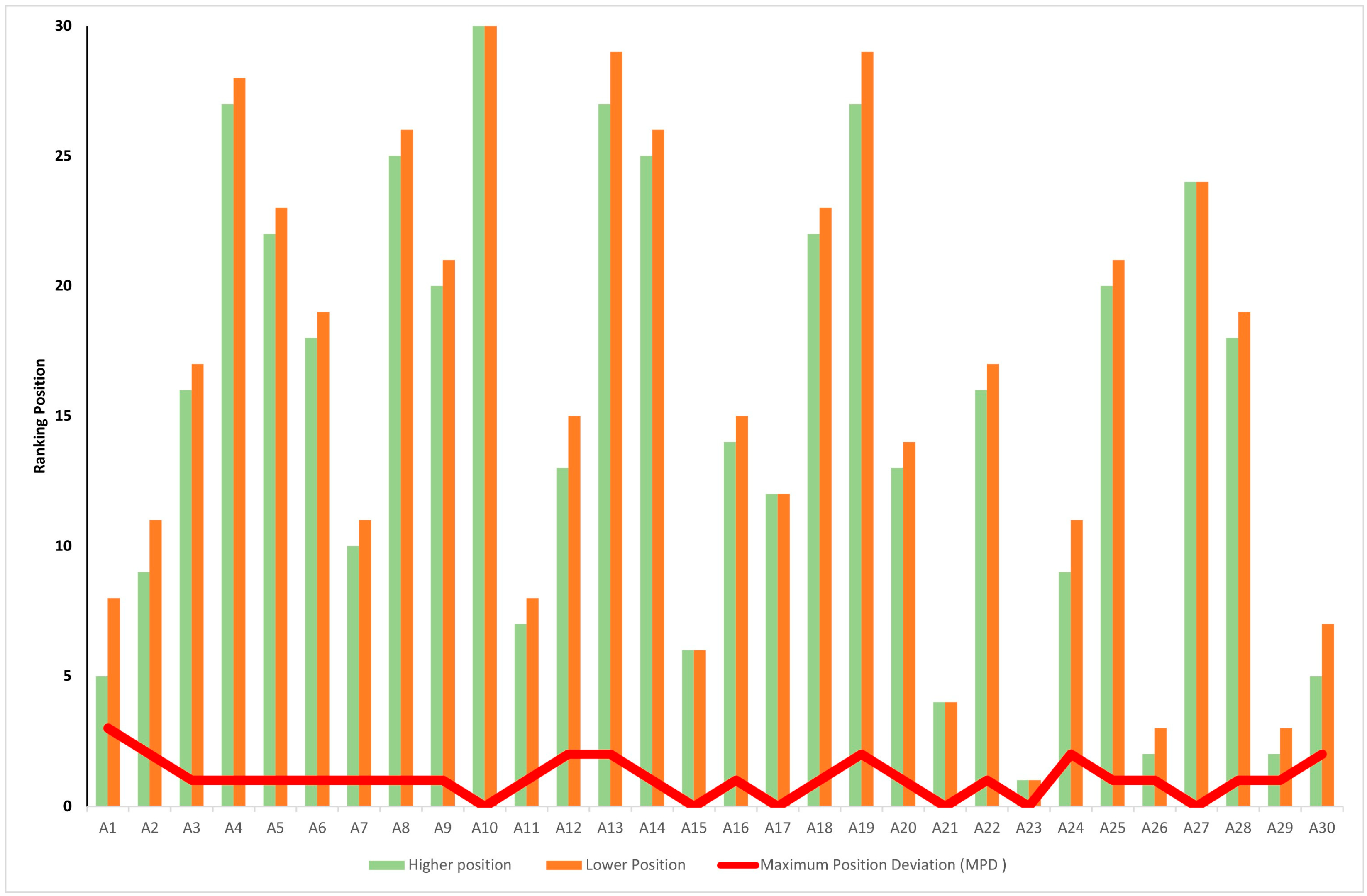
Figure 3 reinforces this analytical finding by displaying the Maximum Position Deviation (MPD) between the highest and lowest rank obtained by each alternative across the four methods. The results indicate that more than 75% of the alternatives either remained unchanged or varied by only one position in the ranking, whereas only one alternative exhibited a deviation of three positions. This limited dispersion indicates that the observed consistency is not a mere statistical artefact of high correlation coefficients but rather reflects a structural stability of the prioritisation order. In other words, the methods converge not only in relative direction but also in absolute positional agreement, even under different computational assumptions.
Taken together, these results confirm that the proposed prioritisation framework is both methodologically coherent and operationally resilient, providing a reliable basis for informed decision making in urban accessibility planning.
5.1. Practical Implications and Value Added
The results obtained validate that the developed methodology enables the precise identification of the most strategic bus stops for intervention, thereby facilitating decision making in resource-constrained contexts. This finding represents a significant advance over traditional approaches, which focused exclusively on diagnosing barriers without providing operational prioritisation tools [
35,
36,
38,
39].
The added value of the model resides in its capacity to integrate objective criteria—specifically, potential stop usage and the level of accessibility deficit—with participatory consultation of users and experts via AHP. This integration not only reinforces the model’s technical soundness but also enhances its social legitimacy. In practical terms, this combination provides a rigorous framework for municipal planning, directing the allocation of resources towards interventions that generate the maximum social impact.
5.2. Extrapolation, Resilience, and Global Relevance
In a broader sense, the proposed methodology extends beyond passenger public transport, as it may be extrapolated to other urban mobility nodes, such as intermodal stations or last-mile logistics microhubs. This potential transferability relies on the structural similarity of the decision-making processes involved, which require the joint consideration of social, technical, economic, and environmental criteria. In such contexts, the same AHP–MCDM framework can be adapted by redefining the criterion weights and incorporating additional indicators (e.g., freight flows or transfer times) without altering the underlying logic of prioritisation.
Although this extrapolation has not yet been empirically validated, its conceptual coherence suggests that the proposed model may serve as a general decision-support tool for integrated passenger–freight planning, fostering the convergence of accessibility and efficiency within sustainable logistics systems. This represents a promising avenue for future research aimed at verifying the operational robustness of the model across different urban nodes.
Beyond its empirical application, the study constitutes a significant methodological contribution to the field of urban accessibility. The proposal introduces a straightforward and replicable model that can be readily adapted to diverse urban contexts and varying levels of data availability. Furthermore, the global relevance of the model is reinforced by its direct alignment with Sustainable Development Goal (SDG) 11, specifically Target 11.2 (Affordable and sustainable transport systems).
5.3. Limitations and Directions for Future Research
Nonetheless, certain limitations should be noted. Firstly, the empirical validation was conducted exclusively in a single city (Segovia), which restricts the immediate generalisation of the findings. Secondly, the approach was applied solely to bus stops; hence, further work is required to confirm its effectiveness in intermodal stations or other, more complex, multimodal nodes.
Future work primarily involves extending the methodology to various urban mobility nodes, such as railway stations, interchanges, and logistics microhubs, where efficient accessibility management can decisively impact sustainable mobility and freight distribution. A second line of research focuses on incorporating dynamic data via digital tools, which would allow for the continuous updating of intervention priorities based on evolving demand and changing urban conditions.
Finally, a third line of research focuses on evaluating the robustness of the model against variations in the input data values for the selected criteria. Since MCDM results can change materially depending on the specific performance values assigned to each alternative (bus stops), future studies should explore how potential fluctuations in these measurements—due to data collection timing or environmental changes—might influence the final rankings. This would further validate the stability of the prioritisation model under varying empirical conditions.
6. Conclusions
This study successfully developed and validated a robust AHP–MCDM methodology for prioritising universal accessibility interventions at urban mobility nodes. The model’s reliability and its applicability in resource-constrained contexts are affirmed by the high consistency observed across the majority of the derived rankings and the stability confirmed in the sensitivity analysis. The comparative analysis shows that the four MCDM methods used (TOPSIS, VIKOR, COPRAS, and ARAS) provide highly similar rankings for the bus stops. This convergence of results ensures that municipal authorities can prioritise accessibility interventions objectively, as the final prioritisation remains consistent regardless of the specific mathematical method applied. By demonstrating that different evaluation perspectives lead to nearly identical outcomes, the framework provides a reliable and transparent basis for decision making, ensuring that public investments are directed toward the most critical nodes with high technical and social consensus.
Crucially, the model offers an innovative hybrid approach by combining objective criteria (e.g., stop usage and accessibility deficit) with participatory validation via AHP, thereby integrating the perspectives of disabled individuals and accessibility experts. This hybridisation ensures both the technical rigour and the social legitimacy of the resulting prioritisation decisions. On a practical level, the methodology contributes to optimising the allocation of municipal resources by focusing efforts on interventions that yield the greatest social impact, enabling a transition towards more equitable and efficient transport systems. However, it must be acknowledged that the final prioritisation is inherently linked to the specific values recorded for each criterion across the 149 bus stops. Recognising that results in MCDM can change materially depending on the chosen criteria set and the values assigned to each alternative, further research is required to assess the model’s robustness against fluctuations in these input data.
The findings demonstrate the methodology’s transferability and potential for extension to other complex urban mobility nodes, such as intermodal stations and logistics microhubs, thereby reinforcing its relevance to urban supply chains and the construction of more resilient and sustainable cities. Ultimately, the model is a replicable and adaptable tool that directly supports the global agenda through alignment with SDG 11 (Sustainable Cities and Communities), specifically Target 11.2 (Affordable and sustainable transport systems). While the framework focuses on social and technical accessibility criteria, it integrates the environmental dimension transversally; by optimising public transport nodes, the model promotes a reduction in urban emissions and supports the transition to more sustainable and low-carbon urban mobility patterns.