Article

Built Environment and Elderly Safety Risks in Old Residential Communities Under Urban Renewal


1
Department of Civil Engineering, Design School, Xi’an Jiaotong-Liverpool University, Suzhou 215123, China
2
Department of Civil and Environmental Engineering, University of Liverpool, Liverpool L69 3GH, UK
3
School of Civil Engineering and Architecture, Zhejiang Sci-Tech University, Hangzhou 310018, China
*
Author to whom correspondence should be addressed.
Urban Sci. 2026, 10(1), 54; https://doi.org/10.3390/urbansci10010054

Submission received: 19 November 2025 / Revised: 30 December 2025 / Accepted: 13 January 2026 / Published: 15 January 2026
(This article belongs to the Section Urban Governance for Health and Well-Being)

Abstract

With China’s rapidly aging population, enhancing the safety and age-friendliness of existing residential communities has become a pressing need in the context of urban renewal. Based on empirical analysis of 146 questionnaires collected from aging communities in Jiangsu Province, this study examines how built environment factors influence safety risks and perceived security among older adults. The results show that public seating (F3), pedestrian pathways (F11), staircases (F1), lighting (F5), landscaping (F10), and outdoor animals (F12) significantly affect both actual safety risks and perceived safety. Insufficient lighting, uneven pathways, unstable seating, and unsafe staircases are the primary causes of falls, collisions, and abrasions, while issues such as standing water, overgrown vegetation, and stray animals further reduce residents’ sense of security. The findings indicate that improving elderly safety relies more on environmental visibility, accessibility, and spatial maintenance than on compensating for individual physical limitations. Therefore, interventions such as enhancing lighting, maintaining pedestrian routes, providing stable seating, and strengthening community management can effectively reduce risks and enhance perceived security. This study offers empirical evidence to guide age-friendly community renewal and provides policy insights for promoting safe, inclusive, and sustainable development in aging cities.

1. Introduction

China is experiencing rapid population aging alongside ongoing urbanization. As the country’s economic development and spatial expansion accelerate, the proportion of older adults continues to rise [1]. This overlap of demographic and spatial transformation introduces new challenges for urban governance and community sustainability. Although new residential districts are continually being developed, many older adults prefer to remain in long-established neighborhoods where long-term social connections, emotional attachment, and a strong sense of belonging have been formed [2]. However, many aging residential neighborhoods face increasing pressures related to infrastructure decline and service capacity [3]. The interaction between declining functional capacity among older adults and the aging of physical environments increases the likelihood of accidents, such as falls and collisions, while reducing motivation for outdoor participation [4]. Addressing these challenges requires a clearer understanding of how built-environment characteristics relate to safety, comfort, and overall well-being among elderly residents.
Research on the built environment has increasingly demonstrated its crucial influence on quality of life among older adults. Well-designed spatial layouts and accessible infrastructure can promote physical activity, facilitate social engagement, and enhance psychological well-being [5]. Conversely, environmental barriers in outdoor community spaces can constrain mobility and increase accident risks among older adults [6]. Despite substantial progress in international research on age-friendly environments, the safety implications of outdoor spaces in aging-in-place residential communities remain insufficiently examined, particularly in developing contexts such as China [7]. Existing studies often emphasize indoor environments or institutional care settings, while the safety implications of everyday outdoor community spaces receive comparatively limited attention [8]. Moreover, empirical analyses linking environmental characteristics to measurable safety outcomes are still limited, underscoring the need for evidence-based approaches to guide neighborhood-scale interventions.
Urban renewal plays a critical role in determining whether older adults can continue to live independently and safely within familiar environments [9]. Recent policy trends in China have shifted from large-scale demolition toward small-scale, people-centered neighborhood regeneration, aligning with global agendas for inclusive and sustainable cities [10]. Within this context, improving the built environment of aging communities is essential for enhancing safety, accessibility, and livability [11]. However, renewal practices often prioritize visible physical upgrades, such as façade improvements or landscape beautification [12], while overlooking micro-scale environmental conditions and ongoing maintenance issues that directly affect daily safety, including pathway conditions, lighting maintenance, and the stability of outdoor facilities. Existing empirical studies tend to emphasize general accessibility or overall environmental quality [13], while evidence linking specific built environment characteristics to different types of safety outcomes in outdoor spaces remains relatively scarce. In addition, prior research has relied largely on perceived safety or satisfaction measures [14], whereas experienced safety incidents occurring during routine community activities have received comparatively less attention. These limitations are particularly evident in older residential neighborhoods in China, where constrained management capacity and demographic change intersect under ongoing urban renewal.
In response to these gaps, this study examines the associations between micro-scale built environment characteristics and elderly safety in aging residential communities. Using survey data collected from older residents in Jiangsu Province, the analysis focuses on environmental features related to visibility, accessibility, and maintenance conditions in everyday outdoor spaces. By distinguishing between perceived daily security and experienced safety risks, the study incorporates both subjective evaluations and incident-based outcomes that arise through routine interactions between older residents and their surrounding environments, which allows safety conditions in aging-in-place community settings to be examined from complementary perspectives. The study focuses on three related analytical questions:
  • How built environment characteristics are associated with the safety and comfort of elderly outdoor activities, including mobility, resting, and exercise behaviors.
  • How outdoor space conditions in aging residential communities relate to accessibility, inclusiveness, and safety for older residents.
  • How community-scale environmental features and management conditions are associated with elderly quality of life within the context of urban renewal.
The remainder of this paper is structured as follows. Section 2 reviews the relevant literature on aging, the built environment, and community safety. Section 3 presents the research design, including study sites, data collection, and analytical methods. Section 4 reports the empirical findings. Section 5 discusses implications for age-friendly community development. Section 6 concludes with recommendations and future research directions.

2. Literature Review

2.1. Urban Renewal and Aging Residential Communities

Urban renewal functions as a key mechanism for addressing structural aging, functional inefficiencies and social decline in mature urban neighborhoods [15]. Earlier renewal paradigms in many cities primarily relied on large-scale demolition and redevelopment designed to modernize infrastructure, increase development intensity and reshape urban form [16]. Li et al. (2025) [17] noted that this approach was later criticized for disrupting established social networks and weakening community identity, especially in neighborhoods with long settlement histories and culturally embedded daily practices. As a result, international scholarship began advocating incremental, people-oriented and socially inclusive renewal strategies that balance physical improvement with the preservation of social fabric [18]. Cordeiro et al. (2024) [19] added that contemporary renewal therefore emphasizes micro-regeneration, contextual adaptation and community-led transformation, which promote equity, livability and social resilience. Traditional planning logic viewed communities as static geographic entities, favoring a blueprint-based paradigm that neglected dynamic social behaviors and evolving needs [20]. Llewellyn et al. (2024) [21] argued that such rationalist planning strategies constrained spontaneous diversity and limited the capacity of neighborhoods to self-adjust. With the rise of collaborative and participatory planning approaches, urban renewal governance has increasingly incorporated multi-stakeholder participation, social engagement and market mechanisms [22]. These shifts reflect the recognition that communities exhibit characteristics of complex socio-spatial systems shaped by everyday interactions, informal rules and adaptive behaviors.
Despite recent advancements, urban renewal practices still insufficiently address the needs of vulnerable populations, particularly older adults who are more affected by environmental barriers and infrastructural aging [23]. Public health crises and demographic transitions have exposed persistent deficiencies in neighborhood-scale mobility, environmental maintenance and safety systems [24]. In China, many older residential communities developed during earlier urbanization phases were shaped by quantity-oriented planning logics, resulting in limited adaptability and inadequate age-friendly infrastructure, public spaces and service facilities [25]. Fragmented governance and weak management capacity further constrain effective renewal. As population aging accelerates and family-based support declines, these spatial and institutional shortcomings increasingly undermine older adults’ comfort, independence and safety [26], underscoring the need to better integrate aging considerations into urban renewal strategies.

2.2. Built Environment and Governance Factors Related to Elderly Safety

2.2.1. Environmental Conditions and Elderly Safety Risks

The built environment exerts substantial influence over the safety, mobility and health of older adults [27]. Age-related physiological changes, including reduced balance, weakened muscle strength and declining visual acuity, amplify sensitivity to environmental hazards such as uneven pavements, insufficient lighting or obstructed pathways [28]. Kumar et al. (2025) [29] further indicated that falls are the leading cause of injury-related morbidity among older adults, and many of these events occur in outdoor community environments that lack adequate safety features. Research identifies several key built environment attributes that shape elderly safety. Walkway continuity, surface evenness and curb design influence gait stability, route predictability and walking efficiency [30]. Lighting quality affects depth perception, environmental legibility and perceptions of fear or vulnerability, particularly during evening hours [31]. Environmental clarity and visibility influence spatial orientation and determine whether older adults feel confident navigating outdoor areas [32].
International studies highlight that micro-scale design interventions, including rest points, barrier-free crossings, tactile paving and accessible exercise equipment, support safe and independent mobility [33]. Conversely, environmental neglect such as poor drainage, unmanaged vegetation or cluttered public spaces increases the likelihood of slips, trips and psychological stress [34]. The interaction between environmental quality and elderly mobility behavior suggests that physical hazards and psychological perceptions jointly shape safety conditions. Existing literature, however, exhibits several limitations. Initially, Dodds et al. (2024) [35] noted that research focuses disproportionately on institutional care facilities or macro-scale planning, while everyday outdoor environments in aging-in-place communities receive less attention. Subsequently, Miakhel et al. (2024) [36] pointed out that many studies concentrate on accessibility and barrier-free design but overlook maintenance-related factors such as surface cleanliness, vegetation control or the presence of stray animals, all of which directly influence safety outcomes. Ultimately, Aguome et al. (2024) [37] emphasized that research from developing countries, where aging infrastructure coexists with rapid demographic change, remains relatively scarce. This gap necessitates empirical investigations that link specific built environment variables to perceived and experienced safety risks in older residential communities.

2.2.2. Community Governance and Elderly Safety

Governance plays a critical role in determining whether built environment improvements are sustained and translated into long-term safety benefits for older adults [38]. The WHO Age-Friendly Cities and Communities framework emphasizes that spatial upgrading must be supported by coordinated maintenance, integrated service delivery and active citizen participation [39]. Wu et al. (2025) [40] noted that in older residential communities, governance directly influences the functionality of lighting systems, sanitary conditions, vegetation management and the maintenance of walkways and public facilities. Traditional top-down governance models often struggle to manage fine-grained, rapidly emerging hazards in aging communities [41]. Micro-scale risks such as broken pavements, water accumulation or poorly lit corners frequently fall between administrative responsibilities, resulting in slow or incomplete maintenance [42]. Samora et al. (2025) [43] indicated that collaborative governance structures involving governments, property managers, neighborhood committees and social organizations can more effectively respond to local conditions and maintain environmental safety.
Participatory governance enhances the alignment between community needs and environmental improvements [44]. Parappallil et al. (2024) [45] highlighted that older residents possess situated knowledge of daily mobility challenges, environmental hazards and temporal patterns of space use, and their involvement in planning and maintenance improves environmental responsiveness, cultivates collective responsibility and strengthens perceived security [46]. Communities with higher levels of participation often demonstrate stronger environmental stewardship and more sustained safety improvements [47]. In China, community governance often relies heavily on administrative allocation rather than collaborative mechanisms, leading to disparities in maintenance quality across neighborhoods [48]. Forsyth et al. (2024) [49] added that older residential communities frequently lack professional property management or stable financial resources, which constrains their ability to adapt to demographic aging and environmental changes. Ongoing policy reforms promoting micro-renewal and multi-actor co-governance reflect attempts to build more flexible and adaptive governance frameworks [50]. However, empirical evidence connecting governance structures with elderly safety at the micro-scale remains limited.

2.2.3. Environmental Dimensions Relevant to Elderly Safety

The built environment forms the immediate spatial context within which elderly mobility, behavior and safety outcomes unfold [51]. Micro-scale physical features shape how older adults perceive, navigate and interact with community spaces, influencing both objective injury risks and subjective feelings of safety [52]. Circulation systems, lighting conditions, public amenities, environmental cleanliness and maintenance quality play interrelated roles in structuring exposure to hazards and determining mobility confidence [53]. Staircases, walkways and pavement conditions exert substantial influence over gait stability and fall risk, as irregular steps, missing handrails, uneven surfaces and obstructed paths require high levels of physical control and increase the likelihood of slips or trips, especially for older adults with declining balance [54]. Castilla et al. (2024) [55] emphasized that lighting and visibility determine spatial legibility and the accuracy of visual judgment. Insufficient illumination diminishes depth perception and increases fear, while excessive contrast disrupts spatial orientation. Public amenities such as community seating provide essential physiological support during walking, reduce fatigue accumulation and enhance outdoor participation. Levinger et al. (2025) [56] noted that poorly maintained exercise equipment introduces risks of imbalance, abrasion or joint strain despite its intended health benefits, and Liu et al. (2021) [57] added that unmanaged vegetation and inadequate drainage can further compound safety hazards for older adults in community spaces.
Environmental maintenance encompasses drainage systems, vegetation management and animal control [58]. Inadequate drainage produces slippery surfaces, unmanaged vegetation obstructs sightlines or creates uneven terrain, and outdoor animals generate both physical and psychological risks [59]. These environmental characteristics influence two interconnected dimensions of safety. Perceived security reflects environmental predictability, visibility and comfort [60], which influence activity decisions. Experienced safety risks refer to actual incidents, such as falls or collisions, that directly affect health and independence [61]. This integrated perspective highlights that elderly safety arises from the combined effects of physical environment quality, maintenance practices and behavioral responses.

2.3. Conceptual Framework Linking Built Environment to Elderly Safety Outcomes

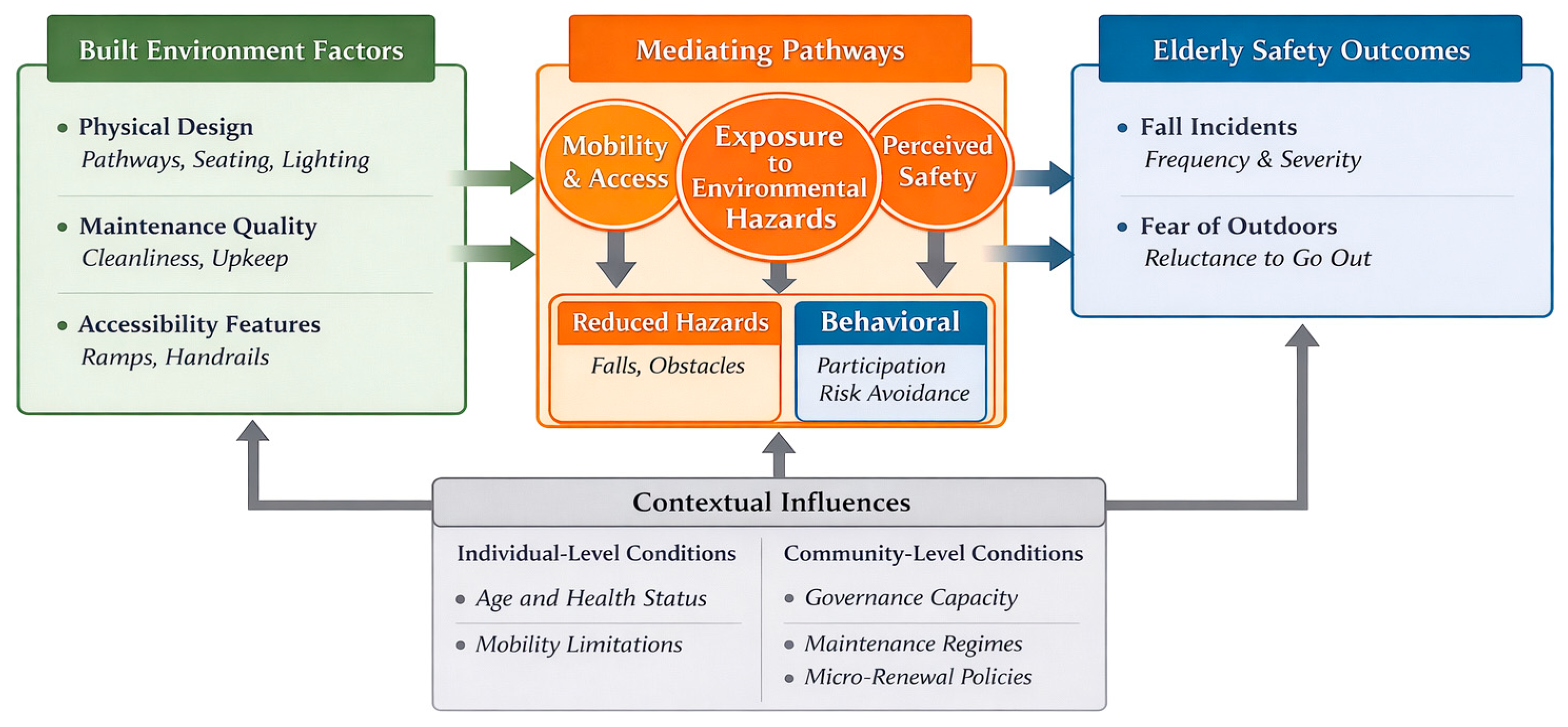
Drawing on the above literature, this study develops an operational conceptual framework to examine how built environment characteristics are associated with elderly safety outcomes in aging residential communities, as illustrated in Figure 1. The framework integrates age-friendly environment theories with the context of Chinese aging residential communities, many of which were constructed during earlier stages of urbanization and now face simultaneous population aging, infrastructure deterioration, and limited management capacity. Built environment conditions are conceptualized along three interrelated dimensions: physical design, accessibility features, and environmental maintenance quality. Physical design refers to spatial elements structuring everyday outdoor movement, including pedestrian pathways, staircases, level transitions, lighting, and public seating. In many aging communities in China, these elements reflect earlier construction standards that did not account for population aging, resulting in narrow pathways, irregular stairs, insufficient resting facilities, and uneven lighting that affect walking stability and movement continuity. Accessibility features capture the extent to which outdoor environments accommodate age-related functional decline through barrier-free design, handrail provision, surface continuity, and spatial legibility. Environmental maintenance quality reflects ongoing management practices such as surface cleanliness and drainage, vegetation control, and animal management, which are often constrained in older Chinese communities.
The framework further specifies three mediating pathways linking built environment conditions to elderly safety outcomes. Mobility and access describe how environmental conditions influence walking stability, route continuity, and opportunities for rest during daily outdoor activities. Exposure to environmental hazards reflects the likelihood of encountering uneven surfaces, obstructions, standing water, or poorly maintained facilities. Perceived safety captures older adults’ assessments of confidence and fear when navigating outdoor environments, shaping activity participation and risk avoidance. Through these pathways, built environment conditions are associated with two interrelated safety outcomes: experienced safety risks, such as falls or collisions, and perceived security in daily community life. These relationships are further conditioned by individual characteristics, including age, health status, and mobility limitations, as well as community-level factors such as governance capacity, maintenance regimes, and micro-renewal implementation.

3. Research Method

3.1. Survey Design

The survey instrument was developed through a concept-driven measurement process grounded in environmental gerontology, environmental behavior theory, and empirical research on safety risks among older adults. The purpose of the questionnaire was to capture the multi-layered pathways through which built environment characteristics influence elderly mobility, comfort, and safety outcomes in aging residential communities. Drawing on established conceptual frameworks and validated measurement scales, environmental attributes related to spatial quality, accessibility, visibility, maintenance, and public facilities were translated into observable items that reflect both physical conditions and residents’ subjective evaluations, as shown in Table A1. To ensure clarity and cognitive accessibility for older respondents, all items were reviewed by domain experts, revised for linguistic simplicity, and pilot tested in a small sample community. Feedback from the pilot study was used to refine wording, eliminate ambiguous indicators, and enhance the internal coherence of each construct.
All perceptual items were measured on a five-point Likert scale ranging from “Very Dissatisfied” (1) to “Very Satisfied” (5) and were included in the analysis as numerical variables [62]. Following the initial design, reliability testing and exploratory factor analysis were conducted to verify the conceptual structure of the measurement tool. The final factor system integrates multiple built environment dimensions along with two safety-related outcome factors that reflect both perceived safety and experienced incident frequency. Together, these factors provide a comprehensive representation of the environmental, psychological, and behavioral mechanisms underlying elderly safety in everyday community settings. This validated factor structure served as the analytical foundation for subsequent statistical procedures, including correlation and regression analysis.

3.2. Sampling and Data Collection

A stratified community-based sampling approach was adopted to capture variation in aging residential environments while ensuring coverage of typical conditions in urban China. Jiangsu Province was chosen as the study area because it has one of the largest aging populations in China and contains numerous old residential neighborhoods currently undergoing urban renewal [63]. Two core cities were selected, namely Nanjing, the provincial capital located in central Jiangsu, and Suzhou, the major economic hub in southern Jiangsu. These two cities represent different urban development stages and renewal contexts within the province, allowing regional variation in community environmental conditions and elderly living needs to be captured. Within the two selected cities, a total of six residential communities were selected following a stratified framework, with three communities chosen in each city. Eligible communities met three inclusion criteria: they were built before 2000 and classified as old residential communities under Chinese urban renewal policies; they had a relatively high proportion of elderly residents, consistent with commonly used definitions of aging communities in China; and they had not undergone large-scale renovation or major infrastructure upgrading in the past five years, ensuring that the built environment reflected typical conditions faced by elderly residents. This selection strategy focused on capturing key physical and social characteristics of aging residential neighborhoods rather than achieving statistical representativeness, while maintaining sufficient within-community sampling depth.
Questionnaires were administered face-to-face by trained interviewers to ensure comprehension and response accuracy, particularly given that many elderly respondents had limited formal education. To reduce recall bias inherent in self-reported data, especially for safety-incident-related items, several mitigation measures were adopted. The recall period was restricted to two years to balance recall accuracy and incident coverage, and incident-related questions used specific and concrete descriptions rather than vague references. Interviewers followed standardized prompts to assist memory retrieval, explained questions when necessary, clarified ambiguous terms, and verified completed questionnaires to minimize missing data and inconsistencies. Approximately 26–27 questionnaires were collected in each community, resulting in 160 questionnaires distributed and 146 valid responses obtained, yielding an effective response rate of 91.25%. As shown in Table 1, the final sample comprised 46.6% male and 53.4% female respondents, and the majority of participants were between 60 and 80 years of age (79.4%). Educational attainment was generally low, with 50.7% having completed primary school and 32.9% junior high school. Monthly income levels were modest, with nearly half of respondents (49.3%) reporting incomes between 2000 and 5000 RMB. Regarding marital and living conditions, 55.5% were married, 27.4% were widowed, and 29.5% lived alone, while 54.8% lived with a spouse and 15.8% lived with their children, indicating that family-based support remains common but independent living is increasingly observed among elderly residents.

3.3. Data Analysis

All statistical analyses were conducted using IBM SPSS Statistics 22.0 to ensure the accuracy and robustness of the empirical results. Before formal analyses, questionnaire data were examined for completeness, consistency, and outliers, and invalid or incomplete responses were excluded. Descriptive statistics were then applied to summarize the key variables and verify data distribution and normality. The analyses examined relationships between built environment characteristics and elderly safety outcomes in aging residential communities. To ensure measurement quality, Cronbach’s alpha was used to evaluate internal consistency reliability, with coefficients above 0.70 indicating acceptable reliability [64]. This step confirmed that all items within each dimension measured the same underlying construct with reasonable stability. Subsequently, Exploratory Factor Analysis (EFA) was performed to examine the construct validity of the measurement scales [65]. The Kaiser–Meyer–Olkin (KMO) measure and Bartlett’s Test of Sphericity were used to evaluate sampling adequacy and the suitability of the data for factor extraction. When the KMO value exceeded 0.60 and the significance level of Bartlett’s test was below 0.05, the dataset was considered appropriate for factor analysis [66]. Factors were extracted using principal component analysis with Varimax rotation. Items with factor loadings below 0.50 or substantial cross-loadings were removed to maintain conceptual clarity. The resulting factor scores were subsequently entered into the regression analyses.
After the reliability and validity of the scales were confirmed, a series of inferential statistical analyses were conducted to explore the relationships between built environment characteristics and elderly safety outcomes. Pearson’s correlation analysis was first used to identify the linear associations among the key variables [67]. Subsequently, multiple linear regression analysis was employed to quantify the relative influence of built environment dimensions, such as lighting, accessibility, greenery, and public facilities, on perceived safety and incident frequency. Before conducting the regression analysis, multicollinearity among independent variables was examined using the Variance Inflation Factor (VIF). All VIF values were below 5, indicating acceptable model stability and the absence of serious multicollinearity. This two-step analytical framework, which involved reliability and validity testing followed by correlation and regression analysis, ensured methodological rigor and provided a solid empirical foundation for examining how specific characteristics of the built environment influence the safety perception and behavioral outcomes of elderly residents in aging urban neighborhoods.

4. Results

4.1. Reliability and Validity Analysis

This study conducted a comprehensive reliability and validity assessment to ensure that the measurement instrument met accepted psychometric standards. Cronbach’s α coefficients were calculated for all Likert-type items, excluding demographic and screening questions. The overall α value for the 70-item scale was 0.812, indicating a high level of internal consistency and demonstrating that the questionnaire reliably captures the constructs of interest. Across the thirteen built environment dimensions (F1–F13) and the two safety-related dimensions (C1 and C2), Cronbach’s α values ranged from 0.742 to 0.834, all of which exceed the widely accepted minimum threshold of 0.70. Dimensions such as Residential Staircase (α = 0.834), Community Entrance and Exit (α = 0.817), and Sense of Security in Daily Activities (α = 0.829) showed particularly strong consistency, reflecting stable participant responses regarding these core environmental and safety perceptions. Dimensions containing fewer items, including Security with two items (α = 0.742) and Noise with three items (α = 0.781), also exhibited acceptable reliability. The relatively high α values for these brief scales suggest that the items within each construct were conceptually coherent and measured a common underlying dimension. In contrast, more heterogeneous dimensions, such as Pedestrian Pathways, which consisted of nine items and yielded an α value of 0.785, showed moderate reliability, which is expected for scales covering multiple aspects of environmental infrastructure.
Sampling adequacy and factorability were subsequently assessed using the Kaiser–Meyer–Olkin (KMO) measure and Bartlett’s Test of Sphericity. The KMO coefficient reached 0.861, indicating that the correlation matrix was suitable for factor analysis, while Bartlett’s Test yielded a statistically significant result with a p-value below 0.001, confirming that the item correlations were not random and were appropriate for identifying underlying factor structures. On this basis, exploratory factor analysis was conducted to examine the construct validity of the measurement scales. Factors were extracted using principal component analysis with Varimax rotation, and items with factor loadings below 0.50 or with substantial cross-loadings were removed to preserve conceptual clarity. The finalized factor structure corresponds to the built environment dimensions and safety-related outcome dimensions summarized in Table 2. The resulting factor scores were used in the subsequent correlation and regression analyses.

4.2. Correlation Analysis

Pearson’s correlation analysis was applied to examine the linear relationships between built environment perceptions and elderly safety outcomes [74]. The analysis included 13 dimensions of the built environment, such as residential staircases, lighting, public seating, traffic safety, and greenery, together with eight safety indicators, including daily activity security, overall safety risk, and six types of risk events: falls, collisions, getting lost, abrasions, animal bites, and dizziness episodes. As shown in Table 3, multiple environmental dimensions were significantly correlated with both perceived safety and risk exposure. The variable Residential Staircase was negatively correlated with daily activity safety (r = −0.332, p < 0.01) and positively correlated with overall safety risk (r = 0.377, p < 0.01). Poor stairway conditions appear to increase both perceived insecurity and the likelihood of physical hazards. The same factor was also correlated with collisions (r = 0.333, p < 0.01) and dizziness episodes (r = 0.336, p < 0.01), suggesting that uneven steps and insufficient visibility can substantially heighten the probability of mobility-related incidents among older adults.
The variables Public Seating and Lighting also showed strong and consistent correlations with elderly safety indicators. Public Seating was negatively associated with daily activity safety (r = −0.312, p < 0.01) and positively associated with safety risk (r = 0.391, p < 0.01). Limited or unevenly distributed benches may reduce resting opportunities, leading to greater fatigue and loss of balance. Lighting exhibited the strongest negative correlation with perceived safety (r = −0.433, p < 0.01) and a positive correlation with safety risk (r = 0.230, p < 0.01), confirming that inadequate illumination undermines both perceived and actual safety in community spaces. Other dimensions, including Residential Landscaping (r = 0.365, p < 0.01), Pedestrian Pathways (r = 0.368, p < 0.01), and Community Entrance and Exit design (r = 0.280, p < 0.01), were significantly associated with higher levels of perceived safety risk. These results indicate that disorganized pathways, irregular paving, and ambiguous circulation routes can increase confusion and the occurrence of minor accidents. In contrast, factors such as Noise and Traffic Safety exhibited weaker correlations, implying that they influence overall comfort but play a lesser role in immediate safety outcomes.

4.3. Regression Analysis Results

The regression analysis explored how different characteristics of the built environment influence elderly safety perception and actual risk exposure. Two regression models were constructed, with experienced safety risk and perceived daily security serving as dependent variables. The general form of the regression model can be expressed as:
Y i = α + k β k B E i k + m γ m X i m + ε i
where, Y i denotes the safety outcome for individual i , including experienced safety risk and perceived daily security. α represents the intercept term. B E i k denotes the k -th built environment variable for individual i , including lighting, residential staircases, pedestrian pathways, public seating, landscaping, and outdoor animals. β k is the estimated coefficient associated with each built environment component. X i m represents the m -th control variable for individual i , capturing socio-demographic characteristics such as age, gender, education level, income, marital status, and living arrangement, and γ m is the corresponding coefficient. ε i is the error term, capturing unobserved factors affecting elderly safety outcomes.
All variables were standardized prior to estimation to allow comparison across dimensions and to eliminate the influence of differing measurement scales. The results presented in Table 4 indicate that both models are statistically significant, confirming that built environment features have a substantial impact on both the objective and subjective aspects of elderly safety. In the Safety Risk Model (R = 0.600, R2 = 0.360, p < 0.001), several environmental attributes exerted notable effects. Public Seating (B = 0.346, p = 0.001) displayed the strongest positive association, suggesting that inadequate or poorly placed benches may increase exposure to minor accidents during outdoor activities. Residential community landscaping (B = 0.282, p = 0.007) also exhibited a positive relationship, implying that uneven surfaces, obstructive vegetation, or maintenance deficiencies elevate exposure to environmental hazards. Pedestrian Pathways (B = 0.342, p = 0.013) significantly predicted safety risks, indicating that discontinuous or uneven walkways can disrupt movement stability. Residential Staircases (B = 0.281, p = 0.007) further contributed to safety risks, emphasizing the importance of step uniformity and handrail reliability. Outdoor Animals (B = 0.199, p = 0.026) produced a moderate positive effect, suggesting that stray pets or uncontrolled domestic animals remain persistent contributors to everyday safety incidents.
The Daily Security Model (R = 0.579, R2 = 0.335, p < 0.001) demonstrated similar robustness but reflected perceptual rather than physical safety outcomes. Lighting conditions (B = −0.300, p < 0.001) had the most pronounced negative effect, indicating that insufficient illumination during evening hours or in enclosed corridors significantly undermines the sense of security. Pedestrian Pathways (B = −0.363, p < 0.001) were also negatively associated with perceived safety, suggesting that irregular pavement, cracks, or poor continuity increase psychological discomfort and uncertainty while walking. Residential Staircases (B = −0.167, p = 0.009) further reduced perceived security, highlighting how deteriorated or poorly maintained steps discourage confidence in vertical circulation. These findings emphasize that lighting quality and pathway integrity not only influence objective safety risks but also shape subjective perceptions of comfort and spatial trust. Both regression models satisfied the assumptions of normality and linearity, and the variance inflation factors remained below 3.0, confirming that multicollinearity among predictors was not a concern. Overall, the results demonstrate that environmental factors influencing elderly safety operate through both structural and perceptual pathways. Improvements in lighting, pedestrian continuity, and circulation maintenance are therefore critical for reducing safety risks, enhancing spatial confidence, and supporting mobility independence in aging residential environments.

4.4. Subtype Analysis of Specific Risk Events

This study further examined how specific built environment characteristics influence different categories of safety incidents among older adults. Separate regression models were developed for falls, collisions, abrasions, and walking fatigue. As shown in Table 5, each type of incident is associated with distinct environmental variables, reflecting diverse pathways through which the built environment affects safety outcomes. Fall events are most strongly influenced by standing water, community landscaping, and public seating. These factors are all positively and significantly correlated with the likelihood of falling (R = 0.343, R2 = 0.118, p < 0.001). The coefficient for standing water (B = 0.367, p = 0.022) suggests that poor drainage or uneven surfaces increase slip risks. Community landscaping (B = 0.344, p = 0.043) indicates that poorly maintained vegetation, such as overgrown plants or exposed roots, can obstruct footpaths and compromise balance. Public seating (B = 0.329, p = 0.047) suggests that insufficient or poorly placed benches reduce opportunities for rest, leading to fatigue and increasing fall risk. These findings emphasize the importance of effective drainage design, proper vegetation maintenance, and the provision of stable and accessible seating to mitigate fall risks.
In contrast, collision incidents are primarily shaped by spatial configuration and visual accessibility. The regression model (R = 0.490, R2 = 0.240, p < 0.001) identifies residential staircases (B = 0.447, p = 0.007), pedestrian pathways (B = 0.514, p = 0.018), public seating (B = 0.415, p = 0.011), and community landscaping (B = 0.324, p = 0.049) as significant predictors. Staircase issues such as inconsistent riser heights or missing handrails may lead to missteps, while benches or vegetation that encroach on walking areas or block sightlines reduce spatial predictability. Similarly, narrow or discontinuous pathways may cause congestion, increasing the risk of accidental contact. Abrasions show a different relationship with the environment (R = 0.334, R2 = 0.112, p < 0.001), with exercise equipment (B = 0.336, p = 0.013) and pedestrian pathways (B = 0.544, p = 0.023) serving as key contributors. Poorly maintained or rusted fitness equipment and uneven pavements heighten the chances of tripping or scraping injuries. Furthermore, walking fatigue is strongly associated with public seating (B = 1.201, p < 0.001) and pathway design (B = 1.043, p = 0.004), as shown in the model (R = 0.445, R2 = 0.198, p < 0.001). Long distances without rest points and irregular terrain amplify physical exhaustion, which may discourage outdoor activity and elevate secondary risks such as dizziness or falls. Overall, while environmental factors vary across incident types, pedestrian infrastructure and seating availability consistently emerge as critical determinants of safety in aging residential environments.

5. Discussion

5.1. Summary of Key Findings

The empirical results show that elderly safety in aging residential communities is predominantly shaped by micro-scale environmental conditions that structure routine outdoor activities, rather than by general or macro-level facilities. Built environment variables related to pedestrian pathways, public seating, residential landscaping, and environmental maintenance display consistent and robust associations with both perceived daily security and experienced safety risks. By contrast, broader facilities or generalized safety provisions exhibit weaker or non-significant relationships. This pattern indicates that safety outcomes among older adults are closely linked to repeated, high-frequency exposure to everyday environmental conditions, through which minor deficiencies accumulate into meaningful safety risks over time.
The results further reveal clear differentiation between environmental mechanisms influencing perceived daily security and those affecting experienced safety incidents. Lighting conditions are significantly associated with perceived security, suggesting that adequate illumination enhances confidence, spatial legibility, and willingness to engage in outdoor activities, particularly under low-visibility conditions. However, lighting does not show a direct association with experienced safety risks, indicating that perceptual reassurance alone is insufficient to mitigate physical hazards embedded in the environment. Residential staircases, in contrast, emerge as a critical environmental element associated with both increased accident risk and reduced perceived security. Their significance reflects the combined physical demands of vertical movement and the psychological uncertainty generated by worn surfaces, inconsistent step dimensions, and insufficient handrails. These results highlight staircases as key transition spaces where physical vulnerability and perceived insecurity converge in aging residential environments.
Disaggregated analysis by safety incident type further demonstrates that different accidents correspond to distinct environmental risk pathways rather than a single generalized safety problem. Fall incidents are most strongly associated with standing water, residential landscaping, and public seating, pointing to risks arising during low-speed movement, fatigue accumulation, and transitional behaviors such as sitting down or resuming walking. Collision incidents show stronger associations with staircases, pedestrian pathways, and landscaping conditions, indicating that spatial congestion, limited visibility, and reduced route predictability increase unintended contact risk. Abrasion injuries are primarily linked to exercise equipment and pathway conditions, suggesting that poorly maintained facilities intended for physical activity may introduce additional hazards. Walking fatigue is most strongly influenced by seating availability and pathway quality, reinforcing the role of physical exhaustion as an indirect but important precursor to subsequent safety incidents. Together, these findings indicate that elderly safety in aging residential communities is governed by the continuity, predictability, and maintainability of everyday outdoor environments. Environmental elements often regarded as secondary, including benches, pavement evenness, vegetation management, and drainage, exert a disproportionate influence on cumulative risk exposure and should be recognized as central components of safety-oriented community environments.

5.2. Practical and Policy Implications

Community renewal strategies aimed at improving elderly safety should move beyond undifferentiated environmental upgrading and adopt a more selective, priority-based approach. In aging residential communities, where renewal budgets, construction feasibility, and governance capacity are often constrained, treating all built environment elements as equally important may dilute limited resources and reduce intervention effectiveness. A micro-scale and risk-oriented perspective is therefore essential for translating renewal efforts into tangible safety improvements for older residents. Such an approach emphasizes prioritization and feasibility rather than comprehensive redevelopment, aligning renewal objectives with the practical realities faced by long-established neighborhoods. From an implementation perspective, renewal priorities should focus on environmental conditions that older adults encounter most frequently during daily outdoor activities and that can be addressed through relatively low-cost and incremental measures. Maintaining pedestrian surface continuity, ensuring adequate and evenly distributed lighting, and providing appropriately located resting facilities represent interventions that can be embedded into routine renewal and maintenance cycles. These measures do not require large-scale physical reconstruction but directly target high-frequency exposure environments where safety risks tend to accumulate over time. Framing age-friendly renewal around these everyday spatial conditions allows safety improvements to be achieved without disrupting existing community structures or imposing excessive financial burdens.
Beyond physical design, the implications of this study highlight the central role of everyday governance and management practices in shaping elderly safety outcomes. Improving safety depends not only on one-time upgrading projects but also on the consistency and quality of routine maintenance, including drainage cleaning, vegetation trimming, lighting repair, and the management of outdoor animals. These practices constitute a critical yet often overlooked layer of safety governance, particularly in communities lacking professional property management or stable renewal funding. Viewed in this way, age-friendly renewal should be understood as an ongoing and adaptive process rather than a one-off intervention. By integrating fine-grained physical improvements with continuous governance execution, communities can better support safe aging in place through incremental, maintenance-oriented renewal strategies that are both realistic and sustainable.

6. Conclusions

This study examined how built environment characteristics influence elderly safety risks and perceived security in aging residential communities. Using questionnaire data and regression analysis, the research identified that Public Seating, Pedestrian Pathways, staircases, lighting, and landscaping significantly affect both the objective and subjective dimensions of elderly safety. These findings demonstrate that the safety of older adults is closely related to the spatial quality, accessibility, and maintenance of everyday environments rather than individual vulnerability alone. The analysis showed that poorly maintained Public Seating, uneven pavements, and deteriorated stair structures increase the likelihood of falls and collisions, while inadequate lighting and obstructed pathways reduce visibility and weaken perceived safety. Specific incidents, such as falls and abrasions, were strongly associated with environmental hazards including Standing Water, overgrown vegetation, and unsafe Exercise Equipment. These results indicate that different safety risks stem from distinct physical mechanisms, emphasizing the need for targeted and detailed environmental interventions. Improving lighting, ensuring smooth and unobstructed walkways, and maintaining safe resting facilities are essential to enhance both physical safety and psychological comfort for older adults.
The findings provide empirical evidence for the development of age-friendly communities. They suggest that urban safety improvement does not necessarily rely on large-scale reconstruction but can be effectively achieved through fine-scale design adjustments and continuous maintenance. Community participation and inclusive management should be encouraged to ensure that environmental upgrades reflect the real needs of elderly residents. Nevertheless, this study has certain limitations. The data were collected from a limited number of communities and relied on self-reported perceptions, which may involve subjective bias and limit the spatial representativeness of the findings. In addition, the relatively modest sample size may constrain the generalizability of the observed relationships across different urban contexts. Future research should incorporate objective spatial data, longitudinal observations, and comparative analyses across different urban contexts to better understand the dynamic relationship between environment and safety. In summary, elderly safety arises from the interaction between environmental design and perceptual experience. Creating safe, comfortable, and inclusive living environments requires attention to micro-scale spatial quality and everyday usability. The results of this study offer both theoretical and practical foundations for promoting age-friendly urban renewal, contributing to a safer and more supportive environment for aging populations.

Author Contributions

Conceptualization, Z.W. and C.Z.; methodology, Z.W. and S.Y.; software, Z.W.; validation, Z.W. and C.Z.; formal analysis, Z.W. and S.Y.; investigation, Z.W.; resources, S.Y.; data curation, C.Z.; writing—original draft preparation, Z.W.; writing—review and editing, Z.W. and J.L.H.; visualization, Z.W. and C.Z.; supervision, J.L.H.; project administration, J.L.H.; funding acquisition, J.L.H. All authors have read and agreed to the published version of the manuscript.

Funding

This research was funded by Xi’an Jiaotong–Liverpool University, grant numbers PGRS (FOSA2212030) and RDS10120240304.

Institutional Review Board Statement

The study was conducted in accordance with the Declaration of Helsinki, and the protocol was approved by the University Research Ethics Review Panel, Xi’an Jiaotong–Liverpool University (ER-LRR-00100000304) on 23 December 2025. All ethical procedures required by the University were completed prior to study initiation, including protocol review, community permission, informed consent, and data protection arrangements. The stated approval date reflects the administrative registration of the application rather than the timing of ethical clearance, and ethical approval was in place before data collection began.

Informed Consent Statement

Informed consent for participation was obtained from all subjects involved in the study.

Data Availability Statement

The original contributions presented in this study are included in the article. Further inquiries can be directed to the corresponding author.

Conflicts of Interest

The authors declare no conflict of interest.

Appendix A

Table A1. Questionnaire: Environmental Risk Management for Elderly Safety in Aging Residential Communities.
Section 1. Basic Information
1. Gender□ Male  □ Female
2. Age□ 60–70  □ 70–80  □ 80–90  □ 90+
3. Education Level□ Illiterate  □ Primary  □ Middle School  □ High School  □ Bachelor’s  □ Master’s+
4. Monthly Income (RMB)□ <2000  □ 2000–5000  □ 5000–10,000  □ >10,000
5. Marital Status□ Never Married  □ Married  □ Divorced  □ Widowed
6. Living Arrangement□ Live alone  □ Live with spouse  □ Live with children
7. Health Conditions (Multiple choices allowed)□ Hypertension  □ Diabetes  □ Osteoporosis  □ Visual/Hearing loss
□ Arthritis  □ Cataract  □ Use cane  □ Wheelchair/Walker
Section 2. Assessment of Outdoor Environment
Please rate the following using the scales below:
- Satisfaction: 1 = Very dissatisfied, 3 = Neutral, 5 = Very satisfied
- Safety Impact: 1 = No impact, 3 = Moderate impact, 5 = Strong impact
CategoryEvaluation ItemSatisfaction (1–5)Safety Impact (1–5)
F1. Residential StaircaseStair slope is comfortable○1 ○2 ○3 ○4 ○5○1 ○2 ○3 ○4 ○5
Handrail height is appropriate○1 ○2 ○3 ○4 ○5○1 ○2 ○3 ○4 ○5
Handrails are non-slip○1 ○2 ○3 ○4 ○5○1 ○2 ○3 ○4 ○5
Steps are even and consistent○1 ○2 ○3 ○4 ○5○1 ○2 ○3 ○4 ○5
F3. Public SeatingEnough seats are available○1 ○2 ○3 ○4 ○5○1 ○2 ○3 ○4 ○5
Seat height is comfortable○1 ○2 ○3 ○4 ○5○1 ○2 ○3 ○4 ○5
Seat structure is stable○1 ○2 ○3 ○4 ○5○1 ○2 ○3 ○4 ○5
F5. Lighting SystemAdequate lighting at night○1 ○2 ○3 ○4 ○5○1 ○2 ○3 ○4 ○5
Timely repair of damaged lights○1 ○2 ○3 ○4 ○5○1 ○2 ○3 ○4 ○5
F11. Pedestrian PathwaysPath surface is flat and even○1 ○2 ○3 ○4 ○5○1 ○2 ○3 ○4 ○5
Path is barrier-free○1 ○2 ○3 ○4 ○5○1 ○2 ○3 ○4 ○5
No obstructions on pathway○1 ○2 ○3 ○4 ○5○1 ○2 ○3 ○4 ○5
F9. Standing WaterNo water pooling after rain○1 ○2 ○3 ○4 ○5○1 ○2 ○3 ○4 ○5
F10. LandscapingVegetation is well-maintained○1 ○2 ○3 ○4 ○5○1 ○2 ○3 ○4 ○5
F12. Outdoor AnimalsPets are controlled (leashed)○1 ○2 ○3 ○4 ○5○1 ○2 ○3 ○4 ○5
F4. Exercise EquipmentEquipment is safe to use○1 ○2 ○3 ○4 ○5○1 ○2 ○3 ○4 ○5
Section 3. Perceived Safety in Daily Activities (C1)
ScenarioRating (1–5)
Walking alone at night○1 ○2 ○3 ○4 ○5
Walking in the daytime○1 ○2 ○3 ○4 ○5
Using stairs○1 ○2 ○3 ○4 ○5
Passing through community entrance○1 ○2 ○3 ○4 ○5
Walking during rainy weather○1 ○2 ○3 ○4 ○5
Using outdoor exercise equipment○1 ○2 ○3 ○4 ○5
Section 4. Frequency of Safety Incidents in the Past Two Years (C2)
Incident TypeNumber of Occurrences (0–10+)
Falls□0 □1 □2 □3 □4 □5 □6 □7 □8 □9 □10+
Near-falls□0 □1 □2 □3 □4 □5 □6 □7 □8 □9 □10+
Collisions□0 □1 □2 □3 □4 □5 □6 □7 □8 □9 □10+
Near-collisions□0 □1 □2 □3 □4 □5 □6 □7 □8 □9 □10+
Abrasions□0 □1 □2 □3 □4 □5 □6 □7 □8 □9 □10+
Animal bites□0 □1 □2 □3 □4 □5 □6 □7 □8 □9 □10+
Getting lost□0 □1 □2 □3 □4 □5 □6 □7 □8 □9 □10+
Dizziness episodes□0 □1 □2 □3 □4 □5 □6 □7 □8 □9 □10+
Walking fatigue□0 □1 □2 □3 □4 □5 □6 □7 □8 □9 □10+
Section 5. Satisfaction with Outdoor Activities
ItemSatisfaction (1–5)
Quality of sleep○1 ○2 ○3 ○4 ○5
Social interaction with neighbors○1 ○2 ○3 ○4 ○5
Participation in group exercise (e.g., square dancing)○1 ○2 ○3 ○4 ○5
Finding seating when tired○1 ○2 ○3 ○4 ○5
Cleanliness and maintenance of pathways○1 ○2 ○3 ○4 ○5

References

  1. Guo, Y.; Zhong, W. How Urbanization Shapes Rural Ageing in China? Evidence from Spatial Durbin and Threshold Regression Models. Habitat Int. 2025, 163, 103487. [Google Scholar] [CrossRef]
  2. van Tilburg, T.G.; Klok, J.; Fokkema, T. The Overlooked Role of Place Attachment in Loneliness: An Investigation among Old People. Health Place 2025, 95, 103529. [Google Scholar] [CrossRef]
  3. Gao, F.; Zheng, H.; Qin, B. Using Multi-Source Big Data to Identify “Double-Aging” Neighborhoods for Urban Retrofitting: A Case Study of Beijing. Appl. Geogr. 2025, 180, 103658. [Google Scholar] [CrossRef]
  4. Dalecká, A.; Kšiňan, A.; Szabó, D.; Čapková, N.; Pikhart, H.; Bobák, M. Neighborhood Environment and Cognitive Functioning in Middle-Aged and Older Population: A Mediating Role of Physical Activity. Int. J. Hyg. Environ. Health 2025, 264, 114521. [Google Scholar] [CrossRef]
  5. Molaei, P.; Alidadi, M.; Badland, H.; Gunn, L. Associations between the Urban Neighbourhood Built and Social Environment Characteristics with Physical Functioning among Mid- and Older-Aged Adults: A Systematic Review. Soc. Sci. Med. 2024, 362, 117412. [Google Scholar] [CrossRef]
  6. Klicnik, I.; Riad Andrawes, R.; Bell, L.; Manafo, J.; Meens Miller, E.; Sun, W.; Widener, M.; Dogra, S. Insights from Neighbourhood Walking Interviews Using the Living Environments and Active Aging Framework (LEAAF) in Community-Dwelling Older Adults. Health Place 2024, 89, 103339. [Google Scholar] [CrossRef]
  7. Mu, Y.; Li, Z. Indoor Housing Conditions, Neighborhood Environment Satisfaction, and Mental Health among Older Adults in China: Urban-Rural Differences. Cities 2025, 167, 106392. [Google Scholar] [CrossRef]
  8. Jian, I.Y.; Mo, K.H.; Ng, E.; Chen, W.; Jim, C.Y.; Woo, J. Age-Friendly Spatial Design for Residential Neighbourhoods in a Compact City: Participatory Planning with Older Adults and Stakeholders. Habitat Int. 2025, 161, 103428. [Google Scholar] [CrossRef]
  9. Shen, C.; Wang, Y.; Xu, Y.; Li, X. Unveiling Citizen-Government Interactions in Urban Renewal in China: Spontaneous Online Opinions, Reginal Characteristics, and Government Responsiveness. Cities 2024, 148, 104857. [Google Scholar] [CrossRef]
  10. Liu, Y.; Li, Y.; Wu, M.; Lu, Y. Neighbourhoods for Healthy Ageing: Examining the Nonlinear Effect of Neighbourhood Environments on Older Adults’ Functional Ability. Environ. Impact Assess. Rev. 2026, 116, 108115. [Google Scholar] [CrossRef]
  11. Hazbei, M.; Yesayan, T.; Yu, N.; Hutt-Taylor, K.; Ziter, C.D. Lessons from Exploring the Relationship between Livability and Biodiversity in the Built Environment. Urban For. Urban Green. 2025, 113, 129110. [Google Scholar] [CrossRef]
  12. Maksoud, A.; Hussien, A.; Mushtaha, E.; Alawneh, S.I.A.R. Computational Design and Virtual Reality Tools as an Effective Approach for Designing Optimization, Enhancement, and Validation of Islamic Parametric Elevation. Buildings 2023, 13, 1204. [Google Scholar] [CrossRef]
  13. Zheng, Y.; Chen, X.; Zhang, M.; Zhu, R.; Jin, Y. Darker Nights, Happier Lives? The Impact of Urban Green Space Night-Time Accessibility on Residents’ Subjective Happiness: A Case Study of the Main Urban Area of Hangzhou. Cities 2026, 169, 106510. [Google Scholar] [CrossRef]
  14. Garcia, M.F.; Mangold, M.; Johansson, T. Examining Property and Neighborhood Effects on Perceived Safety in Urban Environments: Proximity to Square and Heights of Buildings. Cities 2024, 150, 105069. [Google Scholar] [CrossRef]
  15. Xu, Y.; Liu, H.; Su, S.; Mao, P. Ageing Suitability Evaluation of Residential Districts Based on Active Ageing Theory. Buildings 2023, 13, 1041. [Google Scholar] [CrossRef]
  16. Liu, Z.; Chen, J.; Wang, Q. Construction of a Comprehensive Evaluation Model for Old Community Renewal in Suzhou Based on Smart City Concepts. Front. Archit. Res. 2025, 14, 1364–1379. [Google Scholar] [CrossRef]
  17. Li, H.; Yang, X.; Niu, S. What Nudges Residents’ Funding-Participation Behavior in Urban Settlement Regeneration? A Perspective of Evolving Social Network. Environ. Impact Assess. Rev. 2025, 112, 107813. [Google Scholar] [CrossRef]
  18. Kasula, P.; Dedekorkut-Howes, A.; Shearer, H.; Baum, S. Social Inclusion of Urban Villages: A Systematic Review of Global Urban Planning Practices. Cities 2026, 169, 106509. [Google Scholar] [CrossRef]
  19. Cordeiro, T.A.A.; Ferreira, F.A.F.; Spahr, R.W.; Sunderman, M.A.; Ferreira, N.C.M.Q.F. Enhanced Planning Capacity in Urban Renewal: Addressing Complex Challenges Using Neutrosophic Logic and DEMATEL. Cities 2024, 150, 105006. [Google Scholar] [CrossRef]
  20. Elshabshiri, A.; Ghanim, A.; Hussien, A.; Maksoud, A.; Mushtaha, E. Integration of Building Information Modeling and Digital Twins in the Operation and Maintenance of a Building Lifecycle: A Bibliometric Analysis Review. J. Build. Eng. 2025, 99, 111541. [Google Scholar] [CrossRef]
  21. Llewellyn, J.; Katzeff, C.; Pargman, D.; Johansson, F. Citizen Perceptions and Interactions towards Self-Sufficiency, Community Plot Ratio and Civic Generosity within Sustainable Neighbourhoods. City Environ. Interact. 2024, 24, 100180. [Google Scholar] [CrossRef]
  22. Tiwari, R.; Babb, C.; Tye, M.; Hussein, F. The Wharf Street Smart Park Story: A Guide to Navigating Multi-Stakeholder Innovation in Smart Cities. Sustainability 2024, 16, 503. [Google Scholar] [CrossRef]
  23. Wasserman, R.; Barrie, H.; Dikken, J.; van Hoof, J.; Soebarto, V. Validating the Age-Friendly Cities and Communities Questionnaire in Australia: Revealing Five Distinct Groups of Older People in Greater Adelaide. Habitat Int. 2025, 156, 103278. [Google Scholar] [CrossRef]
  24. Horgan, S.; Prorok, J.; Ellis, K.; Mullaly, L.; Cassidy, K.-L.; Seitz, D.; Checkland, C. Optimizing Older Adult Mental Health in Support of Healthy Ageing: A Pluralistic Framework to Inform Transformative Change across Community and Healthcare Domains. Int. J. Environ. Res. Public Health 2024, 21, 664. [Google Scholar] [CrossRef]
  25. Pan, Z.; Liu, Y.; Liu, Y.; Huo, Z.; Han, W. Age-Friendly Neighbourhood Environment, Functional Abilities and Life Satisfaction: A Longitudinal Analysis of Older Adults in Urban China. Soc. Sci. Med. 2024, 340, 116403. [Google Scholar] [CrossRef] [PubMed]
  26. Chen, M.; Bolt, G.; Hooimeijer, P. The Impact of Residential Environment on Older People’s Capabilities to Live Independently: A Survey in Beijing. BMC Public Health 2024, 24, 843. [Google Scholar] [CrossRef] [PubMed]
  27. Yu, S.; Guo, N.; Zheng, C.; Song, Y.; Hao, J. Investigating the Association between Outdoor Environment and Outdoor Activities for Seniors Living in Old Residential Communities. Int. J. Environ. Res. Public Health 2021, 18, 7500. [Google Scholar] [CrossRef]
  28. dos Santos Ferreira, L.; da Silva, T.E.M.; Batista dos Santos, E.; Fank, F.; Neto, J.A.B.; Menezes, E.C. The Influence of the Built Environment and Perceived Neighborhood on Physical Frailty and Sarcopenia in Older Adults: A Systematic Review. Arch. Gerontol. Geriatr. 2025, 137, 105910. [Google Scholar] [CrossRef] [PubMed]
  29. Kumar, S.; Cruz, F.; Yates, Z.; Amin, Q.; Awan, M.U.; Lee, P.; Kumar, S.; Elkbuli, A. Falls among Older Adults: An Exploration of Trends, Clinical Outcomes, Predisposing Risk Factors, and Intervention Strategies. Am. J. Surg. 2025, 245, 116385. [Google Scholar] [CrossRef]
  30. Veeroja, P.; Foliente, G.; McCrea, R.; Badland, H.; Pettit, C. The Role of Neighbourhood Social and Built Environments—Including Third Places—In Older Adults’ Social Interactions. Urban Policy Res. 2024, 42, 184–203. [Google Scholar] [CrossRef]
  31. Lis, A.; Zienowicz, M.; Błachnio, A. Lighting Features Affecting the Well-Being of Able-Bodied People and People with Physical Disabilities in the Park in the Evening: An Integrated and Sustainable Approach to Lighting Urban Green Areas. Sustainability 2024, 16, 8871. [Google Scholar] [CrossRef]
  32. Zuo, Y.; Zhou, J. Reducing Younger and Older Adults’ Spatial Disorientation during Indoor-Outdoor Transitions: Effects of Route Alignment and Visual Access on Wayfinding. Behav. Brain Res. 2024, 465, 114967. [Google Scholar] [CrossRef]
  33. He, S.Y.; Jiang, Y.; Mo, K.H. Planning for Healthy Ageing: Addressing Older Adults’ Travel Behaviour and Mobility Needs. Transp. Rev. 2025, 45, 643–649. [Google Scholar] [CrossRef]
  34. Colón-Emeric, C.S.; McDermott, C.L.; Lee, D.S.; Berry, S.D. Risk Assessment and Prevention of Falls in Older Community-Dwelling Adults: A Review. JAMA 2024, 331, 1397–1406. [Google Scholar] [CrossRef]
  35. Dodds, L.; Brayne, C.; Siette, J. Associations between Social Networks, Cognitive Function, and Quality of Life among Older Adults in Long-Term Care. BMC Geriatr. 2024, 24, 221. [Google Scholar] [CrossRef]
  36. Miakhel, M.; Abdulrahimzai, A.A.; Habib, A.; Behsoodi, M.M. Urban Green Infrastructures and Its Impacts on the Urban Environment: A Review. J. Environ. Clim. Ecol. 2024, 1, 9–15. [Google Scholar] [CrossRef]
  37. Aguome, N.M.; Ewurum, N.I.; Ifeanacho, K.P.; Abaa-Okorie, L.C.; Ugwu, C.G. Public Recreational Facilities as Catalyst for Urban Aging-in-Place Decision in Developing Countries. Cities 2024, 155, 105448. [Google Scholar] [CrossRef]
  38. Wang, C.; Liao, L.; Zhang, X.; Lin, L.; Chen, B. The Health and Welfare Effects of Environmental Governance: Evidence from China. Environ. Int. 2024, 185, 108579. [Google Scholar] [CrossRef] [PubMed]
  39. Najafi, P.; Mohammadi, M. Redefining Age-Friendly Neighbourhoods: Translating the Promises of Blue Zones for Contemporary Urban Environments. Int. J. Environ. Res. Public Health 2024, 21, 365. [Google Scholar] [CrossRef] [PubMed]
  40. Wu, S.; Chen, X.; Ma, C.; Wu, D.; Xu, Y.; Xiong, Y. Vertical Transportation and Age-Friendly Urban Renewal: A Systematic Framework for Sustainable and Inclusive Communities. Sustainability 2025, 17, 9594. [Google Scholar] [CrossRef]
  41. Ghosh, M. Age-Friendly Cities Enhancing Ageing: Accelerating Digital Inclusion for India’s Elderly. Work. Older People 2024, 29, 233–242. [Google Scholar] [CrossRef]
  42. van Hoof, J.; Marston, H.R. The Need for Measurable Evidence-Based Design Recommendations for Age-Friendly Cities and Communities. J. Urban Des. 2025, 30, 170–174. [Google Scholar] [CrossRef]
  43. Samora-Arvela, A.; Montalvão, M.; Marques, S.; Eloy, S. Towards an Age-Friendly Neighbourhood Index in a Changing Climate: A Methodological Contribution. In Sustainability in Aging: Challenges and Opportunities for an Integrated Society; Moreira, M.J.G., Carvalho, L.S.A., Simões, Â., de Jesus Candeias, M., Tomás, H.M., Eds.; Springer Nature Switzerland: Cham, Switzerland, 2025; pp. 14–32. ISBN 978-3-031-77282-5. [Google Scholar]
  44. Ali, M.A.; Kamraju, M. The Role of Community Participation in Sustainable Integrated Water Resources Management: Challenges, Opportunities, and Current Perspectives. In Integrated Management of Water Resources in India: A Computational Approach: Optimizing for Sustainability and Planning; Yadav, A.K., Yadav, K., Singh, V.P., Eds.; Springer Nature Switzerland: Cham, Switzerland, 2024; pp. 325–344. ISBN 978-3-031-62079-9. [Google Scholar]
  45. Parappallil Mathew, B.; Bangwal, D. People Centric Governance Model for Smart Cities Development: A Systematic Review, Thematic Analysis, and Findings. Res. Glob. 2024, 9, 100237. [Google Scholar] [CrossRef]
  46. Bressane, A.; Loureiro, A.I.S.; Almendra, R. Community Engagement in the Management of Urban Green Spaces: Prospects from a Case Study in an Emerging Economy. Urban Sci. 2024, 8, 188. [Google Scholar] [CrossRef]
  47. Wu, S.; Kong, L.; Ma, C.; Wu, D.; Xu, Y.; Xiong, Y. Collaborative Enhancements of Community Walking Environments for Low-Carbon Development and Age-Friendly Objectives: A Systematic Review. Buildings 2025, 15, 3873. [Google Scholar] [CrossRef]
  48. Jia, Y.; Lee, S.; Kanda, M.; Park, P.; Edwards, S.J.; Gao, J.; Zhou, W.; Ji, J.S. Sustainable Age-Friendly Cities and Communities in China: A Scoping Review and Narrative Assessment of National Policies. Lancet Reg. Health-West. Pac. 2025, 64, 101723. [Google Scholar] [CrossRef]
  49. Forsyth, A.; Lyu, Y. Making Communities Age-Friendly: Lessons From Implemented Programs. J. Plan. Lit. 2024, 39, 3–24. [Google Scholar] [CrossRef]
  50. Wang, D.; Wang, Y. Design Strategies for Age-Friendly Communities in the Context of Population Ageing. Des. J. 2025, 28, 722–741. [Google Scholar] [CrossRef]
  51. Wu, P.; Liu, H.; Zou, Y.; Yi, C.; Du, P.; Song, Y. Exploring the Influence Factors and Operating Mechanisms of Age-Friendly Communities in Urban Fringe Areas from the Resilience Perspective: A Case Study in Shangjie Township, Southeast China. Front. Public Health 2025, 13, 1624641. [Google Scholar] [CrossRef] [PubMed]
  52. van Hoof, J.; Dikken, J. Revealing Sustainable Mindsets among Older Adults Concerning the Built Environment: The Identification of Six Typologies through a Comprehensive Survey. Build. Environ. 2024, 256, 111496. [Google Scholar] [CrossRef]
  53. Finlay, J.; Westrick, A.C.; Guzman, V.; Meltzer, G. Neighborhood Built Environments and Health in Later Life: A Literature Review. J. Aging Health 2025, 37, 3–17. [Google Scholar] [CrossRef]
  54. Zhang, Y.; Koene, M.; Chen, C.; Wagenaar, C.; Reijneveld, S.A. Associations between the Built Environment and Physical Activity in Children, Adults and Older People: A Narrative Review of Reviews. Prev. Med. 2024, 180, 107856. [Google Scholar] [CrossRef]
  55. Castilla, N.; Blanca-Giménez, V.; Pérez-Carramiñana, C.; Llinares, C. The Influence of the Public Lighting Environment on Local Residents’ Subjective Assessment. Appl. Sci. 2024, 14, 1234. [Google Scholar] [CrossRef]
  56. Levinger, P.; Dreher, B.L.; Dow, B.; Batchelor, F.; Hill, K.D. Older People’s Views and Usage of Recreational Spaces in Parks with Age-Friendly Outdoor Exercise Equipment. Int. J. Environ. Health Res. 2025, 35, 81–93. [Google Scholar] [CrossRef] [PubMed]
  57. Liu, J.; Wei, Y.; Lu, S.; Wang, R.; Chen, L.; Xu, F. The Elderly’s Preference for the Outdoor Environment in Fragrant Hills Nursing Home, Beijing: Interpreting the Visual-Behavioural Relationship. Urban For. Urban Green. 2021, 64, 127242. [Google Scholar] [CrossRef]
  58. Priya, U.K.; Senthil, R. Framework for Enhancing Urban Living Through Sustainable Plant Selection in Residential Green Spaces. Urban Sci. 2024, 8, 235. [Google Scholar] [CrossRef]
  59. Mansouri, Y.; Matallah, M.E.; Attar, A.; Mahar, W.A.; Attia, S. An Investigation of Microclimatic Influences on Pedestrian Perception and Walking Experience in Contrasting Urban Fabrics: The Case of the Old Town and the Lower City of Béjaïa, Algeria. Urban Sci. 2025, 9, 243. [Google Scholar] [CrossRef]
  60. Mushtaha, E.; Alsyouf, I.; Hamad, R.; Elmualim, A.; Maksoud, A.; Yahia, M.W. Developing Design Guidelines for University Campus in Hot Climate Using Quality Function Deployment (QFD): The Case of the University of Sharjah, UAE. Archit. Eng. Des. Manag. 2022, 18, 593–613. [Google Scholar] [CrossRef]
  61. Meulenbroeks, I.; Mercado, C.; Gates, P.; Nguyen, A.; Seaman, K.; Wabe, N.; Silva, S.M.; Zheng, W.Y.; Debono, D.; Westbrook, J. Effectiveness of Fall Prevention Interventions in Residential Aged Care and Community Settings: An Umbrella Review. BMC Geriatr. 2024, 24, 75. [Google Scholar] [CrossRef]
  62. Hao, J.L.; Yu, S.; Tang, X.; Wu, W. Determinants of Workers’ pro-Environmental Behaviour towards Enhancing Construction Waste Management: Contributing to China’s Circular Economy. J. Clean. Prod. 2022, 369, 133265. [Google Scholar] [CrossRef]
  63. Guo, X.; Wu, Y.; Wang, Y.; Shen, H.; Yang, Y.; Fan, Y. Prediction of Population Aging Trend and Analysis of Influencing Factors Based on Grey Fractional-Order and Grey Relational Models: A Case Study of Jiangsu Province, China. BMC Geriatr. 2025, 25, 197. [Google Scholar] [CrossRef]
  64. Guo, N.; Hao, J.L.; Zheng, C.; Yu, S.; Wu, W. Applying Social Cognitive Theory to the Determinants of Employees’ Pro-Environmental Behaviour Towards Renovation Waste Minimization: In Pursuit of a Circular Economy. Waste Biomass Valor. 2022, 13, 3739–3752. [Google Scholar] [CrossRef]
  65. Luparelli, A.; Papadopoulos, P.; Kyprianou, I.; Erba, S.; Ingrosso, A.; Carlucci, S. Design and Validation of Thermal Comfort Questionnaire Using Exploratory and Confirmatory Factor Analyses. Energy Build. 2025, 337, 115676. [Google Scholar] [CrossRef]
  66. Naeem, M.K.H.; Nadezhda, B.; Wang, Y. Service Failure Is Bound to Happen: Unraveling the Impact of Dissatisfaction, Complaint Behavior and Re-Travel Intention in Travel and Tourism Industry. Acta Psychol. 2024, 248, 104343. [Google Scholar] [CrossRef] [PubMed]
  67. Nuuyandja, H.; Pisa, N.; Masoumi, H.; Chakamera, C. The Relationships Between Land Use Characteristics, Neighbourhood Perceptions, Socio-Economic Factors and Travel Behaviour in Compact and Sprawled Neighbourhoods in Windhoek. Urban Sci. 2025, 9, 431. [Google Scholar] [CrossRef]
  68. Chen, Y.; Wang, J.; Wu, J.; Li, Y.; Lu, J.; Zhang, L. The Impact of Residential Neighbor Noise on Cognitive Health in Chinese Cities. Build. Environ. 2026, 287, 113901. [Google Scholar] [CrossRef]
  69. Yang, J.; Wu, Y.; Chen, X.; Luo, B.; Wu, R.; Lin, R. Evaluation of Walkability Index for Embedded Community Services from an Age-Friendly Perspective: A Case Study of Mapple Community in Chengdu, China. Land 2025, 14, 1189. [Google Scholar] [CrossRef]
  70. Lv, J.; Hou, J.; Wang, T.; Li, D.; Liu, Y.; Xue, S.; Chen, G.; Guan, B. Impact of Modeling Methods on Urban Flood Processes at Community Scale. Urban Clim. 2024, 58, 102209. [Google Scholar] [CrossRef]
  71. Awoniyi, A.M.; Barreto, A.M.; Argibay, H.D.; Santana, J.O.; Palma, F.A.G.; Riviere-Cinnamond, A.; Dobigny, G.; Bertherat, E.; Ferguson, L.; Belmain, S.; et al. Systematic Surveillance Tools to Reduce Rodent Pests in Disadvantaged Urban Areas Can Empower Communities and Improve Public Health. Sci. Rep. 2024, 14, 4503. [Google Scholar] [CrossRef] [PubMed]
  72. Mulliner, E.; O’Brien, T.D.; Maliene, V.; Maganaris, C.N.; Mason, R. Older Adults’ and Professionals’ Attitudes Towards Stair-Fall Prevention Interventions. Healthcare 2025, 13, 1324. [Google Scholar] [CrossRef]
  73. Zhu, J. Public Space and Its Publicness in People-Oriented Urban Regeneration: A Case Study of Shanghai. J. Urban Aff. 2025, 47, 2319–2338. [Google Scholar] [CrossRef]
  74. Zhuge, J.; Wan Mohamed, W.S.; Abdul Shukor, S.F. Predicting Leisure Walking Intentions Among Older Adults in Urban Residential Areas: Extended Theory of Planned Behavior and Health Belief Model. HERD 2025, 19, 48–71. [Google Scholar] [CrossRef] [PubMed]
Figure 1. Conceptual framework.
Urbansci 10 00054 g001
Table 1. Socio-demographic profile of respondents.
ItemsCategoryNumber of ObservationsPercentage (%)
GenderMale6846.6
Female7853.4
Age60–70 years5739.0
70–80 years5940.4
80–90 years2919.9
Above 90 years10.7
Education LevelIlliteracy117.5
Primary school7450.7
Junior high school4832.9
Senior high school138.9
Monthly Income
(RMB)
<20001812.3
2000–50007249.3
5000–10,0005336.3
>10,00032.1
Marital StatusNever married32.1
Married8155.5
Divorced2215.1
Widowed4027.4
Living SituationLiving alone4329.5
Living with spouse8054.8
Living with children2315.8
Table 2. Built environment and safety dimensions and indicators.
Dimension CodeDimension NameExample ItemsNumber of ItemsCronbach’s αReference
F1Residential StaircaseStep uniformity, handrail availability70.834[8,54]
F2NoiseDisturbing sounds, noise intensity30.781[5,68]
F3Public SeatingSeating quantity, spatial distribution40.802[10,57]
F4Exercise EquipmentEquipment integrity, safety of use30.758[37,56]
F5LightingIllumination uniformity, brightness adequacy40.793[31,55]
F6Community Entrance and ExitEntrance layout, accessibility and order50.817[50,69]
F7Traffic SafetyVehicle-pedestrian conflicts, traffic calming40.768[29,40]
F8SecurityPatrol, monitoring, perceived protection20.742[8,25]
F9Standing WaterSurface runoff, ponding after rain30.773[34,70]
F10Residential LandscapingVegetation arrangement, visual comfort30.806[11,58]
F11Pedestrian PathwaysPavement flatness, continuity, absence of obstacles90.785[30,35]
F12Outdoor AnimalsPresence of stray animals, disturbance or threat30.764[59,71]
F13Road SignsClarity of signage, wayfinding support30.772[32,33,72]
C1Sense of Security in Daily ActivitiesFeeling of safety during routine outdoor activities60.829[26,27,73]
C2Safety Risks for the ElderlyFrequency of falls, collisions, abrasions, dizziness, etc.110.788[34,61]
OverallQuestionnaire--700.812-
Table 3. Correlation matrix between built environment dimensions and elderly safety indicators.
VariablesDaily ActivitiesSafety RiskFallsCollisionsLost WaysAbrasionsAnimal BitesDizziness
Residential Staircase−0.332 **0.377 **0.0890.333 **0.218 **0.128−0.0550.336 **
Noise0.0360.0070.0150.130−0.0690.166 *0.1410.003
Public Seating−0.312 **0.391 **0.1130.210 *0.127−0.059−0.0290.363 **
Exercise Equipment−0.1570.219 **−0.0040.134−0.0490.259 **0.186 *0.160
Lighting−0.433 **0.230 **−0.0250.174 *0.0990.079−0.0220.277 **
Entrance/Exit−0.222 **0.280 **−0.0070.281 **0.0850.1430.1270.192 *
Traffic Safety−0.1430.050−0.0030.192 *0.101−0.043−0.1120.129
Security−0.1200.222 **0.0850.090−0.0210.131−0.0500.209 *
Standing Water−0.255 **0.271 **0.213 **0.274 **0.0380.1270.0040.068
Landscaping−0.227 **0.365 **0.1540.188 *0.071−0.0080.0750.207 *
Pedestrian Pathways−0.386 **0.368 **0.174 *0.346 **−0.0290.238 **0.1270.126
Outdoor Animals−0.1600.312 **0.1080.1040.225 **0.0950.321 **0.150
Road Signs−0.1390.150−0.0680.313 **0.402 **0.018−0.0850.178 *
Note. Significance levels: ** p < 0.01, * p < 0.05 (two-tailed); Negative coefficients for daily activity safety indicate that poorer built environment conditions are associated with lower perceived safety and higher objective risk.
Table 4. Regression analysis of safety risk and daily security among older adults.
VariablesSafety RiskDaily Security
Residential Staircase (F1)0.281 (0.102) **−0.167 (0.063) **
Public Seating (F3)0.346 (0.100) ***-
Lighting (F5)-−0.300 (0.059) ***
Residential Landscaping (F10)0.282 (0.103) **-
Pedestrian Pathways (F11)0.342 (0.136) *−0.363 (0.084) ***
Outdoor Animals (F12)0.199 (0.088) *-
R0.6000.579
R20.3600.335
Model Sig.<0.001<0.001
Notes: Values are standardized regression coefficients (B) with standard errors in parentheses; R denotes the multiple correlation coefficient and R2 denotes the coefficient of determination; Model Sig. indicates the overall model significance based on the F-test; Significance levels: *** p < 0.001, ** p < 0.01, * p < 0.05 (two-tailed).
Table 5. Regression Results for Specific Risk Event Subtypes.
VariablesFallsCollisionsAbrasionsWalking Fatigue
Residential Staircase (F1)-0.447 (0.163) **--
Public Seating (F3)0.329 (0.164) *0.415 (0.161) *-1.201 (0.270) ***
Exercise Equipment (F4)--0.336 (0.134) *-
Standing Water (F9)0.367 (0.158) *---
Landscaping (F10)0.344 (0.168) *0.324 (0.163) *--
Pedestrian Pathways (F11)-0.514 (0.214) *0.544 (0.237) *1.043 (0.357) **
R0.3430.4900.3340.445
R20.1180.2400.1120.198
Model Sig.<0.001<0.001<0.001<0.001
Notes: Values are standardized regression coefficients (B) with standard errors in parentheses; R denotes the multiple correlation coefficient and R2 denotes the coefficient of determination; Model Sig. indicates the overall model significance based on the F-test; Significance levels: *** p < 0.001, ** p < 0.01, * p < 0.05 (two-tailed).
Disclaimer/Publisher’s Note: The statements, opinions and data contained in all publications are solely those of the individual author(s) and contributor(s) and not of MDPI and/or the editor(s). MDPI and/or the editor(s) disclaim responsibility for any injury to people or property resulting from any ideas, methods, instructions or products referred to in the content.