

Exercise-Induced Changes in Circulating Exerkines Associated with Brain Health: A Systematic Review and Meta-Analysis in Healthy Populations


 , , , and
Abstract
1. Introduction
2. Methods
2.1. Protocol and Registration
2.2. Data Strategy
2.3. Selection Criteria
2.4. Search Procedure
2.5. Data Extraction
2.6. Quality Assessment
2.7. Statistical Analysis
2.8. Role of Preclinical Evidence and Qualitative Synthesis Approach
3. Results
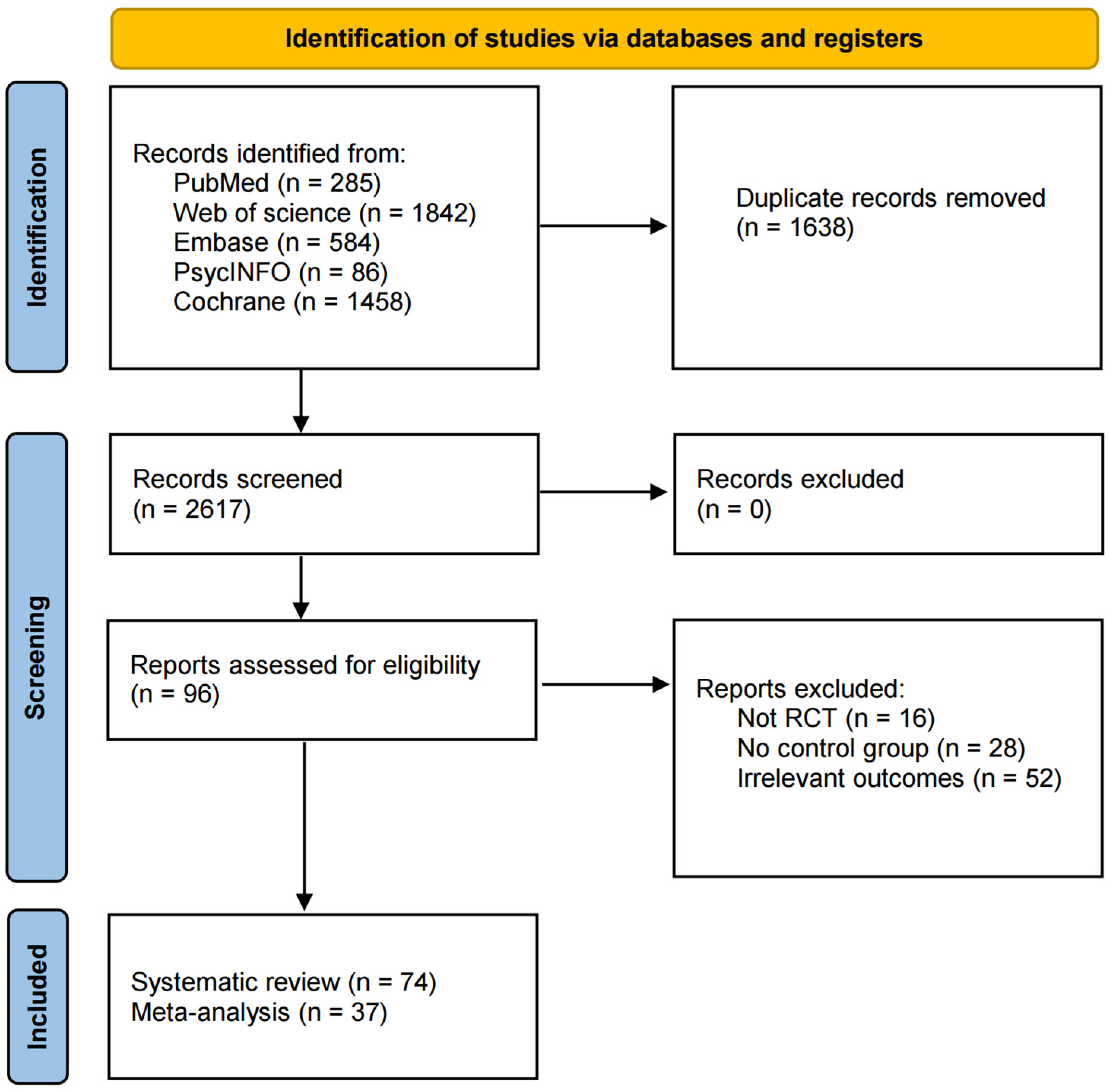
3.1. Flowchart of Studies Through the Review
3.2. Characteristics of Included Studies
3.2.1. Participants and Subjects
3.2.2. Interventions in Humans
3.2.3. Interventions in Animals
3.3. Acute and Chronic Effects of Physical Exercise on Exerkine Levels in Healthy Humans
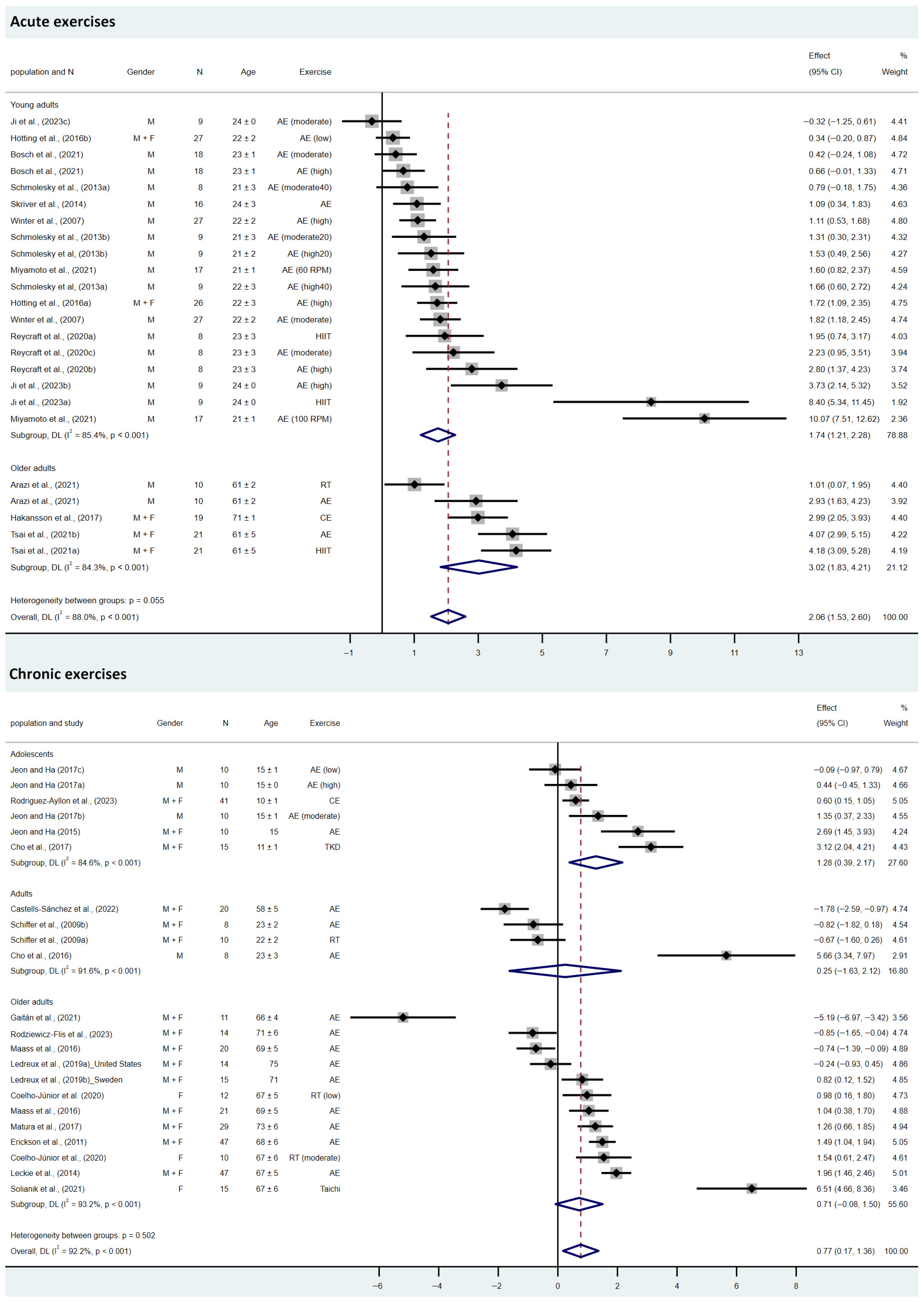
3.3.1. BDNF

| Author, Year, and Country | Design | Participant N (Female), Mean Age ± SD | Intervention Components | Exerkines (The Change Between Pre- and Post-Exercise) | Brain-Related Outcomes |
|---|---|---|---|---|---|
| Acute interventions | |||||
| Arazi et al., 2021 (Iran) [36] | RP | Healthy older adults AE (with interval): 10 (0), 61 ± 2 RT: 10 (0), 61 ± 2 CON: 10 (0), 61 ± 1 | --- AE: 3 × 10 min with 120 s interval of running with 65–70% of HRmax [208–0.7 (age)] --- RT: 65–70% of 1 RM --- Time: total 45 min in all conditions | --- Serum BDNF AE, +13%; RT, +16%; CON, +0.9% --- Serum IGF-1 AE, +4%; RT, +4%: CON, +0.2% | N/A |
| Bosch et al., 2021 (Switzerland) [13] | RC | Healthy young adults N = 18 (0), 23 ± 1 | --- Cycle ergometer with a pedaling cadence of 60–80 RPM --- AE (H): 75% of HRmax for 21 min --- AE (M): 65% of HRmax for 30 min | Serum BNDF AE (H): +2470 pg/mL AE (M): +2270 CON: +1890 | --- AE (M) improved memory (accuracy, efficiency and decoding) --- In AE (M), correlation between BDNF and delayed memory retention |
| Chang et al., 2017 (Taiwan, China) [46] | RC | Healthy young adults N = 30 (13), 23 ± 2 | Cycle ergometer with 60–70% of HRR for 30 min | No difference in serum BDNF after AE | AE improved cognitive functions (response time & accuracy) |
| Hakansson et al., 2017 (Sweden) [50] | RC | Healthy older adults N = 19 (11), 71 ± 1 | CE (self-weight exercise combined with aerobic exercise) with 11–13 RPE, total 35 min | Significantly increased in serum BDNF after CE | Working memory correlation with lower baseline BDNF and post-CE BDNF |
| Hötting et al., 2016 (Germany) [37] | RP | Healthy young adults AE (H): 26 (13), 22 ± 3 AE (L): 27 (13), 22 ± 2 CON: 28 (14), 23 ± 2 | Exercise on a cycling ergometer with 80% of HRmax ± 5 beats/min (H) or less than 57% of HRmax (L) for 30 min | Serum BDNF AE (H), +14% AE (L), −5% CON, −8% | AE (H) protected memory |
| Hwang et al., 2016 (United States) [45] | RP | Healthy young adults AE: 29 (15), 23 ± 3 CON: 29 (17), 24 ± 3 | Running on a treadmill with 85–90% of VO2max for 20 min | Significantly increased in serum BDNF after AE | --- AE (H) improved cognitive function (test in Stroop and TMT) --- Significant correlation between the change in BDNF and shorter completion times in TMT |
| Ji et al., 2023 (Korea) [38] | RC | Healthy young adults N = 9 (0), 24 ± 0 | --- Cycle ergometer --- HIIT: four 30 s of “all out” followed by 4 min of recovery, total 18 min --- AE (H): 85% HRR for 30 min --- AE (M): 55% HRR for 30 min | --- Serum BDNF HIIT, +52%; AE (H), +24% AE (M), −2%; CON, 0% --- Serum CTSB HIIT, +184%; AE (H), +87% AE (M), −23%; CON, +5% --- Serum FGF21 HIIT, +44%; AE (H), +12% AE (M), +2%; CON, −8% | N/A |
| McDonnell et al., 2013 (Australia) [47] | RC | Healthy adults N = 25 (16), 27 ± 8 | --- Cycle ergometer with a pedaling cadence of 50 RPM --- AE (L): 58 ± 5% of age-predicted HRmax (220 − age), 11 ± 2 RPE, total 30 min --- AE (M): 76 ± 16% of age-predicted HRmax, 15 ± 1 RPE, total 15 min | Trend to decrease serum BDNF after any condition | AE (L) improved neuroplasticity within the motor cortex |
| Miyamoto et al., 2021 (Japan) [39] | RC | Healthy adults N = 17 (0), 21 ± 1 | Cycle ergometer with 40% of VO2max for 40 min | Serum BDNF AE (60 RPM), +4% AE (100 RPM), +24% CON, −7% | N/A |
| Reycraft et al., 2020 (Canada) [14] | RC | Healthy young adults N = 8 (0), 23 ± 3 | --- Treadmill running --- HIIT: four 30 s of “all out” efforts interspersed with 4 min of recovery, total 18 min --- AE (H): 85% of VO2max for 30 min --- AE (M): 65% of VO2max for 30 min | --- Plasma BDNF HIIT, +196%; AE (H), +53% AE (M), +53%; CON, −4% --- Plasma Irisin HIIT, −12%; AE (H), −8% AE (M), −2%; CON, +6% | N/A |
| Schmolesky et al., 2013 (United States) [40] | RP | Healthy young adults AE (H for 40 min): 9 (0), 22 ± 3 AE (H for 20 min): 9 (0), 21 ± 2 AE (M for 40 min): 8 (0), 21 ± 3 AE (M for 20 min): 9 (0), 21 ± 3 CON: 10 (0) Age 20 ± 2 in CON (40 and 20 min) | Cycle ergometers with 60% and 80% of HRR for 20 min and 40 min (four exercise conditions) | Serum BDNF AE (H for 40 min), +28% AE (H for 20 min), +26% AE (M for 40 min), +30% AE (M for 20 min), +41% CON (40 min), −11% CON (20 min), −14% | N/A |
| Schwarz et al., 1996 (United Stated) [41] | RC | Healthy young adults N = 10 (0), 28 ± 5 | --- Exercise on a cycling ergometer --- AE (H): 79 ± 5.7% VO2max for 10 min --- AE (M): 46 ± 4.9% VO2max for 10 min | --- Serum GH AE (H), +343%; AE (M), +57% CON, +26% --- Serum IGF-1 AE (H), +13%; AE (M), +8% CON, −6% | N/A |
| Skriver et al., 2014 (Denmark) [42] | RP | Healthy young adults AE: 16 (0), 24 ± 3 CON: 16 (0), 24 ± 4 | Cycling ergometer with 10 mmol/L or above of intensity in lactate and workload ranged from 200 to 315 W, total 20 min | --- Plasma VEGF AE, +2.22 pg/mL; CON, +0.04 pg/mL --- Plasma BDNF AE, +0.37 pg/mL; CON, +0.02 pg/mL --- Plasma IGF-1 AE, +80 pg/mL; CON, +20 pg/mL | Positive correlation between BDNF change with memory |
| Slusher et al., 2018 (United States) [49] | RC | Healthy young adults N = 13 (0), 24 ± 1 | HIIT with sprint intensity on a cycle ergometer for 10 × 20 s with 10 s of active recovery against 5.5% of the participant’s body weight, total 15 min | Significantly increased after HIIT | HIIT improved executive function |
| Tsai et al., 2021 (Taiwan, China) [43] | RC | Healthy late-middle-aged and older adults N = 21 (11), 61 ± 5 | --- Stationary adjustable bicycle --- HIIT: 24 min of training (1 min of 70–75% of HRR alternated with a 2 min of 9–11 RPE active recovery period) --- AE: 50–55% of HRR --- Time: total 30 min in all conditions | --- Serum BDNF HIIT, +18%; AE, +23%; CON, −4% ---Serum Irisin HIIT, +8%; AE, +4%; CON, 0% | --- No correlations among the change in BDNF and irisin and the change in neuro-cognitive performance --- In AE, significant correlations between the change in irisin and reaction time --- AE improved accuracy rate --- AE and HIIT improved reaction time |
| Tsai et al., 2014 (Taiwan, China) [48] | RP | Healthy young adults RT (H): 20 (0), 22 ± 2 RT (L): 20 (0), 23 ± 3 CON: 20 (0), 23 ± 2 | --- RT (H): 80% of 1 RM --- RT (L): 50% of 1 RM --- Time: total 40 min in all conditions | --- Serum GH RT (H), +1145%; RT (L), +458% CON, +73% --- Serum IGF-1 RT (H), +12%; RT (L), +6% CON, −2% | RT with both high- and L-improved executive function |
| Winter et al., 2007 (Germany) [44] | RC | Healthy sports young adults N = 27 (0), 22 ± 2 | --- AE (H): running with blood lactate level ≤ 2 mmol/L, the median of HR was 140 beats/min, total 10 min --- AE (M): running with blood lactate level > 10 mmol/L, the median of HR was 184 beats/min, total 40 min | Serum BDNF AE (H), +12%; AE (M), +15% CON, +4% | Relationship between more sustained BDNF during learning after AE (H) and better short-term learning success |
| Chronic intervention | |||||
| Cassilhas et al., 2010 (Brazil) [66] | RP | MMSE score > 23 older adults RT (high-load): 20 (0), 68 ± 1 RT (moderate-load): 19 (0), 69 ± 1 CON: 23 (0), 67 ± 1 | --- RT (high-load): 80% of 1 RM --- RT (moderate-load): 50% of 1 RM --- Length: 60 min/session, 3 sessions/wk for 6 months | Serum IGF-1 RT (high-load), +35%; RT (moderate-load), +41,120 pg/mL CON, −10% | RT improved mood and anxiety |
| Guazzarini et al., 2024 (Italy) [73] | RP | Healthy older adults Tai Chi: 14 (10), 70 ± 7 CE: 14 (10), 70 ± 5 CON: 14 (8), 72 ± 5 | Intensity: N/A Length: 2 sessions/wk for 6 months | Plasma Irisin Tai Chi, +70%; CE, +55%; CON, −30% | Tai Chi practice at six months positive correlation between irisin with a verbal memory test |
| Castells-Sánchez et al., 2022 (Spain) [52] | RP | Healthy late-middle-aged adults AE: 25 (13), 58 ± 5 CON: 15 (7), 57 ± 6 | --- Healthy late-middle-aged adults --- AE: 25 (13), 58 ± 5 --- CON: 15 (7), 57 ± 6 | --- Plasma BDNF AE, −16%; CON, +5% --- Plasma TNF-α AE, +8%; CON, −1% | In AE group, sex differences were found in total white matter, parietal, temporal lobe, and dorsolateral prefrontal cortex volumes |
| Cho et al., 2017 (Korea) [76] | RP | Healthy children Taekwondo: 15 (6), 11 ± 1 CON: 15 (6), 11 ± 1 | --- Main exercise (involved basic movements, poomsae, kicking and gymnastic) with 11–15 RPE --- Length: 60 min/session, 5 sessions/wk for 4 months | --- Serum BDNF Taekwondo, +15%; CON, +2% --- Serum VEGF Taekwondo, +9%; CON, +3% --- Serum IGF-1 Taekwondo, +8%; CON, +3% | Taekwondo improved cognitive function (color-word test) |
| Cho et al. 2019 (Korea) [75] | RP | Healthy older adults Taekwondo: 19 (19), 69 ± 4 CON: 18 (18), 69 ± 4 | --- Main exercise (involved Taekwondo basic movement, poomsae, kicking and taekwondo gymnastics) with 50–80% of HRmax --- Length: 60 min/session, 5 sessions/wk for 4 months | --- Serum BDNF Taekwondo, +13%; CON, +2% --- Serum VEGF Taekwondo, +5%; CON, −2% --- Serum IGF-1 Taekwondo, +7%; CON, 0% | Taekwondo improved cognitive function (color-word test) |
| Cho et al., 2016 (Korea) [53] | RP | Overweight or obese young adults AE: 8 (0), 23 ± 3 CON: 8 (0), 22 ± 2 | --- Running on a treadmill with 70% of HRR --- Length: 40 min/session, 3 sessions/wk for 2 months | Serum BDNF AE, +21%; CON, +1% | N/A |
| Coelho-Júnior et al. 2020 (Brazil) [68] | RP | Healthy older adults RT (M): 10 (10), 67 ± 6 RT (L): 12 (12), 67 ± 5 CON: 14 (14), 67 ± 5 | --- RT (M): traditional RT (exercise machines and free weights) with 5–6/10 RPE --- RT (L): traditional RT combined with power training using elastic bands with 2–3/10 RPE --- Length: approx. 60 min/session, 2 sessions/wk for 22 wks | Serum BDNF RT (M), +5%; RT (L), +2% CON, −3% | Both RT programs improved global cognitive function, including short-term memory and dual-task performance |
| Erickson et al. 2011 (United States) [12] | RP | Older adults with normal cognitive function, depression score, and no neurologic disease or infarction history AE: 60 (44), 68 ± 6 CON: 60 (36), 66 ± 5 | --- Walking with 60–75% of HRR --- Length: 50 min/session, 3 sessions/wk for 1 year | Serum BDNF AE, +11%; CON, +3% | --- AE increased hippocampal volume --- Association between the change in BDNF and the change in hippocampal volume --- Association between higher aerobic fitness level after AE and better memory performance |
| Gaitán et al., 2021 (United States) [54] | RP | Cognitively healthy older adults AE: 11 (5), 66 ± 4 CON: 12 (6), 64 ± 5 | --- Moderate–vigorous intensity on treadmill --- Length: 3 sessions/wk for 26 wks | --- Plasma CTSB AE, +32%; CON, +22% --- Plasma BDNF AE, −47%; CON, −19% --- Serum klotho AE, 0%; CON, −6% | Positive correlation between the change in CTSB with cognitive function |
| Jeon and Ha 2015 (Korea) [56] | RP | Healthy adolescents AE, N = 10; CON, N = 10 No gender reported, mean age 15 | --- AE on treadmill with 40–60% of VO2max until burned 200 kcal --- Length: 3 sessions/wk for 2 months | --- Serum BDNF AE, +18%; CON, +4% --- Serum IGF-1 AE, +50%; CON, +3% | N/A |
| Jeon and Ha 2017 (Korea) [55] | RP | Healthy adolescents AE (H): 10 (0), 15 ± 0 AE (M): 10 (0), 15 ± 1 AE (L): 10 (0), 15 ± 1 CON: 10 (0), 15 ± 0 | --- AE on treadmill with 40% (L) of VO2max for 43 min/session, or with 55% (M) of VO2max for 33 min/session, or with 70% (H) of VO2max for 26 min/session, until burned 200 kcal --- Length: 4 sessions/wk for 3 months | --- Serum BDNF AE (H), +19%; AE (M), +7% AE (L), +1%; CON, +2% --- Serum IGF-1 AE (H), +8%; AE (M), −1% AE (L), +1%; CON, +6% | AE (H) improved working memory |
| Leckie et al., 2014 (United States) [57] | RP | Older adults without cognitive impairment AE: 47 (32), 67 ± 5 CON: 45 (27), 66 ± 6 | --- Walking with 60–75% of HRR --- Length: 50 min/session, total 1 year | Serum BDNF AE, +11%; CON, −2% | The change in BDNF mediated the relationship between exercise group and executive function, specifically for participants aged 71 years and older |
| Ledreux et al., 2019a (United States) [58] | RP | Healthy older adults AE, N = 14; CON, N = 19 Age approx. 75 and 25 are female in all group | --- AE routines with 11–13 of RPE --- Length: 35 min/session, 5 sessions/wk for 5 wks | Serum BDNF AE, −5%; CON, −0.8% | N/A |
| Ledreux et al., 2019b (Sweden) [58] | RP | Healthy older adults AE, N = 15; CON, N = 20 Age approx. 71 and 26 are female in all group | --- AE routines with 11–13 of RPE --- Length: 35 min/session, 5 sessions/wk for 5 wks | Serum BDNF AE, +10%; CON, −9% | N/A |
| Maass et al., 2016 (Germany) [59] | RP | Healthy older adults AE: 21 (11), 69 ± 5 CON: 19 (11), 68 ± 4 | --- Running interval training on a treadmill with 70% of HRmax --- Length: 40 min/session, 3 sessions/wk for 3 months | --- Serum BDNF AE, −4%; CON, 0% --- Plasma BDNF AE, +31%; CON, +9% --- Serum VEGF AE, 0%; CON, −7% --- Serum IGF-1 AE, −2%; CON, −3% | Positive correlation between the change in IGF-1 with hippocampal volume and memory |
| Matura et al. 2017 (German) [60] | RP | Cognitively healthy older adults AE: 29 (12), 73 ± 6 CON: 24 (12), 77 ± 8 | --- Cycle ergometer with 64 ± 9% of VO2max --- Length: 30 min/session, 3 sessions/wk for 3 months | Serum BDNF AE, +2%; CON, −7% | --- CON increased whereas AE remained stable in cerebral choline concentration --- No change in Cortical gray matter volume after AE |
| Moon et al., 2016 (Germany) [61] | RP | Healthy young adults AE, N = 20; CON, N = 23 Age approx. 19–34 and 24 are female in all group | --- Running interval training on a treadmill with 70–90% of HRmax --- Length: 45–75 min/session, 3 sessions/wk for 4 months | Plasma CTSB AE, +22%; CON, −4% | Positive correlation between the change in CTSB with memory |
| Rodriguez-Ayllon et al. 2023 (Spain) [71] | RP | Children without neurological and attention deficit/hyperactivity disorder CE: 42 (15), 10 ± 1 CON: 39 (18), 10 ± 1 | --- CE with an average of 38 min above 80% of HRmax --- Length: 90 min/session, 3 sessions/wk for 5 months | --- Plasma BDNF CE, −20%; CON, −40% --- Plasma CTSB CE, −5%; CON, +5% --- Plasma FGF21 CE, −12%; CON, +11% --- Plasma kynurenine CE, 0.29 z-score; CON, 0.22 z-score | CE improved total intelligence and cognitive flexibility but no difference in working memory and hippocampal volume |
| Rodziewicz-Flis et al. 2023 (Poland) [62] | RP | Older adults without cognitive impairment AE, N = 14; CON, N = 12 Age 71 ± 6 and 6 are female in all group | --- Folk-dance training with 60–80% HRmax --- Length: 50 min/session, 3 sessions/wk for 3 months | --- Serum BDNF AE, −66%; CON, −33% --- Serum Irisin AE, +13%; CON, 0% | N/A |
| Ruscheweyh et al. 2011 (German) [65] | RP | Healthy older adults AE: 20 (14), 60 ± 6 CON: 21 (14), 58 ± 7 | --- Nordic walking with lactate between 1.5 and 2.0 mmol/L --- Length: 50 min/session, 3 sessions/wk for 6 months | Trend to increase serum BDNF after AE | --- AE improved memory --- Positive correlation between the increases in local gray matter volume in prefrontal and cingulate cortex, and BDNF levels |
| Schiffer et al., 2009 (Germany) [63] | RP | Healthy sports young adults RT: 10, 22 ± 2 AE: 8, 23 ± 2 CON: 9, 22 ± 2 No gender reported | --- RT: 70–80% of 1 RM --- AE: Running on a treadmill with 70–80% of HRmax for 45 min --- Length: 3 sessions/wk for 3 months | --- Plasma BDNF RT, −14%; AE, −20%; CON, −3% --- Plasma IGF-1 RT, −9%; AE, −6%; CON, −6% | N/A |
| Seo et al., 2010 (Korea) [64] | RP | Healthy postmenopausal women AE: 7 (7), 55 ± 5 CE: 8 (8), 54 ± 4 CON: 7 (7), 58 ± 4 | --- AE: 60–80% of HRR --- CE: Walking and resistance exercise with 50–70% of 1 RM --- Length: 60 min/session, 3 sessions/wk for 3 months | --- Serum IGF-1 AE, +12%; CE, +9%; CON, −2% --- Serum GH AE, +45%, CE, +88%; CON, +7% | N/A |
| Solianik et al. 2021 (Lithuania) [74] | RP | Healthy older adults Tai Chi, 15 (13); CON, 15 (13) 67 ± 6 years old in both group | --- 8-form Yang-style Tai Chi practice --- Length: 60 min/session, 2 sessions/wk for 10 wks | Serum BDNF Tai Chi, +99%; CON, −8% | --- In Tai Chi, correlation between the change in BDNF and the change in reaction time --- Tai Chi improved cognitive function |
| Tsai et al., 2015 (Taiwan, China) [69] | RP | Healthy older adults RT: 24 (0), 71 ± 3 CON: 24 (0), 72 ± 4 | --- 75–80% of 1 RM --- Length: 60 min/session, 3 sessions/wk for 1 year | --- Serum GH RT, +22%; CON, −9% --- Serum IGF-1 RT, +12%; CON, −2% | --- RT improved reaction time --- Negative correlation between the change in IGF-1 with neurocognitive decline |
| Vaughan et al. 2014 (Australia) [72] | RP | Older adults without cognitive impairment CE: 25 (25), 69 ± 3 CON: 23 (23), 69 ± 4 | --- Each session includes aerobic, resistance and motor fitness (balance, co-ordination, flexibility and agility), with the intensity of 3–6/10 RPE --- Length: 60 min/session, 2 sessions/wk for 4 months | Significantly increased in plasma BDNF after CE | CE improved cognitive function |
| Vints et al., 2024 (Lithuania) [70] | RP | MoCA score > 25 older adults RT: 27 (15), 71 ± 6 CON: 25 (13), 69 ± 6 | --- RT: 70–85% of 1 RM --- Length: 2 sessions/wk for 3 months | --- Serum IGF-1 RT, +17%; CON, +21% --- Serum IL-6 RT, +44%; CON, −7% --- Serum kynurenine RT, −18%; CON, −8% | In RT, negative correlation between the increases in IGF-1 with the improvements in response time on a mathematical processing test |
| Exerkines | Ages | Detected Regions | Levels | Significance or Tendency | Refs. | |
|---|---|---|---|---|---|---|
| BDNF | Adolescence | Short-term | Hippocampus | Protein | ↑ * | [91,92] |
| ↓ * | [89] | |||||
| Short-term | Perirhinal cortex | Protein | ↑ | [89] | ||
| Long-term | Hippocampus | Protein | ↑ | [108] | ||
| Adults | Acute | Hippocampus | Protein | ↑ * | [77] | |
| mRNA | ↑ * | [77,78] | ||||
| Short-term | Hippocampus | mRNA | ↑ | [85] | ||
| ↑ * | [82,88] | |||||
| Cerebral cortex | Protein | ↑ * | [101] | |||
| Hippocampus | ↑ | [81] | ||||
| ↑ * | [82] | |||||
| Perirhinal cortex | ↑ | [89] | ||||
| Striatum | ↔ | [102] | ||||
| Long-term | Basolateral amygdala | mRNA | ↑ * | [105] | ||
| Hippocampus | mRNA | ↑ * | [104,105] | |||
| Protein | ↑ * | [103] | ||||
| Old-aged | Short-term | Hippocampus | mRNA | ↔ | [85] | |
| pro-BDNF | Adults | Short-term | Hippocampus | mRNA | ↑ * | [82] |
| Protein | ↑ * | [82] | ||||
| Mature BDNF | Adults | Short-term | Hippocampus | Protein | ↑ * | [83] |
| Long-term | ↑ * | [107] | ||||
| CTSB | Adolescence | Short-term | Blood | Plasma | ↑ * | [61] |
| FNDC5 | Adults | Short-term | Hippocampus | mRNA | ↑ | [97] |
| IGF-1 | Adults | Short-term | Blood | Serum | ↑ | [84] |
| Hippocampus | mRNA | ↑ * | [82] | |||
| Protein | ↓ | [84] | ||||
| VEGF | Adults | Short-term | Blood | Plasma | ↑ | [102] |
| Hippocampus | Protein | ↔ | [102] | |||
| Striatum | ↔ | [102] |
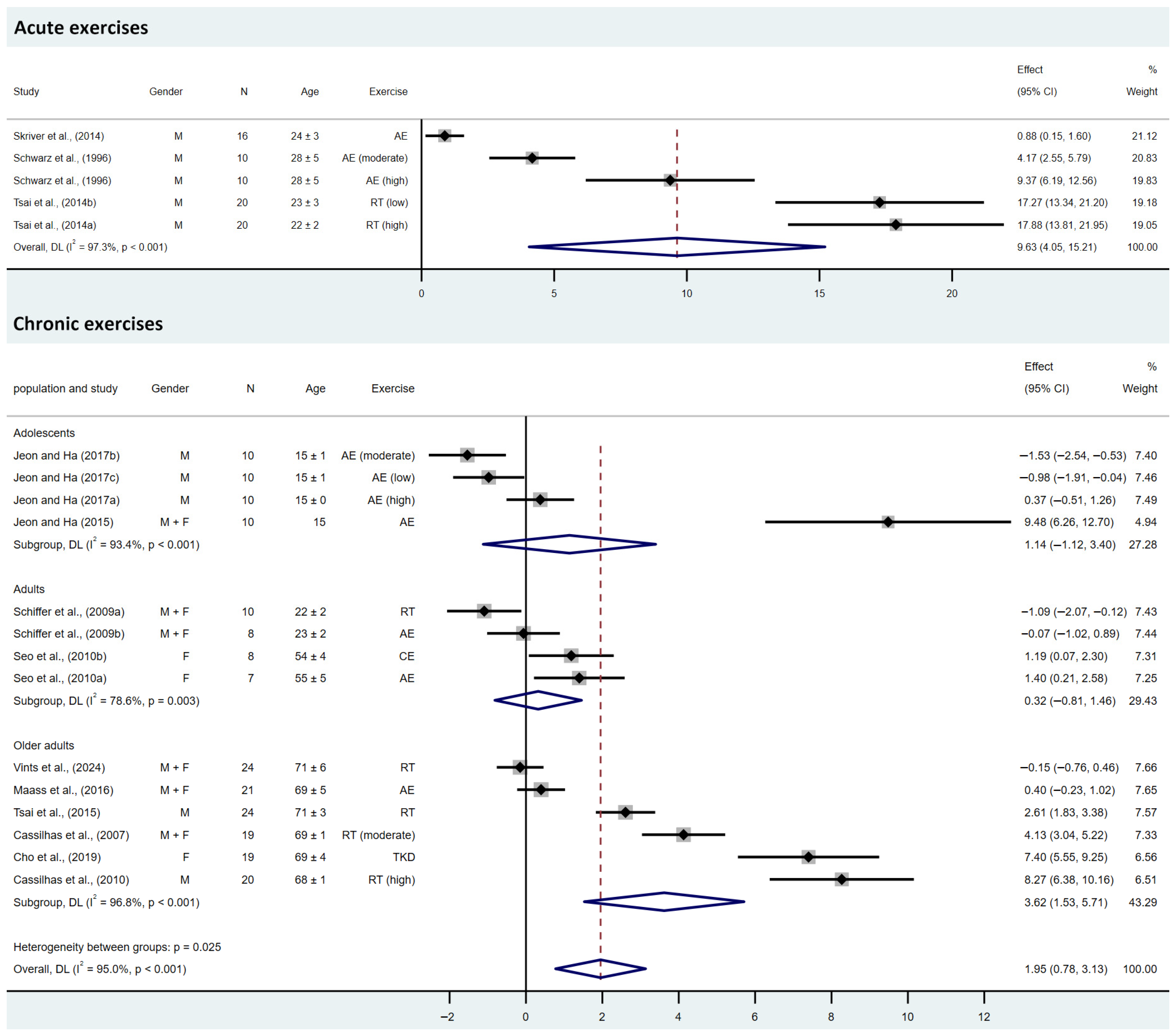
| Acute Exercises | N = Trails | Cohen’s d (95% CI) | I2 (%) | P1 | P2 | Chronic Exercises | N = Trails | Cohen’s d (95% CI) | I2 (%) | P1 | P2 |
|---|---|---|---|---|---|---|---|---|---|---|---|
| Gender | - | Gender | 0.01 | ||||||||
| Male | 24 | 2.09 (1.54, 2.63) | 92.9 | <0.01 | Male | 4 | 1.52 (−0.04, 3.07) | 87.9 | 0.06 | ||
| Female | - | - | - | - | Female | 4 | 6.99 (3.13, 10.85) | 96.8 | <0.01 | ||
| Age (years old) | 0.06 | Age (years old) | 0.99 | ||||||||
| <18 | - | - | - | - | <18 | 6 | 1.29 (0.39, 2.18) | 85.1 | <0.01 | ||
| 18–30 | 19 | 1.77 (1.23, 2.32) | 86.1 | <0.01 | 18–30 | 3 | 1.16 (−1.58, 3.89) | 93.3 | 0.41 | ||
| 30–60 | - | - | - | - | 30–60 | - | - | - | - | ||
| >60 | 5 | 3.02 (1.84, 4.21) | 84.6 | <0.01 | >60 | 13 | 1.18 (0.24, 2.11) | 94.9 | 0.01 | ||
| Baseline BMI (>18 y/o) | 0.42 | Baseline BMI (>18 y/o) | 0.23 | ||||||||
| <25 | 12 | 1.92 (1.24, 2.60) | 85.1 | <0.01 | <25 | 7 | 2.05 (0.42, 3.67) | 94.3 | 0.01 | ||
| ≥25 | 3 | 3.75 (−0.6, 8.09) | 95.5 | 0.09 | ≥25 | 12 | 0.95 (0.17, 1.73) | 92.8 | 0.02 | ||
| Physical activity levels | - | Physical activity levels | 0.07 | ||||||||
| Low | - | - | - | Low | 9 | 1.36 (−0.15, 2.87) | 97.0 | 0.08 | |||
| Moderate | - | - | - | Moderate | - | - | - | ||||
| High | 18 | 1.84 (1.26, 2.42) | 86.9 | <0.01 | High | 4 | −0.18 (−0.93, 0.58) | 71.1 | 0.64 | ||
| Blood composition | 0.62 | Blood composition | <0.01 | ||||||||
| Serum | 20 | 2.13 (1.51, 2.76) | 90.1 | <0.01 | Serum | 17 | 1.76 (1.00, 2.53) | 93.1 | <0.01 | ||
| Plasma | 4 | 1.88 (1.10, 2.66) | 49.4 | <0.01 | Plasma | 6 | −0.98 (−2.23, 0.28) | 91.9 | 0.13 | ||
| Types of exercise | 0.01 | Types of exercise | 0.01 | ||||||||
| Aerobic | 19 | 1.80 (1.25, 2.34) | 87.0 | <0.01 | Aerobic | 17 | 0.70 (−0.05, 1.44) | 93.6 | 0.07 | ||
| Resistance | - | - | - | - | Resistance | 3 | 0.62 (−0.64, 1.88) | 83.4 | 0.33 | ||
| Concurrent | - | - | - | - | Concurrent | 3 | 7.74 (3.10, 12.39) | 97.7 | <0.01 | ||
| HIIT | 3 | 4.50 (1.84, 7.16) | 89.5 | <0.01 | HIIT | - | - | - | - | ||
| Intensity | 0.36 | Intensity | 0.60 | ||||||||
| Light | 3 | 3.57 (0.69, 6.45) | 96.6 | 0.02 | Light | 2 | 0.46 (−0.59, 1.50) | 67.2 | 0.39 | ||
| Moderate | 10 | 1.69 (0.89, 2.48) | 86.8 | <0.01 | Moderate | 15 | 1.11 (0.31, 1.90) | 93.9 | 0.01 | ||
| Vigorous | 11 | 2.22 (1.49, 2.95) | 84.9 | <0.01 | vigorous | 4 | 1.08 (−0.29, 2.45) | 89.2 | 0.12 | ||
| Length (wks) | - | Length (wks) | 0.26 | ||||||||
| ≤12 | - | - | - | - | ≤12 | 15 | 0.76 (0.01, 1.51) | 91.3 | 0.05 | ||
| >12 | - | - | - | - | >12 | 8 | 1.60 (0.35, 2.84) | 95.4 | 0.01 | ||
| Frequency (sessions/wk) | - | Frequency (sessions/wk) | 0.41 | ||||||||
| ≤3 | - | - | - | - | ≤3 | 14 | 0.84 (0.04, 1.64) | 93.0 | 0.04 | ||
| >3 | - | - | - | - | >3 | 8 | 1.55 (0.09, 3.00) | 94.8 | 0.04 | ||
| Duration (min/session) | 0.37 | Duration (min/session) | 0.67 | ||||||||
| ≤30 | 16 | 1.91 (1.26, 2.56) | 88.6 | <0.01 | ≤30 | 2 | 0.92 (0.13, 1.71) | 55.9 | 0.02 | ||
| 30–60 | 8 | 2.45 (1.46, 3.45) | 88.1 | <0.01 | 30–60 | 18 | 1.17 (0.31, 2.04) | 94.8 | <0.01 |
3.3.2. IGF-1
3.3.3. Other Exerkines
3.4. Quality Assessment, Risk of Publication Bias, Sensitivity Analysis, and Heterogeneity
4. Discussion
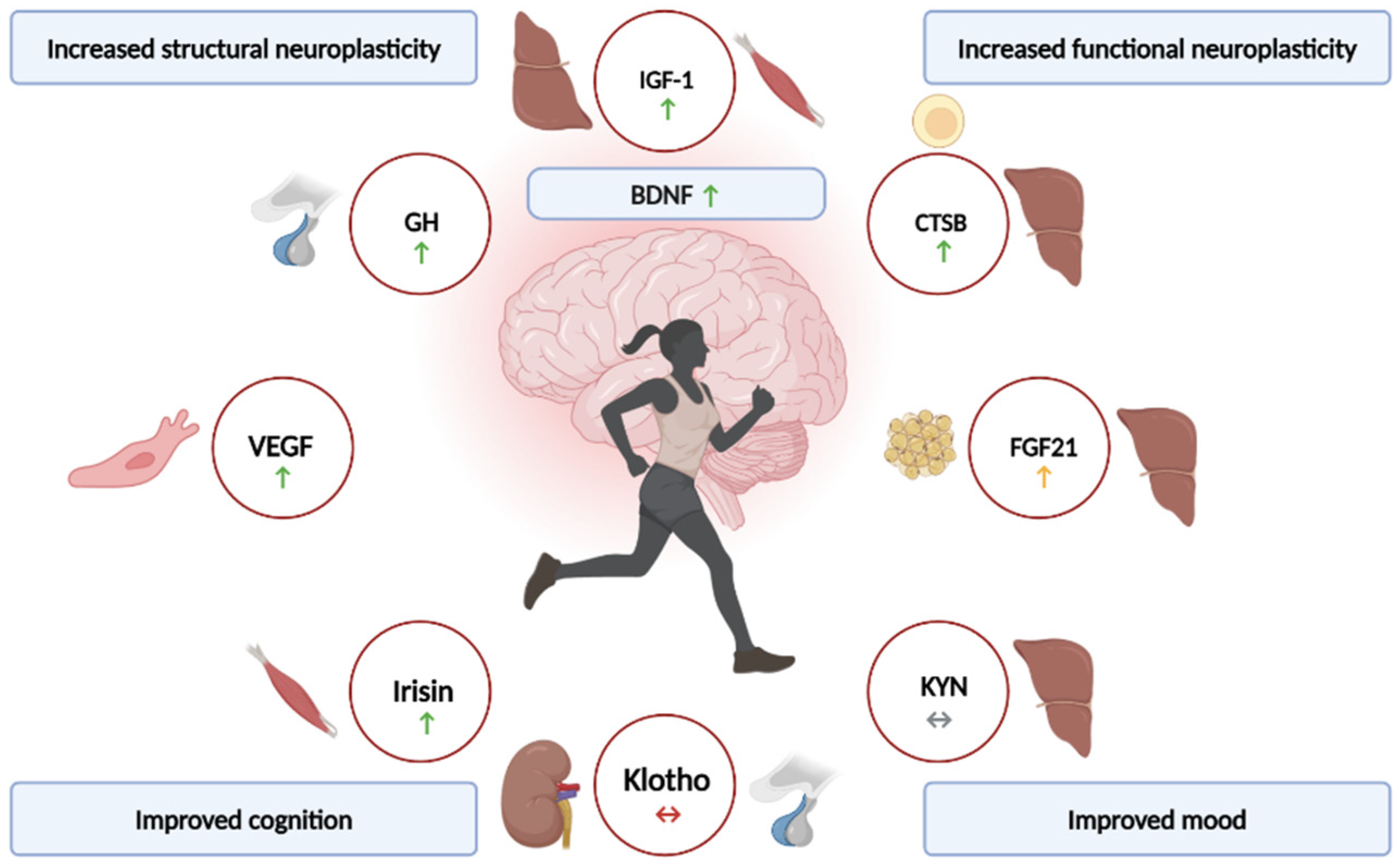
4.1. Cerebral Responses to Physical Exercise and the Link Between Exerkines and Brain Health
4.2. Acute and Chronic Effects of PE on Exerkine Levels in Healthy Humans and Animals (The Reporting Sequence of Exerkines According to Initial A–Z)
4.3. Subgroup Analysis
4.4. Exploring the Contributions of Exercise-Induced Changes in Exerkines to Brain Structure and Function
4.5. Strengths and Limitations
5. Conclusions
Supplementary Materials
Author Contributions
Funding
Data Availability Statement
Acknowledgments
Conflicts of Interest
References
- Lavie, C.J.; Arena, R.; Swift, D.L.; Johannsen, N.M.; Sui, X.; Lee, D.C.; Earnest, C.P.; Church, T.S.; O’Keefe, J.H.; Milani, R.V.; et al. Exercise and the cardiovascular system: Clinical science and cardiovascular outcomes. Circ. Res. 2015, 117, 207–219. [Google Scholar] [CrossRef] [PubMed]
- Haskell, W.L.; Lee, I.M.; Pate, R.R.; Powell, K.E.; Blair, S.N.; Franklin, B.A.; Macera, C.A.; Heath, G.W.; Thompson, P.D.; Bauman, A. Physical activity and public health: Updated recommendation for adults from the American College of Sports Medicine and the American Heart Association. Med. Sci. Sports Exerc. 2007, 39, 1423–1434. [Google Scholar] [CrossRef]
- Warburton, D.E.; Nicol, C.W.; Bredin, S.S. Health benefits of physical activity: The evidence. Can. Med. Assoc. J. 2006, 174, 801–809. [Google Scholar] [CrossRef] [PubMed]
- Erickson, K.I.; Hillman, C.; Stillman, C.M.; Ballard, R.M.; Bloodgood, B.; Conroy, D.E.; Macko, R.; Marquez, D.X.; Petruzzello, S.J.; Powell, K.E.; et al. Physical Activity, Cognition, and Brain Outcomes: A Review of the 2018 Physical Activity Guidelines. Med. Sci. Sports Exerc. 2019, 51, 1242–1251. [Google Scholar] [CrossRef]
- Piercy, K.L.; Troiano, R.P.; Ballard, R.M.; Carlson, S.A.; Fulton, J.E.; Galuska, D.A.; George, S.M.; Olson, R.D. The Physical Activity Guidelines for Americans. JAMA 2018, 320, 2020–2028. [Google Scholar] [CrossRef]
- Boa Sorte Silva, N.C.; Barha, C.K.; Erickson, K.I.; Kramer, A.F.; Liu-Ambrose, T. Physical exercise, cognition, and brain health in aging. Trends Neurosci. 2024, 47, 402–417. [Google Scholar] [CrossRef]
- Livingston, G.; Huntley, J.; Liu, K.Y.; Costafreda, S.G.; Selbaek, G.; Alladi, S.; Ames, D.; Banerjee, S.; Burns, A.; Brayne, C.; et al. Dementia prevention, intervention, and care: 2024 report of the Lancet standing Commission. Lancet 2024, 404, 572–628. [Google Scholar] [CrossRef]
- Chieffi, S.; Messina, G.; Villano, I.; Messina, A.; Valenzano, A.; Moscatelli, F.; Salerno, M.; Sullo, A.; Avola, R.; Monda, V.; et al. Neuroprotective Effects of Physical Activity: Evidence from Human and Animal Studies. Front. Neurol. 2017, 8, 188. [Google Scholar] [CrossRef]
- Vecchio, L.M.; Meng, Y.; Xhima, K.; Lipsman, N.; Hamani, C.; Aubert, I. The Neuroprotective Effects of Exercise: Maintaining a Healthy Brain Throughout Aging. Brain Plast. 2018, 4, 17–52. [Google Scholar] [CrossRef]
- Safdar, A.; Saleem, A.; Tarnopolsky, M.A. The potential of endurance exercise-derived exosomes to treat metabolic diseases. Nat. Rev. Endocrinol. 2016, 12, 504–517. [Google Scholar] [CrossRef] [PubMed]
- Chow, L.S.; Gerszten, R.E.; Taylor, J.M.; Pedersen, B.K.; van Praag, H.; Trappe, S.; Febbraio, M.A.; Galis, Z.S.; Gao, Y.; Haus, J.M.; et al. Exerkines in health, resilience and disease. Nat. Rev. Endocrinol. 2022, 18, 273–289. [Google Scholar] [CrossRef]
- Erickson, K.I.; Voss, M.W.; Prakash, R.S.; Basak, C.; Szabo, A.; Chaddock, L.; Kim, J.S.; Heo, S.; Alves, H.; White, S.M.; et al. Exercise training increases size of hippocampus and improves memory. Proc. Natl. Acad. Sci. USA 2011, 108, 3017–3022. [Google Scholar] [CrossRef]
- Marin Bosch, B.; Bringard, A.; Logrieco, M.G.; Lauer, E.; Imobersteg, N.; Thomas, A.; Ferretti, G.; Schwartz, S.; Igloi, K. A single session of moderate intensity exercise influences memory, endocannabinoids and brain derived neurotrophic factor levels in men. Sci. Rep. 2021, 11, 14371. [Google Scholar] [CrossRef] [PubMed]
- Reycraft, J.T.; Islam, H.; Townsend, L.K.; Hayward, G.C.; Hazell, T.J.; Macpherson, R.E.K. Exercise Intensity and Recovery on Circulating Brain-derived Neurotrophic Factor. Med. Sci. Sports Exerc. 2020, 52, 1210–1217. [Google Scholar] [CrossRef]
- Voss, M.W.; Erickson, K.I.; Prakash, R.S.; Chaddock, L.; Kim, J.S.; Alves, H.; Szabo, A.; Phillips, S.M.; Wojcicki, T.R.; Mailey, E.L.; et al. Neurobiological markers of exercise-related brain plasticity in older adults. Brain Behav. Immun. 2013, 28, 90–99. [Google Scholar] [CrossRef] [PubMed]
- Carro, E.; Nunez, A.; Busiguina, S.; Torres-Aleman, I. Circulating insulin-like growth factor I mediates effects of exercise on the brain. J. Neurosci. 2000, 20, 2926–2933. [Google Scholar] [CrossRef] [PubMed]
- Carro, E.; Trejo, J.L.; Busiguina, S.; Torres-Aleman, I. Circulating insulin-like growth factor I mediates the protective effects of physical exercise against brain insults of different etiology and anatomy. J. Neurosci. 2001, 21, 5678–5684. [Google Scholar] [CrossRef]
- Trejo, J.L.; Carro, E.; Torres-Aleman, I. Circulating insulin-like growth factor I mediates exercise-induced increases in the number of new neurons in the adult hippocampus. J. Neurosci. 2001, 21, 1628–1634. [Google Scholar] [CrossRef]
- Tyndall, A.V.; Clark, C.M.; Anderson, T.J.; Hogan, D.B.; Hill, M.D.; Longman, R.S.; Poulin, M.J. Protective Effects of Exercise on Cognition and Brain Health in Older Adults. Exerc. Sport Sci. Rev. 2018, 46, 215–223. [Google Scholar] [CrossRef]
- Pedersen, B.K. Physical activity and muscle-brain crosstalk. Nat. Rev. Endocrinol. 2019, 15, 383–392. [Google Scholar] [CrossRef]
- Kim, H.; Jung, J.; Park, S.; Joo, Y.; Lee, S.; Sim, J.; Choi, J.; Lee, H.; Hwang, G.; Lee, S. Exercise-Induced Fibroblast Growth Factor-21: A Systematic Review and Meta-Analysis. Int. J. Mol. Sci. 2023, 24, 7284. [Google Scholar] [CrossRef] [PubMed]
- Schwarcz, R.; Bruno, J.P.; Muchowski, P.J.; Wu, H.Q. Kynurenines in the mammalian brain: When physiology meets pathology. Nat. Rev. Neurosci. 2012, 13, 465–477. [Google Scholar] [CrossRef]
- Moher, D.; Liberati, A.; Tetzlaff, J.; Altman, D.G.; Group, P. Preferred reporting items for systematic reviews and meta-analyses: The PRISMA statement. PLoS Med. 2009, 6, e1000097. [Google Scholar] [CrossRef]
- Liberati, A.; Altman, D.G.; Tetzlaff, J.; Mulrow, C.; Gotzsche, P.C.; Ioannidis, J.P.; Clarke, M.; Devereaux, P.J.; Kleijnen, J.; Moher, D. The PRISMA statement for reporting systematic reviews and meta-analyses of studies that evaluate health care interventions: Explanation and elaboration. PLoS Med. 2009, 6, e1000100. [Google Scholar] [CrossRef]
- Wang, Y.; Pan, Y.; Li, H. What is brain health and why is it important? BMJ 2020, 371, m3683. [Google Scholar] [CrossRef] [PubMed]
- Hozo, S.P.; Djulbegovic, B.; Hozo, I. Estimating the mean and variance from the median, range, and the size of a sample. BMC Med. Res. Methodol. 2005, 5, 13. [Google Scholar] [CrossRef]
- Altman, D.G.; Bland, J.M. Standard deviations and standard errors. BMJ 2005, 331, 903. [Google Scholar] [CrossRef]
- Maher, C.G.; Sherrington, C.; Herbert, R.D.; Moseley, A.M.; Elkins, M. Reliability of the PEDro scale for rating quality of randomized controlled trials. Phys. Ther. 2003, 83, 713–721. [Google Scholar] [CrossRef]
- Goldet, G.; Howick, J. Understanding GRADE: An introduction. J. Evid. Based Med. 2013, 6, 50–54. [Google Scholar] [CrossRef] [PubMed]
- Craig, C.L.; Marshall, A.L.; Sjostrom, M.; Bauman, A.E.; Booth, M.L.; Ainsworth, B.E.; Pratt, M.; Ekelund, U.; Yngve, A.; Sallis, J.F.; et al. International physical activity questionnaire: 12-country reliability and validity. Med. Sci. Sports Exerc. 2003, 35, 1381–1395. [Google Scholar] [CrossRef]
- American College of Sports Medicine. ACSM’s Guidelines for Exercise Testing and Prescription, 9th ed.; Lippincott Williams & Wilkins: Philadelphia, PA, USA, 2013. [Google Scholar]
- Higgins, J.P.; Thompson, S.G.; Deeks, J.J.; Altman, D.G. Measuring inconsistency in meta-analyses. BMJ 2003, 327, 557–560. [Google Scholar] [CrossRef]
- Egger, M.; Davey Smith, G.; Schneider, M.; Minder, C. Bias in meta-analysis detected by a simple, graphical test. BMJ 1997, 315, 629–634. [Google Scholar] [CrossRef]
- Galan-Lopez, P.; Casuso, R.A. Metabolic Adaptations to Morning Versus Afternoon Training: A Systematic Review and Meta-analysis. Sports Med. 2023, 53, 1951–1961. [Google Scholar] [CrossRef] [PubMed]
- Campbell, M.; McKenzie, J.E.; Sowden, A.; Katikireddi, S.V.; Brennan, S.E.; Ellis, S.; Hartmann-Boyce, J.; Ryan, R.; Shepperd, S.; Thomas, J.; et al. Synthesis without meta-analysis (SWiM) in systematic reviews: Reporting guideline. BMJ 2020, 368, l6890. [Google Scholar] [CrossRef] [PubMed]
- Arazi, H.; Babaei, P.; Moghimi, M.; Asadi, A. Acute effects of strength and endurance exercise on serum BDNF and IGF-1 levels in older men. BMC Geriatr. 2021, 21, 50. [Google Scholar] [CrossRef]
- Hotting, K.; Schickert, N.; Kaiser, J.; Roder, B.; Schmidt-Kassow, M. The Effects of Acute Physical Exercise on Memory, Peripheral BDNF, and Cortisol in Young Adults. Neural Plast. 2016, 2016, 6860573. [Google Scholar] [CrossRef]
- Ji, M.; Cho, C.; Lee, S. Acute effect of exercise intensity on circulating FGF-21, FSTL-1, cathepsin B, and BDNF in young men. J. Exerc. Sci. Fit. 2024, 22, 51–58. [Google Scholar] [CrossRef]
- Miyamoto, T.; Nishiwaki, E.; Uho, T.; Mizutani, R.; Miyamae, N.; Yamada, E. Effect of pedaling cadence on serum levels of brain-derived neurotrophic factor during ergometric exercise in healthy adults. Sport Sci. Health 2021, 17, 543–549. [Google Scholar] [CrossRef]
- Schmolesky, M.T.; Webb, D.L.; Hansen, R.A. The effects of aerobic exercise intensity and duration on levels of BDNF in healthy men. J. Sports Sci. Med. 2013, 12, 502–511. [Google Scholar] [PubMed]
- Schwarz, A.J.; Brasel, J.A.; Hintz, R.L.; Mohan, S.; Cooper, D.M. Acute effect of brief low- and high-intensity exercise on circulating insulin-like growth factor (IGF) I, II, and IGF-binding protein-3 and its proteolysis in young healthy men. J. Clin. Endocrinol. Metab. 1996, 81, 3492–3497. [Google Scholar] [CrossRef] [PubMed]
- Skriver, K.; Roig, M.; Lundbye-Jensen, J.; Pingel, J.; Helge, J.W.; Kiens, B.; Nielsen, J.B. Acute exercise improves motor memory: Exploring potential biomarkers. Neurobiol. Learn. Mem. 2014, 116, 46–58. [Google Scholar] [CrossRef] [PubMed]
- Tsai, C.L.; Pan, C.Y.; Tseng, Y.T.; Chen, F.C.; Chang, Y.C.; Wang, T.C. Acute effects of high-intensity interval training and moderate-intensity continuous exercise on BDNF and irisin levels and neurocognitive performance in late middle-aged and older adults. Behav. Brain Res. 2021, 413, 113472. [Google Scholar] [CrossRef]
- Winter, B.; Breitenstein, C.; Mooren, F.C.; Voelker, K.; Fobker, M.; Lechtermann, A.; Krueger, K.; Fromme, A.; Korsukewitz, C.; Floel, A.; et al. High impact running improves learning. Neurobiol. Learn. Mem. 2007, 87, 597–609. [Google Scholar] [CrossRef]
- Hwang, J.; Brothers, R.M.; Castelli, D.M.; Glowacki, E.M.; Chen, Y.T.; Salinas, M.M.; Kim, J.; Jung, Y.; Calvert, H.G. Acute high-intensity exercise-induced cognitive enhancement and brain-derived neurotrophic factor in young, healthy adults. Neurosci. Lett. 2016, 630, 247–253. [Google Scholar] [CrossRef]
- Chang, Y.K.; Alderman, B.L.; Chu, C.H.; Wang, C.C.; Song, T.F.; Chen, F.T. Acute exercise has a general facilitative effect on cognitive function: A combined ERP temporal dynamics and BDNF study. Psychophysiology 2017, 54, 289–300. [Google Scholar] [CrossRef]
- McDonnell, M.N.; Buckley, J.D.; Opie, G.M.; Ridding, M.C.; Semmler, J.G. A single bout of aerobic exercise promotes motor cortical neuroplasticity. J. Appl. Physiol. 2013, 114, 1174–1182. [Google Scholar] [CrossRef] [PubMed]
- Tsai, C.L.; Wang, C.H.; Pan, C.Y.; Chen, F.C.; Huang, T.H.; Chou, F.Y. Executive function and endocrinological responses to acute resistance exercise. Front. Behav. Neurosci. 2014, 8, 262. [Google Scholar] [CrossRef]
- Slusher, A.L.; Patterson, V.T.; Schwartz, C.S.; Acevedo, E.O. Impact of high intensity interval exercise on executive function and brain derived neurotrophic factor in healthy college aged males. Physiol. Behav. 2018, 191, 116–122. [Google Scholar] [CrossRef]
- Hakansson, K.; Ledreux, A.; Daffner, K.; Terjestam, Y.; Bergman, P.; Carlsson, R.; Kivipelto, M.; Winblad, B.; Granholm, A.C.; Mohammed, A.K. BDNF Responses in Healthy Older Persons to 35 Minutes of Physical Exercise, Cognitive Training, and Mindfulness: Associations with Working Memory Function. J. Alzheimer’s Dis. 2017, 55, 645–657. [Google Scholar] [CrossRef]
- Aboyans, V.; Criqui, M.H.; Abraham, P.; Allison, M.A.; Creager, M.A.; Diehm, C.; Fowkes, F.G.R.; Hiatt, W.R.; Jönsson, B.; Lacroix, P.; et al. Measurement and Interpretation of the Ankle-Brachial Index. Circulation 2012, 126, 2890–2909. [Google Scholar] [CrossRef] [PubMed]
- Castells-Sanchez, A.; Roig-Coll, F.; Dacosta-Aguayo, R.; Lamonja-Vicente, N.; Toran-Monserrat, P.; Pera, G.; Garcia-Molina, A.; Tormos, J.M.; Montero-Alia, P.; Heras-Tebar, A.; et al. Molecular and Brain Volume Changes Following Aerobic Exercise, Cognitive and Combined Training in Physically Inactive Healthy Late-Middle-Aged Adults: The Projecte Moviment Randomized Controlled Trial. Front. Hum. Neurosci. 2022, 16, 854175. [Google Scholar] [CrossRef]
- Cho, S.Y.; Roh, H.T. Effects of aerobic exercise training on peripheral brain-derived neurotrophic factor and eotaxin-1 levels in obese young men. J. Phys. Ther. Sci. 2016, 28, 1355–1358. [Google Scholar] [CrossRef]
- Gaitan, J.M.; Moon, H.Y.; Stremlau, M.; Dubal, D.B.; Cook, D.B.; Okonkwo, O.C.; van Praag, H. Effects of Aerobic Exercise Training on Systemic Biomarkers and Cognition in Late Middle-Aged Adults at Risk for Alzheimer’s Disease. Front. Endocrinol. 2021, 12, 660181. [Google Scholar] [CrossRef]
- Jeon, Y.K.; Ha, C.H. The effect of exercise intensity on brain derived neurotrophic factor and memory in adolescents. Environ. Health Prev. Med. 2017, 22, 27. [Google Scholar] [CrossRef]
- Jeon, Y.K.; Ha, C.H. Expression of BDNF, IGF1 and cortisol elicited by regular aerobic exercise in adolescents. J. Phys. Ther. Sci. 2015, 27, 737–741. [Google Scholar] [CrossRef] [PubMed]
- Leckie, R.L.; Oberlin, L.E.; Voss, M.W.; Prakash, R.S.; Szabo-Reed, A.; Chaddock-Heyman, L.; Phillips, S.M.; Gothe, N.P.; Mailey, E.; Vieira-Potter, V.J.; et al. BDNF mediates improvements in executive function following a 1-year exercise intervention. Front. Hum. Neurosci. 2014, 8, 985. [Google Scholar] [CrossRef]
- Ledreux, A.; Hakansson, K.; Carlsson, R.; Kidane, M.; Columbo, L.; Terjestam, Y.; Ryan, E.; Tusch, E.; Winblad, B.; Daffner, K.; et al. Differential Effects of Physical Exercise, Cognitive Training, and Mindfulness Practice on Serum BDNF Levels in Healthy Older Adults: A Randomized Controlled Intervention Study. J. Alzheimer’s Dis. 2019, 71, 1245–1261. [Google Scholar] [CrossRef]
- Maass, A.; Duzel, S.; Brigadski, T.; Goerke, M.; Becke, A.; Sobieray, U.; Neumann, K.; Lovden, M.; Lindenberger, U.; Backman, L.; et al. Relationships of peripheral IGF-1, VEGF and BDNF levels to exercise-related changes in memory, hippocampal perfusion and volumes in older adults. Neuroimage 2016, 131, 142–154. [Google Scholar] [CrossRef] [PubMed]
- Matura, S.; Fleckenstein, J.; Deichmann, R.; Engeroff, T.; Fuzeki, E.; Hattingen, E.; Hellweg, R.; Lienerth, B.; Pilatus, U.; Schwarz, S.; et al. Effects of aerobic exercise on brain metabolism and grey matter volume in older adults: Results of the randomised controlled SMART trial. Transl. Psychiatry 2017, 7, e1172. [Google Scholar] [CrossRef] [PubMed]
- Moon, H.Y.; Becke, A.; Berron, D.; Becker, B.; Sah, N.; Benoni, G.; Janke, E.; Lubejko, S.T.; Greig, N.H.; Mattison, J.A.; et al. Running-Induced Systemic Cathepsin B Secretion Is Associated with Memory Function. Cell Metab. 2016, 24, 332–340. [Google Scholar] [CrossRef]
- Rodziewicz-Flis, E.A.; Kawa, M.; Kaczor, J.J.; Szaro-Truchan, M.; Flis, D.J.; Lombardi, G.; Ziemann, E. Changes in selected exerkines concentration post folk-dance training are accompanied by glucose homeostasis and physical performance improvement in older adults. Sci. Rep. 2023, 13, 8596. [Google Scholar] [CrossRef]
- Schiffer, T.; Schulte, S.; Hollmann, W.; Bloch, W.; Struder, H.K. Effects of strength and endurance training on brain-derived neurotrophic factor and insulin-like growth factor 1 in humans. Horm. Metab. Res. 2009, 41, 250–254. [Google Scholar] [CrossRef]
- Seo, D.I.; Jun, T.W.; Park, K.S.; Chang, H.; So, W.Y.; Song, W. 12 weeks of combined exercise is better than aerobic exercise for increasing growth hormone in middle-aged women. Int. J. Sport Nutr. Exerc. Metab. 2010, 20, 21–26. [Google Scholar] [CrossRef]
- Ruscheweyh, R.; Willemer, C.; Kruger, K.; Duning, T.; Warnecke, T.; Sommer, J.; Volker, K.; Ho, H.V.; Mooren, F.; Knecht, S.; et al. Physical activity and memory functions: An interventional study. Neurobiol. Aging 2011, 32, 1304–1319. [Google Scholar] [CrossRef] [PubMed]
- Cassilhas, R.C.; Antunes, H.K.; Tufik, S.; de Mello, M.T. Mood, anxiety, and serum IGF-1 in elderly men given 24 weeks of high resistance exercise. Percept. Mot. Skills 2010, 110, 265–276. [Google Scholar] [CrossRef] [PubMed]
- Cassilhas, R.C.; Viana, V.A.; Grassmann, V.; Santos, R.T.; Santos, R.F.; Tufik, S.; Mello, M.T. The impact of resistance exercise on the cognitive function of the elderly. Med. Sci. Sports Exerc. 2007, 39, 1401–1407. [Google Scholar] [CrossRef]
- Coelho-Junior, H.J.; Goncalves, I.O.; Sampaio, R.A.C.; Sampaio, P.Y.S.; Lusa Cadore, E.; Calvani, R.; Picca, A.; Izquierdo, M.; Marzetti, E.; Uchida, M.C. Effects of Combined Resistance and Power Training on Cognitive Function in Older Women: A Randomized Controlled Trial. Int. J. Environ. Res. Public Health 2020, 17, 3435. [Google Scholar] [CrossRef]
- Tsai, C.L.; Wang, C.H.; Pan, C.Y.; Chen, F.C. The effects of long-term resistance exercise on the relationship between neurocognitive performance and GH, IGF-1, and homocysteine levels in the elderly. Front. Behav. Neurosci. 2015, 9, 23. [Google Scholar] [CrossRef]
- Vints, W.A.J.; Gokce, E.; Seikinaite, J.; Kusleikiene, S.; Cesnaitiene, V.J.; Verbunt, J.; Levin, O.; Masiulis, N. Resistance training’s impact on blood biomarkers and cognitive function in older adults with low and high risk of mild cognitive impairment: A randomized controlled trial. Eur. Rev. Aging Phys. Act. 2024, 21, 9. [Google Scholar] [CrossRef]
- Rodriguez-Ayllon, M.; Plaza-Florido, A.; Mendez-Gutierrez, A.; Altmae, S.; Solis-Urra, P.; Aguilera, C.M.; Catena, A.; Ortega, F.B.; Esteban-Cornejo, I. The effects of a 20-week exercise program on blood-circulating biomarkers related to brain health in overweight or obese children: The ActiveBrains project. J. Sport Health Sci. 2023, 12, 175–185. [Google Scholar] [CrossRef] [PubMed]
- Vaughan, S.; Wallis, M.; Polit, D.; Steele, M.; Shum, D.; Morris, N. The effects of multimodal exercise on cognitive and physical functioning and brain-derived neurotrophic factor in older women: A randomised controlled trial. Age Ageing 2014, 43, 623–629. [Google Scholar] [CrossRef]
- Guazzarini, A.G.; Mancinetti, F.; Bastiani, P.; Scamosci, M.; Cecchetti, R.; Boccardi, V.; Mecocci, P. Tai chi, irisin and cognitive performance: A clinical and biological investigation in older adults. Aging Clin. Exp. Res. 2024, 36, 90. [Google Scholar] [CrossRef] [PubMed]
- Solianik, R.; Mickeviciene, D.; Zlibinaite, L.; Cekanauskaite, A. Tai chi improves psychoemotional state, cognition, and motor learning in older adults during the COVID-19 pandemic. Exp. Gerontol. 2021, 150, 111363. [Google Scholar] [CrossRef]
- Cho, S.Y.; Roh, H.T. Taekwondo Enhances Cognitive Function as a Result of Increased Neurotrophic Growth Factors in Elderly Women. Int. J. Environ. Res. Public Health 2019, 16, 962. [Google Scholar] [CrossRef]
- Cho, S.Y.; So, W.Y.; Roh, H.T. The Effects of Taekwondo Training on Peripheral Neuroplasticity-Related Growth Factors, Cerebral Blood Flow Velocity, and Cognitive Functions in Healthy Children: A Randomized Controlled Trial. Int. J. Environ. Res. Public Health 2017, 14, 454. [Google Scholar] [CrossRef]
- Chen, M.J.; Russo-Neustadt, A.A. Running exercise-induced up-regulation of hippocampal brain-derived neurotrophic factor is CREB-dependent. Hippocampus 2009, 19, 962–972. [Google Scholar] [CrossRef]
- Lee, M.; Soya, H. Effects of acute voluntary loaded wheel running on BDNF expression in the rat hippocampus. J. Exerc. Nutr. Biochem. 2017, 21, 52–57. [Google Scholar] [CrossRef]
- Baj, G.; D’Alessandro, V.; Musazzi, L.; Mallei, A.; Sartori, C.R.; Sciancalepore, M.; Tardito, D.; Langone, F.; Popoli, M.; Tongiorgi, E. Physical exercise and antidepressants enhance BDNF targeting in hippocampal CA3 dendrites: Further evidence of a spatial code for BDNF splice variants. Neuropsychopharmacology 2012, 37, 1600–1611. [Google Scholar] [CrossRef]
- Chen, M.J.; Russo-Neustadt, A.A. Running exercise- and antidepressant-induced increases in growth and survival-associated signaling molecules are IGF-dependent. Growth Factors 2007, 25, 118–131. [Google Scholar] [CrossRef] [PubMed]
- Chen, M.J.; Russo-Neustadt, A.A. Exercise activates the phosphatidylinositol 3-kinase pathway. Brain Res. Mol. Brain Res. 2005, 135, 181–193. [Google Scholar] [CrossRef] [PubMed]
- Ding, Q.; Vaynman, S.; Akhavan, M.; Ying, Z.; Gomez-Pinilla, F. Insulin-like growth factor I interfaces with brain-derived neurotrophic factor-mediated synaptic plasticity to modulate aspects of exercise-induced cognitive function. Neuroscience 2006, 140, 823–833. [Google Scholar] [CrossRef]
- Ding, Q.; Ying, Z.; Gomez-Pinilla, F. Exercise influences hippocampal plasticity by modulating brain-derived neurotrophic factor processing. Neuroscience 2011, 192, 773–780. [Google Scholar] [CrossRef] [PubMed]
- Engesser-Cesar, C.; Anderson, A.J.; Cotman, C.W. Wheel running and fluoxetine antidepressant treatment have differential effects in the hippocampus and the spinal cord. Neuroscience 2007, 144, 1033–1044. [Google Scholar] [CrossRef] [PubMed]
- Garza, A.A.; Ha, T.G.; Garcia, C.; Chen, M.J.; Russo-Neustadt, A.A. Exercise, antidepressant treatment, and BDNF mRNA expression in the aging brain. Pharmacol. Biochem. Behav. 2004, 77, 209–220. [Google Scholar] [CrossRef]
- Gomez-Pinilla, F.; Ying, Z.; Roy, R.R.; Molteni, R.; Edgerton, V.R. Voluntary exercise induces a BDNF-mediated mechanism that promotes neuroplasticity. J. Neurophysiol. 2002, 88, 2187–2195. [Google Scholar] [CrossRef]
- Gomez-Pinilla, F.; Zhuang, Y.; Feng, J.; Ying, Z.; Fan, G. Exercise impacts brain-derived neurotrophic factor plasticity by engaging mechanisms of epigenetic regulation. Eur. J. Neurosci. 2011, 33, 383–390. [Google Scholar] [CrossRef]
- Groves-Chapman, J.L.; Murray, P.S.; Stevens, K.L.; Monroe, D.C.; Koch, L.G.; Britton, S.L.; Holmes, P.V.; Dishman, R.K. Changes in mRNA levels for brain-derived neurotrophic factor after wheel running in rats selectively bred for high- and low-aerobic capacity. Brain Res. 2011, 1425, 90–97. [Google Scholar] [CrossRef] [PubMed][Green Version]
- Hopkins, M.E.; Nitecki, R.; Bucci, D.J. Physical exercise during adolescence versus adulthood: Differential effects on object recognition memory and brain-derived neurotrophic factor levels. Neuroscience 2011, 194, 84–94. [Google Scholar] [CrossRef] [PubMed]
- Ieraci, A.; Mallei, A.; Musazzi, L.; Popoli, M. Physical exercise and acute restraint stress differentially modulate hippocampal brain-derived neurotrophic factor transcripts and epigenetic mechanisms in mice. Hippocampus 2015, 25, 1380–1392. [Google Scholar] [CrossRef]
- Johnson, R.A.; Rhodes, J.S.; Jeffrey, S.L.; Garland, T., Jr.; Mitchell, G.S. Hippocampal brain-derived neurotrophic factor but not neurotrophin-3 increases more in mice selected for increased voluntary wheel running. Neuroscience 2003, 121, 1–7. [Google Scholar] [CrossRef]
- Kitamura, T.; Mishina, M.; Sugiyama, H. Enhancement of neurogenesis by running wheel exercises is suppressed in mice lacking NMDA receptor epsilon 1 subunit. Neurosci. Res. 2003, 47, 55–63. [Google Scholar] [CrossRef]
- Lee, M.C.; Okamoto, M.; Liu, Y.F.; Inoue, K.; Matsui, T.; Nogami, H.; Soya, H. Voluntary resistance running with short distance enhances spatial memory related to hippocampal BDNF signaling. J. Appl. Physiol. 2012, 113, 1260–1266. [Google Scholar] [CrossRef]
- Molteni, R.; Ying, Z.; Gomez-Pinilla, F. Differential effects of acute and chronic exercise on plasticity-related genes in the rat hippocampus revealed by microarray. Eur. J. Neurosci. 2002, 16, 1107–1116. [Google Scholar] [CrossRef] [PubMed]
- Sartori, C.R.; Vieira, A.S.; Ferrari, E.M.; Langone, F.; Tongiorgi, E.; Parada, C.A. The antidepressive effect of the physical exercise correlates with increased levels of mature BDNF, and proBDNF proteolytic cleavage-related genes, p11 and tPA. Neuroscience 2011, 180, 9–18. [Google Scholar] [CrossRef]
- Suijo, K.; Inoue, S.; Ohya, Y.; Odagiri, Y.; Takamiya, T.; Ishibashi, H.; Itoh, M.; Fujieda, Y.; Shimomitsu, T. Resistance exercise enhances cognitive function in mouse. Int. J. Sports Med. 2013, 34, 368–375. [Google Scholar] [CrossRef]
- Tomiga, Y.; Sakai, K.; Ra, S.G.; Kusano, M.; Ito, A.; Uehara, Y.; Takahashi, H.; Kawanaka, K.; Soejima, H.; Higaki, Y. Short-term running exercise alters DNA methylation patterns in neuronal nitric oxide synthase and brain-derived neurotrophic factor genes in the mouse hippocampus and reduces anxiety-like behaviors. FASEB J. 2021, 35, e21767. [Google Scholar] [CrossRef]
- Vaynman, S.; Ying, Z.; Gomez-Pinilla, F. Exercise induces BDNF and synapsin I to specific hippocampal subfields. J. Neurosci. Res. 2004, 76, 356–362. [Google Scholar] [CrossRef] [PubMed]
- Vaynman, S.; Ying, Z.; Gomez-Pinilla, F. Hippocampal BDNF mediates the efficacy of exercise on synaptic plasticity and cognition. Eur. J. Neurosci. 2004, 20, 2580–2590. [Google Scholar] [CrossRef] [PubMed]
- Vaynman, S.; Ying, Z.; Gomez-Pinilla, F. The select action of hippocampal calcium calmodulin protein kinase II in mediating exercise-enhanced cognitive function. Neuroscience 2007, 144, 825–833. [Google Scholar] [CrossRef]
- Yang, J.L.; Lin, Y.T.; Chuang, P.C.; Bohr, V.A.; Mattson, M.P. BDNF and exercise enhance neuronal DNA repair by stimulating CREB-mediated production of apurinic/apyrimidinic endonuclease 1. Neuromol. Med. 2014, 16, 161–174. [Google Scholar] [CrossRef]
- Yasuhara, T.; Hara, K.; Maki, M.; Matsukawa, N.; Fujino, H.; Date, I.; Borlongan, C.V. Lack of exercise, via hindlimb suspension, impedes endogenous neurogenesis. Neuroscience 2007, 149, 182–191. [Google Scholar] [CrossRef] [PubMed]
- Alomari, M.A.; Khabour, O.F.; Alzoubi, K.H.; Alzubi, M.A. Forced and voluntary exercises equally improve spatial learning and memory and hippocampal BDNF levels. Behav. Brain Res. 2013, 247, 34–39. [Google Scholar] [CrossRef] [PubMed]
- Fahimi, A.; Baktir, M.A.; Moghadam, S.; Mojabi, F.S.; Sumanth, K.; McNerney, M.W.; Ponnusamy, R.; Salehi, A. Physical exercise induces structural alterations in the hippocampal astrocytes: Exploring the role of BDNF-TrkB signaling. Brain Struct. Funct. 2017, 222, 1797–1808. [Google Scholar] [CrossRef] [PubMed]
- Greenwood, B.N.; Strong, P.V.; Foley, T.E.; Fleshner, M. A behavioral analysis of the impact of voluntary physical activity on hippocampus-dependent contextual conditioning. Hippocampus 2009, 19, 988–1001. [Google Scholar] [CrossRef]
- Khabour, O.F.; Alzoubi, K.H.; Alomari, M.A.; Alzubi, M.A. Changes in spatial memory and BDNF expression to concurrent dietary restriction and voluntary exercise. Hippocampus 2010, 20, 637–645. [Google Scholar] [CrossRef]
- Marlatt, M.W.; Potter, M.C.; Lucassen, P.J.; van Praag, H. Running throughout middle-age improves memory function, hippocampal neurogenesis, and BDNF levels in female C57BL/6J mice. Dev. Neurobiol. 2012, 72, 943–952. [Google Scholar] [CrossRef]
- Rhodes, J.S.; van Praag, H.; Jeffrey, S.; Girard, I.; Mitchell, G.S.; Garland, T., Jr.; Gage, F.H. Exercise increases hippocampal neurogenesis to high levels but does not improve spatial learning in mice bred for increased voluntary wheel running. Behav. Neurosci. 2003, 117, 1006–1016. [Google Scholar] [CrossRef]
- Egan, B.; Zierath, J.R. Exercise metabolism and the molecular regulation of skeletal muscle adaptation. Cell Metab. 2013, 17, 162–184. [Google Scholar] [CrossRef] [PubMed]
- Kraemer, W.J.; Ratamess, N.A. Hormonal responses and adaptations to resistance exercise and training. Sports Med. 2005, 35, 339–361. [Google Scholar] [CrossRef]
- Cotman, C.W.; Berchtold, N.C.; Christie, L.A. Exercise builds brain health: Key roles of growth factor cascades and inflammation. Trends Neurosci. 2007, 30, 464–472. [Google Scholar] [CrossRef] [PubMed]
- Pedersen, B.K.; Febbraio, M.A. Muscles, exercise and obesity: Skeletal muscle as a secretory organ. Nat. Rev. Endocrinol. 2012, 8, 457–465. [Google Scholar] [CrossRef] [PubMed]
- Hawley, J.A.; Hargreaves, M.; Joyner, M.J.; Zierath, J.R. Integrative biology of exercise. Cell 2014, 159, 738–749. [Google Scholar] [CrossRef]
- Cunha, P.M.; Werneck, A.O.; Santos, L.D.; Oliveira, M.D.; Zou, L.; Schuch, F.B.; Cyrino, E.S. Can resistance training improve mental health outcomes in older adults? A systematic review and meta-analysis of randomized controlled trials. Psychiatry Res. 2024, 333, 115746. [Google Scholar] [CrossRef]
- Wang, Y.H.; Zhou, H.H.; Luo, Q.; Cui, S. The effect of physical exercise on circulating brain-derived neurotrophic factor in healthy subjects: A meta-analysis of randomized controlled trials. Brain Behav. 2022, 12, e2544. [Google Scholar] [CrossRef] [PubMed]
- Garcia-Hermoso, A.; Ramirez-Velez, R.; Diez, J.; Gonzalez, A.; Izquierdo, M. Exercise training-induced changes in exerkine concentrations may be relevant to the metabolic control of type 2 diabetes mellitus patients: A systematic review and meta-analysis of randomized controlled trials. J. Sport Health Sci. 2023, 12, 147–157. [Google Scholar] [CrossRef] [PubMed]
- Vints, W.A.J.; Levin, O.; Fujiyama, H.; Verbunt, J.; Masiulis, N. Exerkines and long-term synaptic potentiation: Mechanisms of exercise-induced neuroplasticity. Front. Neuroendocrinol. 2022, 66, 100993. [Google Scholar] [CrossRef]
- Cabral, D.F.; Rice, J.; Morris, T.P.; Rundek, T.; Pascual-Leone, A.; Gomes-Osman, J. Exercise for Brain Health: An Investigation into the Underlying Mechanisms Guided by Dose. Neurotherapeutics 2019, 16, 580–599. [Google Scholar] [CrossRef]
- Cotman, C.W.; Berchtold, N.C. Exercise: A behavioral intervention to enhance brain health and plasticity. Trends Neurosci. 2002, 25, 295–301. [Google Scholar] [CrossRef]
- Erickson, K.I.; Miller, D.L.; Roecklein, K.A. The aging hippocampus: Interactions between exercise, depression, and BDNF. Neuroscientist 2012, 18, 82–97. [Google Scholar] [CrossRef]
- Sonntag, W.E.; Lynch, C.D.; Cooney, P.T.; Hutchins, P.M. Decreases in cerebral microvasculature with age are associated with the decline in growth hormone and insulin-like growth factor 1. Endocrinology 1997, 138, 3515–3520. [Google Scholar] [CrossRef] [PubMed]
- Sun, B.; Kambayashi, J.-i.; Nakahashi, T.; Nakamura, T.; Chen, R.; Fujimura, H.; Altar, C.; Tandon, N. Brain-derived Neurotrophic Factor Is Stored in Human Platelets and Released by Agonist Stimulation. Thromb. Haemost. 2017, 87, 728–734. [Google Scholar] [CrossRef]
- Sonntag, W.E.; Ramsey, M.; Carter, C.S. Growth hormone and insulin-like growth factor-1 (IGF-1) and their influence on cognitive aging. Ageing Res. Rev. 2005, 4, 195–212. [Google Scholar] [CrossRef] [PubMed]
- Bian, A.; Ma, Y.; Zhou, X.; Guo, Y.; Wang, W.; Zhang, Y.; Wang, X. Association between sarcopenia and levels of growth hormone and insulin-like growth factor-1 in the elderly. BMC Musculoskelet. Disord. 2020, 21, 214. [Google Scholar] [CrossRef]
- Tan, B.K.; Hallschmid, M.; Adya, R.; Kern, W.; Lehnert, H.; Randeva, H.S. Fibroblast growth factor 21 (FGF21) in human cerebrospinal fluid: Relationship with plasma FGF21 and body adiposity. Diabetes 2011, 60, 2758–2762. [Google Scholar] [CrossRef]
- Gao, X.; Chen, Y.; Cheng, P. Unlocking the potential of exercise: Harnessing myokines to delay musculoskeletal aging and improve cognitive health. Front. Physiol. 2024, 15, 1338875. [Google Scholar] [CrossRef]
- Wrann, C.D.; White, J.P.; Salogiannnis, J.; Laznik-Bogoslavski, D.; Wu, J.; Ma, D.; Lin, J.D.; Greenberg, M.E.; Spiegelman, B.M. Exercise induces hippocampal BDNF through a PGC-1alpha/FNDC5 pathway. Cell Metab. 2013, 18, 649–659. [Google Scholar] [CrossRef]
- Islam, M.R.; Valaris, S.; Young, M.F.; Haley, E.B.; Luo, R.; Bond, S.F.; Mazuera, S.; Kitchen, R.R.; Caldarone, B.J.; Bettio, L.E.B.; et al. Exercise hormone irisin is a critical regulator of cognitive function. Nat. Metab. 2021, 3, 1058–1070. [Google Scholar] [CrossRef]
- Lourenco, M.V.; Frozza, R.L.; de Freitas, G.B.; Zhang, H.; Kincheski, G.C.; Ribeiro, F.C.; Goncalves, R.A.; Clarke, J.R.; Beckman, D.; Staniszewski, A.; et al. Exercise-linked FNDC5/irisin rescues synaptic plasticity and memory defects in Alzheimer’s models. Nat. Med. 2019, 25, 165–175. [Google Scholar] [CrossRef]
- Liang, Y.Y.; Zhang, L.D.; Luo, X.; Wu, L.L.; Chen, Z.W.; Wei, G.H.; Zhang, K.Q.; Du, Z.A.; Li, R.Z.; So, K.F.; et al. All roads lead to Rome—A review of the potential mechanisms by which exerkines exhibit neuroprotective effects in Alzheimer’s disease. Neural Regen. Res. 2022, 17, 1210–1227. [Google Scholar] [CrossRef] [PubMed]
- Fix, D.K.; VanderVeen, B.N.; Counts, B.R.; Carson, J.A. Regulation of Skeletal Muscle DRP-1 and FIS-1 Protein Expression by IL-6 Signaling. Oxid. Med. Cell Longev. 2019, 2019, 8908457. [Google Scholar] [CrossRef] [PubMed]
- Heo, J.; Noble, E.E.; Call, J.A. The role of exerkines on brain mitochondria: A mini-review. J. Appl. Physiol. 2023, 134, 28–35. [Google Scholar] [CrossRef] [PubMed]
- Leon, J.; Moreno, A.J.; Garay, B.I.; Chalkley, R.J.; Burlingame, A.L.; Wang, D.; Dubal, D.B. Peripheral Elevation of a Klotho Fragment Enhances Brain Function and Resilience in Young, Aging, and alpha-Synuclein Transgenic Mice. Cell Rep. 2017, 20, 1360–1371. [Google Scholar] [CrossRef]
- Correa, H.L.; Raab, A.T.O.; Araujo, T.M.; Deus, L.A.; Reis, A.L.; Honorato, F.S.; Rodrigues-Silva, P.L.; Neves, R.V.P.; Brunetta, H.S.; Mori, M.; et al. A systematic review and meta-analysis demonstrating Klotho as an emerging exerkine. Sci. Rep. 2022, 12, 17587. [Google Scholar] [CrossRef] [PubMed]
- Safdar, A.; Tarnopolsky, M.A. Exosomes as Mediators of the Systemic Adaptations to Endurance Exercise. Cold Spring Harb. Perspect. Med. 2018, 8, a029827. [Google Scholar] [CrossRef] [PubMed]
- Claes, S.; Myint, A.M.; Domschke, K.; Del-Favero, J.; Entrich, K.; Engelborghs, S.; De Deyn, P.; Mueller, N.; Baune, B.; Rothermundt, M. The kynurenine pathway in major depression: Haplotype analysis of three related functional candidate genes. Psychiatry Res. 2011, 188, 355–360. [Google Scholar] [CrossRef]


Disclaimer/Publisher’s Note: The statements, opinions and data contained in all publications are solely those of the individual author(s) and contributor(s) and not of MDPI and/or the editor(s). MDPI and/or the editor(s) disclaim responsibility for any injury to people or property resulting from any ideas, methods, instructions or products referred to in the content. |
© 2026 by the authors. Licensee MDPI, Basel, Switzerland. This article is an open access article distributed under the terms and conditions of the Creative Commons Attribution (CC BY) license.
Share and Cite
Tang, S.; Pedrero-Chamizo, R.; Gesteiro, E.; Quesada-González, C.; Pérez-Ruiz, M.; González-Gross, M. Exercise-Induced Changes in Circulating Exerkines Associated with Brain Health: A Systematic Review and Meta-Analysis in Healthy Populations. Sci 2026, 8, 84. https://doi.org/10.3390/sci8040084
Tang S, Pedrero-Chamizo R, Gesteiro E, Quesada-González C, Pérez-Ruiz M, González-Gross M. Exercise-Induced Changes in Circulating Exerkines Associated with Brain Health: A Systematic Review and Meta-Analysis in Healthy Populations. Sci. 2026; 8(4):84. https://doi.org/10.3390/sci8040084
Chicago/Turabian StyleTang, Songxin, Raquel Pedrero-Chamizo, Eva Gesteiro, Carlos Quesada-González, Margarita Pérez-Ruiz, and Marcela González-Gross. 2026. "Exercise-Induced Changes in Circulating Exerkines Associated with Brain Health: A Systematic Review and Meta-Analysis in Healthy Populations" Sci 8, no. 4: 84. https://doi.org/10.3390/sci8040084
APA StyleTang, S., Pedrero-Chamizo, R., Gesteiro, E., Quesada-González, C., Pérez-Ruiz, M., & González-Gross, M. (2026). Exercise-Induced Changes in Circulating Exerkines Associated with Brain Health: A Systematic Review and Meta-Analysis in Healthy Populations. Sci, 8(4), 84. https://doi.org/10.3390/sci8040084