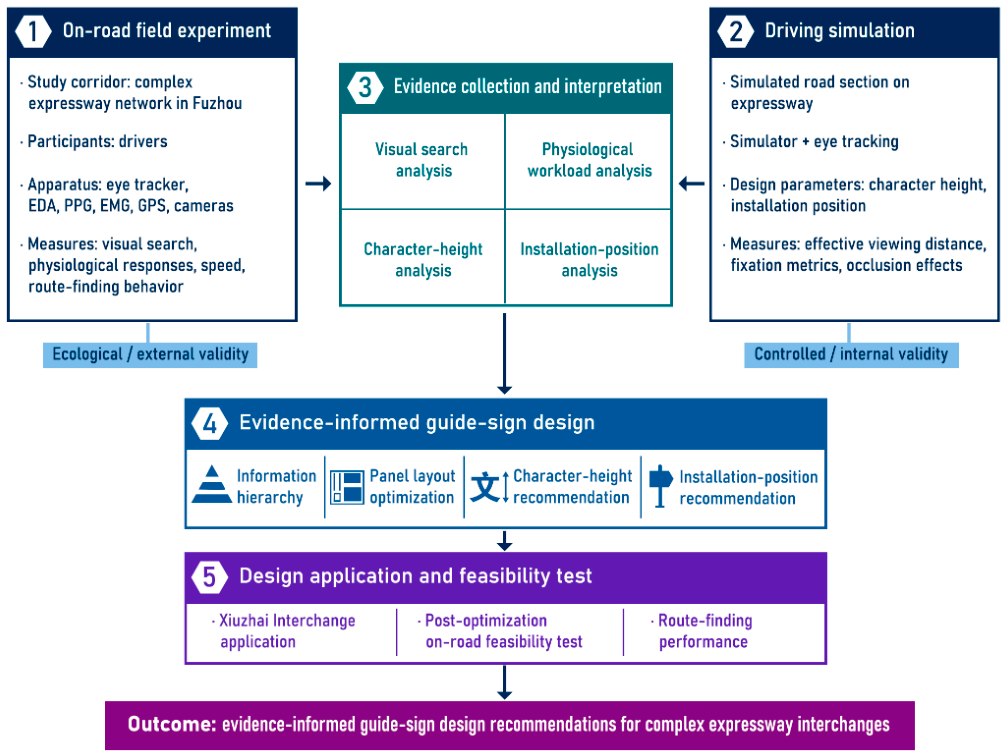


Human-Centered Optimization of Expressway Interchange Guide-Sign Infrastructure in Complex Road Networks: Evidence from Visual Behavior, Physiological Responses, and Driving Simulation


Abstract
Share and Cite
Zhi, Y.; Lou, S.; Wu, H.; Luo, Y.; Yang, Y. Human-Centered Optimization of Expressway Interchange Guide-Sign Infrastructure in Complex Road Networks: Evidence from Visual Behavior, Physiological Responses, and Driving Simulation. Infrastructures 2026, 11, 265. https://doi.org/10.3390/infrastructures11080265
Zhi Y, Lou S, Wu H, Luo Y, Yang Y. Human-Centered Optimization of Expressway Interchange Guide-Sign Infrastructure in Complex Road Networks: Evidence from Visual Behavior, Physiological Responses, and Driving Simulation. Infrastructures. 2026; 11(8):265. https://doi.org/10.3390/infrastructures11080265
Chicago/Turabian StyleZhi, Yanshuang, Shuzhen Lou, Hongfu Wu, Yingying Luo, and Yanqun Yang. 2026. "Human-Centered Optimization of Expressway Interchange Guide-Sign Infrastructure in Complex Road Networks: Evidence from Visual Behavior, Physiological Responses, and Driving Simulation" Infrastructures 11, no. 8: 265. https://doi.org/10.3390/infrastructures11080265
APA StyleZhi, Y., Lou, S., Wu, H., Luo, Y., & Yang, Y. (2026). Human-Centered Optimization of Expressway Interchange Guide-Sign Infrastructure in Complex Road Networks: Evidence from Visual Behavior, Physiological Responses, and Driving Simulation. Infrastructures, 11(8), 265. https://doi.org/10.3390/infrastructures11080265