

Ternary Gypsum–Cement–Pozzolanic Compositions for 3D Printing: Mix Design, Rheology and Long-Term Performance

 ,
,  , ,
, ,  and
and 
Abstract
1. Introduction
2. Materials and Methods
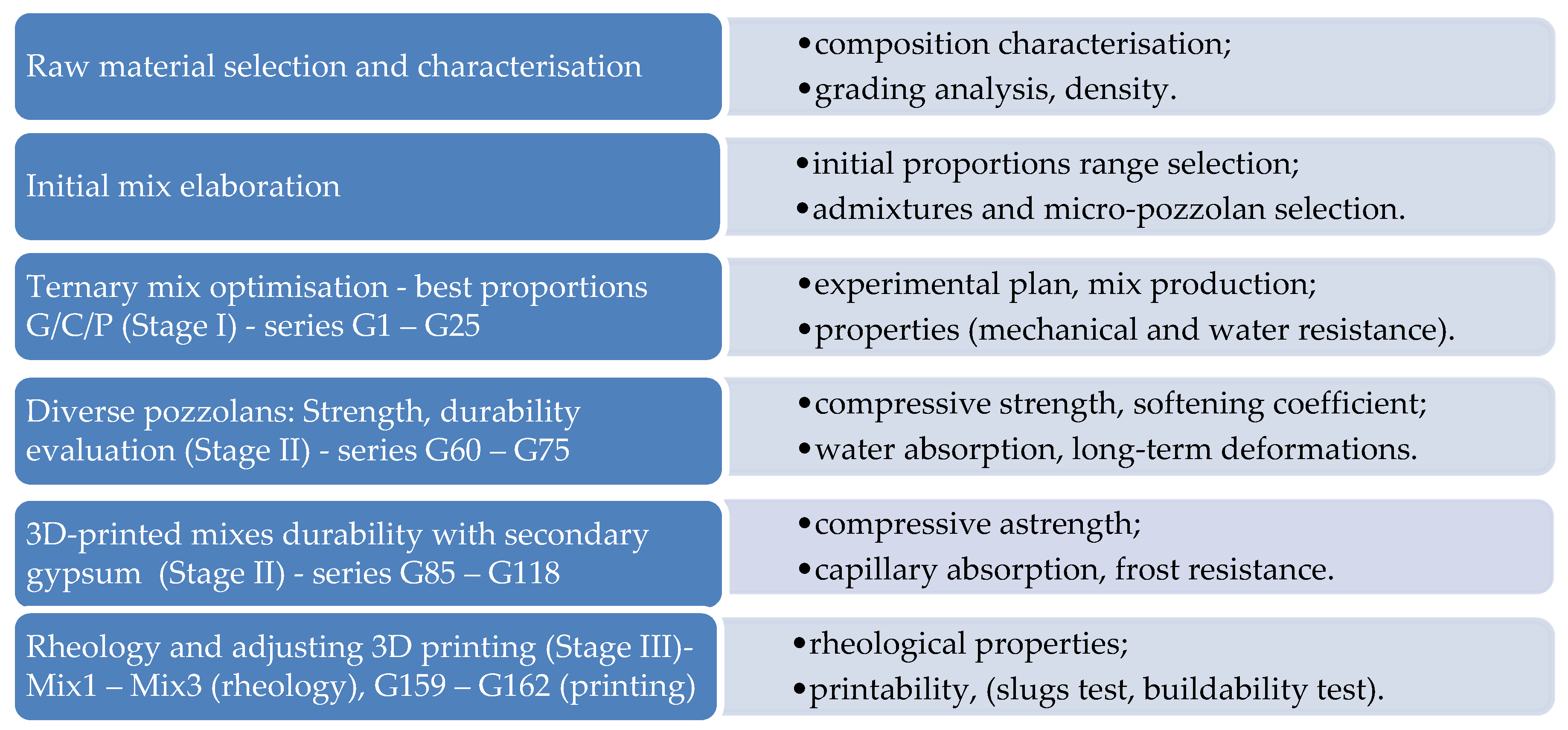
- Stage I—Optimisation of ternary binder composition;
- Stage II—Evaluation of alternative pozzolans and secondary gypsum sources with durability assessment;
- Stage III—Adaptation of optimised compositions for extrusion-based 3D printing and rheological characterisation.
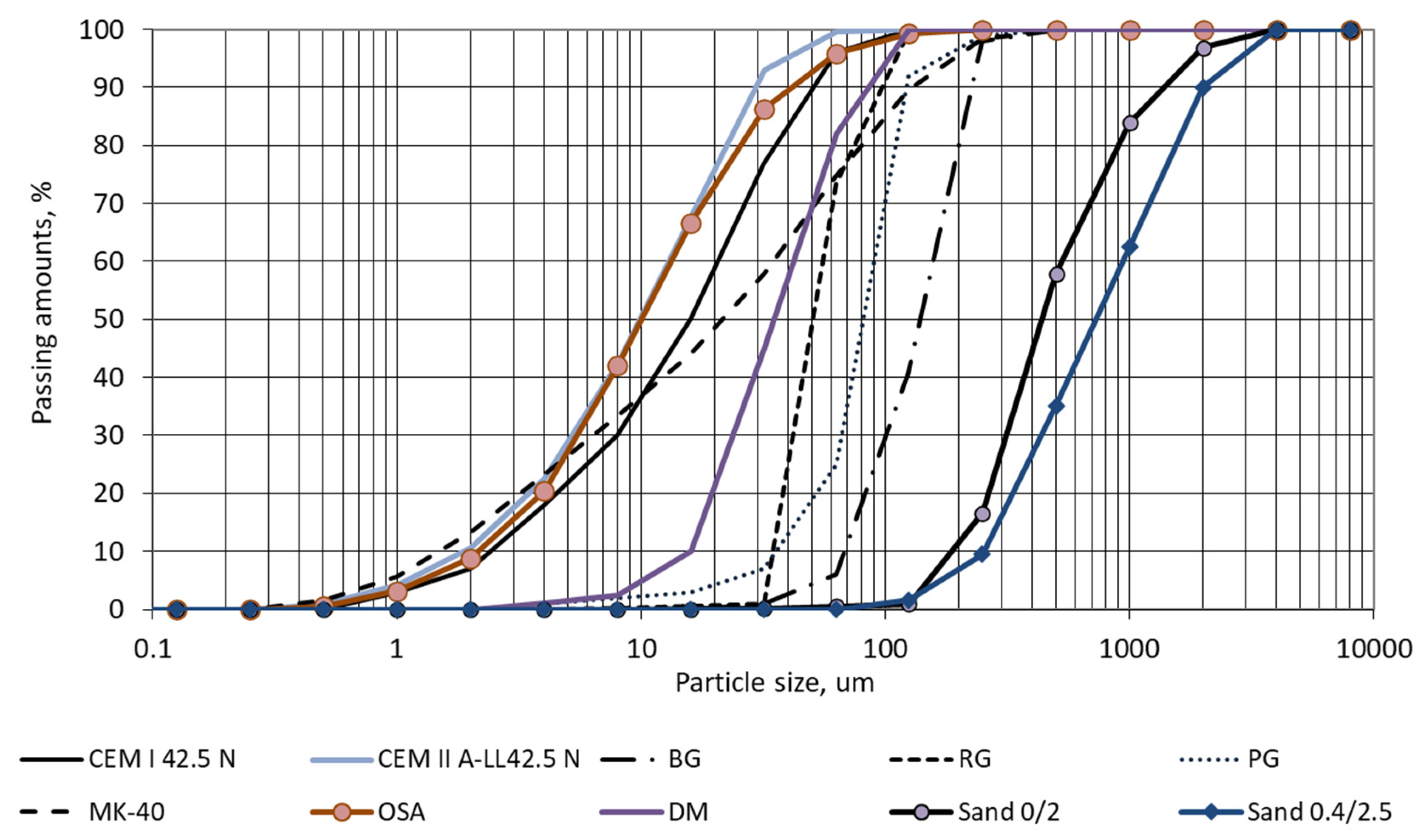
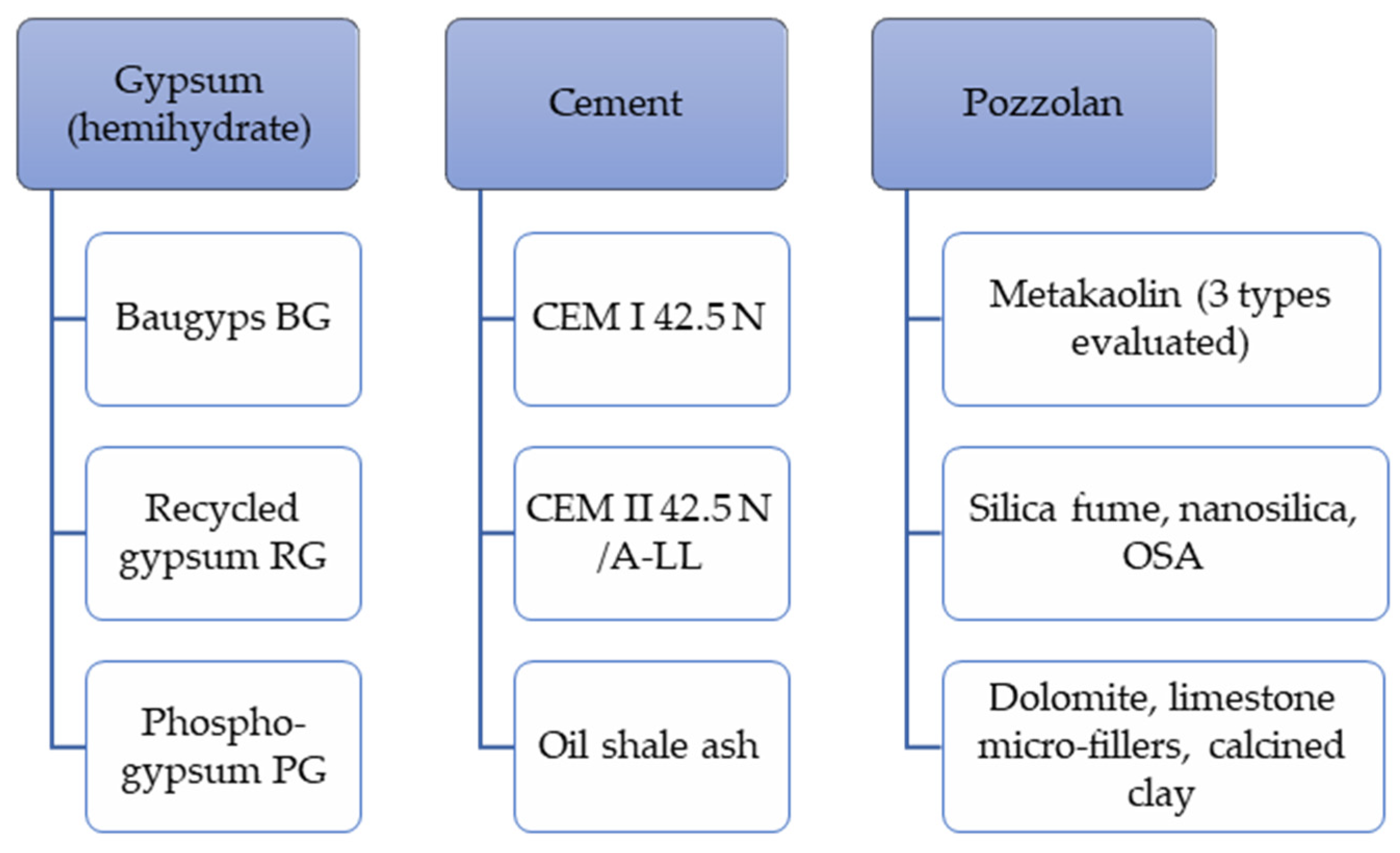
2.1. Raw Materials
2.2. Mix Preparation and Testing of Fresh Mix Properties
2.3. Sample Preparation and Testing
- Air-dry condition (fdry), after drying at 50 °C for 24 h;
- Fully water-saturated condition (fwet).
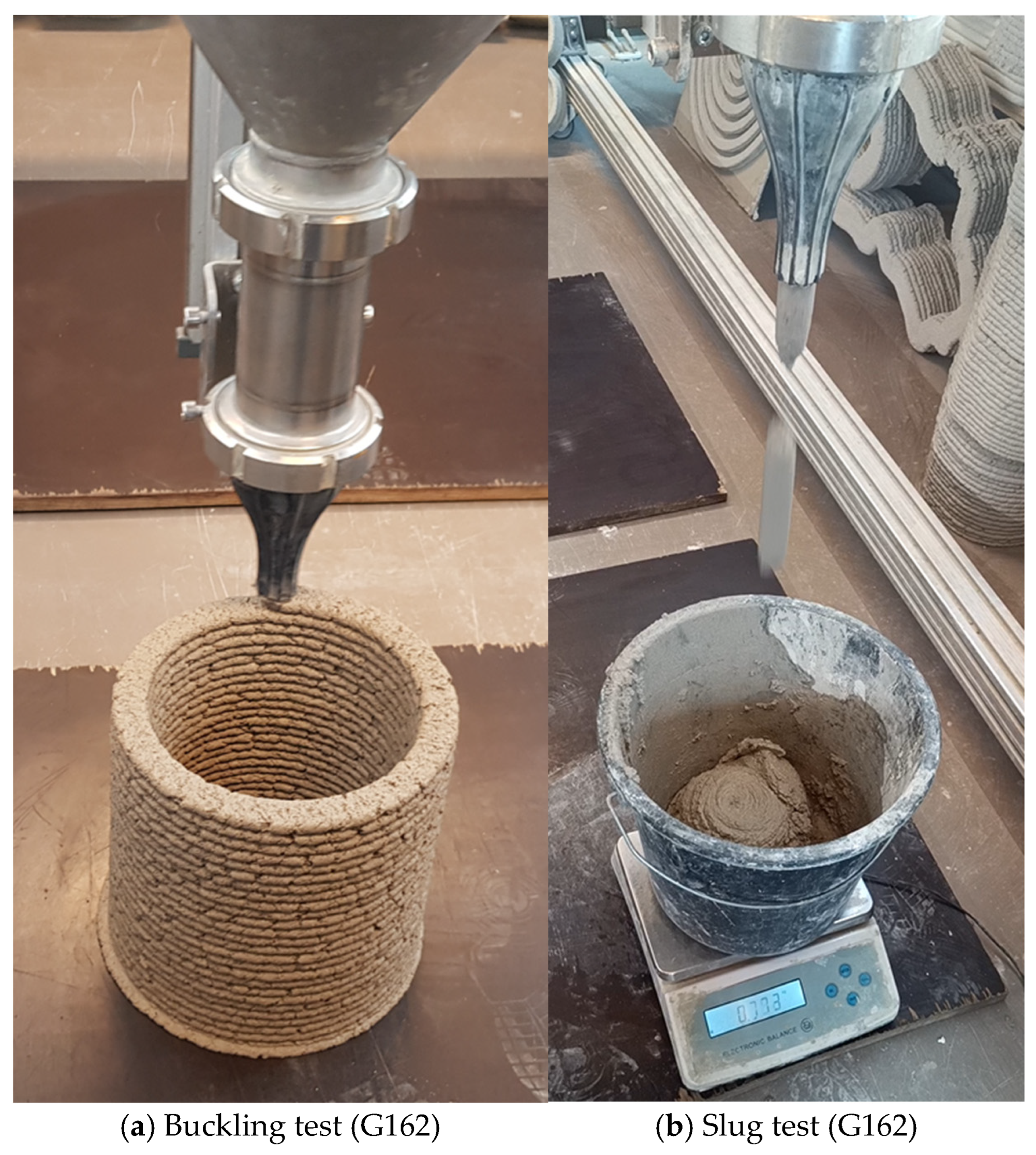
2.4. 3D Printing Setup and Parameters
2.5. Experimental Plan
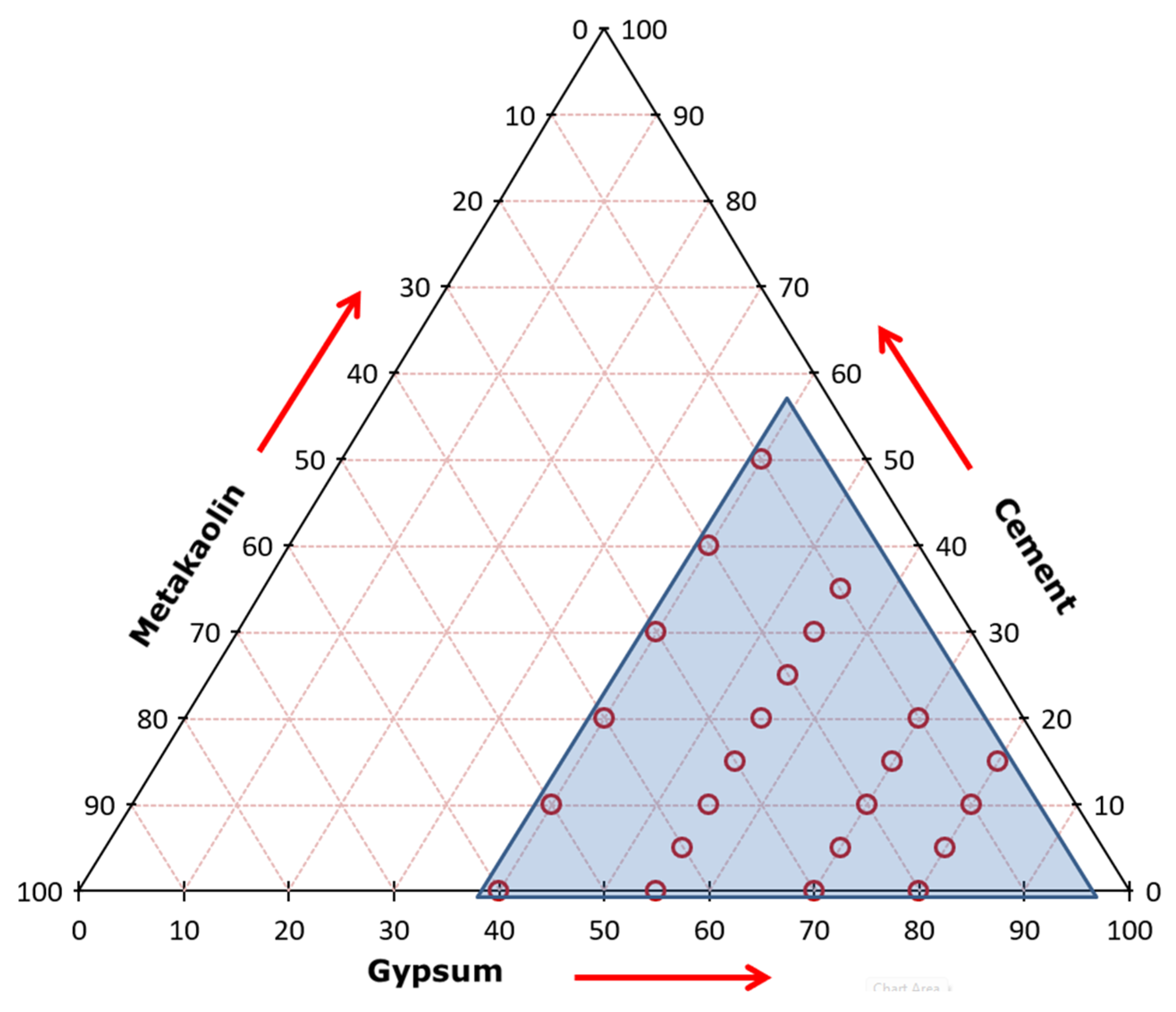
2.5.1. First Iteration—Optimisation of GCP Composition
2.5.2. Second Iteration—Optimisation of Alternative Pozzolans, Secondary Gypsum, and Durability Performance
2.5.3. Third Iteration—Adaptation of GCP Compositions for 3D Printing
- Gypsum component (primary or secondary gypsum): approximately 38–55 wt.% of binder;
- PC (predominantly CEM II/A-LL type): approximately 10–25 wt.%;
- Pozzolanic additive (mainly MK or OSA): approximately 20–30 wt.%;
- Sand filler content corresponding to a sand-to-binder ratio of approximately 0.5–1.5.
3. Results
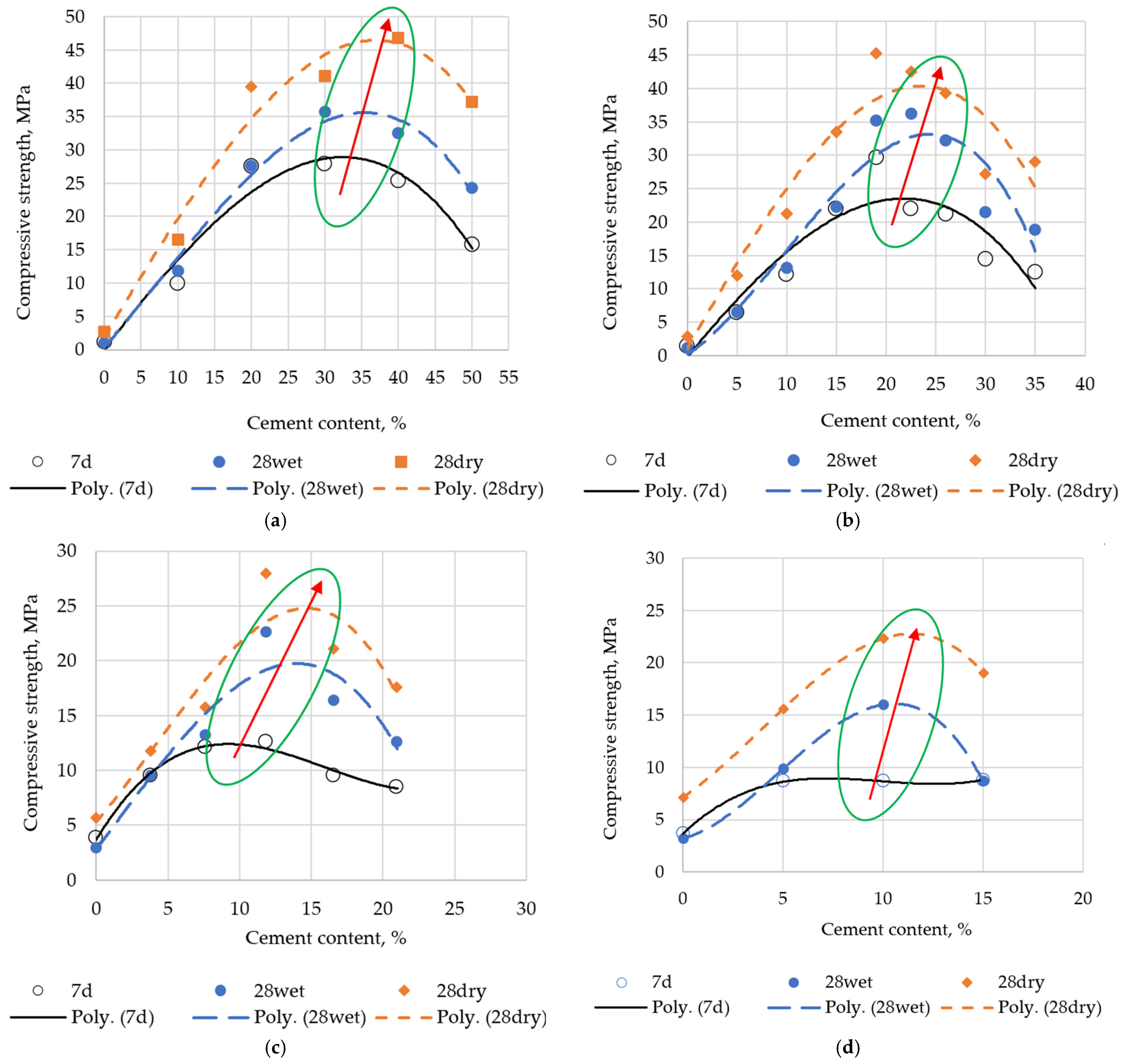
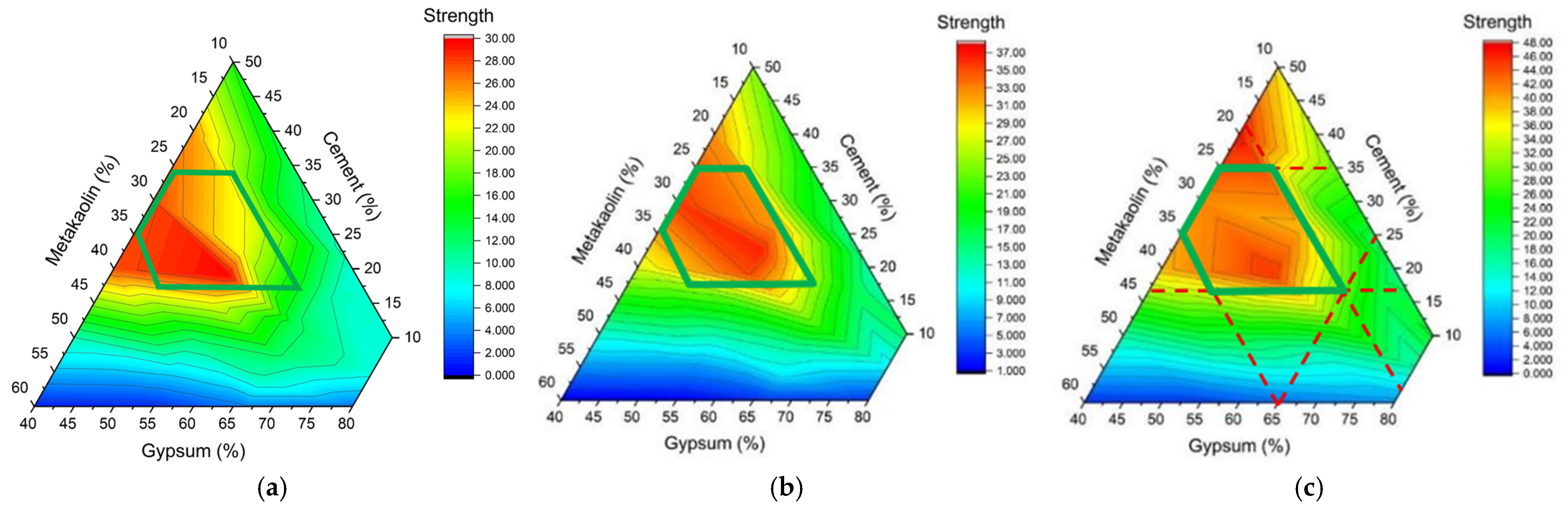
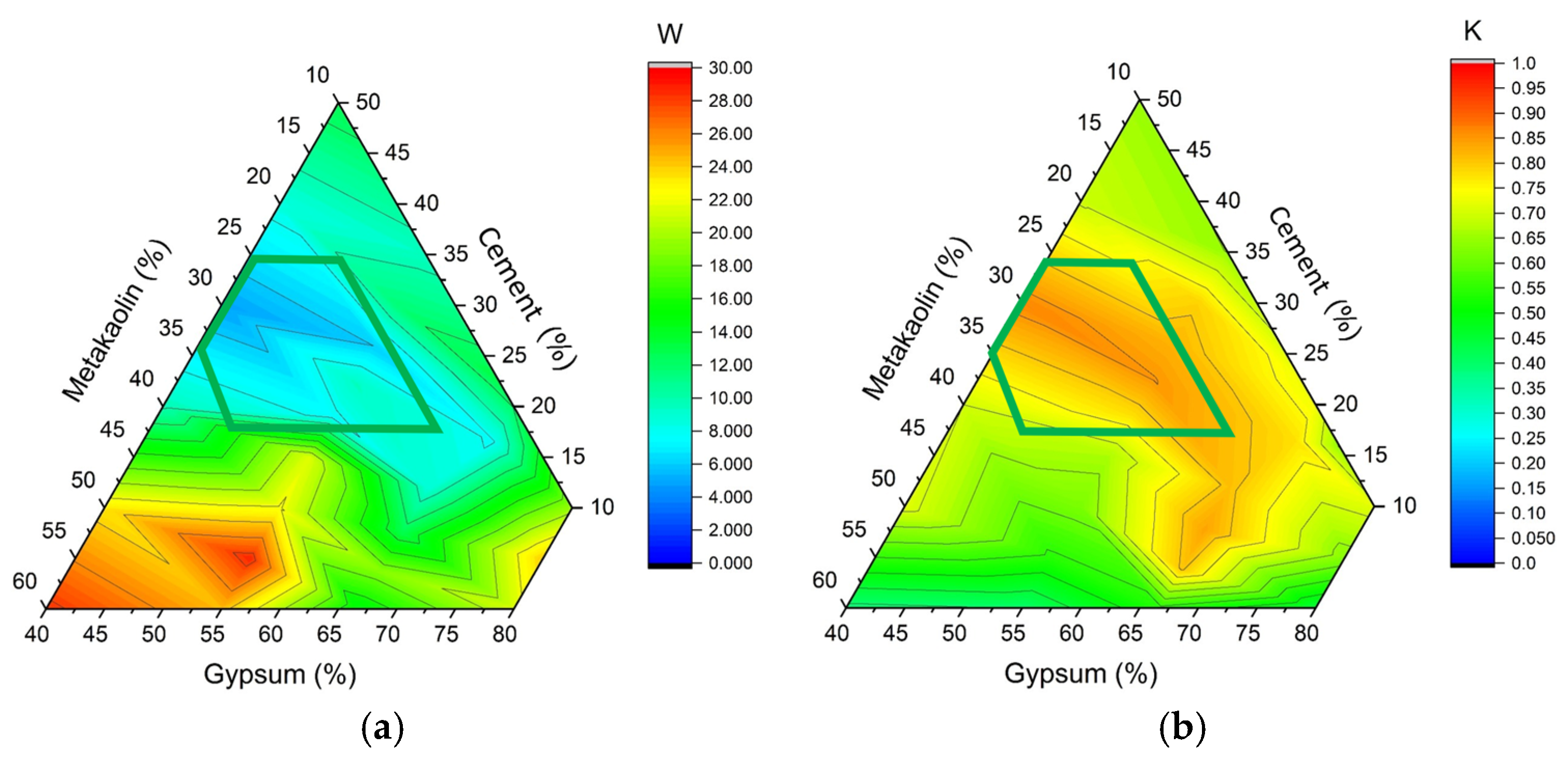
3.1. First Iteration: Optimisation of GCP Composition
3.2. Second ITERATION: The Effect of Diverse Binder Compounds
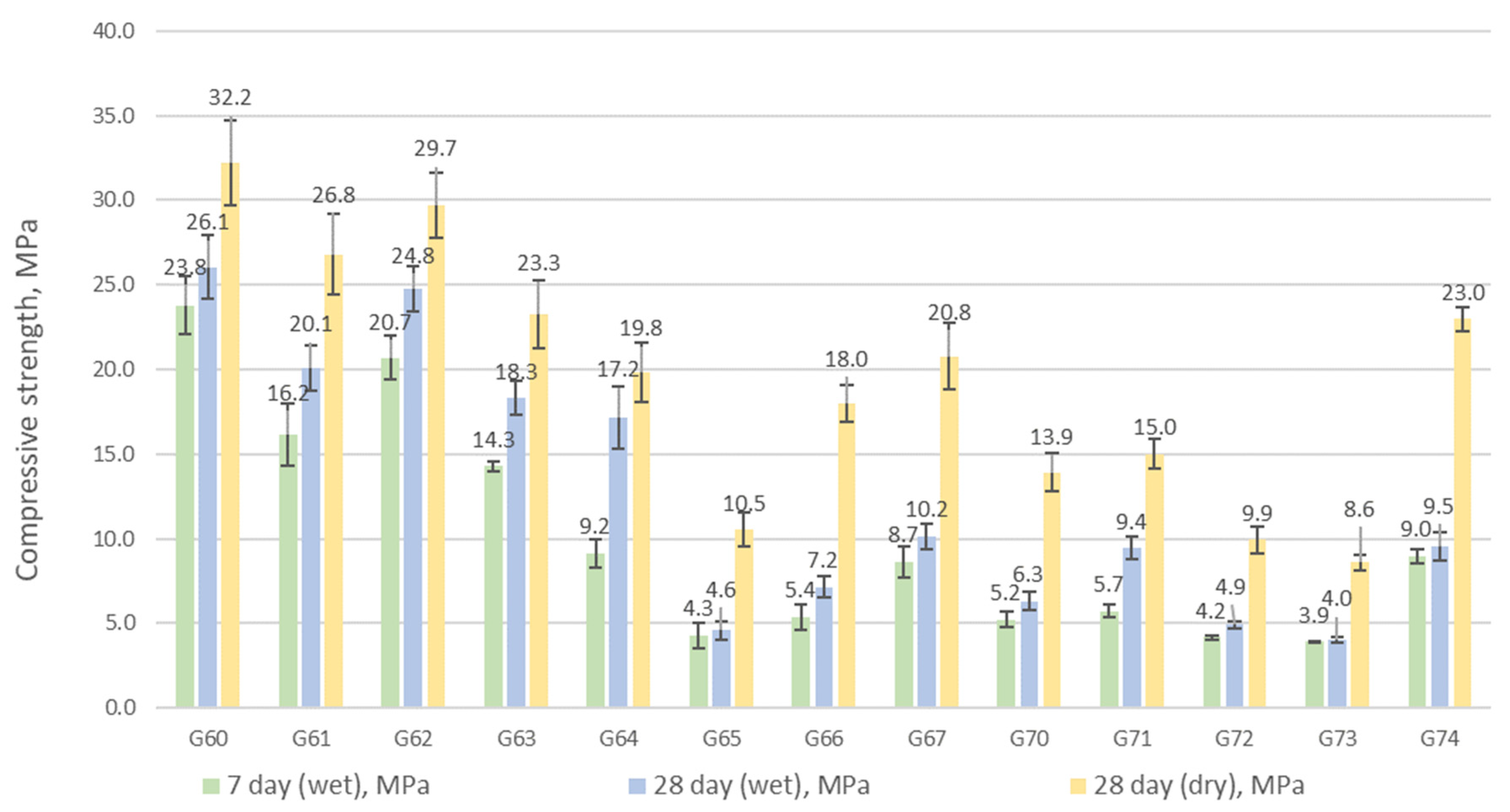
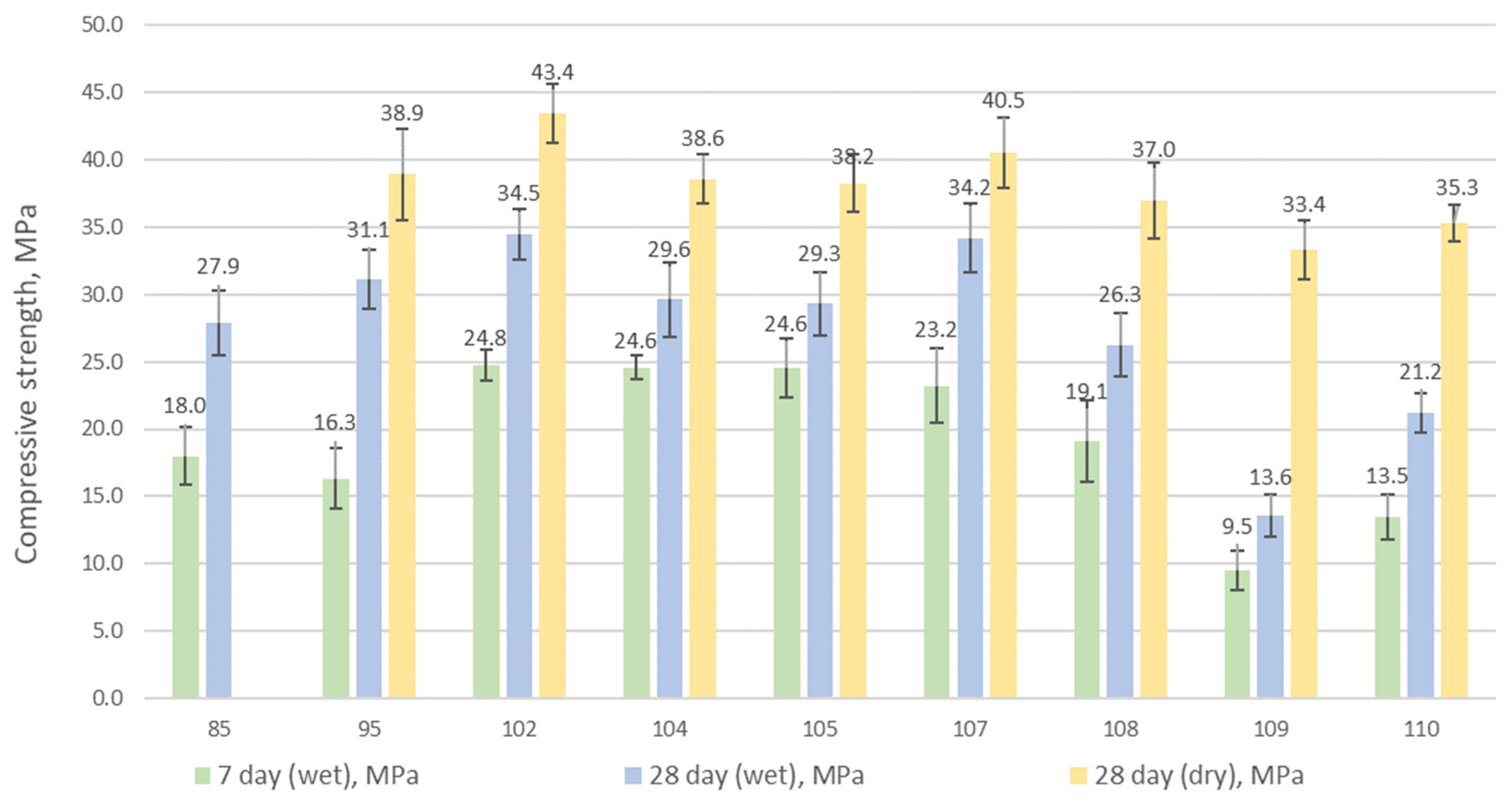
3.2.1. Compressive Strength of Mixtures with Different Pozzolans
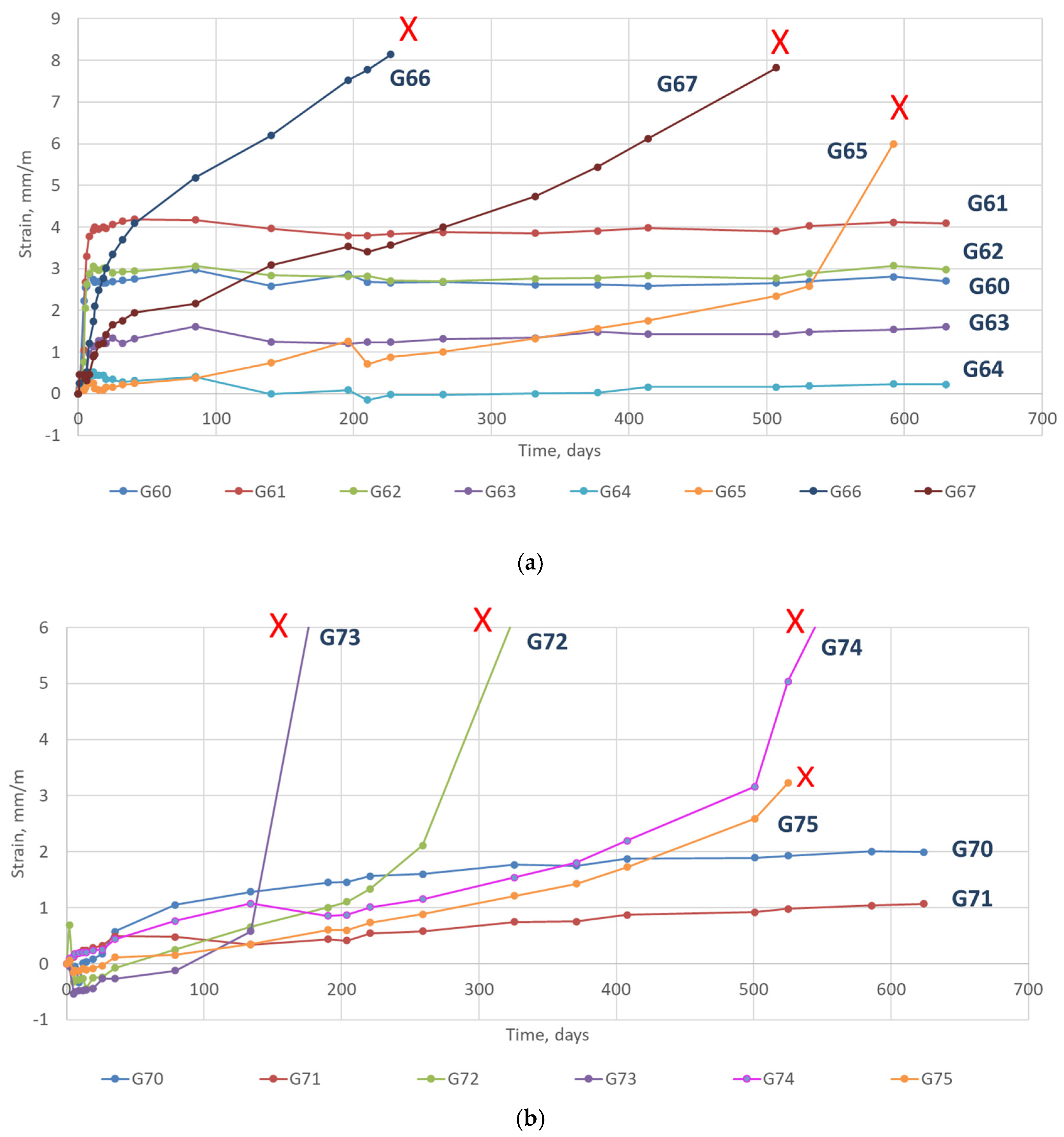
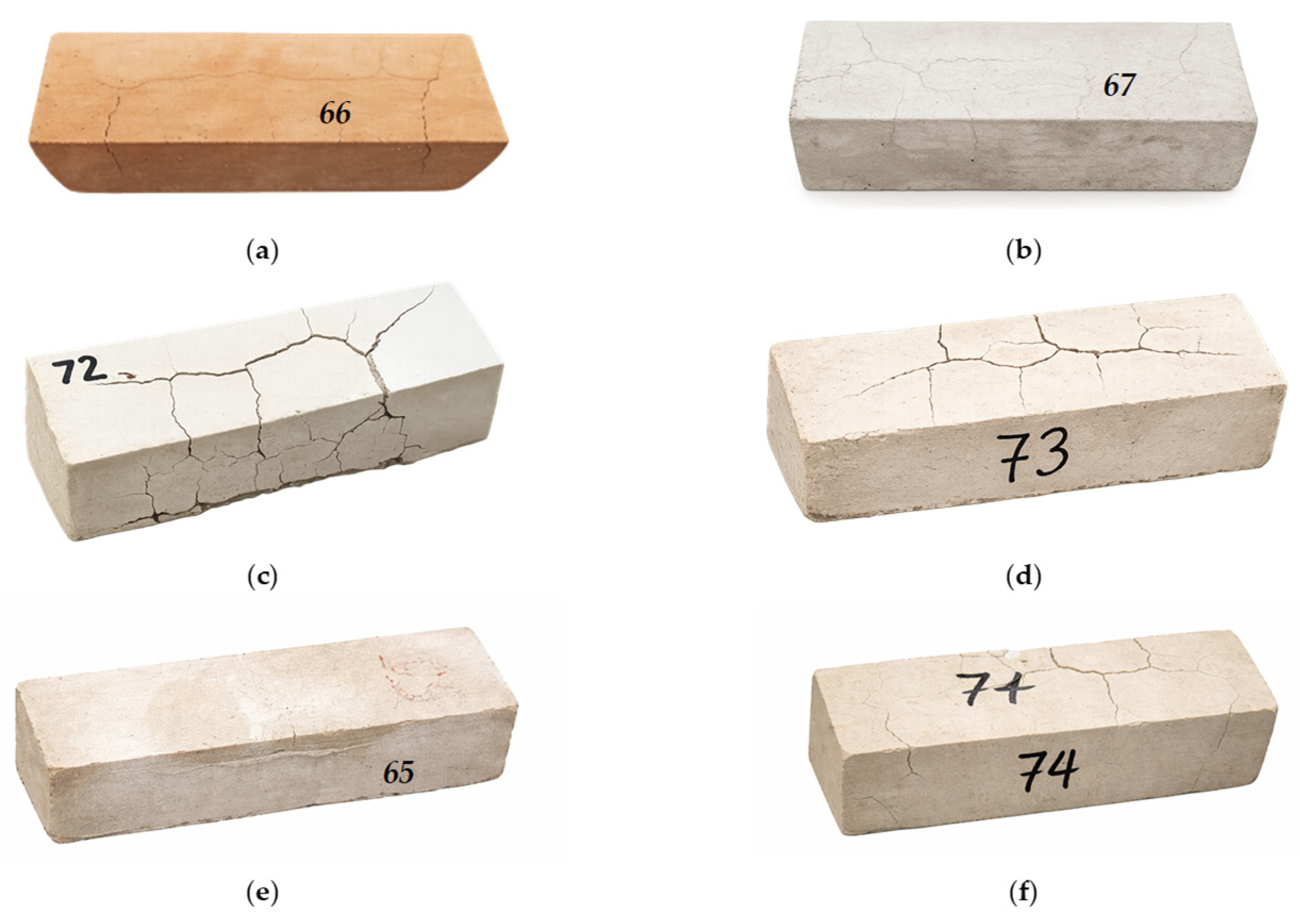
3.2.2. Long-Term Dimensional Stability
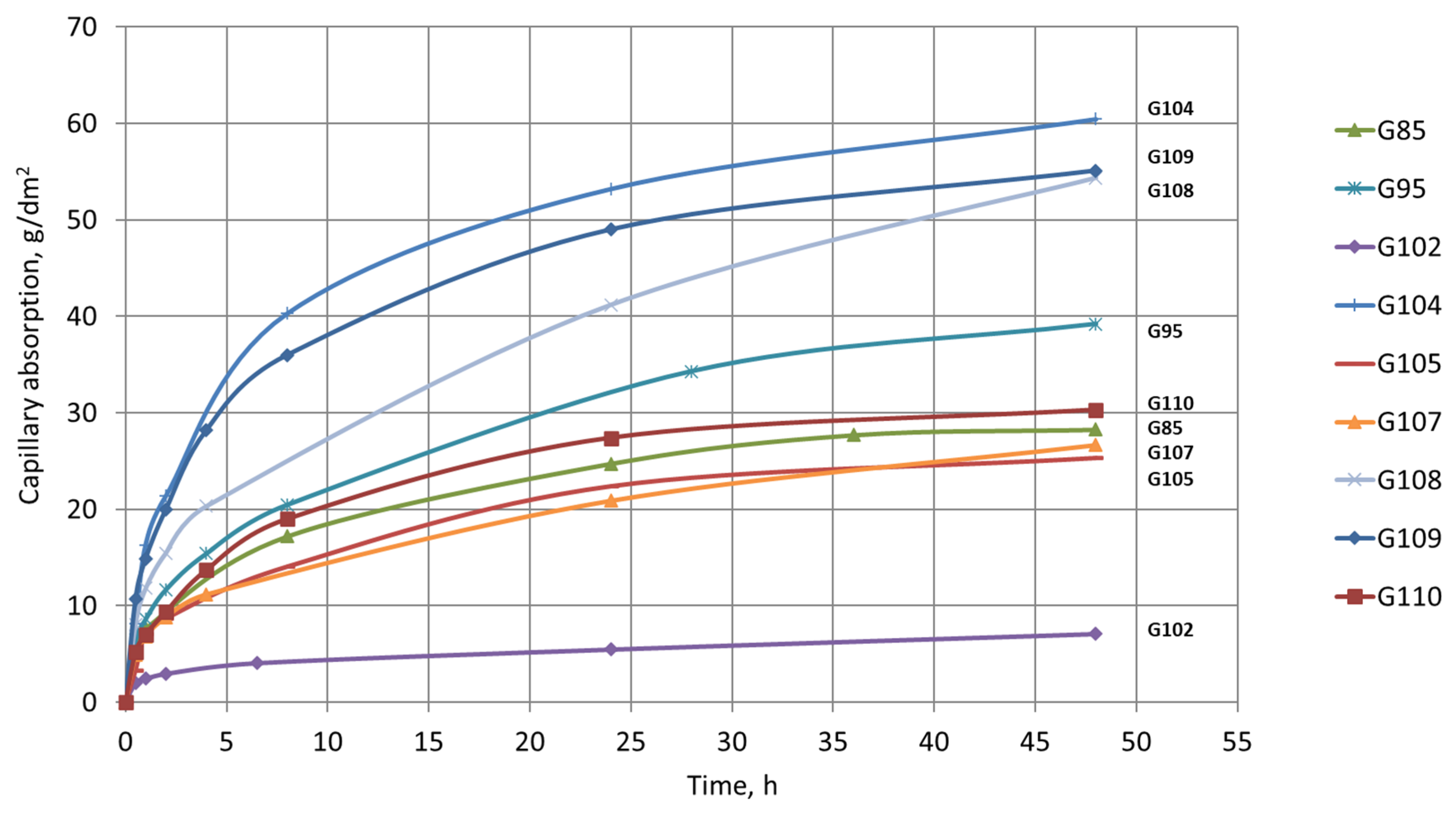
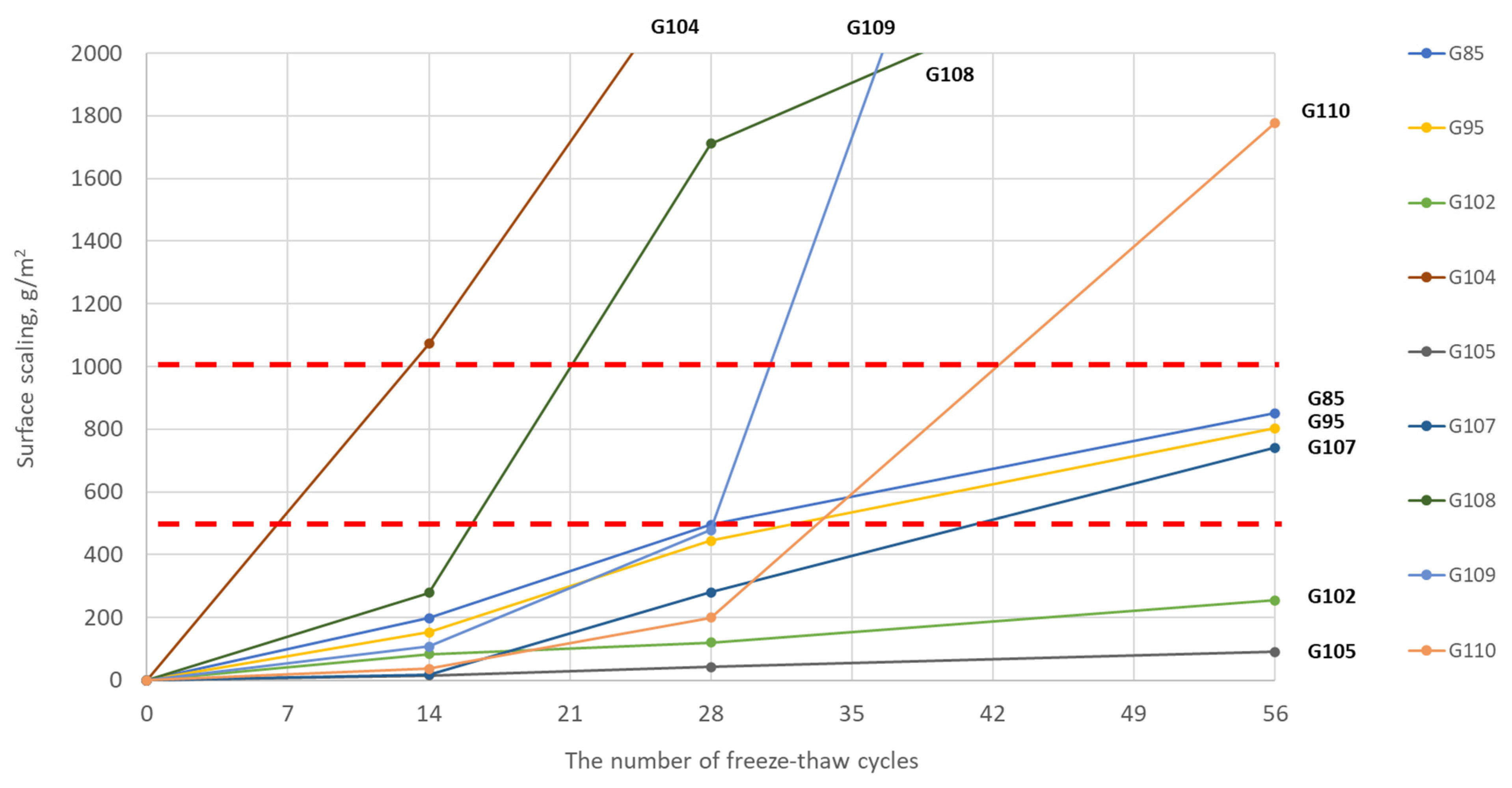
3.2.3. Frost Resistance
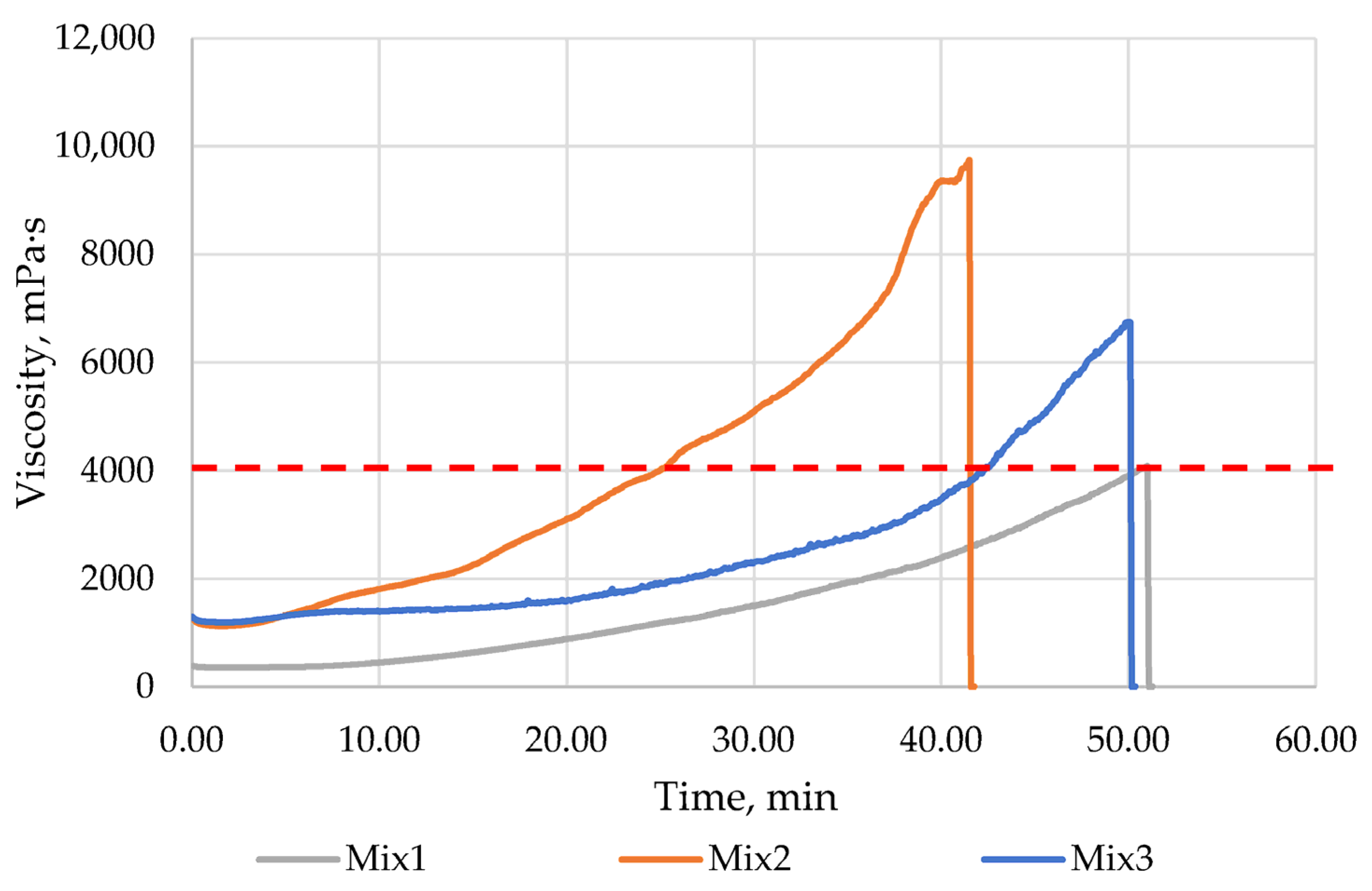
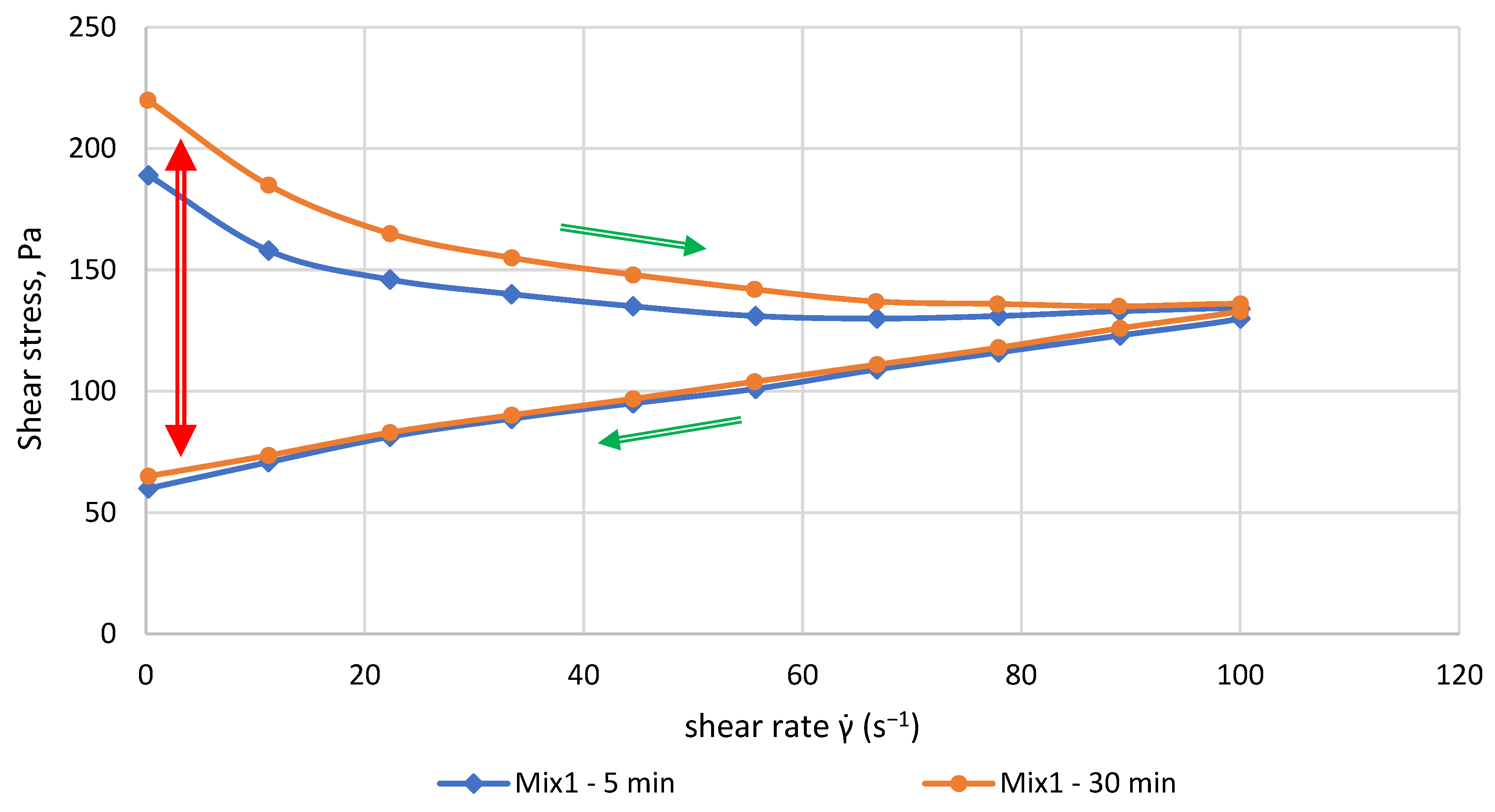
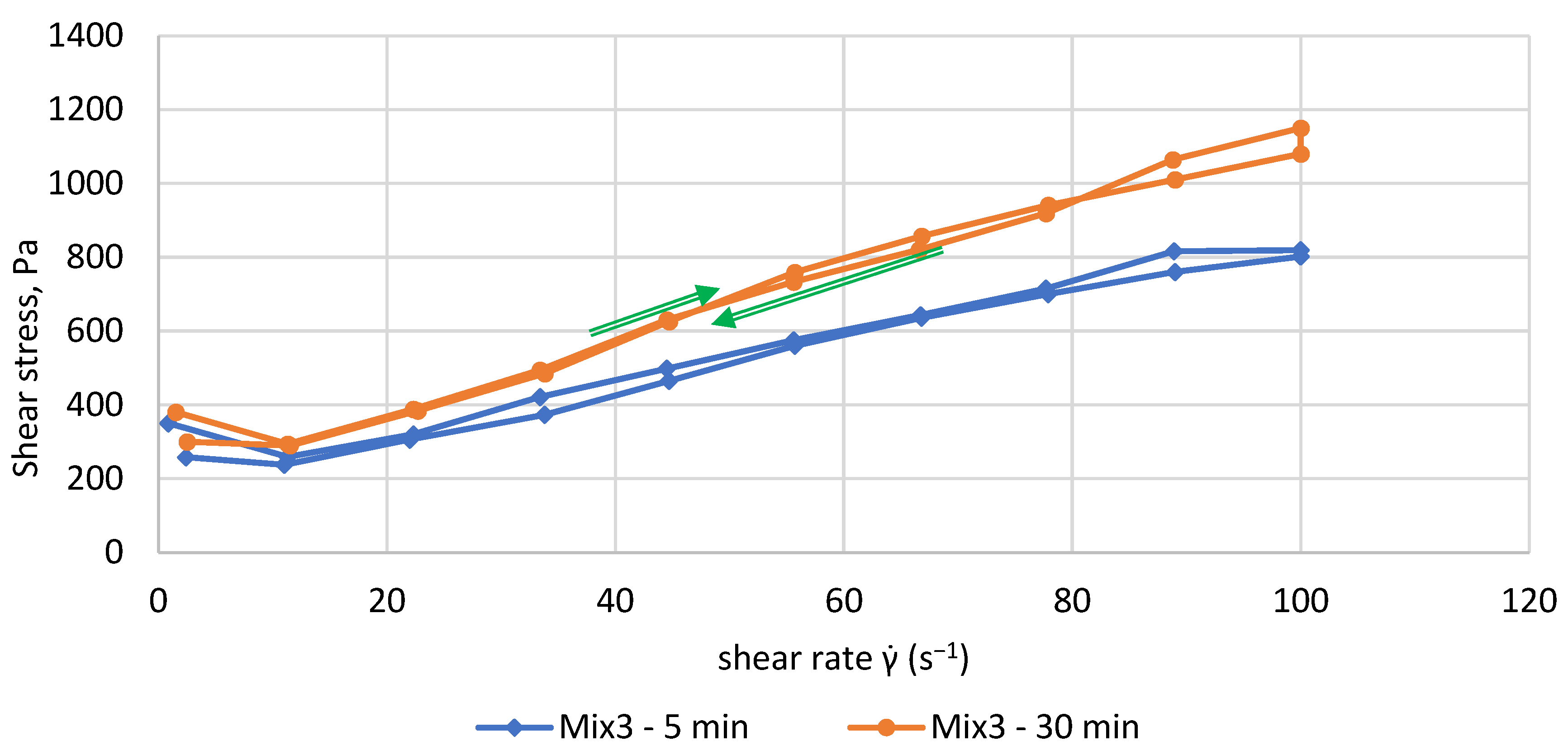
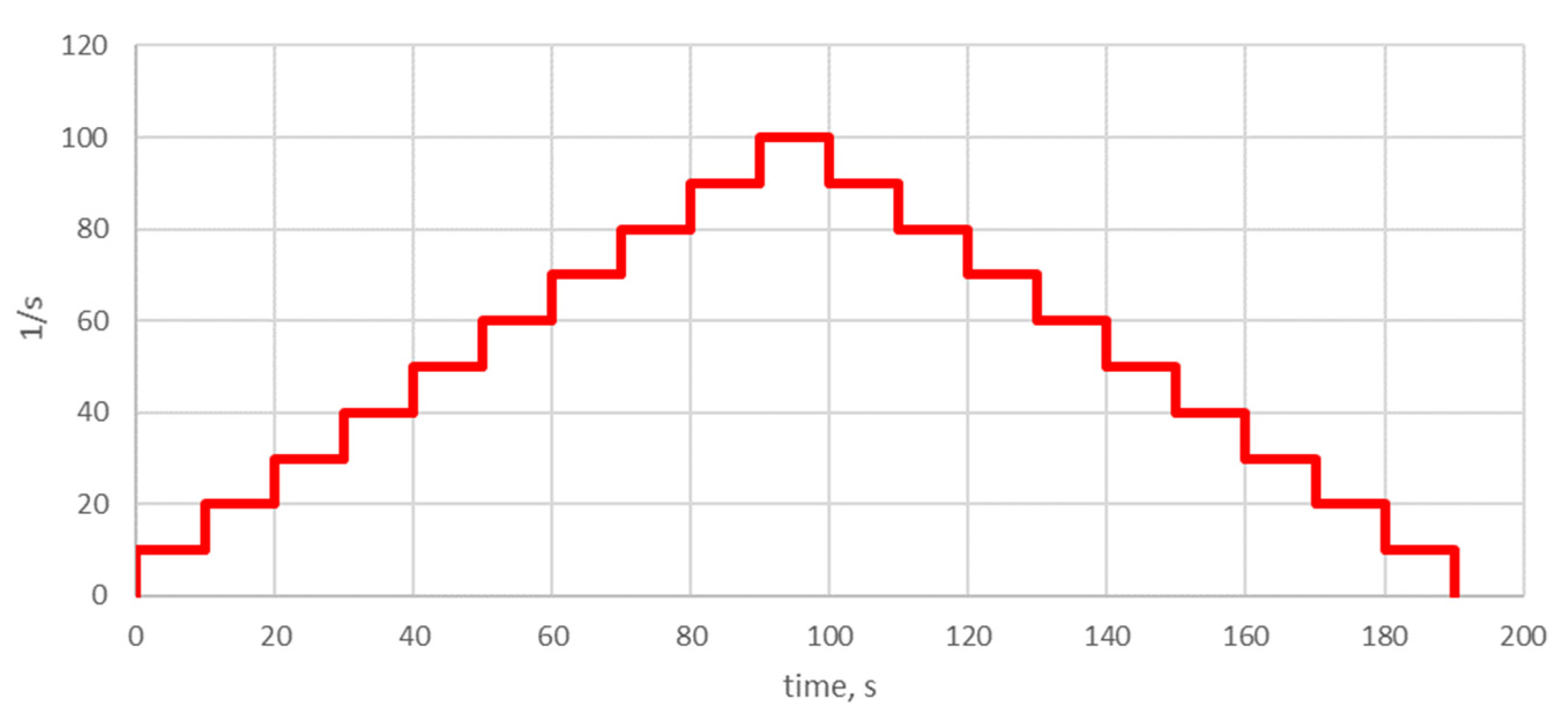
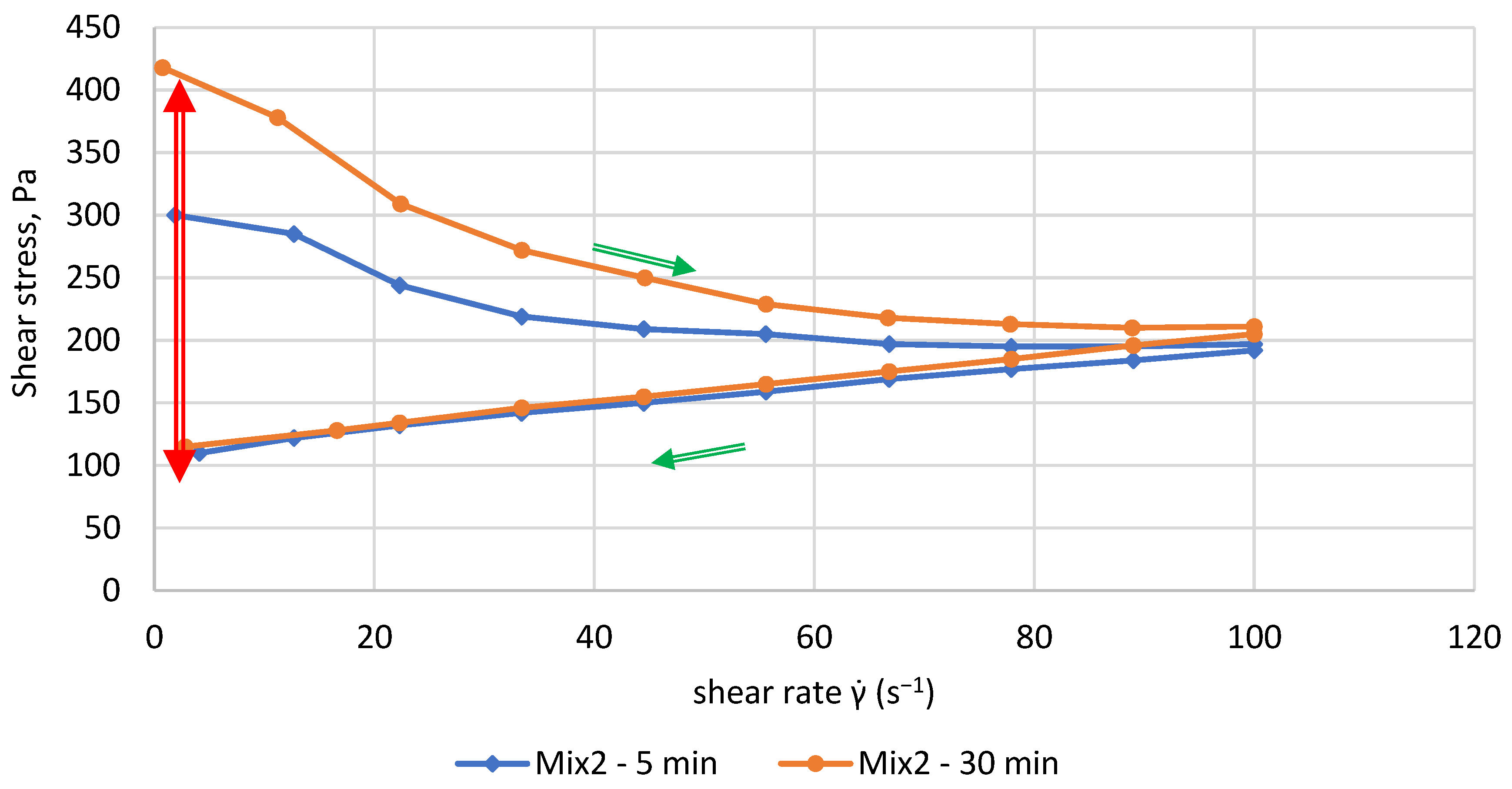
3.3. Third Iteration—Rheological Characterisation of GCP Composition for 3D Printing
- Mix1: ~50 min;
- Mix2: ~25 min;
- Mix3: ~42 min.
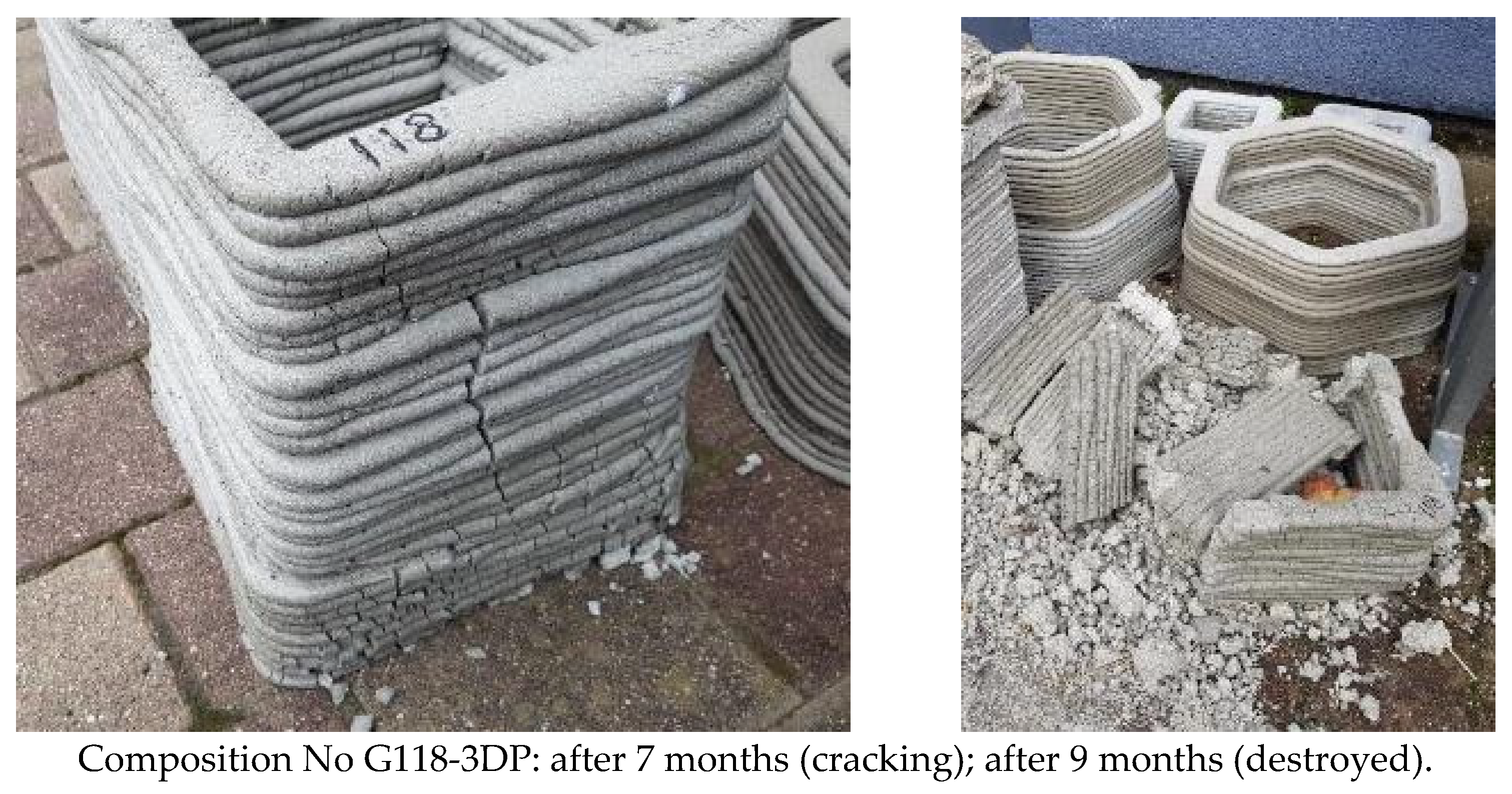
3.4. Adoption for 3D Printing
4. Discussion
4.1. Optimisation of GCP Composition
4.2. The Effect of Diverse Binder Compounds
4.2.1. Effect of Pozzolan Type on Strength and Durability
4.2.2. Mechanisms of Long-Term Deformation
- Stable systems with MK, SF, FA and zeolite (G60–G64, G70–G71): characterised by initial strain followed by stabilisation;
- Progressive instability with OSA and LM (G66–G67): continuous strain accumulation leading to failure;
- Delayed instability with glass powder, dolomite, and blended systems (G65, G72-G75): low initial strain followed by accelerated degradation.
4.2.3. Frost Resistance and Durability Limitations
4.3. Rheological Characterisation and Printability
4.4. Rheology–Printability Relationship and In Situ Validation
4.5. Limitations and Future Perspectives
5. Conclusions
Author Contributions
Funding
Data Availability Statement
Conflicts of Interest
References
- UN Environment Programme. Building Materials and the Climate: Constructing A New Future; UNEP—UN Environment Programme: Nairobi, Kenya, 2023. [Google Scholar]
- Tay, Y.W.D.; Li, M.Y.; Tan, M.J. Effect of Printing Parameters in 3D Concrete Printing: Printing Region and Support Structures. J. Mater. Process. Technol. 2019, 271, 261–270. [Google Scholar] [CrossRef]
- Sinka, M.; Zorica, J.; Bajare, D.; Sahmenko, G.; Korjakins, A. Fast Setting Binders for Application in 3D Printing of Bio-Based Building Materials. Sustainability 2020, 12, 8838. [Google Scholar] [CrossRef]
- Alhumayani, H.; Gomaa, M.; Soebarto, V.; Jabi, W. Environmental Assessment of Large-Scale 3D Printing in Construction: A Comparative Study between Cob and Concrete. J. Clean. Prod. 2020, 270, 122463. [Google Scholar] [CrossRef]
- Mukhametrakhimov, R.; Galautdinov, A.; Lukmanova, L. Influence of Active Mineral Additives on the Basic Properties of the Gypsum Cementpozzolan Binder for the Manufacture of Building Products. MATEC Web Conf. 2017, 106, 03012. [Google Scholar] [CrossRef]
- Stav, E.; Burkard, E.A.; Finkelstein, R.S.; Winkowski, D.A.; Metz, L.J.; Mudd, P.J. Cementitious Gypsum-Containing Binders and Compositions. U.S. Patent US5858083, 12 January 1999. [Google Scholar]
- Mukhametrakhimov, R.K.; Galautdinov, A.R.; Gilmanshin, I.R. Modified Gypsum-Cement-Pozzolanic Composites Reinforced with Polypropylene Fibers Modified Gypsum-Cement-Pozzolanic Composites Reinforced with Polypropylene Fibers. IOP Conf. Ser. Mater. Sci. Eng. 2019, 570, 012068. [Google Scholar] [CrossRef]
- Çolak, A. Physical, Mechanical, and Durability Properties of Gypsum—Portland Cement—Natural Pozzolan Blends. Can. J. Civ. Eng. 2001, 28, 375–382. [Google Scholar] [CrossRef]
- Abdellatief, M.; Elemam, W.E.; Alanazi, H.; Tahwia, A.M. Production and Optimization of Sustainable Cement Brick Incorporating Clay Brick Wastes Using Response Surface Method. Ceram. Int. 2023, 49, 9395–9411. [Google Scholar] [CrossRef]
- Fayomi, G.U.; Mini, S.E.; Fayomi, O.S.I.; Ayoola, A.A. Perspectives on Environmental CO2 Emission and Energy Factor in Cement Industry. IOP Conf. Ser. Earth Environ. Sci. 2019, 331, 012035. [Google Scholar] [CrossRef]
- Bumanis, G.; Korjakins, A.; Bajare, D. Environmental Benefit of Alternative Binders in Construction Industry: Life Cycle Assessment. Environments 2022, 9, 6. [Google Scholar] [CrossRef]
- Zhang, Y.; Pan, F.; Wu, R. Study on the Performance of FGD Gypsum-Metakaolin-Cement Composite Cementitious System. Constr. Build. Mater. 2016, 128, 1–11. [Google Scholar] [CrossRef]
- Bumanis, G.; Vaičiukynienė, D.; Tambovceva, T.; Puzule, L.; Sinka, M.; Nizevičienė, D.; Fornés, I.V.; Bajare, D. Circular Economy in Practice: A Literature Review and Case Study of Phosphogypsum Use in Cement. Recycling 2024, 9, 63. [Google Scholar] [CrossRef]
- Sahmenko, G.; Puzule, L.; Sapata, A.; Slosbergs, P.; Bumanis, G.; Sinka, M.; Bajare, D. Gypsum–Cement–Pozzolan Composites for 3D Printing: Properties and Life Cycle Assessment. J. Compos. Sci. 2024, 8, 212. [Google Scholar] [CrossRef]
- Tseng, K.-C.; Chi, M.; Yeih, W.; Huang, R. Influence of Slag/Fly Ash as Partial Cement Replacement on Printability and Mechanical Properties of 3D-Printed Concrete. Appl. Sci. 2025, 15, 3933. [Google Scholar] [CrossRef]
- Girskas, G.; Kligys, M. 3D Concrete Printing Review: Equipment, Materials, Mix Design, and Properties. Buildings 2025, 15, 2049. [Google Scholar] [CrossRef]
- Doleželová, M.; Pokorný, J.; Vimmrová, A. Design of the Ternary Gypsum-Based Building Composite Using Simplex Optimization. In Materials Design and Applications II; Springer Nature: Cham, Switzerland, 2018. [Google Scholar] [CrossRef]
- Ma, G.; Buswell, R.; Leal da Silva, W.R.; Wang, L.; Xu, J.; Jones, S.Z. Technology Readiness: A Global Snapshot of 3D Concrete Printing and the Frontiers for Development. Cem. Concr. Res. 2022, 156, 106774. [Google Scholar] [CrossRef]
- Bumanis, G.; Zorica, J.; Bajare, D. Properties of Foamed Lightweight High-Performance Phosphogypsum-Based Ternary System Binder. Appl. Sci. 2020, 10, 6222. [Google Scholar] [CrossRef]
- Colak, A. The Long-Term Durability Performance of Gypsum—Portland Cement—Natural Pozzolan Blends. Cem. Concr. Res. 2002, 32, 109–115. [Google Scholar] [CrossRef]
- Gaidučis, S.; Žvironaitė, J.; Mačiulaitis, R.; Jakovlev, G. Resistance of Phosphogypsum Cement Pozzolanic Compositions against the Influence of Water. Mater. Sci. 2011, 17, 308–313. [Google Scholar] [CrossRef]
- Cengiz, O. Effects of Pozzolan Incorporation and Curing Conditions on Strength and Water Resistance of Natural Gypsum Pastes. Ph.D. Thesis, Middle East Technical University, Ankara, Turkiye, 2009. [Google Scholar]
- da Cruz, T.A.M.; Geraldo, R.H.; Costa, A.R.D.; Maciel, K.R.D.; Goncalves, J.P.; Camarini, G. Microstructural and Mineralogical Compositions of Metakaolin-Lime-Recycled Gypsum Plaster Ternary Systems. J. Build. Eng. 2022, 47, 103770. [Google Scholar] [CrossRef]
- Tayibi, H.; Choura, M.; López, F.A.; Alguacil, F.J.; López-Delgado, A. Environmental Impact and Management of Phosphogypsum. J. Environ. Manag. 2009, 90, 2377–2386. [Google Scholar] [CrossRef]
- Bumanis, G.; Bajare, D.; Korjakins, A. Durability of High Strength Self Compacting Concrete with Metakaolin Containing Waste. Key Eng. Mater. 2016, 674, 65–70. [Google Scholar] [CrossRef]
- Hanžič, L.; Štefančič, M.; Šter, K.; Serjun, V.Z.; Šinka, M.; Sapata, A.; Šahmenko, G.; Šerelis, E.; Migliniece, B.; Bensa, L.K. Collision Milling of Oil Shale Ash as Constituent Pretreatment in Concrete 3D Printing. Infrastructures 2025, 10, 18. [Google Scholar] [CrossRef]
- EN 196-3:2016; Cement Testing Methods for Setting Times and Soundness. iTeh Inc.: Newark, DE, USA, 2016. Available online: https://standards.iteh.ai/catalog/standards/cen/e4921eca-8101-4261-b066-25d19b9b8e8a/en-196-3-2016 (accessed on 23 February 2026).
- EN 1015-3:1999; Test Methods for Fresh Mortar Consistence by Flow Table. iTeh Inc.: Newark, DE, USA, 2016. Available online: https://standards.iteh.ai/catalog/standards/cen/f427f20a-2746-4ab7-bd55-d1c455b1f009/en-1015-3-1999 (accessed on 23 February 2026).
- Jo, J.H.; Jo, B.W.; Cho, W.; Kim, J.-H. Development of a 3D Printer for Concrete Structures: Laboratory Testing of Cementitious Materials. Int. J. Concr. Struct. Mater. 2020, 14, 13. [Google Scholar] [CrossRef]
- Rehman, A.U.; Kim, J.-H. 3D Concrete Printing: A Systematic Review of Rheology, Mix Designs, Mechanical, Microstructural, and Durability Characteristics. Materials 2021, 14, 3800. [Google Scholar] [CrossRef]
- Kligys, M.; Girskas, G.; Baltuškienė, D. Influence of the Amount of Mineral Additive on the Rheological Properties and the Carbon Footprint of 3D-Printed Concrete Mixtures. Buildings 2026, 16, 490. [Google Scholar] [CrossRef]
- Mechtcherine, V.; Muthukrishnan, S.; Robens-Radermacher, A.; Wolfs, R.; Versteege, J.; Menna, C.; Ozturk, O.; Ozyurt, N.; Roupec, J.; Richter, C.; et al. Mechanical Properties of 3D Printed Concrete: A RILEM 304-ADC Interlaboratory Study–Compressive Strength and Modulus of Elasticity. Mater. Struct./Mater. Constr. 2025, 58, 181. [Google Scholar] [CrossRef]
- EN 196-1:2016; Cement Strength Testing Methods Compressive Flexural. iTeh Inc.: Newark, DE, USA, 2016. Available online: https://standards.iteh.ai/catalog/standards/cen/37b8816e-4085-4dcc-a642-a383d9bddd6c/en-196-1-2016?srsltid=AfmBOoo6fTjBXuSVef0COQsDcldKbI19Cvg3dzeaEfyZAuHY1ml7m_1l (accessed on 19 April 2026).
- EN 1015-18:2002; Mortar Water Absorption Coefficient Test Method. iTeh Inc.: Newark, DE, USA, 2002. Available online: https://standards.iteh.ai/catalog/standards/cen/d9e520b3-5f88-4368-ae91-e568d18aef5a/en-1015-18-2002?srsltid=AfmBOopEGmoqCc9DwZ0gCXZ9N_I1hWv31ZnVnFtvUVsnjfitJMZFANce (accessed on 19 April 2026).
- CEN/TS 12390-9:2016; Concrete Freeze-Thaw Resistance with De-Icing. iTeh Inc.: Newark, DE, USA, 2016. Available online: https://standards.iteh.ai/catalog/standards/cen/ba399d8b-cdd7-419d-87f0-c00b3033fcd9/cen-ts-12390-9-2016?srsltid=AfmBOopzWpPQW70_a3sMhNs47yV_eCn1gMQsElsW5DqFEUp845cKj7vY (accessed on 19 April 2026).
- BS EN 206:2013+A1:2016; Concrete. Specification, Performance, Production and Conformity-European Standards. iTeh Inc.: Newark, DE, USA, 2016. Available online: https://standards.iteh.ai/catalog/standards/cen/b22aa5df-b7d0-4073-a729-d8e0653c4c49/en-206-2013a1-2016?srsltid=AfmBOopcQtv1ffUDD0auA07EcezdjQFqShrCngzR0FC3zqIMugSDtAUH (accessed on 31 July 2020).
- EN 772-11:2011; Test Methods for Water Absorption of Masonry Units. iTeh Inc.: Newark, DE, USA, 2016. Available online: https://standards.iteh.ai/catalog/standards/cen/ef19ac4d-a314-4036-9e64-fe9db764adba/en-772-11-2011?srsltid=AfmBOopxj-MeOgGGJyLz-_C7d_Nw0U-UhvCC-2rxr0zWraqd1DN9BFGk (accessed on 19 April 2026).
- Puzule, L.; Spurina, E.; Frolovs, G.; Dragons, D.; Dias, A.C.; Sinka, M. 3D Printing of Bio-Based Building Materials—Mix Design, Properties and Carbon Footprint Assessment. Available online: https://papers.ssrn.com/sol3/papers.cfm?abstract_id=6478099 (accessed on 19 April 2026).
- Sapata, A.; Šinka, M.; Šahmenko, G.; Korat Bensa, L.; Hanžič, L.; Šter, K.; Ručevskis, S.; Bajāre, D.; Bos, F.P. Establishing Benchmark Properties for 3D-Printed Concrete: A Study of Printability, Strength, and Durability. J. Compos. Sci. 2025, 9, 74. [Google Scholar] [CrossRef]
- OriginLab Help Online-Tutorials-Ternary Contour. Available online: https://www.originlab.com/doc/Tutorials/TernaryContour (accessed on 19 April 2026).
- Piotrowski, T. Special Requirements for Freeze-Thaw Resistance of Concrete in PWR Nuclear Civil Works. Mater. Bud. 2016, 1, 95–98. [Google Scholar] [CrossRef]
- Wild, S.; Khatib, J.M.; Jones, A. Relative Strength, Pozzolanic Activity and Cement Hydration in Superplasticised Metakaolin Concrete. Cem. Concr. Res. 1996, 26, 1537–1544. [Google Scholar] [CrossRef]
- Sun, D.; Wu, K.; Shi, H.; Miramini, S.; Zhang, L. Deformation Behaviour of Concrete Materials under the Sulfate Attack. Constr. Build. Mater. 2019, 210, 232–241. [Google Scholar] [CrossRef]
- Liu, H.; Liu, C.; Wu, Y.; Bai, G.; He, C.; Zhang, R.; Wang, Y. Hardened Properties of 3D Printed Concrete with Recycled Coarse Aggregate. Cem. Concr. Res. 2022, 159, 106868. [Google Scholar] [CrossRef]
- Roussel, N. Rheological Requirements for Printable Concretes. Cem. Concr. Res. 2018, 112, 76–85. [Google Scholar] [CrossRef]
- Wang, C.; Lian, J.; Fang, Y.; Fan, G.; Yang, Y.; Huang, W.; Shi, S. Rheological Optimization of 3D-Printed Cementitious Materials Using Response Surface Methodology. Materials 2025, 18, 3933. [Google Scholar] [CrossRef] [PubMed]
- Jayathilakage, R.; Rajeev, P.; Sanjayan, J. Rheometry for Concrete 3D Printing: A Review and an Experimental Comparison. Buildings 2022, 12, 1190. [Google Scholar] [CrossRef]
- Le, T.T.; Austin, S.A.; Lim, S.; Buswell, R.A.; Gibb, A.G.F.; Thorpe, T. Mix Design and Fresh Properties for High-Performance Printing Concrete. Mater. Struct. 2012, 45, 1221–1232. [Google Scholar] [CrossRef]
- Si, W.; Khan, M.; McNally, C. A Comprehensive Review of Rheological Dynamics and Process Parameters in 3D Concrete Printing. J. Compos. Sci. 2025, 9, 299. [Google Scholar] [CrossRef]









| SiO2 | Al2O3 | Fe2O3 | CaO | MgO | SO3 | Na2O | K2O | TiO2 | P2O5 | LOI | |
|---|---|---|---|---|---|---|---|---|---|---|---|
| BG | 3.73 | 1.68 | 0.46 | 35.64 | 3.92 | 30.90 | 0.31 | 0.52 | 0.04 | 22.43 | |
| PG | 1.07 | 0.70 | 0.22 | 37.16 | 0.21 | 37.38 | 0.48 | 0.11 | 0.10 | 0.57 | 19.24 |
| PC | 19.5 | 4.1 | 2.9 | 62.5 | 3.4 | 3.3 | 0.20 | 1.10 | 1.85 | ||
| MK-40 Astra | 57.30 | 35.73 | 2.04 | 0.23 | 0.13 | 0.43 | 1.69 | 0.04 | 1.81 | ||
| OSA | 1.26 | 3.35 | 3.35 | 37.48 | 4.43 | 6.42 | 0.16 | 3.37 | <3 | ||
| MKW waste | 54.3 | 34.0 | 1.14 | 1.94 | 0.51 | 0.15 | 3.26 | 0.80 | 0.53 | 3.37 | |
| MK Metasil | 51.2 | 23.3 | 0.90 | 4.87 | 1.6 | 0.12 | 12.2 | 0.56 | 0.23 | ||
| Z-50 | 68.0 | 12.2 | 1.3 | 4.0 | 0.9 | 0.75 | 2.8 | 0.20 | |||
| FA | 50.8 | 27.5 | 6.43 | 2.89 | 1.33 | 0.65 | 0.60 | 2.22 |
| Mix | BG Gypsum (%) | CEM I (%) | MK Astra (%) | W/B | Plasticiser | Retarder |
|---|---|---|---|---|---|---|
| G1 | 40 | 50 | 10 | 0.39 | 0.20 | 0.40 |
| G2 | 40 | 40 | 20 | 0.38 | 0.20 | 0.40 |
| G3 | 40 | 30 | 30 | 0.38 | 0.20 | 0.40 |
| G4 | 40 | 20 | 40 | 0.39 | 0.20 | 0.40 |
| G5 | 40 | 10 | 50 | 0.40 | 0.20 | 0.40 |
| G6 | 40 | 0 | 60 | 0.40 | 0.20 | 0.40 |
| G7 | 55 | 35 | 10 | 0.41 | 0.20 | 0.40 |
| G8 | 55 | 30 | 15 | 0.41 | 0.20 | 0.40 |
| G9 | 55 | 26 | 19 | 0.41 | 0.20 | 0.40 |
| G10 | 55 | 22.5 | 22.5 | 0.41 | 0.20 | 0.40 |
| G11 | 55 | 19 | 26 | 0.41 | 0.20 | 0.40 |
| G12 | 55 | 15 | 30 | 0.39 | 0.20 | 0.40 |
| G13 | 55 | 10 | 35 | 0.43 | 0.20 | 0.40 |
| G14 | 55 | 5 | 40 | 0.44 | 0.20 | 0.40 |
| G15 | 55 | 0 | 45 | 0.45 | 0.20 | 0.40 |
| G16 | 70 | 21 | 9 | 0.43 | 0.20 | 0.40 |
| G17 | 70 | 16.5 | 13.5 | 0.43 | 0.20 | 0.40 |
| G18 | 66.7 | 11.9 | 21.4 | 0.40 | 0.20 | 0.40 |
| G19 | 66.7 | 7.6 | 25.7 | 0.40 | 0.20 | 0.40 |
| G20 | 66.7 | 3.8 | 29.5 | 0.40 | 0.20 | 0.40 |
| G21 | 66.7 | 0 | 33.3 | 0.40 | 0.20 | 0.40 |
| G22 | 80 | 15 | 5 | 0.43 | 0.20 | 0.40 |
| G23 | 80 | 10 | 10 | 0.42 | 0.20 | 0.40 |
| G24 | 80 | 5 | 15 | 0.42 | 0.20 | 0.40 |
| G25 | 80 | 0 | 20 | 0.42 | 0.20 | 0.40 |
| Mix No. | Designation | Pozzolan Name | W/B | Plasticiser | Retarder |
|---|---|---|---|---|---|
| G60 | MK | Astra MK-40 | 0.40 | 0.20 | 0.40 |
| G61 | Metasil | Metakaolin Metasil | 0.42 | 0.20 | 0.40 |
| G62 | MKW | MKW (by-product) | 0.42 | 0.20 | 0.40 |
| G63 | Z-50 | Zeolite Zeobau 50 (Astra Polska) | 0.42 | 0.20 | 0.40 |
| G64 | SF | Silica fume (Elkem) | 0.53 | 0.20 | 0.40 |
| G65 | GP | Glass powder < 0.1 mm | 0.41 | 0.20 | 0.40 |
| G66 | LM | Liepa clay calcined in 750 °C | 0.42 | 0.20 | 0.40 |
| G67 | OSA | Oil shale ash | 0.43 | 0.20 | 0.40 |
| G70 | FA | Fly ash (Korżienice) | 0.42 | 0.20 | 0.40 |
| G71 | SF + DM | Silica fume + dolomite powder (1:3) | 0.42 | 0.20 | 0.40 |
| G72 | DM | Dolomite powder | 0.42 | 0.20 | 0.40 |
| G73 | NS + DM | Nanosilica sol. + dolomite powder (1:3) | 0.42 | 0.20 | 0.40 |
| G74 | DM | Dolomite powder | 0.34 | 0.20 | 0.40 |
| G75 | NS + DM | Nanosilica sol. + dolomite powder (1:3) | 0.31 | 0.20 | 0.40 |
| Mix | Reference Mixture | BG (%) | RG (%) | PG (%) | CEM (%) | MK (%) | OSA (%) | W/B | Plastretard PE (% from Binder) | Sand 0/2 mm (Mass % from Binder) |
|---|---|---|---|---|---|---|---|---|---|---|
| G85 | G10 | 55 | 0 | 0 | 22.5 | 22.5 | 0 | 0.49 | 0.46 | 150 |
| G95 | G10 | 0 | 55 | 0 | 22.5 | 22.5 | 0 | 0.58 | 0.56 | 150 |
| G102 | G10 | 55 | 0 | 0 | 22.5 | 22.5 | 0 | 0.46 | 0.46 | 50 |
| G104 | G10 | 0 | 0 | 55 | 22.5 | 22.5 | 0 | 0.52 | 0.50 | 50 |
| G105 | G10 | 27.5 | 27.5 | 0 | 22.5 | 22.5 | 0 | 0.53 | 0.52 | 50 |
| G107 | G10 | 27.5 | 0 | 27.5 | 22.5 | 22.5 | 0 | 0.52 | 0.50 | 50 |
| G108 | G10 | 0 | 27.5 | 27.5 | 22.5 | 22.5 | 0 | 0.60 | 0.50 | 50 |
| G109 | G67 | 55 | 0 | 0 | 22.5 | 0 | 22.5 | 0.42 | 0.54 | 50 |
| G110 | G67 | 55 | 0 | 0 | 22.5 | 11.25 | 11.25 | 0.42 | 0.48 | 50 |
| G118-3DP | G67 | 55 | 0 | 0 | 22.5 | 0 | 22.5 | 0.39 | 0.39 | 50 |
| Component | Mix1 | Mix2 | Mix3 | G159 | G160 | G161 | G162 |
|---|---|---|---|---|---|---|---|
| Binder composition (mass % of binder) | |||||||
| BG | 55 | 55 | 55 | 55 | 55 | 27.5 | 38.2 |
| PG | – | – | – | – | – | 27.5 | – |
| OSA | – | – | – | – | – | – | 25.5 |
| CEM type | CEM I | CEM I | CEM I | CEM II | CEM II | CEM II | CEM II |
| CEM (%) | 22.5 | 22.5 | 22.5 | 22.5 | 22.5 | 22.5 | 10.8 |
| MK (%) | 22.5 | 22.5 | 22.5 | 22.5 | 22.5 | 22.5 | 25.5 |
| Water/Admixtures | |||||||
| W/B | 0.540 | 0.480 | 0.610 | 0.409 | 0.441 | 0.506 | 0.492 |
| Plastretard PE | 0.5 | 0.5 | 0.5 | 0.41 | 0.44 | 0.51 | 0.40 |
| PP fibre | – | – | – | 0.2% | 0.2% | 0.2% | 0.2% |
| Fillers/Aggregates | |||||||
| Limestone filler | 25 | 25 | 25 | – | – | – | – |
| Sand 0/0.4 mm | – | – | – | 25 | 70 | 70 | 70 |
| Sand 0.4/2.5 mm | – | – | – | 25 | 70 | 70 | 70 |
| Sand 0/2 mm—sieved < 1mm) | – | – | 175 | – | – | – | – |
| Sand/Binder paste | – | – | 1.4 | 0.5 | 1.4 | 1.4 | 1.4 |
| Mix No. | ρo (kg/m3) | fwet (MPa) | fdry (MPa) | K | W (%) |
|---|---|---|---|---|---|
| G1 | 1665 ± 18.0 | 24.3 ± 2.2 | 37.2 ± 2.7 | 0.65 | 12.8 |
| G2 | 1737 ± 8.3 | 32.5 ± 1.5 | 46.8 ± 1.6 | 0.69 | 8.6 |
| G3 | 1789 ± 16.3 | 35.7 ± 3.7 | 41.1 ± 3.5 | 0.87 | 4.8 |
| G4 | 1664 ± 10.8 | 28.2 ± 0.8 | 39.4 ± 2.7 | 0.72 | 9.7 |
| G5 | 1456 ± 22.8 | 11.8 ± 1.5 | 16.5 ± 2.2 | 0.72 | 23.3 |
| G6 | 1385 ± 27.3 | 1.0 ± 0.0 | 2.6 ± 0.2 | 0.39 | 28.4 |
| G7 | 1636 ± 1.1 | 18.9 ± 0.8 | 29.0 ± 1.1 | 0.65 | 9.4 |
| G8 | 1612 ± 20.4 | 20.8 ± 0.6 | 27.2 ± 0.8 | 0.77 | 11.6 |
| G9 | 1732 ± 18.3 | 32.1 ± 0.7 | 39.3 ± 1.9 | 0.82 | 6.0 |
| G10 | 1678 ± 26.3 | 36.2 ± 0.7 | 42.6 ± 1.3 | 0.85 | 9.4 |
| G11 | 1678 ± 27.0 | 35.2 ± 1.0 | 45.2 ± 0.6 | 0.78 | 7.7 |
| G12 | 1601 ± 26.3 | 25.5 ± 2.1 | 34.1 ± 3.0 | 0.75 | 11.8 |
| G13 | 1444 ± 10.0 | 14.6 ± 0.5 | 21.1 ± 1.2 | 0.69 | 22.1 |
| G14 | 1370 ± 10.6 | 6.9 ± 0.5 | 12.0 ± 0.2 | 0.57 | 28.6 |
| G15 | 1321 ± 9.4 | 1.4 ± 0.0 | 2.9 ± 0.2 | 0.47 | 24.5 |
| G16 | 1548 ± 18.6 | 12.0 ± 1.1 | 17.5 ± 1.3 | 0.68 | 13.3 |
| G17 | 1625 ± 14.9 | 16.4 ± 0.9 | 21.1 ± 1.6 | 0.78 | 7.9 |
| G18 | 1620 ± 12.8 | 22.7 ± 1.2 | 28.0 ± 3.6 | 0.81 | 8.8 |
| G19 | 1591 ± 25.4 | 12.4 ± 0.6 | 15.8 ± 1.7 | 0.79 | 12.7 |
| G20 | 1516 ± 24.2 | 9.5 ± 0.5 | 11.8 ± 0.9 | 0.80 | 19.0 |
| G21 | 1412 ± 13.6 | 3.0 ± 1.7 | 5.6 ± 0.3 | 0.54 | 14.6 |
| G22 | 1467 ± 15.5 | 9.1 ± 0.9 | 19.0 ± 1.6 | 0.48 | 22.5 |
| G23 | 1511 ± 11.7 | 16.0 ± 1.0 | 22.3 ± 0.7 | 0.72 | 19.5 |
| G24 | 1454 ± 15.0 | 9.8 ± 0.7 | 15.6 ± 1.2 | 0.63 | 24.0 |
| G25 | 1441 ± 4.2 | 3.6 ± 0.1 | 7.2 ± 0.6 | 0.50 | 21.2 |
| Mix No. | Pozzolan Type | Pozzolan Name | W/B | Wet Density (kg/m3) | Dry Density (kg/m3) | Δρ (kg/m3) | Softening Coefficient (K) | Water Absorption (%) |
|---|---|---|---|---|---|---|---|---|
| High durability (K ≥ 0.75) | ||||||||
| G60 | MK | MK-40 Astra | 0.40 | 1800 ± 39.7 | 1656 ± 12.3 | 144 | 0.81 | 10.9 ± 1.20 |
| G61 | MK | Metasil | 0.42 | 1701 ± 30.9 | 1523 ± 27.0 | 178 | 0.75 | 13.7 ± 0.69 |
| G62 | MK | MKW | 0.42 | 1726 ± 32.1 | 1572 ± 13.7 | 154 | 0.83 | 12.0 ± 0.38 |
| G63 | Z-50 | Zeobau 50 | 0.42 | 1732 ± 23.1 | 1523 ± 14.9 | 209 | 0.79 | 15.3 ± 0.52 |
| G64 | SF | Elkem | 0.53 | 1626 ± 30.0 | 1342 ± 34.7 | 284 | 0.87 | 21.3 ± 0.79 |
| Moderate durability (0.60 ≤ K < 0.75) | ||||||||
| G71 | SF + DM | SF + DM (1:3) | 0.42 | 1809 ± 21.8 | 1472 ± 10.8 | 337 | 0.63 | 24.2 ± 0.60 |
| Low durability (K < 0.60) | ||||||||
| G72 | DM | Dolomite | 0.42 | 1807 ± 23.5 | 1463 ± 10.4 | 344 | 0.50 | 24.7 ± 0.82 |
| G67 | OSA | Oil shale ash | 0.43 | 1791 ± 25.3 | 1488 ± 21.9 | 303 | 0.49 | 22.1 ± 1.07 |
| G73 | NS + DM | Nanosilica sol. + DM (1:3) | 0.42 | 1709 ± 24.4 | 1324 ± 13.6 | 385 | 0.47 | 30.5 ± 0.69 |
| G70 | FA | Fly ash (Korżienice) | 0.42 | 1735 ± 31.7 | 1410 ± 10.2 | 325 | 0.45 | 24.1 ± 0.49 |
| G65 | GP | Glass powder (<0.1 mm) | 0.41 | 1738 ± 33.5 | 1437 ± 17.1 | 301 | 0.44 | 23.0 ± 0.84 |
| G66 | LM | Calcined Liepa clay (750 °C) | 0.42 | 1750 ± 21.0 | 1447 ± 8.3 | 303 | 0.40 | 22.3 ± 0.76 |
| G74 | DM | Dolomite | 0.34 | 1949 ± 17.9 | 1622 ± 9.9 | 327 | 0.41 | 20.9 ± 0.34 |
| G75 | NS + DM | Nanosilica sol. + DM (1:3) | 0.31 | 1910 ± 23.3 | 1568 ± 13.3 | 342 | 0.39 | 22.8 ± 0.68 |
| Mix Designation | Wet Density (kg/m3) | Dry Density (kg/m3) | Softening Coefficient | Water Absorption (%) |
|---|---|---|---|---|
| G85 | 1992 ± 30.0 | – | 0.73 | – |
| G95 | 1975 ± 41.0 | 1767 ± 30.6 | 0.80 | 12.3 ± 0.54 |
| G102 | 1905 ± 16.3 | 1735 ± 13.6 | 0.79 | 10.5 ± 0.38 |
| G104 | 1895 ± 22.8 | 1643 ± 25.8 | 0.77 | 15.3 ± 2.03 |
| G105 | 1831 ± 17.4 | 1642 ± 15.0 | 0.77 | 12.1 ± 0.36 |
| G107 | 1864 ± 28.6 | 1650 ± 12.5 | 0.84 | 14.7 ± 0.49 |
| G108 | 1812 ± 33.5 | 1556 ± 8.8 | 0.71 | 18.6 ± 0.56 |
| G109 | 1958 ± 18.3 | 1722 ± 10.0 | 0.41 | 14.7 ± 0.24 |
| G110 | 1906 ± 22.4 | 1738 ± 2.6 | 0.60 | 11.1 ± 0.43 |
| G118-3DP | 1939 ± 37.2 | 1739 ± 14.5 | 0.43 | 13.8 ± 0.13 |
| Mix1 | Mix2 | Mix3 | |
|---|---|---|---|
| RHEO, 5 min. | |||
| Yield stress, Pa | 189 | 300 | 345 |
| Shear stress, Pa | 64 | 112 | 195 |
| Plastic viscosity, mPa∙s | 670 | 830 | 6300 |
| Static viscosity, mPa∙s | 370 | 1300 | 1300 |
| RHEO 30, min. | |||
| Yield stress, Pa | 220 | 418 | 380 |
| Shear stress, Pa | 67 | 114 | 225 |
| Plastic viscosity, mPa∙s | 670 | 925 | 8920 |
| Static viscosity, mPa∙s | 1510 | 5100 | 2300 |
| Composition No | G159 | G160 | G161 | G162 |
|---|---|---|---|---|
| Fresh density | 1927 | 2010 | 1975 | 1982 |
| Slug mass ms, g (average) | 161 ± 3.0 | 159 ± 1.1 | 209 ± 6.7 | 148 ± 4.5 |
| Yield stress, Pa (at 10–15 min) | 1860 ± 35 | 1838 ± 13 | 2408 ± 77 | 1706 ± 52 |
| Buckling, layers (at 15–20 min) | 30.5 | 39 | 37 | 29 |
| Flow diameter at 10–15 min, mm | 165 | 164 | 174 | 173 |
| Flow diameter at 20–30 min, mm | 155 | 143 | 165 | 167 |
Disclaimer/Publisher’s Note: The statements, opinions and data contained in all publications are solely those of the individual author(s) and contributor(s) and not of MDPI and/or the editor(s). MDPI and/or the editor(s) disclaim responsibility for any injury to people or property resulting from any ideas, methods, instructions or products referred to in the content. |
© 2026 by the authors. Licensee MDPI, Basel, Switzerland. This article is an open access article distributed under the terms and conditions of the Creative Commons Attribution (CC BY) license.
Share and Cite
Sahmenko, G.; Bumanis, G.; Sinka, M.; Slosbergs, P.; Sapata, A.; Bajare, D.; Lapkovskis, V. Ternary Gypsum–Cement–Pozzolanic Compositions for 3D Printing: Mix Design, Rheology and Long-Term Performance. Infrastructures 2026, 11, 153. https://doi.org/10.3390/infrastructures11050153
Sahmenko G, Bumanis G, Sinka M, Slosbergs P, Sapata A, Bajare D, Lapkovskis V. Ternary Gypsum–Cement–Pozzolanic Compositions for 3D Printing: Mix Design, Rheology and Long-Term Performance. Infrastructures. 2026; 11(5):153. https://doi.org/10.3390/infrastructures11050153
Chicago/Turabian StyleSahmenko, Genadijs, Girts Bumanis, Maris Sinka, Peteris Slosbergs, Alise Sapata, Diana Bajare, and Vjaceslavs Lapkovskis. 2026. "Ternary Gypsum–Cement–Pozzolanic Compositions for 3D Printing: Mix Design, Rheology and Long-Term Performance" Infrastructures 11, no. 5: 153. https://doi.org/10.3390/infrastructures11050153
APA StyleSahmenko, G., Bumanis, G., Sinka, M., Slosbergs, P., Sapata, A., Bajare, D., & Lapkovskis, V. (2026). Ternary Gypsum–Cement–Pozzolanic Compositions for 3D Printing: Mix Design, Rheology and Long-Term Performance. Infrastructures, 11(5), 153. https://doi.org/10.3390/infrastructures11050153