


Abstract
Young drivers are often involved in speed-related crashes, particularly on rural and highway roads. This is usually due to high speeds, unstable control of vehicle positioning, complex road designs, and limited visibility. This study explores how young drivers select their speed and position their vehicle on different types of roads under daytime and nighttime conditions using a driving simulator. Thirty civil engineering students aged 18 to 24 participated in four simulated scenarios: a rural road during the day, rural road at night, highway during the day, and highway at night. They also completed a structured questionnaire about their driving experience, confidence, and perception of risk. Vehicle speed, lateral position, and acceleration were analyzed using descriptive statistics and linear regression. The results indicate that driving on highways resulted in higher speeds and increased lateral wander. Additionally, driver experience and familiarity with the road affected speed choice and vehicle position. Compliance with speed limits was linked to more consistent lane positioning. These findings give important insights into the behavior of young drivers and may suggest ways to improve infrastructure design, visibility, and speed management strategies, thereby helping to reduce crash risk.
1. Introduction
1.1. Background on Young Drivers’ Placement on the Broader Context of Road Safety
Road safety rightfully remains a primary aim of transportation engineering and public health policy formulation on a worldwide scale. Although significant progress in infrastructure design has been made over the last decades, together with advances in vehicle technology and enforcement, road crashes continue to account for over 1.19 million fatalities annually according to the World Health Organization [1]. Apart from the enormous human cost, traffic collisions pose severe social and economic burdens, including medical costs, loss of productivity, and infrastructure repair expenses [2,3]. Therefore, ongoing research on road safety is justified considering its technical, socioeconomic, and ethical components that shape the sustainability and efficiency of national and international road transport systems [4,5].
The level of road safety varies considerably among nations and regions, and is influenced by multiple factors such as national safety culture, road network quality, pavement surface status (e.g., skid resistance), environmental conditions, and, of course, drivers’ attitude and overall experience [6,7,8,9]. The safe performance of a road system requires the integration of strict principles for road geometric design, driver behavioral understanding, compliance with vehicle safety standards, and the formulation of regulatory frameworks. Among these, human factors, including driver perception, attention, and decision-making capabilities, consistently attract the majority of related studies, with a view of emphasizing behavioral approaches that complement traditional infrastructure-based safety solutions and strategic interventions [10,11,12].
Within the broad network of those involved in road safety research, young drivers, typically aged around 18–24 years old, represent one of the most vulnerable and high-risk user groups. This demographic category is consistently linked to higher crash rates per distance traveled, compared to older and more experienced drivers [13]. International reports and studies have thoroughly documented their overrepresentation in collision statistics. For instance, in the United States, the age group of 15–20 years old accounted for 8% of all drivers involved in fatal crashes in 2022, whereas only 5% of these drivers were officially licensed [14]. Similarly, in Europe, during the period 2015–2019, 16% of fatally injured drivers were under 25 years of age, despite this age group comprising nearly 8% of the population [13,15]. These remarks underpin youthful inexperience, which makes targeted behavioral and infrastructural countermeasures indispensable.
Some of the most common risky performance attributes of young drivers include excessive speed, sharp acceleration or braking, dangerous overtaking, and close following distances. These come as a direct result of limited hazard understanding, cognitive immaturity, and questionable ability to self-regulate under risk presence and driving pressure [16,17]. Moreover, young drivers are particularly vulnerable to external distractions, which can affect their focus and decision-making capabilities. Studies have also shown that using mobile phones, socially interacting while driving, and emotionally reacting, including excitement or stress, significantly elevate crash potential [18,19].
In addition to driver-related factors, young drivers’ behavior may also be influenced by the presence of other road users, particularly other vulnerable users, such as pedestrians and cyclists. Risk-taking behaviors, including unsafe crossing or limited compliance with traffic rules, may interact with drivers’ perception and reaction processes, especially under conditions of reduced visibility or limited sight distance. Previous studies have shown that visibility constraints and behavioral interactions between drivers and vulnerable road users can significantly contribute to crash occurrence and injury severity [20,21,22]. Finally, young drivers are also subject to the so-called “overconfidence bias”, which implies that they tend to underestimate driving hazards and overestimate their response capabilities [23].
Definitively, driving at night exacerbates these vulnerabilities. The reduced visibility during nighttime impairs distance estimation and risk detection, while higher speeds may be observed because of reduced traffic volumes [24]. A study in Finland reported that 26% of young drivers’ crashes occur at night, primarily due to inadequate use of lighting systems and poor visual adaptation [25]. However, the influence of nighttime conditions on driving behavior and crash occurrence is not always conclusive in the literature. Several studies highlight that the observed effects of nighttime driving are often confounded with other factors such as fatigue, alcohol consumption, reduced traffic volumes, or differences in driver population. Consequently, isolating the independent impact of lighting conditions on driver behavior remains methodologically challenging.
From an infrastructure viewpoint, the aforementioned aspects of young drivers’ performance raise engineering concerns in highway design and management. On the one hand, excessive speed variability affects vehicle stability, especially on sensitive road design elements like curves or sharp gradients. On the other hand, unstable vehicle trace endangers lane changes in motorways and run-off-road crashes on narrow and rural roads. The term “lateral wander” will be used in this study, defined as the distance of the vehicle’s lateral position from the lane centerline. Understanding these driver–road interactions is an important step for planning road design and safety interventions, visibility treatments, etc., from which both inexperienced and experienced drivers can benefit.
1.2. Experiments with Driving Simulators and Young Drivers’ Engagement
Until now, it is clear that understanding driver behavior is crucial, but researching it in real-world conditions can be tough. Safety concerns, costs, and managing real-scale experiments are among the main challenges to consider. For instance, ethical issues arise since safety cannot be guaranteed for those wishing to participate in an experiment, including driving action in dangerous or poor visibility situations [26]. Although naturalistic studies provide valuable insights, they take a lot of time and planning [27,28]. Furthermore, weather and traffic peculiarities can hinder data interpretation, thereby inducing variability and uncertainty in the collected data.
To bypass these limitations, transportation engineers and researchers have increasingly used driving simulators as advanced experimental tools that are capable of providing safe, controlled, and repeatable testing environments [29,30]. Driving simulators allow joint consideration of roadway types, lighting conditions, and traffic context, while continuously recording data on driving action and vehicle dynamics, such as speed, acceleration, lateral position, etc. This technology enables precise examination of how different road, traffic, visibility, and weather categories affect driver behavior without exposing participants to real-world risks. Additionally, simulator studies can be combined with psychological or behavioral questionnaires to evaluate how self-reported attributes (e.g., risk-taking behavior, confidence, and night-driving anxiety) correlate with objective data from driving performance reporting [18,31].
Despite its main drawback, that of the lack of realism and motion feedback, the driving simulator remains indispensable for studying high-risk driver groups such as novices, elderly drivers, or those with impairments [32,33,34]. Focusing on the young drivers, the university environment constitutes an ideal entity for simulation-based studies with a rich sample. University students fall within the age range of 18–24 years and frequently possess a valid driving license; their overall cognitive and behavioral attitude suits that of novice drivers [35]. In addition, conducting experiments within a university laboratory setting ensures ease of participant recruitment, behavioral seriousness of all participants, familiarization, and eventually compliance with experimental protocols.
1.3. Aim and Objectives
Building on these premises, the present study aims to explore young drivers’ interaction with various road types and visibility systems within a structured simulator-based framework. A high-fidelity driving simulator (model: Foerst F12PF, version 8.4 RC) was used for the simulations. The experimental setup included four scenarios combining two road types, i.e., rural and multi-lane highways, with two visibility conditions, i.e., daytime and nighttime driving. In total, thirty engineering students participated in the experiment. All of them had a civil engineering background, which implies an inherent understanding of road design principles, interactions between a road system and drivers, etc., thereby making them more conscious of infrastructure-related factors while driving. This contextually supports both the reliability of behavioral measurements and the relevance of the findings for future highway-related applications. To meet the research aim, the following objectives were set:
- To develop a pre-simulation questionnaire wishing to capture participants’ demographic data, driving experience self-reporting, and driving characteristics. This was expected to provide the basis for correlating those data with the measured driving performance.
- To record data from the driving scenarios and initially analyze them with descriptive statistics and reveal preliminary information and tendencies about speed, acceleration, and lateral vehicle position. The impact of road type and visibility status (daytime versus nighttime) on speed selection, acceleration, and lateral stability was assessed.
- To explore through linear regression how self-reporting data, environmental and infrastructural variations can explain critical driving behavioral outcomes, like speed and lateral vehicle position.
Ultimately, the interpretation of the observed trends about speed, acceleration, and lane positioning is supported by discussion points on implications for highway design consistency, visibility enhancement, and potential road safety countermeasures targeting young drivers.
The rest of the paper is organized as follows: Section 2 includes a comprehensive description of the experimental procedure followed. Section 3 presents the results obtained from the analysis. Section 4 provides practical discussion points and acknowledges the study’s limitations, while Section 5 summarizes the main research findings and contributions.
2. Experimental Procedure
2.1. Questionnaire and Participant Profiling
Before starting the driving simulation, each participant was asked to complete a structured questionnaire designed to collect a multitude of background information and use it for potential correlation analysis between self-reported driving habits and driving behavior data objectively recorded from the simulator. The questionnaire consisted of three main parts, including (a) demographic information, (b) habits from driving and behavioral performance, and (c) involvement in crash history.
In more detail:
- The first part gathered essential demographic data, like the gender and the age of the participant. These enabled sample characterization and the assessment of possible liaison between basic personal factors and indicators of driving attitude.
- The second part gave emphasis to the participant’s experience in real-world driving environments. Related questions included, among others:
- (i)
- Years of license ownership;
- (ii)
- Years of actual driving action;
- (iii)
- Number of driving days in three distinct road environments (i.e., urban roads, rural roads, and highways)—aiming to assess familiarity levels with each road category;
- (iv)
- Participant compliance with speed limits and perception of the existing ones—aiming to evaluate the degree of agreement or disagreement with current limits and the attitudinal tendency toward adopting a specific speed during the simulation;
- (v)
- Documentation of possible fine reception because of over-limit speeding.
- The third part sought to identify any involvement in road crashes through distinguishing between those property-damage-only and those involving injuries. None of the participants reported engagement in injury-based crashes.
In terms of its format, the questionnaire consisted mainly of closed-ended questions, including binary (yes/no), categorical, and ordinal-scale responses. All responses were treated numerically, indicating a numerical coding that facilitated statistical analysis (e.g., binary responses were coded as “0/1”, categorical variables were assigned to numerical values, etc.), and enabled the exploratory integration with the driving performance metrics from the simulator. The questionnaire was anonymous for confidentiality purposes, such that each participant could honestly self-report.
2.2. Simulation Experiment
Once the questionnaires were completed, participants were asked to take a short trial driving experience, i.e., a familiarization phase in the simulator, to ensure they were mentally ready for research-purpose driving and had a baseline understanding of “vehicle” controls in the driving environment.
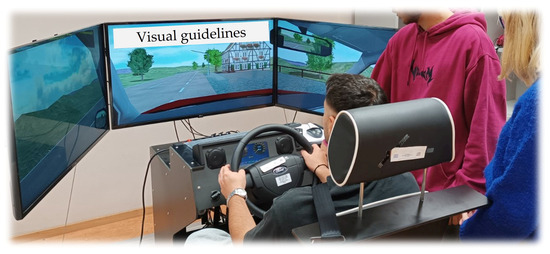
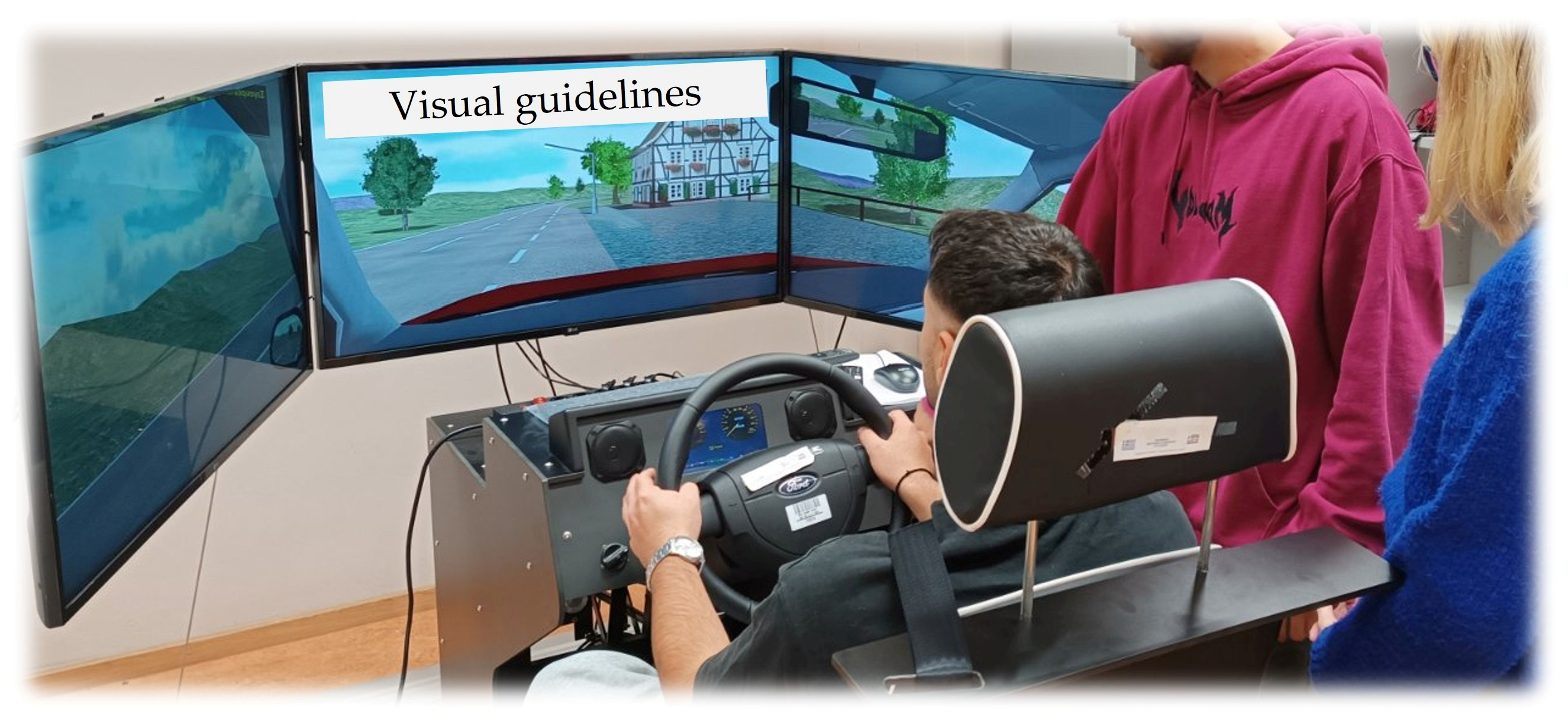
At this stage, two to three participants were allowed to be simultaneously present in the simulator room and be engaged in light and non-intrusive conversation (Figure 1). This was intentionally adopted to create a realistic setting, reflecting the quite often social nature of real-world driving experiences, which was necessary to increase comfort and minimize anxiety. Their presence was consistent across all trials, and they did not interact with the driver in ways that could affect performance metrics. As per the familiarization driving process itself, it was performed in free mode along a highway and a rural road for approximately five to six minutes. The simulator illustrated in Figure 1 ensured sufficient realism through a full-scale driver cockpit, force-feedback steering wheel, pedals, and a 180° visual projection system. It is clarified that data from the familiarization phase were not further analyzed.
Figure 1.
Participant familiarization with the driving simulator setup.
As per the core part of the experiment, the simulation consisted of four three-minute scenarios that allowed assessment of the main interaction effects of road environment and visibility on key performance metrics. These scenarios included the following:
- Driving on a highway during daytime in dry weather conditions;
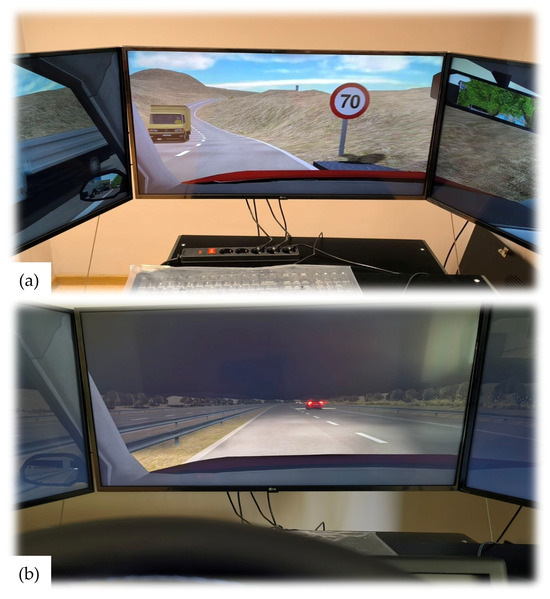
- Driving on a rural road during daytime in dry weather conditions (e.g., Figure 2a);
- Driving on a highway during nighttime in dry weather conditions (e.g., Figure 2b);
- Driving on a rural road during nighttime in dry weather conditions.
Figure 2.
Examples of driving scenarios: (a) rural road—daytime, and (b) highway—nighttime.
The lighting of the simulator room was adjusted to match daytime and nighttime conditions (Figure 2b). During the simulation, apart from the driver, two other co-participants were again present in the simulation room for all scenarios. To avoid potential learning effects and analysis bias, the aforementioned co-participants did not operate the simulator. Therefore, their role was limited to social contextualization of the driving behavior framework. Most importantly, they did not interact with the driver during the simulation. Each driver was instructed to focus exclusively on the driving task.
At each driving scenario, the participant came across a wide range of representative road design elements, such as straight alignments and curves. As per the vertical road profile, the longitudinal slope was nearly flat, but some random crest and sag curves were present too (e.g., Figure 2a). It is clarified that road geometric data were predefined from the simulator coding phase. In addition, the same level of traffic density was chosen for each participant to ensure homogeneity in their driving responses in the recorded data.
Finally, all participants were given the same speed limits, which were 70 km/h for the rural road comprising one lane per direction (e.g., Figure 2a), and 120 km/h for the highway comprising two or three lanes per direction. Those speed limits were in accordance with common engineering sense as well. Performance metrics were continuously collected at a high temporal resolution (i.e., at the millisecond scale), enabling later statistical analysis of driving behavior under the different experimental conditions. These metrics included vehicle speed, acceleration, and vehicle lateral position.
2.3. Analysis Framework
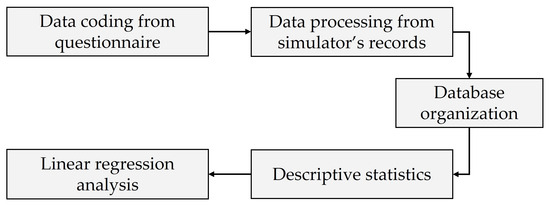
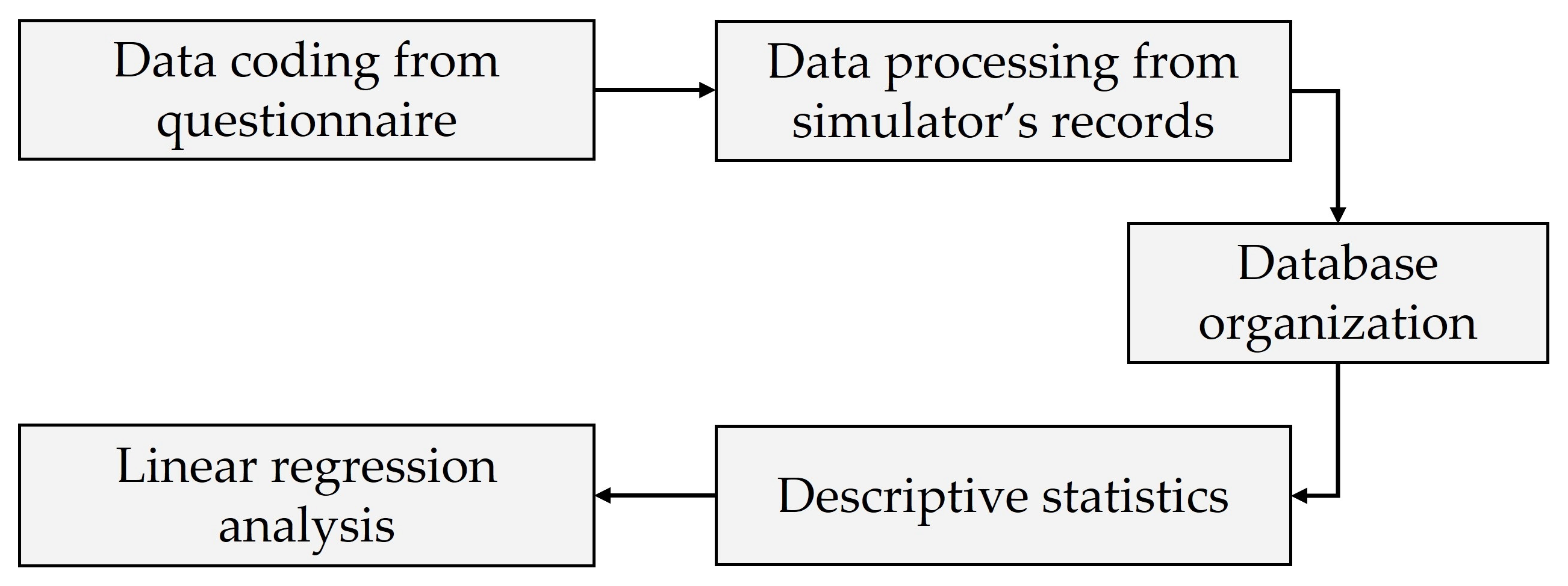
Based on the collected data from both the questionnaires and the simulation process, five analysis steps were followed according to Figure 3. This analysis framework was developed to integrate participants’ self-reported data from the questionnaire with objective driving data obtained from the simulator. The well-established rationale behind this approach was to enable exploration of liaisons between road environment, behavioral attitude, and driving performance.
Figure 3.
Research steps.
Prior to the statistical analysis, questionnaire responses were checked for completeness and consistency. All responses were coded into numerical variables according to predefined categories and subsequently integrated into the analysis dataset together with the simulator-derived performance metrics. As per the raw simulator data, the simulator’s output included more than thirty columns of dense data records. Since the focus of the analysis was put on speed, acceleration, and lane positioning, these three columns were extracted from the simulator’s output (i.e., continuous variables).
To mitigate artifacts from participants’ adaptation, data records from the first minute of each scenario were filtered out. This enabled the evaluation of the average speed, for instance, as indicative by assuming a nearly stable driving performance for each participant in each scenario. Based on this filtering, all variables including the mean speed, the maximum acceleration, and vehicle lateral position, were then computed over this “stable” driving period.
Thereafter, an integrated database was constructed by combining the coded questionnaire data (i.e., independent variables) with the processed simulator metrics (i.e., dependent variables). This allowed for a unified representation of both subjective and objective measures for each participant, facilitating correlation and regression analyses.
Two analysis steps followed:
- Descriptive statistics, including means, standard deviations, and ranges for continuous variables, as well as boxplots that were generated for key driving metrics (e.g., speed and lateral position) to identify trends and visualize distribution of recorded data. In addition, descriptive statistics offer the potential for preliminary insights into driving attitude for the different road types and visibility conditions under consideration.
- The structured dataset was formatted for further processing in a statistical-based analysis package. The tendency assessment of the simulator’s output variables was made through a linear regression approach.
3. Results
3.1. Overview of the Independent Variables
Table 1 briefly presents the questionnaire given to the participants together with the variable names and types that were assigned to each question for further statistical processing (Section 3.3). For better clarity, the eleventh question was slightly modified, since only property-damage-only crashes were recorded in the questionnaire. Recall that none of the participants reported involvement in injury-related crashes.
Table 1.
Skeleton of the questionnaire and answer treatment.
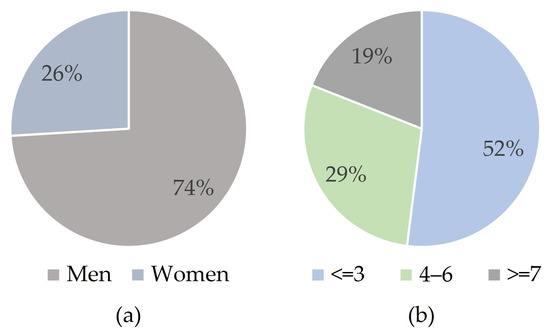
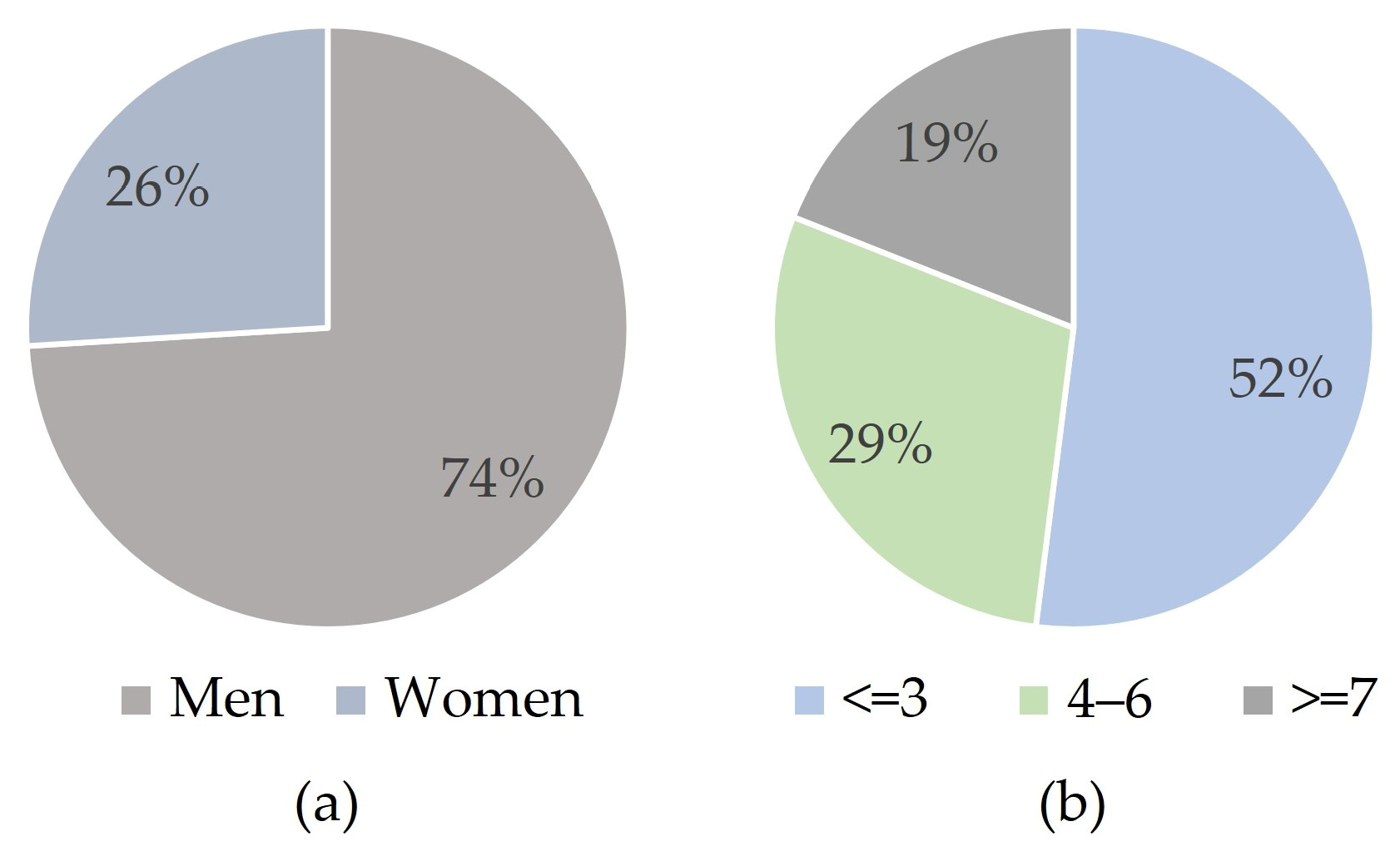
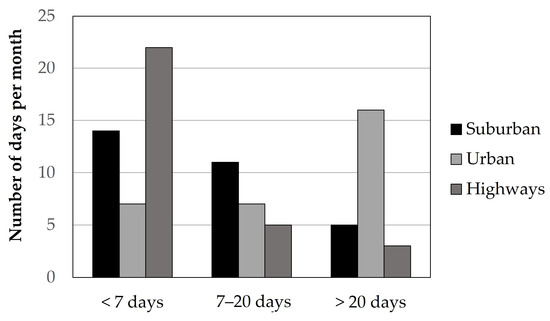
In terms of some basic information retrieved from the questionnaire, Table 2 presents the descriptive statistics of the continuous variables (AGE, LIC, DRVEXP, FINE, and CRASH), whereas Figure 4 and Figure 5 present the distribution of gender, years of driving experience, and driving frequency.
Table 2.
Descriptive statistics of continuous variables.
Figure 4.
Sample overview in terms of (a) gender and (b) years of driving experience.
Figure 5.
Distribution of driving frequency among different road types.
As can be seen from Table 2, driving experience was treated as a distinct variable from license holding duration. While license possession reflects the legal duration of a driving permit, driving experience better captures actual exposure to real-world driving. Notably, 40% of participants were found to have more years of practical driving experience than their official license duration. This likely indicates informal or supervised driving prior to licensing. Based on the actual driving experience, Figure 4b denotes that nearly one out of two participants had less than 3 years of experience, thereby better suiting the characterization of “novice” drivers for a considerable portion of the whole sample.
From Figure 5, it appears that urban roads constitute the most popular category for the sample of drivers (i.e., driving for more than 20 days per month), whereas highways are the least popular category for the same sample (i.e., driving for less than 7 days per month). These remarks are rational, considering that young drivers most often travel within their residence place for study and entertainment purposes.
3.2. Overview of the Dependent Variables
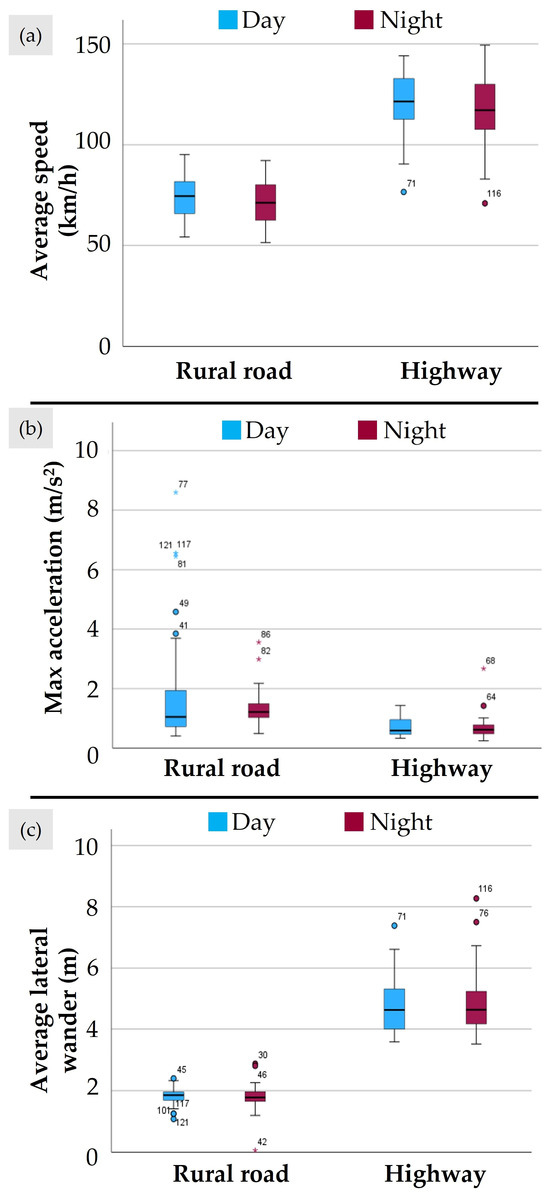
After the driving simulations took place, data about speed, acceleration, and lateral wander, or vehicle’s lateral position from the road’s axis center, were extracted per each participant and each run (i.e., four runs per participant). For a better overview of the four datasets, boxplots of the average speed, related to driving stability, the maximum acceleration, related to driving aggressiveness, and the average lateral wander, related to vehicle positioning, are given in Figure 6.
Figure 6.
Boxplots of (a) average speed (variable: VMEAN), (b) maximum acceleration (variable: ACCELMAX), and (c) average lateral wander (variable: WANDER).
It is clear that driving on highways results in higher speeds, irrespective of the time of driving. Notably, speeds on highways were found to be higher than those on rural roads at a rate of 66% during daytime driving and 65% during nighttime driving. Considering the speed limits given to the participants, it also appears that daytime driving made drivers more prone to speeding irrespective of the road category. In particular, for rural roads, 63% and 53% of the participants have an average speed above the limit of 70 km/h for daytime and nighttime driving, respectively. On highways, the corresponding percentages were found to be 53% and 43%, respectively.
In terms of the maximum acceleration, it appears to be lower in highways, which is probably a result of the “smoother” road geometric design in terms of its horizontal and vertical profiling. Driving on rural roads requires more frequent speed changes, and thus more abrupt accelerations, because of the existence of horizontal and vertical curves.
Vehicle lateral positioning presents higher variability (i.e., greater range) on highways, which is a result of the ability to change lanes. A closer look at the nighttime boxplots yields some outliers, thereby indicating an increased variability in lateral wander at night irrespective of the type of road. Indeed, the coefficients of variation for the lateral wander on rural roads are 17% for daytime driving and 27% for nighttime driving, whereas the corresponding values for highways were 19% and 23%.
Additional statistical testing was also performed through a paired t-test, aiming to assess the significance of the observed differences in the dependent variables because of the time of driving (i.e., daytime versus nighttime). For each pair, the null hypothesis assumes that the difference between the dependent variables at a 95% confidence level is not significant. The null hypothesis is accepted when |tstat| < tcrit. The results are presented at Table 3 for df = 29 (degrees of freedom).
Table 3.
Paired t-test results for the impact of daytime versus nighttime driving (df = 29).
In all scenarios, the null hypothesis could not be rejected. This result implies that, given the constraints of a simulator study and the limited sample size, differences in lighting conditions did not appear to influence behavioral outcomes. Such a result contrasts with a number of real-world studies, which find greater effects during nighttime, possibly suggesting that a simulator reduces some form of pressure related to perception or fatigue [36]. Nevertheless, the t-test results were applied on the average values of the dependent variables, which may not capture potential variability effects that were previously implied, for instance, about the range of vehicle positioning.
3.3. Linear Regression Analysis
Considering that each participant ran four scenarios (rural/daytime, rural/nighttime, highway/daytime, and highway/nighttime), a single combined dataset of 120 observations was created. Two additional nominal variables were introduced: (i) type of the road (name: TYPEROAD: “0” for rural road or “1” for highway), and (ii) time of the day (name: TIMEDAY: “0” for daytime or “1” for nighttime). This addition effectively integrated all scenarios into a unified analytical framework with a single database.
For each of the dependent variables, the regression procedure followed a specific sequence to ensure robustness and interpretability. First, the normality test of the dependent variables was made. Subsequently, a backward analysis approach was applied so that non-significant predictors were progressively removed and only those with meaningful contributions were kept. For those retained in the final model, Pearson correlation analysis was performed to explore correlations between the independent variables, and multicollinearity was further quantified using the Variance Inflation Factor (VIF). Normality was also visually assessed from the residual plots. Finally, standardized beta coefficients were assessed in terms of each predictor’s effect on driving performance metrics.
3.3.1. Statistical Processing with the SPSS
All statistical analyses were performed using IBM SPSS Statistics (SPSS, version 29.0). Prior to the linear regression analysis, the normality of the dependent variables was checked by the Kolmogorov–Smirnov and Shapiro–Wilk tests. Although not fully necessary, these checks were just made for the sake of completeness. The dependent variables under consideration were the mean speed (VMEAN), mean lateral wander (WANDER), and maximum acceleration (ACCELMAX). All 120 observations were used. The results of the normality tests are presented in Table 4.
Table 4.
Test of normality for the dependent variables.
It appears that all the variables were found to deviate from normal distribution, with probability values less than 0.001. The absence of normal distribution is common in the case of behavioral datasets, like driving speed, lateral wander, acceleration, etc., since such data are often skewed or have outliers (recall the boxplots from Figure 6).
Thereafter, a backward regression approach was applied, including all candidate predictors (i.e., those from Table 1 plus TYPEROAD and TIMEDAY), to identify those most strongly associated with the dependent variables. The observed equations are given below:
The units of VMEAN, WANDER, and ACCELMAX are km/h, m, and m/s2, respectively. Despite being an exploratory analysis, two fitness metrics are given for the sake of completeness—the coefficient of determination (R2), and the Standard Error of the Estimate (SEE)—for Equation (1) these values were 0.83 and 11.52 km/h, for Equation (2) these values were 0.86 and 0.67 m, and for Equation (3) these values were 0.27 and 1.13 m/s2.
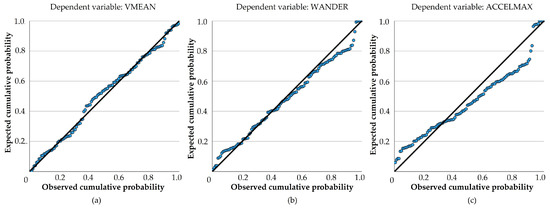
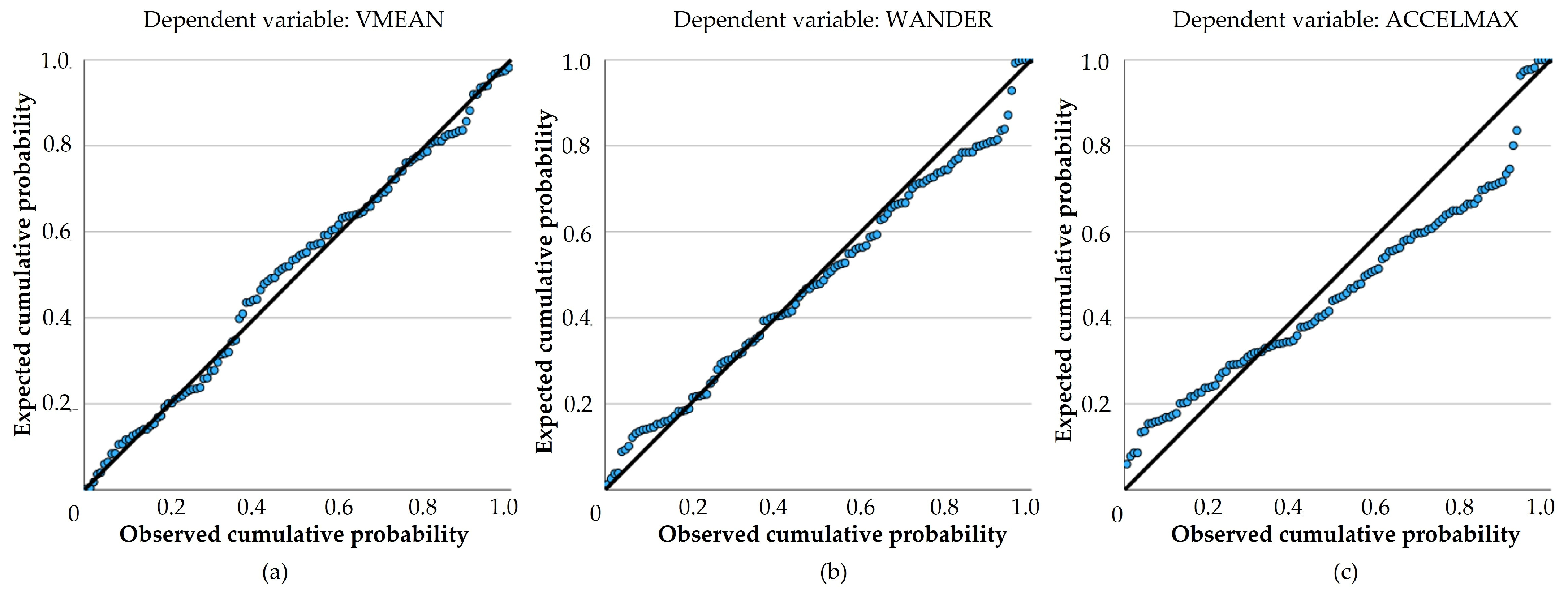
Among the selected predictors within Equations (1)–(3), Pearson correlations were inspected to assess potential multicollinearity; no excessively high correlations were observed. Furthermore, the VIF ranged from 1 to 3.4, confirming the absence of multicollinearity. Although the raw dependent variables deviated from normality (recall Table 4), this was fully anticipated. The examination of the regression-standardized residuals via P-P plots is more indicative. These plots are shown in Figure 7.
Figure 7.
P-P plots for residual distribution for the three dependent variables: (a) VMEAN, (b) WANDER, and (c) ACCELMAX.
The visual inspection of P-P plots indicates approximate normality for VMEAN and WANDER, supporting the assumptions for linear regression analysis, even though the raw variables were not perfectly normal. Indeed, almost all points follow the diagonal line, which represents a satisfactory normal distribution of residuals. Minor deviations at the extremes for WANDER are normal and generally acceptable considering the number of observations (i.e., 120). Contrarily, the points in Figure 7c (variable: ACCELMAX) do not satisfactorily follow the diagonal line.
Therefore, based on the good fit power (i.e., higher R2) and approximately normal residuals, VMEAN and WANDER were further interpreted in terms of the standardized beta coefficients. ACCELMAX was excluded from further analysis because of the lower R2 and the residuals that deviated from normality.
3.3.2. Interpretation of the Predictors’ Effect
SPSS results from the linear regression analysis are given in Table 5. Some predictors were not found to be statistically significant (p value > 0.05), indicating a limited independent effect on the dependent variable; however, low VIF values—previously mentioned—had already confirmed that this was not due to multicollinearity.
Table 5.
Beta coefficients for the dependent variables—predictors’ evaluation.
For mean speed (VMEAN)—as shown in the left part of Table 5—the strongest positive effect comes from the variable TYPEROAD (β = 0.853, p < 0.001). This implies that participants applied substantially higher speeds on highways compared to rural roads, probably because of the often-straight alignment. Further, higher driving frequency on urban roads (URBDAYS, β = 0.113, p = 0.021) and highways (HWYDAYS, β = 0.138, p = 0.002) can lead to increased speeds, which is compatible with drivers’ confidence because of their experience. In contrast, compliance with speed limits (SPDKEEP) was negatively associated with speed (β = −0.130, p = 0.004). This indicates a tendency of conservative driving because of the reported adherence to legal limits. Gender (GEN), fines (FINE), and crash involvement (CRASH) did not exhibit a significant effect on VMEAN (p > 0.05).
For lateral wander (WANDER)—as shown in the right part of Table 5—TYPEROAD again exhibited the largest positive effect (β = 0.891, p < 0.001), indicating greater lane variability on highways. This can be simply explained by the multiple lanes of a highway (i.e., two or three lanes per direction). Age (AGE, β = 0.282, p < 0.001) and gender (GEN, β = 0.180, p < 0.001) presented a positive association with lateral wander, suggesting that aged participants within the sample of this investigation, or female participants, exhibited slightly higher values in WANDER. A tendency towards more consistent lane positioning can be implied through license holding (LIC) and the agreement with speed limits (SPDAGREE). These were negatively associated with lateral wander (β = −0.285, p < 0.001; β = −0.150, p = 0.002, respectively), indicating experienced and rule-compliant drivers. Crash history (CRASH) had a small, yet significant, negative effect (β = −0.089, p = 0.029).
Overall, the type of road appeared to be a significant predictor for both average speed and lateral wander, while driving frequency and driver’s experience significantly contributed to average speed and lateral position, respectively.
4. Discussion
4.1. Practical Implications for Road Safety
From the analysis, it appeared that an increase in speed on highways compared to rural roads is consistent with previous simulator and field studies reporting that road geometric characteristics strongly influence speed choice and lane-keeping behavior. Studies using both simulator and field data have shown that highways typically encourage higher speeds due to their straighter alignment and wider cross-sections, whereas rural roads often lead to more frequent speed adjustments and vehicle position variations because of their geometric complexity [24,32].
The observed patterns in the speed and lateral position behaviors of young drivers contribute insights for the improvement of road safety and infrastructure conditions. Firstly, the observed influence of road type on the mean speed and lateral wander can prioritize safety interventions on rural roads and highways differently. For instance, because of the higher values observed on highways, the application, monitoring, and periodical upgrade of signage, lane markings, and reflective delineators are indispensable. Improved road geometric design with the provision of shoulders is also necessary to improve vehicle stability and mitigate the risk of run-off-road crashes because of poor vehicle positioning or poor pavement skid resistance—an aspect that cannot be considered in a simulation environment.
Furthermore, the observed relationships between driving frequency (in days per month) and speed imply that the level of familiarity of young drivers with the types of roads could influence the speeds they choose to drive. Educational interventions and campaigns in the management of speeds, particularly among young and less-experienced drivers, can help them become easily adaptable to variable, yet demanding, road environments. Such interventions may include targeted driver education programs addressing speed perception, simulator-based training for novice drivers, and awareness campaigns focusing on risk perception. In terms of the lateral wander, the observation that compliance with speed limits and speed conformity led to more consistent vehicle positioning, suggests that the enforcement of speed limits with clear and consistent speed signage may facilitate the development of safer driving behaviors. Lower speeds and consistent vehicle lateral position can substantially reduce crash risk.
Lastly, the need to consider the interaction of behavioral and infrastructural factors in highway safety interventions is important. While vehicle automation and in-vehicle warning systems are continually developed, enhancing the visibility and consistency of the road design may be essential in facilitating young drivers’ performance. In addition, lighting conditions, signage and a self-explanatory road geometric design can jointly ensure improved directional capabilities of all drivers, irrespective of their age and road’s complex geometry, thereby reducing their risk exposure, especially at nighttime.
4.2. Study Limitations
The findings of the study shall be viewed in the context of the limitations of the experimental approach. Firstly, the use of a high-fidelity driving simulator, although allowing a safe and realistic driving experience, does not accurately reflect the true driving experience. The study could not control additional factors that affect driving, such as the reaction of a driver to real-life traffic conditions, road type and status (i.e., a deteriorated pavement surface or poor ride quality that both affect drivers’ comfort [37]), as well as the physiological part of a driver’s reaction and overall performance. As such, although the linear regression analysis provided behavioral insights, the exploratory nature of the study could have been affected by additional factors influencing drivers’ performance.
Furthermore, the study only focused on civil engineering students who were between the ages of 18 and 24 years old. As such, the study could not be generalized to the broader community of younger drivers. Finally, a single scenario of driving experience in the study only lasted about three minutes, which indicates limited capability of reflecting hourly driving routes in the real scale.
5. Conclusions
Using a high-fidelity driving simulator, this study investigated young drivers’ lateral position and speed selection in highway and rural settings under daytime and nighttime driving scenarios. The core conclusions are as follows:
- The main factor influencing driving behavior was the type of road. Compared to rural roads, participants displayed noticeably faster speeds and higher lateral wander on highways, which reflected the special geometric features of highways, i.e., straight alignment and multi-lane roads.
- Speed and vehicle position were influenced by the driver’s familiarity and experience. The role of both experience and rule compliance was highlighted by the finding that more frequent driving on urban roads and highways was linked to faster speeds, while consistent lane positioning was linked to longer license holding and agreement with speed limits.
- Nighttime driving effects were less pronounced in the simulator. Although increased variability in lateral wander at night was observed descriptively, statistical tests did not indicate significant differences for average values, suggesting that simulated environments may underrepresent fatigue and perceptual challenges present in real-world night driving.
These results should be expanded in future studies using longer driving exposures, more varied participant populations, and complementary naturalistic research. A promising way to improve the habits of inexperienced drivers is to combine behavioral insights with infrastructure upgrades. Overall, this study highlights the importance of simulator-based analyses in analyzing high-risk driver groups, offering both empirical insights and practical suggestions for improving road safety.
Author Contributions
Conceptualization, K.G., G.B. and A.K.; Methodology, K.G.; Analysis, K.G.; Writing—Review and Editing, K.G., G.B. and A.K. All authors have read and agreed to the published version of the manuscript.
Funding
This research received no external funding.
Data Availability Statement
The original contributions presented in this study are included in the article. Further inquiries can be directed to the corresponding author.
Acknowledgments
The authors gratefully acknowledge the Region of Eastern Macedonia and Thrace (Greece) for funding the acquisition of the driving simulator through the Operational Programme “Eastern Macedonia and Thrace, Priority Axis 3: Infrastructure for Human Capital Development and Strengthening of Social Cohesion”.
Conflicts of Interest
The authors declare no conflicts of interest.
References
- World Health Organization (WHO). Global Status Report on Road Safety; WHO: Geneva, Switzerland, 2023. [Google Scholar]
- Tandrayen-Ragoobur, V. The economic burden of road traffic accidents and injuries: A small island perspective. Int. J. Transp. Sci. Technol. 2025, 17, 109–119. [Google Scholar] [CrossRef] [Scilit]
- Välilä, T. Road safety and road infrastructure expenditure: A bivariate analysis. Transp. Policy 2023, 140, 148–162. [Google Scholar] [CrossRef] [Scilit]
- Abuzaid, H.; Almashhour, R.; Abu-Lebdeh, G. Driving towards Sustainability: A Neural Network-Based Prediction of the Traffic-Related Effects on Road Users in the UAE. Sustainability 2024, 16, 1092. [Google Scholar] [CrossRef] [Scilit]
- Nikolaeva, R.V. Road safety as a factor in the socio-economic development of the country. IOP Conf. Ser. Mater. Sci. Eng. 2020, 786, 012070. [Google Scholar] [CrossRef] [Scilit]
- Van den Berghe, W.; Schachner, M.; Sgarra, V.; Christie, N. The association between national culture, road safety performance and support for policy measures. IATSS Res. 2020, 44, 197–211. [Google Scholar] [CrossRef] [Scilit]
- Gkyrtis, K.; Pomoni, M. Use of Historical Road Incident Data for the Assessment of Road Redesign Potential. Designs 2024, 8, 88. [Google Scholar] [CrossRef] [Scilit]
- Song, K.-H.; Kim, K.H.; Choi, S.; Elkosantini, S.; Lee, S.M.; Suh, W. Comprehensive Safety Index for Road Safety Management System. Sustainability 2024, 16, 450. [Google Scholar] [CrossRef] [Scilit]
- Plati, C.; Pomoni, M.; Loizos, A.; Yannis, G. Stochastic Prediction of Short-Term Friction Loss of Asphalt Pavements: A Traffic Dependent Approach. In Proceedings of the 9th International Conference on Maintenance and Rehabilitation of Pavements—Mairepav9; Lecture Notes in Civil Engineering; Raab, C., Ed.; Springer: Cham, Switzerland, 2020; Volume 76. [Google Scholar] [CrossRef] [Scilit]
- Camden, M.C.; Soccolich, S.A.; Hickman, J.S.; Hanowski, R.J. Reducing risky driving: Assessing the impacts of an automatically-assigned, targeted web-based instruction program. J. Saf. Res. 2019, 70, 105–115. [Google Scholar] [CrossRef] [Scilit]
- Useche, S.A.; Faus, M.; Alonso, F. Is safety in the eye of the beholder? Discrepancies between self-reported and proxied data on road safety behaviors—A systematic review. Front. Psychol. 2022, 13, 964387. [Google Scholar] [CrossRef] [Scilit]
- Cvahte Ojsteršek, T.; Topolšek, D. Influence of drivers’ visual and cognitive attention on their perception of changes in the traffic environment. Eur. Transp. Res. Rev. 2019, 11, 45. [Google Scholar] [CrossRef] [Scilit]
- Mansourifar, F.; Nadimi, N.; Golbabaei, F. Novice and Young Drivers and Advanced Driver Assistant Systems: A Review. Future Transp. 2025, 5, 32. [Google Scholar] [CrossRef] [Scilit]
- National Highway Traffic Safety Administration (NHTSA). NHTSA’s National Center for Statistics and Analysis; Traffic Safety Facts, 2022 Data; US Department of Transportation: Washington, DC, USA, 2024.
- European Commission (EC). Road Safety Thematic Report—Novice Drivers; European Commission: Brussels, Belgium, 2021. [Google Scholar]
- Sagberg, F.; Selpi; Bianchi Piccinini, G.F.; Engström, J. A Review of Research on Driving Styles and Road Safety. Hum. Factors 2015, 57, 1248–1275. [Google Scholar] [CrossRef] [Scilit]
- Marian, A.-L.; Chiriac, L.-E.; Ciofu, V.; Apostol, M.M. Understanding Risky Behavior in Sustainable Driving among Young Adults: Exploring Social Norms, Emotional Regulation, Perceived Behavioral Control, and Mindfulness. Sustainability 2024, 16, 6620. [Google Scholar] [CrossRef] [Scilit]
- Sekadakis, M.; Katrakazas, C.; Orfanou, F.; Pavlou, D.; Oikonomou, M.; Yannis, G. Impact of texting and web surfing on driving behavior and safety in rural roads. Int. J. Transp. Sci. Technol. 2023, 12, 665–682. [Google Scholar] [CrossRef] [Scilit]
- Oviedo-Trespalacios, O.; Haque, M.M.; King, M.; Washington, S. Understanding the impacts of mobile phone distraction on driving performance: A systematic review. Transp. Res. Part C Emerg. Technol. 2016, 72, 360–380. [Google Scholar] [CrossRef] [Scilit]
- Nikolaou, D.; Ntontis, A.; Michelaraki, E.; Ziakopoulos, A.; Yannis, G. Pedestrian safety attitudes and self-declared behaviour in Greece. IATSS Res. 2023, 47, 14–24. [Google Scholar] [CrossRef] [Scilit]
- Rolison, J.; Regev, S.; Moutari, S.; Feeney, A. What are the factors that contribute to road accidents? An assessment of law enforcement views, ordinary drivers’ opinions, and road accident records. Accid. Anal. Prev. 2018, 115, 11–24. [Google Scholar] [CrossRef] [Scilit]
- Yuan, Q.; Zhai, X.; Ji, W.; Yang, T.; Yu, Y.; Yu, S. Correlation analysis on accident injury and risky behavior of vulnerable road users based on Bayesian general ordinal logit model. Sustainability 2022, 14, 16048. [Google Scholar] [CrossRef] [Scilit]
- Mohammadpour, S.I.; Nassiri, H. Aggressive driving: Do driving overconfidence and aggressive thoughts behind the wheel, drive professionals off the road? Transp. Res. Part F Traffic Psychol. Behav. 2021, 79, 170–184. [Google Scholar] [CrossRef] [Scilit]
- Ferko, M.; Pirdavani, A.; Babić, D.; Babić, D. Exploring Factors Influencing Speeding on Rural Roads: A Multivariable Approach. Infrastructures 2024, 9, 222. [Google Scholar] [CrossRef] [Scilit]
- Laapotti, S.; Keskinen, E.; Hatakka, M.; Katila, A. Novice drivers’ accidents and violations- a failure on higher or lower hierarchical levels of driving behavior. Accid. Anal. Prev. 2001, 33, 759–769. [Google Scholar] [CrossRef] [Scilit] [PubMed]
- Elvik, R. Why are there so few experimental road safety evaluation studies: Could their findings explain it? Accid. Anal. Prev. 2021, 163, 106467. [Google Scholar] [CrossRef] [Scilit] [PubMed]
- Kontaxi, A.; Ziakopoulos, A.; Yannis, G. Exploring the impact of driver feedback on safety: A systematic review of studies in real-world driving conditions. Transp. Res. Part F Traffic Psychol. Behav. 2025, 114, 118–140. [Google Scholar] [CrossRef] [Scilit]
- Camden, M.C.; Hickman, J.S.; Hanowski, R.J. Pilot Testing a Naturalistic Driving Study to Investigate Winter Maintenance Operator Fatigue during Winter Emergencies. Safety 2017, 3, 19. [Google Scholar] [CrossRef] [Scilit]
- Chen, L.; Fang, J.; Li, J.; Xie, J. Research on the Effectiveness of Driving Simulation Systems in Risky Traffic Environments. Systems 2025, 13, 329. [Google Scholar] [CrossRef] [Scilit]
- Kamaludin, M.Z.A.; Karjanto, J.; Muhammad, N.; Md Yusof, N.; Hassan, M.Z.; Baharom, M.Z.; Mohd Jawi, Z.; Rauterberg, M. The Correlation Between Self-Assessment and Observation in Driving Style Classification: An On-Road Case Study. Information 2025, 16, 140. [Google Scholar] [CrossRef] [Scilit]
- Mohammadi, A.; Aghabayk, K.; Zabihzadeh, A. Exploring the Factors Influencing the Safety of Young Novice Drivers: A Qualitative Approach Based on Grounded Theory. Sustainability 2024, 16, 9711. [Google Scholar] [CrossRef] [Scilit]
- Pavlou, D.; Christodoulou, G.; Yannis, G. The impact of weather conditions and driver characteristics on road safety on rural roads. Transp. Res. Procedia 2023, 72, 4081–4088. [Google Scholar] [CrossRef] [Scilit]
- Pavlou, D.; Papantoniou, P.; Papadimitriou, E.; Vardaki, S.; Economou, A.; Yannis, G.; Papageorgiou, S.G. Self-assessment of older drivers with brain pathologies: Reported habits and self-regulation of driving. J. Transp. Health 2017, 4, 90–98. [Google Scholar] [CrossRef] [Scilit]
- Tsoutsi, V.; Papadakaki, M.; Yannis, G.; Pavlou, D.; Basta, M.; Chliaoutakis, J.; Dikeos, D. Driving Behaviour in Depression Based on Subjective Evaluation and Data from a Driving Simulator. Int. J. Environ. Res. Public Health 2023, 20, 5609. [Google Scholar] [CrossRef] [Scilit]
- Zhang, S.; Zhao, C.; Zhang, Z.; Lv, Y. Driving simulator validation studies: A systematic review. Simul. Model. Pract. Theory 2025, 138, 103020. [Google Scholar] [CrossRef] [Scilit]
- Lobjois, R.; Faure, V.; Desire, L.; Benguigui, N. Behavioral and workload measures in real and simulated driving: Do they tell us the same thing about the validity of driving simulation? Saf. Sci. 2021, 134, 105046. [Google Scholar] [CrossRef] [Scilit]
- Plati, C.; Gkyrtis, K.; Loizos, A. A practice-based approach to diagnose pavement roughness problems. Int. J. Civ. Eng. 2024, 22, 453–465. [Google Scholar] [CrossRef] [Scilit]

Disclaimer/Publisher’s Note: The statements, opinions and data contained in all publications are solely those of the individual author(s) and contributor(s) and not of MDPI and/or the editor(s). MDPI and/or the editor(s) disclaim responsibility for any injury to people or property resulting from any ideas, methods, instructions or products referred to in the content. |
© 2026 by the authors. Licensee MDPI, Basel, Switzerland. This article is an open access article distributed under the terms and conditions of the Creative Commons Attribution (CC BY) license.