
Article

Analytical Solutions of Free Surface Evolution Within Originally Dry, Coarse-Grain-Sized Embankment Dam Materials †
Department of Civil Engineering and Computer Science Engineering, University of Rome Tor Vergata, Via Politecnico 1, 00133 Rome, Italy
*
Author to whom correspondence should be addressed.
The paper was selected as one of the “10 DW2025 Best Papers” submitted and presented at the 2025 Fifth International DAM WORLD Conference, Lisbon, Portugal, 13–17 April 2025. It has been modified and extended for publishing in the journal.
Infrastructures 2026, 11(1), 23; https://doi.org/10.3390/infrastructures11010023

Submission received: 26 October 2025 / Revised: 8 December 2025 / Accepted: 25 December 2025 / Published: 12 January 2026
(This article belongs to the Special Issue Preserving Life Through Dams)

Abstract

Tightness of homogeneous embankment dams is often ensured by means of upstream water barriers, such as bituminous concrete facings, concrete slabs, shotcrete membranes, metallic sheets, geomembranes, and cement blankets. The stability analysis of these dams, especially in areas with high seismicity, must include the hydraulic and mechanical effects resulting from an extensive, sudden cracking of the impervious facing. To this purpose, in this paper, simple, original analytical solutions are proposed to estimate the position of the exit point on the downstream slope of the dam, the maximum height of the saturation front at the downstream face, and the time required for the saturation front to reach the downstream face. These variables generally depend on several factors, such as the geometry of the dam, homogeneity or heterogeneity, the permeability coefficient of the dam body materials, and resistance laws to describe the seepage flow. The high number of these factors requires the development of advanced 2D/3D FEM analyses, often computationally heavy and complex to implement. Although approximate, the proposed solutions may however allow us to define the role of the various factors and their interaction, to quickly deduce the main, preliminary design indications.

1. Introduction

Under post-earthquake conditions or extensive lacerations of the facing and complete loss of tightness, a massive seepage flow could occur in dry, coarse-grain-sized embankment dam materials, governed by Darcy’s law and Laplace’s equation or, alternatively, by non-linear relationships between the permeability coefficient and the piezometric head [1,2].
The seepage flow is modulated by the progressive saturation of the dam body due to the advancement of the free surface towards the downstream face, through the different cross-sections of the dam. Flow velocity and saturation depend on (i) the height of the dam, (ii) the upstream hydraulic head, and (iii) the corresponding extensions of the different cross-sections at the base of the dam; they vary along the longitudinal axis [3,4,5,6].
Therefore, potential release of water from the dam body is analyzed under the simplifying hypotheses listed below.
-
Seepage flow mainly occurs along each cross-section of the dam; that is, 2D flow for each cross-section, by neglecting the longitudinal components of the flow velocity.
-
Flow rates are in accordance with a Darcy laminar flow.
-
In case of non-laminar flows, specific laws may be applied for coarse materials (e.g., the Forchheimer relationship [7,8,9]), describing seepage flows in a granular material initially dry and progressively saturated, with variable water depth in space and time.
At the same time, it must be checked that, under the hypothesis of seepage, the dam material essentially maintains its granulometric stability in the presence of the dragging water actions generated by the seepage flow [10,11].
In other words, the facing and the drainage system behind it guarantee the safety of the dam under ordinary conditions, preventing, even in the case of ordinary deterioration of the facing, the leaks that give rise to seepage flow from the reservoir through the embankment.
In extreme conditions, e.g., after a very strong earthquake, the absence of uncontrolled release of water from the reservoir must be checked. The corresponding seepage analyses must start from the hypothesis that the sudden breakage and inefficiency—local or global—of the upstream facing occurs; consequently, a seepage flow through the dam body would start. The progressive saturation of the dam materials, coupled with the evolution of the free surface, will be governed by the hydrodynamic resistance to the seepage flow through the dry material. This phenomenon may also be accompanied by possible dragging, suffusion, and particle migration of incoherent materials. In this last case, potential self-healing and self-protection characteristics of the saturated materials must be checked too (e.g., [12]). The outflow is ensured by the downstream draining face; initially, the free surface lies entirely within the dam body, and it progressively moves towards the downstream face, which is reached after a critical time t*; after t*, the free surface progressively rises and the water seeps through the downstream face. This second phase of the unsteady seepage flow is very important, owing to the problems possibly related to the discharge rates that should be safely collected and conveyed far from the dam as well as to the possible limit states related to particle migration phenomena.
The need to study these particular limit states, in addition to specific requirements reported in national laws and safety standards, derives from the analysis of documented cases of failures of dams composed of coarse-grained materials and/or rockfill, even in the recent past (e.g., [13,14,15]). Specifically, these cases were analyzed through advanced 3D numerical simulations. In this paper, comparisons between the analytical and numerical solutions validate that the approximation proposed methods (applicable to 2D and 3D cases) can achieve desirable precisions and conservative results, even in the cases with strong nonlinearity.

2. The Boussinesq Equation for Simplified 1D Geometric Schemes

2.1. General Setting

Despite the basic simplifying assumptions (i.e., constant porosity of the material; Dupuit’s hypothesis; Darcy’s law; horizontal impervious base boundary; incompressible water and solid skeleton soil), the well-known Boussinesq equation, much studied and re-elaborated in the technical literature (e.g., [16]),
1 2 2 h 2 x 2 = n s K h t ε K  
being x = main flow (spatial) direction; t = time; ns = porosity of material; K = permeability coefficient; ε = infiltration rate coefficient; h = water table, can be solved analytically only in some particular cases.
A solution can be obtained by separating the variables x and t, expressing the function h(x; t) as the product of two functions, one dependent only on x and the other only on t, as originally applied by [17].
Another method, proposed to solve the Boussinesq equation, consists of combining the variables x and t in a parameter α, in which the relationship between x and t is known a priori. This method was used by [1,18,19] in the form
h x , t = f α    
being
α = c x t 1 / 2    
to determine the flow rate through the initial vertical section (where the free surface of the upstream water and the free surface of the seepage water are in contact), when the upstream free surface rises or falls instantaneously from a level H1 to a level H2.
The result of this method provides the seepage flow rate (q) as a function of the geometric and physical (K, ns) parameters of the soil and the time:
q = ± H 2 H 1 K n s 2 t
More advanced, recently proposed (e.g., [16,19]) procedures allow us to consider some general cases. Following a similar procedure, the propagation of the free surface can be analytically modeled by assuming that (i) the initial level of the free surface coincides with the impermeable base boundary and (ii) following the sudden rise of the free surface, the seepage flow occurs through a homogeneous dry soil.
The propagation maximum distance of the free surface, along its base, in this case, is expressed by the following relation (e.g., [20,21]):
x 0 t = 1.62 t K H n s
To confirm the reliability of this result, let us first consider the advancement x 0 t in the lowest position of the saturation front, i.e., at the contact with the impermeable base surface, where the fluid threads can advance only horizontally, as if the permeability in the vertical direction were null.
At the generic time t, the saturation front has reached the position x(t) and continues to advance due to the piezometric head (HmHv)/x(t), decreasing in space and time as t increases: Hm is the level of the water reservoir, measured from the base of the dam; Hv (=0) is the piezometric head at the base of the saturation front (i.e., z = 0; interstitial pressure = 0).
By recalling the continuity equation
q   d t = d V w
from which
K · i ( t ) · 1 ·   d t = 1 · n s   d x 0
K · H m x 0 t d t = n s   d x 0
being ns = volumetric porosity. By separating the variables and integrating the Equation (7),
x 0 t = 1.414 t · K · H m n s
The Equation (8) is entirely comparable with the previous Equation (4). By imposing that x0 is equal to the length L of the dam base, the time t* necessary for the saturation front to reach the downstream foot of the dam in the highest portion of the dam (maximum height of the cross-section) can be obtained:
t * = n s · L 2 2 · K · H m  
It is interesting to rewrite the same continuity Equation (5) by assuming a non-linear relationship between flow velocity and piezometric gradient, such as (e.g., [7,14]):
v = K · i t 1 / 2
Thus,
K · H m x 0 t 1 / 2 d t = n s   d x 0
By separating the variables and integrating the Equation (11),
x 0 t = 1.31 · t · K n s 2 / 3   H m 1 / 3
The time t* needed for the saturation front to reach the downstream foot of the dam is
t * = 2 3 n s · L 3 / 2 K · H m 1 / 2
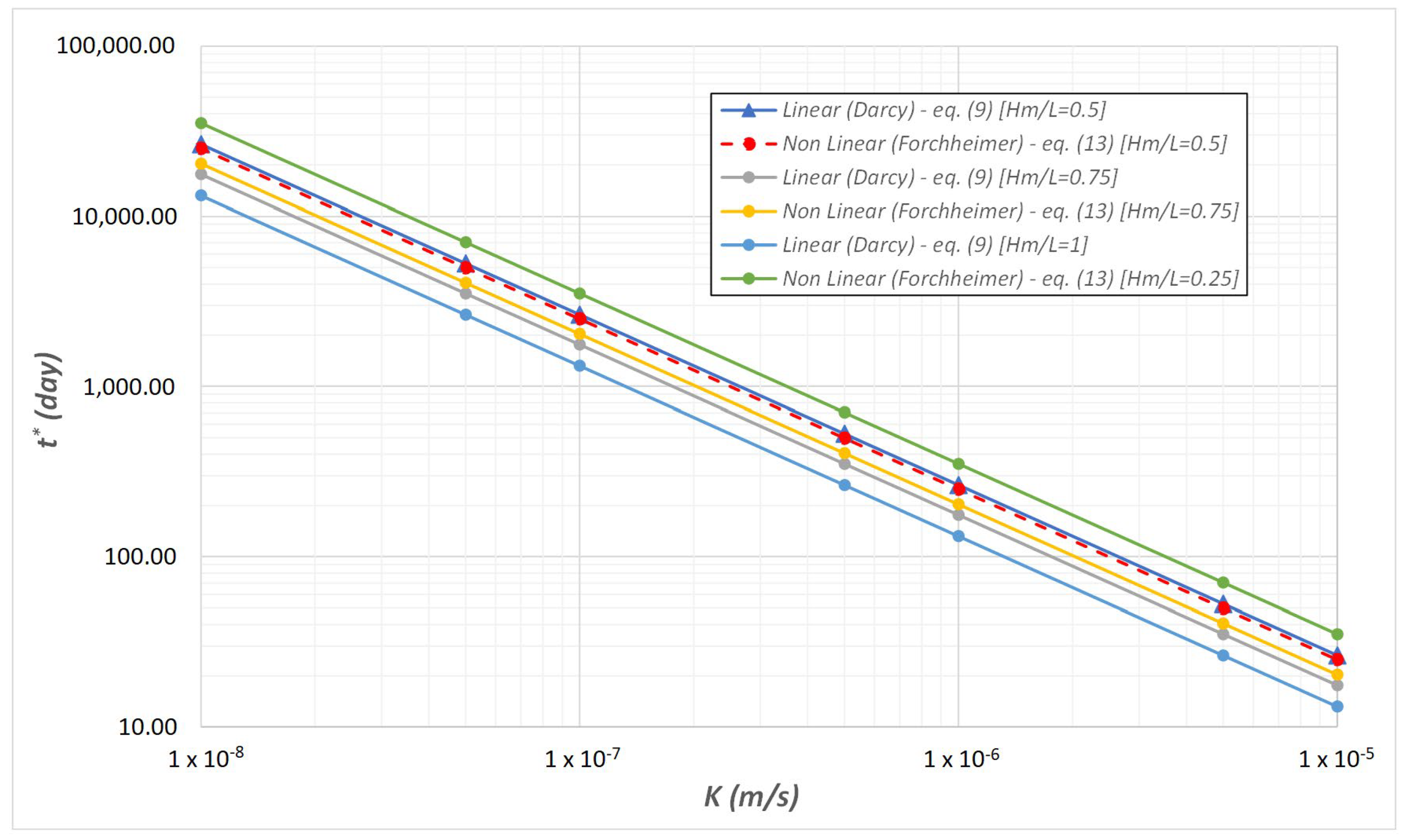
As shown in the following Figure 1, the results obtained with the two distinct relationships between velocity and piezometric gradient (i.e., Equations (9) and (13)), by assuming ns = 0.38 and different values of the ratio Hm/L, appear comparable (especially for Hm/L = 0.5).
In conclusion, it can be deduced that, for preliminary qualitative and quantitative evaluations of the characteristics of the seepage motion, laminar motion regimes (permanent and various), according to Darcy’s law, can be applied.

2.2. The 2D Solutions for “Real” Dam Body

The previous solutions (Equations (4)–(8), referred to vertical upstream slopes) are not directly applicable to pervious zones suddenly affected by a seepage flow following unexpected collapse of the upstream face after a strong earthquake.
However, based on the previous general considerations, to model the advancement of the free surface referred to the real geometry of a dam, a simplified solution can be developed by admitting the validity of Dupuit’s hypothesis (the vertical component of the seepage flow is neglected, i.e., kz (vertical permeability) << kx (horizontal permeability) is assumed) and adopting the technique of successive stationary states to model the unsteady state.
Following this line of thought, the previous Equation (8) can be rewritten for this case as follows:
x 0 z , t = 2 t · K · ( H m z ) n s
At each time instant t, under the assumed hypotheses, in the case of a vertical upstream face, the free surface (curve z(x)) is a parabola.
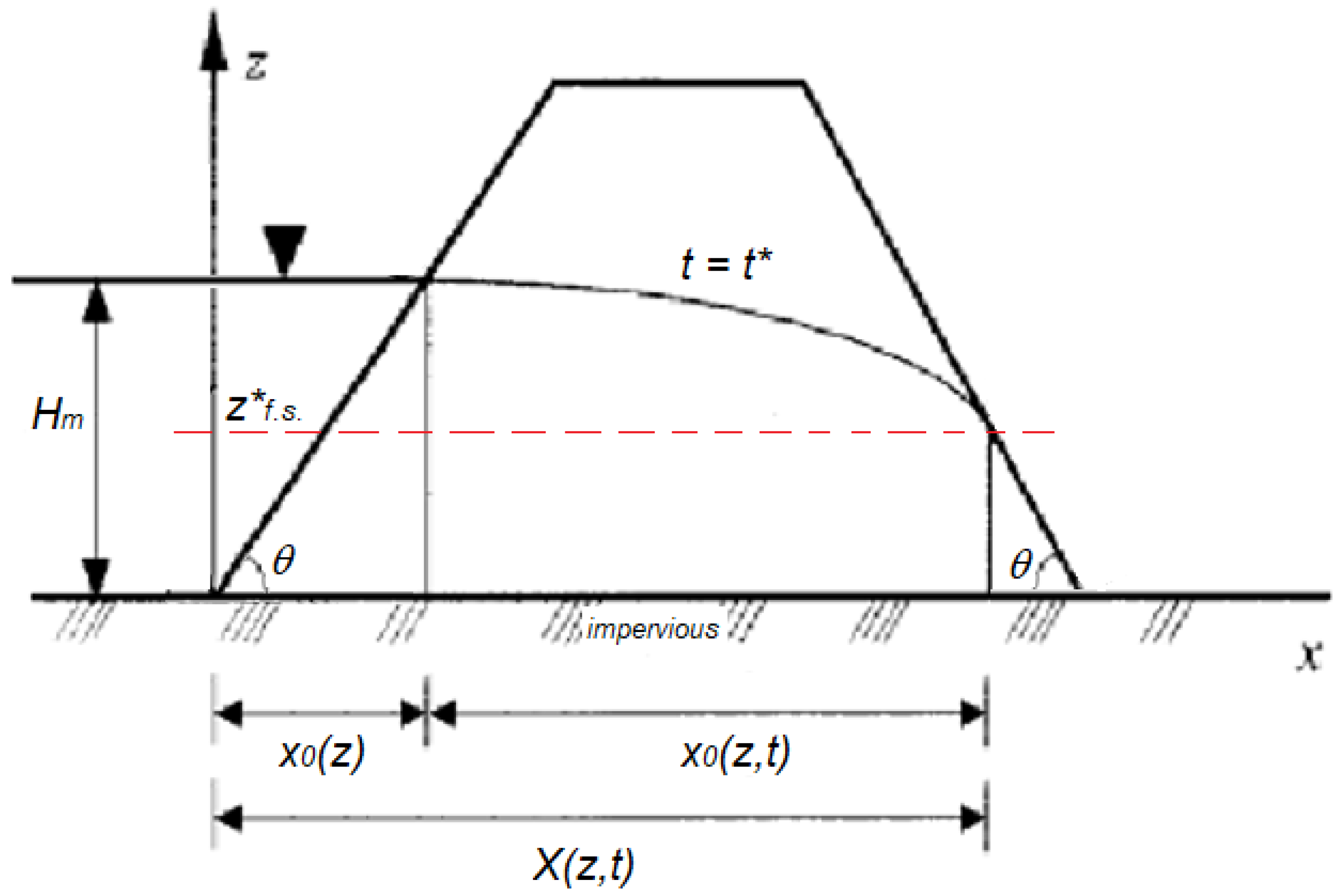
To take into account the inclination of the upstream face (angle θ with respect to the horizontal plane) to the path x(z,t), it is necessary to add the length x0(z) of the initial position of the upstream face with respect to x = 0, which depends on the elevation z (see also Figure 2):
x 0 z = z t a n   θ    
Definitively, at time t and for the elevation z, the saturation front reaches the position X(z,t):
X z , t = x 0 z , t + x 0 z
Thus,
X z , t = 2 t · K · ( H m z ) n s + z t a n   θ
The position X(z,t) therefore also depends on the slope (θ) of the upstream face. Furthermore, the free surface always intersects the upstream face at the reservoir level z = Hm for any time instant t.
For z = 0, the downstream foot of the dam (path equal to the length L of the base of the dam) is reached even after the time t* (z = 0), independent of the angle θ (equal to the previous Equation (9)):
t * ( z = 0 ) = n s · L 2 2 · K · H m                                                                                                   ( 9 . b i s )      
For z > 0, the downstream face is reached after a path dependent on the elevation z:
t * ( z > 0 ) = n s 2 · K · tan 2 θ · L · tan θ 2 z 2 H m z  
To estimate the minimum time required for the free surface X(z,t) to reach the downstream face and, correspondingly, determine its related elevation z*f.s., the first derivative dt*/dz equal to zero must be imposed. Thus,
z * f . s . = H m H m 2 H m L tan θ + L 2 tan 2 θ 4 1 2  
Based on the expression of z*f.s., the minimum time t* for which the saturation front reaches the downstream face (corresponding to the elevation z*f.s.) can be obtained. Following this procedure, the following is obtained:
t * z = z * f . s . = n s 2 · K · tan 2 θ · L · tan θ 2 z * f . s . 2 H m z * f . s .      
As expected, the minimum time t* depends on Hm, L, and θ , as well as on the permeability K and porosity n s .
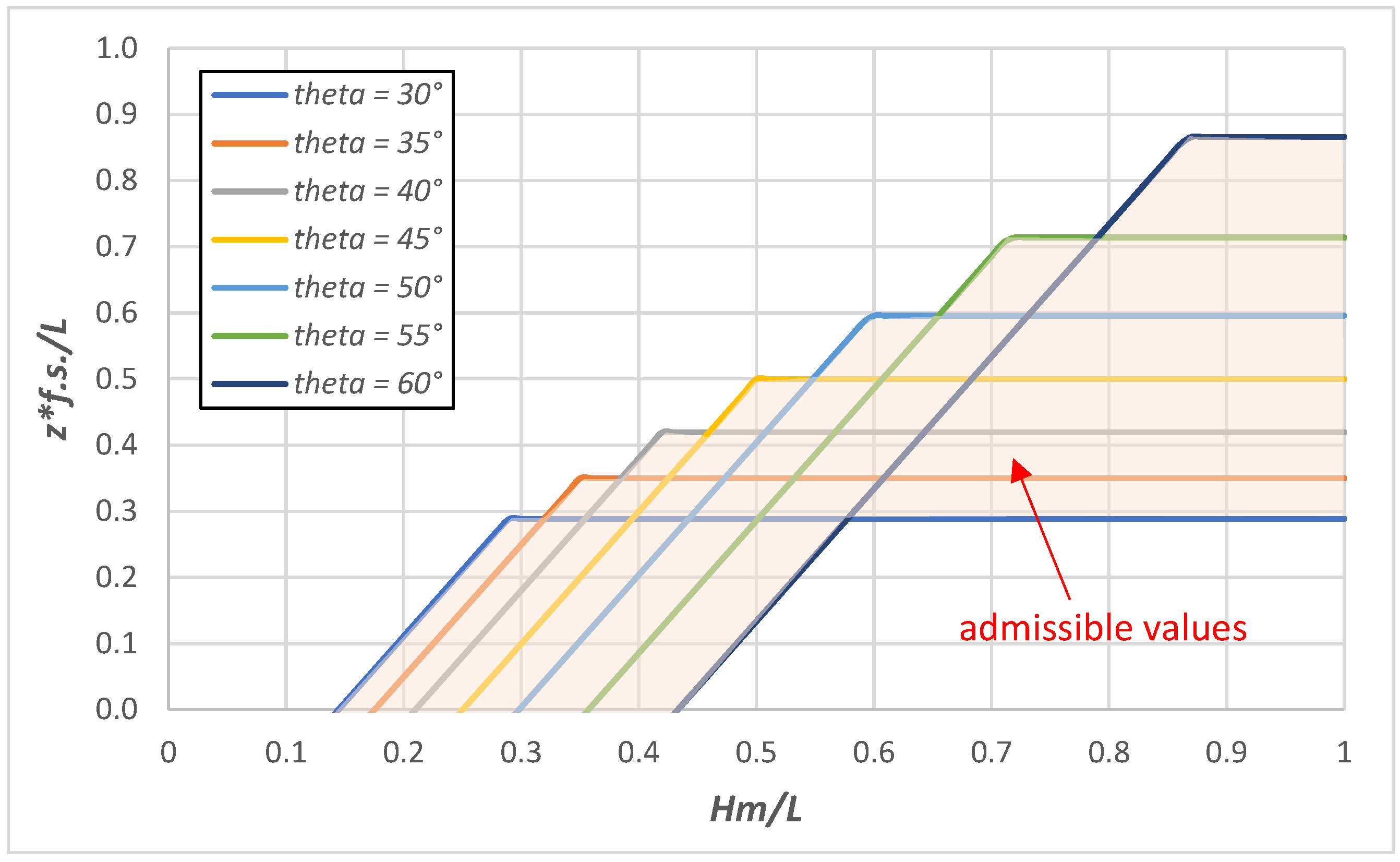
Through Equation (19), the graph shown in Figure 3 ( z * f . s . /L vs. Hm/L) can be obtained. It defines the field of admissible (resulting) values for z * f . s . , for different values of θ.
Specifically, z * f . s . /L vs. Hm/L assumes a bilinear evolution: once a particular value of Hm (depending on θ) has been exceeded, z * f . s .   becomes independent on Hm itself because it is geometrically “limited/defined” by the length of the dam base, L.
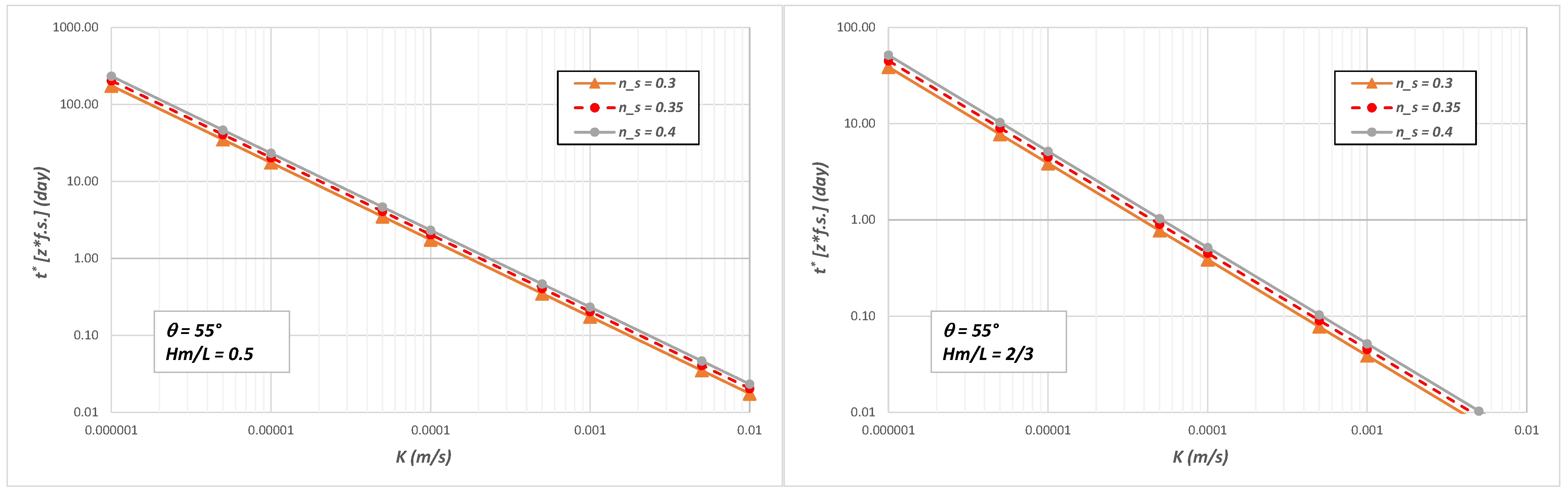
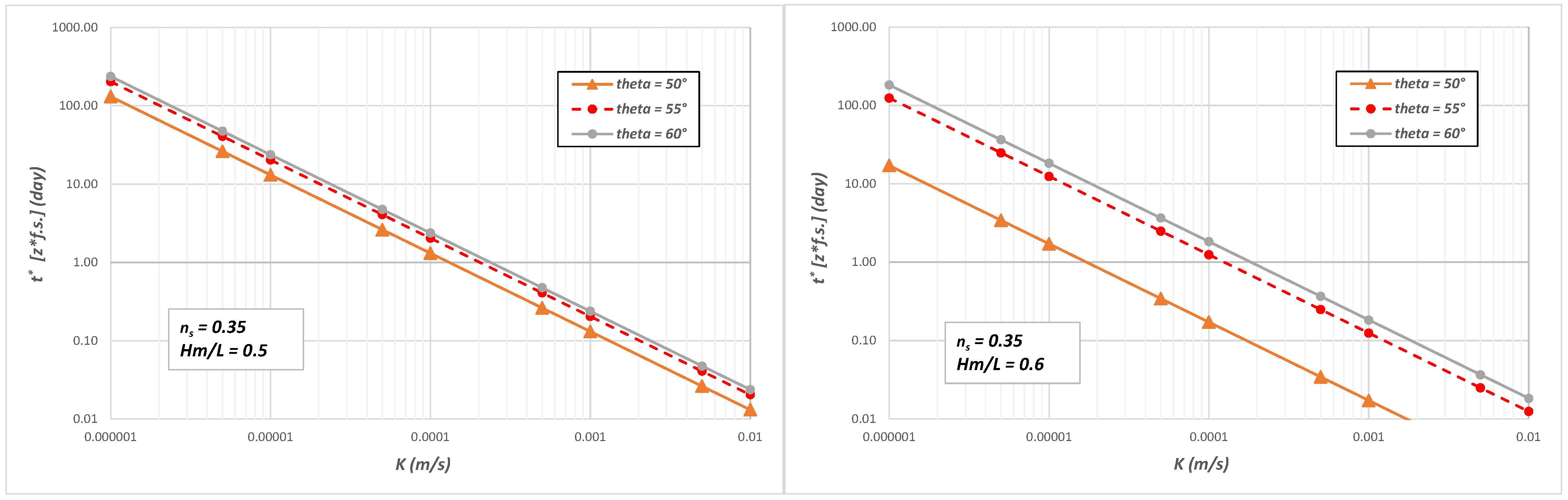
Through Equation (20), in the following figures (Figure 4 and Figure 5), the influence of ns (fixed θ) and θ (fixed ns) on t * z = z * f . s . vs. K, for different values of Hm/L, is investigated: if ns increases, t * z = z * f . s . increases, although in a less appreciable way; t * z = z * f . s . tends to reduce if Hm/L increases.
Even if θ increases, t * z = z * f . s . increases; then, t * z = z * f . s . tends to reduce if Hm/L increases, enough significantly for lower values of θ.
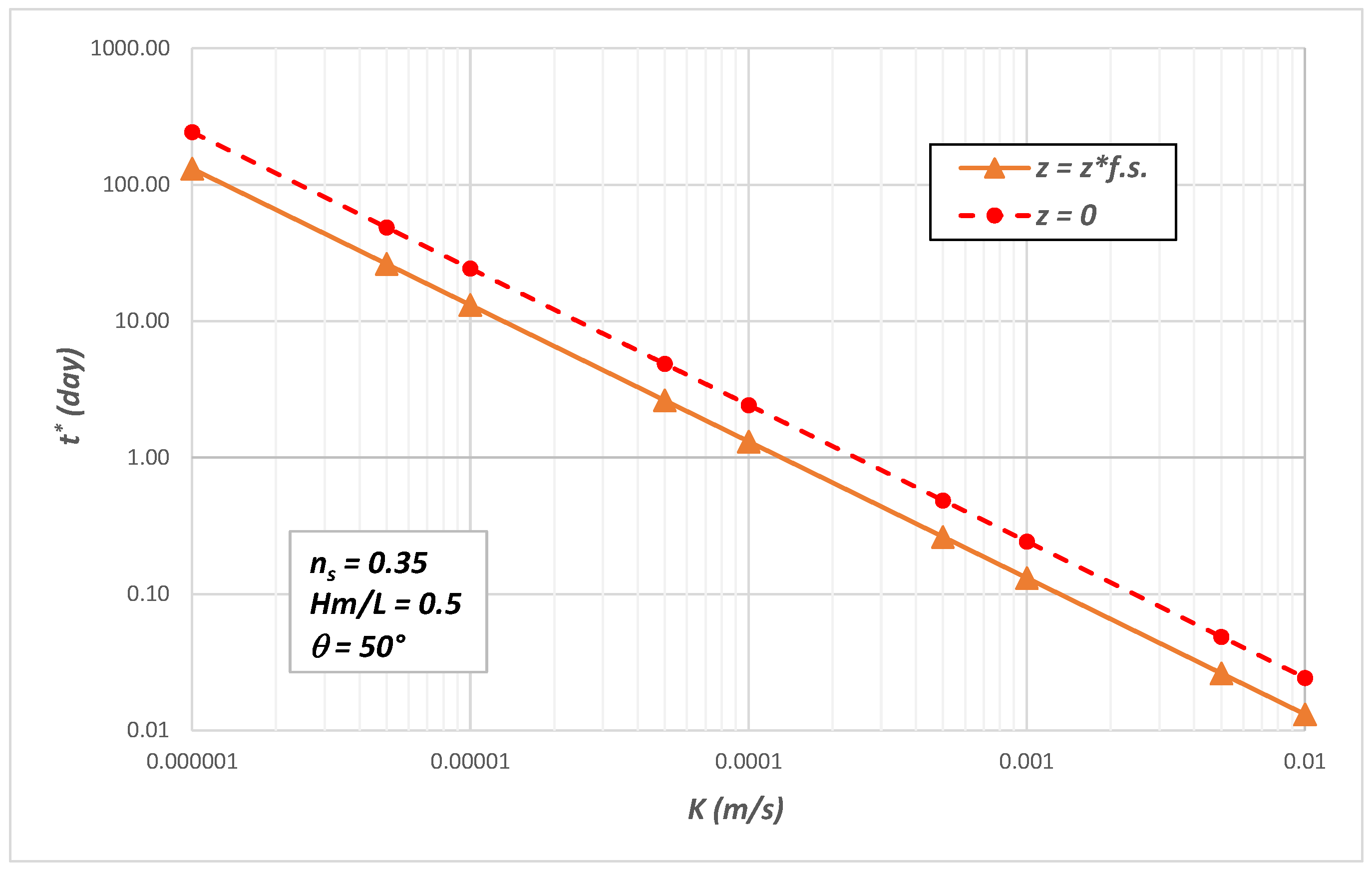
For completeness, assigned the parameters Hm/L = 0.5, ns = 0.35 and θ = 50°, Figure 6 shows the comparison between t * z = z * f . s . and t * z = 0 .
It is therefore confirmed that the saturation front reaches the downstream face more quickly for “intermediate-high” positions.

2.3. The 3D Simplified Solutions

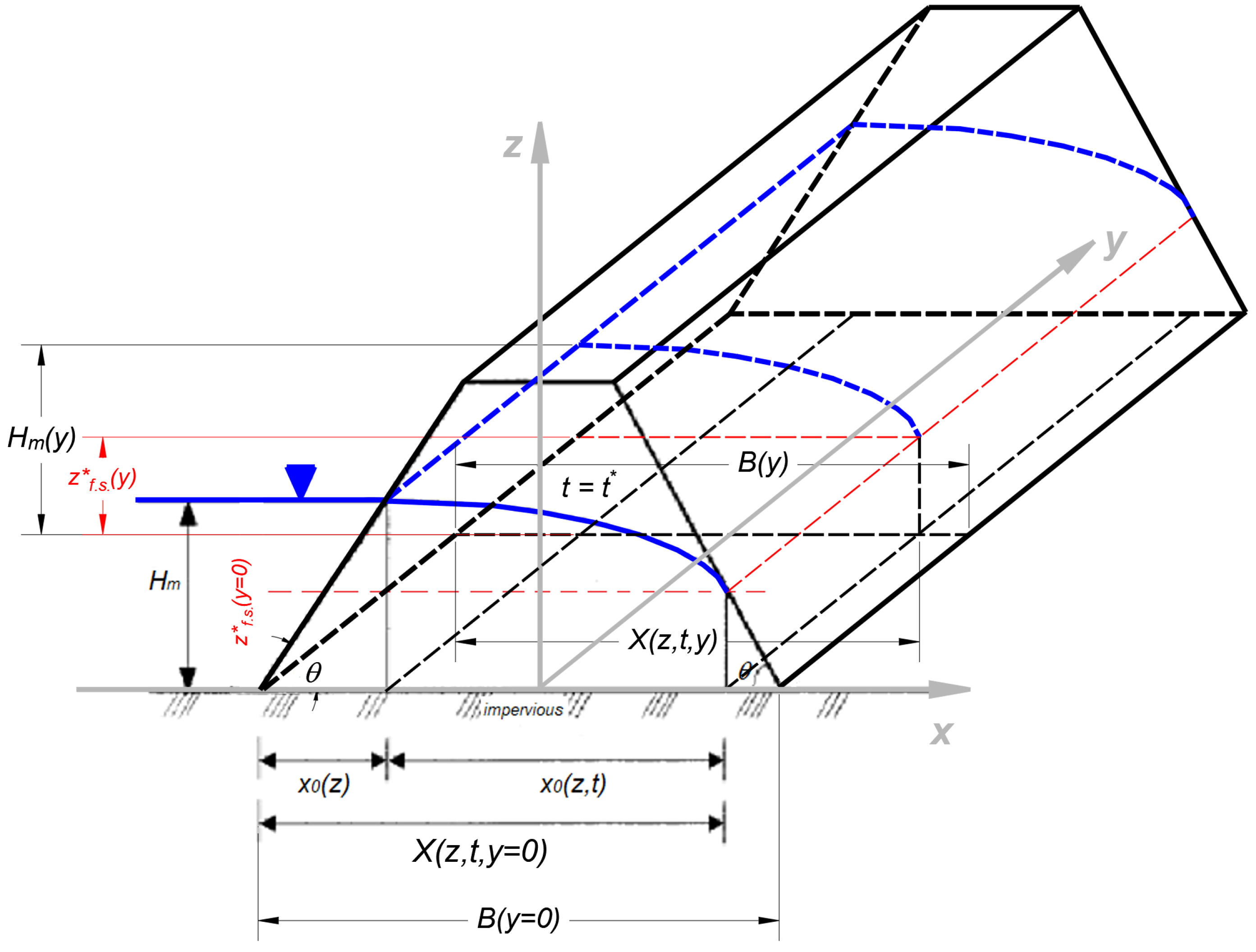
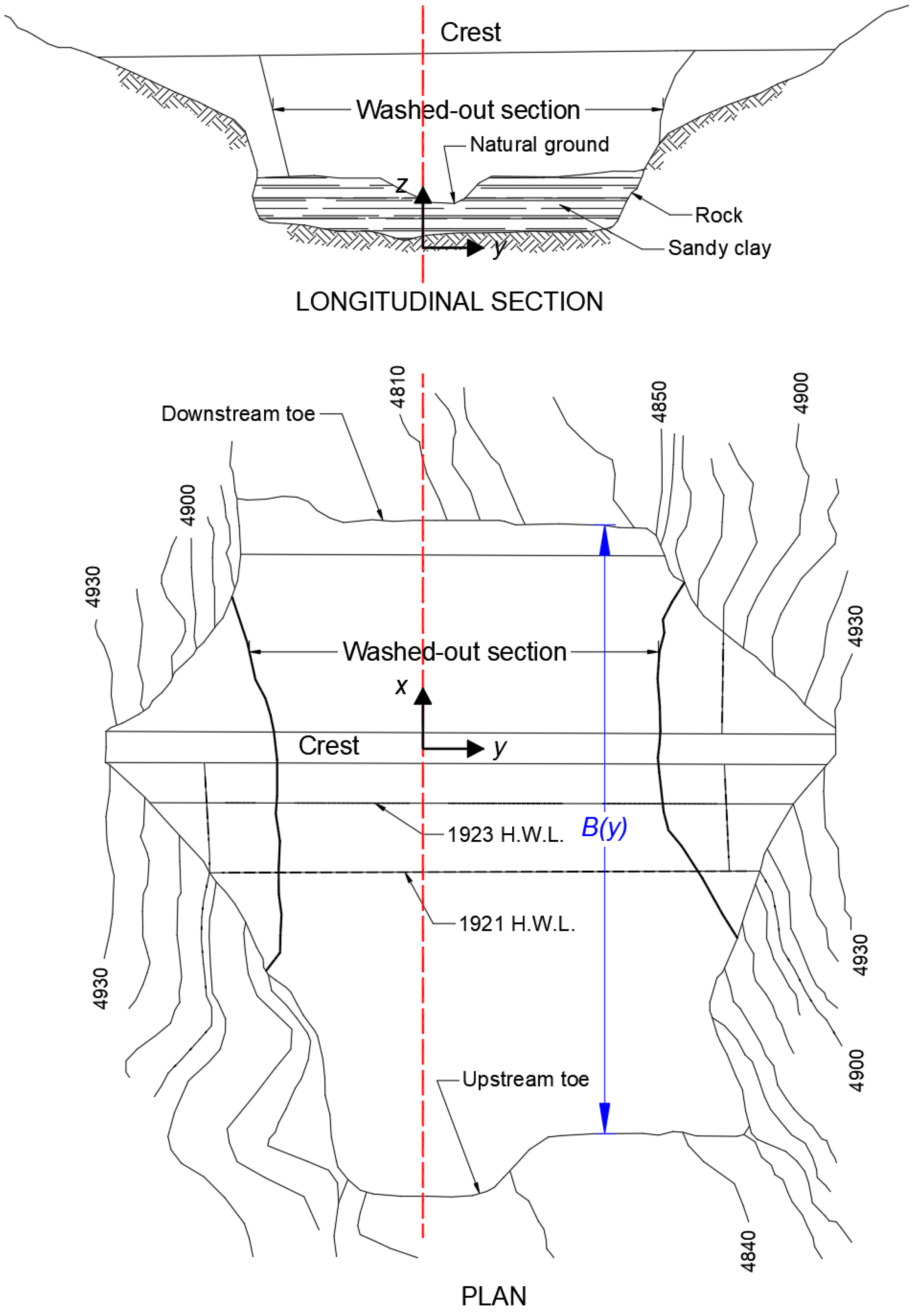
To qualitatively forecast the dynamics of the seepage flow within the entire dam body, it is further necessary to rewrite the previous equations as a function of the longitudinal coordinate “y”, too (see Figure 7); the origin (y = 0) corresponds to the position of the cross-section of maximum height (see also Figure 8).
Specifically, by recalling the equations previously obtained and introducing the longitudinal coordinate “y”, the previous Equations (9) and (17) are further generalized as follows:
X y , z , t = 2 t · K · ( H m ( y ) z ) n s + z t a n   θ
t * ( y , z = 0 ) = n s · B ( y ) 2 2 · K · H m    
being B(y) = length of the dam along the transversal direction, variable along the y-coordinate (B(y = 0) = L, as previously defined).
Thus, the following is obtained:
z * f . s . ( y ) = H m ( y ) H m y 2 H m ( y ) B ( y ) tan θ + B ( y ) 2 tan 2 θ 4 1 / 2
Equation (21) highlights that if y increases (fixed z and t), the length X(y,z,t) of the saturation front decreases, due to the reduction in the piezometric head.
Furthermore, “z” must be understood as “local” coordinate, from the base of the cross-section of the dam corresponding to “y”.
In order to refer the results to the base plane of the dam with minimum elevation (z = 0), the following relationship must be introduced:
z y = z y + r y = z y + y   t a n β    
being β = the angle formed by the valley bank with the horizontal plane (along the longitudinal axis of the dam). The above equations (for 3D cases) are applied to a simplified specific case: H m y = 0 = 32 m; B y = 0 = 60 m, θ = 53.13°, β = 10.08°, ns = 0.38, K = 10−4 m/s, characterized by the following geometric relationships:
H m y = 0.178 · ( 180 y )
B y = 12 + 0.267 · ( 180 y )
Main results in terms of t* (see Equation (22)) for z’ = 0 and y = 0, 60 m, 120 m and 150 m, are reported in the following Table 1.
Reaching the downstream face (for z’ = 0) occurs more rapidly as y increases, due to the shorter distance to travel and earlier than in the central portions of the dam, which are higher and much wider.
Therefore, as also indicated in the 3D FE analyses by [22,23], the leakage of the reservoir water might occur first at the abutments of the dam and subsequently in the highest (and widest) part of the dam. The same condition happens for t*(z’*f.s.).

3. Comparison Between Analytical Simplified Solutions and Numerical Simulations

To test and validate the simplified solutions of Boussinesq equations previously obtained and described, some comparisons with the results derived from 2D and 3D FEM analyses are carried out.

3.1. The 2D Cases

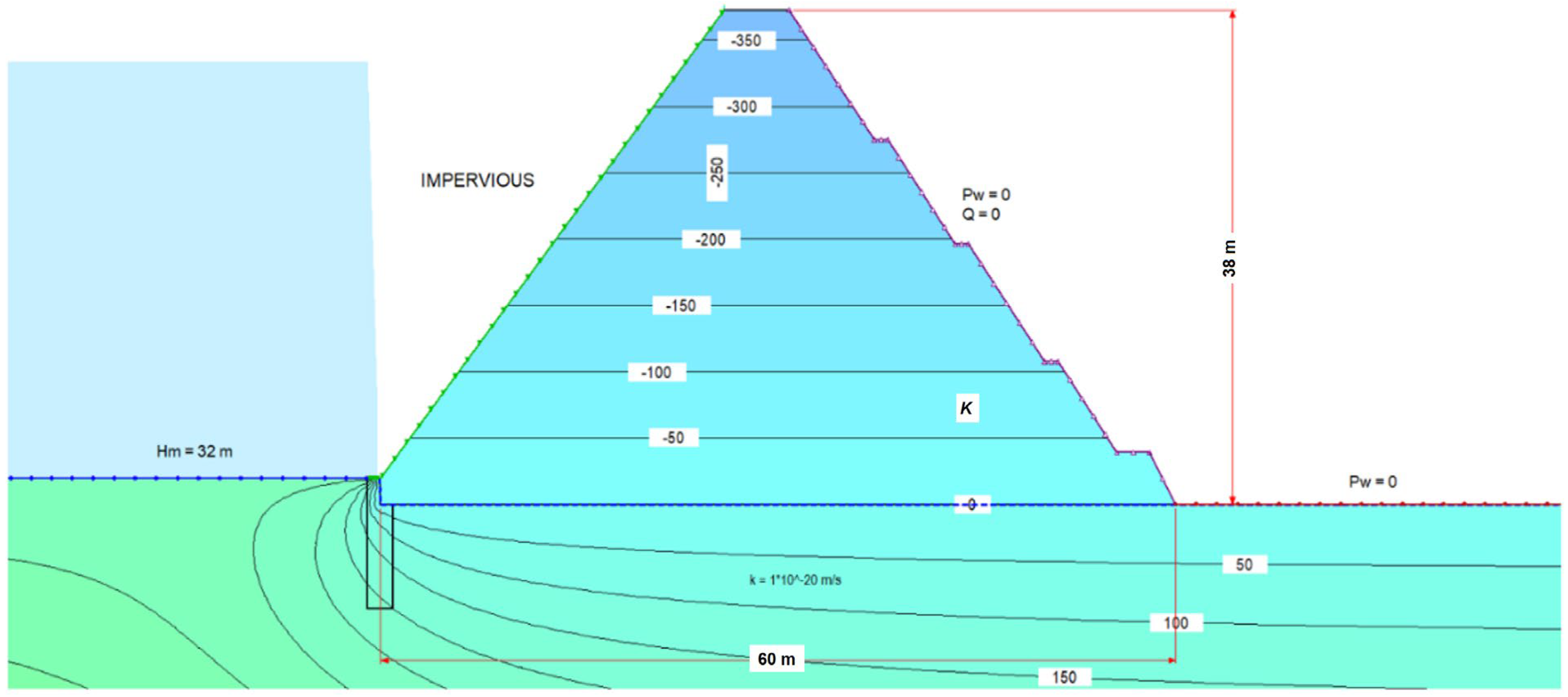
A general, typical cross-section of a rockfill dam whose tightness is ensured by an impervious upstream facing, initially perfectly efficient, is considered (see cross-section scheme reported in Figure 9).
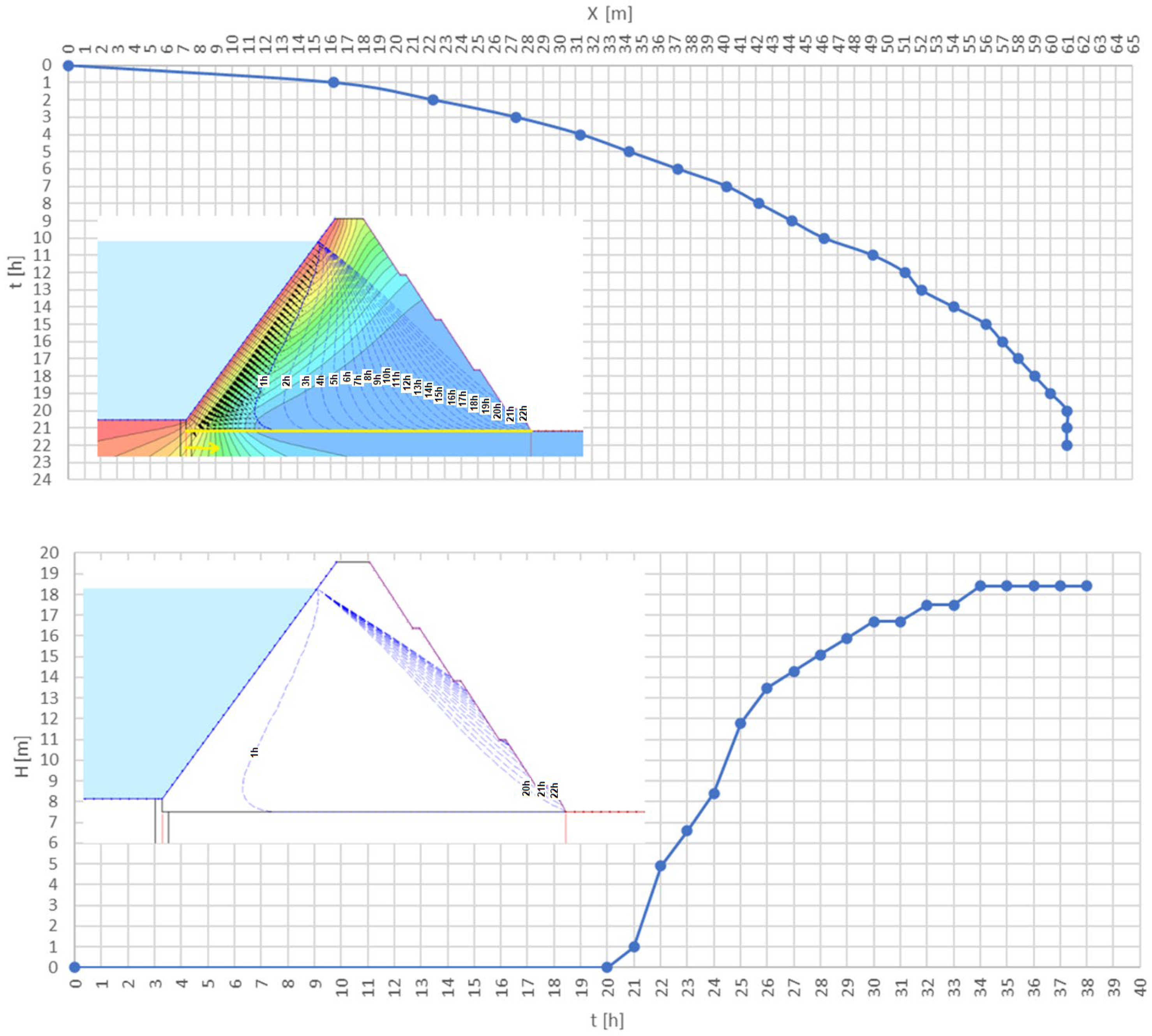
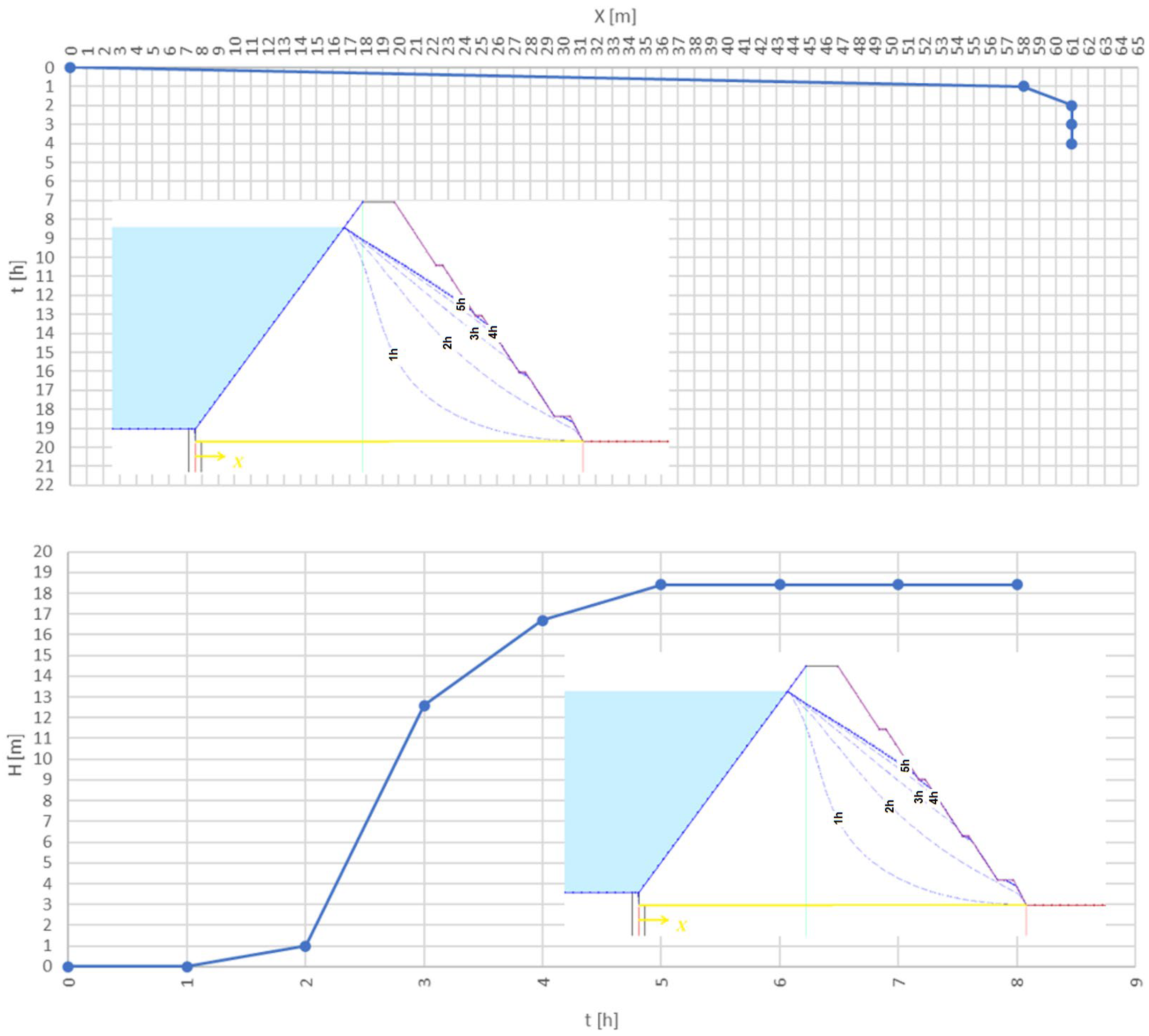
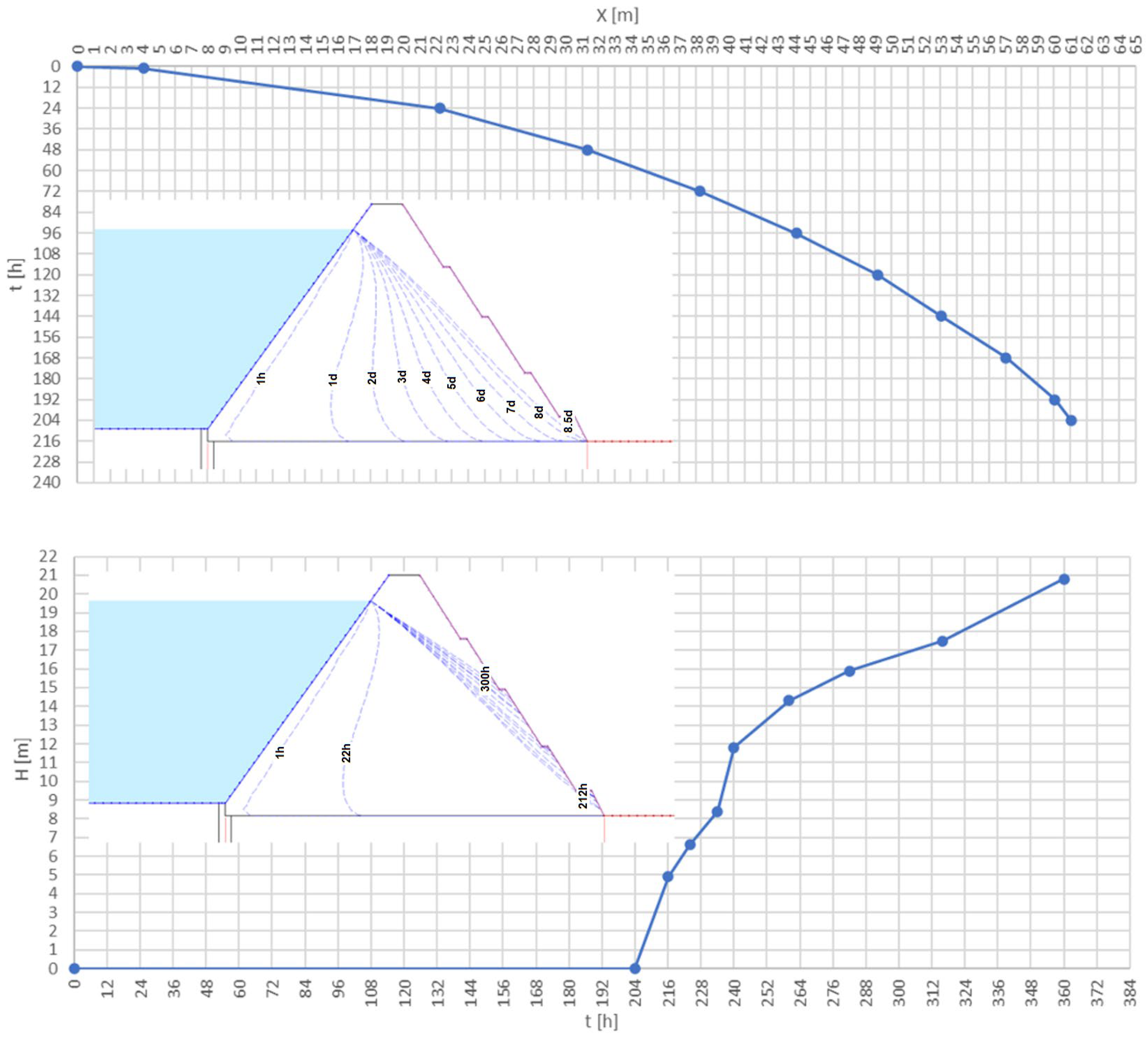
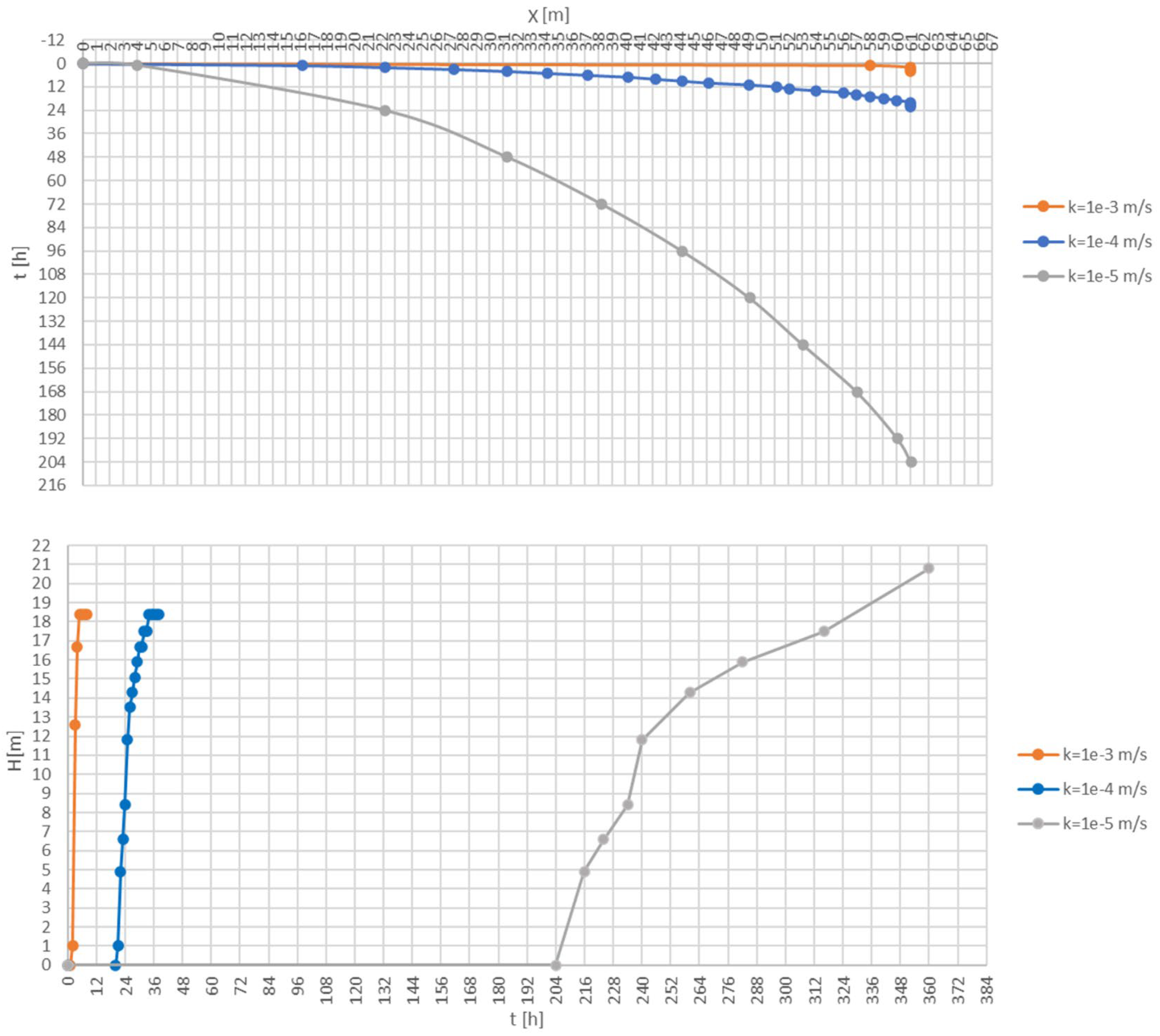
Numerical 2D FEM simulations of seepage flow through the dam body, through SEEP/W code, following an instantaneous, widely extended failure of the upstream facing, under unsteady state conditions, for different values of K (i.e., 10−4, 10−3, 10−5 m/s), are carried out. The results of the 2D FEM simulations, in terms of temporal and spatial progression of the saturation front as well as raising the free surface once the dam foot is reached, are shown in the following Figure 10, Figure 11, Figure 12 and Figure 13. Figure 12 summarizes the obtained main results.
In Table 2, the comparison between the results obtained from 2D FEM simulations and simplified analytical solutions (Equations (19) and (20)) is shown.
The maximum height of the saturation front falls in the range 18–21 m, compliant with the values (i.e., 24 m) determined through the simplified 2D analytical solutions.
The time required for the saturation front to reach this maximum height, obtained through the 2D FEM numerical simulations as well as through the simplified analytical solutions, previously determined, is favorably comparable.

3.2. The 3D Cases

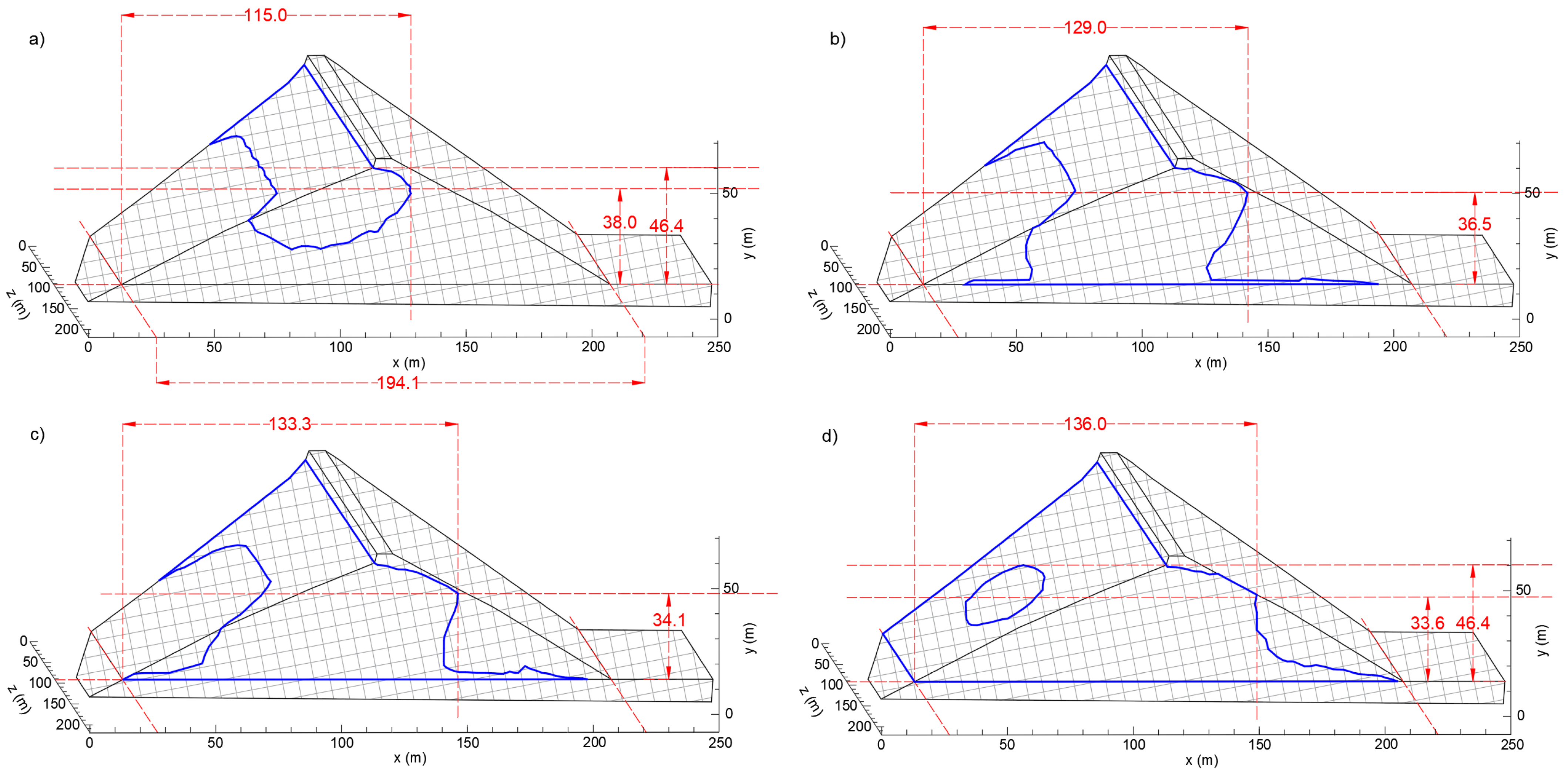
The results obtained from the 3D numerical simulations developed by [13] are analyzed. Specifically, three-dimensional transient infiltration in the Gouhou concrete-faced rockfill dam (Province of Qinghai, in China) was simulated using saturated–unsaturated seepage theory. The evolution of the free surface along each of the three dimensions was examined and discussed (in [13]) under homogenous and anisotropic (K) conditions.
The results in terms of evolution of the phreatic surface in the dam under homogeneous (K = 11.6 × 10⁻⁵ m/s) conditions (derived from [13]) are here re-elaborated and considered (Figure 14).
The previous simplified Equations (21)–(23), proposed for 3D cases, are applied to the above specific case: H m y = 0 = 46.4 m; B y = 0 = 194.1 m, θ = 32° (corresponding to an upstream dam slope = 1:1.6), ns = 0.21, K = 11.6 × 10⁻⁵ m/s [13] (y = 0 corresponds to the dam maximum height cross-section). In Table 3 and Table 4, the comparison between the results obtained from 3D FEM simulations [13] and simplified analytical solutions (Equations (21)–(23)) is shown.
The maximum height of the saturation front (32.2 m) and the time required for the saturation front to reach this maximum height (8.5 days), obtained through the 3D FEM numerical simulations as well as through the simplified analytical solutions previously determined, are favorably comparable.
It should be noted that the downstream dam slope (1:1.5) is different from that of the upstream face (1:1.6). The differences between the results shown in the previous tables are also due to this asymmetric geometry of the dam.

4. Concluding Remarks

Simple, original, analytical solutions, based on the well-known Boussinesq equation, are proposed to assess the seepage flow progression within dry, coarse-grain-sized (homogeneous) embankment dam materials, following an instantaneous, very large loss of tightness of its impervious upstream facing. The 2D FEM simulations through SEEP/W code and analyses of 3D FEM results from technical literature (e.g., [13]) are developed in order to test and validate the proposed simplified solutions by referring to specific cases.
The main results obtained by the proposed analytical solutions and the 2D/3D FEM numerical analyses can be summarized as follows.
-
It is confirmed that, independently of the hypotheses at the basis of the respective developments (analytical solutions: negligibility of the vertical component of the seepage flow velocity, application of the method of successive stationary states; FEM solutions: partial saturation and, therefore, suction, in the portions not reached by the seepage flow), both developed analyses are sufficiently reliable.
-
The results obtained through the two, analytical and numerical, procedures, are favorably compared, both from qualitative and quantitative points of view.
-
The appreciable dependence of the obtained results on the permeability coefficient (in saturated conditions) of the dry material is highlighted.
-
Referring to the 2D FEM simulations, the saturation front would reach the downstream foot in about 2 h, 18 h or, again, in about 7.5 days, for values of the permeability coefficient K (saturated condition, dry material) equal to 10−3 m/s, 10−4 m/s, 10−5 m/s, respectively.
-
As also indicated in the 3D FE analyses by [13,23], the leakage of the reservoir water occurs first at the abutments of the dam and subsequently in the highest (and widest) part of the dam. The same condition happens for t*(z’*f.s.).
Therefore, this study shows how simplified solutions can help “rapidly” provide useful guidance both for preliminary design and for defining minimum safety requirements/standards and design criteria.
Finally, it is worth observing that the issues above described and analyzed in the paper are prevented in the case of non-homogeneous dams, equipped by a clay core (e.g., [5,6,12]), coupled with an efficient filter and drainage system, against the migration of phreatic line and internal erosion phenomena.

Author Contributions

Conceptualization, F.F.; methodology, F.F.; validation, F.F. and C.C.; formal analysis, F.F.; investigation, F.F. and C.C.; resources, F.F. and C.C.; data curation, C.C.; writing—original draft preparation, C.C.; writing—review and editing, F.F.; visualization, C.C.; supervision, F.F. All authors have read and agreed to the published version of the manuscript.

Funding

This research received no external funding.

Data Availability Statement

Data supporting reported results can be found in the references or however the calculations can be easily re-performed.

Conflicts of Interest

The authors declare no conflict of interest.

References

  1. Aravin, V.I.; Numerov, S.N. Theory of Fluid Flow in Undeformable Porous Media; Moscona, A., Ed.; Aravin, V.I.; Numerov, S.N., Translators; translated from Russian; Jerusalem, Israel Program for Scientific Translations: Jerusalem, Israel, 1965. [Google Scholar]
  2. Casagrande, A. Seepage through dams. J. N. Engl. Water Work. 1937, 51, 295–336. [Google Scholar]
  3. Federico, F.; Jappelli, R.; Musso, A. Analysis of seepage limit states in embankment dams. In Proceedings of the XIX ICOLD, Florence, Italy, 26–30 May 1997; Volume I, pp. 807–818. [Google Scholar]
  4. Federico, F.; Calzoletti, F.; Montanaro, A. Steady state seepage flow through zoned earth structures affected by permeability defects. In Proceedings of the NUMGE 2010, 7th European Conference on Numerical Methods in Geotechnical Engineering, Trondheim, Norway, 2–4 June 2010. [Google Scholar]
  5. Federico, F.; Cesali, C.; Jappelli, R. Geotechnical design of large central draining cores in embankment dams. In Proceedings of the 3rd International Conference “DAM WORLD 2018”, Foz do Iguaçu, Brazil, 17–21 September 2018. [Google Scholar]
  6. Federico, F.; Cesali, C.; Jappelli, R. Design of draining cores to control seepage through embankment dams. In Proceedings of the XVII ECSMGE Geotechnical Engineering Foundation of the Future, Reykjavik, Iceland, 1–6 September 2019. [Google Scholar]
  7. Chahar, B.R. Determination of length of a horizontal drain in homogeneous. J. Irrig. Drain. Eng. 2004, 130, 530–536. [Google Scholar] [CrossRef]
  8. Chapuis, R.P.; Aubertin, M. A simplified method to estimate saturated and unsaturated seepage through dikes under steady-state conditions. Can. Geotech. J. 2002, 38, 1321–1328. [Google Scholar] [CrossRef]
  9. Jafari, N.H.; Cadigan, J.A.; Stark, T.D.; Woodward, M.L. Phreatic surface migration through an unsaturated levee embankment. J. Geotech. Geoenviron. Eng. 2019, 145, 05019010. [Google Scholar] [CrossRef]
  10. De Mello, V.F.B. Reflections on design decisions of practical significance to embankment dams. Geotechnique 1977, 27, 281–355. [Google Scholar] [CrossRef]
  11. Charles, J.A. Internal erosion in European embankment dams. In Progress Report of Working Group on Internal Erosion in Embankment Dams, Dam Safety; Berga, L., Ed.; A. A. Balkema: Rotterdam, The Netherlands, 1998; Volume 2, pp. 1567–1576. [Google Scholar]
  12. Jappelli, R.; Federico, F.; Marzocchi, L.; Fantoma, D.; Mariani, M.; Musso, A. Impervious facing and large central drain for the embankment dams of a pumped-storage plant. XVI Int. Congr. Large Dams Q 1988, 61, 465–492. [Google Scholar]
  13. Chen, Q.; Zhang, L.M. Three-dimensional analysis of water infiltration into the Gouhou rockfill dam using saturated–unsaturated seepage theory. Can. Geotech. J. 2006, 43, 449–461. [Google Scholar] [CrossRef]
  14. Zhang, L.M.; Chen, Q. Seepage failure mechanism of the Gouhou rockfill dam during reservoir water infiltration. Soils Found. 2006, 46, 557–568. [Google Scholar] [CrossRef]
  15. ICOLD. Bulletin 164: Internal Erosion of Existing Dams, Levees and Dikes, and Their Foundations. Volume 1: Internal Erosion Processes and Engineering Assessment. Volume 2: Case Histories, Investigations, Testing, Remediation and Surveillance. International Commission on Large Dams, Paris. Publication of Final Preprint in English and French. 2017. Available online: http://www.icold-cigb.org (accessed on 1 September 2017).
  16. Tang, Y.; Jiang, Q.; Zhou, C. Approximate analytical solution to the Boussinesq equation with a sloping water-land boundary. Water Resour. Res. 2016, 52, 2529–2550. [Google Scholar] [CrossRef]
  17. Boussinesq, J. Recherches théoriques sur l’écoulement des nappes d’eau infiltrées dans le sol et sur le débit des sources. J. Mathématiques Pures Appliquées 1904, 10, 5–78. [Google Scholar]
  18. Polubarinova-Kochina, P.Y. Theory of Ground Water Movement; Princeton University Press: Princeton, NJ, USA, 1962. [Google Scholar]
  19. Kacimov, A.R.; Simunek, J. Analytical traveling-wave solutions and HYDRUS modeling of wet wedges propagating into dry soils: Barenblatt’s regime for Boussinesq’s equation generalized. J. Hydrol. 2021, 598, 126413. [Google Scholar] [CrossRef]
  20. Jaswal, M.; Sinha, R.K.; Sen, P. Delineation of phreatic surface in soil type slope—A comparative study using physical and numerical modeling. J. Min. Sci. 2020, 56, 494–504. [Google Scholar] [CrossRef]
  21. Liggett, J.A.; Liu, P.L.F. Unsteady interzonal free surface flow in porous media. Water Resour. Res. 1979, 15, 240–246. [Google Scholar] [CrossRef]
  22. Masciopinto, C.; Passarella, G.; Vurro, M.; Castellano, L. Numerical simulations for the evaluation of the free surface history in porous media. Comparison between two different approaches. Adv. Eng. Softw. 1994, 21, 149–157. [Google Scholar] [CrossRef]
  23. Zhou, X.P.; Wei, X.; Liu, C.; Cheng, H. Three-dimensional stability analysis of bank slopes with reservoir drawdown based on rigorous limit equilibrium method. Int. J. Geomech. ASCE 2020, 20, 04020229. [Google Scholar] [CrossRef]
Figure 1. Time t* necessary for the saturation front to reach the downstream foot of the dam vs. permeability K: comparison between Equations (9) and (13), for ns = 0.38 and different values of Hm/L.
Infrastructures 11 00023 g001
Figure 2. Simplified scheme of cross-section of a homogeneous dam with upstream facing: definition of variables x0(z,t), X(z,t), z * f . s . .
Infrastructures 11 00023 g002
Figure 3. z * f . s . /L vs. Hm/L, for different values of θ (according to Equation (19)).
Infrastructures 11 00023 g003
Figure 4. t * z = z * f . s . vs. K, for different values of ns and Hm/L (according to Equation (20)).
Infrastructures 11 00023 g004
Figure 5. t * z = z * f . s . vs. K, for different values of θ and Hm/L (according to Equation (20)).
Infrastructures 11 00023 g005
Figure 6. Comparison between t * z = z * f . s . vs. K and t * z = 0 vs. K.
Infrastructures 11 00023 g006
Figure 7. Simplified 3D scheme of a homogeneous dam, with upstream facing: definition of variables X(z,t,y), B(y), Hm(y) z * f . s . (y).
Infrastructures 11 00023 g007
Figure 8. Example of definition of reference system for 3D simplified analytical solutions: coordinate “y” along the transversal, cross-section of a dam.
Infrastructures 11 00023 g008
Figure 9. Scheme of the examined dam, at the initial conditions, before the facing failure, and related boundary conditions (PW = interstitial pressure; Q = flow discharge).
Infrastructures 11 00023 g009
Figure 10. Results of 2D FEM simulations (SEEP/W): X(t), temporal progression of the saturation front (above) and H(t), raising the free surface within the dam body (below), for K = 10−4 m/s.
Infrastructures 11 00023 g010
Figure 11. Results of 2D FEM simulations (SEEP/W): X(t), temporal progression of the saturation front (above) and H(t), raising the free surface within the dam body (below), for K = 10−3 m/s.
Infrastructures 11 00023 g011
Figure 12. Results of 2D FEM simulations (SEEP/W): X(t), temporal progression of the saturation front (above) and H(t), raising the free surface within the dam body (below), for K = 10−5 m/s.
Infrastructures 11 00023 g012
Figure 13. Results of 2D FEM simulations (SEEP/W): X(t) vs. time (above) and H(t) vs. time (below), for different values of the permeability K.
Infrastructures 11 00023 g013
Figure 14. Results from 3D FEM simulations, adapted from [13]: evolution of the free surface (in blue) in a homogeneous dam at (a) t = 2 days, (b) t = 4.5 days, (c) t = 6.5 days, (d) t = 9 days.
Infrastructures 11 00023 g014
Table 1. The 3D case: results in terms of t* for the considered case.
z’ [m]y [m]Hm(y) [m]B(y) [m]r(y) [m]t* [h]
003260059.42
60214410.747.92
120112821.338.80
15052026.739.57
Table 2. Comparison between results from 2D FEM simulations and 2D simplified solutions.
Main Parameters2D FEM2D Simplified Solutions
K = 1 × 10⁻⁴ m/s
z*f.s. [m]18.524
t* (z = z*f.s.) [h]3438
K = 1 × 10⁻³ m/s
z*f.s. [m]18.524
t* (z = z*f.s.) [h]54
K = 1 × 10⁻⁵ m/s
z*f.s. [m]2124
t* (z = z*f.s.) [h]360380
Table 3. Comparison between results from 3D FEM and 3D simplified solutions: X(z,t,y) vs. time (t).
3D FEM3D Simplified Solutions
t (days)z (m)X(z,t,y = 0)
238115.0100.9
4.536.5129.0123.6
6.534.1133.3141.9
933.6136.0158.6
Table 4. Comparison between results from 3D FEM and 3D simplified solutions: z*f.s., t* (z = z*f.s.).
Main Parameters3D FEM3D Simplified Solutions
z*f.s. [m]33.632.2
t* (z = z*f.s.) [days]9.08.50
Disclaimer/Publisher’s Note: The statements, opinions and data contained in all publications are solely those of the individual author(s) and contributor(s) and not of MDPI and/or the editor(s). MDPI and/or the editor(s) disclaim responsibility for any injury to people or property resulting from any ideas, methods, instructions or products referred to in the content.