
Article

Evaluation of the Efficiency of a Speed Monitoring Display (SMD) in a Very Short-Term Roadwork Zone

by
Itziar Gurrutxaga
1,
Miren Isasa
1,
José Manuel Baraibar
2 and
Heriberto Pérez-Acebo
3,*
1
Mechanical Engineering Department, University of the Basque Country UPV/EHU Pl. Europa, 1, 20018 Donostia-San Sebastián, Spain
2
R + D + I Department, Viuda de Sainz, S.L., Pol. El Campillo, 19, 48500 Abanto-Zierbena, Spain
3
Mechanical Engineering Department, University of the Basque Country UPV/EHU, P° Rafael Moreno Pitxitxi, 2, 48013 Bilbao, Spain
*
Author to whom correspondence should be addressed.
Infrastructures 2026, 11(1), 24; https://doi.org/10.3390/infrastructures11010024
Submission received: 5 November 2025 / Revised: 1 January 2026 / Accepted: 8 January 2026 / Published: 12 January 2026

Abstract

Roadwork zones are high-risk environments where sudden geometric changes, narrowed lanes, and driver unfamiliarity frequently lead to inappropriate speeds. Ensuring safe vehicle speeds in roadwork zones remains a priority due to drivers’ limited perception of risk and frequent non-compliance with temporary limits. This study evaluates the effectiveness of a speed monitoring display (SMD) installed in a nighttime, four-day motorway roadwork site involving a temporary median crossing, where traffic was diverted through a single lane and a chicane-type re-entry. Speed data were collected at two points, 100 and 50 m before the median crossing, labelled as P1 and P2, respectively, during two phases: with standard work zone signage only (Phase 1) and with an SMD added (Phase 2). Results show statistically significant reductions in mean speed after SMD installation at both measurement points, including decreases of 7.09 km/h at P1 and 4.69 km/h at P2, with a greater reduction among heavy vehicles. The percentage of speeding vehicles fell from 95.4% to 81.9% upstream and from 63.4% to 35.7% near the chicane, indicating improved compliance in the most critical section (P2). These findings demonstrate that SMDs can effectively reduce speeds and variability even in very short-term work zones, supporting their integration as low-cost safety measures.

1. Introduction

In recent decades, road accident rates have shown a downward trend in most developed countries thanks to improvements in infrastructure, vehicle technology and the implementation of increasingly rigorous safety policies. Even so, traffic accidents continue to be one of the leading causes of premature death globally and remain a persistent challenge for authorities responsible for transport and mobility management [1,2,3,4,5,6]. The need to improve safety on all types of roads, both urban and rural, has driven the development of strategies and devices aimed at reducing risky behaviour and promoting safer driving, generally by means of traffic calming measures [7,8,9,10,11]. Within this effort, roadwork areas are particularly relevant, as they are some of the most vulnerable environments on the road network. Various risk factors converge in these sections, such as geometric modifications, lane narrowing and unfamiliarity with temporary signage. These characteristics make roadwork sections more complex driving environments and, hence, increase the probability of accidents compared to sections without roadworks [12,13,14,15,16,17,18]. Furthermore, previous research has shown not only an increase in the frequency of accidents in these environments [19,20], but also a greater severity of accidents [21].
In this context, various studies have identified a series of recurring causes and driver behaviour patterns that explain the high level of risk associated with roadworks. These main factors and findings are summarised in Table 1.
Taking into account the factors and behaviour patterns identified (Table 1), there is a clear need to implement specific safety measures on roads with construction zones. These measures seek to correct inappropriate behaviour and minimise the consequences of changing road conditions. In response, various traffic-calming strategies have been developed and implemented. They aim at improving compliance with speed limits, increasing risk perception and protecting both road users and workers in the construction zone. These traffic-calming strategies in construction zones are usually grouped into four categories: informational, physical, coercive, and educational [36]. Among them, informational measures that provide real-time information, such as speed monitoring displays (SMDs), stand out as effective tools for positively influencing driver behaviour and enhancing safety in these environments [37,38]. This speed-monitoring indicator detects the speed of approaching vehicles and displays it on LED panels. As some of the SMDs also display an emoticon (with a happy face if the speed limit is met or an angry face if not), they are also known as pedagogical radars.
The effectiveness of SMDs in reducing speed and improving safety has been widely demonstrated in different road contexts, such as urban areas [39,40,41,42], rural motorway interchanges [43], suburban areas [44,45], school zones [46,47], and rural roads crossing short urban segments [48]. Nevertheless, most studies conducted in construction zones have focused on long-term interventions [43,49,50,51,52,53,54]. Although some research has analysed the performance of SMDs in temporary or short-term construction sites [55,56,57,58,59], the available empirical evidence remains limited and unsystematic compared to other contexts. Additionally, the analysis of very short-term road works, such as nighttime roadworks lasting four of five days, is even scarcer. Therefore, there remains a knowledge gap regarding the effectiveness of SMDs in very short-term road works.
More specifically, the document of the UK Department of Transport on traffic management at road and street works, Safety at Street Works and Road Works: A Code of Practice [60], classifies works by activity type (e.g., mobile or short-duration works) and associated traffic management measures. However, it does not provide a clear or consistent classification of roadworks based on duration into very short-, short-, medium-, and long-term categories. In contrast, the FHWA Manual on Uniform Traffic Control Devices (MUTCD) [61] provides a duration-based classification. It defines very short-term works (less than one hour) as activities such as inspections, emergency interventions, or mobile maintenance; short-term works (more than one hour and less than one day) as minor maintenance or utility operations; intermediate-term works (more than one day and less than three days) as short-duration rehabilitation or repair works; and long-term works (three days or more) as major reconstruction, widening, or structural rehabilitation projects.
Moreover, this gap is particularly relevant in temporary median crossing configurations, which are frequently used in maintenance or repair operations inside tunnels. In these situations, the complete closure of one of the carriageways forces traffic to be diverted to the opposite carriageway via a temporary bypass through the median. While this arrangement allows traffic to continue flowing, it introduces significant safety challenges, particularly at the re-entry point, where vehicles return to their original carriageway via a curve and a counter-curve (chicane).
These transition sections present a high risk potential due to the combination of sudden geometric changes, narrow lanes, two-way traffic and drivers’ unfamiliarity with the temporary configuration, a problem that is accentuated in short-term and very short-terms, where users do not have enough time to adapt to the new road layout [19,59]. In addition, drivers travelling through very short-term roadworks tend to experience greater stress and unpredictable behaviour due to unfamiliarity with the layout or critical points such as median crossings or re-entries [62,63]. According to Debnath et al. [23], interventions in these contexts must consider the dynamic nature of driver behaviour, characterised by quick decisions and frequent overestimation of vehicle control. Despite the presence of regulatory signage, several studies have shown that these measures alone are not sufficient to mitigate risk in highly complex areas [64]. Non-compliance with new speed limits or the unpredictable behaviour of some drivers increases the likelihood of collisions or loss of control [23], especially in temporary contexts, where the user’s margin for adaptation is very limited.
In this regard, the present study aims to evaluate the effectiveness of an SMD installed before a median crossing at a very short-term roadworks site. To this end, the speeds recorded in two phases were compared: without the device and only with the mandatory roadworks signage (Phase 1) and immediately after its installation (Phase 2), in order to determine its immediate effect.
This article is structured as follows. Section 2 describes the location of the case study, including the geometric layout of the diversion and the methodology used for data collection and analysis. Section 3 presents the results, encompassing comparative statistics, significance tests, and discusses the implications of the findings. Finally, Section 4 summarises the conclusions of the research.

2. Analysed Segment and Applied Methodology

2.1. Analysed Segment

The section under study is located on the AP-8/A-8 freeway (or motorway, used synonymously), one of Spain’s main high-capacity roads. This motorway runs along the coast of the Cantabrian Sea and connects key cities in the north of the country, from Irun, on the border with France, to A Coruña, with a total length of approximately 667 km. It passes through the autonomous communities of the Basque Country, Cantabria, Asturias and Galicia. The segment between Irun, at kilometre point 0 (KP 0) and Galdakao (KP 105), is a toll motorway (known as the AP-8), and from there, it becomes a toll-free motorway, identified as A-8, up to the final kilometre point near A Coruña. In addition, the AP-8/A-8 is part of the Class A road within the International E-road network, specifically the E-70. Various highway administrations manage the freeway, depending on the location. Due to the special autonomous status, the provincial councils of the three provinces of the Basque Country manage the entire road network in their territory, including interregional freeways and highways. Therefore, the Provincial Councils of Gipuzkoa and Biscay are responsible for the segments located in the provinces of Gipuzkoa and Biscay, respectively [65,66,67]. By contrast, as it is an interregional motorway, the Spanish Ministry of Transport and Sustainable Mobility manages and maintains the rest of the freeway [68]. The analysed segment is located in the province of Bizkaia, so the Provincial Council of Bizkaia (PCB) is the responsible highway administration.
This motorway is a major east–west axis of the European transnational network, which means that it handles a significant volume of long-distance traffic. On the affected segment, the Annual Average Daily Traffic (AADT) in 2024 was 59,169 vehicles, of which 5.6% were heavy vehicles [69]. In Spain, a heavy vehicle is defined as one weighing more than 3500 kg [70].
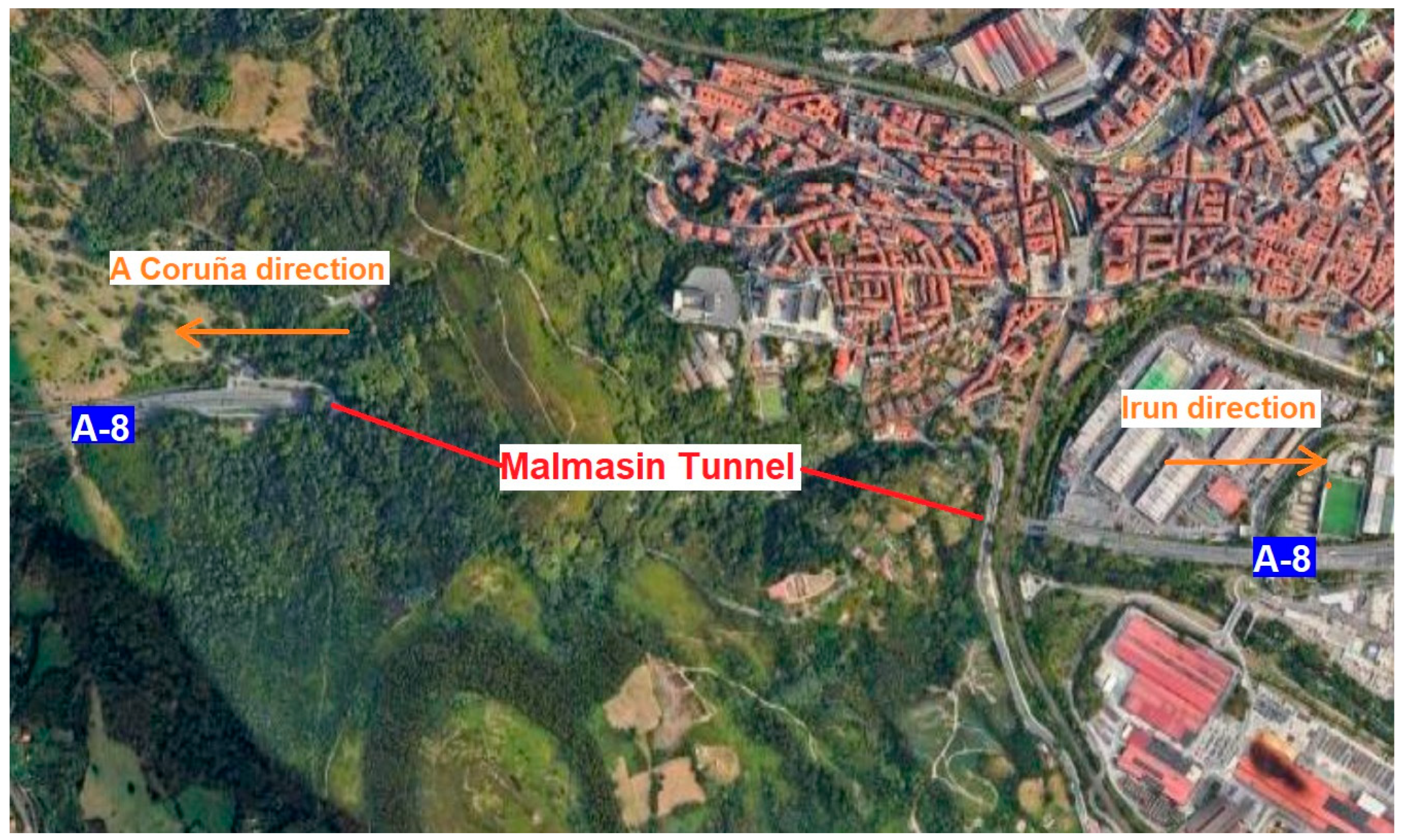
The studied segment is located between KP 111 + 0490 and KP 112 + 0970, where the median crossings are placed, in Basauri (Biscay). There are two lanes in each direction. It is an area with a gradient ranging from—3.1% to 0.5%. Under normal traffic conditions, the speed limit is 80 km/h. The works on this section were due to the milling and application of a new layer of asphalt in the Malmasin tunnel, with a length of 1330 m, between PK 11 + 0590 and PK 112 + 0920, in the direction of Irun (Figure 1). This was the reason for completely closing the tunnel in this direction for five nights and traffic was diverted to the other carriageway via a bypass. The tunnel was closed from Sunday 14 April 2024 to Thursday 18 April, from 10:00 p.m. to 6:00 a.m.
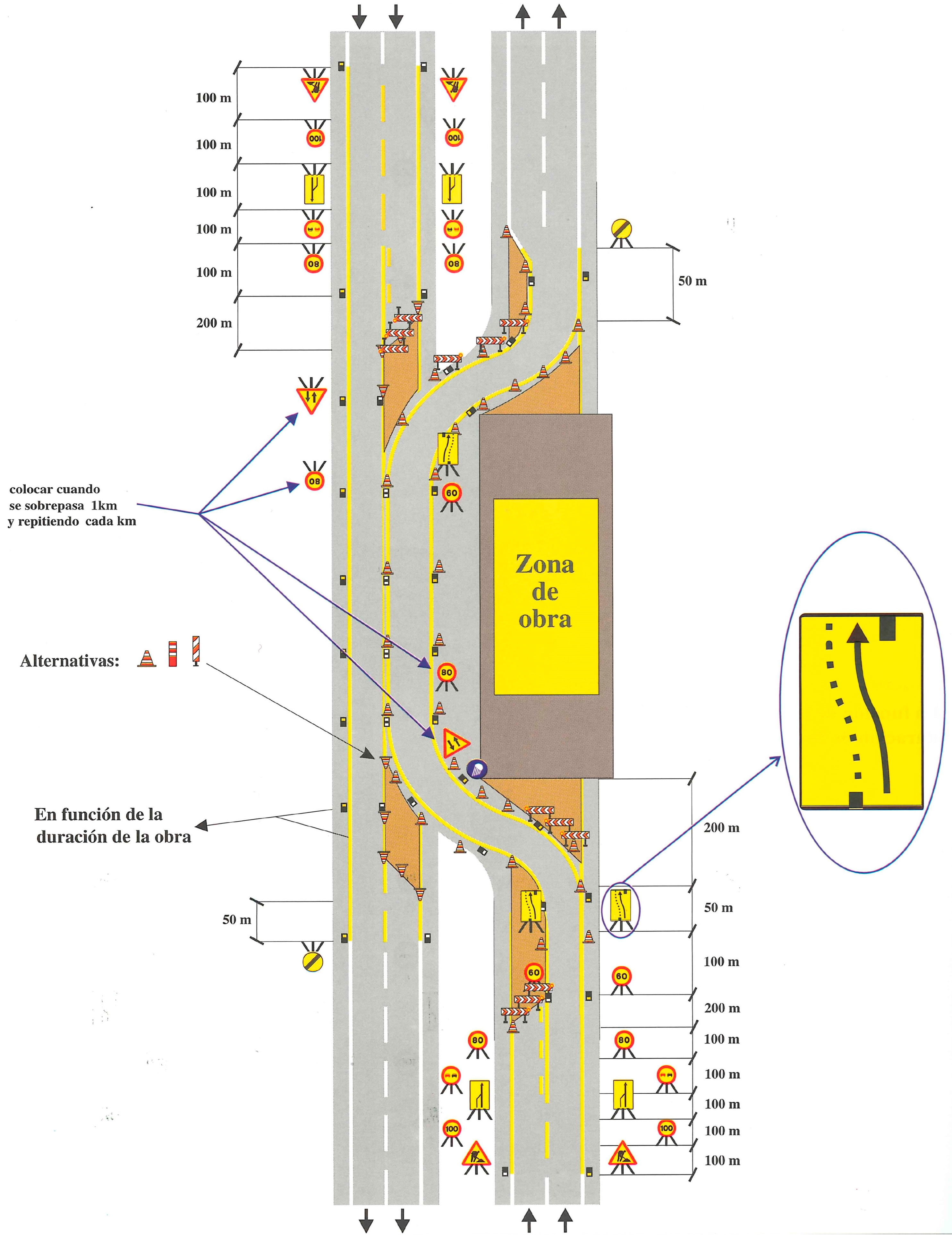
To carry out these activities, it was necessary to reduce the two existing lanes in the direction of Irun to a single lane, diverting traffic in that direction to the opposite carriageway, corresponding to the ascending PKs (direction of A Coruña). On this carriageway, the right lane remained operational for the traffic in the direction, as the left lane was used for traffic diverted from the closed carriageway. Thus, both directions of traffic were reduced to a single lane, separated by cones. The return to the original carriageway was carried out via the median crossing located at PK 111 + 0490. This point can be considered critical if it is not properly signposted, as it involves vehicles returning to the usual route. The signage used during this operation was exclusively that required by current Spanish regulations [71]. Figure 2 illustrates the corresponding signage for this scenario.
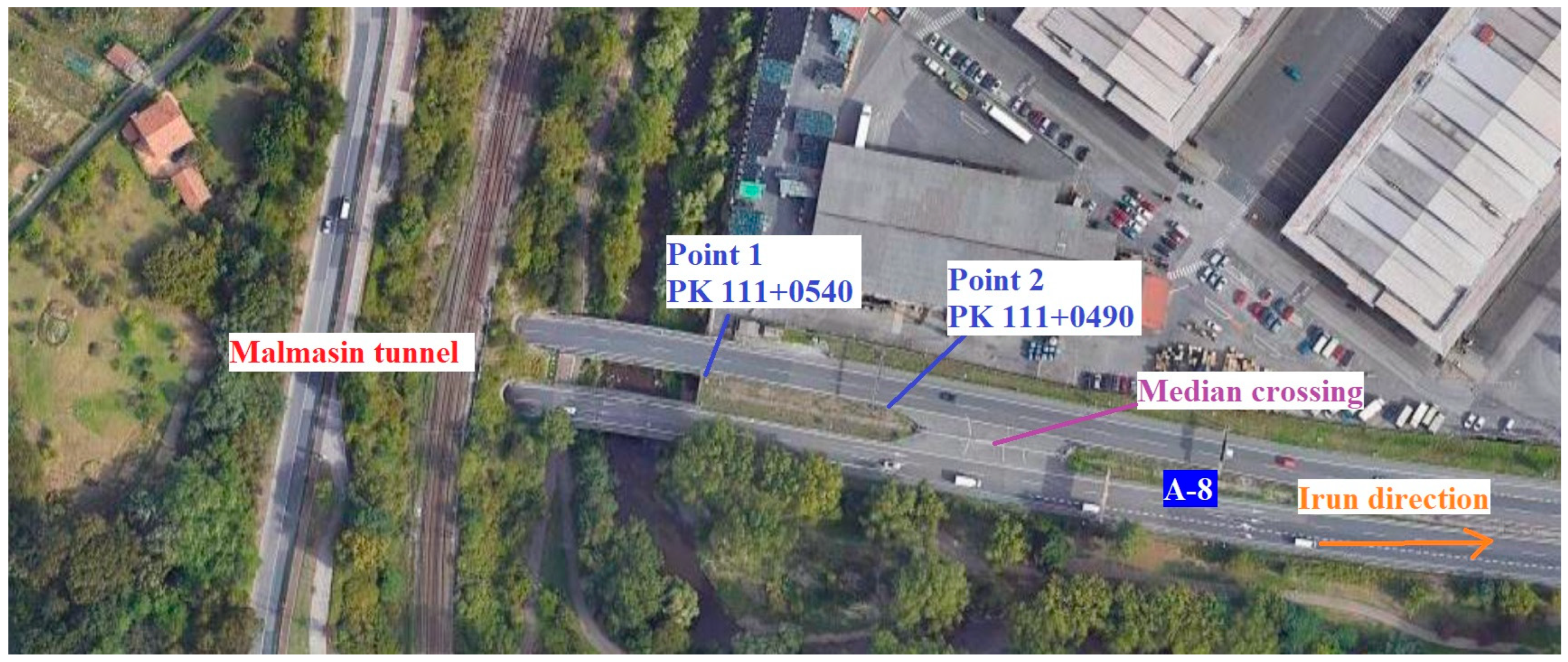
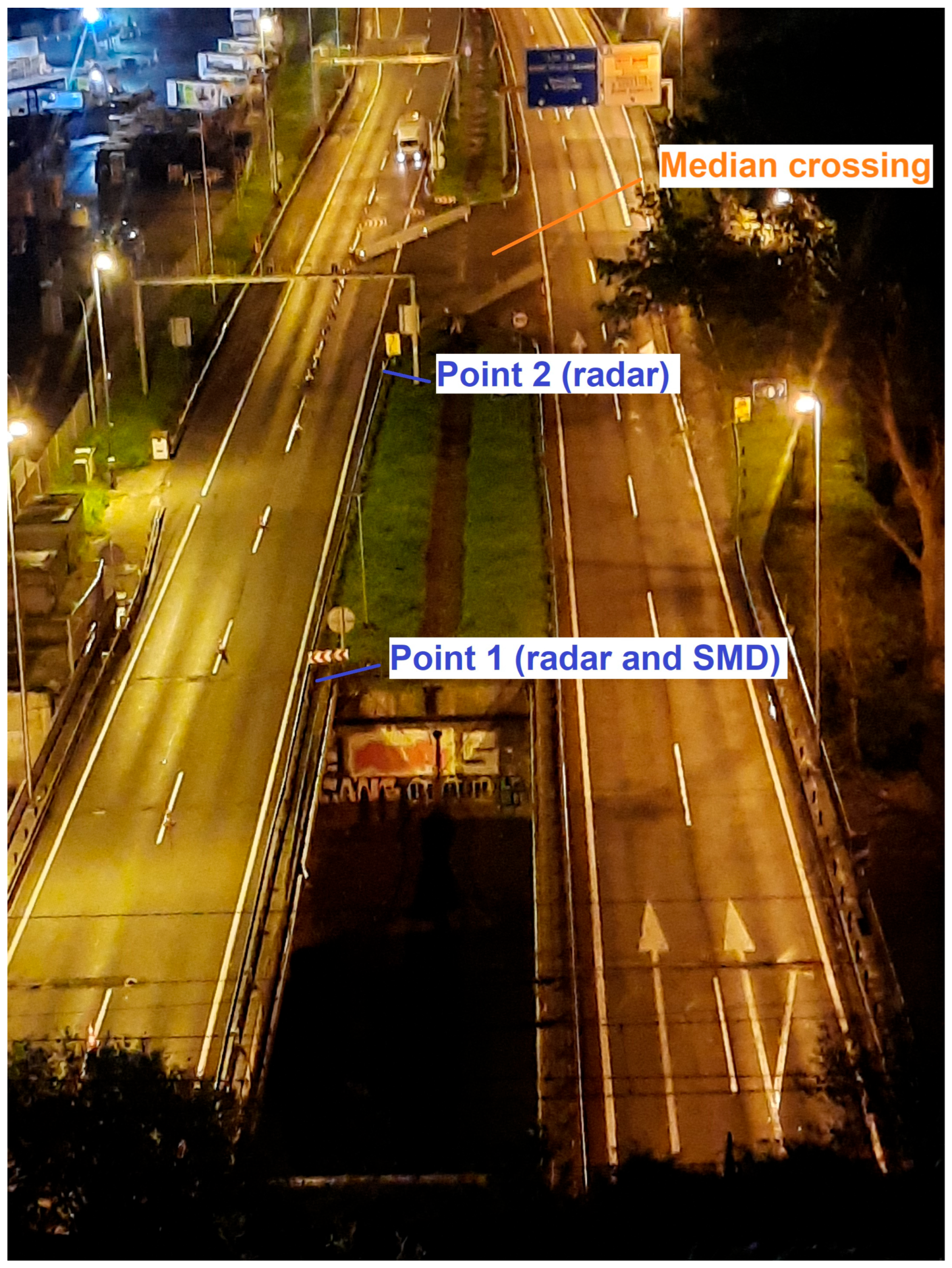
This study assesses the need to install an SMD before this median crossing. Two measurement points were selected to monitor speed. Speed measurements were taken approximately 100 m from the tunnel exit (PK 111 + 0540, called Point 1) to monitor the speed of vehicles approaching the bypass and 50 m before the median strip (PK 111 + 0490, called Point 2), where drivers’ behaviour is monitored after they observe their speed on the SMD (Figure 3). The data was recorded during two phases. In the initial phase, Phase 1, with only the mandatory signage indicated in Spanish regulations [71], and in a subsequent phase, called Phase 2, a speed monitoring display was added, placed at Point 1, which shows the speed of vehicles to drivers.
Phase 1 was measured on the night of 16 April. Phase 2 was measured on the nights of 17 and 18 April, after the installation of the SMD at Point 1. In this phase, the response of drivers after seeing their speed was measured. The measurement time intervals for Phase 1 and Phase 2 are shown in Table 2.
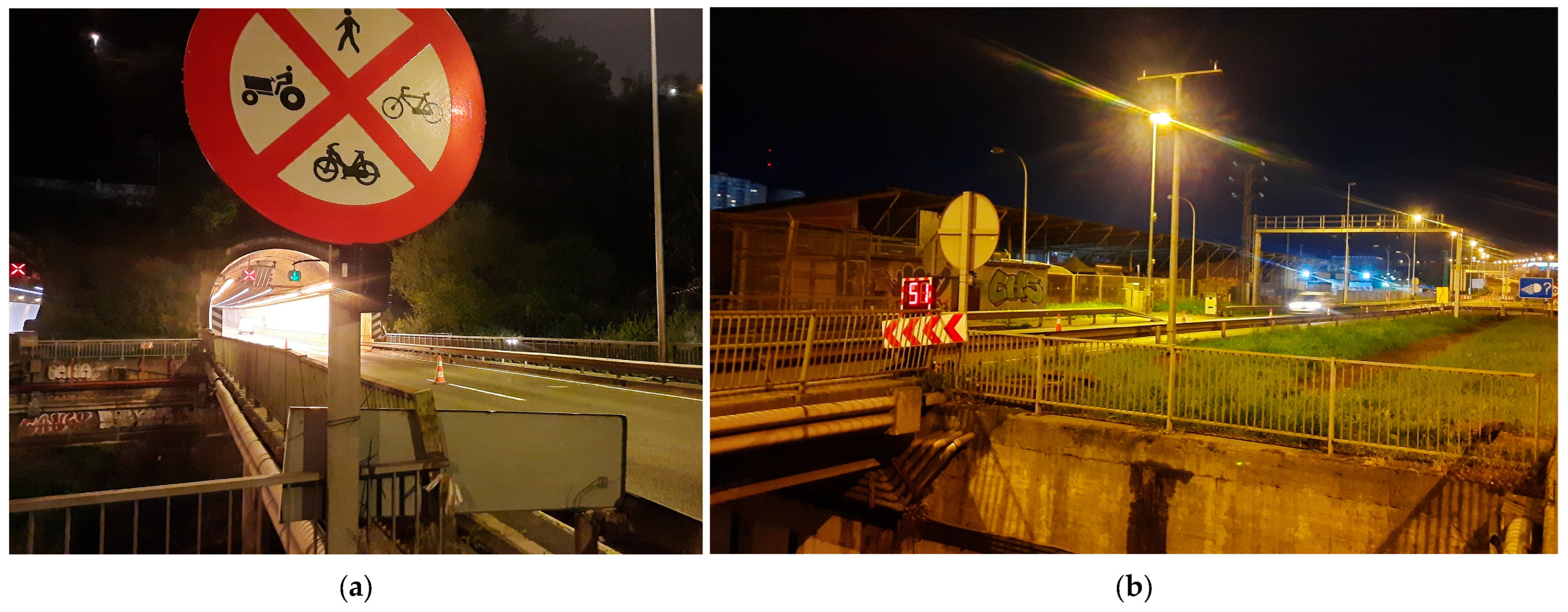
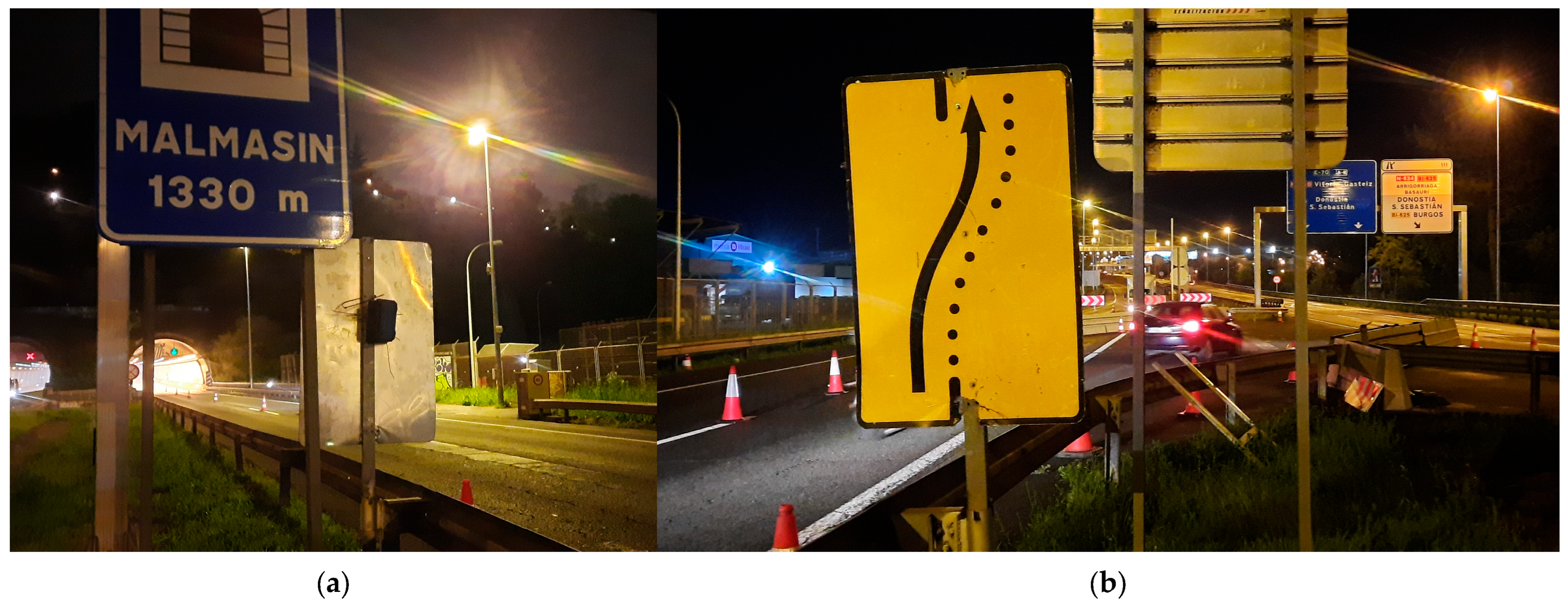
The radar at P1 is placed at the circular sign (Figure 4a). Figure 4b shows the SMD at Point 1 after being installed in Phase 2. Vehicles were alerted 50 m before arriving at the median crossing. At Point 2, the radar was hidden behind the signal indicating the returning chicane to the original carriageway (Figure 5a). This sign is aimed at alerting drivers to reduce their speed and prepare for upcoming changes in road alignment (Figure 5b). As observed, radars were hidden from drivers, so they could not alter their speed due to their presence, even if these radars cannot issue fines.
Figure 6 shows an aerial view of the median crossing and P1 and P2 during the works.
Although the road works were repeated over five consecutive nights, each intervention was limited to a short nighttime window (22:00–05:00) with no daytime presence. From an operational perspective, this configuration is closer to very short-term roadworks, as it involved no permanent lane reconfiguration and generated limited driver adaptation. Furthermore, the nighttime setting implies a surprise effect and a predominance of non-recurrent users, supporting the classification adopted in this study.

2.2. Methodology

Speed measurements were taken at the specified points during the phases described in Table 2. A Doppler-based radar was employed at each point, with a maximum error margin of 5%, according to the equipment specifications.
The data collected at each point were used to calculate the average speed of vehicles (Vm), the minimum (Vmin) and maximum speed (Vmax), the standard deviation (SD), and the 85th percentile (V85), which is the speed at which 85% of vehicles travel at or below that speed, i.e., the speed exceeded by 15% of vehicles. Additionally, from the total number of vehicles registered (N), the number of vehicles exceeding the speed limit during the road works (Vlim = 40 km/h) was counted (Nlim), and the corresponding percentage of speed limit violations was calculated (%Lim). These values were also calculated by grouping the vehicles into light and heavy vehicles. Radars indicate the length of each detected vehicle. After observing the recorded lengths and the real vehicles on site, it was possible to determine the length threshold used to classify them.
Regarding the radar error, given the large sample size analysed in each phase, the effect of random measurement error on aggregated speed indicators is reduced through averaging. Furthermore, as the same device and configuration were used in all phases, any residual systematic error would affect all measurements similarly and would not bias the comparative results.
The analysis mainly focused on evaluating the effect of the treatment by comparing average speed (Vm) and the 85th percentile speed (V85) between the two study phases at each observation point. To assess whether the observed differences in means were statistically significant, independent two-sample t-tests were applied. Depending on the homogeneity of variances, determined by means of Levene’s test, either the pooled variance method (for equal variances) or Welch’s approximation (for unequal variances) was employed, following statistical procedures used in other studies [59,72,73,74]. Two-sample t-test were employed because independent populations were considered since very few drivers have passed through the segment in both phases.
The null hypothesis (H0) posits that there is no significant difference in mean vehicle speeds before and after the implementation of the treatment (Equation (1)):
V m 1 = V m 2
where Vm1 and Vm2 are the mean speeds of the vehicles in Phase 1 and Phase 2, respectively, On the contrary, the alternative hypothesis (H1) suggests a reduction in mean speed after the intervention (Equation (2)):
H 1 : V m 1 > V m 2
Rejection of H0, at the predetermined 95% confidence level, implies that the traffic calming strategy under evaluation, the SMD in this case, is effective in reducing vehicle speeds. The test statistic used is the two-tailed t-test, defined in Equation (3):
t = V m 2 V m 1 S E
where SE is the standard error of the difference between means, computed using Equation (4) in the case of equal variances, where the pooled variance, S p 2 , is defined in Equation (5), and the degrees of freedom (d.f.) are calculated as shown in Equation (6).
S E = S p 2 · 1 n 1 + 1 n 2
S p 2 = n 1 · s 1 2 + n 2 · s 2 2 n 1 + n 2 2
d . f . = n 1 + n 2 2
In these expressions, s 1 2 and s 2 2 represent the sample variances for Phase 1 and Phase 2, while n 1 and n 2 correspond to the respective sample sizes.
If the assumption of equal variances is rejected based on Levene’s test, the standard error (SE) is calculated using the equation for unequal variances (Welch’s test), as presented in Equation (7), with the corresponding degrees of freedom (d.f.) estimated using the Welch–Satterthwaite approximation, as shown in Equation (8):
S E = s 1 2 n 1 + s 2 2 n 2
d . f . = s 1 2 / n 1   +   s 2 2 / n 2 2 s 1 2 / n 1 2 n 1 1 + s 2 2 / n 2 2 n 2 1
Mean difference tests were conducted at each observation point for all recorded vehicles and by vehicle type (light and heavy).

3. Results and Discussion

A total amount of 3080 vehicles was recorded during both phases at both points. These data form the basis for the analysis presented in the following subsections.

3.1. Phase 1

The vehicles controlled during the night from 16 April 2024 to 17 April 2024 comprise Phase 1, where only the compulsory signage [71] was placed in the roadwork zone due to the activities in the Malmasin tunnel. The established speed limit was 40 km/h for the last part of the bypass, from the exit of the tunnel to the chicane, where the radars were installed.
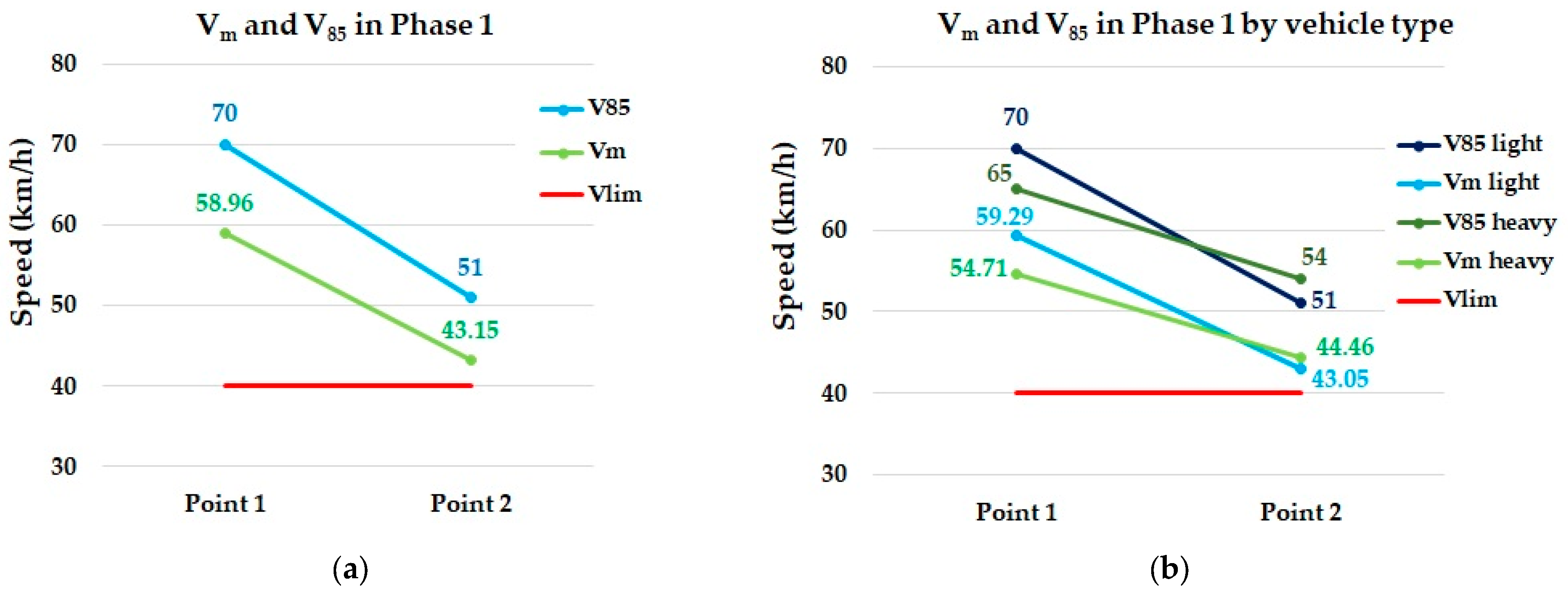
In Phase 1, 890 vehicles were registered, of which 65 were heavy vehicles (7.87%). The mean speed at Point 1 was 58.96 km/h and the V85 was 70 km/h (Table 3), indicating that more than half of the drivers exceeded the speed limit. In fact, 849 vehicles did not respect the limit (%Lim = 95.4%), reflecting an almost total non-compliance with the speed limit, which could lead to a high risk of accidents and underlining the need for measures to ensure road safety [19,25].
At Point 2, where the temporary median crossing is located and the layout proved to be more complicated, the measured speeds are lower than at Point 1 (Figure 7a). The mean speed was 43.15 km/h, almost 16 km/h lower than 50 m before (Point 1). In the case of the 85th percentile, a decrease of 19 km/h is observed, with a V85 of 51 km/h at this point. Since the mean speed is over the limit, once again, more than half of motorists exceeded the limit (63.4%). Despite the lower percentage, it continues to be high, suggesting the need to implement mitigation measures to reduce speeds [23].
The analysis by vehicle type is included in Table 3 and illustrated in Figure 7b. As expected, heavy vehicles recorded lower speeds than the overall traffic at Point 1 (54.71 km/h vs. 58.96 km/h for the mean speed, and 65 km/h vs. 70 km/h for V85). In spite of this difference, the rate of speeding remained high, with over 92% of heavy vehicle drivers exceeding the 40 km/h limit. At Point 2, the difference between vehicles categories changed. Heavy vehicles registered a mean speed of 44.46 km/h, nearly identical to the total mean (43.05 km/h) and slightly above the mean speed recorded for light vehicles (43.05 km/h). In addition, the 85th percentile for heavy vehicles at Point 2 reached 54 km/h, notably higher than both the total V85 (51 km/h) and that of light vehicles (also 51 km/h), suggesting that a subset of heavy vehicle motorists maintained high cruising speeds through the bypass.
These results reflect the broader trends found in the literature regarding the low compliance with speed limits in work zones [22,23]. Overall, both categories exhibited high rates of speeding, particularly at Point 1. At Point 2, while speeds were lower, a significant portion of drivers (over 60% of light vehicles and 72% of heavy vehicles) still failed to comply with the posted speed restrictions. The low proportion of heavy vehicles (7.8%) limits their overall impact on aggregate statistics, but their behavioural pattern remains relevant for risk assessment in mixed traffic environments.

3.2. Phase 2

In view of the results of Phase 1, on 17 April 2024, a speed monitoring display (SMD) was installed at Point 1 (Figure 4b), as an additional traffic calming measure, complementing the mandatory signage in the roadwork zone.
Speed data were registered during the night from 17 April 2024 to 18 April 2025 and following night until 0:00 on 19 April 2024, because works in the tunnel finished. A total of 2190 vehicles were recorded during Phase 2, of which 156 were heavy vehicles, representing 7.12% of the total.
At Point 1, the mean speed, 51.87 km/h, is still over the speed limit (Table 4), indicating again that more than 50% of drivers do not respect the established limit. More specifically, 81.9% of the total exceeded the limit.
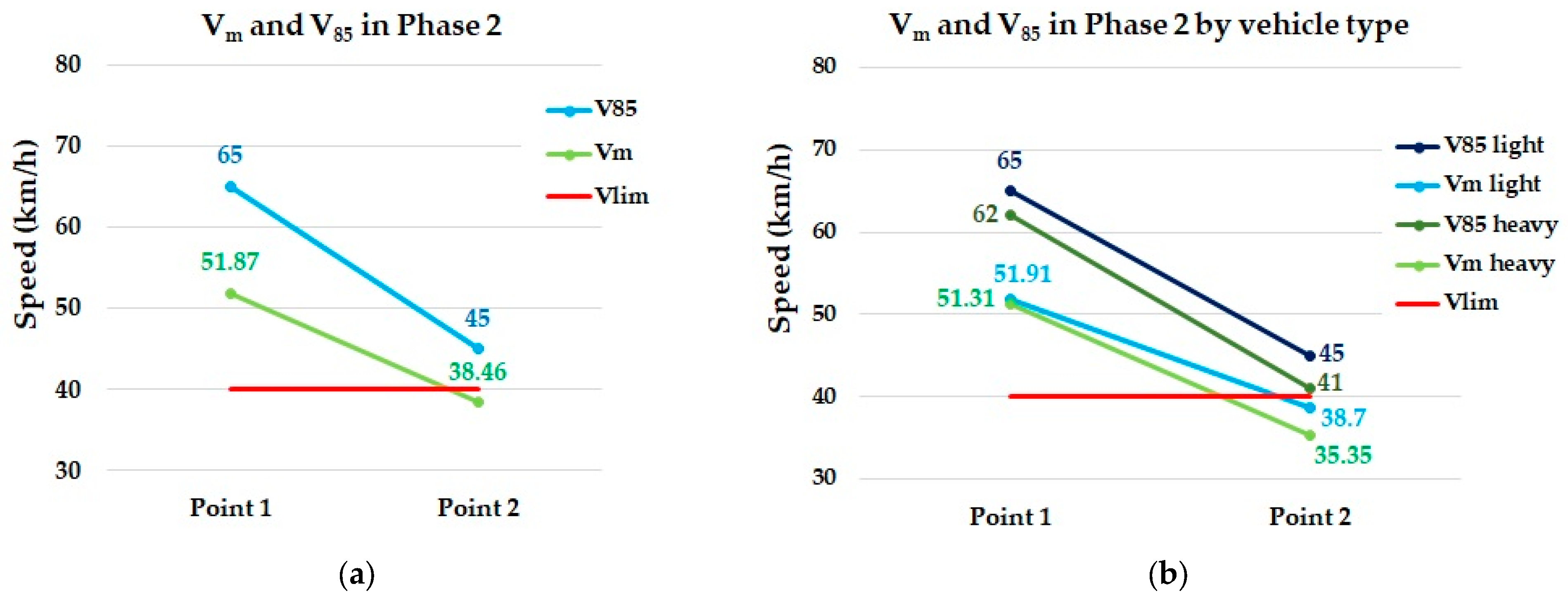
Nevertheless, at Point 2, after viewing the SMD indicating the speed, the situation improved considerably (Figure 8a). The average value was below 40 km/h (Vm = 38.46 km/h), although the V85 was 45, still over the limit. Of the 2190 vehicles registered, 781 exceeded the limit, equivalent to 35.7% of the total. This percentage is considerably lower than that obtained at Point 1, suggesting that a significant reduction in speeding and an improvement in road safety was achieved, thanks to the SMD.
The analysis by vehicle type (Figure 8b) shows that lower speeds were recorded for heavy vehicles at both points, which is the usual trend. In this phase, at Point 1, the mean speeds for both heavy and light vehicles were quite similar. At P2, heavy vehicles reduce their speeds significantly, with a mean speed 3.1 km/h lower than the total average. The V85 of heavy vehicle drivers drops to 41 km/h, just above the legal limit, whereas the overall V85 remains higher, at 45 km/h. This indicates a more conservative driving behaviour among heavy vehicles drivers on the returning chicane. This reduction may be attributed to the fact that drivers had already seen their speed displayed at Point 1, which may have prompted them to adjust their behaviour as they continued through the bypass.

3.3. Comparison Between Phase 1 and Phase 2

Finally, in order to observe the impact of the speed enforcement display on driver behaviour, it is necessary, in addition to comparing the values at each point during the same phase, to compare the different phases. This makes it possible to evaluate the effectiveness of the installed educational radar.
The evaluation of mean vehicle speeds (Vm) before and after the implementation of the SMD was conducted at both observation points. Independent two-sample t-tests were used to determine whether the differences in mean speeds between Phase 1 and Phase 2 were statistically significant, with Levene’s test applied to assess the assumption of homogeneity of variances. The effect of the SMD on vehicle speeds was first assessed globally and subsequently by vehicle category.
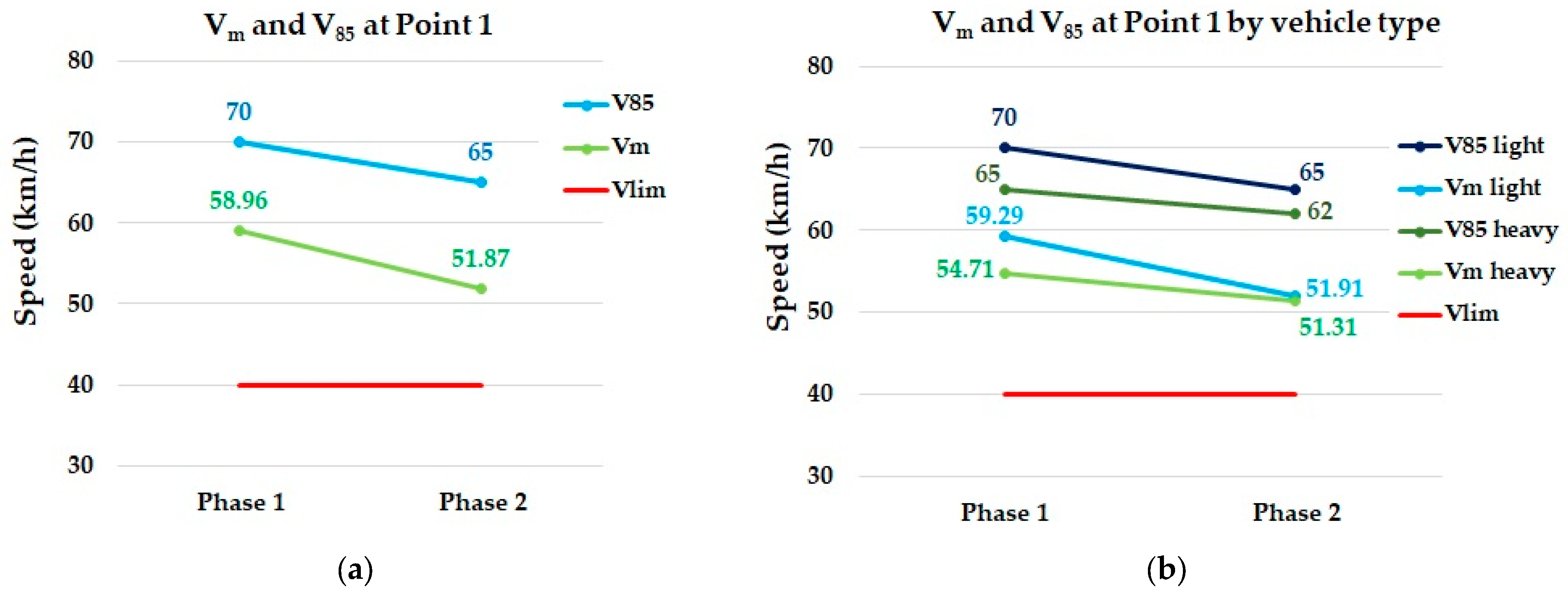
At Point 1, the mean speed in Phase 1 was 58.96 km/h, compared to 51.87 km/h in Phase 2. This corresponds to a reduction of 7.09 km/h or approximately 12%. The 85th percentile of speed decreased from 70 km/h to 65.0 km/h, implying a reduction of 7.1% (Figure 9a). Levene’s test indicated a significant difference in variance between the two phases, so Welch’s t-test was applied (Table 5). As shown in Table 6, the mean difference is statistically significant, leading to the rejection of the null hypothesis. These results confirmed that the SMD effectively reduced vehicle speeds at this location.
Grouping vehicles according to their type (light and heavy), the following results were obtained. With regard to light vehicles, the mean speed decreased by 7.38 km/h (−12.4%) (Figure 9b). Levene’s test yielded a p-value < 0.001, indicating unequal variances between phases (Table 5) and, hence, Welch’s test was applied. The test showed a statistically significant difference in means (Table 6), supporting the hypothesis that the introduction of the SMD was associated with lower travel speeds. Similarly, for heavy vehicles, a reduction of 3.4 km/h was observed, which was statistically significant (Table 6). These values suggest that the SMD had a modest but statistically meaningful impact on heavy vehicle speeds at this location.
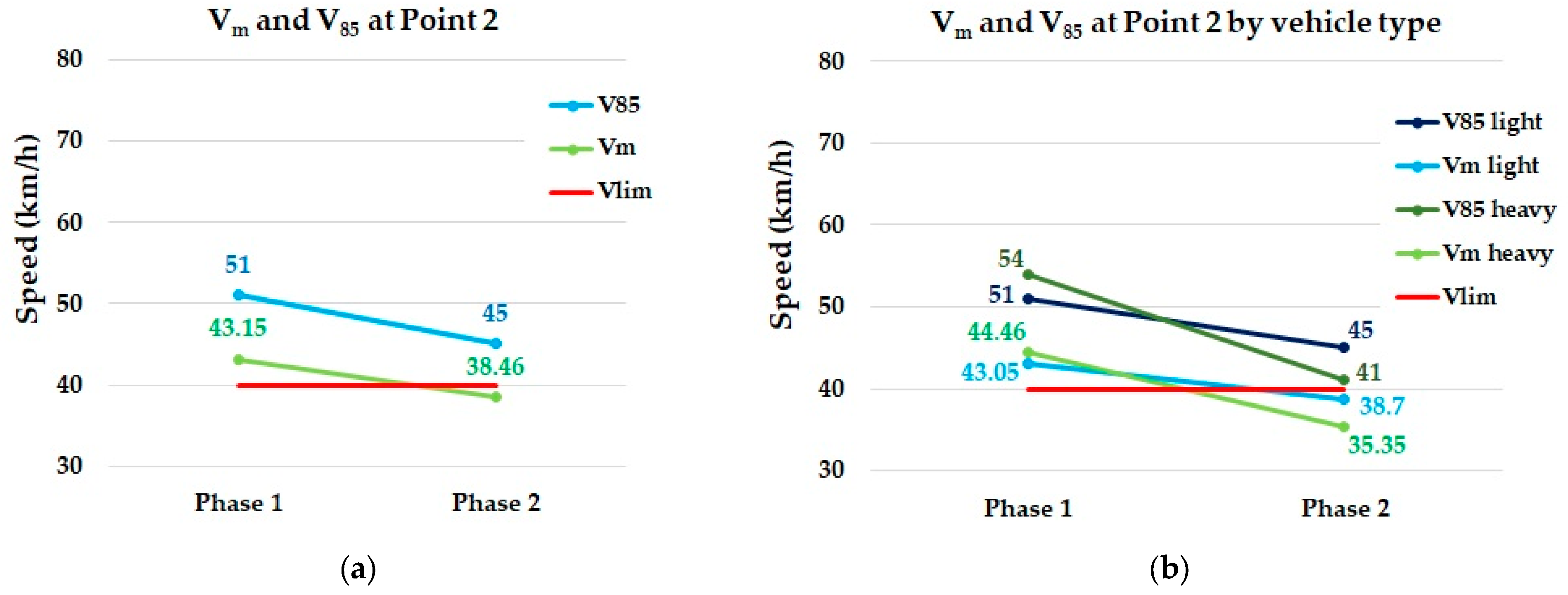
Continuing the analysis with Point 2, despite the lower speed values at this place in Phase 1 (43.15 km/h), a mean speed of 38.46 km/h was registered in Phase 2, which corresponds to a reduction of 4.69 km/h, or −10.9% (Figure 10a). The V85 also shows an important decrease, from 51 km/h to 45 km/h (−11.8%). Again, Levene’s test showed a variance inequality (Table 5), justifying the use of Welch’s t-test. The difference in means was statistically significant, confirming the effectiveness of the SMD in reducing vehicle speeds at this downstream location, where more conservative values were already recorded in Phase 1 (Table 7).
Disaggregating by vehicle type, the analysis revealed similar patterns. Light vehicles registered a mean speed decrease at Point 2 of 4.35 km/h (Figure 10b), −10.1%, which was statistically significant after the Welch’s t-test (Table 7). These results suggest that the implementation of the SMD effectively influenced the behaviour of light vehicle drivers after passing the SMD.
Regarding heavy vehicles, a reduction of 9.11 km/h in mean speeds was observed (Figure 10b), which implies a decrease of 20.5%. Once again, the variances were not homogeneous (Table 5) and the Welch’s t-test confirmed that there was a statistically significant mean difference (Table 7). These data reflect that the SMD was highly effective in lowering speeds among heavy vehicles at the critical points, where it is more necessary to reduce speed.
These findings demonstrate a consistent and statistically significant reduction in average vehicle speeds after the introduction of a low-cost traffic calming measure like a speed monitoring device. These results are aligned with previous research that indicated the effect of SMD ranged between 3 km/h to 12 km/h [75]. The efficiency has been previously tested in other contexts, such as urban areas [39,41], suburban areas [44,45] and in school zones [46,47] and in short urban segments in rural roads [48,76]. Regarding roadwork zones, implementation of SMDs in long-term interventions was confirmed [49,50,51] and in short-term works [55,58,77]. However, it was necessary to test if this type of measure was also effective in very short-term works, such as the ones conducted in the Malmasin tunnel. The intervention only lasted for four and a half nights and the closure of one carriageway was conducted from 22:00 to 6:00 not to affect morning peak hours. Consequently, most of the drivers were not habitual users of the work zone. If a different road layout suddenly appears, there is a need to complement the compulsory signals with additional measures to prevent and alert drivers of the most difficult point of the work area. Although it is generally said that SMDs can effectively reduce speed only for a short section [75], the critical point was located just 50 m after the SMD and hence, it became effective where it was needed.
Additionally, another way of verifying the importance of the SMD is the reduction in the percentage of vehicles exceeding the speed limit in the work zone (40 km/h). At Point 1, the decrease was from 95.4% of drivers exceeding the limit (Table 3) in Phase 1 to 81.9% in Phase 2 (Table 4). At Point 2, where more effectiveness was needed, 63.4% of drivers passed over the limit, while in Phase 2, this value dropped to 35.7% (Table 3 and Table 4), a reduction of 27.7 points. This fact highlights the importance of the SMD on driver awareness and reduction in speed limit violations.
Moreover, some properties of the SMDs must be highlighted. It is a low-cost device, with low operating cost, as it can work with batteries or solar cells (as the one installed in this study, which worked even at night). It can be rented and is not labour intensive [75].

3.4. Cumulative Distribution Curves

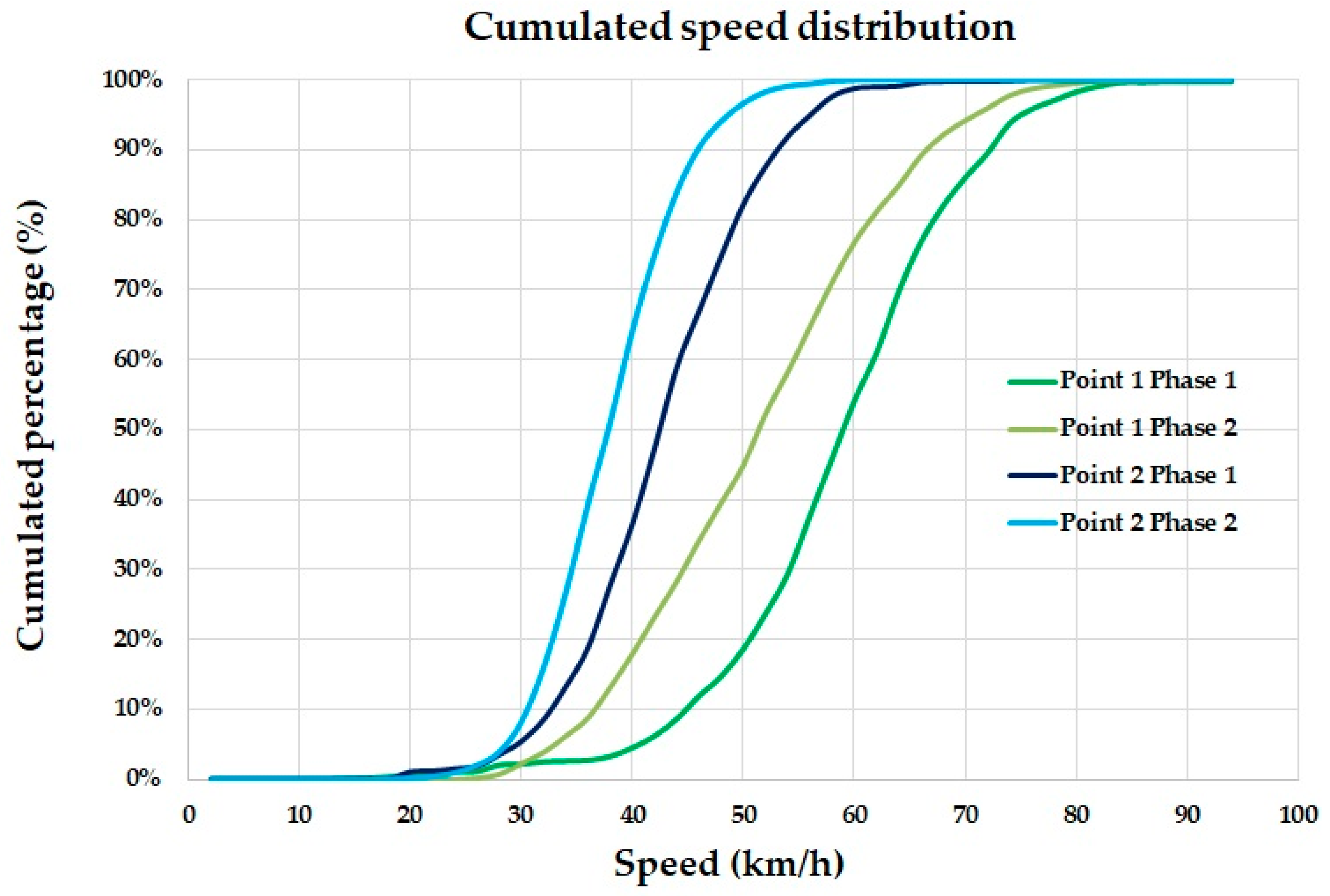
An additional way of assessing the SMD as a traffic calming measure is through cumulative distribution [78]. Recorded speeds were grouped into 2 km/h ranges. For each point and phase, the cumulative percentage of vehicles driving at or below that speed was calculated. This methodology makes it possible to clearly observe how speed varies as a result of the traffic calming measure [48].
As shown in Figure 11, the SMD reduced traffic speed since the curves of Phase 2 are shifted to the left compared to those of Phase 1, indicating that drivers are travelling at lower speed after the implementation of the low-cost device.
Furthermore, the curve at Point 2 in Phase 2 (light blue) became more “vertical” than the curve at Point in Phase 1, indicating a decrease in speed dispersion. This fact, which was observable in the values of the standard deviation in Table 2 (SD = 8.13 in Phase 1) and Table 3 (SD = 6.23 in Phase 2), suggests that drivers react more uniformly after visualising their speed, especially around the median and 85th percentile values, favouring a more predictable and safer flow. This fact is of fundamental importance in the case of Point 2, where the hazardous layout is located.
Regarding Point 1, the standard deviation is higher Phase 2 (SD = 8.13 in Phase 1 and SD = 11.48 in Phase 2). As the Vm decreases at Point 1 in Phase 1, it can be interpreted that, in general terms, drivers slow down after visualising their speed, but some of them do not. Consequently, they maintain their behaviour regardless the SMD, which implies a greater dispersion of the speed (Figure 11).

4. Conclusions

This study examined the effectiveness of a speed monitoring display (SMD) in a very short-term freeway work zone featuring a temporary median crossing and a chicane-type re-entry, a configuration that introduces sudden geometric changes and perceived uncertainty for drivers. The analysis compared two operational phases: one with only mandatory Spanish work zone signage (Phase 1) and another in which an SMD was added at the tunnel exit to display vehicle speed (Phase 2). Speed data collected at two points—100 m and 50 m before the re-entry—demonstrated that the use of the SMD contributed to a significant reduction in vehicle speeds and speeding behaviour in this complex and short-duration traffic management scenario.
The results clearly show that the SMD helped mitigate the typically low speed limit compliance observed in roadwork areas. At baseline, without the SMD, mean speeds exceeded the temporary 40 km/h limit by wide margins, with 95.4% of vehicles speeding at the upstream point (P1) and 63.4% at the downstream point (P2). After introducing the SMD, speeding rates fell markedly to 81.9% upstream and to just 35.7% near the re-entry, where the geometric complexity is greatest. Correspondingly, mean speeds fell by 7.09 km/h upstream and by 4.69 km/h downstream, while 85th-percentile speeds also decreased substantially. These reductions were statistically significant according to two-sample t-tests, confirming the immediate effectiveness of the SMD in influencing driver behaviour in this context.
A particularly relevant finding is the strong response of heavy vehicles, whose mean speed decreased by 20.5% at the P2. Although heavy vehicles represented only around 7–8% of overall traffic, their behaviour is important for work zone safety due to their size, longer stopping distances, and potential severity in collisions. The greater speed drop among heavy vehicles suggests that this group may be especially responsive to real-time feedback in constrained situations. More generally, the study observed a reduction in speed dispersion after SMD deployment, indicating more homogeneous driver behaviour and a likely improvement in predictability and safety at the critical location.
The context of this intervention strengthens its relevance. Unlike long- or medium-term work zones, where drivers may become accustomed to the modified layout, the studied work zone lasted only four nights, and detours took place exclusively during night hours. Consequently, most drivers were not habituated to the temporary traffic pattern, increasing the risk of inappropriate speed selection and delayed adaptation. The observed improvements therefore highlight the utility of SMDs when rapid behavioural adjustment is required, aligning with previous evidence showing that such devices can achieve speed reductions of 3–12 km/h in other settings.
Moreover, the chicane layout used to return traffic to the original carriageway is inherently demanding. Sudden lane shifts, narrow alignment, and the absence of physical separation reinforce the need for effective warning and speed control measures. The results show that the SMD offered a timely and visible cue, allowing drivers to adjust their speed prior to entering the most hazardous point. This is particularly valuable considering that mandatory signage alone proved insufficient, as documented in the initial phase, where speed limit compliance was extremely low despite proper regulatory signage.
Given the findings, incorporating SMDs as standard equipment for short-duration works in complex geometric settings is recommended, especially at locations involving temporary median crossings or sharp alignment changes. Furthermore, the low cost of the device is an additional advantage for its deployment.

Author Contributions

Conceptualization, I.G. and H.P.-A.; methodology, M.I. and H.P.-A.; software, I.G. and M.I.; validation, M.I. and J.M.B.; formal analysis, I.G. and J.M.B.; investigation, I.G., M.I. and H.P.-A.; resources, J.M.B. and H.P.-A.; data curation, I.G. and H.P.-A.; writing—original draft preparation, I.G. and M.I.; writing—review and editing, I.G., M.I., J.M.B. and H.P.-A.; visualisation, I.G., M.I. and H.P.-A.; supervision, I.G., M.I. and H.P.-A.; project administration, J.M.B. and H.P.-A.; funding acquisition, J.M.B. and H.P.-A. All authors have read and agreed to the published version of the manuscript.

Funding

This research was funded by the Provincial Council of Biscay (Bizkaiko Foru Aldundia/Diputación Foral de Bizkaia) under grant number 5/12/IV/2021/00001, the DIGICALM Project of the grant programme aimed at promoting innovation in road infrastructure 2021; under grant 5/12/IV/2024/00010, the CalmingLEDs (Calmando el tráfico en zonas de obras mediante LEDs inteligentes) project of the grant program aimed at promoting innovation in road infrastructure 2024 and by the University of the Basque Country (UPV/EHU) under grant number US24/28 of the Universidad-Empresa-Sociedad programme; and under grant number GIU21/046. Additionally, financial support was provided through research contracts with Viuda de Sainz, S.L., under contract numbers 2019.0560, 2022.0300, and 2024.0846.

Data Availability Statement

The dataset is available at https://doi.org/10.5281/zenodo.17525801, accessed on 4 November 2025.

Conflicts of Interest

The authors declare no conflicts of interest.

Abbreviations

The following abbreviations are used in this manuscript:
SMDSpeed Monitoring Display
VminMinimum speed
VmMean speed
V8585th percentile of the speed
VmaxMaximum speed
NNumber of vehicles
NlimNumber of vehicles exceeding the speed limit
%LimPercentage of vehicles exceeding the speed limit

References

  1. Llopis-Castelló, D.; Findley, D.J. Influence of Calibration Factors on Crash Prediction on Rural Two-Lane Two-Way Roadway Segments. J. Transp. Eng. Part A Syst. 2019, 145, 04019024. [Google Scholar] [CrossRef]
  2. Pérez-Acebo, H.; Ziółkowski, R.; Linares-Unamunzaga, A.; Gonzalo-Orden, H. A Series of Vertical Deflections, a Promising Traffic Calming Measure: Analysis and Recommendations for Spacing. Appl. Sci. 2020, 10, 3368. [Google Scholar] [CrossRef]
  3. Haghani, M.; Behnood, A.; Dixit, V.; Oviedo-Trespalacios, O. Road Safety Research in the Context of Low- and Middle-Income Countries: Macro-Scale Literature Analyses, Trends, Knowledge Gaps and Challenges. Saf. Sci. 2022, 146, 105513. [Google Scholar] [CrossRef]
  4. Sohail, A.; Cheema, M.A.; Ali, M.E.; Toosi, A.N.; Rakha, H.A. Data-Driven Approaches for Road Safety: A Comprehensive Systematic Literature Review. Saf. Sci. 2023, 158, 105949. [Google Scholar] [CrossRef]
  5. Ziółkowski, R.; Pérez-Acebo, H.; Gonzalo-Orden, H.; Linares-Unamunzaga, A. Changes in Safety Performance on Single-Carriageway Roads After Installation of Additional Lighting at Pedestrian Crossing. Land 2024, 13, 2134. [Google Scholar] [CrossRef]
  6. Ferko, M.; Pirdavani, A.; Babić, D.; Babić, D. Exploring Factors Influencing Speeding on Rural Roads: A Multivariable Approach. Infrastructures 2024, 9, 222. [Google Scholar] [CrossRef]
  7. D’Apuzzo, M.; Evangelisti, A.; Santilli, D.; Nardoianni, S.; Cappelli, G.; Nicolosi, V. Towards a New Design Methodology for Vertical Traffic Calming Devices. Sustainability 2023, 15, 13381. [Google Scholar] [CrossRef]
  8. Alshabibi, N.M. An Impact Assessment of Speed Humps’ Geometric Characteristics and Spacing on Vehicle Speed: An Overview. Infrastructures 2025, 10, 190. [Google Scholar] [CrossRef]
  9. Martin-Castresana, S.; Alvarez, D.; Andrade-Cataño, F.; Castro, M. Effect of Road Markings on Speed Through Curves on Rural Roads: A Driving Simulator Study in Spain. Infrastructures 2025, 10, 94. [Google Scholar] [CrossRef]
  10. Magkafas, F.; Fountas, G.; Anastasopoulos, P.C.; Basbas, S. Beyond Speed Reduction: A Systematic Literature Review of Traffic-Calming Effects on Public Health, Travel Behaviour, and Urban Liveability. Infrastructures 2025, 10, 147. [Google Scholar] [CrossRef]
  11. Pirdavani, A.; Sadeqi Bajestani, M.; Mantels, M.; Spooren, T. A Driving Simulator-Based Assessment of Traffic Calming Measures at High-to-Low Speed Transition Zones. Smart Cities 2025, 8, 147. [Google Scholar] [CrossRef]
  12. Wang, J.; Hughes, W.E.; Council, F.M.; Paniati, J.F. Investigation of Highway Work Zone Crashes: What We Know and What We Don’t Know. Transp. Res. Rec. 1996, 1529, 54–62. [Google Scholar] [CrossRef]
  13. Meng, Q.; Weng, J. A Genetic Algorithm Approach to Assessing Work Zone Casualty Risk. Saf. Sci. 2011, 49, 1283–1288. [Google Scholar] [CrossRef]
  14. Qi, Y.; Srinivasan, R.; Teng, H.; Baker, R. Analysis of the Frequency and Severity of Rear-End Crashes in Work Zones. Traffic Inj. Prev. 2013, 14, 61–72. [Google Scholar] [CrossRef]
  15. Yang, H.; Ozbay, K.; Ozturk, O.; Xie, K. Work Zone Safety Analysis and Modeling: A State-of-the-Art Review. Traffic Inj. Prev. 2015, 16, 387–396. [Google Scholar] [CrossRef]
  16. La Torre, F.; Domenichini, L.; Nocentini, A. Effects of Stationary Work Zones on Motorway Crashes. Saf. Sci. 2017, 92, 148–159. [Google Scholar] [CrossRef]
  17. Liljegren, E. Traffic Accidents in Connection to Road Work in Sweden. In Proceedings of the Transport Research Arena (TRA) 5th Conference: Transport Solutions from Research to Deployment, Paris, France, 14–17 April 2014. [Google Scholar]
  18. Adminaite, D.; Allsop, R.; Jost, G. Ranking EU Progress on Improving Motorway Safety; Pin Flash Report 28; European Transport Safety Council: Brussels, Belgium, 2015. [Google Scholar]
  19. Khattak, A.J.; Khattak, A.J.; Council, F.M. Effects of Work Zone Presence on Injury and Non-Injury Crashes. Accid. Anal. Prev. 2002, 34, 19–29. [Google Scholar] [CrossRef]
  20. Whitmire, J.; Morgan, J.F.; Oron-Gilad, T.; Hancock, P.A. The Effect of In-Vehicle Warning Systems on Speed Compliance in Work Zones. Transp. Res. Part F Traffic Psychol. Behav. 2011, 14, 331–340. [Google Scholar] [CrossRef]
  21. Debnath, A.K.; Blackman, R.; Haworth, N. Common Hazards and Their Mitigating Measures in Work Zones: A Qualitative Study of Worker Perceptions. Saf. Sci. 2015, 72, 293–301. [Google Scholar] [CrossRef]
  22. Finley, M.D. Field Evaluation of Motorist Reactions to Reduced Work Zone Speed Limits and Other Work Zone Conditions. Transp. Res. Rec. 2011, 2258, 40–48. [Google Scholar] [CrossRef]
  23. Debnath, A.K.; Blackman, R.; Haworth, N. A Tobit Model for Analyzing Speed Limit Compliance in Work Zones. Saf. Sci. 2014, 70, 367–377. [Google Scholar] [CrossRef]
  24. Ravani, B.; Wang, C. Speeding in Highway Work Zone: An Evaluation of Methods of Speed Control. Accid. Anal. Prev. 2018, 113, 202–212. [Google Scholar] [CrossRef] [PubMed]
  25. Brewer, M.A.; Pesti, G.; Schneider, W. Improving Compliance with Work Zone Speed Limits. Transp. Res. Rec. 2006, 1948, 67–76. [Google Scholar] [CrossRef]
  26. Bai, Y.; Li, Y. Determining the Drivers’ Acceptance of EFTCD in Highway Work Zones. Accid. Anal. Prev. 2011, 43, 762–768. [Google Scholar] [CrossRef]
  27. Weng, J.; Meng, Q. Effects of Environment, Vehicle and Driver Characteristics on Risky Driving Behavior at Work Zones. Saf. Sci. 2012, 50, 1034–1042. [Google Scholar] [CrossRef]
  28. Benekohal, R.F.; Shim, E. Multivariate Analysis of Truck Drivers’ Assessment of Work Zone Safety. J. Transp. Eng. 1999, 125, 398–406. [Google Scholar] [CrossRef]
  29. Steinbakk, R.T.; Ulleberg, P.; Sagberg, F.; Fostervold, K.I. Effects of Roadwork Characteristics and Drivers’ Individual Differences on Speed Preferences in a Rural Work Zone. Accid. Anal. Prev. 2019, 132, 105263. [Google Scholar] [CrossRef]
  30. Benekohal, R.F.; Wang, L. Relationship Between Initial Speed and Speed inside a Highway Work Zone. Transp. Res. Rec. 1994, 1442, 41–48. [Google Scholar]
  31. Paolo, P.; Sar, D. Driving Speed Behaviour Approaching Road Work Zones On Two-Lane Rural Roads. Procedia Soc. Behav. Sci. 2012, 53, 672–681. [Google Scholar] [CrossRef]
  32. Finley, M.D.; Jenkins, J.; McAvoy, D.S. Motorists’ Speed Response to Nonvariable and Variable Work Zone Speed Limits and Other Work Zone Conditions. Transp. Res. Rec. 2015, 2485, 70–77. [Google Scholar] [CrossRef]
  33. Benekohal, R.F.; Wang, L. Speed Change Distribution of Vehicles in a Highway Work Zone. Transp. Res. Rec. 1993, 1409, 42–51. [Google Scholar]
  34. Hou, Y.; Edara, P.; Sun, C. Speed Limit Effectiveness in Short-Term Rural Interstate Work Zones. Transp. Lett. 2013, 5, 8–14. [Google Scholar] [CrossRef]
  35. Benekohal, R.F.; Wang, L.; Orloski, R.; Kastel, L.M. Speed-Reduction Patterns of Vehicles in a Highway Construction Zone. Transp. Res. Rec. 1992, 1352, 35–45. [Google Scholar]
  36. Debnath, A.K.; Blackman, R.; Haworth, N. A Review of the Effectiveness of Speed Control Measures in Roadwork Zones. In Proceedings of the Occupational Safety in Transport Conference, Gold Coast, Australia, 20–21 September 2012. [Google Scholar]
  37. Garber, N.J.; Patel, S.T. Effectiveness of Changeable Message Signs in Controlling Vehicle Speeds in Work Zones; No. FHWA/VA-95-R4; Virginia Transportation Research Council: Charlottesville, VA, USA, 1994. [Google Scholar]
  38. Garber, N.J.; Srinivasan, S. Effectiveness of Changeable Message Signs in Controlling Vehicle Speeds in Work Zones: Phase II; No. VTRC 98-R10; Virginia Transportation Research Council: Charlottesville, VA, USA, 1998. [Google Scholar]
  39. Gehlert, T.; Schulze, C.; Schlag, B. Evaluation of Different Types of Dynamic Speed Display Signs. Transp. Res. Part F Traffic Psychol. Behav. 2012, 15, 667–675. [Google Scholar] [CrossRef]
  40. Gonzalo-Orden, H.; Rojo, M.; Pérez-Acebo, H.; Linares, A. Traffic Calming Measures and Their Effect on the Variation of Speed. Transp. Res. Procedia 2016, 18, 349–356. [Google Scholar] [CrossRef]
  41. Gonzalo-Orden, H.; Pérez-Acebo, H.; Unamunzaga, A.L.; Arce, M.R. Effects of Traffic Calming Measures in Different Urban Areas. Transp. Res. Procedia 2018, 33, 83–90. [Google Scholar] [CrossRef]
  42. Vertlberg, J.; Jakovljević, M.; Ševrović, M.; Shabanaj, K. Speed Display Radars’ Impact on Speed Reduction on District Roads at Settlement Entrances. Sustainability 2023, 15, 3099. [Google Scholar] [CrossRef]
  43. Pesti, G.; McCoy, P.T. Long-Term Effectiveness of Speed Monitoring Displays in Work Zones on Rural Interstate Highways. Trans. Res. Rec. 2001, 1754, 21–30. [Google Scholar] [CrossRef]
  44. Hallmark, S.L.; Hawkins, N.; Knickerbocker, S. Use of DSFS as a Speed Transition Zone Countermeasure in Small, Rural Communities. In Proceedings of the IEEE 18th International Conference on Intelligent Transportation Systems, Las Palmas de Gran Canaria, Spain, 15–18 September 2015; pp. 1448–1454. [Google Scholar]
  45. Olowosegun, A.; Fountas, G.; Davis, A. Effective Trigger Speeds for Vehicle Activated Signs on 20 mph Roads in Rural Areas. Safety 2024, 10, 25. [Google Scholar] [CrossRef]
  46. Lee, C.; Lee, S.; Choi, B.; Oh, Y. Effectiveness of Speed-Monitoring Displays in Speed Reduction in School Zones. Transp. Res. Rec. 2006, 1973, 27–35. [Google Scholar] [CrossRef]
  47. O’Brien, S.W.; Simpson, C.L. Use of “Your Speed” Changeable Message Signs in School Zones. Transp. Res. Rec. 2012, 2318, 128–136. [Google Scholar] [CrossRef]
  48. Pérez-Acebo, H.; Ziolkowski, R.; Gonzalo-Orden, H. Evaluation of the Radar Speed Cameras and Panels Indicating the Vehicles’ Speed as Traffic Calming Measures (TCM) in Short Length Urban Areas Located along Rural Roads. Energies 2021, 14, 8146. [Google Scholar] [CrossRef]
  49. McCoy, P.T.; Bonneson, J.A.; Kollbaum, J.A. Speed Reduction Effects of Speed Monitoring Displays with Radar in Work Zones on Interstate Highways. Transp. Res. Rec. 1995, 1509, 65–72. [Google Scholar]
  50. Saito, M.; Bowie, J. Efficacy of Speed Monitoring Displays in Increasing Speed Limit Compliance in Highway Work Zones; No. UT-03.12; Utah Department of Transportation: Salt Lake City, UT, USA, 2003. [Google Scholar]
  51. Čygas, D.; Skrodenis, D.; Paškauskas, A.; Sušinskaitė, Ž.; Žalimienė, L. Evaluation of Speeding and Behaviour of Drivers in Roadwork Zones. Balt. J. Road Bridge Eng. 2018, 13, 261–273. [Google Scholar] [CrossRef]
  52. Fontaine, M.D.; Carlson, P.J.; Hawkins, H.G., Jr. Evaluation of Traffic Control Devices for Rural High-Speed Maintenance Work Zones: Second Year Activities and Final Recommendations; No. FHWA/TX-00/1879-2; Texas Department of Transportation: Austin, TX, USA, 2000. [Google Scholar]
  53. Maze, T.; Kamyab, A.; Schrock, S. Evaluation of Work Zone Speed Reduction Measures; Iowa State University: Ames, IA, USA, 2000. [Google Scholar]
  54. Cunningham, J.R., IV; Anderson, S.M.; Fitzsimmons, E.J.; Nye, B. Analysis of Speed Profiles and Evaluation of Dynamic Signs in Kansas Work Zones; Report No. K-TRAN: KSU-18-6 Final Report; Kansas Department of Transportation: Topeka, KA, USA, 2021. [Google Scholar]
  55. Arnold, E.D. Use of Police in Work Zones on Highways in Virginia; Virginia Department of Transportation: Charlottesville, VI, USA, 2003. [Google Scholar]
  56. Wang, C.; Dixon, K.K.; Jared, D. Evaluating Speed-Reduction Strategies for Highway Work Zones. Transp. Res. Rec. 2003, 1824, 44–53. [Google Scholar] [CrossRef]
  57. Meyer, E. Evaluation of Data From Test Application of Optical Speed Bars to Highway Work Zones; No. K-TRAN KU-00-04; Kansas Department of Transportation: Topeka, KA, USA, 2004. [Google Scholar]
  58. Haworth, N.; Symmons, M.; Mulvihill, C. Safety of Small Workgroups on Roadways; Monash University: Clayton, VIC, Australia, 2002. [Google Scholar]
  59. Pérez-Acebo, H.; Baraibar, J.M.; Arteagabeitia, U.; Isasa, M. Study of the Necessity of a Speed Monitoring Display at the Returning Chicane on a Freeway Bypass. Traffic Inj. Prev. 2024, 25, 832–841. [Google Scholar] [CrossRef]
  60. Department for Transport. Safety at Street Works and Road Works. A Code of Practice; The Stationery Office: London, UK, 2013.
  61. FWHA (Federal Highway Administration). Manual on Uniform Traffic Control for Streets and Highways, 11th ed.; U.S. Department of Transportation: Washington, DC, USA, 2023.
  62. Venkatraman, V.; Arkatkar, S.; Joshi, G.; Krishna Rao, K.V. Driver Stress and Workload in Highway Work Zones. Transp. Res. Rec. 2013, 2337, 59–66. [Google Scholar]
  63. Theofilatos, A.; Graham, D.; Yannis, G. Factors Affecting Accident Probability at Road Work Zones. Transp. Res. Part F Traffic Psychol. Behav. 2017, 47, 210–224. [Google Scholar]
  64. Rouphail, N.M.; Yang, Z.S.; Fazio, J. Comparative Study of Short- and Long-Term Urban Freeway Construction Zones. Transp. Res. Rec. 1988, 1163, 4–14. [Google Scholar]
  65. Pérez-Acebo, H.; Gonzalo-Orden, H.; Findley, D.J.; Rojí, E. Modeling the International Roughness Index Performance on Semi-Rigid Pavements in Single Carriageway Roads. Constr. Build. Mater. 2021, 272, 121665. [Google Scholar] [CrossRef]
  66. Gurrutxaga, I.; Alonso-Solórzano, Á.; Isasa, M.; Pérez-Acebo, H. IRI Performance Models for Flexible, Semi-Rigid and Composite Pavements in Double-Carriageway Roads. Civ. Eng. J. 2025, 11, 1712–1738. [Google Scholar] [CrossRef]
  67. Isasa, M.; Alonso-Solórzano, Á.; Gurrutxaga, I.; Pérez-Acebo, H. A Skid Resistance Predicting Model for Single Carriageways. Lubricants 2025, 13, 365. [Google Scholar] [CrossRef]
  68. Alonso-Solorzano, A.; Perez-Acebo, H.; Findley, D.J.; Gonzalo-Orden, H. Transition Probability Matrices for Pavement Deterioration Modelling with Variable Duty Cycle Times. Int. J. Pavement Eng. 2023, 24, 2278694. [Google Scholar] [CrossRef]
  69. Bizkaiko Foru Aldundia/Diputación Foral de Bizkaia (BFA/DFB). Evolución del Tráfico en las Carreteras de Bizkaia 2024; Departamento de Infraestructuras y Desarrollo Territorial: Bilbao, Spain, 2025.
  70. MFOM (Ministerio de Fomento). Orden FOM/3460/2003, de 28 de Noviembre, por la Que Se Aprueba la Norma 6.1 IC Secciones de Firme, de la Instrucción de Carreteras; BOE de 12 de Diciembre de 2003; Ministerio de Fomento: Madrid, Spain, 2003.
  71. Dirección General de Carreteras (DGC). Manual de Ejemplos de Señalización de Obras Fijas; Ministerio de Fomento: Madrid, Spain, 1997.
  72. Woo, T.H.; Ho, S.-M.; Chen, H.-L. Monitoring Displays Coupled with Speed Cameras. Transp. Res. Rec. 2007, 2009, 30–36. [Google Scholar] [CrossRef]
  73. Dell’acqua, G. Reducing Traffic Injuries Resulting from Excess Speed. Transp. Res. Rec. 2011, 2203, 94–99. [Google Scholar] [CrossRef]
  74. Islam, M.T.; El-Basyouny, K.; Ibrahim, S.E. The Impact of Lowered Residential Speed Limits on Vehicle Speed Behavior. Saf. Sci. 2014, 62, 483–494. [Google Scholar] [CrossRef]
  75. Vadeby, A.; Sörensen, G.; Bolling, A.; Cocu, X.; Saleh, P.; Aleksa, M.; La Torre, F.; Nocentini, A.; Tucka, P. Towards a European Guideline for Speed Management Measures in Work Zones. Transp. Res. Procedia 2016, 14, 3426–3435. [Google Scholar] [CrossRef]
  76. Pérez-Acebo, H.; Otxoa-Muñoz, X.; Marquina-Llaguno, M.; Gonzalo-Orden, H. Evaluation of the efficiency of traffic lights turning red in case of exceeding speed limit with previous panels indicating the speed. Transp. Res. Procedia 2021, 58, 45–52. [Google Scholar] [CrossRef]
  77. Pérez-Acebo, H.; Baraibar-Díez, J.M.; Arteagabeitia-Villanueva, U. Analysis of the Effectiveness of a Speed Indicator Sign as a Traffic Calming Measure on Roads with Separate Carriageways (Motorways) Affected by Road Works. Routes Roads 2025, 404, 33–36. [Google Scholar]
  78. Pérez-Acebo, H.; Otxoa-Muñoz, X.; Marquina-Llaguno, M.; Gonzalo-Orden, H. Analysis of the efficiency of traffic lights turning red in case of exceeding speed limit. Ing. Investig. 2021, 41, e86047. [Google Scholar] [CrossRef]
Figure 1. Aerial view of the A-8 in the Malmasin tunnel.
Infrastructures 11 00024 g001
Figure 2. Signage diagram for a dual carriageway motorway when one carriageway is closed and traffic is diverted to the other using one of the two existing lanes.
Infrastructures 11 00024 g002
Figure 3. Location of Point 1 and Point 2 at the entrance of the Malmasin tunnel.
Infrastructures 11 00024 g003
Figure 4. Point 1: (a) in Phase 1, with the radar at the circular signal; (b) in Phase 2, after the installation of the SMD.
Infrastructures 11 00024 g004
Figure 5. Point 2: (a) the radar, hidden by a rectangular signal; (b) the signal hiding the radar and a truck at the returning chicane.
Infrastructures 11 00024 g005
Figure 6. General view of the works at the entrance of the Malmasin tunnel.
Infrastructures 11 00024 g006
Figure 7. Mean speed (Vm) and 85th percentile of speed (V85) (a) in Phase 1; (b) in Phase 1 by vehicle type.
Infrastructures 11 00024 g007
Figure 8. Mean speed (Vm) and 85th percentile of speed: (a) in Phase 2, (b) in Phase 2 by vehicle type.
Infrastructures 11 00024 g008
Figure 9. Mean speed (Vm) and 85th percentile of speed at Point 1 (a) for total traffic; (b) by vehicle type.
Infrastructures 11 00024 g009
Figure 10. Mean speed (Vm) and 85th percentile of speed at Point 2 (a) for total traffic; (b) by vehicle type.
Infrastructures 11 00024 g010
Figure 11. Cumulative speed distribution at each Point in both phases.
Infrastructures 11 00024 g011
Table 1. Causal factors and driver behaviour patterns in road work zones.
TypeFactor/PatternDescription/Observed EvidenceReferences
Main causesExcessive speedSpeeding is one of the main causes of crashes in road work zones, increasing the risk for both drivers and workers[19,22,23,24,25]
Lack of attention/distractionDriver inattention can lead to overlooking temporary signage or reduced speed limits[26,27]
Perception of speed limitsAlthough drivers often perceive work zones as more hazardous, observation and model-based studies report high levels of speed limit non-compliance in these environments[22,23,28]
Behavioural patterns and contextual factorsSelective risk perceptionDrivers tend to reduced their speed only when they perceive a clear threat or visible activity within the work zone, such as, workers, equipment, or movement[29,30,31,32,33]
Work zone durationSpeed reductions are more effective in short-term work zones than in long-term interventions[34]
Speed adjustment behaviourSome drivers reduced their speed after the first warning sign, increase it before reaching the active zone, and then reduce it again within the work area (observational evidence of within-zone speed variation)[35]
Perceived “appropriate speed”Drivers tend to maintain a speed they consider appropriate, regardless of the legal limit or posted signage[25,33]
Table 2. Measurement periods in each phase.
PhaseStart DateStart TimeEnd DateEnd TimeDuration of the Measurements
116 April 202411:15 p.m.17 April 20246:00 a.m.6 h 45 min
217 April 202410:45 p.m.18 April 20246:00 a.m.9 h 15 min
18 April 202410:00 p.m.19 April 20240:00 a.m.
Table 3. Summaries of data collected during Phase 1.
Vehicle TypePointVmin (km/h)Vm (km/h)V85 (km/h)Vmax (km/h)SDNNlim%Lim
All the vehiclesP11358.96709611.0789084995.4
P21943.1551768.1389056463.4
Heavy vehiclesP12854.71658110.15656092.3
P22044.4654748.97654772.3
Light vehiclesP11359.29709611.0882578995.64
P21943.0551768.0682551762.67
Table 4. Summary of data collected during Phase 2.
Vehicle TypePointVmin (km/h)Vm (km/h)V85 (km/h)Vmax (km/h)SDNNlim%Lim
All the vehiclesP12451.87659011.482190179481.9
P21738.4645636.23219078135.7
Heavy vehiclesP12851.31627911.5215612781.4
P21735.3541555.941562817.9
Light vehiclesP12451.91659011.482034166781.96
P21738.745636.19203475337.0
Table 5. Levene’s statistic for Point 1 and 2 comparing results for both phases.
PointConsidered VehiclesF StatisticSignificance (p-Value)Result
Point 1All13.991<0.001Unequal variance
Light14.179<0.001Unequal variance
Heavy2.7640.098Equal variance
Point 2All72.186<0.001Unequal variance
Light68.637<0.001Unequal variance
Heavy12.528<0.001Unequal variance
Table 6. Mean difference t-test for Point 1 comparing Phase 1 and Phase 2.
Vehicle TypePhaseVmSDt Valued.f.Sig.
(p-Value)
Mean
Difference
95% Confidence
Interval
LowerUpper
AllPhase 158.9611.0715.9341703.4<0.0017.096.2167.961
Phase 251.8711.48
LightPhase 159.2911.0815.9721576.7<0.0017.386.4758.288
Phase 251.9111.48
HeavyPhase 154.7110.152.0642190.023.390.1546.633
Phase 251.3111.52
Table 7. Mean difference based on t-test for Point 2 comparing Phase 1 and Phase 2.
Vehicle TypePhaseVmSDt Valued.f.Sig.
(p-Value)
Mean
Difference
95% Confidence
Interval
LowerUpper
AllPhase 143.158.1215.4521332.5<0.0014.6874.0925.282
Phase 238.466.23
LightPhase 143.058.0613.9131236.2<0.0014.3453.3724.958
Phase 238.706.19
HeavyPhase 144.468.977.5388.3<0.0019.116.70511.513
Phase 235.355.94
Disclaimer/Publisher’s Note: The statements, opinions and data contained in all publications are solely those of the individual author(s) and contributor(s) and not of MDPI and/or the editor(s). MDPI and/or the editor(s) disclaim responsibility for any injury to people or property resulting from any ideas, methods, instructions or products referred to in the content.