Article

A CFD Description of the Breach Flow of an Overtopped Embankment Dam †

1
Instituto Superior Técnico, Universidade de Lisboa, 1049-001 Lisbon, Portugal
2
Laboratório Nacional de Engenharia Civil, 1700-066 Lisbon, Portugal
*
Authors to whom correspondence should be addressed.
This paper is based on one of the ten best scientific/academic full papers submitted and presented at the 2025 Fifth International Dam World Conference, Lisbon, Portugal, 13–17 April 2025. This is an extended version with modified figures and more complete arguments. The key findings remain the same.
Infrastructures 2026, 11(2), 57; https://doi.org/10.3390/infrastructures11020057
Submission received: 1 November 2025 / Revised: 5 January 2026 / Accepted: 15 January 2026 / Published: 9 February 2026
(This article belongs to the Special Issue Preserving Life Through Dams)

Abstract

We investigate the flow over a breached dam through combined measurements and numerical simulations, revealing key topological features of the mean flow, including separation and stagnation surfaces, attached vortices, secondary currents, and boundary layer development. PIV measurements of velocities are complemented with simulations with the interFoam solver of OpenFOAM-v2106 (URANS with k-ω SST closure model and rough-wall corrections). We show the development of the boundary layer over the crest, influenced by the breach crest wall curvature and strong lateral flow convergence. Three-dimensional separation is observed in the plunging pool. Two different attached vortices develop along the bottom and side walls of the breach, where underscouring is known to be strong. The first is associated with an adverse pressure gradient while the second results from the flow curvature imposed by the evolving geometry of the plunging pool. A counter rotating vortex pair is observed in the flow exiting the dam breach channel. We discuss the significance of these structures for hydraulic erosion and underscouring. We also provide recommendations for CFD modeling of dam breaches.

1. Introduction

Earth dams and dikes may breach following overtopping, especially if not protected against surface erosion. Breaching may lead to significant or complete destruction of the dam. The erosion processes that occur during breaching are complex and exhibit a strong transient character. They include hydraulic erosion (Temple et al., 2010 [1]; Amaral et al., 2020 [2]; Halso et al., 2025 [3]) and intermittent detachment, the slumping of slopes, failure of soil masses, and breach widening (Pickert et al., 2011 [4]; Walder et al., 2015 [5]; Alvarez et al., 2025 [6]). Experimental techniques are needed to collect evidence about the relationship between flow hydrodynamics and erosion processes. The characterization of the flow field is, in particular, paramount.
Velocity measurements in dam breach flows are not trivial due to a lack of optical access and the impossibility of deploying intrusive instrumentation (Mendes et al., 2023 [7]; Gebremariam et al., 2025 [8]). Imaging-based techniques are mostly used to measure velocity fields on the free surface (Bento et al., 2017 [9]; Rahman et al., 2019 [10]; Aleixo et al., 2022 [11]; Liu et al., 2023 [12]). Due to these limitations and the transient character of the flow, it is often impossible to experimentally investigate in detail the different phenomena acting during the breaching process.
To mitigate the effects of a lack of experimental evidence, Computational Fluid Dynamics (CFD) modeling could be used to generate 3D flow fields over the breached dam and within the erosion cavity, providing insights into the structure of the flow. The CFD solver must, however, be shown to reproduce the actual flow field, which leads to the problem of validating the numerical approaches, for which data is needed and, for the reasons expounded above, is not available.
Hence, either for gathering empirical evidence to advance the knowledge of dam breach processes or for validating numerical solvers, the need for detailed descriptions of the three-dimensional breach flow structure are paramount. As a result, CFD modeling exercises are sometimes conducted with no guidance from experimental data of any kind (e.g., Zainab et al., 2022 [13]) or rely on comparisons with morphology data (Mashreghi et al., 2025 [14]) or surface velocity data only (Fraga Filho et al., 2025 [15]).
This paper attempts to find a more complete solution. We developed and employed a simplified experimental facility, which replicates the fundamental hydrodynamic characteristics of the phenomenon while maintaining control over critical variables. The facility generates velocimetry data sets, describing the 3D structure of breaching flows, that can be used to validate CFD models. The simplified experimental facility features a scaled breached dam model that preserves the shape of a live overtopped erodible dam at a specific instant. The fixed-bed model allows for full optical access thus enabling the use of non-intrusive velocimetry techniques, such as Particle Image Velocimetry (PIV), to obtain a comprehensive experimental characterization of the flow field at that specific instant.
In this paper, the experimental database is used to confront a Reynolds-Averaged Navier–Stokes (RANS)-based CFD model, implemented in OpenFOAM-v2106, a standard tool to model free surface flows, for instance in spillways (e.g., Bayon et al., 2018 [16]; Kadia et al., 2024 [17]).
While a full formal validation is not attempted, the main aims of this paper are to compare the computational solution with the experimental data, in key flow regions, and to use the CFD results to highlight the flow structures that may influence the erosion process. To fulfill these objectives, Section 2 describes the experimental facilities and instrumentation, Section 3 describes the numerical approach, and Section 4 shows the comparison of experimental and numerical results and the identification of the main flow features—some observed for the first time—that might be relevant for the scouring process. The paper ends with a set of conclusions.

2. Experimental Approach

2.1. The Fixed Dam Model

Test model dams with 0.45 m height and 1.2 m width were constructed in a facility at the Portuguese Laboratório Nacional de Engenharia Civil (LNEC), as part of an experimental setup detailed in Amaral et al. (2019) [18], Alvarez et al. (2019) [19], Amaral et al. (2023) [20] and Alvarez et al. (2025) [6]. These models were tested in live overtopping conditions, under an approximately constant hydraulic head.
The model dam described in Alvarez et al. (2025) [6] as TD.01, a homogeneous silty sand compacted at 89% of the maximum bulk density and at −2.31% of the optimal water content, was chosen for further analysis. In the transition between the initial and second erosion stages (Alvarez et al. 2025 [6]), the test was interrupted in an almost instantaneous way. To achieve this, the intake valve was closed and, simultaneously, the bottom outlet valve was opened, leading to the rapid drawdown of the reservoir to a level below the breach. Once the breach crest became uncovered and no discharge went through the breach, the bottom outlet was closed preventing the reservoir from draining completely. This avoids the generation of soil stresses due to cycles of wetting/draining and allows for a faster test restart. In this case, only the top 10 cm were drained from the reservoir, a little more than the depth over the breach crest. To restart the test, the inflow discharge was set for the same value measured before the test stoppage.
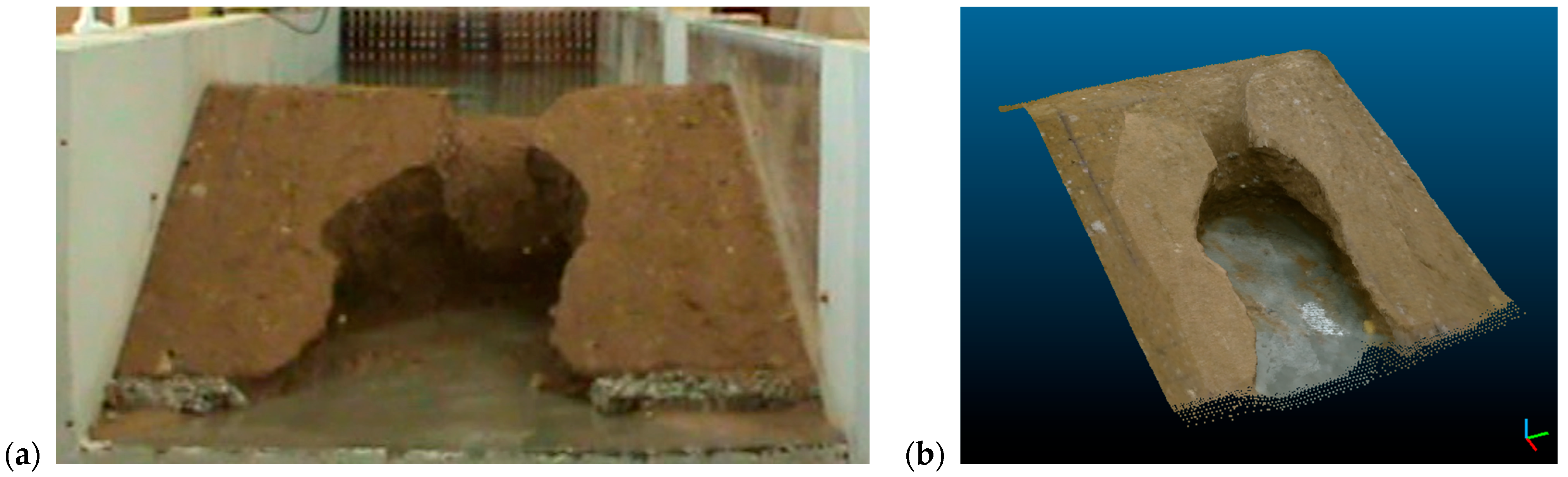
During the test interruption, the breach morphology was characterized with a Kinect sensor for Xbox One from Microsoft (Redmond, Washington, USA). Kinect is a depth sensing device composed of two internal cameras (RGB and IR-camera) that allows for the simultaneous acquisition of color and depth images (Jonatas et al. 2025 [21]). The interruption of the test is required because the water flow over the breach is turbid, due to suspended sediments. Reduced visibility reduces the reliability of Kinect acquisitions (Alvarez et al. 2025 [6]).
Several depth images were acquired with the Kinect sensor to perform a complete sweep of the breach. The acquired data consists, thus, of a collection of images from different angles, where each pixel contains a depth value indicating the distance of objects from the sensor. The post-processing of the acquired data allowed the creation of points clouds, which led to 3D reconstructions of the embankment.
The post processing of the depth images was performed with the software CloudCompare-v2.12.0. It included the point cloud alignment to the same coordinate system; removal of all points that do not belong to the breached dam (e.g., channel walls); merging of the point clouds and noise removal and smoothing of the final cloud (Jonatas et al., 2025 [21]; Amaral et al., 2023 [20]). This procedure allowed for the reconstruction of the breach surfaces and 3D characterization of the erosion cavities (Figure 1).
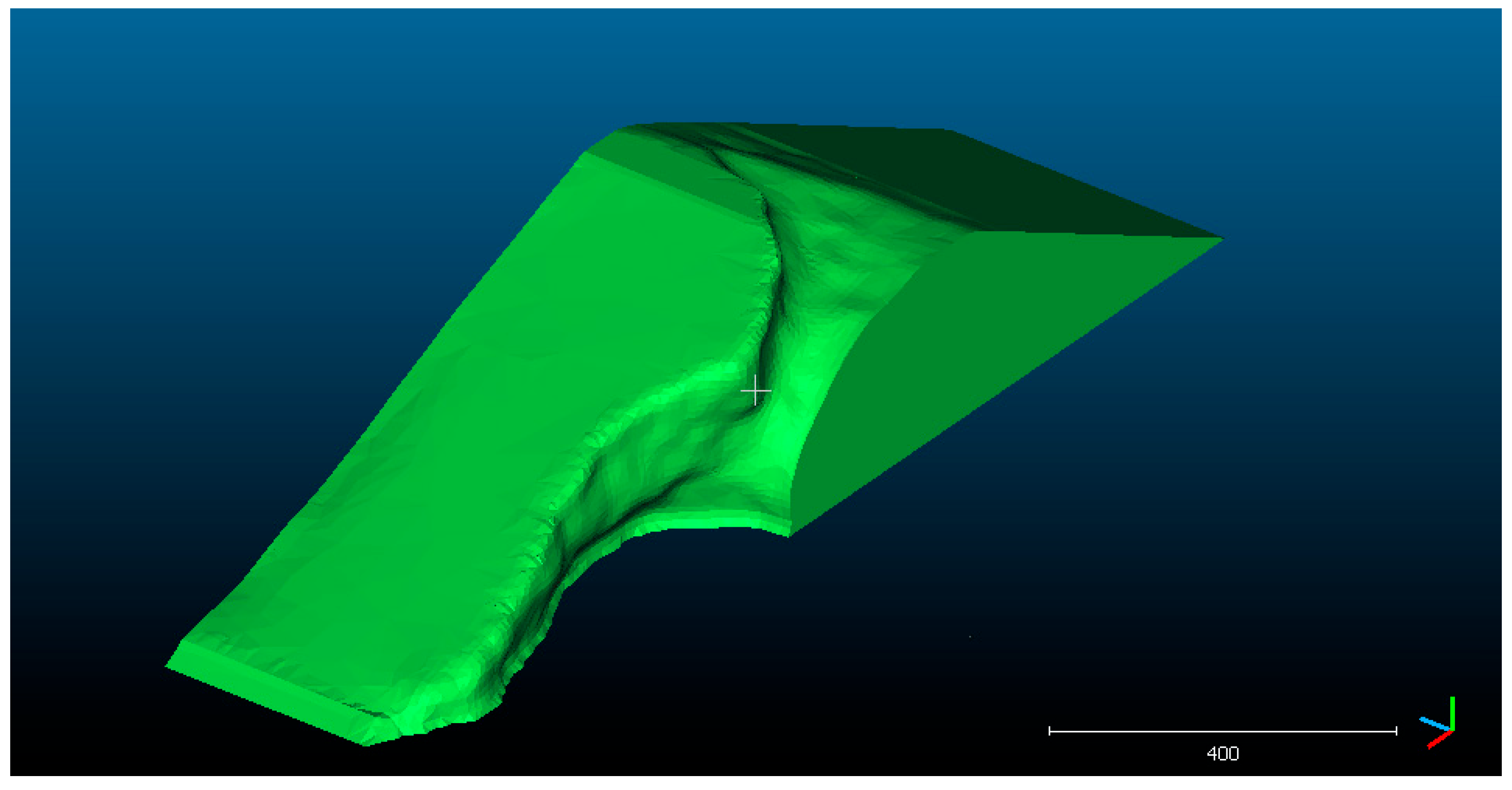
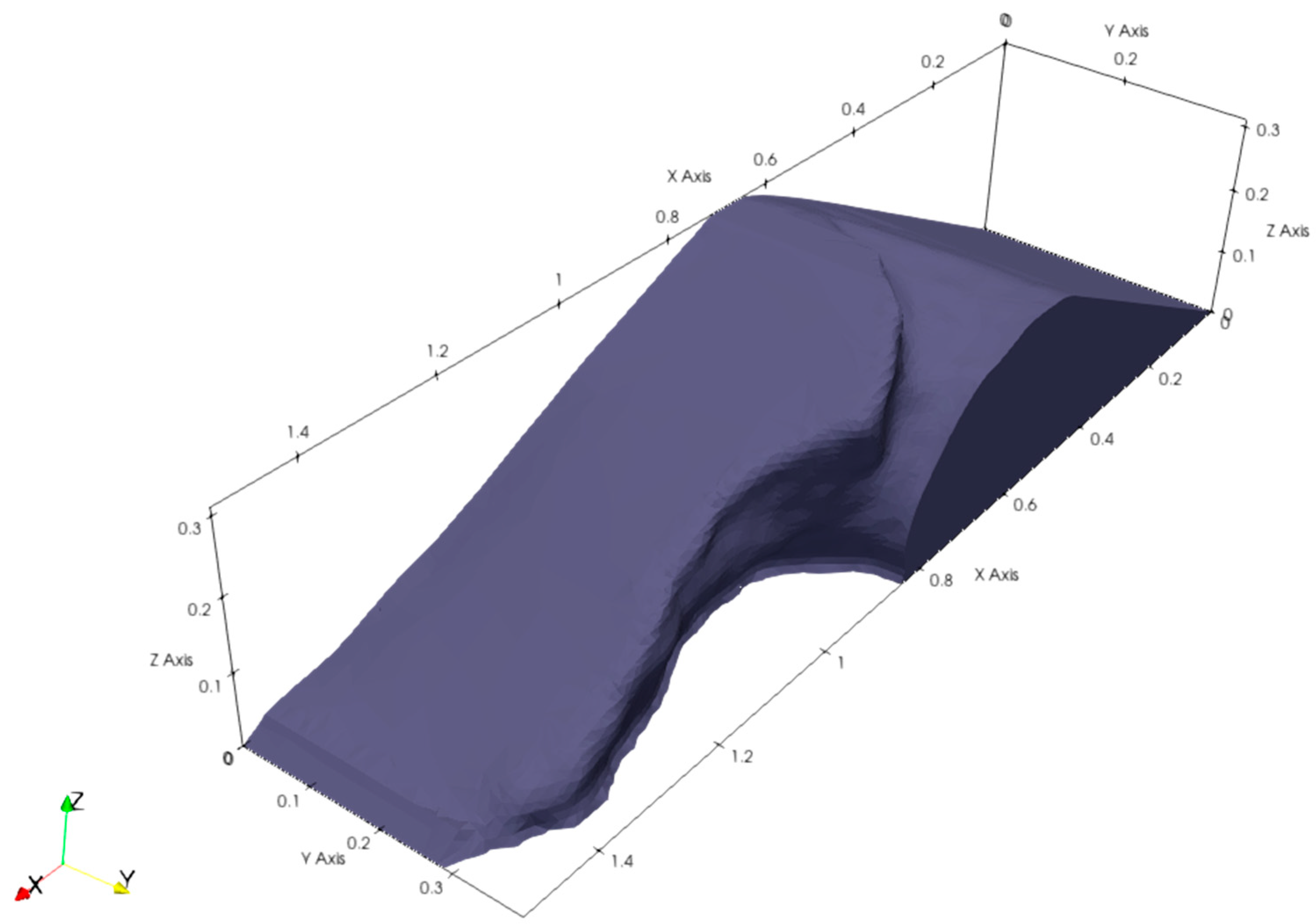
The surface data depicting the three-dimensional (3D) geometry of the breached dam was then converted in a solid mesh to be 3D-printed, to obtain a non-erodible scaled model (Figure 2). This scaled model was used in a smaller flume at Instituto Superior Técnico, under controlled flow conditions and able to be studied in detail with optical access and without the constraints associated with transient flows.
To allow for optical access for Particle Image Velocimetry (PIV) only half of the dam was printed. We justify this option by having observed that the breach morphology in the instant of flow arrest was essentially symmetrical (Figure 1) relative to a vertical plane perpendicular to the crest of the dam and in its mid-section. Any small deviation from symmetry introduces a small but non-quantifiable error, which is an undesirable effect, but allows for a much larger benefit of being able, for the first time, to assess the detailed flow structure during the breaching process. The mid-section was approximately the thalweg of the breach channel, as seen in Figure 2.
The frozen dam model allows for a detailed study of the flow in an instant representation of a phase of the breach evolution—the transition between the first and the second stages. In the first stage, the downstream dam shell is eroded as a headcut that eventually finds the rigid bottom and progresses upstream to the dam crest. In the second stage, the breach crest deepens, increasing the hydraulic head, allowing for a fast growth of the breach discharge (Alvarez et al., 2025 [6]). In the transition phase, that the fixed dam represents, the breach channel has fully formed but the breach crest has not yet started to deepen at a fast rate. Under these conditions, we note that the time scale of morphology changes is much larger than the fluid time scales. The time needed, at the maximum hydraulic erosion rate, to erode a layer of the thickness of the d 90 of soil is d 90 Z b / t m a x 1 = O 10 . The fluid time scales can be estimated as the boundary layer turnover time, δ / U = O 10 1 . This shows that flow structures are able to adapt to the much slower changes in the dam body. Neglecting inertial effects should thus be a good approximation, in what concerns both the frozen dam experiments and the fixed boundary numerical simulations. In both cases, the flow can be conceived as a succession of steady flows over a slowly evolving boundary.

2.2. Experimental Facility and PIV Instrumentation

The measurements were carried out in a closed-circuit flume of the Hydraulics Laboratory of Instituto Superior Técnico. The flume is 5.8 m long, 0.395 m wide and 0.40 m high. The channel can be divided into three sections: settling chamber, test reach and outlet.
The settling chamber has a length of 1.230 m and the transition for the test reach is made by a honeycomb-like structure to break the large turbulence eddies and to allow a more stable flow. The test reach has a length of 3.630 m. Glass walls allow for optical access. Finally, the outlet has a length of 0.94 m. The water was evacuated from the channel by means of two orifices in the channel outlet. These orifices are connected to the flume’s reservoir by means of two independent flexibles pipes, each one having a valve allowing for some degree or control to the water level in the channel.
The bottom of the channel in the test section is made of polymethyl methacrylate, allowing optical access to the flume from the bottom, whereas in both the settling chamber and outlet, the bottom is made of PVC. Water from a reservoir placed under the channel was pumped by a frequency-controlled pump, allowing a fine tuning of the flow rate.
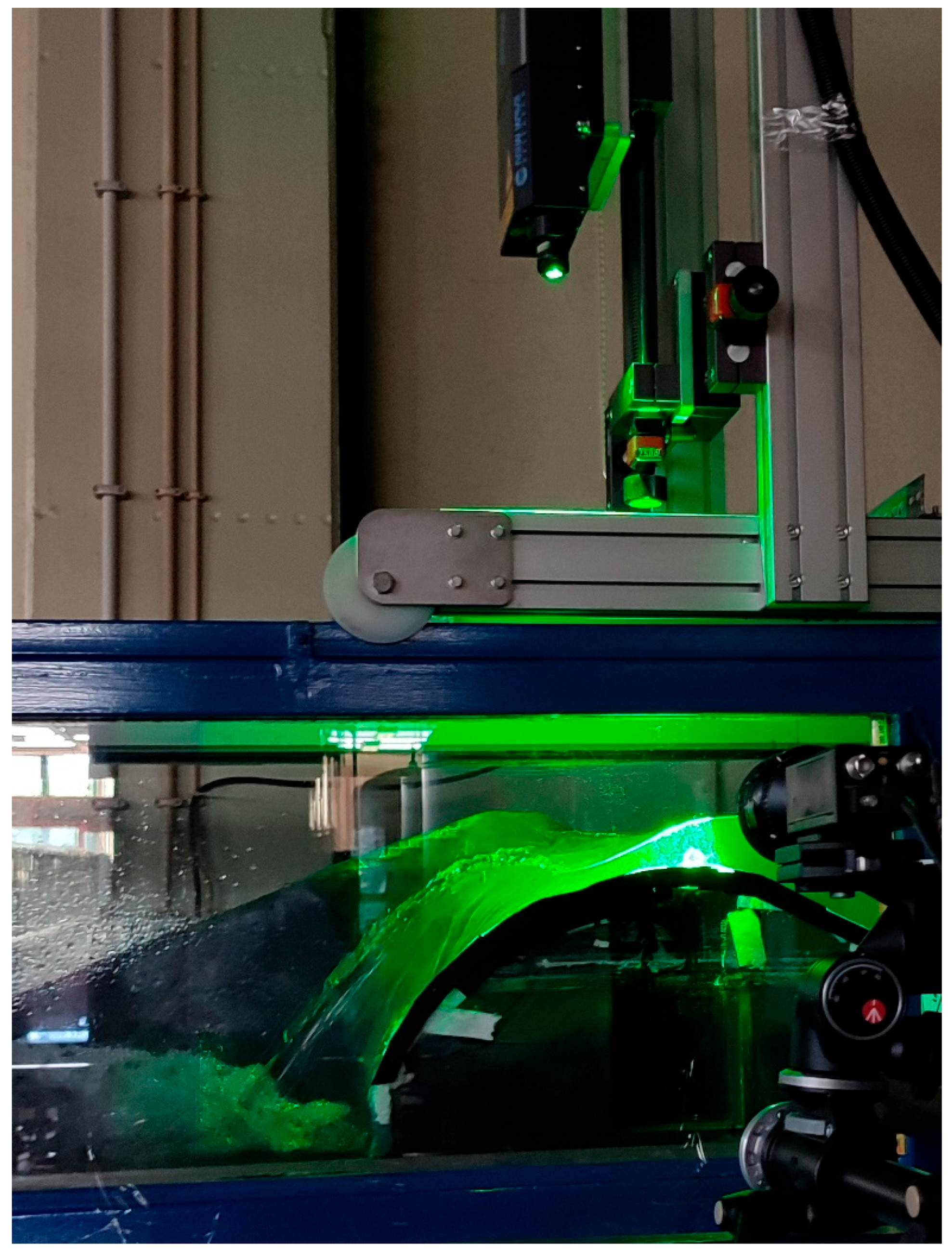
The flow rate was measured by means of an electromagnetic flowmeter placed in the channel-feeding circuit and it was set at Q   =   2.75 L/s. Figure 3 depicts the flume section used in the experiments with the PIV laser light sheet positioned above the channel and the camera placed parallel to the channel window.
Instantaneous velocity fields were measured with a Particle Image Velocimetry (PIV) system by Dantec (Denmark). This system consisted of a Solo pulsed laser (250 mJ), collecting data at 15 Hz, a camera with a resolution of 1600 × 1200 pixels and a timer box to synchronize the laser and the camera. The camera was equipped with a Nikon 60 mm/f2.8 lens. The system was controlled by Dantec’s software DynamicStudio 7.3. The laser was placed above the channel, attached to a moving frame (Figure 3), allowing for sweeping the channel in the x and y directions (details on the PIV system of the IST Hydraulics lab can be found in Ferreira et al., 2011 [22]). The water was seeded with polyamide particles with 50 µm of diameter.

2.3. Data Acquisition Procedure

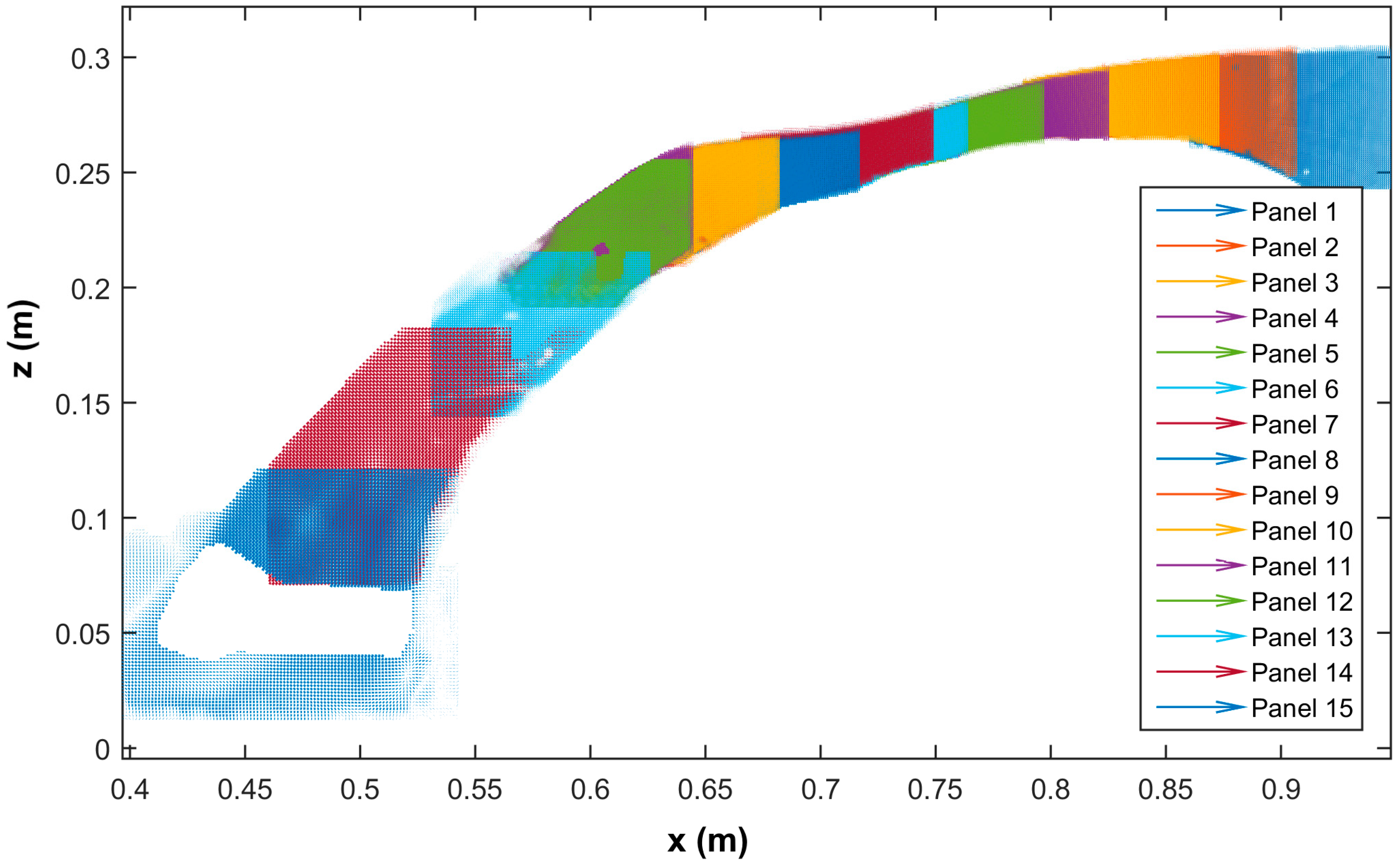
It was not possible to observe all the regions of interest (ROIs) in the camera as this would make it impossible to appropriately resolve the seeding particles, resulting in peak-locking. Therefore, the region of interest was divided into smaller regions, hereafter referred to as sample regions, and the system laser plus camera were moved accordingly to sweep all the ROI. An overlap of at least 10% of the image areas was considered between adjacent sample regions. Figure 4 depicts the scheme used to cover the ROI above the crest of the dam.
The final interrogation window size was 16 × 16 pixel2, corresponding to a spatial resolution between 0.6 and 1.5 mm. Each PIV acquisition was made with at least 4500 image pairs and repeated three times. PIV is an established technique nowadays, described in detail in the literature such as in Adrian and Westerweel (2011) [23] and references therein.
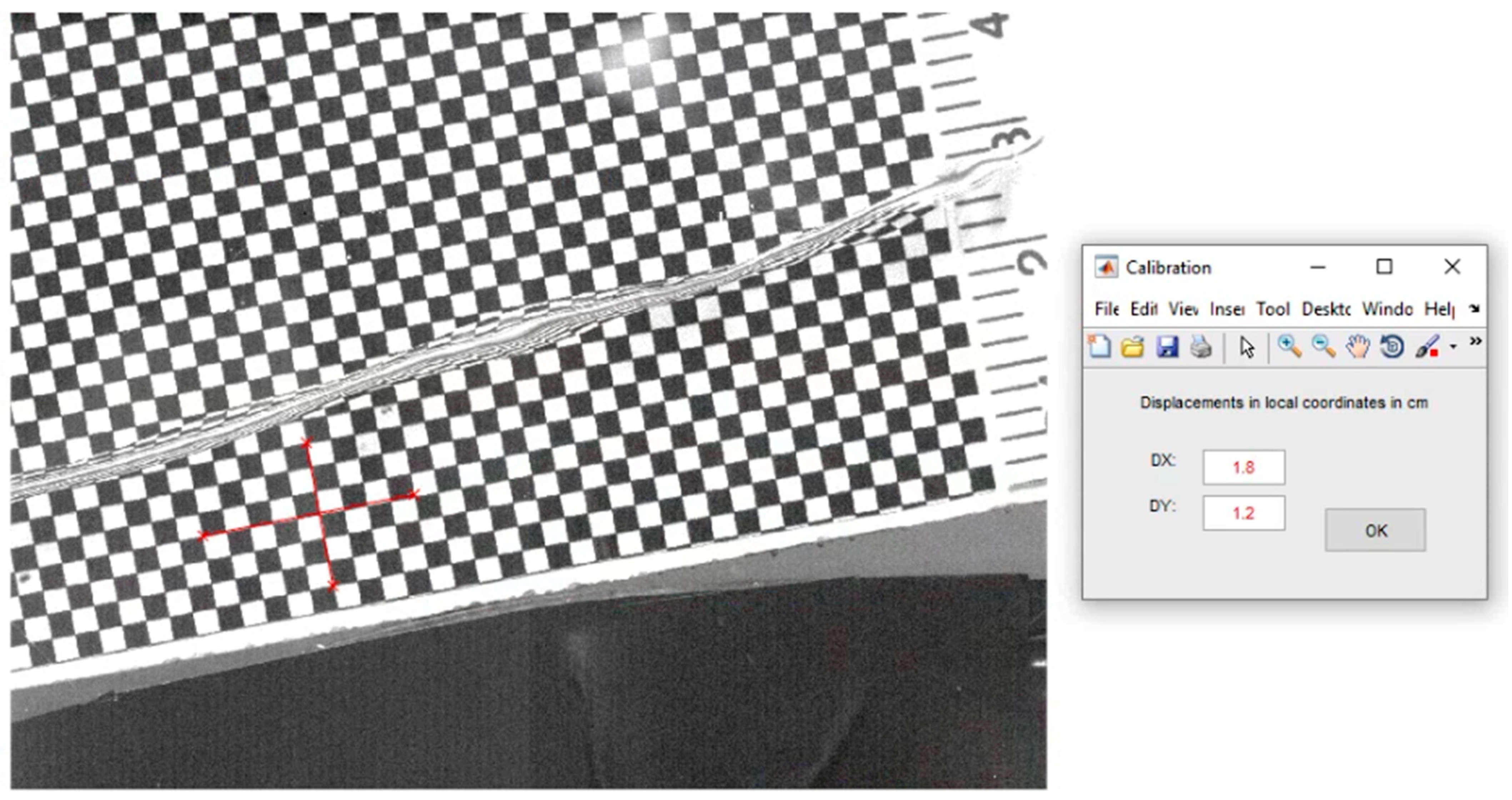
Image calibration was performed using a checkerboard, with 2 × 2 mm2 squares (Figure 5). Since the distortion observed in the images was negligible, a linear conversion algorithm was applied to obtain the final velocity fields in metric units.
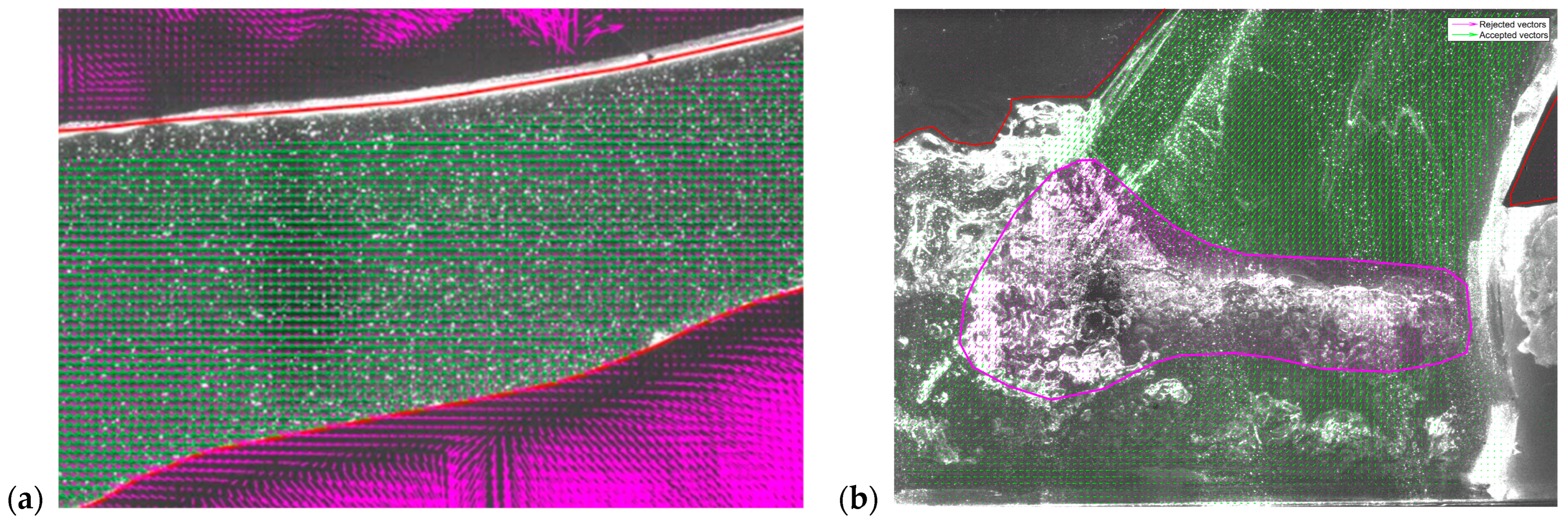
After image calibration, masks were applied with the two following goals: (i) to restrict the analysis to the ROI, thus reducing the processing time; and (ii) to remove areas where the velocity measurements could not be trusted due to the excessive aeriation and turbulence of the jet. In particular, near the plunging jet impact area, the air bubbles block the visibility of the seeding particles (Figure 6).
For the jet impact area, panel 15, the Reynolds shear stresses were computed as
τ x z = ρ u z u x ¯ ,
where ρ is the water density and u i are the velocity fluctuations in x and y directions.

3. The CFD Approach

3.1. Conservation and Closure Equations

This approach is based on the unsteady Reynolds-Averaged Navier–Stokes (URANS) equations with k-ω SST turbulence closure—a robust two-equation model being k-ω near-wall accuracy and k-ε free-stream stability—to simulate turbulent flows effectively. This hybrid approach excels in adverse pressure gradients and separation, as envisaged in this application.
The governing URANS equations can be written as:
ρ t + ( ρ u i ) x i = 0 ,
( ρ u i ) t + ( ρ u i u j ) x j = p x i + x j μ u i x j + u j x i τ i j x j ,
where ρ is the fluid density, u j are the Reynolds-averaged velocity components in a cartesian frame { x , y , z } , where z is the vertical coordinate, against the gravity vector, p is the pressure, μ is the dynamic viscosity, and τ i j = ρ u i u j ¯ is the Reynolds stress tensor.
The k ω SST model introduces two transport equations for the turbulent kinetic energy k and the specific dissipation rate ω :
( ρ k ) t + ( ρ u j k ) x j = P k β * ρ k ω + x j μ + σ k μ t k x j
( ρ ω ) t + ( ρ u j ω ) x j = α ω k P k β ρ ω 2 + x j μ + σ ω μ t ω x j + 2 ( 1 F 1 ) ρ σ ω 2 1 ω k x j ω x j ,
where P k is the production of turbulent kinetic energy, and μ t = ρ k ω is the turbulent viscosity. The blending function F 1 ensures a smooth transition between the k ω and k ϵ formulations. It is defined as
F 1 = tanh min max k β * ω y , 500 ν y 2 ω , 4 ρ σ ω k C D k ω y 2 4 .
The k ω SST model is implemented in OpenFOAM using the turbulence modeling framework. Having been subjected to extensive validation, the k ω SST approach has been shown to provide credible solutions in 3D flows with separation, recirculation, and wall-bounded turbulence.

3.2. Considerations on Discretization and Numerical Solution

The discretization of the governing equations is performed using a finite volume method (FVM) on a computational grid composed of structured hexahedral elements. Hexahedral meshes, implemented in OpenFOAM, are preferred due to their higher numerical accuracy, efficiency, and robustness in resolving flow fields. This is particularly important in flows with strong gradients, such as boundary layers and recirculation zones, expected in the flow in the erosion cavity of the dam.
In the FVM framework, the computational domain is divided into non-overlapping discrete hexahedral control volumes, and the governing equations are integrated over each volume. Fluxes of mass, momentum, and energy are evaluated at the faces of the control volumes using appropriate interpolation schemes, such as linear upwind or central differencing. The face-normal gradients are computed using second-order accurate schemes to ensure consistency and accuracy. Hexahedral grids also facilitate structured alignment with the flow direction, minimizing numerical dissipation and improving the resolution of anisotropic turbulence structures.
The numerical mesh is built around the digital model of half the dam, replicating experimental conditions (Figure 7).
OpenFOAM includes a combination of interpolation techniques, robust time-stepping methods, and boundary conditions while ensuring the numerical stability and accuracy required to resolve complex hydrodynamic phenomena.
Interpolation and differentiation schemes determine the accuracy and stability of the numerical solution. For convective fluxes, we employed linear upwind differencing (LUD) to balance accuracy and stability, particularly in regions with steep gradients. It uses flux-limiting functions to prevent spurious oscillations near discontinuities. For diffusive fluxes, central differencing was employed, providing second-order accuracy by averaging values at cell faces. Cell-face values are reconstructed using appropriate linear or non-linear interpolation techniques.
Time integration in transient simulations is handled using a semi-implicit scheme based on the backward Euler method and the second-order implicit Crank–Nicolson scheme, conditionally stable and well-suited for URANS simulations. The time step is automatically adjusted during the simulation execution to guarantee adherence to the Courant–Friedrichs–Lewy (CFL) condition, which mandates that the time step remains proportionally related to the local flow characteristics by keeping the Courant number equal or less than one in all domain cells. This adaptative time-stepping mechanism ensures both numerical stability and physical fidelity throughout the transient evolution.
Pressure–velocity coupling employs the Pressure Implicit with Splitting of Operators (PISO) algorithm in interFOAM solver, using a predictor–corrector scheme to iteratively solve momentum and pressure equations until tolerance thresholds are met per timestep—ensuring boundedness in URANS without global convergence. Boundary conditions include inlet water flux with turbulence quantities (k, ω), zero-gradient outflow, cyclic patches for symmetry, and wall functions with near-wall refinement for accuracy.
Boundary treatment is critical to ensure the accuracy of the numerical solution and maintain physical fidelity. An inner region wall function was employed with near-wall grid refinement. For the inlet, we prescribe water flux as well as turbulence quantities (e.g., k and ω ). A zero-gradient Neumann boundary condition is used to allow free outflow. Cyclic boundary conditions are applied when the flow geometry or physical configuration allows, reducing computational cost and ensuring consistent treatment of periodic domains.
CFD simulations complement experimental and PIV measurements by providing insights into separation and stagnation surfaces, attached vortices, secondary currents, and boundary layer development across complex three-dimensional flow topologies—which are very challenging to measure directly—thus enabling a better understanding of key mean flow features such as separation zones, vortex dynamics, and their implications for hydraulic erosion processes.

4. Experimental Data and Numerical Results

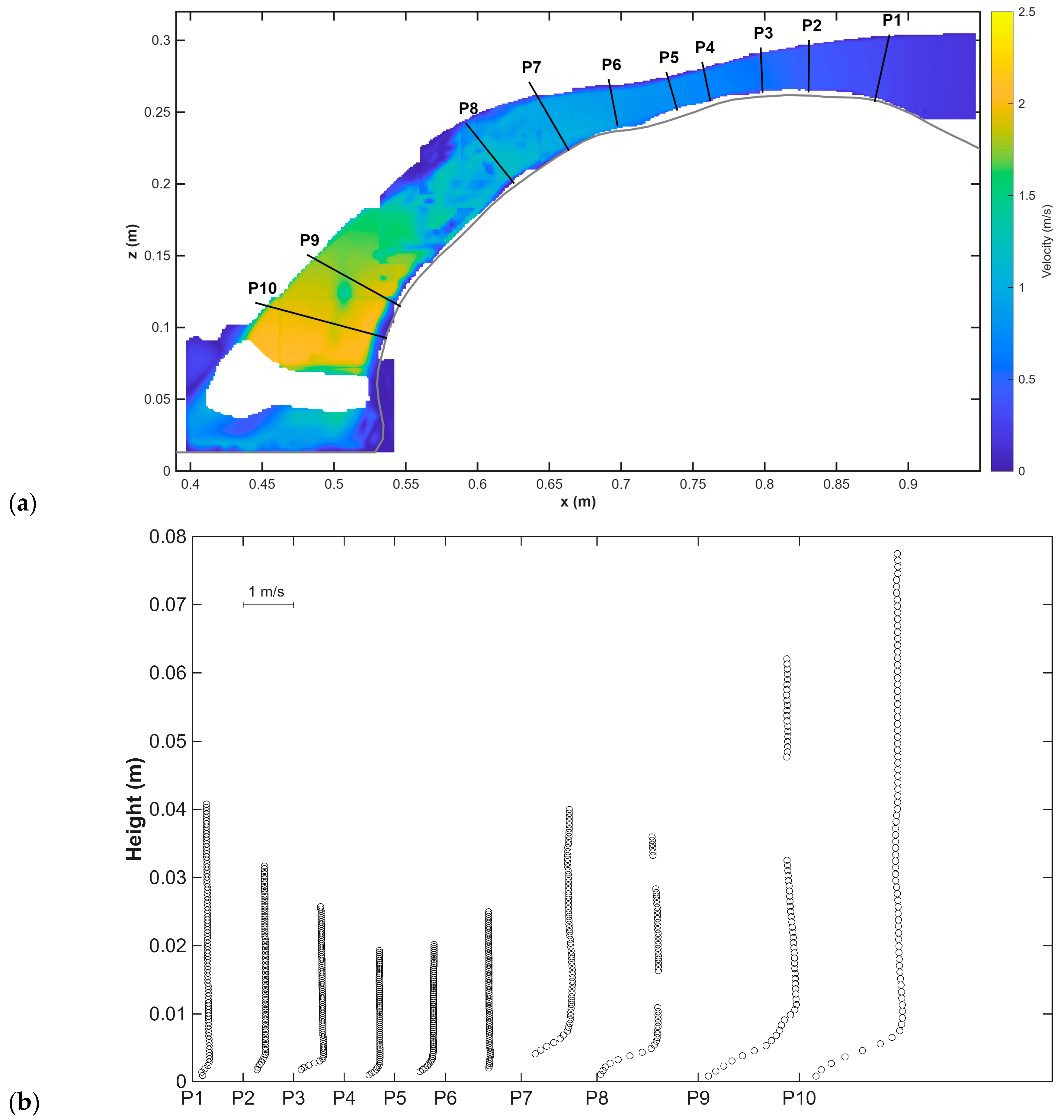
The mean velocity field over the centerline of the dam crest, measured with PIV, is shown in Figure 8. The location of the cross-sections where velocity profiles were sampled along the crest are plotted in Figure 8a, along with the flow profile. The wall-normal velocity profiles are depicted in Figure 8b, showing the evolution of the boundary layer as the inner part of the profile, exhibiting a non-zero shear rate. Above the boundary layer a uniform flow profile develops up to the free surface. It is clear from Figure 8b that the thickness of the flow layer does not increase monotonically from upstream to downstream (right to left in Figure 8a). This means that the von Kármán classical model for the development of the boundary layer is not valid in the breach channel. It is also observed that the mean velocity increases from upstream to downstream as does the flow thickness. The discharge is constant in these tests, but this does not constitute a mass conservation error: as the flow enters the breach, it is deflected to the center of the breach channel. The flow depth increases over the channel center but the total flow area is reduced. The PIV measurements were taken near the equivalent centerline (near the symmetry wall, in the frozen model dam) and thus capture the visible effect of this flow redistribution/flow convergence and consequent increase in its thickness adjacent to the glass side wall.
As the flow depth in the center of the channel increases, the pressure gradient becomes adverse, eventually past the threshold of separation. The last two profiles in Figure 8—profiles 9 and 10—already show a curvature indicating that the flow is near the onset of separation. Separation eventually takes place near the end of the breach channel and comes to occupy a region adjacent to the bottom of the flume.
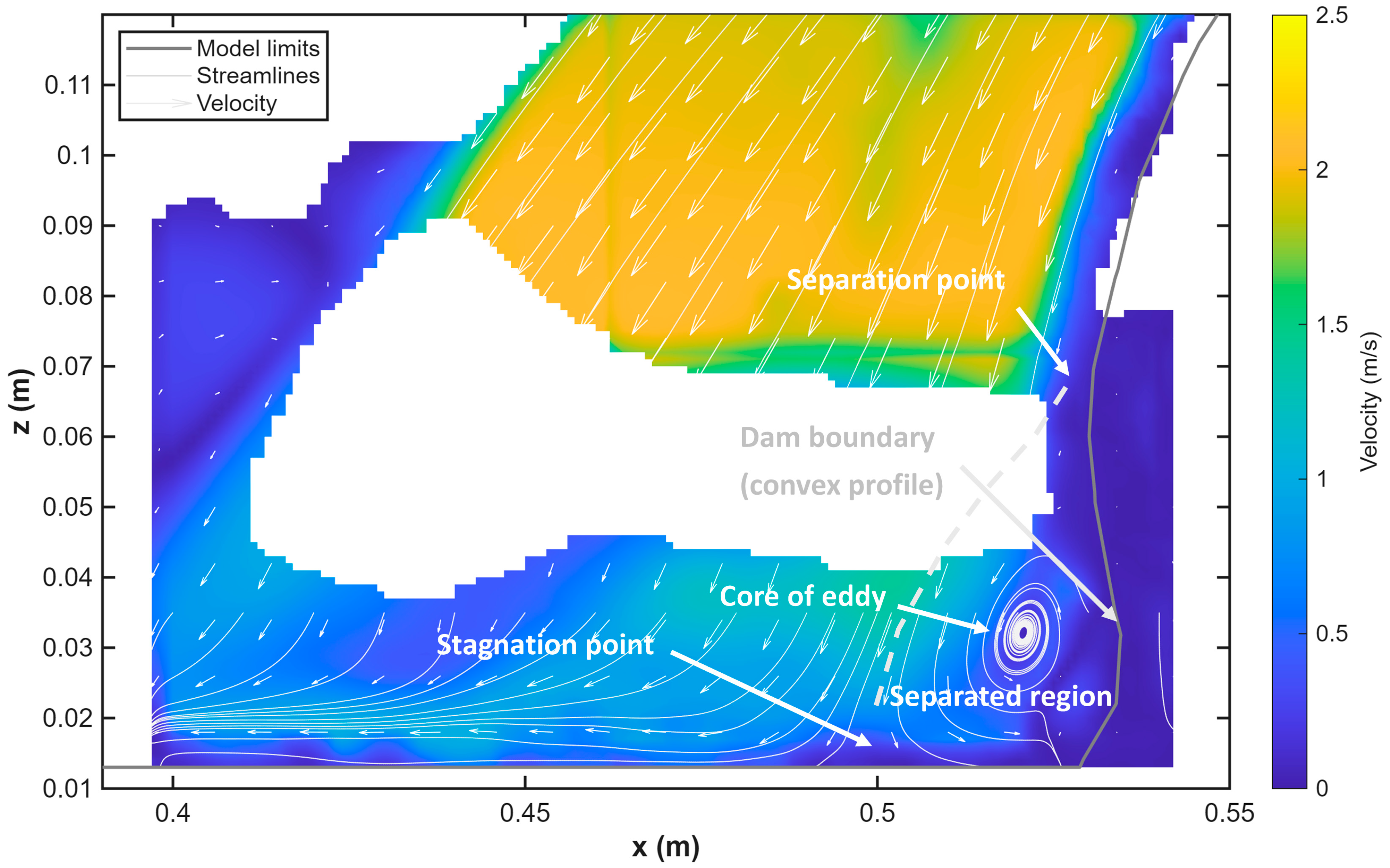
Figure 9 shows the plunging jet impact area and the circulation associated with the separation of the boundary layer. The central part of the flow has been masked out since air entrainment would reduce the quality of the velocity data. Below the region where air entrainment is the dominant feature, the flow encounters the bottom, generating a stagnation point. The flow flattens downstream (to the left in the figure) to exit the dam cavity. Upstream of the stagnation point (to the right in the figure), the flow exhibits a conspicuous circulation. Figure 9 thus reveals the existence of a strong eddy, with a rotational flow, inside the separated region (note that the flow is from the right to the left).
It is interesting to note that the dimensions of the eddy are a close match to the convex profile of the dam wall at the lower end of the breach channel. Although not conclusive, since this is not a live erosion test, it seems to form a strong working hypothesis that the eddy in the separated region is relevant to explain underscouring erosion and upstream propagation of the inner cavity.
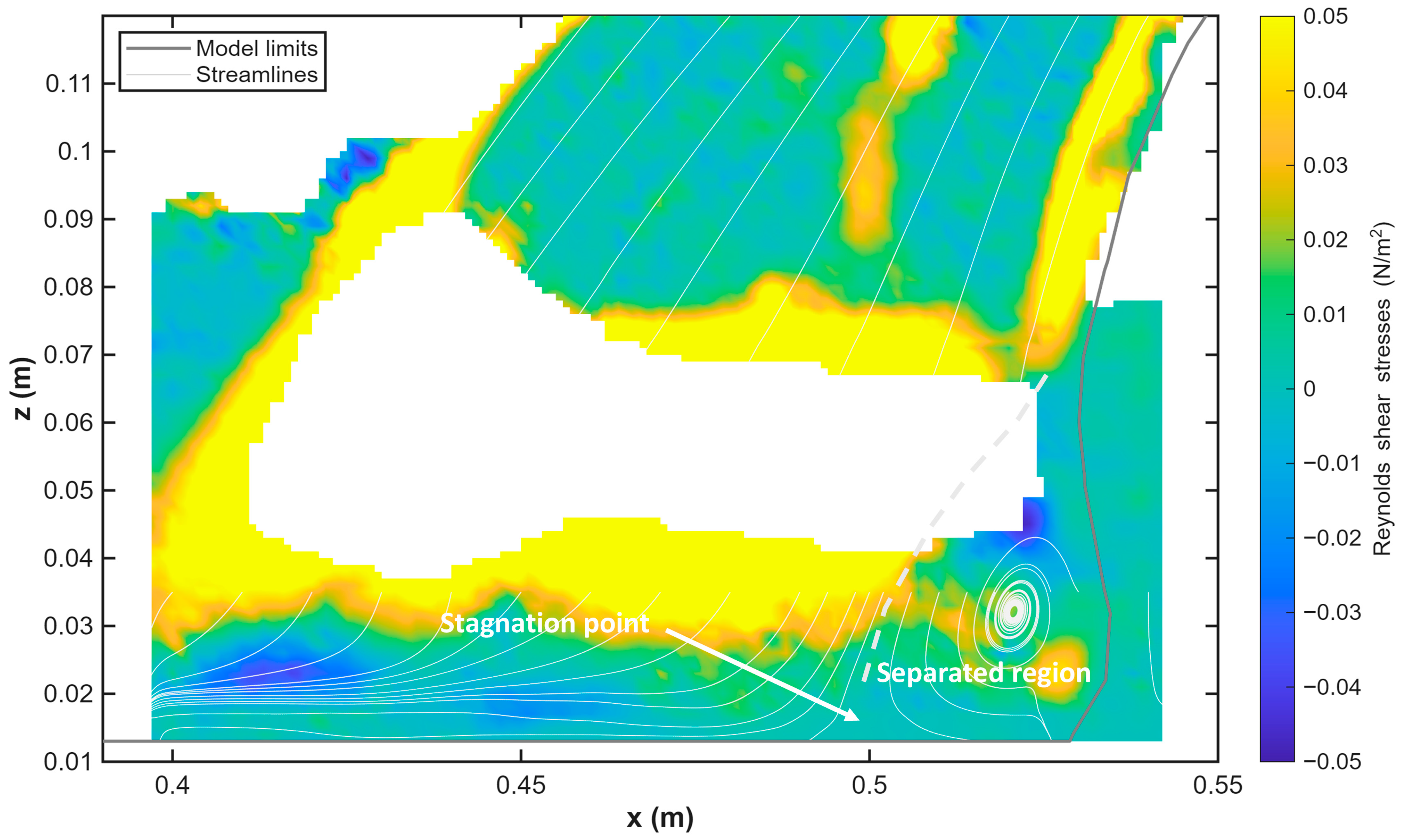
Reynolds shear stresses in this region are shown in Figure 10. The higher values are registered in the region where air is entrained. High shear stress values are also found on the separated region and in the developing boundary layer downstream of the stagnation point. Around the locus of the stagnation point, turbulence is strongly suppressed, as the pressure gradients are very high, resulting in the lowest observed values of the Reynolds shear stresses.
We compared the results of the CFD numerical simulations with the experimental results in order to assess the potential of the unsteady RANS solution to describe the dam breach flow. Complete verification and validation, with mesh sensitivity analysis or mesh convergence, and analysis of spatial error distribution, is out of the scope of this work.
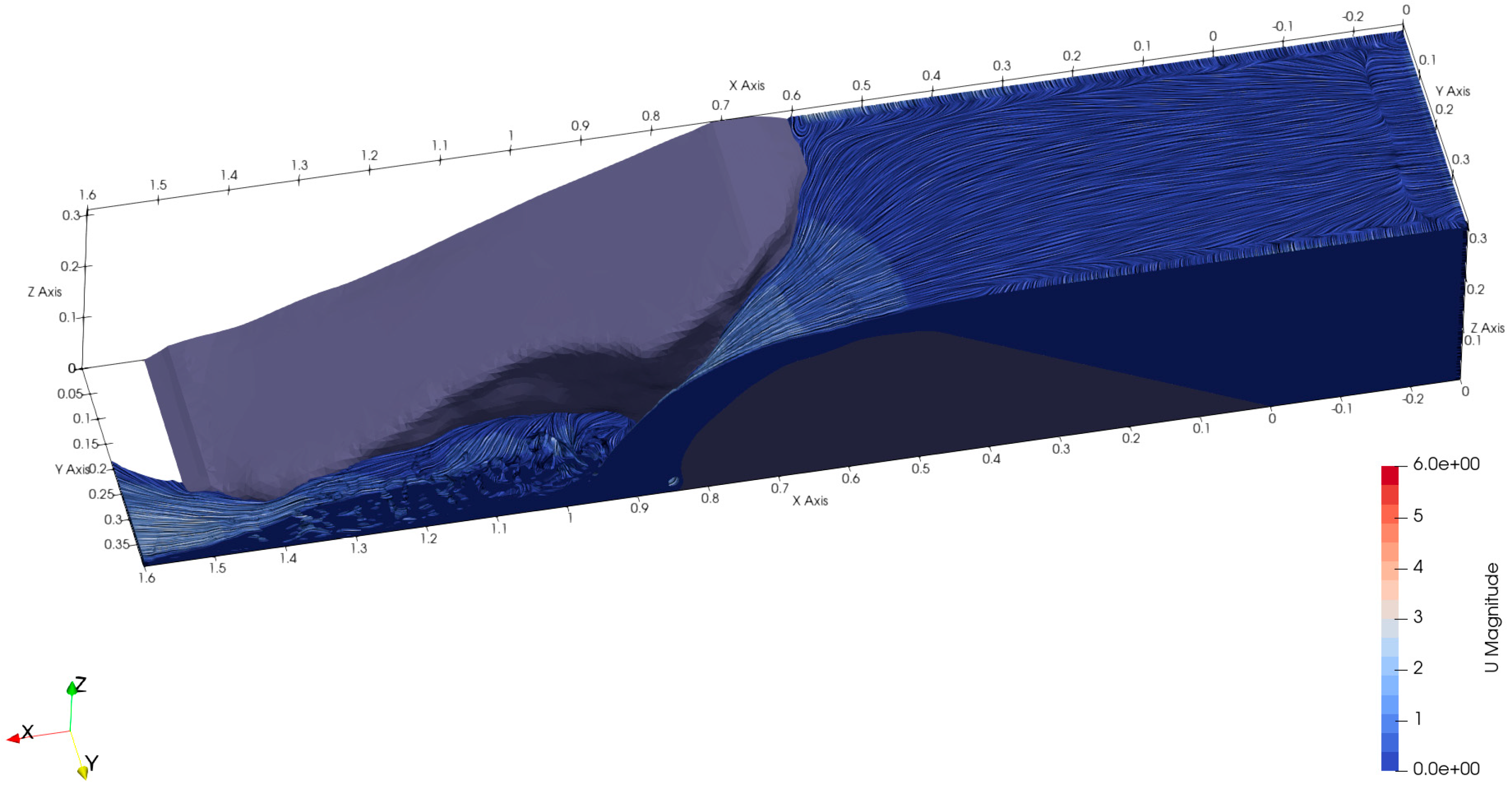
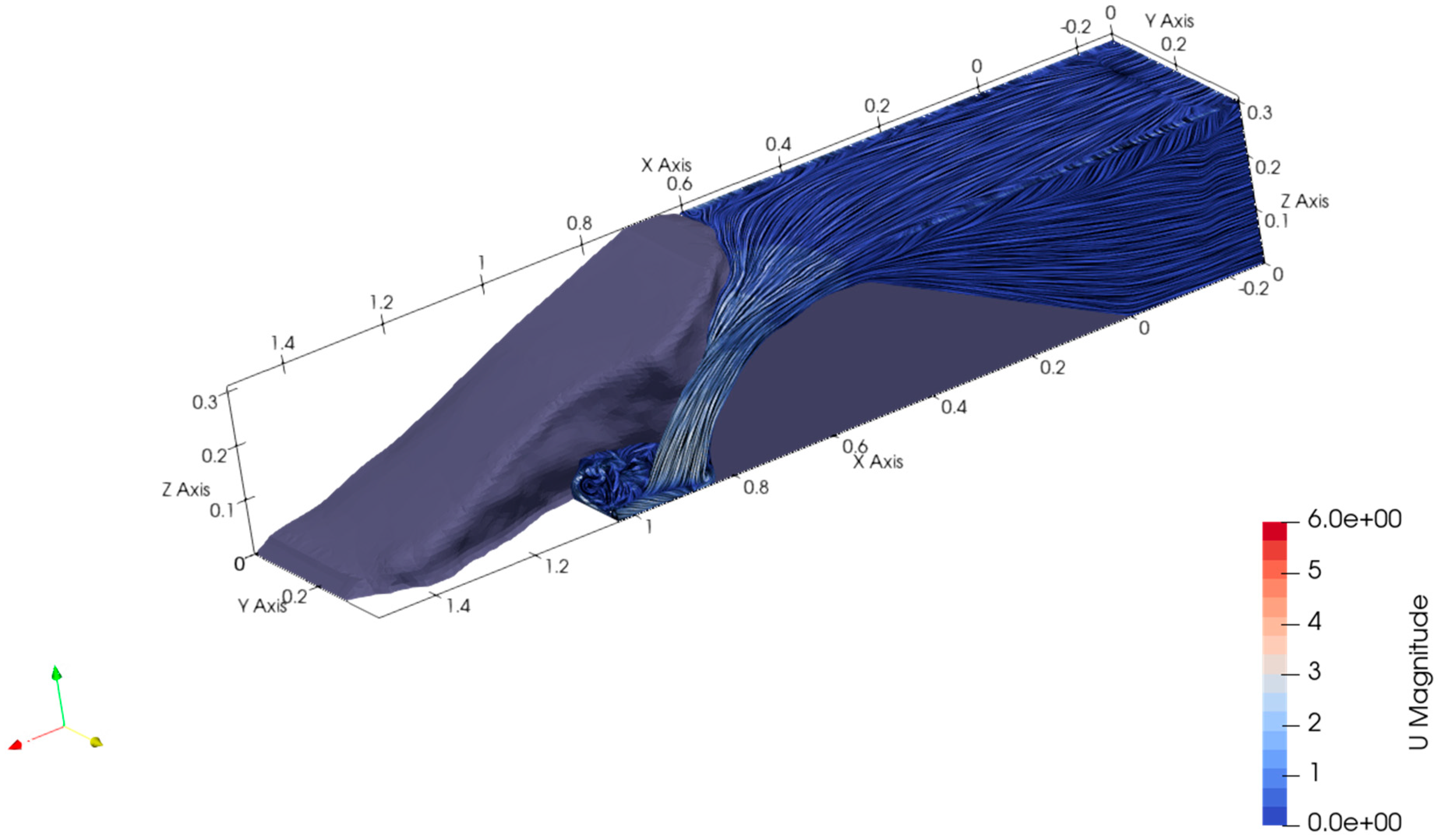
An overview of the solution is depicted in Figure 11. The simulation correctly captures the convergent flow into the breach, including the increase in flow depth. The latter feature is revealed to be the consequence of the diversion of a substantial part of the discharge from the breach wall to the center of the breach. The laterally diverted flow pushes the flow in the center of the breach upwards (represented in the simulation as the symmetry no-friction wall).
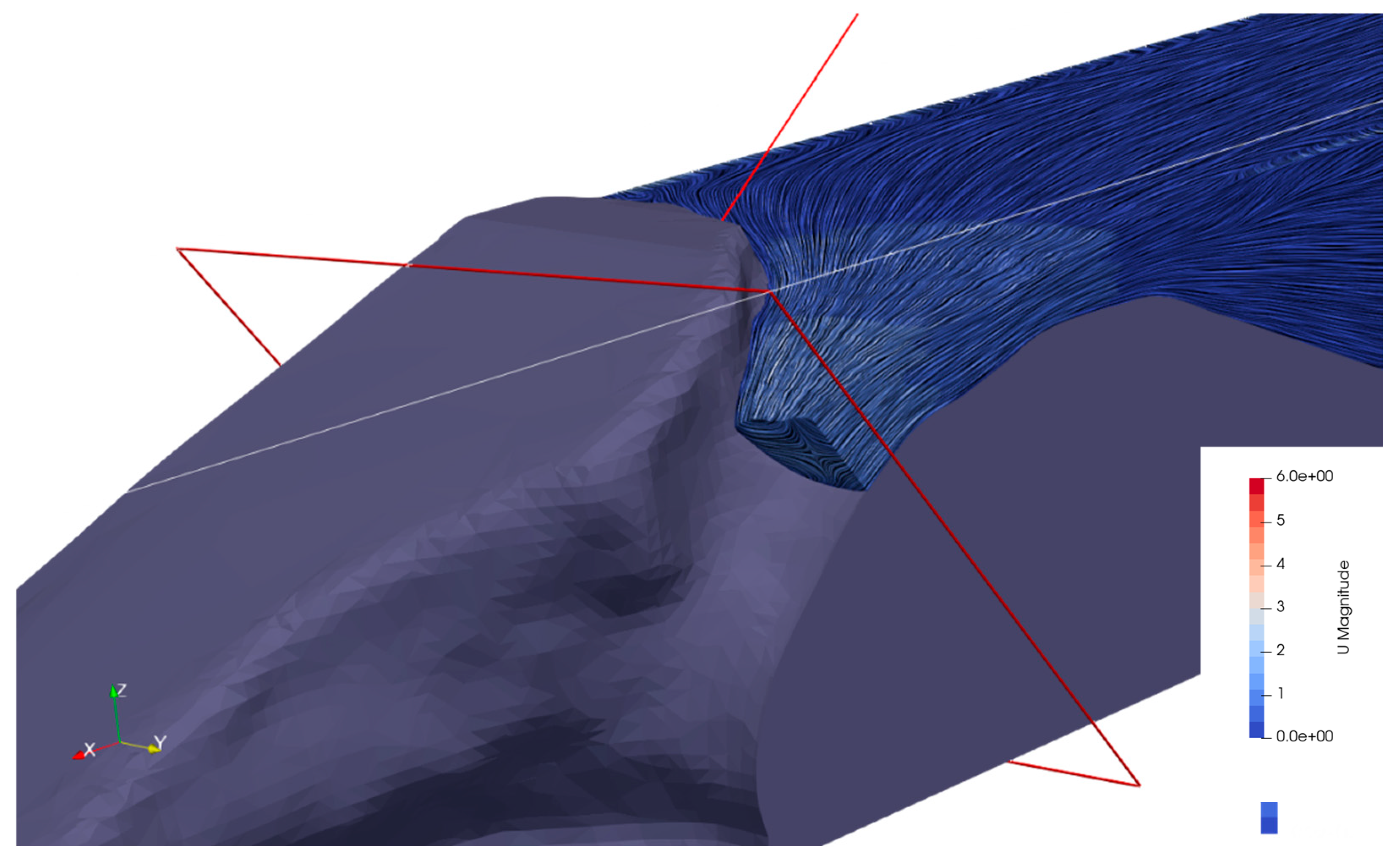
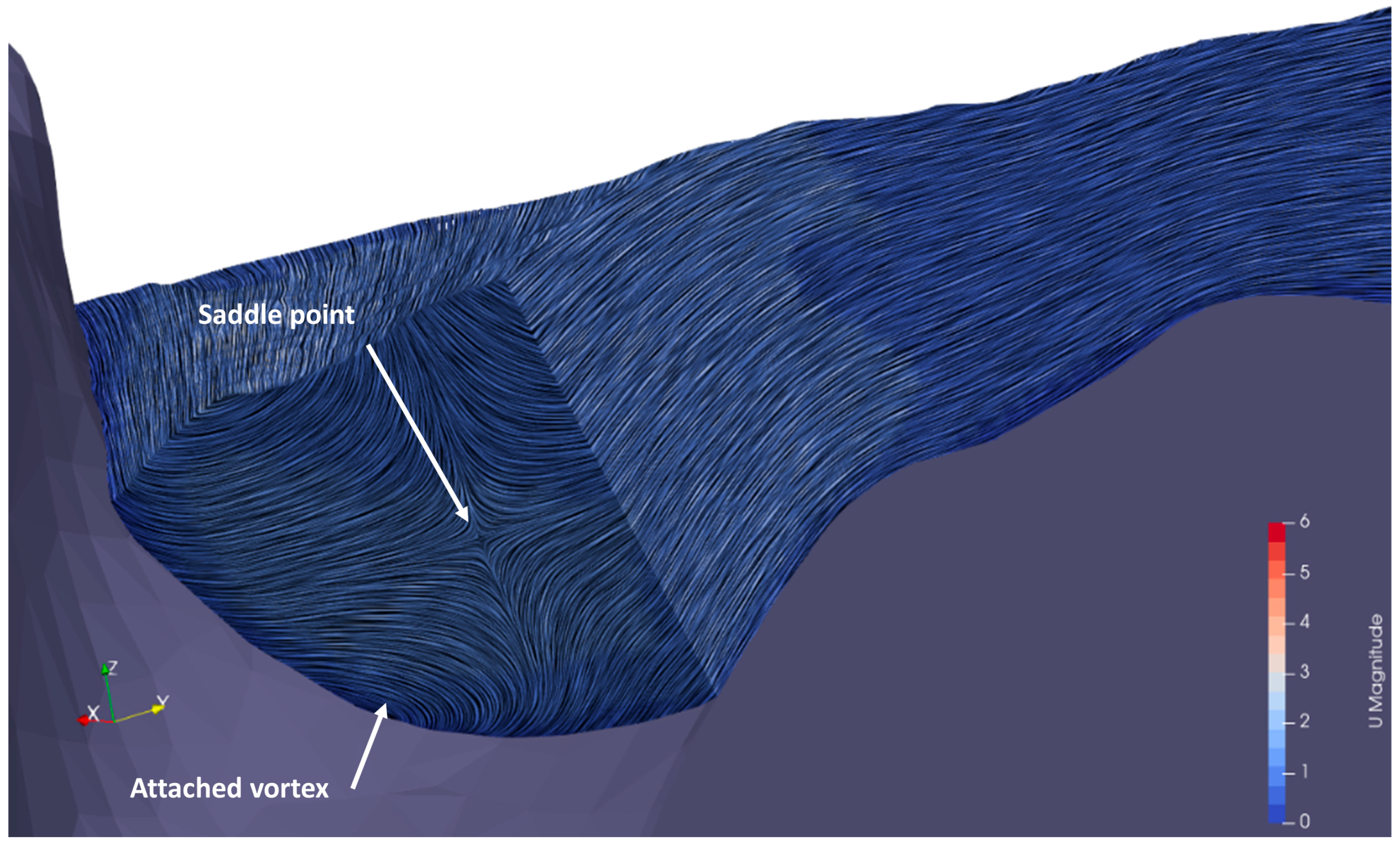
A closer look at the structure of the flow in the breach channel, for instance in the cross-section depicted in Figure 12, reveals that the lateral diversion of the flow creates a complex topology. The detailed flow is shown in Figure 13. The laterally diverted flow curls to the channel wall to form an attached vortex but is also directed upwards to the free surface. This is the result of the interaction with the flow nearest to the symmetry wall, that develops similar structures. The result is a saddle point topological structure that separates the flow adjacent to the cavity wall (that contains the attached vortex) and adjacent to the symmetry wall. It forms a stagnation surface between the upward and downward flow, encompassing the later separated cells. This topological structure has not been confirmed by observations.
The complex topological structure, influenced by the breach crest wall curvature, secondary currents and strong lateral flow convergence, is associated with lateral gradients that are not included in the von Kármán momentum integral which renders this classical model unsuitable to describe the development of the boundary layer over the breach crest and down the breach channel.
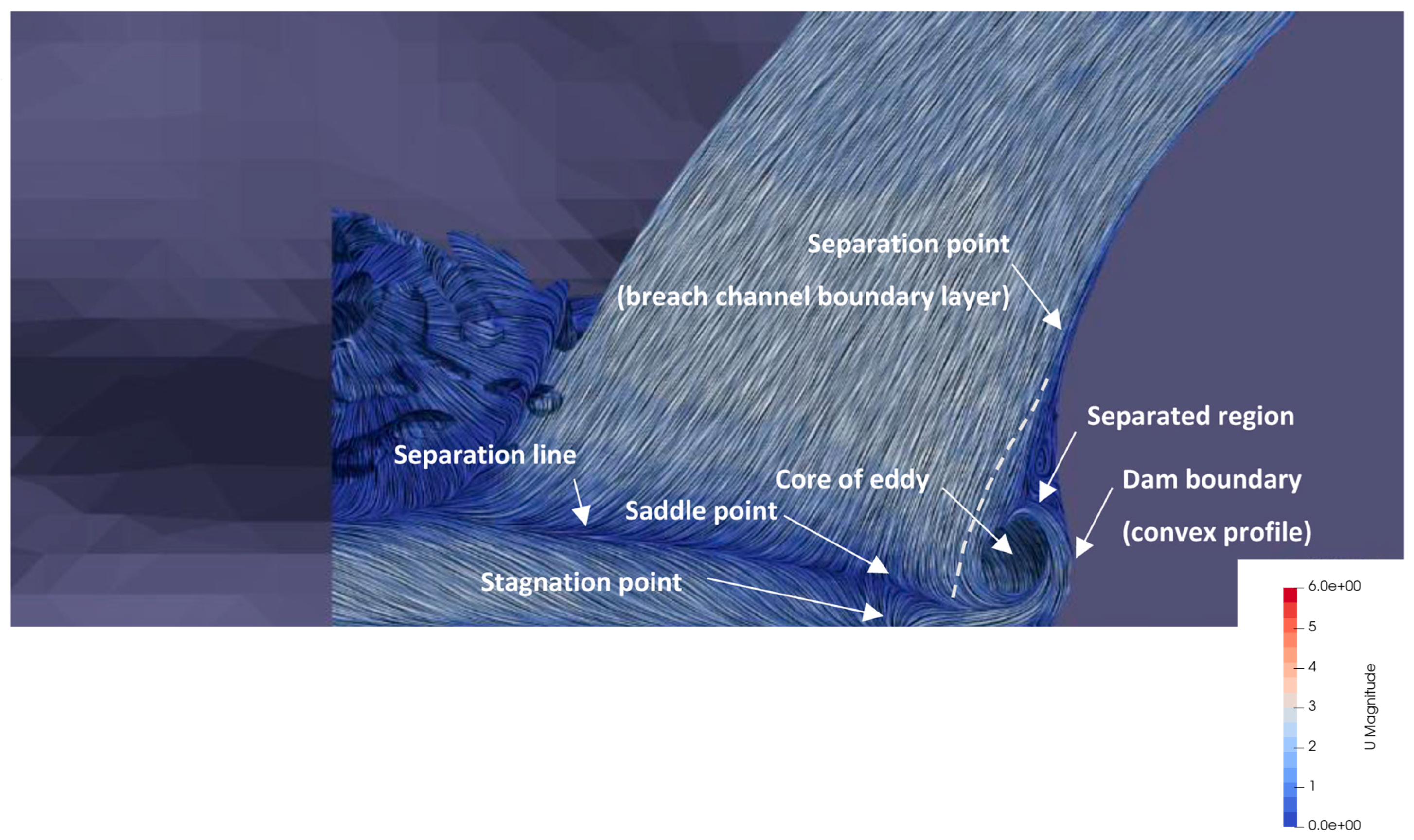
The plunging jet converges to the center of the breach channel. As it hits the channel’s bottom wall, it spreads laterally, downstream and upstream. There is thus a stagnation point, associated with a maximum pressure in the bottom wall. The stagnation point in the numerical solution can be seen in Figure 14.
Above the stagnation point, the flow topology features a saddle point, not confirmed in the PIV measurements. It should be noticed that the saddle point occurs at the symmetry wall while the PIV measurements were taken at 3 mm from the physical channel glass wall. It may also be the case that the experimental saddle point occurs at a higher elevation where air entrainment precludes visualization.
In the upstream direction, the flow curls into a separated region, very similar to that observed experimentally, as seen in Figure 14. The separation of the boundary layer along the breach channel is resolved in great detail. The numerical solution suggests that the separated zone is populated by three vortical structures. From upstream to downstream, the flow separates and forms a small counterclockwise rotating cell (in the coordinate frame of Figure 14), followed by a compatibility cell (clockwise rotating). Lastly, adjacent to the channel bottom, the large counterclockwise rotating cell occupies most of the separated region.
Downstream of the stagnation point, there is evidence of a helical cell whose axis is aligned with the longitudinal direction (the streaklines detach from the bottom wall to attach to the separation line issued from the saddle point), presumably a part of a counter-rotating vortex pair conducting flow out of the erosion cavity. Such a structure was suggested to exist in earlier studies such as Zhao et al. (2015) [24]. The experimental results confirm the formation of a helical cell, since the streamlines seem to converge to a separation line (Figure 9). The helical cell seems less strong in measurements, though.
Figure 15 shows a cross-section of the flow in the erosion cavity. A detailed depiction of the cross-section is shown in Figure 16.
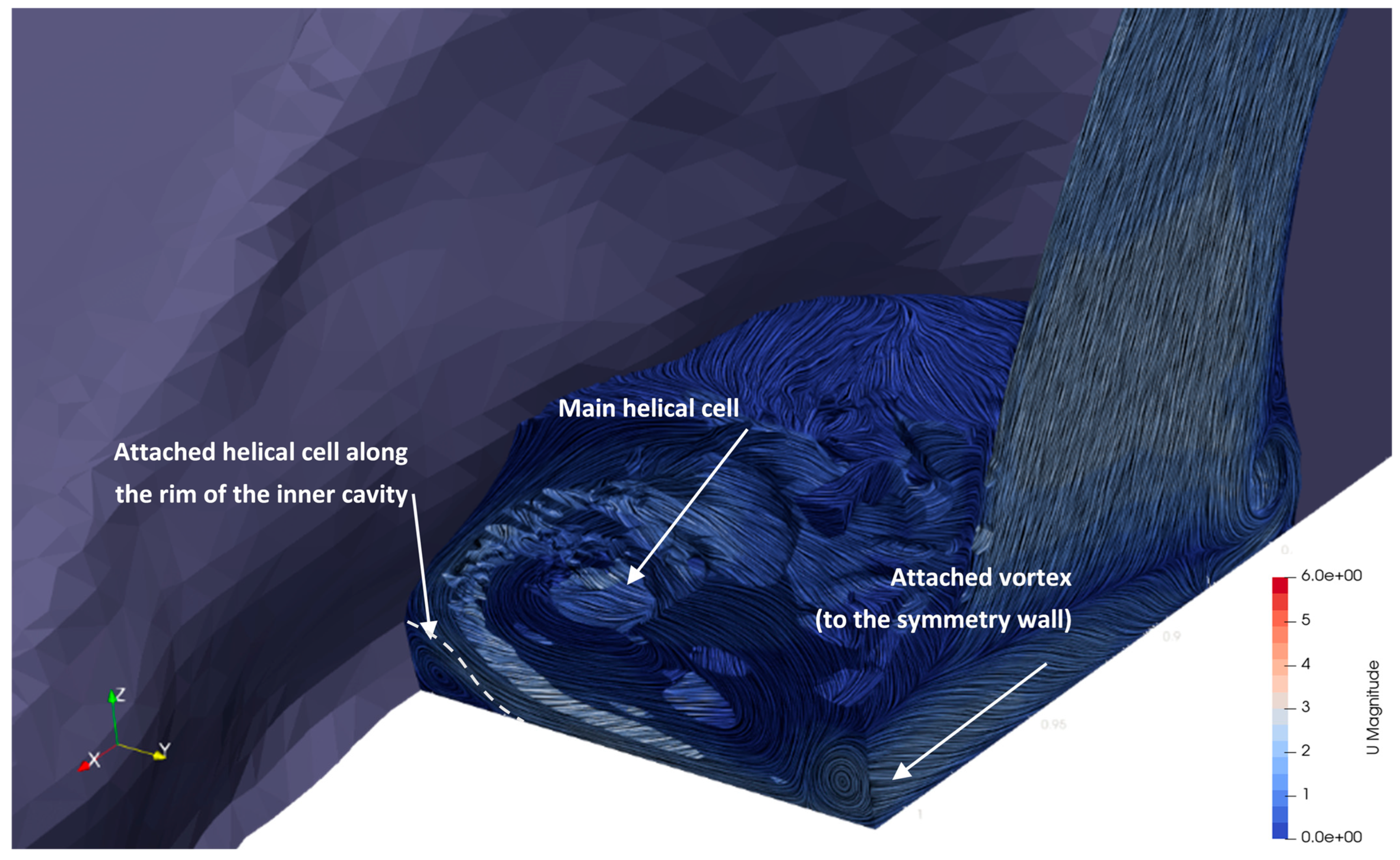
Figure 16 shows that the left half of the counter-rotating vortex pair is clearly visibly attached to the symmetry wall. The main trend of the flow is from the symmetry wall to the dam cavity wall. As it hits the cavity wall, the flow curls back and forms a large counterclockwise rotation flow, driving the flow out of the cavity.
However, Figure 16 also reveals that the laterally spreading flow separates before reaching the cavity wall. There is apparently a separated region running along the rim of the erosion cavity with a rotating cell oriented along the main flow direction. This structure is unlikely to have been originated in the breach choannel boundary layer separation cell, since the rotation is opposite. It is also interesting to note that the dimensions of the attached circulation cell are compatible with the erosion pattern along the rim of the inner cavity—a convex profile that suggests that underscouring erosion is stronger along the interface between the bottom of the channel and the dam body.
The plunging jet impinging on the bottom of the plunging pool generates a complex flow pattern of vortices with an intense air–water emulsion. This complex turbulent flow, curling and separating on the side wall, is responsible for erosion in the inner cavity. This is not speculation; it is necessary that it is so, since this is the flow that is in contact with the inner cavity walls. CFD results help to better understand the erosion pathways, particularly the separation structures at the breach channel end and cavity vicinity. The convex shape of the inner cavity aligns with the contributions from these cells, enhancing shear rates that promote undercutting and upstream/lateral erosion progression. The non-separated turbulent lateral flow towards the cavity walls should, in any case, be responsible for significant erosion in the cavity walls.

5. Conclusions

We have used the CFD suite OpenFOAM to compute URANS solutions for the flow over a breaching dam and within its scour cavity. The aim was to complement laboratory observations of flow structures that may influence the erosion process of the overtopped dams. Measuring live dam breach flows is currently beyond our technical capacities, hence the need for a CFD approach. However, the need to validate CFD simulation tools still remains. Envisaging a methodology to generate data for validation, we 3D-printed a model of a breached dam to generate a stationary flow representing one instant of the transient flow over the breach crest. We performed long-duration measurements using PIV, allowing for the determination of the mean velocity field and of Reynolds stresses.
We did not attempt a full validation of the CFD model. We employed our experimental results to compare with the numerical simulations in specific flow regions. The agreement between the observations and the results of the numerical simulations is good in the sense that the latter reproduces the main observed flow structures. We further used the simulation results to complement the observations, highlighting the complexity of the flow dynamics in the breach channel and erosion cavity.
We showed that the flow in the breach interacts with the symmetry wall (the glass wall of the experimental facility at IST), forming topological structures that include saddle points and attached vortices. The strong lateral gradients in the breach channel, influenced by boundary curvature and attached cells, may explain why classical models like the Kármán momentum integral are unable to describe the evolution of the boundary layer.
The boundary layer along the breach channel separates as it reaches the bottom wall, presumably as a result of an adverse pressure gradient. The plunging jet impacts the bottom wall of the breach channel creating a maximum pressure in the stagnation point that drives lateral and longitudinal flow upstream and downstream. The flow that spreads out from the stagnation point is responsible for enlarging the inner erosion cavity. The details of this flow offer hints to how underscouring may take place.
Upstream of the stagnation point, the flow meets the separated boundary layer and forms a strong eddy whose dimensions fit the convex erosion pattern underneath the breach crest. In the lateral direction, the flow directed to the side walls of the inner cavity curls back and forms large-scale helical cells and counter-rotating vortices. It also separates near the bottom, forming an inner helical cell along the rim of the cavity. Its size is commensurable with the convex scour mark that runs along the rim of the cavity. While it is legitimate to propose, as a working hypothesis, that these eddies and helical cells are significant to the erosion process, further research is needed to clarify their role and how they could be parameterized.
This study has provided evidence for flow structures that seem to match erosion patterns in the inner cavity and may thus be significant to the erosion process. It should be emphasized that these structures have been observed in steady-flow conditions in a fixed geometry. We have shown that the time scales of unsteadiness and morphology are much larger than the time scales that govern the adaptation of the large eddies. This allows us to propose the observed flow structure as a good proxy for reality. However, we should remain motivated to improve our experimental methods in order to conduct similar experiments in live erosion tests under unsteady conditions. We should be careful in extrapolating these results to prototype-scale dams where the values of the Reynold numbers are much larger. Since boundary layer development and separation are influenced by viscosity, the size and relative influence of the observed structures may be different in a larger dam.


Author Contributions

Conceptualization, R.M.L.F. and T.A.; methodology, R.M.L.F., N.M.C.M., T.A. and T.V.; software, N.M.C.M.; validation, N.M.C.M. and T.A.; formal analysis, R.M.L.F., N.M.C.M. and T.A.; resources, R.M.L.F. and T.V.; data curation, T.V.; writing—original draft preparation, R.M.L.F. and N.M.C.M.; writing—review and editing, R.M.L.F.; supervision, R.M.L.F. and T.V.; funding acquisition, R.M.L.F. and T.V. All authors have read and agreed to the published version of the manuscript.

Funding

This work was partially supported by national funds through Portuguese Foundation for Science and Technology (FCT), projects UIDB/04625/2025 of the research unit CERIS, DikesFPro PTDC/ECI-EGC/7739/2020 and DT4Rivers 2023.18404.ICD/COMPETE2030-FEDER-00760800, and the Doctoral Grant PD/BD/127801/2016.

Data Availability Statement

All experimental data regarding the live dam breach tests for the characterization of the breach morphology are publicly available at ZENODO via https://doi.org/10.5281/zenodo.15045696, accessed on 21 January 2026.

Conflicts of Interest

The authors declare no conflicts of interest. The funders had no role in the design of the study; in the collection, analysis, or interpretation of data; in the writing of the manuscript; or in the decision to publish the results.

Abbreviations

The following abbreviations are used in this manuscript:
PIVParticle Image Velocimetry
CFDComputational Fluid Dynamics
RANSReynolds-Averaged Navier–Stokes equations
SSTShear Stress Transport turbulence closure model
RASReynolds-Averaged simulation
FVMFinite Volume (discretization) Method
URANSUnsteady Reynolds-Averaged Navier–Stokes Equations
LUDLinear Upwind Differences
PISOPressure-Implicit with Splitting of Operators

References

  1. Temple, D.M.; Hanson, G.J.; Hunt, S.L. Observations on dam overtopping breach processes and prediction. J. Dam Saf. 2010, 8, 28–33. [Google Scholar]
  2. Amaral, S.; Caldeira, L.; Viseu, L.; Ferreira, R.M.L. Designing Experiments to study Dam Breach Hydraulic Phenomena. J. Hydraul. Eng. 2020, 145, 04020014. [Google Scholar] [CrossRef]
  3. Halso, M.C.; Evers, F.M.; Vetsch, D.F.; Boes, R.M. Effect of grain size distribution in non-cohesive spatial dam breach: Hydraulic model investigation and systematic calibration of 2D numerical model. J. Hydraul. Res. 2025, 63, 337–356. [Google Scholar] [CrossRef]
  4. Pickert, G.; Weitbrecht, V.; Bieberstein, A. Beaching of overtopped river embankments controlled by apparent cohesion. J. Hydraul. Res. 2011, 49, 143–156. [Google Scholar] [CrossRef]
  5. Walder, J.S.; Iverson, R.M.; Godt, J.W.; Logan, M.; Solovitz, S.A. Controls on the breach geometry and flood hydrograph during overtopping of noncohesive earthen dams. Water Resour. Res. 2015, 51, 6701–6724. [Google Scholar] [CrossRef]
  6. Alvarez, T.; Ferreira, R.M.L.; Mendes, S.; Aleixo, R.; Amaral, S.; Caldeira, L.; Viseu, T. Breaching of homogeneous dams with internal drainage system. Water Resour. Res. 2025, 61, e2024WR038552. [Google Scholar] [CrossRef]
  7. Mendes, S.; Amaral, S.; Alvarez, T.; Aleixo, R.; Muralha, A.; Viseu, T.; Ferreira, R.M.L. Image Analysis Techniques to Characterize Scaled Embankment Failures. In RILEM Bookseries; Springer: Cham, Switzerland, 2023; Volume 41, pp. 423–438. [Google Scholar]
  8. Gebremariam, F.T.; Tesfay, A.H.; Sigtryggsdóttir, F.G.; Goitom, H.; Lia, L. Overtopping-Induced Embankment Breaching Experiments: State-of-the-Art Review on Measurement and Instrumentation. Water 2025, 17, 1051. [Google Scholar] [CrossRef]
  9. Bento, A.M.; Amaral, S.; Viseu, T.; Cardoso, R.; Ferreira, R.M.L. Direct Estimate of the Breach Hydrograph of an Overtopped Earth Dam. J. Hydraul. Eng. 2017, 143, 06017004. [Google Scholar] [CrossRef]
  10. Rahman, A.; Nistor, I.; Infante, J.A. A Novel Experimental Technique for the Planar Breach Outflow of an Overtopped Sand Embankment using 2DV-PTV. In Proceedings of the 38th IAHR World Congress, Panama City, Panama, 1–6 September 2019. [Google Scholar] [CrossRef]
  11. Aleixo, R.; Amaral, S.; Mendes, S.V.; Viseu, M.T.; Alvarez, T.; Fraga Filho, C.A.; Ferreira, R.M.L. Challenges of Surface Image Velocimetry–The Dam-Breach Example. In Proceedings of the 39th IAHR World Congress, Granada, Spain, 19–24 June 2022. [Google Scholar]
  12. Liu, J.; Xiao, H.; Guo, F. Calculation formula and coefficient analysis of dam breach discharge based on surface velocity. Flow Meas. Instrum. 2023, 94, 102446. [Google Scholar] [CrossRef]
  13. Zainab, M.Y.; Zebedee, A.L.S.; Khairi, A.A.; Zulhilmi, I.; Shahabuddin, A. Modelling of an Embankment Failure Using Flow-3D. In Proceedings of the 5th International Conference on Water Resources (ICWR)–Volume 1: Current Research in Water Resources, Coastal and Environment; Springer Nature: Singapore, 2022; pp. 273–282. [Google Scholar] [CrossRef]
  14. Mashreghi, A.; Elalfy, E.; Goharian, E.; Chaudhry, M.H. Three-Dimensional Modeling of Dam-Breach Development due to Overtopping Failure Using FLOW-3D. In World Environmental and Water Resources Congress; American Society of Civil Engineers (ASCE): Reston, VA, USA, 2025; pp. 510–519. [Google Scholar] [CrossRef]
  15. Fraga Filho, C.A.D.; Ferreira, R.M.L.; Aleixo, R.; Canelas, R.; Amaral, S.; Viseu, T. SPH modelling of mass detachment processes in overtopped dams. The Limits Froude similarity. Adv. Water Resour. 2025, 202, 104987. [Google Scholar] [CrossRef]
  16. Bayon, A.; Toro, J.P.; Bombardelli, F.A.; Matos, J.; López-Jiménez, P.A. Influence of VOF technique, turbulence model and discretization scheme on the numerical simulation of the non-aerated, skimming flow in stepped spillways. J. Hydro-Environ. Res. 2018, 19, 137–149. [Google Scholar] [CrossRef]
  17. Kadia, S.; Albayrak, I.; Lia, L.; Rüther, N.; Pummer, E. Reynolds Stress Model Study Comparing the Secondary Currents and Turbulent Flow Characteristics in High-Speed Narrow Open Channel and Duct Flows. J. Hydraul. Eng. 2024, 150, 04024017. [Google Scholar] [CrossRef]
  18. Amaral, S.; Viseu, T.; Ferreira, R.M.L. Experimental methods for local-scale characterization of hydro-morphodynamic dam breach processes. Breach detection, 3D reconstruction, flow kinematics and spatial surface velocimetry. J. Flow Meas. Instrum. 2019, 70, 101658. [Google Scholar] [CrossRef]
  19. Alvarez, T.; Valente, S.; Amaral, S.; Viseu, T.; Ferreira, R.M.L. Sensitivity Analysis to Initial Conditions in Dam Breach by Overtopping. In Proceedings of the 38th IARH World Congress–Water Connecting the World, Panama City, Panama, 1–6 September 2019. [Google Scholar]
  20. Amaral, S.; Viseu, T.; Zhao, G.; Ferreira, R.M.L. Recent Advances in Instrumentation and Monitoring Techniques Applied to Dam Breach Experiments. In Advances on Testing and Experimentation in Civil Engineering; Chastre, C., Neves, J., Ribeiro, D., Neves, M.G., Faria, P., Eds.; Springer Tracts in Civil Enineering: Chaw, Switzerland, 2023; pp. 299–324. ISBN 978-3-031-05875-2. [Google Scholar] [CrossRef]
  21. Jonatas, R.; Aleixo, R.; Amaral, S.; Mendes, S.V.; Viseu, T.; Ferreira, R.M.L. Laboratory Application of Real-Time LiDAR Technology for Assessing Breach Morphology during the Failure of Earth Dams and Fluvial Dikes. J. Hydraul. Eng. 2025, 151, 04025033. [Google Scholar] [CrossRef]
  22. Ferreira, R.M.L. Turbulent Flow Hydrodynamics and Sediment Transport, Laboratory research with LDA and PIV. In Experimental Methods in Hydraulic Research; Pawel, R., Ed.; GeoPlanet-Earth and Planetary Sciences, Polish Academy of Science Institute of Geophysics: Warszawa, Poland, 2023; pp. 67–111. ISBN 978-3-642-17474-2. [Google Scholar] [CrossRef]
  23. Adrian, R.J.; Westerweel, J. Particle Image Velocimetry; Cambridge University Press: Cambridge, UK, 2011. [Google Scholar]
  24. Zhao, G.; Visser, P.J.; Ren, Y.; Uijttewaal, W.S.J. Flow hydrodynamics in embankment breach. J. Hydrodyn. 2015, 27, 835–844. [Google Scholar] [CrossRef]
Figure 1. (a) Downstream view of the live breached dam. (b) Perspective of the 3D model.
Infrastructures 11 00057 g001
Figure 2. Perspective view of the printable 3D model.
Infrastructures 11 00057 g002
Figure 3. Flume and dam breach model used in experiments. Above the channel, the laser source is placed in a rigid frame on a moving cart.
Infrastructures 11 00057 g003
Figure 4. Segmentation of the ROI in sample regions and respective measurements.
Infrastructures 11 00057 g004
Figure 5. Example of a calibration image over the breached dam crest. Red lines indicate example of segments selected during calibration.
Infrastructures 11 00057 g005
Figure 6. (a) Flow over the breach and respective mask. Red lines indicate the mask limits; outside the masked area, the (pink) vectors are discarded, while the green ones are maintained; (b) Flow in the plunging pool around the stagnation point. The central part of the image is masked out since the air bubbles do not allow for valid PIV vectors.
Infrastructures 11 00057 g006
Figure 7. Digital model of the breached dam.
Infrastructures 11 00057 g007
Figure 8. (a) Mean velocity field along the breach channel; (b) velocity profiles in the 7 cross-sections identified in the left panel.
Infrastructures 11 00057 g008
Figure 9. Mean (time-averaged) velocity and streamlines at Panel 15 (Figure 4), representing the impact area of the plunging jet. The boundary of the separated region is identified by the dashed line. Note the circulation inside the separated region and the stagnation point at x 0.5 m.
Infrastructures 11 00057 g009
Figure 10. Reynolds shear stresses in the plunging jet impact area (data from Panel 15 of Figure 4). The boundary of the separated region is identified by the dashed line.
Infrastructures 11 00057 g010
Figure 11. General aspect of the velocity field obtained with the RANS-based CFD solution (velocity magnitude and streaklines).
Infrastructures 11 00057 g011
Figure 12. Cross-section in the flow in the breach channel (the cross-sectional plane is identified by the red lines).
Infrastructures 11 00057 g012
Figure 13. Detail of the cross-sectional flow in the breach channel. Note the formation of a saddle point.
Infrastructures 11 00057 g013
Figure 14. Separated region and stagnation point in the CFD solution for the plunging jet region.
Infrastructures 11 00057 g014
Figure 15. General aspect of the flow and cross-section depicting the lateral motion of the helical structures in the erosion cavity The cross-sectional plane is identified by the red lines. Red arrow represents the x-direction in the computational model.
Infrastructures 11 00057 g015
Figure 16. Flow in the erosion cavity. Notice the main helical cell generated by the curling back of the lateral flow, the cell attached to the symmetry wall and the separated cell around the rim of the cavity.
Infrastructures 11 00057 g016
Disclaimer/Publisher’s Note: The statements, opinions and data contained in all publications are solely those of the individual author(s) and contributor(s) and not of MDPI and/or the editor(s). MDPI and/or the editor(s) disclaim responsibility for any injury to people or property resulting from any ideas, methods, instructions or products referred to in the content.