1. Introduction
The rapid aging of highway pavement infrastructure has become a critical challenge in many countries, and Korea is no exception. Large portions of the national expressway network constructed between the 1970s and 1990s are now reaching or exceeding their intended service life, resulting in increasing frequencies of structural and functional distresses such as cracking, rutting, and potholes. According to the Ministry of Land, Infrastructure and Transport [
1], approximately 15% of the national road network had already surpassed 30 years of service life as of 2019, and this proportion is projected to rise rapidly to 46% and 87% in 10 and 20 years, respectively. As deterioration accelerates with aging, the effectiveness of pavement maintenance strategies and, more fundamentally, the accuracy of deterioration modeling have become central concerns for both policy and engineering practice. Numerous studies have emphasized that reliable deterioration prediction is essential for sustainable pavement asset management and long-term budget planning [
2]. In addition, the mechanisms of pavement response and damage are closely linked to vehicle–road interaction and traffic loading characteristics, which motivates the need to interpret performance changes in the context of loading-induced effects [
3].
Korea’s expressway operator has used a Pavement Management System (PMS) since the 1990s, employing performance indices, such as the International Roughness Index (IRI), Rut Depth (RD), and Surface Distress (SD), to evaluate the pavement’s functional condition. These indices are monitored annually at approximately 0.1 km intervals, producing a dense time-series structure covering route, direction, lane, and segment levels. The Korea Highway Pavement Management System (hereafter, K-HPMS) provides a comprehensive dataset for characterizing pavement behavior; however, its decision-making utility is constrained by long-standing limitations in both data processing and model formulation.
Recent domestic and international studies have advanced data-driven and probabilistic approaches for pavement performance prediction and have also addressed practical data challenges in PMS (e.g., Bayesian estimation, ANN-based prediction, LTPP data utilization, and missing-data handling) [
4,
5,
6,
7].
First, aggregation bias inherently arises when pavement data are analyzed at higher hierarchical levels—such as the route or roadway direction—where micro-level deterioration signals at the lane or segment level are diluted by averaging effects. Prior studies have shown that aggregating short survey sections into longer “homogeneous” sections can distort condition statistics and obscure local extremes and dispersion, whereas finer sectioning better preserves localized variability relevant for project-level decisions [
8,
9]. This implies that deterioration analysis and modeling must focus on Lane–Segment-level data to avoid misleading interpretations of the pavement condition.
Second, traditional PMS deterioration models often parameterize deterioration primarily as a function of static age—either construction age or time since first measurement. However, actual pavement lifecycle behavior can involve irregular and nonlinear transitions driven by traffic loading, climatic effects, and maintenance interventions. When maintenance actions such as patching, milling, resurfacing, or localized repairs occur, the pavement condition may exhibit immediate improvement followed by renewed deterioration, and incorporating treatment effects is therefore important for reliable performance forecasting and planning [
10,
11]. In practice, when maintenance history is not explicitly modeled, improvement-like changes may be inadequately represented within purely age-driven deterioration structures, which can bias inferred deterioration rates and mask slope changes associated with recovery.
Third, pavement performance evolution is widely recognized as nonlinear, and long-term monitoring databases (e.g., LTPP) have enabled the development and validation of data-driven nonlinear prediction models, including deep neural networks for rutting progression [
6,
12]. Despite this, linear or quasi-linear models remain widely used in current PMS practice for convenience, leading to an inability to reflect acceleration phenomena or inflection points. Given that pavement performance is influenced by a wide range of heterogeneous factors, including geometry, traffic, temperature, moisture, and structural configuration—deterioration trajectories are inherently non-stationary and vary across segments.
Fourth, although absolute values of IRI, RD, and SD describe the present level of deterioration, year-to-year changes provide direct insight into the direction and magnitude of performance transitions and can reveal atypical responses that are not apparent in static summaries. Yet, change-based analysis has remained underutilized in PMS research. A key difficulty arises from measurement noise stemming from seasonal influences, sensor variability, and survey conditions, such that Δ values often mix structural signals with stochastic fluctuations and thus complicate interpretation. While several studies have developed data-driven prediction models for IRI using machine learning approaches [
11], there is still no established framework for systematically quantifying noise, suppressing non-structural variability, and encoding the remaining structural responses into a coherent multivariate representation suitable for state-dependent analysis.
Finally, although state-based modeling approaches such as Markov chains have been widely adopted in PMS, they inherently rely on discretizing continuous performance indices into ordinal states, leading to information loss and limited ability to represent abrupt or nonlinear changes [
13,
14]. Moreover, transitions between states are typically modeled using empirical probabilities that do not account for maintenance-driven resets or multimodal responses. As a result, existing state models do not capture dynamic deterioration behaviors emerging from heterogeneous structural conditions and irregular maintenance.
These limitations collectively highlight the need for a new deterioration modeling paradigm that (1) reflects Lane–Segment-level heterogeneity, (2) incorporates noise-filtered year-to-year changes, (3) recognizes nonlinear and state-dependent deterioration structures, and (4) integrates maintenance-driven recovery through dynamic age adjustment.
To address these gaps, this study proposes a Δ–State Vector and Reaction Signature framework for asphalt pavement deterioration analysis using eight years of Korean HPMS segment-level data (2015–2022). The contributions of this research are fourfold.
First, we quantify hierarchical variance across K-HPMS levels and demonstrate that deterioration behavior is governed by segment-level heterogeneity, empirically verifying the presence of aggregation bias in network-level analyses.
Second, we compute robust Noise Bands for ΔIRI and ΔRD, enabling the separation of structural deterioration from measurement noise—a process essential for constructing reliable change-based models.
Third, by integrating previous-year condition grades with noise-filtered changes, we develop a Δ–State Vector that embeds state dependency and directional deterioration information in a compact multivariate representation.
Fourth, we apply UMAP and HDBSCAN to identify five dominant reaction regimes (UMAP–HDBSCAN clusters) and evaluate their consistency with the rule-based Trend × Mode Reaction Signature taxonomy.
Through these contributions, this study provides a data-driven foundation for a future event-based Dynamic Age Reset framework, in which pavement age is redefined according to the actual condition response rather than chronological time. The results offer practical implications for PMS optimization, deterioration prediction, and maintenance prioritization. Hierarchical tests (L0–L4) are used only to diagnose aggregation distortion, whereas reaction modeling and clustering are conducted at the Lane–Segment resolution (L5).
3. Methodology
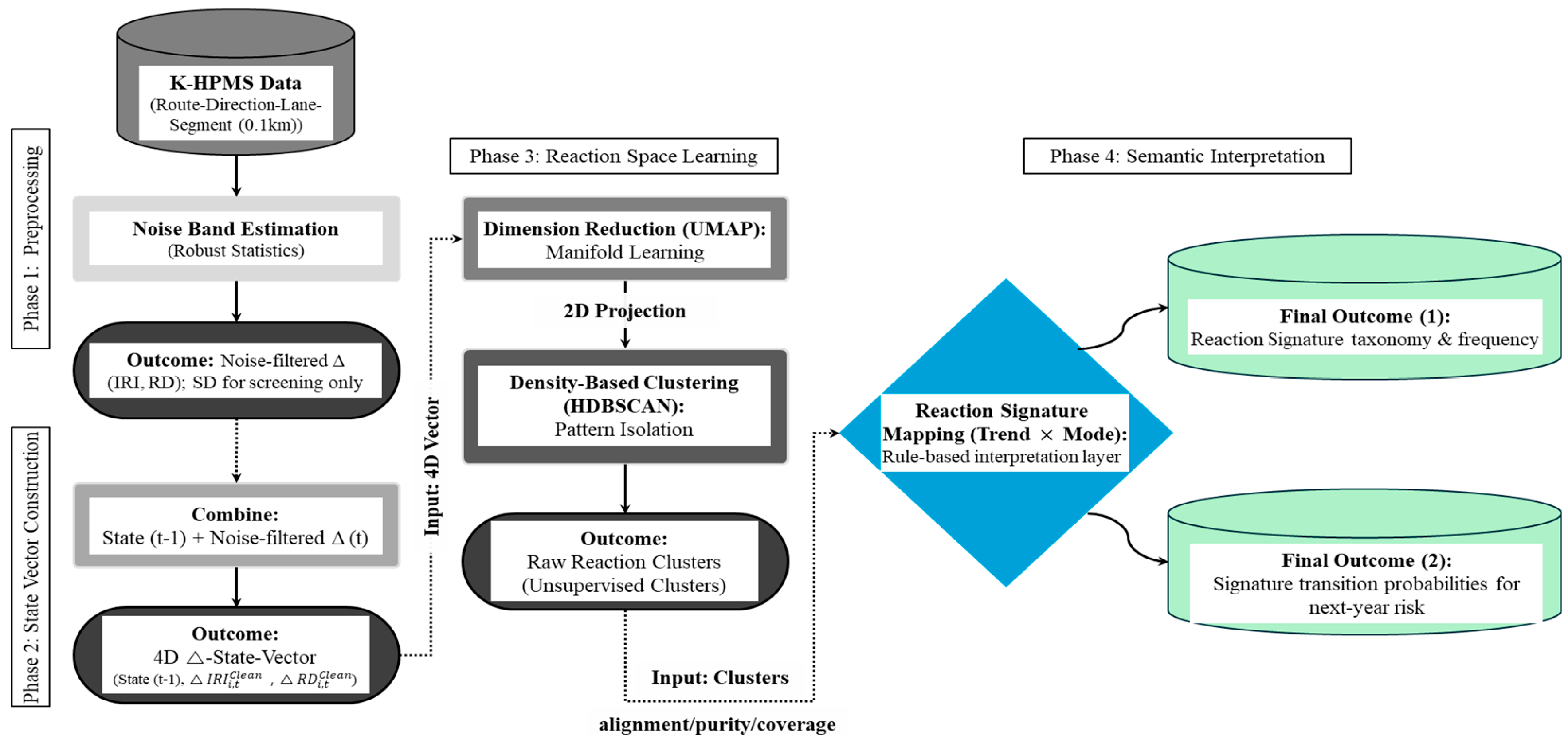
This study develops a reaction-based analytical framework grounded in the Δ–State Vector, designed to jointly interpret pavement performance from the perspectives of absolute state and year-to-year structural change. This framework enables the detection of non-stationary deterioration behaviors, mixed responses, and improvement-like recovery patterns that conventional linear PMS models cannot capture, as illustrated in
Figure 1.
3.1. Data Source and Study Scope
This study utilizes eight consecutive years (2015–2022) of pavement performance data from the K-HPMS. Only asphalt pavement (ACP) segments were included to ensure material homogeneity in deterioration behavior. Each record is structured according to a strict hierarchy consisting of Year → Route → Direction → Lane → Segment (0.1 km), with performance indices—IRI, RD, and SD—measured annually using standardized automated survey equipment. Because PMS deterioration behavior is governed by localized heterogeneity, the primary analytical resolution of this study is the Lane–Segment level (Level 5; 0.1 km), unless otherwise noted. Hierarchical-level analyses (L0–L4) are used only to diagnose aggregation distortion and distributional bias, whereas all reaction modeling, clustering, and hotspot analyses are conducted at the Lane–Segment resolution (L5) (
Table 1).
3.2. Hierarchical Variability and Aggregation Bias Assessment
To determine the appropriate modeling scale, this study evaluates how the statistical properties of IRI, RD, and SD vary across the K-HPMS hierarchical levels. Although Level 5 provides Lane–Segment (0.1 km) resolution, formal statistical tests were conducted across Levels 0–4 (L0–L4) because Level 5 groups are essentially singleton cells (≈1 observation per segment–year group), making within-group variance undefined and ANOVA-type comparisons ill-posed. Accordingly, L0–L4 comparisons should be interpreted as a diagnostic test of aggregation-induced bias, not as a substitute for segment-level inference. Therefore, differences in distributional properties were assessed by comparing groups defined at each aggregation level. Three complementary tests were conducted, outlined in the following:
3.2.1. Brown-Forsythe Test
This test is used to examine variance heterogeneity among hierarchical groups by transforming each observation into the absolute deviation from the group median.
A significant -value ( < 0.05) indicates that variances differ among groups within the given aggregation level, implying aggregation-dependent variability.
3.2.2. Welch ANOVA
This test is applied when heteroscedasticity is detected, providing robust comparisons of mean values among groups without assuming equal variances. Welch ANOVA uses unequal-variance weights,
to compute an approximate F statistic with Satterthwaite-type degrees-of-freedom adjustment, thereby reducing bias under variance heterogeneity. A significant
-value (
< 0.05) indicates that group means differ at the corresponding aggregation level.
3.2.3. Effect Size ()
This test quantifies the proportion of total variance explained by the grouping structure at each hierarchical level. Interpretation follows [
29], as follows:
3.3. Annual Change (Δ) Computation and Noise Band (ε) Estimation
For each segment
i and performance index Y ∈ {IRI, RD, SD}, the year-to-year change is defined as
Because Δ values mix structural signals with measurement noise, the study estimates a Noise Band (εY) using the following robust statistics:
Interquartile Range: IQR/2;
Median Absolute Deviation (MAD);
The 5th–95th percentile envelope.
In this study, the global Noise Band for each indicator is defined from the pooled
distribution using the MAD as a conservative scale:
To accommodate transition-specific irregularity in the fixed panel, a transition-wise MAD scale
is computed for each performance indicator
. To prevent unrealistically small thresholds (e.g., when
becomes near-zero), the filtering threshold was defined by enforcing a minimum-threshold (floor) constraint using global scale:
Here, denotes the effective Noise Band and is applied symmetrically as a two-sided threshold, i.e., is treated as noise-level variability and is treated as a meaningful structural reaction.
Values within the noise band
were treated as noise, and the noise-filtered change was defined as
Each annual change is classified as
Stable: ;
Worsen: ;
Improve: .
This hard thresholding is intentionally adopted to suppress survey-condition variability and to preserve only changes that exceed the empirically derived noise scale. Because the objective of this study is identification of reaction patterns rather than continuous change estimation, retaining sub-threshold fluctuations would inflate “micro-reactions” and degrade the stability of the reaction manifold.
3.4. Construction of the Δ–State Vector
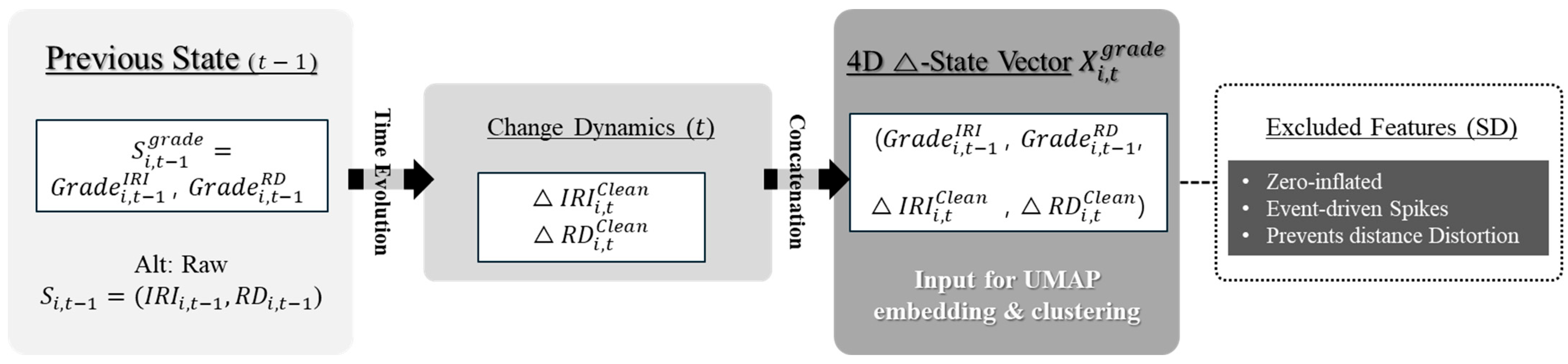
To jointly represent the absolute structural condition of a pavement segment and its year-to-year performance response, this study establishes a four-dimensional Δ–State Vector. This formulation integrates (1) the previous-year condition state and (2) the current-year noise-filtered structural changes (i.e.,
and
;
Section 3.3), forming the core representation of the proposed reaction-based deterioration framework.
3.4.1. Previous-Year Condition (State) Vector
For each segment
, the previous-year structural condition is expressed as a two-dimensional State Vector based on the absolute values of IRI and RD:
This state vector represents the baseline condition from which the subsequent annual reaction is evaluated.
To ensure consistency with the maintenance grading scheme used in the K-HPMS, the condition values were additionally coded into a seven-grade classification system following the Korea Expressway Corporation Research Institute (KECRI)’s reference maintenance grading criteria [
30]:
The grade definitions used in this study are summarized in
Table 2. Using grade-coded states facilitates stable comparisons across segments with different deterioration histories and supports robust clustering in the reaction space. Although the grades are ordinal, they provide a standardized state representation aligned with operational PMS decision thresholds. Importantly, the grade-coding is only used to stabilize the state component for clustering and interpretation; the underlying continuous IRI/RD values remain unchanged and are retained for descriptive and validation analyses. To prevent spurious boundary-driven grade transitions under no-reaction conditions, grade-coded states were stabilized by retaining the previous-year grade when
and/or
. This stabilization does not modify the underlying continuous measurements.
3.4.2. Four-Dimensional Δ–State Vector
The final four-dimensional Δ–State Vector is defined by concatenating the previous-year state with the current-year noise-filtered changes (
Section 3.3):
For consistency with the maintenance grading scheme used in the K-HPMS (
Table 2), a grade-coded form is additionally defined as
where
features the stabilized grade under no-reaction conditions as described in
Section 3.4.1. This representation captures both the absolute condition level (state) and the direction/magnitude of annual reactions (change), enabling state-dependent analysis of deterioration dynamics and mixed/transitional behaviors.
The Δ–State Vector deliberately combines an ordinal state descriptor with continuous change descriptors to capture state dependence without discarding the directional reaction magnitude. To mitigate scale incompatibility, subsequent embedding uses Z-score standardization across all components (
Section 3.5), so that the state and reaction terms contribute comparably in the neighborhood graph construction. Surface distress (SD) is not included in the Δ–State Vector to avoid distorting distance-based embedding; its distributional characteristics are reported in
Section 4.2.3 (see also
Figure 2).
3.5. UMAP-Based Dimensionality Reduction Procedure
The Δ–State Vector constitutes a four-dimensional reaction descriptor (
Section 3.4). Because this feature space is nonlinear and heterogeneously distributed, a nonlinear dimensionality reduction step was employed to obtain a stable low-dimensional reaction representation.
UMAP was adopted because it embeds high-dimensional observations onto a low-dimensional manifold while largely preserving local neighborhood relations [
22]. This property is suitable for constructing interpretable reaction maps that highlight heterogeneous response modes [
23]. The UMAP procedure in this study consists of the following steps:
UMAP was applied to the grade-coded Δ–State Vector
defined in
Section 3.4.2 (Equation (12)), which concatenates the stabilized previous-year grades with the noise-filtered annual changes.
All four components were standardized using Z-score normalization. Euclidean distance was used in the standardized space. Using Euclidean distance in the standardized space yields a transparent and reproducible similarity measure for neighborhood preservation, while avoiding additional tuning associated with alternative mixed-type metrics.
UMAP was configured with and .
For each segment–year observation
, UMAP produces a two-dimensional embedding:
This embedding defines the Reaction Space for subsequent clustering and alignment evaluation.
3.6. HDBSCAN Clustering Procedure
Although UMAP provides a meaningful 2D projection of the Δ–State Vector, the resulting Reaction Space remains heterogeneous with variable-density regions and nonlinear boundaries. Therefore, this study employed HDBSCAN (Hierarchical Density-Based Spatial Clustering of Applications with Noise), which identifies clusters based on density hierarchy while separating noise points [
24,
25].
HDBSCAN was applied to the UMAP coordinates (Equation (13)).
HDBSCAN was applied to the 2D UMAP coordinates using Euclidean distance.
The clustering was configured with min_samples = 10. To avoid interpreting unstable micro-clusters, clusters with fewer than 30 observations were excluded by post-filtering and treated as noise. Observations not assigned to any retained cluster were labeled as noise and were retained only for visualization, while being excluded from cluster-level alignment metrics.
3.7. Rule-Based Reaction Signature Definition and Cluster–Signature Alignment Metrics
To provide an interpretable taxonomy of annual reactions and to evaluate whether unsupervised clusters reflect these interpretable patterns, in this study rule-based Reaction Signatures are defined for each Lane–Segment transitions observation and their alignment with HDBSCAN clusters is quantified. Here, the rule-based Reaction Signature is an interpretation layer that assigns each observation to a physically readable category, whereas HDBSCAN discovers density-driven groupings in the embedded manifold. The alignment metrics quantify whether the data-driven clusters correspond to the intended, interpretable reaction taxonomy rather than to arbitrary binning.
First, noise-filtered changes were normalized by the transition-specific effective noise scales (
Section 3.3; Equation (7)):
A reaction magnitude was defined as
The Trend (Stable/Improve/Worsen) was determined by the direction of the combined normalized change, with Stable assigned when both noise-filtered components are zero. The Mode (Zero/Clear/Mixed/Full) captures the strength and consistency of the response, using reaction magnitude and sign consistency, as described in
Section 3.8.
To compare rule-based signatures with HDBSCAN clusters, a cluster–signature contingency table was constructed, and cluster purity was defined as
where
is the number of observations in cluster
assigned to signature
, and
is the size of non-noise cluster
(i.e., excluding HDBSCAN noise points.). Two summary alignment metrics were reported: (i) weighted purity defined as
computed over non-noise clusters, and (ii) the coverage (purity ≥ 0.60), defined as the fraction of all observations that fall into clusters with
(noise points are counted as not covered). These metrics quantify how strongly unsupervised clustering aligns with the interpretable signature taxonomy.
3.8. Reaction-Signature Analysis
Reaction Signatures summarize the annual response pattern of each Lane–Segment observation
by combining Trend (directionality) and Mode (strength/consistency). Using the normalized changes and reaction magnitude defined in
Section 3.7 (Equations (14) and (15)), each observation is assigned to a Trend × Mode category according to the rules below.
3.8.1. Trend Classification
Trend represents the net direction of the transition-level response as follows:
Stable: both noise-filtered components are zero ( and );
Worsen: the combined normalized direction is positive;
Improve: the combined normalized direction is negative.
For non-stable observations, the combined normalized direction is defined as ; Worsen is assigned if and Improve is assigned if (ties are negligible in continuous data).
3.8.2. Mode Classification
Mode captures the strength and consistency of the response within each Trend:
Zero: assigned only under Stable Trend (no reaction after noise filtering);
Mixed: assigned when the two normalized components indicate mixed-direction behavior (opposite signs) or when the response does not meet Clear/Full criteria;
Clear/Full: Full denotes upper-tail reactions (e.g., ), and Clear denotes moderate reactions (e.g., ).
Operationally, Mode is assigned as follows. (i) if Trend is Stable, Mode = Zero, (ii) if then Mode = Mixed (sign-inconsistent), and (iii) if Mode is determined by the reaction magnitude quantiles computed from the empirical distribution of , it is Full if , Clear if , and Mixed otherwise.
In particular, sign-inconsistent responses () are classified as Mixed regardless of magnitude, because they reflect opposing movements between indicators.
3.8.3. Reaction Signature (Trend × Mode)
Combining the Trend and Mode yields the Reaction Signature taxonomy used throughout the subsequent analyses (
Table 3). This categorical structure enables consistent interpretation of heterogeneous annual responses and supports clustering and reaction-space construction for pattern identification.
4. Results
4.1. Distributional Characteristics and Statistical Significance Across Hierarchical Levels
The HPMS dataset was structured according to a six-level hierarchy—ranging from Year (Level 0) to Route–Direction–Lane–Segment (Level 5)—to evaluate how the spatial aggregation level influences the distribution of pavement performance indicators (IRI, RD, and SD).
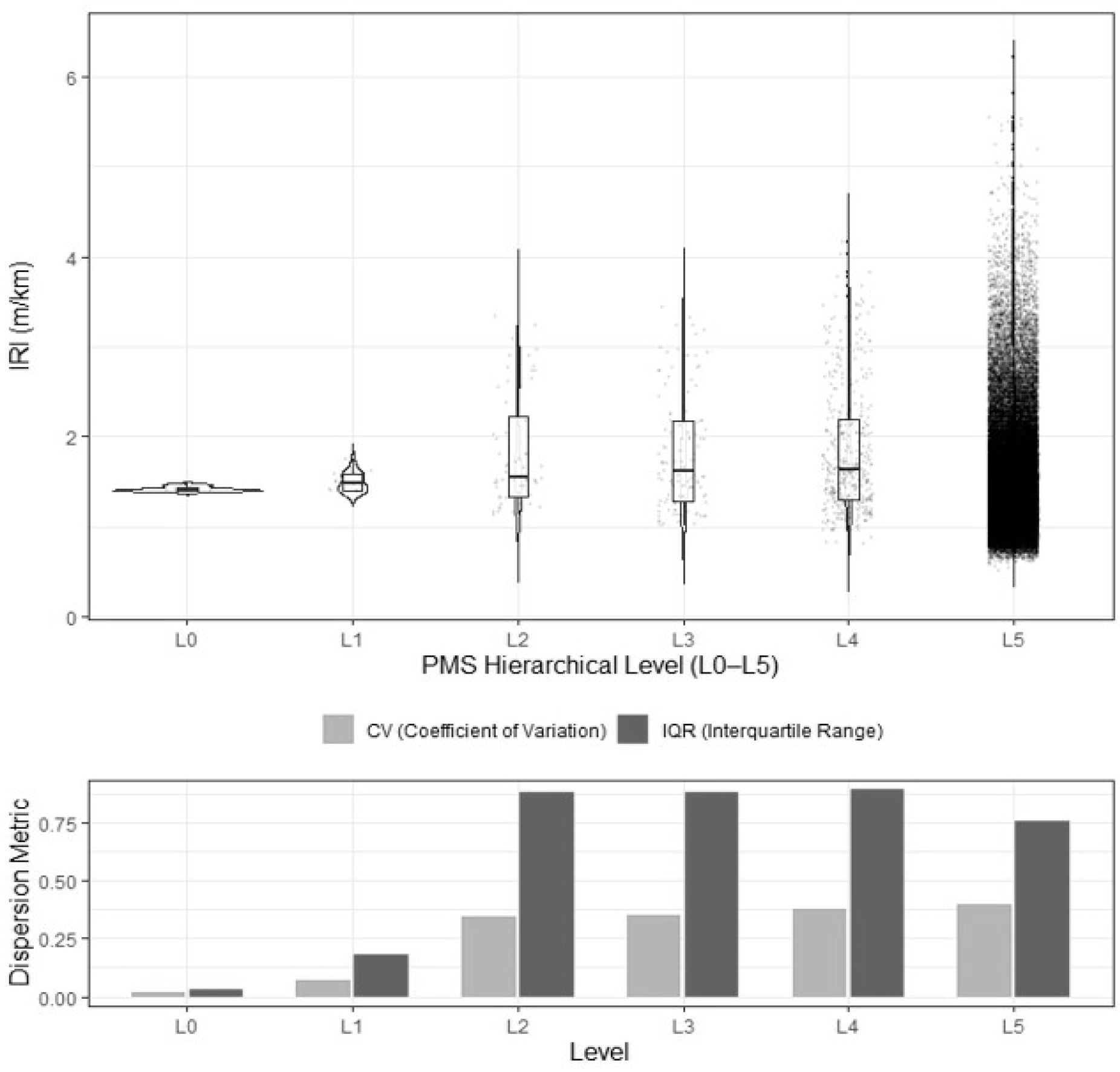
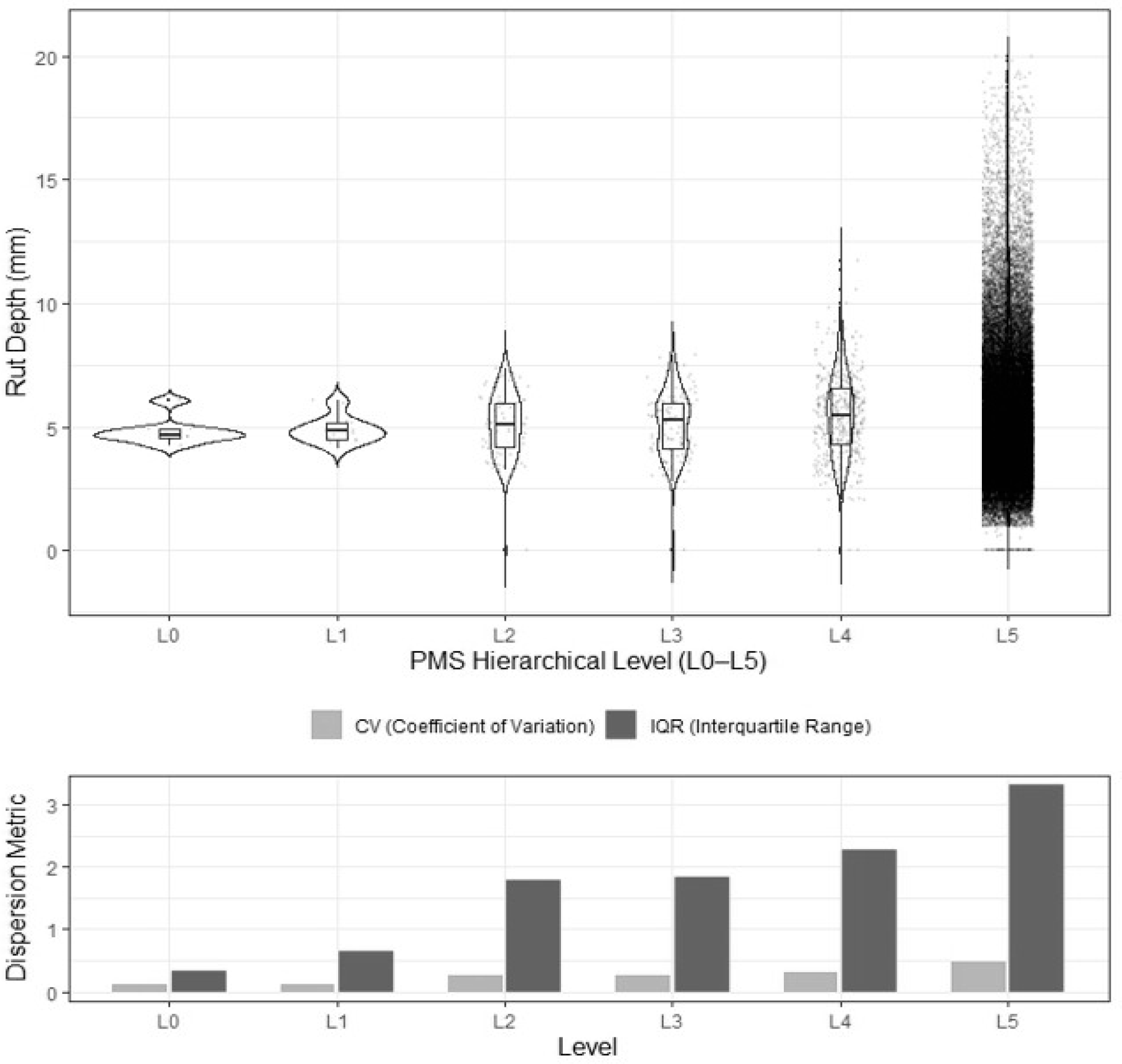
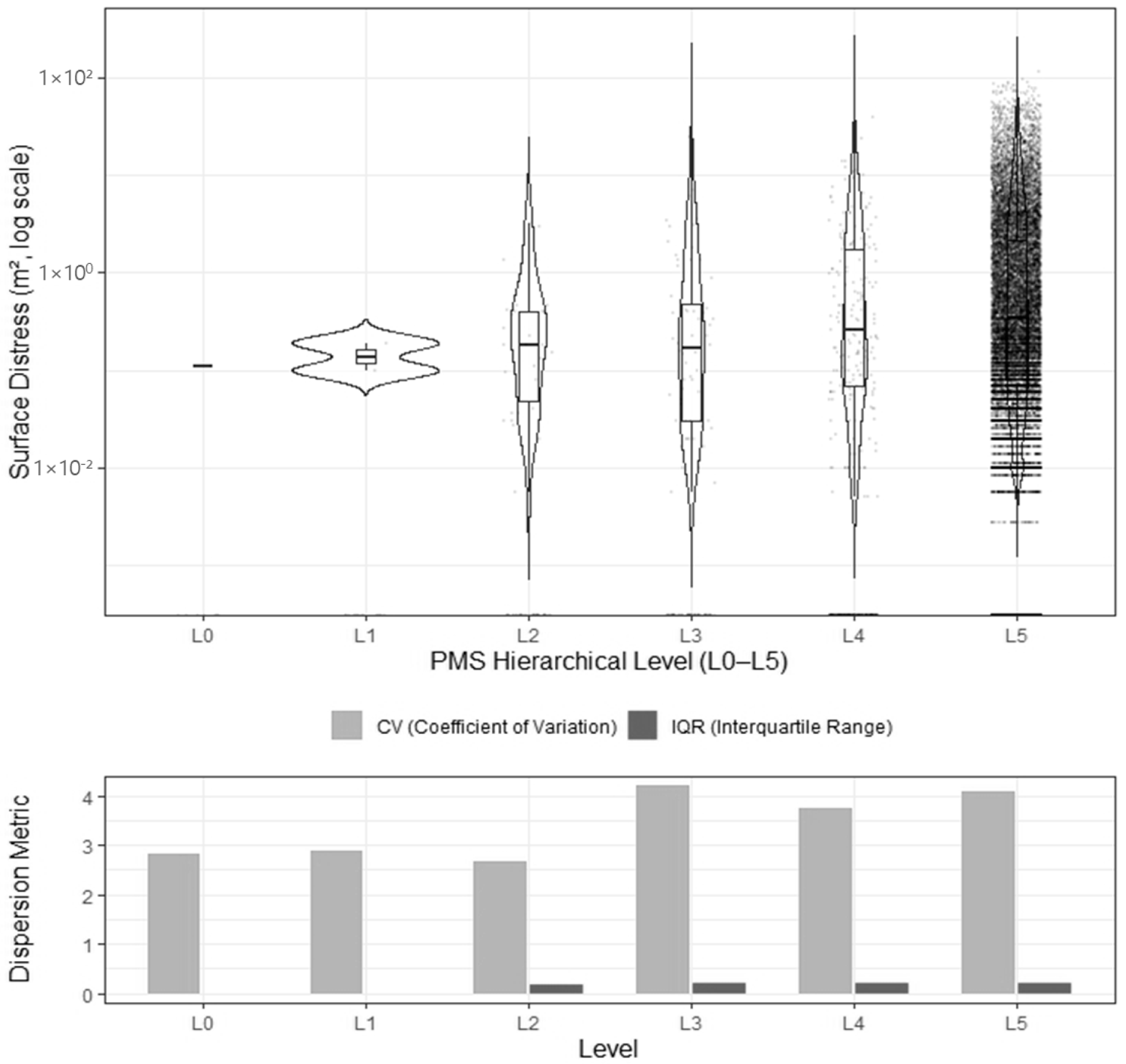
Figure 3,
Figure 4 and
Figure 5 illustrate the distributional changes across Levels 0–5 for each indicator.
At Level 0 (Year), where all segments are aggregated within a given year, IRI values are concentrated within a narrow band around 1.3 m/km, masking heterogeneity across segments. At the Lane-Segment level (Level 5), however, the distribution widens substantially, spanning roughly 0.5–6.5 m/km, revealing pronounced localized roughness. This confirms that network-wide, year-aggregated IRI values obscure severe but spatially confined roughness conditions.
RD exhibited relatively stable typical values around 4–6 mm at the upper aggregation level (L0–L2), whereas the distribution widened markedly as the hierarchy became more detailed. At the Lane-Segment level (L5), extreme values exceeding 10 mm were frequently observed, with outliers reaching or exceeding 20 mm, indicating highly localized rutting conditions. These patterns suggest that severe rutting is muted under higher-level aggregation and becomes evident only when data are examined at finer spatial resolution.
SD values were strongly zero-inflated and were therefore analyzed on a logarithmic scale. At Level 0 (Year), SD values were tightly clustered around 10−2–10−1 m2, suggesting minimal apparent distress under year-level aggregation. As the hierarchy became more detailed, the distribution developed a pronounced long tail; at the Lane-Segment level (Level 5), SD spanned several orders of magnitude, with extreme observations reaching the 101–102 m2 range, indicating highly localized surface distress hotspots.
These results suggest that spatial averaging can conceal localized distress hotspots and that SD behaves primarily as an event-driven indicator rather than a gradual deterioration metric. Consequently, SD was excluded from Δ-based modeling and was reported only descriptively in this study.
To quantitatively assess whether hierarchical levels influence performance distributions, Brown–Forsythe and Welch ANOVA tests were conducted for all indices across Levels 0–4 (
Table 4).
Brown-Forsythe tests indicated significant heteroscedasticity across hierarchical levels, confirming that aggregation materially alters the dispersion structure of IRI, RD, and SD.
Where Welch ANOVA was evaluable, it further confirmed significant differences in mean values across levels ( < 0.05).
Effect size () increased sharply as spatial resolution became more detailed, indicating that finer grouping explains substantially more variance.
Level 0 showed negligible explanatory power ( = 0.002–0.050), whereas Level 4 showed large effects ( = 0.146–0.358), indicating that approximately 14.6–35.8% of total variability is explained by Lane-level stratification.
Across all three indicators, the variance, interquartile range, and extreme-value prevalence increased markedly as the analysis moved from Level 0 to Level 4, demonstrating that pavement performance is fundamentally governed by localized spatial heterogeneity that can be distorted or lost under coarser aggregation. Accordingly, these L0–L4 results should be interpreted as a diagnostic of aggregation-induced bias rather than as Segment–level inference. The diagnostics indicate that meaningful inference requires at least Lane–level resolution (L4); therefore, all reaction modeling in this study was performed at the Lane–Segment level (L5).
4.2. Distribution of Annual Changes and Noise Band Validation
In this section, annual changes (Δ) in pavement performance indicators (IRI, RD, and SD) are quantified and Noise Bands (ε) are established using robust statistics. The Noise Bands provide a practical criterion for separating meaningful structural change from measurement- and environment-driven variability, serving as the basis for constructing noise-filtered Δ values for the Δ–State Vector and subsequent reaction classification.
All Δ statistics were computed from a fixed panel of 4302 asphalt segments continuously measured for eight years (2015–2022). Year-to-year changes were evaluated over seven transitions, yielding = 30,114 pooled Δ observations per indicator.
Throughout this section, the “year” label in the year-wise summaries corresponds to the transition . Noise Bands are first estimated globally from pooled Δ distributions and then examined through year-/transition-wise and spatial-group screening to determine an appropriate filtering rule.
4.2.1. Natural Variability in ΔIRI ()
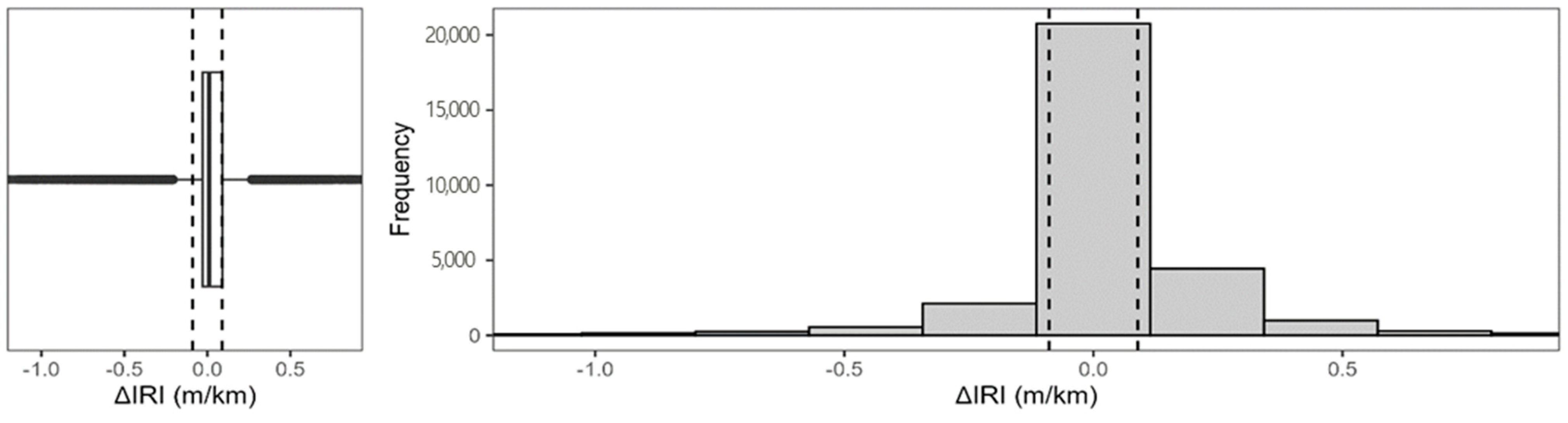
The pooled ΔIRI distribution is sharply centered around zero (
Figure 6). Robust statistics were as follows:
To define a conservative global Noise Band for ΔIRI, the MAD-based scale was adopted in this study.
Figure 6.
Empirical distribution of ΔIRI and derived Noise Band (±0.089 m/km).
Figure 6.
Empirical distribution of ΔIRI and derived Noise Band (±0.089 m/km).
Values within
are treated as noise-level variability; values exceeding the band indicate meaningful structural change. Year-wise validation results are summarized in
Table 5.
4.2.2. Natural Variability in ΔRD ()
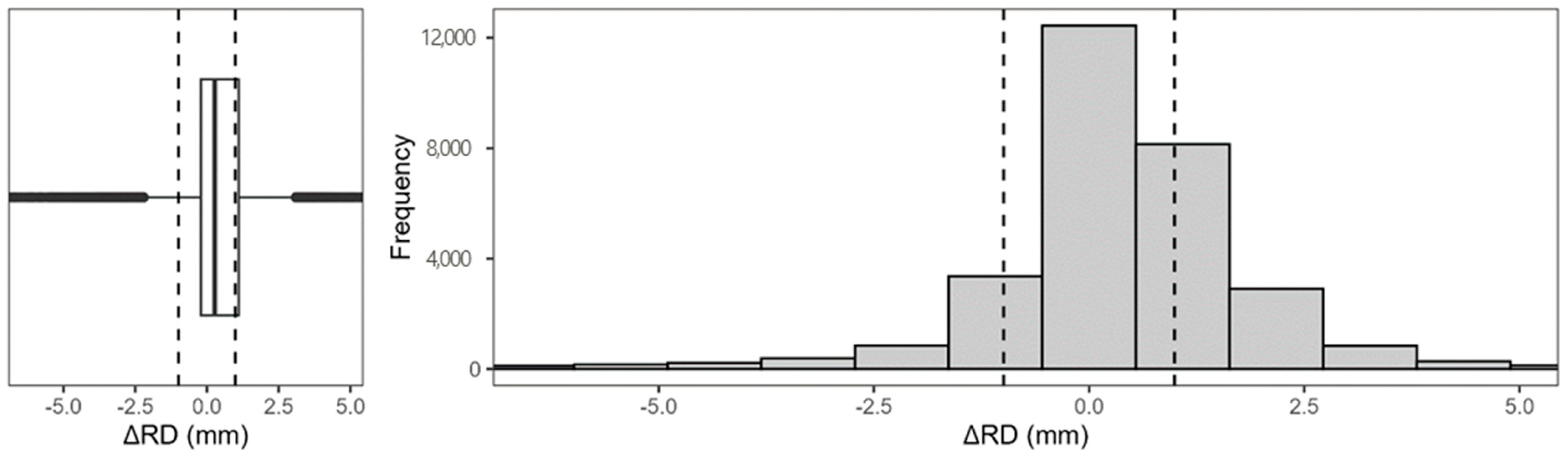
ΔRD exhibits a wider dispersion than ΔIRI (
Figure 7). Robust statistics of pooled ΔRD were as follows:
Consistent with
Section 4.2.1, the global Noise Band is defined using the MAD-based estimate:
Figure 7.
Empirical distribution of ΔRD and derived Noise Band (±0.993 mm).
Figure 7.
Empirical distribution of ΔRD and derived Noise Band (±0.993 mm).
Changes exceeding
are classified as meaningful increases (rutting progression) or decreases (apparent recovery), whereas values within the band are treated as natural variability. Year-wise dispersion statistics and noise-level shares are summarized in
Table 6.
4.2.3. Natural Variability in ΔSD ()
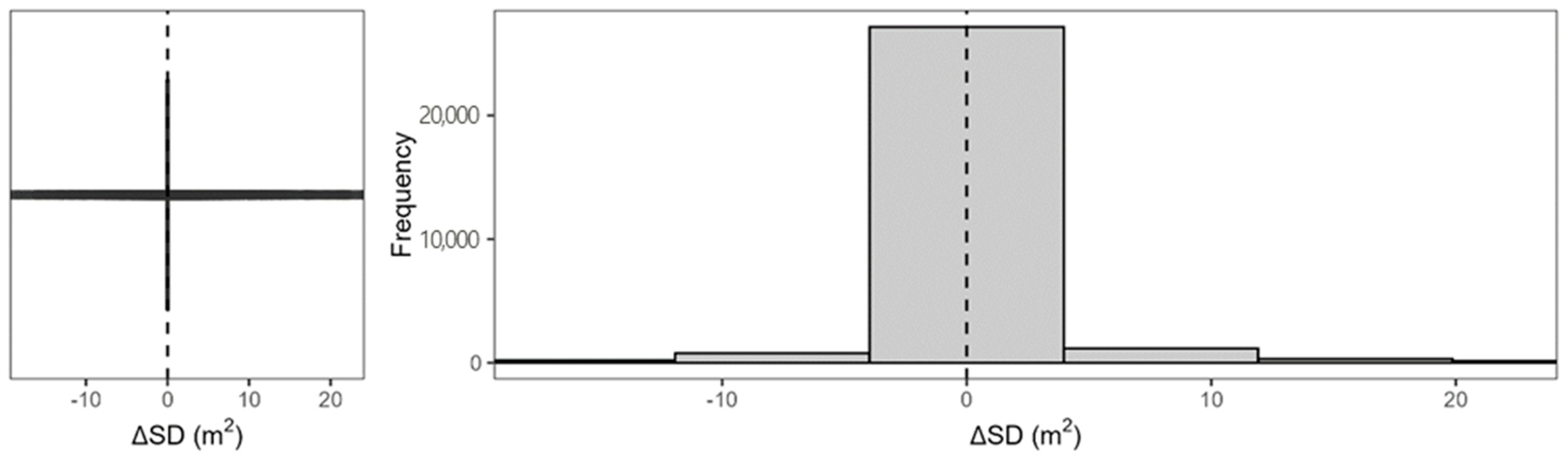
SD exhibits strong zero inflation and event-driven spikes (
Figure 8). The pooled ΔSD distribution shows near-zero central dispersion with occasional abrupt changes. Robust statistics were as follows:
Unlike IRI and RD, is not used to construct the –State Vector or the reaction manifold because its changes are dominated by sparse event-like spikes rather than gradual deterioration signals. Therefore, we do not apply the hard-thresholding filter in Equation (8) to obtain . Instead, SD is reported only descriptively in this study.
For completeness, we summarize the transition-wise robust dispersion scale of
using the median absolute deviation:
where the “year” index
corresponds to the transition
.
Table 7 reports
and two reference “near-zero” shares: (i) the strict zero share
, reflecting zero inflation, and (ii) the small-change share
, reported only to characterize the distribution and not used for model input filtering.
Figure 8.
Empirical distribution of ΔSD showing zero-inflation and event-driven spikes.
Figure 8.
Empirical distribution of ΔSD showing zero-inflation and event-driven spikes.
Although the MAD of
is small, it remains nonzero and varies across year-to-year transitions (
Table 7). Here,
is reported only as a descriptive dispersion scale under strong zero inflation and sparse event-driven spikes, and it is not used as a Noise Band for cleaning or as an input to the
–State Vector. Accordingly, SD is excluded from the reaction manifold construction and discussed only descriptively in this study.
4.2.4. Spatial Variability Check and Adoption of Transition-Specific Noise Bands
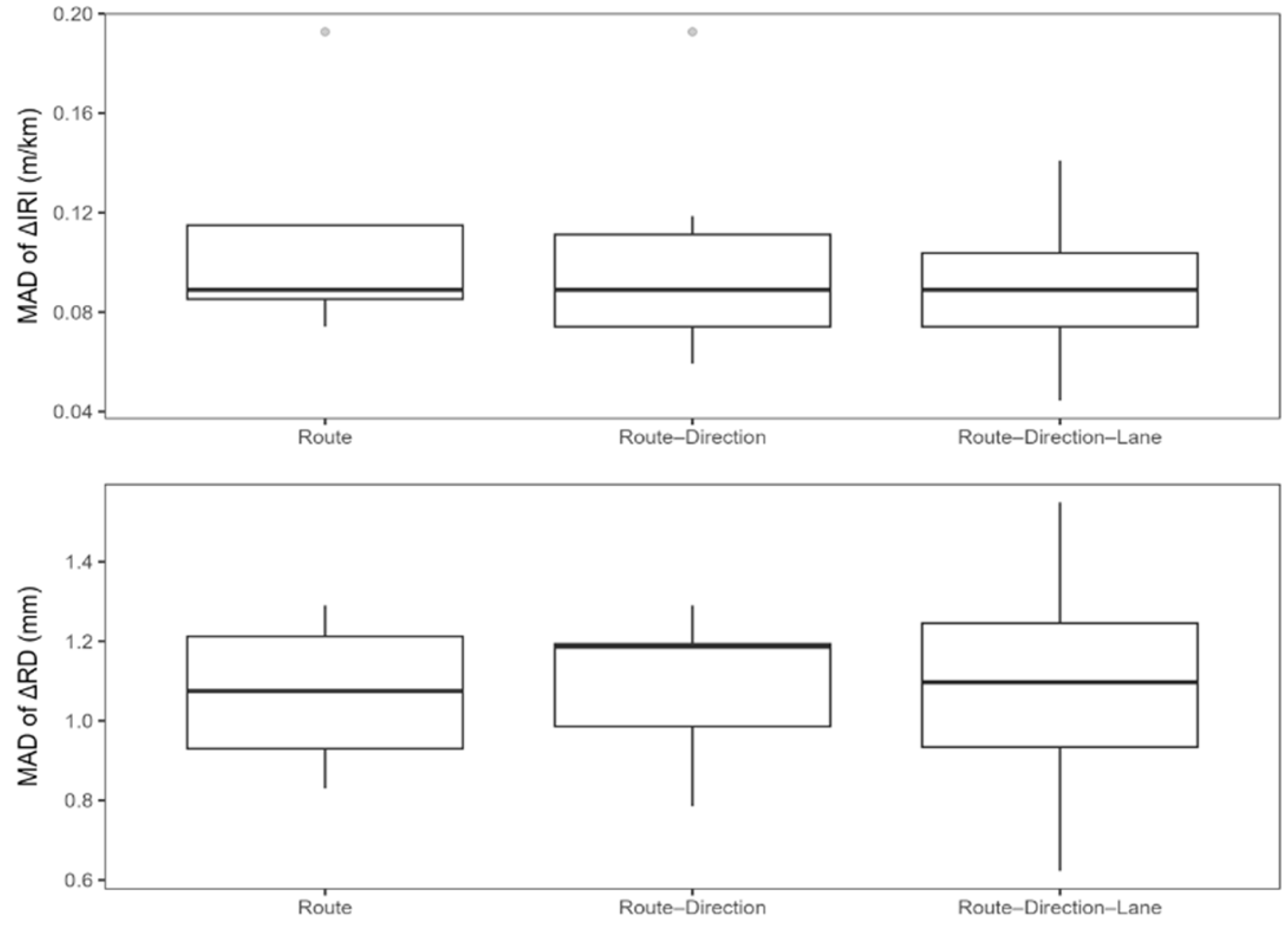
Figure 9 summarizes MAD-based dispersion scales of ΔIRI and ΔRD across spatial hierarchy levels (route; route–direction; route–direction–lane). The distributions are broadly comparable across these spatial groupings, suggesting limited practical benefit from introducing multiple spatially stratified Noise Bands. Spatial differences may still reflect various factors (e.g., heterogeneous structural or traffic conditions), but they are not used to parameterize ε in this study.
In contrast, transition-wise summaries in
Table 5 and
Table 6 show that the MAD-based dispersion scale varies across transitions. Notably, the first transition (2015–2016) yields MAD = 0 for both ΔIRI and ΔRD, which would result in
under the MAD rule. To avoid applying an unrealistically small threshold in such cases, Δ filtering follows the floor(minimum-threshold) defined in Equation (7). More generally, the observed transition-wise variability may be influenced by differences in survey conditions, including potential changes in measurement devices or processing performance over time; however, this study does not attribute causality and uses transition-specific ε only as a practical filtering adjustment. ΔSD is treated separately as an event-driven indicator and is not included in the Δ–State Vector.
4.3. Analysis of Deterioration Characteristics Using the Δ–State Vector
The Δ–State Vector was introduced to address the limitations of conventional single-indicator linear deterioration assessments by jointly considering (i) the previous-year condition state and (ii) noise-filtered annual structural changes. In this study, the state component is represented by the previous-year IRI grade and RD grade, and the change component is represented by the corresponding noise-filtered changes and .
Noise filtering was performed as outlined in
Section 4.2: global Noise Bands provide baseline thresholds, while the effective threshold is applied at the transition/year level with a conservative lower bound (Equation (7)). Using these noise-filtered changes, this section examines state-dependent deterioration dynamics within the Δ–State framework (
Section 3.4).
Table 8 summarizes the state-stratified annual reactions of IRI and RD using the noise-filtered Δ values. The results reveal a clear state-dependent shift in both the net direction (mean Δ) and the directional composition (worsen vs. improve ratios) as the pavement condition worsens.
The mean ΔIRI decreased monotonically from +0.038 m/km/year (Grade 1) to −0.419 m/km/year (Grade 7), crossing zero at approximately Grade 3 (−0.012).
The ΔIRI Worsen Ratio increased from 18.7% (Grade 1) to ~32% (Grades 4–7) remaining at a comparable level in higher grades (≈30.7–32.5%).
The ΔIRI Improve Ratio increased steadily from 6.18% (Grade 1) to 45.3% (Grade 7).
For ΔRD, the mean shifted from +0.458 mm/year (Grade 1) to negative values in poorer grades (e.g., −0.107 at Grade 3, −0.775 at Grade 4, −3.52 at Grade 6).
The ΔRD Improve Ratio increased from 3.46% (Grade 1) to 41.0% (Grade 6), while the ΔRD Worsen Ratio remained substantial in lower-to-mid grades (≈26–28%) but dropped at Grade 6 (16.7%).
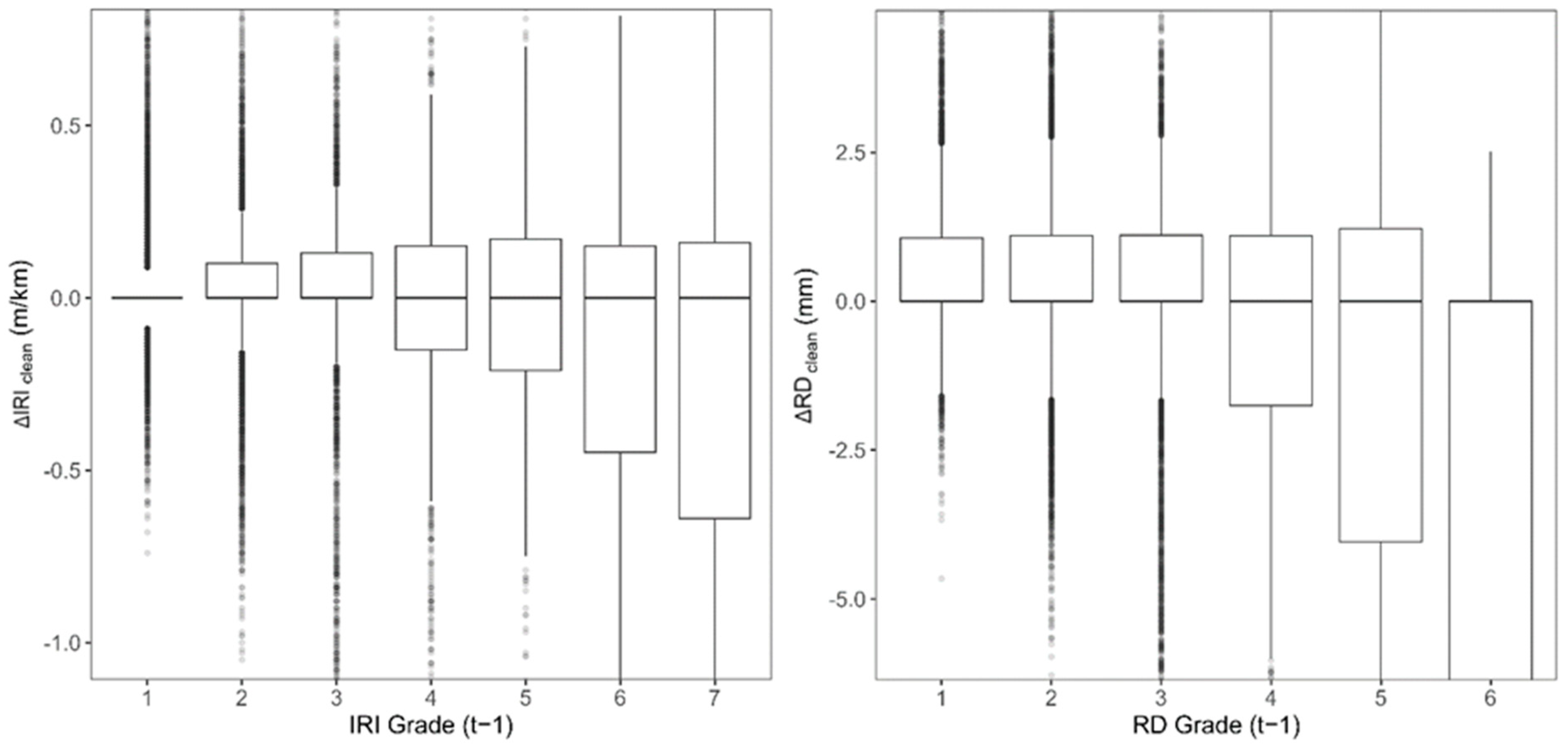
Figure 10 illustrates state-dependent changes in the dispersion and direction of annual reactions. As the previous-year condition grade worsens, both
and
exhibit a wider spread, indicating increased instability under degraded structural states. In particular, the frequency and magnitude of negative Δ (improvement-like) increase in higher grades, consistent with more frequent improvement-like responses. Because explicit M&R records are unavailable, in this study these signals are not attributed to specific interventions; instead, the subsequent signature transition analysis examines whether these improvement-like reactions exhibit short-term persistence (recurrence) across consecutive years, which would be more consistent with event-driven changes than purely noise-level variability.
Overall, these results suggest that pavement performance is more strongly associated with its current condition state than with elapsed time, indicating a distinctly state-dependent response pattern. In higher-grade segments (Grades 6–7), improvement-like reactions (negative Δ) become more frequent while worsening reactions remain present, implying a more variable and bidirectional response regime under degraded conditions. This state dependence prompts the use of reaction-driven frameworks—rather than purely age-based approaches—to better characterize heterogeneous deterioration trajectories. In the subsequent analyses, we examine whether these improvement-like signals exhibit temporal persistence and spatial coherence, which would be consistent with event-driven changes.
4.4. Reaction Signature Classification
To categorize the multidimensional deterioration behaviors captured by the Δ–State Vector, this study defines rule-based Reaction Signatures using the directionality (Trend) and the magnitude/consistency (Mode) of the noise-filtered annual changes. The resulting Trend × Mode signatures provide an interpretable summary of heterogeneous Lane–Segment transition responses and serve as a reference taxonomy for comparison with the unsupervised clustering results presented in the next section.
The distribution of Reaction Signatures is summarized in
Table 9 for the non-noise observation set used in the cluster–signature alignment analysis (i.e., after excluding post-filtered HDBSCAN noise; see
Section 3.6). Within this evaluated set, Stable–Zero accounts for the largest share of observations (60.4%), indicating that many lane–segment year-to-year transitions remain within the noise band after filtering. Among non-stable reactions, Worsen–Mixed (14.4%) and Worsen–Clear (10.5%) are most prevalent, suggesting that a substantial subset of transitions exhibit net deterioration with varying consistency. Improvement-like reactions are less frequent but still non-negligible—Improve–Mixed (5.31%), Improve–Clear (4.78%), and Improve–Full (3.02%)—reflecting increasingly strong recovery patterns. Finally, Worsen–Full (1.60%) represents high-severity, strongly directional deterioration events.
Overall, the Reaction Signature framework provides a compact yet interpretable representation of annual pavement responses by encoding both direction and intensity/stability. These signatures form the basis for subsequent Reaction Space mapping and for evaluating the alignment between rule-based signatures and unsupervised UMAP–HDBSCAN clusters.
4.5. Reaction Space Mapping and Cluster–Signature Alignment
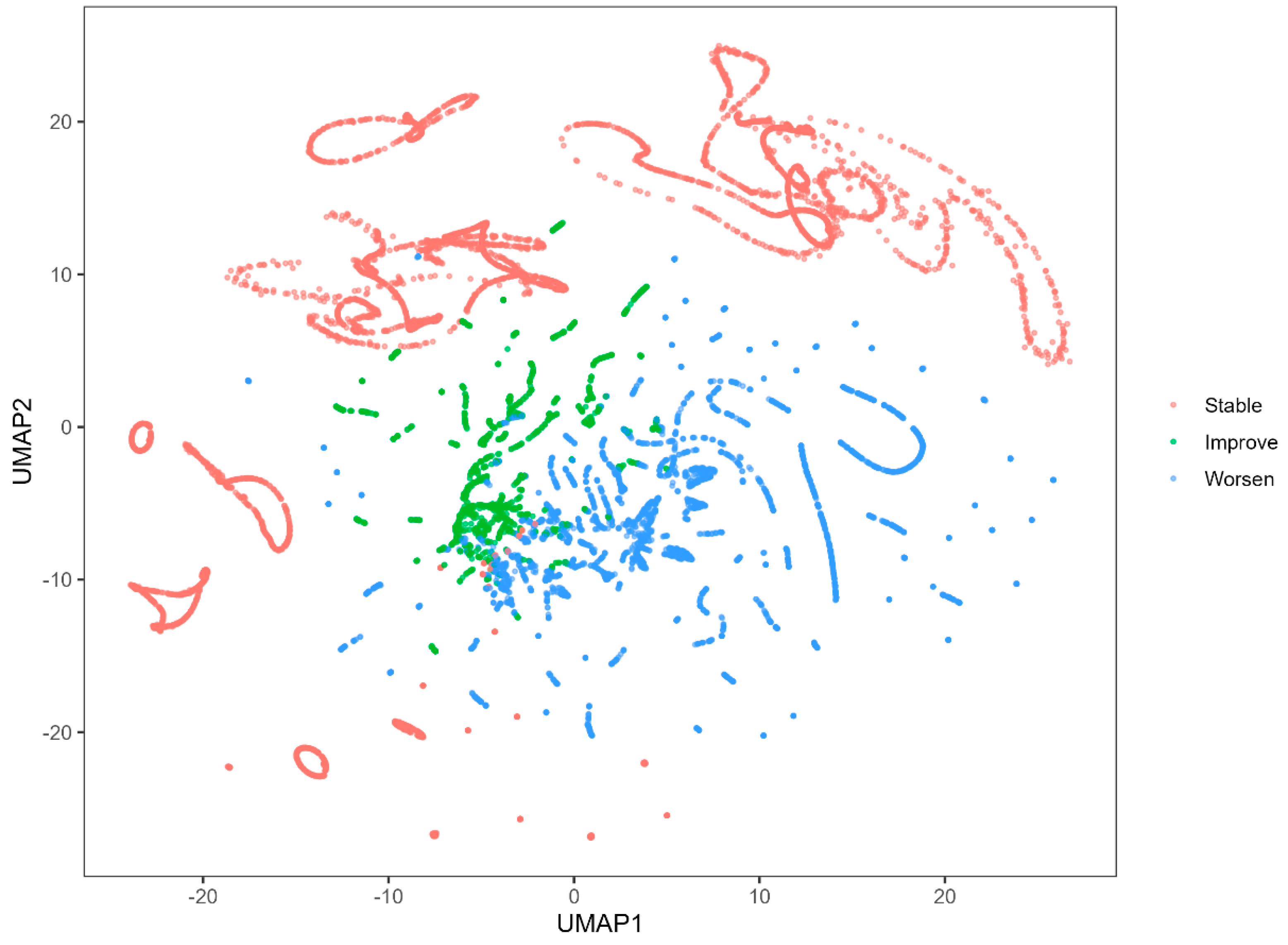
To visualize high-dimensional Δ–State responses, a two-dimensional Reaction Space was constructed using UMAP. Although the UMAP axes are unitless, nearby points in the embedding correspond to similar 4D Δ–State vectors (previous-year condition grades combined with noise-filtered annual changes). When colored by the rule-based Trend labels, the Reaction Space exhibits a clear directional organization among Stable, Improve, and Worsen regimes (
Figure 11), suggesting that the local neighborhood structure of Δ–State responses is well preserved in the low-dimensional manifold.
To test whether the interpretable rule-based taxonomy reflects intrinsic structure in the data, HDBSCAN was applied in the UMAP space and compared against the rule-based Trend × Mode signatures. Following the clustering procedure (
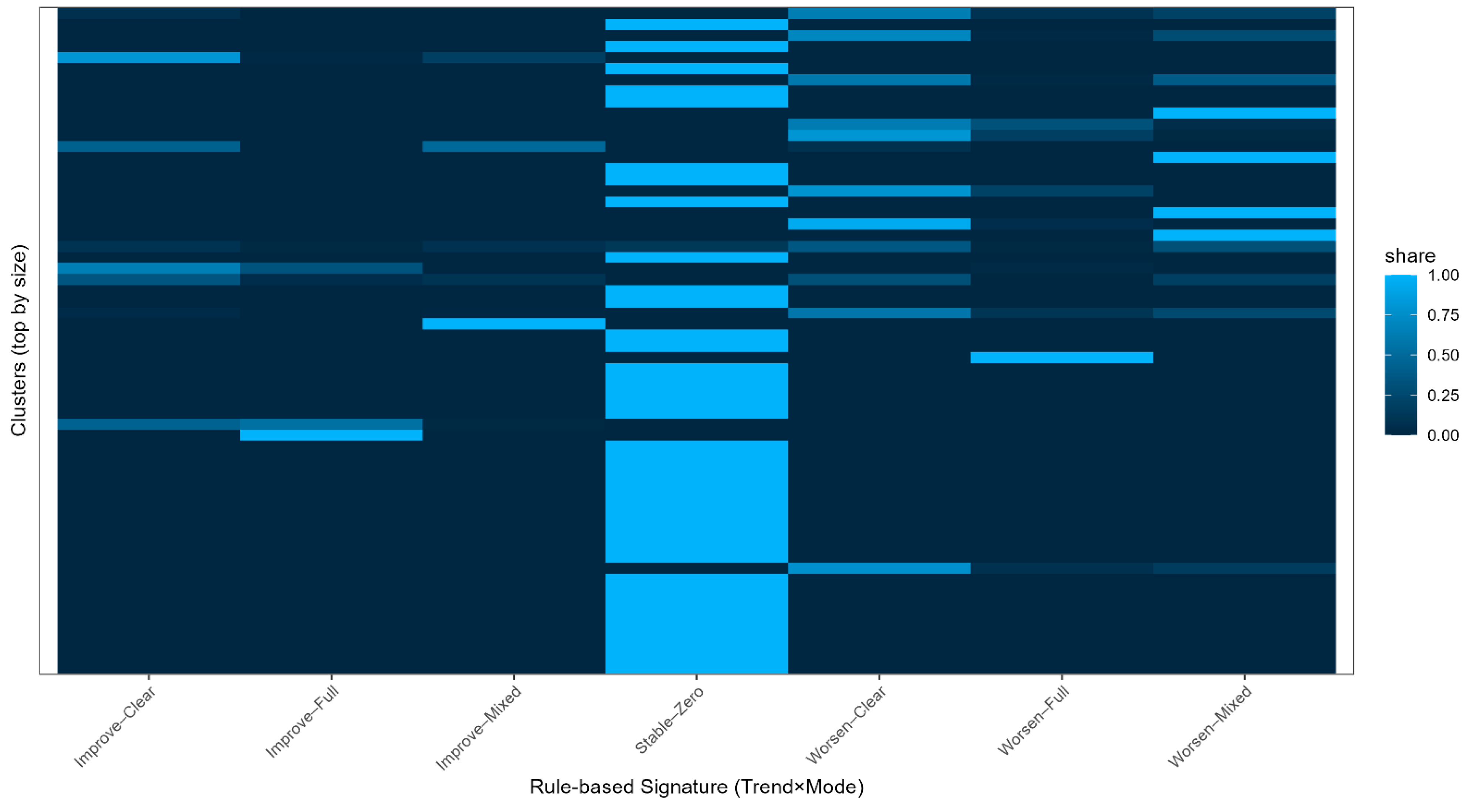
Section 3.6), clusters with fewer than 30 observations were post-filtered and treated as noise; noise points were retained only for visualization and excluded from cluster-level alignment metrics. In this study, the five dominant reaction regimes refer to the five largest non-noise HDBSCAN clusters (by sample size) shown in
Figure 12. The cluster–signature agreement is strong (weighted purity = 0.927; coverage at purity ≥ 0.60 = 0.911), indicating that the rule-based signatures closely match the dominant density-defined regimes in the embedding rather than acting as arbitrary partitions (
Figure 12). For consistency with this alignment evaluation,
Table 9 reports signature shares over the same non-noise observation set, providing a baseline distribution for interpreting cluster–signature correspondence.
4.6. Signature Transition Analysis
This transition analysis uses all signature-labeled consecutive-year observations and is independent of HDBSCAN noise labels, because it is defined in the signature space rather than the cluster space.
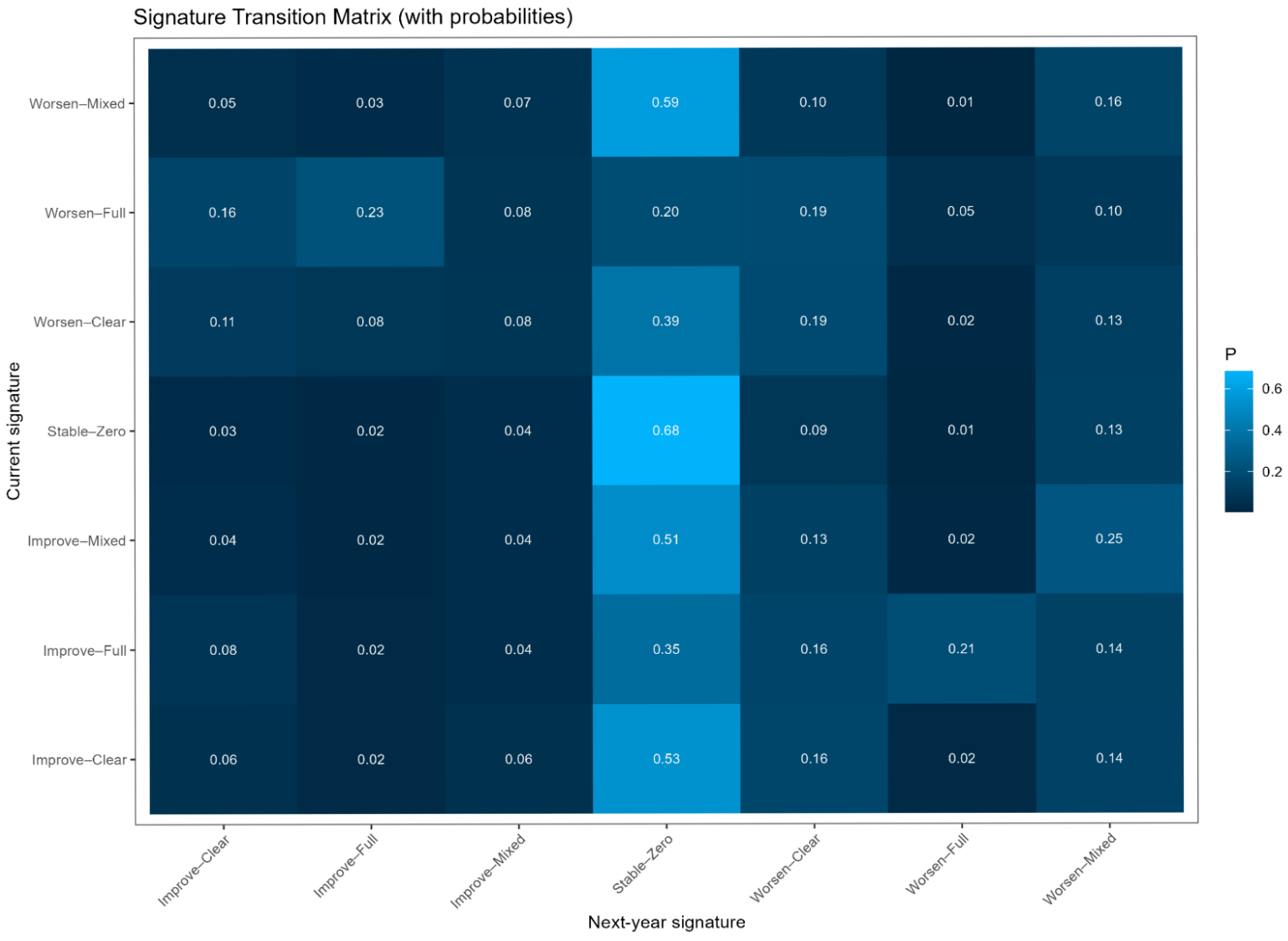
To assess short-term predictability and recurrence in annual reactions, a one-step signature transition probability matrix was constructed from consecutive-year observations. For each Lane–Segment with adjacent-year measurements, the current-year signature was paired with the next-year signature , and empirical transition probabilities were estimated by row-normalizing transition counts across the seven Trend × Mode categories.
Figure 13 shows that Stable–Zero exhibits the highest self-transition probability (0.68), indicating strong persistence of noise-level stability once segments enter the zero-reaction regime. Several non-stable signatures also revert to Stable–Zero with relatively high probability (e.g., Worsen–Mixed → Stable–Zero: 0.59), suggesting that a substantial portion of annual reactions are transient rather than persistently directional. At the same time, worsening signatures display meaningful branching, including non-negligible persistence within the same regime and transitions to other worsening regimes, consistent with heterogeneous evolution pathways.
Overall, the transition matrix demonstrates that the proposed signatures encode empirically observable persistence and recurrence patterns in next-year responses and provide a practical basis for risk-oriented interpretation, such as estimating the conditional likelihood of shifting into high-severity reactions (e.g., Worsen–Full) given the current signature.
5. Discussion
This study provides an empirical and methodological reassessment of how pavement deterioration should be interpreted and modeled within PMS frameworks. The findings collectively reveal that deterioration behavior in asphalt pavements is fundamentally state-dependent, nonlinear, and event-sensitive, challenging the long-standing assumption that performance declines smoothly as a function of chronological age.
First, the hierarchical variability analysis confirmed substantial aggregation bias in HPMS data, where segment-level heterogeneity is progressively masked at upper levels (Year, Route, and Direction). Large effect sizes already emerge at the lane-aggregation level (Level 4), supporting the need to avoid over-aggregated indicators when diagnosing deterioration dynamics; reaction modeling is therefore performed at the Lane–Segment resolution (Level 5).
Second, the robust Noise Bands derived from pooled annual change distributions (ΔIRI: ±0.089 m/km; ΔRD: ±0.993 mm, MAD-based) enabled separation of structural changes from natural measurement variability. The resulting clean Δ values highlight that most annual changes are near-zero and that meaningful deterioration or improvement occurs only when these thresholds are exceeded, implying that static deterioration curves can misinterpret noise-induced variations as structural trends.
Third, the Δ–State Vector analysis demonstrated that deterioration magnitude is governed not by chronological age but by the previous-year condition state. In higher grades (6–7), dispersion and structural-signal ratios increase sharply, consistent with entry into an accelerated deterioration zone that is difficult to operationalize using static age-based models.
Fourth, the UMAP–HDBSCAN framework identified five dominant reaction regimes (clusters) in the embedded Reaction Space, while the rule-based Trend × Mode Reaction Signature taxonomy provided an interpretable labeling layer for comparing and explaining these regimes. The presence of transitional patterns (e.g., Improve–Mixed and Worsen–Mixed) suggests regime shifts that contradict linear or strictly monotonic assumptions, and small dense Worsen–Full groups may indicate localized structural vulnerability.
Finally, while this study demonstrates that improvement-like and worsening reactions exhibit a systematic structure in both state and transition analyses, linking recurrent high-severity signatures to persistent spatial hotspots requires an explicit spatio-temporal mapping module and independent validation (e.g., M&R logs or corroborating distress surveys), which remains a key next step for future PMS integration.
Because oxidative ageing and associated microstructural evolution (e.g., asphaltene nano-aggregation) can weaken cracking resistance and alter damage accumulation under repeated loading and environmental exposure, identical service times may still yield different deterioration reactions across segments, underscoring the need to interpret performance changes through a state-dependent lens [
31].