

The Fusion Mechanism and Prospective Application of Physics-Informed Machine Learning in Bridge Lifecycle Health Monitoring


Abstract
1. Introduction
2. Survey Methodology
2.1. Search Strategy and Data Sources
2.2. Inclusion and Exclusion Criteria
2.3. Data Extraction and Classification Framework
2.4. Implementation Tools
3. The Bottleneck and Evolution of Traditional Bridge Health Monitoring Methods
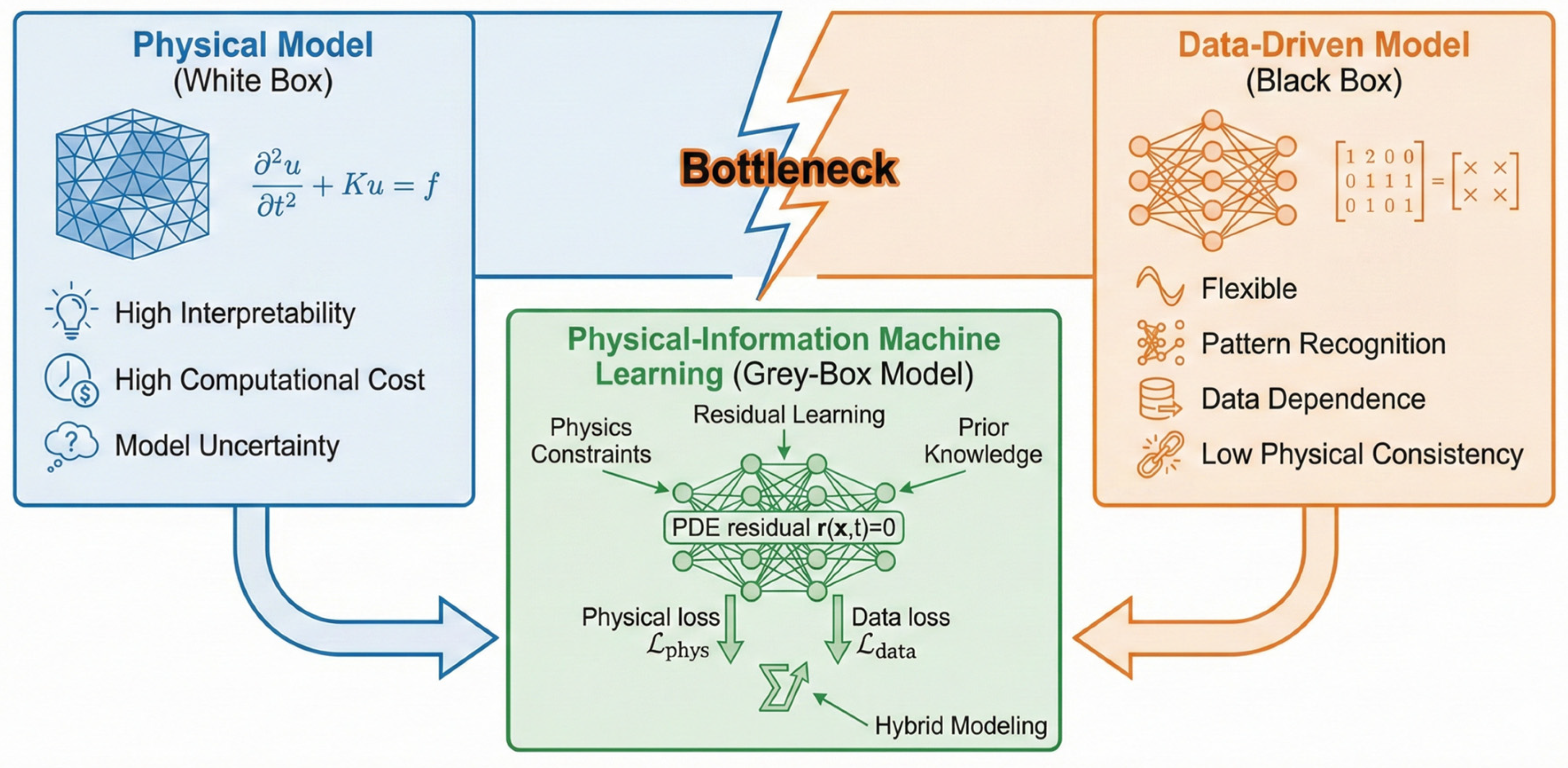
3.1. Physical Model: The “Idealization” Dilemma Under High Interpretability
- (1)
- Model uncertainty: Finite element models are essentially simplifications of real structures. Simplification assumptions, inaccurate boundary conditions, and idealization of material constitutive relationships during the modeling process can introduce significant modeling errors, leading to “model distortion” [17].
- (2)
- High computational cost: For large and complex bridge structures, the establishment and iterative updating of high-fidelity finite element models require significant computational resources and time, making it difficult to meet the requirements of real-time or quasi-real-time monitoring [18].
- (3)
- Insufficient nonlinear processing capability: Traditional model updating methods are mostly based on linear or weak nonlinear assumptions, which make it difficult to effectively capture strong nonlinear damage processes such as concrete cracking and steel yield, limiting their application in structural limit state assessment [19].
3.2. Data Driven Approach: The “Black Box” Behind Flexibility and Data Dependencies
- (1)
- Powerful pattern recognition capability: It is capable of capturing subtle damage features that are difficult for the human eye or traditional methods to detect from massive, high-dimensional data.
- (2)
- Flexibility in handling complexity and nonlinearity: It has a natural adaptability to the nonlinear and non-stationary characteristics of structural behavior.
- (3)
- Fast inference speed: Once the model training is completed, its online application inference speed is extremely fast, suitable for real-time state evaluation.
- (1)
- Physical inconsistency: Model predictions may violate fundamental physical laws (such as energy conservation), leading to absurd results in data-scarce regions [23].
- (2)
- Weak generalization ability: Model performance heavily relies on the quality and completeness of training data. When environmental conditions, load patterns, or damage types exceed the range of the training set, its performance will sharply decline [24]. For example, collecting labeled data of real bridges in various damage states is extremely costly and unethical, resulting in a scarcity of damage samples.
- (3)
- Overfitting risk: The model may only remember the noise or specific patterns in the training data, rather than the true damage mechanism, resulting in poor performance on unknown data.
3.3. From Opposition to Complementarity: The Inevitability of Integration
4. The Core Fusion Mechanism and Modeling Path of PIML
4.1. Physics-Informed Machine Learning as Constraint: Regularizer in Loss Function
- (1)
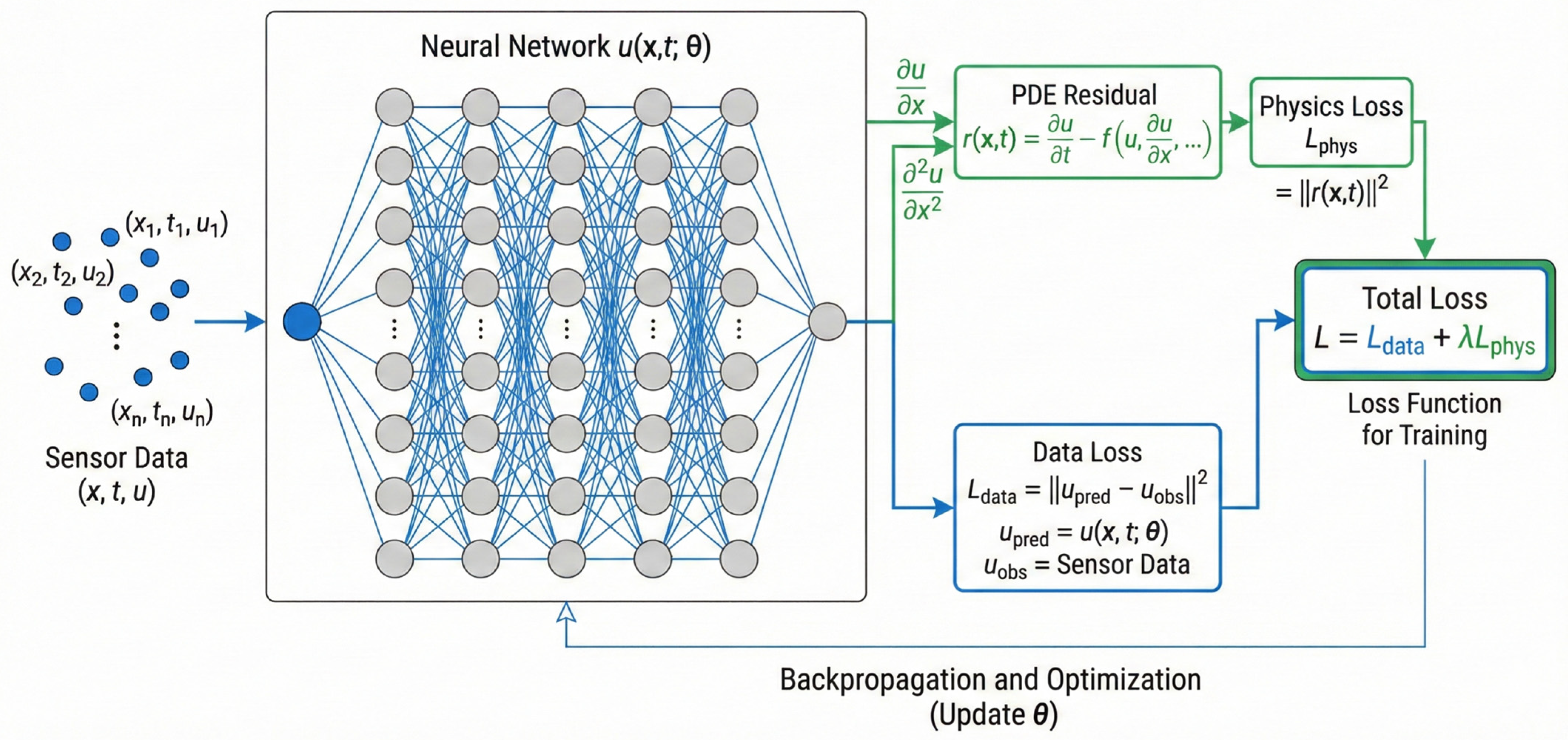
- Mechanism: The total loss function of the model is usually constructed as follows:
- (2)
- (3)
- Bridge application case: (1) Displacement reconstruction: [29] Using physics-informed convolutional neural networks, the differential relationship between displacement and acceleration was embedded into the loss function, and the full process displacement of the bridge under traffic loads was successfully reconstructed based solely on strain and acceleration data. (2) Nonlinear damage identification: [30] Integrating the dynamic control equation of the bridge pier into the loss function enables the PINN to accurately identify the location and degree of nonlinear damage in reinforced concrete bridge piers based solely on seismic response data.
- (4)
- Concrete illustration for bridge monitoring: A practical example can elucidate this fusion process. Consider the task of reconstructing the full dynamic displacement field of a bridge deck using sparse acceleration measurements—a common challenge in monitoring. The physics law here is Newton’s second law: acceleration is the second derivative of displacement with respect to time. A PINN set up for this task would use a neural network that takes spatial location and time as inputs and directly outputs a predicted displacement field. The data loss term compares the network’s predicted accelerations (obtained by automatically differentiating the network’s displacement output twice with respect to time) against the measured sparse acceleration data. Crucially, the physics loss term is computed at a large number of randomly sampled points across the bridge domain and time period; it penalizes the discrepancy between the network’s predicted acceleration and the second time derivative of its own predicted displacement. By minimizing the total loss, the network is forced to learn a displacement field that not only fits the few available sensor readings but also inherently obeys the fundamental kinematic relationship between displacement and acceleration at all points. This demonstrates how the known differential equation is embedded as a soft constraint, enabling accurate full-field prediction from limited measurements.
4.2. Physics-Informed Machine Learning as a Prior: Model Architecture and Initialization Guidance
Mechanism
- (1)
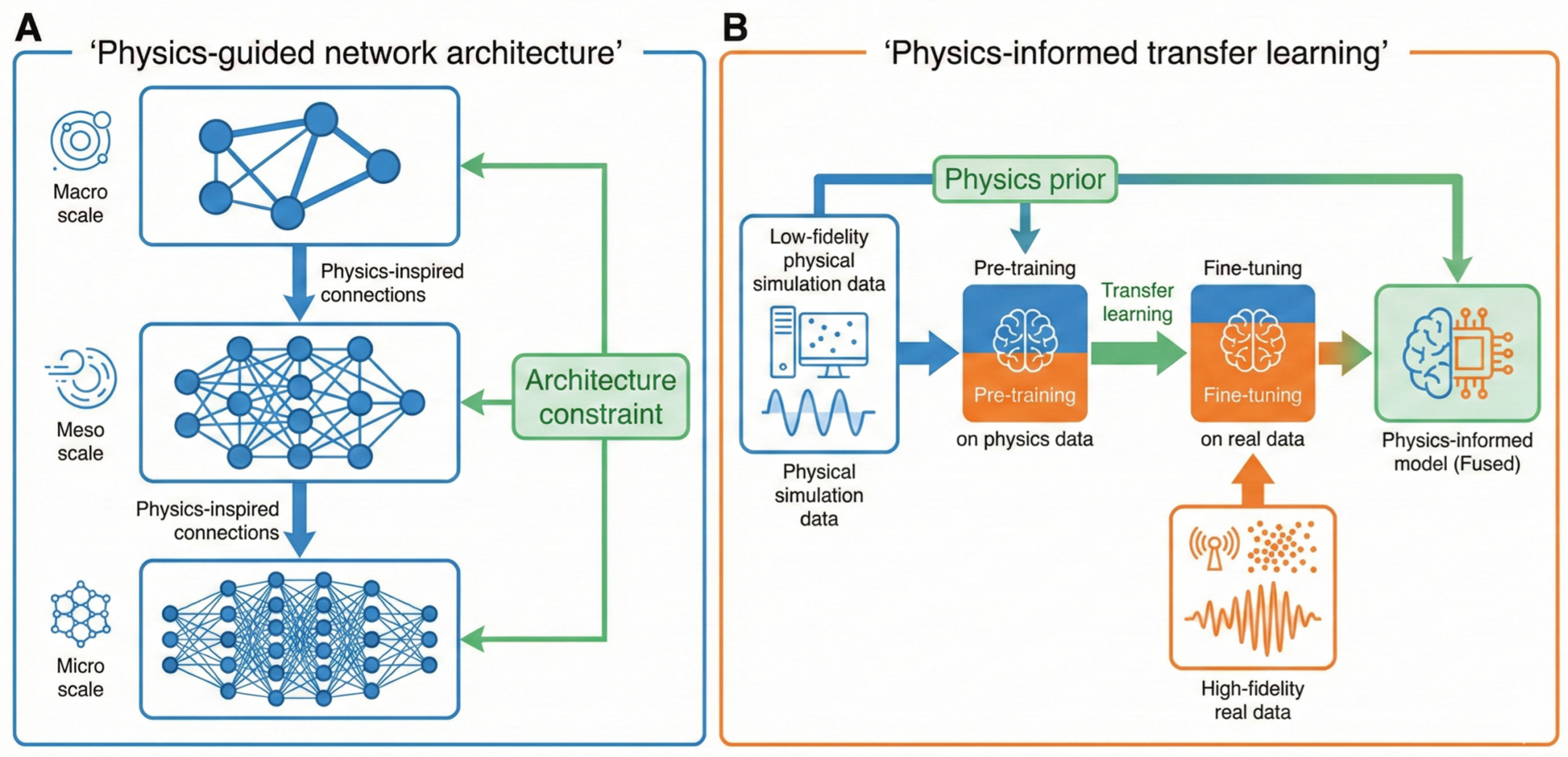
- Architecture design: Design a dedicated network structure that directly corresponds to the components or mathematical operations of the physical system in terms of its layers, nodes, or connection methods. For example, the multi-scale homogenized deep neural network proposed in has a network hierarchy that strictly corresponds to the multi-scale physical model of water flow [31], using physical properties as activation functions to achieve high-precision prediction of flood surface displacement.
- (2)
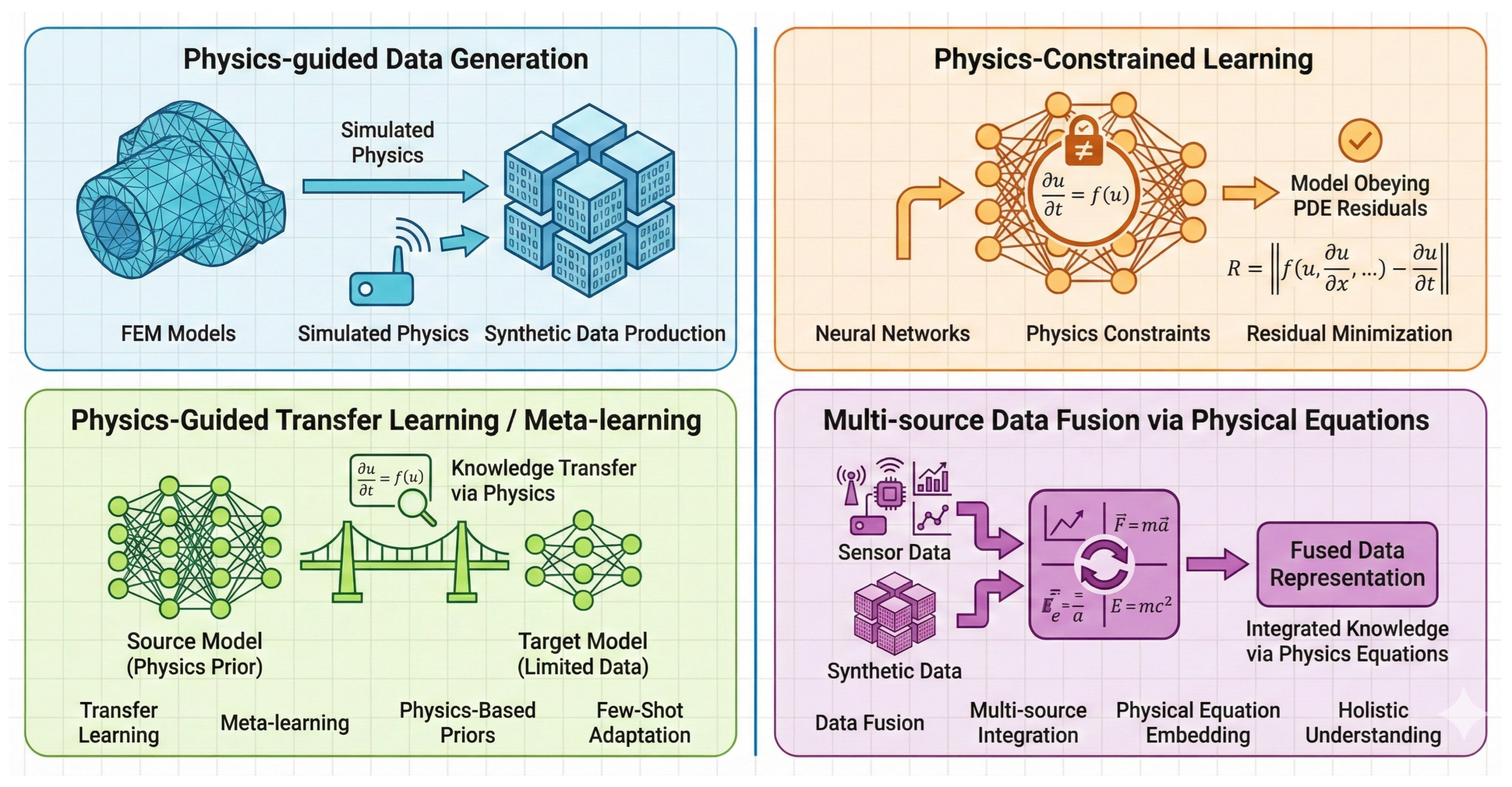
- Initialization guidance: Pre-train the network using “low-fidelity” data generated by physical simulation [32], and then fine-tune it using real “high-fidelity” data (Figure 3). This physics-guided transfer learning can provide the model with an initial state that is closer to the global optimal solution, effectively accelerating convergence and improving performance [33]. Through this method, high accuracy in damage identification of concrete slab bridges has been successfully achieved using small-sample, high-fidelity data.
4.3. Physics-Informed Machine Learning as Residuals: Hybrid Modeling Paradigm
- (1)
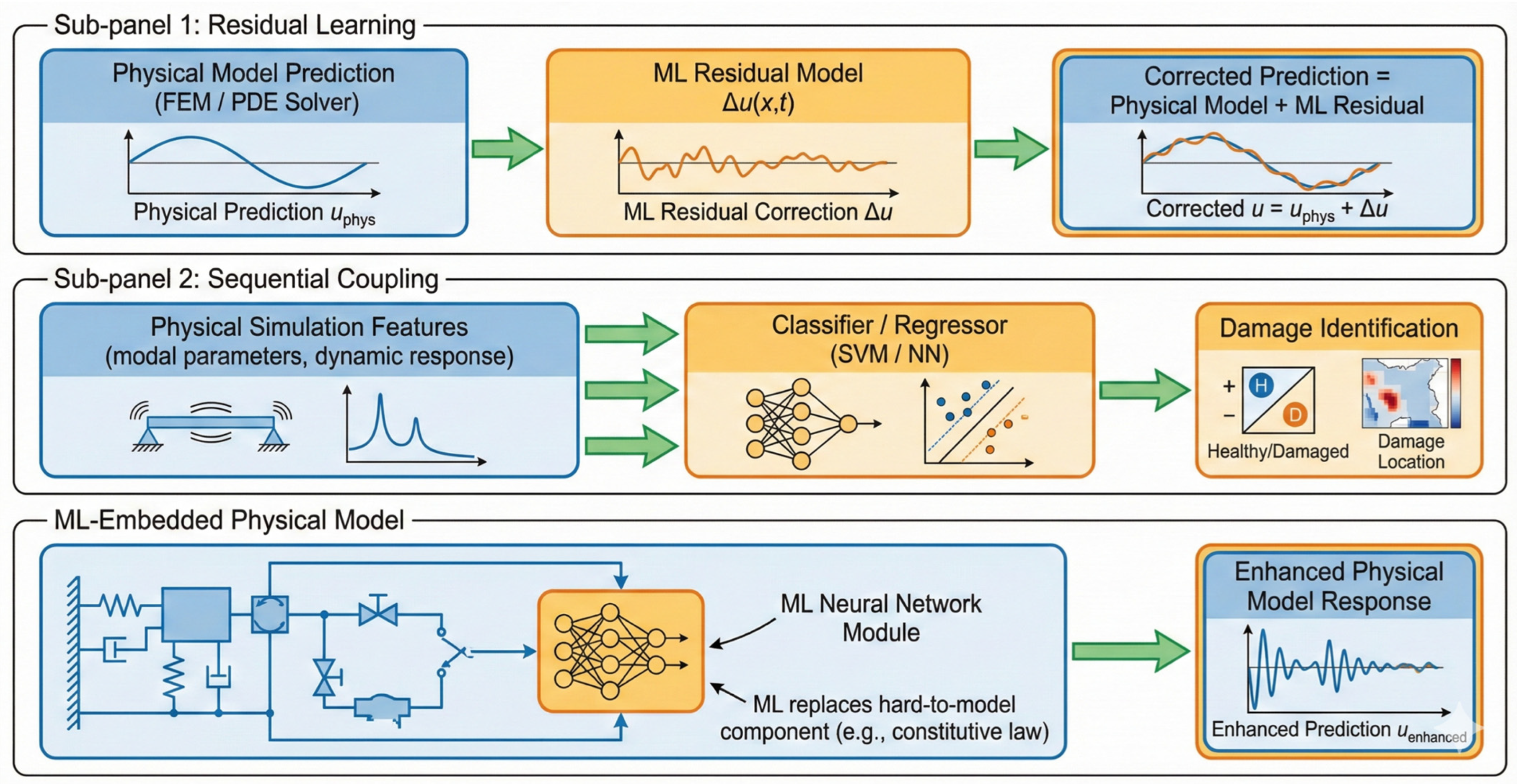
- Residual learning: ML models learn the differences between physical model predictions and measured data. For example, Wan et al. [34] use Gaussian process models to learn the residuals of finite element model modal prediction, thereby achieving efficient model updates and damage identification.
- (2)
- Sequence coupling: The output of the physical model serves as the input feature of the ML model. For example, Svendsen et al. [35] inputs the dynamic response of finite element simulation into a support vector machine for steel bridge damage identification under changing environmental conditions.
- (3)
- ML embedding in physical models: ML is used to replace a component in the physical model that is difficult to describe accurately (such as constitutive relationships). In multi-stage damage identification [36], neural networks are used to process modal parameters generated by physical models to identify specific damaged components.
4.4. Physics-Informed Machine Learning as a Discovery Target: Sparse Identification of Control Equations
- (1)
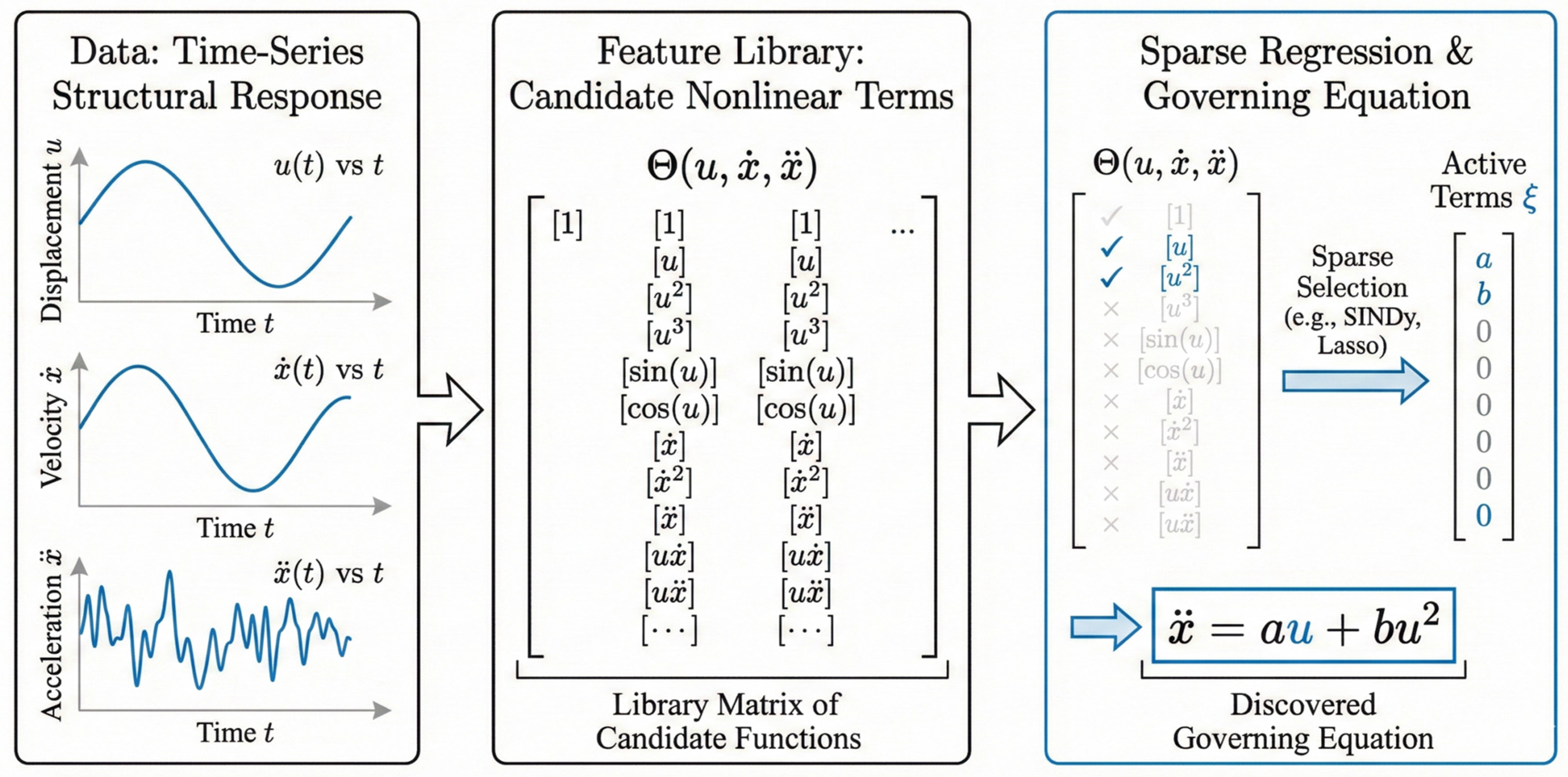
- Mechanism: Using techniques such as sparse regression [37] or symbolic regression [38], the simplest combination of mathematical terms that best describes the dynamics of observed data is automatically selected from a large candidate function library (such as polynomials, trigonometric functions, etc.), resulting in an explicit control equation (Figure 5).
- (2)
- Bridge application potential: Although direct applications to bridges remain limited in the current literature, this method has great potential for revealing the complex and nonlinear dynamic behavior of bridges under extreme loads or material degradation processes and can provide data-driven insights for establishing more accurate theoretical models.
5. Application Scenarios of PIML in the Entire Lifecycle of Bridges
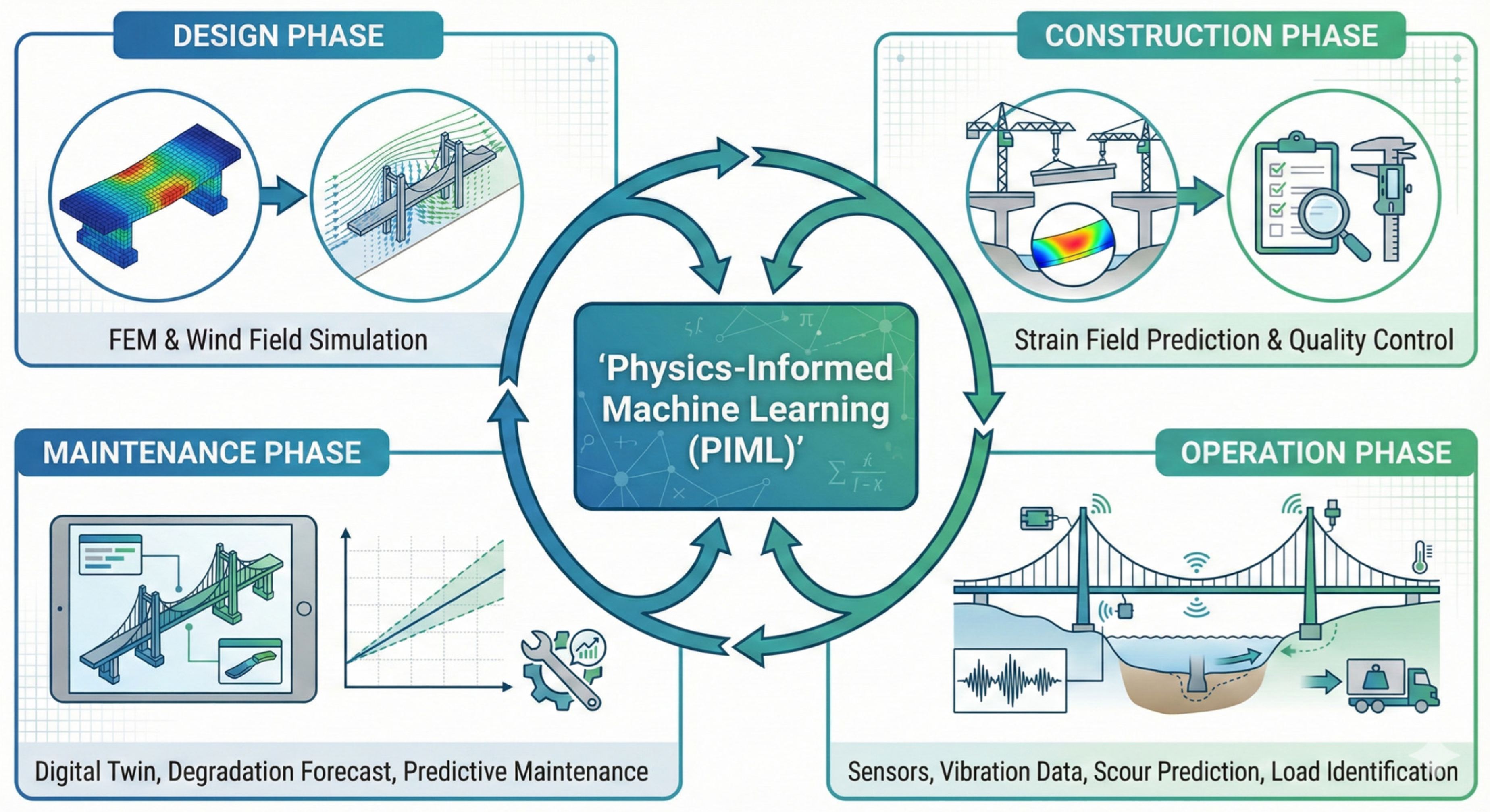
5.1. Design and Planning Phase: High Fidelity Virtual Simulation and Performance Prediction
- (1)
- Wind and flow field simulation: Traditional computational fluid dynamics simulation is computationally expensive. PIML can quickly predict the wind field distribution around the bridge body by embedding the Navier–Stokes equations. For example, Yan et al. use PINN to accurately predict the flow field around the tower of a cable-stayed bridge [39], providing an efficient tool for wind load calculation and wind vibration analysis.
- (2)
- Load response prediction: In the scheme stage, PIML can learn the data of parameterized finite element models and establish a fast surrogate model from design parameters to structural response, which is used to quickly evaluate the safety of different design schemes under extreme loads (such as earthquakes and strong winds).
5.2. Construction and Bridge Completion Stages: Closed-Loop Real-Time State Perception and Quality Control
- (1)
- Real-time prediction of strain field: A PIML model has been developed, which can predict the full field two-dimensional strain distribution on the surface of concrete structures in real time with only a limited number of sensor data points, providing a visualization tool for stress control and defect identification during construction.
- (2)
- Initial cable force calibration and bridge completion status confirmation: For cable-stayed bridges and suspension bridges, the completed cable force is a key parameter. The physics-informed autoencoder framework can accurately identify cable forces from frequency response function data, ensuring that the completed bridge state meets design expectations [40].
5.3. Operation and Monitoring Stage: Early Diagnosis and Load Identification of Damage Under Multiple Disasters
- (1)
- Earthquake damage identification: Traditional methods are difficult to accurately quantify nonlinear damage after an earthquake [41]. Using PINN, the nonlinear damage distribution of reinforced concrete (RC) bridge piers was directly identified through seismic response data inversion, providing a key basis for post-earthquake emergency assessment and repair.
- (2)
- Vehicle and mobile load identification: The difficulty of BHM lies in identifying vehicle loads on bridges without interrupting traffic [42]. The dynamic equation of the vehicle bridge coupling system was embedded into the loss function of PINN, successfully achieving synchronous high-precision identification of the bridge influence line and multiple vehicle loads.
- (3)
- Prediction of scour depth: Bridge pier scour is the main cause of bridge water damage [43]. By integrating the hydrodynamic empirical formula (HEC-18) into a deep learning model [43], a physically guided erosion prediction framework was constructed, which can effectively predict the trend of the maximum erosion depth around the bridge pier.
5.4. Maintenance and Prognostic Stage: Performance Degradation Prediction and Proactive Maintenance Driven by Digital Twins
- (1)
- Structural degradation prediction: Simple data-driven models often lack a physical basis when predicting long-term degradation. Embedding ontological knowledge, such as material degradation models and structural mechanics, into neural networks significantly improves the long-term prediction accuracy of concrete bridge deck condition ratings, making them more in line with physical laws [44].
- (2)
- The research on digital twins and pre-diagnostic maintenance: some studies demonstrate how to use PINN to combine sensor data with control equations that reflect structural behavior to construct digital twins that can predict real-time structural response [45,46]. This twin can continuously update and predict future performance under specific loads or damage scenarios, enabling pre-diagnostic maintenance by developing maintenance plans before faults occur.
6. Data Strategy and Enhancement Methods of PIML
6.1. Physics Guided Data Generation and Enhancement: Building a “Synthetic Data Factory”
- (1)
- Mechanism: Using preliminarily validated finite element models or simplified physical models, simulate the response of structures under various loads, environments, and different damage scenarios. Although there is a gap between these simulated data and real data, they contain correct physical laws.
- (2)
- (3)
- Building a hybrid dataset: For example, in the damage detection of the Z24 bridge [49], real monitoring data is mixed with numerical data generated by the FE model to jointly train a multi-layer perceptron, effectively improving the classification accuracy and robustness of the model.
6.2. Small Sample and Zero Sample Learning Under Physical Constraints: Achieving “Learning from One Example to Another”
- (1)
- Mechanism: Physical equations (such as PDEs) themselves are strong constraints and generalizations of system behavior. Embedding this constraint into the model is equivalent to providing the model with the ability to “self-learn”. Even without training data under certain operating conditions, the model can still provide reasonable predictions by satisfying physical laws.
- (2)
- Application prospects (zero sample learning): As shown in the research on acoustic field reconstruction in ref. [50], incorporating physics knowledge into dictionary learning can achieve prediction in completely new scenarios without training data. This suggests that PIML may be applied to a new type of bridge in the future without the need for its historical data.
- (3)
- Few sample learning: Weng et al. [51] demonstrates how physics-informed machine learning significantly improves the performance of wind pressure prediction models with very few data samples. In BHM, this means that only short-term monitoring of the bridge is needed to establish a reliable predictive model.
6.3. Physics-Guided Self-Supervision and Meta-Learning: Mining “Free Labels” from Data
6.3.1. Self-Supervised Learning
- (1)
- Mechanism: Physical laws themselves can be used to generate “pseudo labels”. For example, any set of predictions that satisfy zero PDE residuals can be considered an effective “self-supervised signal”. Park et al. [52] demonstrated that incorporating physical constraints into self-supervised dual learning can effectively solve complex optimization problems.
- (2)
- Potential in BHM: A large amount of unlabeled monitoring data can be utilized to pre-train a model by minimizing physical residuals, enabling it to learn the intrinsic physical laws of structural response, and then fine-tune with a small amount of labeled data at hand.
6.3.2. Meta Learning
- (1)
- Mechanism: Meta learning aims to train the model to “learn how to learn”. A meta learning initialization method for PINN was proposed, which enables the model to quickly adapt to new, unseen structures or load conditions with minimal iterations.
- (2)
- Value in BHM: For a management department with multiple similar bridges, meta learning can be used to train a universal PIML model that can quickly adapt to each specific bridge, achieving “plug and play” health monitoring and greatly reducing the model development cost for each bridge.
6.4. Physical Consistency Fusion of Multi-Source Heterogeneous Data
- (1)
- Mechanism: Data from different sources are unified into a common physical equation. For example, strain data and acceleration data are unified for displacement reconstruction through mechanical relationships [29]. Physical equations serve as a “universal language” for connecting different modal data.
- (2)
- Application: As described in ref. [53], a bridge degradation prediction model is constructed by structurally embedding multi-source knowledge, such as detection reports, physical equations, and simulation data, into a neural network through ontology. The prediction results are more physically meaningful and robust than models that only use monitoring data.
7. PIML-Driven Bridge Digital Twin System
7.1. Core Engine: Paradigm Upgrade from “Model-Driven” to “Physics-Informed Data-Driven”
- (1)
- Real-time performance: The trained PIML model (such as PINN) has extremely fast inference speed, which can meet real-time or quasi-real-time simulation requirements, far exceeding traditional FEM [46].
- (2)
- Data assimilation and model updating: PIML can continuously fuse real-time sensor data with physical laws, dynamically adjust model parameters (such as stiffness and boundary conditions), and keep the digital twin and physical entity evolving synchronously, rather than a static “snapshot”.
- (3)
- Physical consistency guarantee: It ensures that digital twins behave in accordance with basic physical laws even when data is interrupted or extrapolated, avoiding the absurd results that pure data models may produce.
7.2. Implementation of Key Functions
7.2.1. High Fidelity Real-Time Response Prediction and Virtual Sensing
- (1)
- Mechanism: By using frameworks such as PINN, sparse sensor data (such as acceleration and strain) can be combined with control equations governing structural behavior, and digital twins can reconstruct the full-field response of unmeasured degrees of freedom.
- (2)
- Case: Developed a PINN-driven RC bridge digital twin, which can predict the real-time response of the structure under various loads based on sensor inputs. Using a physics-informed Gaussian process model, virtual sensing of wind load estimation and key position response of suspension bridges was achieved, overcoming the limitations of sensor deployment quantity and location.
7.2.2. Multi-Physics Field Coupling and Extreme Operating Condition Simulation
7.2.3. Adaptive Prognostic and Pre-Diagnostic Maintenance
- (1)
- Mechanism: The digital twin continuously learns the degradation laws of the structure (such as material performance degradation) through PIML and can simulate the structural behavior under future load scenarios (such as traffic growth, extreme storms), thereby predicting its remaining service life and failure risk.
- (2)
- Case: In the digital twin of prestressed concrete bridges, predictive models and key performance indicators are integrated to predict structural performance degradation and generate predictive maintenance plans. By embedding the knowledge ontology of structural degradation into neural networks, the predictive ability of digital twins for long-term condition rating of bridge components (such as concrete bridge decks) has been enhanced, providing a basis for developing scientific long-term maintenance plans.
7.3. System Architecture and Workflow
- (1)
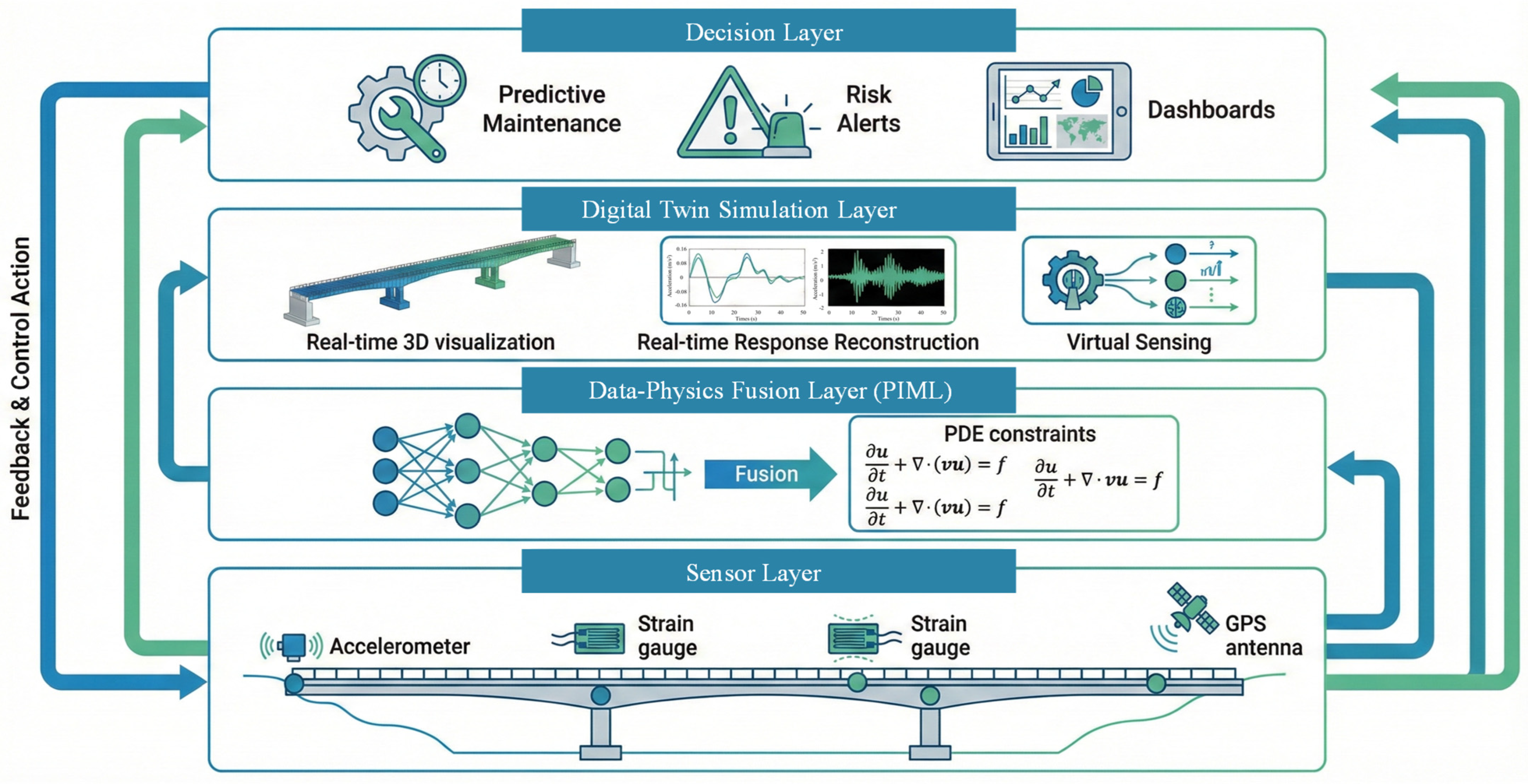
- Perception layer: A sensor network deployed on physical bridges continuously collects data.
- (2)
- Model layer: The PIML core model serves as the computing engine for the digital twin.
- (3)
- Data physical fusion: Real-time data is input into the PIML model, which performs state estimation and parameter updates through its embedded physical constraints to ensure synchronization between digital twins and physical entities.
- (4)
- Simulation and prediction: The updated digital twin is used to run “What if” scenarios, predicting the structural response under future loads or damage propagation.
- (5)
- Decision and feedback: Predictive results and diagnostic information are provided to managers to guide inspections, maintenance, or traffic control. The resulting decision actions then have a feedback effect on physical entities, forming a closed loop.
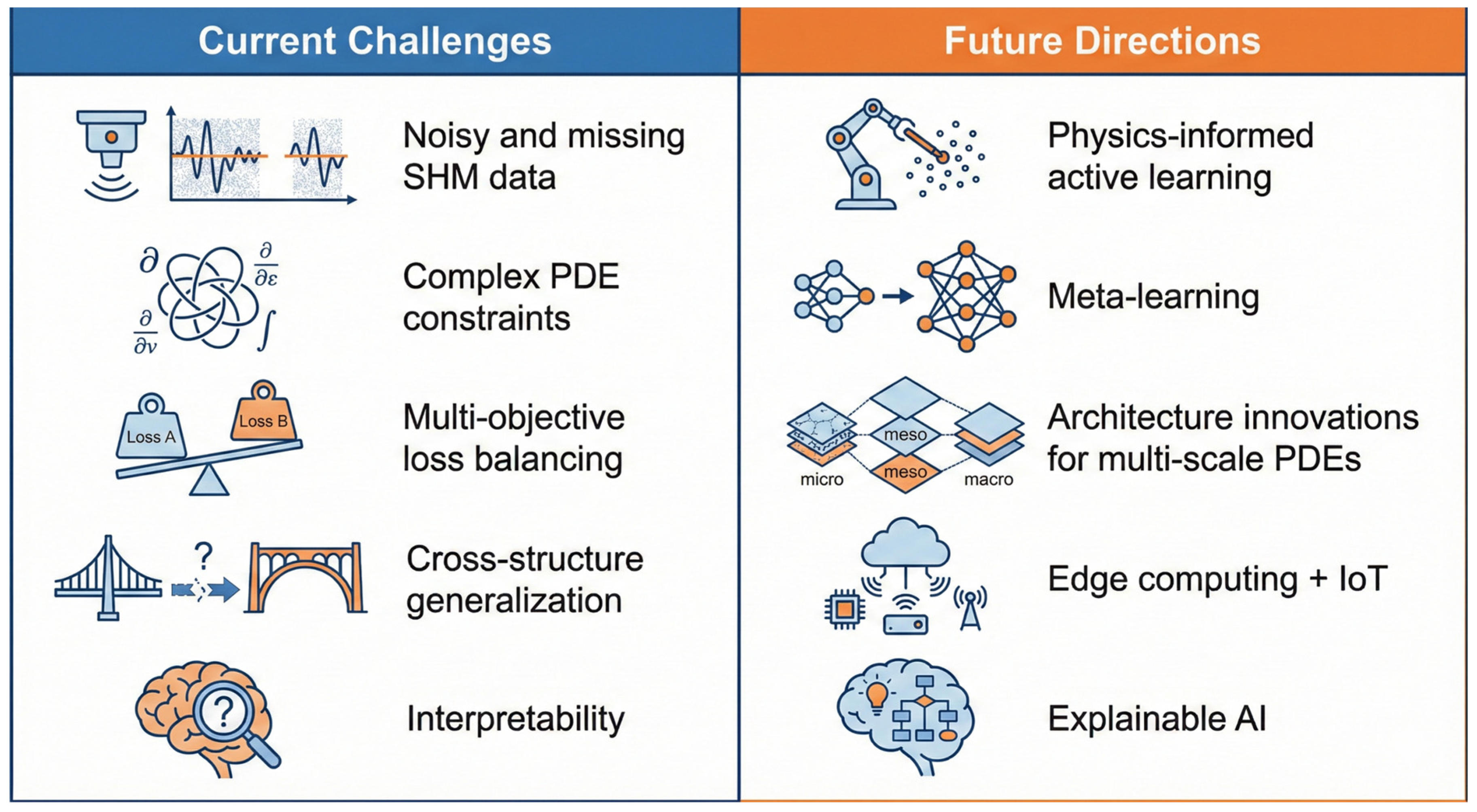
8. Challenges and Future Directions
8.1. Current Core Challenges
8.1.1. Inherent Challenges at the Data Level
8.1.2. Complexity and Computational Burden of Physical Constraints
8.1.3. The Art of Balancing Multi-Objective Loss Functions
8.2. Future Research Directions
8.2.1. Intelligent Data Strategy and Physical Guided Active Learning
- (1)
- Physics-Informed Active Learning (PIAL): PIAL can be implemented by a PIML model that quantifies its own predictive uncertainty. An acquisition function, guided by physical principles (e.g., stress concentrations, modal sensitivities), would then identify the most valuable actions—such as where to place a new sensor, which location to inspect with non-destructive testing, or what diagnostic load configuration to apply—to maximally reduce model uncertainty about critical parameters [60]. This creates a closed-loop, resource-optimized monitoring strategy.
- (2)
- Self-supervision and meta learning: As shown in ref. [61], using physical laws to create pre-training tasks from unlabeled data, or training meta-models that can quickly adapt to new bridges, will be the key to solving small-sample and cross-structure generalization problems.
8.2.2. Innovation in Advanced Model Architecture and Optimization Algorithms
- (1)
- A novel network for handling complex PDEs: Developing specialized architectures that can naturally handle multi-scale, long-term dependencies (such as combining graph neural networks with PINNs for complex topological structures) to overcome the limitations of traditional PINNs in complex dynamical systems.
- (2)
- Adaptive loss balancing technology: Promote multi-task loss weighting algorithms based on homoscedastic uncertainty, to dynamically adjust the contributions of different loss terms in PIML, achieving more stable and efficient training.
8.2.3. Deep Integration with Cutting-Edge Information Technology
- (1)
- Edge computing and IoT integration: With the help of IoT technology trends pointed out by ref. [62] and others, lightweight PIML models are deployed on edge computing nodes to achieve real-time intelligent diagnosis on the end side and reduce the pressure on data transmission and cloud computing.
- (2)
- Visualization and explainable AI: Developing advanced visualization tools to visually correlate PIML prediction results (such as damage location and degree) with physical parameters (such as stress and mode) and using attribution analysis and other techniques to explain the decision-making basis of the model, enhancing its credibility in practical engineering.
8.2.4. Standardization and Verification for Engineering Practice
9. Conclusions
Author Contributions
Funding
Data Availability Statement
Conflicts of Interest
References
- Barros, B.; Conde, B.; Cabaleiro, M.; Riveiro, B. Design and testing of a decision tree algorithm for early failure detection in steel truss bridges. Eng. Struct. 2023, 289, 116243. [Google Scholar] [CrossRef]
- Rizzo, P.; Enshaeian, A. Challenges in Bridge Health Monitoring: A Review. Sensors 2021, 21, 4336. [Google Scholar] [CrossRef] [PubMed]
- Peng, J.; Zhang, S.; Peng, D.; Liang, K. Application of machine learning method in bridge health monitoring. In Proceedings of the 2017 Second International Conference on Reliability Systems Engineering (ICRSE), Beijing, China, 10–12 July 2017; pp. 1–7. [Google Scholar]
- Zhou, X.; Zhang, F.L.; Goi, Y.; Kim, C.W. Bayesian model update for damage detection of a steel plate girder bridge. Smart Struct. Syst. 2023, 31, 29–43. [Google Scholar] [CrossRef]
- Cheng, W.-H.; Huang, H.-H. Image-Based Hidden Damage Detection Method: Combining Stereo Digital Image Correlation and Finite Element Model Updating. Sensors 2024, 24, 4844. [Google Scholar] [CrossRef]
- Zhang, C.; Chun, Q.; Zhu, Y.; Li, P.; Lin, Y.; Hua, Q. Digital twin technique for automatic damage detection of historical buildings with an adaptive model updating approach. Mech. Syst. Signal Process. 2025, 234, 112831. [Google Scholar] [CrossRef]
- Pan, H.; Azimi, M.; Yan, F.; Lin, Z. Time-Frequency-Based Data-Driven Structural Diagnosis and Damage Detection for Cable-Stayed Bridges. J. Bridge Eng. 2018, 23, 04018033. [Google Scholar] [CrossRef]
- Li, S.; Wang, W.; Lu, B.; Du, X.; Dong, M.; Zhang, T.; Bai, Z. Long-term structural health monitoring for bridge based on back propagation neural network and long and short-term memory. Struct. Health Monit. 2023, 22, 2325–2345. [Google Scholar] [CrossRef]
- Zhang, H.; Lin, J.; Hua, J.; Gao, F.; Tong, T. Data Anomaly Detection for Bridge SHM Based on CNN Combined with Statistic Features. J. Nondestruct. Eval. 2022, 41, 28. [Google Scholar] [CrossRef]
- Yuan, F.-G.; Zargar, S.A.; Chen, Q.; Wang, S. Machine Learning for Structural Health Monitoring: Challenges and Opportunities; SPIE: Bellingham, WA, USA, 2020; Volume 11379. [Google Scholar]
- Xu, F.; Jiang, Z.; Jiang, Q.; Wang, X.S. Damage Detection and Assessment of Broken Wires in Cables of a Bridge Based on Magnetic Flux Leakage. Exp. Tech. 2023, 47, 907–920. [Google Scholar] [CrossRef]
- Willard, J.; Jia, X.; Xu, S.; Steinbach, M.; Kumar, V. Integrating Scientific Knowledge with Machine Learning for Engineering and Environmental Systems. ACM Comput. Surv. 2022, 55, 66. [Google Scholar] [CrossRef]
- Farneti, E.; Cavalagli, N.; Costantini, M.; Trillo, F.; Minati, F.; Venanzi, I.; Ubertini, F. A method for structural monitoring of multispan bridges using satellite InSAR data with uncertainty quantification and its pre-collapse application to the Albiano-Magra Bridge in Italy. Struct. Health Monit. 2023, 22, 353–371. [Google Scholar] [CrossRef]
- Liu, J.; Li, Q.; Li, L.; An, S. Structural damage detection and localization via an unsupervised anomaly detection method. Reliab. Eng. Syst. Saf. 2024, 252, 110465. [Google Scholar] [CrossRef]
- Izadi, A.; Esfandiari, A. Finite element model updating for structural damage detection using transmissibility data. Earthq. Eng. Eng. Vib. 2024, 23, 87–101. [Google Scholar] [CrossRef]
- He, W.-Y.; Zhu, S.; Ren, W.-X. Two-phase damage detection of beam structures under moving load using multi-scale wavelet signal processing and wavelet finite element model. Appl. Math. Model. 2019, 66, 728–744. [Google Scholar] [CrossRef]
- Teughels, A.; De Roeck, G. Structural damage identification of the highway bridge Z24 by FE model updating. J. Sound Vib. 2004, 278, 589–610. [Google Scholar] [CrossRef]
- He, W.-Y.; Zhu, S.; Ren, W.-X. Progressive damage detection of thin plate structures using wavelet finite element model updating. Smart Struct. Syst. 2018, 22, 277–290. [Google Scholar] [CrossRef]
- Barros, B.; Conde, B.; Cabaleiro, M.; Solla, M.; Riveiro, B. Multi-objective optimization-based model calibration of masonry bridges. Case Stud. Constr. Mater. 2023, 19, e02306. [Google Scholar] [CrossRef]
- Zhou, X.; Kim, C.-W.; Zhang, F.-L.; Chang, K.-C. Vibration-based Bayesian model updating of an actual steel truss bridge subjected to incremental damage. Eng. Struct. 2022, 260, 114226. [Google Scholar] [CrossRef]
- Jin, Z.; Zhang, J.; He, Q.; Zhu, S.; Ouyang, T.; Chen, G. Feature Selection Using Tree Model and Classification Through Convolutional Neural Network for Structural Damage Detection. Acta Mech. Solida Sin. 2024, 37, 498–518. [Google Scholar] [CrossRef]
- Nick, H.; Ashrafpoor, A.; Aziminejad, A. Damage identification in steel frames using dual-criteria vibration-based damage detection method and artificial neural network. Structures 2023, 51, 1833–1851. [Google Scholar] [CrossRef]
- Pan, S.; Duraisamy, K. Physics-Informed Probabilistic Learning of Linear Embeddings of Nonlinear Dynamics with Guaranteed Stability. SIAM J. Appl. Dyn. Syst. 2020, 19, 480–509. [Google Scholar] [CrossRef]
- Xue, Z.; Xu, C.; Wen, D. Structural Damage Detection Based on One-Dimensional Convolutional Neural Network. Appl. Sci. 2023, 13, 140. [Google Scholar] [CrossRef]
- Ghiasi, A.; Ng, C.-T.; Sheikh, A.H. Damage detection of in-service steel railway bridges using a fine k-nearest neighbor machine learning classifier. Structures 2022, 45, 1920–1935. [Google Scholar] [CrossRef]
- Tan, Y.-K.; Wang, Y.-L.; Deng, E.; Ye, X.; Zhang, Y.; Ni, Y.-Q. Automatic damage detection and data completion for operational bridge safety using convolutional echo state networks. Autom. Constr. 2024, 166, 105606. [Google Scholar] [CrossRef]
- Ghiasi, R.; Ghasemi Mohammad, R. Optimization-based method for structural damage detection with consideration of uncertainties—A comparative study. Smart Struct. Syst. 2018, 22, 561–574. [Google Scholar] [CrossRef]
- Raissi, M.; Perdikaris, P.; Karniadakis, G.E. Physics-informed neural networks: A deep learning framework for solving forward and inverse problems involving nonlinear partial differential equations. J. Comput. Phys. 2019, 378, 686–707. [Google Scholar] [CrossRef]
- Ni, P.; Li, Y.; Sun, L.; Wang, A. Traffic-induced bridge displacement reconstruction using a physics-informed convolutional neural network. Comput. Struct. 2022, 271, 106863. [Google Scholar] [CrossRef]
- Yamaguchi, T.; Mizutani, T. A Physics-Informed Neural Network for the Nonlinear Damage Identification in a Reinforced Concrete Bridge Pier Using Seismic Responses. Struct. Control Health Monit. 2024, 2024, 5532909. [Google Scholar] [CrossRef]
- Chew, A.W.Z.; He, R.; Zhang, L. Multiscale homogenized predictive modelling of flooding surface in urban cities using physics-induced deep AI with UPC. J. Clean. Prod. 2022, 363, 132455. [Google Scholar] [CrossRef]
- Teng, S.; Chen, G.; Yan, Z.; Cheng, L.; Bassir, D. Vibration-based structural damage detection using 1-D convolutional neural network and transfer learning. Struct. Health Monit. 2023, 22, 2888–2909. [Google Scholar] [CrossRef]
- Teng, S.; Chen, X.; Chen, G.; Cheng, L. Structural damage detection based on transfer learning strategy using digital twins of bridges. Mech. Syst. Signal Process. 2023, 191, 110160. [Google Scholar] [CrossRef]
- Wan, H.-P.; Ren, W.-X. A residual-based Gaussian process model framework for finite element model updating. Comput. Struct. 2015, 156, 149–159. [Google Scholar] [CrossRef]
- Svendsen, B.T.; Øiseth, O.; Frøseth, G.T.; Rønnquist, A. A hybrid structural health monitoring approach for damage detection in steel bridges under simulated environmental conditions using numerical and experimental data. Struct. Health Monit. 2023, 22, 540–561. [Google Scholar] [CrossRef]
- Ko, J.M.; Sun, Z.G.; Ni, Y.Q. Multi-stage identification scheme for detecting damage in cable-stayed Kap Shui Mun Bridge. Eng. Struct. 2002, 24, 857–868. [Google Scholar] [CrossRef]
- Brunton, S.L.; Proctor, J.L.; Kutz, J.N. Discovering governing equations from data by sparse identification of nonlinear dynamical systems. Proc. Natl. Acad. Sci. USA 2016, 113, 3932–3937. [Google Scholar] [CrossRef] [PubMed]
- Rudy, S.H.; Brunton, S.L.; Proctor, J.L.; Kutz, J.N. Data-driven discovery of partial differential equations. Sci. Adv. 2017, 3, e1602614. [Google Scholar] [CrossRef]
- Yan, H.; Wang, Y.; Yan, Y.; Cui, J. Physics-Informed Neural Network for Flow Prediction Based on Flow Visualization in Bridge Engineering. Atmosphere 2023, 14, 759. [Google Scholar] [CrossRef]
- Guo, X.-Y.; Fang, S.-E. A physics-informed auto-encoder based cable force identification framework for long-span bridges. Structures 2024, 60, 105906. [Google Scholar] [CrossRef]
- Feng, D.-C.; Yi, X.; Deger, Z.T.; Liu, H.-K.; Chen, S.-Z.; Wu, G. Rapid post-earthquake damage assessment of building portfolios through deep learning-based component-level image recognition. J. Build. Eng. 2024, 98, 111380. [Google Scholar] [CrossRef]
- Zhang, C.; Zhang, W.; Ying, G.; Ying, L.; Hu, J.; Chen, W. A deep learning method for heavy vehicle load identification using structural dynamic response. Comput. Struct. 2024, 297, 107341. [Google Scholar] [CrossRef]
- Xiong, W.; Yang, Q.; Chen, Z.; Zhang, R. Enhancing the hydraulic engineering circular-18 pier scour equation with knowledge-guided symbolic regression and field data augmentation. Eng. Appl. Artif. Intell. 2025, 152, 110614. [Google Scholar] [CrossRef]
- Li, F.; Luo, D.; Niu, D. Data-intelligence driven methods for durability, damage diagnosis and performance prediction of concrete structures. Commun. Eng. 2025, 4, 100. [Google Scholar] [CrossRef] [PubMed]
- Jeon, C.-H.; Shim, C.-S.; Lee, Y.-H.; Schooling, J. Prescriptive maintenance of prestressed concrete bridges considering digital twin and key performance indicator. Eng. Struct. 2024, 302, 117383. [Google Scholar] [CrossRef]
- Radbakhsh, S.H.; Nik-Bakht, M.; Zandi, K. Structural Digital Twin of Concrete Infrastructure Powered with Physics-Informed Neural Networks. In Proceedings of the Interdisciplinary Symposium on Smart & Sustainable Infrastructures, Vancouver, BC, Canada, 4–8 September 2023; pp. 1101–1113. [Google Scholar]
- Teng, S.; Liu, A.; Chen, B.; Wang, J.; Fu, J. Bridge progressive damage detection using unsupervised learning and self-attention mechanism. Eng. Struct. 2024, 301, 117278. [Google Scholar] [CrossRef]
- Miele, S.; Karve, P.; Mahadevan, S. Multi-fidelity physics-informed machine learning for probabilistic damage diagnosis. Reliab. Eng. Syst. Saf. 2023, 235, 109243. [Google Scholar] [CrossRef]
- Figueiredo, E.; Moldovan, I.; Santos, A.; Campos, P.; Costa, J.C.W.A. Finite Element–Based Machine-Learning Approach to Detect Damage in Bridges under Operational and Environmental Variations. J. Bridge Eng. 2019, 24, 04019061. [Google Scholar] [CrossRef]
- Damiano, S.; Miotello, F.; Pezzoli, M.; Bernardini, A.; Antonacci, F.; Sarti, A.; Waterschoot, T. A Zero-Shot Physics-Informed Dictionary Learning Approach for Sound Field Reconstruction. arXiv 2024. [Google Scholar] [CrossRef]
- Weng, Y.; Paal, S.G. Physics-informed few-shot learning for wind pressure prediction of low-rise buildings. Adv. Eng. Inform. 2023, 56, 102000. [Google Scholar] [CrossRef]
- Park, S.; Van Hentenryck, P. Self-Supervised Primal-Dual Learning for Constrained Optimization. Proc. AAAI Conf. Artif. Intell. 2023, 37, 4052–4060. [Google Scholar] [CrossRef]
- Hu, X.; Liu, K. Structural Deterioration Knowledge Ontology towards Physics-Informed Machine Learning for Enhanced Bridge Deterioration Prediction. J. Comput. Civ. Eng. 2023, 37, 04022051. [Google Scholar] [CrossRef]
- Liu, C.; Chen, Y.; Xu, X. Structural digital Twin for damage detection of CFRP composites using meta transfer Learning-based approach. Expert Syst. Appl. 2025, 261, 125458. [Google Scholar] [CrossRef]
- Liu, C.; Chen, Y.; Xu, X.; Che, W. Domain generalization-based damage detection of composite structures powered by structural digital twin. Compos. Sci. Technol. 2024, 258, 110908. [Google Scholar] [CrossRef]
- Ritto, T.G.; Rochinha, F.A. Digital twin, physics-based model, and machine learning applied to damage detection in structures. Mech. Syst. Signal Process. 2021, 155, 107614. [Google Scholar] [CrossRef]
- Manzoni, A.; Pagani, S.; Lassila, T. Accurate Solution of Bayesian Inverse Uncertainty Quantification Problems Combining Reduced Basis Methods and Reduction Error Models. SIAM/ASA J. Uncertain. Quantif. 2016, 4, 380–412. [Google Scholar] [CrossRef]
- Lawal, Z.K.; Yassin, H.; Lai, D.T.C.; Che Idris, A. Physics-Informed Neural Network (PINN) Evolution and Beyond: A Systematic Literature Review and Bibliometric Analysis. Big Data Cogn. Comput. 2022, 6, 140. [Google Scholar] [CrossRef]
- Blum, A.L.; Rivest, R.L. Training a 3-node neural network is NP-complete. In Machine Learning: From Theory to Applications: Cooperative Research at Siemens and MIT; Hanson, S.J., Remmele, W., Rivest, R.L., Eds.; Springer: Berlin/Heidelberg, Germany, 1993; pp. 9–28. [Google Scholar] [CrossRef]
- He, X.; Tran, A.; Bortz, D.M.; Choi, Y. Physics-Informed Active Learning With Simultaneous Weak-Form Latent Space Dynamics Identification. Int. J. Numer. Methods Eng. 2025, 126, e7634. [Google Scholar] [CrossRef]
- Liu, X.; Zhang, X.; Peng, W.; Zhou, W.; Yao, W. A novel meta-learning initialization method for physics-informed neural networks. Neural Comput. Appl. 2022, 34, 14511–14534. [Google Scholar] [CrossRef]
- Rahita, A.; Zaki, A.; Nugroho, G.; Yadi, S. Internet of Things (IoT) in Structural Health Monitoring: A Decade of Research Trends. Instrum. Mes. Métrol. 2024, 23, 123–139. [Google Scholar] [CrossRef]


Disclaimer/Publisher’s Note: The statements, opinions and data contained in all publications are solely those of the individual author(s) and contributor(s) and not of MDPI and/or the editor(s). MDPI and/or the editor(s) disclaim responsibility for any injury to people or property resulting from any ideas, methods, instructions or products referred to in the content. |
© 2026 by the authors. Licensee MDPI, Basel, Switzerland. This article is an open access article distributed under the terms and conditions of the Creative Commons Attribution (CC BY) license.
Share and Cite
Sun, J.; He, J.; Zhou, G.; Yang, J.; Sun, X.; Teng, S. The Fusion Mechanism and Prospective Application of Physics-Informed Machine Learning in Bridge Lifecycle Health Monitoring. Infrastructures 2026, 11, 16. https://doi.org/10.3390/infrastructures11010016
Sun J, He J, Zhou G, Yang J, Sun X, Teng S. The Fusion Mechanism and Prospective Application of Physics-Informed Machine Learning in Bridge Lifecycle Health Monitoring. Infrastructures. 2026; 11(1):16. https://doi.org/10.3390/infrastructures11010016
Chicago/Turabian StyleSun, Jiaren, Jiangjiang He, Guangbing Zhou, Jun Yang, Xiaoli Sun, and Shuai Teng. 2026. "The Fusion Mechanism and Prospective Application of Physics-Informed Machine Learning in Bridge Lifecycle Health Monitoring" Infrastructures 11, no. 1: 16. https://doi.org/10.3390/infrastructures11010016
APA StyleSun, J., He, J., Zhou, G., Yang, J., Sun, X., & Teng, S. (2026). The Fusion Mechanism and Prospective Application of Physics-Informed Machine Learning in Bridge Lifecycle Health Monitoring. Infrastructures, 11(1), 16. https://doi.org/10.3390/infrastructures11010016