


Review

Illusional Perspective across Humans and Bees
by
Elia Gatto
1,2,*,
Olli J. Loukola
3,
Maria Elena Miletto Petrazzini
4,
Christian Agrillo
4,5 and
Simone Cutini
5,6
1
Department of Chemical, Pharmaceutical and Agricultural Sciences, University of Ferrara, 44121 Ferrara, Italy
2
Department of Life Sciences and Biotechnology, University of Ferrara, 44121 Ferrara, Italy
3
Ecology and Genetics Research Unit, University of Oulu, P.O. Box 3000, FI-90014 Oulu, Finland
4
Department of General Psychology, University of Padova, 35131 Padova, Italy
5
Department of Developmental and Social Psychology, University of Padova, 35131 Padova, Italy
6
Padua Neuroscience Center, University of Padova, 35129 Padova, Italy
*
Author to whom correspondence should be addressed.
Vision 2022, 6(2), 28; https://doi.org/10.3390/vision6020028
Submission received: 22 April 2022 / Revised: 20 May 2022 / Accepted: 26 May 2022 / Published: 31 May 2022

Abstract

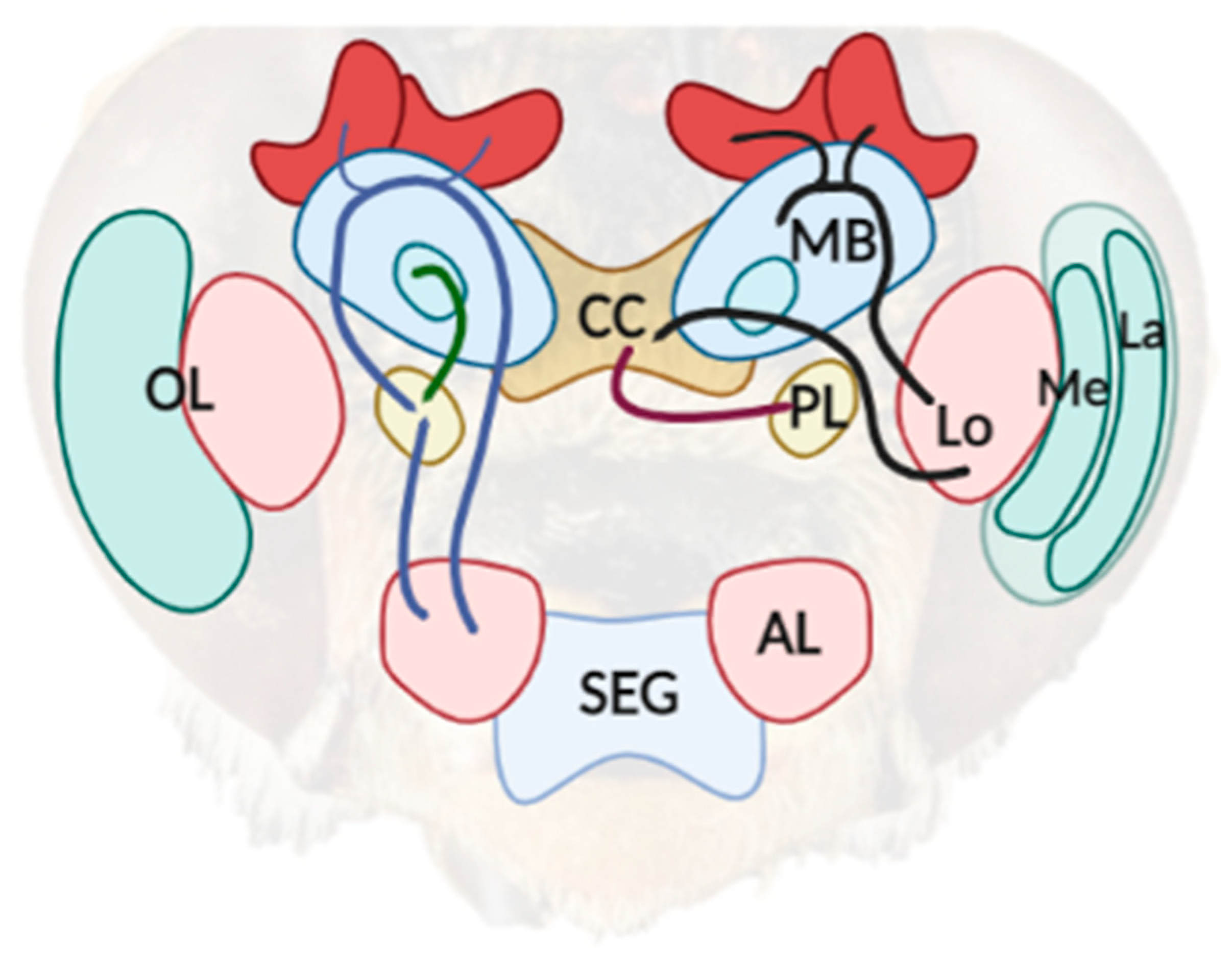
For two centuries, visual illusions have attracted the attention of neurobiologists and comparative psychologists, given the possibility of investigating the complexity of perceptual mechanisms by using relatively simple patterns. Animal models, such as primates, birds, and fish, have played a crucial role in understanding the physiological circuits involved in the susceptibility of visual illusions. However, the comprehension of such mechanisms is still a matter of debate. Despite their different neural architectures, recent studies have shown that some arthropods, primarily Hymenoptera and Diptera, experience illusions similar to those humans do, suggesting that perceptual mechanisms are evolutionarily conserved among species. Here, we review the current state of illusory perception in bees. First, we introduce bees’ visual system and speculate which areas might make them susceptible to illusory scenes. Second, we review the current state of knowledge on misperception in bees (Apidae), focusing on the visual stimuli used in the literature. Finally, we discuss important aspects to be considered before claiming that a species shows higher cognitive ability while equally supporting alternative hypotheses. This growing evidence provides insights into the evolutionary origin of visual mechanisms across species.
Keywords: bees; invertebrates; visual illusion; visual perception bees; invertebrates; visual illusion; visual perception


