Abstract
This study proposes a novel simulation-driven intelligent framework for the performance and reliability assessment of renewable energy-integrated pavement systems by unifying coupled multiphysics finite element modeling, structured dataset generation, and graph-based artificial intelligence within a single computational paradigm. The proposed pavement is formulated as a seven-layer multifunctional infrastructure system comprising the asphalt surface, intermediate binder, base layer, thermoelectric energy layer, piezoelectric insert zone, subbase, and subgrade soil, thereby enabling simultaneous consideration of structural load transfer, thermal gradient-driven energy harvesting, moisture-sensitive support behavior, and reliability-oriented performance interpretation. A three-dimensional thermo-hydro-mechanical Abaqus model was developed to simulate the concurrent effects of moving wheel load, solar heat flux, rainfall infiltration, and internal moisture diffusion, and it was subsequently used to construct an AI-ready dataset containing 6000 simulation cases and 68 variables spanning geometric, material, environmental, traffic, uncertainty, structural, thermal, hydraulic, renewable-energy, and probabilistic reliability descriptors. To preserve the physical hierarchy of the layered pavement within the learning process, a Layer-Coupled Reliability Graph Operator Network (LaRGO-Net) was proposed, in which pavement layers are represented as interacting graph nodes linked through adaptive interlayer coupling and optimized through multi-task, physics-aware, and coupling-consistent learning. Experimental evaluation across nine progressive configurations demonstrated a monotonic improvement from baseline dense and graph-convolution models to the full LaRGO-Net formulation. The final model achieved the best overall performance with mean RMSE = 0.040, mean MAE = 0.028, mean , and reliability prediction accuracy characterized by F1 = 99.21 and AUC = 99.53. These results confirm that the proposed framework provides a highly accurate, physically interpretable, and reliability-aware surrogate for next-generation pavement systems capable of simultaneously supporting structural serviceability, renewable-energy functionality, and intelligent decision-making.
1. Introduction
Pavement infrastructure has historically been conceived as a passive structural system whose principal purpose is to sustain traffic loading, distribute stresses, and maintain serviceability under long-term environmental exposure. Although this conventional view remains central to pavement engineering practice, it is increasingly insufficient for the emerging demands of sustainable transportation infrastructure, where roadway systems are expected not only to provide structural performance but also to contribute to resilience, intelligence, and resource efficiency. In this broader context, renewable energy-integrated pavement systems have attracted growing interest as a new class of multifunctional infrastructure in which structural layers are no longer treated solely as load-bearing media, but also as physically active domains capable of thermal and electromechanical energy harvesting [1]. Such systems are particularly attractive because pavements are continuously exposed to wheel-induced mechanical excitation, solar-driven thermal gradients, and hydro-environmental actions, all of which simultaneously act as deterioration drivers and potential energy sources [2]. The transition from passive pavements to energy-responsive smart pavement systems therefore represents not merely an incremental modification of pavement design, but a conceptual shift toward infrastructure that can structurally perform, environmentally interact, and functionally generate useful engineering outputs within the same physical domain [3].
The analytical treatment of renewable energy-integrated pavements remains far more complex than that of conventional layered sections, since their response arises from the simultaneous interaction of structural mechanics, thermal transfer, moisture migration, and embedded energy-conversion mechanisms. In the present problem, the pavement cannot be interpreted as a purely mechanical body governed only by deflection or stress transmission. Instead, it must be understood as a layered thermo-hydro-mechanical continuum in which the asphalt surface and intermediate binder govern traffic interaction and near-surface conditioning, the base layer controls the main structural load-spreading function, the thermoelectric layer exploits vertical temperature differentials, the piezoelectric zone responds to traffic-induced compressive excitation, and the lower subbase and subgrade regulate hydraulic moderation, confinement, and global support stability. The final system behavior therefore emerges from a coupled field environment rather than from isolated layer contributions [4].
A second research gap arises at the artificial intelligence stage. While machine learning and deep learning have been increasingly used for pavement condition prediction and infrastructure assessment, many available approaches still rely on flat feature representations that do not preserve the physical hierarchy of multilayer pavement systems. This limitation becomes even more critical in renewable energy-integrated pavements, where the predictive targets are not confined to conventional mechanical indicators but extend to temperature gradients, moisture-sensitive support response, electromechanical harvesting outputs, and probabilistic reliability descriptors. Under such conditions, the predictive problem is not merely one of nonlinear regression or classification, but one of learning how disturbances propagate across a structured infrastructure medium whose internal dependency pattern is intrinsically layered [5]. A model that ignores this ordered architecture risks learning statistical associations without capturing the physical pathways through which load, heat, moisture, and energy interaction jointly evolve. For this reason, the present study departs from conventional tabular learning and reformulates each simulation case as a graph-structured pavement representation, in which the seven pavement constituents are treated as interacting nodes and the dominant structural, thermal, hydraulic, and functional transfer mechanisms are encoded through interlayer relations [6]. This idea forms the conceptual basis of the proposed Layer-Coupled Reliability Graph Operator Network (LaRGO-Net), whose design is explicitly matched to the stratified physical logic of the pavement rather than imposed as a generic black-box predictor [7].
To address these methodological and engineering gaps, this study proposes a novel simulation-driven intelligent framework for renewable energy-integrated pavement assessment that unifies multiphysics finite element modeling, high-fidelity data generation, and graph-based reliability-aware learning within a single computational pipeline. First, a three-dimensional coupled thermo-hydro-mechanical finite element model is established in Abaqus to simulate the concurrent effects of moving wheel load, solar heat flux, rainfall infiltration, and internal moisture diffusion in a seven-layer pavement with embedded thermoelectric and piezoelectric functional zones. Second, the simulation environment is used not merely for response visualization, but as a physics-based data-generation engine from which a structured AI-ready dataset is constructed, containing geometric, material, environmental, traffic, uncertainty, structural, thermal, hydraulic, energy-harvesting, and reliability-related descriptors. Third, LaRGO-Net is developed to preserve the layered physical hierarchy of the pavement in the learning process through node-wise feature encoding, global scenario conditioning, adaptive interlayer coupling, graph-level pooling, and multi-head prediction of structural, thermal, hydraulic, renewable-energy, and reliability targets. The framework is further strengthened by physics-consistency and coupling-consistency objectives, so that the model is optimized not only for predictive accuracy but also for engineering plausibility and inter-output coherence. Consequently, the research builds upon both traditional pavement modeling and traditional AI modeling by developing a reliability-focused intelligent surrogate model that is physically structured, multifunctional, and specifically designed for the new generation of renewable energy-powered pavements.
The importance of this work is its ability to bridge three fields that are traditionally investigated separately: multiphysics of advanced pavement systems, integrated renewable-energy functionality, and explainable artificial intelligence for infrastructure reliability. In the proposed approach, the finite element model is not merely regarded as a stand-alone engineering analysis, but rather as the source of physically relevant evidence; the dataset is not regarded as a numerical dataset, but instead as a representation of causal pavement physics; and the AI model is not seen as a black-box predictor, but as a layer-sensitive graph operator that learns how the pavement transitions into safe, marginal, or unsafe states under uncertain operating conditions. This holistic view is critical for next-generation infrastructure where pavement systems are expected to simultaneously provide traffic services, adapt to climate-sensitive operating conditions, harness distributed energy opportunities, and provide actionable information for predictive maintenance. As such, the current study is part of a larger infrastructure movement that transforms transportation surfaces from passive to active, intelligent, and functional energy systems.
Compared with existing thermo-hydro-mechanical pavement modeling, energy-harvesting pavement research, and graph-neural-network-based pavement prediction methods, the main innovation of this study lies in the unified integration of these directions within a single reliability-oriented framework. Existing coupled pavement models mainly focus on structural-environmental response, energy-harvesting studies often evaluate thermoelectric or piezoelectric functionality as separate modules, and graph-based pavement prediction methods generally emphasize structural response prediction without explicitly combining renewable-energy functionality and reliability interpretation. In contrast, the proposed framework integrates a seven-layer renewable energy-embedded pavement configuration, coupled Abaqus-based thermo-hydro-mechanical simulation, a 6000-case and 68-variable simulation-generated dataset, and the Layer-Coupled Reliability Graph Operator Network (LaRGO-Net). This integration enables simultaneous assessment of structural, thermal, hydraulic, thermoelectric, piezoelectric, and reliability indicators while preserving the physical hierarchy of the layered pavement system.
The principal contributions of this study are summarized as follows:
- A seven-layer renewable energy-integrated pavement system is introduced, in which conventional structural layers are coupled with thermoelectric and piezoelectric harvesting zones to enable simultaneous structural support, thermal gradient utilization, traffic-induced energy harvesting, and reliability-oriented assessment.
- A coupled thermo-hydro-mechanical Abaqus-based simulation framework is developed as a physics-based data-generation engine, producing an AI-ready dataset of 6000 cases and 68 variables covering geometric, material, environmental, traffic, uncertainty, structural, thermal, hydraulic, energy-harvesting, and reliability descriptors.
- A Layer-Coupled Reliability Graph Operator Network (LaRGO-Net) is proposed to preserve the physical hierarchy of the multilayer pavement system through node-wise layer encoding, adaptive interlayer coupling, global scenario embedding, graph-level aggregation, and physics-aware multi-task prediction.
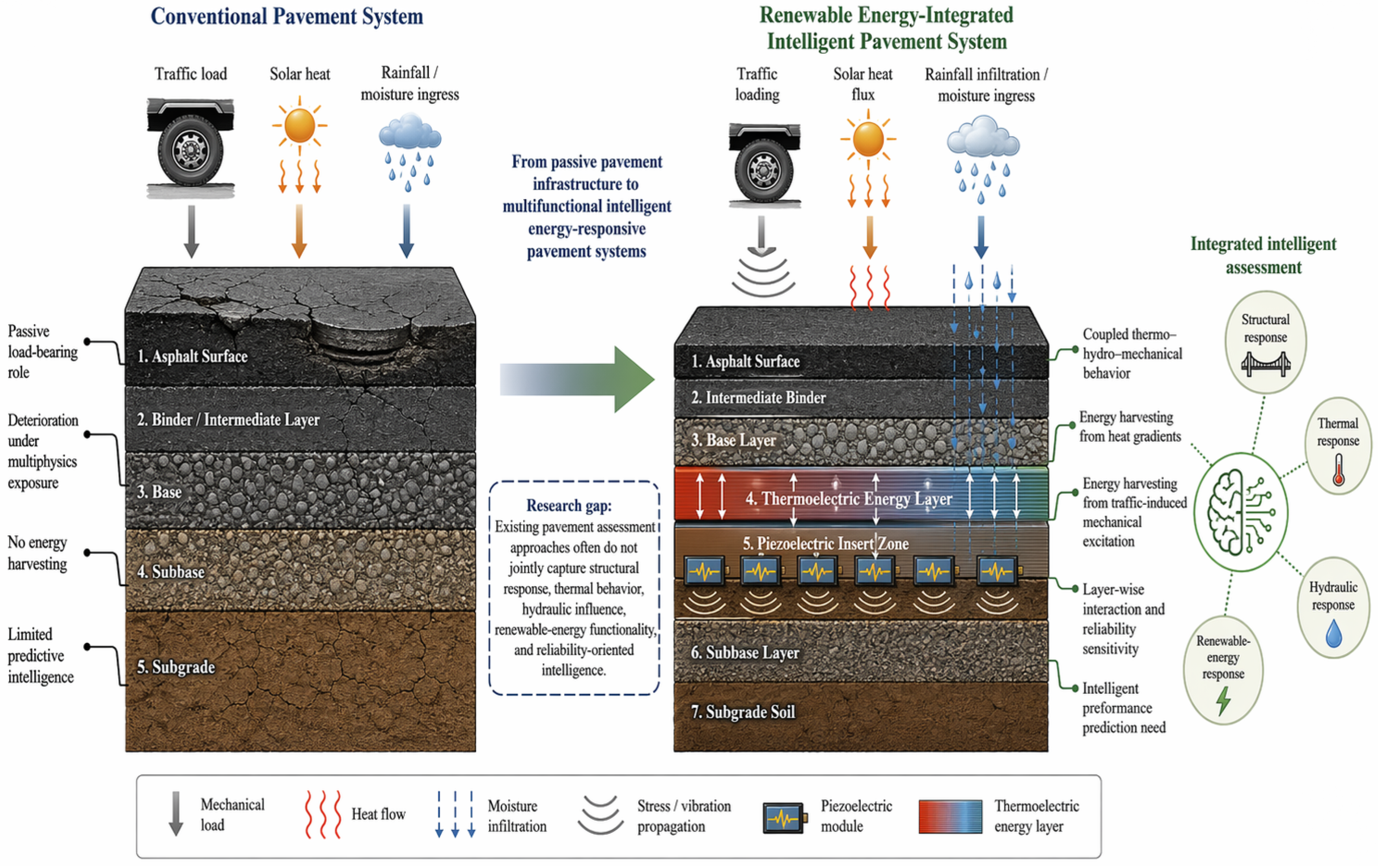
Figure 1 provides a high-level conceptual synthesis of the research problem addressed in this study by contrasting the functional limitations of conventional pavement systems with the engineering potential of renewable energy-integrated intelligent pavements. As illustrated on the left side, the conventional pavement is represented as a passive structural system exposed to the combined effects of traffic loading, solar heating, and rainfall-induced moisture ingress, where the dominant outcome of these coupled actions is progressive deterioration in the form of fatigue cracking, rutting, moisture damage, and pothole formation. This representation emphasizes that, within the traditional pavement paradigm, the layered structure primarily serves a load-bearing role and remains vulnerable to multi-physics degradation without providing any additional functional benefit beyond structural serviceability. The figure therefore captures an important gap in current pavement engineering practice, namely, that conventional assessment approaches are largely centered on distress identification and do not explicitly exploit the embedded physical processes of the pavement body for energy functionality or intelligent reliability-oriented interpretation. In contrast, the right side of the figure presents the proposed renewable energy-integrated intelligent pavement system as a multifunctional infrastructure platform in which the seven-layer pavement configuration is not only designed to resist coupled thermo-hydro-mechanical actions, but also to convert part of these actions into useful engineering functionality. In particular, the thermoelectric energy layer is positioned to utilize vertical heat gradients generated through solar exposure, while the piezoelectric insert zone is located within the mechanically active region to harvest traffic-induced compressive excitation, thereby transforming the pavement from a passive transport surface into an active energy-responsive medium. At the same time, the figure highlights that the proposed system supports a broader analytical interpretation through integrated structural, thermal, hydraulic, renewable-energy, and reliability response domains, which together define the need for intelligent performance prediction rather than isolated distress observation.
Figure 1.
Conceptual transition from conventional passive pavements to renewable energy-integrated intelligent pavement systems under coupled thermo-hydro-mechanical actions.
Mou et al. (2025) [1] offer a targeted review of pavement piezoelectric energy harvesting, and they synthesize the current state of the art in terms of piezoelectric mechanisms, material types, harvester designs, finite element-based analysis, packaging, circuitry, and pavement applications. The research question they seek to answer is how the mechanical vibration due to pavement loads can be transformed into electrical energy for low-power, transportation-related functions, and the research problem is seen as the lack of a consolidated and still-emerging engineering view on road-integrated piezoelectric harvesting systems. The paper is a review, rather than a novel predictive or simulation-based approach, and synthesizes past research in terms of design, modeling and implementation. Their key finding is an engineering landscape of piezoelectric pavement harvesting, with emphasis on its potential and limitations in terms of device durability, integration, and efficiency. However, the main contribution missing from their paper is that the review does not integrate a pavement-scale model to model piezoelectric harvesting together with thermal gradients, moisture, pavement response, and probabilistic prediction of reliability within the same platform; this is the novelty of the current study, which uses a seven-layer thermo-hydro-mechanical Abaqus model combined with graph-based multi-task reliability learning for predicting the reliability.
Priyanka and Gao (2026) [3] offer a review of pavement energy harvesting from the perspective of pavement engineering, focusing on traffic load-driven, solar-driven, and thermal gradient-driven energy harvesting concepts. The scope of their work is to assess the state of the art in pavement energy harvesting technologies and outline the main engineering opportunities for transforming road infrastructure into multifunctional responsive systems capable of harvesting energy, with the research question focusing on the need for a comprehensive engineering review of the field, given the different harvesting principles. Their approach is a review of a large collection of published papers, which classifies the literature based on harvesting mechanisms, performance tendencies and challenges in their implementation. The primary finding of the paper is that pavements can be used as multifunctional energy platforms for distributed harvesting, but deployment is highly dependent on structural compatibility, harvesting efficiency and operating climatic conditions. The key gap in this paper (which is addressed in the current work) is that their work is review-based and does not provide a simulation-based, layer-resolved predictive model that can jointly capture thermal, hydrologic, structural, thermoelectric, piezoelectric, and reliability processes in a single data-driven computational framework.
Liu and Al-Qadi (2025) [6] propose a graph-neural-network-based framework for modeling three-dimensional asphalt concrete pavement responses from finite element simulation data, making their work one of the closest methodological references to the AI component of the present study. Their objective is to build a graph-based surrogate capable of reproducing 3D pavement responses with lower computational cost than repeated full finite element analyses, while the research problem they define is that conventional pavement-response modeling is computationally intensive and that unstructured learning representations do not fully exploit the underlying organization of pavement systems. Methodologically, they develop a validated 3D FE pavement model, generate hundreds of simulation cases, convert the FE output into graph structures, and train a GNN-based pavement simulator to predict structural responses. Their results show that graph-based learning can reproduce 3D FE pavement behavior effectively and can function as an efficient surrogate modeling tool. The research gap that remains, and that the present study addresses, is that their framework is centered on structural asphalt-concrete response modeling and does not extend toward a renewable energy-integrated pavement with coupled thermo-hydro-mechanical behavior, embedded thermoelectric and piezoelectric layers, multi-domain targets, and reliability-oriented physics-aware optimization.
Chen et al. (2025) [5] develop an improved recurrent-neural-network-based pavement performance prediction model using the LTPP database, focusing on the prediction of pavement deterioration through deep learning. The objective of their study is to enhance pavement performance forecasting by incorporating multiple influential factors, while the research problem is defined as the limited capability of earlier prediction models to capture nonlinear, multivariate deterioration patterns in long-term pavement datasets. Their methodology consists of identifying major contributing factors such as initial condition indicators, traffic load, weather, pavement structure, and maintenance measures, and then training an RNN-based prediction model using LTPP data. Their results demonstrate that deep learning improves pavement performance prediction and can model nonlinear degradation behavior more effectively than simpler approaches. The key gap that the present study addresses is that their model remains fundamentally tabular and performance-oriented, without explicitly preserving pavement–layer hierarchy, without embedding coupled thermo-hydro-mechanical field behavior, and without incorporating renewable-energy outputs and probabilistic reliability descriptors into a single graph-structured predictive framework.
Hei et al. (2026) [8] propose a Bayesian-neural-network-based model for pavement management engineering, referred to as an all-in-one performance prediction framework. The objective of their study is to develop a generalized pavement prediction model capable of handling multiple management-related tasks within one probabilistic deep learning architecture, while the research problem is that many pavement prediction methods either address only specific tasks or do not explicitly quantify predictive uncertainty for engineering decision support. Methodologically, the study adopts a Bayesian neural network formulation to produce unified prediction outputs together with uncertainty-aware estimates that are relevant for pavement management applications. Their reported results indicate that the Bayesian framework improves the generality of pavement-performance prediction and contributes a more uncertainty-conscious modeling strategy. The gap that remains, and that the present study directly addresses, is that their model is not formulated around a coupled renewable energy-integrated pavement system and does not encode pavement layers as interacting graph nodes linked by mechanical, thermal, hydraulic, and functional transfer pathways; in contrast, the present work combines graph-structured multiphysics learning with embedded energy-harvesting layers and reliability-specific targets such as , , safety class, and damage-risk level.
Rahmani and Kim (2025) [2] develop a coupled thermo-mechanical finite element framework for reflective cracking in flexible pavements and thereby contribute an important recent reference on multi-field pavement simulation. The objective of their study is to simulate reflective cracking under combined thermal and mechanical loading using a more rigorous mechanistic framework, while the research problem is that classical pavement analyses often simplify thermal-mechanical interaction and therefore fail to represent cracking evolution under realistic service conditions. Their methodology integrates computational fracture mechanics, mixture-level fracture characterization of bituminous materials, and structural-level finite element modeling of flexible pavements under coupled thermal and mechanical actions. Their results show that combined thermal and mechanical loading intensifies reflective cracking behavior and that a coupled-field treatment is necessary for realistic damage assessment. The gap addressed by the present study is that, although their work is strong in thermo-mechanical pavement simulation, it does not extend to a broader thermo-hydro-mechanical environment with embedded renewable-energy functionality, simulation-generated AI-ready datasets, and graph-based multi-task reliability prediction; the current study fills that exact gap by adding hydraulic transport, thermoelectric and piezoelectric integration, and reliability-aware intelligent learning.
Ma et al. (2025) [4] investigate asphalt-pavement damage mechanisms under coupled salt-thermal-mechanical effects using a multi-scale modeling framework, highlighting the growing importance of multi-field pavement analysis in recent literature. The objective of their study is to identify damage mechanisms under aggressive environmental and mechanical coupling, while the research problem is that single-field or simplified pavement models cannot adequately explain deterioration under chemically and thermally complex operating conditions. Methodologically, they combine multi-scale modeling with laboratory-based parameter identification and validation procedures, including experimental testing to calibrate and verify their numerical interpretation of damage evolution. Their results show that salt, thermal, and mechanical interactions can significantly accelerate pavement damage and that multi-field modeling is essential for realistic durability assessment. The research gap that the present study addresses is that their work, despite its strong multi-field mechanics, does not translate coupled pavement behavior into a simulation-driven AI framework with structured dataset generation, embedded thermoelectric and piezoelectric functionality, and graph-based multi-task prediction of structural, thermal, hydraulic, energy, and reliability responses; the present study explicitly resolves that gap by integrating those components into one unified framework.
Ma et al. (2025) [4] investigate asphalt-pavement damage under coupled salt thermal mechanical effects using multi-scale modeling, making their work relevant to recent coupled pavement simulation research. Their objective is to explain how salt erosion, temperature variation, and mechanical loading jointly accelerate asphalt deterioration, while the research problem is that simplified single-field models cannot capture combined environmental mechanical degradation. They use pull-off tests, semicircular bending tests, cohesive zone modeling, and multi-scale finite element simulation. Their results show that after 48 h of salt treatment, cohesive strength decreased by 26.0 32.5% and adhesive strength by 33.5 63.8% at , while at , cohesive strength decreased by 24.9 44.0% and adhesive strength by 37.9 71.6%; fracture energy at was also reduced by 4.2 13.0% compared with , and salt penetration reached only about 10 mm after 48 h. However, their work remains focused on salt thermal mechanical damage and does not include renewable-energy layers, thermoelectric/piezoelectric outputs, AI-ready dataset generation, or graph-based reliability prediction, which are addressed in the present study.
Yin et al. (2026) [9] propose a hybrid pavement module integrating photovoltaic and piezoelectric effects, providing a recent example of multi-source energy-harvesting pavement research. Their objective is to improve pavement energy-harvesting efficiency by combining solar conversion with traffic-induced piezoelectric generation, while the research problem is that single photovoltaic pavement systems suffer from intermittency caused by day night variation, weather changes, and vehicle shading. They combine finite element simulation, mathematical power-generation modeling, and physical prototype testing under a 20 kN standard vertical load. Their results report a simulated fatigue baseline of cycles, a simulated piezoelectric power yield of about 22 mW at an optimal impedance of 680 , outdoor photovoltaic output power of 5.286 W, stable rectified piezoelectric mean power of 17.99 mW, and mean hybrid charging power of 1.55 W. Nevertheless, their work remains a prototype-level feasibility and safety-margin study under simplified boundary conditions, whereas the present study extends energy harvesting into a seven-layer thermo-hydro-mechanical pavement framework linked with structural, thermal, hydraulic, energy, and reliability prediction.
Liu and Al-Qadi (2025) [7] develop a physics-informed graph neural network for three-dimensional spatiotemporal structural response prediction of flexible pavements, making their work closely related to the graph-learning component of the present study. Their objective is to reduce the computational cost of 3D finite element pavement response modeling while preserving physical consistency, and the research problem is that conventional 3D finite element models are computationally expensive whereas purely data-driven models may violate mechanics-based constraints. They transform 3D finite element pavement data into graph format and develop a physics-informed graph neural network-based pavement simulator using strain displacement and stress-equilibrium loss components. Their results show that both the data-driven graph pavement simulator and physics-informed graph pavement simulator achieved rollout prediction time of less than 8 s per finite element simulation case, compared with about 12 h for traditional 3D finite element pavement simulation, while maintaining strong short-term accuracy and better long-term robustness for the physics-informed model. However, their model focuses on structural pavement responses only and does not include renewable-energy layers, thermo-hydro-mechanical field coupling, thermoelectric/piezoelectric outputs, or reliability-oriented multi-task prediction, which are integrated in the present study.
Wang et al. (2025) [10] develop an uncertainty-aware Bayesian dynamic linear model enhanced with a kernel regression basis function for high-precision multi-step prediction of structural health monitoring sensor streams under extreme typhoon events. Their objective is to improve SHM sensor forecasting, missing-data imputation, and uncertainty interpretation under severe environmental disturbance, while the research problem is that conventional deterministic models cannot robustly handle non-stationary and heteroscedastic sensor responses during typhoon conditions. They use a KR-BDLM framework and compare it with BP neural network and wavelet neural network predictors. Their results show that for single-step prediction, KR-BDLM achieved RMSE = 0.8049, which is 38.69% lower than the BP neural network RMSE of 1.3096; for multi-step prediction, KR-BDLM achieved RMSE = 3.5271, which is 9.44% lower than the BP neural network RMSE of 3.8946. The model also supports missing strain-data imputation and uncertainty estimation through prediction error, variance, and confidence-interval width. However, their work remains focused on SHM sensor-stream forecasting under typhoon events and does not include renewable-energy pavement layers, thermoelectric/piezoelectric outputs, thermo-hydro-mechanical pavement simulation, AI-ready dataset generation, or layer-coupled graph-based reliability prediction, which are addressed in the present study.
Cho et al. (2025) [11] propose a real-time structural health monitoring framework based on Bayesian neural networks for distinguishing aleatoric and epistemic uncertainty in digital-twin-oriented diagnostics. Their objective is to reconstruct full-field strain distributions from sparse strain-gauge measurements while quantifying uncertainty, and the research problem is that SHM models must provide reliable confidence information rather than only deterministic predictions when sensor data are noisy, sparse, or affected by damage-induced strain discontinuities. They combine principal component analysis, Bayesian neural networks, and Hamiltonian Monte Carlo inference, and validate the framework through cyclic four-point bending tests on carbon fiber-reinforced polymer specimens with different crack lengths. Their results show that the proposed framework achieved accurate full-field strain reconstruction with , while also generating real-time aleatoric and epistemic uncertainty fields. Nevertheless, their work focuses on experimental strain reconstruction for composite structural specimens, whereas the present study extends uncertainty-aware intelligent prediction to renewable energy-integrated multilayer pavements by coupling thermo-hydro-mechanical simulation, thermoelectric and piezoelectric energy-output prediction, reliability-index estimation, and layer-coupled graph-based multi-task learning.
2. Materials and Methods
The methodology of this study follows a sequential simulation-to-intelligence workflow that connects pavement configuration, Abaqus simulation, dataset construction, LaRGO-Net prediction, physical-consistency learning, and reliability assessment. First, a seven-layer renewable energy-integrated pavement system is defined with embedded thermoelectric and piezoelectric functional zones. Second, this pavement configuration is modeled in Abaqus to simulate the coupled effects of moving wheel load, solar heat flux, rainfall infiltration, and internal moisture diffusion. Third, the numerical responses obtained from Abaqus are extracted and organized into a structured simulation-generated dataset comprising 6000 cases and 68 variables, including input parameters, multiphysics responses, renewable-energy indicators, and reliability targets. Fourth, each simulation case is reformulated as a layer-based graph, where pavement layers are represented as graph nodes and interlayer physical interactions are represented as graph edges. Fifth, the proposed Layer-Coupled Reliability Graph Operator Network (LaRGO-Net) learns from these graph-structured cases to predict structural, thermal, hydraulic, energy-harvesting, and reliability-related outputs. Finally, physical-consistency and coupling-consistency losses are incorporated during training to reduce physically unrealistic predictions and to support reliability assessment through safety and risk indicators. In this workflow, Abaqus provides the physics-based evidence, the dataset stores the extracted simulation knowledge, LaRGO-Net learns the layer-dependent response patterns, and the reliability assessment translates the predicted outputs into engineering performance interpretation.
2.1. Configuration of the Renewable Energy-Integrated Pavement System
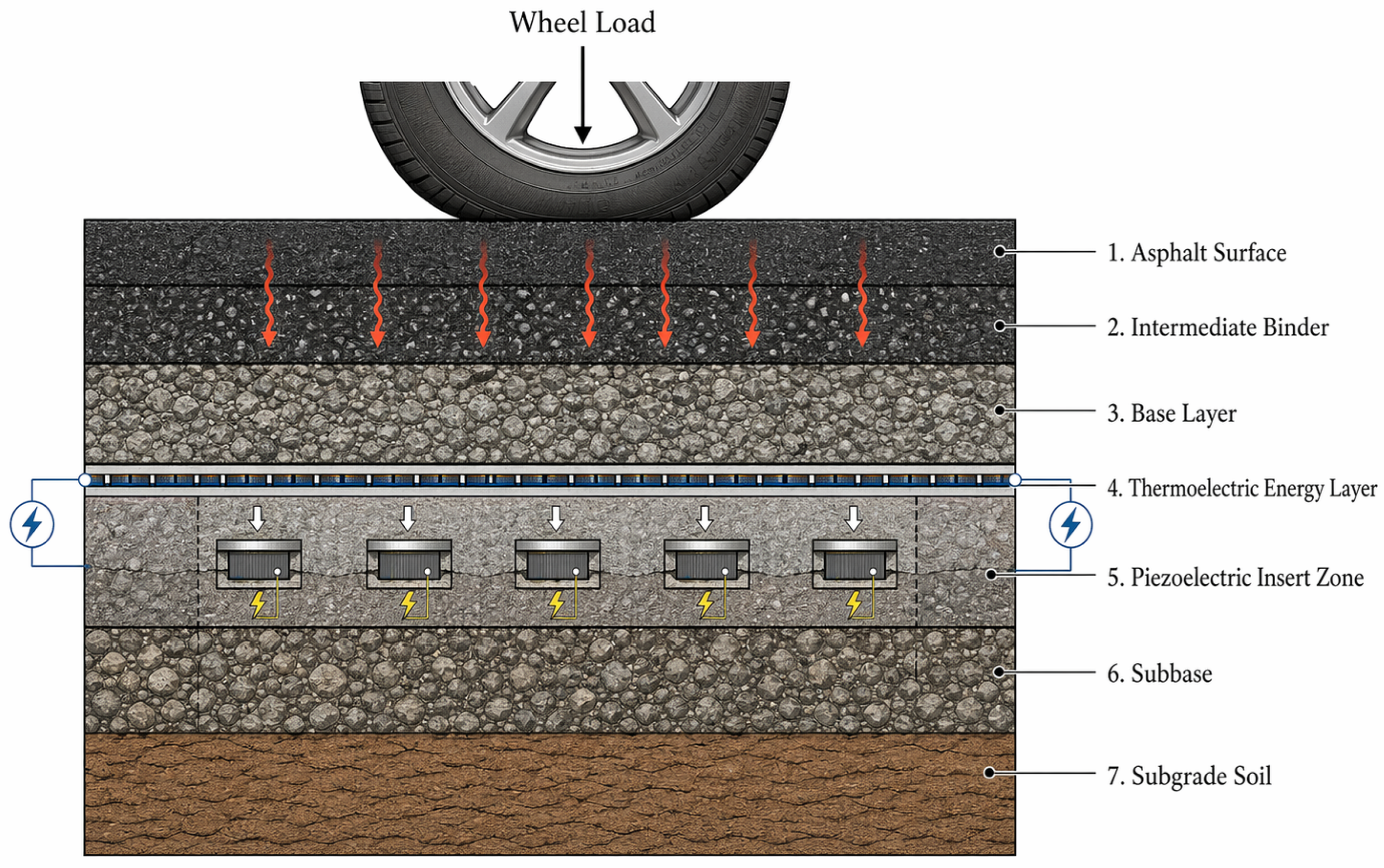
The proposed pavement was configured as a multifunctional layered infrastructure system in which the conventional structural role of the pavement was extended to include distributed renewable-energy harvesting under coupled service and environmental actions. As shown in Figure 2, the cross-section is composed of seven integrated layers, namely, the asphalt surface, intermediate binder, base layer, thermoelectric energy layer, piezoelectric insert zone, subbase, and subgrade soil. The asphalt surface was assumed to be the main wearing course which was directly exposed to traffic loads, friction, and initial thermal and mechanical stresses. The middle binder course was then deployed to improve the layer continuity and stress transfer and minimize the potential for premature shear failure. Finally, the base layer was used as the main structural carrier for dissipating wheel-induced stresses and transferring them to a larger area before they are transferred to the subgrade. Unlike the traditional pavement structures, a thin thermoelectric medium was installed below the base where the vertical temperature gradient across the pavement depth may be exploited to enable direct conversion of thermally induced energy into electrical energy. Below the thermoelectric layer, a dedicated piezoelectric insert zone was installed to harness the impact of traffic-induced compression and dynamic mechanical stimulation, thus converting local strain energy into electrical output. The subbase and subgrade layers continued to play their traditional geotechnical roles as support and confinement media, and they also functioned as thermal and hydraulic transition media that affect the global system response.
Figure 2.
Seven-layer configuration of the proposed renewable energy-integrated pavement system with embedded thermoelectric and piezoelectric functional zones.
Figure 2 illustrates the spatial arrangement and interaction of these components in the proposed smart pavement design. The load at the top of the section is the result of repeated traffic action, which triggers the stress wave through the layered medium, while the downward red arrows symbolize the heat transfer from the top part of the pavement to the thermoelectric layer. This representation highlights that the energy-harvesting components were not applied as an add-on, and that they were structurally integrated into the pavement system so that they are subject to realistic field-like mechanical and thermal loadings. The thermoelectric layer was placed at a medium depth to ensure that sufficient temperature differential can be maintained without undue weakening of the upper courses, while the piezoelectric insert zone was placed within the mechanically active region to ensure that the unit is responsive to repeated wheel-loads. This location is characteristic of a trade-off between structural robustness, energy-harvesting efficiency, and multiphysics compatibility. As such, the proposed configuration provides the physical basis for the following coupled thermo-hydro-mechanical simulation, as it allows the joint consideration of load transmission, heat flow, moisture effects, deformation response, and energy-harvesting performance within the unified pavement structure. This integrated design facilitates the idea of future pavement systems that are no longer considered merely as passive transportation surfaces, but as active civil infrastructure that is able to support traffic loads while providing resilient and sustainable energy-facilitating transportation systems.
Table 1 shows that the proposed pavement system was not simply configured as a conventional multilayered structure just for load bearing, but rather as a civil infrastructure system where each layer offers a particular mechanical, thermal, hydraulic, or energy-related capability within the proposed THM-AI system. The asphalt surface and binder layers are mainly responsible for direct traffic response, stress generation, and continuity, while the base layer functions as the primary structural medium for stress distribution, stiffness improvement, and deformation. By contrast, the thermoelectric energy layer and piezoelectric insert zone are added to provide the renewable-energy aspect of the system, as they transform temperature gradients and traffic load-induced mechanical stimulation into electrical response, thus expanding the pavement functionality from load support to energy generation. The subbase and subgrade layers are still important for stress dissipation, confinement, drainage-induced moderation, and global support, which are vital for maintaining the integrity of the structural and functional layers. Further, the table also explains how the design was translated into the simulation and data-generation phases, as each layer is directly related to certain output responses such as temperature gradients, load transfer, deformation, moisture-dependent behavior, or electrical response. Thus, the table reveals the engineering insight of the proposed pavement system and justifies that the multilayer structure was strategically created to enable both multiphysics simulation and AI-driven reliability analysis.
Table 1.
Layered configuration and engineering functionality of the proposed renewable energy-integrated pavement system.
2.2. Coupled Thermo-Hydro-Mechanical Finite Element Modeling in Abaqus
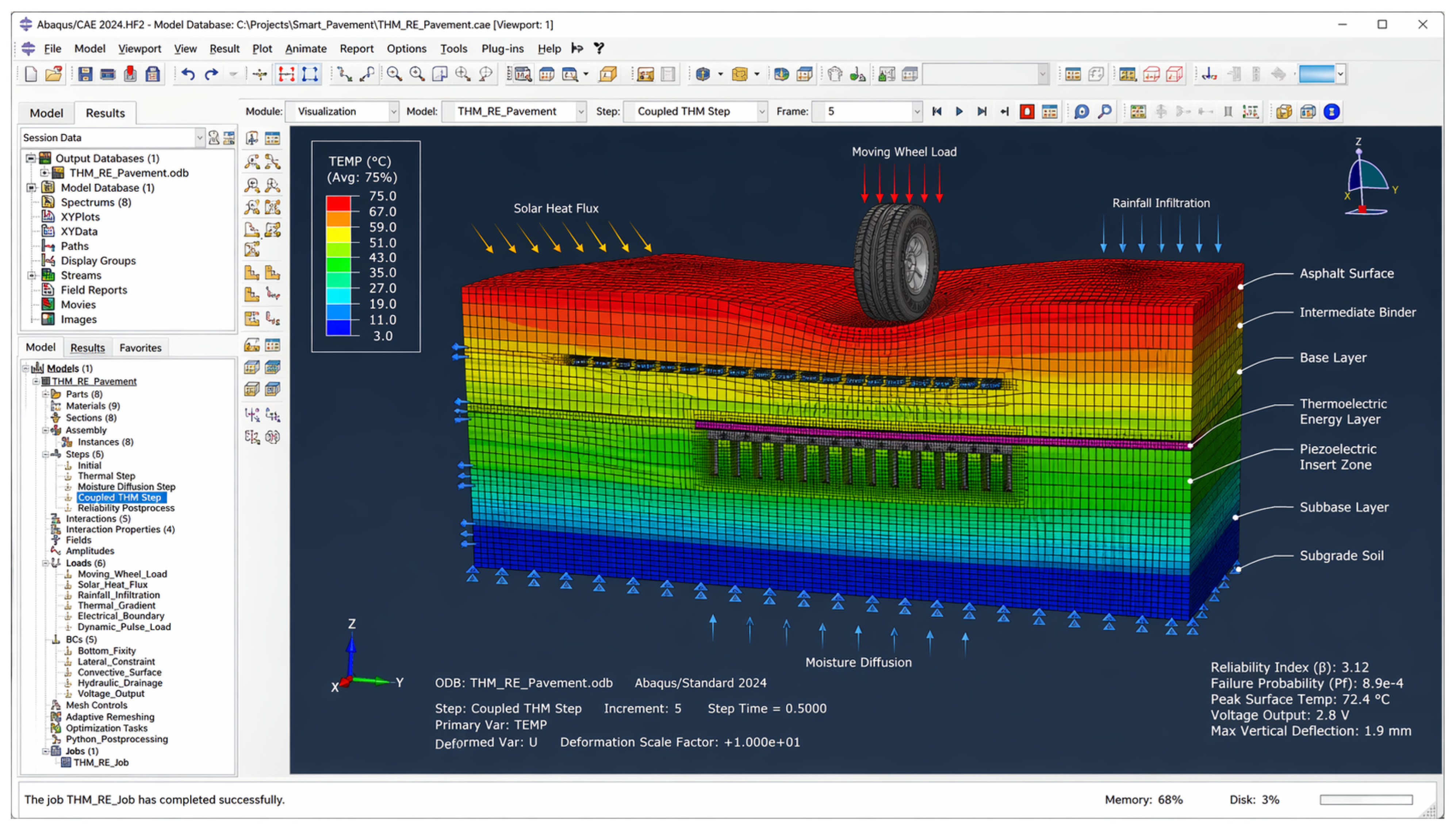
In the proposed workflow, the Abaqus model represents the physics-based simulation stage. Its role is to generate controlled thermo-hydro-mechanical pavement responses under different loading, environmental, material, and uncertainty conditions. These numerical responses are not treated as final results only; instead, they are extracted and organized into the simulation-generated dataset used later for LaRGO-Net training and reliability assessment. A three-dimensional (3-D) thermo-hydro-mechanical finite element model was created in the commercial finite element program Abaqus/CAE to investigate the coupled behavior of a renewable energy-harvesting pavement system. The model was developed to capture the coupled interaction of traffic loading, thermal effects, and moisture effects on a multilayer pavement structure with embedded energy recovery layers. As depicted in Figure 3, the model represents the asphalt surface, intermediate binder, base layer, thermoelectric energy layer, piezoelectric insert zone, subbase layer, and subgrade soil, and it therefore retains the actual layered structure of the proposed pavement system. This stratigraphic representation was required because the pavement response was expected to be influenced not only by the stiffness and support from the conventional structural layers, but also by the heat transfer path through the upper part of the structure, the water diffusion process through the lower part, and the electromechanical interaction introduced by the embedded functional layers. Hence, the finite element model was developed as the primary physics-based simulation platform to investigate deformation, stress, temperature, moisture, and energy response under realistic coupled loading conditions.
Figure 3.
Abaqus-based coupled thermo-hydro-mechanical finite element model of the renewable energy-integrated pavement system under moving wheel load, solar heat flux, rainfall infiltration, and moisture diffusion.
Figure 3 illustrates the coupled-field loading approach used in the model. A moving wheel load was imposed at the surface to generate local downward deformation in the upper layers and to deliver the main mechanical disturbance to the embedded piezoelectric region. Simultaneously, the upper boundary was subjected to asolar heat flux, producing a depth-dependent thermal gradient through the pavement structure, as indicated by the temperature contours from the hot upper region to the cooler lower region. At the same time, rainfall infiltration and moisture diffusion were applied to simulate water ingress from the pavement surface and moisture migration through the lower layers. The model also includes local mesh refinement around the wheel-load region and the embedded functional zones to better capture localized deformation, stress, thermal, and moisture gradients. The placement of the thermoelectric zone below the base layer and the piezoelectric insert zone within the mechanically active region ensures that the embedded energy-harvesting components are exposed to the thermal and load-induced responses required for energy-output extraction.
The relationship between the Abaqus model and the later artificial intelligence stage is therefore direct and sequential. For each simulated pavement scenario, Abaqus provides field-level responses such as vertical deformation, stress, strain, temperature distribution, moisture-related response, thermoelectric voltage, piezoelectric voltage, reliability index, and probability of failure. These responses are then postprocessed into numerical descriptors and stored as output variables in the dataset. The corresponding layer geometry, material properties, loading conditions, environmental variables, and uncertainty factors are stored as input variables. LaRGO-Net then uses this input-output structure to learn the relationship between pavement configuration, coupled physical response, energy-harvesting behavior, and reliability state. The simulation in Figure 3 confirms that the model is not intended to be only a structural pavement analysis, but a coupled multiphysics environment for response extraction and reliability-oriented evaluation. The temperature and deformation fields indicate a non-homogeneous coupled response field, which is dominated by the upper courses and moderated by the underlying support layers. The highlighted responses in the simulation screen, such as the reliability index, probability of failure, maximum surface temperature, induced voltage, and maximum vertical deformation, also show the transition from finite element field output to engineering performance metrics. These metrics are then assembled into the AI-ready dataset. Thus, the coupled finite element model forms the methodological bridge between the physical pavement design and the downstream stages of dataset construction, LaRGO-Net modeling, physical-consistency learning, and reliability assessment.
Table 2 summarizes the finite element simulation parameters adopted for the sequentially coupled thermo-hydro-mechanical analysis, including numerical settings, layer geometry, material properties, traffic and environmental boundaries, hydraulic inputs, uncertainty factors, mesh information, convergence criteria, and validation checks. The selected ranges indicate that the simulation campaign was designed to represent realistic pavement and service-condition variability rather than a single deterministic configuration. Geometrically, the model covers asphalt surface thicknesses of 50–80 mm, binder thicknesses of 40–70 mm, base thicknesses of 180–300 mm, thermoelectric-layer thicknesses of 6–12 mm, piezoelectric insert depths of 90–150 mm, piezoelectric insert lengths of 120–250 mm, and subbase thicknesses of 200–350 mm, allowing the effect of layer depth and embedded energy-harvesting placement to be reflected in the structural and functional response. Mechanically, the adopted stiffness ranges of 2500–6000 MPa for the asphalt surface, 2000–5000 MPa for the binder, 300–800 MPa for the base, 150–450 MPa for the subbase, and 40–180 MPa for the subgrade represent different pavement support conditions, from relatively weak foundation states to stiffer multilayer systems. The coupled thermal and hydraulic conditions are represented through asphalt thermal conductivity of 0.90–1.50 W/mK, base thermal conductivity of 1.20–2.20 W/mK, subgrade thermal conductivity of 0.80–1.80 W/mK, thermoelectric-layer conductivity of 1.20–2.00 W/mK, initial moisture content of 0.06–0.22, subgrade permeability of – m/s, rainfall infiltration of 0–20 mm/h, and moisture flux of 0.005–0.030. These values allow the model to represent temperature variation, moisture transport, seepage tendency, and moisture-dependent support degradation within the sequential THM workflow. In parallel, the energy-harvesting parameters, including a Seebeck coefficient of – V/K, piezoelectric coupling coefficient of 25–45 pC/N, and relative dielectric constant of 1000–1800, support the extraction of thermoelectric and piezoelectric performance indicators. The traffic and environmental loading conditions, including wheel loads of 35–80 kN, contact pressures of 0.60–0.90 MPa, load speeds of 20–100 km/h, solar heat flux of 500–1000 W/m2, ambient temperature of 15–45 °C, and thermal gradients of 8–30 °C, ensure that the generated responses reflect combined mechanical, thermal, and hydraulic forcing. The numerical implementation was further specified through 8-node linear brick continuum elements with reduced integration, a global mesh size of 40–60 mm, refined mesh size of 8–15 mm near the tire-contact area and embedded TEG/PZT zones, mesh aspect ratio below 5, automatic implicit incrementation, and a force-residual convergence tolerance of . Boundary and coupling settings included mm at the bottom boundary, roller-type lateral restraint in and , sequential field transfer from thermal to hydraulic to mechanical analysis, and mapping of temperature, moisture state, and pore-pressure-related response into the stress analysis. The moisture-stiffness relation and thermal strain relation clarify how hydraulic and thermal states influence the mechanical response. Finally, uncertainty factors such as surface tolerance of 0.5–3.0 mm, base tolerance of 2.0–10.0 mm, modulus variation of 0.85–1.15, temperature variation of 0.90–1.10, moisture variation of 0.80–1.20, and traffic-growth factor of 0.90–1.25 expand the simulation space into a reliability-oriented dataset. Model stability was checked through convergence monitoring, mesh-independence comparison with less than 3% change in peak deflection and stress, and consistency with expected mechanistic pavement trends. The Abaqus model functions as a controlled physics-based data-generation engine, producing 6000 simulation cases and 68 variables that connect pavement geometry, material behavior, coupled THM response, energy-harvesting performance, and reliability assessment within the LaRGO-Net learning framework.
Table 2.
Adopted finite element simulation parameters, numerical ranges, coupling settings, mesh information, convergence criteria, and validation checks used for the sequentially coupled thermo-hydro-mechanical analysis of the renewable energy-integrated pavement system.
2.2.1. Advanced Coupled Mathematical Formulation of the Thermo-Hydro-Mechanical Energy-Integrated Model
To provide a more rigorous representation of the proposed pavement system, the present study formulates the renewable energy-integrated pavement as a multi-field heterogeneous continuum in which thermal, hydraulic, and mechanical processes coexist with embedded energy-harvesting functionality. Unlike conventional pavement formulations that primarily emphasize stress–strain response under external traffic loading, the adopted framework treats the pavement domain as an active infrastructure medium in which the state variables T, , and u evolve under environmental and operational forcing. In this study, the implemented numerical workflow is interpreted as a sequentially coupled thermo-hydro-mechanical framework rather than a fully monolithic poro-thermo-mechanical formulation in which temperature, pore pressure, seepage, and displacement are solved simultaneously within a single global coupled matrix. The thermal and moisture fields are first resolved or updated under environmental exposure, and their effects are then transferred to the mechanical response stage through temperature- and moisture-sensitive material response indicators and postprocessed hydraulic descriptors. This clarification is important because the objective of the model is to generate physically traceable simulation data for AI-based reliability assessment rather than to claim a fully coupled THM field solver.
In this setting, the thermal field is governed by a transient conduction balance written as
where is the density, is the specific heat capacity, k is the effective thermal conductivity, represents external thermal input, and is a coupling term accounting for internally redistributed heat associated with field interaction and embedded functional layers. For the upper pavement boundary , the solar-driven thermal loading is introduced through
where denotes the imposed surface heat flux. This formulation is especially important in the present system because the temperature gradient is not merely an environmental by-product, but a physically exploitable source that activates the thermoelectric layer.
Accordingly, the thermoelectric response was first represented through the open-circuit voltage generated by the effective Seebeck effect,
where is the effective Seebeck coefficient and is the effective temperature difference across the thermoelectric layer after accounting for thermal contact losses. To avoid treating the thermoelectric component as an ideal voltage source, the terminal voltage delivered to an external load resistance was calculated using an equivalent circuit model as
where is the internal electrical resistance of the thermoelectric layer. The harvested thermoelectric power was then calculated as
The ideal load-matching condition occurs when , while deviations from this condition represent non-ideal electrical loading. Thermal contact resistance at the upper and lower interfaces of the thermoelectric layer was represented through
where is the heat flux crossing the thermoelectric layer, and and are the upper and lower thermal contact resistances. Thus, the thermoelectric output was evaluated using an equivalent electrical postprocessing model that includes open-circuit voltage, internal resistance, external load resistance, load matching, thermal contact losses, and power delivery rather than relying only on the ideal Seebeck relation.
The hydraulic contribution was incorporated through a generalized moisture transport model that captures infiltration, diffusion, and redistribution within the lower and intermediate pavement layers. The evolution of the moisture-related field variable was expressed as
where is the effective moisture diffusivity, is the external moisture source term, and denotes the coupling contribution associated with temperature-sensitive moisture transport. The corresponding hydraulic flux boundary condition over the infiltration boundary is written as
where defines the imposed rainfall infiltration or moisture ingress rate. This hydraulic field was introduced not only to reflect environmental wetting effects, but also to capture the gradual change in support conditions, thermal transfer efficiency, and stiffness sensitivity of the underlying support layers.
Within the adopted sequential coupling strategy, moisture content, moisture flux, moisture penetration depth, and pore-pressure-related indicators were treated as hydraulic descriptors that influence the subsequent mechanical response. In particular, seepage and moisture accumulation in the subbase and subgrade were assumed to reduce the effective support stiffness, while temperature variation was assumed to modify both the thermal strain state and the effective stiffness of temperature-sensitive layers. Therefore, pore pressure and seepage were not treated as isolated outputs only; they were used as intermediate descriptors linking hydraulic exposure to deformation, stress redistribution, subgrade compressive strain, and reliability-related response. The effective stiffness of moisture- and temperature-sensitive layers was represented in reduced form as
where is the reference elastic modulus, T and are the local temperature and moisture state variables, and are reference values, and and are sensitivity coefficients controlling thermal- and moisture-induced stiffness degradation. This reduced relation connects environmental field evolution with the mechanical response without assuming a fully monolithic THM solution.
The mechanical equilibrium of the layered pavement was formulated through the balance equation
where is the Cauchy stress tensor and b is the body-force vector. The kinematic field follows the small–strain expression
while the constitutive behavior is represented in coupled generalized form as
where is the effective temperature- and moisture-sensitive stiffness tensor, is the thermally induced strain, is the moisture-related strain contribution, and is an equivalent electromechanical strain contribution used to represent the local interaction of embedded piezoelectric components with the surrounding pavement matrix. The thermal strain is written as
where is the thermal expansion coefficient, is the reference temperature, and is the identity tensor. In addition, the wheel-induced traffic action over the loaded surface is imposed as
where denotes the traction associated with the moving wheel load.
For the embedded piezoelectric region, the electromechanical response was represented using a reduced constitutive relation,
where is the electric displacement, is the piezoelectric coupling coefficient, is the stress component, is the dielectric tensor, and is the electric field. In the present implementation, the polarization direction was assumed to be aligned with the dominant vertical compressive stress induced by wheel loading, and the upper and lower electrode faces of the piezoelectric insert were treated as equipotential electrode boundaries. The open-circuit piezoelectric voltage was first estimated from the stress-induced electromechanical response. The voltage delivered to an external load resistance was then evaluated using an equivalent electrical resistance model as
where is the equivalent internal resistance of the piezoelectric insert. The harvested piezoelectric power was calculated as
This distinction separates open-circuit voltage estimation from closed-circuit power delivery to an external load. Therefore, the piezoelectric output was not treated only through the constitutive equation; instead, the finite element stress response was coupled with equivalent electrical postprocessing assumptions involving polarization direction, electrode boundary conditions, internal resistance, external load resistance, terminal voltage, and power calculation.
It should be noted that the energy-harvesting formulation in this study is an equivalent postprocessing representation coupled to the thermo-hydro-mechanical finite element response, rather than a full power-electronics or detailed transient circuit co-simulation. This level of modeling is suitable for constructing voltage, power, and energy-efficiency descriptors for the AI-ready dataset, while avoiding the unsupported assumption that the pavement model resolves all transient electrical circuit dynamics directly within Abaqus.
Collectively, Equations (1)–(17) define an integrated mathematical basis for the proposed system by linking heat-driven thermoelectric conversion, moisture-sensitive support behavior, seepage-related hydraulic response, traffic-induced deformation, and embedded piezoelectric harvesting within a single simulation-oriented framework. The formulation should therefore be interpreted as a sequentially coupled THM-energy modeling workflow with equivalent energy-output postprocessing, rather than as a fully monolithic THM-electrical circuit simulation. This formulation provides the theoretical foundation for extracting high-fidelity multiphysics descriptors from the finite element model and transforms the simulation stage from a conventional response-analysis task into a data-generation engine for intelligent reliability-oriented pavement design.
2.2.2. Simulation Scenario Generation and Dataset Construction
Table 3 defines the complete simulation input space and demonstrates that the numerical scenarios were generated from a physically grounded combination of geometric, material, environmental, traffic, energy-functional, and uncertainty-related variables. The geometric variables, including Asphalt_Surface_Thickness, Intermediate Binder Thickness, Base Layer Thickness, Thermoelectric Layer Thickness, Piezoelectric Insert Depth, Piezoelectric Insert Length, and Subbase Thickness control not only the structural depth and load distribution characteristics of the pavement, but also the spatial embedding and activation region of the thermoelectric and piezoelectric components. In parallel, the material-property variables such as Asphalt Elastic Modulus, Base Elastic Modulus, Subgrade Elastic Modulus, Asphalt Thermal Conductivity, Subgrade Permeability, TEG Thermal Conductivity, and TEG Seebeck Coefficient govern the stiffness, heat-transfer capability, hydraulic sensitivity, and energy-conversion efficiency of the multilayer system. The traffic and environmental variables, particularly Wheel Load, Contact Pressure, Load Speed, Solar Heat Flux, Ambient Temperature, Rainfall Infiltration Rate, Moisture Flux, and Thermal Gradient, define the coupled service and exposure conditions acting on the pavement, while the uncertainty descriptors Construction Tolerance Surface, Construction Tolerance Base, Modulus Variation Factor, Temperature Variation Factor, Moisture Variation Factor, and Traffic Growth Factor introduce realistic variability associated with construction imperfections, constitutive fluctuations, environmental instability, and future traffic escalation. Therefore, the table confirms that the simulation campaign was designed as a multidimensional reliability-oriented scenario space rather than a narrow deterministic parametric sweep, which is essential for generating a dataset capable of supporting robust AI-based prediction and generalizable engineering interpretation.
Table 3.
Input variables and variation ranges adopted for simulation scenario generation in the coupled thermo-hydro-mechanical Abaqus framework.
To ensure that the reliability-related outputs were traceable and physically interpretable, the reliability index, failure probability, safety class, performance state, and damage-risk level were derived from finite element simulation responses through a limit-state-based postprocessing procedure rather than assigned manually. For each simulation case, the main structural, hydraulic, and serviceability demands extracted from Abaqus included maximum vertical deflection, asphalt-bottom tensile strain, subgrade compressive strain, maximum von Mises stress, maximum moisture-response indicator, and pore-pressure-related hydraulic response. These simulated demands were compared with predefined allowable thresholds to calculate normalized safety margins. The general limit-state function for response indicator i was defined as
where is the allowable resistance or critical threshold of response indicator i, and is the corresponding simulated demand obtained from the finite element model. A positive value of indicates that the simulated response remains within the allowable range, whereas a negative value indicates exceedance of the corresponding limit state.
Because pavement performance may be controlled by more than one response mode, a case-level composite safety margin was calculated using the most critical normalized limit-state ratio as
Here, , , , , , and denote the maximum vertical deflection, asphalt-bottom tensile strain, subgrade compressive strain, von Mises stress, moisture-response indicator, and pore-pressure-related hydraulic response, respectively. The corresponding allowable values define the adopted serviceability, material, and hydraulic thresholds. The minimum operator was used so that the most critical response mode controlled the reliability status of each simulation case.
The reliability index was then calculated from the statistical distribution of the composite safety margin within the uncertainty-based scenario group as
where and are the mean and standard deviation of the composite safety margin G, respectively. The failure probability was calculated using the standard normal cumulative distribution function as
where is the standard normal cumulative distribution function. Therefore, higher values indicate larger safety margins and lower probability of failure, whereas higher values indicate greater likelihood that at least one critical structural, hydraulic, or serviceability limit state is exceeded.
Table 4 provides the complete construction logic used to transform finite element simulation responses into reliability-oriented learning targets. The process begins with the limit-state margin , where each simulated demand is compared with its corresponding allowable threshold . This step ensures that the reliability calculation is directly tied to the actual Abaqus-derived response quantities rather than to manually assigned labels. The composite safety margin G then combines the dominant structural, hydraulic, and serviceability response modes, including maximum vertical deflection , asphalt-bottom tensile strain , subgrade compressive strain , maximum von Mises stress , maximum moisture-response indicator , and maximum pore-pressure-related hydraulic response . By using the minimum normalized margin, the framework assigns the reliability status of each case according to the most critical failure tendency, which is appropriate for pavement systems where excessive deformation, fatigue-related tensile strain, rutting-related compressive strain, stress concentration, moisture accumulation, or pore-pressure increase may independently control performance degradation. The continuous reliability index is subsequently computed from the mean and standard deviation of the composite safety margin G, while the failure probability is obtained from the standard normal cumulative distribution function. These two continuous quantities are then used to construct the classification targets: Safety_Class separates safe and reliability-critical cases using and , Performance_State distinguishes safe, marginal, and unsafe behavior using combined - and -based thresholds, and Damage_Risk_Level provides an ordinal risk interpretation from low to critical based on decreasing reliability-index ranges. Accordingly, the table clarifies that the regression targets and , the binary safety label, the multiclass performance state, and the ordinal damage-risk level were all generated through a reproducible limit-state postprocessing chain. This makes the LaRGO-Net training targets physically interpretable because they remain linked to simulated pavement deformation, strain, stress, moisture, and pore-pressure responses rather than subjective or visually assigned damage categories.
Table 4.
Definition and construction rules of the reliability-related target variables derived from finite element simulation outputs.
Table 5 shows that the response extraction strategy was deliberately structured to capture the full operational complexity of the proposed renewable energy-integrated pavement system through mechanical, thermal, hydraulic, energy-harvesting, and reliability-oriented indicators. The mechanical responses, including Max Vertical Deflection, Max Total Deformation, Max Von Mises Stress, Max Principal Stress, Max Principal Strain, Max Tensile Strain Asphalt Bottom, Max Compressive Strain Subgrade, and Contact Stress, collectively describe both the global deformation behavior of the pavement and the localized stress–strain conditions associated with fatigue susceptibility, rutting tendency, and surface loading transfer. The thermal responses, namely, Peak Surface Temperature, Peak TEG Temperature, Average Temperature Gradient, Temperature at Asphalt Base, and Temperature at Subgrade Top, provide a vertically resolved characterization of the thermal field and are especially important because they directly determine the activation condition of the embedded thermoelectric layer. Similarly, the hydraulic variables Max Moisture Content, Average Moisture Content Subbase, Moisture Penetration Depth, Pore Pressure Max, and Hydraulic Flux Max quantify moisture ingress, transport intensity, hydraulic accumulation, and support-layer vulnerability, thereby extending the model beyond dry-state structural mechanics. The renewable-energy outputs TEG Voltage Output, TEG Power Output, Piezoelectric Voltage, Piezoelectric Power, and Energy Harvesting Efficiency then translate these coupled physical states into measurable functional performance, while the final descriptors Reliability Index Beta, Failure Probability Pf, Performance State, Safety Class, and Damage Risk Level convert the extracted responses into decision-oriented reliability targets. Consequently, the table confirms that the output set was not limited to raw finite element quantities, but was intentionally formulated to bridge field-level numerical response, renewable-energy functionality, and AI-ready reliability assessment.
Table 5.
Extracted output variables obtained from the coupled thermo-hydro-mechanical Abaqus simulations and used in the final dataset.
The reliability-related targets were computed from a rule-based limit-state formulation derived from the finite element response outputs. For each simulation case, a normalized performance demand index D was first calculated by combining the main structural and environmental demand ratios as
where , , , and denote the maximum vertical deflection, tensile strain, equivalent stress, and moisture-related severity indicator extracted from the finite element model, respectively. The terms , , , and are the corresponding allowable thresholds, while , , , and are weighting coefficients satisfying . The limit-state margin was then defined as
so that positive values of g indicate an acceptable safety margin, while negative values indicate that the combined demand exceeds the allowable performance boundary. The reliability index was calculated as
where and are the mean and standard deviation of the limit-state margin estimated over the uncertainty-perturbed simulation response. The corresponding probability of failure was obtained using the standard normal cumulative distribution function as
These two continuous reliability descriptors were then mapped into categorical labels according to the thresholds summarized in Table 6.
Table 6.
Reliability-index, failure-probability, and classification thresholds used to define reliability targets.
Table 7 presents the final architecture of the simulation-generated dataset and confirms that the numerical records were organized as a structured causal framework linking prescribed inputs to extracted multiphysics behavior and final reliability interpretation. The metadata block, comprising Case ID, Model Name, Analysis Step, Mesh Level, and Run Status, provides simulation traceability and ensures that each record can be associated with a unique numerical experiment and execution condition. The 35-column input block preserves the complete design and loading definition of each case, including layer geometry, constitutive properties, thermal and hydraulic descriptors, traffic conditions, renewable-energy material parameters, and uncertainty factors, which means that every dataset row contains a full engineering description of the scenario simulated in Abaqus. The multiphysics response block then describes the structural, thermal, and hydraulic responses through indicators such as deflection, stress, strain, temperature distribution, moisture penetration, and pore pressure, while the renewable-energy block introduces a unique functional perspective through thermoelectric and piezoelectric voltage, power, and efficiency. Finally, the reliability block produces the numerical response in the form of predictive targets through Reliability Index Beta, Failure Probability Pf, Performance State, Safety Class, and Damage Risk Level, which allows both regression-oriented and classification oriented AI-based tasks. Moreover, the size of the dataset—6000 records and 68 variables—suggests that the database is sufficiently large, multidimensional, and well-organized enough for data-driven modeling, sensitivity analysis and reliability-focused surrogate modeling. Accordingly, the table clearly shows that the dataset was created not only as a store for the output, but as a digital representation of the entire simulation framework, and it can support explainable artificial intelligence for renewable energy-integrated pavement design.
Table 7.
Representative schema of the final simulation-generated dataset used for artificial intelligence modeling and reliability assessment.
2.3. Layer-Coupled Reliability Graph Operator Network for Performance and Reliability Prediction
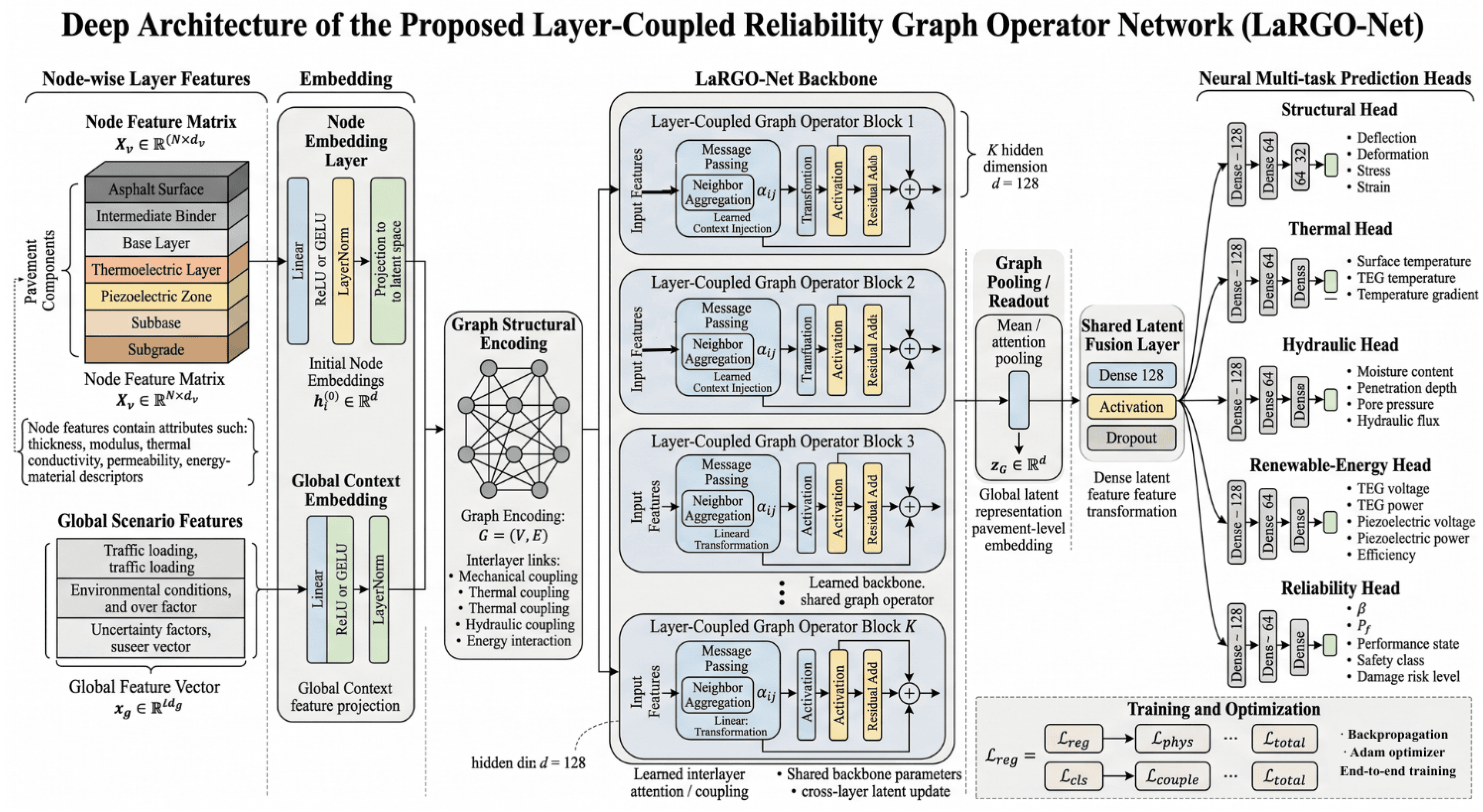
In the proposed framework, LaRGO-Net represents the learning stage that links the Abaqus simulation outputs with reliability-oriented prediction. The workflow is organized in a simple sequence. First, the coupled Abaqus model generates the physical response of each pavement scenario under wheel loading, solar heat flux, rainfall infiltration, and moisture diffusion. Second, the extracted responses are organized into a structured dataset containing input variables, multiphysics outputs, renewable-energy indicators, and reliability targets. Third, each dataset record is converted into a layer-based graph, where the seven pavement layers are treated as graph nodes and the physical interactions between adjacent or functionally connected layers are treated as graph edges. Fourth, LaRGO-Net learns from these graph-structured cases to predict structural, thermal, hydraulic, energy-harvesting, and reliability-related outputs. Finally, physical-consistency and coupling-consistency losses are used during training to reduce physically unrealistic predictions and improve the engineering reliability interpretation of the model outputs.
To maintain the physical hierarchy of the proposed renewable energy-integrated pavement system within the artificial intelligence level, a Layer-Coupled Reliability Graph Operator Network (LaRGO-Net) was developed as the main prediction model. The motivation for LaRGO-Net is that the generated dataset, although stored in tabular form, originates from a physically ordered multilayer pavement system. Therefore, the prediction problem should not be treated only as learning from independent numerical features, but as learning how load, heat, moisture, and energy-harvesting effects propagate through the pavement depth. Accordingly, each simulation case was reinterpreted as a graph-structured sample , where the node set represents the main pavement constituents, namely, the asphalt surface, intermediate binder, base layer, thermoelectric energy layer, piezoelectric insert zone, subbase, and subgrade soil, while the edge set represents the dominant pathways of mechanical load transmission, thermal conduction, hydraulic migration, and functional interaction among adjacent or strategically coupled layers. In this representation, the node-feature matrix stores layer-specific attributes such as thickness, elastic modulus, thermal conductivity, permeability, piezoelectric modulus, Seebeck-related thermoelectric properties, and local uncertainty descriptors, whereas the graph-level feature vector contains shared scenario descriptors including wheel load, contact pressure, load speed, solar heat flux, ambient temperature, rainfall infiltration rate, moisture flux, thermal gradient, traffic growth factor, and other boundary-level variables. The learning problem is therefore formulated as an operator-learning task of the form [12].
Although the proposed pavement graph contains only seven nodes, these nodes correspond to physically meaningful pavement layers rather than arbitrary computational units. Therefore, the motivation for LaRGO-Net is not graph size, but the need to preserve layer-specific behavior and interlayer transfer within the thermo-hydro-mechanical energy system. Simpler surrogate models can process the same inputs as structured tabular features; however, they do not explicitly separate layer-level attributes from global loading and environmental conditions, nor do they encode the physical pathways through which load, heat, moisture, and energy-harvesting effects propagate across pavement depth. An MLP treats all predictors as a flat numerical vector, while Random Forest and XGBoost infer nonlinear interactions through tree splits without enforcing pavement–layer topology or adaptive interlayer coupling. Kriging can be effective for smooth and relatively low-dimensional response surfaces, but it becomes less suitable for the present high-dimensional, multi-output dataset involving structural, thermal, hydraulic, renewable-energy, and reliability targets. For this reason, LaRGO-Net is introduced as a physically structured surrogate that combines node-wise layer encoding, global scenario conditioning, adaptive interlayer coupling, and multi-task prediction within one reliability-oriented learning architecture.
where is the adjacency matrix encoding layer connectivity and directed interlayer influence, denotes the trainable model parameters, and denotes the complete target space, including deformation, stress, strain, temperature, moisture, energy-generation, and reliability outputs. Thus, Abaqus provides the physical evidence, the dataset stores the extracted simulation knowledge, the graph representation preserves the pavement–layer structure, and LaRGO-Net learns the relationship between layer interactions and system-level reliability.
The internal structure of LaRGO-Net was designed to capture both local layer behavior and cross-layer disturbance transfer through a graph operator mechanism with adaptive coupling. Let denote the initial embedding of node i, obtained from its physical feature vector through a learned projection [13]
where and are trainable encoder parameters and is a nonlinear activation function. The hidden representation of each layer is then iteratively updated by combining self-state information, incoming messages from neighboring layers, and global operational forcing according to [14]
where , , and are trainable weight matrices associated with self-retention, neighborhood message propagation, and scenario-level influence injection, respectively. The coefficients are adaptive interlayer coupling weights that quantify the relative influence of node j on node i during the k-th propagation stage. In practical terms, these coefficients allow the model to learn which layer interactions are most influential under a given loading and environmental condition. For example, one scenario may be governed mainly by upper-layer thermal effects, while another may be governed by lower-layer moisture accumulation, mechanical overstress, or the activation of embedded energy-harvesting zones. To further enrich the operator structure, the edge influence itself may be expressed as a function of node and global states,
where is a learned compatibility function. This formulation enables LaRGO-Net to act as a reliability-sensitive graph operator, since the flow of information across the pavement is modulated not only by structural adjacency but also by scenario-specific environmental and loading severity. After K propagation layers, the node embeddings are aggregated into a global pavement representation [15]
where is a pooling operator, such as weighted mean pooling or attention-based pooling. The latent graph state is then fed to task-specific predictive heads to generate structural responses , thermal responses , hydraulic responses , energy-harvesting responses , and reliability descriptors . In this way, the model output is directly connected to the reliability assessment stage: the predicted deformation, stress, strain, temperature, moisture, voltage, and power responses are used together with reliability descriptors such as the reliability index, failure probability, performance state, safety class, and damage-risk level.
The training objective was designed to keep this prediction process both accurate and physically reasonable. The regression and classification losses measure the prediction error relative to the simulation-generated targets, while the physical-consistency and coupling-consistency terms act as constraints that discourage unrealistic relationships among the predicted outputs [16]. Therefore, the loss function does not replace the Abaqus simulation; rather, it guides the AI model to remain consistent with the coupled thermo-hydro-mechanical behavior observed in the simulation dataset. Since the output space includes continuous outputs, such as deflection, stress, temperature, moisture penetration, voltage, power, reliability index, and probability of failure, as well as discrete outputs, such as performance state, safety class, and damage-risk level, the overall objective function was set as [17]
where is the regression loss, is the classification loss, is a physics-consistency regularizer, and is a coupling-consistency term introduced to preserve coherence among structurally related outputs. The regression loss was formulated as [18]
while the classification component was written as the cross-entropy loss [19]
To prevent nonphysical predictions, the physics-regularization term was used to penalize violations of expected monotonic trends, such as decreases in predicted deflection under increasing wheel load, increases in predicted reliability under increasing moisture severity, or reductions in thermoelectric voltage under increasing thermal gradient. A compact form of this penalty may be expressed as [20]
where is the predicted vertical deflection, is the wheel load, is the predicted reliability index, is a moisture-related severity measure, is the predicted thermoelectric voltage, and is the temperature gradient. In addition, the coupling-consistency term was introduced to preserve logical agreement between interrelated outputs, for example, between high tensile strain and reduced reliability, or between elevated moisture penetration and increased failure probability, and it may be generically written as
where is a task-coupling matrix encoding selected engineering relationships and is a vector of expected relational responses. Consequently, the role of LaRGO-Net can be summarized as follows: Abaqus generates physically grounded pavement responses, the dataset organizes these responses into input-output learning pairs, the graph structure preserves the seven-layer pavement hierarchy, the physical-consistency losses constrain the learning process, and the final predicted outputs support reliability assessment through safety and risk indicators. This simplified connection clarifies that the proposed framework is not a collection of independent components, but a sequential simulation-driven pipeline for reliability-aware prediction of renewable energy-integrated pavement systems.
Algorithm 1 represents the operational core of the proposed intelligent framework because it converts each Abaqus-generated simulation case from a flat numerical record into a physically meaningful graph in which the asphalt surface, intermediate binder, base layer, thermoelectric layer, piezoelectric zone, subbase, and subgrade are modeled as interacting nodes connected through thermo-hydro-mechanical and functional coupling pathways. This graph construction step is analytically important because it preserves the real stratified architecture of the pavement system and avoids the main limitation of conventional machine-learning models, namely, the loss of layer-to-layer dependency when all variables are treated as unrelated columns. The node-feature assignment stage embeds local descriptors such as thickness, elastic modulus, thermal conductivity, permeability, and energy-material properties into each layer representation, while the global feature vector injects scenario-wide driving variables including wheel load, contact pressure, traffic speed, solar heat flux, ambient temperature, rainfall infiltration, moisture flux, thermal gradient, and uncertainty factors, thereby allowing the model to distinguish between intrinsic layer behavior and case-level forcing conditions. The iterative message-passing mechanism then performs the most novel role in the algorithm by learning adaptive coupling coefficients between neighboring layers, which means that the model does not assume a fixed influence structure but instead infers how strongly one layer affects another under a given service condition; in practice, this allows LaRGO-Net to identify whether the dominant mechanism behind a simulated case is mechanical overload, thermal intensification, moisture-driven weakening, or interaction with the embedded renewable-energy components. The graph-pooling stage aggregates the final node states into a graph-level latent descriptor that summarizes the full pavement condition after cross-layer information exchange, and this descriptor is passed to multiple task-specific heads so that the same learned representation can simultaneously predict structural outputs such as deflection, stress, and strain; thermal outputs such as peak temperature and temperature gradient; hydraulic outputs such as moisture penetration and pore pressure; renewable-energy outputs such as thermoelectric and piezoelectric voltage and power; and reliability outputs such as the reliability index , failure probability , safety class, and damage-risk level. The partitioning strategy was designed to evaluate both ordinary predictive performance and robustness under severe operating conditions. The random 70/30 split provides a standard assessment of training, validation, and unseen testing behavior, while the extreme-condition hold-out subset provides a stricter evaluation under combined high-temperature, high-moisture, high-load, and low-modulus scenarios. This additional test reduces the possibility that the model performance is driven only by interpolation among similar simulation samples and provides a more demanding assessment of generalization under unfavorable pavement-service conditions.
Although the present implementation of LaRGO-Net was trained on the proposed seven-layer renewable energy-integrated pavement configuration, the graph formulation itself can be extended to pavement cross-sections with different layer arrangements. In the current model, the node set represents the asphalt surface, intermediate binder, base layer, thermoelectric energy layer, piezoelectric insert zone, subbase, and subgrade soil, while the adjacency matrix represents layer connectivity and directed interlayer influence. For other pavement designs, , , and the node-feature matrix can be redefined according to the actual layer sequence and available functional components. For example, a conventional pavement without thermoelectric or piezoelectric layers can be represented by removing these nodes or assigning inactive masks during message passing and graph pooling, while pavements with additional drainage, reinforcement, insulation, sensing, or energy-harvesting layers can be represented by inserting new nodes and defining the corresponding mechanical, thermal, hydraulic, or functional edges. However, direct use of the trained seven-layer model on substantially different pavement structures is not recommended without adaptation; instead, the trained encoders, message-passing blocks, and graph-pooling layers should be transferred and fine-tuned using new finite element, laboratory, or field data for the target cross-section.
| Algorithm 1 Simplified LaRGO-Net training and prediction procedure |
| Require: Simulation dataset , propagation depth K, trainable parameters , loss weights |
| Ensure: Predicted multiphysics and reliability outputs |
|
Figure 4 presents the full deep architecture of the proposed Layer-Coupled Reliability Graph Operator Network (LaRGO-Net) and clarifies how the artificial intelligence stage was intentionally structured to preserve the physical hierarchy, interlayer dependency, and multiphysics coupling logic of the renewable energy-integrated pavement system. The architecture begins with two complementary input streams: the node-wise layer feature matrix , which stores the layer-specific attributes of the asphalt surface, intermediate binder, base layer, thermoelectric layer, piezoelectric zone, subbase, and subgrade, and the global feature vector , which contains traffic, environmental, and uncertainty descriptors shared by the full simulation case. These two streams are first transformed through dedicated embedding modules, where linear projection, nonlinear activation, and normalization map the raw physical variables into compact latent representations suitable for graph learning. The graph structural encoding block then reformulates the pavement as a connected graph , so that mechanical coupling, thermal transfer, hydraulic interaction, and energy-functional dependency are not treated as implicit statistical correlations but as explicit interlayer relationships. At the core of the model, the LaRGO-Net backbone is composed of stacked layer-coupled graph operator blocks, each performing message passing, neighbor aggregation, adaptive coupling through learned coefficients , linear transformation, activation, and residual addition, thereby allowing the network to learn how disturbances propagate across pavement depth under different service and environmental conditions. This repeated operator design is particularly important because the reliability state of the pavement does not depend on a single layer in isolation, but emerges from cumulative structural, thermal, hydraulic, and electromechanical interactions transmitted through the multilayer system. The graph pooling/readout stage subsequently compresses the final node embeddings into a global latent representation , which is refined through a shared latent fusion layer before being distributed to five parallel neural prediction heads dedicated to structural, thermal, hydraulic, renewable-energy, and reliability outputs. The lower training-and-optimization block further indicates that the model is trained end-to-end using regression, classification, physics-consistency, and coupling-consistency losses, which means that the network is optimized not only to fit numerical targets but also to preserve physically meaningful trends and inter-output coherence. Collectively, the figure demonstrates that LaRGO-Net is not a conventional black-box deep learner, but a physically structured, reliability-aware graph operator whose architecture is directly aligned with the layered pavement configuration, the coupled thermo-hydro-mechanical simulation environment, and the multi-domain prediction objectives of the proposed framework.
Figure 4.
Deep architecture of the proposed Layer-Coupled Reliability Graph Operator Network (LaRGO-Net) for multiphysics response and reliability prediction.
Table 8 presents an expanded and progressively staged experimental design for evaluating LaRGO-Net against neural, physics-informed, graph-based, and transformer-based baselines. The first configuration, E1, uses a basic flat MLP with , five output heads, dropout = 0.10, learning rate , batch size 128, and 120 epochs, and therefore tests whether the 68-variable simulation-generated dataset can be learned as a conventional tabular mapping without graph structure or physical constraints. E2 strengthens this dense baseline by using a Physics-Informed MLP with , dropout = 0.15, learning rate , batch size 96, and 180 epochs, while adding to the regression and classification objectives. This separates the effect of physics-aware regularization from the effect of pavement–layer graph topology. The next group, E3–E6, introduces stronger competitive baselines. E3 uses a static GCN with , , mean pooling, and no adaptive coupling, while E4 uses a GAT with , , attention pooling, dropout = 0.25, and learning rate , allowing the study to test whether generic graph attention can replace the proposed pavement-specific adaptive coupling. E5 and E6 further introduce transformer-based tabular baselines, where TabTransformer uses , dropout = 0.25, batch size 64, and 240 epochs, while FT-Transformer uses , dropout = 0.30, batch size 48, and 260 epochs. These configurations directly test whether self-attention over tabular features or feature-token interactions can replace the physically ordered layer-graph representation.
Table 8.
Experimental configurations adopted for the progressive evaluation of LaRGO-Net against neural, graph-based, transformer-based, and physics-informed baselines.
The LaRGO-Net configurations E7–E13 then progressively increase graph expressiveness, propagation depth, latent capacity, pooling quality, and physics-aware optimization. E7 introduces the compact adaptive graph operator with , , mean pooling, dropout = 0.20, and learning rate , enabling adaptive -based interlayer learning with node/global embedding. E8 increases the model to and , and it adds residual graph operator blocks, LayerNorm, and shared latent fusion, while E9 increases the propagation depth to with dropout = 0.30 to strengthen interlayer information transfer. E10 introduces attention pooling and a wider latent representation with , , and dense fusion , whereas E11 represents the strongest purely architectural variant with , , attention pooling, dropout = 0.35, learning rate , GELU activation, and 300 epochs. Finally, E12 and E13 evaluate the effect of physics-aware and coupling-aware training. E12 adds using , learning rate , and 320 epochs, while E13 represents the full LaRGO-Net with , , dropout = 0.40, learning rate , batch size 32, 350 epochs, AdamW, weight decay , and early stopping. Thus, Table 8 shows that the evaluation is not merely an increase in model size, but a controlled sequence that separates flat neural learning, physics-informed dense learning, static graph convolution, graph attention, transformer-based tabular attention, adaptive pavement–layer coupling, graph depth, latent width, attention pooling, physical consistency, and coupling consistency.
3. Results
Table 9 shows a systematic progression from simple dense learning, through physics-informed and competitive graph/transformer baselines, to the full LaRGO-Net architecture. The baseline MLP in E1 represents the weakest configuration, using a 3-layer dense structure with , dropout = 0.10, learning rate , and no graph structure or physics-aware constraint. It produced the highest mean errors, with mean RMSE = 0.194, mean MAE = 0.152, mean , mean F1 = 90.87%, and mean AUC = 94.18%. The energy block was the most difficult for this baseline, with RMSE = 0.218, MAE = 0.171, , F1 = 89.92%, and AUC = 93.45%, confirming that a flat tabular model is not sufficient for representing coupled energy-harvesting behavior. Adding physical-consistency regularization in E2 substantially improved the dense baseline, reducing mean RMSE from 0.194 to 0.083 and MAE from 0.152 to 0.058, while increasing mean from 0.861 to 0.974, mean F1 from 90.87% to 97.40%, and mean AUC from 94.18% to 98.23%. This improvement shows that physics-aware regularization helps constrain the response surface, but E2 still lacks explicit pavement–layer topology. The graph and attention-based baselines further improved performance: E3, the static GCN baseline, achieved mean RMSE = 0.071 and mean , while E4, the GAT baseline, improved these values to mean RMSE = 0.059, mean MAE = 0.041, mean , mean F1 = 98.49%, and mean AUC = 98.93%. However, because E3 uses fixed adjacency and E4 uses generic graph attention without pavement-specific adaptive interlayer coupling, both remain weaker than the final LaRGO-Net. Similarly, the transformer baselines in E5 and E6 confirm that strong tabular attention improves performance but does not fully replace the proposed physically structured graph operator. TabTransformer in E5 achieved mean RMSE = 0.066 and mean , whereas FT-Transformer in E6 was the strongest non-LaRGO-Net competitor, with mean RMSE = 0.054, mean MAE = 0.038, mean , mean F1 = 98.69%, and mean AUC = 99.09%.
Table 9.
Block-wise predictive results of the experimental configurations, including MLP, physics-informed MLP, GCN, GAT, transformer-based baselines, and progressive LaRGO-Net variants.
The progression from E7 to E11 demonstrates the architectural value of LaRGO-Net before the addition of the full physics-aware objective. E7, the compact LaRGO-Net with , , mean pooling, dropout = 0.20, learning rate , and adaptive -based node/global embedding, achieved mean RMSE = 0.137, mean MAE = 0.105, mean , mean F1 = 94.48%, and mean AUC = 96.70%. Although this is weaker than the stronger transformer baselines, it shows the initial benefit of adaptive interlayer learning. Increasing the graph depth and latent dimension in E8, using , , residual blocks, LayerNorm, and shared fusion, reduced mean RMSE to 0.111 and improved mean to 0.952. The reliability block improved from RMSE = 0.118, MAE = 0.091, , F1 = 94.87%, and AUC = 97.02% in E7 to RMSE = 0.096, MAE = 0.072, , F1 = 96.18%, and AUC = 98.01% in E8. E9 further increased propagation depth to , reducing mean RMSE to 0.088 and increasing mean to 0.970, while the reliability block reached RMSE = 0.074, MAE = 0.055, , F1 = 97.24%, and AUC = 98.64%. Moving to E10, the wider attention-based version with , , attention pooling, and dense fusion reduced mean RMSE to 0.074 and improved mean F1 to 97.83%. This indicates that attention pooling helps the model assign nonuniform importance to pavement layers rather than treating all node embeddings equally. E11, the deep-wide variant with , , attention pooling, GELU activation, dropout = 0.35, and learning rate , achieved mean RMSE = 0.060, mean MAE = 0.043, mean , mean F1 = 98.46%, and mean AUC = 99.04%. This result is close to the GAT and FT-Transformer baselines, but it still benefits from the physically ordered pavement graph and adaptive layer-wise representation rather than generic attention alone.
The final improvement is obtained when the LaRGO-Net architecture is combined with physics-aware and coupling-consistency objectives. E12 adds to the regression and classification losses, using , , attention pooling, dropout = 0.35, learning rate , batch size 48, and 320 epochs. This reduced the mean RMSE from 0.060 in E11 to 0.048, reduced mean MAE from 0.043 to 0.034, and increased mean from 0.986 to 0.991. At the reliability-block level, E12 achieved RMSE = 0.036, MAE = 0.025, , F1 = 99.08%, and AUC = 99.37%, showing that physical-consistency regularization improves both continuous response prediction and reliability classification. The full LaRGO-Net in E13 further adds , uses dropout = 0.40, learning rate , batch size 32, 350 epochs, AdamW, weight decay , and early stopping. It achieved the best overall results, with mean RMSE = 0.040, mean MAE = 0.028, mean , mean F1 = 99.10%, and mean AUC = 99.45%. Compared with the strongest non-LaRGO-Net competitor, FT-Transformer in E6, the full model reduced mean RMSE from 0.054 to 0.040, corresponding to a 25.9% reduction, and reduced mean MAE from 0.038 to 0.028, corresponding to a 26.3% reduction. The reliability block of E13 reached RMSE = 0.029, MAE = 0.020, , F1 = 99.21%, and AUC = 99.53%, which is higher than E6 reliability performance of RMSE = 0.043, MAE = 0.030, , F1 = 98.81%, and AUC = 99.16%. These results indicate that LaRGO-Net’s superiority is not simply due to using a deeper or wider model, because strong alternatives such as GAT and FT-Transformer were included. Instead, the improvement is linked to the combination of pavement–layer graph representation, adaptive interlayer coupling, global scenario conditioning, task-aware prediction, physics-consistency loss, and coupling-consistency loss, which together allow the model to better capture structural, thermal, hydraulic, energy-harvesting, and reliability interactions in the renewable energy-integrated pavement system.
The final step from E8 to E9 provides the strongest evidence that the true novelty of the proposed framework lies not only in graph depth or latent width, but in the integration of physics-aware and coupling-aware optimization with the graph-operator backbone. E8 retains the strong architectural setting of , , attention pooling, and dropout 0.35, but it introduces the physics-consistency objective through with , trained using AdamW at for 320 epochs. This reduces the mean RMSE to 0.048 and raises the mean to 0.991. The structural block reaches RMSE = 0.051 and , the thermal block RMSE = 0.046 and , and the reliability block RMSE = 0.036, MAE = 0.025, , F1 = 99.08, and AUC = 99.37. The full E9 configuration adds the coupling-consistency objective, stronger dropout of 0.40, a lower learning rate of , smaller batch size 32, 350 training epochs, AdamW with weight decay , and early stopping, thereby producing the best results in every domain. Specifically, E9 achieves structural RMSE = 0.043 with , thermal RMSE = 0.038 with , hydraulic RMSE = 0.048 with , energy RMSE = 0.044 with , and reliability RMSE = 0.029, MAE = 0.020, , F1 = 99.21, and AUC = 99.53. Its mean RMSE of 0.040 and mean of 0.994 make it the most accurate and most stable configuration across all five output blocks. From a technical standpoint, this indicates that the physics-consistency term improves local plausibility of individual targets, while the coupling-consistency term strengthens coherence among mutually dependent outputs such as tensile strain, moisture penetration, energy-generation response, and reliability degradation.
Table 10 presents a fair comparison between the proposed LaRGO-Net and representative tabular, neural-network, and graph-neural-network baselines using the same training, validation, and test partitions. Among the tabular models, XGBoost achieved the strongest baseline performance, with RMSE = 0.091, MAE = 0.067, , F1 = 96.82, and AUC = 98.34, showing that boosted trees can capture nonlinear interactions among the simulation-generated variables more effectively than Random Forest. However, both Random Forest and XGBoost still treat the pavement response as a flat tabular prediction problem and do not explicitly preserve the seven-layer pavement hierarchy or the directed transfer of load, heat, moisture, and energy effects across the pavement depth.
Table 10.
Fair comparison of the proposed LaRGO-Net with conventional machine-learning and graph-neural-network baselines using the same training, validation, and test splits.
For the neural and graph-based baselines, the MLP produced the weakest performance because all variables were processed as an unstructured feature vector. The static GCN improved over the MLP, confirming that graph representation is useful for this problem, but its fixed adjacency and lack of adaptive coupling limited its ability to represent changing interlayer interactions under different loading and environmental conditions. GAT and GraphSAGE achieved stronger performance than GCN, with GAT reaching RMSE = 0.103 and , due to attention-based or neighborhood-aggregation mechanisms. Nevertheless, these graph baselines still remained less accurate than the proposed model because they do not incorporate the full layer-coupled operator structure, explicit node/global feature separation, physics-consistency loss, and coupling-consistency loss.
The full LaRGO-Net achieved the best overall performance, with RMSE = 0.040, MAE = 0.028, , F1 = 99.21, and AUC = 99.53. Compared with the strongest conventional baseline, XGBoost, LaRGO-Net reduced RMSE by approximately 56.0% and MAE by approximately 58.2%, while also improving , F1, and AUC. This confirms that the performance gain is not only due to nonlinear learning capacity, but also to the physically structured graph representation, adaptive interlayer coupling, attention-based readout, and physics/coupling-aware multi-task optimization.
Table 11 evaluates whether the final LaRGO-Net configuration remains stable under severe operating conditions rather than only under the random test split. The extreme-condition hold-out subset included cases combining high thermal loading, high moisture exposure, high wheel load or contact pressure, and low pavement modulus values. Compared with the random test subset, the hold-out subset produced a moderate increase in mean RMSE from 0.040 to 0.059 and a decrease in mean from 0.994 to 0.987. The reliability block also decreased from F1 = 99.21 and AUC = 99.53 to F1 = 97.84 and AUC = 98.76. This reduction is expected because the hold-out subset represents more severe and less frequently occurring combinations of thermo-hydro-mechanical loading conditions. Nevertheless, the model retained high predictive consistency across structural, thermal, hydraulic, energy, and reliability outputs, indicating that its performance was not driven only by interpolation among similar randomly split samples.
Table 11.
Random test and extreme-condition hold-out performance of the final LaRGO-Net configuration.
Figure 5 shows the prediction quality of the E1 baseline multilayer perceptron for ten selected responses, and sets the baseline for the study. One of the notable visual features of this figure is the comparatively large spread of the predicted points away from the 45-degree line in the directions of both prediction over- and under-estimation, which signals that the E1 baseline model can capture the overall trend of the responses generated by the simulation model but is unable to sustain their subtle interdependencies and local nonlinearities. This is particularly evident in the structural and moisture hydrologic domains, where the Max Vertical Deflection , Moisture Penetration Depth , and Pore Pressure Max show relatively large vertical scatter and deviation from the ideal line, meaning that dense flat learning cannot represent the coupled effects of layer stiffness, thermal and moisture transport, and embedded energy-functional behavior. Even the relatively good predictions, like Peak Surface Temperature and Reliability Index , still show some degree of scatter, so the model defines the general envelope of the system’s response but not the full physics-informed precision of the system at hand. The energy-related responses including TEG Voltage Output and Piezoelectric Power also indicate that the baseline lacks the inductive bias to represent the secondary electromechanical response to coupled loading. Hence, Figure 5 reveals that the E1 baseline model can only give a coarse statistical representation of the target space and is inherently constrained by its lack of inductive bias to represent the layered multiphysics nature of the renewable energy-integrated pavement system.
Figure 5.
Prediction quality across representative structural, thermal, hydraulic, energy, and reliability outputs for the E1 baseline MLP.
Figure 6 shows the prediction quality of the E4 LaRGO-Net baseline configuration and represents a significant leap from tabular learning to physics-informed graph-based learning. Compared with the baseline plot, the points are now much closer to the identity line in almost all output families, which means that the model is now better calibrated, has lower variance and better preserves the causal relations in the simulation data. This is particularly evident in the structural family, where Max Vertical Deflection and Max Von Mises Stress make the leap to and , respectively, indicating that once the pavement is modeled as a layered graph with node- and graph-wise feature encoding, the model is significantly improved in terms of capturing of cross-layer stress transfer and deformation. This improvement is also seen in the thermal predictions, where Peak Surface Temperature and Average Temperature Gradient indicate a better learning of temperature gradients across the pavement depth to the thermoelectric layer. The improvement is also clear in the hydraulics, with Moisture Penetration Depth and Pore Pressure Max suggesting that the graph operator begins to learn how support effects from the lower layers and moisture-related transport processes interact with the pavement response. The energy and reliability targets show equally important gains, with TEG Voltage Output , Piezoelectric Power , Reliability Index , and Failure Probability . Overall, Figure 6 shows that even the original LaRGO-Net configuration already offers a different learning regime to the MLP baseline, as it begins to capture the pavement not as an arbitrary set of variables, but in terms of an interacting multilayer infrastructure system whose responses are evolving through structured thermo-hydro-mechanical and energy-functional interactions.
Figure 6.
Prediction quality across representative structural, thermal, hydraulic, energy, and reliability outputs for the E4 LaRGO-Net base model.
Figure 7 represents the prediction performance of the final E9 configuration, which testifies to the final convergence of the proposed LaRGO-Net model, where multilayered graph propagation, latent space, attention-based aggregation, and physics-informed optimization, all contribute to an almost-perfect match between measured and predicted values for all of the representative outputs. Compared to Figure 5 and Figure 6, the point clouds are significantly tighter, more uniformly distributed around the 45-degree line and less scattered at higher output magnitudes, showing not only improved goodness-of-fit, but also greater stability and reduced heteroscedasticity over the full range of responses. This is evident in the structural response, where Max Vertical Deflection and Max Von Mises Stress demonstrate the full model captures the fine-scale load-induced response propagation through the multilayered pavement structure with great accuracy. The thermal responses also remain extremely strong, as seen with Peak Surface Temperature and Average Temperature Gradient , which is critical because these responses control thermoelectric activation. The “most uncertain” hydraulic outputs also become extremely stable, withMoisture Penetration Depth and Pore Pressure Max , showing that the model now captures support-layer and diffusion processes much more accurately than either the baseline or base graph. The energy outputs, TEG Voltage Output and Piezoelectric Power , show that the proposed model does not just predict traditional engineering responses, but can also capture the embedded harvesting mechanism with high precision. Finally, the reliability-related outputs perhaps show the greatest degree of success, with Reliability Index at and Failure Probability , demonstrating that the full model can map pavement responses to highly precise safety-performance indicators. If Figure 5, Figure 6 and Figure 7 are viewed as a progression from simple flat learning to informed graph learning, to full intelligent prediction with reliability awareness, then they visually support the central claim of the study that graph encoding and physics-based constrained optimization is critical for accurate multiphysics prediction in renewable energy-integrated pavement systems.
Figure 7.
Prediction quality across representative structural, thermal, hydraulic, energy, and reliability outputs for the E9 full LaRGO-Net.
Table 12 presents a family-wise summary of regression performance of the best model (i.e., full E9 LaRGO-Net) and shows that the proposed model exhibits high accuracy across all five families of predictions rather than in just a single family. The model has RMSE = 0.043, MAE = 0.030, and in the structural family (deflection, deformation, stress and strain) which suggests the precise modeling of the structural response and deformation of the layered pavement structure. The thermal family is even slightly better, with RMSE = 0.038, MAE = 0.026, and , which suggests that the graph-based architecture is able to capture the temperature gradient with depth of the pavement and the internal gradients that activate the thermoelectric layer. The hydraulic family is still the most difficult to model with RMSE = 0.048, MAE = 0.034, and , but still extremely good in terms of prediction, and this also shows that the moisture-sensitive effects, pore-pressure and penetration dynamics are still uncertain due to their higher dependence on support-layer interaction and environmental variations. The renewable-energy family of thermoelectric and piezoelectric voltage, power, and efficiency of the energy-harvesting system achieves RMSE = 0.044, MAE = 0.031, and , which shows that the proposed architecture is capable of accurately capturing the functional energy-harvesting response while maintaining the prediction performance for mechanical and environmental responses. The continuous reliability family has the best performance with RMSE = 0.029, MAE = 0.020, and for the prediction of and , which also features the smallest RMSE and the highest percentages of improvement over the baseline models, i.e., 83.24% versus E1 and 80.54% versus E2. These percentages are statistically meaningful in that they show that the full LaRGO-Net not only increases the prediction of response variables, but it actually increases in value as the prediction target moves towards decision variables for safety-critical design. In addition, the percentage improvement is quite high across all families, ranging from 76.12% to 83.24% against E1, and from 72.88% to 80.54% against E2, which also suggests that the benefits of the proposed graph-based, physics-aware learning framework are both widespread and even.
Table 12.
Category-wise regression performance of the best-performing model across structural, thermal, hydraulic, renewable-energy, and reliability-continuous outputs.
Figure 8 offers an aggregated quantitative assessment of regression prediction performance for the three major model versions, that is, the E1 baseline MLP, E4 LaRGO-Net base, and E9 full LaRGO-Net models; it thus provides a visual overview of the performance improvement for the proposed framework from traditional flat learning to physically structured graph-based learning. The monotonic rise of in panel (a) for all ten representative targets confirms that each stage of architectural development enhances the variance explained by the model; this is particularly noticeable for targets that are sensitive to hydraulic interaction or reliability concerns such as Moisture Penetration Depth, Pore Pressure Max, and Failure Probability , where the improvement from E1 to E4 is already significant, and the final step to E9 brings predictions close to unity. Panel (b) confirms this finding by displaying a monotonic decrease in RMSE across all outputs, meaning that the increased explanation of variance is coupled with a simultaneous decrease in absolute error. The largest drops are observed for variables that are the most difficult to learn due to their coupled multiphysics nature, namely, Moisture Penetration Depth, Pore Pressure Max, and Piezoelectric Power, which indicates that the graph-based architecture is increasingly superior as the target is more dependent on cross-layer interaction and support-condition sensitivity. Panel (c) reinforces this insight via the normalized MAE, which eliminates some of the scale bias and proves that the quality of E9 is not a mere effect of metric scale, but an indication of relative predictive accuracy with respect to diverse targets with different physical units and magnitudes. Interpreting the three panels in concert, we observe a uniform and technically meaningful trend: E1 has the lowest variance explanation and largest errors; E4 provides a significant improvement through graph encoding, residual operator learning, and shared latent encoding; and E9 strikes the best balance with a deeper propagation, attention pooling, and physical optimization.
Figure 8.
Comparative regression prediction quality across representative outputs for E1, E4, and E9 using , RMSE, and normalized MAE.
Table 13 shows that the proposed full LaRGO-Net brings a decisive and very consistent gain in classification performance for reliability-oriented decision making, compared to the baseline dense MLP and the baseline shallow GCN, in all three decision targets, namely, Safety_Class, Performance_State, and Damage_Risk_Level. The flat MLP model for binary Safety_Class delivers 91.22% accuracy, 90.53% precision, 91.16% recall, 90.84 F1-score, 94.12 AUC, and 0.824 kappa, showing that the model has a fair separability but a substantial risk of misclassification in safety-critical applications. The graph structure in E2 leads to 93.04% accuracy, 92.41% precision, 92.88% recall, 92.63 F1-score, 95.84 AUC and 0.861 kappa, showing that even static graph structures are more effective in representing the interdependence of the pavement layers than dense learning. On the other hand, the complete E9 LaRGO-Net boosts this target to 99.37% accuracy, 99.18% precision, 99.25% recall, 99.21 F1-score, 99.53 AUC, and 0.987 kappa, which suggests near-perfect discrimination and an extremely high agreement beyond chance. This trend also holds for the multiclass Performance_State target, where the model improves from 89.74% accuracy and 89.92 F1-score in E1 to 91.86%, 91.98 in E2, and then to 98.94% accuracy and 98.95 F1-score in E9, while kappa improves from 0.792 to 0.972, which indicates that the proposed architecture is highly efficient for discriminating the safe, marginal, and unsafe operating states. The same monotonic improvement occurs to the Damage_Risk_Level target, from 90.16% accuracy, 90.27 F1-score and 0.801 kappa in E1 to 92.31%, 92.46 and 0.846 in E2, and finally to 99.08%, 99.07 and 0.975 in E9, showing that the model can perform accurate qualitative risk grouping based on coupled multiphysics response. These findings are technically important because they demonstrate that the improvement brought by LaRGO-Net is not limited to one particular reliability label, but is uniformly spread across binary safety classification, multiclass performance evaluation, and damage-based risk classification. From an engineering perspective, this confirms that graph-based encoding, interlayer adaptive coupling, attention-based aggregation and physics-informed training all contribute to enhance the model’s capacity to preserve causal links between structural damage, water vulnerability, thermal stress, renewable-energy response, and reliability assessment.
Table 13.
Classification performance of representative competing models for reliability-oriented targets.
Figure 9 shows the distribution view of the prediction quality across the nine experiments, and it is important because it complements the summary statistics by offering a view of the distribution of the absolute prediction error over the entire test domain. A monotonic pattern is evident in how E1 through E9 distributions become progressively more concentrated around zero, their right tails become successively shorter, and the values of the mean and median (normalized) absolute errors drop in a highly systematic fashion. We start with the E1 baseline MLP which has the widest and most right-skewed distribution whose mean error and median , suggesting not only a higher absolute error, but also a large number of moderate to large errors. E2 and E3 drop the values to and , respectively, indicating that the addition of graph and then adaptive coupling already moves the error mass to lower values. The jumps to E4 and E5, with mean/median values of and , show that the introduction of residual learning of graph operators and deeper interactions between layers not only tighten the average error, but also the overall shape of the error distribution. E6 and E7 show a further concentration of the distributions toward zero, with the mean error reducing to 0.037 and 0.031, respectively, revealing the role of attention-based pooling and wider/deeper latent representations in reducing the number of medium errors. In the final two panels, E8 and E9, we see the most tightly concentrated and left-skewed distributions, with E8 having mean/median and E9 giving the best overall results of and . These last panels are especially noteworthy because the very short right tails show that physics-consistency and coupling-consistency regularization not only reduce central tendency but also increase resilience to large, outlier-like errors. Analytically, the figure demonstrates that the proposed LaRGO-Net does not merely reduce mean error in a restricted set of cases, but progressively transforms the whole error landscape into higher concentration, lower spread, and greater stability as the network architecture better conforms to physics and as the optimization algorithm becomes more constrained by engineering principles.
Figure 9.
Distribution of normalized absolute prediction error across the nine experimental configurations from E1 to E9.
Table 14 provides a component-level verification of LaRGO-Net by isolating the contribution of graph structure, adaptive interlayer coupling, global context injection, residual propagation, attention pooling, physics-aware losses, and multi-task prediction. The complete model in A1 achieved the strongest overall performance, with RMSE = 0.040, , Macro-F1 = 99.21%, and a training time of 105.5 min. The most severe degradation occurred in A12, where both graph structure and adaptive interlayer coupling were removed simultaneously; RMSE increased to 0.226, decreased to 0.812, and Macro-F1 dropped to 88.97%, corresponding to ΔRMSE = +0.186 and a Macro-F1 loss of 10.24 percentage points. Although this simplified configuration reduced training time to 34.8 min, the large accuracy loss confirms that the computational saving was achieved at the expense of removing the physical layer organization required to represent the seven-layer pavement system. The individual ablations support the same conclusion: removing graph encoding alone in A2 increased RMSE to 0.194 and reduced Macro-F1 to 90.84%, while removing adaptive interlayer coupling in A3 increased RMSE to 0.151 and reduced Macro-F1 to 94.52%. Therefore, the graph topology and learned coefficients are both essential, because the model must preserve the ordered pavement hierarchy and learn how interlayer influence changes under different mechanical, thermal, hydraulic, and energy-harvesting conditions.
Table 14.
Ablation analysis of graph structure, adaptive interlayer coupling, physics-aware losses, and multi-task prediction components in LaRGO-Net.
The results also demonstrate the importance of context-conditioned and multi-task learning. Removing global context injection in A8 increased RMSE from 0.040 to 0.083, reduced from 0.994 to 0.974, and decreased Macro-F1 from 99.21% to 97.62%, showing that pavement–layer interactions cannot be interpreted independently of scenario-level variables. This is important because the same pavement configuration may behave differently under wheel loads of 35–80 kN, contact pressures of 0.60–0.90 MPa, load speeds of 20–100 km/h, solar heat flux of 500–1000 W/m2, ambient temperatures of 15–45 °C, thermal gradients of 8–30 °C, rainfall infiltration of 0–20 mm/h, and moisture flux of 0.005–0.030. The multi-task ablations further verify that the proposed prediction strategy is not merely an architectural addition. In A9, replacing the separate structural, thermal, hydraulic, energy-harvesting, and reliability prediction heads with one shared output head increased RMSE to 0.073 and reduced Macro-F1 to 98.01%. In A10, reliability-only single-task training further increased RMSE to 0.088 and reduced Macro-F1 to 97.34%. These results indicate that reliability prediction benefits from simultaneously learning intermediate physical responses, including deformation, stress, temperature, moisture response, voltage, and power, because reliability states emerge from the interaction of these coupled response domains rather than from isolated reliability labels alone.
The remaining ablations clarify the roles of physics-aware regularization and architectural stabilization. Removing the physical-consistency loss in A6 increased RMSE to 0.052, reduced to 0.990, and lowered Macro-F1 to 98.96%, while removing the coupling-consistency loss in A7 increased RMSE to 0.047, reduced to 0.992, and lowered Macro-F1 to 99.08%. When both and were removed together in A11, the degradation became more evident, with RMSE = 0.064, , Macro-F1 = 98.23%, and ΔRMSE = +0.024. This confirms that the two loss terms are complementary: discourages physically inconsistent trends such as reduced deflection under higher wheel loading or reduced thermoelectric voltage under larger thermal gradients, whereas preserves agreement among related outputs such as tensile strain, failure probability, safety class, and damage-risk level. In addition, removing residual connections in A4 increased RMSE to 0.097 and reduced Macro-F1 to 97.03%, while replacing attention pooling with mean pooling in A5 increased RMSE to 0.061 and reduced Macro-F1 to 98.44%. Overall, the ablation results confirm that the final LaRGO-Net performance is produced by the combined effect of graph-based physical structuring, adaptive interlayer reasoning, scenario-conditioned message passing, task-specific multi-output prediction, and physics-aware regularization rather than by model size alone.
Figure 10 offers a family-wise residual-distribution view of the evolution from the most basic baseline models to the full LaRGO-Net and is particularly telling because it shows not only the error magnitude, but also the error centering, spread, and balance across the five output families. In the top row, representing E1, E2, and E3, the boxplots are clearly wider, the interquartile ranges are longer, and the whiskers and outlier ranges are stretched away from the zero-residual line, which shows there is much prediction variability, and lower calibration, in the structural, thermal, hydraulic, energy, and reliability families. The variability is especially high in the hydraulic and energy families in these early configurations, with greater residual spread and tail skew, which makes sense given the greater nonlinearity and multiphysics coupling of moisture-transport and energy-harvesting variables. In the middle row, E4 to E6, the distributions start to shrink around the zero line, the medians are more centered, and the boxes shrink, revealing that as the residual graph operator learning is added, the propagation depth is increased, and attention-based pooling is applied, there is a progressive reduction in systematic bias and diminishment in medium-scale error variability across all five response families. This constriction is particularly significant because it happens in all five families, which suggests that the graph-based architecture is not only improving some variables at the expense of others, but is delivering a coordinated improvement in the calibration of structurally and physically diverse targets. The bottom row, for E7, E8, and E9, shows the most compact, most centered, and most unbiased distributions of residuals, with very short interquartile ranges, whiskers, and noticeable contraction of the outlier distribution, especially in the structural, thermal and reliability families. The E9 full LaRGO-Net exhibits the most compact and most centered distributions, which suggests that the final combination of deeper and wider graph propagation, attention-based latent aggregation, physics-consistency regularization, and coupling-consistency constraints not only leads to lower average error across targets, but also to statistically more stable and less systematic predictions in the full target space. The figure is important from an analytical point of view because it shows that the evolution from E1 to E9 reflects a genuine improvement in the residual structure: the model’s average accuracy ascends while becoming more balanced in terms of prediction accuracy across the different families of responses, and it becomes more centered around a physically plausible prediction behavior.
Figure 10.
Boxplot comparison of normalized residual distributions by output family across the nine experimental configurations from E1 to E9.
Table 15 shows that the top-performing E9 configuration exhibits a strong degree of model stability under increasingly critical uncertainty-sensitive operating conditions and that the influence of different uncertainty sources on model performance is revealing. For all three types of conditions, the low-severity bands demonstrate the best overall performance as measured by RMSE (0.031, 0.033, and 0.030 for traffic growth, moisture variation, and temperature variation, respectively), (0.996, 0.995, and 0.996, respectively) and F1 (greater than 99.27). This suggests that as long as the variability in operability is small, the LaRGO-Net model maintains near-perfect regression and classification accuracy for continuous reliability targets and discrete safety-related decision-making. From low to medium severity, a controlled and nearly uniform degradation pattern is observed, with RMSE values of 0.039, 0.041, and 0.038 and F1-scores of 99.08, 98.96, and 99.02 for traffic growth, moisture variation, and temperature variation, respectively, and the mean error is maintained in the small range 0.021–0.024, while the mean error is below . This implies that the model maintains a high level of generalization under moderate uncertainty growth and that the graph-based latent space remains effective in capturing the predominant coupled relationships between the structural, thermal, hydraulic and energy-functional variables. The most interesting pattern emerges in the high-severity level, where there is a more significant loss of performance and more variability among different uncertainty sources. Under high traffic growth, the model records RMSE = 0.051, MAE = 0.036, , F1 = 98.74, mean error = 0.031, and mean error = , indicating that intensified loading remains challenging but still manageable for the model. High temperature variation induces a similar but less severe situation, with RMSE = 0.053, MAE = 0.037, , F1 = 98.63, mean error = 0.033, and mean error = , because increased thermal variability reduces model accuracy but only in a minor way. High moisture variation is undoubtedly the most challenging case, where RMSE increases to 0.057, MAE to 0.040, decreases to 0.988, F1 to 98.48, mean error to 0.036 and mean error to , which are the lowest values in the table. This is technically important because it suggests that moisture variation is still the most disruptive source of performance degradation, which is entirely consistent with the coupled thermo-hydro-mechanical (THM) nature of the proposed pavement system, where water ingress changes support conditions, affects stiffness redistribution, modifies pore-pressure evolution, and indirectly changes both structural response and reliability.
Table 15.
Robustness of the best-performing model under uncertainty-sensitive operating conditions.
Figure 11 provides a dynamic perspective on the development of the baseline to the best-performing LaRGO-Net, and it shows that the convergence patterns reflect the improvements in the regression and reliability tables. In panel (a), the E1 baseline MLP has a large initial RMSE of both the training and validation curves, a relatively slow convergence, and a significant gap between the training and validation curves, with early stopping at epoch 107 of 120, which indicates low representational efficiency and moderate potential to further reduce the generalization error during training. In panel (b), the E4 LaRGO base model, we see a major shift towards well-behaved convergence: the RMSE values of both curves now converge more rapidly, the validation curves are smoother, and the gap between the curves has decreased at the early stopping point (around epoch 186 of 220), which suggests that not only does the graph encoding and the residual operator learning (which is also part of the latent fusion) improve the quality of the optimization but also the stability of the generalization behavior. In panel (c), the E8 network (LaRGO + Physics) reveals another shift towards desirable convergence where the RMSE values of the training and validation curves converge quickly to a low RMSE regime, and then converge strongly around a minimum value with early stopping at epoch 207 of 320; this is interesting because the physics-consistency loss not only improves the accuracy of the predictions but also stabilizes the optimization landscape early in the training process by preventing unphysical drift in late epochs. The optimal pattern is seen in panel (d) for the E9 LaRGO-Net, where the training and validation curves go down to the lowest RMSE range in the figure, have a very stable late-stage training trajectory, and a very small residual gap at early stopping (epoch 314 of 350). This final pattern is significant because it confirms that deeper graph propagation, attention-based aggregation, physics-consistency, coupling-consistency, AdamW optimization and early stopping not only result in the best final regression and reliability metrics but they also produce the most optimal convergence dynamics, which include fast error reduction, lack of jitter at late epochs and stability of the validation curve.
Figure 11.
Train-validation RMSE convergence comparison for representative configurations E1, E4, E8, and E9 with early-stopping behavior.
Figure 12 supplements the RMSE-based convergence analysis by displaying the evolution of the explanatory power of the models during training and validation for four representative configurations, which not only reflects the final prediction quality but also the stability and the level of maturity of the learning process across the model hierarchy. As shown in panel (a), the E1 baseline MLP has the lowest and slowest evolution, with the training curve starting from around 0.50 and progressing to around 0.83, while the validation stabilizes to about 0.78 at early stopping (early stopping happens at around epoch 107), and there is a significant gap between the two curves; this suggests that the baseline model can learn a general response trend but lacks the ability to achieve strong explanatory power and consistency, as well as the capacity to effectively represent the pavement system. In panel (b), we observe a much better convergence for the E4 LaRGO base model, with both training and validation rising more steeply and reaching the mid-0.94 range at early stopping around epoch 186, highlighting that graph encoding, residual graph operator learning, and shared latent fusion largely boost the explanatory power and validation stability. In panel (c), E8 LaRGO + Physics shows an even better convergence pattern in which the two curves rapidly enter the high- regime and then remain very close to 0.99 after roughly half of the training time, implying that the physics-consistency objective improves not only the final predictive quality but also the convergence dynamics by encouraging the model to learn physically plausible and more stable generalization. Panel (d), corresponding to the full E9 LaRGO-Net, shows the best convergence behavior, where the training and validation curves rapidly increase in the early epochs, are almost perfectly overlapped over a long training window, and converge very close to 0.99 at early stopping around epoch 314, revealing almost perfect explanatory power with negligible generalization gap. This last pattern is of analytical significance as it indicates that the combination of deeper graph propagation, attentional pooling, physics consistency, coupling consistency, and disciplined training not only achieves the best final prediction performance, but also the best overall learning dynamics, with fast convergence, high validation stability, and no overfitting.
Figure 12.
Train-validation convergence comparison for representative configurations E1, E4, E8, and E9 with early-stopping behavior.
Table 16 demonstrates that the benefits in predictive accuracy provided by LaRGO-Net are delivered with a moderate and acceptable increase in the computational cost of the model, hence demonstrating a good trade-off between predictive ability and implementation efficiency. E1, the baseline MLP, is the smallest model with only 0.31 million parameters, 412 MB of GPU memory, 4.8 s per epoch in training, and 0.19 ms per case in inference, but the performance score of 86.4 tells us that this is achieved at the cost of poor awareness of structural interactions and poor predictive fidelity. The baseline GCN in E2 slightly augments the model size to 0.58 million parameters and 568 MB of memory and training and inference times to 7.2 s and 0.32 ms, but the performance score increases to 89.7, which indicates that even a basic graph representation provides a substantial gain for a moderate increase in computational cost. The jump to the LaRGO-Net models is more informative: E4, the base graph-operator model, requires 1.42 million parameters and 1096 MB of memory, training time of 10.9 s per epoch, and inference time of 0.47 ms, but the performance score of 95.2 indicates that the added complexity is well justified by the significant improvement in predictive accuracy. E7, the deep-wide version, increases the backbone complexity to 3.86 million parameters and 1848 MB of memory, with training and inference costs of 16.4 s and 0.73 ms, respectively, but it improves the performance score to 98.1, indicating that the wider latent representation and deeper graph-operator backbone provide a strong fidelity gain without making the model prohibitively large. The full E9 model only slightly expands the E7 model in terms of model size (3.94 million parameters, 1926 MB memory), training time (18.1 s per epoch) and inference time (0.81 ms), yet it increases the performance score to 99.1. This modest increase in computational burden, coupled with the best possible predictive performance, is particularly significant because it demonstrates that the final gains of E9 are not due to simply increasing the model size, but the inclusion of physics-consistency, coupling-consistency, and more robust optimization schemes (AdamW, weight decay, and early stopping).
Table 16.
Computational complexity and efficiency comparison of baseline and LaRGO-Net variants.
Figure 13 offers a spatially-distributed multiphysics interpretation of the proposed renewable energy-integrated pavement system by simultaneously depicting the temperature, moisture ingress, stress, strain, and vertical deformation fields against the final seven-layer pavement configuration, thus revealing the depth-wise evolution of the governing responses and their interaction with the functional layers. Panel (a) shows the temperature field and reveals a surface-dominated thermal field under solar heat flux, with the hottest region being in the upper asphalt and binder courses; the temperature field then progressively decreases with depth towards the subgrade, which demonstrates the existence of a persistent vertical thermal gradient across the pavement depth and directly motivates embedding the thermoelectric layer at an intermediate position where significant thermal gradients can be maintained. Panel (b) reveals the moisture-penetration field under rainfall infiltration, where the upper ingress zone gradually spreads through depth and lateral diffusion, resulting in a nonuniform hydraulic front that is more pronounced in the lower support courses; this is important because it indicates that the moisture-ingress zone is not only present on the surface but also penetrates toward the subbase and subgrade, thereby affecting support sensitivity, pore-pressure build up, and reliability-related damage. The stress–strain fields in panels (c) and (d) also show that the peak von Mises stress and principal strain occur in the immediate vicinity of the wheel-load zone and then decay with an increase in depth, but they still remain identifiable in the piezoelectric and thermoelectric insert zone, which suggests that the upper support courses absorb the direct load effect, whereas the intermediate functional zone remains sufficiently active to support energy harvesting, yet is not disconnected from the global stress transfer. This is complemented by the vertical deformation field in panel (e) where the maximum vertical displacement is concentrated below the tire contact zone and then attenuates through the base, subbase, and subgrade, revealing the role of the structural layers in spreading the load, and the downward flow of deformation-sensitive response towards the embedded insert region. Finally, panel (f) shows the layered structure of the pavement and enables the preceding field contours to be interpreted in terms of the physical structure, thus confirming that the thermoelectric layer and piezoelectric insert zone are not simply randomly positioned components, but they are instead embedded within the depth range where the thermal gradient, load-induced stress, and vertical deformation remain significant for coupled interactions. Overall, the figure confirms that the proposed pavement is indeed a fully thermo-hydro-mechanical infrastructure system, where heat conduction, moisture diffusion, loading-induced stress, strain localization and vertical deformation are all geometrically coupled and it is this field interdependency that justifies the use of simulation-based data generation and graph-based reliability-aware prediction in the rest of the investigation.
Figure 13.
Coupled thermo-hydro-mechanical contour maps and layered configuration of the proposed renewable energy-integrated pavement system.
Nadeau–Bengio Corrected Resampled t-Test for Train–Test Generalization and Data-Leakage Assessment
The statistical generalization analysis in Table 17 provides additional evidence that the high prediction performance of LaRGO-Net was not restricted to the training subset. Under the repeated 70/30 holdout evaluation, 70% of the 6000 simulation cases were used for training and 30% were reserved for testing in each repetition, while the Nadeau–Bengio corrected resampled paired t-test was used to account for the dependence introduced by repeated data splits. The regression results show only minor train–test differences: RMSE increased from during training to during testing, with a mean gap of only , corrected standard error of 0.00345, corrected , and . Similarly, MAE increased slightly from to , with a gap of , corrected , and , while decreased only from to , with a gap of , corrected , and . Since all regression p-values are greater than 0.05 and the 95% confidence intervals of the gaps include zero, the small differences between training and testing errors are not statistically significant. This supports the interpretation that the model retained its predictive accuracy on unseen simulation cases rather than simply memorizing the training records.
Table 17.
Nadeau–Bengio corrected resampled paired t-test analysis of train–test generalization under repeated 70/30 holdout evaluation.
The classification results also demonstrate stable generalization between the training and testing stages. The testing accuracy remained very close to the training value, decreasing only from to , with a mean gap of , corrected , and . Precision decreased from to , recall decreased from to , and F1-score decreased from to . These changes correspond to small gaps of only , , and , respectively, with corrected p-values of 0.421, 0.428, and 0.379. The AUC also remained highly stable, decreasing only from to , with a gap of , corrected , and . The effect sizes remained small across all reported metrics, ranging approximately from 0.13 to 0.20, indicating that the observed train–test differences were not practically large. These findings provide statistical support that the reported classification performance was not the result of direct leakage from reliability-derived labels or finite element response outputs into the input feature matrix.
The high performance should be interpreted carefully because the dataset was generated from a controlled finite element simulation environment rather than from noisy field measurements. The leakage-control protocol reduces the risk of over-optimistic evaluation because each complete Abaqus simulation case was assigned to either the training or testing subset, normalization parameters were fitted using the training subset only, and target-derived quantities such as limit-state margins, reliability index , failure probability , safety class, performance state, and damage-risk level were excluded from the input features. However, the simulation setting still contains idealizations that may contribute to the strong performance, including controlled boundary conditions, structured parameter ranges, equivalent energy-output postprocessing, sequential rather than fully monolithic THM coupling, and limited representation of field uncertainties such as aging, construction defects, traffic wander, seasonal material degradation, and measurement noise. Therefore, the results demonstrate strong internal generalization within the 6000-case, 68-variable simulation-generated scenario space, but they should not be interpreted as unrestricted field-level validation. Future work should extend the evaluation using independent laboratory tests, field-monitoring data, or external finite element datasets generated under different material models, pavement geometries, climatic conditions, and boundary assumptions.

4. Discussion
The results demonstrate that the proposed simulation-driven LaRGO-Net framework provides an accurate and physically meaningful surrogate for predicting the multiphysics and reliability behavior of renewable energy-integrated pavement systems. Unlike conventional models that process the input variables as flat tabular data, LaRGO-Net preserves the layered pavement structure by representing the asphalt surface, binder, base, thermoelectric layer, piezoelectric insert zone, subbase, and subgrade as interacting graph nodes. This is important because the system response is governed by the coupled transfer of wheel-load effects, thermal gradients, moisture movement, and energy-harvesting activation across the pavement depth. The Abaqus-based simulation campaign generated 6000 cases and 68 variables, covering geometric, material, traffic, environmental, uncertainty, multiphysics, energy, and reliability descriptors, which provided a broad reliability-oriented learning space for the proposed model. The experimental comparison shows a clear progression from baseline learning to physically structured graph learning. The baseline MLP produced the weakest performance, with mean RMSE = 0.194, MAE = 0.152, and = 0.861, confirming that flat learning is insufficient for capturing the coupled behavior of the energy-embedded pavement system. Although physics-informed MLP, GCN, GAT, and transformer-based baselines improved the results, they still lacked the complete combination of pavement-specific graph topology, adaptive interlayer coupling, global scenario conditioning, and physics/coupling-aware losses. The full LaRGO-Net achieved the best overall performance, with mean RMSE = 0.040, MAE = 0.028, = 0.994, F1 = 99.21, and AUC = 99.53, showing strong predictive ability for both continuous response variables and reliability-oriented classification targets.
The family-wise results further confirm that the proposed model performs consistently across all output domains. The structural family achieved RMSE = 0.043 and = 0.994, while the thermal family reached RMSE = 0.038 and = 0.995, indicating accurate prediction of deformation, stress, strain, temperature, and thermal-gradient behavior. The hydraulic family remained the most challenging, with RMSE = 0.048 and = 0.991, because moisture penetration and pore-pressure response are highly nonlinear and sensitive to support-layer variability. Nevertheless, the model retained high accuracy in this domain. The renewable-energy family achieved RMSE = 0.044 and = 0.993, confirming that thermoelectric and piezoelectric responses can be predicted together with structural and environmental outputs. The continuous reliability outputs achieved the strongest accuracy, with RMSE = 0.029 and = 0.996 for and , indicating that the learned multiphysics representation can be effectively translated into reliability indicators. The ablation results show that the final performance is not simply due to increasing model depth or width. Removing graph encoding, adaptive coupling, global context injection, attention pooling, physics-consistency loss, or coupling-consistency loss degraded the results. The largest performance loss occurred when graph structure and adaptive interlayer coupling were removed together, proving that the ordered pavement–layer representation is essential. This confirms that the model gains accuracy because it learns physically meaningful transfer pathways between layers rather than only statistical correlations among variables.
The prediction quality and residual plots support the same conclusion. The baseline model showed wider scatter around the 45-degree line and larger error dispersion, especially for hydraulic, energy, and reliability outputs. In contrast, the full LaRGO-Net produced tightly aligned predicted-versus-actual plots and compact residual distributions centered near zero. This indicates reduced bias, lower variance, and better stability across different response families. The convergence curves also show that the full model reached lower validation error with a smaller generalization gap, suggesting that physics- and coupling-aware training improved both final accuracy and training stability. The robustness analysis demonstrates that LaRGO-Net remains reliable under uncertainty-sensitive conditions. Performance was strongest under low-severity traffic, moisture, and temperature variations, and it decreased gradually as severity increased. The most difficult condition was high moisture variation, where RMSE increased to 0.057 and decreased to 0.988. This result is physically reasonable because moisture affects subbase and subgrade stiffness, pore-pressure development, stress redistribution, and reliability degradation. Therefore, the observed sensitivity to moisture confirms the importance of explicitly modeling hydraulic effects in renewable energy-integrated pavement systems.
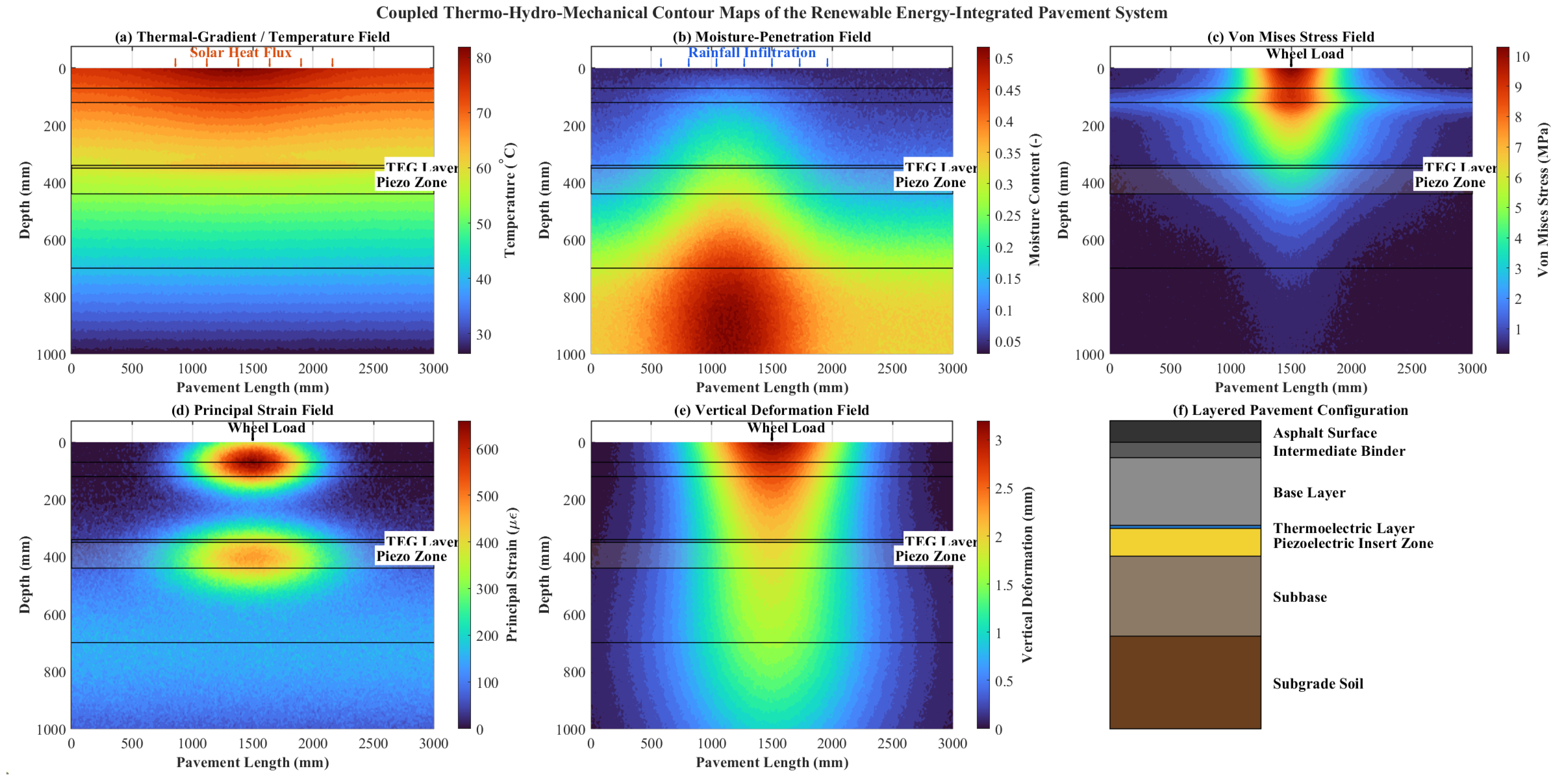
5. Conclusions and Future Work
This study developed a novel simulation-driven intelligent framework for renewable energy-integrated pavement assessment by unifying coupled thermo-hydro-mechanical finite element modeling, structured dataset generation, and graph-based reliability-aware artificial intelligence within a single computational pipeline. The proposed seven-layer pavement system, incorporating embedded thermoelectric and piezoelectric functional zones, was modeled in Abaqus under moving wheel load, solar heat flux, rainfall infiltration, and internal moisture diffusion, enabling the extraction of a high-fidelity dataset containing 6000 simulation cases and 68 variables across structural, thermal, hydraulic, renewable-energy, and reliability domains. To preserve the physical hierarchy of the layered pavement in the learning stage, the proposed LaRGO-Net reformulated each case as a layer-coupled graph and integrated adaptive interlayer coupling, graph-level aggregation, global scenario embedding, and physics-aware multi-task optimization. The experimental results confirmed a clear monotonic improvement from baseline dense and shallow graph models to the full LaRGO-Net configuration, with the best model achieving mean RMSE = 0.040, mean MAE = 0.028, mean , and reliability prediction performance of F1 = 99.21 and AUC = 99.53. These findings demonstrate that reliable prediction of renewable energy-integrated pavement behavior is best achieved when the artificial intelligence model explicitly reflects the layered physical structure, coupled field interactions, and engineering reliability logic of the system. Despite these promising results, the present validation remains primarily numerical because the dataset was generated from Abaqus-based thermo-hydro-mechanical simulations rather than from laboratory or field measurements. Therefore, the reported performance should be interpreted as evidence of internal generalization within the controlled simulation domain, not as complete field-level validation. Incorporating laboratory data from instrumented pavement sections and field measurements of harvested energy would substantially strengthen the credibility of the proposed surrogate model and verify whether the learned relationships reflect real-world physical behavior rather than only simulation consistency. Future experimental validation may include measured vertical deflection, asphalt tensile strain, subgrade compressive strain, temperature gradients, moisture content, pore-pressure response, thermoelectric voltage, piezoelectric voltage, harvested power, and energy-conversion efficiency under controlled traffic and environmental conditions. Such measurements could be used as an external test set for LaRGO-Net; as calibration data for uncertain material, hydraulic, thermal, and energy-conversion parameters in the finite element model; and as domain-adaptation data for updating the surrogate model under field-observed pavement behavior. Future work should also examine graph-masking, transfer-learning, and fine-tuning strategies for pavement cross-sections with different layer numbers, missing thermoelectric or piezoelectric components, or additional functional layers, so that the proposed graph operator can be adapted to practical pavement designs beyond the seven-layer configuration evaluated in this study.
Author Contributions
Conceptualization, N.L. and M.Q.A.-J.; methodology, N.L. and M.Q.A.-J.; software, M.A.; validation, N.L., M.Q.A.-J. and M.A.; formal analysis, N.L. and M.A.; investigation, N.L.; resources, M.Q.A.-J.; data curation, M.A.; writing—original draft preparation, N.L. and M.Q.A.-J.; writing—review and editing, N.L., M.Q.A.-J. and M.A.; visualization, M.A.; supervision, N.L. and M.Q.A.-J.; project administration, N.L.; funding acquisition, M.Q.A.-J. All authors have read and agreed to the published version of the manuscript.
Funding
This research was supported and funded by Al-Ahliyya University, Amman, Jordan.
Data Availability Statement
The data presented in this study are available upon request from the corresponding author due to institutional restrictions on sharing the complete simulation-generated dataset and finite element postprocessing files, which contain project-specific modeling parameters and unpublished computational outputs.
Acknowledgments
The authors gratefully acknowledge the institutional support provided by Al-Ahliyya University, Amman, Jordan, which contributed to the successful completion of this research work.
Conflicts of Interest
The authors declare no conflicts of interest.
References
- Mou, K.; Ji, X.; Liu, J.; Zhou, H.; Tian, H.; Li, X.; Liu, H. Using piezoelectric technology to harvest energy from pavement: A review. J. Traffic Transp. Eng. (Engl. Ed.) 2025, 12, 68–86. [Google Scholar] [CrossRef] [Scilit]
- Rahmani, M.; Kim, Y.-R. Coupled thermo-mechanical modeling of reflective cracking in flexible pavements. Int. J. Solids Struct. 2025, 308, 113129. [Google Scholar] [CrossRef] [Scilit]
- Priyanka, D.; Gao, L. Advances in technologies for energy harvesting from pavements: A comprehensive review. Appl. Sci. 2026, 16, 3634. [Google Scholar] [CrossRef] [Scilit]
- Ma, J.; Chen, J.; Tang, M.; Liu, Y. Multi-scale modeling and damage mechanisms of asphalt pavements under coupled salt-thermal-mechanical effects. Materials 2025, 18, 2337. [Google Scholar] [CrossRef] [Scilit] [PubMed]
- Chen, L.; Li, H.; Wang, S.; Shan, F.; Han, Y.; Zhong, G. Imporved model for pavement performance prediction based on recurrent neural network using LTPP database. Int. J. Transp. Sci. Technol. 2025, 19, 128–138. [Google Scholar] [CrossRef] [Scilit]
- Liu, F.; Al-Qadi, I.L. Graph neural network-based 3D asphalt concrete pavement response modelling. Int. J. Pavement Eng. 2025, 26, 2464201. [Google Scholar] [CrossRef] [Scilit]
- Liu, F.; Al-Qadi, I.L. Physics-informed graph neural network for 3D spatiotemporal structural response modeling of flexible pavements. Eng. Appl. Artif. Intell. 2025, 162, 112391. [Google Scholar] [CrossRef] [Scilit]
- Hei, T.; Tong, Z.; Xie, Z.; Ma, T. An all-in-one performance prediction model for pavement management engineering based on Bayesian neural network. Adv. Eng. Inform. 2026, 71, 104413. [Google Scholar] [CrossRef] [Scilit]
- Yin, C.; Mao, M.; Tang, Y.; Liu, S.; Yuan, Q.; Liu, Y.; Yang, Z.; Miao, L.; Li, H. Finite Element Modeling and Experimental Study on an Innovative Pavement Module Integrated Photovoltaic-Piezoelectric Effects. Energy 2026, 353, 141017. [Google Scholar] [CrossRef] [Scilit]
- Wang, Q.-A.; Huang, X.-Y.; Ni, Y.-Q.; Feng, W.-S.; Wang, J.-F.; Qiu, S.; Zhou, P.; Li, J.-P.; Luo, Y. Uncertainty-aware, high-precision multi-step prediction of structural health monitoring sensor streams under extreme typhoon events: An enhanced Bayesian dynamic linear model leveraging the kernel regression basis function for severe environmental adaptation. Measurement 2025, 262, 120050. [Google Scholar]
- Cho, H.; Yu, J.; Moon, H.; Yoon, J.; Lee, J.; Kim, G.; Park, J.; Ryu, S. Real-time structural health monitoring with Bayesian neural networks: Distinguishing aleatoric and epistemic uncertainty for digital twin frameworks. arXiv 2025, arXiv:2512.03115. [Google Scholar] [CrossRef] [Scilit]
- Lanthaler, S.; Stuart, A.M. The parametric complexity of operator learning. IMA J. Numer. Anal. 2026, 46, 647–712. [Google Scholar] [CrossRef] [Scilit]
- Rajagiri, S. Deep learning model for enterprise process performance prediction: Graph convolutional network approach. Int. J. Future Innov. Sci. Technol. (IJFIST) 2026, 9, 103–113. [Google Scholar] [CrossRef] [Scilit]
- Li, K.; He, Y.; Li, K.; Liu, C. Adaptive fractional-order admittance control for force tracking in highly dynamic unknown environments. Ind. Robot. Int. J. Robot. Res. Appl. 2023, 50, 530–541. [Google Scholar] [CrossRef] [Scilit]
- Shahid, M.; Ševrović, M.; Hassani, A.; Olyslagers, M. Multi-scale spatio-temporal feature aggregation for road safety attributes classification from videos. IEEE Access 2026, 14, 65668–65686. [Google Scholar] [CrossRef] [Scilit]
- Al-Jamal, M.Q.; Alsarhan, A.; Aljamal, Q.; AlJamal, M.; Khassawneh, B.S.; Al Nuaim, A.; Al Nuaim, A. AI-enabled system-of-systems decision support: BIM-integrated AI-LCA for resilient and sustainable fiber-reinforced façade design. Information 2026, 17, 126. [Google Scholar] [CrossRef] [Scilit]
- Fan, X.; Huang, L.; Qi, D.; Xia, J. BLIP: A BiGRU-based framework for load decomposition and electricity consumption behavior pattern recognition in smart grids. Int. J. Pattern Recognit. Artif. Intell. 2026, 40, 2650006. [Google Scholar] [CrossRef] [Scilit]
- Louzi, N.; Arabiat, A.M.; AlJamal, M. A counterfactual AI-based system for spatio-temporal traffic risk prediction and intelligent safety intervention in smart transportation systems. Infrastructures 2026, 11, 152. [Google Scholar] [CrossRef] [Scilit]
- Al-Jamal, M.Q.; Alsarhan, A.; AlJamal, M.; Aljamal, Q.; Khassawneh, B.S.; Salhi, A.; Hayat, H. Integrating generative design and artificial intelligence for optimized energy-efficient composite facades in next-generation smart buildings. Sustainability 2026, 18, 2379. [Google Scholar] [CrossRef] [Scilit]
- Söding, H.; Maurer, H.; Koedel, U.; Fechner, T. Time-domain inversion for source functions and receiver coupling with an application to a seismic full-waveform crosshole data set. Geophys. J. Int. 2026, 244, ggaf435. [Google Scholar] [CrossRef] [Scilit]
Disclaimer/Publisher’s Note: The statements, opinions and data contained in all publications are solely those of the individual author(s) and contributor(s) and not of MDPI and/or the editor(s). MDPI and/or the editor(s) disclaim responsibility for any injury to people or property resulting from any ideas, methods, instructions or products referred to in the content. |
© 2026 by the authors. Licensee MDPI, Basel, Switzerland. This article is an open access article distributed under the terms and conditions of the Creative Commons Attribution (CC BY) license.